WO2010146901A1 - Composé alicyclique, son procédé de production, composite contenant ledit composé et procédé de formation d'un motif de réserve l'utilisant - Google Patents
Composé alicyclique, son procédé de production, composite contenant ledit composé et procédé de formation d'un motif de réserve l'utilisant Download PDFInfo
- Publication number
- WO2010146901A1 WO2010146901A1 PCT/JP2010/054240 JP2010054240W WO2010146901A1 WO 2010146901 A1 WO2010146901 A1 WO 2010146901A1 JP 2010054240 W JP2010054240 W JP 2010054240W WO 2010146901 A1 WO2010146901 A1 WO 2010146901A1
- Authority
- WO
- WIPO (PCT)
- Prior art keywords
- carbon atoms
- general formula
- group
- alicyclic compound
- formula
- Prior art date
- Legal status (The legal status is an assumption and is not a legal conclusion. Google has not performed a legal analysis and makes no representation as to the accuracy of the status listed.)
- Ceased
Links
- 0 CCC1(CC(C2)C3)CC3(*)CC2(*)C1 Chemical compound CCC1(CC(C2)C3)CC3(*)CC2(*)C1 0.000 description 1
Images

Classifications
-
- C—CHEMISTRY; METALLURGY
- C07—ORGANIC CHEMISTRY
- C07J—STEROIDS
- C07J9/00—Normal steroids containing carbon, hydrogen, halogen or oxygen substituted in position 17 beta by a chain of more than two carbon atoms, e.g. cholane, cholestane, coprostane
- C07J9/005—Normal steroids containing carbon, hydrogen, halogen or oxygen substituted in position 17 beta by a chain of more than two carbon atoms, e.g. cholane, cholestane, coprostane containing a carboxylic function directly attached or attached by a chain containing only carbon atoms to the cyclopenta[a]hydrophenanthrene skeleton
-
- G—PHYSICS
- G03—PHOTOGRAPHY; CINEMATOGRAPHY; ANALOGOUS TECHNIQUES USING WAVES OTHER THAN OPTICAL WAVES; ELECTROGRAPHY; HOLOGRAPHY
- G03F—PHOTOMECHANICAL PRODUCTION OF TEXTURED OR PATTERNED SURFACES, e.g. FOR PRINTING, FOR PROCESSING OF SEMICONDUCTOR DEVICES; MATERIALS THEREFOR; ORIGINALS THEREFOR; APPARATUS SPECIALLY ADAPTED THEREFOR
- G03F7/00—Photomechanical, e.g. photolithographic, production of textured or patterned surfaces, e.g. printing surfaces; Materials therefor, e.g. comprising photoresists; Apparatus specially adapted therefor
- G03F7/004—Photosensitive materials
- G03F7/039—Macromolecular compounds which are photodegradable, e.g. positive electron resists
- G03F7/0392—Macromolecular compounds which are photodegradable, e.g. positive electron resists the macromolecular compound being present in a chemically amplified positive photoresist composition
Definitions
- the present invention relates to an alicyclic compound, a method for producing the same, a composition containing the alicyclic compound, and a resist pattern forming method using the alicyclic compound, and more specifically, an alicyclic compound that functions as a positive photoresist, that is, usually an alkali.
- DNQ diazonaphthoquinone
- Patent Documents 2 to 7 have developed polyphenolic low molecular compounds such as calixarene and calixresorcinalene as materials for semiconductor production by lithography. Although these are easy to synthesize, since they have an aromatic ring, they cannot be used for light sources with short wavelengths such as KrF and ArF due to light absorption. Usually, the wavelength that can be used for exposure is limited to g-line or i-line of a high-pressure mercury lamp, or soft X-ray. Therefore, several various alicyclic low-molecular compounds have been proposed for application to ArF excimer laser, which is the current state-of-the-art mass production exposure technology (see Patent Documents 8 to 11).
- Patent Document 12 a fully alicyclic low-molecular compound
- the compound group described in these is an all alicyclic compound, it has high transparency and lithography with an arbitrary light source is possible. Furthermore, it is possible to build a process having a thermal margin with a material having an adamantane skeleton and excellent thermal stability.
- a specific compound see Compound No. GR-5 of Patent Document 12
- has a high solubility in a developing solution and there is a problem that it is necessary to use a diluted developing solution.
- various low molecular weight compounds have been proposed as dissolution inhibitors in the lithography technology using existing polymer resists (see Patent Documents 13 to 14). However, these compounds have a low heat resistance because their molecular weight is too small. It can be said that the material is unsuitable for the recent high-temperature semiconductor manufacturing process.
- the present invention is useful as a dissolution inhibitor for flat panel displays (FPD) or an interlayer insulating film, a positive photoresist monomer used for manufacturing semiconductor devices, or other dissolution inhibitors under the above circumstances.
- An object of the present invention is to provide an alicyclic compound excellent in solubility characteristics, exposure sensitivity, resolution, roughness, heat resistance, etc., a production method thereof, a composition containing the same, and a resist pattern forming method using the same. .
- the present inventors have solved the above problems by using an alicyclic compound in which one or two cholic acid ester structure-containing groups are bonded to the adamantane skeleton.
- the present invention has been completed. That is, the present invention 1.
- R a to R c represent a cholic acid ester structure-containing group represented by the following general formula (a), and the other R a to R c are each independently , Represents a hydrogen atom, a hydroxyl group or a halogen atom.
- R d, R e and R f represents a hydrogen atom, a hydroxyl group or the following general formula (b1) ⁇ (b5) an oxygen-containing organic group having 2 to 30 carbon atoms represented by any one of
- R g And R h each independently represents a linear, branched or cyclic hydrocarbon group having 1 to 10 carbon atoms which may have a hydrogen atom or a hetero atom, and n represents 1 or 2.
- A represents a single bond or a divalent hydrocarbon group having 1 to 5 carbon atoms.
- Z 1 represents a linear, branched or cyclic hydrocarbon group having 1 to 15 carbon atoms which may have a hetero atom.
- Z 2 represents a linear, branched or cyclic hydrocarbon group having 1 to 15 carbon atoms which may have a hetero atom.
- Z 3 is a linear, branched or cyclic hydrocarbon group having 1 to 9 carbon atoms which may have a hetero atom, and R i and R j are each independently a hydrogen atom.
- Z 4 represents a linear, branched or cyclic hydrocarbon group having 1 to 15 carbon atoms which may have a hetero atom.
- Z 5 to Z 7 each independently represents a linear, branched or cyclic hydrocarbon group having 1 to 10 carbon atoms which may have a hetero atom.
- One selected from cholic acids represented by any of the following general formulas (c1) to (c5) and 1-vinyloxyadamantane, 1-halogenomethoxyadamantane, 1-vinyloxymethyladamantane and 1-methylthiomethoxyadamantane The method for producing an alicyclic compound according to any one of the above 1 to 6, characterized by reacting the above, 8).
- a composition comprising at least the alicyclic compound according to any one of 1 to 6 above, 10. Furthermore, the composition of said 9 containing a solvent and an acid generator, 11.
- composition of said 9 or 10 containing a quencher, 12 12.
- a resist pattern forming method including a step of forming I will provide a.
- the alicyclic compound of the present invention is excellent in dissolution characteristics, exposure sensitivity, resolution, roughness, heat resistance and the like, and particularly excellent in dissolution inhibiting effect on a developer.
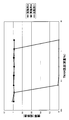
- FIG. It is a figure which compares the change of the film thickness with respect to the TMAH density
- FIG. It is a figure which compares the change of the film thickness with respect to the TMAH density
- the present invention provides an alicyclic compound represented by the following general formula (1).
- R a to R c represent a cholic acid ester structure-containing group represented by the following general formula (a), and the other R a to R c are each independently , Represents a hydrogen atom, a hydroxyl group or a halogen atom.
- R a to R c are preferably represented by the general formula (a), and other R a to R c are preferably hydrogen atoms.
- R d in the general formula (a) represents a hydrogen atom, a hydroxyl group or an oxygen-containing organic group having 2 to 30 carbon atoms represented by any of the following general formulas (b1) to (b5), preferably a hydroxyl group or An oxygen-containing organic group having 2 to 30 carbon atoms represented by any one of the general formulas (b1) to (b5), more preferably a hydroxyl group or an oxygen-containing organic group having 2 to 15 carbon atoms represented by the following general formula (b1) Organic group.
- R e and R f in the general formula (a) are each independently a hydrogen atom, a hydroxyl group, or an oxygen-containing organic group having 2 to 30 carbon atoms represented by any of the following general formulas (b1) to (b5).
- a hydrogen atom, a hydroxyl group or an oxygen-containing organic group having 2 to 15 carbon atoms represented by any of the following general formulas (b1) to (b5) more preferably a hydrogen atom or a hydroxyl group.
- R g and R h in the general formula (a) are each independently a hydrogen atom or a linear, branched or cyclic hydrocarbon group having 1 to 10 carbon atoms which may have a hetero atom.
- n represents 1 or 2, and preferably 1.
- a in the general formula (a) represents a single bond or a divalent hydrocarbon group having 1 to 5 carbon atoms, preferably a single bond.
- linear, branched or cyclic hydrocarbon group having 1 to 10 carbon atoms which may have a heteroatom represented by R g and R h in the general formula (a) include a methyl group, Linear hydrocarbon group such as ethyl group, n-propyl group, n-butyl group, n-pentyl group, n-hexyl group, n-heptyl group, isopropyl group, sec-butyl group, tert-butyl group, isopentyl Group, a branched hydrocarbon group such as neopentyl group, and a cyclic hydrocarbon group such as cyclopentyl group, cyclohexyl group and adamantyl group.
- Linear hydrocarbon group such as ethyl group, n-propyl group, n-butyl group, n-pentyl group, n-hexyl group, n-heptyl group, isoprop
- hetero atom that R g and R h have include a nitrogen atom, an oxygen atom, and a sulfur atom.
- divalent hydrocarbon group having 1 to 5 carbon atoms represented by A in the general formula (a) include a methylene group, an ethylene group, a trimethylene group, a tetramethylene group, and a pentamethylene group.
- Z 1 in the general formula (b1) represents a linear, branched or cyclic hydrocarbon group having 1 to 15 carbon atoms which may have a hetero atom, preferably a straight chain having 1 to 5 carbon atoms. A chain, branched or cyclic hydrocarbon group is shown.
- Z 2 in the general formula (b2) represents a linear, branched or cyclic hydrocarbon group having 1 to 15 carbon atoms which may have a hetero atom, preferably a straight chain having 1 to 8 carbon atoms. A chain, branched or cyclic hydrocarbon group is shown.
- Z 3 in the general formula (b3) represents a linear, branched or cyclic hydrocarbon group having 1 to 9 carbon atoms which may have a hetero atom, preferably a straight chain having 1 to 4 carbon atoms.
- a chain, branched or cyclic hydrocarbon group is shown.
- R i and R j in the general formula (b3) each independently represent a hydrogen atom or a linear, branched or cyclic hydrocarbon group having 1 to 10 carbon atoms which may have a hetero atom, Preferably, it represents a hydrogen atom or a linear, branched or cyclic hydrocarbon group having 1 to 5 carbon atoms.
- Z 4 in the general formula (b4) represents a linear, branched or cyclic hydrocarbon group having 1 to 15 carbon atoms which may have a hetero atom, preferably a straight chain having 1 to 8 carbon atoms. A chain, branched or cyclic hydrocarbon group is shown.
- Z 5 to Z 7 in the general formula (b5) each independently represent a linear, branched or cyclic hydrocarbon group having 1 to 10 carbon atoms which may have a hetero atom, preferably A linear, branched or cyclic hydrocarbon group having 1 to 5 carbon atoms.
- cyclic hydrocarbon group and the straight, branched or cyclic hydrocarbon group having 1 to 10 carbon atoms which may have a hetero atom represented by Z 5 to Z 7 in the general formula (b5) examples include methyl, ethyl, n-propyl, n-butyl, n-pe A linear hydrocarbon group such as an nyl group, n-hexyl group, n-heptyl group, n-octyl group, n-nonyl group, n-decanyl group, isopropyl group, isobutyl group, sec-butyl group, tert-butyl Groups, branched hydrocarbon groups such as isopentyl group and neopentyl group, cyclopentyl group, cyclohexyl group, cycloheptyl group, cyclooctyl group, cyclononyl group, cyclodecanyl group, decalyl
- monovalent residue of monocyclic or polycyclic alkyl such as dodecane ring, ⁇ -butyrolactyl ring, 4-oxa-tricyclo [4.2.1.0 3,7 ] nonane-5-one 4,8-dioxa-tricyclo [4.2.1.0 3,7 ] nonane-5-one, 4-oxa-tricyclo [4.3.1.1 3,8 ] undecan-5-one, etc.
- the alicyclic structure-containing compound of the present invention can be produced by various methods, and typical examples thereof include the following production methods A to D, but are not limited thereto.
- Manufacturing method A A method in which an adamantane structure-containing alcohol is reacted with a hydrogen halide gas in the presence of an aldehyde to obtain a halogenated alkyl ether, and an esterification reaction between the halogenated alkyl ether and cholic acids is performed.
- Production method B By reacting an adamantane structure-containing alcohol with an alkyl sulfoxide in the presence of an acid anhydride, an alkylthioalkyl ether is obtained, and a halogenated alkyl ether is obtained with a halogenating agent. Further, the halogenated alkyl ether and a cholic acid are obtained.
- a method of performing an esterification reaction with Production method C A method of carrying out an esterification reaction between an adamantane structure-containing vinyl ether and cholic acids in the presence of an acid catalyst.
- Manufacturing method D A method of performing a hydroxyl-protecting reaction of the alicyclic compound obtained by the above production methods A to C using an oxygen-containing organic compound.
- Examples of the adamantane structure-containing alcohol in the production method A include 1,3,5-adamantanetriol, 1,3,5-tris (hydroxymethyl) adamantane, 1,3-adamantanediol, 1,3-bis (hydroxymethyl) Examples thereof include adamantane, 1-adamantanol, 1- (hydroxymethyl) adamantane, and the like. 1,3-adamantanediol, 1,3-bis (hydroxymethyl) adamantane, 1-adamantanol, 1- (hydroxymethyl) adamantane Is preferred.
- aldehydes in Production Method A include linear or branched aliphatic aldehydes such as formaldehyde, paraformaldehyde, acetaldehyde, propionaldehyde, butyraldehyde, and isobutyraldehyde.
- the hydrogen halide gas in the production method A include a single gas such as hydrogen fluoride gas, hydrogen chloride gas, and hydrogen bromide gas, or a mixed gas thereof.
- Examples of cholic acids in Production Method A include lithocholic acid represented by the following formula (c1), deoxycholic acid represented by the following formula (c2), ursodeoxycholic acid represented by the following formula (c3), Examples thereof include saturated cholic acid analogs such as chenodeoxycholic acid represented by c4) and cholic acid represented by the following formula (c5).
- the halogenated alkyl ether compound in Production Method A can be obtained by reacting an adamantane structure-containing alcohol with hydrogen halide gas in the presence of aldehydes. At this time, it can be carried out in the presence or absence of an organic solvent, but when an organic solvent is used, there is no particular limitation as long as it is below the saturated solubility of the adamantane structure-containing alcohol, but the substrate concentration is 0. It is preferable to adjust to 1 mol / liter to 10 mol / liter. When the substrate concentration is 0.1 mol / liter or more, a necessary amount can be obtained in a normal reactor, which is economically preferable.
- organic solvents include hydrocarbon solvents such as hexane, heptane, cyclohexane, ethylcyclohexane, benzene, toluene, xylene, and ethers such as diethyl ether, dibutyl ether, tetrahydrofuran (THF), dioxane, dimethoxyethane (DME), etc.
- the solvent include halogen solvents such as dichloromethane and carbon tetrachloride.
- Halogen solvents having a high dissolved amount of hydrogen halide gas are preferable, and these may be used alone or in combination.
- the reaction temperature can be any temperature, but if it is too high, the solubility of the hydrogen halide gas decreases, and if it is too low, the reaction itself proceeds slowly.
- the pressure can be any pressure, normal pressure is preferable because side reactions need to be controlled under pressurized conditions. If the pressure is too high, a special pressure device is required, which is not economical.
- Specific examples of the halogenated alkyl ether thus obtained include 1,3-bis (halogenomethoxy) adamantane.
- the esterification reaction in Production Method A can be performed by reacting a halogenated alkyl ether with cholic acids in the presence of a base. From the viewpoint of reactivity, it is preferable to react with ⁇ -haloalkyl ether. Further, it can be carried out in the presence or absence of an organic solvent, but when an organic solvent is used, it is preferable to adjust the substrate concentration to be 0.1 mol / liter to 10 mol / liter. . When the substrate concentration is 0.1 mol / liter or more, a necessary amount can be obtained in a normal reactor, which is economically preferable. When the substrate concentration is 10 mol / liter or less, the temperature control of the reaction solution is controlled. It is easy and preferable.
- Usable organic solvents include hexane, heptane, cyclohexane, ethylcyclohexane, benzene, toluene, xylene and other hydrocarbon solvents, diethyl ether, dibutyl ether, tetrahydrofuran (THF), dioxane, dimethoxyethane (DME), and other ethers.
- Solvents such as dichloromethane and carbon tetrachloride, DMF (N, N-dimethylformamide), dimethyl sulfoxide (DMSO), N-methyl-2-pyrrolidone (NMP), hexamethylphosphate triamide (HMPA),
- aprotic polar solvents such as hexamethylphosphorous triamide (HMPT) and carbon disulfide, and these may be used alone or in combination.
- the base include sodium hydride, sodium hydroxide, potassium hydroxide, sodium carbonate, potassium carbonate, sodium bicarbonate, potassium bicarbonate, silver oxide, sodium phosphate, potassium phosphate, disodium monohydrogen phosphate, dipotassium hydrogen phosphate.
- the reaction product liquid is separated into water and an organic layer, and the product is extracted from the aqueous layer as necessary.
- the solvent is distilled off from the reaction solution under reduced pressure to obtain the alicyclic compound of the present invention.
- a purification method it can be selected from general purification methods such as distillation, extraction washing, crystallization, reprecipitation, activated carbon adsorption, silica gel column chromatography in consideration of production scale and required purity.
- the method by extraction washing, crystallization or reprecipitation is preferable because it can be handled at a relatively low temperature and can process a large amount of sample at one time.
- a method for removing the used raw material from the alicyclic compound of the present invention can be employed as a method for removing the used raw material from the alicyclic compound of the present invention, but from the viewpoint of operability and economics, the raw material is obtained using a poor solvent for the alicyclic compound.
- a method of washing is preferred.
- poor solvents for alicyclic compounds those having a low boiling point are preferable, and representative examples include diethyl ether, methanol, ethanol, n-hexane, and n-heptane.
- Production method B As the adamantane structure-containing alcohol and cholic acids in the production method B, those similar to the production method A are used.
- Examples of the alkyl sulfoxide in production method B include dimethyl sulfoxide, diethyl sulfoxide, di-n-propyl sulfoxide, diisopropyl sulfoxide, di-n-butyl sulfoxide, diisobutyl sulfoxide, di-sec-butyl sulfoxide, and di-tert-butyl sulfoxide.
- Symmetric or asymmetrical aliphatic sulfoxides such as diisopentyl sulfoxide, methylethyl sulfoxide, methyl-tert-butyl sulfoxide, etc., but considering the unity of the reaction product, preferably symmetric aliphatic sulfoxide is preferable. Further, dimethyl sulfoxide having a short chain length alkyl group is more preferable.
- Examples of the acid anhydride in Production Method B include acetic anhydride, propionic anhydride, butyric anhydride, isobutyric anhydride, valeric anhydride, pivalic anhydride, benzoic anhydride, chloroacetic anhydride, tri Aliphatic or aromatic carboxylic acid anhydrides such as fluoroacetic anhydride can be mentioned, and one or more can be used.
- Examples of the halogenating agent in the production method B include sulfur halide compounds such as thionyl chloride, sulfuryl chloride, thionyl bromide, sulfuryl bromide, thionyl chlorobromide, sulfuryl bromide bromide, phosphorus trichloride, and three odors.
- sulfur halide compounds such as thionyl chloride, sulfuryl chloride, thionyl bromide, sulfuryl bromide, thionyl chlorobromide, sulfuryl bromide bromide, phosphorus trichloride, and three odors.
- phosphorus halide compounds such as phosphorus iodide, phosphorus triiodide, phosphorous trichloride, phosphorous tribromide, phosphorus pentachloride, phosphorus pentabromide.
- the alkylthioalkyl ether compound in Production Method B can be obtained by reacting an adamantane structure-containing alcohol in the presence of an alkyl sulfoxide and an acid anhydride. At this time, the reaction can be carried out in the presence or absence of an organic solvent, but usually the reaction proceeds by using alkylsulfoxide and acid anhydride as a reaction reagent and solvent in a large excess.
- the substrate concentration is preferably adjusted to 1 mol / liter to 10 mol / liter. If the substrate concentration is 1 mol / liter or more, the necessary amount can be obtained in a normal reactor, which is economically preferable.
- the temperature of the reaction solution can be easily controlled.
- Usable organic solvents include hydrocarbon solvents such as hexane, heptane, cyclohexane, ethylcyclohexane, benzene, toluene, xylene, ethers such as diethyl ether, dibutyl ether, THF (tetrahydrofuran), dioxane, DME (dimethoxyethane), etc.
- the solvent include halogen solvents such as dichloromethane and carbon tetrachloride, and these may be used alone or in combination.
- the reaction temperature can be any temperature, but if it is too high, the selectivity decreases due to side reactions, and if it is too low, the progress of the reaction itself slows, so room temperature to 60 ° C. is preferable.
- the pressure can be any pressure, normal pressure is preferable because side reactions need to be controlled under pressurized conditions. If the pressure is too high, a special pressure device is required, which is not economical.
- Specific examples of the alkylthioalkyl ether thus obtained include 1-methylthiomethoxyadamantane, 1,3-bis (methylthiomethoxy) adamantane, and the like.
- the halogenated alkyl ether compound in Production Method B can be obtained by reacting the alkylthioalkyl ether compound with a halogenating agent.
- the reaction can be carried out in the presence or absence of an organic solvent, but a halogenating agent may be used in a large excess as a reaction reagent and a solvent.
- a halogenating agent may be used in a large excess as a reaction reagent and a solvent.
- the substrate concentration is 0.1 mol / liter or more, a necessary amount can be obtained in a normal reactor, which is economically preferable.
- the substrate concentration is 10 mol / liter or less, the temperature control of the reaction solution is controlled. It is easy and preferable.
- Usable organic solvents include hydrocarbon solvents such as hexane, heptane, cyclohexane, ethylcyclohexane, benzene, toluene, xylene, and ethers such as diethyl ether, dibutyl ether, tetrahydrofuran (THF), dioxane, dimethoxyethane (DME), etc.
- the solvent include halogen solvents such as dichloromethane and carbon tetrachloride, and these may be used alone or in combination.
- the reaction temperature can be any temperature, but if it is too high, the selectivity decreases due to side reactions, and if it is too low, the progress of the reaction itself slows, so room temperature to 100 ° C. is preferred.
- the pressure can be any pressure, normal pressure is preferable because side reactions need to be controlled under pressurized conditions. If the pressure is too high, a special pressure device is required, which is not economical. Specific examples of the halogenated alkyl ether thus obtained include 1,3-bis (halogenomethoxy) adamantane.
- the esterification reaction in production method B can be carried out in the same manner as the esterification reaction in production method A.
- Examples of the adamantane structure-containing vinyl ether in the production method C include 1-vinyloxyadamantane, 1-vinyloxymethyladamantane, 1,3-bis (vinyloxy) adamantane, 1,3-bis (vinyloxymethyl) adamantane, and the like. Can be mentioned.
- the cholic acids in the production method C the same ones as in the production method A are used.
- the acid catalyst in production method C include any organic and inorganic acids defined by Lewis acid, Bronsted acid, Arrhenius acid, etc., preferably formic acid, acetic acid, hydrochloric acid, sulfuric acid, nitric acid, methanesulfone.
- an adamantane structure-containing vinyl ether is reacted with cholic acids in the presence of an acid catalyst. At this time, it can be carried out in the presence or absence of an organic solvent, but when an organic solvent is used, there is no particular limitation as long as it is below the saturated solubility of the adamantane structure-containing vinyl ether. It is preferable to adjust to 1 mol / liter to 10 mol / liter.
- Organic solvents that can be used include hydrocarbon solvents such as hexane, heptane, cyclohexane, ethylcyclohexane, benzene, toluene, xylene, and ethers such as diethyl ether, dibutyl ether, tetrahydrofuran (THF), dioxane, and dimethoxyethane (DME).
- hydrocarbon solvents such as hexane, heptane, cyclohexane, ethylcyclohexane, benzene, toluene, xylene
- ethers such as diethyl ether, dibutyl ether, tetrahydrofuran (THF), dioxane, and dimethoxyethane (DME).
- the solvent examples include halogen solvents such as dichloromethane and carbon tetrachloride. Halogen solvents having a high dissolved amount of hydrogen halide gas are preferable, and these may be used alone or in combination.
- the reaction temperature can be any temperature, but if it is too high, a side reaction occurs in which the adamantane structure-containing vinyl ethers are polymerized. If it is too low, the reaction itself proceeds slowly, so 0 to 40 ° C. is preferable.
- the pressure can be any pressure, normal pressure is preferable because side reactions need to be controlled under pressurized conditions. If the pressure is too high, a special pressure device is required, which is not economical.
- the alicyclic compounds obtained by the above production methods A to C may be subjected to the following hydroxyl group protection reaction.
- the alicyclic compound used in the production method D those represented by the following general formula (1-1) are preferable.
- one or two of R a to R c each independently represents a cholic acid ester structure-containing group represented by the following general formula (a-1), preferably the following general formula (a -2) represents a group containing a cholic acid ester structure, and the other R a to R c each independently represents a hydrogen atom, a hydroxyl group or a halogen atom.
- R k and R l are each independently a hydrogen atom or a hydroxyl group.
- the oxygen-containing organic compound in Production Method D includes carboxylic acid halides represented by the following general formula (d1), carbonate ester anhydrides represented by the following general formula (d2), and alkyl halides represented by the following general formula (d3).
- carboxylic acid halides represented by the following general formula (d1) carbonate ester anhydrides represented by the following general formula (d2)
- alkyl halides represented by the following general formula (d3) One or more selected from ethers, halogenated acetates represented by the following general formula (d4) and silyl halides represented by the following general formula (d5) are used.
- Z 1 represents a linear, branched or cyclic hydrocarbon group having 1 to 15 carbon atoms which may have a hetero atom, and X represents a halogen atom.
- Z 2 represents a linear, branched or cyclic hydrocarbon group having 1 to 15 carbon atoms which may have a hetero atom.
- Z 3 is a linear, branched or cyclic hydrocarbon group having 1 to 9 carbon atoms which may have a hetero atom, and R m and R n are each independently a hydrogen atom. Alternatively, it represents a straight, branched or cyclic hydrocarbon group having 1 to 10 carbon atoms which may have a hetero atom, and X represents a halogen atom.
- Z 4 represents a linear, branched or cyclic hydrocarbon group having 1 to 15 carbon atoms which may have a hetero atom, and X represents a halogen atom.
- Z 5 to Z 7 each independently represents a linear, branched or cyclic hydrocarbon group having 1 to 10 carbon atoms which may have a hetero atom, and X represents a halogen atom. .
- Z 1 to Z 7 and X in the general formulas (d1) to (d5) are the same as those in the above (b1) to (b5).
- an oxygen-containing organic compound is reacted with the hydroxyl group of the alicyclic compound obtained in the production methods A to C.
- it can be carried out in the presence or absence of an organic solvent, but when an organic solvent is used, there is no particular limitation as long as it is below the saturated solubility of the alicyclic compound, but the substrate concentration is 0. It is preferable to adjust to 1 mol / liter to 10 mol / liter. When the substrate concentration is 0.1 mol / liter or more, a necessary amount can be obtained in a normal reactor, which is economically preferable. When the substrate concentration is 10 mol / liter or less, the temperature control of the reaction solution is controlled.
- Organic solvents that can be used include hydrocarbon solvents such as hexane, heptane, cyclohexane, ethylcyclohexane, benzene, toluene, xylene, and ethers such as diethyl ether, dibutyl ether, tetrahydrofuran (THF), dioxane, and dimethoxyethane (DME).
- the solvent include halogen solvents such as dichloromethane and carbon tetrachloride. Halogen solvents having a high dissolved amount of hydrogen halide gas are preferable, and these may be used alone or in combination.
- the reaction temperature can be any temperature, but if it is too high, decomposition of the existing ester bond or acetal bond occurs, and if it is too low, the reaction itself proceeds slowly, so 0 to 40 ° C. is preferable.
- the pressure can be any pressure, normal pressure is preferable because side reactions need to be controlled under pressurized conditions. If the pressure is too high, a special pressure device is required, which is not economical.
- the present invention also provides a composition containing the alicyclic compound of the present invention.
- the composition of the present invention preferably further contains a solvent, an acid generator, a quencher, various additives and the like.
- the composition of the present invention can be used for various applications such as circuit forming materials (resist for semiconductor production, printed wiring boards, etc.), image forming materials (printing plate materials, relief images, etc.), and in particular flat panel displays. It is preferably used as a dissolution inhibitor for (FPD), an interlayer insulating film, or a photoresist composition, and more preferably used as a positive photoresist composition.
- the present invention further provides a positive resist composition comprising the composition of the present invention.
- the positive resist composition of the present invention is not particularly limited as long as it contains the alicyclic structure-containing compound of the present invention, but contains the alicyclic structure of the present invention based on the total amount of the positive resist composition of the present invention. Those containing 2 to 50% by mass of the compound are preferred, and those containing 5 to 15% by mass are more preferred.
- the positive resist composition of the present invention includes a photoacid generator (PAG), a quencher such as an organic amine, an alkali-soluble resin (for example, novolak resin, phenol resin, imide resin, carboxyl Group-containing resins) and other alkali-soluble components, colorants (for example, dyes), organic solvents (for example, hydrocarbons, halogenated hydrocarbons, alcohols, esters, ketones, ethers, cellosolves) , Carbitols, glycol ether esters, a mixed solvent thereof, and the like) can be added.
- PAG photoacid generator
- a quencher such as an organic amine
- an alkali-soluble resin for example, novolak resin, phenol resin, imide resin, carboxyl Group-containing resins
- colorants for example, dyes
- organic solvents for example, hydrocarbons, halogenated hydrocarbons, alcohols, esters, ketones, ethers, cellosolves
- the photoacid generator examples include conventional compounds that efficiently generate acid upon exposure, such as diazonium salts, iodonium salts (for example, diphenyliodohexafluorophosphate), sulfonium salts (for example, triphenylsulfonium hexafluoroantimonate, Triphenylsulfonium hexafluorophosphate, triphenylsulfonium methanesulfonate, etc.), sulfonate esters [for example, 1-phenyl-1- (4-methylphenyl) sulfonyloxy-1-benzoylmethane, 1,2,3-trisulfonyloxy Methylbenzene, 1,3-dinitro-2- (4-phenylsulfonyloxymethyl) benzene, 1-phenyl-1- (4-methylphenylsulfonyloxymethyl) -1-hydroxy-1-benzoylmeta Etc.], o
- photoacid generators can be used alone or in combination of two or more. Furthermore, these photoacid generators can also be used as thermal acid generators.
- the amount of the photoacid generator used in the positive resist composition of the present invention can be appropriately selected according to the strength of the acid generated by light irradiation, the content of the alicyclic structure-containing compound, etc.
- the photoacid generator is preferably contained in an amount of 0.1 to 30 parts by mass, more preferably 1 to 25 parts by mass, and further preferably 2 to 20 parts by mass with respect to 100 parts by mass of the total amount of the ring structure-containing compound.
- the quencher may be arbitrarily selected from known ones such as aliphatic amines, cyclic amines, aromatic amines, etc. Among them, aliphatic amines, particularly secondary aliphatic amines and tertiary aliphatic amines are preferable.
- the aliphatic amine is an amine having one or more aliphatic groups, and the aliphatic groups preferably have 1 to 20 carbon atoms.
- the aliphatic amine include amines (alkyl amines or alkyl alcohol amines) or cyclic amines in which at least one hydrogen atom of ammonia NH 3 is substituted with an alkyl group or hydroxyalkyl group having 20 or less carbon atoms.
- alkylamine and alkyl alcohol amine include monoalkylamines such as n-hexylamine, n-heptylamine, n-octylamine, n-nonylamine, n-decylamine; diethylamine, di-n-propylamine, di- -Dialkylamines such as n-heptylamine, di-n-octylamine, dicyclohexylamine; trimethylamine, triethylamine, tri-n-propylamine, tri-n-butylamine, tri-n-hexylamine, tri-n-pentylamine Trialkylamines such as tri-n-heptylamine, tri-n-octylamine, tri-n-nonylamine, tri-n-decylamine, tri-n-dodecylamine; diethanolamine, triethanolamine, diisopropanolamine, Li iso
- Examples of the cyclic amine include heterocyclic compounds containing a nitrogen atom as a hetero atom.
- the heterocyclic compound may be monocyclic (aliphatic monocyclic amine) or polycyclic (aliphatic polycyclic amine).
- Specific examples of the aliphatic monocyclic amine include piperidine and piperazine.
- As the aliphatic polycyclic amine those having 6 to 10 carbon atoms are preferable. Specifically, 1,5-diazabicyclo [4.3.0] -5-nonene, 1,8-diazabicyclo [5. 4.0] -7-undecene, hexamethylenetetramine, 1,4-diazabicyclo [2.2.2] octane, and the like.
- Aromatic amines include aniline, pyridine, 4-dimethylaminopyridine, pyrrole, indole, pyrazole, imidazole or derivatives thereof, diphenylamine, triphenylamine, tribenzylamine, and the like.
- Other aliphatic amines include tris (2-methoxymethoxyethyl) amine, tris ⁇ 2- (2-methoxyethoxy) ethyl ⁇ amine, tris ⁇ 2- (2-methoxyethoxymethoxy) ethyl ⁇ amine, tris ⁇ 2 -(1-methoxyethoxy) ethyl ⁇ amine, tris ⁇ 2- (1-ethoxyethoxy) ethyl ⁇ amine, tris ⁇ 2- (1-ethoxypropoxy) ethyl ⁇ amine, tris [2- ⁇ 2- (2-hydroxy Ethoxy) ethoxy ⁇ ethylamine and the like. These may be used alone or in combination of two or more.
- the amount of quencher used in the resist composition of the present invention can be selected as appropriate in order to improve the resist pattern shape, stability over time, etc., for example, preferably with respect to 100 parts by mass of the alicyclic compound. It contains 0 to 10 parts by mass, more preferably 0.01 to 5.0 parts by mass of a quencher.
- the positive resist composition of the present invention is a mixture of the alicyclic structure-containing compound, a photoacid generator, a quencher, and, if necessary, the organic solvent and the like, and a contaminant such as a conventional solid such as a filter. It can be prepared by removing by separation means.
- the positive resist composition is applied onto a substrate or substrate, dried, and exposed to light (or further post-exposure baked) to expose the coating film (resist film) through a predetermined mask.
- a fine pattern can be formed with high accuracy.
- the present invention includes a step of hydrophobizing the support as necessary, a step of forming a resist film on the support using the positive resist composition, and a step of selectively exposing the resist film. And a step of forming a resist pattern by subjecting the selectively exposed resist film to an alkali development treatment.
- the hydrophobizing agent used for the hydrophobizing treatment may be arbitrarily selected from known ones, and is preferably bis (alkylsilyl) amine, more preferably hexamethyldisilazane (HMDS), for example.
- the support include a silicon wafer, metal, plastic, glass, and ceramic.
- the photoresist composition can be applied using a conventional application means such as a spin coater, a dip coater, or a roller coater.
- the thickness of the coating film is, for example, preferably 0.01 to 20 ⁇ m, more preferably 0.05 to 1 ⁇ m.
- light beams of various wavelengths such as ultraviolet rays and X-rays, can be used.
- semiconductor resists usually g-line, i-line, and excimer lasers (for example, XeCl, KrF, KrCl). , ArF, ArCl, etc.), soft X-rays, etc. are used.
- the exposure energy is, for example, about 0.1 to 1000 mJ / cm 2 , preferably about 1 to 100 mJ / cm 2 . Since the alicyclic compound contained in the positive resist composition has an acetal structure, it has an acid decomposition function. Therefore, an acid is generated from the photoacid generator by the selective exposure, and the acetal structure portion of the structure based on the alicyclic compound is rapidly eliminated by this acid, thereby generating a carboxyl group and a hydroxyl group contributing to solubilization. To do. Therefore, a predetermined pattern can be formed with high accuracy by performing development using water or an alkali developer.
- Example 1 Synthesis of cholic acid adamantane-1-oxymethyl
- 1-adamantanol [formula: 152.23, 15 g, 98.5 mmol]
- DMSO dimethyl sulfoxide
- acetic anhydride 75 ml were added and stirred for 20 hours.
- 50 ml of water and 100 ml of diethyl ether were added to the reaction mixture, and after shaking and standing, the aqueous layer and the organic layer were separated.
- 50 ml of diethyl ether was added to the aqueous layer again, and after shaking and standing, the aqueous layer and the organic layer were separated. This was repeated two more times.
- Example 2 Synthesis of successionntane adamantane-1,3-dioxymethyl) 1,3-adamantanol [formula: 168.23, 10 g, 59.4 mmol], dimethyl sulfoxide (DMSO) 150 ml and acetic anhydride 75 ml were added to a 300 ml flask and stirred for 50 hours. 50 ml of water and 100 ml of diethyl ether were added to the reaction mixture, and after shaking and standing, the aqueous layer and the organic layer were separated. 50 ml of diethyl ether was added to the aqueous layer again, and after shaking and standing, the aqueous layer and the organic layer were separated.
- DMSO dimethyl sulfoxide
- Example 3 (Preparation of composition) To the adamantane-1-oxymethyl cholic acid obtained in Example 1, 5% by mass of triphenylsulfonium nonafluorobutanesulfonate was added as a photoacid generator, and dissolved in cyclohexanone so that these were 5% by mass. Composition R3 was prepared. The prepared resist composition was applied on an untreated silicon wafer and a silicon wafer treated with HMDS (hexamethyldisilazane), and baked at 110 ° C. for 60 seconds to form a resist film. The silicon wafer thus obtained was developed with a TMAH (tetramethylammonium hydroxide) aqueous solution (2.38% by mass) diluted with water for 30 seconds. The change in film thickness with respect to the TMAH concentration at this time is shown in Table 1 and FIG.
- TMAH tetramethylammonium hydroxide
- Example 4 (Preparation of composition)
- Example 3 is the same as Example 3 except that resist composition R4 was prepared using adamantane-1,3-dioxymethyl dicholate obtained in Example 2 instead of adamantane-1-oxymethyl cholic acid obtained in Example 1. The same was done.
- the change of the film thickness with respect to the TMAH concentration is shown in Table 1 and FIG.
- Comparative Example 1 (Preparation of composition) A resist composition R5 was prepared using a compound GR-5 represented by the following formula in place of the adamantane-1-oxymethyl cholic acid obtained in Example 1, except that ethyl lactate was used instead of cyclohexanone. The same operation as in Example 3 was performed. The change of the film thickness with respect to the TMAH concentration is shown in Table 1 and FIG. Even if the resist composition R5 was applied on a silicon wafer that had been subjected to HMDS treatment, the resist composition R5 was repelled and could not be formed.
- the alicyclic compound of the present invention is useful for positive resist composition applications.
Landscapes
- Physics & Mathematics (AREA)
- Spectroscopy & Molecular Physics (AREA)
- Chemical & Material Sciences (AREA)
- Organic Chemistry (AREA)
- General Physics & Mathematics (AREA)
- Health & Medical Sciences (AREA)
- General Health & Medical Sciences (AREA)
- Steroid Compounds (AREA)
- Materials For Photolithography (AREA)
Abstract
L'invention porte sur un composé alicyclique dans lequel un ou deux groupes qui contiennent des structures esters d'acide cholique sont liés à un squelette d'adamantane. Ledit composé alicyclique est utile comme inhibiteur de dissolution, monomère de résine photosensible positive utilisé dans la fabrication de dispositif à semi-conducteur, ou similaire, et a d'excellentes propriétés de solubilité, sensibilité à l'exposition, résolution, rugosité, résistance à la chaleur, et similaire, et en particulier présente une excellente inhibition de la dissolution en termes de solution de conception. L'invention porte également sur un procédé permettant de produire le composé alicyclique susmentionné, sur un composite contenant le composé alicyclique et sur un procédé de formation d'un motif de réserve l'utilisant.
Applications Claiming Priority (2)
| Application Number | Priority Date | Filing Date | Title |
|---|---|---|---|
| JP2009-146808 | 2009-06-19 | ||
| JP2009146808A JP2011001319A (ja) | 2009-06-19 | 2009-06-19 | 脂環式化合物、その製造方法、それを含む組成物及びそれを用いたレジストパターン形成方法 |
Publications (1)
| Publication Number | Publication Date |
|---|---|
| WO2010146901A1 true WO2010146901A1 (fr) | 2010-12-23 |
Family
ID=43356231
Family Applications (1)
| Application Number | Title | Priority Date | Filing Date |
|---|---|---|---|
| PCT/JP2010/054240 Ceased WO2010146901A1 (fr) | 2009-06-19 | 2010-03-12 | Composé alicyclique, son procédé de production, composite contenant ledit composé et procédé de formation d'un motif de réserve l'utilisant |
Country Status (3)
| Country | Link |
|---|---|
| JP (1) | JP2011001319A (fr) |
| TW (1) | TW201111340A (fr) |
| WO (1) | WO2010146901A1 (fr) |
Cited By (1)
| Publication number | Priority date | Publication date | Assignee | Title |
|---|---|---|---|---|
| JP2016099544A (ja) * | 2014-11-25 | 2016-05-30 | 信越化学工業株式会社 | ポジ型レジスト材料並びにこれを用いたパターン形成方法 |
Families Citing this family (1)
| Publication number | Priority date | Publication date | Assignee | Title |
|---|---|---|---|---|
| KR20140029704A (ko) * | 2012-08-29 | 2014-03-11 | 금호석유화학 주식회사 | 레지스트용 산 확산 억제제 및 이를 포함하는 레지스트 조성물 |
Citations (4)
| Publication number | Priority date | Publication date | Assignee | Title |
|---|---|---|---|---|
| JP2006003781A (ja) * | 2004-06-21 | 2006-01-05 | Tokyo Ohka Kogyo Co Ltd | ポジ型レジスト組成物及びレジストパターン形成方法 |
| JP2007193328A (ja) * | 2006-01-19 | 2007-08-02 | Samsung Electronics Co Ltd | フォトレジスト組成物及びこれを用いるフォトレジストパターンの形成方法 |
| WO2007094784A1 (fr) * | 2006-02-16 | 2007-08-23 | Cornell Research Foundation, Inc. | Photoresists de verre moleculaire a base d'adamantane pour lithographie sub-200 nm |
| JP2009265623A (ja) * | 2008-03-31 | 2009-11-12 | Hitachi Chem Co Ltd | シリカ系ポジ型感光性樹脂組成物 |
-
2009
- 2009-06-19 JP JP2009146808A patent/JP2011001319A/ja active Pending
-
2010
- 2010-03-12 WO PCT/JP2010/054240 patent/WO2010146901A1/fr not_active Ceased
- 2010-04-22 TW TW99112729A patent/TW201111340A/zh unknown
Patent Citations (4)
| Publication number | Priority date | Publication date | Assignee | Title |
|---|---|---|---|---|
| JP2006003781A (ja) * | 2004-06-21 | 2006-01-05 | Tokyo Ohka Kogyo Co Ltd | ポジ型レジスト組成物及びレジストパターン形成方法 |
| JP2007193328A (ja) * | 2006-01-19 | 2007-08-02 | Samsung Electronics Co Ltd | フォトレジスト組成物及びこれを用いるフォトレジストパターンの形成方法 |
| WO2007094784A1 (fr) * | 2006-02-16 | 2007-08-23 | Cornell Research Foundation, Inc. | Photoresists de verre moleculaire a base d'adamantane pour lithographie sub-200 nm |
| JP2009265623A (ja) * | 2008-03-31 | 2009-11-12 | Hitachi Chem Co Ltd | シリカ系ポジ型感光性樹脂組成物 |
Non-Patent Citations (1)
| Title |
|---|
| TANAKA, S. ET AL.: "Adamantane Based Molecular Glass Resist for 193nm Lithography", PROC. OF SPIE, vol. 6153, no. 61532B, 2006, pages 1 - 12 * |
Cited By (1)
| Publication number | Priority date | Publication date | Assignee | Title |
|---|---|---|---|---|
| JP2016099544A (ja) * | 2014-11-25 | 2016-05-30 | 信越化学工業株式会社 | ポジ型レジスト材料並びにこれを用いたパターン形成方法 |
Also Published As
| Publication number | Publication date |
|---|---|
| JP2011001319A (ja) | 2011-01-06 |
| TW201111340A (en) | 2011-04-01 |
Similar Documents
| Publication | Publication Date | Title |
|---|---|---|
| JP5608009B2 (ja) | ホモアダマンタン誘導体、その製造方法及びフォトレジスト組成物 | |
| JP6646633B2 (ja) | 光酸発生剤およびこれを含むフォトレジスト | |
| KR101944305B1 (ko) | 광산 발생제 및 이를 포함하는 포토레지스트 | |
| JP5687442B2 (ja) | 光酸発生剤およびこれを含むフォトレジスト | |
| KR101857467B1 (ko) | 설포닐 광산 발생제 및 이를 포함하는 포토레지스트 | |
| KR101806155B1 (ko) | 콜레이트 광산 발생제 및 이를 포함하는 포토레지스트 | |
| TWI452432B (zh) | 化學放大型光阻組成物及浸漬式微影用之化學放大型光阻組成物 | |
| JP2009114381A (ja) | (メタ)アクリル酸エステル樹脂 | |
| KR20120052188A (ko) | 락톤 광산발생제, 수지 및 이들을 포함하는 포토레지스트 | |
| JP6472097B2 (ja) | スルホン酸誘導体、それを用いた光酸発生剤、レジスト組成物及びデバイスの製造方法 | |
| KR20010085618A (ko) | 신규의 모노머, 폴리머, 그의 합성 방법 및 포토레지스트조성물 | |
| WO2009142142A1 (fr) | Composé contenant une structure alicyclique, (méth)acrylate, polymère (méth)acrylique et composition de résist positif contenant le polymère (méth)acrylique | |
| JP5286236B2 (ja) | 感活性光線性又は感放射線性樹脂組成物、それを用いて形成した膜及びそれを用いたパターン形成方法 | |
| KR101739886B1 (ko) | 감활성광선성 또는 감방사선성 수지 조성물, 그 조성물을 사용한 감활성광선성 또는 감방사선성 수지막 및 패턴 형성 방법 | |
| WO2010146901A1 (fr) | Composé alicyclique, son procédé de production, composite contenant ledit composé et procédé de formation d'un motif de réserve l'utilisant | |
| TWI471700B (zh) | A positive resist composition, a photoresist pattern formation method, and a polymer compound | |
| JP2003002883A (ja) | ラクトン構造を有する(メタ)アクリレート化合物、その重合体、レジスト材料及びパターン形成方法 | |
| JP3975790B2 (ja) | 感放射線性樹脂組成物 | |
| JP5329211B2 (ja) | ラクトン骨格を含む高分子化合物及びフォトレジスト組成物 | |
| KR20130020602A (ko) | 감활성 광선성 또는 감방사선성 수지 조성물, 및 이 조성물을 사용한 감활성 광선성 또는 감방사선성 수지막과 패턴 형성 방법 | |
| WO2010087339A1 (fr) | Composé alicyclique, procédé de fabrication de celui-ci, composition contenant celui-ci et procédé de formation de motif de résine photosensible utilisant ce composé | |
| TWI434864B (zh) | 化合物及含有該化合物的光阻組成物 |
Legal Events
| Date | Code | Title | Description |
|---|---|---|---|
| 121 | Ep: the epo has been informed by wipo that ep was designated in this application |
Ref document number: 10789278 Country of ref document: EP Kind code of ref document: A1 |
|
| NENP | Non-entry into the national phase |
Ref country code: DE |
|
| 122 | Ep: pct application non-entry in european phase |
Ref document number: 10789278 Country of ref document: EP Kind code of ref document: A1 |