WO2010143653A1 - ロール状医療用粘着テープおよびその製造方法 - Google Patents
ロール状医療用粘着テープおよびその製造方法 Download PDFInfo
- Publication number
- WO2010143653A1 WO2010143653A1 PCT/JP2010/059758 JP2010059758W WO2010143653A1 WO 2010143653 A1 WO2010143653 A1 WO 2010143653A1 JP 2010059758 W JP2010059758 W JP 2010059758W WO 2010143653 A1 WO2010143653 A1 WO 2010143653A1
- Authority
- WO
- WIPO (PCT)
- Prior art keywords
- adhesive tape
- roll
- nonwoven fabric
- medical adhesive
- pressure
- Prior art date
- Legal status (The legal status is an assumption and is not a legal conclusion. Google has not performed a legal analysis and makes no representation as to the accuracy of the status listed.)
- Ceased
Links
Images


Classifications
-
- A—HUMAN NECESSITIES
- A61—MEDICAL OR VETERINARY SCIENCE; HYGIENE
- A61F—FILTERS IMPLANTABLE INTO BLOOD VESSELS; PROSTHESES; DEVICES PROVIDING PATENCY TO, OR PREVENTING COLLAPSING OF, TUBULAR STRUCTURES OF THE BODY, e.g. STENTS; ORTHOPAEDIC, NURSING OR CONTRACEPTIVE DEVICES; FOMENTATION; TREATMENT OR PROTECTION OF EYES OR EARS; BANDAGES, DRESSINGS OR ABSORBENT PADS; FIRST-AID KITS
- A61F13/00—Bandages or dressings; Absorbent pads
- A61F13/02—Adhesive bandages or dressings
- A61F13/0269—Tapes for dressing attachment
-
- A—HUMAN NECESSITIES
- A61—MEDICAL OR VETERINARY SCIENCE; HYGIENE
- A61B—DIAGNOSIS; SURGERY; IDENTIFICATION
- A61B17/00—Surgical instruments, devices or methods
- A61B17/08—Wound clamps or clips, i.e. not or only partly penetrating the tissue ; Devices for bringing together the edges of a wound
- A61B17/085—Wound clamps or clips, i.e. not or only partly penetrating the tissue ; Devices for bringing together the edges of a wound with adhesive layer
-
- A—HUMAN NECESSITIES
- A61—MEDICAL OR VETERINARY SCIENCE; HYGIENE
- A61B—DIAGNOSIS; SURGERY; IDENTIFICATION
- A61B46/00—Surgical drapes
-
- A—HUMAN NECESSITIES
- A61—MEDICAL OR VETERINARY SCIENCE; HYGIENE
- A61K—PREPARATIONS FOR MEDICAL, DENTAL OR TOILETRY PURPOSES
- A61K9/00—Medicinal preparations characterised by special physical form
- A61K9/70—Web, sheet or filament bases ; Films; Fibres of the matrix type containing drug
-
- A—HUMAN NECESSITIES
- A61—MEDICAL OR VETERINARY SCIENCE; HYGIENE
- A61F—FILTERS IMPLANTABLE INTO BLOOD VESSELS; PROSTHESES; DEVICES PROVIDING PATENCY TO, OR PREVENTING COLLAPSING OF, TUBULAR STRUCTURES OF THE BODY, e.g. STENTS; ORTHOPAEDIC, NURSING OR CONTRACEPTIVE DEVICES; FOMENTATION; TREATMENT OR PROTECTION OF EYES OR EARS; BANDAGES, DRESSINGS OR ABSORBENT PADS; FIRST-AID KITS
- A61F13/00—Bandages or dressings; Absorbent pads
- A61F2013/00361—Plasters
- A61F2013/00544—Plasters form or structure
- A61F2013/00553—Plasters form or structure with detachable parts
- A61F2013/00561—Plasters form or structure with detachable parts with adhesive connecting means
Definitions
- the present invention relates to a roll medical adhesive tape, and more specifically, a medical adhesive tape having a non-woven fabric excellent in breathability and stretchability as a support is directly wound without a release liner (also referred to as “separator”).
- Roll-shaped medical adhesive tape with good workability when wearing gloves, hand cutting (hand cutting), parting ability (probability that the cut in the lateral direction of the tape is straight), and It relates to the manufacturing method.
- Medical adhesive tape is used to protect affected areas and wounds, and to fix gauze, absorbent cotton, catheters, tubes, shipping agents, and other skin surfaces.
- a medical pressure-sensitive adhesive tape has a layer structure in which a pressure-sensitive adhesive layer is provided on one side of a support made of paper, cloth, plastic film or the like.
- a soft vinyl chloride film is excellent in toughness, stress relaxation, printability, etc., and is inexpensive, and is therefore widely used as a support for emergency bandages.
- a plastic film does not have sufficient fit to the skin surface, and is insufficient in flexibility and breathability.
- non-woven fabrics are suitable as a support for medical pressure-sensitive adhesive tapes because they are excellent in air permeability and are not easily stuffy when applied.
- stretchable nonwoven fabrics made of polyurethane or polyester have been developed, and by using these nonwoven fabrics that have both stretchability and breathability as a support for adhesive tape, rashes, itchiness, erythema It is possible to obtain an adhesive tape that is less likely to cause skin disorders such as the above and that can follow the movement of the applied skin (see, for example, Patent Documents 1 and 2).
- a pressure-sensitive adhesive tape using a polyurethane nonwoven fabric excellent in breathability and stretchability as a support has various characteristics excellent as a medical pressure-sensitive adhesive tape (see, for example, Patent Documents 3 and 4).
- Patent Document 7 there is an example of an adhesive tape in which a non-woven fabric is treated with a chemical binder to provide a pattern that does not penetrate completely (see Patent Document 7).
- Patent Document 6 also describes that the hole may be in a recessed state that does not penetrate therethrough.
- Patent Document 8 there is an example (see Patent Document 8) in which a continuous or discontinuous pattern of concave portions is formed on a non-woven fabric having a thickness of 0.5 to 5 mm by embossing to improve hand tearability.
- This adhesive tape is applied to cleansing, cooking, wiper, and other applications. It differs from the medical adhesive tape in the technical field, and in the embossing process, the adhesive tape has a thickness of about 50 to 200 ⁇ m. Therefore, it is impossible to realize the hand cutting ability and parting ability required for the above.
- JP 2-14059 A (corresponding to US 5,239,701 and EP2390341875 A1) Japanese Patent Laid-Open No. 9-560 (corresponding to EP 0749756 A2) Japanese Patent Laid-Open No. 10-33585 Japanese Patent Laid-Open No. 11-9623 Japanese National Publication No. 9-502111 (corresponding to WO 95/06450 and US 5,496,605) JP 2007-330376 A (corresponding to US 2007/0212520 A1 and EP 1822261 A2) Japanese Patent No. 3431628 (corresponding to WO 93/15245, US 5,496,603, US 5,631,073 and US 5,679,190) JP 2000-345454 A
- the present invention has been made in view of the above-mentioned problems, and the problem is that it is a roll-shaped medical device that has good hand cutting properties, can be cut straight, and has good workability even when wearing gloves. It is to provide an adhesive tape for use.
- a pressure-sensitive adhesive layer is formed on one side of a support, and in a rolled medical pressure-sensitive adhesive tape wound in a roll shape, (1)
- the support is made of a nonwoven fabric formed from synthetic resin fibers having a fiber length of 1 to 20 mm, (2) On the back surface opposite to the pressure-sensitive adhesive layer of the support, a concave portion that is straight in the width direction perpendicular to the winding direction of the tape and does not penetrate through the nonwoven fabric by thermal perforation is formed, (3)
- the depth of the recesses is 5 to 60% of the thickness of the support, the interval between the recesses is 0.5 to 1.5 mm, and
- a rolled medical pressure-sensitive adhesive tape is provided in which the pressure-sensitive adhesive tape is wound so that the pressure-sensitive adhesive layer contacts the back surface of the support and is formed into a roll shape.
- the tear tear resistance in the width direction is 2.0 to 5.0 N
- the tear propagation resistance is 0.5 to 2.5 N / 25 mm
- the rolled medical adhesive tape has a tensile strength in the winding direction of 5 to 50 N / 25 mm, a parting ability of 80% or more, and a glove adhesive strength of 1.0 N or less.
- the nonwoven fabric has a thickness of 50 to 200 ⁇ m and a basis weight of 20 to 60 g / m 2 .
- a method for producing a roll-shaped medical pressure-sensitive adhesive tape including a step of forming a recess by thermal perforation with a heated embossing roll.
- a roll-like medical pressure-sensitive adhesive tape having a breathable nonwoven fabric as a support, which has good hand cutting properties and parting properties, and has good workability in a state where gloves are worn.
- a medical pressure-sensitive adhesive tape and a method for producing the same are provided.
- FIG. 1 is an explanatory diagram showing the shape of a sample piece used in the hand-cutting pseudo-test.
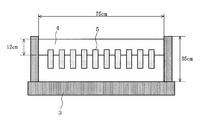
- FIG. 2 is a diagram showing a test apparatus used for measuring the 10-piece operation time.
- FIG. 3 is a photograph of the shape of the vicinity of the hand-cut portion of the test piece after the parting test for Example 1, Comparative Example 2, and Comparative Example 3 in order from the left.
- the rolled medical adhesive tape of the present invention (hereinafter sometimes simply referred to as “adhesive tape”) has an adhesive layer on at least one surface of the support.
- This support is composed of a nonwoven fabric.
- the nonwoven fabric used for the pressure-sensitive adhesive tape of the present invention is produced using fibers having a fiber length of 1 to 20 mm and a fineness of 1 to 30 denier.
- the fiber length is less than 1 mm, the strength when the nonwoven fabric sheet is formed is low, and when the fiber length exceeds 20 mm, the bonding points between the fibers increase, and the hand-cutting property is deteriorated.
- the fineness is less than 1 denier, the waist of the nonwoven fabric is lowered and the workability is deteriorated.
- the denier is more than 30 denier, the waist becomes too stiff and the feeling of strangeness when the adhesive tape is applied to the human body may be increased.
- the basis weight of the nonwoven fabric is preferably 20 to 60 g / m 2 and the thickness is preferably 50 to 200 ⁇ m.
- the fiber to be used may be a synthetic fiber having a property of melting with respect to heat.
- the material include polyolefins such as polyethylene and polypropylene, polyesters such as polyethylene terephthalate (PET), nylon, and polyurethane.
- PET polyethylene terephthalate
- nylon polyurethane.
- wood pulp or the like can be blended with these fibers at an arbitrary ratio for the purpose of softening the texture. When blending wood pulp, the ratio of synthetic fiber: wood pulp is preferably in the range of 99: 1 to 70:30 (weight ratio).
- the fibers are appropriately cut by thermal drilling, which is advantageous for hand cut performance.
- nonwoven fabrics manufactured by other manufacturing methods can also be used.
- the nonwoven fabric of the present invention preferably has a basis weight of 20 to 60 g / m 2 and more preferably 30 to 50 g / m 2 .
- the basis weight is less than 20 g / m 2 , the waist of the nonwoven fabric is lowered, so that the handling property is deteriorated.
- the basis weight exceeds 60 g / m 2 , the thermal bonding points between the fibers increase, the nonwoven fabric becomes strong, and the cut property tends to be lowered.
- the thickness of the nonwoven fabric of the present invention is preferably 50 to 200 ⁇ m, more preferably 80 to 150 ⁇ m.
- the thickness of the nonwoven fabric is measured in accordance with Japanese Industrial Standard JIS L 1096 with a pressure of 1 kPa applied to the nonwoven fabric.
- the non-woven fabric used in the present invention can be easily cut linearly by subjecting the non-woven fabric to thermal perforation that does not penetrate the non-woven fabric in a substantially straight continuous pattern.
- the degree of thermal drilling the hand cutting property can be controlled.
- the depth of each recess formed by thermal perforation is not necessarily uniform, but it is necessary to be within a range of 5 to 60% with respect to the thickness of the nonwoven fabric. If there is a recessed portion with a depth exceeding 60%, the tensile strength of the pressure-sensitive adhesive tape is remarkably reduced, and if there is a recessed portion with a depth less than 5%, it becomes difficult to impart hand cut performance.
- the depth of perforation means the depth of the recessed part from the surface of the nonwoven fabric support body before thermal perforation.
- the depth of the recess is measured by cutting a medical adhesive tape along the winding direction of the tape and taking a photograph of the cross section of the recess.
- the interval between the recesses formed by hot drilling is in the range of 0.5 to 1.5 mm, preferably in the range of 0.7 to 1.3 mm. If the gap between the recesses exceeds 1.5 mm, it may be necessary to check and select the cutting position when hand-cutting. If the gap between the concave portions is less than 0.5 mm, adjacent perforations interfere with each other, and when hand cutting is performed, the cuts may be cut across a plurality of perforations, and the cut may be inclined. From the viewpoint of hand-cutting properties, it is preferable that the intervals between the concave portions are equal intervals along the winding direction of the tape.
- interval of each recessed part means the distance along the winding direction of the tape of the deepest parts of an adjacent recessed part.
- a method of forming the recessed portion by hot drilling processing with a heating blade, processing with laser irradiation, processing with a heated embossing roll, and the like can be adopted.
- a method using a heated embossing roll is preferable.
- a heated embossing roll in which a linear continuous pattern is projected in the circumferential direction of the roll at a predetermined interval in the roll width direction and an anvil roll having a smooth surface are arranged to face each other.
- the depth of the recessed portion formed by thermal drilling can be adjusted by the distance between the embossing roll and the anvil roll.
- a metal roll is used as the embossing roll.
- As the anvil roll a stainless steel roll having a smooth surface, a rubber roll having a smooth surface coated with silicon rubber on a core metal, or the like can be used.
- the embossing roll needs to be heated to a temperature at which the synthetic fibers forming the nonwoven fabric melt. It is usually preferred to heat the embossing roll to a temperature between about 150 ° C and about 300 ° C.
- the anvil roll may not be heated, but may be heated to the same temperature as the embossing roll, if necessary, in order to avoid thermal influence on the embossing roll.
- the fiber melts in the thickness direction of the nonwoven fabric, and is formed into a film or cut.
- a recess is formed in the thickness direction.
- the tear strength is lowered because the fiber is partially cut. Therefore, the adhesive tape can be easily cut along the recessed portion, and the adhesive tape can be cut substantially linearly.
- the cross-sectional shape of the recessed portion formed by heat drilling is not particularly limited as long as the shape does not hinder hand cutability, but in the case of heat drilling by a heated embossing roll, an equilateral triangle or an isosceles triangle is used. It is preferable to use a triangular roof-shaped cross-sectional recess having a substantially triangular shape from the viewpoints of securing hand-cutting properties and ease of manufacturing.
- an acrylic pressure-sensitive adhesive, a rubber-based pressure-sensitive adhesive, a silicone-based pressure-sensitive adhesive, or the like is used, and among these, those having less skin irritation are preferable.
- Acrylic adhesives include homopolymers or copolymers of long chain (meth) acrylate monomers having about 4 to 12 carbon atoms such as butyl acrylate, 2-ethylhexyl acrylate, isononyl acrylate, or (meth) acrylic. 2 to 50% by weight of at least one other copolymerizable monomer such as (meth) acrylic acid, vinyl acetate, styrene, vinyl pyrrolidone, acrylamide, hydroxyethyl acrylate, hydroxypropyl acrylate, etc. A copolymer obtained by copolymerization within the range of%.
- the acrylic pressure-sensitive adhesive is a solvent type obtained by polymerizing the monomer in an organic solvent such as toluene, hexane, ethyl acetate, or the like, using a peroxide such as benzoyl peroxide as an initiator in a nitrogen atmosphere.
- an emulsion type obtained by polymerizing the monomer after emulsifying and dispersing the monomer in water with an emulsifier may be used.
- it is preferable to crosslink the polymer by adding an appropriate amount of a polyfunctional resin such as an epoxy resin to the acrylic pressure-sensitive adhesive before coating on the sheet or film support.
- the rubber-based pressure-sensitive adhesive examples include a composition in which a tackifier resin, a softener, and the like are blended with a rubber base such as synthetic polyisoprene rubber and styrene-isoprene-styrene block copolymer.
- the thickness of the pressure-sensitive adhesive layer is usually 10 to 200 ⁇ m, preferably 20 to 100 ⁇ m.
- the adhesive strength of the adhesive is the adhesive strength (peeling strength) of the adhesive tape to the bakelite plate (refers to the adhesive strength of the 25 mm wide adhesive tape to the bakelite plate, measured according to “180 degree peeling method” of JIS Z 0237). However, it is desirable to adjust so as to be within the range of 0.4 to 3.0 N / cm, more preferably 0.6 to 2.5 N / cm.
- the pressure-sensitive adhesive can be applied by a method in which a pressure-sensitive adhesive liquid using an organic solvent or water as a medium is directly applied onto a support by a coating apparatus such as a reverse roll coater, a comma roll coater, or a bar coater.
- the pressure-sensitive adhesive liquid is applied onto a high-quality paper treated with a release agent such as a silicone resin, a paper support such as glassine paper, or a so-called separator sheet such as a polyester film, and then dried in a hot air apparatus. It is also possible to employ a method in which a support is bonded onto the pressure-sensitive adhesive layer and the pressure-sensitive adhesive layer is transferred to one side of the support.
- Examples of the release agent that can be used in the present invention include a long-chain alkyl group pendant release agent and a silicone release agent.
- a long-chain alkyl group pendant release agent a copolymer of a straight-chain alkyl group-containing monomer having 12 or more carbon atoms such as stearyl acrylate, stearyl acrylamide, stearyl vinyl ether and acrylic acid, vinyl acetate, acrylonitrile, etc .; polyvinyl alcohol And a modified polymer obtained by pendating a polymer such as alkyroyl chloride with a long-chain alkyl component such as alkyl isocyanate.
- Fluorine-based release agents in which hydrogen atoms of these alkyl groups are replaced with fluorine atoms can also be used.
- silicone release agent examples include those obtained by crosslinking by using polydimethylsiloxane as a base polymer and blending polymethylhydrogensiloxane or the like. The crosslinking reaction is roughly classified into a condensation type and an addition type.
- the separator sheet is removed and wound up in a roll shape so that the pressure-sensitive adhesive layer is in direct contact with the back surface of the support.
- the winding is performed under mild conditions so as not to apply excessive tension on the core material such as a paper tube.
- roll medical adhesive by cutting to a predetermined width with a slitter and then winding to a fixed size, or cutting a semi-finished product to a predetermined width with a core cutter. Use tape.
- the roll medical adhesive tape of the present invention preferably has a tear end tear resistance in the width direction of 2.0 to 5.0 N, more preferably 2.5 to 4.5 N, in a hand-cutting forgery test described later.
- the tear propagation resistance is preferably in the range of 0.5 to 2.5 N / 25 mm, more preferably 1.0 to 2.0 N / 25 mm. desirable.
- the tear resistance in the width direction exceeds 5.0N, the hand tearability is inferior. If the tear resistance is less than 2.0N, it will be cut carelessly at the time of handling or sticking, and it is likely to cause practical problems. Become.
- the tear propagation resistance is ideally 0 N (completely cut in the width direction at the same time as the end crack), but if it is 0.5 to 2.5 N / 25 mm, hand cutting can be performed without stress. .
- the rolled medical adhesive tape of the present invention has an adhesive tape width of preferably 9 to 100 mm, more preferably 12 to 50 mm. From the viewpoint of hand cutting, it is desirable that there is no deviation in the distance in the direction of tape flow until it is done, and that the distance in the horizontal direction is straight. Specifically, when 10 pieces are hand-cut continuously, it is desirable that the probability that the cut end in the tape horizontal direction is a straight line (parting ability) is 80% or more. The upper limit of the parting ability is 100%, and in many cases 98%. If the cut end is not straight but loose (the cut surface is irregular), it will look bad, and when two pieces of tape are applied in a nearly perpendicular direction at a close distance, the backlash will interfere with the adjacent tape.
- the roll-like medical adhesive tape of the present invention has a tensile strength (A) in the longitudinal direction (winding direction) of the tape of preferably 5.0 to 50.0 N / 25 mm, more preferably 10.0 to 20.0 N. / 25 mm.
- A tensile strength
- the tensile strength is less than 5.0 N / 25 mm, there is a possibility of breaking due to insufficient strength when a thick material is fixed.
- the tensile strength in the longitudinal direction of the medical pressure-sensitive adhesive tape exceeds 50.0 N / 25 mm, the strength of the nonwoven fabric is increased, and thus the hand cut property is deteriorated.
- the unwinding force (B) of the rolled medical adhesive tape is preferably in the range of 0.5 to 4.0 N / 25 mm, more preferably 1.0 to 2.5 N / 25 mm.
- the unwinding force is preferably within the above range from the viewpoint of the unwinding property of the pressure-sensitive adhesive tape. If the rolled medical adhesive tape satisfies the relationship of tensile strength (A) in the longitudinal direction> rewinding force (B), it does not break during rewinding.
- the rolled medical pressure-sensitive adhesive tape of the present invention can be suitably used as a dressing tape, a surgical pressure-sensitive adhesive tape, or the like, which is used by being directly attached to human skin (skin).
- Test atmosphere Various characteristics were measured by adjusting the test atmosphere to a temperature of 23 ⁇ 2 ° C. and a relative humidity of 65 ⁇ 5%. The sample was previously conditioned in the same atmosphere for 24 hours.
- the data were obtained by determining the initial load (tear end resistance) which is the maximum load and the average value (tear propagation resistance) of the portion where the stress is relatively stable thereafter.
- Rewind force The unwinding force is obtained by loading a sample wound around a paper tube having a diameter of 1 inch onto a unwinding roller, fixing the unwinding roller to the lower chuck of a tensile testing machine (TENSILON RTC-1250 manufactured by ORIENTEC), and The 300 mm length was rewound at a speed of 300 ⁇ 20 mm per minute and the load at that time was measured.
- TENSILON RTC-1250 manufactured by ORIENTEC
- An acrylic pressure-sensitive adhesive (a copolymer of isononyl acrylate 83% by weight, methoxy nonaethylene glycol acrylate 16% by weight, and nonaethylene glycol methacrylate 1% by weight) was dried on a separator sheet, and the weight was 30 g / m. The coating was performed to be 2 . The above support (nonwoven fabric) was bonded onto the pressure-sensitive adhesive layer formed in this manner and adhered to obtain a pressure-sensitive adhesive tape.
- An embossing roll in which a roof-type horizontal straight protrusion having an isosceles triangular cross section having a height of 400 ⁇ m and a base of 500 ⁇ m is provided on a roll having a width of 300 mm and a diameter of 200 mm so that the distance between adjacent triangles is 500 ⁇ m.
- the heated embossing roll is opposed to an anvil roll having a smooth surface at room temperature, and the adhesive tape is passed between both rolls while the separator sheet is in contact with the anvil roll, thereby adhering the horizontal straight roof pattern. It applied to the opposite side (support surface side) of the agent application surface.
- the embossing roll was heated to 270 ° C.
- the formed recesses were 1 mm pitch in the tape winding direction (length direction; MD), and the perforation depth was 30 to 50 ⁇ m.
- the drilling depth indicates a range when 20 drilling depths are measured at intervals of 10 cm in the winding direction.
- the pressure-sensitive adhesive tape thus produced was wound up to a length of 7 m on a 1-inch diameter paper tube while peeling off the separator sheet, and cut into a width of 25 mm to produce a directly wound roll-shaped medical pressure-sensitive adhesive tape.
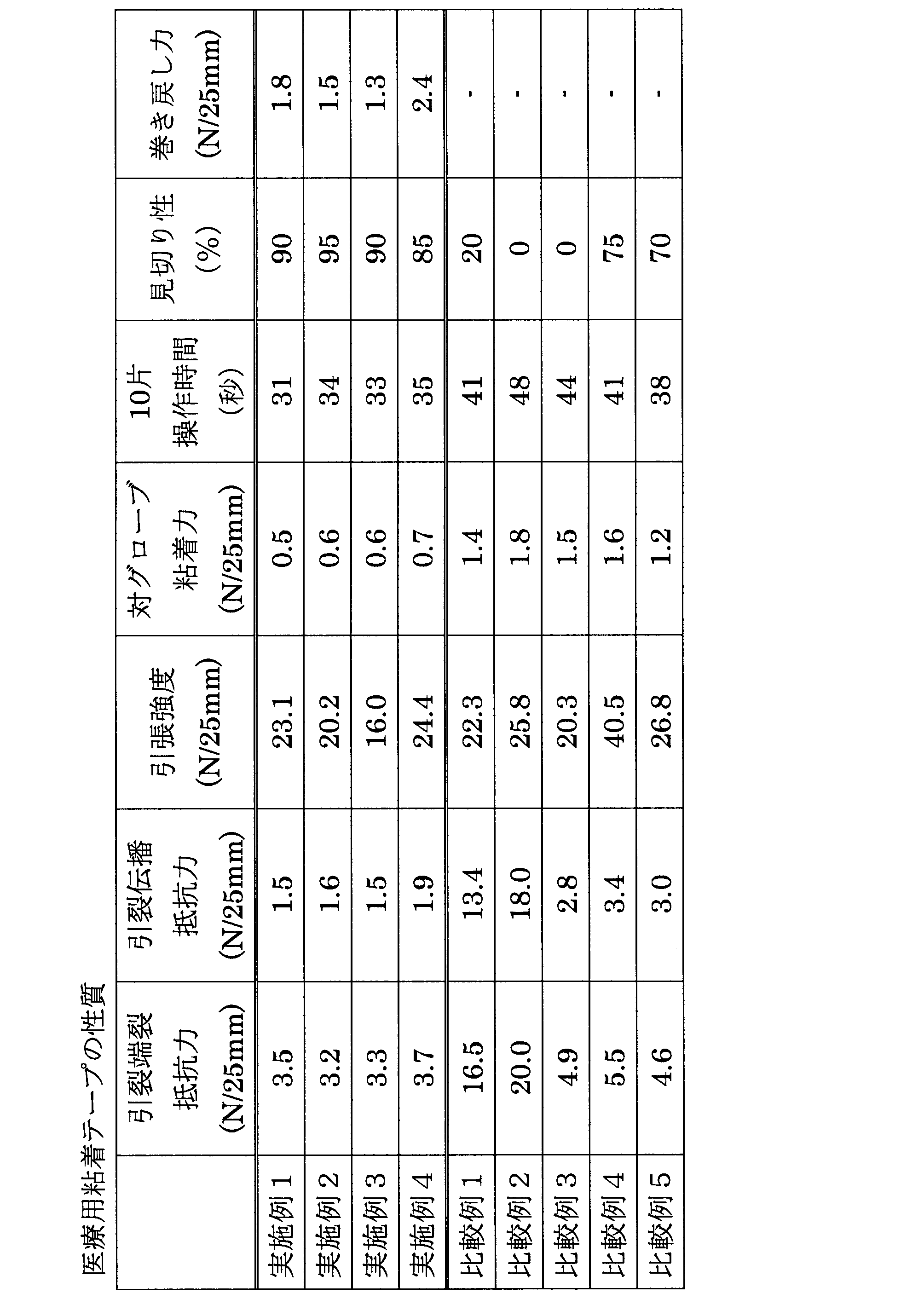
- Table 1 shows the composition of the nonwoven fabric and the shape of the recessed portion, and Table 2 shows the test results.
- Example 2 Roll medical as in Example 1 except that a polyester fiber having a fiber length of 5 mm and a fineness of 2 denier was used as the support, and a non-woven fabric having a basis weight of 35 g / m 2 and a thickness of 90 ⁇ m was used. An adhesive tape was prepared. Table 1 shows the composition of the nonwoven fabric and the shape of the recessed portion, and Table 2 shows the test results.
- Example 3 As a support, only a polypropylene fiber having a fiber length of 3 mm and a fineness of 1.5 denier was used, a nonwoven fabric having a basis weight of 40 g / m 2 and a thickness of 120 ⁇ m was used, and the temperature of the embossing roll was set to 150 ° C. Table 1 shows the composition of the nonwoven fabric and the shape of the recessed portion, and Table 2 shows the test results.
- a roll medical adhesive tape was prepared in the same manner as in Example 2 except that was used.
- Table 1 shows the composition of the nonwoven fabric and the shape of the recessed portion, and Table 2 shows the test results.
- Example 1 As a support, except that a spunbond nonwoven fabric having a fiber length of substantially infinite ( ⁇ ), a fineness of 5 denier polypropylene fiber, a basis weight of 40 g / m 2 and a thickness of 80 ⁇ m was used. A roll-like medical adhesive tape was produced in the same manner as in Example 2. According to the spunbond method, a nonwoven fabric composed of long fibers having a substantially infinite fiber length is formed. Table 1 shows the composition of the nonwoven fabric and the shape of the recessed portion, and Table 2 shows the test results.
- Table 1 shows the composition of the nonwoven fabric and the shape of the perforations
- Table 2 shows the test results for commercially available tapes that have a polypropylene nonwoven fabric and have through perforations.
- Table 1 shows the composition and shape of the nonwoven fabric and Table 2 shows the test results for a commercially available tape that is a polyester / pulp nonwoven fabric and does not have perforations or recesses.
- Table 1 shows the composition of the nonwoven fabric and the shape of the perforations
- Table 2 shows the test results for commercially available tapes that have a polyester / pulp nonwoven fabric and have through perforations.
- Table 1 shows the composition of the nonwoven fabric and the shape of the perforations
- Table 2 shows the test results for commercially available tapes that have a polyester / rayon nonwoven fabric support and have through perforations.
- the roll medical adhesive tapes of the present invention have good hand cutting properties and parting properties.
- the pressure-sensitive adhesive tapes of Examples 1 and 4 were excellent in hand cutting properties and parting properties, and also had good tensile strength.
- the roll medical adhesive tape of the present invention did not require excessive force when the tape was cut, so that the adhesive tape could be easily peeled off from the glove.
- the adhesive tape of Comparative Example 1 is not easily cut because the fibers of the non-woven fabric are melted, so that the fibers are not cut appropriately.
- the parting ability was also bad.
- the wound adhesive plaster using the commercially available nonwoven fabrics of Comparative Examples 2 to 5 as a support required force when hand-cut and also had poor parting properties as shown in FIG. Since the pressure-sensitive adhesive tapes of Comparative Examples 1 to 5 required force when cutting the tape, they adhered excessively to the glove, and it was difficult to remove the tape from the glove.
- the rolled medical pressure-sensitive adhesive tape of the present invention can be used in the medical field for protecting affected skin areas and fixing gauze, catheters, puncture needles, and the like.
- the roll medical adhesive tape of the present invention has good hand cutting ability, can be cut straight, and has good workability even when wearing gloves. It contributes to the improvement of treatment of diseases and injuries. Moreover, since a recessed part can be formed by the thermal drilling by a heating embossing roll, the roll-shaped medical adhesive tape with favorable hand cutting property can be manufactured cheaply. For this reason, the roll-shaped medical adhesive tape of this invention can also contribute to a patient burden and improvement of medical finance.
Landscapes
- Health & Medical Sciences (AREA)
- Life Sciences & Earth Sciences (AREA)
- Animal Behavior & Ethology (AREA)
- Surgery (AREA)
- Engineering & Computer Science (AREA)
- Veterinary Medicine (AREA)
- Public Health (AREA)
- General Health & Medical Sciences (AREA)
- Heart & Thoracic Surgery (AREA)
- Biomedical Technology (AREA)
- Molecular Biology (AREA)
- Medical Informatics (AREA)
- Epidemiology (AREA)
- Vascular Medicine (AREA)
- Nuclear Medicine, Radiotherapy & Molecular Imaging (AREA)
- Bioinformatics & Cheminformatics (AREA)
- Chemical & Material Sciences (AREA)
- Medicinal Chemistry (AREA)
- Pharmacology & Pharmacy (AREA)
- Adhesive Tapes (AREA)
Abstract
Description
(1)支持体が、繊維長1~20mmの合成樹脂繊維から形成された不織布からなり、
(2)支持体の粘着剤層とは反対側の背面に、テープの巻回方向に対して垂直の幅方向に一直線状の、熱穿孔による不織布を貫通しない凹陥部が形成されており、
(3)該凹陥部の深さが支持体の厚みに対して5~60%の深さであり、該凹陥部の間隔が0.5~1.5mmであって、かつ、
(4)粘着テープが、粘着剤層が該支持体の背面に接触するように巻き付けられてロール状に形成されたものである
ロール状医療用粘着テープが提供される。
(1)試験雰囲気:
試験雰囲気は、温度23±2℃、相対湿度65±5%に調整して各種特性の測定を行った。試料は、予め同雰囲気中で24時間コンディショニングした。
25×78mm幅に裁断したロール状医療用粘着テープの試料片に、図1に示すように等脚台形に印をつけて、その上下1、1’に配向ポリプロピレンテープ(OPPテープ)を貼着した。引張試験機(ORIENTEC社製TENSILON RTC-1250)を用い、つかみ間隔を10mmとし、試料片の台形の短辺(a)を張った状態で長辺(b)を緩めて、図1に示すつかみ部分2、2’を挟み、引張速度1000mm/分で引き裂く時の応力を測定した。
日本工業規格JIS K 7115に従って、前記の引張試験機で試料片の両端をまっすぐに、つかみ間隔50mm、引張速度300mm/分で引っ張り、破断するまでに示す最大の荷重を求めた。
手にプラスチックグローブ〔型番:ポリ塩化ビニル製プラスチックグローブ パウダーフリー No.50、(株)共和製〕を着装し、25mm幅の巻絆創膏(ロール状医療用粘着テープ)を約100mm長解きほぐした後、親指を巻絆創膏の背面に、人差し指を巻絆創膏の粘着剤面に当て、テープをハンドカットし、人差し指に粘着テープを付着させた。その後、テープの端部を把持し、前記引張試験機を用いて300mm/分の速度で引っ張り、グローブとテープが剥離するに要する荷重を求め、対グローブ粘着力とした。この試験を5人の被験者について行いその平均値を求めた。
手にプラスチックグローブ〔型番:ポリ塩化ビニル製プラスチックグローブ パウダーフリー No.50、(株)共和製〕を着装し、25mm幅の巻絆創膏(ロール状医療用粘着テープ)を解きほぐしつつ、約100mm長の試験片5を手切りしながら、図2に示す木製架台3に鉛直に固定されたガラス板4(75cm×12cm)に該試験片5の上部10~20mmを鉛直方向に貼付する作業を10回繰り返すことに要する時間を測定した。5人の被験者について行い、その平均値を求め、小数点以下を4捨5入した。
上記作業にて手切りされた10片の試験片の見切り性を目視により観察し、切り口が綺麗な(横一直線)試験片が占める割合を求めた。5人の被験者による試験を行い、その平均値を求め、2捨3入により5%刻みの値とした。実施例1、比較例2および比較例3について、見切り性試験後の試験片の手切り部近傍の形状の例を図3に示す。
巻き戻し力は、直径1インチの紙管に巻き付けたサンプルを巻戻し用ローラーに装填して、引張試験機(ORIENTEC社製TENSILON RTC-1250)の下部チャックに巻戻し用ローラーを固定し、毎分300±20mmの速度で300mm長を巻戻し、その時の荷重を測定した。
繊維長5mm、繊度2デニールのポリエステル繊維に木材パルプを混合(PET/パルプ=8:2)し、坪量を40g/m2、厚みを100μmとした不織布を支持体として使用した。この不織布は、エアレイド法により製造されたものである。
支持体として、繊維長5mm、繊度2デニールのポリエステル繊維のみを使用し、坪量を35g/m2、厚みを90μmとした不織布を使用したこと以外は、実施例1と同様にしてロール状医療用粘着テープを作製した。不織布の組成と凹陥部の形状を表1に、試験結果を表2に、それぞれ示す。
支持体として、繊維長3mm、繊度1.5デニールのポリプロピレン繊維のみを使用し、坪量を40g/m2、厚みを120μmとした不織布を使用し、かつエンボスロールの温度を150℃とした。不織布の組成と凹陥部の形状を表1に、試験結果を表2に、それぞれ示す。
支持体として、繊維長8mm、繊度7デニールのポリエステル繊維に木材パルプ及びテンセルを混合(PET/パルプ/テンセル=8:1:1)し、坪量を40g/m2、厚みを150μmとした不織布を使用したこと以外は、実施例2と同様にしてロール状医療用粘着テープを作製した。不織布の組成と凹陥部の形状を表1に、試験結果を表2に、それぞれ示す。
支持体として、繊維長が実質的に無限大(∞)で、繊度5デニールのポリプロピレン繊維を使用し、坪量を40g/m2、厚みを80μmとしたスパンボンド不織布を使用したこと以外は、実施例2と同様にしてロール状医療用粘着テープを作製した。スパンボンド法によれば、繊維長が実質的に無限大の長繊維からなる不織布が形成される。不織布の組成と凹陥部の形状を表1に、試験結果を表2に、それぞれ示す。
支持体がポリプロピレン不織布で、貫通穿孔を有する市販品テープについて、不織布の組成と穿孔の形状を表1に、試験結果を表2に、それぞれ示す。
支持体がポリエステル/パルプ不織布で、穿孔または凹陥部を有しない市販品テープについて、不織布の組成と形状を表1に、試験結果を表2に、それぞれ示す。
支持体がポリエステル/パルプ不織布で、貫通穿孔を有する市販品テープについて、不織布の組成と穿孔の形状を表1に、試験結果を表2に、それぞれ示す。
支持体がポリエステル/レーヨン不織布で、貫通穿孔を有する市販品テープについて、不織布の組成と穿孔の形状を表1に、試験結果を表2に、それぞれ示す。

(*1)「スキナゲートメッシュ」(ニチバン株式会社製、登録商標)
(*2)「ST-21N」(ニチバン株式会社製)
(*3)「優肌絆GS」(日東電工株式会社製)
(*4)「トランスポアホワイト」(スリーエムヘルスケア株式会社製、登録商標)
(*5)不織布の穿孔状態と直接関係ないので、測定していない。
2,2’: 手切れ性擬制試験におけるつかみ部分
3: 木製架台
4: ガラス板
5: 試験片
Claims (13)
- 支持体の片面に粘着剤層が形成され、ロール状に巻回されたロール状医療用粘着テープにおいて、
(1)支持体が、繊維長1~20mmの合成樹脂繊維から形成された不織布からなり、
(2)支持体の粘着剤層とは反対側の背面に、テープの巻回方向に対して垂直の幅方向に一直線状の、熱穿孔による不織布を貫通しない凹陥部が形成されており、
(3)該凹陥部の深さが支持体の厚みに対して5乃至60%の深さであり、該凹陥部の間隔が0.5~1.5mmであって、かつ、
(4)粘着テープが、粘着剤層が該支持体の背面に接触するように巻き付けられてロール状に形成されたものである
ロール状医療用粘着テープ。 - 本件明細書に開示されている測定法による手切れ性擬制試験において、幅方向の引裂端裂抵抗力が2.0~5.0Nであり、かつ、引裂伝播抵抗力が0.5~2.5N/25mmである請求項1記載のロール状医療用粘着テープ。
- 本件明細書に開示されている測定法により測定したテープの巻回方向の引張強度が、5.0~50.0N/25mmである請求項1記載のロール状医療用粘着テープ。
- 本件明細書に開示されている測定法により測定した見切り性が、80%以上である請求項1記載のロール状医療用粘着テープ。
- 本件明細書に開示されている測定法により測定した対グローブ粘着力が、1.0N以下である請求項1記載のロール状医療用粘着テープ。
- 該不織布の厚みが、50~200μmである請求項1記載のロール状医療用粘着テープ。
- 該不織布の坪量が、20~60g/m2である請求項1記載のロール状医療用粘着テープ。
- 該不織布の材質が、ポリオレフィン、ポリエステル、ナイロン、またはポリウレタンである請求項1記載のロール状医療用粘着テープ。
- 該不織布が、エアレイド法により製造されたものである請求項1記載のロール状医療用粘着テープ。
- 該粘着剤が、アクリル系粘着剤である請求項1記載のロール状医療用粘着テープ。
- 日本工業規格JIS Z 0237に従って測定した幅25mmの粘着テープのベークライト板に対する粘着力が、0.4~3.0N/cmである請求項1記載のロール状医療用粘着テープ。
- それぞれ明細書に記載の測定法により測定して、巻回方向の引張強度(A)が、巻き戻し力(B)よりも大きい請求項1記載のロール状医療用粘着テープ。
- 加熱エンボスロールによる熱穿孔によって、不織布を貫通しない凹陥部を形成する工程を含む請求項1記載のロール状医療用粘着テープの製造方法。
Priority Applications (3)
| Application Number | Priority Date | Filing Date | Title |
|---|---|---|---|
| HK12110575.8A HK1169799B (en) | 2009-06-12 | 2010-06-09 | Roll-shaped medical adhesive tape and manufacturing method therefor |
| CN201080025970.7A CN102458326B (zh) | 2009-06-12 | 2010-06-09 | 卷状医用胶带及其制造方法 |
| JP2011518555A JP5632373B2 (ja) | 2009-06-12 | 2010-06-09 | ロール状医療用粘着テープおよびその製造方法 |
Applications Claiming Priority (2)
| Application Number | Priority Date | Filing Date | Title |
|---|---|---|---|
| JP2009-140946 | 2009-06-12 | ||
| JP2009140946 | 2009-06-12 |
Publications (1)
| Publication Number | Publication Date |
|---|---|
| WO2010143653A1 true WO2010143653A1 (ja) | 2010-12-16 |
Family
ID=43308908
Family Applications (1)
| Application Number | Title | Priority Date | Filing Date |
|---|---|---|---|
| PCT/JP2010/059758 Ceased WO2010143653A1 (ja) | 2009-06-12 | 2010-06-09 | ロール状医療用粘着テープおよびその製造方法 |
Country Status (4)
| Country | Link |
|---|---|
| JP (1) | JP5632373B2 (ja) |
| KR (1) | KR20120037935A (ja) |
| CN (1) | CN102458326B (ja) |
| WO (1) | WO2010143653A1 (ja) |
Cited By (2)
| Publication number | Priority date | Publication date | Assignee | Title |
|---|---|---|---|---|
| WO2022043382A1 (en) | 2020-08-26 | 2022-03-03 | Bostik Sa | Hot melt adhesive composition |
| JP7806361B1 (ja) * | 2025-06-24 | 2026-01-27 | 二人 土居 | 保護シート |
Families Citing this family (2)
| Publication number | Priority date | Publication date | Assignee | Title |
|---|---|---|---|---|
| CN103450823A (zh) * | 2012-06-04 | 2013-12-18 | 亚化科技(东莞)胶粘制品有限公司 | 环保型免刀胶带 |
| CN107805465A (zh) * | 2017-10-23 | 2018-03-16 | 江阴通利光电科技有限公司 | 一种可重工无纺布阻燃胶带 |
Citations (6)
| Publication number | Priority date | Publication date | Assignee | Title |
|---|---|---|---|---|
| JP2000345454A (ja) * | 1999-06-04 | 2000-12-12 | Kao Corp | 不織布 |
| JP2001114672A (ja) * | 1999-08-10 | 2001-04-24 | Hisamitsu Pharmaceut Co Inc | ロール状外用貼付剤 |
| JP2002360625A (ja) * | 2001-06-04 | 2002-12-17 | Nichiban Co Ltd | 皮膚貼付用粘着テープ及びその製造方法 |
| JP2004229830A (ja) * | 2003-01-29 | 2004-08-19 | Nichiban Co Ltd | ロール状医療用粘着テープ |
| JP2007282734A (ja) * | 2006-04-13 | 2007-11-01 | Nitto Denko Corp | 粘着テープまたはシート |
| JP2007330376A (ja) * | 2006-06-13 | 2007-12-27 | Nitto Denko Corp | 医療用粘着テープもしくはシート |
Family Cites Families (1)
| Publication number | Priority date | Publication date | Assignee | Title |
|---|---|---|---|---|
| WO1995006450A1 (en) * | 1993-08-31 | 1995-03-09 | Minnesota Mining And Manufacturing Company | Perforated roll of nonwoven surgical tape |
-
2010
- 2010-06-09 JP JP2011518555A patent/JP5632373B2/ja active Active
- 2010-06-09 KR KR1020127000876A patent/KR20120037935A/ko not_active Ceased
- 2010-06-09 CN CN201080025970.7A patent/CN102458326B/zh not_active Expired - Fee Related
- 2010-06-09 WO PCT/JP2010/059758 patent/WO2010143653A1/ja not_active Ceased
Patent Citations (6)
| Publication number | Priority date | Publication date | Assignee | Title |
|---|---|---|---|---|
| JP2000345454A (ja) * | 1999-06-04 | 2000-12-12 | Kao Corp | 不織布 |
| JP2001114672A (ja) * | 1999-08-10 | 2001-04-24 | Hisamitsu Pharmaceut Co Inc | ロール状外用貼付剤 |
| JP2002360625A (ja) * | 2001-06-04 | 2002-12-17 | Nichiban Co Ltd | 皮膚貼付用粘着テープ及びその製造方法 |
| JP2004229830A (ja) * | 2003-01-29 | 2004-08-19 | Nichiban Co Ltd | ロール状医療用粘着テープ |
| JP2007282734A (ja) * | 2006-04-13 | 2007-11-01 | Nitto Denko Corp | 粘着テープまたはシート |
| JP2007330376A (ja) * | 2006-06-13 | 2007-12-27 | Nitto Denko Corp | 医療用粘着テープもしくはシート |
Cited By (3)
| Publication number | Priority date | Publication date | Assignee | Title |
|---|---|---|---|---|
| WO2022043382A1 (en) | 2020-08-26 | 2022-03-03 | Bostik Sa | Hot melt adhesive composition |
| EP4755625A2 (en) | 2020-08-26 | 2026-06-10 | Bostik SA | Hot melt adhesive composition |
| JP7806361B1 (ja) * | 2025-06-24 | 2026-01-27 | 二人 土居 | 保護シート |
Also Published As
| Publication number | Publication date |
|---|---|
| KR20120037935A (ko) | 2012-04-20 |
| CN102458326A (zh) | 2012-05-16 |
| HK1169799A1 (en) | 2013-02-08 |
| CN102458326B (zh) | 2014-09-24 |
| JPWO2010143653A1 (ja) | 2012-11-29 |
| JP5632373B2 (ja) | 2014-11-26 |
Similar Documents
| Publication | Publication Date | Title |
|---|---|---|
| CN101172072B (zh) | 医疗用粘性胶带或胶片 | |
| CA2582000C (en) | Pressure-sensitive adhesive tape or sheet | |
| JP6358874B2 (ja) | アクリル系粘着剤組成物、及び、粘着テープまたはシート | |
| CN102755216B (zh) | 拉伸粘合绷带 | |
| KR101943106B1 (ko) | 띠 형상 부착재의 권회체 | |
| JP5632373B2 (ja) | ロール状医療用粘着テープおよびその製造方法 | |
| JP4763157B2 (ja) | 皮膚貼付用粘着テープ及びその製造方法 | |
| JP4698189B2 (ja) | 粘着テープ | |
| JP4181883B2 (ja) | ロール状医療用粘着テープ | |
| JP2024105684A (ja) | 絆創膏及び絆創膏用ポリウレタン不織布 | |
| JP2012228347A (ja) | 伸縮性粘着包帯 | |
| JP2004083425A (ja) | 皮膚貼着用粘着部材 | |
| JP2013106719A (ja) | 伸縮性粘着包帯 | |
| JP4476009B2 (ja) | 皮膚貼付用粘着シート | |
| JP4884020B2 (ja) | 医療補助用粘着テープ | |
| JP5815188B2 (ja) | ロール状皮膚貼付材 | |
| JP2011067615A (ja) | 貼付材 | |
| JP2004073483A (ja) | 医療用粘着テープ及びその製造方法 | |
| JP2007330376A (ja) | 医療用粘着テープもしくはシート | |
| HK1169799B (en) | Roll-shaped medical adhesive tape and manufacturing method therefor | |
| JP4492868B2 (ja) | 絆創膏又は粘着ドレッシング | |
| JP2012045049A (ja) | 皮膚貼付材および皮膚貼付用テープ材 | |
| JP4947939B2 (ja) | 医療用粘着テープもしくはシート | |
| JP2023552590A (ja) | 医療用途のための有孔テープ | |
| JP2025111289A (ja) | ロール状掃除用粘着テープ |
Legal Events
| Date | Code | Title | Description |
|---|---|---|---|
| WWE | Wipo information: entry into national phase |
Ref document number: 201080025970.7 Country of ref document: CN |
|
| 121 | Ep: the epo has been informed by wipo that ep was designated in this application |
Ref document number: 10786184 Country of ref document: EP Kind code of ref document: A1 |
|
| ENP | Entry into the national phase |
Ref document number: 2011518555 Country of ref document: JP Kind code of ref document: A |
|
| NENP | Non-entry into the national phase |
Ref country code: DE |
|
| ENP | Entry into the national phase |
Ref document number: 20127000876 Country of ref document: KR Kind code of ref document: A |
|
| 122 | Ep: pct application non-entry in european phase |
Ref document number: 10786184 Country of ref document: EP Kind code of ref document: A1 |