WO2010140527A1 - 反応性ウレタン化合物、それを含む活性エネルギー線硬化型樹脂組成物、及びその用途 - Google Patents
反応性ウレタン化合物、それを含む活性エネルギー線硬化型樹脂組成物、及びその用途 Download PDFInfo
- Publication number
- WO2010140527A1 WO2010140527A1 PCT/JP2010/058981 JP2010058981W WO2010140527A1 WO 2010140527 A1 WO2010140527 A1 WO 2010140527A1 JP 2010058981 W JP2010058981 W JP 2010058981W WO 2010140527 A1 WO2010140527 A1 WO 2010140527A1
- Authority
- WO
- WIPO (PCT)
- Prior art keywords
- compound
- resin composition
- curable resin
- acid
- active energy
- Prior art date
- Legal status (The legal status is an assumption and is not a legal conclusion. Google has not performed a legal analysis and makes no representation as to the accuracy of the status listed.)
- Ceased
Links
Classifications
-
- C—CHEMISTRY; METALLURGY
- C08—ORGANIC MACROMOLECULAR COMPOUNDS; THEIR PREPARATION OR CHEMICAL WORKING-UP; COMPOSITIONS BASED THEREON
- C08F—MACROMOLECULAR COMPOUNDS OBTAINED BY REACTIONS ONLY INVOLVING CARBON-TO-CARBON UNSATURATED BONDS
- C08F299/00—Macromolecular compounds obtained by interreacting polymers involving only carbon-to-carbon unsaturated bond reactions, in the absence of non-macromolecular monomers
- C08F299/02—Macromolecular compounds obtained by interreacting polymers involving only carbon-to-carbon unsaturated bond reactions, in the absence of non-macromolecular monomers from unsaturated polycondensates
- C08F299/06—Macromolecular compounds obtained by interreacting polymers involving only carbon-to-carbon unsaturated bond reactions, in the absence of non-macromolecular monomers from unsaturated polycondensates from polyurethanes
- C08F299/065—Macromolecular compounds obtained by interreacting polymers involving only carbon-to-carbon unsaturated bond reactions, in the absence of non-macromolecular monomers from unsaturated polycondensates from polyurethanes from polyurethanes with side or terminal unsaturations
-
- C—CHEMISTRY; METALLURGY
- C08—ORGANIC MACROMOLECULAR COMPOUNDS; THEIR PREPARATION OR CHEMICAL WORKING-UP; COMPOSITIONS BASED THEREON
- C08F—MACROMOLECULAR COMPOUNDS OBTAINED BY REACTIONS ONLY INVOLVING CARBON-TO-CARBON UNSATURATED BONDS
- C08F290/00—Macromolecular compounds obtained by polymerising monomers on to polymers modified by introduction of aliphatic unsaturated end or side groups
- C08F290/02—Macromolecular compounds obtained by polymerising monomers on to polymers modified by introduction of aliphatic unsaturated end or side groups on to polymers modified by introduction of unsaturated end groups
- C08F290/06—Polymers provided for in subclass C08G
-
- C—CHEMISTRY; METALLURGY
- C08—ORGANIC MACROMOLECULAR COMPOUNDS; THEIR PREPARATION OR CHEMICAL WORKING-UP; COMPOSITIONS BASED THEREON
- C08F—MACROMOLECULAR COMPOUNDS OBTAINED BY REACTIONS ONLY INVOLVING CARBON-TO-CARBON UNSATURATED BONDS
- C08F290/00—Macromolecular compounds obtained by polymerising monomers on to polymers modified by introduction of aliphatic unsaturated end or side groups
- C08F290/02—Macromolecular compounds obtained by polymerising monomers on to polymers modified by introduction of aliphatic unsaturated end or side groups on to polymers modified by introduction of unsaturated end groups
- C08F290/06—Polymers provided for in subclass C08G
- C08F290/067—Polyurethanes; Polyureas
-
- C—CHEMISTRY; METALLURGY
- C08—ORGANIC MACROMOLECULAR COMPOUNDS; THEIR PREPARATION OR CHEMICAL WORKING-UP; COMPOSITIONS BASED THEREON
- C08F—MACROMOLECULAR COMPOUNDS OBTAINED BY REACTIONS ONLY INVOLVING CARBON-TO-CARBON UNSATURATED BONDS
- C08F299/00—Macromolecular compounds obtained by interreacting polymers involving only carbon-to-carbon unsaturated bond reactions, in the absence of non-macromolecular monomers
- C08F299/02—Macromolecular compounds obtained by interreacting polymers involving only carbon-to-carbon unsaturated bond reactions, in the absence of non-macromolecular monomers from unsaturated polycondensates
- C08F299/06—Macromolecular compounds obtained by interreacting polymers involving only carbon-to-carbon unsaturated bond reactions, in the absence of non-macromolecular monomers from unsaturated polycondensates from polyurethanes
-
- C—CHEMISTRY; METALLURGY
- C08—ORGANIC MACROMOLECULAR COMPOUNDS; THEIR PREPARATION OR CHEMICAL WORKING-UP; COMPOSITIONS BASED THEREON
- C08G—MACROMOLECULAR COMPOUNDS OBTAINED OTHERWISE THAN BY REACTIONS ONLY INVOLVING UNSATURATED CARBON-TO-CARBON BONDS
- C08G18/00—Polymeric products of isocyanates or isothiocyanates
- C08G18/06—Polymeric products of isocyanates or isothiocyanates with compounds having active hydrogen
- C08G18/28—Polymeric products of isocyanates or isothiocyanates with compounds having active hydrogen characterised by the compounds used containing active hydrogen
- C08G18/30—Low-molecular-weight compounds
- C08G18/34—Carboxylic acids; Esters thereof with monohydroxyl compounds
- C08G18/348—Hydroxycarboxylic acids
-
- G—PHYSICS
- G03—PHOTOGRAPHY; CINEMATOGRAPHY; ANALOGOUS TECHNIQUES USING WAVES OTHER THAN OPTICAL WAVES; ELECTROGRAPHY; HOLOGRAPHY
- G03F—PHOTOMECHANICAL PRODUCTION OF TEXTURED OR PATTERNED SURFACES, e.g. FOR PRINTING, FOR PROCESSING OF SEMICONDUCTOR DEVICES; MATERIALS THEREFOR; ORIGINALS THEREFOR; APPARATUS SPECIALLY ADAPTED THEREFOR
- G03F7/00—Photomechanical, e.g. photolithographic, production of textured or patterned surfaces, e.g. printing surfaces; Materials therefor, e.g. comprising photoresists; Apparatus specially adapted therefor
- G03F7/004—Photosensitive materials
- G03F7/0045—Photosensitive materials with organic non-macromolecular light-sensitive compounds not otherwise provided for, e.g. dissolution inhibitors
-
- G—PHYSICS
- G03—PHOTOGRAPHY; CINEMATOGRAPHY; ANALOGOUS TECHNIQUES USING WAVES OTHER THAN OPTICAL WAVES; ELECTROGRAPHY; HOLOGRAPHY
- G03F—PHOTOMECHANICAL PRODUCTION OF TEXTURED OR PATTERNED SURFACES, e.g. FOR PRINTING, FOR PROCESSING OF SEMICONDUCTOR DEVICES; MATERIALS THEREFOR; ORIGINALS THEREFOR; APPARATUS SPECIALLY ADAPTED THEREFOR
- G03F7/00—Photomechanical, e.g. photolithographic, production of textured or patterned surfaces, e.g. printing surfaces; Materials therefor, e.g. comprising photoresists; Apparatus specially adapted therefor
- G03F7/004—Photosensitive materials
- G03F7/027—Non-macromolecular photopolymerisable compounds having carbon-to-carbon double bonds, e.g. ethylenic compounds
-
- G—PHYSICS
- G03—PHOTOGRAPHY; CINEMATOGRAPHY; ANALOGOUS TECHNIQUES USING WAVES OTHER THAN OPTICAL WAVES; ELECTROGRAPHY; HOLOGRAPHY
- G03F—PHOTOMECHANICAL PRODUCTION OF TEXTURED OR PATTERNED SURFACES, e.g. FOR PRINTING, FOR PROCESSING OF SEMICONDUCTOR DEVICES; MATERIALS THEREFOR; ORIGINALS THEREFOR; APPARATUS SPECIALLY ADAPTED THEREFOR
- G03F7/00—Photomechanical, e.g. photolithographic, production of textured or patterned surfaces, e.g. printing surfaces; Materials therefor, e.g. comprising photoresists; Apparatus specially adapted therefor
- G03F7/004—Photosensitive materials
- G03F7/027—Non-macromolecular photopolymerisable compounds having carbon-to-carbon double bonds, e.g. ethylenic compounds
- G03F7/032—Non-macromolecular photopolymerisable compounds having carbon-to-carbon double bonds, e.g. ethylenic compounds with binders
- G03F7/035—Non-macromolecular photopolymerisable compounds having carbon-to-carbon double bonds, e.g. ethylenic compounds with binders the binders being polyurethanes
-
- H—ELECTRICITY
- H05—ELECTRIC TECHNIQUES NOT OTHERWISE PROVIDED FOR
- H05K—PRINTED CIRCUITS; CASINGS OR CONSTRUCTIONAL DETAILS OF ELECTRIC APPARATUS; MANUFACTURE OF ASSEMBLAGES OF ELECTRICAL COMPONENTS
- H05K3/00—Apparatus or processes for manufacturing printed circuits
- H05K3/22—Secondary treatment of printed circuits
- H05K3/28—Applying non-metallic protective coatings
- H05K3/285—Permanent coating compositions
- H05K3/287—Photosensitive compositions
Definitions
- the present invention is a reactive polyurethane compound that is hard to be modified or discolored by heat or light, can obtain a tough and flexible cured film, and is capable of photo-patterning by development, and an active energy ray curable type containing the same.
- the present invention relates to a resin composition, a cured product thereof, and further to its use.
- solder resists for film forming materials that cover circuits. It is getting higher and higher.
- heat resistance that can withstand the heat generation of elements during board manufacturing and operation using solder, etc.
- reliability by maintaining high insulation for a long time, performance that can withstand chemical treatment such as plating, etc.
- a film-forming material having toughened cured product performance but no material satisfying these various characteristics has been found.
- color resists used in manufacturing color filters used in so-called liquid crystal displays and organic EL displays are also modified and discolored by heat treatment during production, heat during use, and light, as with printed wiring boards. Therefore, there is a problem that the color reproducibility deteriorates. Therefore, there is a demand for a resist binder that can be finely patterned by alkali development and has no discoloration. Further, regarding the color filter, since a flexible color filter is required to realize a flexible display, the same flexibility as a flexible substrate is required.
- Patent Documents 1 and 2 and the like include attempts to use a compound having photoreactivity with an acrylic acid copolymer as a composition and impart reactivity to the acrylic acid copolymer.
- attempts to graft polymerizable ethylenically unsaturated groups are described.
- heat resistance such as heat treatment such as soldering at the time of element mounting and insulation for a long period of time are not possible. The reliability to keep was not enough.
- Patent Documents 4 and 5 and the like include a difunctional epoxycarboxylate compound containing an aromatic ring, a compound having two hydroxyl groups and one or more carboxyl groups in one molecule, and a reactive urethane acrylate compound comprising a diisocyanate compound. Attempts to use it in resists are described. However, there is no description about the use of a reactive urethane compound derived from an epoxy resin containing no aromatic ring for a solder resist or the like.
- the present invention is capable of photo-patterning, has heat resistance that can withstand the heat generation of the element at the time of manufacturing or operating a substrate using solder, etc., reliability by maintaining high insulation for a long time, plating, etc.
- the present inventors have obtained an epoxy carboxylate compound obtained from an epoxy resin containing no aromatic ring, a compound having both two hydroxyl groups and one or more carboxyl groups in one molecule.
- the present inventors have found a reactive polyurethane compound obtained from a compound having two isocyanate groups in one molecule, an acid-modified compound thereof, an active energy ray-curable resin composition containing the same, and a cured product thereof. .
- the present invention includes an epoxy resin (i) having no aromatic ring and having two epoxy groups in one molecule, one or more polymerizable ethylenically unsaturated groups and one or more ones in one molecule.
- An epoxycarboxylate compound (a) obtained by reacting with a compound (ii) having a carboxyl group, a compound (b) having two hydroxyl groups and one or more carboxyl groups in one molecule, and no aromatic ring
- the present invention also relates to a reactive polyurethane compound (A) obtained by reacting a compound (c) having two isocyanate groups in one molecule.
- the present invention relates to an acid-modified reactive polyurethane compound (B) obtained by reacting the reactive polyurethane compound (A) with a polybasic acid anhydride (d).
- the present invention relates to an active energy ray-curable resin composition containing the reactive polyurethane compound (A) and / or the acid-modified reactive polyurethane compound (B).
- the present invention relates to the active energy ray-curable resin composition containing a reactive compound (C) other than the compound (A) and the compound (B).
- the present invention relates to the active energy ray-curable resin composition containing a color pigment.
- the present invention relates to the active energy ray-curable resin composition, which is a light transmissive molding material.
- the present invention relates to the active energy ray-curable resin composition, which is a colored film forming material.
- the present invention relates to the active energy ray-curable resin composition, which is a material for forming a light-transmitting film.
- the present invention relates to the active energy ray-curable resin composition, which is a resist material.
- the present invention relates to a cured product of the active energy ray-curable resin composition.
- the present invention relates to an article overcoated with a cured product of the active energy ray-curable resin composition.
- the reactive polyurethane compound of the present invention, the acid-modified compound thereof, the active energy ray-curable resin composition containing the same, and the cured product thereof can be photo-patterned, and can be used at the time of manufacturing or operating a substrate using solder or the like.
- Heat resistance that can withstand the heat generation of the element, reliability by maintaining high insulation for a long time, materials that can be used for solder resists that are resistant to chemical treatments such as plating, and basic characteristics such as color resists are not impaired It is a material that has flexibility that can be used for a flexible substrate and the like, and further has a property of being hardly denatured or discolored by high temperature or light.
- solder resist such as an LED mounting substrate used as a light source.
- a resist binder for color filters such as a liquid crystal display and an organic EL display, and an optical waveguide forming material, taking advantage of the feature that is difficult to color.
- it also has a softness
- the reactive polyurethane compound (A) of the present invention comprises an epoxy resin (i) that does not contain an aromatic ring and has two epoxy groups in one molecule, and one or more polymerizable ethylenic polymers in one molecule.
- An epoxycarboxylate compound (a) obtained by reacting a compound having a saturated group and one or more carboxyl groups (ii), a compound (b) having two hydroxyl groups and one or more carboxyl groups in one molecule; It can be obtained by reacting a compound (c) that does not contain an aromatic ring and has two isocyanate groups in one molecule.
- the reactive polyurethane compound (A) of the present invention comprises an epoxy carboxylate-forming step for obtaining an epoxy carboxylate compound (a) by reacting an epoxy resin (i) with a compound (ii), and the epoxy carboxylate compound. (A) reacting a compound (b) having two hydroxyl groups and one or more carboxyl groups in one molecule, and a compound (c) not containing an aromatic ring and having two isocyanate groups in one molecule It can be obtained with two reaction steps of the urethanization step.
- the epoxycarboxylate compound (a) obtained in the epoxycarboxylation step is obtained by reacting the epoxy resin (i) with the compound (ii) to form two ethylenically unsaturated groups polymerizable in one molecule and epoxy. It has two hydroxyl groups derived from the resin (i).
- the hydroxyl group of the epoxy carboxylate compound (a) and the compound (b) having two hydroxyl groups and one or more carboxyl groups in one molecule is urethanized with the compound (c) having an isocyanate group.
- the reactive polyurethane compound (A) is obtained.
- An epoxy resin (i) that does not contain an aromatic ring and has two epoxy groups in one molecule is a characteristic constituent element of the present invention. Since it does not contain an aromatic ring, it becomes possible to suppress denaturation and discoloration with respect to heat and light, and since it has two epoxy groups, it can be urethanized using a hydroxyl group produced after epoxy carboxylation. At this time, the molecular weight of the resulting reactive polyurethane compound (A) cannot be adjusted with a monofunctional epoxy compound, and a tri- or higher functional epoxy compound has a multi-branched structure to obtain a suitable cured product property. Is difficult.
- the epoxy resin (i) is preferably a compound represented by the general formula (I). [Chemical 1] X-R-X (I) (In the formula, X represents a functional group having an epoxy group, and R represents an organic residue containing no direct bond or aromatic ring.)
- Examples of the functional group having an epoxy group in the general formula (I) include an aliphatic substituent having an epoxy group such as a glycidyl ether group and a glycidyl ester group, a 3,4-epoxycyclohexyl ether group, and a 3,4-epoxycyclohexane.
- Examples include alicyclic substituents having an epoxy group such as a carboxylyl ester group.
- the organic residue containing no aromatic ring in the general formula (I) is not particularly limited as long as it does not contain an aromatic ring.
- the compound represented by the general formula (I) is a compound obtained by reacting, for example, a diol compound or a dicarboxylic acid compound with epichlorohydrin, glycidol, cyclohexenecarboxylic acid, cyclohexenemethanol or the like, R is It becomes a residue of the diol compound, dicarboxylic acid compound and the like.
- organic residues that do not contain an aromatic ring examples include linear hydrocarbon residues, cyclic hydrocarbon residues, polyalkylene glycol residues, polyester diol residues, and cyclic ether diol residues.
- linear hydrocarbon residues examples include ethylene glycol residues, propylene glycol residues, butylene glycol residues, pentanediol residues, hexanediol residues, heptanediol residues, octanediol residues, and nonanediol.
- linear hydrocarbon residues examples include a residue, a decanediol residue, an adipic acid residue, a sebacic acid residue, and the like, preferably an organic residue having 2 to 30 carbon atoms, more preferably 6 to 18 carbon atoms.
- cyclic hydrocarbon residue examples include cyclohexanediol residue, cyclohexanedimethanol residue, isobornyldiol residue, norbornenediol residue, tricyclodecanediol residue, hydrogenated bisphenol A residue, and hydrogenated bisphenol.
- F residues, hydrogenated biphenol residues and the like can be mentioned, and organic residues having 2 to 30 carbon atoms, more preferably 6 to 18 carbon atoms are preferable. When the number of carbon atoms is less than this range, the obtained cured product is insufficient in flexibility, and when it is large, the toughness is insufficient.
- the substitution position of the substituent is not particularly limited as long as substitution is possible.
- polyalkylene glycol residue examples include a polyethylene glycol residue, a polypropylene glycol residue, a polybutylene glycol residue, and the like.
- the number average molecular weight of the polyalkylene glycol is preferably about 62 to 5000, and about 500 to 2000. More preferred. When the number average molecular weight is smaller than this range, the obtained cured product has insufficient flexibility, and when it is larger, the toughness is insufficient.
- polyester diol residue examples include polycaprolactone diol residue, ethylene glycol adipate diol residue, linear hydrocarbon polycarbonate diol residue, cyclic hydrocarbon polycarbonate diol residue and the like.
- the average molecular weight is preferably about 100 to 5000, and more preferably about 500 to 2000. When the number average molecular weight is smaller than this range, the obtained cured product has insufficient flexibility, and when it is larger, the toughness is insufficient.
- Examples of the cyclic ether diol residue include a spiro glycol residue having a spiro ring structure, a dioxane glycol residue having an acetal ring structure, and the like.
- compounds having a cyclic structure such as a cyclohexane ring structure, a spiro ring structure, or an acetal ring structure in the molecule are preferable in view of the heat resistance of the cured product. That is, a compound in which the organic residue R has the alicyclic structure or the functional group X having an epoxy group contains an alicyclic epoxy group is preferable.
- a preferable range of chlorine contained is 0 to 0.2% by weight, more preferably 0 to 0.2% by weight of the total chlorine contained in the epoxy resin (i) (measured in accordance with JIS K7243-3: 2005). 1% by weight.
- R is directly bonded includes, for example, 3,4-epoxycyclohexylmethyl 3 ', 4'-epoxycyclohexanecarboxylate (manufactured by Daicel Chemical Industries, Celoxide 2021).
- the compound (ii) having one or more polymerizable ethylenically unsaturated groups and one or more carboxyl groups in one molecule used in the epoxy carboxylation step is obtained by reacting the epoxy resin (i) with an epoxy carboxylate reaction. While leading to a diol compound, it plays a role of introducing an ethylenically unsaturated group into the reactive polyurethane compound (A).
- the compound (ii) is preferably a compound having no hydroxyl group, for example, (meth) acrylic acid, crotonic acid, ⁇ -cyanocinnamic acid, cinnamic acid, or a saturated or unsaturated dibasic acid and an unsaturated group-containing mono-acid.
- examples include a reaction product with a glycidyl compound.
- Examples of (meth) acrylic acids include (meth) acrylic acid, ⁇ -styrylacrylic acid, ⁇ -furfurylacrylic acid, (meth) acrylic acid dimer, and (meth) acrylic acid and ⁇ -caprolactone reaction.
- (meth) acrylic acid a reaction product of (meth) acrylic acid and ⁇ -caprolactone, or cinnamic acid is preferred from the viewpoint of sensitivity when an active energy ray-curable resin composition is used.
- the epoxy carboxylation step it is preferable to use 90 to 120 equivalent% of the compound (ii) with respect to 1 equivalent of the epoxy group of the epoxy resin (i). Within this range, it is possible to manufacture under relatively stable conditions. When the amount of compound (ii) charged is larger than this, excess carboxylic acid remains, which is not preferable. On the other hand, if the amount is too small, unreacted epoxy groups remain, which causes a problem in the stability of the produced resin.
- the reaction may be carried out without solvent or diluted with a solvent.
- the solvent is not particularly limited as long as it is an inert solvent for the epoxycarboxylation reaction, and an inert solvent is also used in the subsequent urethanization step and the acid addition step described below as necessary. It is preferable.
- the amount of the solvent to be used should be appropriately adjusted depending on the viscosity and use of the resin to be obtained, but is preferably about 30 to 100% by weight, more preferably 50 to 90% by weight as the solid content.
- the solvent examples include hydrocarbon solvents such as aromatic hydrocarbon solvents such as toluene, xylene, ethylbenzene, and tetramethylbenzene, aliphatic hydrocarbon solvents such as hexane, octane, and decane, and mixtures thereof.
- hydrocarbon solvents such as aromatic hydrocarbon solvents such as toluene, xylene, ethylbenzene, and tetramethylbenzene
- aliphatic hydrocarbon solvents such as hexane, octane, and decane
- examples include petroleum ether, white gasoline, and solvent naphtha.
- ester solvents include alkyl acetates such as ethyl acetate, propyl acetate, and butyl acetate, cyclic esters such as ⁇ -butyrolactone, ethylene glycol monomethyl ether monoacetate, diethylene glycol monomethyl ether monoacetate, and diethylene glycol monoethyl ether monoester.
- Mono such as acetate, triethylene glycol monoethyl ether monoacetate, diethylene glycol monobutyl ether monoacetate, propylene glycol monomethyl ether monoacetate, butylene glycol monomethyl ether monoacetate, or polyalkylene glycol monoalkyl ether monoacetates, dialkyl glutarate, succinate Polycarbohydrates such as dialkyl acid and dialkyl adipate Acid alkyl esters.
- ether solvents include alkyl ethers such as diethyl ether and ethyl butyl ether, ethylene glycol dimethyl ether, ethylene glycol diethyl ether, dipropylene glycol dimethyl ether, dipropylene glycol diethyl ether, triethylene glycol dimethyl ether, and triethylene glycol diethyl ether.
- alkyl ethers such as diethyl ether and ethyl butyl ether, ethylene glycol dimethyl ether, ethylene glycol diethyl ether, dipropylene glycol dimethyl ether, dipropylene glycol diethyl ether, triethylene glycol dimethyl ether, and triethylene glycol diethyl ether.
- glycol ethers such as tetrahydrofuran, and cyclic ethers such as tetrahydrofuran.
- ketone solvent examples include acetone, methyl ethyl ketone, cyclohexanone, isophorone, and the like.
- the reactive compound (C) described below may be used alone or as a mixed organic solvent.
- the active energy ray-curable resin composition can be used as it is.
- the amount of the catalyst used depends on the reactants, that is, the epoxy resin (i), the compound (ii), and optionally the solvent. About 0.1 to 10% by weight with respect to the total amount of the reaction product added.
- the reaction temperature is 60 to 150 ° C., and the reaction time is preferably 5 to 60 hours.
- the catalyst examples include triethylamine, benzyldimethylamine, triethylammonium chloride, benzyltrimethylammonium bromide, benzyltrimethylammonium iodide, triphenylphosphine, triphenylstibine, methyltriphenylstibine, chromium octoate, and zirconium octoate.
- a basic catalyst etc. are mentioned.
- hydroquinone monomethyl ether 2-methylhydroquinone, hydroquinone, diphenylpicrylhydrazine, diphenylamine, 3,5-di-tert-butyl-4-hydroxytoluene and the like are preferably used as the thermal polymerization inhibitor.
- the sample is appropriately sampled, and the end point is when the acid value of the sample is 5 mgKOH / g or less, preferably 2 mgKOH / g or less.
- the compound (b) having two hydroxyl groups and one or more carboxyl groups in one molecule used in the urethanization step introduces a carboxyl group into the reactive polyurethane compound (A), and an alkaline aqueous solution can be used during photopatterning. It is for melting.
- Examples of the compound (b) include dimethylolpropionic acid, dimethylolbutanoic acid, dimethylolvaleric acid and the like. Of these, dimethylolpropionic acid and dimethylolbutanoic acid are preferred in view of the availability of raw materials.
- the compound (c) not containing an aromatic ring used in the urethanization step and having two isocyanate groups in one molecule is composed of an epoxy carboxylate compound (a) and two hydroxyl groups and one or more in one molecule.
- a reactive polyurethane compound (A) is produced by a urethanation reaction with the hydroxyl group of the compound (b) having a carboxyl group.
- Examples of the compound (c) include linear diisocyanates such as hexamethylene diisocyanate and trimethylhexamethylene diisocyanate, aliphatic cyclic diisocyanates such as isophorone diisocyanate, norbornene diisocyanate, hydrogenated xylylene diisocyanate, and hydrogenated methylene bisphenylene diisocyanate. Is mentioned.
- the compound (c) having an isocyanate group is preferably mixed with the mixture of the epoxycarboxylate compound (a) and the compound (b).
- the ratio of hydroxyl groups to isocyanate groups in the reaction system is preferably in the range of 1.05 to 2, particularly preferably in the range of 1.1 to 1.5. This is to improve the storage stability of the reactive polyurethane compound (A) by preventing the isocyanate group from finally remaining in the urethanization reaction.
- the value of the number of moles of the epoxycarboxylate compound (a) / the number of moles of the compound (b) is preferably in the range of 0.1 to 4, preferably 0.3 to 2. The range of is particularly preferable.
- this value is larger than 4, the amount of carboxyl groups in the reactive polyurethane resin (A) decreases and it is difficult to impart the required developability.
- this value is smaller than 0.1, the reactive group in the reactive polyurethane resin (A) decreases, and it is difficult to impart sensitivity and toughness of the coating film.
- the reaction may be carried out without solvent or diluted with a solvent.
- the solvent is not particularly limited as long as it is an inert solvent for the urethanization reaction.
- the amount of the solvent to be used should be appropriately adjusted depending on the viscosity and use of the resin to be obtained, but is preferably about 30 to 99% by weight, more preferably 50 to 90% by weight as the solid content.
- it manufactures using a solvent in the epoxy carboxylate conversion process which is a previous process if it is inert to both reaction, it can also use for the urethanization process which is a next process directly, without removing a solvent.
- the solvent examples include the solvents exemplified in the epoxy carboxylation step.
- the reactive compound (C) described later may be used alone or as a mixed organic solvent, and in this case, it can be used as it is as an active energy ray-curable resin composition.
- thermal polymerization inhibitor and the like the same compounds as those in the epoxy carboxylation step can be used.
- the reaction can be carried out substantially without catalyst, but a catalyst can also be used to accelerate the reaction.
- the amount used is based on the total amount of the reaction product, that is, the carboxylate compound (a), the compound (b), the compound (c) having an isocyanate group, and optionally the reaction product to which a solvent is added.
- the reaction temperature is 40 to 150 ° C., and the reaction time is preferably 5 to 60 hours.
- the catalyst is preferably a known basic catalyst such as a Lewis base catalyst such as tin ethylhexanoate or tin octoate.
- the reaction end point is set at a time when almost no isocyanate groups remain.
- the peak near 2250 cm ⁇ 1 derived from an isocyanate group may be observed by infrared absorption spectrum measurement, or a titration method according to JIS K1556: 1968 may be used.
- a preferred molecular weight range of the reactive carboxylate compound (A) of the present invention thus obtained is a polystyrene-converted weight average molecular weight in GPC (gel permeation chromatography) of 1,000 to 30,000, more preferably 1 , 500 to 20,000.
- the solid content acid value of the finally obtained reactive polyurethane compound (A) (according to JIS K5601-2-1: 1999) ) Is preferably 30 to 120 mg ⁇ KOH / g, more preferably 40 to 105 mg ⁇ KOH / g.
- the active energy ray-curable resin composition of the present invention exhibits good developability with an alkaline aqueous solution. That is, a good patterning property and a management range for overdevelopment are widened.
- the present invention also includes an acid-modified reactive polyurethane compound (B) obtained by reacting a reactive polyurethane compound (A) with a polybasic acid anhydride (d). By doing so, the acid value required for alkali development can be further added depending not only on the compound (b) but also on the required properties of the resin. In the present invention, this reaction step is referred to as an acid addition step.
- the acid addition step is a step of reacting the hydroxyl group remaining in the reactive polyurethane compound (A) with the polybasic acid anhydride (d) to introduce a carboxyl group via an ester bond. Accordingly, it is impossible to add an acid beyond the equivalent of the hydroxyl group remaining after the urethanization step.
- any compound having a cyclic acid anhydride structure in one molecule can be used, but a compound excellent in alkali aqueous solution developability, heat resistance, hydrolysis resistance and the like.
- aromatic acid anhydrides such as phthalic anhydride and trimellitic anhydride, tetrahydrophthalic anhydride, hexahydrophthalic anhydride, 3-methyl-tetrahydrophthalic anhydride, 4-methyl-hexahydrophthalic anhydride
- aliphatic acid anhydrides such as alicyclic acid anhydrides such as succinic anhydride, maleic anhydride and itaconic anhydride.
- aliphatic acid anhydrides and alicyclic acid anhydrides are preferable from the viewpoint of colorability.
- the acid addition step is performed by adding the polybasic acid anhydride (d) to the reactive polyurethane compound (A).
- the amount of the polybasic acid anhydride (d) used depends on the set value of the reactive polyurethane compound (A), that is, the acid value derived from the compound (b), the amount of residual hydroxyl groups, and the required acid value. It can be changed as appropriate.
- the solid content acid value (according to JIS K5601-2-1: 1999) is 30 to 120 mg ⁇ KOH / g, More preferably, a calculation amount of 40 to 105 mg ⁇ KOH / g is charged.
- the active energy ray-curable resin composition of the present invention exhibits good developability with an alkaline aqueous solution. That is, a good patterning property and a management range for overdevelopment are widened.
- the amount of the catalyst used is the amount of the reactants, that is, the reactive polyurethane compound (A), the polybasic acid anhydride (d) and optionally the solvent. About 0.1 to 10% by weight with respect to the total amount of the reaction product added.
- the reaction temperature is 60 to 150 ° C., and the reaction time is preferably 5 to 60 hours.
- the catalyst examples include triethylamine, benzyldimethylamine, triethylammonium chloride, benzyltrimethylammonium bromide, benzyltrimethylammonium iodide, triphenylphosphine, triphenylstibine, methyltriphenylstibine, chromium octoate, zirconium octoate and the like. Can be mentioned.
- the reaction may be performed without solvent or diluted with a solvent.
- the solvent is not particularly limited as long as it is an inert solvent for the acid addition reaction. Moreover, when it manufactures using a solvent in the urethanization process which is a previous process, if it is inert to both reaction, it can also use for the acid addition process which is a next process directly, without removing a solvent.
- the amount of the solvent to be used should be appropriately adjusted depending on the viscosity and usage of the obtained resin, but is preferably about 30 to 90% by weight, more preferably 50 to 80% by weight as the solid content.
- the solvent for example, the same solvent as in the epoxy carboxylation step and the urethanization step can be used.
- the reactive compound (C) described below may be used alone or as a mixed organic solvent, and in this case, it can be used as it is as an active energy ray-curable resin composition.
- thermal polymerization inhibitor and the like the same compounds as those in the epoxy carboxylation step and the urethanization step can be used.
- the acid value of the reaction product is measured by the above method while sampling as appropriate, and the end point is determined when the measured acid value falls within the range of plus or minus 10% of the set acid value.
- Examples of the reactive compound (C) other than the compound (A) and the compound (B) that may be contained in the active energy ray-curable resin composition of the present invention include, for example, radical-reactive (meth) acrylates, cations Examples thereof include so-called reactive oligomers such as reactive epoxy compounds and vinyl compounds sensitive to both.
- radical reaction acrylates examples include monofunctional (meth) acrylates, polyfunctional (meth) acrylates, urethane (meth) acrylate, polyester (meth) acrylate, and other epoxy (meth) acrylates.
- Monofunctional (meth) acrylates include, for example, methyl (meth) acrylate, ethyl (meth) acrylate, butyl (meth) acrylate, lauryl (meth) acrylate, polyethylene glycol (meth) acrylate, polyethylene glycol (meth) acrylate monomethyl Examples include ether, phenethyl (meth) acrylate, isobornyl (meth) acrylate, cyclohexyl (meth) acrylate, benzyl (meth) acrylate, and tetrahydrofurfuryl (meth) acrylate.
- polyfunctional (meth) acrylates butanediol di (meth) acrylate, hexanediol di (meth) acrylate, neopentyl glycol di (meth) acrylate, nonanediol di (meth) acrylate, glycol di (meth) acrylate, Diethylene glycol di (meth) acrylate, polyethylene glycol di (meth) acrylate, tris (meth) acryloyloxyethyl isocyanurate, polypropylene glycol di (meth) acrylate, adipic acid epoxy di (meth) acrylate, bisphenol ethylene oxide di (meth) acrylate , Hydrogenated bisphenol ethylene oxide (meth) acrylate, bisphenol di (meth) acrylate, neopentyl glycol hydroxybivalate ⁇ -caprolactone adduct di (meth) acrylate, dipentaerythritol and
- urethane (meth) acrylate having a functional group that reacts with active energy rays and a urethane bond in the same molecule
- a polyester (meth) acrylate having a functional group that reacts with active energy rays and an ester bond in the same molecule
- epoxy (meth) acrylate other than compound (B) and reactivity in which these bonds exist in a complex manner An oligomer etc.
- the cationic reaction type epoxy compounds are not particularly limited as long as they are compounds having an epoxy group.
- vinyl compounds examples include vinyl ethers, styrenes, and other vinyl compounds.
- vinyl ethers examples include ethyl vinyl ether, propyl vinyl ether, hydroxyethyl vinyl ether, ethylene glycol divinyl ether, and the like.
- styrenes examples include styrene, methyl styrene, and ethyl styrene.
- vinyl compounds include, for example, triallyl isocyanurate and trimethallyl isocyanurate.
- radical reaction type (meth) acrylates are particularly preferable.
- a cation-reactive compound it is necessary to use a two-component mixed-use type so that the carboxylic acid and epoxy group do not react.
- the reactive polyurethane compound (A) and / or acid-modified reactive polyurethane compound (B) of the present invention is mixed with the reactive compound (C) other than the compound (A) and the compound (B) as necessary.
- the active energy ray-curable resin composition of the present invention can be obtained. At this time, you may add another component suitably according to a use.
- the reactive polyurethane compound (A) and / or the acid-modified reactive polyurethane compound (B) is preferably 5 to 97% by weight, particularly preferably 10%, in the composition.
- the reactive compound (C) other than the compound (A) and the compound (B) is preferably contained in an amount of ⁇ 87% by weight, preferably 3 to 95% by weight, particularly preferably 3 to 90% by weight. If necessary, other components may be included up to about 70% by weight.
- the active energy ray-curable resin composition of the present invention is easily cured by active energy rays to give a cured product.
- active energy rays include electromagnetic waves such as ultraviolet rays, visible rays, infrared rays, X-rays, gamma rays, and laser rays, and particle rays such as alpha rays, beta rays, and electron beams.
- ultraviolet rays, laser beams, visible rays, or electron beams are preferred in view of suitable applications of the present invention.
- the color pigment that may be contained in the active energy ray-curable resin composition of the present invention is used to make the active energy ray-curable resin composition a colored material. Since the present invention is a material that is less colored even by exposure to heat or light, it is suitable for use in applications using colored materials.
- coloring pigment examples include organic pigments such as phthalocyanine, azo, and quinacridone, and inorganic pigments such as carbon black and titanium oxide.
- organic pigments such as phthalocyanine, azo, and quinacridone
- inorganic pigments such as carbon black and titanium oxide.
- the molding material refers to an uncured composition placed in a mold or pressed against a mold to form an object and then cured by active energy rays, or the uncured composition is focused light such as a laser.
- a material used for the purpose of irradiating, curing and molding That is, a sheet formed in a flat shape, a sealing material for protecting the element, a so-called nanoimprint material that performs fine molding by pressing a “mold” that has been finely processed into an uncured composition, and more particularly thermal Applications such as peripheral sealing materials such as light-emitting diodes and photoelectric conversion elements, which have severe optical requirements, can be mentioned.
- the film-forming material is used for the purpose of coating the surface of the substrate.
- Ink materials such as gravure ink, flexo ink, silk screen ink, offset ink, coating materials such as hard coat, top coat, overprint varnish, clear coat, various adhesives and adhesives for laminating, optical disc, etc.
- Uses such as adhesive materials, solder resists, etching resists, resist materials such as resists for micromachines, and the like.
- a so-called dry film in which a film-forming material is temporarily applied to a peelable substrate to form a film and then bonded to the originally intended substrate to form a film corresponds to the film-forming material.
- the reactive polyurethane compound (A) and / or the acid-modified reactive urethane compound (B) are preferably used as an alkaline water developable resist material composition taking advantage of the feature of being soluble in an alkaline aqueous solution.
- the resist material means that a film layer of the composition is formed on a substrate, and then an active energy ray such as ultraviolet rays is partially irradiated, and the physical difference between an irradiated part and an unirradiated part is determined.
- An active energy ray-sensitive material to be used for drawing It is a material used for the purpose of removing the irradiated part or the unirradiated part by some method, for example, dissolving it with a solvent or an alkaline solution, and performing drawing.
- the active energy ray-curable resin composition which is a resist material of the present invention, can be used for various materials that can be patterned. For example, it is particularly useful for solder resist materials and interlayer insulation materials for build-up methods. Furthermore, it can be used as an optical waveguide for printed wiring boards, electrical / electronic / optical substrates such as optoelectronic substrates and optical substrates, and the like.
- Especially suitable applications are permanent resist applications such as solder resists that have the purpose of coloring, taking advantage of the characteristics of being able to obtain a cured product that is flexible but strong, and that is not easily altered or discolored by heat or light, Use of a color resist such as a color filter is preferred.
- the method for forming a film using the active energy ray-curable resin composition of the present invention is not particularly limited, and includes intaglio printing methods such as gravure, relief printing methods such as flexo, stencil printing methods such as silk screens, and offsets.
- Various coating methods such as a lithographic printing method, a roll coater, a knife coater, a die coater, a curtain coater, and a spin coater can be arbitrarily employed.
- a cured product obtained by irradiating and curing the active energy ray-curable resin composition of the present invention with an active energy ray is also included in the present invention.
- other components may be added up to 70% by weight in the resin composition according to various uses.
- other components include a photopolymerization initiator, various additives, pigment materials, a volatile solvent for adjusting viscosity for imparting coating suitability, and the like.
- photopolymerization initiator a radical photopolymerization initiator, a cationic photopolymerization initiator, or the like can be used.
- radical photopolymerization initiators include benzoins such as benzoin, benzoin methyl ether, benzoin ethyl ether, benzoin propyl ether, and benzoin isobutyl ether; acetophenone, 2,2-diethoxy-2-phenylacetophenone, 2,2- Diethoxy-2-phenylacetophenone, 1,1-dichloroacetophenone, 2-hydroxy-2-methylphenylpropan-1-one, diethoxyacetophenone, 1-hydroxycyclohexyl phenyl ketone, 2-methyl-1- [4- (methylthio ) Acetophenones such as phenyl] -2-morpholinopropan-1-one; ant such as 2-ethylanthraquinone, 2-t-butylanthraquinone, 2-chloroanthraquinone, 2-amylanthraquinone Quinones; thioxanthones such as 2,4-diethylthi
- Examples of the cationic photopolymerization initiator include Lewis acid diazonium salt, Lewis acid iodonium salt, Lewis acid sulfonium salt, Lewis acid phosphonium salt, other halides, triazine initiator, borate initiator, and others. And a photoacid generator.
- diazonium salt of Lewis acid examples include p-methoxyphenyldiazonium fluorophosphonate, N, N-diethylaminophenyldiazonium hexafluorophosphonate (manufactured by Sanshin Chemical Industry Co., Ltd., Sun-Aid SI-60L, Sun-Aid SI-80L, Sun-Aid SI-100L). Etc.).
- Examples of the iodonium salt of Lewis acid include diphenyliodonium hexafluorophosphonate and diphenyliodonium hexafluoroantimonate.
- Examples of the sulfonium salt of Lewis acid include triphenylsulfonium hexafluorophosphonate (Union Carbide, Cyracure UVI-6990, etc.), triphenylsulfonium hexafluoroantimonate (Union Carbide, Cyracure UVI-6974, etc.) and the like. Can be mentioned.
- Examples of the phosphonium salt of Lewis acid include triphenylphosphonium hexafluoroantimonate.
- halides examples include 2,2,2-trichloro- [1-4 '-(dimethylethyl) phenyl] ethanone (manufactured by AKZO, Trigonal PI, etc.), 2,2-dichloro-1- [4 -(Phenoxyphenyl)] ethanone (manufactured by Sandoz, Sandray 1000, etc.), ⁇ , ⁇ , ⁇ -tribromomethylphenylsulfone (manufactured by Steel Manufacturing Chemical Co., Ltd., BMPS, etc.) and the like.
- triazine-based initiator examples include 2,4,6-tris (trichloromethyl) triazine, 2-trichloromethyl-4- (4′-methoxyphenyl) -6-triazine (manufactured by Panchi, Triazine A, etc.), 2-trichloromethyl-4- (4′-methoxystyryl) -6-triazine (manufactured by Panchim, Triazine PMS, etc.), 2-trichloromethyl-4-pipronyl-6-triazine (manufactured by Panchim, Triazine PP, etc.), 2-trichloromethyl-4- (4′-methoxynaphthyl) -6-triazine (manufactured by Panchim, Triazine B, etc.), 2 [2 ′ (5 ′′ -methylfuryl) ethylidene] -4,6-bis (trichloro Methyl) -s-triazine
- Examples of the baud rate initiator include NK-3876 and NK-3881 manufactured by Nippon Photosensitive Dye.
- photoacid generators include, for example, 9-phenylacridine, 2,2′-bis (o-chlorophenyl) -4,4 ′, 5,5′-tetraphenyl-1,2-biimidazole (black) Biimidazole, etc.
- an azo initiator such as azobisisobutyronitrile, a peroxide radical initiator sensitive to heat such as benzoyl peroxide, and the like may be used in combination.
- both radical and cationic photopolymerization initiators may be used in combination. These photopolymerization initiators may be used alone or in combination of two or more as appropriate.
- thermosetting catalysts such as melamine, thixotropy imparting agents such as aerosil, silicone and fluorine leveling agents and antifoaming agents, polymerization inhibitors such as hydroquinone and hydroquinone monomethyl ether, stabilizers, An antioxidant etc. are mentioned.
- pigment material examples include extender pigments not intended to be colored, such as talc, barium sulfate, calcium carbonate, magnesium carbonate, barium titanate, aluminum hydroxide, silica, and clay.
- Resins that are not reactive with active energy rays such as other epoxy resins, phenol resins, urethane resins, polyester resins, ketone formaldehyde resins, cresol resins, xylene resins, diallyl phthalate resins, styrene Resins, guanamine resins, natural or synthetic rubbers, acrylic resins, polyolefin resins, or modified products thereof can also be used. These are preferably used in the resin composition in the range of up to 40% by weight.
- a resin composition containing an acid-modified reactive polyurethane compound (B) is used for solder resist applications, it is preferable to use a known general epoxy resin as a resin having no reactivity with active energy rays.
- An epoxy resin that has a carboxyl group derived from the compound (B) after being cured by active energy rays, and the cured product tends to be inferior in water resistance and hydrolyzability, but has no reactivity to active energy rays.
- the remaining carboxyl group can be further reacted to form a strong cross-linked structure, thereby enhancing the performance.
- the viscosity adjusting volatile solvent may be added to the resin composition in an amount of 50% by weight, more preferably up to 35% by weight.
- Epoxy resin (i) shown in Table 1 below is 1 mol of epoxy group (the same g number as epoxy equivalent (WPE; g / eq)), and 1 mol of acrylic acid (abbreviation AA, molecular weight 72) as compound (ii). (72 g), 3 g of triphenylphosphine as a catalyst, propylene glycol monomethyl ether monoacetate (abbreviation PGMAc) as a solvent was added so that the solid content would be 80%, and the mixture was reacted at 100 ° C. for 24 hours to obtain an epoxycarboxylate compound (a ) A solution was obtained. The reaction end point was determined by solid content acid value (AV; mgKOH / g). The solid content acid value was converted from the solution acid value measured in the reaction system.
- AV solid content acid value
- Synthesis Example 2 Synthesis of Epoxy Carboxylate Compound Having Aromatic Ring The reaction was performed in the same manner as in Synthesis Example 1 except that the amount of bisphenol A type epoxy resin described in Table 1 was used as the epoxy resin.
- Example 1 Production of reactive polyurethane compound (A) (urethanization step) The amount of the epoxycarboxylate compound (a) solution synthesized in Synthesis Example 1 in the reaction tank described in Table 2 (in terms of solid content), a compound having both two hydroxyl groups and one or more carboxyl groups in one molecule (b ) Dimethylolpropionic acid in the amount shown in Table 2, propylene glycol monomethyl ether acetate (abbreviation PGMAc) as a solvent and 50% of the reactive polyurethane compound (A) as a solid content were added and dissolved with stirring. Further, 1 g of tin octoate was added as a catalyst and heated to 100 ° C.
- PGMAc propylene glycol monomethyl ether acetate
- Comparative Example 1 Production of Reactive Polyurethane Compound Having Aromatic Ring Comparative Example 1-1 uses the epoxycarboxylate compound synthesized in Synthesis Example 2, and uses the reactive polyurethane compound having an aromatic ring in the same manner as in Example 1. Manufactured. In Comparative Example 1-2, a reactive polyurethane compound having an aromatic ring was produced in the same manner as in Example 1 using a compound having two isocyanate groups having an aromatic ring.
- DMPA dimethylolpropionic acid
- HMDI hexamethylene diisocyanate
- TMDI trimethylhexamethylene diisocyanate
- IPDI isophorone diisocyanate
- TDI tolylene diisocyanate (aromatic)
- a + b) / c (number of moles of compound (a) + number of moles of compound (b)) / value of number of moles of compound (c) a / b: number of moles of compound (a) / of compound (b)
- Mole value AV Acid value at the end of the reaction (solid content conversion value); mgKOH / g
- Example 2 Production of acid-modified reactive polyurethane compound (B) (acid addition step) To the reaction vessel, the amount of the reactive polyurethane compound (A) produced in Example 1 was added in the amount shown in Table 3 (in terms of solid content), the acid anhydride shown in Table 3 was added, and propylene glycol monomethyl ether acetate as the solvent. (Abbreviation PGMAc) was added to the acid-modified reactive polyurethane compound (B) to a solid content of 50% and dissolved by stirring. The solution was heated at 80 ° C. for 10 hours, the acid value was measured, and the completion of the reaction was confirmed.
- Table 3 in terms of solid content
- PGMAc propylene glycol monomethyl ether acetate
- Comparative Example 2 Production of an acid-modified reactive urethane compound having an aromatic ring (acid addition step) Using the reactive polyurethane compound produced in Comparative Example 1 in the reaction vessel, an acid-modified reactive urethane compound having an aromatic ring was produced in the same manner as in Example 2.
- Tetrahydrophthalic anhydride SA Succinic anhydride AV (compound (A)): Acid value (converted to solid content) of raw material compound (A), mgKOH / g AV (compound (B)): acid value of the produced compound (B) (in terms of solid content), mgKOH / g
- Example 3 Preparation and evaluation of white solder resist composition for flexible substrate 54 g of reactive polyurethane compound (A) obtained in Example 1 or acid-modified reactive urethane compound (B) obtained in Example 2 and reaction HX-220 (trade name: manufactured by Nippon Kayaku Co., Ltd., diacrylate monomer) as a functional compound (C), 5 g as a photopolymerization initiator, 5 g of lucillin TPO (manufactured by BASF), and alicyclic as a curing component After premixing, 15 g of diepoxide resin (Celoxide 2021P: manufactured by Daicel Chemical Industries), 1 g of melamine as a thermosetting catalyst, 21 g of methyl ethyl ketone as a concentration adjusting solvent, and 30 g of titanium oxide (Typaque A-100: manufactured by Ishihara Sangyo) as a color pigment are mixed.
- the resist resin composition was obtained by kneading with
- the obtained resist resin composition was applied to a copper laminated polyimide film using a silk screen method so that the film thickness after drying was approximately 20 microns.
- the coated substrate was heated in an electric oven at 80 ° C. for 60 minutes to dry the solvent.
- a Kodak step tablet No. for estimating the mask on which the circuit pattern was drawn and the sensitivity using an ultraviolet exposure apparatus (Oak Manufacturing Co., Ltd., model HMW-680GW) was used. 2 was irradiated with ultraviolet rays of 500 mJ / cm 2 . Thereafter, spray development was performed with a 1% sodium carbonate aqueous solution to remove the resin in the non-irradiated part. It was washed with water and dried, and the printed circuit board was heated and cured in an electric oven at 150 ° C. for 60 minutes to obtain a cured film.
- Sensitivity evaluation was determined by the density portion of the step tablet remaining at the time of development in the exposed portion that passed through the step tablet. The greater the number of steps, the higher the sensitivity is determined (unit: step).
- the developability was evaluated based on the so-called break time (unit: second) until the pattern-shaped portion was completely developed when the exposed portion that passed through the pattern mask was developed. It is preferable that development can be performed in about 20 to 50 seconds. If it is shorter than this, the development is too early and a problem is likely to occur in the stability of the development. On the other hand, if it is too long, a problem of productivity arises.
- Curability evaluation was evaluated by pencil hardness of the cured film after heating at 150 ° C. The evaluation method was based on JIS K5600-5-4: 1999.
- the reactive polyurethane compound containing an aromatic ring and the acid-modified reactive polyurethane compound containing an aromatic ring are colored so strongly that they cannot be used in the evaluation of colorability. It was.
- the reactive polyurethane compound (A) or acid-modified reactive polyurethane (B) of the present invention that does not contain an aromatic ring showed excellent performance in each test.
- the solder resist composition produced in Example 3 is formed on a BT resin printed circuit board having a comb pattern of 100 ⁇ m in line and space so that the film thickness after drying by a silk screen method is about 20 ⁇ m. Coated.
- the substrate after coating was heated in an electric oven at 80 ° C. for 60 minutes for solvent drying.
- the printed circuit board was subjected to a heat curing reaction in an electric oven at 150 [deg.] C. for 60 minutes to obtain a cured film.
- a lead wire was connected to the obtained substrate, and the transition of the resistance value was observed under an environment with an environmental temperature of 85 ° C.
- the resistance value is maintained for 2000 hours or more.
- TCl Total chlorine (%)
- AV Solid content acid value of compound (A) or compound (B) (mgKOH / g)
- R Diol residue in general formula (I)
- HD Hexanediol residue (linear hydrocarbon residue)
- PTMG650 polytetramethylene glycol residue (polyalkylene glycol residue, average molecular weight 650)
- CHDM Cyclohexanedimethanol residue (cyclic hydrocarbon residue)
- H-BisA Hydrogenated bisphenol A residue (cyclic hydrocarbon residue)
- TCD Tricyclodecane dimethanol residue (cyclic hydrocarbon residue) None: No linking group (direct bond)
- Example 4-4 shows a tendency for the long-term insulation performance to decrease compared with the low chlorine example (Example 4-5) having the same skeleton. It was. It was also shown that those having an alicyclic skeleton in the skeleton have high insulating properties.
- the reactive polyurethane compound (A) or acid-modified reactive polyurethane compound (B) of the present invention has basic characteristics as a solder resist and is discolored. There are few, and it has high flexibility aptitude and long-term insulation characteristics.
- the active energy ray-curable resin composition of the present invention can be used as a hard coating material or a colored resist material that requires flexibility for alkali development, as a material having the characteristics of curability and flexibility, and further difficult to color. Are better.
- Examples of applications that can effectively exhibit this characteristic include, for example, active energy ray-curable printing inks and color resists, color resists and lens materials for LCDs that are particularly resistant to discoloration, that is, excellent color reproducibility over a long period of time, Furthermore, it can be particularly suitably used for flexible displays and the like.
Landscapes
- Chemical & Material Sciences (AREA)
- Physics & Mathematics (AREA)
- Chemical Kinetics & Catalysis (AREA)
- Medicinal Chemistry (AREA)
- Polymers & Plastics (AREA)
- Organic Chemistry (AREA)
- Health & Medical Sciences (AREA)
- Spectroscopy & Molecular Physics (AREA)
- General Physics & Mathematics (AREA)
- Engineering & Computer Science (AREA)
- Microelectronics & Electronic Packaging (AREA)
- Manufacturing & Machinery (AREA)
- Macromonomer-Based Addition Polymer (AREA)
- Polyurethanes Or Polyureas (AREA)
- Materials For Photolithography (AREA)
- Non-Metallic Protective Coatings For Printed Circuits (AREA)
- Epoxy Resins (AREA)
Abstract
Description
[化1]
X-R-X (I)
(式中、Xはエポキシ基を有する官能基、Rは直接結合若しくは芳香環を含まない有機残基を示す。)
これらの光重合開始剤は1種類を単独で用いても適宜2種類以上を併せて用いてもよい。
軟化点、エポキシ当量は以下の条件で測定した。
(1)エポキシ当量:JIS K7236:2001に準じた方法で測定
(2)全塩素:JIS K7243-3:2005に準じた方法で測定
(3)酸価:JIS K0070:1992に準じた方法で測定
(4)GPCの測定条件は以下の通りである。
機種:TOSOH HLC-8220GPC
カラム:TSKGEL Super HZM-N
溶離液:THF(テトラヒドロフラン);0.35ml/分、温度40℃
検出器:示差屈折計
分子量標準:ポリスチレン
下記表1記載のエポキシ樹脂(i)をエポキシ基1モル分(エポキシ当量(WPE;g/eq)と同じg数)、化合物(ii)としてアクリル酸(略称AA、分子量72)を1モル分(72g)、触媒としてトリフェニルホスフィン3gに、溶剤としてプロピレングリコールモノメチルエーテルモノアセテート(略称PGMAc)を固形分が80%となるように加え、100℃で24時間反応させ、エポキシカルボキシレート化合物(a)溶液を得た。反応終点は固形分酸価(AV;mgKOH/g)にて決定した。固形分酸価は反応系中測定した溶液酸価から換算した。
エポキシ樹脂としてビスフェノールA型エポキシ樹脂を表1中に記載した量を用い、それ以外は合成例1と同様に反応を行った。

WPE:エポキシ当量(g/eq)
TCl:全塩素(%)
AV:反応系中における溶液酸価;mgKOH/g
X:一般式(I)におけるエポキシ基の種類とその結合形態
GEth:グリシジルエーテル基
CEst:3,4-エポキシシクロヘキサンカルボキシリルエステル基
CEth:3,4-エポキシシクロヘキシルエーテル基
R:一般式(I)におけるジオール残基
HD:ヘキサンジオール残基(直鎖状炭化水素残基)
PTMG650:ポリテトラメチレングリコール残基(ポリアルキレングリコール残基;平均分子量650)
PCDL800:ポリカーボネートジオール残基(ポリエステルジオール残基;平均分子量800)
CHDM:シクロヘキサンジメタノール残基(環状炭化水素残基)
H-BisA:水添型ビスフェノールA残基(環状炭化水素残基)
TCD:トリシクロデカンジメタノール残基(環状炭化水素残基)
DOG:ジオキサングリコール残基(環状エーテルジオール残基)
None:結合基なし(直接結合)
Bis―A:ビスフェノールA残基(芳香環を有するビスフェノールA残基)
反応槽に合成例1にて合成したエポキシカルボキシレート化合物(a)溶液を表2中記載量(固形分換算値)、一分子中に二個の水酸基と一個以上のカルボキシル基を併せ持つ化合物(b)としてジメチロールプロピオン酸を表2中記載量、溶剤としてプロピレングリコールモノメチルエーテルアセテート(略称PGMAc)を、反応性ポリウレタン化合物(A)を固形分として50%になる様に加え、撹拌溶解した。更に、触媒としてオクタン酸スズ1gを添加し、100℃に加熱した。次いで、芳香環を含まず、且つ一分子中に二個のイソシアネート基を有する化合物(c)として、表2中記載のジイソシアネートを記載量、滴下漏斗を用いて加え反応させた。滴下終了後2時間反応を継続し、赤外吸収スペクトルにてイソシアネート基に由来する吸収ピークがないことを確認し、反応性ポリウレタン化合物(A)を得た。
比較例1-1は合成例2にて合成したエポキシカルボキシレート化合物を用い、実施例1と同様にして芳香環を有する反応性ポリウレタン化合物を製造した。比較例1-2は芳香環を有する二個のイソシアネート基を有する化合物を用い、実施例1と同様にして芳香環を有する反応性ポリウレタン化合物を製造した。

DMPA:ジメチロールプロピオン酸
HMDI:ヘキサメチレンジイソシアネート
TMDI:トリメチルヘキサメチレンジイソシアネート
IPDI:イソホロンジイソシアネート
TDI:トリレンジイソシアネート(芳香族系)
(a+b)/c:(化合物(a)のモル数+化合物(b)のモル数)/化合物(c)のモル数の値
a/b:化合物(a)のモル数/化合物(b)のモル数の値
AV:反応終了時の酸価(固形分換算値);mgKOH/g
反応槽に実施例1にて製造した反応性ポリウレタン化合物(A)溶液を表3中記載量(固形分換算値)加え、表3中記載の酸無水物を加え、溶剤としてプロピレングリコールモノメチルエーテルアセテート(略称PGMAc)を、酸変性反応性ポリウレタン化合物(B)を固形分として50%になる様に加えて撹拌溶解した。溶液を80℃にて10時間加熱し、酸価を測定し反応終了を確認した後に反応を終了した。
反応槽に比較例1にて製造した反応性ポリウレタン化合物を用い、実施例2と同様にして芳香環を有する酸変性反応性ウレタン化合物を製造した。

THPA:テトラヒドロ無水フタル酸
SA:無水コハク酸
AV(化合物(A)):原料となった化合物(A)の酸価(固形分換算値)、mgKOH/g
AV(化合物(B)):製造された化合物(B)の酸価(固形分換算値)、mgKOH/g
実施例1で得られた反応性ポリウレタン化合物(A)又は実施例2で得られた酸変性反応性ウレタン化合物(B)54g、反応性化合物(C)としてHX-220(商品名:日本化薬(株)製、ジアクリレート単量体)3.5g、光重合開始剤としてルシリンTPO(BASF製)5g、硬化成分として脂環式ジエポキシド樹脂(セロキサイド2021P:ダイセル化学製)15g、熱硬化触媒としてメラミン1g、濃度調整溶媒としてメチルエチルケトン21g及び着色顔料として酸化チタン(タイペークA-100:石原産業製)30gを配合し、プレミックスした後に三本ミルにて混練し、均一に分散させレジスト樹脂組成物を得た。
感度は、ステップタブレットを透過した露光部に、ステップタブレットの何段目の濃度部分まで現像時に残存したかで判定した。段数が大きいほど高感度と判定される(単位:段)。
現像性は、パターンマスクを透過した露光部を現像する際に、パターン形状部が完全に現像されるまでの時間、所謂ブレイクタイムをもって現像性の評価とした(単位:秒)。20~50秒程度の時間で現像できることが好ましい。これよりも短い場合、現像が早すぎて現像の安定性に問題を生じやすい。又、長すぎる場合は生産性の問題が生じる。
硬化性評価は、150℃加熱終了後の硬化膜の鉛筆硬度にて評価した。評価方法は、JIS K5600-5-4:1999に準拠した。
耐熱性評価は、フラックス処理した後に260℃はんだ槽に1分間浸漬し、取り出した後、水洗し風乾し、密着性試験(JIS K5600-2-6:1999)を行い、評価した。
○:剥がれなし
△:わずかに剥がれあり
×:剥離してしまう
得られた基板を、スーパーUVテスター(岩崎電気製)にて24時間の暴露を行い、その着色を目視にて評価した。
○:ほとんど着色変化なし
△:やや変色あり
×:黄色変色がひどく実質的に使用できない
レジストの硬化膜を形成したポリイミドプリント基板を、硬化膜側を上にして山折りし、指で折り曲げ部をよくしごいた。折り曲げ部を元に戻し、レジスト膜を光学顕微鏡で観察した。一回折り曲げでも問題がなかったサンプルは、同じ場所を合計5回繰り返し折り曲げを行い、折り曲げ部のレジスト膜の亀裂を光学顕微鏡で観察した。
◎:五回繰り返し後でも亀裂なし
○:一回折り曲げで亀裂なし
△:一回折り曲げで僅かな亀裂が観察される
×:剥離する

◎:2000時間以上抵抗値を保持した
○:1000時間以上2000時間未満抵抗値を保持した
△:500時間以上1000時間未満抵抗値を保持した
×:500時間未満で抵抗値が10メガオーム以下となった
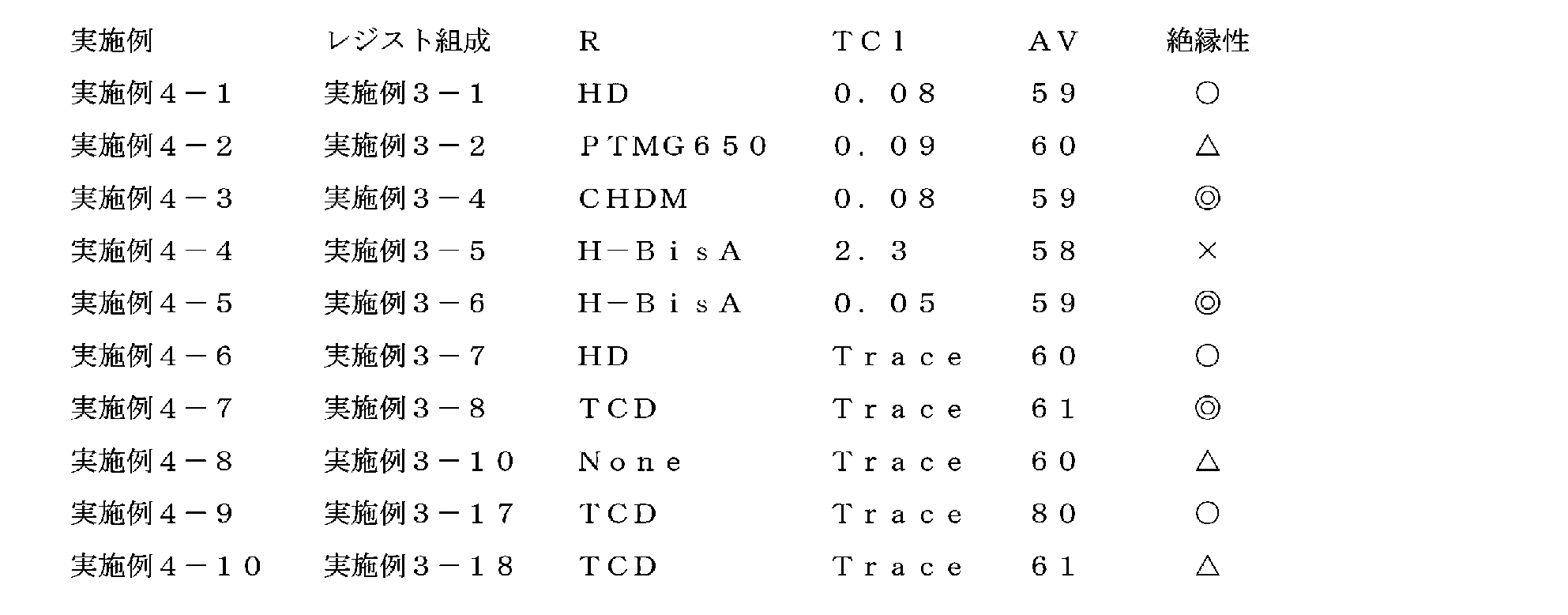
TCl:全塩素(%)
AV:化合物(A)又は化合物(B)の固形分酸価(mgKOH/g)
R:一般式(I)におけるジオール残基
HD:ヘキサンジオール残基(直鎖状炭化水素残基)
PTMG650:ポリテトラメチレングリコール残基(ポリアルキレングリコール残基、平均分子量650)
CHDM:シクロヘキサンジメタノール残基(環状炭化水素残基)
H-BisA:水添型ビスフェノールA残基(環状炭化水素残基)
TCD:トリシクロデカンジメタノール残基(環状炭化水素残基)
None:結合基なし(直接結合)
Claims (11)
- 芳香環を含まず、且つ一分子中に二個のエポキシ基を有するエポキシ樹脂(i)と、一分子中に一個以上の重合可能なエチレン性不飽和基と一個以上のカルボキシル基を併せ持つ化合物(ii)とを反応させて得られるエポキシカルボキシレート化合物(a)、一分子中に二個の水酸基と一個以上のカルボキシル基を併せ持つ化合物(b)、及び芳香環を含まず、且つ一分子中に二個のイソシアネート基を有する化合物(c)を反応させて得られる反応性ポリウレタン化合物(A)。
- 請求項1記載の反応性ポリウレタン化合物(A)に多塩基酸無水物(d)を反応させて得られる酸変性反応性ポリウレタン化合物(B)。
- 反応性ポリウレタン化合物(A)及び/又は酸変性反応性ポリウレタン化合物(B)を含む活性エネルギー線硬化型樹脂組成物。
- 更に、化合物(A)、化合物(B)以外の反応性化合物(C)を含む請求項3記載の活性エネルギー線硬化型樹脂組成物。
- 着色顔料を含む請求項3又は4に記載の活性エネルギー線硬化型樹脂組成物。
- 光透過性成形用材料である請求項3~5のいずれか一項に記載の活性エネルギー線硬化型樹脂組成物。
- 着色皮膜形成用材料である請求項3~5のいずれか一項に記載の活性エネルギー線硬化型樹脂組成物。
- 光透過皮膜形成用材料である請求項3~5のいずれか一項に記載の活性エネルギー線硬化型樹脂組成物。
- レジスト用材料である請求項3~5のいずれか一項に記載の活性エネルギー線硬化型樹脂組成物。
- 請求項3~5のいずれか一項に記載の活性エネルギー線硬化型樹脂組成物の硬化物。
- 請求項10に記載の活性エネルギー線硬化型樹脂組成物の硬化物でオーバーコートされた物品。
Priority Applications (1)
| Application Number | Priority Date | Filing Date | Title |
|---|---|---|---|
| CN2010800243893A CN102459392A (zh) | 2009-06-04 | 2010-05-27 | 反应性氨基甲酸酯化合物、包含该化合物的活性能量射线固化型树脂组合物及其用途 |
Applications Claiming Priority (2)
| Application Number | Priority Date | Filing Date | Title |
|---|---|---|---|
| JP2009135121A JP2010280812A (ja) | 2009-06-04 | 2009-06-04 | 反応性ウレタン化合物、それを含む活性エネルギー線硬化型樹脂組成物、及びその用途 |
| JP2009-135121 | 2009-06-04 |
Publications (1)
| Publication Number | Publication Date |
|---|---|
| WO2010140527A1 true WO2010140527A1 (ja) | 2010-12-09 |
Family
ID=43297663
Family Applications (1)
| Application Number | Title | Priority Date | Filing Date |
|---|---|---|---|
| PCT/JP2010/058981 Ceased WO2010140527A1 (ja) | 2009-06-04 | 2010-05-27 | 反応性ウレタン化合物、それを含む活性エネルギー線硬化型樹脂組成物、及びその用途 |
Country Status (5)
| Country | Link |
|---|---|
| JP (1) | JP2010280812A (ja) |
| KR (1) | KR20120036841A (ja) |
| CN (1) | CN102459392A (ja) |
| TW (1) | TW201102756A (ja) |
| WO (1) | WO2010140527A1 (ja) |
Cited By (4)
| Publication number | Priority date | Publication date | Assignee | Title |
|---|---|---|---|---|
| CN102584578A (zh) * | 2012-01-06 | 2012-07-18 | 南昌大学 | 1,4-环己烷二甲醇二缩水甘油醚二丙烯酸酯的制备方法和应用 |
| WO2017010534A1 (ja) * | 2015-07-14 | 2017-01-19 | ローム アンド ハース エレクトロニック マテリアルズ エルエルシー | 光感応性樹脂組成物 |
| WO2017208865A1 (ja) * | 2016-05-31 | 2017-12-07 | 昭和電工株式会社 | ポリウレタンの製造方法並びにエポキシカルボキシレート組成物、ポリウレタン及びポリウレタン樹脂組成物 |
| WO2018043395A1 (ja) * | 2016-08-31 | 2018-03-08 | 東京応化工業株式会社 | ネガ型感光性樹脂組成物、感光性レジストフィルム、パターン形成方法、硬化膜、硬化膜の製造方法 |
Families Citing this family (7)
| Publication number | Priority date | Publication date | Assignee | Title |
|---|---|---|---|---|
| CN110058490A (zh) | 2011-08-10 | 2019-07-26 | 日立化成株式会社 | 感光性树脂组合物、感光性薄膜、永久抗蚀剂以及永久抗蚀剂的制造方法 |
| JP5904362B2 (ja) * | 2011-12-08 | 2016-04-13 | 日立化成株式会社 | 光学材料用樹脂組成物、光学材料用樹脂フィルム及び光導波路 |
| CN104216227A (zh) * | 2013-05-28 | 2014-12-17 | 株式会社田村制作所 | 感光性树脂组合物 |
| KR101853387B1 (ko) * | 2015-03-27 | 2018-04-30 | 동우 화인켐 주식회사 | 플렉서블 디스플레이용 하드코팅 필름 |
| JP6744233B2 (ja) * | 2017-01-30 | 2020-08-19 | 日本化薬株式会社 | ポリウレタン化合物、それを含有する活性エネルギー線硬化型樹脂組成物及びその用途 |
| CN109776756A (zh) * | 2019-01-21 | 2019-05-21 | 深圳市道尔顿电子材料有限公司 | 一种双重改性环氧丙烯酸酯及其光刻胶 |
| JP7464498B2 (ja) * | 2020-10-28 | 2024-04-09 | 日本化薬株式会社 | エポキシ樹脂を含有する感光性樹脂組成物及びその硬化物 |
Citations (7)
| Publication number | Priority date | Publication date | Assignee | Title |
|---|---|---|---|---|
| JPH0952925A (ja) * | 1995-08-11 | 1997-02-25 | Takeda Chem Ind Ltd | 光重合性樹脂組成物および硬化物 |
| JP2001033960A (ja) * | 1999-07-16 | 2001-02-09 | Kansai Paint Co Ltd | フォトレジスト用感光性樹脂組成物及びレジストパターン形成方法 |
| JP2001033959A (ja) * | 1999-07-16 | 2001-02-09 | Kansai Paint Co Ltd | フォトレジスト用感光性樹脂組成物及びレジストパターン形成方法 |
| JP2001247638A (ja) * | 2000-03-07 | 2001-09-11 | Dainippon Ink & Chem Inc | エネルギー線硬化型樹脂組成物 |
| JP2002338652A (ja) * | 2001-05-17 | 2002-11-27 | Nippon Kayaku Co Ltd | アルカリ水溶液可溶性ウレタン化エポキシカルボキシレート化合物及びそれを用いた感光性樹脂組成物並びにその硬化物 |
| JP2003122001A (ja) * | 2001-10-15 | 2003-04-25 | Nippon Kayaku Co Ltd | 感光性樹脂、及びそれを用いた感光性樹脂組成物、並びにその硬化物 |
| WO2004079452A1 (ja) * | 2003-03-06 | 2004-09-16 | Nippon Kayaku Kabushiki Kaisha | 感光性樹脂組成物及びその硬化物 |
-
2009
- 2009-06-04 JP JP2009135121A patent/JP2010280812A/ja active Pending
-
2010
- 2010-05-27 KR KR1020117029702A patent/KR20120036841A/ko not_active Withdrawn
- 2010-05-27 WO PCT/JP2010/058981 patent/WO2010140527A1/ja not_active Ceased
- 2010-05-27 CN CN2010800243893A patent/CN102459392A/zh active Pending
- 2010-06-03 TW TW99118062A patent/TW201102756A/zh unknown
Patent Citations (7)
| Publication number | Priority date | Publication date | Assignee | Title |
|---|---|---|---|---|
| JPH0952925A (ja) * | 1995-08-11 | 1997-02-25 | Takeda Chem Ind Ltd | 光重合性樹脂組成物および硬化物 |
| JP2001033960A (ja) * | 1999-07-16 | 2001-02-09 | Kansai Paint Co Ltd | フォトレジスト用感光性樹脂組成物及びレジストパターン形成方法 |
| JP2001033959A (ja) * | 1999-07-16 | 2001-02-09 | Kansai Paint Co Ltd | フォトレジスト用感光性樹脂組成物及びレジストパターン形成方法 |
| JP2001247638A (ja) * | 2000-03-07 | 2001-09-11 | Dainippon Ink & Chem Inc | エネルギー線硬化型樹脂組成物 |
| JP2002338652A (ja) * | 2001-05-17 | 2002-11-27 | Nippon Kayaku Co Ltd | アルカリ水溶液可溶性ウレタン化エポキシカルボキシレート化合物及びそれを用いた感光性樹脂組成物並びにその硬化物 |
| JP2003122001A (ja) * | 2001-10-15 | 2003-04-25 | Nippon Kayaku Co Ltd | 感光性樹脂、及びそれを用いた感光性樹脂組成物、並びにその硬化物 |
| WO2004079452A1 (ja) * | 2003-03-06 | 2004-09-16 | Nippon Kayaku Kabushiki Kaisha | 感光性樹脂組成物及びその硬化物 |
Cited By (9)
| Publication number | Priority date | Publication date | Assignee | Title |
|---|---|---|---|---|
| CN102584578A (zh) * | 2012-01-06 | 2012-07-18 | 南昌大学 | 1,4-环己烷二甲醇二缩水甘油醚二丙烯酸酯的制备方法和应用 |
| WO2017010534A1 (ja) * | 2015-07-14 | 2017-01-19 | ローム アンド ハース エレクトロニック マテリアルズ エルエルシー | 光感応性樹脂組成物 |
| JP2017021298A (ja) * | 2015-07-14 | 2017-01-26 | ローム・アンド・ハース電子材料株式会社 | 光感応性樹脂組成物 |
| WO2017208865A1 (ja) * | 2016-05-31 | 2017-12-07 | 昭和電工株式会社 | ポリウレタンの製造方法並びにエポキシカルボキシレート組成物、ポリウレタン及びポリウレタン樹脂組成物 |
| JPWO2017208865A1 (ja) * | 2016-05-31 | 2019-03-28 | 昭和電工株式会社 | ポリウレタンの製造方法並びにエポキシカルボキシレート組成物、ポリウレタン及びポリウレタン樹脂組成物 |
| TWI732876B (zh) * | 2016-05-31 | 2021-07-11 | 日商昭和電工股份有限公司 | 聚胺基甲酸酯的製造方法、環氧羧酸酯組成物、聚胺基甲酸酯及聚胺基甲酸酯樹脂組成物 |
| US11203659B2 (en) | 2016-05-31 | 2021-12-21 | Showa Denko K. K. | Method for producing polyurethane, epoxy carboxylate composition, polyurethane, and polyurethane resin composition |
| WO2018043395A1 (ja) * | 2016-08-31 | 2018-03-08 | 東京応化工業株式会社 | ネガ型感光性樹脂組成物、感光性レジストフィルム、パターン形成方法、硬化膜、硬化膜の製造方法 |
| US11415888B2 (en) | 2016-08-31 | 2022-08-16 | Tokyo Ohka Kogyo Co., Ltd. | Negative type photosensitive resin composition, photosensitive resist film, pattern forming method, cured film, and method of producing cured film |
Also Published As
| Publication number | Publication date |
|---|---|
| JP2010280812A (ja) | 2010-12-16 |
| KR20120036841A (ko) | 2012-04-18 |
| CN102459392A (zh) | 2012-05-16 |
| TW201102756A (en) | 2011-01-16 |
Similar Documents
| Publication | Publication Date | Title |
|---|---|---|
| TWI468430B (zh) | A reactive carboxylic acid ester compound, an active energy ray-hardening resin composition using the same, and a use thereof | |
| JP2010280812A (ja) | 反応性ウレタン化合物、それを含む活性エネルギー線硬化型樹脂組成物、及びその用途 | |
| JP5279214B2 (ja) | 反応性カルボキシレート化合物、それを用いた活性エネルギー線硬化型樹脂組成物、およびその用途 | |
| JP6576161B2 (ja) | 新規反応性エポキシカルボキシレート化合物、その誘導体、それを含有する樹脂組成物及びその硬化物 | |
| JP7716516B2 (ja) | 反応性ポリカルボン酸化合物、それを用いた活性エネルギー線硬化型樹脂組成物、その硬化物及びその用途 | |
| JP5843372B2 (ja) | ポリウレタン化合物、それを含有する活性エネルギー線硬化型樹脂組成物及びその用途 | |
| JP2019001998A (ja) | 反応性ポリカルボン酸化合物、それを用いた活性エネルギー線硬化型樹脂組成物、その硬化物及びその用途 | |
| CN108794729B (zh) | 反应性多元羧酸化合物、含有该化合物的树脂组合物、该组合物的硬化物及物品 | |
| JP5473208B2 (ja) | 新規エポキシカルボキシレート化合物、その誘導体、それを含有する活性エネルギー線硬化型樹脂組成物及びその硬化物 | |
| JP2009120737A (ja) | 反応性カルボキシレート化合物、それを用いた活性エネルギー線硬化型樹脂組成物、およびその用途 | |
| JP5604106B2 (ja) | 反応性カルボキシレート化合物、それを用いた硬化型樹脂組成物、およびその用途 | |
| TWI576363B (zh) | 新穎環氧羧酸酯化合物、其衍生物、含有其的活性能量線硬化型樹脂組成物及其硬化物 | |
| JP7419246B2 (ja) | 反応性ポリカルボン酸樹脂混合物、それを用いた活性エネルギー線硬化型樹脂組成物およびその硬化物、並びに反応性エポキシカルボキシレート樹脂混合物 | |
| WO2013172009A1 (ja) | 反応性ポリエステル化合物及び活性エネルギー線硬化型樹脂組成物 | |
| CN120757737A (zh) | 聚氨酯化合物、活性能量线硬化型树脂组合物、硬化物及物品 | |
| JP6685813B2 (ja) | エポキシ樹脂、反応性カルボキシレート化合物、それを用いた硬化型樹脂組成物、及びその用途 | |
| JP2009275167A (ja) | 反応性カルボキシレート化合物、それを用いた活性エネルギー線硬化型樹脂組成物、およびその用途 | |
| JP5959125B2 (ja) | 反応性カルボキシレート化合物、それを用いた活性エネルギー線硬化型樹脂組成物、およびその用途 | |
| JP2016148874A (ja) | 反応性カルボキシレート化合物、それを用いた活性エネルギー線硬化型樹脂組成物、およびその用途 | |
| JP6588346B2 (ja) | エポキシ樹脂、反応性カルボキシレート化合物、それを用いた硬化型樹脂組成物、およびその用途 | |
| JP2013108093A (ja) | 反応性カルボキシレート化合物、それを用いた活性エネルギー線硬化型樹脂組成物、およびその用途 |
Legal Events
| Date | Code | Title | Description |
|---|---|---|---|
| WWE | Wipo information: entry into national phase |
Ref document number: 201080024389.3 Country of ref document: CN |
|
| 121 | Ep: the epo has been informed by wipo that ep was designated in this application |
Ref document number: 10783311 Country of ref document: EP Kind code of ref document: A1 |
|
| NENP | Non-entry into the national phase |
Ref country code: DE |
|
| ENP | Entry into the national phase |
Ref document number: 20117029702 Country of ref document: KR Kind code of ref document: A |
|
| 122 | Ep: pct application non-entry in european phase |
Ref document number: 10783311 Country of ref document: EP Kind code of ref document: A1 |