WO2010122794A1 - ピラジンカルボン酸誘導体の製造方法及びその中間体 - Google Patents
ピラジンカルボン酸誘導体の製造方法及びその中間体 Download PDFInfo
- Publication number
- WO2010122794A1 WO2010122794A1 PCT/JP2010/002898 JP2010002898W WO2010122794A1 WO 2010122794 A1 WO2010122794 A1 WO 2010122794A1 JP 2010002898 W JP2010002898 W JP 2010002898W WO 2010122794 A1 WO2010122794 A1 WO 2010122794A1
- Authority
- WO
- WIPO (PCT)
- Prior art keywords
- alkyl group
- producing
- acid derivative
- pyrazinecarboxylic acid
- general formula
- Prior art date
- Legal status (The legal status is an assumption and is not a legal conclusion. Google has not performed a legal analysis and makes no representation as to the accuracy of the status listed.)
- Ceased
Links
- 0 CC(C)C1C=CC(C*)C1 Chemical compound CC(C)C1C=CC(C*)C1 0.000 description 5
Classifications
-
- C—CHEMISTRY; METALLURGY
- C07—ORGANIC CHEMISTRY
- C07C—ACYCLIC OR CARBOCYCLIC COMPOUNDS
- C07C251/00—Compounds containing nitrogen atoms doubly-bound to a carbon skeleton
- C07C251/02—Compounds containing nitrogen atoms doubly-bound to a carbon skeleton containing imino groups
- C07C251/04—Compounds containing nitrogen atoms doubly-bound to a carbon skeleton containing imino groups having carbon atoms of imino groups bound to hydrogen atoms or to acyclic carbon atoms
- C07C251/06—Compounds containing nitrogen atoms doubly-bound to a carbon skeleton containing imino groups having carbon atoms of imino groups bound to hydrogen atoms or to acyclic carbon atoms to carbon atoms of a saturated carbon skeleton
- C07C251/08—Compounds containing nitrogen atoms doubly-bound to a carbon skeleton containing imino groups having carbon atoms of imino groups bound to hydrogen atoms or to acyclic carbon atoms to carbon atoms of a saturated carbon skeleton being acyclic
-
- C—CHEMISTRY; METALLURGY
- C07—ORGANIC CHEMISTRY
- C07D—HETEROCYCLIC COMPOUNDS
- C07D241/00—Heterocyclic compounds containing 1,4-diazine or hydrogenated 1,4-diazine rings
- C07D241/02—Heterocyclic compounds containing 1,4-diazine or hydrogenated 1,4-diazine rings not condensed with other rings
- C07D241/10—Heterocyclic compounds containing 1,4-diazine or hydrogenated 1,4-diazine rings not condensed with other rings having three double bonds between ring members or between ring members and non-ring members
- C07D241/14—Heterocyclic compounds containing 1,4-diazine or hydrogenated 1,4-diazine rings not condensed with other rings having three double bonds between ring members or between ring members and non-ring members with hetero atoms or with carbon atoms having three bonds to hetero atoms with at the most one bond to halogen, e.g. ester or nitrile radicals, directly attached to ring carbon atoms
- C07D241/24—Carbon atoms having three bonds to hetero atoms with at the most one bond to halogen, e.g. ester or nitrile radicals
Definitions
- the present invention relates to a method for producing a 3-haloalkylpyrazine-2-carboxylic acid derivative useful as an intermediate for pharmaceuticals, agricultural chemicals and the like, in particular, as an intermediate for producing agricultural and horticultural acaricides and fungicides, its synthetic intermediate
- the present invention relates to a method for producing a synthetic intermediate.
- the 3-haloalkylpyrazine-2-carboxylic acid derivative is used as an intermediate for pharmaceuticals, agricultural chemicals, etc., especially for agricultural and horticultural acaricides (for example, see Patent Document 1) and fungicides (for example, see Patent Document 2). ).
- a method for producing pyrazine derivatives a method for synthesizing pyrazine derivatives by reacting haloketone derivatives with trifluoromethanesulfonic acid anilide to lead to imino derivatives, then reacting with 1,2-ethylenediamine and further oxidizing is reported.
- An object of the present invention is to provide a novel and industrially advantageous production method for pyrazinecarboxylic acid derivatives, particularly 3-haloalkylpyrazine-2-carboxylic acid derivatives useful as intermediates for pharmaceuticals and agricultural chemicals.
- the inventors of the present application reacted a haloester derivative having a specific structure with an alkali metal azide salt, 1,2-ethylenediamine or its acid salt and a dehydrogenating agent.
- a haloester derivative having a specific structure with an alkali metal azide salt, 1,2-ethylenediamine or its acid salt and a dehydrogenating agent.
- the imino derivative which is a production intermediate was found to be a novel compound not described in the literature, and the present invention was completed.
- an objective compound can be produced efficiently and economically on an industrial scale by using an easily available reagent.
- R 1 is a halo (C 1 -C 6 ) alkyl group, preferably a fluoro (C 1 -C 6 ) alkyl group, particularly preferably fluoro (C 1 -C 3 ).
- An alkyl group most preferably a trifluoromethyl group and a difluoromethyl group.
- R 2 is preferably a (C 1 -C 6 ) alkyl group.
- X is a halogen atom, preferably a bromine atom or a chlorine atom, and most preferably a chlorine atom.
- M is preferably a lithium atom, a sodium atom or a potassium atom, particularly preferably a sodium atom.
- halogen atom is fluorine atom, chlorine atom, bromine atom or iodine atom.
- (C 1 -C 6 ) alkyl group means a linear or branched alkyl group having 1 to 6 carbon atoms, such as methyl, ethyl, n-propyl, i-propyl, An alkyl group such as n-butyl, i-butyl, s-butyl, t-butyl, n-pentyl, n-hexyl, etc., which may be the same as or different from the “halo (C 1 -C 6 ) alkyl group” 1 represents a straight-chain or branched alkyl group having 1 to 6 carbon atoms substituted with one or more halogen atoms, and “fluoro (C 1 -C 6 ) alkyl group” is one or more fluorine atoms Substituted or straight chain or branched alkyl group having 1 to 6 carbon atoms
- fluoro (C 1 -C 3 ) alkyl group represents a linear or branche
- the “alkali metal atom” refers to a lithium atom, a sodium atom, or a potassium atom.
- the acid in the acid salt include inorganic acids such as hydrochloric acid, sulfuric acid and nitric acid, organic acids such as formic acid, acetic acid, trifluoroacetic acid and propionic acid, methanesulfonic acid, trifluoromethanesulfonic acid and p-toluenesulfonic acid. And sulfonic acids.
- reaction involved in the present invention is illustrated as follows.
- One preferred embodiment of the present invention is the one-pot reaction described below.
- a reaction between a haloester derivative represented by the general formula (II) or a hydrate thereof, an alkali metal azide salt represented by the general formula (III), 1,2-ethylenediamine or an acid salt thereof, and a dehydrogenating agent By doing so, a pyrazinecarboxylic acid derivative represented by the general formula (I) can be produced.
- Acid salts for example, salts with inorganic acids such as hydrochloric acid and sulfuric acid, salts with organic acids such as formic acid, acetic acid and propionic acid, or salts with sulfonic acids such as methanesulfonic acid, trifluoromethanesulfonic acid and toluenesulfonic acid
- a dehydrogenating agent to produce a pyrazinecarboxylic acid derivative represented by the general formula (I).
- the haloester derivative represented by the general formula (II) may be used as it is, it can also be used favorably in the form of a hydrate.
- the alkali metal azide salt is preferably lithium azide, sodium azide or potassium azide, more preferably sodium azide.
- the alkali metal azide salt can be used in a range of 0.1 to 10 times mol, preferably 1 to 5 times mol of the haloester derivative represented by the general formula (II) or a hydrate thereof. The range is more preferably 1.0 to 2.5 times mol.
- 1,2-ethylenediamine or an acid salt thereof can be used in a range of 0.1 to 10-fold moles relative to the haloester derivative represented by the general formula (II) or a hydrate thereof, preferably 0
- the range is from 5 to 5 times mol, and more preferably from 0.9 to 1.2 times mol.
- the dehydrogenating agent is not particularly limited as long as it has a dehydrogenating ability.
- manganese compounds such as manganese dioxide; chromic acids such as sodium chromate; lead compounds such as lead tetraacetate; mercury compounds such as mercury oxide;
- Oxidizing agents such as osmium tetroxide, ruthenium tetroxide and selenium dioxide; metal halides such as iron chloride, copper iodide and copper chloride; halogens such as iodine and bromine; N-chlorosuccinimide, N-bromosuccinimide and diiodo Haloimides such as hydantoin; transition metal compounds such as palladium, platinum, iridium, rhodium, ruthenium, selenium, rhenium; quinone-based oxidizing agents such as DDQ (2,3-dichloro-5,6-dicyano-p-benzoquinone); Peroxides
- the metal compound such as palladium, platinum, iridium, rhodium, ruthenium, selenium, rhenium
- the metal itself can also be used. C., 1997, 62, 1072-1078, TL, 48 (2007) 2729-2732), and palladium and platinum supported on activated carbon are preferable.
- transition metal compounds 230-243 can also be used.
- transition metal compounds are zero-valent, formic acid salts such as sodium formate and ammonium formate; hydroquinone, formaldehyde, etc. in order to carry out the reaction while returning the transition metal compound oxidized in the reaction to zero-valent (reduced type)
- Organic reducing agents such as formic acid, glucose, and ascorbic acid; reducing gases such as carbon monoxide, ethylene, and methane can also be mixed and used.
- transition metal compounds in an oxidized state can also be used.
- PdCl 2 , Pd (OH) 2 palladium oxide, palladium sulfide, Pt / O 2 , iridium chloride (III), rhodium chloride (III), ruthenium chloride.
- inorganic transition metal compounds such as rhenium oxide; palladium (II) acetate, dichlorobis (benzonitrile) palladium (II), dichlorobis (trialkylphosphine) palladium (II), trans- [iodo (phenyl) bis (dimethyl) Phenylphosphine) palladium (II)], trans- [dimethylbis (triphenylphosphine) palladium (II)], (dioxygen) bis (t-butyl isocyanate), Pd 2 Cl 4 (C 2 H 4 ) 2 , Pd 2 Cl 4 (PPh 3 ) 2, Pd ( 2 H 4) (PPh 3) 2, PdCl 2 (C 8 H 12), [PdCl (C 3 H 5)] 2, Pd (C 3 H 5) (C 5 H 5), Pd (C 3 H 5 ) 2 , [Pd (C 5 H 5 ) (C 8 H 12 )] BF 4
- Two or more transition metal compounds can also be used in combination, for example, a technique such as Wacker oxidation (“Palladium Reagents and Catalysis”, First Edition 2004, Wiley, 29-35; Synthesis 1984, 369-384). Can be used.
- dehydrogenating agents can be used in the range of 0.001 to 10-fold mol, preferably in the range of 0.01 to 5-fold mol based on the haloester derivative represented by the general formula (II). is there.
- the inert solvent used is not particularly limited as long as it does not significantly inhibit the progress of this reaction.
- aliphatic hydrocarbons such as hexane, cyclohexane, and methylcyclohexane
- aromatics such as benzene, toluene, xylene, and chlorobenzene.
- Hydrocarbons Halogenated hydrocarbons such as dichloromethane, chloroform, and carbon tetrachloride; Linear or cyclic ethers such as diethyl ether, t-butyl methyl ether, dioxane, tetrahydrofuran, and 1,2-dimethoxyethane; Methanol, ethanol , N-propanol, 2-propanol, n-butanol, s-butanol, t-butanol and other alcohols; esters such as ethyl acetate; amides such as dimethylformamide and dimethylacetamide; nitriles such as acetonitrile Examples of the inert solvent include 1,3-dimethyl-2-imidazolidinone, pyridine, acetic acid, and water. These solvents may be used alone or in admixture of two or more kinds of inert solvents. it can.
- Examples of the purpose of adjusting the pH in the reaction system include organic bases such as triethylamine, tributylamine, pyrrolidine, piperidine, morpholine, pyridine, 3-picoline, 4-picoline, 4-dimethylaminopyridine; lithium hydroxide, Alkali metal hydroxides such as sodium hydroxide and potassium hydroxide; Alkali metal alkoxides such as sodium methoxide and sodium ethoxide; Carbonates such as sodium hydrogen carbonate and potassium carbonate; Potassium monohydrogen phosphate and trisodium phosphate Phosphates such as sodium formate and sodium acetate; inorganic acids such as hydrochloric acid, sulfuric acid and nitric acid; organic acids such as formic acid, acetic acid, trifluoroacetic acid and propionic acid; methanesulfonic acid and trifluoromethanesulfonic acid P-Toluenesulfonic acid It is possible to use the sulfonic
- phase transfer catalyst such as a quaternary ammonium salt such as tetrabutylammonium chloride or a crown ether such as 18-crown-6 can be used, and is represented by the general formula (II).
- the amount can be appropriately selected within the range of 0.001 to 0.1 moles relative to the haloester derivative.
- the reaction temperature may be appropriately selected within the range of ⁇ 20 ° C. to the reflux temperature of the inert solvent used, but is preferably selected from the range of 0 ° C. to 120 ° C.
- the reaction time varies depending on the reaction scale, reaction temperature, and the like, and is not constant but may be appropriately selected within the range of several minutes to 100 hours.
- the pyrazinecarboxylic acid derivative represented by the general formula (I) may be isolated from the reaction system containing the target product by a conventional method. If necessary, this may be recrystallized, column chromatography, distillation, etc.
- the desired product can be produced by purifying with
- Another preferred embodiment of the present invention is the stepwise reaction described below.
- (a) a haloester derivative represented by the general formula (II) or a hydrate thereof and an alkali metal azide salt represented by the general formula (III) are reacted stepwise in an inert solvent, Derived into an imino form represented by the general formula (IV) or a hydrate thereof, then (b) reacted with 1,2-ethylenediamine or an acid salt thereof, and finally (c) a dehydrogenating agent is allowed to act.
- a pyrazinecarboxylic acid derivative represented by the general formula (I) can be produced.
- the reactions (a), (b) and (c) may be performed according to the method described in 1). Even if each reagent is added simultaneously as described in 1) or sequentially as described in 2), the desired product can be obtained satisfactorily.
- the compound represented by the general formula (II) can be produced by a known method, for example, the method described in Helvetica Chumica Acta (1965), 48 (6), 1423-6, or the like. Further, the 3-haloalkylpyrazine-2-carboxylic acid derivative obtained by the production method of the present invention can be easily produced by, for example, the method shown in Reference Examples, etc. ) And the like can be produced.
- Example 1 Preparation of ethyl 3-trifluoromethylpyrazine-2-carboxylate To a 4 mL aqueous solution of sodium azide (2.6 g, 40 mmol) and 1,2-ethylenediamine hydrochloride (3.2 g, 24 mmol) in 2-chloro-4,4 , A solution of ethyl 4-trifluoro-3-oxobutanoate (4.4 g, 20 mmol) in ethyl acetate (8 mL) was added dropwise. Thereafter, 5% Pd / C (2 g; 50% wet) and ethyl acetate (2 mL) were added, and the mixture was stirred at room temperature for 1 hour.
- reaction mixture was then stirred at 35 ° C. for 1 hour and then heated to reflux for 2.5 hours.
- the reaction was cooled to room temperature.
- Ethyl acetate (100 mL) and water (60 mL) were added, Pd / C was removed by filtration, and the mixture was extracted with ethyl acetate.
- the organic layer was washed with water and dried, the solvent was distilled off, and the residue was purified by silica gel column chromatography to obtain ethyl 3-trifluoromethylpyrazine-2-carboxylate.
- Example 2 Preparation of ethyl 3-trifluoromethylpyrazine-2-carboxylate To a mixed solution of sodium azide (2.6 g, 40 mmol) and tetrabutylammonium chloride (0.6 g, 2 mmol) in toluene (6 mL) and water (4 mL) A toluene solution (2 mL) of ethyl 2-chloro-4,4,4-trifluoro-3-oxobutanoate (4.4 g, 20 mmol) was added dropwise.
- Example 3 Production of ethyl 3-difluoromethylpyrazine-2-carboxylate Sulfuryl chloride (8.5 g, 63 mol) was added to ethyl 4,4-difluoro-3-oxobutanoate (10 g, 60 mol), and the mixture was stirred at room temperature for 12 hours. The reaction mixture was poured into ice water (100 ml) and extracted with ethyl acetate. The organic layer was washed successively with water and saturated brine, dried over anhydrous sodium sulfate, and concentrated under reduced pressure.
Landscapes
- Chemical & Material Sciences (AREA)
- Organic Chemistry (AREA)
- Organic Low-Molecular-Weight Compounds And Preparation Thereof (AREA)
Abstract
医薬・農薬等の中間体として有用なピラジンカルボン酸誘導体、特に3-ハロアルキルピラジン-2-カルボン酸誘導体の新規で工業的に有利な製造方法を提供することを課題とする。課題を解決するための手段は、一般式(II)で表されるハロエステル誘導体と一般式(III)で表されるアルカリ金属アジド塩及び1、2-エチレンジアミン又はその酸塩及び脱水素化剤と反応させることを特徴とする、一般式(I)で表されるピラジンカルボン酸誘導体の製造方法である。
Description
本発明は、医薬・農薬等の中間体として、特に農園芸用殺ダニ剤、殺菌剤の製造中間体として有用な3-ハロアルキルピラジン-2-カルボン酸誘導体の製造方法、その合成中間体並びに当該合成中間体の製造方法に関するものである。
3-ハロアルキルピラジン-2-カルボン酸誘導体は、医薬・農薬等の中間体として、特に農園芸用殺ダニ剤(例えば、特許文献1を参照。)及び殺菌剤(例えば、特許文献2を参照。)の中間体として有用である。
ピラジン誘導体の製造方法として、ハロケトン誘導体とトリフルオロメタンスルホン酸アニリドとを反応させることにより、イミノ誘導体に導き、次いで1、2-エチレンジアミンと反応させ、更に酸化することによりピラジン誘導体を合成する方法が報告されているが(例えば、非特許文献1を参照)、本発明のピラジンカルボン酸誘導体の製法、特にハロアルキル基を有するピラジンカルボン酸誘導体に関しては、具体的な開示も示唆もされていない。
一方、ジケトカルボン酸エステル誘導体と1、2-エチレンジアミンを反応させることにより、ジヒドロピラジン誘導体に導き、次いで酸化することによりピラジンカルボン酸誘導体に変換する方法が報告されているが(例えば、非特許文献2を参照)、本発明とは出発原料が異なり、本発明のようなハロアルキル基が導入された化合物に関しては、具体的な開示も示唆もされていない。
ピラジン誘導体の製造方法として、ハロケトン誘導体とトリフルオロメタンスルホン酸アニリドとを反応させることにより、イミノ誘導体に導き、次いで1、2-エチレンジアミンと反応させ、更に酸化することによりピラジン誘導体を合成する方法が報告されているが(例えば、非特許文献1を参照)、本発明のピラジンカルボン酸誘導体の製法、特にハロアルキル基を有するピラジンカルボン酸誘導体に関しては、具体的な開示も示唆もされていない。
一方、ジケトカルボン酸エステル誘導体と1、2-エチレンジアミンを反応させることにより、ジヒドロピラジン誘導体に導き、次いで酸化することによりピラジンカルボン酸誘導体に変換する方法が報告されているが(例えば、非特許文献2を参照)、本発明とは出発原料が異なり、本発明のようなハロアルキル基が導入された化合物に関しては、具体的な開示も示唆もされていない。
Jouranal of Organic Chemistry,45,161,1980
Jouranal of Chemical Socity., Perkin Trans.1, 2000,299-302
前記非特許文献1及び2の報告には、本発明に係る誘導体及びその製造方法について何の開示も示唆も無い。本発明の課題は、医薬・農薬等の中間体として有用なピラジンカルボン酸誘導体、特に3-ハロアルキルピラジン-2-カルボン酸誘導体の新規で工業的に有利な製造方法を提供することである。
前記課題を解決すべく鋭意研究を行った結果、本願発明者等は特定構造を有するハロエステル誘導体とアルカリ金属アジド塩、1、2-エチレンジアミン又はその酸塩及び脱水素化剤とを反応させることにより、上記のピラジンカルボン酸誘導体を効率よく製造することができることを見出した。また製造中間体であるイミノ誘導体は文献未記載の新規化合物であることを見出し、本発明を完成させるに至った。
即ち、本発明は、
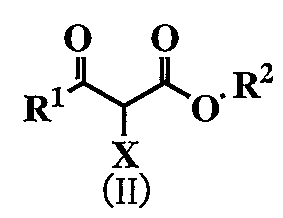
[1]一般式(II)

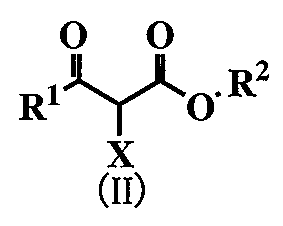
(式中、R1は(C1-C6)アルキル基またはハロ(C1-C6)アルキル基、R2は(C1-C6)アルキル基及びXはハロゲン原子を示す。)で表されるハロエステル誘導体又はその水和物と一般式(III)

(式中、Mはアルカリ金属原子を示す。)で表されるアルカリ金属アジド塩及び1、2-エチレンジアミン又はその酸塩及び脱水素化剤と反応させることを特徴とする、一般式(I)
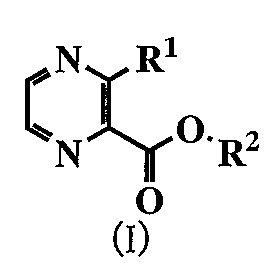
(式中、R1及びR2は前記に同じ。)で表されるピラジンカルボン酸誘導体の製造方法、
[2]一般式(II)
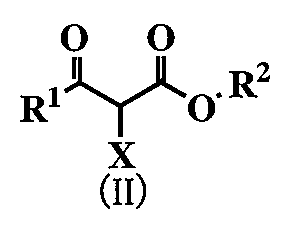
(式中、R1は(C1-C6)アルキル基またはハロ(C1-C6)アルキル基、R2は(C1-C6)アルキル基及びXはハロゲン原子を示す。)で表されるハロエステル誘導体又はその水和物と一般式(III)

(式中、Mはアルカリ金属原子を示す。)で表されるアルカリ金属アジド塩と反応させ、次いで1、2-エチレンジアミン又はその酸塩と反応させ、次いで脱水素化剤と反応させることを特徴とする、一般式(I)
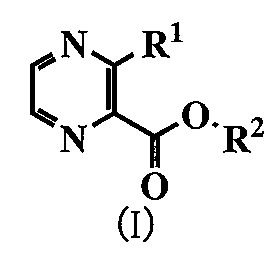
(式中、R1及びR2は前記に同じ。)で表されるピラジンカルボン酸誘導体の製造方法、
[3]一般式(II)
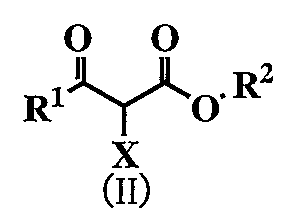
(式中、R1は(C1-C6)アルキル基またはハロ(C1-C6)アルキル基、R2は(C1-C6)アルキル基及びXはハロゲン原子を示す。)で表されるハロエステル誘導体又はその水和物と一般式(III)

(式中、Mはアルカリ金属原子を示す。)で表されるアルカリ金属アジド塩を反応させて、一般式(IV)

(式中、R1及びR2は前記に同じ。)で表されるイミノ体またはその水和物に誘導し、次いで該イミノ体又は該水和物を単離しまたは単離せずして、1、2-エチレンジアミン又はその酸塩と反応させて、次いで脱水素化剤と反応させることを特徴とする、一般式(I)

(式中、R1及びR2は前記に同じ。)で表されるピラジンカルボン酸誘導体の製造方法、
[4]R1がハロ(C1-C6)アルキル基である前記[1]に記載のピラジンカルボン酸誘導体の製造方法、
[5]R1がハロ(C1-C6)アルキル基である前記[2]に記載のピラジンカルボン酸誘導体の製造方法、
[6]R1がハロ(C1-C6)アルキル基である前記[3]に記載のピラジンカルボン酸誘導体の製造方法、
[7]R1がフルオロ(C1-C6)アルキル基である前記[1]に記載のピラジンカルボン酸誘導体の製造方法、
[8]R1がフルオロ(C1-C6)アルキル基である前記[2]に記載のピラジンカルボン酸誘導体の製造方法、
[9]R1がフルオロ(C1-C6)アルキル基である前記[3]に記載のピラジンカルボン酸誘導体の製造方法、
[10]R1がフルオロ(C1-C3)アルキル基である前記[1]に記載のピラジンカルボン酸誘導体の製造方法、
[11]R1がフルオロ(C1-C3)アルキル基である前記[2]に記載のピラジンカルボン酸誘導体の製造方法、
[12]R1がフルオロ(C1-C3)アルキル基である前記[3]に記載のピラジンカルボン酸誘導体の製造方法、
[13]R1がジフルオロメチル基又はトリフルオロメチル基である前記[1]に記載のピラジンカルボン酸誘導体の製造方法、
[14]R1がジフルオロメチル基又はトリフルオロメチル基である前記[2]に記載のピラジンカルボン酸誘導体の製造方法、
[15]R1がジフルオロメチル基又はトリフルオロメチル基である前記[3]に記載のピラジンカルボン酸誘導体の製造方法、
[16]Mが、ナトリウムである前記[1]~[15]のいずれかに記載のピラジンカルボン酸誘導体の製造方法、
[17]脱水素化剤が、パラジウム又はその担持体である前記[1]~[16]のいずれかに記載のピラジンカルボン酸誘導体の製造方法、
[18]一般式(IV)

(式中、R1は(C1-C6)アルキル基またはハロ(C1-C6)アルキル基、R2は(C1-C6)アルキル基を示す。)で表されるイミノ体またはその水和物、および
[19]一般式(II)
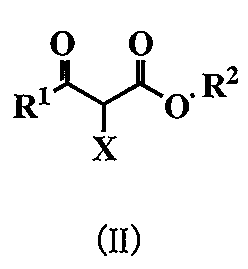
(式中、R1は(C1-C6)アルキル基またはハロ(C1-C6)アルキル基、R2は(C1-C6)アルキル基及びXはハロゲン原子を示す。)で表されるハロエステル誘導体又はその水和物と一般式(III)

(式中、Mはアルカリ金属原子を示す。)で表されるアルカリ金属アジド塩を反応させることを特徴とする、一般式(IV)
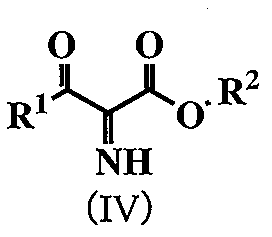
(式中、R1及びR2は前記に同じ。)で表されるイミノ体またはその水和物の製造方法、
に関する。
即ち、本発明は、
[1]一般式(II)
[2]一般式(II)
[3]一般式(II)
[4]R1がハロ(C1-C6)アルキル基である前記[1]に記載のピラジンカルボン酸誘導体の製造方法、
[5]R1がハロ(C1-C6)アルキル基である前記[2]に記載のピラジンカルボン酸誘導体の製造方法、
[6]R1がハロ(C1-C6)アルキル基である前記[3]に記載のピラジンカルボン酸誘導体の製造方法、
[7]R1がフルオロ(C1-C6)アルキル基である前記[1]に記載のピラジンカルボン酸誘導体の製造方法、
[8]R1がフルオロ(C1-C6)アルキル基である前記[2]に記載のピラジンカルボン酸誘導体の製造方法、
[9]R1がフルオロ(C1-C6)アルキル基である前記[3]に記載のピラジンカルボン酸誘導体の製造方法、
[10]R1がフルオロ(C1-C3)アルキル基である前記[1]に記載のピラジンカルボン酸誘導体の製造方法、
[11]R1がフルオロ(C1-C3)アルキル基である前記[2]に記載のピラジンカルボン酸誘導体の製造方法、
[12]R1がフルオロ(C1-C3)アルキル基である前記[3]に記載のピラジンカルボン酸誘導体の製造方法、
[13]R1がジフルオロメチル基又はトリフルオロメチル基である前記[1]に記載のピラジンカルボン酸誘導体の製造方法、
[14]R1がジフルオロメチル基又はトリフルオロメチル基である前記[2]に記載のピラジンカルボン酸誘導体の製造方法、
[15]R1がジフルオロメチル基又はトリフルオロメチル基である前記[3]に記載のピラジンカルボン酸誘導体の製造方法、
[16]Mが、ナトリウムである前記[1]~[15]のいずれかに記載のピラジンカルボン酸誘導体の製造方法、
[17]脱水素化剤が、パラジウム又はその担持体である前記[1]~[16]のいずれかに記載のピラジンカルボン酸誘導体の製造方法、
[18]一般式(IV)
[19]一般式(II)
に関する。
本発明によれば、入手容易な試薬を用い、目的化合物を効率的且つ経済的に工業的規模で製造できる。
本発明の実施態様としては、R1はハロ(C1-C6)アルキル基であり、好ましくはフルオロ(C1-C6)アルキル基であり、特に好ましくはフルオロ(C1-C3)アルキル基であり、最も好ましくはトリフルオロメチル基及びジフルオロメチル基である。R2は(C1-C6)アルキル基が好ましい。Xはハロゲン原子であり、好ましくは臭素原子又は塩素原子であり、最も好ましくは塩素原子である。Mはリチウム原子、ナトリウム原子、カリウム原子が好ましく、特に好ましくはナトリウム原子である。
次に本明細書中に記載する各置換基を説明する。本発明の一般式(I)~(IV)で表される化合物の置換基の定義中、『ハロゲン原子』、『ハロゲン』及び『ハロ』とはフッ素原子、塩素原子、臭素原子又はヨウ素原子を示し、『(C1-C6)アルキル基』とは、炭素原子数1~6の直鎖状又は分枝状のアルキル基を示し、例えば、メチル、エチル、n-プロピル、i-プロピル、n-ブチル、i-ブチル、s-ブチル、t-ブチル、n-ペンチル、n-ヘキシル等のアルキル基を示し、『ハロ(C1-C6)アルキル基』とは同一又は異なっても良く、1以上のハロゲン原子で置換された炭素原子数1~6の直鎖状又は分枝状のアルキル基を示し、『フルオロ(C1-C6)アルキル基』とは1以上のフッ素原子で置換された炭素原子数1~6の直鎖状又は分枝状のアルキル基を示し、『フルオロ(C1-C3)アルキル基』とは1以上のフッ素原子で置換された炭素原子数1~3の直鎖状又は分枝状のアルキル基を示す。『アルカリ金属原子』とは、リチウム原子、ナトリウム原子、カリウム原子を示す。また、酸塩における酸としては、例えば、塩酸、硫酸、硝酸等の無機酸類、蟻酸、酢酸、トルフルオロ酢酸、プロピオン酸等の有機酸類、メタンスルホン酸、トリフルオロメタンスルホン酸、p-トルエンスルホン酸等のスルホン酸類等を挙げることができる。
本発明に関与する反応は以下のように図示される。
本発明の好ましい実施態様の一つは下記するワンポット反応である。

(式中、R1、R2、X及びMは前記に同じ。)
即ち、一般式(II)で表されるハロエステル誘導体又はその水和物と一般式(III)表されるアルカリ金属アジド塩、1、2-エチレンジアミン又はその酸塩及び脱水素化剤とを反応させることにより一般式(I)で表されるピラジンカルボン酸誘導体を製造することができる。
本発明の好ましい実施態様の一つは下記するワンポット反応である。
即ち、一般式(II)で表されるハロエステル誘導体又はその水和物と一般式(III)表されるアルカリ金属アジド塩、1、2-エチレンジアミン又はその酸塩及び脱水素化剤とを反応させることにより一般式(I)で表されるピラジンカルボン酸誘導体を製造することができる。
1) 一般式(II) → 一般式(I)
本反応は、通常は不活性溶媒中、一般式(II)で表されるハロエステル誘導体又はその水和物と一般式(III)で表されるアルカリ金属アジド塩、1、2-エチレンジアミン又はその酸塩(例えば、塩酸、硫酸などの無機酸との塩、ギ酸、酢酸、プロピオン酸などの有機酸との塩、又はメタンスルホン酸、トリフルオロメタンスルホン酸、トルエンスルホン酸などのスルホン酸との塩)及び脱水素化剤とを反応させて、一般式(I)で表されるピラジンカルボン酸誘導体を製造するものである。一般式(II)で表されるハロエステル誘導体はそのまま用いても良いが、水和物の形でも良好に使用できる。アルカリ金属アジド塩は、リチウムアジド、ナトリウムアジド、カリウムアジドが好ましく、更に好ましくはナトリウムアジドである。アルカリ金属アジド塩は、一般式(II)で表されるハロエステル誘導体又はその水和物に対し、0.1~10倍モルの範囲で使用可能であるが、好ましくは1~5倍モルの範囲であり、更に好ましくは1.0~2.5倍モルの範囲である。1、2-エチレンジアミン又はその酸塩は、一般式(II)で表されるハロエステル誘導体又はその水和物に対し、0.1~10倍モルの範囲で使用可能であるが、好ましくは0.5~5倍モルの範囲であり、更に好ましくは0.9~1.2倍モルの範囲である。
本反応は、通常は不活性溶媒中、一般式(II)で表されるハロエステル誘導体又はその水和物と一般式(III)で表されるアルカリ金属アジド塩、1、2-エチレンジアミン又はその酸塩(例えば、塩酸、硫酸などの無機酸との塩、ギ酸、酢酸、プロピオン酸などの有機酸との塩、又はメタンスルホン酸、トリフルオロメタンスルホン酸、トルエンスルホン酸などのスルホン酸との塩)及び脱水素化剤とを反応させて、一般式(I)で表されるピラジンカルボン酸誘導体を製造するものである。一般式(II)で表されるハロエステル誘導体はそのまま用いても良いが、水和物の形でも良好に使用できる。アルカリ金属アジド塩は、リチウムアジド、ナトリウムアジド、カリウムアジドが好ましく、更に好ましくはナトリウムアジドである。アルカリ金属アジド塩は、一般式(II)で表されるハロエステル誘導体又はその水和物に対し、0.1~10倍モルの範囲で使用可能であるが、好ましくは1~5倍モルの範囲であり、更に好ましくは1.0~2.5倍モルの範囲である。1、2-エチレンジアミン又はその酸塩は、一般式(II)で表されるハロエステル誘導体又はその水和物に対し、0.1~10倍モルの範囲で使用可能であるが、好ましくは0.5~5倍モルの範囲であり、更に好ましくは0.9~1.2倍モルの範囲である。
脱水素化剤としては、脱水素化能がある化合物なら何でも良く、例えば、二酸化マンガンなどのマンガン化合物;クロム酸ナトリウムなどのクロム酸類;四酢酸鉛などの鉛化合物;酸化水銀などの水銀化合物;四酸化オスミウム、四酸化ルテニウム、二酸化セレンなどの酸化剤;塩化鉄、沃化銅、塩化銅等の金属ハロゲン化物、沃素、臭素などのハロゲン類;N-クロロスクシンイミド、N-ブロモスクシンイミド、ジヨードヒダントインなどのハロイミド類;パラジウム、白金、イリジウム、ロジウム、ルテニウム、セレン、レニウムなどの遷移金属化合物;DDQ(2,3-ジクロロ-5,6-ジシアノ-p-ベンゾキノン)などのキノン系酸化剤;過酸化水素水、過安息香酸、m-クロル過安息香酸などの過酸化物;硫黄原子、活性炭や酸素が挙げられ、これら脱水素化剤は単独もしくは2種以上を混合して使用することもできる。
パラジウム、白金、イリジウム、ロジウム、ルテニウム、セレン、レニウムなどの遷移金属化合物は、金属そのものも使用できるが、例えば、活性炭、シリカゲル、アルミナ、酸化チタン、珪藻土、軽石、硫酸バリウム又はポリアニリン(J.O.C.,1997,62,1072-1078、T.L.,48(2007)2729-2732)に担持させたものも使用でき、好ましくは、活性炭で担持したパラジウム及び白金である。またカルボニルトリス(トリフェニルホスフィン)パラジウム(0)、ビス(イソシアン化t-ブチル)パラジウム(0)、テトラキス(トリフェニルホスフィン)パラジウム(0)、トリス(ジベンジリデンアセトン)二パラジウム(0)[新実験化学講座12(有機金属化学)p.230-243]のような0価の錯体も使用できる。これら遷移金属化合物が0価の場合は、当該反応で酸化された遷移金属化合物を0価(還元型)に戻しつつ反応を行うために、蟻酸ナトリウム、蟻酸アンモニウムなどの蟻酸塩;ヒドロキノン、ホルムアルデヒド、蟻酸、ぶどう糖、アスコルビン酸などの有機還元剤;一酸化炭素、エチレン、メタンのような還元性気体を混合して使用することもできる。
一方、酸化された状態の遷移金属化合物も使用でき、例えば、PdCl2、Pd(OH)2、酸化パラジウム、硫化パラジウム、Pt/O2、塩化イリジウム(III)、塩化ロジウム(III)、塩化ルテニウム(III)、酸化レニウムなどの無機遷移金属化合物;酢酸パラジウム(II)、ジクロロビス(ベンゾニトリル)パラジウム(II)、ジクロロビス(トリアルキルホスフィン)パラジウム(II)、trans-[ヨード(フェニル)ビス(ジメチルフェニルホスフィン)パラジウム(II)]、trans-[ジメチルビス(トリフェニルホスフィン)パラジウム(II)]、(二酸素)ビス(イソシアン化t-ブチル)パラジウム、Pd2Cl4(C2H4)2、Pd2Cl4(PPh3)2、Pd(C2H4)(PPh3)2、PdCl2(C8H12)、[PdCl(C3H5)]2、Pd(C3H5)(C5H5)、Pd(C3H5)2、[Pd(C5H5)(C8H12)]BF4、[Pd(C3H5)(C8H12)]BF4、[Pd(acac)(C8H12)]BF4[新実験化学講座12(有機金属化学)p.230-243]などの有機遷移金属化合物が挙げられる。
また、2種以上の遷移金属化合物を組み合わせて使用することもでき、例えば、Wacker酸化(“Palladium Reagents and Catalysis”, First Edition 2004, Wiley, 29-35;Synthesis 1984,369-384)などの手法を用いることができる。
これら脱水素化剤は、一般式(II)で表されるハロエステル誘導体に対し、0.001~10倍モルの範囲で使用可能であるが、好ましくは0.01~5倍モルの範囲である。
使用する不活性溶媒としては、本反応の進行を著しく阻害しないものであれば良く、例えば、ヘキサン、シクロヘキサン、メチルシクロヘキサンなどの脂肪族炭化水素類;ベンゼン、トルエン、キシレン、クロルベンゼンなどの芳香族炭化水素類;ジクロロメタン、クロロホルム、四塩化炭素などのハロゲン化炭化水素類;ジエチルエーテル、t-ブチルメチルエーテル、ジオキサン、テトラヒドロフラン、1,2-ジメトキシエタンなどの鎖状または環状エーテル類;メタノール、エタノール、n-プロパノール、2-プロパノール、n-ブタノール、s-ブタノール、t-ブタノールなどのアルコール類;酢酸エチルなどのエステル類;ジメチルホルムアミド、ジメチルアセトアミドなどのアミド類;アセトニトリルなどのニトリル類;1、3-ジメチル-2-イミダゾリジノン、ピリジン、酢酸又は水などの不活性溶媒を例示することができ、これらの溶媒は単独もしくは2種以上の不活性溶媒を混合して使用することができる。
反応系内のpHを調整する目的としては、例えば、トリエチルアミン、トリブチルアミン、ピロリジン、ピペリジン、モルホリン、ピリジン、3-ピコリン、4-ピコリン、4-ジメチルアミノピリジンなどの有機塩基類;水酸化リチウム、水酸化ナトリウム、水酸化カリウムなどの水酸化アルカリ金属類;ナトリウムメトキシド、ナトリウムエトキシドなどのアルカリ金属アルコキシド類;炭酸水素ナトリウム、炭酸カリウムなどの炭酸塩類;リン酸一水素カリウム、リン酸三ナトリウムなどのリン酸塩類;蟻酸ナトリウム、酢酸ナトリウムなどの有機酸塩基類;塩酸、硫酸、硝酸等の無機酸類;蟻酸、酢酸、トルフルオロ酢酸、プロピオン酸等の有機酸類;メタンスルホン酸、トリフルオロメタンスルホン酸、p-トルエンスルホン酸等のスルホン酸類等を使用することができる。これらの塩基類、有機酸塩基類又は酸類は反応系内のpHを1~9になるように適宜加えれば良い。
反応を促進することを目的として、テトラブチルアンモニウムクロリドなどの4級アンモニウム塩、18-クラウン-6などのクラウンエーテル等の相間移動触媒を使用することもでき、一般式(II)で表されるハロエステル誘導体に対して0.001倍~0.1倍モルの範囲で適宜選択することができる。
反応温度は-20℃から使用する不活性溶媒の還流温度の範囲で適宜選択すればよいが、好ましくは0℃~120℃までの範囲から選ばれる。反応時間は反応規模、反応温度などにより変化し、一定ではないが数分~100時間の範囲で適宜選択すればよい。
反応終了後、目的物を含む反応系から常法により、一般式(I)で表されるピラジンカルボン酸誘導体を単離すれば良く、必要に応じてこれを再結晶、カラムクロマトグラフィー、蒸留等で精製することにより目的物を製造することができる。
本発明の他の好ましい実施態様の一つは下記するステップワイズ反応である。
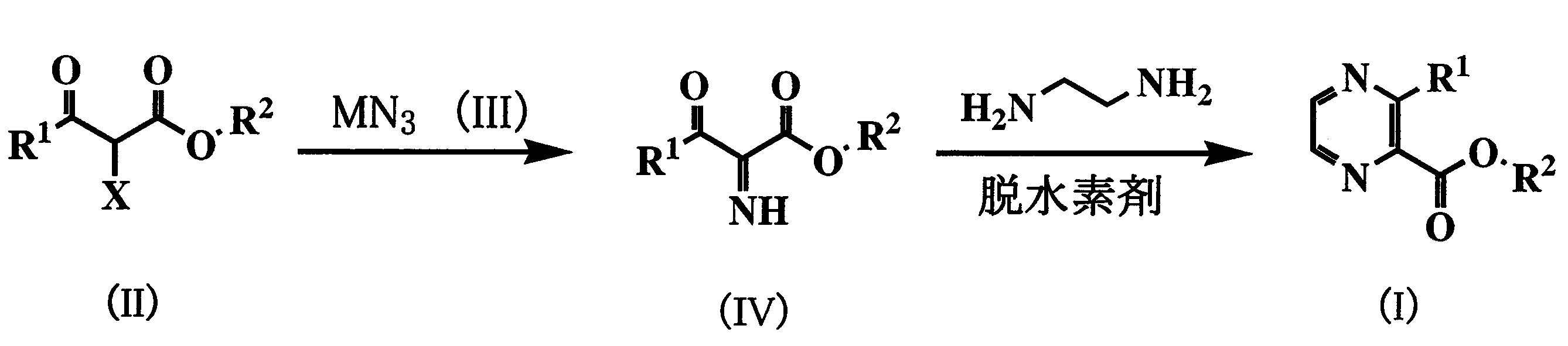
(式中、R1、R2、X及びMは前記に同じ。)
2) 一般式(II) → 一般式(IV)→ 一般式(I)
本反応は、不活性溶媒中、段階的に(イ)一般式(II)で表されるハロエステル誘導体またはその水和物と一般式(III)で表されるアルカリ金属アジド塩を反応させ、一般式(IV)で表されるイミノ体またはその水和物に誘導し、次いで(ロ)1、2-エチレンジアミン又はその酸塩と反応させ、最後に(ハ)脱水素化剤を作用させ、一般式(I)で表されるピラジンカルボン酸誘導体を製造することができる。
2) 一般式(II) → 一般式(IV)→ 一般式(I)
本反応は、不活性溶媒中、段階的に(イ)一般式(II)で表されるハロエステル誘導体またはその水和物と一般式(III)で表されるアルカリ金属アジド塩を反応させ、一般式(IV)で表されるイミノ体またはその水和物に誘導し、次いで(ロ)1、2-エチレンジアミン又はその酸塩と反応させ、最後に(ハ)脱水素化剤を作用させ、一般式(I)で表されるピラジンカルボン酸誘導体を製造することができる。
(イ)、(ロ)および(ハ)の反応は、1)で述べた方法に準じて行えば良い。それぞれの試薬は1)に記載のように同時に添加しても、また2)に記載のように順次添加しても良好に目的物を得ることができる。
一般式(II)で表される化合物は、公知の方法、例えば、Helvetica Chumica Acta(1965),48(6),1423-6等に記載の方法により、またはこれに準じて製造できる。また本願発明の製造方法により得られる3-ハロアルキルピラジン-2-カルボン酸誘導体は、例えば参考例に示した方法等により容易に農園芸用殺ダニ剤(特許文献1)及び殺菌剤(特許文献2)などの有用な化合物を製造することができる。
以下に本発明の代表的な実施例を示すが、本発明はこれらに限定されるものではない。
実施例1. 3-トリフルオロメチルピラジン-2-カルボン酸エチルの製造
アジ化ナトリウム(2.6g、40mmol)と1,2-エチレンジアミン塩酸塩(3.2g、24mmol)の4mL水溶液に2-クロロ-4,4,4-トリフルオロ-3-オキソブタン酸エチル(4.4g、20mmol)の酢酸エチル溶液(8mL)を滴下した。その後、5%Pd/C(2g;50%wet)と酢酸エチル(2mL)を添加し室温にて1時間撹拌した。次いで、反応混合物を35℃で1時間撹拌後、2.5時間加熱還流した。反応液を室温に冷却した。酢酸エチル(100mL)及び水(60mL)を加え、ろ過にてPd/Cを除去した後、酢酸エチルにて抽出した。有機層を水洗、乾燥し、溶媒を留去し残渣をシリカゲルカラムクロマトグラフィーにて精製し3-トリフルオロメチルピラジン-2-カルボン酸エチルを得た。
収量;2.1g
収率;48%
物性:1H-NMR[CDCl3/TMSδ値(ppm)]
δ:1.44(t,J=8Hz,3H),4.52(q,J=8Hz,2H),8.81(d,J=4Hz,1H),8.84(d,J=4Hz,1H)
19F-NMR[CDCl3/TMSδ値(ppm)]
δ:-65.5
アジ化ナトリウム(2.6g、40mmol)と1,2-エチレンジアミン塩酸塩(3.2g、24mmol)の4mL水溶液に2-クロロ-4,4,4-トリフルオロ-3-オキソブタン酸エチル(4.4g、20mmol)の酢酸エチル溶液(8mL)を滴下した。その後、5%Pd/C(2g;50%wet)と酢酸エチル(2mL)を添加し室温にて1時間撹拌した。次いで、反応混合物を35℃で1時間撹拌後、2.5時間加熱還流した。反応液を室温に冷却した。酢酸エチル(100mL)及び水(60mL)を加え、ろ過にてPd/Cを除去した後、酢酸エチルにて抽出した。有機層を水洗、乾燥し、溶媒を留去し残渣をシリカゲルカラムクロマトグラフィーにて精製し3-トリフルオロメチルピラジン-2-カルボン酸エチルを得た。
収量;2.1g
収率;48%
物性:1H-NMR[CDCl3/TMSδ値(ppm)]
δ:1.44(t,J=8Hz,3H),4.52(q,J=8Hz,2H),8.81(d,J=4Hz,1H),8.84(d,J=4Hz,1H)
19F-NMR[CDCl3/TMSδ値(ppm)]
δ:-65.5
実施例2. 3-トリフルオロメチルピラジン-2-カルボン酸エチルの製造
アジ化ナトリウム(2.6g、40mmol)とテトラブチルアンモニウムクロリド(0.6g、2mmol)のトルエン(6mL)及び水(4mL)の混合溶液に2-クロロ-4,4,4-トリフルオロ-3-オキソブタン酸エチル(4.4g、20mmol)のトルエン溶液(2mL)を滴下した。室温にて1.5時間撹拌後、エチレンジアミン塩酸塩(3.2g、24mmol)、2-プロパノール(7mL)及びピリジン(4.0g、50mmol)を順次加え更に1時間攪拌した。10%Pd/C(3g;53%wet)とニトロベンゼン(2mL)を添加し35℃で2時間撹拌後、2.5時間加熱還流した。反応液を室温に冷却した。酢酸エチル(100mL)及び水(60mL)を加え、ろ過にてPd/Cを除去し、有機層を水洗、乾燥し、溶媒を留去し残渣をシリカゲルカラムクロマトグラフィーにて精製し3-トリフルオロメチルピラジン-2-カルボン酸エチルを得た。
収量;1.8g
収率;41%
アジ化ナトリウム(2.6g、40mmol)とテトラブチルアンモニウムクロリド(0.6g、2mmol)のトルエン(6mL)及び水(4mL)の混合溶液に2-クロロ-4,4,4-トリフルオロ-3-オキソブタン酸エチル(4.4g、20mmol)のトルエン溶液(2mL)を滴下した。室温にて1.5時間撹拌後、エチレンジアミン塩酸塩(3.2g、24mmol)、2-プロパノール(7mL)及びピリジン(4.0g、50mmol)を順次加え更に1時間攪拌した。10%Pd/C(3g;53%wet)とニトロベンゼン(2mL)を添加し35℃で2時間撹拌後、2.5時間加熱還流した。反応液を室温に冷却した。酢酸エチル(100mL)及び水(60mL)を加え、ろ過にてPd/Cを除去し、有機層を水洗、乾燥し、溶媒を留去し残渣をシリカゲルカラムクロマトグラフィーにて精製し3-トリフルオロメチルピラジン-2-カルボン酸エチルを得た。
収量;1.8g
収率;41%
実施例3. 3-ジフルオロメチルピラジン-2-カルボン酸エチルの製造
4,4-ジフルオロ-3-オキソブタン酸エチル(10g、60mol)に塩化スルフリル(8.5g、63mol)を加え室温にて12時間攪拌した。反応液を氷水(100ml)にあけ酢酸エチルで抽出した。有機層は水、飽和食塩水にて順次洗浄した後、無水硫酸ナトリウムで乾燥し減圧下濃縮した残渣を減圧蒸留にて精製(73~78℃/12-14mmHg)し2-クロロ-4,4-ジフルオロ-3-オキソブタン酸エチルエステル(6.6g、収率;55%)を得た。
アジ化ナトリウム(2.15g、33mmol)のN,N-ジメチルホルムアミド(6.4mL)、水(1.6mL)溶液に5℃にて2-クロロ-4,4-ジフルオロ-3-オキソブタン酸エチルエステル(3g、15mmol)のN,N-ジメチルホルムアミド(1.6mL)溶液を滴下した。反応溶液を室温にて1.5時間撹拌後、エチレンジアミン塩酸塩(2g、15mmol)とエタノール(4.8mL)、ピリジン(2.6g、33mmol)を加え3時間撹拌した。次いで、5%Pd/C(50%wet;2g)と酢酸(3.2mL)を添加し、2.5時間加熱還流した。反応液を室温へと冷却後、酢酸エチル(100mL)及び水(100mL)を加え、濾過にてPd/Cを除去し濾液を分液した。有機層を水及び飽和食塩水で順次洗浄し、無水硫酸ナトリウムで乾燥し減圧下濃縮した残渣をシリカゲルクロマトグラフィーにて精製し3-ジフルオロメチルピラジン-2-カルボン酸エチルを得た。
収量;1.1g
収率;37%
物性:1H-NMR[CDCl3/TMSδ値(ppm)]
δ:1.49(t,J=8Hz,3H),4.54(q,J=8Hz,2H),7.40(t,J=56Hz,1H),8.82(d,J=4Hz,1H),8.86(d,J=4Hz,1H)
4,4-ジフルオロ-3-オキソブタン酸エチル(10g、60mol)に塩化スルフリル(8.5g、63mol)を加え室温にて12時間攪拌した。反応液を氷水(100ml)にあけ酢酸エチルで抽出した。有機層は水、飽和食塩水にて順次洗浄した後、無水硫酸ナトリウムで乾燥し減圧下濃縮した残渣を減圧蒸留にて精製(73~78℃/12-14mmHg)し2-クロロ-4,4-ジフルオロ-3-オキソブタン酸エチルエステル(6.6g、収率;55%)を得た。
アジ化ナトリウム(2.15g、33mmol)のN,N-ジメチルホルムアミド(6.4mL)、水(1.6mL)溶液に5℃にて2-クロロ-4,4-ジフルオロ-3-オキソブタン酸エチルエステル(3g、15mmol)のN,N-ジメチルホルムアミド(1.6mL)溶液を滴下した。反応溶液を室温にて1.5時間撹拌後、エチレンジアミン塩酸塩(2g、15mmol)とエタノール(4.8mL)、ピリジン(2.6g、33mmol)を加え3時間撹拌した。次いで、5%Pd/C(50%wet;2g)と酢酸(3.2mL)を添加し、2.5時間加熱還流した。反応液を室温へと冷却後、酢酸エチル(100mL)及び水(100mL)を加え、濾過にてPd/Cを除去し濾液を分液した。有機層を水及び飽和食塩水で順次洗浄し、無水硫酸ナトリウムで乾燥し減圧下濃縮した残渣をシリカゲルクロマトグラフィーにて精製し3-ジフルオロメチルピラジン-2-カルボン酸エチルを得た。
収量;1.1g
収率;37%
物性:1H-NMR[CDCl3/TMSδ値(ppm)]
δ:1.49(t,J=8Hz,3H),4.54(q,J=8Hz,2H),7.40(t,J=56Hz,1H),8.82(d,J=4Hz,1H),8.86(d,J=4Hz,1H)
中間体の製造方法
実施例4. 2-イミノ-4,4,4-トリフルオロ-3-オキソブタン酸エチルの製造
アジ化ナトリウム(2.6g、40mmol)の1mL水溶液に2-クロロ-4,4,4-トリフルオロ-3-オキソブタン酸エチル(4.4g、20mmol)のアセトニトリル溶液(2mL)を滴下した。室温にて2時間撹拌後、反応混合物をろ過し濾液を減圧留去し、粗製の目的物を含む油状物を得た。
収量:2.2g
収率:50%
物性:1H-NMR[DMSO/TMSδ値(ppm)]
δ:1.21(t,J=7.2Hz,3H),4.16(q.J=7.2Hz,2H),7.65(s,0.5H),7.85(s,0.5H)
物性:19F-NMR[DMSO-d6/TMSδ値(ppm)]
δ:-80.8
実施例4. 2-イミノ-4,4,4-トリフルオロ-3-オキソブタン酸エチルの製造
アジ化ナトリウム(2.6g、40mmol)の1mL水溶液に2-クロロ-4,4,4-トリフルオロ-3-オキソブタン酸エチル(4.4g、20mmol)のアセトニトリル溶液(2mL)を滴下した。室温にて2時間撹拌後、反応混合物をろ過し濾液を減圧留去し、粗製の目的物を含む油状物を得た。
収量:2.2g
収率:50%
物性:1H-NMR[DMSO/TMSδ値(ppm)]
δ:1.21(t,J=7.2Hz,3H),4.16(q.J=7.2Hz,2H),7.65(s,0.5H),7.85(s,0.5H)
物性:19F-NMR[DMSO-d6/TMSδ値(ppm)]
δ:-80.8
参考例1. N-(3’,4’-ジフルオロビフェニル-2-イル)-3-トリフルオロメチルピラジン-2-カルボキサミドの製造
3’,4’-ジフルオロビフェニル-2-イルアミン(10g、49mmol)のジメチルアセトアミド(11ml)溶液に28%ナトリウムメトキシドメタノール溶液(30ml、0.15mol)を加え、次いで3-トリフルオロメチルピラジン-2-カルボン酸エチル(12.6g、57mmol)のジメチルアセトアミド(1ml)溶液を加え、室温にて5時間攪拌した。冷却した希塩酸(75ml)を加え酢酸エチルで抽出し、有機層を水、重曹水及び飽和食塩水で順次洗浄し無水硫酸ナトリウムで乾燥した。減圧下に濃縮した後、残渣を再結晶化(ヘキサン:酢酸エチル=4:1(V/V))で精製して表題化合物を得た。
収量:15.7g
収率:85%
物性:融点 116~117℃
3’,4’-ジフルオロビフェニル-2-イルアミン(10g、49mmol)のジメチルアセトアミド(11ml)溶液に28%ナトリウムメトキシドメタノール溶液(30ml、0.15mol)を加え、次いで3-トリフルオロメチルピラジン-2-カルボン酸エチル(12.6g、57mmol)のジメチルアセトアミド(1ml)溶液を加え、室温にて5時間攪拌した。冷却した希塩酸(75ml)を加え酢酸エチルで抽出し、有機層を水、重曹水及び飽和食塩水で順次洗浄し無水硫酸ナトリウムで乾燥した。減圧下に濃縮した後、残渣を再結晶化(ヘキサン:酢酸エチル=4:1(V/V))で精製して表題化合物を得た。
収量:15.7g
収率:85%
物性:融点 116~117℃
Claims (19)
- 一般式(II)


- 一般式(II)
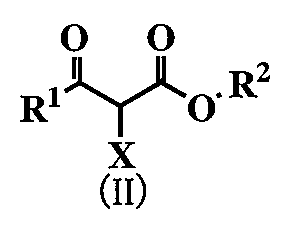

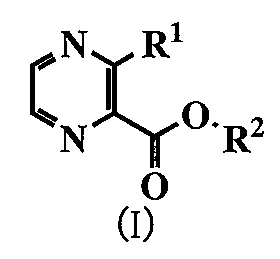
- 一般式(II)


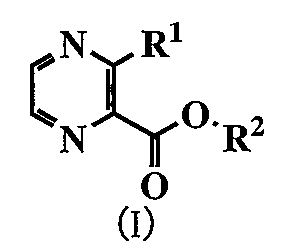
- R1がハロ(C1-C6)アルキル基である請求項1に記載のピラジンカルボン酸誘導体の製造方法。
- R1がハロ(C1-C6)アルキル基である請求項2に記載のピラジンカルボン酸誘導体の製造方法。
- R1がハロ(C1-C6)アルキル基である請求項3に記載のピラジンカルボン酸誘導体の製造方法。
- R1がフルオロ(C1-C6)アルキル基である請求項1に記載のピラジンカルボン酸誘導体の製造方法。
- R1がフルオロ(C1-C6)アルキル基である請求項2に記載のピラジンカルボン酸誘導体の製造方法。
- R1がフルオロ(C1-C6)アルキル基である請求項3に記載のピラジンカルボン酸誘導体の製造方法。
- R1がフルオロ(C1-C3)アルキル基である請求項1に記載のピラジンカルボン酸誘導体の製造方法。
- R1がフルオロ(C1-C3)アルキル基である請求項2に記載のピラジンカルボン酸誘導体の製造方法。
- R1がフルオロ(C1-C3)アルキル基である請求項3に記載のピラジンカルボン酸誘導体の製造方法。
- R1がジフルオロメチル基又はトリフルオロメチル基である請求項1に記載のピラジンカルボン酸誘導体の製造方法。
- R1がジフルオロメチル基又はトリフルオロメチル基である請求項2に記載のピラジンカルボン酸誘導体の製造方法。
- R1がジフルオロメチル基又はトリフルオロメチル基である請求項3に記載のピラジンカルボン酸誘導体の製造方法。
- Mが、ナトリウムである請求項1~15のいずれか1項に記載のピラジンカルボン酸誘導体の製造方法。
- 脱水素化剤が、パラジウム又はその担持体である請求項1~16のいずれか1項に記載のピラジンカルボン酸誘導体の製造方法。
- 一般式(IV)

- 一般式(II)


Applications Claiming Priority (2)
| Application Number | Priority Date | Filing Date | Title |
|---|---|---|---|
| JP2009-104861 | 2009-04-23 | ||
| JP2009104861 | 2009-04-23 |
Publications (1)
| Publication Number | Publication Date |
|---|---|
| WO2010122794A1 true WO2010122794A1 (ja) | 2010-10-28 |
Family
ID=43010919
Family Applications (1)
| Application Number | Title | Priority Date | Filing Date |
|---|---|---|---|
| PCT/JP2010/002898 Ceased WO2010122794A1 (ja) | 2009-04-23 | 2010-04-22 | ピラジンカルボン酸誘導体の製造方法及びその中間体 |
Country Status (1)
| Country | Link |
|---|---|
| WO (1) | WO2010122794A1 (ja) |
Cited By (6)
| Publication number | Priority date | Publication date | Assignee | Title |
|---|---|---|---|---|
| WO2018041853A1 (en) | 2016-09-01 | 2018-03-08 | Lonza Ltd | Method for the preparation of 3-(trifluoromethyl)pyrazine-2-carboxylic acid esters |
| CN108069915A (zh) * | 2016-11-15 | 2018-05-25 | 华中师范大学 | 一种吡嗪酰胺类化合物及其制备方法和应用以及一种杀菌剂 |
| CN109096209A (zh) * | 2017-06-20 | 2018-12-28 | 华中师范大学 | 吡嗪酰胺类化合物及其制备方法和应用以及杀菌剂 |
| CN109666004A (zh) * | 2017-10-13 | 2019-04-23 | 华中师范大学 | 含有三氟甲基的吡嗪酰胺类化合物及其制备方法和应用以及杀菌剂 |
| CN109666003A (zh) * | 2017-10-13 | 2019-04-23 | 华中师范大学 | 含碘元素的吡嗪酰胺类化合物及其制备方法和应用以及杀菌剂 |
| CN109689631A (zh) * | 2016-09-01 | 2019-04-26 | 隆萨有限公司 | 制备3-(三氟甲基)吡嗪-2-甲酸酯的方法 |
Citations (2)
| Publication number | Priority date | Publication date | Assignee | Title |
|---|---|---|---|---|
| WO2005115994A1 (ja) * | 2004-05-27 | 2005-12-08 | Nihon Nohyaku Co., Ltd. | 置換ピラジンカルボン酸アニリド誘導体又はその塩類、その中間体及び農園芸用薬剤並びにその使用方法 |
| WO2007072999A1 (en) * | 2005-12-22 | 2007-06-28 | Nihon Nohyaku Co., Ltd | Pyrazinecarboxamide derivatives and plant disease controlling agents containing the same |
-
2010
- 2010-04-22 WO PCT/JP2010/002898 patent/WO2010122794A1/ja not_active Ceased
Patent Citations (2)
| Publication number | Priority date | Publication date | Assignee | Title |
|---|---|---|---|---|
| WO2005115994A1 (ja) * | 2004-05-27 | 2005-12-08 | Nihon Nohyaku Co., Ltd. | 置換ピラジンカルボン酸アニリド誘導体又はその塩類、その中間体及び農園芸用薬剤並びにその使用方法 |
| WO2007072999A1 (en) * | 2005-12-22 | 2007-06-28 | Nihon Nohyaku Co., Ltd | Pyrazinecarboxamide derivatives and plant disease controlling agents containing the same |
Non-Patent Citations (1)
| Title |
|---|
| RAYMOND J. BERGERON ET AL.: "Application of N-Phenyltrifluoromethanesulfonamides to the Synthesis of Pyrazines", JOURNAL OF ORGANIC CHEMISTRY, vol. 45, no. 1, 1980, pages 161 - 163 * |
Cited By (10)
| Publication number | Priority date | Publication date | Assignee | Title |
|---|---|---|---|---|
| WO2018041853A1 (en) | 2016-09-01 | 2018-03-08 | Lonza Ltd | Method for the preparation of 3-(trifluoromethyl)pyrazine-2-carboxylic acid esters |
| CN109689631A (zh) * | 2016-09-01 | 2019-04-26 | 隆萨有限公司 | 制备3-(三氟甲基)吡嗪-2-甲酸酯的方法 |
| CN108069915A (zh) * | 2016-11-15 | 2018-05-25 | 华中师范大学 | 一种吡嗪酰胺类化合物及其制备方法和应用以及一种杀菌剂 |
| CN108069915B (zh) * | 2016-11-15 | 2020-05-15 | 华中师范大学 | 一种吡嗪酰胺类化合物及其制备方法和应用以及一种杀菌剂 |
| CN109096209A (zh) * | 2017-06-20 | 2018-12-28 | 华中师范大学 | 吡嗪酰胺类化合物及其制备方法和应用以及杀菌剂 |
| CN109096209B (zh) * | 2017-06-20 | 2022-03-01 | 华中师范大学 | 吡嗪酰胺类化合物及其制备方法和应用以及杀菌剂 |
| CN109666004A (zh) * | 2017-10-13 | 2019-04-23 | 华中师范大学 | 含有三氟甲基的吡嗪酰胺类化合物及其制备方法和应用以及杀菌剂 |
| CN109666003A (zh) * | 2017-10-13 | 2019-04-23 | 华中师范大学 | 含碘元素的吡嗪酰胺类化合物及其制备方法和应用以及杀菌剂 |
| CN109666003B (zh) * | 2017-10-13 | 2020-08-21 | 华中师范大学 | 含碘元素的吡嗪酰胺类化合物及其制备方法和应用以及杀菌剂 |
| CN109666004B (zh) * | 2017-10-13 | 2020-08-21 | 华中师范大学 | 含有三氟甲基的吡嗪酰胺类化合物及其制备方法和应用以及杀菌剂 |
Similar Documents
| Publication | Publication Date | Title |
|---|---|---|
| KR101420892B1 (ko) | 이마티닙 및 그들의 중간체 및 그 제조방법 | |
| KR20190013553A (ko) | 아미노피리미딘 유도체의 개선된 제조방법 | |
| WO2010122794A1 (ja) | ピラジンカルボン酸誘導体の製造方法及びその中間体 | |
| JP2020528437A (ja) | アミノピリミジン誘導体の合成に有用な新規中間体、それを調製するためのプロセス、及びそれを使用してアミノピリミジン誘導体を調製するためのプロセス | |
| JP6771475B2 (ja) | 3−クロロ−2−ビニルフェニルスルホネート類の製造方法 | |
| KR102006518B1 (ko) | 1-알킬-3-플루오로알킬-1h-피라졸-4-카르복실산 클로라이드의 제조 방법 | |
| JP5689321B2 (ja) | 2−アミノ−4−トリフルオロメチルピリジン類の製造方法 | |
| JP2007326784A (ja) | 1−置換−5−フルオロアルキルピラゾール−4−カルボン酸エステルの製造方法 | |
| WO2010122793A1 (ja) | ピラジン誘導体の製造方法及びその中間体 | |
| JP5631741B2 (ja) | ピラジン誘導体類の製造方法及びその中間体類 | |
| JP4879907B2 (ja) | フェニル2−ピリミジニルケトン類の製造方法及びその新規中間体 | |
| JP2008545623A (ja) | カルボキサミド誘導体の調製方法 | |
| JP2011057575A (ja) | 4−ヒドロキシベンゾチオフェン誘導体の製造方法 | |
| CN102548951A (zh) | 作为中间体的二氢化茚衍生物 | |
| JP4061333B2 (ja) | 2−(ピラゾール−1−イル)ピリジン誘導体 | |
| JP2019514931A (ja) | 除草剤としてのピリジニルイミダゾロン化合物を調製するプロセス | |
| JP4055246B2 (ja) | 5−クロロ−6−(α−フルオロアルキル)−4−ピリミドン及びその製法 | |
| CN120485299A (zh) | 一种中间体的制备方法 | |
| JP2003286285A (ja) | ピリドン化合物の製造法およびその中間体 | |
| JP4449211B2 (ja) | 6−(1−フルオロエチル)−5−ヨード−4−ピリミドン及びその製法 | |
| JP2007153823A (ja) | アレンカルボン酸エステル類の製造法 | |
| CN104080776A (zh) | N-羟基-1-(1-烷基-1h-四唑-5-基)-1-苯基亚甲胺衍生物的制备方法 | |
| JP2009046400A (ja) | 殺虫性化合物の製造中間体およびその製造方法 | |
| JPWO2007086559A1 (ja) | テトラヒドロピラン化合物の製造方法 | |
| JPWO2005026119A1 (ja) | スルホンアミド含有インドール化合物の製造方法 |
Legal Events
| Date | Code | Title | Description |
|---|---|---|---|
| 121 | Ep: the epo has been informed by wipo that ep was designated in this application |
Ref document number: 10766855 Country of ref document: EP Kind code of ref document: A1 |
|
| NENP | Non-entry into the national phase |
Ref country code: DE |
|
| 122 | Ep: pct application non-entry in european phase |
Ref document number: 10766855 Country of ref document: EP Kind code of ref document: A1 |
|
| NENP | Non-entry into the national phase |
Ref country code: JP |