WO2010087339A1 - 脂環式化合物、その製造方法、それを含む組成物及びそれを用いたレジストパターン形成方法 - Google Patents
脂環式化合物、その製造方法、それを含む組成物及びそれを用いたレジストパターン形成方法 Download PDFInfo
- Publication number
- WO2010087339A1 WO2010087339A1 PCT/JP2010/050977 JP2010050977W WO2010087339A1 WO 2010087339 A1 WO2010087339 A1 WO 2010087339A1 JP 2010050977 W JP2010050977 W JP 2010050977W WO 2010087339 A1 WO2010087339 A1 WO 2010087339A1
- Authority
- WO
- WIPO (PCT)
- Prior art keywords
- carbon atoms
- formula
- branched
- hydrocarbon group
- cyclic hydrocarbon
- Prior art date
- Legal status (The legal status is an assumption and is not a legal conclusion. Google has not performed a legal analysis and makes no representation as to the accuracy of the status listed.)
- Ceased
Links
- SMEROWZSTRWXGI-OJHYTHBOSA-N CC(CCC(O)=O)C(CC1)[C@@](C)(CC2)C1C(CC1)C2[C@@](C)(CC2)C1C[C@@H]2O Chemical compound CC(CCC(O)=O)C(CC1)[C@@](C)(CC2)C1C(CC1)C2[C@@](C)(CC2)C1C[C@@H]2O SMEROWZSTRWXGI-OJHYTHBOSA-N 0.000 description 1
- RUDATBOHQWOJDD-AAAMDKJCSA-N CC(CCC(O)=O)C(CC1)[C@@](C)(CCC2[C@@](C)(CC[C@H](C3)O)C3C3)C1C2[C@@H]3O Chemical compound CC(CCC(O)=O)C(CC1)[C@@](C)(CCC2[C@@](C)(CC[C@H](C3)O)C3C3)C1C2[C@@H]3O RUDATBOHQWOJDD-AAAMDKJCSA-N 0.000 description 1
- RUDATBOHQWOJDD-YLHBYLHCSA-N CC(CCC(O)=O)C(CC1)[C@@](C)(CCC2[C@@](C)(CC[C@H](C3)O)C3C3)C1C2[C@H]3O Chemical compound CC(CCC(O)=O)C(CC1)[C@@](C)(CCC2[C@@](C)(CC[C@H](C3)O)C3C3)C1C2[C@H]3O RUDATBOHQWOJDD-YLHBYLHCSA-N 0.000 description 1
- BHQCQFFYRZLCQQ-FLFOCHNTSA-N CC(CCC(O)=O)C(CCC1C(C(C2)[C@@](C)(CC[C@H](C3)O)C3C3)[C@@H]3O)[C@@]1(C)[C@H]2O Chemical compound CC(CCC(O)=O)C(CCC1C(C(C2)[C@@](C)(CC[C@H](C3)O)C3C3)[C@@H]3O)[C@@]1(C)[C@H]2O BHQCQFFYRZLCQQ-FLFOCHNTSA-N 0.000 description 1
- KXGVEGMKQFWNSR-RTAUBXBKSA-N CC(CCC(O)=O)C(CCC1C(CC2)C(C3)[C@@](C)(CC4)C2C[C@@H]4O)[C@@]1(C)[C@H]3O Chemical compound CC(CCC(O)=O)C(CCC1C(CC2)C(C3)[C@@](C)(CC4)C2C[C@@H]4O)[C@@]1(C)[C@H]3O KXGVEGMKQFWNSR-RTAUBXBKSA-N 0.000 description 1
- 0 CC(CCC(OCO*)=O)C(CCC1C(C(C2)[C@@](C)(CC[C@](C3)O)C3C3)[C@@]3O)[C@@]1(C)[C@]2O Chemical compound CC(CCC(OCO*)=O)C(CCC1C(C(C2)[C@@](C)(CC[C@](C3)O)C3C3)[C@@]3O)[C@@]1(C)[C@]2O 0.000 description 1
Images

Classifications
-
- C—CHEMISTRY; METALLURGY
- C07—ORGANIC CHEMISTRY
- C07J—STEROIDS
- C07J9/00—Normal steroids containing carbon, hydrogen, halogen or oxygen substituted in position 17 beta by a chain of more than two carbon atoms, e.g. cholane, cholestane, coprostane
-
- G—PHYSICS
- G03—PHOTOGRAPHY; CINEMATOGRAPHY; ANALOGOUS TECHNIQUES USING WAVES OTHER THAN OPTICAL WAVES; ELECTROGRAPHY; HOLOGRAPHY
- G03F—PHOTOMECHANICAL PRODUCTION OF TEXTURED OR PATTERNED SURFACES, e.g. FOR PRINTING, FOR PROCESSING OF SEMICONDUCTOR DEVICES; MATERIALS THEREFOR; ORIGINALS THEREFOR; APPARATUS SPECIALLY ADAPTED THEREFOR
- G03F7/00—Photomechanical, e.g. photolithographic, production of textured or patterned surfaces, e.g. printing surfaces; Materials therefor, e.g. comprising photoresists; Apparatus specially adapted therefor
- G03F7/004—Photosensitive materials
- G03F7/0045—Photosensitive materials with organic non-macromolecular light-sensitive compounds not otherwise provided for, e.g. dissolution inhibitors
-
- G—PHYSICS
- G03—PHOTOGRAPHY; CINEMATOGRAPHY; ANALOGOUS TECHNIQUES USING WAVES OTHER THAN OPTICAL WAVES; ELECTROGRAPHY; HOLOGRAPHY
- G03F—PHOTOMECHANICAL PRODUCTION OF TEXTURED OR PATTERNED SURFACES, e.g. FOR PRINTING, FOR PROCESSING OF SEMICONDUCTOR DEVICES; MATERIALS THEREFOR; ORIGINALS THEREFOR; APPARATUS SPECIALLY ADAPTED THEREFOR
- G03F7/00—Photomechanical, e.g. photolithographic, production of textured or patterned surfaces, e.g. printing surfaces; Materials therefor, e.g. comprising photoresists; Apparatus specially adapted therefor
- G03F7/004—Photosensitive materials
- G03F7/039—Macromolecular compounds which are photodegradable, e.g. positive electron resists
- G03F7/0392—Macromolecular compounds which are photodegradable, e.g. positive electron resists the macromolecular compound being present in a chemically amplified positive photoresist composition
Definitions
- the present invention relates to an alicyclic compound, a method for producing the same, a composition containing the alicyclic compound, and a resist pattern forming method using the alicyclic compound, and more specifically, an alicyclic compound that functions as a positive photoresist, that is, usually an alkali.
- DNQ diazonaphthoquinone
- Patent Documents 2 to 7 have developed polyphenolic low molecular compounds such as calixarene and calixresorcinalene as materials for semiconductor production by lithography. Although these are easy to synthesize, since they have an aromatic ring, they cannot be used for light sources with short wavelengths such as KrF and ArF due to light absorption. Usually, the wavelength that can be used for exposure is limited to g-line or i-line of a high-pressure mercury lamp, or soft X-ray. Therefore, several various alicyclic low-molecular compounds have been proposed for application to ArF excimer laser, which is the current state-of-the-art mass production exposure technology (see Patent Documents 8 to 11).
- Patent Document 12 a fully alicyclic low-molecular compound. Since the compound group described in these is an all alicyclic compound, it has high transparency and lithography with an arbitrary light source is possible. Furthermore, it is possible to build a process having a thermal margin with a material having an adamantane skeleton and excellent thermal stability. However, a specific compound (see Compound No. GR-5 of Patent Document 12) has a high solubility in a developing solution, resulting in a problem that the film is reduced, and it is necessary to use a diluted developing solution.
- the present invention is excellent in solubility characteristics, exposure sensitivity, resolution, roughness, heat resistance, etc. useful as a positive photoresist monomer or dissolution inhibitor used in the manufacture of semiconductor devices under the circumstances as described above.
- An object of the present invention is to provide an alicyclic compound having an excellent dissolution inhibiting effect on a developer, a production method thereof, a composition containing the same, and a resist pattern forming method using the same.
- an alicyclic compound represented by the following general formula (1) (Wherein R a1 to R a3 are each independently a cholic acid ester structure-containing group represented by the following general formula (a)) (Wherein R b represents a hydroxyl group or an oxygen-containing organic group having 2 to 30 carbon atoms represented by any of the following general formulas (b1) to (b5).
- R c and R d are each independently A hydrogen atom, a hydroxyl group, or an oxygen-containing organic group having 2 to 30 carbon atoms represented by any of the following general formulas (b1) to (b5), wherein R e and R f are each independently a hydrogen atom, A linear, branched or cyclic hydrocarbon group having 1 to 10 carbon atoms which may have a heteroatom, and n represents 1 or 2.
- A represents a single bond or 1 to 5 carbon atoms.
- Z 1 represents a linear, branched or cyclic hydrocarbon group having 1 to 15 carbon atoms which may have a hetero atom.
- Z 2 represents a linear, branched or cyclic hydrocarbon group having 1 to 15 carbon atoms which may have a hetero atom.
- Z 3 is a linear, branched or cyclic hydrocarbon group having 1 to 9 carbon atoms which may have a hetero atom, and R g and R h are each independently a hydrogen atom.
- Z 4 represents a linear, branched or cyclic hydrocarbon group having 1 to 15 carbon atoms which may have a hetero atom.
- Z 5 to Z 7 each independently represents a linear, branched or cyclic hydrocarbon group having 1 to 10 carbon atoms which may have a hetero atom.
- Cholic acids represented by any one of the following general formulas (c1) to (c4), 1,3,5-tris (vinyloxy) adamantane, 1,3,5-tris (halogenomethoxy) adamantane, 1,3,5
- composition according to any one of 9 to 11 above which is a positive resist composition
- a resist pattern forming method including a step of forming I will provide a.
- the alicyclic compound of the present invention is excellent in dissolution characteristics, exposure sensitivity, resolution, roughness, heat resistance and the like, and particularly excellent in dissolution inhibiting effect on a developer.
- FIG. 6 is a diagram for comparing dissolution inhibiting effects in resist films formed in Examples 7 to 12 and Comparative Example 1.
- the present invention provides an alicyclic compound represented by the following general formula (1).
- R a1 to R a3 are each independently a cholic acid ester structure-containing group represented by the following general formula (a)
- R a1 to R a3 in the general formula (1) may be the same or different from each other, but it is preferable that all of R a1 to R a3 are the same cholic acid ester structure-containing group.
- R b in the general formula (a) represents a hydroxyl group or an oxygen-containing organic group having 2 to 30 carbon atoms represented by any one of the following general formulas (b1) to (b5), preferably a hydroxyl group or the following general formula ( an oxygen-containing organic group having 2 to 30 carbon atoms represented by any of b1) to (b5), more preferably a hydroxyl group or an oxygen-containing organic group having 2 to 15 carbon atoms represented by the following general formula (b1): is there.
- R c and R d in the general formula (a) are each independently a hydrogen atom, a hydroxyl group or an oxygen-containing organic group having 2 to 30 carbon atoms represented by any of the following general formulas (b1) to (b5).
- R e and R f in the general formula (a) are each independently a hydrogen atom or a linear, branched or cyclic hydrocarbon group having 1 to 10 carbon atoms which may have a hetero atom.
- n represents 1 or 2, and preferably 1.
- a in the general formula (a) represents a single bond or a divalent hydrocarbon group having 1 to 5 carbon atoms, preferably a single bond.
- R b , R c and R d are not simultaneously hydroxyl groups.
- linear, branched or cyclic hydrocarbon group having 1 to 10 carbon atoms which may have a hetero atom represented by R e and R f in the general formula (a) include a methyl group, Linear hydrocarbon group such as ethyl group, n-propyl group, n-butyl group, n-pentyl group, n-hexyl group, n-heptyl group, isopropyl group, sec-butyl group, tert-butyl group, isopentyl Group, a branched hydrocarbon group such as neopentyl group, and a cyclic hydrocarbon group such as cyclopentyl group, cyclohexyl group and adamantyl group.
- Linear hydrocarbon group such as ethyl group, n-propyl group, n-butyl group, n-pentyl group, n-hexyl group, n-heptyl group, iso
- hetero atom that R e and R f have include a nitrogen atom, an oxygen atom, and a sulfur atom.
- divalent hydrocarbon group having 1 to 5 carbon atoms represented by A in the general formula (a) include a methylene group, an ethylene group, a trimethylene group, a tetramethylene group, and a pentamethylene group.
- Z 1 in the general formula (b1) represents a linear, branched or cyclic hydrocarbon group having 1 to 15 carbon atoms which may have a hetero atom, preferably a straight chain having 1 to 5 carbon atoms. A chain, branched or cyclic hydrocarbon group is shown.
- Z 2 in the general formula (b2) represents a linear, branched or cyclic hydrocarbon group having 1 to 15 carbon atoms which may have a hetero atom, preferably a straight chain having 1 to 8 carbon atoms. A chain, branched or cyclic hydrocarbon group is shown.
- Z 3 in the general formula (b3) represents a linear, branched or cyclic hydrocarbon group having 1 to 9 carbon atoms which may have a hetero atom, preferably a straight chain having 1 to 4 carbon atoms.
- a chain, branched or cyclic hydrocarbon group is shown.
- R g and R h in the general formula (b3) each independently represent a straight-chain, branched or cyclic hydrocarbon group having 1 to 10 carbon atoms which may have a hydrogen atom or a hetero atom, Preferably, it represents a hydrogen atom or a linear, branched or cyclic hydrocarbon group having 1 to 5 carbon atoms.
- Z 4 in the general formula (b4) represents a linear, branched or cyclic hydrocarbon group having 1 to 15 carbon atoms which may have a hetero atom, preferably a straight chain having 1 to 8 carbon atoms. A chain, branched or cyclic hydrocarbon group is shown.
- Z 5 to Z 7 in the general formula (b5) each independently represent a linear, branched or cyclic hydrocarbon group having 1 to 10 carbon atoms which may have a hetero atom, preferably A linear, branched or cyclic hydrocarbon group having 1 to 5 carbon atoms.
- a linear, branched or cyclic hydrocarbon group having 1 to 15 carbon atoms which may have a hetero atom, or a carbon number which may have a hetero atom represented by Z 3 in the general formula (b3) A linear, branched or cyclic hydrocarbon group having 1 to 9 carbon atoms and a linear chain group having 1 to 10 carbon atoms which may have a heteroatom represented by R g and R h in the above general formula (b3)
- Linear hydrocarbon groups such as n-heptyl group, branched hydrocarbon groups such as isopropyl group, sec-butyl group, tert-butyl group, isopentyl group, neopentyl group, cyclopentyl group, cyclohexyl group, adamantyl group, etc.
- a cyclic hydrocarbon group is mentioned.
- Specific examples of the hetero atom that Z 1 to Z 7 have include a nitrogen atom, an oxygen atom, and a sulfur atom.
- the alicyclic structure-containing compound of the present invention can be produced by various methods, and typical examples thereof include the following production methods A to D, but are not limited thereto.
- Manufacturing method A A method in which a halogenated alkyl ether compound is obtained by reacting an adamantane structure-containing alcohol with a hydrogen halide gas in the presence of an aldehyde, and an esterification reaction between the halogenated alkyl ether compound and cholic acids is carried out.
- Production method B An alcohol having an adamantane structure is obtained in the presence of an alkyl sulfoxide and an acid anhydride to obtain an alkylthioalkyl ether, which is converted to a halogenated alkyl ether by a halogenating agent, and further, esterification of the halogenated alkyl ether with cholic acids. How to perform the reaction.
- Production method C A method of carrying out an esterification reaction between an adamantane structure-containing vinyl ether and cholic acids in the presence of an acid catalyst.
- Manufacturing method D A method of performing a hydroxyl-protecting reaction of the alicyclic compound obtained by the above production methods A to C using an oxygen-containing organic compound.
- Examples of the adamantane structure-containing alcohol in the production method A include 1,3,5-adamantanetriol, 1,3,5-tris (hydroxymethyl) adamantane, and the like.
- Examples of aldehydes in production method A include linear or branched aliphatic aldehydes such as formaldehyde, paraformaldehyde, acetaldehyde, propionaldehyde, butyraldehyde, and isobutyraldehyde, and one or more are used. be able to.
- Examples of the hydrogen halide gas in the production method A include a single gas such as hydrogen fluoride gas, hydrogen chloride gas, and hydrogen bromide gas, or a mixed gas thereof.
- Examples of cholic acids in production method A include cholic acid represented by the following formula (c0), lithocholic acid represented by the following formula (c1), deoxycholic acid represented by the following formula (c2), and the following formula (c3). And saturated cholic acid analogs such as chenodeoxycholic acid represented by the following formula (c4), and one or more can be used.
- cholic acid represented by the following formula (c0) is used as the cholic acid, since the alicyclic compound of the present invention satisfying the general formula (a) cannot be obtained, the production method D described later is further performed. There is a need.
- the halogenated alkyl ether compound in Production Method A can be obtained by reacting an adamantane structure-containing alcohol with hydrogen halide gas in the presence of aldehydes. At this time, it can be carried out in the presence or absence of an organic solvent, but when an organic solvent is used, there is no particular limitation as long as it is below the saturated solubility of the adamantane structure-containing alcohol, but the substrate concentration is 0. It is preferable to adjust to 1 mol / liter to 10 mol / liter. When the substrate concentration is 0.1 mol / liter or more, a necessary amount can be obtained in a normal reactor, which is economically preferable.
- Organic solvents that can be used include hydrocarbon solvents such as hexane, heptane, cyclohexane, ethylcyclohexane, benzene, toluene, xylene, and ethers such as diethyl ether, dibutyl ether, tetrahydrofuran (THF), dioxane, and dimethoxyethane (DME).
- the solvent include halogen solvents such as dichloromethane and carbon tetrachloride.
- Halogen solvents having a high dissolved amount of hydrogen halide gas are preferable, and these may be used alone or in combination.
- the reaction temperature can be any temperature, but if it is too high, the solubility of the hydrogen halide gas decreases, and if it is too low, the reaction itself proceeds slowly.
- the pressure can be any pressure, normal pressure is preferable because side reactions need to be controlled under pressurized conditions. If the pressure is too high, a special pressure device is required, which is not economical.
- Specific examples of the halogenated alkyl ether thus obtained include 1,3,5-tris (halogenomethoxy) adamantane.
- the esterification reaction in production method A can be performed by reacting a halogenated alkyl ether and a cholic acid. Further, it can be carried out in the presence or absence of an organic solvent, but when an organic solvent is used, it is preferable to adjust the substrate concentration to be 0.1 mol / liter to 10 mol / liter. . When the substrate concentration is 0.1 mol / liter or more, a necessary amount can be obtained in a normal reactor, which is economically preferable. When the substrate concentration is 10 mol / liter or less, the temperature control of the reaction solution is controlled. It is easy and preferable.
- Usable organic solvents include hexane, heptane, cyclohexane, ethylcyclohexane, benzene, toluene, xylene and other hydrocarbon solvents, diethyl ether, dibutyl ether, tetrahydrofuran (THF), dioxane, dimethoxyethane (DME), and other ethers.
- Solvents such as dichloromethane and carbon tetrachloride, DMF (N, N-dimethylformamide), dimethyl sulfoxide (DMSO), N-methyl-2-pyrrolidone (NMP), hexamethylphosphoric triamide (HMPA),
- aprotic polar solvents such as hexamethylphosphorous triamide (HMPT) and carbon disulfide, and these may be used alone or in combination.
- the base include sodium hydride, sodium hydroxide, potassium hydroxide, sodium carbonate, potassium carbonate, sodium hydrogen carbonate, potassium hydrogen carbonate, silver oxide, sodium phosphate, potassium phosphate, disodium monohydrogen phosphate, dipotassium hydrogen phosphate.
- the solvent is distilled off from the reaction solution under reduced pressure to obtain the alicyclic compound of the present invention.
- purify as needed and may use a reaction liquid for next reaction, without refine
- a purification method it can be selected from general purification methods such as distillation, extraction washing, crystallization, reprecipitation, activated carbon adsorption, silica gel column chromatography in consideration of production scale and required purity.
- the method by extraction washing, crystallization or reprecipitation is preferable because it can be handled at a relatively low temperature and can process a large amount of sample at one time.
- a method for removing the used raw material from the alicyclic compound of the present invention can be employed as a method for removing the used raw material from the alicyclic compound of the present invention, but from the viewpoint of operability and economics, the raw material is obtained using a poor solvent for the alicyclic compound.
- a method of washing is preferred.
- poor solvents for alicyclic compounds those having a low boiling point are preferable, and representative examples include diethyl ether, methanol, ethanol, n-hexane, and n-heptane.
- Production method B As the adamantane structure-containing alcohol and cholic acids in the production method B, those similar to the production method A are used.
- Examples of the alkyl sulfoxide in production method B include dimethyl sulfoxide, diethyl sulfoxide, di-n-propyl sulfoxide, diisopropyl sulfoxide, di-n-butyl sulfoxide, diisobutyl sulfoxide, di-sec-butyl sulfoxide, and di-tert-butyl sulfoxide.
- Symmetric or asymmetrical aliphatic sulfoxides such as diisopentyl sulfoxide, methyl ethyl sulfoxide, methyl-tert-butyl sulfoxide, and the like, and one or more kinds can be used.
- symmetric aliphatic sulfoxide is preferable, and dimethyl sulfoxide having a short chain length alkyl group is more preferable.
- Examples of the acid anhydride in Production Method B include acetic anhydride, propionic anhydride, butyric anhydride, isobutyric anhydride, valeric anhydride, pivalic anhydride, benzoic anhydride, chloroacetic anhydride, tri Aliphatic or aromatic carboxylic acid anhydrides such as fluoroacetic anhydride can be mentioned, and one or more can be used.
- Examples of the halogenating agent in the production method B include sulfur halide compounds such as thionyl chloride, sulfuryl chloride, thionyl bromide, sulfuryl bromide, thionyl chlorobromide, sulfuryl bromide bromide, phosphorus trichloride, and three odors.
- sulfur halide compounds such as thionyl chloride, sulfuryl chloride, thionyl bromide, sulfuryl bromide, thionyl chlorobromide, sulfuryl bromide bromide, phosphorus trichloride, and three odors.
- Phosphorus halide, phosphorus triiodide, phosphoric acid trichloride, phosphoric acid tribromide, phosphorus pentachloride, phosphorus pentabromide and the like, and one or more of them can be used.
- the alkylthioalkyl ether compound in Production Method B can be obtained by reacting an adamantane structure-containing alcohol in the presence of an alkyl sulfoxide and an acid anhydride. At this time, the reaction can be carried out in the presence or absence of an organic solvent, but usually the reaction proceeds by using alkylsulfoxide and acid anhydride as a reaction reagent and solvent in a large excess.
- the substrate concentration is preferably adjusted to 1 mol / liter to 10 mol / liter. If the substrate concentration is 1 mol / liter or more, the necessary amount can be obtained in a normal reactor, which is economically preferable.
- the temperature of the reaction solution can be easily controlled.
- Usable organic solvents include hydrocarbon solvents such as hexane, heptane, cyclohexane, ethylcyclohexane, benzene, toluene, xylene, ethers such as diethyl ether, dibutyl ether, THF (tetrahydrofuran), dioxane, DME (dimethoxyethane), etc.
- the solvent include halogen solvents such as dichloromethane and carbon tetrachloride, and these may be used alone or in combination.
- the reaction temperature can be any temperature, but if it is too high, the selectivity decreases due to side reactions, and if it is too low, the progress of the reaction itself slows, so room temperature to 60 ° C. is preferable.
- the pressure can be any pressure, normal pressure is preferable because side reactions need to be controlled under pressurized conditions. If the pressure is too high, a special pressure device is required, which is not economical.
- Specific examples of the alkylthioalkyl ether thus obtained include 1,3,5-tris (methylthiomethoxy) adamantane and the like.
- the halogenated alkyl ether compound in Production Method B can be obtained by reacting the alkylthioalkyl ether compound with a halogenating agent.
- the reaction can be carried out in the presence or absence of an organic solvent, but a halogenating agent may be used in a large excess as a reaction reagent and a solvent.
- a halogenating agent may be used in a large excess as a reaction reagent and a solvent.
- the substrate concentration is 0.1 mol / liter or more, a necessary amount can be obtained in a normal reactor, which is economically preferable.
- the substrate concentration is 10 mol / liter or less, the temperature control of the reaction solution is controlled. It is easy and preferable.
- Usable organic solvents include hydrocarbon solvents such as hexane, heptane, cyclohexane, ethylcyclohexane, benzene, toluene, xylene, and ethers such as diethyl ether, dibutyl ether, tetrahydrofuran (THF), dioxane, dimethoxyethane (DME), etc.
- the solvent include halogen solvents such as dichloromethane and carbon tetrachloride, and these may be used alone or in combination.
- the reaction temperature can be any temperature, but if it is too high, the selectivity decreases due to side reactions, and if it is too low, the progress of the reaction itself slows, so room temperature to 100 ° C. is preferred.
- the pressure can be any pressure, normal pressure is preferable because side reactions need to be controlled under pressurized conditions. If the pressure is too high, a special pressure device is required, which is not economical. Specific examples of the halogenated alkyl ether thus obtained include 1,3,5-tris (halogenomethoxy) adamantane.
- the esterification reaction in production method B can be carried out in the same manner as the esterification reaction in production method A.
- Examples of the adamantane structure-containing vinyl ether in Production Method C include 1,3,5-tris (vinyloxy) adamantane and 1,3,5-tris (vinyloxymethyl) adamantane.
- the cholic acids in the production method C the same ones as in the production method A are used.
- the acid catalyst in production method C include any organic and inorganic acids defined by Lewis acid, Bronsted acid, Arrhenius acid, etc., preferably formic acid, acetic acid, hydrochloric acid, sulfuric acid, nitric acid, methanesulfone. Examples thereof include Bronsted acids such as acid, p-toluenesulfonic acid, trifluoroacetic acid, and trifluoromethanesulfonic acid.
- an adamantane structure-containing vinyl ether is reacted with cholic acids in the presence of an acid catalyst.
- it can be carried out in the presence or absence of an organic solvent, but when an organic solvent is used, there is no particular limitation as long as it is below the saturated solubility of the adamantane structure-containing vinyl ether.
- the substrate concentration is 0.1 mol / liter or more, a necessary amount can be obtained in a normal reactor, which is economically preferable.
- the substrate concentration is 10 mol / liter or less, the temperature control of the reaction solution is controlled. It is easy and preferable.
- Organic solvents that can be used include hydrocarbon solvents such as hexane, heptane, cyclohexane, ethylcyclohexane, benzene, toluene, xylene, and ethers such as diethyl ether, dibutyl ether, tetrahydrofuran (THF), dioxane, and dimethoxyethane (DME).
- the solvent include halogen solvents such as dichloromethane and carbon tetrachloride. Halogen solvents having a high dissolved amount of hydrogen halide gas are preferable, and these may be used alone or in combination.
- the reaction temperature can be any temperature, but if it is too high, a side reaction occurs in which the adamantane structure-containing vinyl ethers are polymerized. If it is too low, the reaction itself proceeds slowly, so 0 to 40 ° C. is preferable.
- the pressure can be any pressure, normal pressure is preferable because side reactions need to be controlled under pressurized conditions. If the pressure is too high, a special pressure device is required, which is not economical.
- the alicyclic compounds obtained by the above production methods A to C may be subjected to the following hydroxyl group protection reaction.
- R b , R c and R d in the above general formula (a) of the alicyclic compound are When three hydroxyl groups are simultaneously used, it is necessary to carry out the following hydroxyl group protection reaction.
- R a4 to R a6 are each independently a cholic acid ester structure-containing group represented by the following general formula (a-1), preferably a cholic acid ester represented by the following formula (a-2) It is a structure-containing group.
- R h and R i are each independently a hydrogen atom or a hydroxyl group
- the oxygen-containing organic compound in Production Method D includes carboxylic acid halides represented by the following general formula (d1), carbonate ester anhydrides represented by the following general formula (d2), and alkyl halides represented by the following general formula (d3).
- carboxylic acid halides represented by the following general formula (d1) carbonate ester anhydrides represented by the following general formula (d2)
- alkyl halides represented by the following general formula (d3) One or more selected from ethers, halogenated acetates represented by the following general formula (d4) and silyl halides represented by the following general formula (d5) are used.
- Z 1 represents a linear, branched or cyclic hydrocarbon group having 1 to 15 carbon atoms which may have a hetero atom, and X represents a halogen atom.
- Z 2 represents a linear, branched or cyclic hydrocarbon group having 1 to 15 carbon atoms which may have a hetero atom.
- Z 3 is a linear, branched or cyclic hydrocarbon group having 1 to 9 carbon atoms which may have a hetero atom, and R g and R h are each independently a hydrogen atom. Alternatively, it represents a straight, branched or cyclic hydrocarbon group having 1 to 10 carbon atoms which may have a hetero atom, and X represents a halogen atom.
- Z 4 represents a linear, branched or cyclic hydrocarbon group having 1 to 15 carbon atoms which may have a hetero atom, and X represents a halogen atom.
- Z 5 to Z 7 each independently represents a linear, branched or cyclic hydrocarbon group having 1 to 10 carbon atoms which may have a hetero atom, and X represents a halogen atom. .
- an oxygen-containing organic compound is reacted with the hydroxyl group of the alicyclic compound obtained in the production methods A to C.
- it can be carried out in the presence or absence of an organic solvent, but when an organic solvent is used, there is no particular limitation as long as it is below the saturated solubility of the alicyclic compound, but the substrate concentration is 0. It is preferable to adjust to 1 mol / liter to 10 mol / liter. When the substrate concentration is 0.1 mol / liter or more, a necessary amount can be obtained in a normal reactor, which is economically preferable. When the substrate concentration is 10 mol / liter or less, the temperature control of the reaction solution is controlled.
- organic solvents include hydrocarbon solvents such as hexane, heptane, cyclohexane, ethylcyclohexane, benzene, toluene, xylene, and ethers such as diethyl ether, dibutyl ether, tetrahydrofuran (THF), dioxane, dimethoxyethane (DME), and the like.
- the solvent include halogen solvents such as dichloromethane and carbon tetrachloride. Halogen solvents having a high dissolved amount of hydrogen halide gas are preferable, and these may be used alone or in combination.
- the reaction temperature can be any temperature, but if it is too high, decomposition of the existing ester bond or acetal bond occurs, and if it is too low, the reaction itself proceeds slowly, so 0 to 40 ° C. is preferable.
- the pressure can be any pressure, normal pressure is preferable because side reactions need to be controlled under pressurized conditions. If the pressure is too high, a special pressure device is required, which is not economical.
- the present invention also provides a composition containing the alicyclic compound of the present invention.
- the composition of the present invention preferably further contains a solvent, an acid generator, a quencher, various additives and the like.
- the composition of the present invention can be used for various applications such as circuit forming materials (resist for semiconductor production, printed wiring boards, etc.), image forming materials (printing plate materials, relief images, etc.), etc. It is preferable to use as a positive photoresist composition.
- the present invention further provides a positive resist composition comprising the composition of the present invention.
- the positive resist composition of the present invention is not particularly limited as long as it contains the alicyclic structure-containing compound of the present invention, but contains the alicyclic structure of the present invention based on the total amount of the positive resist composition of the present invention. Those containing 2 to 50% by mass of the compound are preferred, and those containing 5 to 15% by mass are more preferred.
- the positive resist composition of the present invention includes a photoacid generator (PAG), a quencher such as an organic amine, an alkali-soluble resin (for example, novolak resin, phenol resin, imide resin, carboxyl Group-containing resins) and other alkali-soluble components, colorants (for example, dyes), organic solvents (for example, hydrocarbons, halogenated hydrocarbons, alcohols, esters, ketones, ethers, cellosolves) , Carbitols, glycol ether esters, a mixed solvent thereof, and the like) can be added.
- PAG photoacid generator
- a quencher such as an organic amine
- an alkali-soluble resin for example, novolak resin, phenol resin, imide resin, carboxyl Group-containing resins
- colorants for example, dyes
- organic solvents for example, hydrocarbons, halogenated hydrocarbons, alcohols, esters, ketones, ethers, cellosolves
- the photoacid generator examples include conventional compounds that efficiently generate acid upon exposure, such as diazonium salts, iodonium salts (for example, diphenyliodohexafluorophosphate), sulfonium salts (for example, triphenylsulfonium hexafluoroantimonate, Triphenylsulfonium hexafluorophosphate, triphenylsulfonium methanesulfonate, etc.), sulfonate esters [for example, 1-phenyl-1- (4-methylphenyl) sulfonyloxy-1-benzoylmethane, 1,2,3-trisulfonyloxy Methylbenzene, 1,3-dinitro-2- (4-phenylsulfonyloxymethyl) benzene, 1-phenyl-1- (4-methylphenylsulfonyloxymethyl) -1-hydroxy-1-benzoylmeta Etc.], o
- photoacid generators can be used alone or in combination of two or more. Furthermore, these photoacid generators can also be used as thermal acid generators.
- the amount of the photoacid generator used in the positive resist composition of the present invention can be appropriately selected according to the strength of the acid generated by light irradiation, the content of the alicyclic structure-containing compound, etc.
- the photoacid generator is preferably contained in an amount of 0.1 to 30 parts by mass, more preferably 1 to 25 parts by mass, and further preferably 2 to 20 parts by mass with respect to 100 parts by mass of the total amount of the ring structure-containing compound.
- the quencher may be arbitrarily selected from known ones such as aliphatic amines, cyclic amines, aromatic amines, etc. Among them, aliphatic amines, particularly secondary aliphatic amines and tertiary aliphatic amines are preferable.
- the aliphatic amine is an amine having one or more aliphatic groups, and the aliphatic groups preferably have 1 to 20 carbon atoms.
- the aliphatic amine include amines (alkyl amines or alkyl alcohol amines) or cyclic amines in which at least one hydrogen atom of ammonia NH 3 is substituted with an alkyl group or hydroxyalkyl group having 20 or less carbon atoms.
- alkylamine and alkyl alcohol amine include monoalkylamines such as n-hexylamine, n-heptylamine, n-octylamine, n-nonylamine, n-decylamine; diethylamine, di-n-propylamine, di- -Dialkylamines such as n-heptylamine, di-n-octylamine, dicyclohexylamine; trimethylamine, triethylamine, tri-n-propylamine, tri-n-butylamine, tri-n-hexylamine, tri-n-pentylamine Trialkylamines such as tri-n-heptylamine, tri-n-octylamine, tri-n-nonylamine, tri-n-decylamine, tri-n-dodecylamine; diethanolamine, triethanolamine, diisopropanolamine, Li iso
- Examples of the cyclic amine include heterocyclic compounds containing a nitrogen atom as a hetero atom.
- the heterocyclic compound may be monocyclic (aliphatic monocyclic amine) or polycyclic (aliphatic polycyclic amine).
- Specific examples of the aliphatic monocyclic amine include piperidine and piperazine.
- As the aliphatic polycyclic amine those having 6 to 10 carbon atoms are preferable. Specifically, 1,5-diazabicyclo [4.3.0] -5-nonene, 1,8-diazabicyclo [5. 4.0] -7-undecene, hexamethylenetetramine, 1,4-diazabicyclo [2.2.2] octane, and the like.
- Aromatic amines include aniline, pyridine, 4-dimethylaminopyridine, pyrrole, indole, pyrazole, imidazole or derivatives thereof, diphenylamine, triphenylamine, tribenzylamine, and the like.
- Other aliphatic amines include tris (2-methoxymethoxyethyl) amine, tris ⁇ 2- (2-methoxyethoxy) ethyl ⁇ amine, tris ⁇ 2- (2-methoxyethoxymethoxy) ethyl ⁇ amine, tris ⁇ 2 -(1-methoxyethoxy) ethyl ⁇ amine, tris ⁇ 2- (1-ethoxyethoxy) ethyl ⁇ amine, tris ⁇ 2- (1-ethoxypropoxy) ethyl ⁇ amine, tris [2- ⁇ 2- (2-hydroxy Ethoxy) ethoxy ⁇ ethylamine and the like. These may be used alone or in combination of two or more.
- the amount of quencher used in the resist composition of the present invention can be selected as appropriate in order to improve the resist pattern shape, stability over time, etc., for example, preferably with respect to 100 parts by mass of the alicyclic compound. It contains 0 to 10 parts by mass, more preferably 0.01 to 5.0 parts by mass of a quencher.
- the positive resist composition of the present invention is a mixture of the alicyclic structure-containing compound, a photoacid generator, a quencher, and, if necessary, the organic solvent and the like, and a contaminant such as a conventional solid such as a filter. It can be prepared by removing by separation means.
- the positive resist composition is applied onto a substrate or substrate, dried, and exposed to light (or further post-exposure baked) to expose the coating film (resist film) through a predetermined mask. By forming an image pattern and then developing it, a fine pattern can be formed with high accuracy.
- the present invention includes a step of hydrophobizing the support as necessary, a step of forming a resist film on the support using the positive resist composition, and a step of selectively exposing the resist film. And a step of forming a resist pattern by subjecting the selectively exposed resist film to an alkali development treatment.
- the hydrophobizing agent used for the hydrophobizing treatment may be arbitrarily selected from known ones, and is preferably bis (alkylsilyl) amine, more preferably hexamethyldisilazane (HMDS), for example.
- the support include a silicon wafer, metal, plastic, glass, and ceramic.
- the photoresist composition can be applied using a conventional application means such as a spin coater, a dip coater, or a roller coater.
- the thickness of the coating film is, for example, preferably 0.01 to 20 ⁇ m, more preferably 0.05 to 1 ⁇ m.
- light beams of various wavelengths such as ultraviolet rays and X-rays, can be used.
- semiconductor resists usually g-line, i-line, and excimer lasers (for example, XeCl, KrF, KrCl). , ArF, ArCl, etc.), soft X-rays, etc. are used.
- the exposure energy is, for example, about 0.1 to 1000 mJ / cm 2 , preferably about 1 to 100 mJ / cm 2 . Since the alicyclic compound contained in the positive resist composition has an acetal structure, it has an acid decomposition function. Therefore, an acid is generated from the photoacid generator by the selective exposure, and the acetal structure portion of the structure based on the alicyclic compound is rapidly eliminated by this acid, thereby generating a carboxyl group and a hydroxyl group contributing to solubilization. To do. Therefore, a predetermined pattern can be formed with high accuracy by performing development using water or an alkali developer.
- ATR-FTIR Attenuated total reflection infrared spectroscopy
- FT-ATR Fourier transform-total reflection method
- GPC Gel permeation chromatograph
- DSC Different scanning calorimetry
- the measurement was performed using EXSTAR DSC7020 manufactured by SII Nano Technology.
- Thermogravimetric / differential thermal analysis (TG / DTA) Measurement was performed using EXSTAR TG / DTA7200 manufactured by SII Nano Technology.
- Example 1 Synthesis of trilithocholic acid adamantane-1,3,5-triyltrisoxymethyl) 1,3,5-tris (methylthiomethoxy) adamantane [formula: 364.59, 1823 mg, 5 mmol] synthesized by the method described in International Publication No. WO2007094784A was placed in a 50 ml two-necked flask, and thionyl chloride [formula : 118.97, 1.32 ml, 18 mmol] was slowly added dropwise, followed by stirring for 2 hours. The remaining thionyl chloride was removed with a vacuum pump.
- Example 2 (Synthesis of tris (3-acetylcholic acid) adamantane-1,3,5-triyltrisoxymethyl)
- a 200 ml two-necked flask was charged with tricholate adamantane-1,3,5-triyltrisoxymethyl [formula: 1445.98, 4340 mg, 3 mmol] synthesized by the method described in International Publication No. WO2007709784A, and the THF was added to 45 ml.
- Example 3 (Tris (3- (1-adamantylcarbonyl) cholic acid) Synthesis of adamantane-1,3,5-triyltrisoxymethyl)
- adamantane-1,3,5-triyltrisoxymethyl tricholate [formula: 1445.98, 2895 mg, 2 mmol] synthesized by the method described in International Publication No. WO2007709784A, and the THF was added to 45 ml.
- 1-adamantylcarbonyl chloride [formula weight: 198.69, 1788 mg, 9 mmol] was slowly added dropwise to the above solution.
- Example 4 (Synthesis of tris (3-cyclohexylcarbonylcholic acid) adamantane-1,3,5-triyltrisoxymethyl)
- a 200 ml two-necked flask was charged with tricholate adamantane-1,3,5-triyltrisoxymethyl [formula: 1445.98, 2904 mg, 2 mmol] synthesized by the method described in International Publication No. WO2007709784A, and the THF was added to 45 ml. Dissolved.
- Example 5 Synthesis of trideoxycholic acid adamantane-1,3,5-triyltrisoxymethyl) 1,3,5-tris (methylthiomethoxy) adamantane [formula: 364.59, 1823 mg, 5 mmol] synthesized by the method described in International Publication WO20070949484A was placed in a 50 ml two-necked flask, and thionyl chloride [formula: 118.97, 1.2 ml, 16.5 mmol] was slowly added dropwise, followed by stirring for 2 hours. The remaining thionyl chloride was removed with a vacuum pump.
- Example 6 Synthesis of triursodeoxycholic acid adamantane-1,3,5-triyltrisoxymethyl) 1,3,5-tris (methylthiomethoxy) adamantane [formula: 364.59, 1823 mg, 5 mmol] synthesized by the method described in International Publication WO20070949484A was placed in a 50 ml two-necked flask, and thionyl chloride [formula: 118.97, 1.2 ml, 16.5 mmol] was slowly added dropwise, followed by stirring for 2 hours. The remaining thionyl chloride was removed with a vacuum pump.
- Example 7 (Tris (3- (oxymethoxy-2,6-norbornanecarbolactonecarbonyl) cholic acid) Synthesis of adamantane-1,3,5-triyltrisoxymethyl) 3-hydroxy-2,6-norbornanecarbolactone [formula: 154.16, 1.297 mol, 200 g], paraffin was added to a 2 liter three-necked flask equipped with a stirrer, thermometer and nozzle for introducing hydrogen chloride gas.
- Example 8 (Preparation of composition) To 100 parts by mass of the alicyclic compound obtained in Example 1, 5 parts by mass of triphenylsulfonium nonafluorobutane sulfonate was added as a photoacid generator and dissolved in cyclohexanone so that these were 5% by mass. A product was prepared. The prepared composition was applied onto a hexamethyldisilazane (HMDS) -treated silicon wafer, and baked at 110 ° C. for 60 seconds to form a resist film. The wafer thus obtained was developed with an aqueous tetramethylammonium hydroxide (TMAH) solution (2.38% by mass) diluted with water for 30 seconds. The change in film thickness with respect to the TMAH concentration at this time is shown in Table 1 and FIG.
- TMAH aqueous tetramethylammonium hydroxide
- Examples 9-14 (Preparation of composition) Instead of the alicyclic compound obtained in Example 1, a composition was prepared using each of the alicyclic compounds obtained in Examples 2 to 7, and the prepared composition was treated with an untreated silicon wafer or A resist film was formed and developed in the same manner as in Example 8 except that it was applied onto a HMDS-treated silicon wafer.
- the change in film thickness with respect to the TMAH concentration at this time is shown in Table 1 and FIG.
- Comparative Example 1 (Preparation of comparative composition)
- Example 8 instead of the alicyclic compound obtained in Example 1, a compound GR-5 represented by the following formula was used, and a comparative composition was prepared using ethyl lactate instead of cyclohexanone.
- a resist film was formed and developed in the same manner as in Example 8 except that the comparative composition was coated on an untreated silicon wafer. The change in film thickness with respect to the TMAH concentration at this time is shown in Table 1 and FIG.
- the resist film formed using the compositions prepared in Examples 8 to 14 of the present invention was compared with the resist film formed using the comparative composition prepared in Comparative Example 1. It was confirmed that the film thickness was maintained even in a higher concentration TMAH solution. In particular, the film thickness of the resist film formed using the compositions prepared in Examples 1 to 3 and 7 was maintained even at the TMAH standard concentration (2.38% by mass).
- the alicyclic compound of the present invention is useful for positive resist composition applications.
Landscapes
- Physics & Mathematics (AREA)
- Spectroscopy & Molecular Physics (AREA)
- General Physics & Mathematics (AREA)
- Chemical & Material Sciences (AREA)
- Organic Chemistry (AREA)
- Health & Medical Sciences (AREA)
- General Health & Medical Sciences (AREA)
- Steroid Compounds (AREA)
- Exposure And Positioning Against Photoresist Photosensitive Materials (AREA)
- Materials For Photolithography (AREA)
Abstract
アダマンタン骨格にコール酸類エステル構造含有基が結合した脂環式化合物、その製造方法、それを含む組成物及びそれを用いたレジストパターン形成方法により、半導体装置製造に用いられるポジ型フォトレジスト用モノマーあるいは溶解抑止剤などとして有用な、溶解特性、露光感度、解像度、ラフネス、耐熱性等に優れ、特に現像液に対する溶解抑止効果に優れた脂環式化合物、その製造方法、それを含む組成物及びそれを用いたレジストパターン形成方法を提供する。
Description
本発明は、脂環式化合物、その製造方法、それを含む組成物及びそれを用いたレジストパターン形成方法に関し、さらに詳しくは、ポジ型フォトレジストとして機能する脂環式化合物、すなわち、通常はアルカリ溶液への溶解抑止効果を有するが、光酸発生剤などにより酸分解を受けることにより、アルカリ可溶性となりうる脂環式化合物、その製造方法、それを含む組成物及びそれを用いたレジストパターン形成方法に関する。
近年、半導体素子の微細化が進むに伴い、その製造におけるフォトリソグラフィー工程において、さらなる微細化が要求されており、KrF、ArFあるいはF2エキシマレーザー光などの短波長の照射光に対応したフォトレジスト材料を用いて、微細パターンを形成させる方法が種々検討されている。そして、前記エキシマレーザー光などの短波長の照射光に対応できる新しいフォトレジスト材料の出現が望まれている。
フォトレジスト材料として、従来はフェノール樹脂をベースとするポリマーが数多く開発されてきたが、これらの材料は芳香族環を含むために光の吸収が大きく、微細化に対応できるだけのパターン精度を得ることができない。
また、溶解抑止効果を有する化合物として、ジアゾナフトキノン(DNQ)に代表されるフェノール系化合物も使用されてはいるが、上記ポリマーと同様に短波長の照射光では光の吸収のため、微細パターンの形成には限界がある。
フォトレジスト材料として、従来はフェノール樹脂をベースとするポリマーが数多く開発されてきたが、これらの材料は芳香族環を含むために光の吸収が大きく、微細化に対応できるだけのパターン精度を得ることができない。
また、溶解抑止効果を有する化合物として、ジアゾナフトキノン(DNQ)に代表されるフェノール系化合物も使用されてはいるが、上記ポリマーと同様に短波長の照射光では光の吸収のため、微細パターンの形成には限界がある。
このため、ArFエキシマレーザーによる半導体製造における感光性レジストとしては、2-メチル-2-アダマンチルメタクリレートのような脂環式骨格を持った重合性化合物を共重合したポリマーが提案されている(例えば、特許文献1参照)。
しかしながら、微細加工技術の更なる進歩に伴い、現時点では32nm以下の線幅を実現しようとしているものの、従来の技術だけでは、露光感度、解像度、パターン形状、露光深度、表面荒れなどの種々の要求性能をクリアすることができていない。具体的には、LER、LWRと呼ばれるパターン表面の粗さ(ラフネス)やうねりといった平滑性の問題が顕在化してきた。また、近年の液浸露光による方法では、液浸媒体に起因するレジストパターンのディフェクト=欠陥などの現像不良も散見される。さらには、13.5nmの極端紫外線(EUV)を使用した半導体製造工程においては、スループットの向上の為にも、より高感度のレジスト開発が望まれている。
従来技術を駆使することにより、それぞれの要求性能を改善することは可能になってきているものの、互いにトレードオフの関係にある「露光感度、解像度、表面荒れ」を同時に達成することが困難と言われている。その中で、低分子レジストといわれる単分子化合物は、従来のポリマー系化合物と異なり、露光感度と解像度のみならず、その分子サイズに由来する表面荒れが大きく低減できる材料として期待されている。
しかしながら、微細加工技術の更なる進歩に伴い、現時点では32nm以下の線幅を実現しようとしているものの、従来の技術だけでは、露光感度、解像度、パターン形状、露光深度、表面荒れなどの種々の要求性能をクリアすることができていない。具体的には、LER、LWRと呼ばれるパターン表面の粗さ(ラフネス)やうねりといった平滑性の問題が顕在化してきた。また、近年の液浸露光による方法では、液浸媒体に起因するレジストパターンのディフェクト=欠陥などの現像不良も散見される。さらには、13.5nmの極端紫外線(EUV)を使用した半導体製造工程においては、スループットの向上の為にも、より高感度のレジスト開発が望まれている。
従来技術を駆使することにより、それぞれの要求性能を改善することは可能になってきているものの、互いにトレードオフの関係にある「露光感度、解像度、表面荒れ」を同時に達成することが困難と言われている。その中で、低分子レジストといわれる単分子化合物は、従来のポリマー系化合物と異なり、露光感度と解像度のみならず、その分子サイズに由来する表面荒れが大きく低減できる材料として期待されている。
低分子レジストとしては、例えば特許文献2~7には、リソグラフィーによる半導体製造用材料としてカリックスアレーン、カリックスレゾルシナレンなどのポリフェノール系の低分子化合物が開発されている。これらは合成が容易であるものの、芳香環を有するためにKrFやArFといった短波長の光源には、光の吸収により使用できない。通常、露光に使用できる波長は高圧水銀灯のg線またはi線、あるいは軟X線に限られる。
そこで現行の最先端の量産用露光技術であるArFエキシマレーザーに適用すべく、種々の脂環式低分子化合物がいくつか提案されている(特許文献8~11参照)。更には本発明者らも全脂環式の低分子化合物を開発している(特許文献12参照)。これらに記載の化合物群は全脂環式化合物であるため高い透明性を有し、任意の光源でのリソグラフィーが可能である。さらには、アダマンタン骨格を有した熱安定性に優れた材料で熱的に余裕のあるプロセスを組むことができる。しかしながら、特定の化合物(特許文献12の化合物番号GR-5参照)においては現像液への溶解性が高く、膜減りしてしまい、希釈した現像液を使用する必要があるという課題があった。
一方で既存のポリマー系レジストによるリソグラフィー技術では溶解抑止剤として、各種の低分子化合物が提案されてきた(特許文献13~15参照)しかしながら、これらの化合物は分子量が小さすぎるため耐熱性が低く、昨今の高温化された半導体製造プロセスには不向きな材料と言える。
そこで現行の最先端の量産用露光技術であるArFエキシマレーザーに適用すべく、種々の脂環式低分子化合物がいくつか提案されている(特許文献8~11参照)。更には本発明者らも全脂環式の低分子化合物を開発している(特許文献12参照)。これらに記載の化合物群は全脂環式化合物であるため高い透明性を有し、任意の光源でのリソグラフィーが可能である。さらには、アダマンタン骨格を有した熱安定性に優れた材料で熱的に余裕のあるプロセスを組むことができる。しかしながら、特定の化合物(特許文献12の化合物番号GR-5参照)においては現像液への溶解性が高く、膜減りしてしまい、希釈した現像液を使用する必要があるという課題があった。
一方で既存のポリマー系レジストによるリソグラフィー技術では溶解抑止剤として、各種の低分子化合物が提案されてきた(特許文献13~15参照)しかしながら、これらの化合物は分子量が小さすぎるため耐熱性が低く、昨今の高温化された半導体製造プロセスには不向きな材料と言える。
本発明は、上記のような状況下で、半導体装置製造に用いられるポジ型フォトレジスト用モノマーあるいは溶解抑止剤などとして有用な、溶解特性、露光感度、解像度、ラフネス、耐熱性等に優れ、特に現像液に対する溶解抑止効果に優れた脂環式化合物、その製造方法、それを含む組成物及びそれを用いたレジストパターン形成方法を提供することを目的とするものである。
本発明者らは、前記目的を達成するために鋭意研究を重ねた結果、アダマンタン骨格にコール酸類エステル構造含有基が結合した脂環式化合物を用いることで、上記課題を解決し得ることを見出し、本発明を完成した。
すなわち、本発明は、
1.下記一般式(1)で表される脂環式化合物、

(式中、Ra1~Ra3は、それぞれ独立に、下記一般式(a)で表わされるコール酸類エステル構造含有基である。)

(式中、Rbは、水酸基又は下記一般式(b1)~(b5)のいずれかで示される炭素数2~30の酸素含有有機基を示す。Rc及びRdは、それぞれ独立に、水素原子、水酸基又は下記一般式(b1)~(b5)のいずれかで示される炭素数2~30の酸素含有有機基を示し、Re及びRfは、それぞれ独立に、水素原子、あるいは、ヘテロ原子を有してもよい炭素数1~10の直鎖状、分岐状または環状の炭化水素基を示し、nは、1又は2を示す。Aは、単結合又は炭素数1~5の二価の炭化水素基を示す。但し、Rb、Rc及びRdが3つ同時に水酸基である場合はない。)

(式中、Z1は、ヘテロ原子を有してもよい炭素数1~15の直鎖状、分岐状または環状の炭化水素基を示す。)

(式中、Z2は、ヘテロ原子を有してもよい炭素数1~15の直鎖状、分岐状または環状の炭化水素基を示す。)

(式中、Z3は、ヘテロ原子を有してもよい炭素数1~9の直鎖状、分岐状または環状の炭化水素基であり、Rg及びRhは、それぞれ独立に、水素原子あるいはヘテロ原子を有してもよい炭素数1~10の直鎖状、分岐状または環状の炭化水素基を示す。)

(式中、Z4は、ヘテロ原子を有してもよい炭素数1~15の直鎖状、分岐状または環状の炭化水素基を示す。)

(式中、Z5~Z7は、それぞれ独立に、ヘテロ原子を有してもよい炭素数1~10の直鎖状、分岐状または環状の炭化水素基を示す。)
すなわち、本発明は、
1.下記一般式(1)で表される脂環式化合物、
2.前記一般式(a)におけるRe及びRfが水素原子であり、かつ、Aが単結合である上記1記載の脂環式化合物、
3.前記一般式(a)におけるnが1であり、Rc及びRdが、それぞれ独立に、水素原子又は水酸基である上記1又は2記載の脂環式化合物、
4.前記一般式(a)におけるRbが、前記一般式(b1)で表わされる酸素含有有機基であって、Rc及びRdが水酸基である上記1~3のいずれかに記載の脂環式化合物、
5.前記一般式(a)におけるRbが水酸基である上記1~3のいずれかに記載の脂環式化合物、
3.前記一般式(a)におけるnが1であり、Rc及びRdが、それぞれ独立に、水素原子又は水酸基である上記1又は2記載の脂環式化合物、
4.前記一般式(a)におけるRbが、前記一般式(b1)で表わされる酸素含有有機基であって、Rc及びRdが水酸基である上記1~3のいずれかに記載の脂環式化合物、
5.前記一般式(a)におけるRbが水酸基である上記1~3のいずれかに記載の脂環式化合物、
6.下記一般式(c1)~(c4)のいずれかで示されるコール酸類と、1,3,5-トリス(ビニルオキシ)アダマンタン、1,3,5-トリス(ハロゲノメトキシ)アダマンタン、1,3,5-トリス(ビニルオキシメチル)アダマンタン及び1,3,5-トリス(メチルチオメトキシ)アダマンタンから選択される1種以上とを反応させることを特徴とする上記1、2、3又は5記載の脂環式化合物の製造方法、
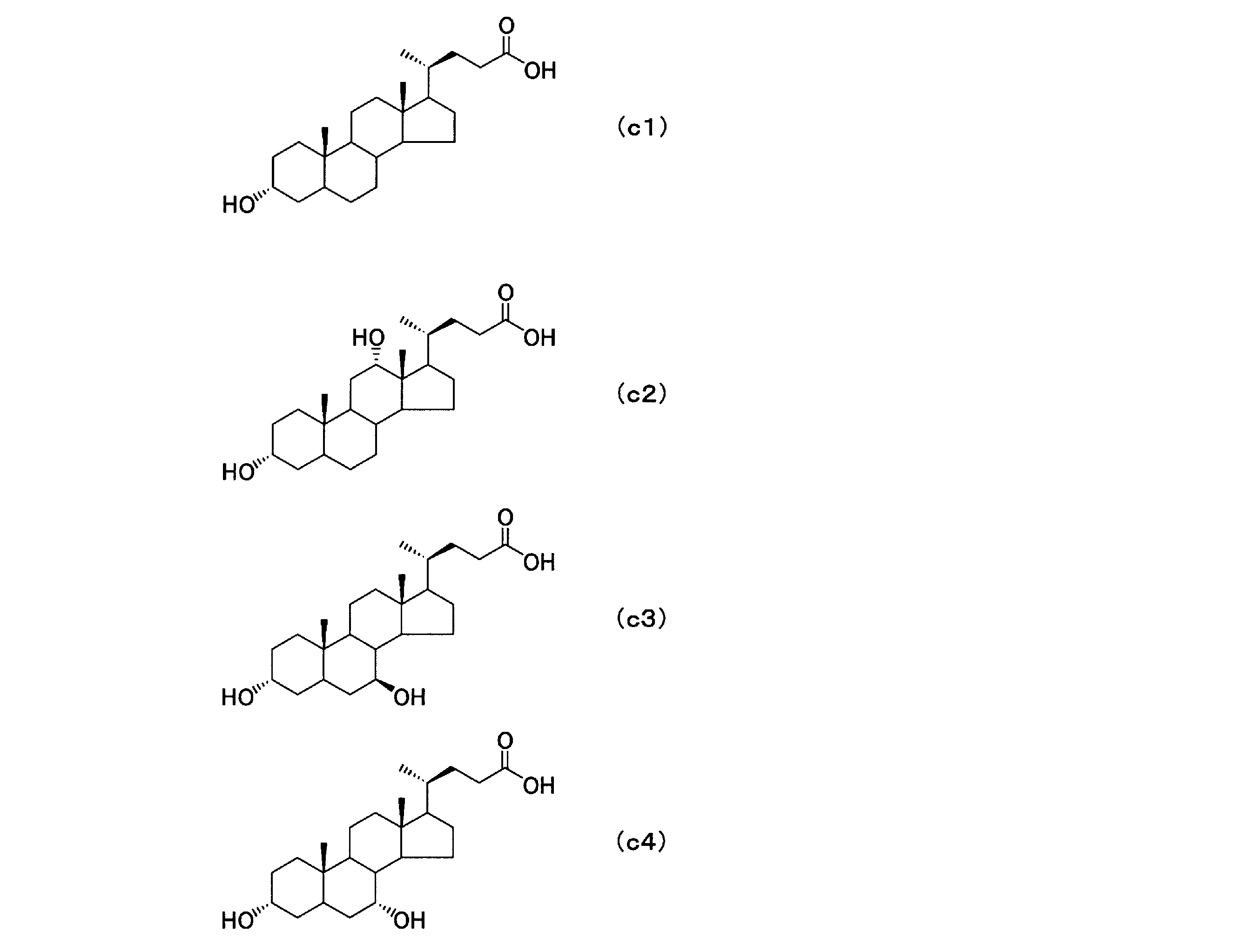
7.下記一般式(1-1)で示される脂環式化合物と、下記一般式(d1)~(d5)のいずれかで示される酸素含有有機化合物1種以上とを反応させることを特徴とする上記1~6のいずれかに記載の脂環式化合物の製造方法、

(式中、Ra4~Ra6は、それぞれ独立に、下記一般式(a-1)で表わされるコール酸類エステル構造含有基である。)

(式中、Rh及びRiは、それぞれ独立に、水素原子又は水酸基である。)

(式中、Z1は、ヘテロ原子を有してもよい炭素数1~15の直鎖状、分岐状または環状の炭化水素基を示し、Xはハロゲン原子を示す。)

(式中、Z2は、ヘテロ原子を有してもよい炭素数1~15の直鎖状、分岐状または環状の炭化水素基を示す。)

(式中、Z3は、ヘテロ原子を有してもよい炭素数1~9の直鎖状、分岐状または環状の炭化水素基であり、Rg及びRhは、それぞれ独立に、水素原子あるいはヘテロ原子を有してもよい炭素数1~10の直鎖状、分岐状または環状の炭化水素基を示し、Xはハロゲン原子を示す。)

(式中、Z4は、ヘテロ原子を有してもよい炭素数1~15の直鎖状、分岐状または環状の炭化水素基を示し、Xはハロゲン原子を示す。)

(式中、Z5~Z7は、それぞれ独立に、ヘテロ原子を有してもよい炭素数1~10の直鎖状、分岐状または環状の炭化水素基を示し、Xはハロゲン原子を示す。)
8.前記一般式(1-1)におけるRa4~Ra6が、下記一般式(a-2)で表わされるコール酸類エステル構造含有基である上記7記載の脂環式化合物の製造方法、

9.上記1~5のいずれかに記載の脂環式化合物を含有することを特徴とする組成物、
10.さらに溶媒及び酸発生剤を含有する上記9記載の組成物、
11.さらにクエンチャーを含有する上記9又は10記載の組成物、
12.ポジ型レジスト組成物である上記9~11のいずれかに記載の組成物、及び
13.上記9~12のいずれかに記載の組成物をポジ型レジストとして用いて支持体上にレジスト膜を形成する工程と、該レジスト膜を露光する工程と、該レジスト膜をアルカリ現像してレジストパターンを形成する工程とを含むレジストパターン形成方法、
を提供する。
10.さらに溶媒及び酸発生剤を含有する上記9記載の組成物、
11.さらにクエンチャーを含有する上記9又は10記載の組成物、
12.ポジ型レジスト組成物である上記9~11のいずれかに記載の組成物、及び
13.上記9~12のいずれかに記載の組成物をポジ型レジストとして用いて支持体上にレジスト膜を形成する工程と、該レジスト膜を露光する工程と、該レジスト膜をアルカリ現像してレジストパターンを形成する工程とを含むレジストパターン形成方法、
を提供する。
本発明の脂環式化合物は、溶解特性、露光感度、解像度、ラフネス、耐熱性等に優れ、特に現像液に対する溶解抑止効果に優れる。
本発明は、下記一般式(1)で表される脂環式化合物を提供する。

(式中、Ra1~Ra3は、それぞれ独立に、下記一般式(a)で表わされるコール酸類エステル構造含有基である。)
上記一般式(1)におけるRa1~Ra3は、互いに同一であっても異なっていてもよいが、Ra1~Ra3が全て同一のコール酸類エステル構造含有基であることが好ましい。
上記一般式(1)におけるRa1~Ra3は、互いに同一であっても異なっていてもよいが、Ra1~Ra3が全て同一のコール酸類エステル構造含有基であることが好ましい。

上記一般式(a)におけるRbは、水酸基又は下記一般式(b1)~(b5)のいずれかで示される炭素数2~30の酸素含有有機基を示し、好ましくは水酸基又は下記一般式(b1)~(b5)のいずれかで示される炭素数2~30の酸素含有有機基であり、より好ましくは水酸基又は下記一般式(b1)で示される炭素数2~15の酸素含有有機基である。
上記一般式(a)におけるRc及びRdは、それぞれ独立に、水素原子、水酸基又は下記一般式(b1)~(b5)のいずれかで示される炭素数2~30の酸素含有有機基を示し、好ましくは水素原子、水酸基又は下記一般式(b1)~(b5)のいずれかで示される炭素数2~15の酸素含有有機基であり、より好ましくは水素原子又は水酸基である。
上記一般式(a)におけるRe及びRfは、それぞれ独立に、水素原子、あるいは、ヘテロ原子を有してもよい炭素数1~10の直鎖状、分岐状または環状の炭化水素基を示し、好ましくは水素原子、あるいは、ヘテロ原子を有してもよい炭素数1~6の直鎖状、分岐状または環状の炭化水素基であり、より好ましくは水素原子である。
上記一般式(a)におけるnは、1又は2を示し、好ましくは1を示す。
上記一般式(a)におけるAは、単結合又は炭素数1~5の二価の炭化水素基を示し、好ましくは単結合を示す。
但し、上記一般式(a)において、Rb、Rc及びRdが3つ同時に水酸基である場合はない。
上記一般式(a)におけるRc及びRdは、それぞれ独立に、水素原子、水酸基又は下記一般式(b1)~(b5)のいずれかで示される炭素数2~30の酸素含有有機基を示し、好ましくは水素原子、水酸基又は下記一般式(b1)~(b5)のいずれかで示される炭素数2~15の酸素含有有機基であり、より好ましくは水素原子又は水酸基である。
上記一般式(a)におけるRe及びRfは、それぞれ独立に、水素原子、あるいは、ヘテロ原子を有してもよい炭素数1~10の直鎖状、分岐状または環状の炭化水素基を示し、好ましくは水素原子、あるいは、ヘテロ原子を有してもよい炭素数1~6の直鎖状、分岐状または環状の炭化水素基であり、より好ましくは水素原子である。
上記一般式(a)におけるnは、1又は2を示し、好ましくは1を示す。
上記一般式(a)におけるAは、単結合又は炭素数1~5の二価の炭化水素基を示し、好ましくは単結合を示す。
但し、上記一般式(a)において、Rb、Rc及びRdが3つ同時に水酸基である場合はない。
上記一般式(a)においてRe及びRfで示されるヘテロ原子を有してもよい炭素数1~10の直鎖状、分岐状または環状の炭化水素基の具体例としては、メチル基、エチル基、n-プロピル基、n-ブチル基、n-ペンチル基、n-ヘキシル基、n-ヘプチル基等の直鎖状炭化水素基、イソプロピル基、sec-ブチル基、tert-ブチル基、イソペンチル基、ネオペンチル基等の分岐状炭化水素基、シクロペンチル基、シクロヘキシル基、アダマンチル基等の環状炭化水素基が挙げられる。Re及びRfが有するヘテロ原子の具体例としては、窒素原子、酸素原子、硫黄原子等が挙げられる。
上記一般式(a)においてAで示される炭素数1~5の二価の炭化水素基の具体例としては、メチレン基、エチレン基、トリメチレン基、テトラメチレン基及びペンタメチレン基が挙げられる。
上記一般式(a)においてAで示される炭素数1~5の二価の炭化水素基の具体例としては、メチレン基、エチレン基、トリメチレン基、テトラメチレン基及びペンタメチレン基が挙げられる。

上記一般式(b1)におけるZ1は、ヘテロ原子を有してもよい炭素数1~15の直鎖状、分岐状または環状の炭化水素基を示し、好ましくは、炭素数1~5の直鎖状、分岐状または環状の炭化水素基を示す。

上記一般式(b2)におけるZ2は、ヘテロ原子を有してもよい炭素数1~15の直鎖状、分岐状または環状の炭化水素基を示し、好ましくは、炭素数1~8の直鎖状、分岐状または環状の炭化水素基を示す。

上記一般式(b3)におけるZ3は、ヘテロ原子を有してもよい炭素数1~9の直鎖状、分岐状または環状の炭化水素基を示し、好ましくは、炭素数1~4の直鎖状、分岐状または環状の炭化水素基を示す。
上記一般式(b3)におけるRg及びRhは、それぞれ独立に、水素原子あるいはヘテロ原子を有してもよい炭素数1~10の直鎖状、分岐状または環状の炭化水素基を示し、好ましくは、水素原子あるいは炭素数1~5の直鎖状、分岐状または環状の炭化水素基を示す。
上記一般式(b3)におけるRg及びRhは、それぞれ独立に、水素原子あるいはヘテロ原子を有してもよい炭素数1~10の直鎖状、分岐状または環状の炭化水素基を示し、好ましくは、水素原子あるいは炭素数1~5の直鎖状、分岐状または環状の炭化水素基を示す。

上記一般式(b4)におけるZ4は、ヘテロ原子を有してもよい炭素数1~15の直鎖状、分岐状または環状の炭化水素基を示し、好ましくは、炭素数1~8の直鎖状、分岐状または環状の炭化水素基を示す。

上記一般式(b5)におけるZ5~Z7は、それぞれ独立に、ヘテロ原子を有してもよい炭素数1~10の直鎖状、分岐状または環状の炭化水素基を示し、好ましくは、炭素数1~5の直鎖状、分岐状または環状の炭化水素基を示す。
上記一般式(b1)においてZ1で示されるヘテロ原子を有してもよい炭素数1~15の直鎖状、分岐状または環状の炭化水素基、上記一般式(b2)においてZ2で示されるヘテロ原子を有してもよい炭素数1~15の直鎖状、分岐状または環状の炭化水素基、上記一般式(b3)においてZ3で示されるヘテロ原子を有してもよい炭素数1~9の直鎖状、分岐状または環状の炭化水素基、上記一般式(b3)においてRg及びRhで示されるヘテロ原子を有していてもよい炭素数1~10の直鎖状、分岐状または環状の炭化水素基、上記一般式(b4)においてZ4で示されるヘテロ原子を有してもよい炭素数1~15の直鎖状、分岐状または環状の炭化水素基、及び上記一般式(b5)においてZ5~Z7で示されるヘテロ原子を有してもよい炭素数1~10の直鎖状、分岐状または環状の炭化水素基の具体例としては、メチル基、エチル基、n-プロピル基、n-ブチル基、n-ペンチル基、n-ヘキシル基、n-ヘプチル基等の直鎖状炭化水素基、イソプロピル基、sec-ブチル基、tert-ブチル基、イソペンチル基、ネオペンチル基等の分岐状炭化水素基、シクロペンチル基、シクロヘキシル基、アダマンチル基等の環状炭化水素基が挙げられる。Z1~Z7が有するヘテロ原子の具体例としては、窒素原子、酸素原子、硫黄原子等が挙げられる。
本発明の脂環構造含有化合物は、種々の方法により製造可能であり、代表的な例としては以下の製造方法A~Dが挙げられるが、これらに限定されるものではない。
製造方法A:
アダマンタン構造含有アルコールをアルデヒド類の存在下、ハロゲン化水素ガスで反応させることによりハロゲン化アルキルエーテル体を得て、このハロゲン化アルキルエーテル体と、コール酸類とのエステル化反応を行う方法。
製造方法B:
アダマンタン構造含有アルコールをアルキルスルホキシド及び酸無水物の存在下でアルキルチオアルキルエーテル体を得て、ハロゲン化剤によりハロゲン化アルキルエーテル体とし、さらに、このハロゲン化アルキルエーテル体と、コール酸類とのエステル化反応を行う方法。
製造方法C:
酸触媒存在下、アダマンタン構造含有ビニルエーテルと、コール酸類とのエステル化反応を行う方法。
製造方法D:
酸素含有有機化合物を用いて、前記製造方法A~Cで得られた脂環式化合物の水酸基保護反応を行う方法。
製造方法A:
アダマンタン構造含有アルコールをアルデヒド類の存在下、ハロゲン化水素ガスで反応させることによりハロゲン化アルキルエーテル体を得て、このハロゲン化アルキルエーテル体と、コール酸類とのエステル化反応を行う方法。
製造方法B:
アダマンタン構造含有アルコールをアルキルスルホキシド及び酸無水物の存在下でアルキルチオアルキルエーテル体を得て、ハロゲン化剤によりハロゲン化アルキルエーテル体とし、さらに、このハロゲン化アルキルエーテル体と、コール酸類とのエステル化反応を行う方法。
製造方法C:
酸触媒存在下、アダマンタン構造含有ビニルエーテルと、コール酸類とのエステル化反応を行う方法。
製造方法D:
酸素含有有機化合物を用いて、前記製造方法A~Cで得られた脂環式化合物の水酸基保護反応を行う方法。
(製造方法A)
上記製造方法Aにおけるアダマンタン構造含有アルコールとしては、例えば、1,3,5-アダマンタントリオール、1,3,5-トリス(ヒドロキシメチル)アダマンタンなどが挙げられる。
製造方法Aにおけるアルデヒド類としては、例えば、ホルムアルデヒド,パラホルムアルデヒド,アセトアルデヒド、プロピオンアルデヒド、ブチルアルデヒド、イソブチルアルデヒドなどの直鎖状または分岐状の脂肪族アルデヒドが挙げられ、1種または2種以上を用いることができる。
製造方法Aにおけるハロゲン化水素ガスとしては、例えば、フッ化水素ガス、塩化水素ガス、臭化水素ガスのような単体ガスまたはこれらの混合ガスが挙げられる。
製造方法Aにおけるコール酸類としては、例えば、下記式(c0)で示されるコール酸、下記式(c1)で示されるリトコール酸、下記式(c2)で示されるデオキシコール酸、下記式(c3)で示されるウルソデオキシコール酸、下記式(c4)で示されるケノデオキシコール酸などの飽和コール酸類縁体が挙げられ、1種または2種以上を用いることができる。
但し、コール酸類として、下記式(c0)で示されるコール酸を用いた場合、上記一般式(a)を満たす本発明の脂環式化合物が得られないため、さらに後述の製造方法Dを行う必要がある。
上記製造方法Aにおけるアダマンタン構造含有アルコールとしては、例えば、1,3,5-アダマンタントリオール、1,3,5-トリス(ヒドロキシメチル)アダマンタンなどが挙げられる。
製造方法Aにおけるアルデヒド類としては、例えば、ホルムアルデヒド,パラホルムアルデヒド,アセトアルデヒド、プロピオンアルデヒド、ブチルアルデヒド、イソブチルアルデヒドなどの直鎖状または分岐状の脂肪族アルデヒドが挙げられ、1種または2種以上を用いることができる。
製造方法Aにおけるハロゲン化水素ガスとしては、例えば、フッ化水素ガス、塩化水素ガス、臭化水素ガスのような単体ガスまたはこれらの混合ガスが挙げられる。
製造方法Aにおけるコール酸類としては、例えば、下記式(c0)で示されるコール酸、下記式(c1)で示されるリトコール酸、下記式(c2)で示されるデオキシコール酸、下記式(c3)で示されるウルソデオキシコール酸、下記式(c4)で示されるケノデオキシコール酸などの飽和コール酸類縁体が挙げられ、1種または2種以上を用いることができる。
但し、コール酸類として、下記式(c0)で示されるコール酸を用いた場合、上記一般式(a)を満たす本発明の脂環式化合物が得られないため、さらに後述の製造方法Dを行う必要がある。
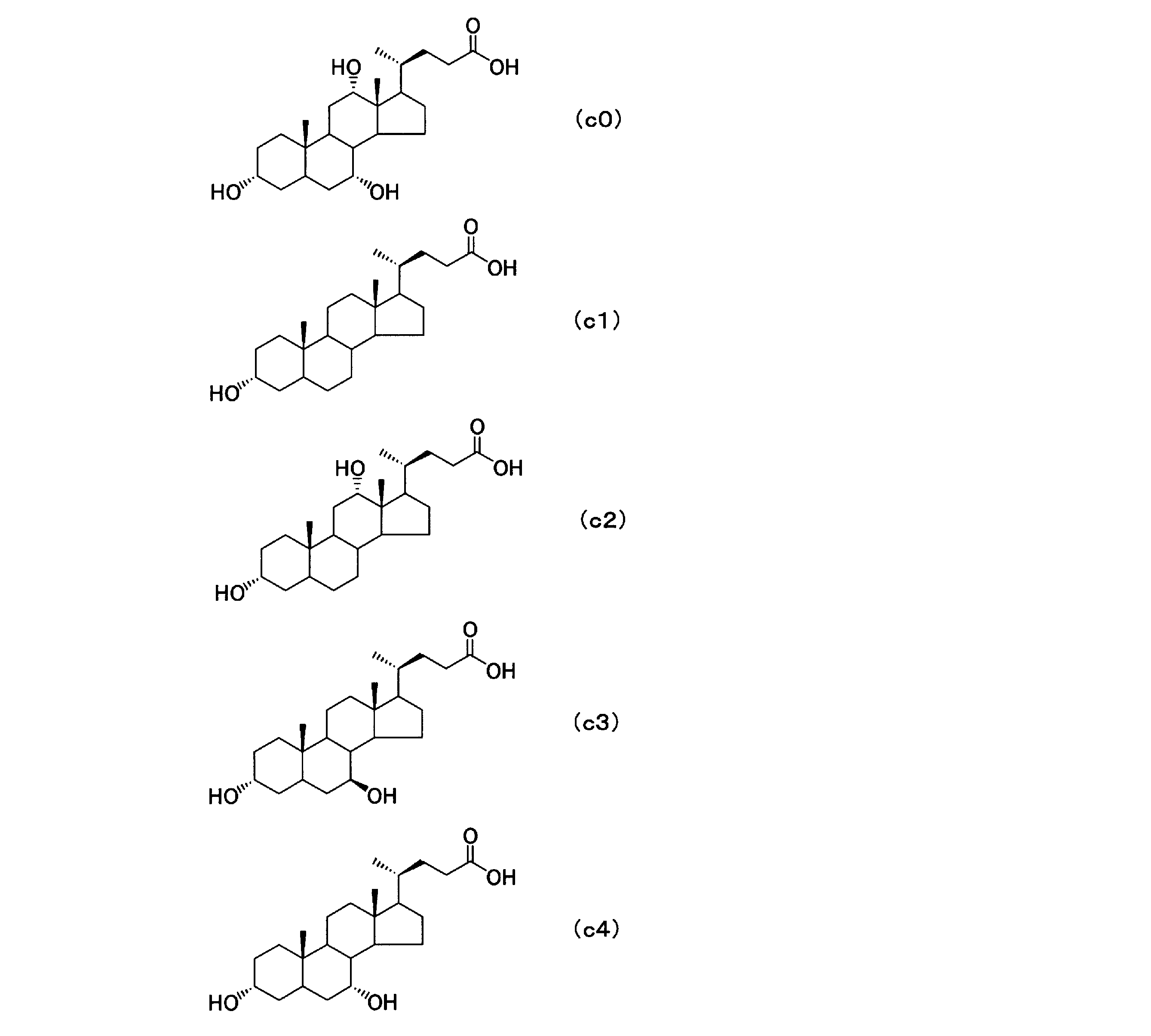
製造方法Aにおけるハロゲン化アルキルエーテル体は、アダマンタン構造含有アルコールをアルデヒド類の存在下、ハロゲン化水素ガスで反応させることにより得られる。このとき、有機溶媒の存在下又は不存在下で行うことができるが、有機溶媒を使用する場合には、アダマンタン構造含有アルコールの飽和溶解度以下であれば特に限定はしないが、基質濃度が0.1モル/リットル~10モル/リットルとなるように調節することが好ましい。基質濃度が0.1モル/リットル以上であると、通常の反応器で必要な量が得られるため、経済的に好ましく、基質濃度が10モル/リットル以下であると、反応液の温度制御が容易となり好ましい。
使用できる有機溶媒としては、ヘキサン,ヘプタン,シクロヘキサン,エチルシクロヘキサン,ベンゼン,トルエン,キシレン,などの炭化水素系溶媒、ジエチルエーテル,ジブチルエーテル,テトラヒドロフラン(THF),ジオキサン,ジメトキシエタン(DME)などのエーテル系溶媒、ジクロロメタン,四塩化炭素などのハロゲン系溶媒が挙げられ、ハロゲン化水素ガスの溶存量が高いハロゲン系溶媒が好ましく、これらを1種又は2種以上を混合して用いてもよい。
また、反応温度は任意の温度をとれるが、高すぎるとハロゲン化水素ガスの溶解度が低下し、低すぎると反応自体の進行が遅くなるので、0℃~40℃が好ましい。
圧力は任意の圧力をとれるが、加圧条件では副反応の制御も必要となるため、常圧が好ましい。また、圧力が高すぎる場合は特別な耐圧装置が必要となり、経済的でない。
このようにして得られるハロゲン化アルキルエーテル体の具体例としては、1,3,5-トリス(ハロゲノメトキシ)アダマンタン等が挙げられる。
使用できる有機溶媒としては、ヘキサン,ヘプタン,シクロヘキサン,エチルシクロヘキサン,ベンゼン,トルエン,キシレン,などの炭化水素系溶媒、ジエチルエーテル,ジブチルエーテル,テトラヒドロフラン(THF),ジオキサン,ジメトキシエタン(DME)などのエーテル系溶媒、ジクロロメタン,四塩化炭素などのハロゲン系溶媒が挙げられ、ハロゲン化水素ガスの溶存量が高いハロゲン系溶媒が好ましく、これらを1種又は2種以上を混合して用いてもよい。
また、反応温度は任意の温度をとれるが、高すぎるとハロゲン化水素ガスの溶解度が低下し、低すぎると反応自体の進行が遅くなるので、0℃~40℃が好ましい。
圧力は任意の圧力をとれるが、加圧条件では副反応の制御も必要となるため、常圧が好ましい。また、圧力が高すぎる場合は特別な耐圧装置が必要となり、経済的でない。
このようにして得られるハロゲン化アルキルエーテル体の具体例としては、1,3,5-トリス(ハロゲノメトキシ)アダマンタン等が挙げられる。
製造方法Aにおけるエステル化反応は、ハロゲン化アルキルエーテル体と、コール酸類とを反応させることにより行うことができる。また、有機溶媒の存在下又は不存在下で行うことができるが、有機溶媒を使用する場合には、基質濃度が0.1モル/リットル~10モル/リットルとなるように調節することが好ましい。基質濃度が0.1モル/リットル以上であると、通常の反応器で必要な量が得られるため、経済的に好ましく、基質濃度が10モル/リットル以下であると、反応液の温度制御が容易となり好ましい。使用できる有機溶媒としては、ヘキサン,ヘプタン,シクロヘキサン,エチルシクロヘキサン,ベンゼン,トルエン,キシレンなどの炭化水素系溶媒、ジエチルエーテル,ジブチルエーテル,テトラヒドロフラン(THF),ジオキサン,ジメトキシエタン(DME),などのエーテル系溶媒、ジクロロメタン,四塩化炭素などのハロゲン系溶媒、DMF(N,N-ジメチルホルムアミド),ジメチルスルホキシド(DMSO),N-メチル-2-ピロリドン(NMP),ヘキサメチルリン酸トリアミド(HMPA),ヘキサメチル亜リン酸トリアミド(HMPT),二硫化炭素などの非プロトン極性溶媒が挙げられ、これらを1種又は2種以上を混合して用いてもよい。上記塩基としては水素化ナトリウム,水酸化ナトリウム,水酸化カリウム,炭酸ナトリウム,炭酸カリウム,炭酸水素ナトリウム,炭酸水素カリウム,酸化銀,燐酸ナトリウム,燐酸カリウム,燐酸一水素二ナトリウム,燐酸一水素二カリウム,燐酸二水素一ナトリウム,燐酸二水素一カリウム,ナトリウムメトキシド,カリウムt-ブトキシド,トリエチルアミン,トリブチルアミン,トリオクチルアミン,ピリジン,N,N-ジメチルアミノピリジン,1,5-ジアザビシクロ[4,3,0]ノナ-5-エン(DBN),1,8-ジアザビシクロ[5,4,0]ウンデカ-7-エン(DBU)などの無機塩基および有機アミンが用いられる。
上記エステル化反応後、反応生成液は水と有機層に分離し、必要に応じて水層から生成物を抽出する。反応液から溶媒を減圧留去することで、本発明の脂環式化合物が得られる。必要に応じて精製してもよいし、精製することなく反応液を次の反応に供してもよい。精製方法としては、蒸留,抽出洗浄,晶析,再沈,活性炭吸着,シリカゲルカラムクロマトグラフィーなど一般的な精製方法の中から、製造スケール、必要な純度を考慮して、選択することができるが、比較的低温での取扱いが可能であり、一度に多量のサンプルを処理できるため、抽出洗浄、晶析または再沈による方法が好ましい。特に使用した原料を、本発明である脂環式化合物から除去する方法としては種々の方法が採用され得るが、操作性や経済的な視点から、脂環式化合物に対する貧溶媒を用いて原料を洗浄する方法が好ましい。脂環式化合物に対する貧溶媒の中でも、沸点が低いものが好ましく、代表的にはジエチルエーテル、メタノール、エタノール、n-ヘキサン、n-ヘプタンなどが挙げられる。
上記エステル化反応後、反応生成液は水と有機層に分離し、必要に応じて水層から生成物を抽出する。反応液から溶媒を減圧留去することで、本発明の脂環式化合物が得られる。必要に応じて精製してもよいし、精製することなく反応液を次の反応に供してもよい。精製方法としては、蒸留,抽出洗浄,晶析,再沈,活性炭吸着,シリカゲルカラムクロマトグラフィーなど一般的な精製方法の中から、製造スケール、必要な純度を考慮して、選択することができるが、比較的低温での取扱いが可能であり、一度に多量のサンプルを処理できるため、抽出洗浄、晶析または再沈による方法が好ましい。特に使用した原料を、本発明である脂環式化合物から除去する方法としては種々の方法が採用され得るが、操作性や経済的な視点から、脂環式化合物に対する貧溶媒を用いて原料を洗浄する方法が好ましい。脂環式化合物に対する貧溶媒の中でも、沸点が低いものが好ましく、代表的にはジエチルエーテル、メタノール、エタノール、n-ヘキサン、n-ヘプタンなどが挙げられる。
(製造方法B)
上記製造方法Bにおけるアダマンタン構造含有アルコール及びコール酸類としては、前記製造方法Aと同様のものが用いられる。
製造方法Bにおけるアルキルスルホキシドとしては、例えば、ジメチルスルホキシド、ジエチルスルホキシド、ジ-n-プロピルスルホキシド、ジイソプロピルスルホキシド、ジ-n-ブチルスルホキシド、ジイソブチルスルホキシド、ジ-sec-ブチルスルホキシド、ジ-tert-ブチルスルホキシド、ジイソペンチルスルホキシド、メチルエチルスルホキシド、メチル-tert-ブチルスルホキシドなどの対称または非対称の脂肪族スルホキシドが挙げられ、1種または2種以上を用いることができるが、反応生成物の単一性を考慮すると、好ましくは、対称脂肪族スルホキシドがよく、短鎖長アルキル基のジメチルスルホキシドがより好ましい。
製造方法Bにおける酸無水物としては、例えば、無水酢酸、プロピオン酸無水物、酪酸無水物、イソ酪酸無水物、吉草酸無水物、ピバリン酸無水物、安息香酸無水物、クロロ酢酸無水物、トリフルオロ酢酸無水物などの脂肪族または芳香族カルボン酸無水物が挙げられ、1種または2種以上を用いることができる。
製造方法Bにおけるハロゲン化剤としては、例えば、塩化チオニル、塩化スルフリル、臭化チオニル、臭化スルフリル、塩化臭化チオニル、塩化臭化スルフリル、などのハロゲン化硫黄化合物や、三塩化リン、三臭化リン、三ヨウ化リン、三塩化リン酸、三臭化リン酸、五塩化リン、五臭化リンなどのハロゲン化リン化合物が挙げられ、1種または2種以上を用いることができる。
上記製造方法Bにおけるアダマンタン構造含有アルコール及びコール酸類としては、前記製造方法Aと同様のものが用いられる。
製造方法Bにおけるアルキルスルホキシドとしては、例えば、ジメチルスルホキシド、ジエチルスルホキシド、ジ-n-プロピルスルホキシド、ジイソプロピルスルホキシド、ジ-n-ブチルスルホキシド、ジイソブチルスルホキシド、ジ-sec-ブチルスルホキシド、ジ-tert-ブチルスルホキシド、ジイソペンチルスルホキシド、メチルエチルスルホキシド、メチル-tert-ブチルスルホキシドなどの対称または非対称の脂肪族スルホキシドが挙げられ、1種または2種以上を用いることができるが、反応生成物の単一性を考慮すると、好ましくは、対称脂肪族スルホキシドがよく、短鎖長アルキル基のジメチルスルホキシドがより好ましい。
製造方法Bにおける酸無水物としては、例えば、無水酢酸、プロピオン酸無水物、酪酸無水物、イソ酪酸無水物、吉草酸無水物、ピバリン酸無水物、安息香酸無水物、クロロ酢酸無水物、トリフルオロ酢酸無水物などの脂肪族または芳香族カルボン酸無水物が挙げられ、1種または2種以上を用いることができる。
製造方法Bにおけるハロゲン化剤としては、例えば、塩化チオニル、塩化スルフリル、臭化チオニル、臭化スルフリル、塩化臭化チオニル、塩化臭化スルフリル、などのハロゲン化硫黄化合物や、三塩化リン、三臭化リン、三ヨウ化リン、三塩化リン酸、三臭化リン酸、五塩化リン、五臭化リンなどのハロゲン化リン化合物が挙げられ、1種または2種以上を用いることができる。
製造方法Bにおけるアルキルチオアルキルエーテル体は、アダマンタン構造含有アルコールをアルキルスルホキシドおよび酸無水物の存在下、反応させることにより得られる。このとき、有機溶媒の存在下又は不存在下で行うことができるが、通常はアルキルスルホキシドおよび酸無水物を反応試剤かつ溶媒として大過剰使用することにより反応は進行する。別途、有機溶媒を使用する場合には、基質濃度が1モル/リットル~10モル/リットルとなるように調節することが好ましい。基質濃度が1モル/リットル以上であると、通常の反応器で必要な量が得られるため、経済的に好ましく、基質濃度が10モル/リットル以下であると、反応液の温度制御が容易となり好ましい。使用できる有機溶媒としては、ヘキサン,ヘプタン,シクロヘキサン,エチルシクロヘキサン,ベンゼン,トルエン,キシレンなどの炭化水素系溶媒、ジエチルエーテル,ジブチルエーテル,THF(テトラヒドロフラン),ジオキサン,DME(ジメトキシエタン)などのエーテル系溶媒、ジクロロメタン,四塩化炭素などのハロゲン系溶媒が挙げられ、これらを1種又は2種以上を混合して用いてもよい。反応温度は任意の温度をとれるが、高すぎると副反応による選択率低下がおき、低すぎると反応自体の進行が遅くなるので、室温~60℃が好ましい。圧力は任意の圧力をとれるが、加圧条件では副反応の制御も必要となるため、常圧が好ましい。圧力が高すぎる場合は特別な耐圧装置が必要となり、経済的でない。
このようにして得られるアルキルチオアルキルエーテル体の具体例としては、1,3,5-トリス(メチルチオメトキシ)アダマンタン等が挙げられる。
このようにして得られるアルキルチオアルキルエーテル体の具体例としては、1,3,5-トリス(メチルチオメトキシ)アダマンタン等が挙げられる。
製造方法Bにおけるハロゲン化アルキルエーテル体は、上記アルキルチオアルキルエーテル体をハロゲン化剤と反応させることにより得られる。このとき、有機溶媒の存在下又は不存在下で行うことができるが、ハロゲン化剤を反応試剤かつ溶媒として大過剰使用してもよい。別途、有機溶媒を使用する場合には、基質濃度が0.1モル/リットル~10モル/リットルとなるように調節することが好ましい。基質濃度が0.1モル/リットル以上であると、通常の反応器で必要な量が得られるため、経済的に好ましく、基質濃度が10モル/リットル以下であると、反応液の温度制御が容易となり好ましい。使用できる有機溶媒としては、ヘキサン,ヘプタン,シクロヘキサン,エチルシクロヘキサン,ベンゼン,トルエン,キシレンなどの炭化水素系溶媒、ジエチルエーテル,ジブチルエーテル,テトラヒドロフラン(THF),ジオキサン,ジメトキシエタン(DME)などのエーテル系溶媒、ジクロロメタン,四塩化炭素などのハロゲン系溶媒が挙げられ、これらを1種又は2種以上を混合して用いてもよい。反応温度は任意の温度をとれるが、高すぎると副反応による選択率低下がおき、低すぎると反応自体の進行が遅くなるので、室温~100℃が好ましい。圧力は任意の圧力をとれるが、加圧条件では副反応の制御も必要となるため、常圧が好ましい。圧力が高すぎる場合は特別な耐圧装置が必要となり、経済的でない。
このようにして得られるハロゲン化アルキルエーテル体の具体例としては、1,3,5-トリス(ハロゲノメトキシ)アダマンタン等が挙げられる。
製造方法Bにおけるエステル化反応は、前記製造方法Aにおけるエステル化反応と同様にして行うことができる。
このようにして得られるハロゲン化アルキルエーテル体の具体例としては、1,3,5-トリス(ハロゲノメトキシ)アダマンタン等が挙げられる。
製造方法Bにおけるエステル化反応は、前記製造方法Aにおけるエステル化反応と同様にして行うことができる。
(製造方法C)
上記製造方法Cにおけるアダマンタン構造含有ビニルエーテルとしては、例えば、1,3,5-トリス(ビニルオキシ)アダマンタン、1,3,5-トリス(ビニルオキシメチル)アダマンタンなどが挙げられる。
製造方法Cにおけるコール酸類としては、上記製造方法Aと同様のものが用いられる。
製造方法Cにおける酸触媒としては、ルイス酸、ブレンステッド酸、アレニウス酸などで定義される任意の有機および無機の酸が挙げられるが、好ましくは、ギ酸、酢酸、塩酸、硫酸、硝酸、メタンスルホン酸、パラトルエンスルホン酸、トリフルオロ酢酸、トリフルオロメタンスルホン酸などのブレンステッド酸が挙げられる。
上記製造方法Cにおけるアダマンタン構造含有ビニルエーテルとしては、例えば、1,3,5-トリス(ビニルオキシ)アダマンタン、1,3,5-トリス(ビニルオキシメチル)アダマンタンなどが挙げられる。
製造方法Cにおけるコール酸類としては、上記製造方法Aと同様のものが用いられる。
製造方法Cにおける酸触媒としては、ルイス酸、ブレンステッド酸、アレニウス酸などで定義される任意の有機および無機の酸が挙げられるが、好ましくは、ギ酸、酢酸、塩酸、硫酸、硝酸、メタンスルホン酸、パラトルエンスルホン酸、トリフルオロ酢酸、トリフルオロメタンスルホン酸などのブレンステッド酸が挙げられる。
上記製造方法Cでは、酸触媒存在下、アダマンタン構造含有ビニルエーテルと、コール酸類とを反応させる。このとき、有機溶媒の存在下又は不存在下で行うことができるが、有機溶媒を使用する場合には、アダマンタン構造含有ビニルエーテルの飽和溶解度以下であれば特に限定はしないが、基質濃度が0.1モル/リットル~10モル/リットルとなるように調節することが好ましい。基質濃度が0.1モル/リットル以上であると、通常の反応器で必要な量が得られるため、経済的に好ましく、基質濃度が10モル/リットル以下であると、反応液の温度制御が容易となり好ましい。
使用できる有機溶媒としては、ヘキサン,ヘプタン,シクロヘキサン,エチルシクロヘキサン,ベンゼン,トルエン,キシレン,などの炭化水素系溶媒、ジエチルエーテル,ジブチルエーテル,テトラヒドロフラン(THF),ジオキサン,ジメトキシエタン(DME)などのエーテル系溶媒、ジクロロメタン,四塩化炭素などのハロゲン系溶媒が挙げられ、ハロゲン化水素ガスの溶存量が高いハロゲン系溶媒が好ましく、これらを1種又は2種以上を混合して用いてもよい。
また、反応温度は任意の温度をとれるが、高すぎるとアダマンタン構造含有ビニルエーテル同士が重合する副反応が起きてしまい、低すぎると反応自体の進行が遅くなるので、0℃~40℃が好ましい。
圧力は任意の圧力をとれるが、加圧条件では副反応の制御も必要となるため、常圧が好ましい。また、圧力が高すぎる場合は特別な耐圧装置が必要となり、経済的でない。
使用できる有機溶媒としては、ヘキサン,ヘプタン,シクロヘキサン,エチルシクロヘキサン,ベンゼン,トルエン,キシレン,などの炭化水素系溶媒、ジエチルエーテル,ジブチルエーテル,テトラヒドロフラン(THF),ジオキサン,ジメトキシエタン(DME)などのエーテル系溶媒、ジクロロメタン,四塩化炭素などのハロゲン系溶媒が挙げられ、ハロゲン化水素ガスの溶存量が高いハロゲン系溶媒が好ましく、これらを1種又は2種以上を混合して用いてもよい。
また、反応温度は任意の温度をとれるが、高すぎるとアダマンタン構造含有ビニルエーテル同士が重合する副反応が起きてしまい、低すぎると反応自体の進行が遅くなるので、0℃~40℃が好ましい。
圧力は任意の圧力をとれるが、加圧条件では副反応の制御も必要となるため、常圧が好ましい。また、圧力が高すぎる場合は特別な耐圧装置が必要となり、経済的でない。
(製造方法D)
上記製造方法A~Cによって得られた脂環式化合物に対して、以下に示す水酸基保護反応を行ってもよい。特に、上記製造方法A~Cにおいて、コール酸類として上記式(c0)で示されるコール酸を用いた場合等、脂環式化合物の上記一般式(a)におけるRb、Rc及びRdが3つ同時に水酸基である場合には、以下の水酸基保護反応を行う必要がある。
上記製造方法A~Cによって得られた脂環式化合物に対して、以下に示す水酸基保護反応を行ってもよい。特に、上記製造方法A~Cにおいて、コール酸類として上記式(c0)で示されるコール酸を用いた場合等、脂環式化合物の上記一般式(a)におけるRb、Rc及びRdが3つ同時に水酸基である場合には、以下の水酸基保護反応を行う必要がある。
製造方法Dに用いられる脂環式化合物としては、下記一般式(1-1)で示されるものが好ましい。

(式中、Ra4~Ra6は、それぞれ独立に、下記一般式(a-1)で表わされるコール酸類エステル構造含有基であり、好ましくは下記式(a-2)で表わされるコール酸類エステル構造含有基である。)


製造方法Dにおける酸素含有有機化合物は、下記一般式(d1)で示されるカルボン酸ハライド類、下記一般式(d2)で示される炭酸エステル無水物、下記一般式(d3)で示されるハロゲン化アルキルエーテル類、下記一般式(d4)で示されるハロゲン化酢酸エステル類および下記一般式(d5)で示されるシリルハライド類から選択される1種以上が用いられる。





上記製造方法Dにおける水酸基保護反応では、上記製造方法A~Cで得られた脂環式化合物の水酸基に対して、酸素含有有機化合物を反応させる。このとき、有機溶媒の存在下又は不存在下で行うことができるが、有機溶媒を使用する場合には、脂環式化合物の飽和溶解度以下であれば特に限定はしないが、基質濃度が0.1モル/リットル~10モル/リットルとなるように調節することが好ましい。基質濃度が0.1モル/リットル以上であると、通常の反応器で必要な量が得られるため、経済的に好ましく、基質濃度が10モル/リットル以下であると、反応液の温度制御が容易となり好ましい。
使用できる有機溶媒としては、ヘキサン,ヘプタン,シクロヘキサン,エチルシクロヘキサン,ベンゼン,トルエン,キシレン,などの炭化水素系溶媒、ジエチルエーテル,ジブチルエーテル,テトラヒドロフラン(THF),ジオキサン,ジメトキシエタン(DME)などのエーテル系溶媒、ジクロロメタン,四塩化炭素などのハロゲン系溶媒が挙げられ、ハロゲン化水素ガスの溶存量が高いハロゲン系溶媒が好ましく、これらを1種又は2種以上を混合して用いてもよい。
また、反応温度は任意の温度をとれるが、高すぎると既存のエステル結合やアセタール結合の分解が起きてしまい、低すぎると反応自体の進行が遅くなるので、0℃~40℃が好ましい。
圧力は任意の圧力をとれるが、加圧条件では副反応の制御も必要となるため、常圧が好ましい。また、圧力が高すぎる場合は特別な耐圧装置が必要となり、経済的でない。
使用できる有機溶媒としては、ヘキサン,ヘプタン,シクロヘキサン,エチルシクロヘキサン,ベンゼン,トルエン,キシレン,などの炭化水素系溶媒、ジエチルエーテル,ジブチルエーテル,テトラヒドロフラン(THF),ジオキサン,ジメトキシエタン(DME)などのエーテル系溶媒、ジクロロメタン,四塩化炭素などのハロゲン系溶媒が挙げられ、ハロゲン化水素ガスの溶存量が高いハロゲン系溶媒が好ましく、これらを1種又は2種以上を混合して用いてもよい。
また、反応温度は任意の温度をとれるが、高すぎると既存のエステル結合やアセタール結合の分解が起きてしまい、低すぎると反応自体の進行が遅くなるので、0℃~40℃が好ましい。
圧力は任意の圧力をとれるが、加圧条件では副反応の制御も必要となるため、常圧が好ましい。また、圧力が高すぎる場合は特別な耐圧装置が必要となり、経済的でない。
本発明はまた、上記本発明の脂環式化合物を含有する組成物も提供する。
本発明の組成物は、さらに溶媒、酸発生剤、クエンチャー、各種添加剤等を含有することが好ましい。
本発明の組成物は、種々の用途、例えば、回路形成材料(半導体製造用レジスト、プリント配線板など)、画像形成材料(印刷版材、レリーフ像など)などに利用できるが、特にフォトレジスト組成物として用いることが好ましく、ポジ型フォトレジスト組成物として用いることがより好ましい。
本発明の組成物は、さらに溶媒、酸発生剤、クエンチャー、各種添加剤等を含有することが好ましい。
本発明の組成物は、種々の用途、例えば、回路形成材料(半導体製造用レジスト、プリント配線板など)、画像形成材料(印刷版材、レリーフ像など)などに利用できるが、特にフォトレジスト組成物として用いることが好ましく、ポジ型フォトレジスト組成物として用いることがより好ましい。
本発明はさらに、上記本発明の組成物からなるポジ型レジスト組成物をも提供する。
本発明のポジ型レジスト組成物は、本発明の脂環構造含有化合物を含有するものであれば特に限定されないが、本発明のポジ型レジスト組成物の全量基準で、本発明の脂環構造含有化合物を2~50質量%含有するものが好ましく、5~15質量%含有するものがより好ましい。
本発明のポジ型レジスト組成物は、上記脂環構造含有化合物以外に、光酸発生剤(PAG)や有機アミンなどのクエンチャー、アルカリ可溶性樹脂(例えば、ノボラック樹脂、フェノール樹脂、イミド樹脂、カルボキシル基含有樹脂など)などのアルカリ可溶成分、着色剤(例えば、染料など)、有機溶媒(例えば、炭化水素類、ハロゲン化炭化水素類、アルコール類、エステル類、ケトン類、エーテル類、セロソルブ類、カルビトール類、グリコールエーテルエステル類、これらの混合溶媒など)などを添加することができる。
本発明のポジ型レジスト組成物は、本発明の脂環構造含有化合物を含有するものであれば特に限定されないが、本発明のポジ型レジスト組成物の全量基準で、本発明の脂環構造含有化合物を2~50質量%含有するものが好ましく、5~15質量%含有するものがより好ましい。
本発明のポジ型レジスト組成物は、上記脂環構造含有化合物以外に、光酸発生剤(PAG)や有機アミンなどのクエンチャー、アルカリ可溶性樹脂(例えば、ノボラック樹脂、フェノール樹脂、イミド樹脂、カルボキシル基含有樹脂など)などのアルカリ可溶成分、着色剤(例えば、染料など)、有機溶媒(例えば、炭化水素類、ハロゲン化炭化水素類、アルコール類、エステル類、ケトン類、エーテル類、セロソルブ類、カルビトール類、グリコールエーテルエステル類、これらの混合溶媒など)などを添加することができる。
光酸発生剤としては、露光により効率よく酸を生成する慣用の化合物、例えば、ジアゾニウム塩、ヨードニウム塩(例えば、ジフェニルヨードヘキサフルオロホスフェートなど)、スルホニウム塩(例えば、トリフェニルスルホニウムヘキサフルオロアンチモネート、トリフェニルスルホニウムヘキサフルオロホスフェート、トリフェニルスルホニウムメタンスルホネートなど)、スルホン酸エステル[例えば、1-フェニル-1-(4-メチルフェニル)スルホニルオキシ-1-ベンゾイルメタン、1,2,3-トリスルホニルオキシメチルベンゼン、1,3-ジニトロ-2-(4-フェニルスルホニルオキシメチル)ベンゼン、1-フェニル-1-(4-メチルフェニルスルホニルオキシメチル)-1-ヒドロキシ-1-ベンゾイルメタンなど]、オキサチアゾール誘導体、s-トリアジン誘導体、ジスルホン誘導体(ジフェニルジスルホンなど)、イミド化合物、オキシムスルホネート、ジアゾナフトキノン、ベンゾイントレートなどが挙げられる。
これらの光酸発生剤は単独で又は2種以上組み合わせて使用できる。さらにこれらの光酸発生剤は熱酸発生剤としても使用できる。
本発明のポジ型レジスト組成物中における光酸発生剤の使用量は、光照射により生成する酸の強度や前記脂環構造含有化合物の含有量などに応じて適宜選択できるが、例えば、前記脂環構造含有化合物の全量100質量部に対して、好ましくは0.1~30質量部、より好ましくは1~25質量部、さらに好ましくは2~20質量部の光酸発生剤を含有する。
これらの光酸発生剤は単独で又は2種以上組み合わせて使用できる。さらにこれらの光酸発生剤は熱酸発生剤としても使用できる。
本発明のポジ型レジスト組成物中における光酸発生剤の使用量は、光照射により生成する酸の強度や前記脂環構造含有化合物の含有量などに応じて適宜選択できるが、例えば、前記脂環構造含有化合物の全量100質量部に対して、好ましくは0.1~30質量部、より好ましくは1~25質量部、さらに好ましくは2~20質量部の光酸発生剤を含有する。
クエンチャーは、脂肪族アミン、環式アミン、芳香族アミン等の公知のものから任意に用いれば良く、なかでも脂肪族アミン、特に第2級脂肪族アミンや第3級脂肪族アミンが好ましい。ここで、脂肪族アミンとは、1つ以上の脂肪族基を有するアミンであり、該脂肪族基は炭素数が1~20であることが好ましい。
脂肪族アミンとしては、たとえば、アンモニアNH3の水素原子の少なくとも1つを、炭素数20以下のアルキル基またはヒドロキシアルキル基で置換したアミン(アルキルアミンまたはアルキルアルコールアミン)又は環式アミンが挙げられる。
アルキルアミンおよびアルキルアルコールアミンの具体例としては、n-ヘキシルアミン、n-ヘプチルアミン、n-オクチルアミン、n-ノニルアミン、n-デシルアミン等のモノアルキルアミン;ジエチルアミン、ジ-n-プロピルアミン、ジ-n-ヘプチルアミン、ジ-n-オクチルアミン、ジシクロヘキシルアミン等のジアルキルアミン;トリメチルアミン、トリエチルアミン、トリ-n-プロピルアミン、トリ-n-ブチルアミン、トリ-n-ヘキシルアミン、トリ-n-ペンチルアミン、トリ-n-ヘプチルアミン、トリ-n-オクチルアミン、トリ-n-ノニルアミン、トリ-n-デシルアミン、トリ-n-ドデシルアミン等のトリアルキルアミン;ジエタノールアミン、トリエタノールアミン、ジイソプロパノールアミン、トリイソプロパノールアミン、ジ-n-オクタノールアミン、トリ-n-オクタノールアミン、ステアリルジエタノールアミン、ラウリルジエタノールアミン等のアルキルアルコールアミンが挙げられる。これらの中でも、炭素数5~10のトリアルキルアミンや、アルキルアルコールアミンが好ましく、トリ-n-ペンチルアミン、ジエタノールアミン、ステアリルジエタノールアミンが特に好ましい。
脂肪族アミンとしては、たとえば、アンモニアNH3の水素原子の少なくとも1つを、炭素数20以下のアルキル基またはヒドロキシアルキル基で置換したアミン(アルキルアミンまたはアルキルアルコールアミン)又は環式アミンが挙げられる。
アルキルアミンおよびアルキルアルコールアミンの具体例としては、n-ヘキシルアミン、n-ヘプチルアミン、n-オクチルアミン、n-ノニルアミン、n-デシルアミン等のモノアルキルアミン;ジエチルアミン、ジ-n-プロピルアミン、ジ-n-ヘプチルアミン、ジ-n-オクチルアミン、ジシクロヘキシルアミン等のジアルキルアミン;トリメチルアミン、トリエチルアミン、トリ-n-プロピルアミン、トリ-n-ブチルアミン、トリ-n-ヘキシルアミン、トリ-n-ペンチルアミン、トリ-n-ヘプチルアミン、トリ-n-オクチルアミン、トリ-n-ノニルアミン、トリ-n-デシルアミン、トリ-n-ドデシルアミン等のトリアルキルアミン;ジエタノールアミン、トリエタノールアミン、ジイソプロパノールアミン、トリイソプロパノールアミン、ジ-n-オクタノールアミン、トリ-n-オクタノールアミン、ステアリルジエタノールアミン、ラウリルジエタノールアミン等のアルキルアルコールアミンが挙げられる。これらの中でも、炭素数5~10のトリアルキルアミンや、アルキルアルコールアミンが好ましく、トリ-n-ペンチルアミン、ジエタノールアミン、ステアリルジエタノールアミンが特に好ましい。
環式アミンとしては、たとえば、ヘテロ原子として窒素原子を含む複素環化合物が挙げられる。該複素環化合物としては、単環式のもの(脂肪族単環式アミン)であっても多環式のもの(脂肪族多環式アミン)であってもよい。
脂肪族単環式アミンとして、具体的には、ピペリジン、ピペラジン等が挙げられる。
脂肪族多環式アミンとしては、炭素数が6~10のものが好ましく、具体的には、1,5-ジアザビシクロ[4.3.0]-5-ノネン、1,8-ジアザビシクロ[5.4.0]-7-ウンデセン、ヘキサメチレンテトラミン、1,4-ジアザビシクロ[2.2.2]オクタン等が挙げられる。
芳香族アミンとしては、アニリン、ピリジン、4-ジメチルアミノピリジン、ピロール、インドール、ピラゾール、イミダゾールまたはこれらの誘導体、ジフェニルアミン、トリフェニルアミン、トリベンジルアミンなどが挙げられる。
その他の脂肪族アミンとしては、トリス(2-メトキシメトキシエチル)アミン、トリス{2-(2-メトキシエトキシ)エチル}アミン、トリス{2-(2-メトキシエトキシメトキシ)エチル}アミン、トリス{2-(1-メトキシエトキシ)エチル}アミン、トリス{2-(1-エトキシエトキシ)エチル}アミン、トリス{2-(1-エトキシプロポキシ)エチル}アミン、トリス[2-{2-(2-ヒドロキシエトキシ)エトキシ}エチルアミン等が挙げられる。
これらは単独で用いてもよいし、2種以上を組み合わせて用いてもよい。
本発明のレジスト組成物中におけるクエンチャーの使用量は、レジストパターン形状、引き置き経時安定性などを向上させるため適宜選択できるが、例えば、前記脂環式化合物100質量部に対して、好ましくは0~10質量部、より好ましくは0.01~5.0質量部のクエンチャーを含有する。
脂肪族単環式アミンとして、具体的には、ピペリジン、ピペラジン等が挙げられる。
脂肪族多環式アミンとしては、炭素数が6~10のものが好ましく、具体的には、1,5-ジアザビシクロ[4.3.0]-5-ノネン、1,8-ジアザビシクロ[5.4.0]-7-ウンデセン、ヘキサメチレンテトラミン、1,4-ジアザビシクロ[2.2.2]オクタン等が挙げられる。
芳香族アミンとしては、アニリン、ピリジン、4-ジメチルアミノピリジン、ピロール、インドール、ピラゾール、イミダゾールまたはこれらの誘導体、ジフェニルアミン、トリフェニルアミン、トリベンジルアミンなどが挙げられる。
その他の脂肪族アミンとしては、トリス(2-メトキシメトキシエチル)アミン、トリス{2-(2-メトキシエトキシ)エチル}アミン、トリス{2-(2-メトキシエトキシメトキシ)エチル}アミン、トリス{2-(1-メトキシエトキシ)エチル}アミン、トリス{2-(1-エトキシエトキシ)エチル}アミン、トリス{2-(1-エトキシプロポキシ)エチル}アミン、トリス[2-{2-(2-ヒドロキシエトキシ)エトキシ}エチルアミン等が挙げられる。
これらは単独で用いてもよいし、2種以上を組み合わせて用いてもよい。
本発明のレジスト組成物中におけるクエンチャーの使用量は、レジストパターン形状、引き置き経時安定性などを向上させるため適宜選択できるが、例えば、前記脂環式化合物100質量部に対して、好ましくは0~10質量部、より好ましくは0.01~5.0質量部のクエンチャーを含有する。
本発明のポジ型レジスト組成物は、前記脂環構造含有化合物と光酸発生剤、クエンチャー及び必要に応じて前記有機溶媒等を混合し、必要に応じて夾雑物をフィルターなどの慣用の固体分離手段により除去することにより調製できる。このポジ型レジスト組成物を基材又は基板上に塗布し、乾燥した後、所定のマスクを介して、塗膜(レジスト膜)に光線を露光して(又は、さらに露光後ベークを行い)潜像パターンを形成し、次いで現像することにより、微細なパターンを高い精度で形成できる。
本発明は、必要に応じて支持体上に疎水化処理をする工程と、上記ポジ型レジスト組成物を用いて支持体上にレジスト膜を形成する工程と、該レジスト膜を選択露光する工程と、選択露光されたレジスト膜をアルカリ現像処理してレジストパターンを形成する工程とを含むレジストパターン形成方法をも提供する。
上記疎水化処理に使用される疎水化処理剤は、公知のものから任意に用いれば良く、例えば、好ましくはビス(アルキルシリル)アミン、より好ましくはヘキサメチルジシラザン(HMDS)である。
上記支持体としては、シリコンウエハー、金属、プラスチック、ガラス、セラミックなどが挙げられる。フォトレジスト組成物の塗布は、スピンコータ、ディップコータ、ローラコータなどの慣用の塗布手段を用いて行うことができる。塗膜の厚みは、例えば、好ましくは0.01~20μm、より好ましくは0.05~1μmである。
レジスト膜を選択露光する工程には、種々の波長の光線、例えば、紫外線、X線などが利用でき、半導体レジスト用では、通常、g線、i線、エキシマレーザー(例えば、XeCl、KrF、KrCl、ArF、ArClなど)、軟X線などが使用される。露光エネルギーは、例えば0.1~1000mJ/cm2、好ましくは1~100mJ/cm2程度である。
上記ポジ型レジスト組成物に含まれる脂環式化合物は、アセタール構造を有するため、酸分解機能を有する。従って、上記選択露光により光酸発生剤から酸が生成し、この酸により前記脂環式化合物に基づく構造のうちアセタール構造部分が速やかに脱離して、可溶化に寄与するカルボキシル基や水酸基が生成する。そのため、水又はアルカリ現像液を用いて現像処理を行なうことで、所定のパターンを精度よく形成できる。
本発明は、必要に応じて支持体上に疎水化処理をする工程と、上記ポジ型レジスト組成物を用いて支持体上にレジスト膜を形成する工程と、該レジスト膜を選択露光する工程と、選択露光されたレジスト膜をアルカリ現像処理してレジストパターンを形成する工程とを含むレジストパターン形成方法をも提供する。
上記疎水化処理に使用される疎水化処理剤は、公知のものから任意に用いれば良く、例えば、好ましくはビス(アルキルシリル)アミン、より好ましくはヘキサメチルジシラザン(HMDS)である。
上記支持体としては、シリコンウエハー、金属、プラスチック、ガラス、セラミックなどが挙げられる。フォトレジスト組成物の塗布は、スピンコータ、ディップコータ、ローラコータなどの慣用の塗布手段を用いて行うことができる。塗膜の厚みは、例えば、好ましくは0.01~20μm、より好ましくは0.05~1μmである。
レジスト膜を選択露光する工程には、種々の波長の光線、例えば、紫外線、X線などが利用でき、半導体レジスト用では、通常、g線、i線、エキシマレーザー(例えば、XeCl、KrF、KrCl、ArF、ArClなど)、軟X線などが使用される。露光エネルギーは、例えば0.1~1000mJ/cm2、好ましくは1~100mJ/cm2程度である。
上記ポジ型レジスト組成物に含まれる脂環式化合物は、アセタール構造を有するため、酸分解機能を有する。従って、上記選択露光により光酸発生剤から酸が生成し、この酸により前記脂環式化合物に基づく構造のうちアセタール構造部分が速やかに脱離して、可溶化に寄与するカルボキシル基や水酸基が生成する。そのため、水又はアルカリ現像液を用いて現像処理を行なうことで、所定のパターンを精度よく形成できる。
以下、本発明について実施例及び比較例を示してより具体的に説明するが、本発明はこれらに何ら制限されるものではない。
なお、各種分析方法は以下に示すようにして行った。
[ガスクロマトグラフ(GC)]
アジレント社製 6850シリーズを使用して分析した。
[核磁気共鳴分光法(NMR)]
溶媒としてクロロホルム-dまたはジメチルスルホキシド-d6を使用し、日本電子株式会社製 JNM-ECA500で測定した。
[ガスクロマトグラフ-質量分析(GC-MS)]
株式会社島津製作所製 GCMS-QP2010を使用してEI法にて測定した。
[減衰全反射赤外分光法(ATR-FTIR)]
パーキンエルマー社製 Spectrum Oneを使用して、フーリエ変換-全反射法(FT-ATR)にて測定した。
[ゲル浸透クロマトグラフ(GPC)]
東ソー株式会社製 HLC-8220GPCで測定した。
[示差走査熱量分析(DSC)]
エスアイアイ・ナノテクノロジー株式会社製 EXSTAR DSC7020を用いて測定した。
[熱重量/示差熱分析(TG/DTA)]
エスアイアイ・ナノテクノロジー株式会社製 EXSTAR TG/DTA7200を用いて測定した。
[膜厚及び規格化膜厚]
光学式膜厚計(フィルメトリクス株式会社製 F20-UV、または、大塚電子株式会社製 FE-3000)または接触式膜厚計(株式会社小坂研究所製 ET-4000A)を用いて膜厚を測定し、現像前の膜厚を1.00として規格化膜厚を算出した。
なお、各種分析方法は以下に示すようにして行った。
[ガスクロマトグラフ(GC)]
アジレント社製 6850シリーズを使用して分析した。
[核磁気共鳴分光法(NMR)]
溶媒としてクロロホルム-dまたはジメチルスルホキシド-d6を使用し、日本電子株式会社製 JNM-ECA500で測定した。
[ガスクロマトグラフ-質量分析(GC-MS)]
株式会社島津製作所製 GCMS-QP2010を使用してEI法にて測定した。
[減衰全反射赤外分光法(ATR-FTIR)]
パーキンエルマー社製 Spectrum Oneを使用して、フーリエ変換-全反射法(FT-ATR)にて測定した。
[ゲル浸透クロマトグラフ(GPC)]
東ソー株式会社製 HLC-8220GPCで測定した。
[示差走査熱量分析(DSC)]
エスアイアイ・ナノテクノロジー株式会社製 EXSTAR DSC7020を用いて測定した。
[熱重量/示差熱分析(TG/DTA)]
エスアイアイ・ナノテクノロジー株式会社製 EXSTAR TG/DTA7200を用いて測定した。
[膜厚及び規格化膜厚]
光学式膜厚計(フィルメトリクス株式会社製 F20-UV、または、大塚電子株式会社製 FE-3000)または接触式膜厚計(株式会社小坂研究所製 ET-4000A)を用いて膜厚を測定し、現像前の膜厚を1.00として規格化膜厚を算出した。
実施例1(トリリトコール酸 アダマンタン-1,3,5-トリイルトリスオキシメチルの合成)
50ミリリットル二口フラスコに、国際公開公報WO2007094784Aに記載の方法で合成した1,3,5-トリス(メチルチオメトキシ)アダマンタン[式量:364.59,1823mg,5mmol]を入れ、塩化チオニル[式量:118.97,1.32ミリリットル,18mmol]をゆっくり滴下した後2時間撹拌した。残った塩化チオニルを真空ポンプにて除去した。
テトラヒドロフラン(THF)20ミリリットルに溶かしたリトコール酸[式量:376.57,5649mg,15mmol,1.0当量]をキャヌラーを使用して滴下し、さらにTHF5ミリリットル2回で洗い込んだ。続いて、トリエチルアミン[式量:101.19,d=0.726,2.51ミリリットル,18.0mmol,1.2当量]を滴下すると、速やかに反応液が白濁し、わずかに発熱がみられた。引き続き20時間撹拌の後、水50ミリリットルを加えて反応を止めた。反応混合液にTHF20ミリリットルとジエチルエーテル100ミリリットルを加え、震とう,静置の後、水層と有機層を分けた。水層に再びジエチルエーテル50ミリリットルを加え、震とう,静置の後、水層と有機層を分けた。これをさらに2回繰り返した。得られた有機層を硫酸マグネシウムで乾燥し、濾過の後、溶媒を留去した。溶媒を除去した残渣をTHF20ミリリットルに溶かし、ジエチルエーテル500ミリリットルに滴下すると目的物であるトリリトコール酸 アダマンタン-1,3,5-トリイルトリスオキシメチルの白色固体[3.051mg,2.26mmol,単離収率45.2%]を得た。
50ミリリットル二口フラスコに、国際公開公報WO2007094784Aに記載の方法で合成した1,3,5-トリス(メチルチオメトキシ)アダマンタン[式量:364.59,1823mg,5mmol]を入れ、塩化チオニル[式量:118.97,1.32ミリリットル,18mmol]をゆっくり滴下した後2時間撹拌した。残った塩化チオニルを真空ポンプにて除去した。
テトラヒドロフラン(THF)20ミリリットルに溶かしたリトコール酸[式量:376.57,5649mg,15mmol,1.0当量]をキャヌラーを使用して滴下し、さらにTHF5ミリリットル2回で洗い込んだ。続いて、トリエチルアミン[式量:101.19,d=0.726,2.51ミリリットル,18.0mmol,1.2当量]を滴下すると、速やかに反応液が白濁し、わずかに発熱がみられた。引き続き20時間撹拌の後、水50ミリリットルを加えて反応を止めた。反応混合液にTHF20ミリリットルとジエチルエーテル100ミリリットルを加え、震とう,静置の後、水層と有機層を分けた。水層に再びジエチルエーテル50ミリリットルを加え、震とう,静置の後、水層と有機層を分けた。これをさらに2回繰り返した。得られた有機層を硫酸マグネシウムで乾燥し、濾過の後、溶媒を留去した。溶媒を除去した残渣をTHF20ミリリットルに溶かし、ジエチルエーテル500ミリリットルに滴下すると目的物であるトリリトコール酸 アダマンタン-1,3,5-トリイルトリスオキシメチルの白色固体[3.051mg,2.26mmol,単離収率45.2%]を得た。
<物性データ>
熱重量/示差熱分析法(TG/DTA): Td5=164.8℃
減衰全反射赤外分光法(ATR-FTIR): 3313.6, 2926.6, 2863.3, 1706.1, 1100.3, 1034.5
核磁気共鳴分光法(NMR):
1H-NMR: 0.62(s,9H) 0.87~0.89(m,18H), 1.06~2.21(m,97H), 3.42~3.52(br-s,3H), 3.60~3.63(m,3H), 4.58~4.80(m,6H)
13C-NMR: 11.81(a2), 18.07(a1), 20.40, 23.16(a3), 23.79, 25.13, 26.86, 27.70, 29.50, 30.64, 30.68, 34.27, 34.79, 35.33, 39.65, 39.94, 41.48, 42.26, 43.00, 52.30, 55.53, 56.04, 65.70, 67.01, 75.56, 81.98(e), 174.78(d)
熱重量/示差熱分析法(TG/DTA): Td5=164.8℃
減衰全反射赤外分光法(ATR-FTIR): 3313.6, 2926.6, 2863.3, 1706.1, 1100.3, 1034.5
核磁気共鳴分光法(NMR):
1H-NMR: 0.62(s,9H) 0.87~0.89(m,18H), 1.06~2.21(m,97H), 3.42~3.52(br-s,3H), 3.60~3.63(m,3H), 4.58~4.80(m,6H)
13C-NMR: 11.81(a2), 18.07(a1), 20.40, 23.16(a3), 23.79, 25.13, 26.86, 27.70, 29.50, 30.64, 30.68, 34.27, 34.79, 35.33, 39.65, 39.94, 41.48, 42.26, 43.00, 52.30, 55.53, 56.04, 65.70, 67.01, 75.56, 81.98(e), 174.78(d)

実施例2(トリス(3-アセチルコール酸) アダマンタン-1,3,5-トリイルトリスオキシメチルの合成)
200ミリリットル二口フラスコに国際公開公報WO2007094784Aに記載の方法で合成したトリコール酸 アダマンタン-1,3,5-トリイルトリスオキシメチル[式量:1445.98,4340mg,3mmol]を入れ、THF45ミリリットルに溶解させた。
上記溶液にアセチルクロライド[式量:78.50,d=1.104,0.64ミリリットル,9mmol]をゆっくり滴下した。続いて、トリエチルアミン[式量:101.19,d=0.726,1.5ミリリットル,10.8mmol,1.2当量]を滴下すると、速やかに反応液が白濁し、わずかに発熱がみられた。引き続き20時間撹拌の後、水50ミリリットルを加えて反応を止めた。反応混合液にTHF50ミリリットルとジエチルエーテル100ミリリットルを加え、震とう,静置の後、水層と有機層を分けた。水層に再びジエチルエーテル50ミリリットルを加え、震とう,静置の後、水層と有機層を分けた。これをさらに2回繰り返した。得られた有機層を硫酸マグネシウムで乾燥し、濾過の後、溶媒を留去した。溶媒を除去した残渣をTHF60ミリリットルに溶かし、ジエチルエーテル500ミリリットルに滴下すると目的物であるトリス(3-アセチルコール酸) アダマンタン-1,3,5-トリイルトリスオキシメチルの白色固体を得た[4233mg,2.693mmol,単離収率89.8%]。
200ミリリットル二口フラスコに国際公開公報WO2007094784Aに記載の方法で合成したトリコール酸 アダマンタン-1,3,5-トリイルトリスオキシメチル[式量:1445.98,4340mg,3mmol]を入れ、THF45ミリリットルに溶解させた。
上記溶液にアセチルクロライド[式量:78.50,d=1.104,0.64ミリリットル,9mmol]をゆっくり滴下した。続いて、トリエチルアミン[式量:101.19,d=0.726,1.5ミリリットル,10.8mmol,1.2当量]を滴下すると、速やかに反応液が白濁し、わずかに発熱がみられた。引き続き20時間撹拌の後、水50ミリリットルを加えて反応を止めた。反応混合液にTHF50ミリリットルとジエチルエーテル100ミリリットルを加え、震とう,静置の後、水層と有機層を分けた。水層に再びジエチルエーテル50ミリリットルを加え、震とう,静置の後、水層と有機層を分けた。これをさらに2回繰り返した。得られた有機層を硫酸マグネシウムで乾燥し、濾過の後、溶媒を留去した。溶媒を除去した残渣をTHF60ミリリットルに溶かし、ジエチルエーテル500ミリリットルに滴下すると目的物であるトリス(3-アセチルコール酸) アダマンタン-1,3,5-トリイルトリスオキシメチルの白色固体を得た[4233mg,2.693mmol,単離収率89.8%]。
<物性データ>
熱重量/示差熱分析法(TG/DTA): Td5=249.8℃
減衰全反射赤外分光法(ATR-FTIR): 3450.1, 2935.0, 2859.6, 1725.5, 1090.7, 1034.1
核磁気共鳴分光法(NMR):
1H-NMR: 0.59~0.64(s,9H), 0.82(s,9H), 0.93(s,9H), 1.10~2.40(m,87H), 2.50(s,1H), 3.19(br-s,3H), 3.33(br-s,3H), 3.62(br-s,3H), 3.78(br-s,3H), 4.09(m,6H), 4.65(m,3H), 5.22(s,6H)
13C-NMR: 10.58, 12.24, 16.86, 22.52, 22.72, 26.13, 26.69, 27.20, 28.43, 30.35, 30.50, 30.80, 34.30, 34.42, 34.80, 34.89, 35.25, 36.02, 41.28, 41.47, 45.50, 45.71, 46.01, 66.19, 70.39, 70.95, 76.57, 86.47, 172.64, 174.89
熱重量/示差熱分析法(TG/DTA): Td5=249.8℃
減衰全反射赤外分光法(ATR-FTIR): 3450.1, 2935.0, 2859.6, 1725.5, 1090.7, 1034.1
核磁気共鳴分光法(NMR):
1H-NMR: 0.59~0.64(s,9H), 0.82(s,9H), 0.93(s,9H), 1.10~2.40(m,87H), 2.50(s,1H), 3.19(br-s,3H), 3.33(br-s,3H), 3.62(br-s,3H), 3.78(br-s,3H), 4.09(m,6H), 4.65(m,3H), 5.22(s,6H)
13C-NMR: 10.58, 12.24, 16.86, 22.52, 22.72, 26.13, 26.69, 27.20, 28.43, 30.35, 30.50, 30.80, 34.30, 34.42, 34.80, 34.89, 35.25, 36.02, 41.28, 41.47, 45.50, 45.71, 46.01, 66.19, 70.39, 70.95, 76.57, 86.47, 172.64, 174.89
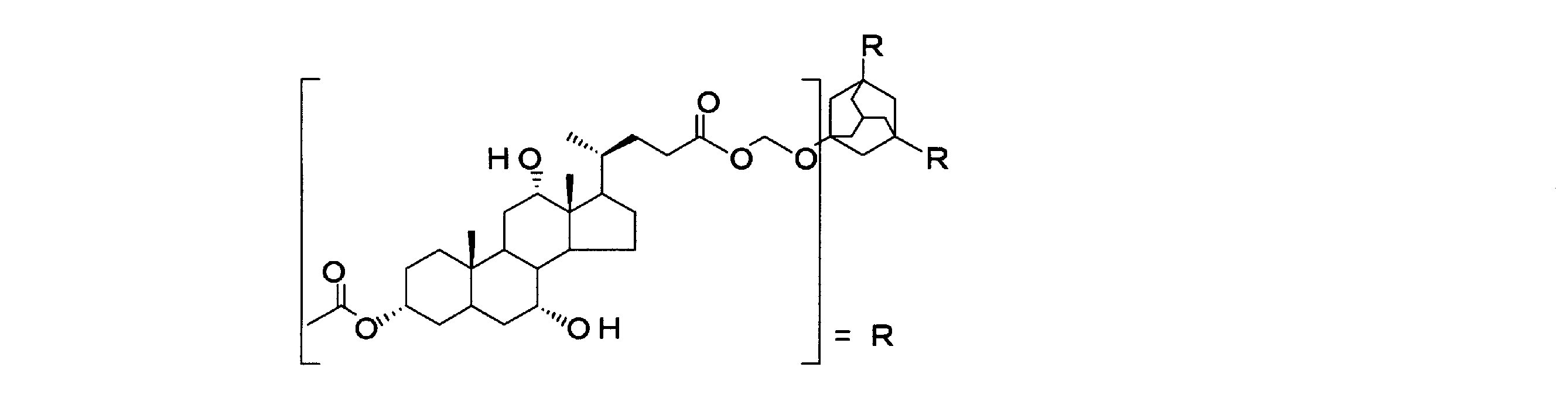
実施例3(トリス(3-(1-アダマンチルカルボニル)コール酸) アダマンタン-1,3,5-トリイルトリスオキシメチルの合成)
200ミリリットル二口フラスコに国際公開公報WO2007094784Aに記載の方法で合成したトリコール酸 アダマンタン-1,3,5-トリイルトリスオキシメチル[式量:1445.98,2895mg,2mmol]を入れ、THF45ミリリットルに溶解させた。
上記溶液に1-アダマンチルカルボニルクロライド[式量:198.69,1788mg,9mmol]をゆっくり滴下した。続いて、トリエチルアミン[式量:101.19,d=0.726,1.5ミリリットル,10.8mmol,1.2eq]を滴下すると、速やかに反応液が白濁し、わずかに発熱がみられた。引き続き20時間撹拌の後、水50ミリリットルを加えて反応を止めた。反応混合液にTHF50ミリリットルとジエチルエーテル100ミリリットルを加え、震とう,静置の後、水層と有機層を分けた。水層に再びジエチルエーテル50ミリリットルを加え、震とう,静置の後、水層と有機層を分けた。これをさらに2回繰り返した。得られた有機層を硫酸マグネシウムで乾燥し、濾過の後、溶媒を留去した。溶媒を除去した残渣をTHF60ミリリットルに溶かし、ジエチルエーテル500ミリリットルに滴下すると目的物であるトリス(3-(1-アダマンチルカルボニル)コール酸) アダマンタン-1,3,5-トリイルトリスオキシメチルの白色固体[2389mg,1.24mmol,単離収率61.8%]を得た。
200ミリリットル二口フラスコに国際公開公報WO2007094784Aに記載の方法で合成したトリコール酸 アダマンタン-1,3,5-トリイルトリスオキシメチル[式量:1445.98,2895mg,2mmol]を入れ、THF45ミリリットルに溶解させた。
上記溶液に1-アダマンチルカルボニルクロライド[式量:198.69,1788mg,9mmol]をゆっくり滴下した。続いて、トリエチルアミン[式量:101.19,d=0.726,1.5ミリリットル,10.8mmol,1.2eq]を滴下すると、速やかに反応液が白濁し、わずかに発熱がみられた。引き続き20時間撹拌の後、水50ミリリットルを加えて反応を止めた。反応混合液にTHF50ミリリットルとジエチルエーテル100ミリリットルを加え、震とう,静置の後、水層と有機層を分けた。水層に再びジエチルエーテル50ミリリットルを加え、震とう,静置の後、水層と有機層を分けた。これをさらに2回繰り返した。得られた有機層を硫酸マグネシウムで乾燥し、濾過の後、溶媒を留去した。溶媒を除去した残渣をTHF60ミリリットルに溶かし、ジエチルエーテル500ミリリットルに滴下すると目的物であるトリス(3-(1-アダマンチルカルボニル)コール酸) アダマンタン-1,3,5-トリイルトリスオキシメチルの白色固体[2389mg,1.24mmol,単離収率61.8%]を得た。
<物性データ>
熱重量/示差熱分析法(TG/DTA): Td5=270.5℃
減衰全反射赤外分光法(ATR-FTIR): 3460.1, 2935.6, 2870.6, 1727.2, 1090.7, 1033.9
熱重量/示差熱分析法(TG/DTA): Td5=270.5℃
減衰全反射赤外分光法(ATR-FTIR): 3460.1, 2935.6, 2870.6, 1727.2, 1090.7, 1033.9
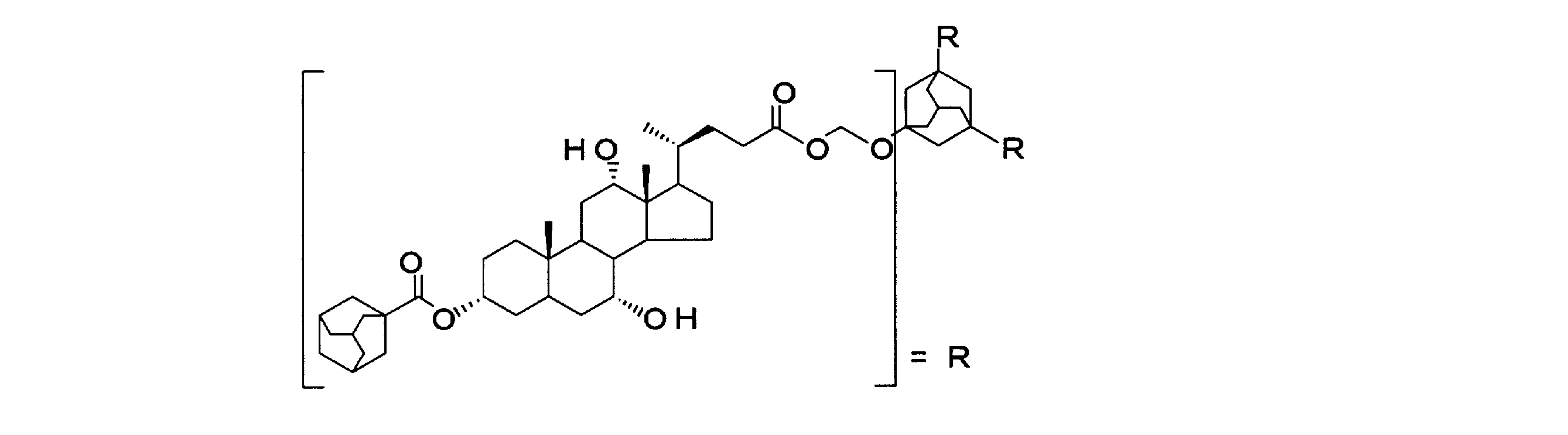
実施例4(トリス(3-シクロヘキシルカルボニルコール酸) アダマンタン-1,3,5-トリイルトリスオキシメチルの合成)
200ミリリットル二口フラスコに国際公開公報WO2007094784Aに記載の方法で合成したトリコール酸 アダマンタン-1,3,5-トリイルトリスオキシメチル[式量:1445.98,2904mg,2mmol]を入れ、THF45ミリリットルに溶解させた。
上記溶液にシクロヘキシルカルボニルクロライド[式量:146.61,d=1.096,1.2ミリリットル,9mmol]をゆっくり滴下した。続いて、トリエチルアミン[式量:101.19,d=0.726,1.5ミリリットル,10.8mmol,1.2当量]を滴下すると、速やかに反応液が白濁し、わずかに発熱がみられた。引き続き20時間撹拌の後、水50ミリリットルを加えて反応を止めた。反応混合液にTHF50ミリリットルとジエチルエーテル100ミリリットルを加え、震とう,静置の後、水層と有機層を分けた。水層に再びジエチルエーテル50ミリリットルを加え、震とう,静置の後、水層と有機層を分けた。これをさらに2回繰り返した。得られた有機層を硫酸マグネシウムで乾燥し、濾過の後、溶媒を留去した。溶媒を除去した残渣をTHF60ミリリットルに溶かし、ジエチルエーテル500ミリリットルに滴下すると目的物であるトリス(3-シクロヘキシルカルボニルコール酸) アダマンタン-1,3,5-トリイルトリスオキシメチルの白色固体[2200mg,1.24mmol,単離収率61.7%]を得た。
200ミリリットル二口フラスコに国際公開公報WO2007094784Aに記載の方法で合成したトリコール酸 アダマンタン-1,3,5-トリイルトリスオキシメチル[式量:1445.98,2904mg,2mmol]を入れ、THF45ミリリットルに溶解させた。
上記溶液にシクロヘキシルカルボニルクロライド[式量:146.61,d=1.096,1.2ミリリットル,9mmol]をゆっくり滴下した。続いて、トリエチルアミン[式量:101.19,d=0.726,1.5ミリリットル,10.8mmol,1.2当量]を滴下すると、速やかに反応液が白濁し、わずかに発熱がみられた。引き続き20時間撹拌の後、水50ミリリットルを加えて反応を止めた。反応混合液にTHF50ミリリットルとジエチルエーテル100ミリリットルを加え、震とう,静置の後、水層と有機層を分けた。水層に再びジエチルエーテル50ミリリットルを加え、震とう,静置の後、水層と有機層を分けた。これをさらに2回繰り返した。得られた有機層を硫酸マグネシウムで乾燥し、濾過の後、溶媒を留去した。溶媒を除去した残渣をTHF60ミリリットルに溶かし、ジエチルエーテル500ミリリットルに滴下すると目的物であるトリス(3-シクロヘキシルカルボニルコール酸) アダマンタン-1,3,5-トリイルトリスオキシメチルの白色固体[2200mg,1.24mmol,単離収率61.7%]を得た。
<物性データ>
熱重量/示差熱分析法(TG/DTA): Td5=165.3℃
減衰全反射赤外分光法(ATR-FTIR): 3425.4, 2935.8, 2868.3, 1713.0, 1091.7, 1034.1
熱重量/示差熱分析法(TG/DTA): Td5=165.3℃
減衰全反射赤外分光法(ATR-FTIR): 3425.4, 2935.8, 2868.3, 1713.0, 1091.7, 1034.1
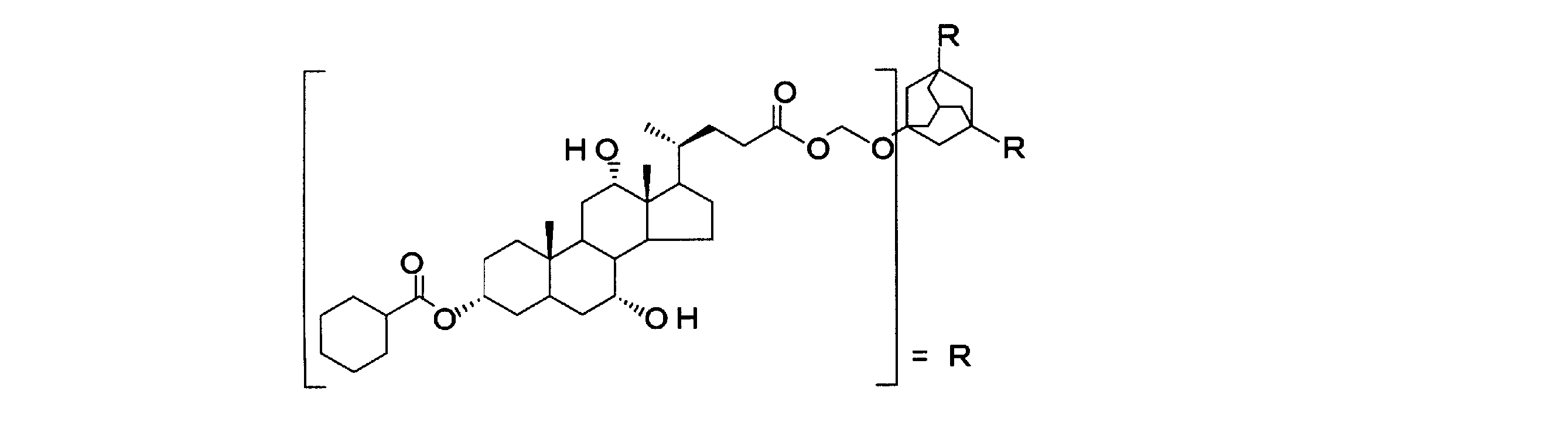
実施例5(トリデオキシコール酸 アダマンタン-1,3,5-トリイルトリスオキシメチルの合成)
50ミリリットル二口フラスコに国際公開公報WO2007094784Aに記載の方法で合成した1,3,5-トリス(メチルチオメトキシ)アダマンタン[式量:364.59,1823mg,5mmol]を入れ、塩化チオニル[式量:118.97,1.2ミリリットル,16.5mmol]をゆっくり滴下した後2時間撹拌した。残った塩化チオニルを真空ポンプにて除去した。
THF10ミリリットルに溶かしたデオキシコール酸[式量:392.57,5889mg,15mmol,1.0当量]をキャヌラーを使用して滴下し、さらにTHF5ミリリットル2回で洗い込んだ。続いて、トリエチルアミン[式量:101.19,d=0.726,2.3ミリリットル,16.5mmol,1.1当量]を滴下すると、速やかに反応液が白濁し、わずかに発熱がみられた。引き続き20時間撹拌の後、水100ミリリットルを加えて反応を止めた。反応混合液にTHF100ミリリットルとジエチルエーテル200ミリリットルを加え、震とう,静置の後、水層と有機層を分けた。水層に再びジエチルエーテル50ミリリットルを加え、震とう,静置の後、水層と有機層を分けた。これをさらに2回繰り返した。得られた有機層を硫酸マグネシウムで乾燥し、濾過の後、溶媒を留去した。溶媒を除去した残渣をTHF30ミリリットルに溶かし、ジエチルエーテル750ミリリットルに滴下すると目的物であるトリデオキシコール酸 アダマンタン-1,3,5-トリイルトリスオキシメチルの白色固体を得た[3939mg,2.82mmol,単離収率56.4%]。
50ミリリットル二口フラスコに国際公開公報WO2007094784Aに記載の方法で合成した1,3,5-トリス(メチルチオメトキシ)アダマンタン[式量:364.59,1823mg,5mmol]を入れ、塩化チオニル[式量:118.97,1.2ミリリットル,16.5mmol]をゆっくり滴下した後2時間撹拌した。残った塩化チオニルを真空ポンプにて除去した。
THF10ミリリットルに溶かしたデオキシコール酸[式量:392.57,5889mg,15mmol,1.0当量]をキャヌラーを使用して滴下し、さらにTHF5ミリリットル2回で洗い込んだ。続いて、トリエチルアミン[式量:101.19,d=0.726,2.3ミリリットル,16.5mmol,1.1当量]を滴下すると、速やかに反応液が白濁し、わずかに発熱がみられた。引き続き20時間撹拌の後、水100ミリリットルを加えて反応を止めた。反応混合液にTHF100ミリリットルとジエチルエーテル200ミリリットルを加え、震とう,静置の後、水層と有機層を分けた。水層に再びジエチルエーテル50ミリリットルを加え、震とう,静置の後、水層と有機層を分けた。これをさらに2回繰り返した。得られた有機層を硫酸マグネシウムで乾燥し、濾過の後、溶媒を留去した。溶媒を除去した残渣をTHF30ミリリットルに溶かし、ジエチルエーテル750ミリリットルに滴下すると目的物であるトリデオキシコール酸 アダマンタン-1,3,5-トリイルトリスオキシメチルの白色固体を得た[3939mg,2.82mmol,単離収率56.4%]。
<物性データ>
熱重量/示差熱分析法(TG/DTA): Td5=122.7℃
・減衰全反射赤外分光法(ATR-FTIR): 3423.8, 2933.3, 2863.0, 1709.6, 1090.1, 1033.0, 1017.3
熱重量/示差熱分析法(TG/DTA): Td5=122.7℃
・減衰全反射赤外分光法(ATR-FTIR): 3423.8, 2933.3, 2863.0, 1709.6, 1090.1, 1033.0, 1017.3

実施例6(トリウルソデオキシコール酸 アダマンタン-1,3,5-トリイルトリスオキシメチルの合成)
50ミリリットル二口フラスコに国際公開公報WO2007094784Aに記載の方法で合成した1,3,5-トリス(メチルチオメトキシ)アダマンタン[式量:364.59,1823mg,5mmol]を入れ、塩化チオニル[式量:118.97,1.2ミリリットル,16.5mmol]をゆっくり滴下した後2時間撹拌した。残った塩化チオニルを真空ポンプにて除去した。THF10ミリリットルに溶かしたウルソデオキシコール酸[式量:392.57,5889mg,15mmol,1.0当量]をキャヌラーを使用して滴下し、さらにTHF5ミリリットル2回で洗い込んだ。続いて、トリエチルアミン[式量:101.19,d=0.726,2.3ミリリットル,16.5mmol,1.1当量]を滴下すると、速やかに反応液が白濁し、わずかに発熱がみられた。引き続き20時間撹拌の後、水100ミリリットルを加えて反応を止めた。反応混合液にTHF100ミリリットルとジエチルエーテル200ミリリットルを加え、震とう,静置の後、水層と有機層を分けた。水層に再びジエチルエーテル50ミリリットルを加え、震とう,静置の後、水層と有機層を分けた。これをさらに2回繰り返した。得られた有機層を硫酸マグネシウムで乾燥し、濾過の後、溶媒を留去した。溶媒を除去した残渣をTHF25ミリリットルに溶かし、ジエチルエーテル800ミリリットルに滴下すると目的物であるトリデオキシコール酸 アダマンタン-1,3,5-トリイルトリスオキシメチルの白色固体を得た[5230mg,3.74mmol,単離収率74.8%]。
50ミリリットル二口フラスコに国際公開公報WO2007094784Aに記載の方法で合成した1,3,5-トリス(メチルチオメトキシ)アダマンタン[式量:364.59,1823mg,5mmol]を入れ、塩化チオニル[式量:118.97,1.2ミリリットル,16.5mmol]をゆっくり滴下した後2時間撹拌した。残った塩化チオニルを真空ポンプにて除去した。THF10ミリリットルに溶かしたウルソデオキシコール酸[式量:392.57,5889mg,15mmol,1.0当量]をキャヌラーを使用して滴下し、さらにTHF5ミリリットル2回で洗い込んだ。続いて、トリエチルアミン[式量:101.19,d=0.726,2.3ミリリットル,16.5mmol,1.1当量]を滴下すると、速やかに反応液が白濁し、わずかに発熱がみられた。引き続き20時間撹拌の後、水100ミリリットルを加えて反応を止めた。反応混合液にTHF100ミリリットルとジエチルエーテル200ミリリットルを加え、震とう,静置の後、水層と有機層を分けた。水層に再びジエチルエーテル50ミリリットルを加え、震とう,静置の後、水層と有機層を分けた。これをさらに2回繰り返した。得られた有機層を硫酸マグネシウムで乾燥し、濾過の後、溶媒を留去した。溶媒を除去した残渣をTHF25ミリリットルに溶かし、ジエチルエーテル800ミリリットルに滴下すると目的物であるトリデオキシコール酸 アダマンタン-1,3,5-トリイルトリスオキシメチルの白色固体を得た[5230mg,3.74mmol,単離収率74.8%]。
<物性データ>
熱重量/示差熱分析法(TG/DTA): Td5=118.6℃
・減衰全反射赤外分光法(ATR-FTIR): 3423.8, 2932.0, 2864.7, 1709.1, 1092.6, 1013.6
熱重量/示差熱分析法(TG/DTA): Td5=118.6℃
・減衰全反射赤外分光法(ATR-FTIR): 3423.8, 2932.0, 2864.7, 1709.1, 1092.6, 1013.6
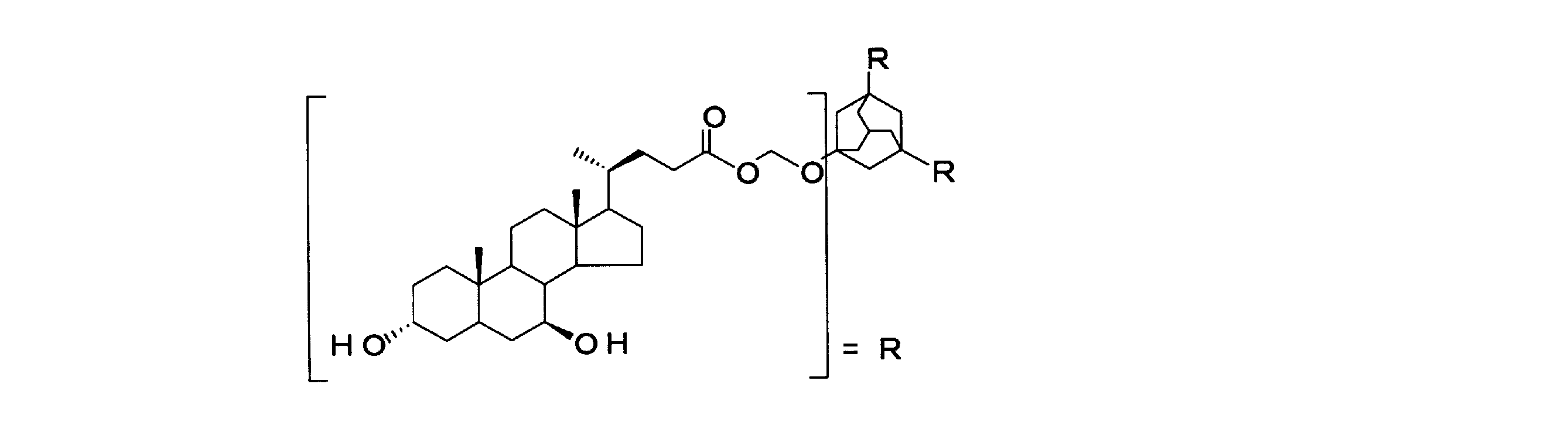
実施例7(トリス(3-(オキシメトキシ-2,6-ノルボルナンカルボラクトンカルボニル)コール酸) アダマンタン-1,3,5-トリイルトリスオキシメチルの合成)
攪拌器,温度計及び塩化水素ガス導入用のノズルを取付けた2リットル3つ口フラスコに3-ヒドロキシ-2,6-ノルボルナンカルボラクトン[式量:154.16,1.297mol,200g],パラホルムアルデヒド[式量:30.03,1.687mol,50.64g],硫酸マグネシウム[式量:120.37,1.297mmol,156.1g]及びジクロロメタン1,300ミリリットルを加え、0℃に保ちながら攪拌した。塩化ナトリウム1,070gと濃硫酸900ミリリットルを混合して発生させた塩化水素ガスをジクロロメタン溶液にノズルを通して5時間吹き込んだ。3時間攪拌後、反応液のGC-MS分析を行ったところ3-ヒドロキシ-2,6-ノルボルナンカルボラクトンは完全に転化し、選択率96%で、3-クロロメトキシ-2,6-ノルボルナンカルボラクトンが得られていることを確認した。
<物性データ>
ガスクロマトグラフ-質量分析(GC-MS):
204(M+(37Cl),1.83%), 202(M+(35Cl),5.39%), 174(9.29%), 167(4.01%), 144(15.11%), 138(25.31%), 119(13.04%), 105(100%), 80(60.96%), 66(44.62%), 55(16.02%)
攪拌器,温度計及び塩化水素ガス導入用のノズルを取付けた2リットル3つ口フラスコに3-ヒドロキシ-2,6-ノルボルナンカルボラクトン[式量:154.16,1.297mol,200g],パラホルムアルデヒド[式量:30.03,1.687mol,50.64g],硫酸マグネシウム[式量:120.37,1.297mmol,156.1g]及びジクロロメタン1,300ミリリットルを加え、0℃に保ちながら攪拌した。塩化ナトリウム1,070gと濃硫酸900ミリリットルを混合して発生させた塩化水素ガスをジクロロメタン溶液にノズルを通して5時間吹き込んだ。3時間攪拌後、反応液のGC-MS分析を行ったところ3-ヒドロキシ-2,6-ノルボルナンカルボラクトンは完全に転化し、選択率96%で、3-クロロメトキシ-2,6-ノルボルナンカルボラクトンが得られていることを確認した。
<物性データ>
ガスクロマトグラフ-質量分析(GC-MS):
204(M+(37Cl),1.83%), 202(M+(35Cl),5.39%), 174(9.29%), 167(4.01%), 144(15.11%), 138(25.31%), 119(13.04%), 105(100%), 80(60.96%), 66(44.62%), 55(16.02%)

50ミリリットル二口フラスコに、国際公開公報WO2007094784Aに記載の方法で合成したトリコール酸 アダマンタン-1,3,5-トリイルトリスオキシメチル[式量:1445.98,1000mg,0.69mmol]と、上述のようにして合成した3-クロロメトキシ-2,6-ノルボルナンカルボラクトン[式量:202.63,558mg,2.48mmol,1.2当量]を入れ、THF10ミリリットルに溶解させた。続いて、トリエチルアミン[式量:101.19,d=0.726,0.4ミリリットル,3.1mmol,1.25当量]を滴下すると、速やかに反応液が白濁し、わずかに発熱がみられた。引き続き20時間撹拌の後、水50ミリリットルを加えて反応を止めた。反応混合液にTHF30ミリリットルとジエチルエーテル100ミリリットルを加え、震とう,静置の後、水層と有機層を分けた。水層に再びジエチルエーテル50ミリリットルを加え、震とう,静置の後、水層と有機層を分けた。これをさらに2回繰り返した。得られた有機層を硫酸マグネシウムで乾燥し、濾過の後、溶媒を留去した。溶媒を除去した残渣をTHF20ミリリットルに溶かし、ジエチルエーテル400ミリリットルに滴下すると目的物であるトリス(3-(オキシメトキシ-2,6-ノルボルナンカルボラクトンカルボニル)コール酸) アダマンタン-1,3,5-トリイルトリスオキシメチルの白色固体[1048mg,0.54mmol,単離収率78.2%]を得た。
<物性データ>
熱重量/示差熱分析法(TG/DTA): Td5=243.3℃
減衰全反射赤外分光法(ATR-FTIR): 3455.1, 2937.0, 2869.3, 1780.9, 1709.1, 1089.5, 1037.4
熱重量/示差熱分析法(TG/DTA): Td5=243.3℃
減衰全反射赤外分光法(ATR-FTIR): 3455.1, 2937.0, 2869.3, 1780.9, 1709.1, 1089.5, 1037.4
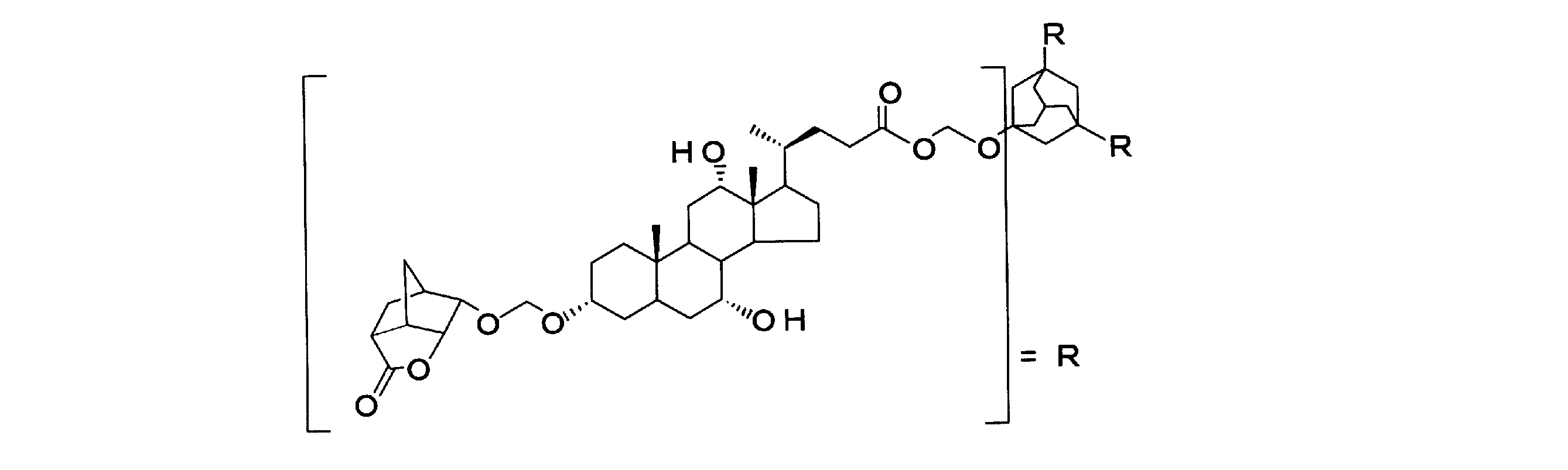
実施例8(組成物の調製)
実施例1で得られた脂環式化合物100質量部に対し、光酸発生剤としてトリフェニルスルホニウムノナフルオロブタンスルホネートを5質量部加え、これらが5質量%になるようにシクロヘキサノンで溶解し、組成物を調製した。ヘキサメチルジシラザン(HMDS)処理したシリコンウエハー上に、調製した組成物を塗布し、110℃で、60秒間ベークを行い、レジスト膜を形成した。こうして得られたウエハーを水で希釈したテトラメチルアンモニウムハイドロオキサイド(TMAH)水溶液(2.38質量%)で30秒間現像した。このときのTMAH濃度に対する膜厚の変化を第1表及び図1に示す。
実施例1で得られた脂環式化合物100質量部に対し、光酸発生剤としてトリフェニルスルホニウムノナフルオロブタンスルホネートを5質量部加え、これらが5質量%になるようにシクロヘキサノンで溶解し、組成物を調製した。ヘキサメチルジシラザン(HMDS)処理したシリコンウエハー上に、調製した組成物を塗布し、110℃で、60秒間ベークを行い、レジスト膜を形成した。こうして得られたウエハーを水で希釈したテトラメチルアンモニウムハイドロオキサイド(TMAH)水溶液(2.38質量%)で30秒間現像した。このときのTMAH濃度に対する膜厚の変化を第1表及び図1に示す。
実施例9~14(組成物の調製)
実施例1で得られた脂環式化合物に代えて、実施例2~7で得られた脂環式化合物をそれぞれ使用して組成物を調製し、調製した組成物を未処理のシリコンウエハー又はHMDS処理したシリコンウェハー上に塗布した以外は実施例8と同様にしてレジスト膜を形成し、現像した。このときのTMAH濃度に対する膜厚の変化を第1表及び図1に示す。
実施例1で得られた脂環式化合物に代えて、実施例2~7で得られた脂環式化合物をそれぞれ使用して組成物を調製し、調製した組成物を未処理のシリコンウエハー又はHMDS処理したシリコンウェハー上に塗布した以外は実施例8と同様にしてレジスト膜を形成し、現像した。このときのTMAH濃度に対する膜厚の変化を第1表及び図1に示す。
比較例1(比較組成物の調製)
実施例8において、実施例1で得られた脂環式化合物に代えて、下記式で示される化合物GR-5を用い、シクロヘキサノンの代わりに乳酸エチルを用いて比較組成物を調製し、調製した比較組成物を未処理のシリコンウエハー上に塗布した以外は実施例8と同様にしてレジスト膜を形成し、現像した。このときのTMAH濃度に対する膜厚の変化を第1表及び図1に示す。
実施例8において、実施例1で得られた脂環式化合物に代えて、下記式で示される化合物GR-5を用い、シクロヘキサノンの代わりに乳酸エチルを用いて比較組成物を調製し、調製した比較組成物を未処理のシリコンウエハー上に塗布した以外は実施例8と同様にしてレジスト膜を形成し、現像した。このときのTMAH濃度に対する膜厚の変化を第1表及び図1に示す。

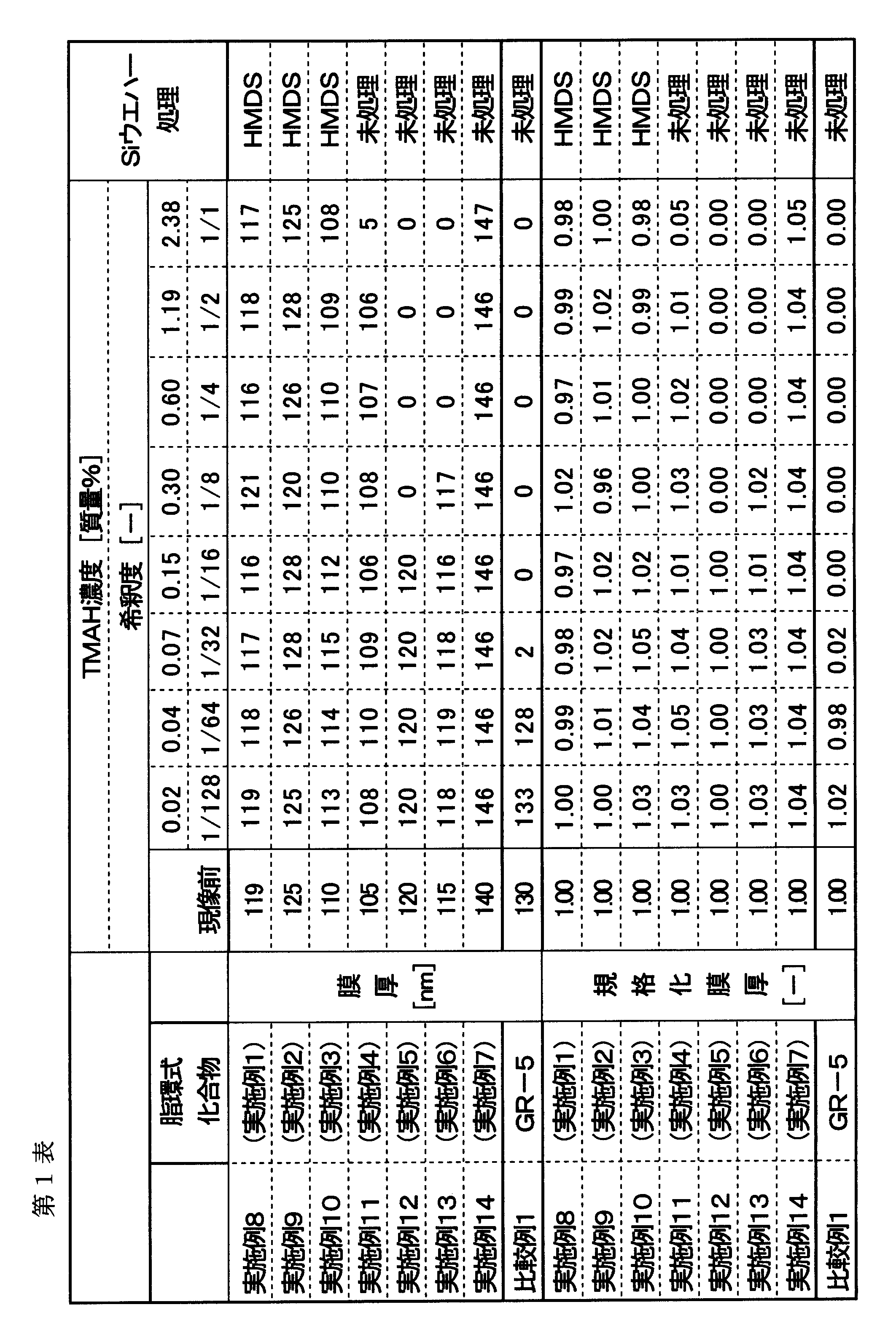
このように本発明の実施例8~14で調製された組成物を用いて形成されたレジスト膜は、比較例1で調製された比較組成物を用いて形成されたレジスト膜と比較して、より高濃度のTMAH溶液においても、膜厚が維持されることが確認された。特に実施例1~3及び7で調製された組成物を用いて形成されたレジスト膜は、TMAH標準濃度(2.38質量%)においても膜厚が維持された。
以上詳細に説明したように、本発明の脂環式化合物は、ポジ型レジスト組成物用途に有用である。
Claims (13)
- 下記一般式(1)で表される脂環式化合物。






- 前記一般式(a)におけるRe及びRfが水素原子であり、かつ、Aが単結合である請求項1記載の脂環式化合物。
- 前記一般式(a)におけるnが1であり、Rc及びRdが、それぞれ独立に、水素原子又は水酸基である請求項1又は2記載の脂環式化合物。
- 前記一般式(a)におけるRbが、前記一般式(b1)で表わされる酸素含有有機基であって、Rc及びRdが水酸基である請求項1~3のいずれかに記載の脂環式化合物。
- 前記一般式(a)におけるRbが水酸基である請求項1~3のいずれかに記載の脂環式化合物。
- 下記一般式(c1)~(c4)のいずれかで示されるコール酸類と、1,3,5-トリス(ビニルオキシ)アダマンタン、1,3,5-トリス(ハロゲノメトキシ)アダマンタン、1,3,5-トリス(ビニルオキシメチル)アダマンタン及び1,3,5-トリス(メチルチオメトキシ)アダマンタンから選択される1種以上とを反応させることを特徴とする請求項1、2、3又は5記載の脂環式化合物の製造方法。

- 下記一般式(1-1)で示される脂環式化合物と、下記一般式(d1)~(d5)のいずれかで示される酸素含有有機化合物1種以上とを反応させることを特徴とする請求項1~6のいずれかに記載の脂環式化合物の製造方法。







- 前記一般式(1-1)におけるRa4~Ra6が、下記一般式(a-2)で表わされるコール酸類エステル構造含有基である請求項7記載の脂環式化合物の製造方法。

- 請求項1~5のいずれかに記載の脂環式化合物を含有することを特徴とする組成物。
- さらに溶媒及び酸発生剤を含有する請求項9記載の組成物。
- さらにクエンチャーを含有する請求項9又は10記載の組成物。
- ポジ型レジスト組成物である請求項9~11のいずれかに記載の組成物。
- 請求項9~12のいずれかに記載の組成物をポジ型レジストとして用いて支持体上にレジスト膜を形成する工程と、該レジスト膜を露光する工程と、該レジスト膜をアルカリ現像してレジストパターンを形成する工程とを含むレジストパターン形成方法。
Applications Claiming Priority (2)
| Application Number | Priority Date | Filing Date | Title |
|---|---|---|---|
| JP2009-020592 | 2009-01-30 | ||
| JP2009020592A JP2010173988A (ja) | 2009-01-30 | 2009-01-30 | 脂環式化合物、その製造方法、それを含む組成物及びそれを用いたレジストパターン形成方法 |
Publications (1)
| Publication Number | Publication Date |
|---|---|
| WO2010087339A1 true WO2010087339A1 (ja) | 2010-08-05 |
Family
ID=42395600
Family Applications (1)
| Application Number | Title | Priority Date | Filing Date |
|---|---|---|---|
| PCT/JP2010/050977 Ceased WO2010087339A1 (ja) | 2009-01-30 | 2010-01-26 | 脂環式化合物、その製造方法、それを含む組成物及びそれを用いたレジストパターン形成方法 |
Country Status (3)
| Country | Link |
|---|---|
| JP (1) | JP2010173988A (ja) |
| TW (1) | TW201040136A (ja) |
| WO (1) | WO2010087339A1 (ja) |
Citations (5)
| Publication number | Priority date | Publication date | Assignee | Title |
|---|---|---|---|---|
| JP2006003781A (ja) * | 2004-06-21 | 2006-01-05 | Tokyo Ohka Kogyo Co Ltd | ポジ型レジスト組成物及びレジストパターン形成方法 |
| JP2007193328A (ja) * | 2006-01-19 | 2007-08-02 | Samsung Electronics Co Ltd | フォトレジスト組成物及びこれを用いるフォトレジストパターンの形成方法 |
| WO2007094784A1 (en) * | 2006-02-16 | 2007-08-23 | Cornell Research Foundation, Inc. | Adamantane based molecular glass photoresists for sub-200 nm lithography |
| JP2007316508A (ja) * | 2006-05-29 | 2007-12-06 | Tokyo Ohka Kogyo Co Ltd | 分解性組成物およびその使用方法 |
| JP2009265623A (ja) * | 2008-03-31 | 2009-11-12 | Hitachi Chem Co Ltd | シリカ系ポジ型感光性樹脂組成物 |
-
2009
- 2009-01-30 JP JP2009020592A patent/JP2010173988A/ja active Pending
-
2010
- 2010-01-26 WO PCT/JP2010/050977 patent/WO2010087339A1/ja not_active Ceased
- 2010-01-28 TW TW99102443A patent/TW201040136A/zh unknown
Patent Citations (5)
| Publication number | Priority date | Publication date | Assignee | Title |
|---|---|---|---|---|
| JP2006003781A (ja) * | 2004-06-21 | 2006-01-05 | Tokyo Ohka Kogyo Co Ltd | ポジ型レジスト組成物及びレジストパターン形成方法 |
| JP2007193328A (ja) * | 2006-01-19 | 2007-08-02 | Samsung Electronics Co Ltd | フォトレジスト組成物及びこれを用いるフォトレジストパターンの形成方法 |
| WO2007094784A1 (en) * | 2006-02-16 | 2007-08-23 | Cornell Research Foundation, Inc. | Adamantane based molecular glass photoresists for sub-200 nm lithography |
| JP2007316508A (ja) * | 2006-05-29 | 2007-12-06 | Tokyo Ohka Kogyo Co Ltd | 分解性組成物およびその使用方法 |
| JP2009265623A (ja) * | 2008-03-31 | 2009-11-12 | Hitachi Chem Co Ltd | シリカ系ポジ型感光性樹脂組成物 |
Non-Patent Citations (3)
| Title |
|---|
| KIM. J. B., PROCEEDINGS OF SPIE, vol. 5753, 2005, pages 603 - 610 * |
| TANAKA, S. ET AL., PROC. OF SPIE, vol. 6153, no. 61532B, 2006, pages 1 - 12 * |
| TANAKA, S. ET AL., PROC. OF SPIE, vol. 6923, no. 69231J, 2008, pages 1 - 8 * |
Also Published As
| Publication number | Publication date |
|---|---|
| TW201040136A (en) | 2010-11-16 |
| JP2010173988A (ja) | 2010-08-12 |
Similar Documents
| Publication | Publication Date | Title |
|---|---|---|
| JP5608009B2 (ja) | ホモアダマンタン誘導体、その製造方法及びフォトレジスト組成物 | |
| JP6646633B2 (ja) | 光酸発生剤およびこれを含むフォトレジスト | |
| KR101944305B1 (ko) | 광산 발생제 및 이를 포함하는 포토레지스트 | |
| JP5687442B2 (ja) | 光酸発生剤およびこれを含むフォトレジスト | |
| JP5267126B2 (ja) | 感放射線性組成物及びそれに用いられる低分子量化合物の製造方法 | |
| JP5919148B2 (ja) | レジスト組成物、レジストパターン形成方法及び高分子化合物 | |
| JP5270188B2 (ja) | 新規なアクリル酸エステル誘導体、高分子化合物 | |
| JP5756672B2 (ja) | 光酸発生剤およびこれを含むフォトレジスト | |
| CN104130172B (zh) | 磺酰光酸产生剂和包含该磺酰光酸产生剂的光刻胶 | |
| JP2009114381A (ja) | (メタ)アクリル酸エステル樹脂 | |
| TWI465418B (zh) | 化合物、含有該化合物的聚合物及含有該聚合物的化學放大型光阻組成物 | |
| JP2011219363A (ja) | ホモアダマンタン誘導体、その製造方法及びフォトレジスト用感光性材料 | |
| TW201214050A (en) | Actinic-ray- or radiation-sensitive resin composition, resist film therefrom and method of forming pattern therewith | |
| WO2010095698A1 (ja) | 重合体及び感放射線性組成物並びに単量体 | |
| JPWO2008081768A1 (ja) | 脂環構造含有クロロメチルエーテル類、フォトレジスト用重合性モノマーおよびその製造方法 | |
| JP6472097B2 (ja) | スルホン酸誘導体、それを用いた光酸発生剤、レジスト組成物及びデバイスの製造方法 | |
| JP5844613B2 (ja) | 感光性コポリマーおよびフォトレジスト組成物 | |
| KR20110066110A (ko) | 콜레이트 광산 발생제 및 이를 포함하는 포토레지스트 | |
| WO2009142142A1 (ja) | 脂環構造含有化合物、(メタ)アクリル酸エステル類、(メタ)アクリル系重合体並びにそれを含むポジ型レジスト組成物 | |
| JP5286236B2 (ja) | 感活性光線性又は感放射線性樹脂組成物、それを用いて形成した膜及びそれを用いたパターン形成方法 | |
| JP5270189B2 (ja) | 新規なアルコールおよびその誘導体 | |
| KR101739886B1 (ko) | 감활성광선성 또는 감방사선성 수지 조성물, 그 조성물을 사용한 감활성광선성 또는 감방사선성 수지막 및 패턴 형성 방법 | |
| JP2003002883A (ja) | ラクトン構造を有する(メタ)アクリレート化合物、その重合体、レジスト材料及びパターン形成方法 | |
| WO2010146901A1 (ja) | 脂環式化合物、その製造方法、それを含む組成物及びそれを用いたレジストパターン形成方法 | |
| JP5707249B2 (ja) | 化学増幅型レジスト組成物、並びに、それを用いたレジスト膜、レジスト塗布マスクブランクス、レジストパターン形成方法、及び、フォトマスク |
Legal Events
| Date | Code | Title | Description |
|---|---|---|---|
| 121 | Ep: the epo has been informed by wipo that ep was designated in this application |
Ref document number: 10735807 Country of ref document: EP Kind code of ref document: A1 |
|
| NENP | Non-entry into the national phase |
Ref country code: DE |
|
| 122 | Ep: pct application non-entry in european phase |
Ref document number: 10735807 Country of ref document: EP Kind code of ref document: A1 |