WO2010082590A1 - 油性ボールペンリフィル - Google Patents
油性ボールペンリフィル Download PDFInfo
- Publication number
- WO2010082590A1 WO2010082590A1 PCT/JP2010/050302 JP2010050302W WO2010082590A1 WO 2010082590 A1 WO2010082590 A1 WO 2010082590A1 JP 2010050302 W JP2010050302 W JP 2010050302W WO 2010082590 A1 WO2010082590 A1 WO 2010082590A1
- Authority
- WO
- WIPO (PCT)
- Prior art keywords
- ball
- writing
- less
- diameter
- ballpoint pen
- Prior art date
- Legal status (The legal status is an assumption and is not a legal conclusion. Google has not performed a legal analysis and makes no representation as to the accuracy of the status listed.)
- Ceased
Links
Images


Classifications
-
- B—PERFORMING OPERATIONS; TRANSPORTING
- B43—WRITING OR DRAWING IMPLEMENTS; BUREAU ACCESSORIES
- B43K—IMPLEMENTS FOR WRITING OR DRAWING
- B43K1/00—Nibs; Writing-points
- B43K1/08—Nibs; Writing-points with ball points; Balls or ball beds
-
- B—PERFORMING OPERATIONS; TRANSPORTING
- B43—WRITING OR DRAWING IMPLEMENTS; BUREAU ACCESSORIES
- B43K—IMPLEMENTS FOR WRITING OR DRAWING
- B43K1/00—Nibs; Writing-points
- B43K1/08—Nibs; Writing-points with ball points; Balls or ball beds
- B43K1/084—Ball beds
-
- B—PERFORMING OPERATIONS; TRANSPORTING
- B43—WRITING OR DRAWING IMPLEMENTS; BUREAU ACCESSORIES
- B43K—IMPLEMENTS FOR WRITING OR DRAWING
- B43K1/00—Nibs; Writing-points
- B43K1/08—Nibs; Writing-points with ball points; Balls or ball beds
- B43K1/086—Nibs; Writing-points with ball points; Balls or ball beds with resilient supporting means for the ball, e.g. springs
-
- B—PERFORMING OPERATIONS; TRANSPORTING
- B43—WRITING OR DRAWING IMPLEMENTS; BUREAU ACCESSORIES
- B43K—IMPLEMENTS FOR WRITING OR DRAWING
- B43K7/00—Ball-point pens
- B43K7/02—Ink reservoirs; Ink cartridges
Definitions
- the present invention relates to an oil ballpoint pen refill designed to prevent ink flow rate decrease due to ink bottling and writing tip drying and paper entrainment.
- Ballpoint pens particularly oil-based ballpoint pens, have a higher ink viscosity than aqueous ballpoint pens. Therefore, the phenomenon of so-called “bottom”, in which excess ink adheres to the tip of the ballpoint pen tip during writing, tends to occur. This also causes the writing surface to become dirty during the next writing.
- Patent Document 1 In order to suppress this “bottom”, there are cases where attempts are made to enlarge the ball seat as in the invention described in Patent Document 1 below.
- the ink reservoir in the ball house that houses the writing ball is reduced. As a result, the ink flow rate decreases, or the drawn line cannot follow when writing at high speed. Therefore, it is described in the same document that it is dealt with by increasing the ball house diameter.
- the document also includes a spring in the ballpoint pen tip that biases the writing ball in the tip direction, sealing between the writing ball and the crimped portion at the tip of the ballpoint pen tip when not writing, and resistance to drying. Is also given.
- the present invention provides an oil-based ballpoint pen refill using a writing ball having a diameter of less than 0.7 mm, particularly 0.5 mm to 0.6 mm, without reducing the ink flow rate. The problem is to solve the problems associated with paper entrainment.
- the present invention provides a holder formed by cutting a cylindrical material, A tapered portion formed by tapering the outer periphery of one end of the holder; A ball house formed by cutting the inner periphery of the tapered portion; A back hole formed by drilling from the other end of the holder to the vicinity of the ball house; An ink hole formed penetrating between the ball house and the back hole; A channel groove which is a groove formed by cutting a plurality of locations equally distributed around the ink hole from the ball house side; A writing ball inserted into the ball house and having a diameter of 0.5 mm or more and 0.6 mm or less; A ball seat to which the curved surface of the writing ball is transferred when the writing ball is pressed toward the back hole on the bottom surface of the ball house; A crimped portion formed by crimping the tip portion of the tapered portion on the inside; and A ballpoint pen tip provided with a spring having a pressing load of 0.010N or more and 0.090N or less inserted into the back
- the structure of each part is adjusted in order to eliminate the adverse effect of paper entrainment.
- the ball-point pen tip is mounted at the tip of the ink storage tube, but may be stored directly in the ink storage tube or may be mounted via a joint.
- “Ballhouse inner diameter” defines the size of the space for storing writing balls.
- the volume of the so-called “ink reservoir” that is a space other than the space occupied by the writing ball is also defined. Into this ink reservoir, writing paper fibers that have been involved in writing will enter. Therefore, the volume of the ink reservoir defined by the inner diameter of the ball house is related to both the ease of entering the fibers and the ease of discharging the entered fibers.
- the inner diameter of the ball house is suitably in the range of 104.0% or more and 108.5% or less of the writing ball diameter.
- the “ball seat diameter” defines the ease of rotation of the writing ball, and also relates to both the ease of entering the fiber and the ease of discharging the entered fiber. When the ball seat diameter is less than 80.0% of the writing ball diameter, the specific portion of the ball seat is likely to be worn by the rotation of the writing ball.
- the ball seat diameter is suitably in the range of 80.0% to 90.0% of the writing ball diameter.
- Angle of the crimping portion means an angle formed by two line segments centering on a point where two line segments forming the crimping portion are extended and crossed in the cross section along the central axis of the ballpoint pen tip. Say. This angle defines the degree of contact between the crimped portion and the writing ball. Therefore, this also relates to both the ease of entering the fibers and the ease of discharging the entered fibers. If the angle of the crimped portion is less than 70 °, the contact between the crimped portion and the writing ball is more dense, and the entangled fiber is easily caught in the crimped portion, which is unsuitable for writing.
- the angle of the crimped portion is suitably in the range of 70 ° or more and 90 ° or less.
- the “spring” has a role of pressing the writing ball toward the tip to bring it into close contact with the caulking portion, thereby preventing the ink pool from drying when not writing. Therefore, the “push load” affects the degree of adhesion between the writing ball and the crimped portion. If the pressing load of the spring is less than 0.010 N, the ink pool becomes easy to dry because the adhesion between the writing ball and the caulking portion when not writing is weak. As a result, the strokes at the beginning of writing tend to fade. On the other hand, if it exceeds 0.090 N, the writing ball is hardly pushed back even if writing pressure is applied. Therefore, the writing quality is impaired. Therefore, the pushing load of the spring is suitably in the range of 0.010N or more and 0.090N or less.
- the length along the axial direction of the seal surface, which is a portion that can come into contact with the writing ball, of the inner surface of the crimped portion is preferably 0.020 mm or more and 0.050 mm or less. . Since this “seal surface” is a part related to the close contact between the writing ball and the crimped part, it is a part related to the fiber being easily caught. When this length is less than 0.020 mm, there is little adhesion between the writing ball and the crimped portion. Therefore, although the fibers are not caught in the caulking portion, the ink stick tends to adhere to the caulking portion, which is not suitable.
- the length along the axial direction of the seal surface is suitably in the range of 0.020 mm or more and 0.050 mm or less.
- the distance that the writing ball can move along the axial direction in the ball house is preferably 0.004 mm or more and 0.009 mm or less.
- This “vertical play” represents how much the writing ball can be pushed back when writing compared to non-writing.
- this vertical play is less than 0.004 mm, the adhesion between the writing ball and the crimped portion becomes strong. Therefore, the fiber is easily caught on the crimped portion, which is not suitable.
- it exceeds 0.009 mm there is little adhesion with a writing ball and a caulking part.
- the length of the vertical play is suitably in the range of 0.004 mm or more and 0.009 mm or less.
- the distance that the writing ball can move in the ball house along the direction orthogonal to the axial direction is 0.005 mm or more and 0.015 mm or less. Is desirable.
- This “horizontal play” indicates how much space can be formed between the crimped portion and the crimped portion at the time of writing.
- the horizontal play is less than 0.005 mm, the writing ball and the crimped portion are strongly adhered. Therefore, the fiber is easily caught on the crimped portion, which is not suitable.
- it exceeds 0.015 mm there is little contact
- the length of the horizontal play is suitably in the range of 0.004 mm or more and 0.015 mm or less.
- the ink consumption is desirably 25 mg to 40 mg per 100 m. That is, in an oil-based ballpoint pen refill equipped with a ballpoint pen tip having the above-described structure, if the physical properties of the stored oil-based ink are such that the ink consumption falls within this range, the quality of the drawn lines and the writing quality are kept good. On the other hand, it is possible to eliminate problems caused by fiber entrainment.
- the present invention is configured as described above, in an oil-based ballpoint pen refill using a writing ball having a diameter of less than 0.7 mm, particularly 0.5 mm to 0.6 mm, the inside of the ballpoint pen tip without reducing the ink flow rate. This will eliminate the problems associated with paper entrainment.
- FIG. 3 is an enlarged (A) front cross-sectional view and (B) II cross-sectional view of a tip portion of the ball-point pen tip shown in FIG.
- the spring is omitted
- the writing ball is omitted.
- the movable distance (lateral play) is schematically illustrated.
- FIG. 1 is a front sectional view of an oil-based ballpoint pen refill 10 according to one embodiment of the present invention.
- a ball-point pen tip 15 is attached to one end of a cylindrical cylindrical ink storage tube 11 whose both ends are open via a joint 14 made of polybutylene terephthalate (PBT).
- PBT polybutylene terephthalate
- a backflow prevention ball 16 is inserted for the purpose of preventing the backflow of ink accompanying the inflow of air when the writing tip is left facing upward.
- the ink containing tube 11 is filled with oil-based ink 12.
- the rear end side is filled with an ink follower 13 that is a grease-like substance.
- the ink follower 13 serves as a stopper for preventing the oil-based ink 12 from flowing out from the rear end of the ink containing tube 11.
- FIG. 2A is a front view and FIG. 2B is a front sectional view of a ball-point pen tip 15 used in the oil-based ballpoint pen refill 10 according to one embodiment of the present invention.
- the ball-point pen tip 15 includes a holder 20 formed by cutting a cylindrical column made of stainless steel, a writing ball 30 made of cemented carbide attached to the tip of the holder 20, and a spring 40 fitted inside the holder 20. It consists of.
- the tip of the holder 20 is a tapered portion 21 that is formed in a tapered shape.
- the tip of the tapered portion 21 is a crimped portion 22 that is pressed and deformed so as to reduce the diameter inward, and holds a writing ball 30 that is partially viewed from the tip.
- the outer diameter of the rear end portion of the holder 20 is reduced, and this portion serves as an insertion portion 28 to be inserted into the joint 14 shown in FIG.
- a back hole 23 reaching from the rear end to the middle of the tapered portion 21 is formed inside the holder 20, as shown in FIG. 2B.
- the back hole 23 is gradually reduced in diameter toward the tip.
- a ball house 24, which is a space in which the writing ball 30 is accommodated, is formed at the tip portion.
- the ball house 24 and the back hole 23 communicate with each other through the ink hole 26.
- a coiled spring 40 is inserted into the back hole 23.
- the rear end of the spring 40 is supported by an inward projection 28a formed by punching inward at a plurality of locations around the reduced diameter portion.
- the tip portion of the spring 40 is formed as a pressing rod 41 extending straight to the tip.
- the front end of the pressing bar 41 passes through the ink hole 26 and is in contact with the rear end of the writing ball 30 in the ball house 24.
- the pushing load of the spring 40 is 0.010 N or more and 0.090 N or less.
- 3A is an enlarged front sectional view of the tip of the ball-point pen tip 15 shown in FIG. 2, and FIG. Note that the spring 40 is omitted in (A) and (B), and the writing ball 30 is omitted in (B).
- a writing ball 30 is inserted into the ball house 24.
- the diameter (H) of the ball house 24 is not less than 104.0% and not more than 108.5% of the diameter (B) of the writing ball 30.
- the writing ball 30 is held by the crimped portion 22 that is pressed and deformed inward.
- the angle ( ⁇ ) formed by the crimping portion 22 is 70 ° or more and 90 ° or less.
- the leading end side of the crimping portion 22 and the writing ball 30 are in direct contact with the writing ball 30 at the seal surface 22 a that contacts the inner surface of the crimping portion 22 by the movement of the writing ball 30.
- the length (S) along the axial direction of the seal surface 22a is not less than 0.020 mm and not more than 0.050 mm.
- Formed on the bottom surface 24a of the ball house 24 is a ball seat 25 to which the curved surface of the writing ball 30 is transferred by a so-called “striking” process in which the writing ball 30 is pressed backward after insertion.
- the diameter (R) of the ball seat 25 is 80.0% or more and 90.0% or less of the diameter (B) of the writing ball 30.
- channel grooves 27 are formed from the bottom surface 24a of the ball house 24 at five locations around the ink hole 26.
- This channel groove 27 is a structure for ensuring the circulation of ink between the ink hole 26 and the ball house 24 in a state where the writing ball 30 is in contact with the ball seat 25.
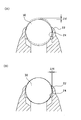
- FIG. 4 shows the inside of the ball house 24, (A) the distance that the writing ball 30 can move along the axial direction in the ball house 24 (vertical backlash), and (B) the writing ball 30 in the ball house 24.
- the distance (lateral play) which can move along the direction orthogonal to an axial direction is typically illustrated.
- the vertical play ( ⁇ V) is defined by the distance between the position where the writing ball 30 is in contact with the ball seat 25 and the state where it is in contact with the seal surface 22a. Specifically, it is 0.004 mm or more and 0.009 mm or less. Further, as shown in FIG.
- the horizontal play ( ⁇ H) is defined by the distance between the state in which the writing ball 30 is in contact with one end of the seal surface 22a and the state in contact with the opposite end. Specifically, it is 0.005 mm or more and 0.015 mm or less.
- the ink consumption of the oil-based ink 12 stored in the ink storage tube 11 is 25 mg per 100 m. 40 mg.
- the desirable composition of the oil-based ink 12 includes a colorant, a main solvent in which the solvent represented by the following structural formula (1) accounts for 40% by weight or more of the total solvent in the ink, and is soluble in this solvent.
- An oil-based ink having a temperature of 25 ° C. and a shear rate of 3.83 / s in the range of 700 mPa ⁇ s to 8,000 mPa ⁇ s is used.
- the main solvent corresponding to the structural formula (1) examples include 3-methoxybutanol, 3-methyl-3-methoxybutanol, 3-methyl-1,3-butanediol, 1,3-butanediol, and hexylene. And glycols. Preferred are 3-methoxybutanol and 3-methyl-3-methoxybutanol.
- an auxiliary solvent excellent in compatibility with the main solvent can be included.
- the resin soluble in the solvent is used for various purposes. For example, adjustment of solid content, suppression of wear of the pen tip, improvement of fixing property and fixing property of coloring material, adjustment of viscosity, improvement of scratch resistance, pigment dispersion and the like can be mentioned.
- the type, molecular weight, and ink blending amount of the resin used is appropriately selected according to the purpose.
- Test 1 Ink outflow test Using a writing tester (Minitech writing tester, Mitsubishi Pencil) compliant with JIS standard S6039, under writing conditions of a writing speed of 4 m / min, a writing angle of 70 °, a writing load of 1.96 N, and a writing distance of 100 m. The writing test was performed by writing spirally on a writing test paper based on the above. In accordance with the following criteria, the ink outflow amount (ink consumption amount) at the end of 100 m writing is expressed as “A”, “B”, “C”, and “D” in the more appropriate order in view of the quality of the drawn lines. did.
- Test 2 Ink followability test A writing test was performed by continuously writing 25 to 30 spirals having a size of 55 to 60 mm on a writing test paper compliant with JIS standard P3201 within 7 to 10 seconds. According to the following criteria, “A”, “B”, “C”, and “D” were used to indicate how much the blur length was in the drawn lines. A: Less than 1mm B: 1mm or more and less than 3mm C: 3 mm or more and less than 5 mm D: 5 mm or more.
- Test 3 Anti-bottom performance test The writing test was conducted under the same conditions as in Test 1, and the amount of ink lump (bottom) attached to the holder at the end of writing was 0 (none), 1 (less), 2 (somewhat more), 3 (more) And 4 (extremely large) were scored in 5 steps, and the amount of the sticking on the writing surface was also scored in 5 steps. Then, according to the following criteria, “A”, “B”, “C”, and “D” were obtained from the total of these points. A: 0 to 1 point B: 2-3 points C: 4-5 points D: 6 to 8 points.
- Test 4 Wear resistance test The writing test was conducted under the same conditions as in Test 1 (however, the writing distance was 1,000 m). Then, the distance between the apex of the writing ball and the tip edge of the caulking portion before and after writing was measured, and the difference was designated as “A”, “B”, “C”, and “D” according to the following criteria.
- Test 5 First brush performance test A writing test was performed under the same conditions as in Test 1. Then, the scraping distance from the start of writing was measured, and “A”, “B”, “C”, and “D” were determined according to the following criteria depending on the length. A: Less than 1mm B: 1mm or more and less than 3mm C: 3 mm or more and less than 5 mm D: 5 mm or more.
- Test 6 Writing taste test A writing test was performed under the same conditions as in Test 2. Sensory evaluation of the writing quality at that time was performed according to the following criteria. A: The texture was smooth so that it slipped without being caught on paper. B: Smooth writing without feeling caught on paper C: Slightly sticky to the paper but almost smooth writing D: There is a feeling of being caught on paper and it is not a smooth writing taste.
- Test 7 Paper roll-in resistance test A writing test was conducted under the same conditions as in Test 1 to confirm the ink outflow. Then, using the same writing tester, the paper was forcibly wound by spirally writing on the paper with a writing speed of 4 m / min, a writing angle of 40 °, a writing load of 2.35 N, and a writing distance of 25 m. . And again, the writing test was implemented on the same conditions as the test 1, and paper entrainment property was confirmed by the decreasing rate of the writing flow rate. Further, a writing test was performed under the same conditions as in Test 1, and the discharge property of the rolled paper was confirmed by restoring the writing flow rate. The determination was “A”, “B”, “C” and “D” according to the following criteria.
- the writing ball diameter ratio of the ball seating diameter is preferably 80.0% or more from the viewpoints of anti-bottom performance and wear resistance, and 90.0% or less from the viewpoint of ink followability.
- Evaluation A or Evaluation B was obtained for any of the test items. From this, it was found that the writing ball diameter ratio of the ball seat diameter is more preferably 83.0% or more and 88.0% or less.
- the result of Test 1 (ink outflow amount) was inferior.
- the distance between the ball and the inner surface of the ball house was large, and caulking was difficult.
- the writing ball diameter ratio of the ball house inner diameter is preferably 104.0% or more and 108.5% or less from the viewpoint of the ink outflow amount.
- the results of Test 1 of Example 5 and Example 6 were evaluated as A. From this, it was found that the writing ball diameter ratio of the inner diameter of the ball house is more preferably 104.0% or more and 106.0% or less.
- the spring pushing load is preferably 0.010 N or more from the viewpoint of initial writing performance and 0.090 N or less from the viewpoint of writing quality.
- Evaluation A or Evaluation B was obtained for any test item. From this, it was found that the spring pushing load is more preferably 0.010N or more and 0.070N or less.
- the ball vertical movement amount is preferably 0.004 mm or more from the viewpoint of paper roll-in performance, and 0.009 mm or less from the viewpoint of anti-bottom performance.
- Example 23 to 26 in which the ball lateral movement amount is in the range of 0.005 mm to 0.015 mm, were favorable for any of the test items. From the above examination, the ball vertical movement amount is preferably 0.005 mm or more from the viewpoint of paper roll-in performance and 0.015 mm or less from the viewpoint of anti-bottom performance. In particular, in Examples 23 to 25, evaluation A or evaluation B was obtained for any of the test items. From this, it was found that the lateral movement amount of the ball is more preferably 0.005 mm or more and 0.012 mm or less.
- the present invention can be used as a refill used in an oil-based ballpoint pen.
Landscapes
- Pens And Brushes (AREA)
Abstract
径が0.7mm未満、特に0.5mm~0.6mmの筆記ボールを使用した油性ボールペンリフィルにおいて、インク流量を少なくすることなく、ボールペンチップ内への紙巻き込みに伴う不具合を解消する。本発明に係る油性ボールペンリフィル10は、ボールペンチップ15内に装着され、その先端部分が前記筆記ボール30を先端へ押圧する押圧棒41として形成されている押し荷重が0.010N以上かつ0.090N以下のスプリング40を備え、ボールハウス24内径が筆記ボール30径の104.0%以上かつ108.5%以下であり、ボール受座25径が筆記ボール30径の80.0%以上かつ90.0%以下であり、カシメ部22の角度が70°以上かつ90°以下である。
Description
本発明は、インクボテ並びに筆記先端の乾燥及び紙巻き込みによるインク流量低下の防止を図った油性ボールペンリフィルに関する。
ボールペン、特に油性ボールペンは水性ボールペンに比べインクの粘度が高い。そのため、筆記の際に余分のインクがボールペンチップの先端に付着して残る、いわゆる「ボテ」という現象が起こりやすい。そしてそれが、次回の筆記の際に筆記面を汚す原因ともなっている。
この「ボテ」を抑制すべく、下記の特許文献1記載の発明のように、ボール受座を大きくすることが試みられることがある。そして、ボール受座を大きくすることで筆記ボールを収容するボールハウス内でのインク溜まりが小さくなる。これによりインク流量が少なくなったり、高速で筆記した場合に描線が追従しきれなくなったりする。そのため、ボールハウス径を大きくすることで対処する、と同文献には記載されている。一方、同文献にはまた、筆記ボールを先端方向へ付勢するスプリングをボールペンチップ内に備えることで、非筆記時において筆記ボールとボールペンチップ先端のカシメ部との間をシールし、耐乾燥性を付与する、ということも記載されている。
ここで、筆記ボールの径を0.7mm未満、たとえば0.5mmとして上記従来技術に開示されているようにボールペンチップを形成し、これを用いた油性ボールペンリフィルで筆記をした場合、ボールハウス内に巻き込まれる筆記用紙の繊維が再び排出されにくくなる、という点が問題となる。そうなると、筆記ボールの回転が妨げられ、ついには筆記が不能となる。
上記の問題点に鑑み、本発明は、径が0.7mm未満、特に0.5mm~0.6mmの筆記ボールを使用した油性ボールペンリフィルにおいて、インク流量を少なくすることなく、ボールペンチップ内への紙巻き込みに伴う不具合を解消することを課題とする。
上記の課題に鑑み、本発明は、円柱材を切削して形成されるホルダーと、
前記ホルダーの一端の外周を先細に切削して形成したテーパー部と、
前記テーパー部の内周を切削して形成したボールハウスと、
前記ホルダーの他端から前記ボールハウスの近傍まで穿孔して形成したバック孔と、
前記ボールハウスと前記バック孔との間を貫通して形成したインク孔と、
前記インク孔の周囲に等配された複数箇所を前記ボールハウス側から切削して形成した溝であるチャンネル溝と、
前記ボールハウス内に挿入されるとともに径が0.5mm以上かつ0.6mm以下である筆記ボールと、
前記ボールハウスの底面において前記筆記ボールをバック孔方向へ押圧した際に該筆記ボールの曲面が転写されたボール受座と、
前記テーパー部の先端部分を内側にカシメ加工して形成したカシメ部と、
前記バック孔内部に挿入されるとともに先端部分が前記筆記ボールを先端へ押圧する押圧棒として形成されている押し荷重が0.010N以上かつ0.090N以下のスプリングとを備えたボールペンチップと、
油性インクを収容しかつ前記ボールペンチップが先端に装着される両端開放円筒状のインク収容管とを備えた油性ボールペンリフィルであって、
前記ボールハウス内径が前記筆記ボール径の104.0%以上かつ108.5%以下であり、
前記ボール受座径が前記筆記ボール径の80.0%以上かつ90.0%以下であり、
前記カシメ加工して形成したカシメ部の角度が70°以上かつ90°以下であることを特徴とする。
すなわち、本発明は、径が0.5mm~0.6mmである筆記ボールをボールペンチップに使用するに際して、紙巻き込みの弊害を解消すべく各部位の構造を調整したものである。
このボールペンチップは、インク収容管の先端に装着されるが、インク収容管に直接収容されることとしてもよいし、継手を介して装着されることとしてもよい。
「ボールハウス内径」は筆記ボールを収容する空間の大きさを規定する。そして、筆記ボールを収容した際に筆記ボールが占める空間以外の空間であるところのいわゆる「インク溜まり」の容積を規定することにもなる。このインク溜まりには、筆記の際巻き込まれてきた筆記用紙繊維が入り込むことになる。よって、ボールハウス内径が規定するインク溜まりの容積は、繊維の入り込みやすさと、入った繊維の排出されやすさとの両方に関わることとなる。
このボールハウス内径が、筆記ボール径の104.0%を下回ると、インク流量が少なく筆記に不適である。それとともに、巻き込んだ繊維が排出されにくくなる。一方、108.5%を上回ると、インク流量が多すぎて描線が汚くなる。よって、ボールハウス内径は筆記ボール径の104.0%以上かつ108.5%以下の範囲内が適当である。
「ボール受座径」は筆記ボールの回転しやすさを規定し、やはり繊維の入り込みやすさと、入った繊維の排出されやすさとの両方に関わることとなる。
このボール受座径が、筆記ボール径の80.0%を下回ると、筆記ボールの回転によりボール受座の特定の部位が摩耗しやすくなる。一方、90.0%を上回ると、筆記ボールの回転が阻害されてインクの流れも悪くなり、描線のかすれなどが起こりやすくなる。よって、ボール受座径は筆記ボール径の80.0%以上かつ90.0%以下の範囲内が適当である。
「カシメ部の角度」とは、ボールペンチップの中心軸に沿った断面において、カシメ部を形成する2本の線分を延長して交わった点を中心として、この2本の線分がなす角をいう。この角度はカシメ部と筆記ボールとの接触の度合いを規定することになる。よって、これもまた繊維の入り込みやすさと、入った繊維の排出されやすさとの両方に関わることとなる。
このカシメ部の角度が70°を下回ると、カシメ部と筆記ボールとの接触がより密であるために巻き込んだ繊維がカシメ部で引っかかりやすくなり筆記に不適である。一方、90°を上回ると、カシメ部での繊維の引っかかりはなくなるもののカシメ部にインクのボテが付着しやすくなりやはり不適である。よって、カシメ部の角度は70°以上かつ90°以下の範囲内が適当である。
「スプリング」には筆記ボールを先端方向へ押しつけてカシメ部との間を密着させ、非筆記時におけるインク溜まりの乾燥を防止するという役割がある。よって、その「押し荷重」は筆記ボールとカシメ部との密着度合いに影響することとなる。
このスプリングの押し荷重が、0.010N未満であると、非筆記時における筆記ボールとカシメ部との密着が弱いので、インク溜まりが乾燥しやすくなる。そのため、書き始めの描線がかすれやすくなる。一方、0.090Nを上回ると、筆記圧をかけても筆記ボールが押し戻されにくくなる。したがって、書き味を損ねることになる。よって、スプリングの押し荷重は0.010N以上かつ0.090N以下の範囲内が適当である。
なお、上記の構造に加え、カシメ部の内側面のうち前記筆記ボールと接触し得る部分であるシール面の軸方向に沿った長さは0.020mm以上かつ0.050mm以下であることが望ましい。この「シール面」は筆記ボールとカシメ部との密着に関わる部分であるため、繊維の引っかかりやすさに関わる部分である。この長さが0.020mmを下回る場合には、筆記ボールとカシメ部との密着が少ない。よってカシメ部での繊維の引っかかりはなくなるもののカシメ部にインクのボテが付着しやすくなり不適である。一方、0.050mmを上回る場合には、筆記ボールとカシメ部との密着が多すぎるのでカシメ部に繊維が引っかかりやすくなる。よって、シール面の軸方向に沿った長さは0.020mm以上かつ0.050mm以下の範囲内が適当である。
また、上記の構造に加え、前記筆記ボールが前記ボールハウス内で軸方向に沿って移動可能な距離(いわゆる「縦ガタ」)は0.004mm以上かつ0.009mm以下であることが望ましい。この「縦ガタ」は筆記時に非筆記時と比べてどの程度筆記ボールが押し戻され得るかということを表している。この縦ガタが0.004mmを下回る場合には、筆記ボールとカシメ部との密着が強くなる。よってカシメ部に繊維が引っかかりやすくなるので不適である。一方、0.009mmを上回る場合には、筆記ボールとカシメ部との密着が少ない。よってカシメ部での繊維の引っかかりはなくなるもののカシメ部にインクのボテが付着しやすくなりやはり不適である。よって、縦ガタの長さは0.004mm以上かつ0.009mm以下の範囲内が適当である。
さらに、上記の構造に加え、前記筆記ボールが前記ボールハウス内で軸方向と直交する方向に沿って移動可能な距離(いわゆる「横ガタ」)は0.005mm以上かつ0.015mm以下であることが望ましい。この「横ガタ」は筆記時にカシメ部との間でどの程度間隙ができ得るかということを表している。この横ガタが0.005mmを下回る場合には、筆記ボールとカシメ部との密着が強い。よってカシメ部に繊維が引っかかりやすくなるので不適である。一方、0.015mmを上回る場合には、筆記ボールとカシメ部との密着が少ない。よってカシメ部での繊維の引っかかりはなくなるもののカシメ部にインクのボテが付着しやすくなりやはり不適である。よって、横ガタの長さは0.004mm以上かつ0.015mm以下の範囲内が適当である。
また、上記の構造に加え、インク消費量が100mあたり25mgから40mgであることが望ましい。すなわち、上記の構造を備えたボールペンチップを装着した油性ボールペンリフィルにおいて、収容した油性インクの物性がインク消費量がこの範囲内に当たるようなものであれば、描線の質や書き味を良好に保ちつつ、繊維の巻き込みによる不具合も解消することが可能となる。
本発明は以上のように構成されているので、径が0.7mm未満、特に0.5mm~0.6mmの筆記ボールを使用した油性ボールペンリフィルにおいて、インク流量を少なくすることなく、ボールペンチップ内への紙巻き込みに伴う不具合が解消されることとなる。
以下、図面を参照しつつ、本発明の一の実施の形態を説明する。
図1は、本発明の1の実施の形態に係る油性ボールペンリフィル10の正面断面図である。
両端が開放したポリプロピレン製の円筒形状のインク収容管11の一端に、ポリブチレンテレフタレート(PBT)製の継手14を介してボールペンチップ15が装着されている。なお、継手14内には、筆記先端を上向きにして放置した際の空気の流入に伴うインクの逆流を防止する目的で、逆流防止ボール16が挿入されている。インク収容管11には油性インク12が充填されている。この後端側に、グリース状の物質であるインク追従体13が充填されている。このインク追従体13は、油性インク12がインク収容管11の後端から流出するのを防止するための栓の役割を果たす。
図2は、本発明の1の実施の形態に係る油性ボールペンリフィル10で使用されるボールペンチップ15の(A)正面図及び(B)正面断面図である。
ボールペンチップ15は、ステンレス鋼製の円柱材を切削して形成されるホルダー20と、ホルダー20の先端に装着される超硬合金製の筆記ボール30と、ホルダー20内部に嵌装されるスプリング40とから構成される。
ホルダー20の先端部は、図2(A)に示すように、円錐状に先細に形成されたテーパー部21となっている。テーパー部21の先端は内方に縮径するように押圧変形されたカシメ部22となっており、先端から一部が覗いている筆記ボール30を抱持している。一方、ホルダー20の後端部の外径は縮径されており、この部分が図1に示す継手14に挿入される挿入部28となっている。
ホルダー20の内部には、図2(B)に示すように、後端からテーパー部21の途中まで達するバック孔23が形成されている。バック孔23は先端に向かって段階的に縮径している。一方、先端部分には、筆記ボール30が収容される空間であるボールハウス24が形成されている。そして、このボールハウス24とバック孔23とは、インク孔26を介して連通している。また、バック孔23内にはコイル状のスプリング40が挿入されている。スプリング40後端は、縮径部の周囲複数箇所を内方にポンチ加工して形成された内方突起28aで支持されている。一方、スプリング40の先端部分は先端へ真っ直ぐのびる押圧棒41として形成されている。押圧棒41の先端はインク孔26を貫通して、ボールハウス24内の筆記ボール30の後端に接している。このスプリング40の押し荷重が0.010N以上かつ0.090N以下である。
図3は、図2に示すボールペンチップ15の先端部分を拡大した(A)正面断面図及び(B)I-I断面図である。なお、(A)及び(B)ではスプリング40は省略されており、(B)では筆記ボール30が省略されている。
ボールハウス24内に筆記ボール30が挿入されている。このボールハウス24の径(H)は筆記ボール30の径(B)の104.0%以上かつ108.5%以下である。この筆記ボール30は内方に押圧変形されたカシメ部22によって抱持されている。このカシメ部22のなす角度(α)は、70°以上かつ90°以下である。カシメ部22の先端側と筆記ボール30とは、筆記ボール30の移動により、カシメ部22の内面に当たるシール面22aで筆記ボール30と直接接触する。このシール面22aの軸方向に沿った長さ(S)は、0.020mm以上かつ0.050mm以下である。ボールハウス24の底面24aには、筆記ボール30が挿入後に後方に押圧されるいわゆる「叩き」工程によって筆記ボール30の曲面が転写されたボール受座25が形成されている。このボール受座25の径(R)は、筆記ボール30の径(B)の80.0%以上かつ90.0%以下である。また、ボールハウス24の底面24aから、インク孔26周囲の5箇所に等配されたチャンネル溝27が形成されている。このチャンネル溝27は、ボール受座25に筆記ボール30が接触している状態において、インク孔26とボールハウス24とのインクの流通を確保するための構造である。
図4は、ボールハウス24の内部で、(A)筆記ボール30がボールハウス24内で軸方向に沿って移動可能な距離(縦ガタ)と、(B)筆記ボール30がボールハウス24内で軸方向と直交する方向に沿って移動可能な距離(横ガタ)とを模式的に図示したものである。図4(A)に示すように、縦ガタ(ΔV)は、筆記ボール30が、ボール受座25に接した位置と、シール面22aと接した状態との距離で定義される。具体的には0.004mm以上かつ0.009mm以下である。また、図4(B)に示すように、横ガタ(ΔH)は、筆記ボール30がシール面22aのある一端に接した状態と、その反対端に接した状態との距離で定義される。具体的には0.005mm以上かつ0.015mm以下である。
上記の通りに製造した図1に示す油性ボールペンリフィル10は、図示しない軸筒に装着して筆記した場合には、インク収容管11に収容される油性インク12のインク消費量は100mあたり25mgから40mgとなる。ここで、この油性インク12の望ましい組成としては、着色剤と、下記構造式(1)で表される溶剤がインク中の全溶剤の40重量%以上を占める主溶剤と、この溶剤に可溶な樹脂を含み、測定温度:25℃、剪断速度:3.83/sにおいて700mPa・s~8,000mPa・sの範囲にある油性インクが採用されている。

上記構造式(1)に該当する主溶剤として具体的には、3-メトキシブタノール、3-メチル-3-メトキシブタノール、3-メチル-1,3ブタンジオール、1,3-ブタンジオール、へキシレングリコールなどが挙げられる。好適には3-メトキシブタノール、3-メチル-3-メトキシブタノールである。また、上記主溶剤の他に、主溶剤に対して相溶性に優れた補助溶剤を含むことができる。
前記溶剤に可溶な樹脂は、様々な目的のために用いられる。たとえば、固形分の調整、ペン先の摩耗抑制、色材の定着性及び固着性向上、粘度調整、耐擦過性の向上、顔料分散などが挙げられる。したがって、用いられる樹脂は目的に応じて、その種類や分子量、インク配合量が適宜選択される。具体的には、ケトン樹脂、スチレン樹脂、スチレン-アクリル樹脂、テルペンフェノール樹脂を含むテルペン系樹脂、ロジン変性マレイン酸樹脂、ロジンフェノール樹脂、アルキルフェノール樹脂、フェノール系樹脂、スチレンマレイン酸樹脂、ロジン系樹脂、アクリル系樹脂、尿素アルデヒド系樹脂、マレイン酸系樹脂、シクロヘキサン系樹脂、ポリビニルピロリドン、セルロース系樹脂、ポリビニルブチラールなどが挙げられる。
(1)試験項目
以下、下記各実施例及び比較例に示す構成のボールペンチップを図1に示すような油性ボールペンリフィルに組み込んで、下記の各試験に供した。なお、全ての実施例及び比較例において、インク収容管に充填した油性インクの組成は、以下の通りであった。
スピロンブラックGMHスペシャル(保土ヶ谷化学工業):8.0重量%
バリファーストバイオレット#1702(オリエント化学工業):20.0重量%
スピロンイエローC-GNH(保土ヶ谷化学工業):5.0重量%
ポリビニルブチラール BM-1(積水化学):6.0重量%
YSポリスター T-130(ヤスハラケミカル):4.0重量%
3-メトキシブタノール:57.0重量%
上記組成で得られた油性インクの粘度は1,100mPa・s(25℃、剪断速度:3.83/s)であった。
また、全ての実施例及び比較例において、ボールペンチップに装着した筆記ボールの径は0.5mmであった。
(1-1)試験1:インク流出量試験
JIS規格S6039に準拠した筆記試験機(ミニテック筆記試験機、三菱鉛筆)を用い、筆記速度4m/分、筆記角度70°、筆記加重1.96N及び筆記距離100mの筆記条件で、JIS規格P3201に準拠した筆記試験紙上に螺旋筆記することにより筆記試験を行った。判定方法は以下の基準に従い、100m筆記終了時におけるインク流出量(インク消費量)を、その描線の質に鑑み、より適正な順に「A」、「B」、「C」及び「D」とした。
A:28mg超かつ33mg以下
B:25mg超かつ28mg以下又は33mg超かつ35mg以下
C:23mg超かつ25mg以下又は35mg超かつ38mg以下
D:23mg以下又は38mg超。
(1-2)試験2:インク追従性試験
JIS規格P3201に準拠した筆記試験紙上に、7~10秒の間に55~60mmの大きさの螺旋を25~30個連続的に筆記することにより筆記試験を行った。筆記した描線中、カスレの長さがどのくらいであるかにつき、下記の基準に従い「A」、「B」、「C」及び「D」とした。
A:1mm未満
B:1mm以上かつ3mm未満
C:3mm以上かつ5mm未満
D:5mm以上。
(1-3)試験3:耐ボテ性能試験
前記試験1と同様の条件で筆記試験を実施し、筆記終了時に、ホルダーに付着したインク塊(ボテ)の量を0(なし)、1(少ない)、2(やや多い)、3(多い)及び4(極めて多い)の5段階で点数化し、また、筆記面に付着したボテの量を同様に5段階で点数化した。そして、これらの点数の合計により、下記の基準に従い「A」、「B」、「C」及び「D」とした。
A:0~1点
B:2~3点
C:4~5点
D:6~8点。
(1-4)試験4:耐摩耗性試験
前記試験1と同様の条件(ただし筆記距離は1,000mとした。)で筆記試験を実施した。そして、筆記前後における筆記ボール頂点とカシメ部の先端縁との距離を測定してその差により下記の基準に従い「A」、「B」、「C」及び「D」とした。
A:1μm未満
B:1μm以上2μm未満
C:2μm以上3μm未満
D:3μm以上。
(1-5)試験5:初筆性能試験
前記試験1と同様の条件で筆記試験を実施した。そして、筆記開始時からのカスレ距離を測定し、その長さにより下記の基準に従い「A」、「B」、「C」及び「D」とした。
A:1mm未満
B:1mm以上3mm未満
C:3mm以上5mm未満
D:5mm以上。
(1-6)試験6:書き味試験
前記試験2と同様の条件で筆記試験を実施した。その際の書き味を下記の基準で官能評価した。
A:紙への引っかかり感がなく滑るように滑らかな書き味であった
B:紙への引っかかり感がなく滑らかな書き味であった
C:やや紙への引っかかり感があるものの概ね滑らかな書き味であった
D:紙への引っかかり感があり滑らかな書き味ではない。
(1-7)試験7:耐紙巻き込み性試験
試験1と同様の条件で筆記試験を実施しインク流出量を確認した。その後、同じ筆記試験機を用い、筆記速度4m/分、筆記角度40°、筆記加重2.35N及び筆記距離25mの筆記条件で、藁半紙上に螺旋筆記することにより強制的に紙を巻き込ませた。そして再度、試験1と同様の条件で筆記試験を実施し筆記流量の低下率により紙巻き込み性を確認した。更に試験1と同様の条件で筆記試験を実施し、筆記流量の回復により巻き込んだ紙の排出性を確認した。判定は下記の基準に従い「A」、「B」、「C」及び「D」とした。
A:紙巻き込みがなく、筆記できた
B:やや紙を巻き込むが、巻き込んだ紙を排出でき、筆記できた
C:紙を巻き込むが、概ね紙を排出でき、筆記できた
D:紙を巻き込み、紙を排出できず、筆記できない。
(2)各構成要素の検討
(2-1)ボール受座径
ボールハウス内径を0.530mm(筆記ボール径比106.0%)、スプリングの押し荷重を0.030N及びカシメ部の角度を85°に固定した条件下で、ボール受座径の適正な範囲を検討した。すなわち、ボール受座径を下記表1の通り0.390mm~0.460mmの範囲内で変化させた場合において、各試験項目の評価は下記表1の通りであった。
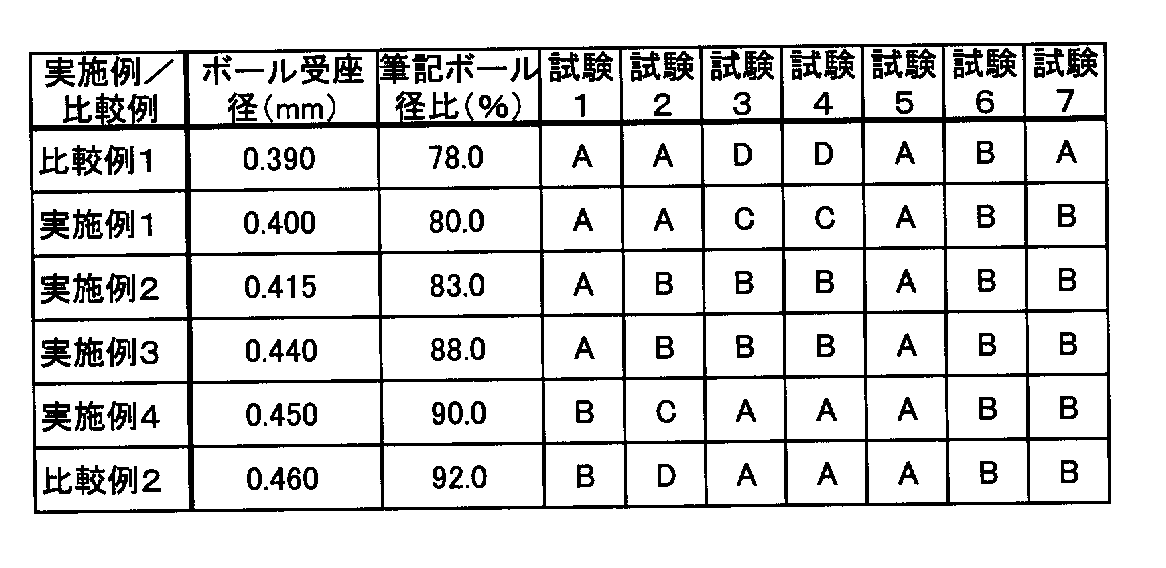
上記の結果、ボール受座径が筆記ボール径比80.0%を下回る比較例1では試験3(耐ボテ性能)及び試験4(耐摩耗性)の結果が劣ることとなった。また、ボール受座径が筆記ボール径比90.0%を上回る比較例2では試験2(インク追従性)の結果が劣ることとなった。それに対し、ボール受座径が筆記ボール径比80.0%~90.0%の範囲内である実施例1~実施例4では悪くとも評価Cが見られたのみで、いずれの試験項目でも好評価が得られた。以上の検討より、ボール受座径の筆記ボール径比は、耐ボテ性能及び耐摩耗性の観点より80.0%以上、並びにインク追従性の観点より90.0%以下が好適である。特に、実施例2及び実施例3ではいずれの試験項目でも評価Aか評価Bが得られた。このことから、ボール受座径の筆記ボール径比は、83.0%以上88.0%以下がより望ましいことが判明した。
(2-2)ボールハウス内径
ボール受座径を0.430mm(筆記ボール径比86.0%)、スプリングの押し荷重を0.030N及びカシメ部の角度を85°に固定した条件下で、ボールハウス内径の適正な範囲を検討した。すなわち、ボールハウス内径を下記表2の通り0.505mm~0.550mmの範囲内で変化させた場合において、各試験項目の評価は下記表2の通りであった。
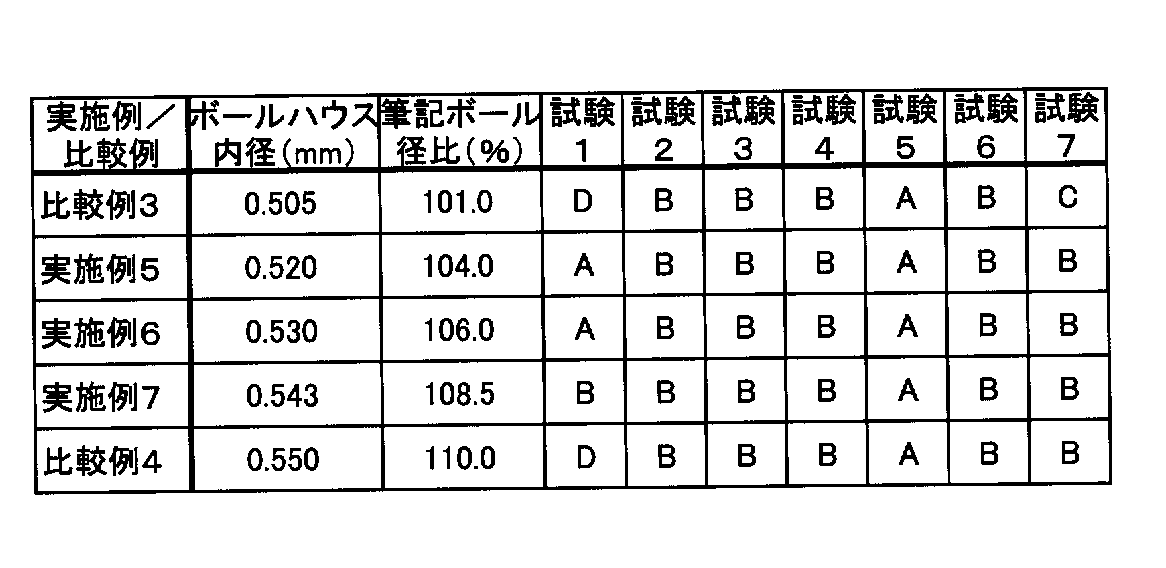
上記の結果、ボールハウス内径が筆記ボール径比104.0%を下回る比較例3並びに108.5%を上回る比較例4では試験1(インク流出量)の結果が劣ることとなった。また比較例4についてはボールとボールハウス内側面との距離が大きくカシメ加工が難しい結果となった。それに対し、ボールハウス内径が筆記ボール径比104.0%~108.5%の範囲内である実施例5~実施例7ではいずれの試験項目でも好評価が得られた。以上の検討より、ボールハウス内径の筆記ボール径比は、インク流出量の観点より104.0%以上108.5%以下が好適である。特に、実施例5及び実施例6の試験1の結果が評価Aとなった。このことから、ボールハウス内径の筆記ボール径比は、104.0%以上106.0%以下がより望ましいことが判明した。
(2-3)スプリング押し荷重
ボール受座径を0.430mm(筆記ボール径比86.0%)、ボールハウス内径を0.530mm(筆記ボール径比106.0%)及びカシメ部の角度を85°に固定した条件下で、スプリング押し荷重の適正な範囲を検討した。すなわち、スプリング押し荷重を下記表3の通り0.005~0.100Nの範囲内で変化させた場合において、各試験項目の評価は下記表3の通りであった。
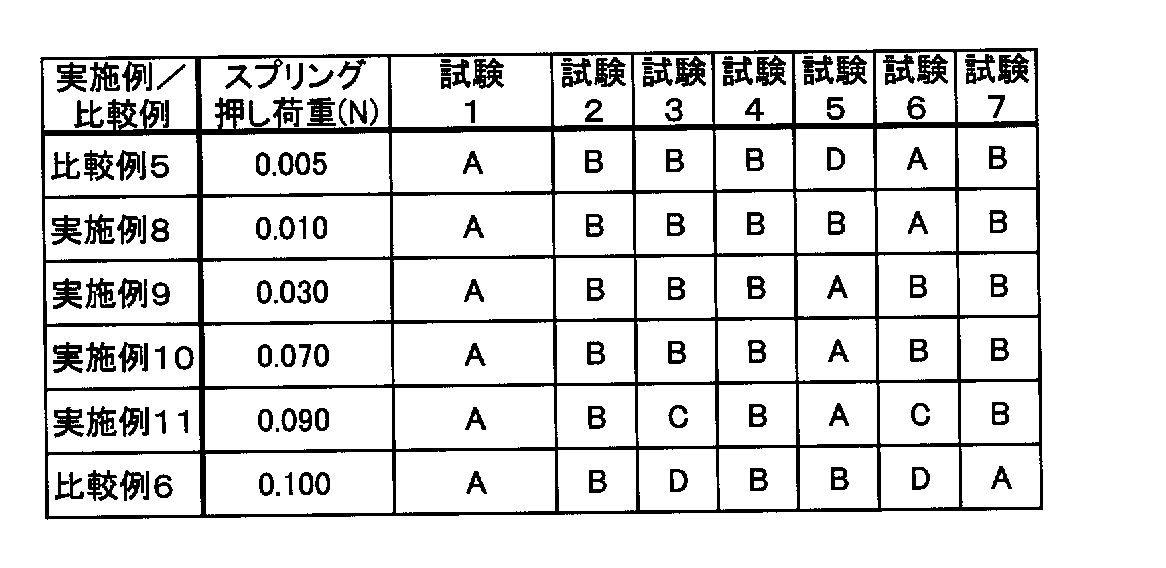
上記の結果、スプリング押し荷重が0.010Nを下回る比較例5では試験5(初筆性能)の結果が劣ることとなった。また、スプリング押し荷重が0.090Nを上回る比較例6では試験6(書き味)の結果が劣ることとなった。それに対し、スプリング押し荷重が0.010N~0.090Nの範囲内である実施例8~実施例11では悪くとも評価Cが見られたのみで、いずれの試験項目でも好評価が得られた。以上の検討より、スプリング押し荷重は、初筆性能の観点より0.010N以上、及び書き味の観点より0.090N以下が好適である。特に、実施例8~実施例10ではいずれの試験項目でも評価Aか評価Bが得られた。このことから、スプリング押し荷重は、0.010N以上0.070N以下がより望ましいことが判明した。
(2-4)カシメ部角度
ボール受座径を0.430mm(筆記ボール径比86.0%)及びボールハウス内径を0.530mm(筆記ボール径比106.0%)及びスプリングの押し荷重を0.030Nに固定した条件下で、カシメ角度の適正な範囲を検討した。すなわち、カシメ角度を下記表4の通り65°~100°の範囲内で変化させた場合において、各試験項目の評価は下記表4の通りであった。

上記の結果、カシメ部の角度が70°を下回る比較例7では試験7(耐紙巻き込み性能)の結果が劣ることとなった。また、カシメ部の角度が90°を上回る比較例8では試験3(耐ボテ性能)の結果が劣ることとなった。それに対し、カシメ部の角度が70°~90°の範囲内である実施例12~実施例15ではいずれの試験項目でも好評価が得られた。以上の検討より、カシメ部の角度は耐紙巻き込み性能の観点より70°以上、及び耐ボテ性能の観点より90°以下が好適である。特に、実施例12~実施例14ではいずれの試験項目でも評価A又は評価Bが得られた。このことから、カシメ部の角度は、70°以上85°以下がより望ましいことが判明した。
(2-5)シール面の長さ
ボール受座径を0.430mm(筆記ボール径比86.0%)及びボールハウス内径を0.530mm(筆記ボール径比106.0%)及びスプリングの押し荷重を0.030Nに固定した条件下で、シール面の長さの適正な範囲を検討した。すなわち、カシメ部を調整してシール面の長さを下記表5の通り0.008mm~0.065mmの範囲内で変化させた場合において、各試験項目の評価は下記表5の通りであった。

上記の結果、シール面の長さが0.050mmを上回る比較例9では試験7(耐紙巻き込み性能)の結果が劣ることとなった。また、シール面の長さが0.020mmを下回る比較例10では試験3(耐ボテ性能)の結果が劣ることとなった。それに対し、シール面の長さが0.020mm~0.050mmの範囲内である実施例16~実施例19ではいずれの試験項目でも好評価が得られた。以上の検討より、シール面の長さは耐紙巻き込み性能の観点より0.050mm以下、及び耐ボテ性能の観点より0.020mm以上が好適である。特に、実施例16~実施例18ではいずれの試験項目でも評価A又は評価Bが得られた。このことから、シール面の長さは、0.025mm以上0.050mm以下がより望ましいことが判明した。
(2-6)ボール縦移動量
ボール受座径を0.430mm(筆記ボール径比86.0%)及びボールハウス内径を0.530mm(筆記ボール径比106.0%)及びスプリングの押し荷重を0.030Nに固定した条件下で、ボール縦移動量の適正な範囲を検討した。すなわち、カシメ部を調整してボール縦移動量を下記表6の通り0.002mm~0.012mmの範囲内で変化させた場合において、各試験項目の評価は下記表6の通りであった。
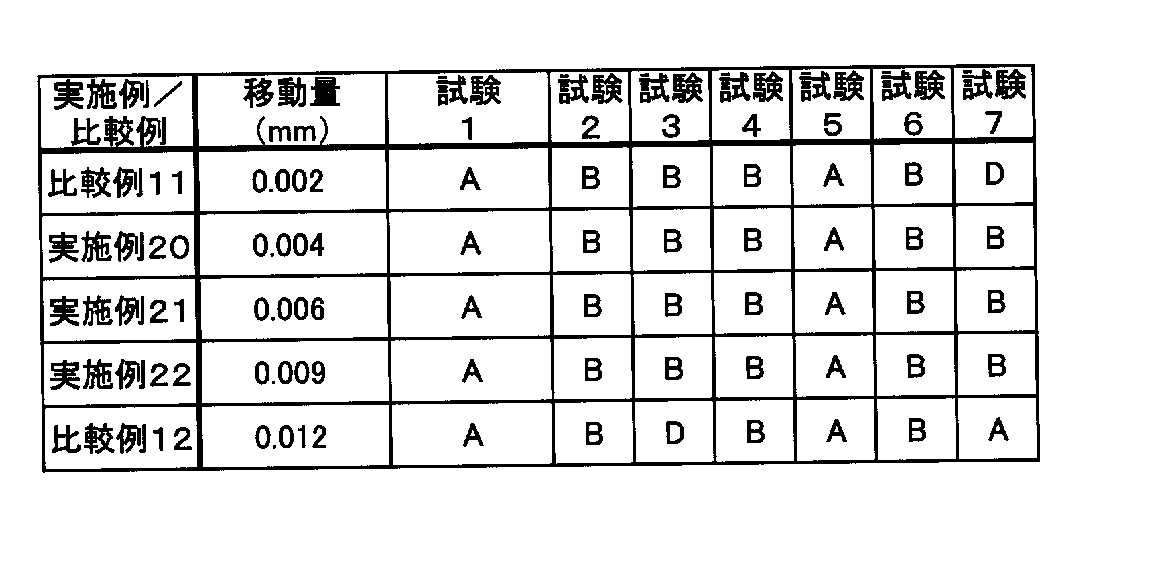
上記の結果、ボール縦移動量が0.004mmを下回る比較例11では試験7(耐紙巻き込み性能)の結果が劣ることとなった。また、ボール縦移動量が0.009mmを上回る比較例12では試験3(耐ボテ性能)の結果が劣ることとなった。それに対し、ボール縦移動量が0.004mm~0.009mmの範囲内である実施例20~実施例22ではいずれの試験項目でも好評価が得られた。以上の検討より、ボール縦移動量は耐紙巻き込み性能の観点より0.004mm以上、及び耐ボテ性能の観点より0.009mm以下が好適である。
(2-7)ボール横移動量
ボール受座径を0.430mm(筆記ボール径比86.0%)及びボールハウス内径を0.530mm(筆記ボール径比106.0%)及びスプリングの押し荷重を0.030Nに固定した条件下で、ボール横移動量の適正な範囲を検討した。すなわち、カシメ部を調整してボール横移動量を下記表7の通り0.002mm~0.018mmの範囲内で変化させた場合において、各試験項目の評価は下記表7の通りであった。
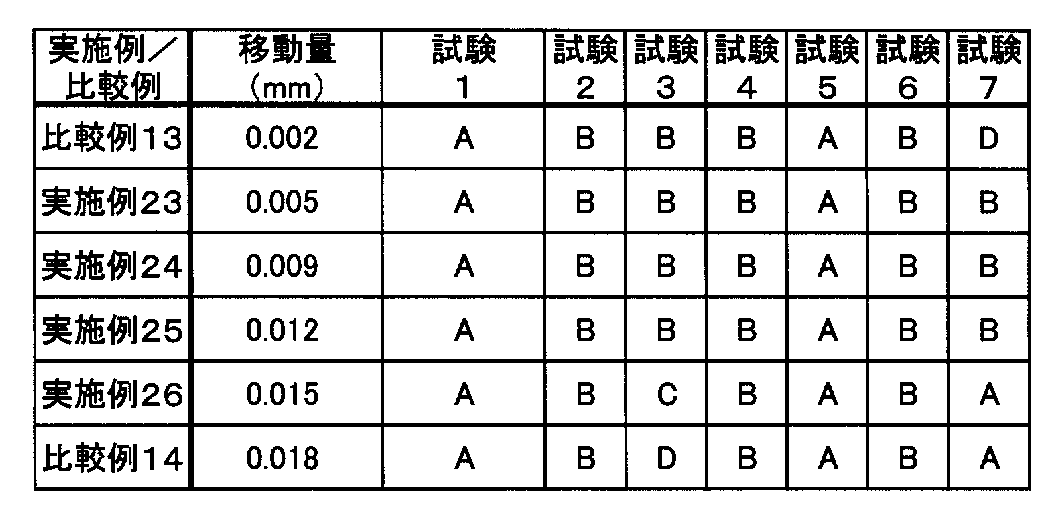
上記の結果、ボール横移動量が0.005mmを下回る比較例13では試験7(耐紙巻き込み性能)の結果が劣ることとなった。また、ボール横移動量が0.015mmを上回る比較例14では試験3(耐ボテ性能)の結果が劣ることとなった。それに対し、ボール横移動量が0.005mm~0.015mmの範囲内である実施例23~実施例26ではいずれの試験項目でも好評価が得られた。以上の検討より、ボール縦移動量は耐紙巻き込み性能の観点より0.005mm以上、及び耐ボテ性能の観点より0.015mm以下が好適である。特に、実施例23~実施例25ではいずれの試験項目でも評価A又は評価Bが得られた。このことから、ボール横移動量は、0.005mm以上0.012mm以下がより望ましいことが判明した。
本発明は、油性ボールペンに用いられるリフィルとして利用可能である。
Claims (5)
-
円柱材を切削して形成されるホルダーと、
前記ホルダーの一端の外周を先細に切削して形成したテーパー部と、
前記テーパー部の内周を切削して形成したボールハウスと、
前記ホルダーの他端から前記ボールハウスの近傍まで穿孔して形成したバック孔と、
前記ボールハウスと前記バック孔との間を貫通して形成したインク孔と、
前記インク孔の周囲に等配された複数箇所を前記ボールハウス側から切削して形成した溝であるチャンネル溝と、
前記ボールハウス内に挿入されるとともに径が0.5mm以上かつ0.6mm以下である筆記ボールと、
前記ボールハウスの底面において前記筆記ボールをバック孔方向へ押圧した際に該筆記ボールの曲面が転写されたボール受座と、
前記テーパー部の先端部分を内側にカシメ加工して形成したカシメ部と、
前記バック孔内部に挿入されるとともに先端部分が前記筆記ボールを先端へ押圧する押圧棒として形成されている押し荷重が0.010N以上かつ0.090N以下のスプリングとを備えたボールペンチップと、
油性インクを収容しかつ前記ボールペンチップが先端に装着される両端開放円筒状のインク収容管とを備えた油性ボールペンリフィルであって、
前記ボールハウス内径が前記筆記ボール径の104.0%以上かつ108.5%以下であり、
前記ボール受座径が前記筆記ボール径の80.0%以上かつ90.0%以下であり、
前記カシメ加工して形成したカシメ部の角度が70°以上かつ90°以下であることを特徴とする油性ボールペンリフィル。
-
前記カシメ部の内側面のうち前記筆記ボールと接触し得る部分であるシール面の軸方向に沿った長さは0.020mm以上かつ0.050mm以下であることを特徴とする請求項1記載の油性ボールペンリフィル。
-
前記筆記ボールが前記ボールハウス内で軸方向に沿って移動可能な距離は0.004mm以上かつ0.009mm以下であることを特徴とする請求項1記載の油性ボールペンリフィル。
-
前記筆記ボールが前記ボールハウス内で軸方向と直交する方向に沿って移動可能な距離は0.005mm以上かつ0.015mm以下であることを特徴とする請求項1記載の油性ボールペンリフィル。
-
インク消費量が100mあたり25mgから40mgであることを特徴とする請求項1、2、3又は4記載の油性ボールペンリフィル。
Applications Claiming Priority (2)
| Application Number | Priority Date | Filing Date | Title |
|---|---|---|---|
| JP2009-005625 | 2009-01-14 | ||
| JP2009005625 | 2009-01-14 |
Publications (1)
| Publication Number | Publication Date |
|---|---|
| WO2010082590A1 true WO2010082590A1 (ja) | 2010-07-22 |
Family
ID=42339844
Family Applications (1)
| Application Number | Title | Priority Date | Filing Date |
|---|---|---|---|
| PCT/JP2010/050302 Ceased WO2010082590A1 (ja) | 2009-01-14 | 2010-01-14 | 油性ボールペンリフィル |
Country Status (2)
| Country | Link |
|---|---|
| JP (1) | JP4480187B1 (ja) |
| WO (1) | WO2010082590A1 (ja) |
Cited By (3)
| Publication number | Priority date | Publication date | Assignee | Title |
|---|---|---|---|---|
| CN109203763A (zh) * | 2018-10-19 | 2019-01-15 | 上海晨光文具股份有限公司 | 弹簧笔头、乳化墨水笔芯以及乳化墨水笔 |
| JP2021088071A (ja) * | 2019-12-02 | 2021-06-10 | 三菱鉛筆株式会社 | ボールペンチップ及びボールペン |
| CN116234705A (zh) * | 2020-08-31 | 2023-06-06 | 株式会社百乐 | 圆珠笔 |
Families Citing this family (5)
| Publication number | Priority date | Publication date | Assignee | Title |
|---|---|---|---|---|
| JP5770994B2 (ja) * | 2010-10-15 | 2015-08-26 | 株式会社パイロットコーポレーション | ボールペンレフィル |
| JP6010323B2 (ja) * | 2012-04-11 | 2016-10-19 | 株式会社パイロットコーポレーション | ボールペンレフィル |
| JP5827725B2 (ja) * | 2014-06-27 | 2015-12-02 | 株式会社パイロットコーポレーション | 油性ボールペンレフィル |
| JP6494432B2 (ja) * | 2015-06-02 | 2019-04-03 | 三菱鉛筆株式会社 | ノック式ボールペン |
| JP6730478B2 (ja) * | 2019-03-05 | 2020-07-29 | 三菱鉛筆株式会社 | ノック式ボールペン |
Citations (3)
| Publication number | Priority date | Publication date | Assignee | Title |
|---|---|---|---|---|
| WO1998030401A1 (en) * | 1997-01-07 | 1998-07-16 | Mitsubishi Pencil Kabushiki Kaisha | Ball-point pen |
| JP2005212304A (ja) * | 2004-01-30 | 2005-08-11 | Pentel Corp | ボールペンチップ |
| JP2007190693A (ja) * | 2006-01-17 | 2007-08-02 | Mitsubishi Pencil Co Ltd | ボールペンリフィル |
-
2010
- 2010-01-14 JP JP2010005502A patent/JP4480187B1/ja active Active
- 2010-01-14 WO PCT/JP2010/050302 patent/WO2010082590A1/ja not_active Ceased
Patent Citations (3)
| Publication number | Priority date | Publication date | Assignee | Title |
|---|---|---|---|---|
| WO1998030401A1 (en) * | 1997-01-07 | 1998-07-16 | Mitsubishi Pencil Kabushiki Kaisha | Ball-point pen |
| JP2005212304A (ja) * | 2004-01-30 | 2005-08-11 | Pentel Corp | ボールペンチップ |
| JP2007190693A (ja) * | 2006-01-17 | 2007-08-02 | Mitsubishi Pencil Co Ltd | ボールペンリフィル |
Cited By (4)
| Publication number | Priority date | Publication date | Assignee | Title |
|---|---|---|---|---|
| CN109203763A (zh) * | 2018-10-19 | 2019-01-15 | 上海晨光文具股份有限公司 | 弹簧笔头、乳化墨水笔芯以及乳化墨水笔 |
| JP2021088071A (ja) * | 2019-12-02 | 2021-06-10 | 三菱鉛筆株式会社 | ボールペンチップ及びボールペン |
| JP7407575B2 (ja) | 2019-12-02 | 2024-01-04 | 三菱鉛筆株式会社 | ボールペンチップ及びボールペン |
| CN116234705A (zh) * | 2020-08-31 | 2023-06-06 | 株式会社百乐 | 圆珠笔 |
Also Published As
| Publication number | Publication date |
|---|---|
| JP2010184495A (ja) | 2010-08-26 |
| JP4480187B1 (ja) | 2010-06-16 |
Similar Documents
| Publication | Publication Date | Title |
|---|---|---|
| JP4480187B1 (ja) | 油性ボールペンリフィル | |
| JP5718104B2 (ja) | ボールペンチップ、ボールペンリフィル及びボールペン | |
| JPWO1998030401A1 (ja) | ボールペン | |
| JP2015208932A (ja) | 油性ボールペンリフィル及び油性ボールペン | |
| EP3031612B1 (en) | Oil-based ballpoint pen refill, oil-based ballpoint pen, and ink composition for oil-based ballpoint pen | |
| CN110857005B (zh) | 圆珠笔芯和圆珠笔 | |
| CN100515798C (zh) | 涂布工具用尖头和涂布工具 | |
| KR20220089704A (ko) | 유성 볼펜용 잉크 조성물 및 그것을 사용한 유성 볼펜 | |
| CN100411883C (zh) | 圆珠笔 | |
| JP4756640B2 (ja) | ボールペンリフィル | |
| JP6553373B2 (ja) | 油性ボールペンレフィル及びそれを用いた油性ボールペン | |
| JP5663236B2 (ja) | ボールペンチップ | |
| JPH11139068A (ja) | ボールペン | |
| JP6125854B2 (ja) | ボールペン | |
| JP6685446B2 (ja) | ボールペン | |
| JP6224949B2 (ja) | 油性ボールペンレフィル及びそれを用いた油性ボールペン | |
| JP4471276B2 (ja) | 塗布具用チップ、塗布具用チップの製造方法、塗布具 | |
| JP6846403B2 (ja) | ボールペン | |
| JP7175112B2 (ja) | 水性ボールペン | |
| JP6463069B2 (ja) | ボールペン | |
| KR102577013B1 (ko) | 볼펜 팁, 볼펜 리필 및 볼펜 | |
| JP7770163B2 (ja) | ボールペンチップ、ボールペンレフィル及びボールペン | |
| JP7812847B2 (ja) | 油性ボールペン | |
| CN116457216B (zh) | 圆珠笔笔尖、圆珠笔笔芯和圆珠笔 | |
| JP5083938B2 (ja) | ボールペン |
Legal Events
| Date | Code | Title | Description |
|---|---|---|---|
| 121 | Ep: the epo has been informed by wipo that ep was designated in this application |
Ref document number: 10731259 Country of ref document: EP Kind code of ref document: A1 |
|
| NENP | Non-entry into the national phase |
Ref country code: DE |
|
| 122 | Ep: pct application non-entry in european phase |
Ref document number: 10731259 Country of ref document: EP Kind code of ref document: A1 |