WO2010026792A1 - ガラス用研摩材スラリー - Google Patents
ガラス用研摩材スラリー Download PDFInfo
- Publication number
- WO2010026792A1 WO2010026792A1 PCT/JP2009/054636 JP2009054636W WO2010026792A1 WO 2010026792 A1 WO2010026792 A1 WO 2010026792A1 JP 2009054636 W JP2009054636 W JP 2009054636W WO 2010026792 A1 WO2010026792 A1 WO 2010026792A1
- Authority
- WO
- WIPO (PCT)
- Prior art keywords
- particle size
- polishing
- slurry
- glass
- abrasive
- Prior art date
- Legal status (The legal status is an assumption and is not a legal conclusion. Google has not performed a legal analysis and makes no representation as to the accuracy of the status listed.)
- Ceased
Links
Images




Classifications
-
- C—CHEMISTRY; METALLURGY
- C09—DYES; PAINTS; POLISHES; NATURAL RESINS; ADHESIVES; COMPOSITIONS NOT OTHERWISE PROVIDED FOR; APPLICATIONS OF MATERIALS NOT OTHERWISE PROVIDED FOR
- C09K—MATERIALS FOR MISCELLANEOUS APPLICATIONS, NOT PROVIDED FOR ELSEWHERE
- C09K3/00—Materials not provided for elsewhere
- C09K3/14—Anti-slip materials; Abrasives
- C09K3/1454—Abrasive powders, suspensions and pastes for polishing
- C09K3/1463—Aqueous liquid suspensions
Definitions
- the present invention relates to an abrasive slurry for glass comprising abrasive particles having a predetermined particle size distribution.
- glass materials have been used for various purposes.
- glass substrates for optical disks and magnetic disks active matrix LCDs (Liquid Crystal Display), color filters for liquid crystal TVs, clocks, calculators, LCDs for cameras, glass substrates for displays such as solar cells, glass substrates for LSI photomasks, or
- a polished surface of the glass is processed with high accuracy.
- Patent Document 1 discloses a CMP polishing liquid characterized in that the abrasive particle size distribution has two or more peaks. According to this prior art, it is possible to realize a polishing liquid having excellent polishing characteristics such as high-speed polishing characteristics, low scratch characteristics, and high planarization performance.
- the polishing liquid of Patent Document 1 contains an abrasive having a particle size exceeding 90 nm, it cannot be said to be sufficient for use in a recent glass substrate or the like that requires a highly accurate polished surface.
- the polishing surface of glass is not effective for those requiring a polishing accuracy of arithmetic average surface roughness (Ra) of 0.1 nm or less.
- the present invention has been made in the background of the circumstances as described above, and an object thereof is to provide an abrasive slurry for glass capable of processing a polished surface of glass with high accuracy and capable of polishing at a relatively high speed.
- the maximum particle size Tmax of the abrasive particles measured by a transmission electron microscope is 90 nm or less, the maximum particle size Tmax, and the average particle size Tavg of the abrasive particles measured by a transmission electron microscope, Satisfying Tmax / Tavg ⁇ 3, and the particle size distribution of the abrasive particles is at least a first peak that appears in the vicinity of the average particle size value and a second peak that appears in the vicinity of a particle size value that is three times or more of Tavg. It is related with the abrasive slurry for glass characterized by having.
- the abrasive slurry for glass of the present invention it is possible to realize the polishing accuracy with an arithmetic average surface roughness (Ra) of 0.1 nm or less in a short time.
- the abrasive slurry for glass of the present invention requires that the maximum particle diameter Tmax of the abrasive particles measured by a transmission electron microscope be 90 nm or less. This is because, with such fine abrasive particles, it is possible to avoid deep polishing scratches on the polished surface of the glass and to realize a highly accurate polished surface.
- the abrasive slurry for glass of the present invention has a maximum particle size Tmax of abrasive particles measured by a transmission electron microscope and an average particle size Tavg of abrasive particles measured by a transmission electron microscope. / Tavg ⁇ 3 must be satisfied.
- the particle size distribution of the abrasive particles is at least a first peak that appears in the vicinity of the average particle size value, and a second that appears in the vicinity of a particle size value that is three or more times Tavg. And having a peak.
- a polishing material exhibiting a particle size distribution having at least such two peaks can realize a high polishing rate.
- the particle size distribution of the abrasive particles in the present invention is determined by the abrasive particles observed with a transmission electron microscope. Specifically, the particle diameter of each particle of 200 or more, preferably 300 to 500, as the number of abrasive particles is measured with a transmission electron microscope, and the particle size distribution is determined based on the result.
- the peak of the particle size distribution refers to a case where the middle section is larger than the frequency (number) of the preceding and following sections in three consecutive sections among the particle diameter sections constituting the particle size distribution.
- the average particle size is preferably in the range of 5 nm to 20 nm.
- the polishing rate tends to be low.
- the average particle diameter exceeds 20 nm, the arithmetic average surface roughness (Ra) of the polished surface of the glass tends to increase.
- the first peak appears in the range of 5 nm to 20 nm and the second peak appears in the range of 25 nm to 60 nm. Is preferred.
- the arithmetic average surface roughness (Ra) of the polished surface of the glass becomes a sufficiently low value, and the polishing rate is in the range of 5 nm to 20 nm of the average particle diameter. More than 5 times larger than abrasives consisting of abrasive particles with only a peak.
- the polishing speed tends to be low, and if it exceeds 20 nm, the arithmetic average surface roughness (Ra) of the polished surface of the glass tends to increase. It becomes a trend.
- the second peak is out of the range of 25 nm to 60 nm, that is, if it is less than 25 nm, the polishing speed does not improve so much, and if it exceeds 60 nm, the maximum particle size Tmax of the abrasive particles tends to exceed 90 nm. It becomes an abrasive that is easy to generate.
- the abrasive is preferably colloidal ceria, colloidal silica, or a mixture of colloidal ceria and colloidal silica, and colloidal ceria is particularly preferable. This is because if these polishing materials are used for polishing, it becomes easy to make the arithmetic average surface roughness (Ra) of the polished surface of the glass 0.1 nm. In particular, when colloidal ceria is used, it is desirable that the glass after polishing is excellent in cleaning properties and it is difficult for the abrasive particles to remain on the glass surface.
- the abrasive slurry for glass of the present invention can be produced as follows. First, in the case of colloidal silica, spherical particles having a uniform particle diameter are commercially available, and therefore can be produced by mixing two kinds having different particle diameters. That is, for a commercial product with a large particle size (referred to as a large particle size product) and a commercial product with a small particle size (referred to as a small particle size product), the average particle size of the large particle size product / the average particle size of the small particle size product ⁇ 3. Colloidal silica used as the abrasive slurry for glass of the present invention can be produced by appropriately mixing two kinds of commercially available products satisfying the relationship of 3 and large particle size average particle size ⁇ 90 nm.
- the average particle size of the large particle size product / average particle size of the small particle size product is close to 3 unless the amount of use of the small particle size product is increased, the mixture will not satisfy Tmax / Tavg ⁇ 3 It becomes.
- the Tmax of the mixture is only slightly larger than the average particle size of the large particle size product. Therefore, unless two kinds of materials satisfying the relationship of large particle size product average particle size / small particle size product average particle size ⁇ 3 are not mixed, it is difficult for the mixture to satisfy Tmax / Tavg ⁇ 3.
- the cerium oxide used as the abrasive is a method for producing a cerium-based abrasive comprising cerium oxide by oxidizing cerium (III) hydroxide, and cerium chloride and an alkaline substance are mixed with an inert gas such as nitrogen gas or argon gas. It is preferable to produce by cerium (III) hydroxide by reacting in an atmosphere and oxidizing the cerium hydroxide to obtain cerium oxide. (III) indicates that the valence of cerium is trivalent.
- cerium oxide production method cerium chloride and an alkaline substance are reacted in an inert gas atmosphere. However, the reaction under such conditions is generated because the reaction proceeds rapidly.
- the particles of cerium hydroxide become fine tetragonal crystals and are oxidized to produce cubic and fine polygonal particles. And the particle size of the cerium oxide particle obtained can be adjusted by controlling reaction of cerium chloride and an alkaline substance.
- the reaction for producing cerium (III) hydroxide can be performed by adding cerium chloride and an alkaline substance such as sodium hydroxide to the solvent while maintaining a constant addition rate.
- cerium oxide having different particle sizes can be produced.
- the reaction can be performed by a method in which cerium chloride and an alkaline substance are dropped simultaneously in a solvent, or a method in which cerium chloride and an alkaline substance are brought into contact with each other and then immediately sheared. According to such a method, gelation at the time of reaction is suppressed, and cerium (III) hydroxide) can be generated in a uniform cubic shape. For this reason, the oxidation process easily proceeds uniformly, and fine particles of cerium oxide having a uniform particle diameter can be obtained.
- the reaction between cerium chloride and an alkaline substance is preferably carried out at a liquid temperature of 60 ° C. to 104 ° C. and a pH of 5 to 9.
- a liquid temperature 60 ° C. to 104 ° C.
- a pH 5 to 9.
- cerium (III) hydroxide obtained by the above is oxidized with an oxidizing agent to produce cerium oxide.
- an oxidizing agent hydrogen peroxide water, hypochlorous acid, sodium hypochlorite, potassium hypochlorite, calcium hypochlorite, ozone and the like can be used.
- the glass slurry of the present invention can be produced by preparing two types of colloidal ceria having different particle diameters by the above production method and mixing them.
- Colloidal ceria to be mixed is manufactured to have a large particle size (referred to as a large particle size ceria) and a small particle size (referred to as a small particle size ceria product), and those that satisfy the following conditions are mixed.
- Preferred conditions are large particle size ceria average particle size / small particle size ceria average particle size ⁇ 2, large particle size product average particle size ⁇ 70 nm, large particle size ceria average particle size / small particle size ceria average particle size ⁇ 3, The condition of large particle size ceria average particle size ⁇ 60 nm is more preferable.
- the mixture satisfies Tmax / Tavg ⁇ 3.
- the Tmax of the mixture is considerably larger than the average particle size of the large particle size ceria. Therefore, even if the large particle size ceria average particle size / small particle size ceria average particle size ⁇ 3, a mixture of two kinds of colloidal ceria having such a relationship often satisfies Tmax / Tavg ⁇ 3. .
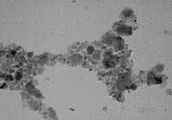
- FIG. 2 is a TEM image photograph of Example 1.
- FIG. 4 is a TEM image photograph of Comparative Example 1.
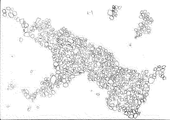
- 6 is a trace drawing of Comparative Example 1.
- 4 is a TEM image photograph of Comparative Example 2.
- 10 is a trace drawing of Comparative Example 2.
- colloidal ceria an abrasive slurry containing two types of cerium oxide with target average particle sizes of 20 nm and 50 nm was produced.
- a colloidal ceria having a target average particle size of 20 nm was produced as follows. First, the cerium chloride aqueous solution was adjusted to 250 g / L in terms of cerium oxide and sodium hydroxide to 174.5 g / L, respectively. Next, 73 L of pure water was added into a 200 L reaction tank, and the mixture was heated to 90 ° C. or higher to perform deaeration treatment. Further, nitrogen gas was introduced at a flow rate of 2.5 L / min and left for 30 minutes to make the inside of the reaction vessel an inert atmosphere.
- both of the cerium chloride aqueous solution and the sodium hydroxide aqueous solution were introduced into the reaction vessel at a flow rate of 260 mL / min and 245 mL / min, respectively, and mixed by vigorous stirring.
- a purple precipitate was generated in the reaction vessel.
- the obtained precipitate was identified as cerium (III) hydroxide by X-ray diffraction analysis (XRD).
- the obtained slurry was collected and subjected to desalting treatment with a cross-flow filter until Na ions in the slurry were ⁇ 10 ppm and Cl ions were ⁇ 100 ppm.
- solid content in the obtained slurry was analyzed by X-ray diffraction (XRD), it was identified as cerium (IV) oxide.
- colloidal ceria having a target average particle size of 50 nm is the same as the above-described method for producing colloidal ceria having a target average particle size of 20 nm, and the difference is in the mixing of a cerium chloride aqueous solution and a sodium hydroxide aqueous solution in a reaction vessel. is there.
- mixing in the reaction tank is only by introducing both of the cerium chloride aqueous solution into the reaction tank at a flow rate of 200 mL / min and a sodium hydroxide aqueous solution at 190 mL / min. Mixed and not vigorously stirred. By this mixing reaction, a purple precipitate was generated in the reaction vessel. The obtained precipitate was identified as cerium (III) hydroxide by X-ray diffraction analysis (XRD).
- the obtained slurry was collected and subjected to a desalting treatment with a cross-flow filter until Na ions in the slurry were ⁇ 10 ppm and Cl ions were ⁇ 100 ppm.
- XRD X-ray diffraction
- the colloidal ceria having a target average particle size of 20 nm obtained as described above was weighed in a 2 L beaker so as to be 57 g in terms of solid content, and 143 g of colloidal ceria having a target average particle size of 50 nm was measured in terms of solid content, Further charged into a 2L beaker. Then, an abrasive slurry (Example 1) made of colloidal ceria was prepared by adding pure water to a 2 L beaker and adjusting the solid content concentration to 10% by weight so that the content was 2000 g. Polishing evaluation of quartz was performed using this polishing material slurry. Polishing evaluation was performed by examining the polishing speed and the surface roughness of the surface to be polished.
- the polishing test was performed using a single-side polishing machine (manufactured by MT Corporation). As the polishing conditions, quartz glass (diameter 60 mm) was polished as an object to be polished using a polyurethane polishing pad. Then, the polishing slurry was supplied at a rate of 25 mL / min, the pressure on the polishing surface was set to 9.0 kPa (0.088 kg / cm 2 ), and polishing was performed at a rotation speed of the polishing machine of 60 rpm for 30 minutes. A polishing process was performed for 30 minutes, and the glass mass before and after the polishing was measured to determine the amount of reduction of the glass mass due to the polishing. Based on this value, the polishing rate was determined.
- the polished surface of the glass obtained by polishing was washed with pure water, dried in a dust-free state, and the polishing accuracy was evaluated.
- the surface roughness was measured with an atomic force microscope (AFM; Nanoscope IIIA manufactured by Biko Japan) in the measurement range of 10 ⁇ m ⁇ 10 ⁇ m on the polished surface of the glass after polishing.
- the thickness Ra was calculated.
- the polishing rate was 0.113 ⁇ m / min, and the arithmetic average surface roughness (Ra) of the polished surface was 0.070 nm.
- Comparative Example 1 For comparison, an abrasive slurry using only the colloidal ceria having the target average particle diameter of 20 nm was prepared.
- the colloidal ceria having a target average particle diameter of 20 nm used in Example 2 above was weighed into a 2 L beaker so as to be 200 g in terms of solid content, and pure water was added so that the content became 2000 g.
- the abrasive slurry by the target average particle diameter of 20 nm colloidal ceria which solid content concentration was adjusted to 10 weight% was produced. Polishing evaluation of quartz was performed using this polishing material slurry.
- the polishing evaluation method is the same as in Example 1.
- the polishing slurry of Comparative Example 1 had a polishing rate of 0.004 ⁇ m / min and an arithmetic average surface roughness (Ra) of the polished surface of 0.067 nm.
- Comparative Example 2 For comparison, an abrasive slurry using only the colloidal ceria having the target average particle diameter of 50 nm was prepared. Colloidal silica with a target average particle size of 50 nm was weighed into a 2 L beaker so that the solid content was 200 g, and pure water was added to make the content 2000 g. In this way, an abrasive slurry with a particle size of about 50 nm colloidal ceria having a solid content concentration adjusted to 10% by weight was prepared. Polishing evaluation of quartz was performed using this polishing material slurry. The polishing evaluation method is the same as in Example 1.
- the polishing slurry of Comparative Example 2 had a polishing rate of 0.225 ⁇ m / min and an arithmetic average surface roughness (Ra) of the polished surface of 0.158 nm.
- colloidal silica having an average particle size of about 20 nm (trade name “COMPOL 20” manufactured by Fujimi Incorporated) was weighed into a 2 L beaker so that the solid content was 57 g. Then, 143 g of colloidal silica having an average particle size of about 80 nm (trade name “COMPOL 80”: manufactured by Fujimi Incorporated Co., Ltd.) in terms of solid content was weighed and put into a 2 L beaker.
- polishing evaluation of quartz was performed using this polishing material slurry. The polishing evaluation was the same as in Example 1 above.
- the polishing rate was 0.050 ⁇ m / min, and the arithmetic average surface roughness (Ra) of the polishing surface was 0.081 nm.
- Comparative Example 3 For comparison, an abrasive slurry using only the colloidal silica having a particle diameter of about 20 nm was prepared.
- the colloidal silica having a particle diameter of about 20 nm used in Example 1 above was weighed into a 2 L beaker so that the solid content was 200 g, and pure water was added so that the content became 2000 g.
- an abrasive slurry with a particle size of about 20 nm colloidal silica having a solid content adjusted to 10% by weight was prepared. Polishing evaluation of quartz was performed using this polishing material slurry. The polishing evaluation method is the same as in Example 1.
- the polishing slurry of Comparative Example 3 had a polishing rate of 0.002 ⁇ m / min and an arithmetic average surface roughness (Ra) of the polished surface of 0.067 nm.
- Comparative Example 4 For comparison, an abrasive slurry using only the colloidal silica having a particle diameter of about 80 nm was prepared. In Comparative Example 2, an abrasive slurry was prepared under the same conditions as in Comparative Example 1 except that colloidal silica having a particle size of about 80 nm used in Example 1 was used. Then, this polishing material slurry was used to evaluate the polishing of quartz. The polishing evaluation method is the same as in Example 1.
- the polishing slurry of Comparative Example 4 had a polishing rate of 0.014 ⁇ m / min and an arithmetic average surface roughness (Ra) of the polished surface of 0.233 nm.
- Tables 1 to 6 show the results of examining the particle size distribution of the abrasive particles for each example and comparative example. This particle size distribution was created as follows.
- the particle diameter (TEM diameter) obtained by a transmission electron microscope was specified as follows. First, a TEM image was taken with a transmission electron microscope at a magnification that included 200 to 1000 particles in one field of view. Then, tracing paper or an OHP sheet is placed on the TEM image photograph, and the outlines of all the particles are traced.
- FIGS. 1 and 2 show a TEM image photograph and a trace drawing thereof in the case of Example 1
- FIGS. 3 and 4 show the case of Comparative Example 1
- FIGS. 5 and 6 show the case of Comparative Example 2.
- the trace drawing thus obtained is read by a scanner (flat head scanner CanonScan 8200F: output resolution 400 dpi), converted into electronic data, and an object (individual particles) by image analysis software (Image Pro Plus: Media Cybernetics). ) By measuring the diameter passing through the center of gravity in increments of 2 °, taking the average value as the particle size of the particle, measuring the particle size of all the electronic data particles, and dividing the total by the number of particles. The average particle size Tavg was specified. Further, the particle size distribution table was prepared by counting the number of particle sizes in the particle size intervals described in Tables 1 to 6 below from the particle size values of the individual particles.
- the particle size distribution interval is 0 to 100 nm with a data interval of 5 nm.
- Each particle size distribution table is shown below.
- the polished surface of glass can be processed with high precision, and the glass can be polished at a relatively high speed.
Landscapes
- Chemical & Material Sciences (AREA)
- Engineering & Computer Science (AREA)
- Materials Engineering (AREA)
- Organic Chemistry (AREA)
- Finish Polishing, Edge Sharpening, And Grinding By Specific Grinding Devices (AREA)
Abstract
本発明は、ガラスの研摩面を高精度に加工でき、比較的高速に研摩が可能なガラス用研摩材スラリーを提供する。
本発明は、透過型電子顕微鏡により測定された研摩材粒子の最大粒径Tmaxが90nm以下であり、前記最大粒径Tmaxと、透過型電子顕微鏡により測定された研摩材粒子の平均粒径TavgとがTmax/Tavg≧3を満足し、該研摩材粒子の粒度分布が、少なくとも、平均粒径値付近に出現する第一ピークとTavgの3倍以上の粒径値付近に出現する第二ピークとを有することを特徴する。
Description
本発明は、所定の粒度分布を有する研摩材粒子からなるガラス用の研摩材スラリーに関する。
近年、様々な用途にガラス材料が用いられている。特に光ディスクや磁気ディスク用ガラス基板、アクティブマトリックス型LCD(Liquid Crystal Display)、液晶TV用カラーフィルター、時計、電卓、カメラ用LCD、太陽電池等のディスプレイ用ガラス基板、LSIフォトマスク用ガラス基板、あるいは光学用レンズ等のガラス基板や光学用レンズ等においては、そのガラスの研摩面を高精度に加工することが行われている。
特に、最近のガラスの表面研摩においては、傷がなく優れた研摩面を素早く実現できる研摩技術が要求されている。このような要望に対応するものとして、例えば、特許文献1のような研磨液が提案されている。
この特許文献1の先行技術では、研磨材の粒度分布が二つ以上のピークを有することを特徴とするCMP用研磨液が開示されている。この先行技術によれば、高速研磨特性、低傷特性、高平坦化性能などの優れた研磨特性を備えた研磨液を実現できる。
しかしながら、この特許文献1の研磨液は、粒径が90nmを超える研磨材を含むため、高精度の研摩面を要求する最近のガラス基板等に用いるには十分なものとはいえない。特に、ガラスの研摩面が算術平均表面粗さ(Ra)が0.1nm以下の研摩精度を要求されるものに対しては有効なものではない。
本発明は、以上のような事情の背景になされたもので、ガラスの研摩面を高精度に加工でき、比較的高速に研摩が可能なガラス用研摩材スラリーを提供することを目的とする。
本発明は、透過型電子顕微鏡により測定された研摩材粒子の最大粒径Tmaxが90nm以下であり、前記最大粒径Tmaxと、透過型電子顕微鏡により測定された研摩材粒子の平均粒径TavgとがTmax/Tavg≧3を満足し、該研摩材粒子の粒度分布が、少なくとも、平均粒径値付近に出現する第一ピークとTavgの3倍以上の粒径値付近に出現する第二ピークとを有することを特徴するガラス用研摩材スラリーに関する。
本発明のガラス用研摩材スラリーによれば、算術平均表面粗さ(Ra)が0.1nm以下の研摩精度を短時間に実現可能となる。
本発明のガラス用研摩材スラリーは、透過型電子顕微鏡により測定された研摩材粒子の最大粒子径Tmaxが90nm以下であることを要する。このように微細な研摩材粒子であれば、ガラスの研摩面に深い研摩傷を加えることが避けられ、より高精度の研摩面を実現できるようになるからである。
そして、本発明のガラス用研摩材スラリーは、透過型電子顕微鏡により測定された研摩材粒子の最大粒子径Tmaxと、透過型電子顕微鏡により測定された研摩材粒子の平均粒子径Tavgとが、Tmax/Tavg≧3を満足する必要がある。
さらに、本発明のガラス用研摩材スラリーは、研摩材粒子の粒度分布が、少なくとも、平均粒径値付近に出現する第一ピークと、Tavgの3倍以上の粒子径値付近に出現する第二ピークとを有することを特徴とする。このような2つのピークを少なくとも有する粒度分布を示す研摩材であると、高い研摩速度を実現できるようになる。
本発明における研摩材粒子の粒度分布は、透過型電子顕微鏡により観察される研摩材粒子により決定される。具体的には、透過型電子顕微鏡により、研摩材粒子個数として200個以上、好ましくは300~500個の各粒子の粒径を測定し、その結果に基づき粒度分布を決定する。また、本発明における粒度分布のピークとは、粒度分布の構成する粒径の区間のうち、連続する3区間において、真ん中の区間が前後の区間の頻度(個数)より大きい場合をいう。
本発明に係るガラス用研摩材スラリーでは、平均粒径が5nm~20nmの範囲にあることが好ましい。平均粒径が5nm未満であると、研摩速度が低くなる傾向となる。一方、平均粒径が20nmを超えると、ガラスの被研摩面の算術平均表面粗さ(Ra)が大きくなりやすくなるからである。
そして、本発明に係るガラス用研摩材スラリーでは、平均粒径が5nm~20nmの範囲にある場合、第一ピークが5nm~20nmの範囲に出現し、第二ピークが25nm~60nmに出現することが好ましい。このような位置に2つのピークがあると、ガラスの被研摩面の算術平均表面粗さ(Ra)が十分に低い値となり、研摩速度は平均粒径の5nm~20nmの範囲であって第一ピークしかない研摩材粒子からなる研摩材に比べ5倍以上も大きくなる。第1ピークが5nm~20nmの範囲をはずれると、つまり、5nm未満であると研摩速度が低くなる傾向となり、20nm超えるとガラスの被研摩面の算術平均表面粗さ(Ra)が大きくなりやすくなる傾向となる。また、第2ピークが25nm~60nmの範囲をはずれると、つまり、25nm未満であると研摩速度はあまり向上しなくなり、60nm超えると研摩材粒子の最大粒径Tmaxが90nmを超える傾向となり、研摩傷などを発生しやすい研摩材になる。
本発明のガラス用研摩材スラリーでは、研摩材がコロイダルセリア、コロイダルシリカ、またはコロイダルセリア及びコロイダルシリカの混合物のいずれかであることが好ましく、なかでもコロイダルセリアが特に好ましい。これらの研摩材を使用して研摩をすれば、ガラスの被研摩面の算術平均表面粗さ(Ra)を0.1nmにすることが容易となるからである。また、特にコロイダルセリアを用いると、研摩後のガラスの洗浄性が良好となり、ガラス表面への研摩材粒子の残留が生じにくくなることから望ましい。
本発明のガラス用研摩材スラリーは次のようにして製造することができる。まず、コロイダルシリカの場合は、均一な粒径の球状のものが市販されているため、粒径の異なる2種類を混合することによって製造することができる。つまり、大粒径の市販品(大粒径品と称す)と小粒径の市販品(小粒径品と称す)とについて、大粒径品平均粒径/小粒径品平均粒径≧3、大粒径品平均粒径≦90nmの関係を満足する2種類の市販品を適宜混合することにより、本発明のガラス用研摩材スラリーとなるコロイダルシリカを作製することができる。大粒径品平均粒径/小粒径品平均粒径の値が3に近い場合は、小粒径品の使用量を多くしないと、混合したものがTmax/Tavg≧3を満足しなくなる傾向となる。コロイダルシリカの場合は、粒径が比較的に均一なため、混合したもののTmaxが大粒径品の平均粒径よりわずかに大きくなるだけになる。そのため、大粒径品平均粒径/小粒径品平均粒径≧3の関係を満足する2種類のものを混合しないと、混合したものがTmax/Tavg≧3を満足させることが難しくなる。
そして、本発明のガラス用研摩材スラリーをコロイダルセリア、すなわち、酸化セリウムにより製造する場合は、次のようにして製造することができる。研摩材となる酸化セリウムは、水酸化セリウム(III)を酸化して酸化セリウムからなるセリウム系研摩材を製造する方法において、塩化セリウムとアルカリ性物質とを、窒素ガス、アルゴンガスなどの不活性ガス雰囲気中で反応させて水酸化セリウム(III)を生成し、該水酸化セリウムを酸化して酸化セリウムとする手法による製造することが好ましい。尚、(III)とは、セリウムの価数が3価であることを示す。
この酸化セリウムの製造方法では、塩化セリウムとアルカリ性物質とを不活性ガス雰囲気下において反応させることとしているが、このような条件下での反応によると、急速に反応が進行するため、生成される水酸化セリウムの粒子が微細な正方晶となり、それを酸化することにより、立方体状で、微細な多角形粒子を生成することができる。そして、塩化セリウムとアルカリ性物質との反応を制御することにより、得られる酸化セリウム粒子の粒径を調整できる。
具体的には、水酸化セリウム(III)を生成させる反応は、塩化セリウムと、水酸化ナトリウムなどのアルカリ性物質とを、それぞれ一定の添加速度に保って溶媒に添加することで行えるが、この時の添加速度を変化させることで、異なる粒径の酸化セリウムを製造することができる。例えば、溶媒中に、塩化セリウムとアルカリ性物質とを同時に滴下する方法や、塩化セリウムとアルカリ性物質とを接触させた後、直ちに剪断する方法によって反応させることができる。このような方法によれば、反応時のゲル化が抑制されるとともに、水酸化セリウム(III))を均一な立方体形状で生成することが可能となる。このため、酸化工程が均一に進行しやすいものとなり、粒径が均一で、微細な粒子の酸化セリウムを得ることができる。
また、塩化セリウムとアルカリ性物質との反応は、液温60℃~104℃、pH5~9で行うことが好ましい。原料として塩化セリウム以外の硝酸セリウムや硝酸セリウムアンモニウム等を用いた場合、粒子径が大きくなる傾向となる。反応時の液温60℃未満であると、高粘度となり撹拌が困難となる傾向になり、104℃より高くするには、かなりの高圧条件で行う必要になる。また、pH5未満になると、粒径が大きくなる傾向となり、pH9を超えると、粒子形状が棒状になりやすく、研摩特性が悪くなる傾向となる。
そして、上記により得られた水酸化セリウム(III)は、酸化剤により酸化して酸化セリウムを製造する。酸化剤としては、過酸化水素水、次亜塩素酸、次亜塩素酸ナトリウム、次亜塩素酸カリウム、次亜塩素酸カルシウム、オゾン等を使用できる。
上記製造方法により、異なる粒径の2種類のコロイダルセリアを準備し、それらを混合することにより、本発明のガラス用研摩材スラリーを製造することできる。混合するコロイダルセリアは、大粒径のもの(大粒径セリアと称す)と小粒径のもの(小粒径セリア品と称す)とを製造しておき、次の条件を満たすものを混合する。大粒径セリア平均粒径/小粒径セリア平均粒径≧2、大粒径品平均粒径≦70nmの条件が好ましく、大粒径セリア平均粒径/小粒径セリア平均粒径≧3、大粒径セリア平均粒径≦60nmの条件がさらに好ましい。このような条件で混合することで、混合したものがTmax/Tavg≧3を満足するものとなる。尚、コロイダルセリアの場合、流度分布にかなりの幅があるため、混合したもののTmaxが大粒径セリアの平均粒径よりかなり大きくなる。そのため、大粒径セリア平均粒径/小粒径セリア平均粒径<3であっても、このような関係の2種類のコロイダルセリアを混合したものがTmax/Tavg≧3を満足できる場合が多い。
本発明によれば、ガラスの研摩面を高精度に且つ、高速に研摩を行うことが可能となる。
本発明の最良の実施形態について、実施例及び比較例を参照しながら詳説する。
まず、初めにコロイダルセリアを使用した場合について説明する。コロイダルセリアの場合、目標平均粒径を20nm、50nmとした2種類の酸化セリウムを含む研摩材スラリーをそれぞれ製造した。
目標平均粒径20nmのコロイダルセリアは次のようにして製造した。まず、塩化セリウム水溶液を酸化セリウム換算で250g/L、水酸化ナトリウムを174.5g/Lになるようにそれぞれ調整した。次に200Lの反応槽中へ73Lの純水を加え、90℃以上まで加温し、脱気処理を行った。そして、さらに、窒素ガスを2.5L/分の流量で導入し、30分間放置することで、反応槽内を不活性雰囲気とした。
その後、塩化セリウム水溶液を260mL/分、水酸化ナトリウム水溶液を245mL/分の流量で、両者を同時に反応槽中へ投入し、強撹拌することにより混合した。この混合反応により、紫色の沈殿物が反応槽内に生成された。この得られた沈殿物は、X線回折分析(XRD)したところ、水酸化セリウム(III)と同定された。
反応槽内では、塩化セリウム水溶液と水酸化ナトリウム水溶液を槽内に投入したときから沈殿し始め、その時点からスラリー状態となり、槽内の撹拌(撹拌速度250rpm)を継続して、ある程度の熟成処理を行うことで、槽内は均一なスラリーとなった。そして、この水酸化セリウム(III)スラリーを液温90℃以上で反応が完結するまで10分間熟成処理を行った。その後、12質量%の過酸化水素水2400mLを流量80mL/分の速度で加え、酸化処理を行った。
酸化処理の反応完了後、得られたスラリーを回収し、クロスフロー型のろ過器にて、スラリー中のNaイオンが<10ppm、Clイオンが<100ppmとなるまで脱塩処理を行った。得られたスラリー中の固形分をX線回折(XRD)にて分析したところ、酸化セリウム(IV)と同定された。
また、目標平均粒径50nmのコロイダルセリアは、上記した目標平均粒径20nmのコロイダルセリアの製造方法と同様で、相違する点は、塩化セリウム水溶液と水酸化ナトリウム水溶液との反応槽での混合である。目標平均粒径50nmのコロイダルセリアの場合、反応槽での混合は、塩化セリウム水溶液を200mL/分、水酸化ナトリウム水溶液を190mL/分の流量で、両者を同時に反応槽中へ投入することだけで混合し、強撹拌は行わなかった。この混合反応により、紫色の沈殿物が反応槽内に生成された。この得られた沈殿物は、X線回折分析(XRD)したところ、水酸化セリウム(III)と同定された。
反応槽内では、塩化セリウム水溶液と水酸化ナトリウム水溶液を槽内に投入したときから沈殿し始め、その時点からスラリー状態となり、槽内の撹拌(撹拌速度250rpm)を継続して、ある程度の熟成処理を行うことで、槽内は均一なスラリーとなった。そして、この水酸化セリウム(III)スラリーを液温90℃以上で反応が完結するまで10分間熟成処理を行った。その後、12質量%の過酸化水素水2400mLを流量80mL/分の速度で加え、酸化処理を行った。
酸化処理の反応完了後、得られたスラリーを回収し、クロスフロー型のろ過器にて、スラリー中のNaイオンが、<10ppm、Clイオンが<100ppmとなるまで脱塩処理を行った。得られたスラリー中の固形分をX線回折(XRD)にて分析したところ、酸化セリウム(IV)と同定された。
以上のようにして得られた目標平均粒径20nmのコロイダルセリアを固形分換算で57gとなるように2Lビーカーで計量し、目標平均粒径50nmのコロイダルセリアを固形分換算で143gを計量し、2Lビーカーにさらに投入した。そして、2Lビーカーに純水を加え、内容物が2000gとなるようにして固形分濃度が10重量%に調整した、コロイダルセリアによる研摩材スラリー(実施例1)を作製した。この研摩材スラリーを用いて石英の研摩評価を行った。研摩評価は、研摩速度と、研摩対象面の表面粗度を調べることよって行った。
研摩試験は、片面ポリッシングマシン((株)エムエーティー社製)を使用して行った。研摩条件は、石英ガラス(直径60mm)を被研摩物としてポリウレタン製の研摩パッドを用いて研摩した。そして、研摩材スラリーを25mL/minの速度で供給し、研摩面に対する圧力を9.0kPa(0.088kg/cm2)に設定して研摩機回転速度を60rpmで30分間の研摩を行った。30分間の研摩処理を行い、研摩前後のガラス質量を測定して研摩によるガラス質量の減少量を求め、この値に基づき研摩速度を求めた。また、研摩精度については、研摩により得られたガラスの被研摩面を純水で洗浄し、無塵状態で乾燥させ、研摩精度の評価を行った。表面粗さは、研摩後のガラスの被研摩面について、10μm×10μmの測定範囲で、原子間力顕微鏡(Atomic Force Microscope(AFM);日本ビーコ社製ナノスコープIIIA)で測定し、その表面粗さ値Raを算出した。
実施例1の研摩材スラリーでは、研摩速度が0.113μm/min、研摩面の算術平均表面粗さ(Ra)が0.070nmであった。
比較例1:比較のために、上記した目標平均粒径20nmのコロイダルセリアのみを用いた研摩材スラリーを作製した。上記実施例2で用いた目標平均粒径20nmのコロイダルセリアを固形分換算で200gとなるように2Lビーカーに計量し、純水を加え、内容物が2000gとなるようにした。このようにして固形分濃度が10重量%に調整した、目標平均粒径20nmコロイダルセリアによる研摩材スラリーを作製した。この研摩材スラリーを用いて石英の研摩評価を行った。研摩評価手法は、実施例1と同様である。
その結果、比較例1の研摩材スラリーでは、研摩速度が0.004μm/min、研摩面の算術平均表面粗さ(Ra)が0.067nmであった。
比較例2:比較のために、上記した目標平均粒径50nmのコロイダルセリアのみを用いた研摩材スラリーを作製した。目標平均粒径50nmのコロイダルシリカを固形分換算で200gとなるように2Lビーカーに計量し、純水を加え、内容物が2000gとなるようにした。このようにして固形分濃度が10重量%に調整した、粒径約50nmコロイダルセリアによる研摩材スラリーを作製した。この研摩材スラリーを用いて石英の研摩評価を行った。研摩評価手法は、実施例1と同様である。
その結果、比較例2の研摩材スラリーでは、研摩速度が0.225μm/min、研摩面の算術平均表面粗さ(Ra)が0.158nmであった。
次に、コロイダルシリカを使用した場合について説明する。平均粒径約20nmのコロイダルシリカ(商品名「コンポール20」:(株)フジミインコーポレッド製)を固形分換算で57gとなるように、2Lビーカーに計量した。そして、平均粒径約80nmのコロイダルシリカ(商品名「コンポール80」:(株)フジミインコーポレッド製)を固形分換算で143gを計量し、2Lビーカーに更に投入した。
2種類のコロイダルシリカが投入された2Lビーカーに純水を加え、内容物が2000gとなるようにし、固形分濃度が10重量%となるように調整し、コロイダルシリカによる研摩材スラリーを作製した。この研摩材スラリーを用いて石英の研摩評価を行った。研摩評価は、上記実施例1と同様にした。
実施例2の研摩材スラリーでは、研摩速度が0.050μm/min、研摩面の算術平均表面粗さ(Ra)が0.081nmであった。
比較例3:比較のために、上記した粒径約20nmのコロイダルシリカのみを用いた研摩材スラリーを作製した。上記実施例1で用いた粒径約20nmのコロイダルシリカを固形分換算で200gとなるように2Lビーカーに計量し、純水を加え、内容物が2000gとなるようにした。このようにして固形分濃度が10重量%に調整した、粒径約20nmコロイダルシリカによる研摩材スラリーを作製した。この研摩材スラリーを用いて石英の研摩評価を行った。研摩評価手法は、実施例1と同様である。
その結果、比較例3の研摩材スラリーでは、研摩速度が0.002μm/min、研摩面の算術平均表面粗さ(Ra)が0.067nmであった。
比較例4:比較のために、上記した粒径約80nmのコロイダルシリカのみを用いた研摩材スラリーを作製した。この比較例2は、実施例1で用いた粒径約80nmのコロイダルシリカを使用した以外は、上記比較例1の場合と同様な条件にて、研摩材スラリーを作製した。そして、この研摩材スラリーを用いて石英の研摩評価を行った。研摩評価手法は、実施例1と同様である。
その結果、比較例4の研摩材スラリーでは、研摩速度が0.014μm/min、研摩面の算術平均表面粗さ(Ra)が0.233nmであった。
続いて、各実施例及び比較例について、その粒度分布を調べた結果について説明する。
表1から表6に、各実施例及び比較例に関する研摩材粒子の粒度分布を調べた結果を示す。この粒度分布については、次のようにして作成した。
透過型電子顕微鏡により得られる粒子径(TEM径)は、次のようにして特定した。まず、透過型電子顕微鏡にて、1視野内に200個~1000個の粒子が含まれる倍率によってTEM像を撮った。そして、そのTEM像写真上に、トレーシングペーパ或いはOHPシートを置き、総ての粒子の輪郭をトレースする。図1及び図2には実施例1の場合のTEM像写真及びそのトレース図面を、図3及び図4には比較例1の場合を、図5及び図6には比較例2の場合を示している。このようにして得られたトレース図面をスキャナー(フラットヘッドスキャナーCanonScan8200F:出力解像度400dpi)により読み込み、電子データ化して、画像解析ソフト(Image Pro Plus:Media Cybernetics社製)により、対象物(個々の粒子)の重心を通る径を2°刻みで測定し、その平均値をその粒子の粒径とし、電子データ化された総ての粒子の粒径を測定し、その合計を粒子個数で割ることにより、平均粒径Tavgを特定した。また、個々の粒子の粒径値から、以下の表1~表6に記載する粒径区間に対して、その個数をカウントして、粒度分布表を作成した。
本実施例のおける研摩材粒子の最大粒径は90nmであるので、粒度分布の区間は、0~100nmの間を5nm間隔でデータ区間を設けた。各粒度分布表を以下に示す。

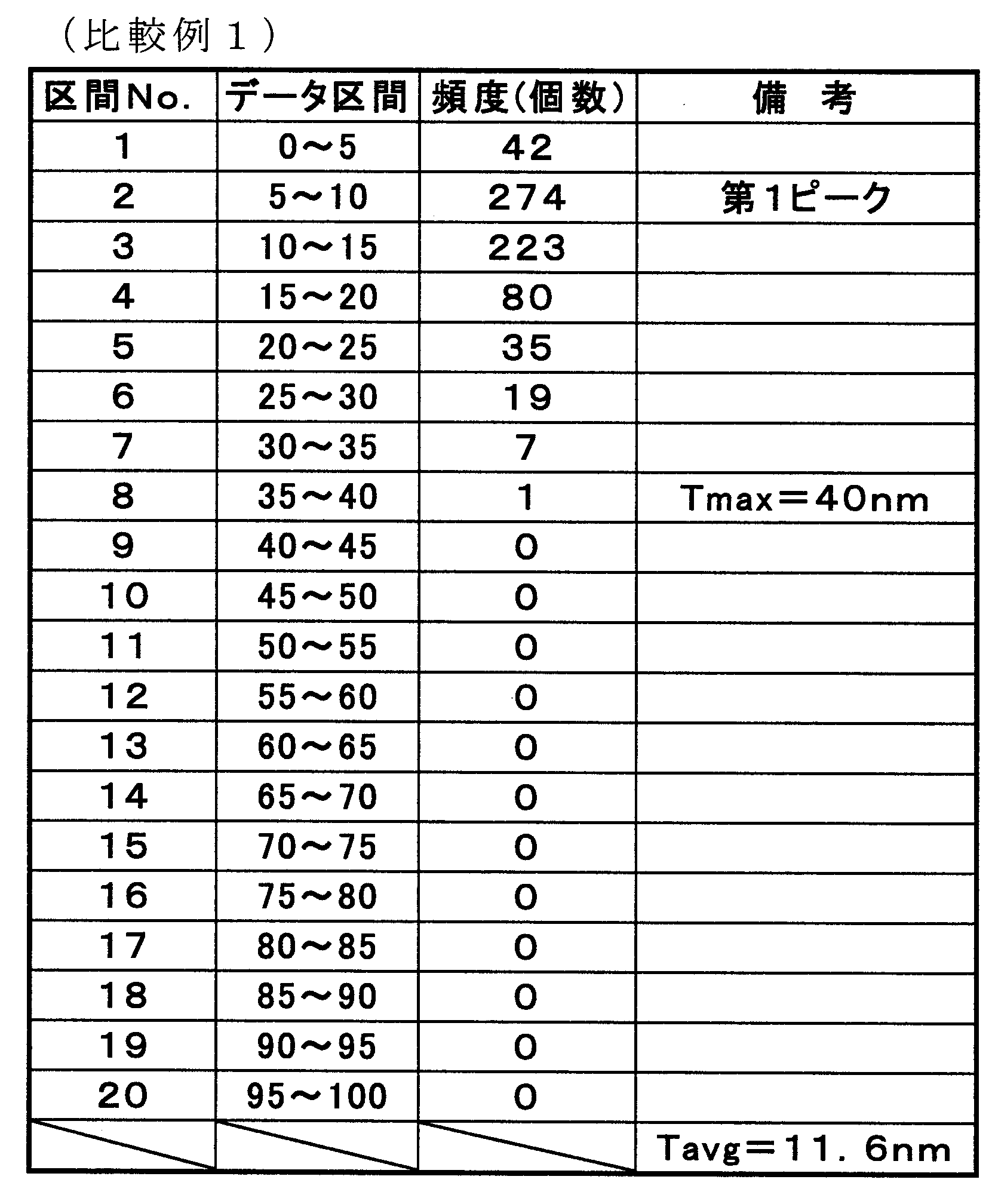

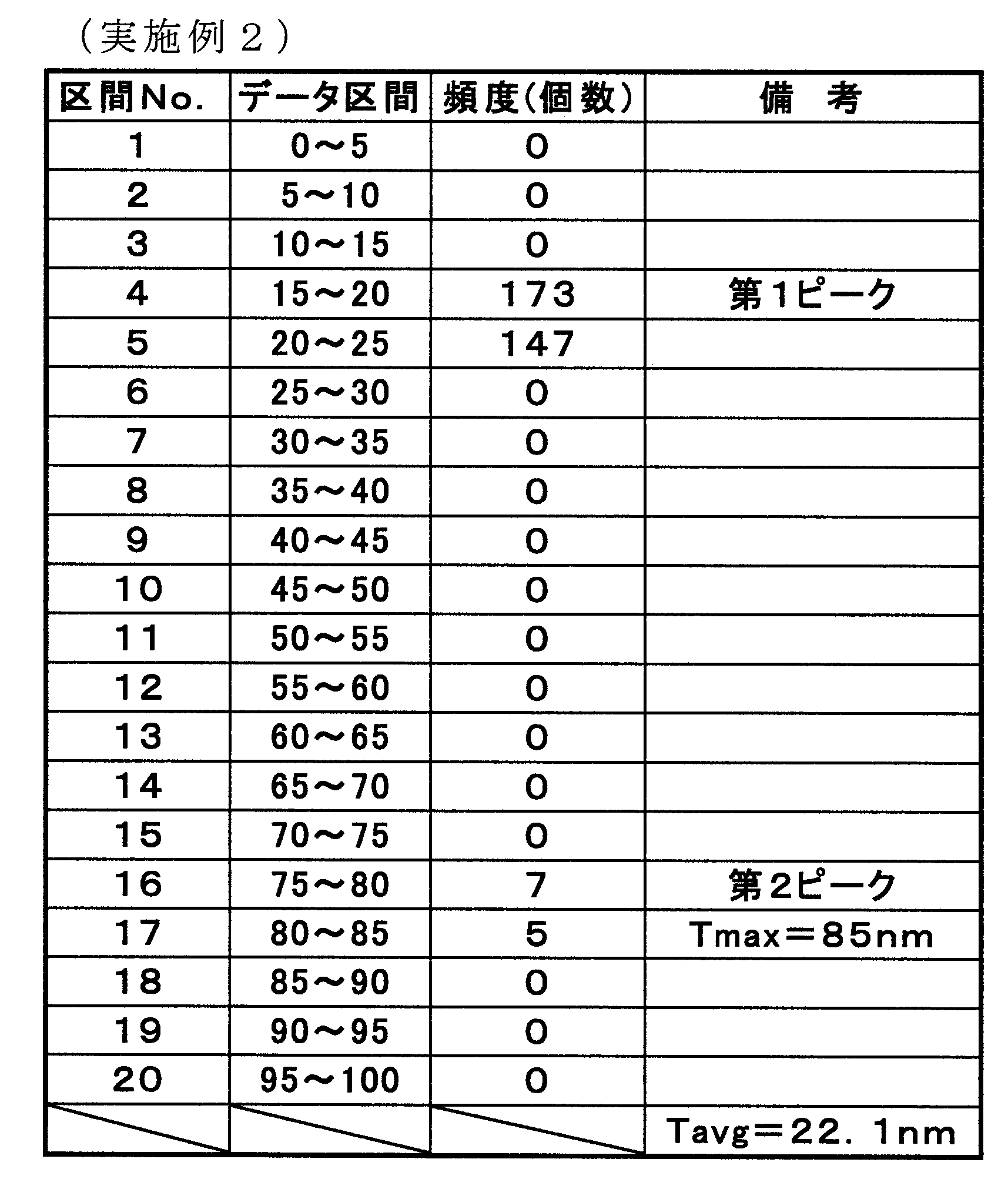
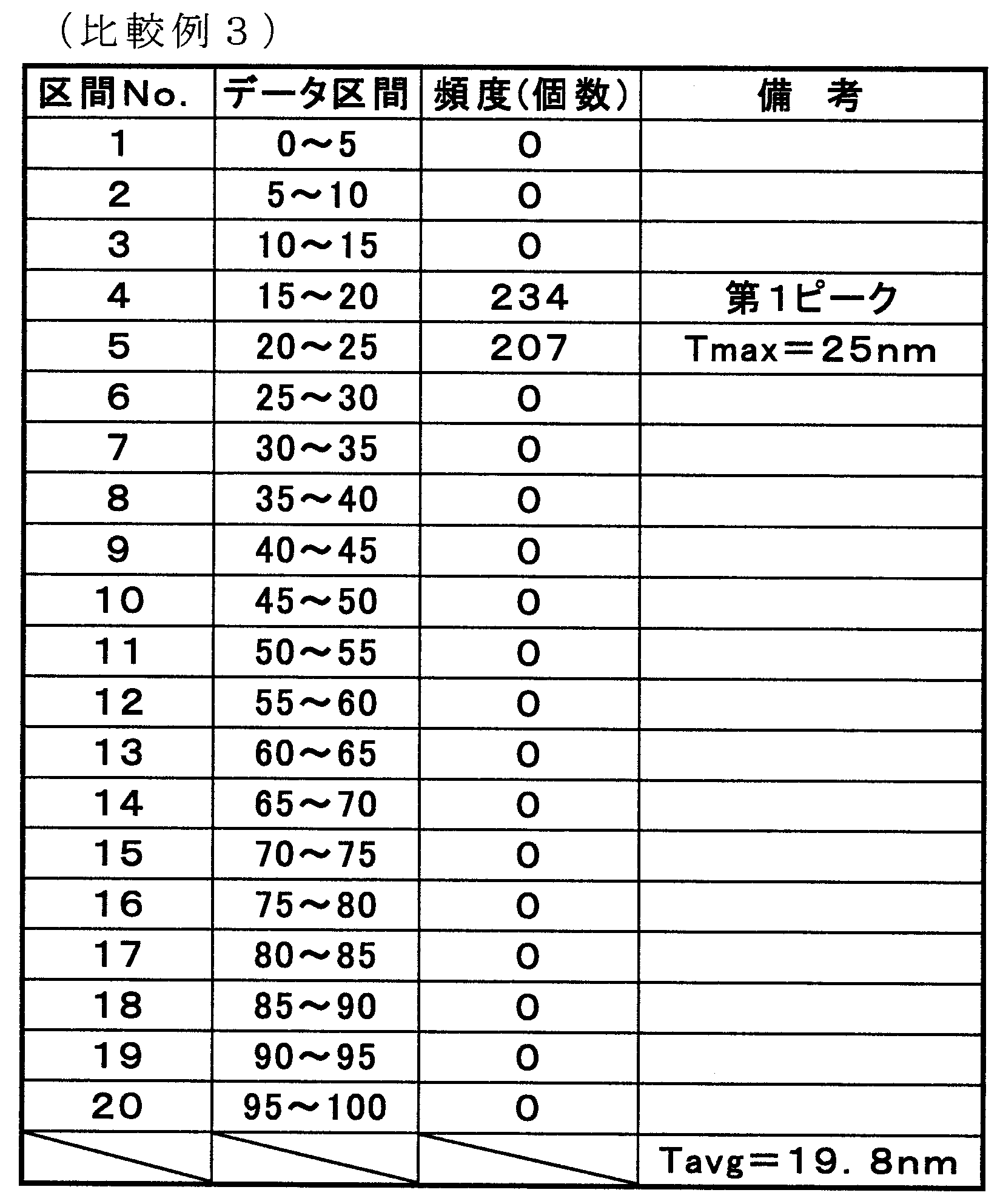
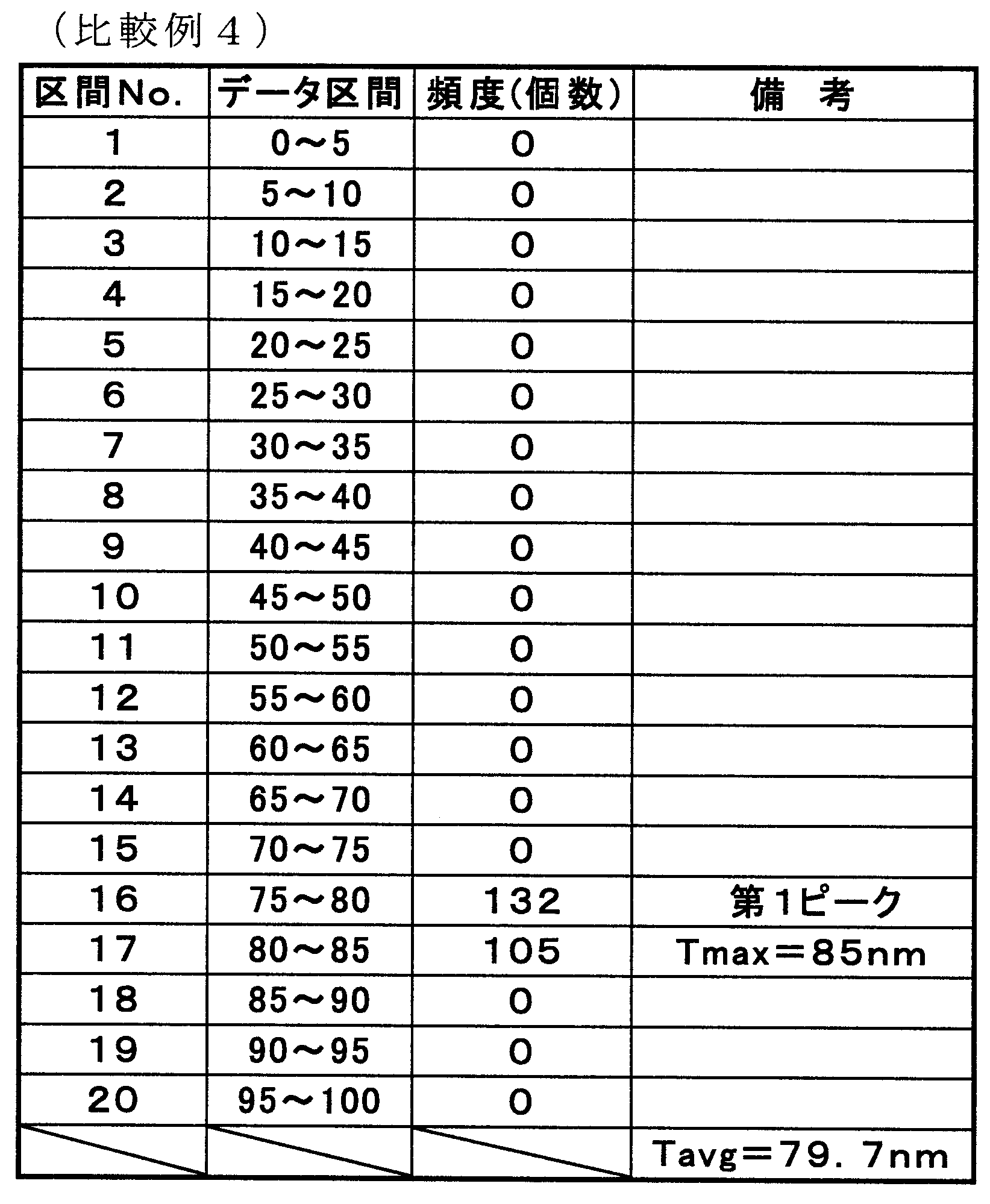
表1~表3とその研摩評価の結果より、コロイダルセリアの場合では、実施例1のように、その粒度分布に二つのピークがあり、最大粒子径Tmaxと平均粒子径TavgとがTmax/Tavg≧3を満足するものでは、比較例1と比べると、被研摩面の表面粗さは同等レベルであるが、その研摩速度は30倍近く速くなることが判明した。また、比較例2と比べた場合、研摩速度はやや遅くなるものの、被研摩面の表面粗さは格段に小さくなることが判明した。
表4~表6とその研摩評価の結果より、コロイダルシリカの場合では、実施例2のように、その粒度分布に二つのピークがあり、最大粒子径Tmaxと平均粒子径TavgとがTmax/Tavg≧3を満足するものでは、比較例3と比べると、被研摩面の表面粗さは同等レベルであるが、その研摩速度は25倍近く速くなることが判明した。また、比較例4と比べた場合、研摩速度も3倍強早くなり、被研摩面の表面粗さは格段に小さくなることが判明した。
ガラスの研摩面を高精度に加工でき、比較的高速にガラスの研摩処理が行える。
Claims (5)
- 透過型電子顕微鏡により測定された研摩材粒子の最大粒径Tmaxが90nm以下であり、
前記最大粒径Tmaxと、透過型電子顕微鏡により測定された研摩材粒子の平均粒径TavgとがTmax/Tavg≧3を満足し、
該研摩材粒子の粒度分布が、少なくとも、平均粒径値付近に出現する第一ピークとTavgの3倍以上の粒径値付近に出現する第二ピークとを有することを特徴するガラス用研摩材スラリー。 - 平均粒径が5nm~20nmの範囲にある請求項1に記載のガラス用研摩材スラリー。
- 第一ピークが5nm~20nmの範囲に出現し、第二ピークが25nm~60nmに出現する請求項2に記載のガラス用研摩材スラリー。
- 研摩材は、コロイダルセリア、コロイダルシリカ、またはコロイダルセリア及びコロイダルシリカの混合物のいずれかである請求項1~請求項3いずれかに記載のガラス用研摩材スラリー。
- 研摩材は、コロイダルセリアである請求項4に記載のガラス用研摩材スラリー。
Applications Claiming Priority (2)
| Application Number | Priority Date | Filing Date | Title |
|---|---|---|---|
| JP2008-226283 | 2008-09-03 | ||
| JP2008226283A JP5396047B2 (ja) | 2008-09-03 | 2008-09-03 | ガラス用研摩材スラリー |
Publications (1)
| Publication Number | Publication Date |
|---|---|
| WO2010026792A1 true WO2010026792A1 (ja) | 2010-03-11 |
Family
ID=41796968
Family Applications (1)
| Application Number | Title | Priority Date | Filing Date |
|---|---|---|---|
| PCT/JP2009/054636 Ceased WO2010026792A1 (ja) | 2008-09-03 | 2009-03-11 | ガラス用研摩材スラリー |
Country Status (3)
| Country | Link |
|---|---|
| JP (1) | JP5396047B2 (ja) |
| TW (1) | TWI404598B (ja) |
| WO (1) | WO2010026792A1 (ja) |
Families Citing this family (4)
| Publication number | Priority date | Publication date | Assignee | Title |
|---|---|---|---|---|
| CN103917332A (zh) * | 2011-11-01 | 2014-07-09 | 旭硝子株式会社 | 玻璃基板的制造方法 |
| US9340706B2 (en) * | 2013-10-10 | 2016-05-17 | Cabot Microelectronics Corporation | Mixed abrasive polishing compositions |
| CN103992743B (zh) * | 2014-05-09 | 2018-06-19 | 杰明纳微电子股份有限公司 | 含有二氧化铈粉体与胶体二氧化硅混合磨料的抛光液及其制备工艺 |
| JP7569717B2 (ja) * | 2021-03-09 | 2024-10-18 | 花王株式会社 | 酸化珪素膜用研磨液組成物 |
Citations (4)
| Publication number | Priority date | Publication date | Assignee | Title |
|---|---|---|---|---|
| JP2004259421A (ja) * | 2003-02-05 | 2004-09-16 | Kao Corp | 研磨液組成物 |
| JP2006061995A (ja) * | 2004-08-24 | 2006-03-09 | Kao Corp | 研磨液組成物 |
| JP2007321159A (ja) * | 2007-08-01 | 2007-12-13 | Yamaguchi Seiken Kogyo Kk | 硬脆材料用精密研磨組成物 |
| JP2008163054A (ja) * | 2006-12-26 | 2008-07-17 | Kao Corp | 容器入り分散液 |
Family Cites Families (4)
| Publication number | Priority date | Publication date | Assignee | Title |
|---|---|---|---|---|
| JP4213858B2 (ja) * | 2000-02-03 | 2009-01-21 | 花王株式会社 | 研磨液組成物 |
| EP1287088B1 (en) * | 2000-05-12 | 2011-10-05 | Nissan Chemical Industries, Ltd. | Polishing composition |
| JP4042906B2 (ja) * | 2003-05-06 | 2008-02-06 | 日本化学工業株式会社 | 研磨用組成物,研磨用組成物の調整方法および研磨方法 |
| TWI284741B (en) * | 2005-06-06 | 2007-08-01 | Chien-Fu Chen | A simple detector for partial discharge with the acoustic emission technique |
-
2008
- 2008-09-03 JP JP2008226283A patent/JP5396047B2/ja active Active
-
2009
- 2009-03-11 WO PCT/JP2009/054636 patent/WO2010026792A1/ja not_active Ceased
- 2009-04-14 TW TW98112262A patent/TWI404598B/zh active
Patent Citations (4)
| Publication number | Priority date | Publication date | Assignee | Title |
|---|---|---|---|---|
| JP2004259421A (ja) * | 2003-02-05 | 2004-09-16 | Kao Corp | 研磨液組成物 |
| JP2006061995A (ja) * | 2004-08-24 | 2006-03-09 | Kao Corp | 研磨液組成物 |
| JP2008163054A (ja) * | 2006-12-26 | 2008-07-17 | Kao Corp | 容器入り分散液 |
| JP2007321159A (ja) * | 2007-08-01 | 2007-12-13 | Yamaguchi Seiken Kogyo Kk | 硬脆材料用精密研磨組成物 |
Also Published As
| Publication number | Publication date |
|---|---|
| JP5396047B2 (ja) | 2014-01-22 |
| TWI404598B (zh) | 2013-08-11 |
| TW201010824A (en) | 2010-03-16 |
| JP2010059310A (ja) | 2010-03-18 |
Similar Documents
| Publication | Publication Date | Title |
|---|---|---|
| JP5862578B2 (ja) | 研磨材微粒子及びその製造方法 | |
| JP2010083741A (ja) | 酸化セリウム及びその製造方法 | |
| KR100574259B1 (ko) | 연마제 및 연마 방법 | |
| JP4439755B2 (ja) | 研磨用組成物およびそれを用いたメモリーハードディスクの製造方法 | |
| JP2001011433A (ja) | 研磨用組成物 | |
| CN104828852A (zh) | 二氧化铈材料及其形成方法 | |
| KR20130089598A (ko) | 합성 석영 유리 기판의 제조 방법 | |
| JP2012011526A (ja) | 研磨材およびその製造方法 | |
| JP2008273780A (ja) | 改質シリカ系ゾルおよびその製造方法 | |
| WO2002044300A2 (en) | Cerium-based abrasive and production process thereof | |
| US7090821B2 (en) | Metal oxide powder for high precision polishing and method of preparation thereof | |
| JP2012079964A (ja) | 半導体ウェーハ用研磨液組成物 | |
| Zhang et al. | Preparation of CeO2 polishing powder and its performance and mechanism for chemical mechanical polishing of optical glass | |
| JP5396047B2 (ja) | ガラス用研摩材スラリー | |
| JP2013111725A (ja) | 研磨材およびその製造方法 | |
| JP6436018B2 (ja) | 酸化物単結晶基板の研磨スラリー及びその製造方法 | |
| JP2014129455A (ja) | ガラス用研磨剤組成物 | |
| JP3694478B2 (ja) | セリウム系研磨材及びその製造方法 | |
| JP2019182987A (ja) | 合成石英ガラス基板用研磨液組成物 | |
| JP2007061989A (ja) | 研磨用複合酸化物粒子およびスラリー状研磨材 | |
| CN112823195A (zh) | 研磨剂、玻璃的研磨方法、以及玻璃的制造方法 | |
| CN113454024A (zh) | 二氧化硅粒子及其制造方法、硅溶胶、研磨组合物、研磨方法、半导体晶片的制造方法和半导体器件的制造方法 | |
| JPH10237425A (ja) | 研磨材 | |
| CN105518780B (zh) | 二氧化硅磨粒、二氧化硅磨粒的制造方法和磁盘用玻璃基板的制造方法 | |
| JP4955253B2 (ja) | デバイスウエハエッジ研磨用研磨組成物、その製造方法、及び研磨加工方法 |
Legal Events
| Date | Code | Title | Description |
|---|---|---|---|
| 121 | Ep: the epo has been informed by wipo that ep was designated in this application |
Ref document number: 09811321 Country of ref document: EP Kind code of ref document: A1 |
|
| NENP | Non-entry into the national phase |
Ref country code: DE |
|
| 122 | Ep: pct application non-entry in european phase |
Ref document number: 09811321 Country of ref document: EP Kind code of ref document: A1 |