WO2010024372A1 - シリコーンモノマー、その製造方法および用途 - Google Patents
シリコーンモノマー、その製造方法および用途 Download PDFInfo
- Publication number
- WO2010024372A1 WO2010024372A1 PCT/JP2009/065036 JP2009065036W WO2010024372A1 WO 2010024372 A1 WO2010024372 A1 WO 2010024372A1 JP 2009065036 W JP2009065036 W JP 2009065036W WO 2010024372 A1 WO2010024372 A1 WO 2010024372A1
- Authority
- WO
- WIPO (PCT)
- Prior art keywords
- formula
- group
- silicone monomer
- represented
- carbon atoms
- Prior art date
- Legal status (The legal status is an assumption and is not a legal conclusion. Google has not performed a legal analysis and makes no representation as to the accuracy of the status listed.)
- Ceased
Links
Classifications
-
- C—CHEMISTRY; METALLURGY
- C08—ORGANIC MACROMOLECULAR COMPOUNDS; THEIR PREPARATION OR CHEMICAL WORKING-UP; COMPOSITIONS BASED THEREON
- C08F—MACROMOLECULAR COMPOUNDS OBTAINED BY REACTIONS ONLY INVOLVING CARBON-TO-CARBON UNSATURATED BONDS
- C08F30/00—Homopolymers or copolymers of compounds having one or more unsaturated aliphatic radicals, each having only one carbon-to-carbon double bond, and containing phosphorus, selenium, tellurium or a metal
- C08F30/04—Homopolymers or copolymers of compounds having one or more unsaturated aliphatic radicals, each having only one carbon-to-carbon double bond, and containing phosphorus, selenium, tellurium or a metal containing a metal
- C08F30/08—Homopolymers or copolymers of compounds having one or more unsaturated aliphatic radicals, each having only one carbon-to-carbon double bond, and containing phosphorus, selenium, tellurium or a metal containing a metal containing silicon
-
- C—CHEMISTRY; METALLURGY
- C08—ORGANIC MACROMOLECULAR COMPOUNDS; THEIR PREPARATION OR CHEMICAL WORKING-UP; COMPOSITIONS BASED THEREON
- C08G—MACROMOLECULAR COMPOUNDS OBTAINED OTHERWISE THAN BY REACTIONS ONLY INVOLVING UNSATURATED CARBON-TO-CARBON BONDS
- C08G77/00—Macromolecular compounds obtained by reactions forming a linkage containing silicon with or without sulfur, nitrogen, oxygen or carbon in the main chain of the macromolecule
- C08G77/04—Polysiloxanes
- C08G77/38—Polysiloxanes modified by chemical after-treatment
-
- G—PHYSICS
- G02—OPTICS
- G02B—OPTICAL ELEMENTS, SYSTEMS OR APPARATUS
- G02B1/00—Optical elements characterised by the material of which they are made; Optical coatings for optical elements
- G02B1/04—Optical elements characterised by the material of which they are made; Optical coatings for optical elements made of organic materials, e.g. plastics
- G02B1/041—Lenses
- G02B1/043—Contact lenses
-
- C—CHEMISTRY; METALLURGY
- C08—ORGANIC MACROMOLECULAR COMPOUNDS; THEIR PREPARATION OR CHEMICAL WORKING-UP; COMPOSITIONS BASED THEREON
- C08G—MACROMOLECULAR COMPOUNDS OBTAINED OTHERWISE THAN BY REACTIONS ONLY INVOLVING UNSATURATED CARBON-TO-CARBON BONDS
- C08G77/00—Macromolecular compounds obtained by reactions forming a linkage containing silicon with or without sulfur, nitrogen, oxygen or carbon in the main chain of the macromolecule
- C08G77/04—Polysiloxanes
- C08G77/14—Polysiloxanes containing silicon bound to oxygen-containing groups
Definitions
- the present invention relates to a novel silicone monomer that is compatible with a hydrophilic monomer, a method for producing the same, and a polymerizable composition using the monomer.
- Silicones are used in various applications such as mold release agents, fiber treatment agents, lubricants, polishes, water repellents, cosmetic additives and the like.
- silicone monomers have been used as lens raw materials for the purpose of reducing the burden on the eyes of ophthalmic lenses (Patent Documents 1 and 2).
- Patent Documents 1 and 2 As described above, when silicone is added to the lens raw material, the lens surface becomes hydrophobic and there is a concern about eye damage. Therefore, it is necessary to make the lens surface hydrophilic.
- a method of obtaining a polymer such as a lens having a hydrophilic surface a method of obtaining a copolymer by compatibilizing a hydrophilic monomer with a silicone monomer is known.
- SiGMA methyldi (trimethylsiloxy) silylpropylglycerol methacrylate
- hydrophilic monomers such as N, N-dimethylacrylamide are known.
- the surface can be hydrophilized by compatibilizing with the functional monomer.
- SiGMA is not sufficiently compatible with more hydrophilic monomers such as 2-methacryloyloxyethyl-2-trimethylammonioethyl phosphate (abbreviated as MPC).
- MPC 2-methacryloyloxyethyl-2-trimethylammonioethyl phosphate
- the object of the present invention is to make hydrophilic monomers such as MPC compatible with a wider range of mixed compositions and to uniformly copolymerize them, and to fully demonstrate the high hydrophilicity and the performance of silicone monomers
- Another object of the present invention is to provide a silicone monomer useful for the production of such a copolymer, a method for producing the same, and a composition for polymerization.
- a silicone monomer represented by the formula (1) is provided.
- X represents an organic group having 1 to 12 carbon atoms which may have 1 or 2 ester groups
- R represents a hydrogen atom or a methyl group
- Y 1 to Y 9 are each independently of each other. Represents a hydrogen atom, an alkyl group having 1 to 4 carbon atoms or an aryl group having 6 to 10 carbon atoms
- n represents an integer of 0 to 3.
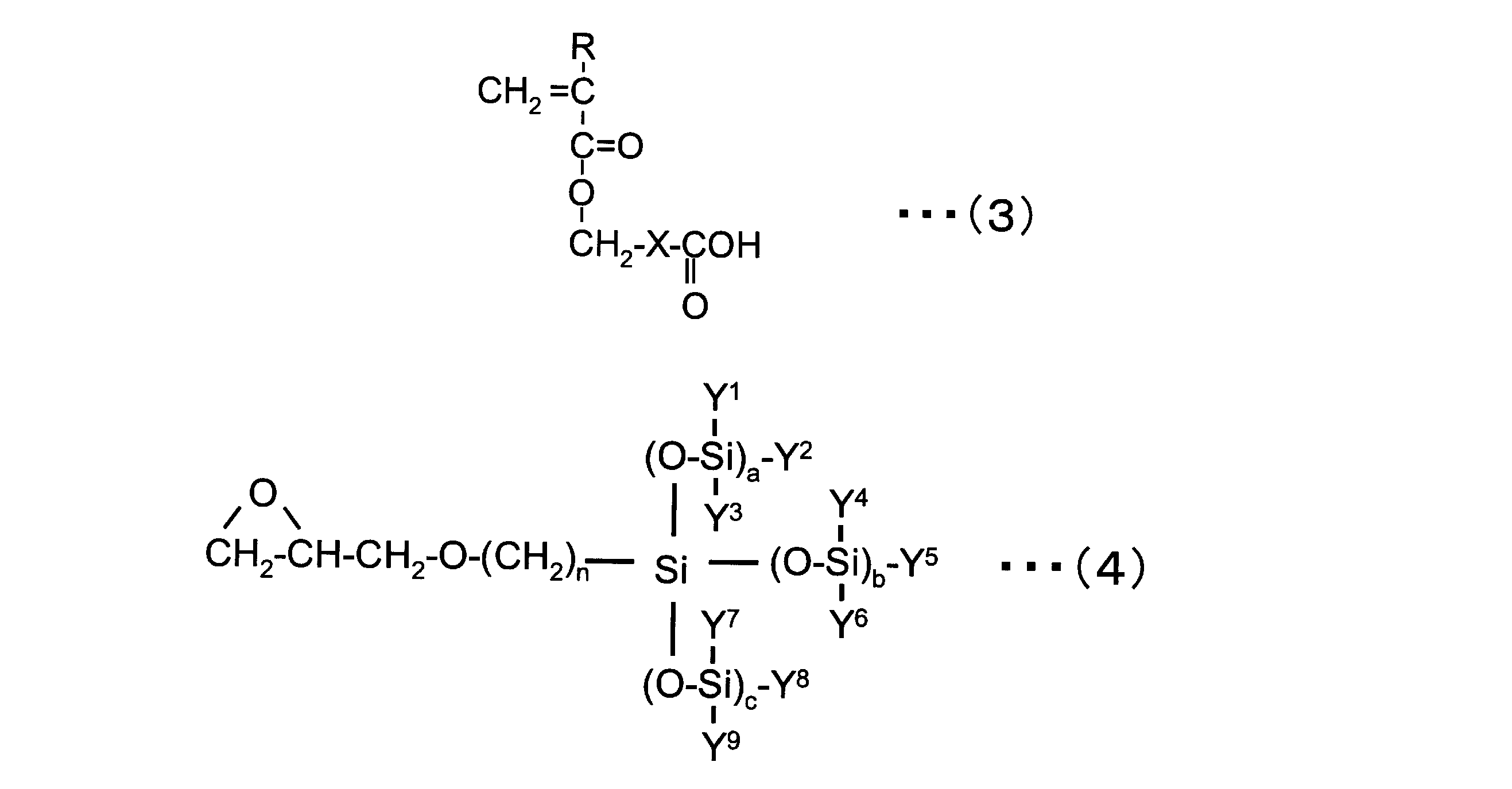
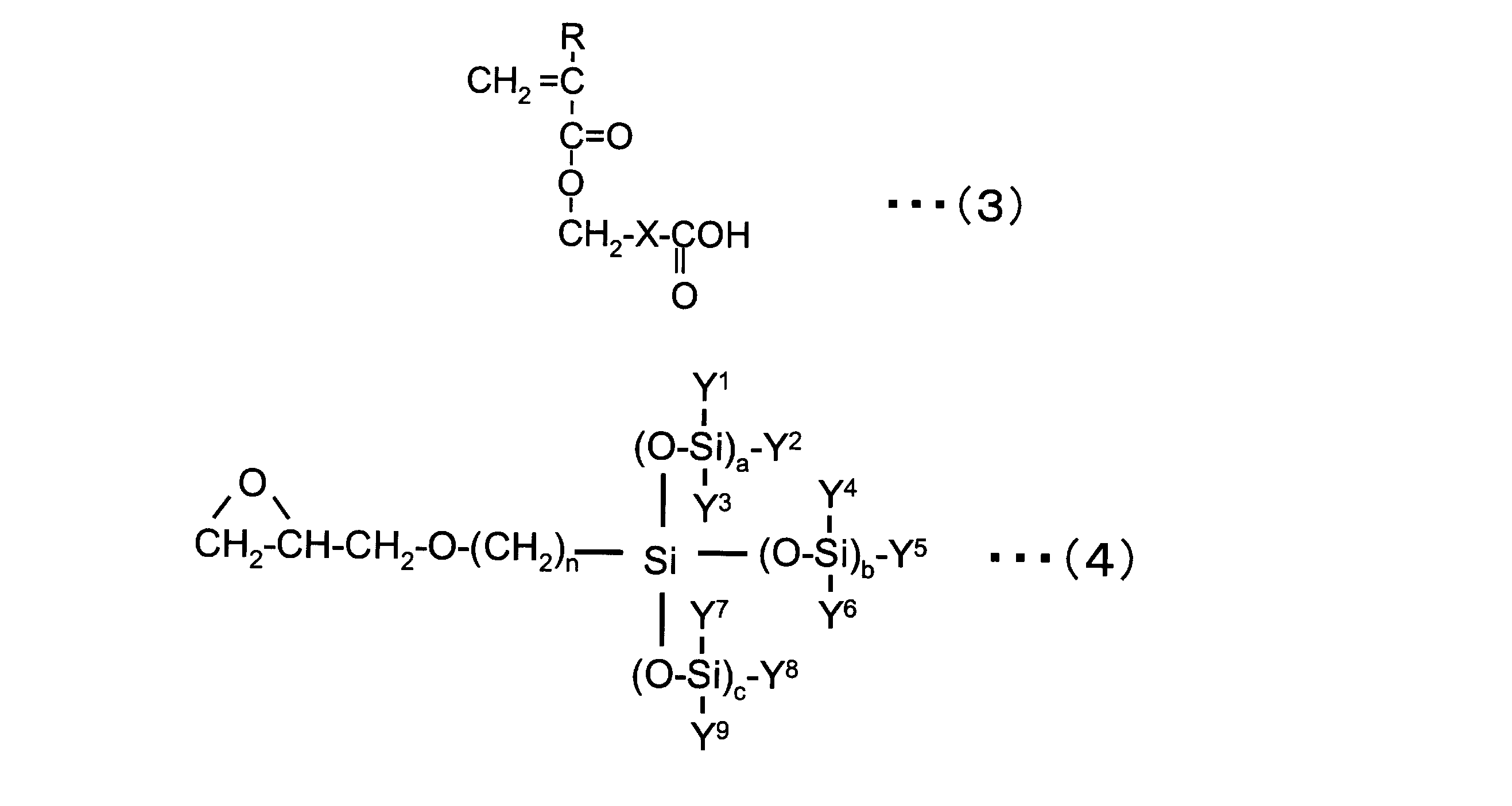
- the silicone monomer represented by the above formula (1) is produced by reacting the carboxylic acid represented by the formula (3) with the epoxy group-containing siloxane represented by the formula (4). A manufacturing method is provided.
- X represents an organic group having 1 to 12 carbon atoms which may have 1 or 2 ester groups
- R represents a hydrogen atom or a methyl group.
- Y 1 to Y 9 Each independently represents a hydrogen atom, an alkyl group having 1 to 4 carbon atoms or an aryl group having 6 to 10 carbon atoms
- n represents an integer of 0 to 3
- a, b and c are each independently Represents an integer of 0 to 3, provided that a + b + c ⁇ 1.
- a polymerization composition comprising a silicone monomer represented by the above formula (1) and MPC.
- the silicone monomer of the present invention has a structure represented by the above formula (1), hydrophilic monomers such as MPC can be compatibilized in a wide range of mixed compositions. For this reason, the composition for polymerization comprising the silicone monomer and the hydrophilic monomer of the present invention can be uniformly copolymerized in a wide range of compositions, and sufficiently exerted the high hydrophilicity and the performance of the silicone monomer. A copolymer having excellent transparency can be obtained.
- the silicone monomer of the present invention is represented by the above formula (1).
- R represents a hydrogen atom or a methyl group.
- X represents an organic group having 1 to 12 carbon atoms which may have 1 or 2 ester groups.
- X is preferably a group represented by the formula (2) or the formulas (5a) to (5c) because the raw materials are easily available.
- Z represents a divalent hydrocarbon group having 1 to 6 carbon atoms or a divalent cyclic hydrocarbon group having 6 to 10 carbon atoms.
- examples of the divalent hydrocarbon group having 1 to 6 carbon atoms include a methylene group, an ethylene group, an n-propylene group, an n-butylene group, and an n-hexylene group.
- an ethylene group is used from the viewpoint of stability and availability of raw materials.
- Examples of the divalent cyclic hydrocarbon group having 6 to 10 carbon atoms include 1,2-cyclohexylene group, 1,3-cyclohexylene group, 1,4-cyclohexylene group, 1,2-phenylene group, , 3-phenylene group, 1,4-phenylene group, 1,2-naphthalene group, 1,3-naphthalene group, 1,4-naphthalene group, 1,5-naphthalene group, 1,6-naphthalene group, 1, Examples thereof include 7-naphthalene group, 1,8-naphthalene group, 2,3-naphthalene group and 2,6-naphthalene group, and preferably 1,2-cyclohexylene group and 1,2-phenylene group for reasons of availability. Is mentioned.
- More specific examples of the group represented by the formula (2) include groups represented by the formulas (6a) to (6e), and the formula (6b), And a group represented by (6d).
- n an integer of 0 to 3.
- n 2 or 3 because of high stability.
- Y 1 to Y 9 each independently represent a hydrogen atom, an alkyl group having 1 to 6 carbon atoms, or an aryl group having 6 to 10 carbon atoms.
- the alkyl group having 1 to 6 carbon atoms include a methyl group, an ethyl group, a propyl group, a butyl group, and a cyclohexyl group.
- the aryl group having 6 to 10 carbon atoms include a phenyl group, a benzyl group, a phenylethyl group, and a naphthyl group.
- Most preferred as Y 1 to Y 9 is a methyl group because the raw materials are easily available.
- a, b and c each independently represent an integer of 0 to 3, preferably 0 to 2. However, a + b + c ⁇ 1.
- silicone monomers represented by the formula (1) include silicone monomers having a structure represented by the formulas (7a) to (7d).
- the most preferable one is a compound represented by the formula (7a) which is particularly excellent in compatibility with a hydrophilic monomer and can be easily dissolved with other silicone monomers.
- the silicone monomer represented by the formula (1) for example, a method of reacting the carboxylic acid represented by the above formula (3) with the epoxy group-containing siloxane represented by the above formula (4).
- the desired silicone monomer can be obtained by separating and purifying the resulting product.
- X and R in the above formula (3), Y 1 to Y 9 , n, a, b and c in the above formula (4) correspond to the above formula (1). Specific examples are given.
- a commercially available carboxylic acid represented by the formula (3) can be used.
- the carboxylic acid is not compatible with a hydrophilic monomer or has a low compatibility with other silicone monomers and hydrophilic monomers.
- a carboxylic acid represented by the formula (5) containing three ester groups can be mentioned.
- Z represents a divalent hydrocarbon group having 1 to 6 carbon atoms or a divalent cyclic hydrocarbon group having 6 to 10 carbon atoms.
- R represents a hydrogen atom or a methyl group.
- Specific examples of Z in formula (5) include the same as Z in formula (2).
- carboxylic acid represented by the formula (5) include, for example, 2-methacryloyloxyethyl succinic acid, 2-methacryloyloxyethyl phthalic acid, 2-methacryloyloxyethyl, because the raw materials are easily available. Hexahydrophthalic acid is mentioned.
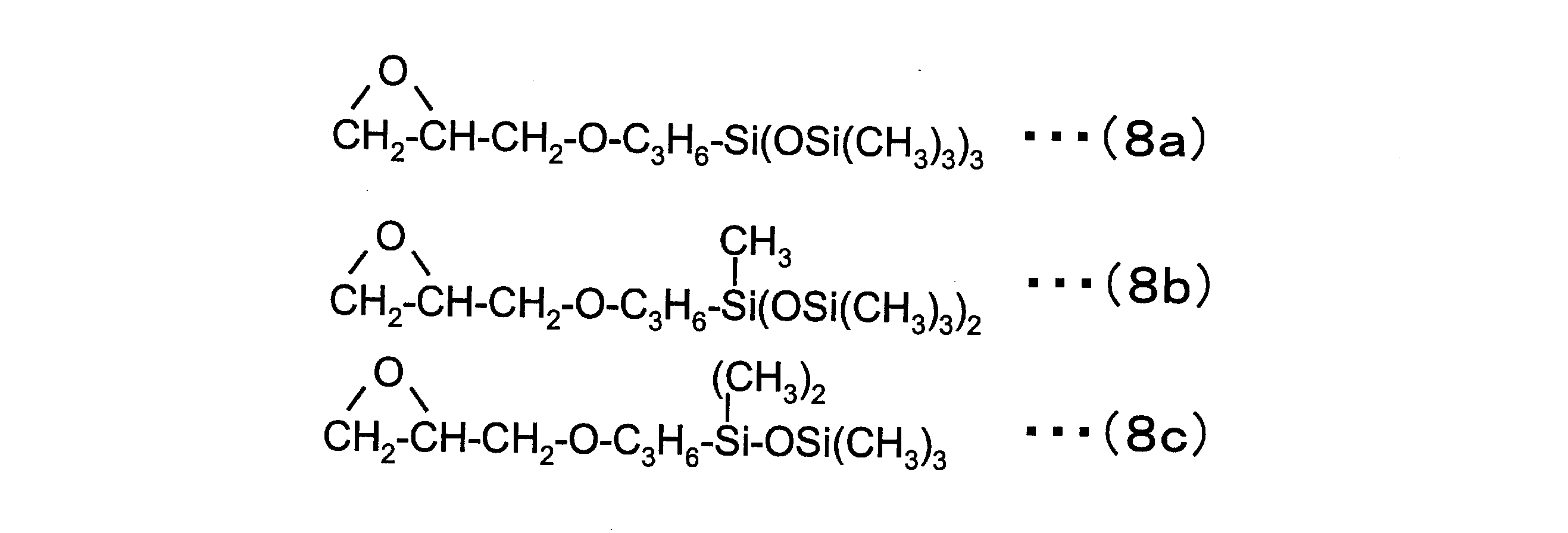
- epoxy group-containing siloxane represented by the above formula (4) commercially available ones can be used, but those represented by the formulas (8a) to (8c) are preferred because the raw materials are easily available. More preferred are those shown in 8b).
- the reaction between the carboxylic acid represented by the formula (3) and the epoxy group-containing siloxane represented by the formula (4) can be performed, for example, without a solvent or in an aprotic solvent.
- the reaction temperature is usually 70 to 150 ° C., preferably 70 to 100 ° C. at which side decomposition reaction hardly occurs, and the reaction time is usually 6 to 48 hours, preferably 12 to 24 hours.
- a catalyst can be used to accelerate the reaction.
- the catalyst include potassium hydroxide, sodium ethoxide, 1,8-diazabicyclo [5,4,0] undec-7-ene, trimethylbenzylammonium chloride, trimethylbenzylammonium chloride, and triethylamine.
- Particularly preferred catalysts include 1,8-diazabicyclo [5,4,0] undec-7-ene, triethylamine and sodium ethoxide because of their low nucleophilicity.
- the amount of the catalyst used is preferably 0.03 to 0.24 molar ratio with respect to the carboxylic acid represented by the formula (3).
- a polymerization inhibitor so that carboxylic acid or the like is not polymerized.
- the polymerization inhibitor include hydroquinone monomethyl ether, 1,4-dihydroxybenzene, and 4-methoxyphenol, and 1,4-dihydroxybenzene can be easily removed by base washing after completion of the reaction. Or the use of 4-methoxyphenol is preferred.
- the amount of the polymerization inhibitor used is usually about 100 to 1000 ppm in the reaction solution.
- the charge ratio of the carboxylic acid represented by the formula (3) and the epoxy group-containing siloxane represented by the formula (4) is such that the epoxy group-containing siloxane in the reaction system is reacted by 99% or more.
- the carboxylic acid is preferably used in a ratio of 1.5 to 3 moles with respect to 1 mole of the epoxy group-containing siloxane.
- the silicone monomer obtained after the reaction is a liquid having a high boiling point and polymerizability, and it is difficult to use it for recrystallization or distillation operation.
- the washing can be performed, for example, by dissolving the resulting reaction solution in n-hexane and using a sodium hydroxide aqueous solution or an organic base acetonitrile solution as the washing solution.
- the organic base include triethylamine, ammonia, triethanolamine, diethanolamine, and ethanolamine.
- the amount of n-hexane used is preferably about 9 times the volume of the reaction solution because the oil phase and the aqueous phase can be easily separated during purification.
- the amount of the cleaning liquid used is usually about the same volume as n-hexane.
- n-hexane is preferably carried out at a temperature of about 60 ° C. or lower, and the operation is performed by reducing the pressure to 5 to 10 mmHg using a vacuum pump and suctioning for about 1 hour.
- the product after the purification is usually obtained as a mixture of the target silicone monomer represented by the formula (1) and the silicone monomer represented by the formula (1 ′).
- R, X, Y 1 to Y 9 , n, a, b and c are the same as those in the formula (1).
- the mixture can be used as it is for the polymerization composition of the present invention described later, but the content ratio of the silicone monomer represented by the formula (1) and the silicone monomer represented by the formula (1 ′) in the mixture is:
- the mass ratio is usually 2/1 to 8/1, preferably 3/1 to 5/1.
- the ratio of the silicone monomer represented by the formula (1) is less than 2/1, the compatibilizing ability of the hydrophilic monomer may be lowered.
- the silicone monomer of the present invention can be used as a lens material, for example.
- the silicone monomer of the present invention is compatible with a highly hydrophilic monomer such as MPC, for example, the polymerization composition of the present invention containing the silicone monomer of the present invention and MPC can be used. .
- the content of MPC is usually based on 100 parts by mass of the silicone monomer of the present invention or a mixture of the silicone monomer of the present invention and the silicone monomer represented by the above formula (1 ′).
- the amount is 10 to 70 parts by mass, preferably 20 to 50 parts by mass. If the MPC content is less than 10 parts by mass, the hydrophilicity of the surface of the resulting polymer may be reduced, and if it is more than 70 parts by mass, the oxygen permeability of the resulting polymer may be reduced.
- the polymerization composition of the present invention can contain other copolymerizable monomers as necessary.
- the content of the other copolymerizable monomer is usually 0 to 150 parts by mass, preferably 0 to 100 parts by mass with respect to 100 parts by mass of the silicone monomer of the present invention.
- copolymerizable monomers are not particularly limited as long as they are copolymerizable, and monomers having (meth) acryloyl group, styryl group, allyl group, vinyl group and other copolymerizable carbon-carbon unsaturated bonds are used. can do.
- copolymer monomers include, for example, alkyl (meth) acrylic acid, itaconic acid, crotonic acid, cinnamic acid, vinyl benzoic acid, phosphorylcholine (meth) acrylate, methyl (meth) acrylate, ethyl (meth) acrylate and the like ( (Meth) acrylates; polyalkylene glycol mono (meth) acrylate, polyalkylene glycol monoalkyl ether (meth) acrylate, polyalkylene glycol bis (meth) acrylate, trimethylolpropane tris (meth) acrylate, pentaerythritol tetrakis (meth) acrylate Polyfunctional (meth) acrylates such as siloxane macromers having carbon-carbon unsaturated bonds at both ends; alkyl halides such as trifluoroethyl (meth) acrylate and hexafluoroisopropyl (meth) acrylate
- a thermal polymerization initiator typified by a peroxide or an azo compound or a photopolymerization initiator in order to facilitate the polymerization.
- a thermal polymerization initiator typified by a peroxide or an azo compound or a photopolymerization initiator
- one having an optimum decomposition characteristic for a desired reaction temperature can be selected and used.
- an azo initiator or a peroxide initiator having a 10-hour half-life temperature of 40 to 120 ° C. is suitable.
- the photopolymerization initiator include carbonyl compounds, peroxides, azo compounds, sulfur compounds, halogen compounds, and metal salts.
- composition for polymerization of the present invention can be suitably used as a raw material for silicone hydrogel contact lenses and the like.
- a mixture of 90% by volume of acetonitrile and 10% by volume of 0.05M ammonium acetate aqueous solution was used as an eluent, and a sample was dissolved in this eluent at a concentration of 0.5% by volume and subjected to analysis.
- the high performance liquid chromatography conditions are as follows. C 18 (octadecylated silica) column (15 mm ⁇ 4.6 mm). (3) Mass Spectrometry Using Q-micro (Waters, ESI ionization method), the sample was dissolved in methanol for analysis. (4) Infrared absorption spectrum analysis Using FT / IR-6100 (manufactured by JASCO Corporation), the sample was absorbed into a polyethylene film and measured.
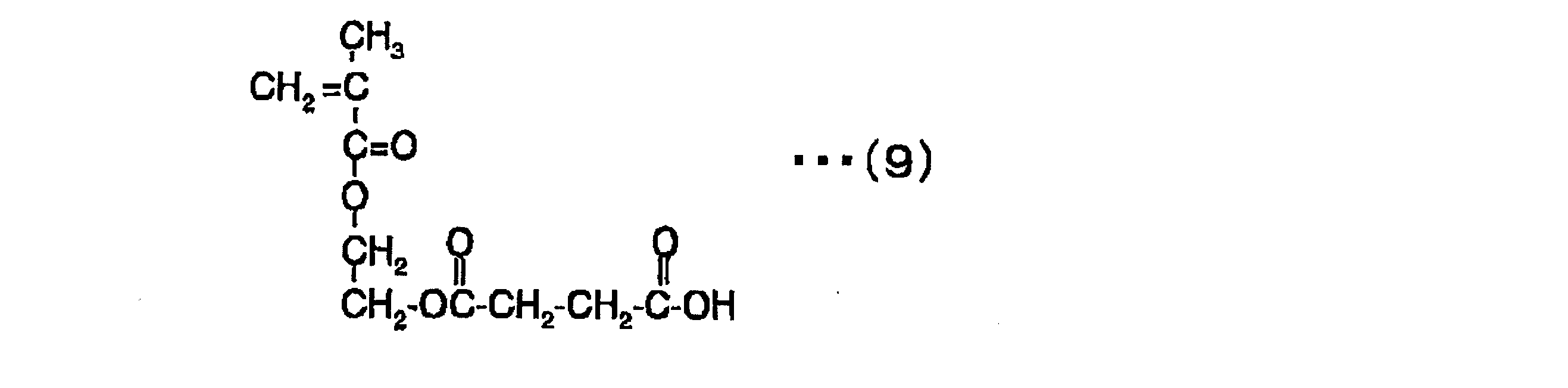
- Example 1 In a 300 ml three-necked flask equipped with a condenser, a stirrer and a dropping funnel, 36.6 g of the compound represented by the above formula (8b) (manufactured by Shin-Etsu Chemical Co., Ltd.), 0.07 g of 1,4-dihydroxybenzene and 0.66 g of triethylamine Then, 50.0 g of a compound represented by the formula (9) (manufactured by Kyoeisha Chemical Co., Ltd.) was added dropwise over about 30 minutes while stirring at room temperature under a nitrogen atmosphere.
- Reaction was performed at 85 degreeC for 24 hours, stirring after completion
- peaks derived from methacryloyl groups were observed at around 6.1 ppm (1H), 5.8 ppm (1H), and 1.9 ppm (3H).
- a peak derived from C—CH 2 —C was observed in the vicinity (2H)
- a peak derived from —CH 2 —Si was observed in the vicinity of 0.5 ppm (2H)
- a peak derived from Si—CH 3 was observed in the vicinity of 0 ppm (21H).
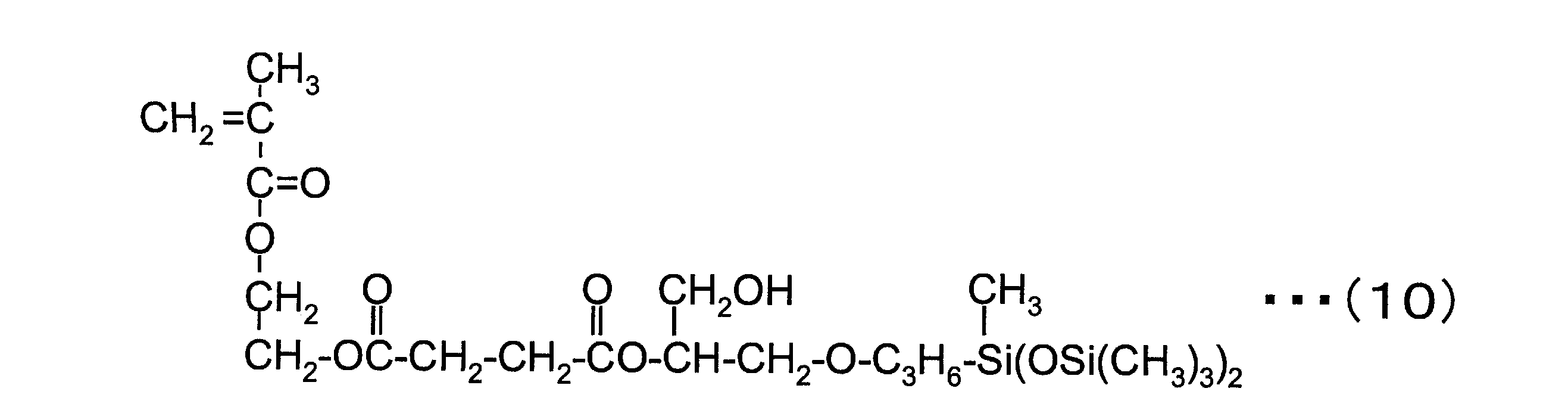
- Peaks characteristic of the compound of formula (10) were observed in the vicinity of 3.7 to 3.9 ppm and 5.0 ppm.
- a peak derived from a hydroxyl group is 3510 cm ⁇ 1
- a peak derived from a double bond is 1640 cm ⁇ 1
- a peak derived from a methacrylic ester bond is 1730 cm ⁇ 1
- succinic acid is obtained.
- the peak 1740 cm -1 derived from an ester the peak 1040 cm -1 derived from Si-O-Si bond, peak 2960 cm -1 derived from a methyl group, 1410 cm -1, the 1300 cm -1, attached to the siloxane
- a peak derived from a methyl group was detected at 845 cm ⁇ 1 .
- Example 2 In a 300 ml three-necked flask equipped with a condenser, a stirrer and a dropping funnel, 36.6 g of the compound represented by the above formula (8b) (manufactured by Shin-Etsu Chemical Co., Ltd.), 0.07 g of 1,4-dihydroxybenzene, 0.66 g of triethylamine And 61.8 g of a compound represented by the formula (11) (manufactured by Kyoeisha Chemical Co., Ltd.) was added and dissolved while stirring. Thereafter, the reaction was carried out at 85 ° C. for 24 hours with stirring.
- Example 3 37.0 parts by mass of a compound represented by the formula (7a) and a compound represented by the formula (10) obtained in Example 1, 37.0 parts by mass, 37.5 parts by mass of tris (trimethylsiloxy) silylpropyl methacrylate, MPC 15 parts by mass, 10 parts by mass of ethanol and 0.5 parts by mass of azobisisobutyronitrile were mixed and dissolved, and then allowed to stand at 100 ° C. for 5 hours for polymerization. After the polymerization, a transparent solid was obtained.
- Example 4 60.0 parts by mass of the compound represented by the formula (7a) and the compound represented by the formula (10) obtained in Example 1 and 40 parts by mass of MPC dissolved in 10 parts by mass of ethanol were mixed. When they were stirred, they were compatible.
- Example 5 60.0 parts by mass of the compound represented by the formula (7a) obtained in Example 1 and the compound represented by the formula (10), 60.0 parts by mass, 8 parts by mass of ethanol, and 20 parts by mass of MPC were mixed and stirred. However, it was compatible.
Landscapes
- Chemical & Material Sciences (AREA)
- Health & Medical Sciences (AREA)
- Chemical Kinetics & Catalysis (AREA)
- Medicinal Chemistry (AREA)
- Polymers & Plastics (AREA)
- Organic Chemistry (AREA)
- Physics & Mathematics (AREA)
- General Chemical & Material Sciences (AREA)
- General Physics & Mathematics (AREA)
- Optics & Photonics (AREA)
- Addition Polymer Or Copolymer, Post-Treatments, Or Chemical Modifications (AREA)
Abstract
親水性モノマーを広範囲の混合組成において相溶化させ、均一に共重合させることができ、高い親水性とシリコーンモノマーが有する性能とを十分発揮させることが可能なコンタクトレンズ材等の製造に有用なシリコーンモノマー、その製造方法及びそれを含む重合用組成物を提供する。該シリコーンモノマーは、式(1)で表され、重合用組成物は、シリコーンモノマーとMPCとを含む。 【化1】 (X:エステル基を1又は2有していてよいC1~12の有機基、R:H、CH3、Y1~Y9:H、C1~4のアルキル基、C6~10のアリール基。n:0~3、a、b、c:0~3、ただしa+b+c≧1)
Description
本発明は、親水性モノマーと相溶する新規なシリコーンモノマー、その製造方法及び該モノマーを利用した重合性組成物に関する。
シリコーンは離型剤、繊維処理剤、潤滑剤、艶出し剤、撥水剤、化粧品添加剤など、さまざまな用途で使用されている。近年、眼用レンズの目に対する負担を軽減する目的でレンズ用原料にシリコーンモノマーが使用されている(特許文献1、2)。このようにレンズ用原料にシリコーンを配合する場合、レンズ表面が疎水性になり、眼障害が懸念されるため、レンズ表面を親水化する必要がある。
従来から、表面を親水化させたレンズ等の重合物を得る方法としては、親水性モノマーをシリコーンモノマーと相溶化させ、共重合物を得る方法が知られている。親水性モノマーと相溶可能なシリコーンモノマーとして、例えば、メチルジ(トリメチルシロキシ)シリルプロピルグリセロールメタクリレート(SiGMAと略す)(特許文献3、4)が知られており、N,N-ジメチルアクリルアミドなどの親水性モノマーと相溶化させることで表面を親水化させることができる。
SiGMAは、2-メタクリロイルオキシエチル-2-トリメチルアンモニオエチルホスフェート(MPCと略す)など、より親水性の高いモノマーとの相溶性が十分とは言えず、中には、高容量のシリコーンモノマーを含有させることができない問題がある(特許文献5)。
そのため、重合物表面に十分な親水性を付与するために、プラズマ処理などの新たな表面親水化技術も開発されている(特許文献6、7)。
従来から、表面を親水化させたレンズ等の重合物を得る方法としては、親水性モノマーをシリコーンモノマーと相溶化させ、共重合物を得る方法が知られている。親水性モノマーと相溶可能なシリコーンモノマーとして、例えば、メチルジ(トリメチルシロキシ)シリルプロピルグリセロールメタクリレート(SiGMAと略す)(特許文献3、4)が知られており、N,N-ジメチルアクリルアミドなどの親水性モノマーと相溶化させることで表面を親水化させることができる。
SiGMAは、2-メタクリロイルオキシエチル-2-トリメチルアンモニオエチルホスフェート(MPCと略す)など、より親水性の高いモノマーとの相溶性が十分とは言えず、中には、高容量のシリコーンモノマーを含有させることができない問題がある(特許文献5)。
そのため、重合物表面に十分な親水性を付与するために、プラズマ処理などの新たな表面親水化技術も開発されている(特許文献6、7)。
本発明の課題は、MPC等の親水性モノマーを従来より広範囲の混合組成において相溶化させ、均一に共重合させることができ、高い親水性とシリコーンモノマーが有する性能とを十分発揮させることが可能な共重合物の製造に有用なシリコーンモノマー、その製造方法及び重合用組成物を提供することにある。
本発明者らは、上記課題を解決するために鋭意検討した。これまでのシリコーンモノマーは、分子内に水酸基を有することにより、親水性モノマーを相溶化し易くできることが知られている。しかし、その水酸基間でシリコーン相中に強い水素結合が形成されるため、親水性モノマーへの配向が十分でなく、親水性モノマーを十分量配合することが困難であった。そこで、シリコーンモノマーの分子構造において、水素結合性の強い水酸基の近傍に水素結合性の弱い親水基であるエステル基を2~4、好ましくは3個含有させることにより、驚くべきことに従来親水性モノマーと相溶させるために用いられてきたシリコーンモノマーと比較して、MPCなどの親水性モノマーとシリコーンモノマーの相溶性を著しく向上させることが可能であることを見出し、更に、そのような構造のシリコーンモノマーの製造に成功し本発明を完成した。
本発明によれば、式(1)で表されるシリコーンモノマーが提供される。
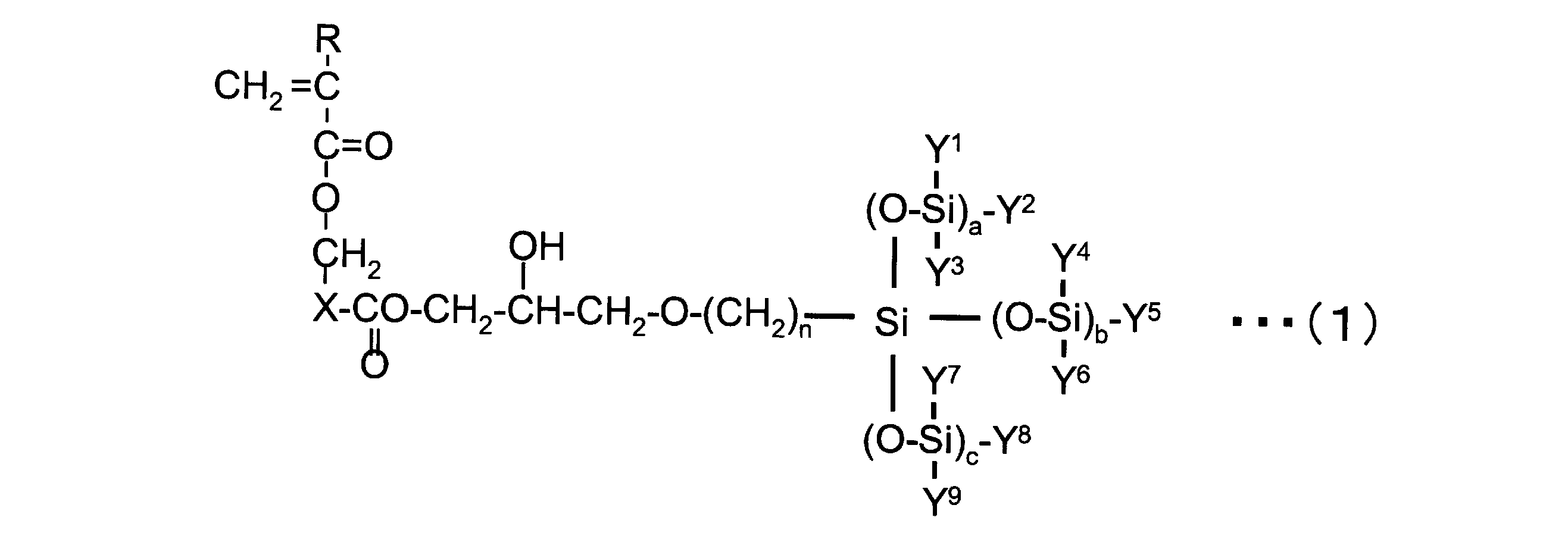
(式(1)中、Xはエステル基を1又は2有していてよい炭素数1~12の有機基、Rは水素原子またはメチル基を表す。Y1~Y9はそれぞれが互いに独立に水素原子、炭素数1~4のアルキル基または炭素数6~10のアリール基を表す。nは0~3の整数を表す。a、b及びcはそれぞれが互いに独立に0~3の整数を表す。ただしa+b+c≧1である。)
また本発明によれば、式(3)で表されるカルボン酸と式(4)で表されるエポキシ基含有シロキサンとを反応させることを特徴とする上記式(1)で表されるシリコーンモノマーの製造方法が提供される。
また本発明によれば、式(3)で表されるカルボン酸と式(4)で表されるエポキシ基含有シロキサンとを反応させることを特徴とする上記式(1)で表されるシリコーンモノマーの製造方法が提供される。
更に本発明によれば、上記式(1)で表されるシリコーンモノマーと、MPCとを含む重合用組成物が提供される。
本発明のシリコーンモノマーは、上記式(1)で表される構造を有するので、MPCなどの親水性モノマーを広範囲の混合組成において相溶化させることができる。このため、本発明のシリコーンモノマーと親水性モノマーとを含む重合用組成物は、広範囲の組成において均一に共重合させることができ、高い親水性とシリコーンモノマーが有する性能とを十分発揮させた、透明性に優れた共重合物を得ることができる。
以下、本発明の実施の形態を詳細に説明する。
本発明のシリコーンモノマーは、上記式(1)で表される。
式(1)中、Rは水素原子またはメチル基を表す。Xはエステル基を1又は2有していて良い炭素数1~12の有機基を表す。Xとしては、原料の入手が容易であることから好ましくは式(2)又は式(5a)~(5c)で示される基を挙げることができる。
本発明のシリコーンモノマーは、上記式(1)で表される。
式(1)中、Rは水素原子またはメチル基を表す。Xはエステル基を1又は2有していて良い炭素数1~12の有機基を表す。Xとしては、原料の入手が容易であることから好ましくは式(2)又は式(5a)~(5c)で示される基を挙げることができる。


式(2)中のZにおいて、炭素数1~6の二価の炭化水素基としては、例えば、メチレン基、エチレン基、n-プロピレン基、n-ブチレン基、n-へキシレン基が挙げられ、好ましくは安定性、原料入手性の面からエチレン基が挙げられる。
炭素数6~10の二価の環状炭化水素基としては、例えば、1,2-シクロヘキシレン基、1,3-シクロヘキシレン基、1,4-シクロヘキシレン基、1,2-フェニレン基、1,3-フェニレン基、1,4-フェニレン基、1,2-ナフタレン基、1,3-ナフタレン基、1,4-ナフタレン基、1,5-ナフタレン基、1,6-ナフタレン基、1,7-ナフタレン基、1,8-ナフタレン基、2,3-ナフタレン基、2,6-ナフタレン基が挙げられ、好ましくは入手性の理由から1,2-シクロヘキシレン基、1,2-フェニレン基が挙げられる。
炭素数6~10の二価の環状炭化水素基としては、例えば、1,2-シクロヘキシレン基、1,3-シクロヘキシレン基、1,4-シクロヘキシレン基、1,2-フェニレン基、1,3-フェニレン基、1,4-フェニレン基、1,2-ナフタレン基、1,3-ナフタレン基、1,4-ナフタレン基、1,5-ナフタレン基、1,6-ナフタレン基、1,7-ナフタレン基、1,8-ナフタレン基、2,3-ナフタレン基、2,6-ナフタレン基が挙げられ、好ましくは入手性の理由から1,2-シクロヘキシレン基、1,2-フェニレン基が挙げられる。
式(2)で表される基のより具体的な例としては、式(6a)~(6e)で表される基が挙げられ、好ましくは原料が入手し易いことから式(6b)、式(6d)で表される基が挙げられる。

式(1)中、nは0~3の整数を表す。好ましくは安定性が高いことから、n=2又は3である。
式(1)中、Y1~Y9はそれぞれが互いに独立に水素原子、炭素数1~6のアルキル基、炭素数6~10のアリール基を表す。
炭素数1~6のアルキル基としては、例えば、メチル基、エチル基、プロピル基、ブチル基、シクロヘキシル基が挙げられる。
炭素数6~10のアリール基としては、例えば、フェニル基、ベンジル基、フェニルエチル基、ナフチル基が挙げられる。前記Y1~Y9として最も好ましいのは原料の入手が容易であることから、メチル基である。
式(1)中、Y1~Y9はそれぞれが互いに独立に水素原子、炭素数1~6のアルキル基、炭素数6~10のアリール基を表す。
炭素数1~6のアルキル基としては、例えば、メチル基、エチル基、プロピル基、ブチル基、シクロヘキシル基が挙げられる。
炭素数6~10のアリール基としては、例えば、フェニル基、ベンジル基、フェニルエチル基、ナフチル基が挙げられる。前記Y1~Y9として最も好ましいのは原料の入手が容易であることから、メチル基である。
式(1)中、a、b及びcはそれぞれが互いに独立に0~3、好ましくは0~2の整数を表す。ただしa+b+c≧1である。好ましいa、b及びcの組み合わせは、原料の入手が容易であることから、a=b=c=1、a=b=1かつc=0、およびa=1かつb=c=0である。
式(1)で示されるシリコーンモノマーとしては、例えば、式(7a)~(7d)に示される構造のシリコーンモノマーが好ましく挙げられる。これらのうち、最も好ましいものは親水性モノマーとの相溶性に特に優れ、かつ他のシリコーンモノマーとも容易に溶解させることができる式(7a)で表される化合物が挙げられる。

式(1)で表されるシリコーンモノマーの好ましい製造方法としては、例えば、上記式(3)で表されるカルボン酸と、上記式(4)で表されるエポキシ基含有シロキサンとを反応させる方法が挙げられ、得られる生成物は、分離精製を行うことで所望のシリコーンモノマーを得ることができる。
上記式(3)中のX、R、上記式(4)中のY1~Y9、n、a、b及びcは、上記式(1)に対応するものであり、上述の好ましい例及び具体例が挙げられる。
上記式(3)中のX、R、上記式(4)中のY1~Y9、n、a、b及びcは、上記式(1)に対応するものであり、上述の好ましい例及び具体例が挙げられる。
式(3)で表されるカルボン酸としては市販のものが使用できるが、好ましくは、親水性モノマーとの相溶性が無いか、低い他のシリコーンモノマーや、親水性モノマーのそれぞれに対する相溶性が高いという理由から、エステル基を3個含む式(5)で表されるカルボン酸が挙げられる。

式(5)で表されるカルボン酸の最も好ましい例としては、原料の入手が容易であることから、例えば、2-メタクリロイルオキシエチルコハク酸、2-メタクリロイルオキシエチルフタル酸、2-メタクリロイルオキシエチルヘキサヒドロフタル酸が挙げられる。
上記式(4)で表されるエポキシ基含有シロキサンとしては市販のものが使用できるが、原料を入手し易いことから式(8a)~(8c)で示されるものが好ましく挙げられ、中でも式(8b)で示されるものが更に好ましい。
式(3)で表されるカルボン酸と、式(4)で表されるエポキシ基含有シロキサンとの反応は、例えば、無溶媒で、又は非プロトン性溶媒中で行うことができる。反応温度は、通常70~150℃、好ましくは副分解反応が起こり難い70~100℃、反応時間は、通常6時間~48時間、好ましくは12~24時間である。
前記反応には、反応を促進するために触媒を用いることができる。該触媒としては、例えば、水酸化カリウム、ナトリウムエトキシド、1,8-ジアザビシクロ[5,4,0]ウンデカ-7-エン、トリメチルベンジルアンモニウムクロライド、トリメチルベンジルアンモニウムクロライド、トリエチルアミンが挙げられる。特に好ましい触媒としては、求核性が低いことから1,8-ジアザビシクロ[5,4,0]ウンデカ-7-エン、トリエチルアミン、ナトリウムエトキシドが挙げられる。
触媒の使用量は、式(3)で表されるカルボン酸に対して、好ましくは0.03~0.24モル比である。
触媒の使用量は、式(3)で表されるカルボン酸に対して、好ましくは0.03~0.24モル比である。
反応に際しては、カルボン酸等が重合しないように重合禁止剤を用いるのが好ましい。重合禁止剤としては、例えば、ヒドロキノンモノメチルエーテル、1,4-ジヒドロキシベンゼン、4-メトキシフェノールが挙げられ、反応終了後、塩基洗浄により容易に除去することが可能な点から1,4-ジヒドロキシベンゼンまたは4-メトキシフェノールの使用が好ましい。
重合禁止剤の使用量は、反応液中に通常100~1000ppm程度である。
重合禁止剤の使用量は、反応液中に通常100~1000ppm程度である。
反応において、式(3)で表されるカルボン酸と、式(4)で表されるエポキシ基含有シロキサンとの仕込み割合は、反応系中の該エポキシ基含有シロキサンを99%以上反応させるために、該エポキシ基含有シロキサン1モルに対して、前記カルボン酸を1.5~3モルの割合になるようにすることが好ましい。
反応後に得られるシリコーンモノマーは、高沸点で重合性を有する液体であり、再結晶や蒸留操作の利用が困難であるため、洗浄により精製することが好ましい。
該洗浄は、例えば、得られた反応液をn-ヘキサンに溶解し、洗浄液として、水酸化ナトリウム水溶液や、有機塩基のアセトニトリル溶液で行うことができる。該有機塩基としては、例えば、トリエチルアミン、アンモニア、トリエタノールアミン、ジエタノールアミン、エタノールアミンが挙げられる。
前記n-ヘキサンの使用量は、精製時の油相と水相の分離が容易であることから、反応液の容量の約9倍程度であることが望ましい。また、前記洗浄液の使用量は、通常n-ヘキサンと同容量程度である。
該洗浄は、例えば、得られた反応液をn-ヘキサンに溶解し、洗浄液として、水酸化ナトリウム水溶液や、有機塩基のアセトニトリル溶液で行うことができる。該有機塩基としては、例えば、トリエチルアミン、アンモニア、トリエタノールアミン、ジエタノールアミン、エタノールアミンが挙げられる。
前記n-ヘキサンの使用量は、精製時の油相と水相の分離が容易であることから、反応液の容量の約9倍程度であることが望ましい。また、前記洗浄液の使用量は、通常n-ヘキサンと同容量程度である。
このような洗浄により、反応終了後に残存する過剰の前記カルボン酸を除去することができる。該カルボン酸は、洗浄液中に、塩基との塩として洗浄液(下相)中に抽出されるため、分液ロートを使用して、洗浄液を除去し、洗浄液が塩基性になるまでこの洗浄を繰り返すことが好ましい。
一方、n-ヘキサン相には少量の塩基が混入するため、さらに水又は食塩水で洗浄し、アルカリを除去することが好ましい。この操作は、洗浄後の食塩水が中性になるまで繰り返すことが望ましい。
一方、n-ヘキサン相には少量の塩基が混入するため、さらに水又は食塩水で洗浄し、アルカリを除去することが好ましい。この操作は、洗浄後の食塩水が中性になるまで繰り返すことが望ましい。
上記洗浄後、無水流酸ナトリウム等の脱水剤を使用して、反応液中に含まれる少量の水を脱水し、ろ過後、例えば、エバポレーターを使用してn-ヘキサンを留去することにより、所望のシリコーンモノマーが得られる。
n-ヘキサンの留去は、約60℃以下で行い、真空ポンプを用いて5~10mmHgに減圧して約1時間吸引する操作により行うことが好ましい。
n-ヘキサンの留去は、約60℃以下で行い、真空ポンプを用いて5~10mmHgに減圧して約1時間吸引する操作により行うことが好ましい。
上記精製後の生成物は、通常、目的の式(1)で示されるシリコーンモノマーと、式(1')で示されるシリコーンモノマーとの混合物として得られる。

式(1')中、R、X、Y1~Y9、n、a、b及びcは、式(1)のものと同様である。
該混合物は、後述する本発明の重合用組成物にそのまま用いることができるが、混合物中の式(1)で示されるシリコーンモノマーと式(1')で示されるシリコーンモノマーとの含有割合は、質量比で通常2/1~8/1、好ましくは3/1~5/1である。式(1)で示されるシリコーンモノマーの割合が2/1未満では、親水性モノマーの相溶化能が低下する恐れがある。
本発明のシリコーンモノマーは、例えば、レンズ用材料として用いることができる。特に、本発明のシリコーンモノマーは、MPC等の高い親水性を示すモノマーと相溶化するために、例えば、本発明のシリコーンモノマーと、MPCとを含む本発明の重合用組成物とすることができる。
本発明の重合用組成物において、MPCの含有割合は、本発明のシリコーンモノマーもしくは、本発明のシリコーンモノマーと上記式(1')で示されるシリコーンモノマーとの混合物100質量部に対して、通常10~70質量部、好ましくは20~50質量部である。MPCの含有割合が10質量部より少ないと、得られる重合物の表面の親水性が低下する恐れがあり、70質量部より多いと、得られる重合物の酸素透過率が低下する恐れがある。
本発明の重合用組成物には、必要により他の共重合性モノマーを含有させることができる。他の共重合性モノマーの含有割合は、本発明のシリコーンモノマー100質量部に対して、通常0~150質量部、好ましくは0~100質量部である。
本発明の重合用組成物には、必要により他の共重合性モノマーを含有させることができる。他の共重合性モノマーの含有割合は、本発明のシリコーンモノマー100質量部に対して、通常0~150質量部、好ましくは0~100質量部である。
他の共重合モノマーは、共重合可能であれば何ら制限はなく、(メタ)アクリロイル基、スチリル基、アリル基、ビニル基および他の共重合可能な炭素-炭素不飽和結合を有するモノマーを使用することができる。
他の共重合モノマーとしては、例えば、(メタ)アクリル酸、イタコン酸、クロトン酸、桂皮酸、ビニル安息香酸、ホスホリルコリン(メタ)アクリレート、メチル(メタ)アクリレート、エチル(メタ)アクリレート等のアルキル(メタ)アクリレート類;ポリアルキレングリコールモノ(メタ)アクリレート、ポリアルキレングリコールモノアルキルエーテル(メタ)アクリレート、ポリアルキレングリコールビス(メタ)アクリレート、トリメチロールプロパントリス(メタ)アクリレート、ペンタエリスリトールテトラキス(メタ)アクリレート、両末端に炭素-炭素不飽和結合を有するシロキサンマクロマー等の多官能(メタ)アクリレート類;トリフルオロエチル(メタ)アクリレート、ヘキサフルオロイソプロピル(メタ)アクリレート等のハロゲン化アルキル(メタ)アクリレート類;2-ヒドロキシエチル(メタ)アクリレート、2,3-ジヒドロキシプロピル(メタ)アクリレート、グリセロール(メタ)アクリレート等の水酸基を有するヒドロキシアルキル(メタ)アクリレート類;N,N-ジメチルアクリルアミド、N,N-ジエチルアクリルアミド、N,N-ジ-n-プロピルアクリルアミド、N,N-ジイソプロピルアクリルアミド、N,N-ジn-ブチルアクリルアミド、N-アクリロイルモルホリン、N-アクリロイルピペリジン、N-アクリロイルピロリジン、N-メチル(メタ)アクリルアミド等の(メタ)アクリルアミド類;スチレン、α-メチルスチレン、ビニルピリジン等の芳香族ビニルモノマー;マレイミド類;N-ビニルピロリドン、N-ビニルカプロラクタム、N-ビニルオキサゾリドン、1-ビニルイミダゾール、N-ビニルカルバゾール、ビニルピリジン、ビニルピラジン等のヘテロ環ビニルモノマー;N-ビニルホルムアミド、N-ビニルアセトアミド、N-メチル-N-ビニルアセトアミド等のN-ビニルカルボキサミド類;酢酸ビニル等のビニルエステル類;3-[トリス(トリメチルシロキシ)シリル]プロピル(メタ)アクリレート、3-[ビス(トリメチルシロキシ)メチルシリル]プロピル(メタ)アクリレート、3-[(トリメチルシロキシ)ジメチルシリル]プロピル(メタ)アクリレート、3-[トリス(トリメチルシロキシ)シリル]プロピル(メタ)アクリルアミド、3-[ビス(トリメチルシロキシ)メチルシリル]プロピル(メタ)アクリルアミド、3-[(トリメチルシロキシ)ジメチルシリル]プロピル(メタ)アクリルアミド、[トリス(トリメチルシロキシ)シリル]メチル(メタ)アクリレート、[ビス(トリメチルシロキシ)メチルシリル]メチル(メタ)アクリレート、[(トリメチルシロキシ)ジメチルシリル]メチル(メタ)アクリレート、[トリス(トリメチルシロキシ)シリル]メチル(メタ)アクリルアミド、[ビス(トリメチルシロキシ)メチルシリル]メチル(メタ)アクリルアミド、[(トリメチルシロキシ)ジメチルシリル]メチル(メタ)アクリルアミド、[トリス(トリメチルシロキシ)シリル]スチレン、[ビス(トリメチルシロキシ)メチルシリル]スチレン、[(トリメチルシロキシ)ジメチルシリル]スチレン、N-〔3-[トリス(トリメチルシロキシ)シリル]プロピル〕カルバミン酸ビニル、N-〔3-[ビス(トリメチルシロキシ)メチルシリル]プロピル〕カルバミン酸ビニル、N-〔3-[(トリメチルシロキシ)ジメチルシリル]プロピル〕カルバミン酸ビニル等のシロキサン含有モノマーが挙げられ、好ましくは共重合性が良いことから(メタ)アクリレート類が挙げられる。
本発明の重合用組成物を重合する際は、重合をし易くするために過酸化物やアゾ化合物に代表される熱重合開始剤や、光重合開始剤を用いることが好ましい。
熱重合を行う場合は、所望の反応温度に対して最適な分解特性を有するものを選択して使用することができる。一般的には10時間半減期温度が40~120℃のアゾ系開始剤又は過酸化物系開始剤が好適である。
光重合開始剤としては、例えば、カルボニル化合物、過酸化物、アゾ化合物、硫黄化合物、ハロゲン化合物又は金属塩が挙げられる。
これらの重合開始剤は単独又は混合して用いられ、その使用量は、重合用組成物100質量部に対して、およそ1質量部以下である。
本発明の重合用組成物は、シリコーンハイドロゲルコンタクトレンズなどの原料として好適に用いることができる。
熱重合を行う場合は、所望の反応温度に対して最適な分解特性を有するものを選択して使用することができる。一般的には10時間半減期温度が40~120℃のアゾ系開始剤又は過酸化物系開始剤が好適である。
光重合開始剤としては、例えば、カルボニル化合物、過酸化物、アゾ化合物、硫黄化合物、ハロゲン化合物又は金属塩が挙げられる。
これらの重合開始剤は単独又は混合して用いられ、その使用量は、重合用組成物100質量部に対して、およそ1質量部以下である。
本発明の重合用組成物は、シリコーンハイドロゲルコンタクトレンズなどの原料として好適に用いることができる。
以下、実施例により、本発明を具体的に説明する。
本実施例における各種測定は、以下に示す方法で行った。
〔測定方法〕
(1)プロトン核磁気共鳴スペクトル
日本電子社製のAL400型を用いて測定した。溶媒にクロロホルム-dを使用し、クロロホルムのピークを内部標準(7.26ppm)とした。
(2)高速液体クロマトグラフィー
高速液体クロマトグラフィーシステム(東ソー社製 LC-8020)を使用した。高速液体クロマトグラフィーカラムからの流出液はUV検出器とRI検出器を用いて検出した。アセトニトリル90体積%と0.05M酢酸アンモニウム水溶液10体積%を混合した液を溶離液とし、サンプルは0.5体積%の濃度でこの溶離液へ溶解し、分析に供した。高速液体クロマトグラフィー条件は下記のとおりである。
C18(オクタデシル化シリカ)カラム(15mm×4.6mm)。
(3)質量分析
Q-micro(Waters社製、ESIイオン化法)を用い、サンプルをメタノール中へ溶解させて分析を行なった。
(4)赤外線吸収スペクトル分析
FT/IR-6100(日本分光社製)を用い、ポリエチレンフィルムへサンプルを吸収させて測定を行なった。
本実施例における各種測定は、以下に示す方法で行った。
〔測定方法〕
(1)プロトン核磁気共鳴スペクトル
日本電子社製のAL400型を用いて測定した。溶媒にクロロホルム-dを使用し、クロロホルムのピークを内部標準(7.26ppm)とした。
(2)高速液体クロマトグラフィー
高速液体クロマトグラフィーシステム(東ソー社製 LC-8020)を使用した。高速液体クロマトグラフィーカラムからの流出液はUV検出器とRI検出器を用いて検出した。アセトニトリル90体積%と0.05M酢酸アンモニウム水溶液10体積%を混合した液を溶離液とし、サンプルは0.5体積%の濃度でこの溶離液へ溶解し、分析に供した。高速液体クロマトグラフィー条件は下記のとおりである。
C18(オクタデシル化シリカ)カラム(15mm×4.6mm)。
(3)質量分析
Q-micro(Waters社製、ESIイオン化法)を用い、サンプルをメタノール中へ溶解させて分析を行なった。
(4)赤外線吸収スペクトル分析
FT/IR-6100(日本分光社製)を用い、ポリエチレンフィルムへサンプルを吸収させて測定を行なった。
実施例1
冷却管、撹拌装置および滴下ロートを備えた300ml三ツ口フラスコに、前記式(8b)で示される化合物(信越化学工業社製)36.6g、1,4-ジヒドロキシベンゼン0.07g及びトリエチルアミン0.66gを入れ、ここへ窒素雰囲気下、室温で撹拌しながら式(9)で示される化合物(共栄社化学社製)50.0gを約30分間かけて滴下した。
冷却管、撹拌装置および滴下ロートを備えた300ml三ツ口フラスコに、前記式(8b)で示される化合物(信越化学工業社製)36.6g、1,4-ジヒドロキシベンゼン0.07g及びトリエチルアミン0.66gを入れ、ここへ窒素雰囲気下、室温で撹拌しながら式(9)で示される化合物(共栄社化学社製)50.0gを約30分間かけて滴下した。
滴下終了後撹拌しながら85℃で24時間反応を行った。一晩放置した後、ヘキサン170mlを加えて室温で2時間撹拌した。析出物をろ過で除き、ヘキサン溶液を5質量%炭酸水素ナトリウムで数回洗浄後、さらに飽和食塩水で中性になるまで洗浄した。無水硫酸ナトリウムを加えて脱水を行った後、硫酸マグネシウムを濾過で除き、ロータリーバキュームエバポレーターによって溶媒を留去した。さらに減圧下60℃で4時間かけて揮発成分を除去し、無色透明液体50.0gを得た。得られた液体をシリカゲルカラムクロマトグラフィー法(展開溶媒;ヘキサン/酢酸エチル=1/1(v/v))により分離精製し、無色透明液体を得た。
得られた液体を、プロトン核磁気共鳴スペクトルにより測定し分析した結果、6.1ppm付近(1H)、5.8ppm付近(1H)および1.9ppm付近(3H)にメタアクリロイル基由来のピーク、4.4ppm付近(4H)にO-CH2-CH2-O由来のピーク、2.6ppm付近(4H)にC(=O)-CH2-CH2-C=O由来のピーク、1.6ppm付近(2H)にC-CH2-C由来のピーク、0.5ppm付近(2H)に-CH2-Si由来のピーク、0ppm付近(21H)にSi-CH3由来のピークなどが観測された。3.7~3.9ppm及び5.0ppm付近には式(10)の化合物に特徴的なピークが観測された。また4.0~4.2ppm付近に式(7a)で表される化合物に由来するピークが確認された。この面積比から、式(7a)で示されるシリコーンモノマーと式(10)で示される化合物の質量比約4/1混合物であることがわかった。
得られた液体を、プロトン核磁気共鳴スペクトルにより測定し分析した結果、6.1ppm付近(1H)、5.8ppm付近(1H)および1.9ppm付近(3H)にメタアクリロイル基由来のピーク、4.4ppm付近(4H)にO-CH2-CH2-O由来のピーク、2.6ppm付近(4H)にC(=O)-CH2-CH2-C=O由来のピーク、1.6ppm付近(2H)にC-CH2-C由来のピーク、0.5ppm付近(2H)に-CH2-Si由来のピーク、0ppm付近(21H)にSi-CH3由来のピークなどが観測された。3.7~3.9ppm及び5.0ppm付近には式(10)の化合物に特徴的なピークが観測された。また4.0~4.2ppm付近に式(7a)で表される化合物に由来するピークが確認された。この面積比から、式(7a)で示されるシリコーンモノマーと式(10)で示される化合物の質量比約4/1混合物であることがわかった。
さらに、赤外線吸収スペクトル分析を行なった結果、水酸基に由来するピークが3510cm-1に、二重結合に由来するピークが1640cm-1に、メタクリルエステル結合に由来するピークが1730cm-1に、コハク酸エステルに由来するピークが1740cm-1に、Si-O-Si結合に由来するピークが1040cm-1に、メチル基に由来するピークが2960cm-1、1410cm-1、1300cm-1に、シロキサンに結合しているメチル基に由来するピークが845cm-1に検出された。また、910cm-1のエポキシ基に由来するピーク、1715cm-1のカルボン酸に由来するピークは検出されなかった。
次に高速液体クロマトグラフィーで分析したところ、単一ピークが観測された。純度は約90%であった。またESI-質量分析を行なったところ、2つの化合物の分子量はどちらも566であった。
次に高速液体クロマトグラフィーで分析したところ、単一ピークが観測された。純度は約90%であった。またESI-質量分析を行なったところ、2つの化合物の分子量はどちらも566であった。
実施例2
冷却管、撹拌装置および滴下ロートを備えた300ml三ツ口フラスコに、上記式(8b)で示される化合物(信越化学工業社製)36.6g、1,4-ジヒドロキシベンゼン0.07g、トリエチルアミン0.66g及び式(11)で表される化合物(共栄社化学社製)61.8gを入れ、攪拌しながら溶解させた。その後撹拌しながら85℃で24時間反応を行った。
冷却管、撹拌装置および滴下ロートを備えた300ml三ツ口フラスコに、上記式(8b)で示される化合物(信越化学工業社製)36.6g、1,4-ジヒドロキシベンゼン0.07g、トリエチルアミン0.66g及び式(11)で表される化合物(共栄社化学社製)61.8gを入れ、攪拌しながら溶解させた。その後撹拌しながら85℃で24時間反応を行った。

一晩放置した後、ヘキサン170mlを加えて室温で2時間撹拌した。析出物をろ過で除き、ヘキサン溶液を2質量%のトリエチルアミンを溶解させたアセトニトリル溶液で数回洗浄した。無水硫酸マグネシウムを加えてヘキサン相から脱水を行った後、硫酸マグネシウムを濾過で除き、ロータリーバキュームエバポレーターによって溶媒を留去した。さらに減圧下60℃で4時間かけて揮発成分を除去し、無色透明液体35.0gを得た。得られた液体をシリカゲルカラムクロマトグラフィー法(展開溶媒;ヘキサン/酢酸エチル=2/1(v/v))により分離精製し、無色透明液体を得た。
得られた液体のプロトン核磁気共鳴スペクトルを測定し分析した結果、6.1ppm付近(1H)、5.6ppm付近(1H)および1.9ppm付近(3H)にメタアクリロイル基由来のピーク、4.2ppm付近(4H)にO-CH2-CH2-O由来のピーク、2.6ppm付近(4H)にC(=O)-CH2-CH2-C=O由来のピーク、1.5から1.9ppm付近(10H)にC-CH2-C由来のピーク、0.5ppm付近(2H)に-CH2-Si由来のピーク、0ppm付近(21H)にSi-CH3由来のピークなどが観測された。また3.9~4.1ppm付近に式(7b)で表される化合物に由来するピークが、また3.6~3.7ppmに式(12)で表される化合物に由来するピークが確認された。この面積比から、式(7b)の化合物と下記式で表される化合物の約4/1混合物であることがわかった。
また質量分析によると2つの化合物の分子量はどちらも620であった。
得られた液体のプロトン核磁気共鳴スペクトルを測定し分析した結果、6.1ppm付近(1H)、5.6ppm付近(1H)および1.9ppm付近(3H)にメタアクリロイル基由来のピーク、4.2ppm付近(4H)にO-CH2-CH2-O由来のピーク、2.6ppm付近(4H)にC(=O)-CH2-CH2-C=O由来のピーク、1.5から1.9ppm付近(10H)にC-CH2-C由来のピーク、0.5ppm付近(2H)に-CH2-Si由来のピーク、0ppm付近(21H)にSi-CH3由来のピークなどが観測された。また3.9~4.1ppm付近に式(7b)で表される化合物に由来するピークが、また3.6~3.7ppmに式(12)で表される化合物に由来するピークが確認された。この面積比から、式(7b)の化合物と下記式で表される化合物の約4/1混合物であることがわかった。
また質量分析によると2つの化合物の分子量はどちらも620であった。

実施例3
実施例1で得た式(7a)で示される化合物及び式(10)で示される化合物の約4/1混合物37.0質量部、トリス(トリメチルシロキシ)シリルプロピルメタクリレート37.5質量部、MPC 15質量部、エタノール10質量部、アゾビスイソブチロニトリル0.5質量部を混合し、相溶させた後、100℃で5時間放置することにより重合した。重合後は、透明固体が得られた。
実施例1で得た式(7a)で示される化合物及び式(10)で示される化合物の約4/1混合物37.0質量部、トリス(トリメチルシロキシ)シリルプロピルメタクリレート37.5質量部、MPC 15質量部、エタノール10質量部、アゾビスイソブチロニトリル0.5質量部を混合し、相溶させた後、100℃で5時間放置することにより重合した。重合後は、透明固体が得られた。
比較例1
メチルジ(トリメチルシロキシ)シリルプロピルグリセロールメタクリレート(SiGMA)37.0質量部、トリス(トリメチルシロキシ)シリルプロピルメタクリレート37.5質量部、MPC15質量部、エタノール10質量部、アゾビスイソブチロニトリル0.5質量部を混合し、相溶させた後、100℃で5時間放置することにより重合した。重合後は、白濁固体が得られた。
メチルジ(トリメチルシロキシ)シリルプロピルグリセロールメタクリレート(SiGMA)37.0質量部、トリス(トリメチルシロキシ)シリルプロピルメタクリレート37.5質量部、MPC15質量部、エタノール10質量部、アゾビスイソブチロニトリル0.5質量部を混合し、相溶させた後、100℃で5時間放置することにより重合した。重合後は、白濁固体が得られた。
実施例4
実施例1で得た式(7a)で示される化合物及び式(10)で示される化合物の約4/1混合物60.0質量部と、エタノール10質量部に溶解させたMPC 40質量部を混合、攪拌したところ、相溶した。
実施例1で得た式(7a)で示される化合物及び式(10)で示される化合物の約4/1混合物60.0質量部と、エタノール10質量部に溶解させたMPC 40質量部を混合、攪拌したところ、相溶した。
実施例5
実施例1で得た式(7a)で示される化合物及び式(10)で示される化合物の約4/1混合物60.0質量部と、エタノール8質量部、MPC 20質量部を混合、攪拌したところ、相溶した。
実施例1で得た式(7a)で示される化合物及び式(10)で示される化合物の約4/1混合物60.0質量部と、エタノール8質量部、MPC 20質量部を混合、攪拌したところ、相溶した。
比較例2
メチルジ(トリメチルシロキシ)シリルプロピルグリセロールメタクリレート(SiGMA)60.0質量部と、エタノール8質量部、MPC 20質量部を混合、攪拌したところ、沈殿物が見られた。
メチルジ(トリメチルシロキシ)シリルプロピルグリセロールメタクリレート(SiGMA)60.0質量部と、エタノール8質量部、MPC 20質量部を混合、攪拌したところ、沈殿物が見られた。
Claims (5)
- 式(1)で表されるシリコーンモノマー。

- 式(1)中、Xが式(2)で示される基である請求項1のシリコーンモノマー。

- 式(3)で表されるカルボン酸と式(4)で表されるエポキシ基含有シロキサンとを反応させることを特徴とする請求項1のシリコーンモノマーの製造方法。
- 請求項1のシリコーンモノマーと、2-メタクリロイルオキシエチル-2-トリメチルアンモニオエチルホスフェートとを含む重合用組成物。
- 請求項2のシリコーンモノマーと、2-メタクリロイルオキシエチル-2-トリメチルアンモニオエチルホスフェートとを含む重合用組成物。
Priority Applications (1)
| Application Number | Priority Date | Filing Date | Title |
|---|---|---|---|
| JP2010526778A JP5402934B2 (ja) | 2008-08-28 | 2009-08-28 | シリコーンモノマー、その製造方法および用途 |
Applications Claiming Priority (2)
| Application Number | Priority Date | Filing Date | Title |
|---|---|---|---|
| JP2008219845 | 2008-08-28 | ||
| JP2008-219845 | 2008-08-28 |
Publications (1)
| Publication Number | Publication Date |
|---|---|
| WO2010024372A1 true WO2010024372A1 (ja) | 2010-03-04 |
Family
ID=41721535
Family Applications (1)
| Application Number | Title | Priority Date | Filing Date |
|---|---|---|---|
| PCT/JP2009/065036 Ceased WO2010024372A1 (ja) | 2008-08-28 | 2009-08-28 | シリコーンモノマー、その製造方法および用途 |
Country Status (2)
| Country | Link |
|---|---|
| JP (1) | JP5402934B2 (ja) |
| WO (1) | WO2010024372A1 (ja) |
Cited By (3)
| Publication number | Priority date | Publication date | Assignee | Title |
|---|---|---|---|---|
| WO2010082659A1 (ja) * | 2009-01-19 | 2010-07-22 | 日油株式会社 | シリコーンモノマー |
| JP2011246666A (ja) * | 2010-05-31 | 2011-12-08 | Nof Corp | ホスホリルコリン基含有(メタ)アクリレート |
| CN116635437A (zh) * | 2020-12-16 | 2023-08-22 | 日油株式会社 | 隐形眼镜用单体组合物、隐形眼镜用聚合物以及隐形眼镜及其制造方法 |
Citations (3)
| Publication number | Priority date | Publication date | Assignee | Title |
|---|---|---|---|---|
| JPS5455455A (en) * | 1977-10-12 | 1979-05-02 | Toyo Contact Lens Co Ltd | Contact lens |
| JPS5515110A (en) * | 1978-07-15 | 1980-02-02 | Toyo Contact Lens Co Ltd | Contact lens |
| JPS5622325A (en) * | 1979-07-31 | 1981-03-02 | Shin Etsu Chem Co Ltd | Production of polymerizable organopolysiloxane |
-
2009
- 2009-08-28 WO PCT/JP2009/065036 patent/WO2010024372A1/ja not_active Ceased
- 2009-08-28 JP JP2010526778A patent/JP5402934B2/ja not_active Expired - Fee Related
Patent Citations (3)
| Publication number | Priority date | Publication date | Assignee | Title |
|---|---|---|---|---|
| JPS5455455A (en) * | 1977-10-12 | 1979-05-02 | Toyo Contact Lens Co Ltd | Contact lens |
| JPS5515110A (en) * | 1978-07-15 | 1980-02-02 | Toyo Contact Lens Co Ltd | Contact lens |
| JPS5622325A (en) * | 1979-07-31 | 1981-03-02 | Shin Etsu Chem Co Ltd | Production of polymerizable organopolysiloxane |
Cited By (4)
| Publication number | Priority date | Publication date | Assignee | Title |
|---|---|---|---|---|
| WO2010082659A1 (ja) * | 2009-01-19 | 2010-07-22 | 日油株式会社 | シリコーンモノマー |
| US8481608B2 (en) | 2009-01-19 | 2013-07-09 | Nof Corporation | Silicone monomer |
| JP2011246666A (ja) * | 2010-05-31 | 2011-12-08 | Nof Corp | ホスホリルコリン基含有(メタ)アクリレート |
| CN116635437A (zh) * | 2020-12-16 | 2023-08-22 | 日油株式会社 | 隐形眼镜用单体组合物、隐形眼镜用聚合物以及隐形眼镜及其制造方法 |
Also Published As
| Publication number | Publication date |
|---|---|
| JP5402934B2 (ja) | 2014-01-29 |
| JPWO2010024372A1 (ja) | 2012-01-26 |
Similar Documents
| Publication | Publication Date | Title |
|---|---|---|
| JP5699931B2 (ja) | シリコーンモノマー | |
| WO2018190158A1 (ja) | ポリシロキサンモノマー及びその製造方法 | |
| JP4882136B2 (ja) | モノマー、ポリマーおよびそれを用いた眼用レンズ | |
| CN113906037B (zh) | 硅氧烷及其制备方法 | |
| JP2007186709A (ja) | 眼用レンズ用モノマー、眼用レンズ用ポリマーおよびコンタクトレンズ | |
| JP5972090B2 (ja) | 高純度(メタ)アクリルシリコーン化合物の製造方法 | |
| EP2955208B1 (en) | Silicone compound and a use thereof | |
| JP2021088689A (ja) | シロキサン化合物及びその製造方法 | |
| JP7639702B2 (ja) | ホスホリルコリン基含有ポリシロキサンモノマー | |
| JP5402934B2 (ja) | シリコーンモノマー、その製造方法および用途 | |
| JP3982114B2 (ja) | 眼用レンズ用モノマー、眼用レンズ用ポリマーおよびそれを用いたコンタクトレンズ | |
| JP4123648B2 (ja) | ポリマーおよびそれを用いた眼用レンズ | |
| CN102257022B (zh) | 有机硅单体 | |
| JP2012017285A (ja) | シリコーンモノマー、その製造方法、単量体組成物及び重合体 | |
| JP5387822B2 (ja) | シリコーンモノマー | |
| JP2018065969A (ja) | シリコーンの製造方法 | |
| US11407862B2 (en) | Silicone and a method for preparing the same | |
| JP7108558B2 (ja) | (メタ)アクリルシリコーン化合物の製造方法 | |
| JP5526845B2 (ja) | シリコーンモノマー | |
| JP4882137B2 (ja) | 眼用レンズ | |
| WO2013098966A1 (ja) | シリコーンモノマー及びその製造方法 | |
| JP5111837B2 (ja) | シリコーンモノマーの製造方法及びその中間体の製造方法及びその成形体 | |
| CN121620550A (zh) | 聚硅氧烷化合物、聚合物、水凝胶、医用材料以及聚硅氧烷化合物的制备方法 | |
| JP2023058871A (ja) | ポリシロキサン化合物及びその製造方法 | |
| JP5482753B2 (ja) | モノマー、ポリマーおよびそれを用いた眼用レンズ |
Legal Events
| Date | Code | Title | Description |
|---|---|---|---|
| 121 | Ep: the epo has been informed by wipo that ep was designated in this application |
Ref document number: 09810020 Country of ref document: EP Kind code of ref document: A1 |
|
| WWE | Wipo information: entry into national phase |
Ref document number: 2010526778 Country of ref document: JP |
|
| NENP | Non-entry into the national phase |
Ref country code: DE |
|
| 122 | Ep: pct application non-entry in european phase |
Ref document number: 09810020 Country of ref document: EP Kind code of ref document: A1 |