WO2010021074A1 - 電気コネクタ - Google Patents
電気コネクタ Download PDFInfo
- Publication number
- WO2010021074A1 WO2010021074A1 PCT/JP2009/002869 JP2009002869W WO2010021074A1 WO 2010021074 A1 WO2010021074 A1 WO 2010021074A1 JP 2009002869 W JP2009002869 W JP 2009002869W WO 2010021074 A1 WO2010021074 A1 WO 2010021074A1
- Authority
- WO
- WIPO (PCT)
- Prior art keywords
- contact
- lance
- housing
- electrical connector
- cavity
- Prior art date
- Legal status (The legal status is an assumption and is not a legal conclusion. Google has not performed a legal analysis and makes no representation as to the accuracy of the status listed.)
- Ceased
Links
Images


Classifications
-
- H—ELECTRICITY
- H01—ELECTRIC ELEMENTS
- H01R—ELECTRICALLY-CONDUCTIVE CONNECTIONS; STRUCTURAL ASSOCIATIONS OF A PLURALITY OF MUTUALLY-INSULATED ELECTRICAL CONNECTING ELEMENTS; COUPLING DEVICES; CURRENT COLLECTORS
- H01R13/00—Details of coupling devices of the kinds covered by groups H01R12/70 or H01R24/00 - H01R33/00
- H01R13/40—Securing contact members in or to a base or case; Insulating of contact members
- H01R13/42—Securing in a demountable manner
- H01R13/426—Securing by a separate resilient retaining piece supported by base or case, e.g. collar or metal contact-retention clip
Definitions
- the present invention relates to an electrical connector capable of releasing a locked state of a contact without using a separately prepared jig.
- the electrical connector generally includes a lance within the cavity of the housing for locking and retaining the contact. After assembling the electrical connector, the contacts may be removed from the housing, for example for maintenance of the electrical connector. In order to remove the contact, the lance is displaced in the unlocking direction by a removal jig separate from the electrical connector to release the locked state between the contact and the lance, and then the contact is pulled backward. (For example, Patent Document 1).
- Patent Document 2 proposes an electrical connector that can remove contacts without using a jig.
- This electrical connector has a frame in which the housing is held at a predetermined holding position, and the frame is integrally provided with a release portion for displacing the lance in a direction for releasing the engagement with the contact.
- patent document 2 in order to hold
- the contact between the abutment portion and the abutment portion prevents the housing from being inserted beyond the holding position of the frame.
- the electrical connector of Patent Document 2 once removes the housing from the frame and bends the abutment portion to allow the housing to move relative to the frame in the forward direction relative to the holding position. Thereafter, when the housing is inserted into the frame, the housing moves relative to the front of the holding position without stopping at the holding position. Due to the excessive movement of the housing, the release portion abuts on the lance to displace the lance in the unlocking direction.
- an object of this invention is to provide the electrical connector which can remove a contact from a housing efficiently, without using a jig.
- the electrical connector of the present invention is provided in a contact electrically connected to a mating contact, a housing in which a cavity for accommodating the contact is formed, and a cavity for locking the contact.
- the fitting surface side connected to the mating connector is defined as the front
- the side from which the electric wire is derived is defined as the rear. The same applies to the embodiments to be described later.
- the lock release member includes a drive unit involved in the lock release and an operation unit connected to the drive unit and operated during movement, and the drive unit advances and retracts the path. Is more preferred. If the operation unit is present, the operator can easily move the lock release member by performing an operation such as pushing the operation unit.
- the unlocking member is attached to the housing so as to be movable back and forth between a first position on the front side and a second position on the rear side.
- the lance is displaced in a direction to unlock the contact by applying a load from the unlocking member to the lance.
- the load on the lance is released from the unlocking member, whereby the lance locks the contact. Since this electrical connector can grasp that the contact is locked or unlocked depending on the position (first position, second position) of the unlocking member, the worker performs the work of removing and attaching the contact. Can be done reliably.
- the present invention can be applied to an electrical connector provided with a plurality of contacts and a plurality of lances that lock the plurality of contacts and hold the contacts out of the cavity. In that case, by providing a plurality of integrated unlocking members, it is possible to simultaneously unlock the plurality of contacts by a single unlocking operation.
- the present invention can further include a cover attached to the housing and covering the lock release member. By covering the locking release member with the cover, it is possible to prevent the locking release member from being inadvertently moved to release the locking.
- the lock release member includes the operating portion, at least the operating portion is preferably covered with a cover for preventing inadvertent movement.
- the locked state of the contact can be released by operating the lock release member attached to the housing, it is not necessary to use a jig for removal.
- the locked state of the contact and the lance can be released simply by moving the locking release member from the rear to the front while the contact is locked. Work efficiency of the removal of Furthermore, since the electrical connector of the present invention can perform the removal operation of the contacts only on the lead-out side of the electric wire, the workability of the removal of the contacts is excellent.
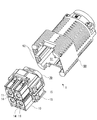
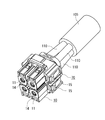
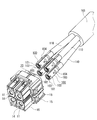
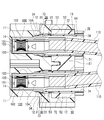
- the electrical connector 1 includes a housing 10 for holding a contact 100 connected to the tip of the electric wire 110 of the cable 105, a lock ring 30 for locking the contact 100 and retaining it, and a presser for fixing the lock ring 30 to the housing 10. It comprises a block 50, a lock release member 70 for operating the lock ring 30 in a direction for releasing the lock with the contact 100, and a cover 90 connected to the housing 10 and covering the rear end thereof.
- the electrical connector 1 can be connected to and disconnected from a mating electrical connector (not shown).
- the housing 10 is manufactured by injection molding of a synthetic resin, and includes a cylindrical cavity 11 penetrating in the front-rear direction.
- the cavities 11 are formed in two rows in the vertical direction and in two rows in the width direction.
- a contact 100 is inserted into each cavity 11 from the rear.
- the cavity 11 has a lock ring accommodating portion 12 at a central portion in the front-rear direction and a pressing block accommodating portion 13 at the rear.
- the lock ring accommodating portion 12 is composed of a portion whose diameter is gradually reduced toward the front, and a portion whose diameter is the same as that of the rear.
- the holding block housing portion 13 has an opening diameter larger than that of the lock ring housing portion 12 and has the same diameter in the front-rear direction.
- the housing 10 has, at each of the cavities 11, a ring-shaped contact control projection 14 that protrudes toward the inside of the cavity 11 at the front end. By abutting the front end of the contact 100 against the contact control projection 14, the contact 100 is positioned at the regular position in the cavity 11.
- the lock ring 30 housed in the lock ring housing 12 has four lance pieces 31 disposed on the conical surface with the slit 32 interposed therebetween.
- a lance piece 31 functioning as a lance in the housing 10 has a rear end connected to a cylindrical base 33 and a front end face having a locking surface 34 opposed to the locking projection 104 of the contact 100.
- the lock ring 30 is integrally manufactured by punching and bending a metal plate such as stainless steel, and the lance piece 31 is at the portion where the front diameter is reduced and the base 33 is at the portion where the rear diameter is equal. It is accommodated in the lock ring accommodating part 12 so that each may be arrange
- the base 33 of the lock ring 30 is pressed against the inner wall of the lock ring housing 12 by a pressing block 50 described later. Further, the lock ring accommodation portion 12 in which the lancet piece 31 is disposed has a sufficient space to allow the lancet piece 31 to bend and be displaced radially outward. Therefore, in the lock ring accommodating portion 12, the lance piece 31 can be bent and deformed radially outward with the base portion 33 as a fixed end.
- the pressing block 50 is manufactured by injection molding of a synthetic resin, and has four main bodies 52 connected by the connecting portion 51. Each main body 52 is formed with a cylindrical through hole 54 penetrating in the front-rear direction. In the through hole 54, the drive portion 72 of the locking release member 70 is disposed so as to be relatively movable in the front-rear direction. Further, at the front end of each main body 52, a ring-shaped lance pressing portion 53 coaxially with the through hole 54 is formed forward. The body 52 of the pressing block 50 is inserted into and fixed to the pressing block accommodating portion 13 of the housing 10.
- the lance pressing portion 53 is inserted into the inner diameter side of the base 33 of the lock ring 30, and presses the base 33 toward the inner wall of the lock ring accommodation portion 12 from the inner diameter side.
- the lock ring 30 is thereby held by the housing 10.
- the locking release member 70 is manufactured by injection molding of a synthetic resin, and has four driving portions 72 whose rear ends are connected by a connecting portion 71.
- the drive portion 72 is a portion involved in releasing the locking of the lancet piece 31, and the connecting portion 71 functions as an operation portion operated by the operator when moving the locking release member 70.
- at least the drive portion 72 is manufactured so as to have higher rigidity in the radial direction than the lance piece 31 of the lock ring 30.
- the driving portion 72 is a hollow cylindrical member having a through hole 74 penetrating in the front and rear direction, and four locking projections 73 protruding radially outward are formed at equal intervals on the outer periphery of the front end portion .
- the locking projection 73 has a front end face having a gentle upward slope from the front to the rear, and the rear end face is perpendicular to the radial direction.
- the outer diameter of the drive portion 72 is set to be slightly smaller than the inner diameter thereof so that the drive portion 72 can be inserted inside the lance pressing portion 53 of the pressing block 50. Further, the outer diameter of the top of the locking projection 73 is set larger than the inner diameter of the lance pressing portion 53. Therefore, when the drive portion 72 is inserted into the through hole 54 of the pressing block 50, the locking projection 73 and the lance pressing portion 53 interfere with each other.
- the cover 90 has a cavity 91 penetrating in the front-rear direction. On the front side of the cavity 91, the rear side of the housing 10 to which the lock ring 30, the pressing block 50 and the lock release member 70 are attached is accommodated. Also, the electric wire 110 is inserted from the rear side of the cavity 91. The contact 100 provided at the tip of the wire 110 is held by the housing 10 in the cavity 91 of the cover 90.
- the contact 100 connected to the electric wire 110 by pressure bonding is formed by bending a plate made of a conductive material such as copper alloy into a cylindrical shape, and a mating contact (not shown) is inserted at the front end
- the opening 101 is provided inside the contact 100.
- a socket-like contact member 102 electrically connected to the other contact is disposed inside the contact 100.
- the position of the contact member 102 in the front-rear direction is restricted by the positioning projection 103 projecting toward the inside of the contact 100 formed on the front and back thereof.
- the positioning projection 103 is formed, for example, by pressing in the state of a plate material.
- a locking projection 104 is formed on the outer peripheral surface of the contact 100 so as to protrude toward the outside of the contact 100.
- the locking projections 104 are also formed, for example, by pressing in the state of a plate material.
- the locking projections 104 are formed at three locations on the outer peripheral surface of the contact 100 at equal intervals. By doing so, regardless of the positions of the lance piece 31 and the contact 100 around their respective axial directions, either one of the locking surfaces 34 of the four lance pieces 31 and one of the three locking projections 104 face each other. Being positioned, the contact 100 is securely locked.
- the procedure for attaching the lock ring 30, the pressing block 50 and the unlocking member 70 to the housing 10 is as follows.
- the drive portion 72 of the locking release member 70 is inserted from the rear end of the through hole 54 of the pressing block 50.
- the outer diameter of the top of the locking projection 73 at the tip of the drive unit 72 is larger than the inner diameter of the lance pressing section 53 of the pressing block 50, so the locking projection 73 and the lance pressing section 53 interfere with each other. Is pushed down, the diameter of the front end portion of the drive portion 72 is reduced by elastic deformation, and the locking projection 73 passes through the lance pressing portion 53. When passing through the lance pressing portion 53, the front end portion of the drive portion 72 elastically returns.
- the locking release member 70 is a position where the locking projection 73 and the lance pressing portion 53 abut against the pressing block 50 (last end, second position), and a position where the connecting portion 71 and the main body 52 It is possible to move back and forth between the front end and the first position).
- the front side of the locking projection 73 is an inclined surface, the locking projection 73 easily passes through the lance pressing portion 53 in the direction from the rear to the front.
- the rear side of the locking projection 73 is a vertical surface, when the locking release member 70 moves from the front to the rear, the locking projection 73 strikes the lance pressing portion 53, and the lance pressing portion It is difficult to pass 53.
- the lance pressing portion 53 has both the function of pressing the base 33 of the lock ring 30 against the housing 10 and the function of restricting the movement range of the locking release member 70.
- the lock ring 30 is attached to the pressing block 50 by fitting the base 33 of the lock ring 30 to the outside of the lance pressing portion 53. Thereby, the locking projection 73 of the locking release member 70 is disposed inside the lock ring 30.
- the assembly consisting of the lock ring 30, the pressing block 50 and the unlocking member 70 is inserted into the cavity 11 of the housing 10 from the side where the lock ring 30 is mounted.
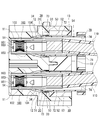
- the assembly is pushed to a proper position where the front end face of the main body 52 of the pressing block 50 abuts against the inner wall surface of the cavity 11, the mounting of the lock ring 30 etc. on the housing 10 is completed (FIG. 6).
- the pressing block 50 is fixed to the cavity 11 of the housing 10.
- the drive portion 72 of the locking release member 70 is disposed in the through hole 54 of the pressing block 50.
- the forward portion of the drive portion 72 including the locking projection 73 protrudes forward beyond the pressing block 50, and the locking projection 73 is disposed inside the lance piece 31.
- the rear portion of the drive portion 72 penetrates the cavity 11 and protrudes rearward than the pressing block 50. That is, an advancing / retracting path is formed between the inner wall of the cavity 11 (the through hole 54 of the pressing block 50) of the housing 10 and the contact 100 from the rear end of the housing 10 to the position of the lance piece 31. It is arranged to be able to move forward and backward. And since the drive part 72 which the latching protrusion 73 reaches to the lance piece 31 was arrange
- attachment of the wire 110 (contact 100) to the housing 10 is performed as follows.
- the electric wire 110 is connected in a state in which the contact 100 is exposed to the outside of the cover 90 through the cavity 91 of the cover 90.
- Each contact 100 connected to the end of the wire 110 is inserted from the rear end of the through hole 74 of the locking release member 70.
- the contact 100 is inserted to a predetermined depth such that the front end thereof abuts on the contact control projection 14 of the housing 10.
- the locking projection 104 formed on the outer periphery of the contact 100 spreads the lance piece 31 of the lock ring 30 outward to pass through the lance piece 31, and the lance piece 31 returns to the original state.
- the locking projection 104 locks the lance piece 31 even if the contact 100 is pulled out. It is locked to the surface 34 and the contact 100 is locked.
- the rear side of the housing 10 is inserted into the normal position of the cavity 91 of the cover 90. Then, the retaining projection 15 provided on the side surface of the housing 10 is locked in the locking groove 92 of the cover 90, and the housing 10 and the cover 90 are locked.
- the electrical connector 1 is in use, i.e., in the state in which the contact 100 is locked, as shown in FIG. 6, the unlocking member 70 is moved to the rearmost end (second position).
- the contact 100 may be removed from the housing 10, for example, for maintenance.
- the locked state of the housing 10 and the cover 90 is released and the cover 90 is removed so that the locking release member 70 can be operated.
- the connecting portion 71 which is the operation portion of the locking release member 70 that has been pulled out to the rearmost end (second position)
- the connecting portion 71 is pushed forward.
- the rigidity of the drive portion 72 is higher than that of the lance piece 31, the lance piece 31 of the lock ring 30 is pushed toward the inner wall of the lock ring accommodation portion 12 by the locking projection 73 moved forward.
- the piece 31 bends and is displaced radially outward, that is, in a direction for releasing the locking.
- the locking release member 70 When the locking release member 70 is pushed until the connecting portion 71 abuts against the main body 52 of the pressing block 50, that is, the front end (first position), the displacement of the lance piece 31 is maximized, and the front end of the lance piece 31
- the diameter of the substantially circular area to be made is larger than the diameter of the top of the locking projection 104 of the contact 100.
- the contact 100 can be removed from the housing 10 by pulling the electric wire 110 backward while the lock release member 70 is positioned at the front end. If the unlocking member 70 is left at the front end even after the contact 100 is removed, then the operation of inserting the contact 100 into the housing 10 is easy.
- the unlocking member 70 tries to stay at the foremost end by the frictional engagement of the locking projection 73 and the lance piece 31.
- the locking release member 70 may be positioned at the front end to release the locked state.
- the locking state of the lance piece 31 can be released by operating the locking release member 70 attached to the housing 10, so that the jig for removal is not used.
- the contact 100 can be removed.
- the locked state of the lance piece 31 can be released only by moving the locking release member 70 from the rearmost end (second position) to the frontmost end (first position). Work efficiency of removal of 100 is good. Also, conversely, since the lance piece 31 can be brought into the locked state only by moving the lock release member 70 from the frontmost end (first position) to the rearmost end (second position), the working efficiency of mounting the contact 100 It is also good.
- the operation of releasing the lock of the electrical connector 1 is to push the connecting portion 71 forward on the rear side of the electrical connector 1, that is, on the lead-out side of the electric wire 110. Therefore, since the series of operations can be performed only on the lead-out side of the electric wire 110 while the electric wire 110 is subsequently pulled out, the workability of removing the contact 100 is excellent. Furthermore, since the electrical connector 1 is housed inside the cover 90, the locking release member 70, in particular, the connecting portion 71 operated when the operator moves the locking release member 70, Precautionary operation is prevented, and the locking state of the lance piece 31 is not released at the time of use.
- the locked state of the four lance pieces 31 can be released at one time by operating the lock release member 70.
- the locking state of the lance pieces 31 may be released one by one by providing the plurality of driving parts 72 independently.
- the present invention can also be applied to an electrical connector 1 in which only one electric wire 110 is connected.
- the lock ring 30 (lance piece 31) functioning as a lance is not limited to this form, and the present invention can be applied to a lance integrally formed in the housing 10.
- the present invention can be applied to the contact 100 even in other forms such as a male contact.
Landscapes
- Connector Housings Or Holding Contact Members (AREA)
- Coupling Device And Connection With Printed Circuit (AREA)
- Details Of Connecting Devices For Male And Female Coupling (AREA)
Priority Applications (2)
| Application Number | Priority Date | Filing Date | Title |
|---|---|---|---|
| CN2009801325347A CN102124612B (zh) | 2008-08-20 | 2009-06-23 | 电连接器 |
| DE112009001980.3T DE112009001980B4 (de) | 2008-08-20 | 2009-06-23 | Elektrischer Verbinder |
Applications Claiming Priority (2)
| Application Number | Priority Date | Filing Date | Title |
|---|---|---|---|
| JP2008-211520 | 2008-08-20 | ||
| JP2008211520A JP5046395B2 (ja) | 2008-08-20 | 2008-08-20 | 電気コネクタ |
Publications (1)
| Publication Number | Publication Date |
|---|---|
| WO2010021074A1 true WO2010021074A1 (ja) | 2010-02-25 |
Family
ID=41706968
Family Applications (1)
| Application Number | Title | Priority Date | Filing Date |
|---|---|---|---|
| PCT/JP2009/002869 Ceased WO2010021074A1 (ja) | 2008-08-20 | 2009-06-23 | 電気コネクタ |
Country Status (4)
| Country | Link |
|---|---|
| JP (1) | JP5046395B2 (enExample) |
| CN (1) | CN102124612B (enExample) |
| DE (1) | DE112009001980B4 (enExample) |
| WO (1) | WO2010021074A1 (enExample) |
Families Citing this family (4)
| Publication number | Priority date | Publication date | Assignee | Title |
|---|---|---|---|---|
| JP6125891B2 (ja) | 2013-05-07 | 2017-05-10 | 矢崎総業株式会社 | 端子金具の保持構造 |
| JP6386138B1 (ja) | 2017-07-14 | 2018-09-05 | 日本航空電子工業株式会社 | コネクタ |
| JP6423053B1 (ja) | 2017-07-14 | 2018-11-14 | 日本航空電子工業株式会社 | コネクタ |
| JP2020193668A (ja) * | 2019-05-28 | 2020-12-03 | 本田技研工業株式会社 | ベアリングの取り外し方法 |
Citations (1)
| Publication number | Priority date | Publication date | Assignee | Title |
|---|---|---|---|---|
| JP2008052974A (ja) * | 2006-08-23 | 2008-03-06 | Yazaki Corp | コネクタ |
Family Cites Families (8)
| Publication number | Priority date | Publication date | Assignee | Title |
|---|---|---|---|---|
| GB1180954A (en) | 1966-11-29 | 1970-02-11 | Fernand Georges Bac | An Electrical Connector with Removable Contacts. |
| US3808590A (en) | 1973-02-27 | 1974-04-30 | Bendix Corp | Contact retention and removal assembly for a multi-pin electrical |
| JPH035098Y2 (enExample) * | 1986-04-21 | 1991-02-08 | ||
| US5643009A (en) | 1996-02-26 | 1997-07-01 | The Whitaker Corporation | Electrical connector having a pivot lock |
| JP4069757B2 (ja) | 2003-02-14 | 2008-04-02 | 住友電装株式会社 | コネクタ |
| EP1619760B1 (en) * | 2003-01-16 | 2007-09-19 | Sumitomo Wiring Systems, Ltd. | A jig and a method for withdrawing a terminal in a connector |
| US7059879B2 (en) * | 2004-05-20 | 2006-06-13 | Hubbell Incorporated | Electrical connector having a piston-contact element |
| JP2008123776A (ja) * | 2006-11-10 | 2008-05-29 | Sumitomo Wiring Syst Ltd | コネクタ及び端子抜き方法 |
-
2008
- 2008-08-20 JP JP2008211520A patent/JP5046395B2/ja active Active
-
2009
- 2009-06-23 WO PCT/JP2009/002869 patent/WO2010021074A1/ja not_active Ceased
- 2009-06-23 DE DE112009001980.3T patent/DE112009001980B4/de active Active
- 2009-06-23 CN CN2009801325347A patent/CN102124612B/zh active Active
Patent Citations (1)
| Publication number | Priority date | Publication date | Assignee | Title |
|---|---|---|---|---|
| JP2008052974A (ja) * | 2006-08-23 | 2008-03-06 | Yazaki Corp | コネクタ |
Also Published As
| Publication number | Publication date |
|---|---|
| JP2010049866A (ja) | 2010-03-04 |
| CN102124612A (zh) | 2011-07-13 |
| DE112009001980T5 (de) | 2012-01-26 |
| DE112009001980B4 (de) | 2020-06-25 |
| JP5046395B2 (ja) | 2012-10-10 |
| CN102124612B (zh) | 2013-08-21 |
Similar Documents
| Publication | Publication Date | Title |
|---|---|---|
| JP4387438B2 (ja) | レバー式コネクタ | |
| JP4468465B2 (ja) | レバー式コネクタ | |
| JP4405564B2 (ja) | レバー式コネクタ | |
| US9270055B2 (en) | Connector with vibratory connection feedback | |
| WO2010032392A1 (ja) | 電気コネクタ | |
| JP5917171B2 (ja) | 光ファイバコネクタ | |
| JP2011086478A (ja) | 電気コネクタ組立体 | |
| WO2010021074A1 (ja) | 電気コネクタ | |
| KR20170070997A (ko) | 커넥터의 록킹 구조 및 커넥터 | |
| JP2010092888A (ja) | レバー式コネクタ | |
| JP5370254B2 (ja) | コネクタ | |
| JPH0950858A (ja) | コネクタの嵌合構造 | |
| JP2007317442A (ja) | コネクタ | |
| JP2016213084A (ja) | コネクタ | |
| JP6077797B2 (ja) | 光コネクタ | |
| JP2017117625A (ja) | コネクタ及び待ち受けコネクタ | |
| JP6535396B1 (ja) | 光コネクタ及び光コネクタの接続方法 | |
| JP6721494B2 (ja) | コネクタ | |
| JP2005085615A (ja) | リテーナ付き端子収容部材、及び治具 | |
| JP2009205906A (ja) | コネクタ | |
| JP2013069487A (ja) | コネクタ | |
| JP2019114363A (ja) | 端子抜き取り治具 | |
| JP6767354B2 (ja) | 端子抜き取り治具 | |
| JP2012059670A (ja) | パネル埋込スイッチ | |
| JP2001043924A (ja) | コネクタ |
Legal Events
| Date | Code | Title | Description |
|---|---|---|---|
| WWE | Wipo information: entry into national phase |
Ref document number: 200980132534.7 Country of ref document: CN |
|
| 121 | Ep: the epo has been informed by wipo that ep was designated in this application |
Ref document number: 09808010 Country of ref document: EP Kind code of ref document: A1 |
|
| 122 | Ep: pct application non-entry in european phase |
Ref document number: 09808010 Country of ref document: EP Kind code of ref document: A1 |