WO2009119656A1 - インクセット、記録方法及び着色体 - Google Patents
インクセット、記録方法及び着色体 Download PDFInfo
- Publication number
- WO2009119656A1 WO2009119656A1 PCT/JP2009/055936 JP2009055936W WO2009119656A1 WO 2009119656 A1 WO2009119656 A1 WO 2009119656A1 JP 2009055936 W JP2009055936 W JP 2009055936W WO 2009119656 A1 WO2009119656 A1 WO 2009119656A1
- Authority
- WO
- WIPO (PCT)
- Prior art keywords
- group
- ink
- formula
- dye
- substituted
- Prior art date
- Legal status (The legal status is an assumption and is not a legal conclusion. Google has not performed a legal analysis and makes no representation as to the accuracy of the status listed.)
- Ceased
Links
- 0 *c1nc(N*N)nc(*)n1 Chemical compound *c1nc(N*N)nc(*)n1 0.000 description 5
- IIPRUQZTMZETSL-UHFFFAOYSA-N CNc(ccc(Br)c1C(c2c3cccc2)=O)c1C3=O Chemical compound CNc(ccc(Br)c1C(c2c3cccc2)=O)c1C3=O IIPRUQZTMZETSL-UHFFFAOYSA-N 0.000 description 1
Classifications
-
- B—PERFORMING OPERATIONS; TRANSPORTING
- B41—PRINTING; LINING MACHINES; TYPEWRITERS; STAMPS
- B41M—PRINTING, DUPLICATING, MARKING, OR COPYING PROCESSES; COLOUR PRINTING
- B41M5/00—Duplicating or marking methods; Sheet materials for use therein
- B41M5/0023—Digital printing methods characterised by the inks used
-
- C—CHEMISTRY; METALLURGY
- C09—DYES; PAINTS; POLISHES; NATURAL RESINS; ADHESIVES; COMPOSITIONS NOT OTHERWISE PROVIDED FOR; APPLICATIONS OF MATERIALS NOT OTHERWISE PROVIDED FOR
- C09B—ORGANIC DYES OR CLOSELY-RELATED COMPOUNDS FOR PRODUCING DYES, e.g. PIGMENTS; MORDANTS; LAKES
- C09B47/00—Porphines; Azaporphines
- C09B47/04—Phthalocyanines abbreviation: Pc
- C09B47/06—Preparation from carboxylic acids or derivatives thereof, e.g. anhydrides, amides, mononitriles, phthalimide, o-cyanobenzamide
- C09B47/064—Preparation from carboxylic acids or derivatives thereof, e.g. anhydrides, amides, mononitriles, phthalimide, o-cyanobenzamide having nitrogen atom(s) directly linked to the skeleton
-
- C—CHEMISTRY; METALLURGY
- C09—DYES; PAINTS; POLISHES; NATURAL RESINS; ADHESIVES; COMPOSITIONS NOT OTHERWISE PROVIDED FOR; APPLICATIONS OF MATERIALS NOT OTHERWISE PROVIDED FOR
- C09B—ORGANIC DYES OR CLOSELY-RELATED COMPOUNDS FOR PRODUCING DYES, e.g. PIGMENTS; MORDANTS; LAKES
- C09B47/00—Porphines; Azaporphines
- C09B47/04—Phthalocyanines abbreviation: Pc
- C09B47/08—Preparation from other phthalocyanine compounds, e.g. cobaltphthalocyanineamine complex
- C09B47/24—Obtaining compounds having —COOH or —SO3H radicals, or derivatives thereof, directly bound to the phthalocyanine radical
- C09B47/26—Amide radicals
-
- C—CHEMISTRY; METALLURGY
- C09—DYES; PAINTS; POLISHES; NATURAL RESINS; ADHESIVES; COMPOSITIONS NOT OTHERWISE PROVIDED FOR; APPLICATIONS OF MATERIALS NOT OTHERWISE PROVIDED FOR
- C09B—ORGANIC DYES OR CLOSELY-RELATED COMPOUNDS FOR PRODUCING DYES, e.g. PIGMENTS; MORDANTS; LAKES
- C09B67/00—Influencing the physical, e.g. the dyeing or printing properties of dyestuffs without chemical reactions, e.g. by treating with solvents grinding or grinding assistants, coating of pigments or dyes; Process features in the making of dyestuff preparations; Dyestuff preparations of a special physical nature, e.g. tablets, films
- C09B67/0033—Blends of pigments; Mixtured crystals; Solid solutions
-
- C—CHEMISTRY; METALLURGY
- C09—DYES; PAINTS; POLISHES; NATURAL RESINS; ADHESIVES; COMPOSITIONS NOT OTHERWISE PROVIDED FOR; APPLICATIONS OF MATERIALS NOT OTHERWISE PROVIDED FOR
- C09B—ORGANIC DYES OR CLOSELY-RELATED COMPOUNDS FOR PRODUCING DYES, e.g. PIGMENTS; MORDANTS; LAKES
- C09B67/00—Influencing the physical, e.g. the dyeing or printing properties of dyestuffs without chemical reactions, e.g. by treating with solvents grinding or grinding assistants, coating of pigments or dyes; Process features in the making of dyestuff preparations; Dyestuff preparations of a special physical nature, e.g. tablets, films
- C09B67/0033—Blends of pigments; Mixtured crystals; Solid solutions
- C09B67/0041—Blends of pigments; Mixtured crystals; Solid solutions mixtures containing one azo dye
-
- C—CHEMISTRY; METALLURGY
- C09—DYES; PAINTS; POLISHES; NATURAL RESINS; ADHESIVES; COMPOSITIONS NOT OTHERWISE PROVIDED FOR; APPLICATIONS OF MATERIALS NOT OTHERWISE PROVIDED FOR
- C09D—COATING COMPOSITIONS, e.g. PAINTS, VARNISHES OR LACQUERS; FILLING PASTES; CHEMICAL PAINT OR INK REMOVERS; INKS; CORRECTING FLUIDS; WOODSTAINS; PASTES OR SOLIDS FOR COLOURING OR PRINTING; USE OF MATERIALS THEREFOR
- C09D11/00—Inks
- C09D11/30—Inkjet printing inks
- C09D11/32—Inkjet printing inks characterised by colouring agents
- C09D11/328—Inkjet printing inks characterised by colouring agents characterised by dyes
-
- C—CHEMISTRY; METALLURGY
- C09—DYES; PAINTS; POLISHES; NATURAL RESINS; ADHESIVES; COMPOSITIONS NOT OTHERWISE PROVIDED FOR; APPLICATIONS OF MATERIALS NOT OTHERWISE PROVIDED FOR
- C09D—COATING COMPOSITIONS, e.g. PAINTS, VARNISHES OR LACQUERS; FILLING PASTES; CHEMICAL PAINT OR INK REMOVERS; INKS; CORRECTING FLUIDS; WOODSTAINS; PASTES OR SOLIDS FOR COLOURING OR PRINTING; USE OF MATERIALS THEREFOR
- C09D11/00—Inks
- C09D11/30—Inkjet printing inks
- C09D11/40—Ink-sets specially adapted for multi-colour inkjet printing
Definitions
- the present invention is an ink set for ink-jet recording of at least two colors composed of at least two kinds of ink compositions each containing a dye having a different hue, and an ink-jet recording method using the ink set, and colored by the ink set It relates to a colored body.
- a water-soluble organic solvent is generally added to prevent clogging of the ink at the pen tip or the ink discharge nozzle.
- These inks give a recorded image of sufficient density, do not cause clogging of the pen tip and nozzles, have good drying properties on the recording material, have little bleeding, and have excellent storage stability. Is required.
- the formed recorded image is required to have various fastness properties such as water resistance, moisture resistance, light resistance, and gas resistance.
- an ink receiving layer may be provided on the surface of an ink jet dedicated paper which is one of recording papers in order to obtain photographic image quality.
- a porous white inorganic substance is often used in order to speed up drying of the ink and reduce bleeding at a high image quality. Discoloration is noticeable.
- n represents an integer of 1 to 3
- R 1 represents a hydrogen atom; an alkyl group; a hydroxy lower alkyl group; a cyclohexyl group; a mono- or dialkylaminoalkyl group; or a cyano lower alkyl group
- R 2 represents a hydrogen atom or a methoxy group
- R 3 is an anilino group substituted with a group selected from the group consisting of a sulfo group, a carboxy group, an alkoxy group, a carbamoyl group, a cyano group, an alkyl group, an anilino group, a phenoxy group, an amino group, a hydroxy group, and a mercapto group.
- X is an anilino group or naphthylamino group having at least one sulfo group, carboxy group, or phosphate group as a substituent.
- the anilino group or naphthylamino group further includes a sulfo group, a carboxy group, a phosphate group, a sulfamoyl group, a carbamoyl group, a hydroxy group, an alkoxy group, an amino group, a mono- or dialkylamino group, a mono- or diarylamino group, and an acetylamino group.
- a ureido group, an alkyl group, a nitro group, a cyano group, a halogen atom, an alkylsulfonyl group, and an alkylthio group may be substituted with one or more substituents.
- preferred substituents include a sulfo group, a carboxy group, and a hydroxy group.
- X is a naphthylamino group
- a sulfo and a hydroxy group are more preferable among the above substituents.
- the number of substituents selected from the above group is generally 0 to 2, preferably 0 or 1, more preferably 0 when X is an anilino group.
- X is a naphthylamino group, it is usually 0 to 4, preferably 0 to 2.
- X include 2,5-disulfoanilino, 2-sulfoanilino, 3-sulfoanilino, 4-sulfoanilino, 2-carboxyanilino, 4-carboxyanilino, 4-ethoxy-2-sulfoanilino, 2-methyl-5 -Sulfoanilino, 2-methoxy-4-nitro-5-sulfoanilino, 2-chloro-5-sulfoanilino, 3-carboxy-4-hydroxyanilino, 3-carboxy-4-hydroxy-5-sulfoanilino, 2-hydroxy-5 -Nitro-3-sulfoanilino, 4-acetylamino-2-sulfoanilino, 4-anilino-3-sulfoanilino, 3,5-dichloro-4-sulf
- Y is a dialkylamino group which may have a substituent
- substituents include di (2-hydroxyethyl) amino, di (2-carboxyethyl) amino and the like.
- Y is a nitrogen-containing heterocyclic group
- 6 or 5 members containing 1 to 2 nitrogen atoms such as morpholino, 4-methyl-piperidino, piperidino, pyrrolidino, 2-carboxy-pyrrolidino, 4-ethyl-piperazino Heterocycles are mentioned.
- the substituents may be as described above, but the number of substituents is usually 0 to 4, preferably 0 to 3, more preferably 0 to 1, and still more preferably 0.
- Specific examples of preferable substituents are methyl, ethyl, sulfo, carboxy, and hydroxy, and methyl, ethyl, and carboxy are more preferable.
- the cyan ink composition of the present invention contains only the cyan dye represented by the above formula (7) or a mixture thereof as a cyan dye.
- a cyan dye may be contained.
- one of the rings A to D is a nitrogen-containing heterocyclic ring, and the remaining When obtaining a cyan dye having three benzene rings, all of rings A to D are benzene rings, one is a nitrogen-containing heterocycle, two are nitrogen-containing heterocycles, and three are nitrogen-containing heterocycles. A mixture of rings is obtained.
- a copper porphyrazine compound (pigment) represented by the following formula (30) is synthesized.
- the copper porphyrazine compound represented by the following formula (30) is, for example, a nitrogen-containing heteroaromatic dicarboxylic acid or a derivative thereof (hereinafter referred to as “nitrogen-containing heteroaromatic dicarboxylic acid derivative”) in the presence of a catalyst and a copper compound.
- nitrogen-containing heteroaromatic dicarboxylic acid derivative a nitrogen-containing heteroaromatic dicarboxylic acid derivative
- phthalic acid derivative a derivative thereof
- the cyan dye represented by the above formula (7) is produced from the compound represented by the following formula (30), it is necessary to remove the compounds in which all of the rings A to D are nitrogen-containing heteroaromatic rings. Good.
- the nitrogen-containing depending on the content ratio By using the heteroaromatic dicarboxylic acid derivative and the phthalic acid derivative in the range of 0.25 to 0.75 moles, the total amount of both being 1 mole, the desired compound Can be obtained.
- the nitrogen-containing heteroaromatic dicarboxylic acid derivative has a carboxy group or a reactive group derived therefrom (acid amide group, imide group, acid anhydride group, carbonitrile group, etc.) at two adjacent positions. Examples thereof include nitrogen-containing heteroaromatic dicarboxylic acid derivatives.
- dicarboxylic acid compounds such as quinolinic acid, 3,4-pyridinedicarboxylic acid, 2,3-pyrazinedicarboxylic acid, quinolinic anhydride, 3,4-pyridinedicarboxylic anhydride, 2,3-pyrazinedicarboxylic acid Acid anhydrides such as anhydrides, amide compounds such as pyridine-2,3-dicarboxamide, dicarboxylic acid monoamide compounds such as pyrazine-2,3-dicarboxylic acid monoamide, acid imide compounds such as quinolinic acid imide, pyridine-2 , 3-dicarbonitrile, dicarbonitrile compounds such as pyrazine-2,3-dicarbonitrile.
- phthalic acid derivative examples include phthalic acid, phthalic anhydride, phthalamide, phthalamic acid, phthalimide, phthalonitrile, 1,3-diiminoisoindoline, 2-cyanobenzamide and the like.
- the nitrile method is a method for synthesizing porphyrazine using a dicarbonitrile compound such as pyridine-2,3-dicarbonitrile, pyrazine-2,3-dicarbonitrile and phthalonitrile as a raw material.
- the Weiler method includes dicarboxylic acid compounds such as phthalic acid, quinolinic acid, 3,4-pyridinedicarboxylic acid, and 2,3-pyrazinedicarboxylic acid, phthalic anhydride, quinolinic anhydride, and 3,4-pyridinedicarboxylic anhydride.
- dicarboxylic acid compounds such as phthalic acid, quinolinic acid, 3,4-pyridinedicarboxylic acid, and 2,3-pyrazinedicarboxylic acid, phthalic anhydride, quinolinic anhydride, and 3,4-pyridinedicarboxylic anhydride.
- Acid anhydride compounds such as 2,3-pyrazinedicarboxylic acid anhydride, dicarboxyamide compounds such as phthalamide and pyridine-2,3-dicarboxyamide, dicarboxylic acids such as phthalamic acid and pyrazine-2,3-dicarboxylic acid monoamide
- An acid imide compound such as an acid monoamide compound, phthalimide, or quinolinic acid imide is used as a raw material.
- addition of urea is essential, and the amount of urea used is 5 to 100 times the molar amount of the total of 1 mole of the nitrogen-containing heteroaromatic dicarboxylic acid derivative and the phthalic acid derivative.
- rings A to D have the same meaning as described above.
- the reaction is carried out in the presence of a solvent.
- a solvent in the nitrile method, an organic solvent having a boiling point of 100 ° C. or higher, more preferably 130 ° C. or higher is used as the solvent.
- the organic solvent include n-amyl alcohol, n-hexanol, cyclohexanol, 2-methyl-1-pentanol, 1-heptanol, 1-octanol, 2-ethylhexanol, N, N-dimethylaminoethanol,
- Examples include benzyl alcohol, ethylene glycol, propylene glycol, trichlorobenzene, chloronaphthalene, nitrobenzene, quinoline, sulfolane and urea.
- an aprotic organic solvent having a boiling point of 150 ° C. or higher, more preferably 180 ° C. or higher is used as the solvent.
- the solvent For example, trichlorobenzene, chloronaphthalene, nitrobenzene, quinoline, sulfolane, urea and the like.
- the amount of the solvent used is 1 to 100 times the total amount of the nitrogen-containing heteroaromatic dicarboxylic acid derivative and the phthalic acid derivative.
- amines such as quinoline, 1,8-diazabicyclo [5,4,0] -7-undecene, tributylamine, ammonia, N, N-dimethylaminoethanol, alkalis such as sodium ethoxide and sodium methoxide
- alkalis such as sodium ethoxide and sodium methoxide
- metal alcoholates examples include metal alcoholates.
- the Weiler method include ammonium molybdate and boric acid.
- the addition amount of the catalyst is 0.001 to 1-fold mol with respect to 1 mol in total of the nitrogen-containing heteroaromatic dicarboxylic acid derivative and the phthalic acid derivative.
- the copper compound examples include copper metal, copper halides, carboxylates, sulfates, nitrates, acetylacetonates, and complexes.
- copper chloride, copper bromide, copper acetate, copper acetylacetonate and the like can be mentioned.
- a central metal exchange reaction may be performed according to a conventional method.
- the amount of the copper compound used is 0.15 to 0.35 times moles with respect to a total of 1 mole of the nitrogen-containing heteroaromatic dicarboxylic acid derivative and the phthalic acid derivative.
- the reaction temperature is usually 100 to 200 ° C, preferably 130 to 170 ° C.
- the reaction temperature is 150 to 300 ° C, preferably 170 to 220 ° C.
- the reaction time varies depending on the reaction conditions, but is usually 1 to 40 hours. After completion of the reaction, the target product is filtered, washed, and dried to obtain a copper cyan dye.
- the main component is copper dibenzobis (2,3-pyrido) porphyrazine, which includes five isomers having different positions of the pyridine ring and the nitrogen atom of the pyridine ring [ Formulas (31-A) to (31-E)] exist.
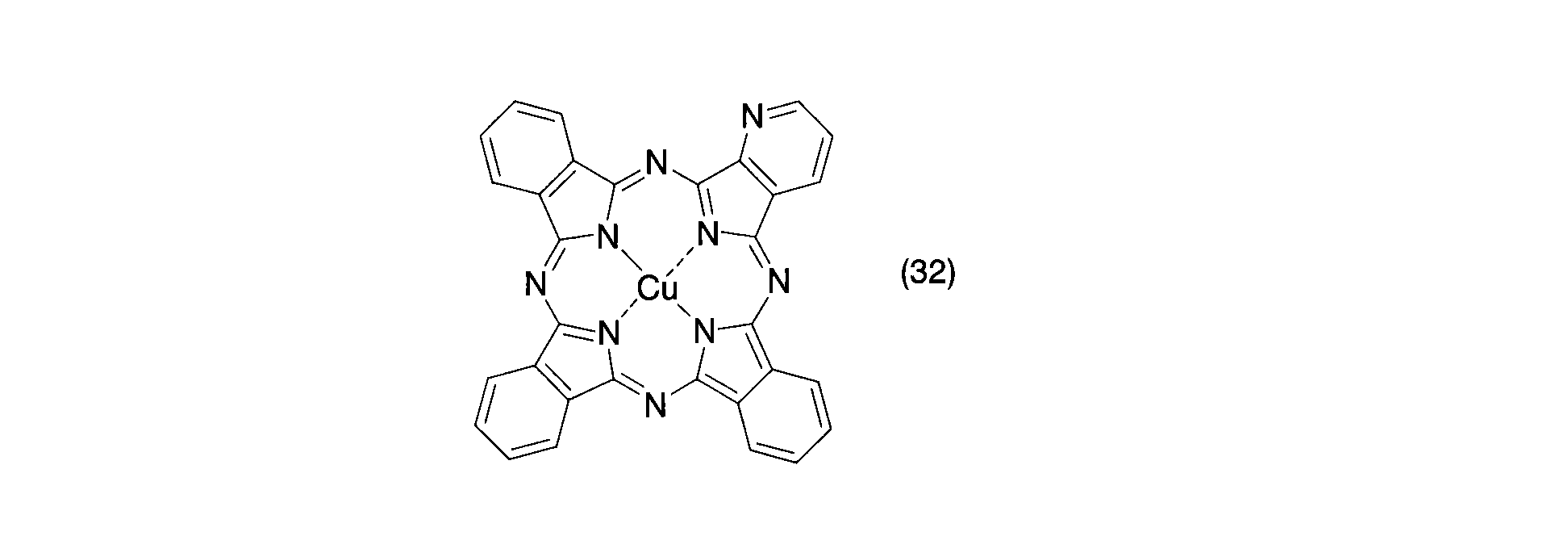
- copper tribenzo (2,3-pyrido) porphyrazine [formula (32)] in which one of A to D in the formula (30) is a pyridine ring and the remaining three are benzene rings and the above formula (32) 30) A to D of copper benzotris (2,3-pyrido) porphyrazine, in which three of A to D are pyridine rings and the other one is a benzene ring, are formed as by-products.
- a complex mixture formulas (33-A) to (33-D)).
- the nitrogen-containing heteroaromatic ring is one or three compounds, or a mixture of one compound and two or / and three compounds, etc.
- the nitrogen-containing heteroaromatic ring dicarboxylic acid derivative and phthalate Depending on the ratio of the nitrogen-containing heteroaromatic ring and the benzene ring of the target compound, the ratio of use with the acid derivative is in the range of approximately 0.25 to 0.75 mol, and the sum of both is 1 mol. It can be obtained similarly by changing.
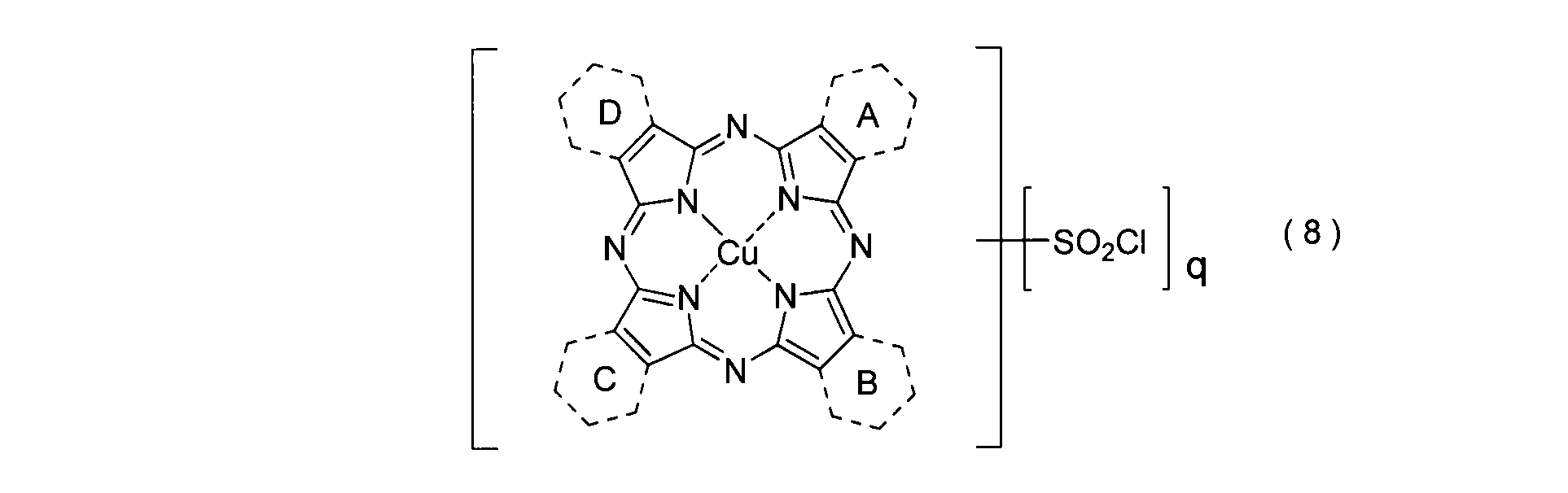
- the copper chlorosulfonylporphyrazine compound represented by the above formula (8) is obtained by chlorosulfonylating the copper cyan dye represented by the above formula (30) in chlorosulfonic acid, or the above formula (30).
- the copper porphyrazine compound represented by formula (1) is sulfonated in sulfuric acid or fuming sulfuric acid and then converted into a chlorosulfonyl group with a chlorinating agent.
- the chlorosulfonyl group or sulfo group thus obtained is introduced onto the benzene ring in the rings A to D of the above formula (30), and is not introduced when the rings A to D correspond to heteroaromatic ring groups.
- the number of the groups introduced is not more than the number of benzene rings. Therefore, the number q of the chlorosulfonyl group in the above formula (8) corresponding to the group is 1 to 3 on average depending on the number of benzene rings of the compound represented by the above formula (8).
- a sulfophthalic acid having a sulfo group and a nitrogen-containing heteroaromatic dicarboxylic acid derivative such as quinolinic acid are condensed by the above method.
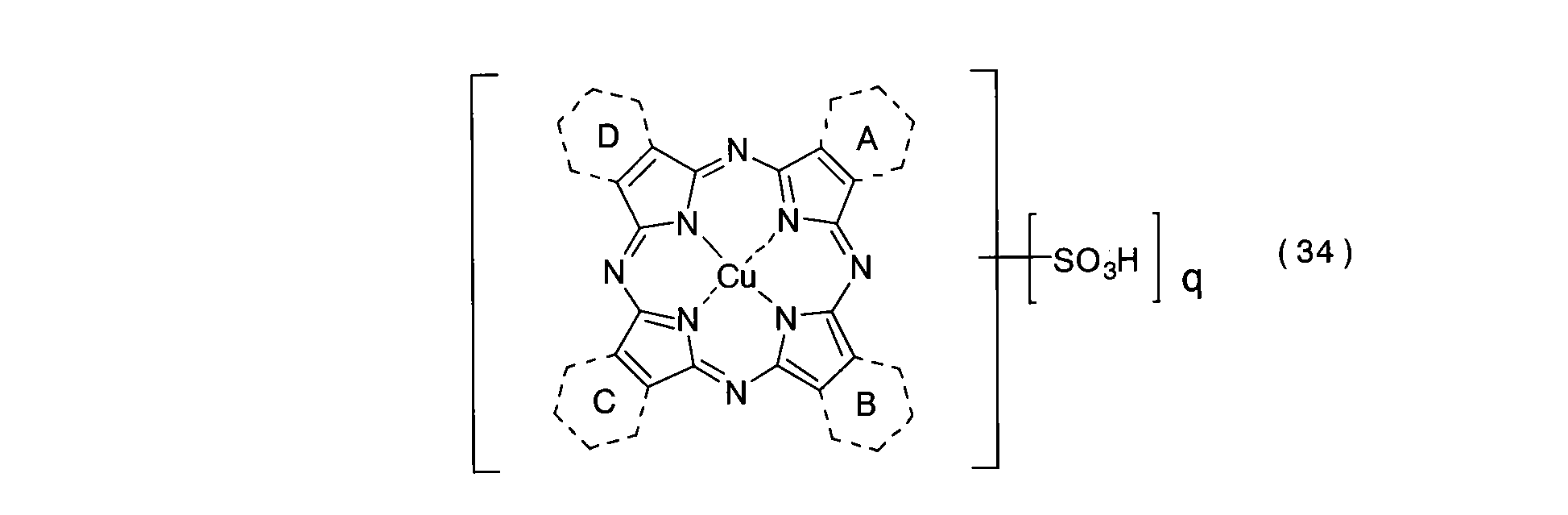
- a compound having a sulfo group represented by the following formula (34) is synthesized, and then the sulfo group is converted into a chlorosulfonyl group to obtain the target compound represented by formula (8). it can.
- the number (q) of chlorosulfo groups in the obtained compound represented by the above formula (8) is 1 to 3 in average as described above, and preferably 2 to 3.
- Rings A to D and q represent the same meaning as in Formula (8) above. ]
- the chlorosulfonylation reaction conditions for the copper cyan dye are usually chlorosulfonic acid as a solvent, and the amount used is 3 to 20 times by weight, preferably 5 to 10 times by weight that of the cyan dye.
- the reaction temperature is usually 100 to 150 ° C., preferably 120 to 150 ° C.
- the reaction time varies depending on the reaction conditions such as the reaction temperature, but is usually 1 to 10 hours.
- the substituent of the copper porphyrazine compound usually obtained is a mixture of a chlorosulfonyl group and a sulfo group
- the reaction solution with chlorosulfonic acid is further added so that all of the sulfo groups are chlorosulfonylated.
- chlorinating agent such as thionyl chloride other than chlorosulfonic acid.
- the amount of chlorinating agent other than chlorosulfonic acid to be added is about 0.5 to 10 equivalents, preferably about 0.5 to 5 equivalents, relative to the sulfo group in the sulfo-substituted copper porphyradi compound.
- the chlorinating agent include, but are not limited to, chlorosulfonic acid or thionyl chloride, sulfuryl chloride, phosphorus trichloride, phosphorus pentachloride, phosphorus oxychloride and the like which are additionally added.
- solvent used in the chlorination reaction examples include sulfuric acid, fuming sulfuric acid, chlorosulfonic acid, benzene, toluene, nitrobenzene, chlorobenzene, N, N-dimethylformamide, N, N-dimethylacetamide, and the like. It is not something.
- the copper chlorosulfonylporphyrazine compound obtained above and an organic amine represented by the following formula (9) are about pH 8 to 10, 5 in an aqueous solvent in the presence of ammonia or an ammonia generation source.
- ammonia means gaseous, liquid, and solid ammonia.
- ammonia generation source means a compound that generates ammonia by heating, neutralization, or the like; and a compound or solution that contains ammonia or a compound that generates the ammonia.
- ammonium salts that generate ammonia by neutralization of ammonium chloride, ammonium sulfate, etc .
- compounds that generate ammonia by heating, such as urea and solutions such as aqueous ammonia and ammonia-containing C1-C4 alkanols.
- solutions such as aqueous ammonia and ammonia-containing C1-C4 alkanols.
- a solution containing ammonia particularly aqueous ammonia as an aqueous solution, and the like are preferable, but not limited thereto.
- the ammonia or ammonia generation source a single compound or the like may be used, or may be used in combination.
- the reaction for obtaining the compound represented by the formula (7) is usually carried out in water or a hydrous solvent, it is more preferable to use a substance that dissolves in water, that is, a water-soluble compound or aqueous ammonia. .
- a substance that dissolves in water that is, a water-soluble compound or aqueous ammonia.
- the concentration of ammonia to be contained should be as high as possible without causing problems in handling. 28% ammonia water can be used as it is.
- the usage-amount of the organic amine represented by the said Formula (9) is the theoretical value (The value of c in said Formula (7) is 0.1 to 3 with respect to 1 mol of copper chlorosulfonyl porphyrazine compounds. The number of moles required to be 1) or more is different depending on the reactivity of the organic amine and reaction conditions, but is not limited thereto. Usually, it is 1 to 3 times mol, preferably about 1 to 2 times mol of the theoretical value.
- the organic amine represented by the formula (9) can be produced by a known method. For example, 0.95 to 1.1 mol of anilines or naphthylamines corresponding to X and 1 mol of 2,4,6-trichloro-S-triazine (cyanur chloride) in water at pH 3 to 7, 5 to The primary condensate is obtained by reacting at 40 ° C. for 2 to 12 hours. Next, when Y is an amino group, 1 mol of the obtained primary condensate and 0.95 to 2.0 mol of ammonia are added at a pH of 4 to 10, 5 to 80 ° C., for 0.5 to 12 hours.
- a secondary condensate is obtained by reacting under conditions.
- Y is a hydroxy group
- an alkali metal hydroxide such as sodium hydroxide is added to the reaction solution of the primary condensate, pH 4 to 10, 5 to 80 ° C., 0.5 to 12 hours.
- a secondary condensate is obtained by reacting under the following conditions.
- Y is an alkylamine or dialkylamine
- 1 mol of the obtained primary condensate and 0.95 to 1.1 mol of these amines are added at pH 4 to 10, 5 to 80 ° C.
- a secondary condensate is obtained by reacting under conditions of 0.5 to 12 hours.
- the cyan dye represented by the above formula (7) is prepared by combining the compound represented by the above formula (8) and the organic amine represented by the above formula (9) in the presence of an ammonia generation source, in particular anhydrous. Synthesized under reaction conditions that do not require conditions. Therefore, a compound in which the chlorosulfonyl group in the formula (8) is partially hydrolyzed by water mixed in the reaction system and converted into a sulfo group is produced as a by-product. It is theoretically conceivable to be mixed into the dye represented by the formula (7). However, it is difficult to distinguish an unsubstituted sulfamoyl group and a sulfonic acid group in mass spectrometry.
- the chlorosulfonyl group in the formula (8) other than those reacted with the organic amine represented by the formula (9) is used. All the groups are described as being converted to unsubstituted sulfamoyl groups.
- the copper porphyrazine ring (Pz) is dimerized (for example, Pz-L-Pz) or trimer via the divalent linking group (L).
- the formed impurities may be produced as a by-product and mixed into the reaction product, but there is no particular problem because the amount is very small.
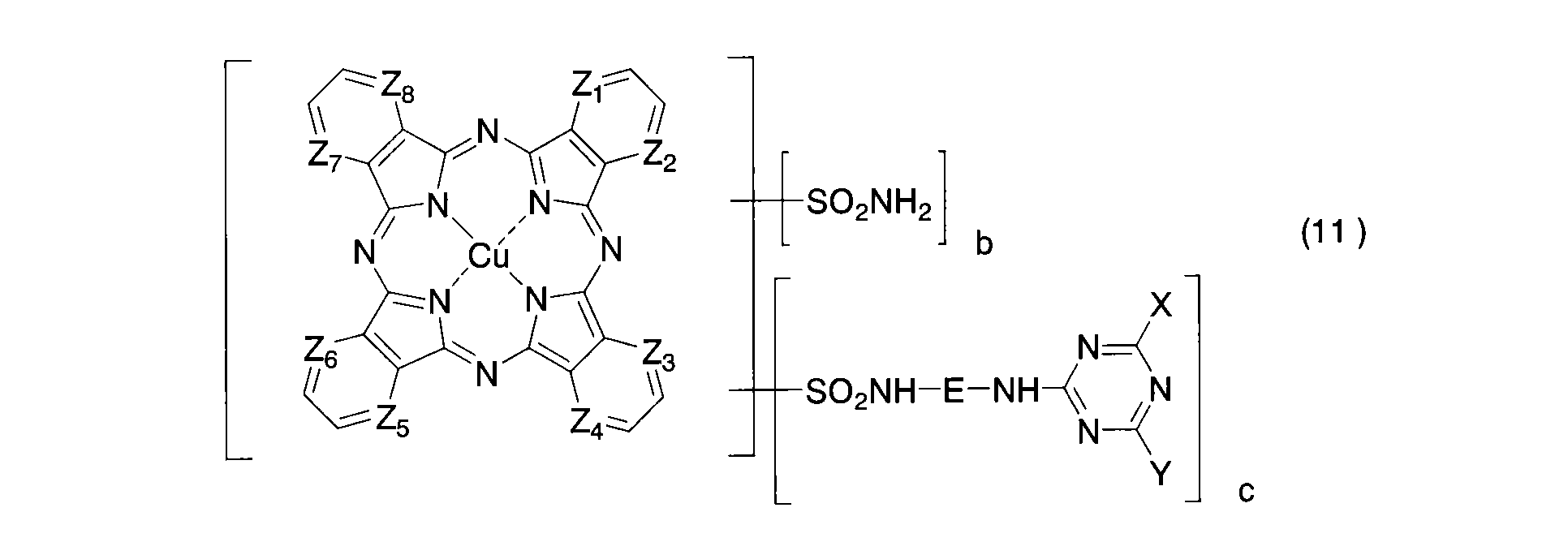
- the cyan dye represented by the above formula (7) is the dye represented by the above formula (11).
- Z 1 to Z 8 each independently represent a nitrogen atom or CH, but Z 1 and Z 2 ; Z 3 and Z 4 ; Z 5 and Z 6 ; and Z 7 and Z 8 ; Of the four combinations, at least one is a combination of CHs, there is no combination of nitrogen atoms, and all four combinations are not CH.
- E, X, Y, b, and c may be the same as those in the above formula (7) including preferable ones.
- the cyan dye represented by the above formula (11) has a nitrogen-containing heteroaromatic ring in rings A to D in the above formula (7) as a pyridine ring, and further specifies the substitution position of the nitrogen atom in the pyridine ring.
- other substituents and the like may be the same as those in the above formula (7) including preferable ones.
- Preferred as the compound represented by the above formula (8) is a compound represented by the above formula (12).
- Z 1 to Z 8 represent the same meaning as in formula (11), and p is a number from 1 to 3.
- the compound represented by the formula (12) is a compound in which the nitrogen-containing heteroaromatic ring in the rings A to D in the formula (8) is a pyridine ring, and the substitution position of the nitrogen atom in the pyridine ring is specified. Except this, it may be the same as the above formula (8) including preferable ones.
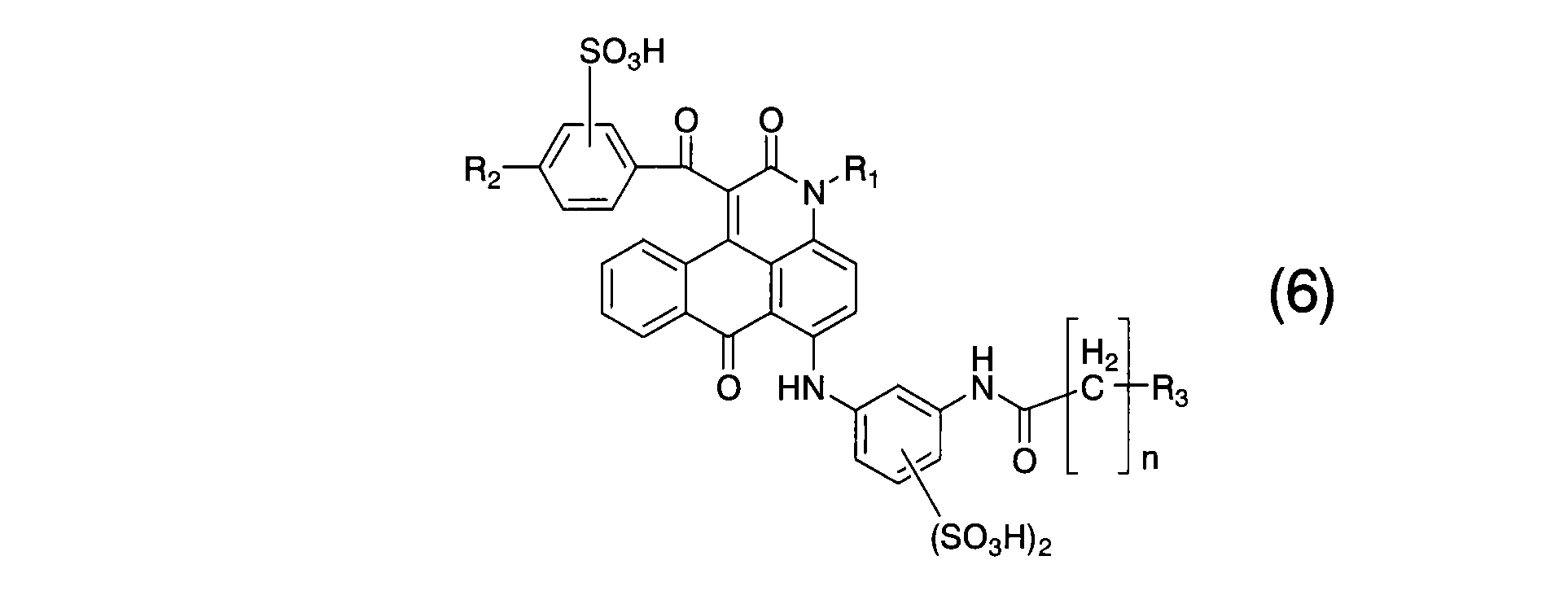
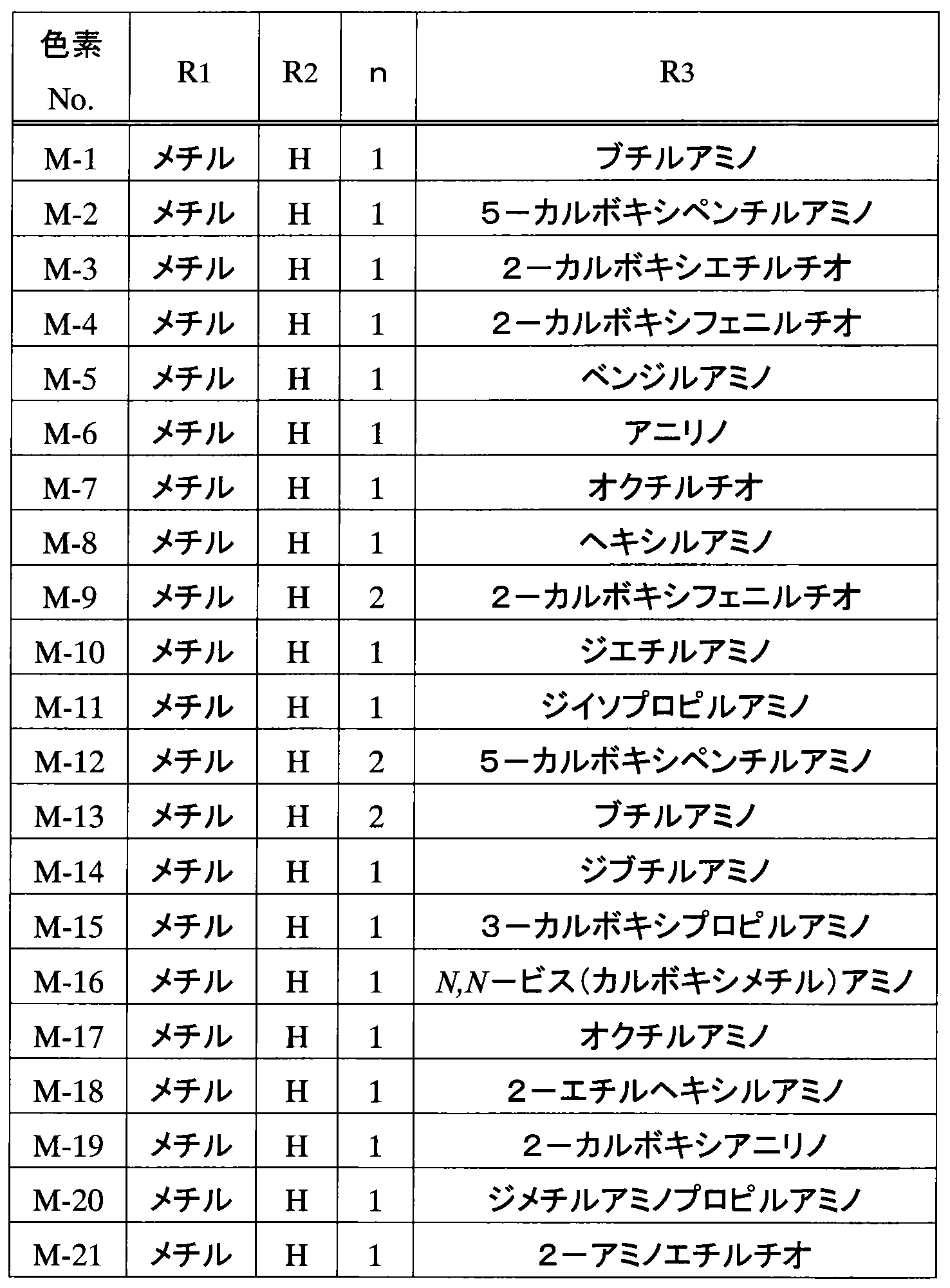
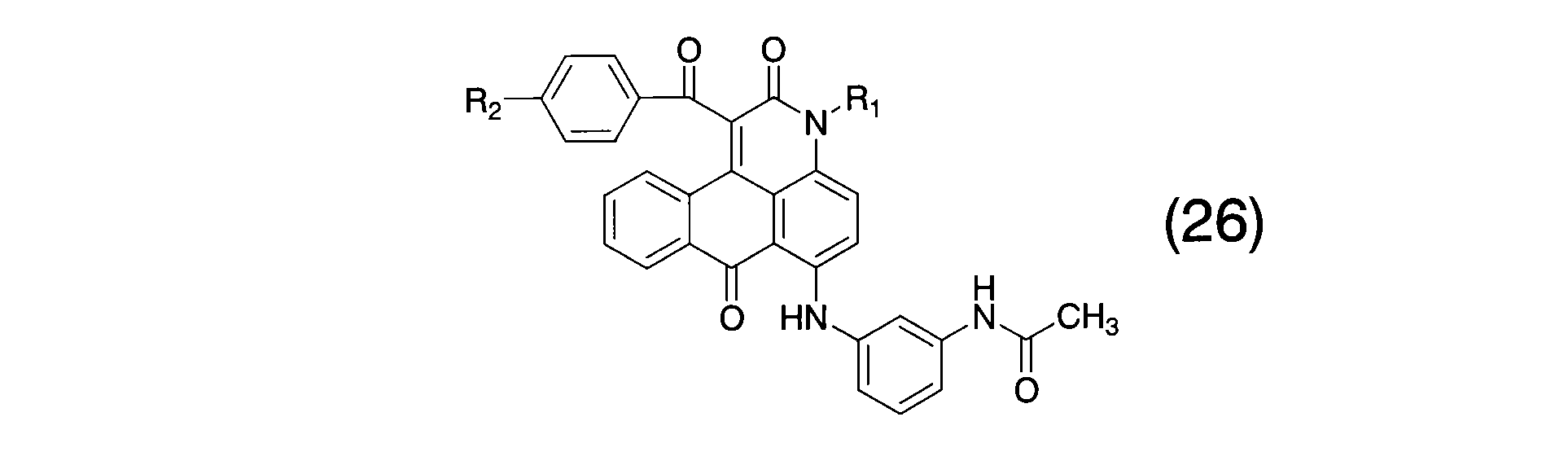
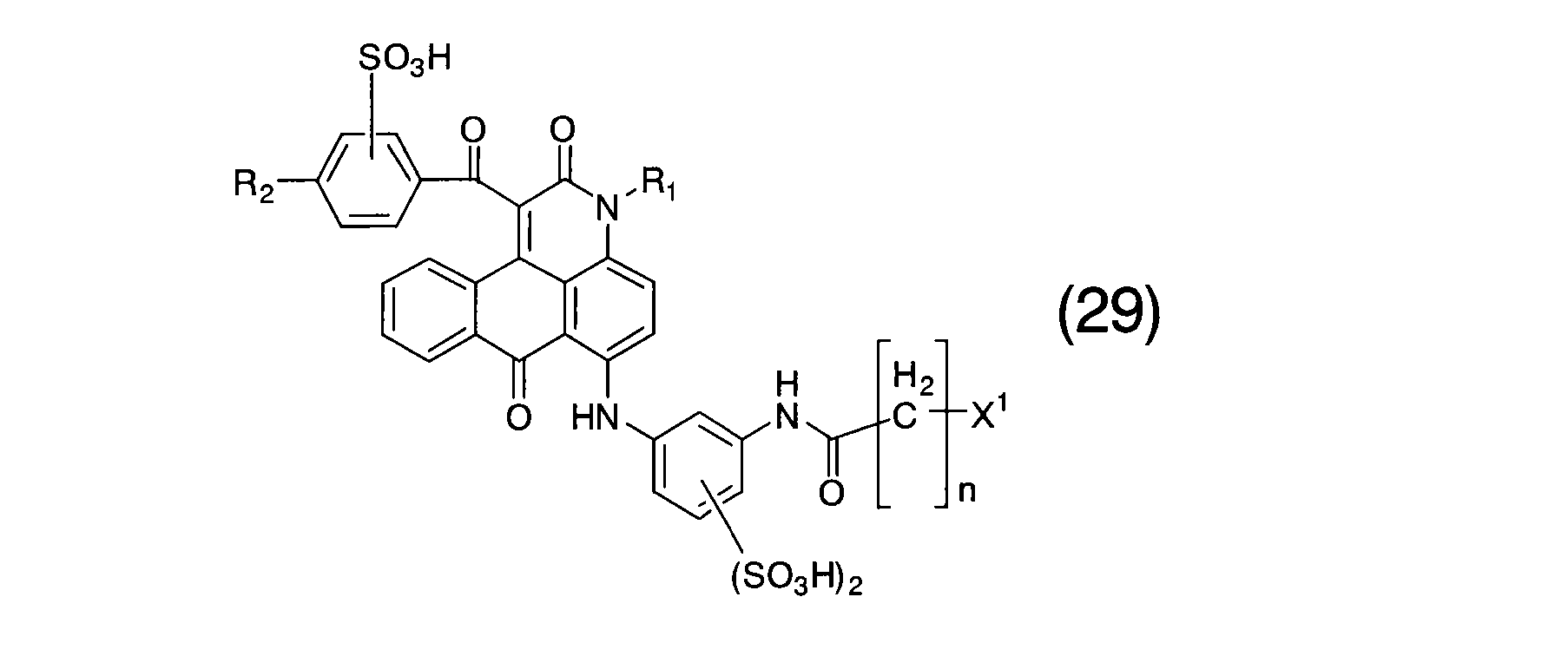
- the magenta ink composition contains a magenta dye of the above formula (6).
- R 1 represents a hydrogen atom; an alkyl group; a hydroxy lower alkyl group; a cyclohexyl group; a mono- or dialkylaminoalkyl group; or a cyano lower alkyl group.
- the alkyl group in R 1 usually represents C1-C6, preferably C1-C4, and may be either linear or branched, but is preferably linear.
- hydroxy lower alkyl group for R 1 examples include straight-chain or branched C1-C6, preferably C1-C4, which are substituted with a hydroxy group, and a straight-chain group is more preferable.
- Specific examples include hydroxyethyl, hydroxypropyl and the like.
- Examples of the monoalkylaminoalkyl group include mono (C1-C4) alkylamino C1-C4 alkyl groups such as methylaminopropyl and ethylaminopropyl.
- Examples of the dialkylaminoalkyl include dimethylaminopropyl and diethylaminoethyl.
- a di (C1-C4) alkylamino C1-C4 alkyl group may be mentioned.
- Examples of the cyano lower alkyl group include cyanoethyl, cyanopropyl and the like.
- R 2 represents a hydrogen atom or a methoxy group. These are all preferable, but a hydrogen atom is more preferable.
- R 3 in the above formula (6) is selected from the group consisting of a sulfo group, a carboxy group, an alkoxy group, a carbamoyl group, a cyano group, an alkyl group, an anilino group, a phenoxy group, an amino group, a hydroxy group, and a mercapto group.
- the number of substituents is usually 1 to 4, preferably 1 to 3, more preferably 1 or 2.
- sulfo-substituted ones such as 2-sulfoanilino, 3-sulfoanilino, 4-sulfoanilino and 2,5-disulfoanilino; 2-carboxyanilino, 4-carboxyanilino, 3,5-dicarboxyani Carboxyl substituted such as lino; alkoxy substituted such as 4-methoxyanilino; alkyl substituted such as 4-butylanilino; anilino and sulfo substituted such as 4-anilino-3-sulfoanilino; 4-phenoxyani Phenoxy-substituted ones such as lino; amino-substituted ones such as 4-aminoanilino; and the like.
- the anilino group is preferably sulfo-substituted, carboxy-substituted, or unsubstituted.
- R 3 is substituted with a group selected from the group consisting of sulfo group, carboxy group, alkoxy group, carbonyl group, carbamoyl group, cyano group, anilino group, phenoxy group, amino group, hydroxy group, mercapto group, and phenyl group.
- the alkyl moiety is usually a C1-C10 alkyl group, preferably C1-C8, more preferably C3-C8, more preferably C5.
- the number of substituents is not limited, but is usually 1 to 4, preferably 1 to 3, more preferably 1 or 2, and still more preferably 1.
- a dialkylamino group it is preferably a C1-C6, more preferably a C1-C4 alkyl group.
- monoalkylamino groups include, for example, unsubstituted straight chain such as methylamino, ethylamino, propylamino, butylamino, pentylamino, hexylamino, heptylamino, octylamino, nonylamino, decylamino; 2-ethylhexyl Unsubstituted branched chain such as amino; unsubstituted cyclic group such as cyclohexylamino; sulfo-substituted one such as 2-sulfoethylamino; carboxymethylamino, 2-carboxyethylamino, 1,2-dicarboxyethylamino Carboxy-substituted ones such as 1,3-dicarboxy
- the monoalkylamino group is preferably sulfo-substituted, carboxy-substituted, phenyl-substituted or unsubstituted, and more preferably carboxy-substituted.
- a dialkylamino group specific examples thereof may be, for example, those substituted with a group independently selected from the above groups, but preferably unsubstituted dimethylamino, diethylamino, dipropylamino, dibutylamino, etc.
- Carboxy-substituted ones such as bis (carboxymethyl) amino; hydroxy-substituted ones such as bis (2-hydroxyethyl) amino; and the like. More preferably, it is unsubstituted or carboxy-substituted. Both straight and branched chains are preferred.
- R 3 is substituted with a group selected from the group consisting of a sulfo group, a carboxy group, an alkoxy group, a carbonyl group, a carbamoyl group, a cyano group, an alkyl group, an anilino group, a phenoxy group, an amino group, a hydroxy group, and a mercapto group.
- a sulfo group a carboxy group, an alkoxy group, a carbonyl group, a carbamoyl group, a cyano group, an alkyl group, an anilino group, a phenoxy group, an amino group, a hydroxy group, and a mercapto group.
- the phenylthio group include sulfo-substituted groups such as 4-sulfophenylthio; carboxy-substituted groups such as 4-carboxyphenylthio and 3,5-dicarboxyphenylthio; 3-e
- Alkyl-substituted ones such as 3-phenylaminophenylthio Nilino-substituted ones; 4-phenoxyphenylthio, phenoxy- or carboxy-substituted phenoxy-substituted ones such as 4- (4-carboxyphenoxy) phenylthio; amino-substituted ones such as 3-aminophenylthio; 4-hydroxyphenylthio Substituted by a hydroxy group; substituted by a mercapto group such as 4-mercaptophenylthio; substituted one of the hydrogen atoms of the amino group which is a substituent of the phenylthio group, such as 4-acetylaminophenylthio, with an acyl group Thing; etc. are mentioned. Carboxy-substituted ones are preferable.
- R 3 is substituted with a group selected from the group consisting of sulfo group, carboxy group, alkoxy group, carbonyl group, carbamoyl group, cyano group, anilino group, phenoxy group, amino group, hydroxy group, mercapto group, and phenyl group.
- the alkyl moiety is preferably a C1-C10 alkyl group.
- the number of substituents is not limited, but is usually 1 to 4, preferably 1 to 3, more preferably 1 or 2, and still more preferably 1.
- linear alkyl groups such as methylthio, ethylthio, propylthio, butylthio, pentylthio, hexylthio, heptylthio, octylthio, nonylthio, decylthio; branched chains such as 2-methylbutylthio and 2-ethylhexylthio Cyclic ones such as cyclohexylthio; sulfo-substitutions such as 2-sulfoethylthio; carboxy-substitutions such as 2-carboxyethylthio, 1,2-dicarboxyethylthio, 1,3-dicarboxypropylthio; Alkoxy substituted such as 2-methoxyethylthio; carbonyl substituted such as 3-oxobutylthio; carbamoyl substituted such as 2-aminocarbonylethylthio; cyano substituted such as 5-
- the alkylthio group is preferably carboxy-substituted, amino-substituted, or unsubstituted.
- the alkyl moiety is preferably C1-C3, and when it is unsubstituted, C6-C10 is more preferable.
- the number of substituents is preferably 1 or 2, and more preferably 1.
- substituents include methyl-substituted ones such as 4-methyl-2-sulfoanilino and 2-methyl-4-sulfoanilino; methoxy-substituted ones such as 4-methoxy-2-sulfoanilino; 2-carboxy-5-sulfoanilino, Examples include carboxy-substituted ones such as 2-carboxy-4-sulfoanilino.
- R 3 is a carboxy-substituted hydroxyanilino group
- the number of substituents is preferably 1 or 2, and more preferably 1. Specific examples thereof include 3-carboxy-4-hydroxyanilino.
- the number of substitution of the sulfo group is not particularly limited, but is usually 1 to 5, preferably 1 to 4, and more preferably 1 to 3.
- 1-naphthylamino 4-sulfo-1-naphthylamino, 5-sulfo-1-naphthylamino, 5-sulfo-2-naphthylamino, 6-sulfo-1-naphthylamino, 7- One sulfo group such as sulfo-1-naphthylamino; sulfo such as 4,8-disulfo-2-naphthylamino, 3,8-disulfo-1-naphthylamino, 3,6-disulfo-1-naphthylamino, etc.
- the number of substituents is usually 1 To 3, preferably 1 or 2.
- sulfo-substituted ones such as 4-sulfophenoxy
- carboxy-substituted ones such as 4-carboxyphenoxy and 3,5-dicarboxyphenoxy
- acetylamino-substituted ones such as 4-acetylaminophenoxy
- Amino-substituted one such as 2-aminophenoxy; one substituted with a hydroxy group such as 4-hydroxyphenoxy
- phenoxy such as 4-phenoxyphenoxy, 4- (4-carboxyphenoxy) phenoxy, or one substituted with carboxy-substituted phenoxy
- Phenyl-substituted ones such as 4-phenylphenoxy;
- R 3 is a monoalkylaminoalkylamino group
- the alkyl range is usually C1-C10, preferably C1-C6, more preferably C1-C4. Specific examples include 2-methylaminoethylamino, 3-methylaminopropylamino, 3-ethylaminopropylamino and the like.
- R 3 is a dialkylaminoalkylamino group, it may independently have two “monoalkyl” moieties of the above monoalkylaminoalkylamino group.
- the range of the alkyl is the same including preferable ones. Specific examples thereof include 3- (N, N-diethylamino) propylamino, 2- (N, N-diethylamino) ethylamino and the like.
- R 3 is preferably a substituted or unsubstituted mono- or dialkylamino group, more preferably a substituted or unsubstituted monoalkylamino group, still more preferably a substituted monoalkylamino group, and a carboxy-substituted monoalkylamino group. Is particularly preferred. Most preferred is a 5-carboxypentylamino group.
- n represents an integer of 1 to 3. n is more preferably 1 or 2, and further preferably 1.
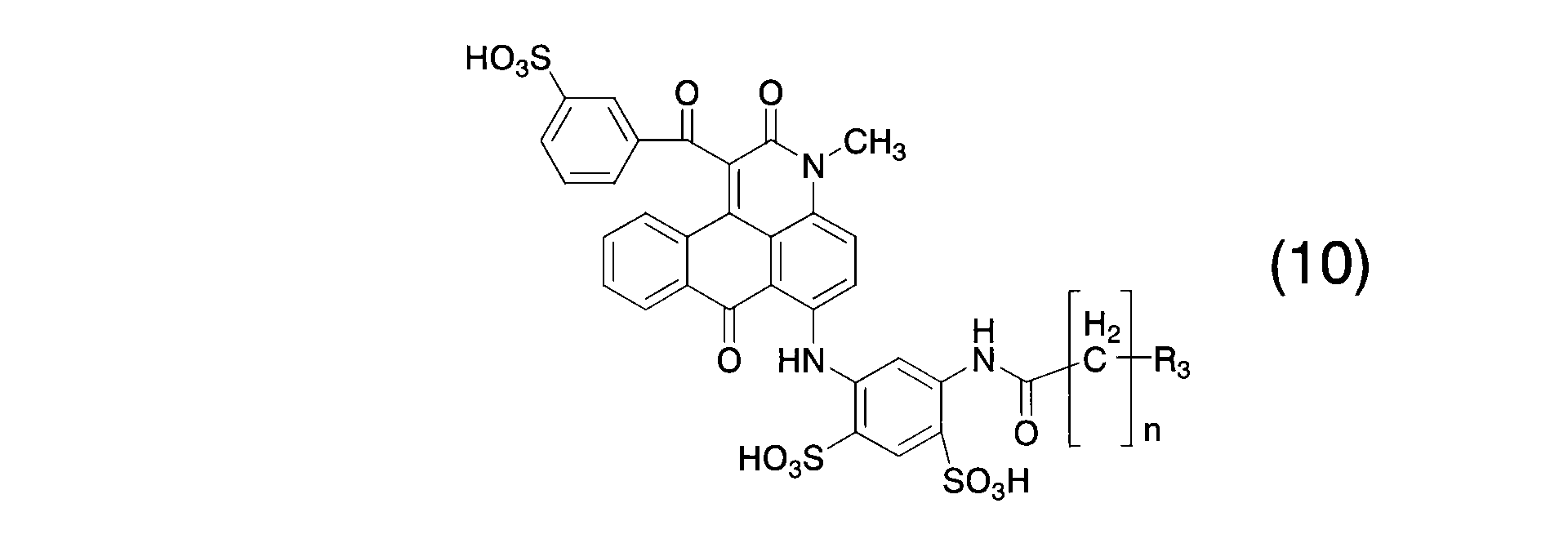
- a preferable magenta dye represented by the above formula (6) is a dye represented by the above formula (10).
- the dye represented by the formula (10) specifies the substitution positions of three sulfo groups whose substitution positions in the formula (6) are not specified, and further, R 1 is a methyl group and R 2 is a hydrogen atom. Each of them is specified, and n and R 3 may be the same as those in the above formula (6) including preferable ones.
- y represents an integer of 1 to 11.
- M is usually 1 to 3, preferably 2 or 3, more preferably 2.
- the substitution position of the sulfo group whose substitution position on the naphthyl ring, in which the substitution number is represented by m, is not particularly limited, is 6 if the substitution position of the azo group is 2-position and m is 1. It is preferable to substitute the 4-position, 8-position, 5-position and 7-position, 6-position and 8-position when m is 2, and 4-position, 6-position and 8-position when m is 3, respectively.
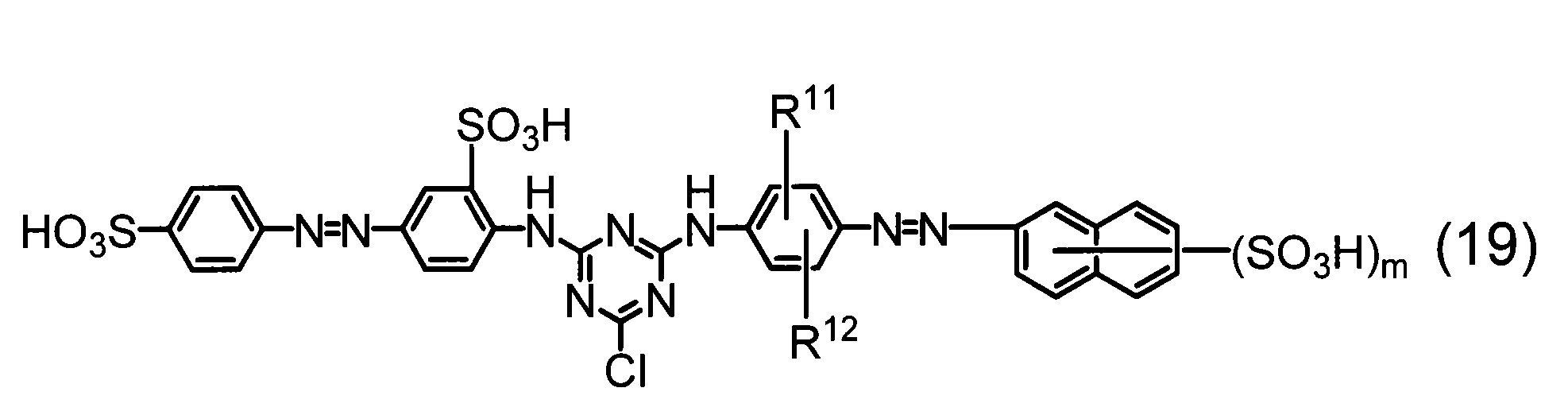
- the group A 1 represents a group represented by any one of the above formulas (2) to (5). If the radicals A 1 is represented by the above formula (2), z in formula (2) represents an integer of 1 to 3. Preferably it is 2.
- aminobenzene or naphthalenesulfonic acid represented by the following formula (15) is diazotized by a conventional method, and the methyl- ⁇ -sulfonic acid derivative of the formula (14) obtained above and 0 to 15 ° C., pH 2 to
- the compound represented by the following formula (16) is obtained by performing a coupling reaction at 4 and subsequently performing a hydrolysis reaction at 80 to 95 ° C. and pH 10.5 to 11.5.
- Examples of the compound represented by the above formula (13) include aniline, 3-methylaniline, 2-methylaniline, 2-methoxyaniline, 3-methoxyaniline, 2,5-dimethylaniline, 2-methoxy-5-methyl.
- Aniline, 2,5-dimethoxyaniline and the like can be mentioned.
- Preferable specific examples include aniline, 3-methylaniline, 2-methoxyaniline and the like, and more preferable specific examples include aniline and the like.
- ink sets ink compositions, and pigments contained in the ink composition, those in which preferable ones are combined are more preferable, and those in which more preferable ones are combined are more preferable. The same applies to more preferable ones, particularly preferable ones.
- examples of the C1-C4 alkyl group in Z 1 to Z 4 include methyl, ethyl and the like.
- examples of the hydroxy C1-C4 alkyl group include hydroxymethyl, hydroxyethyl, 3-hydroxypropyl, 2-hydroxypropyl, 4-hydroxybutyl, 3-hydroxybutyl, 2-hydroxybutyl and the like
- examples of the hydroxy C1-C4 alkoxy C1-C4 alkyl group include hydroxyethoxymethyl, 2-hydroxyethoxyethyl, Examples include 3- (hydroxyethoxy) propyl, 3- (hydroxyethoxy) butyl, 2- (hydroxyethoxy) butyl, and the like.
- each pigment is dissolved in an aqueous medium to which water and, if necessary, a water-soluble organic solvent (an organic solvent miscible with water) and the like are added.
- An ink adjusting agent is added.
- a metal cation chloride contained as an impurity such as sodium chloride, sulfate, eg, an inorganic impurity such as sodium sulfate is used. Is preferred. In this case, for example, the total content of sodium chloride and sodium sulfate is about 1% by mass or less in the total mass of each pigment.
- chelating reagent examples include sodium ethylenediaminetetraacetate, sodium nitrilotriacetate, sodium hydroxyethylethylenediaminetriacetate, sodium diethylenetriaminepentaacetate, sodium uracil diacetate and the like.
- dye solubilizer examples include urea, ⁇ -caprolactam, ethylene carbonate, and the like. Of these, urea is preferably used.
- the anti-fading agent is used for the purpose of improving image storage stability.
- various organic and metal complex antifading agents can be used.
- organic anti-fading agents include hydroquinones, alkoxyphenols, dialkoxyphenols, phenols, anilines, amines, indanes, chromans, alkoxyanilines, heterocycles, etc. Includes nickel complexes and zinc complexes.
- anionic surfactants include alkyl sulfocarboxylates, ⁇ -olefin sulfonates, polyoxyethylene alkyl ether acetates, N-acyl amino acids and salts thereof, N-acyl methyl taurate, alkyl sulfate polyoxyalkyl ethers Sulfate, alkyl sulfate polyoxyethylene alkyl ether phosphate, rosin acid soap, castor oil sulfate ester, lauryl alcohol sulfate ester, alkylphenol type phosphate ester, alkyl type phosphate ester, alkyl aryl sulfonate, diethyl sulfosuccinate Salt, diethyl hexyl sulphosuccinate, dioctyl sulphosuccinate and the like.
- the surface tension of the ink composition used in the ink set of the present invention is usually 25 to 70 mN / m, more preferably 25 to 60 mN / m. Further, the viscosity of the ink composition of the ink set of the present invention is preferably 30 mPa ⁇ s or less, and more preferably adjusted to 20 mPa ⁇ s or less.
- two types of ink, high-density ink and low-density ink are loaded in one printer for the purpose of supplying a high-definition image.
- a high-concentration ink composition and a low-concentration ink composition are respectively prepared and used together as an ink set. Also good.
- the low-density ink is particularly called photo ink or light ink.
- magenta ink high density ink is called magenta ink
- low density ink is called photo magenta ink, light magenta ink or the like.
- the inks of the same color are divided into the high-density ink and the low-density ink and used separately, only the high-concentration ink composition or the low-concentration ink composition can be expressed by formulas (6) and (7).
- the dye of (1) may be used.
- the dye used in the ink set of the present invention does not need to use the dyes of the formulas (6), (7), and (1) alone for each of the inks of cyan, magenta, and yellow.
- another dye may be further added within a range where the hue as the basic three primary colors of the mixed color does not change remarkably or within a range where the effects of the present invention are not impaired.
- three other subtractive basic colors such as black ink, red ink (also referred to as orange ink), green ink, blue ink (also referred to as violet ink), and the like, are used as an ink set of four or more colors. It is also possible.
- the colored body of the present invention is a substance colored with the ink set of the present invention.
- the material of the colored body for example, information transmission sheets such as paper and film, fibers and fabrics (cellulose, nylon, wool, etc.), leather, base materials for color filters, etc. Anything is acceptable and not limited to these.
- the coloring method an ink jet recording method using an ink jet printer is used.
- the information transmission sheet is preferably a surface-treated sheet, specifically, a sheet such as paper, synthetic paper, or film provided with an ink receiving layer.
- the ink receiving layer is formed by, for example, impregnating or coating the base material with a cationic polymer; inorganic fine particles capable of absorbing pigments in inks such as porous silica, alumina sol, and special ceramics are hydrophilic such as polyvinyl alcohol and polyvinyl pyrrolidone.
- a method of coating the surface of the base material together with the conductive polymer; Those provided with such an ink receiving layer are usually called ink jet exclusive paper, ink jet exclusive film, glossy paper, gloss film and the like.
- porous silica, alumina sol, special ceramics, etc. mentioned above are applied to the surface of the substrate because they are easily affected by gases having an oxidizing action in the air, that is, ozone gas and nitrogen oxide gas.
- gases having an oxidizing action in the air that is, ozone gas and nitrogen oxide gas.
- a typical commercial product as an ink jet dedicated paper is manufactured by Canon Inc., trade name Professional Photo Paper, Super Photo Paper, and Matt Photo Paper; Seiko Epson Corporation trade name Photo Paper Crispia ( High gloss), photo paper (gloss), photo matte paper; manufactured by Nippon Hewlett-Packard Co., Ltd., trade name Advanced Photo Paper (gloss); manufactured by Fuji Film Co., Ltd., trade name photo finish photo finish Pro; Since the ink set of the present invention has excellent resistance to the gas having the above oxidizing action, in particular, ozone gas resistance, discoloration is also caused in recording on a recording material having such a porous white inorganic pigment as an ink receiving layer. Gives excellent recorded images with small It can also be used for plain paper.
- a container filled with the above ink composition may be loaded at a predetermined position of an ink jet printer and recorded on the recording material by a normal method.
- the ink jet recording method of the present invention together with cyan ink, magenta ink, and yellow ink, which are ink sets, green ink, blue (or violet) ink, red ink (or orange ink), black ink, and the like are used in combination. Can do.
- the inks of the respective colors are injected into the respective containers, and these containers are used in a predetermined position of the ink jet printer.
- Some inkjet printers use, for example, a piezo method using mechanical vibration; a bubble jet (registered trademark) method using bubbles generated by heating; and the like.
- the ink jet recording method of the present invention can be used by any method.
- the ink set of the present invention has an ideal hue as three primary colors with high saturation and subtractive color mixture.
- the sharpness and color density of images recorded on ink jet dedicated paper and glossy paper are high, and it has a hue suitable for the ink jet recording method.
- the fastness of the recorded image particularly moisture resistance, light resistance and ozone gas resistance are very high.
- Each ink composition in the ink set of the present invention does not precipitate or separate during storage, and has extremely high storage stability. Further, when each ink composition is used for ink jet recording, crystal precipitation due to drying of the ink composition in the vicinity of the nozzle is very unlikely to occur, and the ejector (ink head) is not blocked.
- Each ink composition in the ink set of the present invention uses a continuous ink jet printer and is used by recirculating ink at relatively long time intervals; or when used intermittently by an on-demand ink jet printer; Does not cause changes in physical properties.
- the mixture was cooled to 65 ° C., 200 parts of methanol was added, and the crystals were filtered.
- the obtained crystal was washed with 150 parts of methanol and subsequently with 200 parts of warm water and dried to obtain 72.2 parts of a wet cake.
- the total amount of the obtained wet cake was put into 500 parts of 5% hydrochloric acid, heated to 60 ° C., and held at that temperature for 1 hour.
- the crystals were filtered and washed with 200 parts of water.
- the entire amount of the obtained wet cake was put into 500 parts of 10% aqueous ammonia, and kept at 60 ° C. for 1 hour.
- reaction liquid was cooled to 70 ° C., 17.9 parts of thionyl chloride was added dropwise over 30 minutes, and the reaction was performed at 70 ° C. for 3 hours.
- the reaction solution is cooled to 30 ° C. or lower, slowly poured into 800 parts of ice water, the precipitated crystals are filtered, washed with 200 parts of cold water, and copper tribenzo (2,3-pyrido) porphyrazine trisulfonyl chloride. 40.1 parts of wet cake were obtained.
- the obtained wet cake was put into a beaker, 280 parts of water was added, and the pH was adjusted to 9.0 using a 10% aqueous sodium hydroxide solution. At this time, the liquid volume was 400 parts.
- the reaction solution was adjusted to pH 1.0 using concentrated hydrochloric acid, 80 parts of sodium chloride was added, and the mixture was stirred for 30 minutes to precipitate crystals.
- the precipitated crystals were filtered to obtain 110.1 parts of a wet cake.
- the obtained wet cake was put into a beaker, 260 parts of methanol and 26 parts of water were added and stirred at 50 ° C. for 1 hour, followed by filtration to obtain 89.1 parts of a wet cake.
- the obtained wet cake was dried to obtain 49.3 parts of a white powder.
- the temperature of the reaction liquid was raised to 50 ° C., 93 parts of sodium chloride (15% to the liquid) was added, stirred for 30 minutes, adjusted to pH 2.0 over 20 minutes, filtered, and 100 parts of 10% aqueous sodium chloride solution. Washing gave 42.1 parts of a wet cake. The obtained wet cake was dissolved by adjusting the pH to 9.0 using 360 parts of water and 25% sodium hydroxide solution. The liquid volume at this time was 400 parts.
- the temperature of the dissolving liquid was raised to 50 ° C., 60 parts of sodium chloride (15% to the liquid) was added, stirred for 30 minutes, adjusted to pH 1.0 over 20 minutes, filtered, and 100 parts of 10% aqueous sodium chloride solution.
- the reaction solution was brought to 50 to 60 ° C., 20 parts of sodium chloride was added and stirred, and the precipitated crystals were collected by filtration. After washing with 100 parts of a 22% aqueous sodium chloride solution, the water was thoroughly squeezed to obtain 34 parts of a sodium salt wet cake of a compound represented by the following formula (42).
- the obtained methyl- ⁇ -sulfonic acid derivative was added to the previously prepared diazo reaction solution, and the mixture was stirred at 0 to 15 ° C. and pH 2 to 4 for 5 hours.
- the reaction solution was adjusted to pH 11 with sodium hydroxide, stirred at 80 to 95 ° C. for 5 hours while maintaining the same pH, further salted out by adding 100 parts of sodium chloride, and the precipitated solid was collected by filtration. 100 parts of the compound represented by the formula (36) were obtained as a wet cake.
- the precipitated solid was collected by filtration to obtain 120.0 parts of a wet cake.
- This wet cake was dried with a hot air dryer at 80 ° C. to obtain 50.0 parts of a yellow dye represented by the following formula (37) as a sodium salt.
- ⁇ max (maximum absorption wavelength) of this dye in an aqueous solution was 382 nm.
- the ink composition using the cyan dye represented by the formula (45) obtained in (Step 4) of Dye Synthesis Example 1 is designated as C-03.
- the ink composition using the magenta dye represented by the formula (43) obtained in (Step 5) of Dye Synthesis Example 2 is designated as M-02.
- the ink composition using the yellow dye represented by the formula (37) obtained in (Step 3) of Dye Synthesis Example 3 is designated as Y-01.
- the ink composition using the magenta dye represented by the formula (41) obtained in (Step 3) of Dye Synthesis Example 2 is designated as M-12.
- the color difference ( ⁇ E) of the mixed color of the ink set of the present invention in the ozone resistance test is equivalent to that of monochromatic yellow, magenta and cyan ink compositions on all glossy papers, and extremely good ozone resistance. Showed sex. Further, when the magenta dye of the present invention is changed to that of Comparative Example 1, the color difference of the color (orange, blue, black) mixed with the magenta of the ink set becomes remarkably large, and the ink set containing the magenta dye of the present invention It can be seen that the ozone gas properties are extremely good.
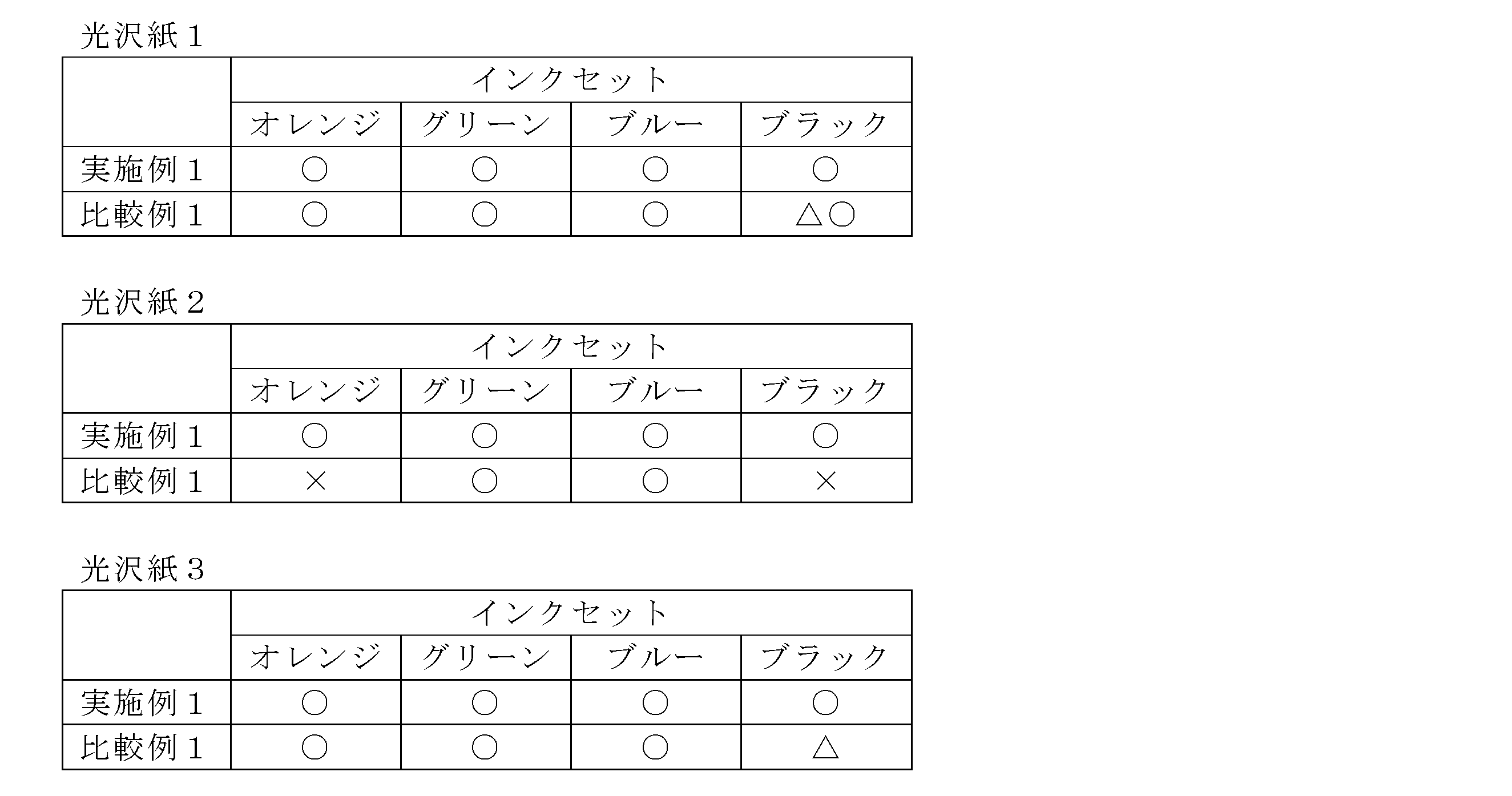
- the mixed color of the ink set of the present invention shows no bleeding as compared with the mixed color of the ink set of Comparative Example 1 regardless of which glossy paper is used. It was found to have sex.
- an ink set composed of an ink composition of at least two colors of magenta and cyan, preferably a three-color ink composition added with a yellow ink composition of the present invention has excellent ozone resistance and moisture resistance. It is clear that the ink set gives an image, and it can be said that the ink set is extremely excellent as an ink set used in an ink jet recording method for expressing a color image by a subtractive color mixing method.
- the image recorded with the ink set of the present invention has high fastness, particularly ozone resistance and moisture resistance, and is suitably used for inkjet ink applications as an ink set for use in an inkjet recording method that represents a full color image by a subtractive color mixing method. .
Landscapes
- Chemical & Material Sciences (AREA)
- Organic Chemistry (AREA)
- Life Sciences & Earth Sciences (AREA)
- Engineering & Computer Science (AREA)
- Materials Engineering (AREA)
- Wood Science & Technology (AREA)
- Chemical Kinetics & Catalysis (AREA)
- Inks, Pencil-Leads, Or Crayons (AREA)
- Ink Jet Recording Methods And Recording Media Thereof (AREA)
- Ink Jet (AREA)
Abstract
Description
従来、万年筆、フェルトペン等のインク及びインクジェット記録用のインクとしては、水溶性の染料を水性媒体に溶解したインクが多く使用されている。また、これらのインクにおいては、ペン先やインク吐出ノズルでのインクの目詰まりを防止すべく、一般に水溶性の有機溶剤が添加されている。これらのインクには、十分な濃度の記録画像を与えること、ペン先やノズルの目詰まりを生じないこと、被記録材上での乾燥性が良いこと、滲みが少ないこと、保存安定性に優れること等が要求される。また、形成される記録画像には、耐水性、耐湿性、耐光性、耐ガス性等の各種堅牢性が求められている。
ここで耐ガス性とは、空気中に存在する酸化作用を持つ酸化窒素ガス、オゾンガス等の酸化性ガスが、記録紙上又は記録紙中で、記録画像の色素(染料)と反応し、印刷された画像を変退色させるという現象に対する耐性のことである。特に、オゾンガスは、インクジェット記録画像の退色現象を促進させる主要な原因物質とされている。この変退色現象はインクジェット画像に特徴的なものであるため、耐ガス性や、特に耐オゾンガス性の向上はこの分野における重要な技術的課題である。
1)少なくともシアンインク組成物及びマゼンタインク組成物の2種のインク組成物から構成される、少なくとも2色のインクセットであって、該シアンインク組成物が含有するシアン色素が下記式(7)で表される色素又はその塩であり、該マゼンタインク組成物が含有するマゼンタ色素が下記式(6)で表される色素又はその塩であるインクジェット記録用インクセット、

Eはアルキレン基を表し、
Xは、少なくとも1つのスルホ基、カルボキシ基、又はリン酸基を置換基として有するアニリノ基又はナフチルアミノ基であり、該アニリノ基又はナフチルアミノ基は、さらにスルホ基、カルボキシ基、リン酸基、スルファモイル基、カルバモイル基、ヒドロキシ基、アルコキシ基、アミノ基、モノ又はジアルキルアミノ基、モノ又はジアリールアミノ基、アセチルアミノ基、ウレイド基、アルキル基、ニトロ基、シアノ基、ハロゲン原子、アルキルスルホニル基、及びアルキルチオ基から成る群から選択される1種又は2種以上の置換基で置換されてもよく、
Yはアミノ基;ヒドロキシ基;スルホ基、カルボキシ基、リン酸基、スルファモイル基、カルバモイル基、ヒドロキシ基、アルコキシ基、ヒドロキシアルコキシ基、アミノ基、モノ-又はジ-アルキルアミノ基、モノ-又はジ-アリールアミノ基、アセチルアミノ基、ウレイド基、アルキル基、ニトロ基、シアノ基、ハロゲン原子、アルキルスルホニル基、及びアルキルチオ基から成る群から選択される1種又は2種以上の置換基を有してもよい、モノ若しくはジアルキルアミノ基又は含窒素複素環基;を表し(但し、Yがアミノ基又はヒドロキシ基であり、且つXが置換アニリノ基である組み合わせを除く。)、
bは0~2.9の数であり、cは0.1~3の数であり、且つb及びcの和は1~3である。]

nは1~3の整数を表し、
R1は水素原子;アルキル基;ヒドロキシ低級アルキル基;シクロヘキシル基;モノ若しくはジアルキルアミノアルキル基;又はシアノ低級アルキル基;を表し、
R2は水素原子又はメトキシ基を表し、
R3はスルホ基、カルボキシ基、アルコキシ基、カルバモイル基、シアノ基、アルキル基、アニリノ基、フェノキシ基、アミノ基、ヒドロキシ基、及びメルカプト基よりなる群から選択される基で置換されたアニリノ基、若しくは無置換アニリノ基;スルホ基、カルボキシ基、アルコキシ基、カルボニル基、カルバモイル基、シアノ基、アニリノ基、フェノキシ基、アミノ基、ヒドロキシ基、メルカプト基、及びフェニル基よりなる群から選択される基で置換されたモノ若しくはジアルキルアミノ基、若しくは無置換モノ若しくはジアルキルアミノ基;スルホ基、カルボキシ基、アルコキシ基、カルボニル基、カルバモイル基、シアノ基、アルキル基、アニリノ基、フェノキシ基、アミノ基、ヒドロキシ基、及びメルカプト基よりなる群から選択される基で置換されたフェニルチオ基、若しくは無置換フェニルチオ基;スルホ基、カルボキシ基、アルコキシ基、カルボニル基、カルバモイル基、シアノ基、アニリノ基、フェノキシ基、アミノ基、ヒドロキシ基、メルカプト基、及びフェニル基よりなる群から選択される基で置換されたアルキルチオ基、若しくは無置換アルキルチオ基;メチル基、メトキシ基、若しくはカルボキシ基で置換されたスルホアニリノ基;カルボキシ置換ヒドロキシアニリノ基;スルホ基で置換されたナフチルアミノ基、若しくは無置換ナフチルアミノ基;スルホ基、カルボキシ基、アセチルアミノ基、アミノ基、ヒドロキシ基、フェノキシ基、及びフェニル基よりなる群から選択される基で置換されたフェノキシ基、若しくは無置換フェノキシ基;モノアルキルアミノアルキルアミノ基;ジアルキルアミノアルキルアミノ基;ヒドロキシ基;メルカプト基;又はアミノ基;を表し、
R1乃至R3で表される上記全ての基及び置換基が水素原子を有する場合、該水素原子は、水素原子以外の基で置換されてもよい。]
2)
上記シアンインク組成物が含有する上記式(7)で表されるシアン色素が、下記式(8)で表される化合物と下記式(9)で表される有機アミンとを、アンモニア又はアンモニア発生源の存在下で反応させることによって得られる色素又はその塩である上記1)に記載のインクジェット記録用インクセット、

3)
上記式(6)で表されるマゼンタ色素又はその塩が、下記式(10)で表される色素又はその塩である上記1)に記載のインクジェット記録用インクセット、

4)
上記シアンインク組成物が含有する上記式(7)で表されるシアン色素又はその塩が、下記式(11)で表される色素又はその塩である上記1)又は2)に記載のインクジェット記録用インクセット、
E、X、Y、b、及びcは式(7)におけるのと同じ意味を表す。]
5)
上記式(8)で表される化合物が、下記式(12)で表される化合物である上記1)、2)、又は4)に記載のインクジェット記録用インクセット、

6)
上記シアンインク組成物の総質量中における、シアン色素の総含有量が2.0~6.0質量%である上記1)乃至5)のいずれか一項に記載のインクジェット記録用インクセット、
7)
上記マゼンタインク組成物の総質量中における、マゼンタ色素の総含有量が1.0~8.0質量%である上記1)乃至6)のいずれか一項に記載のインクジェット記録用インクセット、
8)
上記シアンインク組成物及び上記マゼンタインク組成物の2種のインク組成物に、イエローインク組成物を加えた3種のインク組成物から構成される、3色の上記1)に記載のインクジェット記録用インクセット、
9)
上記イエローインク組成物の総質量中における、イエロー色素の総含有量が1.0~5.0質量%である上記8)に記載のインクジェット記録用インクセット、
10)
上記1)乃至9)のいずれか一項に記載のインクセットを用い、該インクセットの各インクのインク滴を記録信号に応じて吐出させて被記録材に付着させることにより記録を行うインクジェット記録方法、
11)
上記被記録材が情報伝達用シートである上記10)に記載のインクジェット記録方法、
12)
上記情報伝達用シートが普通紙又は多孔性白色無機物を含有するインク受像層を有するものである上記11)に記載のインクジェット記録方法、
13)
上記1)乃至9)のいずれか一項に記載のインクセットにより着色された着色体、
14)
着色がインクジェットプリンタによりなされた上記13)に記載の着色体、
15)
上記1)乃至9)のいずれか一項に記載のインクセットを含有する容器が装填されたインクジェットプリンタ、
に関する。
また、本発明のインクセットをインクジェット記録用として使用した印刷物は、被記録材(例えば紙、フィルム等)を選択することなく高鮮明で、且つ、非常に高濃度の写真調カラー画像を被記録材の上に忠実に再現させることも可能である。さらに、写真画質用インクジェット専用紙やフィルムのような多孔性白色無機物を表面に塗工した被記録材に記録しても各種堅牢性、すなわち耐水性、耐湿性、耐ガス性、耐光性等が良好であり、写真調の記録画像の長期保存安定性に優れている。このように、本発明のインクセットはインクジェット記録用のインクセットとして極めて有用である。
環A乃至Dにおける含窒素複素芳香環としては、例えば、ピリジン環、ピラジン環、ピリミジン環、ピリダジン環等の窒素原子1~2個を含む含窒素6員複素芳香環が挙げられる。これらの含窒素複素芳香環は独立して環A乃至Dとして選択されるが、同種の環を選択するのが好ましい。上記の例の中ではピリジン環又はピラジン環が好ましく、ピリジン環がより好ましい。環A乃至Dのうち1~3個が含窒素複素芳香環であり、残りがベンゼン環である。
含窒素複素芳香環の個数が増えるに従って、耐オゾン性は向上するが、ブロンジング性は生じやすくなる傾向にあり、環A乃至Dにおける含窒素複素芳香環の個数は耐オゾン性とブロンジング性とを考慮しながら、適宜調節し、バランスの良い比率を選択すればよい。含窒素複素芳香環の個数は複素環の種類にもよるので一概には言えないが、通常平均値で、1.0~2.0個の範囲が好ましく、より好ましくは1.0~1.7個、さらに好ましくは1.0~1.5個の範囲であり、残りはベンゼン環である。含窒素複素芳香環の個数が1より大きく、2より小さい時は、複素環が1つの化合物と、2つの化合物の混合物における平均の複素環数である。
複素環が2個の場合には、隣に並んで(例えば環A及びB)又は対向する位置に向かい合って(例えば環A及びC)入る場合のいずれもが生成すると考えられる。製造法の説明や実施例において構造式で化合物を記載する場合、それらをわざわざ記載するのは煩雑であり、分かり難いものとする上、本発明においてそれらをわざわざ区別する必要性も無いので、特に断らない限りは、便宜上、環A及びCの2個が複素環で、B及びDがベンゼン環である化合物の1つの構造式を記載し、上記のように生成する両者の化合物全てを示すものとする。
該アニリノ基又はナフチルアミノ基は、さらにスルホ基、カルボキシ基、リン酸基、スルファモイル基、カルバモイル基、ヒドロキシ基、アルコキシ基、アミノ基、モノ又はジアルキルアミノ基、モノ又はジアリールアミノ基、アセチルアミノ基、ウレイド基、アルキル基、ニトロ基、シアノ基、ハロゲン原子、アルキルスルホニル基、及びアルキルチオ基から成る群から選択される1種又は2種以上の置換基で置換されてもよい。上記の群から選択される1種又は2種以上の置換基のうち、好ましい置換基としては、スルホ基、カルボキシ基、及びヒドロキシ基が挙げられる。また、Xがナフチルアミノ基の場合には、上記の置換基のうち、スルホ及びヒドロキシ基がより好ましい。また、上記の群から選択される置換基の置換数は、Xがアニリノ基の場合には通常0~2、好ましくは0又は1、より好ましくは0である。同様に、Xがナフチルアミノ基の場合には通常0~4、好ましくは0~2である。
Xの具体例としては、2,5-ジスルホアニリノ、2-スルホアニリノ、3-スルホアニリノ、4-スルホアニリノ、2-カルボキシアニリノ、4-カルボキシアニリノ、4-エトキシ-2-スルホアニリノ、2-メチル-5-スルホアニリノ、2-メトキシ-4-ニトロ-5-スルホアニリノ、2-クロロ-5-スルホアニリノ、3-カルボキシ-4-ヒドロキシアニリノ、3-カルボキシ-4-ヒドロキシ-5-スルホアニリノ、2-ヒドロキシ-5-ニトロ-3-スルホアニリノ、4-アセチルアミノ-2-スルホアニリノ、4-アニリノ-3-スルホアニリノ、3,5-ジクロロ-4-スルホアニリノ、3-ホスホノアニリノ、3,5-ジカルボキシアニリノ、2-カルボキシ-4-スルホアニリノ、2-カルボキシ-5-スルホアニリノ、5,7-ジスルホナフタレン-2-イルアミノ、6,8-ジスルホナフタレン-2-イルアミノ、3,6-ジスルホナフタレン-1-イルアミノ、3,6,8-トリスルホナフタレン-1-イルアミノ、8-ヒドロキシ-3,6-ジスルホナフタレン-1-イルアミノ、4,8-ジスルホナフタレン-2-イルアミノ、3,6,8-トリスルホナフタレン-2-イルアミノ、4,6,8-トリスルホナフタレン-2-イルアミノ、8-クロロ-3,6-ジスルホナフタレン-1-イルアミノ、8-ヒドロキシ-6-スルホナフタレン-2-イルアミノ、5-ヒドロキシ-7-スルホナフタレン-2-イルアミノ等が挙げられる。この中で特に好ましいものは4-スルホアニリノである。
Yとしては、置換基を有してもよいモノ又はジアルキルアミノ基が好ましく、置換基を有してもよいモノアルキルアミノ基がより好ましい。該モノ又はジアルキルアミノ基のアルキル部分は、通常C1-C8、好ましくはC1-C6、より好ましくはC1-C4である。
Yが上記の群から選択される1種又は2種以上の置換基を有する場合、該置換基の数は、通常1~4、好ましくは1~3、より好ましくは1~2、さらに好ましくは1である。また、上記の群から選択される置換基のうち、スルホ基、カルボキシ基、及びヒドロキシアルコキシ基が好ましく、スルホ基がより好ましい。
Yの置換基がアルコキシ基の場合、通常C1-C8、好ましくはC1-C6、より好ましくはC1-C4である。
この場合の置換基としても上記の通りでよいが、置換基の数は通常0~4、好ましくは0~3、より好ましくは0~1、さらに好ましくは0である。
好ましい置換基の具体例としてはメチル、エチル、スルホ、カルボキシ、及びヒドロキシであり、メチル、エチル、カルボキシがより好ましい。
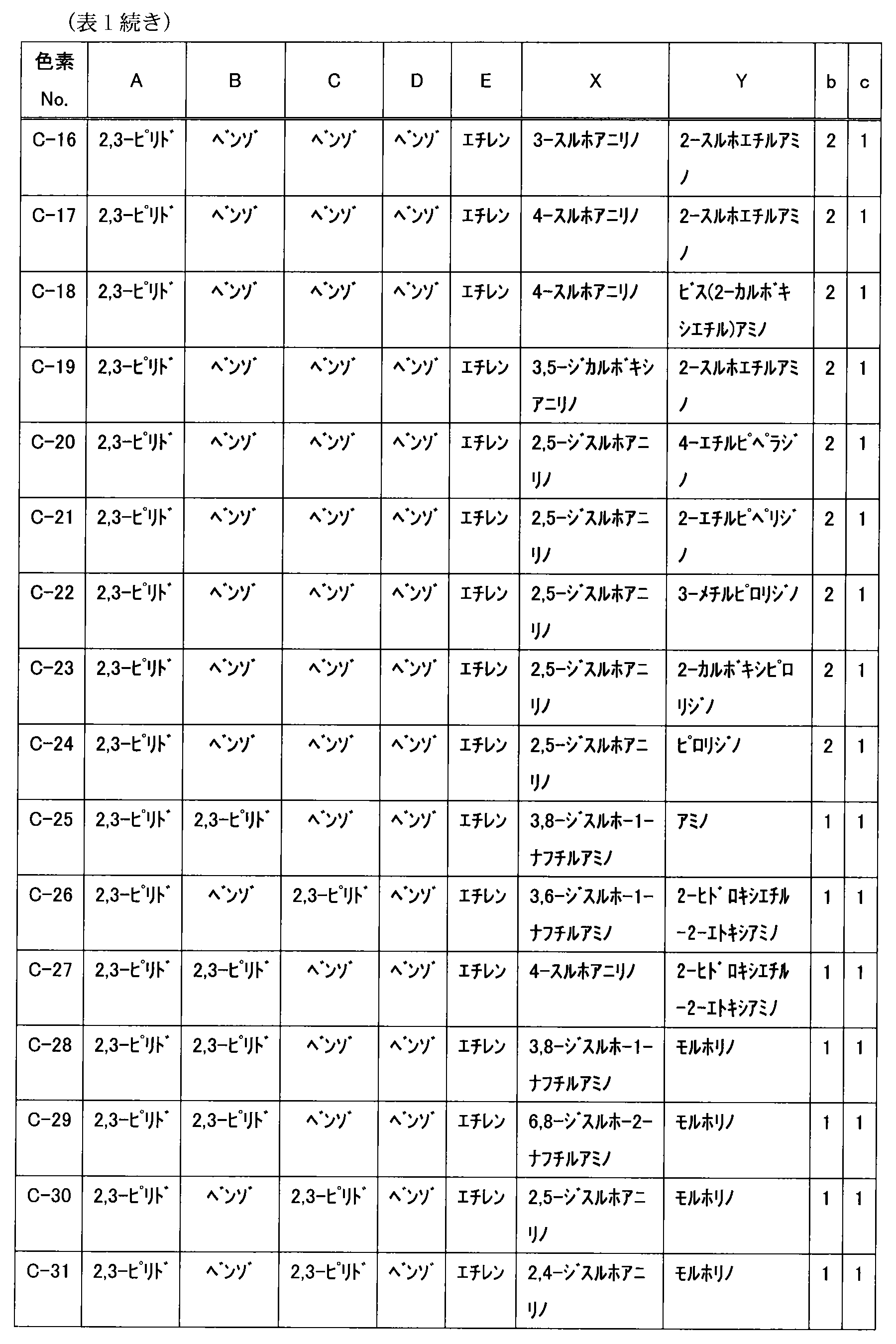
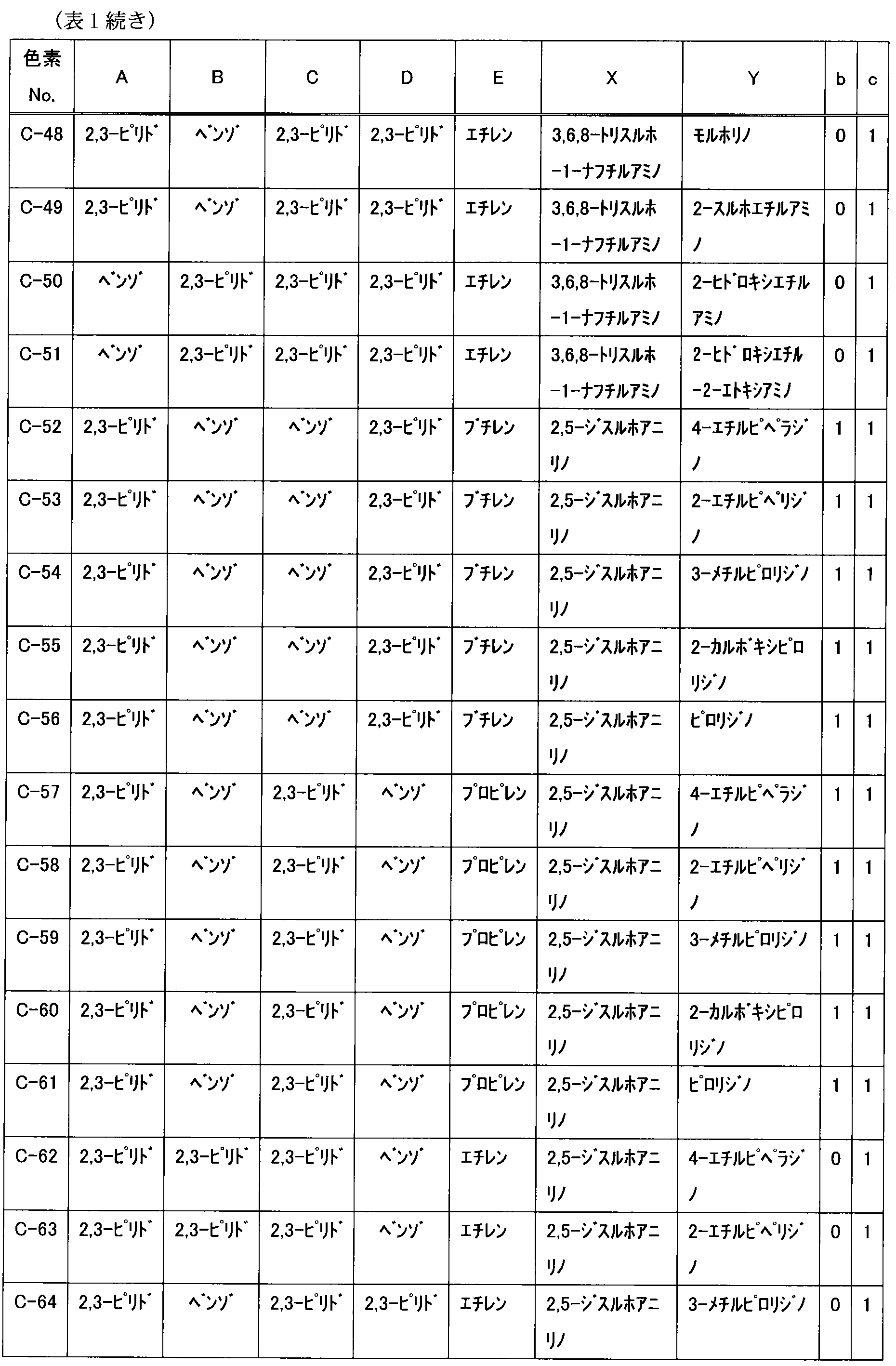
下記の例は、本発明の色素を具体的に説明するために代表的な化合物を示すもので、本発明はこれらの具体例に限定されるものではない。
また、A、B、C、又はDの含窒素複素芳香環がピリジン環の場合には後記するように窒素原子の位置異性体等が存在し、色素合成の際には異性体の混合物として得られる。これら異性体は単離が困難であり、また分析による異性体の特定も困難である。このため通常混合物のまま使用するが、異性体の混合物であっても本発明において特に問題は生じないためここではこれら異性体を区別することなく、構造式での表示は前記のように便宜的に1つの構造式で記載する。


また、上記式(7)で表される単一のシアン色素を高純度で合成することは極めて困難であるため、通常の場合、環A乃至Dの1つが含窒素複素環であり、残りの3つがベンゼン環であるシアン色素を得る場合には、環A乃至Dの全てがベンゼン環のもの、1つが含窒素複素環のもの、2つが含窒素複素環のもの、及び3つが含窒素複素環のものの混合物が得られる。この混合物を得る際に、その反応条件等を制御することにより、生成する各化合物の生成比率を制御することが可能であるため、上記の通り、平均値として環A乃至Dの1つが含窒素複素環であり、残りの3つがベンゼン環である上記式(7)のシアン色素を得ることができる。この環A乃至Dにおける含窒素複素環の数は、元素分析(炭素原子、水素原子、窒素原子、及び銅原子を測定)を行うことにより測定することができる。
また、公知のシアン色素との混合物として使用する場合、混合する色素としてはフタロシアニン系色素が好ましい。該混合物として使用する場合の本発明のシアン色素と他の色素との割合は、使用目的等に応じて適宜決めることができる。例えば、混合物に対して、本発明のシアン色素1~100%、好ましくは10~95%、より好ましくは25~90%であり、残部が他の色素、例えば、フタロシアニン系色素である。
なお、上記の「%」は、いずれも質量%を意味する。
まず、下記式(30)で表される銅ポルフィラジン化合物(顔料)を合成する。下記式(30)で表される銅ポルフィラジン化合物は、例えば触媒及び銅化合物の存在下、含窒素複素芳香環ジカルボン酸又はその誘導体(以下「含窒素複素芳香環ジカルボン酸誘導体」と記載する)とフタル酸又はその誘導体(以下「フタル酸誘導体」と記載する)とを反応させることにより得られる。含窒素複素芳香環ジカルボン酸誘導体とフタル酸誘導体との反応のモル比を変えることにより、環A乃至Dにおける含窒素複素芳香環の数及びベンゼン環の数を調整することが可能である。なお、下記式(30)で表される化合物における環A乃至Dの全てが含窒素複素芳香環の化合物も場合により生成するが、該化合物は酸洗浄、特に塩酸、硫酸等の鉱酸の水溶液で洗浄することにより、目的物中から除去することが可能である。下記式(30)で表される化合物から上記式(7)で表されるシアン色素を製造する際には、環A乃至Dの全てが含窒素複素芳香環の化合物は除去しておくのがよい。
例えば上記式(7)で表されるシアン色素における環A乃至Dうち、1乃至3個が含窒素複素芳香環であり、残りがベンゼン環の場合には、その含有割合に応じて、含窒素複素芳香環ジカルボン酸誘導体とフタル酸誘導体との使用割合をそれぞれ、0.25~0.75モルの割合の範囲で、両者の合計が1モルとなる割合で使用することにより、目的とする化合物を得ることができる。
例えば、含窒素複素芳香環が1個で、ベンゼン環が3個の場合、含窒素複素芳香環ジカルボン酸誘導体を0.25モル、フタル酸誘導体を0.75モルの割合で使用すればよい。
具体的には、キノリン酸、3,4-ピリジンジカルボン酸、2,3-ピラジンジカルボン酸等のジカルボン酸化合物、無水キノリン酸、3,4-ピリジンジカルボン酸無水物、2,3-ピラジンジカルボン酸無水物等の酸無水物、ピリジン-2,3-ジカルボキシアミド等のアミド化合物、ピラジン-2,3-ジカルボン酸モノアミド等のジカルボン酸モノアミド化合物、キノリン酸イミド等の酸イミド化合物、ピリジン-2,3-ジカルボニトリル、ピラジン-2,3-ジカルボニトリル等のジカルボニトリル化合物が挙げられる。
ニトリル法とはピリジン-2,3-ジカルボニトリル、ピラジン-2,3-ジカルボニトリル、フタロニトリル等のジカルボニトリル化合物を原料にポルフィラジンを合成する方法である。
それに対し、ワイラー法はフタル酸、キノリン酸、3,4-ピリジンジカルボン酸、2,3-ピラジンジカルボン酸等のジカルボン酸化合物、無水フタル酸、無水キノリン酸、3,4-ピリジンジカルボン酸無水物、2,3-ピラジンジカルボン酸無水物等の酸無水物化合物、フタルアミド、ピリジン-2,3-ジカルボキシアミド等のジカルボキシアミド化合物、フタラミック酸、ピラジン-2,3-ジカルボン酸モノアミド等のジカルボン酸モノアミド化合物、フタルイミド、キノリン酸イミド等の酸イミド化合物を原料に用いる。また、ワイラー法では尿素の添加が必須であり、尿素の使用量は含窒素複素芳香環ジカルボン酸誘導体とフタル酸誘導体との総計1モルに対し5~100倍モル量である。

また、ワイラー法においては、溶媒として沸点150℃以上、より好ましくは180℃以上の非プロトン性有機溶媒が用いられる。例えば、トリクロロベンゼン、クロロナフタレン、ニトロベンゼン、キノリン、スルホラン、尿素等である。
溶媒の使用量は含窒素複素芳香環ジカルボン酸誘導体とフタル酸誘導体との総計の1~100質量倍である。
ニトリル法においてはキノリン、1,8-ジアザビシクロ[5,4,0]-7-ウンデセン、トリブチルアミン、アンモニア、N,N-ジメチルアミノエタノール等のアミン類、ナトリウムエトキシド、ナトリウムメトキシド等のアルカリ金属アルコラート類が挙げられる。
また、ワイラー法においてはモリブデン酸アンモニウム、ホウ酸等が挙げられる。
触媒の添加量は、含窒素複素芳香環ジカルボン酸誘導体とフタル酸誘導体との総計1モルに対し、0.001~1倍モルである。
銅以外の中心金属を有するポルフィラジンを合成したい場合には、対応する金属塩を用いるか、又はポルフィラジン環を合成した後、常法に従って中心金属の交換反応を行えばよい。
銅化合物の使用量は、含窒素複素芳香環ジカルボン酸誘導体とフタル酸誘導体との総計1モルに対し、0.15~0.35倍モルである。
一方、ワイラー法では反応温度は150~300℃であり、好ましくは170~220℃である。
反応時間は反応条件により変わるが通常1~40時間である。反応終了後、目的物を濾取、洗浄、及び乾燥することにより、銅シアン色素が得られる。


上記式(8)で表される銅クロロスルホニルポルフィラジン化合物のその他の合成方法としては、予めスルホ基を有するスルホフタル酸とキノリン酸等の含窒素複素芳香環ジカルボン酸誘導体とを上記の方法により縮合閉環させることにより、下記式(34)で表されるスルホ基を有する化合物を合成し、その後スルホ基をクロロスルホニル基へ変換することにより目的の式(8)で表される化合物を得ることもできる。
得られた上記式(8)で表される化合物におけるクロロスルホ基の数(q)は、上記のように平均値で1乃至3であり、好ましくは2乃至3である。
添加するクロロスルホン酸以外のクロル化剤の量は、スルホ置換銅ポルフィラジ化合物におけるスルホ基に対して、0.5~10当量、好ましくは0.5~5当量程度である。クロル化剤としては、追加でさらに添加するクロロスルホン酸、又は塩化チオニル、塩化スルフリル、三塩化リン、五塩化リン、オキシ塩化リン等が挙げられるが、これらに限定されるものではない。
クロル化反応に用いられる溶剤としては、硫酸、発煙硫酸、クロロスルホン酸、ベンゼン、トルエン、ニトロベンゼン、クロロベンゼン、N,N-ジメチルホルムアミド、N,N-ジメチルアセトアミド等が挙げられるが、これらに限定されるものではない。

通常は上記理論値の1~3倍モル、好ましくは1~2倍モル程度である。
例えば、Xに対応するアニリン類又はナフチルアミン類0.95~1.1モルと、2,4,6-トリクロロ-S-トリアジン(シアヌールクロライド)1モルとを水中で、pH3~7、5~40℃、2~12時間の条件下に反応させて、1次縮合物を得る。
次いで、Yがアミノ基の場合には、得られた1次縮合物1モルと、アンモニア0.95~2.0モルとを、pH4~10、5~80℃、0.5~12時間の条件下に反応させることにより2次縮合物を得る。
また、Yがヒドロキシ基の場合には、1次縮合物の反応液に、水酸化ナトリウム等のアルカリ金属の水酸化物を添加し、pH4~10、5~80℃、0.5~12時間の条件下に反応させることにより2次縮合物を得る。
また、Yがアルキルアミン類又はジアルキルアミン類の場合には、得られた1次縮合物1モルと、これらアミン類0.95~1.1モルとを、pH4~10、5~80℃、0.5~12時間の条件下に反応させることにより2次縮合物を得る。
次いで、得られた2次縮合物1モルと、Eに対応するアルキレンジアミン類1~50モルとを、pH9~12、5~90℃、0.5~8時間の条件下に反応させることにより、上記式(9)で表される化合物が得られる。縮合の際のpH調整には通常、水酸化ナトリウムや水酸化カリウム等のアルカリ金属の水酸化物、炭酸ナトリウムや炭酸カリウム等のアルカリ金属の炭酸塩等が使用される。なお、縮合の順序は各種化合物の反応性に応じて適宜定められ、上記に限定されない。
しかしながら、質量分析において無置換スルファモイル基とスルホン酸基とを識別することは困難であり、本発明においては式(9)で表される有機アミンと反応したもの以外の式(8)におけるクロロスルホニル基については、全て無置換スルファモイル基へと変換されたものとして記載する。
R1におけるアルキル基は、通常C1-C6、好ましくはC1-C4のものを表し、直鎖及び分岐鎖のいずれでもよいが、直鎖が好ましい。具体例としては、メチル、エチル、n-プロピル、n-ブチル、n-ペンチル、n-ヘキシル等の直鎖のもの;イソプロピル、イソブチル、t-ブチル、イソアミル、2-メチルブチル、イソヘキシル等の分岐鎖のものが挙げられる。
R1におけるヒドロキシ低級アルキル基は、ヒドロキシ基が置換した通常C1-C6、好ましくはC1-C4の直鎖又は分岐鎖のものが挙げられ、直鎖のものがより好ましい。具体例としては、ヒドロキシエチル、ヒドロキシプロピル等が挙げられる。モノアルキルアミノアルキル基としては、例えばメチルアミノプロピル、エチルアミノプロピル等のモノ(C1-C4)アルキルアミノC1-C4アルキル基が挙げられ、ジアルキルアミノアルキルとしては、例えばジメチルアミノプロピル、ジエチルアミノエチル等のジ(C1-C4)アルキルアミノC1-C4アルキル基が挙げられる。
シアノ低級アルキル基としては、例えばシアノエチル、シアノプロピル等が挙げられ、該「低級アルキル基」の部分についてはヒドロキシ基の代わりにシアノ基が置換する以外は、上記R1におけるヒドロキシ低級アルキル基の低級アルキル基の部分と好ましいもの等も含めて同じでよい。
上記のうち、好ましいR1としては水素原子又はアルキル基が挙げられ、水素原子又は直鎖C1-C4アルキル基がより好ましく、直鎖C1-C4アルキル基がさらに好ましく、メチル基が特に好ましい。
その具体例としては、例えば2-スルホアニリノ、3-スルホアニリノ、4-スルホアニリノ、2,5-ジスルホアニリノ等のスルホ置換のもの;2-カルボキシアニリノ、4-カルボキシアニリノ、3,5-ジカルボキシアニリノ等のカルボキシ置換のもの;4-メトキシアニリノ等のアルコキシ置換のもの;4-ブチルアニリノ等のアルキル置換のもの;4-アニリノ-3-スルホアニリノ等のアニリノ及びスルホ置換のもの;4-フェノキシアニリノ等のフェノキシ置換のもの;4-アミノアニリノ等のアミノ置換のもの;等が挙げられる。
アニリノ基としては、スルホ置換、カルボキシ置換、又は無置換が好ましい。
置換基の数に制限は無いが、通常1乃至4、好ましくは1乃至3、より好ましくは1又は2、さらに好ましくは1である。
ジアルキルアミノ基の場合、好ましくはC1-C6、より好ましくはC1-C4アルキル基である。
モノアルキルアミノ基の具体例としては、例えばメチルアミノ、エチルアミノ、プロピルアミノ、ブチルアミノ、ペンチルアミノ、ヘキシルアミノ、ヘプチルアミノ、オクチルアミノ、ノニルアミノ、デシルアミノ等の無置換直鎖のもの;2-エチルヘキシルアミノ等の無置換分岐鎖のもの;シクロヘキシルアミノ等の無置換環状のもの;2-スルホエチルアミノ等のスルホ置換のもの;カルボキシメチルアミノ、2-カルボキシエチルアミノ、1,2-ジカルボキシエチルアミノ、1,3-ジカルボキシプロピルアミノ、5-カルボキシペンチルアミノ等のカルボキシ置換のもの;3-エトキシプロピルアミノ等のアルコキシ置換のもの;3-オキソブチルアミノ等のカルボニル置換のもの;2-アミノカルボニルエチルアミノ等のカルバモイル置換のもの;3-シアノプロピルアミノ等のシアノ置換のもの;2-フェニルアミノエチルアミノ等のアニリノ置換のもの;2-フェノキシエチルアミノ等のフェノキシ置換のもの;N-(3-ヒドロキシプロピル)アミノエチルアミノ等のアミノ置換のもの;2-ヒドロキシエチルアミノ等のヒドロキシ基が置換したもの;2-チオエチルアミノ等のメルカプト基が置換したもの;ベンジルアミノ等のフェニル置換のもの;等が挙げられる。
モノアルキルアミノ基としては、スルホ置換、カルボキシ置換、フェニル置換、又は無置換のものが好ましく、カルボキシ置換がより好ましい。
ジアルキルアミノ基の場合、その具体例としては、例えば上記の基から独立に選択される基で置換されたものでよいが、好ましくはジメチルアミノ、ジエチルアミノ、ジプロピルアミノ、ジブチルアミノ等の無置換のもの;ビス(カルボキシメチル)アミノ等のカルボキシ置換のもの;ビス(2-ヒドロキエチル)アミノ等のヒドロキシ置換のもの;等が挙げられる。より好ましくは無置換又はカルボキシ置換のものである。また直鎖及び分岐鎖のいずれも好ましい。
置換基の数に制限は無いが、通常1乃至4、好ましくは1乃至3、より好ましくは1又は2、さらに好ましくは1である。
その具体例としては、例えばメチルチオ、エチルチオ、プロピルチオ、ブチルチオ、ペンチルチオ、ヘキシルチオ、ヘプチルチオ、オクチルチオ、ノニルチオ、デシルチオ等の直鎖アルキルのもの;2-メチルブチルチオ、2-エチルヘキシルチオ等の分岐鎖のもの;シクロヘキシルチオ等の環状のもの;2-スルホエチルチオ等のスルホ置換のもの;2-カルボキシエチルチオ、1,2-ジカルボキシエチルチオ、1,3-ジカルボキシプロピルチオ等のカルボキシ置換のもの;2-メトキシエチルチオ等のアルコキシ置換のもの;3-オキソブチルチオ等のカルボニル置換のもの;2-アミノカルボニルエチルチオ等のカルバモイル置換のもの;5-シアノペンチルチオ等のシアノ置換のもの;2-フェニルアミノエチルチオ等のアニリノ置換のもの;4-フェノキシフェニルチオ、4-(4-カルボキシフェノキシ)フェニルチオ等のフェノキシ又はカルボキシ置換フェノキシ置換のもの;N-メチルアミノエチルチオ等のアルキルチオ基の置換基であるアミノ基の水素原子の1つがアルキル基に置換したもの;2-ヒドロキシエチルチオ等のヒドロキシ置換のもの;4-メルカプトブチルチオ等のメルカプト基が置換したもの;2-フェニルエチルチオ等のフェニル置換のもの;等が挙げられる。
アルキルチオ基としては、カルボキシ置換、アミノ置換、又は無置換が好ましく、置換基を有する場合には該アルキル部分はC1-C3が好ましく、無置換の場合には同様にC6-C10がより好ましい。
その具体例としては、3-カルボキシ-4-ヒドロキシアニリノ等が挙げられる。
その具体例としては、例えば1-ナフチルアミノ、4-スルホ-1-ナフチルアミノ、5-スルホ-1-ナフチルアミノ、5-スルホ-2-ナフチルアミノ、6-スルホ-1-ナフチルアミノ、7-スルホ-1-ナフチルアミノ等のスルホ基が1つのもの;4,8-ジスルホ-2-ナフチルアミノ、3,8-ジスルホ-1-ナフチルアミノ、3,6-ジスルホ-1-ナフチルアミノ等のスルホ基が2つのもの;3,6,8-トリスルホ-2-ナフチルアミノ、4,6,8-トリスルホ-2-ナフチルアミノ、3,6,8-トリスルホ1-ナフチルアミノ等のスルホ基が3つのもの;等が挙げられる。
その具体例としては、例えば4-スルホフェノキシ等のスルホ置換のもの;4-カルボキシフェノキシ、3,5-ジカルボキシフェノキシ等のカルボキシ置換のもの;4-アセチルアミノフェノキシ等のアセチルアミノ置換のもの;2-アミノフェノキシ等のアミノ置換のもの;4-ヒドロキシフェノキシ等のヒドロキシ基が置換したもの;4-フェノキシフェノキシ、4-(4-カルボキシフェノキシ)フェノキシ等のフェノキシ、又はカルボキシ置換フェノキシ置換のもの;4-フェニルフェノキシ等のフェニル置換のもの;等が挙げられる。
具体例としては、例えば2-メチルアミノエチルアミノ、3-メチルアミノプロピルアミノ、3-エチルアミノプロピルアミノ等が挙げられる。
R3が、ジアルキルアミノアルキルアミノ基の場合、上記のモノアルキルアミノアルキルアミノ基の「モノアルキル」部分を独立に2つ有するものでよい。該アルキルの範囲も、好ましいもの等を含めて同じである。その具体例としては、例えば3-(N,N-ジエチルアミノ)プロピルアミノ、2-(N,N-ジエチルアミノ)エチルアミノ等が挙げられる。










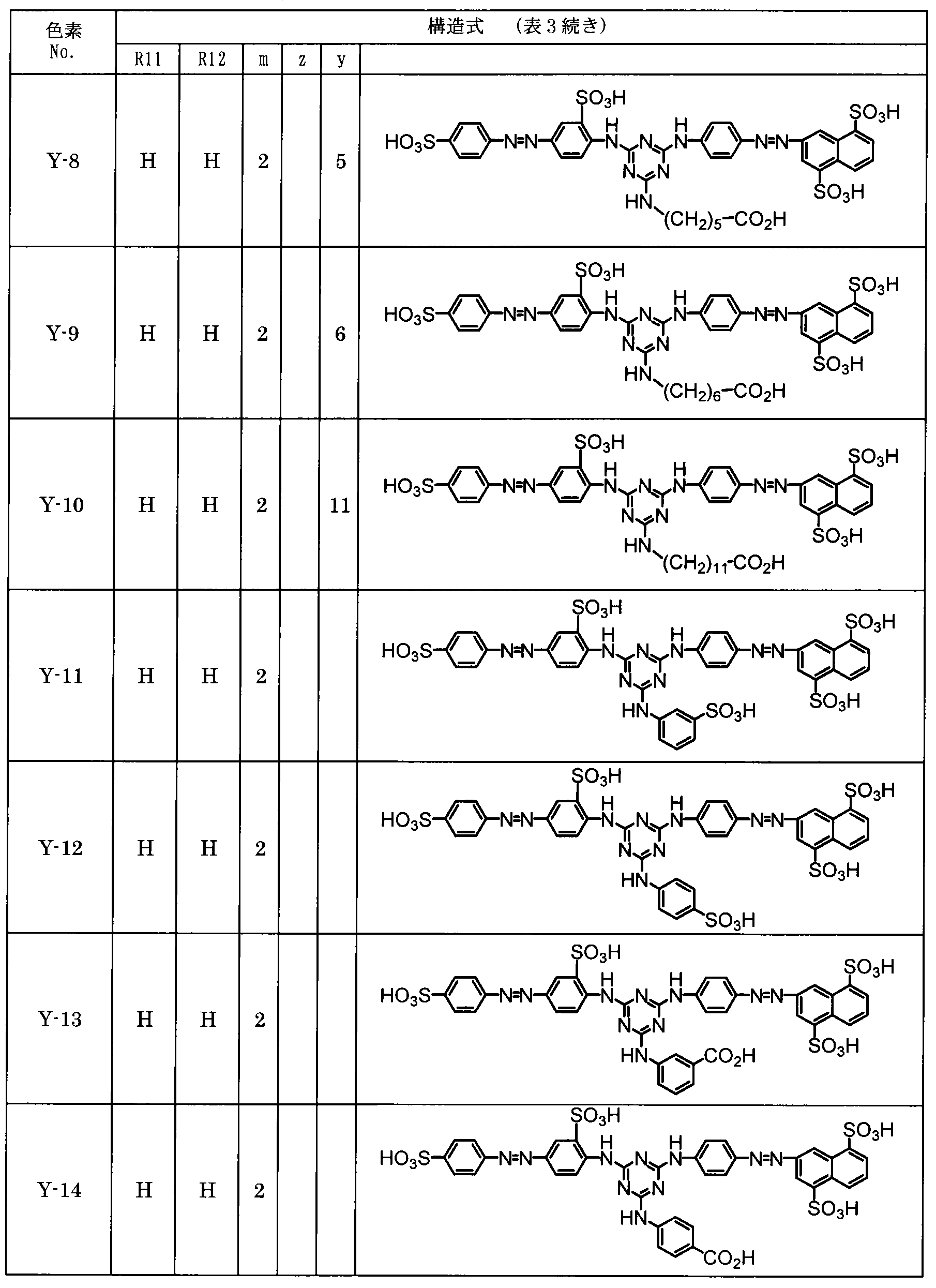
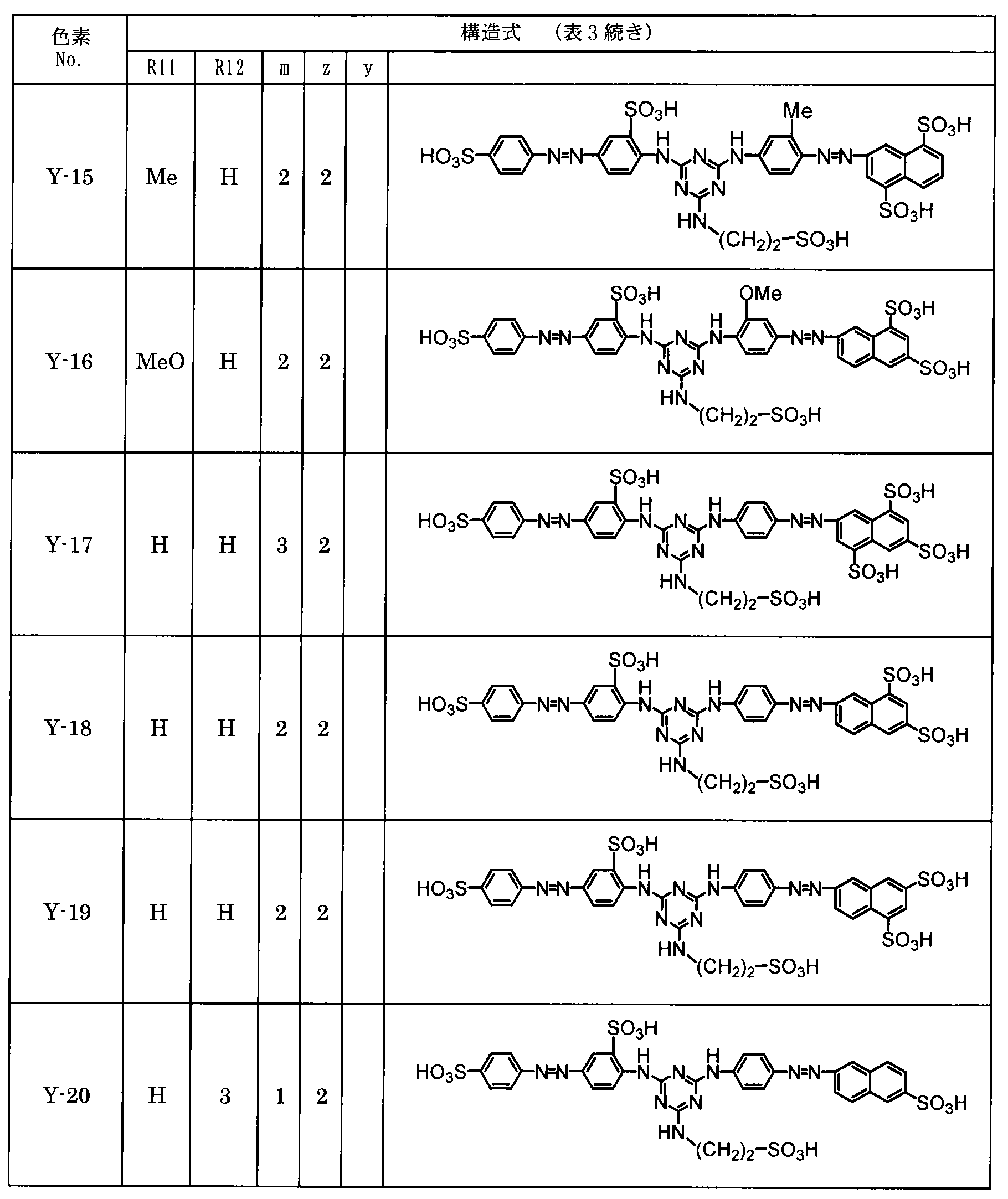
R11及びR12において、C1-C4アルコキシ基としては、直鎖及び分岐鎖のいずれでもよいが、直鎖がより好ましい。好ましい具体例としては、メトキシ、エトキシ、n-プロポキシ、n-ブトキシ等の直鎖のもの;イソプロポキシ、イソブトキシ、1-メチルプロポキシ、t-ブトキシ等の分岐鎖のもの;が挙げられる。より好ましくはメトキシである。
R11及びR12の組み合わせとしては、水素原子、メチル基、メトキシ基から選択される任意の組み合わせが好ましく、少なくとも一方が水素原子のものがより好ましく、両者が共に水素原子である色素がさらに好ましい。
基A1が上記式(2)で表される場合、式(2)中のzは1から3の整数を表す。好ましくは2である。
特開2004-75719号公報に記載の例を参考にして、下記式(13)で表される化合物を、重亜硫酸ナトリウム及びホルマリンを用いてメチル-ω-スルホン酸誘導体(14)に変換する。次いで、常法により、下記式(15)で表されるアミノベンゼン又はナフタレンスルホン酸類をジアゾ化し、先に得られた式(14)のメチル-ω-スルホン酸誘導体と0~15℃、pH2~4でカップリング反応を行い、引き続き、80~95℃、pH10.5~11.5で加水分解反応を行うことにより、下記式(16)で表される化合物が得られる。









また、上記式(20)で表される化合物としては、アミノメチルスルホン酸、タウリン、ホモタウリン等が挙げられ、好ましくはタウリンである。上記式(21)で表される化合物としては、グリシン、β-アラニン、4-アミノ酪酸、5-アミノ吉草酸、6-アミノヘキサン酸、7-アミノヘプタン酸、12-アミノドデカン酸等が具体例として挙げられる。
さらに、上記式(22)で表される化合物としては、3-アミノベンゼンスルホン酸、4-アミノベンゼンスルホン酸等が挙げられ、好ましくは3-アミノベンゼンスルホン酸である。上記式(23)で表される化合物としては、3-アミノ安息香酸、4-アミノ安息香酸が具体例として挙げられる。
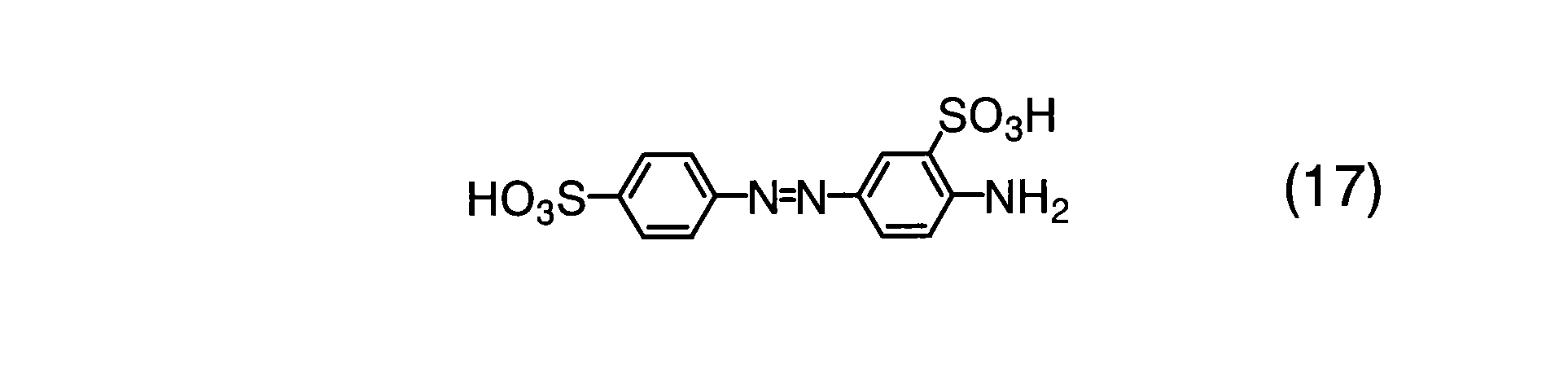
なお、上記式(17)で表される化合物は、ケムコインターナショナル製の市販品として入手可能である。

例えば、色素の合成反応における最終工程の反応液、あるいは色素を含むウェットケーキ又は色素の乾燥品等を溶解した水溶液に食塩を加えて塩析し、析出固体を濾過することにより、色素のナトリウム塩をウェットケーキとして得ることができる。
また、得られたナトリウム塩のウェットケーキを水に溶解後、塩酸等の酸を加えてそのpHを適宜調整し、析出した固体を濾過し、得られた固体を水又は塩酸水等の酸性水で洗浄すること等により、不純物として含有する無機塩、例えば塩化ナトリウムや硫酸ナトリウム等を除去することができ、色素の遊離酸を、あるいは色素の一部がナトリウム塩である遊離酸とナトリウム塩との混合物を得ることもできる。
さらに、色素の遊離酸のウェットケーキを水と共に撹拌しながら、例えば、水酸化カリウム、水酸化リチウム、アンモニア水等の無機塩基、又は上記式(35)で表される化合物の水酸化物等の有機塩基を添加してアルカリ性にすれば、各々相当するカリウム塩、リチウム塩、アンモニウム塩、又は4級アンモニウム塩を得ることもできる。遊離酸のモル数に対して、加える上記の塩のモル数を制限することにより、例えばリチウムとナトリウムとの混塩等、さらにはリチウム、ナトリウム、及びアンモニウムの混塩等も調製することが可能である。
無機塩基としては、上記の水酸化リチウム、水酸化ナトリウム、水酸化カリウム等のアルカリ金属の水酸化物の他に、炭酸リチウム、炭酸ナトリウム、炭酸カリウム等のアルカリ金属の炭酸塩、及び水酸化アンモニウム(アンモニア水)等が用いられる。
有機塩基の例としては、例えば前記式(35)で表される4級アンモニウム塩、例えばジエタノールアミン、トリエタノールアミン等のアルカノールアミンの塩等が用いられるがこれらに限定されるものではない。
色素の塩は、その塩の種類により溶解性等の物理的な性質、あるいはインクとして用いた場合のインクの性能が変化する場合もある。このため、目的とするインク性能等に応じて塩の種類を選択することも好ましく行われる。
なお、インクセットで用いるそれぞれの色素は塩をそろえる必要は無く、例えばイエローインク及びシアンインクに用いる色素はナトリウム塩であるが、マゼンタインクに用いる色素はアンモニウム塩である、といった使用も可能である。
本発明のインクセットに使用するインク組成物は、該インク組成物の総質量中に、それぞれの色素を通常0.1~20質量%、より好ましくは1~10質量%含有する。好ましく各色のインク組成物が含有する色素の量は異なり、シアンインク組成物の場合はシアン色素を2.0~6.0質量%;マゼンタインク組成物の場合はマゼンタ色素を2.0~8.0質量%;イエローインク組成物の場合はイエロー色素を1.0~5.0質量%;それぞれ含有するのが好ましい。
有機ハロゲン系化合物としては、例えばペンタクロロフェノールナトリウムが挙げられ、ピリジンオキシド系化合物としては、例えば2-ピリジンチオール-1-オキサイドナトリウムが挙げられ、イソチアゾリン系化合物としては、例えば1,2-ベンズイソチアゾリン-3-オン、2-n-オクチル-4-イソチアゾリン-3-オン、5-クロロ-2-メチル-4-イソチアゾリン-3-オン、5-クロロ-2-メチル-4-イソチアゾリン-3-オンマグネシウムクロライド、5-クロロ-2-メチル-4-イソチアゾリン-3-オンカルシウムクロライド、2-メチル-4-イソチアゾリン-3-オンカルシウムクロライド等が挙げられる。
その他の防腐防黴剤としては、酢酸ソーダ、ソルビン酸ソーダ、安息香酸ナトリウム等が挙げられる。防腐防黴剤の他の具体例としては、例えば、アベシア社製 商品名プロクセルGXL(S)及びプロクセルXL-2(S)等が好ましく挙げられる。
さらに、本発明のインクセットに用いる色素は、シアン、マゼンタ、イエローの各色それぞれのインクについては、式(6)、(7)、及び(1)の色素を単独で使用する必要は無く、減法混色の基本3原色としての色相が著しく変化しない範囲、また本発明の効果を阻害しない範囲で必要に応じて別の色素をさらに加えてあってもよい。
また、減法混色の基本3色の他の色、例えばブラックインク、レッドインク(オレンジインクとも言う)、グリーンインク、ブルーインク(バイオレットインクとも言う)等を加えて、4色以上のインクセットとして用いることも可能である。
このようなインク受容層を設けたものは通常インクジェット専用紙、インクジェット専用フィルム、光沢紙、光沢フィルム等と呼ばれる。
これらの中でも空気中の酸化作用を持つガス、すなわちオゾンガスや酸化窒素ガス等に対して影響を受けやすいとされているのが、上記の多孔質シリカ、アルミナゾルや特殊セラミックス等を基材表面に塗工したインクジェット専用紙である。
インクジェット専用紙として例えば代表的な市販品の一例を挙げると、キヤノン(株)製、商品名プロフェッショナルフォトペーパー、スーパーフォトペーパー、及びマットフォトペーパー;セイコーエプソン(株)製、商品名写真用紙クリスピア(高光沢)、写真用紙(光沢)、フォトマット紙;日本ヒューレット・パッカード(株)製、商品名アドバンスフォト用紙(光沢);富士フィルム(株)製、商品名画彩 写真仕上げPro;等がある。
本発明のインクセットは上記の酸化作用を持つガスへの耐性、特にオゾンガス耐性が優れているため、このような多孔性白色無機顔料をインク受容層として有する被記録材への記録においても変退色の小さい優れた記録画像を与える。また、普通紙にも当然用いることができる。
インクジェットプリンタには、例えば機械的振動を利用したピエゾ方式;加熱により生ずる泡を利用したバブルジェット(登録商標)方式;等を利用したものがある。本発明のインクジェット記録方法は、いかなる方式であっても使用が可能である。
本発明のインクセットにおける各インク組成物は貯蔵中に沈澱、分離することがなく、保存安定性が極めて高い。また、各インク組成物をインクジェット記録に使用した場合、ノズル付近におけるインク組成物の乾燥による結晶析出は非常に起こりにくく、噴射器(インクヘッド)を閉塞することもない。本発明のインクセットにおける各インク組成物は連続式インクジェットプリンタを用い、比較的長い時間間隔においてインクを再循環させて使用する場合;又はオンデマンド式インクジェットプリンタにより断続的に使用する場合;等においても、物理的性質の変化を起こさない。
(工程1)
銅トリベンゾ(2,3-ピリド)ポルフィラジン[上記式(30)におけるA、B、C、Dのうち1.0がピリジン環で残り3.0がベンゼン環で表される混合物]の合成。
四つ口フラスコに、スルホラン250部、フタルイミド12.3部、キノリン酸15.0部、尿素72.0部、塩化銅(II)・二水和物(純度97.0%)8.8部、モリブデン酸アンモニウム1.0部を加え、200℃まで昇温し、同温度で5時間保持した。反応終了後65℃まで冷却し、メタノール200部投入し、結晶を濾過した。得られた結晶をメタノール150部、続いて温水200部で洗浄、乾燥し、ウェットケーキ72.2部を得た。得られたウェットケーキ全量を5%塩酸500部中に投入し、60℃に昇温し、同温度で1時間保持した。結晶を濾過し水200部で洗浄した。次いで、得られたウェットケーキ全量を10%アンモニア水500部中に投入し、60℃で1時間保持し、結晶を濾過した後、水300部、メタノール100部で洗浄し、ウェットケーキ33.6部を得た。得られたウェットケーキを80℃で乾燥し、銅トリベンゾ(2,3-ピリド)ポルフィラジンと銅ジベンゾビス(2,3-ピリド)ポルフィラジンとの混合物20.0部を青色結晶として得た。ピリジン中でのλmaxは655.0nmであった。
銅トリベンゾ(2,3-ピリド)ポルフィラジントリスルホニルクロリド(上記式(8)におけるA、B、C、Dのうち1.0がピリジン環で残り3.0がベンゼン環であり、qが3.0である混合物)の合成。
クロロスルホン酸46.2部中に撹拌しながら60℃以下で、上記色素合成例1の(工程1)で得られた銅トリベンゾ(2,3-ピリド)ポルフィラジンと銅ジベンゾビス(2,3-ピリド)ポルフィラジンとの混合物5.8部を徐々に仕込み、140℃で4時間反応を行った。次に反応液を70℃まで冷却し、塩化チオニル17.9部を30分間かけて滴下し、70℃で3時間反応を行った。反応液を30℃以下に冷却し、氷水800部中にゆっくりと注ぎ、析出している結晶を濾過し、冷水200部で洗浄し、銅トリベンゾ(2,3-ピリド)ポルフィラジントリスルホニルクロリドのウェットケーキ40.1部を得た。
下記式(44)で表される化合物(上記式(9)におけるXが4-スルホアニリノ、Yが2-スルホエチルアミノ、Eがエチレンである化合物)の合成。

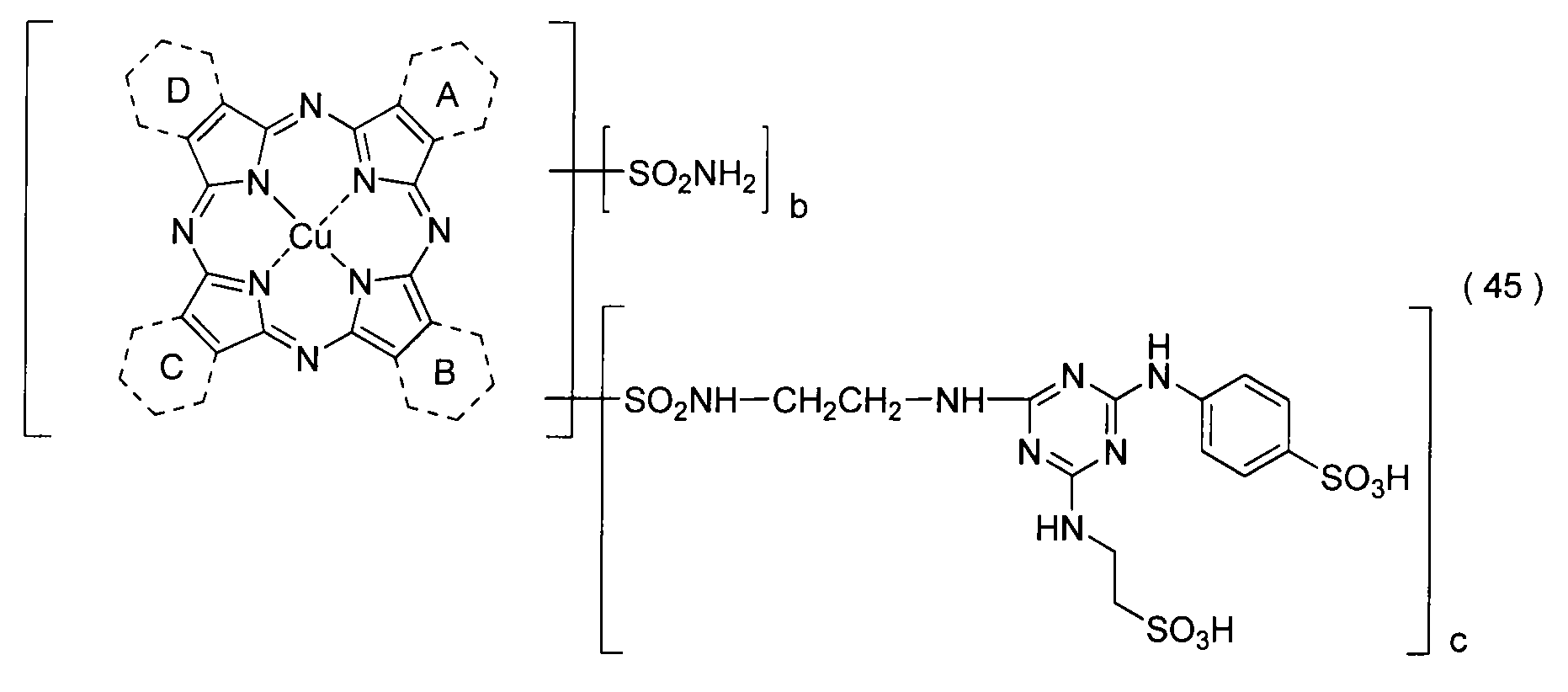
下記式(45)で表される化合物(上記式(7)におけるA、B、C、Dのうち1.0がピリジン環で残り3.0がベンゼン環であり、Eがエチレン、Xが4-スルホアニリノ、Yが2-スルホエチルアミノであり、bが2.36、及びcが0.64である化合物)の合成。
(工程1)
キシレン360部中に、下記式(38)で表される化合物94.8部、炭酸ナトリウム3.0部、ベンゾイル酢酸エチルエステル144.0部を順次加えて昇温し、140~150℃の温度で8時間反応を行った。その間、反応で生成するエタノールと水をキシレンと共沸させながら系外へ留出させ、反応を完結させた。次いで、冷却し、30℃にてメタノール240部を添加して30分撹拌後、析出固体を濾取した。得られた固体をメタノール360部で洗浄後、乾燥して、下記式(39)で表される化合物124.8部を淡黄色針状結晶として得た。


N,N―ジメチルホルムアミド300.0部中に、上記式(39)で表される化合物88.8部、メタアミノアセトアニリド75.0部、酢酸銅一水和物24.0部、及び炭酸ナトリウム12.8部を順次加えて120~130℃に昇温し、3時間反応を行った。反応液を約50℃に冷却し、メタノール120部を添加して30分撹拌した。析出固体を濾取し、メタノール500部、次いで80℃の温水で洗浄した後、乾燥することにより下記式(40)で表される化合物79.2部を青味赤色結晶として得た。

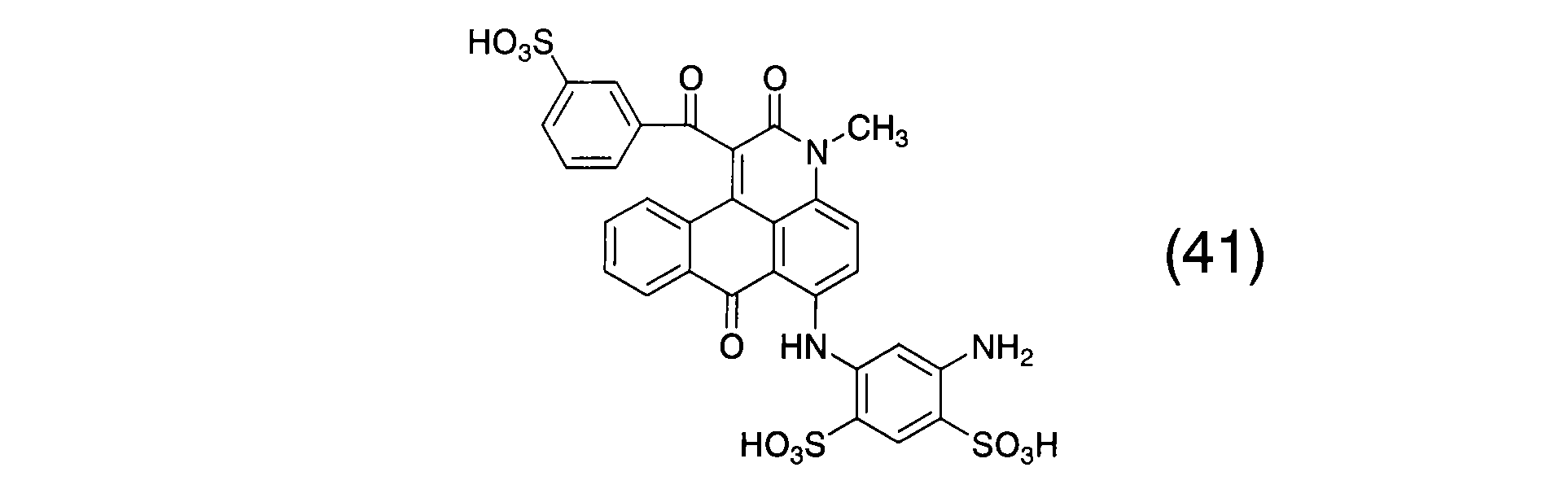
98%硫酸130部に、水冷しながら28%発煙硫酸170部を添加して、12%発煙硫酸300部を調製した。水冷下、上記式(40)で表される化合物51.3部を50℃以下で添加した後、85~90℃へ昇温し、4時間反応を行った。氷水600部中に反応液を添加し、その間氷を加えながら発熱による液温の上昇を40℃以下に保持した。さらに水を加えて液量を1000部とした後、濾過して、不溶解物を除去した。得られた母液に温水を加えて1500部とし、液温を60~65℃に保ちながら、塩化ナトリウム300部を添加して2時間撹拌し、析出した結晶を濾取した。20%塩化ナトリウム水溶液300部で洗浄し、よく水分を絞って下記式(41)で表される化合物59.2部を含むウェットケーキ100.3部を赤色結晶として得た。
水1000部中に、上記色素合成例2の(工程3)で得た式(41)のウェットケーキ1300部、25%水酸化ナトリウム500部を加え、完全に溶解させた。この化合物の純度は、ジアゾ分析法により24.35%であった。水20部にこの溶液64部を加え氷冷しながら液温を10℃以下とした。ここへクロロアセチルクロリド5.8部を加えて、10℃にて、pH2.5に保ちながら30分撹拌した。pHの調整は25%水酸化ナトリウム水溶液で行った。この反応液を50~60℃とし、塩化ナトリウム20部を添加、撹拌し、析出した結晶を濾取した。22%塩化ナトリウム水溶液100部で洗浄し、よく水分を絞り下記式(42)で表される化合物のナトリウム塩のウェットケーキ34部を得た。
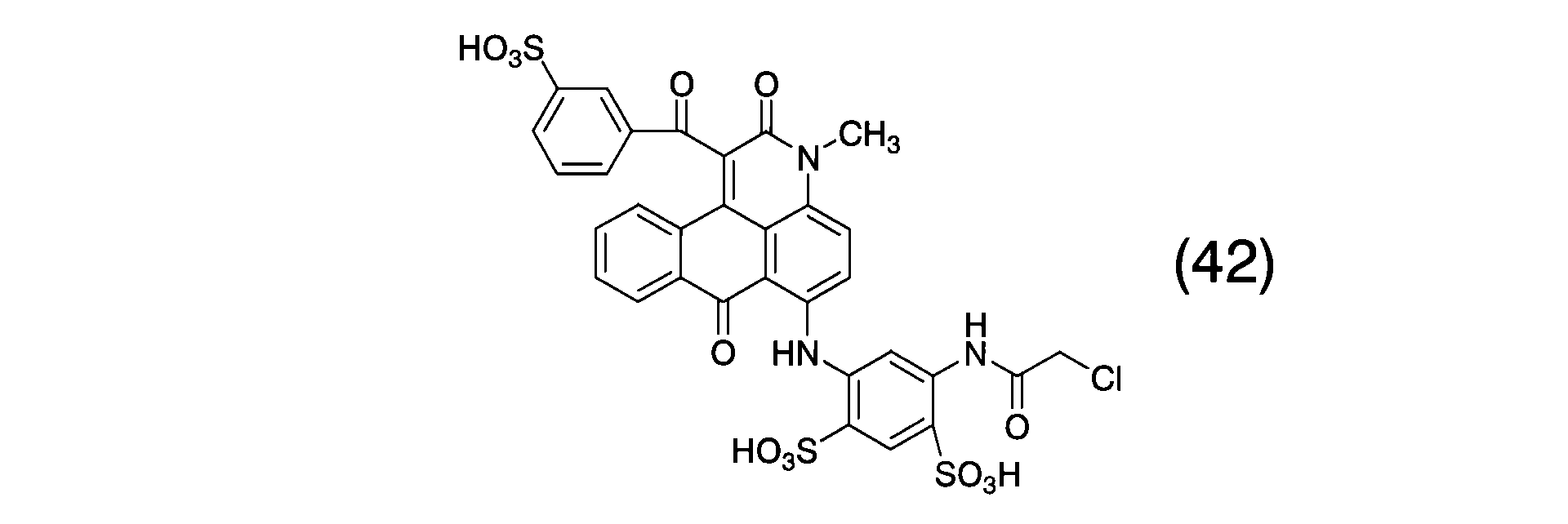
上記色素合成例2の(工程4)で得られた式(42)で表される化合物17部を含むウェットケーキを総量89部となるように水に加えて溶解させた。60℃へ昇温し、pH10で、6-アミノヘキサン酸13部を添加し30分撹拌した。pHの調整は25%水酸化ナトリウム水溶液で行った。液温50~55℃にて、35%塩酸でpH0.5へ調整し、塩化アンモニウム30部を添加、撹拌し、析出した固体を濾取した。23%塩化アンモニウム水溶液100部で洗浄し、得られたウェットケーキをメタノール100部の液中に加え、過熱撹拌し、得られた固体を濾過した後、メタノールで洗浄、乾燥し、下記式(43)で表されるマゼンタ色素のアンモニウム塩16部を赤色固体として得た。この色素の水溶液中でのλmax(最大吸収波長)は531nmであった。

(工程1)
2-アミノナフタレン-4,8-ジスルホン酸30.3部を水酸化ナトリウムでpH6に調整しながら水200部に溶解し、次いで亜硝酸ナトリウム7.2部を加えた。この溶液を0~10℃で、5%塩酸300部中に30分間かけて滴下した後、10℃以下で1時間撹拌してジアゾ化反応を行い、ジアゾ反応液を調製した。
一方、アニリン9.3部を、130部の水、10.4部の重亜硫酸ナトリウム及び8.6部の35%ホルマリンを用いて、常法によりメチル-ω-スルホン酸誘導体とした。
得られたメチル-ω-スルホン酸誘導体を、先に調製したジアゾ反応液中に加え、0~15℃、pH2~4で5時間撹拌した。反応液を水酸化ナトリウムでpH11とした後、同pHを維持しながら80~95℃で5時間撹拌し、さらに100部の塩化ナトリウムを加えて塩析し、析出固体を濾取することにより下記式(36)で表される化合物100部をウェットケーキとして得た。

250部の氷水中にライオン社製、商品名:レオコールTD90(界面活性剤)0.10部を加えて激しく撹拌し、その中に塩化シアヌール12.9部を添加して0~5℃で30分間撹拌し、懸濁液を得た。
続いて式(17)で表される化合物25.0部を水200部に溶解し、この溶液に上記の懸濁液を30分間かけて滴下した。滴下終了後pH5~7、0~15℃で6時間撹拌し、反応液を得た。
上記色素合成例3の(工程1)で得られた上記式(36)で表される化合物100部のウェットケーキを水300部に溶解し、上記色素合成例3の(工程2)で得た反応液に30分間かけて滴下した。滴下終了後pH6~7、25~50℃で6時間撹拌し、タウリン26.3部を加え、pH7~9、75~90℃で3時間撹拌した。得られた反応液を20~25℃まで冷却後、この反応液にアセトン800部を加え、20~25℃で1時間撹拌した。析出固体を濾取することによりウェットケーキ120.0部を得た。このウェットケーキを80℃の熱風乾燥機で乾燥することにより、下記式(37)で表されるイエロー色素50.0部をナトリウム塩として得た。この色素の水溶液中でのλmax(最大吸収波長)は382nmであった。
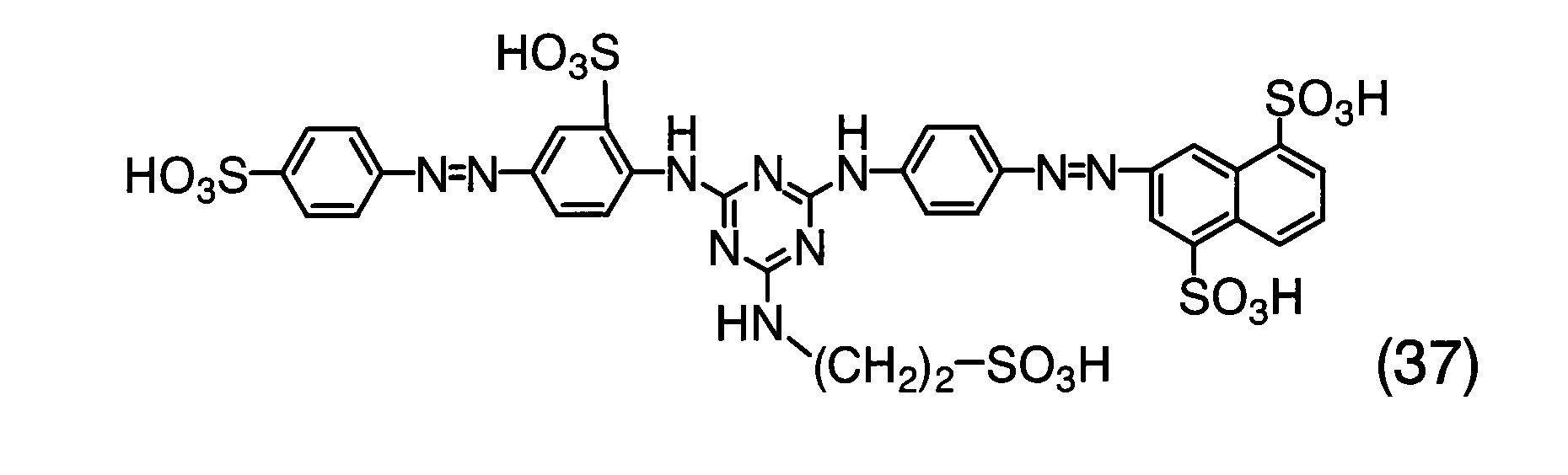
下記表4に示した組成に基づき、各成分を常温において混合することによりインク組成物を調製し、0.45μmのメンブランフィルタで濾過することによりそれぞれのインクジェット記録用水性インク組成物を得た。表4に記載した数値は、いずれも質量部数である。なお、表4中で使用した水は、希釈用途のものを含めていずれもイオン交換水を使用した。また、インク組成物のpHが8~10、総量100部になるように水及び2.5%水酸化ナトリウム水溶液、又は水及び2.8%アンモニア水を加えた。
色素合成例1の(工程4)で得られた式(45)で表されるシアン色素を用いたインク組成物をC-03とする。色素合成例2の(工程5)で得られた式(43)で表されるマゼンタ色素を用いたインク組成物をM-02とする。色素合成例3の(工程3)で得られた式(37)で表されるイエロー色素を用いたインク組成物をY-01とする。色素合成例2の(工程3)で得られた式(41)で表されるマゼンタ色素を用いたインク組成物をM-12とする。これらのインク組成物を下記表5で示す組み合わせとし、発明の実施例1のインクセットを作成し、インクジェット記録を行い、記録画像の評価を行った。結果を下記表6及び7に示す。


インクジェットプリンタ(キヤノン社製 Pixus iP3100)を用いて、多孔性白色無機物を含有するインク受像層を有する2種類の光沢紙にインクジェット記録を行った。インクジェット記録の際、印刷濃度が数段階の諧調が得られるように画像パターンを作り印字物を作成し、これを試験片とした。なお使用した光沢紙は以下の通りである。
光沢紙1:キヤノン社製 商品名プロフェッショナルフォトペーパー
PR-101
光沢紙2:エプソン社製 商品名クリスピア
光沢紙3:HP社製 商品名アドバンスフォトペーパー
上記(B)インクジェットプリントの項に記載したようにして作成した試験片をオゾンウェザーメーター(スガ試験機社製)を用いてオゾン濃度10ppm、湿度60%RH、温度24℃の環境下に8時間放置した。記録紙を測色システム(GRETAG SPM50:GRETAG社製)を用いて測色し、(D値)1.0~1.2の記録紙の試験前後の色差(ΔE)を測色し、評価を行った。
結果を下記表6に示す。なお、表6中の各数値は、上記ΔEを表す。この数値は、小さいほど良好な結果である。
光沢紙1乃至3にプリントして作成した試験片を恒温恒湿器(応用技研産業社製)を用いて30℃、80%RHで168時間放置した。D値が1.7付近の試験前後のブリード性を目視にて判定し、3段階で評価した。
○:滲みなし
△:わずか滲みあり
×:大きく滲みあり
結果を下記表7に示す。

Claims (15)
- 少なくともシアンインク組成物及びマゼンタインク組成物の2種のインク組成物から構成される、少なくとも2色のインクセットであって、該シアンインク組成物が含有するシアン色素が下記式(7)で表される色素又はその塩であり、該マゼンタインク組成物が含有するマゼンタ色素が下記式(6)で表される色素又はその塩であるインクジェット記録用インクセット。

Eはアルキレン基を表し、
Xは、少なくとも1つのスルホ基、カルボキシ基、又はリン酸基を置換基として有するアニリノ基又はナフチルアミノ基であり、該アニリノ基又はナフチルアミノ基は、さらにスルホ基、カルボキシ基、リン酸基、スルファモイル基、カルバモイル基、ヒドロキシ基、アルコキシ基、アミノ基、モノ又はジアルキルアミノ基、モノ又はジアリールアミノ基、アセチルアミノ基、ウレイド基、アルキル基、ニトロ基、シアノ基、ハロゲン原子、アルキルスルホニル基、及びアルキルチオ基から成る群から選択される1種又は2種以上の置換基で置換されてもよく、
Yはアミノ基;ヒドロキシ基;スルホ基、カルボキシ基、リン酸基、スルファモイル基、カルバモイル基、ヒドロキシ基、アルコキシ基、ヒドロキシアルコキシ基、アミノ基、モノ-又はジ-アルキルアミノ基、モノ-又はジ-アリールアミノ基、アセチルアミノ基、ウレイド基、アルキル基、ニトロ基、シアノ基、ハロゲン原子、アルキルスルホニル基、及びアルキルチオ基から成る群から選択される1種又は2種以上の置換基を有してもよい、モノ若しくはジアルキルアミノ基又は含窒素複素環基;を表し(但し、Yがアミノ基又はヒドロキシ基であり、且つXが置換アニリノ基である組み合わせを除く。)、
bは0~2.9の数であり、cは0.1~3の数であり、且つb及びcの和は1~3である。]
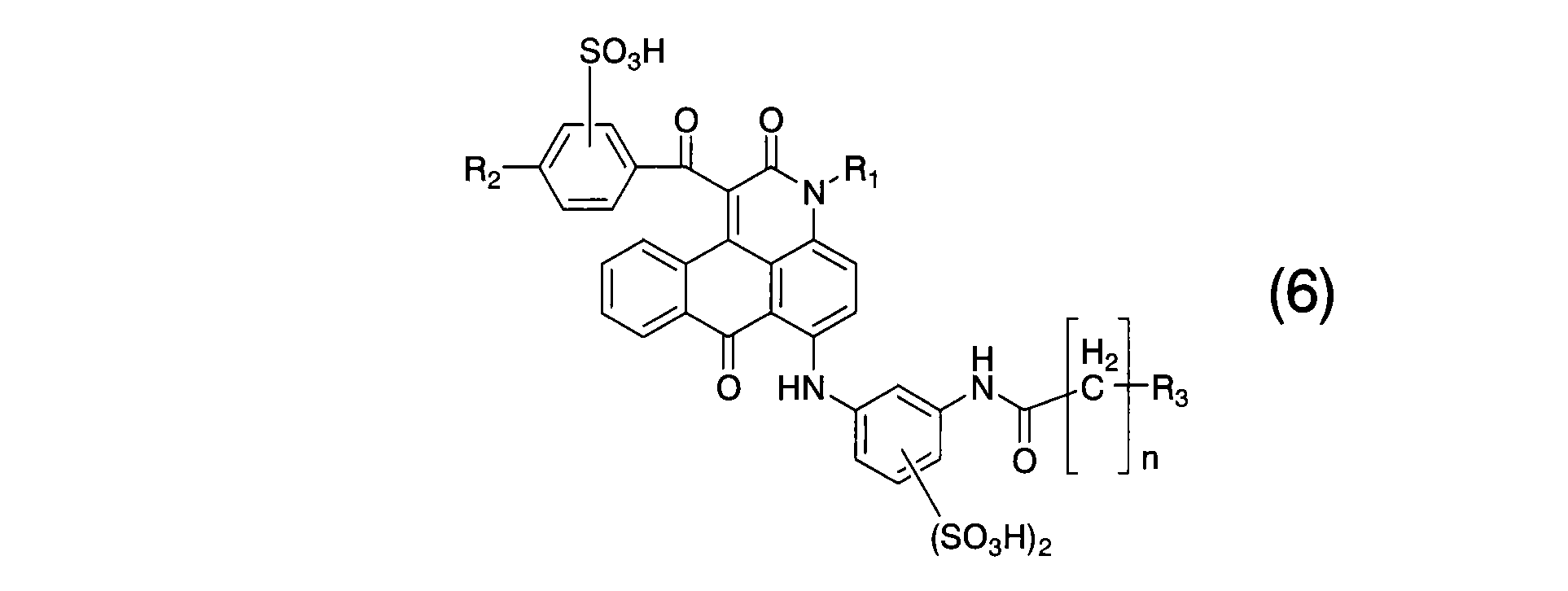
nは1~3の整数を表し、
R1は水素原子;アルキル基;ヒドロキシ低級アルキル基;シクロヘキシル基;モノ若しくはジアルキルアミノアルキル基;又はシアノ低級アルキル基;を表し、
R2は水素原子又はメトキシ基を表し、
R3はスルホ基、カルボキシ基、アルコキシ基、カルバモイル基、シアノ基、アルキル基、アニリノ基、フェノキシ基、アミノ基、ヒドロキシ基、及びメルカプト基よりなる群から選択される基で置換されたアニリノ基、若しくは無置換アニリノ基;スルホ基、カルボキシ基、アルコキシ基、カルボニル基、カルバモイル基、シアノ基、アニリノ基、フェノキシ基、アミノ基、ヒドロキシ基、メルカプト基、及びフェニル基よりなる群から選択される基で置換されたモノ若しくはジアルキルアミノ基、若しくは無置換モノ若しくはジアルキルアミノ基;スルホ基、カルボキシ基、アルコキシ基、カルボニル基、カルバモイル基、シアノ基、アルキル基、アニリノ基、フェノキシ基、アミノ基、ヒドロキシ基、及びメルカプト基よりなる群から選択される基で置換されたフェニルチオ基、若しくは無置換フェニルチオ基;スルホ基、カルボキシ基、アルコキシ基、カルボニル基、カルバモイル基、シアノ基、アニリノ基、フェノキシ基、アミノ基、ヒドロキシ基、メルカプト基、及びフェニル基よりなる群から選択される基で置換されたアルキルチオ基、若しくは無置換アルキルチオ基;メチル基、メトキシ基、若しくはカルボキシ基で置換されたスルホアニリノ基;カルボキシ置換ヒドロキシアニリノ基;スルホ基で置換されたナフチルアミノ基、若しくは無置換ナフチルアミノ基;スルホ基、カルボキシ基、アセチルアミノ基、アミノ基、ヒドロキシ基、フェノキシ基、及びフェニル基よりなる群から選択される基で置換されたフェノキシ基、若しくは無置換フェノキシ基;モノアルキルアミノアルキルアミノ基;ジアルキルアミノアルキルアミノ基;ヒドロキシ基;メルカプト基;又はアミノ基;を表し、
R1乃至R3で表される上記全ての基及び置換基が水素原子を有する場合、該水素原子は、水素原子以外の基で置換されてもよい。] - 前記シアンインク組成物が含有する前記式(7)で表されるシアン色素が、下記式(8)で表される化合物と下記式(9)で表される有機アミンとを、アンモニア又はアンモニア発生源の存在下で反応させることによって得られる色素又はその塩である請求項1に記載のインクジェット記録用インクセット。


- 前記式(6)で表されるマゼンタ色素又はその塩が、下記式(10)で表される色素又はその塩である請求項1に記載のインクジェット記録用インクセット。
- 前記シアンインク組成物が含有する前記式(7)で表されるシアン色素又はその塩が、下記式(11)で表される色素又はその塩である請求項1又は2に記載のインクジェット記録用インクセット。
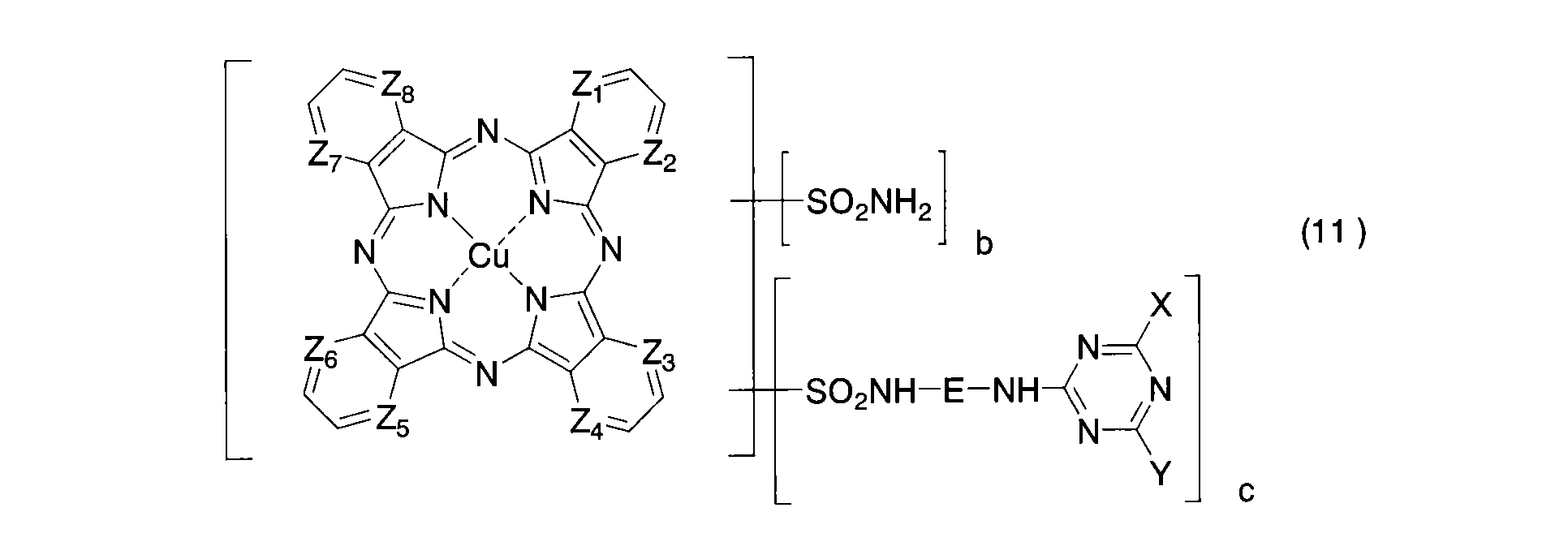
E、X、Y、b、及びcは式(7)におけるのと同じ意味を表す。] - 前記式(8)で表される化合物が、下記式(12)で表される化合物である請求項1、2、又は4に記載のインクジェット記録用インクセット、
- 前記シアンインク組成物の総質量中における、シアン色素の総含有量が2.0~6.0質量%である請求項1乃至5のいずれか一項に記載のインクジェット記録用インクセット。
- 前記マゼンタインク組成物の総質量中における、マゼンタ色素の総含有量が1.0~8.0質量%である請求項1乃至6のいずれか一項に記載のインクジェット記録用インクセット。
- 前記シアンインク組成物及び前記マゼンタインク組成物の2種のインク組成物に、イエローインク組成物を加えた3種のインク組成物から構成される、3色の請求項1に記載のインクジェット記録用インクセット。
- 前記イエローインク組成物の総質量中における、イエロー色素の総含有量が1.0~5.0質量%である請求項8に記載のインクジェット記録用インクセット。
- 請求項1乃至9のいずれか一項に記載のインクセットを用い、該インクセットの各インクのインク滴を記録信号に応じて吐出させて被記録材に付着させることにより記録を行うインクジェット記録方法。
- 前記被記録材が情報伝達用シートである請求項10に記載のインクジェット記録方法。
- 前記情報伝達用シートが普通紙又は多孔性白色無機物を含有するインク受像層を有するものである請求項11に記載のインクジェット記録方法。
- 請求項1乃至9のいずれか一項に記載のインクセットにより着色された着色体。
- 着色がインクジェットプリンタによりなされた請求項13に記載の着色体。
- 請求項1乃至9のいずれか一項に記載のインクセットを含有する容器が装填されたインクジェットプリンタ。
Priority Applications (2)
| Application Number | Priority Date | Filing Date | Title |
|---|---|---|---|
| US12/933,862 US8226222B2 (en) | 2008-03-28 | 2009-03-25 | Ink set, recording method, and colored object |
| JP2010505721A JP5628665B2 (ja) | 2008-03-28 | 2009-03-25 | インクセット、記録方法及び着色体 |
Applications Claiming Priority (2)
| Application Number | Priority Date | Filing Date | Title |
|---|---|---|---|
| JP2008088769 | 2008-03-28 | ||
| JP2008-088769 | 2008-03-28 |
Publications (1)
| Publication Number | Publication Date |
|---|---|
| WO2009119656A1 true WO2009119656A1 (ja) | 2009-10-01 |
Family
ID=41113848
Family Applications (1)
| Application Number | Title | Priority Date | Filing Date |
|---|---|---|---|
| PCT/JP2009/055936 Ceased WO2009119656A1 (ja) | 2008-03-28 | 2009-03-25 | インクセット、記録方法及び着色体 |
Country Status (3)
| Country | Link |
|---|---|
| US (1) | US8226222B2 (ja) |
| JP (1) | JP5628665B2 (ja) |
| WO (1) | WO2009119656A1 (ja) |
Cited By (3)
| Publication number | Priority date | Publication date | Assignee | Title |
|---|---|---|---|---|
| US20110128332A1 (en) * | 2009-11-30 | 2011-06-02 | Brother Kogyo Kabushiki Kaisha | Water-Based Ink for Ink-Jet Recording, Ink Cartridge, and Ink-Jet Recording Apparatus |
| US8430953B2 (en) | 2009-11-30 | 2013-04-30 | Brother Kogyo Kabushiki Kaisha | Water-based ink for ink-jet recording, ink cartridge, and ink-jet recording apparatus |
| US8460449B2 (en) | 2009-11-30 | 2013-06-11 | Brother Kogyo Kabushiki Kaisha | Water-based ink set for ink jet recording, ink cartridge, and ink-jet recording apparatus |
Families Citing this family (11)
| Publication number | Priority date | Publication date | Assignee | Title |
|---|---|---|---|---|
| JPWO2009154141A1 (ja) * | 2008-06-19 | 2011-12-01 | 日本化薬株式会社 | 水溶性アゾ化合物又はその塩、インク組成物及び着色体 |
| TW201005045A (en) * | 2008-06-30 | 2010-02-01 | Nippon Kayaku Kk | Porphyrazine pigment, ink composition and colored article |
| CN102264843B (zh) | 2008-12-25 | 2014-05-14 | 日本化药株式会社 | 四氮杂卟啉色素、含有该色素的油墨组合物及着色体 |
| US8535432B2 (en) | 2009-04-15 | 2013-09-17 | Nippon Kayaku Kabushiki Kaisha | Porphyrazine coloring matter, ink composition containing the same and colored product |
| WO2011122426A1 (ja) * | 2010-03-30 | 2011-10-06 | 日本化薬株式会社 | 水溶性アゾ化合物又はその塩、インク組成物及び着色体 |
| JP5284418B2 (ja) * | 2010-06-22 | 2013-09-11 | キヤノン株式会社 | インクジェット記録方法及びインクジェット記録装置 |
| JP5971639B2 (ja) * | 2010-09-30 | 2016-08-17 | ブラザー工業株式会社 | インクジェット記録用水性インクセット、インクジェット記録方法およびインクジェット記録装置 |
| JP5682748B2 (ja) * | 2010-09-30 | 2015-03-11 | ブラザー工業株式会社 | インクジェット記録用水性インクセット、インクジェット記録方法およびインクジェット記録装置 |
| JP2012092301A (ja) * | 2010-09-30 | 2012-05-17 | Brother Industries Ltd | インクジェット記録用水性インクセット、インクジェット記録方法およびインクジェット記録装置 |
| JP5846424B2 (ja) * | 2010-11-05 | 2016-01-20 | ブラザー工業株式会社 | インクジェット記録用水性インク、インクジェット記録方法およびインクジェット記録装置 |
| GB201118750D0 (en) * | 2011-10-31 | 2011-12-14 | Fujifilm Imaging Colorants Ltd | Azaphthalocyanines |
Citations (5)
| Publication number | Priority date | Publication date | Assignee | Title |
|---|---|---|---|---|
| JP2005105135A (ja) * | 2003-09-30 | 2005-04-21 | Seiko Epson Corp | インクセット |
| JP2006063329A (ja) * | 2004-07-29 | 2006-03-09 | Canon Inc | インクジェット用イエローインク、インクセット、インクジェット記録方法、インクカートリッジ、記録ユニット及びインクジェット記録装置 |
| WO2007116933A1 (ja) * | 2006-04-07 | 2007-10-18 | Nippon Kayaku Kabushiki Kaisha | ポルフィラジン色素、インク、インクセット及び着色体 |
| JP2007277416A (ja) * | 2006-04-07 | 2007-10-25 | Nippon Kayaku Co Ltd | 新規ポルフィラジン色素、インク、インクセット、このインクまたはインクセットを用いたインクジェット記録方法、着色体 |
| WO2009060654A1 (ja) * | 2007-11-06 | 2009-05-14 | Nippon Kayaku Kabushiki Kaisha | アントラピリドン化合物又はその塩、マゼンタインク組成物及び着色体 |
Family Cites Families (4)
| Publication number | Priority date | Publication date | Assignee | Title |
|---|---|---|---|---|
| US6646024B2 (en) * | 1999-12-14 | 2003-11-11 | Lexmark International, Inc. | Ink compositions |
| EP1609824B1 (en) | 2003-03-31 | 2012-10-10 | Nippon Kayaku Kabushiki Kaisha | Phthalocyanine dye and use thereof for ink-jet printing |
| JP2007116933A (ja) * | 2005-10-26 | 2007-05-17 | Atex Co Ltd | 刈刃機の薬剤塗布装置 |
| EP1882723B1 (de) | 2006-07-27 | 2009-03-25 | ILFORD Imaging Switzerland GmbH | Bisazofarbstoffe, ihre Herstellung und Verwendung |
-
2009
- 2009-03-25 JP JP2010505721A patent/JP5628665B2/ja active Active
- 2009-03-25 WO PCT/JP2009/055936 patent/WO2009119656A1/ja not_active Ceased
- 2009-03-25 US US12/933,862 patent/US8226222B2/en active Active
Patent Citations (5)
| Publication number | Priority date | Publication date | Assignee | Title |
|---|---|---|---|---|
| JP2005105135A (ja) * | 2003-09-30 | 2005-04-21 | Seiko Epson Corp | インクセット |
| JP2006063329A (ja) * | 2004-07-29 | 2006-03-09 | Canon Inc | インクジェット用イエローインク、インクセット、インクジェット記録方法、インクカートリッジ、記録ユニット及びインクジェット記録装置 |
| WO2007116933A1 (ja) * | 2006-04-07 | 2007-10-18 | Nippon Kayaku Kabushiki Kaisha | ポルフィラジン色素、インク、インクセット及び着色体 |
| JP2007277416A (ja) * | 2006-04-07 | 2007-10-25 | Nippon Kayaku Co Ltd | 新規ポルフィラジン色素、インク、インクセット、このインクまたはインクセットを用いたインクジェット記録方法、着色体 |
| WO2009060654A1 (ja) * | 2007-11-06 | 2009-05-14 | Nippon Kayaku Kabushiki Kaisha | アントラピリドン化合物又はその塩、マゼンタインク組成物及び着色体 |
Cited By (4)
| Publication number | Priority date | Publication date | Assignee | Title |
|---|---|---|---|---|
| US20110128332A1 (en) * | 2009-11-30 | 2011-06-02 | Brother Kogyo Kabushiki Kaisha | Water-Based Ink for Ink-Jet Recording, Ink Cartridge, and Ink-Jet Recording Apparatus |
| US8430953B2 (en) | 2009-11-30 | 2013-04-30 | Brother Kogyo Kabushiki Kaisha | Water-based ink for ink-jet recording, ink cartridge, and ink-jet recording apparatus |
| US8449664B2 (en) * | 2009-11-30 | 2013-05-28 | Brother Kogyo Kabushiki Kaisha | Water-based ink for ink-jet recording, ink cartridge, and ink-jet recording apparatus |
| US8460449B2 (en) | 2009-11-30 | 2013-06-11 | Brother Kogyo Kabushiki Kaisha | Water-based ink set for ink jet recording, ink cartridge, and ink-jet recording apparatus |
Also Published As
| Publication number | Publication date |
|---|---|
| US8226222B2 (en) | 2012-07-24 |
| JPWO2009119656A1 (ja) | 2011-07-28 |
| US20110032302A1 (en) | 2011-02-10 |
| JP5628665B2 (ja) | 2014-11-19 |
Similar Documents
| Publication | Publication Date | Title |
|---|---|---|
| JP5628665B2 (ja) | インクセット、記録方法及び着色体 | |
| JP5260493B2 (ja) | 新規ポルフィラジン色素、インク、インクセット及び着色体 | |
| JP5066079B2 (ja) | ポルフィラジン色素、インク、インクセット及び着色体 | |
| JP5027674B2 (ja) | 新規ポルフィラジン色素、インク、インクセット及び着色体 | |
| JP5670894B2 (ja) | ポルフィラジン色素、インク組成物、記録方法及び着色体 | |
| JP5281019B2 (ja) | ポルフィラジン色素及びこれを含有するインク組成物 | |
| KR20100072218A (ko) | 안트라피리돈 화합물 또는 그의 염, 마젠타 잉크 조성물 및 착색체 | |
| JP5458010B2 (ja) | ポルフィラジン色素、インク組成物及び着色体 | |
| JP2008013706A (ja) | インク組成物、インクジェット記録方法、ブロンズ現象の抑制方法及び着色体 | |
| JP2007277416A (ja) | 新規ポルフィラジン色素、インク、インクセット、このインクまたはインクセットを用いたインクジェット記録方法、着色体 | |
| WO2009093500A1 (ja) | 水溶性アゾ化合物又はその塩、インク組成物及び着色体 | |
| JP2009263514A (ja) | 水溶性アゾ化合物又はその塩、インク組成物及び着色体 | |
| JP5458022B2 (ja) | ポルフィラジン色素、これを含有するインク組成物及び着色体 | |
| JP2010007019A (ja) | 黒色インク組成物、インクジェット記録方法及び着色体 | |
| WO2009154141A1 (ja) | 水溶性アゾ化合物又はその塩、インク組成物及び着色体 | |
| WO2009116243A1 (ja) | 水溶性アントラピリドン化合物又はその塩、インク組成物及び着色体 | |
| JP5334526B2 (ja) | ポルフィラジン色素、これを含有するインク組成物及び着色体 | |
| JP2010150337A (ja) | インク組成物及び着色体 | |
| JP2010001348A (ja) | 水溶性アントラピリドン化合物又はその塩、インク組成物及び着色体 | |
| JP2010116489A (ja) | 水溶性アントラピリドン化合物又はその塩、インク組成物及び着色体 | |
| JP2011252031A (ja) | アゾ化合物、インク組成物及び着色体 | |
| JP2011190429A (ja) | ポルフィラジン色素、これを含有するインク組成物及び着色剤 |
Legal Events
| Date | Code | Title | Description |
|---|---|---|---|
| 121 | Ep: the epo has been informed by wipo that ep was designated in this application |
Ref document number: 09725899 Country of ref document: EP Kind code of ref document: A1 |
|
| WWE | Wipo information: entry into national phase |
Ref document number: 2010505721 Country of ref document: JP |
|
| WWE | Wipo information: entry into national phase |
Ref document number: 12933862 Country of ref document: US |
|
| NENP | Non-entry into the national phase |
Ref country code: DE |
|
| 122 | Ep: pct application non-entry in european phase |
Ref document number: 09725899 Country of ref document: EP Kind code of ref document: A1 |