WO2009110230A1 - 難燃性樹脂組成物及び被覆電線 - Google Patents
難燃性樹脂組成物及び被覆電線 Download PDFInfo
- Publication number
- WO2009110230A1 WO2009110230A1 PCT/JP2009/000966 JP2009000966W WO2009110230A1 WO 2009110230 A1 WO2009110230 A1 WO 2009110230A1 JP 2009000966 W JP2009000966 W JP 2009000966W WO 2009110230 A1 WO2009110230 A1 WO 2009110230A1
- Authority
- WO
- WIPO (PCT)
- Prior art keywords
- group
- weight
- resin composition
- acid
- parts
- Prior art date
- Legal status (The legal status is an assumption and is not a legal conclusion. Google has not performed a legal analysis and makes no representation as to the accuracy of the status listed.)
- Ceased
Links
Classifications
-
- C—CHEMISTRY; METALLURGY
- C08—ORGANIC MACROMOLECULAR COMPOUNDS; THEIR PREPARATION OR CHEMICAL WORKING-UP; COMPOSITIONS BASED THEREON
- C08L—COMPOSITIONS OF MACROMOLECULAR COMPOUNDS
- C08L67/00—Compositions of polyesters obtained by reactions forming a carboxylic ester link in the main chain; Compositions of derivatives of such polymers
- C08L67/02—Polyesters derived from dicarboxylic acids and dihydroxy compounds
-
- H—ELECTRICITY
- H01—ELECTRIC ELEMENTS
- H01B—CABLES; CONDUCTORS; INSULATORS; SELECTION OF MATERIALS FOR THEIR CONDUCTIVE, INSULATING OR DIELECTRIC PROPERTIES
- H01B3/00—Insulators or insulating bodies characterised by the insulating materials; Selection of materials for their insulating or dielectric properties
- H01B3/18—Insulators or insulating bodies characterised by the insulating materials; Selection of materials for their insulating or dielectric properties mainly consisting of organic substances
- H01B3/28—Insulators or insulating bodies characterised by the insulating materials; Selection of materials for their insulating or dielectric properties mainly consisting of organic substances natural or synthetic rubbers
-
- H—ELECTRICITY
- H01—ELECTRIC ELEMENTS
- H01B—CABLES; CONDUCTORS; INSULATORS; SELECTION OF MATERIALS FOR THEIR CONDUCTIVE, INSULATING OR DIELECTRIC PROPERTIES
- H01B3/00—Insulators or insulating bodies characterised by the insulating materials; Selection of materials for their insulating or dielectric properties
- H01B3/18—Insulators or insulating bodies characterised by the insulating materials; Selection of materials for their insulating or dielectric properties mainly consisting of organic substances
- H01B3/30—Insulators or insulating bodies characterised by the insulating materials; Selection of materials for their insulating or dielectric properties mainly consisting of organic substances plastics; resins; waxes
- H01B3/42—Insulators or insulating bodies characterised by the insulating materials; Selection of materials for their insulating or dielectric properties mainly consisting of organic substances plastics; resins; waxes polyesters; polyethers; polyacetals
- H01B3/421—Polyesters
-
- H—ELECTRICITY
- H01—ELECTRIC ELEMENTS
- H01B—CABLES; CONDUCTORS; INSULATORS; SELECTION OF MATERIALS FOR THEIR CONDUCTIVE, INSULATING OR DIELECTRIC PROPERTIES
- H01B3/00—Insulators or insulating bodies characterised by the insulating materials; Selection of materials for their insulating or dielectric properties
- H01B3/18—Insulators or insulating bodies characterised by the insulating materials; Selection of materials for their insulating or dielectric properties mainly consisting of organic substances
- H01B3/30—Insulators or insulating bodies characterised by the insulating materials; Selection of materials for their insulating or dielectric properties mainly consisting of organic substances plastics; resins; waxes
- H01B3/42—Insulators or insulating bodies characterised by the insulating materials; Selection of materials for their insulating or dielectric properties mainly consisting of organic substances plastics; resins; waxes polyesters; polyethers; polyacetals
- H01B3/421—Polyesters
- H01B3/422—Linear saturated polyesters derived from dicarboxylic acids and dihydroxy compounds
- H01B3/423—Linear aromatic polyesters
-
- C—CHEMISTRY; METALLURGY
- C08—ORGANIC MACROMOLECULAR COMPOUNDS; THEIR PREPARATION OR CHEMICAL WORKING-UP; COMPOSITIONS BASED THEREON
- C08K—Use of inorganic or non-macromolecular organic substances as compounding ingredients
- C08K5/00—Use of organic ingredients
- C08K5/04—Oxygen-containing compounds
- C08K5/13—Phenols; Phenolates
-
- C—CHEMISTRY; METALLURGY
- C08—ORGANIC MACROMOLECULAR COMPOUNDS; THEIR PREPARATION OR CHEMICAL WORKING-UP; COMPOSITIONS BASED THEREON
- C08K—Use of inorganic or non-macromolecular organic substances as compounding ingredients
- C08K5/00—Use of organic ingredients
- C08K5/49—Phosphorus-containing compounds
- C08K5/51—Phosphorus bound to oxygen
- C08K5/53—Phosphorus bound to oxygen bound to oxygen and to carbon only
- C08K5/5313—Phosphinic compounds, e.g. R2=P(:O)OR'
-
- C—CHEMISTRY; METALLURGY
- C08—ORGANIC MACROMOLECULAR COMPOUNDS; THEIR PREPARATION OR CHEMICAL WORKING-UP; COMPOSITIONS BASED THEREON
- C08L—COMPOSITIONS OF MACROMOLECULAR COMPOUNDS
- C08L23/00—Compositions of homopolymers or copolymers of unsaturated aliphatic hydrocarbons having only one carbon-to-carbon double bond; Compositions of derivatives of such polymers
- C08L23/02—Compositions of homopolymers or copolymers of unsaturated aliphatic hydrocarbons having only one carbon-to-carbon double bond; Compositions of derivatives of such polymers not modified by chemical after-treatment
- C08L23/04—Homopolymers or copolymers of ethene
- C08L23/08—Copolymers of ethene
- C08L23/0846—Copolymers of ethene with unsaturated hydrocarbons containing atoms other than carbon or hydrogen
- C08L23/0869—Copolymers of ethene with unsaturated hydrocarbons containing atoms other than carbon or hydrogen with unsaturated acids, e.g. [meth]acrylic acid; with unsaturated esters, e.g. [meth]acrylic acid esters
- C08L23/0884—Epoxide-containing esters
-
- C—CHEMISTRY; METALLURGY
- C08—ORGANIC MACROMOLECULAR COMPOUNDS; THEIR PREPARATION OR CHEMICAL WORKING-UP; COMPOSITIONS BASED THEREON
- C08L—COMPOSITIONS OF MACROMOLECULAR COMPOUNDS
- C08L63/00—Compositions of epoxy resins; Compositions of derivatives of epoxy resins
-
- C—CHEMISTRY; METALLURGY
- C08—ORGANIC MACROMOLECULAR COMPOUNDS; THEIR PREPARATION OR CHEMICAL WORKING-UP; COMPOSITIONS BASED THEREON
- C08L—COMPOSITIONS OF MACROMOLECULAR COMPOUNDS
- C08L67/00—Compositions of polyesters obtained by reactions forming a carboxylic ester link in the main chain; Compositions of derivatives of such polymers
- C08L67/02—Polyesters derived from dicarboxylic acids and dihydroxy compounds
- C08L67/025—Polyesters derived from dicarboxylic acids and dihydroxy compounds containing polyether sequences
Definitions
- the present invention has high heat resistance and flame retardancy although it does not contain a halogen-based flame retardant, etc., and has flexibility, durability (hydrolysis resistance, etc.) and moldability (extrudability, etc.).
- the present invention relates to an excellent flame retardant resin composition, and particularly to a flame retardant resin composition useful for coating electric wires and the like, and a covered electric wire. Background art
- ECU Electronica Control Unit
- indoor and outdoor lighting related devices indoor and outdoor lighting related devices
- air conditioners air conditioners
- motor drive devices such as wipers and power windows
- Such wiring materials are required to have high durability and flame retardancy.
- polyvinyl chloride resin has been used as a material excellent in durability and flame retardancy.
- flame retardancy it is known that the use of a halogen-based flame retardant makes it possible to highly flame retardant resins.
- non-halogen materials such as materials based on flame retardant polyolefin, polyester elastomer, etc. (particularly, materials not containing halogen flame retardants) are attracting attention.
- JP-A-9-53007 discloses polybutylene terephthalate as a hard segment, aromatic dicarboxylic acid as a soft segment, and a long carbon number of 5 to 12.
- a phosphorus block and / or a triazine compound (100 parts by weight of a mixture of a polyester block copolymer (A) composed of a polyester mainly composed of a chain diol and, if necessary, a polyalkylene terephthalate resin (B)
- a flame-retardant resin composition containing 5 to 150 parts by weight, and an electric wire having this resin composition as a coating on the outside of a conductor as a wire coating material are disclosed.
- Japanese Patent Application Laid-Open No. 2002-30204 discloses a high melting point crystalline polymer segment (a) containing a crystalline aromatic polyester unit and a low melting point polymer containing an aliphatic polyether unit. 1 to 50 parts by weight of a phosphorus compound (B), a monocarbodiimide compound (C) and / or a poly (polyester ester block copolymer (A) comprising 100 parts by weight of a segment (b) as a main constituent component It is disclosed that a flame retardant polyester elastomer resin composition containing 0.01 to 10 parts by weight of a carbodiimide compound (D) is suitable for coating electric wires or optical fibers.
- JP-A-2002-358837 (Claims 1 and 4 to 6) describes (B) polytetramethylene terephthalate as a hard segment and 100% by weight of (A) thermoplastic aromatic polyester, 10 to 120 parts by weight of a polyester block copolymer composed of a segmented aromatic dicarboxylic acid and a long chain diol polyester having 5 to 12 carbon atoms, and (C) an olefin-acrylic acid modified with a glycidyl compound
- a flat cable having an insulating coating made of a polyester resin composition containing 1 to 50 parts by weight of an ester copolymer is disclosed.
- This document also discloses that a phosphorus-based flame retardant and a polycarbodiimide compound may be included.
- a resin composition has insufficient wear resistance and flame resistance.
- Japanese Patent Application Laid-Open No. 2001-256836 discloses a dicarboxylic acid component mainly containing terephthalic acid and / or an ester derivative thereof, tetramethylene glycol and polytetramethylene oxide glycol as main components.
- the heat stabilizer is 0.05 to 3 with respect to 100 parts by weight of the polyester ether resin having an intrinsic viscosity of 1.0 to 1.7 and a terminal carboxyl group content of 30 ⁇ eq / g or less.
- a resin-coated electric wire obtained by coating a polyester ether resin containing parts by weight and 0.05 to 5 parts by weight of a lubricant is disclosed.
- This document proposes a method using a phosphite compound, a hindered phenol compound, and a thioether compound as a heat stabilizer.
- such a resin composition has insufficient flame retardancy.
- JP-T-2004-537630 (Claims 1 to 4 and 7) discloses phosphinic acid salts and / or diphosphinic acid salts and / or polymers thereof having an average particle size (d50-value) of 10 ⁇ m or less in a polyester resin.
- a method using 1 to 40% by mass has been proposed.
- such a resin composition can impart flame retardancy but has insufficient flexibility and toughness. In particular, due to the lack of these properties, it is not suitable for wire coating applications. Disclosure of the invention
- an object of the present invention is to provide a flame retardant resin composition that has high heat resistance and flame retardancy and is excellent in workability and flexibility or toughness, particularly useful for coating electric wires and the like. It is to provide a composition.
- Another object of the present invention is to provide a flame retardant resin composition which is excellent in durability, heat resistance and extrusion processability, and is useful for wire coating applications, and a coated electric wire coated with this flame retardant resin composition. It is in.
- Still another object of the present invention is to provide a flame retardant resin composition that is free from appearance defects on the surface of a molded product such as bumps, can suppress bleeding out even in a high temperature environment, and can maintain excellent characteristics. .
- the present inventors have found that when specific five components are combined, even if they are non-halogen, they have high flame retardancy, moldability such as extrudability, and flexibility.
- the present invention has been completed by finding that a resin composition excellent in property or toughness and suitable for covering electric wires can be obtained.
- the present invention relates to (A) phosphinate and diphosphinate having (B) 25 to 150 parts by weight of a thermoplastic polyester elastomer and (C) an average particle size of 10 ⁇ m or less based on 100 parts by weight of polybutylene terephthalate resin. And 5 to 40 parts by weight of at least one phosphinic acid selected from these polymers, (D) 0.5 to 20 parts by weight of an epoxy compound, and (E) 0.1 to 5 parts by weight of an antioxidant.
- a flame retardant resin composition comprising an antioxidant (E) containing a phenolic antioxidant (e-1) as an essential component, a phosphite antioxidant (e-2), and a phosphonite series.
- a flame retardant resin composition containing at least one selected from an antioxidant (e-3) and a thioether-based antioxidant (e-4), and the above-mentioned difficulty in coating an electric wire and its surface A covered electric wire, including sexual resin composition.
- the flame retardant resin composition of the present invention combines specific five components, even a non-halogen resin composition has high flame retardancy and is excellent in workability and flexibility or toughness. Moreover, since the flame retardant resin composition of the present invention is excellent in durability (such as hydrolysis resistance), heat resistance, surface smoothness, and extrusion processability, it is useful in wire coating applications. In addition, the flame retardant resin composition of the present invention can suppress bleed out even under a high temperature environment, and can maintain excellent characteristics.
- the flame retardant resin composition of the present invention comprises five specific components, namely (A) polybutylene terephthalate resin, (B) thermoplastic polyester elastomer, (C) phosphinic acids, (D) epoxy compound, and (E) Consists of antioxidants.
- PBT Polybutylene terephthalate
- butylene terephthalate is a main component (for example, 50 to 100% by weight, preferably 60 to 100% by weight, more preferably about 70 to 100% by weight).
- Homopolyester or copolyester polybutylene terephthalate, polybutylene terephthalate copolyester).
- copolymerizable monomer in the copolyester (butylene terephthalate copolymer or modified PBT resin) (hereinafter sometimes simply referred to as a copolymerizable monomer)
- dicarboxylic acid excluding terephthalic acid, 1,4-butanediol is used. Excluded diol, oxycarboxylic acid, lactone and the like.
- the copolymerizable monomers can be used alone or in combination of two or more.
- dicarboxylic acid examples include aliphatic dicarboxylic acids (for example, succinic acid, glutaric acid, adipic acid, pimelic acid, suberic acid, azelaic acid, sebacic acid, undecanedicarboxylic acid, dodecanedicarboxylic acid, hexadecanedicarboxylic acid, dimer acid, etc.
- aliphatic dicarboxylic acids for example, succinic acid, glutaric acid, adipic acid, pimelic acid, suberic acid, azelaic acid, sebacic acid, undecanedicarboxylic acid, dodecanedicarboxylic acid, hexadecanedicarboxylic acid, dimer acid, etc.
- C4-40 dicarboxylic acids preferably C4-14 dicarboxylic acids
- alicyclic dicarboxylic acids for example, C8-12 dicarboxylic acids such as hexahydrophthalic acid, hexahydroisophthalic acid, hexahydroterephthalic acid, and hymic acid
- Aromatic dicarboxylic acids other than terephthalic acid for example, phthalic acid, isophthalic acid; naphthalenedicarboxylic acid such as 2,6-naphthalenedicarboxylic acid; 4,4′-diphenyldicarboxylic acid, 4,4′-diphenoxyether dicarboxylic acid, 4,4'-diphenyl ether dicarbo Acids, C4-16 dicarboxylic acids such as 4,4′-diphenylmethane dicarboxylic acid, 4,4′-diphenyl ketone dicarboxylic acid), or reactive derivatives thereof [ester-forming derivatives such as lower
- diol examples include aliphatic alkylene glycols other than 1,4-butanediol (for example, ethylene glycol, trimethylene glycol, propylene glycol, neopentyl glycol, hexanediol (1,6-hexanediol, etc.), octanediol ( 1,3-octanediol, etc.), lower alkylene glycols such as decanediol (C2-12 alkylene glycol, preferably C2-10 alkylene glycol, etc.), polyoxyalkylene glycols [glycols having a plurality of oxy C2-4 alkylene units, For example, diethylene glycol, dipropylene glycol, ditetramethylene glycol, triethylene glycol, tripropylene glycol, polytetramethylene glycol, etc.], alicyclic diols (for example, 1,4-cyclohexanediol, 1,4-
- the PBT resin As the PBT resin, a PBT resin [homopolyester (polybutylene terephthalate) and / or copolyester (copolymer) in which the proportion (modification amount) of the copolymerizable monomer is 30 mol% or less (for example, 0 to 30 mol%). )] Is preferred.
- the ratio of the copolymerizable monomer can be selected from the range of, for example, about 0.01 to 30 mol%, and is usually 1 to 30 mol%, preferably 3 to 25 mol%, more preferably 5 to 5 mol%. It is about 20 mol% (for example, 5 to 15 mol%).
- PBT resin can be used individually or in combination of 2 or more types.
- the intrinsic viscosity (IV) of the PBT resin is not particularly limited, and may be, for example, about 0.6 to 1.4 when measured at 35 ° C. in o-chlorophenol. In terms of hydrolysis resistance and extrusion processability, the intrinsic viscosity may be preferably about 0.8 to 1.3, and more preferably about 0.85 to 1.2. If the intrinsic viscosity is too low, desired hydrolysis resistance and extrusion processability (melt tension) may not be obtained. Further, if the intrinsic viscosity is too high, the load during extrusion may be increased.
- PBT resin is a copolymer (polycondensation) of terephthalic acid or a reactive derivative thereof and 1,4-butanediol and, if necessary, a copolymerizable monomer by a conventional method such as transesterification or direct esterification. Can be manufactured.
- B Thermoplastic polyester elastomer
- a thermoplastic polyester elastomer has a structure in which a hard polyester block (hard block or hard segment such as aromatic polyester) and a soft polyester block (soft block or soft segment) are bonded by an ester bond. Is a block copolymer.
- Thermoplastic polyester elastomers can be classified into two types, polyether type and polyester type, depending on the type of soft block, and any type can be used in the present invention.
- the hard polyester constituting the hard block can be obtained by polycondensation of dicarboxylic acids and diols, polycondensation of oxycarboxylic acid, etc., as in the case of the PBT resin, and usually contains at least an aromatic monomer component [the PBT Aromatic diols and reactive derivatives exemplified in the section of resin, aromatic dicarboxylic acids and terephthalic acids exemplified in the section of the PBT resin (and reactive derivatives of these aromatic dicarboxylic acids), and / or aromatics Group oxycarboxylic acids (oxybenzoic acid, oxynaphthoic acid, 4-carboxy-4′hydroxy-biphenyl, etc., and derivatives of these oxycarboxylic acids (alkyl, alkoxy, halogen substituted products, etc.) etc.) Aromatic polyester can be used.
- the said aromatic monomer component can be used individually or in combination of 2 or more types. If necessary, the aromatic polyester may be used in combination with a copolymerizable monomer (including 1,4-butanediol, terephthalic acid and the like in addition to the copolymerizable monomer exemplified in the section of the PBT resin).
- a copolymerizable monomer including 1,4-butanediol, terephthalic acid and the like in addition to the copolymerizable monomer exemplified in the section of the PBT resin.
- the aromatic polyester may be at least an aromatic monomer component as a monomer component, for example, wholly aromatic polyester (polyester of aromatic dicarboxylic acid and aromatic diol, polyester of aromatic oxycarboxylic acid, etc.). Or a polyester of an aromatic dicarboxylic acid and a non-aromatic diol (1,4-butanediol, the aliphatic diol or alicyclic diol exemplified in the PBT resin section), a non-aromatic dicarboxylic acid (the above-mentioned A polyester of an aliphatic dicarboxylic acid and the like in the section of PBT resin) and an aromatic diol, an aromatic oxycarboxylic acid and a non-aromatic oxycarboxylic acid (an aliphatic oxycarboxylic acid such as glycolic acid and oxycaproic acid) Polyester or the like may be used.
- crystalline aromatic polyesters for example, polyalkylene arylates (poly C2-4 alkylene arylates such as polyethylene terephthalate, polybutylene terephthalate, polyethylene naphthalate, polybutylene naphthalate, copolymerization components (isophthalic acid, etc. Modified poly C2-4 alkylene arylate modified or copolymerized at 1 to 30 mol% (for example, a ratio of about 3 to 25 mol%, preferably about 5 to 20 mol%)), etc. ], Liquid crystal polyester, particularly polybutylene terephthalate and the like are preferable.
- the soft polyester constituting the soft block of the polyester-type elastomer can be obtained by polycondensation of dicarboxylic acids and diols, polycondensation of oxycarboxylic acid or lactone, and the like, similar to the PBT resin.
- the soft polyester only needs to be softer than the hard polyester constituting the hard block, and usually contains at least an aliphatic monomer component [aliphatic diol (1,4-butanediol, the aliphatic exemplified in the PBT resin section].
- Diols and reactive derivatives thereof Diols and reactive derivatives thereof), aliphatic dicarboxylic acids (such as the aliphatic dicarboxylic acids and reactive derivatives thereof exemplified in the section of the PBT resin), aliphatic oxycarboxylic acids (such as glycolic acid and oxycaproic acid), Polyester etc. using lactone etc. exemplified in the section of PBT resin] can be used.
- the aliphatic monomer component may be a copolymerizable monomer (usually a non-aromatic monomer component such as the alicyclic diol or alicyclic dicarboxylic acid exemplified in the section of the PBT resin, and these A reactive derivative or the like) may be used in combination.
- amorphous polyesters such as aliphatic polyesters using aliphatic dicarboxylic acids and aliphatic diols and polylactones (ring-opening polymers of the lactones) are preferred.
- the soft segment of the polyether-type elastomer only needs to have at least a polyether unit, and is a polyether [for example, an aliphatic polyether having a polyoxyalkylene unit (polyoxyalkylene glycol exemplified in the section of the PBT resin). , Preferably poly C2-6 alkylene glycol etc.)] or polyester using this polyether.
- a polyether for example, an aliphatic polyether having a polyoxyalkylene unit (polyoxyalkylene glycol exemplified in the section of the PBT resin).
- poly C2-6 alkylene glycol etc. Preferably poly C2-6 alkylene glycol etc.
- poly C2-4 alkylene glycols such as polyoxyethylene glycol, polyoxypropylene glycol, and polyoxytetramethylene glycol are preferred.
- polyester using the polyether examples include the polyether (polyoxyalkylene glycol and the like) and a dicarboxylic acid [usually non-aromatic dicarboxylic acid, for example, the aliphatic or alicyclic exemplified in the section of the PBT resin. And polyesters with dicarboxylic acids and their reactive derivatives].
- a soft polyester block having at least one unit selected from polyether units (aliphatic polyether units, polyester units using aliphatic polyethers) and aliphatic polyester units is preferable.
- thermoplastic polyester elastomer (B) examples include, for example, a polyester type (ie, polyester-polyester type) thermoplastic elastomer [eg, a homopolymer having a poly C2-4 alkylene arylate (particularly, polybutylene terephthalate unit, or Hard segments composed of aromatic crystalline polyesters and liquid crystalline polyesters such as copolymerized components (copolymers copolymerized with ethylene glycol, isophthalic acid, etc.) and aliphatic polyesters (polyethylene adipate, polybutylene adipate, etc.) Block copolymer of soft segment composed of polyester of C2-6 alkylene glycol and C6-12 alkanedicarboxylic acid, etc.], polyether type (ie polyester-polyether type) thermoplastic elastomer [For example, a hard segment composed of the aromatic crystalline polyester or liquid crystal polyester, and a soft segment composed of a polyether such as polyoxy C2-4 alkylene glycol such
- polyester elastomers (B) (b-1) an aliphatic polyether having a hard polyalkylene arylate block and (b-2) polycaprolactone, oxy C2-6 alkylene units (poly C2-6 alkylene glycol, etc.) And a block copolymer with a soft polyester block composed of aliphatic polyester.
- the said thermoplastic polyester elastomer (B) can be used individually or in combination of 2 or more types.
- the thermoplastic polyester elastomer (B) has a flexural modulus of 1000 MPa or less, preferably in the range of about 50 to 400 MPa (particularly 100 to 300 MPa), for example, in applications where flexibility is required, such as wire coating applications. Is preferred. In such an application, if the flexural modulus is too small, there is a problem in the handleability in processing, and if it is too large, sufficient flexibility may not be obtained.
- phosphinic acids examples include salts such as phosphinic acid, diphosphinic acid, or polymers (or condensates such as polyphosphinic acid) [other than metal salts; boron salts (boryl compounds, etc.) , Ammonium salts, salts with amino group-containing nitrogen-containing compounds, and the like. Phosphinic acids can be used alone or in combination of two or more. The phosphinic acids may have a chain structure or a cyclic structure.
- the phosphinic acid, diphosphinic acid or a polymer thereof forming a salt may be a phosphinic acid having no organic group, diphosphinic acid, etc., but usually organic phosphinic acid, organic diphosphinic acid, organic diphosphinic acid polymerization It is often a product (or condensate).
- the said salt may contain 1 type of these phosphinic acids, and may contain it in combination of 2 or more types.
- metal salts are particularly preferred.
- ant pottery metal potassium, sodium, etc.
- antsari earth metal magnesium, calcium, etc.
- transition metal iron, cobalt, nickel, copper, etc.
- periodic table group 12 metal zincc, etc.
- Periodic table group 13 metals aluminum, etc.
- the said metal salt may contain 1 type of these metals, and may contain it in combination of 2 or more types.
- ant-kari earth metals magnesium, calcium, etc.
- periodic table group 13 metals aluminum, etc.
- the valence of the metal is not particularly limited and may be, for example, about 1 to 4 valences, preferably 2 to 4 valences, more preferably 2 or 3 valences.
- phosphinic acid metal salt examples include a compound represented by the following formula (1), and a compound in which the diphosphinic acid metal salt is represented by the following formula (2).
- R 1 , R 2 , R 3 and R 4 are the same or different and each represents an alkyl group, a cycloalkyl group, an aryl group or an aralkyl group, and R 5 represents an alkylene group or an alicyclic divalent group.
- R 1 and R 2 may be bonded to each other to form a ring with an adjacent phosphorus atom, M m + represents a metal having a valence m, and m is 2 to 4.
- M n + represents a metal having a valence of n, and n is an integer of 2 to 4.
- the hydrocarbon group represented by R 1 to R 4 include an alkyl group (for example, a linear or branched C 1-6 alkyl group such as methyl, ethyl, isopropyl, n-butyl, t-butyl group), Cycloalkyl groups (C5-8 cycloalkyl groups such as cyclohexyl groups), aryl groups (C6-10 aryl groups such as phenyl groups), aralkyl groups (C6-10 aryl-C1-4 alkyl groups such as benzyl groups), etc. ) And the like. Of these groups, an alkyl group (preferably C1-4 alkyl group and the like) and an aryl group (phenyl group and the like) are usually preferred.
- the ring formed by combining R 1 and R 2 together with the adjacent phosphorus atom is a heterocycle having the phosphorus atom as a hetero atom constituting the ring (phosphorus atom-containing heterocycle), and usually a 4- to 20-membered heterocycle A ring, preferably a 5- to 16-membered heterocycle is mentioned.
- the phosphorus atom-containing heterocycle may be a bicyclo ring.
- the phosphorus atom-containing heterocycle may have a substituent.
- Examples of the divalent hydrocarbon group represented by R 5 include alkylene groups (or alkylidene groups such as C6 such as methylene, ethylene, phenylethylene, propylene, trimethylene, 1,4-butanediyl, 1,3-butanediyl group, etc.
- a linear or branched C1-10 alkylene group which may have a substituent such as a -10 aryl group), an alicyclic divalent group (a cyclohexylene group, a cyclohexadimethylene group, etc.) Alicyclic divalent groups, etc.), aromatic divalent groups [C6-10 arylene groups optionally having substituents such as C1-4 alkyl groups such as phenylene groups and tolylene groups; arene rings such as xylylene groups; A C6-10 arylene C1-4 alkylene group optionally having a C1-4 alkyl group such as a methyl group; a bisaryl group optionally having a C1-4 alkyl group such as a methyl group on the arene ring ( Example For example, biphenylene group; linear or branched C1-4 alkane-diC6-10 arylene group such as metadiphenylene group; divalent group corresponding to C6-10 aryl ether such as diphenyl ether;
- Preferred metal salts (1) and (2) are polyvalent metal salts in which the valence (m and n) of the metal M is 2 to 3, respectively.
- metal salt (1) of phosphinic acid include, for example, dialkylphosphinic acid Ca salts such as dimethylphosphinic acid Ca, methylethylphosphinic acid Ca and diethylphosphinic acid Ca (di-C1-10 alkylphosphinic acid Ca salts, etc.).
- Arylphosphinic acid Ca salts such as phenylphosphinic acid Ca and diphenylphosphinic acid Ca (mono or di C6-10 arylphosphinic acid Ca salts), alkylarylphosphinic acid Ca salts such as methylphenylphosphinic acid Ca (C1-4 alkyl) -C6-10 arylphosphinic acid Ca salt, etc.), 1-hydroxy-1H-phosphorane-1-oxide Ca salt, 2-carboxy-1-hydroxy-1H-phosphorane-1-oxide Ca salt, etc. Alkylphosphinic acid Ca salt (C3-8 alkyle) Phosphinic acid and the like Ca salt), other Al salts corresponding to these Ca salts, and the like other metal salts.
- the metal salt (2) of diphosphinic acid include, for example, alkanebis (phosphinic acid) Ca salts such as ethane-1,2-bis (phosphinic acid) Ca salts [C1-10 alkanebis (phosphinic acid) Ca salts, etc. ], Alkanebis (alkylphosphinic acid) Ca salts such as ethane-1,2-bis (methylphosphinic acid) Ca salts [C1-10 alkanebis (C1-6 alkylphosphinic acid) Ca salts, etc.], corresponding to these Ca salts In addition to the Al salt, other metal salts are included.
- alkanebis (phosphinic acid) Ca salts such as ethane-1,2-bis (phosphinic acid) Ca salts [C1-10 alkanebis (phosphinic acid) Ca salts, etc.]
- Alkanebis (alkylphosphinic acid) Ca salts such as ethane-1,2-bis (methylphosphinic acid) Ca
- the metal salt of phosphinic acid includes a polyvalent metal salt of these phosphinic acids and / or a polymer or condensate of a polyvalent metal salt of diphosphinic acid.
- the phosphinic acid is preferably at least one selected from a polyvalent metal salt of phosphinic acid, a polyvalent metal salt of diphosphinic acid, and a polyvalent metal salt of a polymer (or condensate) of diphosphinic acid.
- Preferred phosphinic acids are dialkylphosphinic acid metal salts (Ca salts, Al salts, etc.), alkanebisphosphinic acid metal salts (Ca salts, Al salts, etc.) among the metal salts represented by the above formula (1) or (2). ) Etc.
- the average particle size of the phosphinic acids needs to be 10 ⁇ m or less, preferably 8 ⁇ m or less, and more preferably 5 ⁇ m or less.
- the average particle diameter exceeds 10 ⁇ m, not only the surface roughness of the molded product is deteriorated, but also the effect of improving toughness and flame retardancy may be insufficient.
- the average particle diameter of the phosphinic acids is obtained as a median diameter by a laser diffraction / scattering particle size distribution measuring device or the like.
- Epoxy Compound Examples of the epoxy compound (D) include polyfunctional epoxy compounds such as an epoxy resin (d-1) and a vinyl copolymer (d-2) having a glycidyl group. An epoxy compound can be used individually or in combination of 2 or more types.
- Epoxy resin As the epoxy resin (d-1), for example, glycidyl ether type epoxy resin, glycidyl ester type epoxy resin (diglycidyl phthalate, diglycidyl tetrahydrophthalate, diglycidyl hexahydrophthalate, dimethyl glycidyl phthalate, Dimethyl glycidyl hexahydrophthalate, dimer acid glycidyl ester, aromatic diglycidyl ester, cycloaliphatic diglycidyl ester, etc.), glycidylamine type epoxy resin (tetraglycidyl diaminodiphenylmethane, triglycidyl-paraaminophenol, triglycidyl-metaaminophenol) , Diglycidyl toluidine, tetraglycidyl metaxylylenediamine, diglycidyl tribromoaniline, tetra Glycidyl
- glycidyl ether type epoxy resins examples include glycidyl ethers of polyhydroxy compounds [bisphenol type epoxy resins (for example, bisphenol A type, bisphenol AD type, or bisphenol F type epoxy resins), and aromatic polyhydroxys such as resorcin type epoxy resins.
- bisphenol type epoxy resins for example, bisphenol A type, bisphenol AD type, or bisphenol F type epoxy resins
- aromatic polyhydroxys such as resorcin type epoxy resins.
- examples include glycidyl ethers of compounds; aliphatic epoxy resins (such as glycidyl ethers of alkylene glycol and polyoxyalkylene glycol), novolak type epoxy resins (such as phenol nopolac type and cresol novolak type epoxy resins), and the like.
- epoxy resins (d-1) aromatic epoxy resins (bisphenol type epoxy resins, resorcin type epoxy resins, novolac type epoxy resins, etc.) and cycloaliphatic epoxy resins are preferred.
- aromatic epoxy resins bisphenol type epoxy resins, resorcin type epoxy resins, novolac type epoxy resins, etc.
- cycloaliphatic epoxy resins are preferred.
- glycidyl ether type aromatic epoxy resins such as bisphenol type epoxy resins and novolak type epoxy resins are preferable.
- the epoxy equivalent of the epoxy resin may be, for example, about 250 to 1200 g / eq, preferably about 300 to 1100 g / eq, and more preferably about 400 to 1000 g / eq.
- the number average molecular weight of the epoxy resin (d-1) may be, for example, about 200 to 50,000, preferably 300 to 10,000, and more preferably about 400 to 6,000.
- the vinyl copolymer (d-2) having a glycidyl group is a copolymer of a polymerizable monomer having a glycidyl group (such as a vinyl monomer having a glycidyl group) and another copolymerizable monomer. Consists of a polymer.
- the polymerizable monomer having a glycidyl group has at least one polymerizable group (such as an ethylenically unsaturated bond (such as a vinyl group) or an acetylene bond) together with the glycidyl group.
- a polymerizable group such as an ethylenically unsaturated bond (such as a vinyl group) or an acetylene bond
- Examples of such monomers include glycidyl ethers such as allyl glycidyl ether, vinyl glycidyl ether, chalcone glycidyl ether, and 2-cyclohexene-1-glycidyl ether; glycidyl (meth) acrylate, glycidyl maleate, glycidyl itaconate, vinyl benzoate Acid glycidyl ester, allylbenzoic acid glycidyl ester, cinnamic acid glycidyl ester, cinnamylidene acetate glycidyl ester, dimer acid glycidyl ester, ester of epoxidized stearyl alcohol with acrylic acid or methacrylic acid, cycloaliphatic glycidyl ester (cyclohexene-4, Glycidyl or epoxy esters such as 5-diglycidyl carboxylate (especially glycid
- vinyl monomers having a glycidyl group for example, glycidyl esters of ⁇ , ⁇ -unsaturated carboxylic acids are preferred.
- glycidyl group-containing polymerizable monomers can be used alone or in combination of two or more.
- the glycidyl ester of ⁇ , ⁇ -unsaturated carboxylic acid includes, for example, a vinyl monomer having a glycidyl group represented by the following formula (3).
- examples of the alkyl group represented by R 6 include lower alkyl groups such as methyl, ethyl, propyl, isopropyl, and butyl groups (for example, C1-6 alkyl groups).
- the number of glycidyl ester groups is not particularly limited, and may be, for example, 1 to 3, usually about 1 or 2.
- glycidyl esters of ⁇ ⁇ -unsaturated carboxylic acids
- glycidyl (meth) acrylate is preferred.
- Examples of the other copolymerizable monomer that can be copolymerized with the polymerizable monomer having a glycidyl group include olefin monomers (such as ⁇ -olefins such as ethylene, propylene, butene, and hexene) and diene monomers.
- Monomers such as conjugated dienes such as butadiene and isoprene
- aromatic vinyl monomers such as styrene monomers such as styrene, ⁇ -methylstyrene, vinyltoluene
- acrylic monomers ((meth)) (Meth) acrylic acid alkyl esters such as acrylic acid and methyl methacrylate, acrylonitrile and the like), vinyl esters (such as vinyl acetate and vinyl propionate), and vinyl ethers.
- the copolymerizable monomer is preferably a monomer having an ⁇ , ⁇ -unsaturated double bond. These copolymerizable monomers can be used alone or in combination of two or more. Of the copolymerizable monomers, olefin monomers and acrylic monomers (such as (meth) acrylic acid and (meth) acrylic acid ester) are preferable.
- the proportion of the polymerizable monomer having a glycidyl group is 1 to 50% by weight, preferably 2 to 40% by weight, more preferably 2 to 30% by weight. It may be a degree.
- relatively low polymerizable monomers such as vinyl ethers, vinyl esters, (meth) acrylic acid esters, acrylonitrile, styrene monomers
- a glycidyl group The proportion of the polymerizable monomer having s may be reduced (for example, about 1 to 40% by weight).
- the copolymer (d-2) having a glycidyl group is preferably a copolymer obtained using at least an olefin monomer (such as C2-4 olefin such as ethylene) as the copolymerizable monomer.
- (Meth) acrylic monomers such as (meth) acrylic acid C1-4 alkyl esters
- Specific examples of the copolymer include, for example, C2-4 olefin- (meth) acrylic acid glycidyl ester copolymer such as ethylene-methacrylic acid glycidyl ester copolymer; ethylene-methyl acrylate-methacrylic acid glycidyl ester copolymer.
- the phenolic antioxidant (e-1) is an essential component, and further, a phosphite antioxidant (e-2), a phosphonite antioxidant (e 3) and at least one selected from the thioether-based antioxidants (e-4).
- a combination of a phenolic antioxidant (e-1) and a thioether antioxidant (e-4) is preferred.
- a phosphite antioxidant (e-2) is preferred in combination with the phenol antioxidant (e-1) and the thioether antioxidant (e-4).
- the phenolic antioxidant (e-1) is a compound having one or more alkylphenol groups in its molecular structure.
- phenolic antioxidant examples include 2,6-di-t-butyl-p-cresol, stearyl (3,5-di-methyl-4-hydroxybenzyl) thioglycolate, stearyl- ⁇ - (4 -Hydroxy-3,5-di-t-butylphenyl) propionate, distearyl- (3,5-di-t-butyl-4-hydroxybenzyl) phosphonate, stearyl- (4-hydroxy-3-methyl-5- t-butyl) benzyl malonate, 2,2'-methylenebis (4-methyl-6-t-butylphenol), 4,4'-methylenebis (2,6-di-t-butylphenol), 2,2'-methylenebis [6- (1-methylcyclohexyl) -p-cresol], bis [3,3-bis (4-hydroxy-3-tert-butylphenyl) butyric acid] Recall ester, 4,4′-butylidenebis (6-
- E-2 Phosphite-based antioxidant
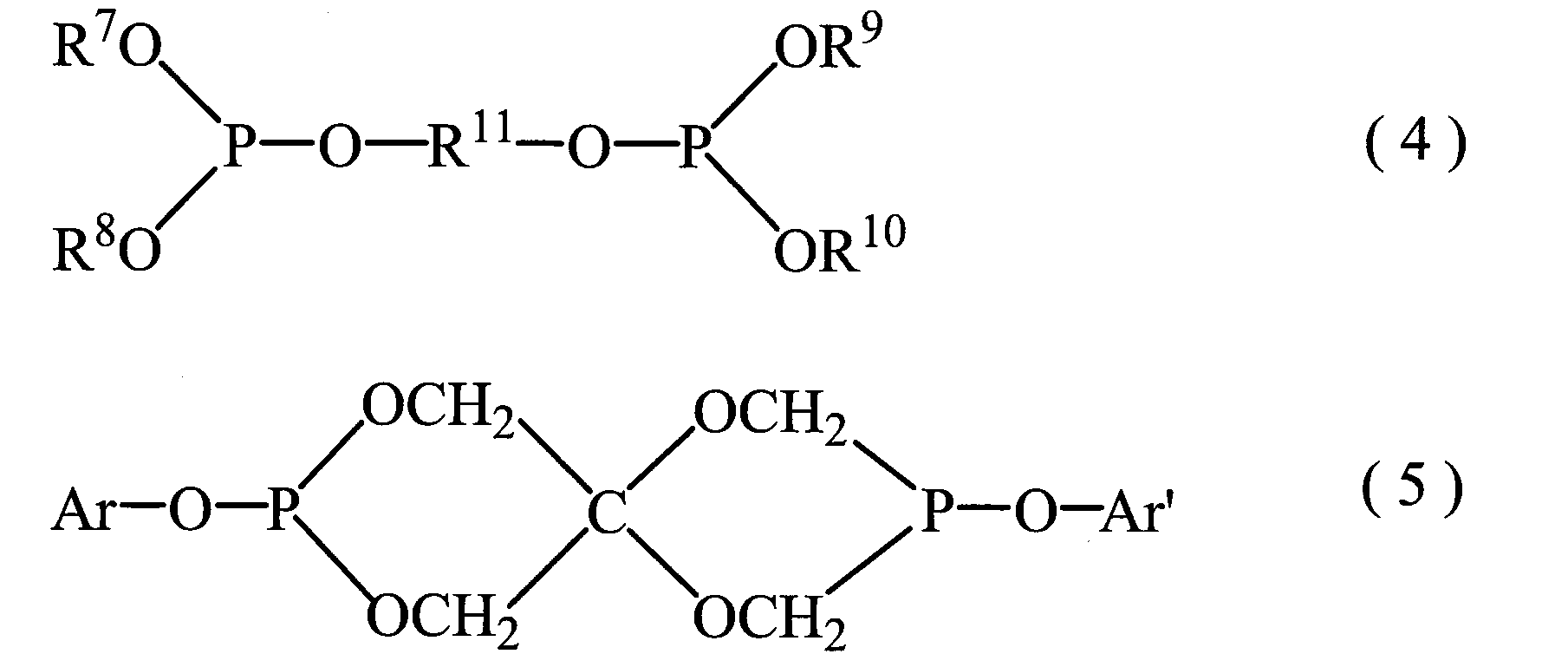
- Examples of the phosphite-based antioxidant include those represented by the following general formula (4) or (5).
- R 7 , R 8 , R 9 and R 10 are a C 1-25 alkyl group, a substituted alkyl group, an aryl group or a substituted aryl group, and may be the same or different. Examples thereof include methyl group, ethyl group, butyl group, octyl group, decyl group, lauryl group, tridecyl group, stearyl group, phenyl group, alkyl and / or alkoxy-substituted phenyl group.
- R 11 is a C4-33 alkylene group, a substituted alkylene group, an arylene group or a substituted arylene group.
- R 11 is a butylene group, an octylene group, a phenylene group, a diphenylene group,
- X represents an oxy group, a sulfonyl group, a carbonyl group, a methylene group, an ethylidene group, a butylidene group, an isopropylene group, a diazo group, etc.
- Particularly preferred phosphite compounds include tetrakis (2,4-di-tert-butylphenyl) -4,4'-diphenylene phosphite.
- Ar and Ar ′ are C6-35 aryl groups or substituted aryl groups, which may be the same or different. Examples thereof include a phenyl group, a naphthyl group, a diphenyl group and the like, or alkyl, hydroxy and / or alkoxy substituted products thereof.
- Examples of specific compounds include bis (2,4-di-t-butylphenyl) pentaerythritol diphosphite, bis (2,6-di-t-butyl-4-methylphenyl) pentaerythritol diphos Phyto, bis (nonylphenyl) pentaerythritol diphosphite, 4-phenoxy-9- ⁇ - (4-hydroxyphenyl) -p-cumeroxy-3,5,8,10-tetraoxa-4,9-diphosphaspiro [5 5] and undecane.
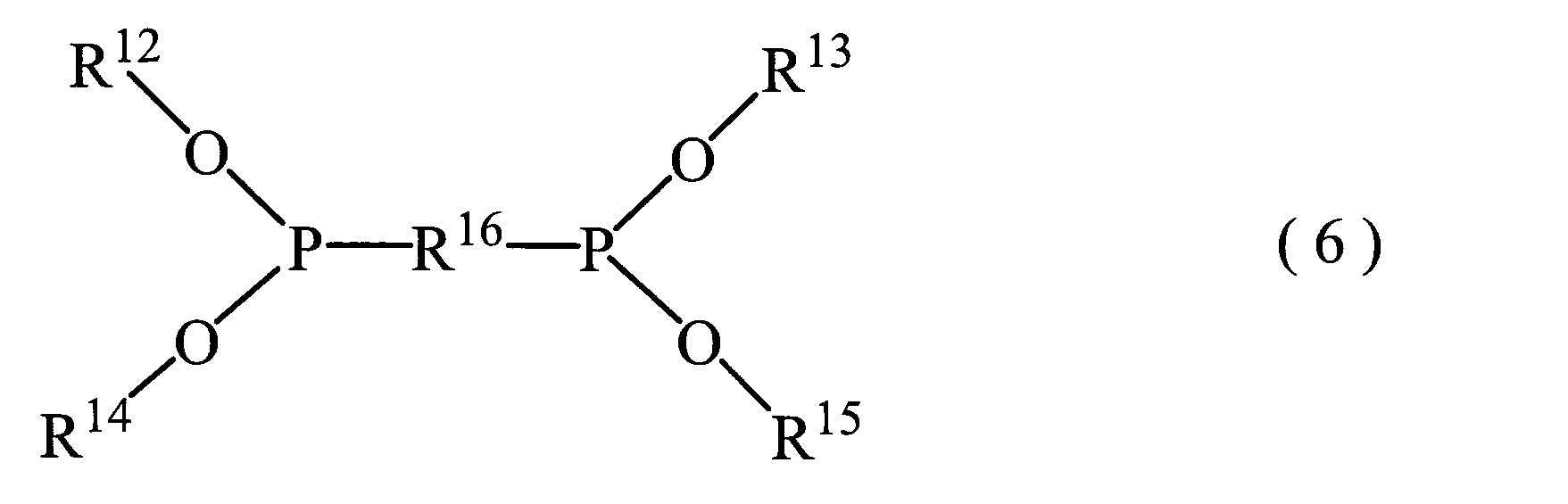
- R 12 , R 13 , R 14 and R 15 are an alkyl group, a substituted alkyl group, an aryl group, a substituted aryl group or an alkoxy group, and may be the same or different.
- R 12 to R 15 are preferably a C6 or higher alkyl group, a substituted alkyl group, an alkoxy group, or an aryl group or a substituted aryl group from the viewpoint of stability during processing. Is particularly preferred.
- R 16 is an alkylene group, a substituted alkylene group, an arylene group or a substituted arylene group, preferably an arylene group or a substituted arylene group.
- thioether-based antioxidant is a compound having at least one thioether bond in the molecular structure. Examples thereof include tetrakis [methylene-3- (dodecylthio) propionate] methane, dilauryl-3,3′-thiodipropionate, distearyl-3,3′-thiodipropionate, and the like. Alternatively, two or more kinds can be used in combination.
- F Polycarbodiimide compound
- a polycarbodiimide compound (F) can be further used for the purpose of improving durability, particularly hydrolysis resistance.
- the polycarbodiimide compound (F) is a compound having at least two carbodiimide groups represented by (—N ⁇ C ⁇ N—) in the molecule, and a compound synthesized by a generally well-known method is used. For example, using an organophosphorus compound or organometallic compound as a catalyst, various polyisocyanates (diisocyanates) can be subjected to a decarboxylation condensation reaction at a temperature of about 70 ° C. or more in a solvent-free or inert solvent. Can be synthesized.
- U.S. Pat.No. 2,941,956 Japanese Patent Publication No. 47-33279, J. Org. Chem. 28, 2069-2075 (1963), Chemical Review 1981. Vol. 81. 4. Those described in p619-621 and the like are known.
- Examples of the organic diisocyanate that is a synthetic raw material in the production of a polycarbodiimide compound include aliphatic diisocyanates, alicyclic diisocyanates, aromatic diisocyanates and mixtures thereof. Specific examples include hexamethylene diisocyanate, cyclohexane- Examples thereof include 1,4-diisocyanate, isophorone diisocyanate, dicyclohexylmethane-4,4′-diisocyanate, and methylcyclohexane diisocyanate.
- the polymerization reaction can be stopped halfway by cooling or the like, and the polymerization degree can be controlled appropriately.
- the terminal is isocyanate.
- Examples of monoisocyanates that control the degree of polymerization by sealing the ends of such polycarbodiimide compounds include phenyl isocyanate, tolyl isocyanate, dimethylphenyl isocyanate, cyclohexyl isocyanate, and butyl isocyanate.
- a preferred polycarbodiimide compound used in the present invention has a number average molecular weight of 1000 to 30000, preferably 2000 to 20000, and more preferably 3000 to 15000. If the number average molecular weight is too small, the heat resistance may be inferior. If it is too large, the resin may not be sufficiently dispersed and the hydrolysis resistance may not be sufficiently improved.
- aromatic polycarbodiimides containing an aromatic component in the molecular chain skeleton are particularly preferably used because of their high hydrolysis resistance and high heat resistance, such as p-phenylene-bis-o-triylcarbodiimide, p-phenylene.
- Aromatic dicarbodiimide compounds such as -bis-p-chlorophenylcarbodiimide, ethylene-bis-diphenylcarbodiimide, poly (4,4'-methylenebiscyclohexylcarbodiimide), poly (4,4'-diphenylmethanecarbodiimide), poly (3 , 3'-dimethyl-4,4'-diphenylmethanecarbodiimide), poly (naphthylenecarbodiimide), poly (p-phenylenecarbodiimide), poly (m-phenylenecarbodiimide), poly (tolylcarbodiimide), poly (diisopropylphenylenecarbodiimide) ), Poly (methyl-diisopropylphenylene carbodiimide), poly (triethylphenylene carbodiimide), poly (triisopropylphenylene carbodiimide) and the like aromatic polycarbodiimide compounds.
- the ratio of the thermoplastic polyester elastomer (B) is, for example, 25 to 150 parts by weight, preferably 50 to 140 parts by weight, based on 100 parts by weight of the polybutylene terephthalate resin (A). Preferably, it may be about 80 to 130 parts by weight. If the proportion of the component (B) is too small, the flexibility is poor and cracking may easily occur due to bending, and if it is too large, the heat resistance, hydrolysis resistance, and combustion resistance decrease significantly, and polybutylene There is a possibility that the effect of terephthalate cannot be obtained sufficiently.
- the ratio of the phosphinic acids (C) is, for example, about 5 to 40 parts by weight, preferably about 10 to 35 parts by weight, and more preferably about 10 to 30 parts by weight with respect to 100 parts by weight of the polybutylene terephthalate resin (A). May be. If the proportion of the component (C) is too small, the flame retardancy improving effect may be insufficient. If it is too large, the flexibility and hydrolysis resistance will be significantly reduced, and the effect of polybutylene terephthalate will be sufficiently obtained. There is a risk of not being able to.
- the proportion of the epoxy compound (D) is, for example, 0.5 to 20 parts by weight, preferably 0.5 to 15 parts by weight, more preferably 0.8 to 100 parts by weight with respect to 100 parts by weight of the polybutylene terephthalate resin (A). It may be about 12 parts by weight. Further, the epoxy resin (d-1) is preferably 0.8 to 5 parts by weight, and the vinyl copolymer (d-2) having a glycidyl group is preferably 3 to 12 parts by weight. If the ratio is too small, the melt tension of the resin required for processing may be insufficient, and if it is too high, molding problems such as an increase in the viscosity of the resin may occur.
- the proportion of the antioxidant (E) is, for example, 0.1 to 5 parts by weight, preferably 0.3 to 4 parts by weight, and more preferably 0.5 parts by weight with respect to 100 parts by weight of the polybutylene terephthalate resin (A). It may be about 3 parts by weight. If the proportion is too small, sufficient heat stability and long-term physical properties cannot be obtained, and if it is too large, not only is it uneconomical, but the improvement effect of the heat stability reaches saturation, and conversely, the moldability decreases. There is a risk that the strength may decrease.
- the polycarbodiimide compound (F) is blended up to 5 parts by weight with respect to 100 parts by weight of the polybutylene terephthalate resin (A) as necessary. Too much polycarbodiimide compound (F) is not only uneconomical, but also increases the amount of gas generated during the process and impairs the appearance.
- the polybutylene terephthalate resin (A) has an intrinsic viscosity of 0.8 to 1.3 dl / g
- the thermoplastic polyester elastomer (B) is A block copolymer of a hard polybutylene terephthalate block (b-1) and a soft polyester block (b-2) having at least one unit selected from polyether units and aliphatic polyester units
- an epoxy compound (D) is (d-1) an aromatic epoxy resin having an epoxy equivalent of 250 to 1200 g / eq, and (d-2) a vinyl monomer having a glycidyl group and a copolymer having an ⁇ , ⁇ -unsaturated bond. This is a case of at least one selected from a copolymer with a polymerizable monomer.
- conventional additives for example, stabilizers other than those described above (ultraviolet absorbers, light stabilizers, etc.), antistatic agents, lubricants, mold release agents, other flame retardants, flame retardant aids Agents, crystallization nucleating agents, colorants (such as dyes or pigments), lubricants, plasticizers, fillers, anti-dripping agents, and the like may be added.
- resin composition of the present invention other resin components such as acrylic resin, fluororesin, polyamide resin, polyacetal resin, polysulfone, polyphenylene oxide, styrene resin (within a range not inhibiting the effect of the present invention)
- Thermoplastic resins such as polystyrene, AS resin, ABS resin
- soft thermoplastic resins such as ethylene-ethyl acrylate copolymer, ethylene-vinyl acetate copolymer
- Thermosetting resins such as silicone resins and epoxy resins may be added.
- These other resins can be used alone or in combination of two or more.
- the resin composition of the present invention may be a powder mixture or a molten mixture, or may be a molded body (such as a sheet or a film-like composition) in which the molten mixture is solidified.
- the powder mixture is composed of (A) PBT resin, (B) thermoplastic polyester elastomer, (C) phosphinic acid, (D) epoxy compound, (E) antioxidant, and (F) polycarbodiimide compound as necessary. It can be prepared by mixing additives and / or other resin components in a conventional manner. For example, (1) A method in which each component is mixed, kneaded by a single or twin screw extruder and extruded to prepare pellets, and then molded.
- a pellet (master batch) having a different composition is once prepared.
- the powdery body of the resin component in addition to the component (A), (B) or (D), the other resin, etc.
- Melting and kneading is advantageous for improving the dispersion of other components.
- a molded product can be obtained by melt-kneading the resin composition of the present invention and molding the resin composition by a conventional method such as extrusion molding, injection molding, or compression molding. Since the resin composition is excellent in flame retardancy and molding processability, it can be used for the production of various molded articles and various uses such as electric / electronic parts, mechanical mechanism parts, automobile parts, packaging materials. It can be suitably used for a case or the like.
- the resin composition of the present invention is excellent in properties such as combustion resistance, heat resistance, hydrolysis resistance and flexibility, it is useful for coating electric wires (copper wires, platinum wires, etc.).
- the resin composition is excellent in hydrolysis resistance and flexibility in addition to combustion resistance, heat resistance, and the like, and further can impart appropriate adhesion to a conductor (electric wire). It is useful in applications for coating power transmission or transmission (wave transmission) wires (for example, as a flame-retardant resin composition for wire coating).
- a coated electric wire can be produced by coating an electric wire with the resin composition.
- the coating method is not particularly limited, and the coating can be performed by a conventional coating method such as extrusion molding or press working.
- the covered electric wire may be manufactured by sandwiching the electric wire between a sheet or a film-like resin composition and pressing it.
- wire an electric wire, an optical fiber cable, etc.
- An ASTM No. 4 type tensile test piece having a thickness of 1.0 mm was prepared using the obtained pellet-shaped resin composition.
- the obtained pellet-shaped resin composition was melt-kneaded at 260 ° C. using a plastmill single screw extruder having a ⁇ 20 mm screw, and a ⁇ 0.9 mm copper wire was coated with a coating thickness of 0.2 mm.
- the coated electric wire was made.
- the measurement method of characteristic evaluation is as follows. ⁇ Evaluation by ASTM No. 4 type tensile test piece> [Tensile strength and tensile elongation at break] Tensile strength (MPa) and tensile elongation at break (%) were measured according to ASTM D-638. [Hydrolysis resistance (tensile strength and elongation at break after wet heat test treatment)] After exposure to a pressure cooker tester at 121 ° C./2 atm for 48 hours, the tensile strength (MPa) and tensile elongation at break (%) were measured according to ASTM D-638 to evaluate hydrolysis resistance. . [Heat aging resistance] After heat treatment in a hot air oven at 125 ° C.
- the tensile strength (MPa) was measured according to ASTM D-638.
- the heat aging resistance was evaluated by the time (days) until the tensile strength of the treated sample was reduced to 80%.
- the obtained particle powder was pulverized by a jet mill to prepare 1,2-diethylphosphinic acid aluminum salt having an average particle diameter of 4 ⁇ m.
- the particle diameter was measured using a laser diffraction / scattering particle size distribution analyzer (LA-920, manufactured by Horiba, Ltd.) using distilled water as a dispersion medium, and the obtained median diameter was defined as the particle diameter. .
- (C-2) 1,3-ethane-1,2-bismethylphosphinic acid calcium salt prepared by the following method: 325.5 g (1.75 mol) of ethane-1,2-bismethylphosphinic acid was added to 500 ml of Dissolved in water, 129.5 g (1.75 mol) of calcium hydroxide was added in several portions over 1 hour with vigorous stirring of the solution. The mixture was then stirred at 90-95 ° C. for several hours, cooled and filtered with suction. When dried in a vacuum drying cabinet at 150 ° C. until the mass was constant, 335 g of product was obtained. This was not melted below 380 ° C. The yield was 85% of theory.
- the obtained particle powder was pulverized by a jet mill to prepare 1,3-ethane-1,2-bismethylphosphinic acid calcium salt having an average particle diameter of 4 ⁇ m.
- (C-3) 1,2-diethylphosphinic acid aluminum salt unground product 1,2-diethylphosphinic acid aluminum salt before pulverization step described in (C-1).
- the average particle size was 55 ⁇ m.
- (D) Epoxy compound (D-1) manufactured by Atofina Japan, “Rotada-AX8930” Ethylene / acrylic acid / glycidyl methacrylate copolymer (D-2) manufactured by Sumitomo Chemical Co., Ltd., “Bond First BF7M” Ethylene / glycidyl methacrylate / methyl acrylate copolymer (D-3) manufactured by Yuka Shell Epoxy Co., Ltd., “Epicoat 1004” Epoxy resin (epoxy equivalent 875-975 g / eq) (E) Antioxidant (E-1) Phenol type antioxidant; “Irganox 1010” manufactured by Ciba Specialty Chemicals Co., Ltd.
Landscapes
- Physics & Mathematics (AREA)
- Spectroscopy & Molecular Physics (AREA)
- Chemical & Material Sciences (AREA)
- Health & Medical Sciences (AREA)
- Chemical Kinetics & Catalysis (AREA)
- Medicinal Chemistry (AREA)
- Polymers & Plastics (AREA)
- Organic Chemistry (AREA)
- Compositions Of Macromolecular Compounds (AREA)
- Organic Insulating Materials (AREA)
- Insulated Conductors (AREA)
Abstract
Description
背景技術
発明の開示
発明の詳細な説明
(A)ポリブチレンテレフタレート(PBT)樹脂
ベース樹脂であるPBT樹脂としては、ブチレンテレフタレートを主成分(例えば、50~100重量%、好ましくは60~100重量%、さらに好ましくは70~100重量%程度)とするホモポリエステル又はコポリエステル(ポリブチレンテレフタレート、ポリブチレンテレフタレートコポリエステル)などが挙げられる。
(B)熱可塑性ポリエステルエラストマー
熱可塑性ポリエステルエラストマーは、一般に、硬質ポリエステルブロック(芳香族ポリエステルなどのハードブロック又はハードセグメント)と、軟質ポリエステルブロック(ソフトブロック又はソフトセグメント)とがエステル結合により結合した構造を有するブロック共重合体である。熱可塑性ポリエステルエラストマーは軟質ブロックの種類によってポリエーテル型とポリエステル型の2種類に分類でき、いずれのタイプも本発明に使用できる。
(C)ホスフィン酸類
ホスフィン酸類としては、例えば、ホスフィン酸、ジホスフィン酸、又はこれらの重合物(又は縮合物、例えばポリホスフィン酸など)などの塩[金属塩の他;ホウ素塩(ボリル化合物など)、アンモニウム塩、アミノ基含有窒素含有化合物との塩など)など]が挙げられる。ホスフィン酸類は、単独で又は二種以上組み合わせて使用できる。尚、ホスフィン酸類は、鎖状及び環状のいずれの構造を有していてもよい。

R1~R4で表される炭化水素基としては、アルキル基(例えば、メチル、エチル、イソプロピル、n-ブチル、t-ブチル基などの直鎖状又は分岐鎖状C1-6アルキル基)、シクロアルキル基(シクロヘキシル基などのC5-8シクロアルキル基など)、アリール基(フェニル基などのC6-10アリール基など)、アラルキル基(ベンジル基などのC6-10アリール-C1-4アルキル基など)などが挙げられる。これらの基のうち、通常、アルキル基(好ましくはC1-4アルキル基など)、アリール基(フェニル基など)などが好ましい。
(D)エポキシ化合物
エポキシ化合物(D)としては、多官能エポキシ化合物、例えば、エポキシ樹脂(d-1)、及びグリシジル基を有するビニル系共重合体(d-2)などが挙げられる。エポキシ化合物は、単独で又は二種以上組み合わせて使用できる。
(d-1)エポキシ樹脂
エポキシ樹脂(d-1)としては、例えば、グリシジルエーテル型エポキシ樹脂、グリシジルエステル型エポキシ樹脂(ジグリシジルフタレート、ジグリシジルテトラヒドロフタレート、ジグリシジルヘキサヒドロフタレート、ジメチルグリシジルフタレート、ジメチルグリシジルヘキサヒドロフタレート、ダイマー酸グリシジルエステル、アロマティックジグリシジルエステル、シクロアリファティックジグリシジルエステルなど)、グリシジルアミン型エポキシ樹脂(テトラグリシジルジアミノジフェニルメタン、トリグリシジル-パラアミノフェノール、トリグリシジル-メタアミノフェノール、ジグリシジルトルイジン、テトラグリシジルメタキシリレンジアミン、ジグリシジルトリブロムアニリン、テトラグリシジルビスアミノメチルシクロヘキサンなど)、複素環式エポキシ樹脂(トリグリシジルイソシアヌレート(TGIC)、ヒダントイン型エポキシ樹脂など)、環式脂肪族エポキシ樹脂(ビニルシクロヘキセンジオキシド、ジシクロペンタジエンオキシド、アリサイクリックジエポキシアセタール、アリサイクリックジエポキシアジペート、アリサイクリックジエポキシカルボキシレートなど)、エポキシ化ポリブタジエンなどが挙げられる。
(d-2)グリシジル基含有ビニル系共重合体(グリシジル基を有するビニル系共重合体)
グリシジル基を有するビニル系共重合体(d-2)は、グリシジル基を有する重合性単量体(グリシジル基を有するビニル系単量体など)と、他の共重合性単量体との共重合体で構成される。
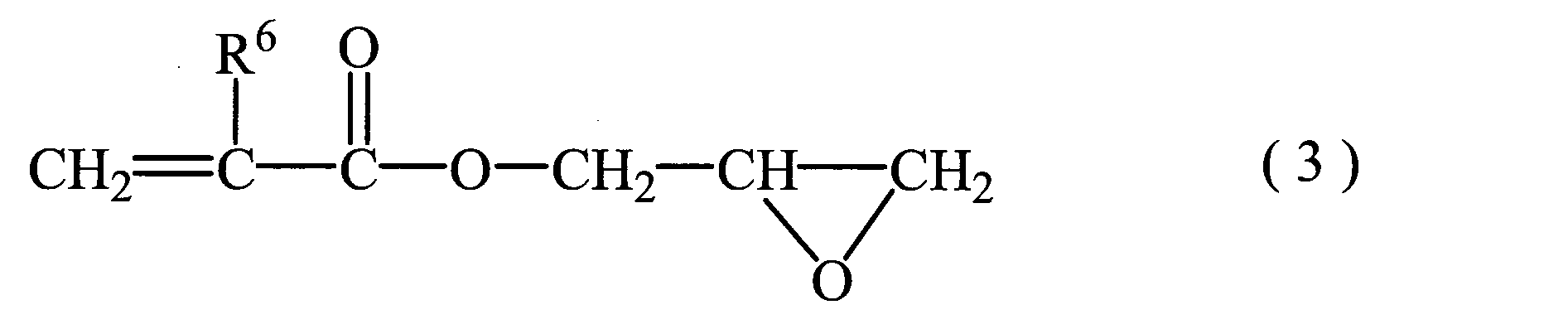
前記式(3)において、R6で表されるアルキル基としては、メチル、エチル、プロピル、イソプロピル、ブチル基などの低級アルキル基(例えば、C1-6アルキル基など)などが挙げられる。グリシジルエステル基を置換基として有するアルキル基において、グリシジルエステル基の個数は特に制限されず、例えば、1~3個、通常1又は2個程度であってもよい。
(E)酸化防止剤
酸化防止剤(E)としては、フェノール系酸化防止剤(e-1)を必須成分とし、更にホスファイト系酸化防止剤(e-2)、ホスフォナイト系酸化防止剤(e-3)及びチオエーテル系酸化防止剤(e-4)から選択された少なくとも一種を含有することが必要である。耐熱性向上のためには、フェノール系酸化防止剤(e-1)とチオエーテル系酸化防止剤(e-4)の組み合わせが好ましい。更には、フェノール系酸化防止剤(e-1)とチオエーテル系酸化防止剤(e-4)に加え、ホスファイト系酸化防止剤(e-2)を併用することが好ましい。
(e-1)フェノール系酸化防止剤
フェノール系酸化防止剤(e-1)は、その分子構造中にアルキルフェノール基を1個以上有する化合物である。フェノール系酸化防止剤の具体例としては、2,6-ジ-t-ブチル-p-クレゾール、ステアリル(3,5-ジ-メチル-4-ヒドロキシベンジル)チオグリコレート、ステアリル-β-(4-ヒドロキシ-3,5-ジ-t-ブチルフェニル)プロピオネート、ジステアリル-(3,5-ジ-t-ブチル-4-ヒドロキシベンジル)ホスホネート、ステアリル-(4-ヒドロキシ-3-メチル-5-t-ブチル)ベンジルマロネート、2,2’-メチレンビス(4-メチル-6-t-ブチルフェノール)、4,4’-メチレンビス(2,6-ジ-t-ブチルフェノール)、2,2’-メチレンビス[6-(1-メチルシクロヘキシル)-p-クレゾール]、ビス[3,3-ビス(4-ヒドロキシ-3-t-ブチルフェニル)ブチリックアシド]グリコールエステル、4,4’-ブチリデンビス(6-t-ブチル-m-クレゾール)、1,1,3-トリス(2-メチル-4-ヒドロキシ-5-t-ブチルフェニル)ブタン、1,3,5-トリス(3,5-ジ-t-ブチル-4-ヒドロキシベンジル)-2,4,6-トリメチルベンゼン、テトラキス[メチレン-3-(3,5-ジ-t-ブチル-4-ヒドロキシフェニル)プロピオネート]メタン、1,3,5-トリス(3,5-ジ-t-ブチル-4-ヒドロキシベンジル)イソシアヌレート、2-オクチルチオ-4,6-ジ(4-ヒドロキシ-3,5-ジ-t-ブチル)フェノキシ-1,3,5-トリアジン、4,4’-チオビス(6-t-ブチル-m-クレゾール)、トリエチレングリコール-ビス[3-(3-t-ブチル-5-メチル-4-ヒドロキシフェニル)プロピオネート]、1,6-ヘキシルジオール-ビス[3-(3,5-ジ-t-ブチル-4-ヒドロキシフェニル)プロピオネート]、2,4-ビス-オクチルチオ-6-(4-ヒドロキシ-3,5-ジ-t-ブチルアニリノ)-1,3,5-トリアジン、2,2-チオ-ジエチレンビス[3-(3,5-ジ-t-ブチル-4-ヒドロキシフェニル)プロピオネート]、N,N-ヘキサメチレンビス(3,5-ジ-t-ブチル-4-ヒドロキシ-ジヒドロシンナマミド)、3,5-ジ-t-ブチル-4-ヒドロキシ-ベンジルホスホネート-ジエチルエステル、1,3,5-トリメチル-2,4,6-トリス(3,5-ジ-t-ブチル-4-ヒドロキシベンジル)ベンゼン、トリス(3,5-ジ-t-ブチル-4-ヒドロキシベンジル)イソシアヌレイト、イソオクチル-3-(3,5-ジ-t-ブチル-4-ヒドロキシフェニル)プロピオネート、2,4-ビス[(オクチルチオ)メチル]-oクレゾールなどが挙げられる。
(e-2)ホスファイト系酸化防止剤
ホスファイト系酸化防止剤としては、下記一般式(4)又は(5)で示されるものが挙げられる。

(e-3)ホスフォナイト系酸化防止剤
ホスフォナイト系酸化防止剤としては、下記一般式(6)で示されるものが挙げられる。
(e-4)チオエーテル系酸化防止剤
チオエーテル系酸化防止剤(e-4)は分子構造中に少なくとも1個のチオエーテル結合を有する化合物である。その例としては、テトラキス[メチレン-3-(ドデシルチオ)プロピオネート]メタン、ジラウリル-3,3’-チオジプロピオネート、ジステアリル-3,3’-チオジプロピオネートなどが挙げられ、これらは一種又は二種以上を併用して用いることができる。
(F)ポリカルボジイミド化合物
本発明では更に、耐久性、特に耐加水分解性を改善する目的でポリカルボジイミド化合物(F)を使用できる。
(各成分の割合)
本発明の樹脂組成物において、熱可塑性ポリエステルエラストマー(B)の割合は、ポリブチレンテレフタレート樹脂(A)100重量部に対して、例えば、25~150重量部、好ましくは50~140重量部、さらに好ましくは80~130重量部程度であってもよい。(B)成分の割合が少なすぎると、柔軟性に乏しく、屈曲によって亀裂が生じやすくなる虞があり、多すぎると、耐熱性や耐加水分解性、耐燃焼性の低下が顕著となり、ポリブチレンテレフタレートの効果が十分得られない虞がある。
実施例
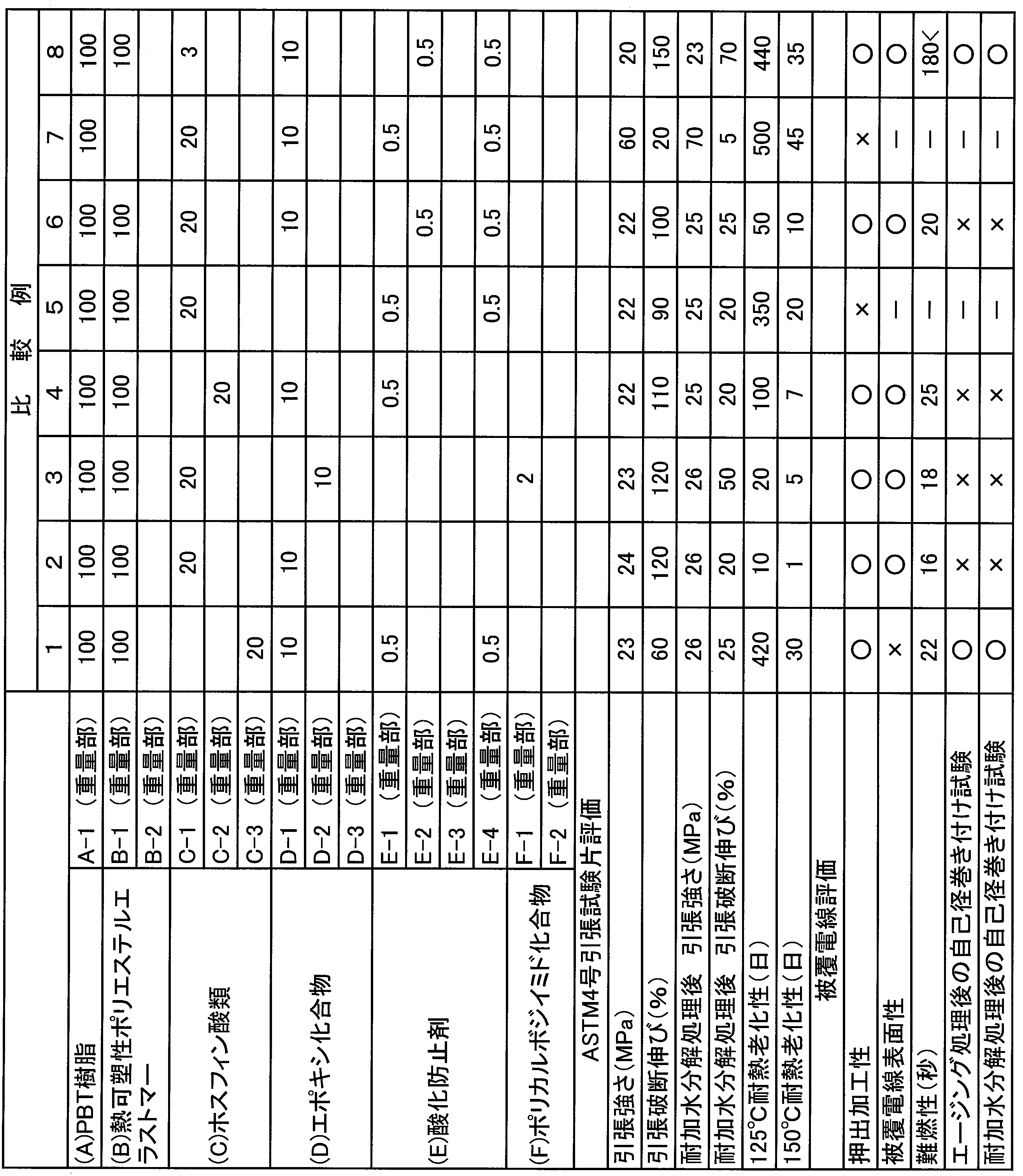
実施例1~13及び比較例1~8
表1及び2に示す各成分を表に示す割合でドライブレンドし、φ30mmのスクリューを有する二軸押出機を用いて、260℃で溶融混練したのちペレット化し、ペレット状の樹脂組成物を得た。樹脂ペレットは140℃で3時間乾燥した後、成形加工に用いた。
<ASTM 4号タイプ引張試験片による評価>
[引張強さ及び引張破断伸び]
ASTM D-638に準拠して、引張強さ(MPa)及び引張破断伸び(%)を測定した。
[耐加水分解性(湿熱試験処理後の引張強さ及び引張破断伸び)]
121℃/2気圧のプレッシャークッカー試験機に48時間暴露した後、ASTM D-638に準拠して、引張強さ(MPa)及び引張破断伸び(%)を測定し、耐加水分解性を評価した。
[耐熱老化性]
125℃又は150℃の熱風オーブン中で所定時間加熱処理した後、ASTM D-638に準拠して、引張強さ(MPa)を測定した。耐熱老化性は、処理サンプルの引張強さが80%に低下するまでの時間(日数)で評価した。
[押出加工性]
0.9mm銅線に樹脂組成物を被覆(押出成形)するときの押出状況を目視にて下記の2段階で評価した。尚、得られた押出成形品ではブリードアウトは見られなかった。
O:樹脂組成物が均一に被覆されている
×:樹脂組成物の被覆状態が不均一であり、銅線がむき出しの箇所がある
[被覆電線表面性]
0.9mm銅線に樹脂組成物を被覆した電線表面を目視にて下記の2段階で評価した。
O:電線表面が平滑で凝集塊が観測されない
×:電線表面が十分平滑でなく一部表面に凝集塊が確認される箇所がある
[難燃性]
ISO6722-12項に準拠し、45度傾斜燃焼試験を行い、樹脂組成物の燃焼性を評価した。燃焼時間が短いほど難燃性に優れることを示す。
[エージング処理後の自己径巻き付け試験]
ISO6722-10.2項に準拠し、125℃のオーブンにて3000時間処理後、巻き付け試験を実施した。クラック等が認められないものを○、クラックの発生が認められたものを×とした。
[耐加水分解処理後の自己径巻き付け試験]
121℃/2気圧にて72時間処理後、巻き付け試験を実施した。クラック等が認められないものを○、クラックの発生が認められたものを×とした。
(A)PBT樹脂
(A-1)ポリブチレンテレフタレート(固有粘度IV=1.20dl/g、ウィンテックポリマー(株)製)
(B)熱可塑性ポリエステルエラストマー
(B-1)(株)東洋紡製、「ペルプレンGP300」
硬質ブロック;ポリブチレンテレフタレート、軟質ブロック;ポリエーテル型軟質ポリエステル
(B-2)帝人化成(株)製、「ヌーベランP4110AN」
硬質ブロック;ポリブチレンテレフタレート、軟質ブロック;ポリエステル型軟質ポリエステル
(C)ホスフィン酸類
(C-1)下記の方法により調製した1,2-ジエチルホスフィン酸アルミニウム塩
2106g(19.5モル)の1,2-ジエチルホスフィン酸を6.5リットルの水に溶解し、この溶液を激しく攪拌しながら507g(6.5モル)の水酸化アルミニウムを加え、得られた混合物を85℃に加熱した。混合物を80~90℃で合計65時間攪拌し、次に60℃に冷却し、吸引濾過した。質量が一定となるまで120℃の真空乾燥キャビネット中で乾燥した後、300℃以下では溶融しない微粒子粉末2140gが得られた。収率は理論値の95%であった。得られた粒子粉末をジェットミルにて粉砕し、平均粒子径4μmの1,2-ジエチルホスフィン酸アルミニウム塩を調製した。
粒子径の測定はレーザー回折/散乱式粒度分布測定装置((株)堀場製作所製、LA-920)を用い、分散媒として蒸留水を用いて測定し、得られたメジアン径を粒子径とした。
(C-2)下記の方法により調製した1,3-エタン-1,2-ビスメチルホスフィン酸カルシウム塩
325.5g(1.75モル)のエタン-1,2-ビスメチルホスフィン酸を500mlの水に溶解し、この溶液を激しく攪拌しながら129.5g(1.75モル)の水酸化カルシウムを数回に分割して1時間かけて添加した。次に、混合物を90~95℃で数時間攪拌後、冷却し、吸引濾過した。質量が一定となるまで150℃の真空乾燥キャビネット中で乾燥したところ、335gの生成物が得られた。これは380℃以下では溶融しないものであった。収率は理論値の85%であった。得られた粒子粉末をジェットミルにて粉砕し、平均粒子径4μmの1,3-エタン-1,2-ビスメチルホスフィン酸カルシウム塩を調製した。
(C-3)1,2-ジエチルホスフィン酸アルミニウム塩の未粉砕物
(C-1)に記載の粉砕工程前の1,2-ジエチルホスフィン酸アルミニウム塩。平均粒子径は55μmであった。
(D)エポキシ化合物
(D-1)アトフィナジャパン(株)製、「ロタダ-AX8930」
エチレン/アクリル酸/グリシジルメタクリレートコポリマー
(D-2)住友化学(株)製、「ボンドファーストBF7M」
エチレン/グリシジルメタクリレート/アクリル酸メチルコポリマー
(D-3)油化シェルエポキシ(株)製、「エピコート1004」
エポキシ樹脂(エポキシ当量875~975g/eq)
(E)酸化防止剤
(E-1)フェノール系酸化防止剤;チバスペシャリティケミカルズ(株)製、「イルガノックス1010」
(E-2)ホスファイト系酸化防止剤;アデカ(株)製、「アデカスタブPEP-24G」
(E-3)ホスフォナイト系酸化防止剤;クラリアント(株)製、「SANDSTAB P-EPQ」
(E-4)チオエーテル系酸化防止剤;アデカ(株)製、「アデカスタブAO412S」
(F)ポリカルボジイミド化合物
(F-1)脂肪族ポリカルボジイミド;日清紡(株)製、「カルボジライトHMV-8CA」
(F-2)芳香族ポリカルボジイミド;ラインケミージャパン(株)製、「スタバックゾールP」

Claims (6)
- (A)ポリブチレンテレフタレート樹脂100重量部に対して、(B)熱可塑性ポリエステルエラストマー25~150重量部、(C)平均粒子径が10μm以下のホスフィン酸塩、ジホスフィン酸塩、及びこれらの重合物から選択された少なくとも一種のホスフィン酸類5~40重量部、(D)エポキシ化合物0.5~20重量部、及び(E)酸化防止剤0.1~5重量部とで構成される難燃性樹脂組成物であって、酸化防止剤(E)がフェノール系酸化防止剤(e-1)を必須成分とし、更にホスファイト系酸化防止剤(e-2)、ホスフォナイト系酸化防止剤(e-3)及びチオエーテル系酸化防止剤(e-4)から選択された少なくとも一種を含有する難燃性樹脂組成物。
- 更に(F)ポリカルボジイミド化合物を5重量部以下(対(A)ポリブチレンテレフタレート樹脂100重量部)配合してなる請求項1記載の難燃性樹脂組成物。
- 熱可塑性ポリエステルエラストマー(B)が、硬質ポリブチレンテレフタレートブロック(b-1)と、ポリエーテル単位、及び脂肪族ポリエステル単位から選択された少なくとも一種の単位を有する軟質ポリエステルブロック(b-2)とのブロック共重合体である請求項1又は2記載の難燃性樹脂組成物。
- ホスフィン酸類(C)において、ホスフィン酸塩が下記式(1)で表され、ジホスフィン酸塩が下記式(2)で表される請求項1~3の何れか1項記載の難燃性樹脂組成物。
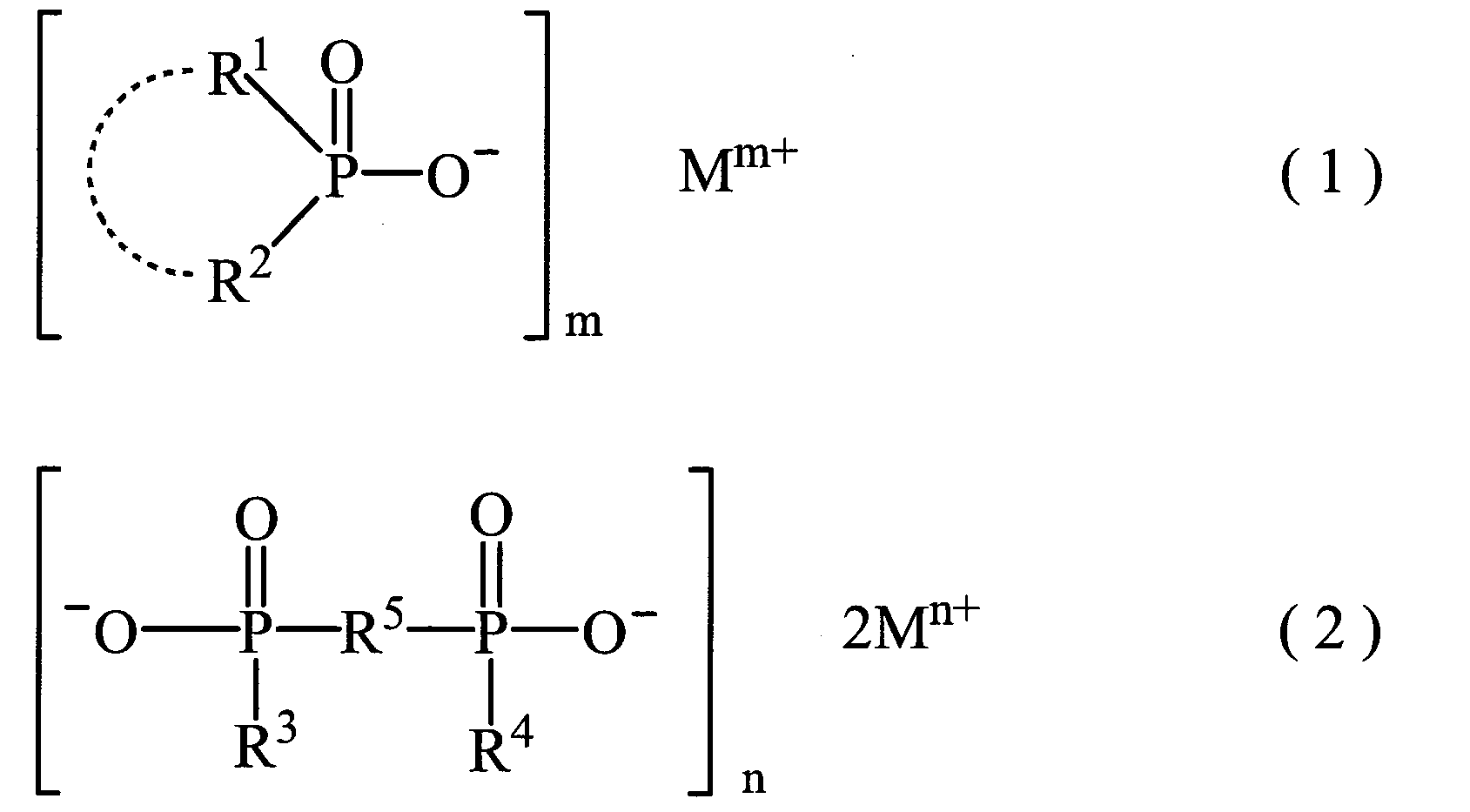
- エポキシ化合物(D)が、(d-1)エポキシ当量250~1200g/eqを有する芳香族エポキシ樹脂、及び(d-2)グリシジル基を有するビニル系単量体とα,β-不飽和結合を有する共重合性単量体との共重合体から選択された少なくとも一種である請求項1~4の何れか1項記載の難燃性樹脂組成物。
- 電線とその表面を被覆した請求項1~5の何れか1項記載の難燃性樹脂組成物を含む被覆電線。
Priority Applications (1)
| Application Number | Priority Date | Filing Date | Title |
|---|---|---|---|
| CN200980105567.2A CN101945946B (zh) | 2008-03-07 | 2009-03-04 | 阻燃性树脂组合物及被覆电线 |
Applications Claiming Priority (2)
| Application Number | Priority Date | Filing Date | Title |
|---|---|---|---|
| JP2008-057526 | 2008-03-07 | ||
| JP2008057526A JP5377869B2 (ja) | 2008-03-07 | 2008-03-07 | 難燃性樹脂組成物及び被覆電線 |
Publications (1)
| Publication Number | Publication Date |
|---|---|
| WO2009110230A1 true WO2009110230A1 (ja) | 2009-09-11 |
Family
ID=41055795
Family Applications (1)
| Application Number | Title | Priority Date | Filing Date |
|---|---|---|---|
| PCT/JP2009/000966 Ceased WO2009110230A1 (ja) | 2008-03-07 | 2009-03-04 | 難燃性樹脂組成物及び被覆電線 |
Country Status (3)
| Country | Link |
|---|---|
| JP (1) | JP5377869B2 (ja) |
| CN (1) | CN101945946B (ja) |
| WO (1) | WO2009110230A1 (ja) |
Cited By (10)
| Publication number | Priority date | Publication date | Assignee | Title |
|---|---|---|---|---|
| CN102190866A (zh) * | 2010-03-10 | 2011-09-21 | 朗盛德国有限责任公司 | 用于在熔融物中防止热降解的包括-n=c=n-的化合物 |
| JP2011207927A (ja) * | 2010-03-29 | 2011-10-20 | Du Pont-Toray Co Ltd | 樹脂製マンドレル |
| CN103261326A (zh) * | 2010-05-18 | 2013-08-21 | 阿克马法国公司 | 至少两种聚烯烃在阻燃的tpe组合物中作为抗流动剂的用途 |
| GB2526564A (en) * | 2014-05-28 | 2015-12-02 | Tyco Electronics Ltd Uk | Polymer composition and heat -shrinkable article |
| WO2019018340A1 (en) * | 2017-07-20 | 2019-01-24 | Eastman Chemical Company | POLYMER COMPOSITIONS HAVING IMPROVED THERMAL STABILITY, COLOR AND / OR FLUAGE PROPERTIES |
| CN113652189A (zh) * | 2017-06-09 | 2021-11-16 | 东洋纺株式会社 | 密封用树脂组合物 |
| EP3945110A1 (de) * | 2020-07-30 | 2022-02-02 | Clariant International Ltd | Flammschutzmittel-stabilisator-kombinationen für flammwidrige polymere mit verbesserter hydrolysebeständigkeit und deren verwendung |
| CN115135720A (zh) * | 2020-02-26 | 2022-09-30 | 东洋纺株式会社 | 聚酯弹性体树脂组合物 |
| US11629224B2 (en) | 2017-07-20 | 2023-04-18 | Eastman Chemical Company | Polymer compositions comprising crystalline polymers and a stabilizer composition |
| US12247115B2 (en) | 2019-01-18 | 2025-03-11 | Eastman Chemical Company | Polymer compositions with improved weathering resistance |
Families Citing this family (25)
| Publication number | Priority date | Publication date | Assignee | Title |
|---|---|---|---|---|
| JP5257322B2 (ja) * | 2009-10-29 | 2013-08-07 | 東洋紡株式会社 | 熱可塑性ポリエステルエラストマー組成物 |
| JP5667377B2 (ja) * | 2010-04-14 | 2015-02-12 | 帝人株式会社 | 耐熱劣化性が改良された電線被覆用熱可塑性樹脂組成物 |
| JP5654300B2 (ja) | 2010-09-17 | 2015-01-14 | ポリプラスチックス株式会社 | 一体成形体 |
| WO2012090732A1 (ja) * | 2010-12-28 | 2012-07-05 | 帝人デュポンフィルム株式会社 | 難燃性二軸配向ポリエステルフィルム |
| KR101796764B1 (ko) * | 2011-01-31 | 2017-11-10 | 에스케이케미칼주식회사 | 공중합 폴리에스테르 수지 조성물 및 그 제조방법 |
| KR101778803B1 (ko) * | 2011-02-21 | 2017-09-15 | 엘에스전선 주식회사 | 고내열성 전선용 절연 조성물 |
| CN104272885B (zh) * | 2012-05-01 | 2017-05-17 | 胜技高分子株式会社 | 电子设备用壳体 |
| JP6233305B2 (ja) * | 2012-09-27 | 2017-11-22 | 東洋紡株式会社 | 照明器具部品用ポリエステル樹脂組成物 |
| WO2015064469A1 (ja) * | 2013-10-28 | 2015-05-07 | 帝人デュポンフィルム株式会社 | 難燃性二軸配向ポリエステルフィルム、それからなる難燃性ポリエステルフィルム積層体およびフレキシブル回路基板 |
| CN103613913B (zh) * | 2013-11-13 | 2016-01-20 | 华东理工大学 | 一种无卤阻燃热塑性聚酯弹性体材料及其制备方法 |
| JP6751522B2 (ja) * | 2014-11-14 | 2020-09-09 | 東洋紡株式会社 | 柔軟で接着力に優れたポリエステル樹脂組成物 |
| JPWO2016076136A1 (ja) * | 2014-11-14 | 2017-08-17 | 東洋紡株式会社 | 柔軟で高流動性のポリエステル樹脂組成物 |
| JP6506998B2 (ja) * | 2015-03-20 | 2019-04-24 | アロン化成株式会社 | 熱可塑性エラストマー組成物 |
| CN107667145B (zh) * | 2015-05-26 | 2020-06-30 | Sabic环球技术有限责任公司 | 聚(对苯二甲酸丁二酯)组合物及相关制品 |
| JP7011899B2 (ja) * | 2017-04-10 | 2022-01-27 | アロン化成株式会社 | 難燃性熱可塑性エラストマー組成物 |
| CN107216620A (zh) * | 2017-06-26 | 2017-09-29 | 新疆蓝山屯河聚酯有限公司 | 一种pbt材料及其制备方法 |
| EP3844220A1 (en) * | 2018-08-30 | 2021-07-07 | Dupont Polymers, Inc. | Copolyetherester formulation with improved heat-stability |
| JP7484883B2 (ja) * | 2019-03-06 | 2024-05-16 | 東洋紡エムシー株式会社 | 熱可塑性ポリエステル樹脂組成物 |
| CN118163453A (zh) | 2019-03-25 | 2024-06-11 | 大日本印刷株式会社 | 装饰片和装饰板 |
| FR3096683B1 (fr) | 2019-05-27 | 2022-03-04 | Arkema France | copolyesteramide auto-ignifugé |
| JP7213218B2 (ja) | 2020-11-06 | 2023-01-26 | ポリプラスチックス株式会社 | 難燃性ポリブチレンテレフタレート樹脂組成物及び樹脂成形品 |
| JP7552399B2 (ja) * | 2021-02-04 | 2024-09-18 | 株式会社プロテリアル | 樹脂組成物、電線、及びケーブル |
| KR102527488B1 (ko) | 2021-06-29 | 2023-05-04 | 에스케이마이크로웍스 주식회사 | 폴리에스테르 수지 조성물, 폴리에스테르 필름 및 전자장치용 적층체 |
| CN114685956A (zh) * | 2022-05-07 | 2022-07-01 | 河源市可顺绝缘材料有限公司 | 一种塑胶材料及其应用的包塑雨刮簧片 |
| KR20230163120A (ko) * | 2022-05-23 | 2023-11-30 | 주식회사 엘지화학 | 열가소성 폴리에스테르 엘라스토머 조성물, 이의 제조방법 및 이를 포함하는 성형품 |
Citations (8)
| Publication number | Priority date | Publication date | Assignee | Title |
|---|---|---|---|---|
| JPH0873720A (ja) * | 1994-08-31 | 1996-03-19 | Hoechst Ag | 防炎性ポリエステル成形材料 |
| JP2001123052A (ja) * | 1999-10-28 | 2001-05-08 | Kuraray Co Ltd | 加工熱安定性に優れた熱可塑性ポリエステル樹脂組成物 |
| JP2001256836A (ja) * | 2000-03-09 | 2001-09-21 | Mitsubishi Engineering Plastics Corp | 樹脂被覆電線 |
| JP2002161211A (ja) * | 2000-11-24 | 2002-06-04 | Daicel Chem Ind Ltd | 難燃性樹脂組成物 |
| JP2002358837A (ja) * | 2001-06-01 | 2002-12-13 | Teijin Ltd | フラットケーブルおよび被覆用ポリエステル樹脂組成物 |
| JP2004537630A (ja) * | 2001-08-07 | 2004-12-16 | ビーエーエスエフ アクチェンゲゼルシャフト | ハロゲンを含有しない防炎化ポリエステル |
| JP2007297424A (ja) * | 2006-04-27 | 2007-11-15 | Mitsubishi Engineering Plastics Corp | 熱可塑性樹脂組成物 |
| JP2008156392A (ja) * | 2006-12-21 | 2008-07-10 | Wintech Polymer Ltd | 難燃性樹脂組成物 |
Family Cites Families (1)
| Publication number | Priority date | Publication date | Assignee | Title |
|---|---|---|---|---|
| JP4643976B2 (ja) * | 2004-11-29 | 2011-03-02 | ウィンテックポリマー株式会社 | 難燃性樹脂組成物 |
-
2008
- 2008-03-07 JP JP2008057526A patent/JP5377869B2/ja active Active
-
2009
- 2009-03-04 CN CN200980105567.2A patent/CN101945946B/zh active Active
- 2009-03-04 WO PCT/JP2009/000966 patent/WO2009110230A1/ja not_active Ceased
Patent Citations (8)
| Publication number | Priority date | Publication date | Assignee | Title |
|---|---|---|---|---|
| JPH0873720A (ja) * | 1994-08-31 | 1996-03-19 | Hoechst Ag | 防炎性ポリエステル成形材料 |
| JP2001123052A (ja) * | 1999-10-28 | 2001-05-08 | Kuraray Co Ltd | 加工熱安定性に優れた熱可塑性ポリエステル樹脂組成物 |
| JP2001256836A (ja) * | 2000-03-09 | 2001-09-21 | Mitsubishi Engineering Plastics Corp | 樹脂被覆電線 |
| JP2002161211A (ja) * | 2000-11-24 | 2002-06-04 | Daicel Chem Ind Ltd | 難燃性樹脂組成物 |
| JP2002358837A (ja) * | 2001-06-01 | 2002-12-13 | Teijin Ltd | フラットケーブルおよび被覆用ポリエステル樹脂組成物 |
| JP2004537630A (ja) * | 2001-08-07 | 2004-12-16 | ビーエーエスエフ アクチェンゲゼルシャフト | ハロゲンを含有しない防炎化ポリエステル |
| JP2007297424A (ja) * | 2006-04-27 | 2007-11-15 | Mitsubishi Engineering Plastics Corp | 熱可塑性樹脂組成物 |
| JP2008156392A (ja) * | 2006-12-21 | 2008-07-10 | Wintech Polymer Ltd | 難燃性樹脂組成物 |
Cited By (17)
| Publication number | Priority date | Publication date | Assignee | Title |
|---|---|---|---|---|
| CN102190866A (zh) * | 2010-03-10 | 2011-09-21 | 朗盛德国有限责任公司 | 用于在熔融物中防止热降解的包括-n=c=n-的化合物 |
| JP2011207927A (ja) * | 2010-03-29 | 2011-10-20 | Du Pont-Toray Co Ltd | 樹脂製マンドレル |
| CN103261326A (zh) * | 2010-05-18 | 2013-08-21 | 阿克马法国公司 | 至少两种聚烯烃在阻燃的tpe组合物中作为抗流动剂的用途 |
| CN103261326B (zh) * | 2010-05-18 | 2015-12-16 | 阿克马法国公司 | 至少两种聚烯烃在阻燃的tpe组合物中作为抗流动剂的用途 |
| GB2526564A (en) * | 2014-05-28 | 2015-12-02 | Tyco Electronics Ltd Uk | Polymer composition and heat -shrinkable article |
| WO2015180899A1 (en) * | 2014-05-28 | 2015-12-03 | Tyco Electronics Uk Ltd | Polymer composition and heat-shrinkable article |
| US10035910B2 (en) | 2014-05-28 | 2018-07-31 | Tyco Electronics Uk Ltd | Polymer composition and heat-shrinkable article |
| CN113652189A (zh) * | 2017-06-09 | 2021-11-16 | 东洋纺株式会社 | 密封用树脂组合物 |
| CN113652189B (zh) * | 2017-06-09 | 2023-12-01 | 东洋纺Mc株式会社 | 密封用树脂组合物 |
| WO2019018340A1 (en) * | 2017-07-20 | 2019-01-24 | Eastman Chemical Company | POLYMER COMPOSITIONS HAVING IMPROVED THERMAL STABILITY, COLOR AND / OR FLUAGE PROPERTIES |
| US11492484B2 (en) | 2017-07-20 | 2022-11-08 | Eastman Chemical Company | Polymer compositions having improved properties of thermal stability, color, and/or flow |
| US11629224B2 (en) | 2017-07-20 | 2023-04-18 | Eastman Chemical Company | Polymer compositions comprising crystalline polymers and a stabilizer composition |
| US12247115B2 (en) | 2019-01-18 | 2025-03-11 | Eastman Chemical Company | Polymer compositions with improved weathering resistance |
| CN115135720A (zh) * | 2020-02-26 | 2022-09-30 | 东洋纺株式会社 | 聚酯弹性体树脂组合物 |
| CN115135720B (zh) * | 2020-02-26 | 2024-04-23 | 东洋纺Mc株式会社 | 聚酯弹性体树脂组合物 |
| EP3945110A1 (de) * | 2020-07-30 | 2022-02-02 | Clariant International Ltd | Flammschutzmittel-stabilisator-kombinationen für flammwidrige polymere mit verbesserter hydrolysebeständigkeit und deren verwendung |
| WO2022023064A1 (en) * | 2020-07-30 | 2022-02-03 | Clariant International Ltd | Flame retardant-stabilizer combinations for flame-retardant polymers having improved hydrolysis stability and use thereof |
Also Published As
| Publication number | Publication date |
|---|---|
| CN101945946B (zh) | 2013-02-13 |
| JP5377869B2 (ja) | 2013-12-25 |
| CN101945946A (zh) | 2011-01-12 |
| JP2009215347A (ja) | 2009-09-24 |
Similar Documents
| Publication | Publication Date | Title |
|---|---|---|
| JP5377869B2 (ja) | 難燃性樹脂組成物及び被覆電線 | |
| JP5085927B2 (ja) | 難燃性樹脂組成物 | |
| KR101558874B1 (ko) | 난연성 폴리에스테르 조성물, 제조방법, 및 그의 물품 | |
| JP6038429B2 (ja) | ポリブチレンテレフタレート樹脂組成物及び成形品 | |
| KR101698874B1 (ko) | 난연성 폴리에스테르 조성물, 제조방법, 및 그의 물품 | |
| US8080599B2 (en) | Thermoplastic polyester compositions, methods of manufacture, and articles thereof | |
| JP6264502B2 (ja) | 熱可塑性ポリエステル樹脂組成物および成形品 | |
| JP6525110B1 (ja) | 熱可塑性ポリエステル樹脂組成物およびその成形品 | |
| EP2606093A1 (en) | Heat stable halogen-free flame retardant copolyester thermoplastic elastomer compositions | |
| CN103370367A (zh) | 无三氧化锑的阻燃热塑性组合物 | |
| CN102015889A (zh) | 聚乳酸树脂组合物的制造方法 | |
| JP2010229390A (ja) | 難燃性熱可塑性エラストマー樹脂組成物およびその用途 | |
| CN104272885B (zh) | 电子设备用壳体 | |
| KR101961956B1 (ko) | 내열-내광성 중합체 조성물 | |
| JP2011137059A (ja) | 熱可塑性ポリエステル樹脂組成物、それを用いた成形品とその製造方法 | |
| JPWO2011132655A1 (ja) | ポリブチレンテレフタレート樹脂組成物及びポリブチレンテレフタレート樹脂組成物の製造方法 | |
| JP2025164933A (ja) | 熱可塑性エラストマー樹脂組成物 | |
| JP2023049227A (ja) | ポリエステルエラストマー成形体およびポリエステルエラストマー成形体の製造方法 | |
| JP7761459B2 (ja) | 難燃性ポリブチレンテレフタレート樹脂組成物及び樹脂成形品 | |
| CN116390980B (zh) | 阻燃性聚对苯二甲酸丁二醇酯树脂组合物及树脂成形品 | |
| TWI589638B (zh) | 耐熱且耐光之聚合物組合物 | |
| WO2026058785A1 (ja) | 樹脂組成物及び成形品 | |
| HK1182728A (en) | Heat and light resistant polymer composition |
Legal Events
| Date | Code | Title | Description |
|---|---|---|---|
| WWE | Wipo information: entry into national phase |
Ref document number: 200980105567.2 Country of ref document: CN |
|
| 121 | Ep: the epo has been informed by wipo that ep was designated in this application |
Ref document number: 09717286 Country of ref document: EP Kind code of ref document: A1 |
|
| WWE | Wipo information: entry into national phase |
Ref document number: 5725/DELNP/2010 Country of ref document: IN |
|
| NENP | Non-entry into the national phase |
Ref country code: DE |
|
| 122 | Ep: pct application non-entry in european phase |
Ref document number: 09717286 Country of ref document: EP Kind code of ref document: A1 |