WO2007083458A1 - 液浸露光用ポジ型レジスト組成物およびレジストパターン形成方法 - Google Patents
液浸露光用ポジ型レジスト組成物およびレジストパターン形成方法 Download PDFInfo
- Publication number
- WO2007083458A1 WO2007083458A1 PCT/JP2006/324550 JP2006324550W WO2007083458A1 WO 2007083458 A1 WO2007083458 A1 WO 2007083458A1 JP 2006324550 W JP2006324550 W JP 2006324550W WO 2007083458 A1 WO2007083458 A1 WO 2007083458A1
- Authority
- WO
- WIPO (PCT)
- Prior art keywords
- group
- structural unit
- polymer
- alkyl group
- immersion exposure
- Prior art date
- Legal status (The legal status is an assumption and is not a legal conclusion. Google has not performed a legal analysis and makes no representation as to the accuracy of the status listed.)
- Ceased
Links
Classifications
-
- G—PHYSICS
- G03—PHOTOGRAPHY; CINEMATOGRAPHY; ANALOGOUS TECHNIQUES USING WAVES OTHER THAN OPTICAL WAVES; ELECTROGRAPHY; HOLOGRAPHY
- G03F—PHOTOMECHANICAL PRODUCTION OF TEXTURED OR PATTERNED SURFACES, e.g. FOR PRINTING, FOR PROCESSING OF SEMICONDUCTOR DEVICES; MATERIALS THEREFOR; ORIGINALS THEREFOR; APPARATUS SPECIALLY ADAPTED THEREFOR
- G03F7/00—Photomechanical, e.g. photolithographic, production of textured or patterned surfaces, e.g. printing surfaces; Materials therefor, e.g. comprising photoresists; Apparatus specially adapted therefor
- G03F7/004—Photosensitive materials
- G03F7/039—Macromolecular compounds which are photodegradable, e.g. positive electron resists
- G03F7/0392—Macromolecular compounds which are photodegradable, e.g. positive electron resists the macromolecular compound being present in a chemically amplified positive photoresist composition
- G03F7/0395—Macromolecular compounds which are photodegradable, e.g. positive electron resists the macromolecular compound being present in a chemically amplified positive photoresist composition the macromolecular compound having a backbone with alicyclic moieties
-
- G—PHYSICS
- G03—PHOTOGRAPHY; CINEMATOGRAPHY; ANALOGOUS TECHNIQUES USING WAVES OTHER THAN OPTICAL WAVES; ELECTROGRAPHY; HOLOGRAPHY
- G03F—PHOTOMECHANICAL PRODUCTION OF TEXTURED OR PATTERNED SURFACES, e.g. FOR PRINTING, FOR PROCESSING OF SEMICONDUCTOR DEVICES; MATERIALS THEREFOR; ORIGINALS THEREFOR; APPARATUS SPECIALLY ADAPTED THEREFOR
- G03F7/00—Photomechanical, e.g. photolithographic, production of textured or patterned surfaces, e.g. printing surfaces; Materials therefor, e.g. comprising photoresists; Apparatus specially adapted therefor
- G03F7/004—Photosensitive materials
- G03F7/039—Macromolecular compounds which are photodegradable, e.g. positive electron resists
- G03F7/0392—Macromolecular compounds which are photodegradable, e.g. positive electron resists the macromolecular compound being present in a chemically amplified positive photoresist composition
- G03F7/0397—Macromolecular compounds which are photodegradable, e.g. positive electron resists the macromolecular compound being present in a chemically amplified positive photoresist composition the macromolecular compound having an alicyclic moiety in a side chain
-
- G—PHYSICS
- G03—PHOTOGRAPHY; CINEMATOGRAPHY; ANALOGOUS TECHNIQUES USING WAVES OTHER THAN OPTICAL WAVES; ELECTROGRAPHY; HOLOGRAPHY
- G03F—PHOTOMECHANICAL PRODUCTION OF TEXTURED OR PATTERNED SURFACES, e.g. FOR PRINTING, FOR PROCESSING OF SEMICONDUCTOR DEVICES; MATERIALS THEREFOR; ORIGINALS THEREFOR; APPARATUS SPECIALLY ADAPTED THEREFOR
- G03F7/00—Photomechanical, e.g. photolithographic, production of textured or patterned surfaces, e.g. printing surfaces; Materials therefor, e.g. comprising photoresists; Apparatus specially adapted therefor
- G03F7/20—Exposure; Apparatus therefor
- G03F7/2041—Exposure; Apparatus therefor in the presence of a fluid, e.g. immersion; using fluid cooling means
-
- Y—GENERAL TAGGING OF NEW TECHNOLOGICAL DEVELOPMENTS; GENERAL TAGGING OF CROSS-SECTIONAL TECHNOLOGIES SPANNING OVER SEVERAL SECTIONS OF THE IPC; TECHNICAL SUBJECTS COVERED BY FORMER USPC CROSS-REFERENCE ART COLLECTIONS [XRACs] AND DIGESTS
- Y10—TECHNICAL SUBJECTS COVERED BY FORMER USPC
- Y10S—TECHNICAL SUBJECTS COVERED BY FORMER USPC CROSS-REFERENCE ART COLLECTIONS [XRACs] AND DIGESTS
- Y10S430/00—Radiation imagery chemistry: process, composition, or product thereof
- Y10S430/1053—Imaging affecting physical property or radiation sensitive material, or producing nonplanar or printing surface - process, composition, or product: radiation sensitive composition or product or process of making binder containing
- Y10S430/1055—Radiation sensitive composition or product or process of making
- Y10S430/106—Binder containing
-
- Y—GENERAL TAGGING OF NEW TECHNOLOGICAL DEVELOPMENTS; GENERAL TAGGING OF CROSS-SECTIONAL TECHNOLOGIES SPANNING OVER SEVERAL SECTIONS OF THE IPC; TECHNICAL SUBJECTS COVERED BY FORMER USPC CROSS-REFERENCE ART COLLECTIONS [XRACs] AND DIGESTS
- Y10—TECHNICAL SUBJECTS COVERED BY FORMER USPC
- Y10S—TECHNICAL SUBJECTS COVERED BY FORMER USPC CROSS-REFERENCE ART COLLECTIONS [XRACs] AND DIGESTS
- Y10S430/00—Radiation imagery chemistry: process, composition, or product thereof
- Y10S430/1053—Imaging affecting physical property or radiation sensitive material, or producing nonplanar or printing surface - process, composition, or product: radiation sensitive composition or product or process of making binder containing
- Y10S430/1055—Radiation sensitive composition or product or process of making
- Y10S430/106—Binder containing
- Y10S430/111—Polymer of unsaturated acid or ester
Definitions
- the present invention relates to a positive resist composition for immersion exposure and a method for forming a resist pattern.
- the present invention relates to a positive resist composition for immersion exposure and a resist pattern formation method used for a resist pattern formation method including an immersion exposure (immersion lithography) step.
- Lithography method is frequently used for the manufacture of fine structures in various electronic devices such as semiconductor devices and liquid crystal devices. With the miniaturization of device structures, the resist pattern has become finer in the lithography process. It is requested. Currently, it is possible to form a fine resist pattern with a line width of about 90 nm in the most advanced area using, for example, an ArF excimer laser by the lithographic method. Pattern formation is required.
- the base resin of chemically amplified resists has high transparency to KrF excimer laser (248 nm), and polyhydroxystyrene (PHS) and its hydroxyl groups are protected with acid dissociable, dissolution inhibiting groups ( PHS-based resin) and excellent transparency to ArF excimer laser (near 193 nm)
- PHS-based resin acid dissociable, dissolution inhibiting groups
- the carboxy group of resin (acrylic resin) that has a structural unit derived from (meth) acrylate ester chain in the main chain
- a coffin protected with an acid dissociable, dissolution inhibiting group is used.
- (Meth) acrylic acid ester means an acrylic acid ester having a hydrogen atom bonded to the ⁇ -position and a methacrylic acid having a methyl group bonded to the a-position. Mean one or both of the esters.
- dissolution inhibiting groups for example, acetal groups such as ethoxyethyl group, tertiary alkyl groups such as tert butyl group, tert butoxycarbonyl group, tert butoxycarbonylmethyl group and the like are known.
- acetal groups such as ethoxyethyl group
- tertiary alkyl groups such as tert butyl group, tert butoxycarbonyl group, tert butoxycarbonylmethyl group and the like
- a structural unit having an acid dissociable, dissolution inhibiting group in a resin component of a conventional ArF resist composition as shown in Patent Document 1 below, 2-alkyl 2-adamantyl (meth) acrylate, etc.
- a structural unit derived from a tertiary ester compound of (meth) acrylic acid is generally used.
- NA numerical aperture
- the g-line with the main spectrum of the mercury lamp is 436 nm with a resist resolution of about 0.3
- the i-line with the main spectrum of the mercury lamp of 365 nm is also used with about 0.5 to 0.30.
- a 248 nm KrF excimer laser beam is used at about 0.30 to 0.15 m
- a 193 nm ArF excimer laser beam is used at about 0.15 m or less.
- F excimer laser 157 nm
- Ar excimer laser 126 nm
- EUV extra pole
- immersion exposure immersion lithography
- an inert gas such as air or nitrogen
- the resist film on the wafer is larger than the refractive index of air!
- immersion exposure even when a light source with the same exposure wavelength is used, the same high resolution as when using a light source with a shorter wavelength or using a high NA lens can be achieved, and moreover, It is said that there is no drop in the depth of the point.
- immersion exposure can be performed using an existing exposure apparatus. For this reason, immersion exposure is expected to be able to form resist patterns with low cost, high resolution, and excellent depth of focus, requiring a large amount of capital investment.
- In the manufacture of the required semiconductor elements much attention has been paid to the fact that it has great effects on the semiconductor industry in terms of cost and lithography properties such as resolution. At present, water is mainly considered as the immersion medium.
- Patent Document 1 JP-A-10-161313
- Non-Patent Document 1 Journal of Vacuum Science & Technology B (USA), 1999, No. 17, No. 6, pages 3306-3309.
- Non-Patent Document 2 Journal of Vacuum Science & Technology B (USA), 2001, 19th, No. 6, 2353-2 356.
- Non-Patent Document 3 Proceedings of SPIE (USA) 2002, 4691, 459-465.
- the resistance of the resist film to the immersion medium (immersion medium resistance).
- immersion medium resistance aqueous solvents such as water are mainly studied as the immersion medium, and it is assumed that increasing the hydrophobicity of the resist film is effective in improving the immersion medium resistance.
- changing the resist composition in order to increase the hydrophobicity of the resist film usually deteriorates the lithography characteristics. For this reason, it is difficult to achieve both suppression of substance elution and lithographic characteristics.
- the present invention has been made in view of the above circumstances, and provides a positive resist composition for immersion exposure and a resist pattern forming method capable of achieving both suppression of substance elution during immersion exposure and lithography characteristics. For the purpose.
- the first aspect (aspect) of the present invention is a resin component (A) that has an acid dissociable, dissolution inhibiting group and increases alkali solubility by the action of an acid, and acid generation that generates an acid upon exposure.
- a positive resist composition for immersion exposure comprising an agent component (B),
- the resin component (A) contains a main chain cyclic polymer (A1) and a non-main chain cyclic polymer (A2) having a structural unit (a) derived from acrylic acid in the main chain.
- the non-main chain cyclic polymer (A2) has a structural unit (al) derived from an acrylate ester having an acid dissociable, dissolution inhibiting group represented by the following general formula (pi): And a positive resist composition for immersion exposure.
- R 1 'and R 2 ' each independently represents a hydrogen atom or a lower alkyl group, n represents an integer of 0 to 3, Y represents a lower alkyl group or an aliphatic ring having 5 to 16 carbon atoms. Represents a formula group.
- the second aspect of the present invention includes a step of forming a resist film on a substrate using the positive resist composition for immersion exposure according to the first aspect, a step of immersion exposure of the resist film, and the resist
- a resist pattern forming method including a step of developing a film to form a resist pattern Is the law.
- consumer unit means a monomer unit constituting a resin (polymer).
- alkyl group includes linear, branched and cyclic monovalent saturated hydrocarbon groups.
- a “lower alkyl group” is an alkyl group having 1 to 5 carbon atoms.
- Aliphatic is a relative concept with respect to aromatics and is defined to mean organic groups, organic compounds, etc. that do not have aromaticity.
- the “aliphatic cyclic group” means a monocyclic organic group or polycyclic organic group having no aromaticity.
- Exposure is a concept that includes general irradiation of radiation.
- the present invention provides a positive resist composition for immersion exposure and a method for forming a resist pattern that can achieve both suppression of substance elution during immersion exposure and lithography characteristics.
- FIG. 1 is a diagram for explaining a receding angle (0) and a falling angle ( ⁇ ).
- FIG. 2 is a graph showing measurement results of receding angle and sliding angle.
- the positive resist composition for immersion exposure has a resin component (A) (hereinafter referred to as component (A)) having an acid dissociable, dissolution inhibiting group and increased in alkali solubility by the action of an acid, It contains an acid generator component (hereinafter referred to as component (B) and ⁇ ⁇ ) that generates acid upon exposure (irradiation).
- component (A) resin component having an acid dissociable, dissolution inhibiting group and increased in alkali solubility by the action of an acid
- component (B) and ⁇ ⁇ ) an acid generator component that generates acid upon exposure (irradiation).
- the component (A) Since the component (A) has an acid dissociable, dissolution inhibiting group, it is insoluble in alkali before exposure. When an acid generated from the component (B) is acted upon by exposure, the acid dissociable, dissolution inhibiting group is dissociated. (A) The alkali solubility of the whole component increases. Therefore, in the formation of the resist pattern, if selective exposure is performed on the resist, or if post exposure bake (PEB) is performed in addition to exposure, the exposed area turns into alkali-soluble, while the unexposed area A Since it remains insoluble and remains unchanged, a positive resist pattern can be formed by alkali development.
- PEB post exposure bake
- Component (A) consists of a main chain cyclic polymer (A1) (hereinafter sometimes referred to as polymer (A1)) and a non-main chain having a structural unit (a) in which acrylic acid power is also induced.
- a cyclic polymer (A2) (hereinafter referred to as polymer (A2)).
- the “main chain cyclic polymer” means that the constituent unit constituting the polymer has a monocyclic or polycyclic ring structure, and preferably at least one on the ring of the ring structure, preferably Means that two or more carbon atoms have a constitutional unit constituting the main chain (hereinafter, a main-chain cyclic constitutional unit! / ⁇ ⁇ ).
- the main chain cyclic structural unit includes a structural unit derived from polycyclohexylene (polycyclic olefin), a structure containing an anhydride of the dicarboxylic acid listed in the structural unit (a'4) described later. Examples include units. Among these, since the etching resistance when used as a resist is particularly excellent, it is preferable to have a structural unit that is induced by a polycyclohexylene force in the main chain.
- Polycycloolefin has one double bond (olefin double bond) on a polycyclic hydrocarbon ring, and “the structural unit from which polycycloolefin is also derived” It means a structural unit formed by cleavage of an olefin fin double bond.
- the hydrocarbon ring in polycycloolefin is preferably 6 to 12 carbon atoms, more preferably 7 to 12 carbon atoms, and most preferably 7 to LO.
- the hydrocarbon ring in polycyclohexylene may or may not have a substituent.
- substituents include a lower alkyl group having 1 to 5 carbon atoms, a fluorine atom, a fluorine atom.
- hydrocarbon ring examples include polycycloalkanes such as bicycloalkane, tricycloalkane, and tetracycloalkane, which may or may not have a substituent.
- polycycloalkanes such as bicycloalkane, tricycloalkane, and tetracycloalkane, which may or may not have a substituent.
- Specific examples include adamantane, norbornane, isobornane, tricyclodecane, and tetracyclododecane.
- norbornane and tetracyclododecane are preferable in terms of high etching resistance and easy availability.
- the structural unit from which polycycloolefin is derived has a basic skeleton represented by the following general formula (a ′).
- What is represented by the general formula (a ') is a basic skeleton, and the structural unit having the basic skeleton includes a structural unit having no substituent (a structure represented by the general formula (a'))
- structural units having a substituent on the ring skeleton such as structural units (a ′ 1) to (a ′ 3) described later are also included.
- the number of substituents bonded to the ring skeleton and the bonding position of the substituent are not particularly limited.
- the number of substituents is preferably 1 to 3, and 1 is particularly preferable.
- the bonding position of the substituent is the carbon atom farthest from the carbon atoms constituting the main chain
- the substituent is bonded to the 5-position and Z- or 6-position of the ring skeleton (bicyclo [2. 2. 1] -2-heptane (norbornane))! /, Rukoto is preferred, if a "is 1, the substituent ring skeleton thereof (tetracyclo [4. 4. 0. I 2 '5 1 7 1 °.] - 3 - dodecane) 8-position and the It is preferably bonded to the Z or 9 position.
- the polymer (A1) is a structural unit other than the main chain cyclic structural unit, for example, a polymer described later.
- the structural unit (a) that also induces acrylic acid power, etc. is included! /, May! /
- the polymer (A1) , cyclic main chain structural unit is based on the combined total of all structural units constituting the polymer (A1), 50 to: preferably to contain LOO mol% instrument 80-100 mole 0/0 is more preferable.
- the polymer (A1) preferably has a fluorine atom.
- the polymer having a fluorine atom a structural unit in which a part of the hydrogen atoms bonded to the carbon atom constituting the basic skeleton represented by the general formula (a ′) is substituted with a fluorine atom or a group having a fluorine atom. The thing which has is mentioned.
- Examples of the group having a fluorine atom include an alkyl group in which part or all of the hydrogen atoms are substituted with a fluorine atom; R 64 (an organic group having an alkali-soluble group) in the structural unit (a ′ 3) described later Among those exemplified, a group containing a fluorine atom (for example, a group represented by the general formula (a′31) described later) can be exemplified.
- the polymer (A1) may have an acid dissociable, dissolution inhibiting group because the polymer (A2) described later has an acid dissociable, dissolution inhibiting group. Although it does not have to be present, it preferably has an acid dissociable, dissolution inhibiting group because of its excellent resist pattern shape, resolution, and the like.
- the acid dissociable, dissolution inhibiting group has an alkali dissolution inhibiting property that makes the entire polymer (A1) insoluble in alkali before dissociation, and changes the entire polymer (A1) to alkali-soluble after dissociation.
- an acid dissociable, dissolution inhibiting group for a base resin for a chemically amplified resist can be used.
- a carboxy group and a cyclic or chain-like third group are generally used.
- a group forming a secondary alkyl ester; a group (pi) represented by the general formula (pi) described later is widely known.
- tertiary alkyl ester means that the hydrogen atom of a carboxy group is a chain or ring. Is formed by substitution with an alkyl group, preferably an alkyl group having 1 to 20 carbon atoms, to the oxygen atom at the terminal of the carbo-oxy group (one C (O) —O—). A structure in which a tertiary carbon atom of the chain or cyclic alkyl group is bonded to each other is shown. In this tertiary alkyl ester, when an acid acts, the bond is broken between the oxygen atom and the tertiary carbon atom.
- the chain or cyclic alkyl group may have a substituent! /.
- a group that becomes acid dissociable by constituting a carboxy group and a tertiary alkyl ester will be referred to as a “tertiary alkyl ester type acid dissociable, dissolution inhibiting group” for convenience.
- tertiary alkyl ester type acid dissociable, dissolution inhibiting group include an aliphatic branched acid dissociable, dissolution inhibiting group and an acid dissociable, dissolution inhibiting group containing an aliphatic cyclic group.
- a tertiary alkyl group having 4 to 8 carbon atoms is preferred. Specific examples include a tert-butyl group, a tert-amyl group, and a tert-heptyl group. It is done.
- a ring of an aliphatic cyclic group similar to that exemplified as the “aliphatic cyclic group” of Y in the general formula (pi) described later A group having a tertiary carbon atom on the skeleton (for example, 1-methyl-1-cyclohexyl group, 1-ethyl-1-cyclohexyl group, 2-methyl-2-adamantyl group, 2-ethyl-2-adamantyl group); A group in which a branched alkylene group having a tertiary carbon atom (preferably a branched alkylene group having 3 to 15 carbon atoms) is bonded to an aliphatic cyclic group (for example, a 1-adamantyl group is bonded to a dialmethylene group) Group, etc.).
- the group represented by the general formula (pi) is a so-called acetal type acid dissociable, dissolution inhibiting group.
- the acetal type acid-dissolvable dissolution inhibiting group include a group that forms a cyclic or chain alkoxyalkyl ester with a carboxy group.
- Cyclic or linear alkoxyalkyl ester is an ester formed by replacing the hydrogen atom of a carboxy group with an alkoxyalkyl group (preferably an alkoxyalkyl group having 2 to 30 carbon atoms).
- alkoxyalkyl group preferably an alkoxyalkyl group having 2 to 30 carbon atoms.
- -Luoxy group —C (O) —O—
- a structure in which the alkoxyalkyl group is bonded to a terminal oxygen atom is shown.
- a substituent having a structure in which a hydrogen atom at a carboxy group end is substituted with an acid dissociable, dissolution inhibiting group is bonded to the basic skeleton represented by the general formula (a ′). It is preferable to have a structural unit having a structure, and it is particularly preferable to have a tertiary alkyl ester type acid dissociable, dissolution inhibiting group as the acid dissociable, dissolution inhibiting group.
- the polymer (A1) preferably has the following structural unit (a ′ 1) because the effects of the present invention are excellent.
- the structural unit (a ′ 1) is a structural unit represented by the following general formula (a ′ 1).
- R is a lower alkyl group, a ′′ is 0 or 1, and b ′′ is an integer of 1 to 3.
- 1-alkyl (R 61 in the formula (a ′ l): 2 to 5 carbon atoms) as a substituent at the 8-position (when 0 ”(when a ′′ 1)) — 1-cycloalkyl (5 to 8 carbon atoms) having an oxycarbonyl group.
- R 61 is a lower alkyl group, and a lower alkyl group having 1 to 5 carbon atoms, which may be linear or branched, is preferred, for example, methyl group, ethyl group, propyl group Isopropyl group, n-butyl group, isobutyl group, pentyl group, isopentyl group, neopentyl group and the like.
- a methyl group or an ethyl group is preferred.
- b ′′ is an integer of 1 to 3, and is preferably 1 or 2 in consideration of easy synthesis and industrial availability.
- R 61 in the formula (a, 1) is an ethyl group and b ′′ is 2. That is, as an acid dissociable, dissolution inhibiting group, 1-ethyl 1-cyclohexyl is preferred. It is preferable to have a sulfur group since the above effect is particularly excellent.
- one type may be used alone, or two or more types may be used in combination.
- the proportion of the structural unit (a '1), relative to the combined total of all the structural units that constitute the polymer (A1) 5 to 80 mole 0/0 force transducer preferred, 10-50 more preferably mole 0/0 force, more preferably 10 to 30 mol%.
- Monomers for deriving the structural units ( a , 1) include, for example, 1 alkyl (meth) acrylate (2 or more carbon atoms) 1-cycloalkyl (carbon) as described in JP-A-2000-235263.
- the compound can be synthesized by reacting an ester with cyclopentagen or dicyclopentagen by a Diels-Alder reaction which is a known reaction.
- the polymer (A1) preferably further has a structural unit (a′2) represented by the following general formula (a′2) in addition to the structural unit ( a′1 ).
- R b R b ° each independently represents a hydrogen atom or a lower alkyl group, and a ′′ is 0 or 1.
- a ′′ is the same as a ′′ in the above formula (a ′ 1).
- R 62 and R 63 are each independently a hydrogen atom or a lower alkyl group, and a hydrogen atom is preferable in view of industrial availability.
- the lower alkyl group of R 62 and R 63 is preferably a linear or branched alkyl group having 1 to 5 carbon atoms, such as a methyl group, an ethyl group, a propyl group, an isopropyl group, an n-butyl group, Examples thereof include an isobutyl group, a pentyl group, an isopentyl group, and a neopentyl group.
- one type may be used alone, or two or more types may be used in combination.
- the proportion of structural unit (a '2) is the sum of all structural units in polymer (A1).
- 5 to 80 mole 0/0 force transducer preferred, preferably from 10 to 50 mole 0/0 force, preferably 10 to 30 mole 0/0 Gasa et al.
- the polymer (A1) is represented by the following general formula (a ′ 3) in addition to the structural unit (a ′ 1) or in addition to the structural units (a ′ 1) and (a ′ 2). It is preferable to have the structural unit (a ′ 3).
- the structural unit (a'3) By having the structural unit (a'3), the elution suppression effect during immersion exposure is further improved. The reason for this is not clear, but it is thought that by having an alkali-soluble group, particularly an alkali-soluble group containing a fluorine atom, the contact angle and receding angle described later are greatly improved.
- the structural unit (a ′ 3) resolution, substrate adhesion, and the like are improved.
- a ′′ is the same as a ′′ in the above formula (a ′ 1).
- R 64 is an organic group having an alkali-soluble group.
- the “organic group” means a group containing at least a carbon atom.
- the alkali-soluble group is a group that enhances the alkali solubility of the polymer, and a group having a relatively small pKa (Ka is an acid dissociation constant) similar to a phenolic hydroxyl group is preferred.
- groups having a pKa in the range of 6-12 are preferred.
- examples of the alkali-soluble group include groups having OH at the terminal, such as a hydroxyl group (phenolic hydroxyl group, alcoholic hydroxyl group) and a carboxy group.
- Preferable alkali-soluble groups include, for example, alcoholic hydroxyl groups; groups in which a hydrogen atom bonded to a carbon atom to which a hydroxyl group is bonded in a hydroxyalkyl group (a carbon atom at the lower position) is substituted with an electron-absorbing group (electron An attractive group-substituted hydroxyalkyl group); a carboxy group, and the like. Of these, an electron-withdrawing group-substituted hydroxyalkyl group or a carboxy group is preferable.
- the alkyl group is preferably linear or branched.
- the number of carbon atoms of the electron-withdrawing group-substituted hydroxyalkyl group is not particularly limited, but it is most preferable that 1 to 20 is preferable and 4 to 16 is more preferable.
- the number of hydroxy groups is not particularly limited, but is preferably one.
- Examples of the electron-withdrawing group include a halogen atom or a halogenoalkyl group.
- the rogen atom include a fluorine atom and a chlorine atom. A fluorine atom is preferable.
- halogen is the halogen atom.
- the alkyl group is preferably a lower alkyl group having, for example, about 1 to 5 carbon atoms, more preferably a methyl group or an ethyl group, and most preferably a methyl group.
- halogenoalkyl group examples include a trifluoromethyl group, a difluoromethyl group, a monofluoromethyl group, a perfluoroethyl group, and the like, and a trifluoromethyl group is particularly preferable.
- the number of electron-withdrawing groups is 1 or 2, preferably 2.
- the electron-withdrawing group-substituted hydroxyalkyl group more specifically and preferably, has a CR 71 R 72 OH group, R 71 and R 72 each independently represent an alkyl group, a halogen atom, or a halogen
- An alkyl group at least one of which can be represented as an electron-withdrawing group in which a halogen atom or a halogenated alkyl group force is also selected.
- the halogen atom or the halogenoalkyl group is the same as described above, and examples of the alkyl group include lower alkyl groups such as a methyl group, an ethyl group, and a propyl group. It is done.
- a group in which the electron-withdrawing group is a fluorine atom or a fluorinated alkyl group (fluorinated hydroxyalkyl group) is preferred.
- R 71 and R 72 are both fluorinated alkyl groups.
- a perfluoroalkyl group in which all of the hydrogen atoms of the alkyl group are substituted with fluorine is preferred! /.
- R 64 is particularly preferably a group represented by the following general formula (a'31) because of its excellent effect of suppressing substance elution during immersion exposure.
- c ′′ is an integer of 1 to 5, more preferably an integer of 1 to 3, and most preferably 1.
- d "and e” are each independently an integer of 1 to 5, more preferably an integer of 1 to 3, especially those in which d "and e” are 1. And is preferable.
- one type may be used alone, or two or more types may be used in combination.
- the polymer (A1) may contain a structural unit (a′4) other than the structural units (a′1) to (a′3) as long as the effects of the present invention are not impaired.
- the structural unit (a ′ 4) is another structural unit that is not classified into the above structural units (a ′ 1) to (a ′ 3), and includes the structural units (a ′ 1) to (a ′).
- the structural unit is not particularly limited as long as it is a structural unit derived from a monomer copolymerizable with the monomer deriving 3).
- a structural unit (a ′ 4) a structural unit derived from a compound having a known ethylenic double bond can be arbitrarily used depending on the purpose.
- the structural unit (a'4) for example, a structural unit (a) derived from an acrylic acid salt exemplified in the polymer (A2) described later, a structure containing an anhydride of dicarboxylic acid
- the unit include a structural unit derived from a polycycloolefin linker having no substituent, and a structural unit derived from a polycyclohexylene force having a polycyclic alicyclic group as a substituent.
- the acid anhydride-containing structural unit of dicarboxylic acid refers to a structural unit having a C (O) —O C (O) structure.
- Examples of such include structural units containing monocyclic or polycyclic cyclic acid anhydrides, and more specifically, monocyclic maleic anhydride shown in the following (a'41).
- a structural unit derived from a polycyclohexylene force having a polycyclic alicyclic group as a substituent the structural unit that does not have the above-described substituent and from which a polycycloolefin is also derived can be used.
- the substituent include a structural unit having a polycyclic group such as a tricyclodecanyl group, an adamantyl group, or a tetracyclopropyl group.
- the combination and ratio of the structural units such as the structural units (a'1) to (a'4) can be appropriately adjusted depending on the required properties.
- Polymer (A1) contains a structural unit (a '1) and a structural unit (a' 3) and does not contain a structural unit (a '2).
- the ratio (molar ratio) of each structural unit is the same as the total structural units constituting the polymer (A1) in terms of the effects of the present invention and easy control in the synthesis of the polymer.
- the structural unit (a ′ 1) is preferably 5 to 80 mol%, more preferably 10 to 60 mol%
- the structural unit (a ′ 3) is preferably 5 to 95 mol%. It is more preferable that it is 10 to 60 mol%.
- the polymer (A1) is a ternary polymer including the structural units (a ′ 1) to (a ′ 3) (however, the structural unit (a ′ 4) may be included 1)
- the proportion of the structural unit (molar ratio) based on the combined total of all structural units constituting the polymer (a 1) Sig 10-50 mol 0 preferred that the structural unit (a '1) is 5 to 80 mol% / 0 and it is more preferable device configuration units (a, 2) 5 to 80 mole 0/0 it is the preferred tool 10 to 50 mol% is more preferable device configuration units (&' 3) it is more preferably from 10 to 90 mole 0/0 is a preferred tool 20-80 mol 0/0.
- the etching resistance and resist pattern shape are excellent, and the lithography characteristics such as resolution are also excellent.
- the polymer (A1) particularly preferably includes three structural units represented by the following general formula (A1-11).
- Such a polymer has an excellent elution suppression effect during immersion exposure.
- it has excellent etching resistance and resist pattern shape, is excellent in lithographic characteristics such as resolution, and has excellent adhesion to the substrate, and pattern collapse is unlikely to occur.
- R 1 represents a methyl group or an ethyl group.
- the polymer (A1) is obtained, for example, by polymerizing a monomer related to each structural unit by a known radical polymerization using a radical polymerization initiator such as azobisisobutyoxy-tolyl (AIBN). be able to.
- a radical polymerization initiator such as azobisisobutyoxy-tolyl (AIBN).
- polymer (A1) is subjected to, for example, HS—CH—CH—CH—C (
- An OH group may be introduced.
- copolymers introduced with hydroxyalkyl groups in which some of the hydrogen atoms in the alkyl group are substituted with fluorine atoms can reduce development defects and reduce LER (Line Edge Roughness: uneven unevenness of line side walls). It is effective in reducing LER (Line Edge Roughness: uneven unevenness of line side walls). It is effective in reducing LER (Line Edge Roughness: uneven unevenness of line side walls). It is effective in reducing
- the weight average molecular weight of the polymer (A1) (polystyrene equivalent weight average molecular weight by gel permeation chromatography, the same shall apply hereinafter) is preferably 20,000 or less, more preferably 15,000 or less.
- mass average molecular weight is 20,000 or less, there are low lj points such as excellent etching resistance and resist pattern swelling that is difficult to occur during development.
- the lower limit is not particularly limited, but considering resolution, solubility in organic solvents, etc., it is 3,000 or more, and more preferably 5,000 or more.
- the polymer (A1) can also constitute one or more polymer forces. [Polymer (A2)]
- the polymer (A2) is a non-main chain cyclic polymer having a structural unit (a) in which the acrylic acid power is also induced in the main chain.
- non-main chain cyclic polymer means that the polymer is not the “main chain cyclic polymer” described above. In other words, it means that the carbon atoms constituting the main chain of the non-main chain cyclic polymer do not include the carbon atoms constituting the ring.
- the concept includes derivatives in which part or all are substituted with other groups or atoms.
- acrylic acid for example, a substituent (an atom or group other than a hydrogen atom) is bonded to the carbon atom at the a position of acrylic acid in a narrow sense, and a substituted acrylic acid or carboxy of these acrylic acids is used. And acrylic acid esters in which the hydrogen atom of the group is substituted with an organic group.
- the a-position (a-position carbon atom) is a carbon atom to which a carbonyl group is bonded unless otherwise specified.
- Examples of the substituent for the a-substituted acrylic acid include a halogen atom, a lower alkyl group, a halogenated lower alkyl group and the like.
- halogen atom examples include a fluorine atom, a chlorine atom, a bromine atom, a silicon atom and the like, and a fluorine atom is particularly preferred.
- lower alkyl group as the substituent at the a position include methyl, ethyl, propyl, isopropyl, n-butyl, isobutyl, tert-butyl, pentyl, isopentyl, and neopentyl.
- a lower linear or branched alkyl group such as a group.
- the lower alkyl group in the halogenated lower alkyl group as a substituent at the ⁇ -position is the same as described above.
- the halogen in the halogeni-lower alkyl group is the same as the above halogen atom.
- Bonded to the a-position of acrylic acid is preferably a hydrogen atom, a halogen atom, a lower alkyl group or a halogenated lower alkyl group, preferably a hydrogen atom, a fluorine atom, a lower atom. From the viewpoint of industrial availability, which is more preferably an alkyl group or a fluorinated lower alkyl group, a hydrogen atom or a methyl group is most preferable.
- “Acrylic acid-derived structural unit” means a structural unit formed by cleavage of an ethylenic double bond of acrylic acid.
- a structural unit derived from an acrylate ester means a structural unit formed by cleavage of an ethylenic double bond of an acrylate ester.
- Examples of the structural unit (a) include structural units represented by the following general formula (a).
- R is a hydrogen atom, a halogen atom, a lower alkyl group or a halogenated lower alkyl group, and X is a hydrogen atom or a monovalent organic group
- Examples of the halogen atom, lower alkyl group or halogenated lower alkyl group for R include the same as the halogen atom, lower alkyl group or halogenated lower alkyl group as the substituent at the a position.
- the organic group of X is not particularly limited.
- the organic group is bonded to the ester side chain portion of the acrylate ester.
- the polymer (A2) preferably contains the structural unit (a) in a proportion of 50 mol% or more with respect to the total of all the structural units constituting the polymer (A2). % Or more is preferable. In particular, since the effect of the present invention is particularly excellent, it is preferable that the polymer (A2) has only a structural unit ( a ) derived from acrylic acid.
- the polymer (A2) needs to have a structural unit (al) derived from an acrylate ester having an acid dissociable, dissolution inhibiting group (pi) represented by the following general formula (pi). By having such a structural unit, good lithography characteristics can be obtained.
- R 1 ′ and R 2 ′ each independently represents a hydrogen atom or a lower alkyl group, n represents an integer of 0 to 3, and Y represents a lower alkyl group or an aliphatic cyclic group.
- n is preferably an integer of 0 to 2, 0 or 1 is more preferable, and 0 is most preferable.
- Examples of the lower alkyl group for R 1 ′ and R 2 ′ include the same lower alkyl groups as those described above for R, and a methyl group that is preferably a methyl group or an ethyl group is most preferable.
- the acid dissociable, dissolution inhibiting group (pi) is preferably a group represented by the following general formula (pi-1).
- R 1 ', n, Y is R 1 in the general formula (pi)', n, it is the same as Y. ]
- Examples of the lower alkyl group for Y include the same as the lower alkyl group for R above.
- aliphatic cyclic group for Y many conventionally proposed ArF resists and the like can be appropriately selected from monocyclic or polycyclic aliphatic cyclic groups.
- the aliphatic cyclic group may be saturated or unsaturated, but is preferably saturated.
- Examples of the aliphatic cyclic group include a monocyclic group having 5 to 8 carbon atoms and a polycyclic group having 6 to 16 carbon atoms.
- Examples of the aliphatic monocyclic group having 5 to 8 carbon atoms include groups in which one or more hydrogen atoms have been removed from monocycloalkane, specifically, one or more from cyclopentane, cyclohexane, etc. And a group in which a hydrogen atom is removed.
- Examples of the aliphatic polycyclic group having 6 to 16 carbon atoms include groups in which one or more hydrogen atoms have been removed from bicycloalkane, tricycloalkane, tetracycloalkane, etc. Specifically, adamantane And groups obtained by removing one or more hydrogen atoms from polycycloalkanes such as norbornane, isobornane, tricyclodecane, and tetracyclododecane. Among these, an adamantyl group, a norbornyl group, and a tetracyclododecanyl group are preferable, and an adamantyl group is particularly preferable because of the industrial preference for aliphatic polycyclic groups.
- the aliphatic cyclic group may or may not have a substituent.
- the aliphatic cyclic group particularly preferably has a methyl group, preferably a lower alkyl group having 1 to 5 carbon atoms, as a substituent.
- An aliphatic cyclic group is a carbon constituting the ring of an alicyclic group, in which the basic ring excluding substituents may be a hydrocarbon group (alicyclic group) composed only of carbon and hydrogen. It may be a heterocyclic group in which part of the atoms is substituted with a heteroatom (oxygen atom, nitrogen atom, etc.), preferably an alicyclic group.
- aliphatic cyclic group for Y examples include those represented by the following chemical formula.
- the acid dissociable, dissolution inhibiting group (pi) in the structural unit (al) has an alkali dissolution inhibiting property that makes the entire polymer (A2) alkali-insoluble before dissociation, and the polymer (A2) after dissociation. Change the whole to alkali-soluble.
- the acid dissociable, dissolution inhibiting group (pi) is usually replaced with a hydrogen atom at the carboxy group end of acrylic acid (bonded to a carboxy-oxy group (—C (O) —O—) end oxygen atom) Establishes an esthetic.
- the structural unit (al) includes a structural unit represented by the following general formula (al—0—1) and a group unit composed of the structural unit represented by the following general formula (a 1—0—2). One or more selected is preferred.
- R represents a hydrogen atom, a halogen atom, a lower alkyl group or a halogenated lower alkyl group
- X 1 represents an acid dissociable, dissolution inhibiting group (pi).
- R represents a hydrogen atom, a halogen atom, a lower alkyl group or a halogenated lower alkyl group
- X 2 represents an acid dissociable, dissolution inhibiting group (Pi)
- Y 2 represents an alkylene group or an aliphatic cyclic group. Indicates a group.
- the halogen atom of R, the lower alkyl group, or the halogenated lower alkyl group is bonded to the a-position of the acrylate ester.
- X 1 is an acid dissociable, dissolution inhibiting group (pi).
- Y 2 is preferably an alkylene group having 1 to 4 carbon atoms or a divalent aliphatic cyclic group.
- Y 2 is a divalent aliphatic cyclic group, it is possible to use the same as described above for the “aliphatic cyclic group” except that a group in which two or more hydrogen atoms are removed is used. it can.
- the structural unit (al) also has a structural unit represented by the following general formula (a 1-2) and a structural unit force represented by the following general formula (al-4).
- the group power is one or more selected.
- R represents a hydrogen atom, a halogen atom, a lower alkyl group or a halogenated lower ⁇ alkyl group
- R 1 ', R 2' , Y is R 1 in the general formula (pi) ', R 2 'Is the same as Y
- n represents an integer of 0 to 3
- m represents 0 or 1;
- one type may be used alone, or two or more types may be used in combination.
- the structural unit represented by the general formula (al-2) is particularly preferable, and the structural units represented by the formulas (al-2-36) to (al-2-39) are more preferable.
- the structural unit represented by the formula (al-2-3 6) or (al-2-37) is most preferred.
- the proportion of the structural unit (al) is based on all the structural units constituting the polymer (A2). 10 to 80 Monore 0/0 mosquitoes women preferred, and 20 to 70 Monore 0/0 mosquitoes J Ri women preferred, and preferable to 25 to 50 Monore 0/0 mosquitoes of et al. By setting it to the lower limit value or more, a pattern can be easily obtained when the resist composition is used, and by setting it to the upper limit value or less, it is possible to balance with other structural units.
- the polymer (A2) preferably has a structural unit (a2) from which an ester acrylate containing a latathone-containing cyclic group is also derived.
- the ratatone-containing cyclic group refers to a cyclic group containing one ring (lataton ring) containing a -o-c (o) structure.
- the rataton ring is counted as the first ring, and if it is only a rataton ring, it is called a monocyclic group, and if it has another ring structure, it is called a polycyclic group regardless of the structure.
- the adhesion of the resist film formed from the resist composition of the present invention to the substrate is increased, and the hydrophilicity with the developer is increased. It is effective in doing.
- any unit can be used without any particular limitation.
- examples of the latatatone-containing monocyclic group include groups in which y-peptidyl latatone force one hydrogen atom is removed.
- examples of the latathone-containing polycyclic group include groups in which a bicycloalkane, tricycloalkane, or tetracycloalkane having a latathone ring has one hydrogen atom removed.
- examples of the structural unit (a2) include structural units represented by the following general formulas (a2-1) to (a2-5).
- R represents a hydrogen atom, a halogen atom, a lower alkyl group or a halogenated lower alkyl group.
- R ′ is a hydrogen atom, a lower alkyl group, or an alkoxy group having 1 to 5 carbon atoms, and m is an integer of 0 or 1.
- R in the general formulas (a2-l) to (a2-5) is the same as R in the structural unit (al).
- the lower alkyl group for R ′ is the same as the lower alkyl group for R in the structural unit (al).
- R ′ is preferably a hydrogen atom in view of industrial availability.
- At least one of the group forces which are constituent unit forces represented by general formulas (a2–l) to (a2–3), is also preferred.
- the structural unit represented is preferred.
- the chemical formulas (a2 — 1 1), (a2 — 1— 2), (a2— 2—l), (a2— 2— 2), (a2—3— l), (a2—3— 2), the structural unit represented by (a2-3-9) or (a2-3-10) Force group power at least one selected is particularly preferred (a2-2-2-1) or (a2 — 2-
- the structural unit represented by 2) is preferred.
- polymer (A2) as the structural unit (a2), one type may be used alone, or two or more types may be used in combination.
- the polymer (A2) is added to the structural unit (al) or to the structural units (al) and (a2).
- a structural unit (a3) derived from an acrylate ester containing a polar group-containing aliphatic hydrocarbon group.
- polar group hydroxyl group, cyan group, carboxy group, partial force of hydrogen atom of alkyl group S hydroxyalkyl group substituted with fluorine atom (wherein the alkyl preferably has 1 to 5 carbon atoms) ) And the like, and particularly a hydroxyl group is preferable.
- the aliphatic hydrocarbon group examples include a linear or branched hydrocarbon group having 1 to 10 carbon atoms (preferably an alkylene group) and a polycyclic aliphatic hydrocarbon group (polycyclic group).
- a resin selected from a large number of proposed resins for ArF excimer laser resist compositions can be used.
- the polycyclic group preferably has 7 to 30 carbon atoms.
- the structural unit is more preferable.
- the polycyclic group include groups in which one or more hydrogen atoms have been removed from bicycloalkane, tricycloalkane, tetracycloalkane or the like.
- Specific examples include groups in which one or more hydrogen atoms have been removed from a polycycloalkane such as adamantane, norbornane, isobornane, tricyclodecane, or tetracyclododecane.
- adamantane norbornane
- isobornane tricyclodecane
- tetracyclododecane two or more hydrogen atoms are removed from adamantane
- two or more hydrogen atoms are removed from norbornane
- two or more hydrogen atoms are removed from tetracyclododecane.
- the industrial group is preferred.
- the structural unit (a3) when the hydrocarbon group in the polar group-containing aliphatic hydrocarbon group is a linear or branched hydrocarbon group having 1 to LO carbon atoms, the hydroxy group of acrylic acid is used.
- Preferred structural units derived from tilesters When the hydrocarbon group is a polycyclic group, a structural unit represented by the following formula (a3-1), a structural unit represented by (a3-2), And the structural unit represented by (a3-3) is preferred.
- R represents a hydrogen atom, a halogen atom, a lower alkyl group or a halogenated lower alkyl group
- j is an integer of 1 to 3
- k is an integer of 1 to 3
- t ′ is 1 to 3
- It is an integer of 3
- 1 is an integer of 1 to 5
- s is an integer of 1 to 3.
- j is preferably 1 or 2, and more preferably 1.
- j is 2, it is preferable that the hydroxyl group is bonded to the 3rd and 5th positions of the adamantyl group.
- j is 1, a hydroxyl group is preferably bonded to the 3rd position of the adamantyl group.
- j is preferably 1, particularly preferably one in which the hydroxyl group is bonded to the 3-position of the adamantyl group.
- k is preferably 1.
- the cyan group is preferably bonded to the 5th or 6th position of the norbornyl group.
- t ′ is preferably 1.
- 1 is preferably 1.
- s is preferred to be 1,.
- These preferably have a 2-norbornyl group or a 3-norbornyl group bonded to the terminal of the carboxy group of acrylic acid. It is preferred that the fluorinated alkyl alcohol be bonded to the 5 or 6 position of the norbornyl group! /.
- one type may be used alone, or two or more types may be used in combination.
- the polymer (A2) may contain other structural units other than the structural units (al) to (a3) as long as the effects of the present invention are not impaired.
- ArF excimer lasers are not limited to the main chain ring-shaped structural units and are not classified as the above structural units (al) to (a3).
- Other structural units are not particularly limited.
- Many known hitherto known powers can be used for resists such as those for KrF excimer laser (preferably for ArF excimer laser).
- Other structural units other than the structural units (al) to (a3) include, for example, the structural unit (a4) derived from an acrylate ester containing a non-acid-dissociable aliphatic polycyclic group. It is done.
- the polycyclic group in the structural unit (a4) include those exemplified for the structural unit (al), for ArF excimer lasers and KrF excimer lasers (preferably Can be used for a resin composition of a resist composition such as ArF excimer laser).
- At least one kind selected from tricyclodecanyl group, adamantyl group, tetracyclododecyl group, isobornyl group and norbornyl group is preferable in terms of industrial availability.
- These polycyclic groups may be substituted with a linear or branched alkyl group having 1 to 5 carbon atoms.
- R represents a hydrogen atom, a halogen atom, a lower alkyl group or a halogenated lower alkyl group.
- the structural unit (a4) in the polymer (A2) contains the structural unit (a4)
- the proportion of the structural unit (a4) is 1 with respect to the total of all the structural units constituting the polymer (A2).
- the polymer (A2) is preferably a copolymer having the structural units (al), (a2) and (a3). Unit (al), (a), (a
- Examples thereof include 2) and (a3) powerful copolymers, copolymers consisting of the above structural units (al), (a2), (a3) and (a4).
- polymer (A2) those containing three kinds of structural units represented by the following general formula (A2-11) are particularly preferable because the effects of the present invention are excellent.
- R represents a hydrogen atom, a halogen atom, a lower alkyl group or a halogenated lower alkyl group
- R 11 represents a hydrogen atom or a methyl group
- R 12 to R 14 each represent a methyl group.
- R 11 is most preferably a methyl group.
- the polymer (A2) is obtained by polymerizing monomers for deriving each structural unit by known radical polymerization using a radical polymerization initiator such as azobisisobutyryl-tolyl (AIBN). This can be obtained.
- a radical polymerization initiator such as azobisisobutyryl-tolyl (AIBN). This can be obtained.
- the polymer (A2) may contain, for example, HS—CH 2 —CH 2 —CH 2 C (
- An OH group may be introduced.
- some of the hydrogen atoms in the alkyl group are fluorine atoms.
- a copolymer having a substituted hydroxyalkyl group introduced is effective in reducing development defects and LER (line edge roughness: uneven unevenness of line side walls).
- the mass average molecular weight (Mw) (polystyrene conversion standard by gel permeation chromatography) of the polymer (A2) is not particularly limited, but 2,000-50,000 is preferred ⁇ , Preferable over 3,000 to 30,000 power ⁇ , 5,000 to 20,000 power ⁇ The most preferable! / ⁇ . If it is smaller than the upper limit of this range, it has sufficient solubility in a resist solvent to be used as a resist. If it is larger than the lower limit of this range, dry etching resistance and resist pattern cross-sectional shape are good.
- the degree of dispersion (Mw / Mn) i is preferably 1.0 to 5.0 force S, more preferably 1.0 to 3.0 force S, and most preferably 1.2 to 2.5.
- Mn represents a number average molecular weight.
- the polymer (A2) may be used alone or in combination of two or more.
- the ratio of the polymer (A1) is at least the lower limit of the above range, the substance elution suppression effect at the time of immersion exposure is excellent, and when it is below the upper limit of the above range, the lithography properties are improved.
- the component (B) is not particularly limited, and those that have been proposed as acid generators for chemical amplification resists can be used.
- acid generators include onium salt acid generators such as ododonium salts and sulfo salt, oxime sulfonate acid generators, bisalkyl or bisarylsulfonyldiazomethanes.
- onium salt acid generators such as ododonium salts and sulfo salt, oxime sulfonate acid generators, bisalkyl or bisarylsulfonyldiazomethanes.
- a wide variety of acid generators such as diazomethane acid generators such as poly (bissulfol) diazomethanes, nitrobenzilsulfonate acid generators, iminosulfonate acid generators, and disulfone acid generators are known.
- Examples of the onion salt acid generator include an acid generator represented by the following general formula (b-0). [0117] [Chemical 32] ⁇ R 52
- R 51 represents a linear, branched or cyclic alkyl group, or a linear, branched or cyclic fluorinated alkyl group
- R 52 represents a hydrogen atom, a hydroxyl group, a halogen atom, a straight A linear or branched alkyl group, a linear or branched halogenated alkyl group, or a linear or branched alkoxy group
- R 53 is an aryl group that may have a substituent; Yes; u "is an integer from 1 to 3.
- R 51 represents a linear, branched or cyclic alkyl group, or a linear, branched or cyclic fluorinated alkyl group.
- the linear or branched alkyl group preferably has 1 to 10 carbon atoms, more preferably 1 to 8 carbon atoms, and most preferably 1 to 4 carbon atoms.
- the cyclic alkyl group preferably has 4 to 12 carbon atoms, more preferably 5 to 10 carbon atoms, and still more preferably 6 to carbon atoms: LO.
- the linear or branched fluorinated alkyl group preferably has 1 to 10 carbon atoms, more preferably 1 to 8 carbon atoms, and most preferably 1 to 4 carbon atoms. preferable.
- the cyclic fluorinated alkyl group preferably has 4 to 12 carbon atoms, preferably 5 to carbon atoms: more preferably 6 to LO, most preferably LO. .
- the fluorination rate of the fluorinated alkyl group (ratio of the number of substituted fluorine atoms to the total number of hydrogen atoms in the alkyl group) is preferably 10 to 100%, more preferably 50 to 100%. In particular, all hydrogen atoms substituted with fluorine atoms are preferred because the strength of the acid is increased.
- R 51 is most preferably a linear alkyl group or a fluorinated alkyl group.
- R 52 is a hydrogen atom, a hydroxyl group, a halogen atom, a linear or branched alkyl group, a linear or branched halogen alkyl group, or a linear or branched alkoxy group.
- examples of the halogen atom include a fluorine atom, a bromine atom, a chlorine atom, and an iodine atom, and a fluorine atom is preferable.
- the alkyl group is linear or branched, and the carbon number thereof is preferably 1 to 5, particularly 1 to 4, and more preferably 1 to 3.
- the halogenated alkyl group is a group in which part or all of the hydrogen atoms in the alkyl group are substituted with halogen atoms.
- the alkyl group here are the same as the “alkyl group” in R 52 .
- the halogen atom to be substituted include the same as those described above for the “norogen atom”.
- the alkoxy group is linear or branched, and the carbon number thereof is preferably 1 to 5, particularly 1 to 4, and more preferably 1 to 3.
- R 52 is preferably a hydrogen atom.
- R 53 is an aryl group which may have a substituent, preferably an aryl group having 6 to 20 carbon atoms.
- the structure of the basic ring (matrix ring) excluding the substituent includes a naphthyl group, Examples thereof include a phenyl group and an anthracenyl group, and a phenyl group is desirable from the viewpoint of the effect of the present invention and the absorption of exposure light such as an ArF excimer laser.
- substituents examples include a hydroxyl group and a lower alkyl group (straight or branched chain, preferably having 5 or less carbon atoms, particularly preferably a methyl group).
- aryl group for R 53 those having no substituent are more preferable.
- u is an integer of 1 to 3, 2 or 3 is preferred and 3 is particularly desirable.
- Preferable examples of the acid generator represented by the general formula (b-0) include the following.
- R 1 " ⁇ 3 ", R 5 "to R 6 " each independently represents an aryl group or an alkyl group;
- R 4 " represents a linear, branched or cyclic alkyl group or a fluorinated alkyl. Represents at least one of,, ⁇ "represents an aryl group, and at least one of R 5 " to R 6 "represents an aryl group.
- the aryl group of R lw to R 3 is not particularly limited, for example, an aryl group having 6 to 20 carbon atoms, in which part or all of the hydrogen atoms are alkyl groups, alkoxy groups. It may not be substituted with a group, a halogen atom, etc.
- the aryl group is preferably an aryl group having 6 to 10 carbon atoms because it can be synthesized at low cost. For example, a phenol group and a naphthyl group can be mentioned.
- alkyl group that may be substituted with a hydrogen atom of the aryl group examples include 1 carbon atom.
- the alkyl group of ⁇ 5 is preferably a methyl group, an ethyl group, a propyl group, an n-butyl group, or a tert-butyl group.
- alkoxy group that may be substituted with a hydrogen atom of the aryl group, a methoxy group and an ethoxy group are preferred, with an alkoxy group having 1 to 5 carbon atoms being preferred.
- the halogen atom that may be substituted for the hydrogen atom of the aryl group is preferably a fluorine atom.
- the “ ⁇ ” alkyl group is not particularly limited, and examples thereof include a linear, branched or cyclic alkyl group having 1 to 10 carbon atoms. From the viewpoint of excellent resolution, the number of carbon atoms is preferably 1 to 5. Specifically, a methyl group, an ethyl group, an n-propyl group, an isopropyl group, an n-butyl group, an isobutyl group, an n-pentyl group, a cyclopentyl group, a hexyl group, a cyclohexyl group, a nonyl group, A decanyl group and the like can be mentioned, and a methyl group can be mentioned as a preferable one because it is excellent in resolution and can be synthesized at low cost.
- R lw to R 3 ′′ are most preferably a phenyl group or a naphthyl group, respectively.
- R 4 represents a linear, branched or cyclic alkyl group or fluorinated alkyl group.
- the linear or branched alkyl group has 1 to 10 carbon atoms, more preferably 1 to 8 carbon atoms, and more preferably 1 to 4 carbon atoms.
- the cyclic alkyl group is a cyclic group as shown by the above R 1 ′′, preferably a carbon number of 4 to 15 carbon atoms, more preferably a carbon number of 4 to 10 carbon atoms. Most preferably, the number is from 6 to 10.
- the fluorinated alkyl group is most preferably 1 to 4 carbon atoms, more preferably 1 to 8 carbon atoms, and more preferably 1 to 4 carbon atoms. Further, the fluorination rate of the fluorine alkyl group (ratio of fluorine atoms in the alkyl group) is preferably 10 to: LO 0%, more preferably 50 to 100%. Those substituted with atoms are preferred because the strength of the acid is increased.
- R 4 ′′ is most preferably a linear or cyclic alkyl group or a fluorinated alkyl group.
- R 5 ′′ and R 6 ′′ each independently represent an aryl group or an alkyl group. At least one of R 5 “and R 6 " represents an aryl group. Most preferably, both R 5 “and R 6 " are aryl groups.
- Examples of the aryl group of R 5 "and R 6 " include those similar to the aryl groups of,, ⁇ .
- R 5 ′′ and R 6 ′′ are most preferably a phenol group.
- acid salt-based acid generators represented by the formulas (b-1) and (b-2) include difluoro-rhodonium trifluoromethanesulfonate, nonafluorobutanesulfonate, bis (4 —Tert-butylphenol) Jodonium trifluoromethanesulfonate or nonafluorobutane sulfonate, trifluoromethane trifluoromethanesulfonate, heptafluoropropane sulfonate or nonafluorobutane sulfonate, Tri (4 methylphenol) sulfo-trifluoromethanesulfonate, heptafluoropropanesulfonate or nonafluorobutanesulfonate, dimethyl (4-hydroxynaphthyl) sulfotrifluoromethanesulfonate, Its heptafluoropropane sulfonate Or
- ohmic salts in which the ionic part of these ohmic salts is replaced with methanesulfonate, n-propanesulfonate, n-butanesulfonate, or n-octanesulfonate can also be used.
- X represents a C 2-6 alkylene group in which at least one hydrogen atom is replaced by a fluorine atom; ⁇ ", ⁇ "each independently represents at least one hydrogen atom is fluorine. Represents an alkyl group having 1 to 10 carbon atoms substituted with an atom.
- X is a linear or branched alkylene group in which at least one hydrogen atom is substituted with a fluorine atom, and the alkylene group has 2 to 6 carbon atoms, preferably 3 to 3 carbon atoms. 5 and most preferably 3 carbon atoms.
- ⁇ "and ⁇ " are each independently a linear or branched alkyl group in which at least one hydrogen atom is substituted with a fluorine atom, and the alkyl group has 1 to 10 carbon atoms, preferably It is C1-C7, More preferably, it is C1-C3.
- the carbon number of the alkylene group of X "or the carbon number of the alkyl group of ⁇ " and ⁇ " is preferably as small as possible because it has good solubility in the resist solvent within the above carbon number range. ⁇ .
- U is preferable because of its improved transparency to electron beams, and the proportion of fluorine atoms in the alkylene group or alkyl group, that is, the fluorination rate is preferably 70 to 100%, More preferably, it is 90 to: L00%, and most preferably a perfluoroalkylene group or a perfluoroalkyl group in which all hydrogen atoms are substituted with fluorine atoms.
- the oxime sulfonate acid generator is a compound having at least one group represented by the following general formula (B-1), and generates an acid upon irradiation with radiation. It is what has.
- Such oxime sulfonate acid generators are widely used for chemically amplified resist compositions, and can be arbitrarily selected and used.
- R 31 and R 32 each independently represents an organic group.
- the organic group of R 31 and R 32 is a group containing a carbon atom, and an atom other than a carbon atom (for example, a hydrogen atom, an oxygen atom, a nitrogen atom, a sulfur atom, a halogen atom (a fluorine atom, a chlorine atom, etc. ) Etc.).
- a linear, branched or cyclic alkyl group or aryl group is preferable. These alkyl groups and aryl groups may have a substituent.
- the substituent is not particularly limited, and examples thereof include a fluorine atom and a linear, branched or cyclic alkyl group having 1 to 6 carbon atoms.
- “having a substituent” means that part or all of the hydrogen atoms of the alkyl group or aryl group are substituted with a substituent.
- 1 to 20 carbon atoms are preferable. 1 to 10 carbon atoms are more preferable. 1 to 8 carbon atoms are more preferable. 1 to 6 carbon atoms are particularly preferable.
- a partially or completely halogenated alkyl group (hereinafter sometimes referred to as a halogenated alkyl group) is particularly preferable.
- the partially halogenated alkyl group means an alkyl group in which a part of hydrogen atoms is substituted with a halogen atom, and the completely halogenated alkyl group means that all the hydrogen atoms are halogen atoms. It means an alkyl group substituted by.
- the halogen atom include a fluorine atom, a chlorine atom, an fluorine atom, and an iodine atom, and a fluorine atom is particularly preferable.
- the halogenated alkyl group is preferably a fluorinated alkyl group! /.
- the aryl group is preferably 4 to 20 carbon atoms, preferably 4 to 20 carbon atoms, more preferably 6 to 10 carbon atoms, more preferably LO.
- a partially or completely halogenated aryl group is particularly preferable.
- a partially halogenated aryl group means an aryl group in which a part of hydrogen atoms is replaced with a halogen atom, and a completely halogenated aryl group means that all hydrogen atoms are halogenated.
- R 31 is particularly preferably an alkyl group having 1 to 4 carbon atoms having no substituent or a fluorinated alkyl group having 1 to 4 carbon atoms.
- the organic group for R 32 is preferably a linear, branched or cyclic alkyl group, aryl group or cyan group.
- Examples of the alkyl group and aryl group for R 32 include the same alkyl groups and aryl groups as those described above for R 31 .
- R 32 is particularly preferably a cyano group, an alkyl group having 1 to 8 carbon atoms having no substituent, or a fluorinated alkyl group having 1 to 8 carbon atoms.
- oxime sulfonate-based acid generator More preferred are those represented by the following general formula (
- Examples thereof include compounds represented by B-2) or (B-3).
- R 33 represents a cyano group, an alkyl group having no substituent, or a halogenalkyl group.
- R 34 is an aryl group.
- R 35 represents an alkyl group having no substituent or a halogenated alkyl group.
- R represents a cyano group, an alkyl group having no substituent, or a halogenalkyl group.
- R 37 is a divalent or trivalent aromatic hydrocarbon group.
- R 38 is an alkyl group having no substituent or a halogenated alkyl group. p "is 2 or 3.]
- an alkyl group having no substituent of R 33 or halogen is preferably 1 to 8 carbon atoms, more preferably 1 to 8 carbon atoms, and most preferably 1 to 6 carbon atoms.
- R 33 is more preferably a fluorinated alkyl group, preferably a halogenated alkyl group.
- the fluorinated alkyl group in R 33 is preferably fluorinated with 50% or more of the hydrogen atom of the alkyl group, more preferably 70% or more, and even more preferably 90% or more. I like it! /
- the aryl group of R 3 includes aromatic carbon such as a phenol group, a biphenyl group, a fluorenyl group, a naphthyl group, an anthracyl group, and a phenanthryl group.
- Etc Among these, a fluorenyl group is preferable.
- the aryl group of R 34 may have a substituent such as an alkyl group having 1 to 10 carbon atoms, a halogenated alkyl group, or an alkoxy group.
- the alkyl group or halogenated alkyl group in the substituent preferably has 1 to 4 carbon atoms, more preferably 1 to 4 carbon atoms.
- the halogenated alkyl group is preferably a fluorinated alkyl group.
- the alkyl group or halogenoalkyl group having no substituent of R 35 preferably has 1 to 10 carbon atoms, preferably 1 to 8 carbon atoms, more preferably 1 to 6 carbon atoms. Most preferred.
- R 35 is most preferably a partially or fully fluorinated alkyl group, preferably a halogenated alkyl group! /.
- the fluorinated alkyl group in R 35 preferably has 50% or more of the hydrogen atoms of the alkyl group fluorinated, more preferably 70% or more, and even more preferably 90% or more. This is preferable because the strength of the acid is increased. Most preferably, it is a fully fluorinated alkyl group in which a hydrogen atom is 100% fluorine-substituted.
- the alkyl group or the halogenated alkyl group having no substituent of R 36 is an alkyl group or a group having no substituent of R 33 described above. Examples thereof are the same as the halogenalkyl group.
- the aryl power of R 34 is also 1 Or a group other than two hydrogen atoms.
- P is preferably 2.
- oxime sulfonate-based acid generators include ⁇ (p-toluenesulfo-oxyximino) monobenzyl cyanide, a-(p-chlorobenzene-sulfo-luoximino) —benzyl cyanide, a-(4-nitro Benzenesulfo-loxyimino) -benzyl cyanide, ichiichi (4-troo 2 trifluoromethylbenzenesulfo-loxyimino) benzyl cyanide, a- (benzenesulfo-loxyimino) —4-cyclobutenyl cyanide-a, benzene Sulfo-Luoxyimino) — 2, 4 Dichlorobenzil cyanide, a — (Benzenesulfo-Luoxyimino) — 2, 6 Dichlorobenzil cyanide, a (Benzenesulfo-
- bisalkyl or bisarylsulfol diazomethanes include bis (isopropylsulfol) diazomethane, bis (p toluenesulfol) diazomethane, bis (1 , 1-dimethylethylsulfol) diazomethane, bis (cyclohexylsulfol) diazomethane, bis (2,4 dimethylphenylsulfol) diazomethane, and the like.
- diazomethane acid generators disclosed in JP-A-11-035551, JP-A-11-035552 and JP-A-11-035573 can also be suitably used.
- poly (bissulfol) diazomethanes include 1,3 bis (phenylsulfol diazomethylsulfol) pronone, 1, 4 disclosed in JP-A-11 322707.
- one type of these acid generators may be used alone, or two or more types may be used in combination.
- an onium salt having a fluorinated alkyl sulfonate ion as an ion as the component (B).
- the content of the component (B) in the positive resist composition for immersion exposure according to the present invention is 0.5 to 30 parts by mass, preferably 1 to L0 parts by mass with respect to 100 parts by mass of the component (A). Is done. Above By forming the enclosure, pattern formation is sufficiently performed. In addition, it is preferable because a uniform solution is obtained and storage stability is good.
- the positive resist composition for immersion exposure of the present invention is intended to improve the resist pattern shape, post exposure stability of the latent image formed by the pattern-wise exposure of the resist layer, etc.
- a nitrogen-containing organic compound (D) hereinafter referred to as “component (D)” can be blended.
- any known one can be used, but cyclic amines, aliphatic amines, especially secondary aliphatic amines are tertiary fats. Aliphatic amines are preferred.
- Aliphatic amines contain at least one hydrogen atom of ammonia NH and have 12 or more carbon atoms.
- Examples include amines substituted with the lower alkyl group or hydroxyalkyl group (alkylamines or alkylalcoholamines). Specific examples thereof include monoalkylamines such as n-hexylamine, n-ptylamine, n-octylamine, n-noramine, n-decylamine; Dialkylamines such as dicyclohexylamine; trimethylamine, triethylamine, tri- n -propylamine, tri-n-butylamine, tri-n-hexylamine, tri-n-pentylamine, tri-n-ptyluamine, tri-n-octylamine, tri - n- Bruno - Ruamin, tri - n- de force - Ruamin, tri - tri Arukiruamin such n- Dodeshiruamin; diethanol ⁇ Min, triethanolamine ⁇ Min, diisopropanolamine ⁇
- alkyl alcoholamines are preferred, with alkyl alcoholamines and trialkylamines being preferred.
- alkyl alcoholamines triethanolamine and triisopropanolamine are most preferred.
- Examples of the cyclic amine include heterocyclic compounds containing a nitrogen atom as a hetero atom.
- the heterocyclic compound may be monocyclic (aliphatic monocyclic ammine) or polycyclic (aliphatic polycyclic ammine).
- Specific examples of the aliphatic monocyclic amine include piperidine and piperazine.
- Aliphatic polycyclic amines having 6 to 10 carbon atoms are preferred, such as 1, 5 — diazabicyclo [4. 3. 0] — 5-nonene, 1, 8 — diazabicyclo [5 4. 0] — 7-undecene, hexamethylenetetramine, 1,4-diazabicyclo [2.2.2] octane.
- Component (D) is usually used in the range of 0.01 to 5.0 parts by mass per 100 parts by mass of component (A).
- the positive resist composition for immersion exposure of the present invention includes an organic carboxylic acid as an optional component for the purpose of preventing sensitivity deterioration, improving the resist pattern shape, stability over time, etc.
- an organic carboxylic acid as an optional component for the purpose of preventing sensitivity deterioration, improving the resist pattern shape, stability over time, etc.
- phosphorus oxoacid or a derivative thereof (E) (hereinafter referred to as component (E)) can be contained.
- organic carboxylic acid for example, malonic acid, citrate, malic acid, succinic acid, benzoic acid, salicylic acid and the like are suitable.
- Phosphoric acid or its derivatives include phosphoric acid, phosphoric acid di-n-butyl ester, phosphoric acid diphenol ester and other phosphoric acid or derivatives such as those esters, phosphonic acid, phosphonic acid dimethyl ester, phosphonic acid Phosphonic acid such as n-butyl ester, phenol phosphonic acid, diphosphoric phosphonic acid ester, dibenzyl phosphonic acid ester and derivatives thereof, phosphinic acid such as phosphinic acid, phenol phosphinic acid and the like Derivatives such as esters are mentioned.
- Component (E) is used in a proportion of 0.01 to 5.0 parts by mass per 100 parts by mass of component (A).
- the positive resist composition for immersion exposure according to the present invention may further contain a miscible additive, for example, an additional resin for improving the performance of the resist film and the coating property.
- a miscible additive for example, an additional resin for improving the performance of the resist film and the coating property.
- surfactants, dissolution inhibitors, plasticizers, stabilizers, colorants, antihalation agents, dyes, and the like can be added as appropriate.
- the positive resist composition for immersion exposure according to the present invention can be produced by dissolving a material in an organic solvent (hereinafter sometimes referred to as (S) component).
- each component used can be dissolved to form a uniform solution.
- any known solvent for chemically amplified resists can be used.
- One type or two or more types can be appropriately selected and used.
- latones such as ⁇ -butyrolatatatone; ketones such as acetone, methyl ethyl ketone, cyclohexanone, methyl- ⁇ -amyl ketone, methyl isoamyl ketone, 2-heptanone; ethylene glycol, diethylene glycol, propylene glycol, dipropylene Polyhydric alcohols such as glycol and derivatives thereof; compounds having an ester bond such as ethylene glycol monoacetate, diethylene glycol monoacetate, propylene glycol monoacetate, or dipropylene glycol monoacetate; the above polyhydric alcohols or the above Monomethyl ether, monoethylenoatenore, monopropinoreatenore, monobutenoleatenore, etc.
- Hue - polyvalent derivatives of alcohol such as compounds having an ether bond such as ether, cyclic ethers and like Jiokisan, methyl lactate Echiru
- EL methyl acetate, ethyl acetate, butyl acetate, methyl pyruvate, ethyl pyruvate, methyl methoxypropionate, ethoxypropionate, and the like; azo monole, ethino leveno eno ethenore, credinole Aromatic organics such as methylenoatenore, diphene-noleatenore, dibenzenoleatenore, phenenolenore, butinolefenenoleatenore, ethinorebenzene, jetylbenzene, amylbenzene, isopropylbenzene, toluene, xylene, cymene, mesitylene A solvent etc. can be mentioned.
- organic solvents can be used alone or as a mixed solvent of two or more.
- PGMEA propylene glycol monomethyl ether acetate
- PGME propylene glycol monomethyl ether
- EL EL
- a mixed solvent in which PGMEA and a polar solvent are mixed is preferable.
- the mixing ratio may be appropriately determined in consideration of the compatibility between PGMEA and the polar solvent, but is preferably 1: 9 to 9: 1, more preferably 2: 8 to 8: 2. Preferably within range! /.
- the mass ratio of PGMEA: EL is preferably 1: 9 to 9: 1, more preferably 2: 8 to 8: 2.
- the mass ratio of PGMEA: PGME is preferably 1: 9 to 9: 1, more preferably 2: 8 to 8: 2, more preferably 3: 7 to 7: Three.
- a mixed solvent of at least one selected from among PGMEA and EL and ⁇ -petit-mouth rataton is also preferable. In this case, the mixing ratio of the former and the latter is preferably 70: 30-95: 5.
- the amount of component (S) used is not particularly limited, but it is a concentration that can be applied to a substrate, etc., and can be appropriately set according to the coating film thickness. It is used so as to be in the range of 20% by mass, preferably 5 to 15% by mass.
- the dissolution of the material in the component (S) can be carried out, for example, by simply mixing and stirring each of the above-mentioned components by a usual method. If necessary, a dissolver, a homogenizer, a three-roll mill, etc. You may disperse and mix using a disperser. Further, after mixing, the mixture may be filtered using a cocoon mesh or a membrane filter.
- the positive resist composition for immersion exposure of the present invention substance elution during immersion exposure can be suppressed, and the lithography properties are also good.
- the reason why the substance elution during immersion exposure can be suppressed is not clear, but by containing the polymer (A1) and the polymer ( ⁇ 2) as the component ( ⁇ ), for example, the polymer ( ⁇ 2) can be used alone.
- One of the main factors is considered to be that the receding angle of the resulting resist film is increased and the falling angle is reduced compared to the case of using it. That is, the resist film formed using the positive resist composition for immersion exposure according to the present invention has a dynamic contact with water as compared with the case where, for example, only the resin ( ⁇ 2) is used as the component ( ⁇ ). Angle (contact angle when the water droplet starts to fall when the resist film is tilted.
- the fall angle (the tilt angle of the resist film when water droplets start to fall when the resist film is tilted) changes. For example, the receding angle increases, while the falling angle decreases.
- immersion exposure as described above, the resist film comes into contact with an immersion solvent such as water during immersion exposure. Therefore, it is presumed that substance elution is affected by the characteristics of the resist film surface (for example, hydrophilicity or hydrophobicity).
- ⁇ a specific component
- the receding angle gradually tilts the plane 2 on which the droplet 1 is placed.
- the liquid drop 1 starts moving (falling) on the plane 2
- the liquid drop 1 has an upper end la of an angle 0 with respect to the plane 2
- the falling angle is the drop 1 Is the inclination angle 0 of plane 2 when starts moving (falling) on plane 2.
- the receding angle and the falling angle are measured as follows.
- a resist composition solution is spin-coated on a 6-inch diameter silicon substrate, and then heated at 90 ° C. for 90 seconds to form a resist film.
- the measured value of the receding angle in a resist film obtained using the positive resist composition is 45 degrees or more. It is more preferable that the angle is 55 to 130 degrees, and 60 to L00 degrees is most preferable.
- the receding angle is 45 degrees or more, the substance elution suppression effect during immersion exposure is improved.
- the reason is not clear, but one of the main factors may be related to the hydrophobicity of the resist film.
- the immersion medium is an aqueous medium such as water, it has high hydrophobicity, and therefore, after immersion exposure is performed, the resist film surface force is rapidly immersed when the immersion medium is removed. It is assumed that the ability to remove the media has an effect. Further, when the receding angle is 150 degrees or less, the lithography characteristics and the like are good.
- the measured value of the falling angle in a resist film obtained using the positive resist composition is preferably 36 degrees or less, and 10 to 36 degrees. It is most preferable that it is 12 to 30 degrees, and it is most preferable that it is 15 to 25 degrees.
- the falling angle is 36 degrees or less, the substance elution suppression effect during immersion exposure is improved.
- the sliding angle is 10 degrees or more, the lithography characteristics and the like are good.
- the size of the receding angle and the falling angle depends on the composition of the resist composition for immersion exposure, for example, the mixing ratio of the polymer (A1) and the polymer (A2) in the component (A), It can be adjusted by adjusting the ratio of a '3). For example, by setting the ratio of the polymer (A1) in the component (A) to 1% by mass or more, the receding angle is significantly larger than when the polymer (A2) is used alone. Thus, the falling angle becomes small.
- resist film alteration and the change in refractive index of the immersion solvent can be suppressed.
- the swell and LER (line edge roughness) of the formed resist pattern are reduced, and the lithography characteristics such as the shape are improved.
- the contamination of the lens of the exposure apparatus can be reduced, and therefore, it is possible to contribute to the simplification of the process and the exposure apparatus that do not require protective measures against them.
- the positive resist composition for immersion exposure according to the present invention has good lithographic properties and lithographic properties in addition to the substance elution suppression effect, and has practical problems when used as a resist in immersion exposure.
- a resist pattern can be formed.
- a resist pattern having high resolution for example, a dimension of 12 Onm or less can be formed.
- the process margin is large.
- the beta temperature margin is large when the dimensional change amount of the resist pattern with respect to the beta temperature is small.
- it has good mask reality (mask reproducibility), and can form resist patterns faithful to various masks with different dimensions and pitches, for example, with the same exposure amount.
- the polymer (A2) force used in the present invention is a so-called acetal type acid. It has a dissociable, dissolution-inhibiting group, and a powerful acid-dissociable, dissolution-inhibiting group can be dissociated with a low activity energy compared to, for example, a tertiary alkyl ester type acid-dissociable, dissolution-inhibiting group.
- the resist pattern forming method of the present invention includes a step of forming a resist film on a substrate using the positive resist composition for immersion exposure of the present invention, a step of immersing the resist film, And developing to form a resist pattern.
- a resist film is formed by applying the immersion exposure resist composition of the present invention on a substrate such as a silicon wafer with a spinner and the like, and then performing a pre-beta (post applied bake (PAB) treatment).
- a substrate such as a silicon wafer with a spinner and the like
- PAB post applied bake
- an organic or inorganic antireflection film may be provided between the substrate and the coating layer of the resist composition to form a two-layer laminate.
- an organic antireflection film can be further provided on the resist film to form a two-layer laminate, and a three-layer laminate in which a lower antireflection film is further provided.
- the antireflection film provided on the resist film is preferably soluble in an alkaline developer.
- the steps so far can be performed using a known method.
- the operating conditions are preferably set as appropriate according to the composition and characteristics of the positive resist composition for immersion exposure to be used.
- immersion exposure Liquid Immersion Lithography
- immersion exposure is selectively performed on the resist film obtained above through a desired mask pattern.
- the space between the resist film and the lowermost lens of the exposure apparatus is previously filled with a solvent (immersion medium) having a refractive index larger than that of air, and exposure (immersion exposure) is performed in that state. .
- the wavelength used for the exposure is not particularly limited, and can be performed using radiation such as an ArF excimer laser, a KrF excimer laser, or an F laser. Resist assembly that helps the present invention
- the composition is effective for KrF or ArF excimer lasers, especially ArF excimer lasers.
- the immersion film is filled with the immersion medium between the resist film and the lowermost lens of the exposure apparatus, and exposure (immersion exposure) is performed in that state.
- the immersion medium is preferably a solvent having a refractive index larger than that of air and having a refractive index of a resist film formed using a positive resist composition for immersion exposure.
- the refractive index of the powerful solvent is not particularly limited as long as it is within the above range.
- Examples of the solvent having a refractive index larger than the refractive index of air and smaller than the refractive index of the resist film include water, a fluorine-based inert liquid, a silicon-based solvent, and the like.
- fluorinated inert liquid examples include C HC1 F, C F OCH, C F OC H, C
- Examples include liquids mainly composed of fluorine-based compounds such as HF, and boiling point of 70 to 180 ° C.
- the thing of 80-160 degreeC is more preferable. If the fluorinated inert liquid has a boiling point in the above range, it is preferable that the medium used for immersion can be removed by a simple method after the exposure is completed.
- a perfluorinated alkyl compound in which all the hydrogen atoms of the alkyl group are replaced with fluorine atoms is particularly preferred! /.
- Specific examples of the perfluorinated alkyl compound include perfluoroalkyl ether compounds and perfluoroalkylamine compounds.
- examples of the perfluoroalkyl ether compound include perfluoro (2-butyl monotetrahydrofuran) (boiling point: 102 ° C.).
- examples of the perfluoroalkylamine compound include: Perfluorotributylamine (boiling point 174 ° C.).
- the positive resist composition for immersion exposure according to the present invention is not particularly susceptible to adverse effects due to water, and is excellent in sensitivity and resist pattern profile shape. Therefore, as a solvent having a refractive index larger than that of air, Water is preferably used. Water also likes cost, safety, environmental issues and versatility.
- post exposure bake PEB
- development using an alkaline developer having an alkaline aqueous solution The water rinse is preferably performed using pure water.
- water is dropped or sprayed on the surface of the substrate to wash away the developer on the substrate and the positive resist composition for immersion exposure dissolved by the developer.
- the resist film has a shape corresponding to the mask pattern.
- a resist pattern patterned can be obtained.
- the obtained positive resist composition solution was applied onto a silicon wafer having a diameter of 8 inches using a spinner, pre-betaed at 110 ° C for 90 seconds on a hot plate, and dried to give a resist having a thickness of 200 nm. A film was formed. One drop (50 1) of pure water was dropped on the resist film, and then the receding angle and the falling angle (the receding angle and the falling angle before exposure) were measured using the following apparatus and conditions.
- a resist film is formed in the same manner as described above, and an open frame exposure (without using a mask) is performed with an ArF excimer laser (193 nm) using a simple type exposure apparatus VUVES4500 (manufactured by RISOTEC Japan Co., Ltd.). The falling angle and after The receding angle (the receding angle and the falling angle after exposure) was measured.
- Table 2 shows the measurement results of the receding angle and the falling angle of the resist film before and after exposure. From the results, a graph was prepared with the ratio (mass%) of polymer 1 in component (A) on the horizontal axis and the receding angle and the falling angle (°) on the vertical axis. This graph is shown in Figure 2.
- a resist film was formed using a positive resist composition solution.
- a drop of pure water 150 ⁇ 1 was moved at a constant linear velocity in a circle from the center of the wafer at room temperature.
- Total contact area of the resist film in contact with the droplet 221. 56 cm 2 ⁇
- the droplet is collected and analyzed by the Agilent Agilent-HP1100 LC MSD (Agilent Technologies)
- the elution amount (molZcm 2 ) of the cation part (PAG +) and the key-on part (PAG) of the component was determined.
- a resist film is formed in the same manner as described above, and an open frame exposure (through a mask without using a mask) is performed with an ArF excimer laser (193 nm) using a simple exposure apparatus VUVES4500 (manufactured by RISOTEC Japan Co., Ltd.). Exposure).
- the exposed resist film is analyzed in the same manner as described above, and the cation portion (PA) of the component (B) is analyzed.
- the amount of elution before exposure is for evaluating the amount of elution in the unexposed area when a resist pattern is formed by selective exposure, and the amount of elution after exposure is in the exposed area. It is for evaluating the amount of elution. Accordingly, since the substance elution into the immersion medium (water) was weak both before and after exposure, the positive resist composition of Examples 1 to 4 was subjected to the resist pattern formation method including the step of immersion exposure. It was confirmed that it can be suitably used for immersion exposure.
- Organic antireflection coating composition “ARC-29A” (trade name, Was applied using a spinner, baked on a hot plate at 205 ° C. for 60 seconds and dried to form an organic antireflection film having a thickness of 77 nm. Then, the positive resist composition solution is applied onto the antireflection film using a spinner, subjected to PAB treatment for 60 seconds at the PAB temperature shown in Table 4 on a hot plate, and dried to obtain a film thickness. A 150 nm resist film was formed.
- TMAH tetramethylammonium - Umuhidorokishido
- the resist film formed from the positive resist composition of Comparative Example 2 using the polymer (A1) alone as the component (A) had a T-top shape and the resist pattern was very inferior.
- the positive resist composition of the present invention using the polymer (A1) and the polymer (A2) in combination can suppress substance elution during immersion exposure, and has good various lithography properties. It is clear that it is suitable for immersion exposure. Industrial applicability
- the positive resist composition for immersion exposure of the present invention is very useful for forming a resist film for immersion exposure because it can suppress substance elution during immersion exposure and has various lithographic properties.
Landscapes
- Physics & Mathematics (AREA)
- Spectroscopy & Molecular Physics (AREA)
- General Physics & Mathematics (AREA)
- Materials For Photolithography (AREA)
- Exposure And Positioning Against Photoresist Photosensitive Materials (AREA)
- Addition Polymer Or Copolymer, Post-Treatments, Or Chemical Modifications (AREA)
- Exposure Of Semiconductors, Excluding Electron Or Ion Beam Exposure (AREA)
Description
明 細 書
液浸露光用ポジ型レジスト組成物およびレジストパターン形成方法 技術分野
[0001] 本発明は、液浸露光(イマ一ジョン(immersion)リソグラフィー)工程を含むレジスト パターン形成方法に用いられる液浸露光用ポジ型レジスト組成物およびレジストパタ ーン形成方法に関する。
本願 ίま、 2006年 1月 17曰〖こ曰本【こ出願された、特願 2006— 008538号【こ基づさ 優先権を主張し、その内容をここに援用する。
背景技術
[0002] 半導体デバイス、液晶デバイス等の各種電子デバイスにおける微細構造の製造に は、リソグラフィ一法が多用されている力 デバイス構造の微細化に伴って、リソグラフ ィー工程におけるレジストパターンの微細化が要求されている。現在では、リソグラフ ィ一法により、例えば ArFエキシマレーザーを用いた最先端の領域では、線幅が 90 nm程度の微細なレジストパターンを形成することが可能となっている力 今後はさら に微細なパターン形成が要求される。
[0003] このような微細なパターン形成を達成させるためには、露光装置とそれに対応する レジストの開発が第一となる。
レジストとしては、高解像性が達成される上に、放射線の照射により発生した酸の触 媒反応、連鎖反応が利用でき、量子収率が 1以上で、しかも高感度が達成できるィ匕 学増幅型レジストが注目され、盛んに開発が行われている。
これまで、化学増幅型レジストのベース榭脂としては、 KrFエキシマレーザー(248 nm)に対する透明性が高 、ポリヒドロキシスチレン (PHS)やその水酸基を酸解離性 の溶解抑制基で保護した榭脂 (PHS系榭脂)や、 ArFエキシマレーザー(193nm付 近)に対する透明性に優れる (メタ)アクリル酸エステルカゝら誘導される構成単位を主 鎖に有する榭脂 (アクリル系榭脂)のカルボキシ基を酸解離性溶解抑制基で保護し た榭脂などが一般的に用いられている。なお、「(メタ)アクリル酸エステル」とは、 α位 に水素原子が結合したアクリル酸エステルと、 a位にメチル基が結合したメタクリル酸
エステルの一方あるいは両方を意味する。
また、酸解離性溶解抑制基としては、たとえば、エトキシェチル基等のァセタール 基、 tert ブチル基等の 3級アルキル基、 tert ブトキシカルボ-ル基、 tert ブト キシカルボニルメチル基などが知られている。たとえば、従来 ArFレジスト組成物の 榭脂成分中の酸解離性溶解抑制基を有する構成単位としては、下記特許文献 1に 示されるように、 2—アルキル 2—ァダマンチル (メタ)アタリレート等の(メタ)アクリル 酸の 3級エステルイ匕合物カゝら誘導される構成単位が一般的に用いられている。
[0004] 一方、露光装置においては、使用する光源波長の短波長化や、レンズの開口数( NA)の大口径化 (高 NA化)等が一般的である。たとえば、一般に、レジスト解像性約 0. では水銀ランプの主要スペクトルが 436nmの g線が、約 0. 5〜0. 30 では同じく水銀ランプの主要スペクトルが 365nmの i線が用いられており、約 0. 30〜 0. 15 mでは 248nmの KrFエキシマレーザー光が用いられ、約 0. 15 m以下で は 193nmの ArFエキシマレーザー光が用いられている。また、さらなる微細化のた めに、 Fエキシマレーザー(157nm)や Arエキシマレーザー(126nm)、 EUV (極
2 2
端紫外線 ; 13. 5nm)、 EB (電子線)、 X線等の使用が検討されて 、る。
しかし、光源波長の短波長化は高額な新たな露光装置が必要となる。また、高 NA 化では、解像度と焦点深度幅がトレードオフの関係にあるため、解像度を上げても焦 点深度幅が低下するという問題がある。
[0005] そのような中、液浸露光 (イマ一ジョンリソグラフィー)という方法が報告されている( たとえば、非特許文献 1〜3参照)。この方法は、露光時に、従来は空気や窒素等の 不活性ガスで満たされて ヽるレンズとゥエーハ上のレジスト膜との間の部分を、空気 の屈折率よりも大き!/、屈折率を有する溶媒 (液浸媒体)で満たした状態で露光 (浸漬 露光)を行う工程を有する方法である。
このような液浸露光によれば、同じ露光波長の光源を用いても、より短波長の光源 を用いた場合や高 NAレンズを用いた場合と同様の高解像性を達成でき、しかも焦 点深度幅の低下もないといわれている。また、液浸露光は、既存の露光装置を用い て行うことができる。そのため、液浸露光は、低コストで、高解像性で、かつ焦点深度 幅にも優れるレジストパターンの形成を実現できると予想され、多額な設備投資を必
要とする半導体素子の製造において、コスト的にも、解像度等のリソグラフィー特性的 にも、半導体産業に多大な効果を与えるものとして大変注目されている。現在、液浸 媒体としては、主に水が検討されている。
特許文献 1 :特開平 10— 161313号公報
非特許文献 1 :ジャーナルォブバキュームサイエンステクノロジー (Journal of Vac uum Science & Technology B) (米国)、 1999年、第 17卷、 6号、 3306— 3 309頁.
非特許文献 2 :ジャーナルォブバキュームサイエンステクノロジー (Journal of Vac uum Science & Technology B) (米国)、 2001年、第 19卷、 6号、 2353— 2 356頁.
非特許文献 3 :プロシーデイングスォブエスピーアイイ一(Proceedings of SPIE) ( 米国) 2002年、第 4691卷、 459— 465頁.
発明の開示
発明が解決しょうとする課題
しかし、液浸露光にはまだまだ未知な点が多ぐ微細なパターンを実際に使用でき るレベルで形成することは、実際には困難である。たとえば、液浸露光においては、 上述のように、浸漬露光時にレジスト膜やレンズに液浸媒体が接触する。そのため、 レジストに含まれる物質が液浸媒体中へ溶出する等によりレジスト膜が変質してその 性能が低下したり、溶出した物質によって液浸媒体の屈折率を局所的に変化したり、 溶出した物質がレンズ表面を汚染する等により、リソグラフィー特性に悪影響を与える ことが考えられる。すなわち、感度が劣化したり、得られるレジストパターン力 —トツ プ形状となったり、レジストパターンの表面荒れゃ膨潤が生じる等の問題が予想され る。本発明者の検討によれば、かかる物質溶出は、特に、酸解離性溶解抑制基とし てァセタール基を有するアクリル系榭脂を用いた場合に顕著である。
物質溶出を抑制する手段として、たとえば、レジスト膜の液浸媒体に対する耐性 (液 浸媒体耐性)を高めることが考えられる。現在、液浸媒体としては、主に水等の水性 溶剤が検討されていることから、レジスト膜の疎水性を高めることが液浸媒体耐性向 上に有効ではないかと推測される。
し力しながら、レジスト膜の疎水性を高めるためにレジストの組成を変更することは、 通常、リソグラフィー特性を悪ィ匕させてしまう。そのため、物質溶出の抑制とリソグラフ ィー特性との両立は困難である。
本発明は、上記事情に鑑みてなされたものであって、浸漬露光時の物質溶出の抑 制とリソグラフィー特性とを両立できる液浸露光用ポジ型レジスト組成物およびレジス トパターン形成方法を提供することを目的とする。
課題を解決するための手段
[0007] 本発明者らは、鋭意検討の結果、特定の 2種の重合体を含有するポジ型レジスト組 成物により上記課題が解決されることを見出し、本発明を完成させた。
すなわち、本発明の第一の態様 (aspect)は、酸解離性溶解抑制基を有し、酸の作 用によりアルカリ可溶性が増大する榭脂成分 (A)と、露光により酸を発生する酸発生 剤成分 (B)とを含む液浸露光用ポジ型レジスト組成物であって、
上記榭脂成分 (A)が、主鎖環状型重合体 (A1)と、アクリル酸から誘導される構成 単位 (a)を主鎖に有する非主鎖環状型重合体 (A2)とを含有し、
上記非主鎖環状型重合体 (A2)が、下記一般式 (pi)で表される酸解離性溶解抑 制基を有するアクリル酸エステルカゝら誘導される構成単位 (al)を有することを特徴と する液浸露光用ポジ型レジスト組成物である。
[0008] [化 1]

[式中、 R1' , R2'はそれぞれ独立して水素原子または低級アルキル基を表し、 nは 0 〜3の整数を表し、 Yは低級アルキル基または炭素数 5〜16の脂肪族環式基を表す 。 ]
また、本発明の第二の態様は、第一の態様の液浸露光用ポジ型レジスト組成物を 用いて基板上にレジスト膜を形成する工程、上記レジスト膜を浸漬露光する工程、上 記レジスト膜を現像しレジストパターンを形成する工程を含むレジストパターン形成方
法である。
[0010] ここで、本請求の範囲及び明細書において、「構成単位」とは榭脂 (重合体)を構成 するモノマー単位を意味する。
「アルキル基」は、特に断りがない限り、直鎖状、分岐鎖状および環状の 1価の飽和 炭化水素基を包含するものとする。
「低級アルキル基」は、炭素原子数 1〜5のアルキル基である。
「脂肪族」とは、芳香族に対する相対的な概念であって、芳香族性を持たない有機 基、有機化合物等を意味するものと定義する。「脂肪族環式基」は、芳香族性を持た な ヽ単環式有機基または多環式有機基であることを示す。
「露光」は放射線の照射全般を含む概念とする。
発明の効果
[0011] 本発明により、浸漬露光時の物質溶出の抑制とリソグラフィー特性とを両立できる液 浸露光用ポジ型レジスト組成物およびレジストパターン形成方法が提供される。
図面の簡単な説明
[0012] [図 1]後退角(0 )および転落角(Θ )を説明する図である。
1 2
[図 2]後退角および転落角の測定結果を示すグラフである。
発明を実施するための最良の形態
[0013] 以下、本発明をより詳細に説明する。
«液浸露光用ポジ型レジスト組成物》
本発明の液浸露光用ポジ型レジスト組成物は、酸解離性溶解抑制基を有し、酸の 作用によりアルカリ可溶性が増大する榭脂成分 (A) (以下、(A)成分という)と、露光( 放射線の照射)により酸を発生する酸発生剤成分 (以下、 (B)成分と ヽぅ)とを含むも のである。
(A)成分は、酸解離性溶解抑制基を有するため、露光前はアルカリ不溶性であり、 露光により前記 (B)成分から発生した酸が作用すると、酸解離性溶解抑制基が解離 し、これによつて (A)成分全体のアルカリ可溶性が増大する。そのため、レジストパタ ーンの形成において、レジストに対して選択的露光を行うと、または露光に加えて露 光後加熱 (PEB)を行うと、露光部はアルカリ可溶性へ転じる一方で、未露光部はァ
ルカリ不溶性のまま変化しないので、アルカリ現像することによりポジ型のレジストパタ ーンが形成できる。
[0014] < (A)成分 >
(A)成分は、主鎖環状型重合体 (A1) (以下、重合体 (A1)ということがある)と、ァ クリル酸力も誘導される構成単位 (a)を主鎖に有する非主鎖環状型重合体 (A2) (以 下、重合体 (A2) 、うことがある)とを含有する。
以下、各重合体について詳細に説明する。
[0015] [重合体 (A1) ]
本発明において、「主鎖環状型重合体」とは、該重合体を構成する構成単位が、単 環または多環式の環構造を有し、該環構造の環上の少なくとも 1つ、好ましくは 2つ 以上の炭素原子が主鎖を構成する構成単位 (以下、主鎖環状型構成単位と!/ヽぅ)を 有することを意味する。
力かる構造の重合体 (A1)を含有することにより、液浸露光時の溶出が抑制される ことに加えて、さらに、レジストとした際のエッチング耐性が向上する。その理由は定 かではないが、主鎖環状型構成単位を有することにより、炭素密度が高くなつている ためと推測される。
[0016] 主鎖環状型構成単位としては、ポリシクロォレフィン (多環式のォレフィン)から誘導 される構成単位、後述する構成単位 (a' 4)において挙げたジカルボン酸の無水物含 有構成単位等が挙げられる。これらのなかでも、レジストとした際のエッチング耐性が 特に優れることから、ポリシクロォレフィン力 誘導される構成単位を主鎖に有すること が好ましい。
ポリシクロォレフィンは、多環式の炭化水素環上に 1個の二重結合 (ォレフイン二重 結合)を有するものであり、「ポリシクロォレフインカも誘導される構成単位」とは、当該 ォレフィン二重結合が開裂して構成される構成単位を意味する。
ポリシクロォレフィンにおける炭化水素環は、炭素数が 6〜 12であることが好ましぐ 炭素数 7〜 12であることがさらに好ましぐ炭素数 7〜: LOが最も好ましい。
ポリシクロォレフィンにおける炭化水素環は、置換基を有していてもよいし、有して いなくてもよい。該置換基としては、炭素数 1〜5の低級アルキル基、フッ素原子、フ
ッ素原子で置換された炭素数 1〜5のフッ素化低級アルキル基、酸素原子( = 0)等 が挙げられる。
炭化水素環の具体例としては、例えば、置換基を有していてもよぐ有していなくて もよぃビシクロアルカン、トリシクロアルカン、テトラシクロアルカンなどのポリシクロアル カンなどを例示できる。具体的には、ァダマンタン、ノルボルナン、イソボルナン、トリ シクロデカン、テトラシクロドデカンなどが挙げられる。特に、エッチング耐性の高さ、 入手の容易さ等の点で、ノルボルナン、テトラシクロドデカンが好ましい。
[0017] 本発明において、ポリシクロォレフインカも誘導される構成単位は、下記一般式 (a' )で表される基本骨格を有することが好ま 、。
[0018] [化 2]

[式中、 a"は 0または 1である。 ]
[0019] 一般式 (a' )で表されるのは基本骨格であり、当該基本骨格を有する構成単位には 、置換基を有さない構成単位 (一般式 (a' )で表される構成単位)のほか、後述する構 成単位 (a' 1)〜 (a' 3)等のように、その環骨格上に置換基を有する構成単位も含ま れる。
[0020] 一般式 (a,)で表される構成単位には、 a" = 0である構成単位 (ビシクロ [2. 2. 1] — 2—ヘプテン (ノルボルネン)から誘導される構成単位)と、 a" = 1である構成単位 ( テトラシクロ [4. 4. 0. I2' 5. 17 1 ]— 3—ドデセン力も誘導される構成単位)が含まれ る。
[0021] 一般式 (a' )中の環骨格上に置換基を有する場合、当該環骨格に結合する置換基 の数、置換基の結合位置は特に限定されない。
置換基の数は、 1〜3が好ましぐ 1が特に好ましい。
置換基の結合位置は、主鎖を構成する炭素原子から最も離れた位置の炭素原子
が好ましぐたとえば a"が 0である場合、置換基は、その環骨格 (ビシクロ [2. 2. 1] - 2—ヘプタン(ノルボルナン) )の 5位および Zまたは 6位に結合して!/、ることが好ましく 、 a"が 1である場合、置換基は、その環骨格 (テトラシクロ [4. 4. 0. I2' 5. 17 1°]— 3 —ドデカン)の 8位および Zまたは 9位に結合していることが好ましい。
[0022] 重合体 (A1)は、主鎖環状型構成単位以外の構成単位、たとえば後述する重合体
(A2)にお 、て挙げるアクリル酸力も誘導される構成単位 (a)等を有して!/、てもよ!/ヽが 、本発明の効果のためには、重合体 (A1)中、主鎖環状型構成単位が、重合体 (A1 )を構成する全構成単位に対し、 50〜: LOOモル%含まれていることが好ましぐ 80〜 100モル0 /0がより好ましい。
[0023] 重合体 (A1)は、フッ素原子を有することが好ま 、。
フッ素原子を有する重合体としては、上記一般式 (a' )で表される基本骨格を構成 する炭素原子に結合した水素原子の一部がフッ素原子またはフッ素原子を有する基 で置換された構成単位を有するものが挙げられる。
フッ素原子を有する基としては、たとえば、水素原子の一部または全部がフッ素原 子で置換されたアルキル基;後述する構成単位 (a' 3)において R64 (アルカリ可溶性 基を有する有機基)として例示したもののうち、フッ素原子を含む基 (たとえば後述す る一般式 (a ' 31)で表される基)等が例示できる。
[0024] 本発明にお 、て、重合体 (A1)は、後述する重合体 (A2)が酸解離性溶解抑制基 を有することから、酸解離性溶解抑制基を有していてもよぐ有していなくてもよいが、 レジストパターン形状、解像性等に優れることから、酸解離性溶解抑制基を有するこ とが好ましい。
酸解離性溶解抑制基は、解離前は重合体 (A1)全体をアルカリ不溶とするアルカリ 溶解抑制性を有するとともに、解離後はこの重合体 (A1)全体をアルカリ可溶性へ変 化させるものであれば、これまで、化学増幅型レジスト用のベース榭脂の酸解離性溶 解抑制基として提案されているものを使用することができ、一般的には、カルボキシ 基と環状または鎖状の第 3級アルキルエステルを形成する基;後述する一般式 (pi) で表される基 (pi)などが広く知られて ヽる。
[0025] ここで、「第 3級アルキルエステル」とは、カルボキシ基の水素原子が鎖状または環
状のアルキル基、好ましくは炭素数 1〜20のアルキル基で置換されることによりエス テルを形成しており、そのカルボ-ルォキシ基(一 C (O)—O— )の末端の酸素原子 に、前記鎖状または環状のアルキル基の第 3級炭素原子が結合して 、る構造を示す 。この第 3級アルキルエステルにおいては、酸が作用すると、酸素原子と第 3級炭素 原子との間で結合が切断される。
なお、前記鎖状または環状のアルキル基は置換基を有して!/、てもよ 、。
以下、カルボキシ基と第 3級アルキルエステルを構成することにより、酸解離性とな つている基を、便宜上、「第 3級アルキルエステル型酸解離性溶解抑制基」という。 第 3級アルキルエステル型酸解離性溶解抑制基としては、たとえば、脂肪族分岐鎖 状酸解離性溶解抑制基、脂肪族環式基を含有する酸解離性溶解抑制基が挙げら れる。
脂肪族分岐鎖状酸解離性溶解抑制基としては、炭素数 4〜8の第 3級アルキル基 が好ましぐ具体的には tert—ブチル基、 tert—ァミル、 tert—へプチル基等が挙げ られる。
「脂肪族環式基を含有する酸解離性溶解抑制基」としては、後述する一般式 (pi) における Yの「脂肪族環式基」として例示するものと同様の脂肪族環式基の環骨格上 に第 3級炭素原子を有する基 (たとえば 1ーメチルー 1ーシクロへキシル基、 1ーェチ ルー 1ーシクロへキシル基、 2—メチルー 2—ァダマンチル基、 2—ェチルー 2—ァダ マンチル基等);脂肪族環式基に、第 3級炭素原子を有する分岐鎖状アルキレン基( 好ましくは炭素数 3〜 15の分岐鎖状アルキレン基)が結合した基 (たとえばジアルキ ルメチレン基に 1ーァダマンチル基が結合した基等)などが挙げられる。
一般式 (pi)で表される基については詳しくは後述するが、一般式 (pi)で表される 基は、いわゆるァセタール型酸解離性溶解抑制基である。かかるァセタール型酸解 離性溶解抑制基としては、たとえばカルボキシ基と環状または鎖状のアルコキシアル キルエステルを形成する基等が挙げられる。
「環状または鎖状のアルコキシアルキルエステル」とは、カルボキシ基の水素原子が アルコキシアルキル基 (好ましくは炭素数 2〜30のアルコキシアルキル基)で置換さ れることによりエステルを形成しており、そのカルボ-ルォキシ基(— C (O)—O—)の
末端の酸素原子に前記アルコキシアルキル基が結合している構造を示す。
力かるァセタール型酸解離性溶解抑制基においては、酸が作用すると、ァセター ル型酸解離性溶解抑制基と、当該ァセタール型酸解離性溶解抑制基が結合した酸 素原子との間で結合が切断される。
[0027] 重合体 (A1)は、上記一般式 (a' )で表される基本骨格に、カルボキシ基末端の水 素原子が酸解離性溶解抑制基で置換された構造の置換基が結合した構造を有する 構成単位を有することが好ましぐ特に、酸解離性溶解抑制基として、第 3級アルキ ルエステル型酸解離性溶解抑制基を有することが好ましい。
中でも、本発明の効果に優れることから、重合体 (A1)は、下記構成単位 (a' 1)を 有することが好ましい。
[0028] ·構成単位 (a,l)
構成単位 (a' 1)は、下記一般式 (a' 1)で表される構成単位である。
[0029] [化 3]

[式(a' 1)中、 R は低級アルキル基であり、 a"は 0または 1であり、 b"は 1〜3の整数 である。 ]
[0030] 一般式 (a' 1)で表される構成単位 (a' l)は、ノルボルナンまたはテトラシクロドデカ ン力 誘導される構成単位にお 、て、その環上の 5位 (a" = 0の場合)または 8位 (a" = 1の場合)に、置換基として、 1—アルキル (式 (a' l)における R61 ;炭素数 2〜5)—
1ーシクロアルキル (炭素数 5〜8)ォキシカルボ-ル基を有するものである。
[0031] 式 (a' 1)中、 R61は低級アルキル基であり、直鎖でも分岐でもよぐ炭素数 1〜5の低 級アルキル基が好ましぐたとえばメチル基、ェチル基、プロピル基、イソプロピル基、 n ブチル基、イソブチル基、ペンチル基、イソペンチル基、ネオペンチル基等が挙 げられる。好ましくはメチル基又はェチル基である。
a"は 0または 1であり、工業上入手が容易であることを考慮すると、 0であることが好 ましい。
b"は 1〜3の整数であり、合成上、および工業上入手が容易であることを考慮すると 、 1又は 2であることが好ましい。
本発明においては、特に、式 (a, 1)における R61がェチル基であり、 b"が 2であるこ とが好ましい。すなわち、酸解離性溶解抑制基として、 1—ェチル 1—シクロへキシ ル基を有することが、上記効果に特に優れるため、好ましい。
[0032] 構成単位 (a' 1)としては、 1種を単独で用いてもよぐ 2種以上を組み合わせて用い てもよい。
重合体 (A1)中、構成単位 (a' 1)の割合は、重合体 (A1)を構成する全構成単位 の合計に対して、 5〜80モル0 /0力 子ましく、 10〜50モル0 /0力より好ましく、 10〜30 モル%がさらに好ましい。下限値以上とすることによって、レジスト組成物とした際に ノ ターンを得ることができ、上限値以下とすることにより他の構成単位とのバランスを とることができる。
[0033] 構成単位 (a, 1)を誘導するモノマーは、たとえば、特開 2000— 235263号公報に 記載されるように、(メタ)アクリル酸 1 アルキル (炭素数 2以上) 1ーシクロアル キル(炭素数 5〜8)エステルと、シクロペンタジェンまたはジシクロペンタジェンとを、 公知の反応である Diels— Alder反応により反応させることにより合成できる。
[0034] ·構成単位 (a,2)
重合体 (A1)は、上記構成単位 (a' 1)に加えて、さらに下記一般式 (a' 2)で表され る構成単位 (a ' 2)を有することが好ま 、。
重合体 (A1)が構成単位 (a' 2)を有することにより、解像性等のリソグラフィー特性 が向上する。その理由は定かではないが、構成単位 (a' 2)により重合体 (A1)全体
の親水性が高まり、重合体 (A1)をレジスト組成物とした際に、該レジスト組成物を用 いて得られるレジスト膜とアルカリ現像液との親和性が高まるためと推測される。
[化 4]

[式 (a' 2)中、 Rb Rb°は、それぞれ独立に、水素原子または低級アルキル基であり 、 a"は 0または 1である。 ]
[0036] 一般式 (a' 2)で表される構成単位 (a' 2)は、ポリシクロォレフインカも誘導される構 成単位 (a, )にお 、て、その環上の 5位 (a" = 0の場合)または 8位 (a" = 1の場合)に 、基 2, R63を有するプチ口ラタトンから 1つの水素原子を除いた基がォキシカルボ- ル基を介して結合したものである。
式 (a' 2)中、 a"は上記式 (a' 1)における a"と同様である。
R62および R63は、それぞれ独立に、水素原子または低級アルキル基であり、工業 上入手が容易であること等を考慮すると、水素原子が好ましい。
R62および R63の低級アルキル基としては、直鎖でも分岐でもよぐ炭素数 1〜5のァ ルキル基が好ましぐたとえばメチル基、ェチル基、プロピル基、イソプロピル基、 n— ブチル基、イソブチル基、ペンチル基、イソペンチル基、ネオペンチル基等が挙げら れる。
[0037] 構成単位 (a' 2)としては、 1種を単独で用いてもよぐ 2種以上を組み合わせて用い てもよい。
重合体 (A1)中、構成単位 (a' 2)の割合は、重合体 (A1)の全構成単位の合計に
対して、 5〜80モル0 /0力 子ましく、 10〜50モル0 /0力より好ましく、 10〜30モル0 /0がさ らに好ましい。下限値以上とすることにより構成単位 (a' 2)を有する効果に優れ、上 限値以下とすることにより他の構成単位とのバランスをとることができる。
[0038] ·構成単位 (a,3)
重合体 (A1)は、上記構成単位 (a' 1)に加えて、または上記構成単位 (a' 1)および (a' 2)に加えて、さらに下記一般式 (a' 3)で表される構成単位 (a' 3)を有することが 好ましい。構成単位 (a' 3)を有することにより、浸漬露光時の溶出抑制効果がさらに 向上する。その理由は定かではないが、アルカリ可溶性基、特にフッ素原子を含むァ ルカリ可溶性基を有することにより、後述する接触角及び後退角カ^、つそう向上する ためと考えられる。また、構成単位 (a' 3)を有することにより、解像性、基板密着性等 も向上する。
[0039] [化 5]

[式 (a' 3)中、 4はアルカリ可溶性基を有する有機基であり、 a"は 0または 1である。 ]
式 (a,3)中、 a"は上記式 (a' 1)における a"と同様である。
R64はアルカリ可溶性基を有する有機基である。
ここで、本明細書および請求の範囲において、「有機基」とは、少なくとも炭素原子 を含む基を意味する。
アルカリ可溶性基は、当該重合体のアルカリ溶解性を高める基であり、フエノール 性水酸基と同程度の、比較的小さい pKa (Kaは酸解離定数)を有する基が好ましぐ 特に限定するものではないが、 pKaが 6〜12の範囲内の基が好適である。
アルカリ可溶性基として、より具体的には、水酸基 (フエノール性水酸基、アルコー ル性水酸基)、カルボキシ基等の、末端に OHを有する基が挙げられる。好ましい アルカリ可溶性基としては、例えば、アルコール性水酸基;ヒドロキシアルキル基にお いて水酸基が結合した炭素原子(ひ位の炭素原子)に結合した水素原子が電子吸 I性基で置換された基 (電子吸引性基置換ヒドロキシアルキル基);カルボキシ基等 が挙げられる。中でも、電子吸引性基置換ヒドロキシアルキル基またはカルボキシ基 が好ましい。
[0041] 電子吸引性基置換ヒドロキシアルキル基において、アルキル基は、直鎖または分岐 鎖状であることが好まし 、。当該電子吸引性基置換ヒドロキシアルキル基の炭素数は 、特に限定するものではないが、 1〜20が好ましぐ 4〜16がより好ましぐ 4〜12で あることが最も好ましい。
ヒドロキシ基の数は特に限定するものではないが、 1つであることが好ましい。
電子吸引性基としては、ハロゲン原子またはハロゲンィ匕アルキル基等が挙げられる ノ、ロゲン原子としては、フッ素原子、塩素原子等が挙げられ、フッ素原子が好ましい ハロゲン化アルキル基において、ハロゲンは前記ハロゲン原子と同様であり、アル キル基は、炭素数が例えば 1〜5程度の低級アルキル基が好ましぐより好ましくはメ チル基またはェチル基、最も好ましくはメチル基である。ハロゲンィ匕アルキル基として 、具体的には、例えばトリフルォロメチル基、ジフルォロメチル基、モノフルォロメチル 基、パーフルォロェチル基等が挙げられ、特にトリフルォロメチル基が好ましい。 電子吸引性基の数は、 1または 2であり、好ましくは 2である。
[0042] 前記電子吸引性基置換ヒドロキシアルキル基として、より具体的かつ好適には、 CR71R72OH基を有し、 R71及び R72は、それぞれ独立にアルキル基、ハロゲン原子、 又はハロゲン化アルキル基であり、その少なくともひとつはハロゲン原子又はハロゲ ン化アルキル基力も選ばれる電子吸引性基であるものとして表すことができる。 ここでのハロゲン原子、又はハロゲンィ匕アルキル基とは前記したものと同様であり、 アルキル基としては、メチル基、ェチル基、プロピル基などの低級アルキル基が挙げ
られる。
これらの中でも、電子吸引性基がフッ素原子又はフッ素化アルキル基である基 (フ ッ素化されたヒドロキシアルキル基)が好ましぐ特には R71及び R72がともにフッ素化 アルキル基であるものが好ましぐアルキル基の水素原子の全部がフッ素で置換され たパーフルォロアルキル基が好まし!/、。
R64としては、特に、浸漬露光時の物質溶出の抑制効果に優れることから、下記一 般式 (a ' 31)で表される基が好ま 、。
[0043] [化 6]

[式(a' 31)中、 c"は 1〜5の整数であり、 d"および e"は、それぞれ独立して、 1〜5の 整数である。 ]
[0044] 式(a' 31)中、 c"は 1〜5の整数であり、より好ましくは 1〜3の整数であり、最も好ま しくは 1である。
また、 d"および e"は、それぞれ独立して、 1〜5の整数であり、より好ましくは 1〜3の 整数であり、特に d"および e"が 1であるもの力 合成上、及び効果において優れてお り、好ましい。
[0045] 構成単位 (a' 3)としては、 1種を単独で用いてもよぐ 2種以上を組み合わせて用い てもよい。
本発明の重合体 (A1)中、構成単位 (a' 3)の割合は、重合体 (A1)の全構成単位 の合計に対して、 10〜90モノレ0 /0力 S好ましく、 20〜80モノレ0 /0力 Sより好ましく、 50〜70 モル%がさらに好ましい。下限値以上とすることにより、構成単位 (a ' 3)を有する効果 に優れ、上限値以下とすることにより他の構成単位とのバランスをとることができる。
[0046] ·その他の構成単位(a,4)
重合体 (A1)は、本発明の効果を損なわない範囲で、前記構成単位 (a' l)〜(a' 3 )以外の構成単位 (a' 4)を含んで 、てもよ 、。
構成単位 (a' 4)としては、上述の構成単位 (a' 1)〜(a' 3)に分類されな 、他の構 成単位であって、構成単位 (a' 1)〜(a' 3)を誘導するモノマーと共重合可能なモノマ 一から誘導される構成単位であれば特に限定するものではない。
力かる構成単位 (a' 4)としては、公知のエチレン性二重結合を有する化合物力 誘 導される構成単位を目的に応じて任意に用いることができる。
[0047] 構成単位 (a' 4)として、より具体的には、たとえば、後述する重合体 (A2)において 挙げるアクリル酸カゝら誘導される構成単位 (a)、ジカルボン酸の無水物含有構成単位 、置換基を有さないポリシクロォレフインカゝら誘導される構成単位、置換基として多環 の脂環式基を有するポリシクロォレフィン力 誘導される構成単位等が挙げられる。
[0048] ジカルボン酸の酸無水物含有構成単位とは、 C (O)— O C (O) 構造を有す る構成単位をいう。そのようなものとしては、例えば、単環式または多環式の環状酸 無水物を含有する構成単位が挙げられ、より具体的には、下記 (a' 41)に示す単環 式の無水マレイン酸から誘導される構成単位、下記式 (a ' 42)に示す多環式の無水 マレイン酸から誘導される構成単位、および下記式 (a ' 43)に示すィタコン酸から誘 導される構成単位等が挙げられる。
[0049] [化 7]
[0050] [ィ匕 8]

C a ' 4 3 )
[0051] 置換基を有さないポリシクロォレフィン力 誘導される構成単位としては、ビシクロ [2 . 2. 1]— 2—ヘプテン(ノルボルネン)、テトラシクロ [4. 4. 0. I2· 5. I7· 10]— 3—ドデ セン等が挙げられる。
また、置換基として多環の脂環式基を有するポリシクロォレフィン力 誘導される構 成単位としては、上記置換基を有さな 、ポリシクロォレフインカも誘導される構成単位 の環上に、置換基として、例えば、トリシクロデカニル基、ァダマンチル基、テトラシク ロドデ力-ル基等の多環式基を有する構成単位が挙げられる。
[0052] 重合体 (A1)において、構成単位 (a' 1)〜(a' 4)等の構成単位の組み合わせおよ び比率は、要求される特性等によって適宜調整可能である。得られるレジストパター ンの形状、エッチング耐性、および解像性等のリソグラフィー特性を考慮すると、少な くとも構成単位 (a' l)および (a' 3)を有することがより好ましく、構成単位 (a' 1)〜 (a ' 3)を有することがさらに好ま 、。
重合体 (A1)が構成単位 (a' 1)および構成単位 (a' 3)を含み、かつ構成単位 (a' 2 )を含まな ヽニ元系の重合体 (ただし構成単位 (a ' 4)を含んでもょ ヽ)である場合、各 構成単位の割合 (モル比)は、本発明の効果および重合体の合成における制御がし やすい点で、重合体 (A1)を構成する全構成単位に対し、構成単位 (a' 1)が 5〜80 モル%であることが好ましぐ 10〜60モル%であることがより好ましぐ構成単位 (a' 3 )が 5〜95モル%であることが好ましぐ 10〜60モル%であることがより好ましい。 また、重合体 (A1)が構成単位 (a' 1)〜 (a' 3)を含む三元系の重合体 (ただし構成 単位 (a ' 4)を含んでもよ 1、)である場合、各構成単位の割合 (モル比)は、重合体 (A 1)を構成する全構成単位に対し、構成単位 (a' 1)が 5〜80モル%であることが好ま しぐ 10〜50モル0 /0であることがより好ましぐ構成単位(a,2)が 5〜80モル0 /0である ことが好ましぐ 10〜50モル%であることがより好ましぐ構成単位 (&' 3)が10〜90 モル0 /0であることが好ましぐ 20〜80モル0 /0であることがより好ましい。これにより、ェ ツチング耐性およびレジストパターン形状に優れ、さらに解像性等のリソグラフィー特 性にも優れたものとなる。
[0053] 本発明おいて、重合体 (A1)としては、特に下記一般式 (A1— 11)に示す 3種の構 成単位を含むものが好ましい。かかる重合体は、浸漬露光時の溶出抑制効果に優れ
るとともに、エッチング耐性およびレジストパターン形状に優れ、解像性等のリソグラフ ィー特性にも優れ、さらに、基板に対する密着性に優れ、パターン倒れ等が生じにく い。
[化 9]

[式中、 R1"はメチル基またはェチル基である。 ]
[0055] 重合体 (A1)は、例えば各構成単位に係るモノマーを、例えばァゾビスイソブチ口- トリル (AIBN)のようなラジカル重合開始剤を用いた公知のラジカル重合等によって 重合させること〖こよって得ることができる。
また、重合体 (A1)には、上記重合の際に、たとえば HS— CH— CH— CH— C (
2 2 2
CF ) —OHのような連鎖移動剤を併用して用いることにより、末端に一 C (CF ) -
3 2 3 2
OH基を導入してもよい。このように、アルキル基の水素原子の一部がフッ素原子で 置換されたヒドロキシアルキル基が導入された共重合体は、現像欠陥の低減や LER (ラインエッジラフネス:ライン側壁の不均一な凹凸)の低減に有効である。
[0056] 重合体 (A1)の質量平均分子量(ゲルパーミエーシヨンクロマトグラフィーによるポリ スチレン換算質量平均分子量、以下同様。)は、 20, 000以下が好ましぐ 15, 000 以下がより好ましい。質量平均分子量が 20, 000以下であると、エッチング耐性に優 れ、また、現像時にレジストパターンの膨潤が生じにくぐパターン倒れが生じにくい 等の禾 lj点がある。
下限値は、特に限定するものではないが、解像性、有機溶剤への溶解性等を考慮 すると、 3, 000以上力 子ましく、 5, 000以上力より好まし ヽ。
[0057] 重合体 (A1)は 1種または 2種以上の重合体力も構成することができる。
[重合体 (A2) ]
重合体 (A2)は、アクリル酸力も誘導される構成単位 (a)を主鎖に有する非主鎖環 状型重合体である。
ここで、本明細書および請求の範囲において、「非主鎖環状型重合体」とは、該重 合体が、上述した「主鎖環状型重合体」ではないことを意味する。すなわち、非主鎖 環状型重合体の主鎖を構成する炭素原子として、環を構成する炭素原子が含まれな いことを意味する。
「アクリル酸」は、狭義のアクリル酸(CH =CHCOOH)、及びその水素原子の一
2
部または全部が他の基または原子で置換された誘導体を含む概念とする。
アクリル酸の誘導体としては、たとえば、狭義のアクリル酸の a位の炭素原子に置 換基 (水素原子以外の原子または基)が結合して 、る a置換アクリル酸、これらのァ クリル酸のカルボキシ基の水素原子が有機基で置換されたアクリル酸エステル等が 挙げられる。
アクリル酸の a位( a位の炭素原子)とは、特に断りがない限り、カルボニル基が結 合して 、る炭素原子のことである。
a置換アクリル酸の置換基としては、ハロゲン原子、低級アルキル基、ハロゲン化 低級アルキル基等が挙げられる。
a位の置換基としてのハロゲン原子としては、フッ素原子、塩素原子、臭素原子、ョ ゥ素原子等が挙げられ、特にフッ素原子が好まし 、。
a位の置換基としての低級アルキル基として、具体的には、メチル基、ェチル基、 プロピル基、イソプロピル基、 n—ブチル基、イソブチル基、 tert—ブチル基、ペンチ ル基、イソペンチル基、ネオペンチル基などの低級の直鎖状または分岐状のアルキ ル基が挙げられる。
α位の置換基としてのハロゲン化低級アルキル基における低級アルキル基は上記 と同様である。また、ハロゲンィ匕低級アルキル基におけるハロゲンは上記のハロゲン 原子と同様である。
アクリル酸の a位に結合しているのは、水素原子、ハロゲン原子、低級アルキル基 またはハロゲンィ匕低級アルキル基であることが好ましぐ水素原子、フッ素原子、低級
アルキル基またはフッ素化低級アルキル基であることがより好ましぐ工業上の入手 の容易さから、水素原子またはメチル基であることが最も好ま 、。
「アクリル酸力 誘導される構成単位」とは、アクリル酸のエチレン性二重結合が開 裂して構成される構成単位を意味する。
「アクリル酸エステルカゝら誘導される構成単位」とは、アクリル酸エステルのエチレン 性二重結合が開裂して構成される構成単位を意味する。
構成単位 (a)としては、下記一般式 (a)で表される構成単位が挙げられる。
[0059] [化 10]

[式中、 Rは水素原子、ハロゲン原子、低級アルキル基またはハロゲン化低級アルキ ル基であり、 Xは水素原子または 1価の有機基である]
[0060] Rのハロゲン原子、低級アルキル基またはハロゲン化低級アルキル基は、上記 a位 の置換基としてのハロゲン原子、低級アルキル基またはハロゲンィ匕低級アルキル基と 同様のものが挙げられる。
Xの有機基としては、特に限定されず、たとえば後述する構成単位 (al)〜(a4)等 にお 、て挙げた構成単位にお 、て、アクリル酸エステルのエステル側鎖部に結合し た基 (酸解離性溶解抑制基、ラタトン環を有する基、極性基含有脂肪族炭化水素基
、多環式の脂肪族炭化水素基等)が挙げられる。
[0061] 重合体 (A2)は、構成単位 (a)を、当該重合体 (A2)を構成する全構成単位の合計 に対し、 50モル%以上の割合で含有することが好ましぐ 70モル%以上含有すること 力 り好ましい。特に、本発明の効果に特に優れることから、重合体 (A2)は、アクリル 酸から誘導される構成単位 (a)のみ力もなるものであることが好ま U、。
ここで、「構成単位 (a)のみ力もなる」とは、重合体 (A2)の主鎖力 構成単位 (a)の み力も構成されており、他の構成単位を含まないことを意味する。
[0062] ·構成単位 (al)
重合体 (A2)は、下記一般式 (pi)で表される酸解離性溶解抑制基 (pi)を有する アクリル酸エステルカゝら誘導される構成単位 (al)を有する必要がある。かかる構成単 位を有することにより、良好なリソグラフィー特性が得られる。
[0063] [化 11]

[式中、 R1' , R2'はそれぞれ独立して水素原子または低級アルキル基を表し、 nは 0 〜3の整数を表し、 Yは低級アルキル基または脂肪族環式基を表す。 ]
[0064] 上記式中、 nは、 0〜2の整数であることが好ましぐ 0または 1がより好ましぐ 0が最 も好ましい。
R1' , R2'の低級アルキル基としては、上記 Rの低級アルキル基と同様のものが挙げ られ、メチル基またはェチル基が好ましぐメチル基が最も好ましい。
本発明においては、 R1' , R2,のうち少なくとも 1つが水素原子であることが好ましい 。すなわち、酸解離性溶解抑制基 (pi)が、下記一般式 (pi— 1)で表される基である ことが好ましい。
[0065] [化 12]

[式中、 R1'、 n、 Yは上記一般式 (pi)中の R1'、 n、 Yと同様である。 ]
Yの低級アルキル基としては、上記 Rの低級アルキル基と同様のものが挙げられる
Yの脂肪族環式基としては、従来 ArFレジスト等にぉ 、て多数提案されて 、る単環 又は多環式の脂肪族環式基の中から適宜選択して用いることができる。
脂肪族環式基は、飽和又は不飽和のいずれでもよいが、飽和であることが好ましい
脂肪族環式基としては、例えば、炭素数 5〜8の単環式基、炭素数 6〜16の多環式 基が挙げられる。炭素数 5〜8の脂肪族単環式基としては、モノシクロアルカンから 1 個以上の水素原子を除いた基が例示でき、具体的には、シクロペンタン、シクロへキ サンなどから 1個以上の水素原子を除いた基などが挙げられる。炭素数 6〜16の脂 肪族多環式基としては、ビシクロアルカン、トリシクロアルカン、テトラシクロアルカンな どから 1個以上の水素原子を除いた基などを例示でき、具体的には、ァダマンタン、 ノルボルナン、イソボルナン、トリシクロデカン、テトラシクロドデカンなどのポリシクロア ルカンから 1個以上の水素原子を除いた基などが挙げられる。これらの中でも、脂肪 族多環式基が好ましぐ工業上、ァダマンチル基、ノルボルニル基、テトラシクロドデ カニル基が好ましく、特にァダマンチル基が好まし 、。
脂肪族環式基は、置換基を有していてもよぐ有していなくてもよい。該置換基とし ては、炭素数 1〜5の低級アルキル基、フッ素原子、フッ素原子で置換された炭素数 1〜5のフッ素化低級アルキル基、酸素原子( = 0)等が挙げられる。脂肪族環式基 は、上記の中でも、置換基として、炭素数 1〜5の低級アルキル基を有することが好ま しぐメチル基を有することが特に好ましい。
脂肪族環式基は、置換基を除いた基本の環が、炭素及び水素のみで構成される 炭化水素基 (脂環式基)であってもよぐ脂環式基の環を構成する炭素原子の一部が ヘテロ原子 (酸素原子、窒素原子等)で置換された複素環式基であってもよぐ好ま しくは脂環式基である。
Yの脂肪族環式基として、具体的には、下記化学式で示される構造のものが例示 できる。
[化 13]

[0068] 構成単位 (al)における酸解離性溶解抑制基 (pi)は、解離前は重合体 (A2)全体 をアルカリ不溶とするアルカリ溶解抑制性を有するとともに、解離後は重合体 (A2)全 体をアルカリ可溶性へ変化させる。
酸解離性溶解抑制基 (pi)は、通常、アクリル酸のカルボキシ基末端の水素原子と 置換して (カルボ-ルォキシ基(— C (O)— O— )末端の酸素原子に結合して)エステ ルを形成している。
構成単位 (al)としては、下記一般式 (al— 0— 1)で表される構成単位と、下記一 般式 (a 1— 0— 2)で表される構成単位カゝらなる群カゝら選ばれる 1種以上が好ま ヽ。
[0069] [化 14]

• ■ ■ ( a 1 _ 0— 1 )
[式中、 Rは水素原子、ハロゲン原子、低級アルキル基またはハロゲン化低級アルキ ル基を示し; X1は酸解離性溶解抑制基 (pi)を示す。 ]
[化 15]

[式中、 Rは水素原子、ハロゲン原子、低級アルキル基またはハロゲン化低級アルキ ル基を示し; X2は酸解離性溶解抑制基 (Pi)を示し; Y2はアルキレン基または脂肪族 環式基を示す。 ]
[0071] 一般式(al— 0— 1)において、 Rのハロゲン原子、低級アルキル基またはハロゲン 化低級アルキル基にっ 、ては上記アクリル酸エステルの a位に結合して 、てよ!/、ノヽ ロゲン原子、低級アルキル基またはハロゲン化低級アルキル基と同様である。
X1は、酸解離性溶解抑制基 (pi)である。
[0072] 一般式(al— 0— 2)にお!/、て、 Rにつ!/、ては式(al— 0— 1)中の Rと同様である。 X 2についても、式(al— 0— 1)中の X1と同様である。
Y2は好ましくは炭素数 1〜4のアルキレン基又は 2価の脂肪族環式基である。 Y2は 2価の脂肪族環式基である場合、水素原子が 2個以上除かれた基が用いられ る以外は、前記「脂肪族環式基」の説明と同様のものを用いることができる。
[0073] 構成単位 (al)は、より具体的には、下記一般式 (a 1— 2)で表される構成単位、お よび下記一般式 (al— 4)で表される構成単位力もなる群力も選ばれる 1種以上であ ることが好ましい。
[0074] [化 16]

( a 1 - 2 )
[上記式中、 Rは水素原子、ハロゲン原子、低級アルキル基またはハロゲン化低級ァ ルキル基を示し; R1'、 R2'、 Yは上記一般式 (pi)中の R1'、 R2'、 Yと同様であり; nは 0〜3の整数を表し; mは 0または 1を表す。
]
[0075] 以下に、一般式 (al— 2)で表される構成単位および一般式 (al— 4)で表される構 成単位の具体例を示す。
[0076] [化 17]

[0077] [化 18]
 19]
19]
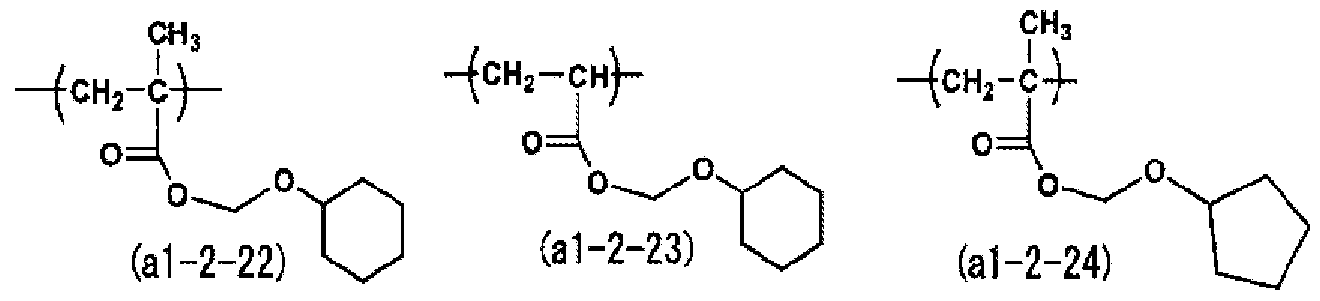


(a1-2-42) (a 1-2-43) 1]
\_ZZ \ [1800]

d 63 8S^C80/.00Z OAV

[0082] 構成単位 (al)としては、 1種を単独で用いてもよぐ 2種以上を組み合わせて用い てもよい。
構成単位 (al)としては、特に前記一般式 (al— 2)で表される構成単位が好ましく、 式(al— 2— 36)〜(al— 2— 39)で表される構成単位がより好ましく、式(al— 2— 3 6)または (al― 2― 37)で表される構成単位が最も好ま ヽ。
[0083] 重合体 (A2)中、構成単位 (al)の割合は、重合体 (A2)を構成する全構成単位に
10〜80モノレ0 /0カ女子ましく、 20〜70モノレ0 /0カ Jり女子ましく、 25〜50モノレ0 /0カさ らに好ましい。下限値以上とすることによって、レジスト組成物とした際に容易にパタ ーンを得ることができ、上限値以下とすることにより他の構成単位とのバランスをとるこ とがでさる。
[0084] ·構成単位 (a2)
重合体 (A2)は、構成単位 (al)に加えて、ラタトン含有環式基を含むアクリル酸ェ ステルカも誘導される構成単位 (a2)を有することが好ま 、。
ここで、ラタトン含有環式基とは、 -o-c(o) 構造を含むひとつの環 (ラタトン環 )を含有する環式基を示す。ラタトン環をひとつの目の環として数え、ラタトン環のみの 場合は単環式基、さらに他の環構造を有する場合は、その構造に関わらず多環式基 と称する。
重合体 (A2)が構成単位 (a2)のラタトン環式基を含有すると、本発明のレジスト組 成物より形成したレジスト膜の基板への密着性を高めたり、現像液との親水性を高め たりするうえで有効なものである。
[0085] 構成単位 (a2)としては、特に限定されることなく任意のものが使用可能である。
具体的には、ラタトン含有単環式基としては、 y プチ口ラタトン力 水素原子 1つ を除いた基が挙げられる。また、ラタトン含有多環式基としては、ラタトン環を有するビ シクロアルカン、トリシクロアルカン、テトラシクロアルカン力も水素原子一つを除いた 基が挙げられる。
[0086] 構成単位 (a2)の例として、より具体的には、下記一般式 (a2— l)〜(a2— 5)で表 される構成単位が挙げられる。
[0087] [化 23]

[式中、 Rは水素原子、ハロゲン原子、低級アルキル基またはハロゲン化低級アルキ
ル基であり、 R'は水素原子、低級アルキル基、または炭素数 1〜5のアルコキシ基で あり、 mは 0または 1の整数である。 ]
[0088] 一般式 (a2— l)〜(a2— 5)における Rは前記構成単位 (al)における Rと同様であ る。
R'の低級アルキル基としては、前記構成単位 (al)における Rの低級アルキル基と 同じである。
一般式 (a2— 1)〜 (a2— 5)中、 R'は、工業上入手が容易であること等を考慮する と、水素原子が好ましい。
以下に、前記一般式 (a2— 1)〜(a2— 5)の具体的な構成単位を例示する。
[0089] [化 24]

(aZ-1-4) (a2-1-5) {a2-1-6)
[0090] [化 25]
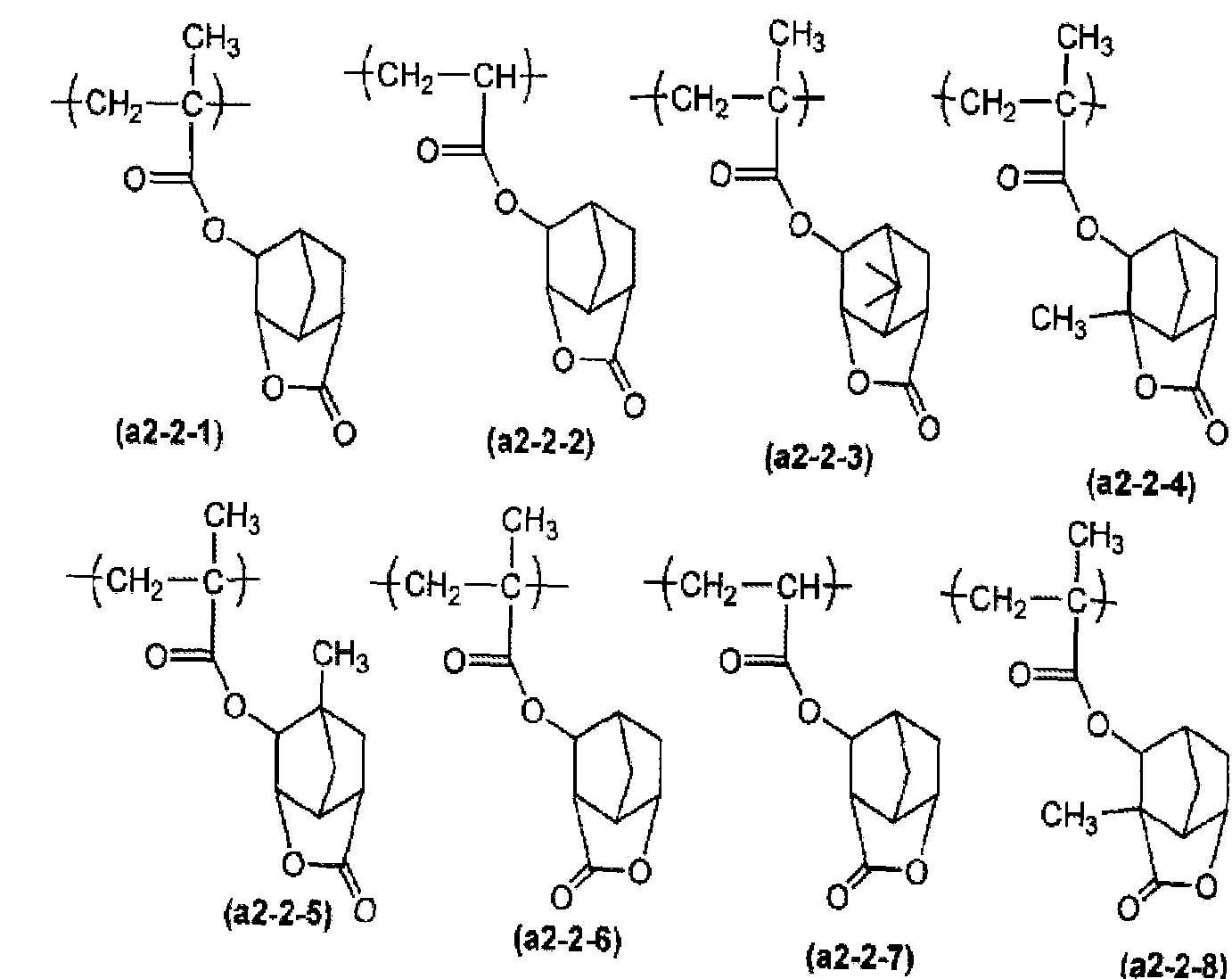 26]
26]

一οεζ <ιβ.· 〔 ^60012


[0094] これらの中でも、一般式 (a2— l)〜(a2— 3)で表される構成単位力 なる群力も選 択される少なくとも 1種が好ましぐ特に一般式 (a2— 2)で表される構成単位が好まし い。具体的には、化学式(a2— 1 1)、 (a2— 1— 2)、 (a2— 2—l)、 (a2— 2— 2)、 ( a2— 3— l)、(a2— 3— 2)、(a2— 3— 9)または(a2— 3— 10)で表される構成単位 力 なる群力 選択される少なくとも 1種が好ましぐ特に式 (a2— 2—1)または (a2— 2- 2)で表される構成単位が好ま 、。
[0095] 重合体 (A2)において、構成単位 (a2)としては、 1種を単独で用いてもよぐ 2種以 上を組み合わせて用いてもょ 、。
重合体 (A2)中の構成単位 (a2)の割合は、重合体 (A2)を構成する全構成単位の 合計に対して、 5〜70モノレ0 /0力 S好ましく、 10〜60モノレ0 /0力 Sより好ましく、 20〜60モ ル%がさらに好ましい。下限値以上とすることにより構成単位 (a2)を含有させることに よる効果が充分に得られ、上限値以下とすることにより他の構成単位とのバランスをと ることがでさる。
[0096] ·構成単位 (a3)
重合体 (A2)は、構成単位 (al)に加えて、または構成単位 (al)および (a2)に加え
て、極性基含有脂肪族炭化水素基を含むアクリル酸エステルから誘導される構成単 位 (a3)を有することが好ましい。構成単位 (a3)を有することにより、重合体 (A2)の 親水性が高まり、現像液との親和性が高まって、露光部でのアルカリ溶解性が向上し 、解像性の向上に寄与する。
極性基としては、水酸基、シァノ基、カルボキシ基、アルキル基の水素原子の一部 力 Sフッ素原子で置換されたヒドロキシアルキル基 (ここに前記アルキルの炭素数は好 ましくは 1〜5である)等が挙げられ、特に水酸基が好ましい。
脂肪族炭化水素基としては、炭素数 1〜10の直鎖状または分岐状の炭化水素基( 好ましくはアルキレン基)や、多環式の脂肪族炭化水素基 (多環式基)が挙げられる。 該多環式基としては、例えば ArFエキシマレーザー用レジスト組成物用の榭脂にお いて、多数提案されているものの中から適宜選択して用いることができる。該多環式 基の炭素数は 7〜30であることが好まし 、。
その中でも、水酸基、シァノ基、カルボキシ基、またはアルキル基の水素原子の一 部がフッ素原子で置換されたヒドロキシアルキル基を含有する脂肪族多環式基を含 むアクリル酸エステルカゝら誘導される構成単位がより好まし ヽ。該多環式基としては、 ビシクロアルカン、トリシクロアルカン、テトラシクロアルカンなどから 1個以上の水素原 子を除いた基などを例示できる。具体的には、ァダマンタン、ノルボルナン、イソボル ナン、トリシクロデカン、テトラシクロドデカンなどのポリシクロアルカンから 1個以上の 水素原子を除いた基などが挙げられる。これらの多環式基の中でも、ァダマンタンか ら 2個以上の水素原子を除 、た基、ノルボルナンから 2個以上の水素原子を除 、た 基、テトラシクロドデカンから 2個以上の水素原子を除 、た基が工業上好ま 、。
[0097] 構成単位 (a3)としては、極性基含有脂肪族炭化水素基における炭化水素基が炭 素数 1〜: LOの直鎖状または分岐状の炭化水素基のときは、アクリル酸のヒドロキシェ チルエステルから誘導される構成単位が好ましぐ該炭化水素基が多環式基のとき は、下記式 (a3— 1)で表される構成単位、(a3— 2)で表される構成単位、及び (a3 - 3)で表される構成単位が好ま ヽものとして挙げられる。
[0098] [化 29]

(a3-3)
[式中、 Rは水素原子、ハロゲン原子、低級アルキル基またはハロゲン化低級アルキ ル基を示し、 jは 1〜3の整数であり、 kは 1〜3の整数であり、 t'は 1〜3の整数であり、 1は 1〜5の整数であり、 sは 1〜3の整数である。 ]
[0099] 式(a3— l)中、 jは 1又は 2であることが好ましぐ 1であることがさらに好ましい。 jが 2 の場合は、水酸基がァダマンチル基の 3位と 5位に結合しているものが好ましい。 jが 1の場合は、水酸基がァダマンチル基の 3位に結合して 、るものが好まし 、。
jは 1であることが好ましぐ特に水酸基がァダマンチル基の 3位に結合しているものが 好ましい。
[0100] 式(a3— 2)中、 kは 1であることが好ましい。シァノ基はノルボル-ル基の 5位または 6位に結合して 、ることが好まし 、。
[0101] 式(a3— 3)中、 t'は 1であることが好ましい。 1は 1であることが好ましい。 sは 1である ことが好まし 、。これらはアクリル酸のカルボキシ基の末端に 2—ノルボルニル基また は 3—ノルボル-ル基が結合していることが好ましい。フッ素化アルキルアルコール はノルボル-ル基の 5又は 6位に結合して!/、ることが好まし!/、。
[0102] 構成単位 (a3)としては、 1種を単独で用いてもよぐ 2種以上を組み合わせて用い てもよい。
重合体 (A2)中、構成単位 (a3)の割合は、当該重合体 (A2)を構成する全構成単 位に対し、 5〜50モル0 /0であることが好ましぐ 5〜40モル0 /0力より好ましく、 5〜25 モル%がさらに好ましい。
[0103] ·その他の構成単位
重合体 (A2)は、本発明の効果を損なわない範囲で、上記構成単位 (al)〜(a3) 以外の他の構成単位を含んでいてもよい。カゝかる構成単位としては、主鎖環状型構 成単位ではなぐかつ上述の構成単位 (al)〜(a3)に分類されな ヽ他の構成単位で あれば特に限定するものではなぐ ArFエキシマレーザー用、 KrFエキシマレーザー 用(好ましくは ArFエキシマレーザー用)等のレジスト用榭脂に用いられるものとして 従来力も知られている多数のものが使用可能である。
[0104] 構成単位 (al)〜(a3)以外の他の構成単位としては、例えば、酸非解離性の脂肪 族多環式基を含むアクリル酸エステルから誘導される構成単位 (a4)が挙げられる。 構成単位 (a4)における多環式基としては、例えば、前記の構成単位 (al)の場合 に例示したものと同様のものを例示することができ、 ArFエキシマレーザー用、 KrF エキシマレーザー用(好ましくは ArFエキシマレーザー用)等のレジスト組成物の榭 脂成分に用いられるものとして従来力も知られている多数のものが使用可能である。 特にトリシクロデカニル基、ァダマンチル基、テトラシクロドデ力-ル基、イソボル- ル基、ノルボル二ル基カも選ばれる少なくとも 1種以上であると、工業上入手し易いな どの点で好ましい。これらの多環式基は、炭素数 1〜5の直鎖又は分岐状のアルキル 基で置換されていてもよい。
構成単位 (a4)として、具体的には、下記一般式 (a4— l)〜(a4— 5)の構造のもの を f列示することができる。
[0105] [化 30]

(式中、 Rは水素原子、ハロゲン原子、低級アルキル基またはハロゲン化低級アルキ ル基を示す。 )
重合体 (A2)が構成単位 (a4)を含有する場合、重合体 (A2)中の構成単位 (a4)
の割合は、重合体 (A2)を構成する全構成単位の合計に対して、構成単位 (a4)を 1
〜30モル0 /0が好ましぐ 10〜20モル0 /0がより好ましい。
[0107] 本発明において、重合体 (A2)は、構成単位 (al)、 (a2)および (a3)を有する共重 合体であることが好ましぐ係る共重合体としては、たとえば、上記構成単位 (al)、 (a
2)および (a3)力 なる共重合体、上記構成単位 (al)、(a2)、(a3)および (a4)から なる共重合体等が例示できる。
[0108] 本発明おいて、重合体 (A2)としては、本発明の効果に優れることから、特に下記 一般式 (A2— 11)に示す 3種の構成単位を含むものが好ま U、。
[0109] [化 31]

[式中、 Rは水素原子、ハロゲン原子、低級アルキル基またはハロゲン化低級アルキ ル基を示し、 R11は水素原子またはメチル基であり、 R12〜R14はそれぞれメチル基で ある。 ]
[0110] 式 (A2— 11)中、 R11は、メチル基であることが最も好ましい。
[Oil 1] 重合体 (A2)は、各構成単位を誘導するモノマーを、例えばァゾビスイソプチ口-ト リル (AIBN)のようなラジカル重合開始剤を用いた公知のラジカル重合等によって重 合させること〖こよって得ることができる。
また、重合体 (A2)には、上記重合の際に、たとえば HS— CH -CH -CH C (
2 2 2
CF ) —OHのような連鎖移動剤を併用して用いることにより、末端に一 C (CF ) -
3 2 3 2
OH基を導入してもよい。このように、アルキル基の水素原子の一部がフッ素原子で
置換されたヒドロキシアルキル基が導入された共重合体は、現像欠陥の低減や LER (ラインエッジラフネス:ライン側壁の不均一な凹凸)の低減に有効である。
[0112] 重合体 (A2)の質量平均分子量(Mw) (ゲルパーミエーシヨンクロマトグラフィーに よるポリスチレン換算基準)は、特に限定するものではないが、 2, 000-50, 000が 好まし <、 3, 000〜30, 000力より好まし <、 5, 000〜20, 000力 ^最ち好まし!/ヽ。この 範囲の上限よりも小さいと、レジストとして用いるのに充分なレジスト溶剤への溶解性 があり、この範囲の下限よりも大きいと、耐ドライエッチング性やレジストパターン断面 形状が良好である。
また分散度(Mw/Mn) iま 1. 0〜5. 0力 S好ましく、 1. 0〜3. 0力 Sより好ましく、 1. 2 〜2. 5が最も好ましい。なお、 Mnは数平均分子量を示す。
[0113] (A)成分中、重合体 (A2)は、 1種を単独で用いてもよぐ 2種以上を併用しても良 い。
[0114] (A)成分中、重合体 (A1)と重合体 (A2)との質量比は、本発明の効果に優れるこ と力も、重合体 (A1) :重合体(八2) = 1 : 99〜99 : 1の範囲内でぁることが好ましぐ 5 : 95〜75: 25の範囲内であることがより好ましぐ 10 : 90〜75: 25の範囲内であるこ と力 S特に好ましく、 10 : 90〜50: 50の範囲内であることが最も好ましい。重合体 (A1) の割合が上記範囲の下限以上であると浸漬露光時の物質溶出抑制効果に優れ、上 記範囲の上限以下であるとリソグラフィー特性が向上する。
[0115] < (B)成分 >
(B)成分としては、特に限定されず、これまでィ匕学増幅型レジスト用の酸発生剤とし て提案されているものを使用することができる。このような酸発生剤としては、これまで 、ョードニゥム塩やスルホ -ゥム塩などのォ-ゥム塩系酸発生剤、ォキシムスルホネ 一ト系酸発生剤、ビスアルキルまたはビスァリールスルホ-ルジァゾメタン類、ポリ(ビ ススルホ -ル)ジァゾメタン類などのジァゾメタン系酸発生剤、ニトロべンジルスルホネ 一ト系酸発生剤、イミノスルホネート系酸発生剤、ジスルホン系酸発生剤など多種の ものが知られている。
[0116] ォニゥム塩系酸発生剤として、例えば下記一般式 (b— 0)で表される酸発生剤が挙 げられる。
[0117] [化 32] \ R52
R53— S X CCH2 } U„ R5iSo3 -
\/ . ' · (b- O)
[式中、 R51は、直鎖、分岐鎖若しくは環状のアルキル基、または直鎖、分岐鎖若しく は環状のフッ素化アルキル基を表し; R52は、水素原子、水酸基、ハロゲン原子、直 鎖若しくは分岐鎖状のアルキル基、直鎖若しくは分岐鎖状のハロゲンィ匕アルキル基 、または直鎖若しくは分岐鎖状のアルコキシ基であり; R53は置換基を有していてもよ ぃァリール基であり; u"は 1〜3の整数である。 ]
[0118] 一般式 (b— 0)において、 R51は、直鎖、分岐鎖若しくは環状のアルキル基、または 直鎖、分岐鎖若しくは環状のフッ素化アルキル基を表す。
前記直鎖若しくは分岐鎖状のアルキル基としては、炭素数 1〜10であることが好ま しぐ炭素数 1〜8であることがさらに好ましぐ炭素数 1〜4であることが最も好ましい。 前記環状のアルキル基としては、炭素数 4〜 12であることが好ましぐ炭素数 5〜1 0であることがさらに好ましぐ炭素数 6〜: LOであることが最も好ましい。
前記直鎖若しくは分岐鎖状のフッ素化アルキル基としては、炭素数 1〜10であるこ とが好ましぐ炭素数 1〜8であることがさらに好ましぐ炭素数 1〜4であることが最も 好ましい。前記環状のフッ素化アルキル基としては、炭素数 4〜 12であることが好ま しぐ炭素数 5〜: LOであることがさらに好ましぐ炭素数 6〜: LOであることが最も好まし い。また、該フッ化アルキル基のフッ素化率 (アルキル基中全水素原子の個数に対 する置換したフッ素原子の個数の割合)は、好ましくは 10〜100%、さらに好ましくは 50〜100%であり、特に水素原子をすベてフッ素原子で置換したもの力 酸の強度 が強くなるので好ましい。
R51としては、直鎖状のアルキル基またはフッ素化アルキル基であることが最も好ま しい。
[0119] R52は、水素原子、水酸基、ハロゲン原子、直鎖若しくは分岐鎖状のアルキル基、 直鎖若しくは分岐鎖状のハロゲンィ匕アルキル基、または直鎖若しくは分岐鎖状のァ ルコキシ基である。
R52において、ハロゲン原子としては、フッ素原子、臭素原子、塩素原子、ヨウ素原 子などが挙げられ、フッ素原子が好ましい。
R52において、アルキル基は、直鎖または分岐鎖状であり、その炭素数は好ましくは 1〜5、特に 1〜4、さらには 1〜3であることが望ましい。
R52において、ハロゲン化アルキル基は、アルキル基中の水素原子の一部または全 部がハロゲン原子で置換された基である。ここでのアルキル基は、前記 R52における「 アルキル基」と同様のものが挙げられる。置換するハロゲン原子としては上記「ノヽロゲ ン原子」について説明したものと同様のものが挙げられる。ハロゲン化アルキル基に おいて、水素原子の全個数の 50〜100%がハロゲン原子で置換されていることが望 ましぐ全て置換されていることがより好ましい。
R52において、アルコキシ基としては、直鎖状または分岐鎖状であり、その炭素数は 好ましくは 1〜5、特に 1〜4、さらには 1〜3であることが望ましい。
R52としては、これらの中でも水素原子が好ましい。
[0120] R53は置換基を有していてもよいァリール基、好ましくは炭素数 6〜20のァリール基 であり、置換基を除いた基本環 (母体環)の構造としては、ナフチル基、フエニル基、 アントラセ-ル基などが挙げられ、本発明の効果や ArFエキシマレーザーなどの露 光光の吸収の観点から、フエニル基が望ましい。
置換基としては、水酸基、低級アルキル基 (直鎖または分岐鎖状であり、その好まし い炭素数は 5以下であり、特にメチル基が好ましい)などを挙げることができる。
R53のァリール基としては、置換基を有しな 、ものがより好ま 、。
u"は 1〜3の整数であり、 2または 3であることが好ましぐ特に 3であることが望まし い。
[0121] 一般式 (b— 0)で表される酸発生剤の好ましいものは以下の様なものを挙げること ができる。
[0122] [化 33]

J~\ 一
) C F,SOj
\ _ I
[0123] 上記一般式 (b— 0)で表される酸発生剤の他のォ-ゥム塩系酸発生剤として、例え ば下記一般式 (b— 1)または (b— 2)で表される化合物が挙げられる。
[0124] [化 34]

[式中、 R1"^3", R5"〜R6"は、それぞれ独立に、ァリール基またはアルキル基を 表し; R4"は、直鎖、分岐または環状のアルキル基またはフッ素化アルキル基を表し; ,,〜 "のうち少なくとも 1っはァリール基を表し、 R5"〜R6"のうち少なくとも 1つは ァリール基を表す。 ]
[0125] 式 (b— 1)中、 "〜 "はそれぞれ独立にァリール基またはアルキル基を表す。 R 〜 "のうち、少なくとも 1っはァリール基を表す。 ,,〜 "のうち、 2以上がァリー ル基であることが好ましぐ Rlw〜R3"のすべてがァリール基であることが最も好ましい
Rlw〜R3"のァリール基としては、特に制限はなぐ例えば、炭素数 6〜20のァリー ル基であって、該ァリール基は、その水素原子の一部または全部がアルキル基、ァ ルコキシ基、ハロゲン原子等で置換されていてもよぐされていなくてもよい。ァリール 基としては、安価に合成可能なことから、炭素数 6〜: L0のァリール基が好ましい。具 体的には、たとえばフエ-ル基、ナフチル基が挙げられる。
前記ァリール基の水素原子が置換されていても良いアルキル基としては、炭素数 1
〜5のアルキル基が好ましぐメチル基、ェチル基、プロピル基、 n—ブチル基、 tert -ブチル基であることが最も好ま 、。
前記ァリール基の水素原子が置換されていても良いアルコキシ基としては、炭素数 1〜5のアルコキシ基が好ましぐメトキシ基、エトキシ基が最も好ましい。
前記ァリール基の水素原子が置換されていても良いハロゲン原子としては、フッ素原 子であることが好ましい。
"〜 "のアルキル基としては、特に制限はなぐ例えば炭素数 1〜10の直鎖状 、分岐状または環状のアルキル基等が挙げられる。解像性に優れる点から、炭素数 1 〜5であることが好ましい。具体的には、メチル基、ェチル基、 n—プロピル基、イソプ 口ピル基、 n—ブチル基、イソブチル基、 n—ペンチル基、シクロペンチル基、へキシ ル基、シクロへキシル基、ノニル基、デカニル基等が挙げられ、解像性に優れ、また 安価に合成可能なことから好ましいものとして、メチル基を挙げることができる。
これらの中で、 Rlw〜R3"は、それぞれ、フエ-ル基またはナフチル基であることが 最も好ましい。
[0126] R4"は、直鎖、分岐または環状のアルキル基またはフッ素化アルキル基を表す。
前記直鎖または分岐のアルキル基としては、炭素数 1〜10であることが好ましぐ炭 素数 1〜8であることがさらに好ましぐ炭素数 1〜4であることが最も好ましい。
前記環状のアルキル基としては、前記 R1"で示したような環式基であって、炭素数 4 〜 15であることが好ましぐ炭素数 4〜 10であることがさらに好ましぐ炭素数 6〜10 であることが最も好ましい。
前記フッ素化アルキル基としては、炭素数 1〜: LOであることが好ましぐ炭素数 1〜 8であることがさらに好ましぐ炭素数 1〜4であることが最も好ましい。また、該フツイ匕 アルキル基のフッ素化率 (アルキル基中のフッ素原子の割合)は、好ましくは 10〜: LO 0%、さらに好ましくは 50〜100%であり、特に水素原子をすベてフッ素原子で置換 したものが、酸の強度が強くなるので好ましい。
R4"としては、直鎖または環状のアルキル基、またはフッ素化アルキル基であること が最も好ましい。
[0127] 式 (b— 2)中、 R5"及び R6"はそれぞれ独立にァリール基またはアルキル基を表す。
R5"及び R6"のうち、少なくとも 1っはァリール基を表す。 R5"及び R6"の両方ともァリ ール基であることが最も好ま 、。
R5"及び R6"のァリール基としては、 ,,〜 "のァリール基と同様のものが挙げられ る。
R5"及び R6"のアルキル基としては、 ,,〜 "のアルキル基と同様のものが挙げら れる。
これらの中で、 R5"及び R6"はすべてフエ-ル基であることが最も好ましい。
式 (b— 2)中の R4"としては上記式 (b - 1)の R4"と同様のものが挙げられる。
式 (b— 1)、(b— 2)で表されるォ-ゥム塩系酸発生剤の具体例としては、ジフ - ルョードニゥムのトリフルォロメタンスルホネートまたはノナフルォロブタンスルホネート 、ビス(4—tert ブチルフエ-ル)ョードニゥムのトリフルォロメタンスルホネートまた はノナフルォロブタンスルホネート、トリフエ-ルスルホ-ゥムのトリフルォロメタンスル ホネート、そのヘプタフルォロプロパンスルホネートまたはそのノナフルォロブタンス ルホネート、トリ(4 メチルフエ-ル)スルホ -ゥムのトリフルォロメタンスルホネート、 そのヘプタフルォロプロパンスルホネートまたはそのノナフルォロブタンスルホネート 、ジメチル(4ーヒドロキシナフチル)スルホ -ゥムのトリフルォロメタンスルホネート、そ のヘプタフルォロプロパンスルホネートまたはそのノナフルォロブタンスルホネート、 モノフエ-ルジメチルスルホ-ゥムのトリフルォロメタンスルホネート、そのへプタフル ォロプロパンスルホネートまたはそのノナフルォロブタンスルホネート、ジフエニルモノ メチノレスノレホ-ゥムのトリフノレオロメタンスノレホネート、そのヘプタフノレォロプロパンス ルホネートまたはそのノナフルォロブタンスルホネート、(4 メチルフエ-ル)ジフエ- ルスルホ-ゥムのトリフルォロメタンスルホネート、そのヘプタフルォロプロパンスルホ ネートまたはそのノナフルォロブタンスルホネート、(4ーメトキシフエ-ル)ジフエニル スノレホニゥムのトリフノレオロメタンスノレホネート、そのヘプタフノレォロプロパンスノレホネ ートまたはそのノナフルォロブタンスルホネート、トリ(4 tert—ブチル)フエ-ルスル ホ-ゥムのトリフノレオロメタンスノレホネート、そのヘプタフノレォロプロパンスノレホネート またはそのノナフルォロブタンスルホネート、ジフエ-ル(1一(4ーメトキシ)ナフチル) スノレホニゥムのトリフノレオロメタンスノレホネート、そのヘプタフノレォロプロパンスノレホネ
ートまたはそのノナフルォロブタンスルホネート、ジ(1 ナフチル)フエ-ルスルホ- ゥムのトリフルォロメタンスルホネート、そのヘプタフルォロプロパンスルホネートまた はそのノナフルォロブタンスルホネートなどが挙げられる。また、これらのォ-ゥム塩 のァ-オン部がメタンスルホネート、 n—プロパンスルホネート、 n—ブタンスルホネー ト、 n—オクタンスルホネートに置き換えたォ-ゥム塩も用いることができる。
[0129] また、前記一般式 (b— 1)又は (b— 2)において、ァニオン部を下記一般式 (b— 3) 又は (b— 4)で表されるァ-オン部に置き換えたォ-ゥム塩系酸発生剤も用いること ができる (カチオン部は (b— 1)又は (b— 2)と同様)。
[0130] [化 35]
… 一 4)

[式中、 X"は、少なくとも 1つの水素原子がフッ素原子で置換された炭素数 2〜6のァ ルキレン基を表し; Υ"、 Ζ"は、それぞれ独立に、少なくとも 1つの水素原子がフッ素 原子で置換された炭素数 1〜10のアルキル基を表す。 ]
[0131] X"は、少なくとも 1つの水素原子がフッ素原子で置換された直鎖状または分岐状の アルキレン基であり、該アルキレン基の炭素数は 2〜6であり、好ましくは炭素数 3〜5 、最も好ましくは炭素数 3である。
Υ"、 Ζ"は、それぞれ独立に、少なくとも 1つの水素原子がフッ素原子で置換された 直鎖状または分岐状のアルキル基であり、該アルキル基の炭素数は 1〜 10であり、 好ましくは炭素数 1〜7、より好ましくは炭素数 1〜3である。
X"のアルキレン基の炭素数または Υ"、 Ζ"のアルキル基の炭素数は、上記炭素数 の範囲内において、レジスト溶媒への溶解性も良好である等の理由により、小さいほ ど好まし ヽ。
また、 X"のアルキレン基または Υ"、 Ζ"のアルキル基において、フッ素原子で置換さ れている水素原子の数が多いほど、酸の強度が強くなり、また 200nm以下の高エネ ルギ一光や電子線に対する透明性が向上するので好ま U、。該アルキレン基または アルキル基中のフッ素原子の割合、すなわちフッ素化率は、好ましくは 70〜100%、
さらに好ましくは 90〜: L00%であり、最も好ましくは、全ての水素原子がフッ素原子で 置換されたパーフルォロアルキレン基またはパーフルォロアルキル基である。
[0132] 本明細書において、ォキシムスルホネート系酸発生剤とは、下記一般式 (B— 1)で 表される基を少なくとも 1つ有する化合物であって、放射線の照射によって酸を発生 する特性を有するものである。この様なォキシムスルホネート系酸発生剤は、化学増 幅型レジスト組成物用として多用されているので、任意に選択して用いることができる
[0133] [化 36]
— C=N― 0— S(¾— R31
R32 · ■ - ( B - 1 )
(式 (B— 1)中、 R31、 R32はそれぞれ独立に有機基を表す。 )
[0134] R31、 R32の有機基は、炭素原子を含む基であり、炭素原子以外の原子 (たとえば水 素原子、酸素原子、窒素原子、硫黄原子、ハロゲン原子 (フッ素原子、塩素原子等) 等)を有していてもよい。
R31の有機基としては、直鎖、分岐または環状のアルキル基またはァリール基が好 ましい。これらのアルキル基、ァリール基は置換基を有していても良い。該置換基とし ては、特に制限はなぐたとえばフッ素原子、炭素数 1〜6の直鎖、分岐または環状の アルキル基等が挙げられる。ここで、「置換基を有する」とは、アルキル基またはァリー ル基の水素原子の一部または全部が置換基で置換されていることを意味する。 アルキル基としては、炭素数 1〜20が好ましぐ炭素数 1〜10がより好ましぐ炭素 数 1〜8がさらに好ましぐ炭素数 1〜6が特に好ましぐ炭素数 1〜4が最も好ましい。 アルキル基としては、特に、部分的または完全にハロゲンィ匕されたアルキル基 (以下 、ハロゲン化アルキル基ということがある)が好ましい。なお、部分的にハロゲンィ匕され たアルキル基とは、水素原子の一部がハロゲン原子で置換されたアルキル基を意味 し、完全にハロゲンィ匕されたアルキル基とは、水素原子の全部がハロゲン原子で置 換されたアルキル基を意味する。ハロゲン原子としては、フッ素原子、塩素原子、臭 素原子、ヨウ素原子等が挙げられ、特にフッ素原子が好ましい。すなわち、ハロゲン 化アルキル基は、フッ素化アルキル基であることが好まし!/、。
ァリール基は、炭素数 4〜20が好ましぐ炭素数 4〜: LOがより好ましぐ炭素数 6〜1 0が最も好ましい。ァリール基としては、特に、部分的または完全にハロゲン化された ァリール基が好ましい。なお、部分的にハロゲン化されたァリール基とは、水素原子 の一部がハロゲン原子で置換されたァリール基を意味し、完全にハロゲンィ匕されたァ リール基とは、水素原子の全部がハロゲン原子で置換されたァリール基を意味する。
R31としては、特に、置換基を有さない炭素数 1〜4のアルキル基、または炭素数 1 〜4のフッ素化アルキル基が好まし 、。
[0135] R32の有機基としては、直鎖、分岐または環状のアルキル基、ァリール基またはシァ ノ基が好ましい。 R32のアルキル基、ァリール基としては、前記 R31で挙げたアルキル 基、ァリール基と同様のものが挙げられる。
R32としては、特に、シァノ基、置換基を有さない炭素数 1〜8のアルキル基、または 炭素数 1〜8のフッ素化アルキル基が好ましい。
[0136] ォキシムスルホネート系酸発生剤として、さらに好ましいものとしては、下記一般式 (
B- 2)または (B— 3)で表される化合物が挙げられる。
[0137] [化 37]
34-C=N― O― S02—— R35
R33 ' ■ ' ( B— 2 )
[式 (B— 2)中、 R33は、シァノ基、置換基を有さないアルキル基またはハロゲンィ匕ァ ルキル基である。 R34はァリール基である。 R35は置換基を有さないアルキル基または ハロゲン化アルキル基である。 ]
[0138] [化 38]

[式 (B— 3)中、 R はシァノ基、置換基を有さないアルキル基またはハロゲンィ匕アル キル基である。 R37は 2または 3価の芳香族炭化水素基である。 R38は置換基を有さな いアルキル基またはハロゲン化アルキル基である。 p"は 2または 3である。 ]
前記一般式 (B— 2)において、 R33の置換基を有さないアルキル基またはハロゲン
化アルキル基は、炭素数が 1〜: L0であることが好ましぐ炭素数 1〜8がより好ましぐ 炭素数 1〜6が最も好ましい。
R33としては、ハロゲンィ匕アルキル基が好ましぐフッ素化アルキル基がより好ましい
R33におけるフッ素化アルキル基は、アルキル基の水素原子が 50%以上フッ素化さ れていることが好ましぐより好ましくは 70%以上、さらに好ましくは 90%以上フッ素 化されて!/、ることが好まし!/、。
[0140] R3のァリール基としては、フエ-ル基、ビフエ-ル (biphenyl)基、フルォレ -ル(fl uorenyl)基、ナフチル基、アントラセル(anthracyl)基、フエナントリル基等の、芳香 族炭化水素の環力 水素原子を 1つ除いた基、およびこれらの基の環を構成する炭 素原子の一部が酸素原子、硫黄原子、窒素原子等のへテロ原子で置換されたへテ ロアリール基等が挙げられる。これらのなかでも、フルォレニル基が好ましい。
R34のァリール基は、炭素数 1〜10のアルキル基、ハロゲン化アルキル基、アルコキ シ基等の置換基を有して 、ても良 、。該置換基におけるアルキル基またはハロゲン 化アルキル基は、炭素数が 1〜8であることが好ましぐ炭素数 1〜4がさらに好ましい 。また、該ハロゲン化アルキル基は、フッ素化アルキル基であることが好ましい。
[0141] R35の置換基を有さないアルキル基またはハロゲンィ匕アルキル基は、炭素数が 1〜 10であることが好ましぐ炭素数 1〜8がより好ましぐ炭素数 1〜6が最も好ましい。
R35としては、ハロゲンィ匕アルキル基が好ましぐ部分的または完全ににフッ素化さ れたアルキル基が最も好まし!/、。
R35におけるフッ素化アルキル基は、アルキル基の水素原子が 50%以上フッ素化さ れていることが好ましぐより好ましくは 70%以上、さらに好ましくは 90%以上フッ素 化されていること力 発生する酸の強度が高まるため好ましい。最も好ましくは、水素 原子が 100%フッ素置換された完全フッ素化アルキル基である。
[0142] 前記一般式 (B— 3)にお 、て、 R36の置換基を有さな 、アルキル基またはハロゲン 化アルキル基としては、上記 R33の置換基を有さな 、アルキル基またはハロゲンィ匕ァ ルキル基と同様のものが挙げられる。
R37の 2または 3価の芳香族炭化水素基としては、上記 R34のァリール基力もさらに 1
または 2個の水素原子を除 、た基が挙げられる。
R38の置換基を有さな 、アルキル基またはハロゲンィ匕アルキル基としては、上記 5 の置換基を有さないアルキル基またはハロゲンィ匕アルキル基と同様のものが挙げら れる。
P"は好ましくは 2である。
ォキシムスルホネート系酸発生剤の具体例としては、 α (p トルエンスルホ-ル ォキシィミノ)一ベンジルシア-ド、 a - (p クロ口ベンゼンスルホ -ルォキシィミノ) —ベンジルシア-ド、 a - (4—二トロベンゼンスルホ -ルォキシィミノ)—ベンジルシ アニド、 ひ一(4 -トロー 2 トリフルォロメチルベンゼンスルホ -ルォキシィミノ) ベンジルシア-ド、 a - (ベンゼンスルホ -ルォキシィミノ)—4—クロ口べンジルシア -ド、 a (ベンゼンスルホ -ルォキシィミノ)— 2, 4 ジクロロべンジルシア-ド、 a —(ベンゼンスルホ -ルォキシィミノ)— 2, 6 ジクロロべンジルシア-ド、 a (ベン ゼンスルホ -ルォキシィミノ) 4—メトキシベンジルシア-ド、 a - (2—クロ口べンゼ ンスルホ -ルォキシィミノ)—4—メトキシベンジルシア-ド、 a - (ベンゼンスルホ- ルォキシィミノ)—チェン— 2—ィルァセトニトリル、 at - (4—ドデシルベンゼンスルホ -ルォキシィミノ)—ベンジルシア-ド、 a - [ (p トルエンスルホ -ルォキシィミノ) - 4—メトキシフエ-ル]ァセトニトリル、 a [ (ドデシルベンゼンスルホ -ルォキシィミノ )—4—メトキシフエ-ル]ァセトニトリル、 at - (トシルォキシィミノ)—4—チェ-ルシア -ド、 a (メチルスルホ -ルォキシィミノ)— 1—シクロペンテ-ルァセトニトリル、 a - (メチルスルホ -ルォキシィミノ)— 1—シクロへキセ-ルァセトニトリル、 OC - (メチ ルスルホ -ルォキシィミノ) 1ーシクロヘプテュルァセトニトリル、 a (メチルスルホ -ルォキシィミノ)— 1—シクロオタテュルァセトニトリル、 at - (トリフルォロメチルスル ホ -ルォキシィミノ)— 1—シクロペンテ-ルァセトニトリル、 a - (トリフルォロメチルス ルホ -ルォキシィミノ)ーシクロへキシルァセトニトリル、 a (ェチルスルホ-ルォキ シィミノ)—ェチルァセトニトリル、 OC - (プロピルスルホ -ルォキシィミノ)—プロピルァ セト-トリル、 a - (シクロへキシルスルホ -ルォキシィミノ)—シクロペンチルァセトニ トリル、 a - (シクロへキシルスルホ -ルォキシィミノ)—シクロへキシルァセトニトリル、 a - (シクロへキシルスルホ -ルォキシィミノ)— 1—シクロペンテ-ルァセトニトリル、
a - (ェチルスルホ -ルォキシィミノ)— 1—シクロペンテ-ルァセトニトリル、 α (ィ ソプロピルスルホ -ルォキシィミノ)— 1—シクロペンテ-ルァセトニトリル、 a - (η— ブチルスルホニルォキシィミノ) 1ーシクロペンテ二ルァセトニトリル、 α (ェチルス ルホ -ルォキシィミノ)— 1—シクロへキセ-ルァセトニトリル、 α - (イソプロピルスル ホ -ルォキシィミノ) 1ーシクロへキセ-ルァセトニトリル、 ひ (η—ブチルスルホ- ルォキシィミノ) 1ーシクロへキセ-ルァセトニトリル、 α (メチルスルホ -ルォキシ ィミノ)—フエ-ルァセトニトリル、 OC - (メチルスルホ -ルォキシィミノ)—ρ—メトキシフ ェ-ルァセトニトリル、 α - (トリフルォロメチルスルホ -ルォキシィミノ)—フエ-ルァ セト-トリル、 α - (トリフルォロメチルスルホ -ルォキシィミノ)—p—メトキシフエ-ル ァセトニトリル、 at - (ェチルスルホニルォキシィミノ)—p—メトキシフエ二ルァセトニト リル、 α—(プロピルスルホ -ルォキシィミノ) p メチルフエ-ルァセトニトリル、 α (メチルスルホ -ルォキシィミノ) ρ ブロモフエ-ルァセトニトリルなどが挙げられ る。
また、特開平 9 - 208554号公報 (段落 [0012]〜 [0014]の [化 18]〜 [化 19] )に 開示されて!、るォキシムスルホネート系酸発生剤、 WO2004Z074242A2 (65〜8 5頁目の Example l〜40)に開示されているォキシムスルホネート系酸発生剤も好適 に用いることができる。
また、好適なものとして以下のものを例示することができる。
[化 39]

上記例示化合物の中でも、下記の 4つの化合物が好ましい 40]

H3C—— C^N—— 0S02—— (CH2)3CH3
H3C一 C=N一 0S02—— <CH2}3CH3

[0147] ジァゾメタン系酸発生剤のうち、ビスアルキルまたはビスァリールスルホ -ルジァゾメ タン類の具体例としては、ビス(イソプロピルスルホ -ル)ジァゾメタン、ビス(p トルェ ンスルホ -ル)ジァゾメタン、ビス( 1 , 1—ジメチルェチルスルホ -ル)ジァゾメタン、ビ ス(シクロへキシルスルホ -ル)ジァゾメタン、ビス(2, 4 ジメチルフエ-ルスルホ-ル )ジァゾメタン等が挙げられる。
また、特開平 11— 035551号公報、特開平 11— 035552号公報、特開平 11— 03 5573号公報に開示されているジァゾメタン系酸発生剤も好適に用いることができる。 また、ポリ(ビススルホ -ル)ジァゾメタン類としては、例えば、特開平 11 322707 号公報に開示されている、 1, 3 ビス(フエ-ルスルホ-ルジァゾメチルスルホ -ル) プロノ ン、 1, 4 ビス(フエ-ルスルホ-ルジァゾメチルスルホ -ル)ブタン、 1, 6 ビ ス(フエ-ルスルホ-ルジァゾメチルスルホ -ル)へキサン、 1 , 10—ビス(フエ-ルス ルホ-ルジァゾメチルスルホ -ル)デカン、 1, 2—ビス(シクロへキシルスルホ -ルジ ァゾメチルスルホ -ル)ェタン、 1, 3 ビス(シクロへキシルスルホ-ルジァゾメチルス ルホ -ル)プロパン、 1, 6 ビス(シクロへキシルスルホ-ルジァゾメチルスルホ -ル) へキサン、 1, 10—ビス(シクロへキシルスルホ-ルジァゾメチルスルホ -ル)デカンな どを挙げることができる。
[0148] (B)成分としては、これらの酸発生剤を 1種単独で用いてもよいし、 2種以上を組み 合わせて用いてもよい。
本発明にお 、ては、中でも (B)成分としてフッ素化アルキルスルホン酸イオンをァ 二オンとするォニゥム塩を用いることが好まし 、。
本発明の液浸露光用ポジ型レジスト組成物における(B)成分の含有量は、 (A)成 分 100質量部に対し、 0. 5〜30質量部、好ましくは 1〜: L0質量部とされる。上記範
囲とすることでパターン形成が充分に行われる。また、均一な溶液が得られ、保存安 定性が良好となるため好ま 、。
<任意成分 >
本発明の液浸露光用ポジ型レジスト組成物には、レジストパターン形状、引き置き 経時 5疋性 (post exposure stability of the latent image formed by the pattern-wise exposure of the resist layer)などを向上させるために、さらに任意の成分として、含窒 素有機化合物 (D) (以下、(D)成分という)を配合することができる。
この(D)成分は、既に多種多様なものが提案されているので、公知のものから任意 に用いれば良いが、環式ァミン、脂肪族ァミン、特に第 2級脂肪族アミンゃ第 3級脂 肪族ァミンが好ましい。
脂肪族ァミンとしては、アンモニア NHの水素原子の少なくとも 1つを、炭素数 12以
3
下のアルキル基またはヒドロキシアルキル基で置換したァミン(アルキルアミンまたは アルキルアルコールァミン)が挙げられる。その具体例としては、 n—へキシルァミン、 n プチルァミン、 n—ォクチルァミン、 n—ノ-ルァミン、 n—デシルァミン等のモノ アルキルァミン;ジェチルァミン、ジ—n—プロピルァミン、ジ—n プチルァミン、ジ —n—ォクチルァミン、ジシクロへキシルァミン等のジアルキルァミン;トリメチルァミン 、トリェチルァミン、トリ—n—プロピルァミン、トリー n—ブチルァミン、トリ— n—へキシ ルァミン、トリー n—ペンチルァミン、トリー n プチルァミン、トリー n—ォクチルアミ ン、トリ— n—ノ-ルァミン、トリ— n—デ力-ルァミン、トリ— n—ドデシルァミン等のトリ アルキルァミン;ジエタノールァミン、トリエタノールァミン、ジイソプロパノールァミン、 トリイソプロパノールァミン、ジー n—ォクタノールァミン、トリー n—ォクタノールァミン 等のアルキルアルコールァミン等が挙げられる。
これらの中でも、アルキルアルコールァミン及びトリアルキルァミンが好ましぐアル キルアルコールァミンが最も好ましい。アルキルアルコールァミンの中でもトリエタノー ルァミンやトリイソプロパノールァミンが最も好ましい。
環式ァミンとしては、たとえば、ヘテロ原子として窒素原子を含む複素環化合物が 挙げられる。該複素環化合物としては、単環式のもの (脂肪族単環式ァミン)であって も多環式のもの (脂肪族多環式ァミン)であってもよ 、。
脂肪族単環式ァミンとして、具体的には、ピぺリジン、ピぺラジン等が挙げられる。 脂肪族多環式ァミンとしては、炭素数が 6〜 10のものが好ましぐ具体的には、 1, 5 —ジァザビシクロ [4. 3. 0]— 5—ノネン、 1, 8—ジァザビシクロ [5. 4. 0]— 7—ゥン デセン、へキサメチレンテトラミン、 1, 4ージァザビシクロ [2. 2. 2]オクタン等が挙げ られる。
これらは単独で用いてもょ 、し、 2種以上を組み合わせて用いてもょ 、。
(D)成分は、(A)成分 100質量部に対して、通常 0. 01〜5. 0質量部の範囲で用 いられる。
[0150] 本発明の液浸露光用ポジ型レジスト組成物には、感度劣化の防止や、レジストパタ ーン形状、引き置き経時安定性等の向上の目的で、任意の成分として、有機カルボ ン酸又はリンのォキソ酸若しくはその誘導体 (E) (以下、(E)成分という)を含有させる ことができる。
有機カルボン酸としては、例えば、マロン酸、クェン酸、リンゴ酸、コハク酸、安息香 酸、サリチル酸などが好適である。
リンのォキソ酸若しくはその誘導体としては、リン酸、リン酸ジー n—ブチルエステル 、リン酸ジフエ-ルエステルなどのリン酸又はそれらのエステルのような誘導体、ホス ホン酸、ホスホン酸ジメチルエステル、ホスホン酸ージー n—ブチルエステル、フエ- ルホスホン酸、ホスホン酸ジフエ-ルエステル、ホスホン酸ジベンジルエステルなどの ホスホン酸及びそれらのエステルのような誘導体、ホスフィン酸、フエ-ルホスフィン 酸などのホスフィン酸及びそれらのエステルのような誘導体が挙げられる。
(E)成分は、(A)成分 100質量部当り 0. 01〜5. 0質量部の割合で用いられる。
[0151] 本発明の液浸露光用ポジ型レジスト組成物には、さらに所望により混和性のある添 加剤、例えばレジスト膜の性能を改良するための付加的榭脂、塗布性を向上させる ための界面活性剤、溶解抑制剤、可塑剤、安定剤、着色剤、ハレーション防止剤、 染料などを適宜、添加含有させることができる。
[0152] 本発明の液浸露光用ポジ型レジスト組成物は、材料を有機溶剤(以下、(S)成分と いうことがある)に溶解させて製造することができる。
(S)成分としては、使用する各成分を溶解し、均一な溶液とすることができるもので
あればよぐ従来、化学増幅型レジストの溶剤として公知のものの中から任意のものを
1種または 2種以上適宜選択して用いることができる。
例えば、 γ —ブチロラタトン等のラタトン類;アセトン、メチルェチルケトン、シクロへ キサノン、メチルー η—アミルケトン、メチルイソアミルケトン、 2—へプタノンなどのケト ン類;エチレングリコール、ジエチレングリコール、プロピレングリコール、ジプロピレン グリコールなどの多価アルコール類及びその誘導体;エチレングリコールモノァセテ ート、ジエチレングリコールモノアセテート、プロピレングリコールモノアセテート、また はジプロピレングリコールモノアセテート等のエステル結合を有する化合物;前記多 価アルコール類または前記エステル結合を有する化合物のモノメチルエーテル、モ ノエチノレエーテノレ、モノプロピノレエーテノレ、モノブチノレエーテノレ等のモノァノレキノレエ 一テルまたはモノフエ-ルエーテル等のエーテル結合を有する化合物等の多価アル コール類の誘導体;ジォキサンのような環式エーテル類や、乳酸メチル、乳酸ェチル
(EL)、酢酸メチル、酢酸ェチル、酢酸ブチル、ピルビン酸メチル、ピルビン酸ェチル 、メトキシプロピオン酸メチル、エトキシプロピオン酸ェチルなどのエステル類;ァ-ソ 一ノレ、ェチノレべンジノレエーテノレ、クレジノレメチノレエーテノレ、ジフエ-ノレエーテノレ、ジ ベンジノレエーテノレ、フエネト一ノレ、ブチノレフエニノレエーテノレ、ェチノレベンゼン、ジェ チルベンゼン、ァミルベンゼン、イソプロピルベンゼン、トルエン、キシレン、シメン、メ シチレン等の芳香族系有機溶剤などを挙げることができる。
これらの有機溶剤は単独で用いてもよぐ 2種以上の混合溶剤として用いてもょ 、。 中でも、プロピレングリコールモノメチルエーテルアセテート(PGMEA)、プロピレン グリコールモノメチルエーテル(PGME)、 ELが好ましい。
また、 PGMEAと極性溶剤とを混合した混合溶媒は好ましい。その配合比(質量比 )は、 PGMEAと極性溶剤との相溶性等を考慮して適宜決定すればよいが、好ましく は 1: 9〜9: 1、より好ましくは 2: 8〜8: 2の範囲内とすることが好まし!/、。
より具体的には、極性溶剤として ELを配合する場合は、 PGMEA:ELの質量比は 、好ましくは 1 : 9〜9 : 1、より好ましくは 2 : 8〜8: 2である。また、極性溶剤として PGM Eを配合する場合は、 PGMEA: PGMEの質量比は、好ましくは 1: 9〜9: 1、より好ま しくは 2: 8〜8: 2、さらに好ましくは 3: 7〜7: 3である。
また、(S)成分として、その他には、 PGMEA及び ELの中カゝら選ばれる少なくとも 1 種と γ—プチ口ラタトンとの混合溶剤も好ましい。この場合、混合割合としては、前者 と後者の質量比が好ましくは 70: 30-95 : 5とされる。
(S)成分の使用量は特に限定しないが、基板等に塗布可能な濃度で、塗布膜厚に 応じて適宜設定されるものである力 一般的にはレジスト組成物の固形分濃度が 2〜 20質量%、好ましくは 5〜15質量%の範囲内となる様に用いられる。
[0153] 材料の(S)成分への溶解は、例えば、上記各成分を通常の方法で混合、撹拌する だけでも行うことができ、また、必要に応じディゾルバー、ホモジナイザー、 3本ロール ミルなどの分散機を用い分散、混合させてもよい。また、混合した後で、さら〖こメッシュ 、メンブレンフィルターなどを用いてろ過してもよい。
[0154] 本発明の液浸露光用ポジ型レジスト組成物によれば、浸漬露光時の物質溶出を抑 制でき、リソグラフィー特性も良好である。
浸漬露光時の物質溶出を抑制できる理由は、明らかではないが、(Α)成分として、 重合体 (A1)と重合体 (Α2)とを含有することにより、たとえば重合体 (Α2)を単独で 用いる場合に比べ、得られるレジスト膜の後退角が増大すること、および転落角が減 少することが主な要因の 1つと考えられる。すなわち、本発明の液浸露光用ポジ型レ ジスト組成物を用いて形成されるレジスト膜は、(Α)成分としてたとえば榭脂 (Α2)の みを用いた場合に比べ、水に対する動的接触角(レジスト膜を傾斜させていった際に 水滴が転落しはじめたときの接触角。水滴の転落方向前方の端点における接触角( 前進角)と、転落方向後方の端点における接触角(後退角)とがある。 )、転落角(レジ スト膜を傾斜させていった際に水滴が転落しはじめたときのレジスト膜の傾斜角度)が 変化する。たとえば後退角は大きくなり、一方、転落角は小さくなる。液浸露光におい ては、上述のように、浸漬露光時にレジスト膜が水等の液浸溶媒に接触することにな る。したがって、物質溶出は、レジスト膜表面の特性 (たとえば親水性'疎水性等)に より影響を受けると推測される。本発明においては、特定の (Α)成分を用いることによ り、これらの特性が変化し、それによつて物質溶出が生じにくぐしかも良好なリソダラ フィー特性が得られるレジスト膜が形成されていると推測される。
[0155] ここで、後退角は、図 1に示すように、その上に液滴 1が置かれた平面 2を次第に傾
けていった際に、当該液滴 1が平面 2上を移動(落下)し始めるときの当該液滴 1上端 laが平面 2に対してなす角度 0 であり、転落角は、当該液滴 1が平面 2上を移動(落 下)し始めるときの平面 2の傾斜角度 0 である。
2
[0156] 本明細書において、後退角および転落角は、以下の様にして測定するものである。
まず、直径 6インチのシリコン基板の上に、レジスト組成物溶液をスピンコートした後 、 90°Cの温度条件で 90秒間加熱してレジスト膜を形成する。
次に、上記レジスト膜に対して、 AUTO SLIDING ANGLE: SA—30DM (協 和界面科学社製)、 AUTO DISPENSER: AD— 31 (協和界面科学社製)等の巿 販の測定装置を用いて測定することができる。
[0157] 本発明の液浸露光用ポジ型レジスト組成物は、当該ポジ型レジスト組成物を用いて 得られるレジスト膜における後退角の測定値が 45度以上であることが好ましぐ 50〜 150度であることがより好ましぐ 55〜 130度であることが特に好ましぐ 60〜: L00度 であることが最も好ましい。後退角が 45度以上であると、浸漬露光時の物質溶出抑 制効果が向上する。その理由は、明らかではないが、主な要因の 1つとして、レジスト 膜の疎水性との関連が考えられる。つまり、液浸媒体は水等の水性のものが用いら れているため、疎水性が高いことにより、浸漬露光を行った後、液浸媒体を除去した 際に速やかにレジスト膜表面力 液浸媒体を除去できることが影響していると推測さ れる。また、後退角が 150度以下であると、リソグラフィー特性等が良好である。
また、本発明の液浸露光用ポジ型レジスト組成物は、当該ポジ型レジスト組成物を 用いて得られるレジスト膜における転落角の測定値が 36度以下であることが好ましく 、 10〜36度であることがより好ましぐ 12〜30度であることが特に好ましぐ 15-25 度であることが最も好ましい。転落角が 36度以下であると、浸漬露光時の物質溶出 抑制効果が向上する。また、転落角が 10度以上であると、リソグラフィー特性等が良 好である。
[0158] 後退角および転落角の大きさは、液浸露光用レジスト組成物の組成、たとえば (A) 成分中の重合体 (A1)と重合体 (A2)との混合比や、構成単位 (a' 3)の割合等を調 整することにより調整できる。たとえば、(A)成分中の重合体 (A1)の割合を 1質量% 以上とすることにより、重合体 (A2)を単独で用いる場合よりも大幅に後退角が大きく
なり、転落角が小さくなる。
[0159] 上述のように、本発明の液浸露光用ポジ型レジスト組成物は、液浸溶媒中への物 質溶出が抑制されている。
そのため、液浸露光において、レジスト膜の変質や、液浸溶媒の屈折率の変化も抑 制できる。また、液浸溶媒の屈折率の変化が抑制される等により、形成されるレジスト パターンのうねりや LER (ラインエッジラフネス)が低減され、形状等のリソグラフィー 特性が良好となる。
また、露光装置のレンズの汚染を低減でき、そのため、これらに対する保護対策を 行わなくてもよぐプロセスや露光装置の簡便化に貢献できる。
なお、榭脂成分 (A)として重合体 (A1)のみを用いた場合でも物質溶出は抑制され る。しかし、本発明者らの研究により、重合体 (A1)のみを用いた場合、リソグラフィー 特性 (例えば形状等)が非常に劣ることが分力つた。
[0160] 本発明の液浸露光用ポジ型レジスト組成物は、物質溶出抑制効果に加え、さら〖こ、 リソグラフィー特性も良好であり、液浸露光においてレジストとして使用した際に、実 用上問題なくレジストパターンを形成できる。
また、本発明の液浸露光用ポジ型レジスト組成物によれば、高解像性、たとえば 12 Onm以下の寸法のレジストパターンを形成できる。
さらに、プロセスマージンも大きい。たとえば、ベータ温度の変化に対するレジストー パターンの寸法変化量が小さぐベータ温度マージンが大きい。また、マスクリ-ァリ ティ (マスク再現性)が良好で、たとえば同じ露光量で、寸法やピッチが異なる多様な マスクに忠実なレジストパターンを形成できる。
これらのリソグラフィー特性が良好な理由は、定かではないが、物質溶出が抑制さ れるためレジストの変質が抑制されること、本発明にお 、て用いられる重合体 (A2) 力 いわゆるァセタール型の酸解離性溶解抑制基を有しており、力かる酸解離性溶 解抑制基は、たとえば第 3級アルキルエステル型酸解離性溶解抑制基に比べて低 ヽ 活性ィ匕エネルギーによる解離が可能であるため、露光部において酸解離性溶解抑 制基が解離しやすぐ露光部と未露光部とのアルカリ溶解性の差 (コントラスト)が大き くなりやすいこと、また、その解離の度合いが、露光量やベータ温度の影響を受けに
くいこと等が考えられる。
[0161] 《レジストパターン形成方法》
次に、本発明のレジストパターン形成方法について説明する。
本発明のレジストパターン形成方法は、上記本発明の液浸露光用ポジ型レジスト組 成物を用いて基板上にレジスト膜を形成する工程、前記レジスト膜を浸漬露光するェ 程、前記レジスト膜を現像しレジストパターンを形成する工程を含む。
[0162] 本発明のレジストパターンの形成方法の好ましい一例を下記に示す。
まず、シリコンゥエーハ等の基板上に、本発明の液浸露光用レジスト組成物をスピン ナーなどで塗布した後、プレベータ(post applied bake (PAB)処理)を行うことにより、 レジスト膜を形成する。
このとき、基板とレジスト組成物の塗布層との間に、有機系または無機系の反射防 止膜を設けて 2層積層体とすることもできる。
また、レジスト膜上にさらに有機系の反射防止膜を設けて 2層積層体とすることもで き、さらにこれに下層の反射防止膜を設けた 3層積層体とすることもできる。
レジスト膜上に設ける反射防止膜はアルカリ現像液に可溶であるものが好ましい。 ここまでの工程は、周知の手法を用いて行うことができる。操作条件等は、使用する 液浸露光用ポジ型レジスト組成物の組成や特性に応じて適宜設定することが好まし い。
[0163] 次いで、上記で得られたレジスト膜に対して、所望のマスクパターンを介して選択的 に液浸露光(Liquid Immersion Lithography)を行う。このとき、予めレジスト膜と 露光装置の最下位置のレンズ間を、空気の屈折率よりも大き!、屈折率を有する溶媒 (液浸媒体)で満たし、その状態で露光 (浸漬露光)を行う。
露光に用いる波長は、特に限定されず、 ArFエキシマレーザー、 KrFエキシマレー ザ一、 Fレーザーなどの放射線を用いて行うことができる。本発明に力かるレジスト組
2
成物は、 KrFまたは ArFエキシマレーザー、特に ArFエキシマレーザーに対して有 効である。
[0164] 上記のように、本発明の形成方法においては、露光時に、レジスト膜と露光装置の 最下位置のレンズ間に液浸媒体で満たし、その状態で露光 (浸漬露光)を行う。
このとき、液浸媒体としては、空気の屈折率よりも大きぐかつ液浸露光用ポジ型レ ジスト組成物を用いて形成されるレジスト膜の有する屈折率を有する溶媒が好ま Uヽ
。力かる溶媒の屈折率としては、前記範囲内であれば特に制限されない。
空気の屈折率よりも大きぐかつレジスト膜の屈折率よりも小さい屈折率を有する溶 媒としては、例えば、水、フッ素系不活性液体、シリコン系溶剤等が挙げられる。
[0165] フッ素系不活性液体の具体例としては、 C HC1 F、 C F OCH、 C F OC H、 C
3 2 5 4 9 3 4 9 2 5
H F等のフッ素系化合物を主成分とする液体等が挙げられ、沸点が 70〜180°Cの
5 3 7
ものが好ましぐ 80〜160°Cのものがより好ましい。フッ素系不活性液体が上記範囲 の沸点を有するものであると、露光終了後に、液浸に用いた媒体の除去を、簡便な 方法で行えること力 好まし 、。
フッ素系不活性液体としては、特に、アルキル基の水素原子が全てフッ素原子で置 換されたパーフロォ口アルキル化合物が好まし!/、。パーフロォ口アルキル化合物とし ては、具体的には、パーフルォロアルキルエーテル化合物やパーフルォロアルキル ァミン化合物を挙げることができる。
さらに、具体的には、前記パーフルォロアルキルエーテル化合物としては、パーフ ルォロ(2—ブチル一テトラヒドロフラン)(沸点 102°C)を挙げることができ、前記パー フルォロアルキルアミン化合物としては、パーフルォロトリブチルァミン(沸点 174°C) を挙げることができる。
[0166] 本発明の液浸露光用ポジ型レジスト組成物は、特に水による悪影響を受けにくく、 感度、レジストパターンプロファイル形状に優れることから、空気の屈折率よりも大きい 屈折率を有する溶媒として、水が好ましく用いられる。また、水はコスト、安全性、環境 問題および汎用性の観点力 も好ま 、。
[0167] 次!、で、浸漬露光工程を終えた後、露光後加熱(post exposure bake (PEB) )を行 い、続いて、アルカリ性水溶液力もなるアルカリ現像液を用いて現像処理する。そし て、好ましくは純水を用いて水リンスを行う。水リンスは、例えば、基板を回転させなが ら基板表面に水を滴下または噴霧して、基板上の現像液および該現像液によって溶 解した液浸露光用ポジ型レジスト組成物を洗い流す。そして、乾燥を行うことにより、 レジスト膜 (液浸露光用ポジ型レジスト組成物の塗膜)がマスクパターンに応じた形状
にパター-ングされたレジストパターンが得られる。
実施例
[0168] 以下、本発明を実施例により具体的に説明するが、本発明はこれらに限定されるも のではない。
以下の実施例および比較例で用いた重合体を下記に示す。
[0169] [化 41]

(Mw:5, 650、 Mw/Mn:l.6、 ^ =2:2:6(モル比)、プロメラス社製)
[化 42]

(Mw:8, 600、 Mw/Mn:l.9、 p,:q,:r, =4:2:4(モル比);特開 2005— 2200
59号公開公報記載の方法で合成した榭脂)
[0171] 実施例 1〜4、比較例 1〜 2
表 1に示す各成分を混合し、溶解してポジ型レジスト組成物溶液を調製した。
[0172] [表 1]
(A)成分
(B)成分 (D)成分 (S)成分
(A1) (A2)
重合体 2 (B)— 1 (D)-1 (S)-1
比較例 1 ―
[100] [3. 0] [0. 2] [1150]
重合体 1 重合体 2 (B)— 1 (D)-1 (S)~1 実施例 1
[5] [95] [3. 0] [0. 2] [1150]
重合体 1 重合体 2 (B)— 1 (D)-1 (S)-1 実施例 2
[10] [90] [3. 0] [0. 2] [1150]
重合体 1 重合体 2 (B)— 1 (D)-1 (S)-1 実施例 3
[25] [75] [3. 0] [0. 2] [1150]
重合体 1 重合体 2 (B)— 1 (D)-1 (S)-1 実施例 4
[50] [50] [3. 0] [0. 2] [1150]
重合体 1 (B)— 1 (D)-1 (S)-1 比較例 2 ―
[100] [3. 0] [0. 2] [1150]
[0173] 表 1中の各略号は以下の意味を有する。また、 []内の数値は配合量 (質量部)であ る。
(B)— 1:トリフエ-ルスルホ-ゥムノナフルォロブタンスルホネート。
(D)— 1:トリエタノールァミン。
(S)— 1: PGMEA/EL = 8/2 (質量比)の混合溶剤。
[0174] 得られたポジ型レジスト組成物溶液を用いて以下の評価を行った。
<後退角および転落角の測定 >
得られたポジ型レジスト組成物溶液を、スピンナーを用いて直径 8インチのシリコン ゥエーハ上に塗布し、ホットプレート上で 110°C、 90秒間プレベータして、乾燥させる ことにより、膜厚 200nmのレジスト膜を形成した。該レジスト膜上に純水を 1滴(50 1 )滴下させた後、以下に示す装置及び条件で後退角および転落角(露光前の後退角 および転落角)を測定した。
く装置名〉
AUTO SLIDING ANGLE:SA— 30DM (協和界面科学社製)
AUTO DISPENSER: AD— 31 (協和界面科学社製)
<解析ソフト (装置に付属のもの) >
FAMAS
[0175] また、上記と同様にしてレジスト膜を形成し、簡易型露光装置 VUVES4500 (リソテ ックジャパン株式会社製)を用いて、 ArFエキシマレーザー(193nm)でオープンフレ ーム露光 (マスクを介さないで露光)を行ったこと以外は同様にして転落角および後
退角(露光後の後退角および転落角)を測定した。
[0176] 露光前および露光後のレジスト膜の後退角および転落角の測定結果を表 2に示す 。また、その結果から、(A)成分中の重合体 1の割合 (質量%)を横軸にとり、後退角 および転落角の角度 (° )を縦軸にとってグラフを作成した。このグラフを図 2に示し た。
これらの結果に示すように、(A)成分として、重合体 (A1)に相当する重合体 1と、 重合体 (A2)に相当する重合体 2とを併用した実施例 1〜4は、重合体 2を単独で用 いた比較例 1に比べて、露光前 ·露光後ともに転落角が小さくなり、後退角が大きくな つていた。また、露光前後の転落角の差、および露光前後の後退角の差が、比較例 1に比べて/ J、さくなつて!/ヽた。
[0177] [表 2]

[0178] <溶出物の測定 >
上記と同様にしてポジ型レジスト組成物溶液を用いてレジスト膜を形成した。次に、 VRC310S (エス'ィ一 ·エス株式会社製)を用いて、純水一滴(150 μ 1)を室温下で 、ゥエーハの中心から円を描くように等線速で液滴を移動させた (液滴が接触したレ ジスト膜の総接触面積 221. 56cm2) οその後、その液滴を採取して、分析装置 Agil ent-HP1100 LC MSD (Agilent Technologies社製)により分析して、(B) 成分のカチオン部(PAG + )およびァ-オン部(PAG )の溶出量 (molZcm2)を求 めた。
[0179] また、上記と同様にしてレジスト膜を形成し、簡易型露光装置 VUVES4500 (リソテ ックジャパン株式会社製)を用いて、 ArFエキシマレーザー(193nm)で、オープンフ レーム露光 (マスクを介さな 、で露光)を行った。
次に、露光されたレジスト膜を上記と同様に分析して、(B)成分のカチオン部 (PA
G + )およびァ-オン部(PAG—)の溶出量 (molZcm2)を求めた。
これらの結果を表 3に示す。表 3中、濃度が検出限界未満であったものについては 「ND」と記載した。
[0180] [表 3]

[0181] 上記結果から明らかなように、重合体 1と重合体 2とを併用した実施例 1〜4のポジ 型レジスト組成物を用いた場合、重合体 2のみを用いた比較例 1のポジ型レジスト組 成物に比べて、露光処理前後の液浸媒体 (水)中への (B)成分の溶出、特に PAG 一の溶出が大幅に抑制されており、溶出抑制効果が確認できた。
上記評価において、露光前の溶出量は、選択的露光を施してレジストパターンを形 成する際の未露光部における溶出量を評価するためのものであり、露光後の溶出量 は、露光部における溶出量を評価するためのものである。したがって、露光前と露光 後の両方において、液浸媒体 (水)への物質溶出が少な力つたことから、実施例 1〜 4のポジ型レジスト組成物力 浸漬露光する工程を含むレジストパターン形成方法に 用 ヽる液浸露光用として好適に使用できることが確認できた。
[0182] また、後退角および転落角の測定結果および溶出物の測定結果から、後退角が増 大し、転落角が減少することと、物質溶出の抑制効果との間に相関関係があることは 明らかである。また、物質溶出の抑制効果には、露光前後の転落角の差が小さくなる こと、および露光前後の後退角の差が小さくなることも影響していると推測される。
[0183] <リソグラフィー特性 >
実施例 1〜3及び比較例 2で得られたポジ型レジスト組成物溶液を用いてリソグラフ ィー特性を評価した。
8インチシリコンゥエーハ上に、有機系反射防止膜組成物「ARC— 29A」(商品名、
ブリュヮーサイエンス社製)を、スピンナーを用いて塗布し、ホットプレート上で 205°C 、 60秒間焼成して乾燥させることにより、膜厚 77nmの有機系反射防止膜を形成した 。そして、ポジ型レジスト組成物溶液を、スピンナーを用いて反射防止膜上に塗布し 、ホットプレート上で、表 4に示す PAB温度で 60秒間の PAB処理を行い、乾燥するこ とにより、膜厚 150nmのレジスト膜を形成した。
ついで、 ArF露光装置 NSR—S302 (ニコン社製; NA (開口数) =0. 60, 2Z3輪 帯照明)により、 ArFエキシマレーザー(193nm)を、マスクパターンを介して選択的 に照射した。そして、表 4に示す PAB温度で 60秒間の PEB処理を行い、さらに 23°C にて 2. 38質量0 /0テトラメチルアンモ-ゥムヒドロキシド (TMAH)水溶液で 30秒間現 像し、その後 30秒間、純水を用いて水リンスし、振り切り乾燥を行って、 120nmの孤 立スペースパターン(以下、 Isoスペースパターンと!/、う)を形成した。
このようにして得られた Isoスペースパターンを走査型電子顕微鏡 (SEM)により観 察した。その結果を表 4に示す。
[0184] [表 4]

o:矩形形状
X: τ—トップ形状
[0185] これらの結果から、(A)成分として、重合体 (A1)と重合体 (A2)とを併用した本願 発明のポジ型レジスト組成物を用いることで、高解像性のレジストパターンを形成でき た。また、レジストパターンの形状力 優れることが確認できた。
一方、(A)成分として重合体 (A1)を単独で用いた比較例 2のポジ型レジスト組成 物より形成したレジスト膜は T—トップ形状となり、レジストパターンが非常に劣るもの であった。
[0186] 以上の結果より、重合体 (A1)と重合体 (A2)とを併用した本発明のポジ型レジスト 組成物が、浸漬露光時の物質溶出を抑制でき、種々のリソグラフィー特性も良好なも のであり、液浸露光用として好適なものであることは明らかである。
産業上の利用可能性
本発明の液浸露光用ポジ型レジスト組成物は、浸漬露光時の物質溶出を抑制でき 、種々のリソグラフィー特性も良好なので、液浸露光用のレジスト膜を形成するのに 非常に有用である。
Claims
請求の範囲
酸解離性溶解抑制基を有し、酸の作用によりアルカリ可溶性が増大する榭脂成分( A)と、露光により酸を発生する酸発生剤成分 (B)とを含む液浸露光用ポジ型レジスト 組成物であって、
前記榭脂成分 (A)が、主鎖環状型重合体 (A1)と、アクリル酸から誘導される構成 単位 (a)を主鎖に有する非主鎖環状型重合体 (A2)とを含有し、
前記非主鎖環状型重合体 (A2)が、下記一般式 (pi)で表される酸解離性溶解抑 制基 (pi)を有するアクリル酸エステルから誘導される構成単位 (al)を有することを 特徴とする液浸露光用ポジ型レジスト組成物。
[化 1]

[式中、 R1' , R2'はそれぞれ独立して水素原子または低級アルキル基を表し、 nは 0
〜3の整数を表し、 Yは低級アルキル基または脂肪族環式基を表す。 ]
[2] 前記主鎖環状型重合体 (A1)が、ポリシクロォレフインカも誘導される構成単位を主 鎖に有する重合体である請求項 1記載の液浸露光用ポジ型レジスト組成物。
[3] 前記主鎖環状型重合体 (A1)が、下記一般式 (a' 1)で表される構成単位 (a' 1)を 有する請求項 2記載の液浸露光用ポジ型レジスト組成物。
[化 2]

[式(a' 1)中、 R は低級アルキル基であり、 a"は 0または 1であり、 b"は 1〜3の整数 である。 ]
前記主鎖環状型重合体 (A1)が、さらに下記一般式 (a' 2)で表される構成単位 (a' 2)を有する請求項 3記載の液浸露光用ポジ型レジスト組成物。
[化 3]

[式 (a' 2)中、 Rb\ RMは、それぞれ独立に、水素原子または低級アルキル基であり 、 a"は 0または 1である。 ]
前記主鎖環状型重合体 (A1)が、さらに下記一般式 (a' 3)で表される構成単位 (a' 3)を有する請求項 3に記載の液浸露光用ポジ型レジスト組成物。
[化 4]

[式 (a' 3)中、 R64はアルカリ可溶性基を有する有機基であり、 a"は 0または 1である。 ]
[6] 前記一般式 (a' 3)における R64が、下記一般式 (a' 31)で表される基である請求項 5記載の液浸露光用ポジ型レジスト組成物。
[化 5]

[式(a' 31)中、 c"は 1〜5の整数であり、 d"および e"は、それぞれ独立して、 1〜5の 整数である。 ]
[7] 前記主鎖環状型重合体 (A1)が、さらに下記一般式 (a' 2)で表される構成単位及 び下記一般式 (a' 3)で表される構成単位を有する請求項 3に記載の液浸露光用ポ ジ型レジスト組成物。
[化 6]

[式 (a' 2)中、 Rb RMは、それぞれ独立に、水素原子または炭素数 1〜5のアルキ ル基であり、 a"は 0または 1である。 ]
[化 7]

[式 (a' 3)中、 R64はアルカリ可溶性基を有する有機基であり、 a"は 0または 1である。 ]
[8] 前記非主鎖環状型重合体 (A2)が、さらに、ラタトン含有環式基を含むアクリル酸ェ ステルから誘導される構成単位 (a2)を有する請求項 1に記載の液浸露光用ポジ型レ ジスト組成物。
[9] 前記非主鎖環状型重合体 (A2)が、さらに、極性基含有脂肪族炭化水素基を含む アクリル酸エステルカゝら誘導される構成単位 (a3)を有する請求項 1に記載の液浸露 光用ポジ型レジスト組成物。
[10] 前記非主鎖環状型重合体 (A2)が、さらに、ラタトン含有環式基を含むアクリル酸ェ
ステルから誘導される構成単位 (a2)及び極性基含有脂肪族炭化水素基を含むァク リル酸エステルから誘導される構成単位 (a3)を有する請求項 1に記載の液浸露光用 ポジ型レジスト組成物。
[11] 前記主鎖環状型重合体 (A1)と前記非主鎖環状型重合体 (A2)との質量比が 99: 1〜1: 99の範囲内である請求項 1に記載の液浸露光用ポジ型レジスト組成物。
[12] さらに含窒素有機化合物 (D)を含有する請求項 1に記載の液浸露光用ポジ型レジ スト組成物。
[13] 請求項 1〜12のいずれか一項に記載の液浸露光用ポジ型レジスト組成物を用いて 基板上にレジスト膜を形成する工程、前記レジスト膜を浸漬露光する工程、前記レジ スト膜を現像しレジストパターンを形成する工程を含むレジストパターン形成方法。
Priority Applications (1)
| Application Number | Priority Date | Filing Date | Title |
|---|---|---|---|
| US12/160,957 US7968269B2 (en) | 2006-01-17 | 2006-12-08 | Positive resist composition for immersion exposure and method of forming resist pattern |
Applications Claiming Priority (2)
| Application Number | Priority Date | Filing Date | Title |
|---|---|---|---|
| JP2006-008538 | 2006-01-17 | ||
| JP2006008538A JP4937587B2 (ja) | 2006-01-17 | 2006-01-17 | 液浸露光用ポジ型レジスト組成物およびレジストパターン形成方法 |
Publications (1)
| Publication Number | Publication Date |
|---|---|
| WO2007083458A1 true WO2007083458A1 (ja) | 2007-07-26 |
Family
ID=38287415
Family Applications (1)
| Application Number | Title | Priority Date | Filing Date |
|---|---|---|---|
| PCT/JP2006/324550 Ceased WO2007083458A1 (ja) | 2006-01-17 | 2006-12-08 | 液浸露光用ポジ型レジスト組成物およびレジストパターン形成方法 |
Country Status (3)
| Country | Link |
|---|---|
| US (1) | US7968269B2 (ja) |
| JP (1) | JP4937587B2 (ja) |
| WO (1) | WO2007083458A1 (ja) |
Families Citing this family (6)
| Publication number | Priority date | Publication date | Assignee | Title |
|---|---|---|---|---|
| JP5012073B2 (ja) * | 2006-02-15 | 2012-08-29 | 住友化学株式会社 | フォトレジスト組成物 |
| JP5481768B2 (ja) * | 2006-09-08 | 2014-04-23 | Jsr株式会社 | 感放射線性樹脂組成物及びそれを用いたレジストパターン形成方法 |
| JP2008065282A (ja) * | 2006-09-11 | 2008-03-21 | Tokyo Ohka Kogyo Co Ltd | ポジ型レジスト組成物およびレジストパターン形成方法 |
| JP5537829B2 (ja) * | 2009-03-31 | 2014-07-02 | 富士フイルム株式会社 | 感活性光線性または感放射線性樹脂組成物、及び該組成物を用いたパターン形成方法 |
| JP5586294B2 (ja) * | 2009-03-31 | 2014-09-10 | 富士フイルム株式会社 | 感活性光線性または感放射線性樹脂組成物、及び該組成物を用いたパターン形成方法 |
| JP2012150501A (ja) * | 2012-03-21 | 2012-08-09 | Jsr Corp | 感放射線性樹脂組成物及びそれを用いたレジストパターン形成方法 |
Citations (12)
| Publication number | Priority date | Publication date | Assignee | Title |
|---|---|---|---|---|
| JP2000159758A (ja) * | 1998-09-25 | 2000-06-13 | Shin Etsu Chem Co Ltd | 新規なラクトン含有化合物、高分子化合物、レジスト材料及びパタ―ン形成方法 |
| JP2001318465A (ja) * | 2000-05-11 | 2001-11-16 | Fuji Photo Film Co Ltd | ポジ型フォトレジスト組成物 |
| JP2005055890A (ja) * | 2003-07-24 | 2005-03-03 | Fuji Photo Film Co Ltd | ポジ型感光性組成物及びそれを用いたパターン形成方法 |
| WO2005075446A1 (ja) * | 2004-02-04 | 2005-08-18 | Daicel Chemical Industries, Ltd. | 不飽和カルボン酸ヘミアセタールエステル、高分子化合物及びフォトレジスト用樹脂組成物 |
| WO2005080473A1 (ja) * | 2004-02-20 | 2005-09-01 | Tokyo Ohka Kogyo Co., Ltd. | 高分子化合物、該高分子化合物を含有するフォトレジスト組成物、およびレジストパターン形成方法 |
| JP2005234330A (ja) * | 2004-02-20 | 2005-09-02 | Fuji Photo Film Co Ltd | 液浸露光用レジスト組成物及びそれを用いたパターン形成方法 |
| JP2005320516A (ja) * | 2004-04-09 | 2005-11-17 | Shin Etsu Chem Co Ltd | ポジ型レジスト材料及びパターン形成方法 |
| WO2005121193A1 (ja) * | 2004-06-08 | 2005-12-22 | Tokyo Ohka Kogyo Co., Ltd. | 重合体、ポジ型レジスト組成物およびレジストパターン形成方法 |
| WO2005123795A1 (ja) * | 2004-06-18 | 2005-12-29 | Tokyo Ohka Kogyo Co., Ltd. | 高分子化合物、ポジ型レジスト組成物及びレジストパターン形成方法 |
| JP2006243264A (ja) * | 2005-03-02 | 2006-09-14 | Fuji Photo Film Co Ltd | 液浸露光用ポジ型レジスト組成物及びそれを用いたパターン形成方法 |
| JP2006291177A (ja) * | 2005-02-23 | 2006-10-26 | Promerus Llc | ノルボルネン系ポリマー、その組成物、及び該組成物を使用するリソグラフィ法 |
| JP2006301435A (ja) * | 2005-04-22 | 2006-11-02 | Fuji Photo Film Co Ltd | 液浸露光用ポジ型レジスト組成物及びそれを用いたパターン形成方法 |
Family Cites Families (16)
| Publication number | Priority date | Publication date | Assignee | Title |
|---|---|---|---|---|
| JP3380128B2 (ja) | 1996-11-29 | 2003-02-24 | 富士通株式会社 | レジスト材料及びレジストパターンの形成方法 |
| US6200725B1 (en) * | 1995-06-28 | 2001-03-13 | Fujitsu Limited | Chemically amplified resist compositions and process for the formation of resist patterns |
| JP3798458B2 (ja) | 1996-02-02 | 2006-07-19 | 東京応化工業株式会社 | オキシムスルホネート化合物及びレジスト用酸発生剤 |
| JP3865473B2 (ja) | 1997-07-24 | 2007-01-10 | 東京応化工業株式会社 | 新規なジアゾメタン化合物 |
| JP3980124B2 (ja) | 1997-07-24 | 2007-09-26 | 東京応化工業株式会社 | 新規ビススルホニルジアゾメタン |
| US5945517A (en) * | 1996-07-24 | 1999-08-31 | Tokyo Ohka Kogyo Co., Ltd. | Chemical-sensitization photoresist composition |
| JP3854689B2 (ja) | 1997-07-24 | 2006-12-06 | 東京応化工業株式会社 | 新規な光酸発生剤 |
| US6187504B1 (en) * | 1996-12-19 | 2001-02-13 | Jsr Corporation | Radiation sensitive resin composition |
| US6153733A (en) * | 1998-05-18 | 2000-11-28 | Tokyo Ohka Kogyo Co., Ltd. | (Disulfonyl diazomethane compounds) |
| JP3935267B2 (ja) | 1998-05-18 | 2007-06-20 | 東京応化工業株式会社 | 新規なレジスト用酸発生剤 |
| JP4307663B2 (ja) | 1998-12-16 | 2009-08-05 | 東京応化工業株式会社 | ポジ型レジスト組成物およびそれに用いる重合体、並びにレジストパターン形成方法 |
| KR100795112B1 (ko) * | 2001-02-05 | 2008-01-17 | 후지필름 가부시키가이샤 | 포지티브 레지스트 조성물 |
| WO2004074242A2 (en) | 2003-02-19 | 2004-09-02 | Ciba Specialty Chemicals Holding Inc. | Halogenated oxime derivatives and the use thereof as latent acids |
| US7867697B2 (en) * | 2003-07-24 | 2011-01-11 | Fujifilm Corporation | Positive photosensitive composition and method of forming resist pattern |
| JP4651283B2 (ja) * | 2004-02-04 | 2011-03-16 | ダイセル化学工業株式会社 | 不飽和カルボン酸ヘミアセタールエステル、高分子化合物及びフォトレジスト用樹脂組成物 |
| KR100864147B1 (ko) * | 2004-04-09 | 2008-10-16 | 신에쓰 가가꾸 고교 가부시끼가이샤 | 포지티브형 레지스트 재료 및 패턴 형성 방법 |
-
2006
- 2006-01-17 JP JP2006008538A patent/JP4937587B2/ja not_active Expired - Fee Related
- 2006-12-08 US US12/160,957 patent/US7968269B2/en active Active
- 2006-12-08 WO PCT/JP2006/324550 patent/WO2007083458A1/ja not_active Ceased
Patent Citations (12)
| Publication number | Priority date | Publication date | Assignee | Title |
|---|---|---|---|---|
| JP2000159758A (ja) * | 1998-09-25 | 2000-06-13 | Shin Etsu Chem Co Ltd | 新規なラクトン含有化合物、高分子化合物、レジスト材料及びパタ―ン形成方法 |
| JP2001318465A (ja) * | 2000-05-11 | 2001-11-16 | Fuji Photo Film Co Ltd | ポジ型フォトレジスト組成物 |
| JP2005055890A (ja) * | 2003-07-24 | 2005-03-03 | Fuji Photo Film Co Ltd | ポジ型感光性組成物及びそれを用いたパターン形成方法 |
| WO2005075446A1 (ja) * | 2004-02-04 | 2005-08-18 | Daicel Chemical Industries, Ltd. | 不飽和カルボン酸ヘミアセタールエステル、高分子化合物及びフォトレジスト用樹脂組成物 |
| WO2005080473A1 (ja) * | 2004-02-20 | 2005-09-01 | Tokyo Ohka Kogyo Co., Ltd. | 高分子化合物、該高分子化合物を含有するフォトレジスト組成物、およびレジストパターン形成方法 |
| JP2005234330A (ja) * | 2004-02-20 | 2005-09-02 | Fuji Photo Film Co Ltd | 液浸露光用レジスト組成物及びそれを用いたパターン形成方法 |
| JP2005320516A (ja) * | 2004-04-09 | 2005-11-17 | Shin Etsu Chem Co Ltd | ポジ型レジスト材料及びパターン形成方法 |
| WO2005121193A1 (ja) * | 2004-06-08 | 2005-12-22 | Tokyo Ohka Kogyo Co., Ltd. | 重合体、ポジ型レジスト組成物およびレジストパターン形成方法 |
| WO2005123795A1 (ja) * | 2004-06-18 | 2005-12-29 | Tokyo Ohka Kogyo Co., Ltd. | 高分子化合物、ポジ型レジスト組成物及びレジストパターン形成方法 |
| JP2006291177A (ja) * | 2005-02-23 | 2006-10-26 | Promerus Llc | ノルボルネン系ポリマー、その組成物、及び該組成物を使用するリソグラフィ法 |
| JP2006243264A (ja) * | 2005-03-02 | 2006-09-14 | Fuji Photo Film Co Ltd | 液浸露光用ポジ型レジスト組成物及びそれを用いたパターン形成方法 |
| JP2006301435A (ja) * | 2005-04-22 | 2006-11-02 | Fuji Photo Film Co Ltd | 液浸露光用ポジ型レジスト組成物及びそれを用いたパターン形成方法 |
Also Published As
| Publication number | Publication date |
|---|---|
| US7968269B2 (en) | 2011-06-28 |
| JP2007192876A (ja) | 2007-08-02 |
| JP4937587B2 (ja) | 2012-05-23 |
| US20100196823A1 (en) | 2010-08-05 |
Similar Documents
| Publication | Publication Date | Title |
|---|---|---|
| JP4717640B2 (ja) | 液浸露光用レジスト組成物およびレジストパターン形成方法 | |
| TWI360725B (en) | Positive resist composition and method of forming | |
| TWI383260B (zh) | 浸液曝光用光阻組成物及光阻圖型之形成方法 | |
| TW200848403A (en) | Compound and polymer compound | |
| WO2008035676A1 (en) | Method for forming resist pattern | |
| WO2008068971A1 (ja) | 液浸露光用ポジ型レジスト組成物およびレジストパターン形成方法 | |
| WO2006067944A1 (ja) | 液浸露光用レジスト組成物およびレジストパターン形成方法 | |
| WO2006082740A1 (ja) | ポジ型レジスト組成物およびレジストパターン形成方法 | |
| WO2008013030A1 (en) | Compound, acid generator, resist composition and method for forming resist pattern | |
| WO2008047729A1 (fr) | Composition de réserve destinée à l'exposition par immersion et procédé de formation d'un motif de réserve | |
| WO2007083458A1 (ja) | 液浸露光用ポジ型レジスト組成物およびレジストパターン形成方法 | |
| WO2007135836A1 (ja) | 液浸露光用ポジ型レジスト組成物およびレジストパターン形成方法 | |
| WO2006040949A1 (ja) | 液浸露光用ポジ型レジスト組成物およびレジストパターン形成方法 | |
| WO2006064626A1 (ja) | 高分子化合物、ポジ型レジスト組成物、およびレジストパターン形成方法 | |
| JP2007212990A (ja) | 液浸露光用ポジ型レジスト組成物およびレジストパターン形成方法 | |
| JP4633648B2 (ja) | 液浸露光用ポジ型レジスト組成物およびレジストパターン形成方法 | |
| WO2008023555A1 (fr) | Composition de résine pour lithographie par immersion liquide, et méthode de formation d'un motif de résine | |
| WO2006038477A1 (ja) | 高分子化合物、ポジ型レジスト組成物およびレジストパターン形成方法 | |
| JP5225555B2 (ja) | 液浸露光用レジスト組成物およびレジストパターン形成方法 | |
| JP4980040B2 (ja) | レジスト被覆膜形成用材料およびレジストパターン形成方法 | |
| JP2008102276A (ja) | 液浸露光用レジスト組成物およびレジストパターン形成方法 | |
| WO2007086181A1 (ja) | 液浸露光用ポジ型レジスト組成物およびレジストパターン形成方法 | |
| WO2006115017A1 (ja) | ポジ型レジスト組成物およびレジストパターン形成方法 | |
| JP5073839B2 (ja) | 液浸露光用レジスト組成物およびレジストパターン形成方法 | |
| WO2008059679A1 (fr) | Composé, générateur d'acide, composition de résist, et procédé de formation d'un motif de résist |
Legal Events
| Date | Code | Title | Description |
|---|---|---|---|
| 121 | Ep: the epo has been informed by wipo that ep was designated in this application | ||
| WWE | Wipo information: entry into national phase |
Ref document number: 12160957 Country of ref document: US |
|
| NENP | Non-entry into the national phase |
Ref country code: DE |
|
| 122 | Ep: pct application non-entry in european phase |
Ref document number: 06834305 Country of ref document: EP Kind code of ref document: A1 |