WO1997005162A1 - Verfahren zur herstellung von dolastatin 15 und deren zwischenprodukten - Google Patents
Verfahren zur herstellung von dolastatin 15 und deren zwischenprodukten Download PDFInfo
- Publication number
- WO1997005162A1 WO1997005162A1 PCT/EP1996/003073 EP9603073W WO9705162A1 WO 1997005162 A1 WO1997005162 A1 WO 1997005162A1 EP 9603073 W EP9603073 W EP 9603073W WO 9705162 A1 WO9705162 A1 WO 9705162A1
- Authority
- WO
- WIPO (PCT)
- Prior art keywords
- formula
- pro
- tert
- dolastatin
- pentapeptide
- Prior art date
- Legal status (The legal status is an assumption and is not a legal conclusion. Google has not performed a legal analysis and makes no representation as to the accuracy of the status listed.)
- Ceased
Links
- 0 **(C(C1C(C2)*2CCC1)=O)N Chemical compound **(C(C1C(C2)*2CCC1)=O)N 0.000 description 1
Classifications
-
- C—CHEMISTRY; METALLURGY
- C07—ORGANIC CHEMISTRY
- C07K—PEPTIDES
- C07K7/00—Peptides having 5 to 20 amino acids in a fully defined sequence; Derivatives thereof
- C07K7/04—Linear peptides containing only normal peptide links
- C07K7/06—Linear peptides containing only normal peptide links having 5 to 11 amino acids
-
- C—CHEMISTRY; METALLURGY
- C07—ORGANIC CHEMISTRY
- C07K—PEPTIDES
- C07K5/00—Peptides containing up to four amino acids in a fully defined sequence; Derivatives thereof
- C07K5/04—Peptides containing up to four amino acids in a fully defined sequence; Derivatives thereof containing only normal peptide links
- C07K5/06—Dipeptides
-
- C—CHEMISTRY; METALLURGY
- C07—ORGANIC CHEMISTRY
- C07K—PEPTIDES
- C07K5/00—Peptides containing up to four amino acids in a fully defined sequence; Derivatives thereof
- C07K5/04—Peptides containing up to four amino acids in a fully defined sequence; Derivatives thereof containing only normal peptide links
- C07K5/06—Dipeptides
- C07K5/06139—Dipeptides with the first amino acid being heterocyclic
- C07K5/06165—Dipeptides with the first amino acid being heterocyclic and Pro-amino acid; Derivatives thereof
-
- C—CHEMISTRY; METALLURGY
- C07—ORGANIC CHEMISTRY
- C07K—PEPTIDES
- C07K5/00—Peptides containing up to four amino acids in a fully defined sequence; Derivatives thereof
- C07K5/04—Peptides containing up to four amino acids in a fully defined sequence; Derivatives thereof containing only normal peptide links
- C07K5/08—Tripeptides
- C07K5/0802—Tripeptides with the first amino acid being neutral
- C07K5/0804—Tripeptides with the first amino acid being neutral and aliphatic
- C07K5/0808—Tripeptides with the first amino acid being neutral and aliphatic the side chain containing 2 to 4 carbon atoms, e.g. Val, Ile, Leu
-
- C—CHEMISTRY; METALLURGY
- C07—ORGANIC CHEMISTRY
- C07K—PEPTIDES
- C07K5/00—Peptides containing up to four amino acids in a fully defined sequence; Derivatives thereof
- C07K5/04—Peptides containing up to four amino acids in a fully defined sequence; Derivatives thereof containing only normal peptide links
- C07K5/10—Tetrapeptides
- C07K5/1002—Tetrapeptides with the first amino acid being neutral
- C07K5/1005—Tetrapeptides with the first amino acid being neutral and aliphatic
- C07K5/101—Tetrapeptides with the first amino acid being neutral and aliphatic the side chain containing 2 to 4 carbon atoms, e.g. Val, Ile, Leu
Definitions
- the invention relates to a new process for the preparation of special pentapeptides and to the new intermediates formed when the process is carried out.
- Dolastatin 15 a peptide active ingredient isolated from the sea dolphin Dolabella auricularia (GR Pettit et al., J. Org. Chem. 1989, 54, 6005), and structurally related synthetic peptides, which are described in WO 93-23442 , are promising new active substances, some of which are already in clinical trial 5. Since isolation from the natural source (6.2 mg from 1,600 kg sea hare) is hopeless, the focus is on suitable synthetic processes which make active ingredients available in sufficient quantities and purity on an industrial scale. 0
- the starting compound proline methyl ester hydrochloride
- the starting compound is an extremely hygroscopic compound.
- careful work must be carried out with the exclusion of moisture, otherwise the crystalline material will dissolve with partial ester hydrolysis. The technical production is therefore difficult.
- Methyl esters are used in the preparation of VIII, IX and X, respectively. When the aqueous work-up required at these stages results in partial saponification of these esters to carboxylic acids. This side reaction also plays an increased role in the scaling-up, since the contact times of the product with water increase when the reaction is enlarged. 4. Depsipeptide component XII is also sensitive to hydrolysis and comes into contact with water twice in the isolation and in the production of the end product. The extended dwell times of the technical process also lead to product losses.
- the hydrochloride of the proline tert-butyl ester is less hygroscopic than the methyl ester used in Scheme 1.
- Dipeptide XV tends to form diketopiperazine a little less than methyl ester VIII.
- the expensive, complex-to-produce building block XX is used in a later synthesis step, so that less of this compound is used.
- a disadvantage of the Poncet process (Scheme 2) is that the tert-butyl ester requires more preparation to prepare than the methyl ester. Just as complex is the cleavage of this ester with trifluoroacetic acid, which produces a flammable, explosive gas and fluorine-containing waste that is difficult to dispose of.
- Pettit and Poncet can also be used for the production of numerous active ingredients of WO 93 / 23.424, which are structurally related to Dolastatin 15.
- the tetrapeptide acid XI can be linked with proline benzylamide to the active substance no. 234 from WO 93 / 23.424 (Scheme 4).
- the pentapeptide acid XIX from Scheme 2 can be converted with a dipeptide to the heptapeptide XXII, from which active ingredient No. 1 from WO 93 / 23.424 can then be produced (Scheme 5).
- the invention relates to a process for the preparation of pentapeptides of the formula I.
- A is OH or an NR 1 R 2 group, in which R 1 and R 2 independently of one another are hydrogen, C 7 alkyl, phenyl having 1, 2 or 3 substituents (independently of each other C 6 alkyl, CF 3 , Nitro, halogen) or benzyl with up to three substituents (independently of one another Ci- 6- alkyl, CF 3 , nitro, halogen),
- R 3 represents ethyl, isopropyl, isobutyl, tert-butyl or 1-methylpropyl
- R 4 represents ethyl, isopropyl, isobutyl, tert-butyl or 1-methylpropyl and
- R 5 represents ethyl, isopropyl, isobutyl, tert-butyl or 1-methylpropyl
- the process is characterized in that one starts from prolinamides of the formula II and from them to the active compounds I via the peptides III, IV and V.
- the compounds II, III, IV, V and I can be used as free bases. It is often advantageous to use the salts of these compounds with different acids.
- Suitable acids are: HCl, HBr, H 3 PO 4 , H 2 SO 4 , malonic acid, oxalic acid, fumaric acid, maleic acid, toluenesulfonic acid, methanesulfonic acid.
- the compounds I and VI are known from WO 93 / 23.424. They are valuable peptide active ingredients and can be further processed into other active substances, such as, for example, the natural substance dolastatin 15. VI is activated according to the usual methods and as described by Poncet et al. (Tetrahedron ÜL, 4115 - 4122, 1992) implemented with module XX. ⁇ Dolastatin 15
- the starting compounds are easily accessible prolinamides, which are not hygroscopic even in the form of their crystalline hydrochlorides.
- building block XX is only required in the very last synthesis stage, so that less of this substance is required than in the Poncet process, which can only be carried out at great expense.
- the process according to the invention not only offers good access to dolastatin 15, but also enables very practical synthesis for numerous active substances which are mentioned in WO 93 / 23,424.
- the patent application mentioned describes the Position of the antineoplastic peptides via a solid phase synthesis. This method is very unsuitable for production on an industrial scale.
- Proline amides of structure II are prepared from proline derivatives of the formula XXI in which A for an activating substituent such as methoxycarbonyl or pivaloyl and P for a protective group z.
- a for an activating substituent such as methoxycarbonyl or pivaloyl and P for a protective group z.
- the CH 2 C1 2 solution was then twice with 500 ml of water, twice with 500 ml of 10% aqueous NaHC0 3 solution, twice with 500 ml of water, twice with 500 ml of 5% aqueous citric acid solution and twice with Washed 500 ml of water, dried over Na 2 S0 4 and evaporated. There remained 120 g of residue which was taken up in 200 ml of ethyl acetate. 1.2 l of n-heptane were added to the ethyl acetate solution, the mixture was stirred for 1 h, filtered off with suction and dried at 50 ° C. in vacuo.
- the Z-prolinebenzylamide 110 g, mp.
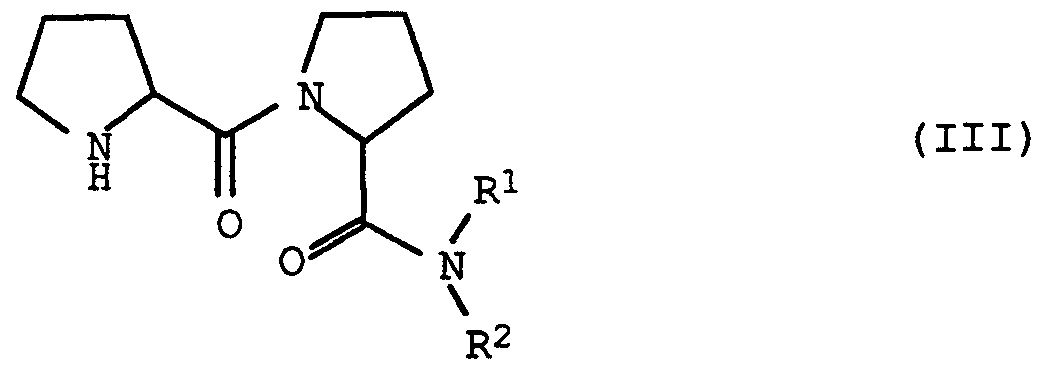
- Dipeptides of structure III are produced from prolinamides II and suitable proline derivatives according to the usual methods of peptide coupling.
- Tripeptides of structure IV were derived from dipeptides III and suitable derivatives of N-methyl amino acids (such as, for example, N-methylvaline, N-methylleucine, N-methyl-isoleucine, N-methyl-tert.-leucine) the usual methods of peptide coupling.
- suitable derivatives of N-methyl amino acids such as, for example, N-methylvaline, N-methylleucine, N-methyl-isoleucine, N-methyl-tert.-leucine
- Tetrapeptides of structure V were prepared from tripeptides IV and suitable derivatives of the amino acids valine, ⁇ -aminobutyric acid, leucine, tert-leucine and isoleucine.
- Pentapeptides of structure V were prepared from the tetrapeptides and suitable derivatives of the amino acids valine, aminoisobutyric acid, leucine, tert-leucine and isoleucine.
- the terminal methyl groups could be introduced after coupling to the pentapeptide.
- suitable derivatives of N, N-dimethylvaline, N, N-dimethylaminoisobutyric acid, N, N-dimethylleucin, N, N-dimethyl-tert-leucine and N, N-dimethylisoleucine can also be used.
- Example 5 Me 2 Val-Val-MeVal-Pro-Pro-NHBz x HCl (active ingredient No. 234 from WO 93 / 23.424)
- the pentapeptide acids VI were obtained from the pentapeptide amides V by hydrolysis with prolyl endopeptidase (T. Yoshimoto et al., J. Biol. Chem., 255, 4786 (1980), J. Biochem. 110, 873 (1991)).
- Benzylamides are particularly suitable substrates. Alkyl amides can also be hydrolyzed, but react much more slowly.
- the pentapeptide carboxylic acid VI a Me 2 Val - Val - MeVal - Pro - ProOH is the suitable precursor for the natural product dolastatin 15.
- VI a must be coupled with the hydroxy acid amide XX.
- a suitable synthesis for XX is described by J. Poncet et al. in Tetrahedron £ 1 (20) 4115-4122 (1992).
Landscapes
- Chemical & Material Sciences (AREA)
- Organic Chemistry (AREA)
- Molecular Biology (AREA)
- Proteomics, Peptides & Aminoacids (AREA)
- Biophysics (AREA)
- General Health & Medical Sciences (AREA)
- Genetics & Genomics (AREA)
- Medicinal Chemistry (AREA)
- Health & Medical Sciences (AREA)
- Biochemistry (AREA)
- Life Sciences & Earth Sciences (AREA)
- Peptides Or Proteins (AREA)
- Medicines That Contain Protein Lipid Enzymes And Other Medicines (AREA)
- Preparation Of Compounds By Using Micro-Organisms (AREA)
- Medicinal Preparation (AREA)
- Medicines Containing Material From Animals Or Micro-Organisms (AREA)
Abstract
Description




Claims


Priority Applications (8)
| Application Number | Priority Date | Filing Date | Title |
|---|---|---|---|
| IL12270496A IL122704A (en) | 1995-07-28 | 1996-07-12 | Preparation of Dolastatin intermediates 15 |
| EP96925744A EP0842190B1 (de) | 1995-07-28 | 1996-07-12 | Verfahren zur herstellung von dolastatin 15 und deren zwischenprodukten |
| CA002223911A CA2223911C (en) | 1995-07-28 | 1996-07-12 | The preparation of active peptides |
| AU66154/96A AU705143B2 (en) | 1995-07-28 | 1996-07-12 | The preparation of active peptides |
| JP50716097A JP3941883B2 (ja) | 1995-07-28 | 1996-07-12 | ドラスタチン15の製法及びその中間体 |
| US08/983,460 US5965700A (en) | 1995-07-28 | 1996-07-12 | Preparation of active peptides |
| DE59603295T DE59603295D1 (de) | 1995-07-28 | 1996-07-12 | Verfahren zur herstellung von dolastatin 15 und deren zwischenprodukten |
| HU9802570A HU227981B1 (hu) | 1995-07-28 | 1996-07-12 | Eljárás dolasztatin 15 elõállítására és az eljárás intermedierejei |
Applications Claiming Priority (2)
| Application Number | Priority Date | Filing Date | Title |
|---|---|---|---|
| DE19527575A DE19527575A1 (de) | 1995-07-28 | 1995-07-28 | Verfahren zur Herstellung von peptidischer Wirkstoffe |
| DE19527575.6 | 1995-07-28 |
Publications (1)
| Publication Number | Publication Date |
|---|---|
| WO1997005162A1 true WO1997005162A1 (de) | 1997-02-13 |
Family
ID=7767995
Family Applications (1)
| Application Number | Title | Priority Date | Filing Date |
|---|---|---|---|
| PCT/EP1996/003073 Ceased WO1997005162A1 (de) | 1995-07-28 | 1996-07-12 | Verfahren zur herstellung von dolastatin 15 und deren zwischenprodukten |
Country Status (15)
| Country | Link |
|---|---|
| US (1) | US5965700A (de) |
| EP (1) | EP0842190B1 (de) |
| JP (1) | JP3941883B2 (de) |
| KR (1) | KR100445124B1 (de) |
| AT (1) | ATE185349T1 (de) |
| AU (1) | AU705143B2 (de) |
| CA (1) | CA2223911C (de) |
| CZ (1) | CZ293445B6 (de) |
| DE (2) | DE19527575A1 (de) |
| ES (1) | ES2138363T3 (de) |
| HU (1) | HU227981B1 (de) |
| IL (1) | IL122704A (de) |
| TW (1) | TW418212B (de) |
| WO (1) | WO1997005162A1 (de) |
| ZA (1) | ZA966371B (de) |
Cited By (4)
| Publication number | Priority date | Publication date | Assignee | Title |
|---|---|---|---|---|
| WO2001083517A1 (en) * | 2000-05-03 | 2001-11-08 | Tularik Inc. | Stat4 and stat6 binding dipeptide derivatives |
| US6426331B1 (en) | 1998-07-08 | 2002-07-30 | Tularik Inc. | Inhibitors of STAT function |
| US6884782B2 (en) | 2000-11-08 | 2005-04-26 | Amgen Inc. | STAT modulators |
| WO2023033129A1 (ja) | 2021-09-03 | 2023-03-09 | 東レ株式会社 | 癌の治療及び/又は予防用医薬組成物 |
Families Citing this family (3)
| Publication number | Priority date | Publication date | Assignee | Title |
|---|---|---|---|---|
| US20010009901A1 (en) | 1996-12-11 | 2001-07-26 | Basf Aktiengesellschaft Germany | Antineoplastic peptides |
| JP4776843B2 (ja) | 1999-10-01 | 2011-09-21 | イムノゲン インコーポレーティッド | 免疫複合体及び化学療法剤を用いる癌治療用組成物及び方法 |
| WO2024178360A2 (en) * | 2023-02-23 | 2024-08-29 | Ambrx, Inc. | Auristatin analogs and antibody conjugates thereof |
Citations (3)
| Publication number | Priority date | Publication date | Assignee | Title |
|---|---|---|---|---|
| FR2460292A1 (fr) * | 1979-06-28 | 1981-01-23 | Richter Gedeon Vegyeszet | Nouveaux tripeptidamides actifs sur le systeme nerveux central et procede de preparation de ceux-ci |
| JPH03141298A (ja) * | 1989-10-25 | 1991-06-17 | M D Res Kk | 活性ペプチド |
| WO1993023424A1 (en) * | 1992-05-20 | 1993-11-25 | Basf Aktiengesellschaft | Derivatives of dolastatin |
-
1995
- 1995-07-28 DE DE19527575A patent/DE19527575A1/de not_active Withdrawn
-
1996
- 1996-07-12 CA CA002223911A patent/CA2223911C/en not_active Expired - Fee Related
- 1996-07-12 EP EP96925744A patent/EP0842190B1/de not_active Expired - Lifetime
- 1996-07-12 WO PCT/EP1996/003073 patent/WO1997005162A1/de not_active Ceased
- 1996-07-12 CZ CZ1998243A patent/CZ293445B6/cs not_active IP Right Cessation
- 1996-07-12 DE DE59603295T patent/DE59603295D1/de not_active Expired - Lifetime
- 1996-07-12 KR KR10-1998-0700636A patent/KR100445124B1/ko not_active Expired - Fee Related
- 1996-07-12 IL IL12270496A patent/IL122704A/en not_active IP Right Cessation
- 1996-07-12 US US08/983,460 patent/US5965700A/en not_active Expired - Lifetime
- 1996-07-12 JP JP50716097A patent/JP3941883B2/ja not_active Expired - Fee Related
- 1996-07-12 ES ES96925744T patent/ES2138363T3/es not_active Expired - Lifetime
- 1996-07-12 AT AT96925744T patent/ATE185349T1/de active
- 1996-07-12 HU HU9802570A patent/HU227981B1/hu not_active IP Right Cessation
- 1996-07-12 AU AU66154/96A patent/AU705143B2/en not_active Ceased
- 1996-07-19 TW TW085108763A patent/TW418212B/zh not_active IP Right Cessation
- 1996-07-26 ZA ZA9606371A patent/ZA966371B/xx unknown
Patent Citations (3)
| Publication number | Priority date | Publication date | Assignee | Title |
|---|---|---|---|---|
| FR2460292A1 (fr) * | 1979-06-28 | 1981-01-23 | Richter Gedeon Vegyeszet | Nouveaux tripeptidamides actifs sur le systeme nerveux central et procede de preparation de ceux-ci |
| JPH03141298A (ja) * | 1989-10-25 | 1991-06-17 | M D Res Kk | 活性ペプチド |
| WO1993023424A1 (en) * | 1992-05-20 | 1993-11-25 | Basf Aktiengesellschaft | Derivatives of dolastatin |
Non-Patent Citations (6)
| Title |
|---|
| Chemical Abstracts, 12th Collective Index,Chemical Substances, Volumes 106-115, Registry Number 137617-30-2 * |
| CHEMICAL ABSTRACTS, vol. 115, no. 25, 23 December 1991, Columbus, Ohio, US; abstract no. 280575j, H KIMURA TE AL.: "Preparation of helodermin fragments as antiasthmatic" page 1072; XP002019752 * |
| CHEMICAL ABSTRACTS, vol. 115, no. 25, 23 December 1991, Columbus, Ohio, US; abstract no. 280575j, page 1072; * |
| J HÄUSLER & U SCHMIDT: "Ringschlüsse von Pyruvoylpeptiden und Dehyropeptiden", MONATSHEFTE FUR CHEMIE, vol. 109, no. 1, March 1978 (1978-03-01), WIEN AT, pages 147 - 155, XP002019748 * |
| J LASCH ET AL.: "Enzymic properties of intestinal aminopeptidase P: a new continuous assay", FEBS LETTERS, vol. 227, no. 2, January 1988 (1988-01-01), AMSTERDAM NL, pages 171 - 174, XP002019749 * |
| N PATINO ET AL.: "Total synthesis of the proposed structure of Dolastatin 15", TETRAHEDRON, vol. 48, no. 20, 15 May 1992 (1992-05-15), OXFORD GB, pages 4115 - 4122, XP002019750 * |
Cited By (4)
| Publication number | Priority date | Publication date | Assignee | Title |
|---|---|---|---|---|
| US6426331B1 (en) | 1998-07-08 | 2002-07-30 | Tularik Inc. | Inhibitors of STAT function |
| WO2001083517A1 (en) * | 2000-05-03 | 2001-11-08 | Tularik Inc. | Stat4 and stat6 binding dipeptide derivatives |
| US6884782B2 (en) | 2000-11-08 | 2005-04-26 | Amgen Inc. | STAT modulators |
| WO2023033129A1 (ja) | 2021-09-03 | 2023-03-09 | 東レ株式会社 | 癌の治療及び/又は予防用医薬組成物 |
Also Published As
| Publication number | Publication date |
|---|---|
| AU6615496A (en) | 1997-02-26 |
| CA2223911C (en) | 2009-03-24 |
| HU227981B1 (hu) | 2012-07-30 |
| HUP9802570A2 (hu) | 1999-04-28 |
| EP0842190A1 (de) | 1998-05-20 |
| JP3941883B2 (ja) | 2007-07-04 |
| CZ24398A3 (cs) | 1998-07-15 |
| DE19527575A1 (de) | 1997-01-30 |
| DE59603295D1 (de) | 1999-11-11 |
| ES2138363T3 (es) | 2000-01-01 |
| ZA966371B (en) | 1998-01-26 |
| ATE185349T1 (de) | 1999-10-15 |
| AU705143B2 (en) | 1999-05-13 |
| JPH11509850A (ja) | 1999-08-31 |
| US5965700A (en) | 1999-10-12 |
| HUP9802570A3 (en) | 1999-06-28 |
| IL122704A0 (en) | 1998-08-16 |
| CZ293445B6 (cs) | 2004-04-14 |
| IL122704A (en) | 2001-06-14 |
| CA2223911A1 (en) | 1997-02-13 |
| KR19990035975A (ko) | 1999-05-25 |
| KR100445124B1 (ko) | 2004-11-16 |
| EP0842190B1 (de) | 1999-10-06 |
| TW418212B (en) | 2001-01-11 |
Similar Documents
| Publication | Publication Date | Title |
|---|---|---|
| EP0796271B1 (de) | Dipeptidische p-amidinobenzylamide mit n-terminalen sulfonyl- bzw. aminosulfonylresten | |
| DE3884139T2 (de) | L-Prolin-Derivate, deren Herstellung und deren biologische Anwendungen. | |
| EP0842190B1 (de) | Verfahren zur herstellung von dolastatin 15 und deren zwischenprodukten | |
| DE69313556T2 (de) | Verfahren zur Herstellung von zyklischen Depsipeptiden | |
| CH636599A5 (en) | Process for preparing novel pentapeptides and their derivatives | |
| DE3831716A1 (de) | Verfahren zur herstellung von dipeptiden mit c-terminalen nicht-proteinogenen aminosaeuren | |
| EP0804466B1 (de) | Neue tetrapeptide, ihre herstellung und verwendung | |
| DE69913996T2 (de) | Depsipeptide, die nicht-natürliche Aminosäuren enthalten | |
| DE2601820A1 (de) | Kathepsin d-inhibitoren | |
| EP0758342B1 (de) | Neuer peptidischer wirkstoff und dessen herstellung | |
| EP0228625A2 (de) | Peptid-Derivate mit inhibitorischer Wirkung auf hydroxylierende Enzyme, Verfahren zu ihrer Herstellung, diese enthaltende Mittel und ihre Verwendung | |
| WO1990003387A1 (de) | Verfahren zur herstellung von dipeptiden mit n-terminalen nichtproteinogenen aminosäuren | |
| EP0842142B1 (de) | Verfahren zur herstellung von alpha-(n,n-dialkyl)-aminocarbonsäureamiden | |
| Johnson et al. | Inhibition of renin by angiotensinogen peptide fragments containing the hydroxy amino acid residue 5-amino-3-hydroxy-7-methyloctanoic acid | |
| DE69001899T2 (de) | Verfahren und herstellung von pentapeptiden und zwischenverbindungen dazu. | |
| DE2727048C2 (de) | 8-Norleucyl-ceruletide | |
| DE2343034A1 (de) | Verfahren zur herstellung von tetrapeptiden mit phagocytosestimulierender wirkung | |
| DD284028B5 (de) | Verfahren zur Herstellung von L-Alanyl-L-prolin-Derivaten | |
| DE60002229T2 (de) | Verfahren zur herstellung eines dipeptids und zwischenverbindung bei diesem verfahren | |
| WO2000031119A1 (de) | Verfahren zur herstellung von l-prolyl-l-m-sarcolysyl-l-p-fluorphenylalanin und von derivaten davon | |
| DE3221818A1 (de) | 3,5-di-tert.-butylbenzyloxycarbonylderivate, verfahren zu ihrer herstellung und ihre verwendung | |
| CH501660A (de) | Verfahren zur Herstellung von Peptid-Derivaten | |
| DD217804A1 (de) | Verfahren zur synthetischen herstellung des peptidteiles von mutterkorn-peptidalkaloiden | |
| DE19703801A1 (de) | Neue Dipeptidtemplate, Verfahren zu deren Herstellung und deren Verwendung zum Einbau in Peptidsequenzen, unter anderem auf Gebiet der kombinatorischen Chemie | |
| DE1543575A1 (de) | Verfahren zur Herstellung von Peptiden |
Legal Events
| Date | Code | Title | Description |
|---|---|---|---|
| AK | Designated states |
Kind code of ref document: A1 Designated state(s): AU BG BR CA CN CZ HU IL JP KR MX NO NZ PL SG SK TR UA US AM AZ BY KG KZ MD RU TJ TM |
|
| AL | Designated countries for regional patents |
Kind code of ref document: A1 Designated state(s): AT BE CH DE DK ES FI FR GB GR IE IT LU MC NL PT SE |
|
| DFPE | Request for preliminary examination filed prior to expiration of 19th month from priority date (pct application filed before 20040101) | ||
| 121 | Ep: the epo has been informed by wipo that ep was designated in this application | ||
| WWE | Wipo information: entry into national phase |
Ref document number: 1996925744 Country of ref document: EP |
|
| WWE | Wipo information: entry into national phase |
Ref document number: 08983460 Country of ref document: US |
|
| ENP | Entry into the national phase |
Ref document number: 2223911 Country of ref document: CA Ref country code: CA Ref document number: 2223911 Kind code of ref document: A Format of ref document f/p: F |
|
| WWE | Wipo information: entry into national phase |
Ref document number: 1019980700636 Country of ref document: KR |
|
| WWE | Wipo information: entry into national phase |
Ref document number: PV1998-243 Country of ref document: CZ |
|
| ENP | Entry into the national phase |
Ref country code: JP Ref document number: 1997 507160 Kind code of ref document: A Format of ref document f/p: F |
|
| WWP | Wipo information: published in national office |
Ref document number: 1996925744 Country of ref document: EP |
|
| WWP | Wipo information: published in national office |
Ref document number: PV1998-243 Country of ref document: CZ |
|
| WWP | Wipo information: published in national office |
Ref document number: 1019980700636 Country of ref document: KR |
|
| WWG | Wipo information: grant in national office |
Ref document number: 1996925744 Country of ref document: EP |
|
| WWG | Wipo information: grant in national office |
Ref document number: PV1998-243 Country of ref document: CZ |
|
| WWG | Wipo information: grant in national office |
Ref document number: 1019980700636 Country of ref document: KR |