US8702240B2 - Image display apparatus - Google Patents
Image display apparatus Download PDFInfo
- Publication number
- US8702240B2 US8702240B2 US12/973,703 US97370310A US8702240B2 US 8702240 B2 US8702240 B2 US 8702240B2 US 97370310 A US97370310 A US 97370310A US 8702240 B2 US8702240 B2 US 8702240B2
- Authority
- US
- United States
- Prior art keywords
- image display
- optical system
- display element
- light
- polarization splitting
- Prior art date
- Legal status (The legal status is an assumption and is not a legal conclusion. Google has not performed a legal analysis and makes no representation as to the accuracy of the status listed.)
- Expired - Fee Related, expires
Links
Images


Classifications
-
- G—PHYSICS
- G02—OPTICS
- G02B—OPTICAL ELEMENTS, SYSTEMS OR APPARATUS
- G02B27/00—Optical systems or apparatus not provided for by any of the groups G02B1/00 - G02B26/00, G02B30/00
- G02B27/28—Optical systems or apparatus not provided for by any of the groups G02B1/00 - G02B26/00, G02B30/00 for polarising
- G02B27/283—Optical systems or apparatus not provided for by any of the groups G02B1/00 - G02B26/00, G02B30/00 for polarising used for beam splitting or combining
-
- G—PHYSICS
- G02—OPTICS
- G02B—OPTICAL ELEMENTS, SYSTEMS OR APPARATUS
- G02B27/00—Optical systems or apparatus not provided for by any of the groups G02B1/00 - G02B26/00, G02B30/00
- G02B27/0018—Optical systems or apparatus not provided for by any of the groups G02B1/00 - G02B26/00, G02B30/00 with means for preventing ghost images
-
- G—PHYSICS
- G03—PHOTOGRAPHY; CINEMATOGRAPHY; ANALOGOUS TECHNIQUES USING WAVES OTHER THAN OPTICAL WAVES; ELECTROGRAPHY; HOLOGRAPHY
- G03B—APPARATUS OR ARRANGEMENTS FOR TAKING PHOTOGRAPHS OR FOR PROJECTING OR VIEWING THEM; APPARATUS OR ARRANGEMENTS EMPLOYING ANALOGOUS TECHNIQUES USING WAVES OTHER THAN OPTICAL WAVES; ACCESSORIES THEREFOR
- G03B21/00—Projectors or projection-type viewers; Accessories therefor
- G03B21/14—Details
- G03B21/145—Housing details, e.g. position adjustments thereof
-
- G—PHYSICS
- G03—PHOTOGRAPHY; CINEMATOGRAPHY; ANALOGOUS TECHNIQUES USING WAVES OTHER THAN OPTICAL WAVES; ELECTROGRAPHY; HOLOGRAPHY
- G03B—APPARATUS OR ARRANGEMENTS FOR TAKING PHOTOGRAPHS OR FOR PROJECTING OR VIEWING THEM; APPARATUS OR ARRANGEMENTS EMPLOYING ANALOGOUS TECHNIQUES USING WAVES OTHER THAN OPTICAL WAVES; ACCESSORIES THEREFOR
- G03B21/00—Projectors or projection-type viewers; Accessories therefor
- G03B21/14—Details
- G03B21/20—Lamp housings
-
- G—PHYSICS
- G03—PHOTOGRAPHY; CINEMATOGRAPHY; ANALOGOUS TECHNIQUES USING WAVES OTHER THAN OPTICAL WAVES; ELECTROGRAPHY; HOLOGRAPHY
- G03B—APPARATUS OR ARRANGEMENTS FOR TAKING PHOTOGRAPHS OR FOR PROJECTING OR VIEWING THEM; APPARATUS OR ARRANGEMENTS EMPLOYING ANALOGOUS TECHNIQUES USING WAVES OTHER THAN OPTICAL WAVES; ACCESSORIES THEREFOR
- G03B21/00—Projectors or projection-type viewers; Accessories therefor
- G03B21/14—Details
- G03B21/20—Lamp housings
- G03B21/2073—Polarisers in the lamp house
-
- G—PHYSICS
- G03—PHOTOGRAPHY; CINEMATOGRAPHY; ANALOGOUS TECHNIQUES USING WAVES OTHER THAN OPTICAL WAVES; ELECTROGRAPHY; HOLOGRAPHY
- G03B—APPARATUS OR ARRANGEMENTS FOR TAKING PHOTOGRAPHS OR FOR PROJECTING OR VIEWING THEM; APPARATUS OR ARRANGEMENTS EMPLOYING ANALOGOUS TECHNIQUES USING WAVES OTHER THAN OPTICAL WAVES; ACCESSORIES THEREFOR
- G03B21/00—Projectors or projection-type viewers; Accessories therefor
- G03B21/14—Details
- G03B21/28—Reflectors in projection beam
-
- H—ELECTRICITY
- H04—ELECTRIC COMMUNICATION TECHNIQUE
- H04N—PICTORIAL COMMUNICATION, e.g. TELEVISION
- H04N9/00—Details of colour television systems
- H04N9/12—Picture reproducers
- H04N9/31—Projection devices for colour picture display, e.g. using electronic spatial light modulators [ESLM]
- H04N9/3141—Constructional details thereof
- H04N9/315—Modulator illumination systems
- H04N9/3167—Modulator illumination systems for polarizing the light beam
Definitions
- the present invention relates to an image display apparatus and more particularly to an image display apparatus using a reflective image display element.
- a polarizing beam splitter allowing P-polarized light to pass through it, but reflecting S-polarized light is arranged on the incident/emergent surface side of the reflective liquid crystal panel.
- the characteristic of a polarization splitting film used in the polarizing beam splitter depends on the incidence angle of the incident light. As the incidence angle of the light incident upon the polarization splitting film departs from 45° to a larger extent, leakage light from the polarization splitting film is increased and the contrast of a projected image is reduced.
- the term “leakage light” implies light entering a projection lens when the liquid crystal panel is driven in a mode where all pixels are displayed black.
- the present invention provides an image display apparatus including an image display element configured to display an image by controlling a polarization state of a polarized light beam, an illumination optical system configured to introduce the polarized light beam to the image display element, a polarizing beam splitter disposed between the illumination optical system and the image display element to selectively split incident light, and a projection optical system (or a mounting portion for the projection optical system), which is configured to project the image displayed by the image display element onto a projection plane.
- the position of an optical axis of the projection optical system is properly set with respect to the polarizing beam splitter.
- FIG. 1 illustrates an image display apparatus according to a first embodiment of the present invention.
- FIG. 2 is an enlarged view of a polarizing beam splitter, an image display element, and thereabout.
- FIGS. 3A and 3B are each a graph illustrating the relationship between an incidence angle of light incident upon a polarization splitting film and a characteristic of the polarization splitting film.
- FIG. 4 is an illustration to explain leakage light from the polarizing beam splitter.
- FIG. 5 illustrates an angular distribution of the leakage light from the polarization splitting film in the first embodiment.
- FIG. 6 illustrates a quantity of light that can be captured by a projection lens, and an angular distribution of the quantity of light captured.
- FIGS. 7A and 7B are each a sectional view of an image display apparatus according to a second embodiment of the present invention.
- FIG. 8 illustrates an angular distribution of the leakage light from the polarization splitting film in the second embodiment.
- FIG. 9 illustrates an image display apparatus according to a third embodiment of the present invention.
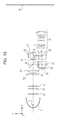
- FIG. 10 illustrates an image display apparatus according to a fourth embodiment of the present invention.
- FIG. 1 illustrates the configuration of an image display apparatus according to a first embodiment.
- reference numeral 1 denotes a light source.
- a reflector 2 reflects light emitted from the light source 1 in a predetermined direction.
- a parabolic reflector is used as the reflector 2 .
- a first fly-eye lens 3 a is made up of rectangular lens elements which are each similar in shape to a panel and which are arranged in a matrix pattern.
- a second fly-eye lens 3 b includes lens elements that correspond respectively to the individual rectangular lens elements of the first fly-eye lens 3 a.
- a polarization conversion element 4 converts unpolarized light from the light source 1 to linearly-polarized light.
- Reference numerals 5 a and 5 b each denote a condenser lens, and 6 denotes a reflecting mirror.
- Reference numeral 7 denotes a polarizing beam splitter, and 8 denotes a polarization splitting film of the polarizing beam splitter 7 .
- a reflective liquid crystal panel (image display element) 9 displays an image by controlling the polarization state of the incident light.
- Reference numeral 10 denotes a projection lens (projection optical system), and 11 denotes a screen (projection plane). The projection lens is mounted into a mounting slot (mounting portion), which is formed in a main body of the image display apparatus.
- a line segment L represents an optical path of a light beam emerging from the center of the image display element and reaching a point where an optical axis of the projection lens 10 intersects an optical surface within the projection lens 10 (projection optical system), which is closest to an illumination optical system (generally, such a point is given as an apex of the lens surface of the relevant optical surface).
- the projection lens support i.e., the mounting slot for the projection lens
- angle ⁇ formed by the optical path L and the polarization splitting film 8 of the polarizing beam splitter 7 is smaller than 45°” implies that an incidence angle and an emergence angle of a light beam propagating along the optical path L with respect to the normal to the polarization splitting film 8 is larger than 45°.
- optical surface within the projection optical system, which is closest to an illumination optical system implies, for example, a lens surface of the projection lens 10 on the side closest to the liquid crystal panel 9 , or closest to the polarizing beam splitter 7 .
- the polarizing beam splitter 7 may have a refractive index n of 1.6 or more.
- the refractive index n of the polarizing beam splitter 7 used in this embodiment is 1.8.
- a light beam emerging from the center of the liquid crystal panel 9 in a direction vertical (perpendicular) to the liquid crystal panel 9 and incident upon the polarization splitting film 8 forms an angle of 45° with respect to the surface of the polarization splitting film 8 .
- a horizontal one-dot-chain line in FIG. 1 represents each of an optical axis of the condenser lens 5 a and the optical axis of the projection lens 10 .
- a vertical one-dot-chain line extending from the reflecting mirror 6 to the liquid crystal panel 9 represents a line normal to the liquid crystal panel 9 and passing substantially through the center of the polarization splitting film 8 .
- the light emitted from the light source 1 is reflected by the reflector 2 to advance as substantially parallel light, which enters the first fly-eye lens 3 a.
- the substantially parallel light is separated into a plurality of light beams by individual lens elements forming the first fly-eye lens 3 a.
- the plural divided light beams pass through the second fly-eye lens 3 b and enter the polarization conversion element 4 .
- the polarization conversion element 4 includes a plurality of small polarizing beam splitters each having a polarization splitting film and a half-wave plate arranged at alternate ones of emergent surfaces of the small polarizing beam splitters.
- Unpolarized light having entered the polarization conversion element 4 exits it after being converted to P-polarized light (i.e., a light beam in the P-polarized state).
- P-polarized light i.e., a light beam in the P-polarized state.
- the conversion to the S-polarized light can be performed by arranging a half-wave plate on the emergent side of the P-polarized light. In that case, the liquid crystal panel 9 is arranged on the side toward which the light incident upon the polarizing beam splitter 7 is reflected.
- the P-polarized light and the S-polarized light are defined with respect to the polarization splitting film 8 of the polarizing beam splitter 7 , which is adjacent to the liquid crystal panel (image display element) 9 , rather than with respect to the small polarizing beam splitters of the polarization conversion element 4 .
- the P-polarized light converted by the polarization conversion element 4 is introduced to the reflecting mirror 6 while being converged by the condenser lenses 5 a and 5 b.
- An optical system from the light source 1 to the condenser lenses 5 a and 5 b constitutes an illumination optical system that illuminates the liquid crystal panel 9 with Koehler illumination.
- the converged light exiting the condenser lenses 5 a and 5 b is reflected by the reflecting mirror 6 to enter the polarizing beam splitter 7 .
- the P-polarized light passes through the polarization splitting film 8 of the polarizing beam splitter 7 for illumination of the liquid crystal panel 9 .
- the incident light is modulated by the liquid crystal panel 9 , and the modulated emergent light is reflected by the polarizing beam splitter 7 to be projected onto a screen 11 through the projection lens 10 (projection optical system).
- a Z-axis in FIG. 1 is parallel to the optical axis of the projection lens 10 , and the direction toward the screen 11 is assumed to be a + Z-direction.
- An X-axis is perpendicular to a plane including the Z-axis and a line normal to the polarization splitting film 8 , and the direction toward the front side of the drawing sheet (as seen from the reader's point of view) is assumed to be a + X-direction.
- a Y-axis is perpendicular to both the X-axis and the Z-axis, and the direction toward the upper side of the drawing sheet from the lower side is assumed to be a + Y-direction.
- FIG. 2 is an enlarged view of the polarizing beam splitter 7 , the liquid crystal panel (image display element) 9 , and thereabout in FIG. 1 .
- An angle ⁇ formed by the optical path L (denoted by a solid line in FIG. 2 ) and the polarization splitting film 8 is smaller than 45°.
- an arrow denoted by a broken line P represents a light beam generated in the mode where all pixels are displayed black.
- the P-polarized light reflected by the reflecting mirror 6 passes through the polarization splitting film 8 and enters the liquid crystal panel 9 .
- the P-polarized light having entered the liquid crystal panel 9 is reflected as it is without being converted in the polarization direction thereof in the mode where all pixels are displayed black.
- the reflected P-polarized light passes through the polarization splitting film 8 again and returns to the light source side. Most of the reflected P-polarized light returns to the light source side due to the characteristic of the polarization splitting film 8 . However, some of the reflected P-polarized light is reflected by the polarization splitting film 8 to enter the projection lens 10 in spite of being the P-polarized light.
- FIG. 3A is a graph illustrating changes in the characteristic of the polarization splitting film 8 with respect to changes in the incidence angle of light incident upon the polarization splitting film 8 in an XY-section (i.e., in the X-direction).
- FIG. 3B is a graph illustrating changes in the characteristic of the polarization splitting film 8 with respect to changes in the incidence angle of light incident upon the polarization splitting film 8 in a YZ-section (i.e., in the Y-direction).
- the horizontal axis represents a wavelength (nm) and the vertical axis (Rp) represents reflectivity (%) of the P-polarized light.
- Rp vertical axis
- a solid line represents the characteristic of the polarization splitting film 8 for a light beam incident upon the polarization splitting film 8 at the incidence angle of 45°.
- a broken line represents the characteristic of the polarization splitting film 8 for a light beam incident upon the polarization splitting film 8 at the incidence angle that is smaller than 45° by about 5°.
- a one-dot-chain line represents the characteristic of the polarization splitting film 8 for a light beam incident upon the polarization splitting film 8 at the incidence angle that is larger than 45° by about 5°.
- the polarization splitting film 8 having the characteristics illustrated in FIGS. 3A and 3B is designed so as to exhibit satisfactory performance in a band corresponding to a green wavelength range of 500 to 580 (nm) where the relative luminosity factor is maximum among the spectrum of the light source used in the image display apparatus.
- the characteristic of the polarization splitting film 8 varies to a larger extent when the incidence angle is changed in the YZ-section than when the incidence angle is changed in the XY-section.
- the polarization splitting film 8 exhibits a better characteristic with respect to changes in the incidence angle in the XY-section (i.e., in the X-direction) than with respect to changes in the incidence angle in the YZ-section (i.e., in the Y-direction).
- the thickness of the polarization splitting film 8 through which the light beam entering the polarization splitting film 8 at the incidence angle of 45° with respect to the line normal to the polarization splitting film 8 passes is increased (namely, the optical path is lengthened) when the incidence angle of the light beam is changed by +5° in the Y-direction, and it is reduced (namely, the optical path is shortened) when the incidence angle of the light beam is changed by ⁇ 5° in the Y-direction. Further, it is seen that the position (indicated by an arrow in FIG.
- FIG. 4 illustrates, in a more easily understandable manner, how the quantity of leakage light changes (becomes less or more) depending on the incidence angle in the same section as that of FIG. 2 .
- the leakage of the light (P-polarized light) reflected at a certain point on the liquid crystal panel 9 and diverging to some extent is less in the + Y-direction and is more in the ⁇ Y-direction on the emergent surface side of the polarizing beam splitter 7 .
- FIG. 5 illustrates the incidence angle of the light beam entering the polarization splitting film 8 and a distribution of the leakage light in the XY-section when the liquid crystal panel 9 is driven in the mode where a projected image is displayed totally black.
- Each coordinate axis represents the incidence angle upon the polarization splitting film 8 , and a deviation from an angle of 45° is 0° at the center (origin).
- the quantity of leakage light is less in a lighter black portion and is more in a denser black portion.
- the coordinate axes in FIG. 5 correspond to those in FIGS. 1 to 4 , and the description of the coordinate axes is omitted. As seen from FIG. 5 , though described above with reference to FIG.
- the quantity of leakage light causing a reduction of the contrast is symmetric in the X-direction, but it is asymmetric in the Y-direction.
- the quantity of leakage light is more significantly increased in the ⁇ Y-direction.
- the angular distribution of the leakage light, illustrated in FIG. 5 can be confirmed by actually displaying a totally black image in the image display apparatus, and by observing the light from the image display element directly on the screen in a state where the projection lens is removed.
- a light beam reflected at and diverging from a point on the liquid crystal panel 9 which is away from the point thereon corresponding to the center of the optical axis of the projection lens 10 , is cut off in part of its components within a particular angular range due to vignetting by the projection lens 10 .
- the term “vignetting” implies that, as an incident light beam is inclined at a larger angle with respect to the optical axis of the projection lens 10 , the incident light beam becomes harder to pass through the entirety of a diaphragm due to the size and the thickness of the lens.
- a projection lens of an image display apparatus is used in such a way that the direction of projection of the projection lens is set obliquely. In the configuration of FIG.
- FIG. 6 illustrates a quantity of the light capable being captured by the projection lens, which is arranged as illustrated in FIG. 1 , and an angular distribution of the light quantity when a light beam having a substantially uniform distribution in light quantity enters the projection lens.
- the influence of the vignetting is less and a loss of the light quantity capable being captured by the projection lens is small in the + Y-direction.
- the light quantity capable being captured by the projection lens is reduced in the ⁇ Y-direction due to the influence of the vignetting.
- the projection lens 10 is arranged with respect to the image display element (liquid crystal panel) 9 as follows, taking into consideration the angular distribution of the leakage light, illustrated in FIG. 5 , which is resulted based on the characteristic of the polarization splitting film 8 . Assuming the optical path L of the light beam that emerges from the center of the liquid crystal panel 9 and reaches the point where the optical axis of the projection lens 10 intersects the optical surface within the projection lens 10 , which is closest to the illumination optical system, the projection lens 10 is arranged such that the angle ⁇ formed by the optical path L and the polarization splitting film 8 of the polarizing beam splitter 7 is smaller than 45°.
- the projection lens 10 and the mounting slot (mounting portion) for the projection lens 10 are arranged such that the incidence angle and the emergence angle of the light beam propagating along the optical path L with respect to the normal to the polarization splitting film 8 is larger than 45°.
- the optical axis of the projection lens i.e., the axis of the projection lens passing the center of the mounting slot
- the leakage light generated at the polarization splitting film can be effectively cut off by utilizing the influence of the vignetting that is caused within the projection lens.
- the optical axis of the projection lens 10 is aligned with a point where the quantity of leakage light from the polarization splitting film 8 is at its minimum. As a result, the quantity of leakage light included in the projected image is reduced and the contrast of the projected image is improved.
- FIGS. 7A and 7B illustrate an image display apparatus according to a second embodiment of the present invention.
- the second embodiment differs from the first embodiment in that an illumination optical system in the second embodiment has the function of compressing a light beam in each of a first section (XZ-section) and a second section (YZ-section), each of which includes an optical axis of the illumination optical system and which are orthogonal to each other.
- FIG. 7A is a sectional view, taken along the XZ-section, of the image display apparatus according to the second embodiment
- FIG. 7B is a sectional view, taken along the YZ-section, of the image display apparatus according to the second embodiment.
- reference numeral 1 denotes a light source.
- a reflector 2 reflects light emitted from the light source 1 in a predetermined direction.
- Reference numeral 12 denotes a convex lens (positive lens).
- Reference numeral 13 denotes a concave cylindrical lens (specifically, a lens having negative refractive power in the X-direction and having no refractive power in the Y-direction), and 14 denotes a concave cylindrical lens (specifically, a lens having no refractive power in the X-direction and having negative refractive power in the Y-direction).
- reference numeral 13 denotes a first negative cylindrical lens
- 14 denotes a second negative cylindrical lens.
- a first fly-eye lens 3 a is made up of rectangular lens elements which are each similar in shape to a panel and which are arranged in a matrix pattern.
- a second fly-eye lens 3 b includes lens elements that correspond respectively to the individual rectangular lens elements of the first fly-eye lens 3 a.
- a polarization conversion element 4 has the function of converting unpolarized light from the light source 1 to linearly-polarized light.
- Reference numerals 5 a and 5 b each denote a condenser lens, and 6 denotes a reflecting mirror.
- Reference numeral 10 denotes a projection lens (projection optical system), and 11 denotes a screen (projection plane).
- the condenser lenses 5 a and 5 b may be a single convex lens.
- a high-pressure mercury lamp is used as the light source 1
- a parabolic mirror is used as the reflector 2 .
- a mounting slot for mounting the projection lens 10 is formed in a main body of the image display apparatus, and the projection lens 10 is mounted into the mounting slot.
- the light emitted from the light source 1 is collected by the reflector 2 and enters the convex lens 12 .
- the light is converged by the convex lens 12 and enters the concave cylindrical lens 13 .
- the convex lens 12 and the concave cylindrical lens (negative cylindrical lens) 13 the light becomes substantially parallel light in the X-direction in the XZ-section of FIG. 7A .
- the light having entered the first fly-eye lens 3 a is separated into a plurality of light beams by individual lens elements forming the first fly-eye lens 3 a.
- the plural divided light beams having passed through the first fly-eye lens 3 a enter the concave cylindrical lens 14 and exit it as substantially parallel light beams in the YZ-section of FIG.
- the liquid crystal panel 9 modulates the P-polarized light into S-polarized light.
- the light modulated by the liquid crystal panel 9 is reflected by the polarization splitting film 8 of the polarizing beam splitter 7 and is projected onto the screen 11 through the projection lens 10 .
- the liquid crystal panel 9 reflects the P-polarized light without converting the polarization direction thereof. The light reflected by the liquid crystal panel 9 returns toward the light source side after passing through the polarization splitting film 8 .
- Koehler illumination is performed for the liquid crystal panel 9 by arranging the light source 1 and the second fly-eye lens 3 b in conjugate positions and by arranging the first fly-eye lens 3 a and the liquid crystal panel 9 in conjugate positions.
- the characteristic of the polarization splitting film 8 varies and leakage light causing a reduction of the contrast is generated depending on changes in the angle at which the light beam reflected by the liquid crystal panel 9 enters the polarization splitting film 8 of the polarizing beam splitter 7 .
- FIG. 8 illustrates an angular distribution of the leakage light at the polarization splitting film 8 when the light beam is modulated by the liquid crystal panel into the polarization state corresponding to a totally black image.
- Each coordinate axis in FIG. 8 represents the incidence angle upon the polarization splitting film 8 , and a deviation from an angle of 45° is 0° at the center (origin).
- the quantity of leakage light is less in a lighter black portion and is more in a denser black portion.
- the coordinate axes in FIG. 8 correspond to those in FIG. 7 , and the description of the coordinate axes is omitted.
- the light beam is compressed in both the X-direction and the Y-direction independently, and a compression rate of the light beam in the Y-axis direction is higher than that in the first embodiment.
- an angle ⁇ formed by the optical path L and a film boundary line of the polarization splitting film 8 in the YZ-plane is set to be smaller than 45° (namely, the incidence angle and the emergence angle of the light beam propagating along the optical path L with respect to the polarization splitting film 8 is set to be larger than 45′). Accordingly, the leakage light generated in the ⁇ Y-direction can be effectively cut off by utilizing the influence of the vignetting that is caused within the projection lens. As a result, the contrast of the projected image can be improved without inserting, e.g., a polarizer to cut off the leakage light.
- the compression rate of the light beam is set different between the X-direction and the Y-direction such that the light beam is more strongly compressed in the Y-direction
- spreading of the incidence angle upon the polarization splitting film 8 can be reduced in the Y-direction in which the characteristic of the polarization splitting film 8 varies to a larger extent.
- the quantity of leakage light can be reduced in the second embodiment in comparison with the case of compressing the light beam in the X-direction and the Y-direction at the same rate.
- compression used in this specification implies an optical action of making the width of a light beam after exiting an optical system, which is substantially afocal, smaller than that of the light beam before entering the optical system, and the term “compression” rate implies a rate of the compression.
- FIG. 9 illustrates an image display apparatus according to a third embodiment of the present invention. The following description is made about only different points from the configuration of FIG. 1 .
- the polarization conversion element 4 converts the incident light to P-polarized light.
- Reference numeral 15 denotes a dichroic mirror (color separation element), and 16 denotes a wavelength selective phase plate that acts upon only light in a red wavelength band to rotate the polarization direction of the light through 90°.
- Reference numerals 17 and 18 denote a first polarizing beam splitter and a second polarizing beam splitter, respectively.
- Reference numeral 19 denotes a reflective liquid crystal panel for red (first image display element), 20 denotes a reflective liquid crystal panel for green (second image display element), and 21 denotes a reflective liquid crystal panel for blue (third image display element).
- a combining prism (combining element) 22 reflects light in a green wavelength band and transmits light in red and blue wavelength bands therethrough.
- a one-dot-chain line in FIG. 9 represents the optical axis of the condenser lens 5 a or the optical axis of the projection lens 10 , or both.
- the dichroic mirror 15 and the first and second polarizing beam splitters 17 and 18 are arranged such that a plane including a color separation surface of the dichroic mirror 15 perpendicularly intersects a plane including polarized-light separation surfaces of the first and second polarizing beam splitters 17 and 18 .
- the dichroic mirror 15 transmits only light in the green wavelength band (first-color light) therethrough, and reflects light in the blue and red wavelength bands (second-color light and third-color light).
- the light in the green wavelength band passes through the polarizing beam splitter (first polarizing beam splitter) for illumination of the liquid crystal panel 20 for green.
- S-polarized light converted from the incident light by the liquid crystal panel 20 for green is reflected by the polarizing beam splitter 17 and is further reflected by the combining prism 22 to be projected onto the projection plane (screen) 11 through the projection lens 10 .
- Light having not been converted in the polarization direction by the liquid crystal panel 20 passes through the polarizing beam splitter 17 again for return to the light source side.
- the wavelength selective phase plate 16 acts upon only the red-band light to rotate the polarization direction thereof through 90° for conversion to S-polarized light.
- the red-band light having been converted to the S-polarized light is reflected by a polarization splitting film of the polarizing beam splitter 18 (second polarizing beam splitter) and enters the liquid crystal panel 19 for red.
- the red-band light having been converted to P-polarized light by the liquid crystal panel 19 passes through both the polarizing beam splitter 18 and the combining prism 22 to be projected onto the projection plane (screen) 11 through the projection lens 10 .
- S-polarized red-band light having been not converted by the liquid crystal panel 19 is reflected by the polarization splitting film of the polarizing beam splitter 18 for return to the light source side.
- the blue-band light having been reflected by the dichroic mirror 15 passes through the wavelength selective phase plate 16 and further passes through the polarizing beam splitter 18 to enter the liquid crystal panel 21 for blue.
- the blue-band light having been converted from P-polarized light to S-polarized light upon entering the liquid crystal panel 21 for blue is reflected by the polarizing beam splitter 18 and passes through the combining prism 22 to be projected onto the projection plane (screen) 11 through the projection lens 10 .
- the P-polarized blue-band light having been not converted by the liquid crystal panel 21 passes through the polarizing beam splitter 18 for return to the light source side.
- the characteristic of the polarization splitting film varies and leakage light causing a reduction of the contrast is generated depending on changes in the angle at which the light beam reflected by the liquid crystal panel 20 enters the polarization splitting film of the polarizing beam splitter 17 .
- the extinction ratio of the P-polarized light is reduced with respect to changes in the incidence angle corresponding to a reduction of the thickness of the polarization splitting film 8 through which the light beam passes.
- an angle ⁇ formed by the optical path L and a film boundary line of the polarization splitting film of the polarizing beam splitter 17 in the YZ-section is set to be smaller than 45° (namely, the incidence angle and the emergence angle of the light beam propagating along the optical path L with respect to the polarization splitting film is set to be larger than 45′). Accordingly, the leakage light generated in the ⁇ Y-direction can be effectively cut off by utilizing the influence of the vignetting that is caused within the projection lens.
- the leakage light can be suppressed without arranging a polarizer, which has low transmittance, on the emergent side of the polarizing beam splitter.
- the contrast of the projected image can be improved while minimizing a reduction of brightness of the projected image.
- the projection lens 10 and the mounting slot for the projection lens 10 are arranged such that, in the direction in which the polarizing beam splitter 17 and the combining element 22 are aligned (i.e., in the Y-direction), the optical axis of the projection lens 10 is shifted parallel toward the polarizing beam splitter 17 relative to an emergent path of the light beam from the combining element (prism) 22 , which has propagated along an optical path aligned with the optical axis of the illumination optical system, (i.e., relative to a path of the incident light upon the projection lens 10 ).
- the size of the image display (projection) apparatus can be reduced in the direction in which the optical axis of the projection lens (i.e., an axis passing the center of the mounting slot for the projection lens 10 ) is shifted (namely, in the Y-direction in FIG. 9 ).
- the optical axis of the projection lens 10 is arranged between the combining prism 22 and the polarizing beam splitter 17 , i.e., at a more inner position within a housing.
- FIG. 10 illustrates an image display apparatus according to a fourth embodiment of the present invention.
- the image display apparatus according to the fourth embodiment differs from that according to the third embodiment, illustrated in FIG. 9 , in the arrangement of the liquid crystal panel 20 for green with respect to the polarizing beam splitter 17 (first polarizing beam splitter).
- a half-wavelength plate 30 is disposed between the dichroic mirror 15 and the polarizing beam splitter 17 . Because the remaining configuration is the same as that in the third embodiment, the following description is made only about different points from the configuration of the third embodiment.
- the liquid crystal panel 20 is arranged such that the liquid crystal panel 20 is illuminated with the light reflected from the polarizing beam splitter 17 . Because the green-band illumination light having passed through the dichroic mirror 15 is converted to the P-polarized light by the polarization conversion element 4 , it is not reflected by the polarizing beam splitter 17 if it remains as the P-polarized light. In this fourth embodiment, therefore, the half-wavelength plate 30 is disposed between the dichroic mirror 15 and the polarizing beam splitter 17 for converting the polarization direction of the illumination light to the S-polarization.
- the green-band illumination light having been substantially converted to the S-polarized light is selectively reflected by the polarizing beam splitter 17 for illumination of the liquid crystal panel 20 .
- P-polarized light obtained with the conversion by the liquid crystal panel 20 passes through the polarizing beam splitter 17 and is reflected by the combining prism 22 to be projected onto the projection plane (screen) 11 through the projection lens 10 .
- the light having been not converted in the polarization direction thereof by the liquid crystal panel 20 is reflected by the polarizing beam splitter 17 again for return to the light source side.
- an angle ⁇ formed by the optical path L and the polarization splitting film of the polarizing beam splitter 17 in the YZ-section is set to be smaller than 45° (namely, the incidence angle and the emergence angle of the light beam propagating along the optical path L with respect to the polarization splitting film is set to be larger than 45′).
- the degree of freedom in layout of the projection lens 10 is increased.
- the size of the image display (projection) apparatus can be reduced by effectively utilizing the space where the liquid crystal panel 20 is positioned in FIG. 9 , for shifting of the projection lens 10 .
- the arrangement capable of providing the advantage of the fourth embodiment is not limited to that illustrated in FIG. 10 .
- the liquid crystal panel 20 is similarly not required to be arranged at the position toward which the projection lens is shifted.
- the present invention is not limited to those embodiments and can be variously modified and changed within the scope of the invention.
- the light source may be a laser beam source emitting linearly-polarized light.
- the characteristic of the dichroic mirror 15 and the characteristic of the combining prism 22 may be changed respectively to transmit the red-band light therethrough and to transmit the blue-band light and the green-band light therethrough.
- the present invention can be applied to an image display apparatus in which a cross-dichroic prism is employed and three polarizing beam splitters are arranged corresponding to liquid crystal panels for three colors, respectively.
- the image display apparatus ensuring high contrast of the projected image can be provided.
Landscapes
- Physics & Mathematics (AREA)
- General Physics & Mathematics (AREA)
- Optics & Photonics (AREA)
- Engineering & Computer Science (AREA)
- Multimedia (AREA)
- Signal Processing (AREA)
- Projection Apparatus (AREA)
- Liquid Crystal (AREA)
- Optical Elements Other Than Lenses (AREA)
- Microscoopes, Condenser (AREA)
- Polarising Elements (AREA)
Applications Claiming Priority (2)
| Application Number | Priority Date | Filing Date | Title |
|---|---|---|---|
| JP2009-290099 | 2009-12-22 | ||
| JP2009290099A JP5511360B2 (ja) | 2009-12-22 | 2009-12-22 | 画像表示装置 |
Publications (2)
| Publication Number | Publication Date |
|---|---|
| US20110149207A1 US20110149207A1 (en) | 2011-06-23 |
| US8702240B2 true US8702240B2 (en) | 2014-04-22 |
Family
ID=43567680
Family Applications (1)
| Application Number | Title | Priority Date | Filing Date |
|---|---|---|---|
| US12/973,703 Expired - Fee Related US8702240B2 (en) | 2009-12-22 | 2010-12-20 | Image display apparatus |
Country Status (4)
| Country | Link |
|---|---|
| US (1) | US8702240B2 (enExample) |
| EP (1) | EP2343588A1 (enExample) |
| JP (1) | JP5511360B2 (enExample) |
| CN (1) | CN102103311B (enExample) |
Cited By (1)
| Publication number | Priority date | Publication date | Assignee | Title |
|---|---|---|---|---|
| US20140168612A1 (en) * | 2012-12-13 | 2014-06-19 | Hon Hai Precision Industry Co., Ltd. | Laser projection device |
Families Citing this family (11)
| Publication number | Priority date | Publication date | Assignee | Title |
|---|---|---|---|---|
| JP5818596B2 (ja) * | 2011-09-13 | 2015-11-18 | キヤノン株式会社 | 画像投射装置 |
| JP2013101294A (ja) * | 2011-09-28 | 2013-05-23 | Hitachi Media Electoronics Co Ltd | 走査型投射装置および走査型画像表示装置 |
| CN103293642B (zh) * | 2012-03-02 | 2015-08-26 | 扬明光学股份有限公司 | 投影镜头和投影装置 |
| WO2015180645A1 (en) | 2014-05-27 | 2015-12-03 | Mediatek Inc. | Projection processor and associated method |
| CN104777545B (zh) * | 2015-05-05 | 2018-05-01 | 武汉大学 | 一种硅纳米砖阵列偏振分光器 |
| JP2018021829A (ja) * | 2016-08-03 | 2018-02-08 | キヤノン株式会社 | 投影装置、計測装置、システム、および物品の製造方法 |
| KR102070211B1 (ko) * | 2017-04-06 | 2020-01-28 | 엘지전자 주식회사 | 차량용 헤드 업 디스플레이 장치 |
| CN113168081B (zh) * | 2018-09-11 | 2022-10-04 | 索尼公司 | 偏振分束器和投影仪 |
| CN110221511A (zh) * | 2019-05-15 | 2019-09-10 | 深圳市瞐客科技有限公司 | 一种新型高效微投影光学架构 |
| WO2021156728A1 (en) * | 2020-02-07 | 2021-08-12 | 3M Innovative Properties Company | Reflective polarizer and display system |
| CN120335222A (zh) | 2024-01-18 | 2025-07-18 | 苏州佳世达光电有限公司 | 一种固态光源投影机 |
Citations (15)
| Publication number | Priority date | Publication date | Assignee | Title |
|---|---|---|---|---|
| JPH03175437A (ja) | 1989-12-05 | 1991-07-30 | Seiko Epson Corp | 偏光検光器 |
| DE19649229A1 (de) | 1995-11-28 | 1997-06-05 | Hughes Aircraft Co | Polarisationsvorrichtung |
| JP2000206463A (ja) | 1999-01-13 | 2000-07-28 | Victor Co Of Japan Ltd | 反射型液晶プロジェクタ |
| JP2001066551A (ja) * | 1999-08-25 | 2001-03-16 | Sharp Corp | 画像表示装置および照明装置 |
| JP2004061569A (ja) | 2002-07-25 | 2004-02-26 | Hitachi Ltd | 投射型液晶表示装置 |
| JP2004109490A (ja) | 2002-09-18 | 2004-04-08 | Fuji Photo Optical Co Ltd | 偏光ビームスプリッタおよびこれを用いた投写型画像表示装置 |
| EP1443356A2 (en) | 2003-01-31 | 2004-08-04 | Canon Kabushiki Kaisha | Polarization beam splitting optical system |
| JP2005283842A (ja) | 2004-03-29 | 2005-10-13 | Canon Inc | 投射表示装置、および、画像投射システム |
| US20050237498A1 (en) * | 2003-07-10 | 2005-10-27 | Hitoshi Shimizu | Liquid crystal projector |
| US20060066813A1 (en) * | 2004-09-17 | 2006-03-30 | Atsushi Okuyama | Image projection apparatus and adjusting method used for the same |
| US7156520B2 (en) * | 2001-09-04 | 2007-01-02 | Canon Kabushiki Kaisha | Color separating optical system, image display optical system, and projection image display apparatus |
| CN1932580A (zh) | 2005-09-13 | 2007-03-21 | 佳能株式会社 | 照明光学系统以及使用了该系统的投射型显示装置 |
| US20080013051A1 (en) | 2006-07-14 | 2008-01-17 | 3M Innovative Properties Company | Polarizing beam splitters incorporating reflective and absorptive polarizers and image display systems thereof |
| JP2008015501A (ja) | 2006-06-08 | 2008-01-24 | Canon Inc | 画像投射用光学系及び画像投射装置 |
| US7878659B2 (en) * | 2007-06-26 | 2011-02-01 | Canon Kabushiki Kaisha | Illumination optical system and projection-type image display apparatus using the same |
Family Cites Families (3)
| Publication number | Priority date | Publication date | Assignee | Title |
|---|---|---|---|---|
| JP2000089228A (ja) * | 1998-09-09 | 2000-03-31 | Canon Inc | 投射型表示装置 |
| JP2000180793A (ja) * | 1998-12-14 | 2000-06-30 | Sony Corp | 映像表示装置 |
| CN100520495C (zh) * | 2006-06-08 | 2009-07-29 | 佳能株式会社 | 用于图像投影的光学系统和图像投影设备 |
-
2009
- 2009-12-22 JP JP2009290099A patent/JP5511360B2/ja active Active
-
2010
- 2010-11-03 EP EP10189795A patent/EP2343588A1/en not_active Withdrawn
- 2010-11-22 CN CN201010559079.3A patent/CN102103311B/zh not_active Expired - Fee Related
- 2010-12-20 US US12/973,703 patent/US8702240B2/en not_active Expired - Fee Related
Patent Citations (15)
| Publication number | Priority date | Publication date | Assignee | Title |
|---|---|---|---|---|
| JPH03175437A (ja) | 1989-12-05 | 1991-07-30 | Seiko Epson Corp | 偏光検光器 |
| DE19649229A1 (de) | 1995-11-28 | 1997-06-05 | Hughes Aircraft Co | Polarisationsvorrichtung |
| JP2000206463A (ja) | 1999-01-13 | 2000-07-28 | Victor Co Of Japan Ltd | 反射型液晶プロジェクタ |
| JP2001066551A (ja) * | 1999-08-25 | 2001-03-16 | Sharp Corp | 画像表示装置および照明装置 |
| US7156520B2 (en) * | 2001-09-04 | 2007-01-02 | Canon Kabushiki Kaisha | Color separating optical system, image display optical system, and projection image display apparatus |
| JP2004061569A (ja) | 2002-07-25 | 2004-02-26 | Hitachi Ltd | 投射型液晶表示装置 |
| JP2004109490A (ja) | 2002-09-18 | 2004-04-08 | Fuji Photo Optical Co Ltd | 偏光ビームスプリッタおよびこれを用いた投写型画像表示装置 |
| EP1443356A2 (en) | 2003-01-31 | 2004-08-04 | Canon Kabushiki Kaisha | Polarization beam splitting optical system |
| US20050237498A1 (en) * | 2003-07-10 | 2005-10-27 | Hitoshi Shimizu | Liquid crystal projector |
| JP2005283842A (ja) | 2004-03-29 | 2005-10-13 | Canon Inc | 投射表示装置、および、画像投射システム |
| US20060066813A1 (en) * | 2004-09-17 | 2006-03-30 | Atsushi Okuyama | Image projection apparatus and adjusting method used for the same |
| CN1932580A (zh) | 2005-09-13 | 2007-03-21 | 佳能株式会社 | 照明光学系统以及使用了该系统的投射型显示装置 |
| JP2008015501A (ja) | 2006-06-08 | 2008-01-24 | Canon Inc | 画像投射用光学系及び画像投射装置 |
| US20080013051A1 (en) | 2006-07-14 | 2008-01-17 | 3M Innovative Properties Company | Polarizing beam splitters incorporating reflective and absorptive polarizers and image display systems thereof |
| US7878659B2 (en) * | 2007-06-26 | 2011-02-01 | Canon Kabushiki Kaisha | Illumination optical system and projection-type image display apparatus using the same |
Non-Patent Citations (1)
| Title |
|---|
| Machine Translation of JP2001066551A. * |
Cited By (2)
| Publication number | Priority date | Publication date | Assignee | Title |
|---|---|---|---|---|
| US20140168612A1 (en) * | 2012-12-13 | 2014-06-19 | Hon Hai Precision Industry Co., Ltd. | Laser projection device |
| US9052578B2 (en) * | 2012-12-13 | 2015-06-09 | Hon Hai Precision Industry Co., Ltd. | Laser projection device |
Also Published As
| Publication number | Publication date |
|---|---|
| CN102103311A (zh) | 2011-06-22 |
| JP2011133514A (ja) | 2011-07-07 |
| CN102103311B (zh) | 2015-06-03 |
| JP5511360B2 (ja) | 2014-06-04 |
| EP2343588A1 (en) | 2011-07-13 |
| US20110149207A1 (en) | 2011-06-23 |
Similar Documents
| Publication | Publication Date | Title |
|---|---|---|
| US20110149207A1 (en) | Image display apparatus | |
| US7980701B2 (en) | Color combining optical system and image projection apparatus using the same | |
| US20060164857A1 (en) | LED polarizing optics for color illumination system and method of using same | |
| JP4514440B2 (ja) | 投写型映像表示装置 | |
| US9389427B2 (en) | Optical system and projection display apparatus using the same | |
| US8248545B2 (en) | Projector | |
| JP2004020621A (ja) | 反射型映像投射装置と、それを用いた投写型映像ディスプレイ装置、及び、それに用いる光源装置 | |
| US6513934B1 (en) | Projection apparatus and observation apparatus | |
| US8727537B2 (en) | Image projection apparatus and color separation/combination optical system | |
| US6987618B2 (en) | Polarization converting device, illumination optical system and projector | |
| JP2015222418A (ja) | 色分離合成系およびこれを用いた色分離合成装置、画像表示装置 | |
| US8096661B2 (en) | Projector having a cross-shaped light beam | |
| US7690793B2 (en) | Illumination optical system and projection-type image display apparatus | |
| CN102498436B (zh) | 照明设备和使用该照明设备的投影显示设备 | |
| JP2015145977A (ja) | 光源装置およびこれを用いた投射型表示装置 | |
| US7597446B2 (en) | Illumination optical system and image projection apparatus | |
| US20060274274A1 (en) | Projection type display apparatus and optical unit used therefor | |
| JP2015210488A (ja) | 照明光学系およびこれを用いた画像表示装置 | |
| CN100587588C (zh) | 照明装置及投影仪 | |
| US10271025B2 (en) | Color separating and combining system and projecting display apparatus including the same | |
| US20260010013A1 (en) | Optical system | |
| JP3821758B2 (ja) | 照明光学系及び投写型表示装置 | |
| JP2004070001A (ja) | 照明光学系及びプロジェクタ装置 | |
| JP2008225040A (ja) | プロジェクタ | |
| JP2007183457A (ja) | 照明装置及びプロジェクタ |
Legal Events
| Date | Code | Title | Description |
|---|---|---|---|
| AS | Assignment |
Owner name: CANON KABUSHIKI KAISHA, JAPAN Free format text: ASSIGNMENT OF ASSIGNORS INTEREST;ASSIGNOR:KAWASUMI, TAKEHITO;REEL/FRAME:026028/0143 Effective date: 20101129 |
|
| STCF | Information on status: patent grant |
Free format text: PATENTED CASE |
|
| MAFP | Maintenance fee payment |
Free format text: PAYMENT OF MAINTENANCE FEE, 4TH YEAR, LARGE ENTITY (ORIGINAL EVENT CODE: M1551) Year of fee payment: 4 |
|
| FEPP | Fee payment procedure |
Free format text: MAINTENANCE FEE REMINDER MAILED (ORIGINAL EVENT CODE: REM.); ENTITY STATUS OF PATENT OWNER: LARGE ENTITY |
|
| LAPS | Lapse for failure to pay maintenance fees |
Free format text: PATENT EXPIRED FOR FAILURE TO PAY MAINTENANCE FEES (ORIGINAL EVENT CODE: EXP.); ENTITY STATUS OF PATENT OWNER: LARGE ENTITY |
|
| STCH | Information on status: patent discontinuation |
Free format text: PATENT EXPIRED DUE TO NONPAYMENT OF MAINTENANCE FEES UNDER 37 CFR 1.362 |
|
| FP | Lapsed due to failure to pay maintenance fee |
Effective date: 20220422 |