US7954289B2 - Anchoring system for posts - Google Patents
Anchoring system for posts Download PDFInfo
- Publication number
- US7954289B2 US7954289B2 US12/129,620 US12962008A US7954289B2 US 7954289 B2 US7954289 B2 US 7954289B2 US 12962008 A US12962008 A US 12962008A US 7954289 B2 US7954289 B2 US 7954289B2
- Authority
- US
- United States
- Prior art keywords
- collet
- housing
- anchor
- foot
- top end
- Prior art date
- Legal status (The legal status is an assumption and is not a legal conclusion. Google has not performed a legal analysis and makes no representation as to the accuracy of the status listed.)
- Active
Links
Images




Classifications
-
- E—FIXED CONSTRUCTIONS
- E04—BUILDING
- E04H—BUILDINGS OR LIKE STRUCTURES FOR PARTICULAR PURPOSES; SWIMMING OR SPLASH BATHS OR POOLS; MASTS; FENCING; TENTS OR CANOPIES, IN GENERAL
- E04H12/00—Towers; Masts or poles; Chimney stacks; Water-towers; Methods of erecting such structures
- E04H12/22—Sockets or holders for poles or posts
- E04H12/2253—Mounting poles or posts to the holder
- E04H12/2269—Mounting poles or posts to the holder in a socket
-
- E—FIXED CONSTRUCTIONS
- E01—CONSTRUCTION OF ROADS, RAILWAYS, OR BRIDGES
- E01F—ADDITIONAL WORK, SUCH AS EQUIPPING ROADS OR THE CONSTRUCTION OF PLATFORMS, HELICOPTER LANDING STAGES, SIGNS, SNOW FENCES, OR THE LIKE
- E01F9/00—Arrangement of road signs or traffic signals; Arrangements for enforcing caution
- E01F9/60—Upright bodies, e.g. marker posts or bollards; Supports for road signs
- E01F9/658—Upright bodies, e.g. marker posts or bollards; Supports for road signs characterised by means for fixing
- E01F9/673—Upright bodies, e.g. marker posts or bollards; Supports for road signs characterised by means for fixing for holding sign posts or the like
- E01F9/685—Subsoil means, e.g. foundations
-
- E—FIXED CONSTRUCTIONS
- E04—BUILDING
- E04H—BUILDINGS OR LIKE STRUCTURES FOR PARTICULAR PURPOSES; SWIMMING OR SPLASH BATHS OR POOLS; MASTS; FENCING; TENTS OR CANOPIES, IN GENERAL
- E04H17/00—Fencing, e.g. fences, enclosures, corrals
- E04H17/14—Fences constructed of rigid elements, e.g. with additional wire fillings or with posts
- E04H17/20—Posts therefor
- E04H17/22—Anchoring means therefor, e.g. specially-shaped parts entering the ground; Struts or the like
-
- E—FIXED CONSTRUCTIONS
- E21—EARTH OR ROCK DRILLING; MINING
- E21B—EARTH OR ROCK DRILLING; OBTAINING OIL, GAS, WATER, SOLUBLE OR MELTABLE MATERIALS OR A SLURRY OF MINERALS FROM WELLS
- E21B33/00—Sealing or packing boreholes or wells
- E21B33/10—Sealing or packing boreholes or wells in the borehole
- E21B33/12—Packers; Plugs
-
- F—MECHANICAL ENGINEERING; LIGHTING; HEATING; WEAPONS; BLASTING
- F16—ENGINEERING ELEMENTS AND UNITS; GENERAL MEASURES FOR PRODUCING AND MAINTAINING EFFECTIVE FUNCTIONING OF MACHINES OR INSTALLATIONS; THERMAL INSULATION IN GENERAL
- F16L—PIPES; JOINTS OR FITTINGS FOR PIPES; SUPPORTS FOR PIPES, CABLES OR PROTECTIVE TUBING; MEANS FOR THERMAL INSULATION IN GENERAL
- F16L5/00—Devices for use where pipes, cables or protective tubing pass through walls or partitions
-
- Y—GENERAL TAGGING OF NEW TECHNOLOGICAL DEVELOPMENTS; GENERAL TAGGING OF CROSS-SECTIONAL TECHNOLOGIES SPANNING OVER SEVERAL SECTIONS OF THE IPC; TECHNICAL SUBJECTS COVERED BY FORMER USPC CROSS-REFERENCE ART COLLECTIONS [XRACs] AND DIGESTS
- Y10—TECHNICAL SUBJECTS COVERED BY FORMER USPC
- Y10T—TECHNICAL SUBJECTS COVERED BY FORMER US CLASSIFICATION
- Y10T403/00—Joints and connections
- Y10T403/32—Articulated members
- Y10T403/32254—Lockable at fixed position
- Y10T403/32467—Telescoping members
- Y10T403/32475—Telescoping members having detent
- Y10T403/32501—Cam or wedge
-
- Y—GENERAL TAGGING OF NEW TECHNOLOGICAL DEVELOPMENTS; GENERAL TAGGING OF CROSS-SECTIONAL TECHNOLOGIES SPANNING OVER SEVERAL SECTIONS OF THE IPC; TECHNICAL SUBJECTS COVERED BY FORMER USPC CROSS-REFERENCE ART COLLECTIONS [XRACs] AND DIGESTS
- Y10—TECHNICAL SUBJECTS COVERED BY FORMER USPC
- Y10T—TECHNICAL SUBJECTS COVERED BY FORMER US CLASSIFICATION
- Y10T403/00—Joints and connections
- Y10T403/57—Distinct end coupler
- Y10T403/5793—Distinct end coupler including member wedging or camming means
-
- Y—GENERAL TAGGING OF NEW TECHNOLOGICAL DEVELOPMENTS; GENERAL TAGGING OF CROSS-SECTIONAL TECHNOLOGIES SPANNING OVER SEVERAL SECTIONS OF THE IPC; TECHNICAL SUBJECTS COVERED BY FORMER USPC CROSS-REFERENCE ART COLLECTIONS [XRACs] AND DIGESTS
- Y10—TECHNICAL SUBJECTS COVERED BY FORMER USPC
- Y10T—TECHNICAL SUBJECTS COVERED BY FORMER US CLASSIFICATION
- Y10T403/00—Joints and connections
- Y10T403/70—Interfitted members
- Y10T403/7062—Clamped members
- Y10T403/7064—Clamped members by wedge or cam
Definitions
- This invention relates to a re-usable support structure for a pole, post, mast or other elongate member; the basis of which is a reversibly lockable ground anchor to be inserted in the ground or other substrate.
- a wide variety of activities depend on the temporary placement of poles in the ground or in a flat floor, road or other substrate, to serve a purpose for a defined period and then to be removed until needed again.
- Applications include road signs and traffic control measures, advertising or information signs, fences for animal control or crowd control, posts for use when playing sports, tent poles, Christmas tree supports, poles/posts for carrying utility wires, and the like.
- the invention is more particularly applicable to those activities that require repeated placement, removal, and replacement of poles in or near the same place and where in the absence of the pole the area should be free of obstruction.
- Past solutions to this need include: providing posts with heavy laterally spread-out bases that sit upon the ground, forcing posts into the ground so that they are held by friction against the ground around the lowest part of the post, embedding posts into concrete, ice, or some other material which can set around the base of the post, and/or making use of mechanical gripping devices such as keys, wedges, or collets.
- the problem to be solved could be summarized as being to devise a simple but effective pole-retaining apparatus capable of allowing the pole to be removed and replaced from time to time, and in addition, having minimal impact on an area when the pole is not in place.
- a survey of prior art reveals that many sockets to hold poles, such as basketball goal support poles or sign holders, have been described, and many of those include some form of taper lock or collet.
- the resulting shell plus cap has a rectangular profile in vertical section, except for an inwardly tapered lower end and an inwardly tapered upper opening, comprising a nylon, internally threaded cap that closes down over a series of short tabs, forcing them into the post just below where it emerges from the cap.
- This is in marked contrast to the single-piece shell with apposed full-length collets and locking means of the present invention, as described below.
- the post must have a round cross-section. If the post moves upward, perhaps because of vibrations inducted by vigorous play or by wind) after being locked in place, the lower restricted area that makes contact between the post and the shell soon comes out of contact.
- the only tool used to clamp or release the post is hammer and wedge means to tighten or loosen the nylon cap so that it screws up or down.
- Riker U.S. Pat. No. 7,003,919 teaches a straight-pipe shell to go in the ground, usually into concrete, and a tapered collet surrounding a short portion of the post within the upper end of the shell. Again, there is only a short length of the tapered outer surface of the collet in contact with an adjacent straight cylindrical section, even though the resilience of the preferred plastics will encourage a little deformation.
- Sofy (U.S. Pat. No. 5,497,972) teaches a support for a Christmas tree in which a one-piece molded skirt with tapered petals serves as a surround of collets to hold a pole within a base.
- the skirt co-operates with, when inserted within, a uniformly tapered hole presented to an upper aspect of a base to provide a tapered clamping surround to a cylindrical pole. Screws hold the skirt onto the base and when undone, allow the pole to be removed.
- this invention provides anchoring means for fastening an elongate member into a substrate, said elongate member having a foot of substantially constant cross-section, said anchoring means including:
- At least one elongate collet having an inward face shaped to fit along and around a section of said foot;
- said at least one collet each has a top end and a bottom end, and an outward face which tapers inwardly from said top towards said bottom in a first portion near said top end and in a second portion near said bottom end, and wherein said internal cavity of the housing tapers inwardly in a corresponding first and second portion;
- each said collet is untapered between said first tapered portion and said second tapered portion, whereby in use substantially no wedging contact occurs between it and the housing between said first and second tapered portions.
- said at least one collet and said housing are formed from a resilient plastics material.
- the anchoring means includes two said collets forming substantially complementary parts of a sleeve shaped and arranged to surround said foot in use.
- said at least one collet includes an outwardly projecting flange at said top end.
- said housing includes a collar shaped and arranged to house said flange.
- said collect includes a longitudinal slot extending downwardly from said top end;
- the anchoring means further including a key shaped and dimensioned to fit into said slot, to engage between said foot and said housing through said collet in use.
- said housing further includes a recess and a metal backing plate arranged to be engaged by said key in use.
- said key comprises a flat blade having an edge arranged to engage with said foot in use, said edge being concave in cross-section so as to provide paired parallel sharp edges.
- said key includes a flange at a top end thereof, substantially corresponding in size and shape with a section of said slotted collet, so as to sit flush with the top end of said collet in use.
- each said collet includes a plurality of transverse ribs near said top end and near said bottom end, to engage with said foot in use.
- said housing includes at least one aperture at or near said bottom end, dimensioned and arranged to admit electrical wiring.
- said housing includes at least one frangible membrane, dimensioned and arranged to admit electrical wiring when punctured in use.
- said housing includes at least one longitudinal rib on a wall of said internal cavity, adapted and arranged to key with said at least one collet, to prevent rotational movement of said one or more collets around said housing in use.
- one of said foot and said housing includes a transversely projecting pin, and the other includes a transversely extending aperture therein shaped and arranged to engage on said pin, whereby in use downward pressure on a said collet can press said pin into engagement with said aperture, such that longitudinal movement of said foot relative to said housing is prevented by said pin.
- said housing includes one or more projections on an external surface thereof, to engage with said substrate in use.
- the anchoring means includes a collet-removing tool comprised of a handle, a fulcrum, and a crescent-shaped head extending transversely relative to said handle and offset relative to said fulcrum, whereby the tips of said crescent-shaped head can be engaged under said projecting flange at the top end of a said collet, and used to lift said collet with leverage against said fulcrum applied with said handle in use.
- a collet-removing tool comprised of a handle, a fulcrum, and a crescent-shaped head extending transversely relative to said handle and offset relative to said fulcrum, whereby the tips of said crescent-shaped head can be engaged under said projecting flange at the top end of a said collet, and used to lift said collet with leverage against said fulcrum applied with said handle in use.
- said tool further includes a bearing block adapted and arranged to fit under said fulcrum.
- said head is pivotally mounted with respect to said handle and said fulcrum.
- the anchoring means includes a cap, dimensioned and adapted to engage into said collar.
- said cap is annular, and is dimensioned and arranged to fit around said elongate member.
- the invention provides a method for fastening an elongate member in a substrate using the anchoring means described above, comprising the steps of:
- a said collet includes a longitudinal slot extending downwardly from said top end, and said anchoring means further includes a key shaped and dimensioned to fit into said slot;
- the method further includes the step of applying an annular cover over said housing around said elongate member, and engaging said cover in a collar on said housing.
- the invention provides a method for removing an elongate member fastened in a substrate using the anchoring means described above, comprising the steps of:
- the invention provides apparatus and a method for mounting a post for a fence, wherein the post of the fence has a rectangular cross-section and the collets and housing are shaped accordingly.
- FIG. 1 is a cross-section of a post fixed in the ground according to the invention.
- FIG. 2 is an exploded side view of components of the invention.
- FIG. 3 (as FIGS. 3 a to 3 d ) shows collets and a key in perspective view.
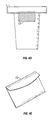
- FIG. 4 (as FIGS. 4 a to 4 e ) shows a key and a backing plate, according to the invention, in perspective view and plan view.
- FIG. 5 (as FIGS. 5 a to 5 b ) shows details of a housing and cap of the invention, in cross-section and in plan view.
- FIG. 6 (as FIGS. 6 a to 6 b ) shows details of a locking pin in relation to the foot of a post.
- FIG. 7 shows a collet removing tool in use.
- FIG. 8 shows collet and key removing tools in perspective view.
- FIG. 9 (as FIGS. 9 a to 9 c ) illustrates variations related to locking a square pole in place.
- FIG. 10 shows the variations related to holding pipes that pass through a wall (or the like).
- FIG. 11 illustrates a way to seal a junction between two pipes at a position where collets are placed.
- FIG. 12 (in FIG. 12 a ) illustrates use of a bolt to apply removal forces to a collet (in FIG. 12 b ).
- FIG. 13 shows in cross sections how the invention can cater for variations on a round post in a round hole, such as hexagonal posts.
- top or bottom or other references to a vertical or horizontal orientation are used for clarity of explanation, but it will be appreciated that the invented apparatus may be oriented in any direction and in such a case these terms must be translated accordingly.
- this specification describes a quick release locking system for ground fixtures particularly a post A having a constant cross-section, and provides a ground-embedded housing B, a pair of free-standing locking members (collets or wedges) C, and a key D. Tools for inserting, locking and later removing the locking member are described.
- the post A is placed loosely in the internal cavity of the embedded housing B then one locking member C is driven down on each side of the post. It may be that only one locking member C is hammered into place.
- the preferred locking members (called collets or wedges) C are shaped (preferably by injection molding or equivalent procedure) to fit closely against the post cross-section on an inward face, and to fit closely inside the housing on an outward face, and are preferably made of a plastics material in order to provide a little resilience that increases contact area; and to provide resistance against corrosion.
- This invention relates to a system for reversibly anchoring a post (or pole, pipe, shaft, beam, mast, etc) in a substrate ( 2 ) such as the ground or a wall.
- a substrate such as the ground or a wall.
- the illustrations and the key to the part identification includes many details.
- the invention employs two main components—the housing, permanently buried at a designated spot, and one, two, or more wedges of a type known as collets because they are shaped to wrap around a shaft together with anti-rotation means, locking means, and removal means.
- Post A may be a hollow conduit or pipe carrying fluids or protecting conductors such as copper wiring or fiber optic materials.
- the post A is made of a slightly deformable material—as per FIG. 1 , where the key D that has been hammered into place has deformed the post A at a point of contact. This assists in preventing movement of the post and helps to retain the key.
- Deformable materials include most metals and some plastics but care must be taken that a selected plastic does not crack and fail on account of the deforming pressure. Note that the post itself is not part of the anchoring invention, although the invention is unlikely to be assembled properly without including a post within.
- Housing B This is a shell (hatched thick line B in the elevation section of FIG. 1 ) that is preferably made of a strong and durable, non-corrodible material; in metal but also preferably made in plastics.
- the housing B will usually be embedded in concrete for use, so that an almost incompressible surrounding is provided around the exterior of the housing when in use.
- Steel reinforcing rings ( 3 ) may be embedded in the concrete to provide tensile strength. Fins or other protrusions may be used on the exterior surface of the housing in order to improve attachment and to prevent undesired rotation of the housing, such as caused by a wind blowing on an unsymmetrical sign.
- the inside of the housing is provided with tapered portions T 1 and T 2 corresponding closely with those on the outside of the collets C described below, and hence should be reasonably precisely shaped. If made in cast metal, the tapered area could usefully be finished with a cutting or grinding operation.
- One advantage of a taper is that there is some useful tolerance as to width.
- the inside surface of the housing may be provided with two or more vertical ribs Y, which act to guide and hold the collets C against rotation within the housing.
- an outwardly projecting collar L is provided at the top end of the housing.
- the inside surface of the collar L is preferably provided with horizontal ribs Z, which in use maintain a gap between the housing and the heads of the collets C, into which a removal tool can be introduced as described below.
- a preferably knockout type of wiring aperture M may be provided, by which pipes or wiring can be introduced into the base of the housing below the collet C.
- the dimensions of the housing are typically 30 cm deep by 12-15 cm in diameter, depending on application.
- the interior of the housing may also include key guides (see later).
- Collet C is a shaped wedge not unlike collets used in engineering to hold tools with a locking process effected by forcing the tapered collet into a tapered hole.
- the basic collet comprises perhaps a third or a half-circle around the post A, as seen in plan view, shaped so that the inward surface J generally conforms to the exterior of the post A, preferably with horizontal ribs G at upper and lower parts of the inward surface J, to resiliently deform against and/or press into the post A to grip it securely at an upper and a lower part of the collet.
- the outward surface H conforms to inner wall of the housing B, with attention given to the angles of the upper and lower tapered areas T 1 and T 2 .
- the head K of a collet C comprises an outwardly projecting flange, shaped and dimensioned to fit within the collar L of the housing B.
- the upper surface K 1 of the head K is preferably slightly sloped downward towards the outer edge, and provides a surface which can be hammered to drive the collet C into place in use.
- the apposable tapered zones (T 1 and T 2 ) on the housing B and the collet C serve to wedge the pole and the collet into place when downward pressure is applied to the collet.
- Use of an upper and a lower taper both having a significant tapered area tends to make a more stable mount since the item held cannot rock to and fro against any high point or obstruction in the mid-height part of the anchor.
- the inter-taper length has to be well controlled so that both tapers co-operate to hold the pole in place. With a continuous taper a similar pressure would be applied right through the supported area, making the locking system of the invention susceptible to vibration and flexing by rocking about the middle.
- Suitable materials for collets include metal which may be cast or milled, but more preferably are a tough plastics material, including for example polypropylene and high-density polyethylene, which may be made by injection molding.
- a tough plastics material including for example polypropylene and high-density polyethylene, which may be made by injection molding.
- the slight flexibility of this material provides an advantage in combination with the use of two tapered zones as described above.
- the top tapered zone T 1 can be pulled free with leverage applied to the top of the collet, while the other zone T 2 remains wedged. The intermediate area is stretched out. The pulling force then transfers to the second zone T 2 , to release it also. If the collet were formed from an inflexible material, or if the taper extended continuously along the entire length of the collet, a much greater pulling force would be required to free the whole wedged section of the collet at once.
- each plastic material has its own shrinkage characteristics.
- collets are made in a single molding operation but the known effects of plastics-dependent shrinkage such that which occurs after release from the die may necessitate subsequent finishing operations—although the cost of those is mitigated by the use of cheaper plastics.
- Cutting, grinding with NC machines and brief searing contact with very hot shapes are possible techniques for post-finishing.
- all parts of the finished item are made at the same thickness, to help in the cooling characteristics, as is known in the relevant arts.
- the collet C may be modified to accommodate locking devices, as described below, with slots W or R as shown in FIGS. 3 b and 3 c.
- the key D has a head D 1 (adapted to allow the key to be hammered into place and then levered out of place after use), and a blade D 2 (adapted to bear tightly against the post A in order to retain it), which tapers towards the lower end so that the key is also wedge-shaped. It may be made of mild steel, perhaps stamped out or otherwise cut. The key is wedged between the post A and the housing B, passing down a groove W cut in a collet as seen in FIG. 3 a .
- the key should have a concave v-cut inner edge N for pressing against the post, so that it has two parallel sharp edges which can cut into and deform the pipe and provide a more secure holding action on the curve of a round post, as is shown particularly in FIG. 4 .
- FIG. 4 b shows placement of the key D in a slot W in a collet C, to engage with both the post A inside and the housing B outside.
- a metal plate E is preferably provided in the housing B, against which the key D can bear. This may comprise a flat plate or may comprise a formed metal plate as shown in FIG. 4 , which is typically 50 ⁇ 75 mm and made of 1.2 mm thick galvanized steel, and has been folded so that it is curved and includes two ridges E 2 that define the sides of a key-compatible slot E 1 that the key D may slide down.
- the plate E is preferably mounted on the outer surface of the housing B, behind a slot cut through the housing B down which the key D is hammered, so that the plate E bears against the concrete ( 2 ) surrounding the housing.
- the concrete may preferably be reinforced (such as by steel ring 3 in FIG. 1 ) because this type of usage will impose tensile forces.
- a firm bearing surface is provided outside the key D as it is hammered down into the slot W, such that the inner edge N is pressed into and deforms or cuts into the material of the post A, to lock it against rotational movement relative to the collet C or housing B.
- FIG. 4 c shows a view of a housing from above, with L indicating the expanded uppermost portion (seen also in elevation view in FIG. 4 d ).
- FIG. 4 e is a perspective view of a bent metal key which for example is about 50 mm wide and 50 mm deep, with a bent-over lip at one end that lies inside the border of L as shown in FIG. 4 c .
- Housings are provided with a thin slot that retains a membrane of plastic unless an installer has burst the membrane by the act of inserting key E 3 , which is done before the concrete is poured around the housing so that the key E 3 is surrounded on both sides by concrete.
- This anti-rotation key works by pressing firmly, along its centre axis, against the outside of the vertical part of the housing (at T 1 , with reference to FIG. 1 ).
- the vertical edges of key E 3 tend to cut into the concrete if a turning action is forced onto the housing L and so on to the key E 3 .
- a further means may be provided for preventing rotation and/or withdrawal of the post A from the anchoring means, as shown in FIGS. 6 and 7 .
- a lock pin P is provided, extending transversely from or through a mounting P 1 in the housing B into the internal cavity.
- the collet C is modified to provide a longitudinal slot R extending upwardly from the bottom, which can fit over the lock pin P, so that it passes through the collet C into contact with the post A.
- the post A is preferably also modified with an aperture P 2 at the appropriate height for the pin P to pass into. With the second collet C not yet in place, the post A can be tilted to allow it to slide past the lock pin P.
- the post A can be tipped upright to engage the pin in the aperture, and then the second collet (not shown) pressed in on the other side to hold the whole assembly in place.
- the post A is prevented from rotating or sliding longitudinally relative to the housing B.
- FIG. 7 and FIG. 8 Two configurations of lever for use in collet removal are shown in FIG. 7 and FIG. 8 . It will be appreciated that this configuration is uncommon in ordinary tools. For example a screwdriver would have no useful purchase under the head of the collet.
- the lever is a form of security in that persons without one would find it very difficult to remove a post.
- This lever has a shaft of convenient length (30-50 cm) so that a user has a suitable amount of leverage, and a shaped head extended sideways from one end.
- the head of the tool comprises a generally crescent-shaped head U and a fulcrum X.
- the tips U 1 of the head U are inserted under the head K of the collet, and levered with the fulcrum X bearing against the collar L of the housing B and/or on the surrounding concrete substrate 2 .
- Ridges Z on the inner surface of the collar L ensure that a gap remains under the flange K for the purpose of inserting the head of the tool.
- the head U may incorporate a recess U 3 to fit around the key D, so that the collet C can be removed independently from the key D.
- the tool V is formed and arranged so that the fulcrum X will bear against the substrate 2 in which the housing B is mounted, rather than the housing B itself.
- a separate bearing plate Y may be provided, to lie between the fulcrum X and the collar L, and/or the head U may be pivotally mounted (U 2 in FIG. 7 ) relative to the fulcrum X, and arranged to fit under the flange K in the collar L while the fulcrum rests on the upper surface of the substrate ( 2 ) outside the housing B.
- the shape of the tool will be modified to suit the dimensions and shape of the collets C used in a particular application N for example, if the system is applied in a square form for mounting square-section posts (as described below) then the collet removing tool V will have a straight or V-shaped head U, rather than the crescent-shaped head U described above.
- FIG. 12 shows use of machine screws as hold-downs and as removing devices for a collet-based post anchor. This is an alternative way of providing for insertion or removal including a mechanical advantage.
- the post is A; the collet housing is B, and two collets are shown as C on each side of the post. L indicates the outer edge of the surface expansion of the housing.
- Bolt 1201 has a drivable head which may be engaged with a socket spanner, or some “security head” may be used to prevent unauthorized removal.
- the bolt shaft includes a subsequently attached fixed washer 1203 that can turn against washer 1202 that forms part of the collet.
- the shaft of the bolt includes a conventional thread 1205 , which passes through captive nut 1204 . The thread is otherwise free to turn in space 1206 .
- the bolt head is turned, the bolt is either pulled down into the housing by engagement with the captive nut, or if rotated in the opposite direction, turns against the collet washer 1202 and causes the bolt to rise out of the housing, so that the collet is forcibly withdrawn from the housing and the post is thereby freed from the anchor B.
- 1207 is a perspective view of a collet of this type, including a bolt 1201 . The stretching effect previously described is still applicable.
- An injection molded cap ( 172 in FIG. 2 ) is available as an optional accessory for use when the post is not in place.
- the surface may be flat rather than semicircular, as shown in FIG. 5 a .
- the closely fitting cap may be placed over the hole to keep rubbish out and to avoid injury to people or animals.
- Resilient parts or a form of engageable catch (screw or bayonet fitting—not shown), or even a temporary glue (such as “hot glue” resin) may be used to retain the cap.
- a temporary glue such as “hot glue” resin
- FIG. 13 shows how this invention exploits a useful result of the use of collets, namely that they can be shaped so as to pack a space and serve as an adapter between usually a cylindrical cavity (in cross-section, though with more than one taper), and a pole having a non-circular cross-section.
- the outer profile of the collets is as previously described and illustrated in for example FIG. 3 a , 3 d as tapers T 1 (an upper taper of about 2.5 degrees slope) and T 2 ; a lower taper of the same slope, separated by a parallel-wall section marked “H”.
- FIG. 13 a shows how a hexagonal section pole can be accommodated.
- 1300 is the wall of the shell to be placed against soil or concrete or the like, when in use.
- 1301 is the outline of a hexagonal pole; commonly supplied made of rolled sheet metal with an overall taper for street lighting applications, for example.
- the hatched outline 1302 is an example of one half-circle collet and the hatched outline 1303 is an example of a different collet outline. These two types could be used at the same time, or used only as one (either) type at a time.
- FIG. 13 b also shows how a hexagonal section pole can be accommodated.
- 1300 is the wall of the shell placed against soil or concrete or the like.
- 1301 is the outline of a hexagonal pole; commonly supplied in rolled sheet metal or the like with an overall taper for street lighting applications, for example.
- the hatched outline 1304 is an example of one 120 degree collet and the hatched outlines 1304 b 1 and 1304 b 2 are examples of yet another, 60 degree collet outline. These two types could be used at the same time, or used only as one (either) type at a time.
- FIG. 13 c shows a ten-sided pole outline as 1306 .
- FIG. 1307 is one of four 36-degree collets shown in outline, and 1308 is an alternative; a 72-degree collet extending around two facets on the outside of the pole.
- FIG. 13 d shows how a square pole may be fitted tightly into a round aperture 1300 by means of at least two varieties of collet section, 1310 and 1311 .
- FIG. 13 e shows that a square-section outer pipe 1312 is provided with collets 1313 or 1314 (two styles are shown) that clamp around a circular-section pole 1315 .
- FIG. 13 e shows that collets are quite adaptable.
- a nonsymmetrical “U”-shaped post is held in place with one irregular collet ( 1317 ) and two of outline 1318 (not unlike 1310 or 1311 ). All these illustrative cross-sections are representative and are in no way limiting of the possible variations that may be used.
- FIG. 9 illustrates how the parts of the invention may be adapted for square-shaped posts that are commonly favored for use in fences where style is important.
- FIG. 9 a is a plan view and FIG. 9 b is a sectioned front view, showing a squared housing B around a square post A.
- Two square collets C (see 9 c for a perspective view) hold the post in place.
- Two collets are used on the same side of the post so that they are accessible from one side of the fence, whereas other positions would lie behind the fence material and may be difficult to access.
- Q is a screw hole used to secure a cover. Note that this system ensures that the post walls are orientated in line with the length of the fence.
- a lever slot K 2 is provided in the head K of the collet, which can be accessed with an appropriately shaped tool in the collar L of the housing B.
- Posts can be provided for use with the above anchoring system that snap cleanly at ground level when over-stressed so that (for example) if a crowd in panic has trampled down the posts, individuals are not injured on protruding stumps thereafter. Later, the broken-off base can be extracted and the entire post can be replaced cheaply without having to pour new concrete, for example. Roadside signs should also break into a safe configuration if hit by a vehicle.
- FIG. 1 illustrates how the parts of the invention may be adapted in order to carry electrical wiring into the interior of a hollow post for lighting, telephones, traffic lights, loudspeakers and the like.
- a cable (see also FIG. 2 ) has been buried in the ground and feeds its wires through an aperture M at the base of the post.
- the aperture M may be pre-formed in the housing B, or alternatively may be provided as a frangible membrane with a guide rim, which can be easily perforated for the insertion of wires or connection of pipes, but which serves as a waterproof seal if not perforated.
- this invention provides apparatus and a method for removably fixing in place a pipe or other elongate member passing through or into a wall using anchoring means as described above, applied horizontally instead of vertically.
- FIG. 10 illustrates how the parts of the invention may be adapted for carrying a fluid such as a water pipe through a wall.
- a large pipe is shown as A 2 .
- the pipe is surrounded by a housing B (either slipped over the pipe from a free end or provided as a pair of shells) and the pipe is clamped in place by means of collets C.
- the upper part of FIG. 10 shows a single-ended collet assembly and the lower part shows a double assembly around a smaller pipe such as a gas pipe or water pipe A 3 .
- this version offers, among other advantages, the benefit that sound travelling along the pipe is deadened at the collets, at least partly owing to a property (also well-known in lead) of hysteresis and mass, hence absorption of sound. It may be set up with a level of tightness which can allow the pipe to slide within the collet should there be earth movement or an earthquake.
- a process as above can be used to anchor an end of a hand rail into a wall made of such as brick or concrete.
- FIG. 11 shows how the collet/housing assembly may be used in an only slightly modified form as a junction between pipes. There is no requirement that the assembly be mounted in the ground or in a wall, for example; it may be free-standing.
- the lumen of the pipes is shown at A 4 .
- a modified housing B 4 forms a complete ring around the approximately flush ends of the pipes.
- the housing includes an interior flange that makes an approximate contact with the pipe exteriors. Sealing is provided by means of the pressure applied by the collet C bases applied against a pressure-equalizing ring C 1 that in turn presses against an 0-ring C 2 that is forced into a sealing contact.
- One such O-ring is used on each side.
- sports or playground fixtures such as for goal posts at specific places when a given sports code is “in season” and replacement by a cover otherwise
- playground fixtures such as of the type based on vertical pipes rising out of the ground—allowing reconfiguration from time to time,
Landscapes
- Engineering & Computer Science (AREA)
- Architecture (AREA)
- Civil Engineering (AREA)
- Structural Engineering (AREA)
- General Engineering & Computer Science (AREA)
- Life Sciences & Earth Sciences (AREA)
- Geology (AREA)
- Mining & Mineral Resources (AREA)
- Environmental & Geological Engineering (AREA)
- Fluid Mechanics (AREA)
- General Life Sciences & Earth Sciences (AREA)
- Geochemistry & Mineralogy (AREA)
- Physics & Mathematics (AREA)
- Mechanical Engineering (AREA)
- Forms Removed On Construction Sites Or Auxiliary Members Thereof (AREA)
- Clamps And Clips (AREA)
- Foundations (AREA)
Applications Claiming Priority (3)
| Application Number | Priority Date | Filing Date | Title |
|---|---|---|---|
| NZ54390605 | 2005-12-01 | ||
| NZ543906 | 2005-12-01 | ||
| PCT/NZ2006/000314 WO2007064235A1 (en) | 2005-12-01 | 2006-12-01 | Anchoring system for posts |
Related Parent Applications (1)
| Application Number | Title | Priority Date | Filing Date |
|---|---|---|---|
| PCT/NZ2006/000314 Continuation WO2007064235A1 (en) | 2005-12-01 | 2006-12-01 | Anchoring system for posts |
Publications (2)
| Publication Number | Publication Date |
|---|---|
| US20090025332A1 US20090025332A1 (en) | 2009-01-29 |
| US7954289B2 true US7954289B2 (en) | 2011-06-07 |
Family
ID=38092475
Family Applications (1)
| Application Number | Title | Priority Date | Filing Date |
|---|---|---|---|
| US12/129,620 Active US7954289B2 (en) | 2005-12-01 | 2008-05-29 | Anchoring system for posts |
Country Status (10)
| Country | Link |
|---|---|
| US (1) | US7954289B2 (ja) |
| EP (1) | EP1960618B1 (ja) |
| JP (1) | JP4970463B2 (ja) |
| KR (1) | KR101395988B1 (ja) |
| CN (1) | CN101351607B (ja) |
| AU (1) | AU2006321066B2 (ja) |
| NZ (1) | NZ569410A (ja) |
| RU (1) | RU2398083C2 (ja) |
| WO (1) | WO2007064235A1 (ja) |
| ZA (1) | ZA200805690B (ja) |
Cited By (23)
| Publication number | Priority date | Publication date | Assignee | Title |
|---|---|---|---|---|
| US20100293883A1 (en) * | 2007-12-21 | 2010-11-25 | Casne Verige Pty Ltd | Cast-in insert |
| US20110229252A1 (en) * | 2010-03-16 | 2011-09-22 | Dewert Antriebs-Und Systemtechnik Gmbh | Device with two relatively-moving parts |
| US8499373B2 (en) * | 2010-04-29 | 2013-08-06 | Swimsmith Co. | Anchor arrangement for swimming pool |
| US8526192B2 (en) * | 2011-12-06 | 2013-09-03 | Inventec Corporation | Boss for securing pair of mainboards |
| US8820007B2 (en) | 2011-09-12 | 2014-09-02 | N. Eric Knudsen | Device for forming post sleeves, and method of use |
| US20150020464A1 (en) * | 2013-03-11 | 2015-01-22 | Paula C. Anderson d/b/a Rascals Railcrete | Tilt tower and pipe auger anchor assembly |
| US20150240851A1 (en) * | 2014-02-26 | 2015-08-27 | Sb Ingénierie | Device for fixing a panel in a support rail |
| US9334673B2 (en) | 2009-03-13 | 2016-05-10 | N. Eric Knudsen | Post sleeve positioning systems and related methods |
| US9777456B1 (en) * | 2017-01-11 | 2017-10-03 | Daniel S. Spiro | Universal pole foundation |
| WO2018010025A1 (en) * | 2016-07-12 | 2018-01-18 | James Lindsay | Post and barrier safety device |
| US9982454B2 (en) | 2008-06-27 | 2018-05-29 | N. Eric Knudsen | Post sleeve assembly |
| US20180195305A1 (en) * | 2017-01-09 | 2018-07-12 | Oldcastle Precast, Inc. | Prefabricated concrete pole base and method of installation |
| WO2018132463A1 (en) * | 2017-01-11 | 2018-07-19 | Spiro Daniel S | Universal pole foundation |
| US10214940B2 (en) | 2016-03-11 | 2019-02-26 | N. Eric Knudsen | Post sleeve positioning apparatus and related methods |
| US10344496B1 (en) * | 2018-04-24 | 2019-07-09 | Adam S. Cefalo | Anchoring device for a beach umbrella |
| US20190249442A1 (en) * | 2016-07-12 | 2019-08-15 | Bohle Ag | Device for fastening a panel-shaped component in a receiving groove of a carrying rail |
| US10633818B2 (en) | 2017-01-11 | 2020-04-28 | Daniel S. Spiro | Universal pole foundation with instant cap |
| US10954662B1 (en) * | 2020-08-05 | 2021-03-23 | King Saud University | System and method for connecting a square concrete-filled steel tubular column to a reinforced concrete footing |
| US11199018B2 (en) | 2019-11-21 | 2021-12-14 | Cool Pool Products, LLC | Secure, two-piece pole holder |
| US11427980B1 (en) * | 2020-07-07 | 2022-08-30 | Tyler Blake Kimrey | Assembly and method for installing and replacing fence posts |
| US11555287B2 (en) | 2017-01-11 | 2023-01-17 | Exposure Illumination Architects, Inc. | Cellular and ballasted universal pole foundation |
| US20240167283A1 (en) * | 2022-11-21 | 2024-05-23 | Avon Plastics, Inc. | Splash block |
| US12116780B2 (en) | 2009-03-18 | 2024-10-15 | N. Eric Knudsen | Post sleeve assembly |
Families Citing this family (31)
| Publication number | Priority date | Publication date | Assignee | Title |
|---|---|---|---|---|
| US20090017946A1 (en) * | 2007-07-13 | 2009-01-15 | Sportcraft, Ltd. | Quick set up net assembly for game play |
| GB2454911A (en) * | 2007-11-22 | 2009-05-27 | Jonathan Edward Browning | Dual sleeve post socket |
| MY144329A (en) * | 2009-03-20 | 2011-08-23 | Ong Chin Dr Chai | Circular pile head for underpinning a slab |
| KR200458935Y1 (ko) * | 2010-01-07 | 2012-03-21 | 주식회사 선진글맥 | 도로표지판의 수평조절구 |
| US8704089B2 (en) * | 2011-03-11 | 2014-04-22 | Hubbell Incorporated | Foundation member with cable theft deterrent device |
| CN102221505A (zh) * | 2011-04-02 | 2011-10-19 | 江苏大学 | 圆盘式茎秆切割试验装置及方法 |
| WO2012139149A1 (en) * | 2011-04-11 | 2012-10-18 | Smart Urban Pty Ltd | A post retainer, post retaining system and method for retaining a post at a variable depth |
| ES2662770T3 (es) * | 2011-06-28 | 2018-04-09 | Surefoot Systems International Limited | Placas de zapatas mejoradas |
| AU2012207010B2 (en) * | 2012-07-09 | 2015-11-05 | Delnorth Pty. Ltd. | A Frangible Pole with Wear Shoe |
| DE102012212603A1 (de) * | 2012-07-18 | 2014-01-23 | Harsco Infrastructure Services Gmbh | Arretiervorrichtung mit Wandschalungsbefestigungseinrichtung und Verfahren |
| JP2014084642A (ja) * | 2012-10-24 | 2014-05-12 | Kyushu Sekisui Kogyo Co Ltd | 支柱保持管 |
| CN103758283A (zh) * | 2013-12-18 | 2014-04-30 | 安徽森泰塑木新材料有限公司 | 集成房屋立柱垫板 |
| SE538222C2 (sv) * | 2014-06-12 | 2016-04-05 | Northcone Ab | Stolparrangemang |
| CN105587156A (zh) * | 2014-10-24 | 2016-05-18 | 无锡市金力电力成套设备有限公司 | 便拆式电力杆的支撑装置 |
| US9970635B2 (en) * | 2015-01-13 | 2018-05-15 | John Daniel Rood | Portable path light system and method |
| FR3041673B1 (fr) * | 2015-09-25 | 2017-11-10 | Eyes Group | Systeme d'ancrage d'un mat dans un sol comportant au moins une interface susceptible d'etre assemblee sur une base d'ancrage destinee a affleurer le sol |
| DE102016106330A1 (de) * | 2016-04-06 | 2017-10-12 | Gebr. Sträb GmbH & Co | Verfahren, Vorrichtung und Bodendübelsystem zur Pfostenbefestigung |
| CN105952241B (zh) * | 2016-05-06 | 2018-04-24 | 国网湖南省电力公司 | 一种用于复合材料电线杆快速安装拆卸的组合底座 |
| RU168411U1 (ru) * | 2016-08-23 | 2017-02-02 | Федеральное государственное бюджетное образовательное учреждение высшего образования "Петербургский государственный университет путей сообщения Императора Александра I" | Опора |
| CN107143194A (zh) * | 2017-04-30 | 2017-09-08 | 陶云霞 | 一种特高压输电电线杆安装固定方法 |
| DE102017120724A1 (de) * | 2017-09-08 | 2019-03-14 | Axel Beyer | Befestigungs-Vorrichtung einer semistationären Geschwindigkeits-Messstation |
| RU2663423C1 (ru) * | 2017-11-07 | 2018-08-06 | Алексей Викторович Воробьев | Опорное приспособление для опорной трубы |
| CN108915336B (zh) * | 2018-07-27 | 2020-05-12 | 国网河北省电力有限公司新乐市供电分公司 | 一种带有入土扎根功能的电杆 |
| CN109024556B (zh) * | 2018-08-01 | 2020-10-09 | 洛阳理工学院 | 一种土木工程建筑组合桩 |
| WO2020046148A1 (en) * | 2018-08-30 | 2020-03-05 | P.H.U. SADDAR Dariusz Sadowinski | A set of elements for setting in the ground a post, especially a post supporting a wire net fencing and a method of setting in the ground a post, especially a post supporting a wire net fencing |
| CN109256726B (zh) * | 2018-11-22 | 2020-06-16 | 陕西陕煤铜川矿业有限公司 | 一种竖直敷设管道的电缆敷设方法 |
| FR3106145B1 (fr) * | 2020-01-14 | 2022-01-21 | Louisiane | Procédé de fixation d’un poteau dans un sol |
| CN111365335A (zh) * | 2020-03-26 | 2020-07-03 | 安徽省庆新家具有限公司 | 一种家具连接紧固机构 |
| CN112012558B (zh) * | 2020-08-31 | 2021-10-26 | 合肥森印科技有限公司 | 一种用于河流池塘旁的延伸式乡村公路电线杆底座 |
| EP4368779A1 (en) * | 2022-11-10 | 2024-05-15 | NAL Products Limited | Universal ground engaging socket |
| CN116927715B (zh) * | 2023-09-19 | 2023-11-21 | 河北上善石油机械有限公司 | 一种可防止脱落的浮箍浮鞋 |
Citations (28)
| Publication number | Priority date | Publication date | Assignee | Title |
|---|---|---|---|---|
| US1033447A (en) * | 1912-02-08 | 1912-07-23 | Herbert W Mower | Expansion-bolt. |
| US1421398A (en) * | 1921-12-27 | 1922-07-04 | H M Dirks | Christmas-tree support |
| US1856000A (en) * | 1930-04-22 | 1932-04-26 | James C Smith | Holder for trees, bushes, flowers, and the like |
| US2713327A (en) * | 1953-10-26 | 1955-07-19 | West Essie Binkley | Tethering device |
| US3250170A (en) * | 1964-03-09 | 1966-05-10 | Norman H Siegel | Expansion shell |
| US3385565A (en) * | 1966-09-16 | 1968-05-28 | Cuthbert Fred | Roadway divider fence construction |
| US3612287A (en) * | 1969-10-13 | 1971-10-12 | Poster Products Inc | Floor display fixtures |
| US3952377A (en) * | 1974-01-25 | 1976-04-27 | Juan Coll Morell | Conical wedges for gripping multi-ply rope or cable |
| US4261138A (en) * | 1978-10-27 | 1981-04-14 | St George Syms John G | Christmas tree holder |
| US4744691A (en) * | 1985-03-05 | 1988-05-17 | Vorspann-Technik Gesellschaft M.B.H. | Anchoring means for tension members |
| US4793110A (en) * | 1987-03-30 | 1988-12-27 | Tucker Joe W | Foundation and building structure support system apparatus and method |
| US5157882A (en) * | 1990-04-27 | 1992-10-27 | Soble Bernard D | Pole support system for a carport and the like |
| WO1992020889A1 (en) | 1991-05-10 | 1992-11-26 | Poletech Systems Limited | Post installation |
| US5497972A (en) * | 1994-10-26 | 1996-03-12 | Hms Mfg. Co. | Stand for artificial Christmas tree or the like |
| US5566926A (en) * | 1994-08-19 | 1996-10-22 | Voight Products Incorporated | Resilient safety barrier |
| US5571229A (en) | 1994-09-27 | 1996-11-05 | Huffy Corporation | Ground sleeve |
| US5791824A (en) * | 1993-11-12 | 1998-08-11 | Radtke; Johannes | Injection cable bolt |
| US5797963A (en) * | 1994-11-10 | 1998-08-25 | Innovasive Devices, Inc. | Suture anchor assembly and methods |
| WO1999024672A1 (en) | 1997-11-07 | 1999-05-20 | Kdc Systems Ltd | Support post securing system |
| US6050034A (en) * | 1995-07-28 | 2000-04-18 | Klaus Krinner | Anchoring device for a pole- or post-like object |
| WO2000039402A1 (en) | 1998-12-23 | 2000-07-06 | Ani Corporation Ltd. | Post anchor |
| US6267688B1 (en) * | 1999-08-11 | 2001-07-31 | Alan J. Morelli, Sr. | Apparatus and method for the creation and covering of holes on golf greens and the like |
| US6287044B1 (en) * | 1999-01-05 | 2001-09-11 | Julius Blum Gesellschaft M.B.H. | Fitting |
| US6450745B2 (en) * | 2000-03-15 | 2002-09-17 | Hilti Aktiengesellschaft | Dowel with a weakened section adjoining the leading threaded end thereof |
| US20030121223A1 (en) * | 2003-02-11 | 2003-07-03 | Riker Ronald D. | Post mount assembly |
| US6684585B2 (en) * | 2001-05-30 | 2004-02-03 | Robert Campbell | Method and apparatus for providing a visual indication of the tension applied to a tendon of a post-tension system |
| US20050082826A1 (en) | 2003-10-17 | 2005-04-21 | Twin Bay Medical, Inc. | Barb clamp |
| US7147404B2 (en) * | 2004-09-20 | 2006-12-12 | Atlas Copco Mai Gmbh | Elongate element tensioning member |
Family Cites Families (10)
| Publication number | Priority date | Publication date | Assignee | Title |
|---|---|---|---|---|
| SE391553B (sv) * | 1973-10-23 | 1977-02-21 | Granstroem Ab E | Anordning for forankring av stolpar eller master |
| AT370158B (de) * | 1978-10-06 | 1983-03-10 | Hofinger Rudolf | Einrichtung zur verankerung eines stehers als traeger fuer leitschienen, gelaender, verkehrszeichen u.dgl. im boden |
| DE3042914A1 (de) * | 1980-11-14 | 1982-07-01 | Karl 3320 Salzgitter Schöngen | Rohrfoermiger standpfosten |
| DE3733973A1 (de) * | 1987-10-08 | 1989-04-27 | Eberhard Hoeckle | Befestigungseinrichtung fuer einen verkehrszeichentraeger |
| FR2641557A1 (fr) * | 1989-01-11 | 1990-07-13 | Concept Urbain | Dispositif de fixation au sol de poteau ou potelet |
| JPH0430114U (ja) * | 1990-07-05 | 1992-03-11 | ||
| JP2945285B2 (ja) * | 1994-11-16 | 1999-09-06 | 株式会社ピー・エス | コンクリート型枠 |
| US5752229A (en) * | 1996-06-28 | 1998-05-12 | Lucent Technologies Inc. | Intelligent near-end speech detection |
| US6691788B1 (en) * | 2002-07-25 | 2004-02-17 | Halliburton Energy Services, Inc. | Retrievable packer having a positively operated support ring |
| DE20304257U1 (de) * | 2003-03-17 | 2003-05-22 | Hsu, Shih Hao, Bi Tou Hsiang, Changhua | Bodenanker mit Montageaufbau |
-
2006
- 2006-12-01 RU RU2008121759/03A patent/RU2398083C2/ru active
- 2006-12-01 NZ NZ569410A patent/NZ569410A/en unknown
- 2006-12-01 EP EP06835742.5A patent/EP1960618B1/en not_active Not-in-force
- 2006-12-01 AU AU2006321066A patent/AU2006321066B2/en not_active Ceased
- 2006-12-01 WO PCT/NZ2006/000314 patent/WO2007064235A1/en not_active Ceased
- 2006-12-01 JP JP2008543226A patent/JP4970463B2/ja not_active Expired - Fee Related
- 2006-12-01 CN CN200680045358XA patent/CN101351607B/zh not_active Expired - Fee Related
- 2006-12-01 KR KR1020087016022A patent/KR101395988B1/ko not_active Expired - Fee Related
-
2008
- 2008-05-29 US US12/129,620 patent/US7954289B2/en active Active
- 2008-06-30 ZA ZA200805690A patent/ZA200805690B/xx unknown
Patent Citations (29)
| Publication number | Priority date | Publication date | Assignee | Title |
|---|---|---|---|---|
| US1033447A (en) * | 1912-02-08 | 1912-07-23 | Herbert W Mower | Expansion-bolt. |
| US1421398A (en) * | 1921-12-27 | 1922-07-04 | H M Dirks | Christmas-tree support |
| US1856000A (en) * | 1930-04-22 | 1932-04-26 | James C Smith | Holder for trees, bushes, flowers, and the like |
| US2713327A (en) * | 1953-10-26 | 1955-07-19 | West Essie Binkley | Tethering device |
| US3250170A (en) * | 1964-03-09 | 1966-05-10 | Norman H Siegel | Expansion shell |
| US3385565A (en) * | 1966-09-16 | 1968-05-28 | Cuthbert Fred | Roadway divider fence construction |
| US3612287A (en) * | 1969-10-13 | 1971-10-12 | Poster Products Inc | Floor display fixtures |
| US3952377A (en) * | 1974-01-25 | 1976-04-27 | Juan Coll Morell | Conical wedges for gripping multi-ply rope or cable |
| US4261138A (en) * | 1978-10-27 | 1981-04-14 | St George Syms John G | Christmas tree holder |
| US4744691A (en) * | 1985-03-05 | 1988-05-17 | Vorspann-Technik Gesellschaft M.B.H. | Anchoring means for tension members |
| US4793110A (en) * | 1987-03-30 | 1988-12-27 | Tucker Joe W | Foundation and building structure support system apparatus and method |
| US5157882A (en) * | 1990-04-27 | 1992-10-27 | Soble Bernard D | Pole support system for a carport and the like |
| WO1992020889A1 (en) | 1991-05-10 | 1992-11-26 | Poletech Systems Limited | Post installation |
| US5791824A (en) * | 1993-11-12 | 1998-08-11 | Radtke; Johannes | Injection cable bolt |
| US5566926A (en) * | 1994-08-19 | 1996-10-22 | Voight Products Incorporated | Resilient safety barrier |
| US5571229A (en) | 1994-09-27 | 1996-11-05 | Huffy Corporation | Ground sleeve |
| US5752349A (en) | 1994-09-27 | 1998-05-19 | Huffy Corporation | Ground sleeve |
| US5497972A (en) * | 1994-10-26 | 1996-03-12 | Hms Mfg. Co. | Stand for artificial Christmas tree or the like |
| US5797963A (en) * | 1994-11-10 | 1998-08-25 | Innovasive Devices, Inc. | Suture anchor assembly and methods |
| US6050034A (en) * | 1995-07-28 | 2000-04-18 | Klaus Krinner | Anchoring device for a pole- or post-like object |
| WO1999024672A1 (en) | 1997-11-07 | 1999-05-20 | Kdc Systems Ltd | Support post securing system |
| WO2000039402A1 (en) | 1998-12-23 | 2000-07-06 | Ani Corporation Ltd. | Post anchor |
| US6287044B1 (en) * | 1999-01-05 | 2001-09-11 | Julius Blum Gesellschaft M.B.H. | Fitting |
| US6267688B1 (en) * | 1999-08-11 | 2001-07-31 | Alan J. Morelli, Sr. | Apparatus and method for the creation and covering of holes on golf greens and the like |
| US6450745B2 (en) * | 2000-03-15 | 2002-09-17 | Hilti Aktiengesellschaft | Dowel with a weakened section adjoining the leading threaded end thereof |
| US6684585B2 (en) * | 2001-05-30 | 2004-02-03 | Robert Campbell | Method and apparatus for providing a visual indication of the tension applied to a tendon of a post-tension system |
| US20030121223A1 (en) * | 2003-02-11 | 2003-07-03 | Riker Ronald D. | Post mount assembly |
| US20050082826A1 (en) | 2003-10-17 | 2005-04-21 | Twin Bay Medical, Inc. | Barb clamp |
| US7147404B2 (en) * | 2004-09-20 | 2006-12-12 | Atlas Copco Mai Gmbh | Elongate element tensioning member |
Cited By (42)
| Publication number | Priority date | Publication date | Assignee | Title |
|---|---|---|---|---|
| US8813446B2 (en) * | 2007-12-21 | 2014-08-26 | Casne Verige Pty Ltd | Cast-in insert |
| US20100293883A1 (en) * | 2007-12-21 | 2010-11-25 | Casne Verige Pty Ltd | Cast-in insert |
| US11035142B2 (en) | 2008-06-27 | 2021-06-15 | N. Eric Knudsen | Post sleeve assembly |
| US9982454B2 (en) | 2008-06-27 | 2018-05-29 | N. Eric Knudsen | Post sleeve assembly |
| US10458143B2 (en) | 2008-06-27 | 2019-10-29 | N. Eric Knudsen | Post sleeve assembly |
| US9334673B2 (en) | 2009-03-13 | 2016-05-10 | N. Eric Knudsen | Post sleeve positioning systems and related methods |
| US11454044B2 (en) | 2009-03-13 | 2022-09-27 | N. Eric Knudsen | Post sleeve positioning systems and related methods |
| US9938749B2 (en) | 2009-03-13 | 2018-04-10 | N. Eric Knudsen | Post sleeve positioning systems and related methods |
| US12012773B2 (en) | 2009-03-13 | 2024-06-18 | N. Eric Knudsen | Post sleeve positioning systems and related methods |
| US12116780B2 (en) | 2009-03-18 | 2024-10-15 | N. Eric Knudsen | Post sleeve assembly |
| US8636436B2 (en) * | 2010-03-16 | 2014-01-28 | Dewertokin Gmbh | Device with at least two parts moving relative to each other |
| US20110229252A1 (en) * | 2010-03-16 | 2011-09-22 | Dewert Antriebs-Und Systemtechnik Gmbh | Device with two relatively-moving parts |
| US8499373B2 (en) * | 2010-04-29 | 2013-08-06 | Swimsmith Co. | Anchor arrangement for swimming pool |
| US9546496B2 (en) | 2011-09-12 | 2017-01-17 | N. Eric Knudsen | Device for forming post sleeves and related methods |
| US8820007B2 (en) | 2011-09-12 | 2014-09-02 | N. Eric Knudsen | Device for forming post sleeves, and method of use |
| US9212463B2 (en) | 2011-09-12 | 2015-12-15 | N. Eric Knudsen | Device for forming post sleeves and related methods |
| US10132099B2 (en) | 2011-09-12 | 2018-11-20 | N. Eric Knudsen | Device for forming post sleeves and related methods |
| US10655355B2 (en) | 2011-09-12 | 2020-05-19 | N. Eric Knudsen | Device for forming post sleeves and related methods |
| US8526192B2 (en) * | 2011-12-06 | 2013-09-03 | Inventec Corporation | Boss for securing pair of mainboards |
| US20150020464A1 (en) * | 2013-03-11 | 2015-01-22 | Paula C. Anderson d/b/a Rascals Railcrete | Tilt tower and pipe auger anchor assembly |
| US10590673B2 (en) * | 2013-03-11 | 2020-03-17 | Paula C. Anderson | Tilt tower and pipe auger anchor assembly |
| US9657760B2 (en) * | 2014-02-26 | 2017-05-23 | Sb Ingénierie | Device for fixing a panel in a support rail |
| US20150240851A1 (en) * | 2014-02-26 | 2015-08-27 | Sb Ingénierie | Device for fixing a panel in a support rail |
| US10214940B2 (en) | 2016-03-11 | 2019-02-26 | N. Eric Knudsen | Post sleeve positioning apparatus and related methods |
| US11015367B2 (en) | 2016-03-11 | 2021-05-25 | N. Eric Knudsen | Post sleeve positioning apparatus and related methods |
| WO2018010025A1 (en) * | 2016-07-12 | 2018-01-18 | James Lindsay | Post and barrier safety device |
| US10640985B2 (en) * | 2016-07-12 | 2020-05-05 | Bohle Ag | Device for fastening a panel-shaped component in a receiving groove of a carrying rail |
| US20190249442A1 (en) * | 2016-07-12 | 2019-08-15 | Bohle Ag | Device for fastening a panel-shaped component in a receiving groove of a carrying rail |
| US20180195305A1 (en) * | 2017-01-09 | 2018-07-12 | Oldcastle Precast, Inc. | Prefabricated concrete pole base and method of installation |
| US11280105B2 (en) | 2017-01-09 | 2022-03-22 | Valmont Industries, Inc. | Prefabricated concrete pole base and method of installation |
| US10280581B2 (en) * | 2017-01-11 | 2019-05-07 | Daniel S. Spiro | Universal pole foundation |
| WO2018132463A1 (en) * | 2017-01-11 | 2018-07-19 | Spiro Daniel S | Universal pole foundation |
| US11339550B2 (en) | 2017-01-11 | 2022-05-24 | Exposure Illumination Architects, Inc. | Universal pole foundation |
| US10633818B2 (en) | 2017-01-11 | 2020-04-28 | Daniel S. Spiro | Universal pole foundation with instant cap |
| US11555287B2 (en) | 2017-01-11 | 2023-01-17 | Exposure Illumination Architects, Inc. | Cellular and ballasted universal pole foundation |
| US9777456B1 (en) * | 2017-01-11 | 2017-10-03 | Daniel S. Spiro | Universal pole foundation |
| US10344496B1 (en) * | 2018-04-24 | 2019-07-09 | Adam S. Cefalo | Anchoring device for a beach umbrella |
| US11199018B2 (en) | 2019-11-21 | 2021-12-14 | Cool Pool Products, LLC | Secure, two-piece pole holder |
| US11427980B1 (en) * | 2020-07-07 | 2022-08-30 | Tyler Blake Kimrey | Assembly and method for installing and replacing fence posts |
| US10954662B1 (en) * | 2020-08-05 | 2021-03-23 | King Saud University | System and method for connecting a square concrete-filled steel tubular column to a reinforced concrete footing |
| US11639601B2 (en) * | 2020-08-05 | 2023-05-02 | King Saud University | System and method for connecting a square concrete-filled steel tubular column to a reinforced concrete footing |
| US20240167283A1 (en) * | 2022-11-21 | 2024-05-23 | Avon Plastics, Inc. | Splash block |
Also Published As
| Publication number | Publication date |
|---|---|
| KR20080083292A (ko) | 2008-09-17 |
| EP1960618B1 (en) | 2015-09-23 |
| CN101351607B (zh) | 2012-07-04 |
| EP1960618A1 (en) | 2008-08-27 |
| AU2006321066B2 (en) | 2012-06-14 |
| JP2009517571A (ja) | 2009-04-30 |
| WO2007064235A1 (en) | 2007-06-07 |
| EP1960618A4 (en) | 2011-01-26 |
| KR101395988B1 (ko) | 2014-05-16 |
| AU2006321066A1 (en) | 2007-06-07 |
| NZ569410A (en) | 2011-05-27 |
| HK1127101A1 (en) | 2009-09-18 |
| RU2008121759A (ru) | 2010-01-10 |
| US20090025332A1 (en) | 2009-01-29 |
| JP4970463B2 (ja) | 2012-07-04 |
| CN101351607A (zh) | 2009-01-21 |
| AU2006321066A8 (en) | 2009-01-22 |
| RU2398083C2 (ru) | 2010-08-27 |
| ZA200805690B (en) | 2009-05-27 |
Similar Documents
| Publication | Publication Date | Title |
|---|---|---|
| US7954289B2 (en) | Anchoring system for posts | |
| US5704188A (en) | Post structure | |
| US6202369B1 (en) | Universal anchor system | |
| US8839572B2 (en) | Post anchor apparatus and method of use | |
| US7500654B2 (en) | Fencing system | |
| US7438273B2 (en) | Anchor for securing an object to ground | |
| US4530190A (en) | Self-anchoring fence post and method of installing same | |
| AU731034B2 (en) | Support post securing system | |
| AU661632B1 (en) | Locking footing socket to improve post implantation | |
| US20060027796A1 (en) | Fencing attachment | |
| IES59907B2 (en) | Mounting arrangements | |
| HK1127101B (en) | Anchoring system for posts | |
| KR200272499Y1 (ko) | 가로등지주의 깃대꽂이관구조 | |
| JPH10512935A (ja) | ポールまたは柱状の物体の垂直配置用装置 | |
| CA1066474A (en) | Tri-anchor bracket for poles | |
| KR101694510B1 (ko) | 비닐하우스용 골조 침하방지캡 | |
| KR200400539Y1 (ko) | 비닐하우스용 파이프의 재활용을 위한 고정지주 | |
| JP4540448B2 (ja) | 根かせ | |
| KR102291157B1 (ko) | 항타형 지지구조물을 갖는 펜스 및 그 시공방법 | |
| KR200227274Y1 (ko) | 울타리용 기초콘크리트의 지주 고정장치 | |
| KR200184804Y1 (ko) | 지면 지지형 지주 구조 | |
| GB2401882A (en) | Post support apparatus with sleeve and securing wedges | |
| AU644731B2 (en) | Post support | |
| JP3277995B2 (ja) | 側溝構築時におけるグレ−チング用受枠の仮止め金具 | |
| JPH09209673A (ja) | ドリル柱脚固定器 |
Legal Events
| Date | Code | Title | Description |
|---|---|---|---|
| AS | Assignment |
Owner name: NOK LOK LICENSING LIMITED, AUSTRALIA Free format text: ASSIGNMENT OF ASSIGNORS INTEREST;ASSIGNOR:RICHARDS, DEAN EVAN;REEL/FRAME:021708/0301 Effective date: 20080909 |
|
| STCF | Information on status: patent grant |
Free format text: PATENTED CASE |
|
| CC | Certificate of correction | ||
| FPAY | Fee payment |
Year of fee payment: 4 |
|
| MAFP | Maintenance fee payment |
Free format text: PAYMENT OF MAINTENANCE FEE, 8TH YEAR, LARGE ENTITY (ORIGINAL EVENT CODE: M1552); ENTITY STATUS OF PATENT OWNER: LARGE ENTITY Year of fee payment: 8 |
|
| MAFP | Maintenance fee payment |
Free format text: PAYMENT OF MAINTENANCE FEE, 12TH YEAR, LARGE ENTITY (ORIGINAL EVENT CODE: M1553); ENTITY STATUS OF PATENT OWNER: LARGE ENTITY Year of fee payment: 12 |