US7585894B2 - 4-[(E)-2-(5,6,7,8-tetrahydro-5,5,8,8-tetramethyl-2-napthalenyl)-1-propenyl]benzoic acid analogs and method of manufacture and use thereof - Google Patents
4-[(E)-2-(5,6,7,8-tetrahydro-5,5,8,8-tetramethyl-2-napthalenyl)-1-propenyl]benzoic acid analogs and method of manufacture and use thereof Download PDFInfo
- Publication number
- US7585894B2 US7585894B2 US11/428,165 US42816506A US7585894B2 US 7585894 B2 US7585894 B2 US 7585894B2 US 42816506 A US42816506 A US 42816506A US 7585894 B2 US7585894 B2 US 7585894B2
- Authority
- US
- United States
- Prior art keywords
- compound
- mmol
- hbttnpb
- added
- hpttnpb
- Prior art date
- Legal status (The legal status is an assumption and is not a legal conclusion. Google has not performed a legal analysis and makes no representation as to the accuracy of the status listed.)
- Expired - Fee Related, expires
Links
- 0 **C1=CC=C(CC(=O)C2=CC=C(/C=C(\C)C3=CC4=C(C=C3)C(C)(C)CCC4(C)C)C=C2)C=C1 Chemical compound **C1=CC=C(CC(=O)C2=CC=C(/C=C(\C)C3=CC4=C(C=C3)C(C)(C)CCC4(C)C)C=C2)C=C1 0.000 description 9
- WIPXIQOHMJNQSE-UHFFFAOYSA-N C.CC1OC(C(=O)O)C(O)C(O)C1O.CC1OC(O)C(C)C(CO)C1O Chemical compound C.CC1OC(C(=O)O)C(O)C(O)C1O.CC1OC(O)C(C)C(CO)C1O WIPXIQOHMJNQSE-UHFFFAOYSA-N 0.000 description 2
- MPTVOJQMOKMTNP-UHFFFAOYSA-N CC1=CC=CC=C1.CCC1=CC=CC=C1 Chemical compound CC1=CC=CC=C1.CCC1=CC=CC=C1 MPTVOJQMOKMTNP-UHFFFAOYSA-N 0.000 description 2
- DVZKNXRZLVIBOY-UHFFFAOYSA-N CC1OC(C)C(O)C(O)C1O Chemical compound CC1OC(C)C(O)C(O)C1O DVZKNXRZLVIBOY-UHFFFAOYSA-N 0.000 description 2
- QAISUVQTVCISDF-UHFFFAOYSA-N CC1OC(O)C(C)C(CO)C1O Chemical compound CC1OC(O)C(C)C(CO)C1O QAISUVQTVCISDF-UHFFFAOYSA-N 0.000 description 2
- PHTRUSQCWIBIIC-PRBYTJTNSA-N BN=P.C/C(=C\C1=CC=C(C(=O)O)C=C1)C1=CC2=C(C=C1)C(C)(C)CCC2(C)C.[3H][3H] Chemical compound BN=P.C/C(=C\C1=CC=C(C(=O)O)C=C1)C1=CC2=C(C=C1)C(C)(C)CCC2(C)C.[3H][3H] PHTRUSQCWIBIIC-PRBYTJTNSA-N 0.000 description 1
- ZWYJJLOKEYHJCG-DYTRJAOYSA-N C/C(=C\C1=CC=C(C(=O)CC2=CC=C(O)C=C2)C=C1)C1=CC2=C(C=C1)C(C)(C)CCC2(C)C Chemical compound C/C(=C\C1=CC=C(C(=O)CC2=CC=C(O)C=C2)C=C1)C1=CC2=C(C=C1)C(C)(C)CCC2(C)C ZWYJJLOKEYHJCG-DYTRJAOYSA-N 0.000 description 1
- WKHYTSQRECPQRR-DYTRJAOYSA-N C/C(=C\C1=CC=C(C(=O)CC2=CC=C(OC3OC(C(=O)O)C(O)C(O)C3O)C=C2)C=C1)C1=CC2=C(C=C1)C(C)(C)CCC2(C)C Chemical compound C/C(=C\C1=CC=C(C(=O)CC2=CC=C(OC3OC(C(=O)O)C(O)C(O)C3O)C=C2)C=C1)C1=CC2=C(C=C1)C(C)(C)CCC2(C)C WKHYTSQRECPQRR-DYTRJAOYSA-N 0.000 description 1
- SFNQYNDFYOQLIZ-UHFFFAOYSA-N CC(C(C(C1O)O)O)OC1C(O)=O Chemical compound CC(C(C(C1O)O)O)OC1C(O)=O SFNQYNDFYOQLIZ-UHFFFAOYSA-N 0.000 description 1
- WKZPWMRGEOWZTC-PPBWNBFDSA-N CC1=C(/C=C/C(C)=C/C=C/C(C)=C/C(=O)CC2=CC=C(O)C=C2)C(C)(C)CCC1 Chemical compound CC1=C(/C=C/C(C)=C/C=C/C(C)=C/C(=O)CC2=CC=C(O)C=C2)C(C)(C)CCC1 WKZPWMRGEOWZTC-PPBWNBFDSA-N 0.000 description 1
- AKJHMTWEGVYYSE-FXILSDISSA-N CC1=C(/C=C/C(C)=C/C=C/C(C)=C/C(=O)NC2=CC=C(O)C=C2)C(C)(C)CCC1 Chemical compound CC1=C(/C=C/C(C)=C/C=C/C(C)=C/C(=O)NC2=CC=C(O)C=C2)C(C)(C)CCC1 AKJHMTWEGVYYSE-FXILSDISSA-N 0.000 description 1
- SHGAZHPCJJPHSC-YCNIQYBTSA-N CC1=C(/C=C/C(C)=C/C=C/C(C)=C/C(=O)O)C(C)(C)CCC1 Chemical compound CC1=C(/C=C/C(C)=C/C=C/C(C)=C/C(=O)O)C(C)(C)CCC1 SHGAZHPCJJPHSC-YCNIQYBTSA-N 0.000 description 1
- IUWGGMHFHQSJKY-FCDQGJHFSA-N CC1=CC=C(CC(=O)C2=CC=C(/C=C(\C)C3=CC4=C(C=C3)C(C)(C)CCC4(C)C)C=C2)C=C1 Chemical compound CC1=CC=C(CC(=O)C2=CC=C(/C=C(\C)C3=CC4=C(C=C3)C(C)(C)CCC4(C)C)C=C2)C=C1 IUWGGMHFHQSJKY-FCDQGJHFSA-N 0.000 description 1
- QDXHCWUGTAOYLM-ZBJSNUHESA-N CC1=CC=C(NC(=O)C2=CC=C(/C=C(\C)C3=CC4=C(C=C3)C(C)(C)CCC4(C)C)C=C2)C=C1 Chemical compound CC1=CC=C(NC(=O)C2=CC=C(/C=C(\C)C3=CC4=C(C=C3)C(C)(C)CCC4(C)C)C=C2)C=C1 QDXHCWUGTAOYLM-ZBJSNUHESA-N 0.000 description 1
- YNQLUTRBYVCPMQ-UHFFFAOYSA-N CCC1=CC=CC=C1 Chemical compound CCC1=CC=CC=C1 YNQLUTRBYVCPMQ-UHFFFAOYSA-N 0.000 description 1
- HMNVEVIRCZGHTA-HIXSDJFHSA-N CCCC1=CC2=C(C=C1/C(C)=C/C1=CC=C(C(=O)NC3=CC=C(C)C=C3)C=C1)C(C)(C)CCC2(C)C Chemical compound CCCC1=CC2=C(C=C1/C(C)=C/C1=CC=C(C(=O)NC3=CC=C(C)C=C3)C=C1)C(C)(C)CCC2(C)C HMNVEVIRCZGHTA-HIXSDJFHSA-N 0.000 description 1
- GWTNLHGTLIBHHZ-CTWIGJCISA-N COC(=O)C1O[C@H](Br)C(OC(C)=O)C(OC(C)=O)[C@@H]1OC(C)=O Chemical compound COC(=O)C1O[C@H](Br)C(OC(C)=O)C(OC(C)=O)[C@@H]1OC(C)=O GWTNLHGTLIBHHZ-CTWIGJCISA-N 0.000 description 1
- PHOQVHQSTUBQQK-UHFFFAOYSA-N OCC(C(C(C1O)O)O)OC1=O Chemical compound OCC(C(C(C1O)O)O)OC1=O PHOQVHQSTUBQQK-UHFFFAOYSA-N 0.000 description 1
Images


Classifications
-
- C—CHEMISTRY; METALLURGY
- C07—ORGANIC CHEMISTRY
- C07C—ACYCLIC OR CARBOCYCLIC COMPOUNDS
- C07C233/00—Carboxylic acid amides
- C07C233/64—Carboxylic acid amides having carbon atoms of carboxamide groups bound to carbon atoms of six-membered aromatic rings
- C07C233/67—Carboxylic acid amides having carbon atoms of carboxamide groups bound to carbon atoms of six-membered aromatic rings having the nitrogen atom of at least one of the carboxamide groups bound to a carbon atom of a hydrocarbon radical substituted by singly-bound oxygen atoms
- C07C233/75—Carboxylic acid amides having carbon atoms of carboxamide groups bound to carbon atoms of six-membered aromatic rings having the nitrogen atom of at least one of the carboxamide groups bound to a carbon atom of a hydrocarbon radical substituted by singly-bound oxygen atoms with the substituted hydrocarbon radical bound to the nitrogen atom of the carboxamide group by a carbon atom of a six-membered aromatic ring
-
- A—HUMAN NECESSITIES
- A61—MEDICAL OR VETERINARY SCIENCE; HYGIENE
- A61P—SPECIFIC THERAPEUTIC ACTIVITY OF CHEMICAL COMPOUNDS OR MEDICINAL PREPARATIONS
- A61P35/00—Antineoplastic agents
-
- C—CHEMISTRY; METALLURGY
- C07—ORGANIC CHEMISTRY
- C07C—ACYCLIC OR CARBOCYCLIC COMPOUNDS
- C07C49/00—Ketones; Ketenes; Dimeric ketenes; Ketonic chelates
- C07C49/76—Ketones containing a keto group bound to a six-membered aromatic ring
- C07C49/794—Ketones containing a keto group bound to a six-membered aromatic ring having unsaturation outside an aromatic ring
- C07C49/798—Ketones containing a keto group bound to a six-membered aromatic ring having unsaturation outside an aromatic ring containing rings other than six-membered aromatic rings
-
- C—CHEMISTRY; METALLURGY
- C07—ORGANIC CHEMISTRY
- C07C—ACYCLIC OR CARBOCYCLIC COMPOUNDS
- C07C49/00—Ketones; Ketenes; Dimeric ketenes; Ketonic chelates
- C07C49/76—Ketones containing a keto group bound to a six-membered aromatic ring
- C07C49/82—Ketones containing a keto group bound to a six-membered aromatic ring containing hydroxy groups
- C07C49/835—Ketones containing a keto group bound to a six-membered aromatic ring containing hydroxy groups having unsaturation outside an aromatic ring
-
- C—CHEMISTRY; METALLURGY
- C07—ORGANIC CHEMISTRY
- C07C—ACYCLIC OR CARBOCYCLIC COMPOUNDS
- C07C49/00—Ketones; Ketenes; Dimeric ketenes; Ketonic chelates
- C07C49/76—Ketones containing a keto group bound to a six-membered aromatic ring
- C07C49/84—Ketones containing a keto group bound to a six-membered aromatic ring containing ether groups, groups, groups, or groups
-
- C—CHEMISTRY; METALLURGY
- C07—ORGANIC CHEMISTRY
- C07H—SUGARS; DERIVATIVES THEREOF; NUCLEOSIDES; NUCLEOTIDES; NUCLEIC ACIDS
- C07H15/00—Compounds containing hydrocarbon or substituted hydrocarbon radicals directly attached to hetero atoms of saccharide radicals
- C07H15/02—Acyclic radicals, not substituted by cyclic structures
- C07H15/04—Acyclic radicals, not substituted by cyclic structures attached to an oxygen atom of the saccharide radical
-
- C—CHEMISTRY; METALLURGY
- C07—ORGANIC CHEMISTRY
- C07H—SUGARS; DERIVATIVES THEREOF; NUCLEOSIDES; NUCLEOTIDES; NUCLEIC ACIDS
- C07H15/00—Compounds containing hydrocarbon or substituted hydrocarbon radicals directly attached to hetero atoms of saccharide radicals
- C07H15/20—Carbocyclic rings
- C07H15/203—Monocyclic carbocyclic rings other than cyclohexane rings; Bicyclic carbocyclic ring systems
-
- C—CHEMISTRY; METALLURGY
- C07—ORGANIC CHEMISTRY
- C07H—SUGARS; DERIVATIVES THEREOF; NUCLEOSIDES; NUCLEOTIDES; NUCLEIC ACIDS
- C07H7/00—Compounds containing non-saccharide radicals linked to saccharide radicals by a carbon-to-carbon bond
- C07H7/02—Acyclic radicals
-
- C—CHEMISTRY; METALLURGY
- C07—ORGANIC CHEMISTRY
- C07C—ACYCLIC OR CARBOCYCLIC COMPOUNDS
- C07C2602/00—Systems containing two condensed rings
- C07C2602/02—Systems containing two condensed rings the rings having only two atoms in common
- C07C2602/04—One of the condensed rings being a six-membered aromatic ring
- C07C2602/10—One of the condensed rings being a six-membered aromatic ring the other ring being six-membered, e.g. tetraline
Definitions
- the present invention is related to U.S. Pat. Nos. 6,117,845; 5,663,377; 5,599,953; 5,574,177; and 5,516,792, which are incorporated herein by reference.
- the present invention is also related to co-pending U.S. patent application Ser. No. 11/416,907, filed on May 3, 2006, which is also incorporated herein by reference.
- the inventive field includes analogs of 4-[(E)-2-(5,6,7,8-tetrahydro-5,5,8,8-tetramethyl-2-napthalenyl)-1-propenyl]benzoic acid and methods of manufacture and use thereof, such as for use in cancer prevention and treatment.
- Retinoic acid is a known metabolite of vitamin A. Retinoic acid and certain analogs thereof appear to be necessary for maintenance of normal epithelial tissue differentiation. Such analogs of retinoic acid may also be able to reverse the metaplastic condition of hamster trachea in vitamin A deficient epithelial tissue. (See Newton et al., Cancer Res 40:3413-3425 (1980)). Retinoic acid and certain amide analogs thereof have also been investigated for use as chemotherapeutic agents. (See Moon et al., Cancer Res 39:1339-1346 (1979)).
- retinoic acid analogs such as retinyl acetate, 13-cis-retinoic acid and glucuronide analogs have also been shown to display some cancer preventive activity including breast cancer preventive activity.
- retinyl acetate, 13-cis-retinoic acid and glucuronide analogs have also been shown to display some cancer preventive activity including breast cancer preventive activity.
- RA retinoic acid
- Retinoid compounds are involved in the modulation of a wide variety of cellular processes such as proliferation, differentiation and apoptosis. Retinoid compounds have been investigated for use as cancer chemotherapeutic agents, but undesirable side effects have been problematic.
- Arotinoid compounds are a class of aromatic retinoid compounds. Arotinoid compounds have high biological activity but also impart undesirable toxicity. For example, the structure of TTNPB is also shown below.
- Toxicity has, however, been a significant obstacle to developing retinoic acid and the analogs thereof.
- the observed side effects include: teratogenicity, hepatotoxicity, blood lipid abnormalities, scaly skin, hair loss and headaches.
- Other research has sought to discover new retinoic acid analogs having increased potency and/or reduced toxicity for use as cancer preventative agents. For example, it has been reported that N-(4-hydroxyphenyl) retinamide (“4-HPR”) displays chemopreventive activity toward breast cancer. (See Moon et al., Cancer Res, 39:1339-1346 (1979)).
- the ketone analog of 4-HPR is 4-HBR.
- the structure of 4-HBR is shown below.
- the properties (and synthesis thereof) of 4-HBR is disclosed in U.S. Pat. No. 6,117,845 to Clagett-Dame et al., which also discloses synthesis of various sugar-analogs of 4-HBR.
- 4-HBR and analogs thereof possess anti-neoplastic activity and are useful in preventing (i.e., prophylactic treatment) and/or treating neoplastic growth in mammals.
- One aspect of the invention is a compound according to the formula
- the compound may also be pharmaceutically suitable salts or solvates thereof, whereby the 4-HBTTNPB compound or pharmaceutically suitable salts or solvates thereof may be administered to a human for the prophylactic treatment of breast cancer or to treat breast cancer.
- Another aspect of the invention is a compound according to the formula
- the compound may also be pharmaceutically suitable salts or solvates thereof, whereby the 4-HPTTNPB compound or pharmaceutically suitable salts or solvates thereof may be administered to a human for the prophylactic treatment of breast cancer or for treating breast cancer.
- Another aspect of the invention is a compound according to the formula
- the compound may also be pharmaceutically suitable salts or solvates thereof, whereby the 3-propyl analog of 4-HPTTNPB compound or pharmaceutically suitable salts or solvates thereof may be administered to a human for the prophylactic treatment of breast cancer or to treat breast cancer.
- L is a member selected from the group consisting of a single bond, CH 2 , and O, and, wherein R 1 is a member selected from the group consisting of an aldose moiety,
- the aldose residue moiety is:
- the compound may also be pharmaceutically suitable salts, esters or solvates thereof, whereby such compounds or such salts, esters or solvates thereof may be administered to a human for the prophylactic treatment of breast cancer or for treating breast cancer.
- L is O
- the C 1-6 straight or branched chain alkyl group may be:
- FIG. 1A shows the structure of various compounds referred to in the specification.
- FIG. 1B shows the structure of oxygen and methylene linked sugars of 4-HBTTNPB.
- FIG. 2 shows a reaction scheme for the synthesis of TTNPB and 4-HPTTNPB.
- FIG. 3 shows a reaction scheme for the synthesis of propyl analogs of TTNPB and 4-HPTTNPB.
- FIG. 4 shows a reaction scheme for the synthesis of 4-HBTTNPB.
- FIG. 5 shows a reaction scheme for the synthesis of an oxygen-linked sugar analog of 4-HBTTNPB.
- FIG. 6 shows a reaction scheme for the synthesis of CH 2 -linked (methylene-linked) sugar analogs of 4-HBTTNPB.
- FIG. 7 shows a reaction scheme for another synthesis of CH 2 -linked sugar analogs of 4-HBTTNPB.
- FIG. 8A shows a reaction scheme for another synthesis of CH 2 -linked sugar analogs of 4-HBTTNPB.
- FIG. 8B shows a reaction scheme for the synthesis of another oxygen-linked sugar analog of 4-HBTTNPB.
- FIG. 9 is a graph comparing the ability of various compounds to interact with the RAR alpha receptor as determined by competition binding assay.
- FIG. 10 is a graph comparing the ability of various compounds to interact with the RAR beta receptor as determined by a competition binding assay.
- FIG. 11 is a graph comparing the ability of various compounds to interact with the RAR gamma receptor as determined by a competition binding assay.
- FIG. 12 is a graph comparing the ability of compounds to interact with the RXR gamma receptor as determined using a competition binding assay.
- FIG. 13 is a graph of the results obtained in an F9 gene reporter assay plotting the relative light units as a function of the log of the retinoid concentration.
- FIG. 14 is a graph of the results obtained from a cell growth inhibition assay, whereby MCF-7 cells were treated once with varying concentrations of retinoids to determine the relative potency of each compound to inhibit cell growth 72 hours later.
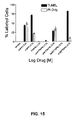
- FIG. 15 is a graph showing data obtained using a TUNEL assay to investigate cell apoptosis in MCF-7 cells after exposure to a single dose of various retinoid compounds for 72 hours.
- TTNPB 4-[(E)-2-(5,6,7,8-tetramethyl-2-napthalenyl)-1-propenyl]benzoic acid
- FIG. 1A The structure of 4-[(E)-2-(5,6,7,8-tetramethyl-2-napthalenyl)-1-propenyl]benzoic acid (TTNPB) is set forth in FIG. 1A .
- TTNPB and other analogs of retinoic acid show resistance to metabolism and possess significant chemotherapeutic activity modulating cell growth and apoptosis.
- TTNPB is a potent but toxic aromatic analog of retinoic acid.
- TTNPB selectively binds to the retinoic acid receptor (“RAR”).
- RXR retinoid X receptor
- Retinoic acid does, however, isomerize and bind to the RXR.
- 4-HPR The carboxylic acid group in the retinoic acid molecule is covalently linked (via an amide linkage) to a para-hydroxyphenyl amine thus yielding the 4-hydroxyphenylretinamide (“4-HPR”).
- 4-HPR has chemopreventative-chemotherapeutic activity against breast cancer.
- 4-HPR is also significantly less toxic than retinoic acid.
- 4-HPR inhibits growth of cancer cells by apoptosis.
- retinoic acid and TTNPB cause growth arrest by causing differentiation.
- 4-HPR may also show RAR-independent activity. (See U.S. Pat. No. 6,117,845).
- the carboxylic acid group of TTNPB is covalently linked (via an amide linkage) to a para-hydroxyphenyl amine thus yielding the 4-HPTTNPB.
- 3-propyl analogs of TTNPB and 4-HPTTNPB were synthesized (see, compounds 11 and 12 herein below). Without being bound to any theory, it appears that the 3-propyl analog of 4-HPTTNPB (compound 12) will not bind to the RAR even it is hydrolyzed in vivo to compound 11. It is further theorized that the 3-propyl analog of 4-HPTTNPB will not bind to the RAR protein for the same reason. As such, it is theorized that the 3-propyl analog of 4-HPTTNPB is sufficiently non-toxic for pharmaceutical use in humans (i.e., pharmaceutically suitable) because it will not bind to the RAR or RXR proteins.
- the ketone group in compounds 20, 21, 22, 23 (4-HBTTNPB), 25 (oxygen-linked glucuronide of 4-HBTTNPB), 29 (methylene-linked glucuronide of 4-HBTTNPB), 30 (methylene-linked glucose of 4-HBTTNPB), and 33 (oxygen-linked glucose of 4-HBTTNPB) functions similar to the amide group in 4-HPTTNPB.
- the glucose moiety may be any of the various moieties derived from an aldose such as a monosaccharide, a monocarboxylic acid, a dicarboxylic acid, a polyhydroxy alcohol or an aldehydo acid.
- glucuronic acid is an aldehydo acid that forms a glucuronide derivative moiety.
- the ketone group will also not bind to the RAR or RXR proteins.
- Compound 20 is E-4-[2-methyl-2-(1,1,4,4-tetramethyl-1,2,3,4-tetrahydronapth-7-yl)-vinyl]phenyl-2′-(4′-methoxyphenyl)-1′-ethanone.
- Compound 21 is E-4-[2-methyl-2-(1,1,4,4-tetramethyl-1,2,3,4-tetrahydronapth-7-yl)-vinyl]-phenyl-2′-(4′-isopropoxyphenyl)-1′-ethanone.
- Compound 22 is E-4-[2-methyl-2-(1,1,4,4-tetramethyl-1,2,3,4-tetrahydronapth-7-yl)-vinyl]-phenyl-2′-(4′-benzyloxyphenyl)-1′-ethanone.
- These ketone-containing compounds were synthesized as set forth herein below and exhibit potent activity inhibiting tumor cell proliferation such that they are suitable for the prophylactic treatment of breast cancer and for treating breast cancer.
- sugar-containing analog compounds 25, 29, 30 and 33 also have enhanced desirable properties such as solubility, bioavailability and low toxicity.
- 2,5-Dimethylhexane-2,5-diol and propyl benzene are commercially available from Aldrich Chemical Company, Milwaukee, Wis.
- Other reagents may be commercially available from, among others, Sigma-Aldrich, St. Louis, Mo. and Aldrich Chemical Company. Such reagents were prepared using known procedures or as set forth herein.
- 2,5-Dichloro-2,5-dimethylhexane (compound 2) was synthesized using a known procedure set forth in Bruson H et al., J Am Chem Soc, 62:36 (1940), whereby 50 g of 2,5-dimethylhexane-2,5-diol (compound 1) and 1 L of concentrated hydrochloric acid was used. Yield was measured quantitatively. Properties of compound 2 matched that reported in Bruson et al.
- 1,1,4,4-Tetramethyl-1,2,3,4-tetrahydronapthalene (compound 3) was synthesized using a known procedure set forth in Bruson et al. A Friedel-Crafts reaction was used, whereby 36 g of 2,5-dichloro-2,5-dimethylhexane (compound 2), 78 g of benzene, and 16 g of aluminum chloride was combined resulting in a 60% yield. Properties of compound 3 matched that reported in Bruson et al.
- Ethyl E-4-[2-methyl-2-(1,1,4,4-tetramethyl-1,2,3,4-tetrahydronapth-7-yl)-vinyl]-benzoate (compound 5) was synthesized using a known procedure set forth in Dawson M et al., J Org Chem, 49:5265 (1984), whereby 30 mL of 1.0 M NaCH 2 SOCH 3 (or, 27 mmol) was added to 10 g diethyl p-carboxyethylbenzylphosphonate with stirring.
- E-4-[2-methyl-2-(1,1,4,4-tetramethyl-1,2,3,4-tetrahydronapth-7-yl)-vinyl]-benzoic acid (TTNPB; compound 6) was synthesized by hydrolyzing ethyl E-4-[2-methyl-2-(1,1,4,4-tetramethyl-1,2,3,4-tetrahydronapth-7-yl)-vinyl]benzoate (compound 5) in 6M aqueous KOH. Yield was 90%. M p was 247-248° C. (from acetic acid).
- 1,2,3,4-Tetrahydro-1,1,4,4-tetramethyl-6-propylnapthalene (compound 8) was synthesized using a known procedure (see Boehm M et al., J Med Chem, 37:2930 (1994)) using 20 g of 2,5-dichloro-2,5-dimethylhexane (compound 2), 26.37 g of propyl benzene, and 0.2 g of aluminum chloride producing a 9% yield. Properties matched that described in Boehm et al.
- Ethyl E,Z-4-[2-methyl-2-(6-propyl-1,1,4,4-tetramethyl-1,2,3,4-tetrahydronapth-7-yl)-vinyl]-benzoates (compound 10) were synthesized according to the procedure set forth herein respecting compound 5. The resultant mixture was worked up and chromatographed using silica gel and 10% EtOAc/90% hexane to produce a mixture containing compound 10 as a colorless oil at a 16% yield. 1 H-NMR was used to characterize the product.
- E-4-[2-methyl-2-(6-propyl-1,1,4,4-tetramethyl-1,2,3,4-tetrahydronapth-7-yl)-vinyl]-benzoic acid (compound 11) was synthesized by hydrolysis of ethyl compound 10 in 6M aqueous KOH producing an 80% yield. 1 H NMR was used to confirm the identity of the product (see Frickel F et al., U.S. Pat. No.
- E-4-[2-methyl-2-(6-propyl-1,1,4,4-tetramethyl-1,2,3,4-tetrahydronapth-7-yl)-vinyl]-benzoic acid 4-hydroxyanilide (compound 12) was synthesized by according to the procedure herein. The resultant mixture was worked up, extracted with ether, washed with brine, and dried over MgSO 4 .
- the structure was confirmed using COSY, HMQC, and NOE diff.
- Methyl 4-hydroxyphenylacetate (compound 14) was prepared as follows. Compound 13 was esterified in methanol with sulfuric acid to produce compound 14 at a quantitative yield. Properties of the product matched those reported in Kuchar M et al., Collection of Czechoslovak Chemical Communications, 42:1723 (1977).
- Methyl 4-isopropoxyphenylacetate (compound 15) was synthesized by treating 3 g of compound 14 with 2.36 g of 2-bromopropane and 1.66 g of potassium carbonate in DMF at a 60% yield.
- Methyl 4-benzyloxyphenylacetate (compound 16) was synthesized by treating 2.47 g of compound 14 with 3.82 g of benzyl bromide and 4.11 g of potassium carbonate in DMF at 48% yield.
- Compound 22 was a white powder from acetic acid produced at a 60% yield.
- HPLC octadecylsilane 4.6 ⁇ 250 mm column, CH 3 OH/water 85:15, UV 310 nm and flow rate 1.0 mL/min.
- E-4-[2-methyl-2-(1,1,4,4-tetramethyl-1,2,3,4-tetrahydronapth-7-yl)-vinyl]-phenyl-2′-(4′-hydroxyphenyl)-1′-ethanone (compound 23) was synthesized by stirring a solution of 0.46 g (0.965 mmol) of compound 21 in 20 mL of dry CH 2 C 12 at ⁇ 20° C. To that solution, 0.28 g (2.413 mmol) of BCl 3 was added drop wise. The reaction mixture was warmed to room temperature and stirred for 30 minutes. The mixture was then poured into ice water, saturated with NaCl, and extracted with 30 mL of diethyl ether.
- bromo compound 24 is shown above, which was synthesized using a known procedure. (See Bollenback G N et al., J Am Chem Soc, 77:3310 (1955)).
- Compound 25 was synthesized from compounds 23 and 24 by first reacting with silver oxide and then reacting with potassium carbonate and methanol. Then, the reaction products are treated with sodium hydroxide in a mixture of methanol and water producing compound 25.
- 2,3,4,6-Tetra-O-(methoxymethyl)-D-gluconic acid- ⁇ -lactone (compound 26.2) was synthesized as follows. To a flame dried flask under argon atmosphere, 7.38 g (41.4 mmol) of ⁇ -gluconolactone (compound 26.1) was combined with 400 mL CH 2 Cl 2 . Compound 26.1 is available from Sigma-Aldrich, St. Louis, Mo. Upon cooling the suspension using an ice bath, diisopropylethylamine (57.6 mL, 331 mmol) was added drop wise. Then, chloromethyl methyl ether (50 g, 621 mmol) was carefully added via an addition funnel.
- the flask was equipped with a reflux condenser, heated to 75-80° C., and refluxed for 4.5 hours. The mixture was cooled to room temperature, then K 3 PO 4 (10 mL, 3 M) was added, and the reaction was allowed to stir for 10 minutes.
- p-Bromobenzyl alcohol (3.98 g, 21.3 mmol) and PdCl 2 (dppf) (0.686 g, 0.85 mmol) dissolved in DMF (100 mL) were added via addition funnel. The reaction was stirred for 18 hours. The reaction was diluted with water and ether. The layers were separated. The organic layer was washed with water and brine. The combined aqueous layers were extracted with ether (3 ⁇ ).
- KBr (2.42 g, 20.38 mmol) and TEMPO (3.19 g, 20.41 mmol) were added to saturated NaHCO 3 solution (400 mL) and stirred for 20 minutes at 0° C.
- Aqueous NaOCl (11.2 mL, 1.6-2.0 M) was added, and the mixture was stirred for 10 minutes.
- the deprotected sugar (formed by reacting the MOM-protected sugar compound 26.5 with HCl in methanol as described above) was dissolved in saturated NaHCO 3 solution (100 mL) and added to the flask containing the TEMPO mixture. That new total mixture was stirred for 45 minutes at 0° C.
- the reaction was quenched using EtOH (50 mL), and the reaction mixture was washed with ether in a separatory funnel. The aqueous layer was concentrated to dryness, and the remaining solid was exhaustively triturated with methanol. The methanol was concentrated and dried. The dried residue was suspended in DMF (180 mL). Iodomethane (6.4 g) dissolved in DMF (10 mL) was added, and the reaction mixture was stirred for 20 hours under argon at room temperature. The reaction mixture was supplemented with acetic anhydride (40 mL), pyridine (20 mL), and DMAP (15 mg) and stirred for 18 hours. The reaction mixture was diluted with water and extracted using ethyl acetate (3 ⁇ ).
- the flask was removed from the cold bath and quenched with 1 M NH 4 Cl (10 mL). The mixture was extracted with ethyl acetate (3 ⁇ ), the organic layers were combined, washed with brine, dried over Na 2 SO 4 , filtered, concentrated and chromatographed (2:1 hexanes/ethyl acetate) producing the alkylated product and some recovered compound 26.7.
- the alkylated product was taken up in 1% aqueous THF (200 mL) and chilled to 0° C. Tetra-n-butyl-ammonium fluoride (309 mg, 1.18 mmol) was added which darkened the solution. The solution was stirred for 1 hour.
- reaction mixture was diluted with water and extracted with ethyl acetate (3 ⁇ ). The organic layers were combined, washed with brine, dried over NaSO 4 , filtered, concentrated, and chromatographed (2:1 hexanes/ethyl acetate) producing the protected methyl ester of compound 29.
- the protected methyl ester of compound 29 (1.64 mmol) was dissolved in methanol (500 mL) and added to a flask. The mixture was cooled to 4° C. Potassium carbonate (136 mg, 0.98 mmol) was added to the flask and stirred for 20 hours. The reaction mixture was concentrated to about 200 mL at 25-30° C. Adjustment to the original volume using methanol was followed by adding 1 N KOH (14 mL, 14 mmol). After stirring for 20 hours at 4° C., the reaction mixture was warmed and stirred for 5 hours at room temperature. The reaction mixture was cooled to 0° C. and adjusted to 7 pH using 4 N HCl.
- reaction mixture was concentrated to about 100 mL at 25-30° C., cooled to 0° C., and adjusted to 3 pH using 1 N HCl.
- the suspension was extracted using ethyl acetate.
- the organic layers were combined, dried over Na 2 SO 4 under argon for 2 hours, and concentrated.
- the residue was chromatographed on reverse phase silica gel (gradient 70:30 to 85:15 methanol/water) producing compound 29.
- the reaction mixture was extracted using ethyl acetate (3 ⁇ ), the organic layers were combined, washed with brine, dried over Na 2 SO 4 , filtered, concentrated, and chromatographed (2:1 hexanes/ethyl acetate) producing the alkylated product and some recovered compound 26.9.
- the alkylated product was taken up in 1% aqueous THF (20 mL) and chilled to 0° C. TBAF (134 mg, 0.51 mmol) was added and the solution darkened. The darkened solution was stirred overnight while warming to room temperature.
- the reaction mixture was diluted with water and extracted with ethyl acetate (3 ⁇ ). The organic layers were combined, washed with brine, dried over NaSO 4 , filtered, concentrated, and chromatographed (2:1 hexanes/ethyl acetate) producing the acetate-protected analog of compound 30.
- the acetate protected analog of compound 30 (0.18 mmol) was dissolved in methanol (75 mL) and added to a flask. The mixture was cooled to 4° C. Potassium carbonate (25 mg, 0.18 mmol) was added to the flask, and the reaction was stirred for 20 hours. The reaction mixture was cooled to 0° C. and the pH was adjusted to 5 using 1 N HCl. The mixture was extracted using ethyl acetate, and the organic layers were combined, dried over Na 2 SO 4 under argon for 2 hours and concentrated. The residue was chromatographed on reverse phase silica gel (gradient 70:30 to 85:15 methanol/water) to provide compound 30.
- glycosyl trichloroacetimidate (compound 31) was synthesized according to the procedure set forth in Cheng H et al., J Med Chem, 48(2):645 (2005) with a quantitative yield. NMR 1 H.
- RAR/RXR Nuclear Retinoid Receptor Binding. Competition of retinoids with [ 3 H]-all-trans-RA for binding to RAR alpha , RAR beta and RAR gamma and with [ 3 H]-9-cis-RA for binding to RXR gamma was determined using an in vitro ligand binding assay. (See Clagett-Dame et al., Methods for generating and characterizing retinoid receptors from E. coli and insect cell expression systems, Meth. Enzymol., 282:13-14 (1997)). Recombinant human RAR alpha was expressed as a fusion protein in E.
- MCF-7 breast cancer cells were maintained as described in Chapman J S et al., Hydrolysis of 4-HPR to atRA occurs in vivo but is not required for retinamide-induced apoptosis, Arch Biochem Biophys, 419:234-243 (2003).
- the cells were plated at 50,000 cells/well in 12-well plates. The wells were dosed with varying amounts of retinoid compounds.
- propidium iodide was added.
- Half of the cells were used to determine the number of live and dead cells after adding fluorescein diacetate, which yields a fluorescent product upon cleavage by metabolically active cells. The other half were fixed in 4% paraformaldehyde, dried on aminosilane coated slides and used to determine TUNEL and propidium iodide staining.
- the F9-RARE-lacZ reporter cell line (see Wagner M et al., Development, 116:55-66 (1992)) was cultured in serum-free L15 medium (15,000 cells/well); dosed with retinoid compounds or vehicle; and assayed for chemiluminescence as described in Chapman J S et al., Hydrolysis of 4-HPR to atRA occurs in vivo but is not required for retinamide-induced apoptosis, Arch Biochem Biophys, 419:234-243 (2003). Data were normalized for total protein using the method set forth in Bradford M M, Anal Biochem, 72:248-254 (1976).
- mice Female rats (Harlan Sprague-Dawley, Madison, Wis. approximately 200 to 250 g in weight) were maintained on normal laboratory rat chow and mated with normal rats of the same strain. Pregnant rats were given a single oral bolus dose of compound dissolved in Wesson® corn oil. Each dose was 60-100 ⁇ L. The doses were given at day 9.25. Each dose was maintained under standard laboratory conditions until euthanasia at embryonic day 21.5. The fetuses were removed. Fetuses with a heartbeat were determined to be alive. The number of live and dead fetuses were recorded. The number of resorption sites was also recorded. The live fetuses were examined for gross external malformations. All animals were maintained in accordance with protocol approved by the University of Wisconsin-Madison animal care committee.
- the teratogenicity data is set forth in Table 1.
- TTNPB showed very weak competition at concentrations above 10 ⁇ 6 M (44% at 10 ⁇ 45 M) whereas 4-HPTTNPB and 4-HPR showed almost no competition with [ 3 H]-9-cis-RA for binding to the human RXR gamma at the highest concentration. (See FIG. 12 ).
- the F9 cell reporter assay yielded ⁇ -galactosidase activity in response to exposure of cells to atRA or any compound with similar transactivation potential. That results from ligands binding to the RAR. It also results from activation of ⁇ -galactosidase via the retinoid receptor complex binding to the ⁇ RARE enhancer (hormone response) element situated upstream of the promoter/enhancer cassette.
- ⁇ RARE enhancer hormone response
- 4-HPTTNPB was around 100-fold less potent than atRA and TTNPB in the reporter assay. Because 4-HPTTNPB did not show any significant binding to the RAR proteins, the activity in the reporter gene assay may be due to partial hydrolysis of 4-HPTTNPB to TTNPB, which is active in this system. (See FIG. 13 ).
- MCF-7 cells were treated with varying concentrations of retinoids at the start of the assay and maintained in culture for 72 hours after which the number of live (viable) and total (viable+dead) cells were determined.
- the response of cells to micromolar doses of 4-HPR was cell death, whereas TTNPB was nearly ineffective in causing the death of cells.
- Exposure of cells to increasing concentrations of 4-HPTTNPB or 4-HBTTNPB resulted in a dose-dependent decrease in the total number of live cells after 72 hours. (See FIG. 14 ).
- the TUNEL assay (which measures DNA fragmentation) was used to determine whether any of the tested compounds induced cellular apoptosis.
- Propidium iodide staining (in the absence of TUNEL labeling) was used to measure the number of cells exhibiting necrosis or late-stage aptosis.
- 4-HPR induced a high degree of apoptosis in MCF-7 cells at the concentrations tested. (See Chapman J S et al., Hydrolysis of 4-HPR to atRA occurs in vivo but is not required for retinamide-induced apoptosis, Arch Biochem Biophys, 419, pp. 234-243 (2003)).
- TTNPB was ineffective at inducing DNA fragmentation after 72 hours, whereas both 4-HPTTNPB and 4-HBTTNPB at the highest doses were very active at inducing apoptosis after 72 hours. (See FIG. 15 ).
- modification of the TTNPB molecule in that fashion produced a dramatic and unexpectedly superior improvement in biological characteristics and activity.
- TTNPB-like activity in cell culture may result from hydrolysis of 4-HPTTNPB liberating small amounts of TTNPB.
- 4-HPTTNPB may induce cell apoptosis reflecting activity of intact 4-HPTTNPB or an unknown metabolite thereof mirroring activity similar to 4-HPR. This is supported by the activity of the non-hydrolyzable analog, 4-HBTTNPB, which induces apoptosis at similar concentrations, but cannot liberate TTNPB.
- MCF-7 human mammary carcinoma cell line
- DMEM Sigma-Aldrich
- Assay for cell growth inhibition Cells are plated in flasks/wells of a tissue culture dish. After 24 hours, cells are dosed with a compound of the present invention at varying concentrations, and after 72 hours, the cells are removed from flasks/plates and counted. Fluorescence (due to staining of cells with fluorescein diacetate) was used to count the number of live cells. Phase-contrast microscopy is used to count the total number of cells.
- Anti-proliferative activity of compounds 12, 23, 25, 29, 30 and 33 may be determined using the protocol set forth herein. The data would show that each compound inhibits growth of MCF-7 cells in a dose-dependent manner. The data would also demonstrate the utility of each compound to inhibit cancer cell growth.
- Competition binding studies may also be performed as set forth herein using compounds 23 (4-HBTTNPB), 12 (propyl analog of 4-HPTTNPB), 25 (O-linked glucuronide of 4-HBTTNPB), 29 (CH 2 -linked glucuronide of 4-HBTTNPB), 30 (CH 2 -linked glucose of 4-HBTTNPB) and 33 (O-linked glucose of 4-HBTTNPB) and comparing these results to those obtained for 4-HPTTNPB.
- Reporter gene assay studies may be performed as set forth herein using compounds 23 (4-HBTTNPB), 12 (propyl analog of 4-HPTTNPB), 25 (O-linked glucuronide of 4-HBTTNPB), 29 (CH 2 -linked glucuronide of 4-HBTTNPB), 30 (CH 2 -linked glucose of 4-HBTTNPB) and 33 (O-linked glucose 4-HBTTNPB).
- the results may be compared to data obtained concerning 4-HPTTNPB which is set forth below.
- Compound 23 may be less active than 4-HPTTNPB (unable to undergo hydrolysis).
- Compound 12 may also be less active than 4-HPTTNPB, and it may liberate a metabolite that is inactive at RAR binding.
- Compounds 25, 29, 30 and 33 may be less active than 4-HPTTNPB.
- Cell growth inhibition assays may be performed as set forth herein using compounds 23 (4-HBTTNPB), 12 (propyl analog of 4-HPTTNPB), 25 (O-linked glucuronide of 4-HBTTNPB), 29 (CH 2 -linked glucuronide of 4-HBTTNPB), 30 (CH 2 -linked glucose of 4-HBTTNPB) and 33 (O-linked glucose of 4-HBTTNPB).
- the data may be compared to data concerning 4-HPTTNPB which is set forth below.
- Compound 23 is similar in activity to 4-HPTTNPB (unable to undergo hydrolysis).
- Compound 12 may also be less active than 4-HPTTNPB, and it may liberate a metabolite that was RAR inactive at binding.
- Compounds 25 and 29 are less active than 4-HPTTNPB, and compounds 30 and 33 are similar in activity to 4-HPTTNPB.
- DNA fragmentation studies may be performed as set forth herein using compound 23 (4-HBTTNPB).
- Compound 23 may possess activity similar to 4-HPTTNPB in the DNA fragmentation study.
- Compounds 25 and 29 are less active than 4-HPTTNPB, and compounds 30 and 33 are similar in activity to 4-HPTTNPB.
- Studies investigating the inhibition of DMBA-induced mammary tumors may be performed using compounds 23 (4-HBTTNPB), 25 (O-linked glucuronide of 4-HBTTNPB), 29 (CH 2 -linked glucuronide of 4-HBTTNPB), 30 (CH 2 -linked glucose of 4-HBTTNPB), and 33 (O-linked glucose of 4-HBTTNPB.
- Compounds 23, 25, 29, 30 and 33 may be active and demonstrate little, if any, toxicity.
- the compounds of the present invention are useful in treating cellular proliferative disorders such as breast cancer.
Landscapes
- Chemical & Material Sciences (AREA)
- Organic Chemistry (AREA)
- Health & Medical Sciences (AREA)
- Life Sciences & Earth Sciences (AREA)
- General Health & Medical Sciences (AREA)
- Engineering & Computer Science (AREA)
- Biochemistry (AREA)
- Biotechnology (AREA)
- Genetics & Genomics (AREA)
- Molecular Biology (AREA)
- Crystallography & Structural Chemistry (AREA)
- Veterinary Medicine (AREA)
- Medicinal Chemistry (AREA)
- Nuclear Medicine, Radiotherapy & Molecular Imaging (AREA)
- Pharmacology & Pharmacy (AREA)
- Animal Behavior & Ethology (AREA)
- Public Health (AREA)
- General Chemical & Material Sciences (AREA)
- Chemical Kinetics & Catalysis (AREA)
- Organic Low-Molecular-Weight Compounds And Preparation Thereof (AREA)
- Acyclic And Carbocyclic Compounds In Medicinal Compositions (AREA)
- Saccharide Compounds (AREA)
- Pyrane Compounds (AREA)
- Pharmaceuticals Containing Other Organic And Inorganic Compounds (AREA)
Priority Applications (2)
| Application Number | Priority Date | Filing Date | Title |
|---|---|---|---|
| US11/428,165 US7585894B2 (en) | 2005-06-30 | 2006-06-30 | 4-[(E)-2-(5,6,7,8-tetrahydro-5,5,8,8-tetramethyl-2-napthalenyl)-1-propenyl]benzoic acid analogs and method of manufacture and use thereof |
| US12/533,354 US7968602B2 (en) | 2005-06-30 | 2009-07-31 | 4-[(E)-2-(5,6,7,8-tetrahydro-5,5,8,8-tetramethyl-2-napthalenyl)-1-propenyl]benzoic acid analogs and method of manufacture and use thereof |
Applications Claiming Priority (2)
| Application Number | Priority Date | Filing Date | Title |
|---|---|---|---|
| US69556405P | 2005-06-30 | 2005-06-30 | |
| US11/428,165 US7585894B2 (en) | 2005-06-30 | 2006-06-30 | 4-[(E)-2-(5,6,7,8-tetrahydro-5,5,8,8-tetramethyl-2-napthalenyl)-1-propenyl]benzoic acid analogs and method of manufacture and use thereof |
Related Child Applications (1)
| Application Number | Title | Priority Date | Filing Date |
|---|---|---|---|
| US12/533,354 Continuation US7968602B2 (en) | 2005-06-30 | 2009-07-31 | 4-[(E)-2-(5,6,7,8-tetrahydro-5,5,8,8-tetramethyl-2-napthalenyl)-1-propenyl]benzoic acid analogs and method of manufacture and use thereof |
Publications (2)
| Publication Number | Publication Date |
|---|---|
| US20070015717A1 US20070015717A1 (en) | 2007-01-18 |
| US7585894B2 true US7585894B2 (en) | 2009-09-08 |
Family
ID=37604800
Family Applications (2)
| Application Number | Title | Priority Date | Filing Date |
|---|---|---|---|
| US11/428,165 Expired - Fee Related US7585894B2 (en) | 2005-06-30 | 2006-06-30 | 4-[(E)-2-(5,6,7,8-tetrahydro-5,5,8,8-tetramethyl-2-napthalenyl)-1-propenyl]benzoic acid analogs and method of manufacture and use thereof |
| US12/533,354 Expired - Fee Related US7968602B2 (en) | 2005-06-30 | 2009-07-31 | 4-[(E)-2-(5,6,7,8-tetrahydro-5,5,8,8-tetramethyl-2-napthalenyl)-1-propenyl]benzoic acid analogs and method of manufacture and use thereof |
Family Applications After (1)
| Application Number | Title | Priority Date | Filing Date |
|---|---|---|---|
| US12/533,354 Expired - Fee Related US7968602B2 (en) | 2005-06-30 | 2009-07-31 | 4-[(E)-2-(5,6,7,8-tetrahydro-5,5,8,8-tetramethyl-2-napthalenyl)-1-propenyl]benzoic acid analogs and method of manufacture and use thereof |
Country Status (6)
| Country | Link |
|---|---|
| US (2) | US7585894B2 (https=) |
| EP (1) | EP1896392A4 (https=) |
| JP (1) | JP2008545013A (https=) |
| AU (1) | AU2006265971A1 (https=) |
| CA (1) | CA2611684A1 (https=) |
| WO (1) | WO2007005568A1 (https=) |
Cited By (1)
| Publication number | Priority date | Publication date | Assignee | Title |
|---|---|---|---|---|
| US20100029777A1 (en) * | 2005-06-30 | 2010-02-04 | Curley Jr Robert W | 4-[(e)-2-(5,6,7,8-tetrahydro-5,5,8,8-tetramethyl-2-napthalenyl)-1-propenyl]benzoic acid analogs and method of manufacture and use thereof |
Families Citing this family (2)
| Publication number | Priority date | Publication date | Assignee | Title |
|---|---|---|---|---|
| JP2011500783A (ja) * | 2007-10-22 | 2011-01-06 | オーキッド リサーチ ラボラトリーズ リミテッド | ヒストンデアセチラーゼ阻害剤 |
| US10472457B2 (en) | 2016-01-21 | 2019-11-12 | The University Of Akron | Initiators for living carbocationic polymerization |
Citations (3)
| Publication number | Priority date | Publication date | Assignee | Title |
|---|---|---|---|---|
| US4326055A (en) | 1977-12-22 | 1982-04-20 | Hoffmann-La Roche Inc. | Stilbene derivatives |
| US5516792A (en) | 1992-11-13 | 1996-05-14 | Ohio State Research Foundation | C-glycoside analogues of N-(4-hydroxyphenyl)retinamide-O-glucuronide |
| US6117845A (en) | 1999-06-11 | 2000-09-12 | Ohio State University Research Foundation | C-linked analogs of N-(4-hydroxyphenyl) retinamide |
Family Cites Families (6)
| Publication number | Priority date | Publication date | Assignee | Title |
|---|---|---|---|---|
| DE3202100A1 (de) * | 1982-01-23 | 1983-08-04 | Basf Ag, 6700 Ludwigshafen | Substituierte benzoesaeure-4-hydroxyanilide, ihre herstellung und diese enthaltende pharmazeutische zubereitungen |
| DE3202065A1 (de) * | 1982-01-23 | 1983-08-04 | Basf Ag, 6700 Ludwigshafen | Substituierte n-(tetrazol-5-yl)-benzoesaeureamide, ihre herstellung und diese enthaltende pharmazeutische zubereitungen |
| LU85558A1 (fr) * | 1984-09-28 | 1986-04-03 | Oreal | Nouveaux derives naphtaleniques a action retinoique,leurs procedes de preparation et compositions medicamenteuse et cosmetique les contenant |
| US5326898A (en) * | 1992-02-11 | 1994-07-05 | Allergan, Inc. | Substituted phenylethenyl compounds having retinoid-like biological activity |
| JP2005020400A (ja) * | 2003-06-26 | 2005-01-20 | Hitachi Communication Technologies Ltd | 無線基地局、無線通信システム、無線基地局の通信制御方法、および、無線通信網の構築方法 |
| EP1896392A4 (en) | 2005-06-30 | 2010-06-02 | Wisconsin Alumni Res Found | 4 - [(E) -2- [5,6,7,8-TETRAHYDRO-5,5,8,8-TETRAMETHYL-2-NAPTHALENYL) -1-PROPENYL] BENZOIC ACID ANALOGUE AND METHOD FOR THE PRODUCTION AND USE THEREOF |
-
2006
- 2006-06-30 EP EP06774321A patent/EP1896392A4/en not_active Withdrawn
- 2006-06-30 AU AU2006265971A patent/AU2006265971A1/en not_active Abandoned
- 2006-06-30 WO PCT/US2006/025507 patent/WO2007005568A1/en not_active Ceased
- 2006-06-30 JP JP2008520299A patent/JP2008545013A/ja active Pending
- 2006-06-30 US US11/428,165 patent/US7585894B2/en not_active Expired - Fee Related
- 2006-06-30 CA CA002611684A patent/CA2611684A1/en not_active Abandoned
-
2009
- 2009-07-31 US US12/533,354 patent/US7968602B2/en not_active Expired - Fee Related
Patent Citations (6)
| Publication number | Priority date | Publication date | Assignee | Title |
|---|---|---|---|---|
| US4326055A (en) | 1977-12-22 | 1982-04-20 | Hoffmann-La Roche Inc. | Stilbene derivatives |
| US5516792A (en) | 1992-11-13 | 1996-05-14 | Ohio State Research Foundation | C-glycoside analogues of N-(4-hydroxyphenyl)retinamide-O-glucuronide |
| US5574177A (en) | 1992-11-13 | 1996-11-12 | The Ohio State Research Foundation | Arylamide analogues of N-(4-hydroxyphenyl) retinamide-o-glucuronide |
| US5599953A (en) | 1992-11-13 | 1997-02-04 | The Ohio State Research Foundation | C-glycoside analogues of N-(4-hydroxyphenyl)retinamide-O-glucuronide |
| US5663377A (en) | 1992-11-13 | 1997-09-02 | The Ohio State Research Foundation | C-glycoside analogues of N-(4-hydroxyphenyl) retinamide-O-glucuronide |
| US6117845A (en) | 1999-06-11 | 2000-09-12 | Ohio State University Research Foundation | C-linked analogs of N-(4-hydroxyphenyl) retinamide |
Non-Patent Citations (5)
| Title |
|---|
| A. Krust, PH. Kastner, M. Petkovich, A. Zelent and P. Chambon; A Third Human Retinoic Acid Receptor, hRAR-y; Proc. Natl. Acad. Sci. USA, vol. 86, pp. 5310-5314, Jul. 1989. |
| Agents in Oncology; Pure Appl. Chem., vol. 73, No. 9, pp. 1437-1444, 2001. |
| Daniele Simoni, Riccardo Randanin, Riccardo Baruchello, Marinella Roberti, Marcello Rossi, Stefani Grimaudo, Natale D'Alessandro, Francesco Paolo Invidiata, and Manlio Tolomeo. |
| Lotan et al. J. Nutr. Growth Cancer (1983) vol. 1, No. 2, pp. 71-76. * |
| Retinoic Acid and Analogs as Potent Inducers of Differentiation and Apoptosis. New Promising Chemopreventive and Chemotherapeutic. |
Cited By (2)
| Publication number | Priority date | Publication date | Assignee | Title |
|---|---|---|---|---|
| US20100029777A1 (en) * | 2005-06-30 | 2010-02-04 | Curley Jr Robert W | 4-[(e)-2-(5,6,7,8-tetrahydro-5,5,8,8-tetramethyl-2-napthalenyl)-1-propenyl]benzoic acid analogs and method of manufacture and use thereof |
| US7968602B2 (en) | 2005-06-30 | 2011-06-28 | Wisconsin Alumni Research Foundation | 4-[(E)-2-(5,6,7,8-tetrahydro-5,5,8,8-tetramethyl-2-napthalenyl)-1-propenyl]benzoic acid analogs and method of manufacture and use thereof |
Also Published As
| Publication number | Publication date |
|---|---|
| US7968602B2 (en) | 2011-06-28 |
| CA2611684A1 (en) | 2007-01-11 |
| AU2006265971A1 (en) | 2007-01-11 |
| JP2008545013A (ja) | 2008-12-11 |
| WO2007005568A1 (en) | 2007-01-11 |
| EP1896392A1 (en) | 2008-03-12 |
| EP1896392A4 (en) | 2010-06-02 |
| US20100029777A1 (en) | 2010-02-04 |
| US20070015717A1 (en) | 2007-01-18 |
Similar Documents
| Publication | Publication Date | Title |
|---|---|---|
| US5516792A (en) | C-glycoside analogues of N-(4-hydroxyphenyl)retinamide-O-glucuronide | |
| JP4456768B2 (ja) | C−配糖体を含有する薬剤 | |
| TW200811126A (en) | Glucopyranosyl-substituted benzonitrile derivatives, pharmaceutical compositions containing such compounds, their use and process for their manufacture | |
| JP2017519756A (ja) | ガレクチンの新規ハイブリッドガラクトシド阻害剤 | |
| US7968602B2 (en) | 4-[(E)-2-(5,6,7,8-tetrahydro-5,5,8,8-tetramethyl-2-napthalenyl)-1-propenyl]benzoic acid analogs and method of manufacture and use thereof | |
| CA2403900C (en) | Substituted chalcones as therapeutic compounds | |
| JPH09188625A (ja) | 医薬組成物 | |
| JP5529280B2 (ja) | 癌治療用のジ(フェニルプロパノイド)・グリセロール誘導体 | |
| IL102500A (en) | 3-deoxy-mannosamine derivatives their preparation and pharmaceutical compositions containing them | |
| EP0732329B1 (en) | Chroman derivative | |
| EP0732921A1 (en) | C-glycoside analogues of n-(4-hydroxyphenyl)retinamide-o-glucuronide | |
| KR100406736B1 (ko) | 나프토퀴논계 화합물을 포함하는 항암제 | |
| US5716982A (en) | Retinoids and methods of use of same | |
| US9359322B2 (en) | C-linked glucuronide of N-(4-hydroxybenzyl) retinone, analogs thereof, and methods of using the same to inhibit neoplastic cell growth | |
| JP4991537B2 (ja) | シス−1,2−置換スチルベン誘導体、および糖尿病の治療および/または予防のための薬剤の製造におけるそれらの使用 | |
| TW455575B (en) | Novel 7-aryl-6(Z)-heptatrienoic acid retinamides | |
| US20240115589A1 (en) | Pharmaceutical composition for preventing cytokine storm | |
| CA2463084C (en) | Preparation and use of carbohydrate-based bicyclic ring structures with antimicrobial and cytostatic activity | |
| US5968940A (en) | Retinoids and methods of use of same | |
| US5495005A (en) | Synthesis and pharmacological activity of a series of novel xanthone derivatives | |
| CN1226300C (zh) | 一种布洛芬糖缀合物及其制备方法和应用 | |
| JP4535238B2 (ja) | プシコースのレチノイン酸エステル及びその製造方法 | |
| CN120647521A (zh) | 一类a环具有异戊烯基的醌式查尔酮及其抗糖尿病用途 | |
| JPH051004A (ja) | 安息香酸誘導体 | |
| JPH0729921B2 (ja) | 骨粗鬆症治療剤 |
Legal Events
| Date | Code | Title | Description |
|---|---|---|---|
| AS | Assignment |
Owner name: WISCONSIN ALUMNI RESEARCH FOUNDATION, WISCONSIN Free format text: ASSIGNMENT OF ASSIGNORS INTEREST;ASSIGNOR:CLAGETT-DAME, MARGARET;REEL/FRAME:018466/0040 Effective date: 20060906 |
|
| AS | Assignment |
Owner name: UNIVERSITY OF CALIFORNIA - LOS ANGELES, CALIFORNIA Free format text: ASSIGNMENT OF ASSIGNORS INTEREST;ASSIGNOR:COLLINS, MICHAEL D.;REEL/FRAME:021345/0698 Effective date: 20080725 |
|
| AS | Assignment |
Owner name: OHIO STATE RESEARCH FOUNDATION, OHIO Free format text: ASSIGNMENT OF ASSIGNORS INTEREST;ASSIGNORS:CURLEY, ROBERT W., JR.;ABZIANIDZE, VICTORIA V.;REEL/FRAME:021415/0666;SIGNING DATES FROM 20080728 TO 20080801 |
|
| AS | Assignment |
Owner name: NATIONAL INSTITUTES OF HEALTH (NIH), U.S. DEPT. OF Free format text: CONFIRMATORY LICENSE;ASSIGNOR:UNIVERSITY OF WISCONSIN MADISON;REEL/FRAME:023096/0362 Effective date: 20090812 |
|
| STCF | Information on status: patent grant |
Free format text: PATENTED CASE |
|
| AS | Assignment |
Owner name: UNIVERSITY OF CALIFORNIA-LOS ANGELES, CALIFORNIA Free format text: ASSIGNMENT OF ASSIGNORS INTEREST;ASSIGNOR:COLLINS, MICHAEL D.;REEL/FRAME:023784/0457 Effective date: 20080725 |
|
| FPAY | Fee payment |
Year of fee payment: 4 |
|
| FPAY | Fee payment |
Year of fee payment: 8 |
|
| CC | Certificate of correction | ||
| FEPP | Fee payment procedure |
Free format text: MAINTENANCE FEE REMINDER MAILED (ORIGINAL EVENT CODE: REM.); ENTITY STATUS OF PATENT OWNER: SMALL ENTITY |
|
| LAPS | Lapse for failure to pay maintenance fees |
Free format text: PATENT EXPIRED FOR FAILURE TO PAY MAINTENANCE FEES (ORIGINAL EVENT CODE: EXP.); ENTITY STATUS OF PATENT OWNER: SMALL ENTITY |
|
| STCH | Information on status: patent discontinuation |
Free format text: PATENT EXPIRED DUE TO NONPAYMENT OF MAINTENANCE FEES UNDER 37 CFR 1.362 |
|
| FP | Lapsed due to failure to pay maintenance fee |
Effective date: 20210908 |