US6462885B2 - Zoom lens and photographing apparatus having the same - Google Patents
Zoom lens and photographing apparatus having the same Download PDFInfo
- Publication number
- US6462885B2 US6462885B2 US09/729,823 US72982300A US6462885B2 US 6462885 B2 US6462885 B2 US 6462885B2 US 72982300 A US72982300 A US 72982300A US 6462885 B2 US6462885 B2 US 6462885B2
- Authority
- US
- United States
- Prior art keywords
- lens
- refractive power
- subunit
- represented
- zoom
- Prior art date
- Legal status (The legal status is an assumption and is not a legal conclusion. Google has not performed a legal analysis and makes no representation as to the accuracy of the status listed.)
- Expired - Lifetime, expires
Links
- 230000003287 optical effect Effects 0.000 claims abstract description 41
- 239000002131 composite material Substances 0.000 claims description 10
- 230000004075 alteration Effects 0.000 description 55
- 230000002265 prevention Effects 0.000 description 7
- 238000006073 displacement reaction Methods 0.000 description 5
- 238000003384 imaging method Methods 0.000 description 4
- 230000000694 effects Effects 0.000 description 3
- 230000011514 reflex Effects 0.000 description 3
- 206010010071 Coma Diseases 0.000 description 2
- 239000011521 glass Substances 0.000 description 2
- 238000010586 diagram Methods 0.000 description 1
- 239000000463 material Substances 0.000 description 1
- 230000002093 peripheral effect Effects 0.000 description 1
- 230000003449 preventive effect Effects 0.000 description 1
Images
Classifications
-
- G—PHYSICS
- G02—OPTICS
- G02B—OPTICAL ELEMENTS, SYSTEMS OR APPARATUS
- G02B27/00—Optical systems or apparatus not provided for by any of the groups G02B1/00 - G02B26/00, G02B30/00
- G02B27/64—Imaging systems using optical elements for stabilisation of the lateral and angular position of the image
- G02B27/646—Imaging systems using optical elements for stabilisation of the lateral and angular position of the image compensating for small deviations, e.g. due to vibration or shake
-
- G—PHYSICS
- G02—OPTICS
- G02B—OPTICAL ELEMENTS, SYSTEMS OR APPARATUS
- G02B15/00—Optical objectives with means for varying the magnification
- G02B15/14—Optical objectives with means for varying the magnification by axial movement of one or more lenses or groups of lenses relative to the image plane for continuously varying the equivalent focal length of the objective
- G02B15/144—Optical objectives with means for varying the magnification by axial movement of one or more lenses or groups of lenses relative to the image plane for continuously varying the equivalent focal length of the objective having four groups only
- G02B15/1441—Optical objectives with means for varying the magnification by axial movement of one or more lenses or groups of lenses relative to the image plane for continuously varying the equivalent focal length of the objective having four groups only the first group being positive
- G02B15/144113—Optical objectives with means for varying the magnification by axial movement of one or more lenses or groups of lenses relative to the image plane for continuously varying the equivalent focal length of the objective having four groups only the first group being positive arranged +-++
Definitions
- the present invention relates to a zoom lens having fluctuation prevention function and a photographing apparatus provided with the zoom lens.
- the present invention relates to a zoom lens having fluctuation prevention function and a photographing apparatus, which can be preferably applied to a still camera, a video camera, a digital camera, etc., and which is designed to allow a lens group, i.e., a part of the zoom lens, to be moved in a direction perpendicular to an optical axis so as to optically correct a blur of a photographed still image caused by the fluctuating motion (inclined motion) of the zoom lens due to hand fluctuation or the like, thereby obtaining a stabilized photographed image.
- a zoom lens having fluctuation prevention function has been required to correct the image blur caused due to hand fluctuation or the like for the purpose of obtaining a higher quality image and enlarging applicable photographing conditions.
- Japanese Patent Application Laid-Open No. 9-230236 discloses a four-lens-group zoom lens in which positive, negative, positive and positive refractive power lens groups are arranged in this order from an object side, and in which the third lens group is divided into a positive refractive power front lens group and a positive refractive power rear lens group, and the rear lens group is moved perpendicularly to an optical axis to correct the image blur.
- Japanese Patent Application Laid-Open No. 9-230236 discloses a four-lens-group zoom lens in which positive, negative, positive and positive refractive power lens groups are arranged in this order from an object side, and in which the third lens group is divided into a positive refractive power front lens group and a positive refractive power rear lens group, and the rear lens group is moved perpendicularly to an optical axis to correct the image blur.
- 10-232420 discloses a four-lens-group zoom lens, primarily applied to a video camera, in which positive, negative, positive and positive refractive power lens groups are arranged with the first and third lens groups to be fixed, and in which the third lens group is divided into a positive refractive power lens group and a negative refractive power lens group, and either one of these lens groups is moved in a direction perpendicular to an optical axis to correct image blur.
- Japanese Patent Application Laid-Open No. 7-128619 discloses a magnification changeable optical system having four lens groups, which is provided, sequentially from an object side, with a first group having a positive refractive power fixed during the change of magnification and the in-focusing condition, a second group with a negative refractive power, having a magnification changing function, an aperture diaphragm, a third group with a positive refractive power, and a fourth group with a positive refractive power, that has both correction a function for correcting an image plane that varies depending on the change of magnification, and an in-focusing function.
- the third group is constructed of two lens groups, i.e., a third-1 group with a negative refractive power, and a third-2 group with a positive refractive power, and the third-2 group is moved in a direction perpendicular to an optical axis to correct blur of the photographed image caused by fluctuation of the magnification changeable optical system.
- Japanese Patent Application Laid-Open No. 7-199124 discloses a magnification changeable optical system constructed of four groups, i.e., positive, negative, positive and positive refractive power lens groups, in which the third lens group entirely is fluctuated perpendicularly to an optical axis for the purpose of fluctuation prevention.
- an optical system which is designed to parallell offset a part of lens of a photographing system in a direction perpendicular to an optical axis to correct the image blur, can advantageously realize the correction of the image blur in a relatively simple fashion, but requires driving means for driving the lens to be moved. Further, the system provides the result in an increased amount of offset aberration occurring during fluctuation prevention.
- a correction lens group for correcting the image blur is large in its number of constituting lenses and weight, a large torque is required when electrically driving the same. Further, if the correction lens group for correcting the image blur is set inappropriately, the correction optical system requires a large amount of its movement in order to obtain an image-blur correcting effect of a certain degree, making the entire optical system large in size.
- An object of the present invention is to provide a zoom lens and a photographing apparatus using the zoom lens, in which a relatively small and light-weight lens group forming a part of the zoom lens is moved in a direction perpendicular to an optical axis to correct image blur due to fluctuation (inclination) of the zoom lens, and in which the lens arrangement for the zoom lens is optimized to realize a zoom lens that is compact in size, has a simple mechanism, is small in the load applied to driving means, and that can effectively correct certain image blurring with a small amount of displacement of the lens group.
- a zoom lens which includes:
- the third lens unit includes a first lens subunit with a positive refractive power, and a second lens subunit with a negative refractive power, and the second lens subunit is moved to have at least a perpendicular vector component with respect to the optical axis to thereby displace an image.
- focal lengths of the entire system at a wide angle end and a telephoto end are respectively represented by Fw and Ft
- the focal length of the third lens unit is represented by F3
- the focal length of the second lens subunit is represented by F32
- Fm (Fw ⁇ Ft) 1 ⁇ 2 .
- the second lens subunit is moved to have a perpendicular vector component with respect to the optical axis to thereby correct image blur caused by fluctuation of the zoom lens.
- Ra radius of curvature of a lens plane located closest to an image plane side within the first lens subunit
- Rb radius of curvature of a lens plane located closest to the object side within the second lens subunit
- the second lens subunit includes one positive lens and one negative lens.
- the first lens subunit includes, from the object side, a composite lens with a positive refractive power, in which a meniscus-like negative lens having a concave surface on an image plane side is adhered to a positive lens, and a composite lens with a positive single lens or a positive refractive power, in which a positive lens is adhered to a negative lens.
- the second lens subunit includes a composite lens with a negative refractive power, in which a positive lens having a convex surface oriented to an image plane side is adhered to a negative lens having a concave surface oriented to the object side.
- the third lens unit further includes a third lens subunit having a negative or positive refractive power on an image plane side of the second lens subunit.
- the present invention provides, as another form, a photographing apparatus which includes:
- the third lens unit includes a first lens subunit with a positive refractive power, and a second lens subunit with a negative refractive power, and the second lens subunit is moved to have at least a perpendicular vector component with respect to the optical axis to thereby displace an image.
- the focal lengths of the entire system at a wide angle end and a telephoto end are respectively represented by Fw and Ft
- the focal length of the third lens unit is represented by F3
- the focal length of the second lens subunit is represented by F32
- Fm (Fw ⁇ Ft) 1 ⁇ 2 .
- the second lens subunit is moved to have a perpendicular vector component with respect to the optical axis to thereby correct image blur caused due to fluctuation of the zoom lens.
- Ra radius of curvature of a lens plane located closest to an image plane side within the first lens subunit
- Rb radius of curvature of a lens plane located closest to the object side within the second lens subunit
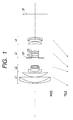
- FIG. 1 is a sectional view showing a lens of a wide angle end according to a numerical first embodiment of the present invention
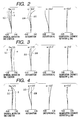
- FIG. 2 is a view showing aberration at the wide angle end under a normal condition according to the numerical first embodiment of the present invention
- FIG. 3 is a view showing aberration at a middle under a normal condition according to the numerical first embodiment of the present invention.
- FIG. 4 is a view showing aberration at a telephoto end under a normal condition according to the numerical first embodiment of the present invention
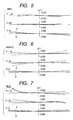
- FIG. 5 is a view showing aberration at the wide angle end with correction for image blur corresponding to an 0.3 degree field angle according to the numerical first embodiment of the present invention
- FIG. 6 is a view showing aberration at the middle with correction for image blur corresponding to a 0.3 degree field angle according to the numerical first embodiment of the present invention
- FIG. 7 is a view showing aberration at the telephoto end with correction for image blur corresponding to a 0.3 degree field angle according to the numerical first embodiment of the present invention
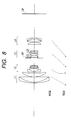
- FIG. 8 is a sectional view showing a lens of a wide angle end according to a numerical second embodiment of the present invention.
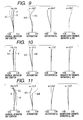
- FIG. 9 is a view showing aberration at the wide angle end under a normal condition according to the numerical second embodiment of the present invention.
- FIG. 10 is a view showing aberration at a middle under a normal condition according to the numerical second embodiment of the present invention.
- FIG. 11 is a view showing aberration at a telephoto end under a normal condition according to the numerical second embodiment of the present invention.
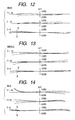
- FIG. 12 is a view showing aberration at the wide angle end with correction for an image blur corresponding to a 0.3 degree field angle according to the numerical second embodiment of the present invention.
- FIG. 13 is a view showing aberration at the middle with correction for an image blur corresponding to a 0.3 degree field angle according to the numerical second embodiment of the present invention.
- FIG. 14 is a view showing aberration at the telephoto end with correction for an image blur corresponding to a 0.3 degree field angle according to the numerical second embodiment of the present invention.
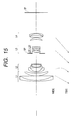
- FIG. 15 is a sectional view showing a lens of a wide angle end according to a numerical third embodiment of the present invention.
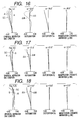
- FIG. 16 is a view showing aberration at the wide angle end under a normal condition according to the numerical third embodiment of the present invention.
- FIG. 17 is a view showing aberration at the middle under a normal condition according to the numerical third embodiment of the present invention.
- FIG. 18 is a view showing aberration at a telephoto end under a normal condition according to the numerical third embodiment of the present invention.
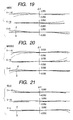
- FIG. 19 is a view showing aberration at the wide angle end with correction for an image blur corresponding to a 0.3 degree field angle according to the numerical third embodiment of the present invention.
- FIG. 20 is a view showing aberration at the middle with correction for an image blur corresponding to a 0.3 degree field angle according to the numerical third embodiment of the present invention.
- FIG. 21 is a view showing aberration at the telephoto end with correction for an image blur corresponding to a 0.3 degree field angle according to the numerical third embodiment of the present invention.
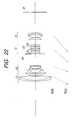
- FIG. 22 is a sectional view showing a lens of a wide angle end according to a numerical fourth embodiment of the present invention.
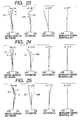
- FIG. 23 is a view showing aberration at the wide angle end under a normal condition according to the numerical fourth embodiment of the present invention.
- FIG. 24 is a view showing aberration at the middle under a normal condition according to the numerical fourth embodiment of the present invention.
- FIG. 25 is a view showing aberration at a telephoto end under a normal condition according to the numerical fourth embodiment of the present invention.
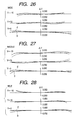
- FIG. 26 is a view showing aberration at the wide angle end with correction for an image blur corresponding to a 0.3 degree field angle according to the numerical fourth embodiment of the present invention.
- FIG. 27 is a view showing aberration at the middle with correction for an image blur corresponding to a 0.3 degree field angle according to the numerical fourth embodiment of the present invention.
- FIG. 28 is a view showing aberration at the telephoto end with correction for an image blur corresponding to a 0.3 degree field angle according to the numerical fourth embodiment of the present invention.
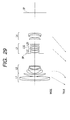
- FIG. 29 is a sectional view showing a lens of a wide angle end according to a numerical fifth embodiment of the present invention.
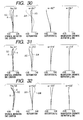
- FIG. 30 is a view showing aberration at the wide angle end under a normal condition according to the numerical fifth embodiment of the present invention.
- FIG. 31 is a view showing aberration at a middle under a normal condition according to the numerical fifth embodiment of the present invention.
- FIG. 32 is a view showing aberration at a telephoto end under a normal condition according to the numerical fifth embodiment of the present invention.
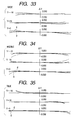
- FIG. 33 is a view showing aberration at the wide angle end with correction for an image blur corresponding to a 0.3 degree field angle according to the numerical fifth embodiment of the present invention.
- FIG. 34 is a view showing aberration at the middle with correction for an image blur corresponding to a 0.3 degree field angle according to the numerical fifth embodiment of the present invention.
- FIG. 35 is a view showing aberration at the telephoto end with correction for an image blur corresponding to a 0.3 degree field angle according to the numerical fifth embodiment of the present invention.
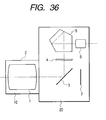
- FIG. 36 is a schematic view showing major portions of a single reflex camera to which a zoom lens according to the present invention is applied.
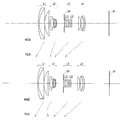
- FIGS. 1, 8 , 15 , 22 and 29 are sectional views respectively showing lenses at wide angle ends according to numerical first to fifth embodiments of the present invention.
- FIGS. 2 to 4 are views respectively showing aberration at the wide angle end, a middle, and a telephoto end under a normal condition according to the numerical first embodiment of the present invention.
- FIGS. 5 to 7 are views respectively showing aberration at the wide angle end, the middle, and the telephoto end in a fluctuation compensation state (correction for image blur corresponding to a 0.3 degree field angle) according to the numerical first embodiment of the present invention.
- FIGS. 9 to 11 are views respectively showing aberration at the wide angle end, the middle, and the telephoto end according to the numerical second embodiment of the present invention.
- FIGS. 12 to 14 are views respectively showing aberration at the wide angle end, the middle, and the telephoto end in a fluctuation compensation state (correction for image blur corresponding to a 0.3 degree field angle) according to the numerical second embodiment of the present invention.
- FIGS. 16 to 18 are views respectively showing aberration at the wide angle end, the middle, and the telephoto end under a normal condition according to the numerical third embodiment of the present invention.
- FIGS. 19 to 21 are views showing aberration at the wide angle end, the middle, and the telephoto end in a fluctuation compensation state (correction for image blur corresponding to a 0.3 degree field angle) according to the numerical third embodiment of the present invention.
- FIGS. 16 to 18 are views respectively showing aberration at the wide angle end, the middle, and the telephoto end under a normal condition according to the numerical third embodiment of the present invention.
- FIGS. 19 to 21 are views showing aberration at the wide angle end, the middle, and the telephoto end in a fluctuation compensation state (correct
- FIGS. 23 to 25 are views respectively showing aberration at the wide angle end, the middle and the telephoto end under a normal condition according to the numerical fourth embodiment of the present invention.
- FIGS. 26 to 28 are views respectively showing aberration at the wide angle end, the middle, and the telephoto end in a fluctuation compensation state (correction for image blur corresponding to a 0.3 degree field angle) according to the numerical fourth embodiment of the present invention.
- FIGS. 30 to 32 are views respectively showing aberration at the wide angle end, the middle, and the telephoto end under a normal condition according to the numerical fifth embodiment of the present invention.
- FIGS. 33 to 35 are views respectively showing aberration at the wide angle end, the middle, and the telephoto end in a fluctuation compensation state (correction for image blur corresponding to a 0.3 degree field angle) according to the numerical fifth embodiment of the present invention.
- L 1 , L 2 , L 3 , and L 4 respectively designate a first lens group with a positive refractive power, a second lens group with a negative refractive power, a third lens group with a positive refractive power, and a fourth lens group with a positive refractive power.
- Each arrow in the drawings shows a direction in which a respective lens group is moved when the magnification is changed from the wide angle side to the telephoto side.
- SP designates a diaphragm (stop) which is provided between the second and third lens groups.
- IP designates an image plane.
- the third lens group includes a positive refractive power, third-first lens group L 31 , and a fluctuation-preventive, third second lens group L 32 with a negative refractive power.
- the third lens group includes a third-first lens group L 31 with a positive refractive power, a fluctuation-preventive third-second lens group L 32 with a negative refractive power, and a third-third lens group L 33 with a negative refractive power.
- Each of the zoom lenses according to the numerical embodiments of the present invention includes the first lens group with positive refractive power, the second lens group with the negative refractive power, the third lens group with the positive refractive power, and the fourth lens group with the positive refractive power arranged in this order from the object side, in which at least the first, third and fourth lens groups are moved along the optical axis to vary spatial distances therebetween for a magnification change, while the third-second lens group L 32 with the negative refractive power in the third lens group is moved perpendicular to the optical axis to change the imaging position.
- the spatial distance between the first lens group and the second lens group is varied so that the second lens group mainly performs the magnification changing operation, and the third lens group is moved to mainly perform the correcting operation for the image plane varied in association with the magnification change, and concurrently the spatial distance between the third lens group and the fourth lens group is varied to correct a variation in decentered aberration in association with the magnification change.
- the second lens group may be fixed with respect to the optical axis to simplify the mechanism.
- the negative refractive function of the third second lens group cancels the various aberrations caused by a lens group having the positive refractive function, which is located as a lens system, other than the third-second lens group, within the third lens group. This also serves to provide a larger displacement of the image position with a smaller amount of movement.
- the third lens group includes, from the object side, the third-first lens group L 31 with the positive refractive power, and the third-second lens group with the negative refractive power, or the third-first lens group L 31 with the positive refractive power, the third-second lens group with the negative refractive power, and the third-third lens group with the negative refractive power, and the third-second lens group is moved perpendicular to the optical axis to displace or vary the imaging position.
- the converging effect of the third-first lens group renders a lens system of the third-second lens group small in size and allows a moving mechanism for the third-second lens group to be simplified.
- a zoom lens aimed at the present invention can be realized by satisfying the above-noted conditions, it is preferable to satisfy at least one of the following conditions in order that the zoom lens exhibits excellent optical performance and the entire optical system is made smaller.
- focal lengths of the entire system at the wide angle end and the telephoto end are respectively represented by Fw and Ft
- a focal length of the third lens group is represented by F3
- a focal length of the third-second lens group is represented by F32
- the refractive power of the third lens group is weakened beyond the upper limit of the formula (1), the amount of the movement of the lens group for securing a certain focal length and magnification changing ratio becomes large, and thus, the entire length of the lens system becomes disadvantageously large.
- the refractive power of the third lens group becomes excessively strong to generate the strong negative spherical aberration, making it difficult to appropriately correct the aberration over the entire range of the magnification by other lens groups.
- the formula (2) relates to the refractive power of the third-second lens group performing the operation of displacing the imaging position within the third lens group, and should be satisfied in order to maintain high quality image while suppressing the movement of the third-second lens group.
- the amount of the movement of the third-second lens group required for performing a certain image position displacement operation is large, and further the lens diameter of the third-second lens group is increased in order to obtain certain peripheral optical intensity. Thus, it is not preferable.
- the negative refractive power of the third-second lens group is large, and then the lens system, other than the third-second lens group, within the third lens group must have a larger positive refractive power, and therefore high-ordered spherical aberration or coma aberration is largely generated, making it difficult to correct the aberration when the image position is displaced.
- the formula (3) should be satisfied in order that the lens surface configurations are appropriately arranged within the third lens group for the purpose of obtaining a high quality image. Outside the numerical range defined by the formula (3), an appropriate canceling relationship is not established in spherical aberration and coma aberration by mutual lens surfaces when the image position is changed and not changed, and therefore is not preferable.
- the formulae (4) to (6) are for the purpose of mainly realizing a compact optical system with high image quality.
- the lens system is outside the upper limit of the formula (4), the refractive power of the first lens group becomes excessively weak so that the lens diameter and the lens entire length become large, which is not preferable.
- the lens system is outside the lower limit, the refractive power of the first lens group becomes excessively strong, so that high-ordered spherical aberration is largely generated, making it difficult to correct the aberration.
- the lens system is outside the upper limit of the formula (5), the refractive power of the second lens group is weakened, so that the amount of the movement of each lens group is large in order to obtain certain magnification changing ratio, and consequently it is difficult to make the lens system compact in size.
- the negative refractive power function becomes large, so that the Petzval sum becomes a large negative value, and thus the image surface curvature is large, which is not preferable.
- the lens system is outside the upper limit of the formula (6), the refractive power of the fourth lens group, becomes too weak, so that the back focus is long, and thus the entire length of the lens is large, which is not preferable.
- the lens system is outside the lower limit, the back focus of the entire lens system becomes too short, so that in a case where the lens system is, for instance, applied to a single reflex lens, the interference with a quick return mirror occurs. Further, decentered, high-ordered aberration such as image plane curvature, is largely generated.
- the third-second lens group is preferably constituted by one positive lens and one negative lens. This is effective in suppressing aberration variation when the lens is moved to displace the image position.
- the focusing is carried out by moving the first lens group or the second lens group toward the object side.
- the system in which the second lens group is moved is preferable because the lens diameter of the first lens group is not increased. Both of the first and second lens groups may be moved to the object side to carry out the focusing.
- the first lens group is preferably constituted, from the object side, by a negative lens having a concave surface on the image plane side, which lens surface is stronger in refractive power than the that on the object side (hereafter, simply referred to as “the lens surface is stronger on the image plane side”, when applicable), a positive lens, and a positive lens having a convex surface on the object side, which lens surface is stronger in refractive power than that on the image plane side (hereafter, simply referred to as “the lens surface is stronger on the object side”, when applicable).
- the second lens group is preferably constituted, from the object side, by a negative lens having a concave surface which lens surface is stronger on the image plane side, a negative lens having concave surfaces on both sides, a positive lens having a convex surface which lens surface is stronger on the object side, and a negative lens having a concave surface which lens surface is stronger on the object side.
- the negative lens located closest to the image plane side is preferably constructed as a composite lens of a negative lens and a positive lens to realize the higher image quality.
- the third-first lens group is preferably constituted, from the object side, by a composite lens in which a meniscus-like, negative lens having a concave surface stronger on the image plane side is adhered to a positive lens to constitute a lens group as being entirely positive, and a positive single lens or a composite lens in which a positive lens is adhered to a negative lens to constitute a lens group as being entirely positive.
- the third-second lens group is preferably constituted by a composite lens group in which a positive lens having a convex surface oriented to the image-plane side is adhered to a negative lens having a concave surface, which lens surface is stronger on the object side to constitute a lens group as being entirely negative.
- the fourth lens group is preferably constituted, from the object side, by a positive lens having a convex surface stronger on the image plane side, a positive lens having convex surfaces on both sides, and a meniscus-like negative lens having a concave surface stronger on the object side.
- a non-spherical surface, a grading optical element, and/or a gradient index optical element are preferably introduced into the lens system.
- Ri and Di respectively represent the thickness and the spatial distance of an i-th lens counted from the object side
- Ni and ⁇ i respectively represent the refractive power and the abbe number of the material of the i-th lens counted from the object side.
- X denotes the amount of displacement in a direction from an optical axis to a lens apex
- H denotes the distance from an optical axis
- R denotes the radius of curvature.
- e-X means “x10 ⁇ x ”.
- FIG. 36 is a schematic diagram showing major portions of a single reflex camera.
- reference numeral 10 designates a photographing lens having the zoom lens 1 described above.
- the zoom lens 1 is held by a barrel 2 , i.e. a holding member.
- Reference numeral 20 designates a camera main body which includes a quick return mirror 3 for reflecting rays of light from the photographing lens 10 upwardly, a focusing glass 4 disposed at a imaging forming position of the photographing lens 10 , a pentadahaprism 5 for converting an inverted image formed on the focusing glass 4 into an erect image, and an eyepiece lens 6 or the like for observing the erect image.
- Reference numeral 7 designates a film plane. During photographing, the quick return mirror 3 is retracted from the optical path so that an image is formed on the film plane 7 by the photographing lens 10 .
- the zoom lens described above can be effectively applied to the photographing apparatus as described with reference to this embodiment.
- a relatively small and light-weight lens group forming a part of a zoom lens is moved in a direction perpendicular to an optical axis to correct image blur cause due to fluctuation (inclination) of a zoom lens.
- the lens arrangement for the zoom lens is optimized to realize the zoom lens which is compact in size, having a simple mechanism, having a small load when applied to driving means, and which can effectively correct a certain image blur with a small amount of displacement of the lens group.
Landscapes
- Physics & Mathematics (AREA)
- General Physics & Mathematics (AREA)
- Optics & Photonics (AREA)
- Lenses (AREA)
- Adjustment Of Camera Lenses (AREA)
Applications Claiming Priority (2)
| Application Number | Priority Date | Filing Date | Title |
|---|---|---|---|
| JP35151899A JP4146977B2 (ja) | 1999-12-10 | 1999-12-10 | ズームレンズ |
| JP11-351518 | 1999-12-10 |
Publications (2)
| Publication Number | Publication Date |
|---|---|
| US20010022696A1 US20010022696A1 (en) | 2001-09-20 |
| US6462885B2 true US6462885B2 (en) | 2002-10-08 |
Family
ID=18417835
Family Applications (1)
| Application Number | Title | Priority Date | Filing Date |
|---|---|---|---|
| US09/729,823 Expired - Lifetime US6462885B2 (en) | 1999-12-10 | 2000-12-06 | Zoom lens and photographing apparatus having the same |
Country Status (2)
| Country | Link |
|---|---|
| US (1) | US6462885B2 (enExample) |
| JP (1) | JP4146977B2 (enExample) |
Cited By (11)
| Publication number | Priority date | Publication date | Assignee | Title |
|---|---|---|---|---|
| US20050046962A1 (en) * | 2003-08-11 | 2005-03-03 | Norihiro Nanba | Zoom lens system and imaging apparatus having the same |
| US6891398B2 (en) | 2001-08-03 | 2005-05-10 | Micron Technology, Inc. | Skewed falling logic device for rapidly propagating a falling edge of an output signal |
| US20050157403A1 (en) * | 2002-10-04 | 2005-07-21 | Nikon Corporation | Zoom lens system |
| US20060023317A1 (en) * | 2004-07-30 | 2006-02-02 | Canon Kabushiki Kaisha | Zoom lens system and image pickup apparatus using the same |
| US20060072213A1 (en) * | 2004-10-01 | 2006-04-06 | Nikon Corporation | Zoom lens system with vibration reduction |
| US20070091461A1 (en) * | 2005-10-19 | 2007-04-26 | Pentax Corporation | Wide-angle zoom lens system |
| US20070133092A1 (en) * | 2005-12-08 | 2007-06-14 | Sony Corporation | Lens device and imager apparatus |
| US20080019018A1 (en) * | 2006-07-20 | 2008-01-24 | Nikon Corporation | Zoom lens system, imaging apparatus, method for vibration reduction, and method for varying focal length |
| US20140333821A1 (en) * | 2013-05-10 | 2014-11-13 | Canon Kabushiki Kaisha | Zoom lens and image pickup apparatus including zoom lens |
| US9229203B2 (en) | 2011-06-21 | 2016-01-05 | Fujifilm Corporation | Zoom lens and imaging apparatus |
| US20220373774A1 (en) * | 2014-03-27 | 2022-11-24 | Nikon Corporation | Zoom optical system, imaging device and method for manufacturing the zoom optical system |
Families Citing this family (17)
| Publication number | Priority date | Publication date | Assignee | Title |
|---|---|---|---|---|
| JP2002333577A (ja) * | 2001-05-10 | 2002-11-22 | Asahi Optical Co Ltd | 防振観察光学系 |
| JP3506691B2 (ja) * | 2002-02-20 | 2004-03-15 | 株式会社タムロン | 高変倍率ズームレンズ |
| JP2005266183A (ja) * | 2004-03-18 | 2005-09-29 | Sigma Corp | 望遠ズームレンズ |
| JP4806915B2 (ja) * | 2004-10-01 | 2011-11-02 | 株式会社ニコン | 防振機能を有するズームレンズ |
| JP5125009B2 (ja) * | 2006-07-20 | 2013-01-23 | 株式会社ニコン | ズームレンズ、撮像装置、ズームレンズの防振方法、ズームレンズの変倍方法 |
| JP4949897B2 (ja) | 2007-03-09 | 2012-06-13 | 富士フイルム株式会社 | 防振機能付きズームレンズおよび撮像装置 |
| EP2045637B1 (en) * | 2007-10-02 | 2019-07-10 | Nikon Corporation | Zoom lens system |
| JP5126663B2 (ja) * | 2007-11-02 | 2013-01-23 | 株式会社ニコン | ズームレンズ及びこのズームレンズを備えた光学機器 |
| US8238038B2 (en) * | 2008-08-08 | 2012-08-07 | Tamron Co., Ltd. | High variable power zoom lens |
| JP4807388B2 (ja) * | 2008-09-22 | 2011-11-02 | 株式会社ニコン | 防振機能を有するズームレンズ |
| JP4905429B2 (ja) * | 2008-09-25 | 2012-03-28 | 株式会社ニコン | ズームレンズ |
| WO2010084664A1 (ja) * | 2009-01-24 | 2010-07-29 | 株式会社ニコン | ズームレンズ、ズームレンズを備えた光学機器、及び、ズームレンズの製造方法 |
| JP5224468B2 (ja) * | 2009-05-12 | 2013-07-03 | 富士フイルム株式会社 | ズームレンズおよび撮像装置 |
| JP5678424B2 (ja) * | 2009-11-26 | 2015-03-04 | 株式会社ニコン | 変倍光学系、この変倍光学系を備える光学機器、及び、変倍光学系の製造方法 |
| JP5426353B2 (ja) * | 2009-12-17 | 2014-02-26 | 株式会社シグマ | 防振機能を有するズームレンズ |
| JP5722730B2 (ja) * | 2011-08-26 | 2015-05-27 | 株式会社タムロン | 手振れ補正ズームレンズ |
| JP7413044B2 (ja) * | 2020-01-27 | 2024-01-15 | キヤノン株式会社 | ズームレンズおよびそれを有する撮像装置、撮像システム |
Citations (19)
| Publication number | Priority date | Publication date | Assignee | Title |
|---|---|---|---|---|
| US5056900A (en) | 1989-10-31 | 1991-10-15 | Canon Kabushiki Kaisha | Zoom lens |
| US5132848A (en) | 1990-10-26 | 1992-07-21 | Canon Kabushiki Kaisha | Wideangle four group zoom lens |
| US5221994A (en) | 1991-06-07 | 1993-06-22 | Canon Kabushiki Kaisha | Zoom lens of rear focus type |
| US5253113A (en) | 1990-09-07 | 1993-10-12 | Canon Kabushiki Kaisha | Wide-angle zoom lens having five lens units |
| JPH07128619A (ja) | 1993-11-04 | 1995-05-19 | Canon Inc | 防振機能を有した変倍光学系 |
| JPH07199124A (ja) | 1993-12-28 | 1995-08-04 | Nikon Corp | 防振機能を備えたズームレンズ |
| US5523888A (en) | 1993-09-03 | 1996-06-04 | Canon Kabushiki Kaisha | Zoom lens |
| US5574599A (en) | 1992-11-18 | 1996-11-12 | Canon Kabushiki Kaisha | Zoom lens and zooming method |
| US5638216A (en) | 1991-08-30 | 1997-06-10 | Canon Kabushiki Kaisha | Zoom lens |
| JPH09230236A (ja) | 1996-02-27 | 1997-09-05 | Minolta Co Ltd | 手ぶれ補正機能を有する光学系及びズームレンズ |
| US5691851A (en) | 1993-07-14 | 1997-11-25 | Canon Kabushiki Kaisha | Zoom lens |
| JPH10232420A (ja) | 1997-02-20 | 1998-09-02 | Matsushita Electric Ind Co Ltd | ズームレンズ |
| US5815320A (en) | 1993-01-14 | 1998-09-29 | Canon Kabushiki Kaisha | Zoom lens |
| US5831772A (en) | 1993-04-07 | 1998-11-03 | Canon Kabushiki Kaisha | Compact zoom lens |
| US6028716A (en) | 1993-11-29 | 2000-02-22 | Canon Kabushiki Kaisha | Zoom lens |
| US6061186A (en) | 1997-01-21 | 2000-05-09 | Canon Kabushiki Kaisha | Zoom lens |
| US6061180A (en) * | 1996-10-29 | 2000-05-09 | Canon Kabushiki Kaisha | Zoom lens |
| US6115188A (en) | 1997-10-16 | 2000-09-05 | Canon Kabushiki Kaisha | Optical system and optical apparatus having the same |
| US6141159A (en) | 1997-07-11 | 2000-10-31 | Canon Kabushiki Kaisha | Viewfinder optical system |
-
1999
- 1999-12-10 JP JP35151899A patent/JP4146977B2/ja not_active Expired - Lifetime
-
2000
- 2000-12-06 US US09/729,823 patent/US6462885B2/en not_active Expired - Lifetime
Patent Citations (21)
| Publication number | Priority date | Publication date | Assignee | Title |
|---|---|---|---|---|
| US5056900A (en) | 1989-10-31 | 1991-10-15 | Canon Kabushiki Kaisha | Zoom lens |
| US5253113A (en) | 1990-09-07 | 1993-10-12 | Canon Kabushiki Kaisha | Wide-angle zoom lens having five lens units |
| US5132848A (en) | 1990-10-26 | 1992-07-21 | Canon Kabushiki Kaisha | Wideangle four group zoom lens |
| US5221994A (en) | 1991-06-07 | 1993-06-22 | Canon Kabushiki Kaisha | Zoom lens of rear focus type |
| US5638216A (en) | 1991-08-30 | 1997-06-10 | Canon Kabushiki Kaisha | Zoom lens |
| US5574599A (en) | 1992-11-18 | 1996-11-12 | Canon Kabushiki Kaisha | Zoom lens and zooming method |
| US5815320A (en) | 1993-01-14 | 1998-09-29 | Canon Kabushiki Kaisha | Zoom lens |
| US5831772A (en) | 1993-04-07 | 1998-11-03 | Canon Kabushiki Kaisha | Compact zoom lens |
| US5691851A (en) | 1993-07-14 | 1997-11-25 | Canon Kabushiki Kaisha | Zoom lens |
| US5523888A (en) | 1993-09-03 | 1996-06-04 | Canon Kabushiki Kaisha | Zoom lens |
| JPH07128619A (ja) | 1993-11-04 | 1995-05-19 | Canon Inc | 防振機能を有した変倍光学系 |
| US6028716A (en) | 1993-11-29 | 2000-02-22 | Canon Kabushiki Kaisha | Zoom lens |
| JPH07199124A (ja) | 1993-12-28 | 1995-08-04 | Nikon Corp | 防振機能を備えたズームレンズ |
| US5585966A (en) | 1993-12-28 | 1996-12-17 | Nikon Corporation | Zoom lens with vibration reduction function |
| JPH09230236A (ja) | 1996-02-27 | 1997-09-05 | Minolta Co Ltd | 手ぶれ補正機能を有する光学系及びズームレンズ |
| US6046852A (en) | 1996-02-27 | 2000-04-04 | Minolta Co., Ltd. | Lens system with image blur correction |
| US6061180A (en) * | 1996-10-29 | 2000-05-09 | Canon Kabushiki Kaisha | Zoom lens |
| US6061186A (en) | 1997-01-21 | 2000-05-09 | Canon Kabushiki Kaisha | Zoom lens |
| JPH10232420A (ja) | 1997-02-20 | 1998-09-02 | Matsushita Electric Ind Co Ltd | ズームレンズ |
| US6141159A (en) | 1997-07-11 | 2000-10-31 | Canon Kabushiki Kaisha | Viewfinder optical system |
| US6115188A (en) | 1997-10-16 | 2000-09-05 | Canon Kabushiki Kaisha | Optical system and optical apparatus having the same |
Cited By (19)
| Publication number | Priority date | Publication date | Assignee | Title |
|---|---|---|---|---|
| US6891398B2 (en) | 2001-08-03 | 2005-05-10 | Micron Technology, Inc. | Skewed falling logic device for rapidly propagating a falling edge of an output signal |
| US20050157403A1 (en) * | 2002-10-04 | 2005-07-21 | Nikon Corporation | Zoom lens system |
| US7142370B2 (en) * | 2002-10-04 | 2006-11-28 | Nikon Corporation | Zoom lens system |
| US7023624B2 (en) * | 2003-08-11 | 2006-04-04 | Canon Kabushiki Kaisha | Zoom lens system and imaging apparatus having the same |
| US20050046962A1 (en) * | 2003-08-11 | 2005-03-03 | Norihiro Nanba | Zoom lens system and imaging apparatus having the same |
| US20060023317A1 (en) * | 2004-07-30 | 2006-02-02 | Canon Kabushiki Kaisha | Zoom lens system and image pickup apparatus using the same |
| US7268954B2 (en) | 2004-07-30 | 2007-09-11 | Canon Kabushiki Kaisha | Zoom lens system and image pickup apparatus using the same |
| US20060072213A1 (en) * | 2004-10-01 | 2006-04-06 | Nikon Corporation | Zoom lens system with vibration reduction |
| US7253965B2 (en) * | 2004-10-01 | 2007-08-07 | Nikon Corporation | Zoom lens system with vibration reduction |
| US7283311B2 (en) | 2005-10-19 | 2007-10-16 | Pentax Corporation | Wide-angle zoom lens system |
| US20070091461A1 (en) * | 2005-10-19 | 2007-04-26 | Pentax Corporation | Wide-angle zoom lens system |
| US20070133092A1 (en) * | 2005-12-08 | 2007-06-14 | Sony Corporation | Lens device and imager apparatus |
| US20080019018A1 (en) * | 2006-07-20 | 2008-01-24 | Nikon Corporation | Zoom lens system, imaging apparatus, method for vibration reduction, and method for varying focal length |
| US7492524B2 (en) | 2006-07-20 | 2009-02-17 | Nikon Corporation | Zoom lens system, imaging apparatus, method for vibration reduction, and method for varying focal length |
| US9229203B2 (en) | 2011-06-21 | 2016-01-05 | Fujifilm Corporation | Zoom lens and imaging apparatus |
| US20140333821A1 (en) * | 2013-05-10 | 2014-11-13 | Canon Kabushiki Kaisha | Zoom lens and image pickup apparatus including zoom lens |
| US9664885B2 (en) * | 2013-05-10 | 2017-05-30 | Canon Kabushiki Kaisha | Zoom lens and image pickup apparatus including zoom lens |
| US20220373774A1 (en) * | 2014-03-27 | 2022-11-24 | Nikon Corporation | Zoom optical system, imaging device and method for manufacturing the zoom optical system |
| US12174355B2 (en) * | 2014-03-27 | 2024-12-24 | Nikon Corporation | Zoom optical system, imaging device and method for manufacturing the zoom optical system |
Also Published As
| Publication number | Publication date |
|---|---|
| JP4146977B2 (ja) | 2008-09-10 |
| JP2001166208A (ja) | 2001-06-22 |
| US20010022696A1 (en) | 2001-09-20 |
Similar Documents
| Publication | Publication Date | Title |
|---|---|---|
| US6462885B2 (en) | Zoom lens and photographing apparatus having the same | |
| US7187504B2 (en) | Zoom lens and image pick up apparatus including the same | |
| US7126758B2 (en) | Zoom lens system and image pickup apparatus having the same | |
| US7688519B2 (en) | Zoom lens and image pickup apparatus including the same | |
| US6606194B2 (en) | Variable magnification optical system having image stabilizing function | |
| US7196851B2 (en) | Zoom lens system and camera incorporating the same | |
| US7443604B2 (en) | Zoom lens and image-pickup apparatus having the same | |
| US6646803B2 (en) | Zoom lens having an image stabilizing function | |
| US7466496B2 (en) | Zoom lens and image pickup apparatus having the same | |
| US7948686B2 (en) | Zoom lens and image pickup apparatus including the same | |
| US20090040604A1 (en) | Zoom lens device and image pickup apparatus including the same | |
| US5059007A (en) | Internally focusing zoom lens | |
| JPH08327907A (ja) | ズームレンズ | |
| JPH0519169A (ja) | ズームレンズ | |
| US20040056969A1 (en) | Zoom lens system and camera incorporating the same | |
| JP4989152B2 (ja) | ズームレンズ及びそれを有する撮像装置 | |
| US7227699B2 (en) | Zoom lens system and image pick-up apparatus including same | |
| US7199942B2 (en) | Zoom lens system and image pickup apparatus including the zoom lens system | |
| JP4717399B2 (ja) | ズームレンズ及びそれを有する撮像装置 | |
| US7782544B2 (en) | Zoom lens system and image pickup apparatus including the same | |
| JPH0651203A (ja) | 近距離収差変動の小さいズームレンズ | |
| JP4533437B2 (ja) | ズームレンズ | |
| JP3376143B2 (ja) | ズームレンズ | |
| US7196853B2 (en) | Zoom lens system and image pickup apparatus having the same | |
| US6493142B1 (en) | Zoom lens and photographing apparatus having it |
Legal Events
| Date | Code | Title | Description |
|---|---|---|---|
| AS | Assignment |
Owner name: CANON KABUSHIKI KAISHA, JAPAN Free format text: ASSIGNMENT OF ASSIGNORS INTEREST;ASSIGNOR:NISHIO, AKIHIRO;REEL/FRAME:011639/0223 Effective date: 20010109 |
|
| STCF | Information on status: patent grant |
Free format text: PATENTED CASE |
|
| CC | Certificate of correction | ||
| CC | Certificate of correction | ||
| CC | Certificate of correction | ||
| FPAY | Fee payment |
Year of fee payment: 4 |
|
| FPAY | Fee payment |
Year of fee payment: 8 |
|
| FPAY | Fee payment |
Year of fee payment: 12 |