US6000862A - Substrate developing method and apparatus - Google Patents
Substrate developing method and apparatus Download PDFInfo
- Publication number
- US6000862A US6000862A US08/725,846 US72584696A US6000862A US 6000862 A US6000862 A US 6000862A US 72584696 A US72584696 A US 72584696A US 6000862 A US6000862 A US 6000862A
- Authority
- US
- United States
- Prior art keywords
- substrate
- developer
- exhaust
- developing
- exhausting
- Prior art date
- Legal status (The legal status is an assumption and is not a legal conclusion. Google has not performed a legal analysis and makes no representation as to the accuracy of the status listed.)
- Expired - Lifetime
Links
Images




Classifications
-
- B—PERFORMING OPERATIONS; TRANSPORTING
- B05—SPRAYING OR ATOMISING IN GENERAL; APPLYING FLUENT MATERIALS TO SURFACES, IN GENERAL
- B05C—APPARATUS FOR APPLYING FLUENT MATERIALS TO SURFACES, IN GENERAL
- B05C11/00—Component parts, details or accessories not specifically provided for in groups B05C1/00 - B05C9/00
- B05C11/02—Apparatus for spreading or distributing liquids or other fluent materials already applied to a surface ; Controlling means therefor; Control of the thickness of a coating by spreading or distributing liquids or other fluent materials already applied to the coated surface
- B05C11/08—Spreading liquid or other fluent material by manipulating the work, e.g. tilting
-
- H—ELECTRICITY
- H10—SEMICONDUCTOR DEVICES; ELECTRIC SOLID-STATE DEVICES NOT OTHERWISE PROVIDED FOR
- H10P—GENERIC PROCESSES OR APPARATUS FOR THE MANUFACTURE OR TREATMENT OF DEVICES COVERED BY CLASS H10
- H10P76/00—Manufacture or treatment of masks on semiconductor bodies, e.g. by lithography or photolithography
-
- G—PHYSICS
- G03—PHOTOGRAPHY; CINEMATOGRAPHY; ANALOGOUS TECHNIQUES USING WAVES OTHER THAN OPTICAL WAVES; ELECTROGRAPHY; HOLOGRAPHY
- G03F—PHOTOMECHANICAL PRODUCTION OF TEXTURED OR PATTERNED SURFACES, e.g. FOR PRINTING, FOR PROCESSING OF SEMICONDUCTOR DEVICES; MATERIALS THEREFOR; ORIGINALS THEREFOR; APPARATUS SPECIALLY ADAPTED THEREFOR
- G03F7/00—Photomechanical, e.g. photolithographic, production of textured or patterned surfaces, e.g. printing surfaces; Materials therefor, e.g. comprising photoresists; Apparatus specially adapted therefor
- G03F7/26—Processing photosensitive materials; Apparatus therefor
- G03F7/30—Imagewise removal using liquid means
- G03F7/3021—Imagewise removal using liquid means from a wafer supported on a rotating chuck
Definitions
- This invention relates to a method and an apparatus for developing photoresist film patterns on substrates such as semiconductor wafers, glass substrates for liquid crystal displays, glass substrates for photomasks, and substrates for optical disks. More particularly, the invention relates to a technique of developing film patterns (in what is called puddle development) with a developer spread and retained on substrates utilizing the surface tension thereof.
- FIG. 1 shows an apparatus of the type noted above. A conventional developing technique will be described with reference to this figure.
- reference W denotes a substrate such as a semiconductor wafer, an upper surface thereof being formed with a photoresist film having a predetermined thickness and a predetermined pattern printed and exposed thereon.
- the wafer W is suction-supported in a substantially horizontal position on a spin chuck 1.
- the spin chuck 1 is surrounded by a scatter preventive cup 4 for collecting a developer and the like.
- the scatter preventive cup 4 includes, disposed in lower positions thereof, drain ports 8 for draining used developer and the like, and exhaust ports 10 for exhausting a gas including mist of the developer scattering within the cup 4.
- a cylindrical wall 13 is continuous with an upper end of the scatter preventive cup 4 for preventing the odor of the developer and the like from diffusing to the ambient.
- the apparatus further includes a nozzle 16 for supplying the developer to the vicinity of the spin center of wafer W.
- the conventional apparatus having the above construction has the following disadvantages.
- the conventional apparatus takes downflows DF into the scatter preventive cup 4 and exhausts the downflows through the lower positions thereof. Consequently, gas flows downward around the edge of wafer W during the developing process, whereby the developer vaporizes at a higher rate from adjacent the edge of the wafer than from a central region of the wafer. The part of the developer adjacent the wafer's edge gives up a high heat of vaporization. As a result, peripheral regions of the wafer become cooler than the central region thereof, with a sharp temperature gradient from center to edge (i.e. lowering toward the edge). Thus, the conventional apparatus has the disadvantage of producing uneven developing (i.e. non-uniformity in the line width of a pattern developed).
- the developer temperature and an average line width of the developed pattern are in a relationship of approximately 0.01 ⁇ m/°C.
- this uneven developing results mainly in the line width of the pattern becoming gradually thinner from the center to the edge of wafer W.
- the temperature gradient may be eliminated by stopping the gas exhaust from the scatter preventive cup 4 during the developing process.
- this measure will bring about the following inconvenience.
- the peripheral regions of wafer W receive the developer spread from the central region.
- the developer reacts with the photoresist film while spreading from the central region to the peripheral regions, and its effectiveness has been reduced by the time the developer reaches the peripheral regions and acts on the photoresist film. That is, the effectiveness of the developer lowers gradually from the central region to the peripheral regions of the wafer.
- the developed pattern has a thinner line width in the central region than in the peripheral regions. In other words, an uneveness in developing occurs from a different cause that development progresses at a higher rate in the central region than in the peripheral regions.
- This invention has been made having regard to the state of the art noted above, and its object is to provide a substrate developing method and apparatus for adjusting a temperature gradient of a developer on a substrate to improve the uniformity of development over the substrate surface.
- a substrate developing method for developing a photoresist film formed on a surface of a substrate with a developer spread over the surface of the substrate supported in horizontal posture comprising a developer supplying step for supplying the developer to the surface of the substrate and spreading the developer thereon, and a developing step for developing the photoresist film while causing a gas to flow in an adjusted quantity down around an edge of the substrate, at least after the developer is spread on the surface of the substrate.
- the quantity of the developer vaporizing from peripheral regions of the substrate is varied by adjusting the quantity of gas flowing down around the edge of the substrate during a process called puddle development. Consequently, a temperature gradient from center to periphery of the substrate may be adjusted as desired to improve the uniformity of development over the substrate surface.
- the gas is caused to flow down in a less quantity in the developing step than in the developer supplying step.
- This flow adjustment suppresses the temperature drop of the developer in peripheral regions of the substrate to diminish the temperature difference with respect to the central region. That is, the temperature gradient from the central region to the peripheral regions becomes gentle (i.e. the developer temperature lowers gently toward the peripheral regions). As a result, the developing rate increases gradually and gently from the central region to the peripheral regions of the substrate.
- the developer supplied to the central region of the substrate in the developer supplying step has the highest degree of activity in the central region, with the activity diminishing gradually toward the peripheral regions.
- the developing rate is the highest in the central region, and lowers gradually and gently toward the peripheral regions.
- the quantity of gas flowing down around the edge of the substrate is adjusted (decreased) so that the temperature gradient of the developer lowers gently toward the edge.
- the developing rate due to the developer temperature increases gradually and gently toward the peripheral regions.
- the developing rate due to the developer activity decreases gradually and gently toward the peripheral regions.
- the developing rate may be made substantially constant from the central region to the peripheral regions of the substrate.
- the pattern line width may be uniformed over the substrate surface, with an improved uniformity of development.
- a physical quantity relating to the quantity of gas downflow e.g. a pressure or velocity of downflow
- the quantity of gas downflow is adjusted by a feedback control so that the physical quantity agrees with a predetermined value.
- This predetermined value is a value of a physical quantity relating to the quantity of the gas flowing down, for uniforming a developing rate from center to edge of the substrate. Such a value may be determined empirically or otherwise in advance.
- a substrate developing apparatus for developing a photoresist film formed on a surface of a substrate with a developer spread over the surface of the substrate supported in horizontal posture
- the apparatus comprising a substrate supporting device for supporting the substrate substantially in horizontal posture, a developer supplying device for supplying the developer to the surface of the substrate, a scatter preventive cup surrounding the substrate supporting device, and a flow adjusting device for adjusting quantity of a gas flowing down around an edge of the substrate at least during a developing process with the developer spread on the surface of the substrate.
- the flow adjusting device includes a cup exhaust structure for exhausting, downwardly from above the substrate, a gas including mist of the developer scattering inside the scatter preventive cup, a detecting device for detecting a physical quantity relating to the quantity of the gas flowing down around the edge of the substrate, and a control device for adjusting a quantity of exhaust through the cup exhaust structure based on a detection value provided by the detecting device, at least during the developing process with the developer spread on the surface of the substrate.
- the quantity of exhaust is controlled based on a detection value provided by the detecting device, which realizes an exhaust adjustment with increased precision.
- the quantity of exhaust may be maintained constant even when, for example, mist and particles of the developer adhere to inner walls of the cup exhaust structure to reduce a sectional area of passages. Consequently, the improved uniformity of development over the substrate surface may be maintained over a long period of time.
- the apparatus according to this invention further comprises an upper exhaust structure disposed above the substrate supporting device.
- the control device preferably, is operable to decrease a quantity of exhaust through the upper exhaust structure when increasing the quantity of exhaust through the cup exhaust structure, and to increase the quantity of exhaust through the upper exhaust structure when decreasing the quantity of exhaust through the cup exhaust structure.
- FIG. 1 is a vertical cross section showing an outline of a conventional substrate developing apparatus
- FIG. 2 is a vertical cross section of a substrate developing apparatus according to the present invention.
- FIGS. 3A and 3B are time charts of a developing process
- FIG. 4 is a vertical cross section of the apparatus prior to adjustment of an exhaust flow rate
- FIG. 5 is a vertical cross section of the apparatus with a reduced exhaust flow rate
- FIG. 6 is a graph showing a change, with passage of time, of developer temperature in the apparatus according to the present invention.
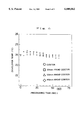
- FIG. 7 is a graph showing a distribution of average line widths provided by the apparatus according to the present invention.
- FIG. 8 is a graph showing a change, with passage of time, of developer temperature in the conventional apparatus.
- FIG. 9 is a graph showing a distribution of average line widths provided by the conventional apparatus.
- FIG. 2 is a view in vertical cross section showing a principal portion of a substrate developing apparatus according to this invention.
- numeral 1 denotes a suction type spin chuck for suction-supporting a substrate W, such as a semiconductor wafer, in a substantially horizontal position so as to be subjected to a developing process.
- the spin chuck 1 is interlocked to a hollow rotary shaft 3 acting as an output shaft of a rotary motor 2.
- the spin chuck 1 is surrounded by a scatter preventive cup 4 which prevents the scattering of a developer as it is spun on substrate W, and which also collects the developer.
- the scatter preventive cup 4 includes an upper cup 5, a baffle disk 6 and a lower cup 7.
- the upper cup 5 defines an upper opening 5a, and a slant surface 5b for downwardly guiding the developer scattered from the spinning substrate W.
- the upper cup 5 is fitted in an upper end of an outer peripheral wall 7a of the lower cup 7.
- the baffle disk 6 is fitted on an upper end of an inner peripheral wall 7b of the lower cup 7 to lie under the spin chuck 1.
- the baffle disk 6 defines a slant surface 6a for straightening and guiding air flows entering through the opening 5a and descending round the edge of substrate W into the lower cup 7.
- the sprays (mist) of the developer guided downward by the slant surface 5b of upper cup 5 are entrained by these air flows to enter the lower cup 7.
- the lower cup 7 includes an annular drainage zone 7c inscribing a lower end of the outer peripheral wall 7a, and an annular gas exhaust zone 7d formed inwardly of the drainage zone 7c.
- a pair of drain ports 8 are formed in lower positions of the drainage zone 7c and opposed to each other across the substrate W in plan view, but only one of the drain ports is shown in FIG. 2 for expediency of illustration.
- the drain ports 8 are connected to a drainage tank 9 for collecting the developer used in the developing process and other liquids.
- the gas exhaust zone 7d has exhaust ports 10 formed in three bottom positions thereof at equal angular displacement around the substrate W, but only one of the exhaust ports is shown in FIG. 2 for expediency of illustration.
- the three exhaust ports 10 are connected to an exhaust box 11.
- the exhaust box 11 has a manometer 12 attached thereto for detecting a pressure (negative pressure) produced by the gas flowing into the box 11.
- the exhaust box 11 communicates with an exhaust adjusting unit 20 which will be described hereinafter.
- the pressure (negative pressure) detected by the manometer 12 is a physical quantity relating to a quantity of gas flowing down around the edge of substrate W. The closer the negative pressure is to zero, the less quantity of gas flows down around the edge of substrate W. Thus, when the negative pressure is zero, there is no gas downflow around the edge of substrate W.
- the manometer 12 corresponds to the detecting device of this invention.
- a cylindrical wall 13 is continuous with an upper end of the upper cup 5 and surrounds the opening 5a to prevent diffusion of the odor of the developer.
- the cylindrical wall 13 includes an annular exhaust zone 14 protruding from an upper outer periphery thereof.
- the exhaust zone 14 has a pair of upper exhaust ports 15 arranged opposite each other. These upper exhaust ports 15 are connected to the exhaust adjusting unit 20 described hereinafter.
- a developer dispensing nozzle 16 is disposed inside the cylindrical wall 13 and above the spin center of substrate W.
- the developer dispensing nozzle 16 is movable between a dispensing position above the spin center of the spin chuck 1, and a retracted position for allowing for the conveyance of substrate W into and out of the apparatus.
- the developer dispensing nozzle 16 has developer outlets 16a formed in a lower peripheral wall thereof for gently delivering the developer onto the substrate W.
- An exhaust adjusting unit 20 includes a box 21 defining two exhaust passages with continuously variable flow rates therethrough.
- the box 21 has an upper wall defining two intake ports 22a and 22b, and a lower wall opposed to the upper wall and defining an exhaust port 23 common to the two intake ports 22a and 22b.
- One of the intake ports 22a communicates with the exhaust box 11 connected to the exhaust ports 10 of the scatter preventive cup 4.
- the other intake port 22b is connected to the upper exhaust ports 15 on the cylindrical wall 11.
- the exhaust port 23 of the box 21 is connected to an exhaust pump 24.
- the box 21 contains a swing plate 25 pivotally supported therein for adjusting the two exhaust passages.
- the box 21 further includes a push-pull rod 26 having one end thereof connected to a position of the swing plate 25 below a pivotal axis thereof.
- the other end of the push-pull rod 26 is meshed with a screw shaft 27a of a motor 27.
- the rod 26 is movable back and forth relative to the interior of the box 21 with rotation of the motor 27.
- the motor 27 is rotatable under control of a controller 28.
- the controller 28 has an internal memory, not shown, for storing a program prepared for the developing process, which is also referred to as a recipe for the developing process. Based on the recipe, the controller 28 carries out an overall control operation to control a substrate transport mechanism, not shown, for transporting substrates W into and out of the apparatus the rotary motor 2 for spinning substrates W a moving mechanism, not shown, for moving the developer dispensing nozzle 16 between the dispensing position and retracted position delivery of the developer through the developer dispensing nozzle 16 and the exhaust adjusting unit 20.
- the controller 28 based on the recipe for development, reads a pressure level detected by the manometer 12, and controls the exhaust adjusting unit 20 for causing the gas to flow at a reduced rate down around the edge of substrate W. This occurs at least during the developing process with the developer spread and retained on the substrate W, so that the flow rate is less than when the developer is supplied to the substrate W.
- the cup's exhaust ports 10, exhaust box 11, exhaust adjusting unit 20 and controller 20 constitute the flow adjusting device of this invention.
- the cup's exhaust ports 10 and exhaust box 11 constitute the exhaust structure of this invention.
- the exhaust adjusting unit 20 and controller 28 constitute the control device of this invention.
- FIG. 3A shows rotating rates of the rotary motor 2
- FIG. 3B shows pressure levels detected by the manometer 12.
- substrate W to be processed i.e. having a photoresist film formed on the surface, with a pattern printed through an exposing process
- the controller 28 has controlled the motor 27 to advance the rod 26 deep into the box 21, thereby to swing the swing plate 25 clockwise, so that the pressure in the exhaust box 11 detected by the manometer 12 is at a fixed value P1 (e.g. -20 mm H 2 O).
- the controller 28 determines that the substrate W is suction-supported by the spin chuck 1, through a pressure detector, not shown, for detecting a pressure inside the hollow rotary shaft 3. Then, the controller 28 rotates the rotary motor 2 at a point of time tS, to attain a predetermined rotating rate R1 (e.g. a low rotating rate in the order of 10 to 50 rpm) at a point of time t 1 . The controller 28 also starts delivery of developer L through the developer dispensing nozzle 16 at the point of time t S .
- FIG. 4 shows the apparatus in this state.
- the developer L is now spread over the entire surface of substrate W and retained thereon as shown in FIG. 5.
- the developer L supplied is lower in effectiveness in peripheral regions than in the central region of substrate W. This is because the developer L supplied to the central region of substrate W is spread toward the edge thereof, while in contact with the photoresist film on the substrate surface, by subsequently supplied parts of the developer L.
- the developer L undergoes a chemical reaction to a certain extent when contacting the photoresist film.
- the central region continues to receive a fresh supply of developer L having a high degree of activity.
- the activity of developer L spread over the substrate W gradually lowers from the central region toward peripheral regions of substrate W, whereby the developing rate gradually lowers toward the peripheral regions.
- the controller 28 rotates the motor 27 to swing the swing plate 25 counterclockwise as shown in FIG. 5.
- the swing plate 25 is swung under feedback control to maintain the pressure detected by the manometer 12 at a negative pressure P2 (e.g. -2 mm H 2 O) less than the fixed pressure P1, that is to cause the gas to flow out of the cup's exhaust ports 10 at a lower flow rate than when the developer L is supplied.
- P2 e.g. -2 mm H 2 O
- the developer L spread over the entire surface of substrate W and retained thereon is cooled by the gas flowing down around the edge of substrate W and carrying away the heat of vaporization.
- the temperature drop is smaller than where the quantity of gas flow is unadjusted.
- the temperature of developer L on the surface of substrate W lowers gently from the central region toward the peripheral regions of substrate W, with a gentle temperature gradient. Consequently, the developing rate may be increased gradually and gently from the central region toward the peripheral regions of substrate W.
- the developing rate due to the activity of developer L lowers gradually toward the peripheral regions.
- the pattern has a substantially uniform line width from the central region to the peripheral regions of substrate W. That is, the developing process provides an improved degree of uniformity over the substrate surface.
- the controller 28 controls the rotary motor 2 to reach a high rotating rate R2 (e.g. 1,000 rpm) at a point of time t 4 .
- a high rotating rate R2 e.g. 1,000 rpm
- the developer L covering the entire surface of substrate W is scattered around the substrate W, and deionized water is supplied from a cleaning nozzle, not shown, to terminate the developing process.
- the deionized water is scattered from the substrate W and the latter is allowed to dry.
- the scattering developer L and deionized water turn into mist which could remain around the substrate W.
- the mist is entrained by the downflows DF taken in from above and exhausted through the cup's exhaust ports 10.
- the controller 28 controls the rotary motor 2 at a point of time t 5 to stop rotating at a point of time t 6 .
- the above series of operations completes the developing process for the substrate W.
- the controller 28 operates the manometer 12 to detect the pressure inside the exhaust box 11, and maintains the exhaust flow rate constant by the feedback control based on the detected pressure.
- the flow rate may be maintained constant even if the developer or the like adheres to inner walls of the cup's exhaust ports 10 to reduce the sectional area thereof.
- the exhaust flow rate may be adjusted accurately, and an improved uniformity of development over the substrate surface may be maintained over a long period of time.
- the apparatus embodying this invention provides a substantially uniform average line width of approximately 0.84 ⁇ m from the center to the point 80 mm therefrom, whereas the conventional apparatus provides an average line width of approximately 0.83 ⁇ m at the center and an average line width of approximately 0.81 ⁇ m adjacent the edge. It will be seen that, in the conventional apparatus, the line width diminishes from center to edge of the wafer. This is due to the developer temperature lowering by a considerably degree toward the edge as noted above. While the apparatus embodying this invention provides pattern line widths deviating from the target line width (0.8 ⁇ m), this may be rectified by adjusting photoresist application, exposure conditions and developing conditions.
- the manometer 12 is attached to the exhaust box 11.
- the manometer 12 may be disposed in any location suited to detect a pressure relating to the quantity of gas flow descending around the edge of substrate W.
- the manometer 12 may be disposed at point A or point B in FIG. 2.
- the manometer 12 as the pressure detecting device
- the invention is not limited thereto but may employ a different device as long as it can detect a physical quantity relating to the quantity of gas flow descending around the edge of substrate W.
- the manometer 12 may be replaced with an anemometer.
- the anemometer may be disposed at any location noted above.
- the exhaust gas flow is adjusted by swinging the swing plate 25 in the box 21.
- This construction may be modified by providing an element in the intake port 22a intercommunicating the box 21 and exhaust box 11, the element being movable to vary a passage area in the intake port 22a.
- the exhaust gas flow may be adjusted in a more direct manner by restricting the upper opening of the cylindrical wall 13.
- the exhaust gas flow is adjusted at least during the developing process with the developer spread over the surface of the substrate. For example, as shown in a two-dot-and-dash line in FIG. 3B, the exhaust gas flow may be reduced before the point of time t E at which the substrate W stops spinning, and the reduced exhaust gas flow may be maintained until when the spin of substrate W is being accelerated toward the high rotating rate R2.
Landscapes
- Physics & Mathematics (AREA)
- General Physics & Mathematics (AREA)
- Exposure Of Semiconductors, Excluding Electron Or Ion Beam Exposure (AREA)
- Photosensitive Polymer And Photoresist Processing (AREA)
Applications Claiming Priority (2)
| Application Number | Priority Date | Filing Date | Title |
|---|---|---|---|
| JP7-291963 | 1995-10-12 | ||
| JP7291963A JPH09106934A (ja) | 1995-10-12 | 1995-10-12 | 基板現像装置 |
Publications (1)
| Publication Number | Publication Date |
|---|---|
| US6000862A true US6000862A (en) | 1999-12-14 |
Family
ID=17775736
Family Applications (1)
| Application Number | Title | Priority Date | Filing Date |
|---|---|---|---|
| US08/725,846 Expired - Lifetime US6000862A (en) | 1995-10-12 | 1996-10-04 | Substrate developing method and apparatus |
Country Status (3)
| Country | Link |
|---|---|
| US (1) | US6000862A (ja) |
| JP (1) | JPH09106934A (ja) |
| KR (1) | KR100221698B1 (ja) |
Cited By (15)
| Publication number | Priority date | Publication date | Assignee | Title |
|---|---|---|---|---|
| US6257778B1 (en) * | 1998-02-04 | 2001-07-10 | Tokyo Electron Limited | Method for developing front surface of substrate with improved developing function of developing solution and apparatus thereof |
| US20020174829A1 (en) * | 2000-09-20 | 2002-11-28 | Lsi Logic Corporation | Exhaust flow control system |
| US20030140949A1 (en) * | 2002-01-31 | 2003-07-31 | Dainippon Screen Mfg. Co., Ltd. | Substrate treating method and substrate treating apparatus |
| US20050205115A1 (en) * | 2004-03-16 | 2005-09-22 | Dainippon Screen Mfg. Co., Ltd. | Resist stripping method and resist stripping apparatus |
| US20060191482A1 (en) * | 2005-02-04 | 2006-08-31 | Seiichiro Kanno | Apparatus and method for processing wafer |
| US20060205239A1 (en) * | 2004-08-31 | 2006-09-14 | Tokyo Electron Limited | Laser treatment apparatus |
| US20080006650A1 (en) * | 2006-06-27 | 2008-01-10 | Applied Materials, Inc. | Method and apparatus for multi-chamber exhaust control |
| US7357842B2 (en) | 2004-12-22 | 2008-04-15 | Sokudo Co., Ltd. | Cluster tool architecture for processing a substrate |
| CN100446176C (zh) * | 2005-11-28 | 2008-12-24 | 株式会社日立高科技 | 基板处理装置、基板处理方法以及基板的制造方法 |
| US7651306B2 (en) | 2004-12-22 | 2010-01-26 | Applied Materials, Inc. | Cartesian robot cluster tool architecture |
| US7699021B2 (en) | 2004-12-22 | 2010-04-20 | Sokudo Co., Ltd. | Cluster tool substrate throughput optimization |
| US7798764B2 (en) | 2005-12-22 | 2010-09-21 | Applied Materials, Inc. | Substrate processing sequence in a cartesian robot cluster tool |
| US7819079B2 (en) | 2004-12-22 | 2010-10-26 | Applied Materials, Inc. | Cartesian cluster tool configuration for lithography type processes |
| CN102989736A (zh) * | 2012-11-26 | 2013-03-27 | 北京七星华创电子股份有限公司 | 一种排风装置 |
| US20210132637A1 (en) * | 2019-11-04 | 2021-05-06 | Tokyo Electron Limited | Methods and systems to monitor, control, and synchronize dispense systems |
Families Citing this family (5)
| Publication number | Priority date | Publication date | Assignee | Title |
|---|---|---|---|---|
| JP3679695B2 (ja) * | 1999-08-12 | 2005-08-03 | 東京エレクトロン株式会社 | 現像装置、基板処理装置及び現像方法 |
| JP5369538B2 (ja) * | 2008-08-12 | 2013-12-18 | 東京エレクトロン株式会社 | 液処理装置及び液処理方法並びに記憶媒体 |
| CN109976106A (zh) * | 2019-04-12 | 2019-07-05 | 云谷(固安)科技有限公司 | 一种显影装置及显影方法 |
| JP7335797B2 (ja) * | 2019-11-29 | 2023-08-30 | 株式会社Screenホールディングス | 現像装置 |
| JP7709859B2 (ja) * | 2021-06-22 | 2025-07-17 | 東京エレクトロン株式会社 | 液処理装置及び液処理方法 |
Citations (5)
| Publication number | Priority date | Publication date | Assignee | Title |
|---|---|---|---|---|
| JPH01234321A (ja) * | 1988-03-15 | 1989-09-19 | Tokai Kogyo Kk | 親水性長石の製造法及び該長石の用途 |
| JPH01260823A (ja) * | 1988-04-12 | 1989-10-18 | Mitsubishi Electric Corp | 半導体ウエハの現像装置 |
| JPH0213959A (ja) * | 1988-06-30 | 1990-01-18 | Mitsubishi Electric Corp | レジスト現像装置 |
| US5143552A (en) * | 1988-03-09 | 1992-09-01 | Tokyo Electron Limited | Coating equipment |
| US5658615A (en) * | 1993-03-25 | 1997-08-19 | Tokyo Electron Limited | Method of forming coating film and apparatus therefor |
-
1995
- 1995-10-12 JP JP7291963A patent/JPH09106934A/ja active Pending
-
1996
- 1996-10-01 KR KR1019960043475A patent/KR100221698B1/ko not_active Expired - Fee Related
- 1996-10-04 US US08/725,846 patent/US6000862A/en not_active Expired - Lifetime
Patent Citations (5)
| Publication number | Priority date | Publication date | Assignee | Title |
|---|---|---|---|---|
| US5143552A (en) * | 1988-03-09 | 1992-09-01 | Tokyo Electron Limited | Coating equipment |
| JPH01234321A (ja) * | 1988-03-15 | 1989-09-19 | Tokai Kogyo Kk | 親水性長石の製造法及び該長石の用途 |
| JPH01260823A (ja) * | 1988-04-12 | 1989-10-18 | Mitsubishi Electric Corp | 半導体ウエハの現像装置 |
| JPH0213959A (ja) * | 1988-06-30 | 1990-01-18 | Mitsubishi Electric Corp | レジスト現像装置 |
| US5658615A (en) * | 1993-03-25 | 1997-08-19 | Tokyo Electron Limited | Method of forming coating film and apparatus therefor |
Cited By (31)
| Publication number | Priority date | Publication date | Assignee | Title |
|---|---|---|---|---|
| US6257778B1 (en) * | 1998-02-04 | 2001-07-10 | Tokyo Electron Limited | Method for developing front surface of substrate with improved developing function of developing solution and apparatus thereof |
| US6787180B2 (en) * | 2000-09-20 | 2004-09-07 | Lsi Logic Corporation | Exhaust flow control system |
| US20020174829A1 (en) * | 2000-09-20 | 2002-11-28 | Lsi Logic Corporation | Exhaust flow control system |
| US6579371B1 (en) * | 2000-09-20 | 2003-06-17 | Lsi Logic Corporation | Exhaust flow control system |
| US7074726B2 (en) | 2002-01-31 | 2006-07-11 | Dainippon Screen Mfg. Co., Ltd. | Substrate treating method and substrate treating apparatus |
| US20060207969A1 (en) * | 2002-01-31 | 2006-09-21 | Dainippon Screen Mfg. Co., Ltd. | Substrate treating apparatus and substrate treating method |
| US20030140949A1 (en) * | 2002-01-31 | 2003-07-31 | Dainippon Screen Mfg. Co., Ltd. | Substrate treating method and substrate treating apparatus |
| US20050205115A1 (en) * | 2004-03-16 | 2005-09-22 | Dainippon Screen Mfg. Co., Ltd. | Resist stripping method and resist stripping apparatus |
| US7682463B2 (en) * | 2004-03-16 | 2010-03-23 | Dainippon Screen Mfg. Co., Ltd. | Resist stripping method and resist stripping apparatus |
| US7473321B2 (en) * | 2004-08-31 | 2009-01-06 | Tokyo Electron Limited | Laser treatment apparatus |
| US8088455B2 (en) | 2004-08-31 | 2012-01-03 | Tokyo Electron Limited | Laser treatment apparatus |
| US20060205239A1 (en) * | 2004-08-31 | 2006-09-14 | Tokyo Electron Limited | Laser treatment apparatus |
| US20090041954A1 (en) * | 2004-08-31 | 2009-02-12 | Tokyo Electron Limited | Laser treatment apparatus |
| US7819079B2 (en) | 2004-12-22 | 2010-10-26 | Applied Materials, Inc. | Cartesian cluster tool configuration for lithography type processes |
| US7925377B2 (en) | 2004-12-22 | 2011-04-12 | Applied Materials, Inc. | Cluster tool architecture for processing a substrate |
| US7651306B2 (en) | 2004-12-22 | 2010-01-26 | Applied Materials, Inc. | Cartesian robot cluster tool architecture |
| US7357842B2 (en) | 2004-12-22 | 2008-04-15 | Sokudo Co., Ltd. | Cluster tool architecture for processing a substrate |
| US7694647B2 (en) | 2004-12-22 | 2010-04-13 | Applied Materials, Inc. | Cluster tool architecture for processing a substrate |
| US7699021B2 (en) | 2004-12-22 | 2010-04-20 | Sokudo Co., Ltd. | Cluster tool substrate throughput optimization |
| US7743728B2 (en) | 2004-12-22 | 2010-06-29 | Applied Materials, Inc. | Cluster tool architecture for processing a substrate |
| US8911193B2 (en) | 2004-12-22 | 2014-12-16 | Applied Materials, Inc. | Substrate processing sequence in a cartesian robot cluster tool |
| US8550031B2 (en) | 2004-12-22 | 2013-10-08 | Applied Materials, Inc. | Cluster tool architecture for processing a substrate |
| US20060191482A1 (en) * | 2005-02-04 | 2006-08-31 | Seiichiro Kanno | Apparatus and method for processing wafer |
| CN100446176C (zh) * | 2005-11-28 | 2008-12-24 | 株式会社日立高科技 | 基板处理装置、基板处理方法以及基板的制造方法 |
| US8066466B2 (en) | 2005-12-22 | 2011-11-29 | Applied Materials, Inc. | Substrate processing sequence in a Cartesian robot cluster tool |
| US7798764B2 (en) | 2005-12-22 | 2010-09-21 | Applied Materials, Inc. | Substrate processing sequence in a cartesian robot cluster tool |
| US20080006650A1 (en) * | 2006-06-27 | 2008-01-10 | Applied Materials, Inc. | Method and apparatus for multi-chamber exhaust control |
| CN102989736A (zh) * | 2012-11-26 | 2013-03-27 | 北京七星华创电子股份有限公司 | 一种排风装置 |
| CN102989736B (zh) * | 2012-11-26 | 2015-03-18 | 北京七星华创电子股份有限公司 | 一种排风装置 |
| US20210132637A1 (en) * | 2019-11-04 | 2021-05-06 | Tokyo Electron Limited | Methods and systems to monitor, control, and synchronize dispense systems |
| US11998945B2 (en) | 2019-11-04 | 2024-06-04 | Tokyo Electron Limited | Methods and systems to monitor, control, and synchronize dispense systems |
Also Published As
| Publication number | Publication date |
|---|---|
| KR970023648A (ko) | 1997-05-30 |
| JPH09106934A (ja) | 1997-04-22 |
| KR100221698B1 (ko) | 1999-09-15 |
Similar Documents
| Publication | Publication Date | Title |
|---|---|---|
| US6000862A (en) | Substrate developing method and apparatus | |
| US5762709A (en) | Substrate spin coating apparatus | |
| US5374312A (en) | Liquid coating system | |
| US7022190B2 (en) | Substrate coating unit and substrate coating method | |
| US7485188B2 (en) | Coating process method and coating process apparatus | |
| US5143552A (en) | Coating equipment | |
| US7918242B2 (en) | Processing solution supply system, processing solution supply method and recording medium for storing processing solution supply control program | |
| US7553374B2 (en) | Coating treatment apparatus and coating treatment method | |
| US5989632A (en) | Coating solution applying method and apparatus | |
| JP3364155B2 (ja) | 塗布膜形成装置及びその方法 | |
| US6565656B2 (en) | Coating processing apparatus | |
| CN1265245C (zh) | 均匀涂布基片的方法 | |
| US6599366B1 (en) | Substrate processing unit and processing method | |
| US5976620A (en) | Coating solution applying method and apparatus | |
| US7238239B2 (en) | Liquid coating device with barometric pressure compensation | |
| JP3704059B2 (ja) | 現像処理方法及び現像処理装置 | |
| JPH021113A (ja) | レジスト処理装置 | |
| US6042647A (en) | Nozzle system for feeding treatment liquid such as a liquid developer on a workpiece | |
| JP2001118790A (ja) | 現像装置、基板処理装置及び現像方法 | |
| JP3398532B2 (ja) | 基板回転式現像装置 | |
| JPH0957176A (ja) | 回転塗布装置 | |
| CN1900823B (zh) | 均匀涂布基片的方法 | |
| JPH11330039A (ja) | 基板処理装置 | |
| JP2952626B2 (ja) | 処理装置 | |
| JP4001207B2 (ja) | 基板現像装置 |
Legal Events
| Date | Code | Title | Description |
|---|---|---|---|
| AS | Assignment |
Owner name: DAINIPPON SCREEN MFG. CO., LTD., A CORP. OF JAPAN, Free format text: ASSIGNMENT OF ASSIGNORS INTEREST;ASSIGNORS:OKUDA, SEIICHIRO;SUGIMOTO, KENJI;REEL/FRAME:008277/0549;SIGNING DATES FROM 19960904 TO 19960905 |
|
| STCF | Information on status: patent grant |
Free format text: PATENTED CASE |
|
| FEPP | Fee payment procedure |
Free format text: PAYOR NUMBER ASSIGNED (ORIGINAL EVENT CODE: ASPN); ENTITY STATUS OF PATENT OWNER: LARGE ENTITY |
|
| FPAY | Fee payment |
Year of fee payment: 4 |
|
| FPAY | Fee payment |
Year of fee payment: 8 |
|
| FPAY | Fee payment |
Year of fee payment: 12 |
|
| AS | Assignment |
Owner name: SCREEN HOLDINGS CO., LTD., JAPAN Free format text: CHANGE OF NAME;ASSIGNOR:DAINIPPON SCREEN MFG. CO., LTD.;REEL/FRAME:035248/0483 Effective date: 20141001 |