US4454652A - Method of processing end portions of covered wires - Google Patents
Method of processing end portions of covered wires Download PDFInfo
- Publication number
- US4454652A US4454652A US06/223,231 US22323181A US4454652A US 4454652 A US4454652 A US 4454652A US 22323181 A US22323181 A US 22323181A US 4454652 A US4454652 A US 4454652A
- Authority
- US
- United States
- Prior art keywords
- wire
- wiring
- wires
- jig
- bridge
- Prior art date
- Legal status (The legal status is an assumption and is not a legal conclusion. Google has not performed a legal analysis and makes no representation as to the accuracy of the status listed.)
- Expired - Lifetime
Links
Images


Classifications
-
- H—ELECTRICITY
- H02—GENERATION; CONVERSION OR DISTRIBUTION OF ELECTRIC POWER
- H02G—INSTALLATION OF ELECTRIC CABLES OR LINES, OR OF COMBINED OPTICAL AND ELECTRIC CABLES OR LINES
- H02G1/00—Methods or apparatus specially adapted for installing, maintaining, repairing or dismantling electric cables or lines
- H02G1/12—Methods or apparatus specially adapted for installing, maintaining, repairing or dismantling electric cables or lines for removing insulation or armouring from cables, e.g. from the end thereof
- H02G1/1202—Methods or apparatus specially adapted for installing, maintaining, repairing or dismantling electric cables or lines for removing insulation or armouring from cables, e.g. from the end thereof by cutting and withdrawing insulation
- H02G1/1248—Machines
-
- H—ELECTRICITY
- H01—ELECTRIC ELEMENTS
- H01B—CABLES; CONDUCTORS; INSULATORS; SELECTION OF MATERIALS FOR THEIR CONDUCTIVE, INSULATING OR DIELECTRIC PROPERTIES
- H01B13/00—Apparatus or processes specially adapted for manufacturing conductors or cables
- H01B13/012—Apparatus or processes specially adapted for manufacturing conductors or cables for manufacturing wire harnesses
- H01B13/01236—Apparatus or processes specially adapted for manufacturing conductors or cables for manufacturing wire harnesses the wires being disposed by machine
- H01B13/01245—Apparatus or processes specially adapted for manufacturing conductors or cables for manufacturing wire harnesses the wires being disposed by machine using a layout board
-
- H—ELECTRICITY
- H01—ELECTRIC ELEMENTS
- H01B—CABLES; CONDUCTORS; INSULATORS; SELECTION OF MATERIALS FOR THEIR CONDUCTIVE, INSULATING OR DIELECTRIC PROPERTIES
- H01B7/00—Insulated conductors or cables characterised by their form
- H01B7/0045—Cable-harnesses
-
- H—ELECTRICITY
- H01—ELECTRIC ELEMENTS
- H01R—ELECTRICALLY-CONDUCTIVE CONNECTIONS; STRUCTURAL ASSOCIATIONS OF A PLURALITY OF MUTUALLY-INSULATED ELECTRICAL CONNECTING ELEMENTS; COUPLING DEVICES; CURRENT COLLECTORS
- H01R43/00—Apparatus or processes specially adapted for manufacturing, assembling, maintaining, or repairing of line connectors or current collectors or for joining electric conductors
- H01R43/28—Apparatus or processes specially adapted for manufacturing, assembling, maintaining, or repairing of line connectors or current collectors or for joining electric conductors for wire processing before connecting to contact members, not provided for in groups H01R43/02 - H01R43/26
-
- Y—GENERAL TAGGING OF NEW TECHNOLOGICAL DEVELOPMENTS; GENERAL TAGGING OF CROSS-SECTIONAL TECHNOLOGIES SPANNING OVER SEVERAL SECTIONS OF THE IPC; TECHNICAL SUBJECTS COVERED BY FORMER USPC CROSS-REFERENCE ART COLLECTIONS [XRACs] AND DIGESTS
- Y10—TECHNICAL SUBJECTS COVERED BY FORMER USPC
- Y10T—TECHNICAL SUBJECTS COVERED BY FORMER US CLASSIFICATION
- Y10T29/00—Metal working
- Y10T29/49—Method of mechanical manufacture
- Y10T29/49002—Electrical device making
- Y10T29/49117—Conductor or circuit manufacturing
-
- Y—GENERAL TAGGING OF NEW TECHNOLOGICAL DEVELOPMENTS; GENERAL TAGGING OF CROSS-SECTIONAL TECHNOLOGIES SPANNING OVER SEVERAL SECTIONS OF THE IPC; TECHNICAL SUBJECTS COVERED BY FORMER USPC CROSS-REFERENCE ART COLLECTIONS [XRACs] AND DIGESTS
- Y10—TECHNICAL SUBJECTS COVERED BY FORMER USPC
- Y10T—TECHNICAL SUBJECTS COVERED BY FORMER US CLASSIFICATION
- Y10T29/00—Metal working
- Y10T29/49—Method of mechanical manufacture
- Y10T29/49002—Electrical device making
- Y10T29/49117—Conductor or circuit manufacturing
- Y10T29/49174—Assembling terminal to elongated conductor
- Y10T29/49181—Assembling terminal to elongated conductor by deforming
-
- Y—GENERAL TAGGING OF NEW TECHNOLOGICAL DEVELOPMENTS; GENERAL TAGGING OF CROSS-SECTIONAL TECHNOLOGIES SPANNING OVER SEVERAL SECTIONS OF THE IPC; TECHNICAL SUBJECTS COVERED BY FORMER USPC CROSS-REFERENCE ART COLLECTIONS [XRACs] AND DIGESTS
- Y10—TECHNICAL SUBJECTS COVERED BY FORMER USPC
- Y10T—TECHNICAL SUBJECTS COVERED BY FORMER US CLASSIFICATION
- Y10T29/00—Metal working
- Y10T29/49—Method of mechanical manufacture
- Y10T29/49002—Electrical device making
- Y10T29/49117—Conductor or circuit manufacturing
- Y10T29/49174—Assembling terminal to elongated conductor
- Y10T29/49181—Assembling terminal to elongated conductor by deforming
- Y10T29/49185—Assembling terminal to elongated conductor by deforming of terminal
-
- Y—GENERAL TAGGING OF NEW TECHNOLOGICAL DEVELOPMENTS; GENERAL TAGGING OF CROSS-SECTIONAL TECHNOLOGIES SPANNING OVER SEVERAL SECTIONS OF THE IPC; TECHNICAL SUBJECTS COVERED BY FORMER USPC CROSS-REFERENCE ART COLLECTIONS [XRACs] AND DIGESTS
- Y10—TECHNICAL SUBJECTS COVERED BY FORMER USPC
- Y10T—TECHNICAL SUBJECTS COVERED BY FORMER US CLASSIFICATION
- Y10T29/00—Metal working
- Y10T29/51—Plural diverse manufacturing apparatus including means for metal shaping or assembling
- Y10T29/5136—Separate tool stations for selective or successive operation on work
- Y10T29/5137—Separate tool stations for selective or successive operation on work including assembling or disassembling station
- Y10T29/5139—Separate tool stations for selective or successive operation on work including assembling or disassembling station and means to sever work prior to disassembling
- Y10T29/514—Separate tool stations for selective or successive operation on work including assembling or disassembling station and means to sever work prior to disassembling comprising means to strip insulation from wire
-
- Y—GENERAL TAGGING OF NEW TECHNOLOGICAL DEVELOPMENTS; GENERAL TAGGING OF CROSS-SECTIONAL TECHNOLOGIES SPANNING OVER SEVERAL SECTIONS OF THE IPC; TECHNICAL SUBJECTS COVERED BY FORMER USPC CROSS-REFERENCE ART COLLECTIONS [XRACs] AND DIGESTS
- Y10—TECHNICAL SUBJECTS COVERED BY FORMER USPC
- Y10T—TECHNICAL SUBJECTS COVERED BY FORMER US CLASSIFICATION
- Y10T29/00—Metal working
- Y10T29/51—Plural diverse manufacturing apparatus including means for metal shaping or assembling
- Y10T29/5136—Separate tool stations for selective or successive operation on work
- Y10T29/5137—Separate tool stations for selective or successive operation on work including assembling or disassembling station
- Y10T29/5142—Separate tool stations for selective or successive operation on work including assembling or disassembling station and means to sever work from supply
-
- Y—GENERAL TAGGING OF NEW TECHNOLOGICAL DEVELOPMENTS; GENERAL TAGGING OF CROSS-SECTIONAL TECHNOLOGIES SPANNING OVER SEVERAL SECTIONS OF THE IPC; TECHNICAL SUBJECTS COVERED BY FORMER USPC CROSS-REFERENCE ART COLLECTIONS [XRACs] AND DIGESTS
- Y10—TECHNICAL SUBJECTS COVERED BY FORMER USPC
- Y10T—TECHNICAL SUBJECTS COVERED BY FORMER US CLASSIFICATION
- Y10T29/00—Metal working
- Y10T29/51—Plural diverse manufacturing apparatus including means for metal shaping or assembling
- Y10T29/5136—Separate tool stations for selective or successive operation on work
- Y10T29/5137—Separate tool stations for selective or successive operation on work including assembling or disassembling station
- Y10T29/5143—Separate tool stations for selective or successive operation on work including assembling or disassembling station and means to machine product
- Y10T29/5145—Separate tool stations for selective or successive operation on work including assembling or disassembling station and means to machine product to sever product to length
-
- Y—GENERAL TAGGING OF NEW TECHNOLOGICAL DEVELOPMENTS; GENERAL TAGGING OF CROSS-SECTIONAL TECHNOLOGIES SPANNING OVER SEVERAL SECTIONS OF THE IPC; TECHNICAL SUBJECTS COVERED BY FORMER USPC CROSS-REFERENCE ART COLLECTIONS [XRACs] AND DIGESTS
- Y10—TECHNICAL SUBJECTS COVERED BY FORMER USPC
- Y10T—TECHNICAL SUBJECTS COVERED BY FORMER US CLASSIFICATION
- Y10T29/00—Metal working
- Y10T29/51—Plural diverse manufacturing apparatus including means for metal shaping or assembling
- Y10T29/5147—Plural diverse manufacturing apparatus including means for metal shaping or assembling including composite tool
- Y10T29/5148—Plural diverse manufacturing apparatus including means for metal shaping or assembling including composite tool including severing means
- Y10T29/515—Plural diverse manufacturing apparatus including means for metal shaping or assembling including composite tool including severing means to trim electric component
-
- Y—GENERAL TAGGING OF NEW TECHNOLOGICAL DEVELOPMENTS; GENERAL TAGGING OF CROSS-SECTIONAL TECHNOLOGIES SPANNING OVER SEVERAL SECTIONS OF THE IPC; TECHNICAL SUBJECTS COVERED BY FORMER USPC CROSS-REFERENCE ART COLLECTIONS [XRACs] AND DIGESTS
- Y10—TECHNICAL SUBJECTS COVERED BY FORMER USPC
- Y10T—TECHNICAL SUBJECTS COVERED BY FORMER US CLASSIFICATION
- Y10T29/00—Metal working
- Y10T29/51—Plural diverse manufacturing apparatus including means for metal shaping or assembling
- Y10T29/5176—Plural diverse manufacturing apparatus including means for metal shaping or assembling including machining means
- Y10T29/5177—Plural diverse manufacturing apparatus including means for metal shaping or assembling including machining means and work-holder for assembly
-
- Y—GENERAL TAGGING OF NEW TECHNOLOGICAL DEVELOPMENTS; GENERAL TAGGING OF CROSS-SECTIONAL TECHNOLOGIES SPANNING OVER SEVERAL SECTIONS OF THE IPC; TECHNICAL SUBJECTS COVERED BY FORMER USPC CROSS-REFERENCE ART COLLECTIONS [XRACs] AND DIGESTS
- Y10—TECHNICAL SUBJECTS COVERED BY FORMER USPC
- Y10T—TECHNICAL SUBJECTS COVERED BY FORMER US CLASSIFICATION
- Y10T29/00—Metal working
- Y10T29/53—Means to assemble or disassemble
- Y10T29/5313—Means to assemble electrical device
- Y10T29/532—Conductor
- Y10T29/53209—Terminal or connector
- Y10T29/53213—Assembled to wire-type conductor
- Y10T29/53235—Means to fasten by deformation
-
- Y—GENERAL TAGGING OF NEW TECHNOLOGICAL DEVELOPMENTS; GENERAL TAGGING OF CROSS-SECTIONAL TECHNOLOGIES SPANNING OVER SEVERAL SECTIONS OF THE IPC; TECHNICAL SUBJECTS COVERED BY FORMER USPC CROSS-REFERENCE ART COLLECTIONS [XRACs] AND DIGESTS
- Y10—TECHNICAL SUBJECTS COVERED BY FORMER USPC
- Y10T—TECHNICAL SUBJECTS COVERED BY FORMER US CLASSIFICATION
- Y10T29/00—Metal working
- Y10T29/53—Means to assemble or disassemble
- Y10T29/5313—Means to assemble electrical device
- Y10T29/532—Conductor
- Y10T29/53243—Multiple, independent conductors
-
- Y—GENERAL TAGGING OF NEW TECHNOLOGICAL DEVELOPMENTS; GENERAL TAGGING OF CROSS-SECTIONAL TECHNOLOGIES SPANNING OVER SEVERAL SECTIONS OF THE IPC; TECHNICAL SUBJECTS COVERED BY FORMER USPC CROSS-REFERENCE ART COLLECTIONS [XRACs] AND DIGESTS
- Y10—TECHNICAL SUBJECTS COVERED BY FORMER USPC
- Y10T—TECHNICAL SUBJECTS COVERED BY FORMER US CLASSIFICATION
- Y10T83/00—Cutting
- Y10T83/202—With product handling means
- Y10T83/2033—Including means to form or hold pile of product pieces
- Y10T83/2037—In stacked or packed relation
- Y10T83/204—Stacker sweeps along product support
-
- Y—GENERAL TAGGING OF NEW TECHNOLOGICAL DEVELOPMENTS; GENERAL TAGGING OF CROSS-SECTIONAL TECHNOLOGIES SPANNING OVER SEVERAL SECTIONS OF THE IPC; TECHNICAL SUBJECTS COVERED BY FORMER USPC CROSS-REFERENCE ART COLLECTIONS [XRACs] AND DIGESTS
- Y10—TECHNICAL SUBJECTS COVERED BY FORMER USPC
- Y10T—TECHNICAL SUBJECTS COVERED BY FORMER US CLASSIFICATION
- Y10T83/00—Cutting
- Y10T83/444—Tool engages work during dwell of intermittent workfeed
- Y10T83/4645—With means to clamp work during dwell
-
- Y—GENERAL TAGGING OF NEW TECHNOLOGICAL DEVELOPMENTS; GENERAL TAGGING OF CROSS-SECTIONAL TECHNOLOGIES SPANNING OVER SEVERAL SECTIONS OF THE IPC; TECHNICAL SUBJECTS COVERED BY FORMER USPC CROSS-REFERENCE ART COLLECTIONS [XRACs] AND DIGESTS
- Y10—TECHNICAL SUBJECTS COVERED BY FORMER USPC
- Y10T—TECHNICAL SUBJECTS COVERED BY FORMER US CLASSIFICATION
- Y10T83/00—Cutting
- Y10T83/869—Means to drive or to guide tool
- Y10T83/8772—One tool edge of tool pair encompasses work [e.g., wire cutter]
Definitions
- the present invention relates to wire harnesses.
- a wire harness generally consists of a large number of wires combined together to form branches of main lines. Terminals connectors or like members are connected to the respective branches.
- Various automatic wiring methods have heretofore been proposed to save time and labor in the production of such wire harnesses.
- An object of the present invention is to provide a wire harness which can be manufactured by a time and labor saving method which comprises laying a wire on a plurality of pre-arranged bridges, cutting said laid wire to a predetermined length, and repeating the above step.
- the thus provided wire harness comprises a plurality of bridges arranged with predetermined spacings therebetween; and a plurality of covered wires held by said bridges at their end portions, said wires crossing over each bridge with suitable spacings therebetween, said end portions which extend from said bridge being of equal length to each other.
- the wire harness comprises a plurality of bridges arranged with predetermined spacings therebetween; a plurality of covered wires held by said bridges at their end portions, said wires crossing over each bridge with equal spacings therebetween, said end portions which extend from said bridge being of equal length to each other; and a terminal members attached to uncovered portion of each end portions.
- the wire harness comprises a plurality of bridges arranged with predetermined spacings therebetween; a plurality of covered wires held by said bridges at their end portion, said wires crossing over each bridge with equal spacings therebetween, said end portions which extend from said bridge being of equal length to each other; a terminal member attached to an uncovered portion of each end portions; and a housing connector accomodating said terminal member.
- Another object of the present invention is to provide a method which reduces the time and labor needed for the production of wire harnesses and thereby to make inexpensive wire harnesses.
- the method of the invention perform simultaneous laying and cutting of wires and, during the laying and cutting operation, secures neatly arranged end portions of wires to a bridge at suitable spacings so as to facilitate the subsequent easy connection of metallic terminal members and the fixation of connectors.
- the method according to the invention uses a plurality of wiring blocks arranged at given distances on a work table prior to wiring procedures.
- Layed on each block is a bridge for carrying thereon a set of suitably spaced wires.
- the process comprises the steps of anchoring a piece of wire to a first wiring block, stretching the wire toward a second wiring block, anchoring the wire to said second block and cutting the wire.
- the procedure is repeated to lay a plurality of wires successively between those desired wiring blocks.
- the bridge retains end portions of the corresponding set of wires in suitably spaced positions.
- the thus obtained set of wires are further subjected to a terminal fixing step and a connector housing attaching step.
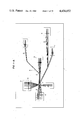
- FIG. 1-A illustrates a wire harness prepared on a worktable at a stage of the method of the present invention
- FIG. 1-B is a perspective view of one embodiment of the invention having a bridge engaging a wire thereon which is being subjected to a step of the method of FIG. 1-A;
- FIG. 1-C is another example of a bridge
- FIG. 1-D is a further example of a bridge
- FIG. 2 shows a wire harness prepared at a stage subsequent to that shown in FIG. 1-A;
- FIG. 3 shows a wire harness prepared at a stage subsequent to that shown in FIG. 2;
- FIG. 4 shows a wire harness prepared at a final stage subsequent to that in FIG. 3;
- FIG. 5 is a perspective view of a device for preparing a wire harness according to the present invention.
- FIG. 6 is an enlarged side elevational view cross-sectioned in part, of a wiring head used in the device of FIG. 5;
- FIG. 7 is a plan view of the wiring head of FIG. 6;
- FIG. 8 is an enlarged side elevational view partly in section of a wiring jig provided in the wiring head of FIGS. 6 and 7;
- FIG. 9 is an enlarged side elevational view partly in section of a mechanism for the vertical reciprocation and rotation of a clamping jig attached to the wiring head of FIG. 6;
- FIG. 10 is an enlarged side elevational view of the clamping jig of FIG. 9;
- FIG. 11 is a perspective view of one of wiring blocks arranged on the worktable shown in FIG. 1-A;
- FIGS. 12-A, 12-B, 12-C show positional relationships between the wiring block, the wiring jig, and the clamping jig;
- FIGS. 13-A to 13-E show a series of wiring steps by using the wiring blocks, the wiring jig, and the clamping jig;
- FIGS. 14-A and 14-B show a situation where two wires are to be laid on one another and subjected to the cutting step
- FIG. 15-A is a plan view of another embodiment of a wiring block to cope with the situation shown in FIGS. 14-A and 14-B;
- FIG. 15-B is a side elevational view of the wiring block of FIG. 15-A;
- FIG. 15-C is a front elevational view of the wiring block of FIG. 15-A;
- FIG. 15-D is a cross sectional view of the wiring block of FIG. 15-B taken along the line d--d thereby;
- FIGS. 16-A to 16-E show in sequence the operation of an arm provided on the wiring block of FIGS. 15-A to 15-D;
- FIG. 17 shows another example of a wire harness obtained by the wiring block of FIGS. 15-A to 15-D;
- FIG. 18-A shows in side elevation a fusing unit under which the work table is adapted to travel
- FIG. 18-B is a front elevational view of the fusing unit of FIG. 18-A;
- FIG. 19-A illustrates an engagement of the fusing unit and of the wiring block
- FIG. 19-B is a front elevational view of FIG. 19-A;
- FIG. 20 is a perspective view of a device for removing an insulation covering of one end portion of each wire of the wire harness and fixing a terminal thereon;
- FIG. 21 is a side elevational view partly in section of wire uncovering and cutting unit provided in the device of FIG. 20;
- FIG. 22 is a fragmentary view illustrating the cutting edges attached to the unit of FIG. 21;
- FIG. 23 is an illustration of a flat cam attached to the unit of FIG. 21;
- FIGS. 24-A to 24-D show in sequence an operation of the cutting edges to remove an insulative covering of the wire and cutting the wire conductor
- FIG. 25 is a front elevational view of a terminal fixing unit provided in the device of FIG. 20;
- FIG. 26 is a side view of an illustration of a wire harness and a train of interconnected terminal members which are supplied into said unit;
- FIG. 27 is a perspective view of the train of terminal members supplied as shown in FIG. 26;
- FIGS. 28-A to 28-E are a series of views or illustrations of the operation of the wire uncovering and cutting unit.
- FIGS. 29-A to 29-B are schematic views illustrating the operation of the terminal fixing unit.
- the reference numeral 1 designates a work table on which pins 2 and wiring blocks 3 are positioned.
- a bridge 4 Lying on each of the wiring blocks 3 is a bridge 4 which, as viewed in FIG. 1B, comprises a base 5 and multiple pairs of parallel fusable holding pieces 6 spaced at common perpendicular intervals and extending along the longitudinal direction of the base.
- the holding pieces 6 in each pair have bevelled sides or slants 7 on their outer top surfaces.
- the bridge 4 is suitably made for the intended number of wires to be nested in the bridge.
- the bridges 4 are formed of a thermoplastic resinous material similar to that employed for insulative coverings of wires.
- the bridge may be made of any material if the wire 8 is pasted or adhered between the holding pieces 6' by suitable means such as an adhesive K as shown in FIG. 1-C.
- the bridge may have a plurality of resilient holding pieces 6" such that wires 8 are resiliently held therebetween when pressed in.
- Wires 8 are securely nested in sequence in between the cooperating pairs of pieces 6 on each bridge 4 by a cooperative mechanism including the blocks 3 and a programmable automatic machine, i.e. a wiring head with a clamping jig. Those portions of respective wires 8 extending beyond the bridge 4 are cut off at a predetermined length l from the bridge. The wires are laid over corresponding blocks 3 thereby constituting a wire harness generally designated A in FIG. 1-A.
- table 1 is bodily moved to the next station in which a fusing unit corresponding to each block 3 is activated to melt the pieces 6 of the bridge 4 simultaneously onto the insulative coverings of the wires 8.
- Strips of tape 9 for temporary fastening are then wound around branching portions of the respective sets of wires.
- wire harness B shown in FIG. 2.
- wires 8 extend at predetermined spacings and in predetermined numbers and the bridges 4 securely hold the corresponding sets of wires at a given spacing.
- wires of the wire harness B are layed automatically at the required spacings and numbers while their terminal portions are neatly arranged and fixed by the bridges with a predetermined length thereof extending beyond the bridges.
- This type of wire harness B though only semiprocessed can be stored and transported advantageously before it advances to any subsequent step.
- each of the wires 8 rigid on the bridge 4 has its insulative covering removed at the end portion by an insulative covering removing unit, and, a terminal member 10 is affixed to the bare wire end by a terminal fixing unit.
- Each bridge 4 in wire harness C retains the end portions of each set of wires 8 permitting a plurality of terminal members 10 to be attached simultaneously to the individual wires. Furthermore, as seen in FIG. 4, all the terminal members can be connected to a connector housing 11 simultaneously and easily.
- a wire harness D in its fully processed state shown in FIG. 4 has wires 8 whose aligned end portions are securely held in the bridge 4 by fusion.
- the bridge 4 disperses the tension to prevent the associated terminal member 10 from disengaging with the connector 11.
- the bridge 4 may be detachably provided on the wire harness.
- FIG. 5 a wiring apparatus is shown in a general perspective view.
- the apparatus includes a pair of threaded X shafts 12 extending along opposite longitudinal edges of the work table 1.
- Cross-beam 13 is movable on and along X shafts 12 and carries thereon threaded Y shaft 14 on which a wiring head 15 is movably supported.
- X shafts 12 are driven for rotation by a first motor (not shown) whereas Y shaft 14 is driven by a second motor (not shown).
- a control unit 16 is adapted to store an entire process for wiring programmed on a magnetic tape (NC control).
- Reference numeral 17 is a reel station where wires 8 whose insulative coverings have different colors are stored on a plurality of independent reels. Wires 8 are payed out to the wiring head 15 through corresponding capstans 18 which serve to reduce the magnitude of tension imparted to the wires being driven by a motor (not shown) in the intended direction of wire feed.
- the wiring head 15 includes frame 19, a plurality of wiring jigs 24 located on top of frame 19 and a clamping jig 45 positioned below the frame 19.
- the jigs 24 and 45 are each reciprocated and rotated relative to a predetermined position.
- An annular member in the form of a jig mount member 21 for mounting the wiring jigs 24 is mounted to frame 19 rotatably through a plurality of guide rollers 20.
- the jig mount 21 is operatively connected to a limited speed motor 22 to rotate in a horizontal plane.
- Wiring jigs 24 are passed through respective tubular guides 23 which are spaced equidistant along the circumference of jig mount 21. Each of the wiring jigs 24 is locked at a preselected level by a knock pin 25.
- Each jig 24 reaching the position P is reciprocated vertically in accordance with the action of a raising and lowering unit 26.
- Denoted by the reference numeral 27 is a motor adapted to drive capstan 33 provided to the jig 24.
- FIG. 8 illustrates a detailed construction of each wiring jig 24.
- wiring jig 24 comprises tubular member 29 having through bore 28 extending axially therethrough to accommodate a wire.
- Tube 29 carries on its outer periphery a bar 30 which is engagable with the raising and lowering unit 26 (FIG. 7).
- Capstan head 31 and recoil prevention assembly 35 are mounted above the tube 29.
- Mounted below the tube 29 is a nozzle or nosepiece 38.
- Capstan head 31 has a gear wheel 32 which is driven by motor 27 shown in FIG. 7 and capstan 33 is faced by a slack preventing piece 34.
- the recoil preventing assembly 35 has a pair of pawls 36 constantly biased by spring 36a.
- Flexible wire guide 37 is provided at the top of the recoil preventing assembly 35.
- the nosepiece 38 is in the form of a coil spring with resiliency such that a given intensity of tension resulting from a travel of the jig 24 causes a flexure of the nosepiece in a direction opposite to the direction of travel and, upon the release of the tension, the nosepiece recovers its position.
- the nosepiece 38 is additionally capable of straightening the wire 8 if it is bent.
- Wire support 38c is nested in the tube 29 and carries a nosepiece support tube 38a fastened to its lower end by means of a screw 38b.
- wire 8 enters jig 24 through top wire guide 37, passes between pawls 36, and is passed one turn round capstan 33. From capstan 33, the wire extends downwardly through tubes 38c and 38a and extends from lower end of nosepiece 38.
- wiring jig 24 has in its upper portion the pair of pawl's 36 which are constantly biased by the spring 36a. Pawls 36 prevent wire 8 from falling out of the jig 24 even when the jig is stationary. Thus, jig 24 positively holds the wire irrespective of the operating condition.
- a mechanism for two different kinds of the movements of clamping jig 45 is indicated in side elevation in FIG. 9.
- Body 39 of the clamping jig is mounted to frame 19 of the wiring head so as to reciprocate vertically relative to the frame by the action of actuator 40 associated therewith.
- Annular jig mount 41 functions as a pulley and is rotatably mounted to the jig body 39 and is in a position where its center coincides with the axis of the wiring jig 24 at the position P.
- the angular orientation of jig 45 is controlled by a limited speed motor 42 which is provided with a timing pulley 43. Passed over this timing pulley 43 and the pulley 41 is an endless belt 44. With this construction, motor 42 drives the clamping jig 45 to a desired position about the wiring jig 24 while the actuator moves the clamping jig up or down as desired.
- clamping jig 45 has a front end clamping plate 46, guide plate 47 with coil spring 47a, cutting edge 48 and a rear end clamping plate 49 arranged in succession radially from the inner end to the outer end.
- Guide plate 47 and the cutting edge 48 protrude slightly beyond the lower ends of clamping plates 46 and 49 and are positioned in perpendicular relation to the clamping plates.
- Clamping plates 46 and 49 are located symmetrically to each other with respect to the cutting edge 48.
- wiring block 3 has a plurality of guide pins 50 at its front upper end and guide slots 54 at the rear end. Interposed between the guide pins 50 and guide slots 54 are recesses 51 for receiving a bridge 4, a series of clamping pawls 52 and a block 53 against the top surface of which cutting edge 48 will abut. Said block 53 is rigidly mounted on block 3 and functions as an edge bearer. Block 3 is also provided with a bore 55 in the vicinity of one lateral end of recess 51; bore 55 is adapted to receive a fusing jig 1160 which will be referred to hereinafter.
- Reference numeral 56 designates a screw for releasing the clamping pawls 52.
- Guide pins 50, and guide slots 54 serve to guide the nosepieces 38 of respective wiring jigs 24 and are provided in accordance with the intended number of wires. Clamping pawls 52 retain wires during the wiring operation and until a subsequent fusing step is over.
- FIGS. 12A-12C Positional relationships of blocks 3-1 and 3-2, wiring jig 24 and clamping jig 45 are indicated in FIGS. 12A-12C.
- a bridge 4 is nested in the recess 51 of block 3 prior to a start of wiring operation.
- nosepiece 38 of the wiring jig 24 is resiliently deformed into engagement with the bridge 4 and in between guide pins 50.
- a predetermined length of the end portion of wire 8 extends beyond the bridge 4 and is positioned between neighboring clamping pawls 52.
- guide plate 47 and clamping plate 46 in cooperation allow the part of the wire projecting from nosepiece 38 to be retained positively on the block 3 despite the slight wire flexure which has occurred in the initial stage of wiring.
- FIG. 12-C shows wiring block 32 which is located in opposing relation to first-mentioned block 31 to define a terminal point of the wiring path.
- wire 8 payed out of nosepiece 38 has been layed under tension from the block 3-1 to the block 3-2 through pins 2 on the table 1 and guide pins 50 on the blocks) (FIG. 13-A to FIG. 13-E).
- the nosepiece is flexed into engagement with a guide slot 54 of the block 3-2 as illustrated. Under this condition, the wire 8 is aligned with a central region between neighboring clamping pawls 52 and that between pieces 6 on the bridge 4.
- motor 42 (see FIG. 9) is energized to turn the clamping jig 45 to a position immediately to the rear of wiring jig 24. This restores conditions to an initial stage of the wiring process.
- a selected wiring jig 24 is brought to the predetermined position P whereupon the unit 26 is driven to lower jig 24 to a position rearwardly of block 3-1.
- Wiring jig 24 is moved along X shafts 12 and Y shaft 14 until it reaches the condition for starting a wiring operation (see FIG. 12-A). Then, the clamping jig 45 is lowered by the actions of actuator 40, thereby fixing a predetermined length of wire 8 on the block 3-1 (see FIGS. 12-A and 12-B) and then jig 45 is raised and capstans 18 and 33 are driven. (FIG. 13-C)
- Wiring jig 24 is positioned at the terminal point of wiring (see FIG. 12-C) relative to block 3-2 whereupon the clamping jig 45 is again lowered to lock and cut the wire 8 and is then raised. Subsequently, the drive of capstans 18 and 33 is interrupted. (FIG. 13-D)
- the orientation of the clamping jig is as follows. Wiring jig 24 moving along the X and Y shafts is shifted to a position behind block 3-2 while the clamping jig 45 is brought to a position immediately to the rear of the wiring jig 24. (FIG. 13-E)
- wiring jig 24 is elevated by the action of unit 26 and is returned to the start position.
- FIGS. 15-A to 16-E show a modification of wiring block 3 in which the above situation is avoided.
- Wire retaining groove 57 (FIGS. 15C and 15D) is defined between lower portions of neighboring clamping pawls 52 while edge bearing member 59 faces recess 58 lying between the pawls 52 and guide groove 54' and is capable of elevating and tilting movements.
- Edge bearer member 59 includes a pair of arms 60 each of which has a lower portion journalled to the body 3 by cam shaft 62 received in a vertically elongate slot 61 of the arm; slot 61 has its upper end enlarged.
- Spring 63 is anchored at one end to an intermediate portion of each arm 60 and at the other end to the upper part of body 3. Arms 60 are usually biased by springs 63 to hold a position inclined toward guide groove 54' on top of body 3.
- Wire guide groove 64 extends on that surface of the edge bearer member 59 which faces the clamping pawls 52. Lugs or cams 65 project upwardly from the edge bearer on opposite sides of groove 64. These lugs 65 are adapted to pull arms 60 up from the inclined position when engaged by the cutting edge 48.
- the wiring block further includes pins 66 and 67 for retaining spring 63 and stop pins 68 adapted to limit the tilting movement of the arms 60.
- Laying of the wire is performed by wiring jig 24 as already discussed in conjunction with FIGS. 12A-12C.
- each spring 63 is preselected such that the following relations are satisfied:
- the wiring block of this type is usuable in combination with ones as shown in FIG. 11 to prepare a wire harness which, as depicted in FIG. 17, has a desired configuration such as block 3a in which end portions of wires 8 are held at equal spacings on bridge 4 and block 3b in which a plurality of wires are retained in superposed relation.
- a positional relationship between wiring block 3 and a fusing unit is illustrated in FIGS. 18-A and 18-B.
- a fusing jig 72 includes body 69 which is vertically mounted to frame 70 to reciprocate through actuator 71.
- the body 69 of the fusing jig is provided therein with a slidable plate 73 having a plurality of slots 74. Accommodated in the respective slots 74 are pressing bars 75 which are arranged in a comb-like configuration and each having an arcuate recess 76 at the lower end. These pressing bars 75 are reciprocated vertically following the action of actuator 77.
- Device 78 for supplying hot air is tiltably supported by body 69 of the jig.
- the blasting device 78 feeds air from ducts 79 and blasts hot air onto pieces 6 on ridge 4, thus fusing the insulative coverings of wires 8 therewith.
- the fusing jig is also provided with pin 80 which is engagable in the previously mentioned bore 55 of block 3.
- actuator 71 lowers pin 80 of jig 72 into engagement in the bore 55 of the wiring block 3 and positions the respective pressing bars 75 on bridge 4.
- the blasting device 78 then blow hot air toward bridge 4.
- Pieces 6 are engaged and deformed inwardly towards each other to seal wire 8 therein by the recessed bottom of the corresponding pressure bar 75.
- the fusing jig 72 may be provided corresponding to each of multiple blocks 3 shown in FIG. 1-A in order to perform all at one time. Branching portions of respective wires 8 are thereafter wound with strips of tape 9, yielding a wire harness B as indicated in FIG. 2.
- the thus obtained wire harness B is further subjected to a insulative covering removing step, a terminal fixing step and, a connector housing attaching step.
- an apparatus embodying the present invention includes outer framework supporter 81 and inner framework supporter 82. Within inner framework supporter 82, there is provided wire holder 83, uncovering and cutting unit 84 and terminal attaching unit 85. These assemblies 84 and 85 function in cooperative relation with wire holder 83. Denoted by the reference numeral 86 is an electric wiring extending from a control box (not shown) to the respective units of the apparatus.
- Wire holder 83 serves as a platform on which end portions of wire harness B are held.
- a plurality of guide pins 87 project upwardly from the rear end of the platform while an auxiliary clamp 88 is pivoted to the platform in such a manner as to be movable toward and away from the series of guide pins 87.
- Wire holder 83 has leg 90 of a rectangular section supported through a spring and a knock pin (not shown) by frame 90 which uprises from seat 91 of inner framework supporter 82. Under usual condition, the wire holder is urged upwardly by the spring and held at a predetermined level by the knock pin.
- the knock pin is retracted by a movement of terminal fixing unit 85 to lower the wire holder whereby terminal members are allowed to reach a station below uncovered portions of the wires.
- Reference numeral 88' designates a clamp adapted to press auxiliary clamp 88 from above.
- Unit 84 is illustrated in partly sectioned elevation in FIG. 21.
- Base plate 92 is positioned at the rear of the wire holder 83.
- Base 92 has in its front portion recess 100 in which disc 101 is rotatably journalled.
- Cam 120 is engagable with disc 101 to limit the movement of frame 95 toward wire holder 83 caused by cylinder 93.
- Front plate 98 forming another part of frame 95 is formed with elongate slot 102 extending vertically in an intermediate area of the front plate 98.
- Upper edge holder 103 and lower edge holder 103' are vertically slidable and guided by slot 102.
- Reference numerals 104 and 104' designate upper and lower cutting edges, respectively, each having a plurality of equally spaced and V-shaped edge portions 105 (four shown in the drawing) as viewed in FIG. 22.
- Edge members 104 and 104' are secured to the front ends of the corresponding holders 103 and 103' such that their edge portions 105 confront each other while having their backs aligned along a common axis. Meshing of lower cutting edge 104' with upper cutting edge 104 can be finely adjusted by adjusting screw 106.
- Cylindrical cam 108 is journalled to upper and lower plates 97 and 96 of frame 95 at opposite ends and is provided with cam grooves 109 and 109' on its periphery. Arms 107 and 107' extending from the rear ends of the edge holders 103 and 103' are slidably engaged in the cam grooves 109 and 109', respectively.
- cam grooves 109 and 109' extend throughout the circumference of cam 108 in vertically symmetrical relation.
- Each of the cam grooves has four substantially horizontal stepwise sections 109-A, 109-B, 109-C and 109-D at regular spacings of 90° along the circumference of cam 108. Accordingly, cam 108 in rotation causes the upper and lower cutting edges 104 and 104' to move toward and away from each other.
- the horizontal sections 109-A to 109-D of the grooves 109 and 109' have such levels as will be discussed in conjunction with FIGS. 24-A to 24-D.
- arms 107 and 107' associated with the corresponding edge holders move from the section 109-A to the sections 109-D via sections 109-B, 109-C, 109-D and back to 109-A in accordance with each counterclockwise 90° movement of cam 108, upper and lower cutting edges 104 and 104' are successively moved through:
- cam 108 The rotation of cam 108 and corresponding movements of the cutting edges 104 and 104' are regulated by a reversible motor 110.
- motor 110 is secured to lower plate 96 of frame 95 and has an output shaft 111 which rigidly supports and carries in its upper portion plate 112 having pawl 113.
- Gear 115 having ratchet teeth 114 on its underside is rotatably coupled over a cylindrical extension of the plate 112.
- the gear 115 is constructed such that a clockwise movement of motor 110 causes gear 115 to turn in the same direction as ratchet 114 which is meshed with pawl 113. Upon a reverse rotation of the motor, however, pawl 113 releases ratchet 114 to permit idling of gear 115.
- the clockwise movement of motor 110 is transmitted to cam 108 through gear 115 and gear 116 which is rigidly mounted on a shaft of the cam 108 and is meshed with gear 115, thereby varying the position of the cutting edges 104 and 104'.
- a reverse rotation of the motor 110 however allows gear 115 only to idle without displacing the cutting edges.
- cam 120 held in sliding engagement with disc 100 functions to regulate the operating positions of the cutting edges 104 and 104'.
- cam 120 has four curved points a, b, c and d at equal angular spacings of 90° around the circumference. The distances from the center o of the cam to the respective points a to d are selected to satisfy the following relation and equation:
- cam 120 is slidably engaged with disc 100 at its point a so that cutting edges 104 and 104' remain disengaged from each other at the position where they touch the wires 8. Subsequent reverse rotations of motor 110 cause cam 120 to turn reversely by 90° each whereby the cutting edges are moved from position O to position O 3 via position O 1 and position O 2 as shown in FIGS. 28-A to 28-E.
- Terminal attaching unit 85 is illustrated in partly sectional front elevation in FIG. 25.
- Cylinder 122 is rigidly mounted through bracket 121 to one end (right end) of the base 92.
- Piston rod 123 extending from cylinder 122 is connected through bracket 121' to one end of frame 124 so that frame 124 is bodily movable laterally with respect to and behind wire holder 83.
- Device 125 for pressing terminal members onto wires is mounted to frame 124 in a position opposite to the piston rod 123.
- the pressing device as shown in FIG. 26 includes lower die 126 and upper die 128 secured to holder 127.
- Upper die 128 has on its underside grooves 129 and 130 which correspond to individual portions 163 and 164 of terminals 162 as will be discussed hereinafter.
- a shear blade 131 is mounted through springs 133 to the outer periphery of lower die 126.
- Shear blade 131 is formed with recess 132 for supporting terminals 162 in an upper portion of its inner wall.
- Shear blade presser 134 projects downwardly from die holder 127 and has grooves 135 on its underside for accommodating the escape of wires.
- Die holder 127 is constantly urged by springs (not shown) to a position above the lower die 126 and operated by a hydraulic ram 136.
- Reference numeral 137 denotes a terminal conveyor unit made up of platform 138, first pawl 140 for preventing reverse travel of terminals and second pawl 148 for feeding terminals.
- a platform 138 Secured to frame 124 in the vicinity of the lower die 126 is a, platform 138 which comprises two generally L-shaped parallel side plates spaced suitably from each other. Each of these side plates is formed with a terminal supporting recess (not shown) in the same way as shear blade 131.
- First pawl 140 is afforded by a generally L-shaped flat member having vertical arm 141 and horizontal arm 142 which has a downwardly inclined end portion 143.
- pawl 140 Part of the pawl 140 where arms 141 and 142 join is pivotally mounted to a wall of window 145 formed through a central area of pawl mount 144.
- Spring 147 is anchored at one end to vertical arm 140 and at the other end to a pin 146 studded on the pawl mount 144, whereby horizontal arm 142 is constantly biased to urge terminals 162 downwardly with its lower surface.
- the second or feed pawl 148 takes the form of a generally L-shaped flat member having vertical arm 149 and horizontal arm 150.
- Horizontal arm 150 has an upwardly inclined end portion 151 which is in contrast to the downwardly inclined portion 143 of the first arm 140.
- the second pawl mount 152 has a base portion nested in a groove 155 extending along the center of frame 124 and is thus slidable along the groove while facing inner walls of the confronting side plates 139 of the terminal support 138.
- Feed rod 156 extends from the rear end of pawl mount 152 through the brackets 121' and 121.
- a pair of cooperating adjuster pieces 157 and 158 are held in threaded engagement on rod 156 on opposite sides of bracket 121 for the adjustment of the amount of terminal feed.
- FIG. 27 is a train of interconnected terminal members 162.
- the terminals 162 are united together in parallel relation at predetermined spacings by two parallel support pieces 160 and cross-pieces 161.
- the assembly 159 also includes raised portions 163 and 164 for retaining conductors and insulative coverings of wires when processed, respectively, and electric contact portions 165.
- FIGS. 28-A to 29-B for the description of a method of uncovering and cutting end portions of wires and fixing terminal members to the same.
- each wire 8 is loaded on the wire holder 83 and nipped by guide pins 87 and auxiliary clamp 88.
- the cutting edges 104 and 104' remain in a position spaced backwardly from wire holder 83.
- frame 95 is advanced by the action of cylinder 93 with arms 107 and 107' held in the appropriate sections of the grooves 109 and 109' as viewed in FIG. 24-A, causing the curved point a of flat cam 120 to abut against disc 101 and thus become halted.
- motor 110 is first turned 90° clockwise so that cutting edges 104 and 104' nip the wire therebetween (FIG. 24-B) in accordance with the rotation (reverse) of cylindrical cam 108.
- Motor 110 is thereafter turned 90° reversely whereby the flat cam 120 is rotated (reverse) to move the cutting edges backwardly to position O 2 .
- the drive pressure in this instance is preselected to be of such a magnitude as to permit a retreat of piston rod 123 of cylinder 122 during the rotation of flat cam 120.
- wire 8 has its conductor 8b exposed over the length O 1 -O 2 (FIG. 28-D).
- motor 110 is driven forwardly and reversely in sequence to cause reverse rotations of cylindrical cam 108 and flat cam 120.
- Frame 95 thus recedes while the cutting edges uncover wire 8 (FIG. 24-C).
- motor 110 is again driven for successive forward and reverse rotations to turn cylindrical cam 108 and flat cam 120 reversely causing the cutting edges to obtain the cutting state (FIG. 24-D) and then position O 3 .
- cylinder 93 is actuated to move frame 95 rearwardly whereupon motor 110 is again turned forwardly and reversely to thereby allow cams 108 and 120 and other members to restore the positions indicated in (1).
- motor 110 is driven for successive forward and reverse motions repeatedly four times to cause one full rotation of each of cams 108 and 120; the cooperative mechanism of the cams 108 and 120 actuate the cutting edges for nipping, peeling and cutting of wires in preselected positions.
- Terminal attaching unit 85 is located to the right of wire holder 83. (FIG. 20)
- Frame 124 is moved by the action of the cylinder 122 until fixing unit 125 reaches a position at the rear of wire holder 83.
- ram 106 is actuated to lower upper die 128 onto lower die 126 so as to press raised pieces 163 and 164 of terminals 162 firmly onto wires 8.
- shear blade presser 134 is lowered to push shear blade 131 downwardly against the action of springs 133 thereby cutting the connecting pieces 161 off from terminals 162.
- wires 8 are received in and protected by grooves 135 of shear blade presser 134.
- a wire harness obtainable by the present invention promotes easy connection of terminal members and attachment of connectors and the like. Thus, as a whole, productivity is improved.
Landscapes
- Engineering & Computer Science (AREA)
- Manufacturing & Machinery (AREA)
- Manufacturing Of Electrical Connectors (AREA)
- Supply And Installment Of Electrical Components (AREA)
- Basic Packing Technique (AREA)
- Insulated Conductors (AREA)
Applications Claiming Priority (6)
| Application Number | Priority Date | Filing Date | Title |
|---|---|---|---|
| JP53-120280 | 1978-09-29 | ||
| JP53120280A JPS6042565B2 (ja) | 1978-09-29 | 1978-09-29 | 布線台 |
| JP14221378A JPS5569986A (en) | 1978-11-20 | 1978-11-20 | Terminal conveyor |
| JP53142212A JPS588209B2 (ja) | 1978-11-20 | 1978-11-20 | 電線端末部の被覆除去切断方法及びその装置 |
| JP53-142213 | 1978-11-20 | ||
| JP53-142212 | 1978-11-20 |
Related Parent Applications (1)
| Application Number | Title | Priority Date | Filing Date |
|---|---|---|---|
| US06080682 Division | 1979-10-01 |
Publications (1)
| Publication Number | Publication Date |
|---|---|
| US4454652A true US4454652A (en) | 1984-06-19 |
Family
ID=27314017
Family Applications (5)
| Application Number | Title | Priority Date | Filing Date |
|---|---|---|---|
| US06/223,231 Expired - Lifetime US4454652A (en) | 1978-09-29 | 1981-01-08 | Method of processing end portions of covered wires |
| US06/223,234 Expired - Lifetime US4433479A (en) | 1978-09-29 | 1981-01-08 | Method of making a wire harness |
| US06/223,232 Expired - Lifetime US4360962A (en) | 1978-09-29 | 1981-01-08 | Wire harness |
| US06/223,233 Expired - Lifetime US4363165A (en) | 1978-09-29 | 1981-01-08 | Wire harness |
| US06/389,915 Expired - Lifetime US4440053A (en) | 1978-09-29 | 1982-06-18 | Wire-laying head |
Family Applications After (4)
| Application Number | Title | Priority Date | Filing Date |
|---|---|---|---|
| US06/223,234 Expired - Lifetime US4433479A (en) | 1978-09-29 | 1981-01-08 | Method of making a wire harness |
| US06/223,232 Expired - Lifetime US4360962A (en) | 1978-09-29 | 1981-01-08 | Wire harness |
| US06/223,233 Expired - Lifetime US4363165A (en) | 1978-09-29 | 1981-01-08 | Wire harness |
| US06/389,915 Expired - Lifetime US4440053A (en) | 1978-09-29 | 1982-06-18 | Wire-laying head |
Country Status (7)
| Country | Link |
|---|---|
| US (5) | US4454652A (it) |
| AU (1) | AU535955B2 (it) |
| CA (1) | CA1142614A (it) |
| DE (1) | DE2939527C2 (it) |
| FR (1) | FR2437763A1 (it) |
| GB (4) | GB2033169B (it) |
| IT (1) | IT1123368B (it) |
Cited By (8)
| Publication number | Priority date | Publication date | Assignee | Title |
|---|---|---|---|---|
| US4509257A (en) * | 1982-06-18 | 1985-04-09 | Takashi Moriyama | Method of and apparatus for baring the end of sheathed multicore cable |
| US4607430A (en) * | 1984-11-13 | 1986-08-26 | Westinghouse Electric Corp. | Method and apparatus for high density wire harness manufacture |
| EP0212801A1 (en) * | 1985-08-22 | 1987-03-04 | Molex Incorporated | Electrical harness fabrication |
| US4713880A (en) * | 1986-04-08 | 1987-12-22 | Artos Engineering Company | Lead making machine |
| DE8914025U1 (de) * | 1989-11-28 | 1991-03-28 | Grote & Hartmann Gmbh & Co Kg, 5600 Wuppertal | Vorrichtung zur automatischen Herstellung von elektrischen Modulen |
| GB2269708B (en) * | 1992-07-07 | 1996-11-20 | Sumitomo Electric Industries | Method of producing wiring harnesses |
| US20050153576A1 (en) * | 2003-12-19 | 2005-07-14 | Yazaki Corporation | Method for manufacturing wire harness branching portion |
| US11551834B2 (en) | 2017-06-09 | 2023-01-10 | Leoni Bordnetz-Systeme Gmbh | Cable-laying device and method for producing wiring harnesses |
Families Citing this family (58)
| Publication number | Priority date | Publication date | Assignee | Title |
|---|---|---|---|---|
| GB2087760B (en) * | 1980-11-20 | 1984-10-03 | Yazaki Corp | Producing a wire harness |
| EP0117273B1 (en) * | 1983-01-22 | 1987-03-11 | Sumitomo Electric Industries Limited | Apparatus for automatically attaching terminals to cable ends |
| GB8304103D0 (en) * | 1983-02-15 | 1983-03-16 | British Aerospace | Filament laying apparatus |
| US4677734A (en) * | 1983-10-07 | 1987-07-07 | The Boeing Company | Robotic wire harness assembly system |
| US4715100A (en) * | 1983-10-07 | 1987-12-29 | The Boeing Company | Wire routing tool for robotic wire harness assembly |
| DE3523308A1 (de) * | 1984-06-27 | 1986-01-09 | Nippon Gakki Seizo K.K., Hamamatsu, Shizuoka | Verfahren und vorrichtung zur herstellung von kabelbaeumen unter verwendung von schneid-/klemmverbindern |
| US4683636A (en) * | 1984-11-13 | 1987-08-04 | Westinghouse Electric Corp. | Wire preparation system |
| US4653159A (en) * | 1984-11-13 | 1987-03-31 | Westinghouse Electric Corp. | Flexible automated manufacturing system |
| US4669162A (en) * | 1985-04-25 | 1987-06-02 | Grumman Aerospace Corporation | Method and apparatus for rapidly stripping cable wires and crimping contacts thereon |
| US4716554A (en) * | 1985-05-02 | 1987-12-29 | Sparton Corporation | Tapered wiring harness |
| US4704775A (en) * | 1985-06-04 | 1987-11-10 | The Boeing Company | Turn gate for use with a robotic wire harness assembly system |
| DE3645117A1 (en) * | 1986-02-07 | 1989-08-17 | Changing electric lines during automatic connection | |
| US4750272A (en) * | 1986-11-06 | 1988-06-14 | Kearney & Trecker Corporation | Tool measuring device employing gap width detection |
| DE3703011A1 (de) * | 1987-02-02 | 1988-08-18 | Fraunhofer Ges Forschung | Werkzeug zum verlegen und ablaengen von kabeln mit hilfe einer handhabungseinrichtung |
| JPH0236710A (ja) * | 1988-04-12 | 1990-02-06 | Sumitomo Electric Ind Ltd | 平型電線とリード線の接続方法 |
| DE3820636A1 (de) * | 1988-06-18 | 1989-12-21 | Fraunhofer Ges Forschung | Vorrichtung zum kontaktieren und verlegen von leitungen |
| US4862927A (en) * | 1988-08-25 | 1989-09-05 | Westinghouse Electric Corp. | Double-ended termination and routing arrangement for an automated wiring system |
| FR2648667B1 (fr) * | 1989-06-15 | 1991-09-27 | Aerospatiale | Procede et dispositif pour la realisation de pieces de cablage |
| DE3933291C1 (en) * | 1989-10-05 | 1991-04-18 | Fraunhofer-Gesellschaft Zur Foerderung Der Angewandten Forschung Ev, 8000 Muenchen, De | Electric cable alternating feeding arrangement for wiring tool - has buffer store between cable changeover and feed unit and storage chamber to return unused part to changeover unit |
| US4972576A (en) * | 1990-03-12 | 1990-11-27 | Ncr Corporation | Method for containment and alignment of wire terminations |
| US5153839A (en) * | 1990-09-28 | 1992-10-06 | The Boeing Company | Wire harness manufacturing system |
| US5125154A (en) * | 1990-09-28 | 1992-06-30 | The Boeing Company | Automated termination station and method of using same |
| US5505398A (en) * | 1990-10-10 | 1996-04-09 | Fraunhofer Gesellschaft Zur Forderung Der Angewandten Forschung E.V. | Device for supplying and exchanging a plurality of cables |
| DE4100797C2 (de) * | 1991-01-12 | 1994-04-28 | Deutsche Aerospace Airbus | Anordnung zum Bearbeiten von Leitungsbündeln |
| AU2155292A (en) * | 1991-05-21 | 1992-12-30 | Elf Technologies, Inc. | Methods and systems of preparing extended length flexible harnesses |
| US5250758A (en) * | 1991-05-21 | 1993-10-05 | Elf Technologies, Inc. | Methods and systems of preparing extended length flexible harnesses |
| JP2765354B2 (ja) * | 1992-03-09 | 1998-06-11 | 住友電装株式会社 | 接続具における電線の敷線方法 |
| JP3340464B2 (ja) * | 1992-05-29 | 2002-11-05 | タイコエレクトロニクスアンプ株式会社 | ハーネス製造装置 |
| JP2706408B2 (ja) * | 1992-09-02 | 1998-01-28 | 住友電気工業株式会社 | 端子挿入装置 |
| CH684374A5 (de) * | 1992-11-17 | 1994-08-31 | Komax Holding Ag | Kabelzuführungs- und -wechseleinrichtung für eine Kabelverarbeitungsmaschine. |
| US5467520A (en) * | 1992-12-21 | 1995-11-21 | Chrysler Corporation | Apparatus for automatically feeding and assembling wires into a trough of a panel |
| US5940962A (en) * | 1993-03-18 | 1999-08-24 | Sumitomo Wiring Systems, Ltd. | Wire harness bundling method |
| DE4325356C1 (de) * | 1993-07-28 | 1994-09-29 | Siemens Nixdorf Inf Syst | Vorrichtung zum Befestigen von Klemmkontakten an elektrische Leiter |
| US5391095A (en) * | 1993-08-31 | 1995-02-21 | At&T Corp. | Enhancement of 10 base T networks |
| JPH10203271A (ja) * | 1997-01-28 | 1998-08-04 | Harness Sogo Gijutsu Kenkyusho:Kk | 自動車用ワイヤーハーネスの製造 |
| JP3889846B2 (ja) * | 1997-03-19 | 2007-03-07 | 矢崎総業株式会社 | 圧接布線装置及びハーネス製造方法 |
| JPH1167413A (ja) * | 1997-08-20 | 1999-03-09 | Sumitomo Wiring Syst Ltd | バルブソケット、バルブソケットと電線の接続方法及びバルブソケットと電線の接続用治具 |
| EP1100296A4 (en) * | 1999-05-07 | 2002-07-17 | Furukawa Electric Co Ltd | METHOD AND DEVICE FOR WIRING |
| GB2353414B (en) * | 1999-08-20 | 2003-06-11 | Qualtron R & D Teoranta | A coaxial cable harness production process |
| FR2800209B1 (fr) * | 1999-10-22 | 2002-01-04 | Siemens Automotive Sa | Dispositif de maintien des branches d'un ensemble de fils electriques surmoules |
| DE60121681T2 (de) * | 2000-08-02 | 2007-08-02 | Honda Giken Kogyo K.K. | Kabelbaumstruktur |
| US6669128B2 (en) | 2001-07-06 | 2003-12-30 | Ksaria Corporation | Method and apparatus for automatically forming a coiled segment of optical fiber |
| US6895654B2 (en) * | 2001-07-06 | 2005-05-24 | Ksaria Corporation | Apparatus and method for attaching a component to a fiber |
| US6964288B2 (en) * | 2001-07-06 | 2005-11-15 | Ksaria Corporation | Apparatus and method for automated preparation of an optical fiber |
| JP3661854B2 (ja) * | 2001-08-30 | 2005-06-22 | タイコエレクトロニクスアンプ株式会社 | ピッチ変換機構付き電線圧接装置 |
| US20030062122A1 (en) * | 2001-10-02 | 2003-04-03 | Keane Richard J. | Optical fiber processing system and method |
| US20060118325A1 (en) * | 2002-08-09 | 2006-06-08 | Kiyoshi Yagi | Electric wire and wire harness |
| US7809230B2 (en) * | 2007-09-25 | 2010-10-05 | Ksaria Corporation | Apparatus for shaping the end of an optical fiber |
| US8254738B2 (en) | 2010-08-27 | 2012-08-28 | Ksaria Corporation | Methods and systems for efficient installation of cables in watercraft |
| EP2466702A1 (en) * | 2010-12-14 | 2012-06-20 | Tyco Electronics Nederland B.V. | Method and apparatus of manufacturing a cable assembly |
| US9239428B2 (en) | 2011-09-28 | 2016-01-19 | Ksaria Corporation | Epoxy dispensing system and dispensing tip used therewith |
| JP6216629B2 (ja) * | 2013-11-27 | 2017-10-18 | 矢崎総業株式会社 | 外装部材及びワイヤハーネス |
| JP6508015B2 (ja) * | 2015-11-20 | 2019-05-08 | 住友電装株式会社 | ワイヤーハーネス、電線保護部材及び電線ホルダ |
| DE202019100105U1 (de) * | 2019-01-10 | 2020-04-16 | Innotec Motion GmbH | Sitzmöbelchassis |
| US11489309B2 (en) * | 2019-10-28 | 2022-11-01 | The Boeing Company | Form board preparation for wire bundling |
| US10958031B1 (en) * | 2020-01-23 | 2021-03-23 | Aptiv Technologies Limited | Terminal un-seated tester for smart kitting of wired connectors |
| CN112038006B (zh) * | 2020-05-11 | 2022-04-19 | 北京机械设备研究所 | 用于线扎制作的自动化剪线装置及方法 |
| CN111968792B (zh) * | 2020-07-13 | 2021-09-17 | 安徽蓝锐电子科技有限公司 | 用于led灯珠装配的线束切段装置 |
Citations (6)
| Publication number | Priority date | Publication date | Assignee | Title |
|---|---|---|---|---|
| US3267556A (en) * | 1965-07-29 | 1966-08-23 | Herbert D Scharf | Wire processing and terminal affixing machine |
| US3541896A (en) * | 1968-06-25 | 1970-11-24 | Western Electric Co | Apparatus for stripping cables |
| US3741261A (en) * | 1971-10-08 | 1973-06-26 | Ddd Eng & Service Corp | Wire terminating apparatus |
| US4091695A (en) * | 1977-02-28 | 1978-05-30 | Molex Incorporated | Wire preparation machine with variable insulation stripping mechanism |
| US4114014A (en) * | 1975-10-30 | 1978-09-12 | Yazaki Corporation | Process and apparatus for producing a wire-harness |
| US4171566A (en) * | 1977-01-25 | 1979-10-23 | Amp Incorporated | Wire feed and contact insertion apparatus |
Family Cites Families (25)
| Publication number | Priority date | Publication date | Assignee | Title |
|---|---|---|---|---|
| DE1061863B (de) * | 1955-06-16 | 1959-07-23 | Siemens Ag | Anordnung zum Festlegen von aus einem Kabelstamm und dessen Abzweigbuendeln herausgefuehrten Einzelleitern |
| US3103735A (en) * | 1959-04-06 | 1963-09-17 | Gardner Denver Co | Positioning apparatus |
| US3127669A (en) * | 1961-03-14 | 1964-04-07 | Western Electric Co | Article feeding apparatus |
| DE1172738B (de) * | 1962-09-06 | 1964-06-25 | Siemens Ag | Hilfsvorrichtung zur Festlegung von aus einem Formkabel oder Kabelbaum ausgeformten Schaltdrahtenden fuer Fernmeldevermittlungsanlagen |
| GB1207889A (en) * | 1968-05-03 | 1970-10-07 | Amp Inc | Insulation stripping unit for attachment to an electrical connector crimping press and a connector crimping press having insulation stripping means |
| US3766624A (en) * | 1969-08-13 | 1973-10-23 | Amp Inc | Automatic lead making and wiring machine |
| US3588081A (en) * | 1969-10-09 | 1971-06-28 | Gerber Scientific Instr Co | Wire-holding comb |
| US3693228A (en) * | 1970-11-12 | 1972-09-26 | Gerber Scientific Instr Co | Machine for assembling wire harness |
| US3844462A (en) * | 1970-12-31 | 1974-10-29 | Hughes Aircraft Co | Dispensing head for strand material |
| US3699630A (en) * | 1970-12-31 | 1972-10-24 | Hughes Aircraft Co | System for ordered dispensing of wire and the like |
| US3804130A (en) | 1970-12-31 | 1974-04-16 | Hughes Aircraft Co | Form board for receiving and removably retaining strand material |
| US3842496A (en) | 1972-02-18 | 1974-10-22 | Boeing Co | Method and apparatus for semiautomatically manufacturing electrical wire harness |
| US4024630A (en) * | 1973-04-26 | 1977-05-24 | L. M. Ericsson Pty. Ltd. | Machine for manufacturing cable forms |
| US3947943A (en) * | 1973-06-30 | 1976-04-06 | Nippon Electric Company Limited | Cable harness forming machine comprising wire feed-out means in harness laying head |
| GB1462870A (en) * | 1973-07-13 | 1977-01-26 | Bowthorpe Hellermann Ltd | Cable harnessing strip |
| DE2344950C3 (de) | 1973-09-06 | 1979-11-29 | Daimler-Benz Ag, 7000 Stuttgart | Vorrichtung zum Anfertigen von Ka- . beibäumen, insbesondere von Kabelbäumen für Kraftfahrzeuge |
| US3907007A (en) * | 1974-01-23 | 1975-09-23 | Western Electric Co | Apparatus and method for forming wires on a wire-receiving member |
| US3964959A (en) | 1974-09-06 | 1976-06-22 | Easy Heat-Wirekraft, Msp Industries Corporation | Heating structure fabricating machine and method |
| US3930524A (en) * | 1974-10-17 | 1976-01-06 | Tarbox John W | Harness making apparatus |
| CA1044778A (en) * | 1975-05-12 | 1978-12-19 | Amp Incorporated | Manufacture of electrical harnesses |
| US4031612A (en) * | 1976-03-02 | 1977-06-28 | Commissariat A L'energie Atomique | Method and a device for the interconnection of electronic components |
| US4084310A (en) * | 1977-02-23 | 1978-04-18 | Bunker Ramo Corporation | Apparatus for stripping and positioning an insulation conductor |
| US4271573A (en) * | 1978-03-31 | 1981-06-09 | Bell Telephone Laboratories, Incorporated | Quick-connect interconnection system |
| US4230925A (en) * | 1978-08-28 | 1980-10-28 | Mcdonnell Douglas Corporation | Circuit board wire bonding and cutting apparatus |
| US4247980A (en) * | 1979-05-14 | 1981-02-03 | Amp Incorporated | Wire feed and contact insertion apparatus |
-
1979
- 1979-09-27 GB GB7933515A patent/GB2033169B/en not_active Expired
- 1979-09-27 GB GB08228792A patent/GB2109644B/en not_active Expired
- 1979-09-28 DE DE2939527A patent/DE2939527C2/de not_active Expired
- 1979-09-28 FR FR7924325A patent/FR2437763A1/fr active Granted
- 1979-09-28 CA CA000336693A patent/CA1142614A/en not_active Expired
- 1979-09-28 IT IT2612179A patent/IT1123368B/it active
- 1979-09-28 AU AU51318/79A patent/AU535955B2/en not_active Expired
-
1981
- 1981-01-08 US US06/223,231 patent/US4454652A/en not_active Expired - Lifetime
- 1981-01-08 US US06/223,234 patent/US4433479A/en not_active Expired - Lifetime
- 1981-01-08 US US06/223,232 patent/US4360962A/en not_active Expired - Lifetime
- 1981-01-08 US US06/223,233 patent/US4363165A/en not_active Expired - Lifetime
-
1982
- 1982-03-04 GB GB08206325A patent/GB2111322B/en not_active Expired
- 1982-03-04 GB GB08206326A patent/GB2111323B/en not_active Expired
- 1982-06-18 US US06/389,915 patent/US4440053A/en not_active Expired - Lifetime
Patent Citations (6)
| Publication number | Priority date | Publication date | Assignee | Title |
|---|---|---|---|---|
| US3267556A (en) * | 1965-07-29 | 1966-08-23 | Herbert D Scharf | Wire processing and terminal affixing machine |
| US3541896A (en) * | 1968-06-25 | 1970-11-24 | Western Electric Co | Apparatus for stripping cables |
| US3741261A (en) * | 1971-10-08 | 1973-06-26 | Ddd Eng & Service Corp | Wire terminating apparatus |
| US4114014A (en) * | 1975-10-30 | 1978-09-12 | Yazaki Corporation | Process and apparatus for producing a wire-harness |
| US4171566A (en) * | 1977-01-25 | 1979-10-23 | Amp Incorporated | Wire feed and contact insertion apparatus |
| US4091695A (en) * | 1977-02-28 | 1978-05-30 | Molex Incorporated | Wire preparation machine with variable insulation stripping mechanism |
Non-Patent Citations (1)
| Title |
|---|
| Western Electric Tech. DIG. No. 24, Oct. 1971, p. 31. * |
Cited By (9)
| Publication number | Priority date | Publication date | Assignee | Title |
|---|---|---|---|---|
| US4509257A (en) * | 1982-06-18 | 1985-04-09 | Takashi Moriyama | Method of and apparatus for baring the end of sheathed multicore cable |
| US4607430A (en) * | 1984-11-13 | 1986-08-26 | Westinghouse Electric Corp. | Method and apparatus for high density wire harness manufacture |
| EP0212801A1 (en) * | 1985-08-22 | 1987-03-04 | Molex Incorporated | Electrical harness fabrication |
| US4713880A (en) * | 1986-04-08 | 1987-12-22 | Artos Engineering Company | Lead making machine |
| DE8914025U1 (de) * | 1989-11-28 | 1991-03-28 | Grote & Hartmann Gmbh & Co Kg, 5600 Wuppertal | Vorrichtung zur automatischen Herstellung von elektrischen Modulen |
| GB2269708B (en) * | 1992-07-07 | 1996-11-20 | Sumitomo Electric Industries | Method of producing wiring harnesses |
| US20050153576A1 (en) * | 2003-12-19 | 2005-07-14 | Yazaki Corporation | Method for manufacturing wire harness branching portion |
| US7624503B2 (en) * | 2003-12-19 | 2009-12-01 | Yazaki Corporation | Method for manufacturing wire harness branching portion |
| US11551834B2 (en) | 2017-06-09 | 2023-01-10 | Leoni Bordnetz-Systeme Gmbh | Cable-laying device and method for producing wiring harnesses |
Also Published As
| Publication number | Publication date |
|---|---|
| FR2437763A1 (fr) | 1980-04-25 |
| DE2939527C2 (de) | 1987-02-05 |
| GB2033169A (en) | 1980-05-14 |
| GB2111322A (en) | 1983-06-29 |
| AU5131879A (en) | 1980-04-03 |
| DE2939527A1 (de) | 1980-04-17 |
| GB2109644A (en) | 1983-06-02 |
| GB2109644B (en) | 1983-10-12 |
| GB2111323A (en) | 1983-06-29 |
| US4363165A (en) | 1982-12-14 |
| CA1142614A (en) | 1983-03-08 |
| IT1123368B (it) | 1986-04-30 |
| GB2033169B (en) | 1983-05-18 |
| GB2111322B (en) | 1984-01-11 |
| AU535955B2 (en) | 1984-04-12 |
| IT7926121A0 (it) | 1979-09-28 |
| FR2437763B1 (it) | 1985-03-29 |
| US4433479A (en) | 1984-02-28 |
| US4440053A (en) | 1984-04-03 |
| GB2111323B (en) | 1983-12-21 |
| US4360962A (en) | 1982-11-30 |
Similar Documents
| Publication | Publication Date | Title |
|---|---|---|
| US4454652A (en) | Method of processing end portions of covered wires | |
| US4175316A (en) | Wire lead clamping mechanism for wire lead production apparatus | |
| US4164808A (en) | Apparatus for producing sets of accurately and identically sized wire leads | |
| US4165768A (en) | Wire straightening mechanism for wire lead production apparatus | |
| JP2808976B2 (ja) | ハーネス製造装置およびハーネス製造方法 | |
| US4290179A (en) | Cable harness assembly machine | |
| EP0341296A1 (en) | Electrical cable-making apparatus | |
| TW201427064A (zh) | 用於將接觸線施用至太陽電池晶圓之裝置及方法 | |
| EP0813271A2 (en) | Wire end alignment assembly for wire crimping apparatus | |
| GB2282339A (en) | Apparatus and method for fabricating harness | |
| CA1147936A (en) | Method of a device for processing end portions of covered wires in a wire harness | |
| CA1147938A (en) | Wiring head for wiring a covered wire | |
| EP0817329A1 (en) | Apparatus for making wire harnesses | |
| US4839962A (en) | Harness-making machine having improved cable guide | |
| EP0801826B1 (en) | Apparatus for producing wire harnesses | |
| CA1147937A (en) | Device for manufacturing a wire harness | |
| US5253399A (en) | Method and apparatus for processing a plurality of wire leads | |
| JPH0118550B2 (it) | ||
| JP3013657B2 (ja) | 電線受渡し機構及びこれを含んだ電線受渡し装置 | |
| KR830001573B1 (ko) | 와이어 하니스 제조방법 | |
| US4888867A (en) | Method of manufacturing electrical harnesses | |
| JPH06102228B2 (ja) | 電線送り装置 | |
| JPS6218299B2 (it) | ||
| JPH07267214A (ja) | 結束装置 | |
| JPS6046490B2 (ja) | ワイヤハ−ネスの布線治具 |
Legal Events
| Date | Code | Title | Description |
|---|---|---|---|
| STCF | Information on status: patent grant |
Free format text: PATENTED CASE |
|
| FPAY | Fee payment |
Year of fee payment: 4 |
|
| FEPP | Fee payment procedure |
Free format text: PAYOR NUMBER ASSIGNED (ORIGINAL EVENT CODE: ASPN); ENTITY STATUS OF PATENT OWNER: LARGE ENTITY |
|
| FPAY | Fee payment |
Year of fee payment: 8 |
|
| FEPP | Fee payment procedure |
Free format text: PAYER NUMBER DE-ASSIGNED (ORIGINAL EVENT CODE: RMPN); ENTITY STATUS OF PATENT OWNER: LARGE ENTITY |
|
| FPAY | Fee payment |
Year of fee payment: 12 |