US10987635B2 - Ceramic membrane for water treatment using oxidation-treated SiC and method for manufacturing the same - Google Patents
Ceramic membrane for water treatment using oxidation-treated SiC and method for manufacturing the same Download PDFInfo
- Publication number
- US10987635B2 US10987635B2 US15/820,952 US201715820952A US10987635B2 US 10987635 B2 US10987635 B2 US 10987635B2 US 201715820952 A US201715820952 A US 201715820952A US 10987635 B2 US10987635 B2 US 10987635B2
- Authority
- US
- United States
- Prior art keywords
- sic
- layer
- sintering
- oxidation
- water treatment
- Prior art date
- Legal status (The legal status is an assumption and is not a legal conclusion. Google has not performed a legal analysis and makes no representation as to the accuracy of the status listed.)
- Active, expires
Links
- 239000000919 ceramic Substances 0.000 title claims abstract description 91
- XLYOFNOQVPJJNP-UHFFFAOYSA-N water Substances O XLYOFNOQVPJJNP-UHFFFAOYSA-N 0.000 title claims abstract description 81
- 239000012528 membrane Substances 0.000 title claims abstract description 60
- 230000003647 oxidation Effects 0.000 title claims abstract description 47
- 238000007254 oxidation reaction Methods 0.000 title claims abstract description 47
- 238000000034 method Methods 0.000 title claims abstract description 32
- 238000004519 manufacturing process Methods 0.000 title claims abstract description 21
- 238000005245 sintering Methods 0.000 claims abstract description 81
- VYPSYNLAJGMNEJ-UHFFFAOYSA-N Silicium dioxide Chemical compound O=[Si]=O VYPSYNLAJGMNEJ-UHFFFAOYSA-N 0.000 claims abstract description 72
- 239000002245 particle Substances 0.000 claims abstract description 67
- 229910052681 coesite Inorganic materials 0.000 claims abstract description 36
- 229910052906 cristobalite Inorganic materials 0.000 claims abstract description 36
- 239000000377 silicon dioxide Substances 0.000 claims abstract description 36
- 229910052682 stishovite Inorganic materials 0.000 claims abstract description 36
- 229910052905 tridymite Inorganic materials 0.000 claims abstract description 36
- 239000011148 porous material Substances 0.000 claims description 67
- 239000000843 powder Substances 0.000 claims description 37
- 239000002002 slurry Substances 0.000 claims description 17
- 239000011248 coating agent Substances 0.000 claims description 15
- 238000000576 coating method Methods 0.000 claims description 15
- 239000010410 layer Substances 0.000 abstract description 173
- 239000011247 coating layer Substances 0.000 abstract description 20
- 230000008569 process Effects 0.000 abstract description 15
- 230000007547 defect Effects 0.000 abstract description 9
- 230000008602 contraction Effects 0.000 abstract description 8
- 235000012239 silicon dioxide Nutrition 0.000 abstract 2
- HBMJWWWQQXIZIP-UHFFFAOYSA-N silicon carbide Chemical compound [Si+]#[C-] HBMJWWWQQXIZIP-UHFFFAOYSA-N 0.000 description 203
- 229910010271 silicon carbide Inorganic materials 0.000 description 199
- KFZMGEQAYNKOFK-UHFFFAOYSA-N Isopropanol Chemical compound CC(C)O KFZMGEQAYNKOFK-UHFFFAOYSA-N 0.000 description 15
- 230000035699 permeability Effects 0.000 description 14
- 230000001590 oxidative effect Effects 0.000 description 12
- 230000007423 decrease Effects 0.000 description 11
- 238000010586 diagram Methods 0.000 description 10
- MCMNRKCIXSYSNV-UHFFFAOYSA-N Zirconium dioxide Chemical compound O=[Zr]=O MCMNRKCIXSYSNV-UHFFFAOYSA-N 0.000 description 8
- 230000014759 maintenance of location Effects 0.000 description 8
- QSHDDOUJBYECFT-UHFFFAOYSA-N mercury Chemical compound [Hg] QSHDDOUJBYECFT-UHFFFAOYSA-N 0.000 description 8
- 229910052753 mercury Inorganic materials 0.000 description 8
- 239000000463 material Substances 0.000 description 7
- 239000003960 organic solvent Substances 0.000 description 7
- PNEYBMLMFCGWSK-UHFFFAOYSA-N aluminium oxide Inorganic materials [O-2].[O-2].[O-2].[Al+3].[Al+3] PNEYBMLMFCGWSK-UHFFFAOYSA-N 0.000 description 6
- 230000008901 benefit Effects 0.000 description 6
- 230000003247 decreasing effect Effects 0.000 description 6
- 230000000694 effects Effects 0.000 description 6
- 238000005470 impregnation Methods 0.000 description 6
- 239000004372 Polyvinyl alcohol Substances 0.000 description 5
- 239000011230 binding agent Substances 0.000 description 5
- 238000006243 chemical reaction Methods 0.000 description 5
- 239000004927 clay Substances 0.000 description 5
- 238000009826 distribution Methods 0.000 description 5
- 238000002156 mixing Methods 0.000 description 5
- 239000000203 mixture Substances 0.000 description 5
- 229920005597 polymer membrane Polymers 0.000 description 5
- 229920002451 polyvinyl alcohol Polymers 0.000 description 5
- QVGXLLKOCUKJST-UHFFFAOYSA-N atomic oxygen Chemical compound [O] QVGXLLKOCUKJST-UHFFFAOYSA-N 0.000 description 4
- 238000003618 dip coating Methods 0.000 description 4
- 239000012153 distilled water Substances 0.000 description 4
- 238000011156 evaluation Methods 0.000 description 4
- 239000001301 oxygen Substances 0.000 description 4
- 229910052760 oxygen Inorganic materials 0.000 description 4
- 239000002202 Polyethylene glycol Substances 0.000 description 3
- 230000015572 biosynthetic process Effects 0.000 description 3
- 230000008859 change Effects 0.000 description 3
- 238000011109 contamination Methods 0.000 description 3
- 238000001035 drying Methods 0.000 description 3
- 239000010408 film Substances 0.000 description 3
- 238000010438 heat treatment Methods 0.000 description 3
- 229920001223 polyethylene glycol Polymers 0.000 description 3
- 238000000746 purification Methods 0.000 description 3
- 230000008707 rearrangement Effects 0.000 description 3
- 239000000126 substance Substances 0.000 description 3
- 230000003746 surface roughness Effects 0.000 description 3
- GWEVSGVZZGPLCZ-UHFFFAOYSA-N Titan oxide Chemical compound O=[Ti]=O GWEVSGVZZGPLCZ-UHFFFAOYSA-N 0.000 description 2
- 239000002270 dispersing agent Substances 0.000 description 2
- 238000001125 extrusion Methods 0.000 description 2
- 239000011521 glass Substances 0.000 description 2
- 238000002844 melting Methods 0.000 description 2
- 230000008018 melting Effects 0.000 description 2
- 230000000704 physical effect Effects 0.000 description 2
- 239000002994 raw material Substances 0.000 description 2
- 238000001878 scanning electron micrograph Methods 0.000 description 2
- 238000000926 separation method Methods 0.000 description 2
- 239000002253 acid Substances 0.000 description 1
- 239000003929 acidic solution Substances 0.000 description 1
- 230000002378 acidificating effect Effects 0.000 description 1
- 239000012670 alkaline solution Substances 0.000 description 1
- 229910021486 amorphous silicon dioxide Inorganic materials 0.000 description 1
- 238000005452 bending Methods 0.000 description 1
- 239000010942 ceramic carbide Substances 0.000 description 1
- 229910010293 ceramic material Inorganic materials 0.000 description 1
- 239000000470 constituent Substances 0.000 description 1
- 238000007865 diluting Methods 0.000 description 1
- 238000007598 dipping method Methods 0.000 description 1
- 239000003814 drug Substances 0.000 description 1
- 229940079593 drug Drugs 0.000 description 1
- 238000011049 filling Methods 0.000 description 1
- 238000001914 filtration Methods 0.000 description 1
- 239000012535 impurity Substances 0.000 description 1
- 238000009766 low-temperature sintering Methods 0.000 description 1
- 229920000609 methyl cellulose Polymers 0.000 description 1
- 239000001923 methylcellulose Substances 0.000 description 1
- 235000010981 methylcellulose Nutrition 0.000 description 1
- 239000003921 oil Substances 0.000 description 1
- 239000005416 organic matter Substances 0.000 description 1
- 229910021426 porous silicon Inorganic materials 0.000 description 1
- 239000008213 purified water Substances 0.000 description 1
- 230000035945 sensitivity Effects 0.000 description 1
- 239000002356 single layer Substances 0.000 description 1
- 238000005507 spraying Methods 0.000 description 1
- 238000005728 strengthening Methods 0.000 description 1
- 238000010998 test method Methods 0.000 description 1
- 238000012360 testing method Methods 0.000 description 1
- 239000010409 thin film Substances 0.000 description 1
- 230000001960 triggered effect Effects 0.000 description 1
- 239000002912 waste gas Substances 0.000 description 1
Images


Classifications
-
- B—PERFORMING OPERATIONS; TRANSPORTING
- B01—PHYSICAL OR CHEMICAL PROCESSES OR APPARATUS IN GENERAL
- B01D—SEPARATION
- B01D71/00—Semi-permeable membranes for separation processes or apparatus characterised by the material; Manufacturing processes specially adapted therefor
- B01D71/02—Inorganic material
-
- B—PERFORMING OPERATIONS; TRANSPORTING
- B01—PHYSICAL OR CHEMICAL PROCESSES OR APPARATUS IN GENERAL
- B01D—SEPARATION
- B01D67/00—Processes specially adapted for manufacturing semi-permeable membranes for separation processes or apparatus
- B01D67/0039—Inorganic membrane manufacture
- B01D67/0041—Inorganic membrane manufacture by agglomeration of particles in the dry state
-
- B—PERFORMING OPERATIONS; TRANSPORTING
- B01—PHYSICAL OR CHEMICAL PROCESSES OR APPARATUS IN GENERAL
- B01D—SEPARATION
- B01D67/00—Processes specially adapted for manufacturing semi-permeable membranes for separation processes or apparatus
- B01D67/0039—Inorganic membrane manufacture
- B01D67/0041—Inorganic membrane manufacture by agglomeration of particles in the dry state
- B01D67/00411—Inorganic membrane manufacture by agglomeration of particles in the dry state by sintering
-
- B—PERFORMING OPERATIONS; TRANSPORTING
- B01—PHYSICAL OR CHEMICAL PROCESSES OR APPARATUS IN GENERAL
- B01D—SEPARATION
- B01D67/00—Processes specially adapted for manufacturing semi-permeable membranes for separation processes or apparatus
- B01D67/0039—Inorganic membrane manufacture
- B01D67/0041—Inorganic membrane manufacture by agglomeration of particles in the dry state
- B01D67/00413—Inorganic membrane manufacture by agglomeration of particles in the dry state by agglomeration of nanoparticles
-
- B—PERFORMING OPERATIONS; TRANSPORTING
- B01—PHYSICAL OR CHEMICAL PROCESSES OR APPARATUS IN GENERAL
- B01D—SEPARATION
- B01D67/00—Processes specially adapted for manufacturing semi-permeable membranes for separation processes or apparatus
- B01D67/0039—Inorganic membrane manufacture
- B01D67/0044—Inorganic membrane manufacture by chemical reaction
-
- B—PERFORMING OPERATIONS; TRANSPORTING
- B01—PHYSICAL OR CHEMICAL PROCESSES OR APPARATUS IN GENERAL
- B01D—SEPARATION
- B01D67/00—Processes specially adapted for manufacturing semi-permeable membranes for separation processes or apparatus
- B01D67/0039—Inorganic membrane manufacture
- B01D67/0046—Inorganic membrane manufacture by slurry techniques, e.g. die or slip-casting
-
- B—PERFORMING OPERATIONS; TRANSPORTING
- B01—PHYSICAL OR CHEMICAL PROCESSES OR APPARATUS IN GENERAL
- B01D—SEPARATION
- B01D69/00—Semi-permeable membranes for separation processes or apparatus characterised by their form, structure or properties; Manufacturing processes specially adapted therefor
- B01D69/02—Semi-permeable membranes for separation processes or apparatus characterised by their form, structure or properties; Manufacturing processes specially adapted therefor characterised by their properties
-
- B—PERFORMING OPERATIONS; TRANSPORTING
- B01—PHYSICAL OR CHEMICAL PROCESSES OR APPARATUS IN GENERAL
- B01D—SEPARATION
- B01D69/00—Semi-permeable membranes for separation processes or apparatus characterised by their form, structure or properties; Manufacturing processes specially adapted therefor
- B01D69/10—Supported membranes; Membrane supports
- B01D69/108—Inorganic support material
-
- B—PERFORMING OPERATIONS; TRANSPORTING
- B01—PHYSICAL OR CHEMICAL PROCESSES OR APPARATUS IN GENERAL
- B01D—SEPARATION
- B01D69/00—Semi-permeable membranes for separation processes or apparatus characterised by their form, structure or properties; Manufacturing processes specially adapted therefor
- B01D69/12—Composite membranes; Ultra-thin membranes
-
- B—PERFORMING OPERATIONS; TRANSPORTING
- B01—PHYSICAL OR CHEMICAL PROCESSES OR APPARATUS IN GENERAL
- B01D—SEPARATION
- B01D69/00—Semi-permeable membranes for separation processes or apparatus characterised by their form, structure or properties; Manufacturing processes specially adapted therefor
- B01D69/12—Composite membranes; Ultra-thin membranes
- B01D69/1212—Coextruded layers
-
- B—PERFORMING OPERATIONS; TRANSPORTING
- B01—PHYSICAL OR CHEMICAL PROCESSES OR APPARATUS IN GENERAL
- B01D—SEPARATION
- B01D69/00—Semi-permeable membranes for separation processes or apparatus characterised by their form, structure or properties; Manufacturing processes specially adapted therefor
- B01D69/12—Composite membranes; Ultra-thin membranes
- B01D69/1213—Laminated layers
-
- B—PERFORMING OPERATIONS; TRANSPORTING
- B01—PHYSICAL OR CHEMICAL PROCESSES OR APPARATUS IN GENERAL
- B01D—SEPARATION
- B01D69/00—Semi-permeable membranes for separation processes or apparatus characterised by their form, structure or properties; Manufacturing processes specially adapted therefor
- B01D69/12—Composite membranes; Ultra-thin membranes
- B01D69/1214—Chemically bonded layers, e.g. cross-linking
-
- B—PERFORMING OPERATIONS; TRANSPORTING
- B01—PHYSICAL OR CHEMICAL PROCESSES OR APPARATUS IN GENERAL
- B01D—SEPARATION
- B01D69/00—Semi-permeable membranes for separation processes or apparatus characterised by their form, structure or properties; Manufacturing processes specially adapted therefor
- B01D69/12—Composite membranes; Ultra-thin membranes
- B01D69/1216—Three or more layers
-
- B—PERFORMING OPERATIONS; TRANSPORTING
- B01—PHYSICAL OR CHEMICAL PROCESSES OR APPARATUS IN GENERAL
- B01D—SEPARATION
- B01D69/00—Semi-permeable membranes for separation processes or apparatus characterised by their form, structure or properties; Manufacturing processes specially adapted therefor
- B01D69/12—Composite membranes; Ultra-thin membranes
- B01D69/1218—Layers having the same chemical composition, but different properties, e.g. pore size, molecular weight or porosity
-
- B—PERFORMING OPERATIONS; TRANSPORTING
- B01—PHYSICAL OR CHEMICAL PROCESSES OR APPARATUS IN GENERAL
- B01D—SEPARATION
- B01D71/00—Semi-permeable membranes for separation processes or apparatus characterised by the material; Manufacturing processes specially adapted therefor
- B01D71/02—Inorganic material
- B01D71/021—Carbon
-
- B—PERFORMING OPERATIONS; TRANSPORTING
- B01—PHYSICAL OR CHEMICAL PROCESSES OR APPARATUS IN GENERAL
- B01D—SEPARATION
- B01D71/00—Semi-permeable membranes for separation processes or apparatus characterised by the material; Manufacturing processes specially adapted therefor
- B01D71/02—Inorganic material
- B01D71/0215—Silicon carbide; Silicon nitride; Silicon oxycarbide
-
- B—PERFORMING OPERATIONS; TRANSPORTING
- B01—PHYSICAL OR CHEMICAL PROCESSES OR APPARATUS IN GENERAL
- B01D—SEPARATION
- B01D71/00—Semi-permeable membranes for separation processes or apparatus characterised by the material; Manufacturing processes specially adapted therefor
- B01D71/02—Inorganic material
- B01D71/024—Oxides
- B01D71/027—Silicium oxide
-
- C—CHEMISTRY; METALLURGY
- C02—TREATMENT OF WATER, WASTE WATER, SEWAGE, OR SLUDGE
- C02F—TREATMENT OF WATER, WASTE WATER, SEWAGE, OR SLUDGE
- C02F1/00—Treatment of water, waste water, or sewage
- C02F1/44—Treatment of water, waste water, or sewage by dialysis, osmosis or reverse osmosis
-
- C—CHEMISTRY; METALLURGY
- C04—CEMENTS; CONCRETE; ARTIFICIAL STONE; CERAMICS; REFRACTORIES
- C04B—LIME, MAGNESIA; SLAG; CEMENTS; COMPOSITIONS THEREOF, e.g. MORTARS, CONCRETE OR LIKE BUILDING MATERIALS; ARTIFICIAL STONE; CERAMICS; REFRACTORIES; TREATMENT OF NATURAL STONE
- C04B35/00—Shaped ceramic products characterised by their composition; Ceramics compositions; Processing powders of inorganic compounds preparatory to the manufacturing of ceramic products
- C04B35/515—Shaped ceramic products characterised by their composition; Ceramics compositions; Processing powders of inorganic compounds preparatory to the manufacturing of ceramic products based on non-oxide ceramics
- C04B35/56—Shaped ceramic products characterised by their composition; Ceramics compositions; Processing powders of inorganic compounds preparatory to the manufacturing of ceramic products based on non-oxide ceramics based on carbides or oxycarbides
- C04B35/565—Shaped ceramic products characterised by their composition; Ceramics compositions; Processing powders of inorganic compounds preparatory to the manufacturing of ceramic products based on non-oxide ceramics based on carbides or oxycarbides based on silicon carbide
-
- C—CHEMISTRY; METALLURGY
- C04—CEMENTS; CONCRETE; ARTIFICIAL STONE; CERAMICS; REFRACTORIES
- C04B—LIME, MAGNESIA; SLAG; CEMENTS; COMPOSITIONS THEREOF, e.g. MORTARS, CONCRETE OR LIKE BUILDING MATERIALS; ARTIFICIAL STONE; CERAMICS; REFRACTORIES; TREATMENT OF NATURAL STONE
- C04B38/00—Porous mortars, concrete, artificial stone or ceramic ware; Preparation thereof
- C04B38/0051—Porous mortars, concrete, artificial stone or ceramic ware; Preparation thereof characterised by the pore size, pore shape or kind of porosity
- C04B38/0054—Porous mortars, concrete, artificial stone or ceramic ware; Preparation thereof characterised by the pore size, pore shape or kind of porosity the pores being microsized or nanosized
-
- C—CHEMISTRY; METALLURGY
- C04—CEMENTS; CONCRETE; ARTIFICIAL STONE; CERAMICS; REFRACTORIES
- C04B—LIME, MAGNESIA; SLAG; CEMENTS; COMPOSITIONS THEREOF, e.g. MORTARS, CONCRETE OR LIKE BUILDING MATERIALS; ARTIFICIAL STONE; CERAMICS; REFRACTORIES; TREATMENT OF NATURAL STONE
- C04B41/00—After-treatment of mortars, concrete, artificial stone or ceramics; Treatment of natural stone
- C04B41/80—After-treatment of mortars, concrete, artificial stone or ceramics; Treatment of natural stone of only ceramics
- C04B41/81—Coating or impregnation
- C04B41/85—Coating or impregnation with inorganic materials
- C04B41/87—Ceramics
-
- B—PERFORMING OPERATIONS; TRANSPORTING
- B01—PHYSICAL OR CHEMICAL PROCESSES OR APPARATUS IN GENERAL
- B01D—SEPARATION
- B01D2325/00—Details relating to properties of membranes
- B01D2325/02—Details relating to pores or porosity of the membranes
- B01D2325/022—Asymmetric membranes
-
- B—PERFORMING OPERATIONS; TRANSPORTING
- B01—PHYSICAL OR CHEMICAL PROCESSES OR APPARATUS IN GENERAL
- B01D—SEPARATION
- B01D2325/00—Details relating to properties of membranes
- B01D2325/02—Details relating to pores or porosity of the membranes
- B01D2325/022—Asymmetric membranes
- B01D2325/0233—Asymmetric membranes with clearly distinguishable layers
-
- B—PERFORMING OPERATIONS; TRANSPORTING
- B01—PHYSICAL OR CHEMICAL PROCESSES OR APPARATUS IN GENERAL
- B01D—SEPARATION
- B01D2325/00—Details relating to properties of membranes
- B01D2325/02—Details relating to pores or porosity of the membranes
- B01D2325/0283—Pore size
-
- B—PERFORMING OPERATIONS; TRANSPORTING
- B01—PHYSICAL OR CHEMICAL PROCESSES OR APPARATUS IN GENERAL
- B01D—SEPARATION
- B01D2325/00—Details relating to properties of membranes
- B01D2325/02—Details relating to pores or porosity of the membranes
- B01D2325/0283—Pore size
- B01D2325/02832—1-10 nm
-
- B—PERFORMING OPERATIONS; TRANSPORTING
- B01—PHYSICAL OR CHEMICAL PROCESSES OR APPARATUS IN GENERAL
- B01D—SEPARATION
- B01D2325/00—Details relating to properties of membranes
- B01D2325/02—Details relating to pores or porosity of the membranes
- B01D2325/0283—Pore size
- B01D2325/02833—Pore size more than 10 and up to 100 nm
-
- B—PERFORMING OPERATIONS; TRANSPORTING
- B01—PHYSICAL OR CHEMICAL PROCESSES OR APPARATUS IN GENERAL
- B01D—SEPARATION
- B01D2325/00—Details relating to properties of membranes
- B01D2325/02—Details relating to pores or porosity of the membranes
- B01D2325/0283—Pore size
- B01D2325/02834—Pore size more than 0.1 and up to 1 µm
-
- B—PERFORMING OPERATIONS; TRANSPORTING
- B01—PHYSICAL OR CHEMICAL PROCESSES OR APPARATUS IN GENERAL
- B01D—SEPARATION
- B01D2325/00—Details relating to properties of membranes
- B01D2325/04—Characteristic thickness
-
- B—PERFORMING OPERATIONS; TRANSPORTING
- B01—PHYSICAL OR CHEMICAL PROCESSES OR APPARATUS IN GENERAL
- B01D—SEPARATION
- B01D2325/00—Details relating to properties of membranes
- B01D2325/30—Chemical resistance
-
- C—CHEMISTRY; METALLURGY
- C04—CEMENTS; CONCRETE; ARTIFICIAL STONE; CERAMICS; REFRACTORIES
- C04B—LIME, MAGNESIA; SLAG; CEMENTS; COMPOSITIONS THEREOF, e.g. MORTARS, CONCRETE OR LIKE BUILDING MATERIALS; ARTIFICIAL STONE; CERAMICS; REFRACTORIES; TREATMENT OF NATURAL STONE
- C04B2111/00—Mortars, concrete or artificial stone or mixtures to prepare them, characterised by specific function, property or use
- C04B2111/00474—Uses not provided for elsewhere in C04B2111/00
- C04B2111/00612—Uses not provided for elsewhere in C04B2111/00 as one or more layers of a layered structure
-
- C—CHEMISTRY; METALLURGY
- C04—CEMENTS; CONCRETE; ARTIFICIAL STONE; CERAMICS; REFRACTORIES
- C04B—LIME, MAGNESIA; SLAG; CEMENTS; COMPOSITIONS THEREOF, e.g. MORTARS, CONCRETE OR LIKE BUILDING MATERIALS; ARTIFICIAL STONE; CERAMICS; REFRACTORIES; TREATMENT OF NATURAL STONE
- C04B2111/00—Mortars, concrete or artificial stone or mixtures to prepare them, characterised by specific function, property or use
- C04B2111/00474—Uses not provided for elsewhere in C04B2111/00
- C04B2111/00793—Uses not provided for elsewhere in C04B2111/00 as filters or diaphragms
- C04B2111/00801—Membranes; Diaphragms
Definitions
- the present invention relates to a ceramic membrane for water treatment, and more specifically, to a ceramic membrane for water treatment using a SiO 2 oxide layer formed on a surface of silicon carbide (SiC) powder and a method for manufacturing the same.
- SiC silicon carbide
- Porous ceramics are actively studied in various fields due to their unique characteristics such as low density, low thermal conductivity, and a low dielectric constant.
- membranes formed by porous ceramics have various industrial application fields such as purification of medicines or foodstuffs, filtration of waste gas, and the like, and among these, a representative example is the use of membranes for water purification.
- Industrially, polymer membranes are widely used, but polymer membranes have disadvantages including low mechanical strength, reduced chemical stability, and low temperature resistance.
- porous ceramic membranes have excellent acid resistance compared to polymer membranes, and have excellent high temperature stability so that porous ceramic membranes can be used in more severe conditions than polymer membranes, for example, in applications such as the separation and purification of strong acidic or alkaline solutions containing an organic solvent, oil, or the like, and it has an advantage that it can be used even at high temperature.
- porous ceramic membranes have superior biological resistance compared to polymer membranes, and thus have an advantage of excellent durability.
- Ceramic membranes for water treatment that are composed of generally commercialized alumina materials are positively (+) charged on their surface, and for organic substances that are negatively ( ⁇ ) charged, accelerated contamination by fouling is triggered. Therefore, it is necessary to make improvements for an excellent flow rate and contamination resistance, and for this reason, novel ceramic membranes whose surface can be negatively charged are in fact necessary.
- silicon carbide (SiC)-type membranes are negatively ( ⁇ ) charged on their surface and induce repulsion with respect to organic matter that is negatively ( ⁇ ) charged, thereby capable of improving the accelerated contamination by fouling.
- SiC materials have a very high sintering temperature of 1800° C. or greater, it is not easy to manufacture the SiC materials, and commercialization is difficult, and thus, it is necessary to manufacture economically feasible membranes through the development of a low temperature sintering process.
- An object of the present invention is to provide a ceramic membrane for water treatment capable of being sintered at a low temperature of 1,050° C. or less.
- Another object of the present invention is to provide a method for manufacturing the ceramic membrane for water treatment.
- the ceramic membrane for water treatment according to the present invention may include a porous ceramic support layer; and a SiC layer formed on the porous ceramic support layer and including SiC particles on which a SiO 2 oxide layer formed on a surface thereof.
- the SiC particles may have an average particle diameter of 1 ⁇ m or less.
- the SiC layer may include pores having an average diameter in a range of 0.05 ⁇ m to 0.5 ⁇ m.
- SiC oxidation (percentage) of the SiC particles may be in a range of 12% to 15%.
- the SiO 2 oxide layer may have a thickness in a range of 0.028 ⁇ m to 0.035 ⁇ m.
- the SiC layer may be in the form of a film having a thickness in a range of 10 ⁇ m to 25 ⁇ m.
- the method of manufacturing a ceramic membrane for water treatment may include steps of (a) coating a porous ceramic support layer with a slurry including SiC powder on; and (b) sintering the coated result at a temperature of 950° C. to 1,050° C.; by which a SiO 2 oxide layer is formed on a surface of SiC particles by the sintering.
- the sintering may be carried out for 2 hours to 4 hours.
- a SiC layer may include pores having an average pore size in a range of 0.05 ⁇ m to 0.5 ⁇ m.
- a SiC layer may be in the form of a film having a thickness in a range of 10 ⁇ m to 25 ⁇ m.
- FIG. 1 includes (a) a schematic diagram illustrating a ceramic membrane for water treatment using oxidation-treated SiC according to the present invention and (b) a cross-sectional diagram illustrating a SiO 2 oxide layer formed on a surface of SiC particles;
- FIG. 2 is a cross-sectional diagram illustrating a ceramic membrane for water treatment showing a conventional coating and defects due to the contraction of a coating layer during sintering;
- FIG. 3 includes (a) a cross-sectional diagram illustrating a ceramic membrane for water treatment due to coating and sintering according to the present invention and (b) an illustration of a rearrangement state of particles;
- FIG. 4 is a graph showing the water permeance of a SiC layer according to SiC oxidation (percentage) of SiC particles;
- FIG. 5 is a graph showing the water permeance of a SiC layer according to thickness of a SiO 2 oxide layer formed on a surface of SiC particles;
- FIG. 6 is a graph showing the coating thickness of a SiC layer according to SiC concentration
- FIG. 7 includes SEM images of a porous ceramic support layer and a ceramic membrane for water treatment including a SiC layer, manufactured under a sintering condition at 1300° C. for 1 hour with varying contents of SiC powder;
- FIG. 8 is a flow chart showing the method for manufacturing a ceramic membrane for water treatment using oxidation-treated SiC according to the present invention.
- FIG. 9 is a graph showing the water permeance vs sintering time of a SiC layer according to the present invention.
- FIG. 10 shows (a) the form and (b) the microstructure of a sintered clay-bound SiC parallel-plate support layer after extrusion according to the present invention
- FIG. 11 is a cross-sectional diagram illustrating the microstructure in which a SiC layer is formed on the SiC parallel-plate support layer according to the present invention.
- FIG. 12 illustrates the microstructure of the SiC layer according to the present invention when the temperature is changed for the SiC layer for 1 hour;
- FIG. 13 is the result showing the pore size distribution of the SiC layer according to the present invention determined by utilizing a mercury impregnation process
- FIG. 14 is the result showing changes in water permeance when the temperature of the SiC layer according to the present invention is changed for 1 hour;
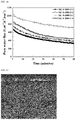
- FIG. 15 shows the pore size distribution at various sintering times for the SiC layer according to the present invention at 1,000° C.
- FIG. 16 shows changes in water permeance when the time for sintering the SiC layer according to the present invention at 1,000° C. is changed.
- FIG. 17 shows the microstructure of a SiC layer after sintering the SiC layer oxidatively bonded on a porous alumina support layer at 1,000° C. for 3 hours.
- the present invention relates to a ceramic membrane for water treatment using the binding of SiO 2 oxide layers formed on the surface of SiC particles by coating a support layer with SiC powder followed by sintering under an oxidizing environment or atmospheric environment, and a method for manufacturing the same. That is, the SiO 2 oxide layer formed during the oxidation process induces volume expansion, and ceramic membranes, in which defects due to the contraction of coating layers during general sintering can be prevented, can be manufactured.
- FIG. 1 includes (a) a schematic diagram illustrating the ceramic membrane for water treatment using oxidation-treated SiC according to the present invention and (b) a cross-sectional diagram illustrating a SiO 2 oxide layer formed on a surface of SiC particles.
- the ceramic membrane for water treatment according to the present invention includes a porous ceramic support layer 10 and a SiC layer 20 formed on the porous ceramic support layer 10 .
- the porous ceramic support layer according to the present invention can be formed of a ceramic including one or more of silicon carbide (SiC), alumina (Al 2 O 3 ), titanium dioxide (TiO 2 ), and zirconia (ZrO 2 ), and can have a porosity of 40% to 60%.
- SiC silicon carbide
- Al 2 O 3 alumina
- TiO 2 titanium dioxide
- ZrO 2 zirconia
- Pores included in the porous ceramic support layer 10 can have an average diameter of 1 ⁇ m to 3 ⁇ m, and can be pores whose average diameter is about 3 times greater than the average diameter of the pores contained in the SiC layer 20 .
- the pores included in the SiC layer 20 can have an interconnected pore structure in which a network structure is developed.
- pores can be classified into independent pores (closed cell) in which the walls of the pores are all closed, and continuous pores (opened cell) which has a structure in which a part of the walls of the pores is opened.
- the pores according to the present invention are open pores, that is, continuous pores (opened cell), and a part among the walls of the pores is open such that the pores are interconnected with other pores.
- the porous ceramic support layer 10 includes interconnected pores having a diameter of 1 ⁇ m to 3 ⁇ m, interconnected pores are thus formed inside the porous ceramic support layer 10 , and thereby an effect of excellent water permeance can be exhibited.
- the SiC layer 20 is formed on the porous ceramic support layer 10 .
- the SiC layer 20 is a coating layer including SiC particles, and a SiO 2 oxide layer is formed on the surface of the SiC particles.
- This SiO 2 oxide layer induces volume expansion, which has an effect of being able to prevent defects due to the contraction of coating layers during general sintering.
- FIG. 2 is a cross-sectional diagram illustrating a ceramic membrane for water treatment showing a conventional coating and defects due to the contraction of a coating layer during sintering
- FIG. 3 includes (a) a cross-sectional diagram illustrating a ceramic membrane for water treatment due to coating and sintering according to the present invention and (b) an illustration of a rearrangement state of particles.
- volume expansion occurs by the oxidation bonding of SiC.
- a coating layer that expands at an initial stage tends to return to its original size. That is, the coating layer shows compressive stress.
- Such compressive stress helps to rearrange the particles and partly densify them without forming cracks.
- This phenomenon can be explained by a monolayer of particles on a sintered porous ceramic support body, which is schematically represented. An oxidative layer is formed on the surface of particles during sintering in air, and thereby the size of the particles increases, which causes the coating layer to expand. It can be seen that optimum compressive stress due to the oxidative expansion of powder in an oxidatively bonded SiC membrane has an important influence on the rearrangement of particles in the coating layer.
- the SiC layer linearly expands by of about 4% to 5% due to the oxidation process, but since the filling rate of the initial SiC layer is less than 60%, a slight expansion is rather an advantageous factor for manufacturing good membranes within the limit of being able to control the pore size of the SiC layer.
- the sintering temperature can be lowered to 1,050° C. or less by including SiC particles formed by sintering SiC powder having an average particle diameter of 1 ⁇ m or less, whereas the sintering temperature of SiC in the existing bulk state is 1,800° C. That is, in the case of including SiC particles having an average particle diameter of 1 ⁇ m or less, oxygen supply is smoother than that of SiC in the existing bulk state, thereby the oxidation process operates effectively, and an effect of excellent durability can be exhibited.
- the SiC layer 20 maintains the interconnected pores and can thereby provide an effect of excellent water permeability.
- the interconnected pores are, as previously described, interconnected pores in which a part of the walls of the pores open such that the pores are connected to other pores.
- the average diameter of such pores can be 0.05 ⁇ m to 0.5 ⁇ m, and when the pores have an average diameter of less than 0.05 ⁇ m, the water permeance of the membrane can be reduced, because the diameter of pores is too small. Conversely, when it exceeds 0.5 ⁇ m, the size of pores increases and thus water permeance increases, but the separation effect decreases, and the application field is reduced as a result. There is a disadvantage in that an oxidative bonding step by heat treatment for 4 hours or more at a high temperature of 1,100° C. or more is required for strengthening oxidative bonding strength.
- FIG. 4 is a graph showing the water permeance of a SiC layer according to SiC oxidation (percentage) of SiC particles.
- the water permeance gradually increases in a 9% to 11% range of the SiC oxidation percentage, and it is observed that an increased gradient of the permeability rises sharply above 11% as compared with below 11%. Afterwards, when the SiC oxidation percentage is 14%, the permeability shows its maximum value.
- the increased gradient of permeability has an inflection point when the SiC oxidation percentage is approximately 12%.
- the permeability after 14% of the SiC oxidation percentage shows a sharply decreasing behavior similar to the previous changes in permeability below 14%.
- the decreased gradient of permeability has an inflection point when the SiC oxidation (percentage) is approximately 15%.
- the degree of SiC oxidation of SiC particles that is, the degree of conversion to SiO 2 can be theoretically determined according to the equation of Hoffmann, et al.
- the weight of the SiC layer when the SiC layer is completely oxidized relative to the weight of the SiC layer when the SiC is layer can be calculated to determine the SiC oxidation percentage (%) in Equation 3.
- the weight change ( ⁇ m(sample) %) of the SiC oxidation percentage can be calculated using Equation 2 and ⁇ m(sample) % can be approximately 6.5% to 7.5%.
- the sintered sample weight refers to SiC particles on which a SiO 2 oxide layer is formed
- the green sample weight refers to SiC particles without the SiO 2 oxide layer
- the SiC particles according to the present invention can have a SiC oxidation percentage of 12% to 15%, as shown in FIG. 4 , and when it falls out of this range, it is confirmed that the water permeance is decreased.
- FIG. 5 is a graph showing the water permeance of a SiC layer according to thickness of a SiO 2 oxide layer formed on a surface of SiC particles.
- the thickness (d) of the SiO 2 oxide layer formed on the surface of the SiC particles satisfies the range of 0.028 ⁇ m to 0.035 ⁇ m, an excellent water permeance of 400 L ⁇ m ⁇ 2 ⁇ h ⁇ 1 ⁇ bar ⁇ 1 or higher can be exhibited.
- the permeance gradually increases when the thickness (d) of the oxide layer is in the range of 0.022 ⁇ m to 0.027 ⁇ m, and a phenomenon in which the increased gradient of the permeability sharply rises after 0.027 ⁇ m is observed. Afterwards, when the thickness (d) of the oxide layer is 0.034 ⁇ m, the permeability shows its maximum value.
- the increased gradient of permeability has an inflection point when the thickness (d) of the oxide layer is approximately 0.028 ⁇ m.
- the permeability shows a sharply decreasing behavior similar to the changes in permeability before 0.034 ⁇ m.
- the decreased gradient of permeability has an inflection point when the thickness (d) of the oxide layer is approximately 0.035 ⁇ m.
- FIG. 6 is a graph showing the coating thickness of a SiC layer according to SiC concentration.
- the SiC layer 20 containing about 2% by weight to 10% by weight of SiC powder can be formed in the form of a film having a thickness of 5 ⁇ m to 30 ⁇ m.
- FIG. 7 includes SEM images of a porous ceramic support layer and a ceramic membrane for water treatment including a SiC layer, manufactured under a sintering condition at 1,300° C. for 1 hour with varying contents of SiC powder.
- FIGS. 7( a ) and ( b ) show membranes containing 6% by weight of SiC powder in the SiC layer 20
- FIGS. 7( c ) and ( d ) show membranes containing 8% by weight of SiC powder in the SiC layer 20
- FIGS. 7( e ) and ( f ) show membranes containing 10% by weight of SiC powder in the SiC layer 20 .
- FIGS. 7( a ) and ( b ) show sufficient results for covering the surface roughness of the porous ceramic support layer.
- FIGS. 7 ( e ) and ( f ) when the SiC powder is 10% by weight or more, cracks are formed as the thickness of the coating layer increases.
- FIGS. 7( c ) and ( d ) when the coating layer containing 8% by weight of SiC powder to have a thickness of about 20 ⁇ m was formed, it was possible to completely cover the porous ceramic support layer, and as a result, it can be confirmed that a smooth membrane surface was formed without cracks.
- the SiC layer formed on the porous ceramic support layer is composed of SiC particles located inside on which the SiO 2 oxide layer is formed on the outside thereof, and since the SiC particles are bound to each other by the SiO 2 oxide layer and the support layer and the SiC layer are bound to each other, thereby maintaining the connectivity of the opened pores, the durability and water permeance of the membrane excellent.
- the slurry contains about 4% by weight to 10% by weight of SiC powder, the surface roughness of the porous ceramic support layer can be sufficiently covered because the thickness of the SiC layer 20 satisfies the range of 10 ⁇ m to 25 ⁇ m, and thereby it is possible to prevent cracks from being formed in the SiC layer 20 .
- FIG. 8 is the flow chart showing the method for manufacturing a ceramic membrane for water treatment using oxidation-treated SiC according to the present invention.
- the method for manufacturing the ceramic membrane for water treatment according to the present invention includes a process S 110 of coating a porous ceramic support layer with a slurry including SiC powder and a process S 120 of sintering.
- the porous ceramic support layer 10 is coated with a slurry including SiC powder.
- the porous ceramic support layer according to the present invention can be formed of a ceramic including one or more of silicon carbide (SiC), alumina (Al 2 O 3 ), titanium dioxide (TiO 2 ), and zirconia (ZrO 2 ). More specifically, a ceramic carbide support layer connected with a glass material made of a ceramic material having gas-permeable pores, a silicon carbide support layer bound with clay, and the like can be used.
- the porous ceramic support layer 10 can be manufactured as follows.
- the form of the extruded material can be a parallel-plate form including pores, and it is dried for 10 hours to 30 hours at room temperature.
- the dried support layer is heat treated at 300° C. to 500° C. for 1 hour to 6 hours in order to remove the binder present inside. Next, it is sintered for 30 minutes to 3 hours at 1,300° C. to 1,500° C.
- the porous ceramic support layer can form interconnected pores having a network structure, which have a porosity of 40% to 60%.
- the average diameter of the formed pores can be 1 ⁇ m to 3 ⁇ m.
- the slurry including SiC powder contains SiC powder having an average particle diameter of 1 ⁇ m or less, distilled water, and an organic solvent.
- SiC powder having an average particle diameter of 1 ⁇ m or less can be used.
- SiC powder with an average particle diameter of 1 ⁇ m or less is formed into SiC particles having an average particle diameter of 1 ⁇ m or less by being sintered.
- Distilled water is mixed with an organic solvent and used for the purpose of diluting the organic solvent.
- the organic solvent may include, for example, isopropyl alcohol, polyvinyl alcohol, polyethylene glycol, and the like. Isopropyl alcohol suppresses bubbles generated while mixing slurry so as to produce a uniform SiC layer. In addition, after coating, isopropyl alcohol increases the drying speed to cause uniform drying.
- Polyvinyl alcohol acts as a binder to increase the viscosity of the slurry to control the movement of SiC particles, and in particular, it serves to prevent SiC particles from entering through the pores inside the support layer 10 by capillary force.
- the micro strength of the sintered SiC layer 20 can be further improved.
- a dispersant can be further added at 1% by weight or less with respect to 100% by weight of the slurry, but it is not limited thereto.
- the coating can be carried out by dip coating, sol-gel coating, or aerosol-spray coating.
- the slurry including 4% by weight to 10% by weight of SiC powder is applied on the porous ceramic support layer in the form of a thin film of 10 ⁇ m to 25 ⁇ m, and a SiC layer 20 having a thickness of 10 ⁇ m to 25 ⁇ m can be formed.
- the thickness of the coating layer can be formed to a maximum of 30 ⁇ m, it is desirable to form at 10 ⁇ m to 25 ⁇ m in terms of the physical properties and reliability of the SiC layer 20 .
- the thickness of the SiC layer 20 satisfies the range of 10 ⁇ m to 25 ⁇ m, the surface roughness of the porous ceramic support layer can be sufficiently covered, and it is possible to prevent cracks from being formed in the SiC layer 20 .
- the coated result is sintered at 950° C. to 1,050° C. to form a SiO 2 oxide layer on the surface of SiC particles.
- Sintering can be carried out under an oxidizing environment or atmospheric environment.
- the sintering temperature is less than 950° C.
- binding between the SiC powders is insufficient
- the growth rate of the SiO 2 oxide layer formed on the surface of SiC particles is inadequate
- interconnected pores may not be sufficiently formed.
- the temperature exceeds 1,050° C.
- the number of interconnected pores formed while sintering at 950° C. to 1,050° C. decreases
- the number of independent pores (closed cell) in a closed structure in which all of the walls are closed increases so that the water permeance of the SiC layer decreases markedly.
- sintering is carried out at 950° C. to 1,050° C. to promote the growth of the SiO 2 oxide layer and maintain interconnected pores.
- sintering is preferably carried out at about 1,000° C. for 2 hours to 4 hours, more preferably for 2.5 hours to 3.5 hours.
- the sintering time is less than 2 hours, the growth rate of the SiO 2 oxide layer formed on the surface of SiC particles is inadequate, it can be difficult to sufficiently form the interconnected pores, and there is a problem of lowered water permeance.
- the sintering time exceeds 4 hours, it exhibits a SiC oxidation percentage similar to the case of sintering for less than 2 hours, and the water permeance of SiC layer decreases to 438 L ⁇ m 2 ⁇ h ⁇ 1 ⁇ bar ⁇ 1 or less.
- the SiC layer satisfies the sintering retention time of 2 hours to 4 hours, excellent water permeance of 400 L ⁇ m ⁇ 2 ⁇ h ⁇ 1 ⁇ bar ⁇ 1 or greater can be exhibited.
- the SiC layer 20 by sintering according to the present invention includes pores whose average diameter is 0.05 ⁇ m to 0.5 ⁇ m, which is smaller than the average diameter of pores included in the porous ceramic support layer 10 .
- a slurry containing SiC powder is applied on the porous ceramic support layer 20 followed by sintering under an oxygen or atmospheric environment to oxidize and bind the surfaces of the SiC particles at the same time, and manufactures the ceramic membrane for water treatment.
- the binding between the particles occurring during the sintering process generates a contraction of the coating layer, and in severe cases, defects can be generated between the support layer and the coating layer.
- the present invention can prevent defects due to the contraction of the coating layer by triggering volume expansion using the SiO 2 oxide layer which is formed during the oxidation of SiC and binds SiC so that a ceramic membrane for water treatment with excellent durability can be manufactured.
- SiC powder with an average particle diameter of 1 ⁇ m or less compared with SiC in the bulk state, has very high sensitivity for a sintering environment, the oxygen supply during sintering under an oxidizing environment is smooth, and thus the reaction rate is improved compared with SiC in the existing bulk state.
- SiC powder having an average particle diameter of 6.7 ⁇ m was mixed with 8% by weight of clay having an average particle diameter of 2.1 ⁇ m.
- 0.2 part by weight of methyl cellulose based on 100 parts by weight of the raw material powder was added as an extruder binder for extrusion of parallel-plate support layers.
- 0.3 part by weight of distilled water based on 100 parts by weight of the raw material powder was added to form a mixture. The mixture was aged for 48 hours and then extruded through an extruder (KTE-50S, Kosentech, Korea).
- the form of the extruded material is, as shown in FIG. 10 , a parallel plate. More specifically, it is in the form of a width of 50 mm, a height of 4 mm, and a length of 20 cm, and 16 holes (2 mm in width and height, respectively) are formed inside.
- the extruded material was dried at room temperature for 24 hours and heat treated at 400° C. for 4 hours to remove the binder present therein. Afterwards, by sintering at 1400° C. for 1 hour, a porous ceramic support layer was prepared.
- the bending strength of the prepared porous ceramic support layer was 46 MPa ⁇ 2.74%.
- the microstructure of the porous ceramic support has a well-developed network structure of coarse pores.
- the porosity was 47%, and the average diameter of the formed pores was 1.8 ⁇ m.
- Pure water was used to measure the water permeance of the porous ceramic support layer, and it was found that the porous ceramic support layer had a high water permeance of 5.5 ⁇ 10 3 L ⁇ m ⁇ 2 ⁇ h ⁇ 1 ⁇ bar ⁇ 1 .
- a SiC layer was formed on the previously prepared porous ceramic support layer using dip coating.
- a slurry was prepared by mixing 8% by weight of SiC powder, 59% by weight of purified water, 30% by weight of isopropyl alcohol (Samchun Chemicals, Korea), 1% by weight of polyvinyl alcohol, 1% by weight of polyethylene glycol, and 1% by weight of Darvan-CN as a dispersant based on 100% by weight of the slurry.
- the SiC powder (F 15-A, specific surface area of 15 m 2 /g, H. C. Starck Ceramics GmbH, Germany) has an average particle diameter of 0.55 ⁇ m.
- the dip coating was carried out under conditions of a dipping time of 30 seconds and a withdrawal speed of 1 mm/s, and after dip coating, drying was carried out at room temperature for 24 hours.
- the dried product was sintered at a temperature in the range of 900° C. to 1,300° C. at a heating rate of 3° C./min for 1 hour to 4 hours.
- the thickness of the prepared SiC layer is 20 ⁇ m.
- FIG. 11 is a cross-sectional diagram illustrating the microstructure in which a SiC layer is formed on the SiC parallel-plate support layer according to the present invention. It can be confirmed that the surface is constantly flat, defects such as cracks were not found, and SiC particles did not enter the inside of the support layer.
- a coating structure free of defects was due to the fact that SiC powder having an average particle diameter of 1 ⁇ m or less included in the slurry was mixed with an organic solvent such as isopropyl alcohol and polyvinyl alcohol at an appropriate mixing ratio.
- the oxidation process of SiC shows a mostly passive oxidation behavior.
- the passive oxidation behavior increases the weight and volume of the SiC layer due to the growth of amorphous SiO 2 particles formed on the surface of SiC particles during oxidation.
- changes in the sintering temperature and sintering time have important influences on the formation of SiO 2 by oxidation, an increase in the resulting weight, and the like.
- FIG. 12 illustrates the microstructure of the SiC layer according to the present invention when the temperature was changed for the SiC layer for 1 hour.
- FIG. 12 there was no change in the microstructure due to oxidation at 900° C., but it was observed that as the sintering temperature increased from 1,000° C. to 1,300° C., the surface microstructure by oxidation was changed. That is, at a high sintering temperature of 1,000° C. or greater, it could be observed that the formation of SiO 2 was promoted on the surface of SiC particles.
- FIG. 13 is the result showing the pore size distribution of the SiC layer according to the present invention by utilizing the mercury impregnation process.
- the peak on the left side shows the pore size of the support layer
- the peak on the right side shows the pore size of the SiC layer.
- the pores of the SiC layer showed a pore size of which the average diameter is about 0.075 ⁇ m to 0.155 ⁇ m.
- the pore size increases, indicating a decreasing trend in the height along the y-axis which indicates the degree of mercury impregnation.
- FIG. 14 is the result showing changes in water permeance when the temperature of the SiC layer according to the present invention is changed for 1 hour. Water permeance is calculated via the following equation.
- factors that affect water permeance include the thickness of coating layers, porosity, the size of pores, and the like.
- water permeance tends to decrease despite an increase in the pore size due to an increase in the sintering temperature. This is determined to be caused by a decrease in the open pore network contributing to air permeability as the connectivity of the previously formed open pores decreases due to an increase in the sintering temperature.
- the pore size does not change as the sintering retention time increases.
- the impregnated amount of mercury measured by the mercury impregnation method is increasing, which suggests an increase in water permeance can be expected.
- FIG. 16 shows changes in water permeance when the time for sintering the SiC layer according to the present invention at 1,000° C. is changed, and it shows changes in water permeance as the sintering retention time increases in the case of sintering at 1,000° C. Water permeance tends to increase from 325 LMH to 700 LMH as the sintering retention time increases from 1 hour to 3 hours.
- the present invention it is possible to manufacture excellent ceramic membranes for water treatment by appropriately controlling the sintering temperature and the sintering retention time.
- an alumina support body was coated with silicon carbide, followed by sintering in the same conditions under an oxidizing environment.
- FIG. 17 shows the microstructure of a SiC layer after sintering the SiC layer oxidatively bonded on a porous alumina support layer at 1,000° C. for 3 hours. It was possible to obtain an excellent structure of the SiC layer having a thickness of about 30 ⁇ m, and since the contraction phenomenon which occurs in the general sintering process does not occur during the oxidation sintering process of the coating layer of SiC, an excellent SiC layer can be obtained, regardless the composition of the support layer.
- the ceramic membrane for water treatment according to the present invention is manufactured by forming a coating layer on a porous ceramic support layer using SiC powder followed by heat treatment in an oxidizing environment to form a SiO 2 oxide layer on the surface of SiC particles.
- the SiO 2 oxide layer is formed by sintering SiC powder at a temperature of 1,050° C. or lower, and by utilizing such a low binding temperature, the sintering temperature of SiC in the existing bulk state, which is 1,800° C. or higher, is lowered to a temperature of 1,050° C. or lower, and, as a result, economically feasible membranes can be manufactured.
- a SiO 2 oxide layer formed, during sintering, on the surface of SiC particles does not contain impurities, and thus, it has an advantage of being very chemically stable.
- ceramic membranes including oxidation-treated SiC are expected to have excellent application effects as a water treatment filter.
Landscapes
- Chemical & Material Sciences (AREA)
- Chemical Kinetics & Catalysis (AREA)
- Engineering & Computer Science (AREA)
- Inorganic Chemistry (AREA)
- Manufacturing & Machinery (AREA)
- Ceramic Engineering (AREA)
- Organic Chemistry (AREA)
- Structural Engineering (AREA)
- Materials Engineering (AREA)
- Nanotechnology (AREA)
- Life Sciences & Earth Sciences (AREA)
- Hydrology & Water Resources (AREA)
- Environmental & Geological Engineering (AREA)
- Water Supply & Treatment (AREA)
- Separation Using Semi-Permeable Membranes (AREA)
- Filtering Materials (AREA)
- Ceramic Products (AREA)
Applications Claiming Priority (2)
| Application Number | Priority Date | Filing Date | Title |
|---|---|---|---|
| KR10-2016-0174618 | 2016-12-20 | ||
| KR1020160174618A KR20180072025A (ko) | 2016-12-20 | 2016-12-20 | 산화 처리된 SiC를 이용한 수처리용 세라믹 분리막 및 그 제조 방법 |
Publications (2)
| Publication Number | Publication Date |
|---|---|
| US20180169588A1 US20180169588A1 (en) | 2018-06-21 |
| US10987635B2 true US10987635B2 (en) | 2021-04-27 |
Family
ID=62557129
Family Applications (1)
| Application Number | Title | Priority Date | Filing Date |
|---|---|---|---|
| US15/820,952 Active 2038-01-29 US10987635B2 (en) | 2016-12-20 | 2017-11-22 | Ceramic membrane for water treatment using oxidation-treated SiC and method for manufacturing the same |
Country Status (4)
| Country | Link |
|---|---|
| US (1) | US10987635B2 (ja) |
| JP (1) | JP6807823B2 (ja) |
| KR (1) | KR20180072025A (ja) |
| CN (1) | CN108201794B (ja) |
Families Citing this family (9)
| Publication number | Priority date | Publication date | Assignee | Title |
|---|---|---|---|---|
| US20190177237A1 (en) | 2017-12-11 | 2019-06-13 | Saudi Arabian Oil Company | Ceramic membranes |
| CN110745972A (zh) * | 2018-07-24 | 2020-02-04 | 宝山钢铁股份有限公司 | 一种淬水槽的水循环处理系统 |
| CN110577405A (zh) * | 2019-01-21 | 2019-12-17 | 南方科技大学 | 双层陶瓷膜及其制备方法 |
| FR3098730B1 (fr) | 2019-07-18 | 2024-01-19 | Saint Gobain Ct Recherches | Filtre comprenant une couche séparatrice en carbure de silicium |
| CN114311232B (zh) * | 2020-09-29 | 2023-02-10 | 三达膜科技(厦门)有限公司 | 一种大直径组合式蜂窝陶瓷过滤膜的制备方法 |
| CN115845619B (zh) * | 2022-12-12 | 2026-03-06 | 上海工程技术大学 | 一种能用于膜蒸馏的碳化硅基疏水陶瓷膜的制备方法 |
| CN116283300B (zh) * | 2023-03-17 | 2024-05-17 | 山东理工大学 | 一种基于数字光处理的一步共烧碳化硅平板陶瓷膜及其制备方法 |
| US20240400741A1 (en) * | 2023-06-01 | 2024-12-05 | King Fahd University Of Petroleum And Minerals | Polyamide-functionalized silicon carbide (sic) nanoparticles-based ceramic membrane for separating an oil and water mixture |
| CN119896975A (zh) * | 2025-03-20 | 2025-04-29 | 上海工程技术大学 | 一种碳化硅基Janus膜及其制备方法与应用 |
Citations (8)
| Publication number | Priority date | Publication date | Assignee | Title |
|---|---|---|---|---|
| EP0219383A1 (fr) | 1985-09-09 | 1987-04-22 | Centre National De La Recherche Scientifique (Cnrs) | Utilisation de poudres frittables de carbure de silicium de granulométrie particulière dans la réalisation d'éléments de filtration en céramique poreuse, et céramiques ainsi obtenues |
| JP2600105Y2 (ja) | 1993-05-28 | 1999-10-04 | 株式会社インパル | オゾン発生装置 |
| JP2003103285A (ja) | 2001-09-28 | 2003-04-08 | Noritake Co Ltd | 水質浄化用多孔体 |
| EP2219383A2 (en) | 2009-02-17 | 2010-08-18 | Samsung Electronics Co., Ltd. | 2D/3D display system, 2D/3D display apparatus and control method of 2D/3D display apparatus |
| WO2011040554A1 (ja) | 2009-09-30 | 2011-04-07 | 住友大阪セメント株式会社 | 排ガス浄化フィルタ |
| WO2011040561A1 (ja) | 2009-09-30 | 2011-04-07 | 住友大阪セメント株式会社 | 排ガス浄化フィルタ |
| WO2011040563A1 (ja) | 2009-09-30 | 2011-04-07 | 住友大阪セメント株式会社 | 排ガス浄化フィルタ |
| CN104174298A (zh) | 2014-08-20 | 2014-12-03 | 武汉工程大学 | 一种净水用梯度碳化硅陶瓷膜的制备方法 |
Family Cites Families (1)
| Publication number | Priority date | Publication date | Assignee | Title |
|---|---|---|---|---|
| CN101913872B (zh) * | 2010-07-22 | 2014-10-29 | 萍乡市金辉环保有限责任公司 | 碳化硅-氧化硅陶瓷膜过滤管的生产方法 |
-
2016
- 2016-12-20 KR KR1020160174618A patent/KR20180072025A/ko not_active Ceased
-
2017
- 2017-11-22 US US15/820,952 patent/US10987635B2/en active Active
- 2017-11-24 JP JP2017226022A patent/JP6807823B2/ja active Active
- 2017-11-24 CN CN201711194071.XA patent/CN108201794B/zh active Active
Patent Citations (10)
| Publication number | Priority date | Publication date | Assignee | Title |
|---|---|---|---|---|
| EP0219383A1 (fr) | 1985-09-09 | 1987-04-22 | Centre National De La Recherche Scientifique (Cnrs) | Utilisation de poudres frittables de carbure de silicium de granulométrie particulière dans la réalisation d'éléments de filtration en céramique poreuse, et céramiques ainsi obtenues |
| JP2600105Y2 (ja) | 1993-05-28 | 1999-10-04 | 株式会社インパル | オゾン発生装置 |
| JP2003103285A (ja) | 2001-09-28 | 2003-04-08 | Noritake Co Ltd | 水質浄化用多孔体 |
| EP2219383A2 (en) | 2009-02-17 | 2010-08-18 | Samsung Electronics Co., Ltd. | 2D/3D display system, 2D/3D display apparatus and control method of 2D/3D display apparatus |
| WO2011040554A1 (ja) | 2009-09-30 | 2011-04-07 | 住友大阪セメント株式会社 | 排ガス浄化フィルタ |
| WO2011040561A1 (ja) | 2009-09-30 | 2011-04-07 | 住友大阪セメント株式会社 | 排ガス浄化フィルタ |
| WO2011040563A1 (ja) | 2009-09-30 | 2011-04-07 | 住友大阪セメント株式会社 | 排ガス浄化フィルタ |
| CN102574039A (zh) | 2009-09-30 | 2012-07-11 | 住友大阪水泥股份有限公司 | 废气净化过滤器 |
| US20120186240A1 (en) * | 2009-09-30 | 2012-07-26 | Honda Motor Co., Ltd. | Exhaust gas purifying filter |
| CN104174298A (zh) | 2014-08-20 | 2014-12-03 | 武汉工程大学 | 一种净水用梯度碳化硅陶瓷膜的制备方法 |
Non-Patent Citations (4)
| Title |
|---|
| J. H. She et al., "Oxidation bonding of porous silicon carbide ceramics", Journal of Materials Science 37, pp. 3615-3622, 2002. |
| J. Roy et al., "Oxidation Behaviour of Silicon Carbide—A Review", Rev.Adv.Mater.Sci.38, pp. 29-39, 2014. |
| JPO, Office Action of JP 2017-226022 dated Oct. 23, 2018. |
| SIPO, Office Action of CN 201711194071.X dated Apr. 26, 2020. |
Also Published As
| Publication number | Publication date |
|---|---|
| US20180169588A1 (en) | 2018-06-21 |
| CN108201794B (zh) | 2021-07-16 |
| JP2018099678A (ja) | 2018-06-28 |
| CN108201794A (zh) | 2018-06-26 |
| JP6807823B2 (ja) | 2021-01-06 |
| KR20180072025A (ko) | 2018-06-29 |
Similar Documents
| Publication | Publication Date | Title |
|---|---|---|
| US10987635B2 (en) | Ceramic membrane for water treatment using oxidation-treated SiC and method for manufacturing the same | |
| Almandoz et al. | Preparation and characterization of non-supported microfiltration membranes from aluminosilicates | |
| CN101528328B (zh) | 陶瓷多孔膜和陶瓷过滤器 | |
| US6709622B2 (en) | Porous nanostructures and method of fabrication thereof | |
| CN101528330B (zh) | 陶瓷多孔膜和陶瓷过滤器 | |
| KR101591932B1 (ko) | 세라믹 코팅층을 가지는 다공질 점토 기반 세라믹 분리막 제조방법 및 이에 의해 제조된 세라믹 분리막 | |
| CN102026939A (zh) | 多相催化中的具有孔隙率梯度的陶瓷泡沫 | |
| Chen et al. | Three-dimensional printing of high-flux ceramic membranes with an asymmetric structure via digital light processing | |
| KR101572281B1 (ko) | 저 크리프 내화성 세라믹 및 제조방법 | |
| KR20150004512A (ko) | 기공 특성이 제어된 다공성 세라믹 분리막의 제조방법 및 이에 의해 제조된 다공성 세라믹 분리막 | |
| JP5925190B2 (ja) | 水不透過性のセラミック分離膜の製造方法および該製造方法で得られるセラミック分離膜 | |
| CN104364222A (zh) | 氧化铝多孔质体及其制造方法 | |
| EP2918331B1 (en) | Support for a ceramic filtration membrane | |
| Silva et al. | Porous asymmetric microfiltration membranes shaped by combined alumina freeze and tape casting | |
| KR101918916B1 (ko) | 산화 처리된 SiC를 이용한 수처리용 세라믹 분리막 | |
| KR20140011508A (ko) | 콜로이드 입자 안정화 세라믹 폼을 코팅한 세라믹 소재 및 이의 제조방법 | |
| KR101811199B1 (ko) | SiC 지지층용 조성물 및 이를 이용한 Al2O3 코팅층을 포함하는 SiC 분리막 및 그 제조 방법 | |
| KR102416209B1 (ko) | 산화 처리된 SiC를 이용한 수처리용 세라믹 분리막의 제조 방법 | |
| CN115427375A (zh) | 多孔质陶瓷层叠体及其制造方法 | |
| Sarbatly | Effect of kaolin/pesf ratio and sintering temperature on pore size and porosity of the kaolin membrane support | |
| Simão et al. | Structural and fluid dynamic characterization of calcium carbonate-based porous ceramics | |
| CN117320800A (zh) | 多孔陶瓷载体、膜、方法及其用途 | |
| KR20100106696A (ko) | 다공질 지지체의 내벽에 산소분리막을 코팅하는 방법 및 이로써 제조된 산소분리용 튜브 | |
| KR20220023531A (ko) | 다공성 지지체 및 이의 제조방법 | |
| US11045770B2 (en) | Silica membrane filter |
Legal Events
| Date | Code | Title | Description |
|---|---|---|---|
| AS | Assignment |
Owner name: KOREA INSTITUTE OF MACHINERY & MATERIALS, KOREA, REPUBLIC OF Free format text: ASSIGNMENT OF ASSIGNORS INTEREST;ASSIGNORS:SONG, IN-HYUCK;LEE, JONG-MAN;HA, JANG-HOON;AND OTHERS;REEL/FRAME:044199/0810 Effective date: 20171106 Owner name: KOREA INSTITUTE OF MACHINERY & MATERIALS, KOREA, R Free format text: ASSIGNMENT OF ASSIGNORS INTEREST;ASSIGNORS:SONG, IN-HYUCK;LEE, JONG-MAN;HA, JANG-HOON;AND OTHERS;REEL/FRAME:044199/0810 Effective date: 20171106 |
|
| FEPP | Fee payment procedure |
Free format text: ENTITY STATUS SET TO UNDISCOUNTED (ORIGINAL EVENT CODE: BIG.); ENTITY STATUS OF PATENT OWNER: SMALL ENTITY |
|
| FEPP | Fee payment procedure |
Free format text: ENTITY STATUS SET TO SMALL (ORIGINAL EVENT CODE: SMAL); ENTITY STATUS OF PATENT OWNER: SMALL ENTITY |
|
| STPP | Information on status: patent application and granting procedure in general |
Free format text: DOCKETED NEW CASE - READY FOR EXAMINATION |
|
| STPP | Information on status: patent application and granting procedure in general |
Free format text: NON FINAL ACTION MAILED |
|
| STPP | Information on status: patent application and granting procedure in general |
Free format text: RESPONSE TO NON-FINAL OFFICE ACTION ENTERED AND FORWARDED TO EXAMINER |
|
| STPP | Information on status: patent application and granting procedure in general |
Free format text: FINAL REJECTION MAILED |
|
| STPP | Information on status: patent application and granting procedure in general |
Free format text: RESPONSE AFTER FINAL ACTION FORWARDED TO EXAMINER |
|
| STPP | Information on status: patent application and granting procedure in general |
Free format text: DOCKETED NEW CASE - READY FOR EXAMINATION |
|
| STPP | Information on status: patent application and granting procedure in general |
Free format text: NON FINAL ACTION MAILED |
|
| STPP | Information on status: patent application and granting procedure in general |
Free format text: NOTICE OF ALLOWANCE MAILED -- APPLICATION RECEIVED IN OFFICE OF PUBLICATIONS |
|
| AS | Assignment |
Owner name: KOREA INSTITUTE OF MATERIALS SCIENCE, KOREA, REPUBLIC OF Free format text: ASSIGNMENT OF ASSIGNORS INTEREST;ASSIGNOR:KOREA INSTITUTE OF MACHINERY & MATERIALS;REEL/FRAME:055048/0937 Effective date: 20200120 |
|
| STPP | Information on status: patent application and granting procedure in general |
Free format text: PUBLICATIONS -- ISSUE FEE PAYMENT RECEIVED |
|
| STPP | Information on status: patent application and granting procedure in general |
Free format text: PUBLICATIONS -- ISSUE FEE PAYMENT VERIFIED |
|
| STCF | Information on status: patent grant |
Free format text: PATENTED CASE |
|
| MAFP | Maintenance fee payment |
Free format text: PAYMENT OF MAINTENANCE FEE, 4TH YR, SMALL ENTITY (ORIGINAL EVENT CODE: M2551); ENTITY STATUS OF PATENT OWNER: SMALL ENTITY Year of fee payment: 4 |