SEQUENCE LISTING
The present application is being filed along with a Sequence Listing in electronic format. The Sequence Listing is provided as a file entitled CORE0115USC4SEQ_ST25.txt, created on Dec. 26, 2018, which is 692 Kb in size. The information in the electronic format of the sequence listing is incorporated herein by reference in its entirety.
BACKGROUND OF THE INVENTION
The principle behind antisense technology is that an antisense compound hybridizes to a target nucleic acid and modulates the amount, activity, and/or function of the target nucleic acid. For example in certain instances, antisense compounds result in altered transcription or translation of a target. Such modulation of expression can be achieved by, for example, target mRNA degradation or occupancy-based inhibition. An example of modulation of RNA target function by degradation is RNase H-based degradation of the target RNA upon hybridization with a DNA-like antisense compound. Another example of modulation of gene expression by target degradation is RNA interference (RNAi). RNAi refers to antisense-mediated gene silencing through a mechanism that utilizes the RNA-induced silencing complex (RISC). An additional example of modulation of RNA target function is by an occupancy-based mechanism such as is employed naturally by microRNA. MicroRNAs are small non-coding RNAs that regulate the expression of protein-coding RNAs. The binding of an antisense compound to a microRNA prevents that microRNA from binding to its messenger RNA targets, and thus interferes with the function of the microRNA. MicroRNA mimics can enhance native microRNA function. Certain antisense compounds alter splicing of pre-mRNA. Regardless of the specific mechanism, sequence-specificity makes antisense compounds attractive as tools for target validation and gene functionalization, as well as therapeutics to selectively modulate the expression of genes involved in the pathogenesis of diseases.
Antisense technology is an effective means for modulating the expression of one or more specific gene products and can therefore prove to be uniquely useful in a number of therapeutic, diagnostic, and research applications. Chemically modified nucleosides may be incorporated into antisense compounds to enhance one or more properties, such as nuclease resistance, pharmacokinetics or affinity for a target nucleic acid. In 1998, the antisense compound, Vitravene® (fomivirsen; developed by Isis Pharmaceuticals Inc., Carlsbad, Calif.) was the first antisense drug to achieve marketing clearance from the U.S. Food and Drug Administration (FDA), and is currently a treatment of cytomegalovirus (CMV)-induced retinitis in AIDS patients. For another example, an antisense oligonucleotide targeting ApoB, KYNAMRO™, has been approved by the U.S. Food and Drug Administration (FDA) as an adjunct treatment to lipid-lowering medications and diet to reduce low density lipoprotein-cholesterol (LDL-C), ApoB, total cholesterol (TC), and non-high density lipoprotein-cholesterol (non HDL-C) in patients with homozygous familial hypercholesterolemia (HoFH).
New chemical modifications have improved the potency and efficacy of antisense compounds, uncovering the potential for oral delivery as well as enhancing subcutaneous administration, decreasing potential for side effects, and leading to improvements in patient convenience. Chemical modifications increasing potency of antisense compounds allow administration of lower doses, which reduces the potential for toxicity, as well as decreasing overall cost of therapy. Modifications increasing the resistance to degradation result in slower clearance from the body, allowing for less frequent dosing. Different types of chemical modifications can be combined in one compound to further optimize the compound's efficacy.
SUMMARY OF THE INVENTION
In certain embodiments, the present disclosure provides conjugated antisense compounds. In certain embodiments, the present disclosure provides conjugated antisense compounds comprising an antisense oligonucleotide complementary to a nucleic acid transcript. In certain embodiments, the present disclosure provides methods comprising contacting a cell with a conjugated antisense compound comprising an antisense oligonucleotide complementary to a nucleic acid transcript. In certain embodiments, the present disclosure provides methods comprising contacting a cell with a conjugated antisense compound comprising an antisense oligonucleotide and reducing the amount or activity of a nucleic acid transcript in a cell.
The asialoglycoprotein receptor (ASGP-R) has been described previously. See e.g., Park et al., PNAS vol. 102, No. 47, pp 17125-17129 (2005). Such receptors are expressed on liver cells, particularly hepatocytes. Further, it has been shown that compounds comprising clusters of three N-acetylgalactosamine (GalNAc) ligands are capable of binding to the ASGP-R, resulting in uptake of the compound into the cell. See e.g., Khorev et al., Bioorganic and Medicinal Chemistry, 16, 9, pp 5216-5231 (May 2008). Accordingly, conjugates comprising such GalNAc clusters have been used to facilitate uptake of certain compounds into liver cells, specifically hepatocytes. For example it has been shown that certain GalNAc-containing conjugates increase activity of duplex siRNA compounds in liver cells in vivo. In such instances, the GalNAc-containing conjugate is typically attached to the sense strand of the siRNA duplex. Since the sense strand is discarded before the antisense strand ultimately hybridizes with the target nucleic acid, there is little concern that the conjugate will interfere with activity. Typically, the conjugate is attached to the 3′ end of the sense strand of the siRNA. See e.g., U.S. Pat. No. 8,106,022. Certain conjugate groups described herein are more active and/or easier to synthesize than conjugate groups previously described.
In certain embodiments of the present invention, conjugates are attached to single-stranded antisense compounds, including, but not limited to RNase H based antisense compounds and antisense compounds that alter splicing of a pre-mRNA target nucleic acid. In such embodiments, the conjugate should remain attached to the antisense compound long enough to provide benefit (improved uptake into cells) but then should either be cleaved, or otherwise not interfere with the subsequent steps necessary for activity, such as hybridization to a target nucleic acid and interaction with RNase H or enzymes associated with splicing or splice modulation. This balance of properties is more important in the setting of single-stranded antisense compounds than in siRNA compounds, where the conjugate may simply be attached to the sense strand. Disclosed herein are conjugated single-stranded antisense compounds having improved potency in liver cells in vivo compared with the same antisense compound lacking the conjugate. Given the required balance of properties for these compounds such improved potency is surprising.
In certain embodiments, conjugate groups herein comprise a cleavable moiety. As noted, without wishing to be bound by mechanism, it is logical that the conjugate should remain on the compound long enough to provide enhancement in uptake, but after that, it is desirable for some portion or, ideally, all of the conjugate to be cleaved, releasing the parent compound (e.g., antisense compound) in its most active form. In certain embodiments, the cleavable moiety is a cleavable nucleoside. Such embodiments take advantage of endogenous nucleases in the cell by attaching the rest of the conjugate (the cluster) to the antisense oligonucleotide through a nucleoside via one or more cleavable bonds, such as those of a phosphodiester linkage. In certain embodiments, the cluster is bound to the cleavable nucleoside through a phosphodiester linkage. In certain embodiments, the cleavable nucleoside is attached to the antisense oligonucleotide (antisense compound) by a phosphodiester linkage. In certain embodiments, the conjugate group may comprise two or three cleavable nucleosides. In such embodiments, such cleavable nucleosides are linked to one another, to the antisense compound and/or to the cluster via cleavable bonds (such as those of a phosphodiester linkage). Certain conjugates herein do not comprise a cleavable nucleoside and instead comprise a cleavable bond. It is shown that that sufficient cleavage of the conjugate from the oligonucleotide is provided by at least one bond that is vulnerable to cleavage in the cell (a cleavable bond).
In certain embodiments, conjugated antisense compounds are prodrugs. Such prodrugs are administered to an animal and are ultimately metabolized to a more active form. For example, conjugated antisense compounds are cleaved to remove all or part of the conjugate resulting in the active (or more active) form of the antisense compound lacking all or some of the conjugate.
In certain embodiments, conjugates are attached at the 5′ end of an oligonucleotide. Certain such 5′-conjugates are cleaved more efficiently than counterparts having a similar conjugate group attached at the 3′ end. In certain embodiments, improved activity may correlate with improved cleavage. In certain embodiments, oligonucleotides comprising a conjugate at the 5′ end have greater efficacy than oligonucleotides comprising a conjugate at the 3′ end (see, for example, Examples 56, 81, 83, and 84). Further, 5′-attachment allows simpler oligonucleotide synthesis. Typically, oligonucleotides are synthesized on a solid support in the 3′ to 5′ direction. To make a 3′-conjugated oligonucleotide, typically one attaches a pre-conjugated 3′ nucleoside to the solid support and then builds the oligonucleotide as usual. However, attaching that conjugated nucleoside to the solid support adds complication to the synthesis. Further, using that approach, the conjugate is then present throughout the synthesis of the oligonucleotide and can become degraded during subsequent steps or may limit the sorts of reactions and reagents that can be used. Using the structures and techniques described herein for 5′-conjugated oligonucleotides, one can synthesize the oligonucleotide using standard automated techniques and introduce the conjugate with the final (5′-most) nucleoside or after the oligonucleotide has been cleaved from the solid support.
In view of the art and the present disclosure, one of ordinary skill can easily make any of the conjugates and conjugated oligonucleotides herein. Moreover, synthesis of certain such conjugates and conjugated oligonucleotides disclosed herein is easier and/or requires few steps, and is therefore less expensive than that of conjugates previously disclosed, providing advantages in manufacturing. For example, the synthesis of certain conjugate groups consists of fewer synthetic steps, resulting in increased yield, relative to conjugate groups previously described. Conjugate groups such as GalNAc3-10 in Example 46 and GalNAc3-7 in Example 48 are much simpler than previously described conjugates such as those described in U.S. Pat. Nos. 8,106,022 or 7,262,177 that require assembly of more chemical intermediates. Accordingly, these and other conjugates described herein have advantages over previously described compounds for use with any oligonucleotide, including single-stranded oligonucleotides and either strand of double-stranded oligonucleotides (e.g., siRNA).
Similarly, disclosed herein are conjugate groups having only one or two GalNAc ligands. As shown, such conjugates groups improve activity of antisense compounds. Such compounds are much easier to prepare than conjugates comprising three GalNAc ligands. Conjugate groups comprising one or two GalNAc ligands may be attached to any antisense compounds, including single-stranded oligonucleotides and either strand of double-stranded oligonucleotides (e.g., siRNA).
In certain embodiments, the conjugates herein do not substantially alter certain measures of tolerability. For example, it is shown herein that conjugated antisense compounds are not more immunogenic than unconjugated parent compounds. Since potency is improved, embodiments in which tolerability remains the same (or indeed even if tolerability worsens only slightly compared to the gains in potency) have improved properties for therapy.
In certain embodiments, conjugation allows one to alter antisense compounds in ways that have less attractive consequences in the absence of conjugation. For example, in certain embodiments, replacing one or more phosphorothioate linkages of a fully phosphorothioate antisense compound with phosphodiester linkages results in improvement in some measures of tolerability. For example, in certain instances, such antisense compounds having one or more phosphodiester are less immunogenic than the same compound in which each linkage is a phosphorothioate. However, in certain instances, as shown in Example 26, that same replacement of one or more phosphorothioate linkages with phosphodiester linkages also results in reduced cellular uptake and/or loss in potency. In certain embodiments, conjugated antisense compounds described herein tolerate such change in linkages with little or no loss in uptake and potency when compared to the conjugated full-phosphorothioate counterpart. In fact, in certain embodiments, for example, in Examples 44, 57, 59, and 86, oligonucleotides comprising a conjugate and at least one phosphodiester internucleoside linkage actually exhibit increased potency in vivo even relative to a full phosphorothioate counterpart also comprising the same conjugate. Moreover, since conjugation results in substantial increases in uptake/potency a small loss in that substantial gain may be acceptable to achieve improved tolerability. Accordingly, in certain embodiments, conjugated antisense compounds comprise at least one phosphodiester linkage.
In certain embodiments, conjugation of antisense compounds herein results in increased delivery, uptake and activity in hepatocytes. Thus, more compound is delivered to liver tissue. However, in certain embodiments, that increased delivery alone does not explain the entire increase in activity. In certain such embodiments, more compound enters hepatocytes. In certain embodiments, even that increased hepatocyte uptake does not explain the entire increase in activity. In such embodiments, productive uptake of the conjugated compound is increased. For example, as shown in Example 102, certain embodiments of GalNAc-containing conjugates increase enrichment of antisense oligonucleotides in hepatocytes versus non-parenchymal cells. This enrichment is beneficial for oligonucleotides that target genes that are expressed in hepatocytes.
In certain embodiments, conjugated antisense compounds herein result in reduced kidney exposure. For example, as shown in Example 20, the concentrations of antisense oligonucleotides comprising certain embodiments of GalNAc-containing conjugates are lower in the kidney than that of antisense oligonucleotides lacking a GalNAc-containing conjugate. This has several beneficial therapeutic implications. For therapeutic indications where activity in the kidney is not sought, exposure to kidney risks kidney toxicity without corresponding benefit. Moreover, high concentration in kidney typically results in loss of compound to the urine resulting in faster clearance. Accordingly for non-kidney targets, kidney accumulation is undesired.
In certain embodiments, the present disclosure provides conjugated antisense compounds represented by the formula:
A-B-C-D
E-F)
q
wherein
A is the antisense oligonucleotide;
B is the cleavable moiety
C is the conjugate linker
D is the branching group
each E is a tether;
each F is a ligand; and
q is an integer between 1 and 5.
In the above diagram and in similar diagrams herein, the branching group “D” branches as many times as is necessary to accommodate the number of (E-F) groups as indicated by “q”. Thus, where q=1, the formula is:
A-B-C-D-E-F
where q=2, the formula is:
where q=3, the formula is:
where q=4, the formula is:
where q=5, the formula is:
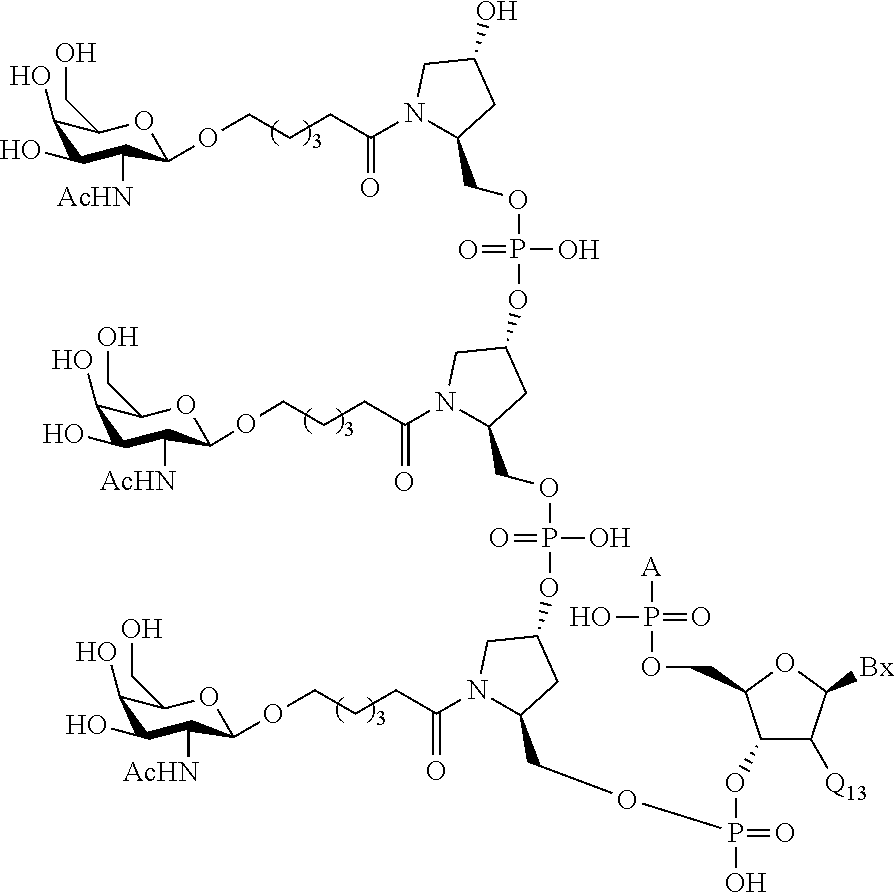
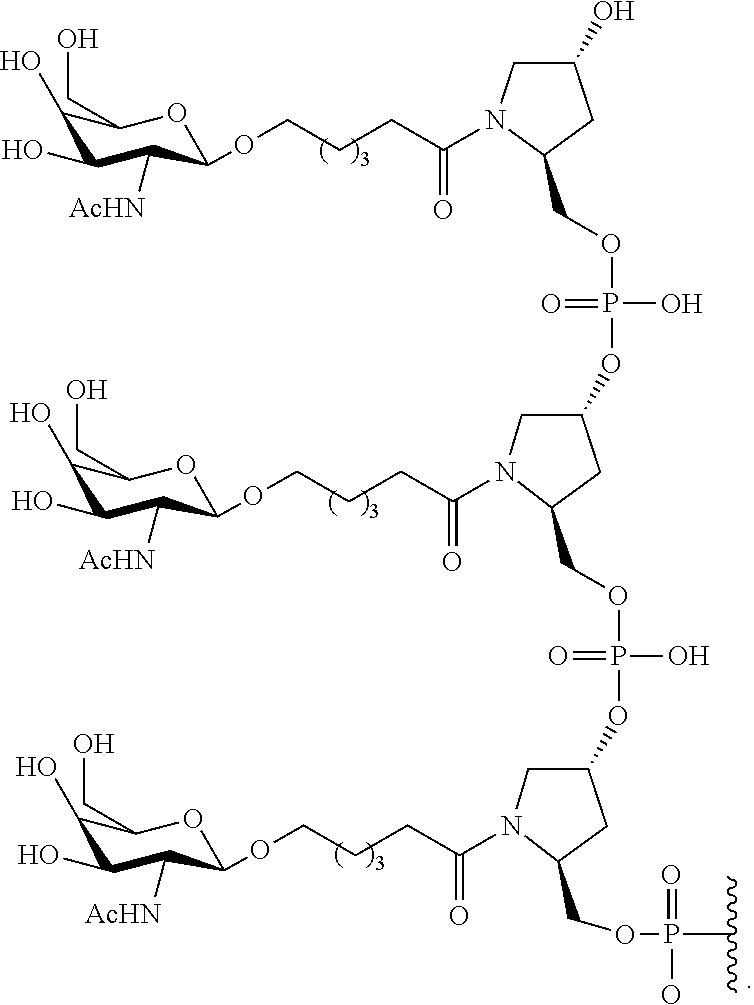
In certain embodiments, conjugated antisense compounds are provided having the structure:
In certain embodiments, conjugated antisense compounds are provided having the structure:
In certain embodiments, conjugated antisense compounds are provided having the structure:
In certain embodiments, conjugated antisense compounds are provided having the structure:
The present disclosure provides the following non-limiting numbered embodiments:
Embodiment 1
A conjugated antisense compound comprising: an antisense oligonucleotide comprising 12-30 linked nucleosides and a conjugate group, wherein the conjugate group comprises: a cleavable moiety; a conjugate linker; and a cell-targeting moiety.
Embodiment 2
The conjugated antisense compound of embodiment 1, wherein:
-
- the cleavable moiety is covalently bound to the antisense oligonucleotide;
- the conjugate linker is covalently bound to the cleavable moiety; and
- the cell-targeting moiety is covalently bound to the conjugate linker.
Embodiment 3
The conjugated antisense compound of embodiment 1 or 2, wherein the cell-targeting moiety comprises a branching group.
Embodiment 4
The conjugated antisense compound of embodiment 3, wherein the branching group is covalently attached to the conjugate linker.
Embodiment 5
The conjugated antisense compound of any of embodiments 1-4, wherein the cell-targeting moiety comprises at least one tether.
Embodiment 6
The conjugated antisense compound of embodiment 5, wherein the at least one tether is covalently attached to the branching group.
Embodiment 7
The conjugated antisense compound of any of embodiments 1-6, wherein the cell-targeting moiety comprises at least one ligand.
Embodiment 8
The conjugated antisense compound of embodiment 7, wherein each of the at least one ligands is covalently attached to a tether.
Embodiment 9
The conjugated antisense compound of embodiment 1-8, wherein the compound has a structure represented by formula I below:
A-B-C-D
E-F)
q
wherein
A is the antisense oligonucleotide;
B is the cleavable moiety
C is the conjugate linker
D is the branching group
each E is a tether;
each F is a ligand; and
q is an integer between 1 and 5.
Embodiment 10
The conjugated antisense compound of any of embodiments 1-9, wherein the cleavable moiety comprises 1-4 linked cleavable moiety nucleosides, wherein the linkage between the antisense oligonucleotide and the first cleavable moiety nucleoside is a phosphodiester internucleoside linkage.
Embodiment 11
The conjugated antisense compound of embodiment 10, wherein each internucleoside linkage between each of the linked cleavable moiety nucleosides is a phosphodiester internucleoside linkage.
Embodiment 12
The conjugated antisense compound of embodiment 10 or 11, wherein the cleavable moiety comprises 1-3 linked cleavable moiety nucleosides.
Embodiment 13
The conjugated antisense compound of embodiment 10 or 11, wherein the cleavable moiety comprises 1-2 linked cleavable moiety nucleosides.
Embodiment 14
The conjugated antisense compound of embodiment 10, wherein the cleavable moiety comprises one cleavable moiety nucleoside.
Embodiment 15
The conjugated antisense compound of any of embodiments 1-14, wherein the cleavable moiety is a cleavable moiety nucleoside selected from the group consisting of a purine, a substituted purine, a pyrimidine, or a substituted pyrimidine.
Embodiment 16
The conjugated antisense compound of any of embodiments 1-14, wherein the cleavable moiety is a cleavable moiety nucleoside selected from cytidine, uridine, adenosine, thymidine, and guanosine.
Embodiment 17
The conjugated antisense compound of any of embodiments 1-14, wherein the cleavable moiety is a cleavable moiety deoxynucleoside selected from deoxyadenosine, deoxyguanosine, deoxyinosine, thymidine, deoxyuridine, and deoxycytidine.
Embodiment 18
The conjugated antisense compound of any of embodiments 1-17, wherein the cleavable moiety comprises deoxyadenosine.
Embodiment 19
The conjugated antisense compound of any of embodiments 1-18, wherein the cleavable moiety is deoxyadenosine.
Embodiment 20
The conjugated antisense compound of any of embodiments 1-19, wherein the cleavable moiety has a structure selected from among:
wherein each of Bx, Bx1, Bx2, and Bx3 is independently a heterocyclic base moiety.
Embodiment 21
The conjugated antisense compound of embodiment 20, wherein the heterocyclic base moiety is selected from among: uracil, thymine, cytosine, 5-methylcytosine, adenine or guanine.
Embodiment 22
The conjugated antisense compound of any of embodiments 1-19, wherein the cleavable moiety has the structure:
Embodiment 23
The conjugated antisense compound of any of embodiments 1-22, wherein the conjugate linker comprises a pyrrolidine.
Embodiment 24
The conjugated antisense compound of any of embodiments 1-23, wherein the conjugate linker comprises PEG.
Embodiment 25
The conjugated antisense compound of any of embodiments 1-24, wherein the conjugate linker comprises an amide.
Embodiment 26
The conjugated antisense compound of any of embodiments 1-25, wherein the conjugate linker comprises a polyamide.
Embodiment 27
The conjugated antisense compound of any of embodiments 1-26, wherein the conjugate linker comprises an amine.
Embodiment 28
The conjugated antisense compound of any of embodiments 1-27, wherein the conjugate linker comprises one or more disulfide bonds.
Embodiment 29
The conjugated antisense compound of any of embodiments 1-28, wherein the conjugate linker comprises a protein binding moiety.
Embodiment 30
The conjugated antisense compound of embodiment 29, wherein the protein binding moiety comprises a lipid.
Embodiment 31
The conjugated antisense compound of embodiment 30, wherein the protein binding moiety is selected from among: cholesterol, cholic acid, adamantane acetic acid, 1-pyrene butyric acid, dihydrotestosterone, 1,3-Bis-O(hexadecyl)glycerol, geranyloxyhexyl group, hexadecylglycerol, borneol, menthol, 1,3-propanediol, heptadecyl group, palmitic acid, myristic acid, O3-(oleoyl)lithocholic acid, O3-(oleoyl)cholenic acid, dimethoxytrityl, or phenoxazine), a vitamin (e.g., folate, vitamin A, vitamin E, biotin, pyridoxal), a peptide, a carbohydrate (e.g., monosaccharide, disaccharide, trisaccharide, tetrasaccharide, oligosaccharide, polysaccharide), an endosomolytic component, a steroid (e.g., uvaol, hecigenin, diosgenin), a terpene (e.g., triterpene, sarsasapogenin, friedelin, epifriedelanol derivatized lithocholic acid), or a cationic lipid.
Embodiment 32
The conjugated antisense compound of any of embodiments 1-31 wherein the protein binding moiety is a C16 to C22 long chain saturated or unsaturated fatty acid, cholesterol, cholic acid, vitamin E, adamantane or 1-pentafluoropropyl.
Embodiment 33
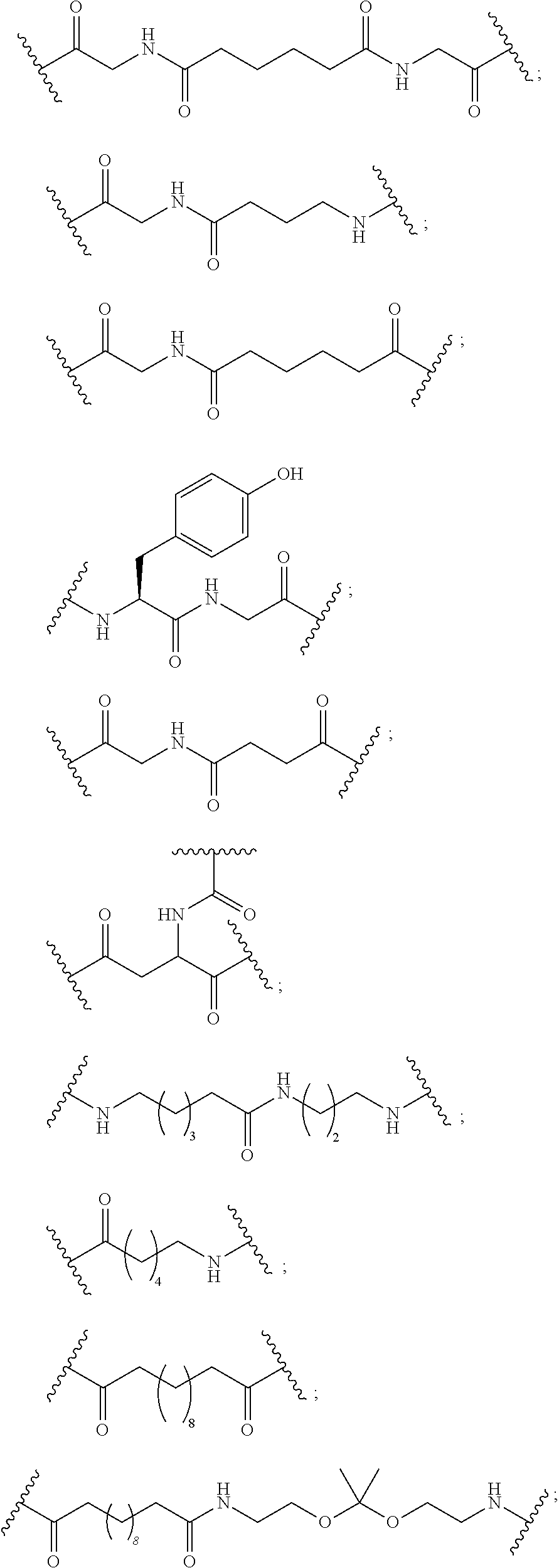
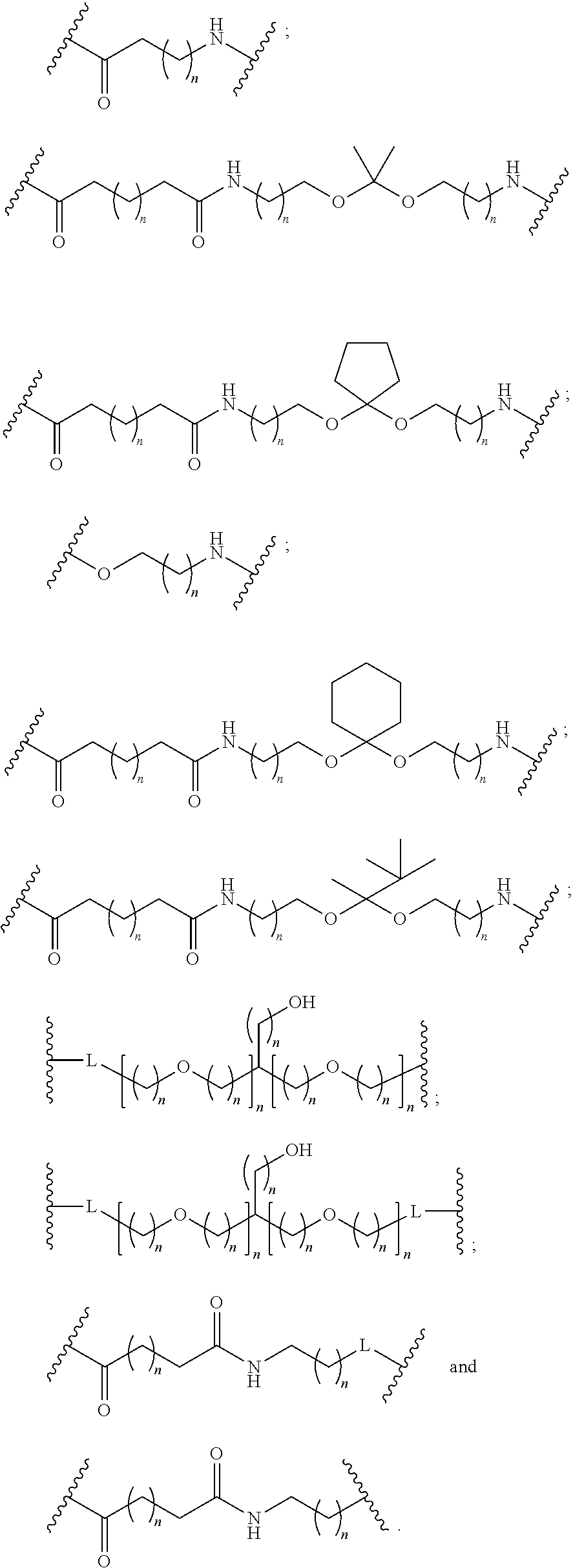
The conjugated antisense compound of any of embodiments 1-32 wherein the conjugate linker has a structure selected from among:
wherein n is from 1 to 20; and p is from 1 to 6. In such embodiments having more than one n, each n is selected independently.
Embodiment 34
The conjugated antisense compound of any of embodiments 1-33 wherein the conjugate linker has a structure selected from among:
wherein n is from 1 to 20.
Embodiment 35
The conjugated antisense compound of any of embodiments 1-33 wherein the conjugate linker has a structure selected from among:
wherein n is from 1 to 20.
Embodiment 36
The conjugated antisense compound of any of embodiments 1-33 wherein the conjugate linker has a structure selected from among:
Embodiment 37
The conjugated antisense compound of any of embodiments 1-33 wherein the conjugate linker has a structure selected from among:
Embodiment 38
The conjugated antisense compound of any of embodiments 1-33 wherein the conjugate linker has a structure selected from among:
wherein n is from 1 to 20.
Embodiment 39
The conjugated antisense compound of any of embodiments 1-33 wherein the conjugate linker has the structure:
Embodiment 40
The conjugated antisense compound of any of embodiments 1-39, wherein the cell-targeting moiety comprises a carbohydrate.
Embodiment 41
The conjugated antisense compound of any of embodiments 1-40, wherein the cell-targeting moiety comprises a carbohydrate cluster.
Embodiment 42
The conjugated antisense compound of any of embodiments 1-41, wherein the cell-targeting moiety comprises a cell surface receptor ligand.
Embodiment 43
The conjugated antisense compound of any of embodiments 1-42, wherein the targeting moiety comprises at least one N-Acetylgalactosamine (GalNAc).
Embodiment 44
The conjugated antisense compound of any of embodiments 1-43, wherein the targeting moiety comprises a branching group.
Embodiment 45
The conjugated antisense compound of embodiment 44, wherein the branching group comprises an ether.
Embodiment 46
The conjugated antisense compound of embodiment 44 or 45, wherein the branching group has the following structure:
wherein each n is, independently, from 1 to 20; and
m is from 2 to 6.
Embodiment 47
The conjugated antisense compound of embodiment 44 or 45, wherein the branching group has the following structure:
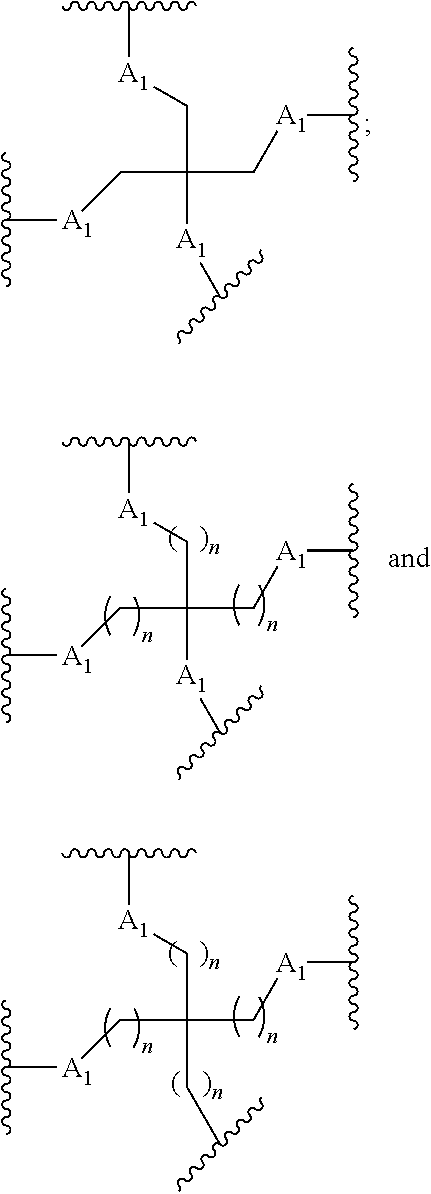
Embodiment 48
The conjugated antisense compound of embodiment 44 or 45, wherein the branching group has the following structure:
wherein each A1 is independently, O, S, C═O or NH; and
each n is, independently, from 1 to 20.
Embodiment 49
The conjugated antisense compound of embodiment 44 or 45, wherein the branching group has the following structure:
Embodiment 50
The conjugated antisense compound of any embodiments 1-49, wherein the cell-targeting moiety comprises a tether.
Embodiment 51
The conjugated antisense compound of any embodiments 1-49, wherein the cell-targeting moiety comprises two tethers.
Embodiment 52
The conjugated antisense compound of any embodiments 1-49, wherein the cell-targeting moiety comprises three tethers.
Embodiment 53
The conjugated antisense compound of any embodiments 1-49, wherein the cell-targeting moiety comprises four or more tethers.
Embodiment 54
The conjugated antisense compound of any of embodiments 1-53, wherein at least one tether comprises PEG.
Embodiment 55
The conjugated antisense compound of any of embodiments 1-54, wherein at least one tether comprises an amide.
Embodiment 56
The conjugated antisense compound of any of embodiments 1-55, wherein at least one tether comprises a polyamide.
Embodiment 57
The conjugated antisense compound of any of embodiments 1-56, wherein at least one tether comprises an amine.
Embodiment 58
The conjugated antisense compound of any of embodiments 1-57, wherein at least two tethers are different from one another.
Embodiment 59
The conjugated antisense compound of any of embodiments 1-57, wherein all of the tethers are the same as one another.
Embodiment 60
The conjugated antisense compound of any of embodiments 1-59, wherein each tether is selected from among:
wherein each n is, independently, from 1 to 20; and
each p is from 1 to about 6.
Embodiment 61
The conjugated antisense compound of any of embodiments 1-60, wherein each tether is selected from among:
Embodiment 62
The conjugated antisense compound of any of embodiments 1-61, wherein each tether has the following structure:
-
- wherein each n is, independently, from 1 to 20.
Embodiment 63
The conjugated antisense compound of any of embodiments 1-61, wherein each tether has the following structure:
Embodiment 64
The conjugated antisense compound of any of embodiments 1-63, wherein the cell-targeting moiety comprises at least one ligand.
Embodiment 65
The conjugated antisense compound of embodiment 64, wherein the cell-targeting moiety comprises one ligand.
Embodiment 66
The conjugated antisense compound of embodiment 64, wherein the targeting moiety comprises two ligands.
Embodiment 67
The conjugated antisense compound of embodiment 64, wherein the targeting moiety comprises three ligands.
Embodiment 68
The conjugated antisense compound of any of embodiments 64-67, wherein a ligand is covalently attached to each tether.
Embodiment 69
The conjugated antisense compound of any of embodiments 1 to 68, wherein at least one ligand is N-Acetylgalactosamine (GalNAc).
Embodiment 70
The conjugated antisense compound of any of embodiments 1 to 69, wherein each ligand is N-Acetylgalactosamine (GalNAc).
Embodiment 71
The conjugated antisense compound of any of embodiments 1-70, wherein the ligand is selected from among: a polysaccharide, modified polysaccharide, mannose, galactose, a mannose derivative, a galactose derivative, D-mannopyranose, L-Mannopyranose, D-Arabinose, L-Galactose, D-xylofuranose, L-xylofuranose, D-glucose, L-glucose, D-Galactose, L-Galactose, α-D-Mannofuranose, β-D-Mannofuranose, α-D-Mannopyranose, β-D-Mannopyranose, α-D-Glucopyranose, β-D-Glucopyranose, α-D-Glucofuranose, β-D-Glucofuranose, α-D-fructofuranose, α-D-fructopyranose, α-D-Galactopyranose, β-D-Galactopyranose, α-D-Galactofuranose, β-D-Galactofuranose, glucosamine, sialic acid, α-D-galactosamine, N-Acetylgalactosamine, 2-Amino-3-O—[(R)-1-carboxyethyl]-2-deoxy-β-D-glucopyranose, 2-Deoxy-2-methylamino-L-glucopyranose, 4,6-Dideoxy-4-formamido-2,3-di-O-methyl-D-mannopyranose, 2-Deoxy-2-sulfoamino-D-glucopyranose, N-Glycoloyl-α-neuraminic acid, 5-thio-β-D-glucopyranose, methyl 2,3,4-tri-O-acetyl-1-thio-6-O-trityl-α-D-glucopyranoside, 4-Thio-β-D-galactopyranose, ethyl 3,4,6,7-tetra-O-acetyl-2-deoxy-1,5-dithio-α-D-gluco-heptopyranoside, 2,5-Anhydro-D-allononitrile, ribose, D-ribose, D-4-thioribose, L-ribose, L-4-thioribose.
Embodiment 72
The conjugated antisense compound of any of embodiments 1-71, wherein the ligand is galactose.
Embodiment 73
The conjugated antisense compound of any of embodiments 1-71, wherein the ligand is mannose-6-phosphate.
Embodiment 74
The conjugated antisense compound of any of embodiments 1-71, wherein each ligand is selected from among:
wherein each R1 is selected from OH and NHCOOH.
Embodiment 75
The conjugated antisense compound of any of embodiments 1-71, wherein each ligand is selected from among:
Embodiment 76
The conjugated antisense compound of any of embodiments 1-71, wherein each ligand has the following structure:
Embodiment 77
The conjugated antisense compound of any of embodiments 1-71, wherein each ligand has the following structure:
Embodiment 78
The conjugated antisense compound of any of embodiments 1-77, wherein the cell-targeting group has the following structure:
wherein each n is, independently, from 1 to 20.
Embodiment 79
The conjugated antisense compound of any of embodiments 1-77, wherein the cell-targeting group has the following structure:
Embodiment 80
The conjugated antisense compound of any of embodiments 1-79, wherein the conjugate has the following structure:
wherein each n is, independently, from 1 to 20;
Z is H or a linked solid support;
Q is said antisense compound;
X is O or S; and
Bx is a heterocyclic base moiety.
Embodiment 81
The conjugated antisense compound of any of embodiments 1-79, wherein the conjugate has the following structure:
wherein Z is H or a linked solid support;
Q is said antisense compound.
Embodiment 82
The conjugated antisense compound of any of embodiments 1-81, wherein the conjugate group is attached to the 2′-position of a nucleoside of the antisense oligonucleotide.
Embodiment 83
The conjugated antisense compound of any of embodiments 1-81, wherein the conjugate group is attached to the 3′-position of a nucleoside of the antisense oligonucleotide.
Embodiment 84
The conjugated antisense compound of any of embodiments 1-81, wherein the conjugate group is attached to the 5′-position of a nucleoside of the antisense oligonucleotide.
Embodiment 85
The conjugated antisense compound of any of embodiments 1-82, wherein the conjugate group is attached to the 5′-terminal nucleoside of the antisense oligonucleotide.
Embodiment 86
The conjugated antisense compound of any of embodiments 1-84, wherein the conjugate group is attached to the 3′-terminal nucleoside of the antisense oligonucleotide.
Embodiment 87
The conjugated antisense compound of any of embodiments 1-84, wherein the conjugate group is attached to an internal nucleoside of the antisense oligonucleotide.
Embodiment 88
The conjugated antisense compound of any of embodiments 1-87, wherein the conjugate group increases uptake of the conjugated antisense compound into a hepatocyte relative to an unconjugated antisense compound.
Embodiment 89
The conjugated antisense compound of any of embodiments 1-88, wherein the conjugate group increases the uptake of the conjugated antisense compound into a liver cell relative to an unconjugated antisense compound.
Embodiment 90
The conjugated antisense compound of any of embodiments 1-89, wherein the conjugate group increases accumulation of the conjugated antisense compound in the liver relative to an unconjugated antisense compound.
Embodiment 91
The conjugated antisense compound of any of embodiments 1-90, wherein the conjugate group decreases accumulation of the conjugated antisense compound in the kidneys relative to an unconjugated antisense compound.
Embodiment 92
The conjugated antisense compound of any of embodiments 1-91, wherein the antisense oligonucleotide is an RNase H based antisense compound.
Embodiment 93
The conjugated antisense compound of any of embodiments 1-92, wherein the antisense oligonucleotide comprises at least one modified nucleoside.
Embodiment 94
The conjugated antisense compound of any of embodiments 1-93, wherein each nucleoside of the antisense oligonucleotide is a modified nucleoside.
Embodiment 95
The conjugated antisense compound of any of embodiments 1-94, wherein the antisense oligonucleotide is single-stranded.
Embodiment 96
The conjugated antisense compound of embodiment 93-95, wherein at least one modified nucleoside comprises a modified sugar moiety.
Embodiment 97
The conjugated antisense compound of embodiment 96, wherein the antisense oligonucleotide has a sugar motif comprising:
-
- a 5′-region consisting of 2-8 linked 5′-region nucleosides, wherein at least two 5′-region nucleosides are modified nucleosides and wherein the 3′-most 5′-region nucleoside is a modified nucleoside;
- a 3′-region consisting of 2-8 linked 3′-region nucleosides, wherein at least two 3′-region nucleosides are modified nucleosides and wherein the 5′-most 3′-region nucleoside is a modified nucleoside; and
- a central region between the 5′-region and the 3′-region consisting of 5-10 linked central region nucleosides, each independently selected from among: a modified nucleoside and an unmodified deoxynucleoside, wherein the 5′-most central region nucleoside is an unmodified deoxynucleoside and the 3′-most central region nucleoside is an unmodified deoxynucleoside.
Embodiment 98
The conjugated antisense compound of embodiment 97, wherein the 5′-region consists of 2 linked 5′-region nucleosides.
Embodiment 99
The conjugated antisense compound of embodiment 97, wherein the 5′-region consists of 3 linked 5′-region nucleosides.
Embodiment 100
The conjugated antisense compound of embodiment 97, wherein the 5′-region consists of 4 linked 5′-region nucleosides.
Embodiment 101
The conjugated antisense compound of embodiment 97, wherein the 5′-region consists of 5 linked 5′-region nucleosides.
Embodiment 102
The conjugated antisense compound of any of embodiments 97-101, wherein the 3′-region consists of 2 linked 3′-region nucleosides.
Embodiment 103
The conjugated antisense compound of any of embodiments 97-101, wherein the 3′-region consists of 3 linked 3′-region nucleosides.
Embodiment 104
The conjugated antisense compound of any of embodiments 97-91, wherein the 3′-region consists of 4 linked 3′-region nucleosides.
Embodiment 105
The conjugated antisense compound of any of embodiments 97-101, wherein the 3′-region consists of 5 linked 3′-region nucleosides.
Embodiment 106
The conjugated antisense compound of any of embodiments 97-105, wherein the central region consists of 5 linked central region nucleosides.
Embodiment 107
The conjugated antisense compound of any of embodiments 97-105, wherein the central region consists of 6 linked central region nucleosides.
Embodiment 108
The conjugated antisense compound of any of embodiments 97-105, wherein the central region consists of 7 linked central region nucleosides.
Embodiment 109
The conjugated antisense compound of any of embodiments 97-105, wherein the central region consists of 8 linked central region nucleosides.
Embodiment 110
The conjugated antisense compound of any of embodiments 97-105, wherein the central region consists of 9 linked central region nucleosides.
Embodiment 111
The conjugated antisense compound of any of embodiments 97-105, wherein the central region consists of 10 linked central region nucleosides.
Embodiment 112
The conjugated antisense compound of any of embodiments 1-111, wherein the antisense oligonucleotide consists of 14 to 26 linked nucleosides.
Embodiment 113
The conjugated antisense compound of any of embodiments 1-111, wherein the antisense oligonucleotide consists of 15 to 25 linked nucleosides.
Embodiment 114
The conjugated antisense compound of any of embodiments 1-111, wherein the antisense oligonucleotide consists of 16 to 20 linked nucleosides.
Embodiment 115
The conjugated antisense compound of any of embodiments 1-114, wherein each modified nucleoside independently comprises a 2′-substituted sugar moiety or a bicyclic sugar moiety.
Embodiment 116
The conjugated antisense compound of embodiment 115, wherein the at least one modified nucleoside comprises a 2′-substituted sugar moiety.
Embodiment 117
The conjugated antisense compound of embodiment 116, wherein each modified nucleoside comprising a 2′-substituted sugar moiety comprises a 2′ substituent independently selected from among: halogen, optionally substituted allyl, optionally substituted amino, azido, optionally substituted SH, CN, OCN, CF3, OCF3, O, S, or N(Rm)-alkyl; O, S, or N(Rm)-alkenyl; 0, S or N(Rm)-alkynyl; optionally substituted O-alkylenyl-O-alkyl, optionally substituted alkynyl, optionally substituted alkaryl, optionally substituted aralkyl, optionally substituted O-alkaryl, optionally substituted O-aralkyl, O(CH2)2SCH3, O—(CH2)2—O—N(Rm)(Rn) or O—CH2—C(═O)—N(Rm)(Rn), where each Rm and Rn is, independently, H, an amino protecting group or substituted or unsubstituted C1-C10 alkyl;
-
- wherein each optionally substituted group is optionally substituted with a substituent group independently selected from among: hydroxyl, amino, alkoxy, carboxy, benzyl, phenyl, nitro (NO2), thiol, thioalkoxy (S-alkyl), halogen, alkyl, aryl, alkenyl and alkynyl.
Embodiment 118
The conjugated antisense compound of embodiment 116, wherein each 2′ substituent is independently selected from among: a halogen, OCH3, OCH2F, OCHF2, OCF3, OCH2CH3, O(CH2)2F, OCH2CHF2, OCH2CF3, OCH2—CH═CH2, O(CH2)2—OCH3, O(CH2)2—SCH3, O(CH2)2—OCF3, O(CH2)3—N(R1)(R2), O(CH2)2—ON(R1)(R2), O(CH2)2—O(CH2)2—N(R1)(R2), OCH2C(═O)—N(R1)(R2), OCH2C(═O)—N(R3)—(CH2)2—N(R1)(R2), and O(CH2)2—N(R3)—C(═NR4)[N(R1)(R2)]; wherein R1, R2, R3 and R4 are each, independently, H or C1-C6 alkyl.
Embodiment 119
The conjugated antisense compound of embodiment 116, wherein each 2′ substituent is independently selected from among: a halogen, OCH3, OCF3, OCH2CH3, OCH2CF3, OCH2—CH═CH2, O(CH2)2—OCH3 (MOE), O(CH2)2—O(CH2)2—N(CH3)2, OCH2C(═O)—N(H)CH3, OCH2C(═O)—N(H)—(CH2)2—N(CH3)2, and OCH2—N(H)—C(═NH)NH2.
Embodiment 120
The conjugated antisense compound of embodiment 116, wherein the at least one 2′-modified nucleoside comprises a 2′-MOE sugar moiety.
Embodiment 121
The conjugated antisense compound of embodiment 116, wherein the at least one 2′-modified nucleoside comprises a 2′-OMe sugar moiety.
Embodiment 122
The conjugated antisense compound of embodiment 116, wherein the at least one 2′-modified nucleoside comprises a 2′-F sugar moiety.
Embodiment 123
The conjugated antisense compound of any of embodiments 1-122, wherein the antisense oligonucleotide comprises at least one modified nucleoside comprising a sugar surrogate.
Embodiment 124
The conjugated antisense compound of embodiment 123, wherein the modified nucleoside comprises an F-HNA sugar moiety.
Embodiment 125
The conjugated antisense compound of embodiment 123, wherein the modified nucleoside comprises an HNA sugar moiety.
Embodiment 126
The conjugated antisense compound of any of embodiments 1-125 wherein the antisense oligonucleotide comprises at least one modified nucleoside comprising a bicyclic sugar moiety.
Embodiment 127
The conjugated antisense compound of embodiment 126, wherein the bicyclic sugar moiety is a cEt sugar moiety.
Embodiment 128
The conjugated antisense compound of embodiment 126, wherein bicyclic sugar moiety is an LNA sugar moiety.
Embodiment 129
The conjugated antisense compound of any of embodiments 1-128, wherein the antisense oligonucleotide comprises at least one modified internucleoside linkage.
Embodiment 130
The conjugated antisense compound of embodiment 129, wherein each internucleoside linkage of the antisense oligonucleotide is a modified internucleoside linkage.
Embodiment 131
The conjugated antisense compound of embodiment 129, wherein the antisense oligonucleotide comprises at least one modified linkage and at least one unmodified phosphodiester internucleoside linkage.
Embodiment 132
The conjugated antisense compound of any of embodiments 129-131 wherein at least one modified internucleoside linkage is a phosphosphorothioate internucleoside linkage.
Embodiment 133
The conjugated antisense compound of any of embodiments 129-122, wherein each modified internucleoside linkage is a phosphorothioate internucleoside linkage.
Embodiment 134
The conjugated antisense compound of any of embodiments 129-133, wherein the antisense oligonucleotide comprises at least 2 phosphodiester internucleoside linkages.
Embodiment 135
The conjugated antisense compound of any of embodiments 129-133, wherein the antisense oligonucleotide comprises at least 3 phosphodiester internucleoside linkages.
Embodiment 136
The conjugated antisense compound of any of embodiments 129-132, wherein the antisense oligonucleotide comprises at least 4 phosphodiester internucleoside linkages.
Embodiment 137
The conjugated antisense compound of any of embodiments 129-132, wherein the antisense oligonucleotide comprises at least 5 phosphodiester internucleoside linkages.
Embodiment 138
The conjugated antisense compound of any of embodiments 129-132, wherein the antisense oligonucleotide comprises at least 6 phosphodiester internucleoside linkages.
Embodiment 139
The conjugated antisense compound of any of embodiments 129-132, wherein the antisense oligonucleotide comprises at least 7 phosphodiester internucleoside linkages.
Embodiment 140
The conjugated antisense compound of any of embodiments 129-132, wherein the antisense oligonucleotide comprises at least 8 phosphodiester internucleoside linkages.
Embodiment 141
The conjugated antisense compound of any of embodiments 129-132, wherein the antisense oligonucleotide comprises at least 9 phosphodiester internucleoside linkages.
Embodiment 142
The conjugated antisense compound of any of embodiments 129-132, wherein the antisense oligonucleotide comprises at least 10 phosphodiester internucleoside linkages.
Embodiment 143
The conjugated antisense compound of any of embodiments 129-142, wherein the antisense oligonucleotide comprises fewer than 16 phosphorothioate internucleoside linkages.
Embodiment 144
The conjugated antisense compound of any of embodiments 129-142, wherein the antisense oligonucleotide comprises fewer than 15 phosphorothioate internucleoside linkages.
Embodiment 145
The conjugated antisense compound of any of embodiments 129-142, wherein the antisense oligonucleotide comprises fewer than 14 phosphorothioate internucleoside linkages.
Embodiment 146
The conjugated antisense compound of any of embodiments 129-142, wherein the antisense oligonucleotide comprises fewer than 13 phosphorothioate internucleoside linkages.
Embodiment 147
The conjugated antisense compound of any of embodiments 129-142, wherein the antisense oligonucleotide comprises fewer than 12 phosphorothioate internucleoside linkages.
Embodiment 148
The conjugated antisense compound of any of embodiments 129-142, wherein the antisense oligonucleotide comprises fewer than 11 phosphorothioate internucleoside linkages.
Embodiment 149
The conjugated antisense compound of any of embodiments 129-142, wherein the antisense oligonucleotide comprises fewer than 10 phosphorothioate internucleoside linkages.
Embodiment 150
The conjugated antisense compound of any of embodiments 129-142, wherein the antisense oligonucleotide comprises fewer than 9 phosphorothioate internucleoside linkages.
Embodiment 151
The conjugated antisense compound of any of embodiments 129-142, wherein the antisense oligonucleotide comprises fewer than 8 phosphorothioate internucleoside linkages.
Embodiment 152
The conjugated antisense compound of any of embodiments 129-142, wherein the antisense oligonucleotide comprises fewer than 7 phosphorothioate internucleoside linkages.
Embodiment 153
The conjugated antisense compound of any of embodiments 129-142, wherein the antisense oligonucleotide comprises fewer than 6 phosphorothioate internucleoside linkages.
Embodiment 154
The conjugated antisense compound of any of embodiments 129-153, wherein each terminal internucleoside linkage of the antisense oligonucleotide is a phosphorothioate internucleoside linkage.
Embodiment 155
The conjugated antisense compound of any of embodiments 129-154, wherein each internucleoside linkage linking two deoxynucleosides of the antisense oligonucleotide is a phosphorothioate internucleoside linkage.
Embodiment 156
The conjugated antisense compound of any of embodiments 129-155, wherein each non-terminal internucleoside linkage linking two modified nucleosides of the antisense oligonucleotide is a phosphodiester internucleoside linkage.
Embodiment 157
The conjugated antisense compound of any of embodiments 129-156, wherein each non-terminal internucleoside linkage of the antisense oligonucleotide that is 3′ of a modified nucleoside is a phosphodiester internucleoside linkage.
Embodiment 158
The conjugated antisense compound of any of embodiments 129-157, wherein each internucleoside linkage of the antisense oligonucleotide that is 3′ of a deoxynucleoside is a phosphorothioate internucleoside linkage.
Embodiment 159
The conjugated antisense compound of any of embodiments 1-158 wherein the antisense oligonucleotides has a chemical motif selected from among:
-
- MsMy(Ds)0-1 (DsDs)(3-5)MsM
- MsMy(Ds)0-1 (DsDs)(3-5)MyMsM
- MsMy(Ds)0-1 (DsDs)(3-5)MyMyMsM
- MsMy(Ds)0-1 (DsDs)(3-5)MyMyMyMsM
- MsMyMy(Ds)0-1 (DsDs)(3-5)MsM
- MsMyMy(Ds)0-1 (DsDs)(3-5)MyMsM
- MsMyMy(Ds)0-1 (DsDs)(3-5)MyMyMsM
- MsMyMy(Ds)0-1 (DsDs)(3-5)MyMyMyMsM
- MsMyMyMy(Ds)0-1 (DsDs)(3-5)MsM
- MsMyMyMy(Ds)0-1 (DsDs)(3-5)MyMsM
- MsMyMyMy(Ds)0-1 (DsDs)(3-5)MyMyMsM
- MsMyMyMy(Ds)0-1(DsDs)(3-5)MyMyMyMsM
- MsMyMyMyMy(Ds)0-1(DsDs)(3-5)MsM
- MsMyMyMyMy(Ds)0-1(DsDs)(3-5)MyMsM
- MsMyMyMyMy(Ds)0-1(DsDs)(3-5)MyMyMsM; and
- MsMyMyMyMy(Ds)0-1(DsDs)(3-5)MyMyMyMsM;
- wherein each M is independently a modified nucleoside, each D is a deoxynucleoside; each s is a phosphorothioate internucleoside linkage, and each y is either a phosphodiester internucleoside linkage or a phosphorothioate internucleoside linkage, provided that at least one y is a phosphodiester internucleotide linkage.
Embodiment 160
The conjugated antisense compound of any of embodiments 1-158 wherein the antisense oligonucleotides has a chemical motif selected from among:
-
- MsMo(Ds)0-1 (DsDs)(3-5)MoMsM
- MsMo(Ds)0-1(DsDs)(3-5)MoMoMsM
- MsMo(Ds)0-1(DsDs)(3-5)MoMoMoMsM
- MsMoMo(Ds)0-1 (DsDs)(3-5)MsM
- MsMoMo(Ds)0-1(DsDs)(3-5)MoMsM
- MsMoMo(Ds)0-1(DsDs)(3-5)MoMoMsM
- MsMoMo(Ds)0-1(DsDs)(3-5)MoMoMoMsM
- MsMoMoMo(Ds)0-1(DsDs)(3-5)MsM
- MsMoMoMo(Ds)0-1(DsDs)(3-5)MoMsM
- MsMoMoMo(Ds)0-1(DsDs)(3-5)MoMoMsM
- MsMoMoMo(Ds)0-1(DsDs)(3-5)MoMoMoMsM
- MsMoMoMoMo(Ds)0-1(DsDs)(3-5)MsM
- MsMoMoMoMo(Ds)0-1(DsDs)(3-5)MoMsM
- MsMoMoMoMo(Ds)0-1(DsDs)(3-5)MoMoMsM; and
- MsMoMoMoMo(Ds)0-1(DsDs)(3-5)MoMoMoMsM;
- wherein each M is independently a modified nucleoside, each D is a deoxynucleoside; each o is a phosphodiester internucleoside linkage, and each s is a phosphorothioate internucleoside linkage.
Embodiment 161
The conjugated antisense compound of embodiment 159 or 160, wherein each M is independently selected from among: a 2′-MOE nucleoside and a bicyclic nucleoside.
Embodiment 162
The conjugated antisense compound of embodiment 161, wherein each M is independently selected from among a 2′-MOE nucleoside, a cEt nucleoside, and an LNA nucleoside.
Embodiment 163
The conjugated antisense compound of embodiment 159 or 160, wherein each M is a 2′-MOE nucleoside.
Embodiment 164
The conjugated antisense compound of embodiment 159 or 160, wherein each M is a cEt nucleoside.
Embodiment 165
The conjugated antisense compound of embodiments 159 or 160, wherein each M is an LNA nucleoside.
Embodiment 166
The conjugated antisense compound of any of embodiments 1-165, wherein the antisense oligonucleotide has a nucleobase sequence comprising an at least 8 nucleobase portion complementary to an equal length portion of a target nucleic acid.
Embodiment 167
The conjugated antisense compound of any of embodiments 1-165, wherein the antisense oligonucleotide has a nucleobase sequence comprising an at least 10 nucleobase portion complementary to an equal length portion of a target nucleic acid.
Embodiment 168
The conjugated antisense compound of any of embodiments 1-165, wherein the antisense oligonucleotide has a nucleobase sequence comprising an at least 12 nucleobase portion complementary to an equal length portion of a target nucleic acid.
Embodiment 169
The conjugated antisense compound of any of embodiments 1-165, wherein the antisense oligonucleotide has a nucleobase sequence comprising an at least 14 nucleobase portion complementary to an equal length portion of a target nucleic acid.
Embodiment 170
The conjugated antisense compound of any of embodiments 1-165, wherein the antisense oligonucleotide has a nucleobase sequence comprising an at least 16 nucleobase portion complementary to an equal length portion of a target nucleic acid.
Embodiment 171
The conjugated antisense compound of any of embodiments 1-165, wherein the antisense oligonucleotide has a nucleobase sequence comprising an at least 18 nucleobase portion complementary to an equal length portion of a target nucleic acid.
Embodiment 172
The conjugated antisense compound of any of embodiments 1-171, wherein the antisense oligonucleotide is at least 90% complementary to a target nucleic acid.
Embodiment 173
The conjugated antisense compound of any of embodiments 1-171, wherein the antisense oligonucleotide is at least 95% complementary to a target nucleic acid.
Embodiment 174
The conjugated antisense compound of any of embodiments 1-171, wherein the antisense oligonucleotide is 100% complementary to a target nucleic acid.
Embodiment 175
The conjugated antisense compound of any of embodiments 166-174, wherein the target nucleic acid is a pre-mRNA.
Embodiment 176
The conjugated antisense compound of any of embodiments 166-174, wherein the target nucleic acid is an mRNA.
Embodiment 177
The conjugated antisense compound of any of embodiments 166-176, wherein the target nucleic acid is expressed in the liver.
Embodiment 178
The conjugated antisense compound of embodiment 177, wherein the target nucleic acid is expressed in hepatocytes.
Embodiment 179
The conjugated antisense compound of embodiment 177 or 178, wherein the target nucleic encodes a protein selected from among: Androgen Receptor, Apolipoprotein (a), Apolipoprotein B, Apolipoprotein C-III, C-Reactive Protein, eIF-4E, Factor VII, Factor XI, Glucocorticoid Receptor, Glucagon Receptor, Protein Tyrosine Phosphatase 1B, STAT3, and Transthyretin.
Embodiment 180
The conjugated antisense compound of embodiment 166-179 wherein the target nucleic acid is a viral nucleic acid.
Embodiment 181
The conjugated antisense compound of embodiment 180, wherein the viral nucleic acid expressed in the liver.
Embodiment 182
The conjugated antisense compound of embodiment 181, wherein the target nucleic acid is a Hepatitis B viral nucleic acid.
Embodiment 183
The conjugated antisense compound of any of embodiments 1-179, wherein the antisense oligonucleotide comprises the nucleobase sequence of any one of SEQ ID NOs.: 17, 18, 19, 20, 21, 22, 23, or 24.
Embodiment 184
The conjugated antisense compound of any of embodiments 1-179, wherein the antisense oligonucleotide comprises the nucleobase sequence of any one of SEQ ID NO.: 25, 26, 27, 28, 29, or 30.
Embodiment 185
The conjugated antisense compound of any of embodiments 1-179, wherein the antisense oligonucleotide comprises the nucleobase sequence of SEQ ID NO.: 31.
Embodiment 186
The conjugated antisense compound of any of embodiments 1-179, wherein the antisense oligonucleotide comprises the nucleobase sequence of SEQ ID NO.: 32.
Embodiment 187
The conjugated antisense compound of any of embodiments 1-179, wherein the antisense oligonucleotide comprises the nucleobase sequence of SEQ ID NO.: 33.
Embodiment 188
The conjugated antisense compound of any of embodiments 1-179, wherein the antisense oligonucleotide comprises the nucleobase sequence of SEQ ID NO.: 34.
Embodiment 189
The conjugated antisense compound of any of embodiments 1-179, wherein the antisense oligonucleotide comprises the nucleobase sequence of any of SEQ ID NOs.: 35, 36, 37, 38, 39, 40, 41, 42, or 43.
Embodiment 190
The conjugated antisense compound of any of embodiments 1-179, wherein the antisense oligonucleotide comprises the nucleobase sequence of SEQ ID NO.: 44, 45, 46, 47, or 48.
Embodiment 191
The conjugated antisense compound of any of embodiments 1-179, wherein the antisense oligonucleotide comprises the nucleobase sequence of any of SEQ ID NOs.: 49, 50, 51, 52, 53, 54, 55, 56, 57, 58, or 59.
Embodiment 192
The conjugated antisense compound of any of embodiments 1-179, wherein the antisense oligonucleotide comprises the nucleobase sequence of any of SEQ ID NOs.: 60, 61, 62, 63, 64, 65, 66, or 67.
Embodiment 193
The conjugated antisense compound of any of embodiments 1-179, wherein the antisense oligonucleotide comprises the nucleobase sequence of any of SEQ ID NO.: 69, 70, 71, or 72.
Embodiment 194
The conjugated antisense compound of any of embodiments 1-179, wherein the antisense oligonucleotide comprises the nucleobase sequence of SEQ ID NO.: 73.
Embodiment 195
The conjugated antisense compound of any of embodiments 1-179, wherein the antisense oligonucleotide comprises the nucleobase sequence of any of SEQ ID NOs.: 74, 75, 76, 77, 78, 79, 80, or 81.
Embodiment 196
The conjugated antisense compound of any of embodiments 1-179, wherein the antisense oligonucleotide comprises the nucleobase sequence of SEQ ID NO.: 68.
Embodiment 197
The conjugated antisense compound of any of embodiments 1-179, wherein the antisense oligonucleotide comprises the nucleobase sequence of any of SEQ ID NOs.: 82-103.
Embodiment 198
A method of reducing the amount or activity of a target nucleic acid in a cell, comprising contacting a cell with the conjugated antisense compound of any of embodiments 1-197.
Embodiment 199
The method of embodiment 198, wherein the cell is a liver cell.
Embodiment 200
The method of embodiment 199, wherein the cell is a hepatocyte.
Embodiment 201
The method of any of embodiments 198-200 wherein the cell is in vitro.
Embodiment 202
The method of any of embodiments 198-200 wherein the cell is in an animal.
Embodiment 203
The method of embodiment 202 wherein the animal is a mouse.
Embodiment 204
The method of embodiment 202 wherein the animal is a human.
Embodiment 205
A pharmaceutical composition comprising an conjugated antisense compound according to any of embodiments 1-197 and a pharmaceutically acceptable carrier or diluent.
Embodiment 206
The pharmaceutical composition of embodiment 205 wherein the pharmaceutically acceptable carrier or diluent is selected from among sterile water and sterile saline.
Embodiment 207
A method of treating a disease or condition in an animal comprising administering the pharmaceutical composition of embodiment 205 or 206 to the animal and thereby treating the disease or condition in the animal.
Embodiment 208
The method of embodiment 207 wherein the animal is a mouse.
Embodiment 209
The method of embodiment 207 wherein the animal is a human.
Embodiment 210
The method of any of embodiments 207-209, wherein the disease or condition is a liver disease or condition.
Embodiment 211
The method of any of embodiments 207-210 wherein the administration is parenteral.
Embodiment 212
The method embodiment 211 wherein the administration is by subcutaneous injection.
Embodiment 213
The method of embodiment 211 wherein the administration is by intravenous injection.
Embodiment 214
The method of embodiment 211 wherein the administration is by intramuscular injection.
Embodiment 215
The method of any of embodiments 207-214 wherein the conjugated antisense compound is provided at a dose of 1-10 mg/kg.
Embodiment 216
The method of any of embodiments 207-214 wherein the conjugated antisense compound is provided at a dose of less than 1 mg/kg.
Embodiment 217
The method of any of embodiments 207-216 wherein the conjugated antisense compound is provided at a dose of greater than 10 mg/kg.
Embodiment 218
The method of any of embodiments 207-217 wherein the conjugated antisense compound is provided for a dosing period of at least 2 months.
Embodiment 219
The method of any of embodiments 207-217 wherein the conjugated antisense compound is provided for a dosing period of at least 4 months.
Embodiment 220
The method of any of embodiments 207-217 wherein the conjugated antisense compound is provided for a dosing period of at least 6 months.
Embodiment 221
The method of any of embodiments 207-217 wherein the conjugated antisense compound is provided at a dosing frequency of about one dose every week.
Embodiment 222
The method of any of embodiments 207-217 wherein the conjugated antisense compound is provided at a dosing frequency of about one dose every two weeks.
Embodiment 223
The method of any of embodiments 207-217 wherein the conjugated antisense compound is provided at a dosing frequency of about one dose every three weeks.
Embodiment 224
The method of any of embodiments 207-217 wherein the conjugated antisense compound is provided at a dosing frequency of one dose every four weeks.
Embodiment 225
The method of any of embodiments 207-217 wherein the conjugated antisense compound is provided at a dosing frequency of one dose every five weeks.
Embodiment 226
The method of any of embodiments 207-217 wherein the conjugated antisense compound is provided at a dosing frequency of one dose every six weeks.
Embodiment 227
The method of any of embodiments 207-217 wherein the conjugated antisense compound is provided at a dosing frequency of one dose every seven weeks.
Embodiment 228
The method of any of embodiments 207-217 wherein the conjugated antisense compound is provided at a dosing frequency of one dose every eight weeks.
Embodiment 229
A conjugated antisense compound comprising: an antisense oligonucleotide comprising 12-30 linked nucleosides, and a conjugate group, wherein the conjugate group comprises at least one cell-targeting moiety.
Embodiment 230
The conjugated antisense compound of embodiment 229, wherein the conjugate group comprises 2 cell-targeting moieties.
Embodiment 231
The conjugated antisense compound of embodiment 229, wherein the conjugate group comprises 3 cell-targeting moieties.
Embodiment 232
The conjugated antisense compound of embodiment 229, wherein the conjugate group comprises 4 cell-targeting moieties.
Embodiment 233
The conjugated antisense compound of any of embodiments 229-232, wherein each cell-targeting moiety comprises a cleavable bond.
Embodiment 234
The conjugated antisense compound of any of embodiments 229-233, wherein each cell-targeting moiety comprises a tether and a ligand.
Embodiment 235
The conjugated antisense compound of embodiment 234, wherein the ligand is a cell surface receptor ligand.
Embodiment 236
The conjugated antisense compound of embodiment 235, wherein at least one tether comprises a cleavable bond.
Embodiment 237
The conjugated antisense compound of embodiment 235, wherein each tether comprises a cleavable bond.
Embodiment 238
The conjugated antisense compound of any of embodiments 229-237, wherein the conjugate group comprises a conjugate linker.
Embodiment 239
The conjugated antisense compound of embodiment 238, wherein the conjugate linker comprises one or more cleavable bonds.
Embodiment 240
The conjugated antisense compound of any of embodiments 229-239, wherein the conjugate group comprises a branching group.
Embodiment 241
The conjugated antisense compound of embodiment 240, wherein the branching group comprises one or more cleavable bonds.
Embodiment 242
The conjugated antisense compound of any of embodiments 229-241, wherein the conjugate group comprises a cleavable moiety.
Embodiment 243
The conjugated antisense compound of embodiment 242, wherein the cleavable moiety comprises one or more cleavable bonds.
Embodiment 244
The conjugated antisense compound of any of embodiments 229-243, wherein the conjugate group comprises at least one cleavable bond.
Embodiment 245
The conjugated antisense compound of any of embodiments 229-243, wherein the conjugate group comprises at least two cleavable bonds.
Embodiment 246
The conjugated antisense compound of any of embodiments 229-243, wherein the conjugate group comprises at least 3 cleavable bonds.
Embodiment 247
The conjugated antisense compound of any of embodiments 229-243, wherein the conjugate group comprises at least 4 cleavable bonds.
Embodiment 248
The conjugated antisense compound of any of embodiments 229-243, wherein the conjugate group comprises at least 5 cleavable bonds.
Embodiment 249
The conjugated antisense compound of any of embodiments 229-248, comprising a cleavable bond selected from among an amide, a polyamide, an ester, an ether, a phosphodiester, a phosphate ester, a carbamate, a di-sulfide, or a peptide.
Embodiment 250
The conjugated antisense compound of embodiment 249, wherein the peptide is a di-peptide.
Embodiment 251
The conjugated antisense compound of embodiment 249, wherein the peptide is a tri-peptide.
Embodiment 252
The conjugated antisense compound of embodiment 249, wherein the peptide is lysine.
Embodiment 253
The conjugated antisense compound of embodiment 249, wherein the peptide is a lysine derivative.
Embodiment 254
The conjugated antisense compound of any of embodiments 250-251, wherein one or more peptides are lysine.
Embodiment 255
The conjugated antisense compound of any of embodiments 250-251, wherein two or more peptides are lysine.
Embodiment 256
The conjugated antisense compound of any of embodiments 229 to 255 wherein the conjugate group comprises:
wherein each j is an integer from 1 to 3; and
wherein each n is an integer from 1 to 20.
Embodiment 257
The conjugated antisense compound of any of embodiments 229 to 255 wherein the conjugate group comprises:
Embodiment 258
The conjugated antisense compound of any of embodiments 229 to 257 wherein the branching group comprises:
wherein each j is an integer from 1 to 3; and
wherein each n is an integer from 1 to 20.
Embodiment 259
The conjugated antisense compound of any of embodiments 229 to 257 wherein the branching group comprises:
Embodiment 260
The conjugated antisense compound of any of embodiments 229-259, wherein the cell-targeting moiety comprises a carbohydrate.
Embodiment 261
The conjugated antisense compound of any of embodiments 229-259, wherein the cell-targeting moiety comprises a carbohydrate cluster.
Embodiment 262
The conjugated antisense compound of any of embodiments 229-259, wherein the cell-targeting moiety comprises a cell surface receptor ligand.
Embodiment 263
The conjugated antisense compound of any of embodiments 229-259, wherein the cell-targeting moiety comprises at least one N-Acetylgalactosamine (GalNAc).
Embodiment 264
The conjugated antisense compound of any of embodiments 229-263, wherein:
-
- the cleavable moiety is covalently bound to the antisense oligonucleotide;
- the conjugate linker is covalently bound to the cleavable moiety; and
- the cell-targeting moiety is covalently bound to the conjugate linker.
Embodiment 265
The conjugated antisense compound of any of embodiments 229-264, wherein the cell-targeting moiety comprises a branching group.
Embodiment 266
The conjugated antisense compound of embodiment 265, wherein the branching group is covalently attached to the conjugate linker.
Embodiment 267
The conjugated antisense compound of any of embodiments 229-266, wherein the cell-targeting moiety comprises at least one tether.
Embodiment 268
The conjugated antisense compound any of embodiments 229-267, wherein the at least one tether is covalently attached to the branching group.
Embodiment 269
The conjugated antisense compound of any of embodiments 229-267, wherein the cell-targeting moiety comprises at least one ligand.
Embodiment 270
The conjugated antisense compound of embodiment 269, wherein each of the at least one ligand is covalently attached to a tether.
Embodiment 271
The conjugated antisense compound of any of embodiments 229-270, wherein the compound has a structure represented by formula I below:
A-B-C-D-
E-F)
q
wherein
A is the antisense oligonucleotide;
B is the cleavable moiety
C is the conjugate linker
D is the branching group
each E is a tether;
each F is a ligand; and
q is an integer between 1 and 5.
Embodiment 272
The conjugated antisense compound any of embodiments 229-271, wherein the cleavable moiety comprises 1-4 linked cleavable moiety nucleosides, wherein the linkage between the antisense oligonucleotide and the first cleavable moiety nucleoside is a phosphodiester internucleoside linkage.
Embodiment 273
The conjugated antisense compound of embodiment 272, wherein each internucleoside linkage between each of the linked cleavable moiety nucleosides is a phosphodiester internucleoside linkage.
Embodiment 274
The conjugated antisense compound of embodiment 271 or 272, wherein the cleavable moiety comprises 1-3 linked cleavable moiety nucleosides.
Embodiment 275
The conjugated antisense compound of embodiment 271 or 272, wherein the cleavable moiety comprises 1-2 linked cleavable moiety nucleosides.
Embodiment 276
The conjugated antisense compound of embodiment 271, wherein the cleavable moiety comprises one cleavable moiety nucleoside.
Embodiment 277
The conjugated antisense compound of any of embodiments 229 to 276, wherein the cleavable moiety is a cleavable moiety nucleoside selected from the group consisting of a purine, a substituted purine, a pyrimidine, or a substituted pyrimidine.
Embodiment 278
The conjugated antisense compound of any of embodiments 229 to 276, wherein the cleavable moiety is a cleavable moiety nucleoside selected from cytidine, uridine, adenosine, thymidine, and guanosine.
Embodiment 279
The conjugated antisense compound of any of embodiments 229 to 276, wherein the cleavable moiety is a cleavable moiety deoxynucleoside selected from deoxyadenosine, deoxyguanosine, deoxyinosine, thymidine, deoxyuridine, and deoxycytidine.
Embodiment 280
The conjugated antisense compound of any of embodiments 229 to 280, wherein the cleavable moiety comprises deoxyadenosine.
Embodiment 281
The conjugated antisense compound of any of embodiments 229 to 280, wherein the cleavable moiety is deoxyadenosine.
Embodiment 282
The conjugated antisense compound of any of embodiments 229 to 276, wherein the cleavable moiety has a structure selected from among:
wherein each of Bx, Bx1, Bx2, and Bx3 is independently a heterocyclic base moiety.
Embodiment 283
The conjugated antisense compound of embodiment 282, wherein the heterocyclic base moiety is selected from among: uracil, thymine, cytosine, 5-methylcytosine, adenine or guanine.
Embodiment 284
The conjugated antisense compound of any of embodiments 229 to 276, wherein the cleavable moiety has the structure:
Embodiment 285
The conjugated antisense compound of any of embodiments 229 to 285, wherein the conjugate linker comprises a pyrrolidine.
Embodiment 286
The conjugated antisense compound of any of embodiments 229 to 286, wherein the conjugate linker comprises PEG.
Embodiment 287
The conjugated antisense compound of any of embodiments 229 to 287, wherein the conjugate linker comprises an amide.
Embodiment 288
The conjugated antisense compound of any of embodiments 229 to 288, wherein the conjugate linker comprises a polyamide.
Embodiment 289
The conjugated antisense compound of any of embodiments 229 to 289, wherein the conjugate linker comprises an amine.
Embodiment 290
The conjugated antisense compound of any of embodiments 229 to 290, wherein the conjugate linker comprises one or more disulfide bonds.
Embodiment 291
The conjugated antisense compound of any of embodiments 229 to 291, wherein the conjugate linker comprises a protein binding moiety.
Embodiment 292
The conjugated antisense compound of embodiment 292, wherein the protein binding moiety comprises a lipid.
Embodiment 293
The conjugated antisense compound of embodiment 293, wherein the protein binding moiety is selected from among: cholesterol, cholic acid, adamantane acetic acid, 1-pyrene butyric acid, dihydrotestosterone, 1,3-Bis-O(hexadecyl)glycerol, geranyloxyhexyl group, hexadecylglycerol, borneol, menthol, 1,3-propanediol, heptadecyl group, palmitic acid, myristic acid, O3-(oleoyl)lithocholic acid, O3-(oleoyl)cholenic acid, dimethoxytrityl, or phenoxazine), a vitamin (e.g., folate, vitamin A, vitamin E, biotin, pyridoxal), a peptide, a carbohydrate (e.g., monosaccharide, disaccharide, trisaccharide, tetrasaccharide, oligosaccharide, polysaccharide), an endosomolytic component, a steroid (e.g., uvaol, hecigenin, diosgenin), a terpene (e.g., triterpene, e.g., sarsasapogenin, friedelin, epifriedelanol derivatized lithocholic acid), or a cationic lipid.
Embodiment 294
The conjugated antisense compound of any of embodiments 229 to 293 wherein the protein binding moiety is a C16 to C22 long chain saturated or unsaturated fatty acid, cholesterol, cholic acid, vitamin E, adamantane or 1-pentafluoropropyl.
Embodiment 295
The conjugated antisense compound of any of embodiments 229 to 294 wherein the conjugate linker has a structure selected from among:
wherein each n is, independently from 1 to 20; and p is from 1 to 6.
Embodiment 296
The conjugated antisense compound of any of embodiments 229 to 295 wherein the conjugate linker has a structure selected from among:
wherein each n is, independently, from 1 to 20.
Embodiment 297
The conjugated antisense compound of any of embodiments 229 to 295 wherein the conjugate linker has a structure selected from among:
wherein each n is, independently, from 1 to 20.
Embodiment 298
The conjugated antisense compound of any of embodiments 229 to 295 wherein the conjugate linker has a structure selected from among:
Embodiment 299
The conjugated antisense compound of any of embodiments 229 to 295 wherein the conjugate linker has a structure selected from among:
Embodiment 300
The conjugated antisense compound of any of embodiments 229 to 295 wherein the conjugate linker has a structure selected from among:
wherein n is from 1 to 20.
Embodiment 301
The conjugated antisense compound of any of embodiments 229 to 295 wherein the conjugate linker has the structure:
Embodiment 302
The conjugated antisense compound of any of embodiments 229 to 301, wherein the cell-targeting moiety comprises a carbohydrate.
Embodiment 303
The conjugated antisense compound of any of embodiments 229 to 302, wherein the cell-targeting moiety comprises a carbohydrate cluster.
Embodiment 304
The conjugated antisense compound of any of embodiments 229 to 303, wherein the cell-targeting moiety comprises a cell surface receptor ligand.
Embodiment 305
The conjugated antisense compound of any of embodiments 229 to 304, wherein the targeting moiety comprises at least one N-Acetylgalactosamine (GalNAc).
Embodiment 306
The conjugated antisense compound of any of embodiments 229 to 305, wherein the targeting moiety comprises a branching group.
Embodiment 307
The conjugated antisense compound of embodiment 306, wherein the branching group comprises an ether.
Embodiment 308
The conjugated antisense compound of embodiment 306 or 307, wherein the branching group has the following structure:
wherein each n is, independently, from 1 to 20; and
m is from 2 to 6.
Embodiment 309
The conjugated antisense compound of embodiment 306 or 307, wherein the branching group has the following structure:
Embodiment 310
The conjugated antisense compound of embodiment 306 or 307, wherein the branching group has the following structure:
wherein each A1 is independently, O, S, C═O or NH; and
each n is, independently, from 1 to 20.
Embodiment 311
The conjugated antisense compound of embodiment 306 or 307, wherein the branching group has the following structure:
Embodiment 312
The conjugated antisense compound of any of embodiments 306 or 307 wherein the branching group comprises:
wherein each j is an integer from 1 to 3; and
wherein each n is an integer from 1 to 20.
Embodiment 313
The conjugated antisense compound of any of embodiments 306 or 307 wherein the branching group comprises:
Embodiment 314
The conjugated antisense compound of any embodiments 229-313, wherein the cell-targeting moiety comprises a tether.
Embodiment 315
The conjugated antisense compound of any embodiments 229-313, wherein the cell-targeting moiety comprises two tethers.
Embodiment 316
The conjugated antisense compound of any embodiments 229-313, wherein the cell-targeting moiety comprises three tethers.
Embodiment 317
The conjugated antisense compound of any embodiments 229-313, wherein the cell-targeting moiety comprises four or more tethers.
Embodiment 318
The conjugated antisense compound of any of embodiments 229-317, wherein at least one tether comprises PEG.
Embodiment 319
The conjugated antisense compound of any of embodiments 229-318, wherein at least one tether comprises an amide.
Embodiment 320
The conjugated antisense compound of any of embodiments 229-319, wherein at least one tether comprises a polyamide.
Embodiment 321
The conjugated antisense compound of any of embodiments 229-320, wherein at least one tether comprises an amine.
Embodiment 322
The conjugated antisense compound of any of embodiments 229-321, wherein at least two tethers are different from one another.
Embodiment 323
The conjugated antisense compound of any of embodiments 229-321, wherein all of the tethers are the same as one another.
Embodiment 324
The conjugated antisense compound of any of embodiments 229-323, wherein each tether is selected from among:
wherein each n is, independently, from 1 to 20; and
each p is from 1 to about 6.
Embodiment 325
The conjugated antisense compound of any of embodiments 229-324, wherein each tether is selected from among:
Embodiment 326
The conjugated antisense compound of any of embodiments 229-324, wherein each tether has the following structure:
-
- wherein each n is, independently, from 1 to 20.
Embodiment 327
The conjugated antisense compound of any of embodiments 229-324, wherein each tether has the following structure:
Embodiment 328
The conjugated antisense compound of any of embodiments 229-328, wherein the cell-targeting moiety comprises at least one ligand.
Embodiment 329
The conjugated antisense compound of embodiment 328, wherein the cell-targeting moiety comprises one ligand.
Embodiment 330
The conjugated antisense compound of embodiment 328, wherein the targeting moiety comprises two ligands.
Embodiment 331
The conjugated antisense compound of embodiment 328, wherein the targeting moiety comprises three ligands.
Embodiment 332
The conjugated antisense compound of any of embodiments 328-331, wherein a ligand is covalently attached to each tether.
Embodiment 333
The conjugated antisense compound of any of embodiments 229-332, wherein at least one ligand is N-Acetylgalactosamine (GalNAc).
Embodiment 334
The conjugated antisense compound of any of embodiments 229-332, wherein each ligand is N-Acetylgalactosamine (GalNAc).
Embodiment 335
The conjugated antisense compound of any of embodiments 229-332, wherein the ligand is selected from among: a polysaccharide, modified polysaccharide, mannose, galactose, a mannose derivative, a galactose derivative, D-mannopyranose, L-Mannopyranose, D-Arabinose, L-Galactose, D-xylofuranose, L-xylofuranose, D-glucose, L-glucose, D-Galactose, L-Galactose, α-D-Mannofuranose, β-D-Mannofuranose, α-D-Mannopyranose, β-D-Mannopyranose, α-D-Glucopyranose, β-D-Glucopyranose, α-D-Glucofuranose, β-D-Glucofuranose, α-D-fructofuranose, α-D-fructopyranose, α-D-Galactopyranose, β-D-Galactopyranose, α-D-Galactofuranose, β-D-Galactopyranose, glucosamine, sialic acid, α-D-galactosamine, N-Acetylgalactosamine, 2-Amino-3-O—[(R)-1-carboxyethyl]-2-deoxy-β-D-glucopyranose, 2-Deoxy-2-methylamino-L-glucopyranose, 4,6-Dideoxy-4-formamido-2,3-di-O-methyl-D-mannopyranose, 2-Deoxy-2-sulfoamino-D-glucopyranose, N-Glycoloyl-α-neuraminic acid, 5-thio-β-D-glucopyranose, methyl 2,3,4-tri-O-acetyl-1-thio-6-O-trityl-α-D-glucopyranoside, 4-Thio-β-D-galactopyranose, ethyl 3,4,6,7-tetra-O-acetyl-2-deoxy-1,5-dithio-α-D-gluco-heptopyranoside, 2,5-Anhydro-D-allononitrile, ribose, D-ribose, D-4-thioribose, L-ribose, L-4-thioribose.
Embodiment 336
The conjugated antisense compound of any of embodiments 229-332, wherein the ligand is galactose.
Embodiment 337
The conjugated antisense compound of any of embodiments 229-332, wherein the ligand is mannose-6-phosphate.
Embodiment 338
The conjugated antisense compound of any of embodiments 229-332, wherein each ligand is selected from among:
wherein each R1 is selected from OH and NHCOOH.
Embodiment 339
The conjugated antisense compound of any of embodiments 229-332, wherein each ligand is selected from among:
Embodiment 340
The conjugated antisense compound of any of embodiments 229-332, wherein each ligand has the following structure:
Embodiment 341
The conjugated antisense compound of any of embodiments 229-332, wherein each ligand has the following structure:
Embodiment 342
The conjugated antisense compound of any of embodiments 229-332, wherein the cell-targeting group has the following structure:
wherein each n is, independently, from 1 to 20.
Embodiment 343
The conjugated antisense compound of any of embodiments 229-336, wherein the cell-targeting group has the following structure:
Embodiment 344
The conjugated antisense compound of any of embodiments 229-336, wherein the conjugate has the following structure:
wherein each n is, independently, from 1 to 20;
Z is H or a linked solid support;
Q is said antisense compound;
X is O or S; and
Bx is a heterocyclic base moiety.
Embodiment 345
The conjugated antisense compound of any of embodiments 229-336, wherein the conjugate has the following structure:
wherein Z is H or a linked solid support; and
Q is said antisense compound.
Embodiment 346
The conjugated antisense compound of any of embodiments 229-345, wherein the conjugate group is attached to the 2′-position of a nucleoside of the antisense oligonucleotide.
Embodiment 347
The conjugated antisense compound of any of embodiments 229-345, wherein the conjugate group is attached to the 3′-position of a nucleoside of the antisense oligonucleotide.
Embodiment 348
The conjugated antisense compound of any of embodiments 229-345, wherein the conjugate group is attached to the 5′-position of a nucleoside of the antisense oligonucleotide.
Embodiment 349
The conjugated antisense compound of any of embodiments 229-345, wherein the conjugate group is attached to the 5′-terminal nucleoside of the antisense oligonucleotide.
Embodiment 350
The conjugated antisense compound of any of embodiments 229-350, wherein the conjugate group is attached to the 3′-terminal nucleoside of the antisense oligonucleotide.
Embodiment 351
The conjugated antisense compound of any of embodiments 229-350, wherein the conjugate group is attached to an internal nucleoside of the antisense oligonucleotide.
Embodiment 352
The conjugated antisense compound of any of embodiments 229-351, wherein the conjugate group increases uptake of the conjugated antisense compound into a hepatocyte relative to an unconjugated antisense compound.
Embodiment 353
The conjugated antisense compound of any of embodiments 229-352, wherein the conjugate group increases the uptake of the conjugated antisense compound into a liver cell relative to an unconjugated antisense compound.
Embodiment 354
The conjugated antisense compound of any of embodiments 229-353, wherein the conjugate group increases accumulation of the conjugated antisense compound in the liver relative to an unconjugated antisense compound.
Embodiment 355
The conjugated antisense compound of any of embodiments 229-354, wherein the conjugate group decreases accumulation of the conjugated antisense compound in the kidneys relative to an unconjugated antisense compound.
Embodiment 356
The conjugated antisense compound of any of embodiments 229-355, wherein the antisense oligonucleotide is an RNase H based antisense compound.
Embodiment 357
The conjugated antisense compound of any of embodiments 229-356, wherein the antisense oligonucleotide comprises at least one modified nucleoside.
Embodiment 358
The conjugated antisense compound of any of embodiments 229-357, wherein each nucleoside of the antisense oligonucleotide is a modified nucleoside.
Embodiment 359
The conjugated antisense compound of any of embodiments 229-358, wherein the antisense oligonucleotide is single-stranded.
Embodiment 360
The conjugated antisense compound of embodiment 357-359, wherein at least one modified nucleoside comprises a modified sugar moiety.
Embodiment 361
The conjugated antisense compound of embodiment 359, wherein the antisense oligonucleotide has a sugar motif comprising:
-
- a 5′-region consisting of 2-8 linked 5′-region nucleosides, wherein at least two 5′-region nucleosides are modified nucleosides and wherein the 3′-most 5′-region nucleoside is a modified nucleoside;
- a 3′-region consisting of 2-8 linked 3′-region nucleosides, wherein at least two 3′-region nucleosides are modified nucleosides and wherein the 5′-most 3′-region nucleoside is a modified nucleoside; and
- a central region between the 5′-region and the 3′-region consisting of 5-10 linked central region nucleosides, each independently selected from among: a modified nucleoside and an unmodified deoxynucleoside, wherein the 5′-most central region nucleoside is an unmodified deoxynucleoside and the 3′-most central region nucleoside is an unmodified deoxynucleoside.
Embodiment 362
The conjugated antisense compound of embodiment 361, wherein the 5′-region consists of 2 linked 5′-region nucleosides.
Embodiment 363
The conjugated antisense compound of embodiment 361, wherein the 5′-region consists of 3 linked 5′-region nucleosides.
Embodiment 364
The conjugated antisense compound of embodiment 361, wherein the 5′-region consists of 4 linked 5′-region nucleosides.
Embodiment 365
The conjugated antisense compound of embodiment 361, wherein the 5′-region consists of 5 linked 5′-region nucleosides.
Embodiment 366
The conjugated antisense compound of any of embodiments 361-365, wherein the 3′-region consists of 2 linked 3′-region nucleosides.
Embodiment 367
The conjugated antisense compound of any of embodiments 361-365, wherein the 3′-region consists of 3 linked 3′-region nucleosides.
Embodiment 368
The conjugated antisense compound of any of embodiments 361-365, wherein the 3′-region consists of 4 linked 3′-region nucleosides.
Embodiment 369
The conjugated antisense compound of any of embodiments 361-365, wherein the 3′-region consists of 5 linked 3′-region nucleosides.
Embodiment 370
The conjugated antisense compound of any of embodiments 361-369, wherein the central region consists of 5 linked central region nucleosides.
Embodiment 371
The conjugated antisense compound of any of embodiments 361-369, wherein the central region consists of 6 linked central region nucleosides.
Embodiment 372
The conjugated antisense compound of any of embodiments 361-369, wherein the central region consists of 7 linked central region nucleosides.
Embodiment 373
The conjugated antisense compound of any of embodiments 361-369, wherein the central region consists of 8 linked central region nucleosides.
Embodiment 374
The conjugated antisense compound of any of embodiments 361-369, wherein the central region consists of 9 linked central region nucleosides.
Embodiment 375
The conjugated antisense compound of any of embodiments 361-369, wherein the central region consists of 10 linked central region nucleosides.
Embodiment 376
The conjugated antisense compound of any of embodiments 229-376, wherein the antisense oligonucleotide consists of 14 to 26 linked nucleosides.
Embodiment 377
The conjugated antisense compound of any of embodiments 229-376, wherein the antisense oligonucleotide consists of 15 to 25 linked nucleosides.
Embodiment 378
The conjugated antisense compound of any of embodiments 229-376, wherein the antisense oligonucleotide consists of 16 to 20 linked nucleosides.
Embodiment 379
The conjugated antisense compound of any of embodiments 229-378, wherein each modified nucleoside independently comprises a 2′-substituted sugar moiety or a bicyclic sugar moiety.
Embodiment 380
The conjugated antisense compound of embodiment 379, wherein the at least one modified nucleoside comprises a 2′-substituted sugar moiety.
Embodiment 381
The conjugated antisense compound of embodiment 380, wherein each modified nucleoside comprising a 2′-substituted sugar moiety comprises a 2′ substituent independently selected from among: halogen, optionally substituted allyl, optionally substituted amino, azido, optionally substituted SH, CN, OCN, CF3, OCF3, O, S, or N(Rm)-alkyl; O, S, or N(Rm)-alkenyl; 0, S or N(Rm)-alkynyl; optionally substituted O-alkylenyl-O-alkyl, optionally substituted alkynyl, optionally substituted alkaryl, optionally substituted aralkyl, optionally substituted O-alkaryl, optionally substituted O-aralkyl, O(CH2)2SCH3, O—(CH2)2—O—N(Rm)(Rn) or O—CH2—C(═O)—N(Rm)(Rn), where each Rm and Rn is, independently, H, an amino protecting group or substituted or unsubstituted C1-C10 alkyl;
-
- wherein each optionally substituted group is optionally substituted with a substituent group independently selected from among: hydroxyl, amino, alkoxy, carboxy, benzyl, phenyl, nitro (NO2), thiol, thioalkoxy (S-alkyl), halogen, alkyl, aryl, alkenyl and alkynyl.
Embodiment 382
The conjugated antisense compound of embodiment 380, wherein each 2′ substituent is independently selected from among: a halogen, OCH3, OCH2F, OCHF2, OCF3, OCH2CH3, O(CH2)2F, OCH2CHF2, OCH2CF3, OCH2—CH═CH2, O(CH2)2—OCH3, O(CH2)2—SCH3, O(CH2)2—OCF3, O(CH2)3—N(R1)(R2), O(CH2)2—ON(R1)(R2), O(CH2)2—O(CH2)2—N(R1)(R2), OCH2C(═O)—N(R1)(R2), OCH2C(═O)—N(R3)—(CH2)2—N(R1)(R2), and O(CH2)2—N(R3)—C(═NR4)[N(R1)(R2)]; wherein R1, R2, R3 and R4 are each, independently, H or C1-C6 alkyl.
Embodiment 383
The conjugated antisense compound of embodiment 380, wherein each 2′ substituent is independently selected from among: a halogen, OCH3, OCF3, OCH2CH3, OCH2CF3, OCH2—CH═CH2, O(CH2)2—OCH3 (MOE), O(CH2)2—O(CH2)2—N(CH3)2, OCH2C(═O)—N(H)CH3, OCH2C(═O)—N(H)—(CH2)2—N(CH3)2, and OCH2—N(H)—C(═NH)NH2.
Embodiment 384
The conjugated antisense compound of embodiment 380, wherein the at least one 2′-modified nucleoside comprises a 2′-MOE sugar moiety.
Embodiment 385
The conjugated antisense compound of embodiment 380, wherein the at least one 2′-modified nucleoside comprises a 2′-OMe sugar moiety.
Embodiment 386
The conjugated antisense compound of embodiment 380, wherein the at least one 2′-modified nucleoside comprises a 2′-F sugar moiety.
Embodiment 387
The conjugated antisense compound of any of embodiments 229-386, wherein the antisense oligonucleotide comprises at least one modified nucleoside comprising a sugar surrogate.
Embodiment 388
The conjugated antisense compound of embodiment 387, wherein the modified nucleoside comprises an F-HNA sugar moiety.
Embodiment 389
The conjugated antisense compound of embodiment 387, wherein the modified nucleoside comprises an HNA sugar moiety.
Embodiment 390
The conjugated antisense compound of any of embodiments 229-389 wherein the antisense oligonucleotide comprises at least one modified nucleoside comprising a bicyclic sugar moiety.
Embodiment 391
The conjugated antisense compound of embodiment 390, wherein the bicyclic sugar moiety is a cEt sugar moiety.
Embodiment 392
The conjugated antisense compound of embodiment 390, wherein bicyclic sugar moiety is an LNA sugar moiety.
Embodiment 393
The conjugated antisense compound of any of embodiments 1-392, wherein the antisense oligonucleotide comprises at least one modified internucleoside linkage.
Embodiment 394
The conjugated antisense compound of embodiment 393, wherein each internucleoside linkage of the antisense oligonucleotide is a modified internucleoside linkage.
Embodiment 395
The conjugated antisense compound of embodiment 394, wherein the antisense oligonucleotide comprises at least one modified linkage and at least one unmodified phosphodiester internucleoside linkage.
Embodiment 396
The conjugated antisense compound of any of embodiments 393-395 wherein at least one modified internucleoside linkage is a phosphosphorothioate internucleoside linkage.
Embodiment 397
The conjugated antisense compound of any of embodiments 393-396, wherein each modified internucleoside linkage is a phosphorothioate internucleoside linkage.
Embodiment 398
The conjugated antisense compound of any of embodiments 393-396, wherein the antisense oligonucleotide comprises at least 2 phosphodiester internucleoside linkages.
Embodiment 399
The conjugated antisense compound of any of embodiments 393-396, wherein the antisense oligonucleotide comprises at least 3 phosphodiester internucleoside linkages.
Embodiment 400
The conjugated antisense compound of any of embodiments 393-396, wherein the antisense oligonucleotide comprises at least 4 phosphodiester internucleoside linkages.
Embodiment 401
The conjugated antisense compound of any of embodiments 393-396, wherein the antisense oligonucleotide comprises at least 5 phosphodiester internucleoside linkages.
Embodiment 402
The conjugated antisense compound of any of embodiments 393-396, wherein the antisense oligonucleotide comprises at least 6 phosphodiester internucleoside linkages.
Embodiment 403
The conjugated antisense compound of any of embodiments 393-396, wherein the antisense oligonucleotide comprises at least 7 phosphodiester internucleoside linkages.
Embodiment 404
The conjugated antisense compound of any of embodiments 393-396, wherein the antisense oligonucleotide comprises at least 8 phosphodiester internucleoside linkages.
Embodiment 405
The conjugated antisense compound of any of embodiments 393-396, wherein the antisense oligonucleotide comprises at least 9 phosphodiester internucleoside linkages.
Embodiment 406
The conjugated antisense compound of any of embodiments 393-396, wherein the antisense oligonucleotide comprises at least 10 phosphodiester internucleoside linkages.
Embodiment 407
The conjugated antisense compound of any of embodiments 393-396 or 398-406, wherein the antisense oligonucleotide comprises fewer than 16 phosphorothioate internucleoside linkages.
Embodiment 408
The conjugated antisense compound of any of embodiments 393-396 or 398-406, wherein the antisense oligonucleotide comprises fewer than 15 phosphorothioate internucleoside linkages.
Embodiment 409
The conjugated antisense compound of any of embodiments 393-396 or 398-406, wherein the antisense oligonucleotide comprises fewer than 14 phosphorothioate internucleoside linkages.
Embodiment 410
The conjugated antisense compound of any of embodiments 393-396 or 398-406, wherein the antisense oligonucleotide comprises fewer than 13 phosphorothioate internucleoside linkages.
Embodiment 411
The conjugated antisense compound of any of embodiments 393-396 or 398-406, wherein the antisense oligonucleotide comprises fewer than 12 phosphorothioate internucleoside linkages.
Embodiment 412
The conjugated antisense compound of any of embodiments 393-396 or 398-406, wherein the antisense oligonucleotide comprises fewer than 11 phosphorothioate internucleoside linkages.
Embodiment 413
The conjugated antisense compound of any of embodiments 393-396 or 398-406, wherein the antisense oligonucleotide comprises fewer than 10 phosphorothioate internucleoside linkages.
Embodiment 414
The conjugated antisense compound of any of embodiments 393-396 or 398-406, wherein the antisense oligonucleotide comprises fewer than 9 phosphorothioate internucleoside linkages.
Embodiment 415
The conjugated antisense compound of any of embodiments 393-396 or 398-406, wherein the antisense oligonucleotide comprises fewer than 8 phosphorothioate internucleoside linkages.
Embodiment 416
The conjugated antisense compound of any of embodiments 393-396 or 398-406, wherein the antisense oligonucleotide comprises fewer than 7 phosphorothioate internucleoside linkages.
Embodiment 417
The conjugated antisense compound of any of embodiments 393-396 or 398-406, wherein the antisense oligonucleotide comprises fewer than 6 phosphorothioate internucleoside linkages.
Embodiment 418
The conjugated antisense compound of any of embodiments 393-418, wherein each terminal internucleoside linkage of the antisense oligonucleotide is a phosphorothioate internucleoside linkage.
Embodiment 419
The conjugated antisense compound of any of embodiments 393-396 or 398-418, wherein each internucleoside linkage linking two deoxynucleosides of the antisense oligonucleotide is a phosphorothioate internucleoside linkage.
Embodiment 420
The conjugated antisense compound of any of embodiments 393-396 or 398-419, wherein each non-terminal internucleoside linkage linking two modified nucleosides of the antisense oligonucleotide is a phosphodiester internucleoside linkage.
Embodiment 421
The conjugated antisense compound of any of embodiments 393-396 or 398-420, wherein each non-terminal internucleoside linkage of the antisense oligonucleotide that is 3′ of a modified nucleoside is a phosphodiester internucleoside linkage.
Embodiment 422
The conjugated antisense compound of any of embodiments 393-396 or 398-418, wherein each internucleoside linkage of the antisense oligonucleotide that is 3′ of a deoxynucleoside is a phosphorothioate internucleoside linkage.
Embodiment 423
The conjugated antisense compound of any of embodiments 229-422 wherein the antisense oligonucleotides has a chemical motif selected from among:
-
- MsMy(Ds)0-1(DsDs)(3-5)MsM
- MsMy(Ds)0-1(DsDs)(3-5)MyMsM
- MsMy(Ds)0-1(DsDs)(3-5)MyMyMsM
- MsMy(Ds)0-1(DsDs)(3-5)MyMyMyMsM
- MsMyMy(Ds)0-1(DsDs)(3-5)MsM
- MsMyMy(Ds)0-1(DsDs)(3-5)MyMsM
- MsMyMy(Ds)0-1(DsDs)(3-5)MyMyMsM
- MsMyMy(Ds)0-1(DsDs)(3-5)MyMyMyMsM
- MsMyMyMy(Ds)0-1(DsDs)(3-5)MsM
- MsMyMyMy(Ds)0-1(DsDs)(3-5)MyMsM
- MsMyMyMy(Ds)0-1(DsDs)(3-5)MyMyMsM
- MsMyMyMy(Ds)0-1(DsDs)(3-5)MyMyMyMsM
- MsMyMyMyMy(Ds)0-1(DsDs)(3-5)MsM
- MsMyMyMyMy(Ds)0-1(DsDs)(3-5)MyMsM
- MsMyMyMyMy(Ds)0-1(DsDs)(3-5)MyMyMsM; and
- MsMyMyMyMy(Ds)0-1(DsDs)(3-5)MyMyMyMsM;
- wherein each M is independently a modified nucleoside, each D is a deoxynucleoside; each s is a phosphorothioate internucleoside linkage, and each y is either a phosphodiester internucleoside linkage or a phosphorothioate internucleoside linkage, provided that at least one y is a phosphodiester internucleotide linkage.
Embodiment 424
The conjugated antisense compound of any of embodiments 229-422 wherein the antisense oligonucleotides has a chemical motif selected from among:
-
- MsMo(Ds)0-1 (DsDs)(3-5)MoMsM
- MsMo(Ds)0-1(DsDs)(3-5)MoMoMsM
- MsMo(Ds)0-1(DsDs)(3-5)MoMoMoMsM
- MsMoMo(Ds)0-1 (DsDs)(3-5)MsM
- MsMoMo(Ds)0-1(DsDs)(3-5)MoMsM
- MsMoMo(Ds)0-1(DsDs)(3-5)MoMoMsM
- MsMoMo(Ds)0-1(DsDs)(3-5)MoMoMoMsM
- MsMoMoMo(Ds)0-1(DsDs)(3-5)MsM
- MsMoMoMo(Ds)0-1(DsDs)(3-5)MoMsM
- MsMoMoMo(Ds)0-1(DsDs)(3-5)MoMoMsM
- MsMoMoMo(Ds)0-1(DsDs)(3-5)MoMoMoMsM
- MsMoMoMoMo(Ds)0-1(DsDs)(3-5)MsM
- MsMoMoMoMo(Ds)0-1(DsDs)(3-5)MoMsM
- MsMoMoMoMo(Ds)0-1(DsDs)(3-5)MoMoMsM; and
- MsMoMoMoMo(Ds)0-1(DsDs)(3-5)MoMoMoMsM;
- wherein each M is independently a modified nucleoside, each D is a deoxynucleoside; each o is a phosphodiester internucleoside linkage, and each s is a phosphorothioate internucleoside linkage.
Embodiment 425
The conjugated antisense compound of embodiment 423 or 424, wherein each M is independently selected from among: a 2′-MOE nucleoside and a bicyclic nucleoside.
Embodiment 426
The conjugated antisense compound of embodiment 425, wherein each M is independently selected from among a 2′-MOE nucleoside, a cEt nucleoside, and an LNA nucleoside.
Embodiment 427
The conjugated antisense compound of embodiment 425 or 426, wherein each M is a 2′-MOE nucleoside.
Embodiment 428
The conjugated antisense compound of embodiment 425 or 426, wherein each M is a cEt nucleoside.
Embodiment 429
The conjugated antisense compound of embodiments 425 or 426, wherein each M is an LNA nucleoside.
Embodiment 430
The conjugated antisense compound of any of embodiments 229-429, wherein the antisense oligonucleotide has a nucleobase sequence comprising an at least 8 nucleobase portion complementary to an equal length portion of a target nucleic acid.
Embodiment 431
The conjugated antisense compound of any of embodiments 229-429, wherein the antisense oligonucleotide has a nucleobase sequence comprising an at least 10 nucleobase portion complementary to an equal length portion of a target nucleic acid.
Embodiment 432
The conjugated antisense compound of any of embodiments 229-429, wherein the antisense oligonucleotide has a nucleobase sequence comprising an at least 12 nucleobase portion complementary to an equal length portion of a target nucleic acid.
Embodiment 433
The conjugated antisense compound of any of embodiments 229-429, wherein the antisense oligonucleotide has a nucleobase sequence comprising an at least 14 nucleobase portion complementary to an equal length portion of a target nucleic acid.
Embodiment 434
The conjugated antisense compound of any of embodiments 229-429, wherein the antisense oligonucleotide has a nucleobase sequence comprising an at least 16 nucleobase portion complementary to an equal length portion of a target nucleic acid.
Embodiment 435
The conjugated antisense compound of any of embodiments 229-429, wherein the antisense oligonucleotide has a nucleobase sequence comprising an at least 18 nucleobase portion complementary to an equal length portion of a target nucleic acid.
Embodiment 436
The conjugated antisense compound of any of embodiments 229-435, wherein the antisense oligonucleotide is at least 90% complementary to a target nucleic acid.
Embodiment 437
The conjugated antisense compound of any of embodiments 229-435, wherein the antisense oligonucleotide is at least 95% complementary to a target nucleic acid.
Embodiment 438
The conjugated antisense compound of any of embodiments 229-435, wherein the antisense oligonucleotide is 100% complementary to a target nucleic acid.
Embodiment 439
The conjugated antisense compound of any of embodiments 430-438, wherein the target nucleic acid is a pre-mRNA.
Embodiment 440
The conjugated antisense compound of any of embodiments 430-438, wherein the target nucleic acid is an mRNA.
Embodiment 441
The conjugated antisense compound of any of embodiments 430-440, wherein the target nucleic acid is expressed in the liver.
Embodiment 442
The conjugated antisense compound of embodiment 441, wherein the target nucleic acid is expressed in hepatocytes.
Embodiment 443
The conjugated antisense compound of embodiment 441 or 442, wherein the target nucleic encodes a protein selected from among: Androgen Receptor, Apolipoprotein (a), Apolipoprotein B, Apolipoprotein C-III, C-Reactive Protein, eIF-4E, Factor VII, Factor XI, Glucocorticoid Receptor, Glucagon Receptor, Protein Tyrosine Phosphatase 1B, STAT3, and Transthyretin.
Embodiment 444
The conjugated antisense compound of embodiment 430-440 wherein the target nucleic acid is a viral nucleic acid.
Embodiment 445
The conjugated antisense compound of embodiment 444, wherein the viral nucleic acid expressed in the liver.
Embodiment 446
The conjugated antisense compound of embodiment 445, wherein the target nucleic acid is a Hepatitis B viral nucleic acid.
Embodiment 447
The conjugated antisense compound of any of embodiments 229-443, wherein the antisense oligonucleotide comprises the nucleobase sequence of any one of SEQ ID NOs.: 17, 18, 19, 20, 21, 22, 23, or 24.
Embodiment 448
The conjugated antisense compound of any of embodiments 229-443, wherein the antisense oligonucleotide comprises the nucleobase sequence of any one of SEQ ID NO.: 25, 26, 27, 28, 29, or 30.
Embodiment 449
The conjugated antisense compound of any of embodiments 229-443, wherein the antisense oligonucleotide comprises the nucleobase sequence of SEQ ID NO.: 31.
Embodiment 450
The conjugated antisense compound of any of embodiments 229-443, wherein the antisense oligonucleotide comprises the nucleobase sequence of SEQ ID NO.: 32.
Embodiment 451
The conjugated antisense compound of any of embodiments 229-443, wherein the antisense oligonucleotide comprises the nucleobase sequence of SEQ ID NO.: 33.
Embodiment 452
The conjugated antisense compound of any of embodiments 229-443, wherein the antisense oligonucleotide comprises the nucleobase sequence of SEQ ID NO.: 34.
Embodiment 453
The conjugated antisense compound of any of embodiments 229-443, wherein the antisense oligonucleotide comprises the nucleobase sequence of any of SEQ ID NOs.: 35, 36, 37, 38, 39, 40, 41, 42, or 43.
Embodiment 454
The conjugated antisense compound of any of embodiments 229-443, wherein the antisense oligonucleotide comprises the nucleobase sequence of SEQ ID NO.: 44, 45, 46, 47, or 48.
Embodiment 455
The conjugated antisense compound of any of embodiments 229-443, wherein the antisense oligonucleotide comprises the nucleobase sequence of any of SEQ ID NOs.: 49, 50, 51, 52, 53, 54, 55, 56, 57, 58, or 59.
Embodiment 456
The conjugated antisense compound of any of embodiments 229-443, wherein the antisense oligonucleotide comprises the nucleobase sequence of any of SEQ ID NOs.: 60, 61, 62, 63, 64, 65, 66, or 67.
Embodiment 457
The conjugated antisense compound of any of embodiments 229-443, wherein the antisense oligonucleotide comprises the nucleobase sequence of any of SEQ ID NO.: 69, 70, 71, or 72.
Embodiment 458
The conjugated antisense compound of any of embodiments 229-443, wherein the antisense oligonucleotide comprises the nucleobase sequence of SEQ ID NO.: 73.
Embodiment 459
The conjugated antisense compound of any of embodiments 229-443, wherein the antisense oligonucleotide comprises the nucleobase sequence of any of SEQ ID NOs.: 74, 75, 76, 77, 78, 79, 80, or 81.
Embodiment 460
The conjugated antisense compound of any of embodiments 229-443, wherein the antisense oligonucleotide comprises the nucleobase sequence of SEQ ID NO.: 68.
Embodiment 461
The conjugated antisense compound of any of embodiments 229-443, wherein the antisense oligonucleotide comprises the nucleobase sequence of any of SEQ ID NOs.: 82-103.
Embodiment 462
A method of reducing the amount or activity of a target nucleic acid in a cell, comprising contacting a cell with the conjugated antisense compound of any of embodiments 229-461.
Embodiment 463
The method of embodiment 462, wherein the cell is a liver cell.
Embodiment 464
The method of embodiment 462, wherein the cell is a hepatocyte.
Embodiment 465
The method of any of embodiments 462-464 wherein the cell is in vitro.
Embodiment 466
The method of any of embodiments 462-464 wherein the cell is in an animal.
Embodiment 467
The method of embodiment 466 wherein the animal is a mouse.
Embodiment 468
The method of embodiment 466 wherein the animal is a human.
Embodiment 469
A pharmaceutical composition comprising an conjugated antisense compound according to any of embodiments 229-469 and a pharmaceutically acceptable carrier or diluent.
Embodiment 470
The pharmaceutical composition of embodiment 469 wherein the pharmaceutically acceptable carrier or diluent is selected from among sterile water and sterile saline.
Embodiment 471
A method of treating a disease or condition in an animal comprising administering the pharmaceutical composition of embodiment 469 or 470 to the animal and thereby treating the disease or condition in the animal.
Embodiment 472
The method of embodiment 471 wherein the animal is a mouse.
Embodiment 473
The method of embodiment 471 wherein the animal is a human.
Embodiment 474
The method of any of embodiments 471-473, wherein the disease or condition is a liver disease or condition.
Embodiment 475
The method of any of embodiments 471-474 wherein the administration is parenteral.
Embodiment 476
The method embodiment 475 wherein the administration is by subcutaneous injection.
Embodiment 477
The method of embodiment 475 wherein the administration is by intravenous injection.
Embodiment 478
The method of embodiment 475 wherein the administration is by intramuscular injection.
Embodiment 479
The method of any of embodiments 471-478 wherein the conjugated antisense compound is provided at a dose of 1-10 mg/kg.
Embodiment 480
The method of any of embodiments 471-478 wherein the conjugated antisense compound is provided at a dose of less than 1 mg/kg.
Embodiment 481
The method of any of embodiments 471-480 wherein the conjugated antisense compound is provided at a dose of greater than 10 mg/kg.
Embodiment 482
The method of any of embodiments 471-481 wherein the conjugated antisense compound is provided for a dosing period of at least 2 months.
Embodiment 483
The method of any of embodiments 471-481 wherein the conjugated antisense compound is provided for a dosing period of at least 4 months.
Embodiment 484
The method of any of embodiments 471-481 wherein the conjugated antisense compound is provided for a dosing period of at least 6 months.
Embodiment 485
The method of any of embodiments 471-481 wherein the conjugated antisense compound is provided at a dosing frequency of about one dose every week.
Embodiment 486
The method of any of embodiments 471-481 wherein the conjugated antisense compound is provided at a dosing frequency of about one dose every two weeks.
Embodiment 487
The method of any of embodiments 471-481 wherein the conjugated antisense compound is provided at a dosing frequency of about one dose every three weeks.
Embodiment 488
The method of any of embodiments 471-481 wherein the conjugated antisense compound is provided at a dosing frequency of one dose every four weeks.
Embodiment 489
The method of any of embodiments 471-481 wherein the conjugated antisense compound is provided at a dosing frequency of one dose every five weeks.
Embodiment 490
The method of any of embodiments 471-481 wherein the conjugated antisense compound is provided at a dosing frequency of one dose every six weeks.
Embodiment 491
The method of any of embodiments 471-481 wherein the conjugated antisense compound is provided at a dosing frequency of one dose every seven weeks.
Embodiment 492
The method of any of embodiments 471-481 wherein the conjugated antisense compound is provided at a dosing frequency of one dose every eight weeks.
Embodiment 493
A conjugate compound comprising at least one phosphorus linking group or neutral linking group and one or more ligands.
Embodiment 494
The conjugate compound of embodiment 493 comprising two or more ligands.
Embodiment 495
The conjugate compound of embodiment 493 comprising three ligands.
Embodiment 496
The conjugate compound of any of embodiments 493 to 495, wherein the ligand is selected from among: a polysaccharide, modified polysaccharide, mannose, galactose, a mannose derivative, a galactose derivative, D-mannopyranose, L-Mannopyranose, D-Arabinose, L-Galactose, D-xylofuranose, L-xylofuranose, D-glucose, L-glucose, D-Galactose, L-Galactose, α-D-Mannofuranose, β-D-Mannofuranose, α-D-Mannopyranose, β-D-Mannopyranose, α-D-Glucopyranose, β-D-Glucopyranose, α-D-Glucofuranose, β-D-Glucofuranose, α-D-fructofuranose, α-D-fructopyranose, α-D-Galactopyranose, β-D-Galactopyranose, α-D-Galactofuranose, β-D-Galactofuranose, glucosamine, sialic acid, α-D-galactosamine, N-Acetylgalactosamine, 2-Amino-3-O—[(R)-1-carboxyethyl]-2-deoxy-β-D-glucopyranose, 2-Deoxy-2-methylamino-L-glucopyranose, 4,6-Dideoxy-4-formamido-2,3-di-O-methyl-D-mannopyranose, 2-Deoxy-2-sulfoamino-D-glucopyranose, N-Glycoloyl-α-neuraminic acid, 5-thio-β-D-glucopyranose, methyl 2,3,4-tri-O-acetyl-1-thio-6-O-trityl-α-D-glucopyranoside, 4-Thio-β-D-galactopyranose, ethyl 3,4,6,7-tetra-O-acetyl-2-deoxy-1,5-dithio-α-D-gluco-heptopyranoside, 2,5-Anhydro-D-allononitrile, ribose, D-ribose, D-4-thioribose, L-ribose, L-4-thioribose.
Embodiment 497
The conjugate compound of any of embodiments 493 to 495, wherein the ligand is N-acetyl galactoseamine.
Embodiment 498
The conjugate compound of any of embodiments 493 to 497, wherein conjugate group comprises a structure selected from among:
Embodiment 499
The conjugate compound of any of embodiments 493 to 498, wherein the conjugate compound has a tether having a structure selected from among:
wherein L is either a phosphorus linking group or a neutral linking group;
-
- Z1 is C(═O)O—R2;
- Z2 is H, C1-C6 alkyl or substituted C1-C6 alky;
- R2 is H, C1-C6 alkyl or substituted C1-C6 alky; and
- each m1 is, independently, from 0 to 20 wherein at least one m1 is greater than 0 for each tether.
Embodiment 500
The conjugate compound of embodiment 499, wherein the tether has a structure selected from among:
-
- wherein Z2 is H or CH3; and
- each m1 is, independently, from 0 to 20 wherein at least one m1 is greater than 0 for each tether.
Embodiment 501
The conjugate compound of any of embodiments 493 to 500, wherein the conjugate compound is covalently attached to an oligonucleotide.
Embodiment 502
An oligomeric compound comprising an oligonucleotide at least one conjugate group, wherein the at least one conjugate group is a conjugate compound of any of embodiments 493 to 500.
Embodiment 503
A compound having the formula (I):
Bx is a heterocyclic base moiety; and
T1 is a hydroxyl, hydrogen, a hydroxyl protecting group, phosphorus moiety, or a reactive phosphorus group.
Embodiment 504
A compound having the formula (II):
-
- wherein:
- Bx is a heterocyclic base moiety; and
- T1 is a hydroxyl, hydrogen, a hydroxyl protecting group, phosphorus moiety, or a reactive phosphorus group.
Embodiment 505
The compound of any of embodiment 503 or 504, wherein said phosphorus moiety has the formula:
-
- wherein:
- n is 0 or 1;
- Ra and Rc are each, independently, OH, SH, C1-C6 alkyl, substituted C1-C6 alkyl, C1-C6 alkoxy, substituted C1-C6 alkoxy, amino or substituted amino; and
- Rb is O or S.
Embodiment 506
An oligomeric compound comprising an oligonucleotide and at least one conjugate group, wherein the at least one conjugate group is a conjugate compound of formula (III):
wherein:
Bx is a heterocyclic base moiety; and
-
- T2 is an internucleoside linking group attached to a nucleoside, a nucleotide, an oligonucleoside, an oligonucleotide, a monomeric subunit or an oligomeric compound.
Embodiment 507
An oligomeric compound comprising an oligonucleotide and at least one conjugate group, wherein the at least one conjugate group is a conjugate compound of formula (IV):
wherein:
Bx is a heterocyclic base moiety; and
-
- T2 is an internucleoside linking group attached to a nucleoside, a nucleotide, an oligonucleoside, an oligonucleotide, a monomeric subunit or an oligomeric compound.
Embodiment 508
The compound or oligomeric compound of any of embodiments 503 to 507, wherein the heterocyclic base moiety is a pyrimidine, substituted pyrimidine, purine or substituted purine.
Embodiment 509
The compound or oligomeric compound of any of embodiments 503 to 507, wherein
Bx is uracil, thymine, cytosine, 5-methyl cytosine, adenine, or guanine.
Embodiment 510
The compound or oligomeric compound of any of embodiments 503 to 507, wherein Bx is adenine.
Embodiment 511
A conjugated antisense compound, wherein the compound has a structure represented by the formula:
A-B-C-D
E-F)
q
wherein
A is the antisense oligonucleotide;
B is the cleavable moiety
C is the conjugate linker
D is the branching group
each E is a tether;
each F is a ligand; and
q is an integer between 1 and 5.
Embodiment 512
A conjugated antisense compound, wherein the compound has a structure represented by the formula:
A-B
C
n 1 D
E-F)
q
-
- wherein:
- A is the antisense oligonucleotide;
- B is the cleavable moiety
- C is the conjugate linker
- D is the branching group
- each E is a tether;
- each F is a ligand;
- n1 is 0 or 1; and
- q is an integer between 1 and 5.
Embodiment 513
The conjugated antisense compound of embodiment 511 or 512, wherein the conjugate linker has a structure selected from among:
wherein each L is, independently, a phosphorus linking group or a neutral linking group; and
each n is, independently, from 1 to 20.
Embodiment 514
The conjugated antisense compound of embodiment 511 or 512, wherein the conjugate linker has a structure selected from among:
Embodiment 515
The conjugated antisense compound of embodiment 511 or 512, wherein the conjugate linker has the structure:
Embodiment 516
The conjugated antisense compound of embodiment 511 or 512, wherein the conjugate linker has one of the structures selected from:
Embodiment 517
The conjugated antisense compound of embodiment 511 or 512, wherein the conjugate linker has one of the structures selected from:
Embodiment 518
The conjugated antisense compound of embodiment 511 or 512, wherein the conjugate linker has one of the structures selected from:
Embodiment 519
The conjugated antisense compound of any of embodiments 511 or 518, wherein the conjugate linker comprises a pyrrolidine.
Embodiment 520
The conjugated antisense compound of any of embodiments 511 or 519, wherein the conjugate linker does not comprise a pyrrolidine.
Embodiment 521
The conjugated antisense compound of any of embodiments 511 or 520, wherein the conjugate linker comprises PEG.
Embodiment 522
The conjugated antisense compound of any of embodiments 511 or 521, wherein the conjugate linker comprises an amide.
Embodiment 523
The conjugated antisense compound of any of embodiments 511 or 522, wherein the conjugate linker does not comprise an amide.
Embodiment 524
The conjugated antisense compound of any of embodiments 511 or 523, wherein the conjugate linker comprises a polyamide.
Embodiment 525
The conjugated antisense compound of any of embodiments 511 or 524, wherein the conjugate linker comprises an amine.
Embodiment 526
The conjugated antisense compound of any of embodiments 511 or 525, wherein the conjugate linker comprises one or more disulfide bonds.
Embodiment 527
The conjugated antisense compound of any of embodiments 511 or 526, wherein the conjugate linker comprises a protein binding moiety.
Embodiment 528
The conjugated antisense compound of embodiment 527, wherein the protein binding moiety comprises a lipid.
Embodiment 529
The conjugated antisense compound of embodiment 528, wherein the protein binding moiety is selected from among: cholesterol, cholic acid, adamantane acetic acid, 1-pyrene butyric acid, dihydrotestosterone, 1,3-Bis-O(hexadecyl)glycerol, geranyloxyhexyl group, hexadecylglycerol, borneol, menthol, 1,3-propanediol, heptadecyl group, palmitic acid, myristic acid, O3-(oleoyl)lithocholic acid, O3-(oleoyl)cholenic acid, dimethoxytrityl, or phenoxazine), a vitamin (e.g., folate, vitamin A, vitamin E, biotin, pyridoxal), a peptide, a carbohydrate (e.g., monosaccharide, disaccharide, trisaccharide, tetrasaccharide, oligosaccharide, polysaccharide), an endosomolytic component, a steroid (e.g., uvaol, hecigenin, diosgenin), a terpene (e.g., triterpene, e.g., sarsasapogenin, friedelin, epifriedelanol derivatized lithocholic acid), or a cationic lipid.
Embodiment 530
The conjugated antisense compound of any of embodiments 527 to 529 wherein the protein binding moiety is a C16 to C22 long chain saturated or unsaturated fatty acid, cholesterol, cholic acid, vitamin E, adamantane or 1-pentafluoropropyl.
Embodiment 531
The conjugated antisense compound of any of embodiments 511 to 512 wherein the conjugate linker has a structure selected from among:
wherein each n is, independently, is from 1 to 20; and p is from 1 to 6.
Embodiment 532
The conjugated antisense compound of any of embodiments 511 to 512 wherein the conjugate linker has a structure selected from among:
wherein each n is, independently, from 1 to 20.
Embodiment 533
The conjugated antisense compound of any of embodiments 511 to 512 wherein the conjugate linker has a structure selected from among:
Embodiment 534
The conjugated antisense compound of any of embodiments 511 to 512 wherein the conjugate linker has a structure selected from among:
wherein n is from 1 to 20.
Embodiment 535
A conjugated antisense compound, wherein the compound has a structure represented by the formula:
A-B-D
E-F)
q
wherein
A is the antisense oligonucleotide;
B is the cleavable moiety;
D is the branching group;
each E is a tether;
each F is a ligand; and
q is an integer between 1 and 5.
Embodiment 536
A conjugated antisense compound, wherein the compound has a structure represented by the formula:
A-D
E-F)
q
wherein
A is the antisense oligonucleotide;
D is the branching group;
each E is a tether;
each F is a ligand; and
q is an integer between 1 and 5.
Embodiment 537
The conjugated antisense compound of embodiment 511 to 536, wherein the branching group has one of the following structures:
wherein each A1 is independently, O, S, C═O or NH; and
each n is, independently, from 1 to 20.
Embodiment 538
The conjugated antisense compound of embodiment 511 to 536, wherein the branching group has one of the following structures:
wherein each A1 is independently, O, S, C═O or NH; and
each n is, independently, from 1 to 20.
Embodiment 539
The conjugated antisense compound of embodiment 511 to 536, wherein the branching group has the following structure:
Embodiment 540
The conjugated antisense compound of embodiment 511 to 536, wherein the branching group has the following structure:
Embodiment 541
The conjugated antisense compound of any of embodiments 511 to 536, wherein the branching group comprises an ether.
Embodiment 542
The conjugated antisense compound of embodiment 511 to 536, wherein the branching group has the following structure:
each n is, independently, from 1 to 20; and
m is from 2 to 6.
Embodiment 543
The conjugated antisense compound of embodiment 511 to 536, wherein the branching group has the following structure:
Embodiment 544
The conjugated antisense compound of embodiment 511 to 536, wherein the branching group has the following structure:
Embodiment 545
The conjugated antisense compound of any of embodiments 511 to 536, wherein the branching group comprises:
wherein each j is an integer from 1 to 3; and
wherein each n is an integer from 1 to 20.
Embodiment 546
The conjugated antisense compound of any of embodiments 511 to 536 wherein the branching group comprises:
Embodiment 547
The conjugated antisense compound of embodiment 511 to 546, wherein each tether is selected from among:
wherein L is selected from a phosphorus linking group and a neutral linking group;
-
- Z1 is C(═O)O—R2;
- Z2 is H, C1-C6 alkyl or substituted C1-C6 alky;
- R2 is H, C1-C6 alkyl or substituted C1-C6 alky; and
- each m1 is, independently, from 0 to 20 wherein at least one m1 is greater than 0 for each tether.
Embodiment 548
The conjugated antisense compound of embodiment 511 to 546, wherein each tether is selected from among:
wherein Z2 is H or CH3; and
each m2 is, independently, from 0 to 20 wherein at least one m2 is greater than 0 for each tether.
Embodiment 549
The conjugated antisense compound of any of embodiments 511 to 546, wherein at least one tether comprises PEG.
Embodiment 550
The conjugated antisense compound of any of embodiments 511 to 546, wherein at least one tether comprises an amide.
Embodiment 551
The conjugated antisense compound of any of embodiments 511 to 546, wherein at least one tether comprises a polyamide.
Embodiment 552
The conjugated antisense compound of any of embodiments 511 to 546, wherein at least one tether comprises an amine.
Embodiment 553
The conjugated antisense compound of any of embodiments 511 to 546, wherein at least two tethers are different from one another.
Embodiment 554
The conjugated antisense compound of any of embodiments 511 to 546, wherein all of the tethers are the same as one another.
Embodiment 555
The conjugated antisense compound of any of embodiments 511 to 546, wherein each tether is selected from among:
wherein each n is, independently, from 1 to 20; and
each p is from 1 to about 6.
Embodiment 556
The conjugated antisense compound of any of embodiments 511 to 546, wherein each tether is selected from among:
Embodiment 557
The conjugated antisense compound of any of embodiments 511 to 546, wherein each tether has the following structure:
-
- wherein each n is, independently, from 1 to 20.
Embodiment 558
The conjugated antisense compound of any of embodiments 511 to 546, wherein each tether has the following structure:
Embodiment 559
The conjugated antisense compound of any of embodiments 493 to 502 or 511 to 558, wherein the cell-targeting moiety has the following structure:
Embodiment 560
The conjugated antisense compound of any of embodiments 493 to 502 or 511 to 558, wherein the cell-targeting moiety has the following structure:
Embodiment 561
The conjugated antisense compound of any of embodiments 493 to 502 or 511 to 558, wherein the cell-targeting moiety comprises at least one ligand.
Embodiment 562
The conjugated antisense compound of embodiment 493 to 502 or 511 to 558, wherein the cell-targeting moiety comprises one ligand.
Embodiment 563
The conjugated antisense compound of embodiment 493 to 502 or 511 to 558, wherein the targeting moiety comprises two ligands.
Embodiment 564
The conjugated antisense compound of embodiment 493 to 502 or 511 to 558, wherein the targeting moiety comprises three ligands.
Embodiment 565
The conjugated antisense compound of any of embodiments 561 to 564, wherein each ligand is covalently attached to each tether.
Embodiment 566
The conjugated antisense compound of any of embodiments 561 to 564, wherein at least one ligand is N-Acetylgalactosamine (GalNAc).
Embodiment 567
The conjugated antisense compound of any of embodiments 561 to 564, wherein each ligand is N-Acetylgalactosamine (GalNAc).
Embodiment 568
The conjugated antisense compound of any of embodiments 561 to 564, wherein the ligand is selected from among: a polysaccharide, modified polysaccharide, mannose, galactose, a mannose derivative, a galactose derivative, D-mannopyranose, L-Mannopyranose, D-Arabinose, L-Galactose, D-xylofuranose, L-xylofuranose, D-glucose, L-glucose, D-Galactose, L-Galactose, α-D-Mannofuranose, β-D-Mannofuranose, α-D-Mannopyranose, β-D-Mannopyranose, α-D-Glucopyranose, β-D-Glucopyranose, α-D-Glucofuranose, β-D-Glucofuranose, α-D-fructofuranose, α-D-fructopyranose, α-D-Galactopyranose, β-D-Galactopyranose, α-D-Galactofuranose, β-D-Galactopyranose, glucosamine, sialic acid, α-D-galactosamine, N-Acetylgalactosamine, 2-Amino-3-O—[(R)-1-carboxyethyl]-2-deoxy-β-D-glucopyranose, 2-Deoxy-2-methylamino-L-glucopyranose, 4,6-Dideoxy-4-formamido-2,3-di-O-methyl-D-mannopyranose, 2-Deoxy-2-sulfoamino-D-glucopyranose, N-Glycoloyl-α-neuraminic acid, 5-thio-β-D-glucopyranose, methyl 2,3,4-tri-O-acetyl-1-thio-6-O-trityl-α-D-glucopyranoside, 4-Thio-β-D-galactopyranose, ethyl 3,4,6,7-tetra-O-acetyl-2-deoxy-1,5-dithio-α-D-gluco-heptopyranoside, 2,5-Anhydro-D-allononitrile, ribose, D-ribose, D-4-thioribose, L-ribose, L-4-thioribose.
Embodiment 569
The conjugated antisense compound of any of embodiments 561 to 564, wherein the ligand is galactose.
Embodiment 570
The conjugated antisense compound of any of embodiments 561 to 564, wherein the ligand is mannose-6-phosphate.
Embodiment 571
The conjugated antisense compound of any of embodiments 561 to 564, wherein each ligand is selected from among:
wherein each R1 is selected from OH and NHCOOH.
Embodiment 572
The conjugated antisense compound of any of embodiments 561 to 564, wherein each ligand is selected from among:
Embodiment 573
The conjugated antisense compound of any of embodiments 561 to 564, wherein each ligand has the following structure:
Embodiment 574
The conjugated antisense compound of any of embodiments 561 to 564, wherein each ligand has the following structure:
Embodiment 575
The conjugated antisense compound of any of embodiments 493 to 502 or 511 to 574, wherein the cell-targeting moiety has the following structure:
wherein each n is, independently, from 1 to 20.
Embodiment 576
The conjugated antisense compound of any of embodiments 493 to 502 or 511 to 574, wherein the cell-targeting moiety has the following structure:
Embodiment 577
The conjugated antisense compound of any of embodiments 493 to 502 or 511 to 574, wherein the conjugate group has the following structure:
wherein each n is, independently, from 1 to 20; Q is said antisense compound; and Bx is a heterocyclic base moiety.
Embodiment 578
The conjugated antisense compound of any of embodiments 493 to 502 or 511 to 574, wherein the conjugate group has the following structure:
wherein each n is, independently, from 1 to 20;
Q is said antisense compound; and
Bx is a heterocyclic base moiety.
Embodiment 579
The conjugated antisense compound of any of embodiments 493 to 502 or 511 to 574, wherein the conjugate group has the following structure:
wherein each n is, independently, from 1 to 20;
Q is said antisense compound;
Z is H or a linked solid support; and
Bx is a heterocyclic base moiety.
Embodiment 580
The conjugated antisense compound of any of embodiments 493 to 502 or 511 to 574, wherein the conjugate group has the following structure:
wherein each n is, independently, from 1 to 20;
Q is said antisense compound;
Z is H or a linked solid support; and
Bx is a heterocyclic base moiety.
Embodiment 581
The conjugated antisense compound of any of embodiments 493 to 502 or 511 to 574, wherein the conjugate group has the following structure:
wherein Q is said antisense compound.
Embodiment 582
The conjugated antisense compound of any of embodiments 493 to 502 or 511 to 574, wherein the conjugate group has the following structure:
wherein Q is said antisense compound.
Embodiment 583
The conjugated antisense compound of any of embodiments 493 to 502 or 511 to 574, wherein the conjugate group has the following structure:
wherein Q is said antisense compound; and
Z is H or a linked solid support.
Embodiment 584
The conjugated antisense compound of any of embodiments 493 to 502 or 511 to 574, wherein the conjugate group has the following structure:
wherein Q is said antisense compound; and
Z is H or a linked solid support.
Embodiment 585
A conjugated oligonucleotide comprising an oligonucleotide and a conjugate group, wherein the conjugate group is any conjugate group of any of embodiments 493 to 584.
Embodiment 586
The conjugated oligonucleotide of embodiment 585 wherein the oligonucleotide comprises at least one modified nucleoside.
Embodiment 587
The conjugated oligonucleotide of embodiment 586 wherein the at least one modified nucleoside comprises a modified base.
Embodiment 588
The conjugated oligonucleotide of embodiment 586 or 587 wherein the at least one modified nucleoside comprises a sugar surrogate.
Embodiment 589
The conjugated oligonucleotide of embodiment 588 wherein the sugar surrogate is a tetrahydropyran.
Embodiment 590
The conjugated oligonucleotide of any of embodiment 589 wherein the tetrahydropyran is F-HNA.
Embodiment 591
The conjugated oligonucleotide of any of embodiments 586 to 590 wherein the remainder of the oligonucleotide comprises at least one nucleoside comprising a modified sugar.
Embodiment 592
The conjugated oligonucleotide of embodiment 591 wherein the at least one modified nucleoside comprising a modified sugar is selected from a bicyclic nucleoside and a 2′-modified nucleoside.
Embodiment 593
The conjugated oligonucleotide of embodiment 586 wherein the at least one modified nucleoside is a bicyclic nucleoside.
Embodiment 594
The conjugated oligonucleotide of embodiment 593 wherein the bicyclic nucleoside is a (4′-CH2—O-2′) BNA nucleoside.
Embodiment 595
The conjugated oligonucleotide of embodiment 593 wherein the bicyclic nucleoside is a (4′-(CH2)2—O-2′) BNA nucleoside.
Embodiment 596
The conjugated oligonucleotide of embodiment 593 wherein the bicyclic nucleoside is a (4′-C(CH3)H—O-2′) BNA nucleoside.
Embodiment 597
The conjugated oligonucleotide of embodiment 586 wherein the at least one modified nucleoside is a 2′-modified nucleoside.
Embodiment 598
The conjugated oligonucleotide of embodiment 597 wherein the at least one 2′-modified nucleoside is selected from a 2′-F nucleoside, a 2′-OCH3 nucleoside, and a 2′-O(CH2)2OCH3 nucleoside.
Embodiment 599
The conjugated oligonucleotide of embodiment 598 wherein the at least one 2′-modified nucleoside is a 2′-F nucleoside.
Embodiment 600
The conjugated oligonucleotide of embodiment 598 wherein the at least one 2′-modified nucleoside is a 2′-OCH3 nucleoside.
Embodiment 601
The conjugated oligonucleotide of embodiment 598 wherein the at least one 2′-modified nucleoside is a 2′-O(CH2)2OCH3 nucleoside.
Embodiment 602
The conjugated oligonucleotide of any of embodiments 585-601 wherein the oligonucleotide comprises at least one unmodified nucleoside.
Embodiment 603
The conjugated oligonucleotide of embodiment 602 wherein the unmodified nucleoside is a ribonucleoside.
Embodiment 604
The conjugated oligonucleotide of embodiment 602 wherein the unmodified nucleoside is a deoxyribonucleoside.
Embodiment 605
The conjugated oligonucleotide of any of embodiments 585 to 604 wherein the oligonucleotide comprises at least two modified nucleosides.
Embodiment 606
The conjugated oligonucleotide of embodiment 605 wherein the at least two modified nucleosides comprise the same modification.
Embodiment 607
The conjugated oligonucleotide of embodiment 605 wherein the at least two modified nucleosides comprise different modifications.
Embodiment 608
The conjugated oligonucleotide of any of embodiments 605 to 607 wherein at least one of the at least two modified nucleosides comprises a sugar surrogate.
Embodiment 609
The conjugated oligonucleotide of any of embodiments 605 to 608 wherein at least one of the at least two modified nucleosides comprises a 2′-modification.
Embodiment 610
The conjugated oligonucleotide of embodiment 609 wherein each of the at least two modified nucleosides is independently selected from 2′-F nucleosides, 2′-OCH3 nucleosides and 2′-O(CH2)2OCH3 nucleosides.
Embodiment 611
The conjugated oligonucleotide of embodiment 610 wherein each of the at least two modified nucleosides is a 2′-F nucleoside.
Embodiment 612
The conjugated oligonucleotide of embodiment 610 wherein each of the at least two modified nucleosides is a 2′-OCH3 nucleosides.
Embodiment 613
The conjugated oligonucleotide of embodiment 610 wherein each of the at least two modified nucleosides is a 2′-O(CH2)2OCH3 nucleoside.
Embodiment 614
The conjugated oligonucleotide of any of embodiments 586 to 613 wherein essentially every nucleoside of the oligonucleotide is a modified nucleoside.
Embodiment 615
The conjugated oligonucleotide of any of embodiments 586 to 601 or 606 to 613 wherein every nucleoside of the oligonucleotide is a modified nucleoside.
Embodiment 616
The conjugated oligonucleotide of any of embodiments 586 to 615 wherein the oligonucleotide is single-stranded.
Embodiment 617
The conjugated oligonucleotide of any of embodiments 586 to 615 wherein the oligonucleotide is double-stranded.
Embodiment 618
The conjugated oligonucleotide of any of embodiments 586 to 615, wherein the oligonucleotide is an antisense compound.
Embodiment 619
The conjugated oligonucleotide of any of embodiments 586 to 615, wherein the oligonucleotide is a RISC based oligonucleotide.
Embodiment 620
The conjugated oligonucleotide of any of embodiments 586 to 615, wherein the oligonucleotide activates the RISC pathway.
Embodiment 621
The conjugated oligonucleotide of any of embodiments 586 to 615, wherein the oligonucleotide is an RNase H based antisense compound.
Embodiment 622
The conjugated oligonucleotide compound of any of embodiments 586 to 621, wherein the conjugate group is attached to the 5′-terminal nucleoside of the antisense oligonucleotide.
Embodiment 623
The conjugated oligonucleotide compound of any of embodiments 586 to 621, wherein the conjugate group is attached to the 3′-terminal nucleoside of the antisense oligonucleotide.
Embodiment 624
The conjugated oligonucleotide compound of any of embodiments 586 to 621, wherein the conjugate group is attached to an internal nucleoside of the antisense oligonucleotide.
Embodiment 625
The conjugated oligonucleotide compound of any of embodiments 586 to 624, wherein the conjugate group increases uptake of the conjugated oligonucleotide compound into a hepatocyte relative to an unconjugated oligonucleotide compound.
Embodiment 626
The conjugated oligonucleotide compound of any of embodiments 586 to 624, wherein the conjugate group increases the uptake of the conjugated oligonucleotide compound into a liver cell relative to an unconjugated oligonucleotide compound.
Embodiment 627
The conjugated oligonucleotide compound of any of embodiments 586 to 626, wherein the conjugate group increases accumulation of the conjugated oligonucleotide compound in the liver relative to an unconjugated oligonucleotide compound.
Embodiment 628
The conjugated oligonucleotide compound of any of embodiments 586 to 627, wherein the conjugate group decreases accumulation of the conjugated oligonucleotide compound in the kidneys relative to an unconjugated oligonucleotide compound.
Embodiment 629
The conjugated oligonucleotide compound of embodiment 586 to 628, wherein the conjugated oligonucleotide has a sugar motif comprising:
-
- a 5′-region consisting of 2-8 linked 5′-region nucleosides, wherein at least two 5′-region nucleosides are modified nucleosides and wherein the 3′-most 5′-region nucleoside is a modified nucleoside;
- a 3′-region consisting of 2-8 linked 3′-region nucleosides, wherein at least two 3′-region nucleosides are modified nucleosides and wherein the 5′-most 3′-region nucleoside is a modified nucleoside; and
- a central region between the 5′-region and the 3′-region consisting of 5-10 linked central region nucleosides, each independently selected from among: a modified nucleoside and an unmodified deoxynucleoside, wherein the 5′-most central region nucleoside is an unmodified deoxynucleoside and the 3′-most central region nucleoside is an unmodified deoxynucleoside.
Embodiment 630
The conjugated oligonucleotide compound of embodiment 629, wherein the 5′-region consists of 2 linked 5′-region nucleosides.
Embodiment 631
The conjugated oligonucleotide compound of embodiment 629, wherein the 5′-region consists of 3 linked 5′-region nucleosides.
Embodiment 632
The conjugated oligonucleotide compound of embodiment 629, wherein the 5′-region consists of 4 linked 5′-region nucleosides.
Embodiment 633
The conjugated oligonucleotide compound of embodiment 629, wherein the 5′-region consists of 5 linked 5′-region nucleosides.
Embodiment 634
The conjugated oligonucleotide compound of any of embodiments 629-633, wherein the 3′-region consists of 2 linked 3′-region nucleosides.
Embodiment 635
The conjugated oligonucleotide compound of any of embodiments 629-633, wherein the 3′-region consists of 3 linked 3′-region nucleosides.
Embodiment 636
The conjugated oligonucleotide compound of any of embodiments 629-633, wherein the 3′-region consists of 4 linked 3′-region nucleosides.
Embodiment 637
The conjugated oligonucleotide compound of any of embodiments 629-633, wherein the 3′-region consists of 5 linked 3′-region nucleosides.
Embodiment 638
The conjugated oligonucleotide compound of any of embodiments 629-633, wherein the central region consists of 5 linked central region nucleosides.
Embodiment 639
The conjugated oligonucleotide compound of any of embodiments 629-633, wherein the central region consists of 6 linked central region nucleosides.
Embodiment 640
The conjugated oligonucleotide compound of any of embodiments 629-633, wherein the central region consists of 7 linked central region nucleosides.
Embodiment 641
The conjugated oligonucleotide compound of any of embodiments 629-633, wherein the central region consists of 8 linked central region nucleosides.
Embodiment 642
The conjugated oligonucleotide compound of any of embodiments 629-633, wherein the central region consists of 9 linked central region nucleosides.
Embodiment 643
The conjugated oligonucleotide compound of any of embodiments 629-633, wherein the central region consists of 10 linked central region nucleosides.
Embodiment 644
The conjugated oligonucleotide compound of any of embodiments 629-644, wherein the conjugated oligonucleotide consists of 14 to 26 linked nucleosides.
Embodiment 645
The conjugated oligonucleotide compound of any of embodiments 629-644, wherein the conjugated oligonucleotide consists of 15 to 25 linked nucleosides.
Embodiment 646
The conjugated oligonucleotide compound of any of embodiments 629-644, wherein the conjugated oligonucleotide consists of 16 to 20 linked nucleosides.
Embodiment 647
The conjugated oligonucleotide compound of any of embodiments 629-644, wherein each modified nucleoside independently comprises a 2′-substituted sugar moiety or a bicyclic sugar moiety.
Embodiment 648
The conjugated oligonucleotide compound of embodiment 647, wherein the at least one modified nucleoside comprises a 2′-substituted sugar moiety.
Embodiment 649
The conjugated oligonucleotide compound of embodiment 648, wherein each modified nucleoside comprising a 2′-substituted sugar moiety comprises a 2′ substituent independently selected from among: halogen, optionally substituted allyl, optionally substituted amino, azido, optionally substituted SH, CN, OCN, CF3, OCF3, O, S, or N(Rm)-alkyl; O, S, or N(Rm)-alkenyl; O, S or N(Rm)-alkynyl; optionally substituted O-alkylenyl-O-alkyl, optionally substituted alkynyl, optionally substituted alkaryl, optionally substituted aralkyl, optionally substituted O-alkaryl, optionally substituted O-aralkyl, O(CH2)2SCH3, O—(CH2)2—O—N(Rm)(Rn) or O—CH2—C(═O)—N(Rm)(Rn), where each Rm and Rn is, independently, H, an amino protecting group or substituted or unsubstituted C1-C10 alkyl;
-
- wherein each optionally substituted group is optionally substituted with a substituent group independently selected from among: hydroxyl, amino, alkoxy, carboxy, benzyl, phenyl, nitro (NO2), thiol, thioalkoxy (S-alkyl), halogen, alkyl, aryl, alkenyl and alkynyl.
Embodiment 650
The conjugated oligonucleotide compound of embodiment 648, wherein each 2′ substituent is independently selected from among: a halogen, OCH3, OCH2F, OCHF2, OCF3, OCH2CH3, O(CH2)2F, OCH2CHF2, OCH2CF3, OCH2—CH═CH2, O(CH2)2—OCH3, O(CH2)2—SCH3, O(CH2)2—OCF3, O(CH2)3—N(R1)(R2), O(CH2)2—ON(R1)(R2), O(CH2)2—O(CH2)2—N(R1)(R2), OCH2C(═O)—N(R1)(R2), OCH2C(═O)—N(R3)—(CH2)2—N(R1)(R2), and O(CH2)2—N(R3)—C(═NR4)[N(R1)(R2)]; wherein R1, R2, R3 and R4 are each, independently, H or C1-C6 alkyl.
Embodiment 651
The conjugated oligonucleotide compound of embodiment 648, wherein each 2′ substituent is independently selected from among: a halogen, OCH3, OCF3, OCH2CH3, OCH2CF3, OCH2—CH═CH2, O(CH2)2—OCH3 (MOE), O(CH2)2—O(CH2)2—N(CH3)2, OCH2C(═O)—N(H)CH3, OCH2C(═O)—N(H)—(CH2)2—N(CH3)2, and OCH2—N(H)—C(═NH)NH2.
Embodiment 652
The conjugated oligonucleotide compound of embodiment 648, wherein the at least one 2′-modified nucleoside comprises a 2′-MOE sugar moiety.
Embodiment 653
The conjugated oligonucleotide compound of embodiment 648, wherein the at least one 2′-modified nucleoside comprises a 2′-OMe sugar moiety.
Embodiment 654
The conjugated oligonucleotide compound of embodiment 648, wherein the at least one 2′-modified nucleoside comprises a 2′-F sugar moiety.
Embodiment 655
The conjugated oligonucleotide compound of any of embodiments 629-644, wherein the conjugated oligonucleotide comprises at least one modified nucleoside comprising a sugar surrogate.
Embodiment 656
The conjugated oligonucleotide compound of embodiment 655, wherein the modified nucleoside comprises an F-HNA sugar moiety.
Embodiment 657
The conjugated oligonucleotide compound of embodiment 655, wherein the modified nucleoside comprises an HNA sugar moiety.
Embodiment 658
The conjugated oligonucleotide compound of any of embodiments 629-657 wherein the conjugated oligonucleotide comprises at least one modified nucleoside comprising a bicyclic sugar moiety.
Embodiment 659
The conjugated oligonucleotide compound of embodiment 658, wherein the bicyclic sugar moiety is a cEt sugar moiety.
Embodiment 660
The conjugated oligonucleotide compound of embodiment 658, wherein bicyclic sugar moiety is an LNA sugar moiety.
Embodiment 661
The conjugated oligonucleotide compound of any of embodiments 585 to 660, wherein the conjugated oligonucleotide comprises at least one modified internucleoside linkage.
Embodiment 662
The conjugated oligonucleotide compound of embodiment 661, wherein each internucleoside linkage of the conjugated oligonucleotide is a modified internucleoside linkage.
Embodiment 663
The conjugated oligonucleotide compound of embodiment 661, wherein the conjugated oligonucleotide comprises at least one modified linkage and at least one unmodified phosphodiester internucleoside linkage.
Embodiment 664
The conjugated oligonucleotide compound of any of embodiments 661 to 663 wherein at least one modified internucleoside linkage is a phosphosphorothioate internucleoside linkage.
Embodiment 665
The conjugated oligonucleotide compound of any of embodiments 661 to 663, wherein each modified internucleoside linkage is a phosphorothioate internucleoside linkage.
Embodiment 666
The conjugated oligonucleotide compound of any of embodiments 661 to 662, wherein the conjugated oligonucleotide comprises at least 2 phosphodiester internucleoside linkages.
Embodiment 667
The conjugated oligonucleotide compound of any of embodiments 661 to 662, wherein the conjugated oligonucleotide comprises at least 3 phosphodiester internucleoside linkages.
Embodiment 668
The conjugated oligonucleotide compound of any of embodiments 661 to 662, wherein the conjugated oligonucleotide comprises at least 4 phosphodiester internucleoside linkages.
Embodiment 669
The conjugated oligonucleotide compound of any of embodiments 661 to 662, wherein the conjugated oligonucleotide comprises at least 5 phosphodiester internucleoside linkages.
Embodiment 670
The conjugated oligonucleotide compound of any of embodiments 661 to 662, wherein the conjugated oligonucleotide comprises at least 6 phosphodiester internucleoside linkages.
Embodiment 671
The conjugated oligonucleotide compound of any of embodiments 661 to 662, wherein the conjugated oligonucleotide comprises at least 7 phosphodiester internucleoside linkages.
Embodiment 672
The conjugated oligonucleotide compound of any of embodiments 661 to 662, wherein the conjugated oligonucleotide comprises at least 8 phosphodiester internucleoside linkages.
Embodiment 673
The conjugated oligonucleotide compound of any of embodiments 661 to 662, wherein the conjugated oligonucleotide comprises at least 9 phosphodiester internucleoside linkages.
Embodiment 674
The conjugated oligonucleotide compound of any of embodiments 661 to 662, wherein the conjugated oligonucleotide comprises at least 10 phosphodiester internucleoside linkages.
Embodiment 675
The conjugated oligonucleotide compound of any of embodiments 661 or 663 to 674, wherein the conjugated oligonucleotide comprises fewer than 16 phosphorothioate internucleoside linkages.
Embodiment 676
The conjugated oligonucleotide compound of any of embodiments 661 or 663 to 674, wherein the conjugated oligonucleotide comprises fewer than 15 phosphorothioate internucleoside linkages.
Embodiment 677
The conjugated oligonucleotide compound of any of embodiments 661 or 663 to 674, wherein the conjugated oligonucleotide comprises fewer than 14 phosphorothioate internucleoside linkages.
Embodiment 678
The conjugated oligonucleotide compound of any of embodiments 661 or 663 to 674, wherein the conjugated oligonucleotide comprises fewer than 13 phosphorothioate internucleoside linkages.
Embodiment 679
The conjugated oligonucleotide compound of any of embodiments 661 or 663 to 674, wherein the conjugated oligonucleotide comprises fewer than 12 phosphorothioate internucleoside linkages.
Embodiment 680
The conjugated oligonucleotide compound of any of embodiments 661 or 663 to 674, wherein the conjugated oligonucleotide comprises fewer than 11 phosphorothioate internucleoside linkages.
Embodiment 681
The conjugated oligonucleotide compound of any of embodiments 661 or 663 to 674, wherein the conjugated oligonucleotide comprises fewer than 10 phosphorothioate internucleoside linkages.
Embodiment 682
The conjugated oligonucleotide compound of any of embodiments 661 or 663 to 674, wherein the conjugated oligonucleotide comprises fewer than 9 phosphorothioate internucleoside linkages.
Embodiment 683
The conjugated oligonucleotide compound of any of embodiments 661 or 663 to 674, wherein the conjugated oligonucleotide comprises fewer than 8 phosphorothioate internucleoside linkages.
Embodiment 684
The conjugated oligonucleotide compound of any of embodiments 661 or 663 to 674, wherein the conjugated oligonucleotide comprises fewer than 7 phosphorothioate internucleoside linkages.
Embodiment 685
The conjugated oligonucleotide compound of any of embodiments 661 or 663 to 674, wherein the conjugated oligonucleotide comprises fewer than 6 phosphorothioate internucleoside linkages.
Embodiment 686
The conjugated oligonucleotide compound of any of embodiments 585 to 685, wherein each terminal internucleoside linkage of the conjugated oligonucleotide is a phosphorothioate internucleoside linkage.
Embodiment 687
The conjugated oligonucleotide compound of any of embodiments 585 to 662 or 665 to 686, wherein each internucleoside linkage linking two deoxynucleosides of the conjugated oligonucleotide is a phosphorothioate internucleoside linkage.
Embodiment 688
The conjugated oligonucleotide compound of any of embodiments 585 to 662 or 665 to 687, wherein each non-terminal internucleoside linkage linking two modified nucleosides of the conjugated oligonucleotide is a phosphodiester internucleoside linkage.
Embodiment 689
The conjugated oligonucleotide compound of any of embodiments 585 to 662 or 665 to 688, wherein each non-terminal internucleoside linkage of the conjugated oligonucleotide that is 3′ of a modified nucleoside is a phosphodiester internucleoside linkage.
Embodiment 690
The conjugated oligonucleotide compound of any of embodiments 585 to 662 or 665 to 689, wherein each internucleoside linkage of the conjugated oligonucleotide that is 3′ of a deoxynucleoside is a phosphorothioate internucleoside linkage.
Embodiment 691
The conjugated oligonucleotide compound of any of embodiments 585 to 662 or 665 to 690 wherein the conjugated oligonucleotide has a chemical motif selected from among:
-
- MsMy(Ds)0-1 (DsDs)(3-5)MsM
- MsMy(Ds)0-1 (DsDs)(3-5)MyMsM
- MsMy(Ds)0-1 (DsDs)(3-5)MyMyMsM
- MsMy(Ds)0-1 (DsDs)(3-5)MyMyMyMsM
- MsMyMy(Ds)0-1(DsDs)(3-5)MsM
- MsMyMy(Ds)0-1(DsDs)(3-5)MyMsM
- MsMyMy(Ds)0-1(DsDs)(3-5)MyMyMsM
- MsMyMy(Ds)0-1(DsDs)(3-5)MyMyMyMsM
- MsMyMyMy(Ds)0-1(DsDs)(3-5)MsM
- MsMyMyMy(Ds)0-1(DsDs)(3-5)MyMsM
- MsMyMyMy(Ds)0-1(DsDs)(3-5)MyMyMsM
- MsMyMyMy(Ds)0-1(DsDs)(3-5)MyMyMyMsM
- MsMyMyMyMy(Ds)0-1(DsDs)(3-5)MsM
- MsMyMyMyMy(Ds)0-1(DsDs)(3-5)MyMsM
- MsMyMyMyMy(Ds)0-1(DsDs)(3-5)MyMyMsM; and
- MsMyMyMyMy(Ds)0-1(DsDs)(3-5)MyMyMyMsM;
- wherein each M is independently a modified nucleoside, each D is a deoxynucleoside; each s is a phosphorothioate internucleoside linkage, and each y is either a phosphodiester internucleoside linkage or a phosphorothioate internucleoside linkage, provided that at least one y is a phosphodiester internucleotide linkage.
Embodiment 692
The conjugated oligonucleotide compound of any of embodiments 585 to 662 or 665 to 690 wherein the conjugated oligonucleotides has a chemical motif selected from among:
-
- MsMo(Ds)0-1 (DsDs)(3-5)MoMsM
- MsMo(Ds)0-1(DsDs)(3-5)MoMoMsM
- MsMo(Ds)0-1(DsDs)(3-5)MoMoMoMsM
- MsMoMo(Ds)0-1 (DsDs)(3-5)MsM
- MsMoMo(Ds)0-1(DsDs)(3-5)MoMsM
- MsMoMo(Ds)0-1(DsDs)(3-5)MoMoMsM
- MsMoMo(Ds)0-1(DsDs)(3-5)MoMoMoMsM
- MsMoMoMo(Ds)0-1(DsDs)(3-5)MsM
- MsMoMoMo(Ds)0-1(DsDs)(3-5)MoMsM
- MsMoMoMo(Ds)0-1(DsDs)(3-5)MoMoMsM
- MsMoMoMo(Ds)0-1(DsDs)(3-5)MoMoMoMsM
- MsMoMoMoMo(Ds)0-1(DsDs)(3-5)MsM
- MsMoMoMoMo(Ds)0-1(DsDs)(3-5)MoMsM
- MsMoMoMoMo(Ds)0-1(DsDs)(3-5)MoMoMsM; and
- MsMoMoMoMo(Ds)0-1(DsDs)(3-5)MoMoMoMsM;
- wherein each M is independently a modified nucleoside, each D is a deoxynucleoside; each o is a phosphodiester internucleoside linkage, and each s is a phosphorothioate internucleoside linkage.
Embodiment 693
The conjugated oligonucleotide compound of embodiment 691 or 692, wherein each M is independently selected from among: a 2′-MOE nucleoside and a bicyclic nucleoside.
Embodiment 694
The conjugated oligonucleotide compound of embodiment 693, wherein each M is independently selected from among a 2′-MOE nucleoside, a cEt nucleoside, and an LNA nucleoside.
Embodiment 695
The conjugated oligonucleotide compound of embodiment 693 or 694, wherein each M is a 2′-MOE nucleoside.
Embodiment 696
The conjugated oligonucleotide compound of embodiment 693 or 694, wherein each M is a cEt nucleoside.
Embodiment 697
The conjugated oligonucleotide compound of embodiments 693 or 694, wherein each M is an LNA nucleoside.
Embodiment 698
The conjugated oligonucleotide compound of any of embodiments 585 to 697, wherein the conjugated oligonucleotide has a nucleobase sequence comprising an at least 8 nucleobase portion complementary to an equal length portion of a target nucleic acid.
Embodiment 699
The conjugated oligonucleotide compound of any of embodiments 585 to 697, wherein the conjugated oligonucleotide has a nucleobase sequence comprising an at least 10 nucleobase portion complementary to an equal length portion of a target nucleic acid.
Embodiment 700
The conjugated oligonucleotide compound of any of embodiments 585 to 697, wherein the conjugated oligonucleotide has a nucleobase sequence comprising an at least 12 nucleobase portion complementary to an equal length portion of a target nucleic acid.
Embodiment 701
The conjugated oligonucleotide compound of any of embodiments 585 to 697, wherein the conjugated oligonucleotide has a nucleobase sequence comprising an at least 14 nucleobase portion complementary to an equal length portion of a target nucleic acid.
Embodiment 702
The conjugated oligonucleotide compound of any of embodiments 585 to 697, wherein the conjugated oligonucleotide has a nucleobase sequence comprising an at least 16 nucleobase portion complementary to an equal length portion of a target nucleic acid.
Embodiment 703
The conjugated oligonucleotide compound of any of embodiments 585 to 697, wherein the conjugated oligonucleotide has a nucleobase sequence comprising an at least 18 nucleobase portion complementary to an equal length portion of a target nucleic acid.
Embodiment 704
The conjugated oligonucleotide compound of any of embodiments 585 to 697, wherein the conjugated oligonucleotide is at least 90% complementary to a target nucleic acid.
Embodiment 705
The conjugated oligonucleotide compound of any of embodiments 585 to 697, wherein the conjugated oligonucleotide is at least 95% complementary to a target nucleic acid.
Embodiment 706
The conjugated oligonucleotide compound of any of embodiments 585 to 697, wherein the conjugated oligonucleotide is 100% complementary to a target nucleic acid.
Embodiment 707
The conjugated oligonucleotide compound of any of embodiments 698 to 706, wherein the target nucleic acid is a pre-mRNA.
Embodiment 708
The conjugated oligonucleotide compound of any of embodiments 698 to 706, wherein the target nucleic acid is an mRNA.
Embodiment 709
The conjugated oligonucleotide compound of any of embodiments 698 to 706, wherein the target nucleic acid is a micro RNA.
Embodiment 710
The conjugated oligonucleotide compound of any of embodiments 698 to 709, wherein the target nucleic acid is expressed in the liver.
Embodiment 711
The conjugated oligonucleotide compound of any of embodiments 698 to 709, wherein the target nucleic acid is expressed in hepatocytes.
Embodiment 712
The conjugated oligonucleotide compound of any of embodiments 698 to 709, wherein the target nucleic encodes a protein selected from among: Androgen Receptor, Apolipoprotein (a), Apolipoprotein B, Apolipoprotein C-Reactive Protein, eIF-4E, Factor VII, Factor XI, Glucocorticoid Receptor, Glucagon Receptor, Protein Tyrosine Phosphatase 1B, STAT3, and Transthyretin.
Embodiment 713
The conjugated oligonucleotide compound of any of embodiments 698 to 709 wherein the target nucleic acid is a viral nucleic acid.
Embodiment 714
The conjugated oligonucleotide compound of embodiment 713, wherein the viral nucleic acid expressed in the liver.
Embodiment 715
The conjugated oligonucleotide compound of embodiment 714, wherein the target nucleic acid is a Hepatitis B viral nucleic acid.
Embodiment 716
The conjugated oligonucleotide compound of any of embodiments 585 to 708, wherein the conjugated oligonucleotide comprises the nucleobase sequence of any one of SEQ ID NOs.: 17, 18, 19, 20, 21, 22, 23, or 24.
Embodiment 717
The conjugated oligonucleotide compound of any of embodiments 585 to 708, wherein the conjugated oligonucleotide comprises the nucleobase sequence of any one of SEQ ID NO.: 25, 26, 27, 28, 29, or 30.
Embodiment 718
The conjugated oligonucleotide compound of any of embodiments 585 to 708, wherein the conjugated oligonucleotide comprises the nucleobase sequence of SEQ ID NO.: 31.
Embodiment 719
The conjugated oligonucleotide compound of any of embodiments 585 to 708, wherein the conjugated oligonucleotide comprises the nucleobase sequence of SEQ ID NO.: 32.
Embodiment 720
The conjugated oligonucleotide compound of any of embodiments 585 to 708, wherein the conjugated oligonucleotide comprises the nucleobase sequence of SEQ ID NO.: 33.
Embodiment 721
The conjugated oligonucleotide compound of any of embodiments 585 to 708, wherein the conjugated oligonucleotide comprises the nucleobase sequence of SEQ ID NO.: 34.
Embodiment 722
The conjugated oligonucleotide compound of any of embodiments 585 to 708, wherein the conjugated oligonucleotide comprises the nucleobase sequence of any of SEQ ID NOs.: 35, 36, 37, 38, 39, 40, 41, 42, or 43.
Embodiment 723
The conjugated oligonucleotide compound of any of embodiments 585 to 708, wherein the conjugated oligonucleotide comprises the nucleobase sequence of SEQ ID NO.: 44, 45, 46, 47, or 48.
Embodiment 724
The conjugated oligonucleotide compound of any of embodiments 585 to 708, wherein the conjugated oligonucleotide comprises the nucleobase sequence of any of SEQ ID NOs.: 49, 50, 51, 52, 53, 54, 55, 56, 57, 58, or 59.
Embodiment 725
The conjugated oligonucleotide compound of any of embodiments 585 to 708, wherein the conjugated oligonucleotide comprises the nucleobase sequence of any of SEQ ID NOs.:
60, 61, 62, 63, 64, 65, 66, or 67.
Embodiment 726
The conjugated oligonucleotide compound of any of embodiments 585 to 708, wherein the conjugated oligonucleotide comprises the nucleobase sequence of any of SEQ ID NO.: 69, 70, 71, or 72.
Embodiment 727
The conjugated oligonucleotide compound of any of embodiments 585 to 708, wherein the conjugated oligonucleotide comprises the nucleobase sequence of SEQ ID NO.: 73.
Embodiment 728
The conjugated oligonucleotide compound of any of embodiments 585 to 708, wherein the conjugated oligonucleotide comprises the nucleobase sequence of any of SEQ ID NOs.: 74, 75, 76, 77, 78, 79, 80, or 81.
Embodiment 729
The conjugated oligonucleotide compound of any of embodiments 585 to 708, wherein the conjugated oligonucleotide comprises the nucleobase sequence of SEQ ID NO.: 68.
Embodiment 730
The conjugated oligonucleotide compound of any of embodiments 585 to 708, wherein the conjugated oligonucleotide comprises the nucleobase sequence of any of SEQ ID NOs.: 82-103.
Embodiment 731
The conjugated oligonucleotide compound of any of embodiments 585 to 731, wherein the conjugated oligonucleotide is an antisense oligonucleotide.
Embodiment 732
A method of reducing the amount or activity of a target nucleic acid in a cell, comprising contacting a cell with a compound or conjugated antisense compound of any of embodiments 493 to 731.
Embodiment 733
The method of embodiment 732, wherein the cell is a liver cell.
Embodiment 734
The method of embodiment 732, wherein the cell is a hepatocyte.
Embodiment 735
The method of any of embodiments 732 to 734 wherein the cell is in vitro.
Embodiment 736
The method of any of embodiments 732 to 734 wherein the cell is in an animal.
Embodiment 737
The method of embodiment 736 wherein the animal is a mouse.
Embodiment 738
The method of embodiment 736 wherein the animal is a human.
Embodiment 739
A pharmaceutical composition comprising a compound or conjugated oligonucleotide according to any of embodiments 493 to 731 and a pharmaceutically acceptable carrier or diluent.
Embodiment 740
The pharmaceutical composition of embodiment 739 wherein the pharmaceutically acceptable carrier or diluent is selected from among sterile water and sterile saline.
Embodiment 741
A method of treating a disease or condition in an animal comprising administering the pharmaceutical composition of embodiment 739 or 740 to the animal and thereby treating the disease or condition in the animal.
Embodiment 742
The method of embodiment 741 wherein the animal is a mouse.
Embodiment 743
The method of embodiment 741 wherein the animal is a human.
Embodiment 744
The method of any of embodiments 741 to 743, wherein the disease or condition is a liver disease or condition.
Embodiment 745
The method of any of embodiments 741 to 743 wherein the administration is parenteral.
Embodiment 746
The method embodiment 745 wherein the administration is by subcutaneous injection.
Embodiment 747
The method of embodiment 745 wherein the administration is by intravenous injection.
Embodiment 748
The method of embodiment 745 wherein the administration is by intramuscular injection.
Embodiment 749
The method of any of embodiments 741 to 748 wherein the conjugated oligonucleotide is provided at a dose of 1-10 mg/kg.
Embodiment 750
The method of any of embodiments 741 to 748 wherein the conjugated oligonucleotide is provided at a dose of less than 1 mg/kg.
Embodiment 751
The method of any of embodiments 741 to 748 wherein the conjugated oligonucleotide is provided at a dose of greater than 10 mg/kg.
Embodiment 752
The method of any of embodiments 741 to 751 wherein the conjugated oligonucleotide is provided for a dosing period of at least 2 months.
Embodiment 753
The method of any of embodiments 741 to 751 wherein the conjugated oligonucleotide is provided for a dosing period of at least 4 months.
Embodiment 754
The method of any of embodiments 741 to 751 wherein the conjugated oligonucleotide is provided for a dosing period of at least 6 months.
Embodiment 755
The method of any of embodiments 741 to 751 wherein the conjugated oligonucleotide is provided at a dosing frequency of about one dose every week.
Embodiment 756
The method of any of embodiments 741 to 751 wherein the conjugated oligonucleotide is provided at a dosing frequency of about one dose every two weeks.
Embodiment 757
The method of any of embodiments 741 to 751 wherein the conjugated oligonucleotide is provided at a dosing frequency of about one dose every three weeks.
Embodiment 758
The method of any of embodiments 741 to 751 wherein the conjugated oligonucleotide is provided at a dosing frequency of one dose every four weeks.
Embodiment 759
The method of any of embodiments 741 to 751 wherein the conjugated oligonucleotide is provided at a dosing frequency of one dose every five weeks.
Embodiment 760
The method of any of embodiments 741 to 751 wherein the conjugated oligonucleotide is provided at a dosing frequency of one dose every six weeks.
Embodiment 761
The method of any of embodiments 741 to 751 wherein the conjugated oligonucleotide is provided at a dosing frequency of one dose every seven weeks.
Embodiment 762
The method of any of embodiments 741 to 751 wherein the conjugated oligonucleotide is provided at a dosing frequency of one dose every eight weeks.
Embodiment 763
A conjugated antisense compound comprising: an antisense oligonucleotide comprising 12-30 linked nucleosides, and a conjugate group, wherein the conjugate group comprises at least one cell-targeting moiety.
Embodiment 764
A method of reducing the activity or amount of an Apolipoprotein C-III protein in a cell, comprising contacting a cell with at least one conjugated antisense compound of any of embodiments 493 to 731; and thereby reducing the activity or amount of the Apolipoprotein C-III protein in the cell.
Embodiment 765
A method of decreasing total cholesterol, comprising contacting a cell with at least one compound of any of embodiments 493 to 731; and thereby decreasing total cholesterol.
Embodiment 766
A method of decreasing triglycerides, comprising contacting a cell with at least one compound of any of embodiments 493 to 731; and thereby decreasing triglycerides.
Embodiment 767
A method of lowering LDL, comprising contacting a cell with at least one compound of any of embodiments 493 to 731; and thereby lowering LDL.
Embodiment 768
A method of increasing HDL, comprising contacting a cell with at least one compound of any of embodiments 493 to 731; and thereby increasing HDL.
Embodiment 769
The method of any of embodiments 764 to 768, wherein the cell is in vitro.
Embodiment 770
The method of any of embodiments 764 to 768, wherein the cell is in an animal.
Embodiment 771
The method of any of embodiments 764 to 768, wherein the animal is a human.
Embodiment 772
The compound or conjugated oligonucleotide of any of embodiments 1-771 or a prodrug thereof.
Embodiment 773
A prodrug of an antisense compound comprising the structure:
wherein ASO represents an antisense oligonucleotide of any of embodiments 1-771.
Embodiment 774
A prodrug of an antisense compound comprising the structure, wherein the one or more metabolites of the prodrug has the structure:
and wherein ASO represents an antisense oligonucleotide of any of embodiments 1-771.
Embodiment 775
A prodrug of an antisense compound, wherein one or more metabolites of the prodrug comprises an antisense oligonucleotide of any of embodiments 1-771.
Embodiment 776
A prodrug comprising:
wherein ASO represents an antisense oligonucleotide of any of embodiments 1 to 731.
Embodiment 777
A method of manufacturing an antisense oligonucleotide of any of embodiments 1-771.
Embodiment 778
A method of preparing an antisense oligonucleotide of any of embodiments 1-771.
Embodiment 779
A conjugate compound comprising at least one phosphorus linking group or neutral linking group and one or more ligands.
Embodiment 780
The conjugate compound of embodiment 779 comprising two or more ligands.
Embodiment 781
The conjugate compound of embodiment 779 comprising three ligands.
Embodiment 782
The conjugate compound of any of embodiments 779 to 781, wherein the ligand is selected from among: a polysaccharide, modified polysaccharide, mannose, galactose, a mannose derivative, a galactose derivative, D-mannopyranose, L-Mannopyranose, D-Arabinose, L-Galactose, D-xylofuranose, L-xylofuranose, D-glucose, L-glucose, D-Galactose, L-Galactose, α-D-Mannofuranose, β-D-Mannofuranose, α-D-Mannopyranose, β-D-Mannopyranose, α-D-Glucopyranose, β-D-Glucopyranose, α-D-Glucofuranose, β-D-Glucofuranose, α-D-fructofuranose, α-D-fructopyranose, α-D-Galactopyranose, β-D-Galactopyranose, α-D-Galactofuranose, β-D-Galactofuranose, glucosamine, sialic acid, α-D-galactosamine, N-Acetylgalactosamine, 2-Amino-3-O—[(R)-1-carboxyethyl]-2-deoxy-β-D-glucopyranose, 2-Deoxy-2-methylamino-L-glucopyranose, 4,6-Dideoxy-4-formamido-2,3-di-O-methyl-D-mannopyranose, 2-Deoxy-2-sulfoamino-D-glucopyranose, N-Glycoloyl-α-neuraminic acid, 5-thio-β-D-glucopyranose, methyl 2,3,4-tri-O-acetyl-1-thio-6-O-trityl-α-D-glucopyranoside, 4-Thio-β-D-galactopyranose, ethyl 3,4,6,7-tetra-O-acetyl-2-deoxy-1,5-dithio-α-D-gluco-heptopyranoside, 2,5-Anhydro-D-allononitrile, ribose, D-ribose, D-4-thioribose, L-ribose, L-4-thioribose.
Embodiment 783
The conjugate compound of any of embodiments 779 to 781, wherein the ligand is N-acetyl galactoseamine.
Embodiment 784
The conjugate compound of any of embodiments 779 to 783, wherein conjugate group comprises a structure selected from among:
Embodiment 785
The conjugate compound of any of embodiments 779 to 784, wherein the conjugate compound has a tether having a structure selected from among:
wherein L is either a phosphorus linking group or a neutral linking group;
Z
1 is C(═O)O—R
2;
Z
2 is H, C
1-C
6 alkyl or substituted C
1-C
6 alky;
R
2 is H, C
1-C
6 alkyl or substituted C
1-C
6 alky; and
each m
1 is, independently, from 0 to 20 wherein at least one m
1 is greater than 0 for each tether.
Embodiment 786
The conjugate compound of embodiment 785, wherein the tether has a structure selected from among:
wherein Z
2 is H or CH
3; and
each m
1 is, independently, from 0 to 20 wherein at least one m
1 is greater than 0 for each tether.
Embodiment 787
The conjugate compound of any of embodiments 779 to 786, wherein the conjugate compound is covalently attached to an oligonucleotide.
Embodiment 788
An oligomeric compound comprising an oligonucleotide and at least one conjugate group, wherein at least one conjugate group is a conjugate compound of any of embodiments 780 to 786.
Embodiment 789
A compound having the formula (V):
-
- wherein one of T3 or T4 is selected from among: GalNAc3-1a, GalNAc3-2a, GalNAc3-3a, GalNAc3-4a, GalNAc3-5a, GalNAc3-6a, GalNAc3-7a, GalNAc3-8a, GalNAc3-9a, GalNAc3-10a, or GalNAc3-11a;
- and the other of T3 or T4 is selected from among: a hydroxyl, a hydroxyl protecting group, a nucleoside, an oligonucleotide, a monomeric subunit, or an oligomeric compound; and wherein Bx is a heterocyclic base moiety.
Embodiment 790
A compound having the formula (VIII):
wherein:
-
- T2 is a nucleoside, a nucleotide, a monomeric subunit, or an oligomeric compound.
Embodiment 791
A compound having the formula (IX):
wherein:
-
- T2 is a nucleoside, a nucleotide, a monomeric subunit, or an oligomeric compound.
Embodiment 792
A compound having the formula (X):
wherein:
T2 is a nucleoside, a nucleotide, a monomeric subunit, or an oligomeric compound.
Embodiment 793
A compound having the formula (XI):
wherein:
T2 is a nucleoside, a nucleotide, a monomeric subunit, or an oligomeric compound.
Embodiment 794
A compound having the formula (XII):
wherein:
T2 is a nucleoside, a nucleotide, a monomeric subunit, or an oligomeric compound.
Embodiment 795
A compound having the formula (XIII):
wherein:
T2 is a nucleoside, a nucleotide, a monomeric subunit, or an oligomeric compound.
Embodiment 796
A compound having the formula (XIV):
wherein:
T2 is a nucleoside, a nucleotide, a monomeric subunit, or an oligomeric compound.
Embodiment 797
A compound having the formula (XV):
wherein:
T2 is a nucleoside, a nucleotide, a monomeric subunit, or an oligomeric compound.
Embodiment 798
A compound having the formula (I):
-
- wherein:
- Bx is a heterocyclic base moiety; and
- T1 is a hydroxyl, hydrogen, a hydroxyl protecting group, phosphorus moiety, or a reactive phosphorus group.
Embodiment 799
A compound having the formula (II):
-
- wherein:
- Bx is a heterocyclic base moiety; and
- T1 is a hydroxyl, hydrogen, a hydroxyl protecting group, phosphorus moiety, or a reactive phosphorus group.
Embodiment 800
The compound of any of embodiment 798 or 799, wherein the phosphorus moiety has the formula:
-
- wherein:
- n is 0 or 1;
- Ra and Rc are each, independently, OH, SH, C1-C6 alkyl, substituted C1-C6 alkyl, C1-C6 alkoxy, substituted C1-C6 alkoxy, amino or substituted amino; and Rb is O or S.
Embodiment 801
An oligomeric compound comprising an oligonucleotide and at least one conjugate group, wherein the at least one conjugate group is a conjugate compound of formula (III):
-
- Wherein;
- Bx is a heterocyclic base moiety; and
- T2 is an internucleoside linking group attached to a nucleoside, a nucleotide, an oligonucleoside, an oligonucleotide, a monomeric subunit or an oligomeric compound.
Embodiment 802
An oligomeric compound comprising an oligonucleotide and at least one conjugate group, wherein the at least one conjugate group is a conjugate compound of formula (IV):
-
- wherein:
- Bx is a heterocyclic base moiety; and
- T2 is an internucleoside linking group attached to a nucleoside, a nucleotide, an oligonucleoside, an oligonucleotide, a monomeric subunit or an oligomeric compound.
Embodiment 803
The compound or oligomeric compound of any of embodiments 798 to 802, wherein the heterocyclic base moiety is a pyrimidine, substituted pyrimidine, purine or substituted purine.
Embodiment 804
The compound or oligomeric compound of any of embodiments 798 to 802, wherein Bx is uracil, thymine, cytosine, 5-methyl cytosine, adenine, or guanine.
Embodiment 805
The compound or oligomeric compound of any of embodiments 798 to 802, wherein Bx is adenine.
Embodiment 806
A conjugated antisense compound, wherein the compound has a structure represented by the formula:
A-B-C-D
F)
q
-
- Wherein:
- A is the antisense oligonucleotide;
- B is the cleavable moiety
- C is the conjugate linker
- D is the branching group
- each E is a tether;
- each F is a ligand; and
- q is an integer between 1 and 5.
Embodiment 807
A conjugated antisense compound, wherein the compound has a structure represented by the formula:
A
B
n 2 C
n 1 D
n 3 E-F)
q
Wherein:
A is the antisense oligonucleotide;
B is the cleavable moiety
C is the conjugate linker
D is the branching group
each E is a tether;
each F is a ligand;
n1 is 0 or 1; and
q is an integer between 1 and 5.
Embodiment 808
A conjugated antisense compound, wherein the compound has a structure represented by the formula:
- A-B-CE-F)q
- wherein
- A is the antisense oligonucleotide;
- B is the cleavable moiety;
- C is the conjugate linker;
- each E is a tether;
- each F is a ligand; and
- q is an integer between 1 and 5.
Embodiment 809
A conjugated antisense compound, wherein the compound has a structure represented by the formula:
A-C-D
E-F)
q
-
- wherein
- A is the antisense oligonucleotide;
- C is the conjugate linker;
- D is the branching group;
- each E is a tether;
- each F is a ligand; and
- q is an integer between 1 and 5.
Embodiment 810
A conjugated antisense compound, wherein the compound has a structure represented by the formula:
A-C
E-F)
q
-
- wherein
- A is the antisense oligonucleotide;
- C is the conjugate linker;
- each E is a tether;
- each F is a ligand; and
- q is an integer between 1 and 5.
Embodiment 811
A conjugated antisense compound, wherein the compound has a structure represented by the formula:
A-B-D
E-F)
q
-
- wherein
- A is the antisense oligonucleotide;
- B is the cleavable moiety;
- D is the branching group;
- each E is a tether;
- each F is a ligand; and
- q is an integer between 1 and 5.
Embodiment 812
A conjugated antisense compound, wherein the compound has a structure represented by the formula:
A-B
E-F)
q
-
- wherein
- A is the antisense oligonucleotide;
- B is the cleavable moiety;
- each E is a tether;
- each F is a ligand; and
- q is an integer between 1 and 5.
Embodiment 813
A conjugated antisense compound, wherein the compound has a structure represented by the formula:
A-D
E-F)
q
-
- wherein
- A is the antisense oligonucleotide;
- D is the branching group;
- each E is a tether;
- each F is a ligand; and
- q is an integer between 1 and 5.
Embodiment 814
The conjugated antisense compound of any of embodiments 806 to 810, wherein the conjugate linker has a structure selected from among:
wherein each L is, independently, a phosphorus linking group or a neutral linking group; and
each n is, independently, from 1 to 20.
Embodiment 815
The conjugated antisense compound of any of embodiments 806 to 810, wherein the conjugate linker has a structure selected from among:
Embodiment 816
The conjugated antisense compound of any of embodiments 806 to 810, wherein the conjugate linker has the structure:
Embodiment 817
The conjugated antisense compound of any of embodiments 806 to 810, wherein the conjugate linker has one of the structures selected from:
Embodiment 818
The conjugated antisense compound of any of embodiments 806 to 810, wherein the conjugate linker has one of the structures selected from:
Embodiment 819
The conjugated antisense compound of any of embodiments 806 to 810, wherein the conjugate linker has one of the structures selected from:
Embodiment 820
The conjugated antisense compound of any of embodiments 806 to 810, wherein the conjugate linker comprises a pyrrolidine.
Embodiment 821
The conjugated antisense compound of any of embodiments 806 to 810, wherein the conjugate linker does not comprise a pyrrolidine.
Embodiment 822
The conjugated antisense compound of any of embodiments 806 to 810, wherein the conjugate linker comprises PEG.
Embodiment 823
The conjugated antisense compound of any of embodiments 806 to 810, wherein the conjugate linker comprises an amide.
Embodiment 824
The conjugated antisense compound of any of embodiments 806 to 810, wherein the conjugate linker does not comprise an amide.
Embodiment 825
The conjugated antisense compound of any of embodiments 806 to 810, wherein the conjugate linker comprises a polyamide.
Embodiment 826
The conjugated antisense compound of any of embodiments 806 to 810, wherein the conjugate linker comprises an amine.
Embodiment 827
The conjugated antisense compound of any of embodiments 806 to 810, wherein the conjugate linker comprises one or more disulfide bonds.
Embodiment 828
The conjugated antisense compound of any of embodiments 806 to 810, wherein the conjugate linker comprises a protein binding moiety.
Embodiment 829
The conjugated antisense compound of embodiment 828, wherein the protein binding moiety comprises a lipid.
Embodiment 830
The conjugated antisense compound of embodiment 829, wherein the protein binding moiety is selected from among: cholesterol, cholic acid, adamantane acetic acid, 1-pyrene butyric acid, dihydrotestosterone, 1,3-Bis-O(hexadecyl)glycerol, geranyloxyhexyl group, hexadecylglycerol, borneol, menthol, 1,3-propanediol, heptadecyl group, palmitic acid, myristic acid, O3-(oleoyl)lithocholic acid, O3-(oleoyl)cholenic acid, dimethoxytrityl, or phenoxazine), a vitamin (e.g., folate, vitamin A, vitamin E, biotin, pyridoxal), a peptide, a carbohydrate (e.g., monosaccharide, disaccharide, trisaccharide, tetrasaccharide, oligosaccharide, polysaccharide), an endosomolytic component, a steroid (e.g., uvaol, hecigenin, diosgenin), a terpene (e.g., triterpene, e.g., sarsasapogenin, friedelin, epifriedelanol derivatized lithocholic acid), or a cationic lipid.
Embodiment 831
The conjugated antisense compound of any of embodiments 828 to 830 wherein the protein binding moiety is a C16 to C22 long chain saturated or unsaturated fatty acid, cholesterol, cholic acid, vitamin E, adamantane or 1-pentafluoropropyl.
Embodiment 832
The conjugated antisense compound of any of embodiments 806 to 810, wherein the conjugate linker has a structure selected from among:
-
- wherein each n is, independently, is from 1 to 20; and p is from 1 to 6.
Embodiment 833
The conjugated antisense compound of any of embodiments 806 to 810 wherein the conjugate linker has a structure selected from among:
-
- wherein each n is, independently, from 1 to 20.
Embodiment 834
The conjugated antisense compound of any of embodiments 806 to 810 wherein the conjugate linker has a structure selected from among:
Embodiment 835
The conjugated antisense compound of any of embodiments 806 to 810 wherein the conjugate linker has a structure selected from among:
-
- wherein n is from 1 to 20.
Embodiment 836
The conjugated antisense compound of embodiment 806 to 835, wherein the branching group has one of the following structures:
-
- wherein each A1 is independently, O, S, C═O or NH; and
- each n is, independently, from 1 to 20.
Embodiment 837
The conjugated antisense compound of embodiment 806 to 835, wherein the branching group has one of the following structures:
-
- wherein each A1 is independently, O, S, C═O or NH; and
- each n is, independently, from 1 to 20.
Embodiment 838
The conjugated antisense compound of embodiment 806 to 835, wherein the branching group has the following structure:
Embodiment 839
The conjugated antisense compound of embodiment 806 to 835, wherein the branching group has the following structure:
Embodiment 840
The conjugated antisense compound of embodiment 806 to 835, wherein the branching group has the following structure:
Embodiment 841
The conjugated antisense compound of embodiment 806 to 835, wherein the branching group has the following structure:
Embodiment 842
The conjugated antisense compound of any of embodiments 806 to 835, wherein the branching group comprises an ether.
Embodiment 843
The conjugated antisense compound of embodiment 806 to 835, wherein the branching group has the following structure:
-
- each n is, independently, from 1 to 20; and
- m is from 2 to 6.
Embodiment 844
The conjugated antisense compound of embodiment 806 to 835, wherein the branching group has the following structure:
Embodiment 845
The conjugated antisense compound of embodiment 806 to 835, wherein the branching group has the following structure:
Embodiment 846
The conjugated antisense compound of any of embodiments 806 to 835, wherein the branching group comprises:
wherein each j is an integer from 1 to 3; and
wherein each n is an integer from 1 to 20.
Embodiment 847
The conjugated antisense compound of any of embodiments 806 to 835 wherein the branching group comprises:
Embodiment 848
The conjugated antisense compound of embodiment 806 to 847, wherein each tether is selected from among:
-
- wherein L is selected from a phosphorus linking group and a neutral linking group;
- Z1 is C(═O)O—R2;
- Z2 is H, C1-C6 alkyl or substituted C1-C6 alky;
- R2 is H, C1-C6 alkyl or substituted C1-C6 alky; and
- each m1 is, independently, from 0 to 20 wherein at least one m1 is greater than 0 for each tether.
Embodiment 849
The conjugated antisense compound of embodiment 806 to 847, wherein each tether is selected from among:
wherein Z2 is H or CH3; and
each m2 is, independently, from 0 to 20 wherein at least one m2 is greater than 0 for each tether.
Embodiment 850
The conjugated antisense compound of any of embodiments 806 to 847, wherein at least one tether comprises PEG.
Embodiment 851
The conjugated antisense compound of any of embodiments 806 to 847, wherein at least one tether comprises an amide.
Embodiment 852
The conjugated antisense compound of any of embodiments 806 to 847, wherein at least one tether comprises a polyamide.
Embodiment 853
The conjugated antisense compound of any of embodiments 806 to 847, wherein at least one tether comprises an amine.
Embodiment 854
The conjugated antisense compound of any of embodiments 806 to 847, wherein at least two tethers are different from one another.
Embodiment 855
The conjugated antisense compound of any of embodiments 806 to 847, wherein all of the tethers are the same as one another.
Embodiment 856
The conjugated antisense compound of any of embodiments 806 to 847, wherein each tether is selected from among:
-
- wherein each n is, independently, from 1 to 20; and
- each p is from 1 to about 6.
Embodiment 857
The conjugated antisense compound of any of embodiments 806 to 847, wherein each tether is selected from among:
Embodiment 858
The conjugated antisense compound of any of embodiments 806 to 847, wherein each tether has the following structure:
wherein each n is, independently, from 1 to 20.
Embodiment 859
The conjugated antisense compound of any of embodiments 806 to 847, wherein each tether has the following structure:
Embodiment 860
The conjugated antisense compound of any of embodiments 806 to 860, wherein the conjugate group comprises a cell-targeting moiety having the following structure:
Embodiment 861
The conjugated antisense compound of any of embodiments 806 to 860, wherein the conjugate group comprises a cell-targeting moiety having the following structure:
Embodiment 862
The conjugated antisense compound of any of embodiments 806 to 859, wherein the cell-targeting moiety comprises at least one ligand.
Embodiment 863
The conjugated antisense compound of any of embodiments 806 to 859, wherein the cell-targeting moiety comprises one ligand.
Embodiment 864
The conjugated antisense compound of any of embodiments 806 to 859, wherein the targeting moiety comprises two ligands.
Embodiment 865
The conjugated antisense compound of any of embodiments 806 to 859, wherein the targeting moiety comprises three ligands.
Embodiment 866
The conjugated antisense compound of any of embodiments 806 to 859, wherein each ligand is covalently attached to each tether.
Embodiment 867
The conjugated antisense compound of any of embodiments 862 to 866, wherein at least one ligand is N-Acetylgalactosamine (GalNAc).
Embodiment 868
The conjugated antisense compound of any of embodiments 862 to 866, wherein each ligand is N-Acetylgalactosamine (GalNAc).
Embodiment 869
The conjugated antisense compound of any of embodiments 862 to 866, wherein the ligand is selected from among: a polysaccharide, modified polysaccharide, mannose, galactose, a mannose derivative, a galactose derivative, D-mannopyranose, L-Mannopyranose, D-Arabinose, L-Galactose, D-xylofuranose, L-xylofuranose, D-glucose, L-glucose, D-Galactose, L-Galactose, α-D-Mannofuranose, β-D-Mannofuranose, α-D-Mannopyranose, β-D-Mannopyranose, α-D-Glucopyranose, β-D-Glucopyranose, α-D-Glucofuranose, β-D-Glucofuranose, α-D-fructofuranose, α-D-fructopyranose, α-D-Galactopyranose, β-D-Galactopyranose, α-D-Galactofuranose, β-D-Galactofuranose, glucosamine, sialic acid, α-D-galactosamine, N-Acetylgalactosamine, 2-Amino-3-O—[(R)-1-carboxyethyl]-2-deoxy-β-D-glucopyranose, 2-Deoxy-2-methylamino-L-glucopyranose, 4,6-Dideoxy-4-formamido-2,3-di-O-methyl-D-mannopyranose, 2-Deoxy-2-sulfoamino-D-glucopyranose, N-Glycoloyl-α-neuraminic acid, 5-thio-β-D-glucopyranose, methyl 2,3,4-tri-O-acetyl-1-thio-6-O-trityl-α-D-glucopyranoside, 4-Thio-β-D-galactopyranose, ethyl 3,4,6,7-tetra-O-acetyl-2-deoxy-1,5-dithio-α-D-gluco-heptopyranoside, 2,5-Anhydro-D-allononitrile, ribose, D-ribose, D-4-thioribose, L-ribose, L-4-thioribose.
Embodiment 870
The conjugated antisense compound of any of embodiments 862 to 866, wherein the ligand is galactose.
Embodiment 871
The conjugated antisense compound of any of embodiments 862 to 866, wherein the ligand is mannose-6-phosphate.
Embodiment 872
The conjugated antisense compound of any of embodiments 862 to 866, wherein each ligand is selected from among:
wherein each R
1 is selected from OH and NHCOOH.
Embodiment 873
The conjugated antisense compound of any of embodiments 862 to 866, wherein each ligand is selected from among:
Embodiment 874
The conjugated antisense compound of any of embodiments 862 to 866, wherein each ligand has the following structure:
Embodiment 875
The conjugated antisense compound of any of embodiments 862 to 866, wherein each ligand has the following structure:
Embodiment 876
The conjugated antisense compound of any of embodiments 806 to 860, wherein the conjugate group comprises a cell-targeting moiety having the following structure:
wherein each n is, independently, from 1 to 20.
Embodiment 877
The conjugated antisense compound of any of embodiments 806 to 860, wherein the conjugate group comprises a cell-targeting moiety having the following structure:
Embodiment 878
The conjugated antisense compound of any of embodiments 806 to 860, wherein the conjugate group comprises a cell-targeting moiety having the following structure:
Embodiment 879
The conjugated antisense compound of any of embodiments 806 to 860, wherein the conjugate group comprises a cell-targeting moiety having the following structure:
Embodiment 880
The conjugated antisense compound of any of embodiments 806 to 860, wherein the conjugate group comprises a cell-targeting moiety having the following structure:
Embodiment 881
The conjugated antisense compound of any of embodiments 806 to 860, wherein the conjugate group comprises a cell-targeting moiety having the following structure:
Embodiment 882
The conjugated antisense compound of any of embodiments 806 to 860, wherein the conjugate group comprises a cell-targeting moiety having the following structure:
Embodiment 883
The conjugated antisense compound of any of embodiments 806 to 860, wherein the conjugate group comprises a cell-targeting moiety having the following structure:
Embodiment 884
The conjugated antisense compound of any of embodiments 806 to 860, wherein the conjugate group comprises a cell-targeting moiety having the following structure:
Embodiment 885
The conjugated antisense compound of any of embodiments 806 to 860, wherein the conjugate group comprises a cell-targeting moiety having the following structure:
Embodiment 886
The conjugated antisense compound of any of embodiments 806 to 860, wherein the conjugate group comprises a cell-targeting moiety having the following structure:
Embodiment 887
The conjugated antisense compound of any of embodiments 779 to 789, wherein the conjugate group has the following structure:
wherein each n is, independently, from 1 to 20;
A is the antisense oligonucleotide; and
Bx is a heterocyclic base moiety.
Embodiment 888
The conjugated antisense compound of any of embodiments 779 to 789, wherein the conjugate group has the following structure:
wherein each n is, independently, from 1 to 20;
A is the antisense oligonucleotide; and
Bx is a heterocyclic base moiety.
Embodiment 889
The conjugated antisense compound of any of embodiments 779 to 789, wherein the conjugate group has the following structure:
wherein each n is, independently, from 1 to 20;
A is the antisense oligonucleotide;
Z is H or a linked solid support; and
Bx is a heterocyclic base moiety.
Embodiment 890
The conjugated antisense compound of any of embodiments 779 to 789, wherein the conjugate group has the following structure:
wherein each n is, independently, from 1 to 20;
A is the antisense oligonucleotide;
Z is H or a linked solid support; and
Bx is a heterocyclic base moiety.
Embodiment 891
The conjugated antisense compound of any of any of embodiments 779 to 789, wherein the conjugate group has the following structure:
wherein A is the antisense oligonucleotide.
Embodiment 892
The conjugated antisense compound of any of embodiments 779 to 789, wherein the conjugate group has the following structure:
wherein A is the antisense oligonucleotide.
Embodiment 893
The conjugated antisense compound of any of embodiments 779 to 789, wherein the conjugate group has the following structure:
wherein A is the antisense oligonucleotide; and
Z is H or a linked solid support.
Embodiment 894
The conjugated antisense compound of any of embodiments 779 to 789, wherein the conjugate group has the following structure:
wherein A is the antisense oligonucleotide; and
Z is H or a linked solid support.
Embodiment 895
The conjugated antisense compound of any of embodiments 779 to 789, wherein the conjugate group has the following structure:
A is the antisense oligonucleotide.
Embodiment 896
The conjugated antisense compound of any of embodiments 779 to 789, wherein the conjugate group has the following structure:
wherein A is the antisense oligonucleotide.
Embodiment 897
The conjugated antisense compound of any of embodiments 779 to 789, wherein the conjugate group has the following structure:
and wherein A is the antisense oligonucleotide.
Embodiment 898
The conjugated antisense compound of any of embodiments 779 to 789, wherein the conjugate group has the following structure:
and wherein A is the antisense oligonucleotide.
Embodiment 899
The conjugated antisense compound of any of embodiments 779 to 789, wherein the conjugate group has the following structure:
and wherein A is the antisense oligonucleotide.
Embodiment 900
The conjugated antisense compound of any of embodiments 779 to 789, wherein the conjugate group has the following structure:
and wherein A is the antisense oligonucleotide.
Embodiment 901
The conjugated antisense compound of any of embodiments 779 to 789, wherein the conjugate group has the following structure:
and wherein A is the antisense oligonucleotide.
Embodiment 902
The conjugated antisense compound of any of embodiments 779 to 789, wherein the conjugate group has the following structure:
and wherein A is the antisense oligonucleotide.
Embodiment 903
The conjugated antisense compound of any of embodiments 779 to 789, wherein the conjugate group has the following structure:
and wherein A is the antisense oligonucleotide.
Embodiment 904
The conjugated antisense compound of any of embodiments 779 to 789, wherein the conjugate group has the following structure:
and wherein A is the antisense oligonucleotide.
Embodiment 905
The conjugated antisense compound of any of embodiments 779 to 789, wherein the conjugate group has the following structure:
and wherein A is the antisense oligonucleotide.
Embodiment 906
The conjugated antisense compound of any of embodiments 779 to 789, wherein the conjugate group has the following structure:
and wherein A is the antisense oligonucleotide.
Embodiment 907
A conjugated oligonucleotide comprising an oligonucleotide and a conjugate group, wherein the conjugate group is any conjugate group of any of embodiments 779 to 907.
Embodiment 908
The conjugated oligonucleotide of embodiment 907 wherein the oligonucleotide comprises at least one modified nucleoside.
Embodiment 909
The conjugated oligonucleotide of embodiment 908 wherein the at least one modified nucleoside comprises a modified base.
Embodiment 910
The conjugated oligonucleotide of embodiment 908 or 909 wherein the at least one modified nucleoside comprises a sugar surrogate.
Embodiment 911
The conjugated oligonucleotide of embodiment 910 wherein the sugar surrogate is a tetrahydropyran.
Embodiment 912
The conjugated oligonucleotide of any of embodiment 911 wherein the tetrahydropyran is F-HNA.
Embodiment 913
The conjugated oligonucleotide of any of embodiments 908 to 912 wherein the remainder of the oligonucleotide comprises at least one nucleoside comprising a modified sugar.
Embodiment 914
The conjugated oligonucleotide of embodiment 913 wherein the at least one modified nucleoside comprising a modified sugar is selected from a bicyclic nucleoside and a 2′-modified nucleoside.
Embodiment 915
The conjugated oligonucleotide of embodiment 914 wherein the at least one modified nucleoside is a bicyclic nucleoside.
Embodiment 916
The conjugated oligonucleotide of embodiment 915 wherein the bicyclic nucleoside is a (4′-CH2—O-2′) BNA nucleoside.
Embodiment 917
The conjugated oligonucleotide of embodiment 915 wherein the bicyclic nucleoside is a (4′-(CH2)2—O-2′) BNA nucleoside.
Embodiment 918
The conjugated oligonucleotide of embodiment 915 wherein the bicyclic nucleoside is a (4′-C(CH3)H—O-2′) BNA nucleoside.
Embodiment 919
The conjugated oligonucleotide of embodiment 914 wherein the at least one modified nucleoside is a 2′-modified nucleoside.
Embodiment 920
The conjugated oligonucleotide of embodiment 919 wherein the at least one 2′-modified nucleoside is selected from a 2′-F nucleoside, a 2′-OCH3 nucleoside, and a 2′-O(CH2)2OCH3 nucleoside.
Embodiment 921
The conjugated oligonucleotide of embodiment 920 wherein the at least one 2′-modified nucleoside is a 2′-F nucleoside.
Embodiment 922
The conjugated oligonucleotide of embodiment 920 wherein the at least one 2′-modified nucleoside is a 2′-OCH3 nucleoside.
Embodiment 923
The conjugated oligonucleotide of embodiment 920 wherein the at least one 2′-modified nucleoside is a 2′-O(CH2)2OCH3 nucleoside.
Embodiment 924
The conjugated oligonucleotide of any of embodiments 907-923 wherein the oligonucleotide comprises at least one unmodified nucleoside.
Embodiment 925
The conjugated oligonucleotide of embodiment 924 wherein the unmodified nucleoside is a ribonucleoside.
Embodiment 926
The conjugated oligonucleotide of embodiment 924 wherein the unmodified nucleoside is a deoxyribonucleoside.
Embodiment 927
The conjugated oligonucleotide of any of embodiments 907 to 926 wherein the oligonucleotide comprises at least two modified nucleosides.
Embodiment 928
The conjugated oligonucleotide of embodiment 927 wherein the at least two modified nucleosides comprise the same modification.
Embodiment 929
The conjugated oligonucleotide of embodiment 927 wherein the at least two modified nucleosides comprise different modifications.
Embodiment 930
The conjugated oligonucleotide of any of embodiments 927 to 929 wherein at least one of the at least two modified nucleosides comprises a sugar surrogate.
Embodiment 931
The conjugated oligonucleotide of any of embodiments 927 to 930 wherein at least one of the at least two modified nucleosides comprises a 2′-modification.
Embodiment 932
The conjugated oligonucleotide of embodiment 931 wherein each of the at least two modified nucleosides is independently selected from 2′-F nucleosides, 2′-OCH3 nucleosides and 2′-O(CH2)2OCH3 nucleosides.
Embodiment 933
The conjugated oligonucleotide of embodiment 932 wherein each of the at least two modified nucleosides is a 2′-F nucleoside.
Embodiment 934
The conjugated oligonucleotide of embodiment 932 wherein each of the at least two modified nucleosides is a 2′-OCH3 nucleosides.
Embodiment 935
The conjugated oligonucleotide of embodiment 932 wherein each of the at least two modified nucleosides is a 2′-O(CH2)2OCH3 nucleoside.
Embodiment 936
The conjugated oligonucleotide of any of embodiments 907 to 935 wherein essentially every nucleoside of the oligonucleotide is a modified nucleoside.
Embodiment 937
The conjugated oligonucleotide of any of embodiments 907 to 927 or 930 to 936 wherein every nucleoside of the oligonucleotide is a modified nucleoside.
Embodiment 938
The conjugated oligonucleotide of any of embodiments 907 to 937 wherein the oligonucleotide is single-stranded.
Embodiment 939
The conjugated oligonucleotide of any of embodiments 907 to 937 wherein the oligonucleotide is double-stranded.
Embodiment 940
The conjugated oligonucleotide of any of embodiments 907 to 937, wherein the oligonucleotide is an antisense compound.
Embodiment 941
The conjugated oligonucleotide of any of embodiments 907 to 937, wherein the oligonucleotide is a RISC based oligonucleotide.
Embodiment 942
The conjugated oligonucleotide of any of embodiments 907 to 937, wherein the oligonucleotide activates the RISC pathway.
Embodiment 943
The conjugated oligonucleotide of any of embodiments 907 to 937, wherein the oligonucleotide is an RNase H based antisense compound.
Embodiment 944
The conjugated oligonucleotide compound of any of embodiments 907 to 943, wherein the conjugate group is attached to the 5′-terminal nucleoside of the antisense oligonucleotide.
Embodiment 945
The conjugated oligonucleotide compound of any of embodiments 907 to 943, wherein the conjugate group is attached to the 3′-terminal nucleoside of the antisense oligonucleotide.
Embodiment 946
The conjugated oligonucleotide compound of any of embodiments 907 to 943, wherein the conjugate group is attached to an internal nucleoside of the antisense oligonucleotide.
Embodiment 947
The conjugated oligonucleotide compound of any of embodiments 907 to 943, wherein the conjugate group increases uptake of the conjugated oligonucleotide compound into a hepatocyte relative to an unconjugated oligonucleotide compound.
Embodiment 948
The conjugated oligonucleotide compound of any of embodiments 907 to 943, wherein the conjugate group increases the uptake of the conjugated oligonucleotide compound into a liver cell relative to an unconjugated oligonucleotide compound.
Embodiment 949
The conjugated oligonucleotide compound of any of embodiments 907 to 943, wherein the conjugate group increases accumulation of the conjugated oligonucleotide compound in the liver relative to an unconjugated oligonucleotide compound.
Embodiment 950
The conjugated oligonucleotide compound of any of embodiments 907 to 943, wherein the conjugate group decreases accumulation of the conjugated oligonucleotide compound in the kidneys relative to an unconjugated oligonucleotide compound.
Embodiment 951
The conjugated oligonucleotide compound of embodiment 907 to 935 or 938 to 950, wherein the conjugated oligonucleotide has a sugar motif comprising:
-
- a 5′-region consisting of 2-8 linked 5′-region nucleosides, wherein at least two 5′-region nucleosides are modified nucleosides and wherein the 3′-most 5′-region nucleoside is a modified nucleoside;
- a 3′-region consisting of 2-8 linked 3′-region nucleosides, wherein at least two 3′-region nucleosides are modified nucleosides and wherein the 5′-most 3′-region nucleoside is a modified nucleoside; and
- a central region between the 5′-region and the 3′-region consisting of 5-10 linked central region nucleosides, each independently selected from among: a modified nucleoside and an unmodified deoxynucleoside, wherein the 5′-most central region nucleoside is an unmodified deoxynucleoside and the 3′-most central region nucleoside is an unmodified deoxynucleoside.
Embodiment 952
The conjugated oligonucleotide compound of embodiment 951, wherein the 5′-region consists of 2 linked 5′-region nucleosides.
Embodiment 953
The conjugated oligonucleotide compound of embodiment 951, wherein the 5′-region consists of 3 linked 5′-region nucleosides.
Embodiment 954
The conjugated oligonucleotide compound of embodiment 951, wherein the 5′-region consists of 4 linked 5′-region nucleosides.
Embodiment 955
The conjugated oligonucleotide compound of embodiment 951, wherein the 5′-region consists of 5 linked 5′-region nucleosides.
Embodiment 956
The conjugated oligonucleotide compound of any of embodiments 951-955, wherein the 3′-region consists of 2 linked 3′-region nucleosides.
Embodiment 957
The conjugated oligonucleotide compound of any of embodiments 951-955, wherein the 3′-region consists of 3 linked 3′-region nucleosides.
Embodiment 958
The conjugated oligonucleotide compound of any of embodiments 951-955, wherein the 3′-region consists of 4 linked 3′-region nucleosides.
Embodiment 959
The conjugated oligonucleotide compound of any of embodiments 951-955, wherein the 3′-region consists of 5 linked 3′-region nucleosides.
Embodiment 960
The conjugated oligonucleotide compound of any of embodiments 951-959, wherein the central region consists of 5 linked central region nucleosides.
Embodiment 961
The conjugated oligonucleotide compound of any of embodiments 951-959, wherein the central region consists of 6 linked central region nucleosides.
Embodiment 962
The conjugated oligonucleotide compound of any of embodiments 951-959, wherein the central region consists of 7 linked central region nucleosides.
Embodiment 963
The conjugated oligonucleotide compound of any of embodiments 951-959, wherein the central region consists of 8 linked central region nucleosides.
Embodiment 964
The conjugated oligonucleotide compound of any of embodiments 951-959, wherein the central region consists of 9 linked central region nucleosides.
Embodiment 965
The conjugated oligonucleotide compound of any of embodiments 951-959, wherein the central region consists of 10 linked central region nucleosides.
Embodiment 966
The conjugated oligonucleotide compound of any of embodiments 951-965, wherein the conjugated oligonucleotide consists of 14 to 26 linked nucleosides.
Embodiment 967
The conjugated oligonucleotide compound of any of embodiments 951-965, wherein the conjugated oligonucleotide consists of 15 to 25 linked nucleosides.
Embodiment 968
The conjugated oligonucleotide compound of any of embodiments 951-965, wherein the conjugated oligonucleotide consists of 16 to 20 linked nucleosides.
Embodiment 969
The conjugated oligonucleotide compound of any of embodiments 951-968, wherein each modified nucleoside independently comprises a 2′-substituted sugar moiety or a bicyclic sugar moiety.
Embodiment 970
The conjugated oligonucleotide compound of embodiment 969, wherein the at least one modified nucleoside comprises a 2′-substituted sugar moiety.
Embodiment 971
The conjugated oligonucleotide compound of embodiment 970, wherein each modified nucleoside comprising a 2′-substituted sugar moiety comprises a 2′ substituent independently selected from among: halogen, optionally substituted allyl, optionally substituted amino, azido, optionally substituted SH, CN, OCN, CF3, OCF3, O, S, or N(Rm)-alkyl; O, S, or N(Rm)-alkenyl; O, S or N(Rm)-alkynyl; optionally substituted O-alkylenyl-O-alkyl, optionally substituted alkynyl, optionally substituted alkaryl, optionally substituted aralkyl, optionally substituted O-alkaryl, optionally substituted O-aralkyl, O(CH2)2SCH3, O—(CH2)2—O—N(Rm)(Rn) or O—CH2—C(═O)—N(Rm)(Rn), where each Rm and Rn is, independently, H, an amino protecting group or substituted or unsubstituted C1-C10 alkyl;
-
- wherein each optionally substituted group is optionally substituted with a substituent group independently selected from among: hydroxyl, amino, alkoxy, carboxy, benzyl, phenyl, nitro (NO2), thiol, thioalkoxy (S-alkyl), halogen, alkyl, aryl, alkenyl and alkynyl.
Embodiment 972
The conjugated oligonucleotide compound of embodiment 970, wherein each 2′ substituent is independently selected from among: a halogen, OCH3, OCH2F, OCHF2, OCF3, OCH2CH3, O(CH2)2F, OCH2CHF2, OCH2CF3, OCH2—CH═CH2, O(CH2)2—OCH3, O(CH2)2—SCH3, O(CH2)2—OCF3, O(CH2)3—N(R1)(R2), O(CH2)2—ON(R1)(R2), O(CH2)2—O(CH2)2—N(R1)(R2), OCH2C(═O)—N(R1)(R2), OCH2C(═O)—N(R3)—(CH2)2—N(R1)(R2), and O(CH2)2—N(R3)—C(═NR4)[N(R1)(R2)]; wherein R1, R2, R3 and R4 are each, independently, H or C1-C6 alkyl.
Embodiment 973
The conjugated oligonucleotide compound of embodiment 970, wherein each 2′ substituent is independently selected from among: a halogen, OCH3, OCF3, OCH2CH3, OCH2CF3, OCH2—CH═CH2, O(CH2)2—OCH3 (MOE), O(CH2)2—O(CH2)2—N(CH3)2, OCH2C(═O)—N(H)CH3, OCH2C(═O)—N(H)—(CH2)2—N(CH3)2, and OCH2—N(H)—C(═NH)NH2.
Embodiment 974
The conjugated oligonucleotide compound of embodiment 970, wherein the at least one 2′-modified nucleoside comprises a 2′-MOE sugar moiety.
Embodiment 975
The conjugated oligonucleotide compound of embodiment 970, wherein the at least one 2′-modified nucleoside comprises a 2′-OMe sugar moiety.
Embodiment 976
The conjugated oligonucleotide compound of embodiment 970, wherein the at least one 2′-modified nucleoside comprises a 2′-F sugar moiety.
Embodiment 977
The conjugated oligonucleotide compound of any of embodiments 951-968, wherein the conjugated oligonucleotide comprises at least one modified nucleoside comprising a sugar surrogate.
Embodiment 978
The conjugated oligonucleotide compound of embodiment 977, wherein the modified nucleoside comprises an F-HNA sugar moiety.
Embodiment 979
The conjugated oligonucleotide compound of embodiment 977, wherein the modified nucleoside comprises an HNA sugar moiety.
Embodiment 980
The conjugated oligonucleotide compound of any of embodiments 951-968 wherein the conjugated oligonucleotide comprises at least one modified nucleoside comprising a bicyclic sugar moiety.
Embodiment 981
The conjugated oligonucleotide compound of embodiment 980, wherein the bicyclic sugar moiety is a cEt sugar moiety.
Embodiment 982
The conjugated oligonucleotide compound of embodiment 980, wherein bicyclic sugar moiety is an LNA sugar moiety.
Embodiment 983
The conjugated oligonucleotide compound of any of embodiments 907 to 982, wherein the conjugated oligonucleotide comprises at least one modified internucleoside linkage.
Embodiment 984
The conjugated oligonucleotide compound of embodiment 908, wherein each internucleoside linkage of the conjugated oligonucleotide is a modified internucleoside linkage.
Embodiment 985
The conjugated oligonucleotide compound of embodiment 983, wherein the conjugated oligonucleotide comprises at least one modified linkage and at least one unmodified phosphodiester internucleoside linkage.
Embodiment 986
The conjugated oligonucleotide compound of any of embodiments 983 to 985 wherein at least one modified internucleoside linkage is a phosphosphorothioate internucleoside linkage.
Embodiment 987
The conjugated oligonucleotide compound of any of embodiments 983 to 985, wherein each modified internucleoside linkage is a phosphorothioate internucleoside linkage.
Embodiment 988
The conjugated oligonucleotide compound of any of embodiments 983 to 984, wherein the conjugated oligonucleotide comprises at least 2 phosphodiester internucleoside linkages.
Embodiment 989
The conjugated oligonucleotide compound of any of embodiments 983 to 984, wherein the conjugated oligonucleotide comprises at least 3 phosphodiester internucleoside linkages.
Embodiment 990
The conjugated oligonucleotide compound of any of embodiments 983 to 984, wherein the conjugated oligonucleotide comprises at least 4 phosphodiester internucleoside linkages.
Embodiment 991
The conjugated oligonucleotide compound of any of embodiments 983 to 984, wherein the conjugated oligonucleotide comprises at least 5 phosphodiester internucleoside linkages.
Embodiment 992
The conjugated oligonucleotide compound of any of embodiments 983 to 984, wherein the conjugated oligonucleotide comprises at least 6 phosphodiester internucleoside linkages.
Embodiment 993
The conjugated oligonucleotide compound of any of embodiments 983 to 984, wherein the conjugated oligonucleotide comprises at least 7 phosphodiester internucleoside linkages.
Embodiment 994
The conjugated oligonucleotide compound of any of embodiments 983 to 984, wherein the conjugated oligonucleotide comprises at least 8 phosphodiester internucleoside linkages.
Embodiment 995
The conjugated oligonucleotide compound of any of embodiments 983 to 984, wherein the conjugated oligonucleotide comprises at least 9 phosphodiester internucleoside linkages.
Embodiment 996
The conjugated oligonucleotide compound of any of embodiments 983 to 984, wherein the conjugated oligonucleotide comprises at least 10 phosphodiester internucleoside linkages.
Embodiment 997
The conjugated oligonucleotide compound of any of embodiments 983 or 985 to 996, wherein the conjugated oligonucleotide comprises fewer than 16 phosphorothioate internucleoside linkages.
Embodiment 998
The conjugated oligonucleotide compound of any of embodiments 983 or 985 to 996, wherein the conjugated oligonucleotide comprises fewer than 15 phosphorothioate internucleoside linkages.
Embodiment 999
The conjugated oligonucleotide compound of any of embodiments 983 or 985 to 996, wherein the conjugated oligonucleotide comprises fewer than 14 phosphorothioate internucleoside linkages.
Embodiment 1000
The conjugated oligonucleotide compound of any of embodiments 983 or 985 to 996, wherein the conjugated oligonucleotide comprises fewer than 13 phosphorothioate internucleoside linkages.
Embodiment 1001
The conjugated oligonucleotide compound of any of embodiments 983 or 985 to 996, wherein the conjugated oligonucleotide comprises fewer than 12 phosphorothioate internucleoside linkages.
Embodiment 1002
The conjugated oligonucleotide compound of any of embodiments 983 or 985 to 996, wherein the conjugated oligonucleotide comprises fewer than 11 phosphorothioate internucleoside linkages.
Embodiment 1003
The conjugated oligonucleotide compound of any of embodiments 983 or 985 to 996, wherein the conjugated oligonucleotide comprises fewer than 10 phosphorothioate internucleoside linkages.
Embodiment 1004
The conjugated oligonucleotide compound of any of embodiments 983 or 985 to 996, wherein the conjugated oligonucleotide comprises fewer than 9 phosphorothioate internucleoside linkages.
Embodiment 1005
The conjugated oligonucleotide compound of any of embodiments 983 or 985 to 996, wherein the conjugated oligonucleotide comprises fewer than 8 phosphorothioate internucleoside linkages.
Embodiment 1006
The conjugated oligonucleotide compound of any of embodiments 983 or 985 to 996, wherein the conjugated oligonucleotide comprises fewer than 7 phosphorothioate internucleoside linkages.
Embodiment 1007
The conjugated oligonucleotide compound of any of embodiments 983 or 985 to 996, wherein the conjugated oligonucleotide comprises fewer than 6 phosphorothioate internucleoside linkages.
Embodiment 1008
The conjugated oligonucleotide compound of any of embodiments 907 to 1007, wherein each terminal internucleoside linkage of the conjugated oligonucleotide is a phosphorothioate internucleoside linkage.
Embodiment 1009
The conjugated oligonucleotide compound of any of embodiments 907 to 984 or 997 to 1008, wherein each internucleoside linkage linking two deoxynucleosides of the conjugated oligonucleotide is a phosphorothioate internucleoside linkage.
Embodiment 1010
The conjugated oligonucleotide compound of any of embodiments 907 to 984 or 997 to 1009, wherein each non-terminal internucleoside linkage linking two modified nucleosides of the conjugated oligonucleotide is a phosphodiester internucleoside linkage.
Embodiment 1011
The conjugated oligonucleotide compound of any of embodiments 907 to 984 or 997 to 1010, wherein each non-terminal internucleoside linkage of the conjugated oligonucleotide that is 3′ of a modified nucleoside is a phosphodiester internucleoside linkage.
Embodiment 1012
The conjugated oligonucleotide compound of any of embodiments 907 to 984 or 997 to 1011, wherein each internucleoside linkage of the conjugated oligonucleotide that is 3′ of a deoxynucleoside is a phosphorothioate internucleoside linkage.
Embodiment 1013
The conjugated oligonucleotide compound of any of embodiments 907 to 984 or 997 to 1012 wherein the conjugated oligonucleotide has a chemical motif selected from among:
-
- MsMy(Ds)0-1 (DsDs)(3-5)MsM
- MsMy(Ds)0-1 (DsDs)(3-5)MyMsM
- MsMy(Ds)0-1 (DsDs)(3-5)MyMyMsM
- MsMy(Ds)0-1 (DsDs)(3-5)MyMyMyMsM
- MsMyMy(Ds)0-1 (DsDs)(3-5)MsM
- MsMyMy(Ds)0-1 (DsDs)(3-5)MyMsM
- MsMyMy(Ds)0-1 (DsDs)(3-5)MyMyMsM
- MsMyMy(Ds)0-1 (DsDs)(3-5)MyMyMyMsM
- MsMyMyMy(Ds)0-1(DsDs)(3-5)MsM
- MsMyMyMy(Ds)0-1(DsDs)(3-5)MyMsM
- MsMyMyMy(Ds)0-1(DsDs)(3-5)MyMyMsM
- MsMyMyMy(Ds)0-1(DsDs)(3-5)MyMyMyMsM
- MsMyMyMyMy(Ds)0-1(DsDs)(3-5)MsM
- MsMyMyMyMy(Ds)0-1(DsDs)(3-5)MyMsM
- MsMyMyMyMy(Ds)0-1(DsDs)(3-5)MyMyMsM; and
- MsMyMyMyMy(Ds)0-1(DsDs)(3-5)MyMyMyMsM;
- wherein each M is independently a modified nucleoside, each D is a deoxynucleoside; each s is a phosphorothioate internucleoside linkage, and each y is either a phosphodiester internucleoside linkage or a phosphorothioate internucleoside linkage, provided that at least one y is a phosphodiester internucleotide linkage.
Embodiment 1014
The conjugated oligonucleotide compound of any of embodiments 907 to 984 or 997 to 1012, wherein the conjugated oligonucleotides has a chemical motif selected from among:
-
- MsMo(Ds)0-1 (DsDs)(3-5)MoMsM
- MsMo(Ds)0-1(DsDs)(3-5)MoMoMsM
- MsMo(Ds)0-1(DsDs)(3-5)MoMoMoMsM
- MsMoMo(DS)0-1(DsDs)(3-5)MsM
- MsMoMo(Ds)0-1(DsDs)(3-5)MoMsM
- MsMoMo(Ds)0-1(DsDs)(3-5)MoMoMsM
- MsMoMo(Ds)0-1(DsDs)(3-5)MoMoMoMsM
- MsMoMoMo(Ds)0-1(DsDs)(3-5)MsM
- MsMoMoMo(Ds)0-1(DsDs)(3-5)MoMsM
- MsMoMoMo(Ds)0-1(DsDs)(3-5)MoMoMsM
- MsMoMoMo(Ds)0-1(DsDs)(3-5)MoMoMoMsM
- MsMoMoMoMo(Ds)0-1(DsDs)(3-5)MsM
- MsMoMoMoMo(Ds)0-1(DsDs)(3-5)MoMsM
- MsMoMoMoMo(Ds)0-1(DsDs)(3-5)MoMoMsM; and
- MsMoMoMoMo(Ds)0-1(DsDs)(3-5)MoMoMoMsM;
- wherein each M is independently a modified nucleoside, each D is a deoxynucleoside; each o is a phosphodiester internucleoside linkage, and each s is a phosphorothioate internucleoside linkage.
Embodiment 1015
The conjugated oligonucleotide compound of embodiment 1013 or 1014, wherein each M is independently selected from among: a 2′-MOE nucleoside and a bicyclic nucleoside.
Embodiment 1016
The conjugated oligonucleotide compound of embodiment 1015, wherein each M is independently selected from among a 2′-MOE nucleoside, a cEt nucleoside, and an LNA nucleoside.
Embodiment 1017
The conjugated oligonucleotide compound of embodiment 1015 or 1016, wherein each M is a 2′-MOE nucleoside.
Embodiment 1018
The conjugated oligonucleotide compound of embodiment 1015 or 1016, wherein each M is a cEt nucleoside.
Embodiment 1019
The conjugated oligonucleotide compound of embodiments 1015 or 1016, wherein each M is an LNA nucleoside.
Embodiment 1020
The conjugated oligonucleotide compound of any of embodiments 907 to 1019, wherein the conjugated oligonucleotide has a nucleobase sequence comprising an at least 8 nucleobase portion complementary to an equal length portion of a target nucleic acid.
Embodiment 1021
The conjugated oligonucleotide compound of any of embodiments 907 to 1019, wherein the conjugated oligonucleotide has a nucleobase sequence comprising an at least 10 nucleobase portion complementary to an equal length portion of a target nucleic acid.
Embodiment 1022
The conjugated oligonucleotide compound of any of embodiments 907 to 1019, wherein the conjugated oligonucleotide has a nucleobase sequence comprising an at least 12 nucleobase portion complementary to an equal length portion of a target nucleic acid.
Embodiment 1023
The conjugated oligonucleotide compound of any of embodiments 907 to 1019, wherein the conjugated oligonucleotide has a nucleobase sequence comprising an at least 14 nucleobase portion complementary to an equal length portion of a target nucleic acid.
Embodiment 1024
The conjugated oligonucleotide compound of any of embodiments 907 to 1019, wherein the conjugated oligonucleotide has a nucleobase sequence comprising an at least 16 nucleobase portion complementary to an equal length portion of a target nucleic acid.
Embodiment 1025
The conjugated oligonucleotide compound of any of embodiments 907 to 1019, wherein the conjugated oligonucleotide has a nucleobase sequence comprising an at least 18 nucleobase portion complementary to an equal length portion of a target nucleic acid.
Embodiment 1026
The conjugated oligonucleotide compound of any of embodiments 907 to 1019, wherein the conjugated oligonucleotide is at least 90% complementary to a target nucleic acid.
Embodiment 1027
The conjugated oligonucleotide compound of any of embodiments 907 to 1019, wherein the conjugated oligonucleotide is at least 95% complementary to a target nucleic acid.
Embodiment 1028
The conjugated oligonucleotide compound of any of embodiments 907 to 1019, wherein the conjugated oligonucleotide is 100% complementary to a target nucleic acid.
Embodiment 1029
The conjugated oligonucleotide compound of any of embodiments 1020 to 1028, wherein the target nucleic acid is a pre-mRNA.
Embodiment 1030
The conjugated oligonucleotide compound of any of embodiments 1020 to 1028, wherein the target nucleic acid is an mRNA.
Embodiment 1031
The conjugated oligonucleotide compound of any of embodiments 1020 to 1030, wherein the target nucleic acid is a micro RNA.
Embodiment 1032
The conjugated oligonucleotide compound of any of embodiments 1020 to 1030, wherein the target nucleic acid is expressed in the liver.
Embodiment 1033
The conjugated oligonucleotide compound of any of embodiments 1020 to 1030, wherein the target nucleic acid is expressed in hepatocytes.
Embodiment 1034
The conjugated oligonucleotide compound of any of embodiments 1020 to 1030, wherein the target nucleic encodes a protein selected from among: Androgen Receptor, Apolipoprotein (a), Apolipoprotein B, Apolipoprotein C-III, C-Reactive Protein, eIF-4E, Factor VII, Factor XI, Glucocorticoid Receptor, Glucagon Receptor, Protein Tyrosine Phosphatase 1B, STAT3, SRB-1, and Transthyretin.
Embodiment 1035
The conjugated oligonucleotide compound of any of embodiments 1020 to 1031 wherein the target nucleic acid is a viral nucleic acid.
Embodiment 1036
The conjugated oligonucleotide compound of embodiment 1035, wherein the viral nucleic acid expressed in the liver.
Embodiment 1037
The conjugated oligonucleotide compound of embodiment 1036, wherein the target nucleic acid is a Hepatitis B viral nucleic acid.
Embodiment 1038
The conjugated oligonucleotide compound of any of embodiments 907 to 1030, wherein the conjugated oligonucleotide comprises the nucleobase sequence of any one of SEQ ID NOs.: 17, 18, 19, 20, 21, 22, 23, or 24.
Embodiment 1039
The conjugated oligonucleotide compound of any of embodiments 907 to 1030, wherein the conjugated oligonucleotide comprises the nucleobase sequence of any one of SEQ ID NO.: 25, 26, 27, 28, 29, or 30.
Embodiment 1040
The conjugated oligonucleotide compound of any of embodiments 907 to 1030, wherein the conjugated oligonucleotide comprises the nucleobase sequence of SEQ ID NO.: 31.
Embodiment 1041
The conjugated oligonucleotide compound of any of embodiments 907 to 1030, wherein the conjugated oligonucleotide comprises the nucleobase sequence of SEQ ID NO.: 32.
Embodiment 1042
The conjugated oligonucleotide compound of any of embodiments 907 to 1030, wherein the conjugated oligonucleotide comprises the nucleobase sequence of SEQ ID NO.: 33.
Embodiment 1043
The conjugated oligonucleotide compound of any of embodiments 907 to 1030, wherein the conjugated oligonucleotide comprises the nucleobase sequence of SEQ ID NO.: 34.
Embodiment 1044
The conjugated oligonucleotide compound of any of embodiments 907 to 1030, wherein the conjugated oligonucleotide comprises the nucleobase sequence of any of SEQ ID NOs.: 35, 36, 37, 38, 39, 40, 41, 42, or 43.
Embodiment 1045
The conjugated oligonucleotide compound of any of embodiments 907 to 1030, wherein the conjugated oligonucleotide comprises the nucleobase sequence of SEQ ID NO.: 44, 45, 46, 47, or 48.
Embodiment 1046
The conjugated oligonucleotide compound of any of embodiments 907 to 1030, wherein the conjugated oligonucleotide comprises the nucleobase sequence of any of SEQ ID NOs.: 49, 50, 51, 52, 53, 54, 55, 56, 57, 58, or 59.
Embodiment 1047
The conjugated oligonucleotide compound of any of embodiments 907 to 1030, wherein the conjugated oligonucleotide comprises the nucleobase sequence of any of SEQ ID NOs.: 60, 61, 62, 63, 64, 65, 66, or 67.
Embodiment 1048
The conjugated oligonucleotide compound of any of embodiments 907 to 1030, wherein the conjugated oligonucleotide comprises the nucleobase sequence of any of SEQ ID NO.: 69, 70, 71, or 72.
Embodiment 1049
The conjugated oligonucleotide compound of any of embodiments 907 to 1030, wherein the conjugated oligonucleotide comprises the nucleobase sequence of SEQ ID NO.: 73.
Embodiment 1050
The conjugated oligonucleotide compound of any of embodiments 907 to 1030, wherein the conjugated oligonucleotide comprises the nucleobase sequence of any of SEQ ID NOs.: 74, 75, 76, 77, 78, 79, 80, or 81.
Embodiment 1051
The conjugated oligonucleotide compound of any of embodiments 907 to 1030, wherein the conjugated oligonucleotide comprises the nucleobase sequence of SEQ ID NO.: 68.
Embodiment 1052
The conjugated oligonucleotide compound of any of embodiments 907 to 1030, wherein the conjugated oligonucleotide comprises the nucleobase sequence of any of SEQ ID NOs.: 82-103, 111, or 113.
Embodiment 1053
The conjugated oligonucleotide compound of any of embodiments 907 to 1052, wherein the conjugated oligonucleotide is an antisense oligonucleotide.
Embodiment 1054
A pharmaceutical composition comprising a compound or conjugated oligonucleotide according to any of embodiments 779 to 1053 and a pharmaceutically acceptable carrier or diluent.
Embodiment 1055
The pharmaceutical composition of embodiment 1054 wherein the pharmaceutically acceptable carrier or diluent is selected from among sterile water and sterile saline.
Embodiment 1056
A method of reducing the amount or activity of a target nucleic acid in a cell, comprising contacting a cell with a compound or conjugated antisense compound of any of embodiments 779 to 1053, or the pharmaceutical composition of embodiments 1054 to 1055.
Embodiment 1057
The method of embodiment 1056, wherein the cell is a liver cell.
Embodiment 1058
The method of embodiment 1056, wherein the cell is a hepatocyte.
Embodiment 1059
The method of any of embodiments 1056 to 1058 wherein the cell is in vitro.
Embodiment 1060
The method of any of embodiments 1056 to 1058, wherein the cell is in an animal.
Embodiment 1061
The method of embodiment 1060 wherein the animal is a mouse.
Embodiment 1062
The method of embodiment 1060 wherein the animal is a human.
Embodiment 1063
A method of treating a disease or condition in an animal comprising administering the pharmaceutical composition of embodiment 1054 or 1056 to the animal and thereby treating the disease or condition in the animal.
Embodiment 1064
The method of embodiment 1063 wherein the animal is a mouse.
Embodiment 1065
The method of embodiment 1063 wherein the animal is a human.
Embodiment 1066
The method of any of embodiments 1063 to 1065, wherein the disease or condition is a liver disease or condition.
Embodiment 1067
The method of any of embodiments 1063 to 1065 wherein the administration is parenteral.
Embodiment 1068
The method embodiment 1067 wherein the administration is by subcutaneous injection.
Embodiment 1069
The method of embodiment 1067 wherein the administration is by intravenous injection.
Embodiment 1070
The method of embodiment 1067 wherein the administration is by intramuscular injection.
Embodiment 1071
The method of any of embodiments 741 to 748 wherein the conjugated oligonucleotide is provided at a dose of 1-10 mg/kg.
Embodiment 1072
The method of any of embodiments 1056 to 1070 wherein the conjugated oligonucleotide is provided at a dose of less than 1 mg/kg.
Embodiment 1073
The method of any of embodiments 1056 to 1070 wherein the conjugated oligonucleotide is provided at a dose of greater than 10 mg/kg.
Embodiment 1074
The method of any of embodiments 1056 to 1073 wherein the conjugated oligonucleotide is provided for a dosing period of at least 2 months.
Embodiment 1075
The method of any of embodiments 1056 to 1073 wherein the conjugated oligonucleotide is provided for a dosing period of at least 4 months.
Embodiment 1076
The method of any of embodiments 1056 to 1073 wherein the conjugated oligonucleotide is provided for a dosing period of at least 6 months.
Embodiment 1077
The method of any of embodiments 1056 to 1073 wherein the conjugated oligonucleotide is provided at a dosing frequency of about one dose every week.
Embodiment 1078
The method of any of embodiments 1056 to 1073 wherein the conjugated oligonucleotide is provided at a dosing frequency of about one dose every two weeks.
Embodiment 1079
The method of any of embodiments 1056 to 1073 wherein the conjugated oligonucleotide is provided at a dosing frequency of about one dose every three weeks.
Embodiment 1080
The method of any of embodiments 1056 to 1073 wherein the conjugated oligonucleotide is provided at a dosing frequency of one dose every four weeks.
Embodiment 1081
The method of any of embodiments 1056 to 1073 wherein the conjugated oligonucleotide is provided at a dosing frequency of one dose every five weeks.
Embodiment 1082
The method of any of embodiments 1056 to 1073 wherein the conjugated oligonucleotide is provided at a dosing frequency of one dose every six weeks.
Embodiment 1083
The method of any of embodiments 1056 to 1073 wherein the conjugated oligonucleotide is provided at a dosing frequency of one dose every seven weeks.
Embodiment 1084
The method of any of embodiments 1056 to 1073 wherein the conjugated oligonucleotide is provided at a dosing frequency of one dose every eight weeks.
Embodiment 1085
A conjugated antisense compound comprising: an antisense oligonucleotide comprising 12-30 linked nucleosides, and a conjugate group, wherein the conjugate group comprises at least one cell-targeting moiety.
Embodiment 1086
A method of reducing the activity or amount of an Apolipoprotein C-III protein in a cell, comprising contacting a cell with at least one conjugated antisense compound of any of embodiments 779 to 1055; and thereby reducing the activity or amount of the Apolipoprotein C-III protein in the cell.
Embodiment 1087
A method of decreasing total cholesterol, comprising contacting a cell with at least one compound of any of embodiments 779 to 1055; and thereby decreasing total cholesterol.
Embodiment 1088
A method of decreasing triglycerides, comprising contacting a cell with at least one compound of any of embodiments 779 to 1055; and thereby decreasing triglycerides.
Embodiment 1089
A method of lowering LDL, comprising contacting a cell with at least one compound of any of embodiments 779 to 1055; and thereby lowering LDL.
Embodiment 1090
A method of increasing HDL, comprising contacting a cell with at least one compound of any of embodiments 779 to 1055; and thereby increasing HDL.
Embodiment 1091
The method of any of embodiments 1086 to 1090, wherein the cell is in vitro.
Embodiment 1092
The method of any of embodiments 1086 to 1090, wherein the cell is in an animal.
Embodiment 1093
The method of any of embodiments 1086 to 1090, wherein the animal is a human.
Embodiment 1094
The compound or conjugated oligonucleotide of any of embodiments 1-1055 or a prodrug thereof.
Embodiment 1095
A method of manufacturing an antisense oligonucleotide of any of embodiments 1-1055.
Embodiment 1096
A method of preparing an antisense oligonucleotide of any of embodiments 1-1055.
Embodiment 1097
A process for manufacturing a conjugated antisense compound of any one of embodiments 1-1055, wherein the method includes formulating the conjugated antisense compound for human use, performing chromatogram analysis of the formulated conjugated antisense compound, and packaging the conjugated antisense compound ready for sale.
Embodiment 1098
A conjugate compound comprising at least one phosphorus linking group or neutral linking group and one or more ligands.
Embodiment 1099
The conjugate compound of embodiment 1098 comprising two or more ligands.
Embodiment 1100
The conjugate compound of embodiment 1098 comprising three ligands.
Embodiment 1101
The conjugate compound of any of embodiments 1098 to 1100, wherein the ligand is selected from among: a polysaccharide, modified polysaccharide, mannose, galactose, a mannose derivative, a galactose derivative, D-mannopyranose, L-Mannopyranose, D-Arabinose, L-Galactose, D-xylofuranose, L-xylofuranose, D-glucose, L-glucose, D-Galactose, L-Galactose, α-D-Mannofuranose,
β-D-Mannofuranose, α-D-Mannopyranose, β-D-Mannopyranose, α-D-Glucopyranose, β-D-Glucopyranose, α-D-Glucofuranose, β-D-Glucofuranose, α-D-fructofuranose, α-D-fructopyranose, α-D-Galactopyranose, β-D-Galactopyranose, α-D-Galactofuranose, β-D-Galactofuranose, glucosamine, sialic acid, α-D-galactosamine, N-Acetylgalactosamine, 2-Amino-3-O—[(R)-1-carboxyethyl]-2-deoxy-β-D-glucopyranose, 2-Deoxy-2-methylamino-L-glucopyranose, 4,6-Dideoxy-4-formamido-2,3-di-O-methyl-D-mannopyranose, 2-Deoxy-2-sulfoamino-D-glucopyranose, N-Glycoloyl-α-neuraminic acid, 5-thio-β-D-glucopyranose, methyl 2,3,4-tri-O-acetyl-1-thio-6-O-trityl-α-D-glucopyranoside, 4-Thio-β-D-galactopyranose, ethyl 3,4,6,7-tetra-O-acetyl-2-deoxy-1,5-dithio-α-D-gluco-heptopyranoside, 2,5-Anhydro-D-allononitrile, ribose, D-ribose, D-4-thioribose, L-ribose, L-4-thioribose.
Embodiment 1102
The conjugate compound of any of embodiments 1098 to 1101, wherein the ligand is N-acetyl galactoseamine.
Embodiment 1103
The conjugate compound of any of embodiments 1098 to 1102, wherein conjugate group comprises a structure selected from among:
wherein n is from 1 to 12; and
wherein m is from 1 to 12.
Embodiment 1104
The conjugate compound of any of embodiments 1098 to 1102, wherein the conjugate compound has a tether having a structure selected from among:
-
- wherein L is either a phosphorus linking group or a neutral linking group;
- Z1 is C(═O)O—R2;
- Z2 is H, C1-C6 alkyl or substituted C1-C6 alky;
- R2 is H, C1-C6 alkyl or substituted C1-C6 alky; and
- each m1 is, independently, from 0 to 20 wherein at least one m1 is greater than 0 for each tether.
Embodiment 1105
The conjugate compound of embodiment 1104, wherein the tether has a structure selected from among:
-
- wherein Z2 is H or CH3; and
- each m1 is, independently, from 0 to 20 wherein at least one m1 is greater than 0 for each tether.
Embodiment 1106
The conjugate compound of any of embodiments 1098 to 1102, wherein the tether has a structure selected from among:
wherein n is from 1 to 12; and
wherein m is from 1 to 12.
Embodiment 1107
The conjugate compound of any of embodiments 1098 to 1106, wherein the conjugate compound is covalently attached to an oligonucleotide.
Embodiment 1108
An oligomeric compound comprising an oligonucleotide and at least one conjugate group, wherein at least one conjugate group is a conjugate compound of any of embodiments 1098 to 1108.
Embodiment 1109
A compound having the formula (V):
-
- wherein one of T3 or T4 is selected from among: GalNAc3-1a, GalNAc3-2a, GalNAc3-3a, GalNAc3-4a, GalNAc3-5a, GalNAc3-6a, GalNAc3-7a, GalNAc3-8a, GalNAc3-9a, GalNAc3-10a, GalNAc3-11a, GalNAc3-12a, GalNAc3-13a, GalNAc3-14a, GalNAc3-15a, GalNAc3-16a, GalNAc3-17a, GalNAc3-18a, GalNAc3-19a, GalNAc3-20a, GalNAc3-21a, or GalNAc3-22a.
- and the other of T3 or T4 is selected from among: a hydroxyl, a hydroxyl protecting group, a nucleoside, an oligonucleotide, a monomeric subunit, or an oligomeric compound; and wherein Bx is a heterocyclic base moiety.
Embodiment 1110
A compound having the formula (Va):
-
- wherein one of T3 or T4 is selected from among: GalNAc3-1a, GalNAc3-2a, GalNAc3-3a, GalNAc3-4a, GalNAc3-5a, GalNAc3-6a, GalNAc3-7a, GalNAc3-8a, GalNAc3-9a, GalNAc3-10a, GalNAc3-11a, GalNAc3-12a, GalNAc3-13a, GalNAc3-14a, GalNAc3-15a, GalNAc3-16a, GalNAc3-17a, GalNAc3-18a, GalNAc3-19a, GalNAc3-20a, GalNAc3-21a, or GalNAc3-22a.
- and the other of T3 or T4 is selected from among: a hydroxyl, a hydroxyl protecting group, a nucleoside, an oligonucleotide, a monomeric subunit, or an oligomeric compound; wherein Bx is a heterocyclic base moiety; and wherein Q13 is selected from among: a halogen, OCH3, OCF3, OCH2CH3, OCH2CF3, OCH2—CH═CH2, O(CH2)2—OCH3 (MOE), O(CH2)2—O(CH2)2—N(CH3)2, OCH2C(═O)—N(H)CH3, OCH2C(═O)—N(H)—(CH2)2—N(CH3)2, and OCH2—N(H)—C(═NH)NH2.
Embodiment 1111
The compound of embodiment 1109 or 1110, wherein Bx is selected from adenine, guanine, thymine, uracil, or cytosine.
Embodiment 1112
The compound of any of embodiments 1109 to 1111, wherein Q13 O(CH2)2—OCH3.
Embodiment 1113
A compound having the formula (XVI):
T2 is a nucleoside, a nucleotide, a monomeric subunit, or an oligomeric compound.
Embodiment 1114
A compound having the formula (XVII):
T2 is a nucleoside, a nucleotide, a monomeric subunit, or an oligomeric compound.
Embodiment 1115
A compound having the formula (XVIII):
T2 is a nucleoside, a nucleotide, a monomeric subunit, or an oligomeric compound.
Embodiment 1116
A compound having the formula (XIX):
T2 is a nucleoside, a nucleotide, a monomeric subunit, or an oligomeric compound.
Embodiment 1117
A compound having the formula (XX):
T2 is a nucleoside, a nucleotide, a monomeric subunit, or an oligomeric compound.
Embodiment 1118
A compound having the formula (XXI):
T2 is a nucleoside, a nucleotide, a monomeric subunit, or an oligomeric compound.
Embodiment 1119
A compound having the formula (XXII):
T2 is a nucleoside, a nucleotide, a monomeric subunit, or an oligomeric compound.
Embodiment 1120
A compound having the formula (XXIII):
wherein:
T2 is a nucleoside, a nucleotide, a monomeric subunit, or an oligomeric compound.
Embodiment 1121
A compound having the formula (XXIIIa):
wherein:
T2 is a nucleoside, a nucleotide, a monomeric subunit, or an oligomeric compound.
Embodiment 1122
A compound having the formula (XXIV):
wherein:
T2 is a nucleoside, a nucleotide, a monomeric subunit, or an oligomeric compound.
Embodiment 1123
A compound having the formula (XXIVa):
wherein:
T2 is a nucleoside, a nucleotide, a monomeric subunit, or an oligomeric compound.
Embodiment 1124
A conjugated antisense compound, wherein the compound has a structure represented by the formula:
A-B-C-D
E-F)
q
wherein
A is the antisense oligonucleotide;
B is the cleavable moiety
C is the conjugate linker
D is the branching group
each E is a tether;
each F is a ligand; and
q is an integer between 1 and 5.
Embodiment 1125
A conjugated antisense compound, wherein the compound has a structure represented by the formula:
A
B
n 2 c
n 1 D
n 3 E-F)
q
wherein:
A is the antisense oligonucleotide;
B is the cleavable moiety
C is the conjugate linker
D is the branching group
each E is a tether;
each F is a ligand;
n1 is 0 or 1; and
q is an integer between 1 and 5.
Embodiment 1126
A conjugated antisense compound, wherein the compound has a structure represented by the formula:
A-B-C
E-F)
q
wherein
A is the antisense oligonucleotide;
B is the cleavable moiety;
C is the conjugate linker;
each E is a tether;
each F is a ligand; and
q is an integer between 1 and 5.
Embodiment 1127
A conjugated antisense compound, wherein the compound has a structure represented by the formula:
A-C-D
E-F)
q
wherein
A is the antisense oligonucleotide;
C is the conjugate linker;
D is the branching group;
each E is a tether;
each F is a ligand; and
q is an integer between 1 and 5.
Embodiment 1128
A conjugated antisense compound, wherein the compound has a structure represented by the formula:
A-C
E-F
q
wherein
A is the antisense oligonucleotide;
C is the conjugate linker;
each E is a tether;
each F is a ligand; and
q is an integer between 1 and 5.
Embodiment 1129
A conjugated antisense compound, wherein the compound has a structure represented by the formula:
A-B-D
E-F)
q
-
- wherein
- A is the antisense oligonucleotide;
- B is the cleavable moiety;
- D is the branching group;
- each E is a tether;
- each F is a ligand; and
- q is an integer between 1 and 5.
Embodiment 1130
A conjugated antisense compound, wherein the compound has a structure represented by the formula:
A-B
E-F)
q
-
- wherein
- A is the antisense oligonucleotide;
- B is the cleavable moiety;
- each E is a tether;
- each F is a ligand; and
- q is an integer between 1 and 5.
Embodiment 1131
A conjugated antisense compound, wherein the compound has a structure represented by the formula:
A-D
E-F)
q
-
- wherein
- A is the antisense oligonucleotide;
- D is the branching group;
- each E is a tether;
- each F is a ligand; and
- q is an integer between 1 and 5.
Embodiment 1132
The conjugated antisense compound of any of embodiments 1124 to 1131, wherein the conjugate linker has a structure selected from among:
wherein each L is, independently, a phosphorus linking group or a neutral linking group; and
each n is, independently, from 1 to 20.
Embodiment 1133
The conjugated antisense compound of any of embodiments 1124 to 1131, wherein the conjugate linker has a structure selected from among:
Embodiment 1134
The conjugated antisense compound of any of embodiments 1124 to 1131, wherein the conjugate linker has the structure:
Embodiment 1135
The conjugated antisense compound of any of embodiments 1124 to 1131, wherein the conjugate linker has one of the structures selected from:
Embodiment 1136
The conjugated antisense compound of any of embodiments 1124 to 1131, wherein the conjugate linker has one of the structures selected from:
Embodiment 1137
The conjugated antisense compound of any of embodiments 1124 to 1131, wherein the conjugate linker has one of the structures selected from:
Embodiment 1138
The conjugated antisense compound of any of embodiments 1124 to 1131, wherein the conjugate linker comprises a pyrrolidine.
Embodiment 1139
The conjugated antisense compound of any of cla embodiments ims 1124 to 1131, wherein the conjugate linker does not comprise a pyrrolidine.
Embodiment 1140
The conjugated antisense compound of any of embodiments 1124 to 1131, wherein the conjugate linker comprises PEG.
Embodiment 1141
The conjugated antisense compound of any of embodiments 1124 to 1131, wherein the conjugate linker comprises an amide.
Embodiment 1142
The conjugated antisense compound of any of embodiments 1124 to 1131, wherein the conjugate linker does not comprise an amide.
Embodiment 1143
The conjugated antisense compound of any of embodiments 1124 to 1131, wherein the conjugate linker comprises a polyamide.
Embodiment 1144
The conjugated antisense compound of any of embodiments 1124 to 1131, wherein the conjugate linker comprises an amine.
Embodiment 1145
The conjugated antisense compound of any of embodiments 1124 to 1131, wherein the conjugate linker comprises one or more disulfide bonds.
Embodiment 1146
The conjugated antisense compound of any of embodiments 1124 to 1131, wherein the conjugate linker comprises a protein binding moiety.
Embodiment 1147
The conjugated antisense compound of embodiment 1146, wherein the protein binding moiety comprises a lipid.
Embodiment 1148
The conjugated antisense compound of embodiment 1146, wherein the protein binding moiety is selected from among: cholesterol, cholic acid, adamantane acetic acid, 1-pyrene butyric acid, dihydrotestosterone, 1,3-Bis-O(hexadecyl)glycerol, geranyloxyhexyl group, hexadecylglycerol, borneol, menthol, 1,3-propanediol, heptadecyl group, palmitic acid, myristic acid, O3-(oleoyl)lithocholic acid, O3-(oleoyl)cholenic acid, dimethoxytrityl, or phenoxazine), a vitamin (e.g., folate, vitamin A, vitamin E, biotin, pyridoxal), a peptide, a carbohydrate (e.g., monosaccharide, disaccharide, trisaccharide, tetrasaccharide, oligosaccharide, polysaccharide), an endosomolytic component, a steroid (e.g., uvaol, hecigenin, diosgenin), a terpene (e.g., triterpene, e.g., sarsasapogenin, friedelin, epifriedelanol derivatized lithocholic acid), or a cationic lipid.
Embodiment 1149
The conjugated antisense compound of any of embodiments 1146 to 1147 wherein the protein binding moiety is a C16 to C22 long chain saturated or unsaturated fatty acid, cholesterol, cholic acid, vitamin E, adamantane or 1-pentafluoropropyl.
Embodiment 1150
The conjugated antisense compound of any of embodiments 1124 to 1128, wherein the conjugate linker has a structure selected from among:
wherein each n is, independently, is from 1 to 20; and p is from 1 to 6.
Embodiment 1151
The conjugated antisense compound of any of embodiments 1124 to 1128 wherein the conjugate linker has a structure selected from among:
wherein each n is, independently, from 1 to 20.
Embodiment 1152
The conjugated antisense compound of any of embodiments 1124 to 1128 wherein the conjugate linker has a structure selected from among:
Embodiment 1153
The conjugated antisense compound of any of embodiments 1124 to 1128 wherein the conjugate linker has a structure selected from among:
wherein n is from 1 to 20.
Embodiment 1154
The conjugated antisense compound of embodiment 1124 to 1154, wherein the branching group has one of the following structures:
wherein each A1 is independently, O, S, C═O or NH; and
each n is, independently, from 1 to 20.
Embodiment 1155
The conjugated antisense compound of embodiment 1124 to 1154, wherein the branching group has one of the following structures:
wherein each A1 is independently, O, S, C═O or NH; and
each n is, independently, from 1 to 20.
Embodiment 1156
The conjugated antisense compound of embodiment 1124 to 1154, wherein the branching group has the following structure:
Embodiment 1157
The conjugated antisense compound of embodiment 1124 to 1154, wherein the branching group has the following structure:
Embodiment 1158
The conjugated antisense compound of embodiment 1124 to 1154, wherein the branching group has the following structure:
Embodiment 1159
The conjugated antisense compound of embodiment 1124 to 1154, wherein the branching group has the following structure:
Embodiment 1160
The conjugated antisense compound of any of embodiments 1124 to 1154, wherein the branching group comprises an ether.
Embodiment 1161
The conjugated antisense compound of embodiment 1124 to 1154, wherein the branching group has the following structure:
each n is, independently, from 1 to 20; and
m is from 2 to 6.
Embodiment 1162
The conjugated antisense compound of embodiment 1124 to 1154, wherein the branching group has the following structure:
Embodiment 1163
The conjugated antisense compound of embodiment 1124 to 1154, wherein the branching group has the following structure:
Embodiment 1164
The conjugated antisense compound of any of embodiments 1124 to 1154, wherein the branching group comprises:
wherein each j is an integer from 1 to 3; and
wherein each n is an integer from 1 to 20.
Embodiment 1165
The conjugated antisense compound of any of embodiments 1124 to 1154 wherein the branching group comprises:
Embodiment 1166
The conjugated antisense compound of embodiment 1124 to 1165, wherein each tether is selected from among:
wherein L is selected from a phosphorus linking group and a neutral linking group;
-
- Z1 is C(═O)O—R2;
- Z2 is H, C1-C6 alkyl or substituted C1-C6 alky;
- R2 is H, C1-C6 alkyl or substituted C1-C6 alky; and
- each m1 is, independently, from 0 to 20 wherein at least one m1 is greater than 0 for each tether.
Embodiment 1167
The conjugated antisense compound of embodiment 1124 to 1165, wherein each tether is selected from among:
wherein Z2 is H or CH3; and
each m2 is, independently, from 0 to 20 wherein at least one m2 is greater than 0 for each tether.
Embodiment 1168
The conjugated antisense compound of embodiment 1124 to 1165, wherein each tether is selected from among:
wherein n is from 1 to 12; and
wherein m is from 1 to 12.
Embodiment 1169
The conjugated antisense compound of any of embodiments 1124 to 1165, wherein at least one tether comprises PEG.
Embodiment 1170
The conjugated antisense compound of any of embodiments 1124 to 1165, wherein at least one tether comprises an amide.
Embodiment 1171
The conjugated antisense compound of any of embodiments 1124 to 1165, wherein at least one tether comprises a polyamide.
Embodiment 1172
The conjugated antisense compound of any of embodiments 1124 to 1165, wherein at least one tether comprises an amine.
Embodiment 1173
The conjugated antisense compound of any of embodiments 1124 to 1165, wherein at least two tethers are different from one another.
Embodiment 1174
The conjugated antisense compound of any of embodiments 1124 to 1165, wherein all of the tethers are the same as one another.
Embodiment 1175
The conjugated antisense compound of any of embodiments 1124 to 1165, wherein each tether is selected from among:
wherein each n is, independently, from 1 to 20; and
each p is from 1 to about 6.
Embodiment 1176
The conjugated antisense compound of any of embodiments 1124 to 1165, wherein each tether is selected from among:
Embodiment 1177
The conjugated antisense compound of any of embodiments 1124 to 1165, wherein each tether has the following structure:
-
- wherein each n is, independently, from 1 to 20.
Embodiment 1178
The conjugated antisense compound of any of embodiments 1124 to 1165, wherein each tether has the following structure:
Embodiment 1179
The conjugated antisense compound of any of embodiments 1124 to 1178, wherein the cell-targeting moiety comprises at least one ligand.
Embodiment 1180
The conjugated antisense compound of any of embodiments 1124 to 1178, wherein the cell-targeting moiety comprises one ligand.
Embodiment 1181
The conjugated antisense compound of any of embodiments 1124 to 1178, wherein the targeting moiety comprises two ligands.
Embodiment 1182
The conjugated antisense compound of any of embodiments 1124 to 1178, wherein the targeting moiety comprises three ligands.
Embodiment 1183
The conjugated antisense compound of any of embodiments 1179 to 1182, wherein each ligand is covalently attached to each tether.
Embodiment 1184
The conjugated antisense compound of any of embodiments 1179 to 1182, wherein at least one ligand is N-Acetylgalactosamine (GalNAc).
Embodiment 1185
The conjugated antisense compound of any of embodiments 1179 to 1182, wherein each ligand is N-Acetylgalactosamine (GalNAc).
Embodiment 1186
The conjugated antisense compound of any of embodiments 1179 to 1182, wherein the ligand is selected from among: a polysaccharide, modified polysaccharide, mannose, galactose, a mannose derivative, a galactose derivative, D-mannopyranose, L-Mannopyranose, D-Arabinose, L-Galactose, D-xylofuranose, L-xylofuranose, D-glucose, L-glucose, D-Galactose, L-Galactose, α-D-Mannofuranose, β-D-Mannofuranose, α-D-Mannopyranose, β-D-Mannopyranose, α-D-Glucopyranose, β-D-Glucopyranose, α-D-Glucofuranose, β-D-Glucofuranose, α-D-fructofuranose, α-D-fructopyranose, α-D-Galactopyranose, β-D-Galactopyranose, α-D-Galactofuranose, β-D-Galactopyranose, glucosamine, sialic acid, α-D-galactosamine, N-Acetylgalactosamine, 2-Amino-3-O—[(R)-1-carboxyethyl]-2-deoxy-β-D-glucopyranose, 2-Deoxy-2-methylamino-L-glucopyranose, 4,6-Dideoxy-4-formamido-2,3-di-O-methyl-D-mannopyranose, 2-Deoxy-2-sulfoamino-D-glucopyranose, N-Glycoloyl-α-neuraminic acid, 5-thio-β-D-glucopyranose, methyl 2,3,4-tri-O-acetyl-1-thio-6-O-trityl-α-D-glucopyranoside, 4-Thio-β-D-galactopyranose, ethyl 3,4,6,7-tetra-O-acetyl-2-deoxy-1,5-dithio-α-D-gluco-heptopyranoside, 2,5-Anhydro-D-allononitrile, ribose, D-ribose, D-4-thioribose, L-ribose, L-4-thioribose.
Embodiment 1187
The conjugated antisense compound of any of embodiments 1179 to 1182, wherein the ligand is galactose.
Embodiment 1188
The conjugated antisense compound of any of embodiments 1179 to 1182, wherein the ligand is mannose-6-phosphate.
Embodiment 1189
The conjugated antisense compound of any of embodiments 1179 to 1182, wherein each ligand is selected from among:
wherein each R1 is selected from OH and NHCOOH.
Embodiment 1190
The conjugated antisense compound of any of embodiments 1179 to 1182, wherein each ligand is selected from among:
Embodiment 1191
The conjugated antisense compound of any of embodiments 1179 to 1182, wherein each ligand has the following structure:
Embodiment 1192
The conjugated antisense compound of any of embodiments 1179 to 1182, wherein each ligand has the following structure:
Embodiment 1193
The conjugated antisense compound of any of embodiments 1124 to 1153, wherein the conjugate group comprises a cell-targeting moiety having the following structure:
Embodiment 1194
The conjugated antisense compound of any of embodiments 1124 to 1153, wherein the conjugate group comprises a cell-targeting moiety having the following structure:
Embodiment 1195
The conjugated antisense compound of any of embodiments 1124 to 1153, wherein the conjugate group comprises a cell-targeting moiety having the following structure:
wherein each n is, independently, from 1 to 20.
Embodiment 1196
The conjugated antisense compound of any of embodiments 1124 to 1153, wherein the conjugate group comprises a cell-targeting moiety having the following structure:
Embodiment 1197
The conjugated antisense compound of any of embodiments 1124 to 1153, wherein the conjugate group comprises a cell-targeting moiety having the following structure:
Embodiment 1198
The conjugated antisense compound of any of embodiments 1124 to 1153, wherein the conjugate group comprises a cell-targeting moiety having the following structure:
Embodiment 1199
The conjugated antisense compound of any of embodiments 1124 to 1153, wherein the conjugate group comprises a cell-targeting moiety having the following structure:
Embodiment 1200
The conjugated antisense compound of any of embodiments 1124 to 1153, wherein the conjugate group comprises a cell-targeting moiety having the following structure:
Embodiment 1201
The conjugated antisense compound of any of embodiments 1124 to 1153, wherein the conjugate group comprises a cell-targeting moiety having the following structure:
Embodiment 1202
The conjugated antisense compound of any of embodiments 1124 to 1153, wherein the conjugate group comprises a cell-targeting moiety having the following structure:
Embodiment 1203
The conjugated antisense compound of any of embodiments 1124 to 1153, wherein the conjugate group comprises a cell-targeting moiety having the following structure:
Embodiment 1204
The conjugated antisense compound of any of embodiments 1124 to 1153, wherein the conjugate group comprises a cell-targeting moiety having the following structure:
Embodiment 1205
The conjugated antisense compound of any of embodiments 1124 to 1153, wherein the conjugate group comprises a cell-targeting moiety having the following structure:
Embodiment 1206
The conjugated antisense compound of any of embodiments 1124 to 1153, wherein the conjugate group comprises a cell-targeting moiety having the following structure:
Embodiment 1207
The conjugated antisense compound of any of embodiments 1124 to 1153, wherein the conjugate group comprises a cell-targeting moiety having the following structure:
Embodiment 1208
The conjugated antisense compound of any of embodiments 1124 to 1153, wherein the conjugate group comprises a cell-targeting moiety having the following structure:
Embodiment 1209
The conjugated antisense compound of any of embodiments 1124 to 1153, wherein the conjugate group comprises a cell-targeting moiety having the following structure:
Embodiment 1210
The conjugated antisense compound of any of embodiments 1124 to 1153, wherein the conjugate group comprises a cell-targeting moiety having the following structure:
Embodiment 1211
The conjugated antisense compound of any of embodiments 1124 to 1153, wherein the conjugate group comprises a cell-targeting moiety having the following structure:
Embodiment 1212
The conjugated antisense compound of any of embodiments 1124 to 1153, wherein the conjugate group comprises a cell-targeting moiety having the following structure:
Embodiment 1213
The conjugated antisense compound of any of embodiments 1124 to 1153, wherein the conjugate group comprises a cell-targeting moiety having the following structure:
Embodiment 1214
The conjugated antisense compound of any of embodiments 1124 to 1153, wherein the conjugate group comprises a cell-targeting moiety having the following structure:
Embodiment 1215
The conjugated antisense compound of any of embodiments 1124 to 1153, wherein the conjugate group comprises a cell-targeting moiety having the following structure:
Embodiment 1216
The conjugated antisense compound of any of embodiments 1124 to 1153, wherein the conjugate group comprises a cell-targeting moiety having the following structure:
Embodiment 1217
The conjugated antisense compound of any of embodiments 1124 to 1131, wherein the conjugate group has the following structure:
wherein each n is, independently, from 1 to 20;
Q13 is H or O(CH2)2—OCH3;
A is the antisense oligonucleotide; and
Bx is a heterocyclic base moiety.
Embodiment 1218
The conjugated antisense compound of any of embodiments 1124 to 1131, wherein the conjugate group has the following structure:
wherein each n is, independently, from 1 to 20;
Q13 is H or O(CH2)2—OCH3;
A is the antisense oligonucleotide; and
Bx is a heterocyclic base moiety.
Embodiment 1219
The conjugated antisense compound of any of embodiments 1124 to 1131, wherein the conjugate group has the following structure:
wherein each n is, independently, from 1 to 20;
Q13 is H or O(CH2)2—OCH3;
A is the antisense oligonucleotide;
Z is H or a linked solid support; and
Bx is a heterocyclic base moiety.
Embodiment 1220
The conjugated antisense compound of any of embodiments 1124 to 1131, wherein the conjugate group has the following structure:
wherein each n is, independently, from 1 to 20;
Q13 is H or O(CH2)2—OCH3;
A is the antisense oligonucleotide;
Z is H or a linked solid support; and
Bx is a heterocyclic base moiety.
Embodiment 1221
The conjugated antisense compound of any of embodiments 1124 to 1131, wherein the conjugate group has the following structure:
wherein Q13 is H or O(CH2)2—OCH3;
A is the antisense oligonucleotide; and
Bx is a heterocyclic base moiety.
Embodiment 1222
The conjugated antisense compound of any of embodiments 1124 to 1131, wherein the conjugate group has the following structure:
wherein Q13 is H or O(CH2)2—OCH3;
A is the antisense oligonucleotide; and
Bx is a heterocyclic base moiety.
Embodiment 1223
The conjugated antisense compound of any of embodiments 1124 to 1131, wherein the conjugate group has the following structure:
wherein Q13 is H or O(CH2)2—OCH3;
A is the antisense oligonucleotide; and
Bx is a heterocyclic base moiety.
Embodiment 1224
The conjugated antisense compound of any of embodiments 1124 to 1131, wherein the conjugate group has the following structure:
wherein Q13 is H or O(CH2)2—OCH3;
A is the antisense oligonucleotide; and
Bx is a heterocyclic base moiety.
Embodiment 1225
The conjugated antisense compound of any of embodiments 1124 to 1131, wherein the conjugate group has the following structure:
wherein Q13 is H or O(CH2)2—OCH3;
A is the antisense oligonucleotide; and
Bx is a heterocyclic base moiety.
Embodiment 1226
The conjugated antisense compound of any of embodiments 1124 to 1131, wherein the conjugate group has the following structure:
wherein Q13 is H or O(CH2)2—OCH3;
A is the antisense oligonucleotide; and
Bx is a heterocyclic base moiety.
Embodiment 1227
The conjugated antisense compound of any of embodiments 1124 to 1131, wherein the conjugate group has the following structure:
wherein Q13 is H or O(CH2)2—OCH3;
A is the antisense oligonucleotide; and
Bx is a heterocyclic base moiety.
Embodiment 1228
The conjugated antisense compound of any of embodiments 1124 to 1131, wherein the conjugate group has the following structure:
wherein Q13 is H or O(CH2)2—OCH3;
A is the antisense oligonucleotide; and
Bx is a heterocyclic base moiety.
Embodiment 1229
The conjugated antisense compound of any of embodiments 1124 to 1131, wherein the conjugate group has the following structure:
wherein Q13 is H or O(CH2)2—OCH3;
A is the antisense oligonucleotide; and
Bx is a heterocyclic base moiety.
Embodiment 1230
The conjugated antisense compound of any of embodiments 1124 to 1131, wherein the conjugate group has the following structure:
wherein Q13 is H or O(CH2)2—OCH3;
A is the antisense oligonucleotide; and
Bx is a heterocyclic base moiety.
Embodiment 1231
The conjugated antisense compound of any of embodiments 1124 to 1131, wherein the conjugate group has the following structure:
wherein Q13 is H or O(CH2)2—OCH3;
A is the antisense oligonucleotide; and
Bx is a heterocyclic base moiety.
Embodiment 1232
The compound of any of embodiments 1217 to 1231, wherein Bx is selected from among from adenine, guanine, thymine, uracil, or cytosine.
Embodiment 1233
The compound of any of embodiments to 1231, wherein Bx is adenine.
Embodiment 1234
The compound of any of embodiments to 1231, wherein Bx is thymine.
Embodiment 1235
The compound of any of embodiments 1217 to 1234, wherein Q13 is O(CH2)2—OCH3.
Embodiment 1236
The compound of any of embodiments 1217 to 1234, wherein Q13 is H.
Embodiment 1237
A conjugated oligonucleotide comprising an oligonucleotide and a conjugate group, wherein the conjugate group is any conjugate group of any of embodiments 1098 to 1236.
Embodiment 1238
The conjugated oligonucleotide of embodiment 1237 wherein the oligonucleotide comprises at least one modified nucleoside.
Embodiment 1239
The conjugated oligonucleotide of embodiment 1237 wherein the at least one modified nucleoside comprises a modified base.
Embodiment 1240
The conjugated oligonucleotide of embodiment 1238 or 1239 wherein the at least one modified nucleoside comprises a sugar surrogate.
Embodiment 1241
The conjugated oligonucleotide of embodiment 1240 wherein the sugar surrogate is a tetrahydropyran.
Embodiment 1242
The conjugated oligonucleotide of any of embodiment 1241 wherein the tetrahydropyran is F-HNA.
Embodiment 1243
The conjugated oligonucleotide of any of embodiments 1238 to 1242 wherein the remainder of the oligonucleotide comprises at least one nucleoside comprising a modified sugar.
Embodiment 1244
The conjugated oligonucleotide of embodiment 1243 wherein the at least one modified nucleoside comprising a modified sugar is selected from a bicyclic nucleoside and a 2′-modified nucleoside.
Embodiment 1245
The conjugated oligonucleotide of embodiment 1244 wherein the at least one modified nucleoside is a bicyclic nucleoside.
Embodiment 1246
The conjugated oligonucleotide of embodiment 1245 wherein the bicyclic nucleoside is a (4′-CH2—O-2′) BNA nucleoside.
Embodiment 1247
The conjugated oligonucleotide of embodiment 1245 wherein the bicyclic nucleoside is a (4′-(CH2)2—O-2′) BNA nucleoside.
Embodiment 1248
The conjugated oligonucleotide of embodiment 1245 wherein the bicyclic nucleoside is a (4′-C(CH3)H—O-2′) BNA nucleoside.
Embodiment 1249
The conjugated oligonucleotide of embodiment 1244 wherein the at least one modified nucleoside is a 2′-modified nucleoside.
Embodiment 1250
The conjugated oligonucleotide of embodiment 1249 wherein the at least one 2′-modified nucleoside is selected from a 2′-F nucleoside, a 2′-OCH3 nucleoside, and a 2′-O(CH2)2OCH3 nucleoside.
Embodiment 1251
The conjugated oligonucleotide of embodiment 1250 wherein the at least one 2′-modified nucleoside is a 2′-F nucleoside.
Embodiment 1252
The conjugated oligonucleotide of embodiment 1250 wherein the at least one 2′-modified nucleoside is a 2′-OCH3 nucleoside.
Embodiment 1253
The conjugated oligonucleotide of embodiment 1250 wherein the at least one 2′-modified nucleoside is a 2′-O(CH2)2OCH3 nucleoside.
Embodiment 1254
The conjugated oligonucleotide of any of embodiments 1237-1253 wherein the oligonucleotide comprises at least one unmodified nucleoside.
Embodiment 1255
The conjugated oligonucleotide of embodiment 1254 wherein the unmodified nucleoside is a ribonucleoside.
Embodiment 1256
The conjugated oligonucleotide of embodiment 1254 wherein the unmodified nucleoside is a deoxyribonucleoside.
Embodiment 1257
The conjugated oligonucleotide of any of embodiments 1237 to 1256 wherein the oligonucleotide comprises at least two modified nucleosides.
Embodiment 1258
The conjugated oligonucleotide of embodiment 1257 wherein the at least two modified nucleosides comprise the same modification.
Embodiment 1259
The conjugated oligonucleotide of embodiment 1257 wherein the at least two modified nucleosides comprise different modifications.
Embodiment 1260
The conjugated oligonucleotide of any of embodiments 1257 to 1259 wherein at least one of the at least two modified nucleosides comprises a sugar surrogate.
Embodiment 1261
The conjugated oligonucleotide of any of embodiments 1257 to 1260 wherein at least one of the at least two modified nucleosides comprises a 2′-modification.
Embodiment 1262
The conjugated oligonucleotide of embodiment 1261 wherein each of the at least two modified nucleosides is independently selected from 2′-F nucleosides, 2′-OCH3 nucleosides and 2′-O(CH2)2OCH3 nucleosides.
Embodiment 1263
The conjugated oligonucleotide of embodiment 1262 wherein each of the at least two modified nucleosides is a 2′-F nucleoside.
Embodiment 1264
The conjugated oligonucleotide of embodiment 1262 wherein each of the at least two modified nucleosides is a 2′-OCH3 nucleosides.
Embodiment 1265
The conjugated oligonucleotide of embodiment 1262 wherein each of the at least two modified nucleosides is a 2′-O(CH2)2OCH3 nucleoside.
Embodiment 1266
The conjugated oligonucleotide of any of embodiments 1237 to 1265 wherein essentially every nucleoside of the oligonucleotide is a modified nucleoside.
Embodiment 1267
The conjugated oligonucleotide of any of embodiments 1237 to 1257 or 1260 to 1266 wherein every nucleoside of the oligonucleotide is a modified nucleoside.
Embodiment 1268
The conjugated oligonucleotide of any of embodiments 1237 to 1267 wherein the oligonucleotide is single-stranded.
Embodiment 1269
The conjugated oligonucleotide of any of embodiments 1237 to 1267 wherein the oligonucleotide is double-stranded.
Embodiment 1270
The conjugated oligonucleotide of any of embodiments 1237 to 1267, wherein the oligonucleotide is an antisense compound.
Embodiment 1271
The conjugated oligonucleotide of any of embodiments 1237 to 1267, wherein the oligonucleotide is a RISC based oligonucleotide.
Embodiment 1272
The conjugated oligonucleotide of any of embodiments 1237 to 1267, wherein the oligonucleotide activates the RISC pathway.
Embodiment 1273
The conjugated oligonucleotide of any of embodiments 1237 to 1267, wherein the oligonucleotide is an RNase H based antisense compound.
Embodiment 1274
The conjugated oligonucleotide compound of any of embodiments 1237 to 1273, wherein the conjugate group is attached to the 5′-terminal nucleoside of the antisense oligonucleotide.
Embodiment 1275
The conjugated oligonucleotide compound of any of embodiments 1237 to 1273, wherein the conjugate group is attached to the 3′-terminal nucleoside of the antisense oligonucleotide.
Embodiment 1276
The conjugated oligonucleotide compound of any of embodiments 1237 to 1273, wherein the conjugate group is attached to an internal nucleoside of the antisense oligonucleotide.
Embodiment 1277
The conjugated oligonucleotide compound of any of embodiments 1237 to 1273, wherein the conjugate group increases uptake of the conjugated oligonucleotide compound into a hepatocyte relative to an unconjugated oligonucleotide compound.
Embodiment 1278
The conjugated oligonucleotide compound of any of embodiments 1237 to 1273, wherein the conjugate group increases the uptake of the conjugated oligonucleotide compound into a liver cell relative to an unconjugated oligonucleotide compound.
Embodiment 1279
The conjugated oligonucleotide compound of any of embodiments 1237 to 1273, wherein the conjugate group increases accumulation of the conjugated oligonucleotide compound in the liver relative to an unconjugated oligonucleotide compound.
Embodiment 1280
The conjugated oligonucleotide compound of any of embodiments 1237 to 1273, wherein the conjugate group decreases accumulation of the conjugated oligonucleotide compound in the kidneys relative to an unconjugated oligonucleotide compound.
Embodiment 1281
The conjugated oligonucleotide compound of embodiment 1237 to 1265 or 1268 to 1280, wherein the conjugated oligonucleotide has a sugar motif comprising:
-
- a 5′-region consisting of 2-8 linked 5′-region nucleosides, wherein at least two 5′-region nucleosides are modified nucleosides and wherein the 3′-most 5′-region nucleoside is a modified nucleoside;
- a 3′-region consisting of 2-8 linked 3′-region nucleosides, wherein at least two 3′-region nucleosides are modified nucleosides and wherein the 5′-most 3′-region nucleoside is a modified nucleoside; and
- a central region between the 5′-region and the 3′-region consisting of 5-10 linked central region nucleosides, each independently selected from among: a modified nucleoside and an unmodified deoxynucleoside, wherein the 5′-most central region nucleoside is an unmodified deoxynucleoside and the 3′-most central region nucleoside is an unmodified deoxynucleoside.
Embodiment 1282
The conjugated oligonucleotide compound of embodiment 1281, wherein the 5′-region consists of 2 linked 5′-region nucleosides.
Embodiment 1283
The conjugated oligonucleotide compound of embodiment 1281, wherein the 5′-region consists of 3 linked 5′-region nucleosides.
Embodiment 1284
The conjugated oligonucleotide compound of embodiment 1281, wherein the 5′-region consists of 4 linked 5′-region nucleosides.
Embodiment 1285
The conjugated oligonucleotide compound of embodiment 1281, wherein the 5′-region consists of 5 linked 5′-region nucleosides.
Embodiment 1286
The conjugated oligonucleotide compound of any of embodiments 1281-1285, wherein the 3′-region consists of 2 linked 3′-region nucleosides.
Embodiment 1287
The conjugated oligonucleotide compound of any of embodiments 1281-1285, wherein the 3′-region consists of 3 linked 3′-region nucleosides.
Embodiment 1288
The conjugated oligonucleotide compound of any of embodiments 1281-1285, wherein the 3′-region consists of 4 linked 3′-region nucleosides.
Embodiment 1289
The conjugated oligonucleotide compound of any of embodiments 1281-1285, wherein the 3′-region consists of 5 linked 3′-region nucleosides.
Embodiment 1290
The conjugated oligonucleotide compound of any of embodiments 1281-1289, wherein the central region consists of 5 linked central region nucleosides.
Embodiment 1291
The conjugated oligonucleotide compound of any of embodiments 1281-1289, wherein the central region consists of 6 linked central region nucleosides.
Embodiment 1292
The conjugated oligonucleotide compound of any of embodiments 1281-1289, wherein the central region consists of 7 linked central region nucleosides.
Embodiment 1293
The conjugated oligonucleotide compound of any of embodiments 1281-1289, wherein the central region consists of 8 linked central region nucleosides.
Embodiment 1294
The conjugated oligonucleotide compound of any of embodiments 1281-1289, wherein the central region consists of 9 linked central region nucleosides.
Embodiment 1295
The conjugated oligonucleotide compound of any of embodiments 1281-1289, wherein the central region consists of 10 linked central region nucleosides.
Embodiment 1296
The conjugated oligonucleotide compound of any of embodiments 1281-1295, wherein the conjugated oligonucleotide consists of 14 to 26 linked nucleosides.
Embodiment 1297
The conjugated oligonucleotide compound of any of embodiments 1281-1295, wherein the conjugated oligonucleotide consists of 15 to 25 linked nucleosides.
Embodiment 1298
The conjugated oligonucleotide compound of any of embodiments 1281-1295, wherein the conjugated oligonucleotide consists of 16 to 20 linked nucleosides.
Embodiment 1299
The conjugated oligonucleotide compound of any of embodiments 1281-1298, wherein each modified nucleoside independently comprises a 2′-substituted sugar moiety or a bicyclic sugar moiety.
Embodiment 1300
The conjugated oligonucleotide compound of embodiment 1299, wherein the at least one modified nucleoside comprises a 2′-substituted sugar moiety.
Embodiment 1301
The conjugated oligonucleotide compound of embodiment 1300, wherein each modified nucleoside comprising a 2′-substituted sugar moiety comprises a 2′ substituent independently selected from among: halogen, optionally substituted allyl, optionally substituted amino, azido, optionally substituted SH, CN, OCN, CF3, OCF3, O, S, or N(Rm)-alkyl; O, S, or N(Rm)-alkenyl; 0, S or N(Rm)-alkynyl; optionally substituted O-alkylenyl-O-alkyl, optionally substituted alkynyl, optionally substituted alkaryl, optionally substituted aralkyl, optionally substituted O-alkaryl, optionally substituted O-aralkyl, O(CH2)2SCH3, O—(CH2)2—O—N(Rm)(Rn) or O—CH2—C(═O)—N(Rm)(Rn), where each Rm and Rn is, independently, H, an amino protecting group or substituted or unsubstituted C1-C10 alkyl;
-
- wherein each optionally substituted group is optionally substituted with a substituent group independently selected from among: hydroxyl, amino, alkoxy, carboxy, benzyl, phenyl, nitro (NO2), thiol, thioalkoxy (S-alkyl), halogen, alkyl, aryl, alkenyl and alkynyl.
Embodiment 1302
The conjugated oligonucleotide compound of embodiment 1300, wherein each 2′ substituent is independently selected from among: a halogen, OCH3, OCH2F, OCHF2, OCF3, OCH2CH3, O(CH2)2F, OCH2CHF2, OCH2CF3, OCH2—CH═CH2, O(CH2)2—OCH3, O(CH2)2—SCH3, O(CH2)2—OCF3, O(CH2)3—N(R1)(R2), O(CH2)2—ON(R1)(R2), O(CH2)2—O(CH2)2—N(R1)(R2), OCH2C(═O)—N(R1)(R2), OCH2C(═O)—N(R3)—(CH2)2—N(R1)(R2), and O(CH2)2—N(R3)—C(═NR4)[N(R1)(R2)]; wherein R1, R2, R3 and R4 are each, independently, H or C1-C6 alkyl.
Embodiment 1303
The conjugated oligonucleotide compound of embodiment 1300, wherein each 2′ substituent is independently selected from among: a halogen, OCH3, OCF3, OCH2CH3, OCH2CF3, OCH2—CH═CH2, O(CH2)2—OCH3 (MOE), O(CH2)2—O(CH2)2—N(CH3)2, OCH2C(═O)—N(H)CH3, OCH2C(═O)—N(H)—(CH2)2—N(CH3)2, and OCH2—N(H)—C(═NH)NH2.
Embodiment 1304
The conjugated oligonucleotide compound of embodiment 1300, wherein the at least one 2′-modified nucleoside comprises a 2′-MOE sugar moiety.
Embodiment 1305
The conjugated oligonucleotide compound of embodiment 1300, wherein the at least one 2′-modified nucleoside comprises a 2′-OMe sugar moiety.
Embodiment 1306
The conjugated oligonucleotide compound of embodiment 1300, wherein the at least one 2′-modified nucleoside comprises a 2′-F sugar moiety.
Embodiment 1307
The conjugated oligonucleotide compound of any of embodiments 1281-1298, wherein the conjugated oligonucleotide comprises at least one modified nucleoside comprising a sugar surrogate.
Embodiment 1308
The conjugated oligonucleotide compound of embodiment 1307, wherein the modified nucleoside comprises an F-HNA sugar moiety.
Embodiment 1309
The conjugated oligonucleotide compound of embodiment 1307, wherein the modified nucleoside comprises an HNA sugar moiety.
Embodiment 1310
The conjugated oligonucleotide compound of any of embodiments 1281-1298 wherein the conjugated oligonucleotide comprises at least one modified nucleoside comprising a bicyclic sugar moiety.
Embodiment 1311
The conjugated oligonucleotide compound of embodiment 1310, wherein the bicyclic sugar moiety is a cEt sugar moiety.
Embodiment 1312
The conjugated oligonucleotide compound of embodiment 1310, wherein bicyclic sugar moiety is an LNA sugar moiety.
Embodiment 1313
The conjugated oligonucleotide compound of any of embodiments 1237 to 1312, wherein the conjugated oligonucleotide comprises at least one modified internucleoside linkage.
Embodiment 1314
The conjugated oligonucleotide compound of embodiment 1238, wherein each internucleoside linkage of the conjugated oligonucleotide is a modified internucleoside linkage.
Embodiment 1315
The conjugated oligonucleotide compound of embodiment 1313, wherein the conjugated oligonucleotide comprises at least one modified linkage and at least one unmodified phosphodiester internucleoside linkage.
Embodiment 1316
The conjugated oligonucleotide compound of any of embodiments 1313 or 1315 wherein at least one modified internucleoside linkage is a phosphosphorothioate internucleoside linkage.
Embodiment 1317
The conjugated oligonucleotide compound of any of embodiments 1313 or 1315, wherein each modified internucleoside linkage is a phosphorothioate internucleoside linkage.
Embodiment 1318
The conjugated oligonucleotide compound of any of embodiments 1313 or 1314, wherein the conjugated oligonucleotide comprises at least 2 phosphodiester internucleoside linkages.
Embodiment 1319
The conjugated oligonucleotide compound of any of embodiments 1313 or 1314, wherein the conjugated oligonucleotide comprises at least 3 phosphodiester internucleoside linkages.
Embodiment 1320
The conjugated oligonucleotide compound of any of embodiments 1313 or 1314, wherein the conjugated oligonucleotide comprises at least 4 phosphodiester internucleoside linkages.
Embodiment 1321
The conjugated oligonucleotide compound of any of embodiments 1313 or 1314, wherein the conjugated oligonucleotide comprises at least 5 phosphodiester internucleoside linkages.
Embodiment 1322
The conjugated oligonucleotide compound of any of embodiments 1313 or 1314, wherein the conjugated oligonucleotide comprises at least 6 phosphodiester internucleoside linkages.
Embodiment 1323
The conjugated oligonucleotide compound of any of embodiments 1313 or 1314, wherein the conjugated oligonucleotide comprises at least 7 phosphodiester internucleoside linkages.
Embodiment 1324
The conjugated oligonucleotide compound of any of embodiments 1313 or 1314, wherein the conjugated oligonucleotide comprises at least 8 phosphodiester internucleoside linkages.
Embodiment 1325
The conjugated oligonucleotide compound of any of embodiments 1313 or 1314, wherein the conjugated oligonucleotide comprises at least 9 phosphodiester internucleoside linkages.
Embodiment 1326
The conjugated oligonucleotide compound of any of embodiments 1313 or 1314, wherein the conjugated oligonucleotide comprises at least 10 phosphodiester internucleoside linkages.
Embodiment 1327
The conjugated oligonucleotide compound of any of embodiments 1313 or 1315 to 1326, wherein the conjugated oligonucleotide comprises fewer than 16 phosphorothioate internucleoside linkages.
Embodiment 1328
The conjugated oligonucleotide compound of any of embodiments 1313 or 1315 to 1326, wherein the conjugated oligonucleotide comprises fewer than 15 phosphorothioate internucleoside linkages.
Embodiment 1329
The conjugated oligonucleotide compound of any of embodiments 1313 or 1315 to 1326, wherein the conjugated oligonucleotide comprises fewer than 14 phosphorothioate internucleoside linkages.
Embodiment 1330
The conjugated oligonucleotide compound of any of embodiments 1313 or 1315 to 1326, wherein the conjugated oligonucleotide comprises fewer than 13 phosphorothioate internucleoside linkages.
Embodiment 1331
The conjugated oligonucleotide compound of any of embodiments 1313 or 1315 to 1326, wherein the conjugated oligonucleotide comprises fewer than 12 phosphorothioate internucleoside linkages.
Embodiment 1332
The conjugated oligonucleotide compound of any of embodiments 1313 or 1315 to 1326, wherein the conjugated oligonucleotide comprises fewer than 11 phosphorothioate internucleoside linkages.
Embodiment 1333
The conjugated oligonucleotide compound of any of embodiments 1313 or 1315 to 1326, wherein the conjugated oligonucleotide comprises fewer than 10 phosphorothioate internucleoside linkages.
Embodiment 1334
The conjugated oligonucleotide compound of any of embodiments 1313 or 1315 to 1326, wherein the conjugated oligonucleotide comprises fewer than 9 phosphorothioate internucleoside linkages.
Embodiment 1335
The conjugated oligonucleotide compound of any of embodiments 1313 or 1315 to 1326, wherein the conjugated oligonucleotide comprises fewer than 8 phosphorothioate internucleoside linkages.
Embodiment 1336
The conjugated oligonucleotide compound of any of embodiments 1313 or 1315 to 1326, wherein the conjugated oligonucleotide comprises fewer than 7 phosphorothioate internucleoside linkages.
Embodiment 1337
The conjugated oligonucleotide compound of any of embodiments 1313 or 1315 to 1326, wherein the conjugated oligonucleotide comprises fewer than 6 phosphorothioate internucleoside linkages.
Embodiment 1338
The conjugated oligonucleotide compound of any of embodiments 1237 to 1337, wherein each terminal internucleoside linkage of the conjugated oligonucleotide is a phosphorothioate internucleoside linkage.
Embodiment 1339
The conjugated oligonucleotide compound of any of embodiments 1237 to 1314 or 1327 to 1338, wherein each internucleoside linkage linking two deoxynucleosides of the conjugated oligonucleotide is a phosphorothioate internucleoside linkage.
Embodiment 1340
The conjugated oligonucleotide compound of any of embodiments 1237 to 1314 or 1327 to 1339, wherein each non-terminal internucleoside linkage linking two modified nucleosides of the conjugated oligonucleotide is a phosphodiester internucleoside linkage.
Embodiment 1341
The conjugated oligonucleotide compound of any of embodiments 1237 to 1314 or 1327 to 1340, wherein each non-terminal internucleoside linkage of the conjugated oligonucleotide that is 3′ of a modified nucleoside is a phosphodiester internucleoside linkage.
Embodiment 1342
The conjugated oligonucleotide compound of any of embodiments 1237 to 1314 or 1327 to 1341, wherein each internucleoside linkage of the conjugated oligonucleotide that is 3′ of a deoxynucleoside is a phosphorothioate internucleoside linkage.
Embodiment 1343
The conjugated oligonucleotide compound of any of embodiments 1237 to 1314 or 1327 to 1342 wherein the conjugated oligonucleotide has a chemical motif selected from among:
-
- MsMy(Ds)0-1 (DsDs)(3-5)MsM
- MsMy(Ds)0-1 (DsDs)(3-5)MyMsM
- MsMy(Ds)0-1 (DsDs)(3-5)MyMyMsM
- MsMy(Ds)0-1 (DsDs)(3-5)MyMyMyMsM
- MsMyMy(Ds)0-1(DsDs)(3-5)MsM
- MsMyMy(Ds)0-1(DsDs)(3-5)MyMsM
- MsMyMy(Ds)0-1(DsDs)(3-5)MyMyMsM
- MsMyMy(Ds)0-1(DsDs)(3-5)MyMyMyMsM
- MsMyMyMy(Ds)0-1(DsDs)(3-5)MsM
- MsMyMyMy(Ds)0-1(DsDs)(3-5)MyMsM
- MsMyMyMy(Ds)0-1(DsDs)(3-5)MyMyMsM
- MsMyMyMy(Ds)0-1(DsDs)(3-5)MyMyMyMsM
- MsMyMyMyMy(Ds)0-1(DsDs)(3-5)MsM
- MsMyMyMyMy(Ds)0-1(DsDs)(3-5)MyMsM
- MsMyMyMyMy(Ds)0-1(DsDs)(3-5)MyMyMsM; and
- MsMyMyMyMy(Ds)0-1(DsDs)(3-5)MyMyMyMsM;
- wherein each M is independently a modified nucleoside, each D is a deoxynucleoside; each s is a phosphorothioate internucleoside linkage, and each y is either a phosphodiester internucleoside linkage or a phosphorothioate internucleoside linkage, provided that at least one y is a phosphodiester internucleotide linkage.
Embodiment 1344
The conjugated oligonucleotide compound of any of embodiments 1237 to 1314 or 1327 to 1342, wherein the conjugated oligonucleotides has a chemical motif selected from among:
-
- MsMo(Ds)0-1 (DsDs)(3-5)MoMsM
- MsMo(Ds)0-1(DsDs)(3-5)MoMoMsM
- MsMo(Ds)0-1(DsDs)(3-5)MoMoMoMsM
- MsMoMo(Ds)0-1 (DsDs)(3-5)MsM
- MsMoMo(Ds)0-1(DsDs)(3-5)MoMsM
- MsMoMo(Ds)0-1(DsDs)(3-5)MoMoMsM
- MsMoMo(Ds)0-1(DsDs)(3-5)MoMoMoMsM
- MsMoMoMo(Ds)0-1(DsDs)(3-5)MsM
- MsMoMoMo(Ds)0-1(DsDs)(3-5)MoMsM
- MsMoMoMo(Ds)0-1(DsDs)(3-5)MoMoMsM
- MsMoMoMo(Ds)0-1(DsDs)(3-5)MoMoMoMsM
- MsMoMoMoMo(Ds)0-1(DsDs)(3-5)MsM
- MsMoMoMoMo(Ds)0-1(DsDs)(3-5)MoMsM
- MsMoMoMoMo(Ds)0-1(DsDs)(3-5)MoMoMsM; and
- MsMoMoMoMo(Ds)0-1(DsDs)(3-5)MoMoMoMsM;
- wherein each M is independently a modified nucleoside, each D is a deoxynucleoside; each o is a phosphodiester internucleoside linkage, and each s is a phosphorothioate internucleoside linkage.
Embodiment 1345
The conjugated oligonucleotide compound of embodiment 1343 or 1344, wherein each M is independently selected from among: a 2′-MOE nucleoside and a bicyclic nucleoside.
Embodiment 1346
The conjugated oligonucleotide compound of embodiment 1345, wherein each M is independently selected from among a 2′-MOE nucleoside, a cEt nucleoside, and an LNA nucleoside.
Embodiment 1347
The conjugated oligonucleotide compound of embodiment 1345 or 1346, wherein each M is a 2′-MOE nucleoside.
Embodiment 1348
The conjugated oligonucleotide compound of embodiment 1345 or 1346, wherein each M is a cEt nucleoside.
Embodiment 1349
The conjugated oligonucleotide compound of embodiments 1345 or 1346, wherein each M is an LNA nucleoside.
Embodiment 1350
The conjugated oligonucleotide compound of any of embodiments 1237 to 1349, wherein the conjugated oligonucleotide has a nucleobase sequence comprising an at least 8 nucleobase portion complementary to an equal length portion of a target nucleic acid.
Embodiment 1351
The conjugated oligonucleotide compound of any of embodiments 1237 to 1349, wherein the conjugated oligonucleotide has a nucleobase sequence comprising an at least 10 nucleobase portion complementary to an equal length portion of a target nucleic acid.
Embodiment 1352
The conjugated oligonucleotide compound of any of embodiments 1237 to 1349, wherein the conjugated oligonucleotide has a nucleobase sequence comprising an at least 12 nucleobase portion complementary to an equal length portion of a target nucleic acid.
Embodiment 1353
The conjugated oligonucleotide compound of any of embodiments 1237 to 1349, wherein the conjugated oligonucleotide has a nucleobase sequence comprising an at least 14 nucleobase portion complementary to an equal length portion of a target nucleic acid.
Embodiment 1354
The conjugated oligonucleotide compound of any of embodiments 1237 to 1349, wherein the conjugated oligonucleotide has a nucleobase sequence comprising an at least 16 nucleobase portion complementary to an equal length portion of a target nucleic acid.
Embodiment 1355
The conjugated oligonucleotide compound of any of embodiments 1237 to 1349, wherein the conjugated oligonucleotide has a nucleobase sequence comprising an at least 18 nucleobase portion complementary to an equal length portion of a target nucleic acid.
Embodiment 1356
The conjugated oligonucleotide compound of any of embodiments 1237 to 1349, wherein the conjugated oligonucleotide is at least 90% complementary to a target nucleic acid.
Embodiment 1357
The conjugated oligonucleotide compound of any of embodiments 1237 to 1349, wherein the conjugated oligonucleotide is at least 95% complementary to a target nucleic acid.
Embodiment 1358
The conjugated oligonucleotide compound of any of embodiments 1237 to 1349, wherein the conjugated oligonucleotide is 100% complementary to a target nucleic acid.
Embodiment 1359
The conjugated oligonucleotide compound of any of embodiments 1350 to 1358, wherein the target nucleic acid is a pre-mRNA.
Embodiment 1360
The conjugated oligonucleotide compound of any of embodiments 1350 to 1358, wherein the target nucleic acid is an mRNA.
Embodiment 1361
The conjugated oligonucleotide compound of any of embodiments 1350 to 1358, wherein the target nucleic acid is a micro RNA.
Embodiment 1362
The conjugated oligonucleotide compound of any of embodiments 1350 to 1358, wherein the target nucleic acid is expressed in the liver.
Embodiment 1363
The conjugated oligonucleotide compound of any of embodiments 1350 to 1358, wherein the target nucleic acid is expressed in hepatocytes.
Embodiment 1364
The conjugated oligonucleotide compound of any of embodiments 1350 to 1360, wherein the target nucleic encodes a protein selected from among: Alpha 1 antitrypsin, Androgen Receptor, Apolipoprotein (a), Apolipoprotein B, Apolipoprotein C-III, C-Reactive Protein, eIF-4E, Factor VII, Factor XI, Glucocorticoid Receptor, Glucagon Receptor, Protein Tyrosine Phosphatase 1B, STAT3, SRB-1, and Transthyretin.
Embodiment 1365
The conjugated oligonucleotide compound of any of cla embodiments ims 1350 to 1361 wherein the target nucleic acid is a viral nucleic acid.
Embodiment 1366
The conjugated oligonucleotide compound of embodiment 1365, wherein the viral nucleic acid expressed in the liver.
Embodiment 1367
The conjugated oligonucleotide compound of embodiment 1366, wherein the target nucleic acid is a Hepatitis B viral nucleic acid.
Embodiment 1368
The conjugated oligonucleotide compound of any of embodiments 1237 to 1360, wherein the conjugated oligonucleotide comprises the nucleobase sequence of any one of SEQ ID NOs.: 17, 18, 19, 20, 21, 22, 23, or 24.
Embodiment 1369
The conjugated oligonucleotide compound of any of embodiments 1237 to 1360, wherein the conjugated oligonucleotide comprises the nucleobase sequence of any one of SEQ ID NO.: 25, 26, 27, 28, 29, or 30.
Embodiment 1370
The conjugated oligonucleotide compound of any of embodiments 1237 to 1360, wherein the conjugated oligonucleotide comprises the nucleobase sequence of SEQ ID NO.: 31.
Embodiment 1371
The conjugated oligonucleotide compound of any of embodiments 1237 to 1360, wherein the conjugated oligonucleotide comprises the nucleobase sequence of SEQ ID NO.: 32.
Embodiment 1372
The conjugated oligonucleotide compound of any of embodiments 1237 to 1360, wherein the conjugated oligonucleotide comprises the nucleobase sequence of SEQ ID NO.: 33.
Embodiment 1373
The conjugated oligonucleotide compound of any of embodiments 1237 to 1360, wherein the conjugated oligonucleotide comprises the nucleobase sequence of SEQ ID NO.: 34.
Embodiment 1374
The conjugated oligonucleotide compound of any of embodiments 1237 to 1360, wherein the conjugated oligonucleotide comprises the nucleobase sequence of any of SEQ ID NOs.: 35, 36, 37, 38, 39, 40, 41, 42, or 43.
Embodiment 1375
The conjugated oligonucleotide compound of any of embodiments 1237 to 1360, wherein the conjugated oligonucleotide comprises the nucleobase sequence of SEQ ID NO.: 44, 45, 46, 47, or 48.
Embodiment 1376
The conjugated oligonucleotide compound of any of embodiments 1237 to 1360, wherein the conjugated oligonucleotide comprises the nucleobase sequence of any of SEQ ID NOs.: 49, 50, 51, 52, 53, 54, 55, 56, 57, 58, or 59.
Embodiment 1377
The conjugated oligonucleotide compound of any of embodiments 1237 to 1360, wherein the conjugated oligonucleotide comprises the nucleobase sequence of any of SEQ ID NOs.:
60, 61, 62, 63, 64, 65, 66, or 67.
Embodiment 1378
The conjugated oligonucleotide compound of any of cl embodiments aims 1237 to 1360, wherein the conjugated oligonucleotide comprises the nucleobase sequence of any of SEQ ID NO.: 69, 70, 71, or 72.
Embodiment 1379
The conjugated oligonucleotide compound of any of embodiments 1237 to 1360, wherein the conjugated oligonucleotide comprises the nucleobase sequence of SEQ ID NO.: 73.
Embodiment 1380
The conjugated oligonucleotide compound of any of embodiments 1237 to 1360, wherein the conjugated oligonucleotide comprises the nucleobase sequence of any of SEQ ID NOs.: 74, 75, 76, 77, 78, 79, 80, or 81.
Embodiment 1381
The conjugated oligonucleotide compound of any of embodiments 1237 to 1360, wherein the conjugated oligonucleotide comprises the nucleobase sequence of SEQ ID NO.: 68.
Embodiment 1382
The conjugated oligonucleotide compound of any of embodiments 1237 to 1360, wherein the conjugated oligonucleotide comprises the nucleobase sequence of any of SEQ ID NOs.: 82-103, 111, or 113.
Embodiment 1383
The conjugated oligonucleotide compound of any of embodiments 1237 to 1382, wherein the conjugated oligonucleotide is an antisense oligonucleotide.
Embodiment 1384
A pharmaceutical composition comprising a compound or conjugated oligonucleotide according to any of embodiments 1098 to 1383 and a pharmaceutically acceptable carrier or diluent.
Embodiment 1385
The pharmaceutical composition of embodiments 1384 wherein the pharmaceutically acceptable carrier or diluent is selected from among sterile water and sterile saline.
Embodiment 1386
A method of reducing the amount or activity of a target nucleic acid in a cell, comprising contacting a cell with a compound or conjugated antisense compound of any of embodiments 1098 to 1383, or the pharmaceutical composition of embodiments 1384 to 1385.
Embodiment 1387
The method of embodiment 1386, wherein the cell is a liver cell.
Embodiment 1388
The method of embodiment 1386, wherein the cell is a hepatocyte.
Embodiment 1389
The method of any of embodiments 1386 to 1388 wherein the cell is in vitro.
Embodiment 1390
The method of any of embodiments 1386 to 1388, wherein the cell is in an animal.
Embodiment 1391
The method of clai embodiment m 1060 wherein the animal is a mouse.
Embodiment 1392
The method of embodiment 1060 wherein the animal is a human.
Embodiment 1393
A method of treating a disease or condition in an animal comprising administering the pharmaceutical composition of embodiment 1384 or 1386 to the animal and thereby treating the disease or condition in the animal.
Embodiment 1394
The method of embodiment 1393 wherein the animal is a mouse.
Embodiment 1395
The method of embodiment 1393 wherein the animal is a human.
Embodiment 1396
The method of any of embodiments 1393 to 1395, wherein the disease or condition is a liver disease or condition.
Embodiment 1397
The method of any of embodiments 1393 to 1395 wherein the administration is parenteral.
Embodiment 1398
The method embodiment 1397 wherein the administration is by subcutaneous injection.
Embodiment 1399
The method of embodiment 1397 wherein the administration is by intravenous injection.
Embodiment 1400
The method of embodiment 1397 wherein the administration is by intramuscular injection.
Embodiment 1401
The method of any of embodiments 1393 to 1400 wherein the conjugated oligonucleotide is provided at a dose of 1-10 mg/kg.
Embodiment 1402
The method of any of embodiments 1393 to 1400 wherein the conjugated oligonucleotide is provided at a dose of less than 1 mg/kg.
Embodiment 1403
The method of any of embodiments 1393 to 1400 wherein the conjugated oligonucleotide is provided at a dose of greater than 10 mg/kg.
Embodiment 1404
The method of any of embodiments 1393 to 1403 wherein the conjugated oligonucleotide is provided for a dosing period of at least 2 months.
Embodiment 1405
The method of any of embodiments 1393 to 1403 wherein the conjugated oligonucleotide is provided for a dosing period of at least 4 months.
Embodiment 1406
The method of any of embodiments 1393 to 1403 wherein the conjugated oligonucleotide is provided for a dosing period of at least 6 months.
Embodiment 1407
The method of any of embodiments 1393 to 1403 wherein the conjugated oligonucleotide is provided at a dosing frequency of about one dose every week.
Embodiment 1408
The method of any of embodiments 1393 to 1403 wherein the conjugated oligonucleotide is provided at a dosing frequency of about one dose every two weeks.
Embodiment 1409
The method of any of embodiments 1393 to 1403 wherein the conjugated oligonucleotide is provided at a dosing frequency of about one dose every three weeks.
Embodiment 1410
The method of any of embodiments 1393 to 1403 wherein the conjugated oligonucleotide is provided at a dosing frequency of one dose every four weeks.
Embodiment 1411
The method of any of embodiments 1393 to 1403 wherein the conjugated oligonucleotide is provided at a dosing frequency of one dose every five weeks.
Embodiment 1412
The method of any of embodiments 1393 to 1403 wherein the conjugated oligonucleotide is provided at a dosing frequency of one dose every six weeks.
Embodiment 1413
The method of any of embodiments 1393 to 1403 wherein the conjugated oligonucleotide is provided at a dosing frequency of one dose every seven weeks.
Embodiment 1414
The method of any of embodiments 1393 to 1403 wherein the conjugated oligonucleotide is provided at a dosing frequency of one dose every eight weeks.
Embodiment 1415
A conjugated antisense compound comprising: an antisense oligonucleotide comprising 12-30 linked nucleosides, and a conjugate group, wherein the conjugate group comprises at least one cell-targeting moiety.
Embodiment 1416
A method of reducing the activity or amount of an Apolipoprotein C-III protein in a cell, comprising contacting a cell with at least one conjugated antisense compound of any of embodiments 1098 to 1385; and thereby reducing the activity or amount of the Apolipoprotein C-III protein in the cell.
Embodiment 1417
A method of decreasing total cholesterol, comprising contacting a cell with at least one compound of any of embodiments 1098 to 1385; and thereby decreasing total cholesterol.
Embodiment 1418
A method of decreasing triglycerides, comprising contacting a cell with at least one compound of any of embodiments 1098 to 1385; and thereby decreasing triglycerides.
Embodiment 1419
A method of lowering LDL, comprising contacting a cell with at least one compound of any of embodiments 1098 to 1385; and thereby lowering LDL.
Embodiment 1420
A method of increasing HDL, comprising contacting a cell with at least one compound of any of embodiments 1098 to 1385; and thereby increasing HDL.
Embodiment 1421
The method of any of embodiments 1416 to 1420, wherein the cell is in vitro.
Embodiment 1422
The method of any of embodiments 1416 to 1420, wherein the cell is in an animal.
Embodiment 1423
The method of any of embodiments 1416 to 1420, wherein the animal is a human.
Embodiment 1424
The compound or conjugated oligonucleotide of any of embodiments 1-1385 or a prodrug thereof.
Embodiment 1425
A method of manufacturing an antisense oligonucleotide of any of embodiments 1-1385.
Embodiment 1426
A method of preparing an antisense oligonucleotide of any of embodiments 1-1385.
Embodiment 1427
A process for manufacturing a conjugated antisense compound of any one of embodiments 1-1385, wherein the method includes formulating the conjugated antisense compound for human use, performing chromatogram analysis of the formulated conjugated antisense compound, and packaging the conjugated antisense compound ready for sale.
Embodiment 1428
The conjugated oligonucleotide compound of any of embodiments 1237 to 1360, wherein the conjugated oligonucleotide comprises the nucleobase sequence of any of SEQ ID NOs.: 117, 118, 119, 120, 121, 122, 123, 124, 125, 126, or 127.
Embodiment 1429
A compound having the formula (V):
-
- wherein one of T3 or T4 is selected from among: GalNAc3-1a, GalNAc3-2a, GalNAc3-3a, GalNAc3-4a, GalNAc3-5a, GalNAc3-6a, GalNAc3-7a, GalNAc3-8a, GalNAc3-9a, GalNAc3-10a, GalNAc3-11a, GalNAc3-12a, GalNAc3-13a, GalNAc3-14a, GalNAc3-15a, GalNAc3-16a, GalNAc3-17a, GalNAc3-18a, GalNAc3-19a, GalNAc3-20a, GalNAc3-21a, GalNAc3-22a, or GalNAc-23a.
- and the other of T3 or T4 is selected from among: a hydroxyl, a hydroxyl protecting group, a nucleoside, an oligonucleotide, a monomeric subunit, or an oligomeric compound; and wherein Bx is a heterocyclic base moiety.
Embodiment 1430
A compound having the formula (Va):
-
- wherein one of T3 or T4 is selected from among: GalNAc3-1a, GalNAc3-2a, GalNAc3-3a, GalNAc3-4a, GalNAc3-5a, GalNAc3-6a, GalNAc3-7a, GalNAc3-8a, GalNAc3-9a, GalNAc3-10a, GalNAc3-11a, GalNAc3-12a, GalNAc3-13a, GalNAc3-14a, GalNAc3-15a, GalNAc3-16a, GalNAc3-17a, GalNAc3-18a, GalNAc3-19a, GalNAc3-20a, GalNAc3-21a, GalNAc3-22a, or GalNAc3-23a.
- and the other of T3 or T4 is selected from among: a hydroxyl, a hydroxyl protecting group, a nucleoside, an oligonucleotide, a monomeric subunit, or an oligomeric compound; wherein Bx is a heterocyclic base moiety; and wherein Q13 is selected from among: a halogen, OCH3, OCF3, OCH2CH3, OCH2CF3, OCH2—CH═CH2, O(CH2)2—OCH3 (MOE), O(CH2)2—O(CH2)2—N(CH3)2, OCH2C(═O)—N(H)CH3, OCH2C(═O)—N(H)—(CH2)2—N(CH3)2, and OCH2—N(H)—C(═NH)NH2.
Embodiment 1431
A compound having the formula (XXV):
wherein:
T2 is a nucleoside, a nucleotide, a monomeric subunit, or an oligomeric compound.
Embodiment 1432
A compound having the formula (XXVI):
T2 comprises a nucleoside, a nucleotide, a monomeric subunit, a reactive ester, a linker, a cleavable moiety or an oligomeric compound.
Embodiment 1433
A compound having the formula (XXVII):
CM represents a cleavable moiety and T3 is a nucleoside, a nucleotide, a monomeric subunit, or an oligomeric compound.
Embodiment 1434
A compound having the formula (XXVIII):
T3 is a nucleoside, a nucleotide, a monomeric subunit, or an oligomeric compound.
Embodiment 1435
A compound having the formula (XXIX):
T3 is a group comprising a nucleoside, a nucleotide, a monomeric subunit, or an oligomeric compound.
Embodiment 1436
A compound having the formula (XXX):
CM represents a cleavable moiety and T3 is a nucleoside, a nucleotide, a monomeric subunit, or an oligomeric compound.
Embodiment 1437
A compound having formula (XXXI):
T2 is a group comprising a nucleoside, a nucleotide, a monomeric subunit, a reactive ester, a linker, a cleavable moiety or an oligomeric compound.
Embodiment 1438
A compound having the formula (XXXII):
-
- T2 is a group comprising a nucleoside, a nucleotide, a monomeric subunit, a reactive ester, a linker, a cleavable moiety or an oligomeric compound.
Embodiment 1439
A compound having the formula (XXXIII):
T3 is a group comprising a nucleoside, a nucleotide, a monomeric subunit, or an oligomeric compound.
Embodiment 1440
A compound having formula (XXXIV):
CM represents a cleavable moiety and T3 is a nucleoside, a nucleotide, a monomeric subunit, or an oligomeric compound.
Embodiment 1441
A compound having the formula (XXXV):
-
- T3 is a group comprising a linker, nucleoside, a nucleotide, a monomeric subunit, or an oligomeric compound.
Embodiment 1442
A compound having the formula (XXXVI):
CM represents a cleavable moiety and T3 is a nucleoside, a nucleotide, a monomeric subunit, or an oligomeric compound.
Embodiment 1443
A compound having formula (XXXVII):
T2 is a group comprising a nucleoside, a nucleotide, a monomeric subunit, a reactive ester, a linker, a cleavable moiety or an oligomeric compound.
Embodiment 1444
A compound having formula (XXXVIII):
wherein: T
2 is a group comprising a nucleoside, a nucleotide, a monomeric subunit, a reactive ester, a linker, a cleavable moiety or an oligomeric compound.
Embodiment 1445
A compound having formula (XXXIX):
wherein: T2 is a nucleoside, a nucleotide, a monomeric subunit, a reactive ester, a linker, a cleavable moiety or an oligomeric compound.
Embodiment 1446
A compound having formula (XL):
wherein: T2 is a group comprising a nucleoside, a nucleotide, a monomeric subunit, a reactive ester, a linker, a cleavable moiety or an oligomeric compound.
Embodiment 1447
A compound having formula (XLI):
wherein each Y is selected from O, S, a substituted or unsubstituted C1-C10 alkyl, amino, substituted amino, azido, alkenyl or alkynyl;
and wherein T2 is a group comprising a nucleoside, a nucleotide, a monomeric subunit, a reactive ester, a linker, a cleavable moiety or an oligomeric compound.
Embodiment 1448
A compound having formula (XLII):
wherein each Y is selected from O, S, a substituted or unsubstituted C1-C10 alkyl, amino, substituted amino, azido, alkenyl or alkynyl;
and wherein T2 is a group comprising a nucleoside, a nucleotide, a monomeric subunit, a reactive ester, a linker, a cleavable moiety or an oligomeric compound.
Embodiment 1449
A compound having formula (XLIII):
wherein Y is selected from O, S, a substituted or unsubstituted C
1-C
10 alkyl, amino, substituted amino, azido, alkenyl or alkynyl;
and wherein T2 is a group comprising a nucleoside, a nucleotide, a monomeric subunit, a reactive ester, a linker, a cleavable moiety or an oligomeric compound.
Embodiment 1450
A compound having formula (XLIV):
-
- wherein T2 is a group comprising a nucleoside, a nucleotide, a monomeric subunit, a reactive ester, a linker, a cleavable moiety or an oligomeric compound.
Embodiment 1451
A compound having formula (XLV):
-
- wherein T2 is a group comprising a nucleoside, a nucleotide, a monomeric subunit, a reactive ester, a linker, a cleavable moiety or an oligomeric compound.
Embodiment 1452
A compound having formula (XLV):
-
- wherein T2 is a group comprising a nucleoside, a nucleotide, a monomeric subunit, a reactive ester, a linker, a cleavable moiety or an oligomeric compound.
Embodiment 1453
A compound having formula (XLV):
-
- wherein T2 is a group comprising a nucleoside, a nucleotide, a monomeric subunit, a reactive ester, a linker, a cleavable moiety or an oligomeric compound.
Embodiment 1454
The compound of any of embodiments 1432 to 1453, wherein T2 or T3 is selected from among:
Bx is a heterocyclic base moiety;
T4 is H, a hydroxyl protecting group or a reactive phosphorus group;
X is O or S;
Z is C1-C6 alkyl, C2-C6 alkenyl, C2-C6 alkynyl, substituted C1-C6 alkyl, substituted C2-C6 alkenyl, substituted C2-C6 alkynyl, acyl, substituted acyl, substituted amide, thiol or substituted thio;
and wherein T4 is a nucleoside, a monomeric subunit, or an oligomeric compound.
Embodiment 1455
A compound having the formula:
wherein X is O or S;
wherein Bx is a heterocyclic base moiety;
wherein Q is selected from among: H, a halogen, OCH3, OCF3, OCH2CH3, OCH2CF3, OCH2—CH═CH2, O(CH2)2—OCH3, O(CH2)2—O(CH2)2—N(CH3)2, OCH2C(═O)—N(H)CH3, OCH2C(═O)—N(H)—(CH2)2—N(CH3)2, and OCH2—N(H)—C(═NH)NH2;
and wherein T4 is a nucleoside, a monomeric subunit, or an oligomeric compound.
Embodiment 1456
A compound having the formula:
wherein X is O or S;
wherein Bx is a heterocyclic base moiety;
and wherein T4 is a nucleoside, a monomeric subunit, or an oligomeric compound.
Embodiment 1457
A compound having the formula:
-
- wherein X is O or S;
- wherein Bx is a heterocyclic base moiety;
- wherein T4 is a nucleoside, a monomeric subunit, or an oligomeric compound.
Embodiment 1458
A compound having the formula:
-
- wherein X is O or S;
- wherein Bx is a heterocyclic base moiety;
- wherein T4 is a nucleoside, a monomeric subunit, or an oligomeric compound.
Embodiment 1459
A compound having the formula:
-
- wherein X is O or S;
- wherein Bx is a heterocyclic base moiety;
- wherein T4 is a nucleoside, a monomeric subunit, or an oligomeric compound.
Embodiment 1460
A compound having the formula:
-
- wherein X is O or S;
- wherein Bx is a heterocyclic base moiety;
- wherein Z is C1-C6 alkyl, C2-C6 alkenyl, C2-C6 alkynyl, substituted C1-C6 alkyl, substituted C2-C6 alkenyl, substituted C2-C6 alkynyl, acyl, substituted acyl, or substituted amide; and
- wherein T4 is a nucleoside, a monomeric subunit, or an oligomeric compound.
Embodiment 1461
A compound having the formula:
-
- wherein X is O or S;
- wherein Bx is a heterocyclic base moiety;
- wherein Q is selected from among: a halogen, OCH3, OCF3, OCH2CH3, OCH2CF3, OCH2—CH═CH2, O(CH2)2—OCH3 (MOE), O(CH2)2—O(CH2)2—N(CH3)2, OCH2C(═O)—N(H)CH3, OCH2C(═O)—N(H)—(CH2)2—N(CH3)2, and OCH2—N(H)—C(═NH)NH2 and
- wherein T4 is a nucleoside, a monomeric subunit, or an oligomeric compound.
Embodiment 1462
A compound having the formula:
-
- wherein X is O or S;
- wherein Bx is a heterocyclic base moiety;
wherein T4 is a nucleoside, a monomeric subunit, or an oligomeric compound.
Embodiment 1463
A compound having the formula:
-
- wherein X is O or S;
- wherein Bx is a heterocyclic base moiety;
- wherein T4 is a nucleoside, a monomeric subunit, or an oligomeric compound.
Embodiment 1464
A compound having the formula:
-
- wherein X is O or S;
- wherein Bx is a heterocyclic base moiety;
- wherein T4 is a nucleoside, a monomeric subunit, or an oligomeric compound.
Embodiment 1465
A compound having the formula:
-
- wherein X is O or S;
- wherein Bx is a heterocyclic base moiety;
- wherein T4 is a nucleoside, a monomeric subunit, or an oligomeric compound.
Embodiment 1466
A compound having the formula:
-
- wherein X is O or S;
- wherein Bx is a heterocyclic base moiety;
- wherein Z is C1-C6 alkyl, C2-C6 alkenyl, C2-C6 alkynyl, substituted C1-C6 alkyl, substituted C2-C6 alkenyl, substituted C2-C6 alkynyl, acyl, substituted acyl, or substituted amide; and
- wherein T4 is a nucleoside, a monomeric subunit, or an oligomeric compound.
Embodiment 1467
A compound having the formula:
wherein X is O or S;
wherein Bx is a heterocyclic base moiety;
wherein Q is selected from among: a halogen, OCH3, OCF3, OCH2CH3, OCH2CF3, OCH2—CH═CH2, O(CH2)2—OCH3 (MOE), O(CH2)2—O(CH2)2—N(CH3)2, OCH2C(═O)—N(H)CH3, OCH2C(═O)—N(H)—(CH2)2—N(CH3)2, and OCH2—N(H)—C(═NH)NH2;
wherein T4 is a nucleoside, a monomeric subunit, or an oligomeric compound.
Embodiment 1468
A compound having the formula:
-
- wherein X is O or S;
- wherein Bx is a heterocyclic base moiety;
- wherein T4 is a nucleoside, a monomeric subunit, or an oligomeric compound.
Embodiment 1469
A compound having the formula:
-
- wherein X is O or S;
- wherein Bx is a heterocyclic base moiety;
- wherein T4 is a nucleoside, a monomeric subunit, or an oligomeric compound.
Embodiment 1470
A compound having the formula:
wherein X is O or S;
wherein Bx is a heterocyclic base moiety;
wherein Z is C1-C6 alkyl, C2-C6 alkenyl, C2-C6 alkynyl, substituted C1-C6 alkyl, substituted C2-C6 alkenyl, substituted C2-C6 alkynyl, acyl, substituted acyl, or substituted amide; and
wherein T4 is a nucleoside, a monomeric subunit, or an oligomeric compound.
Embodiment 1471
A compound having the formula:
-
- wherein X is O or S;
- wherein Bx is a heterocyclic base moiety;
- wherein T4 is a nucleoside, a monomeric subunit, or an oligomeric compound.
Embodiment 1472
A compound having the formula:
-
- wherein X is O or S;
- wherein Bx is a heterocyclic base moiety;
- wherein Z is C1-C6 alkyl, C2-C6 alkenyl, C2-C6 alkynyl, substituted C1-C6 alkyl, substituted C2-C6 alkenyl, substituted C2-C6 alkynyl, acyl, substituted acyl, or substituted amide; and
- wherein T4 is a nucleoside, a monomeric subunit, or an oligomeric compound.
Embodiment 1473
A compound having the formula:
and wherein A is the modified oligonucleotide.
Embodiment 1474
A compound having the formula (V):
-
- wherein one of T3 or T4 is selected from among: GalNAc3-1a, GalNAc3-2a, GalNAc3-3a, GalNAc3-4a, GalNAc3-5a, GalNAc3-6a, GalNAc3-7a, GalNAc3-8a, GalNAc3-9a, GalNAc3-10a, GalNAc3-11a, GalNAc3-12a, GalNAc3-13a, GalNAc3-14a, GalNAc3-15a, GalNAc3-16a, GalNAc3-17a, GalNAc3-18a, GalNAc3-19a, GalNAc3-20a, GalNAc3-21a, GalNAc3-22a, GalNAc3-23a, GalNAc-24a, GalNAc-25a, GalNAc-26a, GalNAc-27a, GalNAc-28a, GalNAc-29a, GalNAc-30a, GalNAc-31a, and GalNAc-32a.
- and the other of T3 or T4 is selected from among: a hydroxyl, a hydroxyl protecting group, a nucleoside, an oligonucleotide, a monomeric subunit, or an oligomeric compound; and wherein Bx is a heterocyclic base moiety;
- and where X is selected from among O or S.
Embodiment 1475
A compound having the formula (Va):
-
- wherein one of T3 or T4 is selected from among: GalNAc3-1a, GalNAc3-2a, GalNAc3-3a, GalNAc3-4a, GalNAc3-5a, GalNAc3-6a, GalNAc3-7a, GalNAc3-8a, GalNAc3-9a, GalNAc3-10a, GalNAc3-11a, GalNAc3-12a, GalNAc3-13a, GalNAc3-14a, GalNAc3-15a, GalNAc3-16a, GalNAc3-17a, GalNAc3-18a, GalNAc3-19a, GalNAc3-20a, GalNAc3-21a, GalNAc3-22a, GalNAc3-23a, GalNAc-24a, GalNAc-25a, GalNAc-26a, GalNAc-27a, GalNAc-28a, GalNAc-29a, GalNAc-30a, GalNAc-31a, and GalNAc-32a, and the other of T3 or T4 is selected from among: a hydroxyl, a hydroxyl protecting group, a nucleoside, an oligonucleotide, a monomeric subunit, or an oligomeric compound; wherein Bx is a heterocyclic base moiety; and wherein Q13 is selected from among: a halogen, OCH3, OCF3, OCH2CH3, OCH2CF3, OCH2—CH═CH2, O(CH2)2—OCH3 (MOE), O(CH2)2—O(CH2)2—N(CH3)2, OCH2C(═O)—N(H)CH3, OCH2C(═O)—N(H)—(CH2)2—N(CH3)2, and OCH2—N(H)—C(═NH)NH2; and where X is selected from among O or S.
Embodiment 1476
A compound having the formula:
-
- wherein one of T3 or T4 is selected from among: GalNAc3-1a, GalNAc3-2a, GalNAc3-3a, GalNAc3-4a, GalNAc3-5a, GalNAc3-6a, GalNAc3-7a, GalNAc3-8a, GalNAc3-9a, GalNAc3-10a, GalNAc3-11a, GalNAc3-12a, GalNAc3-13a, GalNAc3-14a, GalNAc3-15a, GalNAc3-16a, GalNAc3-17a, GalNAc3-18a, GalNAc3-19a, GalNAc3-20a, GalNAc3-21a, GalNAc3-22a, GalNAc3-23a, GalNAc-24a, GalNAc-25a, GalNAc-26a, GalNAc-27a, GalNAc-28a, GalNAc-29a, GalNAc-30a, GalNAc-31a, and GalNAc-32a;
- and the other of T3 or T4 is selected from among: a hydroxyl, a hydroxyl protecting group, a nucleoside, an oligonucleotide, a monomeric subunit, or an oligomeric compound; wherein Bx is a heterocyclic base moiety;
- and where X is selected from among O or S.
Embodiment 1477
A compound having the formula:
-
- wherein one of T3 or T4 is selected from among: GalNAc3-1a, GalNAc3-2a, GalNAc3-3a, GalNAc3-4a, GalNAc3-5a, GalNAc3-6a, GalNAc3-7a, GalNAc3-8a, GalNAc3-9a, GalNAc3-10a, GalNAc3-11a, GalNAc3-12a, GalNAc3-13a, GalNAc3-14a, GalNAc3-15a, GalNAc3-16a, GalNAc3-17a, GalNAc3-18a, GalNAc3-19a, GalNAc3-20a, GalNAc3-21a, GalNAc3-22a, GalNAc3-23a, GalNAc-24a, GalNAc-25a, GalNAc-26a, GalNAc-27a, GalNAc-28a, GalNAc-29a, GalNAc-30a, GalNAc-31a, and GalNAc-32a;
and the other of T3 or T4 is selected from among: a hydroxyl, a hydroxyl protecting group, a nucleoside, an oligonucleotide, a monomeric subunit, or an oligomeric compound; wherein Bx is a heterocyclic base moiety;
and where X is selected from among O or S.
Embodiment 1478
A compound having the formula:
-
- wherein Z is C1-C6 alkyl, C2-C6 alkenyl, C2-C6 alkynyl, substituted C1-C6 alkyl, substituted C2-C6 alkenyl, substituted C2-C6 alkynyl, halogen, acyl, substituted acyl, substituted amide, thiol or substituted thio;
- one of T3 or T4 is selected from among: GalNAc3-1a, GalNAc3-2a, GalNAc3-3a, GalNAc3-4a, GalNAc3-5a, GalNAc3-6a, GalNAc3-7a, GalNAc3-8a, GalNAc3-9a, GalNAc3-10a, GalNAc3-11a, GalNAc3-12a, GalNAc3-13a, GalNAc3-14a, GalNAc3-15a, GalNAc3-16a, GalNAc3-17a, GalNAc3-18a, GalNAc3-19a, GalNAc3-20a, GalNAc3-21a, GalNAc3-22a, GalNAc3-23a, GalNAc-24a, GalNAc-25a, GalNAc-26a, GalNAc-27a, GalNAc-28a, GalNAc-29a, GalNAc-30a, GalNAc-31a, and GalNAc-32a;
- and the other of T3 or T4 is selected from among: a hydroxyl, a hydroxyl protecting group, a nucleoside, an oligonucleotide, a monomeric subunit, or an oligomeric compound; wherein Bx is a heterocyclic base moiety;
- and where X is selected from among O or S.
Embodiment 1479
A compound having the formula:
-
- wherein one of T3 or T4 is selected from among: GalNAc3-1a, GalNAc3-2a, GalNAc3-3a, GalNAc3-4a, GalNAc3-5a, GalNAc3-6a, GalNAc3-7a, GalNAc3-8a, GalNAc3-9a, GalNAc3-10a, GalNAc3-11a, GalNAc3-12a, GalNAc3-13a, GalNAc3-14a, GalNAc3-15a, GalNAc3-16a, GalNAc3-17a, GalNAc3-18a, GalNAc3-19a, GalNAc3-20a, GalNAc3-21a, GalNAc3-22a, GalNAc3-23a, GalNAc-24a, GalNAc-25a, GalNAc-26a, GalNAc-27a, GalNAc-28a, GalNAc-29a, GalNAc-30a, GalNAc-31a, and GalNAc-32a;
- and the other of T3 or T4 is selected from among: a hydroxyl, a hydroxyl protecting group, a nucleoside, an oligonucleotide, a monomeric subunit, or an oligomeric compound; and wherein Bx is a heterocyclic base moiety;
- and wherein Q is selected from among: a hydrogen, halogen, OCH3, OCF3, OCH2CH3, OCH2CF3, OCH2—CH═CH2, O(CH2)2—OCH3 (MOE), O(CH2)2—O(CH2)2—N(CH3)2, OCH2C(═O)—N(H)CH3, OCH2C(═O)—N(H)—(CH2)2—N(CH3)2, and OCH2—N(H)—C(═NH)NH2;
- and where X is selected from among O or S.
Embodiment 1480
A compound having the formula:
-
- wherein one of T3 or T4 is selected from among: GalNAc3-1a, GalNAc3-2a, GalNAc3-3a, GalNAc3-4a, GalNAc3-5a, GalNAc3-6a, GalNAc3-7a, GalNAc3-8a, GalNAc3-9a, GalNAc3-10a, GalNAc3-11a, GalNAc3-12a, GalNAc3-13a, GalNAc3-14a, GalNAc3-15a, GalNAc3-16a, GalNAc3-17a, GalNAc3-18a, GalNAc3-19a, GalNAc3-20a, GalNAc3-21a, GalNAc3-22a, GalNAc3-23a, GalNAc-24a, GalNAc-25a, GalNAc-26a, GalNAc-27a, GalNAc-28a, GalNAc-29a, GalNAc-30a, GalNAc-31a, and GalNAc-32a, and the other of T3 or T4 is selected from among: a hydroxyl, a hydroxyl protecting group, a nucleoside, an oligonucleotide, a monomeric subunit, or an oligomeric compound; wherein Bx is a heterocyclic base moiety; and wherein Q or Q13 is selected from among: a hydrogen, halogen, OCH3, OCF3, OCH2CH3, OCH2CF3, OCH2—CH═CH2, O(CH2)2—OCH3 (MOE), O(CH2)2—O(CH2)2—N(CH3)2, OCH2C(═O)—N(H)CH3, OCH2C(═O)—N(H)—(CH2)2—N(CH3)2, and OCH2—N(H)—C(═NH)NH2; and where X is selected from among O or S.
Embodiment 1481
A compound having the formula:
-
- wherein one of T3 or T4 is selected from among: GalNAc3-1a, GalNAc3-2a, GalNAc3-3a, GalNAc3-4a, GalNAc3-5a, GalNAc3-6a, GalNAc3-7a, GalNAc3-8a, GalNAc3-9a, GalNAc3-10a, GalNAc3-11a, GalNAc3-12a, GalNAc3-13a, GalNAc3-14a, GalNAc3-15a, GalNAc3-16a, GalNAc3-17a, GalNAc3-18a, GalNAc3-19a, GalNAc3-20a, GalNAc3-21a, GalNAc3-22a, GalNAc3-23a, GalNAc-24a, GalNAc-25a, GalNAc-26a, GalNAc-27a, GalNAc-28a, GalNAc-29a, GalNAc-30a, GalNAc-31a, and GalNAc-32a;
- and the other of T3 or T4 is selected from among: a hydroxyl, a hydroxyl protecting group, a nucleoside, an oligonucleotide, a monomeric subunit, or an oligomeric compound; wherein Bx is a heterocyclic base moiety;
- and wherein Q is selected from among: a hydrogen, halogen, OCH3, OCF3, OCH2CH3, OCH2CF3, OCH2—CH═CH2, O(CH2)2—OCH3 (MOE), O(CH2)2—O(CH2)2—N(CH3)2, OCH2C(═O)—N(H)CH3, OCH2C(═O)—N(H)—(CH2)2—N(CH3)2, and OCH2—N(H)—C(═NH)NH2;
- and where X is selected from among O or S.
Embodiment 1482
A compound having the formula:
-
- wherein one of T3 or T4 is selected from among: GalNAc3-1a, GalNAc3-2a, GalNAc3-3a, GalNAc3-4a, GalNAc3-5a, GalNAc3-6a, GalNAc3-7a, GalNAc3-8a, GalNAc3-9a, GalNAc3-10a, GalNAc3-11a, GalNAc3-12a, GalNAc3-13a, GalNAc3-14a, GalNAc3-15a, GalNAc3-16a, GalNAc3-17a, GalNAc3-18a, GalNAc3-19a, GalNAc3-20a, GalNAc3-21a, GalNAc3-22a, GalNAc3-23a, GalNAc-24a, GalNAc-25a, GalNAc-26a, GalNAc-27a, GalNAc-28a, GalNAc-29a, GalNAc-30a, GalNAc-31a, and GalNAc-32a;
- and the other of T3 or T4 is selected from among: a hydroxyl, a hydroxyl protecting group, a nucleoside, an oligonucleotide, a monomeric subunit, or an oligomeric compound; wherein Bx is a heterocyclic base moiety;
- and wherein Q is selected from among: a hydrogen, halogen, OCH3, OCF3, OCH2CH3, OCH2CF3, OCH2—CH═CH2, O(CH2)2—OCH3 (MOE), O(CH2)2—O(CH2)2—N(CH3)2, OCH2C(═O)—N(H)CH3, OCH2C(═O)—N(H)—(CH2)2—N(CH3)2, and OCH2—N(H)—C(═NH)NH2;
- and where X is selected from among O or S.
Embodiment 1483
A compound having the formula:
-
- wherein Z is C1-C6 alkyl, C2-C6 alkenyl, C2-C6 alkynyl, substituted C1-C6 alkyl, substituted C2-C6 alkenyl, substituted C2-C6 alkynyl, halogen, acyl, substituted acyl, substituted amide, thiol or substituted thio;
- one of T3 or T4 is selected from among: GalNAc3-1a, GalNAc3-2a, GalNAc3-3a, GalNAc3-4a, GalNAc3-5a, GalNAc3-6a, GalNAc3-7a, GalNAc3-8a, GalNAc3-9a, GalNAc3-10a, GalNAc3-11a, GalNAc3-12a, GalNAc3-13a, GalNAc3-14a, GalNAc3-15a, GalNAc3-16a, GalNAc3-17a, GalNAc3-18a, GalNAc3-19a, GalNAc3-20a, GalNAc3-21a, GalNAc3-22a, GalNAc3-23a, GalNAc-24a, GalNAc-25a, GalNAc-26a, GalNAc-27a, GalNAc-28a, GalNAc-29a, GalNAc-30a, GalNAc-31a, and GalNAc-32a;
- and the other of T3 or T4 is selected from among: a hydroxyl, a hydroxyl protecting group, a nucleoside, an oligonucleotide, a monomeric subunit, or an oligomeric compound; wherein Bx is a heterocyclic base moiety;
- and wherein Q is selected from among: a hydrogen, halogen, OCH3, OCF3, OCH2CH3, OCH2CF3, OCH2—CH═CH2, O(CH2)2—OCH3 (MOE), O(CH2)2—O(CH2)2—N(CH3)2, OCH2C(═O)—N(H)CH3, OCH2C(═O)—N(H)—(CH2)2—N(CH3)2, and OCH2—N(H)—C(═NH)NH2;
and where X is selected from among O or S.
Embodiment 1484
A compound having the formula:
-
- wherein one of T3 or T4 is selected from among: GalNAc3-1a, GalNAc3-2a, GalNAc3-3a, GalNAc3-4a, GalNAc3-5a, GalNAc3-6a, GalNAc3-7a, GalNAc3-8a, GalNAc3-9a, GalNAc3-10a, GalNAc3-11a, GalNAc3-12a, GalNAc3-13a, GalNAc3-14a, GalNAc3-15a, GalNAc3-16a, GalNAc3-17a, GalNAc3-18a, GalNAc3-19a, GalNAc3-20a, GalNAc3-21a, GalNAc3-22a, GalNAc3-23a, GalNAc-24a, GalNAc-25a, GalNAc-26a, GalNAc-27a, GalNAc-28a, GalNAc-29a, GalNAc-30a, GalNAc-31a, and GalNAc-32a;
- and the other of T3 or T4 is selected from among: a hydroxyl, a hydroxyl protecting group, a nucleoside, an oligonucleotide, a monomeric subunit, or an oligomeric compound; and wherein Bx is a heterocyclic base moiety;
- and where X is selected from among O or S
- and where Z is C1-C6 alkyl, C2-C6 alkenyl, C2-C6 alkynyl, substituted C1-C6 alkyl, substituted C2-C6 alkenyl, substituted C2-C6 alkynyl, halogen, hydrogen, acyl, substituted acyl, substituted amide, thiol or substituted thio.
Embodiment 1485
A compound having the formula:
-
- wherein one of T3 or T4 is selected from among: GalNAc3-1a, GalNAc3-2a, GalNAc3-3a, GalNAc3-4a, GalNAc3-5a, GalNAc3-6a, GalNAc3-7a, GalNAc3-8a, GalNAc3-9a, GalNAc3-10a, GalNAc3-11a, GalNAc3-12a, GalNAc3-13a, GalNAc3-14a, GalNAc3-15a, GalNAc3-16a, GalNAc3-17a, GalNAc3-18a, GalNAc3-19a, GalNAc3-20a, GalNAc3-21a, GalNAc3-22a, GalNAc3-23a, GalNAc-24a, GalNAc-25a, GalNAc-26a, GalNAc-27a, GalNAc-28a, GalNAc-29a, GalNAc-30a, GalNAc-31a, and GalNAc-32a; and the other of T3 or T4 is selected from among: a hydroxyl, a hydroxyl protecting group, a nucleoside, an oligonucleotide, a monomeric subunit, or an oligomeric compound; wherein Bx is a heterocyclic base moiety; and wherein Q13 is selected from among: a hydrogen, halogen, OCH3, OCF3, OCH2CH3, OCH2CF3, OCH2—CH═CH2, O(CH2)2—OCH3 (MOE), O(CH2)2—O(CH2)2—N(CH3)2, OCH2C(═O)—N(H)CH3, OCH2C(═O)—N(H)—(CH2)2—N(CH3)2, and OCH2—N(H)—C(═NH)NH2;
- and where X is selected from among O or S
- and where Z is C1-C6 alkyl, C2-C6 alkenyl, C2-C6 alkynyl, substituted C1-C6 alkyl, substituted C2-C6 alkenyl, substituted C2-C6 alkynyl, halogen, hydrogen, acyl, substituted acyl, substituted amide, thiol or substituted thio.
Embodiment 1486
A compound having the formula:
-
- wherein one of T3 or T4 is selected from among: GalNAc3-1a, GalNAc3-2a, GalNAc3-3a, GalNAc3-4a, GalNAc3-5a, GalNAc3-6a, GalNAc3-7a, GalNAc3-8a, GalNAc3-9a, GalNAc3-10a, GalNAc3-11a, GalNAc3-12a, GalNAc3-13a, GalNAc3-14a, GalNAc3-15a, GalNAc3-16a, GalNAc3-17a, GalNAc3-18a, GalNAc3-19a, GalNAc3-20a, GalNAc3-21a, GalNAc3-22a, GalNAc3-23a, GalNAc-24a, GalNAc-25a, GalNAc-26a, GalNAc-27a, GalNAc-28a, GalNAc-29a, GalNAc-30a, GalNAc-31a, and GalNAc-32a; and the other of T3 or T4 is selected from among: a hydroxyl, a hydroxyl protecting group, a nucleoside, an oligonucleotide, a monomeric subunit, or an oligomeric compound; wherein Bx is a heterocyclic base moiety;
- and where X is selected from among O or S
- and where Z is C1-C6 alkyl, C2-C6 alkenyl, C2-C6 alkynyl, substituted C1-C6 alkyl, substituted C2-C6 alkenyl, substituted C2-C6 alkynyl, halogen, hydrogen, acyl, substituted acyl, substituted amide, thiol or substituted thio.
Embodiment 1487
A compound having the formula:
-
- wherein one of T3 or T4 is selected from among: GalNAc3-1a, GalNAc3-2a, GalNAc3-3a, GalNAc3-4a, GalNAc3-5a, GalNAc3-6a, GalNAc3-7a, GalNAc3-8a, GalNAc3-9a, GalNAc3-10a, GalNAc3-11a, GalNAc3-12a, GalNAc3-13a, GalNAc3-14a, GalNAc3-15a, GalNAc3-16a, GalNAc3-17a, GalNAc3-18a, GalNAc3-19a, GalNAc3-20a, GalNAc3-21a, GalNAc3-22a, GalNAc3-23a, GalNAc-24a, GalNAc-25a, GalNAc-26a, GalNAc-27a, GalNAc-28a, GalNAc-29a, GalNAc-30a, GalNAc-31a, and GalNAc-32a;
- and the other of T3 or T4 is selected from among: a hydroxyl, a hydroxyl protecting group, a nucleoside, an oligonucleotide, a monomeric subunit, or an oligomeric compound; wherein Bx is a heterocyclic base moiety;
- and where X is selected from among O or S.
- and where Z is C1-C6 alkyl, C2-C6 alkenyl, C2-C6 alkynyl, substituted C1-C6 alkyl, substituted C2-C6 alkenyl, substituted C2-C6 alkynyl, halogen, hydrogen, acyl, substituted acyl, substituted amide, thiol or substituted thio.
Embodiment 1488
A compound having the formula:
-
- wherein Z is C1-C6 alkyl, C2-C6 alkenyl, C2-C6 alkynyl, substituted C1-C6 alkyl, substituted C2-C6 alkenyl, substituted C2-C6 alkynyl, acyl, substituted acyl, substituted amide, thiol or substituted thio;
- one of T3 or T4 is selected from among: GalNAc3-1a, GalNAc3-2a, GalNAc3-3a, GalNAc3-4a, GalNAc3-5a, GalNAc3-6a, GalNAc3-7a, GalNAc3-8a, GalNAc3-9a, GalNAc3-10a, GalNAc3-11a, GalNAc3-12a, GalNAc3-13a, GalNAc3-14a, GalNAc3-15a, GalNAc3-16a, GalNAc3-17a, GalNAc3-18a, GalNAc3-19a, GalNAc3-20a, GalNAc3-21a, GalNAc3-22a, GalNAc3-23a, GalNAc-24a, GalNAc-25a, GalNAc-26a, GalNAc-27a, GalNAc-28a, GalNAc-29a, GalNAc-30a, GalNAc-31a, and GalNAc-32a;
- and the other of T3 or T4 is selected from among: a hydroxyl, a hydroxyl protecting group, a nucleoside, an oligonucleotide, a monomeric subunit, or an oligomeric compound; wherein Bx is a heterocyclic base moiety;
- and where X is O or S;
- and where Z is C1-C6 alkyl, C2-C6 alkenyl, C2-C6 alkynyl, substituted C1-C6 alkyl, substituted C2-C6 alkenyl, substituted C2-C6 alkynyl, halogen, hydrogen, acyl, substituted acyl, substituted amide, thiol or substituted thio.
Embodiment 1489
The compound of any of embodiments 1474 to 1488, wherein Bx is selected from adenine, guanine, thymine, uracil, cytosine, or 5-methyl cytosine.
Embodiment 1490
The compound of any of embodiments 1474 to 1483 or 1485, wherein Q or Q13 is O(CH2)2—OCH3.
Embodiment 1491
A compound having the formula (XVI):
T2 is a nucleoside, a nucleotide, a monomeric subunit, or an oligomeric compound.
Embodiment 1492
A compound having the formula (XVII):
-
- T2 is a nucleoside, a nucleotide, a monomeric subunit, or an oligomeric compound.
Embodiment 1493
A compound having the formula (XVIII):
T2 is a nucleoside, a nucleotide, a monomeric subunit, or an oligomeric compound.
Embodiment 1494
A compound having the formula (XIX):
wherein:
T2 is a nucleoside, a nucleotide, a monomeric subunit, or an oligomeric compound.
Embodiment 1495
A compound having the formula (XX):
wherein:
T2 is a group comprising a nucleoside, a nucleotide, a monomeric subunit, or an oligomeric compound.
Embodiment 1496
A compound having the formula (XXI):
wherein:
T2 is a nucleoside, a nucleotide, a monomeric subunit, or an oligomeric compound.
Embodiment 1497
A compound having the formula (XXII):
wherein:
T2 is a nucleoside, a nucleotide, a monomeric subunit, or an oligomeric compound.
Embodiment 1498
A compound having the formula (XXIII):
wherein:
T2 is a group comprising a nucleoside, a nucleotide, a monomeric subunit, or an oligomeric compound.
Embodiment 1499
A compound having the formula (XXIIIa):
wherein:
T2 is a group comprising a nucleoside, a nucleotide, a monomeric subunit, or an oligomeric compound.
Embodiment 1500
A compound having the formula (XXIV):
wherein:
T2 is a group comprising a nucleoside, a nucleotide, a monomeric subunit, or an oligomeric compound.
Embodiment 1501
A compound having the formula (XXIVa):
wherein:
T2 is a group comprising a nucleoside, a nucleotide, a monomeric subunit, or an oligomeric compound.
Embodiment 1502
The compound of any of embodiments 1432 to 1502, wherein the oligomeric compound is a modified oligonucleotide.
Embodiment 1503
The compound of embodiment 1502, wherein the modified oligonucleotide is a gapmer.
Embodiment 1504
The compound of embodiment 1502, wherein the modified oligonucleotide activates RNase H when bound to a complementary target nucleic acid.
Embodiment 1505
The compound of any of embodiments 1502 to 1504, wherein the modified oligonucleotide comprises at least one modified nucleoside.
Embodiment 1506
The compound of embodiment 1505 wherein the at least one modified nucleoside comprises a modified base.
Embodiment 1507
The compound of embodiment 1505 or 1506 wherein the at least one modified nucleoside comprises a sugar surrogate.
Embodiment 1508
The compound of embodiment 1507 wherein the sugar surrogate is a tetrahydropyran.
Embodiment 1509
The compound of embodiment 1508 wherein the tetrahydropyran is F-HNA.
Embodiment 1510
The compound of any of embodiments 1505 to 1509 wherein the remainder of the modified oligonucleotide comprises at least one nucleoside comprising a modified sugar.
Embodiment 1511
The compound of embodiment any of embodiments 1502 to 1510 wherein the modified oligonucleotide comprises at least one nucleoside comprising a modified sugar.
Embodiment 1512
The compound of embodiment 1511 wherein the at least one modified nucleoside comprising a modified sugar is selected from a bicyclic nucleoside and a 2′-modified nucleoside.
Embodiment 1513
The compound of embodiment 1512 wherein the at least one modified nucleoside is a bicyclic nucleoside.
Embodiment 1514
The compound of embodiment 1513 wherein the bicyclic nucleoside is a (4′-CH2—O-2′) BNA nucleoside.
Embodiment 1515
The compound of embodiment 1513 wherein the bicyclic nucleoside is a (4′-(CH2)2—O-2′) BNA nucleoside.
Embodiment 1516
The compound of embodiment 1513 wherein the bicyclic nucleoside is a (4′-C(CH3)H—O-2′) BNA nucleoside.
Embodiment 1517
The compound of embodiment 1513 wherein the at least one modified nucleoside is a 2′-modified nucleoside.
Embodiment 1518
The compound of embodiment 1512 wherein the at least one 2′-modified nucleoside is selected from a 2′-F nucleoside, a 2′-OCH3 nucleoside, and a 2′-O(CH2)2OCH3 nucleoside.
Embodiment 1519
The compound of embodiment 1518 wherein the at least one 2′-modified nucleoside is a 2′-F nucleoside.
Embodiment 1520
The compound of embodiment 1518 wherein the at least one 2′-modified nucleoside is a 2′-OCH3 nucleoside.
Embodiment 1521
The compound of embodiment 1518 wherein the at least one 2′-modified nucleoside is a 2′-O(CH2)2OCH3 nucleoside.
Embodiment 1522
The compound of any of embodiments 1502 to 1521 wherein the modified oligonucleotide comprises at least one unmodified nucleoside.
Embodiment 1523
The compound of embodiment 1522 wherein the unmodified nucleoside is a ribonucleoside.
Embodiment 1524
The compound of embodiment 1522 wherein the unmodified nucleoside is a deoxyribonucleoside.
Embodiment 1525
The compound of any of embodiments 1502 to 1524 wherein the modified oligonucleotide comprises at least two modified nucleosides.
Embodiment 1526
The compound of embodiment 1525 wherein the at least two modified nucleosides comprise the same modification.
Embodiment 1527
The compound of embodiment 1525 wherein the at least two modified nucleosides comprise different modifications.
Embodiment 1528
The compound of any of embodiments 1525 to 1527 wherein at least one of the at least two modified nucleosides comprises a sugar surrogate.
Embodiment 1529
The compound of any of embodiments 1525 to 1528 wherein at least one of the at least two modified nucleosides comprises a 2′-modification.
Embodiment 1530
The compound of embodiment 1529 wherein each of the at least two modified nucleosides is independently selected from 2′-F nucleosides, 2′-OCH3 nucleosides and 2′-O(CH2)2OCH3 nucleosides.
Embodiment 1531
The compound of embodiment 1530 wherein each of the at least two modified nucleosides is a 2′-F nucleoside.
Embodiment 1532
The compound of embodiment 1530 wherein each of the at least two modified nucleosides is a 2′-OCH3 nucleosides.
Embodiment 1533
The compound of embodiment 1530 wherein each of the at least two modified nucleosides are a 2′-O(CH2)2OCH3 nucleoside.
Embodiment 1534
The compound of any of embodiments 1502 to 1533, wherein essentially every nucleoside of the modified oligonucleotide is a modified nucleoside.
Embodiment 1535
The compound of any of embodiments 1502 to 1522 or 1525 to 1534 wherein every nucleoside of the modified oligonucleotide is a modified nucleoside.
Embodiment 1536
The compound of any of embodiments 1502 to 1533, wherein at least 4 nucleosides of the modified oligonucleotide are deoxyribonucleosides.
Embodiment 1537
The compound of any of embodiments 1520 to 1533, wherein at least 5 nucleosides of the modified oligonucleotide are deoxyribonucleosides.
Embodiment 1538
The compound of any of embodiments 1502 to 1533, wherein at least 6 nucleosides of the modified oligonucleotide are deoxyribonucleosides.
Embodiment 1539
The compound of any of embodiments 1502 to 1533, wherein at least 7 nucleosides of the modified oligonucleotide are deoxyribonucleosides.
Embodiment 1540
The compound of any of embodiments 1502 to 1533, wherein at least 8 nucleosides of the modified oligonucleotide are deoxyribonucleosides.
Embodiment 1541
The compound of any of embodiments 1502 to 1533, wherein at least 9 nucleosides of the modified oligonucleotide are deoxyribonucleosides.
Embodiment 1542
The compound of any of embodiments 1502 to 1533, wherein at least 10 nucleosides of the modified oligonucleotide are deoxyribonucleosides.
Embodiment 1543
The compound of any of embodiments 1536 to 1542, wherein each of the deoxyribonucleosides of the modified oligonucleotide are consecutively linked by internucleoside linkages.
Embodiment 1544
The compound of any of embodiments 1502 to 1543, wherein the modified oligonucleotide is single-stranded.
Embodiment 1545
The compound of any of embodiments 1502 to 1543, wherein the modified oligonucleotide is double-stranded.
Embodiment 1546
The compound of any of embodiments 1502 to 1543, wherein the modified oligonucleotide is an antisense compound.
Embodiment 1547
The compound of any of embodiments 1502 to 1543, wherein the modified oligonucleotide is a RISC based oligonucleotide.
Embodiment 1548
The compound of any of embodiments 1502 to 1543, wherein the modified oligonucleotide activates the RISC pathway.
Embodiment 1549
The compound of any of embodiments 1502 to 1547, wherein the oligonucleotide is an RNase H based antisense compound.
Embodiment 1550
The compound of any of embodiments 1502 to 1534 or 1536 to 1546, wherein the compound has a sugar motif comprising:
a 5′-region consisting of 2-8 linked 5′-region nucleosides, wherein at least two 5′-region nucleosides are modified nucleosides and wherein the 3′-most 5′-region nucleoside is a modified nucleoside;
a 3′-region consisting of 2-8 linked 3′-region nucleosides, wherein at least two 3′-region nucleosides are modified nucleosides and wherein the 5′-most 3′-region nucleoside is a modified nucleoside; and a central region between the 5′-region and the 3′-region consisting of 5-10 linked central region nucleosides, each independently selected from among: a modified nucleoside and an unmodified deoxynucleoside, wherein the 5′-most central region nucleoside is an unmodified deoxynucleoside and the 3′-most central region nucleoside is an unmodified deoxynucleoside.
Embodiment 1551
The compound of embodiment 1550, wherein the 5′-region consists of 2 linked 5′-region nucleosides.
Embodiment 1552
The compound of embodiment 1550, wherein the 5′-region consists of 3 linked 5′-region nucleosides.
Embodiment 1553
The compound of embodiment 1550, wherein the 5′-region consists of 4 linked 5′-region nucleosides.
Embodiment 1554
The compound of embodiment 1550, wherein the 5′-region consists of 5 linked 5′-region nucleosides.
Embodiment 1555
The compound of any of embodiments 1550 to 1554, wherein the 3′-region consists of 2 linked 3′-region nucleosides.
Embodiment 1556
The compound of any of embodiments 1550 to 1554, wherein the 3′-region consists of 3 linked 3′-region nucleosides.
Embodiment 1557
The compound of any of embodiments 1550 to 1554, wherein the 3′-region consists of 4 linked 3′-region nucleosides.
Embodiment 1558
The compound of any of embodiments 1550 to 1554, wherein the 3′-region consists of 5 linked 3′-region nucleosides.
Embodiment 1559
The compound of any of embodiments 1550 to 1558, wherein the central region consists of 5 linked central region nucleosides.
Embodiment 1560
The compound of any of embodiments 1550 to 1558, wherein the central region consists of 6 linked central region nucleosides.
Embodiment 1561
The compound of any of embodiments 1550 to 1558, wherein the central region consists of 7 linked central region nucleosides.
Embodiment 1562
The compound of any of embodiments 1550 to 1558, wherein the central region consists of 8 linked central region nucleosides.
Embodiment 1563
The compound of any of embodiments 1550 to 1558, wherein the central region consists of 9 linked central region nucleosides.
Embodiment 1564
The compound of any of embodiments 1550 to 1558, wherein the central region consists of 10 linked central region nucleosides.
Embodiment 1565
The compound of any of embodiments 1550 to 1564, wherein the compound consists of 14 to 26 linked nucleosides.
Embodiment 1566
The compound of any of embodiments 1550 to 1564, wherein the compound consists of 15 to 25 linked nucleosides.
Embodiment 1567
The compound of any of embodiments 1550 to 1564, wherein the compound consists of 16 to 20 linked nucleosides.
Embodiment 1568
The compound of any of embodiments 1550 to 1567, wherein each modified nucleoside independently comprises a 2′-substituted sugar moiety or a bicyclic sugar moiety.
Embodiment 1569
The compound of embodiment 1568, wherein the at least one modified nucleoside comprises a 2′-substituted sugar moiety.
Embodiment 1570
The compound of embodiment 1569, wherein each modified nucleoside comprising a 2′-substituted sugar moiety comprises a 2′ substituent independently selected from among: halogen, optionally substituted allyl, optionally substituted amino, azido, optionally substituted SH, CN, OCN, CF3, OCF3, O, S, or N(Rm)-alkyl; O, S, or N(Rm)-alkenyl; 0, S or N(Rm)-alkynyl; optionally substituted O-alkylenyl-O-alkyl, optionally substituted alkynyl, optionally substituted alkaryl, optionally substituted aralkyl, optionally substituted O-alkaryl, optionally substituted O-aralkyl, O(CH2)2SCH3, O—(CH2)2—O—N(Rm)(Rn) or O—CH2—C(═O)—N(Rm)(Rn), where each Rm and Rn is, independently, H, an amino protecting group or substituted or unsubstituted C1-C10 alkyl; wherein each optionally substituted group is optionally substituted with a substituent group independently selected from among: hydroxyl, amino, alkoxy, carboxy, benzyl, phenyl, nitro (NO2), thiol, thioalkoxy (S-alkyl), halogen, alkyl, aryl, alkenyl and alkynyl.
Embodiment 1571
The compound of embodiment 1569, wherein each 2′ substituent is independently selected from among: a halogen, OCH3, OCH2F, OCHF2, OCF3, OCH2CH3, O(CH2)2F, OCH2CHF2, OCH2CF3, CH2—CH═CH2, O(CH2)2—OCH3, O(CH2)2—SCH3, (CH2)2CF3, (CH2)3—N(R1)(R2), O(CH2)2—ON(R1)(R2), O(CH2)2—O(CH2)2—N(R1)(R2), OCH2C(═O)—N(R1)(R2), OCH2C(═O)—N(R3)—(CH2)2—N(R1)(R2), and O(CH2)2—N(R3)—C(═NR4)[N(R1)(R2)]; wherein R1, R2, R3 and R4 are each, independently, H or C1-C6 alkyl.
Embodiment 1572
The compound of embodiment 1569, wherein each 2′ substituent is independently selected from among: a halogen, OCH3, OCF3, OCH2CH3, OCH2CF3, OCH2—CH═CH2, O(CH2)2—OCH3 (MOE), O(CH2)2—O(CH2)2—N(CH3)2, OCH2C(═O)—N(H)CH3, OCH2C(═O)—N(H)—(CH2)2—N(CH3)2, and OCH2—N(H)—C(═NH)NH2.
Embodiment 1573
The compound of embodiment 1569, wherein the at least one 2′-modified nucleoside comprises a 2′-MOE sugar moiety.
Embodiment 1574
The compound of embodiment 1569, wherein the at least one 2′-modified nucleoside comprises a 2′-OMe sugar moiety.
Embodiment 1575
The compound of embodiment 1569, wherein the at least one 2′-modified nucleoside comprises a 2′-F sugar moiety.
Embodiment 1576
The compound of any of embodiments 1550 to 1575, wherein the compound comprises at least one modified nucleoside comprising a sugar surrogate.
Embodiment 1577
The compound of embodiment 1576, wherein the modified nucleoside comprises an
F-HNA sugar moiety.
Embodiment 1578
The compound of embodiment 1576, wherein the modified nucleoside comprises an
HNA sugar moiety.
Embodiment 1579
The compound of any of embodiments 1550 to 1578 wherein the compound comprises at least one modified nucleoside comprising a bicyclic sugar moiety.
Embodiment 1580
The compound of embodiment 1579, wherein the bicyclic sugar moiety is a cEt sugar moiety.
Embodiment 1581
The compound of embodiment 1579, wherein bicyclic sugar moiety is an LNA sugar moiety.
Embodiment 1582
The compound of any of embodiments 1502 to 1581, wherein the compound comprises at least one modified internucleoside linkage.
Embodiment 1583
The compound of embodiment 1582, wherein each internucleoside linkage of the compound is a modified internucleoside linkage.
Embodiment 1584
The compound of embodiment 1582, wherein the compound comprises at least one modified linkage and at least one unmodified phosphodiester internucleoside linkage.
Embodiment 1585
The compound of any of embodiments 1582 or 1584 wherein at least one modified internucleoside linkage is a phosphosphorothioate internucleoside linkage.
Embodiment 1586
The compound of any of embodiments 1584 or 1585, wherein each modified internucleoside linkage is a phosphorothioate internucleoside linkage.
Embodiment 1587
The compound of any of embodiments 1584 or 1585, wherein the compound comprises at least 2 phosphodiester internucleoside linkages.
Embodiment 1588
The compound of any of embodiments 1584 or 1585, wherein the compound comprises at least 3 phosphodiester internucleoside linkages.
Embodiment 1589
The compound of any of embodiments 1584 or 1585, wherein the compound comprises at least 4 phosphodiester internucleoside linkages.
Embodiment 1590
The compound of any of embodiments 1584 or 1585, wherein the compound comprises at least 5 phosphodiester internucleoside linkages.
Embodiment 1591
The compound of any of embodiments 1584 or 1585, wherein the compound comprises at least 6 phosphodiester internucleoside linkages.
Embodiment 1592
The compound of any of embodiments 1584 or 1585, wherein the compound comprises at least 7 phosphodiester internucleoside linkages.
Embodiment 1593
The compound of any of embodiments 1584 or 1585, wherein the compound comprises at least 8 phosphodiester internucleoside linkages.
Embodiment 1594
The compound of any of embodiments 1584 or 1585, wherein the compound comprises at least 9 phosphodiester internucleoside linkages.
Embodiment 1595
The compound of any of embodiments 1584 or 1585, wherein the compound comprises at least 10 phosphodiester internucleoside linkages.
Embodiment 1596
The compound of any of embodiments 1584 or 1595, wherein the compound comprises fewer than 16 phosphorothioate internucleoside linkages.
Embodiment 1597
The compound of any of embodiments 1584 or 1595, wherein the compound comprises fewer than 15 phosphorothioate internucleoside linkages.
Embodiment 1598
The compound of any of embodiments 1584 or 1595, wherein the compound comprises fewer than 14 phosphorothioate internucleoside linkages.
Embodiment 1599
The compound of any of embodiments 1584 or 1595, wherein the compound comprises fewer than 13 phosphorothioate internucleoside linkages.
Embodiment 1600
The compound of any of embodiments 1584 or 1595, wherein the compound comprises fewer than 12 phosphorothioate internucleoside linkages.
Embodiment 1601
The compound of any of embodiments 1584 or 1595, wherein the compound comprises fewer than 11 phosphorothioate internucleoside linkages.
Embodiment 1602
The compound of any of embodiments 1584 or 1595, wherein the compound comprises fewer than 10 phosphorothioate internucleoside linkages.
Embodiment 1603
The compound of any of embodiments 1584 or 1595, wherein the compound comprises fewer than 9 phosphorothioate internucleoside linkages.
Embodiment 1604
The compound of any of embodiments 1584 or 1595, wherein the compound comprises fewer than 8 phosphorothioate internucleoside linkages.
Embodiment 1605
The compound of any of embodiments 1584 or 1595, wherein the compound comprises fewer than 7 phosphorothioate internucleoside linkages.
Embodiment 1606
The compound of any of embodiments 1584 or 1595, wherein the compound comprises fewer than 6 phosphorothioate internucleoside linkages.
Embodiment 1607
The compound of any of embodiments 1502 to 1605, wherein each terminal internucleoside linkage of the compound is a phosphorothioate internucleoside linkage.
Embodiment 1608
The compound of any of embodiments 1502 to 1605, wherein each internucleoside linkage linking two deoxynucleosides of the compound is a phosphorothioate internucleoside linkage.
Embodiment 1609
The compound of any of embodiments 1502 to 1605, wherein each non-terminal internucleoside linkage linking two modified nucleosides of the compound is a phosphodiester internucleoside linkage.
Embodiment 1610
The compound of any of embodiments 1502 to 1605, wherein each non-terminal internucleoside linkage of the compound that is 3′ of a modified nucleoside is a phosphodiester internucleoside linkage.
Embodiment 1611
The compound of any of embodiments 1502 to 1605, wherein each internucleoside linkage of the compound that is 3′ of a deoxynucleoside is a phosphorothioate internucleoside linkage.
Embodiment 1612
The compound of any of embodiments 1502 to 1588, wherein the compound has a chemical motif selected from among:
MsMy(Ds)0-1 (DsDs)(3-5)MsM
MsMy(Ds)0-1 (DsDs)(3-5)MyMsM
MsMy(Ds)0-1 (DsDs)(3-5)MyMyMsM
MsMy(Ds)0-1 (DsDs)(3-5)MyMyMyMsM
MsMyMy(Ds)0-1 (DsDs)(3-5)MsM
MsMyMy(Ds)0-1 (DsDs)(3-5)MyMsM
MsMyMy(Ds)0-1 (DsDs)(3-5)MyMyMsM
MsMyMy(Ds)0-1 (DsDs)(3-5)MyMyMyMsM
MsMyMyMy(Ds)0-1 (DsDs)(3-5)MsM
MsMyMyMy(Ds)0-1 (DsDs)(3-5)MyMsM
MsMyMyMy(Ds)0-1 (DsDs)(3-5)MyMyMsM
MsMyMyMy(Ds)0-1(DsDs)(3-5)MyMyMyMsM
MsMyMyMyMy(Ds)0-1(DsDs)(3-5)MsM
MsMyMyMyMy(Ds)0-1(DsDs)(3-5)MyMsM
MsMyMyMyMy(Ds)0-1(DsDs)(3-5)MyMyMsM; and
MsMyMyMyMy(Ds)0-1(DsDs)(3-5)MyMyMyMsM;
wherein each M is independently a modified nucleoside, each D is a deoxynucleoside; each s is a phosphorothioate internucleoside linkage, and each y is either a phosphodiester internucleoside linkage or a phosphorothioate internucleoside linkage, provided that at least one y is a phosphodiester internucleotide linkage.
Embodiment 1613
The compound of any of embodiments 1502 to 1588, wherein the compounds has a chemical motif selected from among:
MsMo(Ds)0-1 (DsDs)(3-5)MoMsM
MsMo(Ds)0-1(DsDs)(3-5)MoMoMsM
MsMo(Ds)0-1(DsDs)(3-5)MoMoMoMsM
MsMoMo(Ds)0-1 (DsDs)(3-5)MsM
MsMoMo(Ds)0-1(DsDs)(3-5)MoMsM
MsMoMo(Ds)0-1(DsDs)(3-5)MoMoMsM
MsMoMo(Ds)0-1(DsDs)(3-5)MoMoMoMsM
MsMoMoMo(Ds)0-1(DsDs)(3-5)MsM
MsMoMoMo(Ds)0-1(DsDs)(3-5)MoMsM
MsMoMoMo(Ds)0-1(DsDs)(3-5)MoMoMsM
MsMoMoMo(Ds)0-1(DsDs)(3-5)MoMoMoMsM
MsMoMoMoMo(Ds)0-1(DsDs)(3-5)MsM
MsMoMoMoMo(Ds)0-1(DsDs)(3-5)MoMsM
MsMoMoMoMo(Ds)0-1(DsDs)(3-5)MoMoMsM; and
MsMoMoMoMo(Ds)0-1(DsDs)(3-5)MoMoMoMsM;
wherein each M is independently a modified nucleoside, each D is a deoxynucleoside; each o is a phosphodiester internucleoside linkage, and each s is a phosphorothioate internucleoside linkage.
Embodiment 1614
The compound of embodiment 1612 or 1613, wherein each M is independently selected from among: a 2′-MOE nucleoside and a bicyclic nucleoside.
Embodiment 1615
The compound of embodiment 1614, wherein each M is independently selected from among a 2′-MOE nucleoside, a cEt nucleoside, and an LNA nucleoside.
Embodiment 1616
The compound of embodiment 1612 or 1613, wherein each M is a 2′-MOE nucleoside.
Embodiment 1617
The compound of embodiment 1612 or 1613, wherein each M is a cEt nucleoside.
Embodiment 1618
The compound of embodiments 1612 or 1613, wherein each M is an LNA nucleoside.
Embodiment 1619
The compound of any of embodiments 1502 to 1618, wherein the compound has a nucleobase sequence comprising an at least 8 nucleobase portion complementary to an equal length portion of a target nucleic acid.
Embodiment 1620
The compound of any of embodiments 1502 to 1618, wherein the compound has a nucleobase sequence comprising an at least 10 nucleobase portion complementary to an equal length portion of a target nucleic acid.
Embodiment 1621
The compound of any of embodiments 1502 to 1618, wherein the compound has a nucleobase sequence comprising an at least 12 nucleobase portion complementary to an equal length portion of a target nucleic acid.
Embodiment 1622
The compound of any of embodiments 1502 to 1618, wherein the compound has a nucleobase sequence comprising an at least 14 nucleobase portion complementary to an equal length portion of a target nucleic acid.
Embodiment 1623
The compound of any of embodiments 1502 to 1618, wherein the compound has a nucleobase sequence comprising an at least 16 nucleobase portion complementary to an equal length portion of a target nucleic acid.
Embodiment 1624
The compound of any of embodiments 1502 to 1618, wherein the compound has a nucleobase sequence comprising an at least 18 nucleobase portion complementary to an equal length portion of a target nucleic acid.
Embodiment 1625
The compound of any of embodiments 1502 to 1618, wherein the compound is at least 90% complementary to a target nucleic acid.
Embodiment 1626
The compound of any of embodiments 1502 to 1618, wherein the compound is at least 95% complementary to a target nucleic acid.
Embodiment 1627
The compound of any of embodiments 1502 to 1618, wherein the compound is 100% complementary to a target nucleic acid.
Embodiment 1628
The compound of embodiment 1627, wherein the target nucleic acid is a pre-mRNA.
Embodiment 1629
The compound of embodiment 1627, wherein the target nucleic acid is an mRNA.
Embodiment 1630
The compound of embodiment 1627, wherein the target nucleic acid is a micro RNA.
Embodiment 1631
The compound of embodiment 1627, wherein the target nucleic acid is expressed in the liver.
Embodiment 1632
The compound of embodiment 1627, wherein the target nucleic acid is expressed in hepatocytes.
Embodiment 1633
The compound of embodiment 1627, wherein the target nucleic encodes a protein selected from among: Alpha 1 antitrypsin, Androgen Receptor, Apolipoprotein (a), Apolipoprotein B, Apolipoprotein C-III, C-Reactive Protein, eIF-4E, Factor VII, Factor XI, Glucocorticoid Receptor, Glucagon Receptor, Protein Tyrosine Phosphatase 1B, STAT3, SRB-1, and Transthyretin.
Embodiment 1634
The compound of embodiment 1627, wherein the target nucleic acid is a viral nucleic acid.
Embodiment 1635
The compound of embodiment 1634, wherein the viral nucleic acid expressed in the liver.
Embodiment 1636
The compound of embodiment 1634, wherein the target nucleic acid is a Hepatitis B viral nucleic acid.
Embodiment 1637
The compound of any of embodiments 1502 to 1627, wherein the compound comprises the nucleobase sequence of any one of SEQ ID NOs.: 17, 18, 19, 20, 21, 22, 23, or 24.
Embodiment 1638
The compound of any of embodiments 1502 to 1627, wherein the compound comprises the nucleobase sequence of any one of SEQ ID NO.: 25, 26, 27, 28, 29, or 30.
Embodiment 1639
The compound of any of embodiments 1502 to 1627, wherein the compound comprises the nucleobase sequence of SEQ ID NO.: 31.
Embodiment 1640
The compound of any of embodiments 1502 to 1627, wherein the compound comprises the nucleobase sequence of SEQ ID NO.: 32.
Embodiment 1641
The compound of any of embodiments 1502 to 1627, wherein the compound comprises the nucleobase sequence of SEQ ID NO.: 33.
Embodiment 1642
The compound of any of embodiments 1502 to 1627, wherein the compound comprises the nucleobase sequence of SEQ ID NO.: 34.
Embodiment 1643
The compound of any of embodiments 1502 to 1627, wherein the compound comprises the nucleobase sequence of any of SEQ ID NOs.: 35, 36, 37, 38, 39, 40, 41, 42, or 43.
Embodiment 1644
The compound of any of embodiments 1502 to 1627, wherein the compound comprises the nucleobase sequence of SEQ ID NO.: 44, 45, 46, 47, or 48.
Embodiment 1645
The compound of any of embodiments 1502 to 1627, wherein the compound comprises the nucleobase sequence of any of SEQ ID NOs.: 49, 50, 51, 52, 53, 54, 55, 56, 57, 58, or 59.
Embodiment 1646
The compound of any of embodiments 1502 to 1627, wherein the compound comprises the nucleobase sequence of any of SEQ ID NOs.: 60, 61, 62, 63, 64, 65, 66, or 67.
Embodiment 1647
The compound of any of embodiments 1502 to 1627, wherein the compound comprises the nucleobase sequence of any of SEQ ID NO.: 69, 70, 71, or 72.
Embodiment 1648
The compound of any of embodiments 1502 to 1627, wherein the compound comprises the nucleobase sequence of SEQ ID NO.: 73.
Embodiment 1649
The compound of any of embodiments 1502 to 1627, wherein the compound comprises the nucleobase sequence of any of SEQ ID NOs.: 74, 75, 76, 77, 78, 79, 80, or 81.
Embodiment 1650
The compound of any of embodiments 1502 to 1627, wherein the compound comprises the nucleobase sequence of SEQ ID NO.: 68.
Embodiment 1651
The compound of any of embodiments 1502 to 1627, wherein the compound comprises the nucleobase sequence of any of SEQ ID NOs.: 82-103, 111, or 113.
Embodiment 1652
The compound of any of embodiments 1502 to 1627, wherein the compound is an antisense oligonucleotide.
Embodiment 1653
A pharmaceutical composition comprising a compound or compound according to any of embodiments 1502 to 1652 and a pharmaceutically acceptable carrier or diluent.
Embodiment 1654
The pharmaceutical composition of embodiment 1653 wherein the pharmaceutically acceptable carrier or diluent is selected from among sterile water and sterile saline.
Embodiment 1655
A method of reducing the amount or activity of a target nucleic acid in a cell, comprising contacting a cell with a compound or conjugated antisense compound of any of embodiments 1498 to 1648, or the pharmaceutical composition of embodiments 1653 to 1654.
Embodiment 1656
The method of embodiment 1655, wherein the cell is a liver cell.
Embodiment 1657
The method of embodiment 1655, wherein the cell is a hepatocyte.
Embodiment 1658
The method of any of embodiments 1655 to 1657, wherein the cell is in vitro.
Embodiment 1659
The method of any of embodiments 1655 to 1657, wherein the cell is in an animal.
Embodiment 1660
The method of embodiment 1659 wherein the animal is a mouse.
Embodiment 1661
The method of embodiment 1659 wherein the animal is a human.
Embodiment 1662
A method of treating a disease or condition in an animal comprising administering the pharmaceutical composition of embodiment 1653 or 1654 to the animal and thereby treating the disease or condition in the animal.
Embodiment 1663
The method of embodiment 1662 wherein the animal is a mouse.
Embodiment 1664
The method of embodiment 1662 wherein the animal is a human.
Embodiment 1665
The method of any of embodiments 1662 to 1664, wherein the disease or condition is a liver disease or condition.
Embodiment 1666
The method of any of embodiments 1662 to 1665, wherein the administration is parenteral.
Embodiment 1667
The method of any of embodiments 1662 to 1665, wherein the administration is by subcutaneous injection.
Embodiment 1668
The method of any of embodiments 1662 to 1665, wherein the administration is by intravenous injection.
Embodiment 1669
The method of any of embodiments 1662 to 1665, wherein the administration is by intramuscular injection.
Embodiment 1670
The method of any of embodiments 1662 to 1669, wherein the compound is provided at a dose of 1-10 mg/kg.
Embodiment 1671
The method of any of embodiments 1662 to 1669, wherein the compound is provided at a dose of less than 1 mg/kg.
Embodiment 1672
The method of any of embodiments 1662 to 1669, wherein the compound is provided at a dose of greater than 10 mg/kg.
Embodiment 1673
The method of any of embodiments 1662 to 1669, wherein the compound is provided for a dosing period of at least 2 months.
Embodiment 1674
The method of any of embodiments 1662 to 1669, wherein the compound is provided for a dosing period of at least 4 months.
Embodiment 1675
The method of any of embodiments 1662 to 1669, wherein the compound is provided for a dosing period of at least 6 months.
Embodiment 1676
The method of any of embodiments 1662 to 1669, wherein the compound is provided at a dosing frequency of about one dose every week.
Embodiment 1677
The method of any of embodiments 1662 to 1669, wherein the compound is provided at a dosing frequency of about one dose every two weeks.
Embodiment 1678
The method of any of embodiments 1662 to 1669, wherein the compound is provided at a dosing frequency of about one dose every three weeks.
Embodiment 1679
The method of any of embodiments 1662 to 1669, wherein the compound is provided at a dosing frequency of one dose every four weeks.
Embodiment 1680
The method of any of embodiments 1662 to 1669, wherein the compound is provided at a dosing frequency of one dose every five weeks.
Embodiment 1681
The method of any of embodiments 1662 to 1669, wherein the compound is provided at a dosing frequency of one dose every six weeks.
Embodiment 1682
The method of any of embodiments 1662 to 1669, wherein the compound is provided at a dosing frequency of one dose every seven weeks.
Embodiment 1683
The method of any of embodiments 1662 to 1669, wherein the compound is provided at a dosing frequency of one dose every eight weeks.
Embodiment 1684
The compound or compound of any of embodiments 1 to 1652, or a prodrug thereof.
Embodiment 1685
A method of manufacturing an antisense oligonucleotide of any of embodiments 1 to 1652.
Embodiment 1686
A method of preparing an antisense oligonucleotide of any of embodiments 1 to 1652.
Embodiment 1687
A process for manufacturing a conjugated antisense compound of any one of embodiments 1 to 1652, wherein the method includes formulating the conjugated antisense compound for human use, performing chromatogram analysis of the formulated conjugated antisense compound, and packaging the conjugated antisense compound ready for sale.
Embodiment 1688
The conjugated antisense compound of any of embodiments 1179 to 1182, wherein the tether has a structure selected from among:
wherein each n is independently, 0, 1, 2, 3, 4, 5, 6, or 7.
Embodiment 1689
The conjugated antisense compound of any of embodiments 1179 to 1182, wherein the tether has the structure:
Embodiment 1690
The conjugated antisense compound of any of embodiments 1179 to 1182 or 1688 to 1689, wherein the linker has a structure selected from among:
Embodiment 1691
The conjugated antisense compound of any of embodiments 1179 to 1182 or 1688 to 1689, wherein the linker has a structure selected from among:
wherein each n is independently, 0, 1, 2, 3, 4, 5, 6, or 7.
Embodiment 1692
The conjugated antisense compound of any of embodiments 1179 to 1182 or 1688 to 1689, wherein the linker has the structure:
Embodiment 1693
A compound having the formula (XXVI):
T2 is a group comprising a nucleoside, a nucleotide, a monomeric subunit, a reactive ester, a linker, a cleavable moiety or an oligomeric compound.
Embodiment 1694
The compound of embodiment 1693, wherein the linker comprises an amine, an amide, an ester, an ether, a pyrrolidine, PEG, a polyamide, or a disulfide bond.
Embodiment 1695
The compound of embodiment 1693 or 1694, wherein the linker does not comprise a pyrrolidine.
Embodiment 1696
The compound of any of embodiments 1693 to 1695, wherein the linker has the formula:
Embodiment 1697
The compound of any of embodiments 1693 to 1696, wherein T2 has the formula:
CM is a cleavable moiety and T3 is a nucleoside, a nucleotide, a monomeric subunit, or an oligomeric compound.
Embodiment 1698
The compound of any of embodiments 1693 to 1697, wherein T2 has the formula:
T3 is a nucleoside, a nucleotide, a monomeric subunit, or an oligomeric compound.
Embodiment 1699
The compound of any of embodiments 1693 to 1698, wherein T2 or T3 is a group comprising an oligomeric compound, and wherein the oligomeric compound is a modified oligonucleotide.
Embodiment 1700
The compound of embodiment 1699, wherein the modified oligonucleotide consists of 10 to 30 linked nucleosides wherein at least one nucleoside is a modified nucleoside.
Embodiment 1701
The compound of embodiment 1699 or 1700, wherein the modified oligonucleotide comprises at least one modified nucleoside selected from among: a 2′-MOE nucleoside, a 2′-OMe nucleoside, a 2′-F nucleoside, a (4′-CH2—O-2′) bicyclic nucleoside, a (4′-(CH2)2—O-2′) bicyclic nucleoside, a (4′-C(CH3)H—O-2′) bicyclic nucleoside; and a morpholino.
Embodiment 1702
The compound of any of embodiments 1699 to 1701, wherein the modified oligonucleotide has a gapmer sugar motif comprising:
-
- a 5′-region consisting of 2-8 linked 5′-region nucleosides, wherein at least two 5′-region nucleosides are modified nucleosides and wherein the 3′-most 5′-region nucleoside is a modified nucleoside;
- a 3′-region consisting of 2-8 linked 3′-region nucleosides, wherein at least two 3′-region nucleosides are modified nucleosides and wherein the 5′-most 3′-region nucleoside is a modified nucleoside; and
- a central region between the 5′-region and the 3′-region consisting of 5-10 linked central region nucleosides, each independently selected from among: a modified nucleoside and an unmodified deoxynucleoside, wherein the 5′-most central region nucleoside is an unmodified deoxynucleoside and the 3′-most central region nucleoside is an unmodified deoxynucleoside.
Embodiment 1703
The compound of embodiment 1702, wherein each 5′-region nucleoside is a modified nucleoside; each 3′-region nucleoside is a modified nucleoside; and each central region nucleoside is an unmodified deoxynucleoside.
Embodiment 1704
The compound of any of embodiments 1702 to 1704, wherein the 5′-region consists of 2-5 linked 5′-region nucleosides; the 3′-region consists of 2-5 linked 3′-region nucleosides; and the central region consists of 8-10 central region nucleosides.
Embodiment 1705
The compound of any of embodiments 1699 to 1704, wherein the modified oligonucleotide comprises at least one phosphorothioate internucleoside linkage.
Embodiment 1706
The compound of any of embodiments 1699 to 1705, wherein the modified oligonucleotide comprises at least one phosphodiester internucleoside linkage.
Embodiment 1707
The compound of any of embodiments 1699 to 1706, wherein each internucleoside linkage of the modified oligonucleotide is either phosphorothioate internucleoside linkage or a phosphodiester internucleoside linkage.
Embodiment 1708
The compound of any of embodiments 1699 to 1707, wherein the modified oligonucleotide is attached to the remainder of the compound at the 5′-end of the modified oligonucleotide.
Embodiment 1709
The compound of any of embodiments 1699 to 1707, wherein the modified oligonucleotide is attached to the remainder of the compound at the 3′-end of the modified oligonucleotide.
Embodiment 1710
The compound of any of embodiments 1699 to 1709, wherein the modified oligonucleotide is an antisense oligonucleotide.
Embodiment 1711
The compound of embodiment any of embodiments 1699 to 1710, wherein the modified oligonucleotide is single-stranded.
Embodiment 1712
The compound of any of embodiments 1699 to 1710, wherein the modified oligonucleotide is double-stranded.
Embodiment 1713
The compound of any of embodiments 1699 to 1712, wherein the modified oligonucleotide activates the RISC pathway.
Embodiment 1714
The compound of any of embodiments 1699 to 1712, wherein the modified oligonucleotide is an RNase H based antisense compound.
Embodiment 1715
The compound of any of embodiments 1699 to 1712, wherein the modified oligonucleotide alters splicing of a target pre-mRNA.
Embodiment 1716
The compound of any of embodiments 1699 to 1715, wherein the modified oligonucleotide is complementary to a target nucleic acid.
Embodiment 1717
The compound of embodiment 1716, wherein the target nucleic acid is selected from among: pre-mRNA, micro-RNA, or long non-coding RNA.
Embodiment 1718
The compound of any of embodiments 1699 to 1717, wherein the modified oligonucleotide consists of 12 to 30 linked nucleosides.
Embodiment 1719
The compound of any of embodiments 1699 to 1717, wherein the modified oligonucleotide consists of 18 to 22 linked nucleosides.
Embodiment 1720
The compound of any of embodiments 1699 to 1717, wherein the modified oligonucleotide consists of 16 to 20 linked nucleosides.
Embodiment 1721
A method of administering the compound of any of embodiments 1693 to 1720 to an animal.
Embodiment 1722
A method of treating a metabolic disorder comprising administering the compound of any of embodiments 1693 to 1720 to a subject in need thereof.
Embodiment 1723
A method of treating a cardiovascular disorder comprising administering the compound of any of embodiments 1693 to 1720 to a subject in need thereof.
Embodiment 1724
A compound having the formula (XXXI):
wherein:
T2 is a group comprising a nucleoside, a nucleotide, a monomeric subunit, a reactive ester, a linker, a cleavable moiety or an oligomeric compound.
Embodiment 1725
The compound of embodiment 1724, wherein the linker comprises an amine, an amide, an ester, an ether, a pyrrolidine, PEG, a polyamide, or a disulfide bond.
Embodiment 1726
The compound of embodiment 1724 or 1725, wherein the linker does not comprise a pyrrolidine.
Embodiment 1727
The compound of any of embodiments 1724 to 1726, wherein the linker is:
Embodiment 1728
The compound of any of embodiments 1724 to 1727, wherein T2 has the formula:
CM represents a cleavable moiety and T3 is a nucleoside, a nucleotide, a monomeric subunit, or an oligomeric compound.
Embodiment 1729
The compound of any of embodiments 1724 to 1728, wherein T2 has the formula:
T3 is a nucleoside, a nucleotide, a monomeric subunit, or an oligomeric compound.
Embodiment 1730
The compound of any of embodiments 1724 to 1729, wherein T2 or T3 is a group comprising an oligomeric compound, and wherein the oligomeric compound is a modified oligonucleotide.
Embodiment 1731
The compound of embodiment 1730, wherein the modified oligonucleotide consists of 10 to 30 linked nucleosides wherein at least one nucleoside is a modified nucleoside.
Embodiment 1732
The compound of embodiment 1730 or 1731, wherein the modified oligonucleotide comprises at least one modified nucleoside selected from among: a 2′-MOE nucleoside, a 2′-OMe nucleoside, a 2′-F nucleoside, a (4′-CH2—O-2′) bicyclic nucleoside, a (4′-(CH2)2—O-2′) bicyclic nucleoside, a (4′-C(CH3)H—O-2′) bicyclic nucleoside; and a morpholino.
Embodiment 1733
The compound of any of embodiments 1730 to 1732, wherein the modified oligonucleotide has a gapmer sugar motif comprising:
a 5′-region consisting of 2-8 linked 5′-region nucleosides, wherein at least two 5′-region nucleosides are modified nucleosides and wherein the 3′-most 5′-region nucleoside is a modified nucleoside;
a 3′-region consisting of 2-8 linked 3′-region nucleosides, wherein at least two 3′-region nucleosides are modified nucleosides and wherein the 5′-most 3′-region nucleoside is a modified nucleoside; and
a central region between the 5′-region and the 3′-region consisting of 5-10 linked central region nucleosides, each independently selected from among: a modified nucleoside and an unmodified deoxynucleoside, wherein the 5′-most central region nucleoside is an unmodified deoxynucleoside and the 3′-most central region nucleoside is an unmodified deoxynucleoside.
Embodiment 1734
The compound of embodiment 1733, wherein each 5′-region nucleoside is a modified nucleoside; each 3′-region nucleoside is a modified nucleoside; and each central region nucleoside is an unmodified deoxynucleoside.
Embodiment 1735
The compound of any of embodiments 1733 to 1734, wherein the 5′-region consists of 2-5 linked 5′-region nucleosides; the 3′-region consists of 2-5 linked 3′-region nucleosides; and the central region consists of 8-10 central region nucleosides.
Embodiment 1736
The compound of any of embodiments 1730 to 1735, wherein the modified oligonucleotide comprises at least one phosphorothioate internucleoside linkage.
Embodiment 1737
The compound of any of embodiments 1730 to 1736, wherein the modified oligonucleotide comprises at least one phosphodiester internucleoside linkage.
Embodiment 1738
The compound of any of embodiments 1730 to 1737, wherein each internucleoside linkage of the modified oligonucleotide is either phosphorothioate internucleoside linkage or a phosphodiester internucleoside linkage.
Embodiment 1739
The compound of any of embodiments 1730 to 1738, wherein the modified oligonucleotide is attached to the remainder of the compound at the 5′-end of the modified oligonucleotide.
Embodiment 1740
The compound of any of embodiments 1730 to 1738, wherein the modified oligonucleotide is attached to the remainder of the compound at the 3′-end of the modified oligonucleotide.
Embodiment 1741
The compound of any of embodiments 1730 to 1740, wherein the modified oligonucleotide is an antisense oligonucleotide.
Embodiment 1742
The compound of embodiment any of embodiments 1730 to 1741, wherein the modified oligonucleotide is single-stranded.
Embodiment 1743
The compound of any of embodiments 1730 to 1741, wherein the modified oligonucleotide is double-stranded.
Embodiment 1744
The compound of any of embodiments 1730 to 1743, wherein the modified oligonucleotide activates the RISC pathway.
Embodiment 1745
The compound of any of embodiments 1730 to 1743, wherein the modified oligonucleotide is an RNase H based antisense compound.
Embodiment 1746
The compound of any of embodiments 1730 to 1743, wherein the modified oligonucleotide alters splicing of a target pre-mRNA.
Embodiment 1747
The compound of any of embodiments 1730 to 1746, wherein the modified oligonucleotide is complementary to a target nucleic acid.
Embodiment 1748
The compound of embodiment 1747, wherein the target nucleic acid is selected from among: pre-mRNA, micro-RNA, or long non-coding RNA.
Embodiment 1749
The compound of any of embodiments 1730 to 1748, wherein the modified oligonucleotide consists of 12 to 30 linked nucleosides.
Embodiment 1750
The compound of any of embodiments 1730 to 1748, wherein the modified oligonucleotide consists of 18 to 22 linked nucleosides.
Embodiment 1751
The compound of any of embodiments 1730 to 1748, wherein the modified oligonucleotide consists of 16 to 20 linked nucleosides.
Embodiment 1752
A method of administering the compound of any of embodiments 1724 to 1751 to an animal.
Embodiment 1753
A method of treating a metabolic disorder comprising administering the compound of any of embodiments 1724 to 1751 to a subject in need thereof.
Embodiment 1754
A method of treating a cardiovascular disorder comprising administering the compound of any of embodiments 1724 to 1751 to a subject in need thereof.
Embodiment 1755
A compound having the formula (XXXII):
wherein:
-
- T2 is a group comprising a nucleoside, a nucleotide, a monomeric subunit, a reactive ester, a linker, a cleavable moiety or an oligomeric compound.
Embodiment 1756
The compound of embodiment 1755, wherein the linker comprises an amine, an amide, an ester, an ether, a pyrrolidine, PEG, a polyamide, or a disulfide bond.
Embodiment 1757
The compound of embodiment 1755 or 1756, wherein the linker does not comprise a pyrrolidine.
Embodiment 1758
The compound of any of embodiments 1755 to 1757, wherein the linker is:
Embodiment 1759
The compound of any of embodiments 1755 to 1758, wherein T2 has the formula:
CM is a cleavable moiety and T3 is a nucleoside, a nucleotide, a monomeric subunit, or an oligomeric compound.
Embodiment 1760
The compound of any of embodiments 1755 to 1759, wherein T2 has the formula:
T3 is a nucleoside, a nucleotide, a monomeric subunit, or an oligomeric compound.
Embodiment 1761
The compound of any of embodiments 1755 to 1760, wherein T2 or T3 is a group comprising an oligomeric compound, and wherein the oligomeric compound is a modified oligonucleotide.
Embodiment 1762
The compound of embodiment 1761, wherein the modified oligonucleotide consists of 10 to 30 linked nucleosides wherein at least one nucleoside is a modified nucleoside.
Embodiment 1763
The compound of embodiment 1761 or 1762, wherein the modified oligonucleotide comprises at least one modified nucleoside selected from among: a 2′-MOE nucleoside, a 2′-OMe nucleoside, a 2′-F nucleoside, a (4′-CH2—O-2′) bicyclic nucleoside, a (4′-(CH2)2—O-2′) bicyclic nucleoside, a (4′-C(CH3)H—O-2′) bicyclic nucleoside; and a morpholino.
Embodiment 1764
The compound of any of embodiments 1761 to 1763, wherein the modified oligonucleotide has a gapmer sugar motif comprising:
-
- a 5′-region consisting of 2-8 linked 5′-region nucleosides, wherein at least two 5′-region nucleosides are modified nucleosides and wherein the 3′-most 5′-region nucleoside is a modified nucleoside;
- a 3′-region consisting of 2-8 linked 3′-region nucleosides, wherein at least two 3′-region nucleosides are modified nucleosides and wherein the 5′-most 3′-region nucleoside is a modified nucleoside; and
- a central region between the 5′-region and the 3′-region consisting of 5-10 linked central region nucleosides, each independently selected from among: a modified nucleoside and an unmodified deoxynucleoside, wherein the 5′-most central region nucleoside is an unmodified deoxynucleoside and the 3′-most central region nucleoside is an unmodified deoxynucleoside.
Embodiment 1765
The compound of embodiment 1764, wherein each 5′-region nucleoside is a modified nucleoside; each 3′-region nucleoside is a modified nucleoside; and each central region nucleoside is an unmodified deoxynucleoside.
Embodiment 1766
The compound of any of embodiments 1764 to 1765, wherein the 5′-region consists of 2-5 linked 5′-region nucleosides; the 3′-region consists of 2-5 linked 3′-region nucleosides; and the central region consists of 8-10 central region nucleosides.
Embodiment 1767
The compound of any of embodiments 1761 to 1766, wherein the modified oligonucleotide comprises at least one phosphorothioate internucleoside linkage.
Embodiment 1768
The compound of any of embodiments 1761 to 1767, wherein the modified oligonucleotide comprises at least one phosphodiester internucleoside linkage.
Embodiment 1769
The compound of any of embodiments 1761 to 1768, wherein each internucleoside linkage of the modified oligonucleotide is either phosphorothioate internucleoside linkage or a phosphodiester internucleoside linkage.
Embodiment 1770
The compound of any of embodiments 1761 to 1769, wherein the modified oligonucleotide is attached to the remainder of the compound at the 5′-end of the modified oligonucleotide.
Embodiment 1771
The compound of any of embodiments 1761 to 1769, wherein the modified oligonucleotide is attached to the remainder of the compound at the 3′-end of the modified oligonucleotide.
Embodiment 1772
The compound of any of embodiments 1761 to 1771, wherein the modified oligonucleotide is an antisense oligonucleotide.
Embodiment 1773
The compound of embodiment any of embodiments 1761 to 1772, wherein the modified oligonucleotide is single-stranded.
Embodiment 1774
The compound of any of embodiments 1761 to 1772, wherein the modified oligonucleotide is double-stranded.
Embodiment 1775
The compound of any of embodiments 1761 to 1774, wherein the modified oligonucleotide activates the RISC pathway.
Embodiment 1776
The compound of any of embodiments 1761 to 1774, wherein the modified oligonucleotide is an RNase H based antisense compound.
Embodiment 1777
The compound of any of embodiments 1761 to 1774, wherein the modified oligonucleotide alters splicing of a target pre-mRNA.
Embodiment 1778
The compound of any of embodiments 1761 to 1777, wherein the modified oligonucleotide is complementary to a target nucleic acid.
Embodiment 1779
The compound of embodiment 1779, wherein the target nucleic acid is selected from among: pre-mRNA, micro-RNA, or long non-coding RNA.
Embodiment 1780
The compound of any of embodiments 1761 to 1779, wherein the modified oligonucleotide consists of 12 to 30 linked nucleosides.
Embodiment 1781
The compound of any of embodiments 1761 to 1779, wherein the modified oligonucleotide consists of 18 to 22 linked nucleosides.
Embodiment 1782
The compound of any of embodiments 1761 to 1779, wherein the modified oligonucleotide consists of 16 to 20 linked nucleosides.
Embodiment 1783
A method of administering the compound of any of embodiments 1755 to 1782 to an animal.
Embodiment 1784
A method of treating a metabolic disorder comprising administering the compound of any of embodiments 1755 to 1782 to a subject in need thereof.
Embodiment 1785
A method of treating a cardiovascular disorder comprising administering the compound of any of embodiments 1755 to 1782 to a subject in need thereof.
Embodiment 1786
A compound having the formula (XXXVIII):
wherein:
-
- T2 is a group comprising a nucleoside, a nucleotide, a monomeric subunit, a reactive ester, a linker, a cleavable moiety or an oligomeric compound.
Embodiment 1787
The compound of embodiment 1786, wherein the linker comprises an amine, an amide, an ester, an ether, a pyrrolidine, PEG, a polyamide, or a disulfide bond.
Embodiment 1788
The compound of embodiment 1786 or 1787, wherein the linker does not comprise a pyrrolidine.
Embodiment 1789
The compound of any of embodiments 1786 to 1788, wherein the linker is:
Embodiment 1790
The compound of any of embodiments 1786 to 1789, wherein T2 has the formula:
CM is a cleavable moiety and T3 is a nucleoside, a nucleotide, a monomeric subunit, or an oligomeric compound.
Embodiment 1791
The compound of any of embodiments 1786 to 1790, wherein T2 has the formula:
T3 is a nucleoside, a nucleotide, a monomeric subunit, or an oligomeric compound.
Embodiment 1792
The compound of any of embodiments 1786 to 1791, wherein T2 or T3 is a group comprising an oligomeric compound, and wherein the oligomeric compound is a modified oligonucleotide.
Embodiment 1793
The compound of embodiment 1792, wherein the modified oligonucleotide consists of 10 to 30 linked nucleosides wherein at least one nucleoside is a modified nucleoside.
Embodiment 1794
The compound of embodiment 1792 or 1793, wherein the modified oligonucleotide comprises at least one modified nucleoside selected from among: a 2′-MOE nucleoside, a 2′-OMe nucleoside, a 2′-F nucleoside, a (4′-CH2—O-2′) bicyclic nucleoside, a (4′-(CH2)2—O-2′) bicyclic nucleoside, a (4′-C(CH3)H—O-2′) bicyclic nucleoside; and a morpholino.
Embodiment 1795
The compound of any of embodiments 1792 to 1794, wherein the modified oligonucleotide has a gapmer sugar motif comprising:
a 5′-region consisting of 2-8 linked 5′-region nucleosides, wherein at least two 5′-region nucleosides are modified nucleosides and wherein the 3′-most 5′-region nucleoside is a modified nucleoside;
-
- a 3′-region consisting of 2-8 linked 3′-region nucleosides, wherein at least two 3′-region nucleosides are modified nucleosides and wherein the 5′-most 3′-region nucleoside is a modified nucleoside; and
a central region between the 5′-region and the 3′-region consisting of 5-10 linked central region nucleosides, each independently selected from among: a modified nucleoside and an unmodified deoxynucleoside, wherein the 5′-most central region nucleoside is an unmodified deoxynucleoside and the 3′-most central region nucleoside is an unmodified deoxynucleoside.
Embodiment 1796
The compound of embodiment 1795, wherein each 5′-region nucleoside is a modified nucleoside; each 3′-region nucleoside is a modified nucleoside; and each central region nucleoside is an unmodified deoxynucleoside.
Embodiment 1797
The compound of any of embodiments 1795 to 1796, wherein the 5′-region consists of 2-5 linked 5′-region nucleosides; the 3′-region consists of 2-5 linked 3′-region nucleosides; and the central region consists of 8-10 central region nucleosides.
Embodiment 1798
The compound of any of embodiments 1792 to 1797, wherein the modified oligonucleotide comprises at least one phosphorothioate internucleoside linkage.
Embodiment 1799
The compound of any of embodiments 1792 to 1798, wherein the modified oligonucleotide comprises at least one phosphodiester internucleoside linkage.
Embodiment 1800
The compound of any of embodiments 1792 to 1799, wherein each internucleoside linkage of the modified oligonucleotide is either phosphorothioate internucleoside linkage or a phosphodiester internucleoside linkage.
Embodiment 1801
The compound of any of embodiments 1792 to 1800, wherein the modified oligonucleotide is attached to the remainder of the compound at the 5′-end of the modified oligonucleotide.
Embodiment 1802
The compound of any of embodiments 1792 to 1800, wherein the modified oligonucleotide is attached to the remainder of the compound at the 3′-end of the modified oligonucleotide.
Embodiment 1803
The compound of any of embodiments 1792 to 1802, wherein the modified oligonucleotide is an antisense compound.
Embodiment 1804
The compound of embodiment any of embodiments 1792 to 1803, wherein the modified oligonucleotide is single-stranded.
Embodiment 1805
The compound of any of embodiments 1792 to 1803, wherein the modified oligonucleotide is double-stranded.
Embodiment 1806
The compound of any of embodiments 1792 to 1805, wherein the modified oligonucleotide activates the RISC pathway.
Embodiment 1807
The compound of any of embodiments 1792 to 1805, wherein the modified oligonucleotide is an RNase H based antisense compound.
Embodiment 1808
The compound of any of embodiments 1792 to 1805, wherein the modified oligonucleotide alters splicing of a target pre-mRNA.
Embodiment 1809
The compound of any of embodiments 1792 to 1808, wherein the modified oligonucleotide is complementary to a target nucleic acid.
Embodiment 1810
The compound of embodiment 1809, wherein the target nucleic acid is selected from among: pre-mRNA, micro-RNA, or long non-coding RNA.
Embodiment 1811
The compound of any of embodiments 1792 to 1810, wherein the modified oligonucleotide consists of 12 to 30 linked nucleosides.
Embodiment 1812
The compound of any of embodiments 1792 to 1810, wherein the modified oligonucleotide consists of 18 to 22 linked nucleosides.
Embodiment 1813
The compound of any of embodiments 1792 to 1810, wherein the modified oligonucleotide consists of 16 to 20 linked nucleosides.
Embodiment 1814
A method of administering the compound of any of embodiments 1786 to 1813 to an animal.
Embodiment 1815
A method of treating a metabolic disorder comprising administering the compound of any of embodiments 1786 to 1813 to a subject in need thereof.
Embodiment 1816
A method of treating a cardiovascular disorder comprising administering the compound of any of embodiments 1786 to 1813 to a subject in need thereof.
Embodiment 1817
A compound having the formula (XL):
wherein:
-
- T2 is a group comprising a nucleoside, a nucleotide, a monomeric subunit, a reactive ester, a linker, a cleavable moiety or an oligomeric compound.
Embodiment 1818
The compound of embodiment 1817, wherein the linker comprises an amine, an amide, an ester, an ether, a pyrrolidine, PEG, a polyamide, or a disulfide bond.
Embodiment 1819
The compound of embodiment 1817 or 1818, wherein the linker does not comprise a pyrrolidine.
Embodiment 1820
The compound of any of embodiments 1817 to 1819, wherein the linker is:
Embodiment 1821
The compound of any of embodiments 1817 to 1820, wherein T2 has the formula:
CM is a cleavable moiety and T3 is a nucleoside, a nucleotide, a monomeric subunit, or an oligomeric compound.
Embodiment 1822
The compound of any of embodiments 1817 to 1821, wherein T2 has the formula:
T3 is a nucleoside, a nucleotide, a monomeric subunit, or an oligomeric compound.
Embodiment 1823
The compound of any of embodiments 1817 to 1822, wherein T2 or T3 is a group comprising an oligomeric compound, and wherein the oligomeric compound is a modified oligonucleotide.
Embodiment 1824
The compound of embodiment 1823, wherein the modified oligonucleotide consists of 10 to 30 linked nucleosides wherein at least one nucleoside is a modified nucleoside.
Embodiment 1825
The compound of embodiment 1824, wherein the modified oligonucleotide comprises at least one modified nucleoside selected from among: a 2′-MOE nucleoside, a 2′-OMe nucleoside, a 2′-F nucleoside, a (4′-CH2—O-2′) bicyclic nucleoside, a (4′-(CH2)2—O-2′) bicyclic nucleoside, a (4′-C(CH3)H—O-2′) bicyclic nucleoside; and a morpholino.
Embodiment 1826
The compound of any of embodiments 1824 to 1825, wherein the modified oligonucleotide has a gapmer sugar motif comprising:
a 5′-region consisting of 2-8 linked 5′-region nucleosides, wherein at least two 5′-region nucleosides are modified nucleosides and wherein the 3′-most 5′-region nucleoside is a modified nucleoside;
a 3′-region consisting of 2-8 linked 3′-region nucleosides, wherein at least two 3′-region nucleosides are modified nucleosides and wherein the 5′-most 3′-region nucleoside is a modified nucleoside; and
a central region between the 5′-region and the 3′-region consisting of 5-10 linked central region nucleosides, each independently selected from among: a modified nucleoside and an unmodified deoxynucleoside, wherein the 5′-most central region nucleoside is an unmodified deoxynucleoside and the 3′-most central region nucleoside is an unmodified deoxynucleoside.
Embodiment 1827
The compound of embodiment 1826, wherein each 5′-region nucleoside is a modified nucleoside; each 3′-region nucleoside is a modified nucleoside; and each central region nucleoside is an unmodified deoxynucleoside.
Embodiment 1828
The compound of any of embodiments 1825 to 1826, wherein the 5′-region consists of 2-5 linked 5′-region nucleosides; the 3′-region consists of 2-5 linked 3′-region nucleosides; and the central region consists of 8-10 central region nucleosides.
Embodiment 1829
The compound of any of embodiments 1824 to 1828 wherein the modified oligonucleotide comprises at least one phosphorothioate internucleoside linkage.
Embodiment 1830
The compound of any of embodiments 1824 to 1829, wherein the modified oligonucleotide comprises at least one phosphodiester internucleoside linkage.
Embodiment 1831
The compound of any of embodiments 1824 to 1830, wherein each internucleoside linkage of the modified oligonucleotide is either phosphorothioate internucleoside linkage or a phosphodiester internucleoside linkage.
Embodiment 1832
The compound of any of embodiments 1824 to 1831, wherein the modified oligonucleotide is attached to the remainder of the compound at the 5′-end of the modified oligonucleotide.
Embodiment 1833
The compound of any of embodiments 1824 to 1831, wherein the modified oligonucleotide is attached to the remainder of the compound at the 3′-end of the modified oligonucleotide.
Embodiment 1834
The compound of any of embodiments 1824 to 1833, wherein the modified oligonucleotide is an antisense oligonucleotide.
Embodiment 1835
The compound of embodiment any of embodiments 1824 to 1834, wherein the modified oligonucleotide is single-stranded.
Embodiment 1836
The compound of any of embodiments 1824 to 1834, wherein the modified oligonucleotide is double-stranded.
Embodiment 1837
The compound of any of embodiments 1824 to 1836, wherein the modified oligonucleotide activates the RISC pathway.
Embodiment 1838
The compound of any of embodiments 1824 to 1836, wherein the modified oligonucleotide is an RNase H based antisense compound.
Embodiment 1839
The compound of any of embodiments 1824 to 1836, wherein the modified oligonucleotide alters splicing of a target pre-mRNA.
Embodiment 1840
The compound of any of embodiments 1824 to 1839, wherein the modified oligonucleotide is complementary to a target nucleic acid.
Embodiment 1841
The compound of embodiment 1840, wherein the target nucleic acid is selected from among: pre-mRNA, micro-RNA, or long non-coding RNA.
Embodiment 1842
The compound of any of embodiments 1824 to 1841, wherein the modified oligonucleotide consists of 12 to 30 linked nucleosides.
Embodiment 1843
The compound of any of embodiments 1824 to 1841, wherein the modified oligonucleotide consists of 18 to 22 linked nucleosides.
Embodiment 1844
The compound of any of embodiments 1824 to 1841, wherein the modified oligonucleotide consists of 16 to 20 linked nucleosides.
Embodiment 1845
A method of administering the compound of any of embodiments 1817 to 1844 to an animal.
Embodiment 1846
A method of treating a metabolic disorder comprising administering the compound of any of embodiments 1817 to 1844 to a subject in need thereof.
Embodiment 1847
A method of treating a cardiovascular disorder comprising administering the compound of any of embodiments 1817 to 1844 to a subject in need thereof.
Embodiment 1848
A method comprising administering a conjugated antisense compound to an animal, wherein the conjugated antisense compound comprises a modified oligonucleotide having a gapmer sugar motif and a conjugate comprising a GalNAc.
Embodiment 1849
A method of reducing the amount or activity of a target nucleic acid in a cell in an animal comprising administering to the animal a conjugated antisense compound comprising a modified oligonucleotide and a conjugate, wherein the modified oligonucleotide has a gapmer sugar motif and the conjugate comprises a GalNAc; and thereby reducing the amount or activity of the target nucleic acid in the cell in the animal.
Embodiment 1850
The method of embodiment 1848 or 1849, wherein the conjugate comprises the following structure:
Embodiment 1851
The method of embodiment 1848 or 1849, wherein the conjugate comprises the following structure:
Embodiment 1852
The method of embodiment 1848 or 1849, wherein the conjugate comprises the following structure:
Embodiment 1853
The method of embodiment 1848 or 1849, wherein the conjugate comprises the following structure:
Embodiment 1854
The method of embodiment 1848 or 1849, wherein the conjugate comprises the following structure:
Embodiment 1855
The method of embodiment 1848 or 1849, wherein the conjugate comprises the following structure:
Embodiment 1856
The method of embodiment 1848 or 1849, wherein the conjugate comprises the following structure:
Embodiment 1857
The method of embodiment 1848 or 1849, wherein the conjugate comprises the following structure:
Embodiment 1858
The method of embodiment 1848 or 1849, wherein the conjugate has a branching group selected from the following structures:
Embodiment 1859
The method of embodiment 1848 or 1849, wherein the conjugate has a linker selected from the following structures:
wherein each n is independently selected from 0, 1, 2, 3, 4, 5, 6, or 7.
Embodiment 1860
The method of any of embodiments 1848 to 1859, wherein the modified oligonucleotide comprises at least one modified internucleoside linkage.
Embodiment 1861
The method of embodiment 1860, wherein the modified internucleoside linkage is a phosphorothioate internucleoside linkage.
Embodiment 1862
The method of embodiment 1860 or 1861, wherein the modified oligonucleotide comprises at least one phosphodiester internucleoside linkage.
Embodiment 1863
The method of embodiment 1860 or 1861, wherein the modified oligonucleotide comprises at least 2 phosphodiester internucleoside linkages.
Embodiment 1864
The method of embodiment 1860 or 1861, wherein the modified oligonucleotide comprises at least 3 phosphodiester internucleoside linkages.
Embodiment 1865
The method of embodiment 1860 or 1861, wherein the modified oligonucleotide comprises at least 4 phosphodiester internucleoside linkages.
Embodiment 1866
The method of embodiment 1860 or 1861, wherein the modified oligonucleotide comprises at least 5 phosphodiester internucleoside linkages.
Embodiment 1867
The method of embodiment 1860 or 1861, wherein the modified oligonucleotide comprises at least 6 phosphodiester internucleoside linkages.
Embodiment 1868
The method of embodiment 1860 or 1861, wherein the modified oligonucleotide comprises at least 7 phosphodiester internucleoside linkages.
Embodiment 1869
The method of any of embodiments 1848 to 1868, wherein each internucleoside linkage of the modified oligonucleotide is selected from a phosphodiester internucleoside linkage and a phosphorothioate internucleoside linkage.
Embodiment 1870
The method of embodiment 1869, wherein each internucleoside linkage of the modified oligonucleotide is a phosphorothioate internucleoside linkage.
Embodiment 1871
The method of any of embodiments 1848 to 1870, wherein modified oligonucleotide is at least 80% complementary to a target nucleic acid.
Embodiment 1872
The method of any of embodiments 1848 to 1870, wherein modified oligonucleotide is at least 85% complementary to a target nucleic acid.
Embodiment 1873
The method of any of embodiments 1848 to 1870, wherein modified oligonucleotide is at least 90% complementary to a target nucleic acid.
Embodiment 1874
The method of any of embodiments 1848 to 1870, wherein modified oligonucleotide is 100% complementary to a target nucleic acid.
Embodiment 1875
The method of any of embodiments 1848 to 1874, wherein the target nucleic acid is expressed in the liver.
Embodiment 1876
The method of any of embodiments 1848 to 1875, wherein the target nucleic acid is expressed in hepatocytes.
Embodiment 1877
The method of any of embodiments 1848 to 1876, wherein the target nucleic encodes a protein selected from among: Androgen Receptor, Apolipoprotein (a), Apolipoprotein B, Apolipoprotein C-Reactive Protein, eIF-4E, Factor VII, Factor XI, Glucocorticoid Receptor, Glucagon Receptor, Protein Tyrosine Phosphatase 1B, STAT3, and Transthyretin.
Embodiment 1878
A method of modulating splicing of a pre-mRNA target nucleic acid in a cell comprising contacting the cell with a conjugated antisense compound, wherein the conjugated antisense compound comprises a modified oligonucleotide and a conjugate; and wherein the conjugate comprises a GalNac; and thereby modulating splicing of the pre-mRNA target nucleic acid in the cell.
Embodiment 1879
The method of embodiment 1878, wherein the pre-mRNA target nucleic acid is expressed in a hepatocyte.
Embodiment 1880
The method of embodiment 1878 or 1879, wherein the cell is in vitro.
Embodiment 1881
The method of embodiment 1878 or 1879, wherein the cell is in vivo.
Embodiment 1882
The method of embodiment 1878 or 1879, wherein the cell is in an animal.
Embodiment 1883
The method of any of embodiments 1878 to 1882, wherein the modified oligonucleotide comprises at least one modified nucleoside.
Embodiment 1884
The method of embodiment 1883, wherein the modified oligonucleotide comprises at least one nucleoside comprising a 2′-O(CH2)2OCH3 modification.
Embodiment 1885
The method of embodiment 1883 or 1884, wherein the modified oligonucleotide comprises at least on nucleoside comprising a 2′-OCH3 modification.
Embodiment 1886
The method of any of embodiments 1878 to 1885, wherein the modified oligonucleotide comprises at least one bicyclic nucleoside.
Embodiment 1887
The method of embodiment 1886 comprising a (4′-CH2—O-2′) BNA nucleoside.
Embodiment 1888
The method of embodiment 1886 or 1887 comprising a (4′-(CH2)2—O-2′) BNA nucleoside.
Embodiment 1889
The method of embodiment any of embodiments 1886 to 1888 (4′-C(CH3)H—O-2′)
BNA nucleoside.
Embodiment 1890
The method of any of embodiments 1878 to 1889 wherein each nucleoside of the modified oligonucleotide is a modified nucleoside.
Embodiment 1891
The method of embodiment 1890 wherein each modified nucleoside of the modified oligonucleotide comprises the same modification.
Embodiment 1892
The method of embodiment 1890 wherein at least two modified nucleosides of the modified oligonucleotide comprise modifications that are different from one another.
Embodiment 1893
The method of any of embodiments 1878 to 1889 or 1891 to 1892 wherein at least one nucleoside of the modified oligonucleotide is an unmodified deoxynucleotide.
Embodiment 1894
The method of any of embodiments 1878 to 1893, wherein the conjugate comprises the following structure:
Embodiment 1895
The method of any of embodiments 1878 to 1893, wherein the conjugate comprises the following structure:
Embodiment 1896
The method of any of embodiments 1878 to 1893, wherein the conjugate comprises the following structure:
Embodiment 1897
The method of any of embodiments 1878 to 1893, wherein the conjugate comprises the following structure:
Embodiment 1898
The method of any of embodiments 1878 to 1893, wherein the conjugate comprises the following structure:
Embodiment 1899
The method of any of embodiments 1878 to 1893, wherein the conjugate comprises the following structure:
Embodiment 1900
The method of any of embodiments 1878 to 1893, wherein the conjugate comprises the following structure:
Embodiment 1901
The method of any of embodiments 1878 to 1893, wherein the conjugate comprises the following structure:
Embodiment 1902
The method of any of embodiments 1878 to 1893, wherein the conjugate has a branching group selected from the following structures:
Embodiment 1903
The method of any of embodiments 1878 to 1893, wherein the conjugate has a linker selected from the following structures:
wherein each n is independently selected from 0, 1, 2, 3, 4, 5, 6, or 7.
Embodiment 1904
The method of any of embodiments 1878 to 1903, wherein the modified oligonucleotide comprises at least one modified internucleoside linkage.
Embodiment 1905
The method of embodiment 1904, wherein the modified internucleoside linkage is a phosphorothioate internucleoside linkage.
Embodiment 1906
The method of embodiment 1904 or 1905, wherein the modified oligonucleotide comprises at least one phosphodiester internucleoside linkage.
Embodiment 1907
The method of embodiment 1904 or 1905, wherein the modified oligonucleotide comprises at least 2 phosphodiester internucleoside linkages.
Embodiment 1908
The method of embodiment 1904 or 1905, wherein the modified oligonucleotide comprises at least 3 phosphodiester internucleoside linkages.
Embodiment 1909
The method of embodiment 1904 or 1905, wherein the modified oligonucleotide comprises at least 4 phosphodiester internucleoside linkages.
Embodiment 1910
The method of embodiment 1904 or 1905, wherein the modified oligonucleotide comprises at least 5 phosphodiester internucleoside linkages.
Embodiment 1911
The method of embodiment 1904 or 1905, wherein the modified oligonucleotide comprises at least 6 phosphodiester internucleoside linkages.
Embodiment 1912
The method of embodiment 1904 or 1905, wherein the modified oligonucleotide comprises at least 7 phosphodiester internucleoside linkages.
Embodiment 1913
The method of any of embodiments 1904 or 1905, wherein each internucleoside linkage of the modified oligonucleotide is selected from a phosphodiester internucleoside linkage and a phosphorothioate internucleoside linkage.
Embodiment 1914
The method of embodiment 1913, wherein each internucleoside linkage of the modified oligonucleotide is a phosphorothioate internucleoside linkage.
Embodiment 1915
The method of any of embodiments 1878 to 1913, wherein at least one nucleoside of the modified oligonucleotide is a morpholino nucleoside.
Embodiment 1916
The method of any of embodiments 1878 to 1913, wherein each nucleoside of the modified oligonucleotide is a morpholino nucleoside.
Embodiment 1917
A prodrug comprising an antisense oligonucleotide and a conjugate, wherein the conjugate comprises at least one GalNAc and the antisense oligonucleotide is an RNAse H based antisense oligonucleotide.
Embodiment 1918
The prodrug of embodiment 1917, wherein the RNase H based antisense oligonucleotide is a gapmer.
Embodiment 1919
The prodrug of embodiment 1917 or 1918, wherein the conjugate is attached to the antisense oligonucleotide at the 5′-end of the antisense oligonucleotide.
Embodiment 1920
A prodrug comprising an antisense oligonucleotide and a conjugate, wherein the conjugate comprises at least one GalNAc and the antisense oligonucleotide is an antisense oligonucleotide that alters splicing of a pre-mRNA.
Embodiment 1921
The prodrug of any of embodiments 1917 to 1920, wherein in vivo metabolism of the prodrug results in the antisense oligonucleotide lacking the conjugate.
Embodiment 1922
The prodrug of any of embodiments 1917 to 1921, wherein the prodrug is at least 5 times more potent in vivo than the antisense oligonucleotide lacking the conjugate.
Embodiment 1923
The prodrug of any of embodiments 1917 to 1921, wherein the prodrug is at least 8 times more potent in vivo than the antisense oligonucleotide lacking the conjugate.
Embodiment 1924
The prodrug of any of embodiments 1917 to 1921, wherein the prodrug is at least 10 times more potent in vivo than the antisense oligonucleotide lacking the conjugate.
Embodiment 1925
A method comprising administering the prodrug of any of embodiments 1917 to 1924 to an animal.
Embodiment 1926
A compound comprising an antisense oligonucleotide and a conjugate, wherein the conjugate comprises at least one GalNAc, wherein the antisense oligonucleotide has a gapmer sugar motif, and wherein the nucleobase sequence of the antisense oligonucleotide is not 100% complementary to a target nucleic acid selected from among: mouse Raf Kinase C, mouse Fas receptor, or human Phosphatase and Tensin Homolog (PTEN).
Embodiment 1927
The compound of embodiment 1926, wherein the conjugate is attached to the 5′-end of the antisense oligonucleotide.
Embodiment 1928
The compound of any of embodiments 1926 or 1927, wherein the internucleoside linkages of the antisense oligonucleotide comprise at least one phosphodiester linkage and at least one phosphorothioate linkage.
Embodiment 1929
The compound of any of embodiments 1926 to 1928, wherein the conjugate group does not comprise cholane.
Embodiment 1930
The compound of any of embodiments 1926 to 1929, wherein the branching group comprises a quaternary carbon or an amino acid.
Embodiment 1931
A compound comprising an antisense oligonucleotide and a conjugate, wherein the conjugate comprises at least one GalNAc, wherein the antisense oligonucleotide has a gapmer sugar motif, and wherein the nucleobase sequence of the antisense oligonucleotide is complementary to a target nucleic acid which may be modulated for the treatment of a metabolic or cardiovascular disorder.
Embodiment 1932
The compound of embodiment 1931, wherein the conjugate is attached to the 5′-end of the antisense oligonucleotide.
Embodiment 1933
The compound of any of embodiments 1931 or 1932, wherein the internucleoside linkages of the antisense oligonucleotide comprise at least one phosphodiester linkage and at least one phosphorothioate linkage.
Embodiment 1934
The compound of any of embodiments 1931 to 1933, wherein the conjugate group does not comprise cholane.
Embodiment 1935
The compound of any of embodiments 1931 to 1934, wherein the branching group comprises a quaternary carbon or an amino acid.
Embodiment 1936
A compound comprising an antisense oligonucleotide and a conjugate, wherein the conjugate comprises at least one GalNAc, and wherein the antisense oligonucleotide comprises at least one phosphodiester linkage and at least one phosphorothioate linkage.
Embodiment 1937
The compound of embodiment 1936, wherein the conjugate is attached to the 5′-end of the antisense oligonucleotide.
Embodiment 1938
The compound of any of embodiments 1936 or 1937, wherein the antisense oligonucleotide has a gapmer sugar motif.
Embodiment 1939
The compound of any of embodiments 1936 to 1938, wherein the conjugate group does not comprise cholane.
Embodiment 1940
The compound of any of embodiments 1936 to 1939, wherein the branching group comprises a quaternary carbon or an amino acid.
Embodiment 1941
A compound comprising an antisense oligonucleotide and a conjugate, wherein the conjugate comprises at least one GalNAc, wherein the conjugate group does not comprise cholane; and wherein the antisense oligonucleotide has a gapmer sugar motif.
Embodiment 1942
The compound of embodiment 1941, wherein the conjugate is attached to the 5′-end of the antisense oligonucleotide.
Embodiment 1943
The compound of any of embodiments 1941 or 1942, wherein the internucleoside linkages of the antisense oligonucleotide comprise at least one phosphodiester linkage and at least one phosphorothioate linkage.
Embodiment 1944
The compound of any of embodiments 1941 to 1943, wherein the branching group comprises a quaternary carbon or an amino acid.
Embodiment 1945
A compound comprising an antisense oligonucleotide and a conjugate, wherein the conjugate comprises at least one GalNAc, wherein the antisense oligonucleotide has a gapmer sugar motif, and wherein the branching group comprises a quaternary carbon or an amino acid.
Embodiment 1946
The compound of embodiment 1945, wherein the conjugate is attached to the 5′-end of the antisense oligonucleotide.
Embodiment 1947
The compound of any of embodiments 1945 or 1946, wherein the internucleoside linkages of the antisense oligonucleotide comprise at least one phosphodiester linkage and at least one phosphorothioate linkage.
Embodiment 1948
The compound of any of embodiments 1945 to 1957, wherein the conjugate group does not comprise cholane.
Embodiment 1949
A compound comprising an antisense oligonucleotide and a conjugate, wherein the conjugate comprises at least one GalNAc, and wherein the antisense oligonucleotide alters splicing of a pre-mRNA.
Embodiment 1950
The compound of any of embodiments 1926 to 1949, wherein the antisense oligonucleotide consists of 10 to 30 linked nucleosides.
Embodiment 1951
The compound of any of embodiments 1926 to 1949, wherein the antisense oligonucleotide consists of 18 to 22 linked nucleosides.
Embodiment 1952
The compound of any of embodiments 1926 to 1949, wherein the antisense oligonucleotide consists of 16 to 20 linked nucleosides.
Embodiment 1953
The method of any of embodiments 1926 to 1949, wherein the modified oligonucleotide consists of 10 to 30 linked nucleosides.
Embodiment 1954
The method of any of embodiments 1926 to 1949, wherein the modified oligonucleotide consists of 18 to 22 linked nucleosides.
Embodiment 1955
The method of any of embodiments 1848 to 1916, wherein the modified oligonucleotide consists of 16 to 20 linked nucleosides.
Embodiment 1956
A compound comprising a cell-targeting moiety that has the following structure:
wherein X is a substituted or unsubstituted tether of six to eleven consecutively bonded atoms.
Embodiment 1957
A compound comprising a cell-targeting moiety that has the following structure:
wherein X is a substituted or unsubstituted tether of ten consecutively bonded atoms.
Embodiment 1958
A compound comprising a cell-targeting moiety that has the following structure:
wherein X is a substituted or unsubstituted tether of four to eleven consecutively bonded atoms and wherein the tether comprises exactly one amide bond.
Embodiment 1959
A compound comprising a cell-targeting moiety that has the following structure:
wherein Y and Z are independently selected from a C1-C12 substituted or unsubstituted alkyl, alkenyl, or alkynyl group, or a group comprising an ether, a ketone, an amide, an ester, a carbamate, an amine, a piperidine, a phosphate, a phosphodiester, a phosphorothioate, a triazole, a pyrrolidine, a disulfide, or a thioether.
Embodiment 1960
A compound comprising a cell-targeting moiety that has the following structure:
wherein Y and Z are independently selected from a C1-C12 substituted or unsubstituted alkyl group, or a group comprising exactly one ether or exactly two ethers, an amide, an amine, a piperidine, a phosphate, a phosphodiester, or a phosphorothioate.
Embodiment 1961
A compound comprising a cell-targeting moiety that has the following structure:
wherein Y and Z are independently selected from a C1-C12 substituted or unsubstituted alkyl group.
Embodiment 1962
A compound comprising a cell-targeting moiety that has the following structure:
wherein m and n are independently selected from 1, 2, 3, 4, 5, 6, 7, 8, 9, 10, 11, and 12.
Embodiment 1963
A compound comprising a cell-targeting moiety that has the following structure:
wherein m is 4, 5, 6, 7, or 8, and n is 1, 2, 3, or 4.
Embodiment 1964
A compound comprising a cell-targeting moiety that has the following structure:
wherein X is a substituted or unsubstituted tether of four to thirteen consecutively bonded atoms, and wherein X does not comprise an ether group.
Embodiment 1965
A compound comprising a cell-targeting moiety that has the following structure:
wherein X is a substituted or unsubstituted tether of eight consecutively bonded atoms, and wherein X does not comprise an ether group.
Embodiment 1966
A compound comprising a cell-targeting moiety that has the following structure:
wherein X is a substituted or unsubstituted tether of four to thirteen consecutively bonded atoms, and wherein the tether comprises exactly one amide bond, and wherein X does not comprise an ether group.
Embodiment 1967
A compound comprising a cell-targeting moiety that has the following structure:
wherein X is a substituted or unsubstituted tether of four to thirteen consecutively bonded atoms and wherein the tether consists of an amide bond and a substituted or unsubstituted C2-C11 alkyl group.
Embodiment 1968
A compound comprising a cell-targeting moiety that has the following structure:
wherein Y is selected from a C1-C12 substituted or unsubstituted alkyl, alkenyl, or alkynyl group, or a group comprising an ether, a ketone, an amide, an ester, a carbamate, an amine, a piperidine, a phosphate, a phosphodiester, a phosphorothioate, a triazole, a pyrrolidine, a disulfide, or a thioether.
Embodiment 1969
A compound comprising a cell-targeting moiety that has the following structure:
wherein Y is selected from a C1-C12 substituted or unsubstituted alkyl group, or a group comprising an ether, an amine, a piperidine, a phosphate, a phosphodiester, or a phosphorothioate.
Embodiment 1970
A compound comprising a cell-targeting moiety that has the following structure:
wherein Y is selected from a C1-C12 substituted or unsubstituted alkyl group.
Embodiment 1971
A compound comprising a cell-targeting moiety that has the following structure:
Wherein n is 1, 2, 3, 4, 5, 6, 7, 8, 9, 10, 11, or 12.
Embodiment 1972
A compound comprising a cell-targeting moiety that has the following structure:
wherein n is 4, 5, 6, 7, or 8.
Embodiment 1973
A conjugated antisense oligonucleotide comprising a conjugate group and an antisense oligonucleotide, wherein the conjugate group comprises exactly one GalNAc, and wherein the conjugate group is attached to the 5′ end of the antisense oligonucleotide.
Embodiment 1974
A conjugated antisense oligonucleotide comprising a conjugate group and an antisense oligonucleotide, wherein the conjugate group comprises exactly two GalNAc ligands, and wherein the conjugate group is attached to the 5′ end of the antisense oligonucleotide.
Embodiment 1975
A conjugated antisense oligonucleotide comprising a conjugate group and an antisense oligonucleotide, wherein the conjugate group comprises exactly one GalNAc, and wherein the conjugate group is attached to the 3′ end of the antisense oligonucleotide.
Embodiment 1976
A conjugated antisense oligonucleotide comprising a conjugate group and an antisense oligonucleotide, wherein the conjugate group comprises exactly two GalNAc ligands, and wherein the conjugate group is attached to the 3′ end of the antisense oligonucleotide.
Embodiment 1977
A conjugated antisense oligonucleotide comprising a conjugate group and an antisense oligonucleotide, wherein the conjugate group comprises 1-4 GalNAc ligands, and wherein the antisense oligonucleotide is a gapmer.
Embodiment 1978
The conjugated antisense oligonucleotide of embodiment 1977, wherein the conjugate group is attached to the 5′ end of the antisense oligonucleotide.
Embodiment 1979
The conjugated antisense oligonucleotide of any of embodiments 1977-1978, wherein the conjugate group comprises a linker that does not comprise a disulfide.
Embodiment 1980
The conjugated antisense oligonucleotide of any of embodiments 1977-1979, wherein the conjugate group comprises a linker that does not comprise a thioether.
Embodiment 1981
The conjugated antisense oligonucleotide of any of embodiments 1977-1980, wherein the conjugate group comprises a linker that does not comprise a pyrrolidine.
Embodiment 1982
The conjugated antisense oligonucleotide of any of embodiments 1977-1981, wherein the conjugate group does not comprise a polycyclic moiety.
Embodiment 1983
The conjugated antisense oligonucleotide of any of embodiments 1977-1981, wherein the conjugate group comprises a branching group that does not comprise a polycyclic moiety.
Embodiment 1984
The conjugated antisense oligonucleotide of any of embodiments 1977-1983, wherein the conjugate group comprises a linker that does not comprise a lipid moiety.
Embodiment 1985
The conjugated antisense oligonucleotide of any of embodiments 1977-1984, wherein the linkage between the conjugate group and the antisense oligonucleotide is not a phosphorothioate group.
Embodiment 1986
The conjugated antisense oligonucleotide of any of embodiments 1977-1985, wherein the antisense oligonucleotide comprises at least one modified nucleoside, wherein the modified nucleoside is a 2′-O-methoxyethyl (MOE) modified nucleoside.
Embodiment 1987
The conjugated antisense oligonucleotide of any of embodiments 1977-1986, wherein the antisense oligonucleotide comprises at least one modified nucleoside, wherein the modified nucleoside is a cEt modified nucleoside.
Embodiment 1988
The conjugated antisense oligonucleotide of any of embodiments 1977-1987, wherein the antisense oligonucleotide comprises at least one phosphorothioate internucleoside linkage and at elast one phosphodiester internucleoside linkage.
Embodiment 1989
The conjugated antisense oligonucleotide of any of embodiments 1977-1987, wherein the wings of the gapmer comprise at least two different sugar modifications.
Embodiment 1990
The conjugated antisense oligonucleotide of any of embodiments 1977-1989, wherein the sequence of the antisense oligonucleotide is selected from SEQ ID NO.'s 17-159.
Embodiment 1991
A conjugated antisense oligonucleotide comprising a conjugate group and an antisense oligonucleotide, wherein the conjugate group comprises the cell-targeting moiety of any of embodiments 1956-1972.
Embodiment 1992
A conjugated antisense oligonucleotide comprising a conjugate group and an antisense oligonucleotide, wherein the conjugate group comprises the cell-targeting moiety of any of embodiments 1956-1972, and wherein the antisense oligonucleotide comprises a gapmer.
Embodiment 1993
A conjugated antisense oligonucleotide comprising a conjugate group and an antisense oligonucleotide, wherein the conjugate group comprises the cell-targeting moiety of any of embodiments 1956-1972, and wherein the sugars of the antisense oligonucleotide are uniformly modified.
Embodiment 1994
A conjugated antisense oligonucleotide comprising a conjugate group and an antisense oligonucleotide, wherein the conjugate group comprises the cell-targeting moiety of any of embodiments 1956-1972, and wherein the antisense oligonucleotide is single stranded.
Embodiment 1995
A conjugated antisense oligonucleotide comprising a conjugate group and an antisense oligonucleotide, wherein the conjugate group comprises the cell-targeting moiety of any of embodiments 1956-1972, and wherein the antisense oligonucleotide is double stranded.
Embodiment 1996
The conjugated antisense oligonucleotide of any of embodiments 1991-1995, wherein the conjugate is attached to the 5′ end of the antisense oligonucleotide.
Embodiment 1997
The conjugated antisense oligonucleotide of any of embodiments 1991-1995, wherein the conjugate is attached to the 3′ end of the antisense oligonucleotide.
Embodiment 1998
A conjugated antisense oligonucleotide comprising a conjugate group and an antisense oligonucleotide, wherein the conjugate group comprises 1-4 GalNAc ligands, and wherein the sugars of the antisense oligonucleotide are uniformly modified.
In embodiments having more than one of a particular variable (e.g., more than one “m” or “n”), unless otherwise indicated, each such particular variable is selected independently. Thus, for a structure having more than one n, each n is selected independently, so they may or may not be the same as one another.
DETAILED DESCRIPTION
It is to be understood that both the foregoing general description and the following detailed description are exemplary and explanatory only and are not restrictive of the disclosure. Herein, the use of the singular includes the plural unless specifically stated otherwise. As used herein, the use of “or” means “and/or” unless stated otherwise. Furthermore, the use of the term “including” as well as other forms, such as “includes” and “included”, is not limiting. Also, terms such as “element” or “component” encompass both elements and components comprising one unit and elements and components that comprise more than one subunit, unless specifically stated otherwise.
The section headings used herein are for organizational purposes only and are not to be construed as limiting the subject matter described. All documents, or portions of documents, cited in this application, including, but not limited to, patents, patent applications, articles, books, and treatises, are hereby expressly incorporated by reference in their entirety for any purpose.
A. Definitions
Unless specific definitions are provided, the nomenclature used in connection with, and the procedures and techniques of, analytical chemistry, synthetic organic chemistry, and medicinal and pharmaceutical chemistry described herein are those well known and commonly used in the art. Standard techniques may be used for chemical synthesis, and chemical analysis. Certain such techniques and procedures may be found for example in “Carbohydrate Modifications in Antisense Research” Edited by Sangvi and Cook, American Chemical Society, Washington D.C., 1994; “Remington's Pharmaceutical Sciences,” Mack Publishing Co., Easton, Pa., 21st edition, 2005; and “Antisense Drug Technology, Principles, Strategies, and Applications” Edited by Stanley T. Crooke, CRC Press, Boca Raton, Fla.; and Sambrook et al., “Molecular Cloning, A laboratory Manual,” 2nd Edition, Cold Spring Harbor Laboratory Press, 1989, which are hereby incorporated by reference for any purpose. Where permitted, all patents, applications, published applications and other publications and other data referred to throughout in the disclosure are incorporated by reference herein in their entirety.
Unless otherwise indicated, the following terms have the following meanings:
As used herein, “nucleoside” means a compound comprising a nucleobase moiety and a sugar moiety. Nucleosides include, but are not limited to, naturally occurring nucleosides (as found in DNA and RNA) and modified nucleosides. Nucleosides may be linked to a phosphate moiety.
As used herein, “chemical modification” means a chemical difference in a compound when compared to a naturally occurring counterpart. Chemical modifications of oligonucleotides include nucleoside modifications (including sugar moiety modifications and nucleobase modifications) and internucleoside linkage modifications. In reference to an oligonucleotide, chemical modification does not include differences only in nucleobase sequence.
As used herein, “furanosyl” means a structure comprising a 5-membered ring comprising four carbon atoms and one oxygen atom.
As used herein, “naturally occurring sugar moiety” means a ribofuranosyl as found in naturally occurring RNA or a deoxyribofuranosyl as found in naturally occurring DNA.
As used herein, “sugar moiety” means a naturally occurring sugar moiety or a modified sugar moiety of a nucleoside.
As used herein, “modified sugar moiety” means a substituted sugar moiety or a sugar surrogate.
As used herein, “substituted sugar moiety” means a furanosyl that is not a naturally occurring sugar moiety. Substituted sugar moieties include, but are not limited to furanosyls comprising substituents at the 2′-position, the 3′-position, the 5′-position and/or the 4′-position. Certain substituted sugar moieties are bicyclic sugar moieties.
As used herein, “2′-substituted sugar moiety” means a furanosyl comprising a substituent at the 2′-position other than H or OH. Unless otherwise indicated, a 2′-substituted sugar moiety is not a bicyclic sugar moiety (i.e., the 2′-substituent of a 2′-substituted sugar moiety does not form a bridge to another atom of the furanosyl ring.
As used herein, “MOE” means —OCH2CH2OCH3.
As used herein, “2′-F nucleoside” refers to a nucleoside comprising a sugar comprising fluorine at the 2′ position. Unless otherwise indicated, the fluorine in a 2′-F nucleoside is in the ribo position (replacing the OH of a natural ribose).
As used herein the term “sugar surrogate” means a structure that does not comprise a furanosyl and that is capable of replacing the naturally occurring sugar moiety of a nucleoside, such that the resulting nucleoside sub-units are capable of linking together and/or linking to other nucleosides to form an oligomeric compound which is capable of hybridizing to a complementary oligomeric compound. Such structures include rings comprising a different number of atoms than furanosyl (e.g., 4, 6, or 7-membered rings); replacement of the oxygen of a furanosyl with a non-oxygen atom (e.g., carbon, sulfur, or nitrogen); or both a change in the number of atoms and a replacement of the oxygen. Such structures may also comprise substitutions corresponding to those described for substituted sugar moieties (e.g., 6-membered carbocyclic bicyclic sugar surrogates optionally comprising additional substituents). Sugar surrogates also include more complex sugar replacements (e.g., the non-ring systems of peptide nucleic acid). Sugar surrogates include without limitation morpholinos, cyclohexenyls and cyclohexitols.
As used herein, “bicyclic sugar moiety” means a modified sugar moiety comprising a 4 to 7 membered ring (including but not limited to a furanosyl) comprising a bridge connecting two atoms of the 4 to 7 membered ring to form a second ring, resulting in a bicyclic structure. In certain embodiments, the 4 to 7 membered ring is a sugar ring. In certain embodiments the 4 to 7 membered ring is a furanosyl. In certain such embodiments, the bridge connects the 2′-carbon and the 4′-carbon of the furanosyl.
As used herein, “nucleotide” means a nucleoside further comprising a phosphate linking group. As used herein, “linked nucleosides” may or may not be linked by phosphate linkages and thus includes, but is not limited to “linked nucleotides.” As used herein, “linked nucleosides” are nucleosides that are connected in a continuous sequence (i.e. no additional nucleosides are present between those that are linked).
As used herein, “nucleobase” means a group of atoms that can be linked to a sugar moiety to create a nucleoside that is capable of incorporation into an oligonucleotide, and wherein the group of atoms is capable of bonding with a complementary naturally occurring nucleobase of another oligonucleotide or nucleic acid. Nucleobases may be naturally occurring or may be modified.
As used herein the terms, “unmodified nucleobase” or “naturally occurring nucleobase” means the naturally occurring heterocyclic nucleobases of RNA or DNA: the purine bases adenine (A) and guanine (G), and the pyrimidine bases thymine (T), cytosine (C) (including 5-methyl C), and uracil (U).
As used herein, “modified nucleobase” means any nucleobase that is not a naturally occurring nucleobase.
As used herein, “modified nucleoside” means a nucleoside comprising at least one chemical modification compared to naturally occurring RNA or DNA nucleosides. Modified nucleosides comprise a modified sugar moiety and/or a modified nucleobase.
As used herein, “bicyclic nucleoside” or “BNA” means a nucleoside comprising a bicyclic sugar moiety.
As used herein, “constrained ethyl nucleoside” or “cEt” means a nucleoside comprising a bicyclic sugar moiety comprising a 4′-CH(CH3)—O-2′bridge.
As used herein, “locked nucleic acid nucleoside” or “LNA” means a nucleoside comprising a bicyclic sugar moiety comprising a 4′-CH2—O-2′bridge.
As used herein, “2′-substituted nucleoside” means a nucleoside comprising a substituent at the 2′-position other than H or OH. Unless otherwise indicated, a 2′-substituted nucleoside is not a bicyclic nucleoside.
As used herein, “deoxynucleoside” means a nucleoside comprising 2′-H furanosyl sugar moiety, as found in naturally occurring deoxyribonucleosides (DNA). In certain embodiments, a 2′-deoxynucleoside may comprise a modified nucleobase or may comprise an RNA nucleobase (e.g., uracil).
As used herein, “oligonucleotide” means a compound comprising a plurality of linked nucleosides. In certain embodiments, an oligonucleotide comprises one or more unmodified ribonucleosides (RNA) and/or unmodified deoxyribonucleosides (DNA) and/or one or more modified nucleosides.
As used herein “oligonucleoside” means an oligonucleotide in which none of the internucleoside linkages contains a phosphorus atom. As used herein, oligonucleotides include oligonucleosides.
As used herein, “modified oligonucleotide” means an oligonucleotide comprising at least one modified nucleoside and/or at least one modified internucleoside linkage.
As used herein, “linkage” or “linking group” means a group of atoms that link together two or more other groups of atoms.
As used herein “internucleoside linkage” means a covalent linkage between adjacent nucleosides in an oligonucleotide.
As used herein “naturally occurring internucleoside linkage” means a 3′ to 5′ phosphodiester linkage.
As used herein, “modified internucleoside linkage” means any internucleoside linkage other than a naturally occurring internucleoside linkage.
As used herein, “terminal internucleoside linkage” means the linkage between the last two nucleosides of an oligonucleotide or defined region thereof.
As used herein, “phosphorus linking group” means a linking group comprising a phosphorus atom. Phosphorus linking groups include without limitation groups having the formula:
Ra and Rd are each, independently, O, S, CH2, NH, or NJ1 wherein J1 is C1-C6 alkyl or substituted C1-C6 alkyl;
Rb is O or S;
Rc is OH, SH, C1-C6 alkyl, substituted C1-C6 alkyl, C1-C6 alkoxy, substituted C1-C6 alkoxy, amino or substituted amino; and
J1 is Rb is O or S.
Phosphorus linking groups include without limitation, phosphodiester, phosphorothioate, phosphorodithioate, phosphonate, phosphoramidate, phosphorothioamidate, thionoalkylphosphonate, phosphotriesters, thionoalkylphosphotriester and boranophosphate.
As used herein, “internucleoside phosphorus linking group” means a phosphorus linking group that directly links two nucleosides.
As used herein, “non-internucleoside phosphorus linking group” means a phosphorus linking group that does not directly link two nucleosides. In certain embodiments, a non-internucleoside phosphorus linking group links a nucleoside to a group other than a nucleoside. In certain embodiments, a non-internucleoside phosphorus linking group links two groups, neither of which is a nucleoside.
As used herein, “neutral linking group” means a linking group that is not charged. Neutral linking groups include without limitation phosphotriesters, methylphosphonates, MMI (—CH2—N(CH3)—O—), amide-3 (—CH2—C(═O)—N(H)—), amide-4 (—CH2—N(H)—C(═O)—), formacetal (—O—CH2—O—), and thioformacetal (—S—CH2—O—). Further neutral linking groups include nonionic linkages comprising siloxane (dialkylsiloxane), carboxylate ester, carboxamide, sulfide, sulfonate ester and amides (See for example: Carbohydrate Modifications in Antisense Research; Y. S. Sanghvi and P. D. Cook Eds. ACS Symposium Series 580; Chapters 3 and 4, (pp. 40-65)). Further neutral linking groups include nonionic linkages comprising mixed N, O, S and CH2 component parts.
As used herein, “internucleoside neutral linking group” means a neutral linking group that directly links two nucleosides.
As used herein, “non-internucleoside neutral linking group” means a neutral linking group that does not directly link two nucleosides. In certain embodiments, a non-internucleoside neutral linking group links a nucleoside to a group other than a nucleoside. In certain embodiments, a non-internucleoside neutral linking group links two groups, neither of which is a nucleoside.
As used herein, “oligomeric compound” means a polymeric structure comprising two or more sub-structures. In certain embodiments, an oligomeric compound comprises an oligonucleotide. In certain embodiments, an oligomeric compound comprises one or more conjugate groups and/or terminal groups. In certain embodiments, an oligomeric compound consists of an oligonucleotide. Oligomeric compounds also include naturally occurring nucleic acids. In certain embodiments, an oligomeric compound comprises a backbone of one or more linked monomeric subunits where each linked monomeric subunit is directly or indirectly attached to a heterocyclic base moiety. In certain embodiments, oligomeric compounds may also include monomeric subunits that are not linked to a heterocyclic base moiety, thereby providing abasic sites. In certain embodiments, the linkages joining the monomeric subunits, the sugar moieties or surrogates and the heterocyclic base moieties can be independently modified. In certain embodiments, the linkage-sugar unit, which may or may not include a heterocyclic base, may be substituted with a mimetic such as the monomers in peptide nucleic acids.
As used herein, “terminal group” means one or more atom attached to either, or both, the 3′ end or the 5′ end of an oligonucleotide. In certain embodiments a terminal group is a conjugate group. In certain embodiments, a terminal group comprises one or more terminal group nucleosides.
As used herein, “conjugate” or “conjugate group” means an atom or group of atoms bound to an oligonucleotide or oligomeric compound. In general, conjugate groups modify one or more properties of the compound to which they are attached, including, but not limited to pharmacodynamic, pharmacokinetic, binding, absorption, cellular distribution, cellular uptake, charge and/or clearance properties.
As used herein, “conjugate linker” or “linker” in the context of a conjugate group means a portion of a conjugate group comprising any atom or group of atoms and which covalently link (1) an oligonucleotide to another portion of the conjugate group or (2) two or more portions of the conjugate group.
Conjugate groups are shown herein as radicals, providing a bond for forming covalent attachment to an oligomeric compound such as an antisense oligonucleotide. In certain embodiments, the point of attachment on the oligomeric compound is the 3′-oxygen atom of the 3′-hydroxyl group of the 3′ terminal nucleoside of the oligomeric compound. In certain embodiments the point of attachment on the oligomeric compound is the 5′-oxygen atom of the 5′-hydroxyl group of the 5′ terminal nucleoside of the oligomeric compound. In certain embodiments, the bond for forming attachment to the oligomeric compound is a cleavable bond. In certain such embodiments, such cleavable bond constitutes all or part of a cleavable moiety.
In certain embodiments, conjugate groups comprise a cleavable moiety (e.g., a cleavable bond or cleavable nucleoside) and a carbohydrate cluster portion, such as a GalNAc cluster portion. Such carbohydrate cluster portion comprises: a targeting moiety and, optionally, a conjugate linker. In certain embodiments, the carbohydrate cluster portion is identified by the number and identity of the ligand. For example, in certain embodiments, the carbohydrate cluster portion comprises 3 GalNAc groups and is designated “GalNAc3”. In certain embodiments, the carbohydrate cluster portion comprises 4 GalNAc groups and is designated “GalNAc4”. Specific carbohydrate cluster portions (having specific tether, branching and conjugate linker groups) are described herein and designated by Roman numeral followed by subscript “a”. Accordingly “GalNac3-1a” refers to a specific carbohydrate cluster portion of a conjugate group having 3 GalNac groups and specifically identified tether, branching and linking groups. Such carbohydrate cluster fragment is attached to an oligomeric compound via a cleavable moiety, such as a cleavable bond or cleavable nucleoside.
As used herein, “cleavable moiety” means a bond or group that is capable of being cleaved under physiological conditions. In certain embodiments, a cleavable moiety is cleaved inside a cell or sub-cellular compartments, such as an endosome or lysosome. In certain embodiments, a cleavable moiety is cleaved by endogenous enzymes, such as nucleases. In certain embodiments, a cleavable moiety comprises a group of atoms having one, two, three, four, or more than four cleavable bonds. In certain embodiments, a cleavable moiety is a phosphodiester linkage.
As used herein, “cleavable bond” means any chemical bond capable of being broken. In certain embodiments, a cleavable bond is selected from among: an amide, a polyamide, an ester, an ether, one or both esters of a phosphodiester, a phosphate ester, a carbamate, a di-sulfide, or a peptide.
As used herein, “carbohydrate cluster” means a compound having one or more carbohydrate residues attached to a scaffold or linker group. (see, e.g., Maier et al., “Synthesis of Antisense Oligonucleotides Conjugated to a Multivalent Carbohydrate Cluster for Cellular Targeting,” Bioconjugate Chemistry, 2003, (14): 18-29, which is incorporated herein by reference in its entirety, or Rensen et al., “Design and Synthesis of Novel N-Acetylgalactosamine-Terminated Glycolipids for Targeting of Lipoproteins to the Hepatic Asiaglycoprotein Receptor,” J. Med. Chem. 2004, (47): 5798-5808, for examples of carbohydrate conjugate clusters).
As used herein, “modified carbohydrate” means any carbohydrate having one or more chemical modifications relative to naturally occurring carbohydrates.
As used herein, “carbohydrate derivative” means any compound which may be synthesized using a carbohydrate as a starting material or intermediate.
As used herein, “carbohydrate” means a naturally occurring carbohydrate, a modified carbohydrate, or a carbohydrate derivative.
As used herein “protecting group” means any compound or protecting group known to those having skill in the art. Non-limiting examples of protecting groups may be found in “Protective Groups in Organic Chemistry”, T. W. Greene, P. G. M. Wuts, ISBN 0-471-62301-6, John Wiley & Sons, Inc, New York, which is incorporated herein by reference in its entirety.
As used herein, “single-stranded” means an oligomeric compound that is not hybridized to its complement and which lacks sufficient self-complementarity to form a stable self-duplex.
As used herein, “double stranded” means a pair of oligomeric compounds that are hybridized to one another or a single self-complementary oligomeric compound that forms a hairpin structure. In certain embodiments, a double-stranded oligomeric compound comprises a first and a second oligomeric compound.
As used herein, “antisense compound” means a compound comprising or consisting of an oligonucleotide at least a portion of which is complementary to a target nucleic acid to which it is capable of hybridizing, resulting in at least one antisense activity.
As used herein, “antisense activity” means any detectable and/or measurable change attributable to the hybridization of an antisense compound to its target nucleic acid. In certain embodiments, antisense activity includes modulation of the amount or activity of a target nucleic acid transcript (e.g. mRNA). In certain embodiments, antisense activity includes modulation of the splicing of pre-mRNA.
As used herein, “RNase H based antisense compound” means an antisense compound wherein at least some of the antisense activity of the antisense compound is attributable to hybridization of the antisense compound to a target nucleic acid and subsequent cleavage of the target nucleic acid by RNase H.
As used herein, “RISC based antisense compound” means an antisense compound wherein at least some of the antisense activity of the antisense compound is attributable to the RNA Induced Silencing Complex (RISC).
As used herein, “detecting” or “measuring” means that a test or assay for detecting or measuring is performed. Such detection and/or measuring may result in a value of zero. Thus, if a test for detection or measuring results in a finding of no activity (activity of zero), the step of detecting or measuring the activity has nevertheless been performed.
As used herein, “detectable and/or measureable activity” means a statistically significant activity that is not zero.
As used herein, “essentially unchanged” means little or no change in a particular parameter, particularly relative to another parameter which changes much more. In certain embodiments, a parameter is essentially unchanged when it changes less than 5%. In certain embodiments, a parameter is essentially unchanged if it changes less than two-fold while another parameter changes at least ten-fold. For example, in certain embodiments, an antisense activity is a change in the amount of a target nucleic acid. In certain such embodiments, the amount of a non-target nucleic acid is essentially unchanged if it changes much less than the target nucleic acid does, but the change need not be zero.
As used herein, “expression” means the process by which a gene ultimately results in a protein. Expression includes, but is not limited to, transcription, post-transcriptional modification (e.g., splicing, polyadenlyation, addition of 5′-cap), and translation.
As used herein, “target nucleic acid” means a nucleic acid molecule to which an antisense compound is intended to hybridize to result in a desired antisense activity. Antisense oligonucleotides have sufficient complementarity to their target nucleic acids to allow hybridization under physiological conditions.
As used herein, “nucleobase complementarity” or “complementarity” when in reference to nucleobases means a nucleobase that is capable of base pairing with another nucleobase. For example, in DNA, adenine (A) is complementary to thymine (T). For example, in RNA, adenine (A) is complementary to uracil (U). In certain embodiments, complementary nucleobase means a nucleobase of an antisense compound that is capable of base pairing with a nucleobase of its target nucleic acid. For example, if a nucleobase at a certain position of an antisense compound is capable of hydrogen bonding with a nucleobase at a certain position of a target nucleic acid, then the position of hydrogen bonding between the oligonucleotide and the target nucleic acid is considered to be complementary at that nucleobase pair. Nucleobases comprising certain modifications may maintain the ability to pair with a counterpart nucleobase and thus, are still capable of nucleobase complementarity.
As used herein, “non-complementary” in reference to nucleobases means a pair of nucleobases that do not form hydrogen bonds with one another.
As used herein, “complementary” in reference to oligomeric compounds (e.g., linked nucleosides, oligonucleotides, or nucleic acids) means the capacity of such oligomeric compounds or regions thereof to hybridize to another oligomeric compound or region thereof through nucleobase complementarity. Complementary oligomeric compounds need not have nucleobase complementarity at each nucleoside. Rather, some mismatches are tolerated. In certain embodiments, complementary oligomeric compounds or regions are complementary at 70% of the nucleobases (70% complementary). In certain embodiments, complementary oligomeric compounds or regions are 80% complementary. In certain embodiments, complementary oligomeric compounds or regions are 90% complementary. In certain embodiments, complementary oligomeric compounds or regions are 95% complementary. In certain embodiments, complementary oligomeric compounds or regions are 100% complementary.
As used herein, “mismatch” means a nucleobase of a first oligomeric compound that is not capable of pairing with a nucleobase at a corresponding position of a second oligomeric compound, when the first and second oligomeric compound are aligned. Either or both of the first and second oligomeric compounds may be oligonucleotides.
As used herein, “hybridization” means the pairing of complementary oligomeric compounds (e.g., an antisense compound and its target nucleic acid). While not limited to a particular mechanism, the most common mechanism of pairing involves hydrogen bonding, which may be Watson-Crick, Hoogsteen or reversed Hoogsteen hydrogen bonding, between complementary nucleobases.
As used herein, “specifically hybridizes” means the ability of an oligomeric compound to hybridize to one nucleic acid site with greater affinity than it hybridizes to another nucleic acid site.
As used herein, “fully complementary” in reference to an oligonucleotide or portion thereof means that each nucleobase of the oligonucleotide or portion thereof is capable of pairing with a nucleobase of a complementary nucleic acid or contiguous portion thereof. Thus, a fully complementary region comprises no mismatches or unhybridized nucleobases in either strand.
As used herein, “percent complementarity” means the percentage of nucleobases of an oligomeric compound that are complementary to an equal-length portion of a target nucleic acid. Percent complementarity is calculated by dividing the number of nucleobases of the oligomeric compound that are complementary to nucleobases at corresponding positions in the target nucleic acid by the total length of the oligomeric compound.
As used herein, “percent identity” means the number of nucleobases in a first nucleic acid that are the same type (independent of chemical modification) as nucleobases at corresponding positions in a second nucleic acid, divided by the total number of nucleobases in the first nucleic acid.
As used herein, “modulation” means a change of amount or quality of a molecule, function, or activity when compared to the amount or quality of a molecule, function, or activity prior to modulation. For example, modulation includes the change, either an increase (stimulation or induction) or a decrease (inhibition or reduction) in gene expression. As a further example, modulation of expression can include a change in splice site selection of pre-mRNA processing, resulting in a change in the absolute or relative amount of a particular splice-variant compared to the amount in the absence of modulation.
As used herein, “chemical motif” means a pattern of chemical modifications in an oligonucleotide or a region thereof. Motifs may be defined by modifications at certain nucleosides and/or at certain linking groups of an oligonucleotide.
As used herein, “nucleoside motif” means a pattern of nucleoside modifications in an oligonucleotide or a region thereof. The linkages of such an oligonucleotide may be modified or unmodified. Unless otherwise indicated, motifs herein describing only nucleosides are intended to be nucleoside motifs. Thus, in such instances, the linkages are not limited.
As used herein, “sugar motif” means a pattern of sugar modifications in an oligonucleotide or a region thereof.
As used herein, “linkage motif” means a pattern of linkage modifications in an oligonucleotide or region thereof. The nucleosides of such an oligonucleotide may be modified or unmodified. Unless otherwise indicated, motifs herein describing only linkages are intended to be linkage motifs. Thus, in such instances, the nucleosides are not limited.
As used herein, “nucleobase modification motif” means a pattern of modifications to nucleobases along an oligonucleotide. Unless otherwise indicated, a nucleobase modification motif is independent of the nucleobase sequence.
As used herein, “sequence motif” means a pattern of nucleobases arranged along an oligonucleotide or portion thereof. Unless otherwise indicated, a sequence motif is independent of chemical modifications and thus may have any combination of chemical modifications, including no chemical modifications.
As used herein, “type of modification” in reference to a nucleoside or a nucleoside of a “type” means the chemical modification of a nucleoside and includes modified and unmodified nucleosides. Accordingly, unless otherwise indicated, a “nucleoside having a modification of a first type” may be an unmodified nucleoside.
As used herein, “differently modified” mean chemical modifications or chemical substituents that are different from one another, including absence of modifications. Thus, for example, a MOE nucleoside and an unmodified DNA nucleoside are “differently modified,” even though the DNA nucleoside is unmodified. Likewise, DNA and RNA are “differently modified,” even though both are naturally-occurring unmodified nucleosides. Nucleosides that are the same but for comprising different nucleobases are not differently modified. For example, a nucleoside comprising a 2′-OMe modified sugar and an unmodified adenine nucleobase and a nucleoside comprising a 2′-OMe modified sugar and an unmodified thymine nucleobase are not differently modified.
As used herein, “the same type of modifications” refers to modifications that are the same as one another, including absence of modifications. Thus, for example, two unmodified DNA nucleosides have “the same type of modification,” even though the DNA nucleoside is unmodified. Such nucleosides having the same type modification may comprise different nucleobases.
As used herein, “separate regions” means portions of an oligonucleotide wherein the chemical modifications or the motif of chemical modifications of any neighboring portions include at least one difference to allow the separate regions to be distinguished from one another.
As used herein, “pharmaceutically acceptable carrier or diluent” means any substance suitable for use in administering to an animal. In certain embodiments, a pharmaceutically acceptable carrier or diluent is sterile saline. In certain embodiments, such sterile saline is pharmaceutical grade saline.
As used herein the term “metabolic disorder” means a disease or condition principally characterized by dysregulation of metabolism—the complex set of chemical reactions associated with breakdown of food to produce energy.
As used herein, the term “cardiovascular disorder” means a disease or condition principally characterized by impaired function of the heart or blood vessels.
As used herein the term “mono or polycyclic ring system” is meant to include all ring systems selected from single or polycyclic radical ring systems wherein the rings are fused or linked and is meant to be inclusive of single and mixed ring systems individually selected from aliphatic, alicyclic, aryl, heteroaryl, aralkyl, arylalkyl, heterocyclic, heteroaryl, heteroaromatic and heteroarylalkyl. Such mono and poly cyclic structures can contain rings that each have the same level of saturation or each, independently, have varying degrees of saturation including fully saturated, partially saturated or fully unsaturated. Each ring can comprise ring atoms selected from C, N, O and S to give rise to heterocyclic rings as well as rings comprising only C ring atoms which can be present in a mixed motif such as for example benzimidazole wherein one ring has only carbon ring atoms and the fused ring has two nitrogen atoms. The mono or polycyclic ring system can be further substituted with substituent groups such as for example phthalimide which has two ═O groups attached to one of the rings. Mono or polycyclic ring systems can be attached to parent molecules using various strategies such as directly through a ring atom, fused through multiple ring atoms, through a substituent group or through a bifunctional linking moiety.
As used herein, “prodrug” means an inactive or less active form of a compound which, when administered to a subject, is metabolized to form the active, or more active, compound (e.g., drug).
As used herein, “substituent” and “substituent group,” means an atom or group that replaces the atom or group of a named parent compound. For example a substituent of a modified nucleoside is any atom or group that differs from the atom or group found in a naturally occurring nucleoside (e.g., a modified 2′-substuent is any atom or group at the 2′-position of a nucleoside other than H or OH). Substituent groups can be protected or unprotected. In certain embodiments, compounds of the present disclosure have substituents at one or at more than one position of the parent compound. Substituents may also be further substituted with other substituent groups and may be attached directly or via a linking group such as an alkyl or hydrocarbyl group to a parent compound.
Likewise, as used herein, “substituent” in reference to a chemical functional group means an atom or group of atoms that differs from the atom or a group of atoms normally present in the named functional group. In certain embodiments, a substituent replaces a hydrogen atom of the functional group (e.g., in certain embodiments, the substituent of a substituted methyl group is an atom or group other than hydrogen which replaces one of the hydrogen atoms of an unsubstituted methyl group). Unless otherwise indicated, groups amenable for use as substituents include without limitation, halogen, hydroxyl, alkyl, alkenyl, alkynyl, acyl (—C(O)Raa), carboxyl (—C(O)O—Raa), aliphatic groups, alicyclic groups, alkoxy, substituted oxy (—O—Raa), aryl, aralkyl, heterocyclic radical, heteroaryl, heteroarylalkyl, amino (—N(Rbb)(Rcc)), imino(═NRbb), amido (—C(O)N—(Rbb)(Rcc) or —N(Rbb)C(O)Raa), azido (—N3), nitro (—NO2), cyano (—CN), carbamido (—OC(O)N(Rbb)(Rcc) or —N(Rbb)C(O)ORaa), ureido (—N(Rbb)C(O)N(Rbb)(Rcc)), thioureido (—N(Rbb)C(S)N(Rbb)(Rcc)), guanidinyl (—N(Rbb)C(═NRbON(Rbb)(Rcc)), amidinyl (—C(═NRbb)N(Rbb)(Rcc) or —N(Rbb)C(═NRbb)(Raa)), thiol (—SRbb), sulfinyl (—S(O)Rbb), sulfonyl (—S(O)2Rbb) and sulfonamidyl (—S(O)2N(Rbb)(Rcc) or —N(Rbb)S(O)2Rbb). Wherein each Raa, Rbb and Rcc is, independently, H, an optionally linked chemical functional group or a further substituent group with a preferred list including without limitation, alkyl, alkenyl, alkynyl, aliphatic, alkoxy, acyl, aryl, aralkyl, heteroaryl, alicyclic, heterocyclic and heteroarylalkyl. Selected substituents within the compounds described herein are present to a recursive degree.
As used herein, “alkyl,” as used herein, means a saturated straight or branched hydrocarbon radical containing up to twenty four carbon atoms. Examples of alkyl groups include without limitation, methyl, ethyl, propyl, butyl, isopropyl, n-hexyl, octyl, decyl, dodecyl and the like. Alkyl groups typically include from 1 to about 24 carbon atoms, more typically from 1 to about 12 carbon atoms (C1-C12 alkyl) with from 1 to about 6 carbon atoms being more preferred.
As used herein, “alkenyl,” means a straight or branched hydrocarbon chain radical containing up to twenty four carbon atoms and having at least one carbon-carbon double bond. Examples of alkenyl groups include without limitation, ethenyl, propenyl, butenyl, 1-methyl-2-buten-1-yl, dienes such as 1,3-butadiene and the like. Alkenyl groups typically include from 2 to about 24 carbon atoms, more typically from 2 to about 12 carbon atoms with from 2 to about 6 carbon atoms being more preferred. Alkenyl groups as used herein may optionally include one or more further substituent groups.
As used herein, “alkynyl,” means a straight or branched hydrocarbon radical containing up to twenty four carbon atoms and having at least one carbon-carbon triple bond. Examples of alkynyl groups include, without limitation, ethynyl, 1-propynyl, 1-butynyl, and the like. Alkynyl groups typically include from 2 to about 24 carbon atoms, more typically from 2 to about 12 carbon atoms with from 2 to about 6 carbon atoms being more preferred. Alkynyl groups as used herein may optionally include one or more further substituent groups.
As used herein, “acyl,” means a radical formed by removal of a hydroxyl group from an organic acid and has the general Formula —C(O)—X where X is typically aliphatic, alicyclic or aromatic. Examples include aliphatic carbonyls, aromatic carbonyls, aliphatic sulfonyls, aromatic sulfinyls, aliphatic sulfinyls, aromatic phosphates, aliphatic phosphates and the like. Acyl groups as used herein may optionally include further substituent groups.
As used herein, “alicyclic” means a cyclic ring system wherein the ring is aliphatic. The ring system can comprise one or more rings wherein at least one ring is aliphatic. Preferred alicyclics include rings having from about 5 to about 9 carbon atoms in the ring. Alicyclic as used herein may optionally include further substituent groups.
As used herein, “aliphatic” means a straight or branched hydrocarbon radical containing up to twenty four carbon atoms wherein the saturation between any two carbon atoms is a single, double or triple bond. An aliphatic group preferably contains from 1 to about 24 carbon atoms, more typically from 1 to about 12 carbon atoms with from 1 to about 6 carbon atoms being more preferred. The straight or branched chain of an aliphatic group may be interrupted with one or more heteroatoms that include nitrogen, oxygen, sulfur and phosphorus. Such aliphatic groups interrupted by heteroatoms include without limitation, polyalkoxys, such as polyalkylene glycols, polyamines, and polyimines. Aliphatic groups as used herein may optionally include further substituent groups.
As used herein, “alkoxy” means a radical formed between an alkyl group and an oxygen atom wherein the oxygen atom is used to attach the alkoxy group to a parent molecule. Examples of alkoxy groups include without limitation, methoxy, ethoxy, propoxy, isopropoxy, n-butoxy, sec-butoxy, tert-butoxy, n-pentoxy, neopentoxy, n-hexoxy and the like. Alkoxy groups as used herein may optionally include further substituent groups.
As used herein, “aminoalkyl” means an amino substituted C1-C12 alkyl radical. The alkyl portion of the radical forms a covalent bond with a parent molecule. The amino group can be located at any position and the aminoalkyl group can be substituted with a further substituent group at the alkyl and/or amino portions.
As used herein, “aralkyl” and “arylalkyl” mean an aromatic group that is covalently linked to a C1-C12 alkyl radical. The alkyl radical portion of the resulting aralkyl (or arylalkyl) group forms a covalent bond with a parent molecule. Examples include without limitation, benzyl, phenethyl and the like. Aralkyl groups as used herein may optionally include further substituent groups attached to the alkyl, the aryl or both groups that form the radical group.
As used herein, “aryl” and “aromatic” mean a mono- or polycyclic carbocyclic ring system radicals having one or more aromatic rings. Examples of aryl groups include without limitation, phenyl, naphthyl, tetrahydronaphthyl, indanyl, idenyl and the like. Preferred aryl ring systems have from about 5 to about 20 carbon atoms in one or more rings. Aryl groups as used herein may optionally include further substituent groups.
As used herein, “halo” and “halogen,” mean an atom selected from fluorine, chlorine, bromine and iodine.
As used herein, “heteroaryl,” and “heteroaromatic,” mean a radical comprising a mono- or poly-cyclic aromatic ring, ring system or fused ring system wherein at least one of the rings is aromatic and includes one or more heteroatoms. Heteroaryl is also meant to include fused ring systems including systems where one or more of the fused rings contain no heteroatoms. Heteroaryl groups typically include one ring atom selected from sulfur, nitrogen or oxygen. Examples of heteroaryl groups include without limitation, pyridinyl, pyrazinyl, pyrimidinyl, pyrrolyl, pyrazolyl, imidazolyl, thiazolyl, oxazolyl, isooxazolyl, thiadiazolyl, oxadiazolyl, thiophenyl, furanyl, quinolinyl, isoquinolinyl, benzimidazolyl, benzooxazolyl, quinoxalinyl and the like. Heteroaryl radicals can be attached to a parent molecule directly or through a linking moiety such as an aliphatic group or hetero atom. Heteroaryl groups as used herein may optionally include further substituent groups.
As used herein, “conjugate compound” means any atoms, group of atoms, or group of linked atoms suitable for use as a conjugate group. In certain embodiments, conjugate compounds may possess or impart one or more properties, including, but not limited to pharmacodynamic, pharmacokinetic, binding, absorption, cellular distribution, cellular uptake, charge and/or clearance properties.
As used herein, unless otherwise indicated or modified, the term “double-stranded” refers to two separate oligomeric compounds that are hybridized to one another. Such double stranded compounds may have one or more or non-hybridizing nucleosides at one or both ends of one or both strands (overhangs) and/or one or more internal non-hybridizing nucleosides (mismatches) provided there is sufficient complementarity to maintain hybridization under physiologically relevant conditions.
B. Certain Compounds
In certain embodiments, the invention provides conjugated antisense compounds comprising antisense oligonucleoitdes and a conjugate.
a. Certain Antisense Oligonucleotides
In certain embodiments, the invention provides antisense oligonucleotides. Such antisense oligonucleotides comprise linked nucleosides, each nucleoside comprising a sugar moiety and a nucleobase. The structure of such antisense oligonucleotides may be considered in terms of chemical features (e.g., modifications and patterns of modifications) and nucleobase sequence (e.g., sequence of antisense oligonucleotide, idenity and sequence of target nucleic acid).
i. Certain Chemistry Features
In certain embodiments, antisense oligonucleotide comprise one or more modification. In certain such embodiments, antisense oligonucleotides comprise one or more modified nucleosides and/or modified internucleoside linkages. In certain embodiments, modified nucleosides comprise a modified sugar moirty and/or modified nucleobase.
1. Certain Sugar Moieties
In certain embodiments, compounds of the disclosure comprise one or more modified nucleosides comprising a modified sugar moiety. Such compounds comprising one or more sugar-modified nucleosides may have desirable properties, such as enhanced nuclease stability or increased binding affinity with a target nucleic acid relative to an oligonucleotide comprising only nucleosides comprising naturally occurring sugar moieties. In certain embodiments, modified sugar moieties are substitued sugar moieties. In certain embodiments, modified sugar moieties are sugar surrogates. Such sugar surrogates may comprise one or more substitutions corresponding to those of substituted sugar moieties.
In certain embodiments, modified sugar moieties are substituted sugar moieties comprising one or more non-bridging sugar substituent, including but not limited to substituents at the 2′ and/or 5′ positions. Examples of sugar substituents suitable for the 2′-position, include, but are not limited to: 2′-F, 2′-OCH3 (“OMe” or “O-methyl”), and 2′-O(CH2)2OCH3 (“MOE”). In certain embodiments, sugar substituents at the 2′ position is selected from allyl, amino, azido, thio, O-allyl, O—C1-C10 alkyl, O—C1-C10 substituted alkyl; OCF3, O(CH2)2SCH3, O(CH2)2—O—N(Rm)(Rn), and O—CH2—C(═O)—N(Rm)(Rn), where each Rm and Rn is, independently, H or substituted or unsubstituted C1-C10 alkyl. Examples of sugar substituents at the 5′-position, include, but are not limited to: 5′-methyl (R or S); 5′-vinyl, and 5′-methoxy. In certain embodiments, substituted sugars comprise more than one non-bridging sugar substituent, for example, 2′-F-5′-methyl sugar moieties (see, e.g., PCT International Application WO 2008/101157, for additional 5′, 2′-bis substituted sugar moieties and nucleosides).
Nucleosides comprising 2′-substituted sugar moieties are referred to as 2′-substituted nucleosides. In certain embodiments, a 2′-substituted nucleoside comprises a 2′-substituent group selected from halo, allyl, amino, azido, SH, CN, OCN, CF3, OCF3, O, S, or N(Rm)-alkyl; O, S, or N(Rm)-alkenyl; O, S or N(Rm)-alkynyl; O-alkylenyl-O-alkyl, alkynyl, alkaryl, aralkyl, O-alkaryl, O-aralkyl, O(CH2)2SCH3, O—(CH2)2—O—N(Rm)(Rn) or O—CH2—C(═O)—N(Rm)(Rn), where each Rm and Rn is, independently, H, an amino protecting group or substituted or unsubstituted C1-C10 alkyl. These 2′-substituent groups can be further substituted with one or more substituent groups independently selected from hydroxyl, amino, alkoxy, carboxy, benzyl, phenyl, nitro (NO2), thiol, thioalkoxy (S-alkyl), halogen, alkyl, aryl, alkenyl and alkynyl.
In certain embodiments, a 2′-substituted nucleoside comprises a 2′-substituent group selected from F, NH2, N3, OCF3, O—CH3, O(CH2)3NH2, CH2—CH═CH2, O—CH2—CH═CH2, OCH2CH2OCH3, O(CH2)2SCH3, O—(CH2)2—O—N(Rm)(Rn), O(CH2)2O(CH2)2N(CH3)2, and N-substituted acetamide (O—CH2—C(═O)—N(Rm)(Rn) where each Rm and Rn is, independently, H, an amino protecting group or substituted or unsubstituted C1-C10 alkyl.
In certain embodiments, a 2′-substituted nucleoside comprises a sugar moiety comprising a 2′-substituent group selected from F, OCF3, O—CH3, OCH2CH2OCH3, O(CH2)2SCH3, O—(CH2)2—O—N(CH3)2, —O(CH2)2O(CH2)2N(CH3)2, and O—CH2—C(═O)—N(H)CH3.
In certain embodiments, a 2′-substituted nucleoside comprises a sugar moiety comprising a 2′-substituent group selected from F, O—CH3, and OCH2CH2OCH3.
Certain modified sugar moieties comprise a bridging sugar substituent that forms a second ring resulting in a bicyclic sugar moiety. In certain such embodiments, the bicyclic sugar moiety comprises a bridge between the 4′ and the 2′ furanose ring atoms. Examples of such 4′ to 2′ sugar substituents, include, but are not limited to: —[C(Ra)(Rb)]n—, —[C(Ra)(Rb)]n—O—, —C(RaRb)—N(R)—O— or, —C(RaRb)—O—N(R)—; 4′-CH2-2′, 4′-(CH2)2-2′, 4′-(CH2)3-2′, 4′-(CH2)—O-2′ (LNA); 4′-(CH2)—S-2; 4′-(CH2)2—O-2′ (ENA); 4′-CH(CH3)—O-2′ (cEt) and 4′-CH(CH2OCH3)—O-21, and analogs thereof (see, e.g., U.S. Pat. No. 7,399,845, issued on Jul. 15, 2008); 4′-C(CH3)(CH3)—O-2′ and analogs thereof, (see, e.g., WO2009/006478, published Jan. 8, 2009); 4′-CH2—N(OCH3)-2′ and analogs thereof (see, e.g., WO2008/150729, published Dec. 11, 2008); 4′-CH2—O—N(CH3)-2′ (see, e.g., US2004/0171570, published Sep. 2, 2004); 4′-CH2—O—N(R)-2′, and 4′-CH2—N(R)-0-2′-, wherein each R is, independently, H, a protecting group, or C1-C12 alkyl; 4′-CH2—N(R)—O-2′, wherein R is H, C1-C12 alkyl, or a protecting group (see, U.S. Pat. No. 7,427,672, issued on Sep. 23, 2008); 4′-CH2—C(H)(CH3)-2′ (see, e.g., Chattopadhyaya, et al., J. Org. Chem., 2009, 74, 118-134); and 4′-CH2—C(═CH2)-2′ and analogs thereof (see, published PCT International Application WO 2008/154401, published on Dec. 8, 2008).
In certain embodiments, such 4′ to 2′ bridges independently comprise from 1 to 4 linked groups independently selected from —[C(Ra)(Rb)]n—, —C(Ra)═C(Rb)—, —C(Ra)═N—, —C(═NRa)—, —C(═O)—, —C(═S)—, —O—, —Si(Ra)2—, —S(═O)x—, and —N(Ra)—;
wherein:
x is 0, 1, or 2;
n is 1, 2, 3, or 4;
each Ra and Rb is, independently, H, a protecting group, hydroxyl, C1-C12 alkyl, substituted C1-C12 alkyl, C2-C12 alkenyl, substituted C2-C12 alkenyl, C2-C12 alkynyl, substituted C2-C12 alkynyl, C5-C20 aryl, substituted C5-C20) aryl, heterocycle radical, substituted heterocycle radical, heteroaryl, substituted heteroaryl, C5-C7 alicyclic radical, substituted C5-C7 alicyclic radical, halogen, OJ1, NJ1J2, SJ1, N3, COOJ1, acyl (C(═O)—H), substituted acyl, CN, sulfonyl (S(═O)2-J1), or sulfoxyl (S(═O)-J1); and
each J1 and J2 is, independently, H, C1-C12 alkyl, substituted C1-C12 alkyl, C2-C12 alkenyl, substituted C2-C12 alkenyl, C2-C12 alkynyl, substituted C2-C12 alkynyl, C5-C20 aryl, substituted C5-C20 aryl, acyl (C(═O)—H), substituted acyl, a heterocycle radical, a substituted heterocycle radical, C1-C12 aminoalkyl, substituted C1-C12 aminoalkyl, or a protecting group.
Nucleosides comprising bicyclic sugar moieties are referred to as bicyclic nucleosides or BNAs. Bicyclic nucleosides include, but are not limited to, (A) α-L-Methyleneoxy (4′-CH2—O-2′) BNA, (B) β-D-Methyleneoxy (4′-CH2—O-2′) BNA (also referred to as locked nucleic acid or LNA), (C) Ethyleneoxy (4′-(CH2)2—O-2′) BNA, (D) Aminooxy (4′-CH2—O—N(R)-2′) BNA, (E) Oxyamino (4′-CH2—N(R)—O-2′) BNA, (F) Methyl(methyleneoxy) (4′-CH(CH3)—O-2′) BNA (also referred to as constrained ethyl or cEt), (G) methylene-thio (4′-CH2—S-2′) BNA, (H) methylene-amino (4′-CH2—N(R)-2′) BNA, (I) methyl carbocyclic (4′-CH2—CH(CH3)-2′) BNA, and (J) propylene carbocyclic (4′-(CH2)3-2′) BNA as depicted below.
wherein B
x is a nucleobase moiety and R is, independently, H, a protecting group, or C
1-C
12 alkyl.
Additional bicyclic sugar moieties are known in the art, for example: Singh et al., Chem. Commun., 1998, 4, 455-456; Koshkin et al., Tetrahedron, 1998, 54, 3607-3630; Wahlestedt et al., Proc. Natl. Acad. Sci. U.S.A., 2000, 97, 5633-5638; Kumar et al., Bioorg. Med. Chem. Lett., 1998, 8, 2219-2222; Singh et al., J. Org. Chem., 1998, 63, 10035-10039; Srivastava et al., J. Am. Chem. Soc., 129(26) 8362-8379 (Jul. 4, 2007); Elayadi et al., Curr. Opinion Invens. Drugs, 2001, 2, 558-561; Braasch et al., Chem. Biol., 2001, 8, 1-7; Orum et al., Curr. Opinion Mol. Ther., 2001, 3, 239-243; U.S. Pat. Nos. 7,053,207, 6,268,490, 6,770,748, 6,794,499, 7,034,133, 6,525,191, 6,670,461, and 7,399,845; WO 2004/106356, WO 1994/14226, WO 2005/021570, and WO 2007/134181; U.S. Patent Publication Nos. US2004/0171570, US2007/0287831, and US2008/0039618; U.S. patent Ser. Nos. 12/129,154, 60/989,574, 61/026,995, 61/026,998, 61/056,564, 61/086,231, 61/097,787, and 61/099,844; and PCT International Applications Nos. PCT/US2008/064591, PCT/US2008/066154, and PCT/US2008/068922.
In certain embodiments, bicyclic sugar moieties and nucleosides incorporating such bicyclic sugar moieties are further defined by isomeric configuration. For example, a nucleoside comprising a 4′-2′ methylene-oxy bridge, may be in the α-L configuration or in the β-D configuration. Previously, α-L-methyleneoxy (4′-CH2—O-2′) bicyclic nucleosides have been incorporated into antisense oligonucleotides that showed antisense activity (Frieden et al., Nucleic Acids Research, 2003, 21, 6365-6372).
In certain embodiments, substituted sugar moieties comprise one or more non-bridging sugar substituent and one or more bridging sugar substituent (e.g., 5′-substituted and 4′-2′ bridged sugars). (see, PCT International Application WO 2007/134181, published on Nov. 22, 2007, wherein LNA is substituted with, for example, a 5′-methyl or a 5′-vinyl group).
In certain embodiments, modified sugar moieties are sugar surrogates. In certain such embodiments, the oxygen atom of the naturally occuring sugar is substituted, e.g., with a sulfer, carbon or nitrogen atom. In certain such embodiments, such modified sugar moiety also comprises bridging and/or non-bridging substituents as described above. For example, certain sugar surrogates comprise a 4′-sulfer atom and a substitution at the 2′-position (see, e.g., published U.S. Patent Application US2005/0130923, published on Jun. 16, 2005) and/or the 5′ position. By way of additional example, carbocyclic bicyclic nucleosides having a 4′-2′ bridge have been described (see, e.g., Freier et al., Nucleic Acids Research, 1997, 25(22), 4429-4443 and Albaek et al., J. Org. Chem., 2006, 71, 7731-7740).
In certain embodiments, sugar surrogates comprise rings having other than 5-atoms. For example, in certain embodiments, a sugar surrogate comprises a morphlino. Morpholino compounds and their use in oligomeric compounds has been reported in numerous patents and published articles (see for example: Braasch et al., Biochemistry, 2002, 41, 4503-4510; and U.S. Pat. Nos. 5,698,685; 5,166,315; 5,185,444; and 5,034,506). As used here, the term “morpholino” means a sugar surrogate having the following structure:
In certain embodiments, morpholinos may be modified, for example by adding or altering various substituent groups from the above morpholino structure. Such sugar surrogates are refered to herein as “modified morpholinos.”
For another example, in certain embodiments, a sugar surrogate comprises a six-membered tetrahydropyran. Such tetrahydropyrans may be further modified or substituted. Nucleosides comprising such modified tetrahydropyrans include, but are not limited to, hexitol nucleic acid (HNA), anitol nucleic acid (ANA), manitol nucleic acid (MNA) (see Leumann, C J. Bioorg. & Med. Chem. (2002) 10:841-854), fluoro HNA (F-HNA), and those compounds having Formula VI:
wherein independently for each of said at least one tetrahydropyran nucleoside analog of Formula VI:
Bx is a nucleobase moiety;
T3 and T4 are each, independently, an internucleoside linking group linking the tetrahydropyran nucleoside analog to the antisense compound or one of T3 and T4 is an internucleoside linking group linking the tetrahydropyran nucleoside analog to the antisense compound and the other of T3 and T4 is H, a hydroxyl protecting group, a linked conjugate group, or a 5′ or 3′-terminal group; q1, q2, q3, q4, q5, q6 and q7 are each, independently, H, C1-C6 alkyl, substituted C1-C6 alkyl, C2-C6 alkenyl, substituted C2-C6 alkenyl, C2-C6 alkynyl, or substituted C2-C6 alkynyl; and
each of R1 and R2 is independently selected from among: hydrogen, halogen, substituted or unsubstituted alkoxy, NJ1J2, SJ1, N3, OC(═X)J1, OC(═X)NJ1J2, NJ3C(═X)NJ1J2, and CN, wherein X is O, S or NJ1, and each J1, J2, and J3 is, independently, H or C1-C6 alkyl.
In certain embodiments, the modified THP nucleosides of Formula VI are provided wherein q1, q2, q3, q4, q5, q6 and q7 are each H. In certain embodiments, at least one of q1, q2, q3, q4, q5, q6 and q7 is other than H. In certain embodiments, at least one of q1, q2, q3, q4, q5, q6 and q7 is methyl. In certain embodiments, THP nucleosides of Formula VI are provided wherein one of R1 and R2 is F. In certain embodiments, R1 is fluoro and R2 is H, R1 is methoxy and R2 is H, and R1 is methoxyethoxy and R2 is H.
Many other bicyclo and tricyclo sugar surrogate ring systems are also known in the art that can be used to modify nucleosides for incorporation into antisense compounds (see, e.g., review article: Leumann, J. C, Bioorganic & Medicinal Chemistry, 2002, 10, 841-854).
Combinations of modifications are also provided without limitation, such as 2′-F-5′-methyl substituted nucleosides (see PCT International Application WO 2008/101157 Published on Aug. 21, 2008 for other disclosed 5′, 2′-bis substituted nucleosides) and replacement of the ribosyl ring oxygen atom with S and further substitution at the 2′-position (see published U.S. Patent Application US2005-0130923, published on Jun. 16, 2005) or alternatively 5′-substitution of a bicyclic nucleic acid (see PCT International Application WO 2007/134181, published on Nov. 22, 2007 wherein a 4′-CH2—O-2′ bicyclic nucleoside is further substituted at the 5′ position with a 5′-methyl or a 5′-vinyl group). The synthesis and preparation of carbocyclic bicyclic nucleosides along with their oligomerization and biochemical studies have also been described (see, e.g., Srivastava et al., J. Am. Chem. Soc. 2007, 129(26), 8362-8379).
In certain embodiments, the present disclosure provides oligonucleotides comprising modified nucleosides. Those modified nucleotides may include modified sugars, modified nucleobases, and/or modified linkages. The specific modifications are selected such that the resulting oligonucleotides possess desireable characteristics. In certain embodiments, oligonucleotides comprise one or more RNA-like nucleosides. In certain embodiments, oligonucleotides comprise one or more DNA-like nucleotides.
2. Certain Nucleobase Modifications
In certain embodiments, nucleosides of the present disclosure comprise one or more unmodified nucleobases. In certain embodiments, nucleosides of the present disclosure comprise one or more modified nucleobases.
In certain embodiments, modified nucleobases are selected from: universal bases, hydrophobic bases, promiscuous bases, size-expanded bases, and fluorinated bases as defined herein. 5-substituted pyrimidines, 6-azapyrimidines and N-2, N-6 and O-6 substituted purines, including 2-aminopropyladenine, 5-propynyluracil; 5-propynylcytosine; 5-hydroxymethyl cytosine, xanthine, hypoxanthine, 2-aminoadenine, 6-methyl and other alkyl derivatives of adenine and guanine, 2-propyl and other alkyl derivatives of adenine and guanine, 2-thiouracil, 2-thiothymine and 2-thiocytosine, 5-halouracil and cytosine, 5-propynyl (—C═C—CH3) uracil and cytosine and other alkynyl derivatives of pyrimidine bases, 6-azo uracil, cytosine and thymine, 5-uracil (pseudouracil), 4-thiouracil, 8-halo, 8-amino, 8-thiol, 8-thioalkyl, 8-hydroxyl and other 8-substituted adenines and guanines, 5-halo particularly 5-bromo, 5-trifluoromethyl and other 5-substituted uracils and cyto-sines, 7-methylguanine and 7-methyladenine, 2-F-adenine, 2-amino-adenine, 8-azaguanine and 8-azaadenine, 7-deazaguanine and 7-deazaadenine, 3-deazaguanine and 3-deazaadenine, universal bases, hydrophobic bases, promiscuous bases, size-expanded bases, and fluorinated bases as defined herein. Further modified nucleobases include tricyclic pyrimidines such as phenoxazine cytidine([5,4-b][1,4]benzoxazin-2(3H)-one), phenothiazine cytidine (1H-pyrimido[5,4-b][1,4]benzothiazin-2(3H)-one), G-clamps such as a substituted phenoxazine cytidine (e.g. 9-(2-aminoethoxy)-H-pyrimido[5,4-b][1,4]benzoxazin-2(3H)-one), carbazole cytidine (2H-pyrimido[4,5-b]indol-2-one), pyridoindole cytidine (H-pyrido[3′,2′: 4,5]pyrrolo[2,3-d]pyrimidin-2-one). Modified nucleobases may also include those in which the purine or pyrimidine base is replaced with other heterocycles, for example 7-deaza-adenine, 7-deazaguanosine, 2-aminopyridine and 2-pyridone. Further nucleobases include those disclosed in U.S. Pat. No. 3,687,808, those disclosed in The Concise Encyclopedia Of Polymer Science And Engineering, Kroschwitz, J. I., Ed., John Wiley & Sons, 1990, 858-859; those disclosed by Englisch et al., Angewandte Chemie, International Edition, 1991, 30, 613; and those disclosed by Sanghvi, Y. S., Chapter 15, Antisense Research and Applications, Crooke, S. T. and Lebleu, B., Eds., CRC Press, 1993, 273-288.
Representative United States patents that teach the preparation of certain of the above noted modified nucleobases as well as other modified nucleobases include without limitation, U.S. Pat. Nos. 3,687,808; 4,845,205; 5,130,302; 5,134,066; 5,175,273; 5,367,066; 5,432,272; 5,457,187; 5,459,255; 5,484,908; 5,502,177; 5,525,711; 5,552,540; 5,587,469; 5,594,121; 5,596,091; 5,614,617; 5,645,985; 5,681,941; 5,750,692; 5,763,588; 5,830,653 and 6,005,096, certain of which are commonly owned with the instant application, and each of which is herein incorporated by reference in its entirety.
3. Certain Internucleoside Linkages
In certain embodiments, the present disclosure provides oligonucleotides comprising linked nucleosides. In such embodiments, nucleosides may be linked together using any internucleoside linkage. The two main classes of internucleoside linking groups are defined by the presence or absence of a phosphorus atom. Representative phosphorus containing internucleoside linkages include, but are not limited to, phosphodiesters (PO), phosphotriesters, methylphosphonates, phosphoramidate, and phosphorothioates (PS). Representative non-phosphorus containing internucleoside linking groups include, but are not limited to, methylenemethylimino (—CH2—N(CH3)—O—CH2—), thiodiester (—O—C(O)—S—), thionocarbamate (—O—C(O)(NH)—S—); siloxane (—O—Si(H)2—O—); and N,N′-dimethylhydrazine (—CH2—N(CH3)—N(CH3)—). Modified linkages, compared to natural phosphodiester linkages, can be used to alter, typically increase, nuclease resistance of the oligonucleotide. In certain embodiments, internucleoside linkages having a chiral atom can be prepared as a racemic mixture, or as separate enantiomers. Representative chiral linkages include, but are not limited to, alkylphosphonates and phosphorothioates. Methods of preparation of phosphorous-containing and non-phosphorous-containing internucleoside linkages are well known to those skilled in the art.
The oligonucleotides described herein contain one or more asymmetric centers and thus give rise to enantiomers, diastereomers, and other stereoisomeric configurations that may be defined, in terms of absolute stereochemistry, as (R) or (S), a or β such as for sugar anomers, or as (D) or (L) such as for amino acids etc. Included in the antisense compounds provided herein are all such possible isomers, as well as their racemic and optically pure forms.
Neutral internucleoside linkages include without limitation, phosphotriesters, methylphosphonates, MMI (3′-CH2—N(CH3)—O-5′), amide-3 (3 ‘—CH2—C(═O)—N(H)-5’), amide-4 (3 ‘—CH2—N(H)—C(═O)-5’), formacetal (3′-O—CH2—O-5′), and thioformacetal (3′-S—CH2—O-5′). Further neutral internucleoside linkages include nonionic linkages comprising siloxane (dialkylsiloxane), carboxylate ester, carboxamide, sulfide, sulfonate ester and amides (See for example: Carbohydrate Modifications in Antisense Research; Y. S. Sanghvi and P. D. Cook, Eds., ACS Symposium Series 580; Chapters 3 and 4, 40-65). Further neutral internucleoside linkages include nonionic linkages comprising mixed N, O, S and CH2 component parts.
4. Certain Motifs
In certain embodiments, antisense oligonucleotides comprise one or more modified nucleoside (e.g., nucleoside comprising a modified sugar and/or modified nucleobase) and/or one or more modified internucleoside linkage. The pattern of such modifications on an oligonucleotide is referred to herein as a motif. In certain embodiments, sugar, nucleobase, and linkage motifs are independent of one another.
a. Certain Sugar Motifs
In certain embodiments, oligonucleotides comprise one or more type of modified sugar moieties and/or naturally occurring sugar moieties arranged along an oligonucleotide or region thereof in a defined pattern or sugar modification motif. Such motifs may include any of the sugar modifications discussed herein and/or other known sugar modifications.
In certain embodiments, the oligonucleotides comprise or consist of a region having a gapmer sugar motif, which comprises two external regions or “wings” and a central or internal region or “gap.” The three regions of a gapmer sugar motif (the 5′-wing, the gap, and the 3′-wing) form a contiguous sequence of nucleosides wherein at least some of the sugar moieties of the nucleosides of each of the wings differ from at least some of the sugar moieties of the nucleosides of the gap. Specifically, at least the sugar moieties of the nucleosides of each wing that are closest to the gap (the 3′-most nucleoside of the 5′-wing and the 5′-most nucleoside of the 3′-wing) differ from the sugar moiety of the neighboring gap nucleosides, thus defining the boundary between the wings and the gap. In certain embodiments, the sugar moieties within the gap are the same as one another. In certain embodiments, the gap includes one or more nucleoside having a sugar moiety that differs from the sugar moiety of one or more other nucleosides of the gap. In certain embodiments, the sugar motifs of the two wings are the same as one another (symmetric sugar gapmer). In certain embodiments, the sugar motifs of the 5′-wing differs from the sugar motif of the 31-wing (asymmetric sugar gapmer).
i. Certain 5′-Wings
In certain embodiments, the 5′-wing of a gapmer consists of 1 to 8 linked nucleosides. In certain embodiments, the 5′-wing of a gapmer consists of 1 to 7 linked nucleosides. In certain embodiments, the 5′-wing of a gapmer consists of 1 to 6 linked nucleosides. In certain embodiments, the 5′-wing of a gapmer consists of 1 to 5 linked nucleosides. In certain embodiments, the 5′-wing of a gapmer consists of 2 to 5 linked nucleosides. In certain embodiments, the 5′-wing of a gapmer consists of 3 to 5 linked nucleosides. In certain embodiments, the 5′-wing of a gapmer consists of 4 or 5 linked nucleosides. In certain embodiments, the 5′-wing of a gapmer consists of 1 to 4 linked nucleosides. In certain embodiments, the 5′-wing of a gapmer consists of 1 to 3 linked nucleosides. In certain embodiments, the 5′-wing of a gapmer consists of 1 or 2 linked nucleosides. In certain embodiments, the 5′-wing of a gapmer consists of 2 to 4 linked nucleosides. In certain embodiments, the 5′-wing of a gapmer consists of 2 or 3 linked nucleosides. In certain embodiments, the 5′-wing of a gapmer consists of 3 or 4 linked nucleosides. In certain embodiments, the 5′-wing of a gapmer consists of 1 nucleoside. In certain embodiments, the 5′-wing of a gapmer consists of 2 linked nucleosides. In certain embodiments, the 5′-wing of a gapmer consists of 3 linked nucleosides. In certain embodiments, the 5′-wing of a gapmer consists of 4 linked nucleosides. In certain embodiments, the 5′-wing of a gapmer consists of 5 linked nucleosides. In certain embodiments, the 5′-wing of a gapmer consists of 6 linked nucleosides.
In certain embodiments, the 5′-wing of a gapmer comprises at least one bicyclic nucleoside. In certain embodiments, the 5′-wing of a gapmer comprises at least two bicyclic nucleosides. In certain embodiments, the 5′-wing of a gapmer comprises at least three bicyclic nucleosides. In certain embodiments, the 5′-wing of a gapmer comprises at least four bicyclic nucleosides. In certain embodiments, the 5′-wing of a gapmer comprises at least one constrained ethyl nucleoside. In certain embodiments, the 5′-wing of a gapmer comprises at least one LNA nucleoside. In certain embodiments, each nucleoside of the 5′-wing of a gapmer is a bicyclic nucleoside. In certain embodiments, each nucleoside of the 5′-wing of a gapmer is a constrained ethyl nucleoside. In certain embodiments, each nucleoside of the 5′-wing of a gapmer is a LNA nucleoside.
In certain embodiments, the 5′-wing of a gapmer comprises at least one non-bicyclic modified nucleoside. In certain embodiments, the 5′-wing of a gapmer comprises at least one 2′-substituted nucleoside. In certain embodiments, the 5′-wing of a gapmer comprises at least one 2′-MOE nucleoside. In certain embodiments, the 5′-wing of a gapmer comprises at least one 2′-OMe nucleoside. In certain embodiments, each nucleoside of the 5′-wing of a gapmer is a non-bicyclic modified nucleoside. In certain embodiments, each nucleoside of the 5′-wing of a gapmer is a 2′-substituted nucleoside. In certain embodiments, each nucleoside of the 5′-wing of a gapmer is a 2′-MOE nucleoside. In certain embodiments, each nucleoside of the 5′-wing of a gapmer is a 2′-OMe nucleoside.
In certain embodiments, the 5′-wing of a gapmer comprises at least one 2′-deoxynucleoside. In certain embodiments, each nucleoside of the 5′-wing of a gapmer is a 2′-deoxynucleoside. In a certain embodiments, the 5′-wing of a gapmer comprises at least one ribonucleoside. In certain embodiments, each nucleoside of the 5′-wing of a gapmer is a ribonucleoside. In certain embodiments, one, more than one, or each of the nucleosides of the 5′-wing is an RNA-like nucleoside.
In certain embodiments, the 5′-wing of a gapmer comprises at least one bicyclic nucleoside and at least one non-bicyclic modified nucleoside. In certain embodiments, the 5′-wing of a gapmer comprises at least one bicyclic nucleoside and at least one 2′-substituted nucleoside. In certain embodiments, the 5′-wing of a gapmer comprises at least one bicyclic nucleoside and at least one 2′-MOE nucleoside. In certain embodiments, the 5′-wing of a gapmer comprises at least one bicyclic nucleoside and at least one 2′-OMe nucleoside. In certain embodiments, the 5′-wing of a gapmer comprises at least one bicyclic nucleoside and at least one 2′-deoxynucleoside.
In certain embodiments, the 5′-wing of a gapmer comprises at least one constrained ethyl nucleoside and at least one non-bicyclic modified nucleoside. In certain embodiments, the 5′-wing of a gapmer comprises at least one constrained ethyl nucleoside and at least one 2′-substituted nucleoside. In certain embodiments, the 5′-wing of a gapmer comprises at least one constrained ethyl nucleoside and at least one 2′-MOE nucleoside. In certain embodiments, the 5′-wing of a gapmer comprises at least one constrained ethyl nucleoside and at least one 2′-OMe nucleoside. In certain embodiments, the 5′-wing of a gapmer comprises at least one constrained ethyl nucleoside and at least one 2′-deoxynucleoside.
ii. Certain 3′-Wings
In certain embodiments, the 3′-wing of a gapmer consists of 1 to 8 linked nucleosides. In certain embodiments, the 3′-wing of a gapmer consists of 1 to 7 linked nucleosides. In certain embodiments, the 3′-wing of a gapmer consists of 1 to 6 linked nucleosides. In certain embodiments, the 3′-wing of a gapmer consists of 1 to 5 linked nucleosides. In certain embodiments, the 3′-wing of a gapmer consists of 2 to 5 linked nucleosides. In certain embodiments, the 3′-wing of a gapmer consists of 3 to 5 linked nucleosides. In certain embodiments, the 3′-wing of a gapmer consists of 4 or 5 linked nucleosides. In certain embodiments, the 3′-wing of a gapmer consists of 1 to 4 linked nucleosides. In certain embodiments, the 3′-wing of a gapmer consists of 1 to 3 linked nucleosides. In certain embodiments, the 3′-wing of a gapmer consists of 1 or 2 linked nucleosides. In certain embodiments, the 3′-wing of a gapmer consists of 2 to 4 linked nucleosides. In certain embodiments, the 3′-wing of a gapmer consists of 2 or 3 linked nucleosides. In certain embodiments, the 3′-wing of a gapmer consists of 3 or 4 linked nucleosides. In certain embodiments, the 3′-wing of a gapmer consists of 1 nucleoside. In certain embodiments, the 3′-wing of a gapmer consists of 2 linked nucleosides. In certain embodiments, the 3′-wing of a gapmer consists of 3 linked nucleosides. In certain embodiments, the 3′-wing of a gapmer consists of 4 linked nucleosides. In certain embodiments, the 3′-wing of a gapmer consists of 5 linked nucleosides. In certain embodiments, the 3′-wing of a gapmer consists of 6 linked nucleosides.
In certain embodiments, the 3′-wing of a gapmer comprises at least one bicyclic nucleoside. In certain embodiments, the 3′-wing of a gapmer comprises at least one constrained ethyl nucleoside. In certain embodiments, the 3′-wing of a gapmer comprises at least one LNA nucleoside. In certain embodiments, each nucleoside of the 3′-wing of a gapmer is a bicyclic nucleoside. In certain embodiments, each nucleoside of the 3′-wing of a gapmer is a constrained ethyl nucleoside. In certain embodiments, each nucleoside of the 3′-wing of a gapmer is a LNA nucleoside.
In certain embodiments, the 3′-wing of a gapmer comprises at least one non-bicyclic modified nucleoside. In certain embodiments, the 3′-wing of a gapmer comprises at least two non-bicyclic modified nucleosides. In certain embodiments, the 3′-wing of a gapmer comprises at least three non-bicyclic modified nucleosides. In certain embodiments, the 3′-wing of a gapmer comprises at least four non-bicyclic modified nucleosides. In certain embodiments, the 3′-wing of a gapmer comprises at least one 2′-substituted nucleoside. In certain embodiments, the 3′-wing of a gapmer comprises at least one 2′-MOE nucleoside. In certain embodiments, the 3′-wing of a gapmer comprises at least one 2′-OMe nucleoside. In certain embodiments, each nucleoside of the 3′-wing of a gapmer is a non-bicyclic modified nucleoside. In certain embodiments, each nucleoside of the 3′-wing of a gapmer is a 2′-substituted nucleoside. In certain embodiments, each nucleoside of the 3′-wing of a gapmer is a 2′-MOE nucleoside. In certain embodiments, each nucleoside of the 3′-wing of a gapmer is a 2′-OMe nucleoside.
In certain embodiments, the 3′-wing of a gapmer comprises at least one 2′-deoxynucleoside. In certain embodiments, each nucleoside of the 3′-wing of a gapmer is a 2′-deoxynucleoside. In a certain embodiments, the 3′-wing of a gapmer comprises at least one ribonucleoside. In certain embodiments, each nucleoside of the 3′-wing of a gapmer is a ribonucleoside. In certain embodiments, one, more than one, or each of the nucleosides of the 5′-wing is an RNA-like nucleoside.
In certain embodiments, the 3′-wing of a gapmer comprises at least one bicyclic nucleoside and at least one non-bicyclic modified nucleoside. In certain embodiments, the 3′-wing of a gapmer comprises at least one bicyclic nucleoside and at least one 2′-substituted nucleoside. In certain embodiments, the 3′-wing of a gapmer comprises at least one bicyclic nucleoside and at least one 2′-MOE nucleoside. In certain embodiments, the 3′-wing of a gapmer comprises at least one bicyclic nucleoside and at least one 2′-OMe nucleoside. In certain embodiments, the 3′-wing of a gapmer comprises at least one bicyclic nucleoside and at least one 2′-deoxynucleoside.
In certain embodiments, the 3′-wing of a gapmer comprises at least one constrained ethyl nucleoside and at least one non-bicyclic modified nucleoside. In certain embodiments, the 3′-wing of a gapmer comprises at least one constrained ethyl nucleoside and at least one 2′-substituted nucleoside. In certain embodiments, the 3′-wing of a gapmer comprises at least one constrained ethyl nucleoside and at least one 2′-MOE nucleoside. In certain embodiments, the 3′-wing of a gapmer comprises at least one constrained ethyl nucleoside and at least one 2′-OMe nucleoside. In certain embodiments, the 3′-wing of a gapmer comprises at least one constrained ethyl nucleoside and at least one 2′-deoxynucleoside.
In certain embodiments, the 3′-wing of a gapmer comprises at least one LNA nucleoside and at least one non-bicyclic modified nucleoside. In certain embodiments, the 3′-wing of a gapmer comprises at least one LNA nucleoside and at least one 2′-substituted nucleoside. In certain embodiments, the 3′-wing of a gapmer comprises at least one LNA nucleoside and at least one 2′-MOE nucleoside. In certain embodiments, the 3′-wing of a gapmer comprises at least one LNA nucleoside and at least one 2′-OMe nucleoside. In certain embodiments, the 3′-wing of a gapmer comprises at least one LNA nucleoside and at least one 2′-deoxynucleoside.
In certain embodiments, the 3′-wing of a gapmer comprises at least one bicyclic nucleoside, at least one non-bicyclic modified nucleoside, and at least one 2′-deoxynucleoside. In certain embodiments, the 3′-wing of a gapmer comprises at least one constrained ethyl nucleoside, at least one non-bicyclic modified nucleoside, and at least one 2′-deoxynucleoside. In certain embodiments, the 3′-wing of a gapmer comprises at least one LNA nucleoside, at least one non-bicyclic modified nucleoside, and at least one 2′-deoxynucleoside.
In certain embodiments, the 3′-wing of a gapmer comprises at least one bicyclic nucleoside, at least one 2′-substituted nucleoside, and at least one 2′-deoxynucleoside. In certain embodiments, the 3′-wing of a gapmer comprises at least one constrained ethyl nucleoside, at least one 2′-substituted nucleoside, and at least one 2′-deoxynucleoside. In certain embodiments, the 3′-wing of a gapmer comprises at least one LNA nucleoside, at least one 2′-substituted nucleoside, and at least one 2′-deoxynucleoside.
In certain embodiments, the 3′-wing of a gapmer comprises at least one bicyclic nucleoside, at least one 2′-MOE nucleoside, and at least one 2′-deoxynucleoside. In certain embodiments, the 3′-wing of a gapmer comprises at least one constrained ethyl nucleoside, at least one 2′-MOE nucleoside, and at least one 2′-deoxynucleoside. In certain embodiments, the 3′-wing of a gapmer comprises at least one LNA nucleoside, at least one 2′-MOE nucleoside, and at least one 2′-deoxynucleoside.
In certain embodiments, the 3′-wing of a gapmer comprises at least one bicyclic nucleoside, at least one 2′-OMe nucleoside, and at least one 2′-deoxynucleoside. In certain embodiments, the 3′-wing of a gapmer comprises at least one constrained ethyl nucleoside, at least one 2′-OMe nucleoside, and at least one 2′-deoxynucleoside. In certain embodiments, the 3′-wing of a gapmer comprises at least one LNA nucleoside, at least one 2′-OMe nucleoside, and at least one 2′-deoxynucleoside.
iii. Certain Central Regions (Gaps)
In certain embodiments, the gap of a gapmer consists of 6 to 20 linked nucleosides. In certain embodiments, the gap of a gapmer consists of 6 to 15 linked nucleosides. In certain embodiments, the gap of a gapmer consists of 6 to 12 linked nucleosides. In certain embodiments, the gap of a gapmer consists of 6 to 10 linked nucleosides. In certain embodiments, the gap of a gapmer consists of 6 to 9 linked nucleosides. In certain embodiments, the gap of a gapmer consists of 6 to 8 linked nucleosides. In certain embodiments, the gap of a gapmer consists of 6 or 7 linked nucleosides. In certain embodiments, the gap of a gapmer consists of 7 to 10 linked nucleosides. In certain embodiments, the gap of a gapmer consists of 7 to 9 linked nucleosides. In certain embodiments, the gap of a gapmer consists of 7 or 8 linked nucleosides. In certain embodiments, the gap of a gapmer consists of 8 to 10 linked nucleosides. In certain embodiments, the gap of a gapmer consists of 8 or 9 linked nucleosides. In certain embodiments, the gap of a gapmer consists of 6 linked nucleosides. In certain embodiments, the gap of a gapmer consists of 7 linked nucleosides. In certain embodiments, the gap of a gapmer consists of 8 linked nucleosides. In certain embodiments, the gap of a gapmer consists of 9 linked nucleosides. In certain embodiments, the gap of a gapmer consists of 10 linked nucleosides. In certain embodiments, the gap of a gapmer consists of 11 linked nucleosides. In certain embodiments, the gap of a gapmer consists of 12 linked nucleosides.
In certain embodiments, each nucleoside of the gap of a gapmer is a 2′-deoxynucleoside. In certain embodiments, the gap comprises one or more modified nucleosides. In certain embodiments, each nucleoside of the gap of a gapmer is a 2′-deoxynucleoside or is a modified nucleoside that is “DNA-like.” In such embodiments, “DNA-like” means that the nucleoside has similar characteristics to DNA, such that a duplex comprising the gapmer and an RNA molecule is capable of activating RNase H. For example, under certain conditions, 2′-(ara)-F have been shown to support RNase H activation, and thus is DNA-like. In certain embodiments, one or more nucleosides of the gap of a gapmer is not a 2′-deoxynucleoside and is not DNA-like. In certain such embodiments, the gapmer nonetheless supports RNase H activation (e.g., by virtue of the number or placement of the non-DNA nucleosides).
In certain embodiments, gaps comprise a stretch of unmodified 2′-deoxynucleoside interrupted by one or more modified nucleosides, thus resulting in three sub-regions (two stretches of one or more 2′-deoxynucleosides and a stretch of one or more interrupting modified nucleosides). In certain embodiments, no stretch of unmodified 2′-deoxynucleosides is longer than 5, 6, or 7 nucleosides. In certain embodiments, such short stretches is achieved by using short gap regions. In certain embodiments, short stretches are achieved by interrupting a longer gap region.
In certain embodiments, the gap comprises one or more modified nucleosides. In certain embodiments, the gap comprises one or more modified nucleosides selected from among cEt, FHNA, LNA, and 2-thio-thymidine. In certain embodiments, the gap comprises one modified nucleoside. In certain embodiments, the gap comprises a 5′-substituted sugar moiety selected from among 5′-Me, and 5′-(R)-Me. In certain embodiments, the gap comprises two modified nucleosides. In certain embodiments, the gap comprises three modified nucleosides. In certain embodiments, the gap comprises four modified nucleosides. In certain embodiments, the gap comprises two or more modified nucleosides and each modified nucleoside is the same. In certain embodiments, the gap comprises two or more modified nucleosides and each modified nucleoside is different.
In certain embodiments, the gap comprises one or more modified linkages. In certain embodiments, the gap comprises one or more methyl phosphonate linkages. In certain embodiments the gap comprises two or more modified linkages. In certain embodiments, the gap comprises one or more modified linkages and one or more modified nucleosides. In certain embodiments, the gap comprises one modified linkage and one modified nucleoside. In certain embodiments, the gap comprises two modified linkages and two or more modified nucleosides.
b. Certain Internucleoside Linkage Motifs
In certain embodiments, oligonucleotides comprise modified internucleoside linkages arranged along the oligonucleotide or region thereof in a defined pattern or modified internucleoside linkage motif. In certain embodiments, oligonucleotides comprise a region having an alternating internucleoside linkage motif. In certain embodiments, oligonucleotides of the present disclosure comprise a region of uniformly modified internucleoside linkages. In certain such embodiments, the oligonucleotide comprises a region that is uniformly linked by phosphorothioate internucleoside linkages. In certain embodiments, the oligonucleotide is uniformly linked by phosphorothioate internucleoside linkages. In certain embodiments, each internucleoside linkage of the oligonucleotide is selected from phosphodiester and phosphorothioate. In certain embodiments, each internucleoside linkage of the oligonucleotide is selected from phosphodiester and phosphorothioate and at least one internucleoside linkage is phosphorothioate.
In certain embodiments, the oligonucleotide comprises at least 6 phosphorothioate internucleoside linkages. In certain embodiments, the oligonucleotide comprises at least 7 phosphorothioate internucleoside linkages. In certain embodiments, the oligonucleotide comprises at least 8 phosphorothioate internucleoside linkages. In certain embodiments, the oligonucleotide comprises at least 9 phosphorothioate internucleoside linkages. In certain embodiments, the oligonucleotide comprises at least 10 phosphorothioate internucleoside linkages. In certain embodiments, the oligonucleotide comprises at least 11 phosphorothioate internucleoside linkages. In certain embodiments, the oligonucleotide comprises at least 12 phosphorothioate internucleoside linkages. In certain embodiments, the oligonucleotide comprises at least 13 phosphorothioate internucleoside linkages. In certain embodiments, the oligonucleotide comprises at least 14 phosphorothioate internucleoside linkages.
In certain embodiments, the oligonucleotide comprises at least one block of at least 6 consecutive phosphorothioate internucleoside linkages. In certain embodiments, the oligonucleotide comprises at least one block of at least 7 consecutive phosphorothioate internucleoside linkages. In certain embodiments, the oligonucleotide comprises at least one block of at least 8 consecutive phosphorothioate internucleoside linkages. In certain embodiments, the oligonucleotide comprises at least one block of at least 9 consecutive phosphorothioate internucleoside linkages. In certain embodiments, the oligonucleotide comprises at least one block of at least 10 consecutive phosphorothioate internucleoside linkages. In certain embodiments, the oligonucleotide comprises at least block of at least one 12 consecutive phosphorothioate internucleoside linkages. In certain such embodiments, at least one such block is located at the 3′ end of the oligonucleotide. In certain such embodiments, at least one such block is located within 3 nucleosides of the 3′ end of the oligonucleotide. In certain embodiments, the oligonucleotide comprises less than 15 phosphorothioate internucleoside linkages. In certain embodiments, the oligonucleotide comprises less than 14 phosphorothioate internucleoside linkages. In certain embodiments, the oligonucleotide comprises less than 13 phosphorothioate internucleoside linkages. In certain embodiments, the oligonucleotide comprises less than 12 phosphorothioate internucleoside linkages. In certain embodiments, the oligonucleotide comprises less than 11 phosphorothioate internucleoside linkages. In certain embodiments, the oligonucleotide comprises less than 10 phosphorothioate internucleoside linkages. In certain embodiments, the oligonucleotide comprises less than 9 phosphorothioate internucleoside linkages. In certain embodiments, the oligonucleotide comprises less than 8 phosphorothioate internucleoside linkages. In certain embodiments, the oligonucleotide comprises less than 7 phosphorothioate internucleoside linkages. In certain embodiments, the oligonucleotide comprises less than 6 phosphorothioate internucleoside linkages. In certain embodiments, the oligonucleotide comprises less than 5 phosphorothioate internucleoside linkages.
c. Certain Nucleobase Modification Motifs
In certain embodiments, oligonucleotides comprise chemical modifications to nucleobases arranged along the oligonucleotide or region thereof in a defined pattern or nucleobases modification motif. In certain such embodiments, nucleobase modifications are arranged in a gapped motif. In certain embodiments, nucleobase modifications are arranged in an alternating motif. In certain embodiments, each nucleobase is modified. In certain embodiments, none of the nucleobases is chemically modified.
In certain embodiments, oligonucleotides comprise a block of modified nucleobases. In certain such embodiments, the block is at the 3′-end of the oligonucleotide. In certain embodiments the block is within 3 nucleotides of the 3′-end of the oligonucleotide. In certain such embodiments, the block is at the 5′-end of the oligonucleotide. In certain embodiments the block is within 3 nucleotides of the 5′-end of the oligonucleotide.
In certain embodiments, nucleobase modifications are a function of the natural base at a particular position of an oligonucleotide. For example, in certain embodiments each purine or each pyrimidine in an oligonucleotide is modified. In certain embodiments, each adenine is modified. In certain embodiments, each guanine is modified. In certain embodiments, each thymine is modified. In certain embodiments, each cytosine is modified. In certain embodiments, each uracil is modified.
In certain embodiments, some, all, or none of the cytosine moieties in an oligonucleotide are 5-methyl cytosine moieties. Herein, 5-methyl cytosine is not a “modified nucleobase.” Accordingly, unless otherwise indicated, unmodified nucleobases include both cytosine residues having a 5-methyl and those lacking a 5 methyl. In certain embodiments, the methylation state of all or some cytosine nucleobases is specified.
In certain embodiments, chemical modifications to nucleobases comprise attachment of certain conjugate groups to nucleobases. In certain embodiments, each purine or each pyrimidine in an oligonucleotide may be optionally modified to comprise a conjugate group.
d. Certain Overall Lengths
In certain embodiments, the present disclosure provides oligonucleotides of any of a variety of ranges of lengths. In certain embodiments, oligonucleotides consist of X to Y linked nucleosides, where X represents the fewest number of nucleosides in the range and Y represents the largest number of nucleosides in the range. In certain such embodiments, X and Y are each independently selected from 8, 9, 10, 11, 12, 13, 14, 15, 16, 17, 18, 19, 20, 21, 22, 23, 24, 25, 26, 27, 28, 29, 30, 31, 32, 33, 34, 35, 36, 37, 38, 39, 40, 41, 42, 43, 44, 45, 46, 47, 48, 49, and 50; provided that X≤Y. For example, in certain embodiments, the oligonucleotide may consist of 8 to 9, 8 to 10, 8 to 11, 8 to 12, 8 to 13, 8 to 14, 8 to 15, 8 to 16, 8 to 17, 8 to 18, 8 to 19, 8 to 20, 8 to 21, 8 to 22, 8 to 23, 8 to 24, 8 to 25, 8 to 26, 8 to 27, 8 to 28, 8 to 29, 8 to 30, 9 to 10, 9 to 11, 9 to 12, 9 to 13, 9 to 14, 9 to 15, 9 to 16, 9 to 17, 9 to 18, 9 to 19, 9 to 20, 9 to 21, 9 to 22, 9 to 23, 9 to 24, 9 to 25, 9 to 26, 9 to 27, 9 to 28, 9 to 29, 9 to 30, 10 to 11, 10 to 12, 10 to 13, 10 to 14, 10 to 15, 10 to 16, 10 to 17, 10 to 18, 10 to 19, 10 to 20, 10 to 21, 10 to 22, 10 to 23, 10 to 24, 10 to 25, 10 to 26, 10 to 27, 10 to 28, 10 to 29, 10 to 30, 11 to 12, 11 to 13, 11 to 14, 11 to 15, 11 to 16, 11 to 17, 11 to 18, 11 to 19, 11 to 20, 11 to 21, 11 to 22, 11 to 23, 11 to 24, 11 to 25, 11 to 26, 11 to 27, 11 to 28, 11 to 29, 11 to 30, 12 to 13, 12 to 14, 12 to 15, 12 to 16, 12 to 17, 12 to 18, 12 to 19, 12 to 20, 12 to 21, 12 to 22, 12 to 23, 12 to 24, 12 to 25, 12 to 26, 12 to 27, 12 to 28, 12 to 29, 12 to 30, 13 to 14, 13 to 15, 13 to 16, 13 to 17, 13 to 18, 13 to 19, 13 to 20, 13 to 21, 13 to 22, 13 to 23, 13 to 24, 13 to 25, 13 to 26, 13 to 27, 13 to 28, 13 to 29, 13 to 30, 14 to 15, 14 to 16, 14 to 17, 14 to 18, 14 to 19, 14 to 20, 14 to 21, 14 to 22, 14 to 23, 14 to 24, 14 to 25, 14 to 26, 14 to 27, 14 to 28, 14 to 29, 14 to 30, 15 to 16, 15 to 17, 15 to 18, 15 to 19, 15 to 20, 15 to 21, 15 to 22, 15 to 23, 15 to 24, 15 to 25, 15 to 26, 15 to 27, 15 to 28, 15 to 29, 15 to 30, 16 to 17, 16 to 18, 16 to 19, 16 to 20, 16 to 21, 16 to 22, 16 to 23, 16 to 24, 16 to 25, 16 to 26, 16 to 27, 16 to 28, 16 to 29, 16 to 30, 17 to 18, 17 to 19, 17 to 20, 17 to 21, 17 to 22, 17 to 23, 17 to 24, 17 to 25, 17 to 26, 17 to 27, 17 to 28, 17 to 29, 17 to 30, 18 to 19, 18 to 20, 18 to 21, 18 to 22, 18 to 23, 18 to 24, 18 to 25, 18 to 26, 18 to 27, 18 to 28, 18 to 29, 18 to 30, 19 to 20, 19 to 21, 19 to 22, 19 to 23, 19 to 24, 19 to 25, 19 to 26, 19 to 29, 19 to 28, 19 to 29, 19 to 30, 20 to 21, 20 to 22, 20 to 23, 20 to 24, 20 to 25, 20 to 26, 20 to 27, 20 to 28, 20 to 29, 20 to 30, 21 to 22, 21 to 23, 21 to 24, 21 to 25, 21 to 26, 21 to 27, 21 to 28, 21 to 29, 21 to 30, 22 to 23, 22 to 24, 22 to 25, 22 to 26, 22 to 27, 22 to 28, 22 to 29, 22 to 30, 23 to 24, 23 to 25, 23 to 26, 23 to 27, 23 to 28, 23 to 29, 23 to 30, 24 to 25, 24 to 26, 24 to 27, 24 to 28, 24 to 29, 24 to 30, 25 to 26, 25 to 27, 25 to 28, 25 to 29, 25 to 30, 26 to 27, 26 to 28, 26 to 29, 26 to 30, 27 to 28, 27 to 29, 27 to 30, 28 to 29, 28 to 30, or 29 to 30 linked nucleosides. In embodiments where the number of nucleosides of an oligonucleotide of a compound is limited, whether to a range or to a specific number, the compound may, nonetheless further comprise additional other substituents. For example, an oligonucleotide comprising 8-30 nucleosides excludes oligonucleotides having 31 nucleosides, but, unless otherwise indicated, such an oligonucleotide may further comprise, for example one or more conjugate groups, terminal groups, or other substituents.
Further, where an oligonucleotide is described by an overall length range and by regions having specified lengths, and where the sum of specified lengths of the regions is less than the upper limit of the overall length range, the oligonucleotide may have additional nucleosides, beyond those of the specified regions, provided that the total number of nucleosides does not exceed the upper limit of the overall length range.
5. Certain Antisense Oligonucleotide Chemistry Motifs
In certain embodiments, the chemical structural features of antisense oligonucleotides are characterized by their sugar motif, internucleoside linkage motif, nucleobase modification motif and overall length. In certain embodiments, such parameters are each independent of one another. Thus, each internucleoside linkage of an oligonucleotide having a gapmer sugar motif may be modified or unmodified and may or may not follow the gapmer modification pattern of the sugar modifications. Thus, the internucleoside linkages within the wing regions of a sugar-gapmer may be the same or different from one another and may be the same or different from the internucleoside linkages of the gap region. Likewise, such sugar-gapmer oligonucleotides may comprise one or more modified nucleobase independent of the gapmer pattern of the sugar modifications. One of skill in the art will appreciate that such motifs may be combined to create a variety of oligonucleotides.
In certain embodiments, the selection of internucleoside linkage and nucleoside modification are not independent of one another.
i. Certain Sequences and Targets
In certain embodiments, the invention provides antisense oligonucleotides having a sequence complementary to a target nucleic acid. Such antisense compounds are capable of hybridizing to a target nucleic acid, resulting in at least one antisense activity. In certain embodiments, antisense compounds specifically hybridize to one or more target nucleic acid. In certain embodiments, a specifically hybridizing antisense compound has a nucleobase sequence comprising a region having sufficient complementarity to a target nucleic acid to allow hybridization and result in antisense activity and insufficient complementarity to any non-target so as to avoid or reduce non-specific hybridization to non-target nucleic acid sequences under conditions in which specific hybridization is desired (e.g., under physiological conditions for in vivo or therapeutic uses, and under conditions in which assays are performed in the case of in vitro assays). In certain embodiments, oligonucleotides are selective between a target and non-target, even though both target and non-target comprise the target sequence. In such embodiments, selectivity may result from relative accessibility of the target region of one nucleic acid molecule compared to the other.
In certain embodiments, the present disclosure provides antisense compounds comprising oligonucleotides that are fully complementary to the target nucleic acid over the entire length of the oligonucleotide. In certain embodiments, oligonucleotides are 99% complementary to the target nucleic acid. In certain embodiments, oligonucleotides are 95% complementary to the target nucleic acid. In certain embodiments, such oligonucleotides are 90% complementary to the target nucleic acid.
In certain embodiments, such oligonucleotides are 85% complementary to the target nucleic acid. In certain embodiments, such oligonucleotides are 80% complementary to the target nucleic acid. In certain embodiments, an antisense compound comprises a region that is fully complementary to a target nucleic acid and is at least 80% complementary to the target nucleic acid over the entire length of the oligonucleotide. In certain such embodiments, the region of full complementarity is from 6 to 14 nucleobases in length.
In certain embodiments, oligonucleotides comprise a hybridizing region and a terminal region. In certain such embodiments, the hybridizing region consists of 12-30 linked nucleosides and is fully complementary to the target nucleic acid. In certain embodiments, the hybridizing region includes one mismatch relative to the target nucleic acid. In certain embodiments, the hybridizing region includes two mismatches relative to the target nucleic acid. In certain embodiments, the hybridizing region includes three mismatches relative to the target nucleic acid. In certain embodiments, the terminal region consists of 1-4 terminal nucleosides. In certain embodiments, the terminal nucleosides are at the 3′ end. In certain embodiments, one or more of the terminal nucleosides are not complementary to the target nucleic acid.
Antisense mechanisms include any mechanism involving the hybridization of an oligonucleotide with target nucleic acid, wherein the hybridization results in a biological effect. In certain embodiments, such hybridization results in either target nucleic acid degradation or occupancy with concomitant inhibition or stimulation of the cellular machinery involving, for example, translation, transcription, or splicing of the target nucleic acid.
One type of antisense mechanism involving degradation of target RNA is RNase H mediated antisense. RNase H is a cellular endonuclease which cleaves the RNA strand of an RNA:DNA duplex. It is known in the art that single-stranded antisense compounds which are “DNA-like” elicit RNase H activity in mammalian cells. Activation of RNase H, therefore, results in cleavage of the RNA target, thereby greatly enhancing the efficiency of DNA-like oligonucleotide-mediated inhibition of gene expression.
In certain embodiments, a conjugate group comprises a cleavable moiety. In certain embodiments, a conjugate group comprises one or more cleavable bond. In certain embodiments, a conjugate group comprises a linker. In certain embodiments, a linker comprises a protein binding moiety. In certain embodiments, a conjugate group comprises a cell-targeting moiety (also referred to as a cell-targeting group). In certain embodiments a cell-targeting moiety comprises a branching group. In certain embodiments, a cell-targeting moiety comprises one or more tethers. In certain embodiments, a cell-targeting moiety comprises a carbohydrate or carbohydrate cluster.
ii. Certain Cleavable Moieties
In certain embodiments, a cleavable moiety is a cleavable bond. In certain embodiments, a cleavable moiety comprises a cleavable bond. In certain embodiments, the conjugate group comprises a cleavable moiety. In certain such embodiments, the cleavable moiety attaches to the antisense oligonucleotide. In certain such embodiments, the cleavable moiety attaches directly to the cell-targeting moiety. In certain such embodiments, the cleavable moiety attaches to the conjugate linker. In certain embodiments, the cleavable moiety comprises a phosphate or phosphodiester. In certain embodiments, the cleavable moiety is a cleavable nucleoside or nucleoside analog. In certain embodiments, the nucleoside or nucleoside analog comprises an optionally protected heterocyclic base selected from a purine, substituted purine, pyrimidine or substituted pyrimidine. In certain embodiments, the cleavable moiety is a nucleoside comprising an optionally protected heterocyclic base selected from uracil, thymine, cytosine, 4-N-benzoylcytosine, 5-methylcytosine, 4-N-benzoyl-5-methylcytosine, adenine, 6-N-benzoyladenine, guanine and 2-N-isobutyrylguanine. In certain embodiments, the cleavable moiety is 2′-deoxy nucleoside that is attached to the 3′ position of the antisense oligonucleotide by a phosphodiester linkage and is attached to the linker by a phosphodiester or phosphorothioate linkage. In certain embodiments, the cleavable moiety is 2′-deoxy adenosine that is attached to the 3′ position of the antisense oligonucleotide by a phosphodiester linkage and is attached to the linker by a phosphodiester or phosphorothioate linkage. In certain embodiments, the cleavable moiety is 2′-deoxy adenosine that is attached to the 3′ position of the antisense oligonucleotide by a phosphodiester linkage and is attached to the linker by a phosphodiester linkage.
In certain embodiments, the cleavable moiety is attached to the 3′ position of the antisense oligonucleotide. In certain embodiments, the cleavable moiety is attached to the 5′ position of the antisense oligonucleotide. In certain embodiments, the cleavable moiety is attached to a 2′ position of the antisense oligonucleotide. In certain embodiments, the cleavable moiety is attached to the antisense oligonucleotide by a phosphodiester linkage. In certain embodiments, the cleavable moiety is attached to the linker by either a phosphodiester or a phosphorothioate linkage. In certain embodiments, the cleavable moiety is attached to the linker by a phosphodiester linkage. In certain embodiments, the conjugate group does not include a cleavable moiety.
In certain embodiments, the cleavable moiety is cleaved after the complex has been administered to an animal only after being internalized by a targeted cell. Inside the cell the cleavable moiety is cleaved thereby releasing the active antisense oligonucleotide. While not wanting to be bound by theory it is believed that the cleavable moiety is cleaved by one or more nucleases within the cell. In certain embodiments, the one or more nucleases cleave the phosphodiester linkage between the cleavable moiety and the linker. In certain embodiments, the cleavable moiety has a structure selected from among the following:
wherein each of Bx, Bx
1, Bx
2, and Bx
3 is independently a heterocyclic base moiety. In certain embodiments, the cleavable moiety has a structure selected from among the following:
iii. Certain Linkers
In certain embodiments, the conjugate groups comprise a linker. In certain such embodiments, the linker is covalently bound to the cleavable moiety. In certain such embodiments, the linker is covalently bound to the antisense oligonucleotide. In certain embodiments, the linker is covalently bound to a cell-targeting moiety. In certain embodiments, the linker further comprises a covalent attachment to a solid support. In certain embodiments, the linker further comprises a covalent attachment to a protein binding moiety. In certain embodiments, the linker further comprises a covalent attachment to a solid support and further comprises a covalent attachment to a protein binding moiety. In certain embodiments, the linker includes multiple positions for attachment of tethered ligands. In certain embodiments, the linker includes multiple positions for attachment of tethered ligands and is not attached to a branching group. In certain embodiments, the linker further comprises one or more cleavable bond. In certain embodiments, the conjugate group does not include a linker.
In certain embodiments, the linker includes at least a linear group comprising groups selected from alkyl, amide, disulfide, polyethylene glycol, ether, thioether (—S—) and hydroxylamino (—O—N(H)—) groups. In certain embodiments, the linear group comprises groups selected from alkyl, amide and ether groups. In certain embodiments, the linear group comprises groups selected from alkyl and ether groups. In certain embodiments, the linear group comprises at least one phosphorus linking group. In certain embodiments, the linear group comprises at least one phosphodiester group. In certain embodiments, the linear group includes at least one neutral linking group. In certain embodiments, the linear group is covalently attached to the cell-targeting moiety and the cleavable moiety. In certain embodiments, the linear group is covalently attached to the cell-targeting moiety and the antisense oligonucleotide. In certain embodiments, the linear group is covalently attached to the cell-targeting moiety, the cleavable moiety and a solid support. In certain embodiments, the linear group is covalently attached to the cell-targeting moiety, the cleavable moiety, a solid support and a protein binding moiety. In certain embodiments, the linear group includes one or more cleavable bond.
In certain embodiments, the linker includes the linear group covalently attached to a scaffold group. In certain embodiments, the scaffold includes a branched aliphatic group comprising groups selected from alkyl, amide, disulfide, polyethylene glycol, ether, thioether and hydroxylamino groups. In certain embodiments, the scaffold includes a branched aliphatic group comprising groups selected from alkyl, amide and ether groups. In certain embodiments, the scaffold includes at least one mono or polycyclic ring system. In certain embodiments, the scaffold includes at least two mono or polycyclic ring systems. In certain embodiments, the linear group is covalently attached to the scaffold group and the scaffold group is covalently attached to the cleavable moiety and the linker. In certain embodiments, the linear group is covalently attached to the scaffold group and the scaffold group is covalently attached to the cleavable moiety, the linker and a solid support. In certain embodiments, the linear group is covalently attached to the scaffold group and the scaffold group is covalently attached to the cleavable moiety, the linker and a protein binding moiety. In certain embodiments, the linear group is covalently attached to the scaffold group and the scaffold group is covalently attached to the cleavable moiety, the linker, a protein binding moiety and a solid support. In certain embodiments, the scaffold group includes one or more cleavable bond.
In certain embodiments, the linker includes a protein binding moiety. In certain embodiments, the protein binding moiety is a lipid such as for example including but not limited to cholesterol, cholic acid, adamantane acetic acid, 1-pyrene butyric acid, dihydrotestosterone, 1,3-Bis-O(hexadecyl)glycerol, geranyloxyhexyl group, hexadecylglycerol, borneol, menthol, 1,3-propanediol, heptadecyl group, palmitic acid, myristic acid, O3-(oleoyl)lithocholic acid, O3-(oleoyl)cholenic acid, dimethoxytrityl, or phenoxazine), a vitamin (e.g., folate, vitamin A, vitamin E, biotin, pyridoxal), a peptide, a carbohydrate (e.g., monosaccharide, disaccharide, trisaccharide, tetrasaccharide, oligosaccharide, polysaccharide), an endosomolytic component, a steroid (e.g., uvaol, hecigenin, diosgenin), a terpene (e.g., triterpene, e.g., sarsasapogenin, friedelin, epifriedelanol derivatized lithocholic acid), or a cationic lipid. In certain embodiments, the protein binding moiety is a C16 to C22 long chain saturated or unsaturated fatty acid, cholesterol, cholic acid, vitamin E, adamantane or 1-pentafluoropropyl.
In certain embodiments, a linker has a structure selected from among:
wherein each n is, independently, from 1 to 20; and p is from 1 to 6.
In certain embodiments, a linker has a structure selected from among:
wherein each n is, independently, from 1 to 20.
In certain embodiments, a linker has a structure selected from among:
wherein n is from 1 to 20.
In certain embodiments, a linker has a structure selected from among:
wherein each L is, independently, a phosphorus linking group or a neutral linking group; and
each n is, independently, from 1 to 20.
In certain embodiments, a linker has a structure selected from among:
In certain embodiments, a linker has a structure selected from among:
In certain embodiments, a linker has a structure selected from among:
In certain embodiments, a linker has a structure selected from among:
wherein n is from 1 to 20.
In certain embodiments, a linker has a structure selected from among:
In certain embodiments, a linker has a structure selected from among:
In certain embodiments, a linker has a structure selected from among:
In certain embodiments, the conjugate linker has the structure:
In certain embodiments, the conjugate linker has the structure:
In certain embodiments, a linker has a structure selected from among:
In certain embodiments, a linker has a structure selected from among:
wherein each n is independently, 0, 1, 2, 3, 4, 5, 6, or 7.
iv. Certain Cell-Targeting Moieties
In certain embodiments, conjugate groups comprise cell-targeting moieties. Certain such cell-targeting moieties increase cellular uptake of antisense compounds. In certain embodiments, cell-targeting moieties comprise a branching group, one or more tether, and one or more ligand. In certain embodiments, cell-targeting moieties comprise a branching group, one or more tether, one or more ligand and one or more cleavable bond.
1. Certain Branching Groups
In certain embodiments, the conjugate groups comprise a targeting moiety comprising a branching group and at least two tethered ligands. In certain embodiments, the branching group attaches the conjugate linker. In certain embodiments, the branching group attaches the cleavable moiety. In certain embodiments, the branching group attaches the antisense oligonucleotide. In certain embodiments, the branching group is covalently attached to the linker and each of the tethered ligands. In certain embodiments, the branching group comprises a branched aliphatic group comprising groups selected from alkyl, amide, disulfide, polyethylene glycol, ether, thioether and hydroxylamino groups. In certain embodiments, the branching group comprises groups selected from alkyl, amide and ether groups. In certain embodiments, the branching group comprises groups selected from alkyl and ether groups. In certain embodiments, the branching group comprises a mono or polycyclic ring system. In certain embodiments, the branching group comprises one or more cleavable bond. In certain embodiments, the conjugate group does not include a branching group.
In certain embodiments, a branching group has a structure selected from among:
wherein each n is, independently, from 1 to 20;
j is from 1 to 3; and
m is from 2 to 6.
In certain embodiments, a branching group has a structure selected from among:
wherein each n is, independently, from 1 to 20; and
m is from 2 to 6.
In certain embodiments, a branching group has a structure selected from among:
In certain embodiments, a branching group has a structure selected from among:
wherein each A1 is independently, O, S, C═O or NH; and
each n is, independently, from 1 to 20.
In certain embodiments, a branching group has a structure selected from among:
wherein each A1 is independently, O, S, C═O or NH; and
each n is, independently, from 1 to 20.
In certain embodiments, a branching group has a structure selected from among:
wherein A1 is O, S, C═O or NH; and
each n is, independently, from 1 to 20.
In certain embodiments, a branching group has a structure selected from among:
In certain embodiments, a branching group has a structure selected from among:
In certain embodiments, a branching group has a structure selected from among:
2. Certain Tethers
In certain embodiments, conjugate groups comprise one or more tethers covalently attached to the branching group. In certain embodiments, conjugate groups comprise one or more tethers covalently attached to the linking group. In certain embodiments, each tether is a linear aliphatic group comprising one or more groups selected from alkyl, ether, thioether, disulfide, amide and polyethylene glycol groups in any combination. In certain embodiments, each tether is a linear aliphatic group comprising one or more groups selected from alkyl, substituted alkyl, ether, thioether, disulfide, amide, phosphodiester and polyethylene glycol groups in any combination. In certain embodiments, each tether is a linear aliphatic group comprising one or more groups selected from alkyl, ether and amide groups in any combination. In certain embodiments, each tether is a linear aliphatic group comprising one or more groups selected from alkyl, substituted alkyl, phosphodiester, ether and amide groups in any combination. In certain embodiments, each tether is a linear aliphatic group comprising one or more groups selected from alkyl and phosphodiester in any combination. In certain embodiments, each tether comprises at least one phosphorus linking group or neutral linking group.
In certain embodiments, the tether includes one or more cleavable bond. In certain embodiments, the tether is attached to the branching group through either an amide or an ether group. In certain embodiments, the tether is attached to the branching group through a phosphodiester group. In certain embodiments, the tether is attached to the branching group through a phosphorus linking group or neutral linking group. In certain embodiments, the tether is attached to the branching group through an ether group. In certain embodiments, the tether is attached to the ligand through either an amide or an ether group. In certain embodiments, the tether is attached to the ligand through an ether group. In certain embodiments, the tether is attached to the ligand through either an amide or an ether group. In certain embodiments, the tether is attached to the ligand through an ether group.
In certain embodiments, each tether comprises from about 8 to about 20 atoms in chain length between the ligand and the branching group. In certain embodiments, each tether group comprises from about 10 to about 18 atoms in chain length between the ligand and the branching group. In certain embodiments, each tether group comprises about 13 atoms in chain length.
In certain embodiments, a tether has a structure selected from among:
wherein each n is, independently, from 1 to 20; and
each p is from 1 to about 6.
In certain embodiments, a tether has a structure selected from among:
In certain embodiments, a tether has a structure selected from among:
wherein each n is, independently, from 1 to 20.
In certain embodiments, a tether has a structure selected from among:
-
- wherein L is either a phosphorus linking group or a neutral linking group;
- Z1 is C(═O)O—R2;
- Z2 is H, C1-C6 alkyl or substituted C1-C6 alky;
- R2 is H, C1-C6 alkyl or substituted C1-C6 alky; and
- each m1 is, independently, from 0 to 20 wherein at least one m1 is greater than 0 for each tether.
In certain embodiments, a tether has a structure selected from among:
In certain embodiments, a tether has a structure selected from among:
-
- wherein Z2 is H or CH3; and
- each m1 is, independently, from 0 to 20 wherein at least one m1 is greater than 0 for each tether.
In certain embodiments, a tether has a structure selected from among:
wherein each n is independently, 0, 1, 2, 3, 4, 5, 6, or 7.
In certain embodiments, a tether comprises a phosphorus linking group. In certain embodiments, a tether does not comprise any amide bonds. In certain embodiments, a tether comprises a phosphorus linking group and does not comprise any amide bonds.
3. Certain Ligands
In certain embodiments, the present disclosure provides ligands wherein each ligand is covalently attached to a tether. In certain embodiments, each ligand is selected to have an affinity for at least one type of receptor on a target cell. In certain embodiments, ligands are selected that have an affinity for at least one type of receptor on the surface of a mammalian liver cell. In certain embodiments, ligands are selected that have an affinity for the hepatic asialoglycoprotein receptor (ASGP-R). In certain embodiments, each ligand is a carbohydrate. In certain embodiments, each ligand is, independently selected from galactose, N-acetyl galactoseamine, mannose, glucose, glucosamone and fucose. In certain embodiments, each ligand is N-acetyl galactoseamine (GalNAc). In certain embodiments, the targeting moiety comprises 2 to 6 ligands. In certain embodiments, the targeting moiety comprises 3 ligands. In certain embodiments, the targeting moiety comprises 3 N-acetyl galactoseamine ligands.
In certain embodiments, the ligand is a carbohydrate, carbohydrate derivative, modified carbohydrate, multivalent carbohydrate cluster, polysaccharide, modified polysaccharide, or polysaccharide derivative. In certain embodiments, the ligand is an amino sugar or a thio sugar. For example, amino sugars may be selected from any number of compounds known in the art, for example glucosamine, sialic acid, α-D-galactosamine, N-Acetylgalactosamine, 2-acetamido-2-deoxy-D-galactopyranose (GalNAc), 2-Amino-3-O—[(R)-1-carboxyethyl]-2-deoxy-β-D-glucopyranose (β-muramic acid), 2-Deoxy-2-methylamino-L-glucopyranose, 4,6-Dideoxy-4-formamido-2,3-di-O-methyl-D-mannopyranose, 2-Deoxy-2-sulfoamino-D-glucopyranose and N-sulfo-D-glucosamine, and N-Glycoloyl-α-neuraminic acid. For example, thio sugars may be selected from the group consisting of 5-Thio-β-D-glucopyranose, Methyl 2,3,4-tri-O-acetyl-1-thio-6-O-trityl-α-D-glucopyranoside, 4-Thio-β-D-galactopyranose, and ethyl 3,4,6,7-tetra-O-acetyl-2-deoxy-1,5-dithio-α-D-gluco-heptopyranoside.
In certain embodiments, “GalNac” or “Gal-NAc” refers to 2-(Acetylamino)-2-deoxy-D-galactopyranose, commonly referred to in the literature as N-acetyl galactosamine. In certain embodiments, “N-acetyl galactosamine” refers to 2-(Acetylamino)-2-deoxy-D-galactopyranose. In certain embodiments, “GalNac” or “Gal-NAc” refers to 2-(Acetylamino)-2-deoxy-D-galactopyranose. In certain embodiments, “GalNac” or “Gal-NAc” refers to 2-(Acetylamino)-2-deoxy-D-galactopyranose, which includes both the β-form: 2-(Acetylamino)-2-deoxy-β-D-galactopyranose and α-form: 2-(Acetylamino)-2-deoxy-D-galactopyranose. In certain embodiments, both the β-form: 2-(Acetylamino)-2-deoxy-β-D-galactopyranose and α-form: 2-(Acetylamino)-2-deoxy-D-galactopyranose may be used interchangeably. Accordingly, in structures in which one form is depicted, these structures are intended to include the other form as well. For example, where the structure for an α-form: 2-(Acetylamino)-2-deoxy-D-galactopyranose is shown, this structure is intended to include the other form as well. In certain embodiments, In certain preferred embodiments, the β-form 2-(Acetylamino)-2-deoxy-D-galactopyranose is the preferred embodiment.
In certain embodiments one or more ligand has a structure selected from among:
wherein each R1 is selected from OH and NHCOOH.
In certain embodiments one or more ligand has a structure selected from among:
In certain embodiments one or more ligand has a structure selected from among:
In certain embodiments one or more ligand has a structure selected from among:
i. Certain Conjugates
In certain embodiments, conjugate groups comprise the structural features above. In certain such embodiments, conjugate groups have the following structure:
wherein each n is, independently, from 1 to 20.
In certain such embodiments, conjugate groups have the following structure:
In certain such embodiments, conjugate groups have the following structure:
wherein each n is, independently, from 1 to 20;
Z is H or a linked solid support;
Q is an antisense compound;
X is O or S; and
Bx is a heterocyclic base moiety.
In certain such embodiments, conjugate groups have the following structure:
In certain such embodiments, conjugate groups have the following structure:
In certain such embodiments, conjugate groups have the following structure:
In certain such embodiments, conjugate groups have the following structure:
In certain such embodiments, conjugate groups have the following structure:
In certain such embodiments, conjugate groups have the following structure:
In certain such embodiments, conjugate groups have the following structure:
In certain such embodiments, conjugate groups have the following structure:
In certain embodiments, conjugates do not comprise a pyrrolidine.
In certain such embodiments, conjugate groups have the following structure:
In certain such embodiments, conjugate groups have the following structure:
In certain such embodiments, conjugate groups have the following structure:
In certain such embodiments, conjugate groups have the following structure:
In certain such embodiments, conjugate groups have the following structure:
In certain such embodiments, conjugate groups have the following structure:
In certain such embodiments, conjugate groups have the following structure:
In certain such embodiments, conjugate groups have the following structure:
In certain such embodiments, conjugate groups have the following structure:
In certain such embodiments, conjugate groups have the following structure:
In certain such embodiments, conjugate groups have the following structure:
In certain embodiments, the cell-targeting moiety of the conjugate group has the following structure:
wherein X is a substituted or unsubstituted tether of six to eleven consecutively bonded atoms.
In certain embodiments, the cell-targeting moiety of the conjugate group has the following structure:
wherein X is a substituted or unsubstituted tether of ten consecutively bonded atoms.
In certain embodiments, the cell-targeting moiety of the conjugate group has the following structure:
wherein X is a substituted or unsubstituted tether of four to eleven consecutively bonded atoms and wherein the tether comprises exactly one amide bond.
In certain embodiments, the cell-targeting moiety of the conjugate group has the following structure:
wherein Y and Z are independently selected from a C
1-C
12 substituted or unsubstituted alkyl, alkenyl, or alkynyl group, or a group comprising an ether, a ketone, an amide, an ester, a carbamate, an amine, a piperidine, a phosphate, a phosphodiester, a phosphorothioate, a triazole, a pyrrolidine, a disulfide, or a thioether.
In certain such embodiments, the cell-targeting moiety of the conjugate group has the following structure:
wherein Y and Z are independently selected from a C
1-C
12 substituted or unsubstituted alkyl group, or a group comprising exactly one ether or exactly two ethers, an amide, an amine, a piperidine, a phosphate, a phosphodiester, or a phosphorothioate.
In certain such embodiments, the cell-targeting moiety of the conjugate group has the following structure:
wherein Y and Z are independently selected from a C
1-C
12 substituted or unsubstituted alkyl group.
In certain such embodiments, the cell-targeting moiety of the conjugate group has the following structure:
wherein m and n are independently selected from 1, 2, 3, 4, 5, 6, 7, 8, 9, 10, 11, and 12.
In certain such embodiments, the cell-targeting moiety of the conjugate group has the following structure:
wherein m is 4, 5, 6, 7, or 8, and n is 1, 2, 3, or 4.
In certain embodiments, the cell-targeting moiety of the conjugate group has the following structure:
wherein X is a substituted or unsubstituted tether of four to thirteen consecutively bonded atoms, and wherein X does not comprise an ether group.
In certain embodiments, the cell-targeting moiety of the conjugate group has the following structure:
wherein X is a substituted or unsubstituted tether of eight consecutively bonded atoms, and wherein X does not comprise an ether group.
In certain embodiments, the cell-targeting moiety of the conjugate group has the following structure:
wherein X is a substituted or unsubstituted tether of four to thirteen consecutively bonded atoms, and wherein the tether comprises exactly one amide bond, and wherein X does not comprise an ether group.
In certain embodiments, the cell-targeting moiety of the conjugate group has the following structure:
wherein X is a substituted or unsubstituted tether of four to thirteen consecutively bonded atoms and wherein the tether consists of an amide bond and a substituted or unsubstituted C
2-C
12 alkyl group.
In certain embodiments, the cell-targeting moiety of the conjugate group has the following structure:
wherein Y is selected from a C
1-C
12 substituted or unsubstituted alkyl, alkenyl, or alkynyl group, or a group comprising an ether, a ketone, an amide, an ester, a carbamate, an amine, a piperidine, a phosphate, a phosphodiester, a phosphorothioate, a triazole, a pyrrolidine, a disulfide, or a thioether.
In certain such embodiments, the cell-targeting moiety of the conjugate group has the following structure:
wherein Y is selected from a C
1-C
12 substituted or unsubstituted alkyl group, or a group comprising an ether, an amine, a piperidine, a phosphate, a phosphodiester, or a phosphorothioate.
In certain such embodiments, the cell-targeting moiety of the conjugate group has the following structure:
wherein Y is selected from a C
1-C
12 substituted or unsubstituted alkyl group.
In certain such embodiments, the cell-targeting moiety of the conjugate group has the following structure:
Wherein n is 1, 2, 3, 4, 5, 6, 7, 8, 9, 10, 11, or 12.
In certain such embodiments, the cell-targeting moiety of the conjugate group has the following structure:
wherein n is 4, 5, 6, 7, or 8.
b. Certain conjugated antisense compounds
In certain embodiments, the conjugates are bound to a nucleoside of the antisense oligonucleotide at the 2′, 3′, of 5′ position of the nucleoside. In certain embodiments, a conjugated antisense compound has the following structure:
A-B-C-D
E-F)
q
wherein
A is the antisense oligonucleotide;
B is the cleavable moiety
C is the conjugate linker
D is the branching group
each E is a tether;
each F is a ligand; and
q is an integer between 1 and 5.
In certain embodiments, a conjugated antisense compound has the following structure:
A-C-D
E-F)
q
wherein
A is the antisense oligonucleotide;
C is the conjugate linker
D is the branching group
each E is a tether;
each F is a ligand; and
q is an integer between 1 and 5.
In certain such embodiments, the conjugate linker comprises at least one cleavable bond.
In certain such embodiments, the branching group comprises at least one cleavable bond.
In certain embodiments each tether comprises at least one cleavable bond.
In certain embodiments, the conjugates are bound to a nucleoside of the antisense oligonucleotide at the 2′, 3′, of 5′ position of the nucleoside.
In certain embodiments, a conjugated antisense compound has the following structure:
A-B-C
E-F)
q
wherein
A is the antisense oligonucleotide;
B is the cleavable moiety
C is the conjugate linker
each E is a tether;
each F is a ligand; and
q is an integer between 1 and 5.
In certain embodiments, the conjugates are bound to a nucleoside of the antisense oligonucleotide at the 2′, 3′, of 5′ position of the nucleoside. In certain embodiments, a conjugated antisense compound has the following structure:
A-C-E
F)
q
wherein
A is the antisense oligonucleotide;
C is the conjugate linker
each E is a tether;
each F is a ligand; and
q is an integer between 1 and 5.
In certain embodiments, a conjugated antisense compound has the following structure:
A-B-D
E-F)
q
wherein
A is the antisense oligonucleotide;
B is the cleavable moiety
D is the branching group
each E is a tether;
each F is a ligand; and
q is an integer between 1 and 5.
In certain embodiments, a conjugated antisense compound has the following structure:
A-D
E-F)
q
wherein
A is the antisense oligonucleotide;
D is the branching group
each E is a tether;
each F is a ligand; and
q is an integer between 1 and 5.
In certain such embodiments, the conjugate linker comprises at least one cleavable bond.
In certain embodiments each tether comprises at least one cleavable bond.
In certain embodiments, a conjugated antisense compound has a structure selected from among the following:
In certain embodiments, a conjugated antisense compound has a structure selected from among the following:
In certain embodiments, a conjugated antisense compound has a structure selected from among the following:
In certain embodiments, the conjugated antisense compound has the following structure:
Representative United States patents, United States patent application publications, and international patent application publications that teach the preparation of certain of the above noted conjugates, conjugated antisense compounds, tethers, linkers, branching groups, ligands, cleavable moieties as well as other modifications include without limitation, U.S. Pat. Nos. 5,994,517, 6,300,319, 6,660,720, 6,906,182, 7,262,177, 7,491,805, 8,106,022, 7,723,509, US 2006/0148740, US 2011/0123520, WO 2013/033230 and WO 2012/037254, each of which is incorporated by reference herein in its entirety.
Representative publications that teach the preparation of certain of the above noted conjugates, conjugated antisense compounds, tethers, linkers, branching groups, ligands, cleavable moieties as well as other modifications include without limitation, BIESSEN et al., “The Cholesterol Derivative of a Triantennary Galactoside with High Affinity for the Hepatic Asialoglycoprotein Receptor: a Potent Cholesterol Lowering Agent” J. Med. Chem. (1995) 38:1846-1852, BIESSEN et al., “Synthesis of Cluster Galactosides with High Affinity for the Hepatic Asialoglycoprotein Receptor” J. Med. Chem. (1995) 38:1538-1546, LEE et al., “New and more efficient multivalent glyco-ligands for asialoglycoprotein receptor of mammalian hepatocytes” Bioorganic & Medicinal Chemistry (2011) 19:2494-2500, RENSEN et al., “Determination of the Upper Size Limit for Uptake and Processing of Ligands by the Asialoglycoprotein Receptor on Hepatocytes in Vitro and in Vivo” J. Biol. Chem. (2001) 276(40):37577-37584, RENSEN et al., “Design and Synthesis of Novel N-Acetylgalactosamine-Terminated Glycolipids for Targeting of Lipoproteins to the Hepatic Asialoglycoprotein Receptor” J. Med. Chem. (2004) 47:5798-5808, SLIEDREGT et al., “Design and Synthesis of Novel Amphiphilic Dendritic Galactosides for Selective Targeting of Liposomes to the Hepatic Asialoglycoprotein Receptor” J. Med. Chem. (1999) 42:609-618, and Valentijn et al., “Solid-phase synthesis of lysine-based cluster galactosides with high affinity for the Asialoglycoprotein Receptor” Tetrahedron, 1997, 53(2), 759-770, each of which is incorporated by reference herein in its entirety.
In certain embodiments, conjugated antisense compounds comprise an RNase H based oligonucleotide (such as a gapmer) or a splice modulating oligonucleotide (such as a fully modified oligonucleotide) and any conjugate group comprising at least one, two, or three GalNAc groups. In certain embodiments a conjugated antisense compound comprises any conjugate group found in any of the following references: Lee, Carbohydr Res, 1978, 67, 509-514; Connolly et al., J Biol Chem, 1982, 257, 939-945; Pavia et al., Int J Pep Protein Res, 1983, 22, 539-548; Lee et al., Biochem, 1984, 23, 4255-4261; Lee et al., Glycoconjugate J, 1987, 4, 317-328; Toyokuni et al., Tetrahedron Lett, 1990, 31, 2673-2676; Biessen et al., J Med Chem, 1995, 38, 1538-1546; Valentijn et al., Tetrahedron, 1997, 53, 759-770; Kim et al., Tetrahedron Lett, 1997, 38, 3487-3490; Lee et al., Bioconjug Chem, 1997, 8, 762-765; Kato et al., Glycobiol, 2001, 11, 821-829; Rensen et al., J Biol Chem, 2001, 276, 37577-37584; Lee et al., Methods Enzymol, 2003, 362, 38-43; Westerlind et al., Glycoconj J, 2004, 21, 227-241; Lee et al., Bioorg Med Chem Lett, 2006, 16(19), 5132-5135; Maierhofer et al., Bioorg Med Chem, 2007, 15, 7661-7676; Khorev et al., Bioorg Med Chem, 2008, 16, 5216-5231; Lee et al., Bioorg Med Chem, 2011, 19, 2494-2500; Kornilova et al., Analyt Biochem, 2012, 425, 43-46; Pujol et al., Angew Chemie Int Ed Engl, 2012, 51, 7445-7448; Biessen et al., J Med Chem, 1995, 38, 1846-1852; Sliedregt et al., J Med Chem, 1999, 42, 609-618; Rensen et al., J Med Chem, 2004, 47, 5798-5808; Rensen et al., Arterioscler Thromb Vasc Biol, 2006, 26, 169-175; van Rossenberg et al., Gene Ther, 2004, 11, 457-464; Sato et al., J Am Chem Soc, 2004, 126, 14013-14022; Lee et al., J Org Chem, 2012, 77, 7564-7571; Biessen et al., FASEB J, 2000, 14, 1784-1792; Rajur et al., Bioconjug Chem, 1997, 8, 935-940; Duff et al., Methods Enzymol, 2000, 313, 297-321; Maier et al., Bioconjug Chem, 2003, 14, 18-29; Jayaprakash et al., Org Lett, 2010, 12, 5410-5413; Manoharan, Antisense Nucleic Acid Drug Dev, 2002, 12, 103-128; Merwin et al., Bioconjug Chem, 1994, 5, 612-620; Tomiya et al., Bioorg Med Chem, 2013, 21, 5275-5281; International applications WO1998/013381; WO2011/038356; WO1997/046098; WO2008/098788; WO2004/101619; WO2012/037254; WO2011/120053; WO2011/100131; WO2011/163121; WO2012/177947; WO2013/033230; WO2013/075035; WO2012/083185; WO2012/083046; WO2009/082607; WO2009/134487; WO2010/144740; WO2010/148013; WO1997/020563; WO2010/088537; WO2002/043771; WO2010/129709; WO2012/068187; WO2009/126933; WO2004/024757; WO2010/054406; WO2012/089352; WO2012/089602; WO2013/166121; WO2013/165816; U.S. Pat. Nos. 4,751,219; 8,552,163; 6,908,903; 7,262,177; 5,994,517; 6,300,319; 8,106,022; 7,491,805; 7,491,805; 7,582,744; 8,137,695; 6,383,812; 6,525,031; 6,660,720; 7,723,509; 8,541,548; 8,344,125; 8,313,772; 8,349,308; 8,450,467; 8,501,930; 8,158,601; 7,262,177; 6,906,182; 6,620,916; 8,435,491; 8,404,862; 7,851,615; Published U.S. Patent Application Publications US2011/0097264; US2011/0097265; US2013/0004427; US2005/0164235; US2006/0148740; US2008/0281044; US2010/0240730; US2003/0119724; US2006/0183886; US2008/0206869; US2011/0269814; US2009/0286973; US2011/0207799; US2012/0136042; US2012/0165393; US2008/0281041; US2009/0203135; US2012/0035115; US2012/0095075; US2012/0101148; US2012/0128760; US2012/0157509; US2012/0230938; US2013/0109817; US2013/0121954; US2013/0178512; US2013/0236968; US2011/0123520; US2003/0077829; US2008/0108801; and US2009/0203132; each of which is incorporated by reference in its entirety.
C. Certain Uses and Features
In certain embodiments, conjugated antisense compounds exhibit potent target RNA reduction in vivo. In certain embodiments, unconjugated antisense compounds accumulate in the kidney. In certain embodiments, conjugated antisense compounds accumulate in the liver. In certain embodiments, conjugated antisense compounds are well tolerated. Such properties render conjugated antisense compounds particularly useful for inhibition of many target RNAs, including, but not limited to those involved in metabolic, cardiovascular and other diseases, disorders or conditions. Thus, provided herein are methods of treating such diseases, disorders or conditions by contacting liver tissues with the conjugated antisense compounds targeted to RNAs associated with such diseases, disorders or conditions. Thus, also provided are methods for ameliorating any of a variety of metabolic, cardiovascular and other diseases, disorders or conditions with the conjugated antisense compounds of the present invention.
In certain embodiments, conjugated antisense compounds are more potent than unconjugated counterpart at a particular tissue concentration. Without wishing to be bound by any theory or mechanism, in certain embodiments, the conjugate may allow the conjugated antisense compound to enter the cell more efficiently or to enter the cell more productively. For example, in certain embodiments conjugated antisense compounds may exhibit greater target reduction as compared to its unconjugated counterpart wherein both the conjugated antisense compound and its unconjugated counterpart are present in the tissue at the same concentrations. For example, in certain embodiments conjugated antisense compounds may exhibit greater target reduction as compared to its unconjugated counterpart wherein both the conjugated antisense compound and its unconjugated counterpart are present in the liver at the same concentrations.
Productive and non-productive uptake of oligonucleotides has been discussed previously (See e.g. Geary, R. S., E. Wancewicz, et al. (2009). “Effect of Dose and Plasma Concentration on Liver Uptake and Pharmacologic Activity of a 2′-Methoxyethyl Modified Chimeric Antisense Oligonucleotide Targeting PTEN.” Biochem. Pharmacol. 78(3): 284-91; & Koller, E., T. M. Vincent, et al. (2011). “Mechanisms of single-stranded phosphorothioate modified antisense oligonucleotide accumulation in hepatocytes.” Nucleic Acids Res. 39(11): 4795-807). Conjugate groups described herein may improve productive uptake.
In certain embodiments, the conjugate groups described herein may further improve potency by increasing the affinity of the conjugated antisense compound for a particular type of cell or tissue. In certain embodiments, the conjugate groups described herein may further improve potency by increasing recognition of the conjugated antisense compound by one or more cell-surface receptors. In certain embodiments, the conjugate groups described herein may further improve potency by facilitating endocytosis of the conjugated antisense compound.
In certain embodiments, the cleavable moiety may further improve potency by allowing the conjugate to be cleaved from the antisense oligonucleotide after the conjugated antisense compound has entered the cell. Accordingly, in certain embodiments, conjugated antisense compounds can be administered at doses lower than would be necessary for unconjugated antisense oligonucleotides.
Phosphorothioate linkages have been incorporated into antisense oligonucleotides previously. Such phosphorothioate linkages are resistant to nucleases and so improve stability of the oligonucleotide. Further, phosphorothioate linkages also bind certain proteins, which results in accumulation of antisense oligonucleotide in the liver. Oligonucleotides with fewer phosphorothioate linkages accumulate less in the liver and more in the kidney (see, for example, Geary, R., “Pharmacokinetic Properties of 2′-O-(2-Methoxyethyl)-Modified Oligonucleotide Analogs in Rats,” Journal of Pharmacology and Experimental Therapeutics, Vol. 296, No. 3, 890-897; & Pharmacological Properties of 2′-O-Methoxyethyl Modified Oligonucleotides in Antisense a Drug Technology, Chapter 10, Crooke, S. T., ed., 2008) In certain embodiments, oligonucleotides with fewer phosphorothioate internucleoside linkages and more phosphodiester internucleoside linkages accumulate less in the liver and more in the kidney. When treating diseases in the liver, this is undesirable for several reasons (1) less drug is getting to the site of desired action (liver); (2) drug is escaping into the urine; and (3) the kidney is exposed to relatively high concentration of drug which can result in toxicities in the kidney. Thus, for liver diseases, phosphorothioate linkages provide important benefits.
In certain embodiments, however, administration of oligonucleotides uniformly linked by phosphoro-thioate internucleoside linkages induces one or more proinflammatory reactions. (see for example: J Lab Clin Med. 1996 September; 128(3):329-38. “Amplification of antibody production by phosphorothioate oligodeoxynucleotides”. Branda et al.; and see also for example: Toxicologic Properties in Antisense a Drug Technology, Chapter 12, pages 342-351, Crooke, S. T., ed., 2008). In certain embodiments, administration of oligonucleotides wherein most of the internucleoside linkages comprise phosphorothioate internucleoside linkages induces one or more proinflammatory reactions.
In certain embodiments, the degree of proinflammatory effect may depend on several variables (e.g. backbone modification, off-target effects, nucleobase modifications, and/or nucleoside modifications) see for example: Toxicologic Properties in Antisense a Drug Technology, Chapter 12, pages 342-351, Crooke, S. T., ed., 2008). In certain embodiments, the degree of proinflammatory effect may be mitigated by adjusting one or more variables. For example the degree of proinflammatory effect of a given oligonucleotide may be mitigated by replacing any number of phosphorothioate internucleoside linkages with phosphodiester internucleoside linkages and thereby reducing the total number of phosphorothioate internucleoside linkages.
In certain embodiments, it would be desirable to reduce the number of phosphorothioate linkages, if doing so could be done without losing stability and without shifting the distribution from liver to kidney. For example, in certain embodiments, the number of phosphorothioate linkages may be reduced by replacing phosphorothioate linkages with phosphodiester linkages. In such an embodiment, the antisense compound having fewer phosphorothioate linkages and more phosphodiester linkages may induce less proinflammatory reactions or no proinflammatory reaction. Although the antisense compound having fewer phosphorothioate linkages and more phosphodiester linkages may induce fewer proinflammatory reactions, the antisense compound having fewer phosphorothioate linkages and more phosphodiester linkages may not accumulate in the liver and may be less efficacious at the same or similar dose as compared to an antisense compound having more phosphorothioate linkages. In certain embodiments, it is therefore desirable to design an antisense compound that has a plurality of phosphodiester bonds and a plurality of phosphorothioate bonds but which also possesses stability and good distribution to the liver.
In certain embodiments, conjugated antisense compounds accumulate more in the liver and less in the kidney than unconjugated counterparts, even when some of the phosphorothioate linkages are replaced with less proinflammatory phosphodiester internucleoside linkages. In certain embodiments, conjugated antisense compounds accumulate more in the liver and are not excreted as much in the urine compared to its unconjugated counterparts, even when some of the phosphorothioate linkages are replaced with less proinflammatory phosphodiester internucleoside linkages. In certain embodiments, the use of a conjugate allows one to design more potent and better tolerated antisense drugs. Indeed, in certain embodiments, conjugated antisense compounds have larger therapeutic indexes than unconjugated counterparts. This allows the conjugated antisense compound to be administered at a higher absolute dose, because there is less risk of proinflammatory response and less risk of kidney toxicity. This higher dose, allows one to dose less frequently, since the clearance (metabolism) is expected to be similar. Further, because the compound is more potent, as described above, one can allow the concentration to go lower before the next dose without losing therapeutic activity, allowing for even longer periods between dosing.
In certain embodiments, the inclusion of some phosphorothioate linkages remains desirable. For example, the terminal linkages are vulnerable to exonucleases and so in certain embodiments, those linkages are phosphorothioate or other modified linkage. Internucleoside linkages linking two deoxynucleosides are vulnerable to endonucleases and so in certain embodiments those linkages are phosphorothioate or other modified linkage. Internucleoside linkages between a modified nucleoside and a deoxynucleoside where the deoxynucleoside is on the 5′ side of the linkage deoxynucleosides are vulnerable to endonucleases and so in certain embodiments those linkages are phosphorothioate or other modified linkage. Internucleoside linkages between two modified nucleosides of certain types and between a deoxynucleoside and a modified nucleoside of certain type where the modified nucleoside is at the 5′ side of the linkage are sufficiently resistant to nuclease digestion, that the linkage can be phosphodiester.
In certain embodiments, the antisense oligonucleotide of a conjugated antisense compound comprises fewer than 16 phosphorothioate linkages. In certain embodiments, the antisense oligonucleotide of a conjugated antisense compound comprises fewer than 15 phosphorothioate linkages. In certain embodiments, the antisense oligonucleotide of a conjugated antisense compound comprises fewer than 14 phosphorothioate linkages. In certain embodiments, the antisense oligonucleotide of a conjugated antisense compound comprises fewer than 13 phosphorothioate linkages. In certain embodiments, the antisense oligonucleotide of a conjugated antisense compound comprises fewer than 12 phosphorothioate linkages. In certain embodiments, the antisense oligonucleotide of a conjugated antisense compound comprises fewer than 11 phosphorothioate linkages. In certain embodiments, the antisense oligonucleotide of a conjugated antisense compound comprises fewer than 10 phosphorothioate linkages. In certain embodiments, the antisense oligonucleotide of a conjugated antisense compound comprises fewer than 9 phosphorothioate linkages. In certain embodiments, the antisense oligonucleotide of a conjugated antisense compound comprises fewer than 8 phosphorothioate linkages.
In certain embodiments, antisense compounds comprising one or more conjugate group described herein has increased activity and/or potency and/or tolerability compared to a parent antisense compound lacking such one or more conjugate group. Accordingly, in certain embodiments, attachment of such conjugate groups to an oligonucleotide is desirable. Such conjugate groups may be attached at the 5′-, and/or 3′-end of an oligonucleotide. In certain instances, attachment at the 5′-end is synthetically desirable. Typically, oligonucleotides are synthesized by attachment of the 3′ terminal nucleoside to a solid support and sequential coupling of nucleosides from 3′ to 5′ using techniques that are well known in the art. Accordingly if a conjugate group is desired at the 3′-terminus, one may (1) attach the conjugate group to the 3′-terminal nucleoside and attach that conjugated nucleoside to the solid support for subsequent preparation of the oligonucleotide or (2) attach the conjugate group to the 3′-terminal nucleoside of a completed oligonucleotide after synthesis. Neither of these approaches is very efficient and thus both are costly. In particular, attachment of the conjugated nucleoside to the solid support, while demonstrated in the Examples herein, is an inefficient process. In certain embodiments, attaching a conjugate group to the 5′-terminal nucleoside is synthetically easier than attachment at the 3′-end. One may attach a non-conjugated 3′ terminal nucleoside to the solid support and prepare the oligonucleotide using standard and well characterized reactions. One then needs only to attach a 5′nucleoside having a conjugate group at the final coupling step. In certain embodiments, this is more efficient than attaching a conjugated nucleoside directly to the solid support as is typically done to prepare a 3′-conjugated oligonucleotide. The Examples herein demonstrate attachment at the 5′-end. In addition, certain conjugate groups have synthetic advantages. For Example, certain conjugate groups comprising phosphorus linkage groups are synthetically simpler and more efficiently prepared than other conjugate groups, including conjugate groups reported previously (e.g., WO/2012/037254).
In certain embodiments, conjugated antisense compounds are administered to a subject. In such embodiments, antisense compounds comprising one or more conjugate group described herein has increased activity and/or potency and/or tolerability compared to a parent antisense compound lacking such one or more conjugate group. Without being bound by mechanism, it is believed that the conjugate group helps with distribution, delivery, and/or uptake into a target cell or tissue. In certain embodiments, once inside the target cell or tissue, it is desirable that all or part of the conjugate group to be cleaved to release the active oligonucleotide. In certain embodiments, it is not necessary that the entire conjugate group be cleaved from the oligonucleotide. For example, in Example 20 a conjugated oligonucleotide was administered to mice and a number of different chemical species, each comprising a different portion of the conjugate group remaining on the oligonucleotide, were detected (Table 23a). This conjugated antisense compound demonstrated good potency (Table 23). Thus, in certain embodiments, such metabolite profile of multiple partial cleavage of the conjugate group does not interfere with activity/potency. Nevertheless, in certain embodiments it is desirable that a prodrug (conjugated oligonucleotide) yield a single active compound. In certain instances, if multiple forms of the active compound are found, it may be necessary to determine relative amounts and activities for each one. In certain embodiments where regulatory review is required (e.g., USFDA or counterpart) it is desirable to have a single (or predominantly single) active species. In certain such embodiments, it is desirable that such single active species be the antisense oligonucleotide lacking any portion of the conjugate group. In certain embodiments, conjugate groups at the 5′-end are more likely to result in complete metabolism of the conjugate group. Without being bound by mechanism it may be that endogenous enzymes responsible for metabolism at the 5′ end (e.g., 5′ nucleases) are more active/efficient than the 3′ counterparts. In certain embodiments, the specific conjugate groups are more amenable to metabolism to a single active species. In certain embodiments, certain conjugate groups are more amenable to metabolism to the oligonucleotide.
D. Antisense
In certain embodiments, oligomeric compounds of the present invention are antisense compounds. In such embodiments, the oligomeric compound is complementary to a target nucleic acid. In certain embodiments, a target nucleic acid is an RNA. In certain embodiments, a target nucleic acid is a non-coding RNA. In certain embodiments, a target nucleic acid encodes a protein. In certain embodiments, a target nucleic acid is selected from a mRNA, a pre-mRNA, a microRNA, a non-coding RNA, including small non-coding RNA, and a promoter-directed RNA. In certain embodiments, oligomeric compounds are at least partially complementary to more than one target nucleic acid. For example, oligomeric compounds of the present invention may be microRNA mimics, which typically bind to multiple targets.
In certain embodiments, antisense compounds comprise a portion having a nucleobase sequence at least 70% complementary to the nucleobase sequence of a target nucleic acid. In certain embodiments, antisense compounds comprise a portion having a nucleobase sequence at least 80% complementary to the nucleobase sequence of a target nucleic acid. In certain embodiments, antisense compounds comprise a portion having a nucleobase sequence at least 90% complementary to the nucleobase sequence of a target nucleic acid. In certain embodiments, antisense compounds comprise a portion having a nucleobase sequence at least 95% complementary to the nucleobase sequence of a target nucleic acid. In certain embodiments, antisense compounds comprise a portion having a nucleobase sequence at least 98% complementary to the nucleobase sequence of a target nucleic acid. In certain embodiments, antisense compounds comprise a portion having a nucleobase sequence that is 100% complementary to the nucleobase sequence of a target nucleic acid. In certain embodiments, antisense compounds are at least 70%, 80%, 90%, 95%, 98%, or 100% complementary to the nucleobase sequence of a target nucleic acid over the entire length of the antisense compound.
Antisense mechanisms include any mechanism involving the hybridization of an oligomeric compound with target nucleic acid, wherein the hybridization results in a biological effect. In certain embodiments, such hybridization results in either target nucleic acid degradation or occupancy with concomitant inhibition or stimulation of the cellular machinery involving, for example, translation, transcription, or polyadenylation of the target nucleic acid or of a nucleic acid with which the target nucleic acid may otherwise interact.
One type of antisense mechanism involving degradation of target RNA is RNase H mediated antisense. RNase H is a cellular endonuclease which cleaves the RNA strand of an RNA:DNA duplex. It is known in the art that single-stranded antisense compounds which are “DNA-like” elicit RNase H activity in mammalian cells. Activation of RNase H, therefore, results in cleavage of the RNA target, thereby greatly enhancing the efficiency of DNA-like oligonucleotide-mediated inhibition of gene expression.
Antisense mechanisms also include, without limitation RNAi mechanisms, which utilize the RISC pathway. Such RNAi mechanisms include, without limitation siRNA, ssRNA and microRNA mechanisms. Such mechanisms include creation of a microRNA mimic and/or an anti-microRNA.
Antisense mechanisms also include, without limitation, mechanisms that hybridize or mimic non-coding RNA other than microRNA or mRNA. Such non-coding RNA includes, but is not limited to promoter-directed RNA and short and long RNA that effects transcription or translation of one or more nucleic acids.
In certain embodiments, oligonucleotides comprising conjugates described herein are RNAi compounds. In certain embodiments, oligomeric oligonucleotides comprising conjugates described herein are ssRNA compounds. In certain embodiments, oligonucleotides comprising conjugates described herein are paired with a second oligomeric compound to form an siRNA. In certain such embodiments, the second oligomeric compound also comprises a conjugate. In certain embodiments, the second oligomeric compound is any modified or unmodified nucleic acid. In certain embodiments, the oligonucleotides comprising conjugates described herein is the antisense strand in an siRNA compound. In certain embodiments, the oligonucleotides comprising conjugates described herein is the sense strand in an siRNA compound. In embodiments in which the conjugated oligomeric compound is double-stranded siRNA, the conjugate may be on the sense strand, the antisense strand or both the sense strand and the antisense strand.
D. Target Nucleic Acids, Regions and Segments
In certain embodiments, conjugated antisense compounds target any nucleic acid. In certain embodiments, the target nucleic acid encodes a target protein that is clinically relevant. In such embodiments, modulation of the target nucleic acid results in clinical benefit. Certain target nucleic acids include, but are not limited to, the target nucleic acids illustrated in Table 1.
| TABLE 1 |
| |
| Certain Target Nucleic Acids |
| Target |
Species |
GENBANK ® Accession Number |
SEQ ID NO |
| |
| Androgen Receptor (AR) |
Human |
NT_011669.17 truncated from nucleobases |
1 |
| |
|
5079000 to 5270000 |
| Apolipoprotein (a) (Apo(a)) |
Human |
NM_005577.2 |
2 |
| Apolipoprotein B (ApoB) |
Human |
NM_000384.1 |
3 |
| Apolipoprotein C-III (ApoCIII) |
Human |
NT_033899.8 truncated from nucleobases |
4 |
| |
|
20262640 to 20266603 |
| Apolipoprotein C-III (ApoCIII) |
Human |
NM_000040.1 |
5 |
| C-Reactive Protein (CRP) |
Human |
M11725.1 |
6 |
| eIF4E |
Human |
M15353.1 |
7 |
| Factor VII |
Human |
NT_027140.6 truncated from nucleobases |
8 |
| |
|
1255000 to 1273000 |
| Factor XI |
Human |
NM_000128.3 |
9 |
| Glucocorticoid Receptor (GCCR) |
Human |
the complement NT_029289.10 truncated |
10 |
| |
|
from nucleobases 3818000 to 3980000 |
| Glucagon Receptor (GCGR) |
Human |
NW_926918.1 truncated from nucleobases |
11 |
| |
|
16865000 to 16885000 |
| HBV |
Human |
U95551.1 |
12 |
| Protein Tyrosine Phosphatase 1B |
Human |
NM_002827.2 |
13 |
| (PTP1B) |
| Protein Tyrosine Phosphatase 1B |
Human |
NT_011362.9 truncated from nucleobases |
14 |
| (PTP1B) |
|
14178000 to 14256000 |
| STAT3 |
Human |
NM_139276.2 |
15 |
| Transthyretin (TTR) |
Human |
NM_000371.3 |
16 |
| |
The targeting process usually includes determination of at least one target region, segment, or site within the target nucleic acid for the antisense interaction to occur such that the desired effect will result.
In certain embodiments, a target region is a structurally defined region of the nucleic acid. For example, in certain such embodiments, a target region may encompass a 3′ UTR, a 5′ UTR, an exon, an intron, a coding region, a translation initiation region, translation termination region, or other defined nucleic acid region or target segment.
In certain embodiments, a target segment is at least about an 8-nucleobase portion of a target region to which a conjugated antisense compound is targeted. Target segments can include DNA or RNA sequences that comprise at least 8 consecutive nucleobases from the 5′-terminus of one of the target segments (the remaining nucleobases being a consecutive stretch of the same DNA or RNA beginning immediately upstream of the 5′-terminus of the target segment and continuing until the DNA or RNA comprises about 8 to about 30 nucleobases). Target segments are also represented by DNA or RNA sequences that comprise at least 8 consecutive nucleobases from the 3′-terminus of one of the target segments (the remaining nucleobases being a consecutive stretch of the same DNA or RNA beginning immediately downstream of the 3′-terminus of the target segment and continuing until the DNA or RNA comprises about 8 to about 30 nucleobases). Target segments can also be represented by DNA or RNA sequences that comprise at least 8 consecutive nucleobases from an internal portion of the sequence of a target segment, and may extend in either or both directions until the conjugated antisense compound comprises about 8 to about 30 nucleobases.
In certain embodiments, antisense compounds targeted to the nucleic acids listed in Table 1 can be modified as described herein. In certain embodiments, the antisense compounds can have a modified sugar moiety, an unmodified sugar moiety or a mixture of modified and unmodified sugar moieties as described herein. In certain embodiments, the antisense compounds can have a modified internucleoside linkage, an unmodified internucleoside linkage or a mixture of modified and unmodified internucleoside linkages as described herein. In certain embodiments, the antisense compounds can have a modified nucleobase, an unmodified nucleobase or a mixture of modified and unmodified nucleobases as described herein. In certain embodiments, the antisense compounds can have a motif as described herein.
In certain embodiments, antisense compounds targeted to the nucleic acids listed in Table 1 can be conjugated as described herein.
1. Androgen Receptor (AR)
AR is a transcription factor implicated as a driver of prostate cancer. AR is activated by binding to its hormone ligands: androgen, testosterone, and/or DHT. Androgen deprivation therapy, also known as “chemical castration,” is a first-line treatment strategy against hormone-sensitive, androgen-dependent prostate cancer that reduces circulating androgen levels and thereby inhibits AR activity. However, androgen deprivation therapy frequently leads to the emergence and growth of “castration-resistant” advanced prostate cancer, in which AR signaling is reactivated independent of ligand binding. The mechanisms underlying castration resistance in advanced prostate cancer remain unclear.
Certain Conjugated Antisense Compounds Targeted to an AR Nucleic Acid
In certain embodiments, conjugated antisense compounds are targeted to an AR nucleic acid having the sequence of GENBANK® Accession No. NT_011669.17 nucleobases 5079000 to 5270000, incorporated herein as SEQ ID NO: 1. In certain such embodiments, a conjugated antisense compound is at least 90%, at least 95%, or 100% complementary to SEQ ID NO: 1.
In certain embodiments, a conjugated antisense compound targeted to SEQ ID NO: 1 comprises an at least 8 consecutive nucleobase sequence selected from the nucleobase sequence of any of SEQ ID NOs: 17-24. In certain embodiments, a conjugated antisense compound targeted to SEQ ID NO: 1 comprises a nucleobase sequence selected from the nucleobase sequence of any of SEQ ID NOs: 17-24. In certain embodiments, such conjugated antisense compounds comprise a conjugate comprising 1-3 GalNAc ligands. In certain embodiments, such antisense compounds comprise a conjugate disclosed herein.
| TABLE 2 |
| |
| Antisense Compounds Targeted to AR SEQ ID NO: 1 |
| | Target | | | SEQ |
| | Start | | | ID |
| ISIS No | Site | Sequence | Motif | NO |
| |
| 560131 | 58721 | TTGATTTAATGGTTGC | kkkdddddddddkkke | 17 |
| | 58751 |
| |
| 569213 | 58720 | TGATTTAATGGTTGCA | kkkdddddddddkkke | 18 |
| | 58750 |
| |
| 569216 | 58720 | TGATTTAATGGTTGCA | ekkkddddddddkkke | 18 |
| | 58750 |
| |
| 569221 | 58720 | TGATTTAATGGTTGCA | eekkkddddddddkkk | 18 |
| | 58750 |
| |
| 569236 | 58720 | TGATTTAATGGTTGCA | ekkkdddddddkkkee | 18 |
| | 58750 |
| |
| 579671 | 58721 | TTGATTTAATGGTTGC | ekkekkdddddddkkk | 17 |
| | 58751 |
| |
| 586124 | 58719 | GATTTAATGGTTGCAA | kkkddddddddddkkk | 19 |
| |
| 583918 | 5052 | AGTCGCGACTCTGGTA | kkkddddddddddkkk | 20 |
| |
| 584149 | 8638 | GTCAATATCAAAGCAC | kkkddddddddddkkk | 21 |
| |
| 584163 | 11197 | GAACATTATTAGGCTA | kkkddddddddddkkk | 22 |
| |
| 584269 | 40615 | CCTTATGGATGCTGCT | kkkddddddddddkkk | 23 |
| |
| 584468 | 115272 | CATTGTACTATGCCAG | kkkddddddddddkkk | 24 |
| |
AR Therapeutic Indications
In certain embodiments, the invention provides methods for using a conjugated antisense compound targeted to an AR nucleic acid for modulating the expression of AR in a subject. In certain embodiments, the expression of AR is reduced.
In certain embodiments, the invention provides methods for using a conjugated antisense compound targeted to an AR nucleic acid in a pharmaceutical composition for treating a subject. In certain embodiments, the subject has prostate cancer, such as castration-resistant prostate cancer. In certain embodiments, the subject has prostate cancer resistant to a diarylhydantoin Androgen Receptor (AR) inhibitor, such as MDV3100, which is also known as Enzalutamide. MDV3100 or Enzalutamide is an experimental androgen receptor antagonist drug developed by Medivation for the treatment of castration-resistant prostate cancer. In certain embodiments, the subject has breast cancer. In certain aspects, the subject's breast cancer can have one or more of the following characteristics: Androgen Receptor positive, dependent on androgen for growth, Estrogen Receptor (ER) negative, independent of estrogen for growth, Progesterone Receptor (PR) negative, independent of progesterone for growth, or Her2/neu negative. In certain aspects, the breast cancer or breast cancer cell is apocrine.
In certain embodiments, the invention provides methods for using a conjugated antisense compound targeted to an AR nucleic acid in the preparation of a medicament.
2. Apolipoprotein (a) (Apo(a))
One Apo(a) protein is linked via a disulfide bond to a single ApoB protein to form a lipoprotein(a) (Lp(a)) particle. The Apo(a) protein shares a high degree of homology with plasminogen particularly within the kringle IV type 2 repetitive domain. It is thought that the kringle repeat domain in Apo(a) may be responsible for its pro-thrombotic and anti-fibrinolytic properties, potentially enhancing atherosclerotic progression. Apo(a) is transcriptionally regulated by IL-6 and in studies in rheumatoid arthritis patients treated with an IL-6 inhibitor (tocilizumab), plasma levels were reduced by 30% after 3 month treatment. Apo(a) has been shown to preferentially bind oxidized phospholipids and potentiate vascular inflammation. Further, studies suggest that the Lp(a) particle may also stimulate endothelial permeability, induce plasminogen activator inhibitor type-1 expression and activate macrophage interleukin-8 secretion. Importantly, recent genetic association studies revealed that Lp(a) was an independent risk factor for myocardial infarction, stroke, peripheral vascular disease and abdominal aortic aneurysm. Further, in the Precocious Coronary Artery Disease (PROCARDIS) study, Clarke et al. described robust and independent associations between coronary heart disease and plasma Lp(a) concentrations. Additionally, Solfrizzi et al., suggested that increased serum Lp(a) may be linked to an increased risk for Alzheimer's Disease (AD). Antisense compounds targeting Apo(a) have been previously disclosed in WO2005/000201 and U.S. 61/651,539, herein incorporated by reference in its entirety. An antisense oligonucleotide targeting Apo(a), ISIS-APOARx, is currently in a Phase I clinical trial to study its safety profile.
Certain Conjugated Antisense Compounds Targeted to an Apo(a) Nucleic Acid
In certain embodiments, conjugated antisense compounds are targeted to an Apo(a) nucleic acid having the sequence of GENBANK® Accession No. NM_005577.2, incorporated herein as SEQ ID NO: 2. In certain such embodiments, a conjugated antisense compound is at least 90%, at least 95%, or 100% complementary to SEQ ID NO: 2.
In certain embodiments, a conjugated antisense compound targeted to SEQ ID NO: 2 comprises an at least 8 consecutive nucleobase sequence selected from the nucleobase sequence of any of SEQ ID NOs: 25-30. In certain embodiments, a conjugated antisense compound targeted to SEQ ID NO: 2 comprises a nucleobase sequence selected from the nucleobase sequence of any of SEQ ID NOs: 25-30. In certain embodiments, such conjugated antisense compounds comprise a conjugate comprising 1-3 GalNAc ligands. In certain embodiments, such antisense compounds comprise a conjugate disclosed herein.
| TABLE 3 |
| |
| Antisense Compounds targeted to Apo(a) SEQ ID NO: 2 |
| | Target Start | | | SEQ ID |
| ISIS No | Site | Sequence (5′-3′) | Motif | NO |
| |
| 494372 | 3901 | TGCTCCGTTGGTGCTTGTTC | eeeeeddddddddddeeeee | 25 |
| |
| 494283 | 584 | TCTTCCTGTGACAGTGGTGG | eeeeeddddddddddeeeee | 26 |
| | 926 |
| | 1610 |
| | 1952 |
| | 2294 |
| | 3320 |
| |
| 494284 | 585 | TTCTTCCTGTGACAGTGGTG | eeeeeddddddddddeeeee | 27 |
| | 927 |
| | 1611 |
| | 1953 |
| | 2295 |
| | 3321 |
| |
| 494286 | 587 | GGTTCTTCCTGTGACAGTGG | eeeeeddddddddddeeeee | 28 |
| | 929 |
| | 1613 |
| | 1955 |
| | 2297 |
| |
| 494301 | 628 | CGACTATGCGAGTGTGGTGT | eeeeeddddddddddeeeee | 29 |
| | 970 |
| | 1312 |
| | 1654 |
| | 1996 |
| | 2338 |
| | 2680 |
| | 3022 |
| |
| 494302 | 629 | CCGACTATGCGAGTGTGGTG | eeeeeddddddddddeeeee | 30 |
| | 971 |
| | 1313 |
| | 1655 |
| | 1997 |
| | 2339 |
| | 2681 |
| | 3023 |
| |
Apo(a) Therapeutic Indications
In certain embodiments, the invention provides methods for using a conjugated antisense compound targeted to an Apo(a) nucleic acid for modulating the expression of Apo(a) in a subject. In certain embodiments, the expression of Apo(a) is reduced.
In certain embodiments, the invention provides methods for using a conjugated antisense compound targeted to an Apo(a) nucleic acid in a pharmaceutical composition for treating a subject. In certain embodiments, the subject has a cardiovascular and/or metabolic disease, disorder or condition. In certain embodiments, the subject has hypercholesterolemia, non-familial hypercholesterolemia, familial hypercholesterolemia, heterozygous familial hypercholesterolemia, homozygous familial hypercholesterolemia, mixed dyslipidemia, atherosclerosis, a risk of developing atherosclerosis, coronary heart disease, a history of coronary heart disease, early onset coronary heart disease, one or more risk factors for coronary heart disease, type II diabetes, type II diabetes with dyslipidemia, dyslipidemia, hypertriglyceridemia, hyperlipidemia, hyperfattyacidemia, hepatic steatosis, non-alcoholic steatohepatitis, and/or non-alcoholic fatty liver disease.
In certain embodiments, the invention provides methods for using a conjugated antisense compound targeted to an Apo(a) nucleic acid in the preparation of a medicament.
3. Apolipoprotein B (ApoB)
ApoB (also known as apolipoprotein B-100; ApoB-100, apolipoprotein B-48; ApoB-48 and Ag(x) antigen), is a large glycoprotein that serves an indispensable role in the assembly and secretion of lipids and in the transport and receptor-mediated uptake and delivery of distinct classes of lipoproteins. ApoB performs a variety of activities, from the absorption and processing of dietary lipids to the regulation of circulating lipoprotein levels (Davidson and Shelness, Annu. Rev. Nutr., 2000, 20, 169-193). This latter property underlies its relevance in terms of atherosclerosis susceptibility, which is highly correlated with the ambient concentration of ApoB-containing lipoproteins (Davidson and Shelness, Annu. Rev. Nutr., 2000, 20, 169-193). ApoB-100 is the major protein component of LDL-C and contains the domain required for interaction of this lipoprotein species with the LDL receptor. Elevated levels of LDL-C are a risk factor for cardiovascular disease, including atherosclerosis. Antisense compounds targeting ApoB have been previously disclosed in WO2004/044181, herein incorporated by reference in its entirety. An antisense oligonucleotide targeting ApoB, KYNAMRO™, has been approved by the U.S. Food and Drug Administration (FDA) as an adjunct treatment to lipid-lowering medications and diet to reduce low density lipoprotein-cholesterol (LDL-C), ApoB, total cholesterol (TC), and non-high density lipoprotein-cholesterol (non HDL-C) in patients with homozygous familial hypercholesterolemia (HoFH). However, there is still a need to provide patients with additional and more potent treatment options.
Certain Conjugated Antisense Compounds Targeted to an ApoB Nucleic Acid
In certain embodiments, conjugated antisense compounds are targeted to an ApoB nucleic acid having the sequence of GENBANK® Accession No. NM_000384.1, incorporated herein as SEQ ID NO: 3. In certain such embodiments, a conjugated antisense compound is at least 90%, at least 95%, or 100% complementary to SEQ ID NO: 3.
In certain embodiments, a conjugated antisense compound targeted to SEQ ID NO: 3 comprises an at least 8 consecutive nucleobase sequence of SEQ ID NO: 31. In certain embodiments, a conjugated antisense compound targeted to SEQ ID NO: 3 comprises a nucleobase sequence of SEQ ID NO: 31. In certain embodiments, such conjugated antisense compounds comprise a conjugate comprising 1-3 GalNAc ligands. In certain embodiments, such antisense compounds comprise a conjugate disclosed herein.
| TABLE 4 |
| |
| Antisense Compounds targeted to ApoB SEQ ID NO: 3 |
| | Target | | | SEQ |
| | Start | | | ID |
| ISIS No | Site | Sequence (5′-3′) | Motif | NO |
| |
| 301012 | 3249 | GCCTCAGTCTGC | eeeeedddddddddd | 31 |
| | | TTCGCACC | eeeee |
| |
ApoB Therapeutic Indications
In certain embodiments, the invention provides methods for using a conjugated antisense compound targeted to an ApoB nucleic acid for modulating the expression of ApoB in a subject. In certain embodiments, the expression of ApoB is reduced.
In certain embodiments, the invention provides methods for using a conjugated antisense compound targeted to an ApoB nucleic acid in a pharmaceutical composition for treating a subject. In certain embodiments, the subject has a cardiovascular and/or metabolic disease, disorder or condition. In certain embodiments, the subject has hypercholesterolemia, non-familial hypercholesterolemia, familial hypercholesterolemia, heterozygous familial hypercholesterolemia, homozygous familial hypercholesterolemia, mixed dyslipidemia, atherosclerosis, a risk of developing atherosclerosis, coronary heart disease, a history of coronary heart disease, early onset coronary heart disease, one or more risk factors for coronary heart disease, type II diabetes, type II diabetes with dyslipidemia, dyslipidemia, hypertriglyceridemia, hyperlipidemia, hyperfattyacidemia, hepatic steatosis, non-alcoholic steatohepatitis, and/or non-alcoholic fatty liver disease.
In certain embodiments, the invention provides methods for using a conjugated antisense compound targeted to an ApoB nucleic acid in the preparation of a medicament.
4. Apolipoprotein C-III (ApoCIII)
ApoCIII is a constituent of HDL and of triglyceride (TG)-rich lipoproteins. Elevated ApoCIII levels are associated with elevated TG levels and diseases such as cardiovascular disease, metabolic syndrome, obesity and diabetes. Elevated TG levels are associated with pancreatitis. ApoCIII slows clearance of TG-rich lipoproteins by inhibiting lipolysis through inhibition of lipoprotein lipase (LPL) and through interfering with lipoprotein binding to cell-surface glycosaminoglycan matrix. Antisense compounds targeting ApoCIII have been previously disclosed in WO2004/093783 and WO2012/149495, each herein incorporated by reference in its entirety. Currently, an antisense oligonucleotide targeting ApoCIII, ISIS-APOCIIIRx, is in Phase II clinical trials to assess its effectiveness in the treatment of diabetes or hypertriglyceridemia. However, there is still a need to provide patients with additional and more potent treatment options.
Certain Conjugated Antisense Compounds Targeted to an ApoCIII Nucleic Acid
In certain embodiments, conjugated antisense compounds are targeted to an ApoCIII nucleic acid having the sequence of GENBANK® Accession No. NT_033899.8 truncated from nucleobases 20262640 to 20266603, incorporated herein as SEQ ID NO: 4. In certain such embodiments, a conjugated antisense compound is at least 90%, at least 95%, or 100% complementary to SEQ ID NO: 4. In certain embodiments, such conjugated antisense compounds comprise a conjugate comprising 1-3 GalNAc ligands. In certain embodiments, such antisense compounds comprise a conjugate disclosed herein.
In certain embodiments, conjugated antisense compounds are targeted to an ApoCIII nucleic acid having the sequence of GENBANK® Accession No. NM_000040.1, incorporated herein as SEQ ID NO: 5. In certain such embodiments, a conjugated antisense compound is at least 90%, at least 95%, or 100% complementary to SEQ ID NO: 5. In certain embodiments, such conjugated antisense compounds comprise a conjugate comprising 1-3 GalNAc ligands. In certain embodiments, such antisense compounds comprise a conjugate disclosed herein.
In certain embodiments, a conjugated antisense compound targeted to SEQ ID NO: 5 comprises an at least 8 consecutive nucleobase sequence of SEQ ID NO: 32. In certain embodiments, a conjugated antisense compound targeted to SEQ ID NO: 5 comprises a nucleobase sequence of SEQ ID NO: 32. In certain embodiments, such conjugated antisense compounds comprise a conjugate comprising 1-3 GalNAc ligands. In certain embodiments, such antisense compounds comprise a conjugate disclosed herein.
| TABLE 5 |
| |
| Antisense Compounds targeted to ApoCIII SEQ ID NO: 5 |
| | Target Start | | | SEQ ID |
| ISIS No | Site | Sequence (5′-3′) | Motif | NO |
| |
| 304801 | 508 | AGCTTCTTGTCCAGCTTTAT | eeeeeddddddddddeeeee | 32 |
| |
| 647535 | 508 | AGCTTCTTGTCCAGCTTTAT | eeeeeddddddddddeeeeeod | 32 |
| |
| 616468 | 508 | AGCTTCTTGTCCAGCTTTAT | eeeeeddddddddddeeeee | 32 |
| |
| 647536 | 508 | AGCTTCTTGTCCAGCTTTAT | eeoeoeoeoddddddddddeoe | 32 |
| | | | oeeeod |
| |
ApoCIII Therapeutic Indications
In certain embodiments, the invention provides methods for using a conjugated antisense compound targeted to an ApoCIII nucleic acid for modulating the expression of ApoCIII in a subject. In certain embodiments, the expression of ApoCIII is reduced.
In certain embodiments, the invention provides methods for using a conjugated antisense compound targeted to an ApoCIII nucleic acid in a pharmaceutical composition for treating a subject. In certain embodiments, the subject has a cardiovascular and/or metabolic disease, disorder or condition. In certain embodiments, the subject has hypertriglyceridemia, non-familial hypertriglyceridemia, familial hypertriglyceridemia, heterozygous familial hypertriglyceridemia, homozygous familial hypertriglyceridemia, mixed dyslipidemia, atherosclerosis, a risk of developing atherosclerosis, coronary heart disease, a history of coronary heart disease, early onset coronary heart disease, one or more risk factors for coronary heart disease, type II diabetes, type II diabetes with dyslipidemia, dyslipidemia, hyperlipidemia, hypercholesterolemia, hyperfattyacidemia, hepatic steatosis, non-alcoholic steatohepatitis, pancreatitis and/or non-alcoholic fatty liver disease.
In certain embodiments, the invention provides methods for using a conjugated antisense compound targeted to an ApoCIII nucleic acid in the preparation of a medicament.
5. C-Reactive Protein (CRP)
CRP (also known as PTX1) is an essential human acute-phase reactant produced in the liver in response to a variety of inflammatory cytokines. The protein, first identified in 1930, is highly conserved and considered to be an early indicator of infectious or inflammatory conditions. Plasma CRP levels increase 1,000-fold in response to infection, ischemia, trauma, burns, and inflammatory conditions. In clinical trials where patients receive lipid-lowering therapy, such as statin therapy, it has been demonstrated that patients having reductions in both LDL-C and CRP have a reduced risk of future coronary events relative to patients experiencing only reductions in LDL-C. Antisense compounds targeting CRP have been previously disclosed in WO2003/010284 and WO2005/005599, each herein incorporated by reference in its entirety. An antisense oligonucleotide targeting CRP, ISIS-CRPRx, is currently in Phase 2 clinical trials to study its effectiveness in treating subjects with rheumatoid arthritis and paroxysmal atrial fibrillation. However, there is still a need to provide patients with additional and more potent treatment options.
Certain Conjugated Antisense Compounds Targeted to a CRP Nucleic Acid
In certain embodiments, conjugated antisense compounds are targeted to a CRP nucleic acid having the sequence of GENBANK® Accession No. M11725.1, incorporated herein as SEQ ID NO: 6. In certain such embodiments, a conjugated antisense compound is at least 90%, at least 95%, or 100% complementary to SEQ ID NO: 6.
In certain embodiments, a conjugated antisense compound targeted to SEQ ID NO: 6 comprises an at least 8 consecutive nucleobase sequence of SEQ ID NO: 33. In certain embodiments, a conjugated antisense compound targeted to SEQ ID NO: 6 comprises a nucleobase sequence of SEQ ID NO: 33. In certain embodiments, such conjugated antisense compounds comprise a conjugate comprising 1-3 GalNAc ligands. In certain embodiments, such antisense compounds comprise a conjugate disclosed herein.
| TABLE 6 |
| |
| Antisense Compounds targeted to CRP SEQ ID NO: 6 |
| | Target | | | SEQ |
| | Start | | | ID |
| ISIS No | Site | Sequence (5′-3′) | Motif | NO |
| |
| 329993 | 1378 | AGCATAGTTAAC | eeeeedddddddddd | 33 |
| | | GAGCTCCC | eeeee |
| |
CRP Therapeutic Indications
In certain embodiments, the invention provides methods for using a conjugated antisense compound targeted to a CRP nucleic acid for modulating the expression of CRP in a subject. In certain embodiments, the expression of CRP is reduced.
In certain embodiments, the invention provides methods for using a conjugated antisense compound targeted to a CRP nucleic acid in a pharmaceutical composition for treating a subject. In certain embodiments, the subject has a cardiovascular and/or metabolic disease, disorder or condition. In certain embodiments, the subject has hypercholesterolemia, non-familial hypercholesterolemia, familial hypercholesterolemia, heterozygous familial hypercholesterolemia, homozygous familial hypercholesterolemia, mixed dyslipidemia, atherosclerosis, a risk of developing atherosclerosis, coronary heart disease, a history of coronary heart disease, early onset coronary heart disease, one or more risk factors for coronary heart disease. In certain embodiments, the individual has paroxysmal atrial fibrillation, acute coronary syndrome, vascular injury, arterial occlusion, unstable angina, post peripheral vascular disease, post myocardial infarction (MI), thrombosis, deep vein thrombus, end-stage renal disease (ESRD), chronic renal failure, complement activation, congestive heart failure, or systemic vasculitis. In certain embodiments, the individual has had a stroke. In certain embodiments, the individual has undergone a procedure selected from elective stent placement, angioplasty, post percutaneous transluminal angioplasty (PTCA), cardiac transplantation, renal dialysis or cardiopulmonary bypass. In certain embodiments, the individual has an inflammatory disease. In certain such embodiments, the inflammatory disease is selected from inflammatory bowel disease, ulcerative colitis, rheumatoid arthritis, or osteoarthritis.
In certain embodiments, the invention provides methods for using a conjugated antisense compound targeted to a CRP nucleic acid in the preparation of a medicament.
6. eIF4E
Overexpression of eIF4E has been reported in many human cancers and cancer-derived cell lines and also leads to oncogenic transformation of cells and invasive/metastatic phenotype in animal models. Unlike non-transformed, cultured cells, transformed cell lines express eIF4E independently of the presence of serum growth factors (Rosenwald, Cancer Lett., 1995, 98, 77-82). Excess eIF4E leads to aberrant growth and neoplastic morphology in HeLa cells and also causes tumorigenic transformation in NIH 3T3 and Rat2 fibroblasts, as judged by anchorage-independent growth, formation of transformed foci in culture and tumor formation in nude mice (De Benedetti et al., Proc. Natl. Acad. Sci. USA, 1990, 87, 8212-8216; and Lazaris-Karatzas et al., Nature, 1990, 345, 544-547).
eIF4E is found elevated in several human cancers, including but not limited to non-Hodgkin's lymphomas, colon adenomas and carcinomas and larynx, head and neck, prostate, breast and bladder cancers (Crew et al., Br. J. Cancer, 2000, 82, 161-166; Graff et al., Clin. Exp. Metastasis, 2003, 20, 265-273; Haydon et al., Cancer, 2000, 88, 2803-2810; Kerekatte et al., Int. J. Cancer, 1995, 64, 27-31; Rosenwald et al., Oncogene, 1999, 18, 2507-2517; Wang et al., Am. J. Pathol., 1999, 155, 247-255). Upregulation of eIF4E is an early event in colon carcinogenesis, and is frequently accompanied by an increase in cyclin D1 levels (Rosenwald et al., Oncogene, 1999, 18, 2507-2517). Antisense compounds targeting eIF4E have been previously disclosed in WO2005/028628, herein incorporated by reference in its entirety. An antisense oligonucleotide targeting eIF4E, ISIS-eIF4ERx, is currently in Phase 1/2 clinical trials to study its effectiveness in treating subjects with cancer.
Certain Conjugated Antisense Compounds Targeted to an eIF4E Nucleic Acid
In certain embodiments, conjugated antisense compounds are targeted to an eIF4E nucleic acid having the sequence of GENBANK® Accession No. M15353.1, incorporated herein as SEQ ID NO: 7. In certain such embodiments, a conjugated antisense compound is at least 90%, at least 95%, or 100% complementary to SEQ ID NO: 7.
In certain embodiments, a conjugated antisense compound targeted to SEQ ID NO: 7 comprises an at least 8 consecutive nucleobase sequence of SEQ ID NO: 34. In certain embodiments, a conjugated antisense compound targeted to SEQ ID NO: 7 comprises a nucleobase sequence of SEQ ID NO: 34. In certain embodiments, such conjugated antisense compounds comprise a conjugate comprising 1-3 GalNAc ligands. In certain embodiments, such antisense compounds comprise a conjugate disclosed herein.
| TABLE 7 |
| |
| Antisense Compounds targeted to eIF4E SEQ ID NO: 7 |
| | Target | | | SEQ |
| | Start | | | ID |
| ISIS No | Site | Sequence (5′-3′) | Motif | NO |
| |
| 183750 | 1285 | TGTCATATTCCT | eeeeedddddddddd | 34 |
| | | GGATCCTT | eeeee |
| |
eIF4E Therapeutic Indications
In certain embodiments, the invention provides methods for using a conjugated antisense compound targeted to an eIF4E nucleic acid for modulating the expression of eIF4E in a subject. In certain embodiments, the expression of eIF4E is reduced.
In certain embodiments, the invention provides methods for using a conjugated antisense compound targeted to an eIF4E nucleic acid in a pharmaceutical composition for treating a subject. In certain embodiments, the subject has cancer. In certain aspects, the cancer is prostate cancer.
In certain embodiments, the invention provides methods for using a conjugated antisense compound targeted to an eIF4E nucleic acid in the preparation of a medicament.
7. Factor VII
Coagulation Factor VII (also known as serum prothrombin conversion accelerator) is a key component of the tissue factor coagulation pathway. Clinicians have linked elevated levels of Factor VII activity with poor prognosis in several thrombotic diseases, such as heart attacks, and with cancer-associated thrombosis, which is the second leading cause of death in cancer patients. In preclinical studies, antisense inhibition of Factor VII rapidly reduced Factor VII activity by more than 90 percent in three days with no observed increase in bleeding, which is a common side effect of currently available anti-thrombotic drugs. Antisense compounds targeting Factor VII have been previously disclosed in WO2009/061851, WO2012/174154, and PCT Application no. PCT/US2013/025381, each herein incorporated by reference in its entirety. Clinical studies are planned to assess ISIS-FVIIRx in acute clinical settings, such as following surgery, to prevent patients from developing harmful blood clots. However, there is still a need to provide patients with additional and more potent treatment options.
Certain Conjugated Antisense Compounds Targeted to a Factor VII Nucleic Acid
In certain embodiments, conjugated antisense compounds are targeted to a Factor VII nucleic acid having the sequence of GENBANK® Accession No. NT_027140.6 truncated from nucleobases 1255000 to 1273000), incorporated herein as SEQ ID NO: 8. In certain such embodiments, a conjugated antisense compound targeted to SEQ ID NO: 8 is at least 90%, at least 95% or 100% complementary to SEQ ID NO: 8.
In certain embodiments, a conjugated antisense compound targeted to SEQ ID NO: 8 comprises an at least 8 consecutive nucleobase sequence of SEQ ID NOs: 35-43. In certain embodiments, a conjugated antisense compound targeted to SEQ ID NO: 8 comprises a nucleobase sequence of SEQ ID NOs: 35-43. In certain embodiments, such conjugated antisense compounds comprise a conjugate comprising 1-3 GalNAc ligands. In certain embodiments, such antisense compounds comprise a conjugate disclosed herein.
| TABLE 8 |
| |
| Antisense Compounds targeted to Factor VII SEQ ID NO: 8 |
| | Target Start | | | |
| ISIS No | Site | Sequence (5′-3′) | Motif | SEQ ID NO |
| |
| 540175 | 2592 | GGACACCCACGCCCCC | eekddddddddddkke | 35 |
| | 2626 |
| | 2660 |
| | 2796 |
| | 2966 |
| | 3000 |
| | 3034 |
| | 3068 |
| | 3153 |
| | 3170 |
| | 3272 |
| | 3374 |
| | 3578 |
| | 3851 |
| | 3953 |
| | 4124 |
| | 4260 |
| | 4311 |
| | 4447 |
| | 4532 |
| |
| 490279 | 1387 | CCCTCCTGTGCCTGGATGCT | eeeeeddddddddddeeeee | 36 |
| |
| 473589 | 15128 | GCTAAACAACCGCCTT | kdkdkdddddddddee | 37 |
| |
| 407935 | 15191 | ATGCATGGTGATGCTTCTGA | eeeeeddddddddddeeeee | 38 |
| |
| 529804 | 15192 | CATGGTGATGCTTCTG | kddddddddddkekee | 39 |
| |
| 534796 | 15131 | AGAGCTAAACAACCGC | Ekkddddddddddkke | 40 |
| |
| 540162 | 2565 | ACTCCCGGGACACCCA | eekddddddddddkke | 41 |
| | 2633 |
| | 2667 |
| | 2735 |
| | 2803 |
| | 2837 |
| | 2905 |
| | 3007 |
| | 3041 |
| | 3075 |
| | 3092 |
| | 3279 |
| | 3381 |
| | 3483 |
| | 3603 |
| | 3722 |
| | 3756 |
| | 3858 |
| | 3892 |
| | 3960 |
| | 4046 |
| | 4131 |
| | 4165 |
| | 4318 |
| | 4454 |
| |
| 540182 | 2692 | ACACCCTCGCCTCCGG | eekddddddddddkke | 42 |
| | 2760 |
| | 2862 |
| | 2930 |
| | 3117 |
| | 3338 |
| | 3440 |
| | 3508 |
| | 3542 |
| | 3628 |
| | 3662 |
| | 3781 |
| | 3815 |
| | 3917 |
| | 4190 |
| | 4224 |
| | 4377 |
| | 4411 |
| |
| 540191 | 3109 | GCCTCCGGAACACCCA | eekddddddddddkke | 43 |
| | 3194 |
| | 3330 |
| | 3432 |
| | 3500 |
| | 3534 |
| | 3620 |
| | 3654 |
| | 3773 |
| | 4182 |
| | 4216 |
| | 4369 |
| | 4403 |
| |
Factor VII Therapeutic Indications
In certain embodiments, the invention provides methods for using a conjugated antisense compound targeted to a Factor VII nucleic acid for modulating the expression of Factor VII in a subject. In certain embodiments, the expression of Factor VII is reduced.
In certain embodiments, the invention provides methods for using a conjugated antisense compound targeted to a Factor VII nucleic acid in a pharmaceutical composition for treating a subject. In certain embodiments, the subject has or is at risk of developing a thromboembolic condition, such as, heart attack, stroke, deep vein thrombosis, or pulmonary embolism. In certain embodiments, the subject is at risk of developing a thromboemoblic condition and/or otherwise in need of anticoagulant therapy. Examples of such subjects include those undergoing major orthopedic surgery and patients in need of chronic anticoagulant treatment. In certain embodiments, the subject has or is at risk of developing an inflammatory disease, disorder or condition. In certain embodiments, the subject has or is at risk of developing allergic diseases (e.g., allergic rhinitis, chronic rhinosinusitis), autoimmune diseases (e.g, multiple sclerosis, arthritis, scleroderma, psoriasis, celiac disease), cardiovascular diseases, colitis, diabetes (e.g., type 1 insulin-dependent diabetes mellitus), hypersensitivities (e.g., Type 1, 2, 3 or 4 hypersensitivity), infectious diseases (e.g., viral infection, mycobacterial infection, helminth infection), posterior uveitis, airway hyperresponsiveness, asthma, atopic dermatitis, colitis, endometriosis, thyroid disease (e.g., Graves' disease) and pancreatitis.
In certain embodiments, the invention provides methods for using a conjugated antisense compound targeted to a Factor VII nucleic acid in the preparation of a medicament.
8. Factor XI
Coagulation factor XI (also known as plasma thromboplastin antecedent) is an important member of the coagulation pathway. High levels of Factor XI increase the risk of thrombosis, a process involving aberrant blood clot formation responsible for most heart attacks and strokes. Elevated levels of Factor XI also increase the risk of venous thrombosis, a common problem after surgery, particularly major orthopedic procedures, such as knee or hip replacement. People who are deficient in Factor XI have a lower incidence of thromboembolic events with minimal increase in bleeding risk. Antisense compounds targeting Factor XI have been previously disclosed in WO2010/045509 and WO2010/121074, each herein incorporated by reference in its entirety. Currently, an antisense oligonucleotide targeting Factor XI, ISIS-FXIRx, is in Phase 2 clinical studies to assess the effectiveness of ISIS-FXIRx in reducing the number of thrombotic events in patients following total knee arthroplasty without increasing bleeding. However, there is still a need to provide patients with additional and more potent treatment options.
Certain Conjugated Antisense Compounds Targeted to a Factor XI Nucleic Acid
In certain embodiments, conjugated antisense compounds are targeted to a Factor XI nucleic acid having the sequence of GENBANK® Accession No. NM_000128.3, incorporated herein as SEQ ID NO: 9. In certain such embodiments, a conjugated antisense compound is at least 90%, at least 95%, or 100% complementary to SEQ ID NO: 9.
In certain embodiments, a conjugated antisense compound targeted to SEQ ID NO: 9 comprises an at least 8 consecutive nucleobase sequence of SEQ ID NOs: 44-48. In certain embodiments, a conjugated antisense compound targeted to SEQ ID NO: 9 comprises a nucleobase sequence of SEQ ID NOs: 44-48. In certain embodiments, such conjugated antisense compounds comprise a conjugate comprising 1-3 GalNAc ligands. In certain embodiments, such antisense compounds comprise a conjugate disclosed herein.
| TABLE 9 |
| |
| Antisense Compounds targeted to Factor XI SEQ ID NO: 9 |
| | Target Start | | | SEQ ID |
| ISIS No | Site | Sequence (5′-3′) | Motif | NO |
| |
| 416858 | 1288 | ACGGCATTGGTGCACAGTTT | eeeeeddddddddddeeeee | 44 |
| |
| 416838 | 1022 | GCAACCGGGATGATGAGTGC | eeeeeddddddddddeeeee | 45 |
| |
| 416850 | 1278 | TGCACAGTTTCTGGCAGGCC | eeeeeddddddddddeeeee | 46 |
| |
| 416864 | 1296 | GGCAGCGGACGGCATTGGTG | eeeeeddddddddddeeeee | 47 |
| |
| 417002 | 1280 | GGTGCACAGTTTCTGGCAGG | eedddddddddddddeeeee | 48 |
| |
Factor XI Therapeutic Indications
In certain embodiments, the invention provides methods for using a conjugated antisense compound targeted to a Factor XI nucleic acid for modulating the expression of Factor XI in a subject. In certain embodiments, the expression of Factor XI is reduced.
In certain embodiments, the invention provides methods for using a conjugated antisense compound targeted to a Factor XI nucleic acid in a pharmaceutical composition for treating a subject. In certain embodiments, the subject has or is at risk of developing a thromboembolic condition, such as, heart attack, stroke, deep vein thrombosis, or pulmonary embolism. In certain embodiments, the subject is at risk of developing a thromboemoblic condition and/or otherwise in need of anticoagulant therapy. Examples of such subjects include those undergoing major orthopedic surgery and patients in need of chronic anticoagulant treatment. In certain embodiments, the subject has or is at risk of developing an inflammatory disease, disorder or condition. In certain embodiments, the subject has or is at risk of developing allergic diseases (e.g., allergic rhinitis, chronic rhinosinusitis), autoimmune diseases (e.g., multiple sclerosis, arthritis, scleroderma, psoriasis, celiac disease), cardiovascular diseases, colitis, diabetes (e.g., type 1 insulin-dependent diabetes mellitus), hypersensitivities (e.g., Type 1, 2, 3 or 4 hypersensitivity), infectious diseases (e.g., viral infection, mycobacterial infection, helminth infection), posterior uveitis, airway hyperresponsiveness, asthma, atopic dermatitis, colitis, endometriosis, thyroid disease (e.g., Graves' disease) and pancreatitis.
In certain embodiments, the invention provides methods for using a conjugated antisense compound targeted to a Factor XI nucleic acid in the preparation of a medicament.
9. Glucocorticoid Receptor (GCCR)
Complementary DNA clones encoding the human glucocorticoid receptor (also known as nuclear receptor subfamily 3, group C, member 1; NR3C1; GCCR; GCR; GRL; Glucocorticoid receptor, lymphocyte) were first isolated in 1985 (Hollenberg et al., Nature, 1985, 318, 635-641; Weinberger et al., Science, 1985, 228, 740-742). The gene is located on human chromosome 5q11-q13 and consists of 9 exons (Encio and Detera-Wadleigh, J Biol Chem, 1991, 266, 7182-7188; Gehring et al., Proc Natl Acad Sci USA, 1985, 82, 3751-3755).
The human glucocorticoid receptor is comprised of three major domains, the N-terminal activation domain, the central DNA-binding domain and the C-terminal ligand-binding domain (Giguere et al., Cell, 1986, 46, 645-652). In the absence of ligand, the glucocorticoid receptor forms a large heteromeric complex with several other proteins, from which it dissociates upon ligand binding.
In the liver, glucocorticoid agonists increase hepatic glucose production by activating the glucocorticoid receptor, which subsequently leads to increased expression of the gluconeogenic enzymes phosphoenolpyruvate carboxykinase (PEPCK) and glucose-6-phosphatase. Through gluconeogenesis, glucose is formed through non-hexose precursors, such as lactate, pyruvate and alanine (Link, Curr Opin Investig Drugs, 2003, 4, 421-429).
Antisense compounds targeting GCCR have been previously disclosed in WO2007/035759, WO2005/071080, and PCT application no. PCT/US2012/061984, each herein incorporated by reference in its entirety. An antisense oligonucleotide targeting GCCR, ISIS-GCCRRx, recently completed a Phase I clinical study with positive results. However, there is still a need to provide patients with additional and more potent treatment options.
Certain Conjugated Antisense Compounds Targeted to a GCCR Nucleic Acid
In certain embodiments, conjugated antisense compounds are targeted to a GCCR nucleic acid having the sequence of the complement of GENBANK Accession No. NT_029289.10 truncated from nucleobases 3818000 to 3980000, incorporated herein as SEQ ID NO: 10. In certain such embodiments, a conjugated antisense compound targeted to SEQ ID NO: 10 is at least 90%, at least 95%, or 100% complementary to SEQ ID NO: 10.
In certain embodiments, a conjugated antisense compound targeted to SEQ ID NO: 10 comprises an at least 8 consecutive nucleobase sequence of SEQ ID NOs: 49-59. In certain embodiments, a conjugated antisense compound targeted to SEQ ID NO: 10 comprises a nucleobase sequence of SEQ ID NOs: 49-59. In certain embodiments, such conjugated antisense compounds comprise a conjugate comprising 1-3 GalNAc ligands. In certain embodiments, such antisense compounds comprise a conjugate disclosed herein.
| TABLE 10 |
| |
| Antisense Compounds targeted to GCCR SEQ ID NO: 10 |
| | Target Start | | | |
| ISIS No | Site | Sequence (5′-3′) | Motif | SEQ ID NO |
| |
| 426115 | 65940 | GCAGCCATGGTGATCAGGAG | eeeeeddddddddddeeeee | 49 |
| |
| 420470 | 57825 | GGTAGAAATATAGTTGTTCC | eeeeeddddddddddeeeee | 50 |
| |
| 420476 | 59956 | TTCATGTGTCTGCATCATGT | eeeeeddddddddddeeeee | 51 |
| |
| 426130 | 63677 | GCATCCAGCGAGCACCAAAG | eeeeeddddddddddeeeee | 52 |
| |
| 426183 | 65938 | AGCCATGGTGATCAGGAGGC | eeeddddddddddddddeee | 53 |
| |
| 426261 | 65938 | AGCCATGGTGATCAGGAGGC | eedddddddddddddeeeee | 53 |
| |
| 426262 | 65939 | CAGCCATGGTGATCAGGAGG | eedddddddddddddeeeee | 54 |
| |
| 426168 | 76224 | GTCTGGATTACAGCATAAAC | eeeeeddddddddddeeeee | 55 |
| |
| 426246 | 76225 | GGTCTGGATTACAGCATAAA | eeeddddddddddddddeee | 56 |
| |
| 426172 | 76229 | CCTTGGTCTGGATTACAGCA | eeeeeddddddddddeeeee | 57 |
| |
| 426325 | 76229 | CCTTGGTCTGGATTACAGCA | eedddddddddddddeeeee | 58 |
| |
| 426267 | 95513 | GTGCTTGTCCAGGATGATGC | eedddddddddddddeeeee | 59 |
| |
GCCR Therapeutic Indications
In certain embodiments, the invention provides methods for using a conjugated antisense compound targeted to a GCCR nucleic acid for modulating the expression of GCCR in a subject. In certain embodiments, the expression of GCCR is reduced.
In certain embodiments, the invention provides methods for using a conjugated antisense compound targeted to a GCCR nucleic acid in a pharmaceutical composition for treating a subject. In certain embodiments, the subject has metabolic related diseases, including metabolic syndrome, diabetes mellitus, insulin resistance, diabetic dyslipidemia, hypertriglyceridemia, obesity and weight gain.
Diabetes mellitus is characterized by numerous physical and physiological symptoms. Any symptom known to one of skill in the art to be associated with Type 2 diabetes can be ameliorated or otherwise modulated as set forth above in the methods described above. In certain embodiments, the symptom is a physical symptom selected from the group consisting of increased glucose levels, increased weight gain, frequent urination, unusual thirst, extreme hunger, extreme fatigue, blurred vision, frequent infections, tingling or numbness at the extremities, dry and itchy skin, weight loss, slow-healing sores, and swollen gums. In certain embodiments, the symptom is a physiological symptom selected from the group consisting of increased insulin resistance, increased glucose levels, increased fat mass, decreased metabolic rate, decreased glucose clearance, decreased glucose tolerance, decreased insulin sensitivity, decreased hepatic insulin sensitivity, increased adipose tissue size and weight, increased body fat, and increased body weight.
In certain embodiments, the invention provides methods for using a conjugated antisense compound targeted to a GCCR nucleic acid in the preparation of a medicament.
10. Glucagon Receptor (GCGR)
Diabetes is a chronic metabolic disorder characterized by impaired insulin secretion and/or action. In type 2 diabetes (T2DM), insulin resistance leads to an inability of insulin to control the activity of gluconeogenic enzymes, and many subjects also exhibit inappropriate levels of circulating glucagon in the fasting and postprandial state. Glucagon is secreted from the α-cells of the pancreatic islets and regulates glucose homeostasis through modulation of hepatic glucose production (Quesada et al., J. Endocrinol. 2008. 199: 5-19). Glucagon exerts its action on target tissues via the activation of its receptor, GCGR. The glucagon receptor is a 62 kDa protein that is a member of the class B G-protein coupled family of receptors (Brubaker et al., Recept. Channels. 2002. 8: 179-88). GCGR activation leads to signal transduction by G proteins (Gsα and Gq), whereby Gsα activates adenylate cyclase, which causes cAMP production, resulting in an increase in levels of protein kinase A. GCGR signaling in the liver results in increased hepatic glucose production by induction of glycogenolysis and gluconeogenesis along with inhibition of glycogenesis (Jiang and Zhang. Am. J. Physiol. Endocrinol. Metab. 2003. 284: E671-E678). GCGR is also expressed in extrahepatic tissues, which includes heart, intestinal smooth muscle, kidney, brain, and adipose tissue (Hansen et al., Peptides. 1995. 16: 1163-1166).
Antisense compounds targeting GCGR have been previously disclosed in WO2004/096996, WO2004/096016, WO2007/035771, and WO2013/043817, each herein incorporated by reference in its entirety. An antisense oligonucleotide targeting GCGR, ISIS-GCGRRx, recently completed a Phase I clinical study with positive results. However, there is still a need to provide patients with additional and more potent treatment options.
Certain Conjugated Antisense Compounds Targeted to a GCGR Nucleic Acid
In certain embodiments, conjugated antisense compounds are targeted to a GCGR nucleic acid having the sequence of GENBANK® Accession No NW_926918.1 truncated from nucleobases 16865000 to Ser. No. 16/885,000, incorporated herein as SEQ ID NO: 11. In certain such embodiments, a conjugated antisense compound targeted to SEQ ID NO: 11 is at least 90%, at least 95%, or 100% complementary to SEQ ID NO: 11.
In certain embodiments, a conjugated antisense compound targeted to SEQ ID NO: 11 comprises an at least 8 consecutive nucleobase sequence of SEQ ID NOs: 60-67. In certain embodiments, a conjugated antisense compound targeted to SEQ ID NO: 11 comprises a nucleobase sequence of SEQ ID NOs: 60-67. In certain embodiments, such conjugated antisense compounds comprise a conjugate comprising 1-3 GalNAc ligands. In certain embodiments, such antisense compounds comprise a conjugate disclosed herein.
| TABLE 11 |
| |
| Antisense Compounds targeted to GCGR SEQ ID NO: 11 |
| | Target Start | | | SEQ ID |
| ISIS No | Site | Sequence (5′-3′) | Motif | NO |
| |
| 449884 | 7270 | GGTTCCCGAGGTGCCCA | eeeddddddddddeeee | 60 |
| | 7295 |
| | 7319 |
| | 7344 |
| | 7368 |
| | 7392 |
| | 7416 |
| | 7440 |
| |
| 398471 | 8133 | TCCACAGGCCACAGGTGGGC | eeeeeddddddddddeeeee | 61 |
| |
| 436140 | 15743 | CTCTTTATTGTTGGAGGACA | eeeeeddddddddddeeeee | 62 |
| |
| 448766 | 9804 | GCAAGGCTCGGTTGGGCTTC | eeeeeddddddddddeeeee | 63 |
| |
| 459014 | 10718 | GGGCAATGCAGTCCTGG | eeeddddddddddeeee | 64 |
| |
| 459032 | 7783 | GAAGGTGACACCAGCCT | eeeddddddddddeeee | 65 |
| |
| 459040 | 8144 | GCTCAGCATCCACAGGC | eeeddddddddddeeee | 66 |
| |
| 459157 | 7267 | GGGTTCCCGAGGTGCCCAATG | eeeeeddddddddddeeeeee | 67 |
| | 7292 |
| | 7316 |
| | 7341 |
| | 7365 |
| | 7389 |
| | 7437 |
| |
GCGR Therapeutic Indications
In certain embodiments, the invention provides methods for using a conjugated antisense compound targeted to a GCGR nucleic acid for modulating the expression of GCGR in a subject. In certain embodiments, the expression of GCGR is reduced.
In certain embodiments, the invention provides methods for using a conjugated antisense compound targeted to a GCGR nucleic acid in a pharmaceutical composition for treating a subject. In certain embodiments, the subject has metabolic related diseases, including metabolic syndrome, diabetes mellitus, insulin resistance, diabetic dyslipidemia, hypertriglyceridemia, obesity and weight gain.
Diabetes mellitus is characterized by numerous physical and physiological signs and/or symptoms. Any symptom known to one of skill in the art to be associated with Type 2 diabetes can be ameliorated or otherwise modulated as set forth above in the methods described above. In certain embodiments, the symptom or sign is a physical symptom or sign such as increased glucose levels, increased weight gain, frequent urination, unusual thirst, extreme hunger, extreme fatigue, blurred vision, frequent infections, tingling or numbness at the extremities, dry and itchy skin, weight loss, slow-healing sores, and swollen gums. In certain embodiments, the symptom or sign is a physiological symptom or sign selected from the group consisting of increased insulin resistance, increased glucose levels, increased fat mass, decreased metabolic rate, decreased glucose clearance, decreased glucose tolerance, decreased insulin sensitivity, decreased hepatic insulin sensitivity, increased adipose tissue size and weight, increased body fat, and increased body weight.
In certain embodiments, the invention provides methods for using a conjugated antisense compound targeted to a GCGR nucleic acid in the preparation of a medicament.
11. Hepatitis B (HBV)
Hepatitis B is a viral disease transmitted parenterally by contaminated material such as blood and blood products, contaminated needles, sexually and vertically from infected or carrier mothers to their offspring. It is estimated by the World Health Organization that more than 2 billion people have been infected worldwide, with about 4 million acute cases per year, 1 million deaths per year, and 350-400 million chronic carriers (World Health Organization: Geographic Prevalence of Hepatitis B Prevalence, 2004. http://www.who.int/vaccines-surveillance/graphics/htmls/hepbprev.htm).
The virus, HBV, is a double-stranded hepatotropic virus which infects only humans and non-human primates. Viral replication takes place predominantly in the liver and, to a lesser extent, in the kidneys, pancreas, bone marrow and spleen (Hepatitis B virus biology. Microbiol Mol Biol Rev. 64: 2000; 51-68). Viral and immune markers are detectable in blood and characteristic antigen-antibody patterns evolve over time. The first detectable viral marker is HBsAg, followed by hepatitis B e antigen (HBeAg) and HBV DNA. Titers may be high during the incubation period, but HBV DNA and HBeAg levels begin to fall at the onset of illness and may be undetectable at the time of peak clinical illness (Hepatitis B virus infection—natural history and clinical consequences. N Engl J Med. 350: 2004; 1118-1129). HBeAg is a viral marker detectable in blood and correlates with active viral replication, and therefore high viral load and infectivity (Hepatitis B e antigen—the dangerous end game of hepatitis B. N Engl J Med. 347: 2002; 208-210). The presence of anti-HBsAb and anti-HBcAb (IgG) indicates recovery and immunity in a previously infected individual.
Currently the recommended therapies for chronic HBV infection by the American Association for the Study of Liver Diseases (AASLD) and the European Association for the Study of the Liver (EASL) include interferon alpha (INFα), pegylated interferon alpha-2a (Peg-IFN2a), entecavir, and tenofovir. The nucleoside and nucleobase therapies, entecavir and tenofovir, are successful at reducing viral load, but the rates of HBeAg seroconversion and HBsAg loss are even lower than those obtained using IFNα therapy. Other similar therapies, including lamivudine (3TC), telbivudine (LdT), and adefovir are also used, but for nucleoside/nucleobase therapies in general, the emergence of resistance limits therapeutic efficacy.
Thus, there is a need in the art to discover and develop new anti-viral therapies. Additionally, there is a need for new anti-HBV therapies capable of increasing HBeAg and HBsAg seroconversion rates. Recent clinical research has found a correlation between seroconversion and reductions in HBeAg (Fried et al (2008) Hepatology 47:428) and reductions in HBsAg (Moucari et al (2009) Hepatology 49:1151). Reductions in antigen levels may have allowed immunological control of HBV infection because high levels of antigens are thought to induce immunological tolerance. Current nucleoside therapies for HBV are capable of dramatic reductions in serum levels of HBV but have little impact on HBeAg and HBsAg levels.
Antisense compounds targeting HBV have been previously disclosed in WO2011/047312, WO2012/145674, and WO2012/145697, each herein incorporated by reference in its entirety. Clinical studies are planned to assess the effect of antisense compounds targeting HBV in patients. However, there is still a need to provide patients with additional and more potent treatment options.
Certain Conjugated Antisense Compounds Targeted to a HBV Nucleic Acid
In certain embodiments, conjugated antisense compounds are targeted to a HBV nucleic acid having the sequence of GENBANK® Accession No. U95551.1, incorporated herein as SEQ ID NO: 12. In certain such embodiments, a conjugated antisense compound targeted to SEQ ID NO: 12 is at least 90%, at least 95%, or 100% complementary to SEQ ID NO: 12.
In certain embodiments, a conjugated antisense compound targeted to SEQ ID NO: 12 comprises an at least 8 consecutive nucleobase sequence of SEQ ID NO: 68. In certain embodiments, a conjugated antisense compound targeted to SEQ ID NO: 12 comprises a nucleobase sequence of SEQ ID NO: 68. In certain embodiments, such conjugated antisense compounds comprise a conjugate comprising 1-3 GalNAc ligands. In certain embodiments, such antisense compounds comprise a conjugate disclosed herein.
| TABLE 12 |
| |
| Antisense Compounds targeted to HBV SEQ ID NO: 12 |
| | Target Start | | | |
| ISIS No | Site | Sequence (5′-3′) | Motif | SEQ ID NO |
| |
| 505358 | 1583 | GCAGAGGTGAAGCGAAGTGC | eeeeeddddddddddeeeee | 68 |
| |
HBV Therapeutic Indications
In certain embodiments, the invention provides methods for using a conjugated antisense compound targeted to a HBV nucleic acid for modulating the expression of HBV in a subject. In certain embodiments, the expression of HBV is reduced.
In certain embodiments, the invention provides methods for using a conjugated antisense compound targeted to a HBV nucleic acid in a pharmaceutical composition for treating a subject. In certain embodiments, the subject has a HBV-related condition. In certain embodiments, the HBV-related condition includes, but is not limited to, chronic HBV infection, inflammation, fibrosis, cirrhosis, liver cancer, serum hepatitis, jaundice, liver cancer, liver inflammation, liver fibrosis, liver cirrhosis, liver failure, diffuse hepatocellular inflammatory disease, hemophagocytic syndrome, serum hepatitis, and HBV viremia. In certain embodiments, the HBV-related condition may have which may include any or all of the following: flu-like illness, weakness, aches, headache, fever, loss of appetite, diarrhea, jaundice, nausea and vomiting, pain over the liver area of the body, clay- or grey-colored stool, itching all over, and dark-colored urine, when coupled with a positive test for presence of a hepatitis B virus, a hepatitis B viral antigen, or a positive test for the presence of an antibody specific for a hepatitis B viral antigen. In certain embodiments, the subject is at risk for an HBV-related condition. This includes subjects having one or more risk factors for developing an HBV-related condition, including sexual exposure to an individual infected with Hepatitis B virus, living in the same house as an individual with a lifelong hepatitis B virus infection, exposure to human blood infected with the hepatitis B virus, injection of illicit drugs, being a person who has hemophilia, and visiting an area where hepatitis B is common. In certain embodiments, the subject has been identified as in need of treatment for an HBV-related condition.
In certain embodiments, the invention provides methods for using a conjugated antisense compound targeted to a HBV nucleic acid in the preparation of a medicament.
12. Protein Tyrosine Phosphatase 1B (PTP1B)
PTP1B is a member of a family of PTPs (Barford, et al., Science 1994. 263: 1397-1404) and is a cytosolic enzyme (Neel and Tonks, Curr. Opin. Cell Biol. 1997. 9: 193-204). PTP1B is expressed ubiquitously including tissues that are key regulators of insulin metabolism such as liver, muscle and fat (Goldstein, Receptor 1993. 3: 1-15), where it is the main PTP enzyme.
PTP1B is considered to be a negative regulator of insulin signaling PTP1B interacts with and dephosphorylates the insulin receptor, thus attenuating and potentially terminating the insulin signalling transduction (Goldstein et al., J. Biol. Chem. 2000. 275: 4383-4389). The physiological role of PTP1B in insulin signalling has been demonstrated in knockout mice models. Mice lacking the PTP1B gene were protected against insulin resistance and obesity (Elchebly et al., Science 1999. 283: 1544-1548). PTP1B-deficient mice had low adiposity, increased basal metabolic rate as well as total energy expenditure and were protected from diet-induced obesity. Insulin-stimulated glucose uptake was elevated in skeletal muscle, whereas adipose tissue was unaffected providing evidence that increased insulin sensitivity in PTP1B-deficient mice was tissue-specific (Klaman et al., Mol. Cell. Biol. 2000. 20: 5479-5489). These mice were phenotypically normal and were also resistant to diet-induced obesity, insulin resistance and had significantly lower triglyceride levels on a high-fat diet. Therefore, inhibition of PTP1B in patients suffering from Type II diabetes, metabolic syndrome, diabetic dyslipidemia, or related metabolic diseases would be beneficial.
Antisense compounds targeting PTP1B have been previously disclosed in WO2001/053528, WO2002/092772, WO2004/071407, WO2006/044531, WO2012/142458, WO2006/044531, and WO2012/142458, each herein incorporated by reference in its entirety. An antisense oligonucleotide targeting PTP1B, ISIS-PTP1BRx, recently completed a Phase I clinical study with positive results. However, there is still a need to provide patients with additional and more potent treatment options.
Certain Conjugated Antisense Compounds Targeted to a PTP1B Nucleic Acid
In certain embodiments, conjugated antisense compounds are targeted to a PTP1B nucleic acid having the sequence of GENBANK® Accession No. NM_002827.2, incorporated herein as SEQ ID NO: 13 or GENBANK Accession NT 011362.9 truncated from nucleobases 14178000 to Ser. No. 14/256,000, incorporated herein as SEQ ID NO: 14. In certain such embodiments, a conjugated antisense compound targeted to SEQ ID NO: 13 is at least 90%, at least 95%, or 100% complementary to SEQ ID NO: 13.
In certain embodiments, a conjugated antisense compound targeted to SEQ ID NO: 13 comprises an at least 8 consecutive nucleobase sequence of SEQ ID NOs: 69-72. In certain embodiments, a conjugated antisense compound targeted to SEQ ID NO: 13 comprises a nucleobase sequence of SEQ ID NOs: 69-72. In certain embodiments, such conjugated antisense compounds comprise a conjugate comprising 1-3 GalNAc ligands. In certain embodiments, such antisense compounds comprise a conjugate disclosed herein.
| TABLE 13 |
| |
| Conjugated Antisense Compounds targeted to PTP1B SEQ ID NO: 13 |
| | Target Start | | | |
| | Site on |
| ISIS No | mRNA | Sequence (5′-3′) | Chemistry | SEQ ID NO |
| |
| 404173 | 3290 | AATGGTTTATTCCATGGCCA | eeeeeddddddddddeeeee | 69 |
| |
| 409826 | 3287 | GGTTTATTCCATGGCCATTG | eeeeeddddddddddeeeee | 70 |
| |
| 142082 | 3291 | AAATGGTTTATTCCATGGCC | eeeeeddddddddddeeeee | 71 |
| |
| 446431 | 3292 | AATGGTTTATTCCATGGC | eeeeddddddddddeeee | 72 |
| |
PTP1B Therapeutic Indications
In certain embodiments, the invention provides methods for using a conjugated antisense compound targeted to a PTP1B nucleic acid for modulating the expression of PTP1B in a subject. In certain embodiments, the expression of PTP1B is reduced.
In certain embodiments, the invention provides methods for using a conjugated antisense compound targeted to a PTP1B nucleic acid in a pharmaceutical composition for treating a subject. In certain embodiments, the subject has metabolic related diseases, including metabolic syndrome, diabetes mellitus, insulin resistance, diabetic dyslipidemia, hypertriglyceridemia, obesity and weight gain.
Diabetes mellitus is characterized by numerous physical and physiological symptoms. Any symptom known to one of skill in the art to be associated with Type 2 diabetes can be ameliorated or otherwise modulated as set forth above in the methods described above. In certain embodiments, the symptom is a physical symptom selected from the group consisting of increased glucose levels, increased weight gain, frequent urination, unusual thirst, extreme hunger, extreme fatigue, blurred vision, frequent infections, tingling or numbness at the extremities, dry and itchy skin, weight loss, slow-healing sores, and swollen gums. In certain embodiments, the symptom is a physiological symptom selected from the group consisting of increased insulin resistance, increased fat mass, decreased metabolic rate, decreased glucose clearance, decreased glucose tolerance, decreased insulin sensitivity, decreased hepatic insulin sensitivity, increased adipose tissue size and weight, increased body fat, and increased body weight.
In certain embodiments, the invention provides methods for using a conjugated antisense compound targeted to a PTP1B nucleic acid in the preparation of a medicament.
13. STAT3
The STAT (signal transducers and activators of transcription) family of proteins comprises DNA-binding proteins that play a dual role in signal transduction and activation of transcription. Presently, there are six distinct members of the STAT family (STAT1, STAT2, STAT3, STAT4, STAT5, and STATE) and several isoforms (STAT1α, STAT1β, STAT3 α and STAT3β). The activities of the STAT5 are modulated by various cytokines and mitogenic stimuli. Binding of a cytokine to its receptor results in the activation of Janus protein tyrosine kinases (JAKs) associated with these receptors. This phosphorylates STAT, resulting in translocation to the nucleus and transcriptional activation of STAT responsive genes. Phosphorylation on a specific tyrosine residue on the STATs results in their activation, resulting in the formation of homodimers and/or heterodimers of STAT which bind to specific gene promoter sequences. Events mediated by cytokines through STAT activation include cell proliferation and differentiation and prevention of apoptosis.
The specificity of STAT activation is due to specific cytokines, i.e., each STAT is responsive to a small number of specific cytokines. Other non-cytokine signaling molecules, such as growth factors, have also been found to activate STATs. Binding of these factors to a cell surface receptor associated with protein tyrosine kinase also results in phosphorylation of STAT.
STAT3 (also acute phase response factor (APRF)), in particular, has been found to be responsive to interleukin-6 (IL-6) as well as epidermal growth factor (EGF) (Darnell, Jr., J. E., et al., Science, 1994, 264, 1415-1421). In addition, STAT3 has been found to have an important role in signal transduction by interferons (Yang, C.-H., et al., Proc. Natl. Acad. Sci. USA, 1998, 95, 5568-5572). Evidence exists suggesting that STAT3 may be regulated by the MAPK pathway. ERK2 induces serine phosphorylation and also associates with STAT3 (Jain, N., et al., Oncogene, 1998, 17, 3157-3167).
STAT3 is expressed in most cell types (Zhong, Z., et al., Proc. Natl. Acad. Sci. USA, 1994, 91, 4806-4810). It induces the expression of genes involved in response to tissue injury and inflammation. STAT3 has also been shown to prevent apoptosis through the expression of bcl-2 (Fukada, T., et al., Immunity, 1996, 5, 449-460).
Recently, STAT3 was detected in the mitochondria of transformed cells, and was shown to facilitate glycolytic and oxidative phosphorylation activities similar to that of cancer cells (Gough, D. J., et al., Science, 2009, 324, 1713-1716). The inhibition of STAT3 in the mitochondria impaired malignant transformation by activated Ras. The data confirms a Ras-mediated transformation function for STAT3 in the mitochondria in addition to its nuclear roles.
Aberrant expression of or constitutive expression of STAT3 is associated with a number of disease processes.
Antisense compounds targeting STAT3 have been previously disclosed in WO2012/135736 and WO2005/083124, each herein incorporated by reference in its entirety. An antisense oligonucleotide targeting STAT3, ISIS-STAT3Rx, is currently in Phase 1/2 clinical trials to study its effectiveness in treating subjects with cancer. However, there is still a need to provide patients with additional and more potent treatment options.
Certain Conjugated Antisense Compounds Targeted to a STAT3 Nucleic Acid
In certain embodiments, conjugated antisense compounds are targeted to a STAT3 nucleic acid having the sequence of GENBANK® Accession No. NM_139276.2, incorporated herein as SEQ ID NO: 15. In certain such embodiments, a conjugated antisense compound targeted to SEQ ID NO: 15 is at least 90%, at least 95%, or 100% complementary to SEQ ID NO: 15.
In certain embodiments, a conjugated antisense compound targeted to SEQ ID NO: 15 comprises an at least 8 consecutive nucleobase sequence of SEQ ID NO: 73. In certain embodiments, a conjugated antisense compound targeted to SEQ ID NO: 15 comprises a nucleobase sequence of SEQ ID NO: 73. In certain embodiments, such conjugated antisense compounds comprise a conjugate comprising 1-3 GalNAc ligands. In certain embodiments, such antisense compounds comprise a conjugate disclosed herein.
| TABLE 14 |
| |
| Antisense Compounds targeted to STAT3 SEQ ID NO: 15 |
| | Target Start | | | |
| ISIS No | Site | Sequence (5′-3′) | Motif | SEQ ID NO |
| |
| 481464 | 3016 | CTATTTGGATGTCAGC | kkkddddddddddkkk | 73 |
| |
STAT3 Therapeutic Indications
In certain embodiments, the invention provides methods for using a conjugated antisense compound targeted to a STAT3 nucleic acid for modulating the expression of STAT3 in a subject. In certain embodiments, the expression of STAT3 is reduced.
In certain embodiments, the invention provides methods for using a conjugated antisense compound targeted to a STAT3 nucleic acid in a pharmaceutical composition for treating a subject. In certain embodiments, the subject has a hyperproliferative disease, disorder or condition. In certain embodiments such hyperproliferative disease, disorder, and condition include cancer as well as associated malignancies and metastases. In certain embodiments, such cancers include lung cancer, including non small cell lung cancer (NSCLC), pancreatic cancer, colorectal cancer, multiple myeloma, hepatocellular carcinoma (HCC), glioblastoma, ovarian cancer, osteosarcoma, head and neck cancer, breast cancer, epidermoid carcinomas, intestinal adenomas, prostate cancer, and gastric cancer.
In certain embodiments, the invention provides methods for using a conjugated antisense compound targeted to a STAT3 nucleic acid in the preparation of a medicament.
14. Transthyretin (TTR)
TTR (also known as prealbumin, hyperthytoxinemia, dysprealbuminemic, thyroxine; senile systemic amyloidosis, amyloid polyneuropathy, amyloidosis I, PALB; dystransthyretinemic, HST2651; TBPA; dysprealbuminemic euthyroidal hyperthyroxinemia) is a serum/plasma and cerebrospinal fluid protein responsible for the transport of thyroxine and retinol (Sakaki et al, Mol Biol Med. 1989, 6:161-8). Structurally, TTR is a homotetramer; point mutations and misfolding of the protein leads to deposition of amyloid fibrils and is associated with disorders, such as senile systemic amyloidosis (SSA), familial amyloid polyneuropathy (FAP), and familial amyloid cardiopathy (FAC).
TTR is synthesized primarily by the liver and the choroid plexus of the brain and, to a lesser degree, by the retina in humans (Palha, Clin Chem Lab Med, 2002, 40, 1292-1300). Transthyretin that is synthesized in the liver is secreted into the blood, whereas transthyretin originating in the choroid plexus is destined for the CSF. In the choroid plexus, transthyretin synthesis represents about 20% of total local protein synthesis and as much as 25% of the total CSF protein (Dickson et al., J Biol Chem, 1986, 261, 3475-3478).
With the availability of genetic and immunohistochemical diagnostic tests, patients with TTR amyloidosis have been found in many nations worldwide. Recent studies indicate that TTR amyloidosis is not a rare endemic disease as previously thought, and may affect as much as 25% of the elderly population (Tanskanen et al, Ann Med. 2008; 40(3):232-9).
At the biochemical level, TTR was identified as the major protein component in the amyloid deposits of FAP patients (Costa et al, Proc. Natl. Acad. Sci. USA 1978, 75:4499-4503) and later, a substitution of methionine for valine at position 30 of the protein was found to be the most common molecular defect causing the disease (Saraiva et al, J. Clin. Invest. 1984, 74: 104-119). In FAP, widespread systemic extracellular deposition of TTR aggregates and amyloid fibrils occurs throughout the connective tissue, particularly in the peripheral nervous system (Sousa and Saraiva, Prog. Neurobiol. 2003, 71: 385-400). Following TTR deposition, axonal degeneration occurs, starting in the unmyelinated and myelinated fibers of low diameter, and ultimately leading to neuronal loss at ganglionic sites.
Antisense compounds targeting TTR have been previously disclosed in US2005/0244869, WO2010/017509, and WO2011/139917, each herein incorporated by reference in its entirety. An antisense oligonucleotide targeting TTR, ISIS-TTRRx, is currently in Phase 2/3 clinical trials to study its effectiveness in treating subjects with Familial Amyloid Polyneuropathy. However, there is still a need to provide patients with additional and more potent treatment options.
Certain Conjugated Antisense Compounds Targeted to a TTR Nucleic Acid
In certain embodiments, conjugated antisense compounds are targeted to a TTR nucleic acid having the sequence of GENBANK® Accession No. NM_000371.3, incorporated herein as SEQ ID NO: 16. In certain such embodiments, a conjugated antisense compound targeted to SEQ ID NO: 16 is at least 90%, at least 95%, or 100% complementary to SEQ ID NO: 16.
In certain embodiments, a conjugated antisense compound targeted to SEQ ID NO: 16 comprises an at least 8 consecutive nucleobase sequence of SEQ ID NOs: 74-81. In certain embodiments, a conjugated antisense compound targeted to SEQ ID NO: 16 comprises a nucleobase sequence of SEQ ID NO: 74-81. In certain embodiments, such conjugated antisense compounds comprise a conjugate comprising 1-3 GalNAc ligands. In certain embodiments, such antisense compounds comprise a conjugate disclosed herein.
| TABLE 15 |
| |
| Antisense Compounds targeted to TTR SEQ ID NO: 16 |
| | Target Start | | | |
| ISIS No | Site | Sequence (5′-3′) | Motif | SEQ ID NO |
| |
| 420915 | 508 | TCTTGGTTACATGAAATCCC | eeeeeddddddddddeeeee | 74 |
| |
| 304299 | 507 | CTTGGTTACATGAAATCCCA | eeeeeddddddddddeeeee | 75 |
| |
| 420921 | 515 | GGAATACTCTTGGTTACATG | eeeeeddddddddddeeeee | 76 |
| |
| 420922 | 516 | TGGAATACTCTTGGTTACAT | eeeeeddddddddddeeeee | 77 |
| |
| 420950 | 580 | TTTTATTGTCTCTGCCTGGA | eeeeeddddddddddeeeee | 78 |
| |
| 420955 | 585 | GAATGTTTTATTGTCTCTGC | eeeeeddddddddddeeeee | 79 |
| |
| 420957 | 587 | AGGAATGTTTTATTGTCTCT | eeeeeddddddddddeeeee | 80 |
| |
| 420959 | 589 | ACAGGAATGTTTTATTGTCT | eeeeeddddddddddeeeee | 81 |
| |
TTR Therapeutic Indications
In certain embodiments, the invention provides methods for using a conjugated antisense compound targeted to a TTR nucleic acid for modulating the expression of TTR in a subject. In certain embodiments, the expression of TTR is reduced.
In certain embodiments, the invention provides methods for using a conjugated antisense compound targeted to a TTR nucleic acid in a pharmaceutical composition for treating a subject. In certain embodiments, the subject has a transthyretin related disease, disorder or condition, or symptom thereof. In certain embodiments, the transthyretin related disease, disorder or condition is transthyretin amyloidosis. “Transthyretin-related amyloidosis” or “transthyretin amyloidosis” or “Transthyretin amyloid disease”, as used herein, is any pathology or disease associated with dysfunction or dysregulation of transthyretin that result in formation of transthyretin-containing amyloid fibrils. Transthyretin amyloidosis includes, but is not limited to, hereditary TTR amyloidosis, leptomeningeal amyloidosis, familial amyloid polyneuropathy (FAP), familial amyloid cardiomyopathy, familial oculoleptomeningeal amyloidosis, senile cardiac amyloidosis, or senile systemic amyloidosis.
In certain embodiments, the invention provides methods for using a conjugated antisense compound targeted to a TTR nucleic acid in the preparation of a medicament.
15. PCSK9
PCSK9 (also known as Proprotein convertase subtilisin kexin 9) is a member of the subtilisin serine protease family. The other eight mammalian subtilisin proteases, PCSK1-PCSK8 (also called PC1/3, PC2, furin, PC4, PC5/6, PACE4, PC7, and SIP/SKI-1) are proprotein convertases that process a wide variety of proteins in the secretory pathway and play roles in diverse biological processes (Bergeron, F. (2000) J. Mol. Endocrinol. 24, 1-22, Gensberg, K., (1998) Semin. Cell Dev. Biol. 9, 11-17, Seidah, N. G. (1999) Brain Res. 848, 45-62, Taylor, N. A., (2003) FASEB J. 17, 1215-1227, and Zhou, A., (1999) J. Biol. Chem. 274, 20745-20748). PCSK9 has been proposed to play a role in cholesterol metabolism. PCSK9 mRNA expression is down-regulated by dietary cholesterol feeding in mice (Maxwell, K. N., (2003) J. Lipid Res. 44, 2109-2119), up-regulated by statins in HepG2 cells (Dubuc, G., (2004) Arterioscler. Thromb. Vasc. Biol. 24, 1454-1459), and up-regulated in sterol regulatory element binding protein (SREBP) transgenic mice (Horton, J. D., (2003) Proc. Natl. Acad. Sci. USA 100, 12027-12032), similar to the cholesterol biosynthetic enzymes and the low-density lipoprotein receptor (LDLR). Furthermore, PCSK9 missense mutations have been found to be associated with a form of autosomal dominant hypercholesterolemia (Hchola3) (Abifadel, M., et al. (2003) Nat. Genet. 34, 154-156, Timms, K. M., (2004) Hum. Genet. 114, 349-353, Leren, T. P. (2004) Clin. Genet. 65, 419-422). PCSK9 may also play a role in determining LDL cholesterol levels in the general population, because single-nucleotide polymorphisms (SNPs) have been associated with cholesterol levels in a Japanese population (Shioji, K., (2004) J. Hum. Genet. 49, 109-114).
Antisense compounds targeting PCSK9 have been previously disclosed in U.S. Pat. Nos. 8,084,437; 8,093,222; 8,664,190; and International applications WO 2008/066776 and WO 2009/148605. However, there is still a need to provide patients with additional and more potent treatment options.
Certain Conjugated Antisense Compounds Targeted to a PCSK9 Nucleic Acid
In certain embodiments, conjugated antisense compounds are targeted to a PCSK9 nucleic acid having the sequence of GENBANK® Accession, incorporated herein as SEQ ID NO: 160. In certain such embodiments, a conjugated antisense compound targeted to SEQ ID NO: 160 is at least 90%, at least 95%, or 100% complementary to SEQ ID NO: 160.
In certain embodiments, a conjugated antisense compound targeted to SEQ ID NO: 160 comprises an at least 8 consecutive nucleobase sequence of SEQ ID NOs: 156-159. In certain embodiments, a conjugated antisense compound targeted to SEQ ID NO: 160 comprises a nucleobase sequence of SEQ ID NO: 156-159. In certain embodiments, such conjugated antisense compounds comprise a conjugate comprising 1-3 GalNAc ligands. In certain embodiments, such antisense compounds comprise a conjugate disclosed herein.
| TABLE 15 |
| |
| Antisense Compounds targeted to PCSK9 SEQ ID NO: 156 |
| | Target Start | | | |
| ISIS No | Site | Sequence (5′-3′) | Motif | SEQ ID NO |
| |
| 405879 | 1073 | CCTTGGCCACGCCGGCATCC | eeeeeddddddddddeeeee | 156 |
| |
| 431131 | 1015 | GTCACACTTGCTGGCCTGTC | eeeeeddddddddddeeeee | 157 |
| |
| 405995 | 2001 | TGGCAGTGGACACGGGTCCC | eeeeeddddddddddeeeee | 158 |
| |
| 480604 | 3381 | ACTCACCGAGCTTCCTGGTC | eeeeeddddddddddeeeee | 159 |
| |
PCSK9 Therapeutic Indications
In certain embodiments, the invention provides methods for using a conjugated antisense compound targeted to a PCSK9 nucleic acid for modulating the expression of PCSK9 in a subject. In certain embodiments, the expression of PCSK9 is reduced.
In certain embodiments, the invention provides methods for using a conjugated antisense compound targeted to a PCSK9 nucleic acid in a pharmaceutical composition for treating a subject. In certain embodiments, the subject has a PCSK9 related disease, disorder or condition, or symptom thereof. In certain embodiments, the PCSK9 related disease, disorder or condition is a metabolic or cardiovascular disease.
In certain embodiments, the invention provides methods for using a conjugated antisense compound targeted to a PCSK9 nucleic acid in the preparation of a medicament.
E. Certain Nucleic Acid GalNAc Conjugates
In certain embodiments, conjugated antisense compounds comprise antisense compounds having the nucleobase sequence of the antisense compounds in Table 16 below attached to a GalNAc conjugate. In certain embodiments, conjugated antisense compounds comprise antisense compounds having the nucleobase sequence and chemical modifications of the antisense compounds in Table 16 below attached to a GalNAc conjugate. All internucleoside linkages are phosphorothioate internucleoside linkages unless otherwise indicated. A subscript “1” indicates an LNA bicyclic nucleoside. A subscript “d” indicates a 2′-deoxy nucleoside. A subscript “e” indicates a 2′-MOE modified nucleoside. A subscript “v” indicates a 2-amino-2′-deoxyadenosine.
| TABLE 16 |
| |
| |
|
|
|
|
SEQ |
| Sequence |
|
|
|
Internucleoside |
ID |
| 5′ to 3′ |
Target |
Motif |
Chemistry |
Linkages |
NO. |
| |
| |
| TlGlGlCdAdAdGdCdAdTdCdCdTlGlTl |
HIF-1α |
3-9-3-1 |
LNA/deoxy |
phosphorothioate |
82 |
| Ad |
| |
| ClTlCAlAdTdCdCdAdTdGdGdClAlGl |
Survivin |
4-8-3-1 |
LNA/deoxy |
phosphorothioate |
83 |
| Cd |
| |
| AlClCAdAdGdTdTdTdCdTdTdCdAlGl |
Androgen |
3-10-3 |
LNA/deoxy |
phosphorothioate |
84 |
| Cl |
Receptor |
| |
| GlClAdTdTdGdGdTdAdTdTlCAl |
ApoB |
2-8-3 |
LNA/deoxy |
phosphorothioate |
85 |
| |
| TlTlClAlGlCdAdTdTdGdGdTdAdTdTd |
ApoB |
5-10-5 |
LNA/deoxy |
phosphorothioate |
86 |
| ClAlGlTlGl |
| |
| ClAlGlCdAdTdTdGdGdTdAdTdTlClAl |
ApoB |
3-10-3 |
LNA/deoxy |
phosphorothioate |
87 |
| Gd |
| |
| ClAlGlCdAdTdTdGdGdTdAdTdTlClAl |
ApoB |
3-9-3 |
LNA/deoxy |
phosphorothioate |
88 |
| |
| AlGlClAdTdTdGdGdTdAdTdTlClAl |
ApoB |
3-8-3 |
LNA/deoxy |
phosphorothioate |
89 |
| |
| GlClAdTdTdGdGdTdAdTdTlCl |
ApoB |
2-8-2 |
LNA/deoxy |
phosphorothioate |
90 |
| |
| TlGlClTdAdCdAdAdAdAdCdClClAl |
PCSK9 |
3-8-3 |
LNA/deoxy |
phosphorothioate |
135 |
| |
| ClcCdAlTdTdGlTlCdAdCAdClTdClCl |
miR-122 |
|
LNA/deoxy |
phosphorothioate |
136 |
| |
| CGGCATGTCTATTTTGTA |
TGF-β2 |
|
|
phosphorothioate |
91 |
| |
| GGCTAAATCGCTCCACCAAG |
RRM2 |
|
|
phosphorothioate |
92 |
| |
| CTCTAGCGTCTTAAAGCCGA |
RRM1 |
|
|
phosphorothioate |
93 |
| |
| GCTGCATGATCTCCTTGGCG |
AKT-1 |
|
|
phosphorothioate |
94 |
| |
| ACGTTGAGGGGCATCGTCGC |
c-Myc |
|
|
Morpholino |
95 |
| |
| CGGTTAGAAGACTCATCTTT |
Influenza |
|
|
Morpholino |
137 |
| |
PB1-AUG |
| |
| CTCCAACATCAAGGAAGATG |
dystrophin |
|
|
Morpholino |
138 |
| GCATTTCTAG |
| |
| GAATATTAACANACTGACAA |
Marburg |
|
|
Morpholino |
139 |
| GTC |
virus NP |
| |
| CGTTGATANTTCTGCCATNCT |
Marburg |
|
|
Morpholino |
140 |
| |
virus VP24 |
| |
| GCCATGGTTTTTTCTCAGG |
Ebola virus |
|
|
Morpholino |
141 |
| |
VP24 |
| |
| CCTGCCCTTTGTTCTAGTTG |
Ebola virus |
|
|
Morpholino |
142 |
| |
VP35 |
| |
| GGGTCTGCAvGCGGGAvTGGT |
CCR3 & |
|
|
phosphorothioate |
96 |
| |
CSF2RB |
| |
| GTTAVCTAvCTTCCAvCCTGCC |
CCR3 & |
|
|
phosphorothioate |
97 |
| TG |
CSF2RB |
| |
| TATCCGGAGGGCTCGCCATG |
IRS-1 |
|
|
phosphorothioate |
98 |
| CTGCT |
| |
| GTCGCCCCTTCTCCCCGCAGC |
Smad7 |
|
|
phosphorothioate |
143 |
| |
| GGACCCTCCTCCGGAGCC |
IGF-1R |
|
|
phosphorothioate |
144 |
| |
| ACCAGGCGTCTCGTGGGGCA |
Ki-67 |
|
|
phosphorothioate |
145 |
| CAT |
| |
| TCTCCCAGCGTGCGCCAT |
BCL-2 |
|
|
phosphorothioate |
146 |
| |
| GTGCTCCATTGATGC |
c-Raf |
|
|
phosphate |
147 |
| |
| TeCeCeCeGeCeCTGTGACATeGeCe |
c-Raf |
6-8-6 |
MOE/deoxy |
|
99 |
| AeTeTe |
| |
| CeAeGeCeAGCAGAGTCTTCATe |
Clusterin |
4-13-4 |
MOE/deoxy |
|
100 |
| CeAeTe |
| |
| GeGeGeAeCdGdCdGdGdCdGdCdTdCd |
HSPB1 |
4-12-4 |
MOE/deoxy |
|
101 |
| GdGdTeCeAeTe |
| |
| CeCeAeCeAeAdGdCdTdGdTdCdCdAd |
CTGF |
5-10-5 |
MOE/deoxy |
|
102 |
| GdTeCeTeAeAe |
| |
| CeCeGeCdAdGdCdCdAdTdGdCdGeCe |
CD49d/ |
3-9-8 |
MOE/deoxy |
|
103 |
| TeCeTeTeGeGe |
VLA-4 |
| |
| TeCeAeGeGeGdCdAdTdTdCdTdTdTd |
GHR |
5-10-5 |
MOE/deoxy |
|
148 |
| CdCeAeXeXeCe |
| |
| CeGeAeAeGeGdAdAdAdCdAdAdTdAd |
IGF-1R |
5-10-5 |
MOE/deoxy |
|
149 |
| CdTeCeCeGeAe |
| |
| GeAeCeAeGeCdAdGdCdCdGdCdAdGd |
hepcidin |
5-10-5 |
MOE/deoxy |
|
150 |
| CdAeGeAeAeAe |
| |
| TeGeGeAeAeAdGdGdCdTdTdAdTdAd |
IL-4Rα1 |
5-10-5 |
MOE/deoxy |
|
151 |
| CdCeCeCeTeCe |
| |
| TCAAGGAAGATGGCATTTCT |
dystrophin |
|
2′-O- |
phosphorothioate |
152 |
| |
|
|
Methyl |
| |
| GUGGCUAACAGAAGCU |
dystrophin |
|
2′-O- |
phosphorothioate |
153 |
| |
|
|
Methyl |
| |
| UUUGCCGCUGCCCAAUGCCA |
dystrophin |
|
2′-O- |
phosphorothioate |
154 |
| UCCUG |
|
|
Methyl |
| |
| GmCmGmUmGdCdCdTdCdCdTdCdAd |
Protein |
4-10-4 |
2′-O- |
phosphorothioate |
155 |
| |
| CdUmGmGmCm |
kinase A |
|
Methyl/deoxy |
| |
Additional Sequences and Oligonucleotides Suitable for Conjugation with any Conjugate Herein
In certain embodiments, a compound comprises an antisense oligonucleotide targeted to eukaryotic Initiation Factor 4E (eIF4E) known in the art and a conjugate group described herein. In certain embodiments, antisense oligonucleotides targeted to dIF4E are RNAi (siRNA or ssRNA) compounds. In certain embodiments, antisense oligonucleotides targeted to dIF4E are RNase H based antisense compounds. Examples of antisense oligonucleotides targeted to eIF4E suitable for conjugation include but are not limited to those disclosed in U.S. Pat. No. 7,425,544, which is incorporated by reference in its entirety herein. In certain embodiments, a compound comprises an antisense oligonucleotide having a nucleobase sequence of any of SEQ ID NOs: 18-122 disclosed in U.S. Pat. No. 7,425,544 and a conjugate group described herein. In certain embodiments, a compound comprises an antisense strand having a nucleobase sequence of any of SEQ ID NOs: 212-459 disclosed in U.S. Pat. No. 7,425,544 and a conjugate group described herein. The nucleobase sequences of all of the aforementioned referenced SEQ ID NOs are incorporated by reference herein.
In certain embodiments, a compound comprises an antisense oligonucleotide targeted to Signal Transducer and Activator of Transcription 3 (STAT3) known in the art and a conjugate group described herein. In certain embodiments, antisense oligonucleotides targeted to STAT3 are RNAi (siRNA or ssRNA) compounds. In certain embodiments, antisense oligonucleotides targeted to STAT3 are RNase H based antisense compounds. Examples of antisense oligonucleotides targeted to STAT3 suitable for conjugation include but are not limited to those disclosed in WO 2012/135736, WO 2005/083124, and U.S. Pat. No. 6,727,064; which are incorporated by reference in their entireties herein. In certain embodiments, a compound comprises an antisense oligonucleotide having a nucleobase sequence of any of SEQ ID NOs: 9-426, 430-442, 445-464, 471-498, 500-1034, 1036-1512, and 1541-2757 disclosed in WO 2012/135736 and a conjugate group described herein. In certain embodiments, a compound comprises an antisense oligonucleotide having a nucleobase sequence of any of SEQ ID NOs: 2-81, 108-150, and 159-381 disclosed in WO 2005/083124 and a conjugate group described herein. In certain embodiments, a compound comprises an antisense oligonucleotide having a nucleobase sequence of any of SEQ ID NOs: 2-81 and 108-150 disclosed in U.S. Pat. No. 6,727,064 and a conjugate group described herein. The nucleobase sequences of all of the aforementioned referenced SEQ ID NOs are incorporated by reference herein.
In certain embodiments, a compound comprises an antisense oligonucleotide targeted to glucocorticoid receptor (GCCR) known in the art and a conjugate group described herein. In certain embodiments, antisense oligonucleotides targeted to GCCR are RNAi (siRNA or ssRNA) compounds. In certain embodiments, antisense oligonucleotides targeted to GCCR are RNase H based antisense compounds. Examples of antisense oligonucleotides targeted to GCCR suitable for conjugation include but are not limited to those disclosed in WO 2005/071080, WO 2007/035759, and WO 2007/136988; which are incorporated by reference in their entireties herein. In certain embodiments, a compound comprises an antisense oligonucleotide having a nucleobase sequence of any of SEQ ID NOs: 30-216, and 306-310 disclosed in WO 2005/071080 and a conjugate group described herein. In certain embodiments, a compound comprises an antisense oligonucleotide having a nucleobase sequence of any of SEQ ID NOs: 26-113 disclosed in WO 2007/035759 and a conjugate group disclosed herein. In certain embodiments, a compound comprises an antisense oligonucleotide having a nucleobase sequence of any of SEQ ID NOs: 413-485 disclosed in WO 2007/136988 and a conjugate group disclosed herein. The nucleobase sequences of all of the aforementioned referenced SEQ ID NOs are incorporated by reference herein.
In certain embodiments, a compound comprises an antisense oligonucleotide targeted to glucagon receptor (GCGR) known in the art and a conjugate group described herein. In certain embodiments, antisense oligonucleotides targeted to GCGR are RNAi (siRNA or ssRNA) compounds. In certain embodiments, antisense oligonucleotides targeted to GCGR are RNase H based antisense compounds. Examples of antisense oligonucleotides targeted to GCGR suitable for conjugation include but are not limited to those disclosed in U.S. Pat. Nos. 7,750,142; 7,399,853; WO 2007/035771; and WO 2007/134014; which are incorporated by reference in their entireties herein. In certain embodiments, a compound comprises an antisense oligonucleotide having a nucleobase sequence of any of SEQ ID NOs: 20-399 disclosed in U.S. Pat. No. 7,750,142 and a conjugate group described herein. In certain embodiments, a compound comprises an antisense oligonucleotide having a nucleobase sequence of any of SEQ ID NOs: 20-399 disclosed in U.S. Pat. No. 7,399,853 and a conjugate group described herein. In certain embodiments, a compound comprises an antisense oligonucleotide having a nucleobase sequence of SEQ ID NO: 2 disclosed in WO 2007/035771 and a conjugate group described herein. In certain embodiments, a compound comprises an antisense oligonucleotide having a nucleobase sequence of any of SEQ ID NOs: 486-680 disclosed in WO 2007/134014 and a conjugate group described herein. The nucleobase sequences of all of the aforementioned referenced SEQ ID NOs are incorporated by reference herein.
In certain embodiments, a compound comprises an antisense oligonucleotide targeted to Protein Tyrosine Phosphatase 1B (PTP1B) known in the art and a conjugate group described herein. In certain embodiments, antisense oligonucleotides targeted to PTP1B are RNAi (siRNA or ssRNA) compounds. In certain embodiments, antisense oligonucleotides targeted to PT1B are RNase H based antisense compounds. Examples of antisense oligonucleotides targeted to PTP1B suitable for conjugation include but are not limited to those disclosed in U.S. Pat. No. 7,563,884 and WO 2007/131237, which are incorporated by reference in their entireties herein. In certain embodiments, a compound comprises an antisense oligonucleotide having a nucleobase sequence of any of SEQ ID NOs 17-96 and 244-389 disclosed in U.S. Pat. No. 7,563,884 and a conjugate group described herein. In certain embodiments, a compound comprises an antisense oligonucleotide having a nucleobase sequence of any of SEQ ID NOs 886-1552 disclosed in WO 2007/131237 and a conjugate group described herein. The nucleobase sequences of all of the aforementioned referenced SEQ ID NOs are incorporated by reference herein.
In certain embodiments, a compound comprises an antisense oligonucleotide targeted to Fibroblast Growth Factor Receptor 4 (FGFR4) known in the art and a conjugate group described herein. In certain embodiments, antisense oligonucleotides targeted to FGFR4 are RNAi (siRNA or ssRNA) compounds. In certain embodiments, antisense oligonucleotides targeted to FGFR4 are RNase H based antisense compounds. Examples of antisense oligonucleotides targeted to FGFR4 suitable for conjugation include but are not limited to those disclosed in WO 2009/046141, which is incorporated by reference in its entirety herein. In certain embodiments, a compound comprises an antisense oligonucleotide having a nucleobase sequence of any of SEQ ID NOs 21-24, 28, 29, 36, 38, 39, 43, 48, 51, 54-56, 58-60, 64-66, and 92-166 disclosed in WO 2009/046141 and a conjugate group described herein. The nucleobase sequences of all of the aforementioned referenced SEQ ID NOs are incorporated by reference herein.
In certain embodiments, a compound comprises an antisense oligonucleotide targeted to alpha-1-antitrypsin (A1AT) known in the art and a conjugate group described herein. In certain embodiments, antisense oligonucleotides targeted to A1AT are RNAi (siRNA or ssRNA) compounds. In certain embodiments, antisense oligonucleotides targeted to A1AT are RNase H based antisense compounds. Examples of antisense oligonucleotides targeted to A1AT suitable for conjugation include but are not limited to those disclosed in WO 2013/142514, which is incorporated by reference in its entirety herein. In certain embodiments, a compound comprises an antisense oligonucleotide having a nucleobase sequence of any of SEQ ID NOs 20-41 disclosed in WO 2013/142514 and a conjugate group described herein. The nucleobase sequences of all of the aforementioned referenced SEQ ID NOs are incorporated by reference herein.
In certain embodiments, a compound comprises an antisense oligonucleotide targeted to Factor VII known in the art and a conjugate group described herein. In certain embodiments, antisense oligonucleotides targeted to Factor VII are RNAi (siRNA or ssRNA) compounds. In certain embodiments, antisense oligonucleotides targeted to Factor VII are RNase H based antisense compounds. Examples of antisense oligonucleotides targeted to Factor VII suitable for conjugation include but are not limited to those disclosed in WO 2013/119979 and WO 2009/061851, which are incorporated by reference in their entireties herein. In certain embodiments, a compound comprises an antisense oligonucleotide having a nucleobase sequence of any of SEQ ID NOs 21-659 disclosed in WO 2013/119979 and a conjugate group described herein. In certain embodiments, a compound comprises an antisense oligonucleotide having a nucleobase sequence of any of SEQ ID NOs 4-159 and 168-611 disclosed in WO 2009/061851 and a conjugate group described herein. The nucleobase sequences of all of the aforementioned referenced SEQ ID NOs are incorporated by reference herein.
In certain embodiments, a compound comprises an antisense oligonucleotide targeted to Factor XI known in the art and a conjugate group described herein. In certain embodiments, antisense oligonucleotides targeted to Factor XI are RNAi (siRNA or ssRNA) compounds. In certain embodiments, antisense oligonucleotides targeted to Factor XI are RNase H based antisense compounds. Examples of antisense oligonucleotides targeted to Factor XI suitable for conjugation include but are not limited to those disclosed in WO 2010/045509 and WO 2010/121074, which are incorporated by reference in their entireties herein. In certain embodiments, a compound comprises an antisense oligonucleotide having a nucleobase sequence of any of SEQ ID NOs 15-270 disclosed in WO 2010/045509 and a conjugate group described herein. In certain embodiments, a compound comprises an antisense oligonucleotide having a nucleobase sequence of any of SEQ ID NOs 15-270 disclosed in WO 2010/121074 and a conjugate group described herein. The nucleobase sequences of all of the aforementioned referenced SEQ ID NOs are incorporated by reference herein.
In certain embodiments, a compound comprises an antisense oligonucleotide targeted to Hepatitis B Virus (HBV) known in the art and a conjugate group described herein. In certain embodiments, antisense oligonucleotides targeted to HBV are RNAi (siRNA or ssRNA) compounds. In certain embodiments, antisense oligonucleotides targeted to HBV are RNase H based antisense compounds. Examples of antisense oligonucleotides targeted to HBV suitable for conjugation include but are not limited to those disclosed in WO 2012/145697 and WO 2012/145697, which are incorporated by reference in their entireties herein. In certain embodiments, a compound comprises an antisense oligonucleotide having a nucleobase sequence of any of SEQ ID NOs 5-310, 321-802, 804-1272, 1288-1350, 1364-1372, 1375, 1376, and 1379 disclosed in WO 2012/145697 and a conjugate group described herein. In certain embodiments, a compound comprises an antisense oligonucleotide having a nucleobase sequence of any of SEQ ID NOs 14-22 disclosed in WO 2011/047312 and a conjugate group described herein. The nucleobase sequences of all of the aforementioned referenced SEQ ID NOs are incorporated by reference herein.
In certain embodiments, a compound comprises an antisense oligonucleotide targeted to transthyretin (TTR) known in the art and a conjugate group described herein. In certain embodiments, antisense oligonucleotides targeted to TTR are RNAi (siRNA or ssRNA) compounds. In certain embodiments, antisense oligonucleotides targeted to TTR are RNase H based antisense compounds. Examples of antisense oligonucleotides targeted to TTR suitable for conjugation include but are not limited to those disclosed in WO 2011/139917 and U.S. Pat. No. 8,101,743, which are incorporated by reference in their entireties herein. In certain embodiments, a compound comprises an antisense oligonucleotide having a nucleobase sequence of any of SEQ ID NOs 8-160, 170-177 disclosed in WO 2011/139917 and a conjugate group described herein. In certain embodiments, a compound comprises an antisense oligonucleotide having a nucleobase sequence of any of SEQ ID NOs 12-89 disclosed in U.S. Pat. No. 8,101,743 and a conjugate group described herein. In certain embodiments, a compound comprises an antisense oligonucleotide having a nucleobase sequence complementary to a preferred target segment of any of SEQ ID NOs 90-133 disclosed in U.S. Pat. No. 8,101,743 and a conjugate group described herein. The nucleobase sequences of all of the aforementioned referenced SEQ ID NOs are incorporated by reference herein.
In certain embodiments, a compound comprises an antisense oligonucleotide targeted to apolipoprotein(a) (apo(a)) known in the art and a conjugate group described herein. In certain embodiments, antisense oligonucleotides targeted to apo(a) are RNAi (siRNA or ssRNA) compounds. In certain embodiments, antisense oligonucleotides targeted to apo(a) are RNase H based antisense compounds. Examples of antisense oligonucleotides targeted to apo(a) suitable for conjugation include but are not limited to those disclosed in WO 2013/177468; U.S. Pat. Nos. 8,673,632; 7,259,150; and US Patent Application Publication No. US 2004/0242516; which are incorporated by reference in their entireties herein. In certain embodiments, a compound comprises an antisense oligonucleotide having a nucleobase sequence of any of SEQ ID NOs 12-130, 133, 134 disclosed in WO 2013/177468 and a conjugate group described herein. In certain embodiments, a compound comprises an antisense oligonucleotide having a nucleobase sequence of any of SEQ ID NOs 11-45 and 85-96 disclosed in U.S. Pat. No. 8,673,632 and a conjugate group described herein. In certain embodiments, a compound comprises an antisense oligonucleotide having a nucleobase sequence of any of SEQ ID NOs 11-45 disclosed in U.S. Pat. No. 7,259,150 and a conjugate group described herein. In certain embodiments, a compound comprises an antisense oligonucleotide having a nucleobase sequence of any of SEQ ID NOs 7-41 disclosed in US Patent Application Publication No. US 2004/0242516 and a conjugate group described herein. The nucleobase sequences of all of the aforementioned referenced SEQ ID NOs are incorporated by reference herein.
In certain embodiments, a compound comprises an antisense oligonucleotide targeted to Apolipoprotein B (ApoB) known in the art and a conjugate group described herein. In certain embodiments, antisense oligonucleotides targeted to ApoB are RNAi (siRNA or ssRNA) compounds. In certain embodiments, antisense oligonucleotides targeted to ApoB are RNase H based antisense compounds. Examples of antisense oligonucleotides targeted to ApoB suitable for conjugation include but are not limited to those disclosed in US Patent Application Publication Nos. US 2010/0331390, US 2009/0306180, and US 2005/0009088; which are incorporated by reference in their entireties herein. In certain embodiments, a compound comprises an antisense oligonucleotide having a nucleobase sequence of SEQ ID NO: 20 disclosed in US 2010/0331390 and a conjugate group described herein. In certain embodiments, a compound comprises an antisense oligonucleotide having a nucleobase sequence of any of SEQ ID NOs 16-213 disclosed in US 2009/0306180 and a conjugate group described herein. In certain embodiments, a compound comprises an antisense oligonucleotide having a nucleobase sequence of any of SEQ ID NOs 17-70, 124-317, 319-333, 335-502, 504-804, and 864-887 disclosed in US 2005/0009088 and a conjugate group described herein. The nucleobase sequences of all of the aforementioned referenced SEQ ID NOs are incorporated by reference herein.
In certain embodiments, a compound comprises an antisense oligonucleotide targeted to Apolipoprotein C-III (ApoC-III) known in the art and a conjugate group described herein. In certain embodiments, antisense oligonucleotides targeted to ApoC-III are RNAi (siRNA or ssRNA) compounds. In certain embodiments, antisense oligonucleotides targeted to ApoC-III are RNase H based antisense compounds. Examples of antisense oligonucleotides targeted to ApoC-III suitable for conjugation include but are not limited to those disclosed in US Patent Application Publication No. US 2013/0317085, which is incorporated by reference in its entirety herein. In certain embodiments, a compound comprises an antisense oligonucleotide having a nucleobase sequence of any of SEQ ID NOs 19-96 and 209-221 disclosed in US 2013/0317085 and a conjugate group described herein. The nucleobase sequences of all of the aforementioned referenced SEQ ID NOs are incorporated by reference herein.
In certain embodiments, a compound comprises an antisense oligonucleotide targeted to proprotein convertase subtilisin/kexin type 9 (PCSK9) known in the art and a conjugate group described herein. In certain embodiments, antisense oligonucleotides targeted to PCSK9 are RNAi (siRNA or ssRNA) compounds. In certain embodiments, antisense oligonucleotides targeted to PCSK9 are RNase H based antisense compounds. Examples of antisense oligonucleotides targeted to PCSK9 suitable for conjugation include but are not limited to those disclosed in U.S. Pat. Nos. 8,143,230 and 8,664,190; which are incorporated by reference in their entireties herein. In certain embodiments, a compound comprises an antisense oligonucleotide having a nucleobase sequence of any of SEQ ID NOs 329-403 disclosed in U.S. Pat. No. 8,143,230 and a conjugate group described herein. In certain embodiments, a compound comprises an antisense oligonucleotide having a nucleobase sequence of any of SEQ ID NOs 4-455 and 458-461 disclosed in U.S. Pat. No. 8,664,190 and a conjugate group described herein. The nucleobase sequences of all of the aforementioned referenced SEQ ID NOs are incorporated by reference herein.
In certain embodiments, a compound comprises an antisense oligonucleotide targeted to C-reactive protein (CRP) known in the art and a conjugate group described herein. In certain embodiments, antisense oligonucleotides targeted to CRP are RNAi (siRNA or ssRNA) compounds. In certain embodiments, antisense oligonucleotides targeted to CRP are RNase H based antisense compounds. Examples of antisense oligonucleotides targeted to CRP suitable for conjugation include but are not limited to those disclosed in WO 2003/010284, WO 2005/005599, and WO 2007/143317; which are incorporated by reference in their entireties herein. In certain embodiments, a compound comprises an antisense oligonucleotide having a nucleobase sequence of any of SEQ ID NOs 10-63 disclosed in WO 2003/010284 and a conjugate group described herein. In certain embodiments, a compound comprises an antisense oligonucleotide having a nucleobase sequence of any of SEQ ID NOs 19-72, 76-259, and 598-613 disclosed in WO 2005/005599 and a conjugate group described herein. In certain embodiments, a compound comprises an antisense oligonucleotide having a nucleobase sequence of any of SEQ ID NOs 409-412 disclosed in WO 2007/143317 and a conjugate group described herein. The nucleobase sequences of all of the aforementioned referenced SEQ ID NOs are incorporated by reference herein.
F. Certain Pharmaceutical Compositions
In certain embodiments, the present disclosure provides pharmaceutical compositions comprising one or more antisense compound. In certain embodiments, such pharmaceutical composition comprises a suitable pharmaceutically acceptable diluent or carrier. In certain embodiments, a pharmaceutical composition comprises a sterile saline solution and one or more antisense compound. In certain embodiments, such pharmaceutical composition consists of a sterile saline solution and one or more antisense compound. In certain embodiments, the sterile saline is pharmaceutical grade saline. In certain embodiments, a pharmaceutical composition comprises one or more antisense compound and sterile water. In certain embodiments, a pharmaceutical composition consists of one or more antisense compound and sterile water. In certain embodiments, the sterile saline is pharmaceutical grade water. In certain embodiments, a pharmaceutical composition comprises one or more antisense compound and phosphate-buffered saline (PBS). In certain embodiments, a pharmaceutical composition consists of one or more antisense compound and sterile phosphate-buffered saline (PBS). In certain embodiments, the sterile saline is pharmaceutical grade PBS.
In certain embodiments, antisense compounds may be admixed with pharmaceutically acceptable active and/or inert substances for the preparation of pharmaceutical compositions or formulations. Compositions and methods for the formulation of pharmaceutical compositions depend on a number of criteria, including, but not limited to, route of administration, extent of disease, or dose to be administered.
Pharmaceutical compositions comprising antisense compounds encompass any pharmaceutically acceptable salts, esters, or salts of such esters. In certain embodiments, pharmaceutical compositions comprising antisense compounds comprise one or more oligonucleotide which, upon administration to an animal, including a human, is capable of providing (directly or indirectly) the biologically active metabolite or residue thereof. Accordingly, for example, the disclosure is also drawn to pharmaceutically acceptable salts of antisense compounds, prodrugs, pharmaceutically acceptable salts of such prodrugs, and other bioequivalents. Suitable pharmaceutically acceptable salts include, but are not limited to, sodium and potassium salts.
A prodrug can include the incorporation of additional nucleosides at one or both ends of an oligonucleotide which are cleaved by endogenous nucleases within the body, to form the active antisense oligonucleotide.
Lipid moieties have been used in nucleic acid therapies in a variety of methods. In certain such methods, the nucleic acid is introduced into preformed liposomes or lipoplexes made of mixtures of cationic lipids and neutral lipids. In certain methods, DNA complexes with mono- or poly-cationic lipids are formed without the presence of a neutral lipid. In certain embodiments, a lipid moiety is selected to increase distribution of a pharmaceutical agent to a particular cell or tissue. In certain embodiments, a lipid moiety is selected to increase distribution of a pharmaceutical agent to fat tissue. In certain embodiments, a lipid moiety is selected to increase distribution of a pharmaceutical agent to muscle tissue.
In certain embodiments, pharmaceutical compositions provided herein comprise one or more modified oligonucleotides and one or more excipients. In certain such embodiments, excipients are selected from water, salt solutions, alcohol, polyethylene glycols, gelatin, lactose, amylase, magnesium stearate, talc, silicic acid, viscous paraffin, hydroxymethylcellulose and polyvinylpyrrolidone.
In certain embodiments, a pharmaceutical composition provided herein comprises a delivery system. Examples of delivery systems include, but are not limited to, liposomes and emulsions. Certain delivery systems are useful for preparing certain pharmaceutical compositions including those comprising hydrophobic compounds. In certain embodiments, certain organic solvents such as dimethylsulfoxide are used.
In certain embodiments, a pharmaceutical composition provided herein comprises one or more tissue-specific delivery molecules designed to deliver the one or more pharmaceutical agents of the present disclosure to specific tissues or cell types. For example, in certain embodiments, pharmaceutical compositions include liposomes coated with a tissue-specific antibody.
In certain embodiments, a pharmaceutical composition provided herein comprises a co-solvent system. Certain of such co-solvent systems comprise, for example, benzyl alcohol, a nonpolar surfactant, a water-miscible organic polymer, and an aqueous phase. In certain embodiments, such co-solvent systems are used for hydrophobic compounds. A non-limiting example of such a co-solvent system is the VPD co-solvent system, which is a solution of absolute ethanol comprising 3% w/v benzyl alcohol, 8% w/v of the nonpolar surfactant Polysorbate 80™ and 65% w/v polyethylene glycol 300. The proportions of such co-solvent systems may be varied considerably without significantly altering their solubility and toxicity characteristics. Furthermore, the identity of co-solvent components may be varied: for example, other surfactants may be used instead of Polysorbate 80™; the fraction size of polyethylene glycol may be varied; other biocompatible polymers may replace polyethylene glycol, e.g., polyvinyl pyrrolidone; and other sugars or polysaccharides may substitute for dextrose.
In certain embodiments, a pharmaceutical composition provided herein is prepared for oral administration. In certain embodiments, pharmaceutical compositions are prepared for buccal administration.
In certain embodiments, a pharmaceutical composition is prepared for administration by injection (e.g., intravenous, subcutaneous, intramuscular, etc.). In certain of such embodiments, a pharmaceutical composition comprises a carrier and is formulated in aqueous solution, such as water or physiologically compatible buffers such as Hanks's solution, Ringer's solution, or physiological saline buffer. In certain embodiments, other ingredients are included (e.g., ingredients that aid in solubility or serve as preservatives). In certain embodiments, injectable suspensions are prepared using appropriate liquid carriers, suspending agents and the like. Certain pharmaceutical compositions for injection are presented in unit dosage form, e.g., in ampoules or in multi-dose containers. Certain pharmaceutical compositions for injection are suspensions, solutions or emulsions in oily or aqueous vehicles, and may contain formulatory agents such as suspending, stabilizing and/or dispersing agents. Certain solvents suitable for use in pharmaceutical compositions for injection include, but are not limited to, lipophilic solvents and fatty oils, such as sesame oil, synthetic fatty acid esters, such as ethyl oleate or triglycerides, and liposomes. Aqueous injection suspensions may contain substances that increase the viscosity of the suspension, such as sodium carboxymethyl cellulose, sorbitol, or dextran. Optionally, such suspensions may also contain suitable stabilizers or agents that increase the solubility of the pharmaceutical agents to allow for the preparation of highly concentrated solutions.
In certain embodiments, a pharmaceutical composition is prepared for transmucosal administration. In certain of such embodiments penetrants appropriate to the barrier to be permeated are used in the formulation. Such penetrants are generally known in the art.
In certain embodiments, a pharmaceutical composition provided herein comprises an oligonucleotide in a therapeutically effective amount. In certain embodiments, the therapeutically effective amount is sufficient to prevent, alleviate or ameliorate symptoms of a disease or to prolong the survival of the subject being treated. Determination of a therapeutically effective amount is well within the capability of those skilled in the art.
In certain embodiments, one or more modified oligonucleotide provided herein is formulated as a prodrug. In certain embodiments, upon in vivo administration, a prodrug is chemically converted to the biologically, pharmaceutically or therapeutically more active form of an oligonucleotide. In certain embodiments, prodrugs are useful because they are easier to administer than the corresponding active form. For example, in certain instances, a prodrug may be more bioavailable (e.g., through oral administration) than is the corresponding active form. In certain instances, a prodrug may have improved solubility compared to the corresponding active form. In certain embodiments, prodrugs are less water soluble than the corresponding active form. In certain instances, such prodrugs possess superior transmittal across cell membranes, where water solubility is detrimental to mobility. In certain embodiments, a prodrug is an ester. In certain such embodiments, the ester is metabolically hydrolyzed to carboxylic acid upon administration. In certain instances the carboxylic acid containing compound is the corresponding active form. In certain embodiments, a prodrug comprises a short peptide (polyaminoacid) bound to an acid group. In certain of such embodiments, the peptide is cleaved upon administration to form the corresponding active form.
In certain embodiments, the present disclosure provides compositions and methods for reducing the amount or activity of a target nucleic acid in a cell. In certain embodiments, the cell is in an animal. In certain embodiments, the animal is a mammal. In certain embodiments, the animal is a rodent. In certain embodiments, the animal is a primate. In certain embodiments, the animal is a non-human primate. In certain embodiments, the animal is a human.
In certain embodiments, the present disclosure provides methods of administering a pharmaceutical composition comprising an oligonucleotide of the present disclosure to an animal. Suitable administration routes include, but are not limited to, oral, rectal, transmucosal, intestinal, enteral, topical, suppository, through inhalation, intrathecal, intracerebroventricular, intraperitoneal, intranasal, intraocular, intratumoral, and parenteral (e.g., intravenous, intramuscular, intramedullary, and subcutaneous). In certain embodiments, pharmaceutical intrathecals are administered to achieve local rather than systemic exposures. For example, pharmaceutical compositions may be injected directly in the area of desired effect (e.g., into the liver).
Nonlimiting Disclosure and Incorporation by Reference
While certain compounds, compositions and methods described herein have been described with specificity in accordance with certain embodiments, the following examples serve only to illustrate the compounds described herein and are not intended to limit the same. Each of the references, GenBank accession numbers, and the like recited in the present application is incorporated herein by reference in its entirety.
Certain compounds, compositions, and methods herein are described as “comprising exactly” or “comprises exactly” a particular number of a particular element or feature. Such descriptions are used to indicate that while the compound, composition, or method may comprise additional other elements, the number of the particular element or feature is the identified number. For example, “a conjugate comprising exactly one GalNAc” is a conjugate that contains one and only one GalNAc, though it may contain other elements in addition to the one GalNAc.
Although the sequence listing accompanying this filing identifies each sequence as either “RNA” or “DNA” as required, in reality, those sequences may be modified with any combination of chemical modifications. One of skill in the art will readily appreciate that such designation as “RNA” or “DNA” to describe modified oligonucleotides is, in certain instances, arbitrary. For example, an oligonucleotide comprising a nucleoside comprising a 2′-OH sugar moiety and a thymine base could be described as a DNA having a modified sugar (2′-OH for the natural 2′-H of DNA) or as an RNA having a modified base (thymine (methylated uracil) for natural uracil of RNA).
Accordingly, nucleic acid sequences provided herein, including, but not limited to those in the sequence listing, are intended to encompass nucleic acids containing any combination of natural or modified RNA and/or DNA, including, but not limited to such nucleic acids having modified nucleobases. By way of further example and without limitation, an oligonucleotide having the nucleobase sequence “ATCGATCG” encompasses any oligonucleotides having such nucleobase sequence, whether modified or unmodified, including, but not limited to, such compounds comprising RNA bases, such as those having sequence “AUCGAUCG” and those having some DNA bases and some RNA bases such as “AUCGATCG” and oligonucleotides having other modified bases, such as “ATmeCGAUCG,” wherein me C indicates a cytosine base comprising a methyl group at the 5-position.
Examples
The following examples illustrate certain embodiments of the present disclosure and are not limiting. Moreover, where specific embodiments are provided, the inventors have contemplated generic application of those specific embodiments. For example, disclosure of an oligonucleotide having a particular motif provides reasonable support for additional oligonucleotides having the same or similar motif. And, for example, where a particular high-affinity modification appears at a particular position, other high-affinity modifications at the same position are considered suitable, unless otherwise indicated.
Examples
The following examples illustrate certain embodiments of the present disclosure and are not limiting. Moreover, where specific embodiments are provided, the inventors have contemplated generic application of those specific embodiments. For example, disclosure of an oligonucleotide having a particular motif provides reasonable support for additional oligonucleotides having the same or similar motif. And, for example, where a particular high-affinity modification appears at a particular position, other high-affinity modifications at the same position are considered suitable, unless otherwise indicated.
Example 1: General Method for the Preparation of Phosphoramidites, Compounds 1, 1a and 2
-
- Bx is a heterocyclic base;
Compounds 1, 1a and 2 were prepared as per the procedures well known in the art as described in the specification herein (see Seth et al., Bioorg. Med. Chem., 2011, 21(4), 1122-1125, J. Org. Chem., 2010, 75(5), 1569-1581, Nucleic Acids Symposium Series, 2008, 52(1), 553-554); and also see published PCT International Applications (WO 2011/115818, WO 2010/077578, WO2010/036698, WO2009/143369, WO 2009/006478, and WO 2007/090071), and U.S. Pat. No. 7,569,686).
Example 2: Preparation of Compound 7
Compounds 3 (2-acetamido-1,3,4,6-tetra-O-acetyl-2-deoxy-β-Dgalactopyranose or galactosamine pentaacetate) is commercially available. Compound 5 was prepared according to published procedures (Weber et al., J. Med. Chem., 1991, 34, 2692).
Example 3: Preparation of Compound 11
Compounds 8 and 9 are commercially available.
Example 4: Preparation of Compound 18
Compound 11 was prepared as per the procedures illustrated in Example 3. Compound 14 is commercially available. Compound 17 was prepared using similar procedures reported by Rensen et al., J. Med. Chem., 2004, 47, 5798-5808.
Example 5: Preparation of Compound 23
Compounds 19 and 21 are commercially available.
Example 6: Preparation of Compound 24
Compounds 18 and 23 were prepared as per the procedures illustrated in Examples 4 and 5.
Example 7: Preparation of Compound 25
Compound 24 was prepared as per the procedures illustrated in Example 6.
Example 8: Preparation of Compound 26
Compound 24 is prepared as per the procedures illustrated in Example 6.
Example 9: General Preparation of Conjugated ASOs Comprising GalNAc3-1 at the 3′ Terminus, Compound 29
-
- Wherein the protected GalNAc3-1 has the structure:
The GalNAc3 cluster portion of the conjugate group GalNAc3-1 (GalNAc3-1a) can be combined with any cleavable moiety to provide a variety of conjugate groups. Wherein GalNAc3-1a has the formula:
The solid support bound protected GalNAc3-1, Compound 25, was prepared as per the procedures illustrated in Example 7. Oligomeric Compound 29 comprising GalNAc3-1 at the 3′ terminus was prepared using standard procedures in automated DNA/RNA synthesis (see Dupouy et al., Angew. Chem. Int. Ed., 2006, 45, 3623-3627). Phosphoramidite building blocks, Compounds 1 and 1a were prepared as per the procedures illustrated in Example 1. The phosphoramidites illustrated are meant to be representative and not intended to be limiting as other phosphoramidite building blocks can be used to prepare oligomeric compounds having a predetermined sequence and composition. The order and quantity of phosphoramidites added to the solid support can be adjusted to prepare gapped oligomeric compounds as described herein. Such gapped oligomeric compounds can have predetermined composition and base sequence as dictated by any given target.
Example 10: General Preparation Conjugated ASOs Comprising GalNAc3-1 at the 5′ Terminus, Compound 34
The Unylinker™ 30 is commercially available. Oligomeric Compound 34 comprising a GalNAc3-1 cluster at the 5′ terminus is prepared using standard procedures in automated DNA/RNA synthesis (see Dupouy et al., Angew. Chem. Int. Ed., 2006, 45, 3623-3627). Phosphoramidite building blocks, Compounds 1 and 1a were prepared as per the procedures illustrated in Example 1. The phosphoramidites illustrated are meant to be representative and not intended to be limiting as other phosphoramidite building blocks can be used to prepare an oligomeric compound having a predetermined sequence and composition. The order and quantity of phosphoramidites added to the solid support can be adjusted to prepare gapped oligomeric compounds as described herein. Such gapped oligomeric compounds can have predetermined composition and base sequence as dictated by any given target.
Example 11: Preparation of Compound 39
Compounds 4, 13 and 23 were prepared as per the procedures illustrated in Examples 2, 4, and 5. Compound 35 is prepared using similar procedures published in Rouchaud et al., Eur. J. Org. Chem., 2011, 12, 2346-2353.
Example 12: Preparation of Compound 40
Compound 38 is prepared as per the procedures illustrated in Example 11.
Example 13: Preparation of Compound 44
Compounds 23 and 36 are prepared as per the procedures illustrated in Examples 5 and 11. Compound 41 is prepared using similar procedures published in WO 2009082607.
Example 14: Preparation of Compound 45
Compound 43 is prepared as per the procedures illustrated in Example 13.
Example 15: Preparation of Compound 47
Compound 46 is commercially available.
Example 16: Preparation of Compound 53
Compounds 48 and 49 are commercially available. Compounds 17 and 47 are prepared as per the procedures illustrated in Examples 4 and 15.
Example 17: Preparation of Compound 54
Compound 53 is prepared as per the procedures illustrated in Example 16.
Example 18: Preparation of Compound 55
Compound 53 is prepared as per the procedures illustrated in Example 16.
Example 19: General Method for the Preparation of Conjugated ASOs Comprising GalNAc3-1 at the 3′ Position Via Solid Phase Techniques (Preparation of ISIS 647535, 647536 and 651900)
Unless otherwise stated, all reagents and solutions used for the synthesis of oligomeric compounds are purchased from commercial sources. Standard phosphoramidite building blocks and solid support are used for incorporation nucleoside residues which include for example T, A, G, and mC residues. A 0.1 M solution of phosphoramidite in anhydrous acetonitrile was used for β-D-2′-deoxyribonucleoside and 2′-MOE.
The ASO syntheses were performed on ABI 394 synthesizer (1-2 μmol scale) or on GE Healthcare Bioscience ÄKTA oligopilot synthesizer (40-200 μmol scale) by the phosphoramidite coupling method on an GalNAc3-1 loaded VIMAD solid support (110 μmol/g, Guzaev et al., 2003) packed in the column. For the coupling step, the phosphoramidites were delivered 4 fold excess over the loading on the solid support and phosphoramidite condensation was carried out for 10 min. All other steps followed standard protocols supplied by the manufacturer. A solution of 6% dichloroacetic acid in toluene was used for removing dimethoxytrityl (DMT) group from 5′-hydroxyl group of the nucleotide. 4,5-Dicyanoimidazole (0.7 M) in anhydrous CH3CN was used as activator during coupling step. Phosphorothioate linkages were introduced by sulfurization with 0.1 M solution of xanthane hydride in 1:1 pyridine/CH3CN for a contact time of 3 minutes. A solution of 20% tert-butylhydroperoxide in CH3CN containing 6% water was used as an oxidizing agent to provide phosphodiester internucleoside linkages with a contact time of 12 minutes.
After the desired sequence was assembled, the cyanoethyl phosphate protecting groups were deprotected using a 1:1 (v/v) mixture of triethylamine and acetonitrile with a contact time of 45 minutes. The solid-support bound ASOs were suspended in aqueous ammonia (28-30 wt %) and heated at 55° C. for 6 h.
The unbound ASOs were then filtered and the ammonia was boiled off. The residue was purified by high pressure liquid chromatography on a strong anion exchange column (GE Healthcare Bioscience, Source 30Q, 30 μm, 2.54×8 cm, A=100 mM ammonium acetate in 30% aqueous CH3CN, B=1.5 M NaBr in A, 0-40% of B in 60 min, flow 14 mL min-1, =260 nm). The residue was desalted by HPLC on a reverse phase column to yield the desired ASOs in an isolated yield of 15-30% based on the initial loading on the solid support. The ASOs were characterized by ion-pair-HPLC coupled MS analysis with Agilent 1100 MSD system.
Antisense oligonucleotides not comprising a conjugate were synthesized using standard oligonucleotide synthesis procedures well known in the art.
Using these methods, three separate antisense compounds targeting ApoC III were prepared. As summarized in Table 17, below, each of the three antisense compounds targeting ApoC III had the same nucleobase sequence; ISIS 304801 is a 5-10-5 MOE gapmer having all phosphorothioate linkages; ISIS 647535 is the same as ISIS 304801, except that it had a GalNAc3-1 conjugated at its 3′end; and ISIS 647536 is the same as ISIS 647535 except that certain internucleoside linkages of that compound are phosphodiester linkages. As further summarized in Table 17, two separate antisense compounds targeting SRB-1 were synthesized. ISIS 440762 was a 2-10-2 cEt gapmer with all phosphorothioate internucleoside linkages; ISIS 651900 is the same as ISIS 440762, except that it included a GalNAc3-1 at its 3′-end.
| TABLE 17 |
| |
| Modified ASO targeting ApoC III and SRB-1 |
| | | | | | SEQ |
| | | | CalCd | Observed | ID |
| ASO | Sequence (5′ to 3′) | Target | Mass | Mass | No. |
| |
| ISIS | AesGes mCesTesTes mCdsTdsTdsGdsTds mCds mCdsAdsGds mCdsTesTesTesAesTe | ApoC | 7165.4 | 7164.4 | 32 |
| 304801 | | III |
| |
| ISIS | AesGes mCesTesTes mCdsTdsTdsGdsTds mCds mCdsAdsGds mCdsTesTesTesAesTeo A do′- | ApoC | 9239.5 | 9237.8 | 111 |
| 647535 | GalNAc 3-1 a | III |
| |
| ISIS | AesGeo mCeoTeoTeo mCdsTdsTdsGdsTds mCds mCdsAdsGds mCdsTeoTeoTesAesTeo A do′- | ApoC | 9142.9 | 9140.8 | 111 |
| 647536 | GalNAc 3-1 a | III |
| |
| ISIS | Tks mCksAdsGdsTds mCdsAdsTdsGdsAds mCdsTdsTks mCk | SRB-1 | 4647.0 | 4646.4 | 104 |
| 440762 |
| |
| ISIS | Tks mCksAdsGdsTds mCdsAdsTdsGdsAds mCdsTdsTks mCko A do′-GalNAc 3-1 a | SRB-1 | 6721.1 | 6719.4 | 112 |
| 651900 |
| |
Subscripts: “e” indicates 2′-MOE modified nucleoside; “d” indicates β-D-2′-deoxyribonucleoside; “k” indicates 6′-(S)—CH
3 bicyclic nucleoside (e.g. cEt); “s” indicates phosphorothioate internucleoside linkages (PS); “o” indicates phosphodiester internucleoside linkages (PO); and “o” indicates —O—P(═O)(OH)—. Superscript “m” indicates 5-methylcytosines. “GalNAc3-1” indicates a conjugate group having the structure shown previously in Example 9. Note that GalNAc3-1 comprises a cleavable adenosine which links the ASO to remainder of the conjugate, which is designated “GalNAc3-1
a.” This nomenclature is used in the above table to show the full nucleobase sequence, including the adenosine, which is part of the conjugate. Thus, in the above table, the sequences could also be listed as ending with “GalNAc3-1” with the “A
do” omitted. This convention of using the subscript “a” to indicate the portion of a conjugate group lacking a cleavable nucleoside or cleavable moiety is used throughout these Examples. This portion of a conjugate group lacking the cleavable moiety is referred to herein as a “cluster” or “conjugate cluster” or “GalNAc
3 cluster.” In certain instances it is convenient to describe a conjugate group by separately providing its cluster and its cleavable moiety.
Example 20: Dose-Dependent Antisense Inhibition of Human ApoC III in huApoC III Transgenic Mice
ISIS 304801 and ISIS 647535, each targeting human ApoC III and described above, were separately tested and evaluated in a dose-dependent study for their ability to inhibit human ApoC III in human ApoC III transgenic mice.
Treatment
Human ApoCIII transgenic mice were maintained on a 12-hour light/dark cycle and fed ad libitum Teklad lab chow. Animals were acclimated for at least 7 days in the research facility before initiation of the experiment. ASOs were prepared in PBS and sterilized by filtering through a 0.2 micron filter. ASOs were dissolved in 0.9% PBS for injection.
Human ApoC III transgenic mice were injected intraperitoneally once a week for two weeks with ISIS 304801 or 647535 at 0.08, 0.25. 0.75, 2.25 or 6.75 μmol/kg or with PBS as a control. Each treatment group consisted of 4 animals. Forty-eight hours after the administration of the last dose, blood was drawn from each mouse and the mice were sacrificed and tissues were collected.
ApoC HI mRNA Analysis
ApoC III mRNA levels in the mice's livers were determined using real-time PCR and RIBOGREEN® RNA quantification reagent (Molecular Probes, Inc. Eugene, Oreg.) according to standard protocols. ApoC III mRNA levels were determined relative to total RNA (using Ribogreen), prior to normalization to PBS-treated control. The results below are presented as the average percent of ApoC III mRNA levels for each treatment group, normalized to PBS-treated control and are denoted as “% PBS”. The half maximal effective dosage (ED50) of each ASO is also presented in Table 18, below.
As illustrated, both antisense compounds reduced ApoC III RNA relative to the PBS control. Further, the antisense compound conjugated to GalNAc3-1 (ISIS 647535) was substantially more potent than the antisense compound lacking the GalNAc3-1 conjugate (ISIS 304801).
| TABLE 18 |
| |
| Effect of ASO treatment on ApoC III mRNA |
| levels in human ApoC III transgenic mice |
| | | | | | Inter- | |
| | Dose | | ED50 | | nucleoside | SEQ |
| | (μmol/ | % | (μmol/ | 3′ | linkage/ | ID |
| ASO | kg) | PBS | kg) | Conjugate | Length | No. |
| |
| PBS | 0 | 100 | — | — | — | |
| ISIS | 0.08 | 95 | 0.77 | None | PS/20 | 32 |
| 304801 | 0.75 | 42 | | | | |
| | 2.25 | 32 | | | | |
| | 6.75 | 19 | | | | |
| ISIS | 0.08 | 50 | 0.074 | GalNAc3-1 | PS/20 | 111 |
| 647535 | 0.75 | 15 | | | | |
| | 2.25 | 17 | | | | |
| | 6.75 | 8 | | | | |
| |
ApoC III Protein Analysis (Turbidometric Assay)
Plasma ApoC III protein analysis was determined using procedures reported by Graham et al, Circulation Research, published online before print Mar. 29, 2013.
Approximately 100 μl of plasma isolated from mice was analyzed without dilution using an Olympus Clinical Analyzer and a commercially available turbidometric ApoC III assay (Kamiya, Cat # KAI-006, Kamiya Biomedical, Seattle, Wash.). The assay protocol was performed as described by the vendor.
As shown in the Table 19 below, both antisense compounds reduced ApoC III protein relative to the PBS control. Further, the antisense compound conjugated to GalNAc3-1 (ISIS 647535) was substantially more potent than the antisense compound lacking the GalNAc3-1 conjugate (ISIS 304801).
| TABLE 19 |
| |
| Effect of ASO treatment on ApoC III plasma protein |
| levels in human ApoC III transgenic mice |
| |
|
|
|
|
Inter- |
|
| |
Dose |
|
ED50 |
|
nucleoside |
SEQ |
| |
(μmol/ |
% |
(μmol/ |
3′ |
Linkage/ |
ID |
| ASO |
kg) |
PBS |
kg) |
Conjugate |
Length |
No. |
| |
| PBS |
0 |
100 |
— |
— |
— |
|
| ISIS |
0.08 |
86 |
0.73 |
None |
PS/20 |
32 |
| 304801 |
0.75 |
51 |
|
|
|
|
| |
2.25 |
23 |
|
|
|
|
| |
6.75 |
13 |
|
|
|
|
| ISIS |
0.08 |
72 |
0.19 |
GalNAc3-1 |
PS/20 |
111 |
| 647535 |
0.75 |
14 |
|
|
|
|
| |
2.25 |
12 |
|
|
|
|
| |
6.75 |
11 |
|
|
|
|
| |
Plasma triglycerides and cholesterol were extracted by the method of Bligh and Dyer (Bligh, E. G. and Dyer, W. J. Can. J. Biochem. Physiol. 37: 911-917, 1959)(Bligh, E and Dyer, W, Can J Biochem Physiol, 37, 911-917, 1959)(Bligh, E and Dyer, W, Can J Biochem Physiol, 37, 911-917, 1959) and measured by using a Beckmann Coulter clinical analyzer and commercially available reagents.
The triglyceride levels were measured relative to PBS injected mice and are denoted as “% PBS”. Results are presented in Table 20. As illustrated, both antisense compounds lowered triglyceride levels. Further, the antisense compound conjugated to GalNAc3-1 (ISIS 647535) was substantially more potent than the antisense compound lacking the GalNAc3-1 conjugate (ISIS 304801).
| TABLE 20 |
| |
| Effect of ASO treatment on triglyceride |
| levels in transgenic mice |
| |
|
|
|
|
Inter- |
|
| |
Dose |
|
ED50 |
|
nucleoside |
SEQ |
| |
(μmol/ |
% |
(μmol/ |
3′ |
Linkage/ |
ID |
| ASO |
kg) |
PBS |
kg) |
Conjugate |
Length |
No. |
| |
| PBS |
0 |
100 |
— |
— |
— |
|
| ISIS |
0.08 |
87 |
0.63 |
None |
PS/20 |
32 |
| 304801 |
0.75 |
46 |
|
|
|
|
| |
2.25 |
21 |
|
|
|
|
| |
6.75 |
12 |
|
|
|
|
| ISIS |
0.08 |
65 |
0.13 |
GalNAc3-1 |
PS/20 |
111 |
| 647535 |
0.75 |
9 |
|
|
|
|
| |
2.25 |
8 |
|
|
|
|
| |
6.75 |
9 |
|
|
|
|
| |
Plasma samples were analyzed by HPLC to determine the amount of total cholesterol and of different fractions of cholesterol (HDL and LDL). Results are presented in Tables 21 and 22. As illustrated, both antisense compounds lowered total cholesterol levels; both lowered LDL; and both raised HDL. Further, the antisense compound conjugated to GalNAc3-1 (ISIS 647535) was substantially more potent than the antisense compound lacking the GalNAc3-1 conjugate (ISIS 304801). An increase in HDL and a decrease in LDL levels is a cardiovascular beneficial effect of antisense inhibition of ApoC III.
| TABLE 21 |
| |
| Effect of ASO treatment on total cholesterol levels in transgenic mice |
| |
|
Total |
|
|
SEQ |
| |
Dose |
Cholesterol |
3′ |
Internucleoside |
ID |
| ASO |
(μmol/kg) |
(mg/dL) |
Conjugate |
Linkage/Length |
No. |
| |
| PBS |
0 |
257 |
— |
— |
|
| ISIS |
0.08 |
226 |
None |
PS/20 |
32 |
| 304801 |
0.75 |
164 |
| |
2.25 |
110 |
| |
6.75 |
82 |
| ISIS |
0.08 |
230 |
GalNAc
3
-1
|
PS/20 |
111 |
| 647535 |
0.75 |
82 |
| |
2.25 |
86 |
| |
6.75 |
99 |
| |
| TABLE 22 |
| |
| Effect of ASO treatment on HDL and LDL cholesterol |
| levels in transgenic mice |
| | | | | | Inter- | |
| | Dose | | | | nucleoside | SEQ |
| | (μmol/ | HDL | LDL | 3′ | Linkage/ | ID |
| ASO | kg) | (mg/dL) | (mg/dL) | Conjugate | Length | No. |
| |
| PBS | 0 | 17 | 28 | — | — | |
| ISIS | 0.08 | 17 | 23 | None | PS/20 | 32 |
| 304801 | 0.75 | 27 | 12 | | | |
| | 2.25 | 50 | 4 | | | |
| | 6.75 | 45 | 2 | | | |
| ISIS | 0.08 | 21 | 21 | GalNAc3-1 | PS/20 | 111 |
| 647535 | 0.75 | 44 | 2 | | | |
| | 2.25 | 50 | 2 | | | |
| | 6.75 | 58 | 2 |
| |
Pharmacokinetics Analysis (PK)
The PK of the ASOs was also evaluated. Liver and kidney samples were minced and extracted using standard protocols. Samples were analyzed on MSD1 utilizing IP-HPLC-MS. The tissue level (μg/g) of full-length ISIS 304801 and 647535 was measured and the results are provided in Table 23. As illustrated, liver concentrations of total full-length antisense compounds were similar for the two antisense compounds. Thus, even though the GalNAc3-1-conjugated antisense compound is more active in the liver (as demonstrated by the RNA and protein data above), it is not present at substantially higher concentration in the liver. Indeed, the calculated EC50 (provided in Table 23) confirms that the observed increase in potency of the conjugated compound cannot be entirely attributed to increased accumulation. This result suggests that the conjugate improved potency by a mechanism other than liver accumulation alone, possibly by improving the productive uptake of the antisense compound into cells.
The results also show that the concentration of GalNAc3-1 conjugated antisense compound in the kidney is lower than that of antisense compound lacking the GalNAc conjugate. This has several beneficial therapeutic implications. For therapeutic indications where activity in the kidney is not sought, exposure to kidney risks kidney toxicity without corresponding benefit. Moreover, high concentration in kidney typically results in loss of compound to the urine resulting in faster clearance. Accordingly, for non-kidney targets, kidney accumulation is undesired. These data suggest that GalNAc3-1 conjugation reduces kidney accumulation.
| TABLE 23 |
| |
| PK analysis of ASO treatment in transgenic mice |
| |
|
|
|
|
|
Inter- |
|
| |
Dose |
|
|
Liver |
|
nucleoside |
SEQ |
| |
(μmol/ |
Liver |
Kidney |
EC50 |
3′ |
Linkage/ |
ID |
| ASO |
kg) |
(μg/g) |
(μg/g) |
(μg/g) |
Conjugate |
Length |
No. |
| |
| ISIS |
0.1 |
5.2 |
2.1 |
53 |
None |
PS/20 |
32 |
| 304801 |
0.8 |
62.8 |
119.6 |
|
|
|
|
| |
2.3 |
142.3 |
191.5 |
|
|
|
|
| |
6.8 |
202.3 |
337.7 |
|
|
|
|
| ISIS |
0.1 |
3.8 |
0.7 |
3.8 |
GalNAc3-1 |
PS/20 |
111 |
| 647535 |
0.8 |
72.7 |
34.3 |
|
|
|
|
| |
2.3 |
106.8 |
111.4 |
|
|
|
|
| |
6.8 |
237.2 |
179.3 |
| |
Metabolites of ISIS 647535 were also identified and their masses were confirmed by high resolution mass spectrometry analysis. The cleavage sites and structures of the observed metabolites are shown below. The relative % of full length ASO was calculated using standard procedures and the results are presented in Table 23a. The major metabolite of ISIS 647535 was full-length ASO lacking the entire conjugate (i.e. ISIS 304801), which results from cleavage at cleavage site A, shown below. Further, additional metabolites resulting from other cleavage sites were also observed. These results suggest that introducing other cleabable bonds such as esters, peptides, disulfides, phosphoramidates or acyl-hydrazones between the GalNAc3-1 sugar and the ASO, which can be cleaved by enzymes inside the cell, or which may cleave in the reductive environment of the cytosol, or which are labile to the acidic pH inside endosomes and lyzosomes, can also be useful.
| TABLE 23a |
| |
| Observed full length metabolites of ISIS 647535 |
| |
|
Cleavage |
Relative |
| Metabolite |
ASO |
site |
% |
| |
| 1 |
ISIS 304801 |
A |
36.1 |
| 2 |
ISIS 304801 + dA |
B |
10.5 |
| 3 |
ISIS 647535 minus [3 GalNAc] |
C |
16.1 |
| 4 |
ISIS 647535 minus |
D |
17.6 |
| |
[3 GalNAc + 1 5-hydroxy-pentanoic |
| |
acid tether] |
| 5 |
ISIS 647535 minus |
D |
9.9 |
| |
[2 GalNAc + 2 5-hydroxy-pentanoic |
| |
acid tether] |
| 6 |
ISIS 647535 minus |
D |
9.8 |
| |
[3 GalNAc + 3 5-hydroxy-pentanoic |
| |
acid tether] |
| |
Cleavage Sites
Example 21: Antisense Inhibition of Human ApoC III in Human ApoC III Transgenic Mice in Single Administration Study
ISIS 304801, 647535 and 647536 each targeting human ApoC III and described in Table 17, were further evaluated in a single administration study for their ability to inhibit human ApoC III in human ApoC III transgenic mice.
Treatment
Human ApoCIII transgenic mice were maintained on a 12-hour light/dark cycle and fed ad libitum Teklad lab chow. Animals were acclimated for at least 7 days in the research facility before initiation of the experiment. ASOs were prepared in PBS and sterilized by filtering through a 0.2 micron filter. ASOs were dissolved in 0.9% PBS for injection.
Human ApoC III transgenic mice were injected intraperitoneally once at the dosage shown below with ISIS 304801, 647535 or 647536 (described above) or with PBS treated control. The treatment group consisted of 3 animals and the control group consisted of 4 animals. Prior to the treatment as well as after the last dose, blood was drawn from each mouse and plasma samples were analyzed. The mice were sacrificed 72 hours following the last administration.
Samples were collected and analyzed to determine the ApoC III mRNA and protein levels in the liver; plasma triglycerides; and cholesterol, including HDL and LDL fractions were assessed as described above (Example 20). Data from those analyses are presented in Tables 24-28, below. Liver transaminase levels, alanine aminotransferase (ALT) and aspartate aminotransferase (AST), in serum were measured relative to saline injected mice using standard protocols. The ALT and AST levels showed that the antisense compounds were well tolerated at all administered doses.
These results show improvement in potency for antisense compounds comprising a GalNAc3-1 conjugate at the 3′ terminus (ISIS 647535 and 647536) compared to the antisense compound lacking a GalNAc3-1 conjugate (ISIS 304801). Further, ISIS 647536, which comprises a GalNAc3-1 conjugate and some phosphodiester linkages was as potent as ISIS 647535, which comprises the same conjugate and all internucleoside linkages within the ASO are phosphorothioate.
| TABLE 24 |
| |
| Effect of ASO treatment on ApoC III mRNA |
| levels in human ApoC III transgenic mice |
| |
|
|
|
|
Inter- |
|
| |
|
|
|
|
nucleoside |
SEQ |
| |
Dose |
% |
ED50 |
3′ |
linkage/ |
ID |
| ASO |
(mg/kg) |
PBS |
(mg/kg) |
Conjugate |
Length |
No. |
| |
| PBS |
0 |
99 |
— |
— |
— |
|
| ISIS |
1 |
104 |
13.2 |
None |
PS/20 |
32 |
| 304801 |
3 |
92 |
|
|
|
|
| |
10 |
71 |
|
|
|
|
| |
30 |
40 |
|
|
|
|
| ISIS |
0.3 |
98 |
1.9 |
GalNAc3-1 |
PS/20 |
111 |
| 647535 |
1 |
70 |
|
|
|
|
| |
3 |
33 |
|
|
|
|
| |
10 |
20 |
|
|
|
|
| ISIS |
0.3 |
103 |
1.7 |
GalNAc3-1 |
PS/PO/20 |
111 |
| 647536 |
1 |
60 |
|
|
|
|
| |
3 |
31 |
|
|
|
|
| |
10 |
21 |
| |
| TABLE 25 |
| |
| Effect of ASO treatment on ApoC III plasma protein levels in human |
| ApoC III transgenic mice |
| |
|
|
|
|
|
SEQ |
| |
Dose |
% |
ED50 |
3′ |
Internucleoside |
ID |
| ASO |
(mg/kg) |
PBS |
(mg/kg) |
Conjugate |
Linkage/Length |
No. |
| |
| PBS |
0 |
99 |
— |
— |
— |
|
| ISIS |
1 |
104 |
23.2 |
None |
PS/20 |
32 |
| 304801 |
3 |
92 |
|
|
|
|
| |
10 |
71 |
|
|
|
|
| |
30 |
40 |
|
|
|
|
| ISIS |
0.3 |
98 |
2.1 |
GalNAc3-1 |
PS/20 |
111 |
| 647535 |
1 |
70 |
|
|
|
|
| |
3 |
33 |
|
|
|
|
| |
10 |
20 |
|
|
|
|
| ISIS |
0.3 |
103 |
1.8 |
GalNAc3-1 |
PS/PO/20 |
111 |
| 647536 |
1 |
60 |
|
|
|
|
| |
3 |
31 |
|
|
|
|
| |
10 |
21 |
| |
| TABLE 26 |
| |
| Effect of ASO treatment on triglyceride levels in transgenic mice |
| |
|
|
|
|
|
SEQ |
| |
Dose |
% |
ED50 |
3′ |
Internucleoside |
ID |
| ASO |
(mg/kg) |
PBS |
(mg/kg) |
Conjugate |
Linkage/Length |
No. |
| |
| PBS |
0 |
98 |
— |
— |
— |
|
| ISIS |
1 |
80 |
29.1 |
None |
PS/20 |
32 |
| 304801 |
3 |
92 |
|
|
|
|
| |
10 |
70 |
|
|
|
|
| |
30 |
47 |
|
|
|
|
| ISIS |
0.3 |
100 |
2.2 |
GalNAc3-1 |
PS/20 |
111 |
| 647535 |
1 |
70 |
|
|
|
|
| |
3 |
34 |
|
|
|
|
| |
10 |
23 |
|
|
|
|
| ISIS |
0.3 |
95 |
1.9 |
GalNAc3-1 |
PS/PO/20 |
111 |
| 647536 |
1 |
66 |
|
|
|
|
| |
3 |
31 |
|
|
|
|
| |
10 |
23 |
|
|
|
|
| |
| TABLE 27 |
| |
| Effect of ASO treatment on total cholesterol levels in transgenic mice |
| |
Dose |
|
|
Internucleoside |
|
| ASO |
(mg/kg) |
% PBS |
3′ Conjugate |
Linkage/Length |
SEQ ID No. |
| |
| PBS |
0 |
96 |
— |
— |
|
| ISIS |
1 |
104 |
None |
PS/20 |
32 |
| 304801 |
3 |
96 |
| |
10 |
86 |
| |
30 |
72 |
| ISIS |
0.3 |
93 |
GalNAc
3
-1
|
PS/20 |
111 |
| 647535 |
1 |
85 |
| |
3 |
61 |
| |
10 |
53 |
| ISIS |
0.3 |
115 |
GalNAc
3
-1
|
PS/PO/20 |
111 |
| 647536 |
1 |
79 |
| |
3 |
51 |
| |
10 |
54 |
| |
| TABLE 28 |
| |
| Effect of ASO treatment on HDL and LDL cholesterol levels in |
| transgenic mice |
| |
|
HDL |
LDL |
|
|
SEQ |
| |
Dose |
% |
% |
3′ |
Internucleoside |
ID |
| ASO |
(mg/kg) |
PBS |
PBS |
Conjugate |
Linkage/Length |
No. |
| |
| PBS |
0 |
131 |
90 |
— |
— |
|
| ISIS |
1 |
130 |
72 |
None |
PS/20 |
32 |
| 304801 |
3 |
186 |
79 |
|
|
|
| |
10 |
226 |
63 |
|
|
|
| |
30 |
240 |
46 |
|
|
|
| ISIS |
0.3 |
98 |
86 |
GalNAc3-1 |
PS/20 |
111 |
| 647535 |
1 |
214 |
67 |
|
|
|
| |
3 |
212 |
39 |
|
|
|
| |
10 |
218 |
35 |
|
|
|
| ISIS |
0.3 |
143 |
89 |
GalNAc3-1 |
PS/PO/20 |
111 |
| 647536 |
1 |
187 |
56 |
|
|
|
| |
3 |
213 |
33 |
|
|
|
| |
10 |
221 |
34 |
|
|
|
| |
These results confirm that the GalNAc3-1 conjugate improves potency of an antisense compound. The results also show equal potency of a GalNAc3-1 conjugated antisense compounds where the antisense oligonucleotides have mixed linkages (ISIS 647536 which has six phosphodiester linkages) and a full phosphorothioate version of the same antisense compound (ISIS 647535).
Phosphorothioate linkages provide several properties to antisense compounds. For example, they resist nuclease digestion and they bind proteins resulting in accumulation of compound in the liver, rather than in the kidney/urine. These are desirable properties, particularly when treating an indication in the liver. However, phosphorothioate linkages have also been associated with an inflammatory response. Accordingly, reducing the number of phosphorothioate linkages in a compound is expected to reduce the risk of inflammation, but also lower concentration of the compound in liver, increase concentration in the kidney and urine, decrease stability in the presence of nucleases, and lower overall potency. The present results show that a GalNAc3-1 conjugated antisense compound where certain phosphorothioate linkages have been replaced with phosphodiester linkages is as potent against a target in the liver as a counterpart having full phosphorothioate linkages. Such compounds are expected to be less proinflammatory (See Example 24 describing an experiment showing reduction of PS results in reduced inflammatory effect).
Example 22: Effect of GalNAc3-1 Conjugated Modified ASO Targeting SRB-1 In Vivo
ISIS 440762 and 651900, each targeting SRB-1 and described in Table 17, were evaluated in a dose-dependent study for their ability to inhibit SRB-1 in Balb/c mice.
Treatment
Six week old male Balb/c mice (Jackson Laboratory, Bar Harbor, Me.) were injected subcutaneously once at the dosage shown below with ISIS 440762, 651900 or with PBS treated control. Each treatment group consisted of 4 animals. The mice were sacrificed 48 hours following the final administration to determine the SRB-1 mRNA levels in liver using real-time PCR and RIBOGREEN® RNA quantification reagent (Molecular Probes, Inc. Eugene, Oreg.) according to standard protocols. SRB-1 mRNA levels were determined relative to total RNA (using Ribogreen), prior to normalization to PBS-treated control. The results below are presented as the average percent of SRB-1 mRNA levels for each treatment group, normalized to PBS-treated control and is denoted as “% PBS”.
As illustrated in Table 29, both antisense compounds lowered SRB-1 mRNA levels. Further, the antisense compound comprising the GalNAc3-1 conjugate (ISIS 651900) was substantially more potent than the antisense compound lacking the GalNAc3-1 conjugate (ISIS 440762). These results demonstrate that the potency benefit of GalNAc3-1 conjugates are observed using antisense oligonucleotides complementary to a different target and having different chemically modified nucleosides, in this instance modified nucleosides comprise constrained ethyl sugar moieties (a bicyclic sugar moiety).
| TABLE 29 |
| |
| Effect of ASO treatment on SRB-1 mRNA levels in Balb/c mice |
| |
|
|
|
|
|
SEQ |
| |
Dose |
Liver |
ED50 |
3′ |
Internucleoside |
ID |
| ASO |
(mg/kg) |
% PBS |
(mg/kg) |
Conjugate |
linkage/Length |
No. |
| |
| PBS |
0 |
100 |
|
— |
— |
|
| ISIS |
0.7 |
85 |
2.2 |
None |
PS/14 |
104 |
| 440762 |
2 |
55 |
|
|
|
|
| |
7 |
12 |
|
|
|
|
| |
20 |
3 |
|
|
|
|
| ISIS |
0.07 |
98 |
0.3 |
GalNAc3-1 |
PS/14 |
112 |
| 651900 |
0.2 |
63 |
|
|
|
|
| |
0.7 |
20 |
|
|
|
|
| |
2 |
6 |
|
|
|
|
| |
7 |
5 |
| |
Example 23: Human Peripheral Blood Mononuclear Cells (hPBMC) Assay Protocol
The hPBMC assay was performed using BD Vautainer CPT tube method. A sample of whole blood from volunteered donors with informed consent at US HealthWorks clinic (Faraday & El Camino Real, Carlsbad) was obtained and collected in 4-15 BD Vacutainer CPT 8 ml tubes (VWR Cat. # BD362753). The approximate starting total whole blood volume in the CPT tubes for each donor was recorded using the PBMC assay data sheet.
The blood sample was remixed immediately prior to centrifugation by gently inverting tubes 8-10 times. CPT tubes were centrifuged at rt (18-25° C.) in a horizontal (swing-out) rotor for 30 min. at 1500-1800 RCF with brake off (2700 RPM Beckman Allegra 6R). The cells were retrieved from the buffy coat interface (between Ficoll and polymer gel layers); transferred to a sterile 50 ml conical tube and pooled up to 5 CPT tubes/50 ml conical tube/donor. The cells were then washed twice with PBS (Ca++, Mg++ free; GIBCO). The tubes were topped up to 50 ml and mixed by inverting several times. The sample was then centrifuged at 330×g for 15 minutes at rt (1215 RPM in Beckman Allegra 6R) and aspirated as much supernatant as possible without disturbing pellet. The cell pellet was dislodged by gently swirling tube and resuspended cells in RPMI+10% FBS+pen/strep (˜1 ml/10 ml starting whole blood volume). A 60 μl sample was pipette into a sample vial (Beckman Coulter) with 600 μl VersaLyse reagent (Beckman Coulter Cat # A09777) and was gently vortexed for 10-15 sec. The sample was allowed to incubate for 10 min. at rt and being mixed again before counting. The cell suspension was counted on Vicell XR cell viability analyzer (Beckman Coulter) using PBMC cell type (dilution factor of 1:11 was stored with other parameters). The live cell/ml and viability were recorded. The cell suspension was diluted to 1×10⁷ live PBMC/ml in RPMI+10% FBS+pen/strep.
The cells were plated at 5×10⁵ in 50 μl/well of 96-well tissue culture plate (Falcon Microtest). 50 μl/well of 2× concentration oligos/controls diluted in RPMI+10% FBS+pen/strep. was added according to experiment template (100 μl/well total). Plates were placed on the shaker and allowed to mix for approx. 1 min. After being incubated for 24 hrs at 37° C.; 5% CO2, the plates were centrifuged at 400×g for 10 minutes before removing the supernatant for MSD cytokine assay (i.e. human IL-6, IL-10, IL-8 and MCP-1).
Example 24: Evaluation of Proinflammatory Effects in hPBMC Assay for GalNAc3-1 Conjugated ASOs
The antisense oligonucleotides (ASOs) listed in Table 30 were evaluated for proinflammatory effect in hPBMC assay using the protocol described in Example 23. ISIS 353512 is an internal standard known to be a high responder for IL-6 release in the assay. The hPBMCs were isolated from fresh, volunteered donors and were treated with ASOs at 0, 0.0128, 0.064, 0.32, 1.6, 8, 40 and 200 μM concentrations. After a 24 hr treatment, the cytokine levels were measured.
The levels of IL-6 were used as the primary readout. The EC50 and Emax was calculated using standard procedures. Results are expressed as the average ratio of Emax/EC50 from two donors and is denoted as “Emax/EC50.” The lower ratio indicates a relative decrease in the proinflammatory response and the higher ratio indicates a relative increase in the proinflammatory response.
With regard to the test compounds, the least proinflammatory compound was the PS/PO linked ASO (ISIS 616468). The GalNAc3-1 conjugated ASO, ISIS 647535 was slightly less proinflammatory than its non-conjugated counterpart ISIS 304801. These results indicate that incorporation of some PO linkages reduces proinflammatory reaction and addition of a GalNAc3-1 conjugate does not make a compound more proinflammatory and may reduce proinflammatory response. Accordingly, one would expect that an antisense compound comprising both mixed PS/PO linkages and a GalNAc3-1 conjugate would produce lower proinflammatory responses relative to full PS linked antisense compound with or without a GalNAc3-1 conjugate. These results show that GalNAc3-1 conjugated antisense compounds, particularly those having reduced PS content are less proinflammatory.
Together, these results suggest that a GalNAc3-1 conjugated compound, particularly one with reduced PS content, can be administered at a higher dose than a counterpart full PS antisense compound lacking a GalNAc3-1 conjugate. Since half-life is not expected to be substantially different for these compounds, such higher administration would result in less frequent dosing. Indeed such administration could be even less frequent, because the GalNAc3-1 conjugated compounds are more potent (See Examples 20-22) and re-dosing is necessary once the concentration of a compound has dropped below a desired level, where such desired level is based on potency.
| |
|
|
SEQ ID |
| ASO |
Sequence (5′ to 3′) |
Target |
No. |
| |
| ISIS |
Ges mCesTesGesAesTdsTdsAdsGdsAdsGds |
TNFα |
105 |
| 104838 |
AdsGdsAdsGdsGesTes mCes mCes mCe |
| |
| ISIS |
Tes mCes mCes mCdsAdsTdsTdsTds mCdsAdsGds |
CRP |
106 |
| 353512 |
GdsAdsGdsAds mCds mCdsTesGesGe |
| |
| ISIS |
AesGes mCesTesTes mCdsTdsTdsGdsTds |
ApoC III |
32 |
| 304801 |
mCds mCdsAdsGds mCdsTesTesTesAesTe |
| |
| ISIS |
AesGes mCesTesTes mCdsTdsTdsGdsTds |
ApoC III |
111 |
| 647535 |
mCds mCdsAdsGds mCdsTesTesTesAesTeo A do′-GalNAc 3-1 a |
| |
| ISIS |
AesGeo mCeoTeoTeo mCdsTdsTdsGdsTds |
ApoC III |
32 |
| 616468 |
mCds mCdsAdsGds mCdsTeoTeoTesAesTe |
| |
Subscripts: “e” indicates 2′-MOE modified nucleoside; “d” indicates β-D-2′-deoxyribonucleoside; “k” indicates 6′-(S)—CH3 bicyclic nucleoside (e.g. cEt); “s” indicates phosphorothioate internucleoside linkages (PS); “o” indicates phosphodiester internucleoside linkages (PO); and “o” indicates —O—P(═O)(OH)—. Superscript “m” indicates 5-methylcytosines. “Ado-GalNAc3-1a” indicates a conjugate having the structure GalNAc3-1 shown in Example 9 attached to the 3′-end of the antisense oligonucleotide, as indicated.
| TABLE 31 |
| |
| Proinflammatory Effect of ASOs targeting ApoC III in hPBMC assay |
| |
|
|
|
|
|
SEQ |
| |
EC50 |
Emax |
Emax/ |
3′ |
Internucleoside |
ID |
| ASO |
(μM) |
(μM) |
EC50 |
Conjugate |
Linkage/Length |
No. |
| |
| ISIS 353512 |
0.01 |
265.9 |
26,590 |
None |
PS/20 |
106 |
| (high |
|
|
|
|
|
|
| responder) |
|
|
|
|
|
|
| ISIS 304801 |
0.07 |
106.55 |
1,522 |
None |
PS/20 |
32 |
| ISIS 647535 |
0.12 |
138 |
1,150 |
GalNAc3-1 |
PS/20 |
111 |
| ISIS 616468 |
0.32 |
71.52 |
224 |
None |
PS/PO/20 |
32 |
| |
Example 25: Effect of GalNAc3-1 Conjugated Modified ASO Targeting Human ApoC III In Vitro
ISIS 304801 and 647535 described above were tested in vitro. Primary hepatocyte cells from transgenic mice at a density of 25,000 cells per well were treated with 0.03, 0.08, 0.24, 0.74, 2.22, 6.67 and 20 μM concentrations of modified oligonucleotides. After a treatment period of approximately 16 hours, RNA was isolated from the cells and mRNA levels were measured by quantitative real-time PCR and the hApoC III mRNA levels were adjusted according to total RNA content, as measured by RIBOGREEN.
The IC50 was calculated using the standard methods and the results are presented in Table 32. As illustrated, comparable potency was observed in cells treated with ISIS 647535 as compared to the control, ISIS 304801.
| TABLE 32 |
| |
| Modified ASO targeting human ApoC III in primary hepatocytes |
| |
IC50 |
|
Internucleoside |
SEQ |
| ASO |
(μM) |
3′ Conjugate |
linkage/Length |
ID No. |
| |
| ISIS |
0.44 |
None |
PS/20 |
32 |
| 304801 |
| ISIS |
0.31 |
GalNAc
3
-1
|
PS/20 |
111 |
| 647535 |
| |
In this experiment, the large potency benefits of GalNAc3-1 conjugation that are observed in vivo were not observed in vitro. Subsequent free uptake experiments in primary hepatocytes in vitro did show increased potency of oligonucleotides comprising various GalNAc conjugates relative to oligonucleotides that lacking the GalNAc conjugate. (see Examples 60, 82, and 92)
Example 26: Effect of PO/PS Linkages on ApoC III ASO Activity
Human ApoC III transgenic mice were injected intraperitoneally once at 25 mg/kg of ISIS 304801, or ISIS 616468 (both described above) or with PBS treated control once per week for two weeks. The treatment group consisted of 3 animals and the control group consisted of 4 animals. Prior to the treatment as well as after the last dose, blood was drawn from each mouse and plasma samples were analyzed. The mice were sacrificed 72 hours following the last administration.
Samples were collected and analyzed to determine the ApoC III protein levels in the liver as described above (Example 20). Data from those analyses are presented in Table 33, below.
These results show reduction in potency for antisense compounds with PO/PS (ISIS 616468) in the wings relative to full PS (ISIS 304801).
| TABLE 33 |
| |
| Effect of ASO treatment on ApoC III protein levels |
| in human ApoC III transgenic mice |
| |
Dose |
|
3′ |
Internucleoside |
SEQ ID |
| ASO |
(mg/kg) |
% PBS |
Conjugate |
linkage/Length |
No. |
| |
| PBS |
0 |
99 |
— |
— |
|
| ISIS |
25 mg/kg/wk |
24 |
None |
Full PS |
32 |
| 304801 |
for 2 wks |
| ISIS |
25 mg/kg/wk |
40 |
None |
14 PS/6 PO |
32 |
| 616468 |
for 2 wks |
| |
Example 27: Compound 56
Compound 56 is commercially available from Glen Research or may be prepared according to published procedures reported by Shchepinov et al., Nucleic Acids Research, 1997, 25(22), 4447-4454.
Example 28: Preparation of Compound 60
Compound 4 was prepared as per the procedures illustrated in Example 2. Compound 57 is commercially available. Compound 60 was confirmed by structural analysis.
Compound 57 is meant to be representative and not intended to be limiting as other monoprotected substituted or unsubstituted alkyl diols including but not limited to those presented in the specification herein can be used to prepare phosphoramidites having a predetermined composition.
Example 29: Preparation of Compound 63
Compounds 61 and 62 are prepared using procedures similar to those reported by Tober et al., Eur. J. Org. Chem., 2013, 3, 566-577; and Jiang et al., Tetrahedron, 2007, 63(19), 3982-3988.
Alternatively, Compound 63 is prepared using procedures similar to those reported in scientific and patent literature by Kim et al., Synlett, 2003, 12, 1838-1840; and Kim et al., published PCT International Application, WO 2004063208. Example 30: Preparation of Compound 63b
Compound 63a is prepared using procedures similar to those reported by Hanessian et al., Canadian Journal of Chemistry, 1996, 74(9), 1731-1737.
Example 31: Preparation of Compound 63d
Compound 63c is prepared using procedures similar to those reported by Chen et al., Chinese Chemical Letters, 1998, 9(5), 451-453.
Example 32: Preparation of Compound 67
Compound 64 was prepared as per the procedures illustrated in Example 2. Compound 65 is prepared using procedures similar to those reported by Or et al., published PCT International Application, WO 2009003009. The protecting groups used for Compound 65 are meant to be representative and not intended to be limiting as other protecting groups including but not limited to those presented in the specification herein can be used.
Example 33: Preparation of Compound 70
Compound 64 was prepared as per the procedures illustrated in Example 2. Compound 68 is commercially available. The protecting group used for Compound 68 is meant to be representative and not intended to be limiting as other protecting groups including but not limited to those presented in the specification herein can be used.
Example 34: Preparation of Compound 75a
Compound 75 is prepared according to published procedures reported by Shchepinov et al., Nucleic Acids Research, 1997, 25(22), 4447-4454.
Example 35: Preparation of Compound 79
Compound 76 was prepared according to published procedures reported by Shchepinov et al., Nucleic Acids Research, 1997, 25(22), 4447-4454.
Example 36: Preparation of Compound 79a
Compound 77 is prepared as per the procedures illustrated in Example 35.
Example 37: General Method for the Preparation of Conjugated Oligomeric Compound 82 Comprising a Phosphodiester Linked GalNAc3-2 Conjugate at 5′ Terminus Via Solid Support (Method I)
wherein GalNAc
3-2 has the structure:
The GalNAc3 cluster portion of the conjugate group GalNAc3-2 (GalNAc3-2a) can be combined with any cleavable moiety to provide a variety of conjugate groups. Wherein GalNAc3-2a has the formula:
The VIMAD-bound oligomeric compound 79b was prepared using standard procedures for automated DNA/RNA synthesis (see Dupouy et al., Angew. Chem. Int. Ed., 2006, 45, 3623-3627). The phosphoramidite Compounds 56 and 60 were prepared as per the procedures illustrated in Examples 27 and 28, respectively. The phosphoramidites illustrated are meant to be representative and not intended to be limiting as other phosphoramidite building blocks including but not limited those presented in the specification herein can be used to prepare an oligomeric compound having a phosphodiester linked conjugate group at the 5′ terminus. The order and quantity of phosphoramidites added to the solid support can be adjusted to prepare the oligomeric compounds as described herein having any predetermined sequence and composition.
Example 38: Alternative Method for the Preparation of Oligomeric Compound 82 Comprising a Phosphodiester Linked GalNAc3-2 Conjugate at 5′ Terminus (Method II)
The VIMAD-bound oligomeric compound 79b was prepared using standard procedures for automated DNA/RNA synthesis (see Dupouy et al., Angew. Chem. Int. Ed., 2006, 45, 3623-3627). The GalNAc3-2 cluster phosphoramidite, Compound 79 was prepared as per the procedures illustrated in Example 35. This alternative method allows a one-step installation of the phosphodiester linked GalNAc3-2 conjugate to the oligomeric compound at the final step of the synthesis. The phosphoramidites illustrated are meant to be representative and not intended to be limiting, as other phosphoramidite building blocks including but not limited to those presented in the specification herein can be used to prepare oligomeric compounds having a phosphodiester conjugate at the 5′ terminus. The order and quantity of phosphoramidites added to the solid support can be adjusted to prepare the oligomeric compounds as described herein having any predetermined sequence and composition.
Example 39: General Method for the Preparation of Oligomeric Compound 83h Comprising a GalNAc3-3 Conjugate at the 5′ Terminus (GalNAc3-1 Modified for 5′ End Attachment) Via Solid Support
Compound 18 was prepared as per the procedures illustrated in Example 4. Compounds 83a and 83b are commercially available. Oligomeric Compound 83e comprising a phosphodiester linked hexylamine was prepared using standard oligonucleotide synthesis procedures. Treatment of the protected oligomeric compound with aqueous ammonia provided the 5′-GalNAc3-3 conjugated oligomeric compound (83h).
Wherein GalNAc3-3 has the structure:
The GalNAc3 cluster portion of the conjugate group GalNAc3-3 (GalNAc3-3a) can be combined with any cleavable moiety to provide a variety of conjugate groups. Wherein GalNAc3-3a has the formula:
Example 40: General Method for the Preparation of Oligomeric Compound 89 Comprising a Phosphodiester Linked GalNAc3-4 Conjugate at the 3′ Terminus Via Solid Support
Wherein GalNAc
3-4 has the structure:
Wherein CM is a cleavable moiety. In certain embodiments, cleavable moiety is:
The GalNAc3 cluster portion of the conjugate group GalNAc3-4 (GalNAc3-4a) can be combined with any cleavable moiety to provide a variety of conjugate groups. Wherein GalNAc3-4a has the formula:
The protected Unylinker functionalized solid support Compound 30 is commercially available. Compound 84 is prepared using procedures similar to those reported in the literature (see Shchepinov et al., Nucleic Acids Research, 1997, 25(22), 4447-4454; Shchepinov et al., Nucleic Acids Research, 1999, 27, 3035-3041; and Hornet et al., Nucleic Acids Research, 1997, 25, 4842-4849).
The phosphoramidite building blocks, Compounds 60 and 79a are prepared as per the procedures illustrated in Examples 28 and 36. The phosphoramidites illustrated are meant to be representative and not intended to be limiting as other phosphoramidite building blocks can be used to prepare an oligomeric compound having a phosphodiester linked conjugate at the 3′ terminus with a predetermined sequence and composition. The order and quantity of phosphoramidites added to the solid support can be adjusted to prepare the oligomeric compounds as described herein having any predetermined sequence and composition.
Example 41: General Method for the Preparation of ASOs Comprising a Phosphodiester Linked GalNAc3-2 (See Example 37, Bx is Adenine) Conjugate at the 5′ Position Via Solid Phase Techniques (Preparation of Isis 661134)
Unless otherwise stated, all reagents and solutions used for the synthesis of oligomeric compounds are purchased from commercial sources. Standard phosphoramidite building blocks and solid support are used for incorporation nucleoside residues which include for example T, A, G, and mC residues. Phosphoramidite compounds 56 and 60 were used to synthesize the phosphodiester linked GalNAc3-2 conjugate at the 5′ terminus. A 0.1 M solution of phosphoramidite in anhydrous acetonitrile was used for β-D-2′-deoxyribonucleoside and 2′-MOE.
The ASO syntheses were performed on ABI 394 synthesizer (1-2 μmol scale) or on GE Healthcare Bioscience ÄKTA oligopilot synthesizer (40-200 μmol scale) by the phosphoramidite coupling method on VIMAD solid support (110 μmol/g, Guzaev et al., 2003) packed in the column. For the coupling step, the phosphoramidites were delivered at a 4 fold excess over the initial loading of the solid support and phosphoramidite coupling was carried out for 10 min. All other steps followed standard protocols supplied by the manufacturer. A solution of 6% dichloroacetic acid in toluene was used for removing the dimethoxytrityl (DMT) groups from 5′-hydroxyl groups of the nucleotide. 4,5-Dicyanoimidazole (0.7 M) in anhydrous CH3CN was used as activator during the coupling step. Phosphorothioate linkages were introduced by sulfurization with 0.1 M solution of xanthane hydride in 1:1 pyridine/CH3CN for a contact time of 3 minutes. A solution of 20% tert-butylhydroperoxide in CH3CN containing 6% water was used as an oxidizing agent to provide phosphodiester internucleoside linkages with a contact time of 12 minutes.
After the desired sequence was assembled, the cyanoethyl phosphate protecting groups were deprotected using a 20% diethylamine in toluene (v/v) with a contact time of 45 minutes. The solid-support bound ASOs were suspended in aqueous ammonia (28-30 wt %) and heated at 55° C. for 6 h. The unbound ASOs were then filtered and the ammonia was boiled off. The residue was purified by high pressure liquid chromatography on a strong anion exchange column (GE Healthcare Bioscience, Source 30Q, 30 μm, 2.54×8 cm, A=100 mM ammonium acetate in 30% aqueous CH3CN, B=1.5 M NaBr in A, 0-40% of B in 60 min, flow 14 mL min-1, =260 nm). The residue was desalted by HPLC on a reverse phase column to yield the desired ASOs in an isolated yield of 15-30% based on the initial loading on the solid support. The ASOs were characterized by ion-pair-HPLC coupled MS analysis with Agilent 1100 MSD system.
| TABLE 34 |
| |
| ASO comprising a phosphodiester linked GalNAc3-2 conjugate at the |
| 5′ position targeting SRB-1 |
| |
|
|
Observed |
SEQ ID |
| ISIS No. |
Sequence (5′ to 3′) |
CalCd Mass |
Mass |
No. |
| |
| 661134 |
GalNAc 3-2 a-o′ A doTks mCksAdsGdsTds mCdsAdsTds |
6482.2 |
6481.6 |
114 |
| |
GdsAds mCdsTdsTks mCk |
| |
Subscripts: “e” indicates 2′-MOE modified nucleoside; “d” indicates β-D-2′-deoxyribonucleoside; “k” indicates 6′-(S)—CH3 bicyclic nucleoside (e.g. cEt); “s” indicates phosphorothioate internucleoside linkages (PS); “o” indicates phosphodiester internucleoside linkages (PO); and “o′” indicates —O—P(═O)(OH)—. Superscript “m” indicates 5-methylcytosines. The structure of GalNAc3-2a is shown in Example 37.
Example 42: General Method for the Preparation of ASOs Comprising a GalNAc3-3 Conjugate at the 5′ Position Via Solid Phase Techniques (Preparation of ISIS 661166)
The synthesis for ISIS 661166 was performed using similar procedures as illustrated in Examples 39 and 41.
ISIS 661166 is a 5-10-5 MOE gapmer, wherein the 5′ position comprises a GalNAc3-3 conjugate. The ASO was characterized by ion-pair-HPLC coupled MS analysis with Agilent 1100 MSD system.
| TABLE 34a |
| |
| ASO comprising a GalNAc3-3 conjugate at the 5′ position via a hexylamino |
| phosphodiester linkage targeting Malat-1 |
| ISIS |
|
|
Calcd |
Observed |
|
| No. |
Sequence (5′ to 3′) |
Conjugate |
Mass |
Mass |
SEQ ID No. |
| |
| 661166 |
5′-GalNAc 3-3 a-o′ mCesGesGesTesGes |
5′-GalNAc3-3 |
8992.16 |
8990.51 |
107 |
| |
mCdsAdsAdsGdsGds mCdsTdsTdsAdsGds |
| |
GesAesAesTesTe |
| |
Subscripts: “e” indicates 2′-MOE modified nucleoside; “d” indicates β-D-2′-deoxyribonucleoside; “s” indicates phosphorothioate internucleoside linkages (PS); “o” indicates phosphodiester internucleoside linkages (PO); and “o” indicates —O—P(═O)(OH)—. Superscript “m” indicates 5-methylcytosines. The structure of “5′-GalNAc3-3a” is shown in Example 39.
Example 43: Dose-Dependent Study of Phosphodiester Linked GalNAc3-2 (See Examples 37 and 41, Bx is Adenine) at the 5′ Terminus Targeting SRB-1 In Vivo
ISIS 661134 (see Example 41) comprising a phosphodiester linked GalNAc3-2 conjugate at the 5′ terminus was tested in a dose-dependent study for antisense inhibition of SRB-1 in mice. Unconjugated ISIS 440762 and 651900 (GalNAc3-1 conjugate at 3′ terminus, see Example 9) were included in the study for comparison and are described previously in Table 17.
Treatment
Six week old male Balb/c mice (Jackson Laboratory, Bar Harbor, Me.) were injected subcutaneously once at the dosage shown below with ISIS 440762, 651900, 661134 or with PBS treated control. Each treatment group consisted of 4 animals. The mice were sacrificed 72 hours following the final administration to determine the liver SRB-1 mRNA levels using real-time PCR and RIBOGREEN® RNA quantification reagent (Molecular Probes, Inc. Eugene, Oreg.) according to standard protocols. SRB-1 mRNA levels were determined relative to total RNA (using Ribogreen), prior to normalization to PBS-treated control. The results below are presented as the average percent of SRB-1 mRNA levels for each treatment group, normalized to PBS-treated control and is denoted as “% PBS”. The ED50s were measured using similar methods as described previously and are presented below.
As illustrated in Table 35, treatment with antisense oligonucleotides lowered SRB-1 mRNA levels in a dose-dependent manner. Indeed, the antisense oligonucleotides comprising the phosphodiester linked GalNAc3-2 conjugate at the 5′ terminus (ISIS 661134) or the GalNAc3-1 conjugate linked at the 3′ terminus (ISIS 651900) showed substantial improvement in potency compared to the unconjugated antisense oligonucleotide (ISIS 440762). Further, ISIS 661134, which comprises the phosphodiester linked GalNAc3-2 conjugate at the 5′ terminus was equipotent compared to ISIS 651900, which comprises the GalNAc3-1 conjugate at the 3′ terminus.
| TABLE 35 |
| |
| ASOs containing GalNAc3-1 or GalNAc3-2 targeting SRB-1 |
| ISIS | Dosage | SRB-1 mRNA | ED50 | | SEQ |
| No. | (mg/kg) | levels (% PBS) | (mg/kg) | Conjugate | ID No. |
| |
| PBS | 0 | 100 | — | — | |
| 440762 | 0.2 | 116 | 2.58 | No conjugate | 104 |
| | 0.7 | 91 |
| | 2 | 69 |
| | 7 | 22 |
| | 20 | 5 |
| 651900 | 0.07 | 95 | 0.26 | 3′ GalNAc 3 -1 | 112 |
| | 0.2 | 77 |
| | 0.7 | 28 |
| | 2 | 11 |
| | 7 | 8 |
| 661134 | 0.07 | 107 | 0.25 | 5′ GalNAc 3 -2 | 114 |
| | 0.2 | 86 |
| | 0.7 | 28 |
| | 2 | 10 |
| | 7 | 6 |
| |
| Structures for 3′ GalNAc3-1 and 5′ GalNAc3-2 were described previously in Examples 9 and 37. |
Pharmacokinetics Analysis (PK)
The PK of the ASOs from the high dose group (7 mg/kg) was examined and evaluated in the same manner as illustrated in Example 20. Liver sample was minced and extracted using standard protocols. The full length metabolites of 661134 (5′ GalNAc3-2) and ISIS 651900 (3′ GalNAc3-1) were identified and their masses were confirmed by high resolution mass spectrometry analysis. The results showed that the major metabolite detected for the ASO comprising a phosphodiester linked GalNAc3-2 conjugate at the 5′ terminus (ISIS 661134) was ISIS 440762 (data not shown). No additional metabolites, at a detectable level, were observed. Unlike its counterpart, additional metabolites similar to those reported previously in Table 23a were observed for the ASO having the GalNAc3-1 conjugate at the 3′ terminus (ISIS 651900). These results suggest that having the phosphodiester linked GalNAc3-1 or GalNAc3-2 conjugate may improve the PK profile of ASOs without compromising their potency.
Example 44: Effect of PO/PS Linkages on Antisense Inhibition of ASOs Comprising GalNAc3-1 Conjugate (See Example 9) at the 3′ Terminus Targeting SRB-1
ISIS 655861 and 655862 comprising a GalNAc3-1 conjugate at the 3′ terminus each targeting SRB-1 were tested in a single administration study for their ability to inhibit SRB-1 in mice. The parent unconjugated compound, ISIS 353382 was included in the study for comparison.
The ASOs are 5-10-5 MOE gapmers, wherein the gap region comprises ten 2′-deoxyribonucleosides and each wing region comprises five 2′-MOE modified nucleosides. The ASOs were prepared using similar methods as illustrated previously in Example 19 and are described Table 36, below.
| TABLE 36 |
| |
| Modified ASOs comprising GalNAc3-1 conjugate at the |
| 3′ terminus targeting SRB-1 |
| |
|
|
SEQ |
| |
|
|
ID |
| ISIS No. |
Sequence (5′ to 3′) |
Chemistry |
No. |
| |
| 353382 |
Ges mCesTesTes mCesAdsGdsTds mCdsAdsTdsGdsAds |
Full PS no conjugate |
108 |
| (parent) |
mCdsTdsTes mCes mCesTesTe |
| |
| 655861 |
Ges mCesTesTes mCesAdsGdsTds mCdsAdsTdsGdsAds |
Full PS with |
110 |
| |
mCdsTdsTes mCes mCesTesTeo A do′-GalNAc 3-1 a |
GalNAc3-1 conjugate |
| |
| 655862 |
Ges mCeoTeoTeo mCeoAdsGdsTds mCdsAdsTdsGdsAds |
Mixed PS/PO with |
110 |
| |
mCdsTdsTeo mCeo mCesTesTeo A do′-GalNAc 3-1 a |
GalNAc3-1 conjugate |
| |
Subscripts: “e” indicates 2′-MOE modified nucleoside; “d” indicates β-D-2′-deoxyribonucleoside; “s” indicates phosphorothioate internucleoside linkages (PS); “o” indicates phosphodiester internucleoside linkages (PO); and “o” indicates —O—P(═O)(OH)—. Superscript “m” indicates 5-methylcytosines. The structure of “GalNAc3-1” is shown in Example 9.
Treatment
Six week old male Balb/c mice (Jackson Laboratory, Bar Harbor, Me.) were injected subcutaneously once at the dosage shown below with ISIS 353382, 655861, 655862 or with PBS treated control. Each treatment group consisted of 4 animals. Prior to the treatment as well as after the last dose, blood was drawn from each mouse and plasma samples were analyzed. The mice were sacrificed 72 hours following the final administration to determine the liver SRB-1 mRNA levels using real-time PCR and RIBOGREEN® RNA quantification reagent (Molecular Probes, Inc. Eugene, Oreg.) according to standard protocols. SRB-1 mRNA levels were determined relative to total RNA (using Ribogreen), prior to normalization to PBS-treated control. The results below are presented as the average percent of SRB-1 mRNA levels for each treatment group, normalized to PBS-treated control and is denoted as “% PBS”. The ED50s were measured using similar methods as described previously and are reported below.
As illustrated in Table 37, treatment with antisense oligonucleotides lowered SRB-1 mRNA levels in a dose-dependent manner compared to PBS treated control. Indeed, the antisense oligonucleotides comprising the GalNAc3-1 conjugate at the 3′ terminus (ISIS 655861 and 655862) showed substantial improvement in potency comparing to the unconjugated antisense oligonucleotide (ISIS 353382). Further, ISIS 655862 with mixed PS/PO linkages showed an improvement in potency relative to full PS (ISIS 655861).
| TABLE 37 |
| |
| Effect of PO/PS linkages on antisense inhibition of ASOs |
| comprising GalNAc3-1 conjugate at 3' terminus targeting SRB-1 |
| ISIS |
Dosage |
SRB-1 mRNA |
ED50 |
|
SEQ |
| No. |
(mg/kg) |
levels (% PBS) |
(mg/kg) |
Chemistry |
ID No. |
| |
| PBS |
0 |
100 |
— |
— |
108 |
| 353382 |
3 |
76.65 |
10.4 |
Full PS without |
|
| (parent) |
10 |
52.40 |
|
conjugate |
|
| |
30 |
24.95 |
|
|
|
| 655861 |
0.5 |
81.22 |
2.2 |
Full PS with |
110 |
| |
1.5 |
63.51 |
|
GalNAc3-1 |
|
| |
5 |
24.61 |
|
conjugate |
|
| |
15 |
14.80 |
|
|
|
| 655862 |
0.5 |
69.57 |
1.3 |
Mixed PS/PO with |
110 |
| |
1.5 |
45.78 |
|
GalNAc3-1 |
|
| |
5 |
19.70 |
|
conjugate |
|
| |
15 |
12.90 |
| |
Liver transaminase levels, alanine aminotransferase (ALT) and aspartate aminotransferase (AST), in serum were measured relative to saline injected mice using standard protocols. Organ weights were also evaluated. The results demonstrated that no elevation in transaminase levels (Table 38) or organ weights (data not shown) were observed in mice treated with ASOs compared to PBS control. Further, the ASO with mixed PS/PO linkages (ISIS 655862) showed similar transaminase levels compared to full PS (ISIS 655861).
| TABLE 38 |
| |
| Effect of PO/PS linkages on transaminase levels of ASOs |
| comprising GalNAc3-1 conjugate at 3' terminus targeting SRB-1 |
| ISIS |
Dosage |
ALT |
AST |
|
SEQ |
| No. |
(mg/kg) |
(U/L) |
(U/L) |
Chemistry |
ID No. |
| |
| PBS |
0 |
28.5 |
65 |
— |
108 |
| 353382 |
3 |
50.25 |
89 |
Full PS without |
|
| (parent) |
10 |
27.5 |
79.3 |
conjugate |
|
| |
30 |
27.3 |
97 |
|
|
| 655861 |
0.5 |
28 |
55.7 |
Full PS with |
110 |
| |
1.5 |
30 |
78 |
GalNAc3-1 |
|
| |
5 |
29 |
63.5 |
|
|
| |
15 |
28.8 |
67.8 |
|
|
| 655862 |
0.5 |
50 |
75.5 |
Mixed PS/PO with |
110 |
| |
1.5 |
21.7 |
58.5 |
GalNAc3-1 |
|
| |
5 |
29.3 |
69 |
|
|
| |
15 |
22 |
61 |
| |
Example 45: Preparation of PFP Ester, Compound 110a
Compound 4 (9.5 g, 28.8 mmoles) was treated with compound 103a or 103b (38 mmoles), individually, and TMSOTf (0.5 eq.) and molecular sieves in dichloromethane (200 mL), and stirred for 16 hours at room temperature. At that time, the organic layer was filtered thru celite, then washed with sodium bicarbonate, water and brine. The organic layer was then separated and dried over sodium sulfate, filtered and reduced under reduced pressure. The resultant oil was purified by silica gel chromatography (2%→10% methanol/dichloromethane) to give compounds 104a and 104b in >80% yield. LCMS and proton NMR was consistent with the structure.
Compounds 104a and 104b were treated to the same conditions as for compounds 100a-d (Example 47), to give compounds 105a and 105b in >90% yield. LCMS and proton NMR was consistent with the structure.
Compounds 105a and 105b were treated, individually, with compound 90 under the same conditions as for compounds 901a-d, to give compounds 106a (80%) and 106b (20%). LCMS and proton NMR was consistent with the structure.
Compounds 106a and 106b were treated to the same conditions as for compounds 96a-d (Example 47), to give 107a (60%) and 107b (20%). LCMS and proton NMR was consistent with the structure.
Compounds 107a and 107b were treated to the same conditions as for compounds 97a-d (Example 47), to give compounds 108a and 108b in 40-60% yield. LCMS and proton NMR was consistent with the structure.
Compounds 108a (60%) and 108b (40%) were treated to the same conditions as for compounds 100a-d (Example 47), to give compounds 109a and 109b in >80% yields. LCMS and proton NMR was consistent with the structure.
Compound 109a was treated to the same conditions as for compounds 101a-d (Example 47), to give Compound 110a in 30-60% yield. LCMS and proton NMR was consistent with the structure. Alternatively, Compound 110b can be prepared in a similar manner starting with Compound 109b.
Example 46: General Procedure for Conjugation with PFP Esters (Oligonucleotide 111); Preparation of ISIS 666881 (GalNAc3-10)
A 5′-hexylamino modified oligonucleotide was synthesized and purified using standard solid-phase oligonucleotide procedures. The 5′-hexylamino modified oligonucleotide was dissolved in 0.1 M sodium tetraborate, pH 8.5 (200 μL) and 3 equivalents of a selected PFP esterified GalNAc3 cluster dissolved in DMSO (50 μL) was added. If the PFP ester precipitated upon addition to the ASO solution DMSO was added until all PFP ester was in solution. The reaction was complete after about 16 h of mixing at room temperature. The resulting solution was diluted with water to 12 mL and then spun down at 3000 rpm in a spin filter with a mass cut off of 3000 Da. This process was repeated twice to remove small molecule impurities. The solution was then lyophilized to dryness and redissolved in concentrated aqueous ammonia and mixed at room temperature for 2.5 h followed by concentration in vacuo to remove most of the ammonia. The conjugated oligonucleotide was purified and desalted by RP-HPLC and lyophilized to provide the GalNAc3 conjugated oligonucleotide.
Oligonucleotide 111 is conjugated with GalNAc3-10. The GalNAc3 cluster portion of the conjugate group GalNAc3-10 (GalNAc3-10a) can be combined with any cleavable moiety to provide a variety of conjugate groups. In certain embodiments, the cleavable moiety is —P(═O)(OH)-Ad-P(═O)(OH)— as shown in the oligonucleotide (ISIS 666881) synthesized with GalNAc3-10 below. The structure of GalNAc3-10 (GalNAc3-10a-CM-) is shown below:
Following this general procedure ISIS 666881 was prepared. 5′-hexylamino modified oligonucleotide, ISIS 660254, was synthesized and purified using standard solid-phase oligonucleotide procedures. ISIS 660254 (40 mg, 5.2 μmol) was dissolved in 0.1 M sodium tetraborate, pH 8.5 (200 μL) and 3 equivalents PFP ester (Compound 110a) dissolved in DMSO (50 μL) was added. The PFP ester precipitated upon addition to the ASO solution requiring additional DMSO (600 μL) to fully dissolve the PFP ester. The reaction was complete after 16 h of mixing at room temperature. The solution was diluted with water to 12 mL total volume and spun down at 3000 rpm in a spin filter with a mass cut off of 3000 Da. This process was repeated twice to remove small molecule impurities. The solution was lyophilized to dryness and redissolved in concentrated aqueous ammonia with mixing at room temperature for 2.5 h followed by concentration in vacuo to remove most of the ammonia. The conjugated oligonucleotide was purified and desalted by RP-HPLC and lyophilized to give ISIS 666881 in 90% yield by weight (42 mg, 4.7 μmol).
| |
| GalNAc3-10 conjugated oligonucleotide |
| |
|
|
SEQ |
| ASO |
Sequence (5′ to 3′) |
5′ group |
ID No. |
| |
| ISIS 660254 |
NH2(CH2)6-oAdoGes mCesTesTes mCesAdsGdsTds |
Hexylamine |
109 |
| |
mCdsAdsTdsGdsAds mCdsTesTds mCes mCesTesTe |
| |
| ISIS 666881 |
GalNAc 3-10 a-o′ A doGes mCesTesTes mCesAdsGdsTds |
GalNAc3-10 |
109 |
| |
mCdsAdsTdsGdsAds mCdsTdsTes mCes mCesTesTe |
| |
Capital letters indicate the nucleobase for each nucleoside and mC indicates a 5-methyl cytosine. Subscripts: “e” indicates a 2′-MOE modified nucleoside; “d” indicates a β-D-2′-deoxyribonucleoside; “s” indicates a phosphorothioate internucleoside linkage (PS); “o” indicates a phosphodiester internucleoside linkage (PO); and “o” indicates —O—P(═O)(OH)—. Conjugate groups are in bold.
Example 47: Preparation of Oligonucleotide 102 Comprising GalNAc3-8
The triacid 90 (4 g, 14.43 mmol) was dissolved in DMF (120 mL) and N,N-Diisopropylethylamine (12.35 mL, 72 mmoles). Pentafluorophenyl trifluoroacetate (8.9 mL, 52 mmoles) was added dropwise, under argon, and the reaction was allowed to stir at room temperature for 30 minutes. Boc-diamine 91a or 91b (68.87 mmol) was added, along with N,N-Diisopropylethylamine (12.35 mL, 72 mmoles), and the reaction was allowed to stir at room temperature for 16 hours. At that time, the DMF was reduced by >75% under reduced pressure, and then the mixture was dissolved in dichloromethane. The organic layer was washed with sodium bicarbonate, water and brine. The organic layer was then separated and dried over sodium sulfate, filtered and reduced to an oil under reduced pressure. The resultant oil was purified by silica gel chromatography (2%→10% methanol/dichloromethane) to give compounds 92a and 92b in an approximate 80% yield. LCMS and proton NMR were consistent with the structure.
Compound 92a or 92b (6.7 mmoles) was treated with 20 mL of dichloromethane and 20 mL of trifluoroacetic acid at room temperature for 16 hours. The resultant solution was evaporated and then dissolved in methanol and treated with DOWEX-OH resin for 30 minutes. The resultant solution was filtered and reduced to an oil under reduced pressure to give 85-90% yield of compounds 93a and 93b.
Compounds 7 or 64 (9.6 mmoles) were treated with HBTU (3.7 g, 9.6 mmoles) and N,N-Diisopropylethylamine (5 mL) in DMF (20 mL) for 15 minutes. To this was added either compounds 93a or 93b (3 mmoles), and allowed to stir at room temperature for 16 hours. At that time, the DMF was reduced by >75% under reduced pressure, and then the mixture was dissolved in dichloromethane. The organic layer was washed with sodium bicarbonate, water and brine. The organic layer was then separated and dried over sodium sulfate, filtered and reduced to an oil under reduced pressure. The resultant oil was purified by silica gel chromatography (5%→20% methanol/dichloromethane) to give compounds 96a-d in 20-40% yield. LCMS and proton NMR was consistent with the structure.
Compounds 96a-d (0.75 mmoles), individually, were hydrogenated over Raney Nickel for 3 hours in Ethanol (75 mL). At that time, the catalyst was removed by filtration thru celite, and the ethanol removed under reduced pressure to give compounds 97a-d in 80-90% yield. LCMS and proton NMR were consistent with the structure.
Compound 23 (0.32 g, 0.53 mmoles) was treated with HBTU (0.2 g, 0.53 mmoles) and N,N-Diisopropylethylamine (0.19 mL, 1.14 mmoles) in DMF (30 mL) for 15 minutes. To this was added compounds 97a-d (0.38 mmoles), individually, and allowed to stir at room temperature for 16 hours. At that time, the DMF was reduced by >75% under reduced pressure, and then the mixture was dissolved in dichloromethane. The organic layer was washed with sodium bicarbonate, water and brine. The organic layer was then separated and dried over sodium sulfate, filtered and reduced to an oil under reduced pressure. The resultant oil was purified by silica gel chromatography (2%→20% methanol/dichloromethane) to give compounds 98a-d in 30-40% yield. LCMS and proton NMR was consistent with the structure.
Compound 99 (0.17 g, 0.76 mmoles) was treated with HBTU (0.29 g, 0.76 mmoles) and N,N-Diisopropylethylamine (0.35 mL, 2.0 mmoles) in DMF (50 mL) for 15 minutes. To this was added compounds 97a-d (0.51 mmoles), individually, and allowed to stir at room temperature for 16 hours. At that time, the DMF was reduced by >75% under reduced pressure, and then the mixture was dissolved in dichloromethane. The organic layer was washed with sodium bicarbonate, water and brine. The organic layer was then separated and dried over sodium sulfate, filtered and reduced to an oil under reduced pressure. The resultant oil was purified by silica gel chromatography (5%→20% methanol/dichloromethane) to give compounds 100a-d in 40-60% yield. LCMS and proton NMR was consistent with the structure.
Compounds 100a-d (0.16 mmoles), individually, were hydrogenated over 10% Pd(OH)2/C for 3 hours in methanol/ethyl acetate (1:1, 50 mL). At that time, the catalyst was removed by filtration thru celite, and the organics removed under reduced pressure to give compounds 101a-d in 80-90% yield. LCMS and proton NMR was consistent with the structure.
Compounds 101a-d (0.15 mmoles), individually, were dissolved in DMF (15 mL) and pyridine (0.016 mL, 0.2 mmoles). Pentafluorophenyl trifluoroacetate (0.034 mL, 0.2 mmoles) was added dropwise, under argon, and the reaction was allowed to stir at room temperature for 30 minutes. At that time, the DMF was reduced by >75% under reduced pressure, and then the mixture was dissolved in dichloromethane. The organic layer was washed with sodium bicarbonate, water and brine. The organic layer was then separated and dried over sodium sulfate, filtered and reduced to an oil under reduced pressure. The resultant oil was purified by silica gel chromatography (2%→5% methanol/dichloromethane) to give compounds 102a-d in an approximate 80% yield. LCMS and proton NMR were consistent with the structure.
Oligomeric Compound 102, comprising a GalNAc3-8 conjugate group, was prepared using the general procedures illustrated in Example 46. The GalNAc3 cluster portion of the conjugate group GalNAc3-8 (GalNAc3-8a) can be combined with any cleavable moiety to provide a variety of conjugate groups. In a preferred embodiment, the cleavable moiety is —P(═O)(OH)-Ad-P(═O)(OH)—.
The structure of GalNAc3-8 (GalNAc3-8a-CM-) is shown below:
Example 48: Preparation of Oligonucleotide 119 Comprising GalNAc3-7
Compound 112 was synthesized following the procedure described in the literature (J. Med. Chem. 2004, 47, 5798-5808).
Compound 112 (5 g, 8.6 mmol) was dissolved in 1:1 methanol/ethyl acetate (22 mL/22 mL). Palladium hydroxide on carbon (0.5 g) was added. The reaction mixture was stirred at room temperature under hydrogen for 12 h. The reaction mixture was filtered through a pad of celite and washed the pad with 1:1 methanol/ethyl acetate. The filtrate and the washings were combined and concentrated to dryness to yield Compound 105a (quantitative). The structure was confirmed by LCMS.
Compound 113 (1.25 g, 2.7 mmol), HBTU (3.2 g, 8.4 mmol) and DIEA (2.8 mL, 16.2 mmol) were dissolved in anhydrous DMF (17 mL) and the reaction mixture was stirred at room temperature for 5 min. To this a solution of Compound 105a (3.77 g, 8.4 mmol) in anhydrous DMF (20 mL) was added. The reaction was stirred at room temperature for 6 h. Solvent was removed under reduced pressure to get an oil. The residue was dissolved in CH2Cl2 (100 mL) and washed with aqueous saturated NaHCO3 solution (100 mL) and brine (100 mL). The organic phase was separated, dried (Na2SO4), filtered and evaporated. The residue was purified by silica gel column chromatography and eluted with 10 to 20% MeOH in dichloromethane to yield Compound 114 (1.45 g, 30%). The structure was confirmed by LCMS and 1H NMR analysis.
Compound 114 (1.43 g, 0.8 mmol) was dissolved in 1:1 methanol/ethyl acetate (4 mL/4 mL). Palladium on carbon (wet, 0.14 g) was added. The reaction mixture was flushed with hydrogen and stirred at room temperature under hydrogen for 12 h. The reaction mixture was filtered through a pad of celite. The celite pad was washed with methanol/ethyl acetate (1:1). The filtrate and the washings were combined together and evaporated under reduced pressure to yield Compound 115 (quantitative). The structure was confirmed by LCMS and 1H NMR analysis.
Compound 83a (0.17 g, 0.75 mmol), HBTU (0.31 g, 0.83 mmol) and DIEA (0.26 mL, 1.5 mmol) were dissolved in anhydrous DMF (5 mL) and the reaction mixture was stirred at room temperature for 5 min. To this a solution of Compound 115 (1.22 g, 0.75 mmol) in anhydrous DMF was added and the reaction was stirred at room temperature for 6 h. The solvent was removed under reduced pressure and the residue was dissolved in CH2Cl2. The organic layer was washed aqueous saturated NaHCO3 solution and brine and dried over anhydrous Na2SO4 and filtered. The organic layer was concentrated to dryness and the residue obtained was purified by silica gel column chromatography and eluted with 3 to 15% MeOH in dichloromethane to yield Compound 116 (0.84 g, 61%). The structure was confirmed by LC MS and 1H NMR analysis.
Compound 116 (0.74 g, 0.4 mmol) was dissolved in 1:1 methanol/ethyl acetate (5 mL/5 mL). Palladium on carbon (wet, 0.074 g) was added. The reaction mixture was flushed with hydrogen and stirred at room temperature under hydrogen for 12 h. The reaction mixture was filtered through a pad of celite. The celite pad was washed with methanol/ethyl acetate (1:1). The filtrate and the washings were combined together and evaporated under reduced pressure to yield compound 117 (0.73 g, 98%). The structure was confirmed by LCMS and 1H NMR analysis.
Compound 117 (0.63 g, 0.36 mmol) was dissolved in anhydrous DMF (3 mL). To this solution N,N-Diisopropylethylamine (70 μL, 0.4 mmol) and pentafluorophenyl trifluoroacetate (72 μL, 0.42 mmol) were added. The reaction mixture was stirred at room temperature for 12 h and poured into a aqueous saturated NaHCO3 solution. The mixture was extracted with dichloromethane, washed with brine and dried over anhydrous Na2SO4. The dichloromethane solution was concentrated to dryness and purified with silica gel column chromatography and eluted with 5 to 10% MeOH in dichloromethane to yield compound 118 (0.51 g, 79%). The structure was confirmed by LCMS and 1H and 1H and 19F NMR.
Oligomeric Compound 119, comprising a GalNAc3-7 conjugate group, was prepared using the general procedures illustrated in Example 46. The GalNAc3 cluster portion of the conjugate group GalNAc3-7 (GalNAc3-7a) can be combined with any cleavable moiety to provide a variety of conjugate groups. In certain embodiments, the cleavable moiety is —P(═O)(OH)-Ad-P(═O)(OH)—.
The structure of GalNAc3-7 (GalNAc3-7a-CM-) is shown below:
Example 49: Preparation of Oligonucleotide 132 Comprising GalNAc3-5
Compound 120 (14.01 g, 40 mmol) and HBTU (14.06 g, 37 mmol) were dissolved in anhydrous DMF (80 mL). Triethylamine (11.2 mL, 80.35 mmol) was added and stirred for 5 min. The reaction mixture was cooled in an ice bath and a solution of compound 121 (10 g, mmol) in anhydrous DMF (20 mL) was added. Additional triethylamine (4.5 mL, 32.28 mmol) was added and the reaction mixture was stirred for 18 h under an argon atmosphere. The reaction was monitored by TLC (ethyl acetate:hexane; 1:1; Rf=0.47). The solvent was removed under reduced pressure. The residue was taken up in EtOAc (300 mL) and washed with 1M NaHSO4 (3×150 mL), aqueous saturated NaHCO3 solution (3×150 mL) and brine (2×100 mL). Organic layer was dried with Na2SO4. Drying agent was removed by filtration and organic layer was concentrated by rotary evaporation. Crude mixture was purified by silica gel column chromatography and eluted by using 35-50% EtOAc in hexane to yield a compound 122 (15.50 g, 78.13%). The structure was confirmed by LCMS and 1H NMR analysis. Mass m/z 589.3 [M+H]+.
A solution of LiOH (92.15 mmol) in water (20 mL) and THF (10 mL) was added to a cooled solution of Compound 122 (7.75 g, 13.16 mmol) dissolved in methanol (15 mL). The reaction mixture was stirred at room temperature for 45 min. and monitored by TLC (EtOAc:hexane; 1:1). The reaction mixture was concentrated to half the volume under reduced pressure. The remaining solution was cooled an ice bath and neutralized by adding concentrated HCl. The reaction mixture was diluted, extracted with EtOAc (120 mL) and washed with brine (100 mL). An emulsion formed and cleared upon standing overnight. The organic layer was separated dried (Na2SO4), filtered and evaporated to yield Compound 123 (8.42 g). Residual salt is the likely cause of excess mass. LCMS is consistent with structure. Product was used without any further purification. M.W.cal: 574.36; M.W.fd: 575.3 [M+H]+.
Compound 126 was synthesized following the procedure described in the literature (J. Am. Chem. Soc. 2011, 133, 958-963).
Compound 123 (7.419 g, 12.91 mmol), HOBt (3.49 g, 25.82 mmol) and compound 126 (6.33 g, 16.14 mmol) were dissolved in and DMF (40 mL) and the resulting reaction mixture was cooled in an ice bath. To this N,N-Diisopropylethylamine (4.42 mL, 25.82 mmol), PyBop (8.7 g, 16.7 mmol) followed by Bop coupling reagent (1.17 g, 2.66 mmol) were added under an argon atmosphere. The ice bath was removed and the solution was allowed to warm to room temperature. The reaction was completed after 1 h as determined by TLC (DCM:MeOH:AA; 89:10:1). The reaction mixture was concentrated under reduced pressure. The residue was dissolved in EtOAc (200 mL) and washed with 1 M NaHSO4 (3×100 mL), aqueous saturated NaHCO3(3×100 mL) and brine (2×100 mL). The organic phase separated dried (Na2SO4), filtered and concentrated. The residue was purified by silica gel column chromatography with a gradient of 50% hexanes/EtOAC to 100% EtOAc to yield Compound 127 (9.4 g) as a white foam. LCMS and NMR were consistent with structure. Mass m/z 778.4 [M+H]+.
Trifluoroacetic acid (12 mL) was added to a solution of compound 127 (1.57 g, 2.02 mmol) in dichloromethane (12 mL) and stirred at room temperature for 1 h. The reaction mixture was co-evaporated with toluene (30 mL) under reduced pressure to dryness. The residue obtained was co-evaporated twice with acetonitrile (30 mL) and toluene (40 mL) to yield Compound 128 (1.67 g) as trifluoro acetate salt and used for next step without further purification. LCMS and 1H NMR were consistent with structure. Mass m/z 478.2 [M+H]+.
Compound 7 (0.43 g, 0.963 mmol), HATU (0.35 g, 0.91 mmol), and HOAt (0.035 g, 0.26 mmol) were combined together and dried for 4 h over P2O5 under reduced pressure in a round bottom flask and then dissolved in anhydrous DMF (1 mL) and stirred for 5 min. To this a solution of compound 128 (0.20 g, 0.26 mmol) in anhydrous DMF (0.2 mL) and N,N-Diisopropylethylamine (0.2 mL) was added. The reaction mixture was stirred at room temperature under an argon atmosphere. The reaction was complete after 30 min as determined by LCMS and TLC (7% MeOH/DCM). The reaction mixture was concentrated under reduced pressure. The residue was dissolved in DCM (30 mL) and washed with 1 M NaHSO4 (3×20 mL), aqueous saturated NaHCO3 (3×20 mL) and brine (3×20 mL). The organic phase was separated, dried over Na2SO4, filtered and concentrated. The residue was purified by silica gel column chromatography using 5-15% MeOH in dichloromethane to yield Compound 129 (96.6 mg). LC MS and 1H NMR are consistent with structure. Mass m/z 883.4 [M+2H]+.
Compound 129 (0.09 g, 0.051 mmol) was dissolved in methanol (5 mL) in 20 mL scintillation vial. To this was added a small amount of 10% Pd/C (0.015 mg) and the reaction vessel was flushed with H2 gas. The reaction mixture was stirred at room temperature under H2 atmosphere for 18 h. The reaction mixture was filtered through a pad of Celite and the Celite pad was washed with methanol. The filtrate washings were pooled together and concentrated under reduced pressure to yield Compound 130 (0.08 g). LCMS and 1H NMR were consistent with structure. The product was used without further purification. Mass m/z 838.3 [M+2H]+.
To a 10 mL pointed round bottom flask were added compound 130 (75.8 mg, 0.046 mmol), 0.37 M pyridine/DMF (200 μL) and a stir bar. To this solution was added 0.7 M pentafluorophenyl trifluoroacetate/DMF (100 μL) drop wise with stirring. The reaction was completed after 1 h as determined by LC MS. The solvent was removed under reduced pressure and the residue was dissolved in CHCl3 (˜10 mL). The organic layer was partitioned against NaHSO4 (1 M, 10 mL), aqueous saturated NaHCO3 (10 mL) and brine (10 mL) three times each. The organic phase separated and dried over Na2SO4, filtered and concentrated to yield Compound 131 (77.7 mg). LCMS is consistent with structure. Used without further purification. Mass m/z 921.3 [M+2H]+.
Oligomeric Compound 132, comprising a GalNAc3-5 conjugate group, was prepared using the general procedures illustrated in Example 46. The GalNAc3 cluster portion of the conjugate group GalNAc3-5 (GalNAc3-5a) can be combined with any cleavable moiety to provide a variety of conjugate groups. In certain embodiments, the cleavable moiety is —P(═O)(OH)-Ad-P(═O)(OH)—.
The structure of GalNAc3-5 (GalNAc3-5a-CM-) is shown below:
Example 50: Preparation of Oligonucleotide 144 Comprising GalNAc4-11
Synthesis of Compound 134. To a Merrifield flask was added aminomethyl VIMAD resin (2.5 g, 450 μmol/g) that was washed with acetonitrile, dimethylformamide, dichloromethane and acetonitrile. The resin was swelled in acetonitrile (4 mL). Compound 133 was pre-activated in a 100 mL round bottom flask by adding 20 (1.0 mmol, 0.747 g), TBTU (1.0 mmol, 0.321 g), acetonitrile (5 mL) and DIEA (3.0 mmol, 0.5 mL). This solution was allowed to stir for 5 min and was then added to the Merrifield flask with shaking. The suspension was allowed to shake for 3 h. The reaction mixture was drained and the resin was washed with acetonitrile, DMF and DCM. New resin loading was quantitated by measuring the absorbance of the DMT cation at 500 nm (extinction coefficient=76000) in DCM and determined to be 238 μmol/g. The resin was capped by suspending in an acetic anhydride solution for ten minutes three times.
The solid support bound compound 141 was synthesized using iterative Fmoc-based solid phase peptide synthesis methods. A small amount of solid support was withdrawn and suspended in aqueous ammonia (28-30 wt %) for 6 h. The cleaved compound was analyzed by LC-MS and the observed mass was consistent with structure. Mass m/z 1063.8 [M+2H]+.
The solid support bound compound 142 was synthesized using solid phase peptide synthesis methods.
The solid support bound compound 143 was synthesized using standard solid phase synthesis on a DNA synthesizer.
The solid support bound compound 143 was suspended in aqueous ammonia (28-30 wt %) and heated at 55° C. for 16 h. The solution was cooled and the solid support was filtered. The filtrate was concentrated and the residue dissolved in water and purified by HPLC on a strong anion exchange column. The fractions containing full length compound 144 were pooled together and desalted. The resulting GalNAc4-11 conjugated oligomeric compound was analyzed by LC-MS and the observed mass was consistent with structure.
The GalNAc4 cluster portion of the conjugate group GalNAc4-11 (GalNAc4-11a) can be combined with any cleavable moiety to provide a variety of conjugate groups. In certain embodiments, the cleavable moiety is —P(═O)(OH)-Ad-P(═O)(OH)—.
The structure of GalNAc4-11 (GalNAc4-11a-CM) is shown below:
Example 51: Preparation of Oligonucleotide 155 Comprising GalNAc3-6
Compound 146 was synthesized as described in the literature (Analytical Biochemistry 1995, 229, 54-60).
Compound 4 (15 g, 45.55 mmol) and compound 35b (14.3 grams, 57 mmol) were dissolved in CH2Cl2 (200 ml). Activated molecular sieves (4 Å. 2 g, powdered) were added, and the reaction was allowed to stir for 30 minutes under nitrogen atmosphere. TMS-OTf was added (4.1 ml, 22.77 mmol) and the reaction was allowed to stir at room temp overnight. Upon completion, the reaction was quenched by pouring into solution of saturated aqueous NaHCO3(500 ml) and crushed ice (˜150 g). The organic layer was separated, washed with brine, dried over MgSO4, filtered, and was concentrated to an orange oil under reduced pressure. The crude material was purified by silica gel column chromatography and eluted with 2-10% MeOH in CH2Cl2 to yield Compound 112 (16.53 g, 63%). LCMS and 1H NMR were consistent with the expected compound.
Compound 112 (4.27 g, 7.35 mmol) was dissolved in 1:1 MeOH/EtOAc (40 ml). The reaction mixture was purged by bubbling a stream of argon through the solution for 15 minutes. Pearlman's catalyst (palladium hydroxide on carbon, 400 mg) was added, and hydrogen gas was bubbled through the solution for 30 minutes. Upon completion (TLC 10% MeOH in CH2Cl2, and LCMS), the catalyst was removed by filtration through a pad of celite. The filtrate was concentrated by rotary evaporation, and was dried briefly under high vacuum to yield Compound 105a (3.28 g). LCMS and 1H NMR were consistent with desired product.
Compound 147 (2.31 g, 11 mmol) was dissolved in anhydrous DMF (100 mL). N,N-Diisopropylethylamine (DIEA, 3.9 mL, 22 mmol) was added, followed by HBTU (4 g, 10.5 mmol). The reaction mixture was allowed to stir for ˜15 minutes under nitrogen. To this a solution of compound 105a (3.3 g, 7.4 mmol) in dry DMF was added and stirred for 2 h under nitrogen atmosphere. The reaction was diluted with EtOAc and washed with saturated aqueous NaHCO3 and brine. The organics phase was separated, dried (MgSO4), filtered, and concentrated to an orange syrup. The crude material was purified by column chromatography 2-5% MeOH in CH2Cl2 to yield Compound 148 (3.44 g, 73%). LCMS and 1H NMR were consistent with the expected product.
Compound 148 (3.3 g, 5.2 mmol) was dissolved in 1:1 MeOH/EtOAc (75 ml). The reaction mixture was purged by bubbling a stream of argon through the solution for 15 minutes. Pearlman's catalyst (palladium hydroxide on carbon) was added (350 mg). Hydrogen gas was bubbled through the solution for 30 minutes. Upon completion (TLC 10% MeOH in DCM, and LCMS), the catalyst was removed by filtration through a pad of celite. The filtrate was concentrated by rotary evaporation, and was dried briefly under high vacuum to yield Compound 149 (2.6 g). LCMS was consistent with desired product. The residue was dissolved in dry DMF (10 ml) was used immediately in the next step.
Compound 146 (0.68 g, 1.73 mmol) was dissolved in dry DMF (20 ml). To this DIEA (450 μL, 2.6 mmol, 1.5 eq.) and HBTU (1.96 g, 0.5.2 mmol) were added. The reaction mixture was allowed to stir for 15 minutes at room temperature under nitrogen. A solution of compound 149 (2.6 g) in anhydrous DMF (10 mL) was added. The pH of the reaction was adjusted to pH=9-10 by addition of DIEA (if necessary). The reaction was allowed to stir at room temperature under nitrogen for 2 h. Upon completion the reaction was diluted with EtOAc (100 mL), and washed with aqueous saturated aqueous NaHCO3, followed by brine. The organic phase was separated, dried over MgSO4, filtered, and concentrated. The residue was purified by silica gel column chromatography and eluted with 2-10% MeOH in CH2Cl2 to yield Compound 150 (0.62 g, 20%). LCMS and 1H NMR were consistent with the desired product.
Compound 150 (0.62 g) was dissolved in 1:1 MeOH/EtOAc (5 L). The reaction mixture was purged by bubbling a stream of argon through the solution for 15 minutes. Pearlman's catalyst (palladium hydroxide on carbon) was added (60 mg). Hydrogen gas was bubbled through the solution for 30 minutes. Upon completion (TLC 10% MeOH in DCM, and LCMS), the catalyst was removed by filtration (syringe tip Teflon filter, 0.45 μm). The filtrate was concentrated by rotary evaporation, and was dried briefly under high vacuum to yield Compound 151 (0.57 g). The LCMS was consistent with the desired product. The product was dissolved in 4 mL dry DMF and was used immediately in the next step.
Compound 83a (0.11 g, 0.33 mmol) was dissolved in anhydrous DMF (5 mL) and N,N-Diisopropylethylamine (75 μL, 1 mmol) and PFP-TFA (90 μL, 0.76 mmol) were added. The reaction mixture turned magenta upon contact, and gradually turned orange over the next 30 minutes. Progress of reaction was monitored by TLC and LCMS. Upon completion (formation of the PFP ester), a solution of compound 151 (0.57 g, 0.33 mmol) in DMF was added. The pH of the reaction was adjusted to pH=9-10 by addition of N,N-Diisopropylethylamine (if necessary). The reaction mixture was stirred under nitrogen for ˜30 min. Upon completion, the majority of the solvent was removed under reduced pressure. The residue was diluted with CH2Cl2 and washed with aqueous saturated NaHCO3, followed by brine. The organic phase separated, dried over MgSO4, filtered, and concentrated to an orange syrup. The residue was purified by silica gel column chromatography (2-10% MeOH in CH2Cl2) to yield Compound 152 (0.35 g, 55%). LCMS and 1H NMR were consistent with the desired product.
Compound 152 (0.35 g, 0.182 mmol) was dissolved in 1:1 MeOH/EtOAc (10 mL). The reaction mixture was purged by bubbling a stream of argon thru the solution for 15 minutes. Pearlman's catalyst (palladium hydroxide on carbon) was added (35 mg). Hydrogen gas was bubbled thru the solution for 30 minutes. Upon completion (TLC 10% MeOH in DCM, and LCMS), the catalyst was removed by filtration (syringe-tip Teflon filter, 0.45 μm). The filtrate was concentrated by rotary evaporation, and was dried briefly under high vacuum to yield Compound 153 (0.33 g, quantitative). The LCMS was consistent with desired product.
Compound 153 (0.33 g, 0.18 mmol) was dissolved in anhydrous DMF (5 mL) with stirring under nitrogen. To this N,N-Diisopropylethylamine (65 μL, 0.37 mmol) and PFP-TFA (35 μL, 0.28 mmol) were added. The reaction mixture was stirred under nitrogen for ˜30 min. The reaction mixture turned magenta upon contact, and gradually turned orange. The pH of the reaction mixture was maintained at pH=9-10 by adding more N,-Diisopropylethylamine. The progress of the reaction was monitored by TLC and LCMS. Upon completion, the majority of the solvent was removed under reduced pressure. The residue was diluted with CH2Cl2 (50 mL), and washed with saturated aqueous NaHCO3, followed by brine. The organic layer was dried over MgSO4, filtered, and concentrated to an orange syrup. The residue was purified by column chromatography and eluted with 2-10% MeOH in CH2Cl2 to yield Compound 154 (0.29 g, 79%). LCMS and 1H NMR were consistent with the desired product.
Oligomeric Compound 155, comprising a GalNAc3-6 conjugate group, was prepared using the general procedures illustrated in Example 46. The GalNAc3 cluster portion of the conjugate group GalNAc3-6 (GalNAc3-6a) can be combined with any cleavable moiety to provide a variety of conjugate groups. In certain embodiments, the cleavable moiety is —P(═O)(OH)-Ad-P(═O)(OH)—.
The structure of GalNAc3-6 (GalNAc3-6a-CM-) is shown below:
Example 52: Preparation of Oligonucleotide 160 Comprising GalNAc3-9
Compound 156 was synthesized following the procedure described in the literature Med. Chem. 2004, 47, 5798-5808).
Compound 156, (18.60 g, 29.28 mmol) was dissolved in methanol (200 mL). Palladium on carbon (6.15 g, 10 wt %, loading (dry basis), matrix carbon powder, wet) was added. The reaction mixture was stirred at room temperature under hydrogen for 18 h. The reaction mixture was filtered through a pad of celite and the celite pad was washed thoroughly with methanol. The combined filtrate was washed and concentrated to dryness. The residue was purified by silica gel column chromatography and eluted with 5-10% methanol in dichloromethane to yield Compound 157 (14.26 g, 89%). Mass m/z 544.1 [M−H]−.
Compound 157 (5 g, 9.17 mmol) was dissolved in anhydrous DMF (30 mL). HBTU (3.65 g, 9.61 mmol) and N,N-Diisopropylethylamine (13.73 mL, 78.81 mmol) were added and the reaction mixture was stirred at room temperature for 5 minutes. To this a solution of compound 47 (2.96 g, 7.04 mmol) was added. The reaction was stirred at room temperature for 8 h. The reaction mixture was poured into a saturated NaHCO3 aqueous solution. The mixture was extracted with ethyl acetate and the organic layer was washed with brine and dried (Na2SO4), filtered and evaporated. The residue obtained was purified by silica gel column chromatography and eluted with 50% ethyl acetate in hexane to yield compound 158 (8.25 g, 73.3%). The structure was confirmed by MS and 1H NMR analysis.
Compound 158 (7.2 g, 7.61 mmol) was dried over P2O5 under reduced pressure. The dried compound was dissolved in anhydrous DMF (50 mL). To this 1H-tetrazole (0.43 g, 6.09 mmol) and N-methylimidazole (0.3 mL, 3.81 mmol) and 2-cyanoethyl-N,N,N′,N′-tetraisopropyl phosphorodiamidite (3.65 mL, 11.50 mmol) were added. The reaction mixture was stirred t under an argon atmosphere for 4 h. The reaction mixture was diluted with ethyl acetate (200 mL). The reaction mixture was washed with saturated NaHCO3 and brine. The organic phase was separated, dried (Na2SO4), filtered and evaporated. The residue was purified by silica gel column chromatography and eluted with 50-90% ethyl acetate in hexane to yield Compound 159 (7.82 g, 80.5%). The structure was confirmed by LCMS and 31P NMR analysis.
Oligomeric Compound 160, comprising a GalNAc3-9 conjugate group, was prepared using standard oligonucleotide synthesis procedures. Three units of compound 159 were coupled to the solid support, followed by nucleotide phosphoramidites. Treatment of the protected oligomeric compound with aqueous ammonia yielded compound 160. The GalNAc3 cluster portion of the conjugate group GalNAc3-9 (GalNAc3-9a) can be combined with any cleavable moiety to provide a variety of conjugate groups. In certain embodiments, the cleavable moiety is —P(═O)(OH)-Ad-P(═O)(OH)—. The structure of GalNAc3-9 (GalNAc3-9a-CM) is shown below:
Example 53: Alternate Procedure for Preparation of Compound 18 (GalNAc3-1a and GalNAc3-3a)
Lactone 161 was reacted with diamino propane (3-5 eq) or Mono-Boc protected diamino propane (1 eq) to provide alcohol 162a or 162b. When unprotected propanediamine was used for the above reaction, the excess diamine was removed by evaporation under high vacuum and the free amino group in 162a was protected using CbzCl to provide 162b as a white solid after purification by column chromatography. Alcohol 162b was further reacted with compound 4 in the presence of TMSOTf to provide 163a which was converted to 163b by removal of the Cbz group using catalytic hydrogenation. The pentafluorophenyl (PFP) ester 164 was prepared by reacting triacid 113 (see Example 48) with PFPTFA (3.5 eq) and pyridine (3.5 eq) in DMF (0.1 to 0.5 M). The triester 164 was directly reacted with the amine 163b (3-4 eq) and DIPEA (3-4 eq) to provide Compound 18. The above method greatly facilitates purification of intermediates and minimizes the formation of byproducts which are formed using the procedure described in Example 4.
Example 54: Alternate Procedure for Preparation of Compound 18 (GalNAc3-1a and GalNAc3-3a)
The triPFP ester 164 was prepared from acid 113 using the procedure outlined in example 53 above and reacted with mono-Boc protected diamine to provide 165 in essentially quantitative yield. The Boc groups were removed with hydrochloric acid or trifluoroacetic acid to provide the triamine which was reacted with the PFP activated acid 166 in the presence of a suitable base such as DIPEA to provide Compound 18.
The PFP protected Gal-NAc acid 166 was prepared from the corresponding acid by treatment with PFPTFA (1-1.2 eq) and pyridine (1-1.2 eq) in DMF. The precursor acid in turn was prepared from the corresponding alcohol by oxidation using TEMPO (0.2 eq) and BAIB in acetonitrile and water. The precursor alcohol was prepared from sugar intermediate 4 by reaction with 1,6-hexanediol (or 1,5-pentanediol or other diol for other n values) (2-4 eq) and TMSOTf using conditions described previously in example 47.
Example 55: Dose-Dependent Study of Oligonucleotides Comprising Either a 3′ or 5′-Conjugate Group (Comparison of GalNAc3-1, 3, 8 and 9) Targeting SRB-1 In Vivo
The oligonucleotides listed below were tested in a dose-dependent study for antisense inhibition of SRB-1 in mice. Unconjugated ISIS 353382 was included as a standard. Each of the various GalNAc3 conjugate groups was attached at either the 3′ or 5′ terminus of the respective oligonucleotide by a phosphodiester linked 2′-deoxyadenosine nucleoside (cleavable moiety).
| TABLE 39 |
| |
| Modified ASO targeting SRB-1 |
| |
|
|
|
SEQ ID |
| ASO |
Sequence (5′ to 3′) |
Motif |
Conjugate |
No. |
| |
| ISIS 353382 |
Ges mCesTesTes mCesAdsGdsTds mCdsAdsTdsGdsAds |
5/10/5 |
none |
108 |
| (parent) |
mCdsTdsTes mCes mCesTesTe |
| |
| ISIS 655861 |
Ges mCesTesTes mCesAdsGdsTds mCdsAdsTdsGdsAds |
5/10/5 |
GalNAc3-1 |
110 |
| |
mCdsTdsTes mCes mCesTesTeo A do′-GalNAc 3-1 a |
| |
| ISIS 664078 |
Ges mCesTesTes mCesAdsGdsTds mCdsAdsTdsGdsAds |
5/10/5 |
GalNAc3-9 |
110 |
| |
mCdsTdsTes mCes mCesTesTeo A do′-GalNAc 3-9 a |
| |
| ISIS 661161 |
GalNAc 3-3 a-o′ A do |
5/10/5 |
GalNAc3-3 |
109 |
| |
Ges mCesTesTes mCesAdsGdsTds mCdsAdsTdsGdsAds |
| |
mCdsTdsTes mCes mCesTesTe |
| |
| ISIS 665001 |
GalNAc 3-8 a-o′ A do |
5/10/5 |
GalNAc3-8 |
109 |
| |
Ges mCesTesTes mCesAdsGdsTds mCdsAdsTdsGdsAds |
| |
mCdsTdsTes mCes mCesTesTe |
| |
Capital letters indicate the nucleobase for each nucleoside and mC indicates a 5-methyl cytosine. Subscripts: “e” indicates a 2′-MOE modified nucleoside; “d” indicates a β-D-2′-deoxyribonucleoside; “s” indicates a phosphorothioate internucleoside linkage (PS); “o” indicates a phosphodiester internucleoside linkage (PO); and “o′” indicates —O—P(═O)(OH)—. Conjugate groups are in bold.
The structure of GalNAc3-1a was shown previously in Example 9. The structure of GalNAc3-9 was shown previously in Example 52. The structure of GalNAc3-3 was shown previously in Example 39. The structure of GalNAc3-8 was shown previously in Example 47.
Treatment
Six week old male Balb/c mice (Jackson Laboratory, Bar Harbor, Me.) were injected subcutaneously once at the dosage shown below with ISIS 353382, 655861, 664078, 661161, 665001 or with saline. Each treatment group consisted of 4 animals. The mice were sacrificed 72 hours following the final administration to determine the liver SRB-1 mRNA levels using real-time PCR and RIBOGREEN® RNA quantification reagent (Molecular Probes, Inc. Eugene, Oreg.) according to standard protocols. The results below are presented as the average percent of SRB-1 mRNA levels for each treatment group, normalized to the saline control.
As illustrated in Table 40, treatment with antisense oligonucleotides lowered SRB-1 mRNA levels in a dose-dependent manner. Indeed, the antisense oligonucleotides comprising the phosphodiester linked GalNAc3-1 and GalNAc3-9 conjugates at the 3′ terminus (ISIS 655861 and ISIS 664078) and the GalNAc3-3 and GalNAc3-8 conjugates linked at the 5′ terminus (ISIS 661161 and ISIS 665001) showed substantial improvement in potency compared to the unconjugated antisense oligonucleotide (ISIS 353382). Furthermore, ISIS 664078, comprising a GalNAc3-9 conjugate at the 3′ terminus was essentially equipotent compared to ISIS 655861, which comprises a GalNAc3-1 conjugate at the 3′ terminus. The 5′ conjugated antisense oligonucleotides, ISIS 661161 and ISIS 665001, comprising a GalNAc3-3 or GalNAc3-9, respectively, had increased potency compared to the 3′ conjugated antisense oligonucleotides (ISIS 655861 and ISIS 664078).
| TABLE 40 |
| |
| ASOs containing GalNAc3-1, 3, 8 or 9 targeting SRB-1 |
| |
|
Dosage |
SRB-1 mRNA |
|
| |
ISIS No. |
(mg/kg) |
(% Saline) |
Conjugate |
| |
|
| |
Saline |
n/a |
100 |
|
| |
353382 |
3 |
88 |
none |
| |
|
10 |
68 |
|
| |
|
30 |
36 |
|
| |
655861 |
0.5 |
98 |
GalNac3-1 (3′) |
| |
|
1.5 |
76 |
|
| |
|
5 |
31 |
|
| |
|
15 |
20 |
|
| |
664078 |
0.5 |
88 |
GalNac3-9 (3′) |
| |
|
1.5 |
85 |
|
| |
|
5 |
46 |
|
| |
|
15 |
20 |
|
| |
661161 |
0.5 |
92 |
GalNac3-3 (5′) |
| |
|
1.5 |
59 |
|
| |
|
5 |
19 |
|
| |
|
15 |
11 |
|
| |
665001 |
0.5 |
100 |
GalNac3-8 (5′) |
| |
|
1.5 |
73 |
|
| |
|
5 |
29 |
|
| |
|
15 |
13 |
| |
|
Liver transaminase levels, alanine aminotransferase (ALT) and aspartate aminotransferase (AST), in serum were measured relative to saline injected mice using standard protocols. Total bilirubin and BUN were also evaluated. The change in body weights was evaluated with no significant change from the saline group. ALTs, ASTs, total bilirubin and BUN values are shown in the table below.
| TABLE 41 |
| |
| |
Dosage |
|
|
Total |
|
|
| ISIS No. |
mg/kg |
ALT |
AST |
Bilirubin |
BUN |
Conjugate |
| |
| |
| Saline |
|
24 |
59 |
0.1 |
37.52 |
|
| 353382 |
3 |
21 |
66 |
0.2 |
34.65 |
none |
| |
10 |
22 |
54 |
0.2 |
34.2 |
|
| |
30 |
22 |
49 |
0.2 |
33.72 |
|
| 655861 |
0.5 |
25 |
62 |
0.2 |
30.65 |
GalNac3-1 (3′) |
| |
1.5 |
23 |
48 |
0.2 |
30.97 |
|
| |
5 |
28 |
49 |
0.1 |
32.92 |
|
| |
15 |
40 |
97 |
0.1 |
31.62 |
|
| 664078 |
0.5 |
40 |
74 |
0.1 |
35.3 |
GalNac3-9 (3′) |
| |
1.5 |
47 |
104 |
0.1 |
32.75 |
|
| |
5 |
20 |
43 |
0.1 |
30.62 |
|
| |
15 |
38 |
92 |
0.1 |
26.2 |
|
| 661161 |
0.5 |
101 |
162 |
0.1 |
34.17 |
GalNac3-3 (5′) |
| |
1.5 g |
42 |
100 |
0.1 |
33.37 |
|
| |
5 g |
23 |
99 |
0.1 |
34.97 |
|
| |
15 |
53 |
83 |
0.1 |
34.8 |
|
| 665001 |
0.5 |
28 |
54 |
0.1 |
31.32 |
GalNac3-8 (5′) |
| |
1.5 |
42 |
75 |
0.1 |
32.32 |
|
| |
5 |
24 |
42 |
0.1 |
31.85 |
|
| |
15 |
32 |
67 |
0.1 |
31. |
| |
Example 56: Dose-Dependent Study of Oligonucleotides Comprising Either a 3′ or 5′-Conjugate Group (Comparison of GalNAc3-1, 2, 3, 5, 6, 7 and 10) Targeting SRB-1 In Vivo
The oligonucleotides listed below were tested in a dose-dependent study for antisense inhibition of SRB-1 in mice. Unconjugated ISIS 353382 was included as a standard. Each of the various GalNAc3 conjugate groups was attached at the 5′ terminus of the respective oligonucleotide by a phosphodiester linked 2′-deoxyadenosine nucleoside (cleavable moiety) except for ISIS 655861 which had the GalNAc3 conjugate group attached at the 3′ terminus.
| TABLE 42 |
| |
| Modified ASO targeting SRB-1 |
| |
|
|
|
SEQ |
| ASO |
Sequence (5′ to 3′) |
Motif |
Conjugate |
ID No. |
| |
| ISIS 353382 |
Ges mCesTesTes mCesAdsGdsTds mCdsAdsTdsGdsAds |
5/10/5 |
no conjugate |
108 |
| (parent) |
mCdsTdsTes mCes mCesTesTe |
| |
| ISIS 655861 |
Ges mCesTesTes mCesAdsGdsTds mCdsAdsTdsGdsAds |
5/10/5 |
GalNAc3-1 |
110 |
| |
mCdsTdsTes mCes mCesTesTeo A do′-GalNAc 3-1 a |
| |
| ISIS 664507 |
GalNAc 3-2 a-o′A doGes mCesTesTes mCesAdsGdsTds |
5/10/5 |
GalNAc3-2 |
109 |
| |
mCdsAdsTdsGdsAds mCdsTdsTes mCes mCesTesTe |
| |
| ISIS 661161 |
GalNAc 3-3 a-o′A do |
5/10/5 |
GalNAc3-3 |
109 |
| |
Ges mCesTesTes mCesAdsGdsTds mCdsAdsTdsGdsAds |
| |
mCdsTdsTes mCes mCesTesTe |
| |
| ISIS 666224 |
GalNAc 3-5 a-o′A doGes mCesTesTes mCesAdsGdsTds |
5/10/5 |
GalNAc3-5 |
109 |
| |
mCdsAdsTdsGdsAds mCdsTdsTes mCes mCesTesTe |
| |
| ISIS 666961 |
GalNAc 3-6 a-o′A doGes mCesTesTes mCesAdsGdsTds |
5/10/5 |
GalNAc3-6 |
109 |
| |
mCdsAdsTdsGdsAds mCdsTdsTes mCes mCesTesTe |
| |
| ISIS 666981 |
GalNAc 3-7 a-o′A doGes mCesTesTes mCesAdsGdsTds |
5/10/5 |
GalNAc3-7 |
109 |
| |
mCdsAdsTdsGdsAds mCdsTdsTes mCes mCesTesTe |
| |
| ISIS 666881 |
GalNAc 3-10 a-o′A doGes mCesTesTes mCesAdsGdsTds |
5/10/5 |
GalNAc3-10 |
109 |
| |
mCdsAdsTdsGdsAds mCdsTdsTes mCes mCesTesTe |
| |
Capital letters indicate the nucleobase for each nucleoside and mC indicates a 5-methyl cytosine. Subscripts: “e” indicates a 2′-MOE modified nucleoside; “d” indicates a β-D-2′-deoxyribonucleoside; “s” indicates a phosphorothioate internucleoside linkage (PS); “o” indicates a phosphodiester internucleoside linkage (PO); and “o′” indicates —O—P(═O)(OH)—. Conjugate groups are in bold.
The structure of GalNAc3-1a was shown previously in Example 9. The structure of GalNAc3-2a was shown previously in Example 37. The structure of GalNAc3-3a was shown previously in Example 39. The structure of GalNAc3-5a was shown previously in Example 49. The structure of GalNAc3-6a was shown previously in Example 51. The structure of GalNAc3-7a was shown previously in Example 48. The structure of GalNAc3-10a was shown previously in Example 46.
Treatment
Six week old male Balb/c mice (Jackson Laboratory, Bar Harbor, Me.) were injected subcutaneously once at the dosage shown below with ISIS 353382, 655861, 664507, 661161, 666224, 666961, 666981, 666881 or with saline. Each treatment group consisted of 4 animals. The mice were sacrificed 72 hours following the final administration to determine the liver SRB-1 mRNA levels using real-time PCR and RIBOGREEN® RNA quantification reagent (Molecular Probes, Inc. Eugene, Oreg.) according to standard protocols. The results below are presented as the average percent of SRB-1 mRNA levels for each treatment group, normalized to the saline control.
As illustrated in Table 43, treatment with antisense oligonucleotides lowered SRB-1 mRNA levels in a dose-dependent manner. Indeed, the conjugated antisense oligonucleotides showed substantial improvement in potency compared to the unconjugated antisense oligonucleotide (ISIS 353382). The 5′ conjugated antisense oligonucleotides showed a slight increase in potency compared to the 3′ conjugated antisense oligonucleotide.
| |
TABLE 43 |
| |
|
| |
|
Dosage |
SRB-1 mRNA |
|
| |
ISIS No. |
(mg/kg) |
(% Saline) |
Conjugate |
| |
|
| |
| |
Saline |
n/a |
100.0 |
|
| |
353382 |
3 |
96.0 |
none |
| |
|
10 |
73.1 |
|
| |
|
30 |
36.1 |
|
| |
655861 |
0.5 |
99.4 |
GalNac3-1 (3′) |
| |
|
1.5 |
81.2 |
|
| |
|
5 |
33.9 |
|
| |
|
15 |
15.2 |
|
| |
664507 |
0.5 |
102.0 |
GalNac3-2 (5′) |
| |
|
1.5 |
73.2 |
|
| |
|
5 |
31.3 |
|
| |
|
15 |
10.8 |
|
| |
661161 |
0.5 |
90.7 |
GalNac3-3 (5′) |
| |
|
1.5 |
67.6 |
|
| |
|
5 |
24.3 |
|
| |
|
15 |
11.5 |
|
| |
666224 |
0.5 |
96.1 |
GalNac3-5 (5′) |
| |
|
1.5 |
61.6 |
|
| |
|
5 |
25.6 |
|
| |
|
15 |
11.7 |
|
| |
666961 |
0.5 |
85.5 |
GalNAc3-6 (5′) |
| |
|
1.5 |
56.3 |
|
| |
|
5 |
34.2 |
|
| |
|
15 |
13.1 |
|
| |
666981 |
0.5 |
84.7 |
GalNAc3-7 (5′) |
| |
|
1.5 |
59.9 |
|
| |
|
5 |
24.9 |
|
| |
|
15 |
8.5 |
|
| |
666881 |
0.5 |
100.0 |
GalNAc3-10 (5′) |
| |
|
1.5 |
65.8 |
|
| |
|
5 |
26.0 |
|
| |
|
15 |
13.0 |
| |
|
Liver transaminase levels, alanine aminotransferase (ALT) and aspartate aminotransferase (AST), in serum were measured relative to saline injected mice using standard protocols. Total bilirubin and BUN were also evaluated. The change in body weights was evaluated with no significant change from the saline group. ALTs, ASTs, total bilirubin and BUN values are shown in Table 44 below.
| TABLE 44 |
| |
| |
Dosage |
|
|
Total |
|
|
| ISIS No. |
mg/kg |
ALT |
AST |
Bilirubin |
BUN |
Conjugate |
| |
| |
| Saline |
|
26 |
57 |
0.2 |
27 |
|
| 353382 |
3 |
25 |
92 |
0.2 |
27 |
none |
| |
10 |
23 |
40 |
0.2 |
25 |
|
| |
30 |
29 |
54 |
0.1 |
28 |
|
| 655861 |
0.5 |
25 |
71 |
0.2 |
34 |
GalNac3-1 (3′) |
| |
1.5 |
28 |
60 |
0.2 |
26 |
|
| |
5 |
26 |
63 |
0.2 |
28 |
|
| |
15 |
25 |
61 |
0.2 |
28 |
|
| 664507 |
0.5 |
25 |
62 |
0.2 |
25 |
GalNac3-2 (5′) |
| |
1.5 |
24 |
49 |
0.2 |
26 |
|
| |
5 |
21 |
50 |
0.2 |
26 |
|
| |
15 |
59 |
84 |
0.1 |
22 |
|
| 661161 |
0.5 |
20 |
42 |
0.2 |
29 |
GalNac3-3 (5′) |
| |
1.5 g |
37 |
74 |
0.2 |
25 |
|
| |
5 g |
28 |
61 |
0.2 |
29 |
|
| |
15 |
21 |
41 |
0.2 |
25 |
|
| 666224 |
0.5 |
34 |
48 |
0.2 |
21 |
GalNac3-5 (5′) |
| |
1.5 |
23 |
46 |
0.2 |
26 |
|
| |
5 |
24 |
47 |
0.2 |
23 |
|
| |
15 |
32 |
49 |
0.1 |
26 |
|
| 666961 |
0.5 |
17 |
63 |
0.2 |
26 |
GalNAc3-6 (5′) |
| |
1.5 |
23 |
68 |
0.2 |
26 |
|
| |
5 |
25 |
66 |
0.2 |
26 |
|
| |
15 |
29 |
107 |
0.2 |
28 |
|
| 666981 |
0.5 |
24 |
48 |
0.2 |
26 |
GalNAc3-7 (5′) |
| |
1.5 |
30 |
55 |
0.2 |
24 |
|
| |
5 |
46 |
74 |
0.1 |
24 |
|
| |
15 |
29 |
58 |
0.1 |
26 |
|
| 666881 |
0.5 |
20 |
65 |
0.2 |
27 |
GalNAc3-10 (5′) |
| |
1.5 |
23 |
59 |
0.2 |
24 |
|
| |
5 |
45 |
70 |
0.2 |
26 |
|
| |
15 |
21 |
57 |
0.2 |
24 |
| |
Example 57: Duration of Action Study of Oligonucleotides Comprising a 3′-Conjugate Group Targeting ApoC III In Vivo
Mice were injected once with the doses indicated below and monitored over the course of 42 days for ApoC-III and plasma triglycerides (Plasma TG) levels. The study was performed using 3 transgenic mice that express human APOC-III in each group.
| TABLE 45 |
| |
| Modified ASO targeting ApoC III |
| |
|
|
SEQ ID |
| ASO |
Sequence (5′ to 3′) |
Linkages |
No. |
| |
| ISIS |
AesGes mCesTesTes mCdsTdsTdsGdsTds |
PS |
32 |
| 304801 |
mCds mCdsAdsGds mCdsTesTesTesAesTe |
| |
| ISIS |
AesGes mCesTesTes mCdsTdsTdsGdsTds mCds mCds |
PS |
111 |
| 647535 |
AdsGds mCdsTesTesTesAesTeo A do′-GalNAc 3-1 a |
| |
| ISIS |
AesGeo mCeoTeoTeo mCdsTdsTdsGdsTds mCds mCds |
PO/PS |
111 |
| 647536 |
AdsGds mCdsTeoTeoTesAesTeo A do′-GalNAc 3-1 a |
| |
Capital letters indicate the nucleobase for each nucleoside and mC indicates a 5-methyl cytosine. Subscripts: “e” indicates a 2′-MOE modified nucleoside; “d” indicates a β-D-2′-deoxyribonucleoside; “s” indicates a phosphorothioate internucleoside linkage (PS); “o” indicates a phosphodiester internucleoside linkage (PO); and “o′” indicates —O—P(═O)(OH)—. Conjugate groups are in bold.
The structure of GalNAc3-1a was shown previously in Example 9.
| TABLE 46 |
| |
| ApoC III mRNA (% Saline on Day 1) and Plasma TG Levels |
| (% Saline on Day 1) |
| |
|
|
Day |
Day |
Day |
Day |
Day |
| ASO |
Dose |
Target |
3 |
7 |
14 |
35 |
42 |
| |
| Saline |
0 mg/kg |
ApoC-III |
98 |
100 |
100 |
95 |
116 |
| ISIS 304801 |
30 mg/kg |
ApoC-III |
28 |
30 |
41 |
65 |
74 |
| ISIS 647535 |
10 mg/kg |
ApoC-III |
16 |
19 |
25 |
74 |
94 |
| ISIS 647536 |
10 mg/kg |
ApoC-III |
18 |
16 |
17 |
35 |
51 |
| Saline |
0 mg/kg |
Plasma TG |
121 |
130 |
123 |
105 |
109 |
| ISIS 304801 |
30 mg/kg |
Plasma TG |
34 |
37 |
50 |
69 |
69 |
| ISIS 647535 |
10 mg/kg |
Plasma TG |
18 |
14 |
24 |
18 |
71 |
| ISIS 647536 |
10 mg/kg |
Plasma TG |
21 |
19 |
15 |
32 |
35 |
| |
As can be seen in the table above the duration of action increased with addition of the 3′-conjugate group compared to the unconjugated oligonucleotide. There was a further increase in the duration of action for the conjugated mixed PO/PS oligonucleotide 647536 as compared to the conjugated full PS oligonucleotide 647535.
Example 58: Dose-Dependent Study of Oligonucleotides Comprising a 3′-Conjugate Group (Comparison of GalNAc3-1 and GalNAc4-11) Targeting SRB-1 In Vivo
The oligonucleotides listed below were tested in a dose-dependent study for antisense inhibition of SRB-1 in mice. Unconjugated ISIS 440762 was included as an unconjugated standard. Each of the conjugate groups were attached at the 3′ terminus of the respective oligonucleotide by a phosphodiester linked 2′-deoxyadenosine nucleoside cleavable moiety.
The structure of GalNAc3-1a was shown previously in Example 9. The structure of GalNAc3-11a was shown previously in Example 50.
Treatment
Six week old male Balb/c mice (Jackson Laboratory, Bar Harbor, Me.) were injected subcutaneously once at the dosage shown below with ISIS 440762, 651900, 663748 or with saline. Each treatment group consisted of 4 animals. The mice were sacrificed 72 hours following the final administration to determine the liver SRB-1 mRNA levels using real-time PCR and RIBOGREEN® RNA quantification reagent (Molecular Probes, Inc. Eugene, Oreg.) according to standard protocols. The results below are presented as the average percent of SRB-1 mRNA levels for each treatment group, normalized to the saline control.
As illustrated in Table 47, treatment with antisense oligonucleotides lowered SRB-1 mRNA levels in a dose-dependent manner. The antisense oligonucleotides comprising the phosphodiester linked GalNAc3-1 and GalNAc4-11 conjugates at the 3′ terminus (ISIS 651900 and ISIS 663748) showed substantial improvement in potency compared to the unconjugated antisense oligonucleotide (ISIS 440762). The two conjugated oligonucleotides, GalNAc3-1 and GalNAc4-11, were equipotent.
| TABLE 47 |
| |
| Modified ASO targeting SRB-1 |
| |
|
|
% Saline |
SEQ ID |
| ASO |
Sequence (5′ to 3′) |
Dose mg/kg |
control |
No. |
| |
| Saline |
|
|
100 |
|
| ISIS 440762 |
Tks mCksAdsGdsTds mCdsAdsTdsGdsAds |
0.6 |
73.45 |
104 |
| |
mCdsTdsTks mCk |
2 |
59.66 |
| |
|
6 |
23.50 |
| |
| ISIS 651900 |
Tks mCksAdsGdsTds mCdsAdsTdsGdsAds |
0.2 |
62.75 |
112 |
| |
mCdsTdsTks mCko A do ′-GalNAc 3 -1 a |
0.6 |
29.14 |
| |
|
2 |
8.61 |
| |
|
6 |
5.62 |
| |
| ISIS 663748 |
Tks mCksAdsGdsTds mCdsAdsTdsGdsAds |
0.2 |
63.99 |
112 |
| |
mCdsTdsTks mCko A do ′-GalNAc 4 -11 a |
0.6 |
33.53 |
| |
|
2 |
7.58 |
| |
|
6 |
5.52 |
| |
Capital letters indicate the nucleobase for each nucleoside and mC indicates a 5-methyl cytosine. Subscripts: “e” indicates a 2′-MOE modified nucleoside; “k” indicates 6′-(S)—CH3 bicyclic nucleoside; “d” indicates a β-D-2′-deoxyribonucleoside; “s” indicates a phosphorothioate internucleoside linkage (PS); “o” indicates a phosphodiester internucleoside linkage (PO); and “o” indicates —O—P(═O)(OH)—. Conjugate groups are in bold.
Liver transaminase levels, alanine aminotransferase (ALT) and aspartate aminotransferase (AST), in serum were measured relative to saline injected mice using standard protocols. Total bilirubin and BUN were also evaluated. The change in body weights was evaluated with no significant change from the saline group. ALTs, ASTs, total bilirubin and BUN values are shown in Table 48 below.
| TABLE 48 |
| |
| |
Dosage |
|
|
Total |
|
|
| ISIS No. |
mg/kg |
ALT |
AST |
Bilirubin |
BUN |
Conjugate |
| |
| |
| Saline |
|
30 |
76 |
0.2 |
40 |
|
| 440762 |
0.60 |
32 |
70 |
0.1 |
35 |
none |
| |
2 |
26 |
57 |
0.1 |
35 |
|
| |
6 |
31 |
48 |
0.1 |
39 |
|
| 651900 |
0.2 |
32 |
115 |
0.2 |
39 |
GalNac3-1 (3′) |
| |
0.6 |
33 |
61 |
0.1 |
35 |
|
| |
2 |
30 |
50 |
0.1 |
37 |
|
| |
6 |
34 |
52 |
0.1 |
36 |
|
| 663748 |
0.2 |
28 |
56 |
0.2 |
36 |
GalNac4-11 (3′) |
| |
0.6 |
34 |
60 |
0.1 |
35 |
|
| |
2 |
44 |
62 |
0.1 |
36 |
|
| |
6 |
38 |
71 |
0.1 |
33 |
| |
Example 59: Effects of GalNAc3-1 Conjugated ASOs Targeting FXI In Vivo
The oligonucleotides listed below were tested in a multiple dose study for antisense inhibition of FXI in mice. ISIS 404071 was included as an unconjugated standard. Each of the conjugate groups was attached at the 3′ terminus of the respective oligonucleotide by a phosphodiester linked 2′-deoxyadenosine nucleoside cleavable moiety.
| TABLE 49 |
| |
| Modified ASOs targeting FXI |
| |
|
|
SEQ ID |
| ASO |
Sequence (5′ to 3′) |
Linkages |
No. |
| |
| ISIS |
TesGesGesTesAesAdsTds mCds mCdsAds mCds |
PS |
115 |
| 404071 |
TdsTdsTds mCdsAesGesAesGesGe |
| |
| ISIS |
TesGesGesTesAesAdsTds mCds mCdsAds mCds |
PS |
113 |
| 656172 |
TdsTdsTds mCdsAesGesAesGesGeo A do ′-GalNAc 3 -1 a |
| |
| ISIS |
TesGeoGeoTeoAeoAdsTds mCds mCdsAds mCds |
PO/PS |
113 |
| 656173 |
TdsTdsTds mCdsAeoGeoAesGesGeo A do ′-GalNAc 3 -1 a |
| |
Capital letters indicate the nucleobase for each nucleoside and mC indicates a 5-methyl cytosine. Subscripts: “e” indicates a 2′-MOE modified nucleoside; “d” indicates a β-D-2′-deoxyribonucleoside; “s” indicates a phosphorothioate internucleoside linkage (PS); “o” indicates a phosphodiester internucleoside linkage (PO); and “o′” indicates —O—P(═O)(OH)—. Conjugate groups are in bold.
The structure of GalNAc3-1a was shown previously in Example 9.
Treatment
Six week old male Balb/c mice (Jackson Laboratory, Bar Harbor, Me.) were injected subcutaneously twice a week for 3 weeks at the dosage shown below with ISIS 404071, 656172, 656173 or with PBS treated control. Each treatment group consisted of 4 animals. The mice were sacrificed 72 hours following the final administration to determine the liver FXI mRNA levels using real-time PCR and RIBOGREEN® RNA quantification reagent (Molecular Probes, Inc. Eugene, Oreg.) according to standard protocols. Plasma FXI protein levels were also measured using ELISA. FXI mRNA levels were determined relative to total RNA (using RIBOGREEN®), prior to normalization to PBS-treated control. The results below are presented as the average percent of FXI mRNA levels for each treatment group. The data was normalized to PBS-treated control and is denoted as “% PBS”. The ED50s were measured using similar methods as described previously and are presented below.
| TABLE 50 |
| |
| Factor XI mRNA (% Saline) |
| |
Dose |
|
|
|
| ASO |
mg/kg |
% Control |
Conjugate |
Linkages |
| |
| Saline |
|
100 |
none |
|
| ISIS |
3 |
92 |
none |
PS |
| 404071 |
10 |
40 |
|
|
| |
30 |
15 |
|
|
| ISIS |
0.7 |
74 |
GalNAc3-1 |
PS |
| 656172 |
2 |
33 |
|
|
| |
6 |
9 |
|
|
| ISIS |
0.7 |
49 |
GalNAc3-1 |
PO/PS |
| 656173 |
2 |
22 |
|
|
| |
6 |
1 |
| |
As illustrated in Table 50, treatment with antisense oligonucleotides lowered FXI mRNA levels in a dose-dependent manner. The oligonucleotides comprising a 3′-GalNAc3-1 conjugate group showed substantial improvement in potency compared to the unconjugated antisense oligonucleotide (ISIS 404071). Between the two conjugated oligonucleotides an improvement in potency was further provided by substituting some of the PS linkages with PO (ISIS 656173).
As illustrated in Table 50a, treatment with antisense oligonucleotides lowered FXI protein levels in a dose-dependent manner. The oligonucleotides comprising a 3′-GalNAc3-1 conjugate group showed substantial improvement in potency compared to the unconjugated antisense oligonucleotide (ISIS 404071). Between the two conjugated oligonucleotides an improvement in potency was further provided by substituting some of the PS linkages with PO (ISIS 656173).
| TABLE 50a |
| |
| Factor XI protein (% Saline) |
| |
Dose |
Protein (% |
|
|
| ASO |
mg/kg |
Control) |
Conjugate |
Linkages |
| |
| Saline |
|
100 |
none |
|
| ISIS |
3 |
127 |
|
|
| 404071 |
10 |
32 |
none |
PS |
| |
30 |
3 |
|
|
| ISIS |
0.7 |
70 |
GalNAc3-1 |
PS |
| 656172 |
2 |
23 |
|
|
| |
6 |
1 |
|
|
| ISIS |
0.7 |
45 |
GalNAc3-1 |
PO/PS |
| 656173 |
2 |
6 |
|
|
| |
6 |
0 |
| |
Liver transaminase levels, alanine aminotransferase (ALT) and aspartate aminotransferase (AST), in serum were measured relative to saline injected mice using standard protocols. Total bilirubin, total albumin, CRE and BUN were also evaluated. The change in body weights was evaluated with no significant change from the saline group. ALTs, ASTs, total bilirubin and BUN values are shown in the table below.
| TABLE 51 |
| |
| |
|
|
|
Total |
Total |
|
|
|
| ISIS No. |
Dosage mg/kg |
ALT |
AST |
Albumin |
Bilirubin |
CRE |
BUN |
Conjugate |
| |
| |
| Saline |
|
71.8 |
84.0 |
3.1 |
0.2 |
0.2 |
22.9 |
|
| 404071 |
3 |
152.8 |
176.0 |
3.1 |
0.3 |
0.2 |
23.0 |
none |
| |
10 |
73.3 |
121.5 |
3.0 |
0.2 |
0.2 |
21.4 |
|
| |
30 |
82.5 |
92.3 |
3.0 |
0.2 |
0.2 |
23.0 |
|
| 656172 |
0.7 |
62.5 |
111.5 |
3.1 |
0.2 |
0.2 |
23.8 |
GalNac3-1 (3′) |
| |
2 |
33.0 |
51.8 |
2.9 |
0.2 |
0.2 |
22.0 |
|
| |
6 |
65.0 |
71.5 |
3.2 |
0.2 |
0.2 |
23.9 |
|
| 656173 |
0.7 |
54.8 |
90.5 |
3.0 |
0.2 |
0.2 |
24.9 |
GalNac3-1 (3′) |
| |
2 |
85.8 |
71.5 |
3.2 |
0.2 |
0.2 |
21.0 |
|
| |
6 |
114.0 |
101.8 |
3.3 |
0.2 |
0.2 |
22.7 |
| |
Example 60: Effects of Conjugated ASOs Targeting SRB-1 In Vitro
The oligonucleotides listed below were tested in a multiple dose study for antisense inhibition of SRB-1 in primary mouse hepatocytes. ISIS 353382 was included as an unconjugated standard. Each of the conjugate groups were attached at the 3′ or 5′ terminus of the respective oligonucleotide by a phosphodiester linked 2′-deoxyadenosine nucleoside cleavable moiety.
| TABLE 52 |
| |
| Modified ASO targeting SRB-1 |
| |
|
|
|
SEQ |
| ASO |
Sequence (5′ to 3′) |
Motif |
Conjugate |
ID No. |
| |
| ISIS 353382 |
Ges mCesTesTes mCesAdsGdsTds mCdsAdsTdsGdsAds |
5/10/5 |
none |
108 |
| |
mCdsTdsTes mCes mCesTesTe |
| |
| ISIS 655861 |
Ges mCesTesTes mCesAdsGdsTds mCdsAdsTdsGdsAds |
5/10/5 |
GalNAc3-1 |
110 |
| |
mCdsTdsTes mCes mCesTesTeo A do ′-GalNAc 3 -1 a |
| |
| ISIS 655862 |
Ges mCeoTeoTeo mCeoAdsGdsTds mCdsAdsTdsGdsAds |
5/10/5 |
GalNAc3-1 |
110 |
| |
mCdsTdsTeo mCeo mCesTesTeo A do ′-GalNAc 3 -1 a |
| |
| ISIS 661161 |
GalNAc 3 -3 a-o ′A doGes mCesTesTes mCesAdsGds |
5/10/5 |
GalNAc3-3 |
109 |
| |
Tds mCdsAdsTdsGdsAds mCdsTdsTes mCes mCesTesTe |
| |
| ISIS 665001 |
GalNAc 3 -8 a-o ′A doGes mCesTesTes mCesAdsGds |
5/10/5 |
GalNAc3-8 |
109 |
| |
Tds mCdsAdsTdsGdsAds mCdsTdsTes mCes mCesTesTe |
| |
| ISIS 664078 |
Ges mCesTesTes mCesAdsGdsTds mCdsAdsTdsGdsAds |
5/10/5 |
GalNAc3-9 |
110 |
| |
mCdsTdsTes mCes mCesTesTeo A do′-GalNAc 3 -9 a |
| |
| ISIS 666961 |
GalNAC 3 -6 a - o′A doGes mCesTesTes mCesAdsGds |
5/10/5 |
GalNAc3-6 |
109 |
| |
Tds mCdsAdsTdsGdsAds mCdsTdsTes mCes mCesTesTe |
| |
| ISIS 664507 |
GalNAc 3 -2 a - o ′A doGes mCesTesTes mCesAdsGdsTds |
5/10/5 |
GalNAc3-2 |
109 |
| |
mCdsAdsTdsGdsAds mCdsTdsTes mCes mCesTesTe |
| |
| ISIS 666881 |
GalNAc 3 -10 a - o ′A doGes mCesTesTes mCesAdsGdsTds |
5/10/5 |
GalNAc3-10 |
109 |
| |
mCdsAdsTdsGdsAds mCdsTdsTes mCes mCesTesTe |
| |
| ISIS 666224 |
GalNAc 3 -5 a - o ′A doGes mCesTesTes mCesAdsGdsTds |
5/10/5 |
GalNAc3-5 |
109 |
| |
mCdsAdsTdsGdsAds mCdsTdsTes mCes mCesTesTe |
| |
| ISIS 666981 |
GalNAc 3 -7 a - o ′A doGes mCesTesTes mCesAdsGdsTds |
5/10/5 |
GalNAc3-7 |
109 |
| |
mCdsAdsTdsGdsAds mCdsTdsTes mCes mCesTesTe |
| |
Capital letters indicate the nucleobase for each nucleoside and mC indicates a 5-methyl cytosine. Subscripts: “e” indicates a 2′-MOE modified nucleoside; “d” indicates a β-D-2′-deoxyribonucleoside; “s” indicates a phosphorothioate internucleoside linkage (PS); “o” indicates a phosphodiester internucleoside linkage (PO); and “o′” indicates —O—P(═O)(OH)—. Conjugate groups are in bold.
The structure of GalNAc3-1a was shown previously in Example 9. The structure of GalNAc3-3a was shown previously in Example 39. The structure of GalNAc3-8a was shown previously in Example 47. The structure of GalNAc3-9a was shown previously in Example 52. The structure of GalNAc3-6a was shown previously in Example 51. The structure of GalNAc3-2a was shown previously in Example 37. The structure of GalNAc3-10a was shown previously in Example 46. The structure of GalNAc3-5a was shown previously in Example 49. The structure of GalNAc3-7a was shown previously in Example 48.
Treatment
The oligonucleotides listed above were tested in vitro in primary mouse hepatocyte cells plated at a density of 25,000 cells per well and treated with 0.03, 0.08, 0.24, 0.74, 2.22, 6.67 or 20 nM modified oligonucleotide. After a treatment period of approximately 16 hours, RNA was isolated from the cells and mRNA levels were measured by quantitative real-time PCR and the SRB-1 mRNA levels were adjusted according to total RNA content, as measured by RIBOGREEN®.
The IC50 was calculated using standard methods and the results are presented in Table 53. The results show that, under free uptake conditions in which no reagents or electroporation techniques are used to artificially promote entry of the oligonucleotides into cells, the oligonucleotides comprising a GalNAc conjugate were significantly more potent in hepatocytes than the parent oligonucleotide (ISIS 353382) that does not comprise a GalNAc conjugate.
| |
TABLE 53 |
| |
|
| |
|
IC50 |
Internucleoside |
Conjugate |
SEQ |
| |
ASO |
(nM) |
linkages |
No. |
ID |
| |
|
| |
ISIS 353382 |
190a |
PS |
none |
108 |
| |
ISIS 655861 |
11a |
PS |
GalNAc3-1 |
110 |
| |
ISIS 655862 |
3 |
PO/PS |
GalNAc3-1 |
110 |
| |
ISIS 661161 |
15a |
PS |
GalNAc3-3 |
109 |
| |
ISIS 665001 |
20 |
PS |
GalNAc3-8 |
109 |
| |
ISIS 664078 |
55 |
PS |
GalNAc3-9 |
110 |
| |
ISIS 666961 |
22a |
PS |
GalNAc3-6 |
109 |
| |
ISIS 664507 |
30 |
PS |
GalNAc3-2 |
109 |
| |
ISIS 666881 |
30 |
PS |
GalNAc3-10 |
109 |
| |
ISIS 666224 |
30a |
PS |
GalNAc3-5 |
109 |
| |
ISIS 666981 |
40 |
PS |
GalNAc3-7 |
109 |
| |
|
| |
aAverage of multiple runs. |
Example 61: Preparation of Oligomeric Compound 175 Comprising GalNAc3-12
Compound 169 is commercially available. Compound 172 was prepared by addition of benzyl (perfluorophenyl) glutarate to compound 171. The benzyl (perfluorophenyl) glutarate was prepared by adding PFP-TFA and DIEA to 5-(benzyloxy)-5-oxopentanoic acid in DMF. Oligomeric compound 175, comprising a GalNAc3-12 conjugate group, was prepared from compound 174 using the general procedures illustrated in Example 46. The GalNAc3 cluster portion of the conjugate group GalNAc3-12 (GalNAc3-12a) can be combined with any cleavable moiety to provide a variety of conjugate groups. In a certain embodiments, the cleavable moiety is —P(═O)(OH)-Ad-P(═O)(OH)—. The structure of GalNAc3-12 (GalNAc3-12a-CM-) is shown below:
Example 62: Preparation of Oligomeric Compound 180 Comprising GalNAc3-13
Compound 176 was prepared using the general procedure shown in Example 2. Oligomeric compound 180, comprising a GalNAc
3-13 conjugate group, was prepared from compound 177 using the general procedures illustrated in Example 49. The GalNAc
3 cluster portion of the conjugate group GalNAc
3-13 (GalNAc
3-13
a) can be combined with any cleavable moiety to provide a variety of conjugate groups. In a certain embodiments, the cleavable moiety is —P(═O)(OH)-A
d-P(═O)(OH)—. The structure of GalNAc
3-13 (GalNAc
3-13
a-CM-) is shown below:
Example 63: Preparation of Oligomeric Compound 188 Comprising GalNAc3-14
Compounds 181 and 185 are commercially available. Oligomeric compound 188, comprising a GalNAc
3-14 conjugate group, was prepared from compound 187 using the general procedures illustrated in Example 46. The GalNAc
3 cluster portion of the conjugate group GalNAc
3-14 (GalNAc
3-14
a) can be combined with any cleavable moiety to provide a variety of conjugate groups. In certain embodiments, the cleavable moiety is —P(═O)(OH)-A
d-P(═O)(OH)—. The structure of GalNAc
3-14 (GalNAc
3-14
a-CM-) is shown below:
Example 64: Preparation of Oligomeric Compound 197 Comprising GalNAc3-15
Compound 189 is commercially available. Compound 195 was prepared using the general procedure shown in Example 31. Oligomeric compound 197, comprising a GalNAc3-15 conjugate group, was prepared from compounds 194 and 195 using standard oligonucleotide synthesis procedures. The GalNAc3 cluster portion of the conjugate group GalNAc3-15 (GalNAc3-15a) can be combined with any cleavable moiety to provide a variety of conjugate groups. In certain embodiments, the cleavable moiety is —P(═O)(OH)-Ad-P(═O)(OH)—. The structure of GalNAc3-15 (GalNAc3-15a-CM-) is shown below:
Example 65: Dose-Dependent Study of Oligonucleotides Comprising a 5′-Conjugate Group (Comparison of GalNAc3-3, 12, 13, 14, and 15) Targeting SRB-1 In Vivo
The oligonucleotides listed below were tested in a dose-dependent study for antisense inhibition of SRB-1 in mice. Unconjugated ISIS 353382 was included as a standard. Each of the GalNAc3 conjugate groups was attached at the 5′ terminus of the respective oligonucleotide by a phosphodiester linked 2′-deoxyadenosine nucleoside (cleavable moiety).
| TABLE 54 |
| |
| Modified ASOs targeting SRB-1 |
| | | | SEQ |
| ISIS | | | ID |
| No. | Sequences (5′ to 3′) | Conjugate | No. |
| |
| 353382 | Ges mCesTesTes mCesAdsGdsTds mCdsAdsTdsGdsAds mCdsTdsTes mCes mCesTesTe | none | 108 |
| |
| 661161 | GalNAc 3 -3 a - o ′A doGes mCesTesTes mCesAdsGdsTds mCdsAdsTdsGdsAds mCdsTds | GalNAc3-3 | 109 |
| | Tes mCes mCesTesTe |
| |
| 671144 | GalNAc 3 -12 a - o ′A doGes mCesTesTes mCesAdsGdsTds mCdsAdsTdsGdsAds mCdsTds | GalNAc3-12 | 109 |
| | Tes mCes mCesTesTe |
| |
| 670061 | GalNAc 3 -13 a - o ′A doGes mCesTesTes mCesAdsGdsTds mCdsAdsTdsGdsAds mCdsTds | GalNAc3-13 | 109 |
| | Tes mCes mCesTesTe |
| |
| 671261 | GalNAc 3 -14 a - o ′A doGes mCesTesTes mCesAdsGdsTds mCdsAdsTdsGdsAds mCdsTds | GalNAc3-14 | 109 |
| | Tes mCes mCesTesTe |
| |
| 671262 | GalNAc 3 -15 a - o ′A doGes mCesTesTes mCesAdsGdsTds mCdsAdsTdsGdsAds mCdsTds | GalNAc3-15 | 109 |
| | Tes mCes mCesTesTe |
| |
Capital letters indicate the nucleobase for each nucleoside and
mC indicates a 5-methyl cytosine. Subscripts: “e” indicates a 2′-MOE modified nucleoside; “d” indicates a β-D-2′-deoxyribonucleoside; “s” indicates a phosphorothioate internucleoside linkage (PS); “o” indicates a phosphodiester internucleoside linkage (PO); and “o” indicates —O—P(═O)(OH)—. Conjugate groups are in bold.
The structure of GalNAc3-3a was shown previously in Example 39. The structure of GalNAc3-12a was shown previously in Example 61. The structure of GalNAc3-13a was shown previously in Example 62. The structure of GalNAc3-14a was shown previously in Example 63. The structure of GalNAc3-15a was shown previously in Example 64.
Treatment
Six to eight week old C57bl6 mice (Jackson Laboratory, Bar Harbor, Me.) were injected subcutaneously once or twice at the dosage shown below with ISIS 353382, 661161, 671144, 670061, 671261, 671262, or with saline. Mice that were dosed twice received the second dose three days after the first dose. Each treatment group consisted of 4 animals. The mice were sacrificed 72 hours following the final administration to determine the liver SRB-1 mRNA levels using real-time PCR and RIBOGREEN® RNA quantification reagent (Molecular Probes, Inc. Eugene, Oreg.) according to standard protocols. The results below are presented as the average percent of SRB-1 mRNA levels for each treatment group, normalized to the saline control.
As illustrated in Table 55, treatment with antisense oligonucleotides lowered SRB-1 mRNA levels in a dose-dependent manner. No significant differences in target knockdown were observed between animals that received a single dose and animals that received two doses (see ISIS 353382 dosages 30 and 2×15 mg/kg; and ISIS 661161 dosages 5 and 2×2.5 mg/kg). The antisense oligonucleotides comprising the phosphodiester linked GalNAc3-3, 12, 13, 14, and 15 conjugates showed substantial improvement in potency compared to the unconjugated antisense oligonucleotide (ISIS 335382).
| TABLE 55 |
| |
| SRB-1 mRNA (% Saline) |
| ISIS |
Dosage |
SRB-1 mRNA |
|
|
| No. |
(mg/kg) |
(% Saline) |
ED50 (mg/kg) |
Conjugate |
| |
| Saline |
n/a |
100.0 |
n/a |
n/a |
| 353382 |
3 |
85.0 |
22.4 |
none |
| |
10 |
69.2 |
|
|
| |
30 |
34.2 |
|
|
| |
2 × 15 |
36.0 |
|
|
| 661161 |
0.5 |
87.4 |
2.2 |
GalNAc3-3 |
| |
1.5 |
59.0 |
|
|
| |
5 |
25.6 |
|
|
| |
2 × 2.5 |
27.5 |
|
|
| |
15 |
17.4 |
|
|
| 671144 |
0.5 |
101.2 |
3.4 |
GalNAc3-12 |
| |
1.5 |
76.1 |
|
|
| |
5 |
32.0 |
|
|
| |
15 |
17.6 |
|
|
| 670061 |
0.5 |
94.8 |
2.1 |
GalNAc3-13 |
| |
1.5 |
57.8 |
|
|
| |
5 |
20.7 |
|
|
| |
15 |
13.3 |
|
|
| 671261 |
0.5 |
110.7 |
4.1 |
GalNAc3-14 |
| |
1.5 |
81.9 |
|
|
| |
5 |
39.8 |
|
|
| |
15 |
14.1 |
|
|
| 671262 |
0.5 |
109.4 |
9.8 |
GalNAc3-15 |
| |
1.5 |
99.5 |
|
|
| |
5 |
69.2 |
|
|
| |
15 |
36.1 |
|
|
| |
Liver transaminase levels, alanine aminotransferase (ALT) and aspartate aminotransferase (AST), in serum were measured relative to saline injected mice using standard protocols. Total bilirubin and BUN were also evaluated. The changes in body weights were evaluated with no significant differences from the saline group (data not shown). ALTs, ASTs, total bilirubin and BUN values are shown in Table 56 below.
| TABLE 56 |
| |
| |
|
|
|
Total |
|
|
| |
Dosage |
ALT |
AST |
Bilirubin |
BUN |
|
| ISIS No. |
(mg/kg) |
(U/L) |
(U/L) |
(mg/dL) |
(mg/dL) |
Conjugate |
| |
| Saline |
n/a |
28 |
60 |
0.1 |
39 |
n/a |
| 353382 |
3 |
30 |
77 |
0.2 |
36 |
none |
| |
10 |
25 |
78 |
0.2 |
36 |
|
| |
30 |
28 |
62 |
0.2 |
35 |
|
| |
2 × 15 |
22 |
59 |
0.2 |
33 |
|
| 661161 |
0.5 |
39 |
72 |
0.2 |
34 |
GalNAc3-3 |
| |
1.5 |
26 |
50 |
0.2 |
33 |
|
| |
5 |
41 |
80 |
0.2 |
32 |
|
| |
2 × 2.5 |
24 |
72 |
0.2 |
28 |
|
| |
15 |
32 |
69 |
0.2 |
36 |
|
| 671144 |
0.5 |
25 |
39 |
0.2 |
34 |
GalNAc3-12 |
| |
1.5 |
26 |
55 |
0.2 |
28 |
|
| |
5 |
48 |
82 |
0.2 |
34 |
|
| |
15 |
23 |
46 |
0.2 |
32 |
|
| 670061 |
0.5 |
27 |
53 |
0.2 |
33 |
GalNAc3-13 |
| |
1.5 |
24 |
45 |
0.2 |
35 |
|
| |
5 |
23 |
58 |
0.1 |
34 |
|
| |
15 |
24 |
72 |
0.1 |
31 |
|
| 671261 |
0.5 |
69 |
99 |
0.1 |
33 |
GalNAc3-14 |
| |
1.5 |
34 |
62 |
0.1 |
33 |
|
| |
5 |
43 |
73 |
0.1 |
32 |
|
| |
15 |
32 |
53 |
0.2 |
30 |
|
| 671262 |
0.5 |
24 |
51 |
0.2 |
29 |
GalNAc3-15 |
| |
1.5 |
32 |
62 |
0.1 |
31 |
|
| |
5 |
30 |
76 |
0.2 |
32 |
|
| |
15 |
31 |
64 |
0.1 |
32 |
| |
Example 66: Effect of Various Cleavable Moieties on Antisense Inhibition In Vivo by Oligonucleotides Targeting SRB-1 Comprising a 5′-GalNAc3 Cluster
The oligonucleotides listed below were tested in a dose-dependent study for antisense inhibition of SRB-1 in mice. Each of the GalNAc3 conjugate groups was attached at the 5′ terminus of the respective oligonucleotide by a phosphodiester linked nucleoside (cleavable moiety (CM)).
| TABLE 57 |
| |
| Modified ASOs targeting SRB-1 |
| ISIS | | GalNAc3 | | SEQ |
| No. | Sequences (5′ to 3′) | Cluster | CM | ID No. |
| |
| 661161 | GalNAc 3 -3 a - o′ A doGes mCesTesTes mCesAdsGdsTds mCdsAdsTds | GalNAc3-3a | Ad | 109 |
| | GdsAds mCdsTdsTes mCes mCesTesTe |
| |
| 670699 | GalNAc 3 -3 a - o′ T doGes mCeoTeoTeo mCeoAdsGdsTds mCdsAdsTds | GalNAc3-3a | Td | 116 |
| | GdsAds mCdsTdsTeo mCeoCesTesTe |
| |
| 670700 | GalNAc 3 -3 a - o′ A eoGes mCeoTeoTeo mCeoAdsGdsTds mCdsAdsTds | GalNAc3-3a | Ae | 109 |
| | GdsAds mCdsTdsTeo mCeo mCesTesTe |
| |
| 670701 | GalNAC 3 -3 a - o′ T eoGes mCeoTeoTeo mCeoAdsGdsTds mCdsAdsTds | GalNAc3-3a | Te | 116 |
| | GdsAds mCdsTdsTeo mCeo mCesTesTe |
| |
| 671165 | GalNAc 3 -13 a - o′ A doGes mCeoTeoTeo mCeoAdsGdsTds mCdsAdsTds | GalNAc3-13a | Ad | 109 |
| | GdsAds mCdsTdsTeo mCeo mCesTesTe |
| |
Capital letters indicate the nucleobase for each nucleoside and
mC indicates a 5-methyl cytosine. Subscripts: “e” indicates a 2′-MOE modified nucleoside; “d” indicates a β-D-2′-deoxyribonucleoside; “s” indicates a phosphorothioate internucleoside linkage (PS); “o” indicates a phosphodiester internucleoside linkage (PO); and “o” indicates —O—P(═O)(OH)—. Conjugate groups are in bold.
The structure of GalNAc3-3a was shown previously in Example 39. The structure of GalNAc3-13a was shown previously in Example 62.
Treatment
Six to eight week old C57b16 mice (Jackson Laboratory, Bar Harbor, Me.) were injected subcutaneously once at the dosage shown below with ISIS 661161, 670699, 670700, 670701, 671165, or with saline. Each treatment group consisted of 4 animals. The mice were sacrificed 72 hours following the final administration to determine the liver SRB-1 mRNA levels using real-time PCR and RIBOGREEN® RNA quantification reagent (Molecular Probes, Inc. Eugene, Oreg.) according to standard protocols. The results below are presented as the average percent of SRB-1 mRNA levels for each treatment group, normalized to the saline control.
As illustrated in Table 58, treatment with antisense oligonucleotides lowered SRB-1 mRNA levels in a dose-dependent manner. The antisense oligonucleotides comprising various cleavable moieties all showed similar potencies.
| TABLE 58 |
| |
| SRB-1 mRNA (% Saline) |
| |
|
SRB-1 mRNA |
GalNAc3 |
|
| ISIS No. |
Dosage (mg/kg) |
(% Saline) |
Cluster |
CM |
| |
| Saline |
n/a |
100.0 |
n/a |
n/a |
| 661161 |
0.5 |
87.8 |
GalNAc3-3a |
Ad |
| |
1.5 |
61.3 |
|
|
| |
5 |
33.8 |
|
|
| |
15 |
14.0 |
|
|
| 670699 |
0.5 |
89.4 |
GalNAc3-3a |
Td |
| |
1.5 |
59.4 |
|
|
| |
5 |
31.3 |
|
|
| |
15 |
17.1 |
GalNAc3-3a |
Ae |
| 670700 |
0.5 |
79.0 |
|
|
| |
1.5 |
63.3 |
|
|
| |
5 |
32.8 |
|
|
| |
15 |
17.9 |
|
|
| 670701 |
0.5 |
79.1 |
GalNAc3-3a |
Te |
| |
1.5 |
59.2 |
|
|
| |
5 |
35.8 |
|
|
| |
15 |
17.7 |
|
|
| 671165 |
0.5 |
76.4 |
GalNAc3-13a |
Ad |
| |
1.5 |
43.2 |
|
|
| |
5 |
22.6 |
|
|
| |
15 |
10.0 |
| |
Liver transaminase levels, alanine aminotransferase (ALT) and aspartate aminotransferase (AST), in serum were measured relative to saline injected mice using standard protocols. Total bilirubin and BUN were also evaluated. The changes in body weights were evaluated with no significant differences from the saline group (data not shown). ALTs, ASTs, total bilirubin and BUN values are shown in Table 56 below.
| TABLE 59 |
| |
| |
|
|
|
Total |
|
|
|
| ISIS |
Dosage |
ALT |
AST |
Bilirubin |
BUN |
GalNAc3 |
|
| No. |
(mg/kg) |
(U/L) |
(U/L) |
(mg/dL) |
(mg/dL) |
Cluster |
CM |
| |
| |
| Saline |
n/a |
24 |
64 |
0.2 |
31 |
n/a |
n/a |
| 661161 |
0.5 |
25 |
64 |
0.2 |
31 |
GalNAc3-3a |
Ad |
| |
1.5 |
24 |
50 |
0.2 |
32 |
|
|
| |
5 |
26 |
55 |
0.2 |
28 |
|
|
| |
15 |
27 |
52 |
0.2 |
31 |
|
|
| 670699 |
0.5 |
42 |
83 |
0.2 |
31 |
GalNAc3-3a |
Td |
| |
1.5 |
33 |
58 |
0.2 |
32 |
|
|
| |
5 |
26 |
70 |
0.2 |
29 |
|
|
| |
15 |
25 |
67 |
0.2 |
29 |
|
|
| 670700 |
0.5 |
40 |
74 |
0.2 |
27 |
GalNAc3-3a |
Ac |
| |
1.5 |
23 |
62 |
0.2 |
27 |
|
|
| |
5 |
24 |
49 |
0.2 |
29 |
|
|
| |
15 |
25 |
87 |
0.1 |
25 |
|
|
| 670701 |
0.5 |
30 |
77 |
0.2 |
27 |
GalNAc3-3a |
Tc |
| |
1.5 |
22 |
55 |
0.2 |
30 |
|
|
| |
5 |
81 |
101 |
0.2 |
25 |
|
|
| |
15 |
31 |
82 |
0.2 |
24 |
|
|
| 671165 |
0.5 |
44 |
84 |
0.2 |
26 |
GalNAc3-13a |
Ad |
| |
1.5 |
47 |
71 |
0.1 |
24 |
|
|
| |
5 |
33 |
91 |
0.2 |
26 |
|
|
| |
15 |
33 |
56 |
0.2 |
29 |
| |
Example 67: Preparation of Oligomeric Compound 199 Comprising GalNAc3-16
Oligomeric compound 199, comprising a GalNAc
3-16 conjugate group, is prepared using the general procedures illustrated in Examples 7 and 9. The GalNAc
3 cluster portion of the conjugate group GalNAc
3-16 (GalNAc
3-16
a) can be combined with any cleavable moiety to provide a variety of conjugate groups. In certain embodiments, the cleavable moiety is —P(═O)(OH)-A
d-P(═O)(OH)—. The structure of GalNAc
3-16 (GalNAc
3-16
a-CM-) is shown below:
Example 68: Preparation of Oligomeric Compound 200 Comprising GalNAc3-17
Oligomeric compound 200, comprising a GalNAc
3-17 conjugate group, was prepared using the general procedures illustrated in Example 46. The GalNAc
3 cluster portion of the conjugate group GalNAc
3-17 (GalNAc
3-17
a) can be combined with any cleavable moiety to provide a variety of conjugate groups. In certain embodiments, the cleavable moiety is —P(═O)(OH)-A
d-P(═O)(OH)—. The structure of GalNAc
3-17 (GalNAc
3-17
a-CM-) is shown below:
Example 69: Preparation of Oligomeric Compound 201 Comprising GalNAc3-18
Oligomeric compound 201, comprising a GalNAc
3-18 conjugate group, was prepared using the general procedures illustrated in Example 46. The GalNAc
3 cluster portion of the conjugate group GalNAc
3-18 (GalNAc
3-18
a) can be combined with any cleavable moiety to provide a variety of conjugate groups. In certain embodiments, the cleavable moiety is —P(═O)(OH)-A
d-P(═O)(OH)—. The structure of GalNAc
3-18 (GalNAc
3-18
a-CM-) is shown below:
Example 70: Preparation of Oligomeric Compound 204 Comprising GalNAc3-19
Oligomeric compound 204, comprising a GalNAc
3-19 conjugate group, was prepared from compound 64 using the general procedures illustrated in Example 52. The GalNAc
3 cluster portion of the conjugate group GalNAc
3-19 (GalNAc
3-19
a) can be combined with any cleavable moiety to provide a variety of conjugate groups. In certain embodiments, the cleavable moiety is —P(═O)(OH)-A
d-P(═O)(OH)—. The structure of GalNAc
3-19 (GalNAc
3-19
a-CM-) is shown below:
Example 71: Preparation of Oligomeric Compound 210 Comprising GalNAc3-20
Compound 205 was prepared by adding PFP-TFA and DIEA to 6-(2,2,2-trifluoroacetamido)hexanoic acid in acetonitrile, which was prepared by adding triflic anhydride to 6-aminohexanoic acid. The reaction mixture was heated to 80° C., then lowered to rt. Oligomeric compound 210, comprising a GalNAc
3-20 conjugate group, was prepared from compound 208 using the general procedures illustrated in Example 52. The GalNAc
3 cluster portion of the conjugate group GalNAc
3-20 (GalNAc
3-20
a) can be combined with any cleavable moiety to provide a variety of conjugate groups. In certain embodiments, the cleavable moiety is —P(═O)(OH)-A
d-P(═O)(OH)—. The structure of GalNAc
3-20 (GalNAc
3-20
a-CM-) is shown below:
Example 72: Preparation of Oligomeric Compound 215 Comprising GalNAc3-21
Compound 211 is commercially available. Oligomeric compound 215, comprising a GalNAc
3-21 conjugate group, was prepared from compound 213 using the general procedures illustrated in Example 52. The GalNAc
3 cluster portion of the conjugate group GalNAc
3-21 (GalNAc
3-21
a) can be combined with any cleavable moiety to provide a variety of conjugate groups. In certain embodiments, the cleavable moiety is —P(═O)(OH)-A
d-P(═O)(OH)—. The structure of GalNAc
3-21 (GalNAc
3-21
a-CM-) is shown below:
Example 73: Preparation of Oligomeric Compound 221 Comprising GalNAc3-22
Compound 220 was prepared from compound 219 using diisopropylammonium tetrazolide. Oligomeric compound 221, comprising a GalNAc
3-21 conjugate group, is prepared from compound 220 using the general procedure illustrated in Example 52. The GalNAc
3 cluster portion of the conjugate group GalNAc
3-22 (GalNAc
3-22
a) can be combined with any cleavable moiety to provide a variety of conjugate groups. In certain embodiments, the cleavable moiety is —P(═O)(OH)-A
d-P(═O)(OH)—. The structure of GalNAc
3-22 (GalNAc
3-22
a-CM-) is shown below:
Example 74: Effect of Various Cleavable Moieties on Antisense Inhibition In Vivo by Oligonucleotides Targeting SRB-1 Comprising a 5′-GalNAc3 Conjugate
The oligonucleotides listed below were tested in a dose-dependent study for antisense inhibition of SRB-1 in mice. Each of the GalNAc3 conjugate groups was attached at the 5′ terminus of the respective oligonucleotide.
| TABLE 60 |
| |
| Modified ASOs targeting SRB-1 |
| ISIS | | GalNAc3 | | SEQ |
| No. | Sequences (5′ to 3′) | Cluster | CM | ID No. |
| |
| 353382 | Ges mCesTesTes mCesAdsGdsTds mCdsAdsTdsGdsAds mCdsTdsTes | n/a | n/a | 108 |
| | mCes mCesTesTe |
| |
| 661161 | GalNAc 3 -3 a - o′ A doGes mCesTesTes mCesAdsGdsTds mCdsAdsTds | GalNAc3-3a | Ad | 109 |
| | GdsAds mCdsTdsTes mCes mCesTesTe |
| |
| 666904 | GalNAc 3 -3 a - o′Ges mCesTesTes mCesAdsGdsTds mCdsAdsTds | GalNAc3-3a | PO | 108 |
| | GdsAds mCdsTdsTes mCes mCesTesTe |
| |
| 675441 | GalNAc 3 -17 a - o′ A doGes mCesTesTes mCesAdsGdsTds mCdsAdsTds | GalNAc3-17a | Ad | 109 |
| | GdsAds mCdsTdsTes mCes mCesTesTe |
| |
| 675442 | GalNAc 3 -18 a - o′ A doGes mCesTesTes mCesAdsGdsTds mCdsCdsAdsTds | GalNAc3-18a | Ad | 109 |
| | GdsAds mCdsTds mCes mCesTesTe |
| |
In all tables, capital letters indicate the nucleobase for each nucleoside and
mC indicates a 5-methyl cytosine. Subscripts: “e” indicates a 2′-MOE modified nucleoside; “d” indicates a β-D-2′-deoxyribonucleoside; “s” indicates a phosphorothioate internucleoside linkage (PS); “o” indicates a phosphodiester internucleoside linkage (PO); and “o′” indicates —O—P(═O)(OH)—. Conjugate groups are in bold.
The structure of GalNAc3-3a was shown previously in Example 39. The structure of GalNAc3-17a was shown previously in Example 68, and the structure of GalNAc3-18a was shown in Example 69.
Treatment
Six to eight week old C57BL/6 mice (Jackson Laboratory, Bar Harbor, Me.) were injected subcutaneously once at the dosage shown below with an oligonucleotide listed in Table 60 or with saline. Each treatment group consisted of 4 animals. The mice were sacrificed 72 hours following the final administration to determine the SRB-1 mRNA levels using real-time PCR and RIBOGREEN® RNA quantification reagent (Molecular Probes, Inc. Eugene, Oreg.) according to standard protocols. The results below are presented as the average percent of SRB-1 mRNA levels for each treatment group, normalized to the saline control.
As illustrated in Table 61, treatment with antisense oligonucleotides lowered SRB-1 mRNA levels in a dose-dependent manner. The antisense oligonucleotides comprising a GalNAc conjugate showed similar potencies and were significantly more potent than the parent oligonucleotide lacking a GalNAc conjugate.
| TABLE 61 |
| |
| SRB-1 mRNA (% Saline) |
| |
|
SRB-1 mRNA |
GalNAc3 |
|
| ISIS No. |
Dosage (mg/kg) |
(% Saline) |
Cluster |
CM |
| |
| Saline |
n/a |
100.0 |
n/a |
n/a |
| 353382 |
3 |
79.38 |
n/a |
n/a |
| |
10 |
68.67 |
|
|
| |
30 |
40.70 |
|
|
| 661161 |
0.5 |
79.18 |
GalNAc3-3a |
Ad |
| |
1.5 |
75.96 |
|
|
| |
5 |
30.53 |
|
|
| |
15 |
12.52 |
|
|
| 666904 |
0.5 |
91.30 |
GalNAc3-3a |
PO |
| |
1.5 |
57.88 |
|
|
| |
5 |
21.22 |
|
|
| |
15 |
16.49 |
|
|
| 675441 |
0.5 |
76.71 |
GalNAc3-17a |
Ad |
| |
1.5 |
63.63 |
|
|
| |
5 |
29.57 |
|
|
| |
15 |
13.49 |
|
|
| 675442 |
0.5 |
95.03 |
GalNAc3-18a |
Ad |
| |
1.5 |
60.06 |
|
|
| |
5 |
31.04 |
|
|
| |
15 |
19.40 |
| |
Liver transaminase levels, alanine aminotransferase (ALT) and aspartate aminotransferase (AST), in serum were measured relative to saline injected mice using standard protocols. Total bilirubin and BUN were also evaluated. The change in body weights was evaluated with no significant change from the saline group (data not shown). ALTs, ASTs, total bilirubin and BUN values are shown in Table 62 below.
| TABLE 62 |
| |
| |
|
|
|
Total |
|
|
|
| |
Dosage |
ALT |
AST |
Bilirubin |
BUN |
GalNAc3 |
|
| ISIS No. |
(mg/kg) |
(U/L) |
(U/L) |
(mg/dL) |
(mg/dL) |
Cluster |
CM |
| |
| |
| Saline |
n/a |
26 |
59 |
0.16 |
42 |
n/a |
n/a |
| 353382 |
3 |
23 |
58 |
0.18 |
39 |
n/a |
n/a |
| |
10 |
28 |
58 |
0.16 |
43 |
|
|
| |
30 |
20 |
48 |
0.12 |
34 |
|
|
| 661161 |
0.5 |
30 |
47 |
0.13 |
35 |
GalNAc3-3a |
Ad |
| |
1.5 |
23 |
53 |
0.14 |
37 |
|
|
| |
5 |
26 |
48 |
0.15 |
39 |
|
|
| |
15 |
32 |
57 |
0.15 |
42 |
|
|
| 666904 |
0.5 |
24 |
73 |
0.13 |
36 |
GalNAc3-3a |
PO |
| |
1.5 |
21 |
48 |
0.12 |
32 |
|
|
| |
5 |
19 |
49 |
0.14 |
33 |
|
|
| |
15 |
20 |
52 |
0.15 |
26 |
|
|
| 675441 |
0.5 |
42 |
148 |
0.21 |
36 |
GalNAc3-17a |
Ad |
| |
1.5 |
60 |
95 |
0.16 |
34 |
|
|
| |
5 |
27 |
75 |
0.14 |
37 |
|
|
| |
15 |
24 |
61 |
0.14 |
36 |
|
|
| 675442 |
0.5 |
26 |
65 |
0.15 |
37 |
GalNAc3-18a |
Ad |
| |
1.5 |
25 |
64 |
0.15 |
43 |
|
|
| |
5 |
27 |
69 |
0.15 |
37 |
|
|
| |
15 |
30 |
84 |
0.14 |
37 |
| |
Example 75: Pharmacokinetic Analysis of Oligonucleotides Comprising a 5′-Conjugate Group
The PK of the ASOs in Tables 54, 57 and 60 above was evaluated using liver samples that were obtained following the treatment procedures described in Examples 65, 66, and 74. The liver samples were minced and extracted using standard protocols and analyzed by IP-HPLC-MS alongside an internal standard. The combined tissue level (μg/g) of all metabolites was measured by integrating the appropriate UV peaks, and the tissue level of the full-length ASO missing the conjugate (“parent,” which is Isis No. 353382 in this case) was measured using the appropriate extracted ion chromatograms (EIC).
| TABLE 63 |
| |
| PK Analysis in Liver |
| |
|
Total Tissue |
Parent ASO |
|
|
| |
Dosage |
Level |
Tissue Level |
GalNAc3 |
|
| ISIS No. |
(mg/kg) |
by UV (μg/g) |
by EIC (μg/g) |
Cluster |
CM |
| |
| 353382 |
3 |
8.9 |
8.6 |
n/a |
n/a |
| |
10 |
22.4 |
21.0 |
|
|
| |
30 |
54.2 |
44.2 |
|
|
| 661161 |
5 |
32.4 |
20.7 |
GalNAc3-3a |
Ad |
| |
15 |
63.2 |
44.1 |
|
|
| 671144 |
5 |
20.5 |
19.2 |
GalNAc3-12a |
Ad |
| |
15 |
48.6 |
41.5 |
|
|
| 670061 |
5 |
31.6 |
28.0 |
GalNAc3-13a |
Ad |
| |
15 |
67.6 |
55.5 |
|
|
| 671261 |
5 |
19.8 |
16.8 |
GalNAc3-14a |
Ad |
| |
15 |
64.7 |
49.1 |
|
|
| 671262 |
5 |
18.5 |
7.4 |
GalNAc3-15a |
Ad |
| |
15 |
52.3 |
24.2 |
|
|
| 670699 |
5 |
16.4 |
10.4 |
GalNAc3-3a |
Td |
| |
15 |
31.5 |
22.5 |
|
|
| 670700 |
5 |
19.3 |
10.9 |
GalNAc3-3a |
Ae |
| |
15 |
38.1 |
20.0 |
|
|
| 670701 |
5 |
21.8 |
8.8 |
GalNAc3-3a |
Te |
| |
15 |
35.2 |
16.1 |
|
|
| 671165 |
5 |
27.1 |
26.5 |
GalNAc3-13a |
Ad |
| |
15 |
48.3 |
44.3 |
|
|
| 666904 |
5 |
30.8 |
24.0 |
GalNAc3-3a |
PO |
| |
15 |
52.6 |
37.6 |
|
|
| 675441 |
5 |
25.4 |
19.0 |
GalNAc3-17a |
Ad |
| |
15 |
54.2 |
42.1 |
|
|
| 675442 |
5 |
22.2 |
20.7 |
GalNAc3-18a |
Ad |
| |
15 |
39.6 |
29.0 |
| |
The results in Table 63 above show that there were greater liver tissue levels of the oligonucleotides comprising a GalNAc3 conjugate group than of the parent oligonucleotide that does not comprise a GalNAc3 conjugate group (ISIS 353382) 72 hours following oligonucleotide administration, particularly when taking into consideration the differences in dosing between the oligonucleotides with and without a GalNAc3 conjugate group. Furthermore, by 72 hours, 40-98% of each oligonucleotide comprising a GalNAc3 conjugate group was metabolized to the parent compound, indicating that the GalNAc3 conjugate groups were cleaved from the oligonucleotides.
Example 76: Preparation of Oligomeric Compound 230 Comprising GalNAc3-23
Compound 222 is commercially available. 44.48 ml (0.33 mol) of compound 222 was treated with tosyl chloride (25.39 g, 0.13 mol) in pyridine (500 mL) for 16 hours. The reaction was then evaporated to an oil, dissolved in EtOAc and washed with water, sat. NaHCO3, brine, and dried over Na2SO4. The ethyl acetate was concentrated to dryness and purified by column chromatography, eluted with EtOAc/hexanes (1:1) followed by 10% methanol in CH2Cl2 to give compound 223 as a colorless oil. LCMS and NMR were consistent with the structure. 10 g (32.86 mmol) of 1-Tosyltriethylene glycol (compound 223) was treated with sodium azide (10.68 g, 164.28 mmol) in DMSO (100 mL) at room temperature for 17 hours. The reaction mixture was then poured onto water, and extracted with EtOAc. The organic layer was washed with water three times and dried over Na2SO4. The organic layer was concentrated to dryness to give 5.3 g of compound 224 (92%). LCMS and NMR were consistent with the structure. 1-Azidotriethylene glycol (compound 224, 5.53 g, 23.69 mmol) and compound 4 (6 g, 18.22 mmol) were treated with 4 A molecular sieves (5 g), and TMSOTf (1.65 ml, 9.11 mmol) in dichloromethane (100 mL) under an inert atmosphere. After 14 hours, the reaction was filtered to remove the sieves, and the organic layer was washed with sat. NaHCO3, water, brine, and dried over Na2SO4. The organic layer was concentrated to dryness and purified by column chromatography, eluted with a gradient of 2 to 4% methanol in dichloromethane to give compound 225. LCMS and NMR were consistent with the structure. Compound 225 (11.9 g, 23.59 mmol) was hydrogenated in EtOAc/Methanol (4:1, 250 mL) over Pearlman's catalyst. After 8 hours, the catalyst was removed by filtration and the solvents removed to dryness to give compound 226. LCMS and NMR were consistent with the structure.
In order to generate compound 227, a solution of nitromethanetrispropionic acid (4.17 g, 15.04 mmol) and Hunig's base (10.3 ml, 60.17 mmol) in DMF (100 mL) were treated dropwise with pentaflourotrifluoro acetate (9.05 ml, 52.65 mmol). After 30 minutes, the reaction was poured onto ice water and extracted with EtOAc. The organic layer was washed with water, brine, and dried over Na2SO4. The organic layer was concentrated to dryness and then recrystallized from heptane to give compound 227 as a white solid. LCMS and NMR were consistent with the structure. Compound 227 (1.5 g, 1.93 mmol) and compound 226 (3.7 g, 7.74 mmol) were stirred at room temperature in acetonitrile (15 mL) for 2 hours. The reaction was then evaporated to dryness and purified by column chromatography, eluting with a gradient of 2 to 10% methanol in dichloromethane to give compound 228. LCMS and NMR were consistent with the structure. Compound 228 (1.7 g, 1.02 mmol) was treated with Raney Nickel (about 2 g wet) in ethanol (100 mL) in an atmosphere of hydrogen. After 12 hours, the catalyst was removed by filtration and the organic layer was evaporated to a solid that was used directly in the next step. LCMS and NMR were consistent with the structure. This solid (0.87 g, 0.53 mmol) was treated with benzylglutaric acid (0.18 g, 0.8 mmol), HBTU (0.3 g, 0.8 mmol) and DIEA (273.7 μl, 1.6 mmol) in DMF (5 mL). After 16 hours, the DMF was removed under reduced pressure at 65° C. to an oil, and the oil was dissolved in dichloromethane. The organic layer was washed with sat. NaHCO3, brine, and dried over Na2SO4. After evaporation of the organic layer, the compound was purified by column chromatography and eluted with a gradient of 2 to 20% methanol in dichloromethane to give the coupled product. LCMS and NMR were consistent with the structure. The benzyl ester was deprotected with Pearlman's catalyst under a hydrogen atmosphere for 1 hour. The catalyst was them removed by filtration and the solvents removed to dryness to give the acid. LCMS and NMR were consistent with the structure. The acid (486 mg, 0.27 mmol) was dissolved in dry DMF (3 mL). Pyridine (53.61 μl, 0.66 mmol) was added and the reaction was purged with argon. Pentaflourotriflouro acetate (46.39 μl, 0.4 mmol) was slowly added to the reaction mixture. The color of the reaction changed from pale yellow to burgundy, and gave off a light smoke which was blown away with a stream of argon. The reaction was allowed to stir at room temperature for one hour (completion of reaction was confirmed by LCMS). The solvent was removed under reduced pressure (rotovap) at 70° C. The residue was diluted with DCM and washed with 1N NaHSO4, brine, saturated sodium bicarbonate and brine again. The organics were dried over Na2SO4, filtered, and were concentrated to dryness to give 225 mg of compound 229 as a brittle yellow foam. LCMS and NMR were consistent with the structure.
Oligomeric compound 230, comprising a GalNAc3-23 conjugate group, was prepared from compound 229 using the general procedure illustrated in Example 46. The GalNAc3 cluster portion of the GalNAc3-23 conjugate group (GalNAc3-23a) can be combined with any cleavable moiety to provide a variety of conjugate groups. The structure of GalNAc3-23 (GalNAc3-23a-CM) is shown below:
Example 77: Antisense Inhibition In Vivo by Oligonucleotides Targeting SRB-1 Comprising a GalNAc3 Conjugate
The oligonucleotides listed below were tested in a dose-dependent study for antisense inhibition of SRB-1 in mice.
| TABLE 64 |
| |
| Modified ASOs targeting SRB-1 |
| ISIS |
|
GalNAc3 |
|
SEQ |
| No. |
Sequences (5′ to 3′) |
Cluster |
CM |
ID No. |
| |
| 661161 |
GalNAc 3 -3 a - o′ A doGes mCesTesTes mCesAdsGdsTds mCdsAdsTds |
GalNAc3-3a |
Ad |
109 |
| |
GdsAds mCdsTdsTes mCes mCesTesTe |
| |
| 666904 |
GalNAc 3 -3 a - o′Ges mCesTesTes mCesAdsGdsTds mCdsAdsTds |
GalNAc3-3a |
PO |
108 |
| |
GdsAds mCdsTdsTes mCes mCesTesTe |
| |
| 673502 |
GalNAc 3 -10 a - o′ A doGes mCeoTeoTeo mCeoAdsGdsTds mCdsAdsTds |
GalNAc3-10a |
Ad |
109 |
| |
GdsAds mCdsTdsTeo mCeo mCesTesTe |
| |
| 677844 |
GalNAc 3 -9 a - o′ A doGes mCesTesTes mCesAdsGdsTds mCdsAdsTds |
GalNAc3-9a |
Ad |
109 |
| |
GdsAds mCdsTdsTes mCes mCesTesTe |
| |
| 677843 |
GalNAc 3 -23 a - o′ A doGes mCesTesTes mCesAdsGdsTds mCdsAdsTds |
GalNAc3-23a |
Ad |
109 |
| |
GdsAds mCdsTdsTes mCes mCesTesTe |
| |
| 655861 |
Ges mCesTesTes mCesAdsGdsTds mCdsAdsTdsGdsAds mCdsTdsTes mCes |
GalNAc3-1a |
Ad |
110 |
| |
mCesTesTeo A do′ -GalNAc 3 -1 a |
| |
| 677841 |
Ges mCesTesTes mCesAdsGdsTds mCdsAdsTdsGdsAds mCdsTdsTes mCes |
GalNAc3-19a |
Ad |
110 |
| |
mCesTesTeo A do′ -GalNAc 3 -19 a |
| |
| 677842 |
Ges mCesTesTes mCesAdsGdsTds mCdsAdsTdsGdsAds mCdsTdsTes mCes |
GalNAc3-20a |
Ad |
110 |
| |
mCesTesTeo A do′ -GalNAc 3 -20 a |
| |
The structure of GalNAc3-1a was shown previously in Example 9, GalNAc3-3a was shown in Example 39, GalNAc3-9a was shown in Example 52, GalNAc3-10a was shown in Example 46, GalNAc3-19a was shown in Example 70, GalNAc3-20a was shown in Example 71, and GalNAc3-23a was shown in Example 76.
Treatment
Six to eight week old C57BL/6 mice (Jackson Laboratory, Bar Harbor, Me.) were each injected subcutaneously once at a dosage shown below with an oligonucleotide listed in Table 64 or with saline. Each treatment group consisted of 4 animals. The mice were sacrificed 72 hours following the final administration to determine the SRB-1 mRNA levels using real-time PCR and RIBOGREEN® RNA quantification reagent (Molecular Probes, Inc. Eugene, Oreg.) according to standard protocols. The results below are presented as the average percent of SRB-1 mRNA levels for each treatment group, normalized to the saline control.
As illustrated in Table 65, treatment with antisense oligonucleotides lowered SRB-1 mRNA levels in a dose-dependent manner.
| TABLE 65 |
| |
| SRB-1 mRNA (% Saline) |
| |
|
Dosage |
SRB-1 mRNA |
GalNAc3 |
|
| |
ISIS No. |
(mg/kg) |
(% Saline) |
Cluster |
CM |
| |
|
| |
Saline |
n/a |
100.0 |
n/a |
n/a |
| |
661161 |
0.5 |
89.18 |
GalNAc3-3a |
Ad |
| |
|
1.5 |
77.02 |
|
|
| |
|
5 |
29.10 |
|
|
| |
|
15 |
12.64 |
|
|
| |
666904 |
0.5 |
93.11 |
GalNAc3-3a |
PO |
| |
|
1.5 |
55.85 |
|
|
| |
|
5 |
21.29 |
|
|
| |
|
15 |
13.43 |
|
|
| |
673502 |
0.5 |
77.75 |
GalNAc3-10a |
Ad |
| |
|
1.5 |
41.05 |
|
|
| |
|
5 |
19.27 |
|
|
| |
|
15 |
14.41 |
|
|
| |
677844 |
0.5 |
87.65 |
GalNAc3-9a |
Ad |
| |
|
1.5 |
93.04 |
|
|
| |
|
5 |
40.77 |
|
|
| |
|
15 |
16.95 |
|
|
| |
677843 |
0.5 |
102.28 |
GalNAc3-23a |
Ad |
| |
|
1.5 |
70.51 |
|
|
| |
|
5 |
30.68 |
|
|
| |
|
15 |
13.26 |
|
|
| |
655861 |
0.5 |
79.72 |
GalNAc3-1a |
Ad |
| |
|
1.5 |
55.48 |
|
|
| |
|
5 |
26.99 |
|
|
| |
|
15 |
17.58 |
|
|
| |
677841 |
0.5 |
67.43 |
GalNAc3-19a |
Ad |
| |
|
1.5 |
45.13 |
|
|
| |
|
5 |
27.02 |
|
|
| |
|
15 |
12.41 |
|
|
| |
677842 |
0.5 |
64.13 |
GalNAc3-20a |
Ad |
| |
|
1.5 |
53.56 |
|
|
| |
|
5 |
20.47 |
|
|
| |
|
15 |
10.23 |
| |
|
Liver transaminase levels, alanine aminotransferase (ALT) and aspartate aminotransferase (AST), in serum were also measured using standard protocols. Total bilirubin and BUN were also evaluated. Changes in body weights were evaluated, with no significant change from the saline group (data not shown). ALTs, ASTs, total bilirubin and BUN values are shown in Table 66 below.
| TABLE 66 |
| |
| |
|
|
|
Total |
|
|
|
| |
Dosage |
ALT |
AST |
Bilirubin |
BUN |
GalNAc3 |
|
| ISIS No. |
(mg/kg) |
(U/L) |
(U/L) |
(mg/dL) |
(mg/dL) |
Cluster |
CM |
| |
| Saline |
n/a |
21 |
45 |
0.13 |
34 |
n/a |
n/a |
| 661161 |
0.5 |
28 |
51 |
0.14 |
39 |
GalNAc3-3a |
Ad |
| |
1.5 |
23 |
42 |
0.13 |
39 |
|
|
| |
5 |
22 |
59 |
0.13 |
37 |
|
|
| |
15 |
21 |
56 |
0.15 |
35 |
|
|
| 666904 |
0.5 |
24 |
56 |
0.14 |
37 |
GalNAc3-3a |
PO |
| |
1.5 |
26 |
68 |
0.15 |
35 |
|
|
| |
5 |
23 |
77 |
0.14 |
34 |
|
|
| |
15 |
24 |
60 |
0.13 |
35 |
|
|
| 673502 |
0.5 |
24 |
59 |
0.16 |
34 |
GalNAc3-10a |
Ad |
| |
1.5 |
20 |
46 |
0.17 |
32 |
|
|
| |
5 |
24 |
45 |
0.12 |
31 |
|
|
| |
15 |
24 |
47 |
0.13 |
34 |
|
|
| 677844 |
0.5 |
25 |
61 |
0.14 |
37 |
GalNAc3-9a |
Ad |
| |
1.5 |
23 |
64 |
0.17 |
33 |
|
|
| |
5 |
25 |
58 |
0.13 |
35 |
|
|
| |
15 |
22 |
65 |
0.14 |
34 |
|
|
| 677843 |
0.5 |
53 |
53 |
0.13 |
35 |
GalNAc3-23a |
Ad |
| |
1.5 |
25 |
54 |
0.13 |
34 |
|
|
| |
5 |
21 |
60 |
0.15 |
34 |
|
|
| |
15 |
22 |
43 |
0.12 |
38 |
|
|
| 655861 |
0.5 |
21 |
48 |
0.15 |
33 |
GalNAc3-1a |
Ad |
| |
1.5 |
28 |
54 |
0.12 |
35 |
|
|
| |
5 |
22 |
60 |
0.13 |
36 |
|
|
| |
15 |
21 |
55 |
0.17 |
30 |
|
|
| 677841 |
0.5 |
32 |
54 |
0.13 |
34 |
GalNAc3-19a |
Ad |
| |
1.5 |
24 |
56 |
0.14 |
34 |
|
|
| |
5 |
23 |
92 |
0.18 |
31 |
|
|
| |
15 |
24 |
58 |
0.15 |
31 |
|
|
| 677842 |
0.5 |
23 |
61 |
0.15 |
35 |
GalNAc3-20a |
Ad |
| |
1.5 |
24 |
57 |
0.14 |
34 |
|
|
| |
5 |
41 |
62 |
0.15 |
35 |
|
|
| |
15 |
24 |
37 |
0.14 |
32 |
| |
Example 78: Antisense Inhibition In Vivo by Oligonucleotides Targeting Angiotensinogen Comprising a GalNAc3 Conjugate
The oligonucleotides listed below were tested in a dose-dependent study for antisense inhibition of Angiotensinogen (AGT) in normotensive Sprague Dawley rats.
| TABLE 67 |
| |
| Modified ASOs targeting AGT |
| ISIS | | GalNAc3 | | SEQ |
| No. | Sequences (5′ to 3′) | Cluster | CM | ID No. |
| |
| 552668 | mCesAes mCesTesGesAdsTdsTdsTdsTdsTdsGds mCds mCds mCdsAesGes | n/a | n/a | 117 |
| | GesAesTe |
| |
| 669509 | mCesAes mCesTesGesAdsTdsTdsTdsTdsTdsGds mCds mCds mCdsAesGes | GalNAc3-1a | Ad | 118 |
| | GesAesTeo A do′ -GalNAc 3 -1 a |
| |
The structure of GalNAc
3-1
a was shown previously in Example 9.
Treatment
Six week old, male Sprague Dawley rats were each injected subcutaneously once per week at a dosage shown below, for a total of three doses, with an oligonucleotide listed in Table 67 or with PBS. Each treatment group consisted of 4 animals. The rats were sacrificed 72 hours following the final dose. AGT liver mRNA levels were measured using real-time PCR and RIBOGREEN® RNA quantification reagent (Molecular Probes, Inc. Eugene, Oreg.) according to standard protocols. AGT plasma protein levels were measured using the Total Angiotensinogen ELISA (Catalog # JP27412, IBL International, Toronto, ON) with plasma diluted 1:20,000. The results below are presented as the average percent of AGT mRNA levels in liver or AGT protein levels in plasma for each treatment group, normalized to the PBS control.
As illustrated in Table 68, treatment with antisense oligonucleotides lowered AGT liver mRNA and plasma protein levels in a dose-dependent manner, and the oligonucleotide comprising a GalNAc conjugate was significantly more potent than the parent oligonucleotide lacking a GalNAc conjugate.
| TABLE 68 |
| |
| AGT liver mRNA and plasma protein levels |
| ISIS |
Dosage |
AGT liver |
AGT plasma |
GalNAc3 |
|
| No. |
(mg/kg) |
mRNA (% PBS) |
protein (% PBS) |
Cluster |
CM |
| |
| PBS |
n/a |
100 |
100 |
n/a |
n/a |
| 552668 |
3 |
95 |
122 |
n/a |
n/a |
| |
10 |
85 |
97 |
|
|
| |
30 |
46 |
79 |
|
|
| |
90 |
8 |
11 |
|
|
| 669509 |
0.3 |
95 |
70 |
GalNAc3-1a |
Ad |
| |
1 |
95 |
129 |
|
|
| |
3 |
62 |
97 |
|
|
| |
10 |
9 |
23 |
| |
Liver transaminase levels, alanine aminotransferase (ALT) and aspartate aminotransferase (AST), in plasma and body weights were also measured at time of sacrifice using standard protocols. The results are shown in Table 69 below.
| TABLE 69 |
| |
| Liver transaminase levels and rat body weights |
| |
|
|
|
Body |
|
|
| |
Dosage |
ALT |
AST |
Weight (% |
GalNAc3 |
|
| ISIS No. |
(mg/kg) |
(U/L) |
(U/L) |
of baseline) |
Cluster |
CM |
| |
| PBS |
n/a |
51 |
81 |
186 |
n/a |
n/a |
| 552668 |
3 |
54 |
93 |
183 |
n/a |
n/a |
| |
10 |
51 |
93 |
194 |
|
|
| |
30 |
59 |
99 |
182 |
|
|
| |
90 |
56 |
78 |
170 |
|
|
| 669509 |
0.3 |
53 |
90 |
190 |
GalNAc3-1a |
Ad |
| |
1 |
51 |
93 |
192 |
|
|
| |
3 |
48 |
85 |
189 |
|
|
| |
10 |
56 |
95 |
189 |
| |
Example 79: Duration of Action In Vivo of Oligonucleotides Targeting APOC-III Comprising a GalNAc3 Conjugate
The oligonucleotides listed in Table 70 below were tested in a single dose study for duration of action in mice.
| TABLE 70 |
| |
| Modified ASOs targeting APOC-III |
| ISIS | | GalNAc3 | | SEQ |
| No. | Sequences (5′ to 3′) | Cluster | CM | ID No. |
| |
| 304801 | AesGes mCesTesTes mCdsTdsTdsGdsTds mCds mCdsAdsGds mCdsTesTes | n/a | n/a | 32 |
| | TesAesTe |
| |
| 647535 | AesGes mCesTesTes mCdsTdsTdsGdsTds mCds mCdsAdsGds mCdsTesTes | GalNAc3-1a | Ad | 111 |
| | TesAesTeo A do′ -GalNAc 3 -1 a |
| |
| 663083 | GalNAc 3 -3 a - o′ A doAesGes mCesTesTes mCdsTdsTdsGdsTds mCds | GalNAc3-3a | Ad | 119 |
| | mCdsAdsGds mCdsTesTesTesAesTe |
| |
| 674449 | GalNAc 3 -7 a - o′ A doAesGes mCesTesTes mCdsTdsTdsGdsTds mCds | GalNAc3-7a | Ad | 119 |
| | mCdsAdsGds mCdsTesTesTesAesTe |
| |
| 674450 | GalNAc 3 -10 a - o′ A doAesGes mCesTesTes mCdsTdsTdsGdsTds mCds | GalNAc3-10a | Ad | 119 |
| | mCdsAdsGds mCdsTesTesTesAesTe |
| |
| 674451 | GalNAc 3 -13 a - o′ A doAesGes mCesTesTes mCdsTdsTdsGdsTds mCds | GalNAc3-13a | Ad | 119 |
| | mCdsAdsGds mCdsTesTesTesAesTe |
| |
The structure of GalNAc
3-1
a was shown previously in Example 9, GalNAc
3-3
a was shown in Example 39, GalNAc
3-7
a was shown in Example 48, GalNAc
3-10
a was shown in Example 46, and GalNAc
3-13
a was shown in Example 62.
Treatment
Six to eight week old transgenic mice that express human APOC-III were each injected subcutaneously once with an oligonucleotide listed in Table 70 or with PBS. Each treatment group consisted of 3 animals. Blood was drawn before dosing to determine baseline and at 72 hours, 1 week, 2 weeks, 3 weeks, 4 weeks, 5 weeks, and 6 weeks following the dose. Plasma triglyceride and APOC-III protein levels were measured as described in Example 20. The results below are presented as the average percent of plasma triglyceride and APOC-III levels for each treatment group, normalized to baseline levels, showing that the oligonucleotides comprising a GalNAc conjugate group exhibited a longer duration of action than the parent oligonucleotide without a conjugate group (ISIS 304801) even though the dosage of the parent was three times the dosage of the oligonucleotides comprising a GalNAc conjugate group.
| TABLE 71 |
| |
| Plasma triglyceride and APOC-III protein levels in transgenic mice |
| |
|
Time |
|
APOC- |
|
|
| |
|
point |
Triglyc- |
III |
|
|
| |
|
(days |
erides |
protein |
|
|
| ISIS |
Dosage |
post- |
(% |
(% |
GalNAc3 |
|
| No. |
(mg/kg) |
dose) |
baseline) |
baseline) |
Cluster |
CM |
| |
| PBS |
n/a |
3 |
97 |
102 |
n/a |
n/a |
| |
|
7 |
101 |
98 |
|
|
| |
|
14 |
108 |
98 |
|
|
| |
|
21 |
107 |
107 |
|
|
| |
|
28 |
94 |
91 |
|
|
| |
|
35 |
88 |
90 |
|
|
| |
|
42 |
91 |
105 |
|
|
| 304801 |
30 |
3 |
40 |
34 |
n/a |
n/a |
| |
|
7 |
41 |
37 |
|
|
| |
|
14 |
50 |
57 |
|
|
| |
|
21 |
50 |
50 |
|
|
| |
|
28 |
57 |
73 |
|
|
| |
|
35 |
68 |
70 |
|
|
| |
|
42 |
75 |
93 |
|
|
| 647535 |
10 |
3 |
36 |
37 |
GalNAc3-1a |
Ad |
| |
|
7 |
39 |
47 |
|
|
| |
|
14 |
40 |
45 |
|
|
| |
|
21 |
41 |
41 |
|
|
| |
|
28 |
42 |
62 |
|
|
| |
|
35 |
69 |
69 |
|
|
| |
|
42 |
85 |
102 |
|
|
| 663083 |
10 |
3 |
24 |
18 |
GalNAc3-3a |
Ad |
| |
|
7 |
28 |
23 |
|
|
| |
|
14 |
25 |
27 |
|
|
| |
|
21 |
28 |
28 |
|
|
| |
|
28 |
37 |
44 |
|
|
| |
|
35 |
55 |
57 |
|
|
| |
|
42 |
60 |
78 |
|
|
| 674449 |
10 |
3 |
29 |
26 |
GalNAc3-7a |
Ad |
| |
|
7 |
32 |
31 |
|
|
| |
|
14 |
38 |
41 |
|
|
| |
|
21 |
44 |
44 |
|
|
| |
|
28 |
53 |
63 |
|
|
| |
|
35 |
69 |
77 |
|
|
| |
|
42 |
78 |
99 |
|
|
| 674450 |
10 |
3 |
33 |
30 |
GalNAc3-10a |
Ad |
| |
|
7 |
35 |
34 |
|
|
| |
|
14 |
31 |
34 |
|
|
| |
|
21 |
44 |
44 |
|
|
| |
|
28 |
56 |
61 |
|
|
| |
|
35 |
68 |
70 |
|
|
| |
|
42 |
83 |
95 |
|
|
| 674451 |
10 |
3 |
35 |
33 |
GalNAc3-13a |
Ad |
| |
|
7 |
24 |
32 |
|
|
| |
|
14 |
40 |
34 |
|
|
| |
|
21 |
48 |
48 |
|
|
| |
|
28 |
54 |
67 |
|
|
| |
|
35 |
65 |
75 |
|
|
| |
|
42 |
74 |
97 |
| |
Example 80: Antisense Inhibition In Vivo by Oligonucleotides Targeting Alpha-1 Antitrypsin (A1AT) Comprising a GalNAc3 Conjugate
The oligonucleotides listed in Table 72 below were tested in a study for dose-dependent inhibition of A1AT in mice.
| TABLE 72 |
| |
| Modified ASOs targeting A1AT |
| ISIS | | GalNAc3 | | SEQ ID |
| No. | Sequences (5′ to 3′) | Cluster | CM | No. |
| |
| 476366 | Aes mCes mCes mCesAesAdsTdsTds mCdsAdsGdsAdsAdsGdsGdsAesAes | n/a | n/a | 120 |
| | GesGesAe |
| |
| 656326 | Aes mCes mCes mCesAesAdsTdsTds mCdsAdsGdsAdsAdsGdsGdsAesAes | GalNAc3-1a | Ad | 121 |
| | GesGesAeo A do′ -GalNAc 3 -1 a |
| |
| 678381 | GalNAc 3 -3 a - o′ A doAes mCes mCes mCesAesAdsTdsTds mCdsAdsGdsAds | GalNAc3-3a | Ad | 122 |
| | AdsGdsGdsAesAesGesGesAe |
| |
| 678382 | GalNAc 3 -7 a - o′ A doAes mCes mCes mCesAesAdsTdsTds mCdsAdsGdsAds | GalNAc3-7a | Ad | 122 |
| | AdsGdsGdsAesAesGesGesAe |
| |
| 678383 | GalNAc 3 -10 a - o′ A doAes mCes mCes mCesAesAdsTdsTds mCdsAdsGds | GalNAc3-10a | Ad | 122 |
| | AdsAdsGdsGdsAesAesGesGesAe |
| |
| 678384 | GalNAc 3 -13 a - o′ A doAes mCes mCes mCesAesAdsTdsTds mCdsAdsGds | GalNAc3-13a | Ad | 122 |
| | AdsAdsGdsGdsAesAesGesGesAe |
| |
The structure of GalNAc
3-1
a was shown previously in Example 9, GalNAc
3-3
a was shown in Example 39, GalNAc
3-7
a was shown in Example 48, GalNAc
3-10
a was shown in Example 46, and GalNAc
3-13
a was shown in Example 62.
Treatment
Six week old, male C57BL/6 mice (Jackson Laboratory, Bar Harbor, Me.) were each injected subcutaneously once per week at a dosage shown below, for a total of three doses, with an oligonucleotide listed in Table 72 or with PBS. Each treatment group consisted of 4 animals. The mice were sacrificed 72 hours following the final administration. A1AT liver mRNA levels were determined using real-time PCR and RIBOGREEN® RNA quantification reagent (Molecular Probes, Inc. Eugene, Oreg.) according to standard protocols. A1AT plasma protein levels were determined using the Mouse Alpha 1-Antitrypsin ELISA (catalog #41-A1AMS-E01, Alpco, Salem, N.H.). The results below are presented as the average percent of A1AT liver mRNA and plasma protein levels for each treatment group, normalized to the PBS control.
As illustrated in Table 73, treatment with antisense oligonucleotides lowered A1AT liver mRNA and A1AT plasma protein levels in a dose-dependent manner. The oligonucleotides comprising a GalNAc conjugate were significantly more potent than the parent (ISIS 476366).
| TABLE 73 |
| |
| A1AT liver mRNA and plasma protein levels |
| ISIS |
Dosage |
A1AT liver |
A1AT plasma |
GalNAc3 |
|
| No. |
(mg/kg) |
mRNA (% PBS) |
protein (% PBS) |
Cluster |
CM |
| |
| PBS |
n/a |
100 |
100 |
n/a |
n/a |
| 476366 |
5 |
86 |
78 |
n/a |
n/a |
| |
15 |
73 |
61 |
|
|
| |
45 |
30 |
38 |
|
|
| 656326 |
0.6 |
99 |
90 |
GalNAc3-1a |
Ad |
| |
2 |
61 |
70 |
|
|
| |
6 |
15 |
30 |
|
|
| |
18 |
6 |
10 |
|
|
| 678381 |
0.6 |
105 |
90 |
GalNAc3-3a |
Ad |
| |
2 |
53 |
60 |
|
|
| |
6 |
16 |
20 |
|
|
| |
18 |
7 |
13 |
|
|
| 678382 |
0.6 |
90 |
79 |
GalNAc3-7a |
Ad |
| |
2 |
49 |
57 |
|
|
| |
6 |
21 |
27 |
|
|
| |
18 |
8 |
11 |
|
|
| 678383 |
0.6 |
94 |
84 |
GalNAc3-10a |
Ad |
| |
2 |
44 |
53 |
|
|
| |
6 |
13 |
24 |
|
|
| |
18 |
6 |
10 |
|
|
| 678384 |
0.6 |
106 |
91 |
GalNAc3-13a |
Ad |
| |
2 |
65 |
59 |
|
|
| |
6 |
26 |
31 |
|
|
| |
18 |
11 |
15 |
| |
Liver transaminase and BUN levels in plasma were measured at time of sacrifice using standard protocols. Body weights and organ weights were also measured. The results are shown in Table 74 below. Body weight is shown as % relative to baseline. Organ weights are shown as % of body weight relative to the PBS control group.
| TABLE 74 |
| |
| |
|
|
|
|
|
Liver |
Kidney |
Spleen |
| |
|
|
|
|
|
weight |
weight |
weight |
| ISIS |
Dosage |
ALT |
AST |
BUN |
Body weight |
(Rel |
(Rel |
(Rel |
| No. |
(mg/kg) |
(U/L) |
(U/L) |
(mg/dL) |
(% baseline) |
% BW) |
% BW) |
% BW) |
| |
| |
| PBS |
n/a |
25 |
51 |
37 |
119 |
100 |
100 |
100 |
| 476366 |
5 |
34 |
68 |
35 |
116 |
91 |
98 |
106 |
| |
15 |
37 |
74 |
30 |
122 |
92 |
101 |
128 |
| |
45 |
30 |
47 |
31 |
118 |
99 |
108 |
123 |
| 656326 |
0.6 |
29 |
57 |
40 |
123 |
100 |
103 |
119 |
| |
2 |
36 |
75 |
39 |
114 |
98 |
111 |
106 |
| |
6 |
32 |
67 |
39 |
125 |
99 |
97 |
122 |
| |
18 |
46 |
77 |
36 |
116 |
102 |
109 |
101 |
| 678381 |
0.6 |
26 |
57 |
32 |
117 |
93 |
109 |
110 |
| |
2 |
26 |
52 |
33 |
121 |
96 |
106 |
125 |
| |
6 |
40 |
78 |
32 |
124 |
92 |
106 |
126 |
| |
18 |
31 |
54 |
28 |
118 |
94 |
103 |
120 |
| 678382 |
0.6 |
26 |
42 |
35 |
114 |
100 |
103 |
103 |
| |
2 |
25 |
50 |
31 |
117 |
91 |
104 |
117 |
| |
6 |
30 |
79 |
29 |
117 |
89 |
102 |
107 |
| |
18 |
65 |
112 |
31 |
120 |
89 |
104 |
113 |
| 678383 |
0.6 |
30 |
67 |
38 |
121 |
91 |
100 |
123 |
| |
2 |
33 |
53 |
33 |
118 |
98 |
102 |
121 |
| |
6 |
32 |
63 |
32 |
117 |
97 |
105 |
105 |
| |
18 |
36 |
68 |
31 |
118 |
99 |
103 |
108 |
| 678384 |
0.6 |
36 |
63 |
31 |
118 |
98 |
103 |
98 |
| |
2 |
32 |
61 |
32 |
119 |
93 |
102 |
114 |
| |
6 |
34 |
69 |
34 |
122 |
100 |
100 |
96 |
| |
18 |
28 |
54 |
30 |
117 |
98 |
101 |
104 |
| |
Example 81: Duration of Action In Vivo of Oligonucleotides Targeting A1AT Comprising a GalNAc3 Cluster
The oligonucleotides listed in Table 72 were tested in a single dose study for duration of action in mice.
Treatment
Six week old, male C57BL/6 mice were each injected subcutaneously once with an oligonucleotide listed in Table 72 or with PBS. Each treatment group consisted of 4 animals. Blood was drawn the day before dosing to determine baseline and at 5, 12, 19, and 25 days following the dose. Plasma A1AT protein levels were measured via ELISA (see Example 80). The results below are presented as the average percent of plasma A1AT protein levels for each treatment group, normalized to baseline levels. The results show that the oligonucleotides comprising a GalNAc conjugate were more potent and had longer duration of action than the parent lacking a GalNAc conjugate (ISIS 476366). Furthermore, the oligonucleotides comprising a 5′-GalNAc conjugate (ISIS 678381, 678382, 678383, and 678384) were generally even more potent with even longer duration of action than the oligonucleotide comprising a 3′-GalNAc conjugate (ISIS 656326).
| TABLE 75 |
| |
| Plasma A1AT protein levels in mice |
| ISIS |
Dosage |
Time point |
A1AT (% |
GalNAc3 |
|
| No. |
(mg/kg) |
(days post-dose) |
baseline) |
Cluster |
CM |
| |
| PBS |
n/a |
5 |
93 |
n/a |
n/a |
| |
12 |
93 |
|
|
|
| |
19 |
90 |
|
|
|
| |
25 |
97 |
|
|
|
| 476366 |
5 |
38 |
46 |
n/a |
n/a |
| |
100 |
12 |
|
|
|
| |
19 |
62 |
|
|
|
| |
25 |
77 |
|
|
|
| 656326 |
5 |
33 |
51 |
GalNAc3-1a |
Ad |
| |
12 |
36 |
|
|
|
| |
18 |
19 |
|
|
|
| |
25 |
72 |
|
|
|
| 678381 |
5 |
21 |
35 |
GalNAc3-3a |
Ad |
| |
12 |
21 |
|
|
|
| |
18 |
19 |
|
|
|
| |
25 |
48 |
|
|
|
| 678382 |
5 |
21 |
39 |
GalNAc3-7a |
Ad |
| |
12 |
21 |
|
|
|
| |
18 |
19 |
|
|
|
| |
25 |
60 |
|
|
|
| 678383 |
5 |
24 |
45 |
GalNAc3-10a |
Ad |
| |
12 |
21 |
|
|
|
| |
18 |
19 |
|
|
|
| |
25 |
73 |
|
|
|
| 678384 |
5 |
29 |
57 |
GalNAc3-13a |
Ad |
| |
12 |
34 |
|
|
|
| |
18 |
19 |
|
|
|
| |
25 |
76 |
| |
Example 82: Antisense Inhibition In Vitro by Oligonucleotides Targeting SRB-1 Comprising a GalNAc3 Conjugate
Primary mouse liver hepatocytes were seeded in 96 well plates at 15,000 cells/well 2 hours prior to treatment. The oligonucleotides listed in Table 76 were added at 2, 10, 50, or 250 nM in Williams E medium and cells were incubated overnight at 37° C. in 5% CO2. Cells were lysed 16 hours following oligonucleotide addition, and total RNA was purified using RNease 3000 BioRobot (Qiagen). SRB-1 mRNA levels were determined using real-time PCR and RIBOGREEN® RNA quantification reagent (Molecular Probes, Inc. Eugene, Oreg.) according to standard protocols. IC50 values were determined using Prism 4 software (GraphPad). The results show that oligonucleotides comprising a variety of different GalNAc conjugate groups and a variety of different cleavable moieties are significantly more potent in an in vitro free uptake experiment than the parent oligonucleotides lacking a GalNAc conjugate group (ISIS 353382 and 666841).
| TABLE 76 |
| |
| Inhibition of SRB-1 expression in vitro |
| ISIS | | | GalNAc | | IC50 | SEQ |
| No. | Sequence (5′ to 3′) | Linkages | cluster | CM | (nM) | ID No. |
| |
| 353382 | Ges mCesTesTes mCesAdsGdsTds mCdsAdsTdsGdsAds | PS | n/a | n/a | 250 | 108 |
| | mCdsTdsTes mCes mCesTesTe |
| |
| 655861 | Ges mCesTesTes mCesAdsGdsTds mCdsAdsTdsGdsAds | PS | GalNAc3- | Ad | 40 | 110 |
| | mCdsTdsTes mCes mCesTesTeo A do′ -GalNAc 3 -1a | | 1a |
| |
| 661161 | GalNAc 3 -3 a - o′ A doGes mCesTesTes mCesAdsGdsTds | PS | GalNAc3- | Ad | 40 | 109 |
| | mCdsAdsTdsGdsAds mCdsTdsTes mCes mCesTesTe | | 3a |
| |
| 661162 | GalNAc 3 -3 a - o′ A doGes mCeoTeoTeo mCeoAdsGdsTds | PO/PS | GalNAc3- | Ad | 8 | 109 |
| | mCdsAdsTdsGdsAds mCdsTdsTeo mCeo mCesTesTe | | 3a |
| |
| 664078 | Ges mCesTesTes mCesAdsGdsTds mCdsAdsTdsGdsAds | PS | GalNAc3- | Ad | 20 | 110 |
| | mCdsTdsTes mCes mCesTesTeo A do′ -GalNAc 3 -9 a | | 9a |
| |
| 665001 | GalNAc 3 -8 a - o′ A doGes mCesTesTes mCesAdsGdsTds | PS | GalNAc3- | Ad | 70 | 109 |
| | mCdsAdsTdsGdsAds mCdsTdsTes mCes mCesTesTe | | 8a |
| |
| 666224 | GalNAc 3 -5 a - o′ A doGes mCesTesTes mCesAdsGdsTds | PS | GalNAc3- | Ad | 80 | 109 |
| | mCdsAdsTdsGdsAds mCdsTdsTes mCes mCesTesTe | | 5a |
| |
| 666841 | Ges mCeoTeoTeo mCesAdsGdsTds mCdsAdsTdsGdsAds | PO/PS | n/a | n/a | >250 | 108 |
| | mCdsTdsTeo mCeo mCesTesTe |
| |
| 666881 | GalNAc 3 -10 a - o′ A doGes mCesTesTes mCesAdsGdsTds | PS | GalNAc3- | Ad | 30 | 109 |
| | mCdsAdsTdsGdsAds mCdsTdsTes mCes mCesTesTe | | 10a |
| |
| 666904 | GalNAc 3 -3 a - o′Ges mCesTesTes mCesAdsGdsTds mCds | PS | GalNAc3- | PO | 9 | 108 |
| | AdsTdsGdsAds mCdsTds T es mCes mCesTesTe | | 3a |
| |
| 666924 | GalNAc 3 -3 a - o′ T doGes mCesTesTes mCesAdsGdsTds | PS | GalNAc3- | Td | 15 | 123 |
| | mCdsAdsTdsGdsAds mCdsTdsTes mCes mCesTesTe | | 3a |
| |
| 666961 | GalNAc 3 -6 a - o′ A doGes mCesTesTes mCesAdsGdsTds | PS | GalNAc3- | Ad | 150 | 109 |
| | mCdsAdsTdsGdsAds mCdsTdsTes mCes mCesTesTe | | 6a |
| |
| 666981 | GalNAc 3 -7 a - o′ A doGes mCesTesTes mCesAdsGdsTds | PS | GalNAc3- | Ad | 20 | 109 |
| | mCdsAdsTdsGdsAds mCdsTdsTes mCes mCesTesTe | | 7a |
| |
| 670061 | GalNAc 3 -13 a - o′ A doGes mCesTesTes mCesAdsGdsTds | PS | GalNAc3- | Ad | 30 | 109 |
| | mCdsAdsTdsGdsAds mCdsTdsTes mCes mCesTesTe | | 13a |
| |
| 670699 | GalNAc 3 -3 a - o′ T doGes mCeoTeoTeo mCeoAdsGdsTds | PO/PS | GalNAc3- | Td | 15 | 116 |
| | mCdsAdsTdsGdsAds mCdsTdsTeo mCeo mCesTesTe | | 3a |
| |
| 670700 | GalNAc 3 -3 a - o′ A eoGes mCeoTeoTeo mCeoAdsGdsTds | PO/PS | GalNAc3- | Ae | 30 | 109 |
| | mCdsAdsTdsGdsAds mCdsTdsTeo mCeo mCesTesT | | 3a |
| |
| 670701 | GalNAc 3 -3 a - o′ T eoGes mCeoTeoTeo mCeoAdsGdsTds | PO/PS | GalNAc3- | Te | 25 | 116 |
| | mCdsAdsTdsGdsAds mCdsTdsTeo mCeo mCesTesTe | | 3a |
| |
| 671144 | GalNAc 3 -12 a - o′ A doGes mCesTesTes mCesAdsGdsTds | PS | GalNAc3- | Ad | 40 | 109 |
| | mCdsAdsTdsGdsAds mCdsTdsTes mCes mCesTesTe | | 12a |
| |
| 671165 | GalNAc 3 -13 a - o′ A doGes mCeoTeoTeo mCeoAdsGdsTds | PO/PS | GalNAc3- | Ad | 8 | 109 |
| | mCdsAdsTdsGdsAds mCdsTdsTeo mCeo mCesTesT | | 13a |
| |
| 671261 | GalNAc 3 -14 a - o′ A doGes mCesTesTes mCesAdsGdsTds | PS | GalNAc3- | Ad | >250 | 109 |
| | mCdsAdsTdsGdsAds mCdsTdsTes mCes mCesTesTe | | 14a |
| |
| 671262 | GalNAc 3 -15 a - o′ A doGes mCesTesTes mCesAdsGdsTds | PS | GalNAc3- | Ad | >250 | 109 |
| | mCdsAdsTdsGdsAds mCdsTdsTes mCes mCesTesTe | | 15a |
| |
| 673501 | GalNAc 3 -7 a - o′ A doGes mCeoTeoTeo mCeoAdsGdsTds | PO/PS | GalNAc3- | Ad | 30 | 109 |
| | mCdsAdsTdsGdsAds mCdsTdsTeo mCeo mCesTesTe | | 7a |
| |
| 673502 | GalNAc 3 -10 a - o′ A doGes mCeoTeoTeo mCeoAdsGdsTds | PO/PS | GalNAc3- | Ad | 8 | 109 |
| | mCdsAdsTdsGdsAds mCdsTdsTeo mCeo mCesTesTe | | 10a |
| |
| 675441 | GalNAc 3 -17 a - o′ A doGes mCesTesTes mCesAdsGdsTds | PS | GalNAc3- | Ad | 30 | 109 |
| | mCdsAdsTdsGdsAds mCdsTdsTes mCes mCesTesTe | | 17a |
| |
| 675442 | GalNAc 3 -18 a - o′ A doGes mCesTesTes mCesAdsGdsTds | PS | GalNAc3- | Ad | 20 | 109 |
| | mCdsAdsTdsGdsAds mCdsTdsTes mCes mCesTesTe | | 18a |
| |
| 677841 | Ges mCesTesTes mCesAdsGdsTds mCdsAdsTdsGdsAds | PS | GalNAc3- | Ad | 40 | 110 |
| | mCdsTdsTes mCes mCesTesTeo A do′ -GalNAc 3 -19 a | | 19a |
| |
| 677842 | Ges mCesTesTes mCesAdsGdsTds mCdsAdsTdsGdsAds | PS | GalNAc3- | Ad | 30 | 110 |
| | mCdsTdsTes mCes mCesTesTeo A do′ -GalNAc 3 -20 a | | 20a |
| |
| 677843 | GalNAc 3 -23 a - o′ A doGes mCesTesTes mCesAdsGdsTds | PS | GalNAc3- | Ad | 40 | 109 |
| | mCdsAdsTdsGdsAds mCdsTdsTes mCes mCesTesTe | | 23a |
| |
The structure of GalNAc
3-1
a was shown previously in Example 9, GalNAc
3-3
a was shown in Example 39, GalNAc
3-5
a was shown in Example 49, GalNAc
3-6
a was shown in Example 51, GalNAc
3-7
a was shown in Example 48, GalNAc
3-8
a was shown in Example 47, GalNAc
3-9
a was shown in Example 52, GalNAc
3-10
a was shown in Example 46, GalNAc
3-12
a was shown in Example 61, GalNAc
3-13
a was shown in Example 62, GalNAc
3-14
a was shown in Example 63, GalNAc
3-15
a was shown in Example 64, GalNAc
3-17
a was shown in Example 68, GalNAc
3-18
a was shown in Example 69, GalNAc
3-19
a was shown in Example 70, GalNAc
3-20
a was shown in Example 71, and GalNAc
3-23
a was shown in Example 76.
Example 83: Antisense Inhibition In Vivo by Oligonucleotides Targeting Factor XI Comprising a GalNAc3 Cluster
The oligonucleotides listed in Table 77 below were tested in a study for dose-dependent inhibition of Factor XI in mice.
| TABLE 77 |
| |
| Modified oligonucleotides targeting Factor XI |
| ISIS | | GalNAc | | SEQ |
| No. | Sequence (5′ to 3′) | cluster | CM | ID No. |
| |
| 404071 | TesGesGesTesAesAdsTds mCds mCdsAds mCdsTdsTdsTds mCdsAesGes | n/a | n/a | 115 |
| | AesGesGe |
| |
| 656173 | TesGeoGeoTeoAeoAdsTds mCds mCdsAds mCdsTdsTdsTds mCdsAeoGeo | GalNAc3-1a | Ad | 113 |
| | AesGesGeo A do′ -GalNAc 3 -1 a |
| |
| 663086 | GalNAc 3 -3 a - o′ A doTesGeoGeoTeoAeoAdsTds mCds mCdsAds mCdsTds | GalNAc3-3a | Ad | 124 |
| | TdsTds mCdsAeoGeoAesGesGe |
| |
| 678347 | GalNAc 3 -7 a - o′ A doTesGeoGeoTeoAeoAdsTds mCds mCdsAds mCdsTds | GalNAc3-7a | Ad | 124 |
| | TdsTds mCdsAeoGeoAesGesGe |
| |
| 678348 | GalNAc 3 -10 a - o′ A doTesGeoGeoTeoAeoAdsTds mCds mCdsAds mCds | GalNAc3-10a | Ad | 124 |
| | TdsTdsTds mCdsAeoGeoAesGesGe |
| |
| 678349 | GalNAc 3 -13 a - o′ A doTesGeoGeoTeoAeoAdsTds mCds mCdsAds mCds | GalNAc3-13a | Ad | 124 |
| | TdsTdsTds mCdsAeoGeoAesGesGe |
| |
The structure of GalNAc
3-1
a was shown previously in Example 9, GalNAc
3-3
a was shown in Example 39, GalNAc
3-7
a was shown in Example 48, GalNAc
3-10
a was shown in Example 46, and GalNAc
3-13
a was shown in Example 62.
Treatment
Six to eight week old mice were each injected subcutaneously once per week at a dosage shown below, for a total of three doses, with an oligonucleotide listed below or with PBS. Each treatment group consisted of 4 animals. The mice were sacrificed 72 hours following the final dose. Factor XI liver mRNA levels were measured using real-time PCR and normalized to cyclophilin according to standard protocols. Liver transaminases, BUN, and bilirubin were also measured. The results below are presented as the average percent for each treatment group, normalized to the PBS control.
As illustrated in Table 78, treatment with antisense oligonucleotides lowered Factor XI liver mRNA in a dose-dependent manner. The results show that the oligonucleotides comprising a GalNAc conjugate were more potent than the parent lacking a GalNAc conjugate (ISIS 404071). Furthermore, the oligonucleotides comprising a 5′-GalNAc conjugate (ISIS 663086, 678347, 678348, and 678349) were even more potent than the oligonucleotide comprising a 3′-GalNAc conjugate (ISIS 656173).
| TABLE 78 |
| |
| Factor XI liver mRNA, liver transaminase, BUN, and bilirubin levels |
| |
|
Factor XI |
|
|
|
|
|
SEQ |
| ISIS |
Dosage |
mRNA |
ALT |
AST |
BUN |
Bilirubin |
GalNAc3 |
ID |
| No. |
(mg/kg) |
(% PBS) |
(U/L) |
(U/L) |
(mg/dL) |
(mg/dL) |
Cluster |
No. |
| |
| PBS |
n/a |
100 |
63 |
70 |
21 |
0.18 |
n/a |
n/a |
| 404071 |
3 |
65 |
41 |
58 |
21 |
0.15 |
n/a |
115 |
| |
10 |
33 |
49 |
53 |
23 |
0.15 |
|
|
| |
30 |
17 |
43 |
57 |
22 |
0.14 |
|
|
| 656173 |
0.7 |
43 |
90 |
89 |
21 |
0.16 |
GalNAc3-1a |
113 |
| |
2 |
9 |
36 |
58 |
26 |
0.17 |
|
|
| |
6 |
3 |
50 |
63 |
25 |
0.15 |
|
|
| 663086 |
0.7 |
33 |
91 |
169 |
25 |
0.16 |
GalNAc3-3a |
124 |
| |
2 |
7 |
38 |
55 |
21 |
0.16 |
|
|
| |
6 |
1 |
34 |
40 |
23 |
0.14 |
|
|
| 678347 |
0.7 |
35 |
28 |
49 |
20 |
0.14 |
GalNAc3-7a |
124 |
| |
2 |
10 |
180 |
149 |
21 |
0.18 |
|
|
| |
6 |
1 |
44 |
76 |
19 |
0.15 |
|
|
| 678348 |
0.7 |
39 |
43 |
54 |
21 |
0.16 |
GalNAc3-10a |
124 |
| |
2 |
5 |
38 |
55 |
22 |
0.17 |
|
|
| |
6 |
2 |
25 |
38 |
20 |
0.14 |
|
|
| 678349 |
0.7 |
34 |
39 |
46 |
20 |
0.16 |
GalNAc3-13a |
124 |
| |
2 |
8 |
43 |
63 |
21 |
0.14 |
|
|
| |
6 |
2 |
28 |
41 |
20 |
0.14 |
| |
Example 84: Duration of Action In Vivo of Oligonucleotides Targeting Factor XI Comprising a GalNAc3 Conjugate
The oligonucleotides listed in Table 77 were tested in a single dose study for duration of action in mice.
Treatment
Six to eight week old mice were each injected subcutaneously once with an oligonucleotide listed in Table 77 or with PBS. Each treatment group consisted of 4 animals. Blood was drawn by tail bleeds the day before dosing to determine baseline and at 3, 10, and 17 days following the dose. Plasma Factor XI protein levels were measured by ELISA using Factor XI capture and biotinylated detection antibodies from R & D Systems, Minneapolis, Minn. (catalog # AF2460 and # BAF2460, respectively) and the OptEJA Reagent Set B (Catalog #550534, BD Biosciences, San Jose, Calif.). The results below are presented as the average percent of plasma Factor XI protein levels for each treatment group, normalized to baseline levels. The results show that the oligonucleotides comprising a GalNAc conjugate were more potent with longer duration of action than the parent lacking a GalNAc conjugate (ISIS 404071). Furthermore, the oligonucleotides comprising a 5′-GalNAc conjugate (ISIS 663086, 678347, 678348, and 678349) were even more potent with an even longer duration of action than the oligonucleotide comprising a 3′-GalNAc conjugate (ISIS 656173).
| TABLE 79 |
| |
| Plasma Factor XI protein levels in mice |
| |
|
Time |
|
|
|
|
| |
|
point |
|
|
|
|
| |
|
(days |
Factor |
|
|
SEQ |
| ISIS |
Dosage |
post- |
XI (% |
|
|
ID |
| No. |
(mg/kg) |
dose) |
baseline) |
GalNAc3 Cluster |
CM |
No. |
| |
| PBS |
n/a |
3 |
123 |
n/a |
n/a |
n/a |
| |
|
10 |
56 |
|
|
|
| |
|
17 |
100 |
|
|
|
| 404071 |
30 |
3 |
11 |
n/a |
n/a |
115 |
| |
|
10 |
47 |
|
|
|
| |
|
17 |
52 |
|
|
|
| 656173 |
6 |
3 |
1 |
GalNAc3-1a |
Ad |
113 |
| |
|
10 |
3 |
|
|
|
| |
|
17 |
21 |
|
|
|
| 663086 |
6 |
3 |
1 |
GalNAc3-3a |
Ad |
124 |
| |
|
10 |
2 |
|
|
|
| |
|
17 |
9 |
|
|
|
| 678347 |
6 |
3 |
1 |
GalNAc3-7a |
Ad |
124 |
| |
|
10 |
1 |
|
|
|
| |
|
17 |
8 |
|
|
|
| 678348 |
6 |
3 |
1 |
GalNAc3-10a |
Ad |
124 |
| |
|
10 |
1 |
|
|
|
| |
|
17 |
6 |
|
|
|
| 678349 |
6 |
3 |
1 |
GalNAc3-13a |
Ad |
124 |
| |
|
10 |
1 |
|
|
|
| |
|
17 |
5 |
| |
Example 85: Antisense Inhibition In Vivo by Oligonucleotides Targeting SRB-1 Comprising a GalNAc3 Conjugate
Oligonucleotides listed in Table 76 were tested in a dose-dependent study for antisense inhibition of SRB-1 in mice.
Treatment
Six to eight week old C57BL/6 mice were each injected subcutaneously once per week at a dosage shown below, for a total of three doses, with an oligonucleotide listed in Table 76 or with saline. Each treatment group consisted of 4 animals. The mice were sacrificed 48 hours following the final administration to determine the SRB-1 mRNA levels using real-time PCR and RIBOGREEN® RNA quantification reagent (Molecular Probes, Inc. Eugene, Oreg.) according to standard protocols. The results below are presented as the average percent of liver SRB-1 mRNA levels for each treatment group, normalized to the saline control.
As illustrated in Tables 80 and 81, treatment with antisense oligonucleotides lowered SRB-1 mRNA levels in a dose-dependent manner.
| TABLE 80 |
| |
| SRB-1 mRNA in liver |
| |
|
SRB-1 mRNA |
|
|
| ISIS No. |
Dosage (mg/kg) |
(% Saline) |
GalNAc3 Cluster |
CM |
| |
| Saline |
n/a |
100 |
n/a |
n/a |
| 655861 |
0.1 |
94 |
GalNAc3-1a |
Ad |
| |
0.3 |
119 |
| |
1 |
68 |
| |
3 |
32 |
| 661161 |
0.1 |
120 |
GalNAc3-3a |
Ad |
| |
0.3 |
107 |
| |
1 |
68 |
| |
3 |
26 |
| 666881 |
0.1 |
107 |
GalNAc3-10a |
Ad |
| |
0.3 |
107 |
| |
1 |
69 |
| |
3 |
27 |
| 666981 |
0.1 |
120 |
GalNAc3-7a |
Ad |
| |
0.3 |
103 |
| |
1 |
54 |
| |
3 |
21 |
| 670061 |
0.1 |
118 |
GalNAc3-13a |
Ad |
| |
0.3 |
89 |
| |
1 |
52 |
| |
3 |
18 |
| 677842 |
0.1 |
119 |
GalNAc3-20a |
Ad |
| |
0.3 |
96 |
| |
1 |
65 |
| |
3 |
23 |
| |
| TABLE 81 |
| |
| SRB-1 mRNA in liver |
| |
|
SRB-1 mRNA |
|
|
| ISIS No. |
Dosage (mg/kg) |
(% Saline) |
GalNAc3 Cluster |
CM |
| |
| 661161 |
0.1 |
107 |
GalNAc3-3a |
Ad |
| |
0.3 |
95 |
| |
1 |
53 |
| |
3 |
18 |
| 677841 |
0.1 |
110 |
GalNAc3-19a |
Ad |
| |
0.3 |
88 |
| |
1 |
52 |
| |
3 |
25 |
| |
Liver transaminase levels, total bilirubin, BUN, and body weights were also measured using standard protocols. Average values for each treatment group are shown in Table 82 below.
| TABLE 82 |
| |
| ISIS |
Dosage |
ALT |
AST |
Bilirubin |
BUN |
Body Weight |
GalNAc3 |
|
| No. |
(mg/kg) |
(U/L) |
(U/L) |
(mg/dL) |
(mg/dL) |
(% baseline) |
Cluster |
CM |
| |
| Saline |
n/a |
19 |
39 |
0.17 |
26 |
118 |
n/a |
n/a |
| 655861 |
0.1 |
25 |
47 |
0.17 |
27 |
114 |
GalNAc3-1a |
Ad |
| |
0.3 |
29 |
56 |
0.15 |
27 |
118 |
|
|
| |
1 |
20 |
32 |
0.14 |
24 |
112 |
|
|
| |
3 |
27 |
54 |
0.14 |
24 |
115 |
|
|
| 661161 |
0.1 |
35 |
83 |
0.13 |
24 |
113 |
GalNAc3-3a |
Ad |
| |
0.3 |
42 |
61 |
0.15 |
23 |
117 |
|
|
| |
1 |
34 |
60 |
0.18 |
22 |
116 |
|
|
| |
3 |
29 |
52 |
0.13 |
25 |
117 |
|
|
| 666881 |
0.1 |
30 |
51 |
0.15 |
23 |
118 |
GalNAc3-10a |
Ad |
| |
0.3 |
49 |
82 |
0.16 |
25 |
119 |
|
|
| |
1 |
23 |
45 |
0.14 |
24 |
117 |
|
|
| |
3 |
20 |
38 |
0.15 |
21 |
112 |
|
|
| 666981 |
0.1 |
21 |
41 |
0.14 |
22 |
113 |
GalNAc3-7a |
Ad |
| |
0.3 |
29 |
49 |
0.16 |
24 |
112 |
|
|
| |
1 |
19 |
34 |
0.15 |
22 |
111 |
|
|
| |
3 |
77 |
78 |
0.18 |
25 |
115 |
|
|
| 670061 |
0.1 |
20 |
63 |
0.18 |
24 |
111 |
GalNAc3-13a |
Ad |
| |
0.3 |
20 |
57 |
0.15 |
21 |
115 |
|
|
| |
1 |
20 |
35 |
0.14 |
20 |
115 |
|
|
| |
3 |
27 |
42 |
0.12 |
20 |
116 |
|
|
| 677842 |
0.1 |
20 |
38 |
0.17 |
24 |
114 |
GalNAc3-20a |
Ad |
| |
0.3 |
31 |
46 |
0.17 |
21 |
117 |
|
|
| |
1 |
22 |
34 |
0.15 |
21 |
119 |
|
|
| |
3 |
41 |
57 |
0.14 |
23 |
118 |
| |
Example 86: Antisense Inhibition In Vivo by Oligonucleotides Targeting TTR Comprising a GalNAc3 Cluster
Oligonucleotides listed in Table 83 below were tested in a dose-dependent study for antisense inhibition of human transthyretin (TTR) in transgenic mice that express the human TTR gene.
Treatment
Eight week old TTR transgenic mice were each injected subcutaneously once per week for three weeks, for a total of three doses, with an oligonucleotide and dosage listed in the tables below or with PBS. Each treatment group consisted of 4 animals. The mice were sacrificed 72 hours following the final administration. Tail bleeds were performed at various time points throughout the experiment, and plasma TTR protein, ALT, and AST levels were measured and reported in Tables 85-87. After the animals were sacrificed, plasma ALT, AST, and human TTR levels were measured, as were body weights, organ weights, and liver human TTR mRNA levels. TTR protein levels were measured using a clinical analyzer (AU480, Beckman Coulter, CA). Real-time PCR and RIBOGREEN® RNA quantification reagent (Molecular Probes, Inc. Eugene, Oreg.) were used according to standard protocols to determine liver human TTR mRNA levels. The results presented in Tables 84-87 are the average values for each treatment group. The mRNA levels are the average values relative to the average for the PBS group. Plasma protein levels are the average values relative to the average value for the PBS group at baseline. Body weights are the average percent weight change from baseline until sacrifice for each individual treatment group. Organ weights shown are normalized to the animal's body weight, and the average normalized organ weight for each treatment group is then presented relative to the average normalized organ weight for the PBS group.
In Tables 84-87, “BL” indicates baseline, measurements that were taken just prior to the first dose. As illustrated in Tables 84 and 85, treatment with antisense oligonucleotides lowered TTR expression levels in a dose-dependent manner. The oligonucleotides comprising a GalNAc conjugate were more potent than the parent lacking a GalNAc conjugate (ISIS 420915). Furthermore, the oligonucleotides comprising a GalNAc conjugate and mixed PS/PO internucleoside linkages were even more potent than the oligonucleotide comprising a GalNAc conjugate and full PS linkages.
| TABLE 83 |
| |
| Oligonucleotides targeting human TTR |
| | | | GalNAc | | SEQ |
| Isis No. | Sequence 5′ to 3′ | Linkages | cluster | CM | ID No. |
| |
| 420915 | Tes mCesTesTesGesGdsTdsTdsAds mCdsAdsTdsGdsAdsAds | PS | n/a | n/a | 74 |
| | AesTes mCes mCes mCe |
| |
| 660261 | Tes mCesTesTesGesGdsTdsTdsAds mCdsAdsTdsGdsAdsAds | PS | GalNAc3-1a | Ad | 125 |
| | AesTes mCes mCes mCeo A do′ -GalNAc 3 -1 a |
| |
| 682883 | GalNAc 3 -3 a-o′Tes mCeoTeoTeoGeoGdsTdsTdsAds mCdsAds | PS/PO | GalNAc3-3a | PO | 74 |
| | TdsGdsAdsAdsAeoTeo mCes mCes mCe |
| |
| 682884 | GalNAc 3 -7 a-o′Tes mCeoTeoTeoGeoGdsTdsTdsAds mCdsAds | PS/PO | GalNAc3-7a | PO | 74 |
| | TdsGdsAdsAdsAeoTeo mCes mCes mCe |
| |
| 682885 | GalNAc 3 -10 a-o′Tes mCeoTeoTeoGeoGdsTdsTdsAds mCds | PS/PO | GalNAc3-10a | PO | 74 |
| | AdsTdsGdsAdsAdsAeoTeo mCes mCes mCe |
| |
| 682886 | GalNAc 3 -13 a-o′Tes mCeoTeoTeoGeeoGdsTdsTdsAds mCds | PS/PO | GalNAc3-13a | PO | 74 |
| | AdsTdsGdsAdsAdsAeoTeo mCes mCes mCe |
| |
| 684057 | Tes mCeoTeoTeoGeoGdsTdsTdsAds mCdsAdsTdsGdsAdsAds | PS | GalNAc3-19a | Ad | 125 |
| | AeoTeo mCes mCes mCeo A do′ -GalNAc 3 -19 a |
| |
The legend for Table 85 can be found in Example 74. The structure of GalNAc
3-1 was shown in Example 9. The structure of GalNAc
3-3
a was shown in Example 39. The structure of GalNAc
3-7
a was shown in Example 48. The structure of GalNAc
3-10
a was shown in Example 46. The structure of GalNAc
3-13
a was shown in Example 62. The structure of GalNAc
3-19
a was shown in Example 70.
| TABLE 84 |
| |
| Antisense inhibition of human TTR in vivo |
| |
|
|
Plasma |
|
|
|
| |
|
TTR |
TTR |
|
|
SEQ |
| Isis |
Dosage |
mRNA |
protein |
|
|
ID |
| No. |
(mg/kg) |
(% PBS) |
(% PBS) |
GalNAc cluster |
CM |
No. |
| |
| PBS |
n/a |
100 |
100 |
n/a |
n/a |
|
| 420915 |
6 |
99 |
95 |
n/a |
n/a |
74 |
| |
20 |
48 |
65 |
|
|
|
| |
60 |
18 |
28 |
|
|
|
| 660261 |
0.6 |
113 |
87 |
GalNAc3-1a |
Ad |
125 |
| |
2 |
40 |
56 |
|
|
|
| |
6 |
20 |
27 |
|
|
|
| |
20 |
9 |
11 |
| |
| TABLE 85 |
| |
| Antisense inhibition of human TTR in vivo |
| |
|
|
Plasma TTR protein |
|
|
|
| |
|
|
(% PBS at BL) |
|
|
|
| |
|
TTR |
|
|
|
Day 17 |
|
|
SEQ |
| Isis |
Dosage |
mRNA |
|
|
|
(After |
GalNAc |
|
ID |
| No. |
(mg/kg) |
(% PBS) |
BL |
Day 3 |
Day 10 |
sac) |
cluster |
CM |
No. |
| |
| PBS |
n/a |
100 |
100 |
96 |
90 |
114 |
n/a |
n/a |
|
| 420915 |
6 |
74 |
106 |
86 |
76 |
83 |
n/a |
n/a |
74 |
| |
20 |
43 |
102 |
66 |
61 |
58 |
|
|
|
| |
60 |
24 |
92 |
43 |
29 |
32 |
|
|
|
| 682883 |
0.6 |
60 |
88 |
73 |
63 |
68 |
GalNAc3-3a |
PO |
74 |
| |
2 |
18 |
75 |
38 |
23 |
23 |
|
|
|
| |
6 |
10 |
80 |
35 |
11 |
9 |
|
|
|
| 682884 |
0.6 |
56 |
88 |
78 |
63 |
67 |
GalNAc3-7a |
PO |
74 |
| |
2 |
19 |
76 |
44 |
25 |
23 |
|
|
|
| |
6 |
15 |
82 |
35 |
21 |
24 |
|
|
|
| 682885 |
0.6 |
60 |
92 |
77 |
68 |
76 |
GalNAc3-10a |
PO |
74 |
| |
2 |
22 |
93 |
58 |
32 |
32 |
|
|
|
| |
6 |
17 |
85 |
37 |
25 |
20 |
|
|
|
| 682886 |
0.6 |
57 |
91 |
70 |
64 |
69 |
GalNAc3-13a |
PO |
74 |
| |
2 |
21 |
89 |
50 |
31 |
30 |
|
|
|
| |
6 |
18 |
102 |
41 |
24 |
27 |
|
|
|
| 684057 |
0.6 |
53 |
80 |
69 |
56 |
62 |
GalNAc3-19a |
Ad |
125 |
| |
2 |
21 |
92 |
55 |
34 |
30 |
|
|
|
| |
6 |
11 |
82 |
50 |
18 |
13 |
|
|
|
| |
| TABLE 86 |
| |
| Transaminase levels, body weight changes, and relative organ weights |
| |
Dosage |
ALT (U/L) |
AST (U/L) |
Body |
Liver |
Spleen |
Kidney |
SEQ |
| Isis |
(mg/ |
|
Day |
Day |
Day |
|
Day |
Day |
Day |
(% |
(% |
(% |
(% |
ID |
| No. |
kg) |
BL |
3 |
10 |
17 |
BL |
3 |
10 |
17 |
BL) |
PBS) |
PBS) |
PBS) |
No. |
| |
| PBS |
n/a |
33 |
34 |
33 |
24 |
58 |
62 |
67 |
52 |
105 |
100 |
100 |
100 |
n/a |
| 420915 |
6 |
34 |
33 |
27 |
21 |
64 |
59 |
73 |
47 |
115 |
99 |
89 |
91 |
74 |
| |
20 |
34 |
30 |
28 |
19 |
64 |
54 |
56 |
42 |
111 |
97 |
83 |
89 |
|
| |
60 |
34 |
35 |
31 |
24 |
61 |
58 |
71 |
58 |
113 |
102 |
98 |
95 |
|
| 660261 |
0.6 |
33 |
38 |
28 |
26 |
70 |
71 |
63 |
59 |
111 |
96 |
99 |
92 |
125 |
| |
2 |
29 |
32 |
31 |
34 |
61 |
60 |
68 |
61 |
118 |
100 |
92 |
90 |
|
| |
6 |
29 |
29 |
28 |
34 |
58 |
59 |
70 |
90 |
114 |
99 |
97 |
95 |
|
| |
20 |
33 |
32 |
28 |
33 |
64 |
54 |
68 |
95 |
114 |
101 |
106 |
92 |
| |
| TABLE 87 |
| |
| Transaminase levels, body weight changes, and relative organ weights |
| |
Dosage |
ALT (U/L) |
AST (U/L) |
Body |
Liver |
Spleen |
Kidney |
SEQ |
| Isis |
(mg/ |
|
Day |
Day |
Day |
|
Day |
Day |
Day |
(% |
(% |
(% |
(% |
ID |
| No. |
kg) |
BL |
3 |
10 |
17 |
BL |
3 |
10 |
17 |
BL) |
PBS) |
PBS) |
PBS) |
No. |
| |
| PBS |
n/a |
32 |
34 |
37 |
41 |
62 |
78 |
76 |
77 |
104 |
100 |
100 |
100 |
n/a |
| 420915 |
6 |
32 |
30 |
34 |
34 |
61 |
71 |
72 |
66 |
102 |
103 |
102 |
105 |
74 |
| |
20 |
41 |
34 |
37 |
33 |
80 |
76 |
63 |
54 |
106 |
107 |
135 |
101 |
|
| |
60 |
36 |
30 |
32 |
34 |
58 |
81 |
57 |
60 |
106 |
105 |
104 |
99 |
|
| 682883 |
0.6 |
32 |
35 |
38 |
40 |
53 |
81 |
74 |
76 |
104 |
101 |
112 |
95 |
74 |
| |
2 |
38 |
39 |
42 |
43 |
71 |
84 |
70 |
77 |
107 |
98 |
116 |
99 |
|
| |
6 |
35 |
35 |
41 |
38 |
62 |
79 |
103 |
65 |
105 |
103 |
143 |
97 |
|
| 682884 |
0.6 |
33 |
32 |
35 |
34 |
70 |
74 |
75 |
67 |
101 |
100 |
130 |
99 |
74 |
| |
2 |
31 |
32 |
38 |
38 |
63 |
77 |
66 |
55 |
104 |
103 |
122 |
100 |
|
| |
6 |
38 |
32 |
36 |
34 |
65 |
85 |
80 |
62 |
99 |
105 |
129 |
95 |
|
| 682885 |
0.6 |
39 |
26 |
37 |
35 |
63 |
63 |
77 |
59 |
100 |
109 |
109 |
112 |
74 |
| |
2 |
30 |
26 |
38 |
40 |
54 |
56 |
71 |
72 |
102 |
98 |
111 |
102 |
|
| |
6 |
27 |
27 |
34 |
35 |
46 |
52 |
56 |
64 |
102 |
98 |
113 |
96 |
|
| 682886 |
0.6 |
30 |
40 |
34 |
36 |
58 |
87 |
54 |
61 |
104 |
99 |
120 |
101 |
74 |
| |
2 |
27 |
26 |
34 |
36 |
51 |
55 |
55 |
69 |
103 |
91 |
105 |
92 |
|
| |
6 |
40 |
28 |
34 |
37 |
107 |
54 |
61 |
69 |
109 |
100 |
102 |
99 |
|
| 684057 |
0.6 |
35 |
26 |
33 |
39 |
56 |
51 |
51 |
69 |
104 |
99 |
110 |
102 |
125 |
| |
2 |
33 |
32 |
31 |
40 |
54 |
57 |
56 |
87 |
103 |
100 |
112 |
97 |
|
| |
6 |
39 |
33 |
35 |
40 |
67 |
52 |
55 |
92 |
98 |
104 |
121 |
108 |
| |
Example 87: Duration of Action In Vivo by Single Doses of Oligonucleotides Targeting TTR Comprising a GalNAc3 Cluster
ISIS numbers 420915 and 660261 (see Table 83) were tested in a single dose study for duration of action in mice. ISIS numbers 420915, 682883, and 682885 (see Table 83) were also tested in a single dose study for duration of action in mice.
Treatment
Eight week old, male transgenic mice that express human TTR were each injected subcutaneously once with 100 mg/kg ISIS No. 420915 or 13.5 mg/kg ISIS No. 660261. Each treatment group consisted of 4 animals. Tail bleeds were performed before dosing to determine baseline and at days 3, 7, 10, 17, 24, and 39 following the dose. Plasma TTR protein levels were measured as described in Example 86. The results below are presented as the average percent of plasma TTR levels for each treatment group, normalized to baseline levels.
| TABLE 88 |
| |
| Plasma TTR protein levels |
| | | Time | | | | |
| | | point | | | | |
| | | (days | TTR | | | SEQ |
| ISIS | Dosage | post- | (% | GalNAc3 | | ID |
| No. | (mg/kg) | dose) | baseline) | Cluster | CM | No. |
| |
| 420915 | 100 | 3 | 30 | n/a | n/a | 74 |
| | | 7 | 23 | | | |
| | | 10 | 35 | | | |
| | | 17 | 53 | | | |
| | | 24 | 75 | | | |
| | | 39 | 100 | | | |
| 660261 | 13.5 | 3 | 27 | GalNAc3-1a | Ad | 125 |
| | | 7 | 21 | | | |
| | | 10 | 22 | | | |
| | | 17 | 36 | | | |
| | | 24 | 48 | | | |
| | | 39 | 69 |
| |
Treatment
Female transgenic mice that express human TTR were each injected subcutaneously once with 100 mg/kg ISIS No. 420915, 10.0 mg/kg ISIS No. 682883, or 10.0 mg/kg 682885. Each treatment group consisted of 4 animals. Tail bleeds were performed before dosing to determine baseline and at days 3, 7, 10, 17, 24, and 39 following the dose. Plasma TTR protein levels were measured as described in Example 86. The results below are presented as the average percent of plasma TTR levels for each treatment group, normalized to baseline levels.
| TABLE 89 |
| |
| Plasma TTR protein levels |
| | | point | | | | |
| | | (days | | | | SEQ |
| ISIS | Dosage | post- | TTR (% | GalNAc3 | | ID |
| No. | (mg/kg) | dose) | baseline) | Cluster | CM | No. |
| |
| 420915 | 100 | 3 | 48 | n/a | n/a | 74 |
| | | 7 | 48 | | | |
| | | 10 | 48 | | | |
| | | 17 | 66 | | | |
| | | 31 | 80 | | | |
| 682883 | 10.0 | 3 | 45 | GalNAc3-3a | PO | 74 |
| | | 7 | 37 | | | |
| | | 10 | 38 | | | |
| | | 17 | 42 | | | |
| | | 31 | 65 | | | |
| 682885 | 10.0 | 3 | 40 | GalNAc3-10a | PO | 74 |
| | | 7 | 33 | | | |
| | | 10 | 34 | | | |
| | | 17 | 40 | | | |
| | | 31 | 64 |
| |
The results in Tables 88 and 89 show that the oligonucleotides comprising a GalNAc conjugate are more potent with a longer duration of action than the parent oligonucleotide lacking a conjugate (ISIS 420915).
Example 88: Splicing Modulation In Vivo by Oligonucleotides Targeting SMN Comprising a GalNAc3 Conjugate
The oligonucleotides listed in Table 90 were tested for splicing modulation of human survival of motor neuron (SMN) in mice.
| TABLE 90 |
| |
| Modified ASOs targeting SMN |
| ISIS | | GalNAc3 | | SEQ |
| No. | Sequences (5′ to 3′) | Cluster | CM | ID No. |
| |
| 387954 | AesTesTes mCesAes mCesTesTesTes mCesAesTesAesAesTesGes mCesTesGes | n/a | n/a | 126 |
| | Ge |
| |
| 699819 | GalNAc 3 -7 a-o′AesTesTes mCesAes mCesTesTesTes mCesAesTesAesAes | GalNAc3-7a | PO | 126 |
| | TesGes mCesTesGesGe |
| |
| 699821 | GalNAc 3 -7 a-o′AesTeoTeo mCeoAeo mCeoTeoTeoTeo mCeoAeoTeoAeo | GalNAc3-7a | PO | 126 |
| | AeoTeoGeo mCeoTesGesGe |
| |
| 700000 | AesTesTes mCesAes mCesTesTesTes mCesAesTesAesAesTesGes mCesTesGes | GalNAc3-1a | Ad | 127 |
| | Geo A do′ -GalNAc 3 -1 a |
| |
| 703421 | X-ATTmCAmCTTTmCATAATGmCTGG | n/a | n/a | 126 |
| |
| 703422 | GalNAc 3 -7 b-X-ATTmCAmCTTTmCATAATGmCTGG | GalNAc3-7b | n/a | 126 |
| |
The structure of GalNAc
3-7
a was shown previously in Example 48. “X” indicates a 5′ primary amine generated by Gene Tools (Philomath, Oreg.), and GalNAc
3-7
b indicates the structure of GalNAc
3-7
a lacking the —NH—C
6-0 portion of the linker as shown below:
ISIS numbers 703421 and 703422 are morphlino oligonucleotides, wherein each nucleotide of the two oligonucleotides is a morpholino nucleotide.
Treatment
Six week old transgenic mice that express human SMN were injected subcutaneously once with an oligonucleotide listed in Table 91 or with saline. Each treatment group consisted of 2 males and 2 females. The mice were sacrificed 3 days following the dose to determine the liver human SMN mRNA levels both with and without exon 7 using real-time PCR according to standard protocols. Total RNA was measured using Ribogreen reagent. The SMN mRNA levels were normalized to total mRNA, and further normalized to the averages for the saline treatment group. The resulting average ratios of SMN mRNA including exon 7 to SMN mRNA missing exon 7 are shown in Table 91. The results show that fully modified oligonucleotides that modulate splicing and comprise a GalNAc conjugate are significantly more potent in altering splicing in the liver than the parent oligonucleotides lacking a GlaNAc conjugate. Furthermore, this trend is maintained for multiple modification chemistries, including 2′-MOE and morpholino modified oligonucleotides.
| TABLE 91 |
| |
| Effect of oligonucleotides targeting human SMN in vivo |
| ISIS |
Dose |
+Exon 7/ |
GalNAc3 |
|
SEQ |
| No. |
(mg/kg) |
−Exon 7 |
Cluster |
CM |
ID No. |
| |
| Saline |
n/a |
1.00 |
n/a |
n/a |
n/a |
| 387954 |
32 |
1.65 |
n/a |
n/a |
126 |
| 387954 |
288 |
5.00 |
n/a |
n/a |
126 |
| 699819 |
32 |
7.84 |
GalNAc3-7a |
PO |
126 |
| 699821 |
32 |
7.22 |
GalNAc3-7a |
PO |
126 |
| 700000 |
32 |
6.91 |
GalNAc3-1a |
Ad |
127 |
| 703421 |
32 |
1.27 |
n/a |
n/a |
126 |
| 703422 |
32 |
4.12 |
GalNAc3-7b |
n/a |
126 |
| |
Example 89: Antisense Inhibition In Vivo by Oligonucleotides Targeting Apolipoprotein A (Apo(a)) Comprising a GalNAc3 Conjugate
The oligonucleotides listed in Table 92 below were tested in a study for dose-dependent inhibition of Apo(a) in transgenic mice.
| TABLE 92 |
| |
| Modified ASOs targeting Apo(a) |
| ISIS | | GalNAc3 | | SEQ ID |
| No. | Sequences (5′ to 3′) | Cluster | CM | No. |
| |
| 494372 | TesGes mCesTes mCes mCdsGdsTdsTdsGdsGdsTdsGds mCds | n/a | n/a | 25 |
| | TdsTesGesTesTes mCe |
| |
| 681257 | GalNAc 3 -7 a-o′TesGeo mCeoTeo mCeo mCdsGdsTdsTdsGdsGds | GalNAc3-7a | PO | 25 |
| | TdsGds mCdsTdsTeoGeoTesTes mCe |
| |
The structure of GalNAc
3-7
a was shown in Example 48.
Treatment
Eight week old, female C57BL/6 mice (Jackson Laboratory, Bar Harbor, Me.) were each injected subcutaneously once per week at a dosage shown below, for a total of six doses, with an oligonucleotide listed in Table 92 or with PBS. Each treatment group consisted of 3-4 animals. Tail bleeds were performed the day before the first dose and weekly following each dose to determine plasma Apo(a) protein levels. The mice were sacrificed two days following the final administration. Apo(a) liver mRNA levels were determined using real-time PCR and RIBOGREEN® RNA quantification reagent (Molecular Probes, Inc. Eugene, Oreg.) according to standard protocols. Apo(a) plasma protein levels were determined using ELISA, and liver transaminase levels were determined. The mRNA and plasma protein results in Table 93 are presented as the treatment group average percent relative to the PBS treated group. Plasma protein levels were further normalized to the baseline (BL) value for the PBS group. Average absolute transaminase levels and body weights (% relative to baseline averages) are reported in Table 94.
As illustrated in Table 93, treatment with the oligonucleotides lowered Apo(a) liver mRNA and plasma protein levels in a dose-dependent manner. Furthermore, the oligonucleotide comprising the GalNAc conjugate was significantly more potent with a longer duration of action than the parent oligonucleotide lacking a GalNAc conjugate. As illustrated in Table 94, transaminase levels and body weights were unaffected by the oligonucleotides, indicating that the oligonucleotides were well tolerated.
| TABLE 93 |
| |
| Apo(a) liver mRNA and plasma protein levels |
| |
|
Apo(a) |
|
| ISIS |
Dosage |
mRNA |
Apo(a) plasma protein (% PBS) |
| No. |
(mg/kg) |
(% PBS) |
BL |
Week 1 |
Week 2 |
Week 3 |
Week 4 |
Week 5 |
Week 6 |
| |
| PBS |
n/a |
100 |
100 |
120 |
119 |
113 |
88 |
121 |
97 |
| 494372 |
3 |
80 |
84 |
89 |
91 |
98 |
87 |
87 |
79 |
| |
10 |
30 |
87 |
72 |
76 |
71 |
57 |
59 |
46 |
| |
30 |
5 |
92 |
54 |
28 |
10 |
7 |
9 |
7 |
| 681257 |
0.3 |
75 |
79 |
76 |
89 |
98 |
71 |
94 |
78 |
| |
1 |
19 |
79 |
88 |
66 |
60 |
54 |
32 |
24 |
| |
3 |
2 |
82 |
52 |
17 |
7 |
4 |
6 |
5 |
| |
10 |
2 |
79 |
17 |
6 |
3 |
2 |
4 |
5 |
| |
| TABLE 94 |
| |
| |
Dosage |
ALT |
AST |
Body weight |
| ISIS No. |
(mg/kg) |
(U/L) |
(U/L) |
(% baseline) |
| |
| PBS |
n/a |
37 |
54 |
103 |
| 494372 |
3 |
28 |
68 |
106 |
| |
10 |
22 |
55 |
102 |
| |
30 |
19 |
48 |
103 |
| 681257 |
0.3 |
30 |
80 |
104 |
| |
1 |
26 |
47 |
105 |
| |
3 |
29 |
62 |
102 |
| |
10 |
21 |
52 |
107 |
| |
Example 90: Antisense Inhibition In Vivo by Oligonucleotides Targeting TTR Comprising a GalNAc3 Cluster
Oligonucleotides listed in Table 95 below were tested in a dose-dependent study for antisense inhibition of human transthyretin (TTR) in transgenic mice that express the human TTR gene.
Treatment
TTR transgenic mice were each injected subcutaneously once per week for three weeks, for a total of three doses, with an oligonucleotide and dosage listed in Table 96 or with PBS. Each treatment group consisted of 4 animals. Prior to the first dose, a tail bleed was performed to determine plasma TTR protein levels at baseline (BL). The mice were sacrificed 72 hours following the final administration. TTR protein levels were measured using a clinical analyzer (AU480, Beckman Coulter, CA). Real-time PCR and RIBOGREEN® RNA quantification reagent (Molecular Probes, Inc. Eugene, Oreg.) were used according to standard protocols to determine liver human TTR mRNA levels. The results presented in Table 96 are the average values for each treatment group. The mRNA levels are the average values relative to the average for the PBS group. Plasma protein levels are the average values relative to the average value for the PBS group at baseline. “BL” indicates baseline, measurements that were taken just prior to the first dose. As illustrated in Table 96, treatment with antisense oligonucleotides lowered TTR expression levels in a dose-dependent manner. The oligonucleotides comprising a GalNAc conjugate were more potent than the parent lacking a GalNAc conjugate (ISIS 420915), and oligonucleotides comprising a phosphodiester or deoxyadenosine cleavable moiety showed significant improvements in potency compared to the parent lacking a conjugate (see ISIS numbers 682883 and 666943 vs 420915 and see Examples 86 and 87).
| TABLE 95 |
| |
| Oligonucleotides targeting human TTR |
| | | | GalNAc | | SEQ |
| Isis No. | Sequence 5′ to 3′ | Linkages | cluster | CM | ID No. |
| |
| 420915 | Tes mCesTesTesGesGdsTdsTdsAds mCdsAdsTdsGdsAdsAds | PS | n/a | n/a | 74 |
| | AesTes mCes mCes mCe |
| |
| 682883 | GalNAc 3 -3 a-o′Tes mCeoTeoTeoGeoGdsTdsTdsAds mCdsAds | PS/PO | GalNAc3-3a | PO | 74 |
| | TdsGdsAdsAdsAeoTeo mCes mCes mCe |
| |
| 666943 | GalNAc 3 -3 a-o′ A doTes mCeoTeoTeoGeoGdsTdsTdsAds | PS/PO | GalNAc3-3a | Ad | 128 |
| | mCdsAdsTdsGdsAdsAdsAeoTeo mCes mCes mCe |
| |
| 682887 | GalNAc 3 -7 a-o′ A doTes mCeoTeoTeoGeoGdsTdsTdsAds | PS/PO | GalNAc3-7a | Ad | 128 |
| | mCdsAdsTdsGdsAdsAdsAeoTeo mCes mCes mCe |
| |
| 682888 | GalNAc 3 -10 a-o′ A doTes mCeoTeoTeoGeoGdsTdsTdsAds | PS/PO | GalNAc3-10a | Ad | 128 |
| | mCdsAdsTdsGdsAdsAdsAeoTeo mCes mCes mCe |
| |
| 682889 | GalNAc 3 -13 a-o′ A doTes mCeoTeoTeoGeoGdsTdsTdsAds | PS/PO | GalNAc3-13a | Ad | 128 |
| | mCdsAdsTdsGdsAdsAdsAeoTeo mCes mCes mCe |
| |
The legend for Table 95 can be found in Example 74. The structure of GalNAc
3-3
a was shown in Example 39. The structure of GalNAc
3-7
a was shown in Example 48. The structure of GalNAc
3-10
a was shown in Example 46. The structure of GalNAc
3-13
a was shown in Example 62.
| TABLE 96 |
| |
| Antisense inhibition of human TTR in vivo |
| |
Dosage |
TTR mRNA |
TTR protein |
GalNAc |
|
| Isis No. |
(mg/kg) |
(% PBS) |
(% BL) |
cluster |
CM |
| |
| PBS |
n/a |
100 |
124 |
n/a |
n/a |
| 420915 |
6 |
69 |
114 |
n/a |
n/a |
| |
20 |
71 |
86 |
| |
60 |
21 |
36 |
| 682883 |
0.6 |
61 |
73 |
GalNAc3-3a |
PO |
| |
2 |
23 |
36 |
| |
6 |
18 |
23 |
| 666943 |
0.6 |
74 |
93 |
GalNAc3-3a |
Ad |
| |
2 |
33 |
57 |
| |
6 |
17 |
22 |
| 682887 |
0.6 |
60 |
97 |
GalNAc3-7a |
Ad |
| |
2 |
36 |
49 |
| |
6 |
12 |
19 |
| 682888 |
0.6 |
65 |
92 |
GalNAc3-10a |
Ad |
| |
2 |
32 |
46 |
| |
6 |
17 |
22 |
| 682889 |
0.6 |
72 |
74 |
GalNAc3-13a |
Ad |
| |
2 |
38 |
45 |
| |
6 |
16 |
18 |
| |
Example 91: Antisense Inhibition In Vivo by Oligonucleotides Targeting Factor VII Comprising a GalNAc3 Conjugate in Non-Human Primates
Oligonucleotides listed in Table 97 below were tested in a non-terminal, dose escalation study for antisense inhibition of Factor VII in monkeys.
Treatment
Non-naïve monkeys were each injected subcutaneously on days 0, 15, and 29 with escalating doses of an oligonucleotide listed in Table 97 or with PBS. Each treatment group consisted of 4 males and 1 female. Prior to the first dose and at various time points thereafter, blood draws were performed to determine plasma Factor VII protein levels. Factor VII protein levels were measured by ELISA. The results presented in Table 98 are the average values for each treatment group relative to the average value for the PBS group at baseline (BL), the measurements taken just prior to the first dose. As illustrated in Table 98, treatment with antisense oligonucleotides lowered Factor VII expression levels in a dose-dependent manner, and the oligonucleotide comprising the GalNAc conjugate was significantly more potent in monkeys compared to the oligonucleotide lacking a GalNAc conjugate.
| TABLE 97 |
| |
| Oligonucleotides targeting Factor VII |
| | | | GalNAc | | SEQ |
| Isis No. | Sequence 5′ to 3′ | Linkages | cluster | CM | ID No. |
| |
| 407935 | AesTesGes mCesAesTdsGdsGdsTdsGdsAdsTdsGds mCdsTds | PS | n/a | n/a | 38 |
| | Tes mCesTesGesAe |
| |
| 686892 | GalNAc 3-10a-o′AesTesGes mCesAesTdsGdsGdsTdsGds | PS | GalNAc3-10a | PO | 38 |
| | AdsTdsGds mCdsTdsTes mCesTesGesAe |
| |
The legend for Table 97 can be found in Example 74. The structure of GalNAc
3-10
a was shown in Example 46.
| TABLE 98 |
| |
| Factor VII plasma protein levels |
| |
ISIS No. |
Day |
Dose (mg/kg) |
Factor VII (% BL) |
| |
|
| |
407935 |
0 |
n/a |
100 |
| |
|
15 |
10 |
87 |
| |
|
22 |
n/a |
92 |
| |
|
29 |
30 |
77 |
| |
|
36 |
n/a |
46 |
| |
|
43 |
n/a |
43 |
| |
686892 |
0 |
3 |
100 |
| |
|
15 |
10 |
56 |
| |
|
22 |
n/a |
29 |
| |
|
29 |
30 |
19 |
| |
|
36 |
n/a |
15 |
| |
|
43 |
n/a |
11 |
| |
|
Example 92: Antisense Inhibition in Primary Hepatocytes by Antisense Oligonucleotides Targeting Apo-CIII Comprising a GalNAc3 Conjugate
Primary mouse hepatocytes were seeded in 96-well plates at 15,000 cells per well, and the oligonucleotides listed in Table 99, targeting mouse ApoC-III, were added at 0.46, 1.37, 4.12, or 12.35, 37.04, 111.11, or 333.33 nM or 1.00 μM. After incubation with the oligonucleotides for 24 hours, the cells were lysed and total RNA was purified using RNeasy (Qiagen). ApoC-III mRNA levels were determined using real-time PCR and RIBOGREEN® RNA quantification reagent (Molecular Probes, Inc.) according to standard protocols. IC50 values were determined using Prism 4 software (GraphPad). The results show that regardless of whether the cleavable moiety was a phosphodiester or a phosphodiester-linked deoxyadensoine, the oligonucleotides comprising a GalNAc conjugate were significantly more potent than the parent oligonucleotide lacking a conjugate.
| TABLE 99 |
| |
| Inhibition of mouse APOC-III expression in mouse primary hepatocytes |
| ISIS | | | IC50 | SEQ |
| No. | Sequence (5′ to 3′) | CM | (nM) | ID No. |
| |
| 440670 | mCesAesGes mCesTesTdsTdsAdsTdsTdsAdsGdsGdsGdsAds mCesAesGes mCesAe | n/a | 13.20 | 129 |
| |
| 661180 | mCesAesGes mCesTesTdsTdsAdsTdsTdsAdsGdsGdsGdsAds mCes | Ad | 1.40 | 130 |
| | AesGes mCesAeoAdo′-GalNAc 3 -1 a |
| |
| 680771 | GalNAc 3 -3 a-o′ mCesAesGes mCesTesTdsTdsAdsTdsTdsAdsGdsGdsGdsAds mCes | PO | 0.70 | 129 |
| | AesGes mCesAe |
| |
| 680772 | GalNAc 3 -7 a-o′ mCesAesGes mCesTesTdsTdsAdsTdsTdsAdsGdsGdsGdsAds mCes | PO | 1.70 | 129 |
| | AesGes mCesAe |
| |
| 680773 | GalNAc 3 -10 a-o′ mCesAesGes mCesTesTdsTdsAdsTdsTdsAdsGdsGdsGdsAds mCes | PO | 2.00 | 129 |
| | AesGes mCesAe |
| |
| 680774 | GalNAc 3 -13 a-o′ mCesAesGes mCesTesTdsTdsAdsTdsTdsAdsGdsGdsGdsAds mCes | PO | 1.50 | 129 |
| | AesGes mCesAe |
| |
| 681272 | GalNAc 3 -3 a-o′ mCesAeoGeo mCeoTeoTdsTdsAdsTdsTdsAdsGdsGdsGdsAds mCeo | PO | <0.46 | 129 |
| | AeoGes mCesAe |
| |
| 681273 | GalNAc 3 -3 a-o′ A do mCesAesGes mCesTesTdsTdsAdsTdsTdsAdsGdsGdsGdsAds | Ad | 1.10 | 131 |
| | mCesAesGes mCesAe |
| |
| 683733 | mCesAesGes mCesTesTdsTdsAdsTdsTdsAdsGdsGdsGdsAds mCes | Ad | 2.50 | 130 |
| | AesGes mCesAeoAdo′-GalNAc 3 -19 a |
| |
The structure of GalNAc
3-1
a was shown previously in Example 9, GalNAc
3-3
a was shown in Example 39, GalNAc
3-7
a was shown in Example 48, GalNAc
3-10
a was shown in Example 46, GalNAc
3-13
a was shown in Example 62, and GalNAc
3-19
a was shown in Example 70.
Example 93: Antisense Inhibition In Vivo by Oligonucleotides Targeting SRB-1 Comprising Mixed Wings and a 5′-GalNAc3 Conjugate
The oligonucleotides listed in Table 100 were tested in a dose-dependent study for antisense inhibition of SRB-1 in mice.
| TABLE 100 |
| |
| Modified ASOs targeting SRB-1 |
| ISIS | | GalNAc3 | | SEQ |
| No. | Sequences (5′ to 3′) | Cluster | CM | ID No. |
| |
| 449093 | TksTks mCksAdsGdsTds mCdsAdsTdsGdsAds mCdsTdsTks mCks mCk | n/a | n/a | 132 |
| |
| 699806 | GalNAc 3 -3 a-o′TksTks mCksAdsGdsTds mCdsAdsTdsGdsAds mCds | GalNAc3-3a | PO | 132 |
| | TdsTks mCks mCk |
| |
| 699807 | GalNAc 3 -7 a-o′TksTks mCksAdsGdsTds mCdsAdsTdsGdsAds mCds | GalNAc3-7a | PO | 132 |
| | TdsTks mCks mCk |
| |
| 699809 | GalNAc 3 -7 a-o′TksTks mCksAdsGdsTds mCdsAdsTdsGdsAds mCds | GalNAc3-7a | PO | 132 |
| | TdsTes mCes mCe |
| |
| 699811 | GalNAc 3 -7 a-o′TesTes mCesAdsGdsTds mCdsAdsTdsGdsAds mCds | GalNAc3-7a | PO | 132 |
| | TdsTks mCks mCk |
| |
| 699813 | GalNAc 3 -7 a-o′TksTds mCksAdsGdsTds mCdsAdsTdsGdsAds mCds | GalNAc3-7a | PO | 132 |
| | TdsTks mCds mCk |
| |
| 699815 | GalNAc 3 -7 a-o′TesTks mCksAdsGdsTds mCdsAdsTdsGdsAds mCds | GalNAc3-7a | PO | 132 |
| | TdsTks mCks mCe |
| |
The structure of GalNAc
3-3
a was shown previously in Example 39, and the structure of GalNAc
3-7a was shown previously in Example 48. Subscripts: “e” indicates 2′-MOE modified nucleoside; “d” indicates β-D-2′-deoxyribonucleoside; “k” indicates 6′-(S)—CH
3 bicyclic nucleoside (cEt); “s” indicates phosphorothioate internucleoside linkages (PS); “o” indicates phosphodiester internucleoside linkages (PO). Supersript “m” indicates 5-methylcytosines.
Treatment
Six to eight week old C57BL/6 mice (Jackson Laboratory, Bar Harbor, Me.) were injected subcutaneously once at the dosage shown below with an oligonucleotide listed in Table 100 or with saline. Each treatment group consisted of 4 animals. The mice were sacrificed 72 hours following the final administration. Liver SRB-1 mRNA levels were measured using real-time PCR. SRB-1 mRNA levels were normalized to cyclophilin mRNA levels according to standard protocols. The results are presented as the average percent of SRB-1 mRNA levels for each treatment group relative to the saline control group. As illustrated in Table 101, treatment with antisense oligonucleotides lowered SRB-1 mRNA levels in a dose-dependent manner, and the gapmer oligonucleotides comprising a GalNAc conjugate and having wings that were either full cEt or mixed sugar modifications were significantly more potent than the parent oligonucleotide lacking a conjugate and comprising full cEt modified wings.
Body weights, liver transaminases, total bilirubin, and BUN were also measured, and the average values for each treatment group are shown in Table 101. Body weight is shown as the average percent body weight relative to the baseline body weight (% BL) measured just prior to the oligonucleotide dose.
| TABLE 101 |
| |
| SRB-1 mRNA, ALT, AST, BUN, and |
| total bilirubin levels and body weights |
| |
|
SRB-1 |
|
|
|
|
Body |
| ISIS |
Dosage |
mRNA |
ALT |
AST |
|
|
weight |
| No. |
(mg/kg) |
(% PBS) |
(U/L) |
(U/L) |
Bil |
BUN |
(% BL) |
| |
| PBS |
n/a |
100 |
31 |
84 |
0.15 |
28 |
102 |
| 449093 |
1 |
111 |
18 |
48 |
0.17 |
31 |
104 |
| |
3 |
94 |
20 |
43 |
0.15 |
26 |
103 |
| |
10 |
36 |
19 |
50 |
0.12 |
29 |
104 |
| 699806 |
0.1 |
114 |
23 |
58 |
0.13 |
26 |
107 |
| |
0.3 |
59 |
21 |
45 |
0.12 |
27 |
108 |
| |
1 |
25 |
30 |
61 |
0.12 |
30 |
104 |
| 699807 |
0.1 |
121 |
19 |
41 |
0.14 |
25 |
100 |
| |
0.3 |
73 |
23 |
56 |
0.13 |
26 |
105 |
| |
1 |
24 |
22 |
69 |
0.14 |
25 |
102 |
| 699809 |
0.1 |
125 |
23 |
57 |
0.14 |
26 |
104 |
| |
0.3 |
70 |
20 |
49 |
0.10 |
25 |
105 |
| |
1 |
33 |
34 |
62 |
0.17 |
25 |
107 |
| 699811 |
0.1 |
123 |
48 |
77 |
0.14 |
24 |
106 |
| |
0.3 |
94 |
20 |
45 |
0.13 |
25 |
101 |
| |
1 |
66 |
57 |
104 |
0.14 |
24 |
107 |
| 699813 |
0.1 |
95 |
20 |
58 |
0.13 |
28 |
104 |
| |
0.3 |
98 |
22 |
61 |
0.17 |
28 |
105 |
| |
1 |
49 |
19 |
47 |
0.11 |
27 |
106 |
| 699815 |
0.1 |
93 |
30 |
79 |
0.17 |
25 |
105 |
| |
0.3 |
64 |
30 |
61 |
0.12 |
26 |
105 |
| |
1 |
24 |
18 |
41 |
0.14 |
25 |
106 |
| |
Example 94: Antisense Inhibition In Vivo by Oligonucleotides Targeting SRB-1 Comprising 2′-Sugar Modifications and a 5′-GalNAc3 Conjugate
The oligonucleotides listed in Table 102 were tested in a dose-dependent study for antisense inhibition of SRB-1 in mice.
| TABLE 102 |
| |
| Modified ASOs targeting SRB-1 |
| ISIS | | GalNAc3 | | SEQ |
| No. | Sequences (5′ to 3′) | Cluster | CM | ID No. |
| |
| 353382 | Ges mCesTesTes mCesAdsGdsTds mCdsAdsTdsGdsAds mCdsTdsTes mCes mCes | n/a | n/a | 108 |
| | TesTe |
| |
| 700989 | GmsCmsUmsUmsCmsAdsGdsTds mCdsAdsTdsGdsAds mCdsTdsUmsCmsCms | n/a | n/a | 133 |
| | UmsUm |
| |
| 666904 | GalNAc 3 -3 a-o′Ges mCesTesTes mCesAdsGdsTds mCdsAdsTdsGdsAds | GalNAc3-3a | PO | 108 |
| | mCdsTdsTes mCes mCesTesTe |
| |
| 700991 | GalNAc 3 -7 a-o′GmsCmsUmsUmsCmsAdsGdsTds mCdsAdsTdsGds | GalNAc3-7a | PO | 133 |
| | Ads mCdsTdsUmsCmsCmsUmsUm |
| |
Subscript “m” indicates a 2′-O-methyl modified nucleoside. See Example 74 for complete table legend. The structure of GalNAc
3-3
a was shown previously in Example 39, and the structure of GalNAc
3-7a was shown previously in Example 48.
Treatment
The study was completed using the protocol described in Example 93. Results are shown in Table 103 below and show that both the 2′-MOE and 2′-OMe modified oligonucleotides comprising a GalNAc conjugate were significantly more potent than the respective parent oligonucleotides lacking a conjugate. The results of the body weights, liver transaminases, total bilirubin, and BUN measurements indicated that the compounds were all well tolerated.
| ISIS No. |
Dosage (mg/kg) |
SRB-1 mRNA (% PBS) |
| |
| PBS |
n/a |
100 |
| 353382 |
5 |
116 |
| |
15 |
58 |
| |
45 |
27 |
| 700989 |
5 |
120 |
| |
15 |
92 |
| |
45 |
46 |
| 666904 |
1 |
98 |
| |
3 |
45 |
| |
10 |
17 |
| 700991 |
1 |
118 |
| |
3 |
63 |
| |
10 |
14 |
| |
Example 95: Antisense Inhibition In Vivo by Oligonucleotides Targeting SRB-1 Comprising Bicyclic Nucleosides and a 5′-GalNAc3 Conjugate
The oligonucleotides listed in Table 104 were tested in a dose-dependent study for antisense inhibition of SRB-1 in mice.
| TABLE 104 |
| |
| Modified ASOs targeting SRB-1 |
| ISIS | | GalNAc3 | | SEQ |
| No. | Sequences (5′ to 3′) | Cluster | CM | ID No |
| |
| 440762 | Tks mCksAdsGdsTds mCdsAdsTdsGdsAds mCdsTdsTks mCk | n/a | n/a | 104 |
| |
| 666905 | GalNAc 3 -3 a-o′Tks mCksAdsGdsTds mCdsAdsTdsGds Ads mCdsTdsTks mCk | GalNAc3-3a | PO | 104 |
| |
| 699782 | GalNAc 3 -7 a-o′Tks mCksAdsGdsTds mCdsAdsTdsGdsAds mCdsTdsTks mCk | GalNAc3-7a | PO | 104 |
| |
| 699783 | GalNAc 3 -3 a-o′Tls mClsAdsGdsTds mCdsAdsTdsGdsAds mCdsTdsTls mCl | GalNAc3-3a | PO | 104 |
| |
| 653621 | Tls mClsAdsGdsTds mCdsAdsTdsGdsAds mCdsTdsTls mClo A do′ -GalNAc 3-1a | GalNAc3-1a | Ad | 112 |
| |
| 439879 | Tgs mCgsAdsGdsTds mCdsAdsTdGdsAds mCdsTdsTgs mCg | n/a | n/a | 104 |
| |
| 699789 | GalNAc 3 -3 a-o′Tgs mCgsAdsGdsTds mCdsAdsTdGdsAds mCdsTdsTgs mCg | GalNAc3-3a | PO | 104 |
| |
Subscript “g” indicates a fluoro-HNA nucleoside, subscript “1” indicates a locked nucleoside comprising a 2′-O—CH
2-4′ bridge. See the Example 74 table legend for other abbreviations. The structure of GalNAc
3-1
a was shown previously in Example 9, the structure of GalNAc
3-3
a was shown previously in Example 39, and the structure of GalNAc
3-7a was shown previously in Example 48.
Treatment
The study was completed using the protocol described in Example 93. Results are shown in Table 105 below and show that oligonucleotides comprising a GalNAc conjugate and various bicyclic nucleoside modifications were significantly more potent than the parent oligonucleotide lacking a conjugate and comprising bicyclic nucleoside modifications. Furthermore, the oligonucleotide comprising a GalNAc conjugate and fluoro-HNA modifications was significantly more potent than the parent lacking a conjugate and comprising fluoro-HNA modifications. The results of the body weights, liver transaminases, total bilirubin, and BUN measurements indicated that the compounds were all well tolerated.
| TABLE 105 |
| |
| SRB-1 mRNA, ALT, AST, BUN, and total bilirubin levels and |
| body weights |
| ISIS No. |
Dosage (mg/kg) |
SRB-1 mRNA (% PBS) |
| |
| PBS |
n/a |
100 |
| 440762 |
1 |
104 |
| |
3 |
65 |
| |
10 |
35 |
| 666905 |
0.1 |
105 |
| |
0.3 |
56 |
| |
1 |
18 |
| 699782 |
0.1 |
93 |
| |
0.3 |
63 |
| |
1 |
15 |
| 699783 |
0.1 |
105 |
| |
0.3 |
53 |
| |
1 |
12 |
| 653621 |
0.1 |
109 |
| |
0.3 |
82 |
| |
1 |
27 |
| 439879 |
1 |
96 |
| |
3 |
77 |
| |
10 |
37 |
| 699789 |
0.1 |
82 |
| |
0.3 |
69 |
| |
1 |
26 |
| |
Example 96: Plasma Protein Binding of Antisense Oligonucleotides Comprising a GalNAc3 Conjugate Group
Oligonucleotides listed in Table 70 targeting ApoC-III and oligonucleotides in Table 106 targeting Apo(a) were tested in an ultra-filtration assay in order to assess plasma protein binding.
| TABLE 106 |
| |
| Modified oligonucleotides targeting Apo(a) |
| ISIS | | GalNAc3 | | SEQ |
| No. | Sequences (5′ to 3′) | Cluster | CM | ID No |
| |
| 494372 | TesGes mCesTes mCes mCdsGdsTdsTdsGdsGdsTdsGds mCdsTdsTesGesTes | n/a | n/a | 25 |
| | Tes mCe |
| |
| 693401 | TesGeo mCeoTeo mCeo mCdsGdsTdsTdsGdsGdsTdsGds mCdsTdsTeoGeoTes | n/a | n/a | 25 |
| | Tes mCe |
| |
| 681251 | GalNAc 3 -7 a-o′TesGes mCesTes mCes mCdsGdsTdsTdsGdsGdsTdsGds mCds | GalNAc3-7a | PO | 25 |
| | TdsTesGesTesTes mCe |
| |
| 681257 | GalNAc 3 -7 a-o′TesGeo mCeoTeo mCeo mCdsGdsTdsTdsGdsGdsTdsGds mCds | GalNAc3-7a | PO | 25 |
| | TdsTeoGeoTesTes mCe |
| |
See the Example 74 for table legend. The structure of GalNAc
3-7a was shown previously in Example 48.
Ultrafree-MC ultrafiltration units (30,000 NMWL, low-binding regenerated cellulose membrane, Millipore, Bedford, Mass.) were pre-conditioned with 300 μL of 0.5% Tween 80 and centrifuged at 2000 g for 10 minutes, then with 3004 of a 300 μg/mL solution of a control oligonucleotide in H2O and centrifuged at 2000 g for 16 minutes. In order to assess non-specific binding to the filters of each test oligonucleotide from Tables 70 and 106 to be used in the studies, 300 μL of a 250 ng/mL solution of oligonucleotide in H2O at pH 7.4 was placed in the pre-conditioned filters and centrifuged at 2000 g for 16 minutes. The unfiltered and filtered samples were analyzed by an ELISA assay to determine the oligonucleotide concentrations. Three replicates were used to obtain an average concentration for each sample. The average concentration of the filtered sample relative to the unfiltered sample is used to determine the percent of oligonucleotide that is recovered through the filter in the absence of plasma (% recovery).
Frozen whole plasma samples collected in K3-EDTA from normal, drug-free human volunteers, cynomolgus monkeys, and CD-1 mice, were purchased from Bioreclamation LLC (Westbury, N.Y.). The test oligonucleotides were added to 1.2 mL aliquots of plasma at two concentrations (5 and 150 μg/mL). An aliquot (300 μL) of each spiked plasma sample was placed in a pre-conditioned filter unit and incubated at 37° C. for 30 minutes, immediately followed by centrifugation at 2000 g for 16 minutes. Aliquots of filtered and unfiltered spiked plasma samples were analyzed by an ELISA to determine the oligonucleotide concentration in each sample. Three replicates per concentration were used to determine the average percentage of bound and unbound oligonucleotide in each sample. The average concentration of the filtered sample relative to the concentration of the unfiltered sample is used to determine the percent of oligonucleotide in the plasma that is not bound to plasma proteins (% unbound). The final unbound oligonucleotide values are corrected for non-specific binding by dividing the % unbound by the % recovery for each oligonucleotide. The final % bound oligonucleotide values are determined by subtracting the final % unbound values from 100. The results are shown in Table 107 for the two concentrations of oligonucleotide tested (5 and 150 μg/mL) in each species of plasma. The results show that GalNAc conjugate groups do not have a significant impact on plasma protein binding. Furthermore, oligonucleotides with full PS internucleoside linkages and mixed PO/PS linkages both bind plasma proteins, and those with full PS linkages bind plasma proteins to a somewhat greater extent than those with mixed PO/PS linkages.
| TABLE 107 |
| |
| Percent of modified oligonucleotide bound to plasma proteins |
| ISIS |
Human plasma |
Monkey plasma |
Mouse plasma |
| No. |
5 μg/mL |
150 μg/mL |
5 μg/mL |
150 μg/mL |
5 μg/mL |
150 μg/mL |
| |
| 304801 |
99.2 |
98.0 |
99.8 |
99.5 |
98.1 |
97.2 |
| 663083 |
97.8 |
90.9 |
99.3 |
99.3 |
96.5 |
93.0 |
| 674450 |
96.2 |
97.0 |
98.6 |
94.4 |
94.6 |
89.3 |
| 494372 |
94.1 |
89.3 |
98.9 |
97.5 |
97.2 |
93.6 |
| 693401 |
93.6 |
89.9 |
96.7 |
92.0 |
94.6 |
90.2 |
| 681251 |
95.4 |
93.9 |
99.1 |
98.2 |
97.8 |
96.1 |
| 681257 |
93.4 |
90.5 |
97.6 |
93.7 |
95.6 |
92.7 |
| |
Example 97: Modified Oligonucleotides Targeting TTR Comprising a GalNAc3 Conjugate Group
The oligonucleotides shown in Table 108 comprising a GalNAc conjugate were designed to target TTR.
| TABLE 108 |
| |
| Modified oligonucleotides targeting TTR |
| | | GalNAc3 | | SEQ ID |
| ISIS No. | Sequences (5′ to 3′) | Cluster | CM | No |
| |
| 666941 | GalNAc 3-3 a-o′ A do Tes m Ces Tes Tes Ges Gds Tds Tds Ads mCds | GalNAc3-3 | Ad | 128 |
| | Ads Tds Gds Ads Ads Aes Tes mCes mCes mCe |
| |
| 666942 | Tes m Ceo Teo Teo Geo Gds Tds Tds Ads mCds Ads Tds Gds Ads Ads | GalNAc3-1 | Ad | 125 |
| | Aeo Teo mCes mCes mCeo A do′-GalNAc 3-3 a |
| |
| 682876 | GalNAc 3-3a-o′Tes mCes Tes Tes Ges Gds Tds Tds Ads mCds Ads Tds | GalNAc3-3 | PO | 74 |
| | Gds Ads Ads Aes Tes mCes mCes mCe |
| |
| 682877 | GalNAc 3-7 a-o′Tes m Ces Tes Tes Ges Gds Tds Tds Ads mCds Ads Tds | GalNAc3-7 | PO | 74 |
| | Gds Ads Ads Aes Tes mCes mCes mCe |
| |
| 682878 | GalNAc 3-10 a-o′Tes mCes Tes Tes Ges Gds Tds Tds Ads mCds Ads | GalNAc3-10 | PO | 74 |
| | Tds Gds Ads Ads Aes Tes mCes mCes mCe |
| |
| 682879 | GalNAc 3-13 a-o′Tes mCes Tes Tes Ges Gds Tds Tds Ads mCds Ads | GalNAc3-13 | PO | 74 |
| | Tds Gds Ads Ads Aes Tes mCes mCes mCe |
| |
| 682880 | GalNAc 3-7 a-o′ A do Tes mCes Tes Tes Ges Gds Tds Tds Ads mCds | GalNAc3-7 | Ad | 128 |
| | Ads Tds Gds Ads Ads Aes Tes mCes mCes mCe |
| |
| 682881 | GalNAc 3-10 a-o′ A do Tes mCes Tes Tes Ges Gds Tds Tds Ads mCds | GalNAc3-10 | Ad | 128 |
| | Ads Tds Gds Ads Ads Aes Tes mCes mCes mCe |
| |
| 682882 | GalNAc 3-13 a-o′ A do Tes mCes Tes Tes Ges Gds Tds Tds Ads mCds | GalNAc3-13 | Ad | 128 |
| | Ads Tds Gds Ads Ads Aes Tes mCes mCes mCe |
| |
| 684056 | Tes m Ces Tes Tes Ges Gds Tds Tds Ads mCds Ads Tds Gds Ads Ads | GalNAc3-19 | Ad | 125 |
| | Aes Tes mCes mCes mCeo A do′-GalNAc 3-19 a |
| |
The legend for Table 108 can be found in Example 74. The structure of GalNAc
3-1 was shown in Example 9. The structure of GalNAc
3-3
a was shown in Example 39. The structure of GalNAc
3-7
a was shown in Example 48. The structure of GalNAc
3-10
a was shown in Example 46. The structure of GalNAc
3-13
a was shown in Example 62. The structure of GalNAc
3-19
a was shown in Example 70.
Example 98: Evaluation of Pro-Inflammatory Effects of Oligonucleotides Comprising a GalNAc Conjugate in hPMBC Assay
The oligonucleotides listed in Table 109 and were tested for pro-inflammatory effects in an hPMBC assay as described in Examples 23 and 24. (See Tables 30, 83, 95, and 108 for descriptions of the oligonucleotides.) ISIS 353512 is a high responder used as a positive control, and the other oligonucleotides are described in Tables 83, 95, and 108. The results shown in Table 109 were obtained using blood from one volunteer donor. The results show that the oligonucleotides comprising mixed PO/PS internucleoside linkages produced significantly lower pro-inflammatory responses compared to the same oligonucleotides having full PS linkages. Furthermore, the GalNAc conjugate group did not have a significant effect in this assay.
| TABLE 109 |
| |
| ISIS No. |
Emax/EC50 |
GalNAc3 cluster |
Linkages |
CM |
| |
| |
| 353512 |
3630 |
n/a |
PS |
n/a |
| 420915 |
802 |
n/a |
PS |
n/a |
| 682881 |
1311 |
GalNAc3-10 |
PS |
Ad |
| 682888 |
0.26 |
GalNAc3-10 |
PO/PS |
Ad |
| 684057 |
1.03 |
GalNAc3-19 |
PO/PS |
Ad |
| |
Example 99: Binding Affinities of Oligonucleotides Comprising a GalNAc Conjugate for the Asialoglycoprotein Receptor
The binding affinities of the oligonucleotides listed in Table 110 (see Table 76 for descriptions of the oligonucleotides) for the asialoglycoprotein receptor were tested in a competitive receptor binding assay. The competitor ligand, α1-acid glycoprotein (AGP), was incubated in 50 mM sodium acetate buffer (pH 5) with 1 U neuraminidase-agarose for 16 hours at 3TC, and >90% desialylation was confirmed by either sialic acid assay or size exclusion chromatography (SEC). Iodine monochloride was used to iodinate the AGP according to the procedure by Atsma et al. (see J Lipid Res. 1991 January; 32(1):173-81.) In this method, desialylated α1-acid glycoprotein (de-AGP) was added to 10 mM iodine chloride, Na125I, and 1 M glycine in 0.25 M NaOH. After incubation for 10 minutes at room temperature, 125I-labeled de-AGP was separated from free 125I by concentrating the mixture twice utilizing a 3 KDMWCO spin column. The protein was tested for labeling efficiency and purity on a HPLC system equipped with an Agilent SEC-3 column (7.8×300 mm) and a B-RAM counter. Competition experiments utilizing 125I-labeled de-AGP and various GalNAc-cluster containing ASOs were performed as follows. Human HepG2 cells (106 cells/ml) were plated on 6-well plates in 2 ml of appropriate growth media. MEM media supplemented with 10% fetal bovine serum (FBS), 2 mM L-Glutamine and 10 mM HEPES was used. Cells were incubated 16-20 hours @ 37° C. with 5% and 10% CO2 respectively. Cells were washed with media without FBS prior to the experiment. Cells were incubated for 30 min @37° C. with 1 ml competition mix containing appropriate growth media with 2% FBS, 10−8 M 125I-labeled de-AGP and GalNAc-cluster containing ASOs at concentrations ranging from 10−11 to 10−5 M. Non-specific binding was determined in the presence of 10−2 M GalNAc sugar. Cells were washed twice with media without FBS to remove unbound 125I-labeled de-AGP and competitor GalNAc ASO. Cells were lysed using Qiagen's RLT buffer containing 1% β-mercaptoethanol. Lysates were transferred to round bottom assay tubes after a brief 10 min freeze/thaw cycle and assayed on a γ-counter. Non-specific binding was subtracted before dividing 125I protein counts by the value of the lowest GalNAc-ASO concentration counts. The inhibition curves were fitted according to a single site competition binding equation using a nonlinear regression algorithm to calculate the binding affinities (KS's).
The results in Table 110 were obtained from experiments performed on five different days. Results for oligonucleotides marked with superscript “a” are the average of experiments run on two different days. The results show that the oligonucleotides comprising a GalNAc conjugate group on the 5′-end bound the asialoglycoprotein receptor on human HepG2 cells with 1.5 to 16-fold greater affinity than the oligonucleotides comprising a GalNAc conjugate group on the 3′-end.
| TABLE 110 |
| |
| Asialoglycoprotein receptor binding assay results |
| |
|
Oligonucleotide end to |
|
| |
|
which GalNAc |
| ISIS No. |
GalNAc conjugate |
conjugate is attached |
KD (nM) |
| |
| 661161a |
GalNAc3-3 |
5′ |
3.7 |
| 666881a |
GalNAc3-10 |
5′ |
7.6 |
| 666981 |
GalNAc3-7 |
5′ |
6.0 |
| 670061 |
GalNAc3-13 |
5′ |
7.4 |
| 655861a |
GalNAc3-1 |
3′ |
11.6 |
| 677841a |
GalNAc3-19 |
3′ |
60.8 |
| |
Example 100: Antisense Inhibition In Vivo by Oligonucleotides Comprising a GalNAc Conjugate Group Targeting Apo(a) In Vivo
The oligonucleotides listed in Table 111a below were tested in a single dose study for duration of action in mice.
| TABLE 111a |
| |
| Modified ASOs targeting APO(a) |
| ISIS | | GalNAc3 | | SEQ |
| No. | Sequences (5′ to 3′) | Cluster | CM | ID No. |
| |
| 681251 | GalNAc 3-7 a-o′TesGes mCesTes mCes mCdsGdsTdsTdsGdsGds | GalNAc3-7a | PO | 25 |
| | TdsGds mCdsTdsTesGesTesTes mCe |
| |
| 681257 | GalNAc 3-7 a-o′TesGeo mCeoTeo mCeo mCdsGdsTdsTdsGdsGds | GalNAc3-7a | PO | 25 |
| | TdsGds mCdsTdsTeoGeoTesTes mCe |
| |
The structure of GalNAc
3-7
a was shown in Example 48.
Treatment
Female transgenic mice that express human Apo(a) were each injected subcutaneously once per week, for a total of 6 doses, with an oligonucleotide and dosage listed in Table 111b or with PBS. Each treatment group consisted of 3 animals. Blood was drawn the day before dosing to determine baseline levels of Apo(a) protein in plasma and at 72 hours, 1 week, and 2 weeks following the first dose. Additional blood draws will occur at 3 weeks, 4 weeks, 5 weeks, and 6 weeks following the first dose. Plasma Apo(a) protein levels were measured using an ELISA. The results in Table 111b are presented as the average percent of plasma Apo(a) protein levels for each treatment group, normalized to baseline levels (% BL), The results show that the oligonucleotides comprising a GalNAc conjugate group exhibited potent reduction in Apo(a) expression. This potent effect was observed for the oligonucleotide that comprises full PS internucleoside linkages and the oligonucleotide that comprises mixed PO and PS linkages.
| TABLE 111b |
| |
| Apo(a) plasma protein levels |
| |
|
Apo(a) at |
Apo(a) at |
Apo(a) at |
| |
Dosage |
72 hours |
1 week |
3 weeks |
| ISIS No. |
(mg/kg) |
(% BL) |
(% BL) |
(% BL) |
| |
| PBS |
n/a |
116 |
104 |
107 |
| 681251 |
0.3 |
97 |
108 |
93 |
| |
1.0 |
85 |
77 |
57 |
| |
3.0 |
54 |
49 |
11 |
| |
10.0 |
23 |
15 |
4 |
| 681257 |
0.3 |
114 |
138 |
104 |
| |
1.0 |
91 |
98 |
54 |
| |
3.0 |
69 |
40 |
6 |
| |
10.0 |
30 |
21 |
4 |
| |
Example 101: Antisense Inhibition by Oligonucleotides Comprising a GalNAc Cluster Linked Via a Stable Moiety
The oligonucleotides listed in Table 112 were tested for inhibition of mouse APOC-III expression in vivo. C57Bl/6 mice were each injected subcutaneously once with an oligonucleotide listed in Table 112 or with PBS. Each treatment group consisted of 4 animals. Each mouse treated with ISIS 440670 received a dose of 2, 6, 20, or 60 mg/kg. Each mouse treated with ISIS 680772 or 696847 received 0.6, 2, 6, or 20 mg/kg. The GalNAc conjugate group of ISIS 696847 is linked via a stable moiety, a phosphorothioate linkage instead of a readily cleavable phosphodiester containing linkage. The animals were sacrificed 72 hours after the dose. Liver APOC-III mRNA levels were measured using real-time PCR. APOC-III mRNA levels were normalized to cyclophilin mRNA levels according to standard protocols. The results are presented in Table 112 as the average percent of APOC-III mRNA levels for each treatment group relative to the saline control group. The results show that the oligonucleotides comprising a GalNAc conjugate group were significantly more potent than the oligonucleotide lacking a conjugate group. Furthermore, the oligonucleotide comprising a GalNAc conjugate group linked to the oligonucleotide via a cleavable moiety (ISIS 680772) was even more potent than the oligonucleotide comprising a GalNAc conjugate group linked to the oligonucleotide via a stable moiety (ISIS 696847).
| TABLE 112 |
| |
| Modified oligonucleotides targeting mouse APOC-III |
| | | | | APOC-III | |
| ISIS | | | Dosage | mRNA (% | SEQ |
| No. | Sequences (5′ to 3′) | CM | (mg/kg) | PBS) | ID No. |
| |
| 440670 | mCesAesGes mCesTesTdsTdsAdsTdsTdsAds | n/a | 2 | 92 | 129 |
| | GdsGdsGdsAds mCesAesGes mCesAe | | 6 | 86 |
| | | | 20 | 59 |
| | | | 60 | 37 |
| |
| 680772 | GalNAc 3-7 a-o′ mCesAesGes mCesTesTdsTdsAds | PO | 0.6 | 79 | 129 |
| | TdsTdsAdsGdsGdsGdsAds mCesAesGes mCesAe | | 2 | 58 |
| | | | 6 | 31 |
| | | | 20 | 13 |
| |
| 696847 | GalNAc 3-7 a-s′ mCesAesGes mCesTesTdsTdsAdsTds | n/a (PS) | 0.6 | 83 | 129 |
| | TdsAdsGdsGdsGdsAds mCesAesGes mCesAe | | 2 | 73 |
| | | | 6 | 40 |
| | | | 20 | 28 |
| |
The structure of GalNAc
3-7
a was shown in Example 48.
Example 102: Distribution in Liver of Antisense Oligonucleotides Comprising a GalNAc Conjugate
The liver distribution of ISIS 353382 (see Table 36) that does not comprise a GalNAc conjugate and ISIS 655861 (see Table 36) that does comprise a GalNAc conjugate was evaluated. Male balb/c mice were subcutaneously injected once with ISIS 353382 or 655861 at a dosage listed in Table 113. Each treatment group consisted of 3 animals except for the 18 mg/kg group for ISIS 655861, which consisted of 2 animals. The animals were sacrificed 48 hours following the dose to determine the liver distribution of the oligonucleotides. In order to measure the number of antisense oligonucleotide molecules per cell, a Ruthenium (II) tris-bipyridine tag (MSD TAG, Meso Scale Discovery) was conjugated to an oligonucleotide probe used to detect the antisense oligonucleotides. The results presented in Table 113 are the average concentrations of oligonucleotide for each treatment group in units of millions of oligonucleotide molecules per cell. The results show that at equivalent doses, the oligonucleotide comprising a GalNAc conjugate was present at higher concentrations in the total liver and in hepatocytes than the oligonucleotide that does not comprise a GalNAc conjugate. Furthermore, the oligonucleotide comprising a GalNAc conjugate was present at lower concentrations in non-parenchymal liver cells than the oligonucleotide that does not comprise a GalNAc conjugate. And while the concentrations of ISIS 655861 in hepatocytes and non-parenchymal liver cells were similar per cell, the liver is approximately 80% hepatocytes by volume. Thus, the majority of the ISIS 655861 oligonucleotide that was present in the liver was found in hepatocytes, whereas the majority of the ISIS 353382 oligonucleotide that was present in the liver was found in non-parenchymal liver cells.
| TABLE 113 |
| |
| |
|
|
|
Concentration |
| |
|
Concentration |
Concentration |
in non-parenchymal |
| |
|
in whole liver |
in hepatocytes |
liver cells |
| ISIS |
Dosage |
(molecules * |
(molecules * |
(molecules * |
| No. |
(mg/kg) |
10{circumflex over ( )}6 per cell) |
10{circumflex over ( )}6 per cell) |
10{circumflex over ( )}6 per cell) |
| |
| |
| 353382 |
3 |
9.7 |
1.2 |
37.2 |
| |
10 |
17.3 |
4.5 |
34.0 |
| |
20 |
23.6 |
6.6 |
65.6 |
| |
30 |
29.1 |
11.7 |
80.0 |
| |
60 |
73.4 |
14.8 |
98.0 |
| |
90 |
89.6 |
18.5 |
119.9 |
| 655861 |
0.5 |
2.6 |
2.9 |
3.2 |
| |
1 |
6.2 |
7.0 |
8.8 |
| |
3 |
19.1 |
25.1 |
28.5 |
| |
6 |
44.1 |
48.7 |
55.0 |
| |
18 |
76.6 |
82.3 |
77.1 |
| |
Example 103: Duration of Action In Vivo of Oligonucleotides Targeting APOC-III Comprising a GalNAc3 Conjugate
The oligonucleotides listed in Table 114 below were tested in a single dose study for duration of action in mice.
| TABLE 114 |
| |
| Modified ASOs targeting APOC-III |
| ISIS | | GalNAc3 | | SEQ |
| No. | Sequences (5′ to 3′) | Cluster | CM | ID No. |
| |
| 304801 | AesGes mCesTesTes mCdsTdsTdsGdsTds mCds mCdsAdsGds mCdsTesTes | n/a | n/a | 32 |
| | TesAesTe |
| |
| 663084 | GalNAc 3-3 a-o′ A doAesGeo mCeoTeoTeo mCdsTdsTdsGdsTds mCds | GalNAc3-3a | Ad | 119 |
| | mCdsAdsGds mCdsTeoTeoTesAesTe |
| |
| 679241 | AesGeo mCeoTeoTeo mCdsTdsTdsGdsTds mCds mCdsAdsGds mCdsTeoTeo | GalNAc3-19a | Ad | 111 |
| | TesAesTeo A do′-GalNAc 3-19 a |
| |
The structure of GalNAc
3-3
a was shown in Example 39, and GalNAc
3-19
a was shown in Example 70.
Treatment
Female transgenic mice that express human APOC-III were each injected subcutaneously once with an oligonucleotide listed in Table 114 or with PBS. Each treatment group consisted of 3 animals. Blood was drawn before dosing to determine baseline and at 3, 7, 14, 21, 28, 35, and 42 days following the dose. Plasma triglyceride and APOC-III protein levels were measured as described in Example 20. The results in Table 115 are presented as the average percent of plasma triglyceride and APOC-III levels for each treatment group, normalized to baseline levels. A comparison of the results in Table 71 of example 79 with the results in Table 115 below show that oligonucleotides comprising a mixture of phosphodiester and phosphorothioate internucleoside linkages exhibited increased duration of action than equivalent oligonucleotides comprising only phosphorothioate internucleoside linkages.
| TABLE 115 |
| |
| Plasma triglyceride and APOC-III protein levels in transgenic mice |
| |
|
Time |
|
APOC- |
|
|
| |
|
point |
Triglyc- |
III |
|
|
| |
|
(days |
erides |
protein |
|
|
| ISIS |
Dosage |
post- |
(% |
(% |
GalNAc3 |
|
| No. |
(mg/kg) |
dose) |
baseline) |
baseline) |
Cluster |
CM |
| |
| PBS |
n/a |
3 |
96 |
101 |
n/a |
n/a |
| |
|
7 |
88 |
98 |
|
|
| |
|
14 |
91 |
103 |
|
|
| |
|
21 |
69 |
92 |
|
|
| |
|
28 |
83 |
81 |
|
|
| |
|
35 |
65 |
86 |
|
|
| |
|
42 |
72 |
88 |
|
|
| 304801 |
30 |
3 |
42 |
46 |
n/a |
n/a |
| |
|
7 |
42 |
51 |
|
|
| |
|
14 |
59 |
69 |
|
|
| |
|
21 |
67 |
81 |
|
|
| |
|
28 |
79 |
76 |
|
|
| |
|
35 |
72 |
95 |
|
|
| |
|
42 |
82 |
92 |
|
|
| 663084 |
10 |
3 |
35 |
28 |
GalNAc3-3a |
Ad |
| |
|
7 |
23 |
24 |
|
|
| |
|
14 |
23 |
26 |
|
|
| |
|
21 |
23 |
29 |
|
|
| |
|
28 |
30 |
22 |
|
|
| |
|
35 |
32 |
36 |
|
|
| |
|
42 |
37 |
47 |
|
|
| 679241 |
10 |
3 |
38 |
30 |
GalNAc3-19a |
Ad |
| |
|
7 |
31 |
28 |
|
|
| |
|
14 |
30 |
22 |
|
|
| |
|
21 |
36 |
34 |
|
|
| |
|
28 |
48 |
34 |
|
|
| |
|
35 |
50 |
45 |
|
|
| |
|
42 |
72 |
64 |
| |
Example 104: Synthesis of Oligonucleotides Comprising a 5′-GalNAc2 Conjugate
Compound 120 is commercially available, and the synthesis of compound 126 is described in Example 49. Compound 120 (1 g, 2.89 mmol), HBTU (0.39 g, 2.89 mmol), and HOBt (1.64 g, 4.33 mmol) were dissolved in DMF (10 mL. and N,N-diisopropylethylamine (1.75 mL, 10.1 mmol) were added. After about 5 min, aminohexanoic acid benzyl ester (1.36 g, 3.46 mmol) was added to the reaction. After 3 h, the reaction mixture was poured into 100 mL of 1 M NaHSO4 and extracted with 2×50 mL ethyl acetate. Organic layers were combined and washed with 3×40 mL sat NaHCO3 and 2× brine, dried with Na2SO4, filtered and concentrated. The product was purified by silica gel column chromatography (DCM:EA:Hex, 1:1:1) to yield compound 231. LCMS and NMR were consistent with the structure. Compounds 231 (1.34 g, 2.438 mmol) was dissolved in dichloromethane (10 mL) and trifluoracetic acid (10 mL) was added. After stirring at room temperature for 2 h, the reaction mixture was concentrated under reduced pressure and co-evaporated with toluene (3×10 mL). The residue was dried under reduced pressure to yield compound 232 as the trifuloracetate salt. The synthesis of compound 166 is described in Example 54. Compound 166 (3.39 g, 5.40 mmol) was dissolved in DMF (3 mL). A solution of compound 232 (1.3 g, 2.25 mmol) was dissolved in DMF (3 mL) and N,N-diisopropylethylamine (1.55 mL) was added. The reaction was stirred at room temperature for 30 minutes, then poured into water (80 mL) and the aqueous layer was extracted with EtOAc (2×100 mL). The organic phase was separated and washed with sat. aqueous NaHCO3(3×80 mL), 1 M NaHSO4 (3×80 mL) and brine (2×80 mL), then dried (Na2SO4), filtered, and concentrated. The residue was purified by silica gel column chromatography to yield compound 233. LCMS and NMR were consistent with the structure. Compound 233 (0.59 g, 0.48 mmol) was dissolved in methanol (2.2 mL) and ethyl acetate (2.2 mL). Palladium on carbon (10 wt % Pd/C, wet, 0.07 g) was added, and the reaction mixture was stirred under hydrogen atmosphere for 3 h. The reaction mixture was filtered through a pad of Celite and concentrated to yield the carboxylic acid. The carboxylic acid (1.32 g, 1.15 mmol, cluster free acid) was dissolved in DMF (3.2 mL). To this N,N-diisopropylehtylamine (0.3 mL, 1.73 mmol) and PFPTFA (0.30 mL, 1.73 mmol) were added. After 30 min stirring at room temperature the reaction mixture was poured into water (40 mL) and extracted with EtOAc (2×50 mL). A standard work-up was completed as described above to yield compound 234. LCMS and NMR were consistent with the structure. Oligonucleotide 235 was prepared using the general procedure described in Example 46. The GalNAc2 cluster portion (GalNAc2-24a) of the conjugate group GalNAc2-24 can be combined with any cleavable moiety present on the oligonucleotide to provide a variety of conjugate groups. The structure of GalNAc2-24 (GalNAc2-24a-CM) is shown below:
Example 105: Synthesis of Oligonucleotides Comprising a GalNAc1-25 Conjugate
The synthesis of compound 166 is described in Example 54. Oligonucleotide 236 was prepared using the general procedure described in Example 46.
Alternatively, oligonucleotide 236 was synthesized using the scheme shown below, and compound 238 was used to form the oligonucleotide 236 using procedures described in Example 10.
The GalNAc1 cluster portion (GalNAc1-25a) of the conjugate group GalNAc1-25 can be combined with any cleavable moiety present on the oligonucleotide to provide a variety of conjugate groups. The structure of GalNAc1-25 (GalNAc1-25a-CM) is shown below:
Example 106: Antisense Inhibition In Vivo by Oligonucleotides Targeting SRB-1 Comprising a 5′-GalNAc2 or a 5′-GalNAc3 Conjugate
Oligonucleotides listed in Tables 116 and 117 were tested in dose-dependent studies for antisense inhibition of SRB-1 in mice.
Treatment
Six to week old, male C57BL/6 mice (Jackson Laboratory, Bar Harbor, Me.) were injected subcutaneously once with 2, 7, or 20 mg/kg of ISIS No. 440762; or with 0.2, 0.6, 2, 6, or 20 mg/kg of ISIS No. 686221, 686222, or 708561; or with saline. Each treatment group consisted of 4 animals. The mice were sacrificed 72 hours following the final administration. Liver SRB-1 mRNA levels were measured using real-time PCR. SRB-1 mRNA levels were normalized to cyclophilin mRNA levels according to standard protocols. The antisense oligonucleotides lowered SRB-1 mRNA levels in a dose-dependent manner, and the ED50 results are presented in Tables 116 and 117. Although previous studies showed that trivalent GalNAc-conjugated oligonucleotides were significantly more potent than divalent GalNAc-conjugated oligonucleotides, which were in turn significantly more potent than monovalent GalNAc conjugated oligonucleotides (see, e.g., Khorev et al., Bioorg. & Med. Chem., Vol. 16, 5216-5231 (2008)), treatment with antisense oligonucleotides comprising monovalent, divalent, and trivalent GalNAc clusters lowered SRB-1 mRNA levels with similar potencies as shown in Tables 116 and 117.
| TABLE 116 |
| |
| Modified oligonucleotides targeting SRB-1 |
| ISIS | | | ED50 | SEQ |
| No. | Sequences (5′ to 3′) | GalNAc Cluster | (mg/kg) | ID No |
| |
| 440762 | Tks mCksAdsGdsTds mCdsAdsTdsGdsAds mCdsTdsTks mCk | n/a | 4.7 | 104 |
| |
| 686221 | GalNAc 2-24 a-o′ A doTks mCksAdsGdsTds mCdsAdsTdsGdsAds | GalNAc2-24a | 0.39 | 114 |
| | mCdsTdsTks mCk |
| |
| 686222 | GalNAc 3-13 a-o′ A doTks mCksAdsGdsTds mCdsAdsTdsGdsAds | GalNAc3-13a | 0.41 | 114 |
| | mCdsTdsTks mCk |
| |
See Example 93 for table legend. The structure of GalNAc
3-13a was shown in Example 62, and the structure of GalNAc
2-24a was shown in Example 104.
| TABLE 117 |
| |
| Modified oligonucleotides targeting SRB-1 |
| ISIS | | | ED50 | SEQ |
| No. | Sequences (5′ to 3′) | GalNAc Cluster | (mg/kg) | ID No |
| |
| 440762 | Tks mCksAdsGdsTds mCdsAdsTdsGdsAds mCdsTdsTks mCk | n/a | 5 | 104 |
| |
| 708561 | GalNAc 1-25 a-o′Tks mCksAdsGdsTds mCdsAdsTdsGdsAds | GalNAc1-25a | 0.4 | 104 |
| | mCdsTdsTks mCk |
| |
See Example 93 for table legend. The structure of GalNAc
1-25a was shown in Example 105.
The concentrations of the oligonucleotides in Tables 116 and 117 in liver were also assessed, using procedures described in Example 75. The results shown in Tables 117a and 117b below are the average total antisense oligonucleotide tissues levels for each treatment group, as measured by UV in units of μg oligonucleotide per gram of liver tissue. The results show that the oligonucleotides comprising a GalNAc conjugate group accumulated in the liver at significantly higher levels than the same dose of the oligonucleotide lacking a GalNAc conjugate group. Furthermore, the antisense oligonucleotides comprising one, two, or three GalNAc ligands in their respective conjugate groups all accumulated in the liver at similar levels. This result is surprising in view of the Khorev et al. literature reference cited above and is consistent with the activity data shown in Tables 116 and 117 above.
| TABLE 117a |
| |
| Liver concentrations of oligonucleotides comprising a |
| GalNAc2 or GalNAc3 conjugate group |
| |
|
[Antisense |
|
|
| |
Dosage |
oligonucleotide] |
| ISIS No. |
(mg/kg) |
(μg/g) |
GalNAc cluster |
CM |
| |
| 440762 |
2 |
2.1 |
n/a |
n/a |
| |
7 |
13.1 |
| |
20 |
31.1 |
| 686221 |
0.2 |
0.9 |
GalNAc2-24a |
Ad |
| |
0.6 |
2.7 |
| |
2 |
12.0 |
| |
6 |
26.5 |
| 686222 |
0.2 |
0.5 |
GalNAc3-13a |
Ad |
| |
0.6 |
1.6 |
| |
2 |
11.6 |
| |
6 |
19.8 |
| |
| TABLE 117b |
| |
| Liver concentrations of oligonucleotides comprising a |
| GalNAc1 conjugate group |
| |
|
[Antisense |
|
|
| |
Dosage |
oligonucleotide] |
| ISIS No. |
(mg/kg) |
(μg/g) |
GalNAc cluster |
CM |
| |
| 440762 |
2 |
2.3 |
n/a |
n/a |
| |
7 |
8.9 |
| |
20 |
23.7 |
| 708561 |
0.2 |
0.4 |
GalNAc1-25a |
PO |
| |
0.6 |
1.1 |
| |
2 |
5.9 |
| |
6 |
23.7 |
| |
20 |
53.9 |
| |
Example 107: Synthesis of Oligonucleotides Comprising a GalNAc1-26 or GalNAc1-27 Conjugate
Oligonucleotide 239 is synthesized via coupling of compound 47 (see Example 15) to acid 64 (see Example 32) using HBTU and DIEA in DMF. The resulting amide containing compound is phosphitylated, then added to the 5′-end of an oligonucleotide using procedures described in Example 10. The GalNAc1 cluster portion (GalNAc1-26a) of the conjugate group GalNAc1-26 can be combined with any cleavable moiety present on the oligonucleotide to provide a variety of conjugate groups. The structure of GalNAc1-26 (GalNAc1-26a-CM) is shown below:
In order to add the GalNAc1 conjugate group to the 3′-end of an oligonucleotide, the amide formed from the reaction of compounds 47 and 64 is added to a solid support using procedures described in Example 7. The oligonucleotide synthesis is then completed using procedures described in Example 9 in order to form oligonucleotide 240.
The GalNAc
1 cluster portion (GalNAc
1-27
a) of the conjugate group GalNAc
1-27 can be combined with any cleavable moiety present on the oligonucleotide to provide a variety of conjugate groups. The structure of GalNAc
1-27 (GalNAc
1-27
a-CM) is shown below:
Example 108: Antisense Inhibition In Vivo by Oligonucleotides Comprising a GalNAc Conjugate Group Targeting Apo(a) In Vivo
The oligonucleotides listed in Table 118 below were tested in a single dose study in mice.
| TABLE 118 |
| |
| Modified ASOs targeting APO(a) |
| ISIS | | GalNAc3 | | SEQ |
| No. | Sequences (5′ to 3′) | Cluster | CM | ID No. |
| |
| 494372 | TesGes mCesTes mCes mCdsGdsTdsTdsGdsGdsTdsGds mCds | n/a | n/a | 25 |
| | TdsTesGesTesTes mCe |
| |
| 681251 | GalNAc 3-7 a-o′TesGes mCesTes mCes mCdsGdsTdsTdsGdsGds | GalNAc3-7a | PO | 25 |
| | TdsGds mCdsTdsTesGesTesTes mCe |
| |
| 681255 | GalNAc 3-3 a-o′TesGeo mCeoTeo mCeo mCdsGdsTdsTdsGdsGds | GalNAc3-3a | PO | 25 |
| | TdsGds mCdsTdsTeoGeoTesTes mCe |
| |
| 681256 | GalNAc 3-10 a-o′TesGeo mCeoTeo mCeo mCdsGdsTdsTdsGdsGds | GalNAc3-10a | PO | 25 |
| | TdsGds mCdsTdsTeoGeoTesTes mCe |
| |
| 681257 | GalNAc 3-7 a-o′TesGeo mCeoTeo mCeo mCdsGdsTdsTdsGdsGds | GalNAc3-7a | PO | 25 |
| | TdsGds mCdsTdsTeoGeoTesTes mCe |
| |
| 681258 | GalNAc 3-13 a-o′TesGeo mCeoTeo mCeo mCdsGdsTdsTdsGdsGds | GalNAc3-13a | PO | 25 |
| | TdsGds mCdsTdsTeoGeoTesTes mCe |
| |
| 681260 | TesGeo mCeoTeo mCeo mCdsGdsTdsTdsGdsGdsTdsGds mCdsTdsTeoGeo | GalNAc3-19a | Ad | 134 |
| | TesTes mCeo A do′-GalNAc 3-19 |
| |
The structure of GalNAc
3-7
a was shown in Example 48.
Treatment
Male transgenic mice that express human Apo(a) were each injected subcutaneously once with an oligonucleotide and dosage listed in Table 119 or with PBS. Each treatment group consisted of 4 animals. Blood was drawn the day before dosing to determine baseline levels of Apo(a) protein in plasma and at 1 week following the first dose. Additional blood draws will occur weekly for approximately 8 weeks. Plasma Apo(a) protein levels were measured using an ELISA. The results in Table 119 are presented as the average percent of plasma Apo(a) protein levels for each treatment group, normalized to baseline levels (% BL), The results show that the antisense oligonucleotides reduced Apo(a) protein expression. Furthermore, the oligonucleotides comprising a GalNAc conjugate group exhibited even more potent reduction in Apo(a) expression than the oligonucleotide that does not comprise a conjugate group.
| TABLE 119 |
| |
| Apo(a) plasma protein levels |
| |
|
Apo(a) at 1 week |
| ISIS No. |
Dosage (mg/kg) |
(% BL) |
| |
| PBS |
n/a |
143 |
| 494372 |
50 |
58 |
| 681251 |
10 |
15 |
| 681255 |
10 |
14 |
| 681256 |
10 |
17 |
| 681257 |
10 |
24 |
| 681258 |
10 |
22 |
| 681260 |
10 |
26 |
| |
Example 109: Synthesis of Oligonucleotides Comprising a GalNAc1-28 or GalNAc1-29 Conjugate
Oligonucleotide 241 is synthesized using procedures similar to those described in Example 71 to form the phosphoramidite intermediate, followed by procedures described in Example 10 to synthesize the oligonucleotide. The GalNAc1 cluster portion (GalNAc1-28a) of the conjugate group GalNAc1-28 can be combined with any cleavable moiety present on the oligonucleotide to provide a variety of conjugate groups. The structure of GalNAc1-28 (GalNAc1-28a-CM) is shown below:
In order to add the GalNAc1 conjugate group to the 3′-end of an oligonucleotide, procedures similar to those described in Example 71 are used to form the hydroxyl intermediate, which is then added to the solid support using procedures described in Example 7. The oligonucleotide synthesis is then completed using procedures described in Example 9 in order to form oligonucleotide 242.
The GalNAc
1 cluster portion (GalNAc
1-29
a) of the conjugate group GalNAc
1-29 can be combined with any cleavable moiety present on the oligonucleotide to provide a variety of conjugate groups. The structure of GalNAc
1-29 (GalNAc
1-29
a-CM) is shown below:
Example 110: Synthesis of Oligonucleotides Comprising a GalNAc1-30 Conjugate
Oligonucleotide 246 comprising a GalNAc1-30 conjugate group, wherein Y is selected from 0, S, a substituted or unsubstituted C1-C10 alkyl, amino, substituted amino, azido, alkenyl or alkynyl, is synthesized as shown above. The GalNAc1 cluster portion (GalNAc1-30a) of the conjugate group GalNAc1-30 can be combined with any cleavable moiety to provide a variety of conjugate groups. In certain embodiments, Y is part of the cleavable moiety. In certain embodiments, Y is part of a stable moiety, and the cleavable moiety is present on the oligonucleotide. The structure of GalNAc1-30a is shown below:
Example 111: Synthesis of Oligonucleotides Comprising a GalNAc2-31 or GalNAc2-32 Conjugate
Oligonucleotide 250 comprising a GalNAc2-31 conjugate group, wherein Y is selected from 0, S, a substituted or unsubstituted C1-C10 alkyl, amino, substituted amino, azido, alkenyl or alkynyl, is synthesized as shown above. The GalNAc2 cluster portion (GalNAc2-31a) of the conjugate group GalNAc2-31 can be combined with any cleavable moiety to provide a variety of conjugate groups. In certain embodiments, the Y-containing group directly adjacent to the 5′-end of the oligonucleotide is part of the cleavable moiety. In certain embodiments, the Y-containing group directly adjacent to the 5′-end of the oligonucleotide is part of a stable moiety, and the cleavable moiety is present on the oligonucleotide. The structure of GalNAc2-31a is shown below:
The synthesis of an oligonucleotide comprising a GalNAc2-32 conjugate is shown below.
Oligonucleotide 252 comprising a GalNAc2-32 conjugate group, wherein Y is selected from 0, S, a substituted or unsubstituted C1-C10 alkyl, amino, substituted amino, azido, alkenyl or alkynyl, is synthesized as shown above. The GalNAc2 cluster portion (GalNAc2-32a) of the conjugate group GalNAc2-32 can be combined with any cleavable moiety to provide a variety of conjugate groups. In certain embodiments, the Y-containing group directly adjacent to the 5′-end of the oligonucleotide is part of the cleavable moiety. In certain embodiments, the Y-containing group directly adjacent to the 5′-end of the oligonucleotide is part of a stable moiety, and the cleavable moiety is present on the oligonucleotide. The structure of GalNAc2-32a is shown below:
Example 112: Modified Oligonucleotides Comprising a GalNAc1 Conjugate
The oligonucleotides in Table 120 targeting SRB-1 were synthesized with a GalNAc1 conjugate group in order to further test the potency of oligonucleotides comprising conjugate groups that contain one GalNAc ligand.
| TABLE 120 |
| |
| |
|
GalNAc |
|
SEQ |
| ISIS No. |
Sequence (5′ to 3′) |
cluster |
CM |
ID NO. |
| |
| 711461 |
GalNAc 1-25 a-o′ A do Ges mCes Tes Tes mCes Ads Gds Tds mCds Ads |
GalNAc1-25a |
Ad |
109 |
| |
Tds Gds Ads mCds Tds Tes mCes mCes Tes Te |
| |
| 711462 |
GalNAc 1-25 a-o′Ges mCes Tes Tes mCes Ads Gds Tds mCds Ads Tds |
GalNAc1-25a |
PO |
108 |
| |
Gds Ads mCds Tds Tes mCes mCes Tes Te |
| |
| 711463 |
GalNAc 1-25 a-o′Ges mCeo Teo Teo mCeo Ads Gds Tds mCds Ads Tds |
GalNAc1-25a |
PO |
108 |
| |
Gds Ads mCds Tds Teo mCeo mCes Tes Te |
| |
| 711465 |
GalNAc 1-26 a-o′ A do Ges mCes Tes Tes mCes Ads Gds Tds mCds Ads |
GalNAc1-26a |
Ad |
109 |
| |
Tds Gds Ads mCds Tds Tes mCes mCes Tes Te |
| |
| 711466 |
GalNAc 1-26 a-o′Ges mCes Tes Tes mCes Ads Gds Tds mCds Ads Tds |
GalNAc1-26a |
PO |
108 |
| |
Gds Ads mCds Tds Tes mCes mCes Tes Te |
| |
| 711467 |
GalNAc 1-26 a-o′Ges mCeo Teo Teo mCeo Ads Gds Tds mCds Ads Tds |
GalNAc1-26a |
PO |
108 |
| |
Gds Ads mCds Tds Teo mCeo mCes Tes Te |
| |
| 711468 |
GalNAc 1-28 a-o′ A do Ges mCes Tes Tes mCes Ads Gds Tds mCds Ads |
GalNAc1-28a |
Ad |
109 |
| |
Tds Gds Ads mCds Tds Tes mCes mCes Tes Te |
| |
| 711469 |
GalNAc 1-28 a-o′Ges mCes Tes Tes mCes Ads Gds Tds mCds Ads Tds |
GalNAc1-28a |
PO |
108 |
| |
Gds Ads mCds Tds Tes mCes mCes Tes Te |
| |
| 711470 |
GalNAc 1-28 a-o′Ges mCeo Teo Teo mCeo Ads Gds Tds mCds Ads Tds |
GalNAc1-28a |
PO |
108 |
| |
Gds Ads mCds Tds Teo mCeo mCes Tes Te |
| |
| 713844 |
Ges mCes Tes Tes mCes Ads Gds Tds mCds Ads Tds Gds Ads mCds Tds |
GalNAc1-27a |
PO |
108 |
| |
Tes mCes mCes Tes Teo′- GalNAc 1-27 a |
| |
| 713845 |
Ges mCeo Teo Teo mCeo Ads Gds Tds mCds Ads Tds Gds Ads mCds Tds |
GalNAc1-27a |
PO |
108 |
| |
Teo mCeo mCes Tes Teo′- GalNAc 1-27 a |
| |
| 713846 |
Ges mCeo Teo Teo mCeo Ads Gds Tds mCds Ads Tds Gds Ads mCds Tds |
GalNAc1-27a |
Ad |
110 |
| |
Teo mCeo mCes Tes Teo A do′- GalNAc 1-27 a |
| |
| 713847 |
Ges mCes Tes Tes mCes Ads Gds Tds mCds Ads Tds Gds Ads mCds Tds |
GalNAc1-29a |
PO |
108 |
| |
Tes mCes mCes Tes Teo′- GalNAc 1-29 a |
| |
| 713848 |
Ges mCeo Teo Teo mCeo Ads Gds Tds mCds Ads Tds Gds Ads mCds Tds |
GalNAc1-29a |
PO |
108 |
| |
Teo mCeo mCes Tes Teo′- GalNAc 1-29 a |
| |
| 713849 |
Ges mCes Tes Tes mCes Ads Gds Tds mCds Ads Tds Gds Ads mCds Tds |
GalNAc1-29a |
Ad |
110 |
| |
Tes mCes mCes Tes Teo A do′- GalNAc 1-29 a |
| |
| 713850 |
Ges mCeo Teo Teo mCeo Ads Gds Tds mCds Ads Tds Gds Ads mCds Tds |
GalNAc1-29a |
Ad |
110 |
| |
Teo mCeo mCes Tes Teo A do′- GalNAc 1-29 a |
| |