EP4583365A2 - Drahtlose induktive stromübertragung - Google Patents
Drahtlose induktive stromübertragung Download PDFInfo
- Publication number
- EP4583365A2 EP4583365A2 EP25172698.0A EP25172698A EP4583365A2 EP 4583365 A2 EP4583365 A2 EP 4583365A2 EP 25172698 A EP25172698 A EP 25172698A EP 4583365 A2 EP4583365 A2 EP 4583365A2
- Authority
- EP
- European Patent Office
- Prior art keywords
- power
- indication
- transmitter
- receiver
- calibration
- Prior art date
- Legal status (The legal status is an assumption and is not a legal conclusion. Google has not performed a legal analysis and makes no representation as to the accuracy of the status listed.)
- Pending
Links
Images


Classifications
-
- G—PHYSICS
- G01—MEASURING; TESTING
- G01R—MEASURING ELECTRIC VARIABLES; MEASURING MAGNETIC VARIABLES
- G01R21/00—Arrangements for measuring electric power or power factor
- G01R21/06—Arrangements for measuring electric power or power factor by measuring current and voltage
-
- H—ELECTRICITY
- H02—GENERATION; CONVERSION OR DISTRIBUTION OF ELECTRIC POWER
- H02J—CIRCUIT ARRANGEMENTS OR SYSTEMS FOR SUPPLYING OR DISTRIBUTING ELECTRIC POWER; SYSTEMS FOR STORING ELECTRIC ENERGY
- H02J50/00—Circuit arrangements or systems for wireless supply or distribution of electric power
- H02J50/60—Circuit arrangements or systems for wireless supply or distribution of electric power responsive to the presence of foreign objects, e.g. detection of living beings
-
- H—ELECTRICITY
- H02—GENERATION; CONVERSION OR DISTRIBUTION OF ELECTRIC POWER
- H02J—CIRCUIT ARRANGEMENTS OR SYSTEMS FOR SUPPLYING OR DISTRIBUTING ELECTRIC POWER; SYSTEMS FOR STORING ELECTRIC ENERGY
- H02J50/00—Circuit arrangements or systems for wireless supply or distribution of electric power
- H02J50/80—Circuit arrangements or systems for wireless supply or distribution of electric power involving the exchange of data, concerning supply or distribution of electric power, between transmitting devices and receiving devices
-
- H—ELECTRICITY
- H02—GENERATION; CONVERSION OR DISTRIBUTION OF ELECTRIC POWER
- H02J—CIRCUIT ARRANGEMENTS OR SYSTEMS FOR SUPPLYING OR DISTRIBUTING ELECTRIC POWER; SYSTEMS FOR STORING ELECTRIC ENERGY
- H02J50/00—Circuit arrangements or systems for wireless supply or distribution of electric power
- H02J50/10—Circuit arrangements or systems for wireless supply or distribution of electric power using inductive coupling
-
- H—ELECTRICITY
- H02—GENERATION; CONVERSION OR DISTRIBUTION OF ELECTRIC POWER
- H02J—CIRCUIT ARRANGEMENTS OR SYSTEMS FOR SUPPLYING OR DISTRIBUTING ELECTRIC POWER; SYSTEMS FOR STORING ELECTRIC ENERGY
- H02J50/00—Circuit arrangements or systems for wireless supply or distribution of electric power
- H02J50/10—Circuit arrangements or systems for wireless supply or distribution of electric power using inductive coupling
- H02J50/12—Circuit arrangements or systems for wireless supply or distribution of electric power using inductive coupling of the resonant type
-
- H—ELECTRICITY
- H02—GENERATION; CONVERSION OR DISTRIBUTION OF ELECTRIC POWER
- H02J—CIRCUIT ARRANGEMENTS OR SYSTEMS FOR SUPPLYING OR DISTRIBUTING ELECTRIC POWER; SYSTEMS FOR STORING ELECTRIC ENERGY
- H02J7/00—Circuit arrangements for charging or depolarising batteries or for supplying loads from batteries
- H02J7/007—Regulation of charging or discharging current or voltage
- H02J7/007188—Regulation of charging or discharging current or voltage the charge cycle being controlled or terminated in response to non-electric parameters
Definitions
- the invention relates to inductive power transfer and in particular, but not exclusively, to an inductive power transfer system in accordance with the Qi wireless power transfer standard.
- Power transmission via magnetic induction is a well-known concept, mostly applied in transformers, having a tight coupling between primary transmitter coil and a secondary receiver coil.
- transformers having a tight coupling between primary transmitter coil and a secondary receiver coil.
- wireless power transfer between these becomes possible based on the principle of a loosely coupled transformer.
- Such an arrangement allows a wireless power transfer to the device without requiring any wires or physical electrical connections to be made. Indeed, it may simply allow a device to be placed adjacent to or on top of the transmitter coil in order to be recharged or powered externally.
- power transmitter devices may be arranged with a horizontal surface on which a device can simply be placed in order to be powered.
- wireless power transfer arrangements may advantageously be designed such that the power transmitter device can be used with a range of power receiver devices.
- a wireless power transfer standard known as the Qi standard has been defined and is currently being developed further. This standard allows power transmitter devices that meet the Qi standard to be used with power receiver devices that also meet the Qi standard without these having to be from the same manufacturer or having to be dedicated to each other.
- the Qi standard further includes some functionality for allowing the operation to be adapted to the specific power receiver device (e.g. dependent on the specific power drain).
- the Qi standard is developed by the Wireless Power Consortium and more information can e.g. be found on their website: http://www.wirelesspowerconsortium.com/index.html, where in particular the defined Standards documents can be found.
- the Qi wireless power standard describes that a power transmitter must be able to provide a guaranteed power to the power receiver.
- the specific power level needed depends on the design of the power receiver.
- a set of test power receivers and load conditions are defined which describe the guaranteed power level for each of the conditions.
- Qi originally defined a wireless power transfer for low power devices considered to be devices having a power drain of less than 5 W.
- Systems that fall within the scope of this standard use inductive coupling between two planar coils to transfer power from the power transmitter to the power receiver.
- the distance between the two coils is typically 5 mm. It is possible to extend that range to at least 40mm.
- the Qi standard defines a variety of technical requirements, parameters and operating procedures that a compatible device must meet.
- the Qi standard supports communication from the power receiver to the power transmitter thereby enabling the power receiver to provide information that may allow the power transmitter to adapt to the specific power receiver.
- a unidirectional communication link from the power receiver to the power transmitter has been defined and the approach is based on a philosophy of the power receiver being the controlling element.
- the power receiver specifically communicates information to the power transmitter.
- the unidirectional communication is achieved by the power receiver performing load modulation wherein a loading applied to the secondary receiver coil by the power receiver is varied to provide a modulation of the power signal.
- the resulting changes in the electrical characteristics e.g. variations in the current draw
- the communication channel from power receiver to the power transmitter uses the power signal as a data carrier.
- the power receiver modulates a load which is detected by a change in the amplitude and/or phase of the transmitter coil current or voltage.
- the data is formatted in bytes and packets.
- Qi uses a unidirectional communication link
- a bidirectional link is not trivial to include and is subject to a large number of difficulties and challenges.
- the resulting system still needs to be backwards compatible and e.g. power transmitters and receivers that are not capable of bidirectional communication still need to be supported.
- the technical restrictions in terms of e.g. modulation options, power variations, transmission options etc. are very restrictive as they need to fit in with the existing parameters.
- cost and complexity is kept low, and e.g. it is desirable that the requirement for additional hardware is minimized, that detection is easy and reliable, etc.
- the communication from the power transmitter to the power receiver does not impact, degrade or interfere with the communication from the power receiver to the power transmitter.
- an all-important requirement is that the communication link does not unacceptably degrade the power transfer ability of the system.
- the Qi standard specifies a number of phases or modes that the system may be in at different times of the operation. More details can be found in chapter 5 of part 1 the Qi wireless power specification (version 1.0).
- a compensation value may be determined to reflect the difference between the received power indication(s) and the transmitted power indication(s).
- the compensation value may be a composite value comprising a plurality of values.
- the compensation value may be a set of values for different power levels.
- each element of the compensation value may be a scalar value (or set of scalar values).
- each element of the compensation value may be a function, such as e.g. a function relating the received power indications to expected power transmit indications, or relating the expected power transmit indications to the received power indications. The expected relationship may thus be indicated by a compensation value or a set of compensation values.
- Restricting the power by restricting the apparent power, such as by restricting the inductor current, may be advantageous in many embodiments. Specifically by limiting the current it is possible to directly limit the magnetic potential and the induced voltage. A low voltage is intrinsically safer than a high voltage.
- the calibrator is arranged to request a user input, and to only perform the power loss calibration when the user input is received.
- This may provide an improved accuracy of the calibration. In particular, it may ensure that calibration can be performed while assuming that no foreign objects are present, thereby allowing an improved detection of differences resulting from foreign objects.
- the calibrator is arranged to perform the lower loss calibration by initially determining a first expected relationship at a first power level and then determining a second expected relationship at a second power level using the first expected relationship, the second power level being higher than the first power level.
- Such an approach may ensure safe operation even during the calibration process.
- it may allow improved foreign object detection throughout the entire calibration process, and specifically at higher power levels.
- the calibrator is arranged to, when determining the second power level, restrict the power provided to the inductor in response to a detection that a relationship between the transmitted power indication and the received power indication differs from the expected relationship between transmitted power indication and the received power indication.
- the power provided to the inductor is restricted to the same level as during the power transfer phase.
- the power transmitter further comprises an expected relationship adaptor arranged to adapt the expected relationship during a power transfer phase, the expected relationship being adapted in response to a comparison of at least one transmitted power indication and at least one received power indication during the power transfer phase.
- the power transfer phase is typically much longer than any calibration phase, and accordingly more measurements/ sample points may be available to provide a more accurate expected relationship.
- an adaptation rate for adapting the expected relationship during the power transfer phase is lower than an adaptation rate for determining the expected relationship during the calibration phase.
- the time constant for the power transfer phase may typically at least 2, 5 or 10 times higher than the time constant for the calibration phase.
- This may ensure more reliable operation, and may specifically reduce the risk of the presence of a foreign object resulting in an adaptation of the expected relationship.
- the power transmitter further comprises: a memory for storing identities and expected relationship data for power receivers; a receiver for receiving a first identity from the power receiver; and wherein the calibration controller is arranged to determine whether power loss calibration has been performed for the power transmitter and power receiver pairing in response to the first identity and the identities stored in the memory.
- This may provide facilitated and/or improved operation. In many scenarios, it may reduce the number of calibrations that need to be performed. For example, it may in many embodiments allow for many power transfer sessions without the need for dedicated user input. It may in many embodiments allow a faster power transfer for power receivers that have previously been used with the power transmitter.
- the calibration controller may determine that a power loss calibration has been performed if a compensation value is stored in the memory for the identity of the power receiver.
- the calibration controller is arranged to initiate a power loss calibration in response to a detection that no valid expected relationship data is stored for the first identity.
- This may provide an improved user experience and may allow the calibration to be performed when needed, and typically when power receivers are used with the power transmitter for the first time.
- the compensation values determined by the calibration process may be stored in the memory together with the power receiver identity.
- the calibration controller is arranged to skip a power loss calibration and to extract the expected relationship data for the identity of the power receiver from the memory if the identity of the power receiver matches one of the identities stored in the memory.
- This may provide an improved user experience and may reduce the number of calibrations needed.
- a power transfer system comprising a power transmitter and a power receiver, the power transmitter being arranged to transfer power to a power receiver using a wireless inductive power signal
- the power transmitter comprising: an inductor for providing the power signal; a power signal generator for driving the inductor to provide the power signal;
- the power transfer system further comprising: a calibration controller for determining whether a power loss calibration has been performed for the power transmitter and power receiver pairing, the power loss calibration determining an expected relationship between a received power indication provided by the power receiver and a transmitted power indication for the power transmitter; a power limiter arranged to restrict a power provided to the inductor to not exceed a threshold unless a power loss calibration has been performed for the power transmitter and power receiver pairing, a receiver for receiving received power indications from the power receiver; and a detector for detecting a parasitic power consumption in response to a deviation between a relationship between the transmitted power indication and the received power indication and the expected relationship between the transmitted power indication and the received power indication exceeding a
- a method of operation for a power transmitter arranged to transfer power to a power receiver using a wireless inductive power signal comprising: driving an inductor to provide the power signal; determining whether a power loss calibration has been performed for the power transmitter and power receiver pairing, the power loss calibration determining an expected relationship between a received power indication provided by the power receiver and a transmitted power indication for the power transmitter; restricting a power provided to the inductor to not exceed a threshold unless a power loss calibration has been performed for the power transmitter and power receiver pairing; receiving received power indications from the power receiver; and detecting a parasitic power consumption in response to a deviation between a relationship between the transmitted power indication and the received power indication and the expected relationship between the transmitted power indication and the received power indication exceeding a threshold.
- power receiver for receiving power from a power transmitter via a wireless inductive power signal
- the power receiver comprising: an inductor for receiving the power signal; a calibration controller for determining whether a power loss calibration has been performed for the power transmitter and power receiver pairing, the power loss calibration determining an expected relationship between a received power indication provided by the power receiver and a transmitted power indication for the power transmitter; a power limiter arranged to restrict a power requested from a power transmitter to not exceed a threshold unless a power loss calibration has been performed for the power transmitter and power receiver pairing; and a detector for detecting a parasitic power consumption in response to a deviation between a relationship between a transmitted power indication received from the power transmitter and a received power indication of the power receiver and the expected relationship between the transmitted power indication and the received power indication exceeding a threshold.
- FIG. 1 illustrates an example of a power transfer system in accordance with some embodiments of the invention.
- the power transfer system comprises a power transmitter 101 which includes (or is coupled to) a transmitter coil/ inductor 103.
- the system further comprises a power receiver 105 which includes (or is coupled to) a receiver coil/ inductor 107.
- the system provides a wireless inductive power transfer from the power transmitter 101 to the power receiver 105.
- the power transmitter 101 generates a power signal which is propagated as a magnetic flux by the transmitter coil 103.
- the power signal may typically have a frequency between around 100 kHz to 200 kHz.
- the transmitter coil 103 and the receiver coil 105 are loosely coupled and thus the receiver coil picks up (at least part of) the power signal from the power transmitter 101.
- the power is transferred from the power transmitter 101 to the power receiver 105 via a wireless inductive coupling from the transmitter coil 103 to the receiver coil 107.
- the term power signal is mainly used to refer to the inductive signal between the transmitter coil 103 and the receiver coil 107 (the magnetic flux signal), but it will be appreciated that by equivalence it may also be considered and used as a reference to the electrical signal provided to the transmitter coil 103, or indeed to the electrical signal of the receiver coil 107.
- the operation of the power transmitter 101 and the power receiver 105 will be described with specific reference to an embodiment in accordance with the Qi standard (except for the herein described (or consequential) modifications and enhancements).
- the power transmitter 101 and the power receiver 103 may substantially be compatible with the Qi Specification version 1.0 or 1.1 (except for the herein described (or consequential) modifications and enhancements).
- the power receiver 105 To prepare and control the power transfer between the power transmitter 101 and the power receiver 105 in the wireless power transfer system, the power receiver 105 communicates information to the power transmitter 101. Such communication has been standardized in the Qi Specification version 1.0 and 1.1.
- the communication channel from the power receiver 105 to the power transmitter 101 is implemented by using the power signal as carrier.
- the power receiver 105 modulates the load of the receiver coil 105. This results in corresponding variations in the power signal at the power transmitter side.
- the load modulation may be detected by a change in the amplitude and/or phase of the transmitter coil 105 current, or alternatively or additional by a change in the voltage of the transmitter coil 105.
- the power receiver 105 can modulate data which the power transmitter 101 demodulates. This data is formatted in bytes and packets.
- the system may proceed via different phases, in particular a selection phase, a ping phase, identification and configuration phase, and a power transfer phase. More information can be found in chapter 5 of part 1 of the Qi wireless power specification.
- the power transmitter 101 is in the selection phase wherein it merely monitors for the potential presence of a power receiver.
- the power transmitter 101 may use a variety of methods for this purpose, e.g. as described in the Qi wireless power specification. If such a potential presence is detected, the power transmitter 101 enters the ping phase wherein a power signal is temporarily generated.
- the power receiver 105 can apply the received signal to power up its electronics.
- the power receiver 105 communicates an initial packet to the power transmitter 101. Specifically, a signal strength packet indicating the degree of coupling between power transmitter and power receiver is transmitted. More information can be found in chapter 6.3.1 of part 1 of the Qi wireless power specification.
- the power transmitter 101 Upon receiving the signal strength message, the power transmitter 101 moves into the Identification & Configuration phase. In this phase, the power receiver 105 keeps its output load disconnected and communicates to the power transmitter 101 using load modulation.
- the power transmitter provides a power signal of constant amplitude, frequency and phase for this purpose (with the exception of the change caused by load-modulation).
- the messages are used by the power transmitter 101 to configure itself as requested by the power receiver 105.
- the system moves on to the power transfer phase where the actual power transfer takes place.
- the power receiver 105 connects the output load and supplies it with the received power.
- the power receiver 105 monitors the output load and measures the control error between the actual value and the desired value of a certain operating point. It communicates such control errors to the power transmitter 101 at a minimum rate of e.g. every 250 ms to indicate these errors to the power transmitter 101 as well as the desire for a change, or no change, of the power signal.
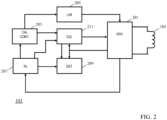
- FIG. 2 illustrates the power transmitter 101 in more detail.
- the transmitter coil 103 is coupled to a power signal generator 201 which drives the inductor to provide the power signal.
- the power signal generator 201 thus generates the current and voltage which is fed to the transmitter coil 103.
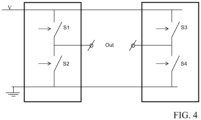
- the power signal generator 201 is typically a drive circuit in the form of an inverter which generates an alternating signal from a DC Voltage.
- FIG. 3 shows a half-bridge inverter. The switches S1 and S2 are controlled such that they are never closed at the same time. Alternatingly S1 is closed while S2 is open and S2 is closed while S1 is open. The switches are opened and closed with the desired frequency, thereby generating an alternating signal at the output. Typically the output of the inverter is connected to the transmitter coil via a resonance capacitor. FIG.
- switches S1 and S2 are controlled such that they are never closed at the same time.
- the switches S3 and S4 are controlled such that they are never closed at the same time. Alternatingly switches S1and S4 are closed while S2 and S3 are open, and then S2 and S3 are closed while S1 and S4 or open, thereby creating a block-wave signal at the output.
- the switches are open and closed with the desired frequency.
- the power signal generator 201 also comprises control functionality for operating the power transfer function and may specifically comprise a controller arranged to operate the power transmitter 101 in accordance with the Qi standard.
- the controller may be arranged to perform the Identification and Configuration as well as the power transfer phases of the Qi standard.
- the power transmitter 101 comprises a calibration controller 203 which is arranged to determine whether a power loss calibration has been performed for the power transmitter and power receiver pairing.
- the power loss calibration can provide one or more compensation values or functions for the expected relationship between indications of the received power which are provided by the receiver and indications of the power which is transmitted by the power transmitter 101.
- the power receiver 105 is required to communicate received power values to the power transmitter 101.
- the received power values are indicative of the power that is received by the power receiver 105.
- the power receiver 105 may report a received power value which corresponds directly to the power that is provided to the load of the power receiver 105. However, in many embodiments, the power receiver 105 will generate a received power value which also includes power loss/ dissipation in the power receiver 105 itself. Thus the reported received power indication may include both power provided to the load as well as power loss in the power receiver 105 itself. For example, it may include measured or estimated power loss in the rectification circuits and/or the receiver coil.
- the received power indication may be provided directly as a power value.
- other indications may be provided, such as a current and/or voltage.
- the received power indication may be provided as the current or voltage induced in the receive coil 107.
- the power transmitter 101 may furthermore calculate an estimate of the transmitted power.
- the transmitted power indication may be determined as the power which is fed to the transmitter coil 103 or may e.g. be determined as the input power to the inverter stage of the power signal generator 201.
- the power transmitter 101 may measure the current through the transmitter coil, the voltage over the transmitter coil 103 and the phase difference between the voltage and current. It can then determine the corresponding (time averaged) power based on these values.
- the supply voltage of the inverter is typically constant, and the power transmitter 101 may measure the current drawn by the inverter and multiply this by the constant voltage to determine the input power to the inverter. This power may be used as the transmitter power indication.
- one or more values that may be used to calculate a transmitted power may directly be used as a transmitter power indication. For example, a measured inverter input current may be compared to an expected inverter input current for a given received power indication (and possibly also dependent on other parameters). If the deviation exceeds a threshold, the parasitic power consumption may be considered too high.
- a slightly more complex transmitted power indication is generated.
- the approach may compensate the calculated power for losses in the power transmitter 101 itself.
- losses in the transmitter coil 103 itself may be calculated, and the input power may be compensated by this value to provide an improved indication of the power which is transmitted from the transmitter coil 103.
- time averaged values are used, e.g. with the power values being determined as average values in suitable time intervals, with the time intervals preferably being synchronized between the power transmitter 101 and the power receiver 105.
- the received and transmitted power indications may be compared. In case the indications are provided directly as power levels, the power levels may be compared to each other. In an ideal system there are no losses incurred anywhere and the transmitted power will be identical to the received power. However, in practical systems, various losses will occur including losses in the power transmitter 101, in the power receiver 105, and indeed by some power being absorbed outside the power receiver 105 (and power transmitter 101). Some of these losses may typically be estimated, such as the loss in the transmitter coil 103 or in the rectifier of the power receiver 105. However, not all power losses can effectively be estimated and there still remain a number of unknown power losses even if no foreign objects are present. These parasitic power losses will introduce a difference between the compensated power levels. Also, the estimation uncertainty for the losses that are estimated will introduce a difference between the actual received and transmitted power levels. Finally, the measurement uncertainty in determining the transmitted and received power levels may introduce an uncertainty which introduces a difference between the transmitted and received power.
- the exact relationship between the transmitted power and the received power is not known as it depends on a number of unknown factors.
- typically an approximate expected relationship can be estimated. For example, an estimate that the transmitted power level is equal to the received power level plus the loss in the transmitter coil 103 plus an additional value can be applied. The additional value may be based on an estimation of the total power loss.
- the power transmitter 101 is arranged to generate an expected relationship which indicates the receive power indication that should be received during normal operation when a given transmit power indication is measured and/or which indicates the transmit power indication that should be measured when a given receive power indication is received from the power receiver 105.
- an expected relationship (function) is generated which for an input of a received receive power indication provides an expected transmit power indication (i.e. that which would be expected during normal operation) and/or which for an input of a measured transmit power indication provides an expected receive power indication (i.e. that which is expected to be received from the power receiver 105 during normal operation).
- Such an expected function may allow deviations to be determined.
- the function may be considered to reflect the situation where no foreign objects are present, i.e. the expected relationship provides the receive power indication which should be received for a given transmit power indication, or the transmit power indication which should be measured for a given receive power indication, when there are no unusual losses.
- the power transmitter 101 may evaluate the function to determine whether this power level corresponds to a calculated transmit power level in accordance with the expected function.
- the function may provide an expected transmit power for a given receive power level, and the received power level may be used as an input.
- the expected transmit power may for example correspond directly to the transmit power that was measured/calculated during the calibration phase for this received power level.
- the resulting expected transmit power is then compared to the calculated transmit power.
- the function may provide an expected receive power for a given transmit power level, and the calculated transmit power level may be used as an input.
- the resulting expected received power level is then compared to the actual received power level provided from the power receiver 105.
- the comparison reveals a deviation which is too large, this indicates the presence of an unexpected power loss. This may specifically be caused by a foreign object being placed too close or on the power transmitter 101. Such a power loss may result in significant heating of the foreign object which may result in damage or injury.
- the power transmitter 101 may therefore proceed to terminate the power transfer in such a scenario.
- the expected relationship thus provides an expected transmit power indication or an expected receive power indication. If the actual values match the expected values, this is because the expected relationship provides an accurate model of the power transfer. As the expected relationship is determined during calibration where it can be guaranteed that there are no parasitic power losses, the expected relationship models the scenario when there are no parasitic power losses. Therefore, if the actual values match the expected values, the current situation will correspond to the one modeled by the expected relationship, i.e. it will correspond to a situation without any parasitic power losses. In other words, if the actual relationship between the actual transmitted power indication and corresponding actual received power indication is the same (or deviate by less than a given threshold) then there are currently no parasitic losses.
- An expected relationship may be determined for all possible values of the transmitted power indication and the received power indication or for only a subset.
- the expected relationship(s) may e.g. be represented by a function which for a values of a transmitted power indication provides a value of the received power indication, or by a function which for a value of a received power indication provides a value of the transmitted power indication.
- the power transmitter 101 may e.g. calculate a transmitted power indication based on measured values. For at least some of these calculated transmitted power indications, the detector 209 determines what the expected received power indication is, e.g. it may access a look-up-table which provides the average received power indication that was found for that transmitted power indication during the calibration phase. The expected received power indication thus represents the expected relationship between the transmitted power indication and the received power indication for this value of the transmitted power indication.
- the match between the expected and actual relationships can simply be determined by comparing the determined expected received power indication to the actual received power indication. If these differ by less than a given threshold, this indicates that the actual and expected relationships are sufficiently close for a consideration of there not being any parasitic losses. Otherwise, the detector 209 determines that parasitic losses are currently present.
- the comparison of the expected relationship to the actual relationship may be assessed by considering an actual received power indication and then determining the expected transmitted power indication corresponding to this value. The comparison can then be made by comparing this expected transmitted power indication to the actual calculated transmitted power indication. If they are sufficiently close (difference less than a threshold), then the difference between the expected relationship and the actual function relationship is sufficiently close for the detector 209 to determine that there are no parasitic power losses. Otherwise, the detector 209 determines that parasitic losses are currently present.
- both the approach of comparing the expected and actual received power indications for a given transmitted power indication and the approach of comparing the expected and actual transmitted power indications for a given received power indication inherently corresponds to a comparison of the expected relationship between a transmitted power indication and a received power indication and the actual relationship between these.
- the unknown factors of the relationship between the transmitted and received power fall into different categories. Some factors will be constant and depend on characteristics of the power transmitter 101 and power receiver 105. Such factors include power dissipation in the cabinets of the devices, any constant bias in the measurement operations etc. Other factors may be random and varying, such as measurement noise.
- a power loss calibration may be performed for the pairing of the power transmitter 101 and the power receiver 105.
- This power loss calibration may determine the expected relationship, and may specifically introduce a compensation or adaptation to an existing or predetermined expected function such that this more accurately reflect the relationship between the transmitted and received power.
- such calibration may compensate for the first category of unknown factors.
- a calibration may reflect the bias in measurements, the power losses in various circuits of the power transmitter 101 and power receiver 105 etc.
- the power loss calibration can reduce the uncertainty from, say ⁇ 5% to around ⁇ 0.5%. Such an improvement may allow the system to be used at substantially higher power levels while allowing the same accuracy of the detection of any unaccounted power losses.
- the system of FIGs. 1 and 2 is arranged to adapt the operation of the system such that the number of power loss calibrations can be minimized while still allowing high power operation.
- the calibration controller 203 determines whether a power loss calibration has been performed for the specific pairing of the power transmitter and power receiver. It is noted that the calibration is not merely a calibration for the power transmitter 103 or a calibration for the power receiver 105. Rather, it is a calibration which is for the specific pairing of the power transmitter and the power receiver, and specifically provides an expected relationship for this specific pair/ combination of power transmitter and power receiver.
- the calibration controller 203 is coupled to a limiter 205 which is fed an indication of whether power loss calibration has been performed.
- the limiter 205 is further coupled to the power signal generator 201 and can provide a control input that restricts the power that can be provided, and which specifically may restrict the maximum coil current.
- the system may thus allow safe operation at high power levels (e.g. up to 50W or 100W) while allowing calibration free operation for low power levels (e.g. up to 5W).
- high power levels e.g. up to 50W or 100W
- low power levels e.g. up to 5W
- a more convenient user experience is provided while at the same time enabling safe high power level power transfers.
- the limiter 205 may for example restrict the current by providing a control signal to the power signal generator 201 indicating a maximum coil current.
- the limiter 205 may include a current limiter in the connection from the power signal generator 201 to the transmitter coil 103.
- the limiter 205 may include a current limiter for the input current of the power signal generator.
- the restricting of power may specifically be by restricting the inductor/ coil current.
- Such an approach may be particularly suitable for embodiments or scenarios wherein the inductor voltage is kept substantially constant. This may be the case in many embodiments by keeping a rail voltage (supply voltage) to the drive circuit (and specifically to an inverter) constant during operation.
- the inductor current may also be a useful safety parameter to control even when the inductor voltage varies since the inductor current also depends on the inductor voltage.
- Another example of a power that may be restricted is the apparent power which may be given as the product of the RMS voltage and RMS current for the inductor, or equivalently as the square roots of the sums of the squared real power and reactive power.
- the power transmitter 101 of FIG. 2 further comprises functionality for detecting parasitic power consumptions, such as typically parasitic power consumption by a foreign object.
- a parasitic power consumption is a power consumption that is not associated with the power receiver 105, and which may typically be associated with foreign objects that may be placed close to the transmitter coil 103, such as e.g. keys, rings or coins positioned on the power transmitter 101.
- the power transmitter 101 comprises a receiver 207 which is arranged to receive messages from the power receiver 105.
- the messages are provided by load modulation as will be known to the skilled person.
- the receiver 207 may specifically receive received power indications from the power receiver 105.
- the received power indications provide an indication of the power consumed by the power receiver 105.
- the received power indications may include some consideration of power losses in the power receiver 105.
- the receiver 207 is coupled to a detector 209 which is arranged to detect parasitic power consumption. Particularly the detector 209 is arranged to detect if parasitic power consumption exceeds a given threshold. The detector 209 does this by determining the deviation between the actual relationship between the transmitted power indication and the received power indication and the expected relationship between these values. Thus, if there is no parasitic power consumption, the actual relationship between the received power indication and the transmitted power indication is likely to be almost the same as the expected relationship, i.e. as the expected relationship reflects/models the power transfer situation where there are no parasitic power losses, the actual relationship will match this expected relationship when indeed there are no parasitic power losses present.
- deviations may be detected by comparing values of receive power indications (i.e. between expected and actual values). In some embodiments, deviations may be detected by comparing values of transmit power indications (i.e. between expected and actual values).
- the deviation may be detected by deriving the expected transmitted power indication from the received power indication provided by the power receiver 105 and comparing this to the actual calculated transmitted power indication.
- the expected received power indication may be derived from actual calculated transmitted power indication and the result may be compared to the actual received power indication provided by the power receiver 105.
- the detector 209 detects whether the parasitic power consumption which is not reflected in the expected relationship is so high that it causes a deviation relative to the actual relationship to exceed a threshold.
- the expected relationship will be a calibrated or adapted expected relationship, i.e. it will reflect the specific characteristics of the specific pairing of the power transmitter 101 and power receiver 105.
- the expected relationship can reflect specific characteristics of the individual devices, such as e.g. characteristics dependent on component variations. Accordingly, the detection will be accurate at higher power levels, thereby allowing a detection of even relatively small parasitic power consumptions.
- the detection of a parasitic power consumption above a threshold may be caused by the presence of a foreign object. Therefore, the detector 209 is arranged to provide a control signal to the power signal generator 201 which causes the power transfer operation to be terminated. The approach may accordingly prevent unacceptable heating of foreign objects and provide a safe operation.
- the power transmitter 101 of FIG. 2 comprises a calibrator 211 which is capable of performing a power loss calibration for the power transmitter 101 and power receiver 105 pairing.
- the calibrator 211 can thus perform a power loss calibration in order to determine the expected relationship between received power indications and transmitted power indications.
- the calibration may generate an improved expected relationship by modifying a default or nominal expected relationship or may directly generate a new expected relationship specific for the pairing.
- the calibration i.e. the determination (or adaptation) of the expected relationship can be perfomed such that it can be assumed with sufficiently high certainty that it reflects a scenario without parasitic power losses. This may for example be done by using a dedicated calibration operation where the user is requested to ensure that there are no foreign objects in the vicinity.
- the calibrator 211 may determine specific values that are then used to adapt the relationship or may equivalently directly determine the expected relationship. For example, in some embodiments the calibrator 211 may determine an additional value that should be added to a default or nominal expected relationship. Such an additional value may for example represent the power consumption which is unaccounted for in the nominal expected relationship.
- the calibrator may determine coefficients or other parameters of a function that represents the expected relationship.
- the coefficients may either be determined outright, or a modification value to nominal coefficients may be applied.
- a nominal function may be stored which is considered to represent a typical expected relationship between reported received power indications and calculated transmitted power indications.
- a number of associated measurements may be made during the calibration process and a curve fitting may be performed between the expected relationship and the obtained data sets.
- the nominal parameters may be modified until a function is provided which has a sufficient close fit to the measured values. These parameters may then be used to define the adapted expected relationship.
- the calibrator 211 may provide a specific expected relationship to use. For example, a number of measurements may be made to provide sample points relating the received power indication to the transmitted power incitation for a number of different values of the received power indication/ transmitted power indication. A look-up-table may be generated directly based on these measurements such that for a given, say, received power indication the look-up-table will store the corresponding transmitted power indication obtained from the measurements. In some embodiments, the measurement points may be used directly, i.e. the obtained pairs of received power indication and transmitted power indication may directly be stored in the look-up-table. However, typically some averaging, filtering or smoothing will be applied. It will also be appreciated that interpolation may be used for received power indications/transmitted power indications that do not directly correspond to the stored values.
- the calibrator 211 is in the example of FIG. 2 arranged to perform the power loss calibration based on the reported received power indication values, i.e. it is based on measurements and data which may be generated during normal operation.
- the calibrator 211 may alternatively or additionally be arranged to perform a dedicated calibration which e.g. is based on measurements, messaging or operations which are not normal operations of a power transfer operation.
- the calibrator 211 receives a number of received power indications from the power receiver 105. It also determines a number of transmitted power indications for the power transmitter 101. The values may then be averaged over a time window to provide more reliable estimates. The time windows are synchronized between the power transmitter 101 and the power receiver 105 such that corresponding values are generated. The resulting pair of an averaged received power indication and an averaged transmitted power indication provides a data point for the expected relationship. The expected relationship is accordingly adapted such that it provides a relationship which provides as close an approximation to the data point as can be achieved.
- the calibrator 211 will generate a plurality of data points corresponding to different power levels.
- the power receiver 105 may change the loading and the power transmitter 101 may change the transmitted power accordingly.
- This change of power level may be achieved using messaging and control operations defined for normal power transfer operation.
- the calibrator 211 proceeds to repeat the measurement process to generate a new data point with a measured transmitted power indication and corresponding received power indication.
- the calibrator 211 may then proceed to generate the adapted or calibrated expected relationship, e.g. by varying parameters of a nominal function relating the received power indication to a corresponding transmitted power indication.
- curve fitting algorithms may be used.
- the data points may be stored in a look-up-table with values for other power levels being generated by interpolation.
- the calibrator 211 may also restrict the calibration to data points at higher power levels to generate an expected relationship. Since the deviation between transmitted and received power could be expected to be largest at high power levels, the calibrator 211 may accordingly be able to establish an accurate relationship for the most relevant power levels. A deviation at low power levels may already be sufficiently low to not require any specific (pairing) calibration. Alternatively the calibrator 211 can extrapolate the relationship of the higher power levels to lower power levels, e.g. by proportional adaptation of the function that calculates the transmitted power from the measured parameters.
- the expected relationship accordingly closely reflects the relationship between a received power indication and a transmitted power indication for this specific power transmitter 101 and power receiver 105, i.e. for the specific pairing of this power transmitter 101 and power receiver 105.
- the expected relationship furthermore reflects this relationship when there are no parasitic power losses. Accordingly, an accurate parasitic power loss evaluation can be carried out thereby allowing safe operation at higher power levels.
- the power loss calibration can be performed under the assumption that there are no parasitic losses associated with foreign objects.
- the calibrator 211 is arranged to request a user input.
- the user input is taken as a confirmation that the required calibration scenario is in place, and specifically that there are no foreign objects near the power transmitter 101.
- the calibrator 211 is arranged to only proceed to perform the power loss calibration when such a user confirmation input has been received.
- the power transmitter 101 can evaluate one or more conditions to ensure that the received power values are suitable for calibration.
- the following conditions may e.g. be applied:
- the power receiver 105 may also be capable of entering a power loss calibration mode, e.g. to allow it to perform the calibration for different power receiver loads.
- the power transmitter 101 may await confirmation that the power receiver 105 is in the calibration mode before the power loss calibration is initiated.
- the confirmation may e.g. be provided by a user input or may e.g. be provided by the power receiver 105 communicating a message by load modulation of the power signal where the message indicates that the power receiver 105 has entered the calibration mode.
- a new power receiver 105 may be positioned close to the power transmitter 101 in order for a power transfer to begin. If the requested power by the power receiver 105 is sufficiently low, i.e. lower than the threshold used by the limiter 205, the power transmitter 101 may proceed to directly provide the power to the power receiver 105 without any calibration being required. However, since no calibration has been performed, the limiter 205 restricts the coil current to the transmitter coil 103, and power levels above the level corresponding to this maximum current is not supported by the power transmitter 101. However, if the power receiver 105 requests such a higher power, the power transmitter 101 proceeds to initiate a calibration phase wherein a power loss calibration is performed.
- the phase may be initiated by requesting a user input confirming that no foreign objects are present and that the calibration should go ahead.
- the calibrator 211 proceeds to perform the calibration and generates a number of data points of corresponding receive power indications and transmitted power indications for the specific power transmitter 101 and power receiver 105 pairing. It then proceeds to adapt the expected relationship to match these data points.
- the power transmitter 101 proceeds to support the higher power level while continuously monitoring for unacceptable parasitic power losses. If such a power loss is detected, the power transfer phase is terminated.
- the approach may provide safe and user friendly operation with calibrations reduced to only be performed when required to support higher power levels.
- the power transmitter 101 may further reduce the number of calibrations that are performed and may indeed restrict the calibrations to only be performed if high power is required and the power receiver 105 has not previously been used with the power transmitter 101.
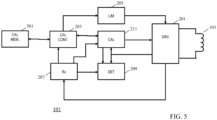
- FIG. 3 An example of such a power transmitter 101 is illustrated in FIG. 3 .
- the power transmitter 101 corresponds to that of FIG. 2 except that it further includes a calibration memory 501 coupled to the calibrator controller 203.
- the calibrator controller 203 is arranged to store the calibration data in the calibration memory 501 after a calibration has been performed.
- the resulting calibration values are fed to the calibrator controller 203 which stores them in the calibration memory 501.
- an identity of the power receiver 105 for which the calibration has been performed is stored.
- the identity of the power receiver 105 is determined in response to a message which is transmitted from the power receiver 105 by load modulation.
- Power transfer systems such as Qi comprise provisions for the power receiver 105 communication an identity (e.g. a unique identity number) to the power transmitter 101.
- identity e.g. a unique identity number
- the identity of the power receiver 105 is provided to the power transmitter 101 as part of the Identification and Configuration phase.
- the calibrator controller 203 may extract this identity and store it together with the compensation values that are determined during calibration.
- the stored calibration values may e.g. be offset values, coefficients or other parameters of a function describing the expected relationship.
- the compensation values may directly be the adapted expected relationship.
- the calibrator controller 203 may directly store corresponding values for received power indications and transmitted power indications.
- the calibrator controller 203 may store compensation values that define a look-up-table.
- the calibrator controller 203 proceeds to determine whether power loss calibration has been performed for this power transmitter and power receiver pairing based on the identity of the power receiver 105 and the identities which are stored in the calibration memory 501.
- the calibrator controller 203 may extract the compensation values and use this data to provide an adapted expected relationship which is specifically adapted to this power transmitter 101 and power receiver 105 pairing.
- the calibrator controller 203 If no match is found in the calibration memory 501, the calibrator controller 203 considers that no power loss calibration has been performed. Accordingly, it proceeds with the power transfer while restricting the maximum coil current to be below the limiting threshold.
- the calibrator controller 203 proceeds to initiate a power loss calibration as has been previously described. The result of such a calibration is then used to generate a more accurate expected relationship which can be used at the higher power levels. Furthermore, the calibration results are stored in the calibration memory 501 together with the identity of the power receiver 105. The next time the power receiver 105 is used with the power transmitter 101, it may directly be supported at the higher power level without requiring any new calibration to be performed.
- the calibrator controller 203 may also store a time stamp or an expiry time. If the stored compensation data is not valid for the power receiver 105, a new power loss calibration may need to be performed.
- the calibrator 211 may be arranged to perform the calibration in a plurality of subphases or submodes wherein the results of the previous phase(s)/mode(s) is used in the current.
- the calibrator 211 may first perform a power loss calibration wherein compensation values are performed for a first set or interval of power levels. For example, a calibration may be performed while keeping the power level to be below, e.g. 5W. At this low power level, a default or nominal expected relationship can be used to detect whether unacceptable unaccounted for power loss is experienced. In particular, even a relatively inaccurate expected relationship may allow the system to detect if the power loss in a foreign object increases beyond, say, 250 mW. Based on this first calibration operation, the calibrator 211 can proceed to adapt the expected relationship to provide a more accurate indication of the relationship between transmitted power indications and received power indications.
- the calibrator may then proceed to perform a second power loss calibration operation for a second set or interval of power levels where the second set/ interval includes power levels that are higher than for the first calibration operation.
- a calibration may be performed for power levels up to, say 20W.
- the detector 209 continues to monitor for parasitic power losses that are unacceptably high.
- the expected relationship may accordingly be further refined to provide a more accurate estimate at higher power levels.
- the calibrator may e.g. continue to perform a third calibration operation, e.g. for power levels up to 50W.
- This third calibration operation may utilize the expected relationship resulting from the second calibration.
- the calibrator 203 may first check whether the power receiver and power transmitter pairing has been calibrated before. If not the power transmitter 101 enters a first calibration sub mode wherein the output power level is restricted. If it has been calibrated, the power transmitter 101 instead enters a second calibration sub-mode in which higher power levels may be applied. In other embodiments, it may in such cases completely skip the calibration.
- the power transmitter 101 limits the power transfer level to a conservative maximum level which allows detection of foreign objects using the nominal expected relationship, i.e. it is considered save even though the power transmitter 101 has no calibration information for the specific power receiver 103.
- the accuracy of the reported received power is expected to be within a predefined tolerance range relatively to the real received power.
- the power transmitter 101 then follows the standard procedure in order to enter the power transfer mode. While providing power to the power receiver 103, the power transmitter 101 measures the necessary parameters to determine the transmitted power and at the same time it collects the reported received power values. The power transmitter 101 also checks that the difference between transmitted and received power does not exceed a safety threshold, i.e. the detector detects that the deviation from the expected relationship does not exceed a given threshold.
- the power transmitter 101 After collecting sufficient received power values, the power transmitter 101 proceeds to generate a calibrated expected relationship.
- the expected relationship may be one that allows the expected received power indication to be calculated from various transmitter parameters related to the transmitted power from the power transmitter 101.
- the power transmitter 101 can determine a function which allows a received power to be calculated as a function of measured parameters of the power transmitter 101.
- the function can be regarded as the expected reported received power or as a calibrated transmitted power for this particular power receiver 101.
- the power transmitter can determine a function which allows the difference between transmitted and received power to be determined as a function of the measured parameters.
- the measured parameters of the power transmitter can for example include:
- the calibrator 211 may proceed to the second calibration sub-mode.
- the power transmitter 101 does not limit the maximum power transfer level or coil current, but allows a power level up to a maximum power level as indicated by the power receiver 101.
- the power transmitter 101 can use the received power values for higher power levels to extend the calibration to higher power levels.
- the power transmitter 101 may be arranged to adapt the expected relationship during a power transfer phase.
- the power transfer phase adaptation can be based on a comparison of transmitted power indications and received power indications which are determined and received during the normal power transfer phase. Specifically, the same approach as described for the power loss calibration by the calibrator 211 may be used.
- the adaptation rate during the normal power transfer phase is typically substantially lower than during a calibration.
- a time constant for adapting the compensation value during the power transfer phase may be higher than a time constant for determining the compensation value during the calibration phase.
- the difference in the adaptation rate/time constant is at least 2, 5 or even 10 times.
- the slower adaptation rate during the power transfer phase reflects that the adaptation can typically be performed over a much longer duration, using more measurement points, the expected relationship is already fairly accurate, and the measurement scenario is less certain than during the calibration phase (e.g. no specific user involvement is included to ensure there are no foreign objects). Thus, the adaptation during the power transfer phase is often used to fine tune or refine the expected relationship.
- the power transmitter 101 can improve the accuracy of the expected relationship using the same approach as during the power loss calibration. Furthermore, as it can be expected that the power transmitter 101 collects many more reported received power values in this mode than in the calibration mode (due to the increased time in which the power transmitter 101 is in this phase) and since the power transmitter cannot trust the reported received power values as much as in the calibration phase, the power transmitter 101 adapts the expected relationship more conservatively than in the calibration mode. E.g. the power transmitter 101 adapts the expected relationship only with marginal changes and only after receiving data over a longer period of time.
- the expected relationship is not adapted when it is detected that the deviation between the actual relationship between the transmitted power indication and the received power indication and the expected relationship between these exceeds a threshold.
- the power transmitter 101 ignores the data point when adapting the expected relationship. Moreover if the difference between actual and expected relationships is above a given threshold, the power transmitter 101 will terminate the power transfer. In other words, the detector 209 is operational as previously described.
- the power transmitter 101 may not directly proceed to terminate the power transfer phase but may proceed to enter a power loss exceeded mode. In this mode, the power transmitter 101 does not adapt the expected relationship. It may however reduce the power level of the power transfer as it is suspected that a foreign object may absorb power from the magnetic field.
- the power transmitter 101 may involve the user e.g. by providing a user alert to indicate a warning. It may e.g. ask for a confirmation that no foreign objects are near to the interface surface of the power transmitter 101 and use such a confirmation to return to normal mode.
- the power transmitter 101 may also return to normal mode if further received power values lead to a power loss which no longer exceeds the threshold.
- the power transmitter 101 changes from power loss exceeding mode to an error mode and terminates the power transfer.
- the power transmitter 101 of FIG. 3 may specifically adapt an expected relationship which allows the estimation of the transmitted power from a received power values provided by the power receiver 105.
- the power transmitter 101 can store the parameters that are necessary for calculating the transmitted power for this particular power receiver 103.
- the parameters are stored at a location in the calibration memory 501 which can be accessed using the identifier of the power receiver 105.
- This approach can be applied in the calibration mode, but also in the normal power transfer mode.
- the difference between these two modes can be made by applying a relatively large adaptation factor and using a limited amount of received power values in the calibration mode thereby reducing the calibration time.
- a relatively small adaptation factor and a large amount of received power values can be used in the normal power transfer mode when adapting the parameters for calculating the transmitted power.
- the following adaptation process may for example be performed for each received power value.
- the power transmitter 101 may first measure the coil current and input power of the transmit coil 103 and accordingly estimate the power loss in the transmit coil 103 according to a default function.
- the power transmitter 101 may proceed to:
- the averaging is applied over the time window that is indicated by the power receiver 105 to have been used when the power receiver 105 determined the reported received power.
- P Diff P PT ⁇ P PR
- the value P Diff accordingly represents a difference between the transmit power and the received power provided from the power receiver 105. It also represents a deviation of the actual relationship between the transmitted power and the received power from the expected relationship, since in this case the expected relationship is that P PT - P PR should be zero, i.e. that P PT -as calculated above should be equal to the reported received power P PR .
- P Diff can thus directly be used as an indication of the parasitic power loss that is unaccounted for in the expected relationship.
- P Diff can directly be used by the detector 209 to estimate whether a foreign object is present.
- the power transmitter 101 can proceed to adapt the expected relationship.
- the expected relationship is represented by (amongst others) the parameter of the frequency independent part of the equivalent resistance.
- the power transmitter may adapt this parameter and calculate a new frequency independent part of the equivalent resistance (R bnew ) such that after recalculating the transmitted power according to the above explanation, the difference between transmitted and received power shifts towards a value that is close to zero.
- P DiffMin ⁇ 300 mW
- P DiffMax 50 mW .
- the power transmitter may derive the new frequency independent part of the equivalent resistance (R bnew ) as follows.
- P PTnew P PTold + adapt ⁇ factor ⁇ P PR ⁇ 125 mW ⁇ P PTold , with
- a power receiver 105 may power two different loads or may be able to operate in two different modes. For example it may operate in a slow charging mode thereby limiting the charging current to the battery to e.g. 1A, or it may operate in a fast charging mode thereby allowing a charging current to the battery of e.g. 2A or more. As another example, it may be able to operate in a charging mode where it charges a battery for a device or in a full operation mode where it provides sufficient power to the device to operate without drawing current from the battery. If the power receiver 105 detects that the power transmitter 101 corresponds to a calibration pairing stored in the memory, it may proceed to request sufficient power for both loads or to support both operational modes. However, if there is no calibration data for power transmitter 101, it may proceed to only request sufficient power for one load or for the less power demanding mode. For example, it may allow only a slow charging of the battery and not fast charging or full operation of the device.
- the invention can be implemented in any suitable form including hardware, software, firmware or any combination of these.
- the invention may optionally be implemented at least partly as computer software running on one or more data processors and/or digital signal processors.
- the elements and components of an embodiment of the invention may be physically, functionally and logically implemented in any suitable way. Indeed the functionality may be implemented in a single unit, in a plurality of units or as part of other functional units. As such, the invention may be implemented in a single unit or may be physically and functionally distributed between different units, circuits and processors.
Landscapes
- Engineering & Computer Science (AREA)
- Power Engineering (AREA)
- Computer Networks & Wireless Communication (AREA)
- Physics & Mathematics (AREA)
- General Physics & Mathematics (AREA)
- Charge And Discharge Circuits For Batteries Or The Like (AREA)
- Near-Field Transmission Systems (AREA)
- Testing Electric Properties And Detecting Electric Faults (AREA)
- Current-Collector Devices For Electrically Propelled Vehicles (AREA)
Applications Claiming Priority (4)
| Application Number | Priority Date | Filing Date | Title |
|---|---|---|---|
| EP12188672 | 2012-10-16 | ||
| EP20204848.4A EP3800765B1 (de) | 2012-10-16 | 2013-09-13 | Drahtlose induktive energieübertragung |
| EP13794982.2A EP2909917B1 (de) | 2012-10-16 | 2013-09-13 | Drahtlose induktive energieübertragung |
| PCT/IB2013/058517 WO2014060871A1 (en) | 2012-10-16 | 2013-09-13 | Wireless inductive power transfer |
Related Parent Applications (2)
| Application Number | Title | Priority Date | Filing Date |
|---|---|---|---|
| EP13794982.2A Division EP2909917B1 (de) | 2012-10-16 | 2013-09-13 | Drahtlose induktive energieübertragung |
| EP20204848.4A Division EP3800765B1 (de) | 2012-10-16 | 2013-09-13 | Drahtlose induktive energieübertragung |
Publications (2)
| Publication Number | Publication Date |
|---|---|
| EP4583365A2 true EP4583365A2 (de) | 2025-07-09 |
| EP4583365A3 EP4583365A3 (de) | 2025-09-17 |
Family
ID=47049053
Family Applications (3)
| Application Number | Title | Priority Date | Filing Date |
|---|---|---|---|
| EP13794982.2A Active EP2909917B1 (de) | 2012-10-16 | 2013-09-13 | Drahtlose induktive energieübertragung |
| EP25172698.0A Pending EP4583365A3 (de) | 2012-10-16 | 2013-09-13 | Drahtlose induktive stromübertragung |
| EP20204848.4A Active EP3800765B1 (de) | 2012-10-16 | 2013-09-13 | Drahtlose induktive energieübertragung |
Family Applications Before (1)
| Application Number | Title | Priority Date | Filing Date |
|---|---|---|---|
| EP13794982.2A Active EP2909917B1 (de) | 2012-10-16 | 2013-09-13 | Drahtlose induktive energieübertragung |
Family Applications After (1)
| Application Number | Title | Priority Date | Filing Date |
|---|---|---|---|
| EP20204848.4A Active EP3800765B1 (de) | 2012-10-16 | 2013-09-13 | Drahtlose induktive energieübertragung |
Country Status (9)
| Country | Link |
|---|---|
| US (2) | US9716388B2 (de) |
| EP (3) | EP2909917B1 (de) |
| JP (3) | JP6276772B2 (de) |
| CN (1) | CN104704710B (de) |
| BR (1) | BR112015008218B1 (de) |
| ES (2) | ES3033650T3 (de) |
| PL (1) | PL2909917T3 (de) |
| RU (1) | RU2639726C2 (de) |
| WO (1) | WO2014060871A1 (de) |
Families Citing this family (66)
| Publication number | Priority date | Publication date | Assignee | Title |
|---|---|---|---|---|
| US9696358B2 (en) | 2012-05-02 | 2017-07-04 | Powerbyproxi Limited | Method for detecting and identifying a receiver in an inductive power transfer system |
| EP2909917B1 (de) * | 2012-10-16 | 2020-11-11 | Koninklijke Philips N.V. | Drahtlose induktive energieübertragung |
| CN110098642A (zh) | 2012-11-05 | 2019-08-06 | 苹果公司 | 感应耦合电力传输系统 |
| JP6505097B2 (ja) | 2013-07-17 | 2019-04-24 | コーニンクレッカ フィリップス エヌ ヴェKoninklijke Philips N.V. | 無線誘導電力伝送 |
| US9929601B2 (en) * | 2013-08-23 | 2018-03-27 | Qualcomm Incorporated | Apparatus and method for lost power detection |
| EP2876770B1 (de) * | 2013-11-22 | 2016-08-17 | TOSHIBA Electronics Europe GmbH | Verfahren zur kabellosen Übertragung einer Leistung |
| JP2015159693A (ja) * | 2014-02-25 | 2015-09-03 | 株式会社豊田自動織機 | 非接触電力伝送システム及び受電装置 |
| EP3661015A1 (de) | 2014-03-25 | 2020-06-03 | Koninklijke Philips N.V. | Drahtlose induktive stromübertragung |
| DE102014207427A1 (de) * | 2014-04-17 | 2015-10-22 | Bombardier Transportation Gmbh | Vorrichtung und Verfahren zur Detektion eines Störkörpers in einem System zur induktiven Energieübertragung sowie System zur induktiven Energieübertragung |
| EP2955814B1 (de) | 2014-06-13 | 2021-08-18 | Nokia Technologies Oy | Manipulationsverfahren für fremdkörperdetektion |
| JP6630680B2 (ja) | 2014-06-13 | 2020-01-15 | ノキア テクノロジーズ オーユー | 異物検出法の実行頻度を決定する方法 |
| US20170163100A1 (en) | 2014-06-20 | 2017-06-08 | Powerbyproxi Limited | Foreign object detection in inductive power transfer field |
| US9543782B2 (en) * | 2014-09-18 | 2017-01-10 | Qualcomm Incorporated | Apparatus and method for lost power detection |
| KR102197580B1 (ko) * | 2014-10-07 | 2021-01-04 | 주식회사 히타치엘지 데이터 스토리지 코리아 | 무선 전력 전송 장치 및 방법 |
| TR201906689T4 (tr) * | 2014-12-11 | 2019-05-21 | Koninklijke Philips Nv | Kablosuz indükleyici güç transferi |
| SE541339C2 (en) | 2014-12-19 | 2019-07-16 | Nok9 Ip Ab | A mobile device tester for precise inductive power measurement and a calibration unit therefor |
| JP6732779B2 (ja) | 2015-03-04 | 2020-07-29 | アップル インコーポレイテッドApple Inc. | 誘導電力送信器 |
| CA2981695A1 (en) | 2015-04-02 | 2016-10-06 | Powerbyproxi Limited | Inductive power transmitter |
| DE102015224839A1 (de) * | 2015-05-13 | 2016-11-17 | Volkswagen Aktiengesellschaft | Gerätespezifische Anpassung des kabellosen Ladeverhaltens von Mobilgeräten |
| JP2017034946A (ja) * | 2015-08-06 | 2017-02-09 | ソニー株式会社 | 移動体装置、非接触給電システムおよび移動体装置の駆動方法 |
| US10381883B2 (en) * | 2015-08-28 | 2019-08-13 | Wireless Advanced Vehicle Electrification, Inc. | Identification using signals from a secondary device before wireless power transfer |
| JP6632299B2 (ja) * | 2015-09-29 | 2020-01-22 | ローム株式会社 | ワイヤレス送電装置、その制御回路、充電器、およびパワーロスメソッドによる異物検出のキャリブレーション方法 |
| CN108401471B (zh) | 2015-11-19 | 2021-06-25 | 苹果公司 | 感应式电力发射器 |
| TR201910529T4 (tr) | 2016-01-13 | 2019-08-21 | Koninklijke Philips Nv | Kablosuz endüktif güç aktarımı. |
| US10530196B2 (en) * | 2016-02-05 | 2020-01-07 | Texas Instruments Incorporated | Methods and apparatus for power loss calibration in a wireless power system |
| US9736790B1 (en) * | 2016-04-04 | 2017-08-15 | Spreadtrum Communications Usa, Inc. | Transceiver system supporting transmitter self calibration and methods of performing the same |
| WO2017176128A1 (en) | 2016-04-04 | 2017-10-12 | Powerbyproxi Limited | Inductive power transmitter |
| US11086042B2 (en) * | 2016-06-13 | 2021-08-10 | Lg Innotek Co., Ltd. | Method for detecting foreign material, and apparatus and system therefor |
| KR102573342B1 (ko) * | 2016-06-14 | 2023-08-31 | 엘지이노텍 주식회사 | 이물질 검출 방법 및 그를 위한 장치 및 시스템 |
| EP3480588B1 (de) * | 2016-07-01 | 2021-09-29 | LG Innotek Co., Ltd. | Verfahren zur erkennung von fremdmaterial sowie vorrichtung und system dafür |
| JP6519573B2 (ja) | 2016-11-30 | 2019-05-29 | トヨタ自動車株式会社 | 送電装置及び電力伝送システム |
| US10879744B2 (en) | 2016-12-05 | 2020-12-29 | Koninklijke Philips N.V. | Foreign object detection in a wireless power transfer system |
| DE102017214741A1 (de) * | 2017-02-10 | 2018-08-16 | Robert Bosch Gmbh | Verfahren zur drahtlosen Energieübertragung von einer Energiesendevorrichtung zu einem Verbraucher sowie drahtlose Energiesendevorrichtung zur Durchführung des Verfahrens |
| EP3410568A1 (de) | 2017-05-30 | 2018-12-05 | Koninklijke Philips N.V. | Fremdkörpererkennung in einem system zur drahtlosen stromübertragung |
| EP3457525A1 (de) | 2017-09-18 | 2019-03-20 | Koninklijke Philips N.V. | Fremdkörpererkennung in einem system zur drahtlosen stromübertragung |
| US10826329B2 (en) | 2017-12-22 | 2020-11-03 | Wireless Advanced Vehicle Electrification, Inc. | Wireless power transfer pad with multiple windings and magnetic pathway between windings |
| CN111712989B (zh) * | 2018-01-10 | 2023-04-11 | Lg电子株式会社 | 在无线功率发送系统中执行功率校准的设备和方法 |
| US11462943B2 (en) | 2018-01-30 | 2022-10-04 | Wireless Advanced Vehicle Electrification, Llc | DC link charging of capacitor in a wireless power transfer pad |
| US11437854B2 (en) | 2018-02-12 | 2022-09-06 | Wireless Advanced Vehicle Electrification, Llc | Variable wireless power transfer system |
| EP3528364A1 (de) | 2018-02-20 | 2019-08-21 | Koninklijke Philips N.V. | System zur drahtlosen energieübertragung |
| RU2688664C1 (ru) * | 2018-08-06 | 2019-05-22 | Акционерное общество "Мостком" | Способ регулировки уровня сигнала на приемнике терминала оптической беспроводной связи |
| AU2018443233B2 (en) | 2018-09-29 | 2022-09-01 | Huawei Technologies Co., Ltd. | Wireless charging method and electronic device |
| EP3637583A1 (de) * | 2018-10-09 | 2020-04-15 | Koninklijke Philips N.V. | Drahtlose stromübertragung |
| CN111224472B (zh) * | 2018-11-26 | 2024-08-02 | 法雷奥舒适驾驶助手公司 | 用于补偿无线电力发射设备的功率损失的校准方法 |
| HUE061664T2 (hu) * | 2019-03-25 | 2023-07-28 | Lg Electronics Inc | Eszköz és eljárás energiakorrekció végrehajtására vezeték nélküli energiaátviteli rendszerben |
| CN110392969B (zh) * | 2019-06-05 | 2023-09-12 | 北京小米移动软件有限公司 | 无线充电方法、装置及存储介质 |
| CN110492625B (zh) * | 2019-08-05 | 2023-08-01 | Oppo广东移动通信有限公司 | 无线充电异物检测方法及装置、电子设备、存储介质 |
| JP7427395B2 (ja) * | 2019-08-29 | 2024-02-05 | キヤノン株式会社 | 受電装置、制御方法及びプログラム |
| JP7449054B2 (ja) * | 2019-09-04 | 2024-03-13 | キヤノン株式会社 | 送電装置、方法、及びプログラム |
| KR102704434B1 (ko) | 2019-10-02 | 2024-09-09 | 엘지전자 주식회사 | 무선전력 수신장치, 무선전력 전송장치 및 이들을 이용한 전력 보정 방법 |
| EP4117143A4 (de) * | 2020-03-06 | 2024-05-22 | LG Electronics, Inc. | Vorrichtung zur drahtlosen stromübertragung, verfahren zur drahtlosen stromübertragung, vorrichtung zum drahtlosen stromempfang und verfahren zum drahtlosen stromempfang |
| EP3879671A1 (de) | 2020-03-10 | 2021-09-15 | Koninklijke Philips N.V. | Drahtlose stromübertragung |
| JP7566483B2 (ja) * | 2020-03-31 | 2024-10-15 | キヤノン株式会社 | 送電装置、送電装置が行う方法およびプログラム |
| JP7471905B2 (ja) * | 2020-05-08 | 2024-04-22 | キヤノン株式会社 | 受電装置、送電装置、それらの制御方法、およびプログラム |
| JP7514110B2 (ja) * | 2020-05-22 | 2024-07-10 | キヤノン株式会社 | 受電装置および受電装置が行う方法、プログラム |
| US20230246484A1 (en) * | 2020-06-03 | 2023-08-03 | Lg Electronics Inc. | Wireless power receiver device, wireless power transmitter device, method of receiving wireless power, and method of transmitting wireless power |
| US12003117B2 (en) * | 2020-06-15 | 2024-06-04 | The Regents Of The University Of Michigan | Foreign object detection in wireless power transfer |
| KR102439634B1 (ko) * | 2020-08-27 | 2022-09-05 | 에스케이씨 주식회사 | 무선 전력 수신 장치, 무선 전력 송신 장치 및 무선 전력 송수신 장치 |
| JP7716083B2 (ja) * | 2021-06-21 | 2025-07-31 | 吉川工業アールエフセミコン株式会社 | 非接触給電装置 |
| KR20240021207A (ko) * | 2021-07-05 | 2024-02-16 | 엘지전자 주식회사 | 무선 전력 전송 시스템에서 mpp와의 호환성을 제공하는 방법 및 장치 |
| WO2023004398A1 (en) * | 2021-07-21 | 2023-01-26 | Microchip Technology Incorporated | Object detection in wireless charging systems and related systems, methods, and devices |
| TW202315275A (zh) * | 2021-09-28 | 2023-04-01 | 美商奇異電器公司 | 無線電力系統中的功率協商 |
| US12100972B2 (en) * | 2021-11-10 | 2024-09-24 | Renesas Electronics America Inc. | Foreign object detection based on transmitter input parameter |
| CN118647885A (zh) * | 2022-02-11 | 2024-09-13 | 亚利迪斯公司 | 用于功率校准的方法 |
| CN115173585A (zh) * | 2022-06-30 | 2022-10-11 | 北京经纬恒润科技股份有限公司 | 无线充电装置的功率校准方法及系统、存储介质、设备 |
| WO2025170767A1 (en) * | 2024-02-05 | 2025-08-14 | Apple Inc. | Wireless power transfer profiles |
Citations (3)
| Publication number | Priority date | Publication date | Assignee | Title |
|---|---|---|---|---|
| WO2005109597A1 (en) | 2004-05-11 | 2005-11-17 | Splashpower Limited | Controlling inductive power transfer systems |
| US20110196544A1 (en) | 2010-02-08 | 2011-08-11 | Access Business Group International Llc | Input parasitic metal detection |
| EP2490342A2 (de) | 2011-02-21 | 2012-08-22 | Sony Corporation | Leistungsübertragungsvorrichtung, Leistungsübertragungsverfahren und Leistungsübertragungssystem |
Family Cites Families (27)
| Publication number | Priority date | Publication date | Assignee | Title |
|---|---|---|---|---|
| GB2414120B (en) * | 2004-05-11 | 2008-04-02 | Splashpower Ltd | Controlling inductive power transfer systems |
| US20070042729A1 (en) * | 2005-08-16 | 2007-02-22 | Baaman David W | Inductive power supply, remote device powered by inductive power supply and method for operating same |
| US20090160261A1 (en) * | 2007-12-19 | 2009-06-25 | Nokia Corporation | Wireless energy transfer |
| CA2709860A1 (en) * | 2007-12-21 | 2009-07-02 | Access Business Group International Llc | Inductive power transfer |
| CN102089954B (zh) * | 2008-07-09 | 2015-03-11 | 捷通国际有限公司 | 无线充电系统 |
| JP2010045960A (ja) * | 2008-07-16 | 2010-02-25 | Seiko Epson Corp | 送電制御装置、送電装置、受電制御装置、受電装置、電子機器、及び無接点電力伝送方法 |
| AU2009298384A1 (en) * | 2008-10-03 | 2010-04-08 | Access Business Group International Llc | Power system |
| JP2010183705A (ja) * | 2009-02-04 | 2010-08-19 | Seiko Epson Corp | 送電装置または受電装置のテスト方法、送電装置、受電装置および無接点電力伝送システム |
| US8575944B2 (en) * | 2009-11-03 | 2013-11-05 | Robert Bosch Gmbh | Foreign object detection in inductive coupled devices |
| US9294153B2 (en) * | 2010-09-23 | 2016-03-22 | Texas Instruments Incorporated | Systems and methods of wireless power transfer with interference detection |
| US9092039B2 (en) * | 2010-11-19 | 2015-07-28 | Google Inc. | HVAC controller with user-friendly installation features with wire insertion detection |
| KR101246693B1 (ko) * | 2011-03-23 | 2013-03-21 | 주식회사 한림포스텍 | 무선 전력 수신 장치 및 그 전력 제어 방법 |
| WO2013046104A1 (en) * | 2011-09-30 | 2013-04-04 | Koninklijke Philips Electronics N.V. | Wireless inductive power transfer |
| US9450648B2 (en) * | 2011-10-13 | 2016-09-20 | Integrated Device Technology, Inc. | Apparatus, system, and method for detecting a foreign object in an inductive wireless power transfer system |
| EP2792046B1 (de) * | 2011-12-14 | 2020-09-30 | Provenance Asset Group LLC | Verfahren und vorrichtung zur optimierung des energiekonsums im bereischaftsbetrieb und bereitstellung von benutzeranweisungen in einem wpc-basierten drahtlosen ladesystem |
| US9558883B2 (en) * | 2012-05-02 | 2017-01-31 | Samsung Electronics Co., Ltd | Power transmitter and method for controlling power transmission |
| JP5836898B2 (ja) * | 2012-08-01 | 2015-12-24 | ルネサスエレクトロニクス株式会社 | 通信装置およびその動作方法 |
| EP2909917B1 (de) * | 2012-10-16 | 2020-11-11 | Koninklijke Philips N.V. | Drahtlose induktive energieübertragung |
| JP6158610B2 (ja) * | 2013-06-25 | 2017-07-05 | ローム株式会社 | 復調器およびそれを用いた、制御回路、ワイヤレス送電装置 |
| JP6505097B2 (ja) * | 2013-07-17 | 2019-04-24 | コーニンクレッカ フィリップス エヌ ヴェKoninklijke Philips N.V. | 無線誘導電力伝送 |
| ES2664407T5 (es) * | 2013-08-07 | 2021-07-27 | Koninklijke Philips Nv | Transferencia de potencia inductiva inalámbrica |
| US10031165B2 (en) * | 2013-12-23 | 2018-07-24 | Qualcomm Technologies International, Ltd. | Wireless charging performance measurement |
| EP3661015A1 (de) * | 2014-03-25 | 2020-06-03 | Koninklijke Philips N.V. | Drahtlose induktive stromübertragung |
| US9583256B2 (en) * | 2014-06-13 | 2017-02-28 | Verily Life Sciences Llc | Three-dimensional wireless charging coil |
| US9777715B2 (en) * | 2015-01-14 | 2017-10-03 | GM Global Technology Operations LLC | Apparatus for cost effective wireless actuator using SMA and MRC |
| CN113937901A (zh) * | 2016-08-26 | 2022-01-14 | 纽卡润特有限公司 | 无线连接器系统 |
| CN107994685B (zh) * | 2016-10-26 | 2023-11-24 | 恩智浦美国有限公司 | 外物检测 |
-
2013
- 2013-09-13 EP EP13794982.2A patent/EP2909917B1/de active Active
- 2013-09-13 EP EP25172698.0A patent/EP4583365A3/de active Pending
- 2013-09-13 US US14/435,177 patent/US9716388B2/en active Active
- 2013-09-13 ES ES20204848T patent/ES3033650T3/es active Active
- 2013-09-13 RU RU2015118173A patent/RU2639726C2/ru active
- 2013-09-13 EP EP20204848.4A patent/EP3800765B1/de active Active
- 2013-09-13 ES ES13794982T patent/ES2838648T3/es active Active
- 2013-09-13 JP JP2015537375A patent/JP6276772B2/ja active Active
- 2013-09-13 CN CN201380054203.2A patent/CN104704710B/zh active Active
- 2013-09-13 WO PCT/IB2013/058517 patent/WO2014060871A1/en not_active Ceased
- 2013-09-13 BR BR112015008218-1A patent/BR112015008218B1/pt active IP Right Grant
- 2013-09-13 PL PL13794982T patent/PL2909917T3/pl unknown
-
2017
- 2017-06-27 US US15/633,796 patent/US10141782B2/en active Active
-
2018
- 2018-01-12 JP JP2018003035A patent/JP6557368B2/ja active Active
-
2019
- 2019-04-19 JP JP2019080034A patent/JP6860608B2/ja active Active
Patent Citations (3)
| Publication number | Priority date | Publication date | Assignee | Title |
|---|---|---|---|---|
| WO2005109597A1 (en) | 2004-05-11 | 2005-11-17 | Splashpower Limited | Controlling inductive power transfer systems |
| US20110196544A1 (en) | 2010-02-08 | 2011-08-11 | Access Business Group International Llc | Input parasitic metal detection |
| EP2490342A2 (de) | 2011-02-21 | 2012-08-22 | Sony Corporation | Leistungsübertragungsvorrichtung, Leistungsübertragungsverfahren und Leistungsübertragungssystem |
Also Published As
| Publication number | Publication date |
|---|---|
| CN104704710B (zh) | 2018-06-29 |
| EP4583365A3 (de) | 2025-09-17 |
| EP2909917A1 (de) | 2015-08-26 |
| JP6276772B2 (ja) | 2018-02-07 |
| WO2014060871A1 (en) | 2014-04-24 |
| JP6860608B2 (ja) | 2021-04-14 |
| ES3033650T3 (en) | 2025-08-06 |
| JP2015535168A (ja) | 2015-12-07 |
| RU2639726C2 (ru) | 2017-12-22 |
| EP2909917B1 (de) | 2020-11-11 |
| ES2838648T3 (es) | 2021-07-02 |
| JP2018093723A (ja) | 2018-06-14 |
| RU2015118173A (ru) | 2016-12-10 |
| JP6557368B2 (ja) | 2019-08-07 |
| US20150263532A1 (en) | 2015-09-17 |
| BR112015008218A2 (pt) | 2017-07-04 |
| EP3800765B1 (de) | 2025-05-28 |
| CN104704710A (zh) | 2015-06-10 |
| EP3800765A1 (de) | 2021-04-07 |
| EP3800765C0 (de) | 2025-05-28 |
| US9716388B2 (en) | 2017-07-25 |
| PL2909917T3 (pl) | 2021-07-05 |
| US20170294806A1 (en) | 2017-10-12 |
| US10141782B2 (en) | 2018-11-27 |
| JP2019115260A (ja) | 2019-07-11 |
| BR112015008218B1 (pt) | 2021-12-21 |
Similar Documents
| Publication | Publication Date | Title |
|---|---|---|
| EP3800765B1 (de) | Drahtlose induktive energieübertragung | |
| US11424647B2 (en) | Foreign object detection in a wireless power transfer system | |
| US10778048B2 (en) | Wireless inductive power transfer | |
| US20220344978A1 (en) | Foreign object detection in a wireless power transfer system | |
| WO2015007696A1 (en) | Wireless inductive power transfer | |
| EP3879671A1 (de) | Drahtlose stromübertragung | |
| RU2777986C2 (ru) | Система беспроводной передачи мощности | |
| TR201812627T4 (tr) | Kablosuz endüktif güç aktarımı. |
Legal Events
| Date | Code | Title | Description |
|---|---|---|---|
| PUAI | Public reference made under article 153(3) epc to a published international application that has entered the european phase |
Free format text: ORIGINAL CODE: 0009012 |
|
| STAA | Information on the status of an ep patent application or granted ep patent |
Free format text: STATUS: THE APPLICATION HAS BEEN PUBLISHED |
|
| AC | Divisional application: reference to earlier application |
Ref document number: 2909917 Country of ref document: EP Kind code of ref document: P Ref document number: 3800765 Country of ref document: EP Kind code of ref document: P |
|
| AK | Designated contracting states |
Kind code of ref document: A2 Designated state(s): AL AT BE BG CH CY CZ DE DK EE ES FI FR GB GR HR HU IE IS IT LI LT LU LV MC MK MT NL NO PL PT RO RS SE SI SK SM TR |
|
| REG | Reference to a national code |
Ref country code: DE Ref legal event code: R079 Free format text: PREVIOUS MAIN CLASS: H02J0050800000 Ipc: H02J0050600000 |
|
| PUAL | Search report despatched |
Free format text: ORIGINAL CODE: 0009013 |