EP4548939A2 - Abgabesysteme für therapeutikum auf kollagenbasis - Google Patents
Abgabesysteme für therapeutikum auf kollagenbasis Download PDFInfo
- Publication number
- EP4548939A2 EP4548939A2 EP25163105.7A EP25163105A EP4548939A2 EP 4548939 A2 EP4548939 A2 EP 4548939A2 EP 25163105 A EP25163105 A EP 25163105A EP 4548939 A2 EP4548939 A2 EP 4548939A2
- Authority
- EP
- European Patent Office
- Prior art keywords
- collagen
- fibril
- matrix
- soluble
- release
- Prior art date
- Legal status (The legal status is an assumption and is not a legal conclusion. Google has not performed a legal analysis and makes no representation as to the accuracy of the status listed.)
- Pending
Links
Images










Classifications
-
- A—HUMAN NECESSITIES
- A61—MEDICAL OR VETERINARY SCIENCE; HYGIENE
- A61L—METHODS OR APPARATUS FOR STERILISING MATERIALS OR OBJECTS IN GENERAL; DISINFECTION, STERILISATION OR DEODORISATION OF AIR; CHEMICAL ASPECTS OF BANDAGES, DRESSINGS, ABSORBENT PADS OR SURGICAL ARTICLES; MATERIALS FOR BANDAGES, DRESSINGS, ABSORBENT PADS OR SURGICAL ARTICLES
- A61L27/00—Materials for grafts or prostheses or for coating grafts or prostheses
- A61L27/14—Macromolecular materials
- A61L27/22—Polypeptides or derivatives thereof, e.g. degradation products
- A61L27/24—Collagen
-
- A—HUMAN NECESSITIES
- A61—MEDICAL OR VETERINARY SCIENCE; HYGIENE
- A61K—PREPARATIONS FOR MEDICAL, DENTAL OR TOILETRY PURPOSES
- A61K38/00—Medicinal preparations containing peptides
- A61K38/16—Peptides having more than 20 amino acids; Gastrins; Somatostatins; Melanotropins; Derivatives thereof
- A61K38/17—Peptides having more than 20 amino acids; Gastrins; Somatostatins; Melanotropins; Derivatives thereof from animals; from humans
- A61K38/18—Growth factors; Growth regulators
-
- A—HUMAN NECESSITIES
- A61—MEDICAL OR VETERINARY SCIENCE; HYGIENE
- A61K—PREPARATIONS FOR MEDICAL, DENTAL OR TOILETRY PURPOSES
- A61K47/00—Medicinal preparations characterised by the non-active ingredients used, e.g. carriers or inert additives; Targeting or modifying agents chemically bound to the active ingredient
- A61K47/30—Macromolecular organic or inorganic compounds, e.g. inorganic polyphosphates
- A61K47/42—Proteins; Polypeptides; Degradation products thereof; Derivatives thereof, e.g. albumin, gelatin or zein
-
- A—HUMAN NECESSITIES
- A61—MEDICAL OR VETERINARY SCIENCE; HYGIENE
- A61K—PREPARATIONS FOR MEDICAL, DENTAL OR TOILETRY PURPOSES
- A61K9/00—Medicinal preparations characterised by special physical form
- A61K9/0012—Galenical forms characterised by the site of application
- A61K9/0019—Injectable compositions; Intramuscular, intravenous, arterial, subcutaneous administration; Compositions to be administered through the skin in an invasive manner
- A61K9/0024—Solid, semi-solid or solidifying implants, which are implanted or injected in body tissue
-
- A—HUMAN NECESSITIES
- A61—MEDICAL OR VETERINARY SCIENCE; HYGIENE
- A61K—PREPARATIONS FOR MEDICAL, DENTAL OR TOILETRY PURPOSES
- A61K9/00—Medicinal preparations characterised by special physical form
- A61K9/14—Particulate form, e.g. powders, Processes for size reducing of pure drugs or the resulting products, Pure drug nanoparticles
- A61K9/19—Particulate form, e.g. powders, Processes for size reducing of pure drugs or the resulting products, Pure drug nanoparticles lyophilised, i.e. freeze-dried, solutions or dispersions
-
- A—HUMAN NECESSITIES
- A61—MEDICAL OR VETERINARY SCIENCE; HYGIENE
- A61L—METHODS OR APPARATUS FOR STERILISING MATERIALS OR OBJECTS IN GENERAL; DISINFECTION, STERILISATION OR DEODORISATION OF AIR; CHEMICAL ASPECTS OF BANDAGES, DRESSINGS, ABSORBENT PADS OR SURGICAL ARTICLES; MATERIALS FOR BANDAGES, DRESSINGS, ABSORBENT PADS OR SURGICAL ARTICLES
- A61L27/00—Materials for grafts or prostheses or for coating grafts or prostheses
- A61L27/50—Materials characterised by their function or physical properties, e.g. injectable or lubricating compositions, shape-memory materials, surface modified materials
- A61L27/54—Biologically active materials, e.g. therapeutic substances
-
- A—HUMAN NECESSITIES
- A61—MEDICAL OR VETERINARY SCIENCE; HYGIENE
- A61L—METHODS OR APPARATUS FOR STERILISING MATERIALS OR OBJECTS IN GENERAL; DISINFECTION, STERILISATION OR DEODORISATION OF AIR; CHEMICAL ASPECTS OF BANDAGES, DRESSINGS, ABSORBENT PADS OR SURGICAL ARTICLES; MATERIALS FOR BANDAGES, DRESSINGS, ABSORBENT PADS OR SURGICAL ARTICLES
- A61L2300/00—Biologically active materials used in bandages, wound dressings, absorbent pads or medical devices
- A61L2300/40—Biologically active materials used in bandages, wound dressings, absorbent pads or medical devices characterised by a specific therapeutic activity or mode of action
- A61L2300/412—Tissue-regenerating or healing or proliferative agents
- A61L2300/414—Growth factors
-
- A—HUMAN NECESSITIES
- A61—MEDICAL OR VETERINARY SCIENCE; HYGIENE
- A61L—METHODS OR APPARATUS FOR STERILISING MATERIALS OR OBJECTS IN GENERAL; DISINFECTION, STERILISATION OR DEODORISATION OF AIR; CHEMICAL ASPECTS OF BANDAGES, DRESSINGS, ABSORBENT PADS OR SURGICAL ARTICLES; MATERIALS FOR BANDAGES, DRESSINGS, ABSORBENT PADS OR SURGICAL ARTICLES
- A61L2300/00—Biologically active materials used in bandages, wound dressings, absorbent pads or medical devices
- A61L2300/60—Biologically active materials used in bandages, wound dressings, absorbent pads or medical devices characterised by a special physical form
- A61L2300/602—Type of release, e.g. controlled, sustained, slow
- A61L2300/604—Biodegradation
-
- A—HUMAN NECESSITIES
- A61—MEDICAL OR VETERINARY SCIENCE; HYGIENE
- A61L—METHODS OR APPARATUS FOR STERILISING MATERIALS OR OBJECTS IN GENERAL; DISINFECTION, STERILISATION OR DEODORISATION OF AIR; CHEMICAL ASPECTS OF BANDAGES, DRESSINGS, ABSORBENT PADS OR SURGICAL ARTICLES; MATERIALS FOR BANDAGES, DRESSINGS, ABSORBENT PADS OR SURGICAL ARTICLES
- A61L2400/00—Materials characterised by their function or physical properties
- A61L2400/06—Flowable or injectable implant compositions
Definitions
- the present disclosure generally relates to a therapeutic delivery device comprising a synthetic collagen-fibril matrix with an active agent dispersed therein, a pre-matrix solution operable for making a delivery device and methods for active agent delivery.
- the disclosure also relates to methods of customizing a delivery system by controlling one or more of the proteolytic biodegradability properties of the collagen-fibril matrix, the microstructural properties of the collagen-fibril matrix, the mechanical properties of the collagen-fibril matrix and the transport properties of the collagen-fibril matrix.
- Collagen the major extracellular matrix (ECM) component of connective tissues
- ECM extracellular matrix
- Extracellular matrices are known to provide scaffolding for cells, while organizing the cells three-dimensionally and providing essential information to regulate cell behavior.
- the field of tissue engineering strives to mimic both the form and function of these scaffolds to create compositions for optimal tissue repair and replacement.
- Collagen, and in particular type I collagen may be used in the field of tissue engineering due to its high availability in the body, conservation across tissues and species, biodegradability and biocompatibility.
- collagen the most abundant molecule of the ECM, it is responsible for the majority of the structural and mechanical properties of several tissues.
- the in vivo form of collagen is a triple-helix center region that is capped at both ends by randomly organized telopeptides. These collagen molecules are found within the ECM assembled as branched collagen-fibril networks that contain natural molecular cross-links.
- Non-dissociated fibrillar collagens are formulations that contain decellularized collagen extracellular matrix (ECM) particulate matter, which is mechanically homogenized, acid-swollen, and finally lyophilized to form sponge that may or may not be cross-linked.
- Soluble collagens are obtained from pepsin or acid solubilization of mammalian tissues to form viscous collagen solutions, which are then lyophilized and formulated as a cross-linked or non-cross-linked sponge or injectable viscous gel.
- ECM extracellular matrix
- a therapeutic delivery device in accordance with one aspect of the present disclosure, includes an insoluble synthetic collagen-fibril matrix and an active agent dispersed throughout the collagen-fibril matrix or within a portion of the collagen-fibril matrix.
- the collagen-fibril matrix comprises a polymerization product of soluble oligomeric collagen or a polymerization product of a mixture of soluble oligomeric collagen with one or more other type of soluble collagen molecules, also referred to herein as non-oligomeric soluble collagen molecules.
- the non-oligomeric soluble collagen molecules include one or more of soluble telocollagen molecules and soluble atelocollagen molecules.
- the synthetic collagen-fibril matrix exhibits a stiffness of at least 5 Pa.
- the oligomeric collagen or mixture of soluble oligomeric collagen with one or more type of non-oligomeric soluble collagen molecules is capable of self-assembling into a synthetic macromolecular collagen-fibril matrix in the absence of an exogenous crosslinking agent.
- a method for making a therapeutic delivery device includes (i) forming an aqueous solution comprising a quantity of soluble collagen-fibril building blocks; (ii) causing the building blocks to polymerize by self-assembly, thereby forming an insoluble synthetic collagen-fibril matrix; and (iii) either (a) including a quantity of an active agent in the aqueous solution whereby said causing forms a collagen-fibril matrix having the active agent dispersed therein or (b) contacting the synthetic collagen-fibril matrix with the quantity of the active agent to form a collagen-fibril matrix having the active agent dispersed therein.
- the quantity of building blocks comprises soluble oligomeric collagen.
- the collagen-fibril matrix exhibits a stiffness of at least 5 Pa.
- This disclosure also provides a pre-matrix composition that comprises an aqueous solution that includes soluble collagen-fibril building blocks and an active agent.
- the soluble collagen-fibril building blocks include soluble oligomeric collagen or a mixture of soluble oligomeric collagen with one or more type of non-oligomeric soluble collagen molecules, which are operable to self-assemble into a synthetic macromolecular collagen-fibril matrix in the absence of an exogenous cross-linking agent.
- the non-oligomeric soluble collagen molecules include one or more of soluble telocollagen molecules and soluble atelocollagen molecules.
- the agent is associated with one or more collagen-fibril building blocks.
- the collagen-fibril matrix exhibits a stiffness of at least 5 Pa.
- a method for delivering an active agent that includes positioning at an in situ location (i) a pre-matrix composition that comprises an aqueous solution that includes soluble collagen-fibril building blocks and an active agent; or (ii) a therapeutic delivery device that includes an insoluble synthetic collagen-fibril matrix and a first active agent dispersed throughout the collagen-fibril matrix or within a portion of the collagen-fibril matrix.
- One aspect of the present disclosure is directed to a collagen-based therapeutic delivery device comprising an insoluble synthetic collagen-fibril matrix with an active agent dispersed therein.
- the disclosure is directed to a pre-matrix composition.
- the disclosure provides methods of making and using the therapeutic delivery device and the pre-matrix composition.
- an illustrative therapeutic delivery device is prepared by polymerizing defined mixtures of collagen-fibril matrix building blocks from aqueous solution.
- the collagen based therapeutic delivery device can be implantable or injectable.
- the disclosed systems enable a broad range of customizable spatiotemporal molecular release profiles for one or more therapeutics, referred to herein as active agents, including burst, sustained and targeted release.
- the term "collagen-fibril matrix” or “collagen-fibril material” refers to a Type I collagen composition that includes collagen fibrils and that has been formed under controlled conditions from solubilized collagen building blocks.
- at least 1% of the collagen in the collagen-fibril matrix is composed of oligomers.
- at least 2%, at least 3%, at least 4% or at least 5% of the collagen in the collagen-fibril matrix is composed of oligomers.
- the collagen-fibril matrix material has a stiffness of at least 5 Pa. In other embodiments the collagen-fibril matrix material has a stiffness of at least 10 Pa, at least 15 Pa, at least 20 Pa or at least 25 Pa.
- the term "collagen” refers to a family of at least 20 genetically different secreted proteins that serve a predominantly structural function and possess a unique triple helical structure configuration of three polypeptide units known as alpha chains.
- the three alpha chains (two ⁇ 1 (I) and one ⁇ 2(I) chain) are characterized by (Gly-X-Y) n repeat units where the X and Y positions are often occupied by proline and hydroxyproline forming an approximately 300 nm long triple helical collagen molecule flanked on each end by a non-helical telopeptide end.
- collagen molecules also known as monomers, are the fundamental building blocks that self-assemble in a hierarchical fashion to form tissue-specific networks of micro-fibrils, fibrils, fiber and fiber bundles that then combine to form the ECM of the body's tissues.
- Lysyl oxidase binds to and catalyzes cross-link formation between prefibrillar aggregates of staggered collagen molecules (called monomers) to create covalently cross-linked dimers or trimers (called oligomers).
- monomers prefibrillar aggregates of staggered collagen molecules
- trimers covalently cross-linked dimers or trimers
- the different oligomer precursors modulate the progressive molecular packing and assembly that eventually yields tissue-specific fibril architecture and matrix function.
- Both monomer and oligomer formulations possess intact telopeptide regions and contain reactive aldehydes generated from acid-labile, intermediate cross-links.
- Proteolytic enzyme treatment of collagen removes the terminal telopeptide regions to yield atelocollagen formulations, whereas removal of the amino and carboxyl-telopeptides results in an amorphous arrangement of collagen molecules and loss of the banded-fibril pattern in a reconstituted product.
- oligomer refers to a molecule in which two or more tropocollagen molecules are covalently attached to one another via a naturally occurring intramolecular cross-link and which is soluble in an aqueous fluid.
- telocollagen also referred to as “tropocollagen”, “telomer”, a “collagen monomer” or “monomeric collagen” refers to an individual collagen molecule in which carboxy- and amino-terminal non-helical telopeptide ends are intact; which is able to undergo self-assembly into a fibrillar matrix, and which lacks intermolecular covalent cross-links.
- telopeptide refers to amino- and carboxy-terminal non-triple helical domains of tropocollagen strands known to be important to fibrillogenesis, polymerization and lysyl-oxidase mediated intermolecular cross-link formation.
- telocollagen refers to a triple helix molecule in which the telopeptide regions have been partially or completely removed from tropocollagen.
- atelocollagen preparations are typically the outcome of enzyme-based (for example, pepsin-based) collagen extraction procedures from tissues.
- matrix refers to a loose meshwork within which cells are or can be embedded or an arrangement of connected things.
- matrix refers to a composite material composed of an insoluble collagen-fibril network or amorphous nanostructure surrounded by an interstitial fluid phase.
- oligomers comprise small aggregates of collagen molecules (e.g., dimers or trimers), which retain collagen's tissue-specific, covalent intermolecular cross-links, whereas telocollagen (or monomers) are individual collagen molecules that lack these intermolecular covalent cross-links.
- Telocollagen and oligomers possess intact telopeptide regions and contain reactive aldehydes generated from acid-labile, intermediate cross-links. Upon natural in vivo polymerization, the process through which collagen fibrils assemble to form a fibril polymeric network, these reactive aldehydes spontaneously reform covalent, intermediate cross-links as part of the fibril-forming process.
- telopeptide-deficient atelomer or atelocollagen formulations are created when collagen is treated with proteolytic enzymes that remove the terminal telopeptide regions.
- proteolytic enzymes that remove the terminal telopeptide regions.
- the collagen matrix building blocks may be obtained from a wide variety of raw collagen sources known in the art including, but not limited to, mammalian tissues, such as bovine, porcine and equine hides and tendons, and human tendons.
- the building blocks can be collagen mimetic peptides or soluble collagen molecules produced using recombinant technology.
- the matrices formed from these building blocks as described in the present disclosure exhibit superior mechano-biological properties as compared to commercially available collagen formulations.
- the matrices described herein also exhibit different properties than raw or native collagen.
- Type I collagen polymers in oligomer form are a primary building block of the insoluble synthetic collagen-fibril matrix described herein.
- the ratio of oligomer to non-oligomeric soluble collagen molecules, such as, for example, atelocollagen and/or telocollagen can be varied to modulate various properties of the formed collagen-fibril matrix, which enables customization of a collagen-based therapeutic delivery device as disclosed herein depending on the intended purpose, location and placement of the device.
- the collagen-based therapeutic delivery device also includes an active agent or, optionally, more than one active agent.
- the one or more active agent included in the device also can vary depending on the intended purpose, location and placement of the device.
- the term "active agent” refers to any compound, agent, molecule, biomolecule, drug, therapeutic agent, nanoparticle, peptide, protein, polypeptide, antibody, ligand, partial antibody, steroid, growth factor, transcription factor, DNA, RNA, virus, bacteria, lipid, vitamin, small molecule, or large molecule that has activity in a biological system.
- Active agents include but are not limited to "biomolecules", “drugs”, silver amine complexes, surfactants, polyhexamethylene biguanidine, betaine, antimicrobials, linear polymer biguanidines with a germicidal activity, bioactive additives, heparin, glyosaminoglycans, extracellular matrix proteins, antibiotics, growth factors, epidermal growth factor (EGF), platelet derived growth factor (PDGF), fibroblast growth factor (FGF), collagen binding peptides or factors, connective tissue activating peptides (CTAP), transforming growth factors (TGFs), oncostatic agents, immunomodulators, immunomodulating agents, anti-inflammatory agents, osteogeneic agents, hematopoietic agents, hematopoietic modulators, osteoinductive agents, TGF- ⁇ 1, TGF- ⁇ 2, TGF ⁇ , insulin-like growth factors (IGFs), tumor necrosis factors (TNFs), interleukins, IL-1, IL-2, colony
- Biomolecules include, but are not limited to, steroids, growth factors, transcription factors, DNA, RNA (including siRNA, mRNA etc), peptides (natural and synthetic), proteins, partial or whole antibodies, ligands, viruses, bacteria, lipids, or vitamins.
- “Drugs” include but are not limited to "small molecules” including but not limited to chemotherapeutics, inhibitors, stimulators, proteases, antibiotics, antivirals; “biomolecules", “large molecules” or a combination thereof and wherein the drug is used to have a beneficial or negative effect on the target protein, cell or tissue.
- Surfactants may include, but are not limited to, glycine derivatives, sulfosuccinate, and an amide based on an unbranched fatty acid.
- the term "immunomodulatory amount” refers to an amount of a particular agent or factor sufficient to show a demonstrable effect on the subject's immune system.
- Immunomodulation may suppress or enhance the immune system as desired by a practitioner. Suppressing the immune system may be desirable when the subject is an organ transplant recipient or for treatment of autoimmune disease including but not limited to lupus, autoimmune arthritis, autoimmune diabetes; additional diagnoses in which suppression of the immune system is desirable are known to those skilled in the art. Alternatively, immnunomodulation may enhance the immune system for example in the treatment of cancer, serious infection or wound repair; additional diagnoses in which enhancement of the immune system is desirable are known to those skilled in the art.
- the term "oncostatically effective amount” is an amount of an agent which is capable of inhibiting tumor cell growth in a subject having tumor cells sensitive to the selected agent.
- hematopoietically modulatory amount is that amount of an agent which enhances or inhibits the production and/or maturation of bloods cells.
- osteoinductive amount is that amount of an agent which causes or contributes to a measurable increase in bone growth or rate of bone growth.
- the collagen-fibril matrix building blocks used to construct the collagen compositions described herein can be obtained from a number of sources, including, for example, porcine skin.
- Suitable tissues useful as a collagen-containing source material for isolating collagen or collagen components to make the collagen compositions described herein include submucosa tissues or any other extracellular matrix-containing tissues of a warm-blooded vertebrate. Suitable methods of preparing submucosa tissues are described in U.S. Patent Nos. 4,902,508 ; 5,281,422 and 5,275,826 , the disclosures of which are each incorporated herein by reference in their entirety.
- Extracellular matrix material-containing tissues other than submucosa tissue may be used to obtain collagen in accordance with still other embodiments disclosed herein.
- Method of preparing other extracellular matrix material-derived tissues for use in obtaining purified collagen or partially purified extracellular matrix components are known to those skilled in the art. For example, see U.S. Patent Nos. 5,163,955 (pericardial tissue); 5,554,389
- the collagen-containing source material can be selected from the group consisting of placental tissue, ovarian tissue, uterine tissue, animal tail tissue, skin tissue, bone, tendon and cartilage tissue.
- the collagen is selected from pig skin collagen, bovine collagen and human collagen; however, it should be understood and appreciated herein that any suitable extracellular matrix-containing tissue can be used as a collagen-containing source material to isolate purified collagen or partially purified extracellular matrix components in accordance with the present teachings.
- a segment of vertebrate intestine for example, preferably harvested from porcine, ovine or bovine species, but not excluding other species, is subjected to abrasion using a longitudinal wiping motion to remove cells or cell-removal is accomplished by hypotonic or hypertonic lysis.
- the submucosa tissue is rinsed under hypotonic conditions, such as with water or with saline under hypotonic conditions and is optionally sterilized.
- compositions can be prepared by mechanically removing the luminal portion of the tunica mucosa and the external muscle layers and/or lysing resident cells with hypotonic or hypertonic washes, such as with water or saline.
- the submucosa tissue can be stored in a hydrated or dehydrated state prior to isolation of the purified collagen or partially purified extracellular matrix components.
- the submucosa tissue can comprise any delamination embodiment, including the tunica submucosa delaminated from both the tunica muscularis and at least the luminal portion of the tunica mucosa of a warm-blooded vertebrate.
- one building block used to prepare the collagen-fibril matrix is oligomeric collagen.
- the presence of oligomeric collagen enables the self-assembly of the building blocks into a collagen-fibril matrix and increases the assembly rate, yielding collagen compositions with distinct fibril microstructures and excellent mechanical integrity (e.g., stiffness).
- the building blocks for the collagen-fibril matrix also include various proportions non-oligomeric soluble collagen molecules.
- the building blocks include one or both of telocollagen and/or atelocollagen.
- the building blocks include oligomeric collagen and atelocollagen.
- the building blocks include oligomeric collagen and telocollagen.
- the building blocks include oligomeric collagen, telocollagen, and atelocollagen.
- oligomeric collagen, telocollagen, atelocollagen and/or other non-oligomeric soluble collagen molecules may be formulated in solution prior to initiation of polymerization to modulate one or more property of the resulting synthetic collagen-fibril matrix including, for example, stiffness, strength, fluid and mass transport, proteolytic degradation and/or compatibility. It is recognized that a predetermined ratio of oligomer to non-oligomeric soluble collagen molecules for use with a particular active agent may differ from that suitable for use with a different active agent.
- Collagen concentration may be expressed in mass/volume or mass/mass.
- Collagen content may be measured by any means known in the art, including but not limited to, calibrated colorimetric assays such as Sirius red and amino acid analysis for hydroxyproline.
- Viscosity of collagen polymer formulations is impacted by a number of factors which may include, but are not limited to: solution or dispersion/suspension, concentration, molecular composition, molecular size, temperature and operating condition. Viscosity measurements may be obtained by any means known in the art including, but not limited to, a viscometer or rheometer.
- the concentration of soluble collagen present in an aqueous pre-matrix composition used to make a synthetic collagen-fibril matrix can vary.
- the collagen is present at a concentration of about 0.5 mg/ml to about 500 mg/ml.
- the collagen is present at a concentration of about 0.5 mg/ml to about 400 mg/ml.
- the collagen is present at a concentration of about 0.5 mg/ml to about 300 mg/ml.
- the collagen is present at a concentration of about 0.5 mg/ml to about 200 mg/ml.
- the collagen is present at a concentration of about 0.5 mg/ml to about 100 mg/ml.
- the collagen is present at a concentration of about 1 mg/ml to about 5 mg/ml. In still yet other embodiments, the collagen is present at a concentration of about 2 mg/ml to about 5 mg/ml. In some embodiments, the collagen is present at a concentration of about 3.5 mg/ml. In other embodiments, the collagen is present at a concentration of about 4 mg/ml to about 10 mg/ml. In yet other embodiments, the collagen is present at a concentration of about 5 mg/ml. In some embodiments, the collagen is present at a concentration of about 10 mg/ml to about 20 mg/ml. In other embodiments, the collagen is present at a concentration of about 12 mg/ml.
- the collagen is present at a concentration of about 20 mg/ml to about 30 mg/ml. In some embodiments, the collagen is present at a concentration of about 24 mg/ml. In some embodiments, the collagen is present at a concentration of about 500 mg/ml. In other embodiments, the collagen is present at a concentration of about 400 mg/ml. In yet other embodiments, the collagen is present at a concentration of about 300 mg/ml. In other embodiments, the collagen is present at a concentration of about 200 mg/ml. In yet other embodiments, the collagen is present at a concentration of about 100 mg/ml. In other embodiments, the collagen is present at a concentration of about 75 mg/ml. In yet other embodiments, the collagen is present at a concentration of about 50 mg/ml.
- the synthetic collagen-fibril matrices can have an oligomer content quantified by average polymer molecular weight (AMW).
- AMW average polymer molecular weight
- modulation of AMW can affect polymerization kinetics, fibril microstructure, molecular properties, and fibril architecture of the matrices, for example, interfibril branching, pore size, and mechanical integrity (e.g., matrix stiffness).
- the oligomer content of the pre-matrix composition as quantified by average polymer molecular weight, positively correlates with matrix stiffness.
- a non-oligomeric soluble collagen included in the pre-matrix composition is reduced collagen.
- reduced collagen means collagen that is reduced in vitro to eliminate or substantially reduce reactive aldehydes.
- collagen may be reduced in vitro by treatment of collagen with a reducing agent (e.g., sodium borohydride).
- a collagen-based therapeutic delivery device comprises a synthetic collagen-fibril matrix adapted for delivery of an active agent.
- the incorporation of an active agent may be achieved by several methods including, but not necessarily limited to, admixing the agent with soluble collagen-fibril matrix building blocks in a pre-matrix composition prior to polymerization, exposing an already-formed synthetic collagen-fibril material with an active agent following polymerization, and covalently attaching an active agent to a soluble collagen-fibril matrix building block and polymerizing the modified collagen building block, either alone or in the presence of unmodified collagen-fibril matrix building blocks.
- the method of incorporating an active agent in the synthetic collagen-fibril matrix may vary based on the active agent. It is further recognized that the method of incorporating a first active agent in the collagen-fibril matrix may be the same or different from the method of incorporating a second active agent in the collagen-fibril matrix. It should also be understood and appreciated herein that the terms "first,” “second,” and “third” as applied to an active agent, are intended to allow distinctions between different active agents and do not necessarily convey a required chronological characteristic or order.
- the purity of a collagen-fibril matrix in accordance with the teachings of the present disclosure may be evaluated by any means known in the art including, but not limited to, SDS-PAGE either on the collagen polymer directly or after specific enzymatic (bacterial collagenase) or chemical (cyanogen bromide) cleavage, peptide mapping, amino-terminal sequencing, and non-collagenous impurity assays.
- Methods of characterizing characteristics of a collagen-fibril matrix include, but are not limited to, cation-exchange HPLC, natural fluorescence, LC/MS, MS, dynamic light scattering, size-exclusion chromatography, viscosity measurements, circular dichroism, differential scanning calorimetry, trypsin susceptibility, impurity profiling, TEM, SEM, cryo-SEM, confocal microscopy, multiphoton microscopy and atomic force microscopy.
- qualitative and quantitative microstructural characteristics of a collagen-fibril matrix can be determined by environmental or cryostage scanning electron microscopy, transmission electron microscopy, confocal microscopy, second harmonic generation multi-photon microscopy.
- Tensile, compressive and viscoelastic properties can be determined by rheometry or tensile testing. All of these methods are known in the art or are further described in U.S. Patent Application Ser. No. 11/435,635 (published Nov. 22, 2007 , as Publication No. 2007/0269476 A1 ), U.S. Patent Application Ser. No. 11/914,606 (published Jan. 8, 2009 , as Publication No. 2009/0011021 A1 ), U.S.
- Patent Application Ser. No. 12/300,951 published Jul. 9, 2009 , as Publication No. 2009/0175922 A1
- U.S. Patent Application Ser. No. 13/192,276 published Feb. 2, 2012 , as Publication No. 2012/0027732 A1
- U.S. Patent Application Ser. No. 13/383,796 published May 10, 2012 , as Publication No. 2012/0115222 A1
- Roeder et al. J. Biomech. Eng., vol. 124, pp. 214-222 (2002 )
- Pizzo et al. J. Appl. Physiol., vol. 98, pp.
- the synthetic collagen-fibril matrix exhibits a stiffness of at least 5 Pa. In another embodiment, the synthetic collagen-fibril matrix exhibits a stiffness of between 5 Pa and 100 GPa. Stiffness may also be referred to as the elastic or linear modulus.
- the collagen-fibril matrix comprises a co-polymer, such collagen-fibril matrix being referred to herein as a "hybrid collagen-fibril" matrix.
- the co-polymer comprises a polymerization product of a mixture of one or more types of soluble collagen building blocks with one or more synthetic or natural non-collagen molecule consisting of individual chemical moieties, which may be the different or the same.
- co-polymer refers to individual chemical moieties that are joined end-to-end to form a linear molecule, as well as individual chemical moieties joined together in the form of a branched (e.g., a "multi-arm” or "star-shaped") structure.
- the co-polymer comprises a copolymers that is obtained by copolymerization of two monomer species, obtained from three monomers species (“terpolymers”), obtained from four monomers species (“quaterpolymers”) or obtained from more than four monomer species.
- hybrid collagen-fibril matrix that include collagen building blocks associated with non-collagen molecules within the fibrils of the matrix (referred to herein as "hybrid fibrils") and also embodiments of a hybrid collagen fibril matrix in which the noncollagen molecules polymerize separately from the collagen fibrils to produce separate collagen fibrils and non-collagen polymers within the hybrid collagen-fibril matrix.
- a hybrid collagen-fibril matrix is formed by providing a polymerized non-collagen polymer or copolymer defining pores and interstitial spaces, introducing an aqueous fluid comprising soluble collagen-fibril matrix building blocks into the interstitial spaces and polymerizing the building blocks to form a collagen-fibril matrix within the interstitial spaces.
- the present disclosure is directed to pre-matrix compositions that are formulated for subsequent polymerization to provide insoluble synthetic collagen-fibril matrices and/or collagen-based therapeutic delivery devices.
- Polymerization of a pre-matrix composition to form a collagen-fibril matrix can be accomplished under controlled conditions, wherein the controlled conditions include, but are not limited do, pH, phosphate concentration, temperature, buffer composition, ionic strength, and composition and concentration of the building blocks and other optional molecules present in a given pre-matrix composition, which can include both collagen molecules and non-collagenous molecules.
- pre-matrix composition refers to an aqueous fluid that includes soluble collagen-fibril matrix building blocks, the building blocks including oligomers and optionally one or more type of non-oligomeric soluble collagen molecules, which building blocks demonstrate a capacity to self-assemble or polymerize into higher order structures (macromolecular assemblies) in the absence of exogenous cross-linking agents.
- the building blocks are selected based on their molecular composition and fibril-forming capacity.
- the non-oligomeric soluble collagen molecules include one or both of telocollagen molecules and atelocollagen molecules.
- a pre-matrix composition comprises a collagen polymer solution comprising different types of collagen polymer building blocks, including but not limited to oligomer, monomer/telocollagen (also referred to as telomer) and atelocollagen (also referred to as atelomer).
- These building blocks differ based on their intermolecular cross-link content, composition and cross-link chemistries. Referring to FIG. 1 , (A) depicts an oligomer, (B) telocollagen and (C) an atelocollagen. Gray bars in FIG. 1 represent stable, mature covalent cross-links.
- the building blocks are obtained by solubilizing collagen from tissue and purifying the soluble collagen.
- the building blocks can be prepared by utilizing acid-solubilized collagen and defined polymerization conditions that are controlled to yield three-dimensional collagen matrices with a range of controlled assembly kinetics (e.g., polymerization half-time), molecular compositions, and fibril microstructure-mechanical properties, for example, as described in U.S. Patent Application Nos. 11/435,635 (published November 22, 2007 , as U.S. Publication No. 2007/0269476 ) and 11/903,326 (granted December 27, 2011 , as U.S. Patent No. 8,084,055 ), each incorporated herein by reference in its entirety.
- the collagen is Type I collagen.
- the collagen-fibril matrix building blocks have been removed from a source tissue.
- the building blocks may be solubilized from the tissue source, while in still other embodiments, the building blocks comprise synthetic collagen.
- the building blocks comprise recombinant collagen.
- the collagen compositions of the present disclosure can be combined, prior to, during, or after polymerization, with nutrients, including minerals, amino acids, sugars, peptides, proteins, vitamins (such as ascorbic acid), or glycoproteins that facilitate hematopoietic stem cell culture, such as laminin and fibronectin, hyaluronic acid, or growth factors such as platelet-derived growth factor, or transforming growth factor beta, and glucocorticoids such as dexamethasone.
- fibrillogenesis inhibitors such as glycerol, glucose, or polyhydroxylated compounds can be added prior to or during polymerization.
- cells can be added to the collagen or extracellular matrix components as the last step prior to the polymerization or after polymerization of the collagen compositions.
- cross-linking agents such as carbodiimides, aldehydes, lysyl-oxidase, N-hydroxysuccinimide esters, imidoesters, hydrazides, and maleimides, and the like can be added before, during, or after polymerization.
- the pre-matrix composition is modulated to achieve synthetic collagen-fibril materials with a broad range of tunable or customizable fibril microstructures, mechanical properties, and proteolytic degradabilities by the selection of various proportions of oligomeric and non-oligomeric building blocks.
- the modulation of the synthetic collagen-fiber matrix composition and the self-assembly reaction conditions allow the fibril microstructure and associated interstitial fluid viscosity, mechanical properties and proteolytic degradation to be regulated.
- the design specificity of the synthetic collagen-fibril matrix allows for the selection of mechanophysical constraints and bioinstructive capacity.
- the collagen-fibril matrix may be tuned such that the predetermined oligomer:non-oligomeric soluble collagen molecule ratio supports burst release, sustained release or variable release of the active agent.
- Burst release is a rapid release of the active agent within a short timeframe that delivers a bolus type amount of the agent to the target area.
- Sustained release provides an ongoing release of the active agent at a steady rate for a predetermined period of time.
- a therapeutic delivery system can be formulated to provide an early phase, medium phase or late phase burst release of an active agent. It is further recognized that different active agents or different concentrations of an active agent may be released in different phases. It is also recognized that a first active agent may be released in a sustained release while a second active agent may be released in a burst release.
- the therapeutic delivery device comprises more than one layer of synthetic collagen-fibril matrix, each being distinguished by at least one physical property or active agent.
- the layers may be generated, for example in a spherical fashion, a cylindrical fashion, a planar fashion or other three-dimensional fashion where one layer of synthetic collagen-fibril matrix is completely or almost completely surrounded by at least a second layer of synthetic collagen-fibril matrix, wherein the second layer of collagen matrix comprises at least one different physical property or active agent from the first collagen-fibril matrix layer.
- the collagen-fibril matrix layers may differ by selection of a predetermined oligomer:non-oligomeric soluble collagen molecule ratio, by selection of different active agents, or by different concentrations of the active agent.
- the therapeutic delivery device comprises gradients of one or more of physical properties, soluble collagen molecules and active agents.
- the matrix can be further processed, for example by unconfined or confined compression, to achieve higher-density materials with tissue-like consistency, handling and mechanical properties.
- unconfined or confined compression examples of compression processing options are described in U.S. Published Application No. 2015/0105323 , the contents of which are hereby incorporated herein by reference.
- a synthetic collagen-fibril matrix may be compressed to form a gradient of at least one physical property.
- the term “compressed” can refer to a reduction in size or an increase in density when a force is applied to the collagen-fibril matrix.
- compression can be achieved through various methods of applying force, such as, but not limited to, confined compression, variable compression, physical compression, centrifugation, ultracentrifugation, evaporation or aspiration.
- compressing the collagen-fibril matrix can form a gradient of at least one physical property in the composition.
- the term “physical property” can refer to any property of the collagen compositions, including structural, mechanical, chemical, and kinetic properties.
- the gradient is a compression-induced gradient.
- compression-induced gradient refers to a gradient in the collagen-fibril matrix that is provided as a result of the compression to which the collagen-fibril matrix is subjected.
- the compression is a physical compression.
- physical compression refers to compression of a collagen-fibril matrix by applying force by physical means.
- the compression is a confined compression.
- confined compression refers to confinement of the collagen-fibril matrix as it undergoes compression.
- the compression is a variable compression.
- variable compression refers to compression of a collagen-fibril matrix by applying force in a non-linear fashion.
- the compression is centrifugation. In some embodiments, the compression is ultracentrifugation. In yet other embodiments, the compression is evaporation. In some embodiments, the compression is aspiration. In certain embodiments, the aspiration is vacuum aspiration. In select embodiments, the compression is not plastic compression because such plastic compression may be an extreme process in which nearly all of the fluid removable from collagen compositions is excreted, and can reduce the cellular viability of the scaffolds and damage the natural matrix architecture.
- the compression is a physical compression
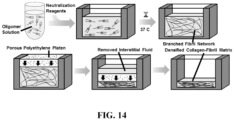
- the physical compression can be performed in a chamber comprising an adjustable mold and platen.
- collagen-fibril matrix can be inserted into the mold and then subjected to compression.
- the physical compression can be varied depending on the placement of the porous platen within the mold.
- the mold may be adjustable so that porous polyethylene is positioned as part of the platen and/or along the walls or bottom of the sample mold.
- the location of the porous polyethylene can define the resultant material gradient in the collagen-fibril matrix.
- the compression is a physical force from at least one direction.
- the compression is a physical force from two or more directions.
- the compression is a physical force from three or more directions.
- the compression is a physical force from four or more directions.
- a synthetic collagen-fibril matrix as described herein may be made under controlled conditions to obtain particular physical properties.
- the collagen-fibril matrices may have desired collagen fibril density, pore size (fibril-fibril branching), elastic modulus, tensile strain, tensile stress, linear modulus, compressive modulus, loss modulus, fibril area fraction, fibril volume fraction, collagen concentration, cell seeding density, shear storage modulus (G' or elastic (solid-like) behavior), and phase angle delta ( ⁇ or the measure of the fluid (viscous)-to solid (elastic)-like behavior; ⁇ equals 0° for Hookean solid and 90° for Newtonian fluid).
- a “modulus” can be an elastic or linear modulus (defined by the slope of the linear region of the stress-strain curve obtained using conventional mechanical testing protocols; i.e., stiffness), a compressive modulus, a loss modulus, or a shear storage modulus (e.g., a storage modulus). These terms are well-known to those skilled in the art.
- a “fibril volume fraction” i.e., fibril density
- fibril density is defined as the percent area of the total area occupied by fibrils in three dimensions.
- a collagen-based therapeutic delivery device as described herein can be formed for subsequent implantation into a patient, such as, for example, as a tissue graft material, or can be formed in situ by injecting a pre-matrix composition to a location in situ for subsequent polymerization to form a collagen-based therapeutic delivery material in situ.
- the collagen-based therapeutic delivery device is a medical graft.
- An important consideration for medical grafts, particularly soft tissue grafts is the design of a graft that promotes graft vascularization, and particularly one that allows for cell co-implantation and cell infiltration, that structurally and functionally supports cell growth, and that is able to fully integrate with the tissue physiologically. Additional important considerations include that the graft should not impede the growth of regenerating tissue and that its degradation should not leave behind any byproducts that would adversely affect the cells involved in tissue regeneration.
- the collagen-based therapeutic delivery systems described herein not only allow for cell co-implantation and cell infiltration, structurally and functionally supports cell growth, and are able to fully integrate with the tissue physiologically by providing a strong porous framework suitable for cell infiltration and growth, but they also enable the delivery of vascularization-promoting active agents to the site of the graft to enhance vascularization following implant.
- the collagen-fibril matrix can be formed in any two- or three- dimensional shape by conducting polymerization in a mold having a desired shape and size and/or by post-polymerization processing.
- the collagen-based therapeutic delivery system can be used in vitro.
- in vitro use of the collagen-based therapeutic delivery systems of the present disclosure may be utilized for research purposes such as cell tissue culture, drug discovery, and chemical toxicity testing.
- the collagen-based therapeutic delivery system can be used in vitro for generating complex tissue and organ constructs, including vascularization, for restoration of damaged or dysfunctional organs or tissues.
- the collagen-fibril matrices may include, but are not limited to, low density fibril matrices and high density fibril matrices.
- a low density fibril matrix may have a collagen concentration less than about 10 mg/ml, 9 mg/ml, 8 mg/ml, 7 mg/ml, 6 mg/ml, 5 mg/ml, 4 mg/ml, 3 mg/ml, 2 mg/ml or 1 mg/ml.
- a high density fibril matrix may have a collagen concentration greater than 10 mg/ml, 20 mg/ml, 30 mg/ml, and 40 mg/ml or higher.
- Applications suitable for low density fibril matrices may include, but are not limited to, in vitro 3D cell culture, injectable therapeutic delivery, and implantable therapeutic delivery.
- Applications suitable for high density fibril matrices or tissue constructs may include, but are not limited to, surgical implants, sheets, fibrillar material, tissue valves, tissue gradients, articular cartilage and tissue-engineered medical products.
- the illustrative collagen-based therapeutic delivery systems of the present disclosure can be used in human and veterinary medicine in both experimental and in vivo conditions.
- Envisioned uses of the illustrative therapeutic delivery systems in accordance with the teachings of the present disclosure include, but are not limited to, as hemostatic agents, as missing tissue substitutes or replacements, as skin equivalents, and as matrices for tissue augmentation.
- the desired physical characteristics of the collagen-fiber matrix for use in different applications may differ depending on the application and the active agent.
- the in vitro model system involved admixing of FITC-Dextrans of various sizes ranging from 10kDa to 2MDa within polymerizable collagens, and then establishing a computational model to predict release kinetics for various sized molecules based on known diffusion coefficients for oligomer matrices.
- the designed experimental model system was then used to define and compare size-dependent molecular release kinetics for FITC-Dextrans within low-density matrices prepared with standardized collagen oligomers and commercial monomeric collagen.
- mammalian refers to any species belonging to the class Mammalia including, but not limited to, humans, cows, pigs, dogs, horses or cats.
- mammalian tissue refers to any tissue including, but not limited to, skin, muscle, tendons or fibrous connecting tissue found in mammals.
- the term "diffusion” refers to the random thermal motion of atoms, molecules, clusters of atoms, etc. in gases, liquids, and some solids.
- fibrilogenesis refers to the process of tropocollagen monomers assembling into mature fibrils and associated fibril-network structures.
- gel refers to a three-dimensional network structure arising from intermolecular polymer chain interactions.
- permeability refers to a measure of the ability of porous materials to transmit fluids; the rate of flow of a liquid through porous material.
- recombinant collagen protein/peptide refers to a collagen or collagen-like polypeptide produced by recombinant methods, such as, but not limited to by expression of a nucleotide sequence encoding, the protein or peptide in a microorganism, insect, plant or animal host.
- Such compositions often comprise Gly-X-Y triplets where Gly is the amino acid glycine and X and Y can be the same or different, are often proline or hydroxyproline, but can be any known amino acid.
- self-assembly refers to the process by which a complex macromolecule (for example collagen) or a supramolecular system (for example a virus) spontaneously assembles itself from its components.
- a complex macromolecule for example collagen
- a supramolecular system for example a virus
- solution refers to a type of homogenous mixture composed of only one phase.
- a "solute” is a substance dissolved in another substance, known as a "solvent".
- stiffness is a general term describing the extent to which a material resists deformation in response to an applied force; specific measures of stiffness depend upon the material loading format (for example, tension, compression, shear, bending).
- degradation refers to a change in chemical, physical or molecular structure or appearance (for example, gross morphology) of material; degradation of collagen under physiological conditions involves site-specific cleavage within the central triple helical region by proteolytic enzymes known as collagenases.
- Collagenases are members of the larger family of proteases known as matrix metalloproteases.
- solubility refers to a measure of the extent to which a material can be dissolved; in the context of collagen polymers, solubility refers to collagen molecules (partial, full or multiples) or peptides in a solution; further qualification of solubility may include "acid-soluble” and "neutral salt-soluble” which describe compositions that are soluble in dilute acids and neutral salt solutions, respectively.
- the present disclosure provides a collagen-based therapeutic delivery device that includes an insoluble synthetic collagen-fibril matrix comprising a polymerization product of soluble oligomeric collagen or a polymerization product of a mixture of soluble oligomeric collagen with one or more type of non-oligomeric soluble collagen molecules; and a first active agent dispersed throughout the collagen-fibril matrix or within a portion of the collagen-fibril matrix. Also provided are the following embodiments:
- the present disclosure provides a method for making a therapeutic delivery device that includes (i) forming an aqueous solution comprising a first quantity of soluble collagen-fibril building blocks; (ii) causing the building blocks to polymerize by self-assembly, thereby forming an insoluble synthetic collagen-fibril matrix; and (iii) either (a) including a second quantity of an active agent in the aqueous solution whereby said causing forms the insoluble synthetic collagen-fibril matrix having the active agent dispersed therein or (b) contacting the insoluble synthetic collagen-fibril matrix with the second quantity of the active agent to form a collagen-fibril matrix having the active agent dispersed therein; wherein the first quantity of building blocks comprises soluble oligomeric collagen molecules. Also provided are the following embodiments:
- the present disclosure provides a pre-matrix composition that comprises an aqueous solution including a first quantity of soluble collagen-fibril building blocks and a second quantity of an active agent in the aqueous solution, wherein the first quantity of soluble collagen-fibril building blocks includes soluble oligomeric collagen or a mixture of soluble oligomeric collagen with one or more other type of non-oligomeric soluble collagen molecules, wherein the building blocks are operable to self-assemble into a macromolecular insoluble synthetic collagen-fibril matrix having a stiffness of at least 5 Pa in the absence of an exogenous cross-linking agent. Also provided are the following embodiments:
- the present disclosure provides a method for delivering an active agent, that includes positioning at an in situ position (i) a pre-matrix composition comprising an aqueous solution including a first quantity of soluble collagen-fibril building blocks and a second quantity of an active agent in the aqueous solution, wherein the first quantity of soluble collagen-fibril building blocks includes soluble oligomeric collagen or a mixture of soluble oligomeric collagen with one or more type of soluble non-oligomeric collagen molecules, wherein the building blocks are operable to self-assemble into an insoluble synthetic macromolecular collagen-fibril matrix having a stiffness of at least 5 Pa in situ in the absence of an exogenous cross-linking agent; or (ii) a collagen-based therapeutic delivery device comprising an insoluble synthetic collagen-fibril matrix comprising a polymerization product of soluble oligomeric collagen or a polymerization product of a mixture of soluble oligomeric collagen with one or more type of soluble non
- Soluble collagen-fibril building blocks including oligomer, telocollagen, and atelocollagen were derived from the dermis of market weight pigs.
- Oligomer formulations were prepared using an acid solubilization method that preferentially extracts oligomers, which represent aggregates of collagen molecules (e.g., trimer) covalently connected by a natural intermolecular crosslink.
- Telomer formulations were prepared using acid solubilization followed by a salt precipitation technique.
- Salt solutions were used to selectively isolate collagen molecules, which were not cross-linked or which contained immature acid labile cross-links, particularly since telomer and oligomer formulations contain reactive aldehyde groups on the telopeptide ends.
- atelocollagen formulations were prepared through a digestion technique in which pepsin enzymatically cleaves the telopeptide ends from the N- and C-terminus of the collagen molecule.
- These soluble collagen-fibril building blocks are standardized and quality controlled based upon their molecular composition and polymerization (collagen-fibril formation) capacity.
- acid solubilized type I collagen harvested from rat tails was purchased from BD Biosciences (Bedford, MA, referenced as BD-rat tail collagen, BD-RTC).
- the collagens were further diluted in 0.01N HCl and further neutralized with phosphate buffered saline (PBS, 10X, pH 7.4) and 0.1N sodium hydroxide (NaOH) to achieve neutral pH (7.4) and a final collagen concentration of 3 mg/ml.
- PBS phosphate buffered saline
- NaOH sodium hydroxide
- FITC-Dextran of four different sizes (i.e., 10, 40, 500 and 2 MDa) were loaded to mimic different sized therapeutic molecules.
- FITC-Dextrans (10 kDa, 40 kDa, 500 kDa, or 2 MDa, from Invitrogen, Eugene, OR) were solubilized in 10X PBS to yield desired final concentration within polymerized matrices.
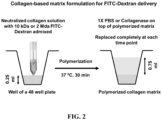
- FITC-Dextran enables straightforward quantification of release kinetics based on fluorescence level detection from supernatant above collagen matrix system. All the neutralized solutions were polymerized in 0.25 ml volume in a 48 well plate (Corning, USA), as shown in FIG. 2 . The system allowed molecular release kinetics into 0.75 ml top buffer which was 1X PBS (pH 7.4) in the absence or presence of collagenase (type IV, from Worthington Biochemical Corporation, USA).
- oligomer matrices (3 mg/ml) were neutralized in the absence and presence of FITC-Dextrans (10 KDa and 2 MDa, each at a final concentration of 1.0 mg/ml) as described in procedure above.
- FITC-Dextrans 10 KDa and 2 MDa, each at a final concentration of 1.0 mg/ml
- Each neutralized solution was put on AR2000 rheometer adapted with a stainless steel 40 mm diameter parallel plate geometry (TA Instruments, New Castle, DE) for polymerization in contact with the steel plate.
- Time-dependent changes in viscoelastic properties were monitored through oscillatory shear, using a time sweep procedure. Temperature of the rheometer plate was maintained at 4°C for a period of 5 minutes to get the baseline of storage modulus of neutralized collagen solutions with or without FITC-Dextran prior to polymerization. The temperature was then increased to 37°C to induce polymerization of matrices. Polymerization kinetics and viscoelastic properties of matrices prepared with or without FITC-Dextran were compared. Polymerization half time (Thalf) was calculated along with the rate of polymerization, defined as the slope of polymerization curve for each sample. Each formulation was tested in triplicate.
- FIG. 3A shows polymerization kinetics as measured by time-dependent changes in G'
- FIG. 3B shows associated final G' values for 3 mg/ml oligomer matrices prepared in absence and presence of 10 KDa and 2000 KDa FITC-Dextrans (1 mg/ml).
- Example 3 Predicting time required for diffusion-based release of various sized FITC-Dextran molecules from collagen-fibril materials
- Equations used for predictive modeling of short-time and long-time release were:
- M t and M ⁇ denote the cumulative amounts of drug released at time t and at infinite time respectively;
- D is the diffusion coefficient of the drug within the system, and
- L represents the total thickness of the matrix.
- Length values for collagen-fibril matrices were 2.61 mm as defined by our experimental system.
- Diffusion coefficient values (D) used for 10 KDa, 40 KDa, 500 KDa and 2 MDa FITC-Dextrans were 1.09 E-10, 4.8 E-11, 2.52 E-11, and 1.76 E-11 (m 2 /sec) based upon previous published values for 3 mg/ml oligomeric collagen matrices.
- Example 4 Comparison of size-dependent molecular release kinetics for low-density (3mg/ml) oligomer and commercial monomer collagen-fibril matrices in the presence and absence of collagenase
- FITC-dextran within the supernatant was determined spectrofluorometrically (Molecular Devices Spectramax M5) at excitation and emission wavelengths of 493 and 530 nm, respectively. This process was repeated until Relative Fluorescence Units from supernatant of wells matched baseline fluorescence (PBS plus/minus collagenase containing no FITC-Dextran), indicating completion of the FITC-Dextran release. All fluorescence values were normalized to maximum total fluorescence intensity and % cumulative release was plotted versus time.
- FIG. 15 depicts illustrative graphs showing the initial rates of release and T50% curves calculated from the release kinetics curves for the various collagenase concentrations.
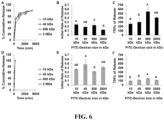
- FITC-Dextrans with molecular sizes of 10kDa ( ⁇ ), 40kDa ( ⁇ ), 500kDa ( ⁇ ), and 2 MDa ( ⁇ ) were polymerized at 0.5 mg/ml within oligomer and commercial monomer (BD rat tail) matrices (3 mg/ml).
- oligomer matrices in the presence of collagenase were found to maintain size dependent and sustained release trends, while commercial monomer (BD rat tail) matrices did not.
- FITC-Dextrans with molecular sizes of 10kDa ( ⁇ ), 40kDa ( ⁇ ), 500kDa ( ⁇ ), and 2 MDa ( ⁇ ) were polymerized at 0.5 mg/ml within oligomer and commercial monomer matrices (3 mg/ml).
- letters indicate statistically different experimental groups as determined by Tukey-Kramer range test (p ⁇ 0.05).
- the designed experimental model allowed the effect of the collagen-fibril microstructure to be investigated alone, as well as both collagen-fibril microstructure and proteolytic degradability on molecular release.
- the collagen biograft system can then be modulated to make it tunable for release.
- molecular release can be affected by two key parameters, namely 1) the collagen fibril microstructure, and 2) its proteolytic degradability. As such, it was an objective to incorporate approaches for modulating these two parameters to customize release kinetics from collagen-fibril materials. It was believed that by using different interfibril branching capacity of collagen building blocks and by altering the collagen fibril density, molecular release kinetics at suprafibrillar level of assembly can be tuned.
- collagen precursors In terms of characterizing molecular release from low-density collagen-fibril materials, it should be understood and appreciated herein that collagen precursors, telocollagens, oligomers and atelocollagens, differ in their intermolecular cross-link composition. It has been previously shown that collagen precursors provide independent control of mechanical and transport properties of collagen matrix. As such, it is therefore hypothesized that the matrices formed from these precursors would exhibit different release kinetics based on their varying fibril microstructure, as well as varying proteolytic degradability, at a matched concentration. In order to test this, proteolytic degradability of matrices were first studied, followed by characterization of molecular release from them in both absence and presence of collagenase. It was also proposed to confirm the effect of microstructure and proteolytic degradability on the release mechanism of matrices by fitting a Weibull function to the molecular release data.
- telocollagen and atelocollagen matrices were polymerized on rheometer plate at 4°C for 5 minutes to get a baseline, and then the temperature was ramped up to 37°C for polymerization. After 30 min of polymerization, the matrices formed were exposed to 5000 U/ml collagenase in an oscillatory shear-based, and strain-controlled time sweep experiment and tan of phase shift angle delta was tracked with respect to time as shown in FIG. 7 .
- Absolute tan delta was plotted as a function of time and representative samples of each type of matrix are shown in this figure.
- Rise in tan delta value ⁇ 1 indicated phase change from solid to liquid, indicating complete proteolytic degradation of material.
- First derivative of tan delta was then plotted against time to get an inflection peak, which was used to calculate the total degradation time for matrices, after subtracting the first 30 minutes of polymerization time.
- atelocollagen and oligomer matrices represented the extreme ends of the obtained proteolytic degradation spectrum.
- Release kinetics from formulated delivery systems were then measured under two conditions: 1) in absence of collagenase, to investigate effect of microstructure on release kinetics (diffusion only); and 2) in presence of 125 U/ml collagenase, to investigate effect of both microstructure and proteolytic degradability on the release kinetics (diffusion + degradation).
- FIG. 8 a graphical representation illustrating that the molecular release profiles are dependent upon the collagen polymer building blocks is shown.
- FITC-Dextrans with molecular sizes of 10 kDa and 2 MDa were polymerized within oligomer, telocollagen, and atelocollagen matrices (3 mg/ml).
- M t is the mass of drug released at time t
- M ⁇ is the mass of drug released at infinite time (assumed equal to the amount of drug added)
- a denotes a scale parameter of time dependency
- b describes the shape of the dissolution curve progression.
- the Weibull function was incorporated into the experimental release kinetics obtained from commercial monomer collagen (BD rat tail), atelocollagen, telocollagen, and oligomer matrices admixed with various FITC-Dextran molecules.
- the Weibull function fit the experimental data well, and the parameter values a and b along with R 2 and confidence intervals determined for parameters a and b from the fits are given in Table 2 below.
- results show that commercial monomer (BD rat tail) matrices gave a diffusion based release mechanism, while oligomer and telocollagen collagen-fibril matrices showed a combined release mechanism (Fickian diffusion and Case II transport) associated with them.
- Atelocollagen showed completely different value of parameter b, perhaps indicating diffusional release mechanism as in highly disordered spaces.
- Weibull function was fit to release kinetics in absence of collagenase alone, the results confirmed that collagen-fibril microstructure affects molecular release.
- the matrices were polymerized without FITC-Dextran on AR2000 Rheometer using the procedure described in Example 2.
- Five different matrix combinations were prepared by combining soluble oligomer and atelocollagen building block in the ratio of 0:100, 25:75, 50:50, 75:25, and 100:0 prior to polymerization.
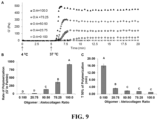
- the resultant polymerization curves and calculated polymerization rates and T50% are shown in FIG. 9 .
- time-dependent changes in shear-storage modulus were monitored as collagen formulations exhibited solution to matrix transition following an increase in temperature from 4°C to 37°C.
- Example 7 Modulation of matrix release kinetics by varying the compositional ratio of molecular building blocks oligomer and atelocollagen
- atelocollagen ratios implied that the modulation in matrix composition would translate into its different agent release profiles. It was hypothesized that modulating the matrix composition using oligomer and atelocollagen building blocks could tune molecular release kinetics of low-fibril density matrices (3 mg/ml). In order to test this, collagen-fibril matrices were formulated with combinations of oligomer: atelocollagen in a ratio of 0:100, 5:95, 10:90, 15:85, 20:80, 25:75, 50:50, 75:25 and 100:0% .
- Example 8 Molecular release from high-density collagen-fibril materials
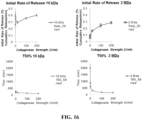
- High-density matrices were prepared by subjecting 3 mg/ml collagen-fibril matrices to confined compression to achieve 5.2X volume reduction. Cylinders of diameter 1.1 (thickness 2.6 mm) were prepared from each matrix type and release kinetics compared.
- Cylinders of diameter 1.1 were prepared from low-density (3 mg/ml) and high-density (15.6 mg/ml) matrices. Molecular release profiles were measured in the presence of 50 U/ml collagenase for triplicate samples of each matrix formulation.
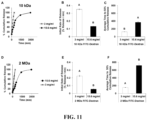
- 10 kDa and 2 MDa FITC-Dextran was admixed in 3 mg/ml and 15.6 mg/ml oligomer matrices. Release kinetics for both matrices were measured upon exposure to 50 U/ml collagenase.
- the difference between release profiles exhibited by low-density and high-density matrix formulation is enhanced for 2 MDa FITC-Dextran (D) as compared to 10 kDa FITC-Dextran (A).
- the initial rate of release is significantly lower in high density matrices compared to low density matrices for both 10 KDa (B) and 2 MDa (E) FITC-Dextrans.
- the T50% of release is significantly higher in high density matrices than in low density matrices for both smaller size FITC-Dextran (10 kDa) and larger size (2 MDa) as seen in FIG. 10E and 10F.
- oligomer collagen-fibril matrices affects agent release
- 10kDa and 2MDa FITC-dextrans were admixed at a concentration of 0.25 mg/ml within matrices prepared over the density range of 3 mg/ml to 40 mg/ml.
- Oligomer matrices prepared at 3 mg/ml were prepared as previously described in absence of confined compression, while 20 mg/ml and 40 mg/ml matrices were prepared by application of confined compression to 4.05 mg/ml matrices.
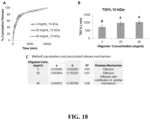
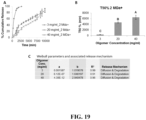
- Cylinders of diameter 1.1 were prepared from all matrices and used to measure release kinetics in the presence or absence of collagenase (10 U/ml). All measurements were made on triplicate samples. Release profiles were plotted and analyzed for time required for 50% cumulative release (T50%), which was calculated based on Weibull fit. The resultant Weibull parameters were used to define the release mechanism.
- the oligomer collagen-fibril matrices showed a density-dependent effect on molecular release of both 10kDa and 2MDa FITC-dextrans in the presence of 50 U/ml collagenase as shown in FIGS. 17 and 19 .
- both FITC-dextrans an increase in T50% was observed with increased density.
- the dynamic range of density-dependent release was greatest for 2MDa FITC-dextran.
- 10kDa FITC-dextran showed decreased T50% values compared 2MDa FITC-dextran for all matrices tested.
- telocollagen Monomer-rich (telocollagen) collagen was prepared by extracting pig skin with 0.5 M acetic acid followed by salt precipitation. Telopeptide regions within the collagen molecule, which contain intermolecular cross-linking sites, were enzymatically removed by complete pepsin digestion. All collagens were dialyzed exhaustively against 0.1 M acetic acid and then lyophilized. Prior to use, lyophilized collagens were dissolved in 0.01 N HCI.
- collagens were diluted in 0.01N HCI and further neutralized with phosphate buffered saline (PBS, 10X, pH 7.4) and 0.1N sodium hydroxide (NaOH) to achieve neutral pH (7.4) and a final collagen concentration of 3 mg/ml.
- PBS phosphate buffered saline
- NaOH sodium hydroxide
- FITC-Dextran 10 kDa, 40 kDa, 500 kDa, or 2 MDa Invitrogen, Eugene, OR
- 10X PBS 10X PBS
- Preparation of matrices with varied oligomer:monomer ratios involved neutralization of each component at 3 mg/ml with 0.5 mg/ml FITC-Dextran and then varying the volume ratio to achieve 0:100, 25:75, 50:50, 75:25, and 100:0 prior to polymerization.
- the neutralized collagen solutions were kept on ice prior to the induction of polymerization by warming to 37°C.
- the temperature of the rheometer plate was maintained below 10°C for a period of 5 minutes to get the baseline storage modulus of non-polymerized matrices and then increased to 37°C. Due to the increased viscosity of the collagen solutions, positive displacement pipettes (Microman, Gilson, Middleton, WI) were used to accurately pipet all collagen solutions.
- FITC-Dextran had no effect on collagen polymerization kinetics and matrix physical properties.
- Collagen matrices (3 mg/ml) containing various sized FITC-Dextran at a concentration of 0.5 mg/ml were polymerized in 48-well plates (250 J.lllwell). Samples then were overlaid with 750 ⁇ l PBS, pH 7.4 containing no collagenase or 125 U/ml bacteria Clostridium histolyticum collagenase (CLS4, Worthington Biomchemical Corporation, Lakewood, NJ). Plates were subjected to gradual rotation at 60 rpm on a Fisher Scientific Clinical Rotator. The supernatant from each sample was collected at specific time intervals and replaced with fresh solutions.
Landscapes
- Health & Medical Sciences (AREA)
- Life Sciences & Earth Sciences (AREA)
- Chemical & Material Sciences (AREA)
- Medicinal Chemistry (AREA)
- Epidemiology (AREA)
- Veterinary Medicine (AREA)
- Public Health (AREA)
- General Health & Medical Sciences (AREA)
- Animal Behavior & Ethology (AREA)
- Engineering & Computer Science (AREA)
- Pharmacology & Pharmacy (AREA)
- Dermatology (AREA)
- Oral & Maxillofacial Surgery (AREA)
- Biomedical Technology (AREA)
- Proteomics, Peptides & Aminoacids (AREA)
- Transplantation (AREA)
- Bioinformatics & Cheminformatics (AREA)
- Gastroenterology & Hepatology (AREA)
- Zoology (AREA)
- Biophysics (AREA)
- Inorganic Chemistry (AREA)
- Immunology (AREA)
- Molecular Biology (AREA)
- Neurosurgery (AREA)
- Materials For Medical Uses (AREA)
- Medicinal Preparation (AREA)
- Medicines That Contain Protein Lipid Enzymes And Other Medicines (AREA)
Applications Claiming Priority (3)
| Application Number | Priority Date | Filing Date | Title |
|---|---|---|---|
| US201462042664P | 2014-08-27 | 2014-08-27 | |
| EP15835953.9A EP3185922B1 (de) | 2014-08-27 | 2015-08-27 | Abgabesysteme für therapeutikum auf kollagenbasis |
| PCT/US2015/047176 WO2016033322A1 (en) | 2014-08-27 | 2015-08-27 | Collagen-based therapeutic delivery systems |
Related Parent Applications (1)
| Application Number | Title | Priority Date | Filing Date |
|---|---|---|---|
| EP15835953.9A Division EP3185922B1 (de) | 2014-08-27 | 2015-08-27 | Abgabesysteme für therapeutikum auf kollagenbasis |
Publications (2)
| Publication Number | Publication Date |
|---|---|
| EP4548939A2 true EP4548939A2 (de) | 2025-05-07 |
| EP4548939A3 EP4548939A3 (de) | 2025-08-06 |
Family
ID=55400571
Family Applications (2)
| Application Number | Title | Priority Date | Filing Date |
|---|---|---|---|
| EP15835953.9A Active EP3185922B1 (de) | 2014-08-27 | 2015-08-27 | Abgabesysteme für therapeutikum auf kollagenbasis |
| EP25163105.7A Pending EP4548939A3 (de) | 2014-08-27 | 2015-08-27 | Abgabesysteme für therapeutikum auf kollagenbasis |
Family Applications Before (1)
| Application Number | Title | Priority Date | Filing Date |
|---|---|---|---|
| EP15835953.9A Active EP3185922B1 (de) | 2014-08-27 | 2015-08-27 | Abgabesysteme für therapeutikum auf kollagenbasis |
Country Status (6)
| Country | Link |
|---|---|
| US (3) | US10314940B2 (de) |
| EP (2) | EP3185922B1 (de) |
| JP (2) | JP2017529390A (de) |
| CA (1) | CA2959139C (de) |
| ES (1) | ES3027646T3 (de) |
| WO (1) | WO2016033322A1 (de) |
Families Citing this family (13)
| Publication number | Priority date | Publication date | Assignee | Title |
|---|---|---|---|---|
| US9878071B2 (en) | 2013-10-16 | 2018-01-30 | Purdue Research Foundation | Collagen compositions and methods of use |
| EP3185922B1 (de) | 2014-08-27 | 2025-04-02 | Purdue Research Foundation | Abgabesysteme für therapeutikum auf kollagenbasis |
| US11919941B2 (en) | 2015-04-21 | 2024-03-05 | Purdue Research Foundation | Cell-collagen-silica composites and methods of making and using the same |
| CA3052266A1 (en) | 2017-01-31 | 2018-08-09 | Geniphys, Llc | Methods and compositions for matrix preparation |
| US11739291B2 (en) | 2017-04-25 | 2023-08-29 | Purdue Research Foundation | 3-dimensional (3D) tissue-engineered muscle for tissue restoration |
| US12458669B2 (en) | 2017-07-25 | 2025-11-04 | Purdue Research Foundation | Collagen encapsulation of insulin-producing cells |
| CN110398514B (zh) * | 2018-04-24 | 2023-04-28 | 恒天纤维集团有限公司 | 一种快速判断纤维素胶液中金属杂质含量的方法 |
| CN113301928B (zh) * | 2018-12-28 | 2022-12-02 | 黄玲惠 | 生物支架和用于制备其的方法 |
| GB201917246D0 (en) | 2019-11-27 | 2020-01-08 | Royal College Surgeons Ireland | A collagen scaffold |
| EP4096635A4 (de) * | 2020-01-27 | 2024-02-21 | GeniPhys, Inc. | Biologischer füllstoff zur wiederherstellung und regeneration von gewebe |
| US12351621B1 (en) | 2023-05-03 | 2025-07-08 | Humabiologics, Inc. | Composite collagen product and method of making thereof |
| US12351620B1 (en) | 2023-05-03 | 2025-07-08 | Humabiologics, Inc. | Process for production of a soluble and insoluble collagen product from mammalian dermis tissue |
| US12134792B1 (en) | 2023-05-03 | 2024-11-05 | Humabiologics, Inc. | Process for production of a soluble and insoluble collagen product from mammalian dermis tissue |
Citations (17)
| Publication number | Priority date | Publication date | Assignee | Title |
|---|---|---|---|---|
| US4902508A (en) | 1988-07-11 | 1990-02-20 | Purdue Research Foundation | Tissue graft composition |
| US5163955A (en) | 1991-01-24 | 1992-11-17 | Autogenics | Rapid assembly, concentric mating stent, tissue heart valve with enhanced clamping and tissue alignment |
| US5275826A (en) | 1992-11-13 | 1994-01-04 | Purdue Research Foundation | Fluidized intestinal submucosa and its use as an injectable tissue graft |
| US5281422A (en) | 1991-09-24 | 1994-01-25 | Purdue Research Foundation | Graft for promoting autogenous tissue growth |
| US5554389A (en) | 1995-04-07 | 1996-09-10 | Purdue Research Foundation | Urinary bladder submucosa derived tissue graft |
| US6099567A (en) | 1996-12-10 | 2000-08-08 | Purdue Research Foundation | Stomach submucosa derived tissue graft |
| WO2001045765A1 (en) | 1999-12-22 | 2001-06-28 | Acell, Inc. | Tissue regenerative composition |
| US6576265B1 (en) | 1999-12-22 | 2003-06-10 | Acell, Inc. | Tissue regenerative composition, method of making, and method of use thereof |
| US6793939B2 (en) | 1996-12-10 | 2004-09-21 | Purdue Research Foundation | Biomaterial derived from vertebrate liver tissue |
| US20070269476A1 (en) | 2006-05-16 | 2007-11-22 | Voytik-Harbin Sherry L | Engineered extracellular matrices control stem cell behavior |
| US20090011021A1 (en) | 2005-05-16 | 2009-01-08 | Purdue Research Foundation | Engineered Extracellular Matrices |
| US20090175922A1 (en) | 2006-05-16 | 2009-07-09 | Voytik-Harbin Sherry L | Three dimensional purified collagen matrices |
| US7919121B2 (en) | 2002-01-11 | 2011-04-05 | Purdue Research Foundation | Biomaterial derived from vertebrate liver tissue |
| US8084055B2 (en) | 2006-09-21 | 2011-12-27 | Purdue Research Foundation | Collagen preparation and method of isolation |
| US20120027732A1 (en) | 2010-07-27 | 2012-02-02 | Voytik-Harbin Sherry L | Thermoreversible collagen |
| US20120115222A1 (en) | 2009-07-16 | 2012-05-10 | Purdue Research Foundation | Composition and method for maintenance, differentiation, and proliferation of stem cells |
| US20150105323A1 (en) | 2013-10-16 | 2015-04-16 | Purdue Research Foundation | Collagen compositions and methods of use |
Family Cites Families (147)
| Publication number | Priority date | Publication date | Assignee | Title |
|---|---|---|---|---|
| US3949073A (en) | 1974-11-18 | 1976-04-06 | The Board Of Trustees Of Leland Stanford Junior University | Process for augmenting connective mammalian tissue with in situ polymerizable native collagen solution |
| US4233360A (en) | 1975-10-22 | 1980-11-11 | Collagen Corporation | Non-antigenic collagen and articles of manufacture |
| US4439521A (en) | 1981-10-21 | 1984-03-27 | Ontario Cancer Institute | Method for producing self-reproducing mammalian pancreatic islet-like structures |
| US4582640A (en) | 1982-03-08 | 1986-04-15 | Collagen Corporation | Injectable cross-linked collagen implant material |
| US4544516A (en) | 1982-07-28 | 1985-10-01 | Battelle Development Corporation | Collagen orientation |
| US4801299A (en) | 1983-06-10 | 1989-01-31 | University Patents, Inc. | Body implants of extracellular matrix and means and methods of making and using such implants |
| MX163953B (es) | 1984-03-27 | 1992-07-03 | Univ New Jersey Med | Procedimiento para preparar una matriz biodegradable a base de colageno |
| US4789663A (en) | 1984-07-06 | 1988-12-06 | Collagen Corporation | Methods of bone repair using collagen |
| US4743552A (en) | 1984-09-26 | 1988-05-10 | Sloan-Kettering Institute For Cancer Research | Method for growth in tissue culture of normal colonic epithelial cells and method for determination of preneoplastic color cells |
| US4600533A (en) | 1984-12-24 | 1986-07-15 | Collagen Corporation | Collagen membranes for medical use |
| US4829000A (en) | 1985-08-30 | 1989-05-09 | The United States Of America As Represented By The Secretary Of The Department Of Health And Human Services | Reconstituted basement membrane complex with biological activity |
| US5032508A (en) | 1988-09-08 | 1991-07-16 | Marrow-Tech, Inc. | Three-dimensional cell and tissue culture system |
| US5266480A (en) | 1986-04-18 | 1993-11-30 | Advanced Tissue Sciences, Inc. | Three-dimensional skin culture system |
| US5863531A (en) | 1986-04-18 | 1999-01-26 | Advanced Tissue Sciences, Inc. | In vitro preparation of tubular tissue structures by stromal cell culture on a three-dimensional framework |
| GB8618374D0 (en) | 1986-07-28 | 1986-09-03 | Hsc Res Dev Corp | Biological vascular prostheses |
| JPH0774239B2 (ja) | 1986-09-04 | 1995-08-09 | 新田ゼラチン株式会社 | 細胞培養用高ゲル強度酸可溶性コラーゲンの製法 |
| US5604106A (en) | 1987-06-05 | 1997-02-18 | Us Commerce | Method for detecting carcinoma |
| US5067961A (en) | 1988-02-18 | 1991-11-26 | Autogenesis Technologies, Inc. | Non-biodegradable two phase corneal implant and method for preparing same |
| JPH0728730B2 (ja) | 1988-03-27 | 1995-04-05 | 新技術事業団 | 擬膵島および拡散チャンバー型人工膵臟 |
| US4956178A (en) | 1988-07-11 | 1990-09-11 | Purdue Research Foundation | Tissue graft composition |
| US4912057A (en) | 1989-06-13 | 1990-03-27 | Cancer Diagnostics, Inc. | Cell chamber for chemotaxis assay |
| US5336616A (en) | 1990-09-12 | 1994-08-09 | Lifecell Corporation | Method for processing and preserving collagen-based tissues for transplantation |
| WO1992015676A1 (en) | 1991-03-08 | 1992-09-17 | The Salk Institute For Biological Studies | Somatic cell gene therapy |
| CA2089487A1 (en) * | 1991-06-14 | 1992-12-15 | Suk-Zu Song | Collagen film drug delivery for proteins |
| EP0605428B9 (de) | 1991-06-24 | 2003-01-02 | hCell Technology, Inc. | In langzeitkultur gehaltene hormon-absondernde pankreatische zellen |
| FR2678624A1 (fr) | 1991-07-04 | 1993-01-08 | Coletica | Utilisation de la peau non pigmentee de poisson, en particulier de poisson plat comme nouvelle source industrielle de collagene, procede d'extraction, collagene et biomateriau ainsi obtenus. |
| US5204382A (en) | 1992-02-28 | 1993-04-20 | Collagen Corporation | Injectable ceramic compositions and methods for their preparation and use |
| US5428022A (en) | 1992-07-29 | 1995-06-27 | Collagen Corporation | Composition of low type III content human placental collagen |
| US5478739A (en) | 1992-10-23 | 1995-12-26 | Advanced Tissue Sciences, Inc. | Three-dimensional stromal cell and tissue culture system |
| US5641518A (en) | 1992-11-13 | 1997-06-24 | Purdue Research Foundation | Method of repairing bone tissue |
| US5352463A (en) | 1992-11-13 | 1994-10-04 | Badylak Steven F | Tissue graft for surgical reconstruction of a collagenous meniscus and method therefor |
| US5510263A (en) | 1993-04-05 | 1996-04-23 | Desmos, Inc. | Growth of pancreatic islet-like cell clusters |
| US5460962A (en) | 1994-01-04 | 1995-10-24 | Organogenesis Inc. | Peracetic acid sterilization of collagen or collagenous tissue |
| CA2140053C (en) * | 1994-02-09 | 2000-04-04 | Joel S. Rosenblatt | Collagen-based injectable drug delivery system and its use |
| US6475232B1 (en) | 1996-12-10 | 2002-11-05 | Purdue Research Foundation | Stent with reduced thrombogenicity |
| US5709934A (en) | 1994-11-22 | 1998-01-20 | Tissue Engineering, Inc. | Bipolymer foams having extracellular matrix particulates |
| US5695998A (en) | 1995-02-10 | 1997-12-09 | Purdue Research Foundation | Submucosa as a growth substrate for islet cells |
| US6485723B1 (en) | 1995-02-10 | 2002-11-26 | Purdue Research Foundation | Enhanced submucosal tissue graft constructs |
| US5711969A (en) | 1995-04-07 | 1998-01-27 | Purdue Research Foundation | Large area submucosal tissue graft constructs |
| CA2172917A1 (en) * | 1995-06-07 | 1996-12-08 | Hugh R. Mcmullin | Moldable collagen compositions for hard tissue repair and augmentation |
| US5776193A (en) | 1995-10-16 | 1998-07-07 | Orquest, Inc. | Bone grafting matrix |
| US6419920B1 (en) | 1995-10-25 | 2002-07-16 | Trans Karyotic Therapies, Inc. | Hybrid matrix implants and explants |
| AU736255B2 (en) | 1995-10-25 | 2001-07-26 | Shire Human Genetic Therapies, Inc. | Hybrid matrix implants and explants |
| WO1997017038A1 (en) | 1995-11-09 | 1997-05-15 | University Of Massachusetts | Tissue re-surfacing with hydrogel-cell compositions |
| JP2000508922A (ja) | 1996-04-26 | 2000-07-18 | ケース ウエスターン リザーブ ユニバーシティ | 間葉幹細胞を用いる皮膚再生 |
| US6171344B1 (en) | 1996-08-16 | 2001-01-09 | Children's Medical Center Corporation | Bladder submucosa seeded with cells for tissue reconstruction |
| WO1998006445A1 (en) | 1996-08-16 | 1998-02-19 | Children's Medical Center Corporation | Bladder submucosa seeded with cells for tissue reconstruction |
| US6666892B2 (en) | 1996-08-23 | 2003-12-23 | Cook Biotech Incorporated | Multi-formed collagenous biomaterial medical device |
| SK22499A3 (en) | 1996-08-23 | 1999-10-08 | Cook Biotech Inc | Graft prosthesis, materials and methods |
| DK0925067T3 (da) | 1996-09-16 | 2004-05-03 | Purdue Research Foundation | Graft fra submucosavæv til reparation af neurologisk væv |
| JP4046358B2 (ja) | 1996-12-10 | 2008-02-13 | パーデュー・リサーチ・ファウンデーション | 粘膜下組織抽出物 |
| ATE249182T1 (de) | 1996-12-10 | 2003-09-15 | Purdue Research Foundation | Rohrförmige transplantatkonstruktionen aus submucosalem gewebe |
| JP2002515813A (ja) | 1997-05-23 | 2002-05-28 | バイオセンス・インコーポレイテッド | 斜めに延びるルーメンを備えたカテーテル |
| US6248587B1 (en) | 1997-11-26 | 2001-06-19 | University Of Southern Cailfornia | Method for promoting mesenchymal stem and lineage-specific cell proliferation |
| WO1999043786A2 (en) | 1998-02-27 | 1999-09-02 | Purdue Research Foundation | Submucosa gel compositions |
| DE19812713A1 (de) | 1998-03-24 | 1999-09-30 | Merck Patent Gmbh | Verfahren zur Herstellung von mineralisierten Kollagenfibrillen und deren Verwendung als Knochenersatzwerkstoff |
| WO2000015765A1 (en) | 1998-09-11 | 2000-03-23 | Purdue Research Foundation | Enhanced submucosal tissue graft constructs |
| EP2295540A1 (de) | 1998-11-19 | 2011-03-16 | Organogenesis, Inc. | Biotechnisch konstruiertes Gewebe und Verfahren zu dessen Produktion und Benutzung |
| US6918396B1 (en) | 1998-12-01 | 2005-07-19 | Purdue Research Foundation | Method for vocal cord reconstruction |
| US7396809B1 (en) | 1999-02-10 | 2008-07-08 | Curis, Inc. | Methods and reagents for treating glucose metabolic disorders |
| US6592623B1 (en) | 1999-08-31 | 2003-07-15 | Virginia Commonwealth University Intellectual Property Foundation | Engineered muscle |
| US7615373B2 (en) | 1999-02-25 | 2009-11-10 | Virginia Commonwealth University Intellectual Property Foundation | Electroprocessed collagen and tissue engineering |
| US20050153442A1 (en) | 1999-03-10 | 2005-07-14 | Adam Katz | Adipose-derived stem cells and lattices |
| AU4351000A (en) | 1999-04-15 | 2000-11-02 | Research Foundation Of State University Of New York, The | Cellular matrix system and use thereof |
| CA2378618C (en) | 1999-08-06 | 2009-10-06 | Cook Biotech Incorporated | Tubular graft construct |
| US6592794B1 (en) | 1999-09-28 | 2003-07-15 | Organogenesis Inc. | Process of making bioengineered collagen fibrils |
| AU7732600A (en) | 1999-09-28 | 2001-04-30 | Organogenesis Inc. | Bioengineered collagen fibrils |
| US6482240B1 (en) | 1999-12-07 | 2002-11-19 | Ed. Geistlich Soehne Ag Fur Chemische Industrie | Method of making a collagen membrane from porcine skin |
| US6479064B1 (en) | 1999-12-29 | 2002-11-12 | Children's Medical Center Corporation | Culturing different cell populations on a decellularized natural biostructure for organ reconstruction |
| US20020039788A1 (en) | 2000-02-29 | 2002-04-04 | Isseroff Roslyn R. | Corneal epithelial graft composites |
| HK1052645B (en) | 2000-04-14 | 2008-03-20 | Universtiy Of Pittsburgh | Soft tissue and bone augmentation and bulking utilizing muscle-derived progenitor cells, compositions and treatments thereof |
| US6893812B2 (en) | 2000-05-30 | 2005-05-17 | Board Of Supervisors Of Louisiana State University And Agricultural And Mechanical College | Three-dimensional ex vivo angiogenesis system |
| WO2001092477A2 (de) | 2000-05-31 | 2001-12-06 | Fraunhofer-Gesellschaft zur Förderung der angewandten Forschung e.V. | Dreidimensionales hautmodell |
| DE20019809U1 (de) | 2000-05-31 | 2001-07-12 | Fraunhofer-Gesellschaft zur Förderung der angewandten Forschung e.V., 80636 München | Knorpelersatz und Biomatrix zur Kultivierung von Zellen |
| CZ301649B6 (cs) | 2000-06-28 | 2010-05-12 | Ed. Geistlich Soehne Ag Fur Chemische Industrie Incorporated Under The Laws Of Switzerland | Trubice pro regeneraci nervu a zpusob jejich výroby |
| DE10032610C2 (de) | 2000-07-07 | 2003-05-15 | Fischer W Mueller Blasformtech | Verfahren zum Herstellen von Kunststoff-Blasformartikeln |
| HUP0300810A2 (hu) | 2000-07-20 | 2003-08-28 | M.G.V.S. Ltd. | Mesterséges értranszplantátum, valamint ennek létrehozása és alkalmazása |
| WO2002014480A2 (en) | 2000-08-16 | 2002-02-21 | Duke University | Decellularized tissue engineered constructs and tissues |
| WO2002020729A2 (en) | 2000-09-06 | 2002-03-14 | UNIVERSITé LAVAL | In vitro human angiogenesis model |
| US20020076816A1 (en) | 2000-12-04 | 2002-06-20 | Jianwu Dai | Stem cells and signals developed for use in tissue and organ repair and replacement |
| US6586493B1 (en) | 2001-03-07 | 2003-07-01 | Arizona Board Of Regents Arizona State University | Polysaccharide-based hydrogels and pre-gel blends for the same |
| WO2002090528A1 (en) | 2001-05-10 | 2002-11-14 | Georgia Tech Research Corporation | Soft tissue devices and methods of use |
| CA2388723C (en) | 2001-06-06 | 2012-10-23 | Becton, Dickinson & Company | Method of providing a substrate with a ready-to-use, uniformly distributed extracellular matrix |
| WO2002102237A2 (en) | 2001-06-15 | 2002-12-27 | The Cleveland Clinic Foundation | Tissue engineered mitral valve chrodae and methods of making and using same |
| DE60131382T2 (de) | 2001-06-28 | 2008-09-11 | Pv Industries B.V. | Verfahren zur Wiedergewinnung von nativem Collagen |
| JP4426285B2 (ja) | 2001-06-28 | 2010-03-03 | クック・バイオテック・インコーポレーテッド | 腎被膜コラーゲンを含有する移植片プロテーゼ用具 |
| US20030113302A1 (en) | 2001-08-31 | 2003-06-19 | Elena Revazova | Use of recipient endothelial cells for enhanced vascularization of tissue and tissue-engineered construct transplants |
| DE20115753U1 (de) | 2001-09-14 | 2002-01-10 | Institut für Agrar- und Stadtökologische Projekte an der Humboldt-Universität zu Berlin, 10115 Berlin | Lösliche Kollagene |
| US8394371B2 (en) | 2002-02-11 | 2013-03-12 | Neocutis Sa | Compositions for the treatment of skin conditions, disorders or diseases and methods of making and using the same |
| US20070026518A1 (en) | 2005-03-29 | 2007-02-01 | The Regents Of The University Of California | Controlling stem cell destiny with tunable matrices |
| US20060014284A1 (en) | 2002-03-21 | 2006-01-19 | Thomas Graeve | Biomatrix and method for producting the same |
| WO2003087337A2 (en) | 2002-04-12 | 2003-10-23 | Yale University | Vascularized human skin equivalent |
| WO2003092381A1 (en) | 2002-05-02 | 2003-11-13 | Purdue Research Foundation | Vascularization enhanced graft constructs |
| CN1665527A (zh) | 2002-05-02 | 2005-09-07 | 普渡研究基金会 | 血管化增强的移植构造物 |
| EP1503652A4 (de) | 2002-05-02 | 2006-02-08 | Purdue Research Foundation | Durch vaskularisierung verstärkte prothesenkonstrukte |
| US9492267B2 (en) | 2002-05-02 | 2016-11-15 | Cook Biotech Incorporated | Cell-seeded extracellular matrix grafts |
| AUPS242702A0 (en) | 2002-05-21 | 2002-06-13 | Colltech Australia Limited | Improved method for the extraction and purification of collagen |
| WO2004028404A2 (en) | 2002-09-30 | 2004-04-08 | Fibrogen, Inc. | Dry tissue sealant compositions |
| US20040126405A1 (en) | 2002-12-30 | 2004-07-01 | Scimed Life Systems, Inc. | Engineered scaffolds for promoting growth of cells |
| WO2004078120A2 (en) | 2003-02-28 | 2004-09-16 | Fibrogen, Inc. | Collagen compositions and biomaterials |
| US20050014181A1 (en) | 2003-06-18 | 2005-01-20 | Galis Zorina S. | Methods and compositions for the assessment of polymer assembly |
| US8741352B2 (en) | 2003-08-25 | 2014-06-03 | Cook Biotech Incorporated | Graft materials containing ECM components, and methods for their manufacture |
| US8043614B2 (en) | 2004-03-09 | 2011-10-25 | Ahlfors Jan-Eric W | Autogenic living scaffolds and living tissue matrices: methods and uses thereof |
| US8337545B2 (en) | 2004-02-09 | 2012-12-25 | Cook Medical Technologies Llc | Woven implantable device |
| EP1713903A2 (de) | 2004-02-09 | 2006-10-25 | Indiana University Research and Technology Corporation | Isolierung, expansion und verwendung klonogener vorläufer-endothelzellen |
| US8241905B2 (en) | 2004-02-24 | 2012-08-14 | The Curators Of The University Of Missouri | Self-assembling cell aggregates and methods of making engineered tissue using the same |
| WO2005085422A1 (en) | 2004-02-27 | 2005-09-15 | Michigan State University | Adult stem cells and uses thereof |
| GB0415080D0 (en) | 2004-07-05 | 2004-08-04 | Ucl Biomedica Plc | Methods for preparing tissue equivalent implants and products thereof |
| WO2006030442A2 (en) | 2004-09-16 | 2006-03-23 | Gamida-Cell Ltd. | Methods of ex vivo progenitor and stem cell expansion by co-culture with mesenchymal cells |
| JP2008517660A (ja) | 2004-10-22 | 2008-05-29 | ザ ボード オブ トラスティーズ オブ ザ ユニバーシティ オブ イリノイ | 生物剤を送達する中空かつ多孔質の整形外科用または歯科用のインプラント |
| US20060165667A1 (en) | 2004-12-03 | 2006-07-27 | Case Western Reserve University | Novel methods, compositions and devices for inducing neovascularization |
| US20060134072A1 (en) * | 2004-12-22 | 2006-06-22 | Pedrozo Hugo A | Self-assembling protein matrix prepared from natural extracellular matrices |
| WO2006099332A2 (en) | 2005-03-11 | 2006-09-21 | Wake Forest University Health Sciences | Production of tissue engineered digits and limbs |
| AU2006247228B2 (en) | 2005-05-16 | 2012-04-26 | Purdue Research Foundation | Engineered extracellular matrices control stem cell behavior |
| WO2007028079A2 (en) | 2005-09-01 | 2007-03-08 | Duke University | Methods of stimulating expansion of hematopoietic stem cells |
| GB0524048D0 (en) | 2005-11-25 | 2006-01-04 | Ucl Biomedica Plc | Bio-artificial materials with tuneable properties |
| US20070190646A1 (en) | 2006-02-10 | 2007-08-16 | The Trustees Of The University Of Pennsylvania | Regulating stem cell differentiation by controlling matrix elasticity |
| US20080026032A1 (en) * | 2006-07-27 | 2008-01-31 | Zubery Yuval | Composite implants for promoting bone regeneration and augmentation and methods for their preparation and use |
| KR20230146124A (ko) | 2006-10-06 | 2023-10-18 | 셀룰래리티 인코포레이티드 | 천연(텔로펩티드) 태반 콜라겐 조성물 |
| JP2010509316A (ja) | 2006-11-09 | 2010-03-25 | ガミダ セル リミテッド | 末梢血管疾患を治療するためのエクスビボ培養された造血細胞の使用 |
| US20100143476A1 (en) | 2007-02-14 | 2010-06-10 | March Keith L | Composition for stimulating formation of vascular structures |
| US20100272697A1 (en) | 2007-04-10 | 2010-10-28 | Ali Naji | Pancreatic islet cells composition and methods |
| US8492332B2 (en) | 2007-04-19 | 2013-07-23 | Fibralign Corporation | Oriented collagen-based materials, films and methods of making same |
| WO2008154623A2 (en) | 2007-06-12 | 2008-12-18 | Musculoskeletal Transplant Foundation | Process for sterilizing acellular soft tissue with irradiation |
| GB0713079D0 (en) | 2007-07-05 | 2007-08-15 | Ucl Business Plc | biomaterial scaffolds with defined stiffness |
| JP2011504374A (ja) | 2007-11-26 | 2011-02-10 | イッサム リサーチ ディベロップメント カンパニー オブ ザ ヘブリュー ユニバーシティー オブ エルサレム リミテッド | 繊維状ポリペプチドおよび多糖を含む組成物 |
| CA2708615C (en) | 2007-12-10 | 2019-12-31 | Purdue Research Foundation | Collagen-based matrices with stem cells |
| CA2723760A1 (en) | 2008-05-07 | 2009-11-12 | Ucl Business Plc | Biomimetic cell scaffolds |
| WO2010054121A2 (en) | 2008-11-07 | 2010-05-14 | Specialized Vascular Technologies, Inc. | Extracellular matrix modulating coatings for medical devices |
| WO2010123928A1 (en) | 2009-04-20 | 2010-10-28 | Purdue Research Foundation | Collagen-based matrices for vessel density and size regulation |
| US9744123B2 (en) | 2009-06-30 | 2017-08-29 | Kensey Nash Corporation | Biphasic implant device providing gradient |
| US8652500B2 (en) * | 2009-07-22 | 2014-02-18 | Acell, Inc. | Particulate tissue graft with components of differing density and methods of making and using the same |
| CA2770490C (en) | 2009-08-11 | 2024-04-16 | The Johns Hopkins University | Compositions and methods for implantation of processed adipose tissue and processed adipose tissue products |
| US8475824B2 (en) | 2010-01-26 | 2013-07-02 | Warsaw Orthopedic, Inc. | Resorbable matrix having elongated particles |
| WO2011154686A1 (en) | 2010-06-10 | 2011-12-15 | Ucl Business Plc | Apparatus, kits and methods for the production of biomimetic constructs |
| GB201011476D0 (en) * | 2010-07-07 | 2010-08-25 | Ucl Business Plc | Controlled production of biomaterial |
| WO2012167249A2 (en) | 2011-06-02 | 2012-12-06 | Indiana University Research And Technology Corporation | Materials and methods for controlling vasculogenesis from endothelial colony forming cells |
| FR2975922B1 (fr) | 2011-06-06 | 2013-05-31 | Arkema France | Reacteur a plaques avec injection in situ |
| CA2881796A1 (en) | 2012-08-17 | 2014-02-20 | Allosource | Adipose composition systems and methods |
| US20140193477A1 (en) | 2012-10-11 | 2014-07-10 | Emory University | Collagen based materials and uses related thereto |
| EP3798226A1 (de) * | 2013-02-01 | 2021-03-31 | Children's Medical Center Corporation | Collagengerüste |
| GB201314312D0 (en) | 2013-08-09 | 2013-09-25 | Regentec Ltd | Composition and delivery system |
| CA2957970A1 (en) | 2014-08-15 | 2016-02-18 | The Johns Hopkins University Technology Ventures | Composite material for tissue restoration |
| EP3185922B1 (de) | 2014-08-27 | 2025-04-02 | Purdue Research Foundation | Abgabesysteme für therapeutikum auf kollagenbasis |
| FI3347027T3 (fi) | 2015-09-10 | 2023-03-20 | Symbiocelltech Llc | Neo-saarekkeita käsittäen kanta- ja saarekesoluja ja diabetes mellituksen hoito niillä |
| CA3052266A1 (en) | 2017-01-31 | 2018-08-09 | Geniphys, Llc | Methods and compositions for matrix preparation |
| US12458669B2 (en) | 2017-07-25 | 2025-11-04 | Purdue Research Foundation | Collagen encapsulation of insulin-producing cells |
-
2015
- 2015-08-27 EP EP15835953.9A patent/EP3185922B1/de active Active
- 2015-08-27 WO PCT/US2015/047176 patent/WO2016033322A1/en not_active Ceased
- 2015-08-27 EP EP25163105.7A patent/EP4548939A3/de active Pending
- 2015-08-27 CA CA2959139A patent/CA2959139C/en active Active
- 2015-08-27 JP JP2017530967A patent/JP2017529390A/ja active Pending
- 2015-08-27 ES ES15835953T patent/ES3027646T3/es active Active
- 2015-08-27 US US15/505,046 patent/US10314940B2/en active Active
-
2019
- 2019-06-10 US US16/436,636 patent/US20190351097A1/en not_active Abandoned
-
2020
- 2020-08-28 JP JP2020144016A patent/JP7384767B2/ja active Active
-
2022
- 2022-06-30 US US17/854,139 patent/US12274808B2/en active Active
Patent Citations (17)
| Publication number | Priority date | Publication date | Assignee | Title |
|---|---|---|---|---|
| US4902508A (en) | 1988-07-11 | 1990-02-20 | Purdue Research Foundation | Tissue graft composition |
| US5163955A (en) | 1991-01-24 | 1992-11-17 | Autogenics | Rapid assembly, concentric mating stent, tissue heart valve with enhanced clamping and tissue alignment |
| US5281422A (en) | 1991-09-24 | 1994-01-25 | Purdue Research Foundation | Graft for promoting autogenous tissue growth |
| US5275826A (en) | 1992-11-13 | 1994-01-04 | Purdue Research Foundation | Fluidized intestinal submucosa and its use as an injectable tissue graft |
| US5554389A (en) | 1995-04-07 | 1996-09-10 | Purdue Research Foundation | Urinary bladder submucosa derived tissue graft |
| US6793939B2 (en) | 1996-12-10 | 2004-09-21 | Purdue Research Foundation | Biomaterial derived from vertebrate liver tissue |
| US6099567A (en) | 1996-12-10 | 2000-08-08 | Purdue Research Foundation | Stomach submucosa derived tissue graft |
| WO2001045765A1 (en) | 1999-12-22 | 2001-06-28 | Acell, Inc. | Tissue regenerative composition |
| US6576265B1 (en) | 1999-12-22 | 2003-06-10 | Acell, Inc. | Tissue regenerative composition, method of making, and method of use thereof |
| US7919121B2 (en) | 2002-01-11 | 2011-04-05 | Purdue Research Foundation | Biomaterial derived from vertebrate liver tissue |
| US20090011021A1 (en) | 2005-05-16 | 2009-01-08 | Purdue Research Foundation | Engineered Extracellular Matrices |
| US20070269476A1 (en) | 2006-05-16 | 2007-11-22 | Voytik-Harbin Sherry L | Engineered extracellular matrices control stem cell behavior |
| US20090175922A1 (en) | 2006-05-16 | 2009-07-09 | Voytik-Harbin Sherry L | Three dimensional purified collagen matrices |
| US8084055B2 (en) | 2006-09-21 | 2011-12-27 | Purdue Research Foundation | Collagen preparation and method of isolation |
| US20120115222A1 (en) | 2009-07-16 | 2012-05-10 | Purdue Research Foundation | Composition and method for maintenance, differentiation, and proliferation of stem cells |
| US20120027732A1 (en) | 2010-07-27 | 2012-02-02 | Voytik-Harbin Sherry L | Thermoreversible collagen |
| US20150105323A1 (en) | 2013-10-16 | 2015-04-16 | Purdue Research Foundation | Collagen compositions and methods of use |
Non-Patent Citations (8)
| Title |
|---|
| FULZELE ET AL., EUR. J. PHARM. SCI., vol. 20, 2003, pages 53 - 61 |
| GRIFFEY ET AL., J. BIOMED. MATER. RES., vol. 58, 2001, pages 10 - 15 |
| HUNT ET AL., AM. J. SURG., vol. 114, 1967, pages 302 - 307 |
| KREGER ET AL., BIOPOLYMERS, vol. 93, 2010, pages 690 - 707 |
| PAPADOPOULOU VKOSMIDIS KVLACHOU MMACHERAS P: "On the use of the Weibull function for the discernment of drug release mechanisms", INTERNATIONAL JOURNAL OF PHARMACEUTICS, vol. 309, no. 1-2, 2006, pages 44 - 50, XP025113379, DOI: 10.1016/j.ijpharm.2005.10.044 |
| PIZZO ET AL., J. APPL. PHYSIOL., vol. 98, 2004, pages 1 - 13 |
| ROEDER ET AL., J. BIOMECH. ENG., vol. 124, 2002, pages 214 - 222 |
| SCHILLING ET AL., SURGERY, vol. 46, 1959, pages 702 - 710 |
Also Published As
| Publication number | Publication date |
|---|---|
| JP2017529390A (ja) | 2017-10-05 |
| EP3185922A4 (de) | 2018-04-25 |
| ES3027646T3 (en) | 2025-06-16 |
| JP2020196752A (ja) | 2020-12-10 |
| EP3185922A1 (de) | 2017-07-05 |
| US12274808B2 (en) | 2025-04-15 |
| JP7384767B2 (ja) | 2023-11-21 |
| CA2959139C (en) | 2023-10-10 |
| US20170274120A1 (en) | 2017-09-28 |
| US20190351097A1 (en) | 2019-11-21 |
| US10314940B2 (en) | 2019-06-11 |
| EP4548939A3 (de) | 2025-08-06 |
| US20230068180A1 (en) | 2023-03-02 |
| EP3185922B1 (de) | 2025-04-02 |
| CA2959139A1 (en) | 2016-03-03 |
| WO2016033322A1 (en) | 2016-03-03 |
Similar Documents
| Publication | Publication Date | Title |
|---|---|---|
| US12274808B2 (en) | Collagen-based therapeutic delivery systems | |
| US11590259B2 (en) | Composition and kits for pseudoplastic microgel matrices | |
| Wang et al. | Injectable nanostructured colloidal gels resembling native nucleus pulposus as carriers of mesenchymal stem cells for the repair of degenerated intervertebral discs | |
| EP2421549B1 (de) | Seiden-fibroin-hydrogele und ihre verwendungen | |
| EP1722834B1 (de) | Matrix mit natürlich vorkommendem vernetztem proteingerüst | |
| CN107073170B (zh) | 用于再生口腔粘膜的生物材料支架 | |
| US20100254900A1 (en) | Biocompatible polymers and Methods of use | |
| EP2093256A2 (de) | Biokompatible Polymere und Verwendungsverfahren | |
| Vardar et al. | Microfluidic production of bioactive fibrin micro-beads embedded in crosslinked collagen used as an injectable bulking agent for urinary incontinence treatment | |
| WO2010123928A1 (en) | Collagen-based matrices for vessel density and size regulation | |
| Xia et al. | Antifouling and injectable granular hydrogel for the prevention of postoperative intrauterine adhesion | |
| KR101796914B1 (ko) | 콜라겐 및 디알데히드전분을 포함하는 필러용 고분자 복합체 | |
| HK1244518A1 (zh) | 包含聚合物蛋白质偶联物及环境响应性聚合物的组成物及其应用 | |
| US20250288719A1 (en) | A tissue conductive scaffolding material | |
| EP3270985B1 (de) | Polypeptidzusammensetzungen und verfahren zur verwendung davon | |
| Kasper et al. | Development of a bioactive tunable hyaluronic-protein bioconjugate hydrogel for tissue regenerative applications | |
| WO2019204818A1 (en) | Use of a hyaluronic acid-based hydrogel for treatment of volumetric muscle loss injury | |
| Joshi | Collagen biografts for tunable drug delivery | |
| JP2023521307A (ja) | 高強度コラーゲン組成物および使用方法 | |
| Joshi | Designer Collagen-Fibril Biograft Materials for Tunable Molecular Delivery | |
| HK1220411B (en) | Compositions comprising a polymer-protein conjugate and an environmentally-responsive polymer and uses thereof | |
| HK1245663B (en) | Composition and kits for pseudoplastic microgel matrices |
Legal Events
| Date | Code | Title | Description |
|---|---|---|---|
| PUAI | Public reference made under article 153(3) epc to a published international application that has entered the european phase |
Free format text: ORIGINAL CODE: 0009012 |
|
| STAA | Information on the status of an ep patent application or granted ep patent |
Free format text: STATUS: THE APPLICATION HAS BEEN PUBLISHED |
|
| AC | Divisional application: reference to earlier application |
Ref document number: 3185922 Country of ref document: EP Kind code of ref document: P |
|
| AK | Designated contracting states |
Kind code of ref document: A2 Designated state(s): AL AT BE BG CH CY CZ DE DK EE ES FI FR GB GR HR HU IE IS IT LI LT LU LV MC MK MT NL NO PL PT RO RS SE SI SK SM TR |
|
| REG | Reference to a national code |
Ref country code: DE Ref legal event code: R079 Free format text: PREVIOUS MAIN CLASS: A61L0031040000 Ipc: A61L0027240000 |
|
| PUAL | Search report despatched |
Free format text: ORIGINAL CODE: 0009013 |
|
| AK | Designated contracting states |
Kind code of ref document: A3 Designated state(s): AL AT BE BG CH CY CZ DE DK EE ES FI FR GB GR HR HU IE IS IT LI LT LU LV MC MK MT NL NO PL PT RO RS SE SI SK SM TR |
|
| RIC1 | Information provided on ipc code assigned before grant |
Ipc: A61L 27/24 20060101AFI20250630BHEP Ipc: A61L 27/54 20060101ALI20250630BHEP Ipc: A61L 31/04 20060101ALI20250630BHEP Ipc: A61K 9/00 20060101ALN20250630BHEP Ipc: A61K 38/18 20060101ALN20250630BHEP Ipc: A61K 47/42 20170101ALN20250630BHEP |
|
| STAA | Information on the status of an ep patent application or granted ep patent |
Free format text: STATUS: REQUEST FOR EXAMINATION WAS MADE |
|
| 17P | Request for examination filed |
Effective date: 20260202 |