EP4512747A1 - Lagerverwaltungsverfahren, -vorrichtung und -system, -vorrichtung und -roboter - Google Patents
Lagerverwaltungsverfahren, -vorrichtung und -system, -vorrichtung und -roboter Download PDFInfo
- Publication number
- EP4512747A1 EP4512747A1 EP23791018.7A EP23791018A EP4512747A1 EP 4512747 A1 EP4512747 A1 EP 4512747A1 EP 23791018 A EP23791018 A EP 23791018A EP 4512747 A1 EP4512747 A1 EP 4512747A1
- Authority
- EP
- European Patent Office
- Prior art keywords
- container
- robot
- rack
- warehouse position
- target
- Prior art date
- Legal status (The legal status is an assumption and is not a legal conclusion. Google has not performed a legal analysis and makes no representation as to the accuracy of the status listed.)
- Pending
Links
Images


Classifications
-
- B—PERFORMING OPERATIONS; TRANSPORTING
- B25—HAND TOOLS; PORTABLE POWER-DRIVEN TOOLS; MANIPULATORS
- B25J—MANIPULATORS; CHAMBERS PROVIDED WITH MANIPULATION DEVICES
- B25J11/00—Manipulators not otherwise provided for
-
- B—PERFORMING OPERATIONS; TRANSPORTING
- B25—HAND TOOLS; PORTABLE POWER-DRIVEN TOOLS; MANIPULATORS
- B25J—MANIPULATORS; CHAMBERS PROVIDED WITH MANIPULATION DEVICES
- B25J9/00—Program-controlled manipulators
- B25J9/16—Program controls
- B25J9/1679—Program controls characterised by the tasks executed
- B25J9/1689—Teleoperation
-
- B—PERFORMING OPERATIONS; TRANSPORTING
- B65—CONVEYING; PACKING; STORING; HANDLING THIN OR FILAMENTARY MATERIAL
- B65G—TRANSPORT OR STORAGE DEVICES, e.g. CONVEYORS FOR LOADING OR TIPPING, SHOP CONVEYOR SYSTEMS OR PNEUMATIC TUBE CONVEYORS
- B65G1/00—Storing articles, individually or in orderly arrangement, in warehouses or magazines
- B65G1/02—Storage devices
- B65G1/04—Storage devices mechanical
- B65G1/0492—Storage devices mechanical with cars adapted to travel in storage aisles
-
- B—PERFORMING OPERATIONS; TRANSPORTING
- B65—CONVEYING; PACKING; STORING; HANDLING THIN OR FILAMENTARY MATERIAL
- B65G—TRANSPORT OR STORAGE DEVICES, e.g. CONVEYORS FOR LOADING OR TIPPING, SHOP CONVEYOR SYSTEMS OR PNEUMATIC TUBE CONVEYORS
- B65G1/00—Storing articles, individually or in orderly arrangement, in warehouses or magazines
- B65G1/02—Storage devices
- B65G1/04—Storage devices mechanical
- B65G1/137—Storage devices mechanical with arrangements or automatic control means for selecting which articles are to be removed
- B65G1/1373—Storage devices mechanical with arrangements or automatic control means for selecting which articles are to be removed for fulfilling orders in warehouses
-
- B—PERFORMING OPERATIONS; TRANSPORTING
- B65—CONVEYING; PACKING; STORING; HANDLING THIN OR FILAMENTARY MATERIAL
- B65G—TRANSPORT OR STORAGE DEVICES, e.g. CONVEYORS FOR LOADING OR TIPPING, SHOP CONVEYOR SYSTEMS OR PNEUMATIC TUBE CONVEYORS
- B65G1/00—Storing articles, individually or in orderly arrangement, in warehouses or magazines
- B65G1/02—Storage devices
- B65G1/04—Storage devices mechanical
- B65G1/137—Storage devices mechanical with arrangements or automatic control means for selecting which articles are to be removed
- B65G1/1373—Storage devices mechanical with arrangements or automatic control means for selecting which articles are to be removed for fulfilling orders in warehouses
- B65G1/1378—Storage devices mechanical with arrangements or automatic control means for selecting which articles are to be removed for fulfilling orders in warehouses the orders being assembled on fixed commissioning areas remote from the storage areas
-
- G—PHYSICS
- G06—COMPUTING OR CALCULATING; COUNTING
- G06Q—INFORMATION AND COMMUNICATION TECHNOLOGY [ICT] SPECIALLY ADAPTED FOR ADMINISTRATIVE, COMMERCIAL, FINANCIAL, MANAGERIAL OR SUPERVISORY PURPOSES; SYSTEMS OR METHODS SPECIALLY ADAPTED FOR ADMINISTRATIVE, COMMERCIAL, FINANCIAL, MANAGERIAL OR SUPERVISORY PURPOSES, NOT OTHERWISE PROVIDED FOR
- G06Q10/00—Administration; Management
- G06Q10/08—Logistics, e.g. warehousing, loading or distribution; Inventory or stock management
-
- G—PHYSICS
- G06—COMPUTING OR CALCULATING; COUNTING
- G06Q—INFORMATION AND COMMUNICATION TECHNOLOGY [ICT] SPECIALLY ADAPTED FOR ADMINISTRATIVE, COMMERCIAL, FINANCIAL, MANAGERIAL OR SUPERVISORY PURPOSES; SYSTEMS OR METHODS SPECIALLY ADAPTED FOR ADMINISTRATIVE, COMMERCIAL, FINANCIAL, MANAGERIAL OR SUPERVISORY PURPOSES, NOT OTHERWISE PROVIDED FOR
- G06Q10/00—Administration; Management
- G06Q10/08—Logistics, e.g. warehousing, loading or distribution; Inventory or stock management
- G06Q10/087—Inventory or stock management, e.g. order filling, procurement or balancing against orders
-
- B—PERFORMING OPERATIONS; TRANSPORTING
- B65—CONVEYING; PACKING; STORING; HANDLING THIN OR FILAMENTARY MATERIAL
- B65G—TRANSPORT OR STORAGE DEVICES, e.g. CONVEYORS FOR LOADING OR TIPPING, SHOP CONVEYOR SYSTEMS OR PNEUMATIC TUBE CONVEYORS
- B65G2201/00—Indexing codes relating to handling devices, e.g. conveyors, characterised by the type of product or load being conveyed or handled
- B65G2201/02—Articles
- B65G2201/0235—Containers
-
- Y—GENERAL TAGGING OF NEW TECHNOLOGICAL DEVELOPMENTS; GENERAL TAGGING OF CROSS-SECTIONAL TECHNOLOGIES SPANNING OVER SEVERAL SECTIONS OF THE IPC; TECHNICAL SUBJECTS COVERED BY FORMER USPC CROSS-REFERENCE ART COLLECTIONS [XRACs] AND DIGESTS
- Y02—TECHNOLOGIES OR APPLICATIONS FOR MITIGATION OR ADAPTATION AGAINST CLIMATE CHANGE
- Y02P—CLIMATE CHANGE MITIGATION TECHNOLOGIES IN THE PRODUCTION OR PROCESSING OF GOODS
- Y02P90/00—Enabling technologies with a potential contribution to greenhouse gas [GHG] emissions mitigation
- Y02P90/02—Total factory control, e.g. smart factories, flexible manufacturing systems [FMS] or integrated manufacturing systems [IMS]
Definitions
- This application relates to the field of smart warehouse technologies, and in particular, to a warehouse management method, apparatus, system, and device, and a robot.
- a multiple-deep shelving unit includes a plurality of longitudinally disposed warehouse positions. Multiple-deep shelving units can save a warehouse space and improve warehouse utilization. However, such shelving units cause inconvenience in retrieval and storage. When it is necessary to perform a retrieval or storage operation on an internal warehouse position, if a container is placed in an external warehouse position corresponding to the internal warehouse position, the container needs to be removed before the retrieval or storage operation can be successfully performed on the internal warehouse position.
- a first robot is usually controlled to carry away the container on the external warehouse position, and then a second robot is controlled to perform the retrieval or storage operation on the internal warehouse position.
- a second robot is controlled to perform the retrieval or storage operation on the internal warehouse position.
- a warehouse management method, apparatus, system, and device, and a robot provided in the present disclosure can reduce a quantity of robots in warehouses, reduce the processing difficulty of a scheduling server and the management difficulty of warehouses, reduce the management costs of warehouses, and optimize a warehouse management process.
- the present disclosure provides a warehouse management method, appliable to a scheduling server in a warehouse system, the method including: determining attribute information of a target warehouse position of a first container, where the attribute information of the target warehouse position includes position information of the target warehouse position, and the first container is a container on which a robot is to perform a first operation; if the target warehouse position is an internal warehouse position of a multiple-deep shelving unit and at least one second container is placed in an external warehouse position corresponding to the target warehouse position, determining at least one first rack from at least two racks in a no-load state of the robot; and sending a first operation instruction to the robot to control the robot to take out each second container and place the second container in the at least one first rack, and sending a second operation instruction to the robot to control the robot to perform an operation corresponding to the second operation instruction on the first container, to take out the first container from the target warehouse position or place the first container in the target warehouse position.
- the determining at least one first rack from at least two racks in a no-load state of the robot includes: determining whether at least one vacant warehouse position exists in a target range; if the at least one vacant warehouse position exists, for each second container, determining a first duration taken to control the robot to take out the second container and place the second container in a corresponding vacant warehouse position and a second duration taken to control the robot to take out the second container and place the second container in a corresponding rack in a no-load state; and comparing the first duration and the second duration corresponding to each second container, and determining the at least one first rack from the at least two racks in a no-load state of the robot according to a comparison result.
- the determining at least one first rack from at least two racks in a no-load state includes: acquiring position information of the at least two racks in a no-load state, where the racks in a no-load state include at least two third racks, or include at least one second rack and at least two third racks, or include at least two second racks and at least one third rack, the second rack is a rack only used for temporarily storing the second container when the robot needs to perform the first operation on the first container, when the robot includes a second rack, the third rack is a rack other than the second rack in the racks in the robot, and when the robot does not include a second rack, the third rack is any rack in the robot; and determining the at least one first rack from the racks in a no-load state according to the position information of each rack in a no-load state.
- the determining the at least one first rack from the racks in a no-load state according to the position information of each rack in a no-load state includes: determining a height difference between each rack in a no-load state and the target warehouse position according to the position information of each rack in a no-load state and the position information of the target warehouse position; and determining the at least one first rack according to an ascending order of height differences between the position information of the racks in a no-load state and the target warehouse position.
- the method further includes: sending a third operation instruction to the robot to control the robot to take out a target second container and place the target second container in a corresponding vacant warehouse position, where the target second container is a second container with the corresponding second duration greater than the corresponding first duration.
- the second operation instruction includes any following instruction: a storing instruction, and a delivery instruction.
- the method further includes: sending a fourth operation instruction to the robot to control the robot to take out each second container from a first rack and place the second container in an external warehouse position.
- the sending module is further configured to: send a third operation instruction to the robot to control the robot to take out a target second container and place the target second container in a corresponding vacant warehouse position, where the target second container is a second container with the corresponding second duration greater than the corresponding first duration.
- the sending module is further configured to send a fourth operation instruction to the robot to control the robot to take out each second container from a first rack and place the second container in a corresponding external warehouse position.
- the present disclosure provides a warehouse management apparatus, the apparatus including: a processing module, configured to: take out a second container from an external warehouse position corresponding to a target warehouse position in response to a first operation instruction, and place the second container in a first rack in the robot; and perform a corresponding operation on a first container in response to a second operation instruction to take out the first container from the target warehouse position or place the first container in the target warehouse position, where the first operation instruction and the second operation instruction are generated and sent by a scheduling server when the target warehouse position of the first container is an internal warehouse position located in a multiple-deep shelving unit and at least one second container is placed in the external warehouse position corresponding to the target warehouse position.
- a processing module configured to: take out a second container from an external warehouse position corresponding to a target warehouse position in response to a first operation instruction, and place the second container in a first rack in the robot; and perform a corresponding operation on a first container in response to a second operation instruction to take out the first container from the target warehouse position or place the
- the second operation instruction includes: a storing instruction, and a delivery instruction.
- the first rack in the robot is determined according to position information of the racks in a no-load state.
- the processing module is further configured to: take out a target second container in response to a third operation instruction, and place the target second container in a corresponding vacant warehouse position, where the third operation instruction is generated and sent by the scheduling server when a first duration corresponding to the target second container is less than a second duration corresponding to the target second container, the first duration is a time taken for the scheduling server to control the robot to take out the second container and place the second container in the corresponding vacant warehouse position, and the second duration is a time taken for the scheduling server to control the robot to take out the second container and place the second container in a corresponding rack in a no-load state.
- the processing module is further configured to: take out each second container from a corresponding first rack in response to a fourth operation instruction, and place the second container in a corresponding external warehouse position.
- the present disclosure provides a warehouse management system, the system including a scheduling server and a robot, where the scheduling server is communicatively connected to the robot;
- the scheduling server is further configured to: determine whether at least one vacant warehouse position exists in a target range; if the at least one vacant warehouse position exists, for each second container, determining a first duration taken to control the robot to take out the second container and place the second container in a corresponding vacant warehouse position and a second duration taken to control the robot to take out the second container and place the second container in a corresponding rack in a no-load state; and compare the first duration and the second duration corresponding to each second container, and determine the at least one first rack from the at least two racks in a no-load state of the robot according to a comparison result.
- the scheduling server is configured to: acquire position information of the at least two racks in a no-load state, where the racks in a no-load state include at least two third racks, or include at least one second rack and at least two third racks, or include at least two second racks and at least one third rack, the second rack is a rack only used for temporarily storing the second container when the robot needs to perform the first operation on the first container, when the robot includes a second rack, the third rack is a rack other than the second rack in the racks in the robot, and when the robot does not include a second rack, the third rack is any rack in the robot; and determine the at least one first rack from the racks in a no-load state according to the position information of each rack in a no-load state.
- the scheduling server is further configured to: determine a height difference between each rack in a no-load state and the target warehouse position according to the position information of each rack in a no-load state and the position information of the target warehouse position; and determine the at least one first rack according to an ascending order of height differences between the position information of the racks in a no-load state and the target warehouse position.
- the scheduling server is further configured to send a third operation instruction to the robot.
- the robot is further configured to: take out a target second container in response to a third operation instruction, and place the target second container in a corresponding vacant warehouse position, where the target second container is a second container with the corresponding second duration greater than the corresponding first duration.
- the second operation instruction includes any following instruction: a storing instruction, and a delivery instruction.
- the scheduling server is further configured to send a fourth operation instruction to the robot.
- the robot is further configured to: take out each second container from a corresponding first rack in response to a fourth operation instruction, and place the second container in a corresponding external warehouse position.
- the present disclosure provides an electronic device, including: at least one processor; and a memory communicatively connected to the at least one processor, where the memory stores instructions executable by the at least one processor, and the instructions, when executed by the at least one processor, cause the at least one processor to perform the method provided in the first aspect and optional manners thereof.
- the present disclosure provides a robot, including: at least one processor; and a memory communicatively connected to the at least one processor, where the memory stores instructions executable by the at least one processor, and the instructions, when executed by the at least one processor, cause the at least one processor to perform the method provided in the second aspect and optional manners thereof.
- the present disclosure provides a computer-readable storage medium, where the computer-readable storage medium stores computer-executable instructions, and the computer-executable instructions, when executed by a processor, implement the method of the first aspect and optional manners thereof or the second aspect and optional manners thereof.
- the present disclosure provides a computer program product, including a computer program/instructions, where the computer program/instructions, when executed by a processor, implement the method of the first aspect and optional manners thereof or the second aspect and optional manners thereof.
- attribute information of a target warehouse position of a first container on which a robot is to perform a first operation is determined; if the target warehouse position is an internal warehouse position of a multiple-deep shelving unit and at least one second container is placed in an external warehouse position corresponding to the target warehouse position, at least one first rack is determined from at least two racks in a no-load state of the robot; and a first operation instruction is sent to the robot to control the robot to take out each second container and place the second container in the at least one first rack, and a second operation instruction is sent to the robot to control the robot to perform an operation corresponding to the second operation instruction on the first container, to take out the first container from the target warehouse position or place the first container in the target warehouse position, so that a quantity of robots in warehouses can be reduced, the processing difficulty of a scheduling server and the management difficulty of warehouses can be reduced, the management costs of warehouses can be reduced, and a warehouse management process can be optimized.
- a multiple-deep shelving unit includes a plurality of longitudinally disposed warehouse positions. Multiple-deep shelving units can save a warehouse space and improve warehouse utilization. However, such shelving units cause inconvenience in retrieval and storage.
- a first robot is usually controlled to carry away the container on the external warehouse position, and then a second robot is controlled to perform the retrieval or storage operation on the internal warehouse position.
- Such a manner requires mutual cooperation of a plurality of robots, and as a result the processing difficulty of a scheduling server as well as the management difficulty and management costs of warehouses are increased.
- the present disclosure provides a warehouse management method, applied to a scheduling server in a warehouse system.
- the scheduling server determines whether a target warehouse position corresponding to a to-be-stored or to-be-delivered first container is an internal warehouse position of a multiple-deep shelving unit.
- the target warehouse position is an internal warehouse position of a multiple-deep shelving unit
- FIG. 1 is a schematic diagram of an application scenario of a warehouse management method according to the present disclosure.
- the scenario includes a scheduling server 11, a robot 12, a multiple-deep shelving unit 13.
- the multiple-deep shelving unit is a shelving unit including a plurality of warehouse positions in a depth direction of the shelving unit.
- An arrow in FIG. 1 points to a depth direction of a corresponding shelving unit.
- FIG. 1 shows a double deep shelving unit in the multiple-deep shelving unit.
- a second container 14 is placed in an external warehouse position of the double deep shelving unit.
- the scheduling server 11 is communicatively connected to the robot 12.
- the robot 12 includes at least two racks.
- the scheduling server 11 is configured to: determine attribute information of a target warehouse position of a first container, where the attribute information of the target warehouse position includes position information of the target warehouse position; and if the target warehouse position is an internal warehouse position of the multiple-deep shelving unit 13, for example, an internal warehouse position of the double deep shelving unit shown in the figure, and if the second container 14 is placed in the external warehouse position corresponding to the target warehouse position, determine a first rack in a no-load state on a body of the robot 12.
- the first container is a container on which the robot 12 is to perform a first operation.
- the first operation may be a storing operation or may be a delivery operation.
- the scheduling server 11 is further configured to: send a first operation instruction to the robot 12 to control the robot 12 to take out the second container and place the second container in the at least one first rack, and send a second operation instruction to the robot 12 to control the robot 12 to perform an operation corresponding to the second operation instruction on the first container.
- the internal warehouse position of the multiple-deep shelving unit is any warehouse position other than a warehouse position on the outermost side of the shelving unit
- the external warehouse position is any warehouse position on an outer side of the target warehouse position on the multiple-deep shelving unit.
- the attribute information of the target warehouse position includes position information of the target warehouse position.
- a multiple-deep shelving unit includes at least two warehouse positions in a depth direction of the multiple-deep shelving unit.
- the multiple-deep shelving unit includes one warehouse position located on the outermost side of the shelving unit and at least one internal warehouse position on an inner side of the warehouse position on the outermost side.
- the internal warehouse position of the multiple-deep shelving unit is any warehouse position other than the warehouse position on the outermost side of the shelving unit in the depth direction of the shelving unit.
- One warehouse position on the outermost side corresponds to one or more internal warehouse positions.
- the target warehouse position When the target warehouse position is an internal warehouse position of the multiple-deep shelving unit, the target warehouse position may correspond to one or more external warehouse positions.
- the external warehouse positions correspond to a warehouse position between the warehouse position on the outermost side of the shelving unit and the target warehouse position, and the warehouse position on the outermost side. This explanation is used for all the external warehouse positions in the following content of the present disclosure.
- the first container is a container on which the robot is to perform a first operation.
- the first operation may be a storing operation or may be a delivery operation.
- the first container is located on the target warehouse position.
- the scheduling server may use an interaction interface of the scheduling server to receive the attribute information of the target warehouse position entered by a user or receive the attribute information of the target warehouse position sent by another device; or may determine the attribute information of the target warehouse position through a correspondence list between each container and a warehouse position stored in the scheduling server.
- S202 If the target warehouse position is an internal warehouse position of a multiple-deep shelving unit and at least one second container is placed in an external warehouse position corresponding to the target warehouse position, determine at least one first rack from at least two racks in a no-load state of a robot.
- the rack on a body of the robot may include a common rack that can load a container at any moment, i.e., a rack that can load a container regardless of whether the robot is in a moving or stationary state; may further include a dedicated rack that is specially used for temporarily storing a container.
- a dedicated rack only temporarily stores the second container when the robot performs the first operation on a first container. After the first operation is completed, the second container in the dedicated rack is removed. In a walking process of the robot, no container is loaded in the dedicated rack.
- the at least one first rack is determined from at least two common racks in a no-load state of the robot.
- the body of the robot includes the foregoing common rack and the foregoing dedicated rack
- the at least two racks in a no-load state of the robot include at least one dedicated rack and one common rack
- the at least one first rack is determined from any foregoing dedicated rack
- the at least two racks in a no-load state of the robot include at least one dedicated rack and at least two common racks
- the at least one first rack is determined from the foregoing at least one dedicated rack and at least two common racks.
- the position of the dedicated rack may be higher than that of the common rack.
- no container is loaded in the dedicated rack, so that the center of gravity of the fully loaded robot can be lowered to reduce shaking during walking, thereby improving the safety of the robot and a container.
- the determining at least one first rack from at least two racks in a no-load state of a robot includes: acquiring position information of the at least two racks in a no-load state; and determining the at least one first rack from the racks in a no-load state according to the position information of each rack in a no-load state.
- the racks in a no-load state include at least two third racks, or include at least one second rack and at least two third racks, or include at least two second racks and at least one third rack.
- the second rack is a dedicated rack, and is a rack only used for temporarily storing the second container when the robot needs to perform the first operation on the first container.
- the third rack is a rack other than the second rack in the racks of the robot.
- the third rack is any rack of the robot.
- the second rack may be determined as the first rack in the robot and used for temporarily storing the second container.
- the scheduling server may acquire position information of all of the at least two racks in a no-load state, or may only acquire position information of some racks.
- the scheduling server may acquire the position information of all the racks in a no-load state; and when the racks in a no-load state include at least two second racks and at least one third rack, the scheduling server may acquire only position information of all second racks in a no-load state.
- the position information of the racks is acquired, so that the first rack can be appropriately planned in combination with the position information, to improve the utilization of racks, thereby ensuring that the first operation can be successfully performed.
- the determining the at least one first rack from the racks in a no-load state according to the position information of each rack in a no-load state includes: determining a height difference between each rack in a no-load state and the target warehouse position according to the position information of each rack in a no-load state and the position information of the target warehouse position; and determining the at least one first rack according to an ascending order of height differences between the position information of the racks in a no-load state and the target warehouse position.
- the racks in a no-load state may include the second rack or may include the third rack, and a corresponding first rack may be the second rack or the third rack.
- a nearby first rack can be selected, to shorten an operation time for the second container, so that an entire processing process is shortened, thereby improving the management efficiency of a warehouse.
- the scheduling server may control the robot to take out each second container and place the second container in the vacant warehouse position.
- S203 Send a first operation instruction to the robot to control the robot to take out each second container and place the second container in the at least one first rack, and send a second operation instruction to the robot to control the robot to perform an operation corresponding to the second operation instruction on the first container, to take out the first container from the target warehouse position or place the first container in the target warehouse position.
- the first operation instruction is used for indicating the robot to take out each second container from the external warehouse position corresponding to the target warehouse position and place the second container in the at least one first rack, in other words, temporarily store each second container in the at least one first rack.
- the robot may take out the second containers one by one and place the second containers in the at least one first rack, or may take out the plurality of second containers in batches and place the second containers in the at least one first rack.
- One or more second containers may be placed in any first rack.
- the second operation instruction includes any following instruction: a storing instruction, and a delivery instruction.
- the second operation instruction is a storing instruction
- the second operation instruction is used for controlling the robot to carry the first container and place the first container in the target warehouse position.
- the second operation instruction is a delivery instruction
- the second operation instruction is used for controlling the robot to take out the first container from the target warehouse position and carry the first container to a destination, for example, place the first container in a rack in the robot.
- the second operation instruction may be sent after the robot finishes performing the first operation instruction, or may be sent simultaneously with the first operation instruction.
- the first operation instruction includes position information of the first rack and attribute information of each second container.
- the attribute information of the second container may include position information of a warehouse position in which the second container is located, size information of a container, and the like.
- the robot may be controlled to take out each second container and place the second container in the vacant warehouse position, in other words, temporarily store each second container on the shelving unit.
- a vacant warehouse position near the target warehouse position may be selected to temporarily store the second container.
- the robot may be controlled to take out each second container and place the second container in the vacant warehouse position; or the robot may be controlled to take out the second containers, place some second containers in a rack in a no-load state, and place other second containers in the vacant warehouse positions.
- it may be determined, according to a first duration and a second duration corresponding to each second rack, whether to place the second rack in the vacant warehouse position or a rack in a no-load state.
- attribute information of a target warehouse position of a first container is determined; if the target warehouse position is an internal warehouse position of a multiple-deep shelving unit and at least one second container is placed in an external warehouse position corresponding to the target warehouse position, a first rack in a no-load state on a body of a robot is determined; and a first operation instruction is sent to the robot to control the robot to take out each second container and place the second container in at least one first rack, and a second operation instruction is sent to the robot to control the robot to perform an operation corresponding to the second operation instruction on the first container, so that a rack on the body of the robot can be used as a medium to temporarily store a container in the external warehouse position of the multiple-deep shelving unit.
- a novel warehouse management method is provided, and through the method, a warehouse system can be optimized, a quantity of robots in warehouses can be reduced, the processing difficulty of a scheduling server and the management difficulty of warehouses can be reduced, and management costs can be reduced.
- FIG. 3 is another schematic flowchart of a warehouse management method according to the present disclosure. The method is applied to a scheduling server in a warehouse system. Based on the embodiment shown in FIG. 2 , how to determine a first rack in a no-load state on a body of a robot is further described in detail in FIG. 3 . As shown in FIG. 3 , the method includes:
- the vacant warehouse position is a warehouse position in a no-load state, and may be specifically a warehouse position on the outermost side of the shelving unit or may be an internal warehouse position of the shelving unit.
- an external warehouse position corresponding to the internal warehouse position also needs to be in a no-load state.
- the target range may be a preset range corresponding to the target warehouse position, or may be a preset range corresponding to the second container.
- the scheduling server may use an image acquisition unit of the scheduling server to determine whether a vacant warehouse position exists in the target range, or may acquire information entered by a user and determine, according to the information entered by the user, whether a vacant warehouse position exists in the target range. This is not limited herein.
- S303 If the at least one vacant warehouse position exists, for each second container, determine a first duration taken to control a robot to take out the second container and place the second container in a corresponding vacant warehouse position and a second duration taken to control the robot to take out the second container and place the second container in a corresponding rack in a no-load state.
- the vacant warehouse position corresponding to the second container may include one or more vacant warehouse positions in the target range.
- any second container may correspond to one or more first durations.
- the vacant warehouse position may be selected from the at least one vacant warehouse position according to a preset rule.
- the preset rule may be that the warehouse position has the smallest distance from a warehouse position in which the second container is located, or the second container corresponding to the warehouse position has the smallest first duration.
- the rack in a no-load state corresponding to the second container may include some or all racks in a no-load state.
- the rack in a no-load state corresponding to the second container is some racks in a no-load state, for example, the rack in a no-load state corresponding to the second container is one rack in a no-load state
- the rack may be selected from a plurality of racks in a no-load state according to a preset rule.
- the rack is a rack with the largest height difference from a rack in which the second container is located.
- the rack corresponds to the shortest second duration.
- the determining a first duration taken to control a robot to take out the second container and place the second container in a corresponding vacant warehouse position may be: determining a plurality of first durations taken to control the robot to take out the second container and place the second container in each vacant warehouse positions; or may be: determining a first duration taken to control the robot to take out the second container and place the second container in a vacant warehouse position closest to the second container.
- the determining a second duration taken to control the robot to take out the second container and place the second container in a corresponding rack in a no-load state may be determining a plurality of second durations taken to control the robot to take out the second container and place the second container in racks in a no-load state, or may be determining a second duration taken to control the robot to take out the second container and place the second container in a rack that has the largest height difference from the second container and is in a no-load state.
- any second container may correspond to a plurality of first durations and a plurality of second durations, or correspond to one first duration and one second duration, or correspond to one first duration and a plurality of second durations, or correspond to a plurality of first durations and one second duration.
- the first duration may be a total time taken to control the robot to take out the second container and place the second container in a corresponding vacant warehouse position, then control the robot to perform a first operation on the first container, and take out the second container from the corresponding vacant warehouse position and place the second container in a corresponding warehouse position after the first operation is completed.
- the warehouse position may be the original warehouse position of the second container or may be another warehouse position.
- the second duration may be a total time taken to control the robot to take out the second container and place the second container in a corresponding rack in a no-load state, then control the robot to perform the first operation on the first container, and take out the second container from the vacant rack and place the second container on the shelving unit after the first operation is completed.
- the second container may be placed back in the original warehouse position or may not be placed back in the original warehouse position.
- the first duration may be a sum of a time taken to control the robot to take out the second container and place the second container in a corresponding vacant warehouse position and a time taken to control the robot to take out the second container from the corresponding vacant warehouse position and place the second container in a corresponding warehouse position.
- the warehouse position may be the original warehouse position of the second container or may be another warehouse position.
- the second duration may be a sum of a time taken to control the robot to take out the second container and place the second container in a corresponding rack in a no-load state and a time taken to control the robot to take out the second container from the corresponding rack in a no-load state and place the second container on the shelving unit.
- the second container may be placed back in the original warehouse position or may not be placed back in the original warehouse position.
- S304 Compare the first duration and the second duration corresponding to each second container, and determine at least one first rack from at least two racks in a no-load state of the robot according to a comparison result.
- the at least one first rack is determined from the at least two racks in a no-load state of the robot, and the at least one first rack is used for temporarily storing each second container.
- any second container may correspond to a plurality of second durations, for any second container, if the first duration corresponding to each second container is greater than or equal to all the second durations corresponding to the second container, the determining at least one first rack from at least two racks in a no-load state of the robot may be specifically: determining a rack corresponding to the shortest second duration in the plurality of second durations corresponding to the second container as the first rack corresponding to the second container.
- Any second container may only correspond to one second duration, and correspondingly, the rack corresponding to the second duration is determined as the first rack corresponding to the second container.
- the at least one first rack is determined from the at least two racks in a no-load state of the robot.
- the at least one first rack is used for temporarily storing the first class container, and the second class container may be temporarily stored in a vacant warehouse position.
- the second container is temporarily stored in a vacant warehouse position.
- any second container may correspond to a plurality of first durations, if the first durations corresponding to the second container are all less than the second duration corresponding to the second container, the temporarily storing the second container in the vacant warehouse position may be specifically: determining a rack corresponding to the shortest first duration in the plurality of first durations corresponding to the second container as a vacant warehouse position used for temporarily storing the second container, and temporarily storing the second container in the vacant warehouse position.
- Any second container may only correspond to one first duration, and correspondingly, the second container is temporarily stored in the vacant warehouse position corresponding to the first duration.
- the method further includes: for any second container, if the first duration is less than the second duration, send a third operation instruction to the robot to control the robot to take out the second container and place the second container in a corresponding vacant warehouse position.
- the robot is controlled to take out each second container and place the second container in a vacant warehouse position, and an operation on the second container can be completed within a short time, to shorten an entire processing process, thereby improving the management efficiency of a warehouse.
- S305 Send a first operation instruction to the robot to control the robot to take out each second container and place the second container in the at least one first rack, and send a second operation instruction to the robot to control the robot to perform an operation corresponding to the second operation instruction on the first container, to take out the first container from the target warehouse position or place the first container in the target warehouse position.
- S305 has the same or corresponding technical features as S203. For detailed description, refer to S203. Details are not described herein.
- the method further includes: S306: Send a fourth operation instruction to the robot to control the robot to take out at least one second container from a corresponding first rack and place the at least one second container in a corresponding external warehouse position.
- the position of the second container can be restored after the target operation has been performed on the first container, so that warehouse management can be facilitated to improve the management efficiency of a warehouse, the load of the robot can be reduced, and the utilization of racks in the robot can be improved.
- the warehouse management method it is further determined whether at least one vacant warehouse position exists in a target range; if the at least one vacant warehouse position exists, for each second container, a first duration taken to control a robot to take out the second container and place the second container in a corresponding vacant warehouse position and a second duration taken to control the robot to take out the second container and place the second container in a corresponding rack in a no-load state are determined; the first duration and the second duration corresponding to each second container are compared, and at least one first rack is determined from at least two racks in a no-load state of the robot according to a comparison result; and a first operation instruction is sent to the robot to control the robot to take out each second container and place the second container in the at least one first rack, and a second operation instruction is sent to the robot to control the robot to perform an operation corresponding to the second operation instruction on a first container, so that an execution time of a first operation performed on the second container can be effectively shortened,
- FIG. 4 is still another schematic flowchart of a warehouse management method according to the present disclosure.
- the method is applied to a robot in a warehouse system, and the robot includes at least two racks in a no-load state.
- the method includes: S401: Take out at least one second container from an external warehouse position corresponding to a target warehouse position in response to a first operation instruction, and place the at least one second container in at least one first rack in the robot.
- the first operation instruction includes position information of the first rack and attribute information of each second container.
- the attribute information of the second container may include position information of a warehouse position in which the second container is located, size information of a container, and the like.
- the first rack in the robot is a rack that is in the racks in a no-load state and has the smallest height difference from the target warehouse position.
- S402 Perform an operation on a first container in response to a second operation instruction to take out the first container from the target warehouse position or place the first container in the target warehouse position.
- the first operation instruction and the second operation instruction are generated and sent by a scheduling server when the target warehouse position of the first container is an internal warehouse position located in a multiple-deep shelving unit and at least one second container is placed in the external warehouse position corresponding to the target warehouse position.
- the second operation instruction may be a delivery instruction, or may be a storing instruction.
- the corresponding operation performed by the robot on the first container includes taking out the first container from the target warehouse position; and when the second operation instruction is a storing instruction, the corresponding operation performed by the robot on the first container includes placing the first container in the target warehouse position.
- the second operation instruction may be received after the robot finishes performing the first operation instruction, or may be received simultaneously with the first operation instruction.
- the performing a corresponding operation on a first container includes: if the second operation instruction is a storing instruction, taking out the first container from a rack in the robot, and placing the first container in the target warehouse position; and if the second operation instruction is a delivery instruction, taking out the first container from the target warehouse position, and placing the first container in a fourth rack in the robot.
- the fourth rack is a third rack in a no-load state in the racks in the robot.
- the method further includes: taking out a target second container in response to a third operation instruction, and placing the target second container in a corresponding vacant warehouse position.
- the third operation instruction is generated and sent by the scheduling server when a first duration corresponding to the target second container is less than a second duration corresponding to the target second container.
- any second container may correspond to a plurality of first durations and a plurality of second durations, or correspond to one first duration and one second duration, or correspond to one first duration and a plurality of second durations, or correspond to a plurality of first durations and one second duration.
- the first duration is a total time taken to control the robot to take out the second container and place the second container in a corresponding vacant warehouse position, then control the robot to perform a first operation on the first container, and take out the second container from the corresponding vacant warehouse position and place the second container in a corresponding external warehouse position after the first operation is completed.
- the second duration is a total time taken to control the robot to take out the second container and place the second container in a corresponding rack in a no-load state, then control the robot to perform the first operation on the first container, and take out the second container from the vacant warehouse position and place the second container in the external warehouse position corresponding to the target warehouse position after the first operation is completed.
- the first duration is a sum of a time taken to control the robot to take out the second container and place the second container in a corresponding vacant warehouse position and a time taken to control the robot to take out the second container from the corresponding vacant warehouse position and place the second container in a corresponding external warehouse position.
- the second duration is a sum of a time taken to control the robot to take out the second container and place the second container in a corresponding rack in a no-load state and a time taken to control the robot to take out the second container from the corresponding rack in a no-load state and place the second container on the external warehouse position corresponding to the target warehouse position.
- the method further includes: taking out each second container from a corresponding first rack in response to a fourth operation instruction, and placing the second container in a corresponding external warehouse position.
- a second container is taken out in response to a first operation instruction, and is placed in a first rack in a robot; and a corresponding operation is performed on a first container in response to a second operation instruction, so that an empty rack on a body of the robot can be used as a medium to temporarily store a container in an external warehouse position of a multiple-deep shelving unit.
- a novel warehouse management method is provided, and through the method, a warehouse system can be optimized, a quantity of robots can be reduced, the processing difficulty of a scheduling server and the management difficulty of warehouses can be reduced, and management costs can be reduced.
- FIG. 5 is a schematic structural diagram of a warehouse management apparatus according to the present disclosure. As shown in FIG. 5 , the apparatus includes:
- the determination module 51 is further configured to: determine whether at least one vacant warehouse position exists in a target range; if the at least one vacant warehouse position exists, for each second container, determining a first duration taken to control the robot to take out the second container and place the second container in a corresponding vacant warehouse position and a second duration taken to control the robot to take out the second container and place the second container in a corresponding rack in a no-load state; and compare the first duration and the second duration corresponding to each second container, and determine the at least one first rack from the at least two racks in a no-load state of the robot according to a comparison result.
- the determination module 51 is configured to: acquire position information of the at least two racks in a no-load state, where the racks in a no-load state include at least two third racks, or include at least one second rack and at least two third racks, or include at least two second racks and at least one third rack, the second rack is a rack only used for temporarily storing the second container when the robot needs to perform the first operation on the first container, when the robot includes a second rack, the third rack is a rack other than the second rack in the racks in the robot, and when the robot does not include a second rack, the third rack is any rack in the robot; and determine the at least one first rack from the racks in a no-load state according to the position information of each rack in a no-load state.
- the determination module 51 is further configured to: determine a height difference between each rack in a no-load state and the target warehouse position according to the position information of each rack in a no-load state and the position information of the target warehouse position; and determine the at least one first rack according to an ascending order of height differences between the position information of the racks in a no-load state and the target warehouse position.
- the sending module 51 is further configured to: send a third operation instruction to the robot to control the robot to take out a target second container and place the target second container in a corresponding vacant warehouse position, where the target second container is a second container with the corresponding first duration less than the corresponding second duration.
- the second operation instruction includes any following instruction: a storing instruction, and a delivery instruction.
- the sending module 52 is further configured to send a fourth operation instruction to the robot to control the robot to take out each second container from a corresponding first rack and place the second container in a corresponding external warehouse position.
- the warehouse management apparatus may perform the foregoing warehouse management method shown in FIG. 2 or FIG. 3 .
- the content and effect of the warehouse management apparatus refer to the method embodiment part. Details are not described again.
- FIG. 6 is another schematic structural diagram of a warehouse management apparatus according to the present disclosure.
- the apparatus includes: a processing module 61, configured to: take out a second container from an external warehouse position corresponding to a target warehouse position in response to a first operation instruction, and place the second container in a first rack in the robot; and perform an operation on a first container in response to a second operation instruction to take out the first container from the target warehouse position or place the first container in the target warehouse position, where the first operation instruction and the second operation instruction are generated and sent by a scheduling server when the target warehouse position of the first container is an internal warehouse position located in a multiple-deep shelving unit and at least one second container is placed in the external warehouse position corresponding to the target warehouse position.
- the first rack in the robot is determined according to position information of the racks in a no-load state.
- the processing module 61 is further configured to: take out a target second container in response to a third operation instruction, and place the target second container in a corresponding vacant warehouse position, where the third operation instruction is generated and sent by the scheduling server when a first duration corresponding to the target second container is less than a second duration corresponding to the target second container, the first duration is a time taken for the scheduling server to control the robot to take out the second container and place the second container in the corresponding vacant warehouse position, and the second duration is a time taken for the scheduling server to control the robot to take out the second container and place the second container in a corresponding rack in a no-load state.
- the processing module 61 is further configured to: take out each second container from a corresponding first rack in response to a fourth operation instruction, and place the second container in a corresponding external warehouse position.
- the warehouse management apparatus may perform the foregoing warehouse management method shown in FIG. 4 .
- the warehouse management apparatus may perform the foregoing warehouse management method shown in FIG. 4 .
- FIG. 7 is a schematic structural diagram of a warehouse management system according to the present disclosure. As shown in FIG. 7 , the system includes a scheduling server 71 and a robot 72, where the scheduling server 71 is communicatively connected to the robot 72.
- the scheduling server 71 is configured to: determine attribute information of a target warehouse position of a first container, where the attribute information of the target warehouse position includes position information of the target warehouse position, and the first container is a container on which the robot is to perform a first operation; and if the target warehouse position is an internal warehouse position of a multiple-deep shelving unit and at least one second container is placed in an external warehouse position corresponding to the target warehouse position, determine at least one first rack from at least two racks in a no-load state of the robot, and send a first operation instruction and a second operation instruction to the robot 72; and the robot 72 is configured to: take out the second container and place the at least one second container in the at least one first rack in response to the first operation instruction, and perform an operation corresponding to the second operation instruction on the first container in response to the second operation instruction to take out the first container from the target warehouse position or place the first container in the target warehouse position.
- the scheduling server 71 is further configured to: determine whether at least one vacant warehouse position exists in a target range; if the at least one vacant warehouse position exists, for each second container, determining a first duration taken to control the robot to take out the second container and place the second container in a corresponding vacant warehouse position and a second duration taken to control the robot to take out the second container and place the second container in a corresponding rack in a no-load state; and compare the first duration and the second duration corresponding to each second container, and determine the at least one first rack from the at least two racks in a no-load state of the robot according to a comparison result.
- the scheduling server 71 is configured to: acquire position information of the at least two racks in a no-load state, where the racks in a no-load state include at least two third racks, or include at least one second rack and at least two third racks, or include at least two second racks and at least one third rack, the second rack is a rack only used for temporarily storing the second container when the robot needs to perform the first operation on the first container, when the robot includes a second rack, the third rack is a rack other than the second rack in the racks in the robot, and when the robot does not include a second rack, the third rack is any rack in the robot; and determine the at least one first rack from the racks in a no-load state according to the position information of each rack in a no-load state.
- the scheduling server 71 is further configured to: determine a height difference between each rack in a no-load state and the target warehouse position according to the position information of each rack in a no-load state and the position information of the target warehouse position; and determine the at least one first rack according to an ascending order of height differences between the position information of the racks in a no-load state and the target warehouse position.
- the scheduling server 71 is further configured to send a third operation instruction to the robot.
- the robot 72 is further configured to: take out a target second container in response to a third operation instruction, and place the target second container in a corresponding vacant warehouse position, where the target second container is a second container with the corresponding second duration greater than the corresponding first duration.
- the second operation instruction includes any following instruction: a storing instruction, and a delivery instruction.
- the scheduling server 71 is further configured to send a fourth operation instruction to the robot.
- the robot 72 is further configured to: take out each second container from a corresponding first rack in response to a fourth operation instruction, and place the second container in a corresponding external warehouse position.
- the warehouse management system may perform the foregoing warehouse management method.
- the content and effect of the warehouse management system refer to the method embodiment part. Details are not described again.
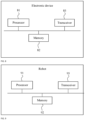
- FIG. 8 is a schematic structural diagram of an electronic device according to the present disclosure.
- the electronic device of this embodiment includes: a processor 81 and a memory 82.
- the processor 81 is communicatively connected to the memory 82.
- the memory 82 is configured to store a computer program.
- the processor 81 is configured to invoke the computer program stored in the memory 82, to implement the methods in the foregoing embodiments.
- the electronic device further includes a transceiver 83, configured to implement communication with another device.
- the electronic device may perform the foregoing warehouse management method shown in FIG. 2 or FIG. 3 .
- the electronic device may perform the foregoing warehouse management method shown in FIG. 2 or FIG. 3 .
- FIG. 9 is a schematic structural diagram of a robot according to the present disclosure.
- the robot of this embodiment includes: a processor 91 and a memory 92.
- the processor 91 is communicatively connected to the memory 92.
- the memory 92 is configured to store a computer program.
- the processor 91 is configured to invoke the computer program stored in the memory 92, to implement the methods in the foregoing embodiments.
- the robot further includes a transceiver 93, configured to implement communication with another device.
- the robot may perform the foregoing warehouse management method shown in FIG. 4 .
- the robot may perform the foregoing warehouse management method shown in FIG. 4 .
- the present disclosure further provides a computer-readable storage medium.
- the computer-readable storage medium stores computer-executable instructions, and the computer-executable instructions, when being executed by a processor, implement the foregoing method in any method embodiment.
- the computer-executable instructions stored in the computer-readable storage medium when being executed by the processor, can implement the foregoing warehouse management method.
- the present disclosure further provides a computer program product, including a computer program/instructions, where the computer program/instructions, when being executed by a processor, implement the foregoing method in any method embodiment.
- the computer-executable instructions stored in the computer-readable storage medium when being executed by the processor, can implement the foregoing warehouse management method.
Landscapes
- Engineering & Computer Science (AREA)
- Business, Economics & Management (AREA)
- Mechanical Engineering (AREA)
- Economics (AREA)
- Marketing (AREA)
- General Business, Economics & Management (AREA)
- Entrepreneurship & Innovation (AREA)
- Human Resources & Organizations (AREA)
- Theoretical Computer Science (AREA)
- Operations Research (AREA)
- Quality & Reliability (AREA)
- Strategic Management (AREA)
- Tourism & Hospitality (AREA)
- Physics & Mathematics (AREA)
- Development Economics (AREA)
- General Physics & Mathematics (AREA)
- Robotics (AREA)
- Finance (AREA)
- Accounting & Taxation (AREA)
Applications Claiming Priority (2)
| Application Number | Priority Date | Filing Date | Title |
|---|---|---|---|
| CN202210410348.2A CN114715591B (zh) | 2022-04-19 | 2022-04-19 | 仓储管理方法、装置、系统、设备和机器人 |
| PCT/CN2023/085794 WO2023202362A1 (zh) | 2022-04-19 | 2023-03-31 | 仓储管理方法、装置、系统、设备和机器人 |
Publications (2)
| Publication Number | Publication Date |
|---|---|
| EP4512747A1 true EP4512747A1 (de) | 2025-02-26 |
| EP4512747A4 EP4512747A4 (de) | 2025-07-23 |
Family
ID=82243624
Family Applications (1)
| Application Number | Title | Priority Date | Filing Date |
|---|---|---|---|
| EP23791018.7A Pending EP4512747A4 (de) | 2022-04-19 | 2023-03-31 | Lagerverwaltungsverfahren, -vorrichtung und -system, -vorrichtung und -roboter |
Country Status (7)
| Country | Link |
|---|---|
| US (1) | US20240417174A1 (de) |
| EP (1) | EP4512747A4 (de) |
| JP (1) | JP2025511495A (de) |
| KR (1) | KR20240155320A (de) |
| CN (1) | CN114715591B (de) |
| TW (1) | TWI887630B (de) |
| WO (1) | WO2023202362A1 (de) |
Families Citing this family (6)
| Publication number | Priority date | Publication date | Assignee | Title |
|---|---|---|---|---|
| CN114715591B (zh) * | 2022-04-19 | 2024-02-23 | 深圳市海柔创新科技有限公司 | 仓储管理方法、装置、系统、设备和机器人 |
| CN115140486B (zh) * | 2022-07-13 | 2023-09-05 | 深圳市海柔创新科技有限公司 | 料箱取出方法和入库方法、装置、设备及存储介质 |
| CN115744029A (zh) * | 2022-11-30 | 2023-03-07 | 珠海格力智能装备有限公司 | 密集型立库的仓储控制方法及装置、电子设备、存储介质 |
| CN115924384B (zh) * | 2022-12-09 | 2026-03-24 | 无锡快仓智能科技股份有限公司 | 基于agv的调度任务执行方法、装置、电子设备及存储介质 |
| CN117485779B (zh) * | 2023-11-09 | 2025-12-26 | 北京极智嘉科技股份有限公司 | 容器取放方法和仓储系统 |
| CN117670188A (zh) * | 2023-11-15 | 2024-03-08 | 杭州海康机器人股份有限公司 | 一种库位调整方法、装置及电子设备 |
Family Cites Families (20)
| Publication number | Priority date | Publication date | Assignee | Title |
|---|---|---|---|---|
| JPS5772503A (en) * | 1980-10-24 | 1982-05-06 | Hitachi Ltd | Control method of stacker crane |
| JPH1111611A (ja) * | 1997-06-26 | 1999-01-19 | Toyota Autom Loom Works Ltd | ダブルリーチ式自動倉庫 |
| JP5769038B2 (ja) * | 2014-10-06 | 2015-08-26 | 株式会社ダイフク | 物品収納設備 |
| KR102080424B1 (ko) * | 2016-01-04 | 2020-02-21 | 저장 리뱌오 로보츠 컴퍼니 리미티드 | 로봇 현장 복귀를 위한 방법 및 장치 |
| CN107516142A (zh) * | 2017-07-24 | 2017-12-26 | 清华大学 | 一种自动处理及履行订单的仓储系统及其仓储方法 |
| KR102385397B1 (ko) * | 2017-11-14 | 2022-04-14 | 하이 로보틱스 씨오., 엘티디. | 운반 로봇 및 운반 로봇에 기반한 픽업 방법 |
| EP4567696A3 (de) * | 2018-08-10 | 2025-09-17 | Beijing Geekplus Technology Co., Ltd. | Verfahren zum bewegen von artikeln auf der basis dichter lagerungen und dichtes lagersystem |
| CN109035740A (zh) * | 2018-09-27 | 2018-12-18 | 上海节卡机器人科技有限公司 | 机器人的控制方法、装置和远程控制系统 |
| CN109359924A (zh) * | 2018-11-19 | 2019-02-19 | 炬星科技(深圳)有限公司 | 基于机器人的物流分区拣选方法、装置、终端、系统及存储介质 |
| CN111620024B (zh) * | 2019-01-29 | 2023-08-25 | 北京极智嘉科技股份有限公司 | 一种搬运机器人、取货箱方法及放货箱方法 |
| CN111498368B (zh) * | 2019-01-30 | 2023-06-23 | 北京京东乾石科技有限公司 | 确定储位的方法和装置 |
| CN111661532B (zh) * | 2019-03-05 | 2023-07-04 | 北京京东乾石科技有限公司 | 存储容器整理方法、装置、设备和存储介质 |
| CN112978189B (zh) * | 2019-06-29 | 2022-07-26 | 深圳市海柔创新科技有限公司 | 取货任务分配方法及其货品分拣系统 |
| CN112573058B (zh) * | 2019-09-30 | 2023-11-28 | 深圳市海柔创新科技有限公司 | 一种取货方法、搬运机器人、处理终端及智能仓储系统 |
| CN111137610A (zh) * | 2019-12-26 | 2020-05-12 | 北京极智嘉科技有限公司 | 一种基于密集存储的货箱搬运方法及装置 |
| CN212221331U (zh) * | 2020-05-13 | 2020-12-25 | 北京极智嘉科技有限公司 | 一种搬运机器人及仓储物流系统 |
| CN212557863U (zh) * | 2020-06-17 | 2021-02-19 | 深圳市海柔创新科技有限公司 | 仓储系统 |
| CN112896900A (zh) * | 2021-03-17 | 2021-06-04 | 北京极智嘉科技股份有限公司 | 一种货箱转移系统、方法、货箱转移装置和机器人 |
| CN113371379B (zh) * | 2021-06-25 | 2022-12-06 | 深圳市库宝软件有限公司 | 货架调度方法、装置、设备、系统、介质及程序产品 |
| CN114715591B (zh) * | 2022-04-19 | 2024-02-23 | 深圳市海柔创新科技有限公司 | 仓储管理方法、装置、系统、设备和机器人 |
-
2022
- 2022-04-19 CN CN202210410348.2A patent/CN114715591B/zh active Active
-
2023
- 2023-03-31 JP JP2024553216A patent/JP2025511495A/ja active Pending
- 2023-03-31 WO PCT/CN2023/085794 patent/WO2023202362A1/zh not_active Ceased
- 2023-03-31 KR KR1020247032656A patent/KR20240155320A/ko active Pending
- 2023-03-31 EP EP23791018.7A patent/EP4512747A4/de active Pending
- 2023-04-11 TW TW112113440A patent/TWI887630B/zh active
-
2024
- 2024-09-03 US US18/823,430 patent/US20240417174A1/en active Pending
Also Published As
| Publication number | Publication date |
|---|---|
| KR20240155320A (ko) | 2024-10-28 |
| CN114715591A (zh) | 2022-07-08 |
| EP4512747A4 (de) | 2025-07-23 |
| WO2023202362A1 (zh) | 2023-10-26 |
| CN114715591B (zh) | 2024-02-23 |
| TWI887630B (zh) | 2025-06-21 |
| US20240417174A1 (en) | 2024-12-19 |
| TW202402641A (zh) | 2024-01-16 |
| JP2025511495A (ja) | 2025-04-16 |
Similar Documents
| Publication | Publication Date | Title |
|---|---|---|
| US20240417174A1 (en) | Warehouse management method and device | |
| US12283064B2 (en) | Shape information generation apparatus, control apparatus, loading/unloading apparatus, logistics system, non-transitory computer-readable medium, and control method | |
| EP4207012A1 (de) | Auftragsverarbeitungs- und lagerversandverfahren, vorrichtung, system und speichermedium | |
| EP4181042A1 (de) | Lagersortierverfahren, -vorrichtung und -system sowie server, roboter und speichermedium | |
| US20200279204A1 (en) | Method for processing item sorting scheduling request, and related device | |
| EP4488201A1 (de) | Verfahren und vorrichtungen zur bestimmung von ausgangsmaterialschachteln und vorrichtung | |
| EP4524066A1 (de) | Fördersteuerungsverfahren und zugehörige vorrichtung | |
| CN111908186A (zh) | 首轮装舱控制系统、方法、装置和存储介质 | |
| EP4733984A1 (de) | Informationsverarbeitungssystem, verfahren und vorrichtung sowie elektronische vorrichtung | |
| CN111908187B (zh) | 首轮装舱控制方法、装置、计算机设备和存储介质 | |
| CN110342179B (zh) | 立体库出库控制方法及系统 | |
| CN111861110A (zh) | 一种仓库作业方法、装置、系统和计算机设备 | |
| CN112660845B (zh) | 装车机控制方法、装置、电子设备以及存储介质 | |
| EP4401019A1 (de) | Verfahren und vorrichtung zur ausgehenden lieferung | |
| JP7710617B2 (ja) | 保留オーダー処理方法、保留オーダー処理装置、制御機器、コンピュータ可読記憶媒体およびコンピュータプログラム | |
| US20230419253A1 (en) | Information processing apparatus, information processing method, computer-readable storage medium, and system | |
| HK40077143A (en) | Warehousing management method, apparatus, system, device and robot | |
| EP4644294A1 (de) | Robotersteuerungsverfahren und -vorrichtung sowie warenhandhabungssystem | |
| HK40077143B (zh) | 仓储管理方法、装置、系统、设备和机器人 | |
| CN114379969A (zh) | 库存容器操作系统和方法 | |
| CN113139776A (zh) | 一种存取物品的方法、装置、电子设备及存储介质 | |
| CN114037390A (zh) | 库存管理方法及设备 | |
| CN113233335B (zh) | 一种岸桥异常集装箱处理方法及系统 | |
| CN117465876B (zh) | 一种基于智能升降台的取货方法及装置 | |
| EP4534451A1 (de) | Informationsverarbeitungsvorrichtung, informationsverarbeitungsverfahren, programm, system und computerlesbares speichermedium |
Legal Events
| Date | Code | Title | Description |
|---|---|---|---|
| STAA | Information on the status of an ep patent application or granted ep patent |
Free format text: STATUS: THE INTERNATIONAL PUBLICATION HAS BEEN MADE |
|
| PUAI | Public reference made under article 153(3) epc to a published international application that has entered the european phase |
Free format text: ORIGINAL CODE: 0009012 |
|
| STAA | Information on the status of an ep patent application or granted ep patent |
Free format text: STATUS: REQUEST FOR EXAMINATION WAS MADE |
|
| 17P | Request for examination filed |
Effective date: 20240902 |
|
| AK | Designated contracting states |
Kind code of ref document: A1 Designated state(s): AL AT BE BG CH CY CZ DE DK EE ES FI FR GB GR HR HU IE IS IT LI LT LU LV MC ME MK MT NL NO PL PT RO RS SE SI SK SM TR |
|
| A4 | Supplementary search report drawn up and despatched |
Effective date: 20250625 |
|
| RIC1 | Information provided on ipc code assigned before grant |
Ipc: B65G 1/137 20060101AFI20250618BHEP Ipc: B65G 1/04 20060101ALI20250618BHEP Ipc: G06Q 10/08 20240101ALI20250618BHEP Ipc: G06Q 10/087 20230101ALI20250618BHEP |
|
| DAV | Request for validation of the european patent (deleted) | ||
| DAX | Request for extension of the european patent (deleted) |