EP4401019A1 - Verfahren und vorrichtung zur ausgehenden lieferung - Google Patents
Verfahren und vorrichtung zur ausgehenden lieferung Download PDFInfo
- Publication number
- EP4401019A1 EP4401019A1 EP22866487.6A EP22866487A EP4401019A1 EP 4401019 A1 EP4401019 A1 EP 4401019A1 EP 22866487 A EP22866487 A EP 22866487A EP 4401019 A1 EP4401019 A1 EP 4401019A1
- Authority
- EP
- European Patent Office
- Prior art keywords
- outbound
- container
- group
- sequence
- transporting
- Prior art date
- Legal status (The legal status is an assumption and is not a legal conclusion. Google has not performed a legal analysis and makes no representation as to the accuracy of the status listed.)
- Pending
Links
Images
Classifications
-
- G—PHYSICS
- G05—CONTROLLING; REGULATING
- G05D—SYSTEMS FOR CONTROLLING OR REGULATING NON-ELECTRIC VARIABLES
- G05D1/00—Control of position, course, altitude or attitude of land, water, air or space vehicles, e.g. using automatic pilots
- G05D1/60—Intended control result
- G05D1/648—Performing a task within a working area or space, e.g. cleaning
-
- B—PERFORMING OPERATIONS; TRANSPORTING
- B65—CONVEYING; PACKING; STORING; HANDLING THIN OR FILAMENTARY MATERIAL
- B65G—TRANSPORT OR STORAGE DEVICES, e.g. CONVEYORS FOR LOADING OR TIPPING, SHOP CONVEYOR SYSTEMS OR PNEUMATIC TUBE CONVEYORS
- B65G1/00—Storing articles, individually or in orderly arrangement, in warehouses or magazines
- B65G1/02—Storage devices
- B65G1/04—Storage devices mechanical
- B65G1/137—Storage devices mechanical with arrangements or automatic control means for selecting which articles are to be removed
- B65G1/1373—Storage devices mechanical with arrangements or automatic control means for selecting which articles are to be removed for fulfilling orders in warehouses
-
- B—PERFORMING OPERATIONS; TRANSPORTING
- B65—CONVEYING; PACKING; STORING; HANDLING THIN OR FILAMENTARY MATERIAL
- B65G—TRANSPORT OR STORAGE DEVICES, e.g. CONVEYORS FOR LOADING OR TIPPING, SHOP CONVEYOR SYSTEMS OR PNEUMATIC TUBE CONVEYORS
- B65G1/00—Storing articles, individually or in orderly arrangement, in warehouses or magazines
- B65G1/02—Storage devices
- B65G1/04—Storage devices mechanical
- B65G1/137—Storage devices mechanical with arrangements or automatic control means for selecting which articles are to be removed
- B65G1/1373—Storage devices mechanical with arrangements or automatic control means for selecting which articles are to be removed for fulfilling orders in warehouses
- B65G1/1378—Storage devices mechanical with arrangements or automatic control means for selecting which articles are to be removed for fulfilling orders in warehouses the orders being assembled on fixed commissioning areas remote from the storage areas
-
- G—PHYSICS
- G06—COMPUTING OR CALCULATING; COUNTING
- G06Q—INFORMATION AND COMMUNICATION TECHNOLOGY [ICT] SPECIALLY ADAPTED FOR ADMINISTRATIVE, COMMERCIAL, FINANCIAL, MANAGERIAL OR SUPERVISORY PURPOSES; SYSTEMS OR METHODS SPECIALLY ADAPTED FOR ADMINISTRATIVE, COMMERCIAL, FINANCIAL, MANAGERIAL OR SUPERVISORY PURPOSES, NOT OTHERWISE PROVIDED FOR
- G06Q10/00—Administration; Management
- G06Q10/08—Logistics, e.g. warehousing, loading or distribution; Inventory or stock management
-
- G—PHYSICS
- G06—COMPUTING OR CALCULATING; COUNTING
- G06Q—INFORMATION AND COMMUNICATION TECHNOLOGY [ICT] SPECIALLY ADAPTED FOR ADMINISTRATIVE, COMMERCIAL, FINANCIAL, MANAGERIAL OR SUPERVISORY PURPOSES; SYSTEMS OR METHODS SPECIALLY ADAPTED FOR ADMINISTRATIVE, COMMERCIAL, FINANCIAL, MANAGERIAL OR SUPERVISORY PURPOSES, NOT OTHERWISE PROVIDED FOR
- G06Q10/00—Administration; Management
- G06Q10/08—Logistics, e.g. warehousing, loading or distribution; Inventory or stock management
- G06Q10/083—Shipping
-
- G—PHYSICS
- G05—CONTROLLING; REGULATING
- G05D—SYSTEMS FOR CONTROLLING OR REGULATING NON-ELECTRIC VARIABLES
- G05D2105/00—Specific applications of the controlled vehicles
- G05D2105/20—Specific applications of the controlled vehicles for transportation
-
- G—PHYSICS
- G05—CONTROLLING; REGULATING
- G05D—SYSTEMS FOR CONTROLLING OR REGULATING NON-ELECTRIC VARIABLES
- G05D2107/00—Specific environments of the controlled vehicles
- G05D2107/70—Industrial sites, e.g. warehouses or factories
Definitions
- Embodiments of this application relate to the field of goods transporting device technologies, and in particular, to an outbound method and a device.
- Intelligent warehousing is an important part of a logistics process. Robots can replace manual labor in transporting containers and play an important role in intelligent warehousing.
- a robot can perform a retrieving and placing process on a container, including: picking the container from a rack and placing the container onto the rack. The picking the container from the rack can be referred to as outbound, and the placing the container onto the rack can be referred to as inbound.
- Embodiments of this application provide an outbound method and a device, to satisfy an outbound requirement in a complicated service scenario.
- an embodiment of this application provides an outbound method, including:
- the assigning the transporting task of the outbound container to the robot according to the at least one outbound sequence includes: assigning transporting tasks of the at least two outbound sequences to the robot in parallel, and assigning, according to a target outbound strategy corresponding to each outbound sequence, a transporting task of at least one outbound container in each outbound sequence to the robot, where the target outbound strategy is used for indicating a first outbound order of the at least one outbound group included in the outbound sequence, and/or a second outbound order of the at least one outbound container included in each outbound group.
- the assigning, according to the target outbound strategy corresponding to each outbound sequence, the transporting task of the at least one outbound container in each outbound sequence to the robot includes:
- the information about the outbound group includes at least one of the following: the number of the outbound containers included in the outbound groups, and the number of aisles in which the outbound containers included in the outbound groups are located.
- the information about the outbound container includes at least one of the following: a transporting distance of the outbound container, a weight of the outbound container, and a size of the outbound container.
- the assigning, according to the first outbound order and the second outbound order, the transporting task of the at least one outbound container in the outbound sequence to the robot includes: in a process of assigning, according to the first outbound order and the second outbound order, the transporting task of each outbound container in the outbound sequence to the robot, if a transporting task of any outbound container in the outbound sequence is assigned unsuccessfully, stopping assigning the transporting task of each outbound container in the outbound sequence to the robot.
- the assigning, according to the inter-group default strategy and the second outbound order, the transporting task of the at least one outbound container in the outbound sequence to the robot includes: in a process of assigning the transporting task of each outbound container in the outbound sequence to the robot, if a transporting task of a first outbound container in the outbound sequence is assigned unsuccessfully, stopping assigning transporting tasks of other outbound containers in a first outbound group in which the first outbound container is located to the robot, and assigning a transporting task of each outbound container in a second outbound group to the robot, where the second outbound group is an outbound group in the outbound sequence other than the first outbound group.
- the assigning, according to the first outbound order and the intra-group default strategy, the transporting task of the at least one outbound container in the outbound sequence to the robot includes: in a process of assigning the transporting task of each outbound container in the outbound sequence to the robot, if a transporting task of a first outbound container in the outbound sequence is assigned unsuccessfully, stopping assigning a transporting task of an outbound container in an outbound group other than a first outbound group to the robot, and assigning a transporting task of an outbound container in the first outbound group other than the first outbound container to the robot, where the first outbound group is an outbound group in which the first outbound container is located.
- the outbound the at least one outbound container according to the task execution state of the transporting task and the at least one outbound sequence includes:
- the method further includes:
- an outbound apparatus including:
- the task assignment module is further configured to: assign transporting tasks of the at least two outbound sequences to the robot in parallel, and assign, according to a target outbound strategy corresponding to each outbound sequence, a transporting task of at least one outbound container in each outbound sequence to the robot, where the target outbound strategy is used for indicating a first outbound order of the at least one outbound group included in the outbound sequence, and/or a second outbound order of the at least one outbound container included in each outbound group.
- the task assignment module is further configured to:
- the information about the outbound group includes at least one of the following: the number of the outbound containers included in the outbound groups, and the number of aisles in which the outbound containers included in the outbound groups are located.
- the information about the outbound container includes at least one of the following: a transporting distance of the outbound container, a weight of the outbound container, and a size of the outbound container.
- the task assignment module is further configured to: when assigning, according to the first outbound order and the second outbound order, the transporting task of the at least one outbound container in the outbound sequence to the robot, if a transporting task of any outbound container in the outbound sequence is assigned unsuccessfully, stop assigning the transporting task of each outbound container in the outbound sequence to the robot.
- the task assignment module is further configured to: when assigning, according to the inter-group default strategy and the second outbound order, the transporting task of the at least one outbound container in the outbound sequence to the robot, if a transporting task of a first outbound container in the outbound sequence is assigned unsuccessfully, stop assigning transporting tasks of other outbound containers in a first outbound group in which the first outbound container is located to the robot, and assign a transporting task of each outbound container in a second outbound group to the robot, where the second outbound group is an outbound group in the outbound sequence other than the first outbound group.
- the task assignment module is further configured to: when assigning, according to the first outbound order and the intra-group default strategy, the transporting task of the at least one outbound container in the outbound sequence to the robot, if a transporting task of a first outbound container in the outbound sequence is assigned unsuccessfully, stop assigning a transporting task of an outbound container in an outbound group other than a first outbound group to the robot, and assign a transporting task of an outbound container in the first outbound group other than the first outbound container to the robot, where the first outbound group is an outbound group in which the first outbound container is located.
- the container outbound module is further configured to: when a task execution state of a second transporting task corresponding to one second outbound container is that the second outbound container is picked out, obtain a task execution state of at least one third transporting task, where the third transporting task is a transporting task of a third outbound container, the third outbound container includes an outbound container that is in the first outbound order and that is included in a third outbound group located before a second outbound group and/or an outbound container that is in the second outbound order corresponding to the second outbound group and that is located before the second outbound container, and the second outbound group is an outbound group in which the second outbound container is located; and if the task execution state of each third transporting task is that a work table is reached, continue to execute the second transporting task, to bound out the second outbound container and the third outbound container according to the first outbound order and/or the second outbound order.
- the container outbound module is further configured to: if the task execution state of the at least one third transporting task is any execution state before that the work table is reached, control the robot transporting the second outbound container to wait; and when the task execution state of the third transporting task is updated to that the work table is reached, continue to execute the second transporting task, to bound out the second outbound container and the third outbound container according to the first outbound order and/or the second outbound order.
- an embodiment of this application provides an electronic device, including: at least one processor and a memory, where
- an embodiment of this application provides a computer-readable storage medium, where the computer-readable storage medium stores computer-executable instructions, and when a processor executes the computer-executable instructions, a computing device is enabled to perform the method according to the foregoing first aspect.
- an embodiment of this application provides a computer program, where the computer program is used for performing the method according to the foregoing first aspect.
- At least one outbound sequence may be determined, where each outbound sequence includes at least one outbound group, and each outbound group includes at least one outbound container; a transporting task of the outbound container is assigned to a robot according to the at least one outbound sequence; and the at least one outbound container is bounded out according to a task execution state of the transporting task and the at least one outbound sequence.
- an outbound requirement in a complicated service scenario may be divided into an outbound sequence and an outbound group, where each outbound sequence includes at least one outbound group, and each outbound group includes at least one outbound container. Therefore, the outbound container may be bounded out through the outbound sequence and the outbound group, and the outbound requirement in the complicated service scenario may be satisfied.
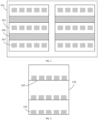
- FIG. 1 is a top view of a warehouse to which an embodiment of this application is applicable. Referring to FIG. 1 , six racks 102 are disposed in the warehouse 101. Every two racks 102 are disposed in one row side by side, and a total of such three rows of racks 102 are disposed in the warehouse 101. A material 103 may be placed on the rack 102.
- a plurality of goods storage layers may be disposed on the rack 102, each goods storage layer may be provided with a plurality of storage locations, and the material 103 may be placed in each storage location.
- the plurality of goods storage layers and the plurality of storage locations increase the storage capacity of the rack 102 for the material 103.
- FIG. 1 it may be seen that, each material 103 occupies one storage location.
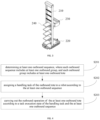
- FIG. 2 is a side view of a rack to which an embodiment of this application is applicable. Referring to FIG. 2 , a rack 102 includes three goods storage layers 105, each goods storage layer 105 includes five storage locations, and one material 103 may be placed in each storage location.
- the material may be usually transported by a robot.
- the robot may retrieve a material from a goods storage layer on the rack onto a goods storage layer of the robot, or may place a material from a goods storage layer of the robot onto a goods storage layer on the rack.
- An unoccupied region is required between every two racks 102 in FIG. 1 and may be referred to as an aisle, to make it convenient for the robot to approach a rack through the aisle. It may be seen that, four aisles 104 exist in FIG. 1 .
- the robot When the robot is required to place a material into a rack 102, the robot may move into a corresponding aisle 104, to place the material on a goods storage layer of the robot into the rack 102.
- the robot When the robot is required to pick a material from a rack 102, the robot may also move to a corresponding aisle 104, to pick the material from a goods storage layer of the rack 102 and place the material into a goods storage layer of the robot.
- FIG. 3 is a schematic structural diagram of a robot according to an embodiment of this application.
- the robot includes a support assembly 210, a movable chassis 220, a goods retrieving and placing apparatus 230, and a storage rack 240.
- the support assembly 210 is mounted on the movable chassis 220, the storage rack 240 and the goods retrieving and placing apparatus 230 are mounted on the support assembly 210, and the goods retrieving and placing apparatus 230 may move along the support assembly 210 in a vertical direction.
- Several goods storage layers may be disposed on the storage rack 240, to place one or more materials to be transported.
- a lifting assembly is disposed on the support assembly 210 and is configured to drive the goods retrieving and placing apparatus 230 to move up and down, so that the goods retrieving and placing apparatus 230 is aligned with any storage unit on the storage rack 240 or aligned with a rack and/or a material in a warehouse.
- the goods retrieving and placing apparatus 230 can rotate around the vertical direction as an axis to adjust an orientation, to be aligned with the storage unit or aligned with the rack and/or the material.
- the goods retrieving and placing apparatus 230 is configured to load or unload the material, to transport the material between the rack and the storage unit.
- the foregoing material is usually stored in a container. Therefore, when the robot transports the material, the robot transports the container. When a container is bounded out, the robot transports the container from a rack in the warehouse onto a work table, to bound out the container on the work table.
- a plurality of containers may be continuously bounded out.
- the robot may be assigned to a plurality of containers in order, so that the robot bound outs these containers in order.
- an outbound requirement in a complicated service scenario may be divided into an outbound sequence and an outbound group, where each outbound sequence includes at least one outbound group, and each outbound group includes at least one outbound container. Therefore, the outbound container may be bounded out through the outbound sequence and the outbound group, and the outbound requirement in the complicated service scenario may be satisfied.
- the foregoing complicated service scenario may be a scenario in which a material is divided according to at least two dimensions.
- the material may be a costume, and the costume may be divided according to such two dimensions as color and size. Therefore, one size may correspond to one outbound group, and the group includes costumes in the size sorted according to colors.
- outbound groups corresponding to a plurality of sizes may form one outbound sequence. For example, one outbound sequence is obtained in order of a smallest size, a medium size, and a large size. In this way, it may be convenient for a user to store costumes directly according to the outbound sequence, and the costumes are not required to be organized and then stored according to colors and sizes, thereby reducing operating complexity of the user.
- the user may be usually a costume vendor.
- FIG. 4 is a flowchart of specific steps of an outbound method according to an embodiment of this application. Referring to FIG. 4 , the method may include:
- each outbound sequence includes at least one outbound group, and each outbound group includes at least one outbound container.
- the outbound sequence and the outbound group may be determined according to an outbound requirement.
- S202 assigning a transporting task of the outbound container to a robot according to the at least one outbound sequence.
- a transporting task of a first outbound container L1 may be first assigned to one robot A, and then transporting tasks of several outbound containers after L1 in the outbound group may be assigned to the robot A according to the number of containers that the robot can transport.
- a transporting task of a next outbound container L2 in the group may be assigned to a robot B, and transporting tasks of several outbound containers after L2 in the outbound group are assigned to the robot B, until transporting tasks of outbound containers in the outbound group are all assigned.
- a transporting task refers to a task of transporting an outbound container from a rack in a warehouse to a work table, and the work table is configured to bound out the outbound container.
- One outbound container corresponds to one transporting task, one transporting task is executed by one robot, and one robot may execute one or more transporting tasks.
- transporting tasks between the foregoing different outbound sequences may be assigned in series or in parallel, and the parallel assignment may reduce the time length for assigning the transporting tasks, thereby reducing the outbound time length.
- Q1 includes two outbound groups G1 and G2
- Q2 includes three outbound groups G3, G4, and G5
- G1 includes two outbound containers B1 and B2
- G2 includes three outbound containers B3, B4, and B5
- G3 includes one outbound container B6
- G4 includes two outbound containers B7 and B8, and G5 includes four outbound containers B9 to B12.
- transporting tasks may be assigned to B1 to B5 and B6 to B12 in parallel. That is to say, when transporting tasks are assigned to B1 to B5, transporting task may be assigned to B6 to B12.
- each of the foregoing outbound sequences may correspond to one target outbound strategy, where the target outbound strategy may indicate an outbound order of outbound containers in the outbound sequence as any order, and the target outbound strategy may further indicate an outbound order of outbound groups in the outbound sequence, and/or an outbound order of outbound containers in each outbound group.
- transporting tasks of outbound containers in one outbound sequence are also assigned one by one according to the outbound order, and a transporting task is preferentially assigned to an outbound container that is first bounded out. That is to say, a transporting task of at least one outbound container in each outbound sequence is assigned to the robot according to a target outbound strategy corresponding to each outbound sequence.
- an outbound order of outbound groups that is indicated by the target outbound strategy is referred to as a first outbound order
- an outbound order that is of outbound containers in an outbound group and that is indicated by the target outbound strategy is referred to as a second outbound order.
- the transporting task of the at least one outbound container in the outbound sequence may be assigned to the robot according to the first outbound order and the second outbound order.
- an order of outbound groups in the outbound sequence is first determined according to the first outbound order; then, for each outbound group, an order of outbound containers in the outbound group is determined according to the second outbound order of the outbound groups; then, an order of at least one outbound container in the outbound sequence is determined according to the order of the outbound groups and the order of the outbound containers in each outbound group; and finally, transporting tasks are assigned one by one to the robot according to the order of the at least one outbound container in the outbound sequence.
- a transporting task may be assigned successfully to each outbound container in the outbound sequence according to the first outbound order and the second outbound order.
- a transporting task may be assigned unsuccessfully. For example, an aisle in which one outbound container is located is filled with robots that are performing transporting tasks. Therefore, a transporting task cannot be assigned anymore to the outbound container, and the transporting task is assigned unsuccessfully. In another example, all robots have been assigned or are abnormal. Therefore, no robot may be assigned, and the transporting task is assigned unsuccessfully.
- the target outbound strategy indicates the first outbound order and the second outbound order, that is to say, the outbound requirement indicates an outbound order of outbound groups and an outbound order of outbound containers in an outbound group
- the transporting task of each outbound container in the outbound sequence is assigned unsuccessfully, the transporting task of each outbound container in the outbound sequence is stopped from being assigned to the robot. In this way, when the assignment is unsuccessful, continuing assigning transporting tasks of other outbound containers may be avoided, thereby avoiding inconsistency between an actual outbound order and an outbound order indicated by the target outbound strategy.
- Outbound containers that are stopped from being assigned include: outbound containers in a first outbound group in which the outbound containers to which assignment is unsuccessful are located, and outbound containers to which assignment is not performed in an outbound group.
- the first outbound order is G1 and G2
- the second outbound order of G1 is B1 and B2
- the second outbound order of G2 is B3, B4, and B5. If a transporting task is assigned to B2 unsuccessfully, transporting tasks of B3, B4, and B5 are stopped from being assigned to the robot.
- transporting tasks are assigned to outbound groups in the outbound sequence according to the first outbound order, and transporting tasks may be assigned to outbound containers in each outbound group in any order.
- one default order may be determined for outbound containers in the outbound group. That is to say, the transporting task of the at least one outbound container in the outbound sequence may be assigned to the robot according to the first outbound order and an intra-group default strategy, where the intra-group default strategy is used for determining, according to information about each outbound container included in the outbound group, an outbound order of the at least one outbound container.
- the information about the outbound container includes at least one of the following: a transporting distance of the outbound container, a weight of the outbound container, and a size of the outbound container.
- the foregoing transporting distance refers to a distance between a location of the outbound container on a rack and the work table. That is to say, only after the outbound container is transported from the rack to the work table, the robot can perform outbound.
- a transporting task may be preferentially assigned to an outbound container with a small transporting distance, or a transporting task may be preferentially assigned to an outbound container with a large transporting distance.
- a transporting task may be preferentially assigned to an outbound container with a small weight, or a transporting task may be preferentially assigned to an outbound container with a large weight.
- a transporting task may be preferentially assigned to an outbound container with a small size, or a transporting task may be preferentially assigned to an outbound container with a large size.
- At least two factors of the transporting distance, the weight, and the size may be further combined to determine an assignment order of transporting tasks of outbound containers in each outbound group.
- one score may be determined for each outbound container according to at least two factors of the transporting distance, the weight, and the size, to perform sorting according to the score to obtain an assignment order of transporting tasks.
- SCR2 is a score of each outbound container
- D, H, and S are a transporting distance, a weight, and a size respectively
- p_21, p_22, and p_23 are weighing coefficients of the transporting distance, the weight, and the size respectively.
- a weighing coefficient in the foregoing formula may be adjusted, to adjust a relationship between the corresponding factor and an assignment order.
- p_21, p_22, and p_23 may be set to positive numbers, and transporting tasks are assigned to outbound containers in ascending order of SCR2. In this way, a transporting task may be preferentially assigned to an outbound container whose transporting distance, weight, and size are all small.
- an order of outbound groups in the outbound sequence is first determined according to the first outbound order; then, for each outbound group, an order of outbound containers in the outbound group is determined according to the intra-group default strategy; then, an order of at least one outbound container in the outbound sequence is determined according to the order of the outbound groups and the order of the outbound containers in each outbound group; and finally, transporting tasks are assigned one by one to the robot according to the order of the at least one outbound container in the outbound sequence.
- a transporting task may be assigned successfully to each outbound container in the outbound sequence according to the first outbound order and the intra-group default strategy. However, because of impact of various factors, a transporting task may be assigned unsuccessfully.
- the target outbound strategy indicates the first outbound order but does not indicate the second outbound order, that is to say, the outbound requirement does not indicate an outbound order of outbound containers in an outbound group
- the transporting task of the at least one outbound container in the outbound sequence to the robot if a transporting task of a first outbound container in the outbound sequence is assigned unsuccessfully, outbound may be performed through the following two policies.
- a first strategy all outbound containers in the outbound sequence are stopped from being assigned to the robot. For example, when outbound containers in one outbound group are required to be bounded out together, this strategy is used.
- a transporting task of an outbound container in an outbound group other than a first outbound group is stopped from being assigned to the robot, and a transporting task of an outbound container in the first outbound group other than the first outbound container is assigned to the robot, where the first outbound group is an outbound group in which the first outbound container is located.
- this strategy is used.
- the stopping assigning the outbound container in the outbound group other than the first outbound group to the robot may avoid inconsistency between an actual outbound order of the outbound groups and an outbound order indicated by the target outbound strategy, and the assigning the outbound container in the first outbound group other than the first outbound container to the robot may increase an assignment success rate of transporting tasks.
- the first outbound order is G1 and G2
- it is determined according to the intra-group default strategy that the second outbound order of G1 is B2 and B1
- it is determined according to the intra-group default strategy that the second outbound order of G2 is B4, B3, and B5. If a transporting task is assigned to B2 unsuccessfully, transporting tasks of B4, B3, and B5 in G2 are stopped from being assigned to the robot, and a transporting task of B1 in G1 continues to be assigned.
- transporting tasks may be assigned through two policies.
- transporting tasks may be assigned to outbound groups in the outbound sequence in any order, and transporting tasks may be assigned to outbound containers in each outbound group according to the second outbound order.
- one default order may be determined for the outbound groups. That is to say, the transporting task of the at least one outbound container in the outbound sequence may be assigned to the robot according to an inter-group default strategy and the second outbound order, where the inter-group default strategy is used for determining, according to information about each outbound group included in the outbound sequence, an outbound order of the at least one outbound group.
- the information about the outbound group includes at least one of the following: the number of the outbound containers included in the outbound groups, and the number of aisles in which the outbound containers included in the outbound groups are located.
- a transporting task may be preferentially assigned to an outbound group in which the number is small, or a transporting task may be preferentially assigned to an outbound group in which the number is large.
- a transporting task may be preferentially assigned to an outbound group in which the number of aisles is small, or a transporting task may be preferentially assigned to an outbound group in which the number of aisles is large.
- the number of outbound containers and the number of aisles may be further combined to determine an assignment order of transporting tasks of outbound groups.
- one score may be determined for each outbound group according to the number of outbound containers and the number of aisles, to perform sorting according to the score to obtain an assignment order of transporting tasks.
- the score may be obtained by calculation through the following formula: where SCR1 is a score of each outbound group, [NUM] _1 and [NUM] _2 are the number of outbound containers and the number of aisles respectively, and p_11 and p_12 are weighing coefficients of the number of outbound containers and the number of aisles respectively.
- a weighing coefficient in the foregoing formula may be adjusted, to adjust a relationship between the corresponding factor and an assignment order.
- p_11 and p_12 may be set to positive numbers, and transporting tasks are assigned to outbound groups in ascending order of SCR1. In this way, a transporting task may be preferentially assigned to an outbound group in which the number of outbound containers and the number of aisles are both small.
- an order of outbound groups in the outbound sequence is first determined according to the inter-group default strategy; then, for each outbound group, an order of outbound containers in the outbound group is determined according to the second outbound order of the outbound groups; then, an order of at least one outbound container in the outbound sequence is determined according to the order of the outbound groups and the order of the outbound containers in each outbound group; and finally, transporting tasks are assigned one by one according to the order of the at least one outbound container in the outbound sequence.
- a transporting task may be assigned successfully to each outbound container in the outbound sequence according to the second outbound order and the inter-group default strategy. However, because of impact of various factors, a transporting task may be assigned unsuccessfully.
- outbound containers of a plurality of outbound groups may be alternately assigned while ensuring the second outbound order.
- the outbound sequence Q1 includes two outbound groups G1 and G2
- G1 includes two outbound containers B1 and B2
- G2 includes three outbound containers B3, B4 and B5
- transporting tasks may be assigned in the following order: B1, B3, B4, B2, and B5.
- the foregoing alternate assignment may be understood as inserting an outbound container in one outbound group G1 before or after an outbound container that is associated with the outbound container and that is in another outbound group, to assign a transporting task.
- Two associated outbound containers may include at least one of the following: two outbound containers in close storage locations on a rack, and two outbound containers in the same type.
- the target outbound strategy indicates the second outbound order but does not indicate the first outbound order, that is to say, the outbound requirement does not indicate an outbound order of outbound groups
- the transporting task of the at least one outbound container in the outbound sequence to the robot, if a transporting task of a first outbound container in the outbound sequence is assigned unsuccessfully, transporting tasks of other outbound containers in a first outbound group in which the first outbound container is located are stopped from being assigned to the robot, and a transporting task of each outbound container in a second outbound group is assigned to the robot, where the second outbound group is an outbound group in the outbound sequence other than the first outbound group.
- the stopping assigning the transporting tasks of the other outbound containers in the first outbound group in which the first outbound container is located to the robot may avoid inconsistency between an actual outbound order of outbound containers in the outbound group and an order indicated by the target outbound strategy.
- the assigning the transporting task of each outbound container in the second outbound group to the robot may increase an assignment success rate of transporting tasks.
- an outbound order determined according to the inter-group default strategy is G2 and G1
- the second outbound order of G1 is B1 and B2
- the second outbound order of G2 is B3, B4, and B5. If a transporting task is assigned to B1 unsuccessfully, a transporting task of B2 in G1 is stopped from being assigned to the robot, but transporting tasks of B3, B4, and B5 in G2 are assigned to the robot.
- transporting tasks may be assigned through two policies.
- an assignment order of transporting tasks of all the outbound containers in the outbound sequence may be determined according to a distance between two outbound containers, a priority of each outbound container, and an aisle in which each outbound container is located, to assign the transporting tasks. For example, transporting tasks are continuously assigned to outbound containers between which a distance is short, or transporting tasks are assigned to outbound containers one by one in order of priorities, or transporting tasks are continuously assigned to outbound containers on racks in the same aisle.
- a transporting task may be assigned to at least one outbound container in the outbound sequence in any order.
- the transporting task of the at least one outbound container in the outbound sequence may be assigned to the robot according to the inter-group default strategy and the intra-group default strategy.
- one default outbound order is determined for at least one outbound container, to assign a transporting task to the at least one outbound container according to the default outbound order.
- the target outbound strategy does not indicate the first outbound order and the second outbound order, that is to say, the outbound requirement does not indicate an outbound order of outbound groups and an outbound order of outbound containers in an outbound group
- the transporting task of the at least one outbound container in the outbound sequence to the robot if a transporting task of one outbound container is assigned unsuccessfully, outbound may be performed through the following two policies.
- transporting tasks of other outbound containers in a first outbound group may be stopped from being assigned to the robot, and transporting tasks of outbound containers in other outbound groups are assigned to the robot.
- the first outbound group is an outbound group in which outbound containers to which assignment is unsuccessful are located.
- transporting tasks of other outbound containers in the outbound sequence to which no transporting task is assigned may continue to be assigned, where the transporting tasks include transporting tasks of the following outbound containers: other outbound containers in a first outbound group and outbound containers in other outbound groups. In this way, an assignment success rate of transporting tasks may be increased.
- the outbound sequence Q1 includes outbound groups G1 and G2, G1 includes outbound containers B1 and B2, and G2 includes outbound containers B3, B4, and B5. Because the first outbound order and the second outbound order do not exist, an outbound order may be determined according to the inter-group default strategy and the intra-group default strategy, to obtain: B5, B4, B3, B1, and B2. If a transporting task is assigned to B4 unsuccessfully, transporting tasks of B3, B1, and B2 continue to be assigned to the robot.
- S203 carrying out the outbound operation of the at least one outbound container according to a task execution state of the transporting task and the at least one outbound sequence.
- the task execution state may include a plurality of states, for example, a state in which the robot walks, a state in which the robot picks out an outbound container, and a state in which the robot reaches the work table.
- the state in which the robot walks may include a state of walking when no container is picked out, and a state of walking when a container is picked out, and the reaching the work table indicates that the robot has transported an outbound container into a preset range around the work table.
- any outbound container is referred to as a second outbound container.
- An outbound group in which the second outbound container is located is referred to as a second outbound group.
- An outbound container that is in the first outbound order and that is included in a third outbound group located before the second outbound group and/or an outbound container that is in the second outbound order corresponding to the second outbound group and that is located before the second outbound container is referred to as a third outbound container.
- a task execution state of a transporting task of the second outbound container is that the second outbound container is picked out, it is required to determine, according to a task execution state of a transporting task of the third outbound container, that the robot of the second outbound container waits or continues to execute the transporting task of the second outbound container, to ensure that the second outbound container is bounded out after the third outbound container.
- a task execution state of a transporting task of the third outbound container may be obtained when the robot picks out the second outbound container, to determine that the robot of the second outbound container waits or continues to execute the transporting task of the second outbound container.
- the state of picking out the second outbound container may include a time range between the picking out the second outbound container and the reaching the work table.
- a process of outbound the second outbound container may include: first, obtaining a task execution state of at least one third transporting task, where the third transporting task is a transporting task of the third outbound container; and then, if the task execution state of each third transporting task is that a work table is reached, continuing to execute the second transporting task, to bound out the second outbound container and the third outbound container according to the first outbound order and/or the second outbound order.
- the robot transporting the second outbound container is controlled to wait; and when the task execution state of the third transporting task is updated to that the work table is reached, the second transporting task continues to be executed, to bound out the second outbound container and the third outbound container according to the first outbound order and/or the second outbound order.
- the outbound order determined according to the first outbound order and/or the second outbound order is that the third outbound container is located before the second outbound container. Therefore, the third outbound container is first bounded out, and then the second outbound container is bounded out.
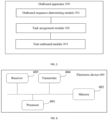
- FIG. 5 is a structural block diagram of an outbound apparatus according to an embodiment of this application. For ease of description, only parts related to the embodiments of this application are shown.
- the foregoing outbound apparatus 300 includes: an outbound sequence determining module 301, a task assignment module 302, and a container outbound module 303.
- the outbound sequence determining module 301 is configured to determine at least one outbound sequence, where each outbound sequence includes at least one outbound group, and each outbound group includes at least one outbound container.
- the task assignment module 302 is configured to assign a transporting task of the outbound container to a robot according to the at least one outbound sequence.
- the container outbound module 303 is configured to bound out the at least one outbound container according to a task execution state of the transporting task and the at least one outbound sequence.
- the task assignment module 302 is further configured to: assign transporting tasks of the at least two outbound sequences to the robot in parallel, and assign, according to a target outbound strategy corresponding to each outbound sequence, a transporting task of at least one outbound container in each outbound sequence to the robot, where the target outbound strategy is used for indicating a first outbound order of the at least one outbound group included in the outbound sequence, and/or a second outbound order of the at least one outbound container included in each outbound group.
- the task assignment module 302 is further configured to:
- the information about the outbound group includes at least one of the following: the number of the outbound containers included in the outbound groups, and the number of aisles in which the outbound containers included in the outbound groups are located.
- the information about the outbound container includes at least one of the following: a transporting distance of the outbound container, a weight of the outbound container, and a size of the outbound container.
- the task assignment module 302 is further configured to: when assigning, according to the first outbound order and the second outbound order, the transporting task of the at least one outbound container in the outbound sequence to the robot, if a transporting task of any outbound container in the outbound sequence is assigned unsuccessfully, stop assigning the transporting task of each outbound container in the outbound sequence to the robot.
- the task assignment module 302 is further configured to: when assigning, according to the inter-group default strategy and the second outbound order, the transporting task of the at least one outbound container in the outbound sequence to the robot, if a transporting task of a first outbound container in the outbound sequence is assigned unsuccessfully, stop assigning transporting tasks of other outbound containers in a first outbound group in which the first outbound container is located to the robot, and assign a transporting task of each outbound container in a second outbound group to the robot, where the second outbound group is an outbound group in the outbound sequence other than the first outbound group.
- the task assignment module 302 is further configured to: when assigning, according to the first outbound order and the intra-group default strategy, the transporting task of the at least one outbound container in the outbound sequence to the robot, if a transporting task of a first outbound container in the outbound sequence is assigned unsuccessfully, stop assigning a transporting task of an outbound container in an outbound group other than a first outbound group to the robot, and assign a transporting task of an outbound container in the first outbound group other than the first outbound container to the robot, where the first outbound group is an outbound group in which the first outbound container is located.
- the container outbound module 303 is further configured to: when a task execution state of a second transporting task corresponding to one second outbound container is that the second outbound container is picked out, obtain a task execution state of at least one third transporting task, where the third transporting task is a transporting task of a third outbound container, the third outbound container includes an outbound container that is in the first outbound order and that is included in a third outbound group located before a second outbound group and/or an outbound container that is in the second outbound order corresponding to the second outbound group and that is located before the second outbound container, and the second outbound group is an outbound group in which the second outbound container is located; and if the task execution state of each third transporting task is that a work table is reached, continue to execute the second transporting task, to bound out the second outbound container and the third outbound container according to the first outbound order and/or the second outbound order.
- the container outbound module 303 is further configured to: if the task execution state of the at least one third transporting task is any execution state before that the work table is reached, control the robot transporting the second outbound container to wait; and when the task execution state of the third transporting task is updated to that the work table is reached, continue to execute the second transporting task, to bound out the second outbound container and the third outbound container according to the first outbound order and/or the second outbound order.
- the outbound apparatus provided in this embodiment may be configured to execute the technical solution in the method embodiment shown in FIG. 4 .
- the implementation principles and technical effects thereof are similar. Details are not described in this embodiment again.
- FIG. 6 is a structural block diagram of an electronic device according to an embodiment of this application.
- the electronic device 600 includes a memory 602 and at least one processor 601.
- the memory 602 stores computer-executable instructions; and the at least one processor 601 executes the computer-executable instructions stored in the memory 602, to enable the electronic device 601 to perform the method in FIG. 4 .
- the electronic device may further include a receiver 603 and a transmitter 604, the receiver 603 is configured to receive information from another apparatus or device and forward the information to the processor 601, and the transmitter 604 is configured to send information to another apparatus or device.
- An embodiment of this application further provides a computer-readable storage medium, where the computer-readable storage medium stores computer-executable instructions, and when a processor executes the computer-executable instructions, a computing device is enabled to perform the method in FIG. 4 .
- An embodiment of this application further provides a computer program, where the computer program is used for performing the method in FIG. 4 .
Landscapes
- Engineering & Computer Science (AREA)
- Business, Economics & Management (AREA)
- Economics (AREA)
- Mechanical Engineering (AREA)
- General Physics & Mathematics (AREA)
- Physics & Mathematics (AREA)
- Strategic Management (AREA)
- General Business, Economics & Management (AREA)
- Operations Research (AREA)
- Quality & Reliability (AREA)
- Human Resources & Organizations (AREA)
- Tourism & Hospitality (AREA)
- Entrepreneurship & Innovation (AREA)
- Marketing (AREA)
- Development Economics (AREA)
- Theoretical Computer Science (AREA)
- Aviation & Aerospace Engineering (AREA)
- Radar, Positioning & Navigation (AREA)
- Remote Sensing (AREA)
- Automation & Control Theory (AREA)
- Manipulator (AREA)
- Warehouses Or Storage Devices (AREA)
Applications Claiming Priority (2)
| Application Number | Priority Date | Filing Date | Title |
|---|---|---|---|
| CN202111063114.7A CN115783577B (zh) | 2021-09-10 | 2021-09-10 | 出库方法及设备 |
| PCT/CN2022/115972 WO2023036022A1 (zh) | 2021-09-10 | 2022-08-30 | 出库方法及设备 |
Publications (2)
| Publication Number | Publication Date |
|---|---|
| EP4401019A1 true EP4401019A1 (de) | 2024-07-17 |
| EP4401019A4 EP4401019A4 (de) | 2025-01-01 |
Family
ID=85417146
Family Applications (1)
| Application Number | Title | Priority Date | Filing Date |
|---|---|---|---|
| EP22866487.6A Pending EP4401019A4 (de) | 2021-09-10 | 2022-08-30 | Verfahren und vorrichtung zur ausgehenden lieferung |
Country Status (5)
| Country | Link |
|---|---|
| US (1) | US20240201704A1 (de) |
| EP (1) | EP4401019A4 (de) |
| JP (1) | JP7625764B2 (de) |
| CN (1) | CN115783577B (de) |
| WO (1) | WO2023036022A1 (de) |
Families Citing this family (1)
| Publication number | Priority date | Publication date | Assignee | Title |
|---|---|---|---|---|
| CN118246861B (zh) * | 2024-05-27 | 2025-04-18 | 国网山东省电力公司莱芜供电公司 | 一种基于人脸识别的电力设备出入库管理方法及系统 |
Family Cites Families (13)
| Publication number | Priority date | Publication date | Assignee | Title |
|---|---|---|---|---|
| JPH03190215A (ja) * | 1989-12-20 | 1991-08-20 | Fujitsu Ltd | レジスト膜の塗布方法 |
| JPH0581303A (ja) * | 1991-09-19 | 1993-04-02 | Nec Software Ltd | 梱包商品とバラ商品の出庫管理方法 |
| JPH07309404A (ja) * | 1994-05-17 | 1995-11-28 | Shimamura:Kk | 自動トランスファー型物流センター |
| JP2002284310A (ja) * | 2001-03-23 | 2002-10-03 | Fuji Photo Film Co Ltd | 自動倉庫の入出庫管理装置および入出庫管理プログラム |
| JP5412964B2 (ja) * | 2009-06-04 | 2014-02-12 | トヨタ自動車株式会社 | 自動倉庫への入庫制御装置 |
| CN105427065A (zh) * | 2015-10-20 | 2016-03-23 | 陈东升 | 商品对象出库信息处理方法及装置 |
| JP6829810B2 (ja) * | 2016-12-20 | 2021-02-17 | 村田機械株式会社 | 組み合わせシステム |
| CN109767151B (zh) * | 2017-11-09 | 2021-09-03 | 北京京东乾石科技有限公司 | 仓储管理方法、装置、介质及电子设备 |
| CN110533350B (zh) * | 2018-05-23 | 2023-11-07 | 菜鸟智能物流控股有限公司 | 一种拣选单生成方法及装置 |
| CN110286673A (zh) * | 2019-05-23 | 2019-09-27 | 北京京东尚科信息技术有限公司 | 仓储任务处理方法、装置、仓储系统以及存储介质 |
| CN110705946A (zh) * | 2019-10-15 | 2020-01-17 | 秒针信息技术有限公司 | 货物配装方法及货物配装系统 |
| CN113269494B (zh) * | 2021-05-31 | 2024-08-27 | 深圳市库宝软件有限公司 | 库存调度方法、设备以及系统 |
| CN113283838B (zh) * | 2021-05-31 | 2024-09-24 | 深圳市库宝软件有限公司 | 库存调度方法、设备以及系统 |
-
2021
- 2021-09-10 CN CN202111063114.7A patent/CN115783577B/zh active Active
-
2022
- 2022-08-30 EP EP22866487.6A patent/EP4401019A4/de active Pending
- 2022-08-30 WO PCT/CN2022/115972 patent/WO2023036022A1/zh not_active Ceased
- 2022-08-30 JP JP2024513386A patent/JP7625764B2/ja active Active
-
2024
- 2024-02-22 US US18/584,390 patent/US20240201704A1/en active Pending
Also Published As
| Publication number | Publication date |
|---|---|
| CN115783577A (zh) | 2023-03-14 |
| CN115783577B (zh) | 2024-12-17 |
| JP7625764B2 (ja) | 2025-02-03 |
| US20240201704A1 (en) | 2024-06-20 |
| JP2024531510A (ja) | 2024-08-29 |
| WO2023036022A1 (zh) | 2023-03-16 |
| EP4401019A4 (de) | 2025-01-01 |
Similar Documents
| Publication | Publication Date | Title |
|---|---|---|
| JP6885644B2 (ja) | 倉庫管理収容・取出システムおよび方法 | |
| US12330873B2 (en) | Inventory region integrating goods preparation and picking, and inventory management system and method | |
| AU2012257735B2 (en) | Method for storing and/or order-picking product units | |
| US11542096B2 (en) | Automatic system and method for storing materials and assembling packages therefrom | |
| EP4741316A1 (de) | Logistiksystem, steuerverfahren für logistiksystem und speichermedium | |
| CN217397486U (zh) | 一种仓储管理系统 | |
| US12596967B2 (en) | Method and system for picking products in a picking station of an automatic storage and retrieval system | |
| EP4477580A1 (de) | Lagerverwaltungssystem und -verfahren | |
| EP4306226A1 (de) | Warensortiersystem, roboter und warensortierverfahren | |
| US20240201704A1 (en) | Outbound method and device | |
| US20240294338A1 (en) | Material outbound method and device | |
| CN115924367A (zh) | 货物管理方法、搬运系统及计算机可读存储介质 | |
| CN114535143A (zh) | 物流货物拣选方法、装置、设备及存储介质 | |
| JPH0797014A (ja) | 自動倉庫装置 | |
| CN118289365A (zh) | 一种仓储调度系统及方法 | |
| EP4577475A1 (de) | Stapelaufnahmeschnittstelle | |
| CN114249056A (zh) | 货箱入库方法、装置、设备和机器人 | |
| CN121871997A (zh) | 拣选系统 | |
| CN117429802A (zh) | 物料拣选方法、装置、设备及存储介质 | |
| HK40053737A (en) | Cargo transport system and method |
Legal Events
| Date | Code | Title | Description |
|---|---|---|---|
| STAA | Information on the status of an ep patent application or granted ep patent |
Free format text: STATUS: THE INTERNATIONAL PUBLICATION HAS BEEN MADE |
|
| PUAI | Public reference made under article 153(3) epc to a published international application that has entered the european phase |
Free format text: ORIGINAL CODE: 0009012 |
|
| STAA | Information on the status of an ep patent application or granted ep patent |
Free format text: STATUS: REQUEST FOR EXAMINATION WAS MADE |
|
| 17P | Request for examination filed |
Effective date: 20240227 |
|
| AK | Designated contracting states |
Kind code of ref document: A1 Designated state(s): AL AT BE BG CH CY CZ DE DK EE ES FI FR GB GR HR HU IE IS IT LI LT LU LV MC MK MT NL NO PL PT RO RS SE SI SK SM TR |
|
| DAV | Request for validation of the european patent (deleted) | ||
| DAX | Request for extension of the european patent (deleted) | ||
| A4 | Supplementary search report drawn up and despatched |
Effective date: 20241203 |
|
| RIC1 | Information provided on ipc code assigned before grant |
Ipc: G06Q 10/083 20240101ALI20241127BHEP Ipc: B65G 47/90 20060101ALI20241127BHEP Ipc: G06Q 10/08 20240101AFI20241127BHEP |