EP4534451A1 - Informationsverarbeitungsvorrichtung, informationsverarbeitungsverfahren, programm, system und computerlesbares speichermedium - Google Patents
Informationsverarbeitungsvorrichtung, informationsverarbeitungsverfahren, programm, system und computerlesbares speichermedium Download PDFInfo
- Publication number
- EP4534451A1 EP4534451A1 EP23816055.0A EP23816055A EP4534451A1 EP 4534451 A1 EP4534451 A1 EP 4534451A1 EP 23816055 A EP23816055 A EP 23816055A EP 4534451 A1 EP4534451 A1 EP 4534451A1
- Authority
- EP
- European Patent Office
- Prior art keywords
- cases
- processor
- swap
- rack
- information processing
- Prior art date
- Legal status (The legal status is an assumption and is not a legal conclusion. Google has not performed a legal analysis and makes no representation as to the accuracy of the status listed.)
- Pending
Links
Images

Classifications
-
- B—PERFORMING OPERATIONS; TRANSPORTING
- B65—CONVEYING; PACKING; STORING; HANDLING THIN OR FILAMENTARY MATERIAL
- B65G—TRANSPORT OR STORAGE DEVICES, e.g. CONVEYORS FOR LOADING OR TIPPING, SHOP CONVEYOR SYSTEMS OR PNEUMATIC TUBE CONVEYORS
- B65G1/00—Storing articles, individually or in orderly arrangement, in warehouses or magazines
- B65G1/02—Storage devices
- B65G1/04—Storage devices mechanical
-
- B—PERFORMING OPERATIONS; TRANSPORTING
- B65—CONVEYING; PACKING; STORING; HANDLING THIN OR FILAMENTARY MATERIAL
- B65G—TRANSPORT OR STORAGE DEVICES, e.g. CONVEYORS FOR LOADING OR TIPPING, SHOP CONVEYOR SYSTEMS OR PNEUMATIC TUBE CONVEYORS
- B65G1/00—Storing articles, individually or in orderly arrangement, in warehouses or magazines
- B65G1/02—Storage devices
- B65G1/04—Storage devices mechanical
- B65G1/137—Storage devices mechanical with arrangements or automatic control means for selecting which articles are to be removed
-
- B—PERFORMING OPERATIONS; TRANSPORTING
- B65—CONVEYING; PACKING; STORING; HANDLING THIN OR FILAMENTARY MATERIAL
- B65G—TRANSPORT OR STORAGE DEVICES, e.g. CONVEYORS FOR LOADING OR TIPPING, SHOP CONVEYOR SYSTEMS OR PNEUMATIC TUBE CONVEYORS
- B65G1/00—Storing articles, individually or in orderly arrangement, in warehouses or magazines
- B65G1/02—Storage devices
- B65G1/04—Storage devices mechanical
- B65G1/137—Storage devices mechanical with arrangements or automatic control means for selecting which articles are to be removed
- B65G1/1371—Storage devices mechanical with arrangements or automatic control means for selecting which articles are to be removed with data records
-
- B—PERFORMING OPERATIONS; TRANSPORTING
- B65—CONVEYING; PACKING; STORING; HANDLING THIN OR FILAMENTARY MATERIAL
- B65G—TRANSPORT OR STORAGE DEVICES, e.g. CONVEYORS FOR LOADING OR TIPPING, SHOP CONVEYOR SYSTEMS OR PNEUMATIC TUBE CONVEYORS
- B65G1/00—Storing articles, individually or in orderly arrangement, in warehouses or magazines
- B65G1/02—Storage devices
- B65G1/04—Storage devices mechanical
- B65G1/137—Storage devices mechanical with arrangements or automatic control means for selecting which articles are to be removed
- B65G1/1373—Storage devices mechanical with arrangements or automatic control means for selecting which articles are to be removed for fulfilling orders in warehouses
-
- B—PERFORMING OPERATIONS; TRANSPORTING
- B65—CONVEYING; PACKING; STORING; HANDLING THIN OR FILAMENTARY MATERIAL
- B65G—TRANSPORT OR STORAGE DEVICES, e.g. CONVEYORS FOR LOADING OR TIPPING, SHOP CONVEYOR SYSTEMS OR PNEUMATIC TUBE CONVEYORS
- B65G1/00—Storing articles, individually or in orderly arrangement, in warehouses or magazines
- B65G1/02—Storage devices
- B65G1/04—Storage devices mechanical
- B65G1/137—Storage devices mechanical with arrangements or automatic control means for selecting which articles are to be removed
- B65G1/1373—Storage devices mechanical with arrangements or automatic control means for selecting which articles are to be removed for fulfilling orders in warehouses
- B65G1/1378—Storage devices mechanical with arrangements or automatic control means for selecting which articles are to be removed for fulfilling orders in warehouses the orders being assembled on fixed commissioning areas remote from the storage areas
-
- G—PHYSICS
- G06—COMPUTING OR CALCULATING; COUNTING
- G06Q—INFORMATION AND COMMUNICATION TECHNOLOGY [ICT] SPECIALLY ADAPTED FOR ADMINISTRATIVE, COMMERCIAL, FINANCIAL, MANAGERIAL OR SUPERVISORY PURPOSES; SYSTEMS OR METHODS SPECIALLY ADAPTED FOR ADMINISTRATIVE, COMMERCIAL, FINANCIAL, MANAGERIAL OR SUPERVISORY PURPOSES, NOT OTHERWISE PROVIDED FOR
- G06Q10/00—Administration; Management
- G06Q10/08—Logistics, e.g. warehousing, loading or distribution; Inventory or stock management
- G06Q10/087—Inventory or stock management, e.g. order filling, procurement or balancing against orders
Definitions
- Embodiments described herein relate generally to an information processing apparatus, an information processing method, a program, a system, and a computer-readable storage medium.
- Patent Document 1 Japanese Patent No. 4423616
- an information processing apparatus an information processing method, a program, a system, and a computer-readable storage medium capable of effectively changing a height at which an article is stored are provided.
- an information processing apparatus includes a first interface, a second interface, and a processor.
- the first interface acquires a retrieval order for picking articles from cases.
- the second interface is connected to a takeout device that swaps the cases stored at different heights.
- the processor selects, based on the retrieval order, two of the cases stored at different heights, and causes the takeout device to swap the selected two cases through the second interface.
- a control system picks articles from racks in a physical distribution system or the like.
- the control system uses automated guided vehicles (AGVs) to transport AGV racks to workstations.
- AGVs automated guided vehicles
- the control system picks articles from the AGV racks at the workstations.
- the control system causes an operator or a robot to pick articles from the AGV racks.
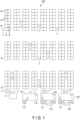
- FIG. 1 is a diagram illustrating a configuration example of a control system 100 according to the embodiment.
- the control system 100 includes a workstation P (P1 to P3), a takeout device 5, an AGV 7, an AGV rack 8, a picking robot 111, a display device 112, and the like.
- Each of the workstations P1 to P3 is provided with the picking robot 111 and the display device 112.
- the control system can operate the picking robot 111 to pick articles using the picking robot 111 at each of the workstations P1 to P3.
- the control system can also stop the operation of the picking robot 111, allocate an operator 113, and cause the operator 113 to pick articles.
- the operator 113 can handle the articles while visually confirming an article handling schedule or the like displayed on the display device 112.
- the display device 112 may be a wireless communication terminal assigned to the operator 113.
- the workstations P1 to P3 may be provided with the display devices 112, and some of the workstations may be provided with the picking robots 111.
- the workstation not provided with the picking robot 111 is used as a workstation for the operator 113.
- the workstation provided with the picking robot 111 can be used as a workstation for the picking robot 111 or a workstation for the operator 113.
- the control system 100 may include a plurality of cameras. Further, one or several cameras among the plurality of cameras may be fixed cameras and the remaining cameras may be movable cameras.
- the fixed camera is a camera fixed to, for example, a ceiling, a wall surface, and a top surface and a side surface or the like that face the workstations P1 to P3.
- the camera captures the entire warehouse and articles handled in the warehouse, and outputs captured data in real time.
- the captured data includes captured date and time data (including captured time) and captured image data.
- the captured image data is still image data and moving image data.
- the fixed camera may rotate vertically and horizontally based on an image-capturing control signal from a WES 10 described later. By rotating the fixed camera vertically and horizontally, the inside of the warehouse can be monitored over a wide range.
- the AGV 7 operates based on a control signal from a rack transport system 20 described later. For example, the AGV 7 travels toward a designated loading position and lifts an AGV rack 8 at the designated loading position. The AGV 7 travels toward a designated unloading position and unloads an AGV rack 8 at the designated unloading position.
- the AGV rack 8 is a rack for storing an article.
- the AGV rack 8 includes two or more sections of different heights.
- the AGV rack 8 is formed by a plurality of tiers.
- the AGV rack 8 includes a case for storing an article on each tier.
- the AGV rack 8 stands upright on four posts.
- the height of an under-rack space below the AGV rack 8 (the height from the floor surface to the bottom of the rack) is higher than the height of the AGV 7. Accordingly, the AGV 7 can enter the under-rack space below the AGV rack 8.
- the AGV 7 which has entered the under-rack space lifts the AGV rack 8 with a pusher to such an extent that the distal ends of the posts are separated from the floor surface by several centimeters, and travels in a state in which the AGV rack 8 is being lifted. In this way, the AGV 7 transports the AGV rack 8.
- rack identification information that can be read by a fixed camera, a movable camera, or the like may be attached.
- article identification information that can be read by a fixed camera, a mobile camera, or the like may be attached.
- the rack identification information and the article identification information are bar codes or two-dimensional codes.
- the control system may include a plurality of readers that read the rack identification information and the article identification information separately from the fixed camera or the movable camera.
- the AGV rack 8 will be described in detail later.
- the workstations P1 to P3 receive the AGV racks 8 transported by the AGVs 7. In the AGV racks 8 received at the workstations P1 to P3, articles are stored. If article handling by the picking robot 111 is designated, the picking robot 111 grips and picks an article stored in the AGV rack 8. If article handling by the operator 113 is designated, the allocated operator 113 manually grips and picks an article stored in the AGV rack 8.
- the display devices 112 provided corresponding to the workstations P1 to P3 display information for supporting the picking operation of the operator 113, for example, an image of the article to be handled, and article identification information, in addition to the article handling schedule. The operator 113 visually checks display contents of the display device 112 and picks the article.
- articles may be stored in the AGV racks 8 using the picking robot 111 or the operator 113.
- the takeout device 5 swaps the cases stored at different heights in the AGV rack 8 under the control of the WES 10. That is, the takeout device 5 exchanges the positions of the cases stored in the AGV rack 8. The takeout device 5 swaps the cases stored in the AGV rack 8 transported by the AGV 7. The takeout device 5 may take out the case from the AGV rack 8 in order to pick an article under the control of the WES 10.
- the takeout device 5 will be described in detail later.
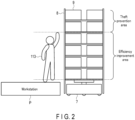
- FIG. 2 shows an example of the AGV rack 8 transported to the workstation P by the AGV 7.
- the AGV rack 8 is loaded on the AGV 7. It is assumed that the AGV rack 8 is transported to a position where the operator 113 can pick an article.
- the AGV rack 8 includes a plurality of cases 9.
- the AGV rack 8 is provided with a plurality of tiers, and each tier stores the cases 9.
- each tier stores two cases 9.
- the cases 9 are stored at a height that the operator 113 can reach without using a ladder or the like and at a position higher than the above-described height.
- a range which is a region in which the AGV rack 8 stores the cases 9 and which the operator 113 can reach without using a ladder or the like is referred to as an efficiency improvement area. That is, the efficiency improvement area is an area in which the operator 113 can pick an article without using a ladder or the like.
- the efficiency improvement area is an area lower than a predetermined height (a height that the operator 113 can reach) .
- a range which is a region in which the AGV rack 8 stores the cases 9 and which is higher than the efficiency improvement area is referred to as a theft prevention area. That is, the theft prevention area is an area in which the operator 113 cannot pick an article unless the operator uses a ladder or the like.
- the theft prevention area is an area higher than a predetermined height (a height that the operator 113 can reach).
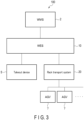
- FIG. 3 is a block diagram illustrating a configuration example of a control system of the control system 100 according to the embodiment.
- the control system 100 includes a WMS 2, a takeout device 5, an AGV 7, a WES 10, a rack transport system 20, and the like.
- the WES 10 is connected to the WMS 2, the takeout device 5, and the rack transport system 20.
- the rack transport system 20 is connected to the AGV 7.
- the WMS 2 (Warehouse Management System) is called a warehouse management system and can be realized by one or more computers.
- the WMS 2 transmits a retrieval order to the WES 10 to provide an instruction to pick an article from the AGV rack 8.
- the WMS 2 may transmit a storage order to the WES 10 to provide an instruction to store an article in the AGV rack 8.
- the WMS 2 stores article information on articles.
- the article information indicates a name, ID, price, theft risk, and the like of an article.
- the theft risk is an index indicating an ease of theft of an article. For example, the theft risk is a value from 0 (no risk) to 5 (maximum risk).
- the theft risk is set based on an operator's operation. The theft risk may be set by the WMS 2 based on the price, outer dimension, weight, and the like of the article.
- the WMS 2 transmits the article information to the WES 10 in response to a request from the WES 10.
- the WES 10 (warehouse execution system) (information processing apparatus) is called a warehouse operation management system and can be realized by one or more computers.
- the WES 10 controls the takeout device 5, the rack transport system 20, and the like based on the retrieval order from the WMS 2.
- the WES 10 will be described in detail later.
- the rack transport system 20 controls the AGV 7 under the control of the WES 10. For example, the rack transport system 20 transports the AGV rack 8 to the workstation P using the AGV 7. The rack transport system 20 returns the AGV rack 8 from the workstation P using the AGV 7.
- the rack transport system 20 stores in advance inventory information indicating articles stored in the cases 9 of each AGV rack 8.
- the inventory information stores an identifier of the AGV rack 8, a position (height) of the case 9 stored in the AGV rack 8, an identifier indicating an article stored in the case 9, and the like in association with each other.
- the rack transport system 20 Upon receiving a retrieval order for retrieving a predetermined article from the WES 10, the rack transport system 20 specifies an AGV rack 8 storing the article by referring to the inventory information.
- the rack transport system 20 Upon specifying the AGV rack 8, the rack transport system 20 transports the specified AGV rack 8 to one of the workstations P using the AGV 7.
- the rack transport system 20 causes an operator or a robot to pick the article from the case 9 of the transported AGV rack 8.
- the rack transport system 20 transports the AGV rack 8 to the takeout device 5 under the control of the WES 10. That is, the rack transport system 20 transports the AGV rack 8 to a position where the takeout device 5 can swap the case 9.
- the rack transport system 20 transmits the inventory information to the WES 10 in response to a request from the WES 10 or at a predetermined timing.
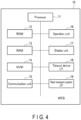
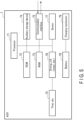
- FIG. 4 is a block diagram illustrating a configuration example of the WES 10.
- the WES 10 includes a processor 11, a ROM 12, a RAM 13, an NVM 14, a communication unit 15, an operation unit 16, a display unit 17, a takeout device interface 18, a rack transport system interface 19, and the like.
- the processor 11, the ROM 12, the RAM 13, the NVM 14, the communication unit 15, the operation unit 16, the display unit 17, the takeout device interface 18, and the rack transport system interface 19 are connected to each other via a data bus or the like.
- the WES 10 may include other configurations as needed in addition to the configuration illustrated in FIG. 4 , or a specific configuration may be excluded from the WES 10.
- the processor 11 (second processor) has a function of controlling the operation of the entire WES 10.
- the processor 11 may include an internal cache, various interfaces, and the like.
- the processor 11 realizes various processes by executing programs stored in advance in the internal memory, the ROM 12, or the NVM 14.
- Some of the various functions realized by the processor 11 executing the programs may be realized by a hardware circuit.
- the processor 11 controls the functions executed by the hardware circuit.
- the ROM 12 is a nonvolatile memory in which a control program, control data and the like are stored in advance.
- the control program and the control data stored in the ROM 12 are incorporated in advance according to the specifications of the WES 10.
- the RAM 13 is a volatile memory.
- the RAM 13 temporarily stores data, etc. being processed by the processor 11.
- the RAM 13 stores various application programs based on instructions from the processor 11.
- the RAM 13 may store data necessary for executing the application program, an execution result of the application program, etc.
- the NVM 14 is a data-writable and rewritable nonvolatile memory.
- the NVM 14 is configured by a hard disk drive (HDD), a solid-state drive (SSD), a flash memory, or the like.
- the NVM 14 stores control programs, applications, and various kinds of data according to the operation purpose of the WES 10.
- the communication unit 15 (first interface) is an interface that transmits and receives data to and from the WMS 2 or the like.
- the communication unit 15 supports wired or wireless local area network (LAN) connection.
- LAN local area network
- the operation unit 16 receives various operation inputs from the operator.
- the operation unit 16 transmits a signal indicating the input operation to the processor 11.
- the operation unit 16 is configured by a mouse, a keyboard, a touch panel, or the like.
- the display unit 17 displays image data from the processor 11.
- the display unit 17 is configured by a liquid crystal monitor.
- the operation unit 16 is configured by a touch panel
- the display unit 17 may be formed integrally with the touch panel as the operation unit 16.
- the takeout device interface 18 (second interface) is an interface that transmits and receives data to and from the takeout device 5.
- the takeout device interface 18 is connected to the takeout device 5 via a network or the like.
- the takeout device interface 18 supports wired or wireless LAN connection.
- the rack transport system interface 19 (third interface) is an interface that transmits and receives data to and from the rack transport system 20.
- the rack transport system interface 19 is connected to the rack transport system 20 via a network or the like.
- the rack transport system interface 19 supports wired or wireless LAN connection.
- the communication unit 15, the takeout device interface 18, and the rack transport system interface 19 may be integrally formed.
- FIG. 5 is a block diagram illustrating a configuration example of the AGV 7 according to the embodiment.
- the AGV 7 includes a processor 71, a ROM 72, a RAM 73, an auxiliary storage device 74, a communication interface 75, a driving unit 76, a sensor 77, a battery 78, a charging mechanism 79, tires 70, and the like.
- the processor 71 has a function of controlling the operation of the entire AGV 7.
- the processor 71 may include an internal cache, various interfaces, and the like.
- the processor 71 realizes various processes by executing programs stored in advance in the ROM 72 or the auxiliary storage device 74.
- the processor 71 is a CPU.
- the processor 71 may be realized by hardware such as a large-scale integration (LSI), an application-specific integrated circuit (ASIC), or a field-programmable gate array (FPGA).
- LSI large-scale integration
- ASIC application-specific integrated circuit
- FPGA field-programmable gate array
- the processor 71 performs processing such as calculation and control necessary for operations of acceleration, deceleration, stopping, direction change, loading and unloading of the AGV rack 8, and the like.
- the processor 71 executes a program stored in the ROM 72 or the like based on a control signal from the rack transport system 20 or the like to generate and output a driving signal to each unit.
- the rack transport system 20 transmits a control signal for moving the AGV 7 from a current position to a first position (a rack arrangement position of the target AGV rack 8) and from the first position to a second position (a position of the target workstation P).
- the rack transport system 20 transmits a control signal for moving the AGV 7 from the second position to the first position.
- the processor 71 of the AGV 7 outputs a driving signal in response to the control signal transmitted from the rack transport system 20. Thereby, the AGV 7 moves from the current position to the first position, from the first position to the second position, and from the second position to the first position.
- the processor 71 outputs a driving signal in response to an instruction to load or unload the AGV rack 8 included in the control signal transmitted from the rack transport system 20. Thereby, the AGV 7 lifts the AGV rack 8 by the pusher and lowers the lifted AGV rack 8.
- the ROM 72 is a non-transitory computer-readable storage medium, and stores the programs described above.
- the ROM 72 stores data used by the processor 71 to perform various processes or various setting values and the like.
- the RAM 73 is a memory used for reading and writing data.
- the RAM 73 is used as a so-called work area or the like which the processor 71 temporarily uses in performing various processes.
- the auxiliary storage device 74 is a non-transitory computer-readable storage medium, and may store the programs described above.
- the auxiliary storage device 74 stores data used by the processor 71 to perform various processes, data generated through the process performed by the processor 71, or various setting values and the like.
- the communication interface 75 is an interface that transmits and receives data to and from the rack transport system 20 and the like through a wireless LAN access point or the like.
- the communication interface 75 supports wireless LAN connection.
- the driving unit 76 is a motor or the like, and rotates or stops the motor based on a driving signal output from the processor 71.
- the power of the motor is transmitted to the tires 70 and then to a steering mechanism.
- the AGV 7 is moved to a target position by the power from such a motor.
- the driving unit 76 functions as a transport mechanism for transporting the AGV 7 and the AGV rack 8.
- the driving unit 76 rotates (normally rotates) the motor based on the driving signal output from the processor 71.
- the pusher is uplifted by the power from the motor, lifting the AGV rack 8.
- the driving unit 76 rotates (reversely rotates) the motor based on the driving signal output from the processor 71.
- the pusher is lowered by the power from the motor, lowering the AGV rack 8 onto the floor surface.
- the sensor 77 includes a plurality of reflection sensors. Each reflection sensor is attached around the AGV 7. Each reflection sensor emits laser light, detects a time from the emission of the laser light to the return of the laser light reflected by the object, detects a distance to the object based on the detected time, and notifies the processor 71 of a detection signal.
- the processor 71 outputs a control signal for controlling the traveling of the AGV 7 based on the detection signal from the sensor 77. For example, the processor 71 outputs a control signal for deceleration, stopping, or the like to avoid collision with the object based on the detection signal from the sensor 77.
- a camera may be provided other than the sensor 77, and the camera may capture an image of the surrounding and output the captured image to the processor 71.
- the processor 71 analyzes the captured image and outputs the control signal for deceleration, stopping, or the like to avoid collision with the object.
- the battery 78 supplies necessary electric power to the driving unit 76 and the like.
- the charging mechanism 79 is a mechanism that connects a charging station and the battery 78, and the battery 78 is charged with electric power supplied from the charging station or the like via the charging mechanism 79.
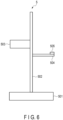
- FIG. 6 is a side view of the takeout device 5.
- the takeout device 5 includes a base 501.
- the base 501 functions as a support mechanism that supports the entire takeout device 5.
- the base 501 is formed with a member 502 extending upward.
- the member 502 is formed by two rod-shaped members extending upward and rod-shaped members formed across the aforementioned members. That is, the member 502 is formed in a ladder shape.
- the member 502 is formed with a rear tray 503.
- the rear tray 503 is a plate-like member extending in the horizontal direction from the member 502. On the rear tray 503, the case 9 is loaded.
- the member 502 is formed with a shuttle part 504.
- the shuttle part 504 is formed in a direction opposite to the rear tray 503 with respect to the member 502.
- the shuttle part 504 can be moved up and down along the member 502 by a driving unit 56 or the like described later.
- the shuttle part 504 grips the case 9 located in the front (right side in FIG. 6 ).
- the shuttle part 504 loads the gripped case 9 on the rear tray 503.
- the shuttle part 504 grips the case 9 loaded on the rear tray 503. The shuttle part 504 releases the gripped case 9 at the front.
- the shuttle part 504 can acquire the case 9 from each tier of the AGV rack 8.
- the shuttle part 504 can set the case 9 on each tier of the AGV rack 8.
- the shuttle part 504 includes a sensor 505.
- the sensor 505 detects the case 9 existing in the front.
- the sensor 505 may read a code or the like attached to the case 9.
- the sensor 505 may include a light or the like.
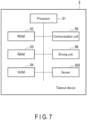
- FIG. 5 is a block diagram illustrating a configuration example of the takeout device 5.
- the takeout device 5 includes a processor 51, a ROM 52, a RAM 53, an NVM 54, a communication unit 55, a driving unit 56, a sensor 505, and the like.
- the processor 51 (first processor) has a function of controlling the operation of the entire takeout device 5.
- the processor 51 may include an internal cache, various interfaces, and the like.
- the processor 51 realizes various processes by executing programs stored in advance in the internal memory, the ROM 52, or the NVM 54.
- the processor 51 is a CPU.
- the processor 51 may be realized by hardware such as an LSI, an ASIC, or an FPGA.
- the ROM 52 is a non-transitory computer-readable storage medium, and stores the programs described above.
- the ROM 52 stores data used by the processor 51 to perform various processes or various setting values and the like.
- the RAM 53 is a memory used for reading and writing data.
- the RAM 53 is used as a so-called work area or the like which the processor 51 temporarily uses in performing various processes.
- the NVM 54 is a non-transitory computer-readable storage medium, and may store the programs described above.
- the NVM 54 stores data used by the processor 51 to perform various processes, data generated through the process performed by the processor 51, or various setting values and the like.
- the communication unit 55 (communication interface) is an interface that transmits and receives data to and from the WES 10 or the like.
- the communication unit 55 is connected to the WES 10 or the like via a network or the like.
- the communication unit 55 supports wireless LAN connection.
- the driving unit 56 drives the shuttle part 504.
- the driving unit 56 moves the shuttle part 504 in the vertical direction.
- the driving unit 56 causes the shuttle part 504 to perform gripping operation.
- the driving unit 56 is a motor or the like that drives the shuttle part 504.
- the takeout device 5 may include other configurations as needed in addition to the configuration illustrated in FIGS. 6 and 7 , or a specific configuration may be excluded from the takeout device 5.
- the functions realized by the WES 10 are realized by the processor 11 executing a program stored in the internal memory, the ROM 12, or the NVM 14.
- the processor 11 has a function of acquiring retrieval orders to be processed in a predetermined period.
- the processor 11 receives retrieval orders from the WMS 2 through the communication unit 15. Upon receiving the retrieval orders, the processor 11 selects retrieval orders to be processed in a predetermined period (for example, the next day).
- the processor 11 selects retrieval orders to be processed in a predetermined period based on the deadline of the retrieval orders.
- the processor 11 has a function of acquiring article information of articles to be picked according to the selected retrieval orders.
- the processor 11 Upon selecting the retrieval orders, the processor 11 transmits, to the WMS 2 through the communication unit 15, a request for requesting article information of articles to be picked according to the selected retrieval orders.
- the processor 11 receives the article information as a response to the request through the communication unit 15.
- the processor 11 has a function of selecting two cases 9 to be swapped (a set of a swap-source case 9 and a swap-destination case 9) based on the article information and the like.
- the processor 11 acquires the inventory information from the rack transport system 20 through the rack transportation system interface 19.
- the processor 11 selects a swap-source case 9 and a swap-destination case 9 from the same line (cases 9 facing the same side) of the AGV rack 8. Furthermore, the processor 11 selects a swap-source case 9 and a swap-destination case 9 that are stored at different heights.
- the processor 11 selects two cases 9 so as to enhance the efficiency of processing of the retrieval order. That is, the processor 11 selects two cases 9 such that the case 9 storing the article of the retrieval order is stored in the efficiency improvement area.
- the processor 11 selects, based on inventory information, a case 9 storing the article of the retrieval order as a swap-source case 9 from cases 9 of the theft prevention area.
- the processor 11 selects a case 9 not including the article of the retrieval order as a swap-destination case 9 from cases 9 of the efficiency improvement area of the AGV rack 8 storing the swap-source case 9.
- the processor 11 may select a swap-source case 9 from the cases 9 of the efficiency improvement area. For example, the processor 11 may select a swap-source case 9 and a swap-destination case 9 such that a case 9 with an earlier retrieval time of the retrieval order is stored at a higher position.
- the processor 11 selects two cases 9 so as to prevent theft of an article. That is, the processor 11 selects two cases 9 such that a case 9 storing an article with a high theft risk is stored in the theft prevention area.
- the processor 11 selects an article (at-risk article) having a theft risk equal to or higher than a predetermined threshold value based on the article information.
- the processor 11 selects a case 9 storing the at-risk article as a swap-source case 9 from cases 9 of the efficiency improvement area based on the inventory information.
- the processor 11 selects a case 9 not storing an at-risk article as a swap-destination case 9 from cases 9 of the theft prevention area of the AGV rack 8 storing the swap-source case 9. For example, the processor 11 selects, as the swap-destination case 9, a case 9 that is stored at a higher position as the theft risk becomes higher. That is, the processor 11 selects a swap-destination case 9 such that the at-risk article having a higher theft risk is stored at a higher position.
- the processor 11 may select a swap-source case 9 from the cases 9 of the theft prevention area. For example, the processor 11 may select the swap-source case 9 and the swap-destination case 9 such that the at-risk article having a higher theft risk is stored at a higher position.
- the processor 11 selects the swap-source case 9 and the swap-destination case 9 by giving priority to efficiency of processing of the retrieval order over prevention of theft. That is, in a case where the article of the retrieval order is an at-risk article, the processor 11 selects a swap-source case 9 and a swap-destination case 9 such that a case 9 storing the at-risk article is stored in the efficiency improvement area.
- the processor 11 sets one or more sets of the swap-source case 9 and the swap-destination case 9 according to the above operation.
- the processor 11 has a function of swapping a set of cases 9 to be swapped.
- the processor 11 Upon setting a set of the swap-source case 9 and the swap-destination case 9, the processor 11 sets one unprocessed set. Upon setting one unprocessed set, the processor 11 specifies an AGV rack 8 that stores cases 9 (a swap-source case 9 and a swap-destination case 9) of the set that has been set.
- the processor 11 Upon specifying the AGV rack 8, the processor 11 causes the rack transport system 20 to transport the specified AGV rack 8 to the takeout device 5 through the rack transport system interface 19.
- the processor 11 Upon the rack transport system 20 transporting the AGV rack 8 to the takeout device 5 using the AGV 7, the processor 11 causes the takeout device 5 to swap the swap-source case 9 with the swap-destination case 9 through the takeout device interface 18. For example, the processor 11 transmits a control signal including an identifier indicating the swap-source case 9 and an identifier indicating the swap-destination case 9 to the takeout device 5 through the takeout device interface 18. The processor 11 may transmit a control signal indicating a tier (or height) on which the swap-source case 9 is stored and a tier (height) on which the swap-destination case 9 is stored to the takeout device 5 through the takeout device interface 18.
- the processor 11 Upon the takeout device 5 swapping the swap-source case 9 and the swap-destination case 9, the processor 11 transmits a notification indicating that the swap is completed to the rack transport system 20 through the rack transport system interface 19.
- the notification includes an identifier indicating the swap-source case 9 and an identifier indicating the swap-destination case 9.
- the rack transport system 20 may update the inventory information based on the notification.
- the processor 11 Upon transmitting the notification to the rack transport system 20, the processor 11 causes the rack transport system 20 to transport the AGV rack 8 to a predetermined return position (e.g., the original position) through the rack transport system interface 19.
- a predetermined return position e.g., the original position
- the processor 11 similarly swaps the swap-source case 9 and the swap-destination case 9 for each set.
- the functions realized by the takeout device 5 are realized by the processor 51 executing a program stored in the internal memory, the ROM 52, the NVM 54, or the like.
- the processor 51 has a function of swapping the swap-source case 9 and the swap-destination case 9 under the control of the WES 10.
- FIG. 8 shows an operation example of the takeout device 5 swapping the swap-source case 9 and the swap-destination case 9.
- the processor 11 of the WES 10 transmits a control signal including an identifier indicating the swap-source case 9 and an identifier indicating the swap-destination case 9 to the takeout device 5 through the takeout device interface 18.
- the processor 51 receives the control signal through the communication unit 55. Upon receiving the control signal, the processor 51 controls the driving unit 56 to move the shuttle part 504 to the height of the swap-destination case 9. Upon moving the shuttle unit 504, the processor 51 grips the swap-destination case 9 using the shuttle part 504 (procedure A).
- the processor 51 Upon gripping the swap-destination case 9, the processor 51 loads the swap-destination case 9 onto the rear tray 503 using the shuttle part 504 (procedure B). Upon loading the swap-destination case 9 onto the rear tray 503, the processor 51 controls the driving unit 56 to move the shuttle part 504 to the height of the swap-source case 9. Upon moving the shuttle part 504, the processor 51 grips the swap-source case 9 using the shuttle part 504 (procedure C).
- the processor 51 Upon gripping the swap-source case 9, the processor 51 controls the driving unit 56 to move the shuttle part 504 to the height of the tier on which the swap-destination case 9 is stored. Upon moving the shuttle part 504, the processor 51 sets the swap-source case 9 on the tier using the shuttle part 504 (procedure D).
- the processor 11 repeats the above operation according to the control signal from the WES 10.
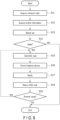
- FIG. 9 is a flowchart illustrating an operation example of the WES 10.
- the WES 10 executes the following operation in a period in which the picking process is not performed (for example, at night).
- the processor 11 of the WES 10 acquires a retrieval order to be processed in a predetermined period (S11). Upon acquiring the retrieval order, the processor 11 acquires article information on an article of the retrieval order from the WMS 2 through the communication unit 15 (S12).
- the processor 11 Upon acquiring the article information, the processor 11 selects a set of a swap-destination case 9 and a swap-source case 9 based on the article information, etc. (S13). Upon selecting the set, the processor 11 determines whether there is a selected set (S14).
- the processor 11 Upon determining that there is a set (S14, YES), the processor 11 causes the rack transport system 20 to transport the AGV rack 8 storing cases 9 of the set to the takeout device 5 through the rack transport system interface 19 (S15).
- the processor 11 Upon the rack transport system 20 transporting the AGV rack 8 to the takeout device 5, the processor 11 causes the takeout device 5 to swap the swap-destination case 9 and the swap-source case 9 through the takeout device interface 18 (S16).
- the processor 11 Upon causing the takeout device 5 to swap the swap-destination case 9 and the swap-source case 9, the processor 11 transmits a notification indicating that the swap is completed to the rack transport system 20 through the rack transport system interface 19 (S17).
- the processor 11 Upon transmitting the notification to the rack transport system 20, the processor 11 causes the rack transport system 20 to transport the AGV rack 8 to a predetermined return position through the rack transport system interface 19 (S18).
- the processor 11 determines whether there is an unprocessed set (S19). Upon determining that there is an unprocessed set (S19, YES), the processor 11 returns to S15.
- the processor 11 Upon determining that there is no unprocessed set (S19, NO), the processor 11 ends the operation.
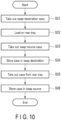
- FIG. 10 is a flowchart illustrating an operation example of the takeout device 5.
- the processor 51 of the takeout device 5 grips the swap-destination case 9 using the shuttle part 504 (S21). Upon gripping the swap-destination case 9, the processor 51 loads the swap-destination case 9 on the rear tray 503 using the shuttle part 504 (S22).
- the processor 51 Upon loading the swap-destination case 9 on the rear tray 503, the processor 51 grips the swap-source case 9 using the shuttle part 504 (S23). Upon gripping the swap-source case 9, the processor 51 sets the swap-source case 9 on the tier on which the swap-destination case 9 was stored using the shuttle part 504 (S24).
- the processor 51 grips the swap-destination case 9 from the rear tray 503 using the shuttle part 504 (S25). Upon gripping the swap-destination case 9 from the rear tray 503, the processor 51 sets the swap-destination case 9 on the tier on which the swap-source case 9 was stored using the shuttle part 504 (S26).
- the processor 51 Upon setting the swap-destination case 9, the processor 51 ends the operation.
- the processor 51 repeats S21 to S26 according to the control signal from the WES 10.
- the processor 11 of the WES 10 may select a swap-destination case 9 from a line (a case 9 facing the other side) different from the line on which the swap-source case 9 is loaded in the AGV rack 8. In this case, the processor 11 may cause the rack transport system 20 to rotate the AGV rack 8 at the timing when the takeout device 5 grips the swap-destination case 9.
- the processor 11 may select a swap-destination case 9 from the cases 9 of the AGV rack 8 different from the AGV rack 8 storing the swap-source case 9. In this case, the processor 11 may cause the rack transport system 20 to replace the AGV rack 8 storing the swap-destination case 9 with the AGV rack 8 storing the swap-source case 9 at the timing when the takeout device 5 grips the swap-destination case 9.
- the processor 11 may set the theft prevention area and the efficiency improvement area according to the height of the operator 113.
- the processor 11 may select the swap-source case 9 and the swap-destination case 9 such that a larger or heavier article is stored at a lower position.
- the control system 100 may include a plurality of takeout devices 5.
- the takeout device 5 may be movable.
- the processor 11 of the WES 10 may cause the takeout device 5 to swap the cases 9 after moving the takeout device 5 to the AGV rack 8.
- the control system 100 may execute the picking process and the swapping of the cases 9 simultaneously in parallel.
- the control system configured as described above displaces the case storing the article to be picked to the range within the reach of the operator based on the retrieval order. Therefore, the control system can allow the operator to efficiently pick the article.
- control system displaces the case storing the article having a high risk of being stolen to the range out of reach of the operator based on the article information. Therefore, the control system can prevent theft of the article.
- the program according to the present embodiment may be transferred in a state of being stored in an electronic device or in a state of not being stored in an electronic device. In the latter case, the program may be transferred through a network or may be transferred in a state of being stored in a storage medium.
- the storage medium is a non-transitory tangible medium.
- the storage medium is a computer-readable medium.
- the storage medium may be of any type, such as a CD-ROM or a memory card, as long as it can store programs and can be read by the computer.
Landscapes
- Engineering & Computer Science (AREA)
- Business, Economics & Management (AREA)
- Mechanical Engineering (AREA)
- Economics (AREA)
- Human Resources & Organizations (AREA)
- Quality & Reliability (AREA)
- Finance (AREA)
- Entrepreneurship & Innovation (AREA)
- Accounting & Taxation (AREA)
- Marketing (AREA)
- Operations Research (AREA)
- Development Economics (AREA)
- Strategic Management (AREA)
- Tourism & Hospitality (AREA)
- Physics & Mathematics (AREA)
- General Business, Economics & Management (AREA)
- General Physics & Mathematics (AREA)
- Theoretical Computer Science (AREA)
- Warehouses Or Storage Devices (AREA)
Applications Claiming Priority (2)
| Application Number | Priority Date | Filing Date | Title |
|---|---|---|---|
| JP2022088599A JP2023176357A (ja) | 2022-05-31 | 2022-05-31 | 情報処理装置、情報処理方法、プログラム及びシステム |
| PCT/JP2023/020106 WO2023234298A1 (ja) | 2022-05-31 | 2023-05-30 | 情報処理装置、情報処理方法、プログラム、システム、及びコンピュータ可読記憶媒体 |
Publications (2)
| Publication Number | Publication Date |
|---|---|
| EP4534451A1 true EP4534451A1 (de) | 2025-04-09 |
| EP4534451A4 EP4534451A4 (de) | 2025-12-31 |
Family
ID=89024840
Family Applications (1)
| Application Number | Title | Priority Date | Filing Date |
|---|---|---|---|
| EP23816055.0A Pending EP4534451A4 (de) | 2022-05-31 | 2023-05-30 | Informationsverarbeitungsvorrichtung, informationsverarbeitungsverfahren, programm, system und computerlesbares speichermedium |
Country Status (4)
| Country | Link |
|---|---|
| US (1) | US20250066125A1 (de) |
| EP (1) | EP4534451A4 (de) |
| JP (1) | JP2023176357A (de) |
| WO (1) | WO2023234298A1 (de) |
Family Cites Families (9)
| Publication number | Priority date | Publication date | Assignee | Title |
|---|---|---|---|---|
| TW200621601A (en) | 2004-09-03 | 2006-07-01 | Murata Machinery Ltd | Automatic warehouse system |
| JP5811040B2 (ja) * | 2012-06-05 | 2015-11-11 | 株式会社ダイフク | 物品仕分け設備の運用方法及び物品仕分け設備 |
| WO2015052825A1 (ja) * | 2013-10-11 | 2015-04-16 | 株式会社日立製作所 | 搬送ロボットシステム |
| JP6857142B2 (ja) * | 2018-02-14 | 2021-04-14 | 株式会社日立物流 | ピッキングシステム及びピッキングシステムの制御方法 |
| US10589932B1 (en) * | 2018-07-13 | 2020-03-17 | Vecna Robotics, Inc. | System and method of providing delivery of items from one container to another container |
| JP7206955B2 (ja) * | 2019-01-28 | 2023-01-18 | 株式会社Ihi | 自動倉庫制御装置及び自動倉庫におけるクレーンの出庫制御方法 |
| KR102173692B1 (ko) * | 2020-02-17 | 2020-11-03 | 쿠팡 주식회사 | 상품 운반을 위한 전자 장치 및 그 동작 방법 |
| KR102216641B1 (ko) * | 2020-02-24 | 2021-02-17 | 쿠팡 주식회사 | 로케이션 추천을 위한 동작 방법 및 이를 위한 장치 |
| JP6961774B1 (ja) * | 2020-09-23 | 2021-11-05 | 株式会社東芝 | 制御装置、および倉庫管理システム |
-
2022
- 2022-05-31 JP JP2022088599A patent/JP2023176357A/ja active Pending
-
2023
- 2023-05-30 EP EP23816055.0A patent/EP4534451A4/de active Pending
- 2023-05-30 WO PCT/JP2023/020106 patent/WO2023234298A1/ja not_active Ceased
-
2024
- 2024-11-14 US US18/947,294 patent/US20250066125A1/en active Pending
Also Published As
| Publication number | Publication date |
|---|---|
| US20250066125A1 (en) | 2025-02-27 |
| JP2023176357A (ja) | 2023-12-13 |
| EP4534451A4 (de) | 2025-12-31 |
| WO2023234298A1 (ja) | 2023-12-07 |
Similar Documents
| Publication | Publication Date | Title |
|---|---|---|
| JP6885644B2 (ja) | 倉庫管理収容・取出システムおよび方法 | |
| US10671088B2 (en) | Communication of information regarding a robot using an optical identifier | |
| EP3872006A1 (de) | Frachttransportsystem und -verfahren | |
| CN109987369A (zh) | 仓储物品的调度系统及方法 | |
| US20260054928A1 (en) | Method and control system for preparing orders of goods stored in an automated storage system | |
| JP7555815B2 (ja) | 情報処理装置、情報処理方法、プログラム、及び制御システム | |
| CN109377125A (zh) | 仓储管理系统及方法 | |
| CN113003086B (zh) | 货物搬运方法、设备及存储介质 | |
| JP2020050479A (ja) | 物品搬送システム | |
| CN116648414A (zh) | 拣选系统和方法 | |
| US20230236600A1 (en) | Operational State Detection for Obstacles in Mobile Robots | |
| JP7511598B2 (ja) | 情報処理方法、情報処理装置及びプログラム | |
| JP2020026318A (ja) | 自動倉庫システム、情報取得装置 | |
| US20250011089A1 (en) | Information processing apparatus, information processing method, system and computer-readable storage medium | |
| JP7524088B2 (ja) | プログラム | |
| EP4534451A1 (de) | Informationsverarbeitungsvorrichtung, informationsverarbeitungsverfahren, programm, system und computerlesbares speichermedium | |
| JP2023173239A (ja) | 情報処理装置、情報処理方法及びプログラム | |
| US20230381822A1 (en) | Information processing device, information processing method, computer-readable storage medium, and system | |
| US20240308766A1 (en) | Information processing apparatus, information processing method, and computer-readable storage medium | |
| EP4204333A1 (de) | Verfahren und system zum kommissionieren von produkten in einer kommissionierstation eines automatischen regalbedienungssystems | |
| CN115724106B (zh) | 基于驶入式货架的货物存取方法及系统、设备、存储介质 | |
| KR102723044B1 (ko) | 물품 적재 시스템 및 이를 이용한 물품 입고 및 출고방법 | |
| EP4194153B1 (de) | Verfahren, vorrichtung und system zur steuerung eines roboters, steuerungsvorrichtung und roboter | |
| JP7524091B2 (ja) | プログラム | |
| JP2024041556A (ja) | 情報処理装置、情報処理方法、プログラム及びシステム |
Legal Events
| Date | Code | Title | Description |
|---|---|---|---|
| STAA | Information on the status of an ep patent application or granted ep patent |
Free format text: STATUS: THE INTERNATIONAL PUBLICATION HAS BEEN MADE |
|
| PUAI | Public reference made under article 153(3) epc to a published international application that has entered the european phase |
Free format text: ORIGINAL CODE: 0009012 |
|
| STAA | Information on the status of an ep patent application or granted ep patent |
Free format text: STATUS: REQUEST FOR EXAMINATION WAS MADE |
|
| 17P | Request for examination filed |
Effective date: 20241105 |
|
| AK | Designated contracting states |
Kind code of ref document: A1 Designated state(s): AL AT BE BG CH CY CZ DE DK EE ES FI FR GB GR HR HU IE IS IT LI LT LU LV MC ME MK MT NL NO PL PT RO RS SE SI SK SM TR |
|
| DAV | Request for validation of the european patent (deleted) | ||
| DAX | Request for extension of the european patent (deleted) | ||
| RAP1 | Party data changed (applicant data changed or rights of an application transferred) |
Owner name: KABUSHIKI KAISHA TOSHIBA |
|
| A4 | Supplementary search report drawn up and despatched |
Effective date: 20251201 |
|
| RIC1 | Information provided on ipc code assigned before grant |
Ipc: B65G 1/04 20060101AFI20251125BHEP Ipc: B65G 1/137 20060101ALI20251125BHEP Ipc: G06Q 10/087 20230101ALI20251125BHEP |