EP4495191A1 - Schlammzusammensetzung und beschichtungsmittel - Google Patents
Schlammzusammensetzung und beschichtungsmittel Download PDFInfo
- Publication number
- EP4495191A1 EP4495191A1 EP23770736.9A EP23770736A EP4495191A1 EP 4495191 A1 EP4495191 A1 EP 4495191A1 EP 23770736 A EP23770736 A EP 23770736A EP 4495191 A1 EP4495191 A1 EP 4495191A1
- Authority
- EP
- European Patent Office
- Prior art keywords
- composite oxide
- based composite
- slurry composition
- oxide particles
- particles
- Prior art date
- Legal status (The legal status is an assumption and is not a legal conclusion. Google has not performed a legal analysis and makes no representation as to the accuracy of the status listed.)
- Pending
Links
Images




Classifications
-
- C—CHEMISTRY; METALLURGY
- C09—DYES; PAINTS; POLISHES; NATURAL RESINS; ADHESIVES; COMPOSITIONS NOT OTHERWISE PROVIDED FOR; APPLICATIONS OF MATERIALS NOT OTHERWISE PROVIDED FOR
- C09D—COATING COMPOSITIONS, e.g. PAINTS, VARNISHES OR LACQUERS; FILLING PASTES; CHEMICAL PAINT OR INK REMOVERS; INKS; CORRECTING FLUIDS; WOODSTAINS; PASTES OR SOLIDS FOR COLOURING OR PRINTING; USE OF MATERIALS THEREFOR
- C09D7/00—Features of coating compositions, not provided for in group C09D5/00; Processes for incorporating ingredients in coating compositions
- C09D7/40—Additives
- C09D7/60—Additives non-macromolecular
- C09D7/61—Additives non-macromolecular inorganic
-
- C—CHEMISTRY; METALLURGY
- C09—DYES; PAINTS; POLISHES; NATURAL RESINS; ADHESIVES; COMPOSITIONS NOT OTHERWISE PROVIDED FOR; APPLICATIONS OF MATERIALS NOT OTHERWISE PROVIDED FOR
- C09C—TREATMENT OF INORGANIC MATERIALS, OTHER THAN FIBROUS FILLERS, TO ENHANCE THEIR PIGMENTING OR FILLING PROPERTIES ; PREPARATION OF CARBON BLACK ; PREPARATION OF INORGANIC MATERIALS WHICH ARE NO SINGLE CHEMICAL COMPOUNDS AND WHICH ARE MAINLY USED AS PIGMENTS OR FILLERS
- C09C1/00—Treatment of specific inorganic materials other than fibrous fillers; Preparation of carbon black
-
- C—CHEMISTRY; METALLURGY
- C09—DYES; PAINTS; POLISHES; NATURAL RESINS; ADHESIVES; COMPOSITIONS NOT OTHERWISE PROVIDED FOR; APPLICATIONS OF MATERIALS NOT OTHERWISE PROVIDED FOR
- C09C—TREATMENT OF INORGANIC MATERIALS, OTHER THAN FIBROUS FILLERS, TO ENHANCE THEIR PIGMENTING OR FILLING PROPERTIES ; PREPARATION OF CARBON BLACK ; PREPARATION OF INORGANIC MATERIALS WHICH ARE NO SINGLE CHEMICAL COMPOUNDS AND WHICH ARE MAINLY USED AS PIGMENTS OR FILLERS
- C09C3/00—Treatment in general of inorganic materials, other than fibrous fillers, to enhance their pigmenting or filling properties
- C09C3/04—Physical treatment, e.g. grinding or treatment with ultrasonic vibrations
-
- C—CHEMISTRY; METALLURGY
- C09—DYES; PAINTS; POLISHES; NATURAL RESINS; ADHESIVES; COMPOSITIONS NOT OTHERWISE PROVIDED FOR; APPLICATIONS OF MATERIALS NOT OTHERWISE PROVIDED FOR
- C09D—COATING COMPOSITIONS, e.g. PAINTS, VARNISHES OR LACQUERS; FILLING PASTES; CHEMICAL PAINT OR INK REMOVERS; INKS; CORRECTING FLUIDS; WOODSTAINS; PASTES OR SOLIDS FOR COLOURING OR PRINTING; USE OF MATERIALS THEREFOR
- C09D133/00—Coating compositions based on homopolymers or copolymers of compounds having one or more unsaturated aliphatic radicals, each having only one carbon-to-carbon double bond, and at least one being terminated by only one carboxyl radical, or of salts, anhydrides, esters, amides, imides, or nitriles thereof; Coating compositions based on derivatives of such polymers
- C09D133/04—Homopolymers or copolymers of esters
- C09D133/06—Homopolymers or copolymers of esters of esters containing only carbon, hydrogen and oxygen, the oxygen atom being present only as part of the carboxyl radical
- C09D133/08—Homopolymers or copolymers of acrylic acid esters
-
- C—CHEMISTRY; METALLURGY
- C09—DYES; PAINTS; POLISHES; NATURAL RESINS; ADHESIVES; COMPOSITIONS NOT OTHERWISE PROVIDED FOR; APPLICATIONS OF MATERIALS NOT OTHERWISE PROVIDED FOR
- C09D—COATING COMPOSITIONS, e.g. PAINTS, VARNISHES OR LACQUERS; FILLING PASTES; CHEMICAL PAINT OR INK REMOVERS; INKS; CORRECTING FLUIDS; WOODSTAINS; PASTES OR SOLIDS FOR COLOURING OR PRINTING; USE OF MATERIALS THEREFOR
- C09D17/00—Pigment pastes, e.g. for mixing in paints
- C09D17/004—Pigment pastes, e.g. for mixing in paints containing an inorganic pigment
- C09D17/007—Metal oxide
-
- C—CHEMISTRY; METALLURGY
- C09—DYES; PAINTS; POLISHES; NATURAL RESINS; ADHESIVES; COMPOSITIONS NOT OTHERWISE PROVIDED FOR; APPLICATIONS OF MATERIALS NOT OTHERWISE PROVIDED FOR
- C09D—COATING COMPOSITIONS, e.g. PAINTS, VARNISHES OR LACQUERS; FILLING PASTES; CHEMICAL PAINT OR INK REMOVERS; INKS; CORRECTING FLUIDS; WOODSTAINS; PASTES OR SOLIDS FOR COLOURING OR PRINTING; USE OF MATERIALS THEREFOR
- C09D201/00—Coating compositions based on unspecified macromolecular compounds
-
- C—CHEMISTRY; METALLURGY
- C09—DYES; PAINTS; POLISHES; NATURAL RESINS; ADHESIVES; COMPOSITIONS NOT OTHERWISE PROVIDED FOR; APPLICATIONS OF MATERIALS NOT OTHERWISE PROVIDED FOR
- C09D—COATING COMPOSITIONS, e.g. PAINTS, VARNISHES OR LACQUERS; FILLING PASTES; CHEMICAL PAINT OR INK REMOVERS; INKS; CORRECTING FLUIDS; WOODSTAINS; PASTES OR SOLIDS FOR COLOURING OR PRINTING; USE OF MATERIALS THEREFOR
- C09D5/00—Coating compositions, e.g. paints, varnishes or lacquers, characterised by their physical nature or the effects produced; Filling pastes
- C09D5/14—Paints containing biocides, e.g. fungicides, insecticides or pesticides
-
- C—CHEMISTRY; METALLURGY
- C09—DYES; PAINTS; POLISHES; NATURAL RESINS; ADHESIVES; COMPOSITIONS NOT OTHERWISE PROVIDED FOR; APPLICATIONS OF MATERIALS NOT OTHERWISE PROVIDED FOR
- C09D—COATING COMPOSITIONS, e.g. PAINTS, VARNISHES OR LACQUERS; FILLING PASTES; CHEMICAL PAINT OR INK REMOVERS; INKS; CORRECTING FLUIDS; WOODSTAINS; PASTES OR SOLIDS FOR COLOURING OR PRINTING; USE OF MATERIALS THEREFOR
- C09D7/00—Features of coating compositions, not provided for in group C09D5/00; Processes for incorporating ingredients in coating compositions
- C09D7/40—Additives
- C09D7/45—Anti-settling agents
-
- C—CHEMISTRY; METALLURGY
- C09—DYES; PAINTS; POLISHES; NATURAL RESINS; ADHESIVES; COMPOSITIONS NOT OTHERWISE PROVIDED FOR; APPLICATIONS OF MATERIALS NOT OTHERWISE PROVIDED FOR
- C09D—COATING COMPOSITIONS, e.g. PAINTS, VARNISHES OR LACQUERS; FILLING PASTES; CHEMICAL PAINT OR INK REMOVERS; INKS; CORRECTING FLUIDS; WOODSTAINS; PASTES OR SOLIDS FOR COLOURING OR PRINTING; USE OF MATERIALS THEREFOR
- C09D7/00—Features of coating compositions, not provided for in group C09D5/00; Processes for incorporating ingredients in coating compositions
- C09D7/40—Additives
- C09D7/66—Additives characterised by particle size
- C09D7/68—Particle size between 100-1000 nm
-
- C—CHEMISTRY; METALLURGY
- C08—ORGANIC MACROMOLECULAR COMPOUNDS; THEIR PREPARATION OR CHEMICAL WORKING-UP; COMPOSITIONS BASED THEREON
- C08K—Use of inorganic or non-macromolecular organic substances as compounding ingredients
- C08K3/00—Use of inorganic substances as compounding ingredients
- C08K3/18—Oxygen-containing compounds, e.g. metal carbonyls
- C08K3/20—Oxides; Hydroxides
- C08K3/22—Oxides; Hydroxides of metals
- C08K2003/221—Oxides; Hydroxides of metals of rare earth metal
-
- C—CHEMISTRY; METALLURGY
- C08—ORGANIC MACROMOLECULAR COMPOUNDS; THEIR PREPARATION OR CHEMICAL WORKING-UP; COMPOSITIONS BASED THEREON
- C08K—Use of inorganic or non-macromolecular organic substances as compounding ingredients
- C08K3/00—Use of inorganic substances as compounding ingredients
- C08K3/18—Oxygen-containing compounds, e.g. metal carbonyls
- C08K3/20—Oxides; Hydroxides
- C08K3/22—Oxides; Hydroxides of metals
- C08K2003/2255—Oxides; Hydroxides of metals of molybdenum
Definitions
- the present invention relates to a slurry composition and a coating agent.
- ceramics composed of a complex oxide containing a rare earth element and molybdenum (Mo) or the like are known as a new type of inorganic material having antibacterial and antiviral properties.
- ceramics composed of a complex oxide (e.g., La 2 Mo 2 O 9 ) containing lanthanum (La) as a rare earth element have attracted particular attention since these ceramics are advantageous for industrial production because of the use of lanthanum, which is inexpensive and readily available among rare earth elements.
- Patent Document 1 indicates that, for example, a ceramic powder of a complex oxide containing lanthanum and molybdenum is combined with a known binder resin, a solvent, etc., and applied as an ink or paste to the surface of a desired article, thereby forming a film containing the complex oxide ceramic.
- Patent Document 1 International Publication WO 2020/017493
- antibacterial property or antiviral property has been imparted, for example, by slurrying a powder having antibacterial property or antiviral property such as silver powder, and using the slurry as a coating agent, or mixing the slurry into a paint.
- An object of the present invention is to provide a slurry composition and a coating agent in which the sedimentation rate of La-based composite oxide particles is decreased.
- the present inventors have found that when the central particle diameter of particles of a complex oxide containing at least one element selected from the group consisting of Mo and W is not greater than 800 nm and the content of the particles is 0.1 to 10 mass%, the sedimentation rate of the particles is decreased and the particles become capable of being applied to the target object, and thus the present inventors have completed the present invention.
- a slurry composition of an embodiment is a liquid composition containing particles of an La-based composite oxide and a dispersion medium.
- La-based composite oxide a complex oxide containing La and at least one element selected from the group consisting of Mo and W is referred to as "La-based composite oxide".
- La-based composite oxide has excellent antibacterial and antiviral properties.
- the La-based composite oxide is represented, for example, by La 2 Mo x W (2-X) O 9 (0 ⁇ x ⁇ 2).
- La-based composite oxide examples include an La-Mo-based composite oxide, an La-Mo-W-based composite oxide, and an La-W-based composite oxide.
- the La-Mo-based composite oxide preferably contains Mo as the element. That is, as the La-based composite oxide, those represented by La 2 Mo x W (2-X) O 9 (0 ⁇ x ⁇ 2) are preferable.
- La-based composite oxide particles particles of the La-based composite oxide (i.e., La-based composite oxide in particle form) are referred to as "La-based composite oxide particles”.
- La-Mo-based composite oxide a complex oxide of lanthanum (La) and molybdenum (Mo)
- La-Mo-based composite oxide particles particles of the La-Mo-based composite oxide (i.e., La-Mo-based composite oxide in particle form) are referred to as "La-Mo-based composite oxide particles”.
- La-Mo-W-based composite oxide a complex oxide of lanthanum (La), molybdenum (Mo), and tungsten (W) is referred to as "La-Mo-W-based composite oxide", and particles of the La-Mo-W-based composite oxide (i.e., La-Mo-W-based composite oxide in particle form) are referred to as "La-Mo-W-based composite oxide particles”.
- La-W-based composite oxide a complex oxide of lanthanum (La) and tungsten (W)
- La-W-based composite oxide a complex oxide of lanthanum (La) and tungsten (W)
- La-W-based composite oxide particles particles of the La-W-based composite oxide (i.e., La-W-based composite oxide in particle form) are referred to as "La-W-based composite oxide particles”.
- the central particle diameter of the La-based composite oxide particles is not greater than 800 nm, preferably not greater than 600 nm, more preferably not greater than 150 nm, and further preferably not greater than 100 nm.
- the central particle diameter of the La-based composite oxide particles is in such a range, the sedimentation rate of the La-based composite oxide particles in the dispersion medium is sufficiently decreased, whereby the dispersibility of the La-based composite oxide particles is improved, and it becomes possible to apply the slurry composition to a target object.
- the central particle diameter of the La-based composite oxide particles is obtained as a particle diameter (D50) at which the cumulative frequency by a laser diffraction method reaches 50%.
- D50 particle diameter
- a specific method for measuring the central particle diameter using a laser diffraction particle size distribution measuring device will be described below.
- the particle diameter is measured using an FE-SEM (Field Emission-Scanning Electron Microscope) in addition to the measurement method using the particle size distribution measuring device.
- the La-based composite oxide powder in the slurry composition may be adhered onto the surface of an appropriate target object, and the particle diameter may be obtained from the La-based composite oxide powder contained in the adhered matter. A specific method for measuring the particle diameter using the FE-SEM will be described later.
- the La-Mo-based composite oxide is not particularly limited as long as the object of the present invention is not impaired, and an example thereof is La 2 Mo 2 O 9 .
- the La-Mo-based composite oxide may be composed of only La 2 Mo 2 O 9 , or may contain a material other than La 2 Mo 2 O 9 .
- the La-Mo-W-based composite oxide is not particularly limited as long as the object of the present invention is not impaired, and examples thereof include La 2 MoWO 9 , La 2 Mo 1.5 W 0.5 O 9 , La 2 Mo 0.5 W 1.5 O 9 , etc. These composite oxides may be used individually, or two or more of these composite oxides may be used in combination.
- the La-W-based composite oxide is not particularly limited as long as the object of the present invention is not impaired, and an example thereof is La 2 W 2 O 9 .
- the La-W-based composite oxide may be composed of only La 2 W 2 O 9 , or may contain a material other than La 2 W 2 O 9 .
- the La-based composite oxide particles such as La-Mo-based composite oxide particles are produced, for example, through a preparation step, a first firing step, and a milling step.
- the preparation step is a step of mixing a lanthanum compound and a molybdenum compound to prepare a mixed powder.
- the preparation step is a step of mixing the lanthanum compound, the molybdenum compound, and a tungsten compound to prepare a mixed powder.
- the preparation step is a step of mixing the lanthanum compound and the tungsten compound to prepare a mixed powder.
- the lanthanum compound is a compound containing lanthanum (La) necessary to produce the La-based composite oxide such as an La-Mo-based composite oxide, and examples thereof include La(OH) 3 , La 2 O 3 , La 2 (CO 3 ) 3 , etc.
- La lanthanum
- the lanthanum compound for example, at least one compound selected from the group consisting of La(OH) 3 , La 2 O 3 , and La 2 (CO 3 ) 3 may be used.
- La(OH) 3 is preferable.
- the molybdenum compound is a compound containing molybdenum (Mo) necessary to produce the La-Mo-based composite oxide or the La-Mo-W-based composite oxide, and examples thereof include MoO 3 , MoO 2 , MoO, Mo(OH) 3 , Mo(OH) 5 , etc.
- MoO 3 molybdenum
- MoO 2 molybdenum
- MoO 3 molybdenum
- MoO 3 is preferable.
- the tungsten compound is a compound containing tungsten (W) necessary to produce the La-Mo-W-based composite oxide or the La-W-based composite oxide, and examples thereof include WO 3 , WO 2 , and W 2 O 3 .
- W tungsten
- WO 3 is preferable.
- the raw materials of the La-based composite oxide such as the lanthanum compound, the molybdenum compound, and the tungsten compound are powders, and these raw materials may be mixed with each other as powders, or may be wet-mixed by adding a solvent such as a lower alcohol (ethanol) to these powders.
- a solvent such as a lower alcohol (ethanol)
- the mixing of the raw materials may be performed by wet-mixing using, for example, alumina balls (alumina cobbles) or the like.
- the wet-mixed mixture (wet-mixture) is dried as appropriate by hot water drying, spray drying, or the like.
- a mixed powder of the lanthanum compound and the molybdenum compound, a mixed powder of the lanthanum compound, the molybdenum compound, and the tungsten compound, or a mixed powder of the lanthanum compound and the tungsten compound is obtained.
- the first firing step is a step of firing the mixed powder obtained in the preparation step, in order to react the lanthanum compound, the molybdenum compound, etc., in the mixed powder.
- the mixed powder is fired, for example, under a temperature condition of not lower than 500°C and not higher than 900°C for 1 hour or longer.
- the first firing step does not need to be performed in a special synthetic air atmosphere, but is performed in a normal atmospheric pressure atmosphere.
- the mixed powder is a mixed powder of the lanthanum compound and the molybdenum compound
- the lanthanum compound and the molybdenum compound in the mixed powder react in the first firing step to obtain an La-Mo-based composite oxide containing La 2 Mo 2 O 9 , etc.
- the mixed powder is a mixed powder of the lanthanum compound, the molybdenum compound, and the tungsten compound, the lanthanum compound, the molybdenum compound, and the tungsten compound in the mixed powder react to obtain an La-Mo-W-based composite oxide containing La 2 MoWO 9 , etc.
- the mixed powder is a mixed powder of the lanthanum compound and the tungsten compound
- the lanthanum compound and the tungsten compound in the mixed powder react to obtain an La-W-based composite oxide containing La 2 W 2 O 9 , etc.
- the milling step is a step of milling the La-based composite oxide after the first firing using a medium-stirring milling device such as a bead mill such that the central particle diameter thereof is within a predetermined range.
- a medium-stirring milling device such as a bead mill
- milling time Various conditions, such as milling time, are set as appropriate such that the central particle diameter of the La-based composite oxide is within the predetermined range.
- the La-based composite oxide particles such as La-Mo-based composite oxide particles having a predetermined central particle diameter, which are used in the slurry composition, are obtained.
- the obtained La-based composite oxide particles may be granulated if necessary.
- a slurry is prepared by performing wet-mixing and milling using alumina balls or the like while adding a solvent such as ethanol to the La-based composite oxide particles, and a dried product of the slurry is passed through a sieve having a predetermined mesh size to obtain La-based composite oxide particles granulated to a predetermined size.
- a product (milled product) obtained by milling an obtained sintered body after the La-based composite oxide particles are sintered may be used as "La-based composite oxide particles" used in the slurry composition.
- the sintered body is obtained, for example, by molding the La-based composite oxide particles before sintering into a predetermined shape and firing the obtained molded body under a predetermined temperature condition (e.g., 900°C or higher).
- a firing step performed in order to sinter the La-based composite oxide particles is referred to as "second firing step”. This second firing step can be performed in an air atmosphere.
- the La-based composite oxide obtained after the second firing step is adjusted to a particle shape having a central particle diameter in a predetermined range by a milling step, if necessary.
- dispersion medium used in the slurry composition water, ethanol, isopropyl alcohol (IPA), methyl ethyl ketone (MEK), ethyl acetate, toluene, etc., are used. These dispersion media may be used individually, or two or more of these dispersion media may be used in combination.
- the content of the La-based composite oxide particles in the slurry composition is 0.1 to 10 mass%.
- the slurry composition may contain other components in addition to the La-based composite oxide particles and the dispersion medium, as long as the object of the present invention is not impaired.
- the other components include a binder, a dispersing agent, an ultraviolet-curable resin, a coloring agent (pigment, dye), etc.
- a binder a dispersing agent
- an ultraviolet-curable resin a coloring agent (pigment, dye)
- a coloring agent pigment, dye
- the binder is used for the purpose of, for example, improving the adhesion, of the La-based composite oxide particles contained in the slurry composition, to the target object.
- a binder is not particularly limited as long as the object of the present invention is not impaired, and examples thereof include polyvinyl alcohol (PVA), polyvinyl butyral (PVB), etc.
- PVA polyvinyl alcohol
- PVB polyvinyl butyral
- These binders may be used individually, or two or more of these binders may be used in combination.
- the content of the binder in the slurry composition is not particularly limited as long as the object of the present invention is not impaired, and is, for example, preferably 0.05 to 5 mass% with respect to the La-based composite oxide particles.
- the dispersing agent is used for the purpose of, for example, enhancing the dispersibility of the La-based composite oxide particles in the dispersing agent.
- a dispersing agent is not particularly limited as long as the object of the present invention is not impaired, and examples thereof include water-soluble acrylic acidbased dispersing agents, anionic surfactants, cationic surfactants, nonionic surfactants, polyethylene glycol (PEG)-polypropylene glycol (PPG) block polymers, ammonium polyacrylate salts, polycarboxylic acid copolymers having alkyl chains or polyalkylene glycol (PAG) chains, etc. These dispersing agents may be used individually, or two or more of these dispersing agents may be used in combination.
- the content of the dispersing agent in the slurry composition is not particularly limited as long as the object of the present invention is not impaired, and is, for example, preferably not greater than 5 mass% with respect to the La-based composite oxide particles.
- the slurry composition of the present embodiment can be used as a coating agent when containing a curing agent.
- a curing agent any curing agent can be selected, such as a curing agent obtained by dissolving a synthetic resin in a volatile solvent, a moisture-curing type curing agent, a two-component mixture type curing agent, and an ultraviolet-curing type curing agent, as long as the object of the present invention is not impaired.
- the curing agent is used for the purpose of, for example, improving the adhesion, of the La-based composite oxide particles contained in the slurry composition, to the target object.
- an ultraviolet-curable resin used in the ultraviolet-curing type curing agent include an acrylic ultraviolet-curable resin, etc.
- the content of the ultraviolet-curable resin in the slurry composition is not particularly limited as long as the object of the present invention is not impaired, and is, for example, preferably not greater than 5 mass% with respect to the La-based composite oxide particles.
- the slurry composition (coating agent) of the present embodiment may contain a pigment.
- the pigment is used for the purpose of, for example, coloring a coating film formed on the surface of the target object and containing the La-based composite oxide particles.
- the pigment may be water-based or may be oil-based.
- the pigment is not particularly limited, and examples thereof include carbon black, synthetic resins, metal powders, minerals, etc. These pigments may be used individually, or two or more of these pigments may be used in combination.
- the target object to which the slurry composition is applied is not particularly limited.
- the material forming the target object include glass, ceramics, synthetic resins such as thermoplastic resins and thermosetting resins, rubbers (natural rubber, synthetic rubber), genuine leather (natural leather), synthetic leather, metal-based materials composed of metals or alloys, wood, paper, fibers, nonwoven fabrics, silicon (silicon wafer, etc.), carbon materials, minerals, etc.
- a brush, a roller, blade casting, or dipping can be used as a method for applying the slurry composition to the target object.
- a method for drying the slurry composition after the slurry composition is applied to the target object a known method such as natural drying and heating in a drying furnace can be used. At this time, it is preferable to select a method that suppresses aggregation of the La-based composite oxide particles.
- the mixed powder was fired under a temperature condition of 700°C for 10 hours in an air atmosphere to obtain a fired powder composed of a reaction product of the lanthanum compound and the molybdenum compound.
- the obtained fired powder was milled in a bead mill for 4.5 hours to obtain La-Mo-based composite oxide particles.
- the central particle diameter of the La-Mo-based composite oxide particles of Example 1 was not greater than 100 nm. A method for measuring the central particle diameter will be described later.
- the La-Mo-based composite oxide particles were blended into water (dispersion medium) such that the solid concentration of a finally obtained slurry composition was 1 mass%, and the mixture of these materials was stirred to obtain a slurry composition of Example 1.
- Example 2 A slurry composition of Example 2 was obtained in the same manner as in Example 1, except that a dispersing agent was blended (1 mass% with respect to the La-Mo-based composite oxide particles).
- a slurry composition of Example 3 was obtained in the same manner as in Example 1, except that a binder and a dispersing agent were blended (0.1 mass% (binder) and 1 mass% (dispersing agent) with respect to the La-Mo-based composite oxide particles).
- Example 4 A slurry composition of Example 4 was obtained in the same manner as in Example 1, except that an ultraviolet-curable resin and a dispersing agent were blended (0.1 mass% (ultraviolet-curable resin) and 1 mass% (dispersing agent) with respect to the La-Mo-based composite oxide particles).
- a slurry composition of Example 5 was obtained in the same manner as in Example 1, except that the La-Mo-based composite oxide particles were blended into water (dispersion medium) such that the solid concentration of a finally obtained slurry composition was 8 mass%, and a dispersing agent was blended (1 mass% with respect to the La-Mo-based composite oxide particles).
- a fired powder was produced in the same manner as in Example 1, and the fired powder was milled in a pot mill for 90 hours to obtain La-Mo-based composite oxide particles of Example 6.
- the central particle diameter of the La-Mo-based composite oxide particles of Example 6 was 600 nm. A method for measuring the central particle diameter will be described later.
- a fired powder was produced in the same manner as in Example 1, and the fired powder was milled in a bead mill for 4.5 hours to obtain La-Mo-based composite oxide particles of Example 7.
- the central particle diameter of the La-Mo-based composite oxide particles of Example 6 was 150 nm.
- the La-Mo-based composite oxide particles were blended into ethanol (dispersion medium) such that the solid concentration of a finally obtained slurry composition was 1 mass%, a dispersing agent was further blended (1 mass% with respect to the La-Mo-based composite oxide particles), and the mixture of these materials was stirred to obtain a slurry composition of Example 7.
- a fired powder was produced in the same manner as in Example 1, and the fired powder was milled in a pot mill for 75 hours to obtain La-Mo-based composite oxide particles of Example 8.
- the central particle diameter of the La-Mo-based composite oxide particles of Example 8 was 800 nm.
- the La-Mo-based composite oxide particles were blended into water (dispersion medium) such that the solid concentration of a finally obtained slurry composition was 1 mass%, a dispersing agent was further blended (1 mass% with respect to the La-Mo-based composite oxide particles), and the mixture of these materials was stirred to obtain a slurry composition of Example 8.
- a fired powder was produced in the same manner as in Example 1, and the provisionally fired powder was milled in a pot mill for 70 hours to obtain La-Mo-based composite oxide particles of Example 9.
- the central particle diameter of the La-Mo-based composite oxide particles of Example 9 was 800 nm.
- the La-Mo-based composite oxide particles were blended into water (dispersion medium) such that the solid concentration of a finally obtained slurry composition was 10 mass%, a dispersing agent was further blended (1 mass% with respect to the La-Mo-based composite oxide particles), and the mixture of these materials was stirred to obtain a slurry composition of Example 9.
- La(OH) 3 was prepared as the lanthanum compound
- MoO 3 was prepared as the molybdenum compound
- WO 3 was prepared as the tungsten compound.
- the mixed powder was fired under a temperature condition of 650°C for 10 hours in an air atmosphere to obtain a fired powder composed of a reaction product of the lanthanum compound, the molybdenum compound, and the tungsten compound.
- the obtained fired powder was milled in a bead mill for 6 hours to obtain particles of an La-Mo-W-based composite oxide.
- the central particle diameter of the particles of Example 10 was not greater than 100 nm.
- the particles of the La-Mo-W-based composite oxide were blended into water (dispersion medium) such that the solid concentration of a finally obtained slurry composition was 1 mass%, and the mixture of these materials was stirred to obtain a slurry composition of Example 10.
- a fired powder was produced in the same manner as in Example 10, and the provisionally fired powder was milled in a pot mill for 75 hours to obtain particles of an La-Mo-W-based composite oxide of Example 13.
- the central particle diameter of the particles of Example 13 was 800 nm.
- the particles of the La-Mo-W-based composite oxide were blended into water (dispersion medium) such that the solid concentration of a finally obtained slurry composition was 10 mass%, and the mixture of these materials was stirred to obtain a slurry composition of Example 13.
- the mixed powder was fired under a temperature condition of 700°C for 10 hours in an air atmosphere to obtain a fired powder composed of a reaction product of the lanthanum compound and the tungsten compound.
- the obtained fired powder was milled in a bead mill for 4.5 hours to obtain particles of an La-W-based composite oxide.
- the central particle diameter of the particles of Example 14 was not greater than 100 nm.
- the particles of the La-W-based composite oxide were blended into water (dispersion medium) such that the solid concentration of a finally obtained slurry composition was 1 mass%, and the mixture of these materials was stirred to obtain a slurry composition of Example 14.
- a fired powder was produced in the same manner as in Example 14, and the fired powder was milled in a pot mill for 75 hours to obtain particles of an La-W-based composite oxide of Example 15.
- the central particle diameter of the particles of Example 15 was 800 nm.
- the particles of the La-W-based composite oxide were blended into water (dispersion medium) such that the solid concentration of a finally obtained slurry composition was 1 mass%, and the mixture of these materials was stirred to obtain a slurry composition of Example 15.
- a fired powder was produced in the same manner as in Example 1, and the fired powder was milled in a pot mill for 15 hours to obtain La-Mo-based composite oxide particles of Comparative Example 1.
- the central particle diameter of the La-Mo-based composite oxide particles of Comparative Example 1 was 2300 nm.
- the La-Mo-based composite oxide particles were blended into water (dispersion medium) such that the solid concentration of a finally obtained slurry composition was 1 mass%, and the mixture of these materials was stirred to obtain a slurry composition of Comparative Example 1.
- a fired powder was produced in the same manner as in Example 1, and the fired powder was milled in a pot mill for 90 hours to obtain La-Mo-based composite oxide particles of Comparative Example 2.
- the central particle diameter of the La-Mo-based composite oxide particles of Comparative Example 2 was 600 nm.
- the La-Mo-based composite oxide particles were blended into water (dispersion medium) such that the solid concentration of a finally obtained slurry composition was 20 mass%, a dispersing agent was further blended (1 mass% with respect to the La-Mo-based composite oxide particles), and the mixture of these materials was stirred to obtain a slurry composition of Comparative Example 2.
- the central particle diameters (D50) of the particles of the La-based composite oxides (La-Mo-based composite oxide, La-Mo-W-based composite oxide, La-W-based composite oxide) of Examples 1 to 15 and Comparative Examples 1 and 2 were measured using a laser diffraction particle size distribution device (model "LA-950", manufactured by HORIBA, Ltd.). The measurement conditions are as follows.
- a sodium hexametaphosphate solution having a concentration of 2 mass% was used as a solution A.
- a solution obtained by adding La-based composite oxide particles (to be measured) to a sodium hexametaphosphate solution having a concentration of 2 mass% and stirring the solution with a homogenizer to uniformly disperse the La-based composite oxide particles was used as a solution B.
- a solution C in which the concentration of the La-based composite oxide particles was not greater than 1 mass% and the La-based composite oxide particles were monodispersed was prepared by dropping 0.5 mL of the solution B into the solution A. Then, using the solution C, a particle diameter (D50) at which the cumulative frequency reached 50% was obtained as a central particle diameter using the laser diffraction particle size distribution device.
- the measurement results of the central particle diameter (D50) in each Example, etc., are shown in Table 1.
- the measurement results (central particle diameters) of the La-Mo-based composite oxide particles in Examples 1 to 5, the measurement results (central particle diameters) of the La-Mo-W-based composite oxide particles in Examples 10 to 12, and the measurement result (central particle diameter) of the La-W-based composite oxide particles in Example 14 were not greater than 100 nm.
- 10 to 12, and 14 the particle diameters were measured using an FE-SEM as follows.
- the particle diameters of the La-based composite oxide particles of Examples 1 to 5, 10 to 12, and 14 were obtained using an FE-SEM according to the following procedure.
- the slurry composition of Example 2 was dropped onto a carbon tape, dried, and used as an object to be measured.
- a dispersion medium water or the like
- FIG. 1 shows an SEM image of the La-Mo-based composite oxide particles (La-based composite oxide particles) of Example 2.
- An SEM image (magnification: 100,000) of the La-Mo-based composite oxide particles of Example 2 was obtained, and multiple individual particles of the La-Mo-based composite oxide particles were extracted as a sample from the SEM image using predetermined image analysis software. Then, an equivalent circle diameter ( ⁇ m) of each of the extracted individual particles was calculated from an image of each of the extracted individual particles using analysis software WinROOF2018. The particle diameter (average particle diameter) of the La-Mo-based composite oxide particles was calculated from the results of the multiple equivalent circle diameters ( ⁇ m) obtained as described above. As a result, the particle diameters (average particle diameters) of the La-Mo-based composite oxide powders of Examples 1 to 5 were 0.05 ⁇ m (50 nm, reference value).
- each slurry composition was placed in a vial having a capacity of 50 ml, and ultrasonic vibration was applied thereto for 10 minutes in a desktop ultrasonic cleaner (product name "US-KS", manufactured by SND). Then, the appearance of the slurry composition was visually observed to check for color and the presence or absence of precipitation. In addition, the possibility or impossibility of re-dispersion was determined by the presence or absence of sedimentation of the La-based composite oxide particles after dispersion. The results are shown in Table 1.
- FIG. 2 shows appearance photographs of the respective slurry compositions of Examples 1 and 2
- FIG. 3 shows an appearance photograph of the slurry composition of Comparative Example 1.
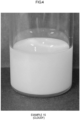
- FIG. 4 shows an appearance photograph of the slurry composition of Example 15.
- each slurry composition was allowed to stand. The presence or absence of precipitation was determined by observing the appearance of each slurry composition when 10 minutes elapsed after being left to stand.
- a transmittance ⁇ of the slurry composition of Example 2 was obtained by a method described below.
- a is the absorbance of the solids in the slurry composition.
- a n represents the absorbance of the slurry composition of Example 2
- a 0 represents the absorbance of water only (blank).
- the absorbance a n and the absorbance a 0 were measured using a UV/visible spectrophotometer under measurement conditions shown below.
- FIG. 5 shows the results of the transmittance (%) of the slurry composition of Example 2.
- the horizontal axis represents wavelength (nm), and the vertical axis represents transmittance (%).
- the maximum value of the transmittance (%) was 100%, and the minimum value of the transmittance (%) was 97.6%.
- Example 4 On the surface of a glass substrate, 2 ml of each of slurry compositions of Example 1, etc., was dropped using a pipette, and the dispersion medium was evaporated. In the case of Example 4, after the slurry composition was adhered to the surface of the substrate, UV light was applied thereto for 30 seconds. The adhesive surface of an adhesive tape was attached to the slurry composition adhered to the surface of the substrate, and then whether or not the slurry composition was peeled off from the surface of the substrate by peeling off the adhesive tape was checked with an SEM. Such a tape peeling test was performed up to 20 times for each slurry composition. If the slurry composition was peeled off when the tape peeling test was performed 3 or fewer times, the result was indicated as "1".
- FIG. 6 shows an SEM image (magnification: 500) of the La-Mo-based composite oxide particles (La-based composite oxide particles) of Comparative Example 2 adhered to the surface of the substrate.
- each of the slurry compositions of Examples 1 to 9 re-dispersion was possible in the state after 10 minutes of application of ultrasonic vibration.
- the slurry compositions of Examples 2, 3, and 4 were transparent, the slurry compositions of Examples 1, 5, and 7 were translucent, and the slurry compositions of Examples 6, 8, and 9 were cloudy.
- Each of the slurry compositions of Examples 1 to 9 was capable of being applied to the target object. Furthermore, no precipitation of the La-Mo-based composite oxide particles was observed in each of the slurry compositions of Examples 1 to 9 even after the slurry composition was allowed to stand for 10 minutes.
- the slurry composition of Comparative Example 1 was not able to be applied to the target object. This is considered to be due to the fact that the central particle diameter of the La-Mo-based composite oxide particles according to Comparative Example 1 is 2300 nm.
- the slurry composition of Comparative Example 2 was cloudy in the state after 10 minutes of application of ultrasonic vibration, and re-dispersion of the La-Mo-based composite oxide particles was possible therein. However, precipitation of the La-Mo-based composite oxide particles was observed in the state after being left to stand for 10 minutes after the end of application of ultrasonic vibration. In addition, as shown in FIG. 5 , aggregation of the La-Mo-based composite oxide particles was observed after application to the target object and drying. This is considered to be due to the fact that the concentration of the La-Mo-based composite oxide particles in the slurry composition according to Comparative Example 2 is 20 mass%.
- Example 4 containing the ultraviolet-curable resin had the most excellent fixability (adhesion) to the target object. It was also confirmed that the slurry composition of Example 3 containing the binder therein had excellent fixability (adhesion) to some extent.
- each of the slurry compositions of Examples 10 to 15 re-dispersion was possible in the state after 10 minutes of application of ultrasonic vibration, as in Example 1, etc. described above.
- the slurry compositions of Examples 10, 11, 12, and 14 were translucent as in Example 1, etc., and the slurry compositions of Examples 13 and 15 were cloudy as in Example 9, etc.
- Each of the slurry compositions of Examples 10 to 15 was capable of being applied to the target object as in Example 1, etc. Furthermore, no precipitation of the La-based composite oxide particles (La-Mo-W-based composite oxide particles, La-W-based composite oxide particles) was observed in each of the slurry compositions of Examples 10 to 15 even after the slurry composition was allowed to stand for 10 minutes.
Landscapes
- Chemical & Material Sciences (AREA)
- Organic Chemistry (AREA)
- Life Sciences & Earth Sciences (AREA)
- Engineering & Computer Science (AREA)
- Materials Engineering (AREA)
- Wood Science & Technology (AREA)
- Inorganic Chemistry (AREA)
- Plant Pathology (AREA)
- Nanotechnology (AREA)
- Inorganic Compounds Of Heavy Metals (AREA)
Applications Claiming Priority (2)
| Application Number | Priority Date | Filing Date | Title |
|---|---|---|---|
| JP2022042579 | 2022-03-17 | ||
| PCT/JP2023/009644 WO2023176781A1 (ja) | 2022-03-17 | 2023-03-13 | スラリー組成物、及びコーティング剤 |
Publications (2)
| Publication Number | Publication Date |
|---|---|
| EP4495191A1 true EP4495191A1 (de) | 2025-01-22 |
| EP4495191A4 EP4495191A4 (de) | 2026-03-04 |
Family
ID=88023787
Family Applications (1)
| Application Number | Title | Priority Date | Filing Date |
|---|---|---|---|
| EP23770736.9A Pending EP4495191A4 (de) | 2022-03-17 | 2023-03-13 | Schlammzusammensetzung und beschichtungsmittel |
Country Status (6)
| Country | Link |
|---|---|
| US (1) | US20250026940A1 (de) |
| EP (1) | EP4495191A4 (de) |
| JP (1) | JP7778914B2 (de) |
| KR (1) | KR20240070663A (de) |
| CN (1) | CN118786186A (de) |
| WO (1) | WO2023176781A1 (de) |
Families Citing this family (1)
| Publication number | Priority date | Publication date | Assignee | Title |
|---|---|---|---|---|
| JPWO2023218928A1 (de) * | 2022-05-09 | 2023-11-16 |
Family Cites Families (7)
| Publication number | Priority date | Publication date | Assignee | Title |
|---|---|---|---|---|
| CN1417127A (zh) * | 2002-12-16 | 2003-05-14 | 中国科学院长春应用化学研究所 | 稀土纳米氧化物的制备方法 |
| CN100488915C (zh) * | 2005-11-10 | 2009-05-20 | 中国科学院合肥物质科学研究院 | 钼酸镧(La2Mo2O9)基中温离子导体材料及其制备方法 |
| GB201309336D0 (en) * | 2013-05-23 | 2013-07-10 | Protia As | Proton conducing ceramic membrage |
| TWI761595B (zh) * | 2017-09-14 | 2022-04-21 | 日商住友金屬礦山股份有限公司 | 近紅外線硬化型油墨組成物、近紅外線硬化膜及其等之製造方法暨光造形法 |
| EP3825292A4 (de) * | 2018-07-18 | 2022-04-20 | Tokyo Institute of Technology | Komplexe oxidkeramik, verfahren zu ihrer herstellung und gegenstand |
| JP7469153B2 (ja) * | 2020-06-22 | 2024-04-16 | 日本特殊陶業株式会社 | ランタン・モリブデン複合酸化物粉末の製造方法及び焼結体の製造方法 |
| JP2022043763A (ja) * | 2020-09-04 | 2022-03-16 | 日本特殊陶業株式会社 | スプレー用組成物、及びスプレー製品 |
-
2023
- 2023-03-13 KR KR1020247014426A patent/KR20240070663A/ko active Pending
- 2023-03-13 WO PCT/JP2023/009644 patent/WO2023176781A1/ja not_active Ceased
- 2023-03-13 EP EP23770736.9A patent/EP4495191A4/de active Pending
- 2023-03-13 JP JP2024508158A patent/JP7778914B2/ja active Active
- 2023-03-13 CN CN202380014793.XA patent/CN118786186A/zh active Pending
- 2023-03-13 US US18/712,995 patent/US20250026940A1/en active Pending
Also Published As
| Publication number | Publication date |
|---|---|
| JPWO2023176781A1 (de) | 2023-09-21 |
| EP4495191A4 (de) | 2026-03-04 |
| WO2023176781A1 (ja) | 2023-09-21 |
| US20250026940A1 (en) | 2025-01-23 |
| KR20240070663A (ko) | 2024-05-21 |
| CN118786186A (zh) | 2024-10-15 |
| JP7778914B2 (ja) | 2025-12-02 |
Similar Documents
| Publication | Publication Date | Title |
|---|---|---|
| CN101353230B (zh) | 超低辐射率的银涂料 | |
| JP5453813B2 (ja) | 金属ナノ粒子分散液及びその製造方法 | |
| EP3252116B1 (de) | Nahinfrarotstrahlenabsorbierende mikropartikeldispersionslösung und herstellungsverfahren dafür | |
| CN103911024B (zh) | 玻璃颜料微粉、分散液、喷墨墨水与其形成方法 | |
| JPH0734021A (ja) | オフセット印刷インク | |
| EP2826825A1 (de) | Keramische Tintenstrahltinten | |
| CN110730766A (zh) | 黑色混合氧化物材料及其制造方法 | |
| WO2015003736A1 (en) | Ceramic inkjet ink | |
| EP3252115B1 (de) | Nahinfrarotstrahlenabsorbierende mikropartikeldispersionslösung und herstellungsverfahren dafür | |
| EP4495191A1 (de) | Schlammzusammensetzung und beschichtungsmittel | |
| EP3549985B1 (de) | Anti-staub- und leicht dispergierbares pigment, verfahren zur herstellung und verwendung | |
| JP2020183486A (ja) | メタリックインク及び被印刷物 | |
| JP2018098412A (ja) | 厚膜抵抗体用組成物、厚膜抵抗体用ペースト、厚膜抵抗体およびこれらの製造方法 | |
| KR890004940B1 (ko) | 두꺼운 피막 저항기 조성물 | |
| JP2011105587A (ja) | 鱗片状ガラス及びその製造方法 | |
| EP3693109A1 (de) | Silber-mikropartikel-dispersionsflüssigkeit | |
| JP2022043763A (ja) | スプレー用組成物、及びスプレー製品 | |
| JP2007297634A (ja) | インクジェット印刷用インク組成物 | |
| TWI722603B (zh) | 低溫度係數電阻膏體材料及低溫度係數電阻膜體之製備方法 | |
| JP2006188615A (ja) | 顔料油性分散液組成物およびその製造方法 | |
| EP4005979B1 (de) | Drucktinte und verfahren zur herstellung davon | |
| CN117025027B (zh) | 水性黄色聚合物墨水及其制备方法 | |
| JP2025038471A (ja) | スラリー組成物、及びコーティング剤 | |
| CN116409991A (zh) | 黑色混合氧化物材料及其制造方法 | |
| WO2008133723A2 (en) | Dispersing agent for metallic nanoparticles in an organic media |
Legal Events
| Date | Code | Title | Description |
|---|---|---|---|
| STAA | Information on the status of an ep patent application or granted ep patent |
Free format text: STATUS: THE INTERNATIONAL PUBLICATION HAS BEEN MADE |
|
| PUAI | Public reference made under article 153(3) epc to a published international application that has entered the european phase |
Free format text: ORIGINAL CODE: 0009012 |
|
| STAA | Information on the status of an ep patent application or granted ep patent |
Free format text: STATUS: REQUEST FOR EXAMINATION WAS MADE |
|
| 17P | Request for examination filed |
Effective date: 20240904 |
|
| AK | Designated contracting states |
Kind code of ref document: A1 Designated state(s): AL AT BE BG CH CY CZ DE DK EE ES FI FR GB GR HR HU IE IS IT LI LT LU LV MC ME MK MT NL NO PL PT RO RS SE SI SK SM TR |
|
| DAV | Request for validation of the european patent (deleted) | ||
| DAX | Request for extension of the european patent (deleted) | ||
| A4 | Supplementary search report drawn up and despatched |
Effective date: 20260202 |
|
| RIC1 | Information provided on ipc code assigned before grant |
Ipc: C09D 4/00 20060101AFI20260127BHEP Ipc: C09D 17/00 20060101ALI20260127BHEP Ipc: C09D 7/45 20180101ALI20260127BHEP Ipc: C09D 7/61 20180101ALI20260127BHEP Ipc: C09C 1/00 20060101ALI20260127BHEP Ipc: C09C 3/04 20060101ALI20260127BHEP Ipc: C09D 5/14 20060101ALI20260127BHEP |