EP4495072A1 - Verfahren zur herstellung von kobaltferritteilchen und damit hergestellte kobaltferritteilchen - Google Patents
Verfahren zur herstellung von kobaltferritteilchen und damit hergestellte kobaltferritteilchen Download PDFInfo
- Publication number
- EP4495072A1 EP4495072A1 EP23770879.7A EP23770879A EP4495072A1 EP 4495072 A1 EP4495072 A1 EP 4495072A1 EP 23770879 A EP23770879 A EP 23770879A EP 4495072 A1 EP4495072 A1 EP 4495072A1
- Authority
- EP
- European Patent Office
- Prior art keywords
- ferrite particles
- cobalt
- cobalt ferrite
- particles according
- producing
- Prior art date
- Legal status (The legal status is an assumption and is not a legal conclusion. Google has not performed a legal analysis and makes no representation as to the accuracy of the status listed.)
- Pending
Links
Images




Classifications
-
- C—CHEMISTRY; METALLURGY
- C01—INORGANIC CHEMISTRY
- C01G—COMPOUNDS CONTAINING METALS NOT COVERED BY SUBCLASSES C01D OR C01F
- C01G51/00—Compounds of cobalt
- C01G51/40—Complex oxides containing cobalt and at least one other metal element
-
- C—CHEMISTRY; METALLURGY
- C01—INORGANIC CHEMISTRY
- C01G—COMPOUNDS CONTAINING METALS NOT COVERED BY SUBCLASSES C01D OR C01F
- C01G51/00—Compounds of cobalt
-
- C—CHEMISTRY; METALLURGY
- C01—INORGANIC CHEMISTRY
- C01G—COMPOUNDS CONTAINING METALS NOT COVERED BY SUBCLASSES C01D OR C01F
- C01G49/00—Compounds of iron
- C01G49/02—Oxides; Hydroxides
- C01G49/08—Ferroso-ferric oxide [Fe3O4]
-
- C—CHEMISTRY; METALLURGY
- C01—INORGANIC CHEMISTRY
- C01G—COMPOUNDS CONTAINING METALS NOT COVERED BY SUBCLASSES C01D OR C01F
- C01G49/00—Compounds of iron
-
- C—CHEMISTRY; METALLURGY
- C01—INORGANIC CHEMISTRY
- C01G—COMPOUNDS CONTAINING METALS NOT COVERED BY SUBCLASSES C01D OR C01F
- C01G51/00—Compounds of cobalt
- C01G51/04—Oxides
-
- G—PHYSICS
- G03—PHOTOGRAPHY; CINEMATOGRAPHY; ANALOGOUS TECHNIQUES USING WAVES OTHER THAN OPTICAL WAVES; ELECTROGRAPHY; HOLOGRAPHY
- G03G—ELECTROGRAPHY; ELECTROPHOTOGRAPHY; MAGNETOGRAPHY
- G03G9/00—Developers
- G03G9/08—Developers with toner particles
- G03G9/083—Magnetic toner particles
-
- G—PHYSICS
- G03—PHOTOGRAPHY; CINEMATOGRAPHY; ANALOGOUS TECHNIQUES USING WAVES OTHER THAN OPTICAL WAVES; ELECTROGRAPHY; HOLOGRAPHY
- G03G—ELECTROGRAPHY; ELECTROPHOTOGRAPHY; MAGNETOGRAPHY
- G03G9/00—Developers
- G03G9/08—Developers with toner particles
- G03G9/083—Magnetic toner particles
- G03G9/0831—Chemical composition of the magnetic components
- G03G9/0833—Oxides
-
- H—ELECTRICITY
- H01—ELECTRIC ELEMENTS
- H01F—MAGNETS; INDUCTANCES; TRANSFORMERS; SELECTION OF MATERIALS FOR THEIR MAGNETIC PROPERTIES
- H01F1/00—Magnets or magnetic bodies characterised by the magnetic materials therefor; Selection of materials for their magnetic properties
- H01F1/01—Magnets or magnetic bodies characterised by the magnetic materials therefor; Selection of materials for their magnetic properties of inorganic materials
- H01F1/03—Magnets or magnetic bodies characterised by the magnetic materials therefor; Selection of materials for their magnetic properties of inorganic materials characterised by their coercivity
- H01F1/12—Magnets or magnetic bodies characterised by the magnetic materials therefor; Selection of materials for their magnetic properties of inorganic materials characterised by their coercivity of soft-magnetic materials
- H01F1/34—Magnets or magnetic bodies characterised by the magnetic materials therefor; Selection of materials for their magnetic properties of inorganic materials characterised by their coercivity of soft-magnetic materials non-metallic substances, e.g. ferrites
-
- H—ELECTRICITY
- H01—ELECTRIC ELEMENTS
- H01F—MAGNETS; INDUCTANCES; TRANSFORMERS; SELECTION OF MATERIALS FOR THEIR MAGNETIC PROPERTIES
- H01F1/00—Magnets or magnetic bodies characterised by the magnetic materials therefor; Selection of materials for their magnetic properties
- H01F1/01—Magnets or magnetic bodies characterised by the magnetic materials therefor; Selection of materials for their magnetic properties of inorganic materials
- H01F1/03—Magnets or magnetic bodies characterised by the magnetic materials therefor; Selection of materials for their magnetic properties of inorganic materials characterised by their coercivity
- H01F1/12—Magnets or magnetic bodies characterised by the magnetic materials therefor; Selection of materials for their magnetic properties of inorganic materials characterised by their coercivity of soft-magnetic materials
- H01F1/34—Magnets or magnetic bodies characterised by the magnetic materials therefor; Selection of materials for their magnetic properties of inorganic materials characterised by their coercivity of soft-magnetic materials non-metallic substances, e.g. ferrites
- H01F1/342—Oxides
- H01F1/344—Ferrites, e.g. having a cubic spinel structure (X2+O)(Y23+O3), e.g. magnetite Fe3O4
-
- H—ELECTRICITY
- H01—ELECTRIC ELEMENTS
- H01F—MAGNETS; INDUCTANCES; TRANSFORMERS; SELECTION OF MATERIALS FOR THEIR MAGNETIC PROPERTIES
- H01F1/00—Magnets or magnetic bodies characterised by the magnetic materials therefor; Selection of materials for their magnetic properties
- H01F1/44—Magnets or magnetic bodies characterised by the magnetic materials therefor; Selection of materials for their magnetic properties of magnetic liquids, e.g. ferrofluids
-
- C—CHEMISTRY; METALLURGY
- C01—INORGANIC CHEMISTRY
- C01P—INDEXING SCHEME RELATING TO STRUCTURAL AND PHYSICAL ASPECTS OF SOLID INORGANIC COMPOUNDS
- C01P2004/00—Particle morphology
- C01P2004/01—Particle morphology depicted by an image
- C01P2004/03—Particle morphology depicted by an image obtained by SEM
-
- C—CHEMISTRY; METALLURGY
- C01—INORGANIC CHEMISTRY
- C01P—INDEXING SCHEME RELATING TO STRUCTURAL AND PHYSICAL ASPECTS OF SOLID INORGANIC COMPOUNDS
- C01P2004/00—Particle morphology
- C01P2004/51—Particles with a specific particle size distribution
-
- C—CHEMISTRY; METALLURGY
- C01—INORGANIC CHEMISTRY
- C01P—INDEXING SCHEME RELATING TO STRUCTURAL AND PHYSICAL ASPECTS OF SOLID INORGANIC COMPOUNDS
- C01P2004/00—Particle morphology
- C01P2004/60—Particles characterised by their size
- C01P2004/61—Micrometer sized, i.e. from 1-100 micrometer
-
- C—CHEMISTRY; METALLURGY
- C01—INORGANIC CHEMISTRY
- C01P—INDEXING SCHEME RELATING TO STRUCTURAL AND PHYSICAL ASPECTS OF SOLID INORGANIC COMPOUNDS
- C01P2004/00—Particle morphology
- C01P2004/80—Particles consisting of a mixture of two or more inorganic phases
-
- C—CHEMISTRY; METALLURGY
- C01—INORGANIC CHEMISTRY
- C01P—INDEXING SCHEME RELATING TO STRUCTURAL AND PHYSICAL ASPECTS OF SOLID INORGANIC COMPOUNDS
- C01P2006/00—Physical properties of inorganic compounds
- C01P2006/42—Magnetic properties
-
- C—CHEMISTRY; METALLURGY
- C01—INORGANIC CHEMISTRY
- C01P—INDEXING SCHEME RELATING TO STRUCTURAL AND PHYSICAL ASPECTS OF SOLID INORGANIC COMPOUNDS
- C01P2006/00—Physical properties of inorganic compounds
- C01P2006/60—Optical properties, e.g. expressed in CIELAB-values
- C01P2006/62—L* (lightness axis)
-
- H—ELECTRICITY
- H01—ELECTRIC ELEMENTS
- H01F—MAGNETS; INDUCTANCES; TRANSFORMERS; SELECTION OF MATERIALS FOR THEIR MAGNETIC PROPERTIES
- H01F1/00—Magnets or magnetic bodies characterised by the magnetic materials therefor; Selection of materials for their magnetic properties
- H01F1/01—Magnets or magnetic bodies characterised by the magnetic materials therefor; Selection of materials for their magnetic properties of inorganic materials
- H01F1/03—Magnets or magnetic bodies characterised by the magnetic materials therefor; Selection of materials for their magnetic properties of inorganic materials characterised by their coercivity
- H01F1/032—Magnets or magnetic bodies characterised by the magnetic materials therefor; Selection of materials for their magnetic properties of inorganic materials characterised by their coercivity of hard-magnetic materials
- H01F1/10—Magnets or magnetic bodies characterised by the magnetic materials therefor; Selection of materials for their magnetic properties of inorganic materials characterised by their coercivity of hard-magnetic materials non-metallic substances, e.g. ferrites, e.g. [(Ba,Sr)O(Fe2O3)6] ferrites with hexagonal structure
- H01F1/11—Magnets or magnetic bodies characterised by the magnetic materials therefor; Selection of materials for their magnetic properties of inorganic materials characterised by their coercivity of hard-magnetic materials non-metallic substances, e.g. ferrites, e.g. [(Ba,Sr)O(Fe2O3)6] ferrites with hexagonal structure in the form of particles
Definitions
- the present invention relates to a method for producing cobalt ferrite particles and cobalt ferrite particles produced by the same and thus provides cobalt ferrite particles, particularly, having a relatively large average particle diameter and, furthermore, also having a narrow particle size distribution.
- Ferrite particles are known as a highly permeable material or a permanent magnet material.
- magnetic powders have been a new material for copier toners, magnetic inks, MR fluids, and the like, and there is an expectation of improvement in quality or performance thereof.
- cobalt ferrite is known as, among spinel ferrites, a magnetic material having a large crystal magnetic anisotropy and a large coercivity.
- cobalt is similar to iron in chemical behaviors and thus has an advantage of ease of a variety of controls in the producing process thereof.
- a method for producing ferrite particles methods such as a co-precipitation method, a wet oxidation method and a hydrothermal method are known.
- the co-precipitation method is a reaction in which two or more kinds of ions are precipitated at the same time.
- an alkali is introduced into an aqueous solution including Fe 3+ and Co 2+ ions, and then the resulting solution is heated to accelerate the reaction to thereby obtain nanosized ferrite particles.
- the reaction is performed at a temperature of 80°C to 100°C, the average particle diameter of the obtained particles is approximately 20 to 50 nm, and the particle size distribution of the obtained particles is relatively wide (Patent Literature 1).
- the wet oxidation method is a method in which an oxidant such as an air is reacted with a starting material aqueous solution including Fe 2+ and Co 2+ ions while being heated.
- an oxidant such as an air
- the reaction temperature is approximately 60°C to 100°C, and particles having a size of approximately 0.05 to 0.3 ⁇ m are obtained (Patent Literature 2 and Patent Literature 3).
- the reaction is performed at a temperature of 30°C to 100°C, and ferrite particles having a size of 3 to 20 nm are obtained (Patent Literature 4).
- the hydrothermal method is a method in which a mixture of an aqueous solution including Co 2+ ions and an aqueous solution including Fe 2+ ions is used for hydrothermal synthesis in an autoclave, and ferrite particles having relatively large particle diameters of 0.3 to 8 ⁇ m are produced by a reaction performed at a high temperature of 160°C to 300°C (Patent Literature 5).
- ferrite particles can be produced at relatively low temperatures by the co-precipitation method or the wet oxidation method, but only nanometer-order fine particles are obtained.
- hydrothermal method relatively large micrometer-order particles can be obtained, but there is a need to perform a hydrothermal reaction (Schikorr reaction) at a high temperature and a high pressure, which has a problem with facilities or costs.
- the present invention overcomes the above-described problems of the related art and provides a producing method capable of synthesizing, with a lower energy, cobalt ferrite particles having a larger average particle diameter than conventional cobalt ferrite particles and having similar particle diameters.
- the present invention also provides cobalt ferrite particles having rounded shapes and similar particle diameters produced by the above-described method.
- Cobalt ferrite particles obtained by the producing method of the present invention have round shapes and similar particle diameters and are thus expected to be used in applications of copier toners, magnetic inks, and MR fluids.
- the cobalt ferrite particles of the present invention can be turned into a white powder having a high brightness by whitening the cobalt ferrite particles by a known method or a powder colored with a bright color by further providing a colored layer.
- the present invention is characterized in that a ferrite precursor is formed of a divalent iron salt and a cobalt salt, and the ferrite precursor is thermally treated under a high-temperature and high-pressure condition in the presence of a complexing agent.
- a divalent iron salt and a cobalt salt are dissolved in deionized and deaerated water to prepare a starting material aqueous solution.
- the divalent iron salt that is used in the method of the present invention is not particularly limited, and examples thereof include iron(II) sulfate, iron(II) chloride, iron(II) nitrate and iron(II) acetate. Iron wash waste liquid or the like from shaft furnaces or electric furnaces is also preferable as an inexpensive starting material.
- the cobalt salt is also not particularly limited and may be any divalent cobalt salt, and examples thereof include cobalt(II) sulfate, cobalt(II) chloride, cobalt(II) nitrate, cobalt(II) acetate, and others.
- iron(II) sulfate or iron(II) chloride is preferable as the divalent iron salt, and cobalt(II) sulfate or cobalt(II) chloride is preferable as the divalent cobalt salt.
- a trivalent iron salt may be added to the starting material aqueous solution, as described in the section on adjustment of particle diameters below.
- the trivalent iron salt is not particularly limited, and examples thereof include iron(III) chloride, iron(III) sulfate and iron(III) nitrate, and others.
- the reason for the use of the deionized and deaerated water is that the charge state of the metallic ions including iron dissolved in the solution is prevented from being affected by a dissolved salt or oxygen. For example, it is known that, when free oxygen is present in the reaction system, divalent iron is oxidized to trivalent iron, and that fine particles having unintended particle diameters are generated.
- an alkali and a complexing agent are dissolved in deionized and deaerated water to prepare an alkaline aqueous solution. After that, the starting material aqueous solution and the alkaline aqueous solution are mixed together.
- an arbitrary alkali such as sodium hydroxide, potassium hydroxide, calcium hydroxide or ammonia is selected.
- the starting material aqueous solution and the alkaline aqueous solution are preferably mixed in the order as described above.
- the pH of the liquid mixture is preferably adjusted to approximately 7 to 13.
- the present invention is, as described above, characterized in that the ferrite precursor is made into a complex with the complexing agent before a thermal treatment to protect the ferrite precursor from being oxidized by an oxidant.
- citrate citrate, nitrilotriacetate, or malate are used, for example.
- a ferrite generation reaction in the present invention is considered to progress as described below.
- the complex that protects the ferrite precursor gradually decomposes, and the ferrite precursor is likely to receive an oxidation action.
- an oxidant such as sodium nitrate may be added thereto in order to uniformly accelerate an oxidation reaction for forming a ferrite.
- the ferrite precursor is oxidized by the oxidation action of the oxidant in a case where the ferrite precursor is under the environment involving the oxidant, or even in a case where there is no oxidant, the ferrite precursor is oxidized by an action of a hydrothermal environment. Thus, a ferrite is formed.
- the progress of the oxidation reaction of the ferrite precursor in a thermal treatment under hydrothermal conditions can be delayed by the complexation action of the complexing agent. This makes it possible to increase the particle diameters of ferrite particles to be synthesized and, furthermore, makes it possible to produce particles having similar particle diameters.
- a thermal treatment by a hydrothermal method is performed using a pressure vessel.
- the pressure vessel used in the present invention may be an ordinary high-pressure reaction container, and examples thereof include an autoclave, a pressure cooker and a boiler.
- An autoclave is preferable due to versatility, for example.
- magnetic particles of cobalt ferrite can be synthesized within a temperature range of approximately 130°C to 300°C, preferably 130 to 280°C, more preferably 130 to 260°C, and more preferably 130 to 240°C by selecting the complexing agent.
- the reaction rate of cobalt ferrite particles can be increased to approximately 90% when heat treated at a higher temperature than 190°C, e.g., 200°C.
- the temperature of the heat treatment is preferably higher than 190°C and lower than 300°C.
- the reaction temperature is preferably between 190 to 270°C, and more preferably between 190 to 260°C.
- a trivalent iron salt can be added to the starting material aqueous solution (the aqueous solution of the divalent iron salt and the cobalt salt) to add the trivalent iron salt to the aqueous solution containing the divalent iron salt and the cobalt salt stabilized by the complexing agent, whereby the particle diameters of cobalt ferrite particles can be adjusted.
- the trivalent iron ions of the trivalent iron salt act as nuclei for the formation of ferrite particles, a ferrite formation reaction is accelerated, regardless of the presence or absence of the oxidant, and the particle diameters of ferrite particles to be produced can be adjusted.
- the trivalent iron salt used herein is not particularly limited, and examples thereof include iron(III) chloride, iron(III) sulfate and iron(III) nitrate. Iron wash waste liquid or the like from shaft furnaces or electric furnaces is also preferable as an inexpensive starting material.
- a pH buffer can be added to the alkaline aqueous solution (the aqueous solution of the alkali and the complexing agent) to add the pH buffer to the aqueous solution containing the divalent iron salt and the cobalt salt stabilized by the complexing agent, whereby the particle diameters of cobalt ferrite particles can be adjusted.
- the ferrite generation reaction is a reaction accompanying a decrease in the pH, and the decrease in the pH suppresses the decomposition of the ferrite precursor to thereby suppresses the ferrite generation reaction. Therefore, the pH buffer can be added thereto in order to suppress a decrease in the pH, whereby the growth of ferrite particles can be accelerated.
- the pH buffer used herein is selected from boric acid and sodium carbonate/sodium hydrogen carbonate.
- Nuclei that are the base on which the cobalt ferrite particles are deposited, can be provided by adding seed particles onto the ferrite precursor. Whereby the particle diameters of the cobalt ferrite particles can be adjusted.
- the seed particle used herein is not particularly limited, and is selected from inorganic compounds that are insoluble in water, such as metals, alloys, and oxides. Particularly, due to its affinity with cobalt ferrite, iron oxide is preferred. Magnetite can be used as iron oxide.
- the alkaline aqueous solution or the ferrite precursor (complex) can be press-injected into the pressure vessel in the middle of the thermal treatment step or after the end of the thermal treatment step, followed by further continuing the thermal treatment, whereby the particle diameters of cobalt ferrite particles can be adjusted.
- the alkaline aqueous solution is not particularly limited and can be appropriately selected from sodium hydroxide, potassium hydroxide, calcium hydroxide, and ammonia.
- Press-injecting of the ferrite precursor is equivalent to addition of a starting material for forming ferrites, which makes it possible to accelerate the particle growth of ferrite particles.
- the method for producing the ferrite precursor is as described above.
- Cobalt ferrite particles produced in the present invention are magnetic particles having relatively large particle diameters with an average particle diameter of 5 to 50 ⁇ m.
- the cobalt ferrite particles are particles having rounded shapes and similar particle diameters.
- the aspect ratio of the cobalt ferrite particles is almost 1.
- one embodiment of the cobalt ferrite particle is a particle having a core-shell structure.
- the cobalt ferrite particles of the present invention have relatively large particle diameters, are rounded and also have a narrow width of the particle size distribution. Therefore, the cohesive property between the particles is weak, and the cobalt ferrite particles can be closely packed when molded, which makes it possible to improve the magnetic characteristics of a molded article or makes it possible to increase the bulk density. Moreover, the particle surfaces are moderately uneven, which makes it easier for pigments to adhere to the particles when used as a magnetic ink, compared to spherical particles with a smooth surface.
- the cobalt ferrite particles are capable of sufficiently exhibiting the characteristics.
- the cobalt ferrite particles of the present invention can be made into a white powder by whitening or can be made into a colored powder by being whitened and then further provided with a colored layer.
- the cobalt ferrite particles can be whitened by a known method, but are desirably whitened by, for example, a whitening method ( Japanese Patent No. 4113045 ), which is patented by the present applicants.
- This whitening method is a method for whitening powder by providing a titanium oxide film between a base particle and a metallic silver film.
- the cobalt ferrite particles can be whitened by forming a titanium oxide film on the surface of the cobalt ferrite particle by the hydrolysis of a titanium alkoxide (for example, International Publication No. WO 96/28269 ), a reaction from a titanium salt aqueous solution (for example, Japanese Patent Laid-Open No. 11-131102 ), or the like and then forming a metallic silver film by a known method such as an electroless plating method.
- a titanium alkoxide for example, International Publication No. WO 96/28269
- a reaction from a titanium salt aqueous solution for example, Japanese Patent Laid-Open No. 11-131102
- This method makes it possible to produce a white powder having a titanium oxide film and a metallic silver film in this order on the surface of the cobalt ferrite particle of the present invention and consequently makes it possible to improve the brightness L* of the cobalt ferrite particle to 75 or higher.
- the standard deviation is used as one of measure for variations in data distribution; however, currently, the standard deviation is standardized by dividing it by the arithmetic average value of the data to evaluate a variation in data.
- This is the CV value, which is a coefficient of variation, and, in the present invention as well, the CV value is used to evaluate the fact that the particle diameters of the formed cobalt ferrite particles vary to a small extent.
- a small CV value indicates that the variation in the particle size distribution is small.
- particles having a CV value of 0.1 or less are considered as monodisperse particles, and the characteristics thereof are attracting attention.
- the magnetic characteristics of the cobalt ferrite particles of the present invention were evaluated by a vibrating sample magnetometer (VSM) (Tamagawa Manufacturing Co., Ltd., model number "TM-VSM101483N7-MRO").
- VSM vibrating sample magnetometer
- a hysteresis curve or a demagnetization curve was obtained at a maximum magnetic field of 10,000 Oe, and a saturation magnetic moment, a residual magnetic moment, and a coercivity were measured.
- the starting material aqueous solution and the complexing agent aqueous solution were mixed in a N 2 -purged container, and then the alkaline aqueous solution was added thereto to adjust the pH to 10, thereby preparing a precursor.
- the precursor was put into a N 2 -purged autoclave and hydrothermally treated under stirring at 190°C for 20 hours, thereby obtaining magnetic particles.
- the magnetic particles were filtered and washed with passing deionized water.
- the washed magnetic particles were dried at 110°C in the atmosphere for two hours.
- Magnetic particles were produced under the same conditions as in Example 1 except that sodium nitrate added as an oxidant in Example 1 was not used.
- Magnetic particles were produced under the same conditions as in Example 1, except that the pH, that was adjusted to 10 by the addition of the alkaline aqueous solution in (5) of Example 1, was changed to 8; and the hydrothermal treatment time in (6) of Example 1 was changed to 40 hours.
- Magnetic particles were produced under the same conditions as in Example 1 except that
- Magnetic particles were produced under the same conditions as in Example 1 except that
- Magnetic particles were produced under the same conditions as in Example 1 except that
- Magnetic particles were produced under the same conditions as in Example 1 except that
- Magnetic particles were produced under the same conditions as in Example 1 except that
- Magnetic particles were produced under the same conditions as in Example 1 except that
- Magnetic particles were produced under the same conditions as in Example 1 except that the amounts of deionized water and the flow rate of N 2 in (1) of Example 1 were changed to 12000.0 g and 10 L/min, respectively;
- Magnetic particles were produced under the same conditions as in Example 1 except that
- Magnetic particles were produced under the same conditions as in Example 1 except that the complexing agent and the oxidant used in Example 1 were not used.
- the reaction rate in the table is basically calculated according to the following formula A.
- Examples 6 and 7 and Reference Examples 1 and 2 were calculated according to Formula B. This is because the magnetic particles were obtained by partially removing the contents from the autoclave during heating, so it was not appropriate to use Formula A, which uses the cobalt ferrite yield when the total amount of precursor reacts completely, as the denominator.
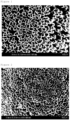
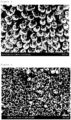
- the ferrite particles were formed by performing the thermal treatment on the ferrite precursor stabilized by the complexing agent, and the obtained particles were ferrite particles having a large average particle diameter with a small variation in the particle diameters. Since the CV values were 0.15, 0.17, 0.16, 0.21, 0.23, 0.24, 0.22, 0.20and 0.20, the particles were nearly monodispersed particles.
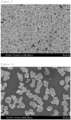
- Figure 1 to Figure 9 are SEM photographs of the powder samples of Examples 1 to 9
- Figures 10 and 11 are SEM photographs of the powder samples from Reference Examples 1 and 2, respectively
- Figure 12 is an SEM photograph of a powder sample from Comparative Example 1.
- Example 5 showed that the reaction rate of the powder sample was 91.4% by adjusting the reaction temperature to 200°C. Thus, it was shown that the reaction rate of the powder sample was improved by increasing the reaction temperature higher than 190°C.
- Figure 13A shows a conceptual cross-sectional view of the powder of Example 6, and as a representative example of particles with seed particles, Figure 13B shows a conceptual cross-sectional view of the powder of Example 9.
- the particles were confirmed to have a core-shell structure with a core section consisting of multiple nanoparticles and a shell section with a series of rounded protrusions on the surface.
- particle size shall refer to the diameter of the outermost shell of the core-shell structured particles, as indicated by the arrow A in Figure 13A .
- 1.2 g of glucose, 0.12 g of tartaric acid, and 2.12 g of ethanol were dissolved in 26.56 g of deionized water to prepare a reduction liquid.
- 1.25 g of sodium hydroxide, 1.75 g of silver nitrate, and 3 g of aqueous ammonia were mixed with 90 g of deionized water to prepare a silver ammine complex solution, and 6.3 g of the titanium oxide-coated powder was suspended in the silver ammine complex solution.
- the reduction liquid was mixed with the suspension while the suspension is irradiated with ultrasonic waves, and the suspended solids were dried, thereby obtaining a silver film-coated powder.
- the obtained white powder had a brightness L* of 79.98.
- Cobalt ferrite particles obtained by the producing method of the present invention have round shapes and similar particle diameters and are thus expected to be used in applications of copier toners, magnetic inks, and MR fluids.
Landscapes
- Chemical & Material Sciences (AREA)
- Organic Chemistry (AREA)
- Inorganic Chemistry (AREA)
- Engineering & Computer Science (AREA)
- Power Engineering (AREA)
- Physics & Mathematics (AREA)
- General Physics & Mathematics (AREA)
- Dispersion Chemistry (AREA)
- Compounds Of Iron (AREA)
Applications Claiming Priority (3)
| Application Number | Priority Date | Filing Date | Title |
|---|---|---|---|
| JP2022042172 | 2022-03-17 | ||
| JP2023036445A JP2023138411A (ja) | 2022-03-17 | 2023-03-09 | コバルトフェライト粒子の製造方法とそれにより製造されたコバルトフェライト粒子 |
| PCT/JP2023/010313 WO2023176926A1 (ja) | 2022-03-17 | 2023-03-16 | コバルトフェライト粒子の製造方法とそれにより製造されたコバルトフェライト粒子 |
Publications (2)
| Publication Number | Publication Date |
|---|---|
| EP4495072A1 true EP4495072A1 (de) | 2025-01-22 |
| EP4495072A4 EP4495072A4 (de) | 2026-03-18 |
Family
ID=88023335
Family Applications (1)
| Application Number | Title | Priority Date | Filing Date |
|---|---|---|---|
| EP23770879.7A Pending EP4495072A4 (de) | 2022-03-17 | 2023-03-16 | Verfahren zur herstellung von kobaltferritteilchen und damit hergestellte kobaltferritteilchen |
Country Status (4)
| Country | Link |
|---|---|
| US (1) | US20250197243A1 (de) |
| EP (1) | EP4495072A4 (de) |
| KR (1) | KR20240163102A (de) |
| WO (1) | WO2023176926A1 (de) |
Families Citing this family (1)
| Publication number | Priority date | Publication date | Assignee | Title |
|---|---|---|---|---|
| JP7454425B2 (ja) * | 2019-05-24 | 2024-03-22 | 日鉄鉱業株式会社 | コバルトフェライト粒子の製造方法とそれにより製造されたコバルトフェライト粒子 |
Family Cites Families (15)
| Publication number | Priority date | Publication date | Assignee | Title |
|---|---|---|---|---|
| GB1472418A (en) | 1974-10-16 | 1977-05-04 | Armstrong Whitworth Co Ltd Sir | Compression ignition internal combustion engine |
| JPS6047722A (ja) | 1983-08-15 | 1985-03-15 | フオ−ド モ−タ− カンパニ− | 車両ドア |
| JPS6291424A (ja) | 1985-04-02 | 1987-04-25 | Toda Kogyo Corp | 球型を呈したスピネル型フエライト粒子粉末及びその製造法 |
| JPH0324412A (ja) | 1989-06-21 | 1991-02-01 | Nissan Motor Co Ltd | 車両用位置表示装置 |
| JPH05275224A (ja) | 1992-03-24 | 1993-10-22 | Nippon Steel Corp | 粒径の整った(Zn,Mn,Ni)フェライト粒子の製造方法 |
| JPH0633116A (ja) * | 1992-07-15 | 1994-02-08 | Fuji Photo Film Co Ltd | 磁気記録媒体用強磁性金属粉末及びその製造方法 |
| ATE242072T1 (de) | 1995-03-14 | 2003-06-15 | Nittetsu Mining Co Ltd | Pulver mit mehrschichtigen filmen auf der oberfläche und verfahren zu dessen herstellung |
| JP3737617B2 (ja) | 1997-10-30 | 2006-01-18 | 日鉄鉱業株式会社 | 膜被覆粉体の製造方法 |
| JP4138344B2 (ja) | 2002-03-20 | 2008-08-27 | 和幸 田路 | 単結晶コバルトフェライト微粒子粉末の製造方法 |
| JP4113045B2 (ja) | 2003-05-26 | 2008-07-02 | 日鉄鉱業株式会社 | 白色粉体およびその製造方法 |
| JP5504399B2 (ja) | 2007-08-30 | 2014-05-28 | 国立大学法人東京工業大学 | フェライト微粒子の製造方法、フェライト微粒子、及びフェライト微粒子の製造装置 |
| CN102633307A (zh) * | 2012-04-19 | 2012-08-15 | 上海交通大学 | 一种水热制备单分散空心磁性纳米粒子的方法 |
| CN107032412A (zh) * | 2017-04-21 | 2017-08-11 | 哈尔滨工业大学 | 一种钴铁氧体磁性纳米颗粒的制备方法 |
| JP7500245B2 (ja) * | 2019-04-25 | 2024-06-17 | 日鉄鉱業株式会社 | コバルトフェライト粒子の製造方法とそれにより製造されたコバルトフェライト粒子 |
| JP7454425B2 (ja) * | 2019-05-24 | 2024-03-22 | 日鉄鉱業株式会社 | コバルトフェライト粒子の製造方法とそれにより製造されたコバルトフェライト粒子 |
-
2023
- 2023-03-16 WO PCT/JP2023/010313 patent/WO2023176926A1/ja not_active Ceased
- 2023-03-16 EP EP23770879.7A patent/EP4495072A4/de active Pending
- 2023-03-16 KR KR1020247033431A patent/KR20240163102A/ko active Pending
- 2023-03-16 US US18/846,978 patent/US20250197243A1/en active Pending
Also Published As
| Publication number | Publication date |
|---|---|
| EP4495072A4 (de) | 2026-03-18 |
| US20250197243A1 (en) | 2025-06-19 |
| KR20240163102A (ko) | 2024-11-18 |
| WO2023176926A1 (ja) | 2023-09-21 |
Similar Documents
| Publication | Publication Date | Title |
|---|---|---|
| Hufschmid et al. | Synthesis of phase-pure and monodisperse iron oxide nanoparticles by thermal decomposition | |
| EP3978443B1 (de) | Kobaltferritpartikelherstellungsverfahren und dadurch hergestellte kobaltferritpartikel | |
| US20250282637A1 (en) | Method for producing cobalt ferrite particles and cobalt ferrite particles produced by same | |
| EP4495072A1 (de) | Verfahren zur herstellung von kobaltferritteilchen und damit hergestellte kobaltferritteilchen | |
| JP2023138411A (ja) | コバルトフェライト粒子の製造方法とそれにより製造されたコバルトフェライト粒子 | |
| JPH0368923B2 (de) | ||
| JP2756845B2 (ja) | 六面体を呈したマグネタイト粒子粉末及びその製造法 | |
| JP3427871B2 (ja) | コバルト被着型針状磁性酸化鉄粒子粉末 | |
| JP4780856B2 (ja) | 粒状マグネタイト粒子及びその製造方法 | |
| CN118843604A (zh) | 钴铁氧体颗粒的制造方法和由此制造的钴铁氧体颗粒 | |
| JPH10259026A (ja) | 針状ゲーサイト微粒子の製造方法 | |
| WO2025058010A1 (ja) | 種粒子とコバルトフェライト粒子の複合粒子及びその製造方法 | |
| JP2026052884A (ja) | 種粒子とコバルトフェライト粒子の複合粒子及びその製造方法 | |
| JP3087778B2 (ja) | 針状ゲータイト粒子粉末の製造法 | |
| JP3087777B2 (ja) | 針状ゲータイト粒子粉末の製造法 | |
| JP2883962B2 (ja) | 針状ゲータイト粒子粉末の製造法 | |
| JP3087780B2 (ja) | 針状ゲータイト粒子粉末の製造法 | |
| JPS61140110A (ja) | 磁気記録材料用針状α−FeOOHの製造方法 | |
| JPH061618A (ja) | 針状ゲータイト粒子粉末の製造法 | |
| JPS6172628A (ja) | 短冊状を呈したゲ−タイト粒子粉末の製造法 | |
| JPH10259025A (ja) | 針状ゲーサイト微粒子の製造方法 |
Legal Events
| Date | Code | Title | Description |
|---|---|---|---|
| STAA | Information on the status of an ep patent application or granted ep patent |
Free format text: STATUS: THE INTERNATIONAL PUBLICATION HAS BEEN MADE |
|
| PUAI | Public reference made under article 153(3) epc to a published international application that has entered the european phase |
Free format text: ORIGINAL CODE: 0009012 |
|
| STAA | Information on the status of an ep patent application or granted ep patent |
Free format text: STATUS: REQUEST FOR EXAMINATION WAS MADE |
|
| 17P | Request for examination filed |
Effective date: 20241001 |
|
| AK | Designated contracting states |
Kind code of ref document: A1 Designated state(s): AL AT BE BG CH CY CZ DE DK EE ES FI FR GB GR HR HU IE IS IT LI LT LU LV MC ME MK MT NL NO PL PT RO RS SE SI SK SM TR |
|
| DAV | Request for validation of the european patent (deleted) | ||
| DAX | Request for extension of the european patent (deleted) | ||
| A4 | Supplementary search report drawn up and despatched |
Effective date: 20260216 |
|
| RIC1 | Information provided on ipc code assigned before grant |
Ipc: C01G 51/00 20250101AFI20260210BHEP Ipc: G03G 9/083 20060101ALI20260210BHEP Ipc: C01G 51/04 20250101ALI20260210BHEP Ipc: C01G 51/40 20250101ALI20260210BHEP |