EP4459010A1 - Fabrication d'une électrode en mousse d'oxyde hydroxyde de nickel activée stable - Google Patents
Fabrication d'une électrode en mousse d'oxyde hydroxyde de nickel activée stable Download PDFInfo
- Publication number
- EP4459010A1 EP4459010A1 EP23171120.1A EP23171120A EP4459010A1 EP 4459010 A1 EP4459010 A1 EP 4459010A1 EP 23171120 A EP23171120 A EP 23171120A EP 4459010 A1 EP4459010 A1 EP 4459010A1
- Authority
- EP
- European Patent Office
- Prior art keywords
- metal electrode
- nickel
- electrode
- metal
- base
- Prior art date
- Legal status (The legal status is an assumption and is not a legal conclusion. Google has not performed a legal analysis and makes no representation as to the accuracy of the status listed.)
- Pending
Links
Images

Classifications
-
- C—CHEMISTRY; METALLURGY
- C25—ELECTROLYTIC OR ELECTROPHORETIC PROCESSES; APPARATUS THEREFOR
- C25B—ELECTROLYTIC OR ELECTROPHORETIC PROCESSES FOR THE PRODUCTION OF COMPOUNDS OR NON-METALS; APPARATUS THEREFOR
- C25B3/00—Electrolytic production of organic compounds
- C25B3/01—Products
- C25B3/07—Oxygen containing compounds
-
- C—CHEMISTRY; METALLURGY
- C25—ELECTROLYTIC OR ELECTROPHORETIC PROCESSES; APPARATUS THEREFOR
- C25B—ELECTROLYTIC OR ELECTROPHORETIC PROCESSES FOR THE PRODUCTION OF COMPOUNDS OR NON-METALS; APPARATUS THEREFOR
- C25B1/00—Electrolytic production of inorganic compounds or non-metals
- C25B1/01—Products
- C25B1/02—Hydrogen or oxygen
- C25B1/04—Hydrogen or oxygen by electrolysis of water
-
- C—CHEMISTRY; METALLURGY
- C25—ELECTROLYTIC OR ELECTROPHORETIC PROCESSES; APPARATUS THEREFOR
- C25B—ELECTROLYTIC OR ELECTROPHORETIC PROCESSES FOR THE PRODUCTION OF COMPOUNDS OR NON-METALS; APPARATUS THEREFOR
- C25B11/00—Electrodes; Manufacture thereof not otherwise provided for
- C25B11/02—Electrodes; Manufacture thereof not otherwise provided for characterised by shape or form
- C25B11/03—Electrodes; Manufacture thereof not otherwise provided for characterised by shape or form perforated or foraminous
- C25B11/031—Porous electrodes
-
- C—CHEMISTRY; METALLURGY
- C25—ELECTROLYTIC OR ELECTROPHORETIC PROCESSES; APPARATUS THEREFOR
- C25B—ELECTROLYTIC OR ELECTROPHORETIC PROCESSES FOR THE PRODUCTION OF COMPOUNDS OR NON-METALS; APPARATUS THEREFOR
- C25B11/00—Electrodes; Manufacture thereof not otherwise provided for
- C25B11/04—Electrodes; Manufacture thereof not otherwise provided for characterised by the material
- C25B11/042—Electrodes formed of a single material
-
- C—CHEMISTRY; METALLURGY
- C25—ELECTROLYTIC OR ELECTROPHORETIC PROCESSES; APPARATUS THEREFOR
- C25B—ELECTROLYTIC OR ELECTROPHORETIC PROCESSES FOR THE PRODUCTION OF COMPOUNDS OR NON-METALS; APPARATUS THEREFOR
- C25B3/00—Electrolytic production of organic compounds
- C25B3/20—Processes
- C25B3/23—Oxidation
-
- C—CHEMISTRY; METALLURGY
- C25—ELECTROLYTIC OR ELECTROPHORETIC PROCESSES; APPARATUS THEREFOR
- C25D—PROCESSES FOR THE ELECTROLYTIC OR ELECTROPHORETIC PRODUCTION OF COATINGS; ELECTROFORMING; APPARATUS THEREFOR
- C25D11/00—Electrolytic coating by surface reaction, i.e. forming conversion layers
- C25D11/02—Anodisation
- C25D11/34—Anodisation of metals or alloys not provided for in groups C25D11/04 - C25D11/32
-
- C—CHEMISTRY; METALLURGY
- C25—ELECTROLYTIC OR ELECTROPHORETIC PROCESSES; APPARATUS THEREFOR
- C25D—PROCESSES FOR THE ELECTROLYTIC OR ELECTROPHORETIC PRODUCTION OF COATINGS; ELECTROFORMING; APPARATUS THEREFOR
- C25D9/00—Electrolytic coating other than with metals
- C25D9/04—Electrolytic coating other than with metals with inorganic materials
- C25D9/06—Electrolytic coating other than with metals with inorganic materials by anodic processes
-
- H—ELECTRICITY
- H01—ELECTRIC ELEMENTS
- H01M—PROCESSES OR MEANS, e.g. BATTERIES, FOR THE DIRECT CONVERSION OF CHEMICAL ENERGY INTO ELECTRICAL ENERGY
- H01M4/00—Electrodes
- H01M4/02—Electrodes composed of, or comprising, active material
- H01M4/24—Electrodes for alkaline accumulators
- H01M4/32—Nickel oxide or hydroxide electrodes
Definitions
- the invention relates to a method with which metal electrodes and metal foam electrodes, in particular nickel electrodes and especially nickel foam electrodes, can be electrochemically activated.
- the invention also relates to metal electrodes and metal foam electrodes, in particular nickel electrodes and especially nickel foam electrodes, which were obtained by the method for electrochemical activation.
- the invention relates to the use of the metal electrodes and metal foam electrodes activated by the method according to the invention, in particular nickel electrodes and especially nickel foam electrodes, in electrochemical reactions, electrolysis of organic compounds, catalysis of organochemical reactions and water electrolysis.
- Metal electrodes and metal foam electrodes, especially nickel electrodes and especially nickel foam electrodes, are in great demand in a wide range of applications due to their high porosity, conductivity, mechanical stability and chemical resistance.
- the disadvantage of this known activation method is the low reproducibility, especially for cleaned nickel foam electrodes.
- the conventional activation method does not reproducibly produce stable nickel oxyhydroxides, especially for nickel foam electrodes that are cleaned after electrochemical oxidation.
- pole changer is required. This significantly increases the complexity of the electronic periphery of the usual galvanostatic setup.
- two nickel electrodes are required, although only one is used for the subsequent electrochemical reaction. Half of the deposited nickel species is therefore on an electrode that will not be used in the reaction, since only the last anodically polarized electrode has an outer NiO(OH) layer.
- the method according to the invention enables the efficient activation of a single metal electrode, in particular a nickel electrode or nickel foam electrode, undivided and in direct current, without requiring a polarity reversal of two metal electrodes, in particular two nickel electrodes.
- a pole changer can be omitted when using the method according to the invention, so that the structure of the system is simplified.
- the method according to the invention enables a reproducible activation of metal foam electrodes, in particular nickel foam electrodes, after their use in electroorganic oxidations. Cleaning foam electrodes is more difficult than plate electrodes, which is why the previous method seemed less suitable for their activation. These cannot be easily polished, as is the case with plate electrodes.
- the method claimed according to the invention thus offers very good access to activated nickel surfaces, with increased reproducibility when using cleaned nickel foams or nickel foam electrodes.
- the method according to the invention enables the reproducible activation of (cleaned) nickel foams and nickel plate electrodes. Depending on the extent of the contamination, this can extend the service life of the electrodes.
- Activated nickel foams are essential for the successful electrochemical oxidation of many substances, including (a)cyclic alcohols and ketones ( H.-J. Schulfer, Electrochem. Top. Curr. Chem. 1987, 142, 101-129 ).
- the present invention therefore allows a flexible and simplified method to activate nickel foams.
- a further advantage of the process according to the invention is that only very small volumes of a base are required to wet the metal electrode, in particular the nickel electrode, and the base used can also be used continuously for this purpose. Further advantages include the flexibility in using different activation solutions, the suitability of the reaction conditions for industrially relevant scaling of the activation and the possibility of using the large activated nickel surface for various applications, such as in catalysis or electrolysis / battery technology.
- the method according to the invention also enables the use of used nickel foams for electroorganic oxidation on activated nickel surfaces. Activation in direct current enables controlled, rapid activation and avoids the deposited nickel residues on the second electrode.
- Figure 1 shows on the left a scanning electron microscope image (SEM) of the activated nickel oxyhydroxide surface using the conventional activation method (taken from GWD Briggs, E. Jones, WFK Wynne-Jones, Trans. Faraday Soc. 1955, 51, 1433-1442 ) and on the right an SEM image of the activated surface obtained using the method according to the invention.
- SEM scanning electron microscope image
- a fine-pored fiber network is visible in both cases.
- the conventional activation method therefore did not reproducibly produce stable nickel oxyhydroxides in nickel foams that were cleaned after electrochemical oxidation. This was evident from a purely visual point of view, as there was no black coloration.
- Figure 2 illustrates a flow electrolysis cell for carrying out a process using an activated metal electrode according to the present invention.
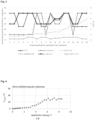
- Figure 3 shows a graphical evaluation of the parameter results with a plot corresponding to the qNMR yields of 3-ethyladipic acid after the electrochemical oxidation of 4-ethylcyclohexanol using an activated metal electrode according to the present invention.
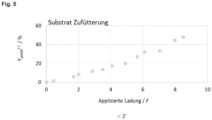
- Figures 4 and 5 illustrate the qNMR yield change of 3-propyladipic acid without and with addition of 4-propylcyclohexanone over the course of the applied charge using an activated metal electrode according to the present invention.
- Bringing the metal electrode into contact with base has a dual function: on the one hand, it cleans the surface and, on the other hand, it accelerates the rapid formation of a metal oxyhydroxide layer, in particular a nickel oxyhydroxide layer, on the surface.
- Ni(O)OH nickel oxyhydroxide anodes
- step (b) the activation of the metal electrode pretreated according to step (a) takes place without reversing the polarity of the electrode.
- Electrodes based on nickel, cobalt and optionally iron are preferably used as metal electrodes in the process according to the invention, wherein the metal electrode preferably comprises 0 to 100% by weight of nickel and 100 to 0% by weight of cobalt, in each case based on the total content of nickel and cobalt in the electrode, or 10 to 100% by weight of nickel and 0 to 90% by weight of iron, in each case based on the total content of nickel and iron in the electrode.
- the content of other metals in the metal electrode is preferably equal to or less than 10 wt.%, particularly preferably equal to or less than 5 wt.%, very particularly preferably equal to or less than 2 wt.% and even more preferably equal to or less than 1 wt.%, each based on the total metal content.
- the metal electrode contains at most up to 1 wt.% each, particularly preferably at most up to 0.1 wt.% each and even more preferably at most 0.01 wt.% each of V, Wo and Mo. It should be noted that these metals are subject to corrosion, particularly in alkaline-aqueous emulsions.
- metal electrodes which contain at least 80% by weight, preferably at least 90% by weight, particularly preferably at least 95% by weight, of nickel, in each case based on the total weight of the metals in the electrode.
- the metals in nickel and/or cobalt and optionally iron can be present in the metal electrode on a substrate, wherein the substrate is in particular at least one material selected from the group consisting of steel, copper, titanium and carbon, preferably graphite.
- the metal electrode can preferably be doped with at least one element of the 5th and/or 6th main group, particularly preferably with one or more elements, preferably an element which is/are selected from the group consisting of phosphorus, arsenic, selenium and sulfur.
- the doping content information refers to the elemental state of the doping relative to the mass of the metal of the electrode.
- the metal electrode is doped with phosphorus, it can preferably contain 2 to 10 wt.% phosphorus, particularly preferably 3 to 9 wt.% and very particularly preferably 4 to 9 wt.%, with phosphorus being considered as an element in each case and related to the metal mass of the electrode.
- the determination of the phosphorus doping content can preferably be carried out according to DIN EN ISO 5427, Appendix D.1
- the metal electrode has a thickness of several millimeters, more preferably more than 3 mm, further more preferably more than 5 mm and particularly preferably equal to or thicker than 6 mm.
- a Ni(O)OH foam electrode is used as the metal electrode, which preferably contains at least 80% by weight, particularly preferably at least 85, 90, 95, 98 or 99% by weight, very particularly preferably at least 99.9, and even more preferably at least 99.99% by weight of nickel, in each case based on the metal content of the Ni(O)OH foam electrode.
- the metal electrode is pretreated by bringing it into contact with base, preferably at least one inorganic base and/or at least one organic base.
- one or more bases preferably one base, independently selected from the group consisting of N(R A ) 4 OH, N(R A ) 4 acetate, where R A is each independently H or C 1-4 alkyl, linear or branched, NaOH, sodium acetate, KOH, potassium acetate, LiOH, lithium acetate, Na 2 CO 3 , K 2 CO 3 and Li 2 CO 3 are used, particularly preferably selected from the group consisting of NaOH and KOH.
- the base is preferably used in aqueous solution in the contacting step, the concentration of the base preferably being 10 mM to 10 M, particularly preferably 0.2 to 5 M, very particularly preferably 0.5 to 1.5 M and even more preferably 1 ⁇ 0.1 M.
- Bringing the metal electrode into contact with the base can be done in particular by spraying, immersion, jet or flow.
- the metal electrode and the base can be brought into contact with one another over a wider temperature range.
- the metal electrode is preferably brought into contact with the base at a temperature of 10 to 40°C, particularly preferably at 18 to 27°C.
- an activation of the metal electrode can advantageously be carried out, wherein one or more salts of nickel and/or cobalt and optionally iron are particularly suitable for this step.
- salts of nickel or cobalt are used, the salts selected from the group consisting of Ni 2 SO 4 and CoSO 4 are particularly suitable.
- the salt or salts may preferably be present in aqueous basic solution, preferably in a concentration of 0.05 to 0.15 M.
- one or more bases are used which are independently selected from the group consisting of N(R A ) 4 OH, N(R A ) 4 acetate, where R A is each independently H or C 1-4 alkyl, linear or branched, NaOH, sodium acetate, KOH, potassium acetate, LiOH, lithium acetate, Na 2 CO 3 , K 2 CO 3 and Li 2 CO 3 , particularly preferably selected from the group consisting of NaOH and KOH.
- the concentration of the base during activation of the metal electrode is preferably 10 mM to 10 M, preferably 0.2 to 5 M, particularly preferably 0.5 to 1.5 M, most preferably 1 ⁇ 0.1 M.
- the activation of the metal electrode occurs at a charge amount of 2 to 10 coulombs, preferably 5 to 7 coulombs.
- the activation of the metal electrode can take place over a wide temperature range.
- the activation of the metal electrode preferably takes place at a temperature of 10 to 40°C, particularly preferably at 18 to 27°C.
- a further object of the present invention is an activated metal electrode, in particular obtainable by the process according to the invention.
- Another object of the present invention is an activated metal electrode, in particular obtainable or obtained by the process according to the invention, for carrying out oxidation reactions of organic components, for water electrolysis, in batteries or in catalysis.
- the metal electrode activated by the process according to the invention can preferably be used in a batch electrolysis cell or in a continuously flowing electrolysis cell, preferably in a continuously flowing electrolysis cell.
- the metal electrode activated by the process according to the invention can preferably be used in an undivided electrolysis cell.
- Analytical grade chemicals were purchased from common suppliers (such as TCI, Aldrich, Rotisolv, Fisher Chemical, VWR, Thermos scientific, and Acros) and used. Solvents were purified by standard methods such as distillation or demineralization.
- the electrodes applied for the reactions were commercially available and contain small channels on the inlet and outlet side: stainless steel (1.4571) and Recemat TM nickel foam. They fit the setup of the IKA ElectraSyn flow 6-18.
- a separate sheet electrode (6x18 cm2) made of stainless steel (1.4571) was cut by the university workshop.
- a TDK Lambda Genesys 750 W/1500 W power supply was used as a galvanostat.
- the reaction mixture was pumped through Ismapren tubing (size 16) using a Reglo Digital Masterflex TM peristaltic pump (model no. 78018-42) from Ismatec.
- a heating circuit was installed and connected to an IKA WICO CBC 5 C refrigeration and circulation thermostat (model RN41).
- Melting point determination Melting points were measured using an M-565 device (Büchi, Essen, Germany). The heating rate was 1°C per minute.
- Liquid chromatography Photodiode array analysis was performed using a Shimadzu DUGA-20A3 instrument equipped with a Knauer C18 column (Eurospher II, 100-5 C18, 150 ⁇ 4 mm). The column was conditioned to 25°C and the flow rate was set to 1 ml/min. The aqueous eluent was
- MS spectra were obtained using a G6545A Q-ToF (Agilent GmbH, Waldbronn, Germany) with dual AJS electrospray ion source (Dual AJS ESI).
- the MS parameters were as follows: mass range: 80 to 3200 m/z, scan rate: 1 spectrum s -1 , nebulizer pressure: 25 psig, capillary voltage: 3500 V, fragmentor: 50 V, skimmer: 45 V, dry gas temperature: 275 °C, dry gas flow: 10 L min-1, sheath gas temperature: 350 °C, sheath gas flow: 10 L min-1.
- Mass calibration was performed on the day of measurement with an external standard. The mass accuracy of the measurement results is better than 5 ppm.
- MALDI TOF MS The Autoflex MALDI TOF mass spectrometer from Bruker Daltonik GmbH (Fahrenheit No 4, 28359 Bremen, Germany) with a smartbeam TM II Nd:YAG laser (355 nm) was used. The image was measured in linear mode. 2-[(2E)-3-(4-tert-butylphenyl)-2-methylprop-2-enylidene]malononitrile (DCTB) was used as matrix.
- DCTB 2-[(2E)-3-(4-tert-butylphenyl)-2-methylprop-2-enylidene]malononitrile
- An electrolysis cell with activated nickel anode was prepared as described below and used in the following reactions.
- a flow electrolysis cell with a geometric anodic surface area of 108 cm 2 was used ( Figure 2 ).
- the modular design of the cell, further comprising a self-supporting frame and a cage for the foam electrode - all with an active geometric surface of 108 cm 2 - makes this electrolyzer particularly interesting for scaled electrolysis in flow mode.
- the large heat dissipation is made possible by channels behind the electrodes, which enable better temperature control than in smaller commercial flow electrolyzers, where only the reservoir can be set to a certain temperature.
- Figure 2 shows the scheme of the reaction setup in an undivided flow electrolysis cell with stainless steel cathode and nickel foam anode, which is contacted by a nickel plate electrode.
- the distance between the electrodes was 3 mm.
- the cooling circuit used water to control the temperature between 25 and 50 °C.
- the reaction mixture was emulsified using an IKA Magic lab mixing unit with DR mixing element (IKA-Werke GmbH & Co. KG Staufen, Germany).
- an activation solution was prepared consisting of 0.1 M NiSO 4 (aq), 0.1 M NaOAc(aq) and 5 mM NaOH(aq). This activation solution (420 mL) was filled into a cup-shaped cell made of polymethyl methacrylate (PMMA). A stainless steel electrode (6x18 cm) was immersed and connected. Before completely immersing and connecting the nickel foam anode at a distance of 10 mm, it was immersed in 1 M sodium hydroxide solution or thoroughly rinsed with it and then drained. A current density of 5.0 mA cm -2 was applied for 30 min. This corresponds to a charge of 9 C cm -2 . The activation solution was stirred at 300 rpm.
- the activated dark nickel foam was then rinsed with demineralized water.
- the stainless steel cathode was cleaned by briefly immersing it in dilute sulfuric acid (4M), then washed with water and treated with sandpaper (pore size 300) until it had an optically homogeneous shine.
- 4M dilute sulfuric acid
- sandpaper pore size 300
- the commercially available IKA magic LAB ® mixing device was connected to the IKA magic PLANT ® stirring vessel.
- the electrolyte consisting of NaOH(aq) (1 M) and the respective cyclic reactant 4-alkylcyclohexanol (1), was emulsified in it.
- This mixing unit has a powerful DR mixing element and pumps the liquid cyclically into the storage vessel and from there back again. This flow rate is 12,000 rpm (which corresponds to approximately 70 L per hour). From there, a peristaltic pump feeds the upright flow cell from below. Pipes on the outlet side are connected to the storage vessel, allowing the hydrogen formed to be safely removed.
- non-acidic components were extracted from the basic aqueous reaction mixture using MTBE. After acidification to pH 1-2, the acids were extracted using ethyl acetate. The organic fractions were dried over MgSO 4 and the solvents were removed. The remaining acid fraction was weighed and the products were quantitatively analyzed by 13 C inverse gated NMR spectroscopy. 1,3,5-trimethoxybenzene (0.1 mmol) was used as an internal standard.
- the basic reaction medium was extracted three times with tert-butyl methyl ether (100 mL each), acidified to pH 1-2 with 4.5 M sulfuric acid and extracted four times with ethyl acetate (100 mL each). After drying over MgSO4 and subsequent solvent removal, the product mixture was analyzed by 1H and 13C inverse-gated NMR against 1,3,5-trimethoxybenzene as an internal standard.
- 4-ethylcyclohexanol was synthesized according to the following procedure. 4-ethylphenol (100 g, 0.82 mol) was dissolved in methanol (500 mL), ruthenium/carbon (10 g, 5% Ru on C) was added to the 1-liter autoclave and a hydrogen atmosphere (10 bar) was applied. The autoclave was heated to 120 °C. To control the yield of 4-ethylcyclohexanol (1"), samples (0.1 mL of the reaction medium) were taken once a day. Product formation was monitored by gas chromatography and the reaction was stopped when no further product formation was observed. 4-ethylphenol was purchased from Sigma Aldrich, ruthenium was purchased from Heraeus Chemicals. 4-ethylcyclohexanol (1") was synthesized on a 200 g scale with isolated yields of up to 95% after vacuum distillation.
- the oxidation was subjected to a design-of-experiment screening procedure with regard to the parameters reaction temperature, flow rate, concentration of the cyclic reactant and current density.
- a nickel foam anode activated as above and a V5A stainless steel plate cathode were used.
- the reaction takes place in a semi-stable emulsion of the cyclic reactant with 1 M NaOH(aq), since the two liquids do not mix under standard conditions.
- a Masterflex TM PharMed TM BPT, L/S 16, tube setup for long-term use was installed.
- a Masterflex TM Ismatec TM peristaltic pump 78018-42 was used for pumping.
- An IKA Magic Lab / IKA Magic Plant system with a DR mixing element (IKA-Werke GmbH & Co. KG Staufen, Germany) was used for continuous mixing.
- the mixing system operated at 12,000 rpm ( ⁇ 70 L h-1 circulation rate) to achieve an optically semi-stable emulsion for the time pumped through the flow electrolyzer and back to the mixer. A charge of 9 F was used for all reactions.
- the reaction mixture was worked up as follows: After each experiment, the reaction mixture was collected in a vial and tert-butyl methyl ether (50 mL) was pumped through the electrolyzer in cycle mode for 1 minute to minimize losses. The same was done with 1 M sodium hydroxide solution (50 mL). An acid-base extraction was then carried out using a Ludwig perforator. High stirring speeds can be achieved more easily if a small stirring rod is used. In addition, the solvent should be filled into the main compartment. The yellow basic The reaction mixture was extracted overnight with MTBE. The two phases were then separated and the aqueous layer was acidified to pH 1-2 with 4.5 MH 2 SO 4 (aq).
- the neutralized crude product was then extracted in a perforator with ethyl acetate.
- the two organic fractions were dried over MgSO 4 , the solvent was removed under low pressure and the product was analyzed by 13C inverse gated NMR with 1,3,5-trimethoxybenzene as internal standard.
- the resulting carboxylic acid mixture was distilled in vacuo over a Vigreux column at 10°-10 -2 mbar.
- the main product was distilled at 180-220°C.
- the remaining yellow color could be removed by recrystallization from heptane.
- ethyl esters of 3-ethyladipic acid were present, the product mixture was dissolved in sodium hydroxide solution (3M), heated to 80 °C and stirred vigorously for 3 hours.
- the mixture was then extracted in a sufficiently large separatory funnel with tert-butyl methyl ether (3 x one third of the aqueous volume), acidified to pH 2-3 with H 2 SO 4 (aq) (4.5 M) and extracted with ethyl acetate.
- the organic fraction was dried over MgSO 4 and the crystals were collected after removal of the solvent.
- a second recrystallization resulted in optically higher purity.
- the reaction flow rate ⁇ is a cumulative flow rate of both tubes. Each parameter has three data points.
- reaction temperature T 25 °C, 37.5 °C and 50 °C
- flow rate of the reaction mixture ⁇ 10 mL min-1, 30 mL min-1 and 50 mL min-1
- concentration of 4-ethylcyclohexanol c(1) 0.2 m, 0.35 m and 0.5 m
- applied reaction current density j 3.0 mA cm-2, 4.0 mA cm-2 and 5.0 mA cm-2).
- Figure 4 shows the qNMR yield change of 3-propyladipic acid over the course of the applied charge.
- the qNMR yield was analyzed against the standard 1,3,5-trimethoxybenzene.
- 3-propyladipic acid was influenced by the formation of 4-propylcyclohexanone. 1 F after the maximum available concentration of 4-propylcyclohexanone, the production rate of 3-propyladipic acid was at its highest. The final result was a yield of over 30%.
- reaction procedure was then changed so that 4-propylcyclohexanone was present in as stable a concentration as possible so that the production rate of 3-propyladipic acid was kept constant.
- the reactant was fed in at a constant rate, adjusted to the production rate of 3-propyladipic acid.
Landscapes
- Chemical & Material Sciences (AREA)
- Organic Chemistry (AREA)
- Chemical Kinetics & Catalysis (AREA)
- Electrochemistry (AREA)
- Engineering & Computer Science (AREA)
- Materials Engineering (AREA)
- Metallurgy (AREA)
- Inorganic Chemistry (AREA)
- General Chemical & Material Sciences (AREA)
- Electrolytic Production Of Non-Metals, Compounds, Apparatuses Therefor (AREA)
- Electrodes For Compound Or Non-Metal Manufacture (AREA)
Priority Applications (3)
| Application Number | Priority Date | Filing Date | Title |
|---|---|---|---|
| EP23171120.1A EP4459010A1 (fr) | 2023-05-02 | 2023-05-02 | Fabrication d'une électrode en mousse d'oxyde hydroxyde de nickel activée stable |
| PCT/EP2024/061885 WO2024227775A1 (fr) | 2023-05-02 | 2024-04-30 | Production d'electrode activée stable en mousse d'hydroxyde et d'oxyde de nickel |
| CN202480029543.8A CN121057845A (zh) | 2023-05-02 | 2024-04-30 | 制备稳定的活化的羟基氧化镍泡沫电极 |
Applications Claiming Priority (1)
| Application Number | Priority Date | Filing Date | Title |
|---|---|---|---|
| EP23171120.1A EP4459010A1 (fr) | 2023-05-02 | 2023-05-02 | Fabrication d'une électrode en mousse d'oxyde hydroxyde de nickel activée stable |
Publications (1)
| Publication Number | Publication Date |
|---|---|
| EP4459010A1 true EP4459010A1 (fr) | 2024-11-06 |
Family
ID=86328568
Family Applications (1)
| Application Number | Title | Priority Date | Filing Date |
|---|---|---|---|
| EP23171120.1A Pending EP4459010A1 (fr) | 2023-05-02 | 2023-05-02 | Fabrication d'une électrode en mousse d'oxyde hydroxyde de nickel activée stable |
Country Status (3)
| Country | Link |
|---|---|
| EP (1) | EP4459010A1 (fr) |
| CN (1) | CN121057845A (fr) |
| WO (1) | WO2024227775A1 (fr) |
Citations (3)
| Publication number | Priority date | Publication date | Assignee | Title |
|---|---|---|---|---|
| EP0278219A2 (fr) * | 1987-01-13 | 1988-08-17 | BASF Aktiengesellschaft | Procédé de fabrication d'acides dicarboxyliques de (poly)oxatétraméthylène |
| CN113512731A (zh) * | 2021-06-07 | 2021-10-19 | 华东理工大学 | 析氧电催化剂及其制备方法、应用和电解水装置 |
| WO2021249775A1 (fr) * | 2020-06-10 | 2021-12-16 | Evonik Operations Gmbh | Procédé de production électrochimique d'acides alcanedicarboxyliques au moyen d'une oxydation par ouverture de cycle au moyen d'une électrode en mousse de ni(o)oh dopé |
-
2023
- 2023-05-02 EP EP23171120.1A patent/EP4459010A1/fr active Pending
-
2024
- 2024-04-30 CN CN202480029543.8A patent/CN121057845A/zh active Pending
- 2024-04-30 WO PCT/EP2024/061885 patent/WO2024227775A1/fr active Pending
Patent Citations (3)
| Publication number | Priority date | Publication date | Assignee | Title |
|---|---|---|---|---|
| EP0278219A2 (fr) * | 1987-01-13 | 1988-08-17 | BASF Aktiengesellschaft | Procédé de fabrication d'acides dicarboxyliques de (poly)oxatétraméthylène |
| WO2021249775A1 (fr) * | 2020-06-10 | 2021-12-16 | Evonik Operations Gmbh | Procédé de production électrochimique d'acides alcanedicarboxyliques au moyen d'une oxydation par ouverture de cycle au moyen d'une électrode en mousse de ni(o)oh dopé |
| CN113512731A (zh) * | 2021-06-07 | 2021-10-19 | 华东理工大学 | 析氧电催化剂及其制备方法、应用和电解水装置 |
Non-Patent Citations (7)
| Title |
|---|
| B. V. LYALINV. A. PETROSYAN, RUSS. CHEM. BULL., vol. 53, 2004, pages 688 - 692 |
| G. W. D. BRIGGSE. JONESW. F. K. WYNNE-JONES, TRANS. FARADAY SOC, vol. 51, 1955, pages 1433 - 1442 |
| G. W. D. BRIGGSE. JONESW. F. K. WYNNE-JONES, TRANS. FARADAY SOC., vol. 51, 1955, pages 1433 - 1442 |
| H.-J. SCHÄFER, ELECTROCHEM. TOP. CURR. CHEM., vol. 142, 1987, pages 101 - 129 |
| H.-J. SCHÄFERJ. KAULEN, TETRAHEDRON, vol. 38, 1982, pages 3299 - 3308 |
| LYALIN B V ET AL: "Electrosynthesis of glutaric acid and regularities of electrocatalytic oxidation of cycloalkanones at a NiOOH anode in aqueous NaOH", RUSSIAN CHEMICAL BULLETIN INTERNATIONAL EDITION SERIYA KHIMICHESKAYA, SPRINGER SCIENCE+BUSINESS MEDIA, INC, vol. 58, no. 12, 22 October 2010 (2010-10-22), pages 2426 - 2431, XP019829781, ISSN: 1573-9171 * |
| W. JUDC. A. SALAZARJ. IMBROGNOJ. VERGHESES. M. GUINNESSJ.-N. DESROSIERSC. O. KAPPED. CANTILLO, ORG. PROCESS RES. DEV., vol. 26, 2022, pages 1486 - 1495 |
Also Published As
| Publication number | Publication date |
|---|---|
| CN121057845A (zh) | 2025-12-02 |
| WO2024227775A1 (fr) | 2024-11-07 |
Similar Documents
| Publication | Publication Date | Title |
|---|---|---|
| DE19809532C1 (de) | Verfahren zur Carboxylierung von terminalen Alkinen | |
| DE69418239T2 (de) | Elektrolysezelle und Verfahren zur Herstellung von Alkalimetall-Hydroxid und Wasserstoff-Peroxyd | |
| EP1242672A2 (fr) | Procede de reduction electrochimique de colorants reductibles | |
| WO2024227776A1 (fr) | Procédé d'oxydation électrochimique à haut rendement | |
| DE4233191C2 (de) | Verfahren zur Herstellung von Alkoholaten | |
| WO2021005216A1 (fr) | Procédé d'électro-dicarboxylation d'au moins un alcène avec du dioxyde de carbone co2 en présence d'hydrogène h2 | |
| EP4459010A1 (fr) | Fabrication d'une électrode en mousse d'oxyde hydroxyde de nickel activée stable | |
| DE69032153T2 (de) | Verfahren zur Herstellung von Butantetracarboxylat | |
| DE3608853A1 (de) | Verfahren zur herstellung von p-aminophenol | |
| EP0355726B1 (fr) | Procédé pour la décarboxylation électrolytique d'un acide perfluorocarboxylique ou de leurs sels solubles et une dimérisation consécutive ds radicaux ainsi obtenus | |
| EP1608797B1 (fr) | Procede d'alcoxylation anodique de composes organiques | |
| EP0589214B1 (fr) | Procédé de préparation de bromoalcanes perfluorés pouvant présenter également des groupes éther | |
| DE2039991A1 (de) | Verfahren zur Herstellung von Sebacinsaeurediestern hoeherer Alkohole | |
| DE2812508B2 (de) | Verfahren zur Herstellung von NJS'dialkylsubstituierten Tetrahydro-4,4'bipyridylen | |
| DE69706668T2 (de) | Verfahren zur herstellung von tetraalkyl 1,2,3,4-butantetracarboxylaten | |
| DE4218399C2 (de) | Verfahren zur Reduzierung der Peroxidzahl | |
| DE19844061B4 (de) | Verfahren zur Herstellung von N-Alkanoylcysteinen | |
| DE2208155A1 (de) | Verfahren zur herstellung von 4-endotricyclo(5,2,1,0 hoch 2,6-endo)-decylamin | |
| DE1618838B2 (de) | Verfahren zur hydrodimerisation von aethylenischen monomeren | |
| DE365588C (de) | Verfahren zur elektrolytischen Oxydation von Acetaldehyd zu Essigsaeure | |
| EP0415189A2 (fr) | Procédé pour la prÀ©paration d'aminobenzylalcools | |
| DE3837954A1 (de) | Verfahren zur herstellung von dihydroxydionen | |
| DE1793568B1 (de) | Verfahren zur Herstellung von paraffinischen Dicarbonsaeure- oder Teracarbonsaeureamiden | |
| DE102021103580A1 (de) | Verfahren zur Herstellung von Formamidinacetat | |
| DE166181C (fr) |
Legal Events
| Date | Code | Title | Description |
|---|---|---|---|
| PUAI | Public reference made under article 153(3) epc to a published international application that has entered the european phase |
Free format text: ORIGINAL CODE: 0009012 |
|
| STAA | Information on the status of an ep patent application or granted ep patent |
Free format text: STATUS: THE APPLICATION HAS BEEN PUBLISHED |
|
| AK | Designated contracting states |
Kind code of ref document: A1 Designated state(s): AL AT BE BG CH CY CZ DE DK EE ES FI FR GB GR HR HU IE IS IT LI LT LU LV MC ME MK MT NL NO PL PT RO RS SE SI SK SM TR |