EP4413872A2 - Verfahren zur kultivierung von aquakulturshirpsen - Google Patents
Verfahren zur kultivierung von aquakulturshirpsen Download PDFInfo
- Publication number
- EP4413872A2 EP4413872A2 EP24183609.7A EP24183609A EP4413872A2 EP 4413872 A2 EP4413872 A2 EP 4413872A2 EP 24183609 A EP24183609 A EP 24183609A EP 4413872 A2 EP4413872 A2 EP 4413872A2
- Authority
- EP
- European Patent Office
- Prior art keywords
- shrimp
- equal
- penaeoidea
- superfamily
- aquaculture
- Prior art date
- Legal status (The legal status is an assumption and is not a legal conclusion. Google has not performed a legal analysis and makes no representation as to the accuracy of the status listed.)
- Pending
Links
Images


Classifications
-
- A—HUMAN NECESSITIES
- A01—AGRICULTURE; FORESTRY; ANIMAL HUSBANDRY; HUNTING; TRAPPING; FISHING
- A01K—ANIMAL HUSBANDRY; AVICULTURE; APICULTURE; PISCICULTURE; FISHING; REARING OR BREEDING ANIMALS, NOT OTHERWISE PROVIDED FOR; NEW BREEDS OF ANIMALS
- A01K61/00—Culture of aquatic animals
- A01K61/50—Culture of aquatic animals of shellfish
- A01K61/59—Culture of aquatic animals of shellfish of crustaceans, e.g. lobsters or shrimps
-
- A—HUMAN NECESSITIES
- A23—FOODS OR FOODSTUFFS; TREATMENT THEREOF, NOT COVERED BY OTHER CLASSES
- A23K—FODDER
- A23K20/00—Accessory food factors for animal feeding-stuffs
- A23K20/10—Organic substances
- A23K20/105—Aliphatic or alicyclic compounds
-
- A—HUMAN NECESSITIES
- A23—FOODS OR FOODSTUFFS; TREATMENT THEREOF, NOT COVERED BY OTHER CLASSES
- A23K—FODDER
- A23K20/00—Accessory food factors for animal feeding-stuffs
- A23K20/10—Organic substances
- A23K20/179—Colouring agents, e.g. pigmenting or dyeing agents
-
- A—HUMAN NECESSITIES
- A23—FOODS OR FOODSTUFFS; TREATMENT THEREOF, NOT COVERED BY OTHER CLASSES
- A23K—FODDER
- A23K50/00—Feeding-stuffs specially adapted for particular animals
- A23K50/80—Feeding-stuffs specially adapted for particular animals for aquatic animals, e.g. fish, crustaceans or molluscs
-
- A—HUMAN NECESSITIES
- A23—FOODS OR FOODSTUFFS; TREATMENT THEREOF, NOT COVERED BY OTHER CLASSES
- A23L—FOODS, FOODSTUFFS OR NON-ALCOHOLIC BEVERAGES, NOT OTHERWISE PROVIDED FOR; PREPARATION OR TREATMENT THEREOF
- A23L17/00—Food-from-the-sea products; Fish products; Fish meal; Fish-egg substitutes; Preparation or treatment thereof
- A23L17/40—Shell-fish
-
- A—HUMAN NECESSITIES
- A23—FOODS OR FOODSTUFFS; TREATMENT THEREOF, NOT COVERED BY OTHER CLASSES
- A23L—FOODS, FOODSTUFFS OR NON-ALCOHOLIC BEVERAGES, NOT OTHERWISE PROVIDED FOR; PREPARATION OR TREATMENT THEREOF
- A23L17/00—Food-from-the-sea products; Fish products; Fish meal; Fish-egg substitutes; Preparation or treatment thereof
- A23L17/50—Molluscs
-
- A—HUMAN NECESSITIES
- A61—MEDICAL OR VETERINARY SCIENCE; HYGIENE
- A61K—PREPARATIONS FOR MEDICAL, DENTAL OR TOILETRY PURPOSES
- A61K35/00—Medicinal preparations containing materials or reaction products thereof with undetermined constitution
- A61K35/56—Materials from animals other than mammals
- A61K35/612—Crustaceans, e.g. crabs, lobsters, shrimps, krill or crayfish; Barnacles
-
- A—HUMAN NECESSITIES
- A61—MEDICAL OR VETERINARY SCIENCE; HYGIENE
- A61P—SPECIFIC THERAPEUTIC ACTIVITY OF CHEMICAL COMPOUNDS OR MEDICINAL PREPARATIONS
- A61P43/00—Drugs for specific purposes, not provided for in groups A61P1/00-A61P41/00
-
- Y—GENERAL TAGGING OF NEW TECHNOLOGICAL DEVELOPMENTS; GENERAL TAGGING OF CROSS-SECTIONAL TECHNOLOGIES SPANNING OVER SEVERAL SECTIONS OF THE IPC; TECHNICAL SUBJECTS COVERED BY FORMER USPC CROSS-REFERENCE ART COLLECTIONS [XRACs] AND DIGESTS
- Y02—TECHNOLOGIES OR APPLICATIONS FOR MITIGATION OR ADAPTATION AGAINST CLIMATE CHANGE
- Y02A—TECHNOLOGIES FOR ADAPTATION TO CLIMATE CHANGE
- Y02A40/00—Adaptation technologies in agriculture, forestry, livestock or agroalimentary production
- Y02A40/80—Adaptation technologies in agriculture, forestry, livestock or agroalimentary production in fisheries management
- Y02A40/81—Aquaculture, e.g. of fish
Definitions
- the present specification relates to aquaculture shrimps and applied products utilizing the same as well as a method used in the aquaculturing the shrimps.
- Carotenoids are either obtained directly from feed or metabolically converted from other carotenoids contained in feed.
- feed used in the culturing of shrimps is supplemented with carotenoids such as astaxanthin (for example, Patent Documents 1 and 2).
- the present specification aims to provide aquaculture shrimps with good appearance.
- an aquaculture shrimp with good appearance is provided.
- the present specification relates to an aquaculture shrimp containing carotenoids, whose second antenna is not broken.
- “Shrimps” that serve as the subject of the present specification includes, without being limited to its size, a so-called lobster, prawn, and shrimp in the classification of foods.
- Shrimps that serve as the subject of the present specification are academically classified under the order of Decapoda, superfamily of Penaeoidea.
- the family Penaeidae is included.
- Organisms of the family Penaeidae include shrimps belonging to the genus of Farfantepenaeus, Fenneropenaeus, Litopenaeus, Marsupenaeus, Melicertus, Metapenaeopsis, Metapenaeus, Penaeus, Trachypenaeus, Xiphopenaeus, for example.
- edible shrimps include kuruma shrimp (Marsupenaeus japonicus), minami kuruma shrimp (Melicertus canaliculatus), black tiger (Penaeus monodon), chinese white shrimp (Penaeus chinensis), green tiger shrimp (Penaeus semisulcatus), western king shrimp (Penaeus latisulcatus), indian shrimp (Fenneropenaeus indicus), sand shrimp (Metapenaeus ensis), middle shrimp (Metapenaeus intermedius), Penaeus occidentalis, blue shrimp (Penaeus stylirostris), red tail shrimp (Penaeus pencicillatus), whiteleg shrimp (Litopenaeus vannamei), for example; however, they are not limited thereto.
- whiteleg shrimp (Litopenaeus vannamei) that belongs to the genus Litopenaeus in the family Penaeidae is one of the subjects in the present specification.
- nektonic species include nektonic species and non-nektonic species.
- nektonic species can be used in a water tank in three dimensions, they are suitable in production at an overcrowded state. Either species may be used in the present specification; however, at an overcrowded state, contact frequency increases and the possibility of having a defect in the second antenna is higher, and thus, the nektonic species may be used.
- nektonic species include sakura shrimp (Lucensosergia lucens), pacific pink shrimp (Pandalus eous), chinese white shrimp (Penaeus chinensis), sand shrimp (Metapenaeus ensis), and whiteleg shrimp (Litopenaeus vannamei).
- Aquaculture shrimps refer to an aquacultured shrimp, and any shrimp aquacultured in either fresh water or sea water (including artificial sea water) is included.
- Shrimps contained in a system where artificial conditions are imposed are included. Such system allows the farming of this group of crustacean in a suitable embodiment, which can control the growing and harvesting of shrimps to be provided for use, processing, and/or sale.
- Carotenoids refers to yellow to red, or purple insoluble polyene pigments that are produced by green plant and certain kinds of fungi, yeast, mushrooms, bacteria, and the like. “Carotenoids” include any molecules that are classified into yellow to red pigments such as carotenes and xanthophylls. Of these, astaxanthin, in particular, artificially synthesized artificial astaxanthin is one of the carotenoids that is the subject of the present specification. Details of synthetic astaxanthin are provided herein below.
- an aquaculture shrimp contains carotenoids greater than or equal to 0.1%, greater than or equal to 0.3%, greater than or equal to 0.5%, greater than or equal to 0.8%, and greater than or equal to 1%.
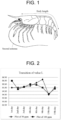
- “Second antenna” refers to an antenna that is commonly referred to as the mustache (refer to FIG. 1 ). "The second antenna is not broken” refers to that the second antenna has no damage. In such case, the two antennas on the left and right are approximately of the same length.
- the aquaculture shrimp of the present specification includes cases where the length of the second antenna is longer than the body length. When this second antenna is defective, the product value is reduced. Moreover, when the second antenna is defective, it would affect the health condition of the shrimp. Generally, as the second antenna is longer than or equal to the body length without a damage, in the present specification, an individual having a second antenna with a length less than or equal to the body length is considered to have a damage in the second antenna. The second antenna is measured from the root of the antenna using a ruler.
- the body color of the shrimp is particularly important in the market. Red color is valued highly at a boiled state, whereas white color is valued highly to be eaten raw.
- Value a of body color refers to value a*, value b*, and colorfulness of the first abdominal segment of the shrimp subjected for measurement, respectively.
- Value a*, value b*, and colorfulness of the body color can be measured at the first abdominal segment of the shrimp which is the subject of measurement by a chroma meter (for example, CR-300; Konica Minolta Inc.).
- value *a of the body color of the aquaculture shrimp of the present specification may be greater than or equal to -0.08, greater than or equal to -0.06, greater than or equal to -0.04, greater than or equal to -0.02, or greater than or equal to 0.
- value b of the color may be greater than or equal to 0.4, greater than or equal to 0.35, greater than or equal to 0.3, greater than or equal to 0.25, greater than or equal to 0.2, or greater than or equal to 0.15.
- the colorfulness of the body color may be less than or equal to 1.8, less than or equal to 1.75, less than or equal to 1.7, less than or equal to 1.65, or less than or equal to 1.6.
- the weight of the aquaculture shrimp of the present specification may be greater than or equal to 10 g, greater than or equal to 11 g, greater than or equal to 12 g, greater than or equal to 13 g, greater than or equal to 14 g, or greater than or equal to 15 g.
- the body length of the aquaculture shrimp of the present specification may be greater than or equal to 5 cm, greater than or equal to 6 cm, greater than or equal to 7 cm, greater than or equal to 8 cm, greater than or equal to 9 cm, greater than or equal to 10 cm, greater than or equal to 11 cm, or greater than or equal to 12 cm.
- the "body length” refers to the length from the dent of the thorax posterior to the eye (eye socket) to the end of the tail (refer to FIG. 1 ).
- the present specification relates to an aquaculture shrimp having a particular body color after killing in ice with water.
- the ice In the killing in ice with water of aquaculture shrimps, the ice may be prepared from fresh water; however, sea water diluted with water to a certain degree or sea water could be used. Furthermore, artificial sea water may be used. In a container, fresh water, sea water diluted with water to a certain degree, sea water, or artificial sea water is put, and the ice is prepared in the same container. When killing the shrimps, it is done so by casting the shrimps into the container. Once the shrimps are dead, they are taken out immediately from the container and kept in the refrigerator.
- the value *a of the body color of the aquaculture shrimp of the present specification, 2 days after killing in ice with water may be greater than or equal to -1.26, greater than or equal to -1.0, greater than or equal to -0.9, greater than or equal to -0.8, greater than or equal to -0.7, or greater than or equal to -0.6.
- the value *b of the body color, 2 days after killing in ice with water may be greater than or equal to -4.3, greater than or equal to -4.0, greater than or equal to -3.0, greater than or equal to -2.0, greater than or equal to -1.0, greater than or equal to 0, greater than or equal to 1.0, or greater than or equal to 2.0.
- the colorfulness of the body color, 2 days after killing in ice with water may be less than or equal to 4.62, less than or equal to 4.0, less than or equal to 3.5, less than or equal to 3.0, less than or equal to 2.5, or less than or equal to 2.0.
- the culturing method of the present specification is a method of culturing aquaculture shrimps of the present specification as stated above.
- a shrimp which has a good appearance with respect to color and the length of the second antenna can be produced.
- a shrimp could be produced so that the occurrence of a shrimp with a deformed body shape is suppressed.
- the probability of the shrimp dying in the course of culturing is reduced, thus the yield is increased, and the shrimp could be raised to a predetermined size.
- the nursery is not particularly limited, and it is appropriately selected in consideration to the kind, size, and the like, of the target shrimp.
- the culturing method of the present specification is carried out by culturing in sea, river, lakes and the like. Land-farming generally allows the shrimps to grow at an overcrowded state, resulting in a large number of damage in the second antenna of the aquaculture shrimps. For this reason, in one embodiment, land-farming is effective.
- the kinds of shrimp subjected for culturing are as mentioned above.
- the shrimps subjected for the culturing method of the present specification is not particularly limited, and include baby shrimps and parent shrimps.
- baby shrimp refers to those that are less than 1 g of body weight, and those that are growing from egg to baby shrimp are not included.
- parent shrimp refers to a grown up of the baby shrimp described above.
- the parent shrimp in case of whiteleg shrimp, for example, in general, is raised up to approximately greater than or equal to 15 g and then shipped.
- carotenoids are given to the shrimps. Such given carotenoids are allowed to accumulate in the shrimps.
- the source of carotenoids is not particularly limited.
- Carotenoids include astaxanthin, in particular, synthetic astaxanthin.
- Synthetic astaxanthin includes astaxanthin produced by chemical synthesis.
- Synthetic astaxanthin includes a large number of isomers of 3S, 3 S' form, 3 S, 3R' form (meso-form), 3R, 3R' form, further includes cis-, trans-forms of conjugated double bond at the center of the molecule, for example, all cis-, 9-cis form and 13-cis form, and thus, it can be easily distinguished from natural astaxanthin.
- carotenoids may include lutein and lycopene, for example.
- a suitable feed is a feed containing greater than or equal to 50 ppm, greater than or equal to 60 ppm, greater than or equal to 70 ppm, greater than or equal to 80 ppm, greater than or equal to 90 ppm, or greater than or equal to 100 ppm of astaxanthin (particularly synthetic astaxanthin).
- the method of containing astaxanthin in the feed may be performed by dissolving in oil, spraying by spray, adding and mixing, or a combination thereof, or astaxanthin may be added as one of the ingredients when the feed itself is prepared.
- the feeding amount of the astaxanthin-containing feed of a predetermined concentration given to shrimps subjected for culturing greater than or equal to 1%, greater than or equal to 2%, greater than or equal to 3%, greater than or equal to 4%, greater than equal to 5%, greater than equal to 6%, greater than or equal to 7%, greater than or equal to 8%, greater than or equal to 9%, or greater than equal to 10% of the feed may be fed to satiation.
- the feed may be given once, twice, three times, four times, or five times.
- the feeding may be carried out continuously while monitoring residual feed.
- the period of the shrimp subjected for culturing given with feed containing astaxanthin of a predetermined concentration is, for example, longer than or equal to 7 days, longer than or equal to 14 days, longer than or equal to 28 days, longer than or equal to 35 days, longer than equal to 42 days, longer than equal to 49 days, longer than or equal to 56 days, longer than equal to 63 days, longer than or equal to 70 days, longer than or equal to 77 days, longer than or equal to 84 days, or longer than or equal to 90 days.
- the water quality is regularly checked and adjusted so to be within the appropriate range.
- the shrimps are farmed at a pH of 5 to 10, 6 to 9, or 7 to 8.
- the pH is adjusted by adding an alkali agent or an acid or adjusting the water exchange rate.
- the farming is carried out while maintaining the water temperature at 23 to 32°C, 25 to 30°C, or 27 to 29°C.
- the water temperature can be adjusted by heating with solar light, heater, and the like, or by cooling with a cooler box, ice, and the like.
- Applied products including aquaculture shrimp or the processed products thereof may be used as is or may be further processed by extraction, grinding, and the like.
- a composition containing aquaculture shrimp may be produced by combining an aquaculture shrimp or a processed product thereof and optional components.
- the formulation ratio of the optional components could be appropriately selected and determined depending on the purpose.
- the shrimps can be offered to the market to be eaten raw. Such use is no restricted; however, specific examples include food, feed, medicine, and the like.
- the food which serves as the subject of the aquaculture shrimp and the processed product thereof of the present specification is not particularly limited, and it can be used as is or mixed with various kinds of food.
- food includes foodstuffs such as sausage, ham, processed fish products.
- the aquaculture shrimp and the processed product thereof of the present specification can also be used as a feed for farming and aquaculturing.
- aquaculture shrimp and the processed product thereof of the present specification can also be used as ingredients of pharmaceutical agents, quasi drugs, and functional foods.
- “Functional food” as used herein refers to foods and/or beverages to be ingested for maintaining health, in addition to general foods, and this term includes Food for specified health uses and Food with nutrient function claims (health functional food), health food, nutritional supplements, nutrition health food, and the like.
- Astaxanthin was purchased from DSM Nutrition Japan KK.
- the product with a product name CAROPHYLL Pink was purchased and used. This product was produced by chemical synthesis.
- the composition of Table 1 was formulated for a pellet mill with a 3-path conditioner. The pellet size was manufactured at 2.4 mm.
- the basic feed was measured and 2.5 ppm of astaxanthin was contained. This is believed to be because fish oil contains astaxanthin.
- Whiteleg shrimp (Litopenaeus vannamei) having an average individual weight of 14 g was subjected for farming.
- 80 L of water was placed in a 100 L cylinder water tank and used.
- Flowing water was managed by setting the water exchange rate to 8 to 10 times/day.
- the water tank was installed indoor, the light from the side and bottom was shielded, and the lights were lit from around 8 AM to 5 PM. Ventilation was carried out by placing the air stone in the central part.
- Water temperature was set at 28°C and DO was maintained at greater than or equal to 6.1 mg/L. Feed was given every day. pH measurement was carried out once every morning.
- the measurement of the body color of the shrimp was carried out using chroma meter CR-300 (Konica Minolta Inc.). The color was assessed by numerical values of L*a*b* color system.
- the site to be measured by the chroma meter was determined to be the first abdominal segment, and the two points on the left side and the right side of the body of each sample were measured, and the average value was used.
- Feed were prepared so that 50 ppm of astaxanthin was added to basic feed (50 ppm astaxanthin feed) and 100 ppm of astaxanthin was added to basic feed (100 ppm astaxanthin feed). Each feed was immersed in water for 6 hours and it was confirmed that the astaxanthin amount was maintained at about 50 ppm and 100 ppm in each feed.
- Shrimps with an average individual weight of about 14 g were prepared and fed each feed, and 16 individuals in each experimental plot were kept for 15 days.
- Mortality rate after 90 days is shown in Table 5. Survival rate was calculated without including the sample individuals. All natural death was caused by the molted individuals being cannibalized.
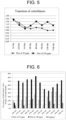
- Tables 3 and 4 experimental plots given with 50 ppm astaxanthin feed and 100 ppm astaxanthin feed are described as "experimental plot of 50 ppm” and “experimental plot of 100 ppm", respectively. The experimental plot given with astaxanthin-enriched feed resulted in a good growth and a high survival rate.
- Two experimental plots were set for 50 ppm astaxanthin feed and 100 ppm astaxanthin feed, and the shrimps were farmed using each feed for 90 days.
- the shrimps were ice killed by casting them into a container containing sea water and ice.
- Seven individuals from the experimental plot of 50 ppm and 5 individuals from the experimental plot of 100 ppm were sampled, ice killed, and the body color of the shrimps were measured using the chroma meter.
- the measurement was carried out using chroma meter CR-300 (Konica Minolta Inc.) and the color was assessed based on the numerical values of the L*a*b* color system.
- the site to be measured by the chroma meter was determined to be the first abdominal segment, and the two points on the left side and the right side of the body of each sample were measured, and the average value was used.
- the body color of the shrimps immediately after killing in ice with water and those that were preserved in the refrigerator for two days after killing in ice with water were measured using the chroma meter.
- the results are shown in Table 6.
- value b tended to increase as time passed after killing in ice with water; however, it was confirmed that the value was suppressed in astaxanthin-enriched plots.
- Aquaculture shrimps or processed product of the same of the present specification could be used as ingredients in various applied products including food, feed, pharmaceutical agents, and thus, they are industrially beneficial.
Landscapes
- Life Sciences & Earth Sciences (AREA)
- Chemical & Material Sciences (AREA)
- Polymers & Plastics (AREA)
- Health & Medical Sciences (AREA)
- Zoology (AREA)
- Engineering & Computer Science (AREA)
- Marine Sciences & Fisheries (AREA)
- Animal Husbandry (AREA)
- Food Science & Technology (AREA)
- Environmental Sciences (AREA)
- Insects & Arthropods (AREA)
- Medicinal Chemistry (AREA)
- Veterinary Medicine (AREA)
- Public Health (AREA)
- General Health & Medical Sciences (AREA)
- Animal Behavior & Ethology (AREA)
- Pharmacology & Pharmacy (AREA)
- Nutrition Science (AREA)
- Birds (AREA)
- Biodiversity & Conservation Biology (AREA)
- Bioinformatics & Cheminformatics (AREA)
- Chemical Kinetics & Catalysis (AREA)
- General Chemical & Material Sciences (AREA)
- Nuclear Medicine, Radiotherapy & Molecular Imaging (AREA)
- Organic Chemistry (AREA)
- Epidemiology (AREA)
- Feed For Specific Animals (AREA)
- Farming Of Fish And Shellfish (AREA)
- Fodder In General (AREA)
- Meat, Egg Or Seafood Products (AREA)
- Medicines Containing Material From Animals Or Micro-Organisms (AREA)
Applications Claiming Priority (3)
| Application Number | Priority Date | Filing Date | Title |
|---|---|---|---|
| JP2016159512 | 2016-08-16 | ||
| EP17841534.5A EP3501271B1 (de) | 2016-08-16 | 2017-08-16 | Verfahren zur kultivierung von garnelen aus aquakultur |
| PCT/JP2017/029474 WO2018034312A1 (ja) | 2016-08-16 | 2017-08-16 | 水産養殖エビ及び水産養殖エビの養殖方法 |
Related Parent Applications (2)
| Application Number | Title | Priority Date | Filing Date |
|---|---|---|---|
| EP17841534.5A Division EP3501271B1 (de) | 2016-08-16 | 2017-08-16 | Verfahren zur kultivierung von garnelen aus aquakultur |
| EP17841534.5A Division-Into EP3501271B1 (de) | 2016-08-16 | 2017-08-16 | Verfahren zur kultivierung von garnelen aus aquakultur |
Publications (2)
| Publication Number | Publication Date |
|---|---|
| EP4413872A2 true EP4413872A2 (de) | 2024-08-14 |
| EP4413872A3 EP4413872A3 (de) | 2024-10-23 |
Family
ID=61196664
Family Applications (2)
| Application Number | Title | Priority Date | Filing Date |
|---|---|---|---|
| EP24183609.7A Pending EP4413872A3 (de) | 2016-08-16 | 2017-08-16 | Verfahren zur kultivierung von aquakulturshirpsen |
| EP17841534.5A Active EP3501271B1 (de) | 2016-08-16 | 2017-08-16 | Verfahren zur kultivierung von garnelen aus aquakultur |
Family Applications After (1)
| Application Number | Title | Priority Date | Filing Date |
|---|---|---|---|
| EP17841534.5A Active EP3501271B1 (de) | 2016-08-16 | 2017-08-16 | Verfahren zur kultivierung von garnelen aus aquakultur |
Country Status (6)
| Country | Link |
|---|---|
| US (2) | US11071288B2 (de) |
| EP (2) | EP4413872A3 (de) |
| JP (4) | JPWO2018034312A1 (de) |
| KR (2) | KR20190035721A (de) |
| ES (1) | ES2988616T3 (de) |
| WO (1) | WO2018034312A1 (de) |
Families Citing this family (6)
| Publication number | Priority date | Publication date | Assignee | Title |
|---|---|---|---|---|
| CN109588539A (zh) * | 2018-10-10 | 2019-04-09 | 中山大学 | 一种降低饲料植物源性原料对南美白对虾不良影响的环保饲料配方 |
| CN109526827A (zh) * | 2018-12-30 | 2019-03-29 | 盐城工学院 | 一种淡水养殖海虾的方法 |
| CN112136738B (zh) * | 2020-09-07 | 2022-04-15 | 浙江省农业科学院 | 一种高抱卵量红螯螯虾亲本筛选及繁育方法 |
| CN112273297A (zh) * | 2020-09-27 | 2021-01-29 | 天津蕴华农业科技发展有限公司 | 一种南美白对虾的养殖方法 |
| JP2023099982A (ja) * | 2022-01-04 | 2023-07-14 | 仁助 中山 | 漁法の捕獲用餌又は養殖魚用餌ならびに代替魚粉原料 |
| CN117898233A (zh) * | 2024-02-27 | 2024-04-19 | 柳州市渔业技术推广站 | 一种缓解工厂化循环水养殖对虾烹饪加工体色发白的方法 |
Citations (2)
| Publication number | Priority date | Publication date | Assignee | Title |
|---|---|---|---|---|
| JPH0453455A (ja) | 1990-06-22 | 1992-02-21 | Ajinomoto Takara Corp:Kk | 甲殻類の飼料添加剤 |
| JPH06276956A (ja) | 1993-03-22 | 1994-10-04 | Mikio Yamauchi | 栄養組成物 |
Family Cites Families (9)
| Publication number | Priority date | Publication date | Assignee | Title |
|---|---|---|---|---|
| JPH07170886A (ja) * | 1993-10-13 | 1995-07-11 | Nippon Suisan Kaisha Ltd | 塩味がつき体色が改善されたエビ類、その加熱処理物およびそれらの冷凍品 |
| JP3053793B2 (ja) * | 1997-12-08 | 2000-06-19 | 株式会社九州メディカル | 甲殻類養殖システム及び方法 |
| KR100405958B1 (ko) | 2000-12-07 | 2003-11-15 | 한국식품개발연구원 | 갑각류 또는 키틴 제조부산물로부터 색소를 분리하는 방법및 이를 주원료로 하는 어류 또는 산란계용 착색제 조성물 |
| AU2003279819A1 (en) * | 2002-10-24 | 2004-05-13 | Advanced Bionutrition Corporation | Shrimp and the production thereof |
| US20060265766A1 (en) * | 2003-03-19 | 2006-11-23 | Advanced Bionutrition Corporation | Fish and the production thereof |
| JP4635172B2 (ja) | 2006-08-16 | 2011-02-16 | 独立行政法人国際農林水産業研究センター | 室内型エビ生産に用いるエビ育成・健康管理システム |
| JP2009136164A (ja) | 2007-12-04 | 2009-06-25 | Jifas Corporation Co Ltd | 複合養殖用ビルディング |
| WO2009149519A1 (en) * | 2008-06-12 | 2009-12-17 | Winwick Business Solutions Pty Ltd | System for cultivation and processing of microorganisms and products therefrom |
| JP2012165734A (ja) * | 2011-02-15 | 2012-09-06 | Yua:Kk | 育成光線利用の仮設建屋式コンクリート製水棲生物小割養殖水槽 |
-
2017
- 2017-08-16 EP EP24183609.7A patent/EP4413872A3/de active Pending
- 2017-08-16 KR KR1020197003052A patent/KR20190035721A/ko not_active Ceased
- 2017-08-16 EP EP17841534.5A patent/EP3501271B1/de active Active
- 2017-08-16 KR KR1020257005922A patent/KR20250029296A/ko active Pending
- 2017-08-16 ES ES17841534T patent/ES2988616T3/es active Active
- 2017-08-16 JP JP2018534416A patent/JPWO2018034312A1/ja active Pending
- 2017-08-16 WO PCT/JP2017/029474 patent/WO2018034312A1/ja not_active Ceased
-
2019
- 2019-02-15 US US16/277,763 patent/US11071288B2/en active Active
-
2021
- 2021-06-21 US US17/352,680 patent/US12058984B2/en active Active
-
2022
- 2022-05-13 JP JP2022079394A patent/JP2022116061A/ja active Pending
-
2023
- 2023-10-02 JP JP2023171571A patent/JP7787860B2/ja active Active
-
2025
- 2025-12-05 JP JP2025236124A patent/JP2026032279A/ja active Pending
Patent Citations (2)
| Publication number | Priority date | Publication date | Assignee | Title |
|---|---|---|---|---|
| JPH0453455A (ja) | 1990-06-22 | 1992-02-21 | Ajinomoto Takara Corp:Kk | 甲殻類の飼料添加剤 |
| JPH06276956A (ja) | 1993-03-22 | 1994-10-04 | Mikio Yamauchi | 栄養組成物 |
Also Published As
| Publication number | Publication date |
|---|---|
| US20190216059A1 (en) | 2019-07-18 |
| EP4413872A3 (de) | 2024-10-23 |
| EP3501271C0 (de) | 2024-07-31 |
| WO2018034312A1 (ja) | 2018-02-22 |
| EP3501271B1 (de) | 2024-07-31 |
| JP7787860B2 (ja) | 2025-12-17 |
| JP2026032279A (ja) | 2026-02-25 |
| JP2022116061A (ja) | 2022-08-09 |
| EP3501271A4 (de) | 2020-04-15 |
| KR20190035721A (ko) | 2019-04-03 |
| US11071288B2 (en) | 2021-07-27 |
| ES2988616T3 (es) | 2024-11-21 |
| US12058984B2 (en) | 2024-08-13 |
| JPWO2018034312A1 (ja) | 2019-06-20 |
| JP2023166028A (ja) | 2023-11-17 |
| US20210315187A1 (en) | 2021-10-14 |
| KR20250029296A (ko) | 2025-03-04 |
| EP3501271A1 (de) | 2019-06-26 |
Similar Documents
| Publication | Publication Date | Title |
|---|---|---|
| US12058984B2 (en) | Aquaculture shrimps and methods for culturing same | |
| Becker | Microalgae for aquaculture: the nutritional value of microalgae for aquaculture | |
| CN105767586A (zh) | 一种营养强化鸡蛋饲料及其应用 | |
| CN104187080A (zh) | 一种用于生产抗氧化鸡蛋的蛋鸡饲料及其制备方法 | |
| KR20190060026A (ko) | 어류용 기능성 첨가물과 이를 포함하는 어류용 사료 및 이의 급이방법 | |
| KR101468802B1 (ko) | 비단잉어 색택개선용 사료조성물 | |
| CN108813146A (zh) | 一种网箱养殖大黄鱼用体色改进剂及其制备方法 | |
| CN101461450B (zh) | 通过饮水补充动物体内类胡萝卜素的方法 | |
| CN106819635A (zh) | 一种添加微藻和益生菌的金鱼增色保健饲料及其制备方法 | |
| JP5706056B2 (ja) | サケ類の肉色改善方法 | |
| CN115211503A (zh) | 利用红法夫酵母制剂提升蛋类虾青素含量的饲料及其应用 | |
| CN100562255C (zh) | 用于特种水产品的速冻鲜饲料及生产工艺 | |
| CN106974141A (zh) | 一种黄粉虫人工复合饲料及其制备方法 | |
| Seidgar | The effects of Fairy Shrimp Phallocryptus spinosa (Branchiopoda: Anostraca) as live food on reproduction performances and color of freshwater ornamental fish prawns | |
| Devi et al. | Pigment deficiency correction in captive clown fish, Amphiprion ocellaris using different carotenoid sources. | |
| CN104187192A (zh) | 一种牛蛙全生长期配合饲料及其制备方法 | |
| CN103918949B (zh) | 可改善池塘、网箱养殖黄鳍鲷体色的环保营养配合饲料 | |
| CN108813133B (zh) | 大鳞副泥鳅虾青素配合饲料 | |
| Siahkalroodi et al. | Effect of safflower (Carthamus tinctorius), beetroot (Beta vulgaris), and scarlet firethorn (Pyracantha coccinea) fruit on fillet and skin pigmentation of rainbow trout (Oncorhynchus mykiss). | |
| CN120113732A (zh) | 一种饲用着色剂组合物及其在改善水产动物皮肤颜色中的应用 | |
| Yousefi Siahkalroodi et al. | Effect of safflower (Carthamus tinctorius), beetroot (Beta vulgaris), and scarlet firethorn (Pyracantha coccinea) fruit on fillet and skin pigmentation of rainbow trout (Oncorhynchus mykiss) | |
| UA130508C2 (uk) | Корм для австралійського рака | |
| KR20130067711A (ko) | 무지개송어를 트라우트 살몬(Trout Salmon,바다송어)으로 변환하는 방법 | |
| CN110477223A (zh) | 一种提高青壳率的小龙虾配合饲料及其制备方法 | |
| CN110301554A (zh) | 一种生态草金鱼营养养殖饲料 |
Legal Events
| Date | Code | Title | Description |
|---|---|---|---|
| PUAI | Public reference made under article 153(3) epc to a published international application that has entered the european phase |
Free format text: ORIGINAL CODE: 0009012 |
|
| STAA | Information on the status of an ep patent application or granted ep patent |
Free format text: STATUS: THE APPLICATION HAS BEEN PUBLISHED |
|
| AC | Divisional application: reference to earlier application |
Ref document number: 3501271 Country of ref document: EP Kind code of ref document: P |
|
| AK | Designated contracting states |
Kind code of ref document: A2 Designated state(s): AL AT BE BG CH CY CZ DE DK EE ES FI FR GB GR HR HU IE IS IT LI LT LU LV MC MK MT NL NO PL PT RO RS SE SI SK SM TR |
|
| REG | Reference to a national code |
Ref country code: DE Ref legal event code: R079 Free format text: PREVIOUS MAIN CLASS: A23L0017500000 Ipc: A01K0061590000 |
|
| PUAL | Search report despatched |
Free format text: ORIGINAL CODE: 0009013 |
|
| AK | Designated contracting states |
Kind code of ref document: A3 Designated state(s): AL AT BE BG CH CY CZ DE DK EE ES FI FR GB GR HR HU IE IS IT LI LT LU LV MC MK MT NL NO PL PT RO RS SE SI SK SM TR |
|
| RIC1 | Information provided on ipc code assigned before grant |
Ipc: A23L 17/50 20160101ALI20240916BHEP Ipc: A61P 43/00 20060101ALI20240916BHEP Ipc: A61K 35/612 20150101ALI20240916BHEP Ipc: A23L 17/40 20160101ALI20240916BHEP Ipc: A23K 50/80 20160101ALI20240916BHEP Ipc: A23K 20/179 20160101ALI20240916BHEP Ipc: A23K 20/105 20160101ALI20240916BHEP Ipc: A01K 61/59 20170101AFI20240916BHEP |
|
| STAA | Information on the status of an ep patent application or granted ep patent |
Free format text: STATUS: REQUEST FOR EXAMINATION WAS MADE |
|
| 17P | Request for examination filed |
Effective date: 20250423 |
|
| STAA | Information on the status of an ep patent application or granted ep patent |
Free format text: STATUS: EXAMINATION IS IN PROGRESS |
|
| 17Q | First examination report despatched |
Effective date: 20251030 |