EP4407713A1 - Positivelektrodenaktivmaterial für eine lithium-ionen-sekundärbatterie und lithium-ionen-sekundärbatterie - Google Patents
Positivelektrodenaktivmaterial für eine lithium-ionen-sekundärbatterie und lithium-ionen-sekundärbatterie Download PDFInfo
- Publication number
- EP4407713A1 EP4407713A1 EP22872729.3A EP22872729A EP4407713A1 EP 4407713 A1 EP4407713 A1 EP 4407713A1 EP 22872729 A EP22872729 A EP 22872729A EP 4407713 A1 EP4407713 A1 EP 4407713A1
- Authority
- EP
- European Patent Office
- Prior art keywords
- positive electrode
- active material
- electrode active
- heat treatment
- less
- Prior art date
- Legal status (The legal status is an assumption and is not a legal conclusion. Google has not performed a legal analysis and makes no representation as to the accuracy of the status listed.)
- Pending
Links
- 239000007774 positive electrode material Substances 0.000 title claims abstract description 140
- 229910001416 lithium ion Inorganic materials 0.000 title claims abstract description 64
- HBBGRARXTFLTSG-UHFFFAOYSA-N Lithium ion Chemical compound [Li+] HBBGRARXTFLTSG-UHFFFAOYSA-N 0.000 title claims abstract description 59
- 239000011164 primary particle Substances 0.000 claims abstract description 83
- 239000002245 particle Substances 0.000 claims abstract description 34
- 238000005259 measurement Methods 0.000 claims abstract description 16
- 238000000634 powder X-ray diffraction Methods 0.000 claims abstract description 10
- 229910006525 α-NaFeO2 Inorganic materials 0.000 claims abstract description 10
- 229910006596 α−NaFeO2 Inorganic materials 0.000 claims abstract description 10
- 229910052744 lithium Inorganic materials 0.000 claims description 94
- WHXSMMKQMYFTQS-UHFFFAOYSA-N Lithium Chemical compound [Li] WHXSMMKQMYFTQS-UHFFFAOYSA-N 0.000 claims description 88
- 239000011148 porous material Substances 0.000 claims description 44
- 239000002131 composite material Substances 0.000 claims description 41
- SECXISVLQFMRJM-UHFFFAOYSA-N N-Methylpyrrolidone Chemical compound CN1CCCC1=O SECXISVLQFMRJM-UHFFFAOYSA-N 0.000 claims description 32
- 238000010521 absorption reaction Methods 0.000 claims description 31
- 239000011163 secondary particle Substances 0.000 claims description 31
- 229910052748 manganese Inorganic materials 0.000 claims description 17
- 229910052782 aluminium Inorganic materials 0.000 claims description 12
- 239000000843 powder Substances 0.000 claims description 9
- QSHDDOUJBYECFT-UHFFFAOYSA-N mercury Chemical compound [Hg] QSHDDOUJBYECFT-UHFFFAOYSA-N 0.000 claims description 6
- 229910052753 mercury Inorganic materials 0.000 claims description 6
- 238000002459 porosimetry Methods 0.000 claims description 6
- 229910052749 magnesium Inorganic materials 0.000 claims description 5
- 229910052725 zinc Inorganic materials 0.000 claims description 4
- 229910052726 zirconium Inorganic materials 0.000 claims description 4
- 238000007599 discharging Methods 0.000 abstract description 51
- 230000002349 favourable effect Effects 0.000 abstract description 32
- 238000010438 heat treatment Methods 0.000 description 194
- PXHVJJICTQNCMI-UHFFFAOYSA-N nickel Substances [Ni] PXHVJJICTQNCMI-UHFFFAOYSA-N 0.000 description 110
- WMFOQBRAJBCJND-UHFFFAOYSA-M Lithium hydroxide Chemical compound [Li+].[OH-] WMFOQBRAJBCJND-UHFFFAOYSA-M 0.000 description 55
- 229910052759 nickel Inorganic materials 0.000 description 54
- 238000010304 firing Methods 0.000 description 43
- 239000000203 mixture Substances 0.000 description 42
- 239000002994 raw material Substances 0.000 description 41
- 230000014759 maintenance of location Effects 0.000 description 39
- 229910052751 metal Inorganic materials 0.000 description 39
- 230000000052 comparative effect Effects 0.000 description 36
- 238000002156 mixing Methods 0.000 description 34
- 230000007423 decrease Effects 0.000 description 31
- 239000008187 granular material Substances 0.000 description 26
- 239000013078 crystal Substances 0.000 description 23
- 239000011572 manganese Substances 0.000 description 23
- XGZVUEUWXADBQD-UHFFFAOYSA-L lithium carbonate Chemical compound [Li+].[Li+].[O-]C([O-])=O XGZVUEUWXADBQD-UHFFFAOYSA-L 0.000 description 22
- 229910052808 lithium carbonate Inorganic materials 0.000 description 22
- 150000001768 cations Chemical class 0.000 description 20
- 239000002243 precursor Substances 0.000 description 20
- 238000000034 method Methods 0.000 description 18
- 239000010936 titanium Substances 0.000 description 18
- 238000005469 granulation Methods 0.000 description 17
- 230000003179 granulation Effects 0.000 description 17
- 239000000126 substance Substances 0.000 description 16
- 229910017052 cobalt Inorganic materials 0.000 description 12
- 239000010941 cobalt Substances 0.000 description 12
- GUTLYIVDDKVIGB-UHFFFAOYSA-N cobalt atom Chemical compound [Co] GUTLYIVDDKVIGB-UHFFFAOYSA-N 0.000 description 12
- 150000001875 compounds Chemical class 0.000 description 12
- 239000002002 slurry Substances 0.000 description 12
- 239000007921 spray Substances 0.000 description 12
- 229910052760 oxygen Inorganic materials 0.000 description 11
- 238000010298 pulverizing process Methods 0.000 description 11
- CURLTUGMZLYLDI-UHFFFAOYSA-N Carbon dioxide Chemical compound O=C=O CURLTUGMZLYLDI-UHFFFAOYSA-N 0.000 description 10
- QVGXLLKOCUKJST-UHFFFAOYSA-N atomic oxygen Chemical compound [O] QVGXLLKOCUKJST-UHFFFAOYSA-N 0.000 description 10
- 150000002642 lithium compounds Chemical class 0.000 description 10
- 239000001301 oxygen Substances 0.000 description 10
- XLYOFNOQVPJJNP-UHFFFAOYSA-N water Substances O XLYOFNOQVPJJNP-UHFFFAOYSA-N 0.000 description 10
- 238000010586 diagram Methods 0.000 description 9
- 239000002184 metal Substances 0.000 description 9
- 239000002904 solvent Substances 0.000 description 9
- PWHULOQIROXLJO-UHFFFAOYSA-N Manganese Chemical compound [Mn] PWHULOQIROXLJO-UHFFFAOYSA-N 0.000 description 8
- XAGFODPZIPBFFR-UHFFFAOYSA-N aluminium Chemical compound [Al] XAGFODPZIPBFFR-UHFFFAOYSA-N 0.000 description 8
- 238000011068 loading method Methods 0.000 description 8
- 238000002441 X-ray diffraction Methods 0.000 description 7
- 230000000694 effects Effects 0.000 description 7
- BFDHFSHZJLFAMC-UHFFFAOYSA-L nickel(ii) hydroxide Chemical compound [OH-].[OH-].[Ni+2] BFDHFSHZJLFAMC-UHFFFAOYSA-L 0.000 description 7
- 239000011255 nonaqueous electrolyte Substances 0.000 description 7
- MYMOFIZGZYHOMD-UHFFFAOYSA-N Dioxygen Chemical compound O=O MYMOFIZGZYHOMD-UHFFFAOYSA-N 0.000 description 6
- GWEVSGVZZGPLCZ-UHFFFAOYSA-N Titan oxide Chemical compound O=[Ti]=O GWEVSGVZZGPLCZ-UHFFFAOYSA-N 0.000 description 6
- 238000006243 chemical reaction Methods 0.000 description 6
- 229910021446 cobalt carbonate Inorganic materials 0.000 description 6
- ZOTKGJBKKKVBJZ-UHFFFAOYSA-L cobalt(2+);carbonate Chemical compound [Co+2].[O-]C([O-])=O ZOTKGJBKKKVBJZ-UHFFFAOYSA-L 0.000 description 6
- 229910001882 dioxygen Inorganic materials 0.000 description 6
- 239000011656 manganese carbonate Substances 0.000 description 6
- 229940093474 manganese carbonate Drugs 0.000 description 6
- 235000006748 manganese carbonate Nutrition 0.000 description 6
- 229910000016 manganese(II) carbonate Inorganic materials 0.000 description 6
- XMWCXZJXESXBBY-UHFFFAOYSA-L manganese(ii) carbonate Chemical compound [Mn+2].[O-]C([O-])=O XMWCXZJXESXBBY-UHFFFAOYSA-L 0.000 description 6
- 238000004519 manufacturing process Methods 0.000 description 6
- TWNQGVIAIRXVLR-UHFFFAOYSA-N oxo(oxoalumanyloxy)alumane Chemical compound O=[Al]O[Al]=O TWNQGVIAIRXVLR-UHFFFAOYSA-N 0.000 description 6
- OGIDPMRJRNCKJF-UHFFFAOYSA-N titanium oxide Inorganic materials [Ti]=O OGIDPMRJRNCKJF-UHFFFAOYSA-N 0.000 description 6
- 229910002092 carbon dioxide Inorganic materials 0.000 description 5
- 239000001569 carbon dioxide Substances 0.000 description 5
- 238000003795 desorption Methods 0.000 description 5
- 238000009792 diffusion process Methods 0.000 description 5
- 238000009826 distribution Methods 0.000 description 5
- 230000001747 exhibiting effect Effects 0.000 description 5
- 238000003780 insertion Methods 0.000 description 5
- 230000037431 insertion Effects 0.000 description 5
- 239000002905 metal composite material Substances 0.000 description 5
- 150000002739 metals Chemical class 0.000 description 5
- -1 nickel becomes low Chemical class 0.000 description 5
- 230000015572 biosynthetic process Effects 0.000 description 4
- 238000000975 co-precipitation Methods 0.000 description 4
- 239000011248 coating agent Substances 0.000 description 4
- 238000000576 coating method Methods 0.000 description 4
- 230000008602 contraction Effects 0.000 description 4
- 230000001186 cumulative effect Effects 0.000 description 4
- 230000003247 decreasing effect Effects 0.000 description 4
- 238000005406 washing Methods 0.000 description 4
- 229910003005 LiNiO2 Inorganic materials 0.000 description 3
- 238000001479 atomic absorption spectroscopy Methods 0.000 description 3
- 230000007547 defect Effects 0.000 description 3
- 239000002270 dispersing agent Substances 0.000 description 3
- 238000001035 drying Methods 0.000 description 3
- 239000007789 gas Substances 0.000 description 3
- 239000012535 impurity Substances 0.000 description 3
- 238000009616 inductively coupled plasma Methods 0.000 description 3
- 239000000463 material Substances 0.000 description 3
- 230000001590 oxidative effect Effects 0.000 description 3
- 230000000704 physical effect Effects 0.000 description 3
- 230000005855 radiation Effects 0.000 description 3
- 238000001878 scanning electron micrograph Methods 0.000 description 3
- 239000000243 solution Substances 0.000 description 3
- 238000003786 synthesis reaction Methods 0.000 description 3
- 239000004925 Acrylic resin Substances 0.000 description 2
- 229920000178 Acrylic resin Polymers 0.000 description 2
- OKTJSMMVPCPJKN-UHFFFAOYSA-N Carbon Chemical compound [C] OKTJSMMVPCPJKN-UHFFFAOYSA-N 0.000 description 2
- BVKZGUZCCUSVTD-UHFFFAOYSA-L Carbonate Chemical compound [O-]C([O-])=O BVKZGUZCCUSVTD-UHFFFAOYSA-L 0.000 description 2
- KMTRUDSVKNLOMY-UHFFFAOYSA-N Ethylene carbonate Chemical compound O=C1OCCO1 KMTRUDSVKNLOMY-UHFFFAOYSA-N 0.000 description 2
- 229910001290 LiPF6 Inorganic materials 0.000 description 2
- VEQPNABPJHWNSG-UHFFFAOYSA-N Nickel(2+) Chemical compound [Ni+2] VEQPNABPJHWNSG-UHFFFAOYSA-N 0.000 description 2
- 239000004743 Polypropylene Substances 0.000 description 2
- 239000011149 active material Substances 0.000 description 2
- 229910052796 boron Inorganic materials 0.000 description 2
- 229910052799 carbon Inorganic materials 0.000 description 2
- 230000007812 deficiency Effects 0.000 description 2
- IEJIGPNLZYLLBP-UHFFFAOYSA-N dimethyl carbonate Chemical compound COC(=O)OC IEJIGPNLZYLLBP-UHFFFAOYSA-N 0.000 description 2
- 238000007908 dry granulation Methods 0.000 description 2
- 239000003792 electrolyte Substances 0.000 description 2
- 238000004993 emission spectroscopy Methods 0.000 description 2
- 238000002149 energy-dispersive X-ray emission spectroscopy Methods 0.000 description 2
- 238000001704 evaporation Methods 0.000 description 2
- 230000008020 evaporation Effects 0.000 description 2
- 239000012530 fluid Substances 0.000 description 2
- XLYOFNOQVPJJNP-UHFFFAOYSA-M hydroxide Chemical compound [OH-] XLYOFNOQVPJJNP-UHFFFAOYSA-M 0.000 description 2
- 239000011261 inert gas Substances 0.000 description 2
- 238000004898 kneading Methods 0.000 description 2
- 239000007791 liquid phase Substances 0.000 description 2
- KWGKDLIKAYFUFQ-UHFFFAOYSA-M lithium chloride Chemical compound [Li+].[Cl-] KWGKDLIKAYFUFQ-UHFFFAOYSA-M 0.000 description 2
- IIPYXGDZVMZOAP-UHFFFAOYSA-N lithium nitrate Chemical compound [Li+].[O-][N+]([O-])=O IIPYXGDZVMZOAP-UHFFFAOYSA-N 0.000 description 2
- 229910001453 nickel ion Inorganic materials 0.000 description 2
- 238000007254 oxidation reaction Methods 0.000 description 2
- 229920001155 polypropylene Polymers 0.000 description 2
- 238000002360 preparation method Methods 0.000 description 2
- 238000005070 sampling Methods 0.000 description 2
- 238000001350 scanning transmission electron microscopy Methods 0.000 description 2
- 239000007787 solid Substances 0.000 description 2
- 238000006467 substitution reaction Methods 0.000 description 2
- 229910052719 titanium Inorganic materials 0.000 description 2
- 238000005550 wet granulation Methods 0.000 description 2
- VAYTZRYEBVHVLE-UHFFFAOYSA-N 1,3-dioxol-2-one Chemical compound O=C1OC=CO1 VAYTZRYEBVHVLE-UHFFFAOYSA-N 0.000 description 1
- QTBSBXVTEAMEQO-UHFFFAOYSA-M Acetate Chemical compound CC([O-])=O QTBSBXVTEAMEQO-UHFFFAOYSA-M 0.000 description 1
- 238000004438 BET method Methods 0.000 description 1
- ZOXJGFHDIHLPTG-UHFFFAOYSA-N Boron Chemical compound [B] ZOXJGFHDIHLPTG-UHFFFAOYSA-N 0.000 description 1
- KRKNYBCHXYNGOX-UHFFFAOYSA-K Citrate Chemical compound [O-]C(=O)CC(O)(CC([O-])=O)C([O-])=O KRKNYBCHXYNGOX-UHFFFAOYSA-K 0.000 description 1
- RYGMFSIKBFXOCR-UHFFFAOYSA-N Copper Chemical compound [Cu] RYGMFSIKBFXOCR-UHFFFAOYSA-N 0.000 description 1
- JOYRKODLDBILNP-UHFFFAOYSA-N Ethyl urethane Chemical compound CCOC(N)=O JOYRKODLDBILNP-UHFFFAOYSA-N 0.000 description 1
- YCKRFDGAMUMZLT-UHFFFAOYSA-N Fluorine atom Chemical compound [F] YCKRFDGAMUMZLT-UHFFFAOYSA-N 0.000 description 1
- 229910032387 LiCoO2 Inorganic materials 0.000 description 1
- 229910016205 LixNi1-y-zCoy Inorganic materials 0.000 description 1
- OAICVXFJPJFONN-UHFFFAOYSA-N Phosphorus Chemical compound [P] OAICVXFJPJFONN-UHFFFAOYSA-N 0.000 description 1
- QAOWNCQODCNURD-UHFFFAOYSA-L Sulfate Chemical compound [O-]S([O-])(=O)=O QAOWNCQODCNURD-UHFFFAOYSA-L 0.000 description 1
- NINIDFKCEFEMDL-UHFFFAOYSA-N Sulfur Chemical compound [S] NINIDFKCEFEMDL-UHFFFAOYSA-N 0.000 description 1
- RTAQQCXQSZGOHL-UHFFFAOYSA-N Titanium Chemical compound [Ti] RTAQQCXQSZGOHL-UHFFFAOYSA-N 0.000 description 1
- 239000002253 acid Substances 0.000 description 1
- 239000000654 additive Substances 0.000 description 1
- 230000000996 additive effect Effects 0.000 description 1
- 239000003513 alkali Substances 0.000 description 1
- 239000007864 aqueous solution Substances 0.000 description 1
- 239000011324 bead Substances 0.000 description 1
- 239000011230 binding agent Substances 0.000 description 1
- 238000004364 calculation method Methods 0.000 description 1
- BVKZGUZCCUSVTD-UHFFFAOYSA-N carbonic acid Chemical compound OC(O)=O BVKZGUZCCUSVTD-UHFFFAOYSA-N 0.000 description 1
- 238000007906 compression Methods 0.000 description 1
- 230000006835 compression Effects 0.000 description 1
- 239000004020 conductor Substances 0.000 description 1
- 239000011889 copper foil Substances 0.000 description 1
- 239000008367 deionised water Substances 0.000 description 1
- 229910021641 deionized water Inorganic materials 0.000 description 1
- 230000006866 deterioration Effects 0.000 description 1
- 238000007580 dry-mixing Methods 0.000 description 1
- 238000011049 filling Methods 0.000 description 1
- 239000011737 fluorine Substances 0.000 description 1
- 229910052731 fluorine Inorganic materials 0.000 description 1
- 239000011888 foil Substances 0.000 description 1
- 239000000499 gel Substances 0.000 description 1
- 229910002804 graphite Inorganic materials 0.000 description 1
- 239000010439 graphite Substances 0.000 description 1
- 229910052739 hydrogen Inorganic materials 0.000 description 1
- 238000002354 inductively-coupled plasma atomic emission spectroscopy Methods 0.000 description 1
- 150000002500 ions Chemical class 0.000 description 1
- 229910052742 iron Inorganic materials 0.000 description 1
- XIXADJRWDQXREU-UHFFFAOYSA-M lithium acetate Chemical compound [Li+].CC([O-])=O XIXADJRWDQXREU-UHFFFAOYSA-M 0.000 description 1
- 229910003002 lithium salt Inorganic materials 0.000 description 1
- 159000000002 lithium salts Chemical class 0.000 description 1
- INHCSSUBVCNVSK-UHFFFAOYSA-L lithium sulfate Inorganic materials [Li+].[Li+].[O-]S([O-])(=O)=O INHCSSUBVCNVSK-UHFFFAOYSA-L 0.000 description 1
- WPBNNNQJVZRUHP-UHFFFAOYSA-L manganese(2+);methyl n-[[2-(methoxycarbonylcarbamothioylamino)phenyl]carbamothioyl]carbamate;n-[2-(sulfidocarbothioylamino)ethyl]carbamodithioate Chemical group [Mn+2].[S-]C(=S)NCCNC([S-])=S.COC(=O)NC(=S)NC1=CC=CC=C1NC(=S)NC(=O)OC WPBNNNQJVZRUHP-UHFFFAOYSA-L 0.000 description 1
- 238000000691 measurement method Methods 0.000 description 1
- 239000007769 metal material Substances 0.000 description 1
- 238000000465 moulding Methods 0.000 description 1
- 238000006386 neutralization reaction Methods 0.000 description 1
- 150000002815 nickel Chemical class 0.000 description 1
- 150000002816 nickel compounds Chemical class 0.000 description 1
- 229910052757 nitrogen Inorganic materials 0.000 description 1
- 229910052698 phosphorus Inorganic materials 0.000 description 1
- 239000011574 phosphorus Substances 0.000 description 1
- 238000004445 quantitative analysis Methods 0.000 description 1
- 230000000630 rising effect Effects 0.000 description 1
- 238000005096 rolling process Methods 0.000 description 1
- 239000004576 sand Substances 0.000 description 1
- 238000007789 sealing Methods 0.000 description 1
- 239000003566 sealing material Substances 0.000 description 1
- 230000000087 stabilizing effect Effects 0.000 description 1
- 229910001220 stainless steel Inorganic materials 0.000 description 1
- 239000010935 stainless steel Substances 0.000 description 1
- 238000003860 storage Methods 0.000 description 1
- 229910052717 sulfur Inorganic materials 0.000 description 1
- 239000011593 sulfur Substances 0.000 description 1
- RBTVSNLYYIMMKS-UHFFFAOYSA-N tert-butyl 3-aminoazetidine-1-carboxylate;hydrochloride Chemical compound Cl.CC(C)(C)OC(=O)N1CC(N)C1 RBTVSNLYYIMMKS-UHFFFAOYSA-N 0.000 description 1
- 238000005979 thermal decomposition reaction Methods 0.000 description 1
- 238000004448 titration Methods 0.000 description 1
- 238000005303 weighing Methods 0.000 description 1
Images




Classifications
-
- C—CHEMISTRY; METALLURGY
- C01—INORGANIC CHEMISTRY
- C01G—COMPOUNDS CONTAINING METALS NOT COVERED BY SUBCLASSES C01D OR C01F
- C01G53/00—Compounds of nickel
- C01G53/40—Complex oxides containing nickel and at least one other metal element
- C01G53/42—Complex oxides containing nickel and at least one other metal element containing alkali metals, e.g. LiNiO2
- C01G53/44—Complex oxides containing nickel and at least one other metal element containing alkali metals, e.g. LiNiO2 containing manganese
- C01G53/50—Complex oxides containing nickel and at least one other metal element containing alkali metals, e.g. LiNiO2 containing manganese of the type (MnO2)n-, e.g. Li(NixMn1-x)O2 or Li(MyNixMn1-x-y)O2
-
- H—ELECTRICITY
- H01—ELECTRIC ELEMENTS
- H01M—PROCESSES OR MEANS, e.g. BATTERIES, FOR THE DIRECT CONVERSION OF CHEMICAL ENERGY INTO ELECTRICAL ENERGY
- H01M4/00—Electrodes
- H01M4/02—Electrodes composed of, or comprising, active material
- H01M4/36—Selection of substances as active materials, active masses, active liquids
- H01M4/48—Selection of substances as active materials, active masses, active liquids of inorganic oxides or hydroxides
- H01M4/50—Selection of substances as active materials, active masses, active liquids of inorganic oxides or hydroxides of manganese
- H01M4/505—Selection of substances as active materials, active masses, active liquids of inorganic oxides or hydroxides of manganese of mixed oxides or hydroxides containing manganese for inserting or intercalating light metals, e.g. LiMn2O4 or LiMn2OxFy
-
- C—CHEMISTRY; METALLURGY
- C01—INORGANIC CHEMISTRY
- C01G—COMPOUNDS CONTAINING METALS NOT COVERED BY SUBCLASSES C01D OR C01F
- C01G53/00—Compounds of nickel
- C01G53/40—Complex oxides containing nickel and at least one other metal element
- C01G53/42—Complex oxides containing nickel and at least one other metal element containing alkali metals, e.g. LiNiO2
- C01G53/44—Complex oxides containing nickel and at least one other metal element containing alkali metals, e.g. LiNiO2 containing manganese
- C01G53/50—Complex oxides containing nickel and at least one other metal element containing alkali metals, e.g. LiNiO2 containing manganese of the type (MnO2)n-, e.g. Li(NixMn1-x)O2 or Li(MyNixMn1-x-y)O2
- C01G53/502—Complex oxides containing nickel and at least one other metal element containing alkali metals, e.g. LiNiO2 containing manganese of the type (MnO2)n-, e.g. Li(NixMn1-x)O2 or Li(MyNixMn1-x-y)O2 containing lithium and cobalt
- C01G53/504—Complex oxides containing nickel and at least one other metal element containing alkali metals, e.g. LiNiO2 containing manganese of the type (MnO2)n-, e.g. Li(NixMn1-x)O2 or Li(MyNixMn1-x-y)O2 containing lithium and cobalt with the molar ratio of nickel with respect to all the metals other than alkali metals higher than or equal to 0.5, e.g. Li(MzNixCoyMn1-x-y-z)O2 with x ≥ 0.5
- C01G53/506—Complex oxides containing nickel and at least one other metal element containing alkali metals, e.g. LiNiO2 containing manganese of the type (MnO2)n-, e.g. Li(NixMn1-x)O2 or Li(MyNixMn1-x-y)O2 containing lithium and cobalt with the molar ratio of nickel with respect to all the metals other than alkali metals higher than or equal to 0.5, e.g. Li(MzNixCoyMn1-x-y-z)O2 with x ≥ 0.5 with the molar ratio of nickel with respect to all the metals other than alkali metals higher than or equal to 0.8, e.g. Li(MzNixCoyMn1-x-y-z)O2 with x ≥ 0.8
-
- C—CHEMISTRY; METALLURGY
- C01—INORGANIC CHEMISTRY
- C01G—COMPOUNDS CONTAINING METALS NOT COVERED BY SUBCLASSES C01D OR C01F
- C01G53/00—Compounds of nickel
- C01G53/80—Compounds containing nickel, with or without oxygen or hydrogen, and containing one or more other elements
- C01G53/84—Hydroxides
-
- H—ELECTRICITY
- H01—ELECTRIC ELEMENTS
- H01M—PROCESSES OR MEANS, e.g. BATTERIES, FOR THE DIRECT CONVERSION OF CHEMICAL ENERGY INTO ELECTRICAL ENERGY
- H01M10/00—Secondary cells; Manufacture thereof
- H01M10/05—Accumulators with non-aqueous electrolyte
- H01M10/052—Li-accumulators
- H01M10/0525—Rocking-chair batteries, i.e. batteries with lithium insertion or intercalation in both electrodes; Lithium-ion batteries
-
- H—ELECTRICITY
- H01—ELECTRIC ELEMENTS
- H01M—PROCESSES OR MEANS, e.g. BATTERIES, FOR THE DIRECT CONVERSION OF CHEMICAL ENERGY INTO ELECTRICAL ENERGY
- H01M4/00—Electrodes
- H01M4/02—Electrodes composed of, or comprising, active material
- H01M4/36—Selection of substances as active materials, active masses, active liquids
- H01M4/48—Selection of substances as active materials, active masses, active liquids of inorganic oxides or hydroxides
- H01M4/52—Selection of substances as active materials, active masses, active liquids of inorganic oxides or hydroxides of nickel, cobalt or iron
- H01M4/525—Selection of substances as active materials, active masses, active liquids of inorganic oxides or hydroxides of nickel, cobalt or iron of mixed oxides or hydroxides containing iron, cobalt or nickel for inserting or intercalating light metals, e.g. LiNiO2, LiCoO2 or LiCoOxFy
-
- C—CHEMISTRY; METALLURGY
- C01—INORGANIC CHEMISTRY
- C01P—INDEXING SCHEME RELATING TO STRUCTURAL AND PHYSICAL ASPECTS OF SOLID INORGANIC COMPOUNDS
- C01P2002/00—Crystal-structural characteristics
- C01P2002/70—Crystal-structural characteristics defined by measured X-ray, neutron or electron diffraction data
-
- C—CHEMISTRY; METALLURGY
- C01—INORGANIC CHEMISTRY
- C01P—INDEXING SCHEME RELATING TO STRUCTURAL AND PHYSICAL ASPECTS OF SOLID INORGANIC COMPOUNDS
- C01P2002/00—Crystal-structural characteristics
- C01P2002/70—Crystal-structural characteristics defined by measured X-ray, neutron or electron diffraction data
- C01P2002/72—Crystal-structural characteristics defined by measured X-ray, neutron or electron diffraction data by d-values or two theta-values, e.g. as X-ray diagram
-
- C—CHEMISTRY; METALLURGY
- C01—INORGANIC CHEMISTRY
- C01P—INDEXING SCHEME RELATING TO STRUCTURAL AND PHYSICAL ASPECTS OF SOLID INORGANIC COMPOUNDS
- C01P2002/00—Crystal-structural characteristics
- C01P2002/70—Crystal-structural characteristics defined by measured X-ray, neutron or electron diffraction data
- C01P2002/74—Crystal-structural characteristics defined by measured X-ray, neutron or electron diffraction data by peak-intensities or a ratio thereof only
-
- C—CHEMISTRY; METALLURGY
- C01—INORGANIC CHEMISTRY
- C01P—INDEXING SCHEME RELATING TO STRUCTURAL AND PHYSICAL ASPECTS OF SOLID INORGANIC COMPOUNDS
- C01P2004/00—Particle morphology
- C01P2004/01—Particle morphology depicted by an image
- C01P2004/03—Particle morphology depicted by an image obtained by SEM
-
- C—CHEMISTRY; METALLURGY
- C01—INORGANIC CHEMISTRY
- C01P—INDEXING SCHEME RELATING TO STRUCTURAL AND PHYSICAL ASPECTS OF SOLID INORGANIC COMPOUNDS
- C01P2004/00—Particle morphology
- C01P2004/60—Particles characterised by their size
- C01P2004/62—Submicrometer sized, i.e. from 0.1-1 micrometer
-
- C—CHEMISTRY; METALLURGY
- C01—INORGANIC CHEMISTRY
- C01P—INDEXING SCHEME RELATING TO STRUCTURAL AND PHYSICAL ASPECTS OF SOLID INORGANIC COMPOUNDS
- C01P2004/00—Particle morphology
- C01P2004/60—Particles characterised by their size
- C01P2004/64—Nanometer sized, i.e. from 1-100 nanometer
-
- C—CHEMISTRY; METALLURGY
- C01—INORGANIC CHEMISTRY
- C01P—INDEXING SCHEME RELATING TO STRUCTURAL AND PHYSICAL ASPECTS OF SOLID INORGANIC COMPOUNDS
- C01P2006/00—Physical properties of inorganic compounds
- C01P2006/12—Surface area
-
- C—CHEMISTRY; METALLURGY
- C01—INORGANIC CHEMISTRY
- C01P—INDEXING SCHEME RELATING TO STRUCTURAL AND PHYSICAL ASPECTS OF SOLID INORGANIC COMPOUNDS
- C01P2006/00—Physical properties of inorganic compounds
- C01P2006/14—Pore volume
-
- C—CHEMISTRY; METALLURGY
- C01—INORGANIC CHEMISTRY
- C01P—INDEXING SCHEME RELATING TO STRUCTURAL AND PHYSICAL ASPECTS OF SOLID INORGANIC COMPOUNDS
- C01P2006/00—Physical properties of inorganic compounds
- C01P2006/16—Pore diameter
-
- C—CHEMISTRY; METALLURGY
- C01—INORGANIC CHEMISTRY
- C01P—INDEXING SCHEME RELATING TO STRUCTURAL AND PHYSICAL ASPECTS OF SOLID INORGANIC COMPOUNDS
- C01P2006/00—Physical properties of inorganic compounds
- C01P2006/19—Oil-absorption capacity, e.g. DBP values
-
- C—CHEMISTRY; METALLURGY
- C01—INORGANIC CHEMISTRY
- C01P—INDEXING SCHEME RELATING TO STRUCTURAL AND PHYSICAL ASPECTS OF SOLID INORGANIC COMPOUNDS
- C01P2006/00—Physical properties of inorganic compounds
- C01P2006/40—Electric properties
-
- H—ELECTRICITY
- H01—ELECTRIC ELEMENTS
- H01M—PROCESSES OR MEANS, e.g. BATTERIES, FOR THE DIRECT CONVERSION OF CHEMICAL ENERGY INTO ELECTRICAL ENERGY
- H01M4/00—Electrodes
- H01M4/02—Electrodes composed of, or comprising, active material
- H01M2004/026—Electrodes composed of, or comprising, active material characterised by the polarity
- H01M2004/028—Positive electrodes
-
- Y—GENERAL TAGGING OF NEW TECHNOLOGICAL DEVELOPMENTS; GENERAL TAGGING OF CROSS-SECTIONAL TECHNOLOGIES SPANNING OVER SEVERAL SECTIONS OF THE IPC; TECHNICAL SUBJECTS COVERED BY FORMER USPC CROSS-REFERENCE ART COLLECTIONS [XRACs] AND DIGESTS
- Y02—TECHNOLOGIES OR APPLICATIONS FOR MITIGATION OR ADAPTATION AGAINST CLIMATE CHANGE
- Y02E—REDUCTION OF GREENHOUSE GAS [GHG] EMISSIONS, RELATED TO ENERGY GENERATION, TRANSMISSION OR DISTRIBUTION
- Y02E60/00—Enabling technologies; Technologies with a potential or indirect contribution to GHG emissions mitigation
- Y02E60/10—Energy storage using batteries
Definitions
- the present invention relates to a positive electrode active material for a lithium ion secondary battery, and a lithium ion secondary battery.
- Lithium ion secondary batteries are widely used as lightweight secondary batteries with high energy density. Lithium ion secondary batteries are required to have even higher capacity as the applications expand. Besides, favorable charging/discharging cycle characteristics are also required.
- a lithium metal composite oxide having an ⁇ -NaFeO 2 type crystal structure (hereinafter may be referred to as a layered structure) is widely known as a positive electrode active material for lithium ion secondary batteries.
- LiCoO 2 has been used as an oxide having a layered structure, but in response to demands for high capacity and mass productivity, a ternary oxide represented by Li(Ni, Co, Mn)Oz and a nickel-based oxide in which LiNiO 2 is replaced with a different element have been developed.
- the nickel-based oxide has a disadvantage that the charging/discharging cycle characteristics are not necessarily favorable.
- the nickel-based oxide is composed of nickel which is cheaper than cobalt, etc. and exhibits relatively high capacity, so the nickel-based oxide is expected to be applied to various uses.
- Patent Document 1 discloses a method that is characterized in mixing at least a predetermined amount of a nickel salt and a lithium salt to form a raw material mixture, and granulating the raw material mixture and firing the resulting granules when firing the raw material mixture to synthesize LiNiO 2 .
- the method produces a LiNiO 2 -based layered composite oxide with high productivity including a working surface from a composite having a desired crystal structure.
- Patent Document 2 discloses a non-aqueous electrolyte secondary battery having a negative electrode composed of lithium metal or a material capable of absorbing and releasing lithium, and a positive electrode.
- Patent Document 3 discloses a positive electrode active material for a lithium secondary battery containing at least nickel, cobalt, and manganese and having a layered structure.
- the positive electrode active material for a lithium secondary battery satisfies the following requirements (1) to (3).
- Patent Document 1 the electrode characteristics are unknown. Further, as a nickel-based positive electrode active material that exhibits high capacity and is expected to be applied to various uses, Patent Documents 2 and 3 were not sufficient in terms of the capacity and capacity retention rate. In other words, there is a problem that it is difficult to achieve both high capacity and favorable charging/discharging cycle characteristics (high capacity retention rate).
- An object of the present invention is to provide a positive electrode active material for a lithium ion secondary battery, and a lithium ion secondary battery that have both high capacity and favorable charging/discharging cycle characteristics.
- a positive electrode active material for a lithium ion secondary battery according to the present invention includes primary particles of a lithium composite oxide represented by following formula (1) and secondary particles in which the primary particles aggregate, Li 1+a Ni b Co c M d X e O 2+ ⁇ ... (1)
- a sum of a half-value width of a peak identified as a 104-plane and the R value in X-ray powder diffraction measurement is 0.480 or more and 0.595 or less.
- a specific surface area is 0.30 m 2 /g or more and 1.00 m 2 /g or less.
- an oil absorption amount of N-methyl-2-pyrrolidone per 100 g of lithium composite oxide powder based on JIS K5101-13-1 is 27 ml/100g or more and 35 ml/100g or less.
- a porosity is 8% or more and 24% or less.
- a most frequent pore diameter is 0.22 ⁇ m or more and 0.30 ⁇ m or less.
- a in the formula (1) satisfies 0.02 ⁇ a ⁇ 0.10.
- the present invention is a lithium ion secondary battery including a positive electrode containing the above-described positive electrode active material for a lithium ion secondary battery.
- the present invention is capable of providing a positive electrode active material for a lithium ion secondary battery, and a lithium ion secondary battery that have both high capacity and favorable charging/discharging cycle characteristics.
- the positive electrode active material for a lithium ion secondary battery according to this embodiment is a lithium composite oxide having an ⁇ -NaFeO 2 type layered structure. Having the layered structure allows the included Li element to be inserted and desorbed as ions, and further including the Ni element can realize high discharge capacity.
- the positive electrode active material may include unavoidable impurities derived from the raw materials and manufacturing processes, other components covering the particles of the lithium composite oxide, such as a boron component, a phosphorus component, a sulfur component, a fluorine component, and an organic substance, and other components mixed together with the particles of the lithium composite oxide.
- the positive electrode active material for a lithium ion secondary battery of the present invention is a lithium composite oxide represented by the following formula (1).
- M is at least one element selected from Al and Mn
- a in compositional formula (1) is -0.10 or more and 0.10 or less. Further, a is preferably -0.04 or more and 0.08 or less. a represents the excess or deficiency of lithium with respect to the stoichiometric ratio of Li(Ni, Co, M, X)O 2 . a is neither the value charged at the time of raw material synthesis nor the value in a state where the Li compound has been removed from the surface of the positive electrode active material by washing with water or the like. Here, a indicates the value in the lithium composite oxide obtained by firing.
- a in compositional formula (1) When a in compositional formula (1) is 0.02 or more and 0.10 or less, the synthesis reaction proceeds appropriately during firing, the amount of cation mixing in which nickel is mixed into the lithium sites decreases, and the R value decreases. Furthermore, when a in compositional formula (1) is 0.04 or more and 0.10 or less, the amount of cation mixing further decreases and the R value further decreases, which is preferable. Therefore, a layered structure with fewer defects can be formed to obtain high discharge capacity.
- the ratio of the atomic concentration (number of moles) of lithium contained in the positive electrode active material to the total atomic concentration (number of moles) of metal elements other than lithium is preferably 0.96 or more and 1.10 or less, 1.02 or more and 1.08 or less, and more preferably 1.04 or more and 1.08 or less.
- Other components may be mixed into the fired precursor fired by heat treatment, and there is a possibility that the reaction ratio during firing may deviate from the stoichiometric ratio.
- cation mixing and a decrease in crystallinity are likely to be suppressed during firing based on the chemical composition represented by compositional formula (1). Therefore, a positive electrode active material with high initial capacity is obtained.
- the coefficient b of Ni (nickel) in compositional formula (1) is 0.80 or more and less than 1.00.
- b is 0.80 or more, high discharge capacity can be achieved compared to other nickel-based oxides with a low nickel content and ternary oxides represented by Li(Ni, Co, Mn, M1)O 2 . Additionally, since the amount of metals rarer than nickel is reduced, the raw material costs can be reduced.
- the coefficient b of nickel may be 0.85 or more, 0.90 or more, or 0.92 or more.
- the discharge capacity tends to be higher as b increases.
- the coefficient b of nickel may be 0.95 or less, 0.90 or less, or 0.85 or less.
- As b decreases the lattice distortion or crystal structure change due to insertion and desorption of lithium ions is reduced, and cation mixing in which nickel is mixed into lithium sites and a decrease in crystallinity are less likely to occur during firing, so favorable charging/discharging cycle characteristics tend to be obtained.
- the coefficient c of Co (cobalt) in compositional formula (1) is 0 or more and 0.20 or less.
- Cobalt may be actively added or may be added at a composition ratio corresponding to unavoidable impurities. Addition of cobalt makes the crystal structure more stable, suppresses cation mixing in which nickel is mixed into lithium sites, and reduces the R value. On the other hand, even if cobalt is not added (cobalt-free), the amount of cation mixing can be suppressed by controlling firing conditions. Therefore, by setting the coefficient c of cobalt within the above range, high discharge capacity and favorable charging/discharging cycle characteristics can be obtained. On the other hand, when cobalt is excessive, the raw material costs of the positive electrode active material increase.
- the proportion of other metals such as nickel may become low, leading to a possibility that the discharge capacity may become low or the effect of the metal element represented by X may decrease.
- c is within the above numerical range, the raw material costs of the lithium composite oxide that exhibits high discharge capacity and favorable charging/discharging cycle characteristics can be reduced.
- the coefficient c of cobalt may be 0.06 or less, 0.03 or less, 0.01 or less, or 0.
- the raw material costs can be reduced as c decreases. While the crystal structure easily becomes more stable, which has the effect of suppressing cation mixing in which nickel is mixed into lithium sites, as the amount of cobalt added increases, high initial capacity and favorable charging/discharging cycle characteristics can be obtained by setting the R value and the primary particle diameter to desired values through firing conditions, thereby reducing the amount of cobalt and making the material cobalt-free.
- the coefficient d of the element M in compositional formula (1) is 0 or more and 0.20 or less.
- M When nickel is substituted with at least one type of M selected from the group consisting of manganese and aluminum, the layered structure remains more stable even if lithium is desorbed by charging.
- M when M is excessive, the proportion of other metals such as nickel becomes low, and the charge/discharge capacity of the positive electrode active material decreases. If d is within the above numerical range, the crystal structure of the positive electrode active material remains stable, and high charge/discharge capacity, favorable charging/discharging cycle characteristics, thermal stability, etc. can be obtained.
- Manganese is particularly preferred as the element represented by M.
- M When nickel is substituted with manganese, higher charge/discharge capacity is obtained compared to when nickel is substituted with aluminum.
- manganese also reacts with lithium carbonate as shown in the following formula (3). Such a reaction suppresses the coarsening of crystal grains and allows the oxidation reaction of nickel to proceed at a high temperature, so as to efficiently obtain a positive electrode active material exhibiting high charge/discharge capacity.
- the element represented by M preferably contains both manganese and aluminum.
- Aluminum promotes the formation of the ⁇ -NaFeO 2 type crystal structure that exhibits a layered structure. Further, as described above, manganese suppresses the coarsening of crystal grains. Therefore, by including both manganese and aluminum, a positive electrode active material with high crystallinity can be obtained while suppressing the coarsening of crystal grains.
- the coefficient d of M is preferably 0.02 or more, more preferably 0.04 or more.
- the effect of manganese and/or aluminum substitution is sufficiently obtained as d increases. That is, it becomes possible to proceed with the oxidation reaction of nickel at a higher temperature, a positive electrode active material exhibiting high charge/discharge capacity can be obtained more efficiently, and a positive electrode active material having both appropriate R value and primary particle diameter can be obtained.
- d is preferably 0.18 or less. If d is 0.18 or less, the charge/discharge capacity remains high even with substitution.
- X in compositional formula (1) is at least one element selected from the group consisting of Ti, Ga, Mg, Zr, and Zn. These elements promote or suppress the formation of the ⁇ -NaFeO 2 type crystal structure exhibiting a layered structure and the grain growth of primary particles. This effect makes it possible to reduce the R value while suppressing the primary particle diameter.
- the element X preferably contains Ti.
- Ti is capable of suppressing the grain growth. Further, after Li and Ni react to start forming the ⁇ -NaFeO 2 type crystal structure exhibiting a layered structure, Ti reacts with Li to form a concentrated layer. In this case, Ti is present on the surface of the primary particles of the positive electrode active material during the relatively low-temperature firing step where the reaction between Li and Ni starts, and Ti tends to form a concentrated layer on the surface of the primary particles in the subsequent high-temperature firing step. Since Ti can be tetravalent, Ti has a strong bond with O and has the effect of suppressing crystal structure deterioration from the surface of the positive electrode active material during charging and discharging. In addition, the molecular weight is relatively small, and the theoretical capacity of the positive electrode active material decreases little when Ti is added.
- the coefficient e of X in compositional formula (1) is 0 or more and 0.05 or less.
- X When X is added, the primary particle diameter can be suppressed as described above.
- X when X is excessive, the proportion of other metals such as nickel is low, and there is a possibility that the discharge capacity may decrease.
- the proportion of divalent nickel increases relatively near the surface of the primary particles, making cation mixing more likely to occur.
- e is within the above numerical range, a lithium composite oxide exhibiting high discharge capacity and favorable charging/discharging cycle characteristics is obtained.
- e When e is 0.05 or less, the proportion of other metals such as nickel can be maintained sufficiently, thereby obtaining high discharge capacity. Furthermore, a layered structure with fewer defects can be formed to obtain high discharge capacity and favorable charging/discharging cycle characteristics.
- ⁇ in compositional formula (1) is set to -0.20 or more and 0.20 or less.
- ⁇ represents the excess or deficiency of oxygen with respect to the stoichiometric ratio of Li(Ni, Co, M, XO 2 . If ⁇ is within the above numerical range, the crystal structure has fewer defects, and the suitable crystal structure is capable of providing high discharge capacity and favorable charging/discharging cycle characteristics. It should be noted that the value of ⁇ can be measured by an inert gas melting-infrared absorption method.
- the average composition of the particles of the positive electrode active material can be confirmed by high frequency inductively coupled plasma (ICP), atomic absorption spectrometry (AAS), or the like.
- ICP inductively coupled plasma
- AAS atomic absorption spectrometry
- the quantitative analysis of the concentration of each element of Ni, Co, M, and X can be performed by scanning transmission electron microscopy (STEM) and energy dispersive X-ray spectrometry (EDX).
- the positive electrode active material has primary particles of the lithium composite oxide and secondary particles composed of the primary particles.
- the positive electrode active material includes secondary particles in which a plurality of primary particles aggregate, and the interior of the secondary particles is configured such that the plurality of primary particles are adjacent to each other via an interface.
- the secondary particles (granules) of this positive electrode active material can be obtained by, for example, further granulating the primary particles produced by a method of producing a positive electrode active material, as described below, by dry granulation or wet granulation.
- Specific granulating means include, for example, granulators such as spray dryers and tumbling fluidized bed devices. Since the secondary particles made of the primary particles in this way have a small specific surface area, a positive electrode with sufficiently high molding density and filling rate of the positive electrode active material can be obtained, which is preferable.
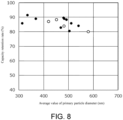
- the average value of the particle diameter of the primary particles is 50 nm or more and 550 nm or less.
- a smaller average primary particle diameter suppresses microcracks generated in the secondary particles and improves the charging/discharging cycle characteristics.
- the average primary particle diameter is preferably 450 nm or less, more preferably 400 nm or less.
- the average primary particle diameter is 550 nm or less, microcracks generated in the secondary particles due to stress associated with charging/discharging cycles are suppressed, and a decrease in capacity is suppressed. Further, even though the diffusion resistance of Li ions in the primary particles increases with charging/discharging cycles, the diffusion distance is short, so a decrease in capacity tends to be suppressed.
- the average primary particle diameter is 50 nm or more, bonding between adjacent primary particles can be ensured, and breakage, deformation, falling of particles, etc. are less likely to occur when the positive electrode active material is applied to the positive electrode and pressure-molded or when the volume changes due to charging and discharging.
- SEM scanning electron microscope
- the average value of the particle diameters of the secondary particles is preferably 3 ⁇ m or more and 50 ⁇ m or less, for example.
- the secondary particles have a form in which a plurality of primary particles are aggregated, and it is preferable that the average value of the particle diameters of the secondary particles is 3 ⁇ m or more, so as to increase the coating density when forming the positive electrode. Further, it is preferable that the average value is 50 ⁇ m or less, so as to obtain a positive electrode with a smooth surface after coating.
- the average secondary particle diameter can be evaluated using a laser diffraction particle size distribution measuring device.
- the positive electrode active material of the embodiment of the present invention has an R value greater than 0.420 and less than or equal to 0.460, which is calculated based on an intensity I 006 calculated from the height of a peak identified as a 006-plane of the ⁇ -NaFeO 2 type layered structure in X-ray powder diffraction measurement, an intensity I 102 calculated from the height of a peak identified as a 102-plane, and an intensity I 101 calculated from the height of a peak identified as a 101-plane. It has been found that this R value depends on the amount of cation mixing in which nickel ions are mixed into lithium sites in the ⁇ -NaFeO 2 type crystal structure.
- the amount of cation mixing becomes small and the nickel ions mixed into the lithium sites are reduced, and Li ions can move smoothly within the lithium sites during charging and discharging. It has been found that the diffusion resistance decreases and the initial capacity increases as a result. Specifically, when the R value is 0.460 or less, cation mixing is small and high discharge capacity can be obtained.
- the R value is affected by the firing temperature, time, etc., as will be described later, and when the R value is 0.420 or less, firing tends to be excessive, and as a result, the average primary particle diameter becomes coarse and there is a possibility that favorable charging/discharging cycle characteristics may not be obtained.
- the upper limit of the R value is preferably 0.450 or less, more preferably 0.435 or less. In addition, the lower limit is preferably 0.425 or more, more preferably 0.430 or more.
- R value I 006 + I 102 / I 101
- 104-plane half-value width the half-value width of the peak identified as the 104-plane (hereinafter may be referred to as 104-plane half-value width) in X-ray powder diffraction measurement and the dependence on crystallite size and crystal lattice strain. That is, it has been found that, as the crystallite size is large and the lattice strain is small, Li ions can move smoothly within the lithium sites during charging and discharging, so the diffusion resistance decreases, and as a result, the initial capacity tends to be high.
- the initial capacity is influenced by the amount of cation mixing, crystallite size, and lattice strain. Therefore, it is desirable to consider both the R value, which indicates the correlation with the amount of cation mixing, and the 104-plane half-value width, which indicates the correlation with the crystallite size and lattice strain.
- the initial capacity tends to increase as the sum of the 104-plane half-value width and the R value (half-value width+R value) decreases.
- firing tends to be excessive and the average primary particle diameter becomes larger than necessary, so it has been found that there is an appropriate range.
- the sum of the 104-plane half-value width and the R value is 0.480 or more and 0.595 or less, high initial capacity is obtained, which is preferable.
- the upper limit of this half-value width+R value is preferably 0.585 or less, more preferably 0.560 or less.
- the lower limit is preferably 0.530 or more, more preferably 0.540 or more.
- the specific surface area of the secondary particles is preferably 0.30 m 2 /g or more and 1.00 m 2 /g or less. As the specific surface area increases, the contact area between the electrolyte and the positive electrode active material widens, the insertion/desorption resistance of Li ions on the surface of the positive electrode active material decreases, and the initial capacity improves.
- the specific surface area is 0.30 m 2 /g or more, pores are formed in the secondary particles of the positive electrode active material. These pores can suppress stress caused by expansion/contraction of the volume of the positive electrode active material due to charging/discharging cycles.
- the specific surface area is more preferably 0.45 m 2 /g or more.
- the capacity improves and the capacity retention rate also increases.
- the specific surface area is more preferably 0.60 m 2 /g or more, and the specific surface area is particularly preferably 0.90 m 2 /g or more.
- the capacity further improves and the capacity retention rate also increases. If the specific surface area is 1.00 m 2 /g or less, bonding between adjacent primary particles can be ensured, and a decrease in capacity due to charging/discharging cycles is suppressed.
- the specific surface area of the positive electrode active material can be determined by a Brunauer-Emett-Teller (BET) method or the like.
- the oil absorption amount of N-methyl-2-pyrrolidone (hereinafter may be referred to as oil absorption amount) per 100 g of the lithium composite oxide powder based on JIS K5101-13-1 is preferably 27 ml/100g or more and 35 ml/100g or less.
- oil absorption amount increases, the contact area between the electrolyte and the positive electrode active material widens, the insertion/desorption resistance of Li ions on the surface of the positive electrode active material decreases, and the capacity improves.
- the oil absorption amount is 27 ml/100g or more, pores are formed in the secondary particles of the positive electrode active material.
- the oil absorption amount is more preferably 28 ml/100g or more.
- the capacity improves and the capacity retention rate also increases.
- the oil absorption amount is more preferably 29 ml/100g or more, and the oil absorption amount is particularly preferably 32 ml/100g or more.
- the capacity further improves and the capacity retention rate also increases. If the oil absorption amount is 35 ml/100g or less, bonding between adjacent primary particles can be ensured, and a decrease in capacity due to charging/discharging cycles is suppressed.
- the oil absorption amount was measured in accordance with JIS K5101-13-1, and N-methylpyrrolidone (NMP) was used as the solvent.
- NMP N-methylpyrrolidone
- 5.0 g of the positive electrode active material is measured and placed in a mountain shape on a flat vat. NMP is sucked up with a poly dropper (2 mL capacity) to measure the mass. Next, while dropping NMP onto the positive electrode active material, the positive electrode active material is kneaded with a spatula, and the dropping and kneading are continued until the entire positive electrode active material becomes clay-like.
- the oil absorption amount can be calculated by converting the amount of NMP that has been dropped up to this point per 100 g of the positive electrode active material.
- the porosity of the secondary particles is preferably 8% or more and 24% or less.
- the porosity is 8% or more, stress caused by expansion/contraction of the volume of the positive electrode active material due to charging/discharging cycles can be suppressed.
- the porosity is more preferably 12% or more. The capacity improves and the capacity retention rate also increases. If the porosity is 24% or less, bonding between adjacent primary particles can be ensured, and a decrease in capacity due to charging/discharging cycles is suppressed.
- the most frequent pore diameter is preferably 0.22 ⁇ m or more and 0.30 ⁇ m or less.
- the most frequent pore diameter is 0.22 ⁇ m or more, stress caused by expansion/contraction of the volume of the positive electrode active material due to charging/discharging cycles can be suppressed. As a result, microcracks generated in the secondary particles are suppressed, and a decrease in capacity is suppressed.
- the most frequent pore diameter is more preferably 0.26 ⁇ m or more. The capacity improves and the capacity retention rate also increases. If the most frequent pore diameter is 0.30 ⁇ m or less, bonding between adjacent primary particles can be ensured, and a decrease in capacity is suppressed.
- the most frequent pore diameter can be measured by mercury porosimetry. Specifically, the pore distribution indicating the pore diameter and frequency was measured by mercury porosimetry, and the pore diameter with the highest frequency in the range where the pore diameter is 0.6 ⁇ m or less was defined as the most frequent pore diameter.
- FIG. 1 is a partial cross-sectional view schematically showing an example of the lithium ion secondary battery.
- the lithium ion secondary battery 100 includes a bottomed cylindrical battery can 101 housing a non-aqueous electrolyte, a wound electrode group 110 housed inside the battery can 101, and a disk-shaped battery lid 102 sealing an upper opening of the battery can 101.
- the battery can 101 and the battery lid 102 are made of a metal material such as stainless steel and aluminum, for example.
- a positive electrode 111 includes a positive electrode collector 111a and a positive electrode mixture layer 111b formed on the surface of the positive electrode collector 111a.
- a negative electrode 112 includes a negative electrode collector 112a and a negative electrode mixture layer 112b formed on the surface of the negative electrode collector 112a.
- this lithium ion secondary battery 100 has a cylindrical shape, the shape and battery structure of the lithium ion secondary battery are not particularly limited.
- the lithium ion secondary battery 100 may have an appropriate shape such as a rectangular shape, a button shape, or a laminated sheet shape, or have other battery structures.
- the lithium ion secondary battery according to this embodiment can be used for various applications.
- the applications include, for example, small power supplies for portable electronic devices and household electrical devices, stationary power supplies for power storage devices, uninterruptible power supply devices, and power leveling devices, and drive power supplies for ships, railway vehicles, hybrid railway vehicles, hybrid automobiles, and electric vehicles, but are not limited thereto. Since the above-described lithium composite oxide has a high nickel content and exhibits not only high discharge capacity but also favorable charging/discharging cycle characteristics, the lithium composite oxide is particularly suitable for automotive applications that require a long life.
- the chemical composition of the positive electrode active material used in the lithium ion secondary battery can be confirmed by disassembling the battery, collecting the positive electrode active material constituting the positive electrode, and performing high frequency inductively coupled plasma emission spectrometry, atomic absorption spectrometry, etc.
- the positive electrode active material of the present invention can be produced by, for example, reliably advancing the synthetic reaction between lithium, nickel, etc. under appropriate firing conditions at a raw material ratio such that the lithium composite oxide has a desired chemical composition.
- a method for producing the positive electrode active material will be described below as an example.
- the method for producing the positive electrode active material for a lithium ion secondary battery includes a step of obtaining granules by either a granulation step or a coprecipitation step, and a firing step of firing the granules in an oxidizing atmosphere. It should be noted that steps other than these steps may be added. For example, a mixing step of mixing the granules with lithium carbonate or lithium hydroxide may be added.
- the slurry-like positive electrode mixture gels, so a water washing step and a drying step may be added following the firing step to reduce the remaining lithium hydroxide and lithium carbonate.
- a raw material mixing step is performed before the granulation step.
- a compound containing lithium and a compound containing metal elements other than Li may be mixed, or only a compound containing metal elements other than Li may be mixed. From the viewpoint of dispersing Li more uniformly, it is preferable to mix a compound containing lithium and a compound containing metal elements other than Li. For example, by weighing, pulverizing, and mixing these raw materials, a powdery mixture in which the raw materials are uniformly mixed can be obtained.
- a pulverizer for pulverizing the raw materials can be, for example, a general precision pulverizer such as a ball mill, a bead mill, a jet mill, a rod mill, and a sand mill.
- the raw material may be pulverized by dry pulverization or wet pulverization.
- a solvent such as water may be added after dry pulverization to form a slurry composed of the raw material and the solvent, or a solvent such as water may be added to the raw material in advance to form a slurry, followed by wet pulverization. From the viewpoint of obtaining uniform and fine powder, it is more preferable to perform wet pulverization using a medium such as water.
- a dispersant it is preferable to uniformly disperse the raw material, and for example, in wet mixing, it is preferable to use a dispersant to improve the dispersibility of the raw material in the slurry.
- a polycarboxylic acid type, a urethane type, or an acrylic resin type can be used as the dispersant, and an acrylic resin type is preferable.
- the amount of the dispersant to be added can be arbitrarily determined in order to adjust the viscosity of the slurry.
- the mixture obtained in the raw material mixing step is granulated to obtain secondary particles (granules) in which the particles aggregate.
- the mixture may be granulated using either dry granulation or wet granulation.
- an appropriate granulation method such as a rolling granulation method, a fluidized bed granulation method, a compression granulation method, or a spray granulation method can be used.
- a spray granulation method is particularly preferable.
- Various types such as a two-fluid nozzle type, a four-fluid nozzle type, and a disk type can be used as a spray granulator.
- the slurry that has been precisely mixed and pulverized by wet pulverization can be granulated while being dried.
- the granulation step it is preferable to granulate the mixture obtained in the mixing step so that the average particle diameter (D50) is 3 ⁇ m or more and 50 ⁇ m or less.
- the average particle diameter (D50) of the secondary particles of the granules is more preferably 5 ⁇ m or more and 20 ⁇ m or less.
- a coprecipitate may be obtained by adjusting the pH of an aqueous solution containing Ni, Co, M, and X.
- Ni, Co, M, and X may all be coprecipitated at once, or one or more of Ni, Co, M, and X may be coprecipitated (precipitated) and then the other elements may be precipitated (coprecipitated) simultaneously or each element may be precipitated (coprecipitated) separately on the surface of the coprecipitate.
- the granules and a lithium compound are mixed.
- the granules and the lithium compound can be mixed by dry mixing.
- a V-type mixer, an attritor, etc. can be used as a mixer for mixing the granules and the lithium compound.
- the granules may be heated before being mixed with the lithium compound. The particle strength of the granules is increased, and the lithium compound can be mixed without breaking the granules.
- the compound containing lithium examples include lithium carbonate, lithium acetate, lithium nitrate, lithium hydroxide, lithium chloride, and lithium sulfate.
- the gas generated in the firing step is water vapor or carbon dioxide gas, which causes little damage to manufacturing equipment and is excellent in industrial applicability and practicality.
- it is more preferable to use at least lithium carbonate and it is more preferable to use lithium carbonate in a proportion of 80% by mass or more in the raw material containing lithium.
- Lithium carbonate has excellent supply stability and is inexpensive compared to other compounds containing lithium, and therefore can be easily obtained.
- lithium carbonate is weakly alkaline, and thus causes less damage to manufacturing equipment and is excellent in industrial applicability and practicality.
- the compound containing metal elements other than Li it is preferable to use a compound composed of C, H, O, and N such as carbonate, hydroxide, oxyhydroxide, acetate, citrate, and oxide. From the viewpoint of ease of pulverization and amount of gas released by thermal decomposition, carbonate, hydroxide, and oxide are particularly preferable. Sulfate may also be used. Being easily soluble in a solvent such as water is preferable.
- the atomic concentration ratio (molar ratio) between the atomic concentration (number of moles) of lithium contained in the fired precursor and the total atomic concentration (number of moles) of the metal elements other than lithium is desirable to react at a stoichiometric ratio of approximately 1:1.
- the atomic concentration ratio (molar ratio) between the atomic concentration (number of moles) of lithium contained in the fired precursor and the total atomic concentration (number of moles) of the metal elements other than lithium is 0.90 or more and 1.10 or less.
- the synthesis reaction proceeds appropriately and the amount of cation mixing in which nickel is mixed into lithium sites is reduced, which is preferably 1.02 or more and 1.10 or less, more preferably 1.04 or more and 1.10 or less.
- the granules are heat-treated to fire the lithium composite oxide.
- the firing step may be performed in one stage of heat treatment in which the heat treatment temperature is controlled within a certain range, or may be performed in multiple stages of heat treatment in which the heat treatment temperature is controlled in different ranges.
- a first precursor is preferably obtained by heat treatment at a heat treatment temperature of 400°C or more and less than 750°C for 2 hours or more and 80 hours or less in an oxidizing atmosphere.
- the first heat treatment step may be performed in one stage of heat treatment in which the heat treatment temperature is controlled within a certain range, or may be performed in multiple stages of heat treatment in which the heat treatment temperature is controlled in different ranges.
- the main purpose of the first heat treatment step is to remove moisture or carbonic acid components and to generate crystal of the lithium composite oxide through a reaction between a lithium compound and a nickel compound.
- Nickel in the fired precursor is sufficiently oxidized to suppress cation mixing in which nickel is mixed into lithium sites and to suppress the formation of cubic domains due to nickel.
- the first heat treatment step preferably obtains the first precursor by heat treatment at a heat treatment temperature of 600°C or more and less than 750°C for 2 hours or more and 80 hours or less. Further, in the first heat treatment step, it is preferable to perform a first stage of heat treatment in which the heat treatment temperature is controlled within a certain range, and a second stage of heat treatment in which the temperature is higher than the first stage of heat treatment in a range of 10°C or more and 50°C or less. By performing the two stages of heat treatment, nickel in the fired precursor is sufficiently oxidized, thereby suppressing cation mixing in which nickel is mixed into lithium sites.
- the first heat treatment step preferably obtains the first precursor by heat treatment at a heat treatment temperature of 400°C or more and less than 550°C for 2 hours or more and 20 hours or less.
- a heat treatment temperature is more preferably 510°C or less.
- the temperature is 510°C or less, the amount of cation mixing can be suppressed while suppressing coarsening of the average primary particle diameter. In other words, it is possible to increase only the initial capacity without affecting the charging/discharging cycle characteristics.
- a lithium composite oxide is obtained by performing heat treatment on the first precursor obtained in the first heat treatment step at a heat treatment temperature of 700°C or more and 900°C or less, which is higher than the heat treatment temperature in the first heat treatment step, for 2 hours or more and 100 hours or less.
- the main purpose of the second heat treatment step is to grow the crystal grains of the lithium composite oxide having a layered structure to appropriate particle diameter and specific surface area.
- the crystal grains of the lithium composite oxide can be grown to appropriate particle diameter and specific surface area while sufficiently oxidizing nickel and suppressing cation mixing.
- the heat treatment temperature is 900°C or less, lithium is difficult to volatilize and the layered structure is difficult to decompose, so a lithium composite oxide with high crystal purity, high discharge capacity, and favorable charging/discharging cycle characteristics can be obtained.
- a heat treatment step at a lower temperature than the second heat treatment step may be added after the second heat treatment step.
- the heat treatment temperature in the second heat treatment step is preferably 820°C or less.
- the heat treatment temperature in the second heat treatment step is preferably 820°C or less.
- a lithium composite oxide having an average primary particle diameter of 550 nm or less is obtained, and favorable charging/discharging cycle characteristics are obtained.
- the specific surface area, oil absorption amount, porosity, and most frequent pore diameter can be controlled by changing the method of loading the first precursor into the firing container.
- the state of emission of carbon dioxide generated as the layered structure is formed can be changed to change the amount of liquid phase during the second heat treatment step, the oxygen concentration in the atmosphere, and the carbon dioxide concentration and to control the various physical properties described above.
- the heat treatment temperature in the second heat treatment step is preferably 850°C or less.
- the heat treatment temperature in the second heat treatment step is preferably 850°C or less.
- the heat treatment time of the second heat treatment step is preferably 20 hours or more and 100 hours or less.
- the heat treatment time of the second heat treatment step By setting the heat treatment time of the second heat treatment step to 20 hours or more, a lithium composite oxide having a small average primary particle diameter, a small R value, and a small half-value width and achieving both high initial capacity and favorable charging/discharging cycle characteristics is obtained. Furthermore, from the viewpoint of mass productivity, the heat treatment time is preferably 100 hours or less.
- an appropriate heat treatment device for example, a rotary furnace such as a rotary kiln, a continuous furnace such as a roller hearth kiln, a tunnel furnace, or a pusher furnace, or a batch furnace can be used as the heat treatment means.
- the first heat treatment step and the second heat treatment step may be performed using the same heat treatment device, or may be performed using different heat treatment devices.
- a positive electrode active material made of the lithium composite oxide can be produced through the above-described granulation step or coprecipitation step and firing step.
- the R value, the half-value width of the peak identified as the 104-plane (104-plane half-value width), and the average primary particle diameter can be controlled mainly through adjustment of the method of preparing the precursor before heat treatment, the composition ratio of metal elements such as nickel, the heat treatment temperature in the first heat treatment step, and the heat treatment temperature and heat treatment time in the second heat treatment step.
- the R value can be reduced while maintaining the average primary particle diameter.
- the R value can be reduced while maintaining the average primary particle diameter.
- the synthesized lithium composite oxide may be supplied for a washing step of washing with deionized water or the like after the firing step for the purpose of removing impurities, and for a drying step of drying the washed lithium composite oxide.
- the synthesized lithium composite oxide may be subj ected to a crushing step of crushing the synthesized lithium composite oxide, a classification step of classifying the lithium composite oxide into a predetermined particle size, etc.
- the primary particle diameter of the positive electrode active material was measured using a scanning electron microscope "S-4700" (manufactured by Hitachi, Ltd.) according to the following procedure.
- the primary particle diameters of 50 arbitrary particles were measured, and the average value was calculated by calculating the arithmetic average of the particle diameters of the 6 th to 44 th particles in descending order of primary particle diameter.
- the specific surface area of the positive electrode active material was determined by the BET method using a fully automatic specific surface area measuring device "Macsorb” (manufactured by Mountech Co., Ltd.).
- the oil absorption amount of the positive electrode active material was measured in accordance with JIS K5101-13-1, and NMP (N-methylpyrrolidone) was used as the solvent.
- NMP N-methylpyrrolidone
- 5.0 g of the positive electrode active material was measured and placed in a mountain shape on a flat vat. NMP was sucked up with a poly dropper (2 mL capacity) to measure the mass. Next, while dropping NMP onto the positive electrode active material, the positive electrode active material was kneaded with a spatula, and the dropping and kneading were continued until the entire positive electrode active material became clay-like.
- the pore distribution was measured using a pore distribution measuring device, and the pore diameter with the highest frequency in the range where the pore diameter was 0.6 ⁇ m or less was defined as the most frequent pore diameter.
- the X-ray diffraction pattern in the X-ray powder diffraction measurement of the positive electrode active material was measured using an X-ray diffraction device "X'Pert PRO MPD" (manufactured by PANalyticalsei) under the conditions of a radiation source of CuK ⁇ , a tube voltage of 45 kV, a tube current of 40 mA, a sampling interval of 0.02°/step, a divergence slit of 0.5°, a scattering slit of 0.5°, a light receiving slit of 0.15 mm, and a scanning range of 15° ⁇ 2 ⁇ 80°.
- X'Pert PRO MPD manufactured by PANalyticalsei
- the X-ray diffraction pattern in the X-ray powder diffraction measurement of the positive electrode active material was measured using an X-ray diffraction device "X'Pert PRO MPD" (manufactured by PANalyticalsei) under the conditions of a radiation source of CuK ⁇ , a tube voltage of 45 kV, a tube current of 40 mA, a sampling interval of 0.02°/step, a divergence slit of 0.5°, a scattering slit of 0.5°, a light receiving slit of 0.15 mm, and a scanning range of 15° ⁇ 2 ⁇ 80°.
- X'Pert PRO MPD manufactured by PANalyticalsei
- the chemical composition of the synthesized positive electrode active material was analyzed by high frequency inductively coupled plasma emission spectrometry using an ICP-AES emission spectrometer "OPTIMA8300" (manufactured by Perkin Elmer). Further, the oxygen content ( ⁇ in compositional formula (1)) of the positive electrode active material was analyzed by the inert gas melting-infrared absorption method.
- lithium carbonate, nickel hydroxide, cobalt carbonate, manganese carbonate, titanium oxide, and aluminum oxide were prepared as raw materials, the raw materials were weighed so that the molar ratio of the metal elements Li:Ni:Co:Mn:Ti:Al became 1.03:0.85:0.03:0.08:0.03:0.01, and pure water was added so that the solid content ratio became 30% by mass.
- a raw material slurry was prepared by wet pulverization (wet mixing) using a pulverizer so that the average particle diameter was less than 0.2 ⁇ m (raw material mixing step).
- the obtained raw material slurry was spray-dried using a nozzle-type spray dryer (manufactured by Okawara Kakoki Co., Ltd., model ODL-20) to obtain granules having a D50 of 12 ⁇ m (granulation step).
- the spray pressure was 0.13 MPa, and the spray amount was 260 g/min.
- the dried granules were then heat-treated to fire the lithium composite oxide (firing step). Specifically, the granules were dehydrated in a continuous conveying furnace at 400°C for 5 hours in an air atmosphere.
- the first heat treatment (first stage) was performed at 650°C for 22 hours in an oxygen stream, and then the first heat treatment (second stage) was performed at 700°C for 30 hours to obtain a first precursor (first heat treatment step). Thereafter, the first precursor was subjected to the second heat treatment (first stage) at 820°C for 10 hours in an oxygen stream in a firing furnace substituted with an oxygen gas atmosphere, and then the second heat treatment (second stage) at 740°C for 4 hours in an oxygen stream in a firing furnace substituted with an oxygen gas atmosphere to obtain a lithium composite oxide (second heat treatment step).
- the fired powder obtained by firing was classified using a sieve with an opening of 53 ⁇ m, and the powder under the sieve was used as the positive electrode active material of the sample.
- the heat treatment in the first heat treatment step will be referred to as the first heat treatment
- the heat treatment in the second heat treatment step will be referred to as the second heat treatment.
- nickel hydroxide, manganese carbonate, titanium oxide, and aluminum oxide were prepared as raw materials, the raw materials were weighed so that the molar ratio of the metal elements Ni:Mn:Ti:Al became 0.88:0.08:0.03:0.01, and pure water was added so that the solid content ratio became 20% by mass. Then, a raw material slurry was prepared by wet pulverization (wet mixing) using a pulverizer so that the average particle diameter was less than 0.2 ⁇ m (raw material mixing step).
- the obtained raw material slurry was spray-dried using a nozzle-type spray dryer (manufactured by Okawara Kakoki Co., Ltd., model ODL-20) to obtain granules having a D50 of 12 ⁇ m (granulation step).
- the spray pressure was 0.13 MPa, and the spray amount was 260 g/min.
- the dried granules were then heat-treated at 650°C for 10 hours to fire the metal composite oxide.
- lithium hydroxide and the obtained metal composite oxide were weighed so that the molar ratio of Li:metal elements other than lithium became 1.03: 1.00, and mixed using a V-type mixer.
- the first heat treatment was performed at 500°C for 14 hours in an oxygen stream to obtain a first precursor (first heat treatment step). Thereafter, the first precursor was subjected to the second heat treatment (first stage) at 850°C for 32 hours in an oxygen stream in a firing furnace substituted with an oxygen gas atmosphere, and then the second heat treatment (second stage) at 740°C for 4 hours in an oxygen stream in a firing furnace substituted with an oxygen gas atmosphere to obtain a lithium composite oxide (second heat treatment step).
- the fired powder obtained by firing was classified using a sieve with an opening of 53 ⁇ m, and the powder under the sieve was used as the positive electrode active material of the sample.
- a positive electrode active material was obtained in the same manner as in Example 2, except that the heat treatment temperature in the second heat treatment (first stage) was 835°C and the heat treatment time was 64 hours. It should be noted that the following second heat treatment refers to the first stage, and the description of (first stage) will be omitted.
- a positive electrode active material was obtained in the same manner as in Example 2, except that the heat treatment temperature in the second heat treatment was 835°C and the heat treatment time was 32 hours.
- a positive electrode active material was obtained in the same manner as in Example 2, except that the ratio of Li:metal elements other than lithium was 1.05: 1.00, the heat treatment temperature in the second heat treatment was 835°C, and the heat treatment time was 32 hours.
- a positive electrode active material was obtained in the same manner as in Example 1, except that the molar ratio of the metal elements Li:Ni:Co:Mn:Ti:Al was weighed to be 1.03:0.88:0.03:0.05:0.03:0.01.
- a positive electrode active material was obtained in the same manner as in Example 2, except that Nickel hydroxide, cobalt carbonate, manganese carbonate, titanium oxide, and aluminum oxide were prepared as raw materials, the raw materials were weighed so that the molar ratio of the metal elements Ni:Co:Mn:Ti:Al became 0.88:0.03:0.05:0.03:0.01, the heat treatment temperature in the second heat treatment was 820°C, and the heat treatment time was 24 hours.
- a positive electrode active material was obtained in the same manner as in Example 2, except that nickel hydroxide, cobalt carbonate, manganese carbonate, titanium oxide, and aluminum oxide were prepared as raw materials, the raw materials were weighed so that the molar ratio of the metal elements Ni:Co:Mn:Ti:Al became 0.88:0.03:0.05:0.03:0.01, the ratio of Li:metal elements other than lithium was 1.05: 1.00, the heat treatment temperature in the second heat treatment was 820°C, and the heat treatment time was 12 hours.
- a positive electrode active material was obtained in the same manner as in Example 2, except that nickel hydroxide, cobalt carbonate, and manganese carbonate were prepared as raw materials, the raw materials were weighed so that the molar ratio of the metal elements Ni:Co:Mn became 0.88:0.09:0.03, the heat treatment temperature in the second heat treatment was 740°C, and the heat treatment time was 32 hours.
- a positive electrode active material was obtained in the same manner as in Example 2, except that nickel hydroxide, cobalt carbonate, titanium oxide, and aluminum oxide were prepared as raw materials, the raw materials were weighed so that the molar ratio of the metal elements Ni:Co:Ti:Al became 0.92:0.03:0.03:0.02, the heat treatment temperature in the second heat treatment was 780°C, and the heat treatment time was 64 hours.
- a positive electrode active material was obtained in the same manner as in Example 1, except that the heat treatment temperature in the second heat treatment was 810°C.
- a positive electrode active material was obtained in the same manner as in Example 2, except that the ratio of Li:metal elements other than lithium was 1.05:1.00, the heat treatment temperature in the second heat treatment was 840°C, and the heat treatment time was 64 hours.
- a positive electrode active material was obtained in the same manner as in Example 2, except that the ratio of Li:metal elements other than lithium was 1.01:1.00, the heat treatment temperature in the second heat treatment was 835°C, and the heat treatment time was 32 hours.
- a positive electrode active material was obtained in the same manner as in Example 2, except that the heat treatment temperature in the first heat treatment was 520°C, the heat treatment temperature in the second heat treatment was 820°C, and the heat treatment time was 96 hours.
- a positive electrode active material was obtained in the same manner as in Example 2, except that the heat treatment temperature in the second heat treatment was 835°C and the heat treatment time was 10 hours.
- a positive electrode active material was obtained in the same manner as in Example 2, except that the heat treatment temperature in the first heat treatment was 520°C, the heat treatment temperature in the second heat treatment was 835°C, and the heat treatment time was 32 hours.
- a positive electrode active material was obtained in the same manner as in Example 6, except that the heat treatment temperature in the second heat treatment was 830°C.
- a positive electrode active material was obtained in the same manner as in Example 6, except that the heat treatment temperature in the second heat treatment was 840°C.
- a positive electrode active material was obtained in the same manner as in Example 8, except that the ratio of Li:metal elements other than lithium was 1.03: 1.00.
- Table 1 shows the chemical compositions of the positive electrode active materials of Examples 1 to 10 and Comparative Examples 1 to 9, the first heat treatment temperatures, and the temperatures and times in the second heat treatment (first stage). It should be noted that the descriptions of the first heat treatment (first stage) and second heat treatment (second stage) in Example 1, Example 6, Comparative Example 1, Comparative Example 7, and Comparative Example 8 are omitted. In addition, the average primary particle diameter, R value, and half-value width of the peak identified as the 104-plane were evaluated. The results are also listed in Table 1. Although not stated, the average secondary particle diameter was in the range of 8 to 13 ⁇ m in both Examples and Comparative Examples, aiming at 10 ⁇ m.
- the half-value width of the peak identified as the 104-plane is described as "104-plane half-value width”
- the sum of the half-value width of the peak identified as the 104-plane and the R value is described as "half-value width+R value”.
- a SEM image of Example 6 is shown in FIG. 3 .
- a lithium ion secondary battery was prepared using the synthesized positive electrode active material as the positive electrode material, and the discharge capacity and capacity retention rate of the lithium ion secondary battery were determined.
- the prepared positive electrode active material, a carbon-based conductive material, and a binder pre-dissolved in N-methyl-2-pyrrolidone (NMP) were mixed at a mass ratio of 94:4.5:1.5.
- NMP N-methyl-2-pyrrolidone
- the uniformly mixed positive electrode mixture slurry was applied onto a positive electrode collector made of aluminum foil with a thickness of 20 ⁇ m so that the coating amount was 10 mg/cm 2 .
- the positive electrode mixture slurry applied to the positive electrode collector was heat-treated at 120°C, and the solvent was distilled off to form a positive electrode mixture layer. Thereafter, the positive electrode mixture layer was pressure-molded using a hot press and punched into a circular shape with a diameter of 15 mm to obtain a positive electrode.
- a lithium ion secondary battery was prepared using the prepared positive electrode, a negative electrode, and a separator. Metal lithium punched into a circular shape with a diameter of 16 mm was used as the negative electrode. A porous separator made of polypropylene and having a thickness of 30 ⁇ m was used as the separator.
- the lithium ion secondary battery was assembled with the positive electrode and the negative electrode facing each other in a non-aqueous electrolyte with the separator therebetween. A solution was used as the non-aqueous electrolyte, which was obtained by dissolving LiPF 6 of 1.0 mol/L in a solvent in which ethylene carbonate and dimethyl carbonate were mixed at a volume ratio of 3:7.
- the prepared lithium ion secondary battery was charged at constant current/constant voltage of 40 A/kg and an upper limit potential of 4.3 V based on the weight of the positive electrode mixture in an environment of 25°C. Then, the battery was discharged to a lower limit potential of 2.5 V at a constant current of 40 A/kg based on the weight of the positive electrode mixture to measure the initial capacity (discharge capacity). The results are also listed in Table 1.
- the initial capacity (discharge capacity) is influenced by the nickel ratio, and as the nickel ratio increases, the capacity increases. In order to compare the relationship between initial capacity and R value, it is necessary to remove the influence of nickel ratio. Therefore, the initial capacity (expected initial capacity) expected at each nickel ratio was calculated from the data on the initial capacity of Li(Ni, Co, Mn)Oz described in Non-patent Documents, Jaurnal of Materials Chemistry A, Issue 5, pp. 874-901 and Applied sciences, Issue 10, 8988 , and the initial capacity rate was determined using formula (4). The results are also listed in Table 1. Since the initial capacity is also affected by the rate, only data measured at the rate of 0.02C to 0.5C was used to calculate the expected initial capacity. Further, since the positive electrode active material of the present invention contains additive elements, the capacity tended to be lower than the expected initial capacity.
- Initial capacity rate measured value of initial capacity / expected initial capacity ⁇ 100
- a lithium ion secondary battery was prepared using the prepared positive electrode, a negative electrode, and a separator.
- a negative electrode a negative electrode prepared by applying graphite on a copper foil negative electrode collector was punched into a circular shape with a diameter of 16 mm.
- the lithium ion secondary battery was assembled with the positive electrode and the negative electrode facing each other in a non-aqueous electrolyte with the separator therebetween.
- a solution was used as the non-aqueous electrolyte, which was obtained by dissolving LiPF 6 of 1.0 mol/L in a solvent in which ethylene carbonate and dimethyl carbonate were mixed at a volume ratio of 3:7, and then dissolving 1.5% by mass of vinylene carbonate.
- the prepared lithium ion secondary battery was charged at constant current/constant voltage of 200 A/kg and an upper limit potential of 4.3 V based on the weight of the positive electrode mixture in an environment of 50°C. Then, a total of 10 cycles of discharging to a lower limit potential of 2.5 V at a constant current of 200 A/kg based on the weight of the positive electrode mixture were performed to measure the discharge capacity after 10 cycles. The ratio of the discharge capacity after 10 cycles to the initial capacity was calculated as the capacity retention rate. The results are also listed in Table 1.
- Example 5 From Example 4, Example 5, and Comparative Example 3, it was confirmed that as the ratio of Li:metal elements other than lithium increased, the R value decreased and the 104-plane half-value width became narrower while the average primary particle diameter was maintained within the range of the present invention. Then, when the ratio of Li:metal elements other than lithium was 1.01, the R value was 0.467, which was outside the range of the present invention; in contrast, when the ratio of Li:metal elements other than lithium was 1.03 or more, the R value was 0.453 or less, and an R value within the range of the present invention was obtained.
- Example 3 Example 4, and Comparative Example 5, it was confirmed that as the heat treatment time in the second heat treatment increased, the R value decreased and the 104-plane half-value width became narrower while the average primary particle diameter was maintained within the range of the present invention. Then, when the heat treatment time in the second heat treatment was 10 hours, the R value was 0.464, which was outside the range of the present invention; in contrast, when the heat treatment time in the second heat treatment was 32 hours or more, the R value was 0.453 or less, and an R value within the range of the present invention was obtained.
- Example 4 and Comparative Example 6 it was confirmed that when the heat treatment temperature in the first heat treatment was low, the R value decreased and the 104-plane half-value width became narrower while the average primary particle diameter was maintained within the range of the present invention. Then, when the heat treatment temperature in the first heat treatment was 520°C, the R value was 0.467, which was outside the range of the present invention; in contrast, when the heat treatment temperature in the first heat treatment was 500°C, the R value was 0.453 or less, and an R value within the range of the present invention was obtained.
- the R value and the average primary particle diameter could be simultaneously controlled within the range of the present invention by adjusting the ratio of Li and metal elements other than lithium, the heat treatment temperature in the first heat treatment step, and the heat treatment temperature and heat treatment time in the second heat treatment step.
- FIG. 4 the relationship between the initial capacity and the R value is shown in FIG. 4
- the relationship between the initial capacity rate and the R value is shown in FIG. 5
- the relationship between the initial capacity and the sum of the 104-plane half-value width and the R value (described as "half-value width+R value") is shown in FIG. 6
- the relationship between the initial capacity rate and the sum of the 104-plane half-value width and the R value is shown in FIG. 7 .
- FIG. 8 the relationship between the capacity retention rate and the average primary particle diameter (described as "average value of primary particle diameter") is shown in FIG. 8 .
- the black circles indicate examples and the white circles indicate comparative examples.
- the primary particle diameter was 50 nm or more and 550 nm or less, and the R value was greater than 0.420 and less than or equal to 0.460.
- each example of the present invention had high initial capacity exceeding 190 Ah/kg and a high initial capacity rate exceeding 93%.
- favorable charging/discharging cycle characteristics were achieved with the capacity retention rate also exceeding 81%, and the positive electrode active material was excellent in both high initial capacity and favorable charging/discharging cycle characteristics.
- a positive electrode active material was obtained in the same manner as in Example 1, except for the method of loading the first precursor in the second heat treatment.
- the loading method changes the loading weight, the stacking thickness, and the size of the loading container. By changing these loading methods, it is possible to change the state of emission of carbon dioxide, the amount of liquid phase, and the oxygen concentration and carbon dioxide concentration in the atmosphere in the first precursor. As a result, it is considered to control various physical properties such as specific surface area, oil absorption amount, porosity, most frequent pore diameter, etc. described below. However, the loading methods and control of various physical properties are not determined uniquely, and it is necessary to accumulate and correlate data for each site.
- a positive electrode active material was obtained in the same manner as in Example 13, except that the heat treatment temperature in the second heat treatment was 815°C.
- FIG. 9 the relationship between the capacity retention rate and the specific surface area is shown in FIG. 9
- the relationship between the capacity retention rate and the oil absorption amount is shown in FIG. 10
- the relationship between the capacity retention rate and the porosity is shown in FIG. 11
- the relationship between the capacity retention rate and the most frequent pore diameter is shown in FIG. 12 .
- Example 11 to 16 had high initial capacity exceeding 190 Ah/kg. It was also confirmed that the initial capacity was higher than in Example 1. In particular, Examples 15 and 16 had higher initial capacity of 200 Ah/kg or more. Although Example 1 and Example 15 exhibited a good capacity retention rate for the primary particle diameter was relatively small among Examples 1 to 16, the capacity retention rate was low among the examples in Table 2 that had the same chemical composition and similar primary particle diameters. The reason is considered to be that in Example 1, the porosity was as low as 4%, so the effect of improving the capacity retention rate was not sufficiently obtained. On the other hand, in Example 15, the porosity was too high at 26%, so the particle strength of the secondary particles decreased, which is considered to have influenced the decrease in capacity retention rate.
- the specific surface area is 0.30 m 2 /g or more and 1.00 m 2 /g or less
- the oil absorption amount is 27 ml/100g or more and 35 ml/100g or less
- the porosity is 8% or more and 24% or less
- the most frequent pore diameter is 0.22 ⁇ m or more and 0.30 ⁇ m or less, higher initial capacity and better charging/discharging cycle characteristics can both be achieved.
- the Ni ratio was set to 90%.
- a positive electrode active material was obtained in the same manner as in Example 1, except that lithium carbonate, nickel hydroxide, cobalt carbonate, manganese carbonate, titanium oxide, and aluminum oxide were prepared as raw materials, the raw materials were weighed so that the molar ratio of the metal elements Li:Ni:Co:Mn:Ti:Al became 1.03:0.90:0.03:0.02:0.03:0.02, the heat treatment temperature in the second heat treatment was 800°C, and the heat treatment time was 90 hours.
- a positive electrode active material was obtained in the same manner as in Example 17, except that the heat treatment temperature in the second heat treatment was 795°C.
- the chemical compositions of the positive electrode active materials of Examples 17 and 18, the temperature in the second heat treatment (first stage), the average primary particle diameter, the R value, the half-value width of the peak identified as the 104-plane, the specific surface area, and the oil absorption amount were evaluated.
- the results are shown in Table 3. Further, although not stated, the average secondary particle diameter was in the range of 8 to 13 ⁇ m, aiming at 10 ⁇ m.
- a positive electrode was prepared in the same manner as in Experimental Example 1, and the initial capacity, the initial capacity rate, and the capacity retention rate were evaluated. The results are also listed in Table 3.
- Examples 17 and 18 had a primary particle diameter of 50 nm or more and 550 nm or less, and an R value greater than 0.420 and less than or equal to 0.460, which were within the range of the present invention, and further, the sum of the half-value width of the peak identified as the 104-plane and the R value was 0.480 or more and 0.595 or less, the specific surface area was 0.30 m 2 /g or more and 1.00 m 2 /g or less, and the oil absorption amount was within the range of 27 ml/100g or more and 35 ml/100g or less.
- the former had a Ni ratio of 90%, while the latter had a Ni ratio of 85%, and thus it is considered that this difference resulted in higher capacity but a slightly lower capacity retention rate. Although there were some differences due to the Ni ratio, it was confirmed that both high initial capacity and favorable charging/discharging cycle characteristics can be achieved within the range of the present invention.
Landscapes
- Chemical & Material Sciences (AREA)
- Organic Chemistry (AREA)
- Inorganic Chemistry (AREA)
- Chemical Kinetics & Catalysis (AREA)
- Electrochemistry (AREA)
- General Chemical & Material Sciences (AREA)
- Engineering & Computer Science (AREA)
- Materials Engineering (AREA)
- Manufacturing & Machinery (AREA)
- Battery Electrode And Active Subsutance (AREA)
- Inorganic Compounds Of Heavy Metals (AREA)
Applications Claiming Priority (3)
| Application Number | Priority Date | Filing Date | Title |
|---|---|---|---|
| JP2021154554 | 2021-09-22 | ||
| JP2021186684 | 2021-11-16 | ||
| PCT/JP2022/033802 WO2023047974A1 (ja) | 2021-09-22 | 2022-09-08 | リチウムイオン二次電池用正極活物質およびリチウムイオン二次電池 |
Publications (2)
| Publication Number | Publication Date |
|---|---|
| EP4407713A1 true EP4407713A1 (de) | 2024-07-31 |
| EP4407713A4 EP4407713A4 (de) | 2025-04-02 |
Family
ID=85720595
Family Applications (1)
| Application Number | Title | Priority Date | Filing Date |
|---|---|---|---|
| EP22872729.3A Pending EP4407713A4 (de) | 2021-09-22 | 2022-09-08 | Positivelektrodenaktivmaterial für eine lithium-ionen-sekundärbatterie und lithium-ionen-sekundärbatterie |
Country Status (5)
| Country | Link |
|---|---|
| US (1) | US20240317605A1 (de) |
| EP (1) | EP4407713A4 (de) |
| JP (1) | JP7318842B1 (de) |
| KR (1) | KR102736805B1 (de) |
| WO (1) | WO2023047974A1 (de) |
Families Citing this family (1)
| Publication number | Priority date | Publication date | Assignee | Title |
|---|---|---|---|---|
| WO2025063203A1 (ja) * | 2023-09-21 | 2025-03-27 | 株式会社プロテリアル | リチウムイオン二次電池用正極活物質の前駆体及びその製造方法、並びにリチウムイオン二次電池用正極活物質及びその製造方法 |
Family Cites Families (7)
| Publication number | Priority date | Publication date | Assignee | Title |
|---|---|---|---|---|
| JP2000072446A (ja) | 1998-08-21 | 2000-03-07 | Sumitomo Metal Mining Co Ltd | LiNiO2系層状複合酸化物の製造方法 |
| JP3692965B2 (ja) | 2000-05-15 | 2005-09-07 | 株式会社デンソー | リチウム二次電池およびその正極の製造方法 |
| JP3640164B2 (ja) | 2000-10-13 | 2005-04-20 | 株式会社デンソー | 非水電解質二次電池 |
| JP6549565B2 (ja) | 2014-05-29 | 2019-07-24 | 住友化学株式会社 | リチウム二次電池用正極活物質、リチウム二次電池用正極及びリチウム二次電池 |
| JP7140321B2 (ja) | 2015-10-09 | 2022-09-21 | 住友金属鉱山株式会社 | リチウムニッケル含有複合酸化物とその製造方法、および非水系電解質二次電池 |
| KR101826612B1 (ko) * | 2017-06-07 | 2018-02-07 | 주식회사 엘 앤 에프 | 양극 활물질, 및 이를 포함하는 리튬 이차 전지 |
| CN111435743B (zh) * | 2019-12-19 | 2022-06-21 | 蜂巢能源科技有限公司 | 四元正极材料、正极、电池 |
-
2022
- 2022-09-08 US US18/577,997 patent/US20240317605A1/en active Pending
- 2022-09-08 WO PCT/JP2022/033802 patent/WO2023047974A1/ja not_active Ceased
- 2022-09-08 JP JP2023523648A patent/JP7318842B1/ja active Active
- 2022-09-08 KR KR1020247001228A patent/KR102736805B1/ko active Active
- 2022-09-08 EP EP22872729.3A patent/EP4407713A4/de active Pending
Also Published As
| Publication number | Publication date |
|---|---|
| KR20240056816A (ko) | 2024-04-30 |
| JP7318842B1 (ja) | 2023-08-01 |
| KR102736805B1 (ko) | 2024-12-03 |
| JPWO2023047974A1 (de) | 2023-03-30 |
| US20240317605A1 (en) | 2024-09-26 |
| WO2023047974A1 (ja) | 2023-03-30 |
| EP4407713A4 (de) | 2025-04-02 |
Similar Documents
| Publication | Publication Date | Title |
|---|---|---|
| US11764356B2 (en) | Method for producing positive electrode active material for lithium ion secondary batteries | |
| JP6986211B2 (ja) | リチウムイオン二次電池用正極活物質、及びその製造方法、並びにリチウムイオン二次電池 | |
| JP5971109B2 (ja) | ニッケル複合水酸化物とその製造方法、非水系電解質二次電池用正極活物質とその製造方法、および非水系電解質二次電池 | |
| JP4894969B1 (ja) | ニッケルマンガン複合水酸化物粒子とその製造方法、非水系電解質二次電池用正極活物質とその製造方法、ならびに、非水系電解質二次電池 | |
| CN114270567B (zh) | 锂离子二次电池用正极活性物质及其制造方法以及锂离子二次电池 | |
| JPWO2019171623A1 (ja) | リチウムイオン二次電池用正極活物質及びリチウムイオン二次電池 | |
| WO2016175268A1 (ja) | アルミニウム被覆ニッケルコバルト含有複合水酸化物とその製造方法、非水系電解質二次電池用正極活物質とその製造方法、および、非水系電解質二次電池 | |
| JP7790484B2 (ja) | リチウムイオン二次電池用正極活物質の製造方法 | |
| EP4184614A1 (de) | Positivelektrodenaktivmaterial für lithium-ionen-sekundärbatterie und lithium-ionen-sekundärbatterie damit | |
| JP7338133B2 (ja) | 非水系電解質二次電池用正極活物質前駆体、非水系電解質二次電池用正極活物質前駆体の製造方法、非水系電解質二次電池用正極活物質の製造方法 | |
| JP7532880B2 (ja) | リチウムイオン二次電池用正極活物質、及びその製造方法、並びにリチウムイオン二次電池 | |
| EP4407713A1 (de) | Positivelektrodenaktivmaterial für eine lithium-ionen-sekundärbatterie und lithium-ionen-sekundärbatterie | |
| JP7618991B2 (ja) | リチウムイオン二次電池用正極活物質、及びその製造方法、並びにリチウムイオン二次電池 | |
| JP4362004B2 (ja) | リチウムマンガン複合酸化物及びその製造方法、並びにその用途 | |
| CN117730436A (zh) | 锂离子二次电池用正极活性物质及锂离子二次电池 | |
| EP4593118A1 (de) | Verfahren zur herstellung eines positivelektrodenaktivmaterials für lithium-ionen-sekundärbatterie, daraus hergestellter vorläufer und verfahren zur herstellung | |
| WO2025169874A1 (ja) | リチウムイオン二次電池用正極活物質の前駆体の製造方法、及びリチウムイオン二次電池用正極活物質の製造方法 | |
| CN120826372A (zh) | 锂离子二次电池用正极活性物质的前体及其制造方法、以及锂离子二次电池用正极活性物质及其制造方法 |
Legal Events
| Date | Code | Title | Description |
|---|---|---|---|
| STAA | Information on the status of an ep patent application or granted ep patent |
Free format text: STATUS: THE INTERNATIONAL PUBLICATION HAS BEEN MADE |
|
| PUAI | Public reference made under article 153(3) epc to a published international application that has entered the european phase |
Free format text: ORIGINAL CODE: 0009012 |
|
| STAA | Information on the status of an ep patent application or granted ep patent |
Free format text: STATUS: REQUEST FOR EXAMINATION WAS MADE |
|
| 17P | Request for examination filed |
Effective date: 20240123 |
|
| AK | Designated contracting states |
Kind code of ref document: A1 Designated state(s): AL AT BE BG CH CY CZ DE DK EE ES FI FR GB GR HR HU IE IS IT LI LT LU LV MC MK MT NL NO PL PT RO RS SE SI SK SM TR |
|
| DAV | Request for validation of the european patent (deleted) | ||
| DAX | Request for extension of the european patent (deleted) | ||
| A4 | Supplementary search report drawn up and despatched |
Effective date: 20250228 |
|
| RIC1 | Information provided on ipc code assigned before grant |
Ipc: H01M 10/0525 20100101ALI20250224BHEP Ipc: C01G 53/50 20250101ALI20250224BHEP Ipc: C01G 53/84 20250101ALI20250224BHEP Ipc: C01G 53/506 20250101ALI20250224BHEP Ipc: H01M 4/505 20100101ALI20250224BHEP Ipc: C01G 53/00 20060101ALI20250224BHEP Ipc: H01M 4/525 20100101AFI20250224BHEP |