EP4280452A1 - Motorsteuerungsvorrichtung und damit ausgestattetes antriebssystem - Google Patents
Motorsteuerungsvorrichtung und damit ausgestattetes antriebssystem Download PDFInfo
- Publication number
- EP4280452A1 EP4280452A1 EP22739432.7A EP22739432A EP4280452A1 EP 4280452 A1 EP4280452 A1 EP 4280452A1 EP 22739432 A EP22739432 A EP 22739432A EP 4280452 A1 EP4280452 A1 EP 4280452A1
- Authority
- EP
- European Patent Office
- Prior art keywords
- estimated
- current
- rotor
- motor
- estimated position
- Prior art date
- Legal status (The legal status is an assumption and is not a legal conclusion. Google has not performed a legal analysis and makes no representation as to the accuracy of the status listed.)
- Withdrawn
Links
Images











Classifications
-
- H—ELECTRICITY
- H02—GENERATION; CONVERSION OR DISTRIBUTION OF ELECTRIC POWER
- H02P—CONTROL OR REGULATION OF ELECTRIC MOTORS, ELECTRIC GENERATORS OR DYNAMO-ELECTRIC CONVERTERS; CONTROLLING TRANSFORMERS, REACTORS OR CHOKE COILS
- H02P6/00—Arrangements for controlling synchronous motors or other dynamo-electric motors using electronic commutation dependent on the rotor position; Electronic commutators therefor
- H02P6/14—Electronic commutators
- H02P6/16—Circuit arrangements for detecting position
- H02P6/18—Circuit arrangements for detecting position without separate position detecting elements
- H02P6/185—Circuit arrangements for detecting position without separate position detecting elements using inductance sensing, e.g. pulse excitation
-
- H—ELECTRICITY
- H02—GENERATION; CONVERSION OR DISTRIBUTION OF ELECTRIC POWER
- H02P—CONTROL OR REGULATION OF ELECTRIC MOTORS, ELECTRIC GENERATORS OR DYNAMO-ELECTRIC CONVERTERS; CONTROLLING TRANSFORMERS, REACTORS OR CHOKE COILS
- H02P21/00—Arrangements or methods for the control of electric machines by vector control, e.g. by control of field orientation
- H02P21/14—Estimation or adaptation of machine parameters, e.g. flux, current or voltage
-
- H—ELECTRICITY
- H02—GENERATION; CONVERSION OR DISTRIBUTION OF ELECTRIC POWER
- H02P—CONTROL OR REGULATION OF ELECTRIC MOTORS, ELECTRIC GENERATORS OR DYNAMO-ELECTRIC CONVERTERS; CONTROLLING TRANSFORMERS, REACTORS OR CHOKE COILS
- H02P21/00—Arrangements or methods for the control of electric machines by vector control, e.g. by control of field orientation
- H02P21/14—Estimation or adaptation of machine parameters, e.g. flux, current or voltage
- H02P21/18—Estimation of position or speed
-
- H—ELECTRICITY
- H02—GENERATION; CONVERSION OR DISTRIBUTION OF ELECTRIC POWER
- H02P—CONTROL OR REGULATION OF ELECTRIC MOTORS, ELECTRIC GENERATORS OR DYNAMO-ELECTRIC CONVERTERS; CONTROLLING TRANSFORMERS, REACTORS OR CHOKE COILS
- H02P21/00—Arrangements or methods for the control of electric machines by vector control, e.g. by control of field orientation
- H02P21/24—Vector control not involving the use of rotor position or rotor speed sensors
-
- H—ELECTRICITY
- H02—GENERATION; CONVERSION OR DISTRIBUTION OF ELECTRIC POWER
- H02P—CONTROL OR REGULATION OF ELECTRIC MOTORS, ELECTRIC GENERATORS OR DYNAMO-ELECTRIC CONVERTERS; CONTROLLING TRANSFORMERS, REACTORS OR CHOKE COILS
- H02P21/00—Arrangements or methods for the control of electric machines by vector control, e.g. by control of field orientation
- H02P21/24—Vector control not involving the use of rotor position or rotor speed sensors
- H02P21/26—Rotor flux based control
-
- H—ELECTRICITY
- H02—GENERATION; CONVERSION OR DISTRIBUTION OF ELECTRIC POWER
- H02P—CONTROL OR REGULATION OF ELECTRIC MOTORS, ELECTRIC GENERATORS OR DYNAMO-ELECTRIC CONVERTERS; CONTROLLING TRANSFORMERS, REACTORS OR CHOKE COILS
- H02P27/00—Arrangements or methods for the control of AC motors characterised by the kind of supply voltage
- H02P27/04—Arrangements or methods for the control of AC motors characterised by the kind of supply voltage using variable-frequency supply voltage, e.g. inverter or converter supply voltage
- H02P27/06—Arrangements or methods for the control of AC motors characterised by the kind of supply voltage using variable-frequency supply voltage, e.g. inverter or converter supply voltage using DC to AC converters or inverters
-
- H—ELECTRICITY
- H02—GENERATION; CONVERSION OR DISTRIBUTION OF ELECTRIC POWER
- H02P—CONTROL OR REGULATION OF ELECTRIC MOTORS, ELECTRIC GENERATORS OR DYNAMO-ELECTRIC CONVERTERS; CONTROLLING TRANSFORMERS, REACTORS OR CHOKE COILS
- H02P6/00—Arrangements for controlling synchronous motors or other dynamo-electric motors using electronic commutation dependent on the rotor position; Electronic commutators therefor
- H02P6/14—Electronic commutators
- H02P6/16—Circuit arrangements for detecting position
- H02P6/18—Circuit arrangements for detecting position without separate position detecting elements
-
- H—ELECTRICITY
- H02—GENERATION; CONVERSION OR DISTRIBUTION OF ELECTRIC POWER
- H02P—CONTROL OR REGULATION OF ELECTRIC MOTORS, ELECTRIC GENERATORS OR DYNAMO-ELECTRIC CONVERTERS; CONTROLLING TRANSFORMERS, REACTORS OR CHOKE COILS
- H02P6/00—Arrangements for controlling synchronous motors or other dynamo-electric motors using electronic commutation dependent on the rotor position; Electronic commutators therefor
- H02P6/14—Electronic commutators
- H02P6/16—Circuit arrangements for detecting position
- H02P6/18—Circuit arrangements for detecting position without separate position detecting elements
- H02P6/181—Circuit arrangements for detecting position without separate position detecting elements using different methods depending on the speed
-
- H—ELECTRICITY
- H02—GENERATION; CONVERSION OR DISTRIBUTION OF ELECTRIC POWER
- H02P—CONTROL OR REGULATION OF ELECTRIC MOTORS, ELECTRIC GENERATORS OR DYNAMO-ELECTRIC CONVERTERS; CONTROLLING TRANSFORMERS, REACTORS OR CHOKE COILS
- H02P6/00—Arrangements for controlling synchronous motors or other dynamo-electric motors using electronic commutation dependent on the rotor position; Electronic commutators therefor
- H02P6/14—Electronic commutators
- H02P6/16—Circuit arrangements for detecting position
- H02P6/18—Circuit arrangements for detecting position without separate position detecting elements
- H02P6/182—Circuit arrangements for detecting position without separate position detecting elements using back-emf in windings
-
- H—ELECTRICITY
- H02—GENERATION; CONVERSION OR DISTRIBUTION OF ELECTRIC POWER
- H02P—CONTROL OR REGULATION OF ELECTRIC MOTORS, ELECTRIC GENERATORS OR DYNAMO-ELECTRIC CONVERTERS; CONTROLLING TRANSFORMERS, REACTORS OR CHOKE COILS
- H02P6/00—Arrangements for controlling synchronous motors or other dynamo-electric motors using electronic commutation dependent on the rotor position; Electronic commutators therefor
- H02P6/14—Electronic commutators
- H02P6/16—Circuit arrangements for detecting position
- H02P6/18—Circuit arrangements for detecting position without separate position detecting elements
- H02P6/183—Circuit arrangements for detecting position without separate position detecting elements using an injected high frequency signal
-
- H—ELECTRICITY
- H02—GENERATION; CONVERSION OR DISTRIBUTION OF ELECTRIC POWER
- H02P—CONTROL OR REGULATION OF ELECTRIC MOTORS, ELECTRIC GENERATORS OR DYNAMO-ELECTRIC CONVERTERS; CONTROLLING TRANSFORMERS, REACTORS OR CHOKE COILS
- H02P6/00—Arrangements for controlling synchronous motors or other dynamo-electric motors using electronic commutation dependent on the rotor position; Electronic commutators therefor
- H02P6/14—Electronic commutators
- H02P6/16—Circuit arrangements for detecting position
- H02P6/18—Circuit arrangements for detecting position without separate position detecting elements
- H02P6/186—Circuit arrangements for detecting position without separate position detecting elements using difference of inductance or reluctance between the phases
-
- H—ELECTRICITY
- H02—GENERATION; CONVERSION OR DISTRIBUTION OF ELECTRIC POWER
- H02P—CONTROL OR REGULATION OF ELECTRIC MOTORS, ELECTRIC GENERATORS OR DYNAMO-ELECTRIC CONVERTERS; CONTROLLING TRANSFORMERS, REACTORS OR CHOKE COILS
- H02P6/00—Arrangements for controlling synchronous motors or other dynamo-electric motors using electronic commutation dependent on the rotor position; Electronic commutators therefor
- H02P6/14—Electronic commutators
- H02P6/16—Circuit arrangements for detecting position
- H02P6/18—Circuit arrangements for detecting position without separate position detecting elements
- H02P6/188—Circuit arrangements for detecting position without separate position detecting elements using the voltage difference between the windings
-
- H—ELECTRICITY
- H02—GENERATION; CONVERSION OR DISTRIBUTION OF ELECTRIC POWER
- H02P—CONTROL OR REGULATION OF ELECTRIC MOTORS, ELECTRIC GENERATORS OR DYNAMO-ELECTRIC CONVERTERS; CONTROLLING TRANSFORMERS, REACTORS OR CHOKE COILS
- H02P2207/00—Indexing scheme relating to controlling arrangements characterised by the type of motor
- H02P2207/05—Synchronous machines, e.g. with permanent magnets or DC excitation
Definitions
- the present invention relates to a motor control device that controls an AC synchronous motor through sensorless control, and to a drive system including the same.
- AC synchronous motors are electric motors each including permanent magnets provided in a rotor thereof and configured to operate while receiving AC supply, and examples thereof include brushless DC motors and stepping motors. That is, electric motors other than those configured to receive DC supply and change the direction of winding current with the use of a commutator are categorized as AC motors, and electric motors each including permanent magnets provided in a rotor thereof are categorized as synchronous motors.
- a typical motor control device for such an AC synchronous motor controls an inverter to convert DC to AC, and the inverter supplies the AC to the electric motor.
- the inverter In order to properly control the inverter, rotor position information is required. Therefore, the inverter is controlled by utilizing the output of a rotor position detector that detects the rotational position of the rotor.
- a known AC motor driving system is such that the AC motor is driven by estimating the rotor position without the use of the rotor position detector and controlling the inverter based on the estimated rotor position.
- This control system is referred to as "position sensorless control” or simply “sensorless control.” Without the rotor position detector, there is no need to give consideration to the mounting position accuracy of the rotor position detector and the wiring routing of the rotor position detector and the like.
- the sensorless control can be advantageously applied to motors in which the rotor position detector cannot be provided for physical reasons and to motors in which the rotor position detector cannot be used for environmental reasons.
- the rotor position is estimated by an induced voltage method.
- an induced voltage is computed based on a motor model by using a voltage command and a current detection value, and the rotor position is estimated based on the induced voltage.
- a ⁇ rotational coordinate system is defined which has an axis error ⁇ with respect to the dq-axes of a dq rotational coordinate system that is rotated synchronously with the rotor.
- the induced voltage is estimated on the ⁇ -axes of the ⁇ rotational coordinate system, and a PLL (phase lock loop) control is performed to output an estimated speed so as to nullify ⁇ (PTL 1).
- PLL phase lock loop
- Another known method is such that a rotor flux position is estimated on the dq-axes with the use of an adaptive observer and the speed is estimated so as to nullify the d-axis component of the rotor flux (PTL 2). These methods can be employed when the motor rotation speed is in a middle to higher speed range in which a relatively high induced voltage is generated.
- the aforementioned two methods are used in combination for the sensorless control for the entire speed range. Specifically, the latter method in which the higher-frequency voltage command is superposed is used for the lower speed range, and the former method in which a higher-frequency superposition voltage is reduced and the estimated position is determined by the adaptive flux observer is used for the middle to higher speed range (PTL 4). Further, a method in which the estimated positions determined by the aforementioned methods are weighted to smoothly switch the control methods even under a load is also disclosed (PTL 5).
- the higher-frequency voltage superposition method suffers from vibrations attributable to a higher-frequency current as pointed out in PTL 6.
- the higher-frequency voltage has a frequency of less than several hundreds Hz at the highest and, therefore, the cycle of the position computation is relatively long.
- the not-so-high-frequency voltage command is demodulated to a current response on the dq-axes, thereby further deteriorating the responsiveness of the position computation. Therefore, the responsiveness of the position computation for the lower speed range suffers from such limitation, as long as the higher-frequency voltage superposition method is employed.
- the value to be computed is not the rotor position itself, but is the position error ⁇ .
- the PLL controller has a limited responsiveness.
- current values and the like on the estimation rotational coordinate system are used for the computation of the position error ⁇ and, therefore, the estimation accuracy is deteriorated if the position error ⁇ is increased due to rapid acceleration/deceleration and an abrupt load.
- embodiments of the present invention provide a motor control device capable of speedily estimating the rotor position to thereby control the motor with higher responsiveness, and a drive system including the motor control device.
- One embodiment of the present invention provides a motor control device that controls an AC synchronous motor through sensorless control without using a rotor position sensor.
- the motor control device includes: a first position estimator that estimates the position of the rotor of the AC synchronous motor on a fixed coordinate system by a first estimation method; a second position estimator that estimates the position of the rotor of the AC synchronous motor on a fixed coordinate system by a second estimation method different from the first estimation method; and drive control means that drives the AC synchronous motor based on the estimation results of the first position estimator and the second position estimator.
- the first estimation method and the second estimation method are each adapted to estimate the rotor position on the fixed coordinate system, so that the first position estimator and the second position estimator can each speedily perform the position estimation. Therefore, the control of the AC synchronous motor based on the estimation results of the first position estimator and the second position estimator is highly responsive.
- the first estimation method and the second estimation method are each adapted to estimate the rotor position without estimating an error in the rotor position.
- the rotor position can be speedily estimated without the estimation of the rotor position error. Therefore, the AC synchronous motor can be controlled with excellent responsiveness.
- the first estimation method and the second estimation method are each adapted to estimate the rotor position without using PLL (phase lock loop) control adapted to output an estimated rotor speed so as to nullify the rotor position error.
- PLL phase lock loop
- the first position estimator outputs an estimated position signal that has two fluctuation cycles in rotor rotation per each electrical angle cycle of the stator of the motor
- the second position estimator outputs an estimated position signal that has one fluctuation cycle in the rotor rotation per each electrical angle cycle of the stator.
- the first position estimator outputs an estimated position signal that has two fluctuation cycles in rotor rotation per each electrical angle cycle of the stator of the motor
- the second position estimator outputs an estimated position signal that has one fluctuation cycle in the rotor rotation per each electrical angle cycle of the stator.
- the motor control device further includes a cycle convertor that converts the estimated position signal of the first position estimator to an estimated position signal which is a cyclic signal that has one fluctuation cycle in the rotor rotation per each electrical angle cycle of the stator.
- the two types of estimated position signals can be obtained as cyclic signals each having one fluctuation cycle in the rotor rotation per each electrical angle cycle of the stator. These two types of estimated position signals can be easily combined together to provide a reasonable estimated position signal.
- the first position estimator estimates the rotor position by detecting a change in the inductance of the AC synchronous motor based on current ripples occurring in the winding current of the AC synchronous motor when a position detection voltage vector is applied to the AC synchronous motor.
- the first position estimator is suitable for the estimation of the rotor position when the AC synchronous motor is rotated at a rotation speed in a lower speed range including a zero speed level.
- the second position estimator estimates the rotor position based on an estimated value of an expanded induced voltage.
- the second position estimator is suitable for the estimation of the rotor position when the AC synchronous motor is rotated at a rotation speed in a middle to higher speed range in which a significant induced voltage is liable to occur.
- the motor control device further includes an estimated position combiner that generates a composite estimated position by switching between a first estimated position signal and a second estimated position signal or by weighting and combining the first estimated position signal and the second estimated position signal, depending on the rotation speed of the rotor or the vector length of the expanded induced voltage, the first estimated position signal being the estimated position signal outputted by the first position estimator, the second estimated position signal being the estimated position signal outputted by the second position estimator.
- the drive control means drives the AC synchronous motor based on the composite estimated position generated by the estimated position combiner.
- the composite estimated position can be properly provided by switching between the first estimated position signal and the second estimated position signal or by weighting and combining the first estimated position signal and the second estimated position signal.
- the switching between the first and second estimated position signals or the weighting combination of the first and second estimated position signals is selected depending on the rotor rotation speed or the expanded induced voltage vector length. Therefore, the composite estimated position indicating the rotor position can be accurately generated for a wide rotation speed range.
- the AC synchronous motor can be properly controlled.
- the motor control device preferably further includes a cycle convertor that converts the estimated position signal of the first position estimator to an estimated position signal which is a cyclic signal that has one fluctuation cycle in the rotor rotation per each electrical angle cycle of the stator, and the estimated position signal generated by the cycle convertor is preferably used as the first estimated position signal.
- the first and second estimated position signals are both cyclic signals each having one fluctuation cycle in the rotor rotation per each electrical angle cycle of the stator. Therefore, the first and second estimated position signals can be easily combined together to provide a reasonable composite estimated position.
- the composite estimated position is also a cyclic signal that has one fluctuation cycle in the rotor rotation per each electrical angle cycle of the stator.
- the motor control device further includes a first compensator and a second compensator that respectively compensate the first estimated position signal and the second estimated position signal according to the motor current and the rotor rotation speed.
- the motor control device further includes a composite estimated position compensator that compensates the composite estimated position according to the motor current and the rotor rotation speed.
- the first position estimator estimates the rotor position by detecting the change in the inductance of the AC synchronous motor based on the current ripples occurring in the winding current of the AC synchronous motor when the position detection voltage vector is applied to the AC synchronous motor.
- the estimated position combiner generates the composite estimated position without using the first estimated position signal when the rotor rotation speed is in a higher speed range not less than a predetermined speed level. Further, the application of the position detection voltage vector is stopped when the rotor rotation speed is in the higher speed range.
- the position estimation can be accurately achieved based on the induced voltage when the rotor rotation speed is in the higher speed range. Therefore, the composite estimated position is generated without the use of the first estimated position signal.
- the AC synchronous motor can be properly controlled based on the accurately estimated position.
- the application of the position detection voltage vector is stopped when the rotor rotation speed is in the higher speed range, thereby making it possible to suppress the influence of the position detection voltage vector on the AC synchronous motor and to suppress the vibrations and the like.
- Another embodiment of the present invention provides a drive system, which includes an AC synchronous motor, an inverter that supplies an alternating current to the AC synchronous motor, and the motor control device that controls the inverter as described above.
- This arrangement makes it possible to drive the AC synchronous motor with excellent responsiveness.
- a first estimation method and a second estimation method are used for the computation of the estimated rotor position on the ⁇ fixed coordinate system.
- the rotor position on the fixed coordinate system is estimated without the estimation of the position errors ⁇ on the rotational coordinate system.
- the rotor position on the fixed coordinate system is estimated without the use of the PLL control in which the estimated rotor speed is outputted so as to nullify the rotor position errors ⁇ on the rotational coordinate system. This makes it possible to speedily estimate the position, thereby achieving a highly responsive motor control.
- the estimated position on the ⁇ fixed coordinate system is determined based on current ripples occurring due to a voltage applied in each PWM control cycle.
- the first estimation method is suitable for the estimation of the rotor position for the lower speed range.
- the estimated position on the ⁇ fixed coordinate system is determined by employing a least-order observer for the computation of an expanded induced voltage.
- the second estimation method is suitable for the estimation of the rotor position for the middle to higher speed range. Methods described in NPL 1 and PTL 7, for example, can be employed for the second estimation method.
- the estimation results obtained by the first and second estimation methods are switched therebetween or weighted and combined together based on the estimated speed or the vector length of the expanded induced voltage, whereby a final estimated position (composite estimated position) is provided.
- the highly responsive sensorless control can be smoothly performed for the entire speed range including a motor halt state without the use of the PLL control.
- this problem can be solved by performing compensation so as to approximate the respective estimated positions to a true position.
- the estimated position (first estimated position) determined by the first estimation method based on the detection of the current ripples is liable to have a great error due to the motor current. Therefore, the first estimated position is compensated depending on the motor current.
- the first estimation method it is sometimes necessary to use a digital filter depending on the S/N ratio (signal-to-noise ratio) of the detection of the current ripples and, in this case, the computation of the estimated position is liable to delay depending on the speed. Therefore, the estimation results obtained by the first and second estimation methods are compensated based on the current and the speed so as to be approximated to a true estimated value, and then weighted to provide a final estimated position (composite estimated position). Even if the motor is stopped due to application of an abrupt load during higher speed rotation thereof, an error in the estimated position due to the load and the speed can be reduced. Thus, the control transition (the transition between the estimation methods) can be stably achieved.
- the motor control device can achieve a highly responsive and stable sensorless drive control for the entire speed range including the halt state and the higher speed driving state.
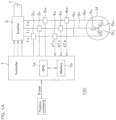
- FIG. 1A is a block diagram for describing the configuration of a drive system including a motor control device according to one embodiment of the present invention.
- the motor control device 100 is a device (AC motor control device) adapted to drive an AC motor M (AC synchronous motor). More specifically, the motor control device 100 drives the AC motor M by so-called sensorless control, i.e., by controlling the AC motor M without the use of a rotor position detector (rotor position sensor) for the detection of the position of the rotor of the AC motor M.
- the AC motor M is a synchronous motor including permanent magnets provided in its rotor and, more specifically, may be a surface magnet synchronous motor (SPMSM).
- SPMSM surface magnet synchronous motor
- the AC motor M is a three-phase permanent magnet synchronous motor, and has a U-phase winding 5u, a V-phase winding 5v and a W-phase winding 5w.
- these windings are often referred to generally as "winding(s) 5uvw.”
- the windings 5uvw are connected together in a Y-connection form by way of example, but may be connected together in a ⁇ -connection form as will be described later.
- the motor control device 100 has a feedback system including a position control loop, a speed control loop and a current control loop, and is configured so as to perform a position servo control operation to control the rotor position of the AC motor M according to a position command.
- Vector control is employed for the current control.
- a command to be externally applied is not limited to the position command, but may be a speed command or may be a torque command (current command). Where the speed command is applied, the position control loop is not used. Where the torque command is applied, the current control loop is used alone, and neither the position control loop nor the speed control loop is used.
- the rotor position is estimated with the use of signals obtained by current derivative detectors without the use of the rotor position detector. More specifically, position estimation signals indicating fluctuation in the inductances of the respective phase windings of the AC motor M are generated based on current derivatives, and the rotor position is estimated based on the position estimation signals.
- the surface magnet synchronous motor is free from saliency and, therefore, it is considered that magnetic poles cannot be detected based on changes in inductances. Where magnets such as neodymium magnets having strong magnetic forces are used, however, the inductances are slightly changed by the magnetic saturation of iron cores.
- the motor control device 100 includes a controller 1, current detectors 3u, 3v, 3w and current derivative detectors 4u, 4v, 4w, and is configured to control an inverter 2.
- the inverter 2 converts a direct current supplied from a DC power source 7 into an alternating current, and supplies the alternating current to the windings 5uvw of the AC motor M.
- the motor control device 100, the inverter 2 and the AC motor M constitute the drive system.
- the inverter 2 and the AC motor M are connected to each other via three current lines 9u, 9v, 9w (hereinafter often referred to generally as "current line(s) 9uvw") for the U-phase, the V-phase and the W-phase.
- the current detectors 3u, 3v, 3w and the current derivative detectors 4u, 4v, 4w are provided in the corresponding current lines 9uvw.
- the current detectors 3u, 3v, 3w respectively detect line currents flowing through the corresponding phase current lines 9uvw, i.e., a U-phase line current Iu, a V-phase line current Iv and a W-phase line current Iw (hereinafter often referred to generally as “line current(s) Iuvw").
- the current derivative detectors 4u, 4v, 4w detect changes in the line currents flowing through the corresponding phase current lines 9uvw with time, i.e., U-phase, V-phase and W-phase current derivatives dIu, dIv, dIw (hereinafter often referred to generally as “current derivative(s) dIuvw”), respectively, and serve as current derivative detection means.
- phase current(s) iuvw phase current(s) flowing through the corresponding phase windings 5uvw.
- the line currents and the phase currents each have a value corresponding to a winding current flowing through the winding 5uvw of the AC motor M.
- the controller 1 controls the inverter 2 based on a position command ⁇ cmd.
- the controller 1 is provided in the form of a computer, and includes a processor (CPU) 1a, and a memory 1b as a recording medium that records a program to be executed by the processor 1a.
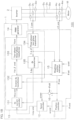
- FIG. 1B is a block diagram for describing the functional configuration of the controller 1.
- the controller 1 is configured so that the processor 1a executes the program to perform the functions of a plurality of functional processing portions.
- the functional processing portions include a position controller 11, a speed controller 12, a current controller 13, a PWM generator 14, a weighting position estimator 15, and a speed estimator 16.
- the current controller 13 includes a dq current controller 131, an inverse dq transformer 132, a two-phase/three-phase transformer 133, a three-phase/two-phase transformer 134, and a dq transformer 135.
- the position controller 11 generates a speed command ⁇ cmd based on the estimated position ⁇ so as to match the rotor position with the position command ⁇ cmd, and supplies the speed command ⁇ cmd to the speed controller 12. In this manner, the position control loop is provided.
- the estimated position ⁇ of the rotor is also supplied to the speed estimator 16.
- the speed controller 12 generates current commands Idcmd, Iqcmd (shown by Id,qcmd in the associated figures) based on the estimated speed ⁇ so as to match the rotor speed with the speed command ⁇ cmd, and supplies the current commands Idcmd, Iqcmd to the current controller 13. In this manner, the speed control loop is provided.
- the line currents Iuvw detected by the current detectors 3uvw (precisely, the detection values of the line currents Iuvw) are supplied to the current controller 13.
- the current controller 13 generates a U-phase voltage command Vu, a V-phase voltage command Vv and a W-phase voltage command Vw (hereinafter often referred to generally as "voltage command(s) Vuvw") so as to match the line currents Iuvw with the current commands Idcmd, Iqcmd, and supplies the voltage commands Vuvw to the PWM generator 14. In this manner, the current control loop is provided.
- the PWM generator 14 is pulse width modulation signal generation means that generates PWM control signals (pulse width modulation signals) according to the voltage commands Vuvw, and supplies the PWM control signals to the inverter 2.
- PWM control signals pulse width modulation signals
- Vuvw voltages according to the voltage commands Vuvw are applied across the windings 5uvw of the AC motor M via the current lines 9uvw by the PWM generator 14.
- the speed controller 12 generates a d-axis current command Idcmd and a q-axis current command Iqcmd on a dq rotational coordinate system, and supplies the d-axis current command Idcmd and the q-axis current command Iqcmd to the current controller 13.
- the dq rotational coordinate system is a rotational coordinate system defined by a d-axis extending in the magnetic flux direction of the rotor of the AC motor M and a q-axis orthogonal to the d-axis, and rotated according to the rotation angle (electrical angle) of the rotor.
- the three-phase/two-phase transformer 134 transforms the three-phase line currents Iuvw detected by the current detectors 3uvw into two-phase current values I ⁇ , I ⁇ on an ⁇ coordinate system which is a two-phase fixed coordinate system.
- the dq transformer 135 transforms the two-phase current values I ⁇ , I ⁇ on the ⁇ coordinate system into a d-axis current value Id and a q-axis current value Iq on the dq rotational coordinate system.
- the current values Id, Iq on the dq rotational coordinate system (shown by Id,q in the associated figures) are supplied to the dq current controller 131.
- the dq current controller 131 generates a d-axis voltage command Vdcmd and a q-axis voltage command Vqcmd (which are voltage commands on the dq rotational coordinate system) so as to match the d-axis current value Id and the q-axis current value Iq with the d-axis current command Idcmd and the q-axis current command Iqcmd, respectively.
- the voltage commands Vdcmd, Vqcmd (shown by Vd,qcmd in the associated figures) are coordinate-transformed into voltage commands V ⁇ cmd, V ⁇ cmd (shown by V ⁇ , ⁇ cmd in the associated figures) on the ⁇ coordinate system by the inverse dq transformer 132.
- the voltage commands V ⁇ cmd, V ⁇ cmd on the ⁇ coordinate system are coordinate-transformed into the three-phase voltage commands Vuvw by the two-phase/three-phase transformer 133.
- the three-phase voltage commands Vuvw are supplied to the PWM generator 14.
- the estimated position ⁇ is used for the computation for the coordinate transformation between the dq rotational coordinate system and the ⁇ coordinate system and for the speed estimating computation to be performed by the speed estimator 16.
- the current controller 13 is drive control means that controls the PWM generator 14 so as to drive the AC motor M according to the estimated position ⁇ supplied from the weighting position estimator 15.
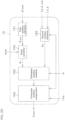
- FIG. 2A is a block diagram for describing the configuration of the weighting position estimator 15 by way of example.
- the weighting position estimator 15 includes a first position estimator 151 and a second position estimator 152.
- the weighting position estimator 15 further includes an estimated position combiner 153.
- the first position estimator 151 estimates the rotor position (angle) on the ⁇ coordinate system (fixed coordinate system) by a first estimation method.
- the second position estimator 152 estimates the rotor position (angle) on the ⁇ coordinate system by a second estimation method.
- the first estimation method and the second estimation method are different from each other.
- the first position estimator 151 computes the estimated position of the rotor of the AC motor M based on the current derivatives dIuvw detected by the current derivative detectors 4uvw.
- the second position estimator 152 computes the estimated position ⁇ of the rotor of the AC motor M based on the ⁇ voltage command values V ⁇ cmd, V ⁇ cmd and the ⁇ current detection values I ⁇ , I ⁇ .
- the first position estimator 151 outputs an estimated position signal that has two fluctuation cycles in rotor rotation per each electrical angle cycle of the stator of the AC motor M.
- the second position estimator 152 outputs an estimated position signal that has one fluctuation cycle in the rotor rotation per each electrical angle cycle of the stator of the AC motor M.
- the weighting position estimator 15 further includes a cycle convertor 154 that converts the estimated position signal ⁇ 1pre generated by the first position estimator 151 into a first estimated position signal ⁇ 1 that has one fluctuation cycle in the rotor rotation per each electrical angle cycle of the stator.
- the weighting position estimator 15 further includes a first compensator 161 and a second compensator 162.
- the composite estimated position signal ⁇ new resulting from the compensation is the output of the weighting position estimator 15, i.e., the estimated position ⁇ .
- FIG. 3 is an electric circuit diagram for describing the configuration of the inverter 2 by way of example.
- Bridge circuits 20u, 20v, 20w for the three phases are connected in parallel between a pair of power supply lines 8A and 8B connected to the DC power source 7.
- a capacitor 26 for smoothing is further connected between the pair of power supply lines 8A and 8B.
- bridge circuit(s) 20uvw are respectively constituted by series circuits each including an upper arm switching device 21u, 21v, 21w (hereinafter often referred to generally as “upper arm switching device(s) 21uvw”) and a lower arm switching device 22u, 22v, 22w (hereinafter often referred to generally as “lower arm switching device(s) 22uvw”) connected in series.
- the current lines 9uvw for connection to the corresponding windings 5uvw of the AC motor M are respectively connected to midpoints 23u, 23v, 23w between the upper arm switching devices 21uvw and the lower arm switching devices 22uvw.
- the switching devices 21uvw, 22uvw are typically power MOS transistors, and respectively incorporate parasitic diodes 24u, 24v, 24w; 25u, 25v, 25w each connected in a direction opposite to that of the DC power source 7.
- the current derivative detectors 4uvw are configured so as to detect the current derivatives dIuvw which are the time-differential values of the line currents Iuvw flowing through the respective phase current lines 9uvw.
- the PWM control signals supplied from the controller 1 are inputted to the gates of the switching devices 21uvw, 22uvw, whereby the switching devices 21uvw, 22uvw are turned on and off.
- the bridge circuits 20uvw are each controlled so that, when one of the upper arm switching device 21uvw and the lower arm switching device 22uvw thereof provided in pair is on, the other is off.
- the value of the PWM control signal is defined as "1" for a control state such that the upper arm switching device 21uvw is on and the lower arm switching device 22uvw is off, and the value of the PWM control signal is defined as "0" for a control state such that the upper arm switching device 21uvw is off and the lower arm switching device 22uvw is on.
- the PWM control signals can describe any of 8 patterns (states) each expressed by a three-dimensional vector.
- the eight patterns (states) are expressed by (1,0,0), (1,1,0), (0,1,0), (0,1,1), (0,0,1), (1,0,1), (0,0,0) and (1,1,1) .
- the first six patterns (1,0,0), (1,1,0), (0,1,0), (0,1,1), (0,0,1) and (1,0,1) correspond to states in which a voltage is applied across the windings 5uvw of the AC motor M.
- the other two patterns (0,0,0) and (1,1,1) correspond to states in which no voltage is applied across the windings 5uvw.
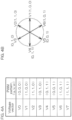
- FIG. 4A shows voltage vectors V0 to V7 corresponding to the eight patterns (states) described above.
- the voltage vectors V1 (1, 0, 0), V2(1,1,0), V3 (0, 1, 0), V4(0,1,1), V5 (0,0,1) and V6(1,0,1) corresponding to the six patterns for which the voltage is applied across the windings can be expressed by six voltage vectors that divide an electrical angle range of 360 degrees into six equiangular ranges as shown in FIG. 4B .
- the voltage vectors V0 (0,0,0) and V7(1,1,1) are zero-voltage vectors for which no voltage is applied across the windings 5uvw.
- an expression "a voltage vector is applied” or the like means that the inverter 2 is controlled in a state expressed by the voltage vector and a voltage corresponding to the voltage vector is applied to the AC motor M.
- the first position estimator 151 estimates the rotor position by the first estimation method when the rotor rotation speed is in a lower speed range (including a halt state).
- the second position estimator 152 estimates the rotor position by the second estimation method when the rotor rotation speed is relatively high in a middle to higher speed range.
- the first estimation method to be used for the estimation of the rotor position for the lower speed range will be first described, and then the second estimation method to be used for the estimation of the rotor position for the middle to higher speed range will be described.
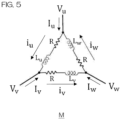
- FIG. 5 is an electric circuit diagram showing a model of the AC motor M, particularly showing a three-phase motor model of ⁇ -connection.
- an inductance matrix on a UVW coordinate system is defined as Muvw, and its inverse matrix M -1 uvw is determined.
- the line currents Iuvw are detectable.
- a relationship between the line currents Iuvw and the phase currents iuvw of the respective phase windings, and a relationship between the time-derivatives of the line currents and the time-derivatives of the phase currents are represented by the following expression (3):
- the above expression (2) is rearranged with this expression, and the derivatives of the line currents Iuvw with time t when the voltage vectors V1(100), V3(010), V5(001) are applied are represented by the following expression (4).
- a term (the second term in the expression (2)) that represents voltage drops due to the electrical resistances R (phase resistances) of the respective phase windings 5uvw is herein ignored, because the voltage drops have values substantially equal to those of the line current derivatives detected during the application of the voltage vector (000) or (111) and can be virtually cancelled by subtraction of the values of the line current derivatives.
- the three-phase position estimation signals Us, Vs, Ws are generated by using the current derivatives obtained when the three voltage vectors V1(100), V3(010), V5(001) are applied
- the three-phase position estimation signals Us, Vs, Ws are defined by the following expression (5).
- gu, gv, gw are the current derivative detection gains of the respective line currents.
- the three-phase position estimation signals Us, Vs, Ws are each defined by factoring out the phase gain gu, gv, gw from a difference between current derivatives of the same phase.
- the three-phase position estimation signals are represented by the following cyclic symmetric polynomial expression (6).
- the three-phase position estimation signals are defined so that the three phases are equivalently influenced even if the inductances fluctuate due to the magnetic saturation of the motor when a higher torque occurs. Therefore, the position detection error is suppressed.
- the three voltage vectors for the position detection are not limited to V1(100), V3(010) and V5(001). Where three voltage vectors V2(011), V6(101) and V4(110) are used, for example, the three-phase position estimation signals can be derived in the same manner.
- Us Vs Ws g u d dt Iu 001 ⁇ g u d dt Iu 010 g u d dt Iu 010 ⁇ g v d dt Iv 001 g w d dt Iw 010 ⁇ g u d dt Iu 001
- Us Vs Ws V S g u L w L v ⁇ L v L u + 2 L w M uv ⁇ L u M vw + M wu M uv ⁇ M vw M wu + M uv 2 ⁇ M vw 2 g v L u L w ⁇ g u L w L v + g u + g v L u M vw ⁇ L v M wu + M uv M vw ⁇ M wu M uv + g v ⁇ g u L w M ⁇ M wu
- the two voltage vectors are used for the position detection, it is necessary to generate a three-phase position estimation signal for any of the three phases based on a difference between current derivatives of different phases. Therefore, the three-phase position estimation signals are influenced by the gains of the current derivative detectors 4uvw.
- the current derivatives of only two of the three phases may be detected, and the current derivative of the remaining one phase may be computed by utilizing a relationship such that the sum of the currents for all the phases is zero.
- the estimated rotor position can be determined as represented by the following expression (11) by transforming the three-phase position estimation signals thus determined into two-phase signals and calculating an arc tangent.
- ⁇ s ⁇ s 2 3 1 ⁇ 1 2 ⁇ 1 2 0 3 2 ⁇ 3 2
- Us Vs Ws ⁇ ArcTan ⁇ s ⁇ s
- Self-inductances Lu, Lv, Lw standardized for the respective phases are represented by the following expression (12) by using a motor electrical angle ⁇ and a standardized inductance amplitude ⁇ . It is herein assumed that the motor is the surface magnet type motor and mutual inductances are small.
- the self-inductances Lu, Lv, Lw are each standardized with an inductance offset L0.
- Lu Lv Lw 1 + ⁇ sin 2 ⁇ + 2 ⁇ 3 1 + ⁇ sin 2 ⁇ 1 + ⁇ sin 2 ⁇ + ⁇ 3
- the three-phase position estimation signals calculated from the above expression (6) with the use of the three voltage vectors are represented by the following expression (13). Where ⁇ ⁇ 1 and the term of the second or higher power of ⁇ is ignored, the expression (13) is approximated to the following expression (14). Thus, the three-phase position estimation signals are provided as three-phase sinusoidal signals.
- the estimated position is determined, which has two fluctuation cycles per each electrical angle cycle. Where two voltage vectors are used, the estimated position fluctuates in the same manner.
- Us Vs Ws 4 3 4 ⁇ 3 ⁇ 2 ⁇ ⁇ 3 sin 6 ⁇ g u sin 2 ⁇ ⁇ + ⁇ 2 sin 2 ⁇ + 3 ⁇ 4 g v sin 2 ⁇ + ⁇ 3 ⁇ + ⁇ 2 sin 2 ⁇ + ⁇ 12 g w sin 2 ⁇ + 2 ⁇ 3 ⁇ + ⁇ 2 sin 2 ⁇ + 5 ⁇ 12
- Us Vs Ws 3 ⁇ g u sin 2 ⁇ g v sin 2 ⁇ + ⁇ 3 g w sin 2 ⁇ + 2 ⁇ 3
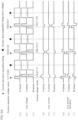
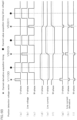
- FIGS. 6A and 6B are waveform diagrams showing voltages, currents and current derivatives observed when the AC motor M is rotated at a lower rotation speed (including a halt state) by way of example.
- FIGS. 6A and 6B (a) shows the waveform of a U-phase line voltage applied to the U-phase current line 9u, (b) shows the waveform of a V-phase line voltage applied to the V-phase current line 9v, and (c) shows the waveform of a W-phase line voltage applied to the W-phase current line 9w.
- FIGS. 6A and 6B shows the waveform of a U-phase line voltage applied to the U-phase current line 9u
- FIGS. 6v shows the waveform of a V-phase line voltage applied to the V-phase current line 9v
- FIGS. 6A and 6B respectively show changes in the U-phase line current Iu, the V-phase line current Iv and the W-phase line current Iw outputted by the current detectors 3uvw.
- FIGS. 6A and 6B respectively show changes in the time-derivatives of the U-phase, V-phase and W-phase line currents, i.e., the U-phase current derivative dIu, the V-phase current derivative dIv and the W-phase current derivative dIw, which respectively correspond to the outputs of the current derivative detectors 4uvw.
- the inverter 2 is a three-phase inverter including the six switching devices 21uvw, 22uvw, and three terminals connected to the U-phase, V-phase and W-phase windings 5uvw of the AC motor M are connected to either a power supply voltage Vdc (PWM voltage) or a ground potential (0 V).
- Vdc power supply voltage
- the state in which the winding 5uvw is connected to the power supply voltage Vdc i.e., the upper arm switching device 21uvw is on
- the state in which the winding 5uvw is connected to 0 V i.e., the upper arm switching device 21uvw is off
- 0 the state in which the winding 5uvw is connected to 0 V
- the voltage vectors to be generated include the eight voltage vectors V0(0,0,0) to V7(1,1,1). Of these, the voltage vectors V0(0,0,0) and V7(1,1,1) are zero-voltage vectors for which the voltage applied across the windings 5uvw is zero with all the winding terminals at the same potential. The other six voltage vectors V1 to V6 are non-zero voltage vectors for which a voltage is applied across the windings 5uvw.
- the PWM generator 14 generates PWM control signals to turn on and off the switching devices 21uvw, 22uvw of the inverter 2 by comparing the respective phase voltage commands Vuvw outputted from the current controller 13 with a triangular carrier signal.
- a frequency for the PWM is 14 kHz, which corresponds to a cycle of about 70 ⁇ sec.
- the phase voltage commands Vuvw are low, so that the periods of the zero-voltage vectors V0, V7 during which no voltage is applied across the windings 5uvw are prolonged.
- FIGS. 6A and 6B show waveforms observed when the period T0 of the zero-voltage vector V0 and the period T7 of the zero-voltage vector V7 are each set to about one half the cycle of the PWM and the AC motor M is stopped.
- the PWM generator 14 has the function of applying the voltage vectors V1, V3, V5 for the detection of the rotor position (position detection voltage vectors) during the period of the zero voltage vector V0 or V7 in addition to the function of generating the PWM control signals.
- a period during which the position detection voltage vectors are each applied is sufficiently shorter than the PWM cycle (e.g., about 70 ⁇ sec) and sufficiently shorter than one half the PWM cycle. More specifically, the position detection voltage vector application period is preferably not greater than 10% of the PWM cycle, more preferably not greater than 5% of the PWM cycle.
- inverse voltage vectors V4(011), V6(101), V2 (110) obtained by inverting the position detection voltage vectors V1, V3, V5 for periods equivalent to those of the position detection voltage vectors immediately after the application of the position detection voltage vectors to thereby offset the currents occurring due to the position detection voltage vectors.
- the inverse voltage vectors V4, V6, V2 are applied.
- the inverse voltage vectors V4, V6, V2 are not applied.
- the position detection voltage vectors V1, V3, V5, and the inverse voltage vectors V4, V6, V2 for the offset of the position detection voltage vectors V1, V3, V5 are applied in the order of the U-phase, the V-phase and the W-phase in each PWM cycle.
- the influence of the application of the position detection voltage vectors can be equalized among the three phases.
- the U-phase, V-phase and W-phase currents change, and the U-phase, V-phase and W-phase current derivative detection voltages change according to the application of the position detection voltage vectors (and further according to the application of the inverse voltage vectors in the example shown in FIG. 6A ).
- the current derivatives are detected directly by the current derivative detectors such as the current transformers, whereby the current derivative detection voltages of the respective phases change instantaneously upon the application of the position detection voltage vectors.
- the current derivatives can be each detected substantially during the position detection voltage vector application period (e.g., 3 ⁇ sec).
- Timings corresponding to the application of the position detection voltage vectors are current derivative acquisition timings (each indicated by a symbol *) at which the current derivatives are to be sampled.
- the current values of the respective phases are each determined by sampling the output of the current detector 3uvw at a current value acquisition timing (indicated by a symbol •) during the voltage vector application period for the motor driving.
- the current derivatives thus detected are put in the expression (5), whereby the three-phase position estimation signals Us, Vs, Ws can be provided. Further, the motor electrical angle ⁇ can be computed from the expression (11). The computation is performed by the first position estimator 151 (see FIGS. 2A and 2B ). Where two voltage vectors are used, the three-phase position estimation signals Us, Vs, Ws can be computed from the expression (7) instead of the expression (5).
- current derivatives may also be acquired for the state corresponding to the voltage vector V7(111) or V0(000), and subtracted from the current derivatives acquired when the position detection voltage vectors V1(100), V3(010), V5(001) are applied.
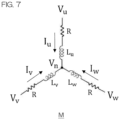
- a voltage equation for a model shown in FIG. 7 is represented by the following expression (15) with the use of a midpoint potential Vn.
- V u ⁇ V n V v ⁇ V n V w ⁇ V n ⁇ R I u I v I w L u M uv M wu M uv L v M vw M wu M vw L w d dt I u I v I w
- the current derivatives are represented by the following expression (16) by using the inverse matrix of the inductance matrix as in the expression (2).
- d dt I u I v I w M uvw ⁇ 1 V u ⁇ V n V v ⁇ V n V w ⁇ V n ⁇ R I u I v I w
- the three-phase position estimation signals are each defined by a difference between current derivatives of the same phase as in the expression (5)
- the following expression (20) is provided, which is a cyclic symmetric polynomial with the gains of the current derivatives factored out as in the expression (6). Therefore, even if the inductances fluctuate due to the magnetic saturation of the motor when a higher torque occurs, the three phases are equivalently influenced by the fluctuation of the inductances in the Y-connection model as in the ⁇ -connection model. Thus, the position detection error is suppressed.
- the position detection voltage vectors V4(011), V6(101), V2(110) are used, the same result can be provided.
- the Y-connection model is influenced by the gains of the current derivative detectors 4uvw as in the case of the ⁇ -connection model.
- Us Vs Ws V S g u M uv L w + M vw ⁇ M wu L v + M vw + A u k A v ⁇ A w g v M vw L u + M wu ⁇ M uv L w + M wu + A v k A w ⁇ A u g w M wu L v + M uv ⁇ M vw L u + M uv + A w k A u ⁇ A v v + A w k A u ⁇ A v v L
- the inductance matrix is transformed in the following manner.
- T ⁇ 2 3 1 ⁇ 1 2 ⁇ 1 2 0 3 2 ⁇ 3 2
- T ⁇ + 2 3 1 0 ⁇ 1 2 3 2 ⁇ 1 2 ⁇ 3 2
- Tdq cos ⁇ sin ⁇ ⁇ sin ⁇ cos ⁇
- T dq ⁇ 1 cos ⁇ ⁇ sin ⁇ sin ⁇ cos ⁇
- a phase voltage equation on the UVW fixed coordinate system is represented by the following expression (24) by using a motor induced voltage e.
- the expression (24) is multiplied on its left side by the ⁇ transformation matrix T ⁇ of the expression (21) to insert a unit matrix between the inductance matrix and the currents, whereby a voltage equation on the ⁇ fixed coordinate system can be defined as represented by the following expression (25):
- inductance matrixes on the respective coordinate systems are computed from the expression (28) and, with the use of m, n, s in the expression (29), inductances on the ⁇ fixed coordinate system and on the dq rotational coordinate system are respectively represented by the following expressions (30) and (31):
- L ⁇ M ⁇ M ⁇ L ⁇ s 0 0 s + m n n ⁇ m L d M dq M qd
- L q s 0 0 s + m n n ⁇ m cos 2 ⁇ sin 2 ⁇ ⁇ sin 2 ⁇ cos 2 ⁇
- FIG. 8 shows ideal sinusoidal waveform inductances on the UVW fixed coordinate system by way of example.
- self-inductances and mutual inductances have amplitudes of 0.1 and 0.02, respectively, and offsets of 1.3 and -0.11, respectively, and each have a sinusoidal waveform with a phase shift of 120 degrees.
- the inductances L ⁇ , L ⁇ , M ⁇ on the ⁇ fixed coordinate system, the inductances Ld, Lq, Mdq on the dq rotational coordinate system, and the components m, n, s are computed by using the expressions (29), (30) and (31), and are plotted as shown in FIGS. 9A, 9B and 9C .
- FIGS. 10A, 10B and 10C show the current derivatives to be obtained when the voltage vector V1(100) is applied, and FIG. 10B shows the current derivatives to be obtained when the voltage vector V3(010) is applied.
- FIG. 10C shows the current derivatives to be obtained when the voltage vector V5(001) is applied.
- FIGS. 10A, 10B and 10C show changes in the U-phase, V-phase and W-phase current derivatives with respect to the rotor electrical angle.
- the detection gain and the voltage gain are 1.
- FIGS. 11A to 11E current derivatives determined by a magnetic analysis performed by inputting the aforementioned three voltage vectors to a three-phase surface magnet type motor and changing the rotor position in one rotation cycle of electrical angle with the motor q-axis current maintained at zero, and an estimated position computed from the expressions (5) and (11) are shown in FIGS. 11A to 11E .
- FIG. 11A shows current derivatives obtained when the voltage vector V1(100) was applied
- FIG. 11B shows current derivatives obtained when the voltage vector V3(010) was applied.
- FIG. 11C shows current derivatives obtained when the voltage vector V5(001) was applied
- FIG. 11D shows three-phase position estimation signals Us, Vs, Ws computed from the expression (5).
- FIG. 11A shows current derivatives obtained when the voltage vector V1(100) was applied
- FIG. 11B shows current derivatives obtained when the voltage vector V3(010) was applied
- FIG. 11C shows current derivatives obtained when the voltage vector V5(001) was
- 11E shows two-phase position estimation signals ⁇ s, ⁇ s on the ⁇ fixed coordinate system computed from the expression (11), and an estimated position ⁇ determined based on the two-phase position estimation signals ⁇ s, ⁇ s.
- the three-phase position estimation signals Us, Vs, Ws which each have a waveform superposed with a harmonic waveform, can be each virtually regarded as a sinusoidal waveform.
- the estimated position ⁇ can be computed.
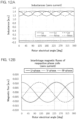
- FIGS. 12A and 12B respectively show motor inductances Lu, Lv, Lw, Muv, Mvw, Mwu and interlinkage magnetic fluxes of the respective phase coils (windings) determined by the magnetic analysis performed under the conditions used for FIGS. 11A to 11E .
- a comparison with FIG. 8 indicates that the three-phase position estimation signals Us, Vs, Ws of FIG. 11D are not in an ideal sinusoidal waveform because the waveforms of the inductances are offset from the ideal sinusoidal waveforms and a higher-order term of the ratio ⁇ between the offset amount of the inductance and the amplitude of the inductance (standardized inductance amplitude) is contained in the expression (13).
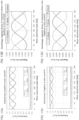
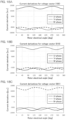
- FIGS. 13A, 13B, 13C and 13D show motor inductances Lu, Lv, Lw, Muv, Mvw, Mwu and interlinkage magnetic fluxes of the respective phase coils (windings) determined by the magnetic analysis performed with the positive q-axis current.
- FIGS. 13C and 13D show motor inductances Lu, Lv, Lw, Muv, Mvw, Mwu and interlinkage magnetic fluxes of the respective phase coils (windings) determined by the magnetic analysis performed with the negative q-axis current.
- the positive and negative rotor electrical angles are defined such that, when the q-axis current is positive under no-load conditions, the rotor electrical angle advances in a plus direction (angle advance direction).
- a direction in which the torque is generated when the q-axis current is positive is defined as the positive direction of the rotor electrical angle.
- the interlinkage magnetic fluxes of the coils are shifted in the angle advance direction (torque generation direction) with the positive q-axis current, and shifted in an angle retard direction (torque generation direction) with the negative q-axis current as compared with a q-axis current of zero.
- the inductances may vary in amplitude depending on the direction (positive or negative direction) of the magnetic resistance along the d-axis, or may contain a harmonic component due to slot combination.
- the phases of the self-inductances Lu, Lv, Lw and the phases of the mutual inductances Muv, Mvw, Mwu are shifted in the same directions as the phases of the interlinkage magnetic fluxes of the coils.
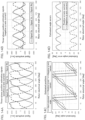
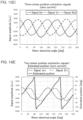
- FIGS. 14A, 14B and 14C Three-phase position estimation signals and an estimated position determined by an analysis performed by applying a q-axis current are shown in FIGS. 14A, 14B and 14C.
- FIG. 14A shows three-phase position estimation signals Us, Vs, Ws computed from the expression (5) for the positive q-axis current.
- FIG. 14B shows three-phase position estimation signals Us, Vs, Ws computed from the expression (5) for the negative q-axis current.
- FIG. 14C shows estimated positions ⁇ computed from the expression (11) for the positive q-axis current and for the negative q-axis current.
- an ideal estimation angle is also shown, which is a rotor electrical angle (analytic true value) used for the analysis.
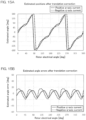
- FIG. 14D shows the deviations of the estimated positions from the ideal estimation angle (estimated angle errors) for the positive q-axis current and for the negative q-axis current.
- the estimated position ⁇ is deviated from the ideal estimation angle in the positive direction (torque generation direction) when the q-axis current is positive, and is deviated from the ideal estimation angle in the negative direction (torque generation direction) when the q-axis current is negative.
- the torque is reduced, resulting in the step-out of the motor in the worst case.
- a correction amount represented by a function of the q-axis current is incorporated.
- the estimated position ⁇ is shifted in the torque generation direction by the absolute value of the correction amount C1 (first correction amount).
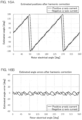
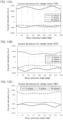
- deviations of the estimated positions ⁇ C1 corrected by the translation correction from the ideal estimation angle (estimated angle errors) are shown in FIG. 15B .
- the estimated angle errors (see FIG. 14D ), which are about ⁇ 50 degrees before the correction, are reduced within ⁇ 20 degrees. As shown, the problem of the estimation error attributable to the inductance phase shift due to the increase in the q-axis current (the increase in the absolute value) can be solved by this correction.
- the proportional expression is used as the function of the q-axis current.
- the translation correction may be performed by incorporating a correction amount determined by utilizing a function containing a higher-order term of the q-axis current. This makes it possible to provide a value closer to the ideal estimation value according to the change in the q-axis current.
- the estimation error is reduced by further performing a harmonic correction (second correction).
- a harmonic correction amount C2 (second correction amount) represented by the following expression (33) is incorporated as an n-th harmonic having an amplitude equivalent to the q-axis current value Iq.
- the harmonic correction amount C2 is a function of the estimated position ⁇ and the q-axis current value Iq, more specifically, a product of a function of the q-axis current value and a harmonic component having a phase defined by the estimated position ⁇ (i.e., the estimated position ⁇ C1 corrected by the translation correction).
- the function of the q-axis current value is the q-axis current value itself in the following expression (33) but, for example, may be a function of the q-axis current value multiplied by a proportionality constant or may be a function containing a higher-order term.
- C2 Sin n ⁇ C1 + ⁇ ⁇ Iq
- a phase offset ⁇ may be selected so as to reduce the estimation errors.
- the estimated position errors are reduced within ⁇ 8 degrees by performing the harmonic correction in addition to the translation correction.
- the torque ripples attributable to the estimated position errors can be reduced.
- the harmonic correction in the example shown in FIGS. 16A and 16B , only the third harmonic is reduced, but a higher harmonic correction may be performed.
- the estimated position errors can be further reduced by performing a correction with the use of a correction amount defined by a function containing a higher-order term of the q-axis current.
- only the translation correction may be performed without the harmonic correction omitted.
- the correction amounts C1, C2 are defined with the use of the functions based on the q-axis current value Iq and the uncorrected estimated position ⁇ .
- the correction amounts may be preliminarily tabulated rather than determined with the use of the functions.
- the corrected estimated position per se may be tabulated rather than determined by generating the correction amounts with the use of the functions or the tables of the correction amounts.
- the above example is directed to the surface magnet type motor. Where an embedded magnet type motor is used, the shifts of inductance waveforms due to the shifts of the interlinkage magnetic fluxes of the coils, and the superposition of the harmonic component on the estimated value similarly occur more or less.
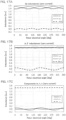
- FIGS. 17A and 17B show the results of the transformation of the inductances on the UVW fixed coordinate system shown in FIG. 12A to inductances on the ⁇ fixed coordinate system and on the dq rotational coordinate system, respectively, by using the expressions (29), (30) and (31).
- FIG. 17C shows relevant components m, n, s.
- a three-phase surface magnet type motor having the same conditions as specified in the aforementioned analyses was prepared as an actual model motor, and the PWM patterns were applied to this motor.
- Current transformers each having a gain variable due to the magnetic saturation depending on the current magnitude were used as the current derivative detectors 4uvw to acquire the current derivatives for the position estimation. The results are shown below.
- FIGS. 18A, 18B and 18C respectively show current derivatives obtained by using the three voltage vectors V1(100), V3(010), V5(001) with the motor current maintained at zero.
- FIG. 18D shows three-phase position estimation signals Us, Vs, Ws each obtained based on a difference between current derivatives of the same phase from the expression (5).
- FIG. 18E shows an estimated position computed from the expression (11) based on the three-phase position estimation signals Us, Vs, Ws. When the current is zero, the estimated position can be computed as indicated by the results of the analyses.
- FIGS. 19A, 19B and 19C show current derivatives acquired when the motor was forcibly externally rotated by applying a zero current, a positive current and a negative current to the U-phase, V-phase and W-phase motor lines, respectively, by fixed phase excitation.
- FIGS. 19A, 19B and 19C respectively show current derivatives acquired when the voltage vectors V1(100), V3(010), V5(001) were applied.
- a relationship between the rotor electrical angle on the abscissa and the excitation angle phase is such that a rotor electrical angle of 0 degree corresponds to d-axis excitation, a rotor electrical angle of 90 degrees corresponds to q-axis excitation, and a rotor electrical angle of 180 degrees corresponds to d-axis reverse excitation.
- a comparison among a U-phase signal for the pattern of the voltage vector V1(100) (see FIG. 19A ), a V-phase signal for the pattern of the voltage vector V3(010) (see FIG. 19B ) and a W-phase signal for the pattern of the voltage vector V5(001) (see FIG. 19C ) which intrinsically have the same signal level indicates that the V-phase signal and the W-phase signal are each attenuated to about one half the ideal level due to the saturation of the magnetic bodies of the current transformers of the current derivative detectors 4uvw.
- FIG. 20A shows three-phase position estimation signals Us, Vs, Ws defined based on the current derivatives of FIGS. 18A, 18B and 18C by the expression (7) using only two voltage vectors V5(001), V3(010).
- FIG. 20B shows an estimated position ⁇ computed from the expression (11) based on the three-phase position estimation signals Us, Vs, Ws.
- the signals Vs, Ws each contain a difference between the current derivatives of different phases and, therefore, contain different gains.
- the subtraction of the signals having the different gains makes it impossible to properly compute the three-phase signals and, hence, to correctly compute the estimated position.
- the three-phase position estimation signals seem to be simply offset.
- the V-phase current and the W-phase current have the same absolute value. Therefore, it is considered that the three-phase position estimation signals behave in the same manner as in the case where the V-phase and the W-phase have the same gain and the offset occurs.
- the U-phase current, the V-phase current and the W-phase current change with time, and the gains of the respective phases also behave without specific limitations. In reality, therefore, the three-phase position estimation signals change in a complicated manner according to the motor current due to the terms of the sums and the differences in the expression (8). This makes it difficult to correct the three-phase position estimation signals.
- current derivative detectors each including an element configured to avoid the saturation of the magnetic body.
- an element such as a current transformer including an air-core coil.
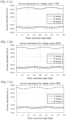
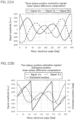
- FIG. 21A shows three-phase position estimation signals Us, Vs, Ws each defined based on a difference between current derivatives of the same phase in FIGS. 18A, 18B and 18C by using the expression (5) by way of example.
- FIG. 21B shows an estimated position computed based on the three-phase position estimation signals Us, Vs, Ws from the expression (11). As shown, it is possible to compute the estimated position while suppressing the influence of the gains of the current derivative detectors 4uvw by the subtraction of the signals of the same phase. The deviation of the estimated position is attributable to the gains gu, gv, gw factored out from the respective expressions in the expression (6).
- the gains gv, gw are about one half the gain gu, so that the amplitudes of the three-phase position estimation signals Vs, Ws are about one half the amplitude of the three-phase position estimation signal Us. This is the cause of the deviation of the estimated position.
- the deviation can be easily corrected simply by multiplying the three-phase position estimation signals by gains according to the current.
- Three-phase position estimation signals Us, Vs, Ws recomputed with the signals Vs, Ws of FIG. 21A amplified twice are shown in FIG. 22A , and an estimated position recomputed from the expression (11) based on the recomputed three-phase position estimation signals Us, Vs, Ws is shown in FIG. 22B .
- the three-phase position estimation signals of the three phases are each in a symmetrical shape, and the deviation of the estimated position is eliminated.
- the correction by the multiplication of the three-phase position estimation signals by the gains according to the current may be replaced with a correction through computation by variably setting the current derivative detection gains gu, gv, gw (hereinafter often referred to generally as "gain(s) guvw”) according to the current.
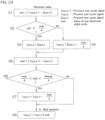
- the gains guvw for the respective motor phases may be determined based on the absolute values
- a gain guvw for the phase is a constant first gain g 1 (g 1 > 0).
- a gain guvw for the phase is a constant second gain g 2 (g 2 > g 1 ).
- a gain guvw for the phase linearly varies between the first gain g 1 and the second gain g 2 according to the absolute value of the line current Iuvw of the phase.
- the constants I 1 , I 2 , g 1 , g 2 may be defined by preliminarily measuring the current derivative detection gains for the motor current and fitting the resulting measurements in the expression (36). Further, the results of the fitting may be tabulated, and the gains guvw for the respective phases may be determined according to the current with reference to the resulting table.
- the gains guvw may be defined by a function additionally containing a higher-order term in the expression (36).
- the gains of the current derivative detectors 4uvw do not influence the change in the signal amplitude.
- the d-axis excitation occurs to enhance the magnetic flux of the magnet.
- the d-axis reverse excitation occurs in such a direction as to reduce the magnetic flux of the magnet.
- a magnet-free state is approached by the reduction of the magnetic flux of the magnet, whereby the position dependence of the inductance occurring due to the saturation of the core is eliminated. Therefore, the signal amplitude is changed.
- the correction is performed by multiplying the three-phase position estimation signals by the gains according to the current.
- detection elements such as current transformers including magnetic bodies can be used for the current derivative detectors 4uvw, even if the current ripples are minute. This makes it possible to detect the current derivatives at a higher sensitivity.
- the initial excitation position is liable to have an opposite phase. If this is problematic, for example, an initial position estimation method utilizing magnetic saturation (see, for example, NPL 2) may be used in combination with the aforementioned computation process to determine the initial excitation position.
- the estimated position is determined on the ⁇ fixed coordinate system. Therefore, if the excitation phase offset of the initial excitation due to the opposite phase of the initial excitation position is not problematic, the two-cycle signal of the estimated position is converted to a one-cycle signal, which may be directly used on the dq transformation coordinate system.
- the motor can be rotated in synchronism without performing the initial position estimation.
- the second position estimator 152 estimates the rotor position on the ⁇ coordinate system by means of an expanded induced voltage observer. This method is described in detail in NPL 1, PTL 7 or the like and, therefore, will be herein described briefly.
- a motor voltage equation on the ⁇ coordinate system is represented by the following expression (37) with the use of a derivative operator p (time-derivative operator).
- v ⁇ v ⁇ R + p L ⁇ p L ⁇ p L ⁇ R + p L ⁇ i ⁇ i ⁇ + ⁇ K e ⁇ sin ⁇ cos ⁇
- a symbol " ⁇ " is a derivative operator indicating first-order time-derivative and effective only on the relevant variable (only on iq in the expression (38)).
- the expression (38) is rearranged to derive a state equation, whereby the following expressions (41) and (42) are provided.
- the expression (42) (which is the time-derivative of the expanded induced voltage)
- the first-order time-derivative of the d-axis current id, the second-order time-derivative of the q-axis current iq and the first-order time-derivative of the angular speed ⁇ are each approximated to zero.
- a least-order observer (expanded induced voltage observer) that determines an estimated expanded induced voltage ê (wherein the symbol " ⁇ " indicates an estimated value, and the same definition also applies to the following description) is represented by the following expressions (43) and (44).
- An observer gain G may be determined, for example, so as to be proportional to the absolute value of the speed.
- ⁇ ⁇ ⁇ ⁇ 1 L d ⁇ R + ⁇ L d ⁇ L q J i ⁇ e ⁇ + v ... 43
- e ⁇ ⁇ ⁇ J e ⁇ + G ⁇ ⁇ ⁇ i ⁇ ... 44
- G g 1 ⁇ g 2 g 2 g 1 , g 1 ⁇ 0
- i is an imaginary unit.
- the second position estimator 152 uses the current detection values I ⁇ , I ⁇ on the ⁇ fixed coordinate system acquired from the three-phase/two-phase transformer 134 (see FIG. 1B ) as the current i in the expression (46), and uses the voltage commands V ⁇ cmd, V ⁇ cmd on the ⁇ fixed coordinate system acquired from the inverse dq transformer 132 (see FIG. 1B ) as the detected voltage value v in the expression (46). Thereby, the second position estimator 152 determines the estimated induced voltage value e ⁇ e ⁇ ⁇ , e ⁇ ⁇ from the expression (47), and further determines the estimated rotor position ⁇ 2 from the expression (48).
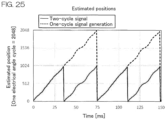
- the first position estimator 151 estimates the position based on the fluctuation in the inductances according to the rotation of the rotor, i.e., by utilizing the dependence of the inductances on the rotational position of the rotor. Therefore, the estimated position signal generated by the first position estimator 151 has two fluctuation cycles in the rotor rotation per each electrical angle cycle of the stator. Therefore, as described above, the cycle convertor 154 (see FIGS. 2A and 2B ) converts the estimated position signal generated by the first position estimator 151 into the first estimated position signal that has one fluctuation cycle in the rotor rotation per each electrical angle cycle of the stator.
- the first position estimator 151 adapted to compute the position information contained in the motor inductance by the detection of the current ripples provides the signal that has two fluctuation cycles per each electrical angle cycle as indicated by the expressions (11), (14) and the like.
- the second position estimator 152 adapted to compute the estimated position according to the expressions (47) and (48) by the expanded induced voltage observer provides the signal that has one fluctuation cycle per each electrical angle cycle.
- a position estimation operation was performed by rotating a surface magnet synchronous motor having a rated rotation speed of 3,000 (r/min) at 160 (r/min) under no-load conditions, estimating the position with the use of the two estimation methods, and plotting the resulting data for two electrical angle cycles.
- the results of the position estimation operation are shown in FIG. 23 .
- the position estimation based on the pulse application (the first estimation method by the first position estimator 151) provides an estimated position signal that has two cycles in the rotor rotation corresponding to one electrical angle cycle
- the position estimation based on the expanded induced voltage the second estimation method by the second position estimator 152 provides an estimated position signal that has one cycle in the rotor rotation corresponding to one electrical angle cycle.
- the estimated position signal is a two-cycle signal that has two cycles per each electrical angle cycle and, therefore, is required to be converted to a one-cycle signal.
- the cycle conversion is performed by the cycle convertor 154 (see FIGS. 2A and 2B ) .
- FIG. 24 shows an exemplary process to be performed by the cycle convertor 154 for the cycle conversion. This process is repeatedly performed in a predetermined computation cycle.
- "one-cycle signal” is a signal that monotonically increases from a lower limit (specifically, zero) to an upper limit msk (a value corresponding to one electrical angle cycle, e.g., 2048) according to the rotor position in the one electrical angle cycle and repeats this monotonic increase.
- two-cycle signal is a signal that monotonically increases from the lower limit to an upper limit msk/2 (a value half the value corresponding to the one electrical angle cycle) according to the rotor position in a cycle half the one electrical angle cycle and repeats this monotonic increase.
- the one-cycle signal has one cycle per each electrical angle cycle, while the two-cycle signal has two cycles per each electrical angle cycle.
- the second estimation method utilizing the expanded induced voltage generates the one-cycle signal
- the first estimation method utilizing the pulse application generates the two-cycle signal.
- the two-cycle signal has a part consistent with the one-cycle signal and a part offset from the one-cycle signal by half the one electrical angle cycle.
- a one-cycle signal can be continuously generated based only on a two-cycle signal presently acquired in each computation cycle (a two-cycle signal in the present computation cycle).
- the absolute value wk1 of a difference between a previous one-cycle signal value 1cyc_t-1 (acquired in the previous computation cycle) and a present two-cycle signal value 2cyc_t (acquired in the present computation cycle) is determined (Step S1). Then, it is determined whether or not the absolute value wk1 of the difference is less than one fourth the value msk of the one electrical angle cycle (e.g., 2048) (Step S2, first determination).
- Step S2 If wk1 ⁇ msk/4 (YES in Step S2), it is determined that the cycles of the signals are consistent with each other, and the two-cycle signal value 2cyc_t is temporarily used as it is as the present one-cycle signal value 1cyc_t (Step S3). If wk1 ⁇ msk/4 (NO in Step S2), it is determined that the two-cycle signal value 2cyc_t is offset by half the cycle, and a value 2cyc_t+msk/2 obtained by adding one half the value msk of the one electrical angle cycle to the two-cycle signal value 2cyc_t is temporarily used as the one-cycle signal value 1cyc_t (Step S4).
- the absolute value wk2 of a difference between the one-cycle signal value 1cyc_t acquired in Step S3 or S4 based on the first determination (Step S2) and the one-cycle signal 1cyc_t-1 acquired in the previous computation cycle is determined (Step S5), and is further subjected to a second determination (Step S6). That is, if a condition msk/4 ⁇ wk2 ⁇ 3*msk/4 is satisfied (YES in Step S6), it is determined that the one-cycle signal value 1cyc_t acquired in Step S3 or S4 based on the first determination (Step S2) is offset by half the cycle.
- the value msk of the one electrical angle cycle may be represented by a power of 2 (i.e., 2 n (wherein n is a natural number)), and a bit operation based on logical product (AND) may be employed instead of the Mod operation.
- the initial position estimation method utilizing the saturation of iron cores can be employed to provide the correct one-cycle signal at the given time.
- FIG. 25 shows the results of conversion in which, when the motor is driven under the same conditions as in FIG. 23 , the two-cycle signal acquired by the first estimation method adapted to determine the estimated position based on the current ripples is converted into the one-cycle signal according to the process of FIG. 24 .
- the value msk of the one electrical angle cycle is set to 2048. The results indicate that the one-cycle signal is properly generated.
- the two types of estimated position signals each having one cycle in the rotor rotation per each electrical angle cycle on the ⁇ fixed coordinate system are provided by the first estimation method and the second estimation method.
- the estimated position signal to be used is switched between the two types of estimated position signals, or the two types of estimated position signals are weighted and combined together. Thereby, a probable estimated position can be determined for the entire speed range.
- the sensorless control can be achieved for the entire speed range.
- FIG. 26 shows an exemplary process to be performed by the estimated position combiner 153 (see FIGS. 2A and 2B ).
- the estimated position combiner 153 weights and combines the first and second estimated position signals ⁇ 1C and ⁇ 2C respectively corrected by the first and second compensators 161 and 162.
- the estimated position combiner 153 weights and combines the uncorrected first and second estimated position signals ⁇ 1 , ⁇ 2 .
- first estimated position ⁇ PWM first estimated position ⁇ PWM
- second estimated position ⁇ EMF second estimated position ⁇ EMF
- the weighting of the estimated positions is achieved by sawtooth waveform weighting computation. Specifically, a difference dif of the second estimated position ⁇ EMF from the first estimated position ⁇ PWM is determined (Step S11). It is checked if the difference dif falls outside a range defined by one half the value msk of the one electrical angle cycle (e.g., 2048). That is, it is checked if dif ⁇ -msk/2 (Step S12) and if dif > msk/2 (Step S14).
- Step S12 If dif ⁇ -msk/2 (YES in Step S12), a value msk+dif obtained by adding the difference dif to the value msk of the one electrical angle cycle is substituted for a variable wk3 (Step S13). If dif > msk/2 (YES in Step S14), a value msk-dif obtained by subtracting the difference dif from the value msk of the one electrical angle cycle is substituted for the variable wk3 (Step S15).
- Step S16 If the difference dif falls within the range defined by one half the value msk of the one electrical angle cycle (-msk/2 ⁇ dif ⁇ msk/2) (NO in both of Steps S12 and S14), the difference dif is substituted for the variable wk3 (Step S16).
- a value ⁇ wk3 obtained by weighting the variable wk3 with a weighting coefficient ⁇ (0 ⁇ ⁇ ⁇ 1) is added to the first estimated position ⁇ PWM , and the resulting sum is subjected to a modulus operation Mod (with a Mod operator %) based on the value msk of the one electrical angle cycle according to the following expression (49), whereby the composite estimated position ⁇ WT is determined by the weighting combination (Step S17).
- ⁇ WT ⁇ PWM + ⁇ ⁇ w k 3 % m s k
- variable wk3 a value obtained by subtracting the difference dif from the value msk of the one electrical angle cycle is used as the variable wk3. If the difference dif is smaller than -msk/2, a value obtained by adding the difference dif to the value msk of the one electrical angle cycle is used as the variable wk3 (Steps S12 to S16). After the variable wk3 is multiplied by the weighting coefficient ⁇ , the resulting product is added to one of the estimated positions ⁇ PWM and ⁇ EMF (in the example shown in FIG. 26 , the first estimated position ⁇ PWM ).
- ⁇ wk 2 ⁇ ⁇ EMF ⁇ ⁇ PWM % msk 2 ⁇ ⁇ EMF ⁇ ⁇ PWM % msk
- WT ⁇ PWM + ⁇ ⁇ wk % msk wherein % is Mod operator.
- ⁇ PWM and ⁇ EMF each have a certain noise and ⁇ EMF is offset from ⁇ PWM by +512.
- a composite estimated position ⁇ WT to be obtained when ⁇ is changed in a range of 0 ⁇ ⁇ ⁇ 1 is computed from the expression (50). The results of the computation are shown in FIG. 27 .
- ⁇ WT matches with ⁇ PWM .
- ⁇ WT matches with ⁇ EMF .
- ⁇ WT can be weighted according to the change in ⁇ even if the noise is contained.
- ⁇ EMF is offset from ⁇ PWM for easy visual understanding but, in reality, ⁇ EMF and ⁇ PWM have substantially the same value. Even in this case, the weighting combination can be properly achieved with the use of the expression (50).
- the first estimation method and the second estimation method can be properly weighted according to the rotor rotation speed, allowing for smooth transition of the estimation method.
- ⁇ is the estimated speed
- ⁇ s is a weighting start speed
- ⁇ e is a weighting end speed.
- the weighting coefficient ⁇ is changed proportionally (linearly) to the estimated speed ⁇ .
- the vector length lel of the expanded induced voltage may be used instead of the estimated speed ⁇ , or the weighting coefficient ⁇ may be defined by some other function (nonlinear function) which is not proportional (linear).
- the weighting coefficient ⁇ is switched from 0 to 1 at the speed ⁇ s . This substantially means that the estimation method is switched instead of being weighted when the rotor speed is the specific speed, i.e., substantially corresponds to switching combination.
- the weighting combination to be achieved by the configuration shown in FIG. 2A is represented by the first line of the following expression (52).
- ⁇ 1 is a correction amount provided by the first compensator 161
- ⁇ 1C ⁇ 1 + ⁇ 1
- ⁇ 2 is a correction amount provided by the second compensator 162
- ⁇ 2C ⁇ 2 + ⁇ 2 .
- the first line can be rearranged into the third line. This represents the weighting combination to be achieved by the configuration shown in FIG. 2B .
- the first term of the third line indicates the weighting combination before the compensation
- the second term of the third line indicates the compensation after the weighting combination. Therefore, the configurations shown in FIGS.
- the compensation (correction) to be performed by the first compensator 161 may be the processes described with reference to FIGS. 15A and 15B and FIGS. 16A and 16B (see the expressions (34) and (35)).
- the compensators 161, 162, 163 (see FIGS. 2A and 2B ) were omitted.
- the speed control of the AC motor M was performed by the controller 1 to rapidly accelerate the AC motor M from 0 to 1600 (r/min) in 30 (ms (milliseconds)). Changes in the weighting coefficient ⁇ , the estimated speed ⁇ and the composite estimated position ⁇ new observed with time in this case are plotted as shown in FIG. 28 .
- the weighting coefficient ⁇ changes linearly according to the speed from 600 to 1200 (r/min), and the weighted composite estimated position ⁇ new smoothly changes without significant fluctuation even in the rapid acceleration.
- PTL 8 shows the result of an experiment in which the forward/reverse rotation of a synchronous motor at a speed of ⁇ 1300 (r/min) was achieved at an acceleration rate of 1.5 (s).
- the acceleration rate in the above example is about 30 times that in PTL 8.
- the weighting start speed ⁇ s and the weighting end speed ⁇ e may be defined based on the upper limit of the speed at which the first estimation method utilizing the pulse application can be employed and the lower limit of the speed at which the second estimation method utilizing the expanded induced voltage estimation can be employed with a sufficiently high accuracy.
- the AC motor M was abruptly stopped in a deceleration period of about 30 (ms) by applying an abrupt load while controlling the speed of the AC motor M at a command speed of 3000 (r/min) by means of the controller 1 designed in the same manner as in the above example.
- Changes in the weighting coefficient ⁇ , the estimated speed ⁇ , the weighted composite estimated position ⁇ new and the q-axis current iq observed with time in this case are shown in FIG. 29 .
- the composite estimated position has a significant error of an electrical angle of about 30 degrees as indicated by a reference character PE. This occurs when the estimation results provided by the first and second estimation methods are significantly deviated from each other. If the composite estimated position error is further increased, the step out of the motor is liable to occur. This is influenced by the deviation in the estimated position (see FIGS.
- the functions of the first and second compensators 161, 162 can be solved by the functions of the first and second compensators 161, 162 (see FIG. 2A ). That is, the first and second estimated position signals ⁇ 1 , ⁇ 2 provided by the first and second estimation methods are compensated according to the dq-axis currents id, iq and the estimated speed ⁇ , and the compensated first and second estimated position signals ⁇ 1C , ⁇ 2C are weighted and combined together.
- An experiment was performed under the same drive conditions as the experiment shown in FIG. 29 by compensating the first and second estimated position signals ⁇ 1 , ⁇ 2 proportionally to a first-order combination a ⁇ iq + b ⁇ (wherein a and b are constants) of the q-axis current iq and the estimated speed ⁇ . The results of the experiment are shown in FIG. 30 . Even during the period of the transition between the first and second estimation methods due to sudden stop with an abrupt load, a smooth change in the composite estimated position was observed with no
- the level of the compensation may be preliminarily adjusted.
- an ideal position true position
- the level of the compensation may be defined so as to minimize a deviation of the estimated position from the ideal position for a given dq-axis current and a given speed.
- the aforementioned compensation can be performed because the position estimators 151, 152 output the estimated positions on the motor fixed coordinate system.
- a position estimator adapted to output the position error ⁇ on the motor rotational coordinate system is used, it is impossible to directly correct the estimated position. Therefore, it is necessary to adjust motor parameters for the computation of the position error ⁇ so as to provide the true estimated position. However, this procedure is difficult.
- the position estimation on the fixed coordinate system is performed by the two estimation methods, i.e., the estimation method based on the current ripples (first estimation method) and the estimation method based on the expanded induced voltage (second estimation method), and the estimation method is switched between the first estimation method and the second estimation method, whereby the sensorless control can be stably achieved with higher responsiveness.
- the position estimation based on the current ripples (first estimation method) is basically unnecessary unless the rapid deceleration is involved.
- the voltage vector patterns to be applied for the first estimation method are liable to pose a problem such that a time range usable for the application of the drive voltage for the driving of the motor (a period during which the drive voltage is applied in each PWM control cycle) is reduced, and a problem such that a high-frequency noise occurs due to the fluctuation of the current in a cycle equivalent to the product of the number of the voltage vector patterns and the PWM control cycle.
- it is preferred to control the PWM generator 14 so as not to apply the position detection voltage vector patterns shown in FIGS. 6A and 6B for the speed range for which only the position estimation result based on the expanded induced voltage (second estimation method) is used (for the higher speed range greater than the weighting end speed ⁇ e ).
- speed control may be performed by externally applying a command speed to the speed controller 12 without the provision of the position controller 11.
- torque control may be performed by externally applying a command current to the dq current controller 131 without the provision of the speed controller 12.
- a voltage for compensation for a speed electromotive force may be applied to the output of the dq current controller 131 to perform a dq-axis noninterference control or to additionally perform a slight field control according to the speed.
- the observer represented by the expressions (43) and (44) is used for the estimation of the expanded induced voltage.
- the expanded induced voltage vector represented by the expression (40) may be used as it is.
- the weighting position estimator 15 may be configured by employing some other position estimator that is capable of computing the estimated position on the motor fixed coordinate system without the estimation of the position error ⁇ .
- the weighting position estimator 15 may include three or more position estimators that respectively output estimated positions on the motor fixed coordinate system and may be configured so as to combine these estimated positions together.
- the weighting position estimator 15 may use three position estimators, i.e., the position estimator utilizing the current ripples, the position estimator utilizing the expanded induced voltage, and a position estimator utilizing a magnetic flux observer, as the position estimators that respectively output the estimated positions on the fixed coordinate system, and may be configured to weight and combine the estimated positions together.
- the weighting position estimator 15 can be configured to be highly accurate.
- the current ripples are directly detected by the current derivative detectors 4uvw.
- the changes (variations) in the currents may be detected without the provision of the current derivative detectors 4uvw.
- differences between currents detected before and after the application of position detection voltage vectors may be determined for use as values indicating the current ripples.
Landscapes
- Engineering & Computer Science (AREA)
- Power Engineering (AREA)
- Control Of Motors That Do Not Use Commutators (AREA)
- Control Of Ac Motors In General (AREA)
- Control Of Multiple Motors (AREA)
Applications Claiming Priority (2)
| Application Number | Priority Date | Filing Date | Title |
|---|---|---|---|
| JP2021005622A JP7662341B2 (ja) | 2021-01-18 | 2021-01-18 | モータ制御装置およびそれを備えた駆動システム |
| PCT/JP2022/000804 WO2022154027A1 (ja) | 2021-01-18 | 2022-01-12 | モータ制御装置およびそれを備えた駆動システム |
Publications (2)
| Publication Number | Publication Date |
|---|---|
| EP4280452A1 true EP4280452A1 (de) | 2023-11-22 |
| EP4280452A4 EP4280452A4 (de) | 2024-12-11 |
Family
ID=82446289
Family Applications (1)
| Application Number | Title | Priority Date | Filing Date |
|---|---|---|---|
| EP22739432.7A Withdrawn EP4280452A4 (de) | 2021-01-18 | 2022-01-12 | Motorsteuerungsvorrichtung und damit ausgestattetes antriebssystem |
Country Status (7)
| Country | Link |
|---|---|
| US (1) | US20240178775A1 (de) |
| EP (1) | EP4280452A4 (de) |
| JP (1) | JP7662341B2 (de) |
| KR (1) | KR20230131267A (de) |
| CN (1) | CN116802988A (de) |
| TW (1) | TWI912446B (de) |
| WO (1) | WO2022154027A1 (de) |
Cited By (1)
| Publication number | Priority date | Publication date | Assignee | Title |
|---|---|---|---|---|
| EP4657744A1 (de) * | 2024-05-27 | 2025-12-03 | Melexis Technologies NV | Rotorwinkelschätzung |
Families Citing this family (2)
| Publication number | Priority date | Publication date | Assignee | Title |
|---|---|---|---|---|
| KR102801869B1 (ko) * | 2023-11-28 | 2025-05-07 | 주식회사 씬그립 | 센서리스 서보 구동기 |
| KR102916041B1 (ko) * | 2024-03-15 | 2026-01-20 | 한양대학교 산학협력단 | 교류 전동기 제어 장치 및 그 방법 |
Family Cites Families (20)
| Publication number | Priority date | Publication date | Assignee | Title |
|---|---|---|---|---|
| JP3612636B2 (ja) | 1996-09-18 | 2005-01-19 | 有限会社シー・アンド・エス国際研究所 | 同期電動機のベクトル制御方法 |
| KR20020007050A (ko) | 2000-07-14 | 2002-01-26 | 설승기 | 교류 전동기의 자속 기준 제어 방법 및 시스템 |
| JP3897970B2 (ja) | 2000-09-12 | 2007-03-28 | 株式会社デジタル | エディタ装置およびエディタプログラムを記録した記録媒体 |
| US7002318B1 (en) * | 2004-09-23 | 2006-02-21 | General Motors Corporation | Position sensor fault tolerant control for automotive propulsion system |
| JP2006158046A (ja) | 2004-11-26 | 2006-06-15 | Yaskawa Electric Corp | 交流電動機のセンサレス制御方法および装置 |
| JP4895703B2 (ja) | 2006-06-28 | 2012-03-14 | 三洋電機株式会社 | モータ制御装置 |
| JP5168536B2 (ja) | 2007-03-06 | 2013-03-21 | 株式会社ジェイテクト | モータ制御装置 |
| MX2010003444A (es) * | 2007-09-27 | 2010-04-21 | Mitsubishi Electric Corp | Controlador de maquina electrica rotatoria. |
| JP5308109B2 (ja) | 2008-09-17 | 2013-10-09 | ルネサスエレクトロニクス株式会社 | 同期電動機の駆動システム |
| JP5277866B2 (ja) | 2008-10-29 | 2013-08-28 | セイコーエプソン株式会社 | 圧電振動片、および圧電デバイス |
| US8239629B2 (en) | 2009-03-31 | 2012-08-07 | Micron Technology, Inc. | Hierarchical memory architecture to connect mass storage devices |
| US8258736B2 (en) * | 2009-10-20 | 2012-09-04 | GM Global Technology Operations LLC | Fail-safe controls for electric traction drive systems |
| CN103270692B (zh) * | 2010-12-20 | 2016-01-20 | 三菱电机株式会社 | 马达控制装置 |
| JP5934640B2 (ja) | 2012-12-28 | 2016-06-15 | 富士フイルム株式会社 | 積層体およびその製造方法ならびにガス分離膜 |
| KR101582034B1 (ko) | 2013-04-29 | 2015-12-31 | 주식회사 엘지화학 | 점착제 조성물 |
| US20150214871A1 (en) * | 2014-01-28 | 2015-07-30 | Moog Inc. | Method and System for Determining Motor Shaft Position |
| US9374028B2 (en) * | 2014-08-22 | 2016-06-21 | Rockwell Automation Technologies, Inc. | Transition scheme for position sensorless control of AC motor drives |
| JP2016100964A (ja) | 2014-11-20 | 2016-05-30 | アイシン・エィ・ダブリュ株式会社 | 車両用動力伝達装置の電動ポンプ用回転電機制御装置 |
| JP6514164B2 (ja) | 2016-09-06 | 2019-05-15 | 株式会社東芝 | 同期電動機の回転位置装置,空調機及び洗濯機 |
| DE112017007328T5 (de) * | 2017-03-27 | 2019-12-12 | Mitsubishi Electric Corporation | Steuervorrichtung für rotierende elektrische maschine |
-
2021
- 2021-01-18 JP JP2021005622A patent/JP7662341B2/ja active Active
-
2022
- 2022-01-12 KR KR1020237027883A patent/KR20230131267A/ko active Pending
- 2022-01-12 EP EP22739432.7A patent/EP4280452A4/de not_active Withdrawn
- 2022-01-12 US US18/261,690 patent/US20240178775A1/en not_active Abandoned
- 2022-01-12 CN CN202280010667.2A patent/CN116802988A/zh active Pending
- 2022-01-12 WO PCT/JP2022/000804 patent/WO2022154027A1/ja not_active Ceased
- 2022-01-17 TW TW111101861A patent/TWI912446B/zh active
Cited By (2)
| Publication number | Priority date | Publication date | Assignee | Title |
|---|---|---|---|---|
| EP4657744A1 (de) * | 2024-05-27 | 2025-12-03 | Melexis Technologies NV | Rotorwinkelschätzung |
| EP4657745A1 (de) * | 2024-05-27 | 2025-12-03 | Melexis Technologies NV | Rotorwinkelschätzung |
Also Published As
| Publication number | Publication date |
|---|---|
| JP2022110307A (ja) | 2022-07-29 |
| TWI912446B (zh) | 2026-01-21 |
| JP7662341B2 (ja) | 2025-04-15 |
| EP4280452A4 (de) | 2024-12-11 |
| TW202249412A (zh) | 2022-12-16 |
| KR20230131267A (ko) | 2023-09-12 |
| US20240178775A1 (en) | 2024-05-30 |
| CN116802988A (zh) | 2023-09-22 |
| WO2022154027A1 (ja) | 2022-07-21 |
Similar Documents
| Publication | Publication Date | Title |
|---|---|---|
| JP3411878B2 (ja) | 同期モータの回転子位置推定方法、位置センサレス制御方法及び制御装置 | |
| EP0944164B1 (de) | Sensorloses steurungsverfahren und permanenterregte synchronmotorvorrichtung | |
| EP2264556B1 (de) | Motorsteuervorrichtung und Motorsteuerverfahren | |
| CN100477483C (zh) | 电动机控制装置 | |
| EP2784928A2 (de) | Motorsteuerungsvorrichtung und Magnetpol-Positionsschätzungsverfahren | |
| US20240178775A1 (en) | Motor control device and drive system equipped with same | |
| US20090140674A1 (en) | Control apparatus for ac motor | |
| US7230398B2 (en) | Brushless motor control apparatus and brushless motor control method | |
| WO2008004417A1 (fr) | Appareil de commande sans capteur de machine synchrone | |
| US10637381B2 (en) | Inverter control device and drive system | |
| EP1460758A2 (de) | Vektorsteuerungsverfahren und -vorrichtung | |
| CN1741367B (zh) | 电动机的无位置传感器控制电路 | |
| JP2006158046A (ja) | 交流電動機のセンサレス制御方法および装置 | |
| CN111313780A (zh) | 永磁体同步电动机的控制装置及运转方法、微型计算机、电动机系统 | |
| JP3797508B2 (ja) | 永久磁石型同期電動機のセンサレス速度制御方法及びその脱調検出方法 | |
| US7161324B1 (en) | Device for estimating pole position of synchronous motor | |
| EP1755211B1 (de) | Widerstandsschätzung eines elektrischen Wechselstrommotors | |
| US12334846B2 (en) | AC motor control device and drive system equipped with same | |
| JP5228435B2 (ja) | インバータ制御装置とその制御方法 | |
| JP4448351B2 (ja) | 電力変換器の制御装置 | |
| JP4411742B2 (ja) | モータ制御装置 | |
| JP2007082380A (ja) | 同期モータ制御装置 | |
| WO2022215263A1 (ja) | 電力変換装置、推定器及び推定方法 |
Legal Events
| Date | Code | Title | Description |
|---|---|---|---|
| STAA | Information on the status of an ep patent application or granted ep patent |
Free format text: STATUS: THE INTERNATIONAL PUBLICATION HAS BEEN MADE |
|
| PUAI | Public reference made under article 153(3) epc to a published international application that has entered the european phase |
Free format text: ORIGINAL CODE: 0009012 |
|
| STAA | Information on the status of an ep patent application or granted ep patent |
Free format text: STATUS: REQUEST FOR EXAMINATION WAS MADE |
|
| 17P | Request for examination filed |
Effective date: 20230815 |
|
| AK | Designated contracting states |
Kind code of ref document: A1 Designated state(s): AL AT BE BG CH CY CZ DE DK EE ES FI FR GB GR HR HU IE IS IT LI LT LU LV MC MK MT NL NO PL PT RO RS SE SI SK SM TR |
|
| DAV | Request for validation of the european patent (deleted) | ||
| DAX | Request for extension of the european patent (deleted) | ||
| REG | Reference to a national code |
Ref country code: DE Ref legal event code: R079 Free format text: PREVIOUS MAIN CLASS: H02P0006182000 Ipc: H02P0006180000 |
|
| A4 | Supplementary search report drawn up and despatched |
Effective date: 20241113 |
|
| RIC1 | Information provided on ipc code assigned before grant |
Ipc: H02P 27/06 20060101ALI20241107BHEP Ipc: H02P 21/18 20160101ALI20241107BHEP Ipc: H02P 21/26 20160101ALI20241107BHEP Ipc: H02P 21/24 20160101ALI20241107BHEP Ipc: H02P 21/14 20160101ALI20241107BHEP Ipc: H02P 6/18 20160101AFI20241107BHEP |
|
| STAA | Information on the status of an ep patent application or granted ep patent |
Free format text: STATUS: THE APPLICATION HAS BEEN WITHDRAWN |
|
| 18W | Application withdrawn |
Effective date: 20250410 |