EP4280397B1 - Halterahmen für einen steckverbinder - Google Patents
Halterahmen für einen steckverbinder Download PDFInfo
- Publication number
- EP4280397B1 EP4280397B1 EP23172202.6A EP23172202A EP4280397B1 EP 4280397 B1 EP4280397 B1 EP 4280397B1 EP 23172202 A EP23172202 A EP 23172202A EP 4280397 B1 EP4280397 B1 EP 4280397B1
- Authority
- EP
- European Patent Office
- Prior art keywords
- base portion
- deformation portion
- frame
- base
- holding frame
- Prior art date
- Legal status (The legal status is an assumption and is not a legal conclusion. Google has not performed a legal analysis and makes no representation as to the accuracy of the status listed.)
- Active
Links
Images



Classifications
-
- H—ELECTRICITY
- H01—ELECTRIC ELEMENTS
- H01R—ELECTRICALLY-CONDUCTIVE CONNECTIONS; STRUCTURAL ASSOCIATIONS OF A PLURALITY OF MUTUALLY-INSULATED ELECTRICAL CONNECTING ELEMENTS; COUPLING DEVICES; CURRENT COLLECTORS
- H01R43/00—Apparatus or processes specially adapted for manufacturing, assembling, maintaining, or repairing of line connectors or current collectors or for joining electric conductors
- H01R43/20—Apparatus or processes specially adapted for manufacturing, assembling, maintaining, or repairing of line connectors or current collectors or for joining electric conductors for assembling or disassembling contact members with insulating base, case or sleeve
-
- H—ELECTRICITY
- H01—ELECTRIC ELEMENTS
- H01R—ELECTRICALLY-CONDUCTIVE CONNECTIONS; STRUCTURAL ASSOCIATIONS OF A PLURALITY OF MUTUALLY-INSULATED ELECTRICAL CONNECTING ELEMENTS; COUPLING DEVICES; CURRENT COLLECTORS
- H01R13/00—Details of coupling devices of the kinds covered by groups H01R12/70 or H01R24/00 - H01R33/00
- H01R13/46—Bases; Cases
- H01R13/502—Bases; Cases composed of different pieces
- H01R13/5025—Bases; Cases composed of different pieces one or more pieces being of resilient material
-
- H—ELECTRICITY
- H01—ELECTRIC ELEMENTS
- H01R—ELECTRICALLY-CONDUCTIVE CONNECTIONS; STRUCTURAL ASSOCIATIONS OF A PLURALITY OF MUTUALLY-INSULATED ELECTRICAL CONNECTING ELEMENTS; COUPLING DEVICES; CURRENT COLLECTORS
- H01R13/00—Details of coupling devices of the kinds covered by groups H01R12/70 or H01R24/00 - H01R33/00
- H01R13/46—Bases; Cases
- H01R13/502—Bases; Cases composed of different pieces
- H01R13/506—Bases; Cases composed of different pieces assembled by snap action of the parts
-
- H—ELECTRICITY
- H01—ELECTRIC ELEMENTS
- H01R—ELECTRICALLY-CONDUCTIVE CONNECTIONS; STRUCTURAL ASSOCIATIONS OF A PLURALITY OF MUTUALLY-INSULATED ELECTRICAL CONNECTING ELEMENTS; COUPLING DEVICES; CURRENT COLLECTORS
- H01R13/00—Details of coupling devices of the kinds covered by groups H01R12/70 or H01R24/00 - H01R33/00
- H01R13/46—Bases; Cases
- H01R13/514—Bases; Cases composed as a modular blocks or assembly, i.e. composed of co-operating parts provided with contact members or holding contact members between them
-
- H—ELECTRICITY
- H01—ELECTRIC ELEMENTS
- H01R—ELECTRICALLY-CONDUCTIVE CONNECTIONS; STRUCTURAL ASSOCIATIONS OF A PLURALITY OF MUTUALLY-INSULATED ELECTRICAL CONNECTING ELEMENTS; COUPLING DEVICES; CURRENT COLLECTORS
- H01R13/00—Details of coupling devices of the kinds covered by groups H01R12/70 or H01R24/00 - H01R33/00
- H01R13/46—Bases; Cases
- H01R13/516—Means for holding or embracing insulating body, e.g. casing, hoods
- H01R13/518—Means for holding or embracing insulating body, e.g. casing, hoods for holding or embracing several coupling parts, e.g. frames
-
- H—ELECTRICITY
- H01—ELECTRIC ELEMENTS
- H01R—ELECTRICALLY-CONDUCTIVE CONNECTIONS; STRUCTURAL ASSOCIATIONS OF A PLURALITY OF MUTUALLY-INSULATED ELECTRICAL CONNECTING ELEMENTS; COUPLING DEVICES; CURRENT COLLECTORS
- H01R13/00—Details of coupling devices of the kinds covered by groups H01R12/70 or H01R24/00 - H01R33/00
- H01R13/62—Means for facilitating engagement or disengagement of coupling parts or for holding them in engagement
- H01R13/627—Snap or like fastening
- H01R13/6275—Latching arms not integral with the housing
-
- H—ELECTRICITY
- H01—ELECTRIC ELEMENTS
- H01R—ELECTRICALLY-CONDUCTIVE CONNECTIONS; STRUCTURAL ASSOCIATIONS OF A PLURALITY OF MUTUALLY-INSULATED ELECTRICAL CONNECTING ELEMENTS; COUPLING DEVICES; CURRENT COLLECTORS
- H01R13/00—Details of coupling devices of the kinds covered by groups H01R12/70 or H01R24/00 - H01R33/00
- H01R13/62—Means for facilitating engagement or disengagement of coupling parts or for holding them in engagement
- H01R13/629—Additional means for facilitating engagement or disengagement of coupling parts, e.g. aligning or guiding means, levers, gas pressure electrical locking indicators, manufacturing tolerances
-
- H—ELECTRICITY
- H01—ELECTRIC ELEMENTS
- H01R—ELECTRICALLY-CONDUCTIVE CONNECTIONS; STRUCTURAL ASSOCIATIONS OF A PLURALITY OF MUTUALLY-INSULATED ELECTRICAL CONNECTING ELEMENTS; COUPLING DEVICES; CURRENT COLLECTORS
- H01R13/00—Details of coupling devices of the kinds covered by groups H01R12/70 or H01R24/00 - H01R33/00
- H01R13/62—Means for facilitating engagement or disengagement of coupling parts or for holding them in engagement
- H01R13/639—Additional means for holding or locking coupling parts together, after engagement, e.g. separate keylock, retainer strap
-
- H—ELECTRICITY
- H01—ELECTRIC ELEMENTS
- H01R—ELECTRICALLY-CONDUCTIVE CONNECTIONS; STRUCTURAL ASSOCIATIONS OF A PLURALITY OF MUTUALLY-INSULATED ELECTRICAL CONNECTING ELEMENTS; COUPLING DEVICES; CURRENT COLLECTORS
- H01R13/00—Details of coupling devices of the kinds covered by groups H01R12/70 or H01R24/00 - H01R33/00
- H01R13/648—Protective earth or shield arrangements on coupling devices, e.g. anti-static shielding
-
- H—ELECTRICITY
- H01—ELECTRIC ELEMENTS
- H01R—ELECTRICALLY-CONDUCTIVE CONNECTIONS; STRUCTURAL ASSOCIATIONS OF A PLURALITY OF MUTUALLY-INSULATED ELECTRICAL CONNECTING ELEMENTS; COUPLING DEVICES; CURRENT COLLECTORS
- H01R13/00—Details of coupling devices of the kinds covered by groups H01R12/70 or H01R24/00 - H01R33/00
- H01R13/648—Protective earth or shield arrangements on coupling devices, e.g. anti-static shielding
- H01R13/652—Protective earth or shield arrangements on coupling devices, e.g. anti-static shielding with earth pin, blade or socket
-
- H—ELECTRICITY
- H01—ELECTRIC ELEMENTS
- H01R—ELECTRICALLY-CONDUCTIVE CONNECTIONS; STRUCTURAL ASSOCIATIONS OF A PLURALITY OF MUTUALLY-INSULATED ELECTRICAL CONNECTING ELEMENTS; COUPLING DEVICES; CURRENT COLLECTORS
- H01R43/00—Apparatus or processes specially adapted for manufacturing, assembling, maintaining, or repairing of line connectors or current collectors or for joining electric conductors
- H01R43/18—Apparatus or processes specially adapted for manufacturing, assembling, maintaining, or repairing of line connectors or current collectors or for joining electric conductors for manufacturing bases or cases for contact members
-
- H—ELECTRICITY
- H01—ELECTRIC ELEMENTS
- H01R—ELECTRICALLY-CONDUCTIVE CONNECTIONS; STRUCTURAL ASSOCIATIONS OF A PLURALITY OF MUTUALLY-INSULATED ELECTRICAL CONNECTING ELEMENTS; COUPLING DEVICES; CURRENT COLLECTORS
- H01R43/00—Apparatus or processes specially adapted for manufacturing, assembling, maintaining, or repairing of line connectors or current collectors or for joining electric conductors
- H01R43/20—Apparatus or processes specially adapted for manufacturing, assembling, maintaining, or repairing of line connectors or current collectors or for joining electric conductors for assembling or disassembling contact members with insulating base, case or sleeve
- H01R43/22—Hand tools
-
- H—ELECTRICITY
- H01—ELECTRIC ELEMENTS
- H01R—ELECTRICALLY-CONDUCTIVE CONNECTIONS; STRUCTURAL ASSOCIATIONS OF A PLURALITY OF MUTUALLY-INSULATED ELECTRICAL CONNECTING ELEMENTS; COUPLING DEVICES; CURRENT COLLECTORS
- H01R12/00—Structural associations of a plurality of mutually-insulated electrical connecting elements, specially adapted for printed circuits, e.g. printed circuit boards [PCB], flat or ribbon cables, or like generally planar structures, e.g. terminal strips, terminal blocks; Coupling devices specially adapted for printed circuits, flat or ribbon cables, or like generally planar structures; Terminals specially adapted for contact with, or insertion into, printed circuits, flat or ribbon cables, or like generally planar structures
- H01R12/70—Coupling devices
- H01R12/7005—Guiding, mounting, polarizing or locking means; Extractors
- H01R12/7011—Locking or fixing a connector to a PCB
-
- H—ELECTRICITY
- H01—ELECTRIC ELEMENTS
- H01R—ELECTRICALLY-CONDUCTIVE CONNECTIONS; STRUCTURAL ASSOCIATIONS OF A PLURALITY OF MUTUALLY-INSULATED ELECTRICAL CONNECTING ELEMENTS; COUPLING DEVICES; CURRENT COLLECTORS
- H01R12/00—Structural associations of a plurality of mutually-insulated electrical connecting elements, specially adapted for printed circuits, e.g. printed circuit boards [PCB], flat or ribbon cables, or like generally planar structures, e.g. terminal strips, terminal blocks; Coupling devices specially adapted for printed circuits, flat or ribbon cables, or like generally planar structures; Terminals specially adapted for contact with, or insertion into, printed circuits, flat or ribbon cables, or like generally planar structures
- H01R12/70—Coupling devices
- H01R12/91—Coupling devices allowing relative movement between coupling parts, e.g. floating or self aligning
-
- H—ELECTRICITY
- H01—ELECTRIC ELEMENTS
- H01R—ELECTRICALLY-CONDUCTIVE CONNECTIONS; STRUCTURAL ASSOCIATIONS OF A PLURALITY OF MUTUALLY-INSULATED ELECTRICAL CONNECTING ELEMENTS; COUPLING DEVICES; CURRENT COLLECTORS
- H01R24/00—Two-part coupling devices, or either of their cooperating parts, characterised by their overall structure
- H01R24/60—Contacts spaced along planar side wall transverse to longitudinal axis of engagement
-
- H—ELECTRICITY
- H01—ELECTRIC ELEMENTS
- H01R—ELECTRICALLY-CONDUCTIVE CONNECTIONS; STRUCTURAL ASSOCIATIONS OF A PLURALITY OF MUTUALLY-INSULATED ELECTRICAL CONNECTING ELEMENTS; COUPLING DEVICES; CURRENT COLLECTORS
- H01R24/00—Two-part coupling devices, or either of their cooperating parts, characterised by their overall structure
- H01R24/60—Contacts spaced along planar side wall transverse to longitudinal axis of engagement
- H01R24/62—Sliding engagements with one side only, e.g. modular jack coupling devices
-
- H—ELECTRICITY
- H01—ELECTRIC ELEMENTS
- H01R—ELECTRICALLY-CONDUCTIVE CONNECTIONS; STRUCTURAL ASSOCIATIONS OF A PLURALITY OF MUTUALLY-INSULATED ELECTRICAL CONNECTING ELEMENTS; COUPLING DEVICES; CURRENT COLLECTORS
- H01R4/00—Electrically-conductive connections between two or more conductive members in direct contact, i.e. touching one another; Means for effecting or maintaining such contact; Electrically-conductive connections having two or more spaced connecting locations for conductors and using contact members penetrating insulation
- H01R4/26—Connections in which at least one of the connecting parts has projections which bite into or engage the other connecting part in order to improve the contact
-
- H—ELECTRICITY
- H01—ELECTRIC ELEMENTS
- H01R—ELECTRICALLY-CONDUCTIVE CONNECTIONS; STRUCTURAL ASSOCIATIONS OF A PLURALITY OF MUTUALLY-INSULATED ELECTRICAL CONNECTING ELEMENTS; COUPLING DEVICES; CURRENT COLLECTORS
- H01R9/00—Structural associations of a plurality of mutually-insulated electrical connecting elements, e.g. terminal strips or terminal blocks; Terminals or binding posts mounted upon a base or in a case; Bases therefor
- H01R9/16—Fastening of connecting parts to base or case; Insulating connecting parts from base or case
-
- H—ELECTRICITY
- H01—ELECTRIC ELEMENTS
- H01R—ELECTRICALLY-CONDUCTIVE CONNECTIONS; STRUCTURAL ASSOCIATIONS OF A PLURALITY OF MUTUALLY-INSULATED ELECTRICAL CONNECTING ELEMENTS; COUPLING DEVICES; CURRENT COLLECTORS
- H01R9/00—Structural associations of a plurality of mutually-insulated electrical connecting elements, e.g. terminal strips or terminal blocks; Terminals or binding posts mounted upon a base or in a case; Bases therefor
- H01R9/22—Bases, e.g. strip, block, panel
- H01R9/226—Bases, e.g. strip, block, panel comprising a plurality of conductive flat strips providing connection between wires or components
-
- Y—GENERAL TAGGING OF NEW TECHNOLOGICAL DEVELOPMENTS; GENERAL TAGGING OF CROSS-SECTIONAL TECHNOLOGIES SPANNING OVER SEVERAL SECTIONS OF THE IPC; TECHNICAL SUBJECTS COVERED BY FORMER USPC CROSS-REFERENCE ART COLLECTIONS [XRACs] AND DIGESTS
- Y10—TECHNICAL SUBJECTS COVERED BY FORMER USPC
- Y10T—TECHNICAL SUBJECTS COVERED BY FORMER US CLASSIFICATION
- Y10T29/00—Metal working
- Y10T29/49—Method of mechanical manufacture
- Y10T29/49002—Electrical device making
- Y10T29/49117—Conductor or circuit manufacturing
- Y10T29/49124—On flat or curved insulated base, e.g., printed circuit, etc.
- Y10T29/4913—Assembling to base an electrical component, e.g., capacitor, etc.
- Y10T29/49133—Assembling to base an electrical component, e.g., capacitor, etc. with component orienting
- Y10T29/49137—Different components
-
- Y—GENERAL TAGGING OF NEW TECHNOLOGICAL DEVELOPMENTS; GENERAL TAGGING OF CROSS-SECTIONAL TECHNOLOGIES SPANNING OVER SEVERAL SECTIONS OF THE IPC; TECHNICAL SUBJECTS COVERED BY FORMER USPC CROSS-REFERENCE ART COLLECTIONS [XRACs] AND DIGESTS
- Y10—TECHNICAL SUBJECTS COVERED BY FORMER USPC
- Y10T—TECHNICAL SUBJECTS COVERED BY FORMER US CLASSIFICATION
- Y10T29/00—Metal working
- Y10T29/49—Method of mechanical manufacture
- Y10T29/49002—Electrical device making
- Y10T29/49117—Conductor or circuit manufacturing
- Y10T29/49169—Assembling electrical component directly to terminal or elongated conductor
-
- Y—GENERAL TAGGING OF NEW TECHNOLOGICAL DEVELOPMENTS; GENERAL TAGGING OF CROSS-SECTIONAL TECHNOLOGIES SPANNING OVER SEVERAL SECTIONS OF THE IPC; TECHNICAL SUBJECTS COVERED BY FORMER USPC CROSS-REFERENCE ART COLLECTIONS [XRACs] AND DIGESTS
- Y10—TECHNICAL SUBJECTS COVERED BY FORMER USPC
- Y10T—TECHNICAL SUBJECTS COVERED BY FORMER US CLASSIFICATION
- Y10T29/00—Metal working
- Y10T29/49—Method of mechanical manufacture
- Y10T29/49002—Electrical device making
- Y10T29/49117—Conductor or circuit manufacturing
- Y10T29/49204—Contact or terminal manufacturing
- Y10T29/49208—Contact or terminal manufacturing by assembling plural parts
-
- Y—GENERAL TAGGING OF NEW TECHNOLOGICAL DEVELOPMENTS; GENERAL TAGGING OF CROSS-SECTIONAL TECHNOLOGIES SPANNING OVER SEVERAL SECTIONS OF THE IPC; TECHNICAL SUBJECTS COVERED BY FORMER USPC CROSS-REFERENCE ART COLLECTIONS [XRACs] AND DIGESTS
- Y10—TECHNICAL SUBJECTS COVERED BY FORMER USPC
- Y10T—TECHNICAL SUBJECTS COVERED BY FORMER US CLASSIFICATION
- Y10T29/00—Metal working
- Y10T29/49—Method of mechanical manufacture
- Y10T29/49002—Electrical device making
- Y10T29/49117—Conductor or circuit manufacturing
- Y10T29/49204—Contact or terminal manufacturing
- Y10T29/49208—Contact or terminal manufacturing by assembling plural parts
- Y10T29/49217—Contact or terminal manufacturing by assembling plural parts by elastic joining
-
- Y—GENERAL TAGGING OF NEW TECHNOLOGICAL DEVELOPMENTS; GENERAL TAGGING OF CROSS-SECTIONAL TECHNOLOGIES SPANNING OVER SEVERAL SECTIONS OF THE IPC; TECHNICAL SUBJECTS COVERED BY FORMER USPC CROSS-REFERENCE ART COLLECTIONS [XRACs] AND DIGESTS
- Y10—TECHNICAL SUBJECTS COVERED BY FORMER USPC
- Y10T—TECHNICAL SUBJECTS COVERED BY FORMER US CLASSIFICATION
- Y10T29/00—Metal working
- Y10T29/53—Means to assemble or disassemble
- Y10T29/5313—Means to assemble electrical device
- Y10T29/53252—Means to simultaneously fasten three or more parts
Definitions
- the invention relates to a holding frame for a connector for receiving similar and/or different modules, with a base section for fixing a received module in a plane and a deformation section which can assume an insertion state and a holding state, wherein the insertion state allows at least one module to be inserted into the holding frame in a direction transverse to the plane and a received module is fixed in the holding state.
- the invention relates to a method for producing a holding frame for a connector for receiving similar and/or different modules, with a base section for fixing a received module in a plane and a deformation section which can assume an insertion state and a holding state, wherein the insertion state allows at least one module to be inserted into the holding frame in a direction transverse to the plane and a received module is fixed in the holding state.
- Such holding frames are required to accommodate several similar and/or different modules.
- modules can be, for example, insulating bodies that serve as contact carriers for electronic and electrical and possibly are also intended for optical and/or pneumatic contacts. It is particularly important that the holding frame enables proper protective earthing in accordance with the connector standard EN61984, for example for inserting the holding frame equipped with modules into metal connector housings.
- An electrical-fiber-optic connector assembly comprises a dielectric shell having a receptacle for receiving a connector in a position for mating with a complementary connector device.
- a metal latch is secured to the dielectric shell and is engageable with a complementary latch on the connector to automatically lock the connector in the receptacle when the connector is positioned therein in an engagement direction.
- An anti-overload stop overlies the metal latch in spaced relation thereto to limit the metal latch's movement into and out of engagement with the complementary latch to prevent overloading of the metal latch.
- a rib and slot engagement is provided between the connector and the cover to prevent rotation of the connector about an axis perpendicular to the mating direction of the connector to provide further overload protection for the metal latch.
- DE 27 36 079 A1 discloses a modular terminal block that can be snapped onto rails.
- Several of the blocks can be connected in a row by interlocking the sides.
- Each module is made of rigid insulating material with slots or raised areas on the sides and cutouts for clipping onto mounting rails.
- the mounting rail is U-shaped and each block contains spring-loaded contact clips.
- Each contact bracket has two prongs whose free ends are bent at 90°. The upright sections of the free ends are in turn split in two and engage in slots in the block.
- the prongs, which run parallel to the base, are connected at the front end with a projection on the inside, which engages in another recess.
- EP 0 183 587 A1 discloses a multi-contact electrical connector element comprising a hollow housing with at least one cavity for receiving an insulating block, the or each of the blocks having a plurality of through-holes or cells intended for the attachment of contacts which are immobilized in the cells, the connector element further comprising locking means which can cooperate with locking means of a complementary connector element.
- Each insulating block is fixed in the corresponding cavity of the housing by two elastic clips with a substantially U-shaped cross-section, the web of which has means for hooking onto a narrow side wall of the cavity of the housing and elastic means for bearing on the narrow side wall opposite the insulating block, each of the legs of the clip being arranged to elastically bear against one of the broad side walls of the insulating block, each of the legs of the clip being further arranged such that its free end surface elastically bears against a peeling bearing surface of the corresponding broad side wall of the cavity of the housing.
- US 4,032,209 relates to a multiple plug assembly for electrical components.
- a rail has spaced arms, each of which holds a plurality of clips, each clip being located at a respective station. Thus, there is a pair of clips at each station.
- the multiple plug assembly can be mounted between the arms at each station or at adjacent stations.
- An electrical component such as a relay, can be plugged into each plug unit. and, when plugged in, is engaged by the clips that hold the component and power strip together and the combination of the two is locked into the station(s) with the rail.
- DE 29 812 500 U1 discloses a modular connector with a support frame which has longitudinal frame strips and contains a plurality of modules which are each supported on a first longitudinal edge of the frame strips, wherein independent locking elements are provided which can be mounted on the modules in a latching or clamping manner and block them on a second longitudinal edge opposite the first longitudinal edge.
- CN 203277786 U discloses a frame structure for fixing modules, the frame structure comprising a frame body and side sliding frames, the frame body and the side sliding frames enclosing a spatial structure for receiving one or more modules, the frame body and the sliding frames each being provided with a plurality of adapted grooves, and a positioning projection corresponding to one of the grooves being provided on the sides of each module, so that when the side sliding frames are closed and locked, the positioning projections of the module are clamped in the closed grooves formed by the interaction of the frame body and the sliding frames. After releasing the sliding frames, the modules can be easily inserted and then the sliding frames are closed, which enables modules to be fixed.
- the advantages of the utility model are that it facilitates the assembly and disassembly of the modules and that the modules are stably fixed.
- a holding frame for holding connector modules and for installation in connector housings or for screwing to wall surfaces is known, whereby the Connector modules are inserted into the holding frame and holding means on the connector modules interact with recesses provided on opposite wall parts (side parts) of the holding frame, wherein the recesses are designed as openings closed on all sides in the side parts of the holding frame, wherein the holding frame consists of two hingedly connected halves, the separation of the holding frame being provided transversely to the side parts of the frame, and joints being arranged in the fastening ends of the holding frame in such a way that when the holding frame is screwed onto a fastening surface, the frame parts are aligned in such a way that the side parts of the holding frame are aligned at right angles to the fastening surface and the connector modules have a positive connection with the holding frame via the holding means.
- such holding frames are usually manufactured using a die-casting process, in particular using a zinc die-casting process.
- EP 2 581 991 A1 discloses a holding frame for connector modules, which has two frame halves which can be locked together by linearly displacing one frame half relative to the other frame half in a sliding direction, wherein locking means corresponding to one another are provided on the frame halves, which, during linear displacement, cause the two frame halves to lock together in two different locking positions in which the frame halves are spaced apart from one another at different distances.
- such holding frames require complex operation during assembly.
- such holding frames must be unscrewed and/or unlocked from the connector as soon as even a single module is to be replaced.
- the other modules that were not intended to be removed may also fall out of the holding frame and must then be reinserted before screwing and/or locking the frame halves together.
- all modules must be in the position intended for them at the same time before the frame halves are joined together in order to be finally fixed in the holding frame when the frame halves are joined together, which makes assembly more difficult.
- the publication EP 1 801 927 B1 discloses a holding frame that consists of a one-piece plastic injection molded part.
- the holding frame is designed as a circumferential collar and has several wall segments separated by slots on its plug-in side. Two opposing wall segments each form an insertion area for a plug module, with the wall segments having window-like openings that serve to accommodate projections molded onto the narrow sides of the modules.
- a guide groove is provided in each of the wall segments. The guide groove is formed above the openings by means of an outwardly offset window web that has an insertion bevel on the inside.
- the plug-in modules have locking arms that are molded onto the narrow sides in the direction of the cable connections and lock below the side collar wall, so that two independent locking means fix the connector modules in the holding frame.
- a disadvantage of this state of the art is that it is a plastic holding frame which is not suitable for protective earthing and therefore not suitable for installation in metal connector housings.
- the use of metal connector housings requires such protective earthing and is necessary in many cases due to their mechanical robustness, temperature resistance and electrically shielding properties and is therefore desired by the customer.
- the production of the aforementioned plastic holding frames using the injection molding process is at least difficult and can only be achieved with great effort.
- the heat resistance of such a plastic holding frame is not always sufficient for special applications, for example near a blast furnace.
- the plastic material and the shape, in particular the thickness of the holding frame are determined at the relevant points primarily by the requirements of flexibility and not by those of temperature resistance.
- the object of the invention is to provide a design for a holding frame which, on the one hand, has good heat resistance and high mechanical robustness and which, in particular, also enables appropriate protective earthing, in particular a PE ("Protection Earth”), when installed in a metallic connector housing and which, on the other hand, also ensures convenient operability, in particular when replacing individual modules.
- PE Protectection Earth
- the object is achieved by a method according to claim 5.
- Such a holding frame can be used in the field of heavy industrial connectors and is made of electrically conductive material. This enables protective earthing, which is achieved by the holding frame having a PE contact or at least being equipped with such a PE contact.
- the holding frame has a base section and a deformation section, which are at least partially made of different materials.
- the base section serves to fix a received module in a plane.
- the deformation section can assume an insertion state and a holding state, wherein the insertion state allows at least one module to be inserted into the holding frame in a direction transverse to the plane, wherein a received module is fixed in the holding state.
- the holding frame has a base frame as the base section and at least one, preferably two cheek parts as the deformation section.
- the base frame is then made of a different material than the cheek parts and has less elasticity and thus greater rigidity than the cheek parts.
- the deformation section in particular the cheek part or parts, can be made of a material that is more elastic according to its stress/strain diagram, i.e. has a smaller modulus of elasticity than the material from which the base section, in particular the base frame, is made.
- the material of the base section can be stiffer than the material from which the deformation section is made.
- the material of the base frame can have a modulus of elasticity according to its stress/strain diagram that is greater than the modulus of elasticity of the material from which the cheek parts are made.
- the value of the modulus of elasticity is greater the more resistance a material offers to elastic deformation.
- the material from which the deformation section is formed can, according to its stress/strain diagram, have a larger elastic range than the material from which the base section is formed.
- the base section i.e. the base frame, is stiff, especially ideally considered rigid.
- the deformation section in particular the cheek part or the cheek parts, is designed to be spring-elastic and consists of a spring-elastic sheet or has spring-elastic sheet.
- a spring-elastic sheet is understood to be a sheet that has spring-elastic properties, such as reversible deformability, in particular when a corresponding restoring force is applied, for example a sheet that is made of spring steel or a comparable material.
- One advantage of the invention is that the modules can be inserted into and removed from the holding frame individually and with very little effort, which makes manual assembly easier in particular.
- the spring-elastic properties of the deformation section, in particular the cheek part or cheek parts allow modules to be inserted or removed individually with very little effort.
- the base frame's rigidity ensures the necessary mechanical stability when holding the inserted modules.
- a high temperature resistance compared for example with plastic, and also a particularly high mechanical robustness of the holding frame is ensured by the use of one or more metallic materials.
- a further advantage of using one or more metallic materials is that the holding frame enables protective earthing for electrical safety, in particular a PE protective earthing of a metallic connector housing into which the holding frame is inserted.
- This shielding can be protection against external interference fields.
- it can also be shielding to prevent or reduce interference emissions, i.e. to protect the environment against interference fields from the connector. In other words, not only are the signals transmitted by the modules protected from external interference fields, but the environment is also protected from interference caused by a current flowing through the modules.
- the holding frame is, on the one hand, particularly heat-resistant and, on the other hand, nevertheless, through the use of spring-elastic sheet metal, for example, it has a sufficiently high elasticity in the required places to allow the modules to be inserted into the module frame and removed again individually and with little effort. It is therefore of particular advantage if the holding frame has spring-elastic sheet metal in suitable places, because this makes it significantly more heat-resistant than a frame made of mechanically or functionally comparable plastic frame.
- the associated modules can be designed to be compact so that they can still be made of plastic and are still relatively heat-resistant.
- the holding frame has several different areas, for example a first and a second area, which have different elasticities compared to one another, because it can then specifically apply a higher section modulus in the area of the highest bending stress.
- the first area corresponds to the base section.
- the second area corresponds to the deformation section.
- the second region in particular the deformation section, can therefore have a higher elasticity than the first region, which corresponds in particular to the base section.
- the first region can thus, in reverse, have a greater rigidity than the second region.
- the base section is designed to be rigid and the deformation section is designed to be spring-elastic.
- Such elasticity or rigidity can, on the one hand, as already mentioned, be achieved by the material used in each case and/or, on the other hand, it can also be achieved by the geometric shape of these regions, in particular the base section and the deformation section.
- the base section is made of a rigid material, for example a zinc alloy or an aluminum alloy or a copper alloy.
- the deformation section is made of a spring-elastic material and can therefore consist of a spring-elastic steel sheet, for example.
- the base section is at least partially manufactured using a die-casting process, for example using a zinc die-casting or aluminum die-casting process.
- the first area, the base section is the surrounding base frame.
- the base frame is therefore in particular a zinc die-cast part.
- the base frame is essentially rectangular in cross-section, i.e. it has two end faces lying parallel to one another and two side parts lying parallel to one another at right angles to it, with the two end faces being shorter than the two side parts. Both the end faces and the side parts can have an essentially rectangular shape.
- the deformation section is formed from at least one, preferably two, separate cheek parts, of which each cheek part preferably consists of a spring-elastic sheet metal part.
- the two cheek parts can optionally consist of the same material, in particular of spring-elastic sheet metal, and also have the same thickness.
- the preferably two cheek parts can be punched out of the same stamped sheet metal.
- Each cheek part can be essentially flat and preferably have a rectangular basic shape. It therefore has two long edges lying opposite one another, namely a first and a second edge, and at right angles to this two short edges lying opposite one another, namely a third and a fourth edge.
- the cheek part has, in particular, preferably straight slots that begin at regular intervals on its first edge and run preferably at right angles to this in the direction of the second edge into the cheek part, whereby free-standing tabs are formed in the cheek part.
- a locking window can be arranged in each of these tabs as a locking element. These locking windows are provided to accommodate locking lugs of inserted modules in order to lock the modules in the holding frame.
- each cheek part can have several fastening elements, in particular fastening recesses in a preferably round shape, for fastening to the base frame.
- Each of the two cheek parts can advantageously be attached to the base frame on an outer side of one of the two side parts, so that two spring-elastic tabs of the two cheek parts are symmetrically opposite each other. Furthermore, these tabs can be bent slightly outwards towards their end, i.e. away from the base frame and thus from each other, in order to make it easier to insert a module.
- the base frame can have fastening means, for example round fastening pins, on the corresponding side part, preferably on both side parts. These fastening means can engage in the fastening recesses of the associated cheek part and thus hold the cheek parts to the base frame, for example by locking and/or by a positive and non-positive connection.
- the cheek parts can be attached to the base frame by gluing, welding, soldering, riveting and/or screwing or by any other type of fastening to the base frame.
- the associated modules can be essentially cuboid-shaped and can have a width on two opposite end faces that corresponds to the width of a tab.
- Each module advantageously has a locking lug on both of its end faces, which can also be essentially cuboid-shaped.
- Each of the spring-elastic tabs of the holding frame advantageously has a locking window, which can be essentially rectangular and which is provided for the preferably form-fitting reception of such a locking lug.
- the two locking lugs of a module can differ from one another, for example in their shape and/or size, in particular in their length, and the tabs on both sides of the holding frame can have corresponding windows, which also differ from one another and whose size and/or shape match one of the locking lugs.
- This has the advantage that the orientation of each module in the holding frame is determined.
- the locking windows and the locking lugs can be used as coding means, in particular as polarization means, for orienting the modules in the holding frame due to their shape and/or size.
- the tabs of the holding frame are slightly bent away from the holding frame in a free-standing end area, which makes it easier to insert the modules. Inserting a module into the holding frame is then particularly user-friendly. To do this, a module is first inserted between two tabs of a holding frame and then slides with its two end faces and in particular with the locking lugs formed on them along the bent-away end areas of the tabs. This causes the two tabs to bend apart briefly until the respective locking lugs are received by the corresponding locking window of the respective tab and thus lock into place. When receiving When the locking lugs are pushed into the respective locking window, the tabs spring back into their original position. This allows the modules to lock individually into the holding frame.
- the module is held firmly in the preferably rigid base frame.
- the two corresponding tabs only have to be bent away from each other.
- the respective module can then be removed individually from the holding frame, while the other modules remain locked in place. This ensures that the module is held firmly in the holding frame with a comparatively low actuation force, which is particularly advantageous for usability.
- modules are already held in the holding frame with sufficient holding force by the aforementioned construction and therefore do not require any further locking means, such as locking arms, apart from their locking lugs, because this considerably simplifies their design and thus their manufacturing effort and at the same time ensures a compact design and thus also a high heat resistance of the modules and thus of the entire connector.
- these two cheek parts are of the same type, i.e. despite the two-part design of the holding frame, only cheek parts of one type have to be produced, which further reduces the manufacturing effort.
- the two cheek parts differ in the size and/or shape of their locking windows.
- This has the advantage that the orientation of each module, which accordingly also has two different locking lugs, can be determined.
- the locking windows and the locking lugs can thus serve as coding means for the orientation of the modules due to their shape.
- the holding frame can be equipped with a corresponding PE module, which, for example, via an electrically conductive earthing clamp, creates an electrical contact between a grounding cable connected to it and the at least partially electrically conductive, in particular metallic, holding frame. This allows the holding frame to be equipped with a PE contact.
- PE protective earthing
- the holding frame itself can have a PE contact, for example a screw contact, for the earthing cable.
- a PE contact can be molded onto the base frame.
- the Fig. 1 shows a base frame 1.
- This base frame 1 is essentially rectangular in cross-section, thus having two mutually parallel end faces 11, 11' and at right angles to this two mutually parallel side parts 12, 12', wherein the two end faces 11, 11' are shorter than the two side parts 12, 12'.
- Both the end faces 11, 11' and the side parts 12, 12' have a substantially rectangular shape, wherein a flange 13, 13' projecting at right angles thereto is formed on the end faces 11, 11', wherein each of these two flanges 13, 13' has two screw holes 131, 131', so that the base frame 1 has a total of four screw holes 131, 131'.
- the two side parts 12, 12' each have a plurality of webs 122, 122' on a first edge, which in the present embodiment are relatively short and arranged symmetrically opposite one another, whereby the term "short" in this context means that the length of the webs 122, 122' running upwards in the drawing is less than their width. In a slightly different embodiment, however, the webs 122, 122' could also be significantly longer. For example, their length could correspond to their width or even exceed it. Open recesses 123, 123' are thus formed between these webs 122, 122'.
- each cheek part 2, 2' four such open recesses 123, 123' are provided on each cheek part 2, 2', but a different number of recesses would of course also be conceivable, for example three, five, six, seven or eight.
- the number of open recesses 132, 132' in each side part 12, 12' corresponds to the number of modules 3 that the corresponding holding frame is able to accommodate.
- each side part 12, 12' has several fastening pins 124, 124' for fastening the associated cheek part 2, 2'.
- the fastening pins 124, 124' have a circular shape in cross-section; however, any other shape is conceivable; the fastening pins 124, 124' could therefore also be oval, rectangular, square, triangular, pentagonal, n-sided or in any other flat shape.
- two cheek parts 2, 2' are provided for the holding frame, namely a first cheek part 2 and a second cheek part 2'.
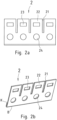
- the Fig. 2 a and Fig. 2 c show each of these cheek parts 2, 2' in a first perspective, in which the viewing direction is perpendicular to it.
- the Fig. 2 b and Fig. 2 d show the respective cheek part 2, 2' from an oblique view.
- Each cheek part 2, 2' which in the present embodiment is preferably a stamped and bent part, has three slots 21, 21', through which four equally sized tabs 22, 22' are formed.
- the number of tabs 22, 22' of the respective cheek part 2, 2' corresponds to the number of open recesses 123, 123' on each of the two side parts 12, 12' of the base frame 1.
- a locking window 23, 23' is provided in each tab 22, 22' of each cheek part 2, 2'.
- the locking windows 23 of the first cheek part 2 are larger than the locking windows 23' of the second cheek part 2'.
- the two cheek parts 2, 2' thus differ from one another in the size of their locking windows 23, 23'.
- additional fastening recesses 24, 24' are provided in the cheek parts 2, 2', which in the present embodiment have a circular shape, but could of course also have any other shape, for example oval, rectangular, square, triangular, pentagonal, n-sided or any other flat shape.
- the fastening pins 124, 124' of the base frame 1 fit positively into the respective fastening recesses 24, 24' of the corresponding Cheek parts 2, 2', so that the respective cheek part 2, 2' can be plugged onto the corresponding side part 12, 12'.
- the respective cheek part 2, 2' can be attached to the corresponding side part 12, 12' in another way, for example by gluing, welding, soldering, riveting and/or screwing.
- the Fig. 3 a and the Fig. 3 b show a module 3 that can be inserted into the support frame in a possible design from two different views. Of course, other modules with a similar design can also be used.
- the module 3 has a first locking lug 31 on a first longitudinal side 32, which is intended for locking in a locking window 23 of the first cheek part 2.
- a second longitudinal side 32' opposite this first longitudinal side 32 the module 3 has a second locking lug 31', which is narrower than the first locking lug and is intended for locking in a locking window 23' of the second cheek part 2'.
- the module is very compact, which improves its heat resistance.
- the orientation of the module 3 in the holding frame is determined by the shape of the locking lugs 31, 31' and the shape of the windows 23, 23'.
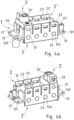
- the Fig. 4 shows a fully assembled holding frame, in which the two cheek parts 2, 2' are attached to the base frame.
- the fastening pins 124, 124' of the base frame engage in the fastening recesses 24, 24' of the corresponding cheek parts 2, 2'.
- this fastening is particularly stable because the lower edge K, K' of the respective sheet of the cheek part 2, 2' ends directly with the corresponding side part 12, 12' of the base frame 1.
- the cheek parts 2, 2' can also be soldered, welded, screwed, riveted or otherwise attached to the base frame 1.
- the cheek parts 2, 2' have a higher elasticity than the base frame 1, particularly in the area of their tabs 22, 22'.
- the base frame 1 therefore has a greater rigidity than the cheek parts 2, 2'.
- the cheek parts 2, 2' have a higher elasticity than the base frame.
- the holding frame is fixed at four corner points.
- it can be fixed by screwing at the four screw holes 131, 131 'of its flanges 13, 13' in or to a metal connector housing.
- this tab 22 is reversibly deflected, for example, by a distance of at least 0.2 mm, preferably of at least 0.4 mm, in particular of at least 0.8 mm, i.e., for example, by more than 1.6 mm.
- the base frame 1 is only deflected by a distance of less than 0.2 mm, preferably less than 0.1 mm, in particular less than 0.05 mm, i.e., for example, less than 0.025 mm, even in this area where its rigidity is at its lowest.
- the base frame 1 is stiffer than the cheek parts 2, 2'.
- the base frame 1 is to be regarded as stiff and the cheek parts 2, 2' are each to be described as spring-elastic.
- the cheek part 2 is spring-elastic and the elasticity of the cheek part 2 is selected in particular according to the values given above so that the modules 3 can be inserted and removed manually.
- the base frame 1 is rigid and in particular the rigidity of the base frame 1 is so high, in particular according to the values given above, that the inserted modules 3 are held therein with sufficient strength to ensure the intended function of an associated connector.
- the modules 3 and thus also the contacts present in the modules 3 are positioned geometrically precisely and mechanically stable enough to reliably make electrical contact with corresponding mating contacts of a comparable mating connector.
- Such a connector and a corresponding mating connector can additionally have a preferably metallic housing, into which a holding frame fully or partially equipped with modules 3 is inserted.
- FIG. 4 a and Fig. 4 b A specially designed PE module 3' is held in the holding frame shown, which in its basic form corresponds to the Fig. 3 a, b corresponds to the module 3 shown.
- the PE module 3' has an electrically conductive PE contact 33', which is electrically connected via the PE module 3' to an electrically conductive earthing clamp 34' that also belongs to the PE module 3'.
- the PE contact 33' can, for example, be a screw contact, ie the PE contact 33' has an earthing screw 35', which is suitable for conductively connecting an earthing cable to the PE contact 33' and mechanically fixing it thereto.
- This earthing cable is electrically connected to the base frame 1 by the PE module 3' via its earthing clamp 34', which is clamped to one of the end faces 11' of the holding frame.
- the holding frame can itself have such a PE contact, for example a PE screw contact, on its base frame 1.
- the PE contact can, for example, be molded onto the base frame 1. This can be done during the manufacture of the base frame 1, for example using an injection molding process.
- the holding frame serves to accommodate similar and/or different modules 3, wherein the holding frame is made of at least two different materials, of which at least one material is electrically conductive.
- the holding frame advantageously has partially spring-elastic properties.
- the holding frame consists partly of a rigid and partly of a spring-elastic material.
- the holding frame is made up of several parts.
- the holding frame consists of at least two parts, of which a first part is made of a first material and a second part is made of a second material, wherein the elastic modulus of the first material is greater than the elastic modulus of the second material.
- the first part can be designed as a base frame 1 and the second part as a cheek part 2, 2'.
- the base frame 1 has a rectangular cross-section and has two side parts 12, 12' that are parallel to one another and two end faces 11, 11' that are arranged perpendicularly thereto and parallel to one another.
- the base frame 1 is designed to be rigid.
- the base frame 1 can be made in one piece.
- the base frame 1 is at least partially made as a die-cast part.
- the at least one Cheek part 2, 2' is spring-elastic.
- the at least one cheek part 2, 2' can be electrically conductive and furthermore consists of spring-elastic sheet metal or has spring-elastic sheet metal.
- the at least one cheek part 2, 2' is attached to the base frame 1, for example by gluing, welding, soldering, riveting, locking and/or screwing.
- the at least one cheek part 2, 2' can have several slots 21, 21 through which tabs 22, 22' are formed in the respective cheek part 2, 2'.
- the width of the tabs 22, 22' can correspond to the width of the modules 3. In particular, all tabs 22, 22' can have the same width.
- Each tab 22, 22' can have a locking means.
- the locking means can consist of a locking window 23, 23' which is arranged in the respective tab 22, 22'.
- the at least one cheek part 2, 2' can in particular be a stamped and bent part.
- the at least one cheek part 2, 2' can be two cheek parts 2, 2'.
- the holding frame has a protective earthing contact (PE contact) or is at least equipped with one.
- the holding frame which is intended for a connector and is suitable for receiving similar and/or different modules 3, is made of at least two different materials.
- the base frame 1 is at least partially manufactured using a die-casting process, in particular using a zinc die-casting process.
- the at least one cheek part 2, 2' is punched out of a spring-elastic sheet metal and can be folded by 180° in particular at least one bending edge B, B'.
- the at least one cheek part 2, 2' can be attached to the base frame 1 in particular by gluing, welding, soldering, riveting, locking and/or screwing.
- the holding frame can hold a module 3 accommodated therein in one direction with its base frame and at the same time fix this module 3 perpendicularly thereto with tabs 13, 13', 23, 23' belonging to the respective cheek part 2, 2', in particular by locking the module 3 onto its tabs 22, 22'.
Landscapes
- Engineering & Computer Science (AREA)
- Manufacturing & Machinery (AREA)
- Connector Housings Or Holding Contact Members (AREA)
- Casings For Electric Apparatus (AREA)
- Manufacturing Of Electrical Connectors (AREA)
- Absorbent Articles And Supports Therefor (AREA)
Description
- Die Erfindung betrifft einen Halterahmen für einen Steckverbinder zur Aufnahme gleichartiger und/oder unterschiedlicher Module, mit einen Grundabschnitt zur Fixierung eines aufgenommenen Moduls in einer Ebene und einem Verformungsabschnitt, der einen Einführzustand und einen Haltezustand annehmen kann, wobei der Einführzustand ein Einführen wenigstens eines Moduls in einer Richtung quer zur Ebene in den Halterahmen erlaubt und ein aufgenommenes Modul im Haltezustand fixiert ist.
- Weiterhin betrifft die Erfindung ein Verfahren zur Herstellung eines Halterahmens für einen Steckverbinder zur Aufnahme gleichartiger und/oder unterschiedlicher Module, mit einen Grundabschnitt zur Fixierung eines aufgenommenen Moduls in einer Ebene und einem Verformungsabschnitt, der einen Einführzustand und einen Haltezustand annehmen kann, wobei der Einführzustand ein Einführen wenigstens eines Moduls in einer Richtung quer zur Ebene in den Halterahmen erlaubt und ein aufgenommenes Modul im Haltezustand fixiert ist.
- Derartige Halterahmen werden benötigt, um mehrere zueinander gleichartige und/oder auch unterschiedliche Module aufzunehmen.
- Bei diesen Modulen kann es sich beispielsweise um Isolierkörper handeln, die als Kontaktträger für elektronische und elektrische und möglicherweise auch für optische und/oder pneumatische Kontakte vorgesehen sind. Von besonderer Wichtigkeit ist es, dass der Halterahmen eine vorschriftsmäßigen Schutzerdung gemäß der Steckverbinder-Norm EN61984 beispielsweise zum Einfügen des mit Modulen bestückten Halterahmens in metallische Steckverbindergehäuse, ermöglicht.
- Eine elektrisch-faseroptische Verbinderanordnung gemäß
US 5,352,133 umfasst eine dielektrische Ummantelung mit einer Aufnahme zur Aufnahme eines Steckverbinders in einer Position zum Zusammenstecken mit einer komplementären Verbindervorrichtung. Eine Metallverriegelung ist an der dielektrischen Ummantelung befestigt und kann mit einer komplementären Verriegelung am Steckverbinder in Eingriff gebracht werden, um den Verbinder in der Aufnahme automatisch zu verriegeln, wenn der Verbinder darin in einer Eingriffsrichtung positioniert wird. Ein Antiüberlastungsanschlag liegt über der Metallverriegelung in einer beabstandeten Beziehung dazu, damit sich die Metallverriegelung nur in begrenztem Ma-ße in und aus dem Eingriff mit der komplementären Verriegelung bewegen kann, um eine Überlastung der Metallverriegelung zu verhindern. Ein Rippen- und Schlitzeingriff ist zwischen dem Verbinder und der Abdeckung vorgesehen, um eine Drehung des Verbinders um eine Achse senkrecht zur Steckrichtung des Verbinders zu verhindern, um einen weiteren Überlastungsschutz für die Metallklinke zu bieten. -
DE 27 36 079 A1 offenbart einen modular aufgebauten Klemmenblock, der auf Schienen aufgerastet werden kann. Mehrere der Blöcke können durch Verzahnung der Seiten in einer Reihe verbunden werden. Jedes Modul besteht aus starrem Isoliermaterial mit Schlitzen oder Erhöhungen an den Seiten und Ausschnitten zum Aufklipsen auf Tragschienen. Die Tragschiene ist U-förmig und jeder Block enthält federbelastete Kontaktklammern. Jeder Kontaktbügel hat zwei Zinken, deren freie Enden um 90° abgeknickt sind. Die aufrechten Abschnitte der freien Enden sind wiederum zweigeteilt und greifen in Schlitze im Block ein. Die parallel zur Basis verlaufenden Zinken sind am vorderen Ende mit einem Vorsprung nach innen verbunden, der in eine weitere Aussparung eingreift. -
EP 0 183 587 A1 offenbart ein elektrisches Verbinderelement mit mehreren Kontakten, das ein hohles Gehäuse mit mindestens einem Hohlraum zur Aufnahme eines Isolierblocks umfasst, wobei der oder jeder der Blöcke eine Vielzahl von durchgehenden Aufnahmen oder Zellen aufweist, die für das Anbringen von Kontakten vorgesehen sind, die in den Zellen unbeweglich gemacht sind, wobei das Verbinderelement außerdem Verriegelungsmittel aufweist, die mit Verriegelungsmitteln eines komplementären Verbinderelements zusammenwirken können. Jeder Isolierblock wird in dem entsprechenden Hohlraum des Gehäuses durch zwei elastische Clips mit einem im Wesentlichen U-förmigen Querschnitt fixiert, deren Steg Mittel zum Einhaken an einer Schmalseitenwand des Hohlraums des Gehäuses und elastische Mittel zum Abstützen an der Schmalseitenwand gegenüber dem Isolierblock aufweist, wobei jeder der Schenkel des Clips so angeordnet ist, dass er sich elastisch an eine der Breitseitenwände des Isolierblocks anlegt, wobei jeder der Schenkel des Clips außerdem so angeordnet ist, dass seine freie Endfläche sich elastisch an eine schälende Auflagefläche der entsprechenden Breitseitenwand des Hohlraums des Gehäuses anlegt. -
US 4,032,209 betrifft eine Mehrfachsteckeranordnung für elektische Komponenten. Eine Schiene weist beabstandete Arme, von denen jeder eine Vielzahl von Klammern hält, wobei sich jede Klammer an einer entsprechenden Station befindet. Somit gibt es an jeder Station ein Paar von Klammern. Die Mehrfachsteckeranordnung kann zwischen den Armen an jeder Station oder an benachbarten Stationen montiert werden. Ein elektrisches Bauteil, wie z.B. ein Relais, kann in jede Steckereinheit eingesteckt werden und wird, wenn es eingesteckt ist, von den Klammern erfasst, die das Bauteil und die Steckdoseneinheit zusammenhalten, und die Kombination der beiden wird in der/den Station(en) mit der Schiene verriegelt. -
DE 29 812 500 U1 offenbart einen modularen Steckverbinder, mit einem Tragrahmen, der längslaufende Rahmenleisten aufweist und mehrere Module enthält, welche jeweils an einer ersten Längskante der Rahmenleisten abgestützt sind, wobei selbständige Verriegelungselemente vorgesehen sind, die rastend oder klemmend an den Modulen montierbar sind und diese an einer zu der ersten Längskante entgegengesetzten zweiten Längskante blockieren. -
CN 203277786 U offenbart eine Rahmenstruktur zur Fixierung von Modulen, wobei die Rahmenstruktur einen Rahmenkörper und seitliche Gleitrahmen umfasst, wobei der Rahmenkörper und die seitlichen Gleitrahmen eine Raumstruktur zur Aufnahme eines oder mehrerer Module umschlie-ßen, wobei der Rahmenkörper und die Gleitrahmen jeweils mit mehreren angepassten Nuten versehen sind, und wobei an den Seiten jedes Moduls jeweils ein Positionierungsvorsprung vorgesehen ist, der einer der Nuten entspricht, so dass, wenn die seitlichen Gleitrahmen geschlossen und verriegelt werden, die Positionierungsvorsprünge des Moduls in den geschlossenen Nuten festgeklemmt sind, die durch das Zusammenwirken von dem Rahmenkörper und den Gleitrahmen gebildet sind. Nach dem Lösen der Gleitrahmen sind die Module leicht einsetzbar und dann werden die Gleitrahmen geschlossen, was eine Fixierung von Modulen ermöglicht. Die Vorteile des Gebrauchsmusters liegen darin, die Montage bzw. Demontage der Module zu erleichtern und die Module stabil zu fixieren. - Aus der Druckschrift
EP 0 860 906 B1 ist ein Halterahmen zur Halterung von Steckverbindermodulen und zum Einbau in Steckverbindergehäuse bzw. zum Anschrauben an Wandflächen bekannt, wobei die Steckverbindermodule in den Halterahmen eingesetzt sind und Halterungsmittel an den Steckverbindermodulen mit an gegenüberliegenden Wandteilen (Seitenteilen) des Halterahmens vorgesehenen Ausnehmungen zusammenwirken, wobei die Ausnehmungen als allseitig geschlossene Öffnungen in den Seitenteilen des Halterahmens ausgebildet sind, wobei der Halterahmen aus zwei gelenkig miteinander verbundenen Hälften besteht, wobei die Trennung des Halterahmens quer zu den Seitenteilen des Rahmens vorgesehen ist, und wobei Gelenke in den Befestigungsenden des Halterahmens derart angeordnet sind, dass beim Aufschrauben des Halterahmens auf eine Befestigungsfläche sich die Rahmenteile derart ausrichten, dass die Seitenteile des Halterahmens rechtwinklig zur Befestigungsfläche ausgerichtet sind und die Steckverbindermodule über die Halterungsmittel eine formschlüssige Verbindung mit dem Halterahmen aufweisen. In der Praxis sind solche Halterahmen üblicherweise in einem Druckgussverfahren, insbesondere in einem Zinkdruckgussverfahren gefertigt. - Dieser Gelenkrahmen wird zusammen mit einem starren Halterahmen im Buch "Steckverbinder II" von G. Knoblauch et al. (3. Auflage, 2006, expert verlag, Kontakt & Studium, Band 583; Abschnitt 7.3.2.3) beschrieben.
- Die Druckschrift
EP 2 581 991 A1 offenbart einen Halterahmen für Steckverbindermodule, der zwei Rahmenhälften aufweist, die durch Linearverschieben der einen Rahmenhälfte relativ zur anderen Rahmenhälfte in eine Schieberichtung miteinander verrastbar sind, wobei an den Rahmenhälften jeweils zueinander korrespondierende Rastmittel vorgesehen sind, die beim Linearverschieben ein Verrasten der beiden Rahmenhälften miteinander in zwei verschiedene Raststellungen bewirken, in denen die Rahmenhälften in verschiedenem Abstand zueinander beabstandet sind. - Es hat sich in der Praxis jedoch gezeigt, dass solche Halterahmen bei der Montage eine aufwändige Bedienung erfordern. Beispielsweise müssen solche Halterahmen aus dem Steckverbinder herausgeschraubt und/oder entrastet werden, sobald auch nur ein einziges Modul ausgetauscht werden soll. Dabei fallen möglicherweise auch die anderen Module, deren Entnahme gar nicht erwünscht war, aus dem Halterahmen heraus und müssen dann vor dem Zusammenschrauben und/oder vor dem Verrasten der Rahmenhälften wieder eingefügt werden. Schließlich müssen sich bereits vor dem Zusammenfügen der Rahmenhälften alle Module gleichzeitig in der für sie vorgesehenen Position befinden, um beim Zusammenfügen der Rahmenhälften endgültig im Halterahmen fixiert zu werden, was die Montage erschwert.
- Die Druckschrift
EP 1 801 927 B1 offenbart einen Halterahmen, der aus einem einteiligen Kunststoffspritzteil besteht. Der Halterahmen ist als umlaufender Kragen ausgebildet und weist an seiner Steckseite mehrere durch Schlitze getrennte Wandsegmente auf. Jeweils zwei gegenüber liegende Wandsegmente bilden einen Einfügebereich für ein Steckermodul, wobei die Wandsegmente fensterartige Öffnungen aufweisen, die zur Aufnahme von an den Schmalseiten der Module angeformten Vorsprüngen dienen. Weiterhin ist in den Wandsegmenten jeweils eine Führungsnut vorgesehen. Die Führungsnut ist oberhalb der Öffnungen mittels eines nach außen versetzten Fenstersteges gebildet, der auf der Innenseite eine Einführungsschräge aufweist. Zusätzlich weisen die Steckmodule Rastarme auf, die an den Schmalseiten in Richtung der Kabelanschlüsse wirkend, angeformt sind, und unterhalb der seitlichen Kragenwand verrasten, so dass zwei unabhängige Rastmittel die Steckverbindermodule im Halterahmen fixieren. - Nachteilig bei diesem Stand der Technik ist zum einen, dass es sich um einen aus Kunststoff gebildeten Halterahmen handelt, der gattungsgemäß nicht zur Schutzerdung und damit nicht für den Einbau in metallische Steckverbindergehäuse geeignet ist. Die Verwendung metallischer Steckverbindergehäuse setzt eine solche Schutzerdung jedoch voraus und ist sowohl wegen ihrer mechanischen Robustheit, ihrer Temperaturbeständigkeit und wegen ihrer elektrisch schirmenden Eigenschaften in vielen Fällen notwendig und daher vom Kunden erwünscht. Weiterhin hat sich gezeigt, dass die Herstellung der vorgenannten Kunststoffhalterahmen im Spritzgussverfahren zumindest schwierig und nur mit hohem Aufwand zu realisieren ist. Letztlich ist auch die Hitzebeständigkeit eines solchen Kunststoffhalterahmens für spezielle Anwendungen, beispielsweise in der Nähe eines Hochofens, nicht immer ausreichend.
- Schließlich werden das Kunststoffmaterial und die Form, insbesondere die Stärke des Halterahmens, an den relevanten Stellen primär von den Anforderungen an die Biegsamkeit bestimmt und nicht von denen der Temperaturbeständigkeit.
- Die Aufgabe der Erfindung besteht darin, eine Bauform für einen Halterahmen anzugeben, die einerseits der eine gute Hitzebeständigkeit und eine hohe mechanische Robustheit aufweist und die insbesondere auch beim Einbau in ein metallisches Steckverbindergehäuse eine entsprechende Schutzerdung, insbesondere eine PE ("Protection Earth"), ermöglicht und die andererseits auch eine komfortable Bedienbarkeit, insbesondere beim Auswechseln einzelner Module, gewährleistet.
- Diese Aufgabe wird in einem ersten Aspekt mit einem Halterahmen der gemäß Anspruch 1 gelöst.
- In einem zweiten Aspekt wird die Aufgabe mit einem Verfahren gemäß Anspruch 5 gelöst.
- Ein solcher Halterahmen ist im Bereich der schweren Industriesteckverbinder einsetzbar und besteht aus elektrisch leitfähigen Material. Dadurch wird eine Schutzerdung ermöglicht, die dadurch realisiert ist, dass der Halterahmen einen PE-Kontakt aufweist oder zumindest mit einem solchen PE-Kontakt ausgestattet ist.
- Der Halterahmen weist einen Grundabschnitt und einen Verformungsabschnitt auf, die wenigstens teilweise aus unterschiedlichen Werkstoffen gebildet sind. Der Grundabschnitt dient zur Fixierung eines aufgenommenen Moduls in einer Ebene. Der Verformungsabschnitt kann einen Einführzustand und einen Haltezustand annehmen, wobei der Einführzustand ein Einführen wenigstens eines Moduls in einer Richtung quer zur Ebene in den Halterahmen erlaubt, wobei ein aufgenommenes Modul im Haltezustand fixiert ist.
- Der Halterahmen weist einen Grundrahmen als Grundabschnitt und mindestens ein, bevorzugt zwei Wangenteile als Verformungsabschnitt auf. Der Grundrahmen ist dann aus einem anderen Werkstoff gebildet als die Wangenteile und besitzt eine geringere Elastizität und damit eine größere Steifigkeit als die Wangenteile.
- Der Verformungsabschnitt, insbesondere das oder die Wangenteile, können aus einem Material gebildet sein, das entsprechend seinem Spannungs/Dehnungs-Diagramm elastischer ist, also ein kleineres Elastizitätsmodul aufweist, als dasjenige Material, aus dem der Grundabschnitt, insbesondere der Grundrahmen, gebildet ist. Umgekehrt formuliert kann das Material des Grundabschnitts steifer sein als das Material, aus dem der Verformungsabschnitt gebildet ist. Beispielsweise kann das Material des Grundrahmens entsprechend seinem Spannungs/Dehnungs-Diagramm ein Elastizitätsmodul besitzen, welches größer ist als das Elastizitätsmodul desjenigen Materials, aus dem die Wangenteile gebildet sind.
- Der Betrag des Elastizitätsmoduls ist dabei umso größer, je mehr Widerstand ein Material seiner elastischen Verformung entgegensetzt.
- Weiterhin kann das Material, aus dem der Verformungsabschnitt gebildet ist, entsprechend seinem Spannungs/Dehnungs-Diagramm, einen größeren elastischen Bereich besitzen, als dasjenige Material, aus dem der Grundabschnitt gebildet ist.
- Der Grundabschnitt, also der Grundrahmen, ist steif, insbesondere idealisiert betrachtet starr, ausgeführt.
- Weiterhin ist der Verformungsabschnitt, insbesondere das Wangenteil oder die Wangenteile, federelastisch ausgeführt und besteht aus einem federelastischen Blechoder weist federelastisches Blech auf.
- Unter einem federelastischen Blech ist dabei ein Blech zu verstehen, das federelastische Eigenschaften, wie beispielsweise eine reversible Verformbarkeit, insbesondere unter Aufbringung einer entsprechenden Rückstellkraft, aufweist, also beispielsweise ein Blech, das aus Federstahl oder einem vergleichbaren Material gefertigt ist.
- Vorteilhafte Ausgestaltungen der Erfindung sind in den Unteransprüchen angegeben.
- Ein Vorteil der Erfindung besteht somit darin, dass die Module einzeln und mit nur sehr geringem Aufwand in den Halterahmen eingefügt und wieder daraus entfernt werden können, was insbesondere die händische Bestückung erleichtert. Die federelastischen Eigenschaften des Verformungsabschnitts, insbesondere des Wangenteils oder der Wangenteile, gestatten es nämlich, Module einzeln mit nur sehr geringem Aufwand einzufügen oder zu entnehmen. Gleichzeitig sorgt der Grundrahmen durch seine Steifigkeit für die notwendige mechanische Stabilität beim Halten der eingefügten Module.
- Vorteilhafterweise ist sowohl für den Grundabschnitt, insbesondere den Grundrahmen, als auch für den Verformungsabschnitt, insbesondere die Wangenteile, durch eine Verwendung eines oder mehrerer metallischer Werkstoffe eine, verglichen beispielsweise mit Kunststoff, hohe Temperaturbeständigkeit und weiterhin auch eine besonders große mechanische Robustheit des Halterahmens gewährleistet.
- Ein weiterer Vorteil des Einsatzes eines oder mehrerer metallischer Werkstoffe besteht darin, dass der Halterahmen zur elektrischen Sicherheit eine Schutzerdung, insbesondere eine PE-Schutzerdung eines metallischen Steckverbindergehäuses, in welches der Halterahmen eingefügt wird, ermöglicht. Dies gewährleistet weiterhin als zusätzlichen Vorteil auch eine Schirmung der durch den Steckverbinder übertragenen Signale. Bei dieser Schirmung kann es sich um einen Schutz gegen Störfelder von außen handeln. Es kann sich aber auch um eine Schirmung zur Vermeidung oder Verminderung einer Störaussendung, also zum Schutz der Umwelt gegen Störfelder des Steckverbinders handeln. Mit anderen Worten werden nicht nur die durch die Module übertragenen Signale vor äußeren Störfeldern geschützt, sondern es findet auch ein Schutz der Umgebung vor Störungen statt, welche durch einen Stromfluss, der durch die Module verläuft, entstehen.
- Ein besonders großer zusätzlicher Vorteil der Verwendung eines oder mehrerer metallischer Werkstoffe besteht weiterhin darin, dass der Halterahmen einerseits besonders hitzebeständig ist und andererseits trotzdem, beispielsweise durch die Verwendung von federelastischem Blech, an den dafür erforderlichen Stellen eine ausreichend hohe Elastizität aufweist, um die Module einzeln und mit geringem Aufwand in den Modulrahmen einzufügen und wieder zu entnehmen. Daher ist es von besonders großem Vorteil, wenn der Halterahmen an geeigneten Stellen federelastisches Blech aufweist, denn dadurch ist er bei mindestens ebenso großer Elastizität wesentlich hitzebeständiger als ein aus mechanischer Sicht sonst funktional vergleichbarer Kunststoffrahmen. Dazugehörige Module können in ihrer Bauform dementsprechend kompakt ausgeführt sein, so dass sie weiterhin aus Kunststoff gefertigt sein können und trotzdem verhältnismäßig hitzebeständig sind.
- Besonders vorteilhaft ist es, wenn der Halterahmen mehrere verschiedene Bereiche, beispielsweise einen ersten und einen zweiten Bereich, aufweist, welche zueinander eine unterschiedliche Elastizität besitzen, weil er dann im Bereich der höchsten Biegebeanspruchung gezielt ein höheres Widerstandsmoment aufbringen kann. Der erste Bereich entspricht dem Grundabschnitt. Der zweite Bereich entspricht dem Verformungsabschnitt.
- Diese verschiedenen Bereiche, insbesondere der Grundabschnitt und der Verformungsabschnitt, sind aus verschiedenen Materialien gebildet sein und weisen so verschiedene Materialeigenschaften, nämlich verschiedene Elastizitätsmoduln, auf.
- Der zweite Bereich, insbesondere der Verformungsabschnitt, kann dadurch eine höhere Elastizität aufweisen, als der erste Bereich, der insbesondere dem Grundabschnitt entspricht. Der erste Bereich kann somit, umgekehrt formuliert, eine größere Steifigkeit besitzen als der zweite Bereich, Insbesondere ist der Grundabschnitt steif ausgebildet und der Verformungsabschnitt ist federelastisch ausgebildet. Eine solche Elastizität bzw. Steifigkeit kann einerseits, wie bereits erwähnt, durch das jeweils verwendete Material erreicht werden und/oder es kann andererseits auch durch die geometrische Formgebung dieser Bereiche, insbesondere des Grundabschnitts und des Verformungsabschnitts, erreicht werden.
- Der der Grundabschnitt ist dazu aus einem steifen Material gebildet, beispielswiese aus einer Zinklegierung oder aus einer Aluminiumlegierung oder aus einer Kupferlegierung. Der der Verformungsabschnitt ist aus einem federelastischen Material gebildet sein und kann somit beispielsweise aus einem federelastischen Stahlblech bestehen.
- Der der Grundabschnitt ist wenigstens teilweise in einem Druckgussverfahren, beispielsweise in einem Zinkdruckguss- oder Aluminiumdruckgussverfahren hergestellt. Bei dem ersten Bereich, dem Grundabschnitt, handelt es sich um den umlaufenden Grundrahmen. Bei dem Grundrahmen handelt es sich somit insbesondere um ein Zinkdruckgussteil. Der Grundrahmen ist im Querschnitt im Wesentlichen rechteckig ausgebildet, besitzt also zwei einander parallel gegenüber liegende Stirnflächen und rechtwinklig dazu zwei einander parallel gegenüber liegende Seitenteile, wobei die beiden Stirnflächen kürzer sind als die beiden Seitenteile. Sowohl die Stirnflächen als auch die Seitenteile können dabei eine im Wesentlichen rechteckige Form aufweisen.
- Weiterhin ist der Verformungsabschnitt aus dem mindestens einen, bevorzugt den beiden, separaten Wangenteilen gebildet, von denen jedes Wangenteil bevorzugt aus jeweils einem federelastischen Blechteil besteht. Die beiden Wangenteile können gegebenenfalls aus demselben Material, insbesondere aus federelastischem Blech, bestehen und zudem die gleiche Stärke aufweisen. Beispielsweise können die bevorzugt beiden Wangenteile aus demselben Stanzblech ausgestanzt sein.
- Jedes Wangenteil kann im Wesentlichen flächig ausgebildet sein und bevorzugt eine rechteckige Grundform aufweisen. Somit besitzt es zwei einander gegenüber liegende, lange Kanten, nämlich eine erste und eine zweite Kante, und rechtwinklig dazu zwei einander gegenüberliegende kurze Kanten, nämlich eine dritte und eine vierte Kante. Das Wangenteil besitzt insbesondere in regelmäßigen Abständen an seiner ersten Kante beginnende und sich bevorzugt rechtwinklig dazu in Richtung der zweiten Kante in das Wangenteil hinein verlaufende, bevorzugt geradlinige, Schlitze, wodurch im Wangenteil frei stehende Laschen gebildet sind. Weiterhin kann in jeder dieser Laschen ein Rastfenster als Rastelement angeordnet sein. Diese Rastfenster sind dafür vorgesehen, Rastnasen eingefügter Module aufzunehmen, um die Module im Halterahmen zu verrasten. Weiterhin kann jedes Wangenteil mehrere Befestigungselemente, insbesondere Befestigungsausnehmungen in bevorzugt runder Form, zur Befestigung am Grundrahmen aufweisen.
- Jedes der beiden Wangenteile kann vorteilhafterweise an jeweils einer Außenseite eines der beiden Seitenteile am Grundrahmen befestigt sein, so dass sich jeweils zwei federelastische Laschen der beiden Wangenteile symmetrisch gegenüber stehen. Weiterhin können diese Laschen zu ihrem Ende hin leicht nach außen, d.h. vom Grundrahmen und somit voneinander weg, gebogen sein, um das Einfügen eines Moduls zu erleichtern.
- An dem entsprechenden Seitenteil, bevorzugt an beiden Seitenteilen, kann der Grundrahmen Befestigungsmittel, beispielsweise runde Befestigungszapfen, aufweisen. Diese Befestigungsmittel können in die Befestigungsausnehmungen des dazugehörigen Wangenteils eingreifen und die Wangenteile so, beispielsweise durch Verrasten und/oder durch eine form- und kraftschlüssige Verbindung am Grundrahmen halten. Zusätzlich oder alternativ dazu können die Wangenteile am Grundrahmen durch Verkleben, Schweißen, Löten, Nieten und/oder Verschrauben oder durch irgendeine andere Befestigungsart am Grundrahmen befestigt sein.
- Die dazu gehörenden Module können im Wesentlichen quaderförmig ausgebildet sein und können an zwei einander gegenüberliegenden Stirnflächen jeweils eine Breite aufweisen, die der Breite einer Lasche entspricht. Jedes Modul weist vorteilhafterweise an seinen beiden Stirnflächen jeweils eine Rastnase auf, die ebenfalls im Wesentlichen quaderförmig ausgeführt sein kann. Jede der federelastischen Laschen des Halterahmens besitzt vorteilhafterweise ein Rastfenster, welches im Wesentlichen rechteckig ausgebildet sein kann, und das zur bevorzugt formschlüssigen Aufnahme einer solchen Rastnase vorgesehen ist.
- Die beiden Rastnasen eines Moduls können sich, beispielsweise in ihrer Form und/oder ihrer Größe, insbesondere durch ihre Länge, voneinander unterscheiden und die Laschen an beiden Seiten des Halterahmens können dazu entsprechende Fenster aufweisen, die sich also ebenfalls voneinander unterscheiden und die in ihrer Größe und/oder ihrer Form zu jeweils einer der Rastnasen passen. Dies hat den Vorteil, dass dadurch die Orientierung jedes Moduls im Halterahmen festgelegt ist. Mit anderen Worten können die Rastfenster und die Rastnasen durch ihre Form und/ oder Größe als Kodiermittel, insbesondere als Polarisationsmittel, zur Orientierung der Module im Halterahmen verwendet werden.
- Vorteilhafterweise sind die Laschen des Halterahmens in einem frei stehenden Endbereich leicht vom Halterahmen weggebogen, was das Einführen der Module vereinfacht. Das Einführen eines Moduls in den Halterahmen gestaltet sich dann besonders bedienungsfreundlich. Dazu wird ein Modul nämlich zunächst zwischen zwei Laschen eines Halterahmens eingeführt und gleitet dann mit seinen beiden Stirnflächen und insbesondere mit den daran angeformten Rastnasen an den voneinander weggebogenen Endbereichen der Laschen entlang. Dadurch biegen sich die beiden Laschen kurzzeitig auseinander, bis die jeweiligen Rastnasen von dem dazugehörigen Rastfenster der jeweiligen Lasche aufgenommen werden und somit darin verrasten. Bei der Aufnahme der Rastnasen in das jeweilige Rastfenster federn die Laschen bevorzugt in ihre Ausgangsposition zurück. Auf diese Weise können die Module einzeln im Halterahmen verrasten.
- Gleichzeitig ist das Modul fest im bevorzugt steifen Grundrahmen gehalten. Um die Module wieder zu entrasten, müssen lediglich die beiden dazugehörigen Laschen wieder voneinander weggebogen werden. Daraufhin kann das jeweilige Modul einzeln aus dem Halterahmen entnommen werden, während die anderen Module weiterhin verrastet sind. Somit ist auf diese Weise ein fester Halt des Moduls im Halterahmen bei einer vergleichsweise geringen Betätigungskraft gewährleistet, was für die Bedienbarkeit besonders vorteilhaft ist.
- Von besonderem Vorteil ist es weiterhin, dass die Module bereits durch die vorgenannte Konstruktion mit ausreichender Haltekraft im Halterahmen gehalten sind und dementsprechend außer ihren Rastnasen keine weiteren Rastmittel, beispielswiese Rastarme, benötigen, denn dies vereinfacht ihre Bauform und damit ihren Herstellungsaufwand erheblich und sorgt gleichzeitig für eine kompakte Bauform und damit auch für eine hohe Hitzebeständigkeit der Module und damit des gesamten Steckverbinders.
- In einer Ausführungsform ist es besonders vorteilhaft, wenn diese beiden Wangenteile gleichartig sind, d.h. es müssen trotz der zweiteiligen Ausführung des Halterahmens nur Wangenteile einer Art hergestellt werden, was den Herstellungsaufwand weiterhin verringert.
- In einer anderen bevorzugten Ausgestaltung unterscheiden sich die beiden Wangenteile durch die Größe und/oder die Form ihrer Rastfenster. Dies hat den Vorteil, dass dadurch die Orientierung jedes Moduls, das dementsprechend auch zwei verschiedene Rastnasen aufweist, festgelegt ist. Mit anderen Worten können die Rastfenster und die Rastnasen somit durch ihre Form als Kodiermittel zur Orientierung der Module dienen.
- Zur Schutzerdung (PE) kann der Halterahmen mit einem entsprechenden PE-Modul bestückt sein, welches beispielsweise über eine elektrisch leitfähige Erdungsklammer einen elektrischen Kontakt zwischen einem daran angeschlossenen Erdungskabel und dem zumindest teilweise elektrisch leitfähigen, insbesondere metallischen, Halterahmen herstellt. Dadurch kann der Halterahmen mit einem PE-Kontakt bestückt werden.
- Alternativ dazu kann der Halterahmen selbst einen PE-Kontakt, beispielsweise einen Schraubkontakt, für das Erdungskabel besitzen. Beispielsweise kann ein solcher PE-Kontakt an den Grundrahmen angeformt sein.
- Ein Ausführungsbeispiel der Erfindung ist in der Zeichnung dargestellt und wird im Folgenden näher erläutert. Es zeigen:
- Fig. 1
- Einen Grundrahmen;
- Fig. 2 a,b
- ein erstes Wangenteil aus zwei verschiedenen Pespektiven;
- Fig. 2 c,d
- ein zweites Wangenteil aus zwei verschiedenen Perspektiven;
- Fig. 3 a,b
- ein Modul aus zwei verschiedenen Perspektiven;
- Fig. 4 a,b
- einen Halterahmen mit einem eingefügten PE-Modul aus zwei verschiedenen Perspektiven.
- Die
Fig. 1 zeigt einen Grundrahmen 1. Dieser Grundrahmen 1 ist im Querschnitt im Wesentlichen rechteckig ausgebildet, besitzt also zwei einander parallel gegenüber liegende Stirnflächen 11, 11' und rechtwinklig dazu zwei einander parallel gegenüber liegende Seitenteile 12, 12', wobei die beiden Stirnflächen 11, 11' kürzer sind als die beiden Seitenteile 12, 12'. Sowohl die Stirnflächen 11, 11' als auch die Seitenteile 12, 12' weisen ihrerseits eine im Wesentlichen rechteckige Form auf, wobei an die Stirnflächen 11, 11' jeweils ein rechtwinklig dazu abstehender Flansch 13, 13' angeformt ist, wobei jeder dieser beiden Flansche 13,13'jeweils zwei Schraubbohrungen 131, 131' aufweist, so dass der Grundrahmen 1 insgesamt vier Schraubbohrungen 131, 131' besitzt. - Die beiden Seitenteile 12, 12' besitzen jeweils an einer ersten Kante mehrere, in der vorliegenden Ausführung relativ kurz ausgeführte einander symmetrisch gegenüberstehend angeordnete Stege 122, 122', wobei mit dem Begriff "kurz" in diesem Zusammenhang gemeint ist, dass die in der Zeichnung nach oben verlaufende Länge der Stege 122, 122' deren Breite unterschreitet. Die Stege 122, 122' könnten in einer etwas anderen Ausführung aber auch deutlich länger sein. Beispielsweise könnte ihre Länge ihrer Breite entsprechen oder diese gar noch überschreiten. Zwischen diesen Stegen 122, 122' sind somit offene Ausnehmungen 123, 123' gebildet.
- Im vorliegenden Beispiel sind an jedem Wangenteil 2, 2' vier solche offenen Ausnehmungen 123, 123' vorgesehen, aber es wäre selbstverständlich auch eine andere Zahl von Ausnehmungen denkbar, beispielsweise drei, fünf, sechs, sieben oder acht. Die Zahl der offenen Ausnehmungen 132, 132' in jedem Seitenteil 12, 12' entspricht der Anzahl von Modulen 3, die der entsprechende Halterahmen aufzunehmen in der Lage ist.
- Weiterhin weist jedes Seitenteil 12, 12' mehrere Befestigungszapfen 124, 124' zur Befestigung des dazugehörigen Wangenteils 2, 2' auf. Im vorliegenden Fall besitzen die Befestigungszapfen 124, 124' eine im Querschnitt eine kreisrunde Form; es wäre aber auch irgendeine andere Form denkbar; die Befestigungszapfen 124, 124' könnten also beispielsweise auch oval, rechteckig, quadratisch, dreieckig, fünfeckig, n-eckig oder in jeder anderen flächigen Form ausgebildet sein.
- Für den Halterahmen sind somit zwei Wangenteile 2, 2' vorgesehen, nämlich ein erstes Wangenteil 2 und ein zweites Wangenteil 2'.
- Die
Fig. 2 a undFig. 2 c zeigen jeweils eines dieser Wangenteile 2, 2' in einer ersten Perspektive, bei der die Blickrichtung rechtwinklig dazu verläuft. DieFig. 2 b undFig. 2 d zeigen das jeweilige Wangenteil 2, 2' aus einer schrägen Ansicht. Jedes Wangenteil 2, 2', bei dem es sich im vorliegenden Ausführungsbeispiel bevorzugt um ein Stanzbiegeteil handelt, besitzt drei Schlitze 21, 21', durch welche vier gleichgroße Laschen 22, 22' gebildet sind. Die Zahl der Laschen 22, 22' des jeweiligen Wangenteils 2, 2' entspricht der Anzahl der offenen Ausnehmungen 123, 123' an jeweils einem der beiden Seitenteile 12, 12' des Grundrahmens 1. - In jeder Lasche 22, 22' jedes Wangenteils 2, 2' ist jeweils ein Rastfenster 23, 23' vorgesehen. Die Rastfenster 23 des ersten Wangenteils 2 sind größer als die Rastfenster 23' des zweiten Wangenteils 2'. Die beiden Wangenteile 2, 2' unterscheiden sich somit voneinander durch die Größe ihrer Rastfenster 23, 23'. Weiterhin sind in den Wangenteilen 2, 2' zusätzliche Befestigungsausnehmungen 24, 24' vorgesehen, die in dem vorliegenden Ausführungsbeispiel eine kreisrunde Form besitzen, aber selbstverständlich auch irgendeine andere Form besitzen könnten, also beispielsweise oval, rechteckig, quadratisch, dreieckig, fünfeckig, n-eckig oder in jeder anderen flächigen Form ausgebildet sein könnten.
- Die Befestigungszapfen 124, 124' des Grundrahmens 1 passen formschlüssig in die jeweiligen Befestigungsausnehmungen 24, 24' der dazugehörigen Wangenteile 2, 2', so dass das jeweilige Wangenteil 2, 2' auf das dazugehörige Seitenteil 12, 12' aufsteckbar ist. Zusätzlich kann das jeweilige Wangenteil 2, 2' noch anderweitig am entsprechenden Seitenteil 12, 12' befestigt werden, beispielsweise durch Verkleben, Schweißen, Löten, Nieten und/oder Verschrauben.
- In den
Fig. 2 b und2 d ist zu erkennen, dass das jeweilige Wangenteil 2, 2' im unteren Endbereich an einer Biegelinie B, B' um 180° gefaltet und damit in diesem Bereich verstärkt ist. Eine untere Kante K, K' des dazugehörigen Bleches kommt dabei zwischen den Befestigungsausnehmungen 24 und einer dazugehörigen Biegelinie B, B' zu liegen, so dass die Befestigungsausnehmungen 24, 24' unverdeckt sind und die Befestigungszapfen 124, 124' ungehindert darin eingeführt werden können. - Die
Fig. 3 a und dieFig. 3 b zeigen ein in den Halterahmen einfügbares Modul 3 in einer möglichen Bauform aus zwei verschiedenen Ansichten. Selbstverständlich können auch andere Module in ähnlicher Bauform Verwendung finden. - Das Modul 3 besitzt an einer ersten Längsseite 32 eine erste Rastnase 31, die zum Verrasten in einem Rastfenster 23 des ersten Wangenteils 2 vorgesehen ist. An einer dieser ersten Längsseite 32 gegenüber liegenden zweiten Längsseite 32' besitzt das Modul 3 eine zweite Rastnase 31', die schmaler ist als die erste Rastnase, und die zum Verrasten in einem Rastfenster 23' des zweiten Wangenteils 2' vorgesehen ist. Weiterhin ist das Modul sehr kompakt ausgeführt, was seine Hitzebeständigkeit verbessert.
- Durch die Form der Rastnasen 31, 31' und die Form der Fenster 23, 23' ist die Orientierung des Moduls 3 im Halterahmen festgelegt.
- Die
Fig. 4 zeigt einen fertig montierten Halterahmen, bei dem also die beiden Wangenteile 2, 2' am Grundrahmen befestigt sind. Dabei greifen die Befestigungszapfen 124, 124' des Grundrahmens in die Befestigungsausnehmungen 24, 24' der entsprechenden Wangenteile 2, 2'. Zusätzlich dazu ist eine besondere Stabilität dieser Befestigung gegeben, indem die besagte untere Kante K, K' des jeweiligen Bleches des Wangenteils 2, 2' direkt mit dem entsprechenden Seitenteil 12, 12' des Grundrahmens 1 abschließt. Zusätzlich oder alternativ zur Befestigung durch die Befestigungszapfen 124, 124' und die Befestigungsausnehmungen 24, 24' können die Wangenteile 2, 2' auch mit dem Grundrahmen 1 verlötet, verschweißt, verschraubt, vernietet oder anderweitig daran befestigt sein. - Die Wangenteile 2, 2' besitzen insbesondere im Bereich ihrer Laschen 22, 22' eine höhere Elastizität als der Grundrahmen 1. Umgekehrt formuliert, besitzt der Grundrahmen 1, der in einem Druckgussverfahren, insbesondere einem Zinkdruckgussverfahren, hergestellt ist, eine grö-ßere Steifigkeit als die beiden federelastischen Wangenteile 2, 2', die beispielsweise aus federelastischem Stahlblech bestehen können.
- Dies bedeutet, dass eine bestimmte Kraft, von beispielsweise 10 N, die an einer beliebigen Lasche 22 eines Wangenteils 2 in Höhe dessen Rastfensters 23 rechtwinklig zur Fläche des Wangenteils 2, bezüglich des Halterahmens von innen nach außen gerichtet, angreift, eine, in Höhe ihres Rastfensters 23 zu messende Auslenkung der Lasche 22 bewirkt, welche größer ist, als diejenige Auslenkung, die der Grundrahmen 1 an einem beliebigen Punkt erfährt, wenn an diesem beliebigen Punkt eine ebenso große Kraft, von also beispielswiese ebenfalls 10 N, senkrecht zu seiner Stirnfläche 11, 11' oder zu seinem Seitenteil 12, 12', bezüglich des Grundrahmens von innen nach außen gerichtet, wirkt.
- Der Grundrahmen 1 besitzt also eine größere Steifigkeit als die Wangenteile 2, 2'. Umgekehrt formuliert besitzen die Wangenteile 2, 2' eine höhere Elastizität als der Grundrahmen.
- Bei den folgenden Angaben wird zugrunde gelegt, dass der Halterahmen an vier Eckpunkten fixiert ist. Beispielsweise kann er an den vier Schraubbohrungen 131, 131 'seiner Flansche 13, 13' in oder an einem metallischen Steckverbindergehäuse, durch Verschrauben fixiert sein.
- Greift dann beispielsweise eine Kraft von 10 N an der Lasche 22 eines Wangenteils 2 in Höhe dessen Rastfensters 23 rechtwinklig zur Fläche des Wangenteils 2 an, so wird diese Lasche 22 beispielsweise um eine Weglänge von mindestens 0,2 mm, bevorzugt von mindestens 0,4 mm, insbesondere von mindestens 0,8 mm, also beispielsweise von mehr als 1,6 mm reversibel ausgelenkt. Greift eine ebenso große Kraft von 10 N beispielsweise in der Mitte seines Seitenteils 12 senkrecht zur Fläche des Seitenteils 12, bezüglich des Grundrahmens 1 von innen nach außen wirkend, an, so wird der Grundrahmen 1 sogar in diesem Bereich, in dem seine Steifigkeit noch am geringsten ist, nur um eine Weglänge von weniger als 0,2 mm, bevorzugt weniger als 0,1 mm, insbesondere weniger als 0,05 mm, also beispielswiese weniger als 0,025 mm ausgelenkt. Somit ist der Grundrahmen 1 steifer als die Wangenteile 2, 2'. Insbesondere ist der Grundrahmen 1 als steif anzusehen und die Wangenteile 2, 2' sind jeweils als federelastisch zu bezeichnen.
- Dadurch ist ein Halten und insbesondere ein Verrasten der Module mit hoher Haltekraft bei gleichzeitig geringen Betätigungskräften gegeben, was die Bedienung, insbesondere das Einfügen und Entnehmen von einzelnen Modulen 3 erheblich erleichtert. Schließlich ist das Wangenteil 2 federelastisch und die Elastizität des Wangenteils 2 ist insbesondere gemäß der vorstehend angegebenen Werte so gewählt, dass die Module 3 händisch einfügbar und händisch entnehmbar sind. Gleichzeitig ist der Grundrahmen 1 steif und insbesondere ist die Steifigkeit des Grundrahmens 1 insbesondere gemäß der vorstehend angegebenen Werte so hoch, dass die eingefügten Module 3 mit ausreichender Festigkeit darin gehalten sind, um die bestimmungsgemäße Funktion eines dazugehörigen Steckverbinders zu gewährleisten. Dadurch sind die Module 3 und damit auch in den Modulen 3 vorhandene Kontakte nämlich geometrisch exakt und mechanisch stabil genug positioniert, um mit entsprechenden Gegenkontakten eines vergleichbaren Gegensteckers zuverlässig elektrisch zu kontaktieren.
- Ein solcher Steckverbinder und ein entsprechender Gegenstecker, die nicht in der Zeichnung dargestellt sind, können zusätzlich ein bevorzugt metallisches Gehäuse besitzen, in welches jeweils ein ganz oder teilweise mit Modulen 3 bestückter Halterahmen eingefügt ist.
- In dem in der
Fig. 4 a undFig. 4 b dargestellten Halterahmen ein speziell ausgeführtes PE-Modul 3' gehalten, das in seiner Grundform dem inFig. 3 a, b dargestellten Modul 3 entspricht. Zusätzlich besitzt das PE-Modul 3' einen elektrisch leitfähigen PE- Kontakt 33', der über das PE-Modul 3' elektrisch leitend mit einer ebenfalls zum PE-Modul 3' gehörenden elektrisch leitfähigen Erdungsklammer 34' verbunden ist. Bei dem PE-Kontakt 33' kann es sich beispielswiese um einen Schraubkontakt handeln, d.h. der PE-Kontakt 33' besitzt eine Erdungsschraube 35', die dazu geeignet ist, ein Erdungskabel leitend mit dem PE-Kontakt 33' zu verbinden und mechanisch daran zu fixieren. Dieses Erdungskabel wird durch das PE-Modul 3' über dessen Erdungsklammer 34', die an eine der Stirnflächen 11' des Halterahmens geklemmt ist, elektrisch leitend mit dem Grundrahmen 1 verbunden. - Alternativ dazu kann der Halterahmen beispielsweise an seinem Grundrahmen 1 selbst einen solchen PE-Kontakt, beispielsweise einen PE-Schraubkontakt, aufweisen. Der PE-Kontakt kann beispielsweise an den Grundrahmen 1 angeformt werden. Dies kann bereits bei der Herstellung des Grundrahmens 1 beispielsweise im Spritzgussverfahren geschehen.
- Die Erfindung ist jedoch keineswegs auf diese Ausführung beschränkt. Es ist vielmehr eine Vielzahl weiterer Ausführungen insbesondere durch die folgenden Kennzeichen sowie auch durch deren sinnvolle Kombination offenbart:
Der Halterahmen dient zur Aufnahme gleichartiger und/oder unterschiedlicher Module 3, wobei der Halterahmen aus mindestens zwei verschiedenen Werkstoffen gebildet ist, von denen zumindest ein Werkstoff elektrisch leitfähig ist. Vorteilhafterweise besitzt der Halterahmen teilweise federelastische Eigenschaften. Insbesondere besteht der Halterahmen teilweise aus einem steifen und teilweise aus einem federelastischen Material. - Der Halterahmen ist mehrteilig ausgeführt. Der Halterahmen besteht aus mindestens zwei Teilen, von denen ein erstes Teil aus einem ersten Werkstoff gebildet ist und ein zweites Teil aus einem zweiten Werkstoff gebildet ist, wobei das Elastizitätsmodul des ersten Werkstoffs größer ist als das Elastizitätsmodul des zweiten Werkstoffs.
- Beispielsweise kann der erste Teil als Grundrahmen 1 und dass das zweite Teil als Wangenteil 2, 2' ausgebildet sein. Der Grundrahmen 1 besitzt eine im Querschnitt rechteckige Form und weist zwei einander parallel gegenüber stehende Seitenteile 12, 12' sowie zwei dazu senkrecht angeordnete und einander parallel gegenüberstehende Stirnflächen 11, 11' auf. Insbesondere ist der Grundrahmen 1 steif ausgebildet.
- Der Grundrahmen 1 kann einstückig ausgeführt sein. Der Grundrahmen 1 ist wenigstens teilweise als Druckgussteil ausgeführt. Das mindestens eine Wangenteil ist 2, 2' federelastisch. Das mindestens eine Wangenteil 2, 2' kann elektrisch leitfähig sein und besteht weiterhin aus federelastischem Blech oder weist federelastisches Blech auf.
- Das mindestens eine Wangenteil 2, 2' ist an dem Grundrahmen 1 befestigt, beispielsweise durch Verkleben, Schweißen, Löten, Nieten, Verrasten und/oder Verschrauben. Das mindestens eine Wangenteil 2, 2' kann mehrere Schlitze 21, 21 aufweisen, durch die im jeweiligen Wangenteil 2, 2' Laschen 22, 22' gebildet sind. Dabei kann die Breite der Laschen 22, 22' der Breite der Module 3 entsprechen. Insbesondere können sämtliche Laschen 22, 22' die gleiche Breite aufweisen. Jede Lasche 22, 22' kann ein Rastmittel aufweisen. Das Rastmittel kann in einem Rastfenster 23, 23' bestehen, welches in der jeweiligen Lasche 22, 22' angeordnet ist. Bei dem mindestens einen Wangenteil 2, 2' kann es sich insbesondere um ein Stanzbiegeteil handeln. Bei dem mindestens einen Wangenteil 2, 2' kann es sich um zwei Wangenteile 2, 2' handeln. Der Halterahmen weist einen Schutzerdungs-Kontakt (PE-Kontakt) auf oder ist zumindest mit einem solchen bestückt.
- Bei seiner Herstellung wird der Halterahmen, der für einen Steckverbinder vorgesehen und zur Aufnahme gleichartiger und/oder unterschiedlicher Module 3 geeignet ist, aus mindestens zwei verschiedenen Werkstoffen gebildet.
- Der Grundrahmen 1, wird dabei wenigstens teilweise in einem Druckgussverfahren, insbesondere in einem Zinkdruckgussverfahren hergestellt.
- Das mindestens eine Wangenteil 2, 2' wird aus einem federelastischen Blech ausgestanzt und kann insbesondere an zumindest einer Biegekante B, B' um 180° gefaltet werden.
- Das mindestens eine Wangenteil 2, 2' kann an dem Grundrahmen 1 insbesondere durch Verkleben, Schweißen, Löten, Nieten, Verrasten und/oder Verschrauben befestigt werden.
- Der Halterahmen kann mit seinem Grundrahmen ein darin aufgenommenes Modul 3 in einer Richtung halten und dieses Modul 3 gleichzeitig mit zum jeweiligen Wangenteil 2, 2' gehörenden Laschen 13, 13', 23, 23' senkrecht dazu fixieren, insbesondere indem das Modul 3 an dessen Laschen 22, 22' verrastet.
-
- 1
- Grundrahmen
- 11, 11'
- Stirnflächen
- 12, 12'
- Seitenteile
- 122, 122'
- Stege
- 123, 123'
- offene Ausnehmungen
- 124, 124'
- Befestigungszapfen
- 13, 13'
- Flansche
- 131, 131'
- Schraubbohrungen
- 2, 2'
- Wangenteile
- 21, 21'
- Schlitze
- 22, 22'
- Laschen
- 23, 23'
- Rastfenster
- 24, 24'
- Befestigungsausnehmungen
- B, B'
- Biegelinie
- K, K'
- untere Kante
- 3
- Modul
- 3'
- PE-Modul
- 31, 31'
- Rastnasen
- 32, 32'
- Frontflächen
- 33'
- PE-Kontakt
- 34'
- Erdungsklammer
- 35'
- Erdungsschraube
Claims (6)
- Halterahmen für einen Steckverbinder, nämlich einen schweren Industriesteckverbinder, zur Aufnahme gleichartiger und/oder unterschiedlicher Module, mit einen Grundabschnitt zur Fixierung eines aufgenommenen Moduls in einer Ebene und einem Verformungsabschnitt, der einen Einführzustand und einen Haltezustand annehmen kann, wobei der Einführzustand ein Einführen wenigstens eines Moduls in einer Richtung quer zur Ebene in den Halterahmen erlaubt und ein aufgenommenes Modul im Haltezustand fixiert ist,wobei der Grundabschnitt und der Verformungsabschnitt wenigstens teilweise aus unterschiedlichen Werkstoffen gebildet sind,wobei der Grundabschnitt (1) und der Verformungsabschnitt (2, 2') verschiedene Materialeigenschaften, nämlich verschiedene Elastizitätsmodule, aufweisen,wobei es sich bei dem Grundabschnitt um einen umlaufenden Grundrahmen handelt, der im Querschnitt rechteckig ausgebildet ist und zwei einander parallel gegenüberliegende Stirnflächen und rechtwinklig dazu zwei parallel gegenüberliegende Seitenteile besitzt, wobei die Stirnflächen kürzer sind als die beiden Seitenteile, undwobei der Grundabschnitt an den Stirnflächen jeweils einen rechtwinklig dazu abstehenden Flansch aufweist, wobei jeder dieser Flansche jeweils zwei Schraubbohrungen aufweist, sodass der Grundrahmen insgesamt vier Schraubbohrungen besitzt, undwobei der Verformungsabschnitt (2, 2') als wenigstens ein Wangenteil am Grundrahmen ausgeführt ist, undwenigstens ein Teil des Verformungsabschnitts (2, 2') außen am Grundabschnitt (1) angeordnet ist, und der Grundabschnitt (1) und der Verformungsabschnitt (2, 2') formschlüssig, kraftschlüssig und/oder stoffschlüssig miteinander verbunden sind, undwobei der Verformungsabschnitt (2, 2') für eine elastische Verformung zwischen Einführzustand und Haltezustand ausgestaltet ist, undwobei der Verformungsabschnitt (2, 2') federelastisches Blech aufweist oder daraus besteht, und die federelastischen Eigenschaften des Verformungsabschnitts (2, 2') es gestatten, Module (3, 3') einzeln einzufügen, oder zu entnehmen, undwobei der Verformungsabschnitt wenigstens teilweise mit einer Stanzbiegetechnik hergestellt ist, undwobei der Halterahmen einen Schutzerdungskontakt (33') aufweist oder damit bestückt ist, undwobei der Grundabschnitt (1) wenigstens teilweise im Druckguss hergestellt ist, nämlich aus einem Metall wie z. B. Zink, oder einer Metalllegierung, vorzugsweise einer Zinklegierung oder Aluminiumlegierung, undwobei der Grundabschnitt eine geringere Elastizität und damit eine größere Steifigkeit aufweist als der Verformungsabschnitt, undwobei der Grundabschnitt (1) steif ausgeführt ist, und die im Vergleich zum Grundabschnitt höhere Elastizität des Verformungsabschnitts (2, 2') durcherreicht wird.- die höhere Elastizität des für den Verformungsabschnitt (2, 2') verwendeten Materials im Vergleich zum Material des Grundabschnitts (1) und/oder- die geometrische Formgebung von Grundabschnitt (1) und Verformungsabschnitt (2, 2')
- Halterahmen nach Anspruch 1, dadurch gekennzeichnet, dass der Schutzerdungskontakt (33') ein Schraubkontakt ist, der eine Erdungsschraube (35') besitzt, die dazu geeignet ist, ein Erdungskabel leitend mit dem Schutzerdungskontakt (33') zu verbinden und mechanisch daran zu fixieren.
- Steckverbinder, insbesondere schwerer Industriesteckverbinder, umfassend:einem Halterahmen gemäß einem der vorstehenden Ansprüche,gleichartige und/oder unterschiedliche Module (3),ein metallisches Steckverbindergehäuse,wobei die Module (3) in dem Halterahmen aufgenommen sind und der Halterahmen mit den Modulen (3) in das metallische Steckverbindergehäuse eingebaut ist.
- Kombination zweier Steckverbinder jeweils gemäß Anspruch 3 als Steckverbinder und Gegensteckverbinder.
- Verfahren zur Herstellung eines Halterahmens für einen Steckverbinder, nämlich eines schweren Industriesteckverbinders, zur Aufnahme gleichartiger und/oder unterschiedlicher Module, mit einen Grundabschnitt zur Fixierung eines aufgenommenen Moduls in einer Ebene und einem Verformungsabschnitt, der einen Einführzustand und einen Haltezustand annehmen kann, wobei der Einführzustand ein Einführen wenigstens eines Moduls in einer Richtung quer zur Ebene in den Halterahmen erlaubt und ein aufgenommenes Modul im Haltezustand fixiert ist,dadurch gekennzeichnet, dass der Grundabschnitt und der Verformungsabschnitt wenigstens teilweise aus unterschiedlichen Werkstoffen gebildet werden,wobei der Grundabschnitt und der Verformungsabschnitt verschiedene Materialeigenschaften, nämlich verschiedene Elastizitätsmodule, aufweisen,wobei der Grundabschnitt einen umlaufenden Grundrahmen bildet und im Querschnitt rechteckig ausgebildet wird und zwei einander parallel gegenüberliegende Stirnflächen und rechtwinklig dazu zwei parallel gegenüberliegende Seitenteile besitzt, wobei die Stirnflächen kürzer sind als die beiden Seitenteile, undder Grundabschnitt an den Stirnflächen jeweils einen rechtwinklig dazu abstehenden Flansch aufweist, wobei jeder dieser Flansche jeweils zwei Schraubbohrungen aufweist, sodass der Grundrahmen insgesamt vier Schraubbohrungen besitzt, undder Verformungsabschnitt (2, 2') als wenigstens ein Wangenteil am Grundrahmen ausgeführt ist, undwenigstens ein Teil des Verformungsabschnitts (2, 2') außen am Grundabschnitt (1) angeordnet wird, und der Grundabschnitt (1) und der Verformungsabschnitt (2, 2') formschlüssig, kraftschlüssig und/oder stoffschlüssig miteinander verbunden werden, undder Verformungsabschnitt (2, 2') für eine elastische Verformung zwischen Einführzustand und Haltezustand ausgestaltet ist, undder Verformungsabschnitt (2, 2') federelastisches Blech aufweist oder daraus besteht, und die federelastischen Eigenschaften des Verformungsabschnitts (2, 2') es gestatten, Module (3, 3') einzeln einzufügen oder zu entnehmen, undder Verformungsabschnitt wenigstens teilweise mit einer Stanzbiegetechnik hergestellt wird, undder Halterahmen einen Schutzerdungskontakt (33') aufweist oder damit bestückt wird, undder Grundabschnitt (1) wenigstens teilweise im Druckguss hergestellt wird, nämlich aus einem Metall wie z. B. Zink oder einer Metallegierung, vorzugsweise einer Zinklegierung oder Aluminiumlegierung,der Grundabschnitt eine geringere Elastizität und damit eine größere Steifigkeit aufweist als der Verformungsabschnitt, undder Grundabschnitt (1) steif ausgeführt ist, und die im Vergleich zum Grundabschnitt höhere Elastizität des Verformungsabschnitts (2, 2') durcherreicht wird, so dass der Halterahmen im Bereich der höchsten Biegebeanspruchung gezielt ein höheres Widerstandsmoment aufbringen kann.- die höhere Elastizität des für den Verformungsabschnitt (2, 2') verwendeten Material im Vergleich zum Material des Grundabschnitts (1) und/oder- die geometrische Formgebung von Grundabschnitt (1) und Verformungsabschnitt (2, 2')
- Verfahren gemäß Anspruch 5, dadurch gekennzeichnet, dass der Schutzerdungskontakt bei Herstellung des Grundrahmens im Spritzgussverfahren am Grundrahmen angeformt wird.
Applications Claiming Priority (5)
| Application Number | Priority Date | Filing Date | Title |
|---|---|---|---|
| DE102013113975.2A DE102013113975C5 (de) | 2013-12-12 | 2013-12-12 | Halterahmen für einen Steckverbinder |
| DE102013113976.0A DE102013113976B4 (de) | 2013-12-12 | 2013-12-12 | Halterahmen für einen Steckverbinder |
| PCT/DE2014/100439 WO2015085995A1 (de) | 2013-12-12 | 2014-12-11 | Halterahmen für einen steckverbinder |
| EP17163616.0A EP3217483B1 (de) | 2013-12-12 | 2014-12-11 | Halterahmen für einen steckverbinder |
| EP14830506.3A EP3080875B2 (de) | 2013-12-12 | 2014-12-11 | Halterahmen für einen steckverbinder |
Related Parent Applications (3)
| Application Number | Title | Priority Date | Filing Date |
|---|---|---|---|
| EP14830506.3A Division EP3080875B2 (de) | 2013-12-12 | 2014-12-11 | Halterahmen für einen steckverbinder |
| EP14830506.3A Division-Into EP3080875B2 (de) | 2013-12-12 | 2014-12-11 | Halterahmen für einen steckverbinder |
| EP17163616.0A Division EP3217483B1 (de) | 2013-12-12 | 2014-12-11 | Halterahmen für einen steckverbinder |
Publications (3)
| Publication Number | Publication Date |
|---|---|
| EP4280397A2 EP4280397A2 (de) | 2023-11-22 |
| EP4280397A3 EP4280397A3 (de) | 2024-02-28 |
| EP4280397B1 true EP4280397B1 (de) | 2025-01-29 |
Family
ID=52396325
Family Applications (3)
| Application Number | Title | Priority Date | Filing Date |
|---|---|---|---|
| EP23172202.6A Active EP4280397B1 (de) | 2013-12-12 | 2014-12-11 | Halterahmen für einen steckverbinder |
| EP17163616.0A Active EP3217483B1 (de) | 2013-12-12 | 2014-12-11 | Halterahmen für einen steckverbinder |
| EP14830506.3A Active EP3080875B2 (de) | 2013-12-12 | 2014-12-11 | Halterahmen für einen steckverbinder |
Family Applications After (2)
| Application Number | Title | Priority Date | Filing Date |
|---|---|---|---|
| EP17163616.0A Active EP3217483B1 (de) | 2013-12-12 | 2014-12-11 | Halterahmen für einen steckverbinder |
| EP14830506.3A Active EP3080875B2 (de) | 2013-12-12 | 2014-12-11 | Halterahmen für einen steckverbinder |
Country Status (12)
| Country | Link |
|---|---|
| US (3) | US10424892B2 (de) |
| EP (3) | EP4280397B1 (de) |
| JP (1) | JP6440714B2 (de) |
| KR (1) | KR101798349B1 (de) |
| CN (2) | CN105814748B (de) |
| CA (1) | CA2930052C (de) |
| DE (9) | DE202014011219U1 (de) |
| DK (1) | DK3080875T3 (de) |
| ES (1) | ES2630178T3 (de) |
| PL (1) | PL3080875T3 (de) |
| RU (1) | RU2650492C1 (de) |
| WO (1) | WO2015085995A1 (de) |
Families Citing this family (38)
| Publication number | Priority date | Publication date | Assignee | Title |
|---|---|---|---|---|
| DE202014011219U1 (de) | 2013-12-12 | 2018-08-27 | Harting Electric Gmbh & Co. Kg | Halterahmen für einen Steckverbinder |
| PL2978075T3 (pl) * | 2014-07-22 | 2023-01-09 | Unger Kabel-Konfektionstechnik GmbH | Układ przyłączeniowy urządzenia ze zintegrowanym przyłączem przewodu ochronnego do urządzeń elektrycznych i urządzenie elektryczne |
| EP3067993B1 (de) * | 2015-03-11 | 2019-01-30 | Phoenix Contact GmbH & Co. KG | Halterahmen zum aufnehmen von modularen kontakteinsätzen |
| DE102016100794B4 (de) | 2016-01-19 | 2019-03-28 | Harting Electric Gmbh & Co. Kg | Halterahmen mit Führungselement für Steckverbindermodule und System bestehend aus zwei dieser Halterahmen |
| DE102016203483B4 (de) * | 2016-03-03 | 2019-02-07 | Harting Electric Gmbh & Co. Kg | Modulsystem für modulare Steckverbinder |
| CN109643866B (zh) | 2016-06-23 | 2020-08-28 | 哈廷电子有限公司及两合公司 | 用于插接连接器的保持框架及其装备方法 |
| CN205985533U (zh) * | 2016-07-12 | 2017-02-22 | 泰科电子(上海)有限公司 | 连接器 |
| DE102016213251A1 (de) | 2016-07-20 | 2018-01-25 | Harting Electric Gmbh & Co. Kg | Halterahmenanordnung mit Grundrahmen und Fixierelement und Bestückungsverfahren |
| DE102016213286A1 (de) | 2016-07-20 | 2018-01-25 | Harting Electric Gmbh & Co. Kg | Mehrteiliger Halterahmen, Konfektionier- und Bestückungsverfahren |
| DE102016116926A1 (de) | 2016-09-09 | 2018-03-15 | Harting Electric Gmbh & Co. Kg | Überspannungsschutzmodul für einen modularen Steckverbinder |
| USD856385S1 (en) * | 2016-10-19 | 2019-08-13 | Harting Electric Gmbh & Co. Kg | Hood connector |
| DE102016120304B4 (de) * | 2016-10-25 | 2020-10-08 | Lisa Dräxlmaier GmbH | Abgewinkelter steckverbinder und verfahren für dessen herstellung |
| DE102017106036B3 (de) * | 2017-03-21 | 2018-09-13 | Harting Electric Gmbh & Co. Kg | Halterahmen mit PE-Kontakt |
| DE102017003198B4 (de) * | 2017-04-03 | 2018-10-31 | Harting Electric Gmbh & Co. Kg | Steckverbindermodularsystem mit integriertem Datenbus |
| DE102017108432A1 (de) | 2017-04-20 | 2018-10-25 | Harting Electric Gmbh & Co. Kg | Halterahmen für einen Steckverbinder und Verfahren zur Bestückung |
| DE102017108433B4 (de) | 2017-04-20 | 2021-09-30 | Harting Electric Gmbh & Co. Kg | Halterahmen für einen Steckverbinder und Verfahren zur Bestückung |
| DE102017108430B4 (de) * | 2017-04-20 | 2021-09-30 | Harting Electric Gmbh & Co. Kg | Halterahmen für einen schweren Steckverbinder sowie System |
| BE1025553B1 (de) | 2017-08-16 | 2019-04-09 | Phoenix Contact Gmbh & Co. Kg | Baugruppe eines Steckverbinderteils mit einem Halterahmen und daran ansetzbare modulare Kontakteinsätze |
| BE1025564B1 (de) * | 2017-09-19 | 2019-04-19 | Phoenix Contact Gmbh & Co Kg | Modularer Anschlussblock mit einer Mehrzahl von Anschlussmodulen für ein Elektronikbauteil |
| DE102017124632A1 (de) * | 2017-10-23 | 2019-04-25 | Harting Electric Gmbh & Co. Kg | Halterahmen für einen Industriesteckverbinder |
| DE102018108968A1 (de) * | 2018-04-16 | 2019-10-17 | Harting Electric Gmbh & Co. Kg | Geschirmtes Steckverbindermodul für einen modularen Industriesteckverbinder |
| JP6965990B2 (ja) * | 2018-04-26 | 2021-11-10 | 住友電装株式会社 | コネクタ |
| DE102018124322A1 (de) * | 2018-10-02 | 2020-04-02 | Phoenix Contact Gmbh & Co. Kg | Baugruppe einer elektrischen Einrichtung und Verfahren zum Herstellen einer solchen Baugruppe |
| JP6936203B2 (ja) * | 2018-10-23 | 2021-09-15 | 矢崎総業株式会社 | 端子台、三連端子台、及び車載機器 |
| USD938906S1 (en) * | 2018-12-26 | 2021-12-21 | Lg Chem, Ltd. | Front cover for battery module |
| JP7313185B2 (ja) * | 2019-04-30 | 2023-07-24 | タイコエレクトロニクスジャパン合同会社 | コネクタハウジング |
| DE102019112612B3 (de) * | 2019-05-14 | 2020-10-01 | Phoenix Contact Gmbh & Co. Kg | Halterahmen und Steckverbinder mit einem derartigen Halterahmen |
| EP4046242B1 (de) * | 2019-10-16 | 2025-09-10 | HARTING Electric Stiftung & Co. KG | Halterahmen für steckverbinder |
| WO2021075242A1 (ja) * | 2019-10-18 | 2021-04-22 | タイコエレクトロニクスジャパン合同会社 | コネクタハウジング |
| DE102019131804A1 (de) * | 2019-11-25 | 2021-05-27 | Phoenix Contact Gmbh & Co. Kg | Halterahmen, Steckverbinder sowie elektronisches Gerät |
| WO2021104916A1 (de) | 2019-11-25 | 2021-06-03 | Phoenix Contact Gmbh & Co. Kg | Halterahmen, steckverbinder sowie elektronisches gerät |
| DE102019131806A1 (de) * | 2019-11-25 | 2021-05-27 | Phoenix Contact Gmbh & Co. Kg | Halterahmen, Steckverbinder sowie elektronisches Gerät |
| DE102020101812A1 (de) * | 2020-01-27 | 2021-07-29 | Harting Electric Gmbh & Co. Kg | Anbaugehäuse |
| DE102020103845A1 (de) * | 2020-02-14 | 2021-08-19 | Phoenix Contact Gmbh & Co. Kg | Baugruppe eines Steckverbinderteils, Steckverbinderteil und elektronisches Gerät |
| TWI813989B (zh) * | 2021-05-05 | 2023-09-01 | 精英電腦股份有限公司 | 活動式鎖耳及包含其的電子裝置 |
| DE102023101556A1 (de) | 2023-01-23 | 2024-07-25 | Harting Electric Stiftung & Co. Kg | Hochstromsteckverbindersystem mit einstellbarer Trennkraft |
| EP4586416A3 (de) | 2023-02-20 | 2026-01-07 | HARTING Electric Stiftung & Co. KG | Verbinder-lösewiderstandsmechanismus |
| CN120266351A (zh) * | 2023-02-27 | 2025-07-04 | 京瓷Avx元器件公司 | 多部件连接器 |
Family Cites Families (52)
| Publication number | Priority date | Publication date | Assignee | Title |
|---|---|---|---|---|
| DE1816371U (de) | 1957-10-24 | 1960-08-11 | Busch Jaeger Duerener Metall | Rastvorrichtung elektrischer unterputzapparate. |
| US3544951A (en) | 1968-06-28 | 1970-12-01 | Deutsch Co Elec Comp | Coupling with deflectable arms |
| US3576520A (en) | 1969-04-11 | 1971-04-27 | Amp Inc | Mounting means for terminal junction modules |
| US4090764A (en) | 1973-12-19 | 1978-05-23 | The Deutsch Company Electronic Components Division | Modular electrical connector |
| US4032209A (en) | 1976-01-15 | 1977-06-28 | Appleton Electric Company | Multiple socket assembly for electrical components |
| DE2736079C3 (de) | 1977-08-10 | 1980-03-06 | Air-Lb Gmbh, 6710 Frankenthal | Trägerschiene für einrastbare Reihenklemmen sowie Reihenklemme hierfür |
| FR2489609A1 (fr) | 1980-08-26 | 1982-03-05 | Lb Air | Module de raccordement de conducteurs electriques a connecteurs amovibles |
| FR2572857B1 (fr) | 1984-11-05 | 1986-12-26 | Sogie | Element de connecteur multicontacts et dispositif pour immobiliser un bloc isolant dans le boitier d'un tel element de connecteur |
| US4621885A (en) | 1985-09-20 | 1986-11-11 | Amp Incorporated | Ribbon cable connector with improved cover latch |
| US4735583A (en) | 1987-04-24 | 1988-04-05 | Amp Incorporated | Spring latch for latching together electrical connectors and improved latching system |
| US4952172A (en) | 1989-07-14 | 1990-08-28 | Amp Incorporated | Electrical connector stiffener device |
| FR2657469A1 (fr) | 1990-01-22 | 1991-07-26 | Aerospatiale | Barrette de raccordement electrique. |
| US5090920A (en) | 1990-04-17 | 1992-02-25 | Amp Incorporated | Module retention/ejection system |
| US5380216A (en) | 1992-05-11 | 1995-01-10 | The Whitaker Corporation | Cable backpanel interconnection |
| US5352133A (en) | 1993-07-19 | 1994-10-04 | Molex Incorporated | Connector assembly having anti-overstress latch means |
| US5562493A (en) * | 1994-12-16 | 1996-10-08 | The Whitaker | Network interface assembly and mounting frame |
| DE29508095U1 (de) | 1995-05-17 | 1995-07-20 | HTS-Elektrotechnik GmbH, 53819 Neunkirchen-Seelscheid | Modulares Steckverbindersystem |
| DE69622408T2 (de) | 1996-10-12 | 2003-03-06 | Molex Inc., Lisle | Verschlüsselungssystem für elektrische Verbinder |
| EP0836249B1 (de) | 1996-10-12 | 2002-03-27 | Molex Incorporated | Elektrische Erdungshülle |
| DE19707120C1 (de) | 1997-02-22 | 1998-06-25 | Harting Kgaa | Halterahmen |
| JP3932151B2 (ja) | 1998-02-27 | 2007-06-20 | タイコエレクトロニクスアンプ株式会社 | 電気コネクタ組立体及びそれを用いた零挿入力接続組立体 |
| US6074238A (en) | 1998-05-15 | 2000-06-13 | Molex Incorporated | Electrical tap connector with spreader means |
| DE29812500U1 (de) | 1998-07-14 | 1998-09-10 | Industria Lombarda Materiale Elettrico I.L.M.E. S.P.A., Mailand/Milano | Modularer Steckverbinder |
| US6196869B1 (en) | 1998-10-30 | 2001-03-06 | Lucent Technologies Inc. | Mounting bracket and power bus for a connector block |
| US6371788B1 (en) | 2000-05-19 | 2002-04-16 | Molex Incorporated | Wafer connection latching assembly |
| US6556411B1 (en) | 2002-04-02 | 2003-04-29 | Marconi Communications, Inc. | Purge protection cartridge with three-way attachment clip |
| US7044802B2 (en) | 2003-09-11 | 2006-05-16 | Super Talent Electronics, Inc. | USB flash-memory card with perimeter frame and covers that allow mounting of chips on both sides of a PCB |
| US7488202B2 (en) | 2004-07-28 | 2009-02-10 | American Power Conversion Corporation | Multiport cabling system and method |
| CN100399637C (zh) | 2005-05-16 | 2008-07-02 | 富士康(昆山)电脑接插件有限公司 | 电连接器 |
| US7303446B2 (en) | 2005-05-18 | 2007-12-04 | 3M Innovative Proprties Company | Frame assembly |
| DE202005020026U1 (de) * | 2005-12-22 | 2006-03-16 | Harting Electric Gmbh & Co. Kg | Halterahmen für Steckermodule |
| JP4829060B2 (ja) | 2006-09-27 | 2011-11-30 | 矢崎総業株式会社 | 合体解除治具 |
| DE102008009357A1 (de) | 2008-02-14 | 2009-08-27 | Phoenix Contact Gmbh & Co. Kg | Elektrische Anschlusseinrichtung |
| US7597587B1 (en) | 2008-04-22 | 2009-10-06 | Tyco Electronics Corporation | Mountable connector assemblies and frames |
| JP5272636B2 (ja) | 2008-10-10 | 2013-08-28 | ミツミ電機株式会社 | モジュールコネクタ |
| US7811129B2 (en) * | 2008-12-05 | 2010-10-12 | Tyco Electronics Corporation | Electrical connector system |
| CN101807755B (zh) * | 2009-02-16 | 2012-06-20 | 富士康(昆山)电脑接插件有限公司 | 电连接器组件 |
| CN101932209A (zh) * | 2009-06-19 | 2010-12-29 | 鸿富锦精密工业(深圳)有限公司 | 壳体 |
| US8668530B2 (en) | 2009-12-09 | 2014-03-11 | Harting Electric Gmbh & Co. Kg | System plug connector |
| RU92746U1 (ru) * | 2009-12-18 | 2010-03-27 | Федеральное государственное унитарное предприятие "Производственное объединение "Уральский оптико-механический завод" имени Э.С. Яламова" | Соединитель для печатных плат |
| KR100988974B1 (ko) | 2010-03-12 | 2010-10-20 | 엘에스전선 주식회사 | 탄성 접촉편 및 이를 구비한 차폐 커넥터 |
| JP5388922B2 (ja) * | 2010-03-26 | 2014-01-15 | ホシデン株式会社 | コネクタ及び電子機器 |
| JP5559589B2 (ja) | 2010-04-21 | 2014-07-23 | 株式会社エスケイ工機 | ネットワーク装置の交換方法およびそれに用いる治具 |
| EP2581991B1 (de) | 2011-10-13 | 2016-12-28 | Weidmüller Interface GmbH & Co. KG | Halterahmen für steckverbinder |
| CN202333292U (zh) | 2011-10-14 | 2012-07-11 | 庆盟工业股份有限公司 | 连接接口模块结构 |
| CN202474421U (zh) * | 2012-02-17 | 2012-10-03 | 连展科技电子(昆山)有限公司 | 连接器结构 |
| RU125779U1 (ru) * | 2012-10-01 | 2013-03-10 | Открытое акционерное общество "Государственный Рязанский приборный завод" | Радиочастотный коаксиальный соединитель |
| CN203277786U (zh) † | 2013-01-29 | 2013-11-06 | 厦门唯恩电气有限公司 | 模块固定框架结构 |
| DE102013106279A1 (de) | 2013-06-17 | 2014-12-18 | Harting Electric Gmbh & Co. Kg | Halterahmen für Steckverbindermodule |
| DE202013103611U1 (de) * | 2013-08-12 | 2013-09-19 | Harting Electric Gmbh & Co. Kg | Halterahmen für Steckverbinder |
| DE102013113976B4 (de) | 2013-12-12 | 2016-10-20 | Harting Electric Gmbh & Co. Kg | Halterahmen für einen Steckverbinder |
| DE202014011219U1 (de) | 2013-12-12 | 2018-08-27 | Harting Electric Gmbh & Co. Kg | Halterahmen für einen Steckverbinder |
-
2014
- 2014-12-11 DE DE202014011219.3U patent/DE202014011219U1/de not_active Expired - Lifetime
- 2014-12-11 DE DE202014011214.2U patent/DE202014011214U1/de not_active Expired - Lifetime
- 2014-12-11 EP EP23172202.6A patent/EP4280397B1/de active Active
- 2014-12-11 DE DE202014011610.5U patent/DE202014011610U1/de not_active Expired - Lifetime
- 2014-12-11 RU RU2016125448A patent/RU2650492C1/ru active
- 2014-12-11 US US15/030,858 patent/US10424892B2/en active Active
- 2014-12-11 EP EP17163616.0A patent/EP3217483B1/de active Active
- 2014-12-11 DE DE202014011449.8U patent/DE202014011449U1/de not_active Withdrawn - After Issue
- 2014-12-11 KR KR1020167018665A patent/KR101798349B1/ko active Active
- 2014-12-11 PL PL14830506T patent/PL3080875T3/pl unknown
- 2014-12-11 DE DE202014011216.9U patent/DE202014011216U1/de not_active Expired - Lifetime
- 2014-12-11 JP JP2016538506A patent/JP6440714B2/ja active Active
- 2014-12-11 CN CN201480067749.6A patent/CN105814748B/zh active Active
- 2014-12-11 DE DE202014011628.8U patent/DE202014011628U1/de not_active Expired - Lifetime
- 2014-12-11 WO PCT/DE2014/100439 patent/WO2015085995A1/de not_active Ceased
- 2014-12-11 DE DE202014011218.5U patent/DE202014011218U1/de not_active Expired - Lifetime
- 2014-12-11 CA CA2930052A patent/CA2930052C/en active Active
- 2014-12-11 CN CN201810455849.6A patent/CN108376869B/zh active Active
- 2014-12-11 DK DK14830506.3T patent/DK3080875T3/en active
- 2014-12-11 DE DE202014011217.7U patent/DE202014011217U1/de not_active Expired - Lifetime
- 2014-12-11 DE DE202014011215.0U patent/DE202014011215U1/de not_active Expired - Lifetime
- 2014-12-11 EP EP14830506.3A patent/EP3080875B2/de active Active
- 2014-12-11 ES ES14830506.3T patent/ES2630178T3/es active Active
-
2016
- 2016-09-20 US US15/271,128 patent/US10554007B2/en active Active
-
2018
- 2018-05-03 US US15/970,590 patent/US10418773B2/en active Active
Also Published As
Similar Documents
| Publication | Publication Date | Title |
|---|---|---|
| EP3080875B2 (de) | Halterahmen für einen steckverbinder | |
| DE102013113976B4 (de) | Halterahmen für einen Steckverbinder | |
| DE102013113975C5 (de) | Halterahmen für einen Steckverbinder | |
| EP3080874B2 (de) | Halterahmen für einen steckverbinder | |
| EP3480898B1 (de) | Modularer halterahmen für steckverbinder | |
| EP3701595B1 (de) | Halterahmen für einen industriesteckverbinder | |
| EP3488498B1 (de) | Halterahmenanordnung mit grundrahmen und fixierelement und bestückungsverfahren | |
| EP3843221B1 (de) | Halterahmen für einen steckverbinder | |
| EP2823536B1 (de) | Steckverbinder umfassend eine schutzleiterbrücke | |
| DE202015009386U1 (de) | System aus Steckverbinder-Modulrahmen und Adapterelementen sowie modularen Steckverbinder mit einem solchen System | |
| EP4033612A1 (de) | Mehrteiliger halterahmen, konfektionier- und bestückungsverfahren | |
| DE102019104559A1 (de) | Halterahmen für eine Steckverbinder | |
| DE202018107326U1 (de) | Halterahmen für einen Steckverbinder | |
| DE102013022674B4 (de) | Halterahmen für einen Steckverbinder | |
| DE102013113973B4 (de) | Metallischer Halterahmen für einen Steckverbinder sowie Verfahren zur Herstellung | |
| DE102018133135A1 (de) | Halterahmen für einen Steckverbinder | |
| WO2024245492A1 (de) | Befestigungsvorrichtung für funktionseinheiten eines multifunktionalen steckverbindermoduls, multifunktionales steckverbindermodul und steckverbindermodularsystem |
Legal Events
| Date | Code | Title | Description |
|---|---|---|---|
| PUAI | Public reference made under article 153(3) epc to a published international application that has entered the european phase |
Free format text: ORIGINAL CODE: 0009012 |
|
| STAA | Information on the status of an ep patent application or granted ep patent |
Free format text: STATUS: THE APPLICATION HAS BEEN PUBLISHED |
|
| AC | Divisional application: reference to earlier application |
Ref document number: 3080875 Country of ref document: EP Kind code of ref document: P Ref document number: 3217483 Country of ref document: EP Kind code of ref document: P |
|
| AK | Designated contracting states |
Kind code of ref document: A2 Designated state(s): AL AT BE BG CH CY CZ DE DK EE ES FI FR GB GR HR HU IE IS IT LI LT LU LV MC MK MT NL NO PL PT RO RS SE SI SK SM TR |
|
| REG | Reference to a national code |
Ref country code: DE Ref legal event code: R079 Free format text: PREVIOUS MAIN CLASS: H01R0043200000 Ipc: H01R0013514000 Ref country code: DE Ref legal event code: R079 Ref document number: 502014016903 Country of ref document: DE Free format text: PREVIOUS MAIN CLASS: H01R0043200000 Ipc: H01R0013514000 |
|
| PUAL | Search report despatched |
Free format text: ORIGINAL CODE: 0009013 |
|
| AK | Designated contracting states |
Kind code of ref document: A3 Designated state(s): AL AT BE BG CH CY CZ DE DK EE ES FI FR GB GR HR HU IE IS IT LI LT LU LV MC MK MT NL NO PL PT RO RS SE SI SK SM TR |
|
| RIC1 | Information provided on ipc code assigned before grant |
Ipc: H01R 43/20 20060101ALI20240119BHEP Ipc: H01R 43/18 20060101ALI20240119BHEP Ipc: H01R 13/518 20060101ALI20240119BHEP Ipc: H01R 13/652 20060101ALI20240119BHEP Ipc: H01R 13/506 20060101ALI20240119BHEP Ipc: H01R 13/514 20060101AFI20240119BHEP |
|
| STAA | Information on the status of an ep patent application or granted ep patent |
Free format text: STATUS: REQUEST FOR EXAMINATION WAS MADE |
|
| 17P | Request for examination filed |
Effective date: 20240613 |
|
| RBV | Designated contracting states (corrected) |
Designated state(s): AL AT BE BG CH CY CZ DE DK EE ES FI FR GB GR HR HU IE IS IT LI LT LU LV MC MK MT NL NO PL PT RO RS SE SI SK SM TR |
|
| STAA | Information on the status of an ep patent application or granted ep patent |
Free format text: STATUS: EXAMINATION IS IN PROGRESS |
|
| 17Q | First examination report despatched |
Effective date: 20240730 |
|
| GRAP | Despatch of communication of intention to grant a patent |
Free format text: ORIGINAL CODE: EPIDOSNIGR1 |
|
| STAA | Information on the status of an ep patent application or granted ep patent |
Free format text: STATUS: GRANT OF PATENT IS INTENDED |
|
| GRAS | Grant fee paid |
Free format text: ORIGINAL CODE: EPIDOSNIGR3 |
|
| INTG | Intention to grant announced |
Effective date: 20241108 |
|
| GRAA | (expected) grant |
Free format text: ORIGINAL CODE: 0009210 |
|
| STAA | Information on the status of an ep patent application or granted ep patent |
Free format text: STATUS: THE PATENT HAS BEEN GRANTED |
|
| P01 | Opt-out of the competence of the unified patent court (upc) registered |
Free format text: CASE NUMBER: APP_64074/2024 Effective date: 20241203 |
|
| AC | Divisional application: reference to earlier application |
Ref document number: 3080875 Country of ref document: EP Kind code of ref document: P Ref document number: 3217483 Country of ref document: EP Kind code of ref document: P |
|
| AK | Designated contracting states |
Kind code of ref document: B1 Designated state(s): AL AT BE BG CH CY CZ DE DK EE ES FI FR GB GR HR HU IE IS IT LI LT LU LV MC MK MT NL NO PL PT RO RS SE SI SK SM TR |
|
| REG | Reference to a national code |
Ref country code: GB Ref legal event code: FG4D Free format text: NOT ENGLISH |
|
| REG | Reference to a national code |
Ref country code: CH Ref legal event code: EP |
|
| REG | Reference to a national code |
Ref country code: DE Ref legal event code: R096 Ref document number: 502014016903 Country of ref document: DE |
|
| REG | Reference to a national code |
Ref country code: IE Ref legal event code: FG4D Free format text: LANGUAGE OF EP DOCUMENT: GERMAN |
|
| REG | Reference to a national code |
Ref country code: NL Ref legal event code: MP Effective date: 20250129 |
|
| PG25 | Lapsed in a contracting state [announced via postgrant information from national office to epo] |
Ref country code: NL Free format text: LAPSE BECAUSE OF FAILURE TO SUBMIT A TRANSLATION OF THE DESCRIPTION OR TO PAY THE FEE WITHIN THE PRESCRIBED TIME-LIMIT Effective date: 20250129 |
|
| PG25 | Lapsed in a contracting state [announced via postgrant information from national office to epo] |
Ref country code: RS Free format text: LAPSE BECAUSE OF FAILURE TO SUBMIT A TRANSLATION OF THE DESCRIPTION OR TO PAY THE FEE WITHIN THE PRESCRIBED TIME-LIMIT Effective date: 20250429 |
|
| PG25 | Lapsed in a contracting state [announced via postgrant information from national office to epo] |
Ref country code: FI Free format text: LAPSE BECAUSE OF FAILURE TO SUBMIT A TRANSLATION OF THE DESCRIPTION OR TO PAY THE FEE WITHIN THE PRESCRIBED TIME-LIMIT Effective date: 20250129 |
|
| PG25 | Lapsed in a contracting state [announced via postgrant information from national office to epo] |
Ref country code: PL Free format text: LAPSE BECAUSE OF FAILURE TO SUBMIT A TRANSLATION OF THE DESCRIPTION OR TO PAY THE FEE WITHIN THE PRESCRIBED TIME-LIMIT Effective date: 20250129 |
|
| PG25 | Lapsed in a contracting state [announced via postgrant information from national office to epo] |
Ref country code: ES Free format text: LAPSE BECAUSE OF FAILURE TO SUBMIT A TRANSLATION OF THE DESCRIPTION OR TO PAY THE FEE WITHIN THE PRESCRIBED TIME-LIMIT Effective date: 20250129 |
|
| REG | Reference to a national code |
Ref country code: LT Ref legal event code: MG9D |
|
| PG25 | Lapsed in a contracting state [announced via postgrant information from national office to epo] |
Ref country code: IS Free format text: LAPSE BECAUSE OF FAILURE TO SUBMIT A TRANSLATION OF THE DESCRIPTION OR TO PAY THE FEE WITHIN THE PRESCRIBED TIME-LIMIT Effective date: 20250529 Ref country code: NO Free format text: LAPSE BECAUSE OF FAILURE TO SUBMIT A TRANSLATION OF THE DESCRIPTION OR TO PAY THE FEE WITHIN THE PRESCRIBED TIME-LIMIT Effective date: 20250429 |
|
| PG25 | Lapsed in a contracting state [announced via postgrant information from national office to epo] |
Ref country code: HR Free format text: LAPSE BECAUSE OF FAILURE TO SUBMIT A TRANSLATION OF THE DESCRIPTION OR TO PAY THE FEE WITHIN THE PRESCRIBED TIME-LIMIT Effective date: 20250129 |
|
| PG25 | Lapsed in a contracting state [announced via postgrant information from national office to epo] |
Ref country code: PT Free format text: LAPSE BECAUSE OF FAILURE TO SUBMIT A TRANSLATION OF THE DESCRIPTION OR TO PAY THE FEE WITHIN THE PRESCRIBED TIME-LIMIT Effective date: 20250529 Ref country code: LV Free format text: LAPSE BECAUSE OF FAILURE TO SUBMIT A TRANSLATION OF THE DESCRIPTION OR TO PAY THE FEE WITHIN THE PRESCRIBED TIME-LIMIT Effective date: 20250129 |
|
| PG25 | Lapsed in a contracting state [announced via postgrant information from national office to epo] |
Ref country code: BG Free format text: LAPSE BECAUSE OF FAILURE TO SUBMIT A TRANSLATION OF THE DESCRIPTION OR TO PAY THE FEE WITHIN THE PRESCRIBED TIME-LIMIT Effective date: 20250129 Ref country code: GR Free format text: LAPSE BECAUSE OF FAILURE TO SUBMIT A TRANSLATION OF THE DESCRIPTION OR TO PAY THE FEE WITHIN THE PRESCRIBED TIME-LIMIT Effective date: 20250430 |
|
| PG25 | Lapsed in a contracting state [announced via postgrant information from national office to epo] |
Ref country code: SE Free format text: LAPSE BECAUSE OF FAILURE TO SUBMIT A TRANSLATION OF THE DESCRIPTION OR TO PAY THE FEE WITHIN THE PRESCRIBED TIME-LIMIT Effective date: 20250129 |
|
| REG | Reference to a national code |
Ref country code: DE Ref legal event code: R081 Ref document number: 502014016903 Country of ref document: DE Owner name: HARTING ELECTRIC GMBH & CO. KG, DE Free format text: FORMER OWNER: ANMELDERANGABEN UNKLAR / UNVOLLSTAENDIG, 80297 MUENCHEN, DE |
|
| PG25 | Lapsed in a contracting state [announced via postgrant information from national office to epo] |
Ref country code: SM Free format text: LAPSE BECAUSE OF FAILURE TO SUBMIT A TRANSLATION OF THE DESCRIPTION OR TO PAY THE FEE WITHIN THE PRESCRIBED TIME-LIMIT Effective date: 20250129 |
|
| PG25 | Lapsed in a contracting state [announced via postgrant information from national office to epo] |
Ref country code: DK Free format text: LAPSE BECAUSE OF FAILURE TO SUBMIT A TRANSLATION OF THE DESCRIPTION OR TO PAY THE FEE WITHIN THE PRESCRIBED TIME-LIMIT Effective date: 20250129 |
|
| PG25 | Lapsed in a contracting state [announced via postgrant information from national office to epo] |
Ref country code: IT Free format text: LAPSE BECAUSE OF FAILURE TO SUBMIT A TRANSLATION OF THE DESCRIPTION OR TO PAY THE FEE WITHIN THE PRESCRIBED TIME-LIMIT Effective date: 20250129 |
|
| PG25 | Lapsed in a contracting state [announced via postgrant information from national office to epo] |
Ref country code: EE Free format text: LAPSE BECAUSE OF FAILURE TO SUBMIT A TRANSLATION OF THE DESCRIPTION OR TO PAY THE FEE WITHIN THE PRESCRIBED TIME-LIMIT Effective date: 20250129 Ref country code: CZ Free format text: LAPSE BECAUSE OF FAILURE TO SUBMIT A TRANSLATION OF THE DESCRIPTION OR TO PAY THE FEE WITHIN THE PRESCRIBED TIME-LIMIT Effective date: 20250129 |
|
| PG25 | Lapsed in a contracting state [announced via postgrant information from national office to epo] |
Ref country code: RO Free format text: LAPSE BECAUSE OF FAILURE TO SUBMIT A TRANSLATION OF THE DESCRIPTION OR TO PAY THE FEE WITHIN THE PRESCRIBED TIME-LIMIT Effective date: 20250129 |
|
| PG25 | Lapsed in a contracting state [announced via postgrant information from national office to epo] |
Ref country code: SK Free format text: LAPSE BECAUSE OF FAILURE TO SUBMIT A TRANSLATION OF THE DESCRIPTION OR TO PAY THE FEE WITHIN THE PRESCRIBED TIME-LIMIT Effective date: 20250129 |
|
| REG | Reference to a national code |
Ref country code: DE Ref legal event code: R097 Ref document number: 502014016903 Country of ref document: DE |
|
| PLBE | No opposition filed within time limit |
Free format text: ORIGINAL CODE: 0009261 |
|
| STAA | Information on the status of an ep patent application or granted ep patent |
Free format text: STATUS: NO OPPOSITION FILED WITHIN TIME LIMIT |
|
| REG | Reference to a national code |
Ref country code: CH Ref legal event code: L10 Free format text: ST27 STATUS EVENT CODE: U-0-0-L10-L00 (AS PROVIDED BY THE NATIONAL OFFICE) Effective date: 20251210 |
|
| 26N | No opposition filed |
Effective date: 20251030 |
|
| PGFP | Annual fee paid to national office [announced via postgrant information from national office to epo] |
Ref country code: GB Payment date: 20251223 Year of fee payment: 12 |
|
| PGFP | Annual fee paid to national office [announced via postgrant information from national office to epo] |
Ref country code: FR Payment date: 20251223 Year of fee payment: 12 |
|
| PGFP | Annual fee paid to national office [announced via postgrant information from national office to epo] |
Ref country code: DE Payment date: 20251229 Year of fee payment: 12 |
|
| PG25 | Lapsed in a contracting state [announced via postgrant information from national office to epo] |
Ref country code: LT Free format text: LAPSE BECAUSE OF FAILURE TO SUBMIT A TRANSLATION OF THE DESCRIPTION OR TO PAY THE FEE WITHIN THE PRESCRIBED TIME-LIMIT Effective date: 20250129 |
|
| PG25 | Lapsed in a contracting state [announced via postgrant information from national office to epo] |
Ref country code: MC Free format text: LAPSE BECAUSE OF FAILURE TO SUBMIT A TRANSLATION OF THE DESCRIPTION OR TO PAY THE FEE WITHIN THE PRESCRIBED TIME-LIMIT Effective date: 20250129 |
|
| REG | Reference to a national code |
Ref country code: CH Ref legal event code: H13 Free format text: ST27 STATUS EVENT CODE: U-0-0-H10-H13 (AS PROVIDED BY THE NATIONAL OFFICE) Effective date: 20260723 |