EP4249463B1 - Verfahren zur herstellung von acrylsäure - Google Patents
Verfahren zur herstellung von acrylsäure Download PDFInfo
- Publication number
- EP4249463B1 EP4249463B1 EP22881156.8A EP22881156A EP4249463B1 EP 4249463 B1 EP4249463 B1 EP 4249463B1 EP 22881156 A EP22881156 A EP 22881156A EP 4249463 B1 EP4249463 B1 EP 4249463B1
- Authority
- EP
- European Patent Office
- Prior art keywords
- acrylic acid
- stream
- cooling tower
- preparing
- aqueous solution
- Prior art date
- Legal status (The legal status is an assumption and is not a legal conclusion. Google has not performed a legal analysis and makes no representation as to the accuracy of the status listed.)
- Active
Links
Images

Classifications
-
- C—CHEMISTRY; METALLURGY
- C07—ORGANIC CHEMISTRY
- C07C—ACYCLIC OR CARBOCYCLIC COMPOUNDS
- C07C51/00—Preparation of carboxylic acids or their salts, halides or anhydrides
- C07C51/347—Preparation of carboxylic acids or their salts, halides or anhydrides by reactions not involving formation of carboxyl groups
- C07C51/377—Preparation of carboxylic acids or their salts, halides or anhydrides by reactions not involving formation of carboxyl groups by splitting-off hydrogen or functional groups; by hydrogenolysis of functional groups
-
- B—PERFORMING OPERATIONS; TRANSPORTING
- B01—PHYSICAL OR CHEMICAL PROCESSES OR APPARATUS IN GENERAL
- B01D—SEPARATION
- B01D3/00—Distillation or related exchange processes in which liquids are contacted with gaseous media, e.g. stripping
- B01D3/14—Fractional distillation or use of a fractionation or rectification column
- B01D3/143—Fractional distillation or use of a fractionation or rectification column by two or more of a fractionation, separation or rectification step
-
- B—PERFORMING OPERATIONS; TRANSPORTING
- B01—PHYSICAL OR CHEMICAL PROCESSES OR APPARATUS IN GENERAL
- B01J—CHEMICAL OR PHYSICAL PROCESSES, e.g. CATALYSIS OR COLLOID CHEMISTRY; THEIR RELEVANT APPARATUS
- B01J19/00—Chemical, physical or physico-chemical processes in general; Their relevant apparatus
- B01J19/0006—Controlling or regulating processes
- B01J19/0013—Controlling the temperature of the process
-
- C—CHEMISTRY; METALLURGY
- C07—ORGANIC CHEMISTRY
- C07C—ACYCLIC OR CARBOCYCLIC COMPOUNDS
- C07C51/00—Preparation of carboxylic acids or their salts, halides or anhydrides
- C07C51/42—Separation; Purification; Stabilisation; Use of additives
-
- C—CHEMISTRY; METALLURGY
- C07—ORGANIC CHEMISTRY
- C07C—ACYCLIC OR CARBOCYCLIC COMPOUNDS
- C07C51/00—Preparation of carboxylic acids or their salts, halides or anhydrides
- C07C51/42—Separation; Purification; Stabilisation; Use of additives
- C07C51/43—Separation; Purification; Stabilisation; Use of additives by change of the physical state, e.g. crystallisation
-
- C—CHEMISTRY; METALLURGY
- C07—ORGANIC CHEMISTRY
- C07C—ACYCLIC OR CARBOCYCLIC COMPOUNDS
- C07C51/00—Preparation of carboxylic acids or their salts, halides or anhydrides
- C07C51/42—Separation; Purification; Stabilisation; Use of additives
- C07C51/43—Separation; Purification; Stabilisation; Use of additives by change of the physical state, e.g. crystallisation
- C07C51/44—Separation; Purification; Stabilisation; Use of additives by change of the physical state, e.g. crystallisation by distillation
-
- C—CHEMISTRY; METALLURGY
- C07—ORGANIC CHEMISTRY
- C07C—ACYCLIC OR CARBOCYCLIC COMPOUNDS
- C07C51/00—Preparation of carboxylic acids or their salts, halides or anhydrides
- C07C51/42—Separation; Purification; Stabilisation; Use of additives
- C07C51/48—Separation; Purification; Stabilisation; Use of additives by liquid-liquid treatment
-
- C—CHEMISTRY; METALLURGY
- C07—ORGANIC CHEMISTRY
- C07C—ACYCLIC OR CARBOCYCLIC COMPOUNDS
- C07C57/00—Unsaturated compounds having carboxyl groups bound to acyclic carbon atoms
- C07C57/02—Unsaturated compounds having carboxyl groups bound to acyclic carbon atoms with only carbon-to-carbon double bonds as unsaturation
- C07C57/03—Monocarboxylic acids
- C07C57/04—Acrylic acid; Methacrylic acid
-
- B—PERFORMING OPERATIONS; TRANSPORTING
- B01—PHYSICAL OR CHEMICAL PROCESSES OR APPARATUS IN GENERAL
- B01J—CHEMICAL OR PHYSICAL PROCESSES, e.g. CATALYSIS OR COLLOID CHEMISTRY; THEIR RELEVANT APPARATUS
- B01J2219/00—Chemical, physical or physico-chemical processes in general; Their relevant apparatus
- B01J2219/00049—Controlling or regulating processes
- B01J2219/00051—Controlling the temperature
- B01J2219/00074—Controlling the temperature by indirect heating or cooling employing heat exchange fluids
- B01J2219/00087—Controlling the temperature by indirect heating or cooling employing heat exchange fluids with heat exchange elements outside the reactor
Definitions
- the present invention relates to a method for preparing an acrylic acid, and more particularly, to a method for preparing an acrylic acid by a dehydration reaction of a lactic acid, which reduces energy used while reducing an acrylic acid loss.
- acrylic acid is used as a polymer raw material used in fiber, adhesives, paint, fiber processing, leather, building materials, and the like, and its demand is growing.
- the acrylic acid is also used as a raw material of an absorbent resin and is industrially used a lot in absorbent articles such as paper diapers and sanitary napkins, agricultural and horticultural water retaining agents, industrial water stop materials, and the like.
- a conventional method for preparing an acrylic acid is generally a method of oxidizing propylene in the air, but the method is a method of converting propylene into acrolein by a gaseous contact oxidation reaction and subjecting the acrolein to a gaseous contact oxidation reaction to prepare an acrylic acid, and the method produces an acetic acid as a by-product, which is difficult to separate from the acrylic acid.
- the method for preparing an acrylic acid using propylene uses propylene obtained by refining crude oil which is a fossil resource, as a raw material, and considering problems such as a recent rise in crude oil prices or global warming, the method has a problem in terms of raw material costs or environmental pollution.
- a study on a method for preparing an acrylic acid from a carbon-neutral biomass raw material was conducted.
- This method is generally a method for preparing an acrylic acid by an intramolecular dehydration reaction of a lactic acid in the presence of a catalyst at a high temperature of 300°C or higher.
- oligomers such as dimers and trimers are produced to lower the concentration of the lactic acid participating in the reaction.
- Document JP 2014-189510 discloses a process for the preparation of acrylic acid starting from lactic acid via a dehydration reaction.
- An object of the present invention is to provide a method of reducing energy required to separate and remove water and minimizing an acrylic acid loss, in preparing an acrylic acid by a dehydration reaction of a lactic acid, in order to solve the problems mentioned in the Background Art.
- a method for preparing an acrylic acid includes: supplying a lactic acid aqueous solution to a reactor and performing a dehydration reaction to prepare a reaction product including an acrylic acid; supplying a reactor discharge stream including the reaction product to a first cooling tower and supplying an upper discharge stream from the first cooling tower to a second cooling tower; supplying a first acrylic acid aqueous solution stream discharged from a lower portion of the second cooling tower to an extraction column; supplying an upper discharge stream from the extraction column and a second acrylic acid aqueous solution stream discharged from a lower portion of the first cooling tower to a distillation column; and separating the acrylic acid from a lower discharge stream from the distillation column.
- the amount of energy used for separating water may be reduced and also an acrylic acid loss may be decreased, by separating a reaction product including an acrylic acid into a first acrylic acid aqueous solution stream and a second acrylic acid aqueous solution stream which have a composition advantageous for separation in each of a distillation column and an extraction column, using two cooling towers, and supplying the streams to the extraction column and the distillation column, respectively.
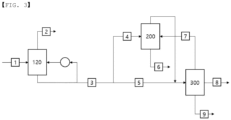
- a method for preparing an acrylic acid may include: supplying a lactic acid aqueous solution to a reactor and performing a dehydration reaction to prepare a reaction product including an acrylic acid; supplying a reactor discharge stream including the reaction product to a first cooling tower 100 and supplying an upper discharge stream from the first cooling tower 100 to a second cooling tower 110; supplying a first acrylic acid aqueous solution stream discharged from a lower portion of the second cooling tower 110 to an extraction column 200; supplying an upper discharge stream from the extraction column 200 and a second acrylic acid aqueous solution stream discharged from a lower portion of the first cooling tower 100 to a distillation column 300; and separating the acrylic acid from a lower discharge stream from the distillation column 300.
- a conventional method for preparing an acrylic acid is generally a method of oxidizing propylene in the air, but the method is a method of converting propylene into acrolein by a gaseous contact oxidation reaction and subjecting the acrolein to a gaseous contact oxidation reaction to prepare an acrylic acid, and the method produces an acetic acid as a by-product, which is difficult to separate from the acrylic acid.
- the method for preparing an acrylic acid using propylene uses propylene obtained by refining crude oil which is a fossil resource, as a raw material, and considering problems such as a recent rise in crude oil prices or global warming, the method has a problem in terms of raw material costs or environmental pollution.
- a study on a method for preparing an acrylic acid from a carbon-neutral biomass raw material was conducted.
- This method is generally a method for preparing an acrylic acid by an intramolecular dehydration reaction of a lactic acid in the presence of a catalyst at a high temperature.
- oligomers such as dimers and trimers are formed by an equilibrium reaction to lower the content of a lactic acid monomer participating in the reaction, and when the concentration of the lactic acid aqueous solution is lowered and used as a raw material, the content of water in a reaction product of a lactic acid dehydration reaction is significantly higher than that in a conventional process of preparing an acrylic acid by a propylene oxidation reaction, and thus, the amount of energy used required for water separation is greatly increased.
- the present invention is intended to provide a method for preparing an acrylic acid by a dehydration reaction of a lactic acid, which reduces the amount of energy used required for water separation and also minimizes an acrylic acid loss.
- a lactic acid is supplied to a reactor and a dehydration reaction is performed to prepare a reaction product including an acrylic acid.
- the lactic acid may be introduced to the reactor in an aqueous solution state, and the dehydration reaction may be performed in a gaseous reaction in the presence of a catalyst.
- the concentration of the lactic acid in the lactic acid aqueous solution may be 10 wt% or more, 20 wt% or more, or 30 wt% or more and 40 wt% or less, 50 wt% or less, 60 wt% or less, or 70 wt% or less.
- the reactor may be a reactor capable of a common dehydration reaction of a lactic acid
- the reactor may include a reaction tube filled with a catalyst, and while a reaction gas including volatile components of a lactic acid aqueous solution as a raw material is passed through the reaction tube, a lactic acid may be dehydrated by a gaseous contact reaction to produce an acrylic acid.
- the reaction gas may further include any one or more dilution gases of water vapor, nitrogen gas, and air for adjusting a concentration, in addition to the lactic acid.
- Operation conditions of the reactor may be common dehydration reaction conditions of a lactic acid.
- the operation temperature of the reactor may refer to a set temperature of a heating medium or the like used for controlling the temperature of the reactor.
- a catalyst used in the dehydration reaction of the lactic acid may include, for example, one or more selected from the group consisting of sulfate-based catalysts, phosphate-based catalysts, and nitrate-based catalysts.
- the sulfate may include Na 2 SO 4 , K 2 SO 4 , CaSO 4 , and Al 2 (SO 4 ) 3
- the phosphate may include Na 3 PO 4 , Na 2 HPO 4 , NaH 2 PO 4 , K 3 PO 4 , K 2 HPO 4 , KH 2 PO 4 , CaHPO 4 , Ca 3 (PO 4 ) 2 , AlPO 4 , CaH 2 P 2 O 7 , and Ca 2 P 2 O 7
- the nitrate may include NaNO 3 , KNO 3 , and Ca(NO 3 ) 2 .
- the catalyst may be supported on a support.
- the support may include one or more selected from the group consisting of, for example, diatomaceous earth, alumina, si
- a reaction product prepared from the dehydration reaction of the lactic acid may further include by-products such as water (H 2 O), acetaldehyde (ACHO), carbon monoxide (CO), carbon dioxide (CO 2 ), and low-boiling point materials and high-boiling point materials of dilution gas, in addition to the acrylic acid as a product to be desired.
- by-products such as water (H 2 O), acetaldehyde (ACHO), carbon monoxide (CO), carbon dioxide (CO 2 ), and low-boiling point materials and high-boiling point materials of dilution gas, in addition to the acrylic acid as a product to be desired.
- a content ratio of water to the acrylic acid in the reaction product may be 2.0 or more, 2.3 or more, or 2.5 or more and 2.6 or less, 3.0 or less, 3.3 or less, or 3.5 or less.
- a reactor discharge stream including the reaction product may be supplied to a first cooling tower 100 and cooled.
- the reactor discharge stream including the reaction product since it is discharged in a gas phase, it may be supplied to the first cooling tower 100 and condensed.
- a condensate condensed in this process may be discharged as a lower discharge stream from the first cooling tower 100, and an upper discharge stream from the first cooling tower 100 including gaseous components may be supplied to a second cooling tower 110.
- a part of the stream of a lower discharge stream from the first cooling tower 100 may be refluxed to the first cooling tower 100 via a cooler, and the rest of the stream may be supplied to a distillation column 300 as a second acrylic acid aqueous solution stream.
- the upper discharge stream from the first cooling tower 100 may include water, an acrylic acid, and gas components
- the second acrylic acid aqueous solution stream may include water and an acrylic acid
- the upper discharge stream from the first cooling tower 100 may have a higher content of water and a lower content of the acrylic acid than the second acrylic acid aqueous solution stream.
- a content ratio of water to the acrylic acid in the second acrylic acid aqueous solution stream may be for example, 1.0 or more, 1.2 or more, or 1.4 or more and 1.8 or less, 1.9 or less, 2.0 or less, or 2.1 or less.
- the upper discharge stream from the first cooling tower 100 may be supplied to a second cooling tower 110, and the gas components may be removed in the second cooling tower 110.
- the upper discharge stream from the first cooling tower 100 supplied to the second cooling tower 110 is gaseous components, and may be condensed in the second cooling tower 110.
- the condensed condensate may be discharged to the lower portion of the second cooling tower 110 as the first acrylic acid aqueous solution stream and supplied to the extraction column 200.
- a part of the first acrylic acid aqueous solution stream may be refluxed to the second cooling tower 110 through a cooler and the rest of the stream may be supplied to the extraction column 200.
- the gas components may be removed by separation in the upper portion, and the gas components may include acetaldehyde, with water, carbon monoxide, carbon dioxide, and a dilution gas.
- the gas components may include acetaldehyde, with water, carbon monoxide, carbon dioxide, and a dilution gas.
- the operation temperature of the second cooling tower 110 may be 40°C or higher, 50°C or higher, or 60°C or higher and 130°C or lower, 150°C or lower, or 200°C or lower, and the operation pressure may be 1 kg/cm 2 or more, 1.5 kg/cm 2 or more, or 2 kg/cm 2 or more and 5 kg/cm 2 or less, 10 kg/cm 2 or less, or 20 kg/cm 2 or less.
- the operation conditions of the second cooling tower 110 are controlled to the operation temperature and the operation pressure within the above range, thereby controlling the composition of the gas components separated to the upper portion of the second cooling tower 110 to minimize an acrylic acid loss and removing the dilution gas and acetaldehyde out of the system, and controlling the composition of the first acrylic acid aqueous solution stream discharged from the lower portion of the second cooling tower 110.
- a content ratio of water to the acrylic acid in the first acrylic acid aqueous solution stream may be, for example, 3.0 or more, 3.1 or more, 3.2 or more, or 3.3 or more and 3.8 or less, 4.0 or less, or 4.5 or less.
- the composition of the second acrylic acid aqueous solution stream is controlled to be within the above range, thereby controlling the composition of the first acrylic acid aqueous solution stream to an advantageous composition in terms of energy and prevention of acrylic acid loss when separation is performed by supplying to the distillation column 300 after passing through the extraction column 200.
- the first acrylic acid aqueous solution stream is supplied to the extraction column 200, and in the extraction column 200, the acrylic acid and water may be separated using an extractant.
- an extractant may be supplied to the extraction column 200, and the extractant may include one or more selected from the group consisting of, for example, benzene, toluene, xylene, n-heptane, cycloheptane, cycloheptene, 1-heptene, ethylbenzene, methylcyclohexane, n-butylacetate, isobutylacetate, isobutylacetate, isobutylacrylate, n-propylacetate, isopropylacetate, methylisobutylketone, 2-methyl-1-heptene, 6-methyl-1-heptene, 4-methyl-1-heptene, 2-ethyl-1-hexene, ethylcyclopentane, 2-methyl-1-hexene,
- the first acrylic acid aqueous solution stream and the extractant are brought into contact and an extract and an extraction residue solution may be separated.
- the extract may be an acrylic acid dissolved in the extractant, and the extract may be discharged as an upper discharge stream from the extraction column 200.
- the extraction residue solution is wastewater including water and may be separated as a lower discharge stream from the extraction column 200.
- the lower discharge stream from the extraction column 200 may include a small amount of an acrylic acid in addition to water, and in the present invention, the reaction product including the acrylic acid is separated into the first acrylic acid aqueous solution stream and the second acrylic acid aqueous solution stream which have advantageous compositions for separation in the distillation column 300 and the extraction column 200, respectively, using two cooling towers, and the streams are supplied to the extraction column 200 and the distillation column 300, respectively, thereby minimizing an acrylic acid loss included in wastewater and discharged.
- the upper discharge stream from the extraction column 200 and the second acrylic acid aqueous solution stream discharged from the lower portion of the first cooling tower 100 may be supplied to the distillation column 300, and components may be separated by distillation.
- the upper discharge stream from the extraction column 200 and the second acrylic acid aqueous solution stream may form a mixed stream and be supplied to the distillation column 300.
- the mixed stream having the flow ratio within the range is supplied to the distillation column 300, thereby decreasing the amount of energy used required for separation in the distillation column 300, and separating water and the acrylic acid using the extractant included in the upper discharge stream from the extraction column 200 without using an additional azeotropic agent.
- the extractant included in the mixed stream may be separated to the upper portion, circulated to the extraction column 200, and reused.
- the acrylic acid included in the mixed stream is separated as a lower discharge stream, and water may be separated as a side discharge stream.
- the operation temperature of the distillation column 300 may be 10°C or higher, 20°C or higher, or 40°C or higher and 100°C or lower, 120°C or lower, or 150°C or lower, and the operation pressure may be 1.3 kPa (10 torr) or more, 6.7 kPa (50 torr) or more, or 13.3 kPa (100 torr) or more and 26.7 kPa (200 torr) or less, 40.0 kPa (300 torr) or less, or 66.7 kPa (500 torr) or less.
- the operation conditions of the distillation column 300 are controlled to the operation temperature and the operation pressure within the above range, thereby effectively separating the extractant from the upper portion, water from the side portion, and the acrylic acid from the lower portion of the distillation column 300.
- the lower discharge stream from the distillation column 300 may include an acryl and a small amount of by-products. Therefore, if necessary, the lower discharge stream from the distillation column 300 is supplied to the refining unit to remove the by-products, thereby obtaining a high-purity acrylic acid.
- devices such as a distillation column, a condenser, a reboiler, a valve, a pump, a separator, a mixer, and the like may be further installed.
- a lactic acid aqueous solution and nitrogen (N 2 ) as a dilution gas were supplied to a reactor to prepare a reaction product including an acrylic acid (AA) by a dehydration reaction, and at this time, a content ratio of water to the acrylic acid in the reaction product was adjusted to 2.5.
- the reactor discharge stream including the reaction product was supplied to the first cooling tower 100, a part of the stream of a lower discharge stream from the first cooling tower 100 was refluxed to the first cooling tower 100 through a cooler, and the rest of the stream, that is, a second acrylic acid aqueous solution stream was supplied to a distillation column 300.
- the operation temperature of the first cooling tower 100 was controlled to 114°C in the upper portion and 117°C in the lower portion, and the operation pressure was controlled to 2 kg/cm 2 .
- the reactor discharge stream was condensed in the first cooling tower 100, the upper discharge stream from the first cooling tower 100 was supplied to a second cooling tower 110, gas components were discharged from the upper portion of the second cooling tower 110, a part of the stream of the lower discharge stream of the second cooling tower 110 was refluxed to the second cooling tower 110 through the cooler, and the rest of the stream, that is, the first acrylic acid aqueous solution stream, was supplied to the extraction column 200.
- the operation temperature of the second cooling tower 110 was controlled to 88°C in the upper portion and 113°C in the lower portion, and the operation pressure was controlled to 2 kg/cm 2 .
- toluene was used as an extractant to dissolve the acrylic acid, which was separated as the upper discharge stream from the extraction column 200, and water was separated as the lower discharge stream.
- the upper discharge stream from the extraction column 200 and the second acrylic acid aqueous solution stream formed a mixed stream and were supplied to the distillation column 300.
- the extractant was separated to the upper portion and refluxed to the extraction column 200, and a side discharge stream including water and a lower discharge stream including the acrylic acid were separated.
- the total is a value obtained by rounding the value determined in the Aspen Plus simulator to one decimal place.
- Example 1 it was confirmed in Example 1 that the content ratio of water to the acrylic acid in the first acrylic acid aqueous solution stream was 3.6, the content ratio of water to the acrylic acid in the second acrylic acid aqueous solution stream was 1.8, the amount of acrylic acid loss when gas components were separated to the upper portion of the second cooling tower 110 was 6.4 kg/hr, and the amount of acrylic acid loss when water was removed from the lower portion of the extraction column 200 was 4.4 kg/hr.
- the amount of energy used in the distillation column 300 was confirmed to be 0.370 Gcal/hr.
- the recovery rate of the acrylic acid of Example 1 which was calculated by a ratio of the flow rate of the acrylic acid in the lower discharge stream from the distillation column 300 to the flow rate of the acrylic acid in the reactor discharge stream, was 95.4%.
- a lactic acid aqueous solution was supplied to a reactor to prepare a reaction product including an acrylic acid (AA) by a dehydration reaction, and at this time, a content ratio of water to the acrylic acid in the reaction product was adjusted to 3.
- AA acrylic acid
- the reactor discharge stream including the reaction product was supplied to the first cooling tower 100, a part of the stream of a lower discharge stream from the first cooling tower 100 was refluxed to the first cooling tower 100 through a cooler, and the rest of the stream, that is, a second acrylic acid aqueous solution stream was supplied to a distillation column 300.
- the operation temperature of the first cooling tower 100 was controlled to 126°C in the upper portion and 127°C in the lower portion, and the operation pressure was controlled to 3 kg/cm 2 .
- the reactor discharge stream was condensed in the first cooling tower 100, the upper discharge stream from the first cooling tower 100 was supplied to a second cooling tower 110, gas components were discharged from the upper portion of the second cooling tower 110, a part of the stream of the lower discharge stream of the second cooling tower 110 was refluxed to the second cooling tower 110 through the cooler, and the rest of the stream, that is, the first acrylic acid aqueous solution stream was supplied to the extraction column 200.
- the operation temperature of the second cooling tower 110 was controlled to 109°C in the upper portion and 122°C in the lower portion, and the operation pressure was controlled to 3 kg/cm 2 .
- toluene was used as an extractant to dissolve the acrylic acid, which was separated as the upper discharge stream from the extraction column 200, and water was separated as the lower discharge stream.
- the upper discharge stream from the extraction column 200 and the second acrylic acid aqueous solution stream formed a mixed stream and was supplied to the distillation column 300.
- the extractant was separated to the upper portion and refluxed to the extraction column 200, and a side discharge stream including water and a lower discharge stream including the acrylic acid were separated.
- Example 2 it was confirmed in Example 2 that the content ratio of water to the acrylic acid in the first acrylic acid aqueous solution stream was 4.0, the content ratio of water to the acrylic acid in the second acrylic acid aqueous solution stream was 2.2, the amount of acrylic acid loss when gas components were separated to the upper portion of the second cooling tower 110 was 4.9 kg/hr, and the amount of acrylic acid loss when water was removed from the lower portion of the extraction column 200 was 5.2 kg/hr.
- the amount of energy used in the distillation column 300 was confirmed to be 0.458 Gcal/hr.
- a lactic acid aqueous solution and nitrogen (N 2 ) as a dilution gas were supplied to a reactor to prepare a reaction product including an acrylic acid (AA) by a dehydration reaction, and at this time, a content ratio of water to the acrylic acid in the reaction product was adjusted to 2.5.
- a reactor discharge stream including the reaction product was supplied to the cooling tower 120, a part of the lower discharge stream from the cooling tower 120 was refluxed to the cooling tower 120 through a cooler, the rest of the stream was supplied to an azeotropic distillation column 400, and gas components were discharged from the upper portion of the cooling tower 120.
- the operation temperature of the cooling tower 120 was controlled to 89°C in the upper portion and 117°C in the lower portion, and the operation pressure was controlled to 2 kg/cm 2 .
- azeotropic distillation column 400 In the azeotropic distillation column 400, toluene was used as an azeotropic agent, the azeotropic agent was separated from the upper discharge stream and refluxed to the azeotropic distillation column 400, water was separated as the remaining stream, and the lower discharge stream including an acrylic acid was separated.
- the amount of energy used in the azeotropic distillation column 400 was confirmed to be 0.697 Gcal/hr.
- the recovery rate of the acrylic acid of Comparative Example 1 which was calculated by a ratio of the flow rate of the acrylic acid in the lower discharge stream from the azeotropic distillation column 400 to the flow rate of the acrylic acid in the reactor discharge stream, was 95.8%.
- a lactic acid aqueous solution and nitrogen (N 2 ) as a dilution gas were supplied to a reactor to prepare a reaction product including an acrylic acid (AA) by a dehydration reaction, and at this time, a content ratio of water to the acrylic acid in the reaction product was adjusted to 2.5.
- the reactor discharge stream including the reaction product was supplied to the cooling tower 120, a part of the stream of the lower discharge stream from the cooling tower 120 was refluxed to the cooling tower 120 through a cooler, the rest of the stream was split into a first stream and a second stream, and the first stream was supplied to an extraction column 200 and the second stream was supplied to a distillation column 300.
- gas components were discharged from the upper portion of the cooling tower 120.
- the operation temperature of the cooling tower 120 was controlled to 89°C in the upper portion and 117°C in the lower portion, and the operation pressure was controlled to 2 kg/cm 2 .
- toluene was used as an extractant to dissolve the acrylic acid, which was separated as the upper discharge stream from the extraction column 200, and water was separated as the lower discharge stream.
- the upper discharge stream from the extraction column 200 was supplied to the distillation column 300 with the second stream, an extractant was separated to the upper portion in the distillation column 300 and refluxed to the extraction column 200, and a side discharge stream including water and a lower discharge stream including an acrylic acid were separated.
- the amount of energy used in the distillation column 300 was confirmed to be 0.380 Gcal/hr.
- the recovery rate of the acrylic acid of Comparative Example 2 which was calculated by a ratio of the flow rate of the acrylic acid in the lower discharge stream from the distillation column 300 to the flow rate of the acrylic acid in the reactor discharge stream, was 91.7%.
Landscapes
- Chemical & Material Sciences (AREA)
- Organic Chemistry (AREA)
- Engineering & Computer Science (AREA)
- Oil, Petroleum & Natural Gas (AREA)
- Chemical Kinetics & Catalysis (AREA)
- Crystallography & Structural Chemistry (AREA)
- Organic Low-Molecular-Weight Compounds And Preparation Thereof (AREA)
Claims (11)
- Verfahren zur Herstellung einer Acrylsäure, wobei das Verfahren umfasst:Zuführen einer wässrigen Milchsäurelösung zu einem Reaktor und Durchführen einer Entwässerungsreaktion, um ein Reaktionsprodukt herzustellen, das eine Acrylsäure umfasst;Zuführen eines Reaktor-Auslassstroms, der das Reaktionsprodukt umfasst, zu einem ersten Kühlturm, und Zuführen eines oberen Auslassstroms aus dem ersten Kühlturm zu einem zweiten Kühlturm;Zuführen eines ersten wässrigen Acrylsäurelösungsstroms, der aus einem unteren Bereich des zweiten Kühlturms ausgeführt wird, zu einer Extraktionssäule;Zuführen eines oberen Auslassstroms aus der Extraktionssäule und eines zweiten wässrigen Acrylsäurelösungsstroms, der aus einem unteren Bereich des ersten Kühlturms ausgeführt wird, zu einer Destillationssäule; undAbtrennen der Acrylsäure von einem unteren Auslassstrom aus der Destillationssäule.
- Verfahren zur Herstellung einer Acrylsäure gemäß Anspruch 1, worin das Mengenverhältnis von Wasser zur Acrylsäure in dem ersten wässrigen Acrylsäurelösungsstrom 3,0 bis 4,5 beträgt.
- Verfahren zur Herstellung einer Acrylsäure gemäß Anspruch 1, worin das Mengenverhältnis von Wasser zur Acrylsäure in dem zweiten wässrigen Acrylsäurelösungsstrom 1,0 bis 2,1 beträgt.
- Verfahren zur Herstellung einer Acrylsäure gemäß Anspruch 1, worin der obere Auslassstrom aus der Extraktionssäule und der zweite wässrige Acrylsäurelösungsstrom einen gemischten Strom bilden und zu der Destillationssäule zugeführt werden.
- Verfahren zur Herstellung einer Acrylsäure gemäß Anspruch 1, worin Gaskomponenten zu einem oberen Bereich des zweiten Kühlturms abgetrennt werden.
- Verfahren zur Herstellung einer Acrylsäure gemäß Anspruch 5, worin die Gaskomponenten Acetaldehyd umfassen.
- Verfahren zur Herstellung einer Acrylsäure gemäß Anspruch 1, worin ein Extraktionsmittel zu der Extraktionssäule zugeführt wird und das Extraktionsmittel als ein oberer Auslassstrom aus der Extraktionssäule ausgeführt wird, zu der Destillationssäule zugeführt wird, zu einem oberen Bereich in der Destillationssäule abgetrennt wird und zu der Extraktionssäule rückgeführt wird.
- Verfahren zur Herstellung einer Acrylsäure gemäß Anspruch 1, worin Wasser als ein unterer Auslassstrom aus der Extraktionssäule abgetrennt wird.
- Verfahren zur Herstellung einer Acrylsäure gemäß Anspruch 1, worin das Wasser als ein Neben-Auslassstrom von der Destillationssäule abgetrennt wird.
- Verfahren zur Herstellung einer Acrylsäure gemäß Anspruch 1, worin das Mengenverhältnis von Wasser zur Acrylsäure in dem Reaktionsprodukt 2,0 bis 3,5 beträgt.
- Verfahren zur Herstellung einer Acrylsäure gemäß Anspruch 1, worin die Betriebstemperaturen des ersten Kühlturms und des zweiten Kühlturms jeweils 40°C bis 200°C betragen und der Betriebsdruck hiervon jeweils 1 kg/cm2 bis 20 kg/cm2 beträgt.
Applications Claiming Priority (2)
| Application Number | Priority Date | Filing Date | Title |
|---|---|---|---|
| KR1020210137933A KR102855127B1 (ko) | 2021-10-15 | 2021-10-15 | 아크릴산 제조방법 |
| PCT/KR2022/008575 WO2023063525A1 (ko) | 2021-10-15 | 2022-06-16 | 아크릴산 제조방법 |
Publications (3)
| Publication Number | Publication Date |
|---|---|
| EP4249463A1 EP4249463A1 (de) | 2023-09-27 |
| EP4249463A4 EP4249463A4 (de) | 2024-07-17 |
| EP4249463B1 true EP4249463B1 (de) | 2025-03-05 |
Family
ID=85987866
Family Applications (1)
| Application Number | Title | Priority Date | Filing Date |
|---|---|---|---|
| EP22881156.8A Active EP4249463B1 (de) | 2021-10-15 | 2022-06-16 | Verfahren zur herstellung von acrylsäure |
Country Status (6)
| Country | Link |
|---|---|
| US (1) | US12583812B2 (de) |
| EP (1) | EP4249463B1 (de) |
| JP (1) | JP7584850B2 (de) |
| KR (1) | KR102855127B1 (de) |
| CN (1) | CN116568663A (de) |
| WO (1) | WO2023063525A1 (de) |
Families Citing this family (1)
| Publication number | Priority date | Publication date | Assignee | Title |
|---|---|---|---|---|
| CN121285540A (zh) * | 2023-12-07 | 2026-01-06 | 株式会社Lg化学 | 生产丙烯酸的方法和装置 |
Family Cites Families (23)
| Publication number | Priority date | Publication date | Assignee | Title |
|---|---|---|---|---|
| JPS60104034A (ja) * | 1983-11-11 | 1985-06-08 | Nippon Kayaku Co Ltd | メタクリル酸の回収法 |
| JP3246216B2 (ja) | 1993-09-03 | 2002-01-15 | 住友化学工業株式会社 | メタクリル酸の分離方法 |
| JP2001131116A (ja) | 1999-11-08 | 2001-05-15 | Nippon Shokubai Co Ltd | 易重合性物質含有液の蒸留方法 |
| JP4942878B2 (ja) | 2001-02-07 | 2012-05-30 | 三菱レイヨン株式会社 | (メタ)アクリル酸エステルの精製方法 |
| CN1550488A (zh) | 2001-10-09 | 2004-12-01 | ������ѧ��ʽ���� | 易聚合性化合物的清洗除去方法 |
| JP2005247714A (ja) | 2004-03-02 | 2005-09-15 | Mitsubishi Chemicals Corp | (メタ)アクリル酸の製造方法 |
| CN1930108B (zh) | 2004-08-02 | 2010-12-29 | Lg化学株式会社 | 制备(甲基)丙烯酸的方法 |
| MX2009002810A (es) | 2006-09-15 | 2009-03-31 | Dow Global Technologies Inc | Proceso para producir acido acrilico. |
| JP4948158B2 (ja) | 2006-12-28 | 2012-06-06 | 株式会社日本触媒 | (メタ)アクリル酸溶液を得るためのシステムおよび(メタ)アクリル酸の製造方法 |
| JP5153137B2 (ja) | 2006-12-28 | 2013-02-27 | 株式会社日本触媒 | (メタ)アクリル酸の製造方法 |
| JP5386847B2 (ja) * | 2008-03-31 | 2014-01-15 | 三菱化学株式会社 | アクリル酸の製造方法 |
| JP2012077014A (ja) | 2010-09-30 | 2012-04-19 | Nippon Shokubai Co Ltd | アクリル酸およびその重合体の製造方法 |
| KR101264603B1 (ko) | 2011-09-15 | 2013-05-24 | 강기준 | 에너지 기여 결합 증류를 이용한 방향족 화합물 산화반응시 반응기 배출물로부터 물을 분리하고 카르복실산을 회수하는 장치 및 방법 |
| JP5821672B2 (ja) | 2012-02-07 | 2015-11-24 | 三菱化学株式会社 | アクリル酸の製造方法 |
| JP5768747B2 (ja) | 2012-03-16 | 2015-08-26 | 三菱化学株式会社 | アクリル酸の製造方法 |
| JP2014189510A (ja) * | 2013-03-26 | 2014-10-06 | Nippon Shokubai Co Ltd | アクリル酸の製造方法 |
| KR102327728B1 (ko) * | 2014-02-20 | 2021-11-18 | 알케마 인코포레이티드 | 아크릴산의 제조 공정 및 시스템 |
| FR3041958B1 (fr) * | 2015-10-06 | 2019-06-14 | Arkema France | Procede ameliore de production d’acide (meth)acrylique de grade polymere |
| FR3049601B1 (fr) * | 2016-03-29 | 2018-03-09 | Arkema France | Procede ameliore de production d'acide (meth)acrylique |
| KR102079774B1 (ko) | 2016-11-25 | 2020-02-20 | 주식회사 엘지화학 | (메트)아크릴산의 연속 회수 방법 및 장치 |
| KR102080287B1 (ko) | 2016-12-06 | 2020-02-21 | 주식회사 엘지화학 | (메트)아크릴산의 회수 방법 |
| KR102467395B1 (ko) | 2016-12-23 | 2022-11-15 | 에스케이이노베이션 주식회사 | 3-히드록시프로피온산의 탈수반응 생성물로부터 물을 제거하는 방법 |
| KR102721330B1 (ko) | 2020-12-03 | 2024-10-23 | 주식회사 엘지화학 | 아크릴산 제조방법 |
-
2021
- 2021-10-15 KR KR1020210137933A patent/KR102855127B1/ko active Active
-
2022
- 2022-06-16 EP EP22881156.8A patent/EP4249463B1/de active Active
- 2022-06-16 US US18/265,543 patent/US12583812B2/en active Active
- 2022-06-16 CN CN202280007887.XA patent/CN116568663A/zh active Pending
- 2022-06-16 JP JP2023534412A patent/JP7584850B2/ja active Active
- 2022-06-16 WO PCT/KR2022/008575 patent/WO2023063525A1/ko not_active Ceased
Also Published As
| Publication number | Publication date |
|---|---|
| US20240025833A1 (en) | 2024-01-25 |
| JP7584850B2 (ja) | 2024-11-18 |
| EP4249463A4 (de) | 2024-07-17 |
| JP2023553060A (ja) | 2023-12-20 |
| EP4249463A1 (de) | 2023-09-27 |
| WO2023063525A1 (ko) | 2023-04-20 |
| KR20230054198A (ko) | 2023-04-24 |
| KR102855127B1 (ko) | 2025-09-03 |
| US12583812B2 (en) | 2026-03-24 |
| CN116568663A (zh) | 2023-08-08 |
Similar Documents
| Publication | Publication Date | Title |
|---|---|---|
| EP4361124A1 (de) | Verfahren zur herstellung von acrylsäure | |
| KR102721330B1 (ko) | 아크릴산 제조방법 | |
| EP4249463B1 (de) | Verfahren zur herstellung von acrylsäure | |
| EP4249465A1 (de) | Verfahren zur herstellung von acrylsäure | |
| EP4249464B1 (de) | Verfahren zur herstellung von acrylsäure | |
| KR102855132B1 (ko) | 아크릴산 제조방법 | |
| EP4365160B1 (de) | Verfahren zur herstellung von acrylsäure | |
| EP4368608A1 (de) | Verfahren zur herstellung von acrylsäure | |
| CN116568664A (zh) | 制备丙烯酸的方法 | |
| KR20160068378A (ko) | 부타디엔 제조장치 |
Legal Events
| Date | Code | Title | Description |
|---|---|---|---|
| STAA | Information on the status of an ep patent application or granted ep patent |
Free format text: STATUS: THE INTERNATIONAL PUBLICATION HAS BEEN MADE |
|
| PUAI | Public reference made under article 153(3) epc to a published international application that has entered the european phase |
Free format text: ORIGINAL CODE: 0009012 |
|
| STAA | Information on the status of an ep patent application or granted ep patent |
Free format text: STATUS: REQUEST FOR EXAMINATION WAS MADE |
|
| 17P | Request for examination filed |
Effective date: 20230620 |
|
| AK | Designated contracting states |
Kind code of ref document: A1 Designated state(s): AL AT BE BG CH CY CZ DE DK EE ES FI FR GB GR HR HU IE IS IT LI LT LU LV MC MK MT NL NO PL PT RO RS SE SI SK SM TR |
|
| REG | Reference to a national code |
Ref country code: DE Ref legal event code: R079 Free format text: PREVIOUS MAIN CLASS: C07C0051377000 Ipc: C07C0057065000 Ref document number: 602022011548 Country of ref document: DE |
|
| A4 | Supplementary search report drawn up and despatched |
Effective date: 20240617 |
|
| RIC1 | Information provided on ipc code assigned before grant |
Ipc: C07C 57/07 20060101ALI20240611BHEP Ipc: C07C 57/065 20060101AFI20240611BHEP |
|
| GRAP | Despatch of communication of intention to grant a patent |
Free format text: ORIGINAL CODE: EPIDOSNIGR1 |
|
| STAA | Information on the status of an ep patent application or granted ep patent |
Free format text: STATUS: GRANT OF PATENT IS INTENDED |
|
| DAV | Request for validation of the european patent (deleted) | ||
| DAX | Request for extension of the european patent (deleted) | ||
| INTG | Intention to grant announced |
Effective date: 20241121 |
|
| GRAS | Grant fee paid |
Free format text: ORIGINAL CODE: EPIDOSNIGR3 |
|
| GRAA | (expected) grant |
Free format text: ORIGINAL CODE: 0009210 |
|
| STAA | Information on the status of an ep patent application or granted ep patent |
Free format text: STATUS: THE PATENT HAS BEEN GRANTED |
|
| AK | Designated contracting states |
Kind code of ref document: B1 Designated state(s): AL AT BE BG CH CY CZ DE DK EE ES FI FR GB GR HR HU IE IS IT LI LT LU LV MC MK MT NL NO PL PT RO RS SE SI SK SM TR |
|
| REG | Reference to a national code |
Ref country code: GB Ref legal event code: FG4D |
|
| REG | Reference to a national code |
Ref country code: CH Ref legal event code: EP |
|
| REG | Reference to a national code |
Ref country code: DE Ref legal event code: R096 Ref document number: 602022011548 Country of ref document: DE |
|
| REG | Reference to a national code |
Ref country code: IE Ref legal event code: FG4D |
|
| PG25 | Lapsed in a contracting state [announced via postgrant information from national office to epo] |
Ref country code: RS Free format text: LAPSE BECAUSE OF FAILURE TO SUBMIT A TRANSLATION OF THE DESCRIPTION OR TO PAY THE FEE WITHIN THE PRESCRIBED TIME-LIMIT Effective date: 20250605 |
|
| PG25 | Lapsed in a contracting state [announced via postgrant information from national office to epo] |
Ref country code: FI Free format text: LAPSE BECAUSE OF FAILURE TO SUBMIT A TRANSLATION OF THE DESCRIPTION OR TO PAY THE FEE WITHIN THE PRESCRIBED TIME-LIMIT Effective date: 20250305 |
|
| PGFP | Annual fee paid to national office [announced via postgrant information from national office to epo] |
Ref country code: DE Payment date: 20250624 Year of fee payment: 4 |
|
| REG | Reference to a national code |
Ref country code: NL Ref legal event code: MP Effective date: 20250305 |
|
| PG25 | Lapsed in a contracting state [announced via postgrant information from national office to epo] |
Ref country code: ES Free format text: LAPSE BECAUSE OF FAILURE TO SUBMIT A TRANSLATION OF THE DESCRIPTION OR TO PAY THE FEE WITHIN THE PRESCRIBED TIME-LIMIT Effective date: 20250305 |
|
| REG | Reference to a national code |
Ref country code: LT Ref legal event code: MG9D |
|
| PG25 | Lapsed in a contracting state [announced via postgrant information from national office to epo] |
Ref country code: NO Free format text: LAPSE BECAUSE OF FAILURE TO SUBMIT A TRANSLATION OF THE DESCRIPTION OR TO PAY THE FEE WITHIN THE PRESCRIBED TIME-LIMIT Effective date: 20250605 |
|
| PG25 | Lapsed in a contracting state [announced via postgrant information from national office to epo] |
Ref country code: HR Free format text: LAPSE BECAUSE OF FAILURE TO SUBMIT A TRANSLATION OF THE DESCRIPTION OR TO PAY THE FEE WITHIN THE PRESCRIBED TIME-LIMIT Effective date: 20250305 |
|
| PG25 | Lapsed in a contracting state [announced via postgrant information from national office to epo] |
Ref country code: LV Free format text: LAPSE BECAUSE OF FAILURE TO SUBMIT A TRANSLATION OF THE DESCRIPTION OR TO PAY THE FEE WITHIN THE PRESCRIBED TIME-LIMIT Effective date: 20250305 |
|
| PGFP | Annual fee paid to national office [announced via postgrant information from national office to epo] |
Ref country code: FR Payment date: 20250624 Year of fee payment: 4 |
|
| PG25 | Lapsed in a contracting state [announced via postgrant information from national office to epo] |
Ref country code: GR Free format text: LAPSE BECAUSE OF FAILURE TO SUBMIT A TRANSLATION OF THE DESCRIPTION OR TO PAY THE FEE WITHIN THE PRESCRIBED TIME-LIMIT Effective date: 20250606 Ref country code: BG Free format text: LAPSE BECAUSE OF FAILURE TO SUBMIT A TRANSLATION OF THE DESCRIPTION OR TO PAY THE FEE WITHIN THE PRESCRIBED TIME-LIMIT Effective date: 20250305 |
|
| REG | Reference to a national code |
Ref country code: AT Ref legal event code: MK05 Ref document number: 1772865 Country of ref document: AT Kind code of ref document: T Effective date: 20250305 |
|
| PG25 | Lapsed in a contracting state [announced via postgrant information from national office to epo] |
Ref country code: NL Free format text: LAPSE BECAUSE OF FAILURE TO SUBMIT A TRANSLATION OF THE DESCRIPTION OR TO PAY THE FEE WITHIN THE PRESCRIBED TIME-LIMIT Effective date: 20250305 |
|
| PG25 | Lapsed in a contracting state [announced via postgrant information from national office to epo] |
Ref country code: SE Free format text: LAPSE BECAUSE OF FAILURE TO SUBMIT A TRANSLATION OF THE DESCRIPTION OR TO PAY THE FEE WITHIN THE PRESCRIBED TIME-LIMIT Effective date: 20250305 |
|
| PG25 | Lapsed in a contracting state [announced via postgrant information from national office to epo] |
Ref country code: SM Free format text: LAPSE BECAUSE OF FAILURE TO SUBMIT A TRANSLATION OF THE DESCRIPTION OR TO PAY THE FEE WITHIN THE PRESCRIBED TIME-LIMIT Effective date: 20250305 |
|
| PG25 | Lapsed in a contracting state [announced via postgrant information from national office to epo] |
Ref country code: PT Free format text: LAPSE BECAUSE OF FAILURE TO SUBMIT A TRANSLATION OF THE DESCRIPTION OR TO PAY THE FEE WITHIN THE PRESCRIBED TIME-LIMIT Effective date: 20250707 |
|
| PG25 | Lapsed in a contracting state [announced via postgrant information from national office to epo] |
Ref country code: IT Free format text: LAPSE BECAUSE OF FAILURE TO SUBMIT A TRANSLATION OF THE DESCRIPTION OR TO PAY THE FEE WITHIN THE PRESCRIBED TIME-LIMIT Effective date: 20250305 Ref country code: PL Free format text: LAPSE BECAUSE OF FAILURE TO SUBMIT A TRANSLATION OF THE DESCRIPTION OR TO PAY THE FEE WITHIN THE PRESCRIBED TIME-LIMIT Effective date: 20250305 |
|
| PG25 | Lapsed in a contracting state [announced via postgrant information from national office to epo] |
Ref country code: AT Free format text: LAPSE BECAUSE OF FAILURE TO SUBMIT A TRANSLATION OF THE DESCRIPTION OR TO PAY THE FEE WITHIN THE PRESCRIBED TIME-LIMIT Effective date: 20250305 |
|
| PG25 | Lapsed in a contracting state [announced via postgrant information from national office to epo] |
Ref country code: CZ Free format text: LAPSE BECAUSE OF FAILURE TO SUBMIT A TRANSLATION OF THE DESCRIPTION OR TO PAY THE FEE WITHIN THE PRESCRIBED TIME-LIMIT Effective date: 20250305 Ref country code: EE Free format text: LAPSE BECAUSE OF FAILURE TO SUBMIT A TRANSLATION OF THE DESCRIPTION OR TO PAY THE FEE WITHIN THE PRESCRIBED TIME-LIMIT Effective date: 20250305 |
|
| PG25 | Lapsed in a contracting state [announced via postgrant information from national office to epo] |
Ref country code: RO Free format text: LAPSE BECAUSE OF FAILURE TO SUBMIT A TRANSLATION OF THE DESCRIPTION OR TO PAY THE FEE WITHIN THE PRESCRIBED TIME-LIMIT Effective date: 20250305 |
|
| PG25 | Lapsed in a contracting state [announced via postgrant information from national office to epo] |
Ref country code: SK Free format text: LAPSE BECAUSE OF FAILURE TO SUBMIT A TRANSLATION OF THE DESCRIPTION OR TO PAY THE FEE WITHIN THE PRESCRIBED TIME-LIMIT Effective date: 20250305 |
|
| PG25 | Lapsed in a contracting state [announced via postgrant information from national office to epo] |
Ref country code: IS Free format text: LAPSE BECAUSE OF FAILURE TO SUBMIT A TRANSLATION OF THE DESCRIPTION OR TO PAY THE FEE WITHIN THE PRESCRIBED TIME-LIMIT Effective date: 20250705 |
|
| REG | Reference to a national code |
Ref country code: DE Ref legal event code: R097 Ref document number: 602022011548 Country of ref document: DE |
|
| PLBE | No opposition filed within time limit |
Free format text: ORIGINAL CODE: 0009261 |
|
| STAA | Information on the status of an ep patent application or granted ep patent |
Free format text: STATUS: NO OPPOSITION FILED WITHIN TIME LIMIT |
|
| PG25 | Lapsed in a contracting state [announced via postgrant information from national office to epo] |
Ref country code: DK Free format text: LAPSE BECAUSE OF FAILURE TO SUBMIT A TRANSLATION OF THE DESCRIPTION OR TO PAY THE FEE WITHIN THE PRESCRIBED TIME-LIMIT Effective date: 20250305 |
|
| REG | Reference to a national code |
Ref country code: CH Ref legal event code: L10 Free format text: ST27 STATUS EVENT CODE: U-0-0-L10-L00 (AS PROVIDED BY THE NATIONAL OFFICE) Effective date: 20260114 |
|
| REG | Reference to a national code |
Ref country code: CH Ref legal event code: H13 Free format text: ST27 STATUS EVENT CODE: U-0-0-H10-H13 (AS PROVIDED BY THE NATIONAL OFFICE) Effective date: 20260127 |
|
| PG25 | Lapsed in a contracting state [announced via postgrant information from national office to epo] |
Ref country code: MC Free format text: LAPSE BECAUSE OF FAILURE TO SUBMIT A TRANSLATION OF THE DESCRIPTION OR TO PAY THE FEE WITHIN THE PRESCRIBED TIME-LIMIT Effective date: 20250305 |
|
| 26N | No opposition filed |
Effective date: 20251208 |
|
| PG25 | Lapsed in a contracting state [announced via postgrant information from national office to epo] |
Ref country code: LU Free format text: LAPSE BECAUSE OF NON-PAYMENT OF DUE FEES Effective date: 20250616 |
|
| REG | Reference to a national code |
Ref country code: BE Ref legal event code: MM Effective date: 20250630 |