EP4249464B1 - Verfahren zur herstellung von acrylsäure - Google Patents
Verfahren zur herstellung von acrylsäure Download PDFInfo
- Publication number
- EP4249464B1 EP4249464B1 EP22881157.6A EP22881157A EP4249464B1 EP 4249464 B1 EP4249464 B1 EP 4249464B1 EP 22881157 A EP22881157 A EP 22881157A EP 4249464 B1 EP4249464 B1 EP 4249464B1
- Authority
- EP
- European Patent Office
- Prior art keywords
- acrylic acid
- separation column
- lactic acid
- stream
- preparing
- Prior art date
- Legal status (The legal status is an assumption and is not a legal conclusion. Google has not performed a legal analysis and makes no representation as to the accuracy of the status listed.)
- Active
Links
Images
Classifications
-
- C—CHEMISTRY; METALLURGY
- C07—ORGANIC CHEMISTRY
- C07C—ACYCLIC OR CARBOCYCLIC COMPOUNDS
- C07C51/00—Preparation of carboxylic acids or their salts, halides or anhydrides
- C07C51/42—Separation; Purification; Stabilisation; Use of additives
- C07C51/487—Separation; Purification; Stabilisation; Use of additives by treatment giving rise to chemical modification
-
- C—CHEMISTRY; METALLURGY
- C07—ORGANIC CHEMISTRY
- C07C—ACYCLIC OR CARBOCYCLIC COMPOUNDS
- C07C51/00—Preparation of carboxylic acids or their salts, halides or anhydrides
- C07C51/347—Preparation of carboxylic acids or their salts, halides or anhydrides by reactions not involving formation of carboxyl groups
- C07C51/377—Preparation of carboxylic acids or their salts, halides or anhydrides by reactions not involving formation of carboxyl groups by splitting-off hydrogen or functional groups; by hydrogenolysis of functional groups
-
- C—CHEMISTRY; METALLURGY
- C07—ORGANIC CHEMISTRY
- C07C—ACYCLIC OR CARBOCYCLIC COMPOUNDS
- C07C51/00—Preparation of carboxylic acids or their salts, halides or anhydrides
- C07C51/42—Separation; Purification; Stabilisation; Use of additives
- C07C51/43—Separation; Purification; Stabilisation; Use of additives by change of the physical state, e.g. crystallisation
-
- C—CHEMISTRY; METALLURGY
- C07—ORGANIC CHEMISTRY
- C07C—ACYCLIC OR CARBOCYCLIC COMPOUNDS
- C07C51/00—Preparation of carboxylic acids or their salts, halides or anhydrides
- C07C51/42—Separation; Purification; Stabilisation; Use of additives
- C07C51/43—Separation; Purification; Stabilisation; Use of additives by change of the physical state, e.g. crystallisation
- C07C51/44—Separation; Purification; Stabilisation; Use of additives by change of the physical state, e.g. crystallisation by distillation
-
- C—CHEMISTRY; METALLURGY
- C07—ORGANIC CHEMISTRY
- C07C—ACYCLIC OR CARBOCYCLIC COMPOUNDS
- C07C51/00—Preparation of carboxylic acids or their salts, halides or anhydrides
- C07C51/42—Separation; Purification; Stabilisation; Use of additives
- C07C51/48—Separation; Purification; Stabilisation; Use of additives by liquid-liquid treatment
-
- C—CHEMISTRY; METALLURGY
- C07—ORGANIC CHEMISTRY
- C07C—ACYCLIC OR CARBOCYCLIC COMPOUNDS
- C07C57/00—Unsaturated compounds having carboxyl groups bound to acyclic carbon atoms
- C07C57/02—Unsaturated compounds having carboxyl groups bound to acyclic carbon atoms with only carbon-to-carbon double bonds as unsaturation
- C07C57/03—Monocarboxylic acids
- C07C57/04—Acrylic acid; Methacrylic acid
Definitions
- the present invention relates to a method for preparing an acrylic acid, and more particularly, to a method for preparing an acrylic acid by a dehydration reaction of a lactic acid, which effectively removes by-products while reducing an acrylic acid loss.
- acrylic acid is used as a polymer raw material used in fiber, adhesives, paint, fiber processing, leather, building materials, and the like, and its demand is growing.
- the acrylic acid is also used as a raw material of an absorbent resin and is industrially used a lot in absorbent articles such as paper diapers and sanitary napkins, agricultural and horticultural water retaining agents, industrial water stop materials, and the like.
- a conventional method for preparing an acrylic acid is generally a method of oxidizing propylene in the air, but the method is a method of converting propylene into acrolein by a gaseous contact oxidation reaction and subjecting the acrolein to a gaseous contact oxidation reaction to prepare an acrylic acid, and the method produces an acetic acid as a by-product, which is difficult to separate from the acrylic acid.
- the method for preparing an acrylic acid using propylene uses propylene obtained by refining crude oil which is a fossil resource, as a raw material, and considering problems such as a recent rise in crude oil prices or global warming, the method has a problem in terms of raw material costs or environmental pollution.
- An object of the present invention is to provide a method of effectively recovering an unreacted lactic acid from a reaction product produced by preparing an acrylic acid by a dehydration reaction of a lactic acid, and reusing the lactic acid, in order to solve the problems mentioned in the Background Art.
- a method for preparing an acrylic acid includes: dehydrating a lactic acid aqueous solution in a reaction unit to prepare a reaction product stream; passing the reaction product stream through a cooling unit and a refining unit sequentially and supplying a discharge stream from the refining unit to an acrylic acid separation column; and separating an unreacted lactic acid as a side discharge stream and separating the acrylic acid as an upper discharge stream in the acrylic acid separation column.
- a recovery rate of an unreacted lactic acid may be increased by controlling the amount of exposure time to a high temperature in a high concentration state to minimize an oligomerization reaction of a lactic acid.
- the term "stream" in the present invention may refer to a fluid flow in a process, or may refer to a fluid itself flowing in a pipe. Specifically, the stream may refer to both a fluid itself flowing in a pipe connecting each device and a fluid flow.
- the fluid may include any one or more components of gas, liquid, and solid.
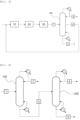
- a method for preparing an acrylic acid may include: dehydrating a lactic acid aqueous solution in a reaction unit 10 to prepare a reaction product stream; passing the reaction product stream through a cooling unit 20 and a refining unit 30 sequentially and supplying a discharge stream from the refining unit 30 to an acrylic acid separation column 100; and separating an unreacted lactic acid as a side discharge stream and separating the acrylic acid as an upper discharge stream in the acrylic acid separation column 100.
- a conventional method for preparing an acrylic acid is generally a method of oxidizing propylene in the air, but the method is a method of converting propylene into acrolein by a gaseous contact oxidation reaction and subjecting the acrolein to a gaseous contact oxidation reaction to prepare an acrylic acid, and the method produces an acetic acid as a by-product, which is difficult to separate from the acrylic acid.
- the method for preparing an acrylic acid using propylene uses propylene obtained by refining crude oil which is a fossil resource, as a raw material, and considering problems such as a recent rise in crude oil prices or global warming, the method has a problem in terms of raw material costs or environmental pollution.
- a study on a method for preparing an acrylic acid from a carbon-neutral biomass raw material was conducted.
- This method is generally a method for preparing an acrylic acid by an intramolecular dehydration reaction of a lactic acid in the presence of a catalyst at a high temperature.
- a reaction product including an acrylic acid is produced by the dehydration reaction of a lactic acid, and an unreacted lactic acid is included in the reaction product depending on a conversion rate.
- the economic feasibility of the process may be improved only by recovering the lactic acid in a separation process.
- the lactic acid is rapidly oligomerized at a high concentration at a high temperature, it is difficult to recover the lactic acid.
- a method of separating a lactic acid from a reaction product including an acrylic acid prepared by the dehydration reaction of a lactic acid in which a time that a high concentration of a lactic acid is exposed to a high temperature is shortened to prevent oligomerization of a lactic acid, thereby improving a recovery rate of an unreacted lactic acid, is to be provided.
- a lactic acid aqueous solution is supplied to the reaction unit 10 and a dehydration reaction is performed to prepare a reaction product including an acrylic acid.
- the dehydration reaction may be performed as a gas phase reaction in the presence of a catalyst.
- the concentration of the lactic acid in the lactic acid aqueous solution may be 10 wt% or more, 20 wt% or more, or 30 wt% or more and 40 wt% or less, 50 wt% or less, 60 wt% or less, or 70 wt% or less.
- oligomers such as dimers and trimers are formed by an equilibrium reaction, so that the lactic acid may be used in the form of an aqueous solution having the concentration in the above range.
- the reactor may include a reactor capable of a common dehydration reaction of a lactic acid, the reactor may include a reaction tube filled with a catalyst, and while a reaction gas including volatile components of a lactic acid aqueous solution as a raw material is passed through the reaction tube, a lactic acid may be dehydrated by a gaseous contact reaction to produce an acrylic acid.
- the reaction gas may further include any one or more dilution gases of water vapor, nitrogen gas, and air for adjusting a concentration, in addition to the lactic acid.
- Operation conditions of the reactor may be common dehydration reaction conditions of a lactic acid.
- the operation temperature of the reactor may refer to a set temperature of a heating medium or the like used for controlling the temperature of the reactor.
- a catalyst used in the dehydration reaction of the lactic acid may include, for example, one or more selected from the group consisting of sulfate-based catalysts, phosphate-based catalysts, and nitrate-based catalysts.
- the sulfate may include Na 2 SO 4 , K 2 SO 4 , CaSO 4 , and Al 2 (SO 4 ) 3
- the phosphate may include Na 3 PO 4 , Na 2 HPO 4 , NaH 2 PO 4 , K 3 PO 4 , K 2 HPO 4 , KH 2 PO 4 , CaHPO 4 , Ca 3 (PO 4 ) 2 , AlPO 4 , CaH 2 P 2 O 7 , and Ca 2 P 2 O 7
- the nitrate may include NaNO 3 , KNO 3 , and Ca(NO 3 ) 2 .
- the catalyst may be supported on a support.
- the support may include one or more selected from the group consisting of, for example, diatomaceous earth, alumina, si
- the reaction product prepared by the dehydration reaction of the lactic acid may further include water (H 2 O), gas by-products, low-boiling point by-products, high-boiling point by-products, and an unreacted lactic acid, in addition to the acrylic acid which is a desired product.
- water H 2 O
- gas by-products gas by-products
- low-boiling point by-products low-boiling point by-products
- high-boiling point by-products high-boiling point by-products
- an unreacted lactic acid in addition to the acrylic acid which is a desired product.
- the method for preparing an acrylic acid by the dehydration reaction of the lactic acid may secure raw material competitiveness as compared with a conventional method of oxidizing propylene in the air and solve the problem of environmental pollution, but the conversion rate of the lactic acid is low and various by-products are produced to lower the yield of an acrylic acid. Therefore, it is necessary to develop a process for improving economic feasibility. For this, in the present invention, a method for improving economic feasibility by increasing the recovery rate of an unreacted lactic acid may be provided.
- the reaction product stream is passed through a cooling unit 20 and a refining unit 30 sequentially, and a discharge stream from the refining unit 30 may be supplied to an acrylic acid separation column 100 to recover a lactic acid.
- the cooling unit 20 may include one or more cooling towers, and the reaction product stream may be supplied to the cooling tower and cooled.
- the reaction product prepared by the dehydration reaction of the lactic acid is a gas phase and may be condensed through the cooling tower.
- Gas by-products may be separated to the upper portion of the cooling tower and a liquid condensate may be discharged to the lower portion of the cooling tower, and the condensate may be supplied to the refining unit 30 at the rear end.
- the gas by-products may include water, carbon monoxide, carbon dioxide, dilution gas, acetaldehyde, and the like as gas components.
- the refining unit 30 may include a water separation column and a low-boiling point separation column.
- the water separation column may separate water from a reaction product by distillation or extraction.
- a separate extractant is supplied to the water separation column, and the acrylic acid included in the reaction product stream may be separated as the upper discharge stream from the water separation column, using the extractant.
- a step for recovering the extractant may be further performed.
- the extractant may include one or more selected from the group consisting of, for example, benzene, toluene, xylene, n-heptane, cycloheptane, cycloheptene, 1-heptene, ethylbenzene, methylcyclohexane, n-butylacetate, isobutylacetate, isobutylacrylate, n-propylacetate, isopropylacetate, methylisobutylketone, 2-methyl-1-heptene, 6-methyl-1-heptene, 4-methyl-1-heptene, 2-ethyl-1-hexene, ethylcyclopentane, 2-methyl-1-hexene, 2,3-dimethylpentane, 5-methyl-1-hexene, and isopropylbutylether.
- the extractant may be toluene.
- a method of supplying the extractant to the water separation column and performing extraction may be any known method, and for example, any method such as cross current, counter current, and co-current may be used without particular limitation.
- the reaction product stream and the extractant may be brought into contact in the water separation column, thereby separating an extract and an extraction residue solution.
- the extract may be an acrylic acid dissolved in the extractant, and the extract may be discharged as an upper discharge stream from the water separation column.
- the upper discharge stream from the water separation column may be supplied to a low-boiling point separation column after removing the extractant.
- the extraction residue solution is wastewater including water and may be separated as a lower discharge stream from the water separation column.
- aqueous by-products may be separated together with water in the lower portion of the water separation column and discharged.
- the upper discharge stream from the water separation column is supplied to the low-boiling point separation column and low-boiling point by-products may be removed by distillation, and a reaction product from which the low-boiling point by-products have been removed may be discharged as the lower discharge stream from the low-boiling point separation column.
- the discharge stream from the refining unit 30 supplied to the acrylic acid separation column 100 may be the lower discharge stream from the low-boiling point separation column.
- the reaction product stream may be passed through the cooling unit 20 and the refining unit 30 sequentially to remove gas by-products, water, and low-boiling point by-products.
- the discharge stream from the refining unit 30 may include an acrylic acid, an unreacted lactic acid, and high-boiling point by-products.
- the content of the unreacted lactic acid in the discharge stream from the refining unit 30 varies with the conversion rate of a lactic acid which is changed depending on the reaction and process conditions in the reaction unit 10, and for example, may be 0.5 wt% or more, 2 wt% or more, or 5 wt% or more and 10 wt% or less, 15 wt% or less, or 20 wt% or less.
- the unreacted lactic acid when the unreacted lactic acid is present in the reaction product, it should be recovered or removed in a separation process, but conventionally, it was difficult to recover the unreacted lactic acid and the unreacted lactic acid was removed with high-boiling point by-products in most cases, and in the present invention, the unreacted lactic acid is recovered at a high recovery rate to improve the economic feasibility of the process.
- the discharge stream from the refining unit 30 may be supplied to the acrylic acid separation column 100 to recover the lactic acid.
- the acrylic acid separation column 100 may be for separating the acrylic acid from the reaction product, and recovering and reusing the unreacted lactic acid.
- the operation conditions of the acrylic acid separation column 100 may be adjusted for increasing the separation efficiency in separating each component depending on the composition of the discharge stream from the refining unit 30.
- the operation pressure of the acrylic acid separation column 100 may be 1.3 kPa (10 torr) or more, 4.0 kPa (30 torr) or more, or 6.7 kPa (50 torr) more and 10.7 kPa (80 torr) or less, 13.3 kPa (100 torr) or less, or 26.7 kPa (200 torr) or less.
- separation efficiency in separating each of the acrylic acid, the unreacted lactic acid, and the high-boiling point by-products in the acrylic acid separation column 100 may be high and a side reaction occurring at a high temperature may be suppressed.
- the discharge stream from the refining unit 30 may be supplied to a stage at 40% or more, 50% or more, 60% or more, or 65% or more and 80% or less, 85% or less, or 90% or less with respect to the total number of stages of the acrylic acid separation column 100.
- the total number of stages of the acrylic acid separation column 100 may be 10 to 70.
- a top stage may be a 1st stage and a bottom stage may be a 100th stage
- stages at 60% to 80% of the total number of stages of the acrylic acid separation column 100 may refer to 60th to 80th stages of the acrylic acid separation column 100.
- a supply stage of the discharge stream from the refining unit 30 which is supplied to the acrylic acid separation column 100 is controlled to the above range, thereby increasing the separation efficiency of the acrylic acid, the lactic acid, and the high-boiling point by-products in the acrylic acid separation column 100.
- the acrylic acid may be separated from the upper discharge stream, the lactic acid may be separated from the side discharge stream, and the high-boiling point by-products may be separated from the lower discharge stream.
- the side discharge stream from the acrylic acid separation column 100 may be discharged to a stage at 20% or more, 30% or more, 50% or more, or 55% or more and 70% or less, 75% or less, or 80% or less with respect to the total number of stages of the acrylic acid separation column 100.
- the discharge stage of the side discharge stream from the acrylic acid separation column 100 is controlled to the above range, thereby separating a high-purity unreacted lactic acid to the side and recovering it, and thus, a time that the lactic acid is exposed to a high temperature may be minimized and a loss of a lactic acid discharged to a lower portion with the high-boiling point by-products may be minimized.
- the content of the unreacted lactic acid included in the side discharge stream from the acrylic acid separation column 100 may be 70% or more, 70% to 90%, or 75% to 90% of the content of the unreacted lactic acid included in the discharge stream from the refining unit 30.
- the unreacted lactic acid separated as the side discharge stream from the acrylic acid separation column 100 may be mixed with the lactic acid aqueous solution and supplied to the reaction unit 10.
- the unreacted lactic acid is recovered as the side discharge stream from the acrylic acid separation column 100 and reused in the reaction unit 10, thereby improving the economic feasibility of the process.
- the upper discharge stream from the acrylic acid separation column 100 passes through a condenser, and a part of the stream is refluxed to the acrylic acid separation column 100 and an acrylic acid may be separated from the rest of the stream.
- a part of the lower discharge stream from the acrylic acid separation column 100 passes through a reboiler and is refluxed to the acrylic acid separation column 100, and high-boiling point by-products may be separated to the rest of the stream.
- a flow rate ratio of the stream passing through the reboiler and being refluxed to the acrylic acid separation column 100 to the stream being not refluxed and separating the acrylic acid in the upper discharge stream from the acrylic acid separation column 100 may be 0.8 or more, 0.85 or more, or 0.95 or more and 1.3 or less, 1.4 or less, or 1.5 or less.
- the flow rate ratio of the stream passing through the lower reboiler and being refluxed to the stream being not refluxed and separating the acrylic acid in the upper discharge stream from the acrylic acid separation column 100 is controlled, thereby reducing a time that the unreacted lactic acid passes through the lower reboiler of the acrylic acid separation column 100 operated at a high temperature to prevent the progress of the oligomerization reaction of the lactic acid.
- devices such as a distillation column, a condenser, a reboiler, a valve, a pump, a separator, a mixer, and the like may be further installed.
- a lactic acid aqueous solution and nitrogen (N 2 ) as a dilution gas were supplied to a reaction unit 10 to prepare a reaction product including an acrylic acid (AA) by a dehydration reaction.
- the discharge stream from the reaction unit 10 including the reaction product stream was supplied to a cooling unit 20 to remove gas by-products, and the reaction product from which the gas by-products were removed was supplied to a refining unit 30.
- Water and low-boiling point by-products were removed from the reaction product in the refining unit 30, and a discharge stream from the refining unit 30 from which water and low-boiling point by-products were removed was supplied to a 15th stage of an acrylic acid separation column 100. At this time, the total number of stages of the acrylic acid separation column 100 was 20.
- the upper discharge stream from the acrylic acid separation column 100 was passed through a condenser, and a part of the stream was refluxed to the acrylic acid separation column 100 and an acrylic acid was separated from the rest of the stream.
- a part of the lower discharge stream from the acrylic acid separation column 100 was passed through a reboiler and refluxed to the acrylic acid separation column 100, and high-boiling point by-products were separated from the rest of the stream.
- a side discharge stream including an unreacted lactic acid was separated to a 13th stage of the acrylic acid separation column 100, and the side discharge stream from the acrylic acid separation column 100 was mixed with the lactic acid aqueous solution and supplied to the reaction unit 10.
- a flow rate ratio of a stream passing through the reboiler and being refluxed to the acrylic acid separation column 100 to a stream being not refluxed and separating the acrylic acid in the upper discharge stream from the acrylic acid separation column 100 was controlled to 1.3.
- the process was performed in the same manner as in Example 1, except that the discharge stream from the refining unit 30 was supplied to a 10th stage of the acrylic acid separation column 100 and the side discharge stream including the unreacted lactic acid was separated to an 8th stage of the acrylic acid separation column 100.
- a lactic acid aqueous solution and nitrogen (N 2 ) as a dilution gas were supplied to a reaction unit 10 to prepare a reaction product including an acrylic acid (AA) by a dehydration reaction.
- the discharge stream from the reaction unit 10 including the reaction product stream was supplied to a cooling unit 20 to remove gas by-products, and the reaction product from which the gas by-products were removed was supplied to a refining unit 30.
- Water and low-boiling point by-products were removed from the reaction product in the refining unit 30, and a discharge stream from the refining unit 30 from which water and low-boiling point by-products were removed was supplied to a 3rd stage of an acrylic acid separation column 100. At this time, the total number of stages of the acrylic acid separation column 100 was 10.
- the upper discharge stream from the acrylic acid separation column 100 was passed through a condenser, and a part of the stream was refluxed to the acrylic acid separation column 100 and an acrylic acid was separated from the rest of the stream.
- a part of the lower discharge stream from the acrylic acid separation column 100 was passed through a reboiler and refluxed to the acrylic acid separation column 100, and high-boiling point by-products and an unreacted lactic acid were separated from the rest of the stream and supplied to a lactic acid recovery column 200.
- the upper discharge stream from the lactic acid recovery column 200 was passed through a condenser, and a part of the stream was refluxed to the lactic acid recovery column 200 and the unreacted lactic acid was recovered from the rest of the stream.
- a part of the lower discharge stream from the lactic acid recovery column 200 was passed through a reboiler and refluxed to the lactic acid recovery column 200, and high-boiling point by-products were separated from the rest of the stream.
- the lactic acid recovered from the upper discharge stream from the lactic acid recovery column 200 was mixed with the lactic acid aqueous solution and supplied to the reaction unit.
- Example 1 in which the supply stage of the discharge stream from the refining unit 30 was controlled to a stage at 65% to 85% of the total number of stages of the acrylic acid separation column 100, the discharge stage of the side discharge stream from the acrylic acid separation column 100 was controlled to a stage at 55% to 75%, and the flow rate ratio of the stream passing through the reboiler and being refluxed to the acrylic acid separation column 100 to the stream being not refluxed and separating the acrylic acid in the upper discharge stream from the acrylic acid separation column 100 was controlled to 1 to 1.5, it was confirmed that the purity of the acrylic acid reached 100%, and the recovery rate of the lactic acid was higher.
- Comparative Example 1 which was conventionally arbitrarily designed for recovering the unreacted lactic acid discharged with the high-boiling point by-products in the lower portion of the acrylic acid separation column 100
- the lower discharge stream from the acrylic acid separation column 100 was supplied to the lactic acid separation column at the rear end and the lactic acid was recovered in the lactic acid separation column, thereby increasing the amount of exposure time to a high temperature in a high concentration state to increase an equilibrium reaction rate, for example, discharging the high concentration of the unreacted lactic acid at a high temperature from the lower portion of the acrylic acid separation column 100 and heating the unreacted lactic acid again in the column at the rear end, and thus, the oligomerization reaction of a lactic acid was promoted to lower the recovery rate of the unreacted lactic acid, and additional energy was used.
Landscapes
- Chemical & Material Sciences (AREA)
- Organic Chemistry (AREA)
- Engineering & Computer Science (AREA)
- Oil, Petroleum & Natural Gas (AREA)
- Chemical Kinetics & Catalysis (AREA)
- Crystallography & Structural Chemistry (AREA)
- General Chemical & Material Sciences (AREA)
- Organic Low-Molecular-Weight Compounds And Preparation Thereof (AREA)
Claims (11)
- Verfahren zur Herstellung einer Acrylsäure, wobei das Verfahren umfasst:Dehydratisieren einer wässrigen Milchsäurelösung in einer Reaktionseinheit, um einen Reaktionsproduktstrom herzustellen,Durchleiten des Reaktionsproduktstroms nacheinander durch eine Kühleinheit und eine Raffinationseinheit und Zuführen eines Abflussstroms aus der Raffinationseinheit zu einer Acrylsäure-Trennsäule undAbtrennen einer nichtumgesetzten Milchsäure als Seitenabflussstrom und Abtrennen der Acrylsäure als ein oberer Abflussstrom in der Acrylsäure-Trennsäule.
- Verfahren zur Herstellung einer Acrylsäure nach Anspruch 1, wobei der Abflussstrom aus der Raffinationseinheit einer Stufe bei 40 % bis 90 % in Bezug auf die Gesamtstufenzahl der Acrylsäure-Trennsäule zugeführt wird.
- Verfahren zur Herstellung einer Acrylsäure nach Anspruch 1, wobei der Abflussstrom aus der Raffinationseinheit einer Stufe bei 65 % bis 85 % in Bezug auf die Gesamtstufenzahl der Acrylsäure-Trennsäule zugeführt wird.
- Verfahren zur Herstellung einer Acrylsäure nach Anspruch 1, wobei der Seitenabflussstrom aus der Acrylsäure-Trennsäule aus einer Stufe von 20 % bis 80 % in Bezug auf die Gesamtstufenzahl der Acrylsäure-Trennsäule abgeleitet wird.
- Verfahren zur Herstellung einer Acrylsäure nach Anspruch 1, wobei der Seitenabflussstrom aus der Acrylsäure-Trennsäule aus einer Stufe von 55 % bis 75 % in Bezug auf die Gesamtstufenzahl der Acrylsäure-Trennsäule abgeleitet wird.
- Verfahren zur Herstellung einer Acrylsäure nach Anspruch 1, wobei der Betriebsdruck der Acrylsäure-Trennsäule 1,3 kPa (10 Torr) bis 26,7 kPa (200 Torr) beträgt.
- Verfahren zur Herstellung einer Acrylsäure nach Anspruch 1, wobei ein Durchflussverhältnis eines Stroms, der durch einen Reboiler läuft und zur Acrylsäure-Trennsäule zurückgeführt wird, zu einem Strom, der nicht zurückgeführt wird und die Acrylsäure in dem oberen Abflussstrom aus der Acrylsäure-Trennsäule abtrennt, 0,8 bis 1,5 beträgt.
- Verfahren zur Herstellung einer Acrylsäure nach Anspruch 1, wobei die nichtumgesetzte Milchsäure, die als Seitenabflussstrom aus der Acrylsäure-Trennsäule abgetrennt wird, mit der wässrigen Milchsäurelösung gemischt und der Reaktionseinheit zugeführt wird.
- Verfahren zur Herstellung einer Acrylsäure nach Anspruch 1, wobei hochsiedende Nebenprodukte von einem unteren Abflussstrom aus der Acrylsäure-Trennsäule abgetrennt werden.
- Verfahren zur Herstellung einer Acrylsäure nach Anspruch 1, wobei der Reaktionsproduktstrom die Acrylsäure, Wasser, Gasnebenprodukte, niedrigsiedende Nebenprodukte, hochsiedende Nebenprodukte und die nichtumgesetzte Milchsäure einschließt.
- Verfahren zur Herstellung einer Acrylsäure nach Anspruch 10, wobei die Kühleinheit die Gasnebenprodukte aus dem Reaktionsproduktstrom entfernt und die Raffinationseinheit Wasser und die niedrigsiedende Nebenprodukte aus dem Reaktionsproduktstrom entfernt.
Applications Claiming Priority (2)
| Application Number | Priority Date | Filing Date | Title |
|---|---|---|---|
| KR1020210137936A KR102855131B1 (ko) | 2021-10-15 | 2021-10-15 | 아크릴산 제조방법 |
| PCT/KR2022/008576 WO2023063526A1 (ko) | 2021-10-15 | 2022-06-16 | 아크릴산 제조방법 |
Publications (3)
| Publication Number | Publication Date |
|---|---|
| EP4249464A1 EP4249464A1 (de) | 2023-09-27 |
| EP4249464A4 EP4249464A4 (de) | 2024-09-18 |
| EP4249464B1 true EP4249464B1 (de) | 2025-04-23 |
Family
ID=85987868
Family Applications (1)
| Application Number | Title | Priority Date | Filing Date |
|---|---|---|---|
| EP22881157.6A Active EP4249464B1 (de) | 2021-10-15 | 2022-06-16 | Verfahren zur herstellung von acrylsäure |
Country Status (6)
| Country | Link |
|---|---|
| US (1) | US12545634B2 (de) |
| EP (1) | EP4249464B1 (de) |
| JP (1) | JP7566410B2 (de) |
| KR (1) | KR102855131B1 (de) |
| CN (1) | CN116685570B (de) |
| WO (1) | WO2023063526A1 (de) |
Family Cites Families (17)
| Publication number | Priority date | Publication date | Assignee | Title |
|---|---|---|---|---|
| EP0623153A1 (de) * | 1992-01-24 | 1994-11-09 | Cargill, Incorporated | Kontinuierliches verfahren zur herstellung von lactidpolymeren mit verbesserten reinigungsprozessen |
| CN1550488A (zh) | 2001-10-09 | 2004-12-01 | ������ѧ��ʽ���� | 易聚合性化合物的清洗除去方法 |
| KR100880141B1 (ko) | 2004-09-03 | 2009-01-23 | 아사히 가세이 케미칼즈 가부시키가이샤 | 고순도 디아릴카보네이트의 공업적 제조 방법 |
| TW200740735A (en) | 2006-01-31 | 2007-11-01 | Asahi Kasei Chemicals Corp | Industrial process for production of high-purity diol |
| CN101255109B (zh) | 2008-04-09 | 2011-01-12 | 南京工业大学 | 一种生物质乳酸脱水生产丙烯酸的工艺 |
| CN101260035B (zh) * | 2008-04-09 | 2010-11-03 | 南京工业大学 | 一种生物质乳酸酯脱水生产丙烯酸及其酯的工艺 |
| JP2014189510A (ja) * | 2013-03-26 | 2014-10-06 | Nippon Shokubai Co Ltd | アクリル酸の製造方法 |
| KR102327728B1 (ko) * | 2014-02-20 | 2021-11-18 | 알케마 인코포레이티드 | 아크릴산의 제조 공정 및 시스템 |
| EP3227450B1 (de) | 2014-12-02 | 2019-04-10 | Archer Daniels Midland Company | Verfahren zur herstellung von acrylsäure aus dextrose |
| FR3041958B1 (fr) * | 2015-10-06 | 2019-06-14 | Arkema France | Procede ameliore de production d’acide (meth)acrylique de grade polymere |
| FR3049601B1 (fr) * | 2016-03-29 | 2018-03-09 | Arkema France | Procede ameliore de production d'acide (meth)acrylique |
| KR102080287B1 (ko) | 2016-12-06 | 2020-02-21 | 주식회사 엘지화학 | (메트)아크릴산의 회수 방법 |
| CN110099890B (zh) | 2016-12-21 | 2022-07-22 | 巴斯夫欧洲公司 | 从丁基为正丁基或异丁基的粗丙烯酸丁酯中通过蒸馏分离出纯丙烯酸丁酯的方法 |
| WO2018118702A1 (en) | 2016-12-22 | 2018-06-28 | Eastman Chemical Company | Acrylic acid purification via dividing wall columns |
| CN214436602U (zh) | 2020-12-26 | 2021-10-22 | 河南金丹乳酸科技股份有限公司 | 一种乳酸酯制备用新型精馏塔 |
| CN113461915B (zh) * | 2021-07-01 | 2022-12-06 | 江苏科富恺机械设备有限公司 | 一种可调控聚合度的乳酸低聚物合成系统及合成方法 |
| CN115124417B (zh) | 2022-08-11 | 2024-05-17 | 天津科技大学 | 一种乳酸单体的精制方法及设备 |
-
2021
- 2021-10-15 KR KR1020210137936A patent/KR102855131B1/ko active Active
-
2022
- 2022-06-16 EP EP22881157.6A patent/EP4249464B1/de active Active
- 2022-06-16 CN CN202280007922.8A patent/CN116685570B/zh active Active
- 2022-06-16 WO PCT/KR2022/008576 patent/WO2023063526A1/ko not_active Ceased
- 2022-06-16 JP JP2023534413A patent/JP7566410B2/ja active Active
- 2022-06-16 US US18/265,491 patent/US12545634B2/en active Active
Also Published As
| Publication number | Publication date |
|---|---|
| KR102855131B1 (ko) | 2025-09-03 |
| CN116685570A (zh) | 2023-09-01 |
| JP2023553061A (ja) | 2023-12-20 |
| JP7566410B2 (ja) | 2024-10-15 |
| US12545634B2 (en) | 2026-02-10 |
| CN116685570B (zh) | 2026-01-30 |
| KR20230054201A (ko) | 2023-04-24 |
| WO2023063526A1 (ko) | 2023-04-20 |
| EP4249464A4 (de) | 2024-09-18 |
| US20240043368A1 (en) | 2024-02-08 |
| EP4249464A1 (de) | 2023-09-27 |
Similar Documents
| Publication | Publication Date | Title |
|---|---|---|
| EP4361124A1 (de) | Verfahren zur herstellung von acrylsäure | |
| EP4122913B1 (de) | Verfahren zur herstellung von acrylsäure | |
| EP1419146B1 (de) | Verfahren zur epoxidierung von olefinen | |
| EP4249465A1 (de) | Verfahren zur herstellung von acrylsäure | |
| EP4249463B1 (de) | Verfahren zur herstellung von acrylsäure | |
| EP4249464B1 (de) | Verfahren zur herstellung von acrylsäure | |
| KR102855132B1 (ko) | 아크릴산 제조방법 | |
| EP4365160B1 (de) | Verfahren zur herstellung von acrylsäure | |
| EP4368608B1 (de) | Verfahren zur herstellung von acrylsäure | |
| CN116568664A (zh) | 制备丙烯酸的方法 | |
| KR20240037088A (ko) | 아크릴산 제조방법 | |
| KR20240037085A (ko) | 아크릴산 제조방법 |
Legal Events
| Date | Code | Title | Description |
|---|---|---|---|
| STAA | Information on the status of an ep patent application or granted ep patent |
Free format text: STATUS: THE INTERNATIONAL PUBLICATION HAS BEEN MADE |
|
| PUAI | Public reference made under article 153(3) epc to a published international application that has entered the european phase |
Free format text: ORIGINAL CODE: 0009012 |
|
| STAA | Information on the status of an ep patent application or granted ep patent |
Free format text: STATUS: REQUEST FOR EXAMINATION WAS MADE |
|
| 17P | Request for examination filed |
Effective date: 20230620 |
|
| AK | Designated contracting states |
Kind code of ref document: A1 Designated state(s): AL AT BE BG CH CY CZ DE DK EE ES FI FR GB GR HR HU IE IS IT LI LT LU LV MC MK MT NL NO PL PT RO RS SE SI SK SM TR |
|
| REG | Reference to a national code |
Ref country code: DE Free format text: PREVIOUS MAIN CLASS: C07C0051377000 Ipc: C07C0057070000 Ref country code: DE Ref legal event code: R079 Ref document number: 602022013716 Country of ref document: DE Free format text: PREVIOUS MAIN CLASS: C07C0051377000 Ipc: C07C0057070000 |
|
| A4 | Supplementary search report drawn up and despatched |
Effective date: 20240820 |
|
| RIC1 | Information provided on ipc code assigned before grant |
Ipc: C07C 57/065 20060101ALI20240813BHEP Ipc: C07C 57/07 20060101AFI20240813BHEP |
|
| GRAP | Despatch of communication of intention to grant a patent |
Free format text: ORIGINAL CODE: EPIDOSNIGR1 |
|
| STAA | Information on the status of an ep patent application or granted ep patent |
Free format text: STATUS: GRANT OF PATENT IS INTENDED |
|
| DAV | Request for validation of the european patent (deleted) | ||
| DAX | Request for extension of the european patent (deleted) | ||
| INTG | Intention to grant announced |
Effective date: 20250115 |
|
| GRAS | Grant fee paid |
Free format text: ORIGINAL CODE: EPIDOSNIGR3 |
|
| GRAA | (expected) grant |
Free format text: ORIGINAL CODE: 0009210 |
|
| STAA | Information on the status of an ep patent application or granted ep patent |
Free format text: STATUS: THE PATENT HAS BEEN GRANTED |
|
| AK | Designated contracting states |
Kind code of ref document: B1 Designated state(s): AL AT BE BG CH CY CZ DE DK EE ES FI FR GB GR HR HU IE IS IT LI LT LU LV MC MK MT NL NO PL PT RO RS SE SI SK SM TR |
|
| REG | Reference to a national code |
Ref country code: GB Ref legal event code: FG4D |
|
| REG | Reference to a national code |
Ref country code: CH Ref legal event code: EP |
|
| REG | Reference to a national code |
Ref country code: DE Ref legal event code: R096 Ref document number: 602022013716 Country of ref document: DE |
|
| REG | Reference to a national code |
Ref country code: IE Ref legal event code: FG4D |
|
| PGFP | Annual fee paid to national office [announced via postgrant information from national office to epo] |
Ref country code: FR Payment date: 20250625 Year of fee payment: 4 |
|
| PGFP | Annual fee paid to national office [announced via postgrant information from national office to epo] |
Ref country code: AT Payment date: 20250721 Year of fee payment: 4 |
|
| REG | Reference to a national code |
Ref country code: NL Ref legal event code: MP Effective date: 20250423 |
|
| PG25 | Lapsed in a contracting state [announced via postgrant information from national office to epo] |
Ref country code: NL Free format text: LAPSE BECAUSE OF FAILURE TO SUBMIT A TRANSLATION OF THE DESCRIPTION OR TO PAY THE FEE WITHIN THE PRESCRIBED TIME-LIMIT Effective date: 20250423 |
|
| REG | Reference to a national code |
Ref country code: AT Ref legal event code: MK05 Ref document number: 1787661 Country of ref document: AT Kind code of ref document: T Effective date: 20250423 |
|
| PG25 | Lapsed in a contracting state [announced via postgrant information from national office to epo] |
Ref country code: PT Free format text: LAPSE BECAUSE OF FAILURE TO SUBMIT A TRANSLATION OF THE DESCRIPTION OR TO PAY THE FEE WITHIN THE PRESCRIBED TIME-LIMIT Effective date: 20250825 Ref country code: FI Free format text: LAPSE BECAUSE OF FAILURE TO SUBMIT A TRANSLATION OF THE DESCRIPTION OR TO PAY THE FEE WITHIN THE PRESCRIBED TIME-LIMIT Effective date: 20250423 Ref country code: ES Free format text: LAPSE BECAUSE OF FAILURE TO SUBMIT A TRANSLATION OF THE DESCRIPTION OR TO PAY THE FEE WITHIN THE PRESCRIBED TIME-LIMIT Effective date: 20250423 |
|
| PGFP | Annual fee paid to national office [announced via postgrant information from national office to epo] |
Ref country code: DE Payment date: 20250707 Year of fee payment: 4 |
|
| REG | Reference to a national code |
Ref country code: LT Ref legal event code: MG9D |
|
| PG25 | Lapsed in a contracting state [announced via postgrant information from national office to epo] |
Ref country code: NO Free format text: LAPSE BECAUSE OF FAILURE TO SUBMIT A TRANSLATION OF THE DESCRIPTION OR TO PAY THE FEE WITHIN THE PRESCRIBED TIME-LIMIT Effective date: 20250723 Ref country code: GR Free format text: LAPSE BECAUSE OF FAILURE TO SUBMIT A TRANSLATION OF THE DESCRIPTION OR TO PAY THE FEE WITHIN THE PRESCRIBED TIME-LIMIT Effective date: 20250724 |
|
| PG25 | Lapsed in a contracting state [announced via postgrant information from national office to epo] |
Ref country code: PL Free format text: LAPSE BECAUSE OF FAILURE TO SUBMIT A TRANSLATION OF THE DESCRIPTION OR TO PAY THE FEE WITHIN THE PRESCRIBED TIME-LIMIT Effective date: 20250423 |
|
| PG25 | Lapsed in a contracting state [announced via postgrant information from national office to epo] |
Ref country code: BG Free format text: LAPSE BECAUSE OF FAILURE TO SUBMIT A TRANSLATION OF THE DESCRIPTION OR TO PAY THE FEE WITHIN THE PRESCRIBED TIME-LIMIT Effective date: 20250423 |
|
| PG25 | Lapsed in a contracting state [announced via postgrant information from national office to epo] |
Ref country code: AT Free format text: LAPSE BECAUSE OF FAILURE TO SUBMIT A TRANSLATION OF THE DESCRIPTION OR TO PAY THE FEE WITHIN THE PRESCRIBED TIME-LIMIT Effective date: 20250423 Ref country code: HR Free format text: LAPSE BECAUSE OF FAILURE TO SUBMIT A TRANSLATION OF THE DESCRIPTION OR TO PAY THE FEE WITHIN THE PRESCRIBED TIME-LIMIT Effective date: 20250423 |
|
| PG25 | Lapsed in a contracting state [announced via postgrant information from national office to epo] |
Ref country code: RS Free format text: LAPSE BECAUSE OF FAILURE TO SUBMIT A TRANSLATION OF THE DESCRIPTION OR TO PAY THE FEE WITHIN THE PRESCRIBED TIME-LIMIT Effective date: 20250723 |
|
| PG25 | Lapsed in a contracting state [announced via postgrant information from national office to epo] |
Ref country code: IS Free format text: LAPSE BECAUSE OF FAILURE TO SUBMIT A TRANSLATION OF THE DESCRIPTION OR TO PAY THE FEE WITHIN THE PRESCRIBED TIME-LIMIT Effective date: 20250823 |
|
| PG25 | Lapsed in a contracting state [announced via postgrant information from national office to epo] |
Ref country code: LV Free format text: LAPSE BECAUSE OF FAILURE TO SUBMIT A TRANSLATION OF THE DESCRIPTION OR TO PAY THE FEE WITHIN THE PRESCRIBED TIME-LIMIT Effective date: 20250423 |
|
| PG25 | Lapsed in a contracting state [announced via postgrant information from national office to epo] |
Ref country code: DK Free format text: LAPSE BECAUSE OF FAILURE TO SUBMIT A TRANSLATION OF THE DESCRIPTION OR TO PAY THE FEE WITHIN THE PRESCRIBED TIME-LIMIT Effective date: 20250423 Ref country code: SM Free format text: LAPSE BECAUSE OF FAILURE TO SUBMIT A TRANSLATION OF THE DESCRIPTION OR TO PAY THE FEE WITHIN THE PRESCRIBED TIME-LIMIT Effective date: 20250423 |
|
| PG25 | Lapsed in a contracting state [announced via postgrant information from national office to epo] |
Ref country code: CZ Free format text: LAPSE BECAUSE OF FAILURE TO SUBMIT A TRANSLATION OF THE DESCRIPTION OR TO PAY THE FEE WITHIN THE PRESCRIBED TIME-LIMIT Effective date: 20250423 |
|
| PG25 | Lapsed in a contracting state [announced via postgrant information from national office to epo] |
Ref country code: EE Free format text: LAPSE BECAUSE OF FAILURE TO SUBMIT A TRANSLATION OF THE DESCRIPTION OR TO PAY THE FEE WITHIN THE PRESCRIBED TIME-LIMIT Effective date: 20250423 |
|
| REG | Reference to a national code |
Ref country code: DE Ref legal event code: R097 Ref document number: 602022013716 Country of ref document: DE |
|
| PG25 | Lapsed in a contracting state [announced via postgrant information from national office to epo] |
Ref country code: SK Free format text: LAPSE BECAUSE OF FAILURE TO SUBMIT A TRANSLATION OF THE DESCRIPTION OR TO PAY THE FEE WITHIN THE PRESCRIBED TIME-LIMIT Effective date: 20250423 |
|
| REG | Reference to a national code |
Ref country code: CH Ref legal event code: H13 Free format text: ST27 STATUS EVENT CODE: U-0-0-H10-H13 (AS PROVIDED BY THE NATIONAL OFFICE) Effective date: 20260127 |
|
| PG25 | Lapsed in a contracting state [announced via postgrant information from national office to epo] |
Ref country code: IT Free format text: LAPSE BECAUSE OF FAILURE TO SUBMIT A TRANSLATION OF THE DESCRIPTION OR TO PAY THE FEE WITHIN THE PRESCRIBED TIME-LIMIT Effective date: 20250423 |
|
| PG25 | Lapsed in a contracting state [announced via postgrant information from national office to epo] |
Ref country code: MC Free format text: LAPSE BECAUSE OF FAILURE TO SUBMIT A TRANSLATION OF THE DESCRIPTION OR TO PAY THE FEE WITHIN THE PRESCRIBED TIME-LIMIT Effective date: 20250423 |
|
| PG25 | Lapsed in a contracting state [announced via postgrant information from national office to epo] |
Ref country code: LU Free format text: LAPSE BECAUSE OF NON-PAYMENT OF DUE FEES Effective date: 20250616 |
|
| REG | Reference to a national code |
Ref country code: BE Ref legal event code: MM Effective date: 20250630 |
|
| PLBE | No opposition filed within time limit |
Free format text: ORIGINAL CODE: 0009261 |
|
| STAA | Information on the status of an ep patent application or granted ep patent |
Free format text: STATUS: NO OPPOSITION FILED WITHIN TIME LIMIT |
|
| REG | Reference to a national code |
Ref country code: CH Ref legal event code: L10 Free format text: ST27 STATUS EVENT CODE: U-0-0-L10-L00 (AS PROVIDED BY THE NATIONAL OFFICE) Effective date: 20260304 |
|
| PG25 | Lapsed in a contracting state [announced via postgrant information from national office to epo] |
Ref country code: RO Free format text: LAPSE BECAUSE OF FAILURE TO SUBMIT A TRANSLATION OF THE DESCRIPTION OR TO PAY THE FEE WITHIN THE PRESCRIBED TIME-LIMIT Effective date: 20250423 |