EP4246639A2 - Verfahren zur herstellung von festelektrolytmaterial - Google Patents
Verfahren zur herstellung von festelektrolytmaterial Download PDFInfo
- Publication number
- EP4246639A2 EP4246639A2 EP23190419.4A EP23190419A EP4246639A2 EP 4246639 A2 EP4246639 A2 EP 4246639A2 EP 23190419 A EP23190419 A EP 23190419A EP 4246639 A2 EP4246639 A2 EP 4246639A2
- Authority
- EP
- European Patent Office
- Prior art keywords
- solid electrolyte
- solution
- clause
- alkali metal
- metal salt
- Prior art date
- Legal status (The legal status is an assumption and is not a legal conclusion. Google has not performed a legal analysis and makes no representation as to the accuracy of the status listed.)
- Pending
Links
Images


Classifications
-
- H—ELECTRICITY
- H01—ELECTRIC ELEMENTS
- H01M—PROCESSES OR MEANS, e.g. BATTERIES, FOR THE DIRECT CONVERSION OF CHEMICAL ENERGY INTO ELECTRICAL ENERGY
- H01M10/00—Secondary cells; Manufacture thereof
- H01M10/05—Accumulators with non-aqueous electrolyte
- H01M10/056—Accumulators with non-aqueous electrolyte characterised by the materials used as electrolytes, e.g. mixed inorganic/organic electrolytes
- H01M10/0561—Accumulators with non-aqueous electrolyte characterised by the materials used as electrolytes, e.g. mixed inorganic/organic electrolytes the electrolyte being constituted of inorganic materials only
- H01M10/0562—Solid materials
-
- C—CHEMISTRY; METALLURGY
- C01—INORGANIC CHEMISTRY
- C01B—NON-METALLIC ELEMENTS; COMPOUNDS THEREOF; METALLOIDS OR COMPOUNDS THEREOF NOT COVERED BY SUBCLASS C01C
- C01B25/00—Phosphorus; Compounds thereof
- C01B25/14—Sulfur, selenium, or tellurium compounds of phosphorus
-
- C—CHEMISTRY; METALLURGY
- C01—INORGANIC CHEMISTRY
- C01B—NON-METALLIC ELEMENTS; COMPOUNDS THEREOF; METALLOIDS OR COMPOUNDS THEREOF NOT COVERED BY SUBCLASS C01C
- C01B17/00—Sulfur; Compounds thereof
- C01B17/22—Alkali metal sulfides or polysulfides
-
- H—ELECTRICITY
- H01—ELECTRIC ELEMENTS
- H01B—CABLES; CONDUCTORS; INSULATORS; SELECTION OF MATERIALS FOR THEIR CONDUCTIVE, INSULATING OR DIELECTRIC PROPERTIES
- H01B1/00—Conductors or conductive bodies characterised by the conductive materials; Selection of materials as conductors
- H01B1/06—Conductors or conductive bodies characterised by the conductive materials; Selection of materials as conductors mainly consisting of other non-metallic substances
- H01B1/10—Conductors or conductive bodies characterised by the conductive materials; Selection of materials as conductors mainly consisting of other non-metallic substances sulfides
-
- H—ELECTRICITY
- H01—ELECTRIC ELEMENTS
- H01M—PROCESSES OR MEANS, e.g. BATTERIES, FOR THE DIRECT CONVERSION OF CHEMICAL ENERGY INTO ELECTRICAL ENERGY
- H01M10/00—Secondary cells; Manufacture thereof
- H01M10/05—Accumulators with non-aqueous electrolyte
- H01M10/052—Li-accumulators
-
- H—ELECTRICITY
- H01—ELECTRIC ELEMENTS
- H01M—PROCESSES OR MEANS, e.g. BATTERIES, FOR THE DIRECT CONVERSION OF CHEMICAL ENERGY INTO ELECTRICAL ENERGY
- H01M2300/00—Electrolytes
- H01M2300/0017—Non-aqueous electrolytes
- H01M2300/0065—Solid electrolytes
- H01M2300/0068—Solid electrolytes inorganic
-
- Y—GENERAL TAGGING OF NEW TECHNOLOGICAL DEVELOPMENTS; GENERAL TAGGING OF CROSS-SECTIONAL TECHNOLOGIES SPANNING OVER SEVERAL SECTIONS OF THE IPC; TECHNICAL SUBJECTS COVERED BY FORMER USPC CROSS-REFERENCE ART COLLECTIONS [XRACs] AND DIGESTS
- Y02—TECHNOLOGIES OR APPLICATIONS FOR MITIGATION OR ADAPTATION AGAINST CLIMATE CHANGE
- Y02E—REDUCTION OF GREENHOUSE GAS [GHG] EMISSIONS, RELATED TO ENERGY GENERATION, TRANSMISSION OR DISTRIBUTION
- Y02E60/00—Enabling technologies; Technologies with a potential or indirect contribution to GHG emissions mitigation
- Y02E60/10—Energy storage using batteries
Definitions
- Solution methods are often readily scalable to production volumes, and as a result are commonly chosen methods for producing a wide range of materials.
- solid state electrolytes lithium-containing sulfide solid electrolytes suitable for use in lithium solid state batteries have been prepared using solution methods. For example, mixing processes reacting Li 2 S and P 2 S 5 in a polar, aprotic solvent have been used to form sulfide solid electrolytes. Additionally, previous processes have indicated that different solvents can change the particle size and crystalline phase of the electrolyte produced. Sulfide electrolytes produced by existing methods include the Li 3 PS 4 and Li 7 P 3 S 11 phases, and their room temperature ionic conductivities are a modest 0.12 - 0.27 mS/cm.
- Milling media may be added to a mixing step to encourage pulverization of the solid reactants and may decrease the reaction time, but this combination requires additional energy input and more expensive equipment.
- One embodiment disclosed herein is a method for producing a sulfide solid electrolyte material comprising the steps of: combining an alkali metal salt and a sulfide compound containing at least one of P, B, Al, As, Sb, Bi, Si, Ge, and Sn with a polar aprotic solvent to form a first solution; combining an alkali metal salt and a polar protonated solvent to form a second solution; combining the first and second solutions to form a third solution; and drying the third solution to produce a sulfide solid electrolyte material.
- a solid electrolyte material may be advantageously synthesized using a multipart solution based method for different reactants used to form the solid electrolyte. Additionally the methods described herein are readily scalable for commercial production of solid-state electrochemical cells.
- existing methods may require multi-day mixing time, are generally not scalable, and may result in low performing electrolytes. Therefore faster mixing processes that leverage the versatility of different solvents to more rapidly produce scalable production volumes of electrolytes with improved performance properties, such as higher ionic conductivity, are needed.
- Existing methods for manufacturing solid electrolytes often utilize energy-intensive milling type processes, long reaction time and/or highly elevated temperatures to reduce the particle size of solid electrolyte precursor compounds, such as Li 2 S, enough to complete the formation of the solid electrolyte phase. These processing conditions inhibit the commercial viability of certain solid electrolyte formulations and may contribute to variability of resultant performance of the electrolyte ionic conductivity and other metrics.
- Described herein are novel soft chemical processes relying upon synthesis methods using multipart solvent/solution based approaches employing selective solvation and/or particle size reduction for different reactants used to form the solid electrolytes.
- the described methods may use simple stirring over short time periods at ambient temperature. The short time periods are possible because a solution is formed at each step of the process in contrast to typical synthesis routes that involve reactions of one or more precursors suspended in solvent.
- ratios of certain reactants may be combined with an appropriate templating solvent to prepare the structural backbone of the desired solid electrolyte phase.
- Other reactants may be mixed with a second solvent to produce sub-micron species that can react rapidly with the structural backbone components.
- FIG. 1 is a flow chart of a process for producing a solid electrolyte composition useful for the construction of secondary electrochemical cells.
- Process 100 results in highly lithium-ion-conducting crystalline, glass, and glass ceramic materials useful as solid electrolytes in lithium-based solid electrochemical cells.
- Process 100 begins with preparation step 110 wherein any preparation action such as precursor synthesis, purification, and equipment preparation may take place.
- an inert environment such as a glovebox containing argon may be used to exclude water vapor from the reaction environment.
- First reactants may include, for example, P 2 S 5 , Li 2 S, and other appropriate Li, P, and S sources which result in PS 4 3- units in a solution.
- elements B, Al, As, Sb, Bi, Si, Ge, and/or Sn may be used in place of P.
- the substitution of B (or Al) may produce BS 3 3- (AlS 3 3- ) instead of BS 4 3- (AlS 4 3- ).
- the elements N, O, Se, and/or Te may be used in place of S.
- the first reactants are typically supplied and used in powder forms with particle sizes of 20 ⁇ m or smaller, as measured with a technique such as laser diffraction. It is also possible to use reactants made up of particles as large as 0.5mm.
- First solvents may include, for example, but are not limited to hydrocarbon solvents containing one or more O, N, or S atoms.
- solvents for use in step 120 may include ring (cyclic) ether molecules such as tetrahydrofuran (THF), ring ether compounds with additional groups such as 2-methyl THF, chain ether molecules such as dimethoxyethane (DME), ester molecules such as ethyl acetate, chain carbonyl containing molecules such as 2-pentanone, ring thioether compounds such as thiophene, chain nitrile molecules such as acetonitrile, and ring amine molecules such as n-methyl piperidine.
- THF tetrahydrofuran
- DME dimethoxyethane
- ester molecules such as ethyl acetate
- chain carbonyl containing molecules such as 2-pentanone
- ring thioether compounds such as thiophene
- chain nitrile molecules such as
- the ratios and amounts of the various reactants are chosen to prepare the electrolyte backbone in small, readily reactive particles.
- a PS 4 3- backbone in one embodiment, approximately 1 mole of Li 2 S is used for every 1 mole of P 2 S 5 to achieve the desired solution.
- the amount of solvent added to the combination is not limited as long as the amount of solvent supports synthesis of the desired composition of solid electrolyte reactant. Furthermore, multiple solvents may be mixed together with the noted reactants.
- second reactants are combined with one or more second solvents.
- reactants Li 3 N, Li 2 O, Li 2 Se, and/or Li 2 Te may be used in place of Li 2 S.
- the second reactants are supplied and used in powder form with particle sizes of 20 ⁇ m or smaller, as measured with a technique such as laser diffraction. It is also possible to use reactants made up of particles as large as 0.5mm.
- Second solvents may include, but are not limited to, hydrocarbon protonated solvents encompassing chain alcohols such as ethanol, protonated ring amine molecules such as pyrrolidine, and chain protonated amide molecules such as n-methyl formamide.
- the typical action of the second solvent upon the second reactants is to reduce the particle size or completely dissolve the reactants.
- the second solvent may also be used to change the orientation of the electrolyte backbone unit prepared in the first solvent and produce different crystal structures of the same chemical composition. For example, when pyrrolidine is used as the second solvent with tetrahydrofuran as the first solvent, and the reactants are Li 2 S and P 2 S 5 , Li 3 PS 4 is the primary phase observed instead of Li 7 PS 6 .
- the solvent choice may also impact the final surface area of the resultant ceramic electrolyte powder.
- the ratios and amounts of the various reactants are not specifically limited, and may be chosen to obtain the appropriate final material stoichiometry.
- the amount of solvent added to the combination is not limited as long as the amount of solvent supports synthesis of the desired composition of solid electrolyte reactant. Furthermore, multiple solvents may be mixed together with the noted reactants.
- the two different solutions/suspensions of steps 120 and 130 utilize the differential solubility of the various reactants and solvents to prepare the required particle sizes and ion coordination environments for the subsequent formation of the solid electrolyte compound.
- polar aprotic solvents can maintain the appropriate S coordination environment around B, Al, P, As, Sb, Bi, Si, Ge, or Sn ions, while protonated solvents will react with the S and displace it.
- sulfur-based reactants are more soluble in protonated solvents than polar aprotic solvents, so placing the appropriate sulfur-based reactants in a protonated solvent provides greater control over the final stoichiometry of the product.
- first reactants Li 2 S and P 2 S 5 with first solvent acetonitrile produces a solution with particles ⁇ 19 ⁇ m, as measured by a particle size analysis technique such as laser diffraction.
- This first solution can be reacted with a second solution prepared with second reactants Li 2 S and LiBr, and second solvent ethanol, to form a Li 6 PS 5 Br argyrodite composed of PS 4 3- units.
- second reactants Li 2 S and LiBr, and second solvent ethanol
- reaction/stir time for each step 120 or step 130 may be between a few minutes and a few hours. Specific reaction/stirring time depend upon the details of the reactants and solvent used including parameters such as initial powder size, total volume, and total solids loading. Example processes described below indicate various reaction/stirring time.
- step 140 the first and second combinations may be mixed for a predetermined period of time and temperature in order to create a solid electrolyte solution.
- Mixing time is not specifically limited as long as it allows for appropriate homogenization and reaction of precursors to generate the solid electrolyte.
- Mixing temperature is also not specifically limited as long as it allows for appropriate mixing and is not so high that a precursor enters the gaseous state.
- appropriate mixing may be accomplished over 0.25 to 48 hours and at temperatures from 20 to 120 degrees Celsius.
- Mixing may be accomplished using, for example, magnetic stirring and a closed glass vessel.
- reaction/stirring time for step 140 may be between a few minutes and a few hours.
- step 150 the mixture resulting from step 140 may be dried by spray drying in an inert atmosphere such as argon or nitrogen or by vacuum drying under vacuum for a predetermined period of time and temperature.
- drying time for step 140 may be between a few minutes and a few hours at a temperature range typically of ambient temperature to 215 degrees Celsius.
- Optional heat treatment during step 160 may also be performed.
- an amorphous glassy phase is desired and no further heat treatment is necessary.
- a crystalline or glass ceramic phase is preferable, and heating to temperatures between 100 and 550 degrees Celsius may be needed.
- the desired crystalline or glass ceramic phase may optionally be produced during step 150. The time and temperature required will vary by material and target phase.
- the dry mixture may be optionally combined with other materials, such as binders, required to form one or more layers of the electrochemical cell described in FIG. 3 .
- a completed composition may be utilized in the construction of electrochemical cells such as the cell of FIG. 3 .
- the following examples express the efficacy of the described dual solution method of process 100 for the production of a desirable Li 6 PS 5 Cl argyrodite crystalline phase electrolyte and other electrolyte compounds as compared to other single solution and dual mixture methods of production.
- Lithium-based compounds it should be understood that Sodium-based electrolyte compounds may be substituted.
- Li 6 PS 5 Cl argyrodite is described herein; it should be understood that the present method may include electrolytes with other phases with and without halogen such as compounds: Li 3 PS 4 , Li 7 P 3 S 11 , Li 7 PS 6 , Li 6 PS 5 Cl, Li 6 PS 5 Cl 0.5 Br 0.5 , Li 6 PS 5 I.
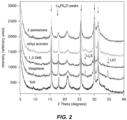
- FIG. 2 is a plot of X-ray diffraction measurements of solid electrolyte compositions produced by the process indicated in FIG. 1 according to Example 1.
- X-ray diffraction (XRD) measurements show dominant peaks indicative of the Li 6 PS 5 Cl argyrodite as the primary crystalline phase observed for all solvents used. Minor variations in the X-ray diffraction measurements were observed based upon the solvent used in the electrolyte synthesis.
- FIG. 3 is a schematic sectional view of an example construction of a lithium solid-state electrochemical cell including an electrode composition of the present disclosure.
- Lithium solid-state battery 300 includes positive electrode (current collector) 310, positive electrode active material layer (cathode) 320, solid electrolyte layer 330, negative electrode active material layer (anode) 340, and negative electrode (current collector) 350.
- Solid electrolyte layer 330 may be formed between positive electrode active material layer 320 and negative electrode active material layer 340.
- Positive electrode 310 electrically contacts positive electrode active material layer 320, and negative electrode 350 electrically contacts negative electrode active material layer 340.
- the solid electrolyte compositions described herein may form portions of positive electrode active material layer 320, negative electrode active material layer 340 and solid electrolyte layer 330.
- Positive electrode 310 may be formed from materials including, but not limited to, aluminum, nickel, titanium, stainless steel, or carbon.
- negative electrode 350 may be formed from copper, nickel, stainless steel, or carbon.
- Positive electrode active material layer 320 may include, at least, a positive electrode active material including, but not limited to, metal oxides, metal phosphates, metal sulfides, sulfur, lithium sulfide, oxygen, or air, and may further include a solid electrolyte material such as the solid electrolyte compositions described herein, a conductive material and/or a binder.
- the conductive material include , but are not limited to, carbon (carbon black, graphite, carbon nanotubes, carbon fiber, graphene), metal particles, filaments, or other structures.
- Positive electrode active material layer 320 may include solid electrolyte compositions as described herein at, for example, 5% by volume to 80% by volume.
- the thickness of positive electrode active material layer 320 may be in the range of, for example, 1 ⁇ m to 1000 ⁇ m.
- Negative electrode active material layer 340 may include, at least, a negative electrode active material including, but not limited to, lithium metal, lithium alloys, Si, Sn, graphitic carbon, hard carbon, and may further include a solid electrolyte material such as the solid electrolyte compositions described herein, a conductive material and/or a binder.
- the conductive material may include those materials used in the positive electrode material layer.
- the binder may include those materials used in the positive electrode material layer.
- Negative electrode active material layer 340 may include solid electrolyte compositions as described herein at, for example, 5% by volume to 80% by volume. The thickness of negative electrode active material layer 340 may be in the range of, for example, 1 ⁇ m to 1000 ⁇ m.
- Solid electrolyte material included within solid electrolyte layer 330 may be solid electrolyte compositions as described herein.
- Solid electrolyte layer 330 may include solid electrolyte compositions as described herein in the range of 10% by volume to 100% by volume, for example. Further, solid electrolyte layer 330 may contain a binder or other modifiers. Examples of the binder may include those materials used in the positive electrode material layer as well as additional self-healing polymers and poly(ethylene) oxide (PEO).
- a thickness of solid electrolyte layer 330 may be in the range of 1 ⁇ m to 1000 ⁇ m.
- a lithium solid-state battery may be produced by providing a positive electrode active material layer, a solid electrolyte layer, and a negative electrode active material layer sequentially layered and pressed between electrodes and provided with a housing.
- a method for producing a sulfide solid electrolyte material comprising the steps of: combining an alkali metal salt and a sulfide compound containing at least one of P, B, Al, As, Sb, Bi, Si, Ge, and Sn with a polar aprotic solvent to form a first solution; combining an alkali metal salt and a polar protonated solvent to form a second solution; combining the first and second solutions to form a third solution; and drying the third solution to produce a sulfide solid electrolyte material.
- Clause 2 there is proposed method as recited in Clause 1, further comprising combining an alkali metal halide with the alkali metal salt and the polar protonated solvent.
- Clause 5 there is provided a method as recited in Clause 1 wherein the first solution has a molar ratio of Li 2 S:P 2 S 5 between 9:11 and 11:9.
- Clause 6 there is provided a method as recited in Clause 1 further comprising the step of heating the sulfide solid electrolyte material to a temperature higher than the drying temperature to increase the ionic conductivity of the sulfide solid electrolyte material.
- Clause 7 there is provided a method as recited in Clause 1 wherein the sulfide solid electrolyte material comprises a lithium argyrodite phase.
- Clause 8 there is provided a method as recited in Clause 1 further comprising the step of stirring each of the first, second and third solutions for a period ranging between 15 minutes and 12 hours.
- a method for producing a sulfide solid electrolyte material comprising the steps of: combining an alkali metal salt and a sulfide compound containing at least one of P, B, Al, As, Sb, Bi, Si, Ge, and Sn with a polar aprotic solvent to form a first solution; combining an alkali metal salt and ethanol to form a second solution; combining the first and second solutions to form a third solution; and drying the third solution to produce a sulfide solid electrolyte material.
- Clause 10 there is provided a method as recited in Clause 9 further comprising combining an alkali metal halide with the alkali metal salt and the ethanol.
- Clause 13 there is provided a method as recited in Clause 9 wherein the first solution has a molar ratio of Li 2 S:P 2 S 5 between 9:11 and 11:9.
- Clause 14 there is provided a method as recited in Clause 9 wherein the sulfide solid electrolyte material comprises a lithium argyrodite phase.
- Clause 15 there is provided a method as recited in Clause 9 further including the step of stirring each of the first, second and third solutions for a period ranging between 15 minutes and 12 hours.
- a method for producing a sulfide solid electrolyte material comprising the steps of combining an alkali metal salt and a sulfide compound containing at least one of P, B, Al, As, Sb, Bi, Si, Ge, and Sn with a Nitrogen-bearing polar aprotic solvent to form a first solution; combining an alkali metal salt and ethanol to form a second solution; combining the first and second solutions to form a third solution; and drying the third solution to produce a sulfide solid electrolyte material.
- Clause 17 there is provided a method as recited in Clause 16 further comprising combining an alkali metal halide with the alkali metal salt and the ethanol.
- Nitrogen-bearing polar aprotic solvent is acetonitrile, propionitrile, isobutyronitrile, malonitrile, fumaronitrile, or a combination thereof.
- Clause 21 there is provided a method as recited in Clause 16 wherein the first solution has a molar ratio of Li 2 S:P 2 S 5 between 9:11 and 11:9.
- Clause 22 there is provided a method as recited in Clause 16 wherein the sulfide solid electrolyte material comprises a lithium argyrodite phase.
- Clause 23 there is provided a method as recited in Clause 16 further comprising the step of stirring each of the first, second and third solutions for a period ranging between 15 minutes and 12 hours.
Landscapes
- Chemical & Material Sciences (AREA)
- Organic Chemistry (AREA)
- Inorganic Chemistry (AREA)
- Manufacturing & Machinery (AREA)
- Engineering & Computer Science (AREA)
- Chemical Kinetics & Catalysis (AREA)
- Electrochemistry (AREA)
- General Chemical & Material Sciences (AREA)
- General Physics & Mathematics (AREA)
- Physics & Mathematics (AREA)
- Condensed Matter Physics & Semiconductors (AREA)
- Secondary Cells (AREA)
- Conductive Materials (AREA)
- Primary Cells (AREA)
- Hybrid Cells (AREA)
Priority Applications (1)
| Application Number | Priority Date | Filing Date | Title |
|---|---|---|---|
| EP23190419.4A EP4246639A3 (de) | 2019-01-25 | 2019-01-25 | Verfahren zur herstellung von festelektrolytmaterial |
Applications Claiming Priority (3)
| Application Number | Priority Date | Filing Date | Title |
|---|---|---|---|
| PCT/US2019/015163 WO2020153973A1 (en) | 2019-01-25 | 2019-01-25 | Solid electrolyte material synthesis method |
| EP23190419.4A EP4246639A3 (de) | 2019-01-25 | 2019-01-25 | Verfahren zur herstellung von festelektrolytmaterial |
| EP19911439.8A EP3914553B1 (de) | 2019-01-25 | 2019-01-25 | Verfahren zur synthese eines festelektrolytmaterials |
Related Parent Applications (1)
| Application Number | Title | Priority Date | Filing Date |
|---|---|---|---|
| EP19911439.8A Division EP3914553B1 (de) | 2019-01-25 | 2019-01-25 | Verfahren zur synthese eines festelektrolytmaterials |
Publications (2)
| Publication Number | Publication Date |
|---|---|
| EP4246639A2 true EP4246639A2 (de) | 2023-09-20 |
| EP4246639A3 EP4246639A3 (de) | 2023-11-29 |
Family
ID=71736840
Family Applications (2)
| Application Number | Title | Priority Date | Filing Date |
|---|---|---|---|
| EP19911439.8A Active EP3914553B1 (de) | 2019-01-25 | 2019-01-25 | Verfahren zur synthese eines festelektrolytmaterials |
| EP23190419.4A Pending EP4246639A3 (de) | 2019-01-25 | 2019-01-25 | Verfahren zur herstellung von festelektrolytmaterial |
Family Applications Before (1)
| Application Number | Title | Priority Date | Filing Date |
|---|---|---|---|
| EP19911439.8A Active EP3914553B1 (de) | 2019-01-25 | 2019-01-25 | Verfahren zur synthese eines festelektrolytmaterials |
Country Status (7)
| Country | Link |
|---|---|
| US (1) | US20220123359A1 (de) |
| EP (2) | EP3914553B1 (de) |
| JP (2) | JP7137021B2 (de) |
| KR (1) | KR102480337B1 (de) |
| CN (1) | CN113677620B (de) |
| PL (1) | PL3914553T3 (de) |
| WO (1) | WO2020153973A1 (de) |
Cited By (1)
| Publication number | Priority date | Publication date | Assignee | Title |
|---|---|---|---|---|
| EP4462452A4 (de) * | 2022-01-05 | 2026-01-14 | Idemitsu Kosan Co | Verfahren zur herstellung eines sulfid-festelektrolyten |
Families Citing this family (20)
| Publication number | Priority date | Publication date | Assignee | Title |
|---|---|---|---|---|
| US11715863B2 (en) | 2018-08-08 | 2023-08-01 | Brightvolt, Inc. | Solid polymer matrix electrolytes (PME) and methods and uses thereof |
| WO2022066924A2 (en) * | 2020-09-23 | 2022-03-31 | Solid Power, Inc. | Solid electrolyte material and solid-state battery made therewith |
| EP4244925A1 (de) * | 2020-12-11 | 2023-09-20 | Solid Power Operating, Inc. | Verfahren zur synthese eines festelektrolyten, festelektrolytzusammensetzung und elektrochemische zelle |
| WO2022221729A1 (en) * | 2021-04-15 | 2022-10-20 | Solid Power Operating, Inc. | Plasma-assisted synthesis for solid-state electrolyte materials |
| US12132167B2 (en) * | 2021-04-27 | 2024-10-29 | Samsung Electronics Co., Ltd. | Multi-phase electrolyte film and method of making the same |
| DE102021112298A1 (de) | 2021-05-11 | 2022-11-17 | Bayerische Motoren Werke Aktiengesellschaft | Verfahren zum Recyceln eines Festelektrolyten und Kathodenmaterials aus Lithium-Festkörperbatterien |
| CN113471519B (zh) * | 2021-06-29 | 2023-04-07 | 深圳大学 | 硫化物固体电解质隔膜及其前驱体溶胶和制备方法 |
| CN113363568B (zh) * | 2021-06-29 | 2022-04-19 | 深圳高能时代科技有限公司 | 一种制备硫化物固态电解质的方法 |
| CN115621537A (zh) * | 2021-07-15 | 2023-01-17 | 通用汽车环球科技运作有限责任公司 | 用于固态电池组的硫银锗矿固体电解质及其制造方法 |
| KR102651843B1 (ko) * | 2021-11-09 | 2024-03-26 | 한국세라믹기술원 | 조성비 제어가 가능한 황화물계 고체 전해질의 제조방법 |
| KR102651840B1 (ko) * | 2021-11-09 | 2024-03-26 | 한국세라믹기술원 | 구형 형상을 갖는 황화물계 고체 전해질의 제조방법 |
| US20250100879A1 (en) * | 2022-01-05 | 2025-03-27 | Idemitsu Kosan Co.,Ltd. | Method for producing sulfide solid electrolyte |
| JP7812668B2 (ja) * | 2022-01-19 | 2026-02-10 | トヨタ自動車株式会社 | 固体電解質、全固体電池、固体電解質溶液、及び固体電解質の製造方法 |
| CN114725511A (zh) * | 2022-03-24 | 2022-07-08 | 华南理工大学 | 一种液相制备掺杂的高离子电导率硫银锗矿型硫化物固态电解质的方法 |
| CN114709471A (zh) * | 2022-03-29 | 2022-07-05 | 上海屹锂新能源科技有限公司 | 一种硫化物固态电解质的制备方法 |
| CN115149095B (zh) * | 2022-09-05 | 2023-06-27 | 中国科学院宁波材料技术与工程研究所 | 一种高纯硫银锗矿相硫化物固体电解质及其制备方法 |
| CN115939500A (zh) * | 2022-09-30 | 2023-04-07 | 上海屹锂新能源科技有限公司 | 一种纳米级硫化物固态电解质的制备方法 |
| FR3157375A1 (fr) * | 2023-12-21 | 2025-06-27 | IFP Energies Nouvelles | Méthode de synthèse en solution de particules thiophosphate de sodium ou lithium |
| CN118651828A (zh) * | 2024-06-06 | 2024-09-17 | 高能时代(深圳)新能源科技有限公司 | 一种硫化物固态电解质的制备方法 |
| CN118712466A (zh) * | 2024-07-01 | 2024-09-27 | 高能时代(深圳)新能源科技有限公司 | 一种硫化物固态电解质及其制备方法和应用 |
Family Cites Families (16)
| Publication number | Priority date | Publication date | Assignee | Title |
|---|---|---|---|---|
| KR100326468B1 (ko) * | 2000-07-25 | 2002-02-28 | 김순택 | 리튬 설퍼 전지용 전해액 |
| WO2004093099A1 (ja) * | 2003-04-15 | 2004-10-28 | Idemitsu Kosan Co., Ltd. | リチウムイオン導電性固体電解質の製造方法及びそれを用いた全固体型二次電池 |
| US8518585B2 (en) * | 2007-10-11 | 2013-08-27 | Idemitsu Kosan Co., Ltd. | Method for producing lithium ion conductive solid electrolyte |
| JP5692266B2 (ja) * | 2013-03-15 | 2015-04-01 | トヨタ自動車株式会社 | 硫化物固体電解質材料の製造方法 |
| WO2014192309A1 (ja) * | 2013-05-31 | 2014-12-04 | 出光興産株式会社 | 固体電解質の製造方法 |
| JP6441224B2 (ja) * | 2013-10-03 | 2018-12-19 | 国立研究開発法人科学技術振興機構 | 全固体アルカリ金属二次電池用の固体電解質を含む層の形成用溶液、被覆活物質粒子、電極、全固体アルカリ金属二次電池及びその製造方法 |
| US20150147660A1 (en) * | 2013-11-26 | 2015-05-28 | Samsung Electronics Co., Ltd. | All solid secondary battery and method of preparing all solid secondary battery |
| CN105098228A (zh) * | 2014-05-05 | 2015-11-25 | 中国科学院宁波材料技术与工程研究所 | 硫化物固体电解质材料及其制备方法 |
| JP2016134316A (ja) * | 2015-01-20 | 2016-07-25 | 出光興産株式会社 | 固体電解質 |
| CN107591563B (zh) * | 2016-07-07 | 2019-07-23 | 北京卫蓝新能源科技有限公司 | 一种硫基电解质溶液及其在固态锂电池中的应用 |
| HUE056390T2 (hu) * | 2017-03-22 | 2022-02-28 | Mitsubishi Gas Chemical Co | Eljárás Li3PS4-alapú szilárd elektrolit elõállítására |
| US11349149B2 (en) | 2017-03-29 | 2022-05-31 | Solid Power Operating, Inc. | Solid electrolyte material and solid-state battery made therewith |
| KR102359583B1 (ko) * | 2017-05-08 | 2022-02-07 | 현대자동차주식회사 | 고체전해질 및 이를 포함하는 전고체 전지의 제조방법 |
| CN107180992A (zh) * | 2017-06-09 | 2017-09-19 | 中国科学院宁波材料技术与工程研究所 | 一种全固态锂电池复合电极材料及其制备方法以及一种全固态锂电池 |
| JP7308147B2 (ja) * | 2017-09-01 | 2023-07-13 | 三菱瓦斯化学株式会社 | Lgps系固体電解質の製造方法 |
| US10879559B2 (en) * | 2017-09-06 | 2020-12-29 | Idemitsu Kosan Co., Ltd. | Method for producing solid electrolyte |
-
2019
- 2019-01-25 WO PCT/US2019/015163 patent/WO2020153973A1/en not_active Ceased
- 2019-01-25 EP EP19911439.8A patent/EP3914553B1/de active Active
- 2019-01-25 CN CN201980090249.7A patent/CN113677620B/zh active Active
- 2019-01-25 PL PL19911439.8T patent/PL3914553T3/pl unknown
- 2019-01-25 US US17/425,230 patent/US20220123359A1/en active Pending
- 2019-01-25 KR KR1020217026695A patent/KR102480337B1/ko active Active
- 2019-01-25 EP EP23190419.4A patent/EP4246639A3/de active Pending
- 2019-01-25 JP JP2021542231A patent/JP7137021B2/ja active Active
-
2022
- 2022-08-31 JP JP2022138311A patent/JP7546016B2/ja active Active
Cited By (1)
| Publication number | Priority date | Publication date | Assignee | Title |
|---|---|---|---|---|
| EP4462452A4 (de) * | 2022-01-05 | 2026-01-14 | Idemitsu Kosan Co | Verfahren zur herstellung eines sulfid-festelektrolyten |
Also Published As
| Publication number | Publication date |
|---|---|
| CN113677620A (zh) | 2021-11-19 |
| KR20210118890A (ko) | 2021-10-01 |
| EP4246639A3 (de) | 2023-11-29 |
| JP2022184854A (ja) | 2022-12-13 |
| EP3914553A1 (de) | 2021-12-01 |
| WO2020153973A1 (en) | 2020-07-30 |
| JP7137021B2 (ja) | 2022-09-13 |
| JP7546016B2 (ja) | 2024-09-05 |
| EP3914553C0 (de) | 2023-08-09 |
| KR102480337B1 (ko) | 2022-12-23 |
| PL3914553T3 (pl) | 2024-03-04 |
| JP2022513322A (ja) | 2022-02-07 |
| US20220123359A1 (en) | 2022-04-21 |
| EP3914553A4 (de) | 2022-01-19 |
| CN113677620B (zh) | 2022-12-02 |
| EP3914553B1 (de) | 2023-08-09 |
Similar Documents
| Publication | Publication Date | Title |
|---|---|---|
| EP3914553B1 (de) | Verfahren zur synthese eines festelektrolytmaterials | |
| US12166173B2 (en) | Solid electrolyte material and solid-state battery made therewith | |
| WO2010043886A2 (en) | Lithium containing transition metal sulfide compounds | |
| US20240186570A1 (en) | Bromine and iodine lithium phosphorous sulfide solid electrolyte and solid-state battery including the same | |
| Yang et al. | “One Stone Two Birds” strategy of synthesizing the battery material lithium sulfide: aluminothermal reduction of lithium sulfate | |
| EP4449523A1 (de) | Feststoff mit li-, mg-, p-, s- und halogenelementen | |
| CN109904399B (zh) | 一种二硫化钼/c/三维石墨烯复合材料 | |
| WO2023111083A1 (en) | Solid material comprising li, mg, p, s and halogen elements | |
| CN118401466A (zh) | 制备具有式MaLibPcSdXe(I)的固体硫化物材料的方法 |
Legal Events
| Date | Code | Title | Description |
|---|---|---|---|
| PUAI | Public reference made under article 153(3) epc to a published international application that has entered the european phase |
Free format text: ORIGINAL CODE: 0009012 |
|
| STAA | Information on the status of an ep patent application or granted ep patent |
Free format text: STATUS: THE APPLICATION HAS BEEN PUBLISHED |
|
| AC | Divisional application: reference to earlier application |
Ref document number: 3914553 Country of ref document: EP Kind code of ref document: P |
|
| AK | Designated contracting states |
Kind code of ref document: A2 Designated state(s): AL AT BE BG CH CY CZ DE DK EE ES FI FR GB GR HR HU IE IS IT LI LT LU LV MC MK MT NL NO PL PT RO RS SE SI SK SM TR |
|
| REG | Reference to a national code |
Ref country code: DE Ref legal event code: R079 Free format text: PREVIOUS MAIN CLASS: H01M0010052000 Ipc: C01B0017220000 |
|
| PUAL | Search report despatched |
Free format text: ORIGINAL CODE: 0009013 |
|
| RAP3 | Party data changed (applicant data changed or rights of an application transferred) |
Owner name: SOLID POWER OPERATING, INC. |
|
| AK | Designated contracting states |
Kind code of ref document: A3 Designated state(s): AL AT BE BG CH CY CZ DE DK EE ES FI FR GB GR HR HU IE IS IT LI LT LU LV MC MK MT NL NO PL PT RO RS SE SI SK SM TR |
|
| RIC1 | Information provided on ipc code assigned before grant |
Ipc: H01M 10/052 20100101ALI20231020BHEP Ipc: H01M 10/0562 20100101ALI20231020BHEP Ipc: H01B 1/10 20060101ALI20231020BHEP Ipc: C01B 25/14 20060101ALI20231020BHEP Ipc: C01B 17/22 20060101AFI20231020BHEP |
|
| STAA | Information on the status of an ep patent application or granted ep patent |
Free format text: STATUS: REQUEST FOR EXAMINATION WAS MADE |
|
| 17P | Request for examination filed |
Effective date: 20240528 |
|
| RBV | Designated contracting states (corrected) |
Designated state(s): AL AT BE BG CH CY CZ DE DK EE ES FI FR GB GR HR HU IE IS IT LI LT LU LV MC MK MT NL NO PL PT RO RS SE SI SK SM TR |
|
| STAA | Information on the status of an ep patent application or granted ep patent |
Free format text: STATUS: EXAMINATION IS IN PROGRESS |