EP4238945A1 - Glaskörper - Google Patents
Glaskörper Download PDFInfo
- Publication number
- EP4238945A1 EP4238945A1 EP21886436.1A EP21886436A EP4238945A1 EP 4238945 A1 EP4238945 A1 EP 4238945A1 EP 21886436 A EP21886436 A EP 21886436A EP 4238945 A1 EP4238945 A1 EP 4238945A1
- Authority
- EP
- European Patent Office
- Prior art keywords
- antibacterial film
- glass body
- glass
- body according
- glass plate
- Prior art date
- Legal status (The legal status is an assumption and is not a legal conclusion. Google has not performed a legal analysis and makes no representation as to the accuracy of the status listed.)
- Pending
Links
Images

Classifications
-
- C—CHEMISTRY; METALLURGY
- C03—GLASS; MINERAL OR SLAG WOOL
- C03C—CHEMICAL COMPOSITION OF GLASSES, GLAZES OR VITREOUS ENAMELS; SURFACE TREATMENT OF GLASS; SURFACE TREATMENT OF FIBRES OR FILAMENTS MADE FROM GLASS, MINERALS OR SLAGS; JOINING GLASS TO GLASS OR OTHER MATERIALS
- C03C17/00—Surface treatment of glass, not in the form of fibres or filaments, by coating
- C03C17/22—Surface treatment of glass, not in the form of fibres or filaments, by coating with other inorganic material
- C03C17/23—Oxides
- C03C17/25—Oxides by deposition from the liquid phase
-
- A—HUMAN NECESSITIES
- A01—AGRICULTURE; FORESTRY; ANIMAL HUSBANDRY; HUNTING; TRAPPING; FISHING
- A01N—PRESERVATION OF BODIES OF HUMANS OR ANIMALS OR PLANTS OR PARTS THEREOF; BIOCIDES, e.g. AS DISINFECTANTS, AS PESTICIDES OR AS HERBICIDES; PEST REPELLANTS OR ATTRACTANTS; PLANT GROWTH REGULATORS
- A01N25/00—Biocides, pest repellants or attractants, or plant growth regulators, characterised by their forms, or by their non-active ingredients or by their methods of application, e.g. seed treatment or sequential application; Substances for reducing the noxious effect of the active ingredients to organisms other than pests
- A01N25/08—Biocides, pest repellants or attractants, or plant growth regulators, characterised by their forms, or by their non-active ingredients or by their methods of application, e.g. seed treatment or sequential application; Substances for reducing the noxious effect of the active ingredients to organisms other than pests containing solids as carriers or diluents
-
- A—HUMAN NECESSITIES
- A01—AGRICULTURE; FORESTRY; ANIMAL HUSBANDRY; HUNTING; TRAPPING; FISHING
- A01N—PRESERVATION OF BODIES OF HUMANS OR ANIMALS OR PLANTS OR PARTS THEREOF; BIOCIDES, e.g. AS DISINFECTANTS, AS PESTICIDES OR AS HERBICIDES; PEST REPELLANTS OR ATTRACTANTS; PLANT GROWTH REGULATORS
- A01N59/00—Biocides, pest repellants or attractants, or plant growth regulators containing elements or inorganic compounds
- A01N59/16—Heavy metals; Compounds thereof
- A01N59/20—Copper
-
- A—HUMAN NECESSITIES
- A01—AGRICULTURE; FORESTRY; ANIMAL HUSBANDRY; HUNTING; TRAPPING; FISHING
- A01P—BIOCIDAL, PEST REPELLANT, PEST ATTRACTANT OR PLANT GROWTH REGULATORY ACTIVITY OF CHEMICAL COMPOUNDS OR PREPARATIONS
- A01P1/00—Disinfectants; Antimicrobial compounds or mixtures thereof
-
- A—HUMAN NECESSITIES
- A01—AGRICULTURE; FORESTRY; ANIMAL HUSBANDRY; HUNTING; TRAPPING; FISHING
- A01P—BIOCIDAL, PEST REPELLANT, PEST ATTRACTANT OR PLANT GROWTH REGULATORY ACTIVITY OF CHEMICAL COMPOUNDS OR PREPARATIONS
- A01P3/00—Fungicides
-
- C—CHEMISTRY; METALLURGY
- C03—GLASS; MINERAL OR SLAG WOOL
- C03C—CHEMICAL COMPOSITION OF GLASSES, GLAZES OR VITREOUS ENAMELS; SURFACE TREATMENT OF GLASS; SURFACE TREATMENT OF FIBRES OR FILAMENTS MADE FROM GLASS, MINERALS OR SLAGS; JOINING GLASS TO GLASS OR OTHER MATERIALS
- C03C17/00—Surface treatment of glass, not in the form of fibres or filaments, by coating
- C03C17/06—Surface treatment of glass, not in the form of fibres or filaments, by coating with metals
-
- C—CHEMISTRY; METALLURGY
- C09—DYES; PAINTS; POLISHES; NATURAL RESINS; ADHESIVES; COMPOSITIONS NOT OTHERWISE PROVIDED FOR; APPLICATIONS OF MATERIALS NOT OTHERWISE PROVIDED FOR
- C09D—COATING COMPOSITIONS, e.g. PAINTS, VARNISHES OR LACQUERS; FILLING PASTES; CHEMICAL PAINT OR INK REMOVERS; INKS; CORRECTING FLUIDS; WOODSTAINS; PASTES OR SOLIDS FOR COLOURING OR PRINTING; USE OF MATERIALS THEREFOR
- C09D1/00—Coating compositions, e.g. paints, varnishes or lacquers, based on inorganic substances
-
- C—CHEMISTRY; METALLURGY
- C09—DYES; PAINTS; POLISHES; NATURAL RESINS; ADHESIVES; COMPOSITIONS NOT OTHERWISE PROVIDED FOR; APPLICATIONS OF MATERIALS NOT OTHERWISE PROVIDED FOR
- C09D—COATING COMPOSITIONS, e.g. PAINTS, VARNISHES OR LACQUERS; FILLING PASTES; CHEMICAL PAINT OR INK REMOVERS; INKS; CORRECTING FLUIDS; WOODSTAINS; PASTES OR SOLIDS FOR COLOURING OR PRINTING; USE OF MATERIALS THEREFOR
- C09D5/00—Coating compositions, e.g. paints, varnishes or lacquers, characterised by their physical nature or the effects produced; Filling pastes
- C09D5/14—Paints containing biocides, e.g. fungicides, insecticides or pesticides
-
- C—CHEMISTRY; METALLURGY
- C03—GLASS; MINERAL OR SLAG WOOL
- C03C—CHEMICAL COMPOSITION OF GLASSES, GLAZES OR VITREOUS ENAMELS; SURFACE TREATMENT OF GLASS; SURFACE TREATMENT OF FIBRES OR FILAMENTS MADE FROM GLASS, MINERALS OR SLAGS; JOINING GLASS TO GLASS OR OTHER MATERIALS
- C03C2217/00—Coatings on glass
- C03C2217/20—Materials for coating a single layer on glass
- C03C2217/21—Oxides
- C03C2217/213—SiO2
-
- C—CHEMISTRY; METALLURGY
- C03—GLASS; MINERAL OR SLAG WOOL
- C03C—CHEMICAL COMPOSITION OF GLASSES, GLAZES OR VITREOUS ENAMELS; SURFACE TREATMENT OF GLASS; SURFACE TREATMENT OF FIBRES OR FILAMENTS MADE FROM GLASS, MINERALS OR SLAGS; JOINING GLASS TO GLASS OR OTHER MATERIALS
- C03C2217/00—Coatings on glass
- C03C2217/20—Materials for coating a single layer on glass
- C03C2217/25—Metals
- C03C2217/251—Al, Cu, Mg or noble metals
- C03C2217/253—Cu
-
- C—CHEMISTRY; METALLURGY
- C03—GLASS; MINERAL OR SLAG WOOL
- C03C—CHEMICAL COMPOSITION OF GLASSES, GLAZES OR VITREOUS ENAMELS; SURFACE TREATMENT OF GLASS; SURFACE TREATMENT OF FIBRES OR FILAMENTS MADE FROM GLASS, MINERALS OR SLAGS; JOINING GLASS TO GLASS OR OTHER MATERIALS
- C03C2217/00—Coatings on glass
- C03C2217/20—Materials for coating a single layer on glass
- C03C2217/28—Other inorganic materials
- C03C2217/283—Borides, phosphides
-
- C—CHEMISTRY; METALLURGY
- C03—GLASS; MINERAL OR SLAG WOOL
- C03C—CHEMICAL COMPOSITION OF GLASSES, GLAZES OR VITREOUS ENAMELS; SURFACE TREATMENT OF GLASS; SURFACE TREATMENT OF FIBRES OR FILAMENTS MADE FROM GLASS, MINERALS OR SLAGS; JOINING GLASS TO GLASS OR OTHER MATERIALS
- C03C2217/00—Coatings on glass
- C03C2217/20—Materials for coating a single layer on glass
- C03C2217/29—Mixtures
-
- C—CHEMISTRY; METALLURGY
- C03—GLASS; MINERAL OR SLAG WOOL
- C03C—CHEMICAL COMPOSITION OF GLASSES, GLAZES OR VITREOUS ENAMELS; SURFACE TREATMENT OF GLASS; SURFACE TREATMENT OF FIBRES OR FILAMENTS MADE FROM GLASS, MINERALS OR SLAGS; JOINING GLASS TO GLASS OR OTHER MATERIALS
- C03C2217/00—Coatings on glass
- C03C2217/70—Properties of coatings
-
- C—CHEMISTRY; METALLURGY
- C03—GLASS; MINERAL OR SLAG WOOL
- C03C—CHEMICAL COMPOSITION OF GLASSES, GLAZES OR VITREOUS ENAMELS; SURFACE TREATMENT OF GLASS; SURFACE TREATMENT OF FIBRES OR FILAMENTS MADE FROM GLASS, MINERALS OR SLAGS; JOINING GLASS TO GLASS OR OTHER MATERIALS
- C03C2217/00—Coatings on glass
- C03C2217/70—Properties of coatings
- C03C2217/76—Hydrophobic and oleophobic coatings
-
- C—CHEMISTRY; METALLURGY
- C03—GLASS; MINERAL OR SLAG WOOL
- C03C—CHEMICAL COMPOSITION OF GLASSES, GLAZES OR VITREOUS ENAMELS; SURFACE TREATMENT OF GLASS; SURFACE TREATMENT OF FIBRES OR FILAMENTS MADE FROM GLASS, MINERALS OR SLAGS; JOINING GLASS TO GLASS OR OTHER MATERIALS
- C03C2218/00—Methods for coating glass
- C03C2218/10—Deposition methods
- C03C2218/11—Deposition methods from solutions or suspensions
-
- C—CHEMISTRY; METALLURGY
- C03—GLASS; MINERAL OR SLAG WOOL
- C03C—CHEMICAL COMPOSITION OF GLASSES, GLAZES OR VITREOUS ENAMELS; SURFACE TREATMENT OF GLASS; SURFACE TREATMENT OF FIBRES OR FILAMENTS MADE FROM GLASS, MINERALS OR SLAGS; JOINING GLASS TO GLASS OR OTHER MATERIALS
- C03C2218/00—Methods for coating glass
- C03C2218/10—Deposition methods
- C03C2218/11—Deposition methods from solutions or suspensions
- C03C2218/113—Deposition methods from solutions or suspensions by sol-gel processes
-
- C—CHEMISTRY; METALLURGY
- C03—GLASS; MINERAL OR SLAG WOOL
- C03C—CHEMICAL COMPOSITION OF GLASSES, GLAZES OR VITREOUS ENAMELS; SURFACE TREATMENT OF GLASS; SURFACE TREATMENT OF FIBRES OR FILAMENTS MADE FROM GLASS, MINERALS OR SLAGS; JOINING GLASS TO GLASS OR OTHER MATERIALS
- C03C2218/00—Methods for coating glass
- C03C2218/30—Aspects of methods for coating glass not covered above
- C03C2218/32—After-treatment
Definitions
- the present invention relates to a glass body and a method for producing the same.
- Patent Literature 1 Glass bodies obtained by performing antibacterial or antiviral treatment on the surface of a glass plate have been proposed due to recent social conditions (e.g., Patent Literature 1).
- Patent Literature 1 JP 2014-511814A
- the present invention was made to address this problem, and it is an object thereof to provide a glass body that has high antibacterial performance, and a method for producing the same.
- the cover member according to the present embodiment is configured to protect a member to be protected, such as a display, a keyboard, or an electronic blackboard, while allowing this member to be seen from the outside.
- a member to be protected such as a display, a keyboard, or an electronic blackboard
- the term "display” encompasses typical desktop displays and also displays for use in various devices, such as mobile PCs, tablet PCs, and in-vehicle devices such as car navigation systems.
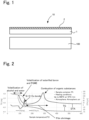
- FIG. 1 is a cross-sectional view of the cover member.
- a cover member 10 includes a glass plate 1 having a first surface and a second surface, and an antibacterial film 2 layered on the first surface of the glass plate 1.
- the cover member 10 is disposed covering a member 100 to be protected that has been described above.
- the glass plate 1 is disposed with its second surface facing the member 100 to be protected, and the antibacterial film 2 is disposed facing outward.
- the glass plate 1 can be made of general-purpose soda-lime glass, borosilicate glass, aluminosilicate glass, clear glass, green glass, UV green glass, heat absorbing glass, privacy glass, alkali-free glass, or other types of glass, for example.
- the glass plate 1 can be float glass formed using a float process. Use of such a glass plate is not limited to the cover member 10 of the present embodiment, and such a glass plate can be used for all glass bodies according to the present invention.
- the float process makes it possible to obtain a glass plate 1 having a flat and smooth surface.
- the glass plate 10 may have recesses and protrusions on its main surface, and may be made of figured glass, for example.
- Figured glass can be formed using a process called a roll out process. Figured glass that is formed using this production process usually has periodic recesses and protrusions in one direction along the main surface of the glass plate.
- molten glass is continuously supplied onto a molten metal such as molten tin, and the supplied molten glass is made to flow over the molten metal and thereby formed into a strip-like shape.
- the thus formed glass is called a "glass ribbon".
- the glass ribbon is cooled as it moves downstream, and the cooled and solidified glass ribbon is raised from the molten metal by rollers. Then, the glass ribbon is transported to an annealing lehr by rollers, annealed, and then cut.
- a float glass plate can be obtained in this manner.
- a surface of the float glass plate that has been in contact with the molten metal is referred to as the "bottom surface”, and the opposite surface is referred to as the "top surface”.
- the bottom surface and the top surface may be unpolished. Note that since the bottom surface has been in contact with the molten metal, in the case where the molten metal is tin, the concentration of tin oxide contained in the bottom surface is higher than the concentration of tin oxide contained in the top surface.
- the first surface of the glass plate 1 corresponds to the bottom surface
- the second surface thereof corresponds to the top surface.
- the thickness of the glass plate 1 is not particularly limited, a thin glass plate is better for weight reduction.
- the thickness of the glass plate 1 is preferably 0.3 to 3 mm, and more preferably 0.6 to 2.5 mm, for example. The reason for this is that, if the glass plate 10 is excessively thin, the strength is reduced, while if the glass plate 1 is excessively thick, the member 100 to be protected may be distorted when seen through the cover member 10.
- the glass plate 1 typically may be a flat plate, but may also be a bent plate.
- the glass plate 1 preferably has a main surface with a non-flat surface shape that fits the non-flat surface shape of the member to be protected.
- the entire glass plate 1 may be bent so as to have a certain curvature, or the glass plate 1 may be locally bent.
- the main surface of the glass plate 1 may be constituted by, for example, a plurality of flat surfaces being connected via a curved surface.
- the radius of curvature of the glass plate 1 can be 5,000 mm or less, for example.
- the lower limit value of this radius of curvature can be 10 mm or more, for example, but a locally bent portion, in particular, may have an even smaller radius of curvature, which can be 1 mm or more, for example.
- a glass plate having the following composition can also be used for a cover member.
- “%” as used when indicating the amounts of components of the glass plate 1 means “mol%” in all instances.
- the wording "substantially composed of” means that the total content of listed components accounts for 99.5 mass% or more, preferably 99.9 mass% or more, and more preferably 99.95 mass% or more.
- the wording "substantially does not contain” means that the content of the component in question is 0.1 mass% or less, and preferably 0.05 mass% or less.
- SL in the narrow sense a composition of glass that is suitable for producing a glass plate using the float process
- the inventors of the present invention have conducted a study to find a composition with which chemical strengthening properties of the SL in the narrow sense can be improved, while enabling T 2 , T 4 , and other characteristics to approximate as closely as possible to those of the SL in the narrow sense, within a composition range that is considered by a person skilled in the art to be soda lime silicate glass (hereinafter also referred to as "SL in the broad sense”) that is suitable for the float process, or more specifically, within the following mass% range:
- SiO 2 is a main component constituting the glass plate 1.
- An excessively low SiO 2 content results in a decrease in chemical durability, such as water resistance, and heat resistance of glass.
- an excessively high SiO 2 content results in an increase in the viscosity of the glass plate 1 at high temperatures, making it difficult to melt and form the glass plate 1. Therefore, an appropriate range of the SiO 2 content is 66 to 72 mol%, and preferably 67 to 70 mol%.
- Al 2 O 3 is a component for improving the chemical durability, such as water resistance, of the glass plate 1 and furthermore facilitating the movement of alkali metal ions in the glass, thereby increasing the surface compressive stress after chemical strengthening and increasing the depth of the stress layer.
- an excessively high Al 2 O 3 content results in an increase in the viscosity of the glass melt, thereby increasing T 2 and T 4 and degrading the clarity of the glass melt, and consequently, making it difficult to produce a high-quality glass plate.
- an appropriate range of the Al 2 O 3 content is 1 to 12 mol%.
- the Al 2 O 3 content is preferably 10 mol% or less and preferably 2 mol% or more.
- MgO is an essential component that improves the meltability of glass. In order to achieve this effect, it is preferable that MgO is added to this glass plate 1. Furthermore, if the MgO content is less than 8 mol%, the surface compressive stress after chemical strengthening decreases, and the depth of the stress layer thus is likely to be small. On the other hand, if the MgO content is increased to more than a suitable amount, strengthening performance that is obtained through chemical strengthening degrades; in particular, the depth of the surface compressive stress layer drastically decreases. Although this adverse effect of MgO is the smallest compared with those of all the other alkaline earth metal oxides, the MgO content in this glass plate 1 is 15 mol% or less. Furthermore, a high MgO content increases T 2 and T 4 and degrades the clarity of this glass melt, thereby making it difficult to produce a high-quality glass plate.
- the MgO content in this glass plate 1 is within a range of 1 to 15 mol%, and preferably 8 mol% or more and 12 mol% or less.
- an appropriate range of the CaO content is 1 to 8 mol%.
- the CaO content is preferably 7 mol% or less and preferably 3 mol% or more.
- SrO and BaO significantly reduce the viscosity of the glass plate 1, and when contained in a small amount, SrO and BaO more markedly have the effect of reducing the liquid phase temperature T L than CaO. However, even when added in a very small amount, SrO and BaO markedly hinder the movement of sodium ions in the glass plate 1, significantly reduce the surface compressive stress, and considerably reduce the depth of the compressive stress layer.
- this glass plate 1 substantially does not contain SrO and BaO.
- Na 2 O is a component for increasing the surface compressive stress and increasing the depth of the surface compressive stress layer, due to sodium ions being replaced by potassium ions.
- the Na 2 O content is increased to more than a suitable amount, stress relaxation during chemical strengthening treatment surpasses generation of the surface compressive stress due to ion exchange during chemical strengthening treatment, and as a result, the surface compressive stress is likely to decrease.
- Na 2 O is a component for improving meltability and reducing T 4 and T 2
- an excessively high Na 2 O content results in a significant decrease in water resistance of the glass. If the Na 2 O content in the glass plate 1 is 10 mol% or more, a sufficient effect of reducing T 4 and T 2 can be obtained, and if the Na 2 O content is more than 16 mol%, the surface compressive stress markedly decreases due to the stress relaxation.
- an appropriate range of the Na 2 O content in the glass plate 1 of the present embodiment is 10 to 16 mol%.
- the Na 2 O content is preferably 12 mol% or more, and more preferably 15 mol% or less.
- K 2 O like Na 2 O, is a component that improves the meltability of glass. Also, in a low K 2 O content range, the ion exchange rate during chemical strengthening increases, and the depth of the surface compressive stress layer thus increases, while, on the other hand, the liquid phase temperature T L of the glass plate 1 decreases. Therefore, it is preferable that K 2 O is contained in a small amount.
- Li 2 O when contained even in a small amount, significantly reduces the depth of the compressive stress layer. Also, in the case where a glass article containing Li 2 O is chemically strengthened in a molten salt of potassium nitrate alone, the molten salt deteriorates significantly faster than in the case of a glass article that does not contain Li 2 O. Specifically, in the case where the glass articles are repeatedly chemically strengthened using the same molten salt, surface compressive stress generated in the glass surface of the glass article containing Li 2 O decreases in the fewer cycles. Therefore, although the glass plate 1 of the present embodiment may contain Li 2 O in an amount of 1 mol% or less, it is preferred that the glass plate 1 substantially does not contain Li 2 O.
- B 2 O 3 is a component that lowers the viscosity of the glass plate 1 and improves meltability.
- the B 2 O 3 content is excessively high, phase separation is likely to occur in the glass plate 1, resulting in a decrease in the water resistance of the glass plate 1.
- a compound formed of B 2 O 3 and an alkali metal oxide may volatilize and cause damage to a refractory material of a glass melting chamber.
- B 2 O 3 is contained, the depth of the compressive stress layer formed by chemical strengthening becomes smaller. Therefore, an appropriate B 2 O 3 content is 0.5 mol% or less. In the present invention, it is more preferable that the glass plate 1 substantially does not contain B 2 O 3 .
- Fe is present as Fe 2+ or Fe 3+ in glass, and functions as a colorant.
- Fe 3+ is a component that improves the ultraviolet absorption performance of glass
- Fe 2+ is a component that improves heat absorption performance.
- the glass plate 1 is to be used as a cover glass for a display, its coloration is required to be inconspicuous, and therefore, a lower Fe content is preferred.
- the content of iron oxide in terms of Fe 2 O 3 is preferably 0.15 mass% or less, more preferably 0.1 mass% or less, and even more preferably 0.02 mass% or less, where the glass plate 1 as a whole is taken as 100 mass%.
- TiO 2 is a component that reduces the viscosity of the glass plate 1 and also increases the surface compressive stress generated by chemical strengthening, but TiO 2 may add a yellow color to the glass plate 1. Therefore, an appropriate TiO 2 content is 0 to 0.2 mass%. Furthermore, TiO 2 from commonly used industrial raw materials is inevitably mixed in the glass plate 1 and thus may be contained therein in an amount of approximately 0.05 mass%. With a content like this, TiO 2 does not add any color to glass and may be contained in the glass plate 1 of the present embodiment.
- ZrO 2 may be mixed in the glass plate 1 from refractory bricks constituting a glass melting furnace, and the ZrO 2 content in that case is known to be approximately 0.01 mass%.
- ZrO 2 is a component that improves the water resistance of glass and increases the surface compressive stress generated by chemical strengthening.
- a high ZrO 2 content may cause an increase in working temperature T 4 and a sharp increase in liquid phase temperature T L and, in the production of a glass plate using the float process, makes it likely that crystals containing precipitated Zr remain in the produced glass as foreign matter. Therefore, an appropriate ZrO 2 content is 0 to 0.1 mass%.
- a sulfate such as sodium sulfate (Na 2 SO 4 ) is widely used as a clarifying agent.
- the sulfate decomposes in the molten glass and generates a gas component, and thus, degassing of the glass melt is promoted, but a portion of the gas component dissolves and remains in the glass plate 1 as SO 3 .
- the SO 3 content in the glass plate 1 of the present invention is 0 to 0.3 mass%.
- CeO 2 is used as a clarifying agent. CeO 2 produces O 2 gas in the molten glass, and therefore, CeO 2 contributes to degassing. On the other hand, an excessively high CeO 2 content causes the glass to be discolored to yellow. Therefore, the CeO 2 content is preferably 0 to 0.5 mass%, more preferably 0 to 0.3 mass%, and even more preferably 0 to 0.1 mass%.
- the glass plate 1 according to the present embodiment is substantially composed of the above-listed components.
- the glass plate 1 according to the present embodiment may also contain components other than the above-listed components as long as the content of each such component is preferably less than 0.1 mass%.
- Examples of the components that can be contained include As 2 O 5 , Sb 2 O 5 , Cl, and F that may be added for the purpose of degassing the molten glass in addition to SO 3 and SnO 2 described above. However, it is preferable that As 2 O 5 , Sb 2 O 5 , Cl, and F are not added because of their significant adverse effects on the environment and for other reasons.
- Other examples of the components that can be contained are ZnO, P 2 O 5 , GeO 2 , Ga 2 O 3 , Y 2 O 3 , and La 2 O 3 .
- Components other than the above that are derived from industrially used raw materials can also be contained as long as the content of each such component does not exceed 0.1 mass%. Since these components may be appropriately added as necessary, or inevitably mixed in, it is possible that the glass plate 1 of the present embodiment substantially does not contain these components.
- the density of the glass plate 1 according to the present embodiment can be reduced to 2.53 g•cm -3 or less, or 2.51 g•cm -3 or less, or even to 2.50 g•cm -3 or less in certain cases.
- the density of soda-lime glass that is currently mass-produced using the float process is approximately 2.50 g•cm -3 .
- the density of the glass plate 1 is close to the aforementioned values, or specifically is 2.45 to 2.55 g•cm -3 , more preferably 2.47 to 2.53 g•cm -3 , and even more preferably 2.47 to 2.50 g•cm -3 .
- a glass substrate may be warped when subjected to chemical strengthening that involves ion exchange.
- the glass plate 1 has a high elasticity.
- the elasticity (Young's modulus: E) of the glass plate 1 can be increased to 70 GPa or more, or even to 72 GPa or more.
- the glass plate 1 according to the present invention can be chemically strengthened by performing an ion exchange treatment in which the glass plate 1 that contains sodium is brought into contact with a molten salt that contains monovalent cations, preferably potassium ions, that have a larger ionic radius than sodium ions, and sodium ions in the glass plate 1 are replaced with the monovalent cations.
- a compressive stress layer in which compressive stress is applied is thus formed in the surface of the glass plate 1.
- a typical example of the molten salt is potassium nitrate.
- a mixed molten salt of potassium nitrate and sodium nitrate may be used, a molten salt of potassium nitrate alone is preferable because it is difficult to control the concentration of the mixed molten salt.
- the surface compressive stress and the depth of the compressive stress layer of a tempered glass article can be controlled by adjusting not only the glass composition of the article but also the temperature of the molten salt during the ion exchange treatment and the treatment time.
- a tempered glass article with an extremely high surface compressive stress and an extremely deep depth of the compressive stress layer can be obtained by bringing the above-described glass plate 1 into contact with a potassium nitrate molten salt.
- a tempered glass article in which the surface compressive stress is 700 MPa or more and the depth of the compressive stress layer is 20 um or more can be obtained, and furthermore, a tempered glass article in which the depth of the compressive stress layer is 20 um or more and the surface compressive stress is 750 MPa or more can be obtained as well.
- the antibacterial film 2 contains a silicon oxide, which is an oxide of Si, and preferably contains a silicon oxide as a main component.
- the antibacterial film 2 containing a silicon oxide as the main component is suitable for reducing the refractive index of the film and suppressing the reflectance of the film.
- the antibacterial film 2 may contain a component other than a silicon oxide, and may contain a component that partially contains a silicon oxide.
- the antibacterial film 2 may contain zirconia, titania, alumina, or the like as the main component, for example, in addition to a silicon oxide.
- the "main component” herein refers to a component contained in the antibacterial film in an amount of 50 mass% or more.
- the component that partially contains a silicon oxide may be, for example, a component that contains a portion composed of a silicon atom and an oxygen atom and in which an atom other than a silicon atom and an oxygen atom, a functional group, or the like is bound to the silicon atom or oxygen atom of this portion.
- the atom other than a silicon atom and an oxygen atom include a nitrogen atom, a carbon atom, a hydrogen atom, and metal elements that will be described in the next paragraph.
- the functional group include organic groups that will be described as R in a paragraph below. This component is not a silicon oxide in a strict sense because it is not composed only of a silicon atom and an oxygen atom.
- a silicon oxide portion that is composed of a silicon atom and an oxygen atom is appropriate and is also consistent with usage in the field.
- the silicon oxide portion is also treated as a silicon oxide.
- the atomic ratio between silicon atoms and oxygen atoms in a silicon oxide need not be stoichiometric (1:2).
- the antibacterial film 2 can contain a metal oxide other than a silicon oxide, or specifically, a metal oxide component or a metal oxide portion that contains an element other than silicon.
- the metal oxide that can be contained in the antibacterial film 2 is not particularly limited, and may be an oxide of at least one metal element selected from the group consisting of Al, Ti, Zr, Ta, Nb, Nd, La, Ce, and Sn, for example.
- the antibacterial film 2 may contain an inorganic compound component other than an oxide, examples of which include a nitride, a carbide, and a halide, and may contain an organic compound component.
- a metal oxide such as a silicon oxide can be formed from a hydrolyzable organic metal compound.
- a hydrolyzable silicon compound is a compound represented by Formula (1): R n SiY 4-n (1) where R is an organic group containing at least one selected from an alkyl group, a vinyl group, an epoxy group, a styryl group, a methacryloyl group, and an acryloyl group; Y is a hydrolyzable organic group that is at least one selected from an alkoxy group, an acetoxy group, an alkenyloxy group, and an amino group, or a halogen atom, which is preferably Cl; and n is an integer from 0 to 3 and is preferably 0 or 1.
- R is preferably an alkyl group, for example, an alkyl group having 1 to 3 carbon atoms, and a methyl group is particularly preferable.
- Y is preferably an alkoxy group, for example, an alkoxy group having 1 to 4 carbon atoms, and a methoxy group and an ethoxy group are particularly preferable.
- Two or more compounds represented by the formula above may also be used in combination. As an example of this combination, a tetraalkoxysilane, where n is 0, and a monoalkyltrialkoxysilane, where n is 1, may be used together.
- a compound represented by Formula (1) after hydrolysis and polycondensation forms a network structure in which silicon atoms are bonded to one another via oxygen atoms.
- the organic groups represented by R are contained in a state of being directly bonded to silicon atoms.
- the thickness of the antibacterial film 2 is preferably 20 to 500 nm, more preferably 30 to 200 nm, and particularly preferably 40 to 80 nm, for example.
- the antibacterial film 2 contains copper in order to have an antibacterial function. Specifically, copper is ionically bonded to the network structure of Si and O. Copper is dispersed on the entire surface of the antibacterial film 2 in this manner.
- the content of copper ions in the antibacterial film 2 is preferably 1 to 40 mass% and more preferably 5 to 25 mass% with respect to the main component (e.g., a silicon oxide, zirconia, titania, or alumina) that constitutes the antibacterial film 2.
- the antibacterial film 2 may contain an acidic oxide, which serves as a network former, such as a boron or phosphorus.
- a network former in this embodiment refers to an oxide of an element that contributes to the formation of a glass network. As will be described later, this element comes from a part of boron or phosphorus contained in a coating liquid used in production remaining in the antibacterial film 2.
- the content of boron or phosphorus remaining in the antibacterial film 2 is preferably 0.1 to 10 mass% and more preferably 0.2 to 2 mass%, for example, with respect to the main component (e.g., a silicon oxide, zirconia, titania, or alumina) that constitutes the antibacterial film 2. Note that if the antibacterial film contains a large amount of boron, the abrasion resistance of the antibacterial film 2 may be reduced.
- the antibacterial film 2 can be formed in the following manner, for example.
- a material that constitutes the above-described matrix for example, tetraethoxysilane is dissolved to form a solution under an acidic condition, and thus, a precursor solution is produced.
- a coating liquid for an antibacterial film is produced by adding, to this precursor solution, a copper salt such as copper nitrate or copper chloride and adding boric acid or phosphoric acid as needed.
- the amount of added copper salt in this coating liquid is preferably 0.1 to 5 mass%, and more preferably 0.2 to 2 mass%, for example.
- the concentration of the copper salt is excessively high, the visible light transmittance of the cover member 10 may be reduced and the haze thereof may be increased. On the other hand, if the concentration of the copper salt is excessively low, the antibacterial function may not be realized.
- the amount of added boric acid or phosphoric acid in this coating liquid is preferably 0.01 to 5 mass%, and more preferably 0.05 to 1 mass%, for example.
- copper nitrate as a copper salt from the viewpoint of suppressing the reduction of copper ions.
- copper chloride is added as a copper salt, metallic copper is likely to be precipitated in the antibacterial film, and the heating temperature cannot be raised, and the hardness of the antibacterial film 2 may also be lower than that when a nitrate is used. Therefore, it is preferable to add a copper salt together with a salt of counter ions, which has a low effect of reducing copper ions.
- salts include nitrates and carbonates, and it is particularly preferable to use nitrates.
- the coating liquid is applied to the first surface of the cleaned glass plate 1.
- a predetermined temperature e.g. 80°C to 120°C
- the applied coating liquid is dried at a predetermined temperature (e.g., 80°C to 120°C) in an oven or the like in order to, for example, volatilize an alcohol and ester compounds, which are produced through a reaction between boron or phosphoric acid and the alcohol, from the solution, and then sintered at a predetermined temperature (e.g., 200°C to 500°C) for the purpose of hydrolysis and organic chain decomposition, for example.
- a predetermined temperature e.g. 200°C to 500°C
- boron is added as boric acid in particular. If copper nitrate and boric acid are added to the precursor, copper of copper nitrate is dispersed as copper ions in the solution, and boron of boric acid is covalently bonded to the network structure of Si and O. Then, when the applied coating liquid is heated, boron in the network structure is substituted by copper, and copper is ionically bonded to the network structure. The dispersion of copper in the entire antibacterial film 2 is facilitated in this manner. The substituted boron is then esterified and volatilizes from the coating liquid. This increases the number of gaps in the network structure, and oxygen is likely to pass therethrough. Note that not all boron is esterified and volatilized, but some boron remains in the network structure.
- the sintered antibacterial film 2 can be made compact.
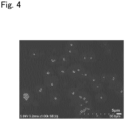
- FIG. 2 shows a weight reduction (TG) and differential thermal analysis (DTA) obtained when the coating liquid is applied to the glass plate and then heated to 600°C at 10°C/min.
- the coating liquid described here as an example contains propylene glycol monomethyl ether (PGME), purified water, copper nitrate, boric acid, and ethyl orthosilicate.
- the coating liquid does not contain copper, the combustion temperature of organic substances exceeds 400°C, and the time taken from the initial film shrinkage to the combustion temperature of organic substances is extended. As a result, the network structure is immobilized due to the initial film shrinkage, and even if organic substances burn at a temperature of about 400°C, it is highly likely that film shrinkage will not proceed.
- the wording "being compact” in this specification refers to D2 / D1 > 0.8 holding true, where D1 is the thickness of the antibacterial film 2 after the cover member 10 has been heated at a temperature of 600°C and D2 is the thickness of the antibacterial film 2 before heating, for example. That is, the wording "being compact” in this specification means that a network structure is formed to such an extent that the antibacterial film does not shrink by 20% or more even when the cover member 10 is heated at high temperatures. Note that there is no particular limitation on the positions where the thicknesses D1 and D2 are measured, and these positions are located at the same position or in the vicinity thereof on the antibacterial film 2.
- boron remains in the heated antibacterial film 2 as described above, boron (BO-) has the effect of attracting copper ions, and thus it is possible to inhibit copper ions from aggregating into crystals such as copper oxides. Note that, if the coating liquid contains boron or phosphorus, the above-described effect can be obtained. However, even if the coating liquid does not contain boron or phosphorus, the film shrinks to some extent. Also, sintering the coating liquid at a temperature higher than the above-described temperature makes the resulting film compact.
- the coating liquid is applied to the entire glass plate 1 due to the coating liquid flowing from an upper end toward a lower end of the glass plate 1, and thus the antibacterial film 2 is likely to be the thickest in the vicinity of the upper end of the glass plate 1 and the thinnest in the vicinity of the lower end.
- Dmax the maximum thickness of the antibacterial film 2
- Dmin the minimum thickness thereof
- visible light transmittance is preferably 85% or more, and more preferably 90% or more.
- the haze ratio of the cover member 10 is 20% or less, 15% or less, or particularly 10% or less, for example, or may optionally be 1% to 8% or even 1% to 6%.
- the gloss can be evaluated based on the specular gloss.
- the 60° specular gloss of the cover member 10 is 60% to 130%, 70% to 120%, or particularly 80% to 110%, for example. These specular gloss values were measured on the surface where the antibacterial film 2 was formed. Note that, in general, a cover member that exhibits a gloss of 120% to 140% is used as a cover member for a display of an in-vehicle device such as a car navigation system.
- a relational expression (a), or more preferably a relational expression (b), holds between the 60° specular gloss G and the haze ratio H (%): H ⁇ ⁇ 0.2 G + 25 H ⁇ ⁇ 0.2 G + 24.5
- the gloss can be measured in conformity with "Method 3 (Specular gloss at 60 degrees)" of “Specular glossiness-Methods of measurement” in JIS Z 8741-1997, and the haze can be measured in conformity with JIS K 7136:2000.
- the cover member 10 can achieve the following effects. That is to say, as described above, copper ions are dispersed in the entire antibacterial film 2, and thus bacteria and copper ions are likely to come into contact with each other, and antibacterial performance can be easily achieved.
- the term “dispersion” as used herein indicates a state in which, when a portion of the antibacterial film 2 is divided into 1 um ⁇ 1 um regions, copper ions are present in each region. Also, “copper ions” as used herein are not aggregates, and “dispersion” indicates that the antibacterial film 2 does not substantially contain copper aggregates with an outer diameter of 100 nm or more, in particular. Alternatively, when analysis is performed through EDX, for example, crystals (with an outer diameter of about 10 nm, for example) of copper or a copper compound are not substantially contained in the antibacterial film 2.
- the antibacterial film 2 As described above, in the antibacterial film 2, copper ions are retained in the network structure, and antibacterial performance (or antivirus performance) is exhibited due to some copper ions being eluted to the surface of the antibacterial film 2. However, if the elution rate of copper ions is excessively high, antibacterial performance cannot be maintained for a long period of time. To address this, as described above, in the cover member 10 according to the present embodiment, the antibacterial film 2 is formed compact, and thus copper ions can be firmly retained in the network structure. In particular, because copper ions are small ions, most of the copper ions may elute over time unless the above-described network structure is compact.
- the compact antibacterial film 2 as described above, copper ions can be firmly retained in the network structure, and it is possible to suppress the elution of copper ions from the antibacterial film 2. As a result, it is possible to maintain an antibacterial effect for a long period of time.
- the amount of copper eluted after immersion of the cover member (the glass body) in water for 16 hours is preferably 40% or less and more preferably 20 mass% or less of copper before the immersion.
- an antiglare function to the antibacterial film 2.
- the following method can be adopted as a method therefor, for example.
- recesses and protrusions are first formed on a surface of the glass plate 1, it is also possible to form recesses and protrusions on the antibacterial film 2 that is to be layered thereon. Therefore, the antiglare function can be realized due to these recesses and protrusions.
- the antibacterial film 2 preferably has a surface roughness Ra of 120 nm or less, and more preferably has a surface roughness Ra of 100 nm or less, for example.
- the antibacterial film 2 preferably has a surface roughness Ra of 20 nm or more, and more preferably has a surface roughness Ra of 40 nm or more, for example. If the surface roughness Ra of the antibacterial film 2 is 20 nm or more and 120 nm or less in this manner, the antiglare function can be realized.
- the surface roughness Ra is the arithmetic average roughness obtained from a roughness profile specified in JIS B0601: 2001. This holds true for the entire specification.
- Rsm of the surface of the antibacterial film 2 is preferably more than 0 um and 35 um or less, more preferably 1 um to 30 ⁇ m, and particularly preferably 2 um to 20 um.
- Rsm is the average length of roughness profile elements specified in JIS B 0601: 2001. An Rsm that is not excessively large is preferable for suppressing so-called "sparkle".
- recesses and protrusions need to be formed on the surface of the glass plate 1.
- the antibacterial film 2 can be layered on the bottom surface of the glass plate 1, for example.
- examples of a method for imparting a predetermined surface roughness to the glass plate 1 include surface treatment techniques such as frosting, sandblasting, and wet blasting.
- Frosting is a process of, for example, immersing the glass plate in a mixed solution of hydrogen fluoride and ammonium fluoride and chemically surface-treating its immersed surface, to thereby form recesses and protrusions on the surface of the glass plate.
- Sandblasting is a process of, for example, spraying a crystalline silicon dioxide powder, a silicon carbide powder, or the like against a surface of the glass plate using pressurized air, to thereby form recesses and protrusions on the surface of the glass plate.
- the surface of the glass plate is chemically etched in order to adjust the surface shape. In this manner, cracks formed by sandblasting or the like can be removed.
- a method in which the glass plate, which is an object to be treated, is immersed in a solution that contains hydrogen fluoride as the main component is preferably used to perform the etching.
- Wet blasting is a process of spraying a jet of a slurry obtained by uniformly stirring abrasive particles constituted by solid particles of alumina or the like with a liquid such as water, against a surface of the glass plate from a jet nozzle at a high speed using compressed air, to thereby form recesses and protrusions on the surface of the glass plate.
- the following method may be used as a method for forming recesses and protrusions on the antibacterial film 2. That is, recesses and protrusions can be formed on the surface of the antibacterial film 2 due to the antibacterial film 2 containing microparticles.
- the shape of the microparticles is not particularly limited, and is preferably a spherical shape.
- the microparticles may be substantially composed of spherical particles. However, a portion of the microparticles may have a shape other than a spherical shape, for example, a flat plate-like shape.
- the microparticles may be composed only of spherical particles.
- a "spherical particle” refers to a particle in which the ratio of the longest diameter to the shortest diameter that pass through the center of gravity is 1 or more and 1.8 or less, and particularly 1 or more and 1.5 or less, and the surface of the particle is constituted by a curved surface.
- the spherical particles may have an average particle size of 5 nm to 200 nm, 10 nm to 100 nm, or particularly 20 nm to 60 nm.
- the average particle size of the spherical particles depends on the average of individual particle sizes, or specifically, average values of the above-described shortest and longest diameters, and it is desirable that the measurement is performed on 30 particles, or preferably 50 particles, based on an SEM image.
- Use of the microparticles can impart a suitable surface roughness Ra to the antibacterial film 2.
- the material constituting the microparticles is not particularly limited, and preferably contains a metal oxide, or particularly a silicon oxide.
- the metal oxide may include an oxide of at least one metal element selected from the group consisting of Al, Ti, Zr, Ta, Nb, Nd, La, Ce, and Sn, for example.
- the microparticles may be phyllosilicate mineral particles.
- a phyllosilicate mineral contained in the phyllosilicate mineral particles is also referred to as "sheet silicate mineral".
- the phyllosilicate mineral include kaolin minerals such as kaolinite, dickite, nacrite, and halloysite; serpentines such as chrysotile, lizardite, and amesite; dioctahedral smectites such as montmorillonite and beidellite; trioctahedral smectites such as saponite, hectorite, and sauconite; dioctahedral micas such as muscovite, palagonite, illite, and celadonite; trioctahedral micas such as phlogopite, annite, and lepidolite; dioctahedral brittle micas such as margarite; trioctahedral bri
- the phyllosilicate mineral particles contain a mineral belonging to smectites, kaolins, or talcs.
- Montmorillonite is preferable as a mineral belonging to smectites. Note that montmorillonite belongs to the monoclinic system, kaolins belong to the triclinic system, and talcs belong to the monoclinic system or the triclinic system.
- This antibacterial film 2 can be formed in a similar manner to the above-described antibacterial film 2. That is to say, the antibacterial film 2 having recesses and protrusions on its surface can be formed by mixing a microparticle dispersion in the above-described coating liquid, applying the coating liquid to a surface of the glass plate, and then sintering the coating liquid.
- a configuration is also possible in which an anti-fingerprint layer is formed on a surface of the antibacterial film 2.
- the formation of an anti-fingerprint film makes it easier to perform a swipe operation on the cover member 10 and also to wipe off dirt such as fingerprints.
- the anti-fingerprint film can be formed in the following manner, for example.
- the anti-fingerprint film can have hydrophobic and oleophobic properties, or in other words, amphiphobic properties so as to minimize wetting of the cover member 10 by water and oil. Therefore, the wetting properties of a surface provided with the anti-fingerprint film are required to be such that not only the surface is hydrophobic, or in other words, the contact angle between the surface and water is preferably more than 90 degrees, but also the surface is oleophobic, or in other words, the contact angle between the surface and oil is preferably more than 50 degrees.
- the anti-fingerprint film can be, for example, a film including a silane that contains an alkyl group and/or a fluoroalkyl group, for example, 3,3,3-trifluoropropyltrimethoxysilane or pentyltriethoxysilane.
- the anti-fingerprint film may be a fluoro-based surface layer that is based on a compound having a hydrocarbon group, wherein the C-H bonds are partially, or preferably substantially completely, replaced by C-F bonds.
- a compound can be a perfluorohydrocarbon represented by the formula (R F ) n SiX 4-n , for example, where R F represents a C 1 to C 22 -alkylperfluorohydrocarbon or -alkylperfluoropolyether, or preferably a C 1 to C 10 -alkylperfluorohydrocarbon or -alkylperfluoropolyether; n is an integer from 1 to 3; and X is a hydrolyzable group, for example, a halogen or an alkoxy group -OR, where R represents, for example, a linear or branched hydrocarbon having 1 to 6 carbon atoms.
- the hydrolyzable group X can, for example, react with a terminal OH group of a coating of a glass substrate, thereby binding to this group by forming a covalent bond.
- the perfluorohydrocarbon can be used to reduce the surface energy of the surface preferably because of the low polarity of the terminal fluoric surface bonding.
- the anti-fingerprint film can be derived from, for example, a monolayer of a molecular chain with fluorine terminal groups, a fluoropolymer coating, or silicon oxide soot particles that have previously been provided with or treated with fluorine terminal groups.
- the anti-fingerprint film can be applied to the surface through immersion, vapor deposition, spray coating, application with a roll or roller or a doctor blade, or thermal vacuum deposition or sputtering, and preferably through a liquid phase method, such as spraying, dip-coating, printing, roller coating, spin coating, or other suitable methods. Immersion or spray coating is particularly preferable. After a coating has been applied, it is cured at a suitable temperature for a suitable period of time.
- the thickness of the anti-fingerprint film can be 50 to 1,000 nm, for example. If the anti-fingerprint film is excessively thick, there is a risk that the antibacterial performance will be inhibited. On the other hand, if the anti-fingerprint film is excessively thin, there is a risk that the anti-fingerprint performance will be reduced.
- the anti-fingerprint film can be formed on the entire surface of the antibacterial film 2, but it can also be formed on a portion thereof.
- a portion of the cover member 10 is arranged on a member 100 to be protected that is used to perform a key touch operation like a keyboard, for example, it is possible that the anti-fingerprint film is not formed on the keys, and the anti-fingerprint layer is formed only on the other regions, for example, a region on which the swipe operation is performed.
- the anti-fingerprint layer can not only suppress the adhesion of fingerprints but also prevent the adhesion of dirt.
- a mask layer on a portion of the glass plate 1 so that, in the portion where the mask layer is formed, the member 100 to be protected can be made invisible from the outside.
- a configuration is possible in which a mask layer is formed on the periphery of the glass plate 1 so that, in the periphery of the cover member 10, the member 100 to be protected can be made invisible from the outside, for example.
- components of the member 100 to be protected such as wiring and brackets, can be made invisible from the outside.
- any material that can block the view from the outside can be selected as appropriate for respective embodiment, and, for example, it is possible to use a ceramic material of a dark color such as black, brown, gray, or dark blue. It is also possible to attach a sheet member.
- the black ceramic material is layered on a surface of the cover member 10 through screen printing or the like, the surface being opposite to the surface on which the antibacterial film 2 is formed, and the layered ceramic material is heated together with the glass plate. When the ceramic material has cured, the mask layer is completed.
- various materials can be used as the ceramic material used for the mask layer, and, for example, a ceramic material with the composition shown in Table 1 below can be used for the mask layer.
- Table 1 First and second colored ceramic pastes Pigment *1 mass% 10 Resin (Cellulose resin) mass% 10 Organic solvent (Pine oil) mass% 10 Glass binder *2 mass% 70 Viscosity dPs 150 *1 Examples of components: copper oxide, chromium oxide, iron oxide, and manganese oxide *2 Examples of components: bismuth borosilicate and zinc borosilicate
- the glass body of the present invention can be used as not only a cover member but also a glass body for various applications. It is possible to use the glass body for windowpanes, partitions, screens, and the like for buildings and vehicles, for example. In particular, the glass body can be suitably used for all kinds of glass that may be touched by an unspecified number of people.
- the glass body according to the present invention can be colorless and transparent, but also can be colored and transparent, or translucent, by adding color to at least one of the glass plate 1 and the antibacterial film 2.
- Cover members according to Examples 1 to 12 were formed by layering antibacterial films with different compositions on respective glass plates. Glanova with an outer shape of 100 mm ⁇ 100 mm and a thickness of 1 mm manufactured by Nippon Sheet Glass Co., Ltd. was prepared as the glass plates.
- Antibacterial-film-forming coating liquids having the following compositions were prepared for the antibacterial films of Examples 1 to 12. At that time, copper chloride was prepared in Examples 1 and 2, and copper nitrate was prepared in Examples 3 to 12. Table 2 Total Amount (g) PGME (wt%) Purified Water (mol/molSi) cHCl (wt%) 60% Nitric Acid (wt%) CuCl 2 •2H 2 O (mol%) Cu(NO 3 ) 2 •3H 2 O (mol%) B(OH) 3 (mol%) Ethyl Orthosilicate TEOS (wt% as SiO 2 ) Ex. 1 20.0 89.0 6.0 0.025 - 10.00 - 10.00 2.00 Ex.
- the above-described coating liquids were respectively applied to the above-described glass plates through flow coating in an environment at a temperature of 20°C and a humidity of 30% and then heated for 15 min in an oven set to 180°C, introduced into another oven set to 250°C and heated for 30.
- the cover members according to Examples 1 to 10 were completed in this manner.
- the contents of copper and boron in the antibacterial films of the cover members according to Examples 1 to 12 are as follows.
- the unit of numerical values in Table 3 is in mass% with respect to the SiO 2 content being taken as 100%.
- Table 3 Cu Content B Content Ex. 1 10.6 1.8 Ex. 2 7.4 1.3 Ex. 3 7.4 0.9 Ex. 4 7.4 0.9 Ex. 5 10.6 0.9 Ex. 6 10.6 2.7 Ex. 7 15.9 1.8 Ex. 8 21.2 1.8 Ex. 9 31.7 1.8 Ex. 10 31.7 3.6 Ex. 11 10.6 1.8 Ex. 12 10.6 1.8
- Antibacterial properties were evaluated under the following conditions based on JIS Z 2801:2012 (Film covering method) (corresponding to ISO 22916).
- Ut is the average of logarithmic values of the number of viable bacteria on the glass plate 24 hours after inoculation.
- At is the average of logarithmic values of the number of viable bacteria on the cover member 24 hours after inoculation.
- Example 3 the distribution of copper in the antibacterial film was examined.
- the surface of the antibacterial film was photographed by a SEM, and mapping of copper (copper ions) was performed on a predetermined range thereof.
- Mapping was performed through EDX (using SU8220, which is a field emission scanning electron microscope available from Hitachi High-Tech Corporation, with XFlash5060FQ (Bruker) as a detector). Measurement was made under the conditions that the acceleration voltage was 5 kV and the sample inclination was 0 degrees from a flat surface.
- FIG. 3 shows the results thereof, and white and gray portions other than black portions of an image that was subjected to the mapping indicate copper, and according to FIG.
- FIG. 3 shows an image of the antibacterial film of this cover member taken by the SEM.
- white portions indicate copper.
- FIG. 3 shows the results of Example 3, and the inventors of the present invention also obtained similar results for the other examples.
- Examples 1 to 10 were immersed in 25 ml of water, 1.5 ml was extracted from the water after 16 hours, and the elution amount of copper ions (elution amount per coating unit area) was calculated.
- This elution amount was calculated as follows. First, a test water, which was treated with PACKTEST Copper (manufactured by Kyoritsu Chemical-Check Lab., Corp.) to develop color, was subjected to measurement, and the concentration of copper ions contained in the liquid was measured using DIGITALPACKTEST Copper (manufactured by Kyoritsu Chemical-Check Lab., Corp.), the obtained concentration thereof was converted to the amount per coating unit area, and the mass% of the elution amount with respect to copper before the test was performed was calculated. The results thereof are shown in Table 4 below. Table 4 Elution Amount Ex. 1 38% Ex. 2 39% Ex. 3 9% Ex. 4 6% Ex. 5 140 Ex. 6 150 Ex. 7 15% Ex. 8 18% Ex. 9 140 Ex. 10 15%
Landscapes
- Life Sciences & Earth Sciences (AREA)
- Chemical & Material Sciences (AREA)
- Engineering & Computer Science (AREA)
- Wood Science & Technology (AREA)
- Plant Pathology (AREA)
- Zoology (AREA)
- Environmental Sciences (AREA)
- Pest Control & Pesticides (AREA)
- General Health & Medical Sciences (AREA)
- Health & Medical Sciences (AREA)
- Chemical Kinetics & Catalysis (AREA)
- General Chemical & Material Sciences (AREA)
- Materials Engineering (AREA)
- Organic Chemistry (AREA)
- Agronomy & Crop Science (AREA)
- Dentistry (AREA)
- Geochemistry & Mineralogy (AREA)
- Inorganic Chemistry (AREA)
- Toxicology (AREA)
- Mycology (AREA)
- Microbiology (AREA)
- Surface Treatment Of Glass (AREA)
- Glass Compositions (AREA)
Applications Claiming Priority (2)
| Application Number | Priority Date | Filing Date | Title |
|---|---|---|---|
| JP2020183241 | 2020-10-30 | ||
| PCT/JP2021/040302 WO2022092319A1 (ja) | 2020-10-30 | 2021-11-01 | ガラス体 |
Publications (2)
| Publication Number | Publication Date |
|---|---|
| EP4238945A1 true EP4238945A1 (de) | 2023-09-06 |
| EP4238945A4 EP4238945A4 (de) | 2024-12-18 |
Family
ID=81382622
Family Applications (1)
| Application Number | Title | Priority Date | Filing Date |
|---|---|---|---|
| EP21886436.1A Pending EP4238945A4 (de) | 2020-10-30 | 2021-11-01 | Glaskörper |
Country Status (8)
| Country | Link |
|---|---|
| US (1) | US20240018035A1 (de) |
| EP (1) | EP4238945A4 (de) |
| JP (1) | JPWO2022092319A1 (de) |
| KR (1) | KR20230095101A (de) |
| CN (1) | CN116528673A (de) |
| AR (1) | AR123854A1 (de) |
| TW (1) | TWI908858B (de) |
| WO (1) | WO2022092319A1 (de) |
Families Citing this family (1)
| Publication number | Priority date | Publication date | Assignee | Title |
|---|---|---|---|---|
| CN120518327B (zh) * | 2025-05-26 | 2026-01-13 | 内蒙古玉晶科技有限公司 | 一种玻璃制品表面防霉粉播撒方法及设备 |
Family Cites Families (25)
| Publication number | Priority date | Publication date | Assignee | Title |
|---|---|---|---|---|
| JPH035345A (ja) * | 1989-05-30 | 1991-01-11 | Nippon Sheet Glass Co Ltd | 着色薄膜の製造方法 |
| JPH10218637A (ja) * | 1997-01-31 | 1998-08-18 | Nippon Glass Fiber Co Ltd | 抗菌・抗かび性ガラス及びそのガラスを含有する樹脂組成物 |
| JPH1186757A (ja) * | 1997-09-04 | 1999-03-30 | Nippon Electric Glass Co Ltd | ブラウン管用パネル |
| CN103443042A (zh) * | 2011-03-28 | 2013-12-11 | 康宁股份有限公司 | Cu、CuO和Cu2O纳米颗粒在玻璃表面和耐久性涂层上的抗微生物作用 |
| KR20140069801A (ko) * | 2012-11-30 | 2014-06-10 | 삼성전자주식회사 | 복합기능 코팅 구조 및 이를 형성하는 방법 |
| JP2014237227A (ja) * | 2013-06-06 | 2014-12-18 | セントラル硝子株式会社 | 抗菌性を有する耐指紋性透明基材 |
| GB2521405B (en) * | 2013-12-18 | 2015-12-02 | Dublin Inst Of Technology | A surface coating |
| US11039621B2 (en) * | 2014-02-19 | 2021-06-22 | Corning Incorporated | Antimicrobial glass compositions, glasses and polymeric articles incorporating the same |
| US9622483B2 (en) * | 2014-02-19 | 2017-04-18 | Corning Incorporated | Antimicrobial glass compositions, glasses and polymeric articles incorporating the same |
| JP2017025120A (ja) * | 2014-04-28 | 2017-02-02 | 旭硝子株式会社 | 液状組成物および抗菌性物品 |
| JP2016033109A (ja) * | 2014-07-29 | 2016-03-10 | 旭硝子株式会社 | 被膜付きガラスおよび被膜形成用組成物 |
| WO2016028554A1 (en) * | 2014-08-19 | 2016-02-25 | Corning Incorporated | Antimicrobial articles with copper nanoparticles and methods of making and using same |
| DE102014013528B4 (de) * | 2014-09-12 | 2022-06-23 | Schott Ag | Beschichtetes Glas-oder Glaskeramiksubstrat mit beständigen multifunktionellen Oberflächeneigenschaften, Verfahren zu dessen Herstellung und dessen Verwendung |
| US20160120174A1 (en) * | 2014-10-29 | 2016-05-05 | Ronald Steven Cok | Imprinted multi-layer biocidal particle structure |
| US20170369369A1 (en) * | 2015-02-12 | 2017-12-28 | Kornerstone Materials Technology Company, Ltd. | Antimicrobial chemically strengthened glass and method for the manufacture thereof |
| CN107922257A (zh) * | 2015-09-02 | 2018-04-17 | 康宁股份有限公司 | 抗微生物‑抗反射制品及其制造方法 |
| JP6639652B2 (ja) * | 2016-04-13 | 2020-02-05 | 富士フイルム株式会社 | 抗菌性組成物、抗菌膜及びウェットワイパー |
| AU2019250301B2 (en) * | 2018-04-12 | 2024-07-18 | Shin-Etsu Chemical Co., Ltd. | Interior material having deodorant, antimicrobial surface layer and production method thereof |
| EP3802444A1 (de) * | 2018-06-08 | 2021-04-14 | Guardian Glass, LLC | Wärmebehandelbares antimikrobielles glas |
| GB201903507D0 (en) * | 2019-03-14 | 2019-05-01 | Pilkington Tech Management Limited | Antimicrobial coating |
| US11312869B2 (en) * | 2019-07-18 | 2022-04-26 | Integran Technologies Inc. | Articles comprising durable water repellent, icephobic and/or biocidal coatings |
| US20210154985A1 (en) * | 2019-11-21 | 2021-05-27 | Corning Incorporated | Antimicrobial assemblies |
| DE112021003902T5 (de) * | 2020-07-22 | 2023-05-04 | AGC Inc. | Antivirales Material |
| EP4211194A4 (de) * | 2020-09-08 | 2024-09-04 | Henkel AG & Co. KGaA | Antimikrobielle oberflächen und zugehörige verfahren |
| KR102332025B1 (ko) * | 2021-06-24 | 2021-12-01 | (주)쉐어켐 | 항균 코팅 조성 및 항균 나노입자를 포함하는 광학 필름 제조방법 |
-
2021
- 2021-08-24 TW TW110131273A patent/TWI908858B/zh active
- 2021-10-19 AR ARP210102889A patent/AR123854A1/es not_active Application Discontinuation
- 2021-11-01 EP EP21886436.1A patent/EP4238945A4/de active Pending
- 2021-11-01 JP JP2022559454A patent/JPWO2022092319A1/ja active Pending
- 2021-11-01 US US18/034,537 patent/US20240018035A1/en active Pending
- 2021-11-01 KR KR1020237017657A patent/KR20230095101A/ko not_active Ceased
- 2021-11-01 CN CN202180070689.3A patent/CN116528673A/zh active Pending
- 2021-11-01 WO PCT/JP2021/040302 patent/WO2022092319A1/ja not_active Ceased
Also Published As
| Publication number | Publication date |
|---|---|
| TW202216632A (zh) | 2022-05-01 |
| WO2022092319A1 (ja) | 2022-05-05 |
| EP4238945A4 (de) | 2024-12-18 |
| CN116528673A (zh) | 2023-08-01 |
| KR20230095101A (ko) | 2023-06-28 |
| JPWO2022092319A1 (de) | 2022-05-05 |
| AR123854A1 (es) | 2023-01-18 |
| US20240018035A1 (en) | 2024-01-18 |
| TWI908858B (zh) | 2025-12-21 |
Similar Documents
| Publication | Publication Date | Title |
|---|---|---|
| EP3348524B1 (de) | Anzeigeabdeckungselement und herstellungsverfahren dafür | |
| JP7331845B2 (ja) | 防眩性透明基体およびそれを備える表示装置 | |
| CN104010983A (zh) | 减小由化学强化处理引起的玻璃基板的翘曲的方法及化学强化玻璃基板的制造方法 | |
| CN104039730B (zh) | 化学强化用玻璃基板及其制造方法 | |
| CN105452185A (zh) | 具有改善的强度的抗微生物玻璃制品以及它们的制备和使用方法 | |
| CN105473525A (zh) | 减小由化学强化处理导致的玻璃基板的翘曲的方法、化学强化玻璃及其制造方法 | |
| US20240018035A1 (en) | Glass body | |
| CN113454040A (zh) | 带防污层的玻璃基体和带防污层的玻璃基体的制造方法 | |
| EP4316823A1 (de) | Laminat | |
| EP4382496A1 (de) | Glaselement und herstellungsverfahren dafür | |
| WO2022054961A1 (ja) | カバー部材 | |
| EP4309890A1 (de) | Abdeckelement | |
| EP4438574A1 (de) | Abdeckelement | |
| WO2022054960A1 (ja) | 表示装置 | |
| WO2022054962A1 (ja) | カバー部材 | |
| JP2022159239A (ja) | ガラス体 |
Legal Events
| Date | Code | Title | Description |
|---|---|---|---|
| STAA | Information on the status of an ep patent application or granted ep patent |
Free format text: STATUS: THE INTERNATIONAL PUBLICATION HAS BEEN MADE |
|
| PUAI | Public reference made under article 153(3) epc to a published international application that has entered the european phase |
Free format text: ORIGINAL CODE: 0009012 |
|
| STAA | Information on the status of an ep patent application or granted ep patent |
Free format text: STATUS: REQUEST FOR EXAMINATION WAS MADE |
|
| 17P | Request for examination filed |
Effective date: 20230503 |
|
| AK | Designated contracting states |
Kind code of ref document: A1 Designated state(s): AL AT BE BG CH CY CZ DE DK EE ES FI FR GB GR HR HU IE IS IT LI LT LU LV MC MK MT NL NO PL PT RO RS SE SI SK SM TR |
|
| DAV | Request for validation of the european patent (deleted) | ||
| DAX | Request for extension of the european patent (deleted) | ||
| A4 | Supplementary search report drawn up and despatched |
Effective date: 20241120 |
|
| RIC1 | Information provided on ipc code assigned before grant |
Ipc: A01P 3/00 20060101ALI20241114BHEP Ipc: A01P 1/00 20060101ALI20241114BHEP Ipc: A01N 59/20 20060101ALI20241114BHEP Ipc: A01N 25/08 20060101ALI20241114BHEP Ipc: C03C 17/25 20060101AFI20241114BHEP |