EP4185386B1 - Heterozyklische inhibitoren von tead zur behandlung von krebs - Google Patents
Heterozyklische inhibitoren von tead zur behandlung von krebs Download PDFInfo
- Publication number
- EP4185386B1 EP4185386B1 EP21755273.6A EP21755273A EP4185386B1 EP 4185386 B1 EP4185386 B1 EP 4185386B1 EP 21755273 A EP21755273 A EP 21755273A EP 4185386 B1 EP4185386 B1 EP 4185386B1
- Authority
- EP
- European Patent Office
- Prior art keywords
- alkyl
- methyl
- amino
- cyano
- prop
- Prior art date
- Legal status (The legal status is an assumption and is not a legal conclusion. Google has not performed a legal analysis and makes no representation as to the accuracy of the status listed.)
- Active
Links
Classifications
-
- C—CHEMISTRY; METALLURGY
- C07—ORGANIC CHEMISTRY
- C07D—HETEROCYCLIC COMPOUNDS
- C07D307/00—Heterocyclic compounds containing five-membered rings having one oxygen atom as the only ring hetero atom
- C07D307/77—Heterocyclic compounds containing five-membered rings having one oxygen atom as the only ring hetero atom ortho- or peri-condensed with carbocyclic rings or ring systems
- C07D307/78—Benzo [b] furans; Hydrogenated benzo [b] furans
- C07D307/79—Benzo [b] furans; Hydrogenated benzo [b] furans with only hydrogen atoms, hydrocarbon or substituted hydrocarbon radicals, directly attached to carbon atoms of the hetero ring
- C07D307/81—Radicals substituted by nitrogen atoms not forming part of a nitro radical
-
- C—CHEMISTRY; METALLURGY
- C07—ORGANIC CHEMISTRY
- C07D—HETEROCYCLIC COMPOUNDS
- C07D307/00—Heterocyclic compounds containing five-membered rings having one oxygen atom as the only ring hetero atom
- C07D307/77—Heterocyclic compounds containing five-membered rings having one oxygen atom as the only ring hetero atom ortho- or peri-condensed with carbocyclic rings or ring systems
- C07D307/78—Benzo [b] furans; Hydrogenated benzo [b] furans
- C07D307/79—Benzo [b] furans; Hydrogenated benzo [b] furans with only hydrogen atoms, hydrocarbon or substituted hydrocarbon radicals, directly attached to carbon atoms of the hetero ring
-
- A—HUMAN NECESSITIES
- A61—MEDICAL OR VETERINARY SCIENCE; HYGIENE
- A61P—SPECIFIC THERAPEUTIC ACTIVITY OF CHEMICAL COMPOUNDS OR MEDICINAL PREPARATIONS
- A61P35/00—Antineoplastic agents
-
- A—HUMAN NECESSITIES
- A61—MEDICAL OR VETERINARY SCIENCE; HYGIENE
- A61P—SPECIFIC THERAPEUTIC ACTIVITY OF CHEMICAL COMPOUNDS OR MEDICINAL PREPARATIONS
- A61P35/00—Antineoplastic agents
- A61P35/02—Antineoplastic agents specific for leukemia
-
- C—CHEMISTRY; METALLURGY
- C07—ORGANIC CHEMISTRY
- C07D—HETEROCYCLIC COMPOUNDS
- C07D213/00—Heterocyclic compounds containing six-membered rings, not condensed with other rings, with one nitrogen atom as the only ring hetero atom and three or more double bonds between ring members or between ring members and non-ring members
- C07D213/02—Heterocyclic compounds containing six-membered rings, not condensed with other rings, with one nitrogen atom as the only ring hetero atom and three or more double bonds between ring members or between ring members and non-ring members having three double bonds between ring members or between ring members and non-ring members
- C07D213/04—Heterocyclic compounds containing six-membered rings, not condensed with other rings, with one nitrogen atom as the only ring hetero atom and three or more double bonds between ring members or between ring members and non-ring members having three double bonds between ring members or between ring members and non-ring members having no bond between the ring nitrogen atom and a non-ring member or having only hydrogen or carbon atoms directly attached to the ring nitrogen atom
- C07D213/60—Heterocyclic compounds containing six-membered rings, not condensed with other rings, with one nitrogen atom as the only ring hetero atom and three or more double bonds between ring members or between ring members and non-ring members having three double bonds between ring members or between ring members and non-ring members having no bond between the ring nitrogen atom and a non-ring member or having only hydrogen or carbon atoms directly attached to the ring nitrogen atom with hetero atoms or with carbon atoms having three bonds to hetero atoms with at the most one bond to halogen, e.g. ester or nitrile radicals, directly attached to ring carbon atoms
- C07D213/72—Nitrogen atoms
- C07D213/74—Amino or imino radicals substituted by hydrocarbon or substituted hydrocarbon radicals
-
- C—CHEMISTRY; METALLURGY
- C07—ORGANIC CHEMISTRY
- C07D—HETEROCYCLIC COMPOUNDS
- C07D277/00—Heterocyclic compounds containing 1,3-thiazole or hydrogenated 1,3-thiazole rings
- C07D277/60—Heterocyclic compounds containing 1,3-thiazole or hydrogenated 1,3-thiazole rings condensed with carbocyclic rings or ring systems
- C07D277/62—Benzothiazoles
- C07D277/64—Benzothiazoles with only hydrocarbon or substituted hydrocarbon radicals attached in position 2
-
- C—CHEMISTRY; METALLURGY
- C07—ORGANIC CHEMISTRY
- C07D—HETEROCYCLIC COMPOUNDS
- C07D405/00—Heterocyclic compounds containing both one or more hetero rings having oxygen atoms as the only ring hetero atoms, and one or more rings having nitrogen as the only ring hetero atom
- C07D405/02—Heterocyclic compounds containing both one or more hetero rings having oxygen atoms as the only ring hetero atoms, and one or more rings having nitrogen as the only ring hetero atom containing two hetero rings
- C07D405/04—Heterocyclic compounds containing both one or more hetero rings having oxygen atoms as the only ring hetero atoms, and one or more rings having nitrogen as the only ring hetero atom containing two hetero rings directly linked by a ring-member-to-ring-member bond
-
- C—CHEMISTRY; METALLURGY
- C07—ORGANIC CHEMISTRY
- C07D—HETEROCYCLIC COMPOUNDS
- C07D405/00—Heterocyclic compounds containing both one or more hetero rings having oxygen atoms as the only ring hetero atoms, and one or more rings having nitrogen as the only ring hetero atom
- C07D405/02—Heterocyclic compounds containing both one or more hetero rings having oxygen atoms as the only ring hetero atoms, and one or more rings having nitrogen as the only ring hetero atom containing two hetero rings
- C07D405/10—Heterocyclic compounds containing both one or more hetero rings having oxygen atoms as the only ring hetero atoms, and one or more rings having nitrogen as the only ring hetero atom containing two hetero rings linked by a carbon chain containing aromatic rings
-
- C—CHEMISTRY; METALLURGY
- C07—ORGANIC CHEMISTRY
- C07D—HETEROCYCLIC COMPOUNDS
- C07D409/00—Heterocyclic compounds containing two or more hetero rings, at least one ring having sulfur atoms as the only ring hetero atoms
- C07D409/02—Heterocyclic compounds containing two or more hetero rings, at least one ring having sulfur atoms as the only ring hetero atoms containing two hetero rings
- C07D409/04—Heterocyclic compounds containing two or more hetero rings, at least one ring having sulfur atoms as the only ring hetero atoms containing two hetero rings directly linked by a ring-member-to-ring-member bond
-
- C—CHEMISTRY; METALLURGY
- C07—ORGANIC CHEMISTRY
- C07D—HETEROCYCLIC COMPOUNDS
- C07D409/00—Heterocyclic compounds containing two or more hetero rings, at least one ring having sulfur atoms as the only ring hetero atoms
- C07D409/02—Heterocyclic compounds containing two or more hetero rings, at least one ring having sulfur atoms as the only ring hetero atoms containing two hetero rings
- C07D409/10—Heterocyclic compounds containing two or more hetero rings, at least one ring having sulfur atoms as the only ring hetero atoms containing two hetero rings linked by a carbon chain containing aromatic rings
-
- C—CHEMISTRY; METALLURGY
- C07—ORGANIC CHEMISTRY
- C07D—HETEROCYCLIC COMPOUNDS
- C07D417/00—Heterocyclic compounds containing two or more hetero rings, at least one ring having nitrogen and sulfur atoms as the only ring hetero atoms, not provided for by group C07D415/00
- C07D417/02—Heterocyclic compounds containing two or more hetero rings, at least one ring having nitrogen and sulfur atoms as the only ring hetero atoms, not provided for by group C07D415/00 containing two hetero rings
- C07D417/04—Heterocyclic compounds containing two or more hetero rings, at least one ring having nitrogen and sulfur atoms as the only ring hetero atoms, not provided for by group C07D415/00 containing two hetero rings directly linked by a ring-member-to-ring-member bond
-
- C—CHEMISTRY; METALLURGY
- C07—ORGANIC CHEMISTRY
- C07D—HETEROCYCLIC COMPOUNDS
- C07D417/00—Heterocyclic compounds containing two or more hetero rings, at least one ring having nitrogen and sulfur atoms as the only ring hetero atoms, not provided for by group C07D415/00
- C07D417/02—Heterocyclic compounds containing two or more hetero rings, at least one ring having nitrogen and sulfur atoms as the only ring hetero atoms, not provided for by group C07D415/00 containing two hetero rings
- C07D417/10—Heterocyclic compounds containing two or more hetero rings, at least one ring having nitrogen and sulfur atoms as the only ring hetero atoms, not provided for by group C07D415/00 containing two hetero rings linked by a carbon chain containing aromatic rings
-
- C—CHEMISTRY; METALLURGY
- C07—ORGANIC CHEMISTRY
- C07D—HETEROCYCLIC COMPOUNDS
- C07D491/00—Heterocyclic compounds containing in the condensed ring system both one or more rings having oxygen atoms as the only ring hetero atoms and one or more rings having nitrogen atoms as the only ring hetero atoms, not provided for by groups C07D451/00 - C07D459/00, C07D463/00, C07D477/00 or C07D489/00
- C07D491/02—Heterocyclic compounds containing in the condensed ring system both one or more rings having oxygen atoms as the only ring hetero atoms and one or more rings having nitrogen atoms as the only ring hetero atoms, not provided for by groups C07D451/00 - C07D459/00, C07D463/00, C07D477/00 or C07D489/00 in which the condensed system contains two hetero rings
- C07D491/04—Ortho-condensed systems
- C07D491/044—Ortho-condensed systems with only one oxygen atom as ring hetero atom in the oxygen-containing ring
- C07D491/048—Ortho-condensed systems with only one oxygen atom as ring hetero atom in the oxygen-containing ring the oxygen-containing ring being five-membered
-
- C—CHEMISTRY; METALLURGY
- C07—ORGANIC CHEMISTRY
- C07F—ACYCLIC, CARBOCYCLIC OR HETEROCYCLIC COMPOUNDS CONTAINING ELEMENTS OTHER THAN CARBON, HYDROGEN, HALOGEN, OXYGEN, NITROGEN, SULFUR, SELENIUM OR TELLURIUM
- C07F5/00—Compounds containing elements of Groups 3 or 13 of the Periodic Table
- C07F5/02—Boron compounds
- C07F5/025—Boronic and borinic acid compounds
Definitions
- the present disclosure relates to compounds useful for therapy and/or prophylaxis in a mammal, and in particular as inhibitors of TEAD useful for treating cancer.
- the Hippo pathway is a signaling pathway that regulates cell proliferation and cell death and determines organ size.
- the pathway is believed to play a role as a tumor suppressor in mammals, and disorders of the pathway are often detected in human cancers.
- the pathway is involved in and/or may regulate the self-renewal and differentiation of stem cells and progenitor cells.
- the Hippo pathway may be involved in wound healing and tissue regeneration.
- it is believed that as the Hippo pathway cross-talks with other signaling pathways such as Wnt, Notch, Hedgehog, and MAPK/ERK, it may influence a wide variety of biological events, and that its dysfunction could be involved in many human diseases in addition to cancer.
- the Hippo signaling pathway is conserved from drosophila to mammals ( Vassilev et al., Genes and Development, 2001, 15, 1229-1241 ; Zeng and Hong, Cancer Cell, 2008, 13, 188-192 ).
- the core of the pathway consists of a cascade of kinases (Hippo-MST1-2 being upstream of Lats 1-2 and NDRI-2) leading to the phosphorylation of two transcriptional co-activators, YAP (Yes-Associated Protein) and TAZ ( Transcription co-activator with PDZ binding motif or tafazzin; Zhao et al., Cancer Res., 2009, 69, 1089-1098 ; Lei et al., Mol. Cell. Biol., 2008, 28, 2426-2436 ).
- YAP In vivo, in mouse liver, the overexpression of YAP or the genetic knockout of its upstream regulators MST1-2 triggers the development of hepatocellular carcinomas. Furthermore, when the tumor suppressor NF2 is inactivated in the mouse liver, the development of hepatocellular carcinomas can be blocked completely by the co-inactivation of YAP.
- deregulation of the Hippo tumor suppressor pathway is a major event in the development of a wide range of malignancies, including with no limitations, lung cancer (NSCLC; Zhou et al., Oncogene, 2011, 30, 2181-2186 ; Wang et al., Cancer Sci., 2010, 101, 1279-1285 ), breast cancer ( Chan et al., Cancer Res., 2008, 68, 2592-2598 ; Lamar et al., Proc. Natl. Acad. Sci, USA, 2012; 109, E2441-E2250 ; Wang et al., Eur. J.
- Lats1/2 kinases phosphorylate the downstream effectors YAP (Yes-associated protein) and TAZ (transcriptional coactivator with PDZ-binding motif; WWTR1), which are homologous to Drosophila Yorkie.
- the phosphorylation of YAP and TAZ by Lats1/2 are crucial events within the Hippo signaling pathway.
- Lats1/2 phosphorylates YAP at multiple sites, but phosphorylation of Ser127 is critical for YAP inhibition.
- Phosphorylation of YAP generates a protein-binding motif for the 14-3-3 family of proteins, which upon binding of a 14-3-3 protein, leads to retention and/or sequestration of YAP in the cell cytoplasm.
- Lats1/2 phosphorylates TAZ at multiple sites, but phosphorylation of Ser89 is critical for TAZ inhibition. Phosphorylation of TAZ leads to retention and/or sequestration of TAZ in the cell cytoplasm.
- phosphorylation of YAP and TAZ is believed to destabilize these proteins by activating phosphorylation-dependent degradation catalyzed by YAP or TAZ ubiquitination.
- YAP and/or TAZ is phosphorylated, inactive, and generally sequestered in the cytoplasm; in contrast, when the Hippo pathway is "off”, YAP and/or TAZ is non-phosphorylated, active, and generally found in the nucleus.
- Non-phosphorylated, activated YAP is translocated into the cell nucleus where its major target transcription factors are the four proteins of the TEAD-domain-containing family (TEAD1-TEAD4, collectively "TEAD”).
- TEAD or other transcription factors such as Smad1, RUNX, ErbB4 and p73
- CTGF connective tissue growth factor
- Gli2 Birc5
- Birc2 fibroblast growth factor 1
- RAG amphiregulin
- non-phosphorylated TAZ is translocated into the cell nucleus where it interacts with multiple DNA-binding transcription factors, such as peroxisome proliferator-activated receptor ⁇ (PPARy), thyroid transcription factor-1 (TTF-1), Pax3, TBX5, RUNX, TEAD1 and Smad2/3/4.
- PARy peroxisome proliferator-activated receptor ⁇
- TTF-1 thyroid transcription factor-1
- Pax3, TBX5, RUNX, TEAD1 and Smad2/3/4 Many of the genes activated by YAP/TAZ-transcription factor complexes mediate cell survival and proliferation. Therefore, under some conditions YAP and/or TAZ acts as an oncogene and the Hippo pathway acts as a tumor suppressor.
- WO02/055521 A1 discloses purine derivatives as purinergic receptoer atagonists.
- WO2015/128333 A1 discloses heteroaromatic derivatives and their use as pharmaceuticals
- CZ306987 B6 discloses 2,6-disubstituted purines for use as pharmaceuticals and pharmaceutical preparations containing them.
- CZ306434 B6 discloses 2,6-disubstituted purines for use as pharmaceuticals, and pharmaceutical preparations.
- WO2020/096416 A1 discloses compound inhibiting yap-tead binding, and pharmaceutical composition for preventing or treating cancer, comprising compound as active ingredient.
- a pharmaceutical composition comprising a compound of formula (I) or a stereoisomer, tautomer, or pharmaceutically acceptable salt thereof, and a pharmaceutically acceptable carrier, diluent or excipient, is provided.
- a compound of formula (X) or formula (I), or a stereoisomer, tautomer, or pharmaceutically acceptable salt thereof, is provided for use in medical therapy.
- a compound of formula (X) or formula (I), or a stereoisomer, tautomer, or pharmaceutically acceptable salt thereof is provided for the treatment or prophylaxis of cancer, mesothelioma, sarcoma, or leukemia.
- a method for treating cancer, mesothelioma, sarcoma, or leukemia in a mammal comprising, administering a compound of formula (X) or formula (I), or a stereoisomer, tautomer, or pharmaceutically acceptable salt thereof, to the mammal.
- a method for treating cancer, mesothelioma, sarcoma, or leukemia in a mammal comprising administering a compound of formula (X) or formula (I), or a stereoisomer, tautomer, or pharmaceutically acceptable salt thereof, to the mammal in combination with a second therapeutic agent.
- a compound of formula (X) or formula (I), or a stereoisomer, tautomer, or pharmaceutically acceptable salt thereof, is provided for modulating TEAD activity.
- a compound of formula (X) or formula (I), or a stereoisomer, tautomer, or pharmaceutically acceptable salt thereof is provided for the treatment or prophylaxis of a disease or condition mediated by TEAD activity.
- a compound of formula (X) or formula (I), or a stereoisomer, tautomer, or pharmaceutically acceptable salt thereof is provided for use for the preparation of a medicament for the treatment or prophylaxis of a disease or condition that is mediated by TEAD activity.
- a method for modulating TEAD activity comprising contacting TEAD with a compound of formula (X) or formula (I), or a stereoisomer, tautomer, or pharmaceutically acceptable salt thereof.
- a method for treating a disease or condition mediated by TEAD activity in a mammal comprising administering a compound of formula (X) or formula (I), or a stereoisomer, tautomer, or pharmaceutically acceptable salt thereof, to the mammal.
- substituted refers to the fact that at least one of the hydrogen atoms of that moiety is replaced by another substituent or moiety.
- alkyl refers to an aliphatic straight-chain or branched-chain saturated hydrocarbon moiety having 1 to 20 carbon atoms, such as 1 to 12 carbon atoms, or 1 to 6 carbon atoms. Alkyl groups may be optionally substituted.
- cycloalkyl means a saturated or partially unsaturated carbocyclic moiety having mono- or bicyclic (including bridged bicyclic) rings and 3 to 10 carbon atoms in the ring.
- cycloalkyl may contain from 3 to 8 carbon atoms (i.e., (C 3 -C 8 )cycloalkyl).
- cycloalkyl may contain from 3 to 6 carbon atoms (i.e., (C 3 -C 6 )cycloalkyl).
- cycloalkyl moieties include, but are not limited to, cyclopropyl, cyclobutyl, cyclopentyl, cyclohexyl, cycloheptyl, and partially unsaturated (cycloalkenyl) derivatives thereof (e.g. cyclopentenyl, cyclohexenyl, and cycloheptenyl).
- the cycloalkyl moiety can be attached in a spirocycle fashion such as spirocyclopropyl:
- haloalkyl refers to an alkyl group wherein one or more of the hydrogen atoms of the alkyl group has been replaced by the same or different halogen atoms, such as fluoro atoms.
- haloalkyl include monofluoro-, difluoro- or trifluoro-methyl, -ethyl or - propyl, for example 3,3,3-trifluoropropyl, 2-fluoroethyl, 2,2,2-trifluoroethyl, fluoromethyl, or trifluoromethyl.
- Haloalkyl groups may be optionally substituted.
- alkenyl refers to a straight or branched chain alkyl or substituted alkyl group as defined elsewhere herein having at least one carbon-carbon double bond. Alkenyl groups may be optionally substituted.
- alkynyl refers to a straight or branched chain alkyl or substituted alkyl group as defined elsewhere herein having at least one carbon-carbon triple bond. Alkynyl groups may be optionally substituted.
- heterocyclyl and “heterocycle” refer to a 4, 5, 6 and 7-membered monocyclic or 7, 8, 9 and 10-membered bicyclic (including bridged bicyclic) heterocyclic moiety that is saturated or partially unsaturated, and has one or more (e.g., 1, 2, 3 or 4) heteroatoms selected from oxygen, nitrogen and sulfur in the ring with the remaining ring atoms being carbon.
- a nitrogen or sulfur may also be in an oxidized form, and a nitrogen may be substituted.
- the heterocycle can be attached to its pendant group at any heteroatom or carbon atom that results in a stable structure and any of the ring atoms can be optionally substituted.
- saturated or partially unsaturated heterocycles include, without limitation, oxiranyl, oxetanyl, tetrahydrofuranyl, tetrahydrothienyl, pyrrolidinyl, pyrrolidonyl, piperidinyl, pyrrolinyl, tetrahydroquinolinyl, tetrahydroisoquinolinyl, decahydroquinolinyl, oxazolidinyl, piperazinyl, dioxanyl, dioxolanyl, diazepinyl, oxazepinyl, thiazolyl, thiazepinyl, morpholinyl, and quinuclidinyl.
- heterocycle also includes groups in which a heterocycle is fused to one or more aryl, heteroaryl, or cycloalkyl rings, such as benzothiazolyl, benzofuranyl, furopyridinyl, indolinyl, 3 H -indolyl, chromanyl, 2-azabicyclo[2.2.1]heptanyl, octahydroindolyl, or tetrahydroquinolinyl. Heterocyclyl groups may be optionally substituted.
- aryl refers to a cyclic aromatic hydrocarbon moiety having a mono-, bi- or tricyclic aromatic ring of 5 to 20 carbon ring atoms. Examples of aryl moieties include, but are not limited to, phenyl, naphthyl, benzyl, and the like.
- aryl also includes partially hydrogenated derivatives of the cyclic aromatic hydrocarbon moiety provided that at least one ring of the cyclic aromatic hydrocarbon moiety is aromatic, each being optionally substituted.
- monocyclic aryl rings may have 5 or 6 carbon ring atoms.
- Aryl groups may be optionally substituted.
- heteroaryl refers an aromatic heterocyclic mono- or bicyclic ring system of 1 to 20 ring atoms, comprising 1, 2, 3 or 4 heteroatoms selected from N, O and S, the remaining ring atoms being carbon.
- heteroaryl moieties include pyrrolyl, furanyl, thienyl, imidazolyl, oxazolyl, thiazolyl, triazolyl, oxadiazolyl, thiadiazolyl, tetrazolyl, pyridinyl, pyrazinyl, pyrazolyl, pyridazinyl, pyrimidinyl, triazinyl, isoxazolyl, benzofuranyl, isothiazolyl, benzothienyl, indolyl, isoindolyl, isobenzofuranyl, benzimidazolyl, benzoxazolyl, benzoisoxazolyl, benzothiazoly
- halo and halogen refer fluoro, chloro, bromo and iodo. In some aspects, halo is fluoro or chloro.
- spirocycle and “spirocyclyl” refer to carbogenic bicyclic ring systems comprising between 5 and 13 carbon atoms with both rings connected through a single atom.
- the rings can be different in size and nature, or identical in size and nature. Examples include spiropentane, spirohexane, spiroheptane, spirooctane, spirononane, or spirodecane.
- One or more of the carbon atoms in the spirocycle can be substituted with a heteroatom (e.g., O, N, S, or P).
- Spirocycle groups may be optionally substituted.
- annular refers to a moiety that is a member of a ring, including, but not limited to, a cycloalkyl ring, a cycloalkenyl ring, an aryl ring, a heteroaryl ring, a heterocyclyl ring, or a spirocyclyl ring.
- a heteroaryl ring is described as “comprising two or more annular heteroatoms"
- two or more of the ring members of the heteroaryl ring will be heteroatoms.
- salts refers to those salts which retain the biological effectiveness and properties of the free bases or free acids, which are not biologically or otherwise undesirable. Salts may be formed with inorganic acids such as hydrochloric acid, hydrobromic acid, sulfuric acid, nitric acid, phosphoric acid and the like, preferably hydrochloric acid, and organic acids such as acetic acid, propionic acid, glycolic acid, pyruvic acid, oxalic acid, maleic acid, malonic acid, salicylic acid, succinic acid, fumaric acid, tartaric acid, citric acid, benzoic acid, cinnamic acid, mandelic acid, methanesulfonic acid, ethanesulfonic acid, p-toluenesulfonic acid, N -acetylcystein and the like.
- inorganic acids such as hydrochloric acid, hydrobromic acid, sulfuric acid, nitric acid, phosphoric acid and the like, preferably hydrochloric acid
- salts may be prepared by the addition of an inorganic base or an organic base to the free acid.
- Salts derived from an inorganic base include, but are not limited to, the sodium, potassium, lithium, ammonium, calcium, and magnesium salts and the like.
- Salts derived from organic bases include, but are not limited to salts of primary, secondary, and tertiary amines, substituted amines including naturally occurring substituted amines, cyclic amines and basic ion exchange resins, such as isopropylamine, trimethylamine, diethylamine, triethylamine, tripropylamine, ethanolamine, lysine, arginine, N-ethylpiperidine, piperidine, polyamine resins and the like.
- prodrug refers to those compounds that readily undergo chemical changes under physiological conditions to provide the compounds of the present disclosure. Additionally, prodrugs can be converted to the compounds of the present disclosure by chemical or biochemical methods in an ex vivo environment. For example, prodrugs can be slowly converted to the compounds of the present disclosure when placed in a transdermal patch reservoir with a suitable enzyme or chemical reagent.
- prodrugs include compounds wherein an amino acid residue, or a polypeptide chain of two or more (e.g., two, three or four) amino acid residues, is covalently joined through an amide or ester bond to a free amino, hydroxy or carboxylic acid group of a compound of the present disclosure.
- the amino acid residues include but are not limited to the 20 naturally occurring amino acids commonly designated by three letter symbols and also includes phosphoserine, phosphothreonine, phosphotyrosine, 4-hydroxyproline, hydroxylysine, demosine, isodemosine, gamma-carboxyglutamate, hippuric acid, octahydroindole-2-carboxylic acid, statine, 1,2,3,4-tetrahydroisoquinoline-3-carboxylic acid, penicillamine, ornithine, 3-methylhistidine, norvaline, beta-alanine, gamma-aminobutyric acid, citrulline, homocysteine, homoserine, methyl-alanine, para-benzoylphenylalanine, phenylglycine, propargylglycine, sarcosine, methionine sulfone and tert-butylglycine.
- a free carboxyl group of a compound of the disclosure can be derivatized as an amide or alkyl ester.
- prodrugs comprising free hydroxy groups can be derivatized as prodrugs by converting the hydroxy group into a group such as, but not limited to, a phosphate ester, hemisuccinate, dimethylaminoacetate, or phosphoryloxymethyloxycarbonyl group, as outlined in Fleisher, D. et al., (1996) Improved oral drug delivery: solubility limitations overcome by the use of prodrugs Advanced Drug Delivery Reviews, 19:115 .
- Carbamate prodrugs of hydroxy and amino groups are also included, as are carbonate prodrugs, sulfonate esters and sulfate esters of hydroxy groups.
- Derivatization of hydroxy groups as (acyloxy)methyl and (acyloxy)ethyl ethers, wherein the acyl group can be an alkyl ester optionally substituted with groups including, but not limited to, ether, amine and carboxylic acid functionalities, or where the acyl group is an amino acid ester as described above, are also encompassed.
- Prodrugs of this type are described in J. Med. Chem., (1996), 39:10 .
- More specific examples include replacement of the hydrogen atom of the alcohol group with a group such as (C 1-6 )alkanoyloxymethyl, 1-((C 1-6 )alkanoyloxy)ethyl, 1-methyl-1-((C 1-6 )alkanoyloxy)ethyl, (C 1-6 )alkoxycarbonyloxymethyl, N-(C 1-6 )alkoxycarbonylaminomethyl, succinoyl, (C 1-6 )alkanoyl, alpha-amino(C 1-4 )alkanoyl, arylacyl and alpha-aminoacyl, or alpha-aminoacyl-alpha-aminoacyl, where each alpha-aminoacyl group is independently selected from the naturally occurring L-amino acids, P(O)(OH) 2 , -P(O)(O(C 1-6 )alkyl) 2 or glycosyl (the radical resulting from the removal of a hydroxyl group of
- prodrug derivatives For additional examples of prodrug derivatives, see, for example, a) Design of Prodrugs, edited by H. Bundgaard, (Elsevier, 1985 ) and Methods in Enzymology, Vol. 42, p. 309-396, edited by K. Widder, et al. (Academic Press, 1985 ); b) A Textbook of Drug Design and Development, edited by Krogsgaard-Larsen and H. Bundgaard, Chapter 5 "Design and Application of Prodrugs," by H. Bundgaard p. 113-191 (1991 ); c) H. Bundgaard, Advanced Drug Delivery Reviews, 8:1-38 (1992 ); d) H. Bundgaard, et al., Journal of Pharmaceutical Sciences, 77:285 (1988 ); and e) N. Kakeya, et al., Chem. Pharm. Bull., 32:692 (1984 ).
- a "metabolite” refers to a product produced through metabolism in the body of a specified compound or salt thereof. Such products can result for example from the oxidation, reduction, hydrolysis, amidation, deamidation, esterification, deesterification, enzymatic cleavage, and the like, of the administered compound.
- Metabolite products typically are identified by preparing a radiolabeled (e.g., 14 C or 3 H) isotope of a compound of the disclosure, administering it parenterally in a detectable dose (e.g., greater than about 0.5 mg/kg) to an animal such as rat, mouse, guinea pig, monkey, or to man, allowing sufficient time for metabolism to occur (typically about 30 seconds to 30 hours) and isolating its conversion products from the urine, blood or other biological samples.
- a detectable dose e.g., greater than about 0.5 mg/kg
- the metabolite structures are determined in conventional fashion, e.g., by MS, LC/MS or NMR analysis. In general, analysis of metabolites is done in the same way as conventional drug metabolism studies well known to those skilled in the art.
- the metabolite products so long as they are not otherwise found in vivo, are useful in diagnostic assays for therapeutic dosing of the compounds of the disclosure.
- Certain compounds of the present disclosure can exist in unsolvated forms as well as solvated forms, including hydrated forms. In general, the solvated forms are equivalent to unsolvated forms and are intended to be encompassed within the scope of the present disclosure. Certain compounds of the present disclosure can exist in multiple crystalline or amorphous forms. In general, all physical forms are equivalent for the uses contemplated by the present disclosure and are intended to be within the scope of the present disclosure.
- isomers Compounds that have the same molecular formula but differ in the nature or sequence of bonding of their atoms or the arrangement of their atoms in space are termed “isomers.” Isomers that differ in the arrangement of their atoms in space are termed “stereoisomers.” Diastereomers are stereoisomers with opposite configuration at one or more chiral centers which are not enantiomers. Stereoisomers bearing one or more asymmetric centers that are non-superimposable mirror images of each other are termed "enantiomers.” When a compound has an asymmetric center, for example, if a carbon atom is bonded to four different groups, a pair of enantiomers is possible.
- An enantiomer can be characterized by the absolute configuration of its asymmetric center or centers and is described by the R- and S-sequencing rules of Cahn, Ingold and Prelog, or by the manner in which the molecule rotates the plane of polarized light and designated as dextrorotatory or levorotatory (i.e., as (+) or (-)-isomers respectively).
- a chiral compound can exist as either individual enantiomer or as a mixture thereof.
- a mixture containing equal proportions of the enantiomers is called a "racemic mixture".
- the compound is enriched by at least about 90% by weight with a single diastereomer or enantiomer.
- the compound is enriched by at least about 95%, 98%, or 99% by weight with a single diastereomer or enantiomer.
- a compound of the formula or “a compound of formula” or “compounds of the formula” or “compounds of formula” refers to any compound selected from the genus of compounds as defined by the formula. In some embodiments or aspects, the term also includes a pharmaceutically acceptable salt or ester of any such compound, a stereoisomer, or a tautomer of such compound.
- a therapeutically effective amount of a compound means an amount of compound that is effective to prevent, alleviate or ameliorate symptoms of disease or prolong the survival of the subject being treated. Determination of a therapeutically effective amount is within the skill in the art.
- the therapeutically effective amount or dosage of a compound according to this disclosure can vary within wide limits and may be determined in a manner known in the art. Such dosage will be adjusted to the individual requirements in each particular case including the specific compound(s) being administered, the route of administration, the condition being treated, as well as the patient being treated.
- a daily dosage of about 0.1 mg to about 5,000 mg, 1 mg to about 1,000 mg, or 1 mg to 100 mg may be appropriate, although the lower and upper limits may be exceeded when indicated.
- the daily dosage can be administered as a single dose or in divided doses, or for parenteral administration, it may be given as continuous infusion.
- pharmaceutically acceptable carrier is intended to include any and all material compatible with pharmaceutical administration including solvents, dispersion media, coatings, antibacterial and antifungal agents, isotonic and absorption delaying agents, and other materials and compounds compatible with pharmaceutical administration. Except insofar as any conventional media or agent is incompatible with a compound of the disclosure, use thereof in the compositions of the disclosure is contemplated. Supplementary active compounds can also be incorporated into the compositions.
- a compound of formula (I), or a stereoisomer, tautomer, or pharmaceutically acceptable salt thereof wherein X 1 is C-R 5 , X 2 is C-R 5 , and X 3 is C-H. In other embodiments, X 1 is C-R 5 , X 2 is C-R 5 , and X 3 is N. In still other embodiments, X 1 is C-R 5 , X 2 is N, and X 3 is C-H. In some embodiments, X 1 is C-R 5 , X 2 is N, and X 3 is N. In some embodiments, X 1 is N, X 2 is C-R 5 , and X 3 is C-H.
- a compound of formula (X) or formula (I), or a stereoisomer, tautomer, or pharmaceutically acceptable salt thereof wherein X 1 is C-R 5 , and R 3 is taken together with the R 5 of X 1 , and the atoms to which they are attached, to form a 5-membered heterocyclyl, wherein the 5-membered heterocyclyl comprises 1, 2, or 3 annular heteroatoms.
- the 1, 2, or 3 heteroatoms are selected from the group consisting of O, N, and S.
- the 5-membered heterocyclyl is optionally substituted with one or more C 1-6 alkyl.
- the 5-membered heterocyclyl is unsubstituted.
- the 5-membered heterocyclyl is substituted with one or more D.
- X 1 is C-R 5 , and R 3 is taken together with the R 5 of X 1 , and the atoms to which they are attached, to form a 5-membered heterocyclyl, wherein the 5-membered heterocyclyl comprises at least one annular heteroatom.
- the X 1 is C-R 5 , and R 3 is taken together with the R 5 of X 1 , and the atoms to which they are attached, to form a 5-membered heterocyclyl that comprises one annular oxygen atom.
- the 5-membered heterocyclyl is optionally substituted with one or more C 1-6 alkyl.
- the 5-membered heterocyclyl is unsubstituted.
- the 5-membered heterocyclyl is substituted with one or more D.
- X 1 is C-Rs; R 3 is taken together with the R 5 of X 1 , and the atoms to which they are attached, to form an unsubstituted 5-membered heterocyclyl; X 2 is N; and X 3 is N.
- X 1 is C-Rs; R 3 is taken together with the R 5 of X 1 , and the atoms to which they are attached, to form a 5-membered heterocyclyl, wherein the 5-membered heterocyclyl is substituted with one or more D; X 2 is N; and X 3 is N.
- X 1 is C-Rs; R 3 is taken together with the R 5 of X 1 , and the atoms to which they are attached, to form an unsubstituted 5-membered heterocyclyl; X 2 is N; and X 3 is N.
- X 1 is C-Rs; R 3 is taken together with the R 5 of X 1 , and the atoms to which they are attached, to form a 5-membered heterocyclyl, wherein the 5-membered heterocyclyl is substituted with one or more D; X 2 is N; and X 3 is N
- X 1 is C-Rs; R 3 is taken together with the R 5 of X 1 , and the atoms to which they are attached, to form an unsubstituted 5-membered heterocyclyl; and L is O.
- X 1 is C-Rs; R 3 is taken together with the R 5 of X 1 , and the atoms to which they are attached, to form a 5-membered heterocyclyl, wherein the 5-membered heterocyclyl is substituted with one or more D; and L is O.
- X 1 is C-Rs; R 3 is taken together with the R 5 of X 1 , and the atoms to which they are attached, to form an unsubstituted 5-membered heterocyclyl; and L is O.
- X 1 is C-Rs; R 3 is taken together with the R 5 of X 1 , and the atoms to which they are attached, to form a 5-membered heterocyclyl, wherein the 5-membered heterocyclyl is substituted with one or more D; and L is O.
- a compound of formula (X) or formula (I), or a stereoisomer, tautomer, or pharmaceutically acceptable salt thereof wherein the compound of formula (X) or formula (I) is a compound of formula (IA): or a stereoisomer, tautomer, or pharmaceutically acceptable salt thereof.
- a compound of formula (X), formula (I), or formula (IA), or a stereoisomer, tautomer, or pharmaceutically acceptable salt thereof wherein X 2 is C-R 5 , and the R 5 of X 2 is H, cyano, halo, S(O) 2 -C 1-6 alkyl, or C 1-6 alkyl, wherein the C 1-6 alkyl is optionally substituted with one or more hydroxyl.
- a compound of formula (X), formula (I), or formula (IA), or a stereoisomer, tautomer, or pharmaceutically acceptable salt thereof wherein X 2 is C-R 5 , and the R 5 of X 2 is H, cyano, halo, or C 1-6 alkyl, wherein the C 1-6 alkyl is optionally substituted with one or more hydroxyl.
- the R 5 of X 2 is cyano.
- the R 5 of X 2 is H.
- the R 5 of X 2 is F.
- the R 5 of X 2 is C 1-6 alkyl, wherein the C 1-6 alkyl is optionally substituted with one or more hydroxyl. In other embodiments, the R 5 of X 2 is -CH 2 OH. In some embodiments, the R 5 of X 2 is S(O) 2 -C 1-6 alkyl. In some embodiments, the R 5 of X 2 is S(O) 2 -CH 3 .
- R 2 is C 1-12 alkyl, C 3-10 cycloalkyl, 3-10 membered heterocyclyl, C 5-13 spirocyclyl, C 6-20 aryl, or 5-20 membered heteroaryl, wherein the C 1-12 alkyl, C 3-10 cycloalkyl, 3-10 membered saturated heterocyclyl, C 5-13 spirocyclyl, C 6-20 aryl, or 5-20 membered heteroaryl of R 2 is independently optionally substituted with one or more substituents selected from the group consisting of cyano, halo, C 1-6 alkyl, C 1-6 haloalkyl, C 3-10 cycloalkyl, NO 2 , N(R e )(R f ), O(R e ), and S(R g )
- R 2 is C 3-10 cycloalkyl or C 6-20 aryl, wherein the C 3-10 cycloalkyl or C 6-20 aryl of R 2 is independently optionally substituted with one or more O(R e ) or C 1-6 alkyl, wherein the C 1-6 alkyl is further optionally substituted with one or more halo.
- R 2 is C 6-20 aryl, wherein the C 6-20 aryl of R 2 is independently optionally substituted with one or more O(R e ), S(R g ) 5 , or C 1-6 alkyl, wherein the C 1-6 alkyl is further optionally substituted with one or more halo.
- R 2 is C 6-20 aryl, wherein the C 6-20 aryl of R 2 is independently optionally substituted with one or more C 1-6 alkyl. In certain embodiments, R 2 is phenyl substituted with isopropyl. In some embodiments, R 2 is C 6-20 aryl, wherein the C 6-20 aryl of R 2 is independently optionally substituted with one or more S(R g ) 5 . In certain embodiments, R 2 is phenyl substituted with SF 5 . In some embodiments, R 2 is phenyl substituted with O(R e ). In some embodiments, R 2 is phenyl substituted with OCF 3 .
- a compound of formula (X), formula (I), or formula (IA), or a stereoisomer, tautomer, or pharmaceutically acceptable salt thereof wherein R 2 is C 1-12 alkyl, C 3-10 cycloalkyl, 3-10 membered heterocyclyl, C 5-13 spirocyclyl, C 6-20 aryl, or 5-20 membered heteroaryl, wherein the C 1-12 alkyl, C 3-10 cycloalkyl, 3-10 membered saturated heterocyclyl, C 5-13 spirocyclyl, C 6-20 aryl, or 5-20 membered heteroaryl of R 2 is independently optionally substituted with one or more substituents selected from the group consisting of cyano, halo, C 1-6 alkyl, C 1-6 haloalkyl, C 3-10 cycloalkyl, NO 2 , N(R e )(R f ), and O(R e ), provided that, when R 2 is
- R 2 is C 3-10 cycloalkyl or C 6-20 aryl, wherein the C 3-10 cycloalkyl or C 6-20 aryl of R 2 is independently optionally substituted with one or more O(R e ) or C 1-6 alkyl, wherein the C 1-6 alkyl is further optionally substituted with one or more halo.
- R 2 is C 6-20 aryl, wherein the C 6-20 aryl of R 2 is independently optionally substituted with one or more O(R e ) or C 1-6 alkyl, wherein the C 1-6 alkyl is further optionally substituted with one or more halo.
- R 2 is C 6-20 aryl, wherein the C 6-20 aryl of R 2 is independently optionally substituted with one or more C 1-6 alkyl. In certain embodiments, R 2 is phenyl substituted with isopropyl.
- a compound of formula (X), formula (I), or formula (IA), or a stereoisomer, tautomer, or pharmaceutically acceptable salt thereof wherein L is absent and R 2 is C 1-12 alkyl, C 3-10 cycloalkyl, 3-10 membered heterocyclyl, C 5-13 spirocyclyl, C 6-20 aryl, or 5-20 membered heteroaryl, wherein the C 1-12 alkyl, C 3-10 cycloalkyl, 3-10 membered saturated heterocyclyl, C 5-13 spirocyclyl, C 6-20 aryl, or 5-20 membered heteroaryl of R 2 is independently optionally substituted with one or more substituents selected from the group consisting of cyano, halo, C 1-6 alkyl, C 1-6 haloalkyl, C 3-10 cycloalkyl, NO 2 , N(R e )(R f ), O(R e ), and S(R
- L is absent and R 2 is C 3-10 cycloalkyl or C 6-20 aryl, wherein the C 3-10 cycloalkyl or C 6-20 aryl of R 2 is independently optionally substituted with one or more O(R e ) or C 1-6 alkyl, wherein the C 1-6 alkyl is further optionally substituted with one or more halo.
- R 2 is C 6-20 aryl, wherein the C 6-20 aryl of R 2 is independently optionally substituted with one or more O(R e ) or C 1-6 alkyl, wherein the C 1-6 alkyl is further optionally substituted with one or more halo.
- L is absent and R 2 is C 6-20 aryl, wherein the C 6-20 aryl of R 2 is independently optionally substituted with one or more C 1-6 alkyl. In certain embodiments, L is absent and R 2 is phenyl substituted with isopropyl. In some embodiments, L is absent and R 2 is C 6-20 aryl, wherein the C 6-20 aryl of R 2 is independently optionally substituted with one or more S(R g ) 5 . In certain embodiments, L is absent and R 2 is phenyl substituted with SF 5 . In some embodiments, L is absent and R 2 is phenyl substituted with O(R e ). In some embodiments, L is absent and R 2 is phenyl substituted with OCF 3 .
- a compound of formula (X), formula (I), or formula (IA), or a stereoisomer, tautomer, or pharmaceutically acceptable salt thereof wherein L is absent and R 2 is C 1-12 alkyl, C 3-10 cycloalkyl, 3-10 membered heterocyclyl, C 5-13 spirocyclyl, C 6-20 aryl, or 5-20 membered heteroaryl, wherein the C 1-12 alkyl, C 3-10 cycloalkyl, 3-10 membered saturated heterocyclyl, C 5-13 spirocyclyl, C 6-20 aryl, or 5-20 membered heteroaryl of R 2 is independently optionally substituted with one or more substituents selected from the group consisting of cyano, halo, C 1-6 alkyl, C 1-6 haloalkyl, C 3-10 cycloalkyl, NO 2 , N(R e )(R f ), and O(R e ), provided that,
- L is absent and R 2 is C 3-10 cycloalkyl or C 6-20 aryl, wherein the C 3-10 cycloalkyl or C 6-20 aryl of R 2 is independently optionally substituted with one or more O(R e ) or C 1-6 alkyl, wherein the C 1-6 alkyl is further optionally substituted with one or more halo.
- R 2 is C 6-20 aryl, wherein the C 6-20 aryl of R 2 is independently optionally substituted with one or more O(R e ) or C 1-6 alkyl, wherein the C 1-6 alkyl is further optionally substituted with one or more halo.
- L is absent and R 2 is C 6-20 aryl, wherein the C 6-20 aryl of R 2 is independently optionally substituted with one or more C 1-6 alkyl. In certain embodiments, L is absent and R 2 is phenyl substituted with isopropyl.
- a compound of formula (X), formula (I), or formula (IA-1), or a stereoisomer, tautomer, or pharmaceutically acceptable salt thereof wherein X 2 is C-R 5 , and the R 5 of X 2 is H, cyano, halo, or S(O) 2 -C 1-6 alkyl, C 1-6 alkyl, wherein the C 1-6 alkyl is optionally substituted with one or more hydroxyl.
- a compound of formula (X), formula (I), or formula (IA-1), or a stereoisomer, tautomer, or pharmaceutically acceptable salt thereof wherein X 2 is C-R 5 , and the R 5 of X 2 is H, cyano, halo, or C 1-6 alkyl, wherein the C 1-6 alkyl is optionally substituted with one or more hydroxyl.
- the R 5 of X 2 is cyano.
- the R 5 of X 2 is H.
- the R 5 of X 2 is F.
- the R 5 of X 2 is C 1-6 alkyl, wherein the C 1-6 alkyl is optionally substituted with one or more hydroxyl. In other embodiments, the R 5 of X 2 is -CH 2 OH. In some embodiments, the R 5 of X 2 is S(O) 2 -C 1-6 alkyl. In some embodiments, the R 5 of X 2 is S(O) 2 -CH 3 .
- a compound of formula (X), formula (I), or formula (IA-1), or a stereoisomer, tautomer, or pharmaceutically acceptable salt thereof wherein R 2 is phenyl, wherein the phenyl is independently optionally substituted with one or more substituents selected from the group consisting of cyano, halo, C 1-6 alkyl, C 1-6 haloalkyl, C 3-10 cycloalkyl, NO 2 , N(R e )(R f ), O(R e ), and S(R g ) 5 .
- the phenyl is independently optionally substituted with one or more O(R e ), S(R g ) 5 , or C 1-6 alkyl, wherein the C 1-6 alkyl is further optionally substituted with one or more halo.
- the phenyl is substituted with isopropyl.
- the phenyl is substituted with S(R g ) 5 .
- the phenyl is substituted with SF 5 .
- the phenyl is substituted with O(R e ).
- the phenyl is substituted with OCF 3 .
- a compound of formula (X), formula (I), or formula (IA-1), or a stereoisomer, tautomer, or pharmaceutically acceptable salt thereof wherein R 2 is phenyl, wherein the phenyl is independently optionally substituted with one or more substituents selected from the group consisting of cyano, halo, C 1-6 alkyl, C 1-6 haloalkyl, C 3-10 cycloalkyl, NO 2 , N(R e )(R f ), and O(R e ).
- the phenyl is independently optionally substituted with one or more O(R e ) or C 1-6 alkyl, wherein the C 1-6 alkyl is further optionally substituted with one or more halo. In certain embodiments, the phenyl is substituted with isopropyl.
- a compound of formula (X), formula (I), or formula (IA-1), or a stereoisomer, tautomer, or pharmaceutically acceptable salt thereof wherein R 1 is wherein R a , R b , and R c are each independently selected from the group consisting of H, B(OH) 2 , C(O)-OH, C(O)-N(R e )(R f ), C(O)-C 1-6 alkoxy and C(O)-C 1-6 alkyl, and R 4 is H or C 1-6 alkyl, wherein R e and R f are, independently of each other and independently at each occurrence, selected from the group consisting of H, hydroxyl, and C 1-6 alkyl.
- the C 1-6 alkyl is methyl or isopropyl.
- the C 1-6 alkoxy of the C(O)-C 1-6 alkoxy is methoxy.
- a compound of formula (X), formula (I), or formula (IA-1), or a stereoisomer, tautomer, or pharmaceutically acceptable salt thereof wherein R 1 is wherein R a , R b , and R c are each independently selected from the group consisting of H, B(OH) 2 , C(O)-OH, C(O)-N(R e )(R f ), C(O)-C 1-6 alkoxy and C(O)-C 1-6 alkyl, and R 4 is H or C 1-6 alkyl, wherein R e and R f are, independently of each other and independently at each occurrence, selected from the group consisting of H, hydroxyl, C 1-6 alkoxy, and C 1-6 alkyl.
- the C 1-6 alkyl is methyl or isopropyl.
- the C 1-6 alkoxy is methoxy.
- a compound of formula (X), formula (I), or formula (IA-1), or a stereoisomer, tautomer, or pharmaceutically acceptable salt thereof wherein X 2 is C-R 5 , wherein R 5 is independently selected from the group consisting of H, cyano, halo, S(O) 2 -C 1-6 alkyl, and C 1-6 alkyl, wherein the C 1-6 alkyl of R 5 is optionally substituted with hydroxyl.
- a compound of formula (X), formula (I), or formula (IA-1), or a stereoisomer, tautomer, or pharmaceutically acceptable salt thereof wherein X 2 is C-R 5 , wherein R 5 is independently selected from the group consisting of H, cyano, halo and C 1-6 alkyl, wherein the C 1-6 alkyl of R 5 is optionally substituted with hydroxyl.
- R 5 is H.
- R 5 is cyano.
- R 5 is C 1-6 alkyl substituted with hydroxyl.
- R 5 is CH 2 -OH.
- R 5 is S(O) 2 -C 1-6 alkyl.
- R 5 is S(O) 2 -CH 3 .
- R 1 is wherein R a , R b , and R c are each independently selected from the group consisting of H, B(OH) 2 , C(O)-OH, C(O)-N(R e )(R f ), C(O)-C 1-6 alkoxy, C(O)-C 1-6 alkyl, and wherein R e and R f are, independently of each other and independently at each occurrence, selected from the group consisting of H, hydroxyl, C 1-6 alkoxy, and C 1-6 alkyl optionally substituted with one or more halo substituents.
- R 1 is wherein R a , R b , and R c are each independently selected from the group consisting of H, B(OH) 2 , C(O)-OH, C(O)-N(R e )(R f ), C(O)-C 1-6 alkoxy, C(O)-C 1-6 alkyl, and wherein R e and R f are, independently of each other and independently at each occurrence, selected from the group consisting of H, hydroxyl and C 1-6 alkyl optionally substituted with one or more halo substituents.
- R a and R b are each H.
- R a and R b are each H, and R c is selected from the group consisting of H, B(OH) 2 , C(O)-OH, C(O)-N(R e )(R f ), C(O)-C 1-6 alkoxy and C(O)-C 1-6 alkyl.
- the C 1-6 alkyl is methyl.
- the C 1-6 alkoxy is methoxy.
- R c is C(O)-OH.
- R c is C(O)-N(R e )(R f ).
- R e and R f are each H.
- one of R e and R f is H, and the other of R e and R f is C 1-6 alkyl. In embodiments, one of R e and R f is H, and the other of R e and R f is methyl. In embodiments, one of R e and R f is H, and the other of R e and R f is OH.
- a compound of formula (X), formula (I), or formula (IA-1), or a stereoisomer, tautomer, or pharmaceutically acceptable salt thereof wherein R 2 is C 6-20 aryl optionally substituted with one or more substituents selected from the group consisting of C 1-6 alkyl, C 1-6 haloalkyl, O(R e ), and S(R g ) 5 .
- R 2 is C 6-20 aryl optionally substituted with one or more substituents selected from the group consisting of C 1-6 alkyl, C 1-6 haloalkyl, and O(R e ).
- R 2 is phenyl.
- R 2 is phenyl substituted with C 1-6 alkyl.
- R 2 is phenyl substituted with isopropyl.
- R 2 is phenyl substituted with C 1-6 haloalkyl.
- R 2 is phenyl substituted with -CF 3 . In embodiments, R 2 is phenyl substituted with -CH 2 (CH 3 )CF 3 . In embodiments, R 2 is phenyl substituted with O(R e ), wherein R e is C 1-6 alkyl substituted with one or more halo substituents. In embodients, R e is - CF 3 . In embodiments, R 2 is phenyl substituted with S(R g ) 5 . In embodiments, R 2 is phenyl substituted with SF 5 .
- a compound of formula (X), formula (I), or formula (IA-1), or a stereoisomer, tautomer, or pharmaceutically acceptable salt thereof wherein R 4 is H or C 1-6 alkyl. In embodiments, R 4 is H. In embodiments, R 4 is methyl.
- a compound of formula (I), or formula (IA-1), or a stereoisomer, tautomer, or pharmaceutically acceptable salt thereof wherein X 2 is C-R 5 , wherein R 5 is H; X 3 is C-H; R 1 is wherein R a and R b are each H, and R c is H, B(OH) 2 , C(O)-OH, C(O)-N(R e )(R f ), C(O)-C 1-6 alkoxy, C(O)-C 1-6 alkyl, and wherein R e and R f are, independently of each other and independently at each occurrence, selected from the group consisting of H, hydroxyl and C 1-6 alkyl; R 2 is phenyl substituted with C 1-6 alkyl, C 1-6 haloalkyl, and O(R e ), wherein R e is C 1-6 alkyl substituted with one or more halo substituents; and R 4
- X 2 is C-R 5 , wherein R 5 is cyano;
- X 3 is C-H;
- R 1 is wherein R a and R b are each H, and R c is H, B(OH) 2 , C(O)-OH, C(O)-N(R e )(R f ), C(O)-C 1-6 alkoxy, C(O)-C 1-6 alkyl, and wherein R e and R f are, independently of each other and independently at each occurrence, selected from the group consisting of H, hydroxyl and C 1-6 alkyl;
- R 2 is phenyl substituted with C 1-6 alkyl, C 1-6 haloalkyl, and O(R e ), wherein R e is C 1-6 alkyl substituted with one or more halo substituents; and
- R 4 is H.
- a compound of formula (X), formula (I), or formula (IA), or a stereoisomer, tautomer, or pharmaceutically acceptable salt thereof wherein X 1 is C-R 5 , and R 3 is taken together with the R 5 of X 1 , and the atoms to which they are attached, to form a 5-membered heterocyclyl, L is absent, and R 2 is C 6-20 aryl, wherein the C 6-20 aryl of R 2 is independently optionally substituted with one or more C 1-6 alkyl.
- a compound of formula (X), formula (I), or formula (IA), or a stereoisomer, tautomer, or pharmaceutically acceptable salt thereof wherein the compound of formula (X), formula (I), or formula (IA) is a compound of formula (IB): or a stereoisomer, tautomer, or pharmaceutically acceptable salt thereof.
- R 1 is a 3-5 membered saturated heterocyclyl comprising at least one annular oxygen atom, wherein the 3-5 membered saturated heterocyclyl is optionally substituted with one or more C 1-6 alkyl.
- R 1 is a 3-membered saturated heterocyclyl comprising at least one annular oxygen atom, wherein the 3-membered saturated heterocyclyl is optionally substituted with one or more C 1-6 alkyl.
- R 1 is oxiranyl, wherein the oxiranyl is optionally substituted with one or more C 1-6 alkyl.
- R 1 is In other embodiments, R 1 is
- a compound of formula (X), formula (I), formula (IA), or formula (IB), or a stereoisomer, tautomer, or pharmaceutically acceptable salt thereof wherein R 1 is N(R e )(R f ), wherein R e and R f are, independently of each other and independently at each occurrence, selected from the group consisting of H, cyano, hydroxyl, C 1-6 alkyl, C 2-6 alkenyl, C 2-6 alkynyl, C 1-6 alkoxy, C 3-10 cycloalkyl, C 1-6 alkyl-C 3-10 cycloalkyl, 3-10 membered heterocyclyl, C 5-13 spirocyclyl, C 6-20 aryl, and 3-20 membered heteroaryl, wherein the C 1-6 alkyl, C 2-6 alkenyl, C 2-6 alkynyl, C 3-10 cycloalkyl, C 1-6 alkyl-C 3-10 cyclo
- a compound of formula (X), formula (I), formula (IA), or formula (IB), or a stereoisomer, tautomer, or pharmaceutically acceptable salt thereof wherein R 1 is N(R e )(R f ), wherein R e and R f are, independently of each other and independently at each occurrence, selected from the group consisting of H, cyano, hydroxyl, C 1-6 alkyl, C 2-6 alkenyl, C 2-6 alkynyl, C 3-10 cycloalkyl, C 1-6 alkyl-C 3-10 cycloalkyl, 3-10 membered heterocyclyl, C 5-13 spirocyclyl, C 6-20 aryl, and 3-20 membered heteroaryl, wherein the C 1-6 alkyl, C 2-6 alkenyl, C 2-6 alkynyl, C 3-10 cycloalkyl, C 1-6 alkyl-C 3-10 cycloalkyl, 3-10 member
- R 1 is wherein R a , R b , and R c are each independently selected from the group consisting of H, halo, cyano, hydroxyl, B(OH) 2 , C(O)-OH, C(O)-N(R e )(R f ), C(O)-C 1-6 alkoxy, C(O)-C 1-6 alkyl, C 1-6 alkyl, C 3-10 cycloalkyl, C 6-20 aryl, 3-10 membered heterocyclyl, C 5-13 spirocyclyl, and 5-20 membered heteroaryl, wherein the C 1-6 alkyl is further optionally substituted with hydroxyl.
- R a , R b , and R c are H. In some embodiments, exactly two of R a , R b , and R c are H, and exactly one of R a , R b , and R c is B(OH) 2 , C(O)-OH, C(O)-N(R e )(R f ), C(O)-C 1-6 alkoxy, or C(O)-C 1-6 alkyl.
- R a and R b are both H and R c is B(OH) 2 , C(O)-OH, C(O)-N(R e )(R f ), C(O)-C 1-6 alkoxy, or C(O)-C 1-6 alkyl.
- exactly two of R a , R b , and R c are H, and exactly one of R a , R b , and R c is C(O)-OH.
- R a and R b are both H and R c is C(O)-OH.
- R a , R b , or R c is C(O)-N(R e )(R f )
- the R e and R f of C(O)-N(R e )(R f ) are each independently H, C 1-6 alkyl, or hydroxyl.
- the R e and R f of C(O)-N(R e )(R f ) are each independently H, C 1-6 alkyl, C 1-6 alkoxy, or hydroxyl.
- a compound of formula (X), formula (I), formula (IA), or formula (IB), or a stereoisomer, tautomer, or pharmaceutically acceptable salt thereof wherein the compound of formula (X), formula (I), formula (IA), or formula (IB) is a compound of formula (IC): or a stereoisomer, tautomer, or pharmaceutically acceptable salt thereof.
- X 2 is C-R 5 , wherein R 5 is H, cyano, halo, or C 1-6 alkyl, wherein the C 1-6 alkyl is optionally substituted with hydroxyl, and X 3 is C-H.
- X 2 is C-R 5 , wherein R 5 is cyano, and X 3 is C-H.
- X 2 is C-R 5 , wherein R 5 is cyano, and X 3 is N.
- X 2 is N and X 3 is C-H.
- X 2 is N and X 3 is N.
- R 4 is C 1-6 alkyl, wherein the C 1-6 alkyl is optionally substituted with hydroxyl. In certain embodiments, R 4 is methyl.
- a compound of formula (IC), or a stereoisomer, tautomer, or pharmaceutically acceptable salt thereof wherein X 2 is C-R 5 , wherein R 5 is H, cyano, halo, or C 1-6 alkyl, wherein the C 1-6 alkyl is optionally substituted with hydroxyl, X 3 is C-H, and R 4 is H.
- a compound of formula (IC), or a stereoisomer, tautomer, or pharmaceutically acceptable salt thereof wherein X 2 is C-R 5 , wherein R 5 is cyano, X 3 is C-H, and R 4 is H.
- exactly two of R a , R b , and R c are H, and exactly one of R a , R b , and R c is B(OH) 2 , C(O)-OH, C(O)-N(R e )(R f ), C(O)-C 1-6 alkoxy, or C(O)-C 1-6 alkyl, wherein the R e and R f of C(O)-N(R e )(R f ) are each independently H, C 1-6 alkyl, C 1-6 alkoxy, or hydroxyl.
- R a , R b , and R c are H, and exactly one of R a , R b , and R c is B(OH) 2 , C(O)-OH, C(O)-N(R e )(R f ), C(O)-C 1-6 alkoxy, or C(O)-C 1-6 alkyl, wherein the R e and R f of C(O)-N(R e )(R f ) are each independently H, C 1-6 alkyl, or hydroxyl.
- R a , R b , and R c are H, and exactly one of R a , R b , and R c is C(O)-OH.
- R a is H
- R b is H
- R c is C(O)-OH.
- R a is H
- R b is H
- R c is C(O)-NH(OH).
- a compound of formula (IC), or a stereoisomer, tautomer, or pharmaceutically acceptable salt thereof wherein X 2 is C-R 5 , wherein R 5 is H, cyano, halo, S(O) 2 -C 1-6 alkyl, or C 1-6 alkyl, wherein the C 1-6 alkyl is optionally substituted with hydroxyl, X 3 is C-H, R 4 is H, and at least two of R a , R b , and R c are H.
- a compound of formula (IC), or a stereoisomer, tautomer, or pharmaceutically acceptable salt thereof wherein X 2 is C-R 5 , wherein R 5 is H, cyano, halo, or C 1-6 alkyl, wherein the C 1-6 alkyl is optionally substituted with hydroxyl, X 3 is C-H, R 4 is H, and at least two of R a , R b , and R c are H.
- a compound of formula (IC), or a stereoisomer, tautomer, or pharmaceutically acceptable salt thereof wherein X 2 is C-R 5 , wherein R 5 is H, cyano, halo, S(O) 2 -C 1-6 alkyl, or C 1-6 alkyl, wherein the C 1-6 alkyl is optionally substituted with hydroxyl, X 3 is C-H, R 4 is H, exactly two of R a , R b , and R c are H, and exactly one of R a , R b , and R c is B(OH) 2 , C(O)-OH, C(O)-N(R e )(R f ), C(O)-C 1-6 alkoxy, or C(O)-C 1-6 alkyl, wherein the R e and R f of C(O)-N(R e )(R f ) are each independently H, C 1-6 alkyl,
- a compound of formula (IC), or a stereoisomer, tautomer, or pharmaceutically acceptable salt thereof wherein X 2 is C-R 5 , wherein R 5 is H, cyano, halo, or C 1-6 alkyl, wherein the C 1-6 alkyl is optionally substituted with hydroxyl, X 3 is C-H, R 4 is H, exactly two of R a , R b , and R c are H, and exactly one of R a , R b , and R c is B(OH) 2 , C(O)-OH, C(O)-N(R e )(R f ), C(O)-C 1-6 alkoxy, or C(O)-C 1-6 alkyl, wherein the R e and R f of C(O)-N(R e )(R f ) are each independently H, C 1-6 alkyl, or hydroxyl.
- a compound of formula (IC), or a stereoisomer, tautomer, or pharmaceutically acceptable salt thereof wherein X 2 is C-R 5 , wherein R 5 is H, cyano, halo, or C 1-6 alkyl, wherein the C 1-6 alkyl is optionally substituted with hydroxyl, X 3 is C-H, R 4 is H, exactly two of R a , R b , and R c are H, and exactly one of R a , R b , and R c is C(O)-OH.
- a compound of formula (IC), or a stereoisomer, tautomer, or pharmaceutically acceptable salt thereof wherein X 2 is C-R 5 , wherein R 5 is H, cyano, halo, or C 1-6 alkyl, wherein the C 1-6 alkyl is optionally substituted with hydroxyl, X 3 is C-H, R 4 is H, exactly two of R a , R b , and R c are H, and exactly one of R a , R b , and R c is C(O)-NH(OH).
- a compound of formula (IC), or a stereoisomer, tautomer, or pharmaceutically acceptable salt thereof wherein the compound of formula (IC) is selected from the group consisting of and or a stereosiomer, tautomer, or pharamceutically acceptable salt thereof.
- R 1 is wherein R d is selected from the group consisting of H, halo, cyano, hydroxyl, B(OH) 2 , C(O)-OH, C(O)-N(R e )(R f ), C(O)-C 1-6 alkoxy, C(O)-C 1-6 alkyl, C 1-6 alkyl, C 3-10 cycloalkyl, C 6-20 aryl, 3-10 membered heterocyclyl, C 5-13 spirocyclyl, and 5-20 membered heteroaryl, wherein the C 1-6 alkyl is further optionally substituted with hydroxyl.
- a compound of formula (I), formula (IA), or formula (IB), or a stereoisomer, tautomer, or pharmaceutically acceptable salt thereof wherein R 3 is cyano, C 1-6 alkyl, C 1-4 alkoxy, or C 2-4 alkenyl, wherein the C 2-4 alkenyl is optionally substituted with N(R e )(R f ).
- R 3 is cyano.
- R 3 is C 1-4 alkoxy.
- a compound of formula (X), or a stereoisomer, tautomer, or pharmaceutically acceptable salt thereof wherein: X 1 is C-R 5 , wherein the R 5 of X 1 is taken together with R 3 , and the atoms to which they are attached, to form a 5-membered heterocyclyl that is optionally substituted with one more D; X 2 is N or C-R 5 , wherein each R 5 is independently selected from the group consisting of H, cyano, halo, C(O)NH 2 , S(O) 2 -C 1-6 alkyl, and C 1-6 alkyl, wherein the C 1-6 alkyl of R 5 is optionally substituted with hydroxyl; X 3 is N or C-H; R 1 is wherein R a and R b are each H, and R c is selected from the group consisting of H, B(OH) 2 , C(O)-OH, C(O)-N(R e )(
- a compound of formula (X), or a stereoisomer, tautomer, or pharmaceutically acceptable salt thereof wherein X 1 is C-R 5 , wherein the R 5 of X 1 is taken together with R 3 , and the atoms to which they are attached, to form a 5-membered heterocyclyl that is optionally substituted with one or more D;
- X 2 is C-R 5 , wherein R 5 is independently selected from the group consisting of H or cyano;
- X 3 is C-H.
- a compound of formula (X), or a stereoisomer, tautomer, or pharmaceutically acceptable salt thereof wherein the R 5 of X 1 is taken together with R 3 , and the atoms to which they are attached, to form a tetrahydrofuranyl that is optionally substituted with one or more D.
- the tetrahydrofuranyl is unsubstituted.
- a compound of formula (X), or a stereoisomer, tautomer, or pharmaceutically acceptable salt thereof wherein R 1 is wherein R a and R b are each H, and R c is selected from the group consisting B(OH) 2 , C(O)-OH, C(O)-N(R e )(R f ), C(O)-C 1-6 alkoxy, C(O)-C 1-6 alkyl, wherein R e and R f are, independently of each other and independently at each occurrence, selected from the group consisting of H, hydroxyl, and C 1-6 alkyl.
- a compound of formula (X), or a stereoisomer, tautomer, or pharmaceutically acceptable salt thereof wherein L is absent, and R 2 is phenyl optionally substituted with one or more substituents selected from the group consisting of C 1-6 alkyl, C 1-6 haloalkyl, O(R e ), and S(R g ) 5 , wherein R e is selected from the group consisting of H and C 1-6 alkyl, wherein the C 1-6 alkyl of R e is optionally substituted with one or more halo, and R g is halo.
- a compound of formula (X), or a stereoisomer, tautomer, or pharmaceutically acceptable salt thereof L is absent, and R 2 is selected from the group consisting of phenyl, thiazolyl, thienyl, pyridyl, pyrazolyl, and furanyl, wherein the phenyl, thiazolyl, thienyl, pyridyl, pyrazolyl, or furanyl of R 2 is independently optionally substituted.
- compounds of formula (X) or formula (I) are selected from the compounds listed in Table 1 below, including racemic mixtures and resolved isomers.
- Compounds 25 and 26 are not part of the invention.
- Table 1 Compound Number Structure Compound Name 1 2-[[[7-(4-isopropylphenyl)-2,3-dihydrobenzofuran-5-yl]amino]methyl]prop-2-enoic acid 2 2-[[[7-(4-isopropylphenyl)-2,3-dihydrobenzofuran-5-yl]amino]methyl]prop-2-enamide 3 2-[[[4-cyano-7-(4-isopropylphenyl)-2,3-dihydrobenzofuran-5-yl]amino]methyl]prop-2-enoic acid 4 2-[[[4-cyano-7-(4-isopropylphenyl)-2,3-dihydrobenzofuran-5-yl]amino]methyl]
- a compound, or a stereoisomer, tautomer, or pharmaceutically acceptable salt thereof selected from the group consisting of: and or a stereoisomer, tautomer, or pharmaceutically acceptable salt thereof.
- a compound, or a stereoisomer, tautomer, or pharmaceutically acceptable salt thereof selected from the group consisting of: and or a stereoisomer, tautomer, or pharmaceutically acceptable salt thereof.
- the compound or a pharmaceutically acceptable salt thereof of formula (I), or a stereoisomer, tautomer, or pharmaceutically acceptable salt thereof is selected from the group consisting of: and or a stereoisomer, tautomer, or pharmaceutically acceptable salt thereof.
- the compound or a pharmaceutically acceptable salt thereof of formula (X) or formula (I), or a stereoisomer, tautomer, or pharmaceutically acceptable salt thereof is selected from the group consisting of: and or a stereoisomer, tautomer, or pharmaceutically acceptable salt thereof.
- the compounds of formula (I) include 2-[[[6-methoxy-5-[(E)-2-[ trans -4-(trifluoromethyl)cyclohexyl]vinyl]-3-pyridyl]amino]methyl]prop-2-enoic acid and 2-[[[6-cyano-5-[( E )-2-[ trans -4-(trifluoromethyl)cyclohexyl]vinyl]-3-pyridyl]amino]methyl]prop-2-enoic acid, and stereoisomers, tautomers, and pharmaceutically acceptable salts thereof.
- the compounds of formula (I) do not include 2-[[[6-methoxy-5-[( E )-2-[trans-4-(trifluoromethyl)cyclohexyl]vinyl]-3-pyridyl]amino]methyl]prop-2-enoic acid or 2-[[[6-cyano-5-[( E )-2-[ trans -4-(trifluoromethyl)cyclohexyl]vinyl]-3-pyridyl]amino]methyl]prop-2-enoic acid, or stereoisomers, tautomers, or pharmaceutically acceptable salts thereof.
- the compounds of formula (I) include and stereoisomers, tautomers, and pharmaceutically acceptable salts thereof. In another aspect, the compounds of formula (I) do not include or or stereoisomers, tautomers, or pharmaceutically acceptable salts thereof.
- the compounds of the disclosure are isotopically labeled by having one or more atoms therein replaced by an atom having a different atomic mass or mass number.
- isotopically-labeled (i.e., radiolabeled) compounds of formula (X) or formula (I) are considered to be within the scope of this disclosure.
- isotopes that can be incorporated into the compounds of formula (X) or formula (I) include isotopes of hydrogen, carbon, nitrogen, oxygen, phosphorous, sulfur, fluorine, chlorine, and iodine, such as, but not limited to, 2 H, 3 H, 11 C, 13 C, 14 C, 13 N, 15 N, 15 O, 17 O, 18 O, 31 P, 32 P, 35 S, 18 F, 36 Cl, 123 I, and 125 I, respectively.
- isotopically-labeled compounds would be useful to help determine or measure the effectiveness of the compounds, by characterizing, for example, the site or mode of action, or binding affinity to TEAD.
- Certain isotopically-labeled compounds of formula (X) or formula (I), for example, those incorporating a radioactive isotope, are useful in drug and/or substrate tissue distribution studies.
- the radioactive isotopes tritium, i.e. 3 H, and carbon-14, i.e., 14 C, are particularly useful for this purpose in view of their ease of incorporation and ready means of detection.
- a compound of formula (X) or formula (I) can be enriched with 1, 2, 5, 10, 25, 50, 75, 90, 95, or 99 percent of a given isotope.
- substitution with heavier isotopes such as deuterium, i.e. 2 H, may afford certain therapeutic advantages resulting from greater metabolic stability, for example, increased in vivo half-life or reduced dosage requirements.
- Isotopically-labeled compounds of formula (X) or formula (I) can generally be prepared by conventional techniques known to those skilled in the art or by processes analogous to those described in the Examples as set out below using an appropriate isotopically-labeled reagent in place of the non-labeled reagent previously employed.
- a pharmaceutically acceptable salt or ester of any compound provided herein as well as a stereoisomer, a geometric isomer, a tautomer, a solvate, a metabolite, an isotope or a prodrug of such compound or a pharmaceutically acceptable salt of such compound.
- compositions and medicaments comprising a compound of the present disclosure or an embodiment or aspect thereof and at least one pharmaceutically acceptable carrier.
- the compositions of the disclosure can be used to selectively inhibit TEAD in patients (e.g., humans).
- the disclosure provides for pharmaceutical compositions or medicaments comprising a compound of the disclosure (or embodiments and aspects thereof including stereoisomers, geometric isomers, tautomers, solvates, metabolites, isotopes, pharmaceutically acceptable salts, and prodrugs) and a pharmaceutically acceptable carrier, diluent or excipient.
- the disclosure provides for preparing compositions (or medicaments) comprising compounds of the disclosure.
- the disclosure provides for administering compounds of the disclosure and compositions comprising compounds of the disclosure to a patient (e.g., a human patient) in need thereof.
- the carrier can be selected from the various oils including those of petroleum, animal, vegetable or synthetic origin, e.g., peanut oil, soybean oil, mineral oil, sesame oil, and the like.
- Water, saline, aqueous dextrose, and glycols are preferred liquid carriers, particularly (when isotonic with the blood) for injectable solutions.
- formulations for intravenous administration comprise sterile aqueous solutions of a compound of the disclosure which are prepared by dissolving solid compounds of the disclosure in water to produce an aqueous solution, and rendering the solution sterile.
- Suitable pharmaceutical excipients include starch, cellulose, talc, glucose, lactose, talc, gelatin, malt, rice, flour, chalk, silica, magnesium stearate, sodium stearate, glycerol monostearate, sodium chloride, dried skim milk, glycerol, propylene glycol, water, ethanol, and the like.
- the compositions may be subjected to conventional pharmaceutical additives such as preservatives, stabilizing agents, wetting or emulsifying agents, salts for adjusting osmotic pressure, buffers and the like.
- Suitable pharmaceutical carriers and their formulation are described in Remington's Pharmaceutical Sciences by E. W. Martin. Such compositions will, in any event, contain an effective amount of a compound of the disclosure together with a suitable carrier so as to prepare the proper dosage form for proper administration to the recipient.
- compositions are formulated, dosed, and administered in a fashion consistent with good medical practice.
- Factors for consideration in this context include the particular disorder being treated, the particular mammal being treated, the clinical condition of the individual patient, the cause of the disorder, the site of delivery of the agent, the method of administration, the scheduling of administration, and other factors known to medical practitioners.
- the effective amount of the compound to be administered will be governed by such considerations, and is the minimum amount necessary to inhibit TEAD activity as required to prevent or treat the undesired disease or disorder, such as for example, pain. For example, such amount may be below the amount that is toxic to normal cells, or the mammal as a whole.
- the therapeutically effective amount of the compound of the disclosure administered parenterally per dose will be in the range of about 0.01-100 mg/kg, alternatively about e.g., 0.1 to 20 mg/kg of patient body weight per day, with the typical initial range of compound used being 0.3 to 15 mg/kg/day.
- the daily does is, in certain aspects, given as a single daily dose or in divided doses two to six times a day, or in sustained release form. In the case of a 70 kg adult human, the total daily dose will generally be from about 7 mg to about 1,400 mg. This dosage regimen may be adjusted to provide the optimal therapeutic response.
- the compounds may be administered on a regimen of 1 to 4 times per day, preferably once or twice per day.
- compositions may contain components conventional in pharmaceutical preparations, e.g., diluents, carriers, pH modifiers, sweeteners, bulking agents, and further active agents.
- compositions comprising compounds of the disclosure (or embodiments or aspects thereof including stereoisomers, geometric isomers, tautomers, solvates, metabolites, isotopes, pharmaceutically acceptable salts, and prodrugs thereof) are normally formulated in accordance with standard pharmaceutical practice as a pharmaceutical composition.
- a typical formulation is prepared by mixing a compound of the present disclosure and a diluent, carrier or excipient. Suitable diluents, carriers and excipients are well known to those skilled in the art and are described in detail in, e.g., Ansel, Howard C., et al., Ansel's Pharmaceutical Dosage Forms and Drug Delivery Systems.
- the formulations may also include one or more buffers, stabilizing agents, surfactants, wetting agents, lubricating agents, emulsifiers, suspending agents, preservatives, antioxidants, opaquing agents, glidants, processing aids, colorants, sweeteners, perfuming agents, flavoring agents, diluents and other known additives to provide an elegant presentation of the drug (i.e., a compound of the present disclosure or pharmaceutical composition thereof) or aid in the manufacturing of the pharmaceutical product (i.e., medicament).
- buffers stabilizing agents, surfactants, wetting agents, lubricating agents, emulsifiers, suspending agents, preservatives, antioxidants, opaquing agents, glidants, processing aids, colorants, sweeteners, perfuming agents, flavoring agents, diluents and other known additives to provide an elegant presentation of the drug (i.e., a compound of the present disclosure or pharmaceutical composition thereof) or aid in the manufacturing
- Suitable carriers, diluents and excipients are well known to those skilled in the art and include buffers such as phosphate, citrate and other organic acids; antioxidants including ascorbic acid and methionine; preservatives (such as octadecyldimethylbenzyl ammonium chloride; hexamethonium chloride; benzalkonium chloride, benzethonium chloride; phenol, butyl or benzyl alcohol; alkyl parabens such as methyl or propyl paraben; catechol; resorcinol; cyclohexanol; 3-pentanol; and m-cresol); low molecular weight (less than about 10 residues) polypeptides; proteins, such as serum albumin, gelatin, or immunoglobulins; hydrophilic polymers such as polyvinylpyrrolidone; amino acids such as glycine, glutamine, asparagine, histidine, arginine,
- An active pharmaceutical ingredient of the disclosure can also be entrapped in microcapsules prepared, for example, by coacervation techniques or by interfacial polymerization, for example, hydroxymethylcellulose or gelatin-microcapsules and poly-(methylmethacrylate) microcapsules, respectively, in colloidal drug delivery systems (for example, liposomes, albumin microspheres, microemulsions, nano-particles and nanocapsules) or in macroemulsions.
- colloidal drug delivery systems for example, liposomes, albumin microspheres, microemulsions, nano-particles and nanocapsules
- Solvents are generally selected based on solvents recognized by persons skilled in the art as safe (GRAS) to be administered to a mammal.
- safe solvents are non-toxic aqueous solvents such as water and other non-toxic solvents that are soluble or miscible in water.
- Suitable aqueous solvents include water, ethanol, propylene glycol, polyethylene glycols (e.g., PEG 400, PEG 300), etc. and mixtures thereof.
- Sustained-release preparations of a compound of the disclosure can be prepared.
- suitable examples of sustained-release preparations include semipermeable matrices of solid hydrophobic polymers containing a compound of formula (X) or formula (I), or an embodiment or aspect thereof, which matrices are in the form of shaped articles, e.g., films, or microcapsules.
- sustained-release matrices include polyesters, hydrogels (for example, poly(2-hydroxyethylmethacrylate), or poly(vinyl alcohol)), polylactides ( U.S. Patent No.
- Sustained release compositions also include liposomally entrapped compounds, which can be prepared by methods known per se ( Epstein et al., Proc. Natl. Acad. Sci. U.S.A. 82:3688, 1985 ; Hwang et al., Proc. Natl. Acad. Sci. U.S.A. 77:4030, 1980 ; U.S. Patent Nos. 4,485,045 and 4,544,545 ; and EP 102,324A ).
- the liposomes are of the small (about 200-800 Angstroms) unilamelar type in which the lipid content is greater than about 30 mol % cholesterol, the selected proportion being adjusted for the optimal therapy.
- compounds of the disclosure or an embodiment or aspect thereof may be formulated by mixing at ambient temperature at the appropriate pH, and at the desired degree of purity, with physiologically acceptable carriers, i.e., carriers that are non-toxic to recipients at the dosages and concentrations employed into a galenical administration form.
- physiologically acceptable carriers i.e., carriers that are non-toxic to recipients at the dosages and concentrations employed into a galenical administration form.
- the pH of the formulation depends mainly on the particular use and the concentration of compound, but preferably ranges anywhere from about 3 to about 8.
- a compound of the disclosure (or an embodiment or aspect thereof) is formulated in an acetate buffer, at pH 5.
- the compounds of the disclosure or an embodiment thereof are sterile.
- the compound may be stored, for example, as a solid or amorphous composition, as a lyophilized formulation or as an aqueous solution
- Formulations of a compound of the disclosure suitable for oral administration can be prepared as discrete units such as pills, capsules, cachets or tablets each containing a predetermined amount of a compound of the disclosure.
- Compressed tablets can be prepared by compressing in a suitable machine a compound of the disclosure in a free-flowing form such as a powder or granules, optionally mixed with a binder, lubricant, inert diluent, preservative, surface active or dispersing agent. Molded tablets can be made by molding in a suitable machine a mixture of a powdered compound of the disclosure moistened with an inert liquid diluent. The tablets can optionally be coated or scored and optionally are formulated so as to provide slow or controlled release of a compound of the disclosure therefrom.
- Tablets, troches, lozenges, aqueous or oil suspensions, dispersible powders or granules, emulsions, hard or soft capsules, e.g., gelatin capsules, syrups or elixirs can be prepared for oral use.
- Formulations of a compound of the disclosure intended for oral use can be prepared according to any method known to the art for the manufacture of pharmaceutical compositions and such compositions can contain one or more agents including sweetening agents, flavoring agents, coloring agents and preserving agents, in order to provide a palatable preparation.
- Tablets containing a compound of the disclosure in admixture with non-toxic pharmaceutically acceptable excipient which are suitable for manufacture of tablets are acceptable.
- excipients can be, for example, inert diluents, such as calcium or sodium carbonate, lactose, calcium or sodium phosphate; granulating and disintegrating agents, such as maize starch, or alginic acid; binding agents, such as starch, gelatin or acacia; and lubricating agents, such as magnesium stearate, stearic acid or talc. Tablets can be uncoated or can be coated by known techniques including microencapsulation to delay disintegration and adsorption in the gastrointestinal tract and thereby provide a sustained action over a longer period. For example, a time delay material such as glyceryl monostearate or glyceryl distearate alone or with a wax can be employed.
- inert diluents such as calcium or sodium carbonate, lactose, calcium or sodium phosphate
- granulating and disintegrating agents such as maize starch, or alginic acid
- binding agents such as starch, ge
- An example of a suitable oral administration form is a tablet containing about 0.1 mg, about 1 mg, about 5 mg, about 10 mg, about 25 mg, about 30 mg, about 50 mg, about 80 mg, about 100 mg, about 150 mg, about 250 mg, about 300 mg and about 500 mg of the compounds (or an embodiment or aspect thereof) of the disclosure compounded with a filler (e.g., lactose, such as about 90-30 mg anhydrous lactose), a disintegrant (e.g, croscarellose, such as about 5-40mg sodium croscarmellose), a polymer (e.g.
- a filler e.g., lactose, such as about 90-30 mg anhydrous lactose
- a disintegrant e.g, croscarellose, such as about 5-40mg sodium croscarmellose
- a polymer e.g.
- polyvinylpyrrolidone PVP
- a cellulose e.g., hydroxypropylmethyl cellulose (HPMC), and/or copovidone, such as about 5-30 mg PVP, HPMC or copovidone
- a lubricant e.g., magnesium stearate, such as about 1-10 mg.
- Wet granulation, dry granulation or dry blending may be used.
- powdered ingredients are first mixed together and then mixed with a solution or suspension of the polymer (e.g., PVP).
- the resulting composition can be dried, granulated, mixed with lubricant and compressed to tablet form using conventional equipment.
- An example of an aerosol formulation can be prepared by dissolving the compound, for example 5-400 mg, of the disclosure in a suitable buffer solution, e.g. a phosphate buffer, adding a tonicifier, e.g. a salt such sodium chloride, if desired.
- a suitable buffer solution e.g. a phosphate buffer
- a tonicifier e.g. a salt such sodium chloride
- the solution may be filtered, e.g., using a 0.2 micron filter, to remove impurities and contaminants.
- the formulations are preferably applied as a topical ointment or cream containing the compounds of the disclosure in an amount of, for example, 0.075 to 20% w/w.
- the compounds of the disclosure can be employed with either a paraffinic or a water-miscible ointment base.
- the compounds of the disclosure can be formulated in a cream with an oil-in-water cream base.
- the aqueous phase of the cream base can include a polyhydric alcohol, i.e., an alcohol having two or more hydroxyl groups such as propylene glycol, butane 1,3-diol, mannitol, sorbitol, glycerol and polyethylene glycol (including PEG 400) and mixtures thereof.
- the topical formulations can desirably include a compound which enhances absorption or penetration of a compound of the disclosure through the skin or other affected areas. Examples of such dermal penetration enhancers include dimethyl sulfoxide and related analogs.
- a pharmaceutical composition according to the disclosure for topical formulations, it is desired to administer an effective amount of a pharmaceutical composition according to the disclosure to target area, e.g., skin surfaces, mucous membranes, and the like, which are adjacent to peripheral neurons which are to be treated.
- This amount will generally range from about 0.0001 mg to about 1 g of a compound of the disclosure (or an embodiment or aspect thereof) per application, depending upon the area to be treated, whether the use is diagnostic, prophylactic or therapeutic, the severity of the symptoms, and the nature of the topical vehicle employed.
- a preferred topical preparation is an ointment, wherein about 0.001 to about 50 mg of a compound of the disclosure is used per cc of ointment base.
- the pharmaceutical composition can be formulated as transdermal compositions or transdermal delivery devices ("patches").
- Such compositions include, for example, a backing, compound of the disclosure reservoir, a control membrane, liner and contact adhesive.
- Such transdermal patches may be used to provide continuous pulsatile, or on demand delivery of the compounds of the present disclosure as desired.
- the formulations can be packaged in unit-dose or multi-dose containers, for example sealed ampoules and vials, and can be stored in a freeze-dried (lyophilized) condition requiring only the addition of the sterile liquid carrier, for example water, for injection immediately prior to use.
- sterile liquid carrier for example water
- Extemporaneous injection solutions and suspensions are prepared from sterile powders, granules and tablets of the kind previously described.
- Preferred unit dosage formulations are those containing a daily dose or unit daily sub-dose, as herein above recited, or an appropriate fraction thereof, of a compound of the disclosure.
- certain aspects of the disclosure provide for a compound of the disclosure (or an embodiment or aspect thereof) to traverse the blood-brain barrier.
- Certain neurodegenerative diseases are associated with an increase in permeability of the blood-brain barrier, such that a compound of the disclosure (or an embodiment or aspect thereof) can be readily introduced to the brain.
- the blood-brain barrier remains intact, several art-known approaches exist for transporting molecules across it, including, but not limited to, physical methods, lipid-based methods, and receptor and channel-based methods.
- Physical methods of transporting a compound of the disclosure (or an embodiment or aspect thereof) across the blood-brain barrier include, but are not limited to, circumventing the blood- brain barrier entirely, or by creating openings in the blood-brain barrier.
- Circumvention methods include, but are not limited to, direct injection into the brain (see, e.g., Papanastassiou et al., Gene Therapy 9:398-406, 2002 ), interstitial infusion/convection-enhanced delivery (see, e.g., Bobo et al., Proc. Natl. Acad. Sci. U.S.A. 91 :2076-2080, 1994 ), and implanting a delivery device in the brain (see, e.g., Gill et al., Nature Med. 9:589-595, 2003 ; and Gliadel WafersTM, Guildford Pharmaceutical ).
- Methods of creating openings in the barrier include, but are not limited to, ultrasound (see, e.g., U.S. Patent Publication No. 2002/0038086 ), osmotic pressure (e.g., by administration of hypertonic mannitol ( Neuwelt, E. A., Implication of the Blood-Brain Barrier and its Manipulation, Volumes 1 and 2, Plenum Press, N.Y., 1989 )), and permeabilization by, e.g., bradykinin or permeabilizer A-7 (see, e.g., U.S. Patent Nos. 5,112,596 , 5,268,164 , 5,506,206 , and 5,686,416 ).
- Lipid-based methods of transporting a compound of formula of the disclosure (or an embodiment or aspect thereof) across the blood-brain barrier include, but are not limited to, encapsulating the a compound of the disclosure (or an embodiment or aspect thereof) in liposomes that are coupled to antibody binding fragments that bind to receptors on the vascular endothelium of the blood- brain barrier (see, e.g., U.S. Patent Application Publication No. 2002/0025313 ), and coating a compound of the disclosure (or an embodiment or aspect thereof) in low-density lipoprotein particles (see, e.g., U.S. Patent Application Publication No. 2004/0204354 ) or apolipoprotein E (see, e.g., U.S. Patent Application Publication No. 2004/0131692 ).
- Receptor and channel-based methods of transporting a compound of the disclosure (or an embodiment or aspect thereof) across the blood-brain barrier include, but are not limited to, using glucocorticoid blockers to increase permeability of the blood-brain barrier (see, e.g., U.S. Patent Application Publication Nos. 2002/0065259 , 2003/0162695 , and 2005/0124533 ); activating potassium channels (see, e.g., U.S. Patent Application Publication No. 2005/0089473 ), inhibiting ABC drug transporters (see, e.g., U.S. Patent Application Publication No.
- the compounds can be administered continuously by infusion into the fluid reservoirs of the CNS, although bolus injection may be acceptable.
- the inhibitors can be administered into the ventricles of the brain or otherwise introduced into the CNS or spinal fluid. Administration can be performed by use of an indwelling catheter and a continuous administration means such as a pump, or it can be administered by implantation, e.g., intracerebral implantation of a sustained-release vehicle. More specifically, the inhibitors can be injected through chronically implanted cannulas or chronically infused with the help of osmotic mini pumps. Subcutaneous pumps are available that deliver proteins through a small tubing to the cerebral ventricles.
- Highly sophisticated pumps can be refilled through the skin and their delivery rate can be set without surgical intervention.
- suitable administration protocols and delivery systems involving a subcutaneous pump device or continuous intracerebroventricular infusion through a totally implanted drug delivery system are those used for the administration of dopamine, dopamine agonists, and cholinergic agonists to Alzheimer's disease patients and animal models for Parkinson's disease, as described by Harbaugh, J. Neural Transm. Suppl. 24:271, 1987 ; and DeYebenes et al., Mov. Disord. 2: 143, 1987 .
- Representative compounds of the disclosure have been shown to modulate TEAD activity.
- a compound that modulates TEAD activity is a compound of formula (B), or a stereoisomer, tautomer, or pharmaceutically acceptable salt thereof wherein:
- a compound that modulates TEAD activity is a compound of formula (A), or a stereoisomer, tautomer, or pharmaceutically acceptable salt thereof wherein:
- a compound that modulates TEAD activity is a compound of formula (X), or a stereoisomer, tautomer, or pharmaceutically acceptable salt thereof wherein:
- a compound that modulates TEAD activity is a compound of formula (I), or a stereoisomer, tautomer, or pharmaceutically acceptable salt thereof wherein:
- the compounds of the disclosure are useful as a medical therapy for treating diseases and conditions mediated by TEAD activity.
- diseases and conditions include but are not limited to cancers including acoustic neuroma, acute leukemia, acute lymphocytic leukemia, acute myelocytic leukemia (monocytic, myeloblastic, adenocarcinoma, angiosarcoma, astrocytoma, myelomonocytic and promyelocytic), acute T-cell leukemia, basal cell carcinoma, bile duct carcinoma, bladder cancer, brain cancer, breast cancer, bronchogenic carcinoma, cervical cancer, chondrosarcoma, chordoma, choriocarcinoma, chronic leukemia, chronic lymphocytic leukemia, chronic myelocytic (granulocytic) leukemia, chronic myelogenous leukemia, colon cancer, colorectal cancer, craniopharyngioma, cystadenocar
- compounds of the disclosure can be administered as a medical therapy to treat proliferative disorders including acoustic neuroma, acute leukemia, acute lymphocytic leukemia, acute myelocytic leukemia (monocytic, myeloblastic, adenocarcinoma, angiosarcoma, astrocytoma, myelomonocytic and promyelocytic), acute T-cell leukemia, basal cell carcinoma, bile duct carcinoma, bladder cancer, brain cancer, breast cancer, bronchogenic carcinoma, cervical cancer, chondrosarcoma, chordoma, choriocarcinoma, chronic leukemia, chronic lymphocytic leukemia, chronic myelocytic (granulocytic) leukemia, chronic myelogenous leukemia, colon cancer, colorectal cancer, craniopharyngioma, cystadenocarcinoma, diffuse large B-cell lympho
- compounds of the disclosure are administered as a medical therapy to treat acoustic neuroma, acute leukemia, acute lymphocytic leukemia, acute myelocytic leukemia (monocytic, myeloblastic, adenocarcinoma, angiosarcoma, astrocytoma, myelomonocytic and promyelocytic), acute T-cell leukemia, basal cell carcinoma, bile duct carcinoma, bladder cancer, brain cancer, breast cancer, bronchogenic carcinoma, cervical cancer, chondrosarcoma, chordoma, choriocarcinoma, chronic leukemia, chronic lymphocytic leukemia, chronic myelocytic (granulocytic) leukemia, chronic myelogenous leukemia, colon cancer, colorectal cancer, craniopharyngioma, cystadenocarcinoma, diffuse large B-cell lymphoma, dysproliferative
- the disclosure provides for a method for treating acoustic neuroma, acute leukemia, acute lymphocytic leukemia, acute myelocytic leukemia (monocytic, myeloblastic, adenocarcinoma, angiosarcoma, astrocytoma, myelomonocytic and promyelocytic), acute T-cell leukemia, basal cell carcinoma, bile duct carcinoma, bladder cancer, brain cancer, breast cancer, bronchogenic carcinoma, cervical cancer, chondrosarcoma, chordoma, choriocarcinoma, chronic leukemia, chronic lymphocytic leukemia, chronic myelocytic (granulocytic) leukemia, chronic myelogenous leukemia, colon cancer, colorectal cancer, craniopharyngioma, cystadenocarcinoma, diffuse large B-cell lymphoma, dysproliferative changes (dysplasias and metaplasi)
- the disclosure provides for a compound of formula (B), formula (A), formula (X), or formula (I) as described elsewhere herein (or any embodiment or aspect thereof) for modulating TEAD activity.
- the disclosure provides for a pharmaceutically acceptable salt of a compound of formula (B), formula (A), formula (X), or formula (I) for modulating TEAD activity.
- the disclosure provides for a compound of formula (B), formula (A), formula (X), or formula (I) as described elsewhere herein, or an embodiment or aspect thereof, such as a pharmaceutically acceptable salt thereof, for use in medical therapy.
- the disclosure provides for a method for treatment or prophylaxis of acoustic neuroma, acute leukemia, acute lymphocytic leukemia, acute myelocytic leukemia (monocytic, myeloblastic, adenocarcinoma, angiosarcoma, astrocytoma, myelomonocytic and promyelocytic), acute T-cell leukemia, basal cell carcinoma, bile duct carcinoma, bladder cancer, brain cancer, breast cancer, bronchogenic carcinoma, cervical cancer, chondrosarcoma, chordoma, choriocarcinoma, chronic leukemia, chronic lymphocytic leukemia, chronic myelocytic (granulocytic) leukemia, chronic myelogenous leukemia, colon cancer, colorectal cancer, craniopharyngioma, cystadenocarcinoma, diffuse large B-cell lymphoma, dysproliferative changes (dysp
- the disclosure provides for a compound of formula (B), formula (A), formula (X), or formula (I), as described elsewhere herein, or an embodiment or aspect thereof, such as a pharmaceutically acceptable salt thereof, for the treatment or prophylaxis of acoustic neuroma, acute leukemia, acute lymphocytic leukemia, acute myelocytic leukemia (monocytic, myeloblastic, adenocarcinoma, angiosarcoma, astrocytoma, myelomonocytic and promyelocytic), acute T-cell leukemia, basal cell carcinoma, bile duct carcinoma, bladder cancer, brain cancer, breast cancer, bronchogenic carcinoma, cervical cancer, chondrosarcoma, chordoma, choriocarcinoma, chronic leukemia, chronic lymphocytic leukemia, chronic myelocytic (granulocytic) leukemia, chronic myelogenous leukemia, colon cancer, colorec
- the disclosure provides for the use of a compound of formula (B), formula (A), formula (X), or formula (I), as described elsewhere herein, or an embodiment or aspect thereof, such as a pharmaceutically acceptable salt thereof, for the preparation of a medicament for the treatment or prophylaxis of acoustic neuroma, acute leukemia, acute lymphocytic leukemia, acute myelocytic leukemia (monocytic, myeloblastic, adenocarcinoma, angiosarcoma, astrocytoma, myelomonocytic and promyelocytic), acute T-cell leukemia, basal cell carcinoma, bile duct carcinoma, bladder cancer, brain cancer, breast cancer, bronchogenic carcinoma, cervical cancer, chondrosarcoma, chordoma, choriocarcinoma, chronic leukemia, chronic lymphocytic leukemia, chronic myelocytic (granulocytic) leukemia, chronic myelogenous
- the disclosure provides for a method for treating acoustic neuroma, acute leukemia, acute lymphocytic leukemia, acute myelocytic leukemia (monocytic, myeloblastic, adenocarcinoma, angiosarcoma, astrocytoma, myelomonocytic and promyelocytic), acute T-cell leukemia, basal cell carcinoma, bile duct carcinoma, bladder cancer, brain cancer, breast cancer, bronchogenic carcinoma, cervical cancer, chondrosarcoma, chordoma, choriocarcinoma, chronic leukemia, chronic lymphocytic leukemia, chronic myelocytic (granulocytic) leukemia, chronic myelogenous leukemia, colon cancer, colorectal cancer, craniopharyngioma, cystadenocarcinoma, diffuse large B-cell lymphoma, dysproliferative changes (dysplasias and metaplasi)
- the disclosure provides for a method for modulating TEAD activity, comprising contacting TEAD with a compound of formula (B), formula (A), formula (X), or formula (I), as described elsewhere herein, or an embodiment or aspect thereof, such as a pharmaceutically acceptable salt thereof.
- the disclosure provides for a compound of formula (B), formula (A), formula (X), or formula (I), as described elsewhere herein, or an embodiment or aspect thereof, such as a pharmaceutically acceptable salt thereof, for the treatment or prophylaxis of a disease or condition mediated by TEAD activity.
- the disease or condition is acoustic neuroma, acute leukemia, acute lymphocytic leukemia, acute myelocytic leukemia (monocytic, myeloblastic, adenocarcinoma, angiosarcoma, astrocytoma, myelomonocytic and promyelocytic), acute T-cell leukemia, basal cell carcinoma, bile duct carcinoma, bladder cancer, brain cancer, breast cancer, bronchogenic carcinoma, cervical cancer, chondrosarcoma, chordoma, choriocarcinoma, chronic leukemia, chronic lymphocytic leukemia, chronic myelocytic (granulocytic) leukemia, chronic myelogenous leukemia, colon cancer, colorectal cancer, craniopharyngioma, cystadenocarcinoma, diffuse large B-cell lymphoma, dysproliferative changes (dysplasias and metaplasias), acute T-cell
- the term “combination,” “combined,” and related terms refers to the simultaneous or sequential administration of therapeutic agents in accordance with this invention.
- a compound of the present invention may be administered with another therapeutic agent simultaneously or sequentially in separate unit dosage forms or together in a single unit dosage form.
- the present invention provides a single unit dosage form comprising a compound of formula I or formula II, an additional therapeutic agent, and a pharmaceutically acceptable carrier, adjuvant, or vehicle.
- compositions of this invention are formulated such that a dosage of between 0.01 - 100 mg/kg body weight/day of an inventive can be administered.
- any agent that has activity against a disease or condition being treated may be co-administered.
- agents can be found in Cancer Principles and Practice of Oncology by V.T. Devita and S. Hellman (editors), 6th edition (February 15, 2001), Lippincott Williams & Wilkins Publishers .
- a person of ordinary skill in the art would be able to discern which combinations of agents would be useful based on the particular characteristics of the drugs and the disease involved.
- the treatment method includes the co-administration of a compound of formula (B), (A), (X), (I), (IA), (IB), or (IC), or stereoisomers, tautomers, or pharmaceutically acceptable salts thereof, and at least one cytotoxic agent.
- cytotoxic agent refers to a substance that inhibits or prevents a cellular function and/or causes cell death or destruction.
- Exemplary cytotoxic agents can be selected from anti-microtubule agents, platinum coordination complexes, alkylating agents, antibiotic agents, topoisomerase II inhibitors, antimetabolites, topoisomerase I inhibitors, hormones and hormonal analogues, signal transduction pathway inhibitors, non-receptor tyrosine kinase angiogenesis inhibitors, immunotherapeutic agents, proapoptotic agents, inhibitors of LDH-A; inhibitors of fatty acid biosynthesis; cell cycle signaling inhibitors; HDAC inhibitors, proteasome inhibitors; and inhibitors of cancer metabolism.
- “Chemotherapeutic agent” includes chemical compounds useful in the treatment of cancer.
- chemotherapeutic agents include erlotinib (TARCEVA ® , Genentech/OSI Pharm.), bortezomib (VELCADE ® , Millennium Pharm.), disulfiram , epigallocatechin gallate , salinosporamide A, carfilzomib, 17-AAG(geldanamycin), radicicol, lactate dehydrogenase A (LDH-A), fulvestrant (FASLODEX ® , AstraZeneca), sunitib (SUTENT ® , Pfizer/Sugen), letrozole (FEMARA ® , Novartis), imatinib mesylate (GLEEVEC ® ., Novartis), finasunate (VATALANIB ® , Novartis), oxaliplatin (ELOXATIN ® , Sanofi), 5-FU (5-
- dynemicin including dynemicin A; bisphosphonates, such as clodronate; an esperamicin; as well as neocarzinostatin chromophore and related chromoprotein enediyne antibiotic chromophores), aclacinomysins, actinomycin, authramycin, azaserine, bleomycins, cactinomycin, carabicin, caminomycin, carzinophilin, chromomycinis, dactinomycin, daunorubicin, detorubicin, 6-diazo-5-oxo-L-norleucine, ADRIAMYCIN ® (doxorubicin), morpholino-doxorubicin, cyanomorpholino-doxorubicin, 2-pyrrolino-doxorubicin and deoxydoxorubicin), epirubicin,
- Chemotherapeutic agent also includes (i) anti-hormonal agents that act to regulate or inhibit hormone action on tumors such as anti-estrogens and selective estrogen receptor modulators (SERMs), including, for example, tamoxifen (including NOLVADEX ® ; tamoxifen citrate), raloxifene, droloxifene, iodoxyfene , 4-hydroxytamoxifen, trioxifene, keoxifene, LY117018, onapristone, and FARESTON ® (toremifine citrate); (ii) aromatase inhibitors that inhibit the enzyme aromatase, which regulates estrogen production in the adrenal glands, such as, for example, 4(5)-imidazoles, aminoglutethimide, MEGASE ® (megestrol acetate), AROMASIN ® (exemestane; Pfizer), formestanie, fadrozole, RIVISOR ® (vorozole
- Chemotherapeutic agent also includes antibodies such as alemtuzumab (Campath), bevacizumab (AVASTIN ® , Genentech); cetuximab (ERBITUX ® , Imclone); panitumumab (VECTIBIX ® , Amgen), rituximab (RITUXAN ® , Genentech/Biogen pie), pertuzumab (OMNITARG ® , 2C4, Genentech), trastuzumab (HERCEPTIN ® , Genentech), tositumomab (Bexxar, Corixia), and the antibody drug conjugate, gemtuzumab ozogamicin (MYLOTARG ® , Wyeth).
- Additional humanized monoclonal antibodies with therapeutic potential as agents in combination with the compounds of the invention include: apolizumab, aselizumab, atlizumab, bapineuzumab, bivatuzumab mertansine, cantuzumab mertansine, cedelizumab, certolizumab pegol, cidfusituzumab, cidtuzumab, daclizumab, eculizumab, efalizumab, epratuzumab, erlizumab, felvizumab, fontolizumab, gemtuzumab ozogamicin, inotuzumab ozogamicin, ipilimumab, labetuzumab, lintuzumab, matuzumab, mepolizumab, motavizumab, motovizumab, natalizumab, nimotuzumab, nolovizum
- Chemotherapeutic agent also includes "EGFR inhibitors,” which refers to compounds that bind to or otherwise interact directly with EGFR and prevent or reduce its signaling activity, and is alternatively referred to as an "EGFR antagonist.”
- EGFR inhibitors refers to compounds that bind to or otherwise interact directly with EGFR and prevent or reduce its signaling activity
- Examples of such agents include antibodies and small molecules that bind to EGFR.
- antibodies which bind to EGFR include MAb 579 (ATCC CRL HB 8506), MAb 455 (ATCC CRL HB8507), MAb 225 (ATCC CRL 8508), MAb 528 (ATCC CRL 8509) (see, US Patent No.
- EMD 55900 Stragliotto et al. Eur. J. Cancer 32A:636-640 (1996 )
- EMD7200 (matuzumab) a humanized EGFR antibody directed against EGFR that competes with both EGF and TGF-alpha for EGFR binding (EMD/Merck); human EGFR antibody, HuMax-EGFR (GenMab); fully human antibodies known as E1.1, E2.4, E2.5, E6.2, E6.4, E2.11, E6. 3 and E7.6.
- the anti-EGFR antibody may be conjugated with a cytotoxic agent, thus generating an immunoconjugate (see, e.g ., EP659,439A2, Merck Patent GmbH ).
- EGFR antagonists include small molecules such as compounds described in US Patent Nos: 5,616,582 , 5,457,105 , 5,475,001 , 5,654,307 , 5,679,683 , 6,084,095 , 6,265,410 , 6,455,534 , 6,521,620 , 6,596,726 , 6,713,484 , 5,770,599 , 6,140,332 , 5,866,572 , 6,399,602 , 6,344,459 , 6,602,863 , 6,391,874 , 6,344,455 , 5,760,041 , 6,002,008 , and 5,747,498 , as well as the following PCT publications: WO98/14451 , WO98/50038 , WO99/09016 , and WO99/24037 .
- EGFR antagonists include OSI-774 (CP-358774, erlotinib, TARCEVA ® Genentech/OSI Pharmaceuticals); PD 183805 (CI 1033, 2-propenamide, N-[4-[(3-chloro-4-fluorophenyl)amino]-7-[3-(4-morpholinyl)propoxy]-6-quinazolinyl]-, dihydrochloride, Pfizer Inc.); ZD1839, gefitinib (IRESSA ® ) 4-(3' -Chloro-4' -fluoroanilino)-7-methoxy-6-(3 -morpholinopropoxy)quinazoline, AstraZeneca); ZM 105180 ((6-amino-4-(3-methylphenyl-amino)-quinazoline, Zeneca); BIBX-1382 (N8-(3-chloro-4-fluoro-phenyl)-N2-(
- Chemotherapeutic agents also include "tyrosine kinase inhibitors" including the EGFR-targeted drugs noted in the preceding paragraph; small molecule HER2 tyrosine kinase inhibitor such as TAK165 available from Takeda; CP-724,714, an oral selective inhibitor of the ErbB2 receptor tyrosine kinase (Pfizer and OSI); dual-HER inhibitors such as EKB-569 (available from Wyeth) which preferentially binds EGFR but inhibits both HER2 and EGFR-overexpressing cells; lapatinib (GSK572016; available from Glaxo-SmithKline), an oral HER2 and EGFR tyrosine kinase inhibitor; PKI-166 (available from Novartis); pan-HER inhibitors such as canertinib (CI-1033; Pharmacia); Raf-1 inhibitors such as antisense agent ISIS-5132 available from ISIS Pharmaceuticals which inhibit Raf-1 signaling; non-HER targeted
- Chemotherapeutic agents also include dexamethasone, interferons, colchicine, metoprine, cyclosporine, amphotericin, metronidazole, alemtuzumab, alitretinoin, allopurinol, amifostine, arsenic trioxide, asparaginase, BCG live, bevacuzimab, bexarotene, cladribine, clofarabine, darbepoetin alfa, denileukin, dexrazoxane, epoetin alfa, elotinib, filgrastim, histrelin acetate, ibritumomab, interferon alfa-2a, interferon alfa-2b, lenalidomide, levamisole, mesna, methoxsalen, nandrolone, nelarabine, nofetumomab, oprelvekin,
- Chemotherapeutic agents also include hydrocortisone, hydrocortisone acetate, cortisone acetate, tixocortol pivalate, triamcinolone acetonide, triamcinolone alcohol, mometasone, amcinonide, budesonide, desonide, fluocinonide, fluocinolone acetonide, betamethasone, betamethasone sodium phosphate, dexamethasone, dexamethasone sodium phosphate, fluocortolone, hydrocortisone-17-butyrate, hydrocortisone-17-valerate, aclometasone dipropionate, betamethasone valerate, betamethasone dipropionate, prednicarbate, clobetasone-17-butyrate, clobetasol-17-propionate, fluocortolone caproate, fluocortolone pivalate and fluprednidene acetate; immune selective
- celecoxib or etoricoxib proteosome inhibitor
- CCI-779 tipifarnib (R11577); orafenib, ABT510
- Bcl-2 inhibitor such as oblimersen sodium (GENASENSE ® )
- pixantrone farnesyltransferase inhibitors such as lonafarnib (SCH 6636, SARASAR TM )
- pharmaceutically acceptable salts, acids or derivatives of any of the above as well as combinations of two or more of the above such as CHOP, an abbreviation for a combined therapy of cyclophosphamide, doxorubicin, vincristine, and prednisolone
- FOLFOX an abbreviation for a treatment regimen with oxaliplatin (ELOXATIN TM ) combined with 5-FU and leucovorin.
- Chemotherapeutic agents also include non-steroidal anti-inflammatory drugs with analgesic, antipyretic and anti-inflammatory effects.
- NSAIDs include non-selective inhibitors of the enzyme cyclooxygenase.
- Specific examples of NSAIDs include aspirin, propionic acid derivatives such as ibuprofen, fenoprofen, ketoprofen, flurbiprofen, oxaprozin and naproxen, acetic acid derivatives such as indomethacin, sulindac, etodolac, diclofenac, enolic acid derivatives such as piroxicam, meloxicam, tenoxicam, droxicam, lornoxicam and isoxicam, fenamic acid derivatives such as mefenamic acid, meclofenamic acid, flufenamic acid, tolfenamic acid, and COX-2 inhibitors such as celecoxib, etoricoxib, lumirac
- NSAIDs can be indicated for the symptomatic relief of conditions such as rheumatoid arthritis, osteoarthritis, inflammatory arthropathies, ankylosing spondylitis, psoriatic arthritis, Reiter's syndrome, acute gout, dysmenorrhoea, metastatic bone pain, headache and migraine, postoperative pain, mild-to-moderate pain due to inflammation and tissue injury, pyrexia, ileus, and renal colic.
- conditions such as rheumatoid arthritis, osteoarthritis, inflammatory arthropathies, ankylosing spondylitis, psoriatic arthritis, Reiter's syndrome, acute gout, dysmenorrhoea, metastatic bone pain, headache and migraine, postoperative pain, mild-to-moderate pain due to inflammation and tissue injury, pyrexia, ileus, and renal colic.
- chemotherapeutic agents include, but are not limited to, doxorubicin, dexamethasone, vincristine, cyclophosphamide, fluorouracil, topotecan, interferons, platinum derivatives, taxanes (e.g., paclitaxel, docetaxel), vinca alkaloids (e.g., vinblastine), anthracyclines (e.g., doxorubicin), epipodophyllotoxins (e.g., etoposide), cisplatin, an mTOR inhibitor (e.g., a rapamycin), methotrexate, actinomycin D, dolastatin 10, colchicine, trimetrexate, metoprine, cyclosporine, daunorubicin, teniposide, amphotericin, alkylating agents (e.g., chlorambucil), 5-fluorouracil, campthothecin, cisplatin
- compounds of the present invention are administered in combination with an antiproliferative or chemotherapeutic agent selected from any one or more of abarelix, aldesleukin, alemtuzumab, alitretinoin, allopurinol, altretamine, amifostine, anastrozole, arsenic trioxide, asparaginase, azacitidine, BCG live, bevacuzimab, fluorouracil, bexarotene, bleomycin, bortezomib, busulfan, calusterone, capecitabine, camptothecin, carboplatin, carmustine, cetuximab, chlorambucil, cladribine, clofarabine, cyclophosphamide, cytarabine, dactinomycin, darbepoetin alfa, daunorubicin, denileukin, dexrazox
- Chemotherapeutic agents also include treatments for Alzheimer's Disease such as donepezil hydrochloride and rivastigmine; treatments for Parkinson's Disease such as L-DOPA/carbidopa, entacapone, ropinrole, pramipexole, bromocriptine, pergolide, trihexephendyl, and amantadine; agents for treating multiple sclerosis (MS) such as beta interferon (e.g., Avonex ® and Rebif ® ), glatiramer acetate, and mitoxantrone; treatments for asthma such as albuterol and montelukast sodium; agents for treating schizophrenia such as zyprexa, risperdal, seroquel, and haloperidol; anti-inflammatory agents such as corticosteroids, TNF blockers, IL-1 RA, azathioprine, cyclophosphamide, and sulfasalazine; immunomodulatory and immunosuppressive agents such
- chemotherapeutic agents include pharmaceutically acceptable salts, acids or derivatives of any of chemotherapeutic agents, described herein, as well as combinations of two or more of them.
- PD-1 axis binding antagonist refers to a molecule that inhibits the interaction of a PD-1 axis binding partner with either one or more of its binding partner, so as to remove T-cell dysfunction resulting from signaling on the PD-1 signaling axis - with a result being to restore or enhance T-cell function (e.g ., proliferation, cytokine production, target cell killing).
- a PD-1 axis binding antagonist includes a PD-1 binding antagonist, a PD-L1 binding antagonist and a PD-L2 binding antagonist.
- PD-1 binding antagonist refers to a molecule that decreases, blocks, inhibits, abrogates or interferes with signal transduction resulting from the interaction of PD-1 with one or more of its binding partners, such as PD-L1, PD-L2.
- the PD-1 binding antagonist is a molecule that inhibits the binding of PD-1 to one or more of its binding partners.
- the PD-1 binding antagonist inhibits the binding of PD-1 to PD-L1 and/or PD-L2.
- PD-1 binding antagonists include anti-PD-1 antibodies, antigen binding fragments thereof, immunoadhesins, fusion proteins, oligopeptides and other molecules that decrease, block, inhibit, abrogate or interfere with signal transduction resulting from the interaction of PD-1 with PD-L1 and/or PD-L2.
- a PD-1 binding antagonist reduces the negative co-stimulatory signal mediated by or through cell surface proteins expressed on T lymphocytes mediated signaling through PD-1 so as render a dysfunctional T-cell less dysfunctional (e.g ., enhancing effector responses to antigen recognition).
- the PD-1 binding antagonist is an anti-PD-1 antibody. Specific examples of PD-1 binding antagonists are provided infra.
- PD-L1 binding antagonist refers to a molecule that decreases, blocks, inhibits, abrogates or interferes with signal transduction resulting from the interaction of PD-L1 with either one or more of its binding partners, such as PD-1, B7-1.
- a PD-L1 binding antagonist is a molecule that inhibits the binding of PD-L1 to its binding partners.
- the PD-L1 binding antagonist inhibits binding of PD-L1 to PD-1 and/or B7-1.
- the PD-L1 binding antagonists include anti-PD-L1 antibodies, antigen binding fragments thereof, immunoadhesins, fusion proteins, oligopeptides and other molecules that decrease, block, inhibit, abrogate or interfere with signal transduction resulting from the interaction of PD-L1 with one or more of its binding partners, such as PD-1, B7-1.
- a PD-L1 binding antagonist reduces the negative co-stimulatory signal mediated by or through cell surface proteins expressed on T lymphocytes mediated signaling through PD-L1 so as to render a dysfunctional T-cell less dysfunctional ( e.g ., enhancing effector responses to antigen recognition).
- a PD-L1 binding antagonist is an anti-PD-L1 antibody. Specific examples of PD-L1 binding antagonists are provided infra.
- PD-L2 binding antagonist refers to a molecule that decreases, blocks, inhibits, abrogates or interferes with signal transduction resulting from the interaction of PD-L2 with either one or more of its binding partners, such as PD-1.
- a PD-L2 binding antagonist is a molecule that inhibits the binding of PD-L2 to one or more of its binding partners.
- the PD-L2 binding antagonist inhibits binding of PD-L2 to PD-1.
- the PD-L2 antagonists include anti-PD-L2 antibodies, antigen binding fragments thereof, immunoadhesins, fusion proteins, oligopeptides and other molecules that decrease, block, inhibit, abrogate or interfere with signal transduction resulting from the interaction of PD-L2 with either one or more of its binding partners, such as PD-1.
- a PD-L2 binding antagonist reduces the negative co-stimulatory signal mediated by or through cell surface proteins expressed on T lymphocytes mediated signaling through PD-L2 so as render a dysfunctional T-cell less dysfunctional (e.g ., enhancing effector responses to antigen recognition).
- a PD-L2 binding antagonist is an immunoadhesin.
- a PD-1 axis binding antagonist and a compound of formula (B), (A), (I), (X), (IA), (IB), or (IC), or a stereoisomer, tautomer, or pharmaceutically acceptable salt thereof, as described elsewhere herein.
- Also provided herein are methods of enhancing immune function or response in an individual comprising administering to the individual an effective amount of a PD-1 axis binding antagonist and a compound of formula (B), (A), (I), (X), (IA), (IB), or (IC), or a stereoisomer, tautomer, or pharmaceutically acceptable salt thereof, as described elsewhere herein.
- the PD-1 axis binding antagonist includes a PD-1 binding antagonist, a PDL1 binding antagonist, and/or a PDL2 binding antagonist.
- Alternative names for "PD-1” include CD279 and SLEB2.
- Alternative names for "PDL1” include B7-H1, B7-4, CD274, and B7-H.
- Alternative names for "PDL2” include B7-DC, Btdc, and CD273.
- PD-1, PDL1, and PDL2 are human PD-1, PDL1 and PDL2.
- the PD-1 binding antagonist is a molecule that inhibits the binding of PD-1 to its ligand binding partner(s).
- the PD-1 ligand binding partners are PDL1 and/or PDL2.
- a PDL1 binding antagonist is a molecule that inhibits the binding of PDL1 to its binding partner(s).
- PDL1 binding partner(s) are PD-1 and/or B7-1.
- the PDL2 binding antagonist is a molecule that inhibits the binding of PDL2 to its binding partner(s).
- a PDL2 binding partner is PD-1.
- the antagonist may be an antibody, an antigen binding fragment thereof, an immunoadhesin, a fusion protein, an oligopeptide or a small molecule. If the antagonist is an antibody, in some embodiments the antibody comprises a human constant region selected from the group consisting of IgG1, IgG2, IgG3 and IgG4
- the PD-1 binding antagonist is an anti-PD-1 antibody.
- a variety of anti-PDL1 antibodies can be utilized in the methods disclosed herein.
- the PD-1 antibody can bind to a human PD-1 or a variant thereof.
- the anti-PD-1 antibody is a monoclonal antibody.
- the anti-PD-1 antibody is an antibody fragment selected from the group consisting of Fab, Fab', Fab'-SH, Fv, scFv, and (Fab') 2 fragments.
- the anti-PD-1 antibody is a chimeric or humanized antibody. In other embodiments, the anti-PD-1 antibody is a human antibody.
- the anti-PD-1 antibody is nivolumab (CAS Registry Number: 946414-94-4 ).
- Nivolumab (Bristol-Myers Squibb/Ono), also known as MDX-1106-04, MDX-1106, ONO-4538, BMS-936558, and OPDIVO ® , is an anti-PD-1 antibody described in WO2006/121168 .
- Nivolumab comprises a heavy chain and a light chain sequence, wherein:
- the anti-PD-1 antibody comprises the six HVR sequences from SEQ ID NO:1 and SEQ ID NO:2 (e.g., the three heavy chain HVRs from SEQ ID NO:1 and the three light chain HVRs from SEQ ID NO:2). In some embodiments, the anti-PD-1 antibody comprises the heavy chain variable domain from SEQ ID NO: 1 and the light chain variable domain from SEQ ID NO:2.
- the anti-PD-1 antibody is pembrolizumab (CAS Registry Number: 1374853-91-4 ).
- Pembrolizumab (Merck), also known as MK-3475, Merck 3475, lambrolizumab, SCH-900475, and KEYTRUDA ® is an anti-PD-1 antibody described in WO2009/114335 .
- Pembrolizumab comprises a heavy chain and a light chain sequence, wherein:
- the anti-PD-1 antibody comprises the six HVR sequences from SEQ ID NO:3 and SEQ ID NO:4 (e.g., the three heavy chain HVRs from SEQ ID NO:3 and the three light chain HVRs from SEQ ID NO:4). In some embodiments, the anti-PD-1 antibody comprises the heavy chain variable domain from SEQ ID NO:3 and the light chain variable domain from SEQ ID NO:4.
- the anti-PD-1 antibody is MEDI-0680 (AMP-514; AstraZeneca).
- MEDI-0680 is a humanized IgG4 anti-PD-1 antibody.
- the anti-PD-1 antibody is PDR001 ( CAS Registry No. 1859072-53-9 ; Novartis).
- PDR001 is a humanized IgG4 anti-PD1 antibody that blocks the binding of PDL1 and PDL2 to PD-1.
- the anti-PD-1 antibody is REGN2810 (Regeneron).
- REGN2810 is a human anti-PD1 antibody.
- the anti-PD-1 antibody is BGB-108 (BeiGene). In some embodiments, the anti-PD-1 antibody is BGB-A317 (BeiGene).
- the anti-PD-1 antibody is JS-001 (Shanghai Junshi).
- JS-001 is a humanized anti-PD1 antibody.
- the anti-PD-1 antibody is STI-A1110 (Sorrento).
- STI-A1110 is a human anti-PD1 antibody.
- the anti-PD-1 antibody is INCSHR-1210 (Incyte).
- INCSHR-1210 is a human IgG4 anti-PD1 antibody.
- the anti-PD-1 antibody is PF-06801591 (Pfizer).
- the anti-PD-1 antibody is TSR-042 (also known as ANB011; Tesaro/AnaptysBio).
- the anti-PD-1 antibody is AM0001 (ARMO Biosciences).
- the anti-PD-1 antibody is ENUM 244C8 (Enumeral Biomedical Holdings).
- ENUM 244C8 is an anti-PD1 antibody that inhibits PD-1 function without blocking binding of PDL1 to PD-1.
- the anti-PD-1 antibody is ENUM 388D4 (Enumeral Biomedical Holdings).
- ENUM 388D4 is an anti-PD1 antibody that competitively inhibits binding of PDL1 to PD-1.
- the PD-1 antibody comprises the six HVR sequences (e.g ., the three heavy chain HVRs and the three light chain HVRs) and/or the heavy chain variable domain and light chain variable domain from a PD-1 antibody described in WO2015/112800 (Applicant: Regeneron) , WO2015/112805 (Applicant: Regeneron) , WO2015/112900 (Applicant: Novartis) , US20150210769 (Assigned to Novartis) , WO2016/089873 (Applicant: Celgene) , WO2015/035606 (Applicant: Beigene) , WO2015/085847 (Applicants: Shanghai Hengrui Pharmaceutical/Jiangsu Hengrui Medicine) , WO2014/206107 (Applicants: Shanghai Junshi Biosciences/Junmeng Biosciences) , WO2012/145493 (Applicant: Amplimmune) , US9205148 (Assigned to MedImmune)
- the PD-1 axis binding antagonist is an anti-PDL1 antibody.
- anti-PDL1 antibodies are contemplated and described herein.
- the isolated anti-PDL1 antibody can bind to a human PDL1, for example a human PDL1 as shown in UniProtKB/Swiss-Prot Accession No.Q9NZQ7.1, or a variant thereof.
- the anti-PDL1 antibody is capable of inhibiting binding between PDL1 and PD-1 and/or between PDL1 and B7-1.
- the anti-PDL1 antibody is a monoclonal antibody.
- the anti-PDL1 antibody is an antibody fragment selected from the group consisting of Fab, Fab'-SH, Fv, scFv, and (Fab') 2 fragments.
- the anti-PDL1 antibody is a chimeric or humanized antibody.
- the anti-PDL1 antibody is a human antibody. Examples of anti-PDL1 antibodies useful in the methods of this invention and methods of making them are described in PCT patent application WO 2010/077634 and US Patent No. 8,217,149 .
- the anti-PDL1 antibody is atezolizumab ( CAS Registry Number: 1422185-06-5 ).
- Atezolizumab also known as MPDL3280A, is an anti-PDL1 antibody.
- Atezolizumab comprises:
- Atezolizumab comprises a heavy chain and a light chain sequence, wherein:
- Atezolizumab comprises a heavy chain and a light chain sequence, wherein:
- the anti-PDL1 antibody is avelumab ( CAS Registry Number: 1537032-82-8 ).
- Avelumab also known as MSB0010718C, is a human monoclonal IgG1 anti-PDL1 antibody (Merck KGaA, Pfizer). Avelumab comprises a heavy chain and a light chain sequence, wherein:
- the anti-PDL1 antibody comprises the six HVR sequences from SEQ ID NO:15 and SEQ ID NO:16 (e.g., the three heavy chain HVRs from SEQ ID NO:15 and the three light chain HVRs from SEQ ID NO:16). In some embodiments, the anti-PDL1 antibody comprises the heavy chain variable domain from SEQ ID NO:15 and the light chain variable domain from SEQ ID NO:16.
- the anti-PDL1 antibody is durvalumab ( CAS Registry Number: 1428935-60-7 ).
- Durvalumab also known as MEDI4736, is an Fc-optimized human monoclonal IgG1 kappa anti-PDL1 antibody (MedImmune, AstraZeneca) described in WO2011/066389 and US2013/034559 .
- Durvalumab comprises a heavy chain and a light chain sequence, wherein:
- the anti-PDL1 antibody comprises the six HVR sequences from SEQ ID NO:17 and SEQ ID NO:18 (e.g., the three heavy chain HVRs from SEQ ID NO:17 and the three light chain HVRs from SEQ ID NO:18). In some embodiments, the anti-PDL1 antibody comprises the heavy chain variable domain from SEQ ID NO:17 and the light chain variable domain from SEQ ID NO:18.
- the anti-PDL1 antibody is MDX-1105 (Bristol Myers Squibb). MDX-1105, also known as BMS-936559, is an anti-PDL1 antibody described in WO2007/005874 .
- the anti-PDL1 antibody is LY3300054 (Eli Lilly).
- the anti-PDL1 antibody is STI-A1014 (Sorrento).
- STI-A1014 is a human anti-PDL1 antibody.
- the anti-PDL1 antibody is KN035 (Suzhou Alphamab).
- KN035 is single-domain antibody (dAB) generated from a camel phage display library.
- the anti-PDL1 antibody comprises a cleavable moiety or linker that, when cleaved ( e.g ., by a protease in the tumor microenvironment), activates an antibody antigen binding domain to allow it to bind its antigen, e.g ., by removing a non-binding steric moiety.
- the anti-PDL1 antibody is CX-072 (CytomX Therapeutics).
- the PDL1 antibody comprises the six HVR sequences (e.g ., the three heavy chain HVRs and the three light chain HVRs) and/or the heavy chain variable domain and light chain variable domain from a PDL1 antibody described in US20160108123 (Assigned to Novartis) , WO2016/000619 (Applicant: Beigene) , WO2012/145493 (Applicant: Amplimmune) , US9205148 (Assigned to MedImmune) , WO2013/181634 (Applicant: Sorrento) , and WO2016/061142 (Applicant: Novartis) .
- HVR sequences e.g ., the three heavy chain HVRs and the three light chain HVRs
- the heavy chain variable domain and light chain variable domain from a PDL1 antibody described in US20160108123 (Assigned to Novartis) , WO2016/000619 (Applicant: Beigene) , WO2012/145493 (
- the PD-1 or PDL1 antibody has reduced or minimal effector function.
- the minimal effector function results from an "effector-less Fc mutation" or aglycosylation mutation.
- the effector-less Fc mutation is an N297A or D265A/N297A substitution in the constant region.
- the isolated anti-PDL1 antibody is aglycosylated. Glycosylation of antibodies is typically either N-linked or O- linked. N-linked refers to the attachment of the carbohydrate moiety to the side chain of an asparagine residue.
- the tripeptide sequences asparagine-X-serine and asparagine-X-threonine, where X is any amino acid except proline, are the recognition sequences for enzymatic attachment of the carbohydrate moiety to the asparagine side chain.
- O-linked glycosylation refers to the attachment of one of the sugars N-aceylgalactosamine, galactose, or xylose to a hydroxyamino acid, most commonly serine or threonine, although 5-hydroxyproline or 5-hydroxylysine may also be used.
- Removal of glycosylation sites form an antibody is conveniently accomplished by altering the amino acid sequence such that one of the above-described tripeptide sequences (for N-linked glycosylation sites) is removed.
- the alteration may be made by substitution of an asparagine, serine or threonine residue within the glycosylation site another amino acid residue (e.g., glycine, alanine or a conservative substitution).
- the PD-1 binding antagonist is an immunoadhesin (e.g., an immunoadhesin comprising an extracellular or PD-1 binding portion of PDL1 or PDL2 fused to a constant region (e.g., an Fc region of an immunoglobulin sequence).
- the PD-1 binding antagonist is AMP-224.
- AMP-224 ( CAS Registry No. 1422184-00-6 ; GlaxoSmithKline/MedImmune), also known as B7-DCIg, is a PDL2-Fc fusion soluble receptor described in WO2010/027827 and WO2011/066342 .
- the PD-1 binding antagonist is a peptide or small molecule compound.
- the PD-1 binding antagonist is AUNP-12 (PierreFabre/Aurigene). See , e.g. , WO2012/168944 , WO2015/036927 , WO2015/044900 , WO2015/033303 , WO2013/144704 , WO2013/132317 , and WO2011/161699 .
- the PDL1 binding antagonist is a small molecule that inhibits PD-1. In some embodiments, the PDL1 binding antagonist is a small molecule that inhibits PDL1. In some embodiments, the PDL1 binding antagonist is a small molecule that inhibits PDL1 and VISTA. In some embodiments, the PDL1 binding antagonist is CA-170 (also known as AUPM-170). In some embodiments, the PDL1 binding antagonist is a small molecule that inhibits PDL1 and TIM3. In some embodiments, the small molecule is a compound described in WO2015/033301 and WO2015/033299 .
- the treatment method includes the co-administration of a compound of formula (B), (A), (I), (X), (IA), (IA-1), (IB), or (IC), or stereoisomers or tautomers thereof, or pharmaceutically acceptable salts of any of the foregoing, and at least one mitogen-activated protein kinase (MAPK) inhibitor.
- the treatment method includes the co-administration of a compound of formula (B), (A), (I), (X), (IA), (IA-1), (IB), or (IC), or stereoisomers or tautomers thereof, or pharmaceutically acceptable salts of any of the foregoing, and at least one inhibitor of the RAS/MAPK pathway.
- the treatment method includes the co-administration of a compound of formula (B), (A), (I), (X), (IA), (IA-1), (IB), or (IC), or stereoisomers or tautomers thereof, or pharmaceutically acceptable salts of any of the foregoing, and at least one epidermal growth factor receptor (EGFR) inhibitor.
- the inhibitor of the RAS/MAPK pathway is a KRAS inhibitor, a RAF inhibitor, such as a BRAF monomer or RAF dimer inhibitor, a MEK inhibitor, an ERK inhibitor, an EGFR inhibitor, or a MAPK inhibitor, or any combination thereof.
- the inhibitor of the RAS/MAPK pathway is an EGFR inhibitor or a MAPK inhibitor, or a combination thereof.
- EGFR inhibitors, MAPK inhibitors, and/or RAS/MAPK pathway inhibitors are disclosed in Moore, A.R., Rosenberg, S.C., McCormick, F. et al. RAS-targeted therapies: is the undruggable drugged?.
- Nat Rev Drug Discov (2020 ), and include, but are not limited to: sotorasib (AMG 510 from Amgen), MRTX849 (from Mirati Therapeutics), JNJ-74699157/ARS-3248 (from J&J Wellspring Biosciences), LY3499446 (from Eli Lilly), GDCBI 1701963 (from Boehringer Ingelheim), mRNA-5671 (from Moderna Therapeutics), G12D inhibitor (from Mirati Therapeutics), RAS(ON) inhibitors (from Revolution Medicines), BBP-454 (from BridgeBio Pharma), SP600125, PLX4032, GW5074, AZD6244, PD98059, simvastatin, alisertib, teriflunomide, NSC95397, PD325901, PD98059, lovastatin, sorafenib (NEXAVAR ® , Bayer Labs), vermurafenib (ZELBORAF ® , Hoffman La Roche Inc.),
- “combination” refers to any mixture or permutation of one or more compounds of the disclosure (or an embodiment or aspect thereof) and one or more other compounds of the disclosure or one or more additional therapeutic agent. Unless the context makes clear otherwise, “combination” may include simultaneous or sequentially delivery of a compound of the invention with one or more therapeutic agents. Unless the context makes clear otherwise, “combination” may include dosage forms of a compound of the disclosure with another therapeutic agent. Unless the context makes clear otherwise, “combination” may include routes of administration of a compound of the disclosure with another therapeutic agent. Unless the context makes clear otherwise, “combination” may include formulations of a compound of the disclosure with another therapeutic agent. Dosage forms, routes of administration and pharmaceutical compositions include, but are not limited to, those described herein.
- the starting materials and reagents used in preparing these compounds generally are either available from commercial suppliers, such as Aldrich Chemical Co., or are prepared by methods known to those skilled in the art following procedures set forth in references such as Fieser and Fieser's Reagents for Organic Synthesis; Wiley & Sons: New York, 1991, Volumes 1-15 ; Rodd's Chemistry of Carbon Compounds, ⁇ Elsevier Science Publishers, 1989, Volumes 1-5 and Supplementals; and Organic Reactions, Wiley & Sons: New York, 1991, Volumes 1-40 .
- the starting materials and the intermediates of the synthetic reaction schemes can be isolated and purified if desired using conventional techniques, including but not limited to, filtration, distillation, crystallization, chromatography, and the like. Such materials can be characterized using conventional means, including physical constants and spectral data.
- the reactions described herein preferably are conducted under an inert atmosphere at atmospheric pressure at a reaction temperature range of from about -78 °C to about 150 °C, more preferably from about 0 °C to about 125 °C.
- the compounds of the present disclosure can be prepared using appropriate starting materials according to the methods described generally herein and/or by methods available to one of ordinary skill in the art.
- Mass spectrometry was performed using a (1) Sciex 15 mass spectrometer in ES+ mode, or (2) Shimadzu liquid chromatography-mass spectrometry (LCMS) 2020 mass spectrometer in ESI+ mode. Mass spectra data generally only indicates the parent ions unless otherwise stated. MS or HRMS data is provided for a particular intermediate or compound where indicated.
- Nuclear magnetic resonance spectroscopy was performed using a (1) Bruker AV III 300 NMR spectrometer, (2) Bruker AV III 400 NMR spectrometer, or (3) Bruker AV III 500 NMR spectrometer, and referenced to tetramethylsilane. NMR data is provided for a particular intermediate or compound where indicated.
- Disclosed compounds and intermediates may be prepared using standard organic synthetic techniques and from comerically available starting materials and reagents. It will be appreciated that synthetic procedures employed in the preparation of disclosed compounds and intermediates will depend on the particular substituents present in the compound or intermediate and that various protection, deprotection, and conversion steps that are standard in organic synthesis may be required, but may not be illustrated in the following general schemes. It is also to be understood that any of the steps shown in any of the following general schemes may be used in any combination and in any order that is chemically feasible to achieve a desired intermediate or disclosed compound.
- R 2 , R 3 , X 1 , X 2 , and X 3 are as defined above for formula (B), (A), (X), or (I).
- Halo refers to any halogen.
- the halogen is chlorine, bromine, or iodine.
- the phosphate compound is P(OR y ) 3 , wherein R y is any suitable atom or group, including, for example, C 1-8 alkyl.
- the phosphate compound is P(OEt) 3 .
- the moiety may be any suitable atom or group, including, for example: a halogen, such a chlorine, bromine, or iodine; or -NR s R t , wherein R s and R t are each independently any suitable atom or group, including, for example, a protecting group. In some variations, R s and R t are different. In other variations, R s and R t are the same. In one embodiment, -NR s R t is -NO 2 .
- R 2 , R 3 , X 1 , X 2 , and X 3 are as defined above for formula (B), (A), (X), or (I).
- Halo refers to any halogen.
- the halogen is chlorine, bromine, or iodine.
- the phosphate compound is P(OR y ) 3 , wherein R y is any suitable atom or group, including, for example, C 1-8 alkyl.
- the phosphate compound is P(OEt) 3 .
- the moiety may be any suitable atom or group, including, for example: a halogen, such a chlorine, bromine, or iodine; or -NR s R t , wherein R s and R t are each independently any suitable atom or group, including, for example, a protecting group. In some variations, R s and R t are different. In other variations, R s and R t are the same. In one embodiment, -NR s R t is -NO 2 .
- Halo refers to any halogen.
- the halogen group is chlorine, bromine, or iodine.
- R 2 , R 3 , X 1 , X 2 , and X 3 are as defined above for formula (B), (A), (X), or (I).
- R" may be any suitable atom or group, including, for example, hydrogen.
- the R" substituents, together with the atoms to which they are attached, may form a ring structure.
- the compound of formula is The moiety may be any suitable atom or group, including, for example, a halogen, such as chlorine, bromine, or iodine; or -NR s R t , wherein R s and R t are each independently any suitable atom or group, including, for example, a protecting group. In some variations, R s and R t are different. In other variations, R s and R t are the same. In one embodiment, -NR s R t is -NO 2 .
- Scheme 4 describes a general synthetic route for converting a halogen (halo) group to the -L-R 2 moiety defined above for formula (B), (A), (X), or (I), using a halo compound.
- Halo refers to any halogen.
- the halogen is chlorine, bromine, or iodine.
- R 2 , R 3 , X 1 , X 2 , and X 3 are as defined above for formula (B), (A), (X), or (I).
- the moiety may be any suitable atom or group, including, for example, a halogen, such as chlorine, bromine, or iodine; or -NR s R t , wherein R s and R t are each independently any suitable atom or group, including, for example, a protecting group. In some variations, R s and R t are different. In other variations, R s and R t are the same. In one embodiment, -NR s R t is -NO 2 .
- Scheme 5 describes a general synthetic route for converting a halogen (halo) group to the R 2 moiety defined above for formula (B), (A), (X), or (I), using a boronic acid or a boronic ester compound.
- Halo refers to any halogen.
- the halogen group is chlorine, bromine, or iodine.
- R 2 , R 3 , X 1 , X 2 , and X 3 are as defined above for formula (A) or formula (I).
- R" may be any suitable atom or group, including, for example, hydrogen.
- the moiety may be any suitable atom or group, including, for example, a halogen, such as chlorine, bromine, or iodine; or -NR s R t , wherein R s and R t are each independently any suitable atom or group, including, for example, a protecting group. In some variations, R s and R t are different. In other variations, R s and R t are the same. In one embodiment, -NR s R t is -NO 2 .
- Scheme 6 describes a general synthetic route for converting a -CH 2 -halo group to a -CH 2 -O-R 2 moiety using a halo compound.
- Halo refers to any halogen.
- the halogen is chlorine, bromine, or iodine.
- R 2 , R 3 , X 1 , X 2 , and X 3 are as defined above for formula (B), (A), (X), or (I).
- the moiety may be any suitable atom or group, including, for example, a halogen, such as chlorine, bromine, or iodine; or -NR s R t , wherein R s and R t are each independently any suitable atom or group, including, for example, a protecting group. In some variations, R s and R t are different. In other variations, R s and R t are the same. In one embodiment, -NR s R t is -NO 2 .
- Scheme 7 describes a general synthetic route for converting a halogen (halo) group to an amino (NH 2 ) moiety.
- Halo refers to any halogen.
- the halogen is chlorine, bromine, or iodine.
- R 3 , X 1 , X 2 , and X 3 are as defined above for formula (B), (A), (X), or (I).
- the moiety may be any suitable atom or group, including, for example: a halogen, such as chlorine, bromine, or iodine; or the -L-R 2 moiety as defined above for formula (B), (A), (X), or (I).
- the halogen (halo) group is converted to the amino (NH 2 ) moiety in the presence of a suitable catalyst such as CuI, a suitable base such as K 3 PO 4 , and NH 3 ⁇ H 2 O, and N 1 , N 2 -bis(5-methyl-[1,1'-biphenyl]-2-yl)oxalamide.
- Scheme 8 describes a general synthetic route for converting a halogen (halo) group to an amino (NH 2 ) group using an imine compound.
- R 3 , X 1 , X 2 , and X 3 are as defined above for formula (A) or formula (I).
- R' is any suitable atom or group, including, for example, C 6-20 aryl.
- the moiety may be any suitable atom or group, including, for example: a halogen, such as chlorine, bromine, or iodine; or the -L-R 2 moiety as defined above for formula (B), (A), (X), or (I).
- Scheme 9 describes a general synthetic route for converting an amino (NH 2 ) group to the moiety as defined above for formula (B), (A), (X), or (I).
- R 3 , X 1 , X 2 , and X 3 are as defined above for formula (B), (A), (X), or (I).
- the moiety may be any suitable atom or group, including, for example: a halogen, such as chlorine, bromine, or iodine; or the -L-R 2 moiety as defined above for formula (B), (A), (X), or (I).
- the amino (NH 2 ) moiety is converted to the moiety in the presence of and N- methylmorpholine.
- Scheme 10 describes a general synthetic route for forming a compound of formula (A) or formula (I) wherein R 3 is taken together with R 5 of X 1 , and the atoms to which they are attached, to form a 5-membered heterocyclyl.
- X 2 and X 3 are as defined above for formula (B), (A), (X), or (I).
- the moiety may be any suitable atom or group, including, for example: a halogen, such as chlorine, bromine, or iodine; or the -L-R 2 moiety as defined above for formula (B), (A), (X), or (I).
- the moiety may be any suitable atom or group, including, for example: H; a halogen, such a chlorine, bromine, or iodine; or -NR s R t , wherein R s and R t are each independently any suitable atom or group, including, for example, a protecting group. In some variations, R s and R t are different. In other variations, R s and R t are the same. In one embodiment, -NR s R t is -NO 2 .
- the three steps outlined in Scheme 10 are carried out sequentially in the presence of (i) a suitable electrophile such as halo (ii) a utiable acid such as diethylaluminum chloride, and (iii) a suitable acid such as aluminum trifluoromethanesulfonate (aluminum triflate).
- a suitable electrophile such as halo
- a utiable acid such as diethylaluminum chloride
- a suitable acid such as aluminum trifluoromethanesulfonate (aluminum triflate).
- Scheme 11 describes a general synthetic route for forming a compound of formula (B), (A), (X), or (I) wherein R 3 is taken together with R 5 of X 1 , and the atoms to which they are attached, to form a 5-membered heterocyclyl.
- X 2 and X 3 are as defined above for formula (B), (A), (X), or (I).
- the moiety may be any suitable atom or group, including, for example: a halogen, such as chlorine, bromine, or iodine; or the -L-R 2 moiety as defined above for formula (B), (A), (X), or (I).
- the moiety may be any suitable atom or group, including, for example: H; a halogen, such a chlorine, bromine, or iodine; or -NR s R t , wherein R s and R t are each independently any suitable atom or group, including, for example, a protecting group. In some variations, R s and R t are different. In other variations, R s and R t are the same. In one embodiment, -NR s R t is -NO 2 .
- the three steps outlined in Scheme 11 are carried out sequentially in the presence of (i) a suitable elctrophile such as 2-bromo-1,1-diethoxyethane, (ii) a suitable acid such as phenylpropanolamine (PPA), and (iii) a suitable catalyst such as Rh/C.
- a suitable elctrophile such as 2-bromo-1,1-diethoxyethane
- a suitable acid such as phenylpropanolamine (PPA)
- PPA phenylpropanolamine
- Rh/C a suitable catalyst
- Scheme 12 describes a general synthetic route for forming a compound of formula (B), (A), (X), or (I), wherein R 3 is taken together with R 5 of X 1 , and the atoms to which they are attached, to form a 5-membered heteroaryl.
- X 2 and X 3 are as defined above for formula (B), (A), (X), or (I).
- the moiety may be any suitable atom or group, including, for example: C 1-6 alkyl, such as methyl; a halogen, such as chlorine, bromine, or iodine; or the -L-R 2 moiety as defined above for formula (B), (A), (X), or (I).
- the moiety may be any suitable atom or group, including, for example: H; a halogen, such a chlorine, bromine, or iodine; or -NR s R t , wherein R s and R t are each independently any suitable atom or group, including, for example, a protecting group. In some variations, R s and R t are different. In other variations, R s and R t are the same. In one embodiment, -NR s R t is -NO 2 .
- the three steps outlined in Scheme 12 are carried out sequentially in the presence of (i) a suitable acid such as HNO 3 , (ii) a suitable catalyst such as Fe, and (iii) a suitable nucleophile such as NH 4 Cl.
- a suitable acid such as HNO 3
- a suitable catalyst such as Fe
- a suitable nucleophile such as NH 4 Cl.
- Scheme 13 describes a general synthetic route for forming a compound of formula (B), (A), (X), or (I), wherein R 1 is Boc is a tert-butyloxycarbonyl group.
- Halo refers to any halogen atom, including, for example, chlorine, bromine, or iodine.
- Any suitable base may be used in step (i) of Scheme 13, including, for example, trimethylamine (TEA).
- TAA trimethylamine
- Any suitable base may be used in step (ii) of Scheme 13, including, for example NaH.
- Scheme 14 describes a general synthetic route for forming a compound of formula (B), (A), (X), or (I), wherein R 1 is and the -L-R 2 moiety is an aromatic moiety.
- Boc is a tert-butyloxycarbonyl group.
- Halo refers to any halogen atom, including, for example, chlorine, bromine, or iodine.
- Ar is any aromatic group, including, for example, substituted or unsubstitued phenyl.
- Any suitable base may be used for Scheme 14, including, for example, trimethylamine (TEA) or NaH.
- R y is any suitable atom or group, including, for example, C 1-8 alkyl. In certain variations, R y is ethyl.
- the moiety may be any suitable atom or group, including, for example: a halogen, such a chlorine, bromine, or iodine; the -N(R 4 )CH 2 R 1 moiety as described in formula (B), (A), (X), or (I); or -NR s R t , wherein R s and R t are each independently any suitable atom or group, including, for example, a protecting group. In some variations, R s and R t are different. In other variations, R s and R t are the same. In one embodiment, -NR s R t is -NO 2 .
- Step 1 Preparation of N -(7-(4-isopropylphenyl)-2,3-dihydrobenzofuran-5-yl)acetamide
- Step 1 Preparation of methyl 5-amino-7-(4-isopropylphenyl)-2,3-dihydrobenzofuran-4-carboxylate
- Step 1 Preparation of tert-Butyl (7-(4-isopropylphenyl)-2,3-dihydrobenzofuran-5-yl)carbamate
- Step 2 Preparation of 2-((( tert -Butoxycarbonyl)(7-(4-isopropylphenyl)-2,3-dihydrobenzofuran-5-yl)amino)methyl)acrylic acid
- Step 3 Preparation of 2-(((7-(4-Isopropylphenyl)-2,3-dihydrobenzofuran-5-yl)amino)methyl)acrylic acid
- Step 1 Preparation of tert -Butyl (2-carbamoylallyl)(7-(4-isopropylphenyl)-2,3-dihydrobenzofuran-5-yl)carbamate
- reaction mixture was concentrated and the residue was purified by prep-HPLC (Welch Xtimate C18 150*25mm*5um, water (0.2%FA)-ACN, 65%-95%) to afford the title compound (90.46 mg, 44%) as a light yellow solid.
- Step 1 Preparation of 2-(((4-Cyano-7-(4-isopropylphenyl)-2,3-dihydrobenzofuran-5-yl)amino)methyl)- N -((tetrahydro-2 H -pyran-2-yl)oxy)acrylamide
- Step 2 Preparation of 2-(((4-cyano-7-(4-isopropylphenyl)-2,3-dihydrobenzofuran-5-yl)amino)methyl)- N -hydroxyacrylamide
- Step 2 Preparation of (3-((4-Cyano-7-(4-isopropylphenyl)-2,3-dihydrobenzofuran-5-yl)amino)prop-1-en-2-yl)boronic acid
- reaction mixture was purified by prep-HPLC (Boston Uni C18 40*150*5um, water (0.225%FA)-ACN, 50-80%) and prep-HPLC (Boston Prime C18 150*30mm*5um, water(0.05%NH3H2O)-ACN,51-81%) to afford the title compound (8.16 mg, 1%) as a yellow solid.
- Step 3 Preparation of 7-(4-isopropylphenyl)-5-((2-methylene-3-oxobutyl)amino)-2,3-dihydrobenzofuran-4-carbonitrile
- Step 1 Preparation of 2-(((4-(Hydroxymethyl)-7-(4-isopropylphenyl)-2,3-dihydrobenzofuran-5-yl)amino)methyl)acrylic acid
- Step 1 Preparation of 2-(((4-cyano-7-(4-isopropylphenyl)-2,3-dihydrobenzofuran-5-yl)amino)methyl)- N -hydroxyacrylamide
- Step 2 Preparation of N -Hydroxy-2-(((4-(hydroxymethyl)-7-(4-isopropylphenyl)-2,3-dihydrobenzofuran-5-yl)amino)methyl)acrylamide
- Step 2 Preparation of 2-(((4-Cyano-7-(4-(trifluoromethyl)phenyl)-2,3-dihydrobenzofuran-5-yl)amino)methyl)acrylic acid
- Step 3 Preparation of 4,4,5,5-Tetramethyl-2-(4-(1,1,1-trifluoropropan-2-yl)phenyl)- 1,3,2-dioxaborolane
- Step 4 Preparation of 5-amino-7-(4-(1,1,1-trifluoropropan-2-yl)phenyl)-2,3-dihydrobenzofuran- 4-carbonitrile
- Step 5 Preparation of ( S )-5-Amino-7-(4-(1,1,1-trifluoropropan-2-yl)phenyl)-2,3-dihydrobenzofuran-4-carbonitrile and ( R )-5-amino-7-(4-(1,1,1-trifluoropropan-2-yl)phenyl)-2,3-dihydrobenzofuran-4-carbonitrile
- the 5-amino-7-(4-(1,1,1-trifluoropropan-2-yl)phenyl)-2,3-dihydrobenzofuran-4-carbonitrile (180 mg, 0.54 mmol) was separated by SFC (DAICEL CHIRALPAK IG (250mm*30mm,10um); 0.1%NH 3 H 2 O MEOH; 30/30%) to afford a first-eluting Enantiomer A (60 mg, 33%) as a white solid and a second-eluting Enantiomer B (65 mg, 36%) as a white solid.
- Step 6 Preparation of ( S )-2-(((4-cyano-7-(4-(1,1,1-trifluoropropan-2-yl)phenyl)-2,3- dihydrobenzofuran-5-yl)amino)methyl)acrylic acid and (R)-2-(((4-cyano-7-(4-(1,1,1-trifluoropropan-2-yl)phenyl)-2,3- dihydrobenzofuran-5-yl)amino)methyl)acrylic acid
- Enantiomer A 60 mg, 0.18 mmol
- 2-(bromomethyl)acrylic acid 30 mg, 0.18 mmol
- the reaction mixture was purified by prep-HPLC (Boston Green ODS 150*30mm*5um; water (0.2%FA)-ACN; 56/86%) to afford Enantiomer C (31.0 mg, 41%) as a white solid.
- Enantiomer B 60 mg, 0.18 mmol
- 2-(bromomethyl)acrylic acid 30 mg, 0.18 mmol
- the reaction mixture was purified by prep-HPLC (Boston Green ODS 150*30mm*5um; water (0.2%FA)-ACN; 56/86%) to afford Enantiomer D (37.0 mg, 41%) as a white solid.
- Step 2 Preparation of N -(4-bromo-7-(4-(trifluoromethoxy)phenyl)-2,3-dihydrobenzofuran-5-yl)acetamide
- Step 5 Preparation of 2-(((4-cyano-7-(4-(trifluoromethoxy)phenyl)-2,3-dihydrobenzofuran-5-yl)amino)methyl)acrylic acid
- Step 2 Preparation of N -(7-(4-(1,1-difluoroethyl)phenyl)-2,3-dihydrobenzofuran-5-yl)acetamide
- Step 3 Preparation of N -(4-Bromo-7-(4-(1,1-difluoroethyl)phenyl)-2,3-dihydrobenzofuran-5-yl)acetamide
- Step 4 Preparation of 4-bromo-7-(4-(1,1-difluoroethyl)phenyl)-2,3-dihydrobenzofuran-5-amine
- Step 5 Preparation of 5-amino-7-(4-(1,1-difluoroethyl)phenyl)-2,3-dihydrobenzofuran-4-carbonitrile
- Step 1 Preparation of 2-chloro-4-(4-isopropylphenyl)furo[3,2- d ]pyrimidine
- Step 4 Preparation of 2-(((4-(4-isopropylphenyl)-6,7-dihydrofuro[3,2- d ]pyrimidin-2-yl)amino)methyl)acrylic acid
- Step 2 Preparation of 2-(((4-fluoro-7-(4-isopropylphenyl)-2,3-dihydrobenzofuran-5- yl)amino)methyl)acrylic acid
- Step 4 Preparation of 7-chloro-2,3-dihydrofuro[2,3- c ]pyridine
- Step 7 Preparation of 7-(4-isopropylphenyl)-2,3-dihydrofuro[2,3- c ]pyridin-5-amine
- Step 8 Preparation of N -(7-(4-isopropylphenyl)-2,3-dihydrofuro[2,3-c]pyridin-5-yl)acetamide
- Step 9 Preparation of N -(4-Bromo-7-(4-isopropylphenyl)-2,3-dihydrofuro[2,3- c ]pyridin-5-yl)acetamide
- Step 10 4-bromo-7-(4-isopropylphenyl)-2,3-dihydrofuro[2,3- c ]pyridin-5-amine
- Step 11 Preparation of 5-amino-7-(4-isopropylphenyl)-2,3-dihydrofuro[2,3-c]pyridine-4-carbonitrile
- Step 12 Preparation of 2-(((4-Cyano-7-(4-isopropylphenyl)-2,3-dihydrofuro[2,3- c ]pyridin-5-yl)amino)methyl)acrylic acid
- Step 6 Preparation of 7-(4-isopropylphenyl)-2,3-dihydrofuro[3,2- b ]pyridin-5-amine
- Step 7 Preparation of 2-(((7-(4-isopropylphenyl)-2,3-dihydrofuro[3,2- b ]pyridin-5-yl)amino)methyl)acrylic acid
- Step 2 Preparation of 4-(4-(1,1-Difluoroethyl)phenyl)-6-nitrobenzo[ d ]thiazole
- Step 4 Preparation of 7-bromo-4-(4-(1,1-difluoroethyl)phenyl)benzo[d]thiazol-6-amine
- Step 6 Preparation of 2-(((7-cyano-4-(4-(1,1-difluoroethyl)phenyl)benzo[ d ]thiazol-6-yl)amino)methyl)acrylic acid
- Step 2 Preparation of 2-(((6-cyano-5-(( E )-2-( trans -4-(trifluoromethyl)cyclohexyl)vinyl)pyridin-3-yl)amino)methyl)acrylic acid
- Step 1 Preparation of methyl 5-amino-7-(4-(trifluoromethoxy)phenyl)-2,3-dihydrobenzofuran-4-carboxylate
- Step 3 Preparation of 2-(((4-(Hydroxymethyl)-7-(4-(trifluoromethoxy)phenyl)-2,3-dihydrobenzofuran-5-yl)amino)methyl)acrylic acid
- the combined mixture was purified by Prep-HPLC (Welch Xtimate C18 150*25mm*5um, water (0.2%FA)-CAN, 26%-56%) to afford 30 mg crude product.
- the product was further purified by Prep-HPLC (Welch Xtimate C18 150*25mm*5um, water (0.2%FA)-CAN, 26%-56%) to afford the title compound (3.79 mg, 2%) as a white solid.
- Step 2 Preparation of 2-(2-Fluoro-4-(prop-1-en-2-yl)phenyl)-4,4,5,5-tetramethyl-1,3,2-dioxaborolane
- Step 5 Preparation of 2-(((4-Cyano-7-(2-fluoro-4-isopropylphenyl)-2,3-dihydrobenzofuran-5-yl)amino)methyl)acrylic acid
- Step 2 Preparation of 2-(2,6-Difluoro-4-(prop-1-en-2-yl)phenyl)-4,4,5,5-tetramethyl-1,3,2-dioxaborolane
- Step 3 Preparation of 5-Amino-7-(2,6-difluoro-4-(prop-1-en-2-yl)phenyl)-2,3-dihydrobenzofuran-4-carbonitrile
- Step 5 Preparation of 2-(((4-Cyano-7-(2,6-difluoro-4-isopropylphenyl)-2,3-dihydrobenzofuran-5-yl)amino)methyl)acrylic acid
- Step 2 Preparation of 2-(((4-Cyano-7-(5-isopropylpyridin-2-yl)-2,3-dihydrobenzofuran-5-yl)amino)methyl)acrylic acid
- Step 5 Preparation of 2-(((4-Cyano-7-(4-isopropylthiophen-2-yl)-2,3-dihydrobenzofuran-5-yl)amino)methyl)acrylic acid
- Step 2 Preparation of 2-(((4-Cyano-7-(5-isopropylthiazol-2-yl)-2,3-dihydrobenzofuran-5-yl)amino)methyl)acrylic acid
- Step 2 Preparation of 2-(((4-Cyano-7-(4-isopropylthiazol-2-yl)-2,3-dihydrobenzofuran-5-yl)amino)methyl)acrylic acid
- Step 3 Preparation of 2-(((4-Cyano-7-(4-isopropylthiazol-2-yl)-2,3-dihydrobenzofuran-5-yl)amino)methyl)- N -((tetrahydro-2 H -pyran-2-yl)oxy)acrylamide
- Step 4 Preparation of 2-(((4-Cyano-7-(4-isopropylthiazol-2-yl)-2,3-dihydrobenzofuran-5-yl)amino)methyl)- N -hydroxyacrylamide
- reaction mixture was purified by Prep-HPLC (Welch Xtimate C18 150*25mm*5um,water(0.2%FA)-ACN,44%-74%) to afford the title compound (47.83 mg, 93%) as a light yellow solid.
- Step 2 Preparation of 2-(((4-Cyano-7-(5-isopropylthiazol-2-yl)-2,3-dihydrobenzofuran-5-yl)amino)methyl)acrylic acid
- Step 3 Preparation of 2-(((4-Cyano-7-(5-isopropylthiazol-2-yl)-2,3-dihydrobenzofuran-5-yl)amino)methyl)- N -hydroxyacrylamide
- Step 1 Preparation of tert -Butyl (7-bromo-4-cyano-2,3-dihydrobenzofuran-5-yl)carbamate
- Step 2 Preparation of tert-Butyl (4-cyano-7-(3-isopropyl-1H-pyrazol-1-yl)-2,3-dihydrobenzofuran-5-yl)carbamate
- Step 3 Preparation of 5-Amino-7-(3-isopropyl-1 H -pyrazol-1-yl)-2,3-dihydrobenzofuran-4-carbonitrile
- Step 4 Preparation of 2-(((4-Cyano-7-(3-isopropyl-1 H -pyrazol-1-yl)-2,3-dihydrobenzofuran-5-yl)amino)methyl)acrylic acid
- Step 5 Preparation of 2-(((4-Cyano-7-(3-isopropyl-1 H -pyrazol-1-yl)-2,3-dihydrobenzofuran-5-yl)amino)methyl)- N -((tetrahydro-2 H -pyran-2-yl)oxy)acrylamide
- Step 6 Preparation of 2-(((4-Cyano-7-(3-isopropyl-1 H -pyrazol-1-yl)-2,3-dihydrobenzofuran-5-yl)amino)methyl)- N -hydroxyacrylamide
- Step 2 Preparation of 2-(((4-Cyano-7-(4-(trifluoromethoxy)phenyl)-2,3-dihydrobenzofuran-5-yl)amino)methyl)acrylic acid
- Step 3 Preparation of 2-(((4-Cyano-7-(4-(trifluoromethoxy)phenyl)-2,3-dihydrobenzofuran-5-yl)amino)methyl)- N -((tetrahydro-2 H -pyran-2-yl)oxy)acrylamide
Landscapes
- Chemical & Material Sciences (AREA)
- Organic Chemistry (AREA)
- Health & Medical Sciences (AREA)
- Chemical Kinetics & Catalysis (AREA)
- General Chemical & Material Sciences (AREA)
- Medicinal Chemistry (AREA)
- Nuclear Medicine, Radiotherapy & Molecular Imaging (AREA)
- Pharmacology & Pharmacy (AREA)
- Life Sciences & Earth Sciences (AREA)
- Animal Behavior & Ethology (AREA)
- General Health & Medical Sciences (AREA)
- Public Health (AREA)
- Veterinary Medicine (AREA)
- Hematology (AREA)
- Oncology (AREA)
- Pharmaceuticals Containing Other Organic And Inorganic Compounds (AREA)
- Nitrogen Condensed Heterocyclic Rings (AREA)
- Pyridine Compounds (AREA)
- Plural Heterocyclic Compounds (AREA)
Claims (15)
- Verbindung der Formel (X):
 X1 C-R5 ist, wobei der R5 von X1 mit R3 und den Atomen, an die sie gebunden sind, unter Bildung eines 5-gliedrigen nicht-aromatischen Heterocyclyls zusammengenommen wird, wobei das 5-gliedrige Heterocyclyl gegebenenfalls mit einem oder mehreren D substituiert ist;X2 N oder C-R5 ist, wobei jeder R5 unabhängig voneinander aus der Gruppe ausgewählt ist, die aus H, Cyano, Halogen, C(O)NH2, N(Re)(Rf), C3-10-Cycloalkyl, C1-6-Alkoxy, C6-20-Aryl, S(O)2-C1-6-Alkyl und C1-6-Alkyl besteht, wobei das C1-6-Alkyl von R5 gegebenenfalls mit Hydroxyl oder N(Re)(Rf) substituiert ist;X3 N oder C-H ist;R1 Folgendes ist:(i) ein 3- bis 5-gliedriges gesättigtes Heterocyclyl, das mindestens ein Ringsauerstoffatom umfasst, wobei das 3- bis 5-gliedrige gesättigte Heterocyclyl gegebenenfalls mit einem oder mehreren C1-6-Alkyl substituiert ist, oder(ii) N(Re)(Rf) oder(iii)
 (iv)
(iv) L abwesend ist oder aus der Gruppe ausgewählt ist, die aus -O-, *-CH2-O-**, *-O-CH2-**, -CH=CH- und -C=C- besteht, wobei ** den Bindungspunkt an die R2-Einheit angibt und * den Bindungspunkt an den Rest des Moleküls angibt;R2 C1-12-Alkyl, C3-10-Cycloalkyl, 3- bis 10-gliedriges Heterocyclyl, C5-13-Spirocyclyl, C6-20-Aryl oder 5- bis 20-gliedriges Heteroaryl ist,wobei das C1-12-Alkyl, C3-10-Cycloalkyl, 3- bis 10-gliedrige gesättigte Heterocyclyl, C5-13-Spirocyclyl, C6-20-Aryl oder 5- bis 20-gliedrige Heteroaryl von R2 unabhängig voneinander gegebenenfalls mit einem oder mehreren Substituenten substituiert ist, die aus der Gruppe ausgewählt sind, die aus Cyano, Halogen, C1-6-Alkyl, C1-6-Halogenalkyl, C3-10-Cycloalkyl, NO2, N(Re)(Rf), O(Re) und S(Rg)5 besteht,mit der Maßgabe, dass, wenn R2 C1-12-Alkyl ist, wobei das C1-12-Alkyl von R2 unabhängig voneinander gegebenenfalls mit einem oder mehreren Substituenten substituiert ist, die aus der Gruppe ausgewählt sind, die aus Cyano, Halogen, C1-6-Alkyl, C1-6-Halogenalkyl, C3-10-Cycloalkyl, NO2, N(Re)(Rf), O(Re) und S(Rg)5 besteht, dann L -CH=CH- oder -C=C- ist;R4 H oder C1-6-Alkyl ist, wobei das C1-6-Alkyl gegebenenfalls mit Hydroxyl substituiert ist;Re und Rf unabhängig voneinander und unabhängig voneinander bei jedem Auftreten aus der Gruppe ausgewählt sind, die aus H, Cyano, Hydroxyl, C1-6-Alkyl, C2-6-Alkenyl, C2-6-Alkinyl, C1-6-Alkoxy, C3-10-Cycloalkyl, C1-6-Alkyl-C3-10-cycloalkyl, 3- bis 10-gliedrigem Heterocyclyl, C5-13-Spirocyclyl, C6-20-Aryl und 3- bis 20-gliedrigem Heteroaryl besteht, wobei das C1-6-Alkyl, C2-6-Alkenyl, C2-6-Alkinyl, C3-10-Cycloalkyl, C1-6-Alkyl-C3-10-cycloalkyl, 3- bis 10-gliedrige Heterocyclyl, C5-13-Spirocyclyl, C6-20-Aryl und 3- bis 20-gliedrige Heteroaryl von Re und Rf unabhängig voneinander gegebenenfalls mit einem oder mehreren Substituenten substituiert ist, die aus der Gruppe ausgewählt sind, die aus C1-6-Alkyl, C1-6-Halogenalkyl, C1-6-Alkoxy, Oxo, Cyano, Halogen, NO2 und Hydroxyl besteht; undRg Halogen ist.
 - Verbindung nach Anspruch 1 oder ein Stereoisomer, Tautomer oder pharmazeutisch unbedenkliches Salz davon, wobei die Verbindung die Formel (IA) aufweist:

- Verbindung nach Anspruch 2 oder ein Stereoisomer, Tautomer oder pharmazeutisch unbedenkliches Salz davon, wobei die Verbindung der Formel (IA) eine Verbindung der Formel (IA-1):

- Verbindung nach einem der Ansprüche 2-3 oder ein Stereoisomer, Tautomer oder pharmazeutisch unbedenkliches Salz davon, wobei X2 C-R5 ist, wobei der R5 von X2 H, Cyano, Halogen, C(O)NH2, S(O)2-C1-6-Alkyl oder C1-6-Alkyl ist, wobei das C1-6-Alkyl gegebenenfalls mit einem oder mehreren Hydroxyl substituiert ist.
- Verbindung nach Anspruch 4 oder ein Stereoisomer, Tautomer oder pharmazeutisch unbedenkliches Salz davon, wobei der R5 von X2 Cyano ist.
- Verbindung nach einem der Ansprüche 2-5 oder ein Stereoisomer, Tautomer oder pharmazeutisch unbedenkliches Salz davon, wobei R2 C3-10-Cycloalkyl oder C6-20-Aryl ist, wobei das C3-10-Cycloalkyl oder C6-20-Aryl von R2 unabhängig voneinander gegebenenfalls mit einem oder mehreren O(Re), S(Rg)5 oder C1-6-Alkyl substituiert ist, wobei das C1-6-Alkyl ferner gegebenenfalls mit einem oder mehreren Halogen substituiert ist.
- Verbindung nach einem der Ansprüche 2-6 oder ein Stereoisomer, Tautomer oder pharmazeutisch unbedenkliches Salz davon, wobei R2 C6-20-Aryl ist, wobei das C6-20-Aryl von R2 unabhängig voneinander gegebenenfalls mit einem oder mehreren C1-6-Alkyl substituiert ist.
- Verbindung nach einem der Ansprüche 2-7 oder ein Stereoisomer, Tautomer oder pharmazeutisch unbedenkliches Salz davon, wobei die Verbindung die Struktur der Formel (IB) aufweist:

- Verbindung nach einem der Ansprüche 1-8 oder ein Stereoisomer, Tautomer oder pharmazeutisch unbedenkliches Salz davon, wobei R1

wobei exakt zwei von Ra, Rb und Rc H sind und exakt einer von Ra, Rb und Rc B(OH)2, C(O)-OH, C(O)-N(Re)(Rf), C(O)-C1-6-Alkoxy oder C(O)-C1-6-Alkyl ist, wobei der Re und Rf von C(O)-N(Re)(Rf) unabhängig voneinander H, C1-6-Alkyl oder Hydroxyl sind. - Verbindung nach einem der Ansprüche 1-9 oder ein Stereoisomer, Tautomer oder pharmazeutisch unbedenkliches Salz davon, wobei R4 H ist.
- Verbindung oder ein Stereoisomer, Tautomer oder pharmazeutisch unbedenkliches Salz davon, die aus der Gruppe ausgewählt ist, die aus Folgendem besteht:
Verbindung Nummer Struktur Bezeichnung der Verbindung 1 
2-[[[7-(4-Isopropylphenyl)-2,3-dihydrobenzofuran-5-yl]amino]methyl]prop-2-ensäure 2 
2-[[[7-(4-Isopropylphenyl)-2,3-dihydrobenzofuran-5-yl]amino]methyl]prop-2-enamid 3 
2-[[[4-Cyano-7-(4-isopropylphenyl)-2,3-dihydrobenzofuran-5-yl]amino]methyl]prop-2-ensäure 4 
2-[[[4-Cyano-7-(4-isopropylphenyl)-2,3-dihydrobenzofuran-5-yl]amino]methyl]prop-2-enamid 5 
2-[[[4-Cyano-7-(4-isopropylphenyl)-2,3-dihydrobenzofuran-5-yl]amino]methyl]-N-methylprop-2-enamid 6 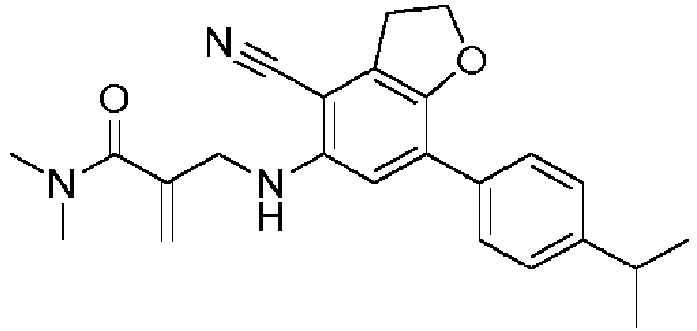
2-[[[4-Cyano-7-(4-isopropylphenyl)-2,3-dihydrobenzofuran-5-yl]amino]methyl]-N,N-dimethylprop-2-enamid 7 
2-[[[4-Cyano-7-(4-isopropylphenyl)-2,3-dihydrobenzofuran-5-yl]-methylamino]methyl]prop-2-ensäure 8 
Methyl-2-[[[4-cyano-7-(4-isopropylphenyl)-2,3-dihydrobenzofuran-5-yl]amino]methyl]prop-2-enoat 9 
2-[[[4-Cyano-7-(4-isopropylphenyl)-2,3-dihydrobenzofuran-5-yl]amino]methyl]prop-2-enhydroxamsäure 10 
1-[[[4-Cyano-7-(4-isopropylphenyl)-2,3-dihydrobenzofuran-5-yl]amino]methyl]vinylboronsäure 11 
7-(4-Isopropylphenyl)-5-[(2-methylen-3-oxo-butyl)amino]-2,3-dihydrobenzofuran-4-carbonitril 12 
2-[[[4-(Hydroxymethyl)-7-(4-isopropylphenyl)-2,3-dihydrobenzofuran-5-yl]amino]methyl]prop-2-ensäure 13 
2-[[[4-(Hydroxymethyl)-7-(4-isopropylphenyl)-2,3-dihydrobenzofuran-5-yl]amino]methyl]prop-2-enamid 14 
2-[[[4-(Hydroxymethyl)-7-(4-isopropylphenyl)-2,3-dihydrobenzofuran-5-yl]amino]methyl]prop-2-enhydroxamsäure 15 
2-[[[4-Cyano-7-[4-(trifluormethyl)phenyl]-2,3-dihydrobenzofuran-5-yl]amino]methyl]prop-2-ensäure 16 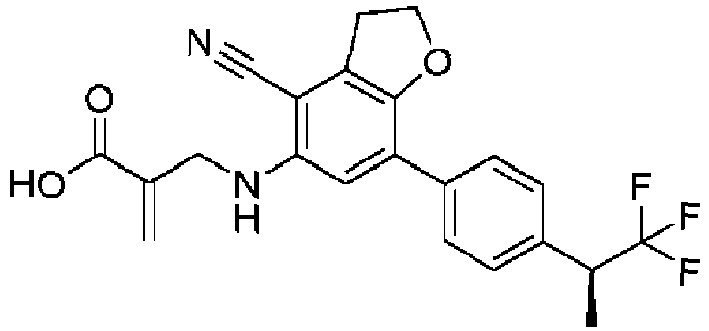
2-[[[4-Cyano-7-[4-[(1S)-2,2,2-trifluor-1-methylethyl]phenyl]-2,3-dihydrobenzofuran-5-yl]amino]methyl]prop-2-ensäure 17 
2-[[[4-Cyano-7-[4-[(1R)-2,2,2-trifluor-1-methylethyl]phenyl]-2,3-dihydrobenzofuran-5-yl]amino]methyl]prop-2-ensäure 18 
2-[[[4-Cyano-7-[4-(trifluormethoxy)phenyl]-2,3-dihydrobenzofuran-5-yl]amino]methyl]prop-2-ensäure 19 
2-[[[4-Cyano-7-[4-(1,1-difluorethyl)phenyl]-2,3-dihydrobenzofuran-5-yl]amino]methyl]prop-2-ensäure 20 
2-[[[4-(4-Isopropylphenyl)-6,7-dihydrofuro[3,2-d]pyrimidin-2-yl]amino]methyl]prop-2-ensäure 21 
2-[[[4-Fluor-7-(4-isopropylphenyl)-2,3-dihydrobenzofuran-5-yl]amino]methyl]prop-2-ensäure 22 
2-[[[4-Cyano-7-(4-isopropylphenyl)-2,3-dihydrofuro[2,3-c]pyridin-5-yl]amino]methyl]prop-2-ensäure 23 
2-[[[7-(4-Isopropylphenyl)-2,3-dihydrofuro[3,2-b]pyridin-5-yl]amino]methyl]prop-2-ensäure 24 
2-[[[7-Cyano-4-[4-(1,1-difluorethyl)phenyl]-1,3-benzothiazol-6-yl]amino]methyl]prop-2-ensäure 27 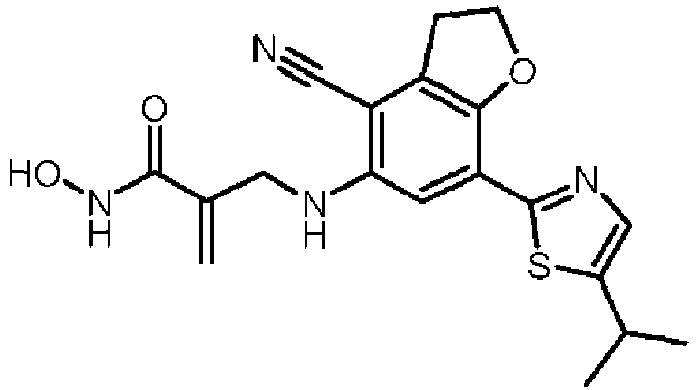
2-[[[4-Cyano-7-(5-isopropylthiazol-2-yl)-2,3-dihydrobenzofuran-5-yl]amino]methyl]prop-2-enhydroxamsäure 28 
2-[[[4-Cyano-7-(2,6-difluor-4-isopropylphenyl)-2,3-dihydrobenzofuran-5-yl]amino]methyl]prop-2-ensäure 29 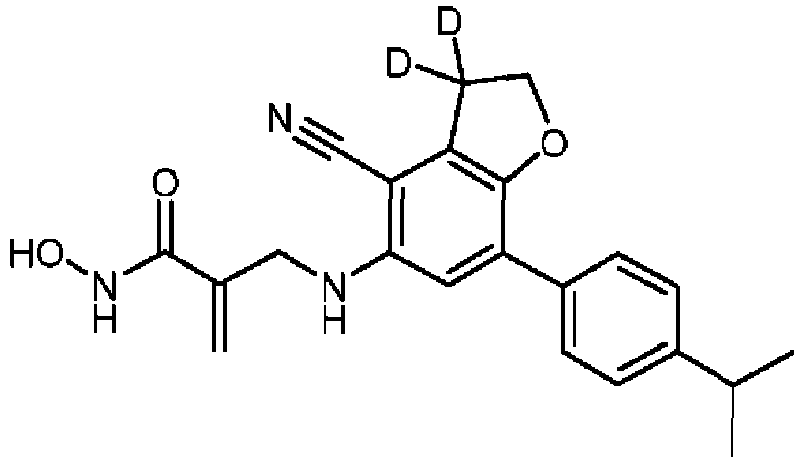
2-[[[4-Cyano-3,3-dideuterio-7-(4-isopropylphenyl)-2H-benzofuran-5-yl]amino]methyl]prop-2-enhydroxamsäure 30 
2-[[[4-Cyano-7-(2-fluor-4-isopropylphenyl)-2,3-dihydrobenzofuran-5-yl]amino]methyl]prop-2-ensäure 31 
2-[[[4-Cyano-7-(4-isopropylthiazol-2-yl)-2,3-dihydrobenzofuran-5-yl]amino]methyl]prop-2-enhydroxamsäure 32 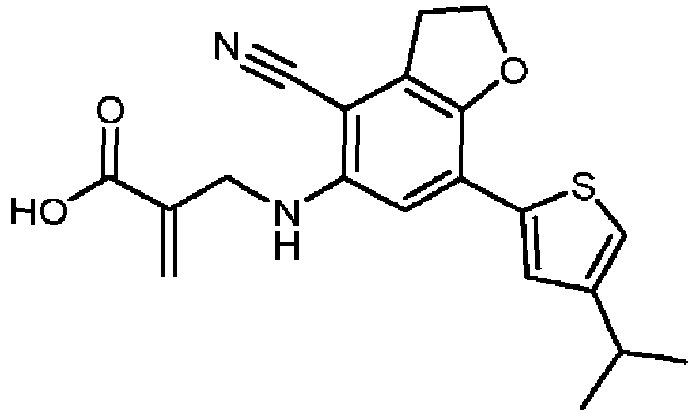
2-[[[4-Cyano-7-(4-isopropyl-2-thienyl)-2,3-dihydrobenzofuran-5-yl]amino]methyl]prop-2-ensäure 33 
2-[[[4-Cyano-3,3-dideuterio-7-(4-isopropylphenyl)-2H-benzofuran-5-yl]amino]methyl]prop-2-enamid 34 
2-[[[4-Carbamoyl-7-(4-isopropylphenyl)-2,3-dihydrobenzofuran-5-yl]amino]methyl]prop-2-ensäure 35 
2-[[[4-(Hydroxymethyl)-7-[4-(trifluormethoxy)phenyl]-2,3-dihydrobenzofuran-5-yl]amino]methyl]prop-2-enamid 36 
2-[[[4-Cyano-7-(3-isopropylpyrazol-1-yl)-2,3-dihydrobenzofuran-5-yl]amino]methyl]prop-2-enhydroxamsäure 37 
2-[[[4-Cyano-2,2-dideuterio-7-[4-(trifluormethoxy)phenyl]-3H-benzofuran-5-yl]amino]methyl]prop-2-enhydroxamsäure 38 
2-[[[4-Cyano-7-[4-(pentafluor-lambda6-sulfanyl)phenyl]-2,3-dihydrobenzofuran-5-yl]amino]methyl]prop-2-enhydroxamsäure 39 
2-[[[4-Cyano-7-[4-(trifluormethoxy)phenyl]-2,3-dihydrobenzofuran-5-yl]amino]methyl]prop-2-enhydroxamsäure 40 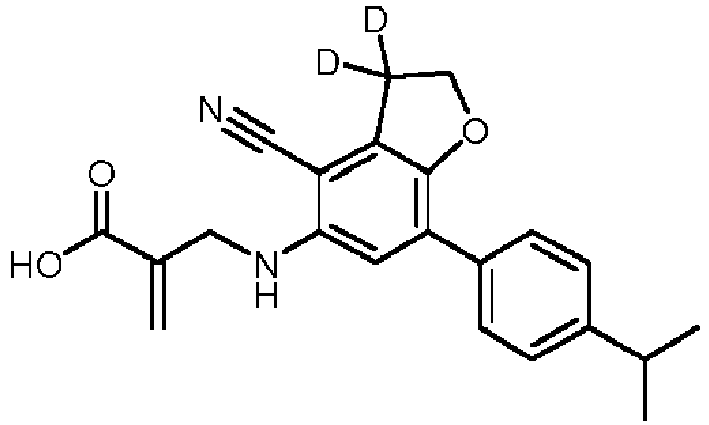
2-[[[4-Cyano-3,3-dideuterio-7-(4-isopropylphenyl)-2H-benzofuran-5-yl]amino]methyl]prop-2-ensäure 41 
2-[[[7-Cyano-4-[4-(trifluormethoxy)phenyl]-1,3-benzothiazol-6-yl]amino]methyl]prop-2-enhydroxamsäure 42 
2-[[[7-Cyano-4-[4-(trifluormethoxy)phenyl]-1,3-benzothiazol-6-yl]amino]methyl]prop-2-enamid 43 
2-[[[4-Cyano-7-[4-(trifluormethoxy)phenyl]-2,3-dihydrobenzofuran-5-yl]amino]methyl]-N-hydroxy-N-methylprop-2-enamid 44 
2-[[[4-Cyano-7-[4-(trifluormethoxy)phenyl]-2,3-dihydrobenzofuran-5-yl]amino]methyl]prop-2-enamid 45 
2-[[[4-Cyano-7-[4-(pentafluor-lambda6-sulfanyl)phenyl]-2,3-dihydrobenzofuran-5-yl]amino]methyl]prop-2-ensäure 46 
2-[[[4-(Hydroxymethyl)-7-[4-(trifluormethoxy)phenyl]-2,3-dihydrobenzofuran-5-yl]amino]methyl]prop-2-enhydroxamsäure 47 
2-[[[4-Cyano-7-(5-isopropyl-2-pyridyl)-2,3-dihydrobenzofuran-5-yl]amino]methyl]prop-2-ensäure 48 
2-[[[4-Cyano-7-[4-(pentafluor-lambda6-sulfanyl)phenyl]-2,3-dihydrobenzofuran-5-yl]amino]methyl]prop-2-enamid 49 
2-[[[4-Cyano-7-(5-isopropylthiazol-2-yl)-2,3-dihydrobenzofuran-5-yl]amino]methyl]prop-2-ensäure 50 
2-[[[7-(4-Isopropylphenyl)-4-methylsulfonyl-2,3-dihydrobenzofuran-5-yl]amino]methyl]prop-2-ensäure 51 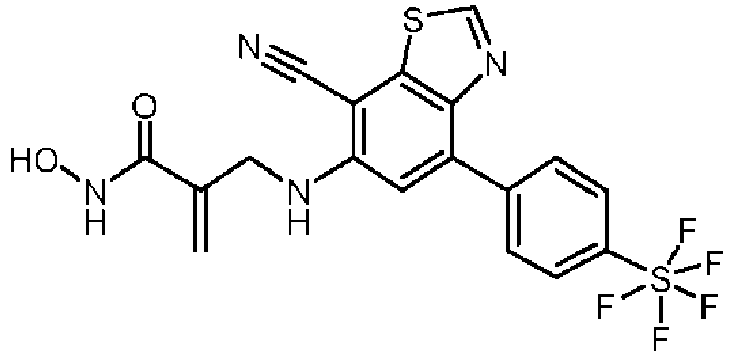
2-[[[7-Cyano-4-[4-(pentafluor-lambda6-sulfanyl)phenyl]-1,3-benzothiazol-6-yl]amino]methyl]prop-2-enhydroxamsäure - Pharmazeutische Zusammensetzung, umfassend (i) eine Verbindung wie in einem der Ansprüche 1-11 beschrieben oder ein Stereoisomer, Tautomer oder pharmazeutisch unbedenkliches Salz davon und (ii) einen pharmazeutisch unbedenklichen Träger, ein pharmazeutisch unbedenkliches Verdünnungsmittel oder einen pharmazeutisch unbedenklichen Hilfsstoff.
- Verbindung wie in einem der Ansprüche 1-11 beschrieben oder ein Stereoisomer, Tautomer oder pharmazeutisch unbedenkliches Salz davon zur Verwendung in medizinischer Therapie.
- Verbindung wie in einem der Ansprüche 1-11 beschrieben oder ein Stereoisomer, Tautomer oder pharmazeutisch unbedenkliches Salz davon zur Verwendung bei der Behandlung und/oder Prophylaxe von Akustikusneurinom, akuter Leukämie, akuter lymphatischer Leukämie, akuter myelozytärer Leukämie (monozytär, myeloblastisch, Adenokarzinom, Angiosarkom, Astrozytom, myelomonozytär und promyelozytär), akuter T-Zell-Leukämie, Basalzellkarzinom, Gallengangkarzinom, Blasenkrebs, Hirnkrebs, Brustkrebs, Bronchialkarzinom, Gebärmutterhalskrebs, Chondrosarkom, Chordom, Choriokarzinom, chronischer Leukämie, chronischer lymphatischer Leukämie, chronischer myelozytäre (granulozytäre) Leukämie, chronischer myelogener Leukämie, Dickdarmkrebs, Kolorektalkrebs, Kraniopharyngiom, Zystadenokarzinom, diffusem großzelligem B-Zell-Lymphom, dysproliferativen Veränderungen (Dysplasien und Metaplasien), embryonalem Karzinom, Gebärmutterschleimhautkrebs, Endotheliosarkom, Ependymom, Epithelzellenkarzinom, Erythroleukämie, Speiseröhrenkrebs, Östrogenrezeptor-positivem Brustkrebs, essentieller Thrombozythämie, Ewing-Sarkom, Fibrosarkom, Follikuläres Lymphom, Keimzelltumor des Hodens, Gliom, Glioblastom, Gliosarkom, Schwerkettenkrankheit, Hämangioblastom, Hepatom, Leberzellkrebs, hormonunempfindlichem Prostatakrebs, Leiomyosarkom, Leukämie, Liposarkom, Lungenkrebs, Lymphangioendotheliom, Lymphangiosarkom, lymphoblastische Leukämie, Lymphom (Hodgkin- und Nicht-Hodgkin), Malignitäten und hyperproliferativen Störungen der Blase, Brust, des Dickdarms, der Lunge, der Eierstöcke, der Bauchspeicheldrüse, der Prostata, der Haut und der Gebärmutter, lymphoiden Malignitäten, die ihren Ursprung in T-Zellen oder B-Zellen haben, medullärem Karzinom, Medulloblastom, Melanom, Meningiom, Mesotheliom, multiplem Myelom, myelogener Leukämie, Myelom, Myxosarkom, Neuroblastom, NUT-Mittellinienkarzinom (NMC), nicht-kleinzelligem Lungenkrebs, Oligodendrogliom, Mundkrebs, Osteosarkom, Eierstockkrebs, Bauchspeicheldrüsenkrebs, papillärem Adenokarzinom, papillärem Karzinom, Pinealom, Polycythaemia vera, Prostatakrebs, Rektumkrebs, Nierenzellkarzinom, Retinoblastom, Rhabdomyosarkom, Sarkom, Talgdrüsenkarzinom, Seminom, Hautkrebs, kleinzelligem Lungenkarzinom, soliden Tumoren (Karzinomen und Sarkomen), kleinzelligem Lungenkrebs, Magenkrebs, Plattenepithelkarzinom, Synoviom, Schweißdrüsenkarzinom, Schilddrüsenkrebs, Waldenström-Makroglobulinämie, Hodentumoren, Gebärmutterkrebs und Wilms-Tumor.
- Verfahren zur Herstellung einer Verbindung der Formel (X) nach Anspruch 1:


Applications Claiming Priority (2)
| Application Number | Priority Date | Filing Date | Title |
|---|---|---|---|
| US202063056498P | 2020-07-24 | 2020-07-24 | |
| PCT/US2021/042968 WO2022020716A1 (en) | 2020-07-24 | 2021-07-23 | Heterocyclic inhibitors of tead for treating cancer |
Publications (3)
| Publication Number | Publication Date |
|---|---|
| EP4185386A1 EP4185386A1 (de) | 2023-05-31 |
| EP4185386C0 EP4185386C0 (de) | 2025-01-08 |
| EP4185386B1 true EP4185386B1 (de) | 2025-01-08 |
Family
ID=77338917
Family Applications (1)
| Application Number | Title | Priority Date | Filing Date |
|---|---|---|---|
| EP21755273.6A Active EP4185386B1 (de) | 2020-07-24 | 2021-07-23 | Heterozyklische inhibitoren von tead zur behandlung von krebs |
Country Status (7)
| Country | Link |
|---|---|
| US (2) | US11787775B2 (de) |
| EP (1) | EP4185386B1 (de) |
| JP (1) | JP7796721B2 (de) |
| CN (1) | CN116234797A (de) |
| AR (1) | AR123049A1 (de) |
| TW (1) | TW202219043A (de) |
| WO (1) | WO2022020716A1 (de) |
Families Citing this family (5)
| Publication number | Priority date | Publication date | Assignee | Title |
|---|---|---|---|---|
| US11787775B2 (en) * | 2020-07-24 | 2023-10-17 | Genentech, Inc. | Therapeutic compounds and methods of use |
| CN117337193A (zh) * | 2021-05-19 | 2024-01-02 | 基因泰克公司 | 组合疗法 |
| EP4504203A1 (de) * | 2022-04-04 | 2025-02-12 | Sanofi | Therapeutische kombination aus kras-g12c-hemmer und tead-hemmer |
| AU2023349151A1 (en) | 2022-09-29 | 2025-04-03 | Insilico Medicine Ip Limited | Tead inhibitors and methods of uses thereof |
| CN117362234A (zh) * | 2023-09-25 | 2024-01-09 | 苏州凯瑞医药科技有限公司 | 一种5-溴-7氯-1h吲唑的制备方法 |
Family Cites Families (113)
| Publication number | Priority date | Publication date | Assignee | Title |
|---|---|---|---|---|
| US4943A (en) | 1847-01-26 | Harness-buckle | ||
| US533A (en) | 1837-12-26 | Truss for hermta | ||
| US3773919A (en) | 1969-10-23 | 1973-11-20 | Du Pont | Polylactide-drug mixtures |
| CU22545A1 (es) | 1994-11-18 | 1999-03-31 | Centro Inmunologia Molecular | Obtención de un anticuerpo quimérico y humanizado contra el receptor del factor de crecimiento epidérmico para uso diagnóstico y terapéutico |
| US4485045A (en) | 1981-07-06 | 1984-11-27 | Research Corporation | Synthetic phosphatidyl cholines useful in forming liposomes |
| EP0102324A3 (de) | 1982-07-29 | 1984-11-07 | Ciba-Geigy Ag | Lipide und Tenside in wässriger Phase |
| US4544545A (en) | 1983-06-20 | 1985-10-01 | Trustees University Of Massachusetts | Liposomes containing modified cholesterol for organ targeting |
| HUT35524A (en) | 1983-08-02 | 1985-07-29 | Hoechst Ag | Process for preparing pharmaceutical compositions containing regulatory /regulative/ peptides providing for the retarded release of the active substance |
| US5004697A (en) | 1987-08-17 | 1991-04-02 | Univ. Of Ca | Cationized antibodies for delivery through the blood-brain barrier |
| EP0491007B1 (de) | 1989-09-08 | 1996-03-13 | The Johns Hopkins University | Modifikationen der struktur des egf-rezeptor-gens in menschlichen glioma |
| US5268164A (en) | 1990-04-23 | 1993-12-07 | Alkermes, Inc. | Increasing blood-brain barrier permeability with permeabilizer peptides |
| US5112596A (en) | 1990-04-23 | 1992-05-12 | Alkermes, Inc. | Method for increasing blood-brain barrier permeability by administering a bradykinin agonist of blood-brain barrier permeability |
| AU661533B2 (en) | 1992-01-20 | 1995-07-27 | Astrazeneca Ab | Quinazoline derivatives |
| ATE191853T1 (de) | 1992-07-27 | 2000-05-15 | Us Health | Zielgerichte liposome zur blut-hirne schranke |
| GB9314893D0 (en) | 1993-07-19 | 1993-09-01 | Zeneca Ltd | Quinazoline derivatives |
| EP0659439B1 (de) | 1993-12-24 | 2001-10-24 | MERCK PATENT GmbH | Immunokonjugate |
| IL112248A0 (en) | 1994-01-25 | 1995-03-30 | Warner Lambert Co | Tricyclic heteroaromatic compounds and pharmaceutical compositions containing them |
| US5679683A (en) | 1994-01-25 | 1997-10-21 | Warner-Lambert Company | Tricyclic compounds capable of inhibiting tyrosine kinases of the epidermal growth factor receptor family |
| IL112249A (en) | 1994-01-25 | 2001-11-25 | Warner Lambert Co | Pharmaceutical compositions containing di and tricyclic pyrimidine derivatives for inhibiting tyrosine kinases of the epidermal growth factor receptor family and some new such compounds |
| PL179659B1 (pl) | 1994-07-21 | 2000-10-31 | Akzo Nobel Nv | Kompozycja cyklicznych nadtlenków ketonów sluzaca do modyfikowania (ko)polimerów zwlaszcza do degradacji polipropylenu PL PL PL PL PL PL PL |
| US5804396A (en) | 1994-10-12 | 1998-09-08 | Sugen, Inc. | Assay for agents active in proliferative disorders |
| MX9707453A (es) | 1995-03-30 | 1997-12-31 | Pfizer | Derivados de quinazolina. |
| GB9508538D0 (en) | 1995-04-27 | 1995-06-14 | Zeneca Ltd | Quinazoline derivatives |
| GB9508565D0 (en) | 1995-04-27 | 1995-06-14 | Zeneca Ltd | Quiazoline derivative |
| US5747498A (en) | 1996-05-28 | 1998-05-05 | Pfizer Inc. | Alkynyl and azido-substituted 4-anilinoquinazolines |
| AU6267896A (en) | 1995-06-07 | 1996-12-30 | Imclone Systems Incorporated | Antibody and antibody fragments for inhibiting the growth oftumors |
| MX9800215A (es) | 1995-07-06 | 1998-03-31 | Novartis Ag | Pirrolopirimidas y procesos para su preparacion. |
| US5760041A (en) | 1996-02-05 | 1998-06-02 | American Cyanamid Company | 4-aminoquinazoline EGFR Inhibitors |
| GB9603095D0 (en) | 1996-02-14 | 1996-04-10 | Zeneca Ltd | Quinazoline derivatives |
| HU228446B1 (en) | 1996-04-12 | 2013-03-28 | Warner Lambert Co | Kinazoline derivatives as irreversible inhibitors of protein-kinase, pharmaceutical compositions containing these compounds and use thereof |
| ID19609A (id) | 1996-07-13 | 1998-07-23 | Glaxo Group Ltd | Senyawa-senyawa heterosiklik |
| ID18494A (id) | 1996-10-02 | 1998-04-16 | Novartis Ag | Turunan pirazola leburan dan proses pembuatannya |
| US6002008A (en) | 1997-04-03 | 1999-12-14 | American Cyanamid Company | Substituted 3-cyano quinolines |
| UA73073C2 (uk) | 1997-04-03 | 2005-06-15 | Уайт Холдінгз Корпорейшн | Заміщені 3-ціанохіноліни, спосіб їх одержання та фармацевтична композиція |
| US6235883B1 (en) | 1997-05-05 | 2001-05-22 | Abgenix, Inc. | Human monoclonal antibodies to epidermal growth factor receptor |
| ATE241986T1 (de) | 1997-05-06 | 2003-06-15 | Wyeth Corp | Verwendung von chinazolin verbindungen zur behandlung von polyzystischer nierenkrankheit |
| ZA986729B (en) | 1997-07-29 | 1999-02-02 | Warner Lambert Co | Irreversible inhibitors of tyrosine kinases |
| ZA986732B (en) | 1997-07-29 | 1999-02-02 | Warner Lambert Co | Irreversible inhibitiors of tyrosine kinases |
| TW436485B (en) | 1997-08-01 | 2001-05-28 | American Cyanamid Co | Substituted quinazoline derivatives |
| CN1278176A (zh) | 1997-11-06 | 2000-12-27 | 美国氰胺公司 | 喹唑啉衍生物作为用于治疗结肠息肉的酪氨酸激酶抑制剂的应用 |
| WO2000031048A1 (en) | 1998-11-19 | 2000-06-02 | Warner-Lambert Company | N-[4-(3-chloro-4-fluoro-phenylamino)-7-(3-morpholin-4-yl-propoxy)-quinazolin-6-yl]-acrylamide, an irreversible inhibitor of tyrosine kinases |
| JP2000302778A (ja) | 1999-04-27 | 2000-10-31 | Yamanouchi Pharmaceut Co Ltd | イソキノリノン誘導体又はその塩 |
| US6514221B2 (en) | 2000-07-27 | 2003-02-04 | Brigham And Women's Hospital, Inc. | Blood-brain barrier opening |
| US20020065259A1 (en) | 2000-08-30 | 2002-05-30 | Schatzberg Alan F. | Glucocorticoid blocking agents for increasing blood-brain barrier permeability |
| US7034036B2 (en) | 2000-10-30 | 2006-04-25 | Pain Therapeutics, Inc. | Inhibitors of ABC drug transporters at the blood-brain barrier |
| GB0100623D0 (en) | 2001-01-10 | 2001-02-21 | Vernalis Res Ltd | Chemical compounds IV |
| GB0100620D0 (en) | 2001-01-10 | 2001-02-21 | Vernalis Res Ltd | Chemical cokpounds V |
| DE10121982B4 (de) | 2001-05-05 | 2008-01-24 | Lts Lohmann Therapie-Systeme Ag | Nanopartikel aus Protein mit gekoppeltem Apolipoprotein E zur Überwindung der Blut-Hirn-Schranke und Verfahren zu ihrer Herstellung |
| JP4202250B2 (ja) | 2001-07-25 | 2008-12-24 | バイオマリン ファーマシューティカル インコーポレイテッド | 血液脳関門輸送を調節するための組成物および方法 |
| US20030162695A1 (en) | 2002-02-27 | 2003-08-28 | Schatzberg Alan F. | Glucocorticoid blocking agents for increasing blood-brain barrier permeability |
| CN101284136A (zh) | 2002-12-03 | 2008-10-15 | 布朗歇特洛克菲勒神经科学研究所 | 传输物质穿过血脑屏障的人工低密度脂蛋白载体 |
| BRPI0411740A (pt) * | 2003-06-26 | 2006-05-23 | Takeda Pharmaceutical | modulador do receptor de canabinóide, composto, pró-droga, droga, método para prevenir ou tratar uma doença ou condição, uso de um composto, e, método para preparar um composto |
| US20050089473A1 (en) | 2003-09-10 | 2005-04-28 | Cedars-Sinai Medical Center | Potassium channel mediated delivery of agents through the blood-brain barrier |
| RU2494107C2 (ru) | 2005-05-09 | 2013-09-27 | Оно Фармасьютикал Ко., Лтд. | Моноклональные антитела человека к белку программируемой смерти 1 (pd-1) и способы лечения рака с использованием анти-pd-1-антител самостоятельно или в комбинации с другими иммунотерапевтическими средствами |
| CN104356236B (zh) | 2005-07-01 | 2020-07-03 | E.R.施贵宝&圣斯有限责任公司 | 抗程序性死亡配体1(pd-l1)的人单克隆抗体 |
| WO2009114335A2 (en) | 2008-03-12 | 2009-09-17 | Merck & Co., Inc. | Pd-1 binding proteins |
| WO2010098788A2 (en) | 2008-08-25 | 2010-09-02 | Amplimmune, Inc. | Pd-i antagonists and methods for treating infectious disease |
| AU2009333580B2 (en) | 2008-12-09 | 2016-07-07 | Genentech, Inc. | Anti-PD-L1 antibodies and their use to enhance T-cell function |
| US8610501B2 (en) | 2009-11-16 | 2013-12-17 | Covidien Lp | Class resonant-H electrosurgical generators |
| WO2011066342A2 (en) | 2009-11-24 | 2011-06-03 | Amplimmune, Inc. | Simultaneous inhibition of pd-l1/pd-l2 |
| NZ628923A (en) | 2009-11-24 | 2016-02-26 | Medimmune Ltd | Targeted binding agents against b7-h1 |
| US8907053B2 (en) | 2010-06-25 | 2014-12-09 | Aurigene Discovery Technologies Limited | Immunosuppression modulating compounds |
| KR101970025B1 (ko) | 2011-04-20 | 2019-04-17 | 메디뮨 엘엘씨 | B7-h1 및 pd-1과 결합하는 항체 및 다른 분자들 |
| CN103732238A (zh) | 2011-06-08 | 2014-04-16 | 奥瑞基尼探索技术有限公司 | 用于免疫调节的治疗性化合物 |
| WO2013132317A1 (en) | 2012-03-07 | 2013-09-12 | Aurigene Discovery Technologies Limited | Peptidomimetic compounds as immunomodulators |
| AU2013239366A1 (en) | 2012-03-29 | 2014-10-16 | Aurigene Discovery Technologies Limited | Immunomodulating cyclic compounds from the BC loop of human PD1 |
| HK1204557A1 (en) | 2012-05-31 | 2015-11-27 | Sorrento Therapeutics, Inc. | Antigen binding proteins that bind pd-l1 |
| US9604937B2 (en) | 2012-11-27 | 2017-03-28 | Thomas Helledays Stiftelse For Medicinsk Forskning | Pyrimidine-2,4-diamine derivatives for treatment of cancer |
| JP6742903B2 (ja) | 2013-05-02 | 2020-08-19 | アナプティスバイオ インコーポレイティッド | プログラム死−1(pd−1)に対する抗体 |
| US9676853B2 (en) | 2013-05-31 | 2017-06-13 | Sorrento Therapeutics, Inc. | Antigen binding proteins that bind PD-1 |
| CN104250302B (zh) | 2013-06-26 | 2017-11-14 | 上海君实生物医药科技股份有限公司 | 抗pd‑1抗体及其应用 |
| HRP20181052T1 (hr) | 2013-09-06 | 2018-09-07 | Aurigene Discovery Technologies Limited | Derivati 1,2,4-oksadiazola kao imunomodulatori |
| EP3041468B1 (de) | 2013-09-06 | 2018-06-13 | Aurigene Discovery Technologies Limited | Cyclische peptidomimetische verbindungen als immunmodulatoren |
| SI3041828T1 (sl) | 2013-09-06 | 2018-10-30 | Aurigene Discovery Technologies Limited | 1,3,4-oksadiazolni in 1,3,4-tiadiazolni derivati kot imunomodulatorji |
| WO2015036927A1 (en) | 2013-09-10 | 2015-03-19 | Aurigene Discovery Technologies Limited | Immunomodulating peptidomimetic derivatives |
| EA034666B1 (ru) | 2013-09-13 | 2020-03-04 | Бейджин Свитзерланд Гмбх | Антитело против pd-1 и его применение для лечения рака или вирусной инфекции и фрагмент антитела |
| WO2015044900A1 (en) | 2013-09-27 | 2015-04-02 | Aurigene Discovery Technologies Limited | Therapeutic immunomodulating compounds |
| MY184154A (en) | 2013-12-12 | 2021-03-23 | Shanghai hengrui pharmaceutical co ltd | Pd-1 antibody, antigen-binding fragment thereof, and medical application thereof |
| TWI680138B (zh) | 2014-01-23 | 2019-12-21 | 美商再生元醫藥公司 | 抗pd-l1之人類抗體 |
| TWI681969B (zh) | 2014-01-23 | 2020-01-11 | 美商再生元醫藥公司 | 針對pd-1的人類抗體 |
| SG10201900002QA (en) | 2014-01-24 | 2019-02-27 | Dana Farber Cancer Institue Inc | Antibody molecules to pd-1 and uses thereof |
| EA201691376A1 (ru) | 2014-02-04 | 2017-01-30 | Пфайзер Инк. | Комбинация антагониста pd-1 и ингибитора vegfr для лечения рака |
| EP3686219A1 (de) | 2014-02-04 | 2020-07-29 | Pfizer Inc | Kombination eines pd-1-antagonisten und eines 4-1bb-agonisten zur behandlung von krebs |
| EP2913330A1 (de) | 2014-02-27 | 2015-09-02 | Laboratoire Biodim | Als Arzneimittel geeignete kondensierte Derivate von Imidazol |
| TWI726608B (zh) | 2014-07-03 | 2021-05-01 | 英屬開曼群島商百濟神州有限公司 | 抗pd-l1抗體及其作為治療及診斷之用途 |
| CA2955676A1 (en) | 2014-08-25 | 2016-03-03 | Pfizer Inc. | Combination of a pd-1 antagonist and an alk inhibitor for treating cancer |
| TWI716362B (zh) | 2014-10-14 | 2021-01-21 | 瑞士商諾華公司 | 針對pd-l1之抗體分子及其用途 |
| WO2016089873A1 (en) | 2014-12-02 | 2016-06-09 | Celgene Corporation | Combination therapies |
| WO2016106160A1 (en) | 2014-12-22 | 2016-06-30 | Enumeral Biomedical Holdings, Inc. | Methods for screening therapeutic compounds |
| EP3353156B1 (de) | 2015-09-23 | 2021-11-03 | The General Hospital Corporation | Autopalmitoylierungsinhibitoren des tead-transkriptionsfaktors |
| WO2017058716A1 (en) | 2015-09-28 | 2017-04-06 | Vivace Therapeutics, Inc. | Tricyclic compounds |
| EP3156404A1 (de) | 2015-10-15 | 2017-04-19 | Inventiva | Neue verbindungsinhibitoren der yap/taz-tead interaktion und verwendung zur behandlung von malignem mesotheliom |
| CZ2016608A3 (cs) | 2015-10-26 | 2017-01-18 | Ústav experimentální botaniky AV ČR, v. v. i. | 2,6-disubstituované puriny pro použití jako léčiva, a farmaceutické přípravky |
| CZ306987B6 (cs) | 2015-10-26 | 2017-11-01 | Ústav experimentální botaniky AV ČR, v. v. i. | 2,6-disubstituované puriny pro použití jako léčiva a farmaceutické přípravky je obsahující |
| JP7164542B2 (ja) | 2017-04-06 | 2022-11-01 | インベンティバ | 新規な化合物であるyap/taz-tead相互作用阻害剤、および悪性中皮腫の治療でのその使用 |
| WO2018204532A1 (en) | 2017-05-03 | 2018-11-08 | Vivace Therapeutics, Inc. | Non-fused tricyclic compounds |
| CA3073543A1 (en) | 2017-08-21 | 2019-02-28 | Vivace Therapeutics, Inc. | Benzosulfonyl compounds |
| US11524943B1 (en) | 2017-12-06 | 2022-12-13 | Vivace Therapeutics, Inc. | Benzocarbonyl compounds |
| EP3793551A4 (de) | 2018-05-16 | 2022-01-26 | Vivace Therapeutics, Inc. | Oxadiazolverbindungen |
| CN112204029B (zh) | 2018-05-31 | 2024-03-01 | 豪夫迈·罗氏有限公司 | 治疗性化合物 |
| WO2019235569A1 (ja) | 2018-06-08 | 2019-12-12 | 日産化学株式会社 | キナーゼ阻害剤 |
| US20210221817A1 (en) | 2018-08-31 | 2021-07-22 | Nivien Therapeutics Compny | Novel heteroaromatic compounds as potent modulators of the hippo-yap signaling pathway lats1/2 kinases |
| WO2020051099A1 (en) | 2018-09-03 | 2020-03-12 | Genentech, Inc. | Carboxamide and sulfonamide derivatives useful as tead modulators |
| EP3632908A1 (de) | 2018-10-02 | 2020-04-08 | Inventiva | Inhibitoren der yap / taz-tead-interaktion und ihre verwendung bei der behandlung von krebs |
| WO2020081572A1 (en) | 2018-10-15 | 2020-04-23 | Dana-Farber Cancer Institute, Inc. | Transcriptional enhanced associate domain (tead) transcription factor inhibitors and uses thereof |
| KR102343865B1 (ko) | 2018-11-09 | 2021-12-28 | 한국화학연구원 | Yap-tead 결합을 저해하는 화합물 및 이를 유효 성분으로 함유하는 암의 예방 또는 치료용 약제학적 조성물 |
| CA3118752A1 (en) | 2018-11-09 | 2020-05-14 | Vivace Therapeutics, Inc. | Bicyclic compounds |
| WO2020096416A1 (ko) | 2018-11-09 | 2020-05-14 | 한국화학연구원 | Yap-tead 결합을 저해하는 화합물 및 이를 유효 성분으로 함유하는 암의 예방 또는 치료용 약제학적 조성물 |
| EP3937943A4 (de) | 2019-03-15 | 2022-12-07 | The General Hospital Corporation | Neue kleinmolekülige inhibitoren der tead-transkriptionsfaktoren |
| HUE070525T2 (hu) | 2019-04-16 | 2025-06-28 | Vivace Therapeutics Inc | Biciklusos vegyületek |
| WO2020243423A1 (en) | 2019-05-31 | 2020-12-03 | Ikena Oncology, Inc. | Tead inhibitors and uses thereof |
| AU2020320008A1 (en) | 2019-07-29 | 2022-03-17 | Basilea Pharmaceutica International AG | 1,2,4-oxadiazol-5-one derivatives for the treatment of cancer |
| US11787775B2 (en) * | 2020-07-24 | 2023-10-17 | Genentech, Inc. | Therapeutic compounds and methods of use |
-
2021
- 2021-07-22 US US17/383,422 patent/US11787775B2/en active Active
- 2021-07-23 EP EP21755273.6A patent/EP4185386B1/de active Active
- 2021-07-23 JP JP2023504662A patent/JP7796721B2/ja active Active
- 2021-07-23 CN CN202180053799.9A patent/CN116234797A/zh active Pending
- 2021-07-23 WO PCT/US2021/042968 patent/WO2022020716A1/en not_active Ceased
- 2021-07-23 AR ARP210102072A patent/AR123049A1/es unknown
- 2021-07-26 TW TW110127421A patent/TW202219043A/zh unknown
-
2023
- 2023-09-21 US US18/472,105 patent/US12435054B2/en active Active
Also Published As
| Publication number | Publication date |
|---|---|
| US12435054B2 (en) | 2025-10-07 |
| JP2023535082A (ja) | 2023-08-15 |
| US20230054741A1 (en) | 2023-02-23 |
| US20240208919A1 (en) | 2024-06-27 |
| WO2022020716A1 (en) | 2022-01-27 |
| AR123049A1 (es) | 2022-10-26 |
| EP4185386A1 (de) | 2023-05-31 |
| CN116234797A (zh) | 2023-06-06 |
| TW202219043A (zh) | 2022-05-16 |
| EP4185386C0 (de) | 2025-01-08 |
| US11787775B2 (en) | 2023-10-17 |
| JP7796721B2 (ja) | 2026-01-09 |
Similar Documents
| Publication | Publication Date | Title |
|---|---|---|
| JP7535500B2 (ja) | Teadモジュレーターとして有用なカルボキサミドおよびスルホンアミド誘導体 | |
| EP4185386B1 (de) | Heterozyklische inhibitoren von tead zur behandlung von krebs | |
| US10183009B2 (en) | Therapeutic compounds and uses thereof | |
| US10206931B2 (en) | Therapeutic compounds and uses thereof | |
| JP7629916B2 (ja) | 治療用化合物および使用方法 | |
| JP6767969B2 (ja) | がんの処置における使用のためのpcafおよびgcn5阻害剤としての式(i)のフタラジン誘導体 | |
| JP7741809B2 (ja) | Tead阻害剤としてのヘテロ二官能性分子 | |
| US10358437B2 (en) | Therapeutic compounds and uses thereof | |
| JP2018510851A (ja) | 治療用ピリダジン化合物およびその使用 | |
| WO2016112298A1 (en) | Pyridazinone derivatives and their use in the treatment of cancer | |
| TW202340212A (zh) | 治療性化合物及其使用方法 | |
| HK40088635A (zh) | 用於治疗癌症的tead的杂环抑制剂 | |
| HK1242696B (zh) | 治療性化合物及其用途 |
Legal Events
| Date | Code | Title | Description |
|---|---|---|---|
| STAA | Information on the status of an ep patent application or granted ep patent |
Free format text: STATUS: UNKNOWN |
|
| STAA | Information on the status of an ep patent application or granted ep patent |
Free format text: STATUS: THE INTERNATIONAL PUBLICATION HAS BEEN MADE |
|
| PUAI | Public reference made under article 153(3) epc to a published international application that has entered the european phase |
Free format text: ORIGINAL CODE: 0009012 |
|
| STAA | Information on the status of an ep patent application or granted ep patent |
Free format text: STATUS: REQUEST FOR EXAMINATION WAS MADE |
|
| 17P | Request for examination filed |
Effective date: 20230224 |
|
| AK | Designated contracting states |
Kind code of ref document: A1 Designated state(s): AL AT BE BG CH CY CZ DE DK EE ES FI FR GB GR HR HU IE IS IT LI LT LU LV MC MK MT NL NO PL PT RO RS SE SI SK SM TR |
|
| DAV | Request for validation of the european patent (deleted) | ||
| DAX | Request for extension of the european patent (deleted) | ||
| STAA | Information on the status of an ep patent application or granted ep patent |
Free format text: STATUS: EXAMINATION IS IN PROGRESS |
|
| 17Q | First examination report despatched |
Effective date: 20231208 |
|
| GRAP | Despatch of communication of intention to grant a patent |
Free format text: ORIGINAL CODE: EPIDOSNIGR1 |
|
| STAA | Information on the status of an ep patent application or granted ep patent |
Free format text: STATUS: GRANT OF PATENT IS INTENDED |
|
| INTG | Intention to grant announced |
Effective date: 20240807 |
|
| GRAS | Grant fee paid |
Free format text: ORIGINAL CODE: EPIDOSNIGR3 |
|
| GRAA | (expected) grant |
Free format text: ORIGINAL CODE: 0009210 |
|
| STAA | Information on the status of an ep patent application or granted ep patent |
Free format text: STATUS: THE PATENT HAS BEEN GRANTED |
|
| AK | Designated contracting states |
Kind code of ref document: B1 Designated state(s): AL AT BE BG CH CY CZ DE DK EE ES FI FR GB GR HR HU IE IS IT LI LT LU LV MC MK MT NL NO PL PT RO RS SE SI SK SM TR |
|
| REG | Reference to a national code |
Ref country code: GB Ref legal event code: FG4D |
|
| REG | Reference to a national code |
Ref country code: CH Ref legal event code: EP |
|
| REG | Reference to a national code |
Ref country code: DE Ref legal event code: R096 Ref document number: 602021024703 Country of ref document: DE |
|
| REG | Reference to a national code |
Ref country code: IE Ref legal event code: FG4D |
|
| U01 | Request for unitary effect filed |
Effective date: 20250108 |
|
| U07 | Unitary effect registered |
Designated state(s): AT BE BG DE DK EE FI FR IT LT LU LV MT NL PT RO SE SI Effective date: 20250114 |
|
| PG25 | Lapsed in a contracting state [announced via postgrant information from national office to epo] |
Ref country code: RS Free format text: LAPSE BECAUSE OF FAILURE TO SUBMIT A TRANSLATION OF THE DESCRIPTION OR TO PAY THE FEE WITHIN THE PRESCRIBED TIME-LIMIT Effective date: 20250408 |
|
| PG25 | Lapsed in a contracting state [announced via postgrant information from national office to epo] |
Ref country code: PL Free format text: LAPSE BECAUSE OF FAILURE TO SUBMIT A TRANSLATION OF THE DESCRIPTION OR TO PAY THE FEE WITHIN THE PRESCRIBED TIME-LIMIT Effective date: 20250108 |
|
| PG25 | Lapsed in a contracting state [announced via postgrant information from national office to epo] |
Ref country code: ES Free format text: LAPSE BECAUSE OF FAILURE TO SUBMIT A TRANSLATION OF THE DESCRIPTION OR TO PAY THE FEE WITHIN THE PRESCRIBED TIME-LIMIT Effective date: 20250108 |
|
| PGFP | Annual fee paid to national office [announced via postgrant information from national office to epo] |
Ref country code: GB Payment date: 20250619 Year of fee payment: 5 |
|
| PG25 | Lapsed in a contracting state [announced via postgrant information from national office to epo] |
Ref country code: NO Free format text: LAPSE BECAUSE OF FAILURE TO SUBMIT A TRANSLATION OF THE DESCRIPTION OR TO PAY THE FEE WITHIN THE PRESCRIBED TIME-LIMIT Effective date: 20250408 Ref country code: IS Free format text: LAPSE BECAUSE OF FAILURE TO SUBMIT A TRANSLATION OF THE DESCRIPTION OR TO PAY THE FEE WITHIN THE PRESCRIBED TIME-LIMIT Effective date: 20250508 |
|
| PG25 | Lapsed in a contracting state [announced via postgrant information from national office to epo] |
Ref country code: HR Free format text: LAPSE BECAUSE OF FAILURE TO SUBMIT A TRANSLATION OF THE DESCRIPTION OR TO PAY THE FEE WITHIN THE PRESCRIBED TIME-LIMIT Effective date: 20250108 |
|
| PG25 | Lapsed in a contracting state [announced via postgrant information from national office to epo] |
Ref country code: GR Free format text: LAPSE BECAUSE OF FAILURE TO SUBMIT A TRANSLATION OF THE DESCRIPTION OR TO PAY THE FEE WITHIN THE PRESCRIBED TIME-LIMIT Effective date: 20250409 |
|
| U20 | Renewal fee for the european patent with unitary effect paid |
Year of fee payment: 5 Effective date: 20250620 |
|
| PG25 | Lapsed in a contracting state [announced via postgrant information from national office to epo] |
Ref country code: SM Free format text: LAPSE BECAUSE OF FAILURE TO SUBMIT A TRANSLATION OF THE DESCRIPTION OR TO PAY THE FEE WITHIN THE PRESCRIBED TIME-LIMIT Effective date: 20250108 |
|
| PGFP | Annual fee paid to national office [announced via postgrant information from national office to epo] |
Ref country code: CH Payment date: 20250801 Year of fee payment: 5 |
|
| PG25 | Lapsed in a contracting state [announced via postgrant information from national office to epo] |
Ref country code: CZ Free format text: LAPSE BECAUSE OF FAILURE TO SUBMIT A TRANSLATION OF THE DESCRIPTION OR TO PAY THE FEE WITHIN THE PRESCRIBED TIME-LIMIT Effective date: 20250108 |
|
| PG25 | Lapsed in a contracting state [announced via postgrant information from national office to epo] |
Ref country code: SK Free format text: LAPSE BECAUSE OF FAILURE TO SUBMIT A TRANSLATION OF THE DESCRIPTION OR TO PAY THE FEE WITHIN THE PRESCRIBED TIME-LIMIT Effective date: 20250108 |
|
| PLBE | No opposition filed within time limit |
Free format text: ORIGINAL CODE: 0009261 |
|
| STAA | Information on the status of an ep patent application or granted ep patent |
Free format text: STATUS: NO OPPOSITION FILED WITHIN TIME LIMIT |
|
| 26N | No opposition filed |
Effective date: 20251009 |