EP4183286B1 - Verfahren zur herstellung von sohlen für schuhwerk unter verwendung von recyclingmaterial - Google Patents
Verfahren zur herstellung von sohlen für schuhwerk unter verwendung von recyclingmaterial Download PDFInfo
- Publication number
- EP4183286B1 EP4183286B1 EP22208224.0A EP22208224A EP4183286B1 EP 4183286 B1 EP4183286 B1 EP 4183286B1 EP 22208224 A EP22208224 A EP 22208224A EP 4183286 B1 EP4183286 B1 EP 4183286B1
- Authority
- EP
- European Patent Office
- Prior art keywords
- tennis balls
- fragments
- soles
- making
- footwear according
- Prior art date
- Legal status (The legal status is an assumption and is not a legal conclusion. Google has not performed a legal analysis and makes no representation as to the accuracy of the status listed.)
- Active
Links
Images
Classifications
-
- A—HUMAN NECESSITIES
- A43—FOOTWEAR
- A43B—CHARACTERISTIC FEATURES OF FOOTWEAR; PARTS OF FOOTWEAR
- A43B1/00—Footwear characterised by the material
- A43B1/0063—Footwear characterised by the material made at least partially of material that can be recycled
-
- A—HUMAN NECESSITIES
- A43—FOOTWEAR
- A43B—CHARACTERISTIC FEATURES OF FOOTWEAR; PARTS OF FOOTWEAR
- A43B1/00—Footwear characterised by the material
- A43B1/10—Footwear characterised by the material made of rubber
- A43B1/12—Footwear characterised by the material made of rubber of rubber waste
-
- A—HUMAN NECESSITIES
- A43—FOOTWEAR
- A43B—CHARACTERISTIC FEATURES OF FOOTWEAR; PARTS OF FOOTWEAR
- A43B13/00—Soles; Sole-and-heel integral units
- A43B13/02—Soles; Sole-and-heel integral units characterised by the material
- A43B13/04—Plastics, rubber or vulcanised fibre
-
- B—PERFORMING OPERATIONS; TRANSPORTING
- B29—WORKING OF PLASTICS; WORKING OF SUBSTANCES IN A PLASTIC STATE IN GENERAL
- B29B—PREPARATION OR PRETREATMENT OF THE MATERIAL TO BE SHAPED; MAKING GRANULES OR PREFORMS; RECOVERY OF PLASTICS OR OTHER CONSTITUENTS OF WASTE MATERIAL CONTAINING PLASTICS
- B29B17/00—Recovery of plastics or other constituents of waste material containing plastics
- B29B17/0026—Recovery of plastics or other constituents of waste material containing plastics by agglomeration or compacting
- B29B17/0042—Recovery of plastics or other constituents of waste material containing plastics by agglomeration or compacting for shaping parts, e.g. multilayered parts with at least one layer containing regenerated plastic
-
- B—PERFORMING OPERATIONS; TRANSPORTING
- B29—WORKING OF PLASTICS; WORKING OF SUBSTANCES IN A PLASTIC STATE IN GENERAL
- B29B—PREPARATION OR PRETREATMENT OF THE MATERIAL TO BE SHAPED; MAKING GRANULES OR PREFORMS; RECOVERY OF PLASTICS OR OTHER CONSTITUENTS OF WASTE MATERIAL CONTAINING PLASTICS
- B29B17/00—Recovery of plastics or other constituents of waste material containing plastics
- B29B17/04—Disintegrating plastics, e.g. by milling
-
- B—PERFORMING OPERATIONS; TRANSPORTING
- B29—WORKING OF PLASTICS; WORKING OF SUBSTANCES IN A PLASTIC STATE IN GENERAL
- B29D—PRODUCING PARTICULAR ARTICLES FROM PLASTICS OR FROM SUBSTANCES IN A PLASTIC STATE
- B29D35/00—Producing footwear
- B29D35/02—Producing footwear made in one piece using a moulding technique, e.g. by injection moulding or casting
-
- B—PERFORMING OPERATIONS; TRANSPORTING
- B29—WORKING OF PLASTICS; WORKING OF SUBSTANCES IN A PLASTIC STATE IN GENERAL
- B29D—PRODUCING PARTICULAR ARTICLES FROM PLASTICS OR FROM SUBSTANCES IN A PLASTIC STATE
- B29D35/00—Producing footwear
- B29D35/12—Producing parts thereof, e.g. soles, heels, uppers, by a moulding technique
- B29D35/122—Soles
-
- B—PERFORMING OPERATIONS; TRANSPORTING
- B29—WORKING OF PLASTICS; WORKING OF SUBSTANCES IN A PLASTIC STATE IN GENERAL
- B29B—PREPARATION OR PRETREATMENT OF THE MATERIAL TO BE SHAPED; MAKING GRANULES OR PREFORMS; RECOVERY OF PLASTICS OR OTHER CONSTITUENTS OF WASTE MATERIAL CONTAINING PLASTICS
- B29B17/00—Recovery of plastics or other constituents of waste material containing plastics
- B29B17/04—Disintegrating plastics, e.g. by milling
- B29B2017/042—Mixing disintegrated particles or powders with other materials, e.g. with virgin materials
-
- B—PERFORMING OPERATIONS; TRANSPORTING
- B29—WORKING OF PLASTICS; WORKING OF SUBSTANCES IN A PLASTIC STATE IN GENERAL
- B29B—PREPARATION OR PRETREATMENT OF THE MATERIAL TO BE SHAPED; MAKING GRANULES OR PREFORMS; RECOVERY OF PLASTICS OR OTHER CONSTITUENTS OF WASTE MATERIAL CONTAINING PLASTICS
- B29B17/00—Recovery of plastics or other constituents of waste material containing plastics
- B29B17/04—Disintegrating plastics, e.g. by milling
- B29B2017/0424—Specific disintegrating techniques; devices therefor
- B29B2017/0468—Crushing, i.e. disintegrating into small particles
-
- B—PERFORMING OPERATIONS; TRANSPORTING
- B29—WORKING OF PLASTICS; WORKING OF SUBSTANCES IN A PLASTIC STATE IN GENERAL
- B29L—INDEXING SCHEME ASSOCIATED WITH SUBCLASS B29C, RELATING TO PARTICULAR ARTICLES
- B29L2031/00—Other particular articles
- B29L2031/54—Balls
- B29L2031/548—Tennis balls
-
- Y—GENERAL TAGGING OF NEW TECHNOLOGICAL DEVELOPMENTS; GENERAL TAGGING OF CROSS-SECTIONAL TECHNOLOGIES SPANNING OVER SEVERAL SECTIONS OF THE IPC; TECHNICAL SUBJECTS COVERED BY FORMER USPC CROSS-REFERENCE ART COLLECTIONS [XRACs] AND DIGESTS
- Y02—TECHNOLOGIES OR APPLICATIONS FOR MITIGATION OR ADAPTATION AGAINST CLIMATE CHANGE
- Y02W—CLIMATE CHANGE MITIGATION TECHNOLOGIES RELATED TO WASTEWATER TREATMENT OR WASTE MANAGEMENT
- Y02W30/00—Technologies for solid waste management
- Y02W30/50—Reuse, recycling or recovery technologies
- Y02W30/62—Plastics recycling; Rubber recycling
Definitions
- the present invention relates to a method for manufacturing shoe soles which also provides for the use of material recovered from exhausted tennis balls.
- exhausted tennis balls is intended to indicate used tennis balls which have a deterioration in performance such as to determine their discard.
- the deterioration of the external felt layer varies according to the conditions of use of the tennis ball, with reference to the characteristics of the playing surface, the strings of the rackets and the climatic conditions of use.
- a tennis ball is made from multiple non-biodegradable and non-compostable type materials.
- they include two mixtures of rubber, carbon black, sulfur and other substances, joined together through a vulcanization process, on which two films of felt are glued - made using a mixed material of wool and synthetic fibers - necessary to allow a better grip by the strings of a racket and to increase their friction with the air, thus making them more controllable.
- the waste caused by discarded tennis balls causes a waste of large quantities of high quality raw materials, helping to increase soil consumption as well as the production of harmful emissions for the environment.
- small fragments generally to the maximum extent of a few millimetres, for example 2-3mm, such as small pieces of cork or rubber fragments coming from used shoe soles or scrap tires or, again, material coming from plastic bottles.
- the quantity of recycled material used in the manufacture of shoe soles is modest and, therefore, does not allow for an appreciable reduction in the quantity of raw material to be used for the production of shoe soles.
- the recycled material to be used is of the type which does not bind mechanically and/or chemically with the components that make up a shoe sole, i.e. an inert material
- the same can only be used in the form of fragments extremely small in size as the fragments simply sink into the mix without binding to it.
- these fragments emerge at the surface of the sole, or are arranged at the sole, they can be easily removed, for example, by hand extraction.
- tennis balls are made with quality material and, therefore, the recovery material that can be obtained from them also has a high quality.
- the object of the present invention is to allow in a simple, efficient and practical way to make a shoe sole through the use of recycled material from tennis balls.
- Another object of the present invention is to facilitate the recycling of the components of tennis balls, i.e. rubber and felt through a method which allows the production of a sole whose technical characteristics, in terms of resistance to abrasion, tensile strength, deformation at rupture, total number of flexes are able to satisfy specific use requirements, for daily use or for amateur or competitive sports use.
- a further object of the present invention is that of optimizing the production costs of a shoe sole by being able to recover high-performance recycled material whose cost is lower than the cost of components of the traditional type used in the production of shoe soles.
- the specific object of the invention is a method for making soles for footwear according to the appended claim 1.
- the step of crushing the tennis balls may comprise a step of cutting the tennis balls into fragments of predetermined size.
- the fragments can have a square or substantially square plan dimension or be contained in a plan dimension within a square or substantially square area with a side equal to 10mm.
- the step of crushing the tennis balls can comprise a step of mechanical separation between the rubber components and the felt components of the tennis balls.
- the mechanical separation step can comprise a surface peeling step through the use of at least one mechanical plate which acts on an outer surface of the tennis balls and a subsequent step of shredding the rubber components previously covered with felt components.
- the mechanical separation step can comprise a surface abrasion process of the felt included in the tennis balls performed by means of abrasive rollers or rotating metal brushes or abrasive cylinders.
- the method for manufacturing shoe soles can comprise a step of moistening the spent tennis balls before carrying out the mechanical separation step to limit a fire risk of said felt.
- the step of adding the tennis ball fragments into the compound may comprise adding a percentage of fragments between 5% and 20%, optionally between 5 and 10%.
- the rubber compound can be maintained at a temperature range between 110°C and 170°C, optionally between 130°C and 150°C for a time interval between 5 and 15 minutes, optionally between 5 and 10 minutes.
- the step of forming the sole in the at least one mould can be performed at a temperature ranging from 150°C to 200°C optionally from 160°C to 180°C for a time ranging from 5 to 15 minutes, optionally between 5 and 10 minutes.
- the method for making shoe soles according to the invention comprises the use of material deriving from exhausted tennis balls to be used as recycled material to replace, at least partially, the virgin raw materials which are used in the production of shoe soles.
- the method for making footwear according to the invention provides for the use of a considerable quantity of recycled material which can be used, making it possible to significantly reduce the quantity of virgin raw material required, according to a solution in able to reduce the impact on the environment as well as contain production costs compared to traditional solutions which do not involve the use of any recycled material or, in the event that they involve the use of recycled material, have high costs for the treatment of the recovered material itself before it can be used.
- the method for making soles for footwear according to the invention allows to obtain soles with high mechanical performance, suitable for use in competitive sports activities, or alternatively to produce soles for amateur sports use or, again, to produce soles for daily use, therefore in the context of an extremely versatile and flexible use solution.
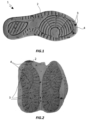
- the attached figures show by way of example an example of a sole 1 which can be obtained through the method for making soles according to the invention.
- This method of making soles comprises an initial step of supplying a material recovered from exhausted tennis balls.
- the initial phase involves the supply of exhausted tennis balls, for example through a recovery service of the same at sports clubs or special collection points and then the mechanical treatment of the tennis balls to crush them and obtain small pieces, in the order of a few millimetres, as better indicated below.
- crushing is intended to indicate, in a generic way, the use of one or more mechanical cutting or abrasion actions, such as to allow a tennis ball to be reduced into granules or substantially into granules of reduced dimensions.
- the step of crushing involves a step of obtaining fragments in the order of about ten millimetres. More precisely, the fragments have a plan dimension, for example a square plan, of about 10mm per side and with a thickness equal to that of a tennis ball, about 2-3mm.
- fragments can have a different overall size in plan than the square one, indicated above merely by way of example, while falling within the same inventive concept of the present method.
- the size of the fragments to be used is selected.
- the crushing step comprises a first step for mechanical separation of the rubber and felt components of the tennis balls.
- This phase of mechanical separation of the felt from the rubber takes place through a surface peeling process carried out through at least one metal foil, preferably a plurality of metal foils which act on the outer surface of the tennis balls.
- the mechanical separation step is performed through a surface abrasion process of the felt with abrasive metal rollers, rotating metal brushes or rotating abrasive cylinders.
- the method comprises a washing phase of the balls, for example by immersion in suitable tanks or by controlled delivery of water against the tennis balls themselves, so as to moisten the felt and limit the risk of fire of the same given that, as known, the felt is a flammable material.
- the rubber layer After removing the felt from the tennis ball, the rubber layer, previously covered with felt, is cut and shredded.
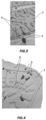
- the method for making soles provides for making a compound, which constitutes the matrix 2 in which the crushed material of the tennis balls is embedded, according to a specific recipe (see for example Figure 3 ).
- the crushed material which is added to the blend comprises fragments of the tennis balls as cut and optionally sieved or screened.
- the crushed material therefore comprises fragments which in turn comprise at least a rubber portion 3 and/or at least a felt fragment 4.
- the shredded material as it is obtained after the crushing process, is incorporated in the matrix 2, as better described below-
- the method for making soles involves the use of specific recipes for making corresponding soles according to the mechanical characteristics to be obtained.
- an object of the present invention is to provide soles for footwear which can be used in sports activities of the competitive type and, therefore, which have high mechanical properties.
- the internal portion of the tennis balls is composed of elastomers while the external felt is partly composed of wool and thermoplastics, the properties of which can be variable within pre-established ranges, within the reach of an expert in the sector and that therefore, they will not be described in detail.
- thermoplastics have the characteristic of softening or melting at specific temperatures.
- the method for manufacturing a sole according to the invention following the step of preparing a rubber-based compound, provides for a step of introducing the fragments of the tennis balls obtained by crushing into the compound itself.
- the percentage of tennis ball fragments which is added to the rubber compound is between 3% and 25%.
- the percentage of tennis ball fragments may vary with respect to the range indicated above.
- the percentage can vary between 5% and 10% in the event that the sole to be produced must present high performance, for example to allow its use in intense sports, such as competitive sports, between 5 % and 15% in the case in which the sole must present good performance, for example to allow its use in medium or low intensity sports, such as for example amateur sports, or between 5% and 20% in the case where the sole to be produced must have standard performance compatible with daily use of the shoe, for example for walking.
- the method then includes a phase of mixing and stirring the compound to promote the distribution and dispersion of the fragments themselves within the compound.
- the rubber compound is maintained at a temperature range indicatively between 110°C and 170°C, more preferably between 130°C and 150°C for a time interval between 5 and 15 minutes, preferably between 5 and 10 minutes, to allow the fragments of the tennis balls to mix with the compound itself and to promote their subsequent reciprocal connection during the moulding of the sole.
- the moulding step takes place according to a methodology within the reach of the person skilled in the field which, therefore, will not be described in detail.
- moulding involves casting or injecting the compound in which the fragments are dispersed inside a cavity that reproduces the shape of the sole.
- the moulding process is carried out at a temperature comprised between 150°C and 200°C more preferably between 160°C and 180°C for a time interval comprised between 5 and 15 minutes, preferably between 5 and 10 minutes.
- the same shows two soles at the end of the moulding phase, with a part of scrap that protrudes along the perimeter of the sole itself, while the attached Figure 1 shows a sole made using the production method according to the invention, configured to be used in a shoe and, more precisely, to be connected to a respective upper.
- the method according to the invention provides a first recipe for making a sole of the walking type and, therefore, for daily use which provides for the use of the following ingredients: Ingredient Percentage ELASTOMERS 50-60% LOAD KAOLIN 5-7% LOAD SILICA 15-18% ACCELERATORS 1-2% ZINC CARBONATE 1-3% SILANE 0,5-2% WAX 0,1-1% ANTIOXIDANT 0,1-1% ACTIVATORS 3-5% PLASTICIZER 1-3% RESIN 1-3% SULFUR 1-2% COLOR 1-6% FRAGMENTS OF TENNIS BALLS (as obtained following the crushing) 5-20%
- the production method according to the invention provides for the following second recipe: Ingredient Percentage RUBBER 50-60% LOAD SILICA 25-35% ACCELERATORS 1-2% ZINC CARBONATE 1-2% ACTIVATING 2-3% STEARIC ACID 0,1-1% SILANE 2-3% ANTIOXIDANT 0,1-1% ACTIVATORS 3-5% PLASTICIZER 1-3% RESIN 2-3% SULFUR 1-2% COLOR 1-6% FRAGMENTS OF TENNIS BALLS (as obtained following the crushing) 5-15%
- a shoe sole made according to the above recipe has the following characteristics.
- the production method according to the invention provides for the following third recipe: Ingredient Percentage RUBBER 45-55% LOAD SILICA 30-35% ACCELERATORS 1-2% ZINC CARBONATE 1-2% ACTIVATING 2-3% STEARIC ACID 0,1-1% SILANE 2-3% ANTIOXIDANT 0,1-1% ACTIVATORS 2-3% PLASTICIZER 1-2% RESIN 2-5% SULFUR 1-2% COLOR 1-6% FRAGMENTS OF TENNIS BALLS (as obtained following the crushing) 5-10%
- a shoe sole made according to the above recipe has the following characteristics.
- the production method according to the invention makes it possible to produce high-performance soles for footwear, through the complete recycling of exhausted tennis balls, i.e. both their rubber portion and their outer felt portion.
- the production method according to the invention provides for the use of a high percentage of recycled material compared to solutions of the traditional type, providing for the use of up to 25% of recycled material.
- This feature has the dual effect of reducing the environmental impact represented by exhausted tennis balls and containing production costs, given that the recycled material has a lower cost than that of the virgin raw materials to be included in the compounds for making the shoe soles.
Landscapes
- Engineering & Computer Science (AREA)
- Mechanical Engineering (AREA)
- Environmental & Geological Engineering (AREA)
- Chemical & Material Sciences (AREA)
- Materials Engineering (AREA)
- Footwear And Its Accessory, Manufacturing Method And Apparatuses (AREA)
Claims (10)
- Verfahren zur Herstellung von Schuhsohlen (1), die folgenden Schritte umfassend:- Zerkleinern von verbrauchten Tennisbällen, um sie in Fragmente (3, 4) oder Granulate mit vorgegebenen Abmessungen zu zerkleinern;- Auswählen der Fragmente mit vorgegebener Größe unter diesen Fragmenten;- Herstellen einer Gummimischung (2);- Hinzufügen der Fragmente der verbrauchten Tennisbälle zu dieser Mischung;- Mischen der Mischung, die die Fragmente der Tennisbälle enthält;wobei das Verfahren ist dadurch gekennzeichnet, dass es weiter folgende Schritte umfasst:- Verwender der Mischung zum Formen von mindestens einer Schuhsohle (1) in mindestens einer Form;- Herausnehmen der mindestens einen Schuhsohle aus dieser mindestens einen Form,wobei der Schritt des Hinzufügen der Fragmente der Tennisbälle ins Innere der Mischung das Hinzufügen eines Prozentsatzes zwischen 3% und 25% Fragmenten umfasst.
- Verfahren zur Herstellung von Schuhsohlen gemäß Anspruch 1, wobei der Schritt des Zerkleinerns der Tennisbälle einen Schritt des Schneidens der Tennisbälle durch Zerkleinern in Fragmente mit vorgegebenen Abmessungen umfasst.
- Verfahren zur Herstellung von Schuhsohlen gemäß Anspruch 2, wobei die Fragmente eine quadratische oder im Wesentlichen quadratische Grundrissabmessung aufweisen oder in einer Grundrissabmessung innerhalb eines quadratischen oder im Wesentlichen quadratischen Bereich mit einer Seitenlänge von 10 mm enthalten sind.
- Verfahren zur Herstellung von Schuhsohlen gemäß Anspruch 1, wobei der Schritt des Zerkleinerns der Tennisbälle einen Schritt der mechanischen Trennung zwischen Gummikomponenten und Filzkomponenten der Tennisbälle umfasst.
- Verfahren zur Herstellung von Schuhsohlen gemäß Anspruch 4, wobei der Schritt der mechanischen Trennung einen Oberflächenschälschritt durch die Verwendung von mindestens einer mechanischen Platte umfasst, die auf eine Außenfläche der Tennisbälle einwirkt, und einen anschließenden Schritt des Zerkleinerns der Gummikomponenten, die zuvor von den Filzkomponenten bedeckt wurden.
- Verfahren zur Herstellung von Schuhsohlen gemäß Anspruch 4, wobei der Schritt der mechanischen Trennung einen Oberflächenschleifprozess des in den Tennisbällen enthaltenen Filzes umfasst, der mittels Schleifwalzen oder rotierenden Metallbürsten oder Schleifzylindern durchgeführt wird.
- Verfahren zur Herstellung von Schuhsohlen gemäß Anspruch 5 oder 6, umfassend einen Schritt des Befeuchtens der verbrauchten Tennisbälle vor der Durchführung des Schritts der mechanischen Trennung, um ein Brandrisiko des Filzes zu begrenzen.
- Verfahren zur Herstellung von Schuhsohlen gemäß Anspruch 1, wobei der Schritt des Hinzufügens der Fragmente der Tennisbälle zu der Mischung das Hinzufügen eines Prozentsatzes von 5 % bis 20 %, optional von 5 % bis 10 % Fragmenten umfasst.
- Verfahren zur Herstellung von Schuhsohlen gemäß Anspruch 1, wobei während des Mischschritts die Gummimischung für eine Zeit zwischen 5 und 15 Minuten, optional zwischen 5 und 10 Minuten, in einem Temperaturbereich zwischen 110°C und 170°C, optional zwischen 130°C und 150°C gehalten wird.
- Verfahren zur Herstellung von Schuhsohlen gemäß Anspruch 1, wobei der Schritt des Formens der Sohle in der mindestens einen Form bei einer Temperatur im Bereich zwischen 150°C und 200°C, optional zwischen 160°C und 180°C, für zwischen 5 und 15 Minuten, optional zwischen 5 und 10 Minuten, durchgeführt wird.
Applications Claiming Priority (1)
| Application Number | Priority Date | Filing Date | Title |
|---|---|---|---|
| IT102021000029255A IT202100029255A1 (it) | 2021-11-18 | 2021-11-18 | Metodo per la realizzazione di suole per calzature con l’impiego di materiale di recupero |
Publications (3)
| Publication Number | Publication Date |
|---|---|
| EP4183286A1 EP4183286A1 (de) | 2023-05-24 |
| EP4183286C0 EP4183286C0 (de) | 2024-11-13 |
| EP4183286B1 true EP4183286B1 (de) | 2024-11-13 |
Family
ID=80122130
Family Applications (1)
| Application Number | Title | Priority Date | Filing Date |
|---|---|---|---|
| EP22208224.0A Active EP4183286B1 (de) | 2021-11-18 | 2022-11-18 | Verfahren zur herstellung von sohlen für schuhwerk unter verwendung von recyclingmaterial |
Country Status (2)
| Country | Link |
|---|---|
| EP (1) | EP4183286B1 (de) |
| IT (1) | IT202100029255A1 (de) |
Cited By (1)
| Publication number | Priority date | Publication date | Assignee | Title |
|---|---|---|---|---|
| FR3164635A1 (fr) | 2024-07-19 | 2026-01-23 | The 8 Impact | Procédé de traitement mécanique d’un produit neuf défectueux ou usagé comprenant initialement au moins un matériau élastomère et au moins un autre matériau, Installation et procédé de recyclage afférents, Granulat d’élastomère(s) obtenu. |
Families Citing this family (1)
| Publication number | Priority date | Publication date | Assignee | Title |
|---|---|---|---|---|
| EP4616746A1 (de) * | 2024-03-12 | 2025-09-17 | Return Societa' Benefit a Responsabilita' Limitata | Verfahren zur herstellung von schuhsohlen aus recyceltem material |
Family Cites Families (4)
| Publication number | Priority date | Publication date | Assignee | Title |
|---|---|---|---|---|
| AU2008304584B2 (en) | 2007-09-25 | 2013-02-14 | Aetrex Worldwide, Inc. | Articles prepared using recycled materials and methods of preparation thereof |
| CN106263226A (zh) * | 2016-10-13 | 2017-01-04 | 陈茂双 | 环保缓震包裹性好的爆米花架桥鞋及其生产工艺 |
| US10426229B2 (en) * | 2017-02-06 | 2019-10-01 | Lana S. Krause | Footwear manufacturing process |
| EP3922122B1 (de) | 2018-05-31 | 2024-03-06 | NIKE Innovate C.V. | Schuhartikel mit recycelten kunststoffen |
-
2021
- 2021-11-18 IT IT102021000029255A patent/IT202100029255A1/it unknown
-
2022
- 2022-11-18 EP EP22208224.0A patent/EP4183286B1/de active Active
Cited By (1)
| Publication number | Priority date | Publication date | Assignee | Title |
|---|---|---|---|---|
| FR3164635A1 (fr) | 2024-07-19 | 2026-01-23 | The 8 Impact | Procédé de traitement mécanique d’un produit neuf défectueux ou usagé comprenant initialement au moins un matériau élastomère et au moins un autre matériau, Installation et procédé de recyclage afférents, Granulat d’élastomère(s) obtenu. |
Also Published As
| Publication number | Publication date |
|---|---|
| EP4183286A1 (de) | 2023-05-24 |
| IT202100029255A1 (it) | 2023-05-18 |
| EP4183286C0 (de) | 2024-11-13 |
Similar Documents
| Publication | Publication Date | Title |
|---|---|---|
| EP4183286B1 (de) | Verfahren zur herstellung von sohlen für schuhwerk unter verwendung von recyclingmaterial | |
| CN101328288B (zh) | 超高耐磨橡胶鞋底及其制备方法 | |
| CN1031122C (zh) | 乙烯-醋酸乙烯共聚物发泡鞋中底的制法 | |
| WO2010120955A1 (en) | Shoe sole and method | |
| CN102964640B (zh) | 橡胶双密度鞋靴专用橡胶沿条及其制备方法 | |
| KR20030003202A (ko) | 미드솔과 아웃솔이 일체로 이루어지는 신발창 제조용금형장치 | |
| CN115477807A (zh) | 一种微气囊结构的环保轻质吸冲发泡材料及其制备方法和应用 | |
| CN101774246A (zh) | 硫磺架桥透明橡胶鞋底的制造方法 | |
| CN114479428B (zh) | 含有回收橡胶的鞋大底及其制备方法和鞋底 | |
| CN212852672U (zh) | 双密度环保鞋底 | |
| US11738529B2 (en) | Shoe, environmentally friendly shoe component thereof, and method of manufacturing environmentally friendly shoe components | |
| CN117283758A (zh) | 废弃泡沫鞋底材料的回收再利用方法、蒸汽成型制品和废弃泡沫鞋底材料回收再利用产品 | |
| EP4616746A1 (de) | Verfahren zur herstellung von schuhsohlen aus recyceltem material | |
| CN101731790B (zh) | 一种不发泡pu鞋底及其制备方法和不发泡pu鞋 | |
| KR100531140B1 (ko) | 폐플라스틱을 이용한 다중 탄성보도블록의 제조방법 | |
| CN109591343A (zh) | 一种高附加值吸塑鞋底制作方法 | |
| KR102119231B1 (ko) | 코르크칩을 이용한 신발용 밑창의 제조방법 및 그 제조방법에 의해 제조되는 신발용 밑창, 이를 포함하는 신발 | |
| KR102227080B1 (ko) | 넌슬립특성이 우수한 아웃솔용 탄성시트 및 이의 제조방법 | |
| CN113771395A (zh) | 一种cpu注入法形成的减震鞋底的制备方法 | |
| CN113729352A (zh) | 双密度环保鞋底及其制造方法 | |
| KR20260026619A (ko) | 합성수지 폐기물을 이용한 파크 골프공 제작방법 | |
| JP7524365B2 (ja) | 環境にやさしい靴素材の製造方法 | |
| KR20030007320A (ko) | 미드솔과 아웃솔이 일체로 이루어지는 신발창 제조용금형장치 | |
| KR0130426B1 (ko) | 신발의 완성창 제조방법 | |
| CN214509728U (zh) | 环保鞋材 |
Legal Events
| Date | Code | Title | Description |
|---|---|---|---|
| PUAI | Public reference made under article 153(3) epc to a published international application that has entered the european phase |
Free format text: ORIGINAL CODE: 0009012 |
|
| STAA | Information on the status of an ep patent application or granted ep patent |
Free format text: STATUS: THE APPLICATION HAS BEEN PUBLISHED |
|
| AK | Designated contracting states |
Kind code of ref document: A1 Designated state(s): AL AT BE BG CH CY CZ DE DK EE ES FI FR GB GR HR HU IE IS IT LI LT LU LV MC ME MK MT NL NO PL PT RO RS SE SI SK SM TR |
|
| STAA | Information on the status of an ep patent application or granted ep patent |
Free format text: STATUS: REQUEST FOR EXAMINATION WAS MADE |
|
| 17P | Request for examination filed |
Effective date: 20231124 |
|
| RBV | Designated contracting states (corrected) |
Designated state(s): AL AT BE BG CH CY CZ DE DK EE ES FI FR GB GR HR HU IE IS IT LI LT LU LV MC ME MK MT NL NO PL PT RO RS SE SI SK SM TR |
|
| GRAP | Despatch of communication of intention to grant a patent |
Free format text: ORIGINAL CODE: EPIDOSNIGR1 |
|
| STAA | Information on the status of an ep patent application or granted ep patent |
Free format text: STATUS: GRANT OF PATENT IS INTENDED |
|
| RIC1 | Information provided on ipc code assigned before grant |
Ipc: B29L 31/54 20060101ALN20240517BHEP Ipc: B29B 17/00 20060101ALI20240517BHEP Ipc: B29B 17/04 20060101ALI20240517BHEP Ipc: A43B 13/04 20060101ALI20240517BHEP Ipc: B29D 35/12 20100101ALI20240517BHEP Ipc: B29D 35/02 20100101ALI20240517BHEP Ipc: A43B 1/12 20060101ALI20240517BHEP Ipc: A43B 1/00 20060101AFI20240517BHEP |
|
| INTG | Intention to grant announced |
Effective date: 20240607 |
|
| GRAS | Grant fee paid |
Free format text: ORIGINAL CODE: EPIDOSNIGR3 |
|
| GRAA | (expected) grant |
Free format text: ORIGINAL CODE: 0009210 |
|
| STAA | Information on the status of an ep patent application or granted ep patent |
Free format text: STATUS: THE PATENT HAS BEEN GRANTED |
|
| AK | Designated contracting states |
Kind code of ref document: B1 Designated state(s): AL AT BE BG CH CY CZ DE DK EE ES FI FR GB GR HR HU IE IS IT LI LT LU LV MC ME MK MT NL NO PL PT RO RS SE SI SK SM TR |
|
| REG | Reference to a national code |
Ref country code: GB Ref legal event code: FG4D |
|
| REG | Reference to a national code |
Ref country code: CH Ref legal event code: EP |
|
| REG | Reference to a national code |
Ref country code: DE Ref legal event code: R096 Ref document number: 602022007676 Country of ref document: DE |
|
| REG | Reference to a national code |
Ref country code: IE Ref legal event code: FG4D |
|
| U01 | Request for unitary effect filed |
Effective date: 20241213 |
|
| U07 | Unitary effect registered |
Designated state(s): AT BE BG DE DK EE FI FR IT LT LU LV MT NL PT RO SE SI Effective date: 20241220 |
|
| U20 | Renewal fee for the european patent with unitary effect paid |
Year of fee payment: 3 Effective date: 20241223 |
|
| PG25 | Lapsed in a contracting state [announced via postgrant information from national office to epo] |
Ref country code: IS Free format text: LAPSE BECAUSE OF FAILURE TO SUBMIT A TRANSLATION OF THE DESCRIPTION OR TO PAY THE FEE WITHIN THE PRESCRIBED TIME-LIMIT Effective date: 20250313 Ref country code: HR Free format text: LAPSE BECAUSE OF FAILURE TO SUBMIT A TRANSLATION OF THE DESCRIPTION OR TO PAY THE FEE WITHIN THE PRESCRIBED TIME-LIMIT Effective date: 20241113 |
|
| PG25 | Lapsed in a contracting state [announced via postgrant information from national office to epo] |
Ref country code: ES Free format text: LAPSE BECAUSE OF FAILURE TO SUBMIT A TRANSLATION OF THE DESCRIPTION OR TO PAY THE FEE WITHIN THE PRESCRIBED TIME-LIMIT Effective date: 20241113 |
|
| PG25 | Lapsed in a contracting state [announced via postgrant information from national office to epo] |
Ref country code: NO Free format text: LAPSE BECAUSE OF FAILURE TO SUBMIT A TRANSLATION OF THE DESCRIPTION OR TO PAY THE FEE WITHIN THE PRESCRIBED TIME-LIMIT Effective date: 20250213 |
|
| PG25 | Lapsed in a contracting state [announced via postgrant information from national office to epo] |
Ref country code: GR Free format text: LAPSE BECAUSE OF FAILURE TO SUBMIT A TRANSLATION OF THE DESCRIPTION OR TO PAY THE FEE WITHIN THE PRESCRIBED TIME-LIMIT Effective date: 20250214 |
|
| PG25 | Lapsed in a contracting state [announced via postgrant information from national office to epo] |
Ref country code: PL Free format text: LAPSE BECAUSE OF FAILURE TO SUBMIT A TRANSLATION OF THE DESCRIPTION OR TO PAY THE FEE WITHIN THE PRESCRIBED TIME-LIMIT Effective date: 20241113 |
|
| PG25 | Lapsed in a contracting state [announced via postgrant information from national office to epo] |
Ref country code: RS Free format text: LAPSE BECAUSE OF FAILURE TO SUBMIT A TRANSLATION OF THE DESCRIPTION OR TO PAY THE FEE WITHIN THE PRESCRIBED TIME-LIMIT Effective date: 20250213 |
|
| PG25 | Lapsed in a contracting state [announced via postgrant information from national office to epo] |
Ref country code: SM Free format text: LAPSE BECAUSE OF FAILURE TO SUBMIT A TRANSLATION OF THE DESCRIPTION OR TO PAY THE FEE WITHIN THE PRESCRIBED TIME-LIMIT Effective date: 20241113 |
|
| PG25 | Lapsed in a contracting state [announced via postgrant information from national office to epo] |
Ref country code: SK Free format text: LAPSE BECAUSE OF FAILURE TO SUBMIT A TRANSLATION OF THE DESCRIPTION OR TO PAY THE FEE WITHIN THE PRESCRIBED TIME-LIMIT Effective date: 20241113 |
|
| PG25 | Lapsed in a contracting state [announced via postgrant information from national office to epo] |
Ref country code: CZ Free format text: LAPSE BECAUSE OF FAILURE TO SUBMIT A TRANSLATION OF THE DESCRIPTION OR TO PAY THE FEE WITHIN THE PRESCRIBED TIME-LIMIT Effective date: 20241113 |
|
| PG25 | Lapsed in a contracting state [announced via postgrant information from national office to epo] |
Ref country code: MC Free format text: LAPSE BECAUSE OF FAILURE TO SUBMIT A TRANSLATION OF THE DESCRIPTION OR TO PAY THE FEE WITHIN THE PRESCRIBED TIME-LIMIT Effective date: 20241113 |
|
| PLBE | No opposition filed within time limit |
Free format text: ORIGINAL CODE: 0009261 |
|
| STAA | Information on the status of an ep patent application or granted ep patent |
Free format text: STATUS: NO OPPOSITION FILED WITHIN TIME LIMIT |
|
| 26N | No opposition filed |
Effective date: 20250814 |
|
| PG25 | Lapsed in a contracting state [announced via postgrant information from national office to epo] |
Ref country code: IE Free format text: LAPSE BECAUSE OF NON-PAYMENT OF DUE FEES Effective date: 20241118 |
|
| REG | Reference to a national code |
Ref country code: CH Ref legal event code: U11 Free format text: ST27 STATUS EVENT CODE: U-0-0-U10-U11 (AS PROVIDED BY THE NATIONAL OFFICE) Effective date: 20251201 |
|
| U20 | Renewal fee for the european patent with unitary effect paid |
Year of fee payment: 4 Effective date: 20251124 |
|
| PGFP | Annual fee paid to national office [announced via postgrant information from national office to epo] |
Ref country code: CH Payment date: 20251201 Year of fee payment: 4 |
|
| PG25 | Lapsed in a contracting state [announced via postgrant information from national office to epo] |
Ref country code: HU Free format text: LAPSE BECAUSE OF FAILURE TO SUBMIT A TRANSLATION OF THE DESCRIPTION OR TO PAY THE FEE WITHIN THE PRESCRIBED TIME-LIMIT; INVALID AB INITIO Effective date: 20221118 |
|
| PG25 | Lapsed in a contracting state [announced via postgrant information from national office to epo] |
Ref country code: CY Free format text: LAPSE BECAUSE OF FAILURE TO SUBMIT A TRANSLATION OF THE DESCRIPTION OR TO PAY THE FEE WITHIN THE PRESCRIBED TIME-LIMIT; INVALID AB INITIO Effective date: 20221118 |