EP4169906B1 - Verfahren zur synthese von roxadustat und zwischenprodukt davon sowie zwischenprodukt davon - Google Patents
Verfahren zur synthese von roxadustat und zwischenprodukt davon sowie zwischenprodukt davon Download PDFInfo
- Publication number
- EP4169906B1 EP4169906B1 EP21826831.6A EP21826831A EP4169906B1 EP 4169906 B1 EP4169906 B1 EP 4169906B1 EP 21826831 A EP21826831 A EP 21826831A EP 4169906 B1 EP4169906 B1 EP 4169906B1
- Authority
- EP
- European Patent Office
- Prior art keywords
- compound
- acid
- solvent
- mixture
- reaction
- Prior art date
- Legal status (The legal status is an assumption and is not a legal conclusion. Google has not performed a legal analysis and makes no representation as to the accuracy of the status listed.)
- Active
Links
Classifications
-
- C—CHEMISTRY; METALLURGY
- C07—ORGANIC CHEMISTRY
- C07D—HETEROCYCLIC COMPOUNDS
- C07D217/00—Heterocyclic compounds containing isoquinoline or hydrogenated isoquinoline ring systems
- C07D217/22—Heterocyclic compounds containing isoquinoline or hydrogenated isoquinoline ring systems with hetero atoms or with carbon atoms having three bonds to hetero atoms with at the most one bond to halogen, e.g. ester or nitrile radicals, directly attached to carbon atoms of the nitrogen-containing ring
- C07D217/26—Carbon atoms having three bonds to hetero atoms with at the most one bond to halogen
Definitions
- the present disclosure relates to a synthesis method of roxadustat and an intermediate thereof, and an intermediate thereof.
- Roxadustat is a hypoxia inducible factor proline hydroxylase inhibitor (HIF-PHI), developed by FibroGen Company, USA, and Astellas and AstraZeneca have received authorized permission, and roxadustat has been marketed in China to treat anemia related to chronic kidney disease and end-stage kidney disease.
- HIF-PHI hypoxia inducible factor proline hydroxylase inhibitor
- roxadustat N- [(4-hydroxy-1-methyl-7-phenoxy-3-isoquinoline)carbonyl)]glycine, and the structural formula is as follows:
- the known synthetic routes of roxadustat are mainly as follows:
- the known synthetic routes of roxadustat have the following defects: the steps are cumbersome, and additional reaction process for controlling by-products needs to be introduced; or high boiling point reagents which are difficult to remove and noble metal palladium catalysts are used; or the yield is low and column chromatography purification is required; or a high-temperature reaction is required, and the reagents used are dangerous, which makes the synthetic routes of roxadustat costly and is not conducive to industrial production. This situation needs to be solved urgently.
- the technical problem to be solved by the present disclosure is to overcome the defects such as long steps, cumbersome operation, high cost and unfavorable industrial production in the synthetic routes of roxadustat in the prior art, and to provide a synthesis method of roxadustat and an intermediate thereof, and an intermediate thereof.
- the method of the present disclosure uses cheap and easily available raw materials, has short reaction steps and mild reaction conditions, has a high yield, has simple and convenient post-treatment procedures, and is suitable for industrial production.
- the present disclosure solves the above technical problems through the following solutions.
- the present disclosure provides a synthesis method of compound M1, and the method comprises the following steps: carrying out a reaction as shown below between compound SM and compound SM-A under the action of an oxidizing agent;
- R 1 is H, C 1 -C 4 alkyl or C 6 -C 10 aryl; more preferably, R 1 is H, methyl, ethyl, n -propyl, isopropyl, n -butyl, isobutyl, sec -butyl, tert -butyl, phenyl or naphthyl; most preferably, R 1 is H, methyl or ethyl.
- R 3 is H, C 1 -C 4 alkyl, C 4 -C 6 cycloalkyl or C 6 -C 10 aryl; more preferably, R 3 is H, methyl, ethyl, n -propyl, isopropyl, n -butyl, isobutyl, sec -butyl, tert -butyl, cyclobutyl, cyclopentyl, cyclohexyl, phenyl or naphthyl; most preferably, R 3 is H or methyl.
- compound SM-A is optionally substituted by 1, 2 or 3 R.
- compound SM-A is preferably
- compound SM is preferably
- the oxidizing agent may be a conventional oxidizing agent for such reactions in the art.
- the oxidizing agent may be, for example, a persulfate oxidizing agent, a peroxide oxidizing agent or a mixture thereof.
- the persulfate oxidizing agent may be, for example, alkali metal persulfate, alkaline earth metal persulfate or a mixture thereof.
- the alkali metal persulfate may be sodium persulfate, potassium persulfate, potassium peroxymonosulfate composite salt (Oxone) or a mixture thereof.
- the alkaline earth metal persulfate may be magnesium persulfate.
- the peroxide oxidizing agent generally refers to a compound containing peroxy -O-O-.
- the peroxide oxidizing agent may be, for example, R m -O-O-R n ; wherein R m and R n are independently H, C 1 -C 4 alkyl or benzoyl optionally substituted by 1, 2 or 3 halogens.
- the peroxide oxidizing agent may be, for example, hydrogen peroxide (H 2 O 2 ), peracetic acid, peroxytrifluoroacetic acid, BPO (benzoyl peroxide), TBHP ( tert -butyl hydroperoxide), DTBP (di- tert -butyl peroxide) or a mixture thereof.
- the amount of the oxidizing agent may be a conventional amount of the oxidizing agent for such reactions in the art.
- a molar ratio of the compound SM to the oxidizing agent is 1:1-1:5, for example, 1: 1.5-1:3, for another example, 1:2.
- the amount of the compound SM and the compound SM-A may be the conventional amount for such reactions in the art.
- a molar ratio of the compound SM-A to the compound SM may be greater than 1:1, for example, greater than 5:1, greater than 10: 1, greater than 20:1, greater than 40: 1, or greater than 50:1.
- the amount of the compound SM-A should be controlled within an appropriate range.
- the compound SM-A when the compound SM-A is a liquid, the compound SM-A serves as a reaction raw material and a solvent simultaneously. When the compound SM-A is a solid, the compound SM-A only serves as the reaction raw material. At this time, the synthesis of compound M1 carries out the reaction in the presence of a solvent.
- the solvent may be a conventional solvent for such reactions in the art, such as a chlorinated hydrocarbon solvent, an ether solvent or a mixture thereof.
- the solvent generally has good solubility for compound SM, and is not easily oxidized or does not participate in the reaction. Therefore, the solvent may be, for example, dichloromethane, tetrahydrofuran, dioxane, or a mixture thereof.
- the temperature of the reaction may be a conventional temperature for such reactions in the art.
- the reaction temperature may be 30 °C to 100 °C, for example, 50 °C to 80 °C, and for another example, 60 °C to 70 °C.
- the temperature of the reaction in the synthesis method of compound M1, may be 30 °C to 100 °C, for example, 60 °C to70 °C, and for another example, 65 °C to 70 °C.
- the progress of the reaction may be monitored by a conventional detection method in the art (such as TLC, MS, HPLC or NMR, etc.).
- the progress of the reaction is monitored by TLC when the compound SM disappears as the end point of the reaction.
- the time of the reaction may be, for example, 20 minutes to 10 hours (e.g., 1 hour, 4 hours, 5 hours, 6 hours, or 8 hours).
- the oxidizing agent may be directly used alone, or the oxidizing agent may be used in the form of a mixed solution with water, or the oxidizing agent may be used in the form of a mixed solution with an organic solvent.
- the water is conventional water in the art, such as purified water, distilled water or a mixture thereof.
- the organic solvent may be, for example, a chlorinated hydrocarbon solvent, an ether solvent, or a mixture thereof.
- the organic solvent generally has good solubility for the oxidizing agent.
- the organic solvent may be, for example, dichloromethane, tetrahydrofuran, dioxane or a mixture thereof.
- a molar ratio of the oxidizing agent to the water or the organic solvent may be 1:1-1:50, for example, 1:2-1:35, for another example, 1:2-1:30, for still another example, 1:20-1:35; and for yet another example, 1:20-1:30.
- the following steps are preferably comprised: mixing a mixture of the compound SM and the compound SM-A with the oxidizing agent to carry out the reaction. Further preferably, heating the mixture of the compound SM and the compound SM-A to 30 °C to 100 °C, and then adding the oxidizing agent to carry out the reaction.
- the post-treatment may comprise the following steps: extracting the reaction solution after the completion of the reaction with an organic solvent, concentrating the organic phase, optionally slurrying the residue obtained after the concentration with the organic solvent, performing a solid-liquid separation, and optionally washing the solid with the organic solvent and drying to obtain a target compound; or, mixing the reaction solution after the completion of the reaction with water, performing the solid-liquid separation, and optionally washing the solid with the organic solvent and drying to obtain the target compound.
- the post-treatment may comprise the following steps: extracting the reaction solution after the completion of the reaction (for example, extracting at room temperature, preferably extracting with the ester solvent such as ethyl acetate or the halogenated hydrocarbon solvent such as dichloromethane), and then concentrating to obtain a concentrated solution (the volume of the concentrated solution is, for example, 1/8 to 1/10 of the volume of the extraction solvent), performing the solid-liquid separation (e.g., filtration under reduced pressure), washing a filter cake with the organic solvent for extraction (preferably washing with the ester solvent such as ethyl acetate or the halogenated hydrocarbon solvent such as dichloromethane), and drying the filter cake (e.g., draining or vacuum drying) to obtain the target compound;
- the post-treatment may comprise the following steps: mixing the reaction solution after the completion of the reaction with water (for example, mixing at room temperature, the amount of water is appropriate to generate a large amount of solid in the reaction solution), performing the solid-liquid separation (for example, filtration under reduced pressure), and drying the filter cake (for example, vacuum drying) to obtain the target compound;
- the post-treatment may comprise the following steps: extracting the reaction solution after the completion of the reaction (for example, extracting at room temperature, preferably extracting with the ester solvent such as ethyl acetate or the halogenated hydrocarbon solvent such as dichloromethane), removing the solvent in the organic phase, and slurrying the residue (preferably slurrying with a mixed solvent of the ester solvent and an alkane solvent, such as a mixed solvent of ethyl acetate and n-heptane, wherein a volume ratio of the ester solvent to the alkane solvent may be, for example, 1 :2/v:v), performing the solid-liquid separation (such as filtration under reduced pressure), and drying the filter cake (such as vacuum drying) to obtain the target compound.
- the ester solvent such as ethyl acetate or the halogenated hydrocarbon solvent such as dichloromethane
- slurrying the residue preferably slurrying with a mixed solvent of the ester solvent and an alkane
- the synthesis method of compound M1 may be carried out in the absence of light.
- the synthesis method of compound M1 may not require an irradiation of a mercury lamp, a tungsten lamp, or the like.
- the present disclosure also provides a synthesis method of compound M2, and the method comprises the following steps: carrying out a reaction as shown below on compound M1 under the action of an acid; wherein the compound M1 is prepared according to the synthesis method as described above; wherein, the definitions of R 1 , R 2 and R 3 are the same as above.
- the acid may be a conventional acid for such reactions in the art, such as an inorganic acid, an organic acid or a mixture thereof.
- the inorganic acid may be, for example, a hydrochloric acid (for example, a concentrated hydrochloric acid with a mass fraction of 36 % or a hydrogen chloride ethanol solution), a sulfuric acid, a phosphoric acid or a mixture thereof (wherein a mass fraction of the sulfuric acid and the phosphoric acid may be, for example, 30 %-85 %).
- the organic acid may be, for example, an acetic acid, a trifluoroacetic acid, or a mixture thereof.
- the amount of the acid may be a conventional amount of such reactions in the art, and a volume-to-mass ratio of the acid to compound M1 is preferably 0.2 mL/g-5 mL/g, for example, 0.5 mL/g-5 mL/g, for another example, 0.2 mL/g-2.5 mL/g, and for still another example, 1 mL/g-2.5 mL/g.
- a solvent may be a conventional solvent for such reactions in the art, such as an ether solvent, an alcohol solvent, an amide solvent, a sulfoxide solvent or a mixture thereof.
- the ether solvent may be, for example, tetrahydrofuran, dioxane or a mixture thereof.
- the alcohol solvent may be, for example, methanol, ethanol, isopropanol or a mixture thereof.
- the amide solvent may be, for example, N , N- dimethylformamide, N , N- dimethylacetamide or a mixture thereof.
- the sulfoxide solvent may be, for example, DMSO.
- the solvent in the reaction may be a single solvent or a mixture of two or more solvents.
- the solvent is preferably the alcohol solvent, or a mixed solvent of the ether solvent and the alcohol solvent, such as ethanol, or a mixed solvent of tetrahydrofuran and methanol.
- a volume ratio of the ether solvent to the alcohol solvent may be 0.5:1-4:1, for example, 1:1-2:1.
- the amount of solvent may be a conventional amount for such reactions in the art, and a volume-mass ratio of the solvent to compound M1 is preferably 3 mL/g to 10 mL/g, for example, 3 mL/g to 8 mL/g; for another example, 5 mL/g to 8 mL/g.
- the temperature of the reaction may be a conventional temperature for such reactions in the art.
- the temperature of the reaction may be a conventional temperature for such reactions in the art.
- the reaction temperature may be 25 °C to 50 °C, for example, 30 °C to 50 °C, and for another example, 30 °C to 45 °C.
- the temperature of the reaction is 30 °C to 40 °C.
- the temperature of the reaction is 40 °C to 45 °C.
- compound M1 may be or
- the progress of the reaction may be monitored by a conventional detection method in the art (such as TLC, MS, HPLC or NMR, etc.).
- the progress of the reaction is monitored by TLC when the compound M1 disappears as the end point of the reaction.
- the time of the reaction may be, for example, 5 hours to 16 hours (e.g., 8 hours).
- the synthesis method of compound M2 preferably comprises the following steps: mixing a mixture of compound M1 and the solvent with the acid to carry out the reaction.
- the method further comprises the following steps: mixing the compound M1 with the solvent, heating to 25 °C to 50 °C, and then adding the acid to carry out the reaction.
- the post-treatment may comprise the following steps: removing the solvent from the reaction solution after the completion of the reaction or adding an anti-solvent with a relatively large polarity difference from the reaction solvent until a large amount of solid is precipitated, performing a solid-liquid separation, optionally washing the solid with an organic solvent, and drying to obtain the target compound.
- the post-treatment may comprise the following steps: concentrating the reaction solution after the completion of the reaction until the solvent is removed or a large amount of solid is precipitated (e.g., vacuum concentration), performing the solid-liquid separation (e.g., filtration under reduced pressure), washing a filter cake with the alcohol solvent (e.g., methanol), and drying (e.g., draining or vacuum drying) to obtain the target compound.
- concentrating the reaction solution after the completion of the reaction until the solvent is removed or a large amount of solid is precipitated e.g., vacuum concentration
- performing the solid-liquid separation e.g., filtration under reduced pressure
- washing a filter cake with the alcohol solvent e.g., methanol
- drying e.g., draining or vacuum drying
- the post-treatment may comprise the following steps: concentrating the reaction solution after the completion of the reaction until the solvent is removed or a large amount of solid is precipitated (e.g., vacuum concentration), performing the solid-liquid separation (e.g., filtration under reduced pressure), washing the filter cake with the ether solvent (e.g., methyl tert -butyl ether), and drying (e.g., draining or vacuum drying) to obtain the target compound.
- the ether solvent e.g., methyl tert -butyl ether
- drying e.g., draining or vacuum drying
- the post-treatment may comprise the following steps: adding an anti-solvent to the reaction solution after the completion of the reaction until a large amount of solid is precipitated (the anti-solvent is preferably the ether solvent, such as isopropyl ether), performing the solid-liquid separation (e.g., filtration under reduced pressure), washing the filter cake with the ether solvent (e.g., isopropyl ether), and drying (e.g., vacuum drying) to obtain the target compound.
- the anti-solvent is preferably the ether solvent, such as isopropyl ether
- performing the solid-liquid separation e.g., filtration under reduced pressure
- washing the filter cake with the ether solvent e.g., isopropyl ether
- drying e.g., vacuum drying
- the reaction solution after the completion of the reaction is directly reacted under the action of the acid to prepare compound M2 without the post-treatment.
- the present disclosure also provides a synthesis method of compound M3, and the method comprises the following steps: carrying out a reaction as shown below on compound M2 in the presence of a hydrogen source; wherein the compound M2 is prepared according to the synthesis method as described above; wherein, the definitions of R 1 and R 2 are the same as above.
- the hydrogen source may be a conventional hydrogen source for such reactions in the art, such as a metal element/hydrogen donor.
- the metal element is, for example, a zinc powder, an iron powder or a mixture thereof.
- the amount of the metal element may be a conventional amount for such reactions in the art, and a molar ratio of the metal element to the compound M2 is preferably 1:1-10:1, for example, 2:1-8:1, for another example, 2:1-6:1, and for still another example, 2:1-3:1.
- the hydrogen donor may be a conventional hydrogen donor for such reactions in the art, such as an acid, ammonium formate, ammonium chloride or a mixture thereof.
- the amount of the hydrogen donor may be a conventional amount for such reactions in the art, and a molar ratio of the hydrogen donor to the metal element is preferably greater than 1:1, for example, greater than 5:1, greater than 10:1, greater than 20:1, greater than 40:1, or greater than 50:1.
- the metal element is preferably the zinc powder.
- the hydrogen donor may be any one of the acid, ammonium formate, ammonium chloride, or a mixture of the acid and ammonium chloride, or a mixture of the acid and ammonium formate.
- the acid when the hydrogen donor is the acid, the acid is preferably a liquid, which may simultaneously serve as the solvent.
- the acid is preferably an inorganic acid, an organic acid or a mixture thereof.
- the inorganic acid is preferably a hydrochloric acid, a sulfuric acid, a phosphoric acid or a mixture thereof.
- the organic acid is preferably a formic acid, an acetic acid, a trifluoroacetic acid or a mixture thereof, more preferably, the acetic acid.
- the amount of the acid may be a conventional amount for such reactions in the art, and a volume-mass ratio of the acid to the compound M2 is preferably 3 mL/g-40 mL/g, for example, 8 mL/g-15 mL/g, and for another example, 8 mL/g-10 mL/g.
- the amount of the hydrogen donor may be a conventional amount for such reactions in the art, and a molar ratio of the hydrogen donor to compound M2 is preferably 1:1-50:1, for example 5:1-40:1, and for another example, 10:1-30:1.
- the acid is preferably a liquid, preferably an inorganic acid, an organic acid or a mixture thereof.
- the inorganic acid is preferably a hydrochloric acid, a sulfuric acid, a phosphoric acid or a mixture thereof.
- the organic acid is preferably a formic acid, an acetic acid, a trifluoroacetic acid or a mixture thereof, more preferably, the acetic acid.
- the amount of the acid may be a conventional amount for such reactions in the art, and a volume-mass ratio of the acid to ammonium chloride is preferably 2 mL/g-10 mL/g, for example, 3 mL/g-8 mL/g, and for another example, 5 mL/g.
- the volume-mass ratio of the amount of the acid to the compound M2 is 1 mL/g-10 mL/g, for example, 1 mL/g-5 mL/g, and for another example, 2 mL/g.
- the reaction may also be carried out in a solvent.
- the solvent may be a conventional solvent for such reactions in the art, such as water, an alcohol solvent, an amide solvent, a sulfoxide solvent or a mixture thereof.
- the alcohol solvent may be, for example, methanol, ethanol, isopropanol or a mixture thereof.
- the amide solvent may be, for example, N , N -dimethylformamide, N , N -dimethylacetamide or a mixture thereof.
- the sulfoxide solvent may be, for example, DMSO. The amount of the solvent may be selected according to actual needs.
- the reaction may also be carried out in the solvent.
- the solvent may be a conventional solvent for such reactions in the art, such as water, an alcohol solvent, an amide solvent, a sulfoxide solvent or a mixture thereof.
- the alcohol solvent may be, for example, methanol, ethanol, isopropanol or a mixture thereof.
- the amide solvent may be, for example, N,N- dimethylformamide, N , N -dimethylacetamide or a mixture thereof.
- the sulfoxide solvent may be, for example, DMSO. The amount of the solvent may be selected according to actual needs.
- the temperature of the reaction may be a conventional temperature for such reactions in the art.
- the temperature of the reaction may be 25 °C to 60 °C, for example, 40 °C to 60 °C.
- the temperature of the reaction may be 25 °C to 60 °C, for example, 45 °C to 60 °C, and for another example, 50 °C to 60 °C.
- the temperature of the reaction may be 25 °C to 60 °C, for example, 40 °C to 60 °C, and for another example, 40 °C to 50 °C.
- compound M2 may be or
- the progress of the reaction may be monitored by a conventional detection method in the art (such as TLC, MS, HPLC or NMR, etc.).
- the progress of the reaction is monitored by TLC when the compound M2 disappears as the end point of the reaction.
- the time of the reaction may be, for example, 1 hour to 10 hours (for example, 2 hours to 6 hours, and for another example, 2 to 3 hours).
- the synthesis method of compound M3 preferably comprises the following steps: mixing a mixture of the compound M2 and the acid with a reducing agent to carry out the reaction; and further preferably comprises the following steps: adding the reducing agent to the mixture of the compound M2 and the acid, and heating to 25 °C to 60 °C to carry out the reaction.
- the synthesis method of compound M3 preferably comprises the following steps: mixing a mixture of the compound M2 and the hydrogen donor with the metal element to carry out the reaction; and further preferably comprises the following steps: adding the metal element to the mixture of the compound M2 and the hydrogen donor, and heating to 25 °C to 60 °C to carry out the reaction.
- the post-treatment may comprise the following steps: performing a solid-liquid separation on the reaction solution after the completion of the reaction, concentrating the filtrate, adding an organic solvent to precipitate the solid, slurrying the obtained solid with the organic solvent, and performing the solid-liquid separation to obtain the target compound; or, mixing the reaction solution after the completion of the reaction with water or a sodium chloride aqueous solution to precipitate the solid, optionally slurrying the obtained solid with the organic solvent, and performing the solid-liquid separation to obtain the target compound.
- the post-treatment may comprise the following steps: performing the solid-liquid separation (for example, filtration) on the reaction solution after the completion of the reaction, washing a filter cake (preferably twice) with the organic solvent (preferably a mixed solvent of the halogenated hydrocarbon solvent and the alcohol solvent, such as a mixed solvent of dichloromethane and methanol), and concentrating the filtrate to 1/5-1/15 of the amount of the organic solvent used for washing (for example, 1/7.5-1/10) to obtain a concentrated solution, and then adding a mixed solvent of the alcohol solvent and water (for example, a mixed solvent of isopropanol and water, a volume ratio of the alcohol solvent to water may be 1:1-1:5, such as 1:2, a volume ratio of the mixed solvent to the concentrated solution may be, for example, 3:1-7.5:1), performing a solid-liquid separation (such as filtration under reduced pressure), slurrying the filter cake with the mixed solvent of the alcohol solvent and water
- the post-treatment may comprise the following steps: mixing the reaction solution after the completion of the reaction with the sodium chloride aqueous solution, performing a solid-liquid separation (e.g., filtration under reduced pressure), adding the organic solvent to the filter cake for slurrying, wherein the organic solvent is preferably acetone, performing the solid-liquid separation (e.g., filtration under reduced pressure), and drying the filter cake (e.g., vacuum drying) to obtain the target compound.
- a solid-liquid separation e.g., filtration under reduced pressure
- the organic solvent is preferably acetone
- performing the solid-liquid separation e.g., filtration under reduced pressure
- drying the filter cake e.g., vacuum drying
- the post-treatment may comprise the following steps: mixing the reaction solution after the completion of the reaction with the sodium chloride aqueous solution, performing a solid-liquid separation (e.g., filtration under reduced pressure), and drying the filter cake (e.g., vacuum drying) to obtain the target compound;
- the compounds M1, M2 and M3 may be directly subjected to the next reaction without post-treatment steps.
- the present disclosure also provides a synthesis method of roxadustat, and the method comprises the following steps: carrying out a reaction as shown below between compound M3 and NH 2 CH 2 COOR a ; wherein the compound M3 is prepared according to the synthesis method as described above;
- the alkali may be a conventional alkali for such reactions in the art.
- the alkali is selected from one or more of sodium methoxide, sodium ethoxide, sodium tert -butoxide, potassium tert -butoxide, sodium hydroxide, potassium hydroxide, lithium hydroxide, 1,8-diazabicycloundec-7-ene, triethylamine, N,N- diisopropylethylamine and pyridine; the alkali is preferably 1,8-diazabicycloundec-7-ene.
- a solvent of the reaction may be a conventional solvent for such reactions in the art.
- the solvent is selected from one or more of methanol, ethanol, n -butanol, tetrahydrofuran, 1,4-dioxane, N , N -dimethylacetamide, acetonitrile, dimethyl sulfoxide, N -methylpyrrolidone, toluene and benzene; the solvent is preferably methanol, acetonitrile or ethanol.
- the temperature of the reaction may be a conventional temperature for such reactions in the art.
- the temperature of the reaction may be 50 °C to 130 °C, for example, 60 °C to 120 °C, and for another example, 60 °C to 90 °C.
- compound M3 may be
- a condition of the reaction is a conventional condition for such reactions in the art.
- the synthesis method of roxadustat has the following routes:
- the present disclosure also provides a compound M1, a compound M2 or a salt thereof wherein, the definitions of R 1 , R 2 and R 3 are the same as above.
- the salt of compound M2 is generally a salt formed by compound M2 and an acid.
- the acid may be, for example, an inorganic acid or an organic acid, such as a hydrochloric acid, a sulfuric acid, a phosphoric acid, an acetic acid or a trifluoroacetic acid.
- the acid is preferably the hydrochloric acid.
- the compounds M1 and M2 of the present disclosure may be used as intermediates for the synthesis of roxadustat.
- the compound M1 may be or
- the compound M2 may be or
- the present disclosure also provides a use of the aforementioned compound M1, the aforementioned compound M2 or the salt thereof in the manufacture of roxadustat.
- the present disclosure provides a compound containing an isoquinoline ring, a preparation method therefor and a use thereof.
- the compound containing the isoquinoline ring participates in the subsequent reaction, and the derivative impurities of the compound containing the isoquinoline ring are difficult to remove, which have a great impact on the quality of the roxadustat active pharmaceutical ingredients (API).
- the compound containing the isoquinoline ring may be used as a reference substance to control the quality of roxadustat synthesis intermediates and roxadustat API, which is necessary to control the quality of the roxadustat API and even the drug product.
- the inventor found that there is always an impurity with a content as high as 0.4 %-0.5 % in the roxadustat API obtained by the above new preparation method, which significantly exceeds the requirement that the impurity identification threshold should not exceed 0.10 % in the pharmaceutical research guiding guidelines promulgated by the International Council for Harmonisation of Technical Requirements for Registration of Pharmaceuticals for Human Use (ICH).
- ICH International Council for Harmonisation of Technical Requirements for Registration of Pharmaceuticals for Human Use
- compound II Through tracing the source of compound II, it was confirmed that there are two ways to produce compound II: (1) compound I with the content greater than 1 % was stably produced in the process of preparing intermediate M2-A from intermediate M1-A by hydrolysis, and compound I was comprised in intermediate M2-A and participated in the subsequent zinc powder reduction reaction to convert into compound II; (2) M2-A itself may also produce a certain amount of compound II due to inevitable hydrolysis during the zinc powder reduction reaction. The carboxyl of compound II was unable to be complete the conversion due to insufficient activity and no reaction with sodium glycinate or glycine, and finally remained in the roxadustat API.
- the inventor On the basis of accurately tracing the source of the above impurities, the inventor has significantly reduced the content of impurity compound II in the finished product of roxadustat API by effectively controlling impurity compound I in intermediate M2-A and impurity compound II in intermediate M3-A continuously, thereby improving the purity of API.
- the present disclosure provides a compound containing an isoquinoline ring represented by formula I or a salt thereof:
- the present disclosure also provides a preparation method of the compound containing the isoquinoline ring represented by formula I , which is a preparation method using preparative liquid chromatography for separation and purification.
- the present disclosure also provides a preparation method of the compound containing the isoquinoline ring represented by formula I , and the method comprises the following steps: performing a gradient elution on a substance containing the compound containing the isoquinoline ring represented by formula I by high performance liquid chromatography to obtain the compound containing the isoquinoline ring represented by formula I ;
- the substance containing the compound containing the isoquinoline ring represented by formula I is M2-A containing the compound containing the isoquinoline ring represented by formula I ;
- the substance containing the compound containing the isoquinoline ring represented by formula I may be dissolved by water and acetonitrile before adding to the column.
- the ratio of water to acetonitrile may be 4:1.
- the concentration of the substance containing the compound containing the isoquinoline ring represented by formula I in the formed solution may be 20 mg/mL.
- parameters of the gradient elution by high performance liquid chromatography may be: min Mobile phase A Mobile phase B 0 50 % 50 % 2 40 % 60 % 12 5 % 95 % 15 5 % 95 % 16 100 % 0 % 18 100 % 0 %
- the times of the gradient elution by high performance liquid chromatography may be one or multiple times.
- the multiple times may be 2 times or 3 times.
- the high performance liquid chromatography may be a preparative high performance liquid chromatography.
- the chromatographic column of the high performance liquid chromatography may be YMC-Triart 10 ⁇ m 250*30 mm.
- the detection wavelength of the high performance liquid chromatography may be a conventional detection wavelength in the art, such as 220 nm and/or 254 nm.
- the injection volume of the high performance liquid chromatography may be a conventional injection volume in the art, such as 125 mg.
- the column temperature of the high performance liquid chromatography may be a conventional column temperature in the art, such as room temperature.
- the flow rate of the high performance liquid chromatography may be 30 mL/min.
- the retention time of the compound containing the isoquinoline ring represented by formula I may be 6.1 min.
- the content of the compound containing the isoquinoline ring represented by formula I in the M2-A may be greater than or equal to 1.0 %.
- the preparation method of the compound containing the isoquinoline ring represented by formula I may further comprise the following steps: carrying out a reaction as shown below on compound M1-A under the action of an acid to obtain the substance M2-A containing the compound containing the isoquinoline ring represented by formula I ; in the preparation method of the substance M2-A containing the compound containing the isoquinoline ring represented by formula I , the acid may be a conventional acid for such reactions in the art, such as an inorganic acid, an organic acid or a mixture thereof.
- the inorganic acid may be, for example, a hydrochloric acid (for example, a concentrated hydrochloric acid with a mass fraction of 36 % or a hydrogen chloride ethanol solution), a sulfuric acid, a phosphoric acid or a mixture thereof (wherein a mass fraction of the sulfuric acid and the phosphoric acid may be, for example, 30 %-85 %).
- the organic acid may be, for example, an acetic acid, a trifluoroacetic acid, or a mixture thereof.
- the amount of the acid may be a conventional amount of the acid for such reactions in the art.
- the acid is a concentrated hydrochloric acid with a mass fraction of 36 %, or a hydrogen chloride ethanol solution. More preferably, the acid is the concentrated hydrochloric acid with the mass fraction of 36 %, or the hydrogen chloride ethanol solution with a mass fraction of 33 %.
- a solvent may be a conventional solvent for such reactions in the art, such as an ether solvent, an alcohol solvent, an amide solvent, a sulfoxide solvent or a mixture thereof.
- the ether alcohol solvent may be, for example, tetrahydrofuran, dioxane or a mixture thereof.
- the alcohol be, for example, methanol, ethanol, isopropanol or a mixture thereof.
- the amide solvent may be, for example, N , N -dimethylformamide, N , N -dimethylacetamide or a mixture thereof.
- the sulfoxide solvent may be, for example, DMSO.
- the solvent of the reaction may be a single solvent or a mixture of two or more solvents.
- the solvent is preferably the alcohol solvent, or a mixed solvent of the ether solvent and the alcohol solvent, such as ethanol, or a mixed solvent of tetrahydrofuran and methanol.
- a volume ratio of the ether solvent to the alcohol solvent may be 0.5:1-4:1, for example, 1:1-2:1.
- the amount of the solvent may be a conventional amount of the solvent for such reactions in the art.
- the solvent is ethanol, or a mixed solvent of tetrahydrofuran and methanol. More preferably, the solvent is ethanol or a mixed solvent of tetrahydrofuran and methanol with a volume ratio of 1:1 to 2:1.
- the temperature of the reaction may be a conventional temperature for such reactions in the art.
- the temperature of the reaction may be 25 °C to 50 °C, for example, 30 °C to 50 °C, and for another example, 30 °C to 45 °C.
- the temperature of the reaction is 30°C to 40°C.
- the temperature of the reaction is 40°C to 45°C.
- the progress of the reaction may be monitored by a conventional detection method in the art (such as TLC, MS, HPLC or NMR, etc.).
- a conventional detection method in the art such as TLC, MS, HPLC or NMR, etc.
- the progress of the reaction is monitored by TLC when the compound M1-A disappears as the end point of the reaction.
- the post-treatment may comprise the following steps: concentrating the reaction solution after the completion of the reaction until the solvent is removed or a large amount of solid is precipitated (e.g., vacuum concentration), performing a solid-liquid separation (e.g., filtration under reduced pressure), washing a filter cake with the alcohol solvent (e.g., methanol), and drying (e.g., draining or vacuum drying) to obtain the substance M2-A containing the compound containing the isoquinoline ring represented by formula I .
- a solid-liquid separation e.g., filtration under reduced pressure
- washing a filter cake with the alcohol solvent e.g., methanol
- drying e.g., draining or vacuum drying
- the preparation method of the compound containing the isoquinoline ring represented by formula I may further comprise a preparation method of compound M1-A: carrying out a reaction as shown below on compound SM2 and DMA under the action of an oxidizing agent to obtain the compound M1-A; in the preparation method of compound M1-A, the oxidizing agent may be a conventional oxidizing agent for such reactions in the art.
- the oxidizing agent may be, a persulfate oxidizing agent, such as alkali metal persulfate.
- the alkali metal persulfate may be sodium persulfate, potassium persulfate, potassium peroxymonosulfate composite salt (Oxone) or a mixture thereof.
- the oxidizing agent is sodium persulfate.
- the amount of the oxidizing agent may be a conventional amount of the oxidizing agent for such reactions in the art.
- a molar ratio of the compound SM2 to the oxidizing agent is 1:1-1:5, for example, 1:1.5-1:3, for another example, 1:2.
- the amount of the compound SM2 and the compound DMA may be the conventional amount for such reactions in the art.
- a molar ratio of the compound DMA to the compound SM2 may be greater than 1:1, for example, greater than 5:1, greater than 10: 1, greater than 20: 1, greater than 40: 1, or greater than 50: 1.
- a molar ratio of the compound DMA to the compound SM2 is greater than 20: 1.
- the solvent may be a conventional solvent for such reactions in the art, such as a chlorinated hydrocarbon solvent, an ether solvent or a mixture thereof.
- the solvent generally has good solubility for compound SM2, and is not easily oxidized or does not participate in the reaction.
- the compound DMA may also be used as a reaction solvent and a raw material at the same time. Preferably, compound DMA is used as both the reaction raw material and the solvent.
- the temperature of the reaction may be a conventional temperature for such reactions in the art.
- the temperature of the reaction may be 30 °C to 100 °C, for example, 50 °C to 80 °C, and for another example, 60 °C to 70 °C.
- the temperature of the reaction in the preparation method of compound M1-A, may be 30 °C to 100 °C, for example, 60 °C to70 °C, and for another example, 65 °C to 70 °C.
- the temperature of the reaction is 60 °C to 70 °C.
- the oxidizing agent may be directly used alone, or the oxidizing agent is used in the form of a mixed solution with water, or the oxidizing agent is used in the form of a mixed solution with an organic solvent.
- the water is conventional water in the art, such as purified water, distilled water or a mixture thereof.
- the organic solvent may be, for example, the chlorinated hydrocarbon solvent, the ether solvent, or the mixture thereof.
- the organic solvent generally has good solubility for the oxidizing agent.
- the organic solvent may be, for example, dichloromethane, tetrahydrofuran, dioxane or a mixture thereof.
- a molar ratio of the oxidizing agent to the water or the organic solvent may be 1:1-1:50, for example, 1:2-1:35, for another example, 1:2-1:30, for still another example, 1:20-1:35, and for yet another example, 1:20-1:30.
- the oxidizing agent is in the form of a mixed solution in which the molar ratio of sodium persulfate to water is 1:20-1:30.
- the progress of the reaction may be monitored by a conventional detection method in the art (such as TLC, MS, HPLC or NMR, etc.).
- a conventional detection method in the art such as TLC, MS, HPLC or NMR, etc.
- the progress of the reaction is monitored by TLC when the compound SM2 disappears as the end point of the reaction.
- the post-treatment may comprise the following steps: mixing the reaction solution after the completion of the reaction with water (for example, mixing at room temperature, the amount of water is appropriate to generate a large amount of solid in the reaction solution), performing a solid-liquid separation (for example, filtration under reduced pressure), and drying the filter cake (for example, vacuum drying) to obtain the target compound M1-A.
- water for example, mixing at room temperature, the amount of water is appropriate to generate a large amount of solid in the reaction solution
- a solid-liquid separation for example, filtration under reduced pressure
- drying the filter cake for example, vacuum drying
- the present disclosure also provides a preparation method of the compound containing the isoquinoline ring represented by formula I , which is a preparation method using chemical target-oriented synthesis.
- the present disclosure also provides a preparation method of the compound containing the isoquinoline ring represented by formula I , and the method comprises the following steps: carrying out a reaction as shown below on compound M1 under the action of an acid to obtain the compound containing the isoquinoline ring represented by formula I ; the temperature of the reaction is 60 to 70 °C; wherein, the definitions of R 1 and R 3 are the same as above, and R 2 is methyl.
- R 1 is H or C 1 -C 4 alkyl; more preferably, R 1 is C 1 -C 4 alkyl; further preferably, R 1 is methyl, ethyl, n -propyl, isopropyl, n -butyl, isobutyl, sec -butyl or tert -butyl; most preferably, R 1 is methyl or ethyl;
- R 3 is H or C 1 -C 4 alkyl; more preferably, R 3 is H, methyl, ethyl, n -propyl, isopropyl, n -butyl, isobutyl, sec -butyl or tert -butyl; most preferably, R 3 is methyl or H.
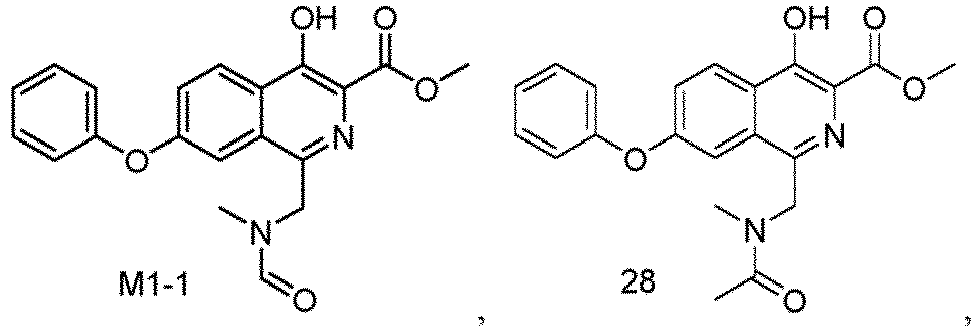
- the compound M1 may be any of the following compounds:
- the acid may be a conventional acid for such reactions in the art, such as an inorganic acid, an organic acid or a mixture thereof.
- the inorganic acid may be, for example, a hydrochloric acid (for example, a concentrated hydrochloric acid with a mass fraction of 36 % or a hydrogen chloride ethanol solution), a sulfuric acid, a phosphoric acid or a mixture thereof (wherein a mass fraction of the sulfuric acid and the phosphoric acid may be, for example, 30 %-85 %).
- the organic acid may be, for example, an acetic acid, a trifluoroacetic acid, or a mixture thereof.
- the amount of the acid may be a conventional amount of the acid for such reactions in the art.
- the acid is a concentrated hydrochloric acid with a mass fraction of 36 %, or a hydrogen chloride ethanol solution. More preferably, the acid is the concentrated hydrochloric acid with the mass fraction of 36 %, or the hydrogen chloride ethanol solution with a mass fraction of 33 %.
- the solvent may be a conventional solvent for such reactions in the art, such as an ether solvent, an alcohol solvent, an amide solvent, a sulfoxide solvent or a mixture thereof.
- the ether solvent may be, for example, tetrahydrofuran, dioxane or a mixture thereof.
- the alcohol solvent may be, for example, methanol, ethanol, isopropanol or a mixture thereof.
- the amide solvent may be, for example, N , N -dimethylformamide, N , N -dimethylacetamide or a mixture thereof.
- the sulfoxide solvent may be, for example, DMSO.
- the solvent of the reaction may be a single solvent or a mixture of two or more solvents.
- the solvent is preferably the alcohol solvent, or a mixed solvent of the ether solvent and the alcohol solvent, such as ethanol, or a mixed solvent of tetrahydrofuran and methanol.
- a volume ratio of the ether solvent to the alcohol solvent may be 0.5:1-4:1, for example, 1:1-2:1.
- the amount of the solvent may be a conventional amount of the solvent for such reactions in the art.
- the solvent is ethanol, or a mixed solvent of tetrahydrofuran and methanol.
- the solvent is ethanol or a mixed solvent of tetrahydrofuran and methanol with a volume ratio of 1:1 to 2:1. Further preferably, the solvent is ethanol, or a mixed solvent of tetrahydrofuran and methanol with a volume ratio of 2:1.
- the temperature of the reaction may be 60 °C to 70 °C.
- the progress of the reaction may be monitored by a conventional detection method in the art (such as TLC, MS, HPLC or NMR, etc.).
- a conventional detection method in the art such as TLC, MS, HPLC or NMR, etc.
- the progress of the reaction is monitored by TLC when the compound M1 disappears as the end point of the reaction.
- the post-treatment may comprise the following steps: cooling the reaction solution after the completion of the reaction (for example, cooling to 15 °C to 25 °C) and/or adding a poor solvent (for example, isopropyl acetate or methyl tert-butyl ether), performing a solid-liquid separation (for example, filtration under reduced pressure), and drying (for example, draining or vacuum drying) to obtain the target compound I .
- a poor solvent for example, isopropyl acetate or methyl tert-butyl ether
- drying for example, draining or vacuum drying
- the preparation method of the compound containing the isoquinoline ring represented by formula I may further comprise a preparation method of compound M1: carrying out a reaction as shown below between compound SM and compound SM-A under the action of an oxidizing agent to obtain the compound M1; wherein, the definitions of R 1 and R 3 are the same as above, and R 2 is methyl.
- R 1 is H or C 1 -C 4 alkyl; more preferably, R 1 is C 1 -C 4 alkyl; further preferably, R 1 is methyl, ethyl, n -propyl, isopropyl, n-butyl, isobutyl, sec -butyl or tert -butyl; most preferably, R 1 is methyl or ethyl;
- R 3 is H or C 1 -C 4 alkyl; more preferably, R 3 is H, methyl, ethyl, n-propyl, isopropyl, n -butyl, isobutyl, sec -butyl or tert -butyl; most preferably, R 3 is methyl or H.
- R 1 is methyl or ethyl
- R 2 is methyl
- R 3 is H or methyl
- the oxidizing agent may be a conventional oxidizing agent for such reactions in the art.
- the oxidizing agent may be, for example, a persulfate oxidizing agent, such as an alkali metal persulfate.
- the alkali metal persulfate may be sodium persulfate, potassium persulfate, potassium peroxymonosulfate composite salt (Oxone) or a mixture thereof.
- the oxidizing agent is sodium persulfate.
- the amount of the oxidizing agent may be a conventional amount of the oxidizing agent for such reactions in the art.
- a molar ratio of the compound SM2 to the oxidizing agent is 1:1-1:5, for example, 1:1.5-1:3, for another example, 1:2.
- the amount of the compound SM and the compound SM-A may be the conventional amount for such reactions in the art.
- a molar ratio of the compound SM-A to the compound SM may be greater than 1:1, for example, greater than 5:1, greater than 10:1, greater than 20:1, greater than 40:1, or greater than 50: 1.
- a molar ratio of the compound SM-A to the compound SM is greater than 20:1.
- the solvent may be a conventional solvent for such reactions in the art, such as a chlorinated hydrocarbon solvent, an ether solvent or a mixture thereof.
- the solvent generally has good solubility for compound SM, and is not easily oxidized or does not participate in the reaction.
- the compound SM-A may also be used as a reaction solvent and a raw material at the same time.
- compound SM-A is used as both the reaction raw material and the solvent.
- the temperature of the reaction may be a conventional temperature for such reactions in the art.
- the reaction temperature may be 30 °C to 100 °C, for example, 50 °C to 80 °C, and for another example, 60 °C to 70 °C.
- the temperature of the reaction in the preparation method of compound M1, may be 30 °C to 100 °C, for example, 60 °C to70 °C, and for another example, 65 °C to 70 °C.
- the temperature of the reaction is 60 °C to 70 °C.
- the oxidizing agent may be directly used alone, or the oxidizing agent is used in the form of a mixed solution with water, or the oxidizing agent is used in the form of a mixed solution with an organic solvent.
- the water is conventional water in the art, such as purified water, distilled water or a mixture thereof.
- the organic solvent may be, for example, a chlorinated hydrocarbon solvent, an ether solvent, or a mixture thereof.
- the organic solvent generally has good solubility for the oxidizing agent.
- the organic solvent may be, for example, dichloromethane, tetrahydrofuran, dioxane or a mixture thereof.
- a molar ratio of the oxidizing agent to the water or the organic solvent may be 1:1-1:50, for example, 1:2-1:35, for another example, 1:2-1:30, for still another example, 1:20-1:35, and for yet another example, 1:20-1:30.
- the oxidizing agent is in the form of a mixed solution in which the molar ratio of sodium persulfate to water is 1:20-1:30.
- the progress of the reaction may be monitored by a conventional detection method in the art (such as TLC, MS, HPLC or NMR, etc.).
- the progress of the reaction is monitored by TLC when the compound SM2 disappears as the end point of the reaction.
- the time of the reaction may be, for example, 20 minutes to 10 hours (e.g., 1 hour, 4 hours, 5 hours, 6 hours, or 8 hours).
- the post-treatment may comprise the following steps: extracting the reaction solution after the completion of the reaction with an organic solvent, concentrating the organic phase, optionally slurrying a residue obtained after the concentration with the organic solvent, performing a solid-liquid separation, and optionally washing the solid with the organic solvent and drying to obtain the target compound; or, mixing the reaction solution after the completion of the reaction with water, performing a solid-liquid separation, and optionally washing the solid with the organic solvent and drying to obtain the target compound.
- the present disclosure also provides a use of a compound containing an isoquinoline ring represented by formula I or a salt thereof in the quality control of rosalostat synthesis intermediate M2-A
- the compound containing the isoquinoline ring represented by formula I or the salt thereof may be used as a reference substance.
- C 1 -C 4 alkyl refers to methyl, ethyl, n -propyl, isopropyl, n -butyl, isobutyl, sec -butyl or tert -butyl.
- C 1 -C 4 alkoxy refers to methoxy, ethoxy, n- propoxy, isopropoxy, n -butoxy, isobutoxy, sec -butoxy or tert -butoxy.
- C 1 -C 4 alkyl or benzoyl substituted by 1, 2 or 3 halogens means that one or more hydrogens in the C 1 -C 4 alkyl or phenyl are substituted by halogens.
- halogens For example, trifluoromethyl, difluoromethyl, trifluoroethyl, difluoroethyl or perfluoroethyl.
- the term "optionally substituted by 1, 2 or 3 R” means that a group is unsubstituted or substituted by 1, 2 or 3 R, wherein R is defined in the present disclosure.
- halogen refers to F, Cl, Br or I.
- hydrochloric acid refers to a concentrated hydrochloric acid with a mass fraction of about 36 %, or a saturated solution of hydrogen chloride in an organic solvent, such as a hydrogen chloride ethanol solution.
- DMA refers to N , N -dimethylacetamide
- DMF refers to N , N -dimethylformamide
- compound SM may be prepared according to methods known in the prior art, for example, the methods disclosed in CN201210152768.1 and CN201310302822.0 .
- Compound 5 may be prepared according to CN201310302822.0 .
- Compound SM2 may be prepared according to CN201210152768.1 .
- the room temperature generally refers to an ambient temperature, such as 0 °C to 40 °C, preferably 10 °C to 30 °C, more preferably 25 °C.
- the reagents and raw materials used in the present disclosure are commercially available.
- the synthesis method of the present disclosure has cheap and easily available raw materials, short steps (only 3 steps are needed to prepare intermediate M3 from the starting raw material SM), mild reaction conditions and a high yield, and is suitable for industrial production.
- the synthesis method of the present disclosure does not use high-boiling point reagents and noble metal reagents (such as palladium catalysts) that are difficult to remove, and the post-treatment is simple and the three wastes are few.
- the compound containing the isoquinoline ring in the present disclosure participates in the subsequent reaction, and the derivative impurities of the compound containing the isoquinoline ring are difficult to remove, which has a great impact on the quality of a roxadustat active pharmaceutical ingredient (API).
- the compound containing the isoquinoline ring may be used as a reference substance to control the quality of roxadustat synthesis intermediates and roxadustat API, which is necessary to control the quality of the roxadustat API and even the drug product.
- reaction or an operation where a reaction or an operation does not specifically specify the temperature, the reaction or the operation is generally performed at room temperature.
- a purity refers to a HPLC purity or a GC purity unless otherwise stated.
- LC-MS detection conditions (embodiments 1-8, unless otherwise stated): model: Agilent liquid chromatography/tandem mass spectrometry 1260/6120; ion source: ESI; sample solvent: acetonitrile.
- the synthetic route is as follows:
- reaction solution was concentrated in vacuum to a concentrated solution with a volume of about 3-5 mL to precipitate a solid, filtered under reduced pressure, washed with a small amount of methanol, and the filter cake was dried in vacuum to obtain 2.7 g of a white solid with a yield of 88.7 % (calculated on the basis of hydrochloride salt) and a purity of 98.64 %.
- reaction solution was concentrated in vacuum until a large amount of solid precipitated, filtered under reduced pressure, washed with a small amount of methanol, and the filter cake was dried in vacuum to obtain 27.1 g of a white solid with a yield of 91.8 % (calculated on the basis of hydrochloride salt) and a purity of 98.20 %.
- the filter cake was slurried in methanol/water (1:3/v:v, 75 mL), filtered under reduced pressure and the filter cake was dried in vacuum to obtain 15.6 g of a brown solid with a yield of 75.3 % and a purity of 96.57 %.
- the synthetic route is as follows:
- reaction solution was concentrated in vacuum to obtain a concentrated solution with a volume of about 2-3 mL to precipitate a solid, filtered under reduced pressure, washed with a small amount of methanol, and drained to obtain 1.7 g of a white solid with a yield of 83.3 % (calculated on the basis of hydrochloride salt) and a purity of 97.80 %.
- the synthetic route is as follows:
- reaction solution was concentrated in vacuum until a large amount of solid precipitated, filtered under reduced pressure, washed with a small amount of methanol, and drained to obtain 2.8 g of a white solid with a yield of 94.7 % (calculated on the basis of hydrochloride salt) and a purity of 98.40 %; wherein the content of impurity compound I (retention time was 4.95 min) was 1.4 %.
- reaction solution was concentrated in vacuum until a large amount of solid precipitated, filtered under reduced pressure, washed with a small amount of methanol, and drained to obtain 2.4 g of a white solid with a yield of 88.4 % (calculated on the basis of hydrochloride salt) and a purity of 98.18 %.
- reaction solution was concentrated in vacuum until a large amount of solid precipitated, filtered under reduced pressure, washed with a small amount of methanol, and drained to obtain 2.4 g of a white solid with a yield of 86.2 % (calculated on the basis of hydrochloride salt) and a purity of 98.83 %.
- reaction solution was concentrated in vacuum until a large amount of solid precipitated, filtered under reduced pressure, washed with a small amount of methanol, and drained to obtain 2.6 g of a white solid with a yield of 84.5 % (calculated on the basis of hydrochloride salt) and a purity of 98.11 %.
- intermediate M3-A (prepared in embodiment 3.9) was added to 15 g of ethanol, and 1.4 g of sodium glycinate was added, and the obtained mixture was heated to 105 °C to 115 °C in a pressure-resistant container and stirred for 8 hours with sealing.
- the reaction solution was cooled to room temperature, filtered under reduced pressure, washed with a small amount of methanol, and drained to obtain a crude product of a roxadustat sodium salt.
- the crude product of the roxadustat sodium salt was dissolved in 25 g of water, and the aqueous phase was washed with 10 mL of ethyl acetate.
- the filter cake was transferred to methanol/water (6 mL/18 mL), stirred at room temperature for 0.5 hours, filtered under reduced pressure, and dried in vacuum to obtain 3.1 g of a finished product of roxadustat with a yield of 87.5 % and a purity of 99.18 %.
- the filter cake was transferred to methanol/water (6 mL/18 mL), stirred at room temperature for 0.5 hours, filtered under reduced pressure, and dried in vacuum to obtain 3.0 g of a finished product of roxadustat with a yield of 86.4 % and a purity of 99.34 %.
- the synthetic route is as follows:
- reaction solution was concentrated in vacuum until a large amount of solid precipitated, filtered under reduced pressure, washed with a small amount of methanol, and drained to obtain 886 g of a white solid, which was intermediate M2-A, with a yield of 89.9 % (calculated on the basis of hydrochloride salt) and a purity of 97.79 % detected by HPLC.
- the filter cake was washed with isopropyl ether (300 mL ⁇ 2 times), drained, dried in vacuum (50 °C, vacuum degree ⁇ -0.09 MPa) for 12 hours, stopped the drying to obtain 243 g of an off-white solid, which was intermediate M2-A, with a yield of 82 % (calculated on the basis of hydrochloride salt) and a purity of 99.26 % detected by HPLC.
- the mixture was cooled to 0 to 10 °C, stirred for 1 hour, filtered under reduced pressure, and the filter cake was washed with water (100 mL ⁇ 2 times), and drained. The filter cake was transferred to a 500 mL round-bottomed flask.
- the solid filter cake was dried in vacuum (50 °C, vacuum degree ⁇ -0.08 MPa) for 24 hours, and the material was collected to obtain 179 g of a crude product of roxadustat with a yield 82 % and a purity of 99.73 % detected by HPLC.
- 100 g of the crude product of roxadustat was weighed in a 5 L three-necked flask, and 1 L of purified water was added, and the obtained mixture was stirred evenly at room temperature.
- a sodium hydroxide aqueous solution 13 g of sodium hydroxide dissolved in 1.3 L of purified water was slowly added dropwise at room temperature. After the dropwise addition, the reaction solution was pale yellow-green.
- the mixture was heated to an internal temperature of about 70 °C.
- An acetic acid aqueous solution (26 g of acetic acid dissolved in 100 mL of purified water) was slowly added dropwise.
- the pH value of the mixture was monitored.
- the dropwise addition of the acetic acid solution was stopped, and a small amount of a crystalline solid was precipitated.
- the remaining acetic acid solution was added dropwise.
- the mixture was continued to be kept the temperature and stirred for 1 hour. The heating was turned off, and when the internal temperature of the system was lowered to about 45 °C, the mixture was filtered under reduced pressure.
- the filter cake was washed with 500 mL of purified water, and the solid of the filter cake was dried in vacuum (50 °C, vacuum degree ⁇ -0.08 Mpa). The materials were collected to obtain 97.36 g of a pure product of roxadustat with a yield of 97.36 % and a purity of 99.91 % detected by HPLC.
- the identification data of the target substance are as follows:
- Ethyl 4-hydroxy-1-((N methylacetamido)methyl)-7-phenoxyisoquinoline-3-carboxylate (intermediate M1-A, prepared with reference to the method of embodiment 3.1, 4 g, 0.01 mol) was added to ethanol (12 mL), then a 33 % hydrogen chloride ethanol solution (8 mL) was added, and the temperature was heated to 60 to 70 °C, and the mixture was stirred for about 24 hours. TLC showed that the raw material disappeared, and the heating was stopped, and the temperature was lowered to 15 to 25 °C. Methyl tert-butyl ether (40 mL) was added, and a solid was precipitated.
- Methyl 4-hydroxy-1-(( N -methylacetamido)methyl)-7-phenoxyisoquinoline-3-carboxylate (intermediate 28, prepared with reference to the method of embodiment 1.2, 4 g, 0.01 mol) was added to methanol (10 mL) and tetrahydrofuran (20 mL), then a 36 % concentrated hydrochloric acid (15 mL) was added, and the temperature was heated to 60 to 70 °C and the mixture was stirred for about 24 hours. TLC showed that the raw material disappeared, the heating was stopped, and the temperature was lowered to 15 to 25 °C. A solid was precipitated.
- Ethyl 4-hydroxy-1-((N methylformamido)methyl)-7-phenoxyisoquinoline-3-carboxylate (intermediate M1-F, prepared with reference to the method of embodiment 3.4, 4 g, 0.01 mol) was added to ethanol (12 mL), then a 33 % hydrogen chloride ethanol solution (8 mL) was added, and the temperature was heated to 60 to 70 °C and the mixture was stirred for about 24 hours. TLC showed that the raw material disappeared, and the heating was stopped, and the temperature was lowered to 15 to 25 °C. Isopropyl acetate (50 mL) was added, and a solid was precipitated.
- the mixture was cooled to 15 to 25 °C, stirred for 1 hour, and filtered under reduced pressure to obtain 0.96 g of a refined product of M3-A with a yield of 70 % and a purity of 98.9 % detected by HPLC, wherein the content of impurity compound II (retention time was 6.8 min) was 0.05 %.
- the pH of the aqueous phase was adjusted to less than 7 by acetic acid. A large amount of solid was precipitated, filtered under reduced pressure. The filter cake was washed with water and drained, dried in vacuum to obtain 0.84 g of a finished product of roxadustat with a yield of 86 % and a purity of 99.81 %, and the content of impurity compound II (retention time was 6.8 min) was 0.03 %.
Landscapes
- Chemical & Material Sciences (AREA)
- Organic Chemistry (AREA)
- Organic Low-Molecular-Weight Compounds And Preparation Thereof (AREA)
- Pharmaceuticals Containing Other Organic And Inorganic Compounds (AREA)
- Heterocyclic Carbon Compounds Containing A Hetero Ring Having Nitrogen And Oxygen As The Only Ring Hetero Atoms (AREA)
Claims (15)
- Verfahren zur Synthese von Verbindung M1, wobei das Verfahren die folgenden Schritte umfasst: Durchführen einer wie nachstehend gezeigten Umsetzung zwischen Verbindung SM und Verbindung SM-A unter der Einwirkung eines Oxidationsmittels;
 R1 für H, C1-C4-Alkyl oder C6-C10-Aryl steht;R2 für H oder Methyl steht;R3 für H, C1-C4-Alkyl, C4-C6-Cycloalkyl oder C6-C10-Aryl steht;wobei das C1-C4-Alkyl, das C6-C10-Aryl und das C4-C6-Cycloalkyl gegebenenfalls durch 1, 2 oder 3 R substituiert sind und R jeweils unabhängig für Halogen, Hydroxyl, Amino, C1-C4-Alkyl, C1-C4-Alkoxy, Mono (C1-C4-alkyl) amino, Di (C1-C4-alkyl) amino, Cyano oder Nitro steht.
 - Verfahren zur Synthese von Verbindung M1 nach Anspruch 1, wobeiR1 für H, C1-C4-Alkyl oder C6-C10-Aryl steht; vorzugsweise R1 für H, Methyl, Ethyl, n-Propyl, Isopropyl, n-Butyl, Isobutyl, sec-Butyl, tert-Butyl, Phenyl oder Naphthyl steht;und/oder R3 für H, C1-C4-Alkyl, C4-C6-Cycloalkyl oder C6-C10-Aryl steht; vorzugsweise R3 für H, Methyl, Ethyl, n-Propyl, Isopropyl, n-Butyl, Isobutyl, sec-Butyl, tert-Butyl, Cyclobutyl, Cyclopentyl, Cyclohexyl, Phenyl oder Naphthyl steht;und/oder das Oxidationsmittel ein Persulfat-Oxidationsmittel, ein Peroxid-Oxidationsmittel oder eine Mischung davon ist; wobei das Persulfat-Oxidationsmittel ein Alkalimetallpersulfat, ein Erdalkalimetallpersulfat oder eine Mischung davon sein kann; das Alkalimetallpersulfat Natriumpersulfat, Kaliumpersulfat, Kaliumperoxomonosulfat-Kompositsalz oder eine Mischung davon sein kann; das Erdalkalimetallpersulfat Magnesiumpersulfat sein kann; das Peroxid-Oxidationsmittel Rm-O-O-Rn sein kann; wobei Rm und Rn unabhängig für H, C1-C4-Alkyl oder Benzoyl, das gegebenenfalls durch 1, 2 oder 3 Halogene substituiert ist, stehen; das Peroxid-Oxidationsmittel Wasserstoffperoxid, Peressigsäure, Peroxytrifluoressigsäure, Benzoylperoxid, tert-Butylhydroperoxid, Di-tert-butylperoxid oder eine Mischung davon sein kann;und/oder ein Molverhältnis von Verbindung SM zu Oxidationsmittel 1:1-1:5, beispielsweise 1:1,5-1:3 oder beispielsweise 1:2, beträgt;und/oder ein Molverhältnis von Verbindung SM-A zu Verbindung SM größer als 1:1, beispielsweise größer als 5:1, größer als 10:1, größer als 20:1, größer als 40:1 oder größer als 50:1, ist;und/oder eine Temperatur der Umsetzung 30 °C bis 100 °C, beispielsweise 50 °C bis 80 °C oder beispielsweise 60 °C bis 70 °C oder beispielsweise 65 °C bis 70 °C, beträgt.
- Verfahren zur Synthese von Verbindung M1 nach Anspruch 1 oder 2, wobei
Verbindung SM-A


- Verfahren zur Synthese von Verbindung M1 nach Anspruch 3, wobei
Verbindung SM







- Verfahren zur Synthese von Verbindung M2, wobei das Verfahren die folgenden Schritte umfasst: Durchführen einer wie nachstehend gezeigten Umsetzung an Verbindung M1 unter der Einwirkung einer Säure; wobei das Verfahren zur Synthese von Verbindung M2 das Verfahren zur Synthese von Verbindung M1 gemäß einem der Ansprüche 1-4 umfasst;

- Verfahren zur Synthese von Verbindung M2 nach Anspruch 5, wobei bei dem Verfahren zur Synthese von Verbindung M2 die Säure eine anorganische Säure, eine organische Säure oder eine Mischung davon ist; die anorganische Säure eine Salzsäure, eine Schwefelsäure, eine Phosphorsäure oder eine Mischung davon sein kann; die organische Säure eine Essigsäure, eine Trifluoressigsäure oder eine Mischung davon sein kann; und/oder bei dem Verfahren zur Synthese von Verbindung M2 das Lösungsmittel ein Etherlösungsmittel, ein Alkohollösungsmittel, ein Amidlösungsmittel, ein Sulfoxidlösungsmittel oder eine Mischung davon ist; das Etherlösungsmittel Tetrahydrofuran, Dioxan oder eine Mischung davon sein kann; das Alkohollösungsmittel Methanol, Ethanol, Isopropanol oder eine Mischung davon sein kann; das Amidlösungsmittel N,N-Dimethylformamid, N,N-Dimethylacetamid oder eine Mischung davon sein kann; das Sulfoxidlösungsmittel DMSO ist;
und/oder bei dem Verfahren zur Synthese von Verbindung M2 eine Temperatur der Umsetzung 25 °C bis 50 °C beträgt. - Verfahren zur Synthese von Verbindung M2 nach Anspruch 5 oder 6, wobei bei dem Verfahren zur Synthese von Verbindung M2 das Lösungsmittel bei der Umsetzung ein einziges Lösungsmittel oder eine Mischung von zwei oder mehr Lösungsmitteln; vorzugsweise das Alkohollösungsmittel oder ein gemischtes Lösungsmittel des Etherlösungsmittels und des Alkohollösungsmittels, wie Ethanol oder ein gemischtes Lösungsmittel von Tetrahydrofuran und Methanol, ist.
- Verfahren zur Synthese von Verbindung M3, wobei das Verfahren die folgenden Schritte umfasst: Durchführen einer wie nachstehend gezeigten Umsetzung an Verbindung M2 unter der Einwirkung einer Wasserstoffquelle; wobei das Verfahren zur Synthese von Verbindung M3 das Verfahren zur Synthese von Verbindung M2 gemäß einem der Ansprüche 5-7 umfasst;

- Verfahren zur Synthese von Verbindung M3 nach Anspruch 8, wobei bei dem Verfahren zur Synthese von Verbindung M3 die Wasserstoffquelle ein Metallelement/ein Wasserstoffdonor ist; das Metallelement ein Zinkpulver, ein Eisenpulver oder eine Mischung davon sein kann; der Wasserstoffdonor eine Säure, Ammoniumformiat, Ammoniumchlorid oder eine Mischung der Säure und des Ammoniumchlorids oder eine Mischung der Säure und des Ammoniumformiats sein kann.
- Verfahren zur Synthese von Verbindung M3 nach Anspruch 9, wobei bei dem Verfahren zur Synthese von Verbindung M3 das Metallelement das Zinkpulver ist; und/oder dann, wenn es sich bei dem Wasserstoffdonor um die Säure handelt, die Säure eine anorganische Säure, eine organische Säure oder eine Mischung davon ist; die anorganische Säure vorzugsweise eine Salzsäure, eine Schwefelsäure, eine Phosphorsäure oder eine Mischung davon ist; die organische Säure vorzugsweise eine Ameisensäure, eine Essigsäure, eine Trifluoressigsäure oder eine Mischung davon ist.
- Verfahren zur Synthese von Verbindung M3 nach Anspruch 9, wobei dann, wenn es sich bei dem Wasserstoffdonor um die Mischung der Säure und des Ammoniumchlorids oder die Mischung der Säure und des Ammoniumformiats handelt, die Säure vorzugsweise eine anorganische Säure, eine organische Säure oder eine Mischung davon ist; die anorganische Säure vorzugsweise eine Salzsäure, eine Schwefelsäure, eine Phosphorsäure oder eine Mischung davon ist; die organische Säure vorzugsweise eine Ameisensäure, eine Essigsäure, eine Trifluoressigsäure oder eine Mischung davon ist.
- Verfahren zur Synthese von Verbindung M3 nach einem der Ansprüche 8-11, wobei bei dem Verfahren zur Synthese von Verbindung M3 Verbindung M2


- Verfahren zur Synthese von Roxadustat, wobei das Verfahren die folgenden Schritte umfasst:Durchführen einer wie nachstehend gezeigten Umsetzung zwischen Verbindung M3 und NH2CH2COORa; wobei das Verfahren zur Synthese von Roxadustat das Verfahren zur Synthese von Verbindung M3 gemäß einem der Ansprüche 8-12 umfasst;
 wobei Ra für H oder Na steht; R1 wie in Anspruch 1 oder 2 definiert ist;vorzugsweise bei dem Verfahren zur Synthese von Roxadustat dann, wenn Ra für H steht, die Verbindung M3 in Gegenwart von Alkali mit NH2CH2COORa reagiert; dann, wenn Ra für Na steht, die Verbindung M3 gegebenenfalls in Gegenwart von Alkali mit NH2CH2COORa reagiert; und/oder bei dem Verfahren zur Synthese von Roxadustat das Alkali aus einem oder mehreren von Natriummethoxid, Natriumethoxid, Natrium-tert-butoxid, Kalium-tert-butoxid, Natriumhydroxid, Kaliumhydroxid, Lithiumhydroxid, 1,8-Diazabicycloundec-7-en, Triethylamin, N,N-Diisopropylethylamin und Pyridin ausgewählt wird; das Alkali vorzugsweise 1,8-Diazabicycloundec-7-en ist;und/oder bei dem Verfahren zur Synthese von Roxadustat das Lösungsmittel der Umsetzung aus einem oder mehreren von Methanol, Ethanol, n-Butanol, Tetrahydrofuran, 1,4-Dioxan, N,N-Dimethylacetamid, Acetonitril, Dimethylsulfoxid, N-Methylpyrrolidon, Toluol und Iodbenzol ausgewählt wird; das Lösungsmittel vorzugsweise Methanol, Acetonitril oder Ethanol ist.
 - Verbindung M1, Verbindung M2 oder ein Salz davon:


- Verbindung M1, Verbindung M2 oder Salz davon gemäß Anspruch 14 zur Verwendung bei der Herstellung von Roxadustat.
Applications Claiming Priority (3)
| Application Number | Priority Date | Filing Date | Title |
|---|---|---|---|
| CN202010566080 | 2020-06-19 | ||
| CN202011148392 | 2020-10-23 | ||
| PCT/CN2021/100797 WO2021254469A1 (zh) | 2020-06-19 | 2021-06-18 | 一种罗沙司他及其中间体的合成方法和其中间体 |
Publications (3)
| Publication Number | Publication Date |
|---|---|
| EP4169906A1 EP4169906A1 (de) | 2023-04-26 |
| EP4169906A4 EP4169906A4 (de) | 2023-09-27 |
| EP4169906B1 true EP4169906B1 (de) | 2024-09-04 |
Family
ID=78923816
Family Applications (1)
| Application Number | Title | Priority Date | Filing Date |
|---|---|---|---|
| EP21826831.6A Active EP4169906B1 (de) | 2020-06-19 | 2021-06-18 | Verfahren zur synthese von roxadustat und zwischenprodukt davon sowie zwischenprodukt davon |
Country Status (5)
| Country | Link |
|---|---|
| US (1) | US12410140B2 (de) |
| EP (1) | EP4169906B1 (de) |
| JP (1) | JP7368636B2 (de) |
| CN (3) | CN113816904B (de) |
| WO (1) | WO2021254469A1 (de) |
Families Citing this family (6)
| Publication number | Priority date | Publication date | Assignee | Title |
|---|---|---|---|---|
| CN114524748B (zh) * | 2021-12-24 | 2023-12-12 | 浙江和泽医药科技股份有限公司 | 一种罗沙司他中间体和罗沙司他的制备方法 |
| CN115420823B (zh) * | 2022-08-29 | 2023-09-29 | 南京正济医药研究有限公司 | 罗沙司他中有关物质的测定方法 |
| CN115594631A (zh) * | 2022-10-25 | 2023-01-13 | 安徽省庆云医药股份有限公司(Cn) | 一种罗沙司他关键中间体及罗沙司他中间体的制备方法 |
| CN116082234A (zh) * | 2022-11-10 | 2023-05-09 | 江苏正济药业股份有限公司 | 一种[(4-羟基-1-甲基-7-苯氧基异喹啉-3-甲酰基)氨基]乙酸的制备方法 |
| CN116891433B (zh) * | 2022-12-30 | 2025-11-04 | 重庆圣华曦药业股份有限公司 | 罗沙司他的制备方法 |
| CN117338946B (zh) * | 2023-10-20 | 2026-04-17 | 四川大学 | Dna四面体框架核酸和fg-4592复合物及其制备方法和用途 |
Family Cites Families (12)
| Publication number | Priority date | Publication date | Assignee | Title |
|---|---|---|---|---|
| DE3727384A1 (de) | 1987-08-17 | 1989-03-02 | Basf Ag | Redoxelektrode zur bestimmung von salpetriger saeure und nitrosylverbindungen |
| WO2007090068A2 (en) * | 2006-01-27 | 2007-08-09 | Fibrogen, Inc. | Cyanoisoquinoline compounds that stabilize hypoxia inducible factor (hif) |
| CA2842730C (en) | 2011-07-22 | 2018-08-21 | Beijing Betta Pharmaceuticals Co., Ltd | Polymorphic forms of compounds as prolyl hydroxylase inhibitor, and uses thereof |
| US9340511B2 (en) * | 2012-07-16 | 2016-05-17 | Fibrogen, Inc. | Process for making isoquinoline compounds |
| US8883823B2 (en) * | 2012-07-16 | 2014-11-11 | Fibrogen, Inc. | Crystalline forms of a prolyl hydroxylase inhibitor |
| CN104892509B (zh) | 2015-06-04 | 2018-03-09 | 苏州明锐医药科技有限公司 | 诺得司他的制备方法 |
| CN106916105A (zh) * | 2015-12-28 | 2017-07-04 | 徐州万邦金桥制药有限公司 | 一种纯化可博美的方法 |
| CN106083720B (zh) | 2016-02-28 | 2018-09-11 | 深圳市塔吉瑞生物医药有限公司 | 一种取代的杂芳基化合物及包含该化合物的组合物及其用途 |
| CN107954931B (zh) * | 2016-10-17 | 2021-06-22 | 上海医药集团青岛国风药业股份有限公司 | 一种诺得司他的制备方法 |
| CN108017583B (zh) * | 2016-11-01 | 2021-04-06 | 徐州万邦金桥制药有限公司 | 一种可博美的制备方法 |
| CN108341777A (zh) * | 2017-01-23 | 2018-07-31 | 四川科伦博泰生物医药股份有限公司 | 异喹啉酮类化合物及其应用 |
| CN108424388B (zh) * | 2018-04-19 | 2020-08-21 | 杭州科巢生物科技有限公司 | 一种慢性贫血药物的制备方法 |
-
2021
- 2021-06-18 WO PCT/CN2021/100797 patent/WO2021254469A1/zh not_active Ceased
- 2021-06-18 EP EP21826831.6A patent/EP4169906B1/de active Active
- 2021-06-18 US US17/913,488 patent/US12410140B2/en active Active
- 2021-06-18 JP JP2022559397A patent/JP7368636B2/ja active Active
- 2021-06-18 CN CN202110683032.6A patent/CN113816904B/zh active Active
- 2021-06-18 CN CN202210295857.5A patent/CN114539149A/zh active Pending
- 2021-06-18 CN CN202210800792.5A patent/CN114933563B/zh active Active
Also Published As
| Publication number | Publication date |
|---|---|
| WO2021254469A1 (zh) | 2021-12-23 |
| CN114539149A (zh) | 2022-05-27 |
| US12410140B2 (en) | 2025-09-09 |
| EP4169906A1 (de) | 2023-04-26 |
| CN114933563B (zh) | 2023-04-07 |
| CN113816904A (zh) | 2021-12-21 |
| CN113816904B (zh) | 2022-08-12 |
| US20240018109A1 (en) | 2024-01-18 |
| EP4169906A4 (de) | 2023-09-27 |
| CN114933563A (zh) | 2022-08-23 |
| JP2023524626A (ja) | 2023-06-13 |
| JP7368636B2 (ja) | 2023-10-24 |
Similar Documents
| Publication | Publication Date | Title |
|---|---|---|
| EP4169906A1 (de) | Verfahren zur synthese von roxadustat und zwischenprodukt davon sowie zwischenprodukt davon | |
| EP4212509B1 (de) | Verfahren zur herstellung von wasserlöslichem magnololderivat und honokiolderivat, verfahren zur herstellung von zwischenprodukten | |
| EP4293026A1 (de) | Hochreine thienopyrimidinverbindung und herstellungsverfahren dafür | |
| CN103113333B (zh) | 一种维生素c乙基醚的合成方法 | |
| CN114014787A (zh) | 一种制备(2s,3r)-对甲砜基苯丝氨酸乙酯的不对称合成方法 | |
| CN110734443B (zh) | 一种他达拉非有关物质i的制备方法 | |
| CN112679431B (zh) | 一种制备异喹啉酮类化合物的方法 | |
| CN113621672A (zh) | 一种新型制备去氢表雄酮的方法 | |
| CN116891433B (zh) | 罗沙司他的制备方法 | |
| CN115260092B (zh) | 一种2-氯烟酰胺及其n取代衍生物的合成方法 | |
| CN114524748B (zh) | 一种罗沙司他中间体和罗沙司他的制备方法 | |
| CN111100042B (zh) | 一种2-甲氧基-5-磺酰胺基苯甲酸的制备方法 | |
| CN117209411A (zh) | 一种吲哚醛及其衍生物的合成方法 | |
| CN116143643A (zh) | 一种2-(4-氨基苯基)丁酸的制备方法 | |
| CN101250098A (zh) | 4’-羟基-2,6-二甲氧基二氢查耳酮的制备方法 | |
| EP3026047A1 (de) | Verfahren zur herstellung einer heterocyclischen verbindung | |
| JPS6151572B2 (de) | ||
| CN117105862B (zh) | 一种罗沙司他及其中间体的制备方法 | |
| CN107188786B (zh) | 一种医药中间体光学纯环戊烯醇的制备方法 | |
| CN107011138B (zh) | 一种西他列汀中间体的制备方法 | |
| CN109776415B (zh) | 一种Roxadustat中间体的制备方法 | |
| CN108424372B (zh) | 2,2,2-三氟-n-[(s)-4-羰基四氢萘-1-基]-乙酰胺的纯化工艺 | |
| AU2024331912A1 (en) | Synthesis of lanifibranor intermediate | |
| WO2023080193A1 (ja) | インドール化合物の製造方法 | |
| CN114524803A (zh) | 一种喹啉化合物中间体的合成方法 |
Legal Events
| Date | Code | Title | Description |
|---|---|---|---|
| STAA | Information on the status of an ep patent application or granted ep patent |
Free format text: STATUS: THE INTERNATIONAL PUBLICATION HAS BEEN MADE |
|
| PUAI | Public reference made under article 153(3) epc to a published international application that has entered the european phase |
Free format text: ORIGINAL CODE: 0009012 |
|
| STAA | Information on the status of an ep patent application or granted ep patent |
Free format text: STATUS: REQUEST FOR EXAMINATION WAS MADE |
|
| 17P | Request for examination filed |
Effective date: 20220926 |
|
| AK | Designated contracting states |
Kind code of ref document: A1 Designated state(s): AL AT BE BG CH CY CZ DE DK EE ES FI FR GB GR HR HU IE IS IT LI LT LU LV MC MK MT NL NO PL PT RO RS SE SI SK SM TR |
|
| A4 | Supplementary search report drawn up and despatched |
Effective date: 20230830 |
|
| DAV | Request for validation of the european patent (deleted) | ||
| DAX | Request for extension of the european patent (deleted) | ||
| RIC1 | Information provided on ipc code assigned before grant |
Ipc: C07D 217/26 20060101AFI20230824BHEP |
|
| GRAP | Despatch of communication of intention to grant a patent |
Free format text: ORIGINAL CODE: EPIDOSNIGR1 |
|
| STAA | Information on the status of an ep patent application or granted ep patent |
Free format text: STATUS: GRANT OF PATENT IS INTENDED |
|
| INTG | Intention to grant announced |
Effective date: 20240425 |
|
| GRAS | Grant fee paid |
Free format text: ORIGINAL CODE: EPIDOSNIGR3 |
|
| GRAA | (expected) grant |
Free format text: ORIGINAL CODE: 0009210 |
|
| STAA | Information on the status of an ep patent application or granted ep patent |
Free format text: STATUS: THE PATENT HAS BEEN GRANTED |
|
| AK | Designated contracting states |
Kind code of ref document: B1 Designated state(s): AL AT BE BG CH CY CZ DE DK EE ES FI FR GB GR HR HU IE IS IT LI LT LU LV MC MK MT NL NO PL PT RO RS SE SI SK SM TR |
|
| REG | Reference to a national code |
Ref country code: GB Ref legal event code: FG4D |
|
| P01 | Opt-out of the competence of the unified patent court (upc) registered |
Free format text: CASE NUMBER: APP_45204/2024 Effective date: 20240805 |
|
| REG | Reference to a national code |
Ref country code: CH Ref legal event code: EP |
|
| REG | Reference to a national code |
Ref country code: IE Ref legal event code: FG4D |
|
| REG | Reference to a national code |
Ref country code: DE Ref legal event code: R096 Ref document number: 602021018465 Country of ref document: DE |
|
| REG | Reference to a national code |
Ref country code: LT Ref legal event code: MG9D |
|
| PG25 | Lapsed in a contracting state [announced via postgrant information from national office to epo] |
Ref country code: NO Free format text: LAPSE BECAUSE OF FAILURE TO SUBMIT A TRANSLATION OF THE DESCRIPTION OR TO PAY THE FEE WITHIN THE PRESCRIBED TIME-LIMIT Effective date: 20241204 |
|
| PG25 | Lapsed in a contracting state [announced via postgrant information from national office to epo] |
Ref country code: GR Free format text: LAPSE BECAUSE OF FAILURE TO SUBMIT A TRANSLATION OF THE DESCRIPTION OR TO PAY THE FEE WITHIN THE PRESCRIBED TIME-LIMIT Effective date: 20241205 Ref country code: FI Free format text: LAPSE BECAUSE OF FAILURE TO SUBMIT A TRANSLATION OF THE DESCRIPTION OR TO PAY THE FEE WITHIN THE PRESCRIBED TIME-LIMIT Effective date: 20240904 Ref country code: PL Free format text: LAPSE BECAUSE OF FAILURE TO SUBMIT A TRANSLATION OF THE DESCRIPTION OR TO PAY THE FEE WITHIN THE PRESCRIBED TIME-LIMIT Effective date: 20240904 |
|
| PG25 | Lapsed in a contracting state [announced via postgrant information from national office to epo] |
Ref country code: BG Free format text: LAPSE BECAUSE OF FAILURE TO SUBMIT A TRANSLATION OF THE DESCRIPTION OR TO PAY THE FEE WITHIN THE PRESCRIBED TIME-LIMIT Effective date: 20240904 |
|
| PG25 | Lapsed in a contracting state [announced via postgrant information from national office to epo] |
Ref country code: LV Free format text: LAPSE BECAUSE OF FAILURE TO SUBMIT A TRANSLATION OF THE DESCRIPTION OR TO PAY THE FEE WITHIN THE PRESCRIBED TIME-LIMIT Effective date: 20240904 |
|
| PG25 | Lapsed in a contracting state [announced via postgrant information from national office to epo] |
Ref country code: HR Free format text: LAPSE BECAUSE OF FAILURE TO SUBMIT A TRANSLATION OF THE DESCRIPTION OR TO PAY THE FEE WITHIN THE PRESCRIBED TIME-LIMIT Effective date: 20240904 |
|
| PG25 | Lapsed in a contracting state [announced via postgrant information from national office to epo] |
Ref country code: ES Free format text: LAPSE BECAUSE OF FAILURE TO SUBMIT A TRANSLATION OF THE DESCRIPTION OR TO PAY THE FEE WITHIN THE PRESCRIBED TIME-LIMIT Effective date: 20240904 Ref country code: RS Free format text: LAPSE BECAUSE OF FAILURE TO SUBMIT A TRANSLATION OF THE DESCRIPTION OR TO PAY THE FEE WITHIN THE PRESCRIBED TIME-LIMIT Effective date: 20241204 |
|
| PG25 | Lapsed in a contracting state [announced via postgrant information from national office to epo] |
Ref country code: RS Free format text: LAPSE BECAUSE OF FAILURE TO SUBMIT A TRANSLATION OF THE DESCRIPTION OR TO PAY THE FEE WITHIN THE PRESCRIBED TIME-LIMIT Effective date: 20241204 Ref country code: PL Free format text: LAPSE BECAUSE OF FAILURE TO SUBMIT A TRANSLATION OF THE DESCRIPTION OR TO PAY THE FEE WITHIN THE PRESCRIBED TIME-LIMIT Effective date: 20240904 Ref country code: NO Free format text: LAPSE BECAUSE OF FAILURE TO SUBMIT A TRANSLATION OF THE DESCRIPTION OR TO PAY THE FEE WITHIN THE PRESCRIBED TIME-LIMIT Effective date: 20241204 Ref country code: LV Free format text: LAPSE BECAUSE OF FAILURE TO SUBMIT A TRANSLATION OF THE DESCRIPTION OR TO PAY THE FEE WITHIN THE PRESCRIBED TIME-LIMIT Effective date: 20240904 Ref country code: HR Free format text: LAPSE BECAUSE OF FAILURE TO SUBMIT A TRANSLATION OF THE DESCRIPTION OR TO PAY THE FEE WITHIN THE PRESCRIBED TIME-LIMIT Effective date: 20240904 Ref country code: GR Free format text: LAPSE BECAUSE OF FAILURE TO SUBMIT A TRANSLATION OF THE DESCRIPTION OR TO PAY THE FEE WITHIN THE PRESCRIBED TIME-LIMIT Effective date: 20241205 Ref country code: FI Free format text: LAPSE BECAUSE OF FAILURE TO SUBMIT A TRANSLATION OF THE DESCRIPTION OR TO PAY THE FEE WITHIN THE PRESCRIBED TIME-LIMIT Effective date: 20240904 Ref country code: ES Free format text: LAPSE BECAUSE OF FAILURE TO SUBMIT A TRANSLATION OF THE DESCRIPTION OR TO PAY THE FEE WITHIN THE PRESCRIBED TIME-LIMIT Effective date: 20240904 Ref country code: BG Free format text: LAPSE BECAUSE OF FAILURE TO SUBMIT A TRANSLATION OF THE DESCRIPTION OR TO PAY THE FEE WITHIN THE PRESCRIBED TIME-LIMIT Effective date: 20240904 |
|
| REG | Reference to a national code |
Ref country code: AT Ref legal event code: MK05 Ref document number: 1720280 Country of ref document: AT Kind code of ref document: T Effective date: 20240904 |
|
| PG25 | Lapsed in a contracting state [announced via postgrant information from national office to epo] |
Ref country code: NL Free format text: LAPSE BECAUSE OF FAILURE TO SUBMIT A TRANSLATION OF THE DESCRIPTION OR TO PAY THE FEE WITHIN THE PRESCRIBED TIME-LIMIT Effective date: 20240904 |
|
| PG25 | Lapsed in a contracting state [announced via postgrant information from national office to epo] |
Ref country code: PT Free format text: LAPSE BECAUSE OF FAILURE TO SUBMIT A TRANSLATION OF THE DESCRIPTION OR TO PAY THE FEE WITHIN THE PRESCRIBED TIME-LIMIT Effective date: 20250106 Ref country code: IS Free format text: LAPSE BECAUSE OF FAILURE TO SUBMIT A TRANSLATION OF THE DESCRIPTION OR TO PAY THE FEE WITHIN THE PRESCRIBED TIME-LIMIT Effective date: 20250104 |
|
| PG25 | Lapsed in a contracting state [announced via postgrant information from national office to epo] |
Ref country code: RO Free format text: LAPSE BECAUSE OF FAILURE TO SUBMIT A TRANSLATION OF THE DESCRIPTION OR TO PAY THE FEE WITHIN THE PRESCRIBED TIME-LIMIT Effective date: 20240904 Ref country code: SM Free format text: LAPSE BECAUSE OF FAILURE TO SUBMIT A TRANSLATION OF THE DESCRIPTION OR TO PAY THE FEE WITHIN THE PRESCRIBED TIME-LIMIT Effective date: 20240904 |
|
| PG25 | Lapsed in a contracting state [announced via postgrant information from national office to epo] |
Ref country code: EE Free format text: LAPSE BECAUSE OF FAILURE TO SUBMIT A TRANSLATION OF THE DESCRIPTION OR TO PAY THE FEE WITHIN THE PRESCRIBED TIME-LIMIT Effective date: 20240904 Ref country code: AT Free format text: LAPSE BECAUSE OF FAILURE TO SUBMIT A TRANSLATION OF THE DESCRIPTION OR TO PAY THE FEE WITHIN THE PRESCRIBED TIME-LIMIT Effective date: 20240904 |
|
| PG25 | Lapsed in a contracting state [announced via postgrant information from national office to epo] |
Ref country code: CZ Free format text: LAPSE BECAUSE OF FAILURE TO SUBMIT A TRANSLATION OF THE DESCRIPTION OR TO PAY THE FEE WITHIN THE PRESCRIBED TIME-LIMIT Effective date: 20240904 |
|
| PG25 | Lapsed in a contracting state [announced via postgrant information from national office to epo] |
Ref country code: SK Free format text: LAPSE BECAUSE OF FAILURE TO SUBMIT A TRANSLATION OF THE DESCRIPTION OR TO PAY THE FEE WITHIN THE PRESCRIBED TIME-LIMIT Effective date: 20240904 Ref country code: IT Free format text: LAPSE BECAUSE OF FAILURE TO SUBMIT A TRANSLATION OF THE DESCRIPTION OR TO PAY THE FEE WITHIN THE PRESCRIBED TIME-LIMIT Effective date: 20240904 |
|
| REG | Reference to a national code |
Ref country code: DE Ref legal event code: R097 Ref document number: 602021018465 Country of ref document: DE |
|
| PGFP | Annual fee paid to national office [announced via postgrant information from national office to epo] |
Ref country code: DE Payment date: 20250618 Year of fee payment: 5 |
|
| PG25 | Lapsed in a contracting state [announced via postgrant information from national office to epo] |
Ref country code: DK Free format text: LAPSE BECAUSE OF FAILURE TO SUBMIT A TRANSLATION OF THE DESCRIPTION OR TO PAY THE FEE WITHIN THE PRESCRIBED TIME-LIMIT Effective date: 20240904 |
|
| PGFP | Annual fee paid to national office [announced via postgrant information from national office to epo] |
Ref country code: GB Payment date: 20250522 Year of fee payment: 5 |
|
| PLBE | No opposition filed within time limit |
Free format text: ORIGINAL CODE: 0009261 |
|
| STAA | Information on the status of an ep patent application or granted ep patent |
Free format text: STATUS: NO OPPOSITION FILED WITHIN TIME LIMIT |
|
| PGFP | Annual fee paid to national office [announced via postgrant information from national office to epo] |
Ref country code: FR Payment date: 20250515 Year of fee payment: 5 |
|
| 26N | No opposition filed |
Effective date: 20250605 |
|
| PG25 | Lapsed in a contracting state [announced via postgrant information from national office to epo] |
Ref country code: SE Free format text: LAPSE BECAUSE OF FAILURE TO SUBMIT A TRANSLATION OF THE DESCRIPTION OR TO PAY THE FEE WITHIN THE PRESCRIBED TIME-LIMIT Effective date: 20240904 |
|
| REG | Reference to a national code |
Ref country code: CH Ref legal event code: H13 Free format text: ST27 STATUS EVENT CODE: U-0-0-H10-H13 (AS PROVIDED BY THE NATIONAL OFFICE) Effective date: 20260127 |
|
| PG25 | Lapsed in a contracting state [announced via postgrant information from national office to epo] |
Ref country code: MC Free format text: LAPSE BECAUSE OF FAILURE TO SUBMIT A TRANSLATION OF THE DESCRIPTION OR TO PAY THE FEE WITHIN THE PRESCRIBED TIME-LIMIT Effective date: 20240904 |
|
| PG25 | Lapsed in a contracting state [announced via postgrant information from national office to epo] |
Ref country code: LU Free format text: LAPSE BECAUSE OF NON-PAYMENT OF DUE FEES Effective date: 20250618 |
|
| REG | Reference to a national code |
Ref country code: BE Ref legal event code: MM Effective date: 20250630 |
|
| PG25 | Lapsed in a contracting state [announced via postgrant information from national office to epo] |
Ref country code: IE Free format text: LAPSE BECAUSE OF NON-PAYMENT OF DUE FEES Effective date: 20250618 |
|
| PG25 | Lapsed in a contracting state [announced via postgrant information from national office to epo] |
Ref country code: BE Free format text: LAPSE BECAUSE OF NON-PAYMENT OF DUE FEES Effective date: 20250630 |
|
| PG25 | Lapsed in a contracting state [announced via postgrant information from national office to epo] |
Ref country code: CH Free format text: LAPSE BECAUSE OF NON-PAYMENT OF DUE FEES Effective date: 20250630 |