EP4137806B1 - Hydrogen detection method and hydrogen detection device - Google Patents
Hydrogen detection method and hydrogen detection device Download PDFInfo
- Publication number
- EP4137806B1 EP4137806B1 EP21788844.5A EP21788844A EP4137806B1 EP 4137806 B1 EP4137806 B1 EP 4137806B1 EP 21788844 A EP21788844 A EP 21788844A EP 4137806 B1 EP4137806 B1 EP 4137806B1
- Authority
- EP
- European Patent Office
- Prior art keywords
- electrode
- hydrogen
- layer
- terminal
- metal oxide
- Prior art date
- Legal status (The legal status is an assumption and is not a legal conclusion. Google has not performed a legal analysis and makes no representation as to the accuracy of the status listed.)
- Active
Links
Images






Classifications
-
- G—PHYSICS
- G01—MEASURING; TESTING
- G01N—INVESTIGATING OR ANALYSING MATERIALS BY DETERMINING THEIR CHEMICAL OR PHYSICAL PROPERTIES
- G01N27/00—Investigating or analysing materials by the use of electric, electrochemical, or magnetic means
- G01N27/02—Investigating or analysing materials by the use of electric, electrochemical, or magnetic means by investigating impedance
- G01N27/04—Investigating or analysing materials by the use of electric, electrochemical, or magnetic means by investigating impedance by investigating resistance
- G01N27/12—Investigating or analysing materials by the use of electric, electrochemical, or magnetic means by investigating impedance by investigating resistance of a solid body in dependence upon absorption of a fluid; of a solid body in dependence upon reaction with a fluid, for detecting components in the fluid
- G01N27/128—Microapparatus
-
- G—PHYSICS
- G01—MEASURING; TESTING
- G01N—INVESTIGATING OR ANALYSING MATERIALS BY DETERMINING THEIR CHEMICAL OR PHYSICAL PROPERTIES
- G01N27/00—Investigating or analysing materials by the use of electric, electrochemical, or magnetic means
- G01N27/02—Investigating or analysing materials by the use of electric, electrochemical, or magnetic means by investigating impedance
- G01N27/04—Investigating or analysing materials by the use of electric, electrochemical, or magnetic means by investigating impedance by investigating resistance
- G01N27/12—Investigating or analysing materials by the use of electric, electrochemical, or magnetic means by investigating impedance by investigating resistance of a solid body in dependence upon absorption of a fluid; of a solid body in dependence upon reaction with a fluid, for detecting components in the fluid
- G01N27/125—Composition of the body, e.g. the composition of its sensitive layer
-
- G—PHYSICS
- G01—MEASURING; TESTING
- G01N—INVESTIGATING OR ANALYSING MATERIALS BY DETERMINING THEIR CHEMICAL OR PHYSICAL PROPERTIES
- G01N33/00—Investigating or analysing materials by specific methods not covered by groups G01N1/00 - G01N31/00
- G01N33/0004—Gaseous mixtures, e.g. polluted air
- G01N33/0009—General constructional details of gas analysers, e.g. portable test equipment
- G01N33/0027—General constructional details of gas analysers, e.g. portable test equipment concerning the detector
- G01N33/0036—General constructional details of gas analysers, e.g. portable test equipment concerning the detector specially adapted to detect a particular component
- G01N33/005—H2
Definitions
- the present disclosure relates to a hydrogen detection method, and a hydrogen detection device.
- Patent Literature (PTL) 1 and PTL 2 disclose a gas sensor that detects gas molecules containing hydrogen atoms.
- the present disclosure provides a hydrogen sensor, a hydrogen detection method, and a hydrogen detection device whose performance in detecting low-concentrated hydrogen is improved.
- the invention is a hydrogen detection method as defined by claim 12.
- the hydrogen detection method according to an aspect of the present invention is a hydrogen detection method in a hydrogen sensor, the hydrogen sensor including: a first electrode which is planar; a second electrode which is planar, faces the first electrode, and includes an exposed portion; a metal oxide layer which is sandwiched between a surface of the first electrode and a surface of the second electrode facing each other, and has a resistance that changes due to hydrogen; and two terminals connected to the second electrode with the exposed portion being interposed therebetween in plan view of the second electrode, the hydrogen detection method including: passing a current through the exposed portion by applying a voltage between the two terminals; and detecting a gas containing hydrogen atoms by detecting a decrease in a resistance value between the two terminals.
- the invention is a hydrogen detection device as defined by claim 1.
- the hydrogen detection device includes: a first electrode which is planar; a second electrode which is planar, faces the first electrode, and includes an exposed portion; a metal oxide layer which is sandwiched between a surface of the first electrode and a surface of the second electrode facing each other, and has a resistance that changes due to hydrogen; two terminals connected to the second electrode; and a drive circuit that, in a state of passing a current through the exposed portion by applying a voltage between the two terminals, detects a gas containing hydrogen atoms by detecting a decrease in a resistance value between the two terminals.
- a hydrogen detection method, and a hydrogen detection device can improve the performance in detecting low-concentrated hydrogen.
- FIG. 1A is a cross-sectional view illustrating a configuration example of hydrogen sensor 1 according to Embodiment 1.
- FIG. 1B is a top view illustrating a configuration example of hydrogen sensor 1 according to Embodiment 1. Note that FIG. 1A illustrates a schematic cross section along line IA-IA of FIG. 1B , viewed in the arrow direction.
- key components of hydrogen sensor 1 include first electrode 103, metal oxide layer 104, second electrode 106, first terminal 111, second terminal 112, and third terminal 113.
- the key components of hydrogen sensor 1 are covered by insulating film 102, insulating films 107a through 107c, and insulating films 109a and 109b. These insulating films, however, have openings 106a, 111a, 112a, and 113a.
- First electrode 103 is a planar electrode and has two surfaces. Of the two surfaces of first electrode 103, one surface (i.e., the upper surface in FIG. 1A ) is in contact with metal oxide layer 104, and the other surface (i.e., the lower surface in FIG. 1A ) is in contact with insulating film 107b and via 108. In FIG. 1B , first electrode 103 is in a rectangular shape of the same size as that of second electrode 106. First electrode 103 may include, for example, a material having a standard electrode potential lower than that of metals forming metal oxides, such as tungsten, nickel, tantalum, titanium, aluminum, tantalum nitride, and titanium nitride.
- First electrode 103 in FIG. 1A is formed with, for example, tantalum nitride (TaN) or titanium nitride (TiN), or laminations thereof.
- Metal oxide layer 104 is sandwiched between a surface of first electrode 103 and a surface of second electrode 106 facing each other, is formed with a metal oxide serving as a gas-sensitive resistance film, and has a resistance value that reversibly changes according to the presence and absence of a hydrogen-containing gas in a gas in contact with second electrode 106. It is sufficient so long as metal oxide layer 104 has a property that its resistance is changed by hydrogen. Metal oxide layer 104 is formed with an oxygen-deficient metal oxide.
- the base metal of metal oxide layer 104 at least one of the following may be selected: aluminum (Al) and transition metals such as tantalum (Ta), hafnium (Hf), titanium (Ti), zirconium (Zr), niobium (Nb), tungsten (W), nickel (Ni), and iron (Fe). Since transition metals can take on plural oxidation states, different resistance states can be realized through redox reactions.
- the "degree of oxygen deficiency" of a metal oxide is the ratio of deficiency of oxygen in the metal oxide to the amount of oxygen in an oxide having a stoichiometric composition composed of the same elements as those of the metal oxide.
- the oxygen deficiency is a value obtained by subtracting the amount of oxygen in the metal oxide from the amount of oxygen in the metal oxide having a stoichiometric composition. If there can be two or more metal oxides having stoichiometric compositions composed of the same elements as those of the metal oxide, the degree of oxygen deficiency of the metal oxide is defined based on one of the two or more metal oxides having stoichiometric compositions that has the highest resistance value. Metal oxides having stoichiometric compositions are more stable and higher in resistance value than metal oxides having other compositions.
- the oxide having a stoichiometric composition as defined above is Ta 2 O 5
- metal oxide layer 104 can be expressed as TaO 2.5 .
- the degree of oxygen deficiency of TaO 2.5 is 0%
- the degree of oxygen deficiency of TaO 1.5 is (2.5 - 1.5) / 2.5 - 40%.
- the degree of oxygen deficiency of a metal oxide with excess oxygen is a negative value. Note that in the present disclosure, the degree of oxygen deficiency can take a positive value, 0, or a negative value unless otherwise noted.
- An oxide with a low degree of oxygen deficiency has a high resistance value because it is closer to an oxide having a stoichiometric composition, whereas an oxide with a high degree of oxygen deficiency has a low resistance value because it is closer to the metal included in the oxide.
- Metal oxide layer 104 illustrated in FIG. 1A includes: first layer 104a in contact with first electrode 103; second layer 104b in contact with first layer 104a and second electrode 106; and isolation layer 104i.
- the degree of oxygen deficiency of second layer 104b is lower than that of first layer 104a.
- first layer 104a is TaOx.
- Second layer 104b is Ta 2 O 5 whose degree of oxygen deficiency is lower than that of first layer 104a.
- Metal oxide layer 104 includes isolation layer 104i at the perimeter in plan view of first electrode 103.
- plan view means viewing hydrogen sensor 1 according to the present invention from a viewpoint in the layer-stacking direction in FIG. 1A ; in other words, viewing from a viewpoint in the direction normal to any of the surfaces of, for example, first electrode 103 and second electrode 106 that are planar.
- plan view refers to viewing the top surface of hydrogen sensor 1 illustrated in FIG. 1B .
- the resistance state of such metal oxide layer 104 is that the resistance value decreases according to a hydrogen-containing gas that comes into contact with second electrode 106.
- a hydrogen-containing gas is present in a detection-target gas
- hydrogen atoms are dissociated from the hydrogen-containing gas in second electrode 106.
- the dissociated hydrogen atoms enter metal oxide layer 104 and form impurity levels.
- the dissociated hydrogen atoms concentrate in the vicinity of the interface with the second electrode, making the apparent thickness of second layer 104b smaller. As a result, the resistance value of metal oxide layer 104 decreases.
- Second electrode 106 is a planar electrode with hydrogen dissociability, and has two surfaces. Of the two surfaces of second electrode 106, one surface (i.e., the lower surface in FIG. 1A ) is in contact with metal oxide layer 104, and the other surface (i.e., the upper surface in FIG. 1A ) is in contact with metal layer 106s and the outside air. Second electrode 106 has, in aperture 106a, exposed portion 106e that is exposed to the outside air.
- Second electrode 106 is formed with, for example, a material that catalyzes dissociation of hydrogen atoms from gas molecules having hydrogen atoms, such as platinum (Pt), iridium (Ir), palladium (Pd), or nickel (Ni), or an alloy containing at least one of these. It is assumed that second electrode 106 in FIG. 1A is platinum (Pt). Two terminals, namely first terminal 111 and second terminal 112, are connected to second electrode 106.
- First terminal 111 is connected to second electrode 106 through via 108.
- Second terminal 112 is connected to second electrode 106 through via 108.
- First terminal 111 and second terminal 112 are connected, via openings 111a and 112a, respectively, to an external drive circuit that drives hydrogen sensor 1.
- first terminal 111 and second terminal 112 are disposed with exposed portion 106e being interposed therebetween in plan view of second electrode 106.
- application of a predetermined voltage between first terminal 111 and second terminal 112 causes passage of current through exposed portion 106e of second electrode 106, that is, causes current to flow through exposed portion 106e.
- the passage of current through exposed portion 106e of second electrode 106 is considered to activate the hydrogen dissociation by exposed portion 106e.
- the predetermined voltage may be voltages that are opposite to each other in polarity.
- the resistance value between first terminal 111 and second terminal 112 changes when gas molecules containing hydrogen atoms come into contact with exposed portion 106e during the passage of a current through exposed portion 106e.
- the above-described drive circuit detecting this change in the resistance value, gas molecules containing hydrogen atoms are detected.
- Third terminal 113 is connected to first electrode 103 via opening 113a, via 108, wiring 114, and via 108. Third terminal 113 is connected, via opening 113a, to the external drive circuit that drives hydrogen sensor 1.
- the resistance between first electrode 103 and second electrode 106 changes when gas molecules containing hydrogen atoms come into contact with exposed portion 106e during the passage of a current through exposed portion 106e.
- the resistance value between first terminal 111 or second terminal 112 and third terminal 113 changes when gas molecules containing hydrogen atoms come into contact with exposed portion 106e during the passage of a current through exposed portion 106e. Gas molecules containing hydrogen atoms are detected also through detection, by the above-described drive circuit, of the change in the resistance value.
- insulating film 102, insulating films 107a through 107c, and insulating films 109a and 109b that cover the key components of hydrogen sensor 1 are formed with a silicon oxide film, a silicon nitride film, etc.
- Metal layer 106s is formed on the upper surface of second electrode 106 except for opening 106a.
- Metal layer 106s includes, for example, TiAlN as the material, and is formed as an etching stopper for forming vias 108, but is not essential.
- the laminate of first electrode 103, metal oxide layer 104, and second electrode 106 is a structure that can be used as a storage element of resistance random access memory (ReRAM).
- the storage element of the resistance random access memory is a digital storage element which uses two of possible states that metal oxide layer 104 can take, i.e., a high-resistance state and a low-resistance state.
- Hydrogen sensor 1 according to the present disclosure uses the high-resistance state among the possible states of metal oxide layer 104.
- FIG. 1A illustrates an example of metal oxide layer 104 having a two-layer configuration with first layer 104a that includes TaOx as the material and second layer 104b that includes, as the material, Ta 2 O 5 whose degree of oxygen deficiency is low.
- metal oxide layer 104 may have a one-layer configuration having, as the material, TaOx or Ta 2 O 5 whose degree of oxygen deficiency is low.
- FIG. 2 is a block diagram illustrating a configuration example of hydrogen detection device 2 including hydrogen sensor 1 and drive circuit 200 that performs a hydrogen detection method according to Embodiment 1.
- hydrogen detection device 2 includes drive circuit 200 and hydrogen sensor 1.
- Drive circuit 200 is connected to hydrogen sensor 1 via at least three wires connected to first terminal 111, second terminal 112, and third terminal 113 of hydrogen sensor 1.
- Drive circuit 200 is a microcomputer including, for example, a CPU, ROM, and RAM. At least three wires are connected to ports of the microcomputer.
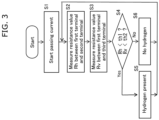
- FIG. 3 is a flowchart illustrating a hydrogen detection method performed by drive circuit 200 using hydrogen sensor 1.
- drive circuit 200 first starts passing current between first terminal 111 and second terminal 112 (S1).
- drive circuit 200 applies a predetermined voltage between first terminal 111 and second terminal 112.
- voltages that are opposite to each other in polarity e.g., +V1 and -V1 are applied to first terminal 111 and second terminal 112.
- the current that passes through exposed portion 106e of second electrode 106 as a result of the voltage application is sufficient so long as it is in a range from several milliamperes to several tens of milliamperes, for example.
- drive circuit 200 measures resistance value Rh between first terminal 111 and second terminal 112 (S2), and further measures resistance value Rv between first terminal 111 or second terminal 112 and third terminal 113 (S3). Furthermore, drive circuit 200 determines whether measured resistance value Rh is less than threshold th1, and determines whether measured resistance value Rv is less than threshold th2 (S4). If at least one of resistance values Rh and Rv is determined to be less than the threshold, it is determined as "hydrogen present” (S5), and if not, it is determined as "no hydrogen” (S6).
- Drive circuit 200 may repeat steps S2 through S6 at a constant cycle of several hundreds of milliseconds to several seconds, for example.
- FIG. 3 illustrates an example of constantly passing a current between first terminal 111 and second terminal 112; however, a current may be passed only during the processing of steps S2 and S3.
- step S5 it may be determined as "hydrogen present” if resistance value Rh and resistance value Rv are both determined to be less than the respective thresholds.
- steps S2 and S3 may be omitted, and only one of resistance values Rh and Rv may be used for the determination.
- FIG. 4 illustrates experimental data on a hydrogen sensor of a comparative example.
- the hydrogen sensor of the comparative example has a configuration which does not include second terminal 112 or the same configuration as hydrogen sensor 1 of Embodiment 1 except that first terminal 111 and second terminal 112 are short-circuited.
- the horizontal axis represents time.
- the vertical axis represents current i3 between third terminal 113 and first terminal 111, that is, current i3 flowing between first electrode 103 and second electrode 106.
- the measurement conditions are as follows: a voltage of typically 1.2 V is applied between third terminal 113 and first terminal 111, and a voltage of -2.2 V is applied therebetween for 50 milliseconds for every second.
- exposed portion 106e of second electrode 106 is in contact with a gas containing 0% of hydrogen.
- exposed portion 106e of second electrode 106 is in contact with a gas containing 1.2% of hydrogen.
- exposed portion 106e of second electrode 106 is in contact with a gas containing 0% of hydrogen.
- FIG. 5 illustrates an experimental result of hydrogen sensor 1 according to Embodiment 1.
- the horizontal axis of FIG. 5 represents the same time axis as in FIG. 4 .
- the vertical axis represents current i3 between third terminal 113 and first terminal 111, that is, current i3 flowing between first electrode 103 and second electrode 106.
- the measurement conditions are different from those in FIG. 4 in that a condition of passing a current between first terminal 111 and second terminal 112 is added. In other words, in FIG. 5 , a current of about 11 mA is applied between first terminal 111 and second terminal 112.
- FIG. 6 illustrates an experimental result of hydrogen sensor 1 according to Embodiment 1.
- the horizontal axis of FIG. 6 represents the same time axis as in FIG. 4 .
- the vertical axis of FIG. 6 is different from that of FIG. 5 , and represents current i1 between first terminal 111 and second terminal 112.
- the measurement conditions are the same as those in FIG. 5 . However, it is assumed that, for example, voltages that are opposite to each other in polarity, such as +0.1 V and -0.1 V, are applied to first terminal 111 and second terminal 112 and a current of about 11 mA is passed through first terminal 111 and second terminal 112. Note that the value of the current passed is determined based on the resistance value of second electrode 106.
- hydrogen sensor 1 includes: first electrode 103 which is planar; second electrode 106 which is planar, faces first electrode 103, and includes exposed portion 106e; metal oxide layer 104 which is sandwiched between a surface of first electrode 103 and a surface of second electrode 106 facing each other, and has a resistance that changes due to hydrogen; and first terminal 111 and second terminal 112 as two terminals connected to second electrode 106.
- hydrogen sensor 1 since hydrogen sensor 1 includes two terminals for passing a current through second electrode 106, passage of a current can lead to an improvement in the hydrogen detection performance.
- first terminal 111 and second terminal 112 may be positioned with exposed portion 106e being interposed therebetween in plan view of second electrode 106 which is planar.
- a current may be passed through exposed portion 106e by applying predetermined voltages to two terminals 111 and 112.
- voltages opposite to each other in polarity may be applied to the two terminals as predetermined voltages.
- the voltage applied to the central part of exposed portion 106e can be made substantially 0 V, and the hydrogen detection performance can be efficiently improved.
- a resistance between first electrode 103 and second electrode 106 may change when gas molecules containing hydrogen atoms come into contact with exposed portion 106e during passage of a current through exposed portion 106e.
- a resistance between the two terminals may change when gas molecules containing hydrogen atoms come into contact with exposed portion 106e during passage of a current through exposed portion 106e.
- hydrogen sensor 1 may include: a first via which is connected to, of two main surfaces of first electrode 103, a main surface farther from metal oxide layer 104, and overlaps with exposed portion 106e in plan view of second electrode 106 which is planar; and a connection terminal (i.e., third terminal 113) connected to the first via.
- the two terminals may be connected to second electrode 106 via two second vias connected to second electrode 106, and the first via may be located at a central position between the two second vias.
- first terminal 111 and second terminal 112 are disposed approximately symmetrically about exposed portion 106e through which a current is passed, and thus, a key current path between first electrode 103 and second electrode 106 can be formed at the central part of exposed portion 106e. As a result, the hydrogen detection performance can be improved.
- metal oxide layer 104 may include (i) first layer 104a in contact with first electrode 103 and (ii) second layer 104b in contact with first layer 104a and second electrode 106, and second layer 104b may have a degree of oxygen deficiency lower than a degree of oxygen deficiency of first layer 104a.
- a hydrogen detection method is a hydrogen detection method in a hydrogen sensor, the hydrogen sensor including: first electrode 103 which is planar; second electrode 106 which is planar, faces first electrode 103, and includes exposed portion 106e; metal oxide layer 104 which is sandwiched between a surface of first electrode 103 and a surface of second electrode 106 facing each other, and has a resistance that changes due to hydrogen; and two terminals (i.e., first terminal 111 and second terminal 112) connected to second electrode 106 with exposed portion 106e being interposed therebetween in plan view of second electrode 106 which is planar, the hydrogen detection method including: passing a current through exposed portion 106e by applying a voltage between the two terminals; and detecting a gas containing hydrogen atoms detecting a decrease in a resistance value between first terminal 111 and second terminal 112 and, optionally, by detecting a decrease in resistance value between first electrode 103 and second electrode 106.
- Hydrogen detection device 2 includes: first electrode 103 which is planar; second electrode 106 which is planar, faces first electrode 103, and includes exposed portion 106e; metal oxide layer 104 which is sandwiched between a surface of first electrode 103 and a surface of second electrode 106, and has a resistance that changes due to hydrogen; two terminals (i.e., first terminal 111 and second terminal 112) connected to second electrode 106; and drive circuit 200 that, in a state of passing a current through exposed portion 106e by applying a voltage between the two terminals, detects a gas containing hydrogen atoms by detecting a decrease in a resistance value between the two terminals and, optionally, by detecting a decrease in resistance value between first electrode 103 and second electrode 106.
- Hydrogen sensor 1 according to Embodiment 2 includes, in addition to the elements of hydrogen sensor 1 according to Embodiment 1, a local region called a filament inside metal oxide layer 104. With hydrogen sensor 1 that includes the local region, the hydrogen detection performance can be further enhanced and the reaction speed in the hydrogen detection can be further increased.
- FIG. 7 is a cross-sectional view illustrating a configuration example of hydrogen sensor 1 according to Embodiment 2. Hydrogen sensor 1 in FIG. 7 is different from hydrogen sensor 1 in FIG. 1A in that local region 105 is added.
- different aspects are mainly described, and overlapping descriptions of the same aspects are avoided.
- Local region 105 is a region which is not in contact with first electrode 103 but is in contact with second electrode 106, and whose degree of oxygen deficiency is higher than that of metal oxide layer 104 surrounding local region 105.
- Local region 105 is a region in which current flows more easily than in metal oxide layer 104. That is to say, local region 105 is a minute region that includes a filament (a conductive path) formed by oxygen vacancies.
- local region 105 is formed at approximately the central part of exposed portion 106e in plan view of second electrode 106. Local region 105 or the filament is formed by a process called forming. In the forming process, a pulse that serves as an electrical stress is applied between second electrode 106 and first electrode 103. Local region 105 can be formed with dependence on the magnitude and duration of the pulse.
- FIG. 7 illustrates an example of metal oxide layer 104 having a two-layer configuration with first layer 104a that includes TaOx as the material and second layer 104b that includes, as the material, Ta 2 O 5 whose degree of oxygen deficiency is low.
- metal oxide layer 104 may have a one-layer configuration having, as the material, TaOx or Ta 2 O 5 whose degree of oxygen deficiency is low.
- FIG. 8 illustrates experimental data on a hydrogen sensor of a comparative example not forming part of the invention.
- the hydrogen sensor of the comparative example has a configuration which does not include second terminal 112 or the same configuration as hydrogen sensor 1 of Embodiment 2 except that first terminal 111 and second terminal 112 are short-circuited.
- the measurement conditions in FIG. 8 are the same as those in FIG. 4 .
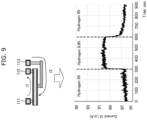
- FIG. 9 illustrates an experimental result of hydrogen sensor 1 according to Embodiment 2.
- the measurement conditions in FIG. 9 are the same as those in FIG. 5 .
- hydrogen sensor 1 according to Embodiment 2 includes a local region which is located inside metal oxide layer 104, is in contact with second electrode 106, and has a degree of oxygen deficiency higher than a degree of oxygen deficiency of metal oxide layer 104.
- the hydrogen detection performance can be improved, and the response speed in the hydrogen detection can be increased.
- Hydrogen sensor 1 includes a local region which is located inside metal oxide layer 104, is in contact with second electrode 106, and is a region in which current flows more easily than in metal oxide layer 104.
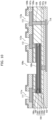
- Embodiment 3 a configuration example of hydrogen sensor 1 is described. Hydrogen sensor 1 according to Embodiment 3 is different from hydrogen sensor 1 according to Embodiment 1 in that metal oxide layer 104 has a three-layer configuration. With this configuration example, the hydrogen detection performance can be further enhanced, and the response speed in the hydrogen detection can be further increased.
- FIG. 10 is a cross-sectional view illustrating a configuration example of hydrogen sensor 1 according to Embodiment 3. Hydrogen sensor 1 in FIG. 10 is different from hydrogen sensor 1 in FIG. 1A in that third layer 104c is added in metal oxide layer 104.
- third layer 104c is added in metal oxide layer 104.
- Third layer 104c is in contact with second layer 104b and second electrode 106.
- the degree of oxygen deficiency of third layer 104c is higher than that of second layer 104b.
- third layer 104c includes, as the material, TaOx or Ta 2 O 5 whose degree of oxygen deficiency is higher than that of second layer 104b which includes Ta 2 O 5 as the material.
- the degree of oxygen deficiency of third layer 104c is lower than that of first layer 104a.
- FIG. 10 illustrates an example of metal oxide layer 104 having a three-layer configuration with first layer 104a that includes TaOx as the material, second layer 104b that includes, as the material, Ta 2 O 5 whose degree of oxygen deficiency is low, and third layer 104c that includes, as the material, Ta 2 O 5 whose degree of oxygen deficiency is higher than that of second layer 104b.
- metal oxide layer 104 may have a two-layer configuration with Ta 2 O 5 whose degree of oxygen deficiency is low and TaOx or Ta 2 O 5 whose degree of oxygen deficiency is higher than that of the former TazOs.
- FIG. 11 illustrates experimental data on a hydrogen sensor of a comparative example not forming part of the invention.
- the hydrogen sensor of the comparative example has a configuration which does not include second terminal 112 or the same configuration as hydrogen sensor 1 of Embodiment 3 except that first terminal 111 and second terminal 112 are short-circuited.
- the measurement conditions in FIG. 11 are the same as those in FIG. 4 .
- FIG. 12 illustrates an experimental result of hydrogen sensor 1 according to Embodiment 3.
- the measurement conditions in FIG. 12 are the same as those in FIG. 5 .
- current i3 increases in the time period from 300 to 600 in seconds as compared to the other time periods as illustrated in FIG. 12 . Furthermore, in the time period from 600 to 900 in seconds, current i3 decreases as compared to the previous time period. According to FIG. 12 , current i3 between first terminal 111 and third terminal 113 increases and decreases in response to the presence and absence of hydrogen. Also, in FIG. 12 , the response speed in the hydrogen detection is faster than that in FIG. 5 .
- metal oxide layer 104 includes (i) first layer 104a in contact with first electrode 103, (ii) second layer 104b in contact with first layer 104a, and (iii) third layer 104c in contact with second layer 104b and second electrode 106, and third layer 104c has a degree of oxygen deficiency higher than a degree of oxygen deficiency of second layer 104b.
- third layer 104c for the hydrogen atoms dissociated by second electrode 106 can be further enhanced.
- the degree of oxygen deficiency of third layer 104c may be lower than that of first layer 104a.
- the hydrogen detection device and hydrogen detection method illustrated in FIG. 2 and FIG. 3 can be implemented likewise using hydrogen sensors 1 according to Embodiments 2 and 3.
- second electrode 106 is connected to two terminals, i.e., first terminal 111 and second terminal 112, but the total number of terminals connected to second electrode 106 is not limited to two, and may be three or more.
- second electrode 106 has three or more terminals, it is sufficient so long as at least one of the three or more terminals is equivalent to first terminal 111 and at least one of the three or more terminals is equivalent to second terminal 112.
- the hydrogen detection method, and hydrogen detection device according to the present disclosure can be widely used for, for example, detection of leakage of a hydrogen-containing gas.
Landscapes
- Chemical & Material Sciences (AREA)
- Health & Medical Sciences (AREA)
- Life Sciences & Earth Sciences (AREA)
- Analytical Chemistry (AREA)
- General Health & Medical Sciences (AREA)
- Pathology (AREA)
- Immunology (AREA)
- Physics & Mathematics (AREA)
- Engineering & Computer Science (AREA)
- Biochemistry (AREA)
- General Physics & Mathematics (AREA)
- Combustion & Propulsion (AREA)
- Medicinal Chemistry (AREA)
- Food Science & Technology (AREA)
- Chemical Kinetics & Catalysis (AREA)
- Electrochemistry (AREA)
- Investigating Or Analyzing Materials By The Use Of Fluid Adsorption Or Reactions (AREA)
Applications Claiming Priority (2)
| Application Number | Priority Date | Filing Date | Title |
|---|---|---|---|
| JP2020073461 | 2020-04-16 | ||
| PCT/JP2021/014645 WO2021210453A1 (ja) | 2020-04-16 | 2021-04-06 | 水素センサ、水素検知方法および水素検知装置 |
Publications (3)
| Publication Number | Publication Date |
|---|---|
| EP4137806A1 EP4137806A1 (en) | 2023-02-22 |
| EP4137806A4 EP4137806A4 (en) | 2023-10-04 |
| EP4137806B1 true EP4137806B1 (en) | 2025-02-26 |
Family
ID=78084850
Family Applications (1)
| Application Number | Title | Priority Date | Filing Date |
|---|---|---|---|
| EP21788844.5A Active EP4137806B1 (en) | 2020-04-16 | 2021-04-06 | Hydrogen detection method and hydrogen detection device |
Country Status (5)
| Country | Link |
|---|---|
| US (1) | US12158459B2 (https=) |
| EP (1) | EP4137806B1 (https=) |
| JP (1) | JP7648606B2 (https=) |
| CN (1) | CN115335689B (https=) |
| WO (1) | WO2021210453A1 (https=) |
Families Citing this family (6)
| Publication number | Priority date | Publication date | Assignee | Title |
|---|---|---|---|---|
| JPWO2023017748A1 (https=) * | 2021-08-11 | 2023-02-16 | ||
| WO2023047759A1 (ja) * | 2021-09-22 | 2023-03-30 | ヌヴォトンテクノロジージャパン株式会社 | 水素検知装置及び水素検知装置の制御方法 |
| WO2023136083A1 (ja) * | 2022-01-17 | 2023-07-20 | ヌヴォトンテクノロジージャパン株式会社 | 水素検知方法、駆動回路および水素検知装置 |
| WO2024009891A1 (ja) * | 2022-07-04 | 2024-01-11 | ヌヴォトンテクノロジージャパン株式会社 | 水素検知装置及びその製造方法 |
| JPWO2024053537A1 (https=) * | 2022-09-06 | 2024-03-14 | ||
| WO2025173708A1 (ja) * | 2024-02-15 | 2025-08-21 | ヌヴォトンテクノロジージャパン株式会社 | センサーパッケージおよびセンサーパッケージの製造方法 |
Family Cites Families (15)
| Publication number | Priority date | Publication date | Assignee | Title |
|---|---|---|---|---|
| JPS5958348A (ja) * | 1982-09-29 | 1984-04-04 | Hitachi Ltd | 水素ガス検知素子 |
| JPS6040945A (ja) * | 1983-08-16 | 1985-03-04 | Hochiki Corp | 半導体ガスセンサ |
| DE102009054435A1 (de) * | 2009-11-25 | 2011-05-26 | Kechter, Andreas, Dipl.-Ing. | Heizbarer Gassensor und Verfahren zu dessen Herstellung |
| JP2017022938A (ja) | 2015-07-14 | 2017-01-26 | キヤノン株式会社 | 振動型アクチュエータの制御装置及び制御方法 |
| EP3343212B1 (en) | 2015-08-28 | 2019-11-06 | Panasonic Intellectual Property Management Co., Ltd. | Gas sensor and fuel cell vehicle |
| JP6761764B2 (ja) * | 2016-03-18 | 2020-09-30 | パナソニックセミコンダクターソリューションズ株式会社 | 水素センサ及び燃料電池自動車、並びに水素検出方法 |
| JP6738749B2 (ja) * | 2016-03-25 | 2020-08-12 | パナソニックセミコンダクターソリューションズ株式会社 | 気体センサ、水素検出方法、及び燃料電池自動車 |
| CN107315033B (zh) * | 2016-04-26 | 2021-08-06 | 新唐科技日本株式会社 | 气体检测装置以及氢检测方法 |
| CN107436313B (zh) | 2016-05-25 | 2021-08-27 | 新唐科技日本株式会社 | 气体传感器装置、气体传感器模块及气体检测方法 |
| JP6840170B2 (ja) * | 2016-12-15 | 2021-03-10 | ヌヴォトンテクノロジージャパン株式会社 | 水素検出装置、燃料電池自動車、水素漏洩監視システム、複合センサモジュール、水素検出方法、およびプログラム |
| JP6886304B2 (ja) * | 2017-01-31 | 2021-06-16 | ヌヴォトンテクノロジージャパン株式会社 | 気体センサ |
| WO2019044256A1 (ja) * | 2017-09-04 | 2019-03-07 | パナソニックIpマネジメント株式会社 | 気体センサ、気体検知装置、燃料電池自動車および気体センサの製造方法 |
| JP7433286B2 (ja) * | 2019-03-07 | 2024-02-19 | ヌヴォトンテクノロジージャパン株式会社 | 気体センサとその製造方法、および燃料電池自動車 |
| JP7138240B2 (ja) * | 2019-04-16 | 2022-09-15 | ヌヴォトンテクノロジージャパン株式会社 | 気体センサの駆動方法及び気体検出装置 |
| JP7486123B2 (ja) * | 2020-07-02 | 2024-05-17 | パナソニックIpマネジメント株式会社 | ガスセンサ装置 |
-
2021
- 2021-04-06 WO PCT/JP2021/014645 patent/WO2021210453A1/ja not_active Ceased
- 2021-04-06 CN CN202180024260.0A patent/CN115335689B/zh active Active
- 2021-04-06 JP JP2022515322A patent/JP7648606B2/ja active Active
- 2021-04-06 EP EP21788844.5A patent/EP4137806B1/en active Active
-
2022
- 2022-09-30 US US17/957,686 patent/US12158459B2/en active Active
Also Published As
| Publication number | Publication date |
|---|---|
| JP7648606B2 (ja) | 2025-03-18 |
| WO2021210453A1 (ja) | 2021-10-21 |
| JPWO2021210453A1 (https=) | 2021-10-21 |
| EP4137806A4 (en) | 2023-10-04 |
| CN115335689A (zh) | 2022-11-11 |
| CN115335689B (zh) | 2026-02-10 |
| EP4137806A1 (en) | 2023-02-22 |
| US12158459B2 (en) | 2024-12-03 |
| US20230022428A1 (en) | 2023-01-26 |
Similar Documents
| Publication | Publication Date | Title |
|---|---|---|
| EP4137806B1 (en) | Hydrogen detection method and hydrogen detection device | |
| CN107315034B (zh) | 气体检测装置以及氢检测方法 | |
| US12235232B2 (en) | Gas sensor, method of manufacturing gas sensor, and fuel cell vehicle | |
| CN107102032B (zh) | 气体传感器及氢浓度判定方法 | |
| US20240272106A1 (en) | Hydrogen detection device and control method for hydrogen detection device | |
| US11541737B2 (en) | Gas detection device, gas detection system, fuel cell vehicle, and gas detection method | |
| CN107315033B (zh) | 气体检测装置以及氢检测方法 | |
| JP7027340B2 (ja) | 気体センサ、気体検知装置、燃料電池自動車および気体センサの製造方法 | |
| JP2017181494A (ja) | 気体センサ、水素検出方法、及び燃料電池自動車 | |
| US20250116623A1 (en) | Hydrogen detection device and method for manufacturing the same | |
| JP5572749B2 (ja) | 不揮発性記憶素子及びその製造方法 | |
| US20240361267A1 (en) | Hydrogen detection method, drive circuit, and hydrogen detection device | |
| US12007348B2 (en) | Method for driving gas sensor, and gas detection device | |
| US12493009B2 (en) | Hydrogen sensor | |
| US20260079124A1 (en) | Sensor package and sensor package manufacturing method | |
| US20210384420A1 (en) | Memory devices and methods of forming memory devices |
Legal Events
| Date | Code | Title | Description |
|---|---|---|---|
| STAA | Information on the status of an ep patent application or granted ep patent |
Free format text: STATUS: THE INTERNATIONAL PUBLICATION HAS BEEN MADE |
|
| PUAI | Public reference made under article 153(3) epc to a published international application that has entered the european phase |
Free format text: ORIGINAL CODE: 0009012 |
|
| STAA | Information on the status of an ep patent application or granted ep patent |
Free format text: STATUS: REQUEST FOR EXAMINATION WAS MADE |
|
| 17P | Request for examination filed |
Effective date: 20221006 |
|
| AK | Designated contracting states |
Kind code of ref document: A1 Designated state(s): AL AT BE BG CH CY CZ DE DK EE ES FI FR GB GR HR HU IE IS IT LI LT LU LV MC MK MT NL NO PL PT RO RS SE SI SK SM TR |
|
| DAV | Request for validation of the european patent (deleted) | ||
| DAX | Request for extension of the european patent (deleted) | ||
| A4 | Supplementary search report drawn up and despatched |
Effective date: 20230904 |
|
| RIC1 | Information provided on ipc code assigned before grant |
Ipc: G01N 27/12 20060101AFI20230829BHEP |
|
| STAA | Information on the status of an ep patent application or granted ep patent |
Free format text: STATUS: EXAMINATION IS IN PROGRESS |
|
| 17Q | First examination report despatched |
Effective date: 20240628 |
|
| GRAP | Despatch of communication of intention to grant a patent |
Free format text: ORIGINAL CODE: EPIDOSNIGR1 |
|
| STAA | Information on the status of an ep patent application or granted ep patent |
Free format text: STATUS: GRANT OF PATENT IS INTENDED |
|
| GRAJ | Information related to disapproval of communication of intention to grant by the applicant or resumption of examination proceedings by the epo deleted |
Free format text: ORIGINAL CODE: EPIDOSDIGR1 |
|
| STAA | Information on the status of an ep patent application or granted ep patent |
Free format text: STATUS: EXAMINATION IS IN PROGRESS |
|
| GRAP | Despatch of communication of intention to grant a patent |
Free format text: ORIGINAL CODE: EPIDOSNIGR1 |
|
| STAA | Information on the status of an ep patent application or granted ep patent |
Free format text: STATUS: GRANT OF PATENT IS INTENDED |
|
| INTG | Intention to grant announced |
Effective date: 20241010 |
|
| INTG | Intention to grant announced |
Effective date: 20241022 |
|
| GRAS | Grant fee paid |
Free format text: ORIGINAL CODE: EPIDOSNIGR3 |
|
| GRAA | (expected) grant |
Free format text: ORIGINAL CODE: 0009210 |
|
| STAA | Information on the status of an ep patent application or granted ep patent |
Free format text: STATUS: THE PATENT HAS BEEN GRANTED |
|
| AK | Designated contracting states |
Kind code of ref document: B1 Designated state(s): AL AT BE BG CH CY CZ DE DK EE ES FI FR GB GR HR HU IE IS IT LI LT LU LV MC MK MT NL NO PL PT RO RS SE SI SK SM TR |
|
| REG | Reference to a national code |
Ref country code: GB Ref legal event code: FG4D |
|
| REG | Reference to a national code |
Ref country code: CH Ref legal event code: EP |
|
| REG | Reference to a national code |
Ref country code: DE Ref legal event code: R096 Ref document number: 602021026848 Country of ref document: DE |
|
| REG | Reference to a national code |
Ref country code: IE Ref legal event code: FG4D |
|
| REG | Reference to a national code |
Ref country code: NL Ref legal event code: MP Effective date: 20250226 |
|
| PG25 | Lapsed in a contracting state [announced via postgrant information from national office to epo] |
Ref country code: RS Free format text: LAPSE BECAUSE OF FAILURE TO SUBMIT A TRANSLATION OF THE DESCRIPTION OR TO PAY THE FEE WITHIN THE PRESCRIBED TIME-LIMIT Effective date: 20250526 |
|
| PG25 | Lapsed in a contracting state [announced via postgrant information from national office to epo] |
Ref country code: FI Free format text: LAPSE BECAUSE OF FAILURE TO SUBMIT A TRANSLATION OF THE DESCRIPTION OR TO PAY THE FEE WITHIN THE PRESCRIBED TIME-LIMIT Effective date: 20250226 |
|
| PG25 | Lapsed in a contracting state [announced via postgrant information from national office to epo] |
Ref country code: PL Free format text: LAPSE BECAUSE OF FAILURE TO SUBMIT A TRANSLATION OF THE DESCRIPTION OR TO PAY THE FEE WITHIN THE PRESCRIBED TIME-LIMIT Effective date: 20250226 |
|
| PGFP | Annual fee paid to national office [announced via postgrant information from national office to epo] |
Ref country code: DE Payment date: 20250417 Year of fee payment: 5 |
|
| PG25 | Lapsed in a contracting state [announced via postgrant information from national office to epo] |
Ref country code: ES Free format text: LAPSE BECAUSE OF FAILURE TO SUBMIT A TRANSLATION OF THE DESCRIPTION OR TO PAY THE FEE WITHIN THE PRESCRIBED TIME-LIMIT Effective date: 20250226 |
|
| REG | Reference to a national code |
Ref country code: LT Ref legal event code: MG9D |
|
| PG25 | Lapsed in a contracting state [announced via postgrant information from national office to epo] |
Ref country code: IS Free format text: LAPSE BECAUSE OF FAILURE TO SUBMIT A TRANSLATION OF THE DESCRIPTION OR TO PAY THE FEE WITHIN THE PRESCRIBED TIME-LIMIT Effective date: 20250626 Ref country code: NO Free format text: LAPSE BECAUSE OF FAILURE TO SUBMIT A TRANSLATION OF THE DESCRIPTION OR TO PAY THE FEE WITHIN THE PRESCRIBED TIME-LIMIT Effective date: 20250526 |
|
| PG25 | Lapsed in a contracting state [announced via postgrant information from national office to epo] |
Ref country code: NL Free format text: LAPSE BECAUSE OF FAILURE TO SUBMIT A TRANSLATION OF THE DESCRIPTION OR TO PAY THE FEE WITHIN THE PRESCRIBED TIME-LIMIT Effective date: 20250226 |
|
| PG25 | Lapsed in a contracting state [announced via postgrant information from national office to epo] |
Ref country code: HR Free format text: LAPSE BECAUSE OF FAILURE TO SUBMIT A TRANSLATION OF THE DESCRIPTION OR TO PAY THE FEE WITHIN THE PRESCRIBED TIME-LIMIT Effective date: 20250226 |
|
| PG25 | Lapsed in a contracting state [announced via postgrant information from national office to epo] |
Ref country code: PT Free format text: LAPSE BECAUSE OF FAILURE TO SUBMIT A TRANSLATION OF THE DESCRIPTION OR TO PAY THE FEE WITHIN THE PRESCRIBED TIME-LIMIT Effective date: 20250626 Ref country code: LV Free format text: LAPSE BECAUSE OF FAILURE TO SUBMIT A TRANSLATION OF THE DESCRIPTION OR TO PAY THE FEE WITHIN THE PRESCRIBED TIME-LIMIT Effective date: 20250226 |
|
| PG25 | Lapsed in a contracting state [announced via postgrant information from national office to epo] |
Ref country code: BG Free format text: LAPSE BECAUSE OF FAILURE TO SUBMIT A TRANSLATION OF THE DESCRIPTION OR TO PAY THE FEE WITHIN THE PRESCRIBED TIME-LIMIT Effective date: 20250226 Ref country code: GR Free format text: LAPSE BECAUSE OF FAILURE TO SUBMIT A TRANSLATION OF THE DESCRIPTION OR TO PAY THE FEE WITHIN THE PRESCRIBED TIME-LIMIT Effective date: 20250527 |
|
| REG | Reference to a national code |
Ref country code: AT Ref legal event code: MK05 Ref document number: 1771085 Country of ref document: AT Kind code of ref document: T Effective date: 20250226 |
|
| PG25 | Lapsed in a contracting state [announced via postgrant information from national office to epo] |
Ref country code: SE Free format text: LAPSE BECAUSE OF FAILURE TO SUBMIT A TRANSLATION OF THE DESCRIPTION OR TO PAY THE FEE WITHIN THE PRESCRIBED TIME-LIMIT Effective date: 20250226 |
|
| PG25 | Lapsed in a contracting state [announced via postgrant information from national office to epo] |
Ref country code: SM Free format text: LAPSE BECAUSE OF FAILURE TO SUBMIT A TRANSLATION OF THE DESCRIPTION OR TO PAY THE FEE WITHIN THE PRESCRIBED TIME-LIMIT Effective date: 20250226 |
|
| PG25 | Lapsed in a contracting state [announced via postgrant information from national office to epo] |
Ref country code: DK Free format text: LAPSE BECAUSE OF FAILURE TO SUBMIT A TRANSLATION OF THE DESCRIPTION OR TO PAY THE FEE WITHIN THE PRESCRIBED TIME-LIMIT Effective date: 20250226 |
|
| PG25 | Lapsed in a contracting state [announced via postgrant information from national office to epo] |
Ref country code: IT Free format text: LAPSE BECAUSE OF FAILURE TO SUBMIT A TRANSLATION OF THE DESCRIPTION OR TO PAY THE FEE WITHIN THE PRESCRIBED TIME-LIMIT Effective date: 20250226 |
|
| PG25 | Lapsed in a contracting state [announced via postgrant information from national office to epo] |
Ref country code: AT Free format text: LAPSE BECAUSE OF FAILURE TO SUBMIT A TRANSLATION OF THE DESCRIPTION OR TO PAY THE FEE WITHIN THE PRESCRIBED TIME-LIMIT Effective date: 20250226 |
|
| PG25 | Lapsed in a contracting state [announced via postgrant information from national office to epo] |
Ref country code: EE Free format text: LAPSE BECAUSE OF FAILURE TO SUBMIT A TRANSLATION OF THE DESCRIPTION OR TO PAY THE FEE WITHIN THE PRESCRIBED TIME-LIMIT Effective date: 20250226 Ref country code: CZ Free format text: LAPSE BECAUSE OF FAILURE TO SUBMIT A TRANSLATION OF THE DESCRIPTION OR TO PAY THE FEE WITHIN THE PRESCRIBED TIME-LIMIT Effective date: 20250226 |
|
| PG25 | Lapsed in a contracting state [announced via postgrant information from national office to epo] |
Ref country code: RO Free format text: LAPSE BECAUSE OF FAILURE TO SUBMIT A TRANSLATION OF THE DESCRIPTION OR TO PAY THE FEE WITHIN THE PRESCRIBED TIME-LIMIT Effective date: 20250226 |
|
| PG25 | Lapsed in a contracting state [announced via postgrant information from national office to epo] |
Ref country code: SK Free format text: LAPSE BECAUSE OF FAILURE TO SUBMIT A TRANSLATION OF THE DESCRIPTION OR TO PAY THE FEE WITHIN THE PRESCRIBED TIME-LIMIT Effective date: 20250226 |
|
| REG | Reference to a national code |
Ref country code: CH Ref legal event code: H13 Free format text: ST27 STATUS EVENT CODE: U-0-0-H10-H13 (AS PROVIDED BY THE NATIONAL OFFICE) Effective date: 20251125 |
|
| REG | Reference to a national code |
Ref country code: DE Ref legal event code: R097 Ref document number: 602021026848 Country of ref document: DE |
|
| PG25 | Lapsed in a contracting state [announced via postgrant information from national office to epo] |
Ref country code: LU Free format text: LAPSE BECAUSE OF NON-PAYMENT OF DUE FEES Effective date: 20250406 |
|
| PG25 | Lapsed in a contracting state [announced via postgrant information from national office to epo] |
Ref country code: MC Free format text: LAPSE BECAUSE OF FAILURE TO SUBMIT A TRANSLATION OF THE DESCRIPTION OR TO PAY THE FEE WITHIN THE PRESCRIBED TIME-LIMIT Effective date: 20250226 |
|
| REG | Reference to a national code |
Ref country code: BE Ref legal event code: MM Effective date: 20250430 |
|
| PLBE | No opposition filed within time limit |
Free format text: ORIGINAL CODE: 0009261 |
|
| STAA | Information on the status of an ep patent application or granted ep patent |
Free format text: STATUS: NO OPPOSITION FILED WITHIN TIME LIMIT |
|
| PG25 | Lapsed in a contracting state [announced via postgrant information from national office to epo] |
Ref country code: BE Free format text: LAPSE BECAUSE OF NON-PAYMENT OF DUE FEES Effective date: 20250430 |
|
| PG25 | Lapsed in a contracting state [announced via postgrant information from national office to epo] |
Ref country code: CH Free format text: LAPSE BECAUSE OF NON-PAYMENT OF DUE FEES Effective date: 20250430 |
|
| GBPC | Gb: european patent ceased through non-payment of renewal fee |
Effective date: 20250526 |
|
| 26N | No opposition filed |
Effective date: 20251127 |
|
| PG25 | Lapsed in a contracting state [announced via postgrant information from national office to epo] |
Ref country code: GB Free format text: LAPSE BECAUSE OF NON-PAYMENT OF DUE FEES Effective date: 20250526 |
|
| PG25 | Lapsed in a contracting state [announced via postgrant information from national office to epo] |
Ref country code: IE Free format text: LAPSE BECAUSE OF NON-PAYMENT OF DUE FEES Effective date: 20250406 |
|
| PGFP | Annual fee paid to national office [announced via postgrant information from national office to epo] |
Ref country code: FR Payment date: 20260309 Year of fee payment: 6 |