EP4133419B1 - Neuronen und synapsen mit ferroelektrisch modulierten metall-halbleiter schottky dioden nebst verfahren - Google Patents
Neuronen und synapsen mit ferroelektrisch modulierten metall-halbleiter schottky dioden nebst verfahren Download PDFInfo
- Publication number
- EP4133419B1 EP4133419B1 EP21731993.8A EP21731993A EP4133419B1 EP 4133419 B1 EP4133419 B1 EP 4133419B1 EP 21731993 A EP21731993 A EP 21731993A EP 4133419 B1 EP4133419 B1 EP 4133419B1
- Authority
- EP
- European Patent Office
- Prior art keywords
- layer
- ferroelectric
- electrode
- component according
- semiconducting layer
- Prior art date
- Legal status (The legal status is an assumption and is not a legal conclusion. Google has not performed a legal analysis and makes no representation as to the accuracy of the status listed.)
- Active
Links
Images





Classifications
-
- H—ELECTRICITY
- H10—SEMICONDUCTOR DEVICES; ELECTRIC SOLID-STATE DEVICES NOT OTHERWISE PROVIDED FOR
- H10D—INORGANIC ELECTRIC SEMICONDUCTOR DEVICES
- H10D64/00—Electrodes of devices having potential barriers
- H10D64/60—Electrodes characterised by their materials
- H10D64/64—Electrodes comprising a Schottky barrier to a semiconductor
- H10D64/647—Schottky drain or source electrodes for IGFETs
-
- G—PHYSICS
- G06—COMPUTING OR CALCULATING; COUNTING
- G06N—COMPUTING ARRANGEMENTS BASED ON SPECIFIC COMPUTATIONAL MODELS
- G06N3/00—Computing arrangements based on biological models
- G06N3/02—Neural networks
- G06N3/06—Physical realisation, i.e. hardware implementation of neural networks, neurons or parts of neurons
- G06N3/063—Physical realisation, i.e. hardware implementation of neural networks, neurons or parts of neurons using electronic means
- G06N3/065—Analogue means
-
- G—PHYSICS
- G11—INFORMATION STORAGE
- G11C—STATIC STORES
- G11C11/00—Digital stores characterised by the use of particular electric or magnetic storage elements; Storage elements therefor
- G11C11/21—Digital stores characterised by the use of particular electric or magnetic storage elements; Storage elements therefor using electric elements
- G11C11/22—Digital stores characterised by the use of particular electric or magnetic storage elements; Storage elements therefor using electric elements using ferroelectric elements
- G11C11/223—Digital stores characterised by the use of particular electric or magnetic storage elements; Storage elements therefor using electric elements using ferroelectric elements using MOS with ferroelectric gate insulating film
-
- G—PHYSICS
- G11—INFORMATION STORAGE
- G11C—STATIC STORES
- G11C11/00—Digital stores characterised by the use of particular electric or magnetic storage elements; Storage elements therefor
- G11C11/54—Digital stores characterised by the use of particular electric or magnetic storage elements; Storage elements therefor using elements simulating biological cells, e.g. neuron
-
- H—ELECTRICITY
- H10—SEMICONDUCTOR DEVICES; ELECTRIC SOLID-STATE DEVICES NOT OTHERWISE PROVIDED FOR
- H10B—ELECTRONIC MEMORY DEVICES
- H10B51/00—Ferroelectric RAM [FeRAM] devices comprising ferroelectric memory transistors
- H10B51/30—Ferroelectric RAM [FeRAM] devices comprising ferroelectric memory transistors characterised by the memory core region
-
- H—ELECTRICITY
- H10—SEMICONDUCTOR DEVICES; ELECTRIC SOLID-STATE DEVICES NOT OTHERWISE PROVIDED FOR
- H10D—INORGANIC ELECTRIC SEMICONDUCTOR DEVICES
- H10D30/00—Field-effect transistors [FET]
- H10D30/60—Insulated-gate field-effect transistors [IGFET]
- H10D30/611—Insulated-gate field-effect transistors [IGFET] having multiple independently-addressable gate electrodes influencing the same channel
-
- H—ELECTRICITY
- H10—SEMICONDUCTOR DEVICES; ELECTRIC SOLID-STATE DEVICES NOT OTHERWISE PROVIDED FOR
- H10D—INORGANIC ELECTRIC SEMICONDUCTOR DEVICES
- H10D30/00—Field-effect transistors [FET]
- H10D30/60—Insulated-gate field-effect transistors [IGFET]
- H10D30/701—IGFETs having ferroelectric gate insulators, e.g. ferroelectric FETs
-
- H—ELECTRICITY
- H10—SEMICONDUCTOR DEVICES; ELECTRIC SOLID-STATE DEVICES NOT OTHERWISE PROVIDED FOR
- H10D—INORGANIC ELECTRIC SEMICONDUCTOR DEVICES
- H10D64/00—Electrodes of devices having potential barriers
- H10D64/20—Electrodes characterised by their shapes, relative sizes or dispositions
- H10D64/23—Electrodes carrying the current to be rectified, amplified, oscillated or switched, e.g. sources, drains, anodes or cathodes
- H10D64/251—Source or drain electrodes for field-effect devices
- H10D64/258—Source or drain electrodes for field-effect devices characterised by the relative positions of the source or drain electrodes with respect to the gate electrode
-
- H—ELECTRICITY
- H10—SEMICONDUCTOR DEVICES; ELECTRIC SOLID-STATE DEVICES NOT OTHERWISE PROVIDED FOR
- H10D—INORGANIC ELECTRIC SEMICONDUCTOR DEVICES
- H10D64/00—Electrodes of devices having potential barriers
- H10D64/60—Electrodes characterised by their materials
- H10D64/66—Electrodes having a conductor capacitively coupled to a semiconductor by an insulator, e.g. MIS electrodes
- H10D64/68—Electrodes having a conductor capacitively coupled to a semiconductor by an insulator, e.g. MIS electrodes characterised by the insulator, e.g. by the gate insulator
- H10D64/689—Electrodes having a conductor capacitively coupled to a semiconductor by an insulator, e.g. MIS electrodes characterised by the insulator, e.g. by the gate insulator having ferroelectric layers
-
- H—ELECTRICITY
- H10—SEMICONDUCTOR DEVICES; ELECTRIC SOLID-STATE DEVICES NOT OTHERWISE PROVIDED FOR
- H10D—INORGANIC ELECTRIC SEMICONDUCTOR DEVICES
- H10D8/00—Diodes
- H10D8/60—Schottky-barrier diodes
-
- G—PHYSICS
- G06—COMPUTING OR CALCULATING; COUNTING
- G06N—COMPUTING ARRANGEMENTS BASED ON SPECIFIC COMPUTATIONAL MODELS
- G06N3/00—Computing arrangements based on biological models
- G06N3/02—Neural networks
- G06N3/06—Physical realisation, i.e. hardware implementation of neural networks, neurons or parts of neurons
- G06N3/063—Physical realisation, i.e. hardware implementation of neural networks, neurons or parts of neurons using electronic means
Definitions
- the invention relates to a synaptic component for a neural network.
- a synaptic component is an electronic component that exhibits the properties of a biological synapse. The electronic component is therefore also referred to as a synapse.
- a neural network is an artificial neural network.
- a brain is a biological neural network. It comprises a multitude of biological neurons, or nerve cells.
- a biological neuron can send information to another biological neuron via biological synapses. This occurs using an output channel of the biological neuron. Such an output channel is called an axon.
- the other biological neuron has an input channel. The input channel is called a dendrite.
- the other biological neuron can receive the information via the input channel.
- the decision as to whether a biological neuron triggers an action potential via its axon and thus sends information depends on the totality of the incoming signals.
- the influence of one biological neuron on another biological neuron can change over time with their activity at biological synapses. Such an influence is called the "synaptic weight" of a biological neuron.
- the properties and behavior of a neural network should resemble those of a biological neural network.
- a neural network should be able to recognize patterns using adaptive algorithms. Similar to the human brain, a neural network should not have to start from scratch for every task or problem. It should be able to draw on previously acquired knowledge and experiences.
- WO 2019/139598 A1 describes a device comprising: a first gate comprising: a first structure comprising a first ferroelectric material; and a second structure adjacent to the first structure, the second structure comprising a first gate electrode; a source adjacent to the first gate; a second gate comprising: a third structure comprising a second ferroelectric material; and a fourth structure adjacent to the third structure, the fourth structure comprising a second gate electrode; a drain adjacent to the second gate; and a semiconductor body adjacent to the first and second gates and between the source and the drain.
- a neural network with memristors is known from the publication CN 208922326 U Scaling, stability, and locking capability are problematic for a neural network with memristors.
- the printed matter WO 2019147859 A2 discloses an electronic component with a semiconductor channel. An input electrode is adjacent to one end of the semiconductor channel. An output electrode is adjacent to the other end of the semiconductor channel. Above the semiconductor channel there is a layer of dielectric material. A circuit serving as a synapse made of semiconductor materials with an electrically charged carrier gas is Printed matter EP 0 529 565 B1 An integrated circuit for providing a synapse is described in the publication US 2019164597 A1 known.
- a neural network can incorporate ferroelectric field-effect transistors (FeFETs).
- FeFETs ferroelectric field-effect transistors
- Traditional ferroelectric materials such as lead zirconate titanate (PZT) are harmful to the environment and incompatible with established CMOS technology.
- the object of the invention is to create a synapse, i.e. a synaptic component with improved properties.
- Patent claim 1 relates to a synaptic component for a neural network.
- the synaptic component comprises a layer made of a semiconductor.
- the layer made of a semiconductor is called a semiconducting layer.
- a source electrode is connected to the semiconducting layer.
- a drain electrode is connected to the semiconducting layer.
- the source electrode is spatially separated from the drain electrode.
- the source electrode and the semiconducting layer form a Schottky diode.
- the source electrode is separated from a first gate electrode by ferroelectric material.
- the drain electrode can be separated from a second gate electrode by ferroelectric material.
- the two gate electrodes are spatially separated from each other.
- An electrode is separated from another electrode if there is a distance between the two electrodes. Spatially separated electrodes do not touch each other. There is therefore no electrically conductive connection between the two electrodes. With the help of the ferroelectric material, an electrical voltage applied to the first gate electrode can be transferred to the source electrode. The same applies if a second gate electrode is separated from the drain electrode by ferroelectric material. Typically, one gate electrode is located on one side of the ferroelectric material and the other source or drain electrode is located on an opposite side of the ferroelectric material. The two electrodes can be directly connected to the ferroelectric material.
- the invention utilizes the memory properties of ferroelectric material to mimic the behavior of a biological synapse.
- a Schottky diode may comprise a metal layer deposited on a semiconducting layer, such as a silicon layer.
- a metal layer is a layer made of metal.
- a silicon layer is a layer made of silicon. Silicon is a semiconductor, a chemical substance whose electrical conductivity lies between that of electrical conductors and that of electrical insulators.
- the silicon layer can, for example, be n-type silicon, i.e., an n-type doped silicon layer. Electrons from the n-type silicon layer migrate to the metal layer. Because electrons move more easily from n-type silicon to the metal layer than vice versa, an electron-depleted region is created in the silicon layer. This region is called the Schottky barrier layer. A depletion layer, or space charge zone, is created. An electric field is also created. The electric field counteracts the migration of the electrodes. If the electric field is large enough, no more electrons migrate from the n-type silicon layer to the metal layer.
- the silicon layer can, however, also be p-type silicon, i.e., a p-type doped silicon layer.
- the Schottky diode is switched in the forward direction. Electrons flow from n-type silicon into the metal layer. If the Schottky diode is switched in the forward direction, the space charge region is cleared.
- An electrode is an electrical conductor.
- An electrode is generally made of metal.
- a layer according to the invention can run linearly, i.e., along a plane. However, a layer according to the invention can also run circularly and/or angularly.
- the component with the features of patent claim 1 can mimic the behavior of a biological synopsis.
- the component can be manufactured with minimal technical effort.
- the component can be made from environmentally friendly materials.
- the source electrode and drain electrode can be located on one side of the semiconducting layer. Such a component can be manufactured in a technically simple manner.
- the source electrode and drain electrode can be deposited on one surface of the semiconducting layer.
- the source electrode and drain electrode can be located at opposite ends of the semiconducting layer. This allows for a suitable distance between the source electrode and the drain electrode to be provided.
- the component can comprise a substrate.
- the semiconducting layer is then applied above the substrate.
- the semiconducting layer can be a thin layer.
- the substrate can be made of silicon.
- An electrically insulating layer can be located between the substrate and the semiconductor. The electrically insulating layer can prevent interference.
- Ferroelectric material of the component can be present in the form of a layer.
- a layer of ferroelectric material can therefore be applied to the source electrode.
- a layer of ferroelectric material can therefore be applied to the drain electrode.
- a ferroelectric layer can be located partly on the semiconducting layer in order to enable technically simple production.
- a ferroelectric layer can be located partly on the source electrode or drain electrode. There does not necessarily have to be two spatially separated layers of ferroelectric material. There can be a single layer of ferroelectric material that is located at least partly on the source electrode and at least partly on the drain electrode. This can also simplify production.
- a first and/or second gate electrode can be applied to the opposite side of such a ferroelectric layer.
- the first gate electrode and/or the second gate electrode are located on one side of the ferroelectric layer.
- the source electrode and/or the drain electrode are located on the opposite side of the ferroelectric layer.
- a metal drain electrode can serve as the substrate of the synaptic device.
- Semiconductor material can be deposited on the substrate.
- the metal for a source electrode can be deposited on top of the semiconductor material.
- Ferroelectric material can be deposited on the source electrode.
- Metal can be applied to the ferroelectric material for a gate electrode. This allows for a vertical design.
- One or more electrically insulating layers can be provided during production in order to produce a synaptic component in a technically simple way.
- an insulating layer with recesses can be applied to a semiconducting layer. Contact can be made with the semiconducting layer through the recesses.
- the recesses can be at least partially coated with metal in order to produce Schottky diodes, for example.
- the insulating layer with the recesses helps to ensure that the two electrodes are electrically separated from one another.
- the production of one or more insulating layers can also be advantageous in a vertical design.
- the electrically insulating layer can cover the semi-material as long as the semiconductor material is not to be contacted by metallic electrodes.
- a variety of synaptic components can be easily fabricated that are electrically connected in parallel and/or electrically in series.
- a so-called crossbar structure can be created, which can be advantageous in neural networks.
- the ferroelectric material can be selected from: HfO 2 -based ferroelectric, perovskite ferroelectric, and organic ferroelectric.
- the ferroelectric material such as HfO 2 -based ferroelectric, can be doped. Doping can be carried out with one or more of the following elements: N, Al, Si, Sc, Ge, Y, Zr, Gd, Pr, Sr, Tb, La, Lu.
- the metal for the Schottky diode can be selected from: Al, Ag, Au, Cu, Cr, Mo, Ni, Nb, Pt, Ti, Ni, TiN, TaN, and metal alloys.
- the metal for the Schottky diode can be a metal-semiconductor alloy such as silicides, germanides, or metal-SiGeSn alloys.
- the invention allows for the provision of artificial synaptic devices based on metal/semiconductor Schottky barriers.
- the polarization of the ferroelectric layers results in a shielding charge at the metal/semiconductor interface, modulating the effective strength of the Schottky barrier in the metal/semiconductor contact.
- Polarization switching in multidomain systems induces multilevel charge distributions at the metal-semiconductor interface, causing multilevel conduction of the diode. This can be exploited to mimic synaptic properties.
- the present invention solves the problem of interface traps at the interface between ferroelectric and semiconducting material in FeFETs, as the ferroelectric material is primarily deposited on the metal.
- the ferroelectric components according to the invention can be fabricated at relatively low temperatures ( ⁇ 800°C) using the CMOS process. This makes almost all ferroelectric materials usable.
- the invention provides a method for constructing artificial synapses, which can be manufactured according to the following pattern.
- These can comprise two back-connected metal/semiconductor Schottky diodes, which are contacted by a ferroelectric layer and a gate electrode.
- the thickness of the ferroelectric layer on both Schottky diodes can be identical or different. This also applies to the selection of the material for the ferroelectric layer.
- One Schottky diode can function as a signal input, while the second Schottky diode can be used to control the synaptic weight.
- the synaptic weight can also be adjusted via the control voltage on the first Schottky diode.
- a metal-semiconductor junction acting like an ohmic contact can be present instead of a second Schottky diode.
- the drain electrode can be realized by an ohmic contact on the semiconductor.
- the invention also relates to a method for operating a synaptic component according to the invention.
- the first Schottky diode is switched to the reverse direction during operation.
- a pulsed electrical voltage is applied to the first gate electrode.
- the synaptic component then behaves like a biological synapse.
- Fig.1 shows the functional principle of a neural gate consisting of several input synapses x 1 to x n and a neuron.
- S is the integration over the input signals with the corresponding weights
- ⁇ is an offset.
- the neural function f ( s ) acts as a threshold function. As soon as S reaches a threshold, the neuron with the function f ( s ) is activated.
- Fig. 2 shows a first embodiment of a synapse.
- the synapse comprises a layer 101 made of a semiconductor.
- a source electrode 102 and a drain electrode 103 are located on the semiconducting layer 101.
- the two electrodes 102, 103 are spatially separated from one another.
- the two electrodes 102, 103 can be adjacent to the end faces of the semiconducting layer 101.
- the two electrodes 102, 103 are made of metal.
- the two electrodes 102, 103 can be layered.
- An electrical potential V S can be applied to the source electrode 102.
- An electrical potential V D can be applied to the drain electrode 103.
- the electrical potential V S differs from the electrical potential V D .
- the metal of the source electrode 102 and the semiconductor material of the semiconducting layer 101 are selected such that the junction between the source electrode 102 and the semiconducting layer 101 is a Schottky junction.
- a first Schottky diode is present, formed by the source electrode 102 and the semiconducting layer 101.
- the metal of the drain electrode 103 and the semiconductor material of the semiconducting layer 101 can be selected such that the junction between the drain electrode 103 and the semiconducting layer 101 is a Schottky junction.
- the drain electrode 103 and the semiconducting layer 101 can thus form a second Schottky diode.
- the first Schottky diode and the second Schottky diode are connected back-to-back in an equivalent circuit.
- a potential difference between the electrical potential V S and the electrical potential V D therefore results in one Schottky diode being reverse-biased and the other Schottky diode being forward-biased.
- an electrical current can flow from the source electrode 102 to the drain electrode 103. If an electrical current flows from the source electrode 102 to the drain electrode 103, the electrical current passes through the first Schottky diode in the reverse direction and the second Schottky diode in the forward direction. The flow of the electrical current in the reverse direction can occur when electrons tunnel through the junction of the first Schottky diode. If the electrical current flows in the forward direction through the second Schottky diode, the second Schottky diode acts like an ohmic resistor.
- a first ferroelectric layer 104a is located above the source electrode 102.
- the first ferroelectric layer 104a may cover a portion of the source electrode 102.
- the first ferroelectric layer 104a overlaps with the semiconducting layer 101.
- a second ferroelectric layer 104b is located above the drain electrode 103.
- the second ferroelectric layer 104b covers a portion of the source electrode 103.
- the second ferroelectric layer 104b overlaps with the semiconducting layer 101.
- a first electrode 105a is located on the first ferroelectric layer 104a.
- a second electrode 105b is located on the second ferroelectric layer 104b. Both electrodes 105a and 105b can be made of metal.
- the synapse is configured such that an electrical potential V g1 can be applied to the first electrode 105a.
- the Schottky barrier of the first Schottky diode can be modulated by an applied electrical potential V g1 .
- the synapse is configured such that an electrical potential V g2 can be applied to the second electrode 105a.
- the Schottky barrier of the second Schottky diode can be modulated by an applied electrical potential V g2 .
- the first electrical potential V g1 can be considered a synaptic input signal within a neural network.
- the second electrical potential V 92 can be used to control weights within a neural network.
- the ferroelectric layers 104a and/or 104b may overlap regions of the electrodes 102 and 103 applied to the semiconducting layer 101. This can facilitate manufacturing.
- the Schottky barriers of the first and second Schottky diodes can also be modulated in a more controlled manner.
- the Figure 2b shows an electrical symbol of the Figure 2a shown synapse with the source electrode S and the drain electrode D.
- FIG. 3 A second embodiment of a synapse is shown, which has only one continuous ferroelectric layer 204 instead of two ferroelectric layers 204a and 204b.
- the synapse shown here has a layer 201 consisting of a semiconductor.
- a source electrode 202 and a drain electrode 203 On the semiconducting layer 201, as in the case of the figure 2a a source electrode 202 and a drain electrode 203.
- the metal of the source electrode 202 and the semiconductor material of the semiconducting layer 201 are selected such that the junction between the source electrode 202 and the semiconducting layer 201 is a Schottky contact.
- the metal of the drain electrode 203 and the semiconductor material of the semiconducting layer 201 can be selected such that the junction between the drain electrode 203 and the semiconducting layer 201 is a Schottky contact.
- a first electrode 205a and a second electrode 205b are located on the ferroelectric layer 204.
- the electrical symbol of the Figure 2b can also be found in the Figure 3 represent the synapse shown.
- Figure 4a shows the case where a voltage or electrical potential applied to the electrode 305 is positive.
- the polarization of the ferroelectric causes non-volatile memory effects, so that electrons are present in the semiconductor layer 301.
- the Figure 4b illustrates the situation when a negative voltage V gi is applied to the first or second electrode 305, respectively, while positive charges (holes) are present in the semiconductor layer 301 due to polarization-induced non-volatile memory effects.
- the thickness of a Schottky barrier can therefore be modulated by applying potentials V gi . This affects the flow of electrical tunneling currents.
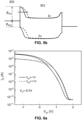
- Figure 5 illustrates, using the band model, a modulation of a Schottky barrier from the metal layer 302 shown in the figure to the n-type doped semiconducting layer 301.
- V gi positive voltage
- FIG. 4a As shown, more electrons are generated at the metal-semiconductor interface.
- the band curvature (dashed line) is increased. This results in a smaller Schottky barrier. This causes a higher tunneling current density along the arrow, which can be formulated as follows: J t ⁇ exp ⁇ q ⁇ bn N D
- ⁇ bn is the height of the Schottky barrier for the electrons.
- q is the charge of the electrons.
- N D is the doping concentration at the surface of the semiconductor 301.
- the Schottky barrier is ⁇ bp .
- Fig. 6a presents an example of a measurement of an electric current I D as a function of V g 1 from a source electrode 402 to a drain electrode 403. A potential of -0.5 volts was applied to the drain electrode.
- the current-voltage characteristic I d - V g 1 in the Figure 6a shows a counterclockwise hysteresis. This is typical of ferroelectric materials.
- the ferroelectric material achieves a memory effect, which is desirable for a synapse.
- Changing the voltage V g 2 also influences the initial current. This demonstrates the weighting function of V g 2 in a synapse.
- the Figure 6a The curves shown were measured using the Figure 6b
- the device shown is used.
- a thin p-doped silicon layer is separated from a Si substrate by an insulating layer. This is called silicon-on-insulator and abbreviated to SOI.
- the insulating layer is formed by "buried silicon oxide,” also called buried silicon oxide or BOX.
- the source electrode 402 and the drain electrode 403 are made of single-crystal NiSi2 .
- Layers 402 and 403 are applied to the thin, p-doped silicon layer 401 by silicidation of very thin Ni.
- Layer 401 is 55 nm thick and is lightly p-doped.
- HfZrO was deposited as the ferroelectric layer 404 by ALD (Atomic Layer Deposition).
- the layer thickness of the ferroelectric layer 404 can be 3 to 30 nm.
- the first electrode 405a and the second electrode 405b are made of TiN.
- the Fig. 7 shows an example of the measured synaptic characteristic of the component from Fig. 6 under the influence of a pulsed signal at the first gate, i.e. at the first gate electrode 405a.
- the current ID is plotted against the pulse number PN.
- a voltage V g1 was thus applied to the first gate electrode in pulse form.
- LTP long-term potentiation
- LTD Long-term depression
- FIG. 8a and 8b Several synapses with a crossbar structure are shown.
- a cross-sectional view from A to A' from the Figure 8a will be in Figure 8b shown.
- Two Schottky diodes of a synapse have a common semiconducting layer 501.
- a metal layer 502a of the first Schottky diode serves as the source electrode.
- a metal layer 502b serves as the drain electrode.
- an electrically insulating layer 505 was first fabricated on the semiconducting layer in such a way that two accesses to the semiconducting layer remain. Subsequently, the two layers 502a and 502b were fabricated in such a way that they are electrically separated from one another.
- ferroelectric layers 502a and 502b with the gate electrodes 504a and 504b were then fabricated.
- conventional manufacturing techniques can advantageously be used to produce a large number of synapses in the form of a crossbar structure in a technically simple manner.
- Fig. 9 shows an example of a synapse which comprises a first Schottky diode.
- the Schottky diode comprises a metal drain electrode 602.
- the metal drain electrode 602 is applied to a semiconductor layer 601.
- the first Schottky diode can be modulated according to the invention with the aid of a voltage V g by a ferroelectric layer 604 with a gate electrode 605.
- a second Schottky diode with the semiconducting layer 601 and the metal drain electrode 603 can be present. This can be operated with a bias voltage V D in the forward direction.
- the semiconducting layer 601 and the metal drain electrode 603 do not have to be selected such that a second Schottky diode is present. Instead, the semiconducting layer 601 and the metal drain electrode 603 can be an ohmic contact.
- the first Schottky diode 602, 601 is operated under reverse bias.
- This synaptic component operates like a single-gate transistor, which is represented by the symbol Fig. 9b can be displayed.
- Fig. 10 shows a synaptic component in a vertical arrangement.
- a metal layer 701 can serve as a substrate. However, the metal layer 701 can also be applied to a substrate. The metal layer 701 serves as a drain electrode. The metal layer 701 is therefore configured such that it can be connected to a voltage V D .
- a semiconducting layer 702 is applied to the metal layer 701. The metal layer 701 and the semiconducting layer 702 can be a Schottky diode.
- An insulator layer 703a, 703b has been applied to the semiconducting layer such that an access to the semiconducting layer 702 remained on the top side.
- the access can also have been created subsequently after the deposition of the insulating layer 703a, 703b, for example by etching.
- a metallic layer 704 was then deposited on the top side. This contacts the semiconducting layer 702 through the access.
- the metallic layer 704 serves as a source electrode. This can therefore be connected to a voltage V S.
- the metallic layer 704 and the semiconducting layer 702 form a Schottky diode.
- a ferroelectric layer 705 was deposited on the metallic layer 704.
- a metallic layer 706 was deposited on the ferroelectric layer 705.
- the metallic layer 706 serves as a gate electrode. This can therefore be connected to a voltage.
- the Figure 10 The structure shown can be rotated by 180°. This structure is Figure 10 The structure shown is C2 rotationally invariant.
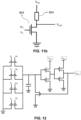
- the Figures 11a and 11b symbolize a neural component with a synapse according to the invention, wherein a transistor and a resistor are present.
- the transistor can be either a double-gate transistor 801 or a single-gate transistor 803. These transistors represent a synaptic component.
- Resistors 802 and 804 function as pull-up/pull-down resistors. By adjusting the conductivity of the resistors, the activation of a neuron can be adjusted.
- Fig. 12 represents a neural network with several synapses according to the invention and with conventional CMOS neurons.
- the synapses are shown in the transistor representation X 1 , W 1 , ..., X n , W n on the left side.
- a conventional neural component is shown.
- the synapse can be a single-gate component, as shown in Fig.9 and Fig.10
- the synapses can be fabricated using the CMOS neuron process to avoid the high-temperature treatment during the CMOS process.
- Synapses according to the invention can be combined with conventional neurons, which is achieved by the Figure 12 is clarified.
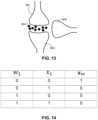
- Fig. 13 outlines a synapse serving as a connection between neurons.
- a signal 904 flows in one direction, from the presynaptic neuron 901 to the postsynaptic neuron 903.
- a neuromodulator 902. The Figure 13 The structure shown can be realized by the invention.
- the first gate (V g1 ) from the Figures 2 and 3 formed by 105a/205a, can serve as a presynaptic neuron.
- the source electrode serves as a postsynaptic neuron.
- the second gate (V g2 ), formed by 105b/205b, serves as a neuromodulator. This allows processing, learning, and modulation functions to be realized simultaneously.
- Figure 14 illustrates how this is done in the Figure 11a
- the component shown can be used as a two-input NAND gate.
- Figure 15 shows how a component according to Fig. 2b can be used as an AND gate, where I out is the current flowing through D.
Landscapes
- Engineering & Computer Science (AREA)
- Health & Medical Sciences (AREA)
- Life Sciences & Earth Sciences (AREA)
- Biomedical Technology (AREA)
- Physics & Mathematics (AREA)
- Computer Hardware Design (AREA)
- General Health & Medical Sciences (AREA)
- Neurology (AREA)
- Molecular Biology (AREA)
- Biophysics (AREA)
- Theoretical Computer Science (AREA)
- Evolutionary Computation (AREA)
- Data Mining & Analysis (AREA)
- Computing Systems (AREA)
- General Engineering & Computer Science (AREA)
- General Physics & Mathematics (AREA)
- Mathematical Physics (AREA)
- Software Systems (AREA)
- Computational Linguistics (AREA)
- Artificial Intelligence (AREA)
- Semiconductor Memories (AREA)
- Thin Film Transistor (AREA)
- Insulated Gate Type Field-Effect Transistor (AREA)
Applications Claiming Priority (2)
| Application Number | Priority Date | Filing Date | Title |
|---|---|---|---|
| DE102020207439.9A DE102020207439A1 (de) | 2020-06-16 | 2020-06-16 | Neuronen und Synapsen mit ferroelektrisch modulierten Metall-Halbleiter Schottky Dioden nebst Verfahren |
| PCT/EP2021/065297 WO2021254830A1 (de) | 2020-06-16 | 2021-06-08 | Neuronen und synapsen mit ferroelektrisch modulierten metall-halbleiter schottky dioden nebst verfahren |
Publications (3)
| Publication Number | Publication Date |
|---|---|
| EP4133419A1 EP4133419A1 (de) | 2023-02-15 |
| EP4133419C0 EP4133419C0 (de) | 2025-03-26 |
| EP4133419B1 true EP4133419B1 (de) | 2025-03-26 |
Family
ID=76421990
Family Applications (1)
| Application Number | Title | Priority Date | Filing Date |
|---|---|---|---|
| EP21731993.8A Active EP4133419B1 (de) | 2020-06-16 | 2021-06-08 | Neuronen und synapsen mit ferroelektrisch modulierten metall-halbleiter schottky dioden nebst verfahren |
Country Status (6)
| Country | Link |
|---|---|
| US (1) | US20230231030A1 (cg-RX-API-DMAC7.html) |
| EP (1) | EP4133419B1 (cg-RX-API-DMAC7.html) |
| JP (1) | JP2023534389A (cg-RX-API-DMAC7.html) |
| CN (1) | CN115668226A (cg-RX-API-DMAC7.html) |
| DE (1) | DE102020207439A1 (cg-RX-API-DMAC7.html) |
| WO (1) | WO2021254830A1 (cg-RX-API-DMAC7.html) |
Families Citing this family (4)
| Publication number | Priority date | Publication date | Assignee | Title |
|---|---|---|---|---|
| US20220012576A1 (en) * | 2020-07-09 | 2022-01-13 | Korea Advanced Institute Of Science And Technology | Charge trap based neuromorphic synaptic transistor with improved linearity and symmetricity by schottky junctions, and a neuromorphic system using it |
| CN117199166A (zh) * | 2022-05-31 | 2023-12-08 | 复旦大学 | 一种极化场调控的正负光响应探测器及其制备方法和应用 |
| KR102824779B1 (ko) * | 2022-11-08 | 2025-06-24 | 성균관대학교산학협력단 | 접합 구조 소자, 이의 제조 방법 및 이를 포함하는 인-메모리 컴퓨터 소자 |
| KR102926808B1 (ko) | 2023-08-30 | 2026-02-12 | 고려대학교 산학협력단 | 실리콘 게이티드 다이오드를 이용한 이진화 신경망 회로 |
Family Cites Families (12)
| Publication number | Priority date | Publication date | Assignee | Title |
|---|---|---|---|---|
| JP2715722B2 (ja) | 1991-08-23 | 1998-02-18 | 日本電気株式会社 | 半導体シナプス回路とその製造方法、及び半導体ニューロン素子、及び半導体−超伝導体複合ニューロン素子 |
| US9660067B2 (en) * | 2014-03-25 | 2017-05-23 | Intel Corporation | III-N transistors with epitaxial layers providing steep subthreshold swing |
| DE102016111237B3 (de) | 2016-06-20 | 2017-11-23 | Namlab Ggmbh | Rekonfigurierbarer Nanodraht-Feldeffekt-Transistor und dessen Herstellung sowie ein Nanodraht-Array und dessen Rekonfigurierung |
| US10510903B2 (en) * | 2016-11-29 | 2019-12-17 | Taiwan Semiconductor Manufacturing Co., Ltd. | Impact ionization semiconductor device and manufacturing method thereof |
| CN106653837B (zh) * | 2016-12-02 | 2019-09-13 | 电子科技大学 | 一种氮化镓双向开关器件 |
| WO2019066959A1 (en) * | 2017-09-29 | 2019-04-04 | Intel Corporation | FERROELECTRIC NEURONS AND SYNAPES |
| US10658030B2 (en) | 2017-11-29 | 2020-05-19 | International Business Machines Corporation | Synaptic crossbar memory array |
| US10374041B2 (en) * | 2017-12-21 | 2019-08-06 | International Business Machines Corporation | Field effect transistor with controllable resistance |
| WO2019139598A1 (en) * | 2018-01-11 | 2019-07-18 | Intel Corporation | Ferroelectric neurons and synapses with dual gate ferroelectric transistors |
| US11514303B2 (en) | 2018-01-24 | 2022-11-29 | The Regents Of The University Of California | Synaptic resistors for concurrent parallel signal processing, memory and learning with high speed and energy efficiency |
| US10963776B2 (en) * | 2018-08-24 | 2021-03-30 | Namlab Ggmbh | Artificial neuron based on ferroelectric circuit element |
| CN208922326U (zh) | 2018-10-29 | 2019-05-31 | 南京邮电大学 | 一种基于忆阻器阵列的神经网络突触觉结构 |
-
2020
- 2020-06-16 DE DE102020207439.9A patent/DE102020207439A1/de active Pending
-
2021
- 2021-06-08 JP JP2022577164A patent/JP2023534389A/ja not_active Withdrawn
- 2021-06-08 EP EP21731993.8A patent/EP4133419B1/de active Active
- 2021-06-08 WO PCT/EP2021/065297 patent/WO2021254830A1/de not_active Ceased
- 2021-06-08 US US18/007,721 patent/US20230231030A1/en active Pending
- 2021-06-08 CN CN202180035992.XA patent/CN115668226A/zh not_active Withdrawn
Non-Patent Citations (1)
| Title |
|---|
| TANG BIN ET AL: "Novel Type of Synaptic Transistors Based on a Ferroelectric Semiconductor Channel", APPLIED MATERIALS & INTERFACES, vol. 12, no. 22, 11 May 2020 (2020-05-11), US, pages 24920 - 24928, XP055840003, ISSN: 1944-8244, Retrieved from the Internet <URL:https://pubs.acs.org/doi/pdf/10.1021/acsami.9b23595> [retrieved on 20241111], DOI: 10.1021/acsami.9b23595 * |
Also Published As
| Publication number | Publication date |
|---|---|
| EP4133419A1 (de) | 2023-02-15 |
| US20230231030A1 (en) | 2023-07-20 |
| CN115668226A (zh) | 2023-01-31 |
| WO2021254830A1 (de) | 2021-12-23 |
| EP4133419C0 (de) | 2025-03-26 |
| JP2023534389A (ja) | 2023-08-09 |
| DE102020207439A1 (de) | 2021-12-16 |
Similar Documents
| Publication | Publication Date | Title |
|---|---|---|
| EP4133419B1 (de) | Neuronen und synapsen mit ferroelektrisch modulierten metall-halbleiter schottky dioden nebst verfahren | |
| DE69018348T2 (de) | Speicherbauelement aus organischem Halbleiter mit einer MISFET-Struktur und sein Kontrollverfahren. | |
| DE102018204283B4 (de) | Programmierbare logikelemente und verfahren zum betreiben derselben | |
| DE4020007C2 (de) | Nichtflüchtiger Speicher | |
| DE69132469T2 (de) | Elektrische Anordnung mit einem dotierten amorphen Siliziumkanal | |
| DE102016111237B3 (de) | Rekonfigurierbarer Nanodraht-Feldeffekt-Transistor und dessen Herstellung sowie ein Nanodraht-Array und dessen Rekonfigurierung | |
| DE112019001709T5 (de) | Halbleitervorrichtung und multiply-accumulate-operations-vorrichtung | |
| EP4062464B1 (de) | Kapazitives synaptisches bauelement und verfahren zu dessen ansteuerung | |
| DE1803035A1 (de) | Feldeffekt-Halbleiterbauelement | |
| DE69501381T2 (de) | Halbleitergerät | |
| DE2711460C2 (de) | Elektroakustische Signalverarbeitungseinrichtung | |
| DE102020100777A1 (de) | Analoge nichtflüchtige Speichervorrichtung unter Verwendung eines polyferroelektrischen Films mit zufälligen Polarisationsrichtungen | |
| DE2011794B2 (de) | Halbleiterspeicheranordnung | |
| EP0050773A2 (de) | Steuerbares MIS-Bauelement | |
| DE2201028B2 (de) | Verfahren zum Betrieb eines Feldeffekttransistors und Feldeffekttransistor zur Ausübung dieses Verfahrens | |
| DE69013057T2 (de) | Hochspannungsdünnschichttransistor. | |
| DE2742935C3 (de) | Nichtflüchtiger Langzeitspeicher | |
| DE2124635A1 (de) | Verfahren zur Steuerung eines Bereiches hoher elektrischer Feldstarke in Halblei tem | |
| DE69127585T2 (de) | Schaltung für künstliche neurale Funktion | |
| DE112006002377T5 (de) | Halbleitervorrichtung und Verfahren zum Herstellen einer Halbleitervorrichtung | |
| DE112021005740B4 (de) | Gemischt leitendes flüchtiges speicherelement zum beschleunigten beschreiben eines nichtflüchtigen memristiven bauelements | |
| DE10212878B4 (de) | Halbleiterschaltungsanordnung und Halbleiterspeichereinrichtung | |
| DE2742936B2 (de) | Nichtflüchtiger Langzeitspeicher | |
| WO2012022342A1 (de) | Halbleiterbauelement | |
| WO2009040375A1 (de) | Elektronisches bauelement mit schalteigenschaften |
Legal Events
| Date | Code | Title | Description |
|---|---|---|---|
| STAA | Information on the status of an ep patent application or granted ep patent |
Free format text: STATUS: UNKNOWN |
|
| STAA | Information on the status of an ep patent application or granted ep patent |
Free format text: STATUS: THE INTERNATIONAL PUBLICATION HAS BEEN MADE |
|
| PUAI | Public reference made under article 153(3) epc to a published international application that has entered the european phase |
Free format text: ORIGINAL CODE: 0009012 |
|
| STAA | Information on the status of an ep patent application or granted ep patent |
Free format text: STATUS: REQUEST FOR EXAMINATION WAS MADE |
|
| 17P | Request for examination filed |
Effective date: 20221109 |
|
| AK | Designated contracting states |
Kind code of ref document: A1 Designated state(s): AL AT BE BG CH CY CZ DE DK EE ES FI FR GB GR HR HU IE IS IT LI LT LU LV MC MK MT NL NO PL PT RO RS SE SI SK SM TR |
|
| DAV | Request for validation of the european patent (deleted) | ||
| DAX | Request for extension of the european patent (deleted) | ||
| STAA | Information on the status of an ep patent application or granted ep patent |
Free format text: STATUS: EXAMINATION IS IN PROGRESS |
|
| 17Q | First examination report despatched |
Effective date: 20231204 |
|
| REG | Reference to a national code |
Ref legal event code: R079 Ipc: G06N0003065000 Ref country code: DE Ref legal event code: R079 Ref document number: 502021007031 Country of ref document: DE Free format text: PREVIOUS MAIN CLASS: G06N0003063000 Ipc: G06N0003065000 |
|
| GRAP | Despatch of communication of intention to grant a patent |
Free format text: ORIGINAL CODE: EPIDOSNIGR1 |
|
| STAA | Information on the status of an ep patent application or granted ep patent |
Free format text: STATUS: GRANT OF PATENT IS INTENDED |
|
| RIC1 | Information provided on ipc code assigned before grant |
Ipc: H01L 29/417 20060101ALI20241111BHEP Ipc: H01L 29/78 20060101ALI20241111BHEP Ipc: H01L 29/51 20060101ALI20241111BHEP Ipc: G06N 3/065 20230101AFI20241111BHEP |
|
| INTG | Intention to grant announced |
Effective date: 20241120 |
|
| GRAS | Grant fee paid |
Free format text: ORIGINAL CODE: EPIDOSNIGR3 |
|
| GRAA | (expected) grant |
Free format text: ORIGINAL CODE: 0009210 |
|
| STAA | Information on the status of an ep patent application or granted ep patent |
Free format text: STATUS: THE PATENT HAS BEEN GRANTED |
|
| P01 | Opt-out of the competence of the unified patent court (upc) registered |
Free format text: CASE NUMBER: APP_2956/2025 Effective date: 20250117 |
|
| AK | Designated contracting states |
Kind code of ref document: B1 Designated state(s): AL AT BE BG CH CY CZ DE DK EE ES FI FR GB GR HR HU IE IS IT LI LT LU LV MC MK MT NL NO PL PT RO RS SE SI SK SM TR |
|
| REG | Reference to a national code |
Ref country code: GB Ref legal event code: FG4D Free format text: NOT ENGLISH |
|
| REG | Reference to a national code |
Ref country code: CH Ref legal event code: EP |
|
| REG | Reference to a national code |
Ref country code: DE Ref legal event code: R096 Ref document number: 502021007031 Country of ref document: DE |
|
| REG | Reference to a national code |
Ref country code: IE Ref legal event code: FG4D Free format text: LANGUAGE OF EP DOCUMENT: GERMAN |
|
| U01 | Request for unitary effect filed |
Effective date: 20250416 |
|
| U07 | Unitary effect registered |
Designated state(s): AT BE BG DE DK EE FI FR IT LT LU LV MT NL PT RO SE SI Effective date: 20250429 |
|
| P04 | Withdrawal of opt-out of the competence of the unified patent court (upc) registered |
Free format text: CASE NUMBER: APP_19832/2025 Effective date: 20250425 |
|
| PG25 | Lapsed in a contracting state [announced via postgrant information from national office to epo] |
Ref country code: RS Free format text: LAPSE BECAUSE OF FAILURE TO SUBMIT A TRANSLATION OF THE DESCRIPTION OR TO PAY THE FEE WITHIN THE PRESCRIBED TIME-LIMIT Effective date: 20250626 |
|
| PGFP | Annual fee paid to national office [announced via postgrant information from national office to epo] |
Ref country code: GB Payment date: 20250620 Year of fee payment: 5 |
|
| PG25 | Lapsed in a contracting state [announced via postgrant information from national office to epo] |
Ref country code: NO Free format text: LAPSE BECAUSE OF FAILURE TO SUBMIT A TRANSLATION OF THE DESCRIPTION OR TO PAY THE FEE WITHIN THE PRESCRIBED TIME-LIMIT Effective date: 20250626 |
|
| PG25 | Lapsed in a contracting state [announced via postgrant information from national office to epo] |
Ref country code: HR Free format text: LAPSE BECAUSE OF FAILURE TO SUBMIT A TRANSLATION OF THE DESCRIPTION OR TO PAY THE FEE WITHIN THE PRESCRIBED TIME-LIMIT Effective date: 20250326 |
|
| PG25 | Lapsed in a contracting state [announced via postgrant information from national office to epo] |
Ref country code: GR Free format text: LAPSE BECAUSE OF FAILURE TO SUBMIT A TRANSLATION OF THE DESCRIPTION OR TO PAY THE FEE WITHIN THE PRESCRIBED TIME-LIMIT Effective date: 20250627 |
|
| U20 | Renewal fee for the european patent with unitary effect paid |
Year of fee payment: 5 Effective date: 20250623 |
|
| PG25 | Lapsed in a contracting state [announced via postgrant information from national office to epo] |
Ref country code: SM Free format text: LAPSE BECAUSE OF FAILURE TO SUBMIT A TRANSLATION OF THE DESCRIPTION OR TO PAY THE FEE WITHIN THE PRESCRIBED TIME-LIMIT Effective date: 20250326 |
|
| PG25 | Lapsed in a contracting state [announced via postgrant information from national office to epo] |
Ref country code: ES Free format text: LAPSE BECAUSE OF FAILURE TO SUBMIT A TRANSLATION OF THE DESCRIPTION OR TO PAY THE FEE WITHIN THE PRESCRIBED TIME-LIMIT Effective date: 20250326 |
|
| PG25 | Lapsed in a contracting state [announced via postgrant information from national office to epo] |
Ref country code: PL Free format text: LAPSE BECAUSE OF FAILURE TO SUBMIT A TRANSLATION OF THE DESCRIPTION OR TO PAY THE FEE WITHIN THE PRESCRIBED TIME-LIMIT Effective date: 20250326 |
|
| PG25 | Lapsed in a contracting state [announced via postgrant information from national office to epo] |
Ref country code: SK Free format text: LAPSE BECAUSE OF FAILURE TO SUBMIT A TRANSLATION OF THE DESCRIPTION OR TO PAY THE FEE WITHIN THE PRESCRIBED TIME-LIMIT Effective date: 20250326 |
|
| PG25 | Lapsed in a contracting state [announced via postgrant information from national office to epo] |
Ref country code: IS Free format text: LAPSE BECAUSE OF FAILURE TO SUBMIT A TRANSLATION OF THE DESCRIPTION OR TO PAY THE FEE WITHIN THE PRESCRIBED TIME-LIMIT Effective date: 20250726 |
|
| PG25 | Lapsed in a contracting state [announced via postgrant information from national office to epo] |
Ref country code: CZ Free format text: LAPSE BECAUSE OF FAILURE TO SUBMIT A TRANSLATION OF THE DESCRIPTION OR TO PAY THE FEE WITHIN THE PRESCRIBED TIME-LIMIT Effective date: 20250326 |
|
| REG | Reference to a national code |
Ref country code: CH Ref legal event code: H13 Free format text: ST27 STATUS EVENT CODE: U-0-0-H10-H13 (AS PROVIDED BY THE NATIONAL OFFICE) Effective date: 20260127 |
|
| PG25 | Lapsed in a contracting state [announced via postgrant information from national office to epo] |
Ref country code: MC Free format text: LAPSE BECAUSE OF FAILURE TO SUBMIT A TRANSLATION OF THE DESCRIPTION OR TO PAY THE FEE WITHIN THE PRESCRIBED TIME-LIMIT Effective date: 20250326 |
|
| PLBE | No opposition filed within time limit |
Free format text: ORIGINAL CODE: 0009261 |
|
| STAA | Information on the status of an ep patent application or granted ep patent |
Free format text: STATUS: NO OPPOSITION FILED WITHIN TIME LIMIT |
|
| REG | Reference to a national code |
Ref country code: CH Ref legal event code: L10 Free format text: ST27 STATUS EVENT CODE: U-0-0-L10-L00 (AS PROVIDED BY THE NATIONAL OFFICE) Effective date: 20260211 |
|
| 26N | No opposition filed |
Effective date: 20260105 |
|
| PG25 | Lapsed in a contracting state [announced via postgrant information from national office to epo] |
Ref country code: IE Free format text: LAPSE BECAUSE OF NON-PAYMENT OF DUE FEES Effective date: 20250608 |
|
| PG25 | Lapsed in a contracting state [announced via postgrant information from national office to epo] |
Ref country code: CH Free format text: LAPSE BECAUSE OF NON-PAYMENT OF DUE FEES Effective date: 20250630 |