EP4130056B1 - Support material for fused deposition modeling, and manufacturing method of fused deposition modeled structure, and three-dimensional object using the same - Google Patents
Support material for fused deposition modeling, and manufacturing method of fused deposition modeled structure, and three-dimensional object using the same Download PDFInfo
- Publication number
- EP4130056B1 EP4130056B1 EP21779712.5A EP21779712A EP4130056B1 EP 4130056 B1 EP4130056 B1 EP 4130056B1 EP 21779712 A EP21779712 A EP 21779712A EP 4130056 B1 EP4130056 B1 EP 4130056B1
- Authority
- EP
- European Patent Office
- Prior art keywords
- support material
- fused deposition
- based resin
- sulfonic acid
- deposition modeling
- Prior art date
- Legal status (The legal status is an assumption and is not a legal conclusion. Google has not performed a legal analysis and makes no representation as to the accuracy of the status listed.)
- Active
Links
Images
Classifications
-
- B—PERFORMING OPERATIONS; TRANSPORTING
- B29—WORKING OF PLASTICS; WORKING OF SUBSTANCES IN A PLASTIC STATE IN GENERAL
- B29C—SHAPING OR JOINING OF PLASTICS; SHAPING OF MATERIAL IN A PLASTIC STATE, NOT OTHERWISE PROVIDED FOR; AFTER-TREATMENT OF THE SHAPED PRODUCTS, e.g. REPAIRING
- B29C64/00—Additive manufacturing, i.e. manufacturing of three-dimensional [3D] objects by additive deposition, additive agglomeration or additive layering, e.g. by 3D printing, stereolithography or selective laser sintering
- B29C64/10—Processes of additive manufacturing
- B29C64/106—Processes of additive manufacturing using only liquids or viscous materials, e.g. depositing a continuous bead of viscous material
- B29C64/118—Processes of additive manufacturing using only liquids or viscous materials, e.g. depositing a continuous bead of viscous material using filamentary material being melted, e.g. fused deposition modelling [FDM]
-
- B—PERFORMING OPERATIONS; TRANSPORTING
- B29—WORKING OF PLASTICS; WORKING OF SUBSTANCES IN A PLASTIC STATE IN GENERAL
- B29C—SHAPING OR JOINING OF PLASTICS; SHAPING OF MATERIAL IN A PLASTIC STATE, NOT OTHERWISE PROVIDED FOR; AFTER-TREATMENT OF THE SHAPED PRODUCTS, e.g. REPAIRING
- B29C64/00—Additive manufacturing, i.e. manufacturing of three-dimensional [3D] objects by additive deposition, additive agglomeration or additive layering, e.g. by 3D printing, stereolithography or selective laser sintering
- B29C64/40—Structures for supporting 3D objects during manufacture and intended to be sacrificed after completion thereof
-
- B—PERFORMING OPERATIONS; TRANSPORTING
- B33—ADDITIVE MANUFACTURING TECHNOLOGY
- B33Y—ADDITIVE MANUFACTURING, i.e. MANUFACTURING OF THREE-DIMENSIONAL [3D] OBJECTS BY ADDITIVE DEPOSITION, ADDITIVE AGGLOMERATION OR ADDITIVE LAYERING, e.g. BY 3D PRINTING, STEREOLITHOGRAPHY OR SELECTIVE LASER SINTERING
- B33Y10/00—Processes of additive manufacturing
-
- B—PERFORMING OPERATIONS; TRANSPORTING
- B33—ADDITIVE MANUFACTURING TECHNOLOGY
- B33Y—ADDITIVE MANUFACTURING, i.e. MANUFACTURING OF THREE-DIMENSIONAL [3D] OBJECTS BY ADDITIVE DEPOSITION, ADDITIVE AGGLOMERATION OR ADDITIVE LAYERING, e.g. BY 3D PRINTING, STEREOLITHOGRAPHY OR SELECTIVE LASER SINTERING
- B33Y70/00—Materials specially adapted for additive manufacturing
-
- B—PERFORMING OPERATIONS; TRANSPORTING
- B33—ADDITIVE MANUFACTURING TECHNOLOGY
- B33Y—ADDITIVE MANUFACTURING, i.e. MANUFACTURING OF THREE-DIMENSIONAL [3D] OBJECTS BY ADDITIVE DEPOSITION, ADDITIVE AGGLOMERATION OR ADDITIVE LAYERING, e.g. BY 3D PRINTING, STEREOLITHOGRAPHY OR SELECTIVE LASER SINTERING
- B33Y80/00—Products made by additive manufacturing
-
- C—CHEMISTRY; METALLURGY
- C08—ORGANIC MACROMOLECULAR COMPOUNDS; THEIR PREPARATION OR CHEMICAL WORKING-UP; COMPOSITIONS BASED THEREON
- C08F—MACROMOLECULAR COMPOUNDS OBTAINED BY REACTIONS ONLY INVOLVING CARBON-TO-CARBON UNSATURATED BONDS
- C08F216/00—Copolymers of compounds having one or more unsaturated aliphatic radicals, each having only one carbon-to-carbon double bond, and at least one being terminated by an alcohol, ether, aldehydo, ketonic, acetal or ketal radical
- C08F216/02—Copolymers of compounds having one or more unsaturated aliphatic radicals, each having only one carbon-to-carbon double bond, and at least one being terminated by an alcohol, ether, aldehydo, ketonic, acetal or ketal radical by an alcohol radical
- C08F216/04—Acyclic compounds
- C08F216/06—Polyvinyl alcohol ; Vinyl alcohol
-
- C—CHEMISTRY; METALLURGY
- C08—ORGANIC MACROMOLECULAR COMPOUNDS; THEIR PREPARATION OR CHEMICAL WORKING-UP; COMPOSITIONS BASED THEREON
- C08F—MACROMOLECULAR COMPOUNDS OBTAINED BY REACTIONS ONLY INVOLVING CARBON-TO-CARBON UNSATURATED BONDS
- C08F216/00—Copolymers of compounds having one or more unsaturated aliphatic radicals, each having only one carbon-to-carbon double bond, and at least one being terminated by an alcohol, ether, aldehydo, ketonic, acetal or ketal radical
- C08F216/02—Copolymers of compounds having one or more unsaturated aliphatic radicals, each having only one carbon-to-carbon double bond, and at least one being terminated by an alcohol, ether, aldehydo, ketonic, acetal or ketal radical by an alcohol radical
- C08F216/04—Acyclic compounds
- C08F216/08—Allyl alcohol
-
- C—CHEMISTRY; METALLURGY
- C08—ORGANIC MACROMOLECULAR COMPOUNDS; THEIR PREPARATION OR CHEMICAL WORKING-UP; COMPOSITIONS BASED THEREON
- C08F—MACROMOLECULAR COMPOUNDS OBTAINED BY REACTIONS ONLY INVOLVING CARBON-TO-CARBON UNSATURATED BONDS
- C08F8/00—Chemical modification by after-treatment
- C08F8/12—Hydrolysis
-
- C—CHEMISTRY; METALLURGY
- C08—ORGANIC MACROMOLECULAR COMPOUNDS; THEIR PREPARATION OR CHEMICAL WORKING-UP; COMPOSITIONS BASED THEREON
- C08L—COMPOSITIONS OF MACROMOLECULAR COMPOUNDS
- C08L29/00—Compositions of homopolymers or copolymers of compounds having one or more unsaturated aliphatic radicals, each having only one carbon-to-carbon double bond, and at least one being terminated by an alcohol, ether, aldehydo, ketonic, acetal or ketal radical; Compositions of hydrolysed polymers of esters of unsaturated alcohols with saturated carboxylic acids; Compositions of derivatives of such polymers
- C08L29/02—Homopolymers or copolymers of unsaturated alcohols
- C08L29/04—Polyvinyl alcohol; Partially hydrolysed homopolymers or copolymers of esters of unsaturated alcohols with saturated carboxylic acids
-
- B—PERFORMING OPERATIONS; TRANSPORTING
- B29—WORKING OF PLASTICS; WORKING OF SUBSTANCES IN A PLASTIC STATE IN GENERAL
- B29C—SHAPING OR JOINING OF PLASTICS; SHAPING OF MATERIAL IN A PLASTIC STATE, NOT OTHERWISE PROVIDED FOR; AFTER-TREATMENT OF THE SHAPED PRODUCTS, e.g. REPAIRING
- B29C2791/00—Shaping characteristics in general
- B29C2791/002—Making articles of definite length, i.e. discrete articles
-
- B—PERFORMING OPERATIONS; TRANSPORTING
- B29—WORKING OF PLASTICS; WORKING OF SUBSTANCES IN A PLASTIC STATE IN GENERAL
- B29K—INDEXING SCHEME ASSOCIATED WITH SUBCLASSES B29B, B29C OR B29D, RELATING TO MOULDING MATERIALS OR TO MATERIALS FOR MOULDS, REINFORCEMENTS, FILLERS OR PREFORMED PARTS, e.g. INSERTS
- B29K2629/00—Use of polyvinylalcohols, polyvinylethers, polyvinylaldehydes, polyvinylketones or polyvinylketals or derivatives thereof, for preformed parts, e.g. for inserts
- B29K2629/04—PVOH, i.e. polyvinyl alcohol
-
- B—PERFORMING OPERATIONS; TRANSPORTING
- B29—WORKING OF PLASTICS; WORKING OF SUBSTANCES IN A PLASTIC STATE IN GENERAL
- B29K—INDEXING SCHEME ASSOCIATED WITH SUBCLASSES B29B, B29C OR B29D, RELATING TO MOULDING MATERIALS OR TO MATERIALS FOR MOULDS, REINFORCEMENTS, FILLERS OR PREFORMED PARTS, e.g. INSERTS
- B29K2667/00—Use of polyesters or derivatives thereof for preformed parts, e.g. for inserts
-
- B—PERFORMING OPERATIONS; TRANSPORTING
- B29—WORKING OF PLASTICS; WORKING OF SUBSTANCES IN A PLASTIC STATE IN GENERAL
- B29K—INDEXING SCHEME ASSOCIATED WITH SUBCLASSES B29B, B29C OR B29D, RELATING TO MOULDING MATERIALS OR TO MATERIALS FOR MOULDS, REINFORCEMENTS, FILLERS OR PREFORMED PARTS, e.g. INSERTS
- B29K2715/00—Condition, form or state of preformed parts, e.g. inserts
- B29K2715/006—Glues or adhesives, e.g. hot melts or thermofusible adhesives
-
- B—PERFORMING OPERATIONS; TRANSPORTING
- B29—WORKING OF PLASTICS; WORKING OF SUBSTANCES IN A PLASTIC STATE IN GENERAL
- B29K—INDEXING SCHEME ASSOCIATED WITH SUBCLASSES B29B, B29C OR B29D, RELATING TO MOULDING MATERIALS OR TO MATERIALS FOR MOULDS, REINFORCEMENTS, FILLERS OR PREFORMED PARTS, e.g. INSERTS
- B29K2995/00—Properties of moulding materials, reinforcements, fillers, preformed parts or moulds
- B29K2995/0037—Other properties
- B29K2995/0059—Degradable
- B29K2995/006—Bio-degradable, e.g. bioabsorbable, bioresorbable or bioerodible
-
- C—CHEMISTRY; METALLURGY
- C08—ORGANIC MACROMOLECULAR COMPOUNDS; THEIR PREPARATION OR CHEMICAL WORKING-UP; COMPOSITIONS BASED THEREON
- C08F—MACROMOLECULAR COMPOUNDS OBTAINED BY REACTIONS ONLY INVOLVING CARBON-TO-CARBON UNSATURATED BONDS
- C08F218/00—Copolymers of compounds having one or more unsaturated aliphatic radicals, each having only one carbon-to-carbon double bond, and at least one being terminated by an acyloxy radical of a saturated carboxylic acid, of carbonic acid or of a haloformic acid
- C08F218/02—Esters of monocarboxylic acids
- C08F218/04—Vinyl esters
- C08F218/08—Vinyl acetate
-
- C—CHEMISTRY; METALLURGY
- C08—ORGANIC MACROMOLECULAR COMPOUNDS; THEIR PREPARATION OR CHEMICAL WORKING-UP; COMPOSITIONS BASED THEREON
- C08G—MACROMOLECULAR COMPOUNDS OBTAINED OTHERWISE THAN BY REACTIONS ONLY INVOLVING UNSATURATED CARBON-TO-CARBON BONDS
- C08G63/00—Macromolecular compounds obtained by reactions forming a carboxylic ester link in the main chain of the macromolecule
- C08G63/02—Polyesters derived from hydroxycarboxylic acids or from polycarboxylic acids and polyhydroxy compounds
- C08G63/12—Polyesters derived from hydroxycarboxylic acids or from polycarboxylic acids and polyhydroxy compounds derived from polycarboxylic acids and polyhydroxy compounds
- C08G63/16—Dicarboxylic acids and dihydroxy compounds
- C08G63/18—Dicarboxylic acids and dihydroxy compounds the acids or hydroxy compounds containing carbocyclic rings
- C08G63/181—Acids containing aromatic rings
- C08G63/183—Terephthalic acids
Definitions
- a support structure which is auxiliary for infilling a target three-dimensional object is formed during the fused deposition modeling.
- the support structure is a mere auxiliary part during the printing process of the target three-dimensional object, and therefore needs to be removed from the fused deposition modeled structure after the printing process.
- PVA-based resin is rigid and inferior in impact resistance, and is not easy to be melt molded and fiberized. If such a PVA-based resin is used for a support material applicable a variety of shapes, PVA-based resin should be given flexibility and impact resistance.
- a thermoplastic elastomer such as styrene-ethylene-butylene-styrene block copolymer (SEBS) with the PVA-based resin (for example, disclosed by WO 2015/182681 A1 , WO 2018/061694 A1 , and JP 2019-155917 A ).
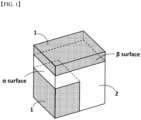
- FIG. 1 depicts a configuration of a fused deposition modeled structure to be formed for measurement in Example.
- a support material for fused deposition modeling of the present invention comprises (A) polyvinyl alcohol (PVA) -based resin having a group containing sulfonic acid or a salt thereof, and (B) a biodegradable polyester, wherein the (A) polyvinyl alcohol-based resin having a group containing sulfonic acid or a salt thereof has a modification rate of 0.5 to 10 mol%, and the content of sodium acetate is from 0.1 to 2.0 parts by weight with respect to 100 parts by weight of (A) polyvinyl alcohol-based resin having a group containing sulfonic acid or a salt thereof.
- PVA polyvinyl alcohol
- B a biodegradable polyester
- the (A) PVA-based resin having a group containing sulfonic acid or a salt thereof used in the support material of the invention is excellent in water solubility and melt-molding property. Moreover, the PVA-based resin (A) has an excellent compatibility with (B) biodegradable polyester as the other essential component of the support material. Additionally, the support material can be provided in the form of filament. As for the fused deposition modeled structure using the support material, a washing operation with water for removing the support structure therein is convenient because of the dissolution of the support structure in water and no generation of agglomerates of the polyester in the wastewater after the washing operation. Therefore, the treatment of waste liquid after the washing and removal operation is not troublesome, described below.
- the (A) PVA-based resin having a group containing sulfonic acid or a salt thereof may exhibit compatibility to (B) biodegradable polyester described later because of the presence of the sulfonic acid or a salt thereof in the molecule of the PVA-based resin (A). If both of the components (A) and (B) are melt-kneaded, their phases are separated but either component (A) or (B) in the form of small domain is dispersed in the other component (B) or (A) as the matrix.
- the proportion of the component (A) of the PVA-based resin is more than half, they usually form a sea-island structure in which the PVA-based resin is sea component and the (B) biodegradable polyester is an island component.
- the side chain 1,2-diol-containing PVA-based resin, and the like polar groups contained in their molecules are merely a hydroxyl group and an acetyl group, so that their compatibility with (B) biodegradable polyester is low.
- the size of domain composed of the polyester resin which is an island component dispersed in the PVA resin as a sea component is from 2 to 5 ⁇ m.
- the wastewater when they are removed by washing with water, the wastewater would contain a large amount of agglomerates of (B) biodegradable polyester and a size of the agglomerates is from 2 mm to 5 mm.
- agglomerates adhere to the target model after the removal of the support structure and cause clogging of a filtration strainer used for wastewater treatment. This makes wastewater treatment troublesome.
- the (B) biodegradable polyester can exist as a domain having a size of 0.05 to 2 ⁇ m in a sea-island structure regardless of their phase separation.
- (B) biodegradable polyester may be finely dispersed in the form of domain (island) having a size of 0.1 to 1.0 ⁇ m, more preferably from 0.1 to 0.5 ⁇ m, in a matrix (sea) of (A) PVA-based resin having a group containing sulfonic acid or a salt thereof.
- domain (island) having a size of 0.1 to 1.0 ⁇ m, more preferably from 0.1 to 0.5 ⁇ m, in a matrix (sea) of (A) PVA-based resin having a group containing sulfonic acid or a salt thereof.
- the (A) the PVA-based resin having a group containing sulfonic acid or a salt thereof comprises a vinyl alcohol unit represented by the following general formula (1), a vinyl ester unit represented by the following general formula (2), and a structural unit represented by the following general formula (3-1), (3-2), or (3-3).
- the vinyl alcohol unit is a basic structural unit of the PVA-based resin.
- the vinyl ester unit is contained as an unsaponified portion when the saponification degree is less than 100%.
- the structural unit (3-1), (3-2), or (3-3) contains a group of a sulfonic acid or a salt thereof in the side chain of the unit.
- the vinyl alcohol unit (1) and the vinyl ester unit (2) both are derived from a vinyl ester compound used as a monomer making up the PVA-based resin.
- vinyl ester compound as a monomer examples include vinyl formate, vinyl acetate, vinyl propionate, vinyl valerate, vinyl butyrate, vinyl isobutyrate, vinyl pivalate, vinyl caprate, vinyl laurate, vinyl stearate, vinyl benzoate, vinyl versatate.
- vinyl acetate is preferably used because of economy.
- R a is an alkyl group having from 1 to 18 carbon atoms and depends on the vinyl ester compound used for a raw material for the synthesis of the PVA-based resin.
- R a is preferably a methyl group, and therefore a preferred vinyl ester unit is vinyl acetate unit represented by the formula (2a).
- M indicates hydrogen, alkali metal or ammonium group.
- M indicates hydrogen, alkali metal or ammonium group.
- the -SO 3 M corresponds to sulfonic acid group.
- M is an alkali metal or ammonium, the -SO 3 M corresponds to a salt of sulfonic acid-containing group.
- R 1 , R 2 , R 3 , R 4 , R 5 , and R 6 in the each formula is independently hydrogen, an alkyl group having from 1 to 4 carbon atoms.
- Each of X and Y is a linking group.
- a typical linking group is an alkylene group having from 1 to 4 carbon atoms, ester bond, amide bond and ether bond.
- -SO 3 M may be a hydrogen, an alkyl group, or a sulfonic acid- or its sulfonate-containing group represented by "-SO 3 M" (M indicates a hydrogen, alkali metal or an ammonium group), or a -SO 3 M-containing group.
- the structural unit represented by the formula (3-1), which is a unit having a group containing sulfonic acid or a salt thereof, may be formed from an unsaturated monomer having a sulfonic acid or a salt thereof (hereinafter referred to as "sulfonic acid group-containing unsaturated monomer").
- sulfonic acid group-containing unsaturated monomer examples include olefin sulfonic acid (4-1), sulfoalkyl (meth)acrylamide (4-2) or (4-3), and sulfoalkyl (meth)acrylate (4-4), shown below.
- R 11 , R 12 , R 13 , and R 14 each is independently hydrogen or an alkyl group having from 1 to 4 carbon atoms.
- n is an integer of 2 to 4
- M represents a hydrogen atom, an alkali metal or ammonium group.
- the structural unit having a group containing sulfonic acid or a salt thereof, represented by the formula (3-2), is formed in the case of a sulfoalkylmaleate represented below as an unsaturated monomer containing a sulfonic acid.
- n is an integer of 2 to 4
- M represents a hydrogen atom, an alkali metal or an ammonium group.
- the structural unit having a group containing sulfonic acid or a salt thereof, represented by the formula (3-3), is formed with use of sulfoalkyl (meth)acrylamide shown below as an unsaturated monomer having a group containing a sulfonic acid or a salt thereof.
- R 15 is hydrogen or an alkyl group having from 1 to 4 carbon atoms.
- n is an integer of 2 to 4, and M represents a hydrogen atom, an alkali metal or ammonium group.
- sulfoalkyl (meth)acrylate examples include sodium sulfoethyl acrylate.
- olefin sulfonic acid or a salt thereof is preferably chosen.
- the average of polymerization degree (measured in accordance with JIS K 6726) of (A) the PVA-based resin having a group containing sulfonic acid or a salt thereof is preferably from 150 to 4000, more preferably from 250 to 1000, and further from 300 to 500.
- the (A) PVA-based resin having a group containing sulfonic acid or a salt thereof has a modification rate of 0.5 to 10 mol%, preferably from 0.5 to 5 mol%, and particularly preferably from 0.5 to 3 mol%.
- the modification rate is a percentage of the structural unit having a group containing sulfonic acid or a salt thereof based on the (A) PVA-based resin molecule.
- the (A) PVA-based resin having unduly low modification rate may be relatively lowered in amount of electron charge and the function as a protective colloid. This causes to impair compatibility with (B) biodegradable polyester.
- Examples of the other monomers include olefins such as ethylene, propylene, isobutylene, ⁇ -octene, ⁇ -dodecene, and ⁇ -octadecene; hydroxy group-containing ⁇ -olefins such as 3-buten-1-ol, 4-penten-1-ol, 5-hexen-1-ol, 3,4-dihydroxy-1-butene and their derivatives such as acylated products; unsaturated acids such as acrylic acid, methacrylic acid, crotonic acid, maleic acid, maleic anhydride, itaconic acid, undecylenic acid, and salts, monoesters, or dialkyl esters thereof; nitriles such as acrylonitrile and meta-acrylonitrile; amides such as acrylamide and methacrylamide; olefin sulfonic acids such as ethylene sulfonic acid, allyl sulfonic acid, methallyl s
- the method of copolymerization of the vinyl ester monomer and the unsaturated monomer containing a sulfonic acid group, and optionally other monomers according to needs, is not particularly limited.
- a known method such as bulk polymerization, solution polymerization, suspension polymerization, dispersion polymerization, or emulsion polymerization can be adopted, but solution polymerization is typically adopted.
- the method of charging the monomers for copolymerization is not particularly limited, and an appropriate method such as batch charging, split charging, continuous charging may be adopted.
- Typical examples of the solvent used in such copolymerization include lower alcohols such as methanol, ethanol, isopropyl alcohol, n-propanol and butanol; ketones such as acetone and methyl ethyl ketone. Of these, alcohols having from 1 to 3 carbon atoms, in particular, methanol is preferably used for industry.
- the amount of the solvent used may be appropriately determined depending on an intended polymerization degree with taking into consideration the chain transfer constant of the solvent.
- the amount of methanol is set within the range of 0.01 to 10 (mass ratio), preferably about from 0.05 to 3 (mass ratio), in term of S (solvent) / M (Polymer) ratio.
- a polymerization catalyst is used in the copolymerization.
- the polymerization catalyst include known radical polymerization catalysts such as azobisisobutyronitrile, acetyl peroxide, benzoyl peroxide and lauryl peroxide, and low temperature active radical polymerization catalysts such as azobisdimethylvaleronitrile and azobismethoxydimethylvaleronitrile.
- An appropriate amount of the polymerization catalyst is selected according to an intended polymerization degree, which depends on the type of catalyst.
- an appropriate amount may be preferably determined from the range between 0.01 and 1.0 mol%, particularly between 0.02 and 0.5 mol%, with respect to the vinyl ester-based monomer.
- the reaction temperature of the copolymerization may be determined from the range about between 30 °C and a boiling point, more specifically between 35 and 150 °C, preferably between 40 and 75 °C, depending on the solvent and pressure used.
- the obtained copolymer is saponified.
- the saponification is carried out by dissolving the copolymer in an alcohol or a hydrous alcohol in the presence of an alkali catalyst or an acid catalyst.
- the alcohol examples include lower alcohols such as methanol, ethanol, propanol and tert-butanol, and among them, alcohols having from 1 to 3 carbon atoms, particularly methanol are preferably used.
- concentration of the copolymer in the alcohol is appropriately selected depending on a viscosity of the system, but is usually selected from the range of 10 to 60% by mass.
- the (A) PVA-based resin having a group containing sulfonic acid or a salt thereof used in the invention can be obtained.
- the content of sodium acetate is 0.1 part by weight or more, preferably 0.3 part by weight or more, more preferably 0.5 part by weight or more, but 2.0 part by weight or less, preferably 1.5 parts by weight or less with respect to 100 parts by weight of (A) PVA-based resin having a group containing sulfonic acid or a salt thereof.
- the presence of sodium acetate at an amount to this extent is preferable because a filamentous support material may be decomposed slightly at the time of being melted to contact a model material, so that the adhesion to the model (or model material) can be improved. If the amount of sodium acetate is too low, the adhesion to the model (model material) tends to be lowered.
- the PVA-based resin having an unduly high content of sodium acetate would be impaired in thermal stability.
- the portion of the support material which in contact with the model material having a high temperature may be impaired in quality or deteriorated at a portion of the obtained fused modeled structure during the process of fused deposition modeling.
- the support material may be decomposed and foamed during the process of fused deposition modeling.
- the biodegradable polyester used in the invention refers to a polyester-based resin meeting the requirements regarding biodegradability prescribed in any one of ISO 14851, ISO 14855, ISO 9408, ISO 9439, ISO 10707, JIS K 6950, JIS K 6951, JIS K 6953 or JIS K 6955.
- the polyester-based resin capable of satisfying biodegradability has essential units that are an aliphatic diol unit represented by the formula (11) and an aliphatic dicarboxylic acid unit represented by the formula (12), and further contains the aromatic dicarboxylic acid unit represented by the formula (13) and the hydroxycarboxylic acid-derived unit represented by the formula (14), depending on the desirable properties such as biodegradability, mechanical properties, or melt moldability.
- p, q and r each is independently integers of 2 to 10, preferably 2 to 6.
- Ar represents an aromatic ring.
- aliphatic diol unit aliphatic dicarboxylic acid unit
- aromatic dicarboxylic acid is contained.
- each of these units not only one type unit but also a combination of different type unit may be contained, in the biodegradable polyester (B).
- the biodegradable polyester (B) may further contain a dicarboxylic acid unit having q and r less than 2 respectively, for example, a structural unit derived from oxalic acid, malonic acid, glycolic acid and lactic acid, as long as the biodegradability of the polyester (B) is not impaired.
- the (B) biodegradable polyester used in the present invention include a polyester whose basic unit is 1,4-butanediol such as polybutylene succinate (PBS), polybutylene succinate adipate (PBSA), polybutylene succinate lactate (PBSL), and polybutylene adipate terephthalate (PBAT), and polyethylene succinate (PES).
- PBS polybutylene succinate
- PBSA polybutylene succinate adipate
- PBSL polybutylene succinate lactate
- PBAT polybutylene adipate terephthalate
- PES polyethylene succinate
- biodegradable polyester such as "Ecoflex” (product name) manufactured by BASF, whose main ingredient is a condensed polymer of adipic acid/terephthalic acid and 1,4-butanediol, "GS-PLA” manufactured by Mitsubishi Chemical Corporation whose main ingredient is a condensed polymer of succinic acid/1,4-butanediol/lactic acid, may be used.
- Bionore product name
- Showa High Polymer Co., Ltd. Lunare (product name) manufactured by Nippon Catalyst Co., Ltd., Biomax ® manufactured by DuPont Co., Ltd., EasterBio ® manufactured by Eastman Chemical Co., Ltd., may also be used.
- Aliphatic dicarboic acid unit and aromatic dicarboxylic acid unit may be contained as the dicarboxylic acid unit.
- the (B) biodegradable polyester may be enhanced in mechanical strength, particularly flexibility, tear strength, and Impact resistance properties, thereby the biodegradable polyester in the form of filament may be preferably used as a support material.
- the melt flow rate (MFR) of the (B) biodegradable polyester as measured at 190 °C under a load of 2.16 kg is usually 1.0 g / 10 minutes or more, preferably 2.0 g / 10 minutes or more, and most preferably 3.0 g / 10 minutes or more, but usually 6.0 g / 10 minutes or less, preferably 5.0 g / 10 minutes or less, and more preferably 4.0 g / 10 minutes or less.
- the MFR less than 1.0g/10 minutes is not sufficient fluidity in molten state. This is not preferred because a supplying rate of the support material is not matched with a modeling rate from the model material during fused deposition modeling.
- the MFR larger than 6.0g/10 minutes makes a support material drip easily from the orifice during fused deposition modeling.
- the weight average molecular weight of the (B) biodegradable polyester is usually from 5000 to 50000, preferably from 5500 to 40000, and particularly preferably from 6000 to 30000.
- An unduly high weight average molecular weight makes the melt viscosity high.
- biodegradable polyester having an unduly low weight average molecular weight readily bleeds on the filament surface during melt-kneading, and the bled polyester may still remain as a water insoluble sheath-like matter after dissolving in water to remove the support structure from the fused deposition modeled structure. The remained water insoluble matter may adhere on the model structure after removing support structure or may cause clog in wastewater treatment.
- the content of the (B) biodegradable polyester in the support material is preferably from 5 to 100 parts by weight, more preferably from 10 to 60 parts by weight, and further preferably from 20 to 50 parts by weight with respect to 100 parts by weight of the (A) PVA-based resin.
- a filamentous support material having too low content of the (B) biodegradable polyester is insufficient in flexibility, resulting in readily broken during fused deposition modeling process.
- a subsequent layer of the support material is laid on the previous layer with considerably low adhesion.
- the support material having too high content ratio of (B) biodegradable polyester may impart water solubility, and such support material is not willing to form a sea-island structure in which the (A) PVA-based resin having a group containing sulfonic acid or a salt thereof is sea component. Moreover, the island of the (B) biodegradable polyester would not be finely dispersed in the sea of the component (A). These phenomena may raise a problem associated with wastewater treatment in the case that the support material is removed by washing the resulting fused deposition modeled structure with use of water.
- the support material of the invention may contain another PVA-based resin which is a PVA-based resin other than the (A) PVA-based resin having a group containing a sulfonic acid or a salt thereof within a range that the compatibility of (A) PVA-based resin with the biodegradable polyester (B) is not impaired, specifically 30% by weight or less, preferably 10% by weight or less of the entire PVA-based resin.
- the another PVA-based resin includes, for example, an unmodified PVA-based resin or another modified PVA-based resin.
- the average particle diameter refers to a particle diameter D 50 measured by the laser diffraction method.
- the content of the filler in the support material is preferably from 0.3 to 40% by weight, more preferably from 2 to 30% by weight, and particularly preferably from 5 to 10% by weight. If the content is too low, the filler may not give a desirable effect. if the content is too high, the filler may impair the smoothness of the surface of the support structure and lower the strength of the support structure.
- the support material of the present invention may contain a plasticizer, however, a relatively low content of the plasticizer is required from the viewpoint of molding stability.
- a preferable content is 20% by weight or less, particularly 10% by weight or less, more particularly 1% by weight or less, and further more particularly 0.1% by weight or less.
- a support material for fused deposition molding (hereinafter, may be simply referred to as a support material) of the present invention contains (A) a PVA-based resin having a group containing sulfonic acid or a salt thereof and (B) a biodegradable polyester.
- a support material of the invention may be provided as a pellet of a composition obtained by adding a predetermined amount of the ingredients, kneading in a heat-melted state with a twin-screw extruder to a homogenous mixture and pelletizing it.
- a support material is provided as a filamentous support material wound around a reel, which is produced by melt-kneading pellets of the composition of support material, extruding the kneaded composition into a filament with a single-screw extruder and being cooled, followed by winding the filament around a reel.
- a pelletized support material composition is melt-kneaded with the twin-screw extruder and extruded in the form of filament having a diameter of 1.5 to 3.0 mm through a single- or multi-hole strand die of the single-screw extruder.
- the extruded filamentous support material is solidified by air cooling, and then wound around a reel to be provided in a marketplace.
- Such a filamentous support material is convenient because the filamentous support material can be fed out together with a model material from the head for a fused deposition modeling.
- a filamentous support material needs to have a flexibility and toughness sufficient to sustain the reel winding operation, and have a rigidity sufficient for delivering to the head without delay during fused deposition modeling process.
- the support material of the invention can meet these requirements.
- produced support material comprising (A) a PVA-based resin having a group containing sulfonic acid or a salt thereof and (B) a biodegradable polyester has a phase-separated structure in which one component is finely dispersed in a matrix consisting of the other component.
- the support material has a sea-island structure in which the (A) PVA-based resin having a group containing sulfonic acid or a salt thereof is present as a sea component, and (B) biodegradable polyester is finely dispersed as an island component.
- the size of the domain consisting of the (B) biodegradable polyester is in the range of about from 0.05 to 2 ⁇ m, preferably from 0.1 to 1.0 ⁇ m, more preferably from 0.1 to 0.5 ⁇ m. Not less than 90% to all domains in a field of 0.01 mm ⁇ 0.01 mm observed by SEM (electronic microscope) under the following conditions, have a size falling in the above-mentioned range.
- a fused deposition modeled structure is obtained in the manufacture of a target model that is a three-dimensional object having a desired shape.
- a support structure made of a support material of the invention is integrally configured with supporting a model structure (target model) in the fused deposition modeled structure.
- a method of manufacturing a three-dimensional object of the invention is a method for forming a target model that is a three-dimensional object having a desired shape by a fused deposition modeling in which an inventive support material is used.
- the method comprises extruding the support material and a model material used for the target model both in molten state, and solidifying them to form a fused deposition modeled structure; and bringing the fused deposition modeled structure into contact with water.
- a constituent material of a model material to which the support material of the present invention can be applied is a thermoplastic resin that can be melt-molded and a resin composition thereof.
- a thermoplastic resin that can be melt-molded and a resin composition thereof.
- PLA polylactic acid
- PA acrylonitrile-butadiene-styrene copolymer
- PC polyamide
- PET polyethylene terephthalate
- PET glycol-modified polyethylene terephthalate
- PHA polyhydroxyalkanoate
- wood-filled composite metal-filled composite, carbon fiber-filled composite, polyvinyl butyral (PVB), thermoplastic elastomer (TPE), thermoplastic polyurethane (TPU), polyolefin, polypropylene (PP), acrylonitrile styrene acrylate (ASA), polyacrylate, polymethacrylate, polystyrene (PS), polyoxymethylene (POM), and mixtures thereof may be used.
- PLA polylactic acid
- PA acrylon
- the support material of the present invention is particularly excellent as a support material for these model materials because of their excellent adhesion to PLA, ABS, PA, PETG, and PC.
- An apparatus used in an inventive method of manufacturing a three-dimensional object may be a fused deposition modeling type apparatus equipped with multi nozzle heads for extruding molten model material and molten support material independently.
- the fused deposition modeling type apparatus includes a dual head type FDM type 3D printer such as Creator manufactured by FlashForge, Eagleed manufactured by Rays Enterprises, MBot Grid II manufactured by 3D Systems, NJB-200W manufactured by Ninjabot, and EVO manufactured by Airwolf.
- a model material composed of the above-mentioned constituent materials is usually provided in a state of being formed into a strand or a filament and wound on a reel like a support material.
- the strands or filaments of the model material and the support material are supplied to separate heads of the fused deposition modeling apparatus, subsequently they are heated and melted at their nozzle heads, so as to be placed onto a print bed to form a structure layer by layer.
- Materials are melted at their heads each having a temperature of usually 150 to 300 °C, and extruded at a pressure of 200 to 1000 psi (1.379 to 6.895 MPa).
- the stacking pitch is usually from 100 to 350 ⁇ m.
- the step of bringing a fused deposition modeled structure into contact with water is a process of removing the support structure by use of water from the fused deposition modeled structure composed of a target model and the support structure.
- This removal process may be conducted by immersing the fused deposition modeled structure in water or warm water, or by washing the fused deposition modeled structure with running water. In order to shorten the immersion period for dissolving the support structure, the water may be stirred or exposed to a ultrasonic wave.
- the water used in the removal process may have a temperature of preferably 25 to 80°C. An amount of water or warm water used for the dissolution is about from 10 to 10000 times as much as the weight of the support structure.
- a three-dimensional object (target model) having a complex shape with overhangs can be obtained by the removal of the support structure from the fused deposition modeled structure.
- the water-insoluble component or (B) biodegradable polyester is finely dispersed as a dispersoid.
- the wastewater (PVA-based resin aqueous solution) generated through washing process with water is likely a suspension in which (B) biodegradable polyester is dispersed in the form of particle having an average particle size of 0.1 to 5 ⁇ m, preferably from 0.2 to 2 ⁇ m. Therefore, it is possible to dispose the wastewater directly without some special separation treatment. Since wastewater can be discharged, the removal process may be conducted with using a relatively large amount of water (warm water), for example, conducted with use of running water.
- a number average polymerization degree is adopted for the polymerization degree.
- the number average polymerization degree is calculated based on the viscosity (mPa ⁇ s) of 4% aqueous solution at 20 °C measured according to JIS K6726.
- the prepared support material was observed by SEM (observation field of 0.01 mm ⁇ 0.01 mm) under the following conditions, and the domain size of (B) biodegradable polyester domain (PBAT domain) was measured.
- a prepared filamentous support material (diameter 2.85 mm) was measured at 15 points at intervals of 1 m in longitudinal direction with respect to the diameter, and deviations from a predetermined diameter of 2.85 mm was calculated. The smaller the deviation, the more stable diameter the filamentous support material has.
- polylactic acid PLA
- ABS resin ABS resin
- PA polyamide
- PETG glycol-modified polyethylene terephthalate
- PC polycarbonate
- FIG. 1 a fused deposition modeled structure shown in FIG. 1 .
- a formed support structure 1 is made of a support material
- an L-shaped model structure 2 is made of a model material.
- a produced fused deposition modeled structure was observed with respect to modeled states.
- the fused deposition modeled structure was separated to a support structure and a model structure by peeling off at a ⁇ surface or ⁇ surface by hand, for the purpose of the evaluation of the adhesion on respective surfaces.
- the ⁇ surface is a layer of the model material laminated on the formed object made of the support material
- the ⁇ surface is a layer of the support material laminated on the formed object made of the model material.
- the adhesion was evaluated according to the following criteria A, B, or C. If the separation by peeling is easily done by hand, fused deposition modeling at relatively high speed would be difficult.
- the support material for fused deposition modeling of the present invention has excellent water solubility. And insoluble matter contained in the support material can turn a very small and biodegradable residue in the wastewater, so the wastewater may be drained as it is. Thus, washing operation of the fused deposition modeled structure and removal treatment of the support material are not troublesome, and wastewater is environmentally friendly. For these reasons, the inventive support material is useful for a support material which is formed temporarily and discarded.
Landscapes
- Chemical & Material Sciences (AREA)
- Engineering & Computer Science (AREA)
- Materials Engineering (AREA)
- Manufacturing & Machinery (AREA)
- Physics & Mathematics (AREA)
- Mechanical Engineering (AREA)
- Optics & Photonics (AREA)
- Chemical Kinetics & Catalysis (AREA)
- Health & Medical Sciences (AREA)
- Medicinal Chemistry (AREA)
- Polymers & Plastics (AREA)
- Organic Chemistry (AREA)
- General Chemical & Material Sciences (AREA)
- Compositions Of Macromolecular Compounds (AREA)
- Laminated Bodies (AREA)
- Biological Depolymerization Polymers (AREA)
Applications Claiming Priority (2)
| Application Number | Priority Date | Filing Date | Title |
|---|---|---|---|
| JP2020062287 | 2020-03-31 | ||
| PCT/JP2021/010809 WO2021200153A1 (ja) | 2020-03-31 | 2021-03-17 | 積層造形用サポート材、これを用いた積層造形物及び立体構造体の製造方法 |
Publications (3)
| Publication Number | Publication Date |
|---|---|
| EP4130056A1 EP4130056A1 (en) | 2023-02-08 |
| EP4130056A4 EP4130056A4 (en) | 2024-01-10 |
| EP4130056B1 true EP4130056B1 (en) | 2025-07-09 |
Family
ID=77928489
Family Applications (1)
| Application Number | Title | Priority Date | Filing Date |
|---|---|---|---|
| EP21779712.5A Active EP4130056B1 (en) | 2020-03-31 | 2021-03-17 | Support material for fused deposition modeling, and manufacturing method of fused deposition modeled structure, and three-dimensional object using the same |
Country Status (5)
| Country | Link |
|---|---|
| US (1) | US12280549B2 (https=) |
| EP (1) | EP4130056B1 (https=) |
| JP (1) | JP7656269B2 (https=) |
| CN (1) | CN115335208B (https=) |
| WO (1) | WO2021200153A1 (https=) |
Families Citing this family (3)
| Publication number | Priority date | Publication date | Assignee | Title |
|---|---|---|---|---|
| WO2021216877A1 (en) * | 2020-04-24 | 2021-10-28 | Infinite Material Solutions, Llc | Water soluble polymer blend compositions |
| JPWO2024117214A1 (https=) * | 2022-12-02 | 2024-06-06 | ||
| WO2024203672A1 (ja) | 2023-03-28 | 2024-10-03 | 三菱ケミカル株式会社 | 樹脂組成物、これを用いた成形品及びサポート材材料 |
Family Cites Families (14)
| Publication number | Priority date | Publication date | Assignee | Title |
|---|---|---|---|---|
| JP2003147181A (ja) * | 2001-11-12 | 2003-05-21 | Daicel Chem Ind Ltd | 樹脂組成物及びその製造方法並びにその用途 |
| JP2017514643A (ja) * | 2014-03-25 | 2017-06-08 | バイオボット、インコーポレイテッド | 電磁放射線を利用する材料及び組織の製造のための方法、デバイス、及びシステム |
| US20170087775A1 (en) | 2014-05-29 | 2017-03-30 | The Nippon Synthetic Chemical Industry Co., Ltd. | Support material for laminate shaping, product laminate-shaped by using the same, and laminate-shaped product production method |
| DE102014215482A1 (de) * | 2014-08-06 | 2016-02-11 | Kuraray Europe Gmbh | Verfahren zur Modifizierung von Polyvinylalkoholen |
| JP5972335B2 (ja) | 2014-10-14 | 2016-08-17 | 花王株式会社 | 三次元造形用可溶性材料 |
| JP6706084B2 (ja) * | 2015-02-06 | 2020-06-03 | 花王株式会社 | 三次元造形用可溶性材料 |
| CA2977868A1 (en) * | 2015-03-03 | 2016-09-09 | Basf Se | Method for producing a tridimensional structure by 3d printing |
| JP6728828B2 (ja) * | 2016-03-18 | 2020-07-22 | 富士ゼロックス株式会社 | 三次元造形装置及び三次元造形プログラム |
| JP7009994B2 (ja) | 2016-09-28 | 2022-01-26 | 三菱ケミカル株式会社 | 樹脂組成物、および積層造形用サポート材 |
| CN109963701B (zh) | 2016-10-18 | 2021-10-12 | 株式会社可乐丽 | 聚乙烯醇与较低极性的聚合物的混合物作为支承结构在3d打印方法中的用途 |
| JP6892983B2 (ja) * | 2016-11-29 | 2021-06-23 | キョーラク株式会社 | 3dプリンタ及び3次元造形方法 |
| JP6812778B2 (ja) * | 2016-12-19 | 2021-01-13 | 三菱ケミカル株式会社 | 積層造形用サポート材 |
| US11298871B2 (en) * | 2017-01-30 | 2022-04-12 | Kao Corporation | Soluble material for three-dimensional molding |
| JP7159919B2 (ja) | 2018-03-07 | 2022-10-25 | 三菱ケミカル株式会社 | 積層造形用サポート材 |
-
2021
- 2021-03-17 EP EP21779712.5A patent/EP4130056B1/en active Active
- 2021-03-17 JP JP2022511845A patent/JP7656269B2/ja active Active
- 2021-03-17 CN CN202180024946.XA patent/CN115335208B/zh active Active
- 2021-03-17 WO PCT/JP2021/010809 patent/WO2021200153A1/ja not_active Ceased
-
2022
- 2022-09-14 US US17/944,668 patent/US12280549B2/en active Active
Also Published As
| Publication number | Publication date |
|---|---|
| US20230023495A1 (en) | 2023-01-26 |
| CN115335208A (zh) | 2022-11-11 |
| JP7656269B2 (ja) | 2025-04-03 |
| CN115335208B (zh) | 2026-03-13 |
| WO2021200153A1 (ja) | 2021-10-07 |
| JPWO2021200153A1 (https=) | 2021-10-07 |
| EP4130056A4 (en) | 2024-01-10 |
| US12280549B2 (en) | 2025-04-22 |
| EP4130056A1 (en) | 2023-02-08 |
Similar Documents
| Publication | Publication Date | Title |
|---|---|---|
| US12280549B2 (en) | Support material for fused deposition modeling, and manufacturing method of fused deposition modeled structure and three-dimensional object using same | |
| JP5615343B2 (ja) | 樹脂組成物およびその成形品 | |
| JP7007818B2 (ja) | 樹脂粒子の製造方法 | |
| JP5779744B2 (ja) | 樹脂組成物およびその成形品 | |
| JP6812778B2 (ja) | 積層造形用サポート材 | |
| EP3640283B1 (en) | Water-soluble matrix, preliminarily molded article containing resin particles, and production method for resin particles | |
| CN112469771A (zh) | 聚乙烯醇系膜 | |
| JP6184093B2 (ja) | 樹脂組成物およびその成形品 | |
| EP4692224A1 (en) | Resin composition, and molded article and support material using same | |
| JPH08151469A (ja) | 射出発泡用樹脂組成物及びその成形体 | |
| JP7388190B2 (ja) | 積層造形用サポート材 | |
| JP2001072710A (ja) | 変性ポリビニルアルコール系樹脂の製造方法 | |
| JP2000273122A (ja) | 熱可塑性カルボキシ変性ポリビニルアルコールおよびその成形品 | |
| CN112771116A (zh) | 树脂组合物、成型品、以及树脂组合物的制造方法 | |
| EP4628286A1 (en) | Support material | |
| JP2023149377A (ja) | 透明性に優れたラクトン変性ポリビニルアルコール系樹脂及びこれを用いたフィルム | |
| EP4671323A1 (en) | RESIN COMPOSITION AND PROCESS FOR PRODUCING A RESIN COMPOSITION | |
| JP5349175B2 (ja) | 水性分散液 | |
| JP2024139768A (ja) | 酸変性ポリエステル系樹脂組成物及び積層体 | |
| CN113677496A (zh) | 成型品和成型品的制造方法 | |
| JPH04337342A (ja) | 生分解性樹脂組成物 |
Legal Events
| Date | Code | Title | Description |
|---|---|---|---|
| STAA | Information on the status of an ep patent application or granted ep patent |
Free format text: STATUS: THE INTERNATIONAL PUBLICATION HAS BEEN MADE |
|
| PUAI | Public reference made under article 153(3) epc to a published international application that has entered the european phase |
Free format text: ORIGINAL CODE: 0009012 |
|
| STAA | Information on the status of an ep patent application or granted ep patent |
Free format text: STATUS: REQUEST FOR EXAMINATION WAS MADE |
|
| 17P | Request for examination filed |
Effective date: 20220921 |
|
| AK | Designated contracting states |
Kind code of ref document: A1 Designated state(s): AL AT BE BG CH CY CZ DE DK EE ES FI FR GB GR HR HU IE IS IT LI LT LU LV MC MK MT NL NO PL PT RO RS SE SI SK SM TR |
|
| DAV | Request for validation of the european patent (deleted) | ||
| DAX | Request for extension of the european patent (deleted) | ||
| A4 | Supplementary search report drawn up and despatched |
Effective date: 20231212 |
|
| RIC1 | Information provided on ipc code assigned before grant |
Ipc: C08F 216/04 20060101ALN20231206BHEP Ipc: C08F 218/12 20060101ALN20231206BHEP Ipc: C08F 228/02 20060101ALN20231206BHEP Ipc: C08F 218/08 20060101ALN20231206BHEP Ipc: C08F 216/06 20060101ALI20231206BHEP Ipc: C08L 29/04 20060101ALI20231206BHEP Ipc: C08L 67/02 20060101ALI20231206BHEP Ipc: B33Y 70/00 20200101ALI20231206BHEP Ipc: B29C 64/40 20170101ALI20231206BHEP Ipc: B29C 64/118 20170101ALI20231206BHEP Ipc: B33Y 10/00 20150101ALI20231206BHEP Ipc: C08K 5/098 20060101ALI20231206BHEP Ipc: C08F 8/12 20060101AFI20231206BHEP |
|
| GRAP | Despatch of communication of intention to grant a patent |
Free format text: ORIGINAL CODE: EPIDOSNIGR1 |
|
| STAA | Information on the status of an ep patent application or granted ep patent |
Free format text: STATUS: GRANT OF PATENT IS INTENDED |
|
| RIC1 | Information provided on ipc code assigned before grant |
Ipc: C08F 216/04 20060101ALN20250312BHEP Ipc: C08F 218/12 20060101ALN20250312BHEP Ipc: C08F 228/02 20060101ALN20250312BHEP Ipc: C08F 218/08 20060101ALN20250312BHEP Ipc: C08F 216/06 20060101ALI20250312BHEP Ipc: C08L 29/04 20060101ALI20250312BHEP Ipc: C08L 67/02 20060101ALI20250312BHEP Ipc: B33Y 70/00 20200101ALI20250312BHEP Ipc: B29C 64/40 20170101ALI20250312BHEP Ipc: B29C 64/118 20170101ALI20250312BHEP Ipc: B33Y 10/00 20150101ALI20250312BHEP Ipc: C08K 5/098 20060101ALI20250312BHEP Ipc: C08F 8/12 20060101AFI20250312BHEP |
|
| INTG | Intention to grant announced |
Effective date: 20250327 |
|
| RIC1 | Information provided on ipc code assigned before grant |
Ipc: C08F 216/04 20060101ALN20250321BHEP Ipc: C08F 218/12 20060101ALN20250321BHEP Ipc: C08F 228/02 20060101ALN20250321BHEP Ipc: C08F 218/08 20060101ALN20250321BHEP Ipc: C08F 216/06 20060101ALI20250321BHEP Ipc: C08L 29/04 20060101ALI20250321BHEP Ipc: C08L 67/02 20060101ALI20250321BHEP Ipc: B33Y 70/00 20200101ALI20250321BHEP Ipc: B29C 64/40 20170101ALI20250321BHEP Ipc: B29C 64/118 20170101ALI20250321BHEP Ipc: B33Y 10/00 20150101ALI20250321BHEP Ipc: C08K 5/098 20060101ALI20250321BHEP Ipc: C08F 8/12 20060101AFI20250321BHEP |
|
| GRAS | Grant fee paid |
Free format text: ORIGINAL CODE: EPIDOSNIGR3 |
|
| GRAA | (expected) grant |
Free format text: ORIGINAL CODE: 0009210 |
|
| STAA | Information on the status of an ep patent application or granted ep patent |
Free format text: STATUS: THE PATENT HAS BEEN GRANTED |
|
| AK | Designated contracting states |
Kind code of ref document: B1 Designated state(s): AL AT BE BG CH CY CZ DE DK EE ES FI FR GB GR HR HU IE IS IT LI LT LU LV MC MK MT NL NO PL PT RO RS SE SI SK SM TR |
|
| P01 | Opt-out of the competence of the unified patent court (upc) registered |
Free format text: CASE NUMBER: APP_26172/2025 Effective date: 20250603 |
|
| REG | Reference to a national code |
Ref country code: GB Ref legal event code: FG4D |
|
| REG | Reference to a national code |
Ref country code: CH Ref legal event code: EP |
|
| REG | Reference to a national code |
Ref country code: IE Ref legal event code: FG4D |
|
| REG | Reference to a national code |
Ref country code: DE Ref legal event code: R096 Ref document number: 602021033862 Country of ref document: DE |
|
| REG | Reference to a national code |
Ref country code: NL Ref legal event code: MP Effective date: 20250709 |
|
| PG25 | Lapsed in a contracting state [announced via postgrant information from national office to epo] |
Ref country code: PT Free format text: LAPSE BECAUSE OF FAILURE TO SUBMIT A TRANSLATION OF THE DESCRIPTION OR TO PAY THE FEE WITHIN THE PRESCRIBED TIME-LIMIT Effective date: 20251110 |
|
| PG25 | Lapsed in a contracting state [announced via postgrant information from national office to epo] |
Ref country code: NL Free format text: LAPSE BECAUSE OF FAILURE TO SUBMIT A TRANSLATION OF THE DESCRIPTION OR TO PAY THE FEE WITHIN THE PRESCRIBED TIME-LIMIT Effective date: 20250709 |
|
| REG | Reference to a national code |
Ref country code: AT Ref legal event code: MK05 Ref document number: 1811784 Country of ref document: AT Kind code of ref document: T Effective date: 20250709 |
|
| PG25 | Lapsed in a contracting state [announced via postgrant information from national office to epo] |
Ref country code: IS Free format text: LAPSE BECAUSE OF FAILURE TO SUBMIT A TRANSLATION OF THE DESCRIPTION OR TO PAY THE FEE WITHIN THE PRESCRIBED TIME-LIMIT Effective date: 20251109 |
|
| PG25 | Lapsed in a contracting state [announced via postgrant information from national office to epo] |
Ref country code: NO Free format text: LAPSE BECAUSE OF FAILURE TO SUBMIT A TRANSLATION OF THE DESCRIPTION OR TO PAY THE FEE WITHIN THE PRESCRIBED TIME-LIMIT Effective date: 20251009 |
|
| REG | Reference to a national code |
Ref country code: LT Ref legal event code: MG9D |
|
| PG25 | Lapsed in a contracting state [announced via postgrant information from national office to epo] |
Ref country code: AT Free format text: LAPSE BECAUSE OF FAILURE TO SUBMIT A TRANSLATION OF THE DESCRIPTION OR TO PAY THE FEE WITHIN THE PRESCRIBED TIME-LIMIT Effective date: 20250709 |
|
| PG25 | Lapsed in a contracting state [announced via postgrant information from national office to epo] |
Ref country code: FI Free format text: LAPSE BECAUSE OF FAILURE TO SUBMIT A TRANSLATION OF THE DESCRIPTION OR TO PAY THE FEE WITHIN THE PRESCRIBED TIME-LIMIT Effective date: 20250709 |
|
| PG25 | Lapsed in a contracting state [announced via postgrant information from national office to epo] |
Ref country code: HR Free format text: LAPSE BECAUSE OF FAILURE TO SUBMIT A TRANSLATION OF THE DESCRIPTION OR TO PAY THE FEE WITHIN THE PRESCRIBED TIME-LIMIT Effective date: 20250709 |
|
| PG25 | Lapsed in a contracting state [announced via postgrant information from national office to epo] |
Ref country code: GR Free format text: LAPSE BECAUSE OF FAILURE TO SUBMIT A TRANSLATION OF THE DESCRIPTION OR TO PAY THE FEE WITHIN THE PRESCRIBED TIME-LIMIT Effective date: 20251010 |
|
| PG25 | Lapsed in a contracting state [announced via postgrant information from national office to epo] |
Ref country code: SE Free format text: LAPSE BECAUSE OF FAILURE TO SUBMIT A TRANSLATION OF THE DESCRIPTION OR TO PAY THE FEE WITHIN THE PRESCRIBED TIME-LIMIT Effective date: 20250709 |
|
| PG25 | Lapsed in a contracting state [announced via postgrant information from national office to epo] |
Ref country code: LV Free format text: LAPSE BECAUSE OF FAILURE TO SUBMIT A TRANSLATION OF THE DESCRIPTION OR TO PAY THE FEE WITHIN THE PRESCRIBED TIME-LIMIT Effective date: 20250709 |
|
| PG25 | Lapsed in a contracting state [announced via postgrant information from national office to epo] |
Ref country code: PL Free format text: LAPSE BECAUSE OF FAILURE TO SUBMIT A TRANSLATION OF THE DESCRIPTION OR TO PAY THE FEE WITHIN THE PRESCRIBED TIME-LIMIT Effective date: 20250709 Ref country code: BG Free format text: LAPSE BECAUSE OF FAILURE TO SUBMIT A TRANSLATION OF THE DESCRIPTION OR TO PAY THE FEE WITHIN THE PRESCRIBED TIME-LIMIT Effective date: 20250709 |
|
| PG25 | Lapsed in a contracting state [announced via postgrant information from national office to epo] |
Ref country code: RS Free format text: LAPSE BECAUSE OF FAILURE TO SUBMIT A TRANSLATION OF THE DESCRIPTION OR TO PAY THE FEE WITHIN THE PRESCRIBED TIME-LIMIT Effective date: 20251009 |
|
| PG25 | Lapsed in a contracting state [announced via postgrant information from national office to epo] |
Ref country code: ES Free format text: LAPSE BECAUSE OF FAILURE TO SUBMIT A TRANSLATION OF THE DESCRIPTION OR TO PAY THE FEE WITHIN THE PRESCRIBED TIME-LIMIT Effective date: 20250709 |
|
| PG25 | Lapsed in a contracting state [announced via postgrant information from national office to epo] |
Ref country code: SM Free format text: LAPSE BECAUSE OF FAILURE TO SUBMIT A TRANSLATION OF THE DESCRIPTION OR TO PAY THE FEE WITHIN THE PRESCRIBED TIME-LIMIT Effective date: 20250709 |
|
| PG25 | Lapsed in a contracting state [announced via postgrant information from national office to epo] |
Ref country code: DK Free format text: LAPSE BECAUSE OF FAILURE TO SUBMIT A TRANSLATION OF THE DESCRIPTION OR TO PAY THE FEE WITHIN THE PRESCRIBED TIME-LIMIT Effective date: 20250709 |
|
| PGFP | Annual fee paid to national office [announced via postgrant information from national office to epo] |
Ref country code: DE Payment date: 20260127 Year of fee payment: 6 |
|
| PG25 | Lapsed in a contracting state [announced via postgrant information from national office to epo] |
Ref country code: IT Free format text: LAPSE BECAUSE OF FAILURE TO SUBMIT A TRANSLATION OF THE DESCRIPTION OR TO PAY THE FEE WITHIN THE PRESCRIBED TIME-LIMIT Effective date: 20250709 |
|
| PG25 | Lapsed in a contracting state [announced via postgrant information from national office to epo] |
Ref country code: CZ Free format text: LAPSE BECAUSE OF FAILURE TO SUBMIT A TRANSLATION OF THE DESCRIPTION OR TO PAY THE FEE WITHIN THE PRESCRIBED TIME-LIMIT Effective date: 20250709 |
|
| PG25 | Lapsed in a contracting state [announced via postgrant information from national office to epo] |
Ref country code: EE Free format text: LAPSE BECAUSE OF FAILURE TO SUBMIT A TRANSLATION OF THE DESCRIPTION OR TO PAY THE FEE WITHIN THE PRESCRIBED TIME-LIMIT Effective date: 20250709 Ref country code: SK Free format text: LAPSE BECAUSE OF FAILURE TO SUBMIT A TRANSLATION OF THE DESCRIPTION OR TO PAY THE FEE WITHIN THE PRESCRIBED TIME-LIMIT Effective date: 20250709 |