EP4126540B1 - Fahrzeugscheibe mit lichtquelle und lichtleiterschicht - Google Patents
Fahrzeugscheibe mit lichtquelle und lichtleiterschicht Download PDFInfo
- Publication number
- EP4126540B1 EP4126540B1 EP21718515.6A EP21718515A EP4126540B1 EP 4126540 B1 EP4126540 B1 EP 4126540B1 EP 21718515 A EP21718515 A EP 21718515A EP 4126540 B1 EP4126540 B1 EP 4126540B1
- Authority
- EP
- European Patent Office
- Prior art keywords
- window pane
- coupling element
- light
- pane body
- vehicle
- Prior art date
- Legal status (The legal status is an assumption and is not a legal conclusion. Google has not performed a legal analysis and makes no representation as to the accuracy of the status listed.)
- Active
Links
Images



Classifications
-
- B—PERFORMING OPERATIONS; TRANSPORTING
- B32—LAYERED PRODUCTS
- B32B—LAYERED PRODUCTS, i.e. PRODUCTS BUILT-UP OF STRATA OF FLAT OR NON-FLAT, e.g. CELLULAR OR HONEYCOMB, FORM
- B32B17/00—Layered products essentially comprising sheet glass, or glass, slag, or like fibres
- B32B17/06—Layered products essentially comprising sheet glass, or glass, slag, or like fibres comprising glass as the main or only constituent of a layer, next to another layer of a specific material
- B32B17/10—Layered products essentially comprising sheet glass, or glass, slag, or like fibres comprising glass as the main or only constituent of a layer, next to another layer of a specific material of synthetic resin
- B32B17/10005—Layered products essentially comprising sheet glass, or glass, slag, or like fibres comprising glass as the main or only constituent of a layer, next to another layer of a specific material of synthetic resin laminated safety glass or glazing
- B32B17/10009—Layered products essentially comprising sheet glass, or glass, slag, or like fibres comprising glass as the main or only constituent of a layer, next to another layer of a specific material of synthetic resin laminated safety glass or glazing characterized by the number, the constitution or treatment of glass sheets
- B32B17/10018—Layered products essentially comprising sheet glass, or glass, slag, or like fibres comprising glass as the main or only constituent of a layer, next to another layer of a specific material of synthetic resin laminated safety glass or glazing characterized by the number, the constitution or treatment of glass sheets comprising only one glass sheet
-
- B—PERFORMING OPERATIONS; TRANSPORTING
- B32—LAYERED PRODUCTS
- B32B—LAYERED PRODUCTS, i.e. PRODUCTS BUILT-UP OF STRATA OF FLAT OR NON-FLAT, e.g. CELLULAR OR HONEYCOMB, FORM
- B32B17/00—Layered products essentially comprising sheet glass, or glass, slag, or like fibres
- B32B17/06—Layered products essentially comprising sheet glass, or glass, slag, or like fibres comprising glass as the main or only constituent of a layer, next to another layer of a specific material
- B32B17/10—Layered products essentially comprising sheet glass, or glass, slag, or like fibres comprising glass as the main or only constituent of a layer, next to another layer of a specific material of synthetic resin
- B32B17/10005—Layered products essentially comprising sheet glass, or glass, slag, or like fibres comprising glass as the main or only constituent of a layer, next to another layer of a specific material of synthetic resin laminated safety glass or glazing
- B32B17/10009—Layered products essentially comprising sheet glass, or glass, slag, or like fibres comprising glass as the main or only constituent of a layer, next to another layer of a specific material of synthetic resin laminated safety glass or glazing characterized by the number, the constitution or treatment of glass sheets
- B32B17/10036—Layered products essentially comprising sheet glass, or glass, slag, or like fibres comprising glass as the main or only constituent of a layer, next to another layer of a specific material of synthetic resin laminated safety glass or glazing characterized by the number, the constitution or treatment of glass sheets comprising two outer glass sheets
-
- B—PERFORMING OPERATIONS; TRANSPORTING
- B32—LAYERED PRODUCTS
- B32B—LAYERED PRODUCTS, i.e. PRODUCTS BUILT-UP OF STRATA OF FLAT OR NON-FLAT, e.g. CELLULAR OR HONEYCOMB, FORM
- B32B17/00—Layered products essentially comprising sheet glass, or glass, slag, or like fibres
- B32B17/06—Layered products essentially comprising sheet glass, or glass, slag, or like fibres comprising glass as the main or only constituent of a layer, next to another layer of a specific material
- B32B17/10—Layered products essentially comprising sheet glass, or glass, slag, or like fibres comprising glass as the main or only constituent of a layer, next to another layer of a specific material of synthetic resin
- B32B17/10005—Layered products essentially comprising sheet glass, or glass, slag, or like fibres comprising glass as the main or only constituent of a layer, next to another layer of a specific material of synthetic resin laminated safety glass or glazing
- B32B17/10165—Functional features of the laminated safety glass or glazing
-
- B—PERFORMING OPERATIONS; TRANSPORTING
- B32—LAYERED PRODUCTS
- B32B—LAYERED PRODUCTS, i.e. PRODUCTS BUILT-UP OF STRATA OF FLAT OR NON-FLAT, e.g. CELLULAR OR HONEYCOMB, FORM
- B32B17/00—Layered products essentially comprising sheet glass, or glass, slag, or like fibres
- B32B17/06—Layered products essentially comprising sheet glass, or glass, slag, or like fibres comprising glass as the main or only constituent of a layer, next to another layer of a specific material
- B32B17/10—Layered products essentially comprising sheet glass, or glass, slag, or like fibres comprising glass as the main or only constituent of a layer, next to another layer of a specific material of synthetic resin
- B32B17/10005—Layered products essentially comprising sheet glass, or glass, slag, or like fibres comprising glass as the main or only constituent of a layer, next to another layer of a specific material of synthetic resin laminated safety glass or glazing
- B32B17/10165—Functional features of the laminated safety glass or glazing
- B32B17/10541—Functional features of the laminated safety glass or glazing comprising a light source or a light guide
-
- B—PERFORMING OPERATIONS; TRANSPORTING
- B32—LAYERED PRODUCTS
- B32B—LAYERED PRODUCTS, i.e. PRODUCTS BUILT-UP OF STRATA OF FLAT OR NON-FLAT, e.g. CELLULAR OR HONEYCOMB, FORM
- B32B17/00—Layered products essentially comprising sheet glass, or glass, slag, or like fibres
- B32B17/06—Layered products essentially comprising sheet glass, or glass, slag, or like fibres comprising glass as the main or only constituent of a layer, next to another layer of a specific material
- B32B17/10—Layered products essentially comprising sheet glass, or glass, slag, or like fibres comprising glass as the main or only constituent of a layer, next to another layer of a specific material of synthetic resin
- B32B17/10005—Layered products essentially comprising sheet glass, or glass, slag, or like fibres comprising glass as the main or only constituent of a layer, next to another layer of a specific material of synthetic resin laminated safety glass or glazing
- B32B17/1055—Layered products essentially comprising sheet glass, or glass, slag, or like fibres comprising glass as the main or only constituent of a layer, next to another layer of a specific material of synthetic resin laminated safety glass or glazing characterized by the resin layer, i.e. interlayer
- B32B17/10761—Layered products essentially comprising sheet glass, or glass, slag, or like fibres comprising glass as the main or only constituent of a layer, next to another layer of a specific material of synthetic resin laminated safety glass or glazing characterized by the resin layer, i.e. interlayer containing vinyl acetal
-
- B—PERFORMING OPERATIONS; TRANSPORTING
- B32—LAYERED PRODUCTS
- B32B—LAYERED PRODUCTS, i.e. PRODUCTS BUILT-UP OF STRATA OF FLAT OR NON-FLAT, e.g. CELLULAR OR HONEYCOMB, FORM
- B32B17/00—Layered products essentially comprising sheet glass, or glass, slag, or like fibres
- B32B17/06—Layered products essentially comprising sheet glass, or glass, slag, or like fibres comprising glass as the main or only constituent of a layer, next to another layer of a specific material
- B32B17/10—Layered products essentially comprising sheet glass, or glass, slag, or like fibres comprising glass as the main or only constituent of a layer, next to another layer of a specific material of synthetic resin
- B32B17/10005—Layered products essentially comprising sheet glass, or glass, slag, or like fibres comprising glass as the main or only constituent of a layer, next to another layer of a specific material of synthetic resin laminated safety glass or glazing
- B32B17/1055—Layered products essentially comprising sheet glass, or glass, slag, or like fibres comprising glass as the main or only constituent of a layer, next to another layer of a specific material of synthetic resin laminated safety glass or glazing characterized by the resin layer, i.e. interlayer
- B32B17/1077—Layered products essentially comprising sheet glass, or glass, slag, or like fibres comprising glass as the main or only constituent of a layer, next to another layer of a specific material of synthetic resin laminated safety glass or glazing characterized by the resin layer, i.e. interlayer containing polyurethane
-
- B—PERFORMING OPERATIONS; TRANSPORTING
- B32—LAYERED PRODUCTS
- B32B—LAYERED PRODUCTS, i.e. PRODUCTS BUILT-UP OF STRATA OF FLAT OR NON-FLAT, e.g. CELLULAR OR HONEYCOMB, FORM
- B32B17/00—Layered products essentially comprising sheet glass, or glass, slag, or like fibres
- B32B17/06—Layered products essentially comprising sheet glass, or glass, slag, or like fibres comprising glass as the main or only constituent of a layer, next to another layer of a specific material
- B32B17/10—Layered products essentially comprising sheet glass, or glass, slag, or like fibres comprising glass as the main or only constituent of a layer, next to another layer of a specific material of synthetic resin
- B32B17/10005—Layered products essentially comprising sheet glass, or glass, slag, or like fibres comprising glass as the main or only constituent of a layer, next to another layer of a specific material of synthetic resin laminated safety glass or glazing
- B32B17/1055—Layered products essentially comprising sheet glass, or glass, slag, or like fibres comprising glass as the main or only constituent of a layer, next to another layer of a specific material of synthetic resin laminated safety glass or glazing characterized by the resin layer, i.e. interlayer
- B32B17/10788—Layered products essentially comprising sheet glass, or glass, slag, or like fibres comprising glass as the main or only constituent of a layer, next to another layer of a specific material of synthetic resin laminated safety glass or glazing characterized by the resin layer, i.e. interlayer containing ethylene vinylacetate
-
- B—PERFORMING OPERATIONS; TRANSPORTING
- B32—LAYERED PRODUCTS
- B32B—LAYERED PRODUCTS, i.e. PRODUCTS BUILT-UP OF STRATA OF FLAT OR NON-FLAT, e.g. CELLULAR OR HONEYCOMB, FORM
- B32B3/00—Layered products comprising a layer with external or internal discontinuities or unevennesses, or a layer of non-planar shape; Layered products comprising a layer having particular features of form
- B32B3/02—Layered products comprising a layer with external or internal discontinuities or unevennesses, or a layer of non-planar shape; Layered products comprising a layer having particular features of form characterised by features of form at particular places, e.g. in edge regions
- B32B3/08—Layered products comprising a layer with external or internal discontinuities or unevennesses, or a layer of non-planar shape; Layered products comprising a layer having particular features of form characterised by features of form at particular places, e.g. in edge regions characterised by added members at particular parts
-
- B—PERFORMING OPERATIONS; TRANSPORTING
- B32—LAYERED PRODUCTS
- B32B—LAYERED PRODUCTS, i.e. PRODUCTS BUILT-UP OF STRATA OF FLAT OR NON-FLAT, e.g. CELLULAR OR HONEYCOMB, FORM
- B32B7/00—Layered products characterised by the relation between layers; Layered products characterised by the relative orientation of features between layers, or by the relative values of a measurable parameter between layers, i.e. products comprising layers having different physical, chemical or physicochemical properties; Layered products characterised by the interconnection of layers
- B32B7/02—Physical, chemical or physicochemical properties
- B32B7/027—Thermal properties
-
- B—PERFORMING OPERATIONS; TRANSPORTING
- B32—LAYERED PRODUCTS
- B32B—LAYERED PRODUCTS, i.e. PRODUCTS BUILT-UP OF STRATA OF FLAT OR NON-FLAT, e.g. CELLULAR OR HONEYCOMB, FORM
- B32B7/00—Layered products characterised by the relation between layers; Layered products characterised by the relative orientation of features between layers, or by the relative values of a measurable parameter between layers, i.e. products comprising layers having different physical, chemical or physicochemical properties; Layered products characterised by the interconnection of layers
- B32B7/04—Interconnection of layers
- B32B7/12—Interconnection of layers using interposed adhesives or interposed materials with bonding properties
-
- B—PERFORMING OPERATIONS; TRANSPORTING
- B60—VEHICLES IN GENERAL
- B60Q—ARRANGEMENT OF SIGNALLING OR LIGHTING DEVICES, THE MOUNTING OR SUPPORTING THEREOF OR CIRCUITS THEREFOR, FOR VEHICLES IN GENERAL
- B60Q3/00—Arrangement of lighting devices for vehicle interiors; Lighting devices specially adapted for vehicle interiors
- B60Q3/20—Arrangement of lighting devices for vehicle interiors; Lighting devices specially adapted for vehicle interiors for lighting specific fittings of passenger or driving compartments; mounted on specific fittings of passenger or driving compartments
- B60Q3/208—Sun roofs; Windows
-
- B—PERFORMING OPERATIONS; TRANSPORTING
- B60—VEHICLES IN GENERAL
- B60Q—ARRANGEMENT OF SIGNALLING OR LIGHTING DEVICES, THE MOUNTING OR SUPPORTING THEREOF OR CIRCUITS THEREFOR, FOR VEHICLES IN GENERAL
- B60Q3/00—Arrangement of lighting devices for vehicle interiors; Lighting devices specially adapted for vehicle interiors
- B60Q3/60—Arrangement of lighting devices for vehicle interiors; Lighting devices specially adapted for vehicle interiors characterised by optical aspects
- B60Q3/62—Arrangement of lighting devices for vehicle interiors; Lighting devices specially adapted for vehicle interiors characterised by optical aspects using light guides
- B60Q3/64—Arrangement of lighting devices for vehicle interiors; Lighting devices specially adapted for vehicle interiors characterised by optical aspects using light guides for a single lighting device
-
- B—PERFORMING OPERATIONS; TRANSPORTING
- B60—VEHICLES IN GENERAL
- B60Q—ARRANGEMENT OF SIGNALLING OR LIGHTING DEVICES, THE MOUNTING OR SUPPORTING THEREOF OR CIRCUITS THEREFOR, FOR VEHICLES IN GENERAL
- B60Q3/00—Arrangement of lighting devices for vehicle interiors; Lighting devices specially adapted for vehicle interiors
- B60Q3/70—Arrangement of lighting devices for vehicle interiors; Lighting devices specially adapted for vehicle interiors characterised by the purpose
- B60Q3/74—Arrangement of lighting devices for vehicle interiors; Lighting devices specially adapted for vehicle interiors characterised by the purpose for overall compartment lighting; for overall compartment lighting in combination with specific lighting, e.g. room lamps with reading lamps
-
- B—PERFORMING OPERATIONS; TRANSPORTING
- B62—LAND VEHICLES FOR TRAVELLING OTHERWISE THAN ON RAILS
- B62D—MOTOR VEHICLES; TRAILERS
- B62D25/00—Superstructure or monocoque structure sub-units; Parts or details thereof not otherwise provided for
- B62D25/06—Fixed roofs
-
- G—PHYSICS
- G02—OPTICS
- G02B—OPTICAL ELEMENTS, SYSTEMS OR APPARATUS
- G02B6/00—Light guides; Structural details of arrangements comprising light guides and other optical elements, e.g. couplings
- G02B6/0001—Light guides; Structural details of arrangements comprising light guides and other optical elements, e.g. couplings specially adapted for lighting devices or systems
- G02B6/0005—Light guides; Structural details of arrangements comprising light guides and other optical elements, e.g. couplings specially adapted for lighting devices or systems the light guides being of the fibre type
- G02B6/001—Light guides; Structural details of arrangements comprising light guides and other optical elements, e.g. couplings specially adapted for lighting devices or systems the light guides being of the fibre type the light being emitted along at least a portion of the lateral surface of the fibre
-
- G—PHYSICS
- G02—OPTICS
- G02B—OPTICAL ELEMENTS, SYSTEMS OR APPARATUS
- G02B6/00—Light guides; Structural details of arrangements comprising light guides and other optical elements, e.g. couplings
- G02B6/0001—Light guides; Structural details of arrangements comprising light guides and other optical elements, e.g. couplings specially adapted for lighting devices or systems
- G02B6/0011—Light guides; Structural details of arrangements comprising light guides and other optical elements, e.g. couplings specially adapted for lighting devices or systems the light guides being planar or of plate-like form
- G02B6/0013—Means for improving the coupling-in of light from the light source into the light guide
- G02B6/0023—Means for improving the coupling-in of light from the light source into the light guide provided by one optical element, or plurality thereof, placed between the light guide and the light source, or around the light source
- G02B6/0028—Light guide, e.g. taper
-
- G—PHYSICS
- G02—OPTICS
- G02B—OPTICAL ELEMENTS, SYSTEMS OR APPARATUS
- G02B6/00—Light guides; Structural details of arrangements comprising light guides and other optical elements, e.g. couplings
- G02B6/0001—Light guides; Structural details of arrangements comprising light guides and other optical elements, e.g. couplings specially adapted for lighting devices or systems
- G02B6/0011—Light guides; Structural details of arrangements comprising light guides and other optical elements, e.g. couplings specially adapted for lighting devices or systems the light guides being planar or of plate-like form
- G02B6/0033—Means for improving the coupling-out of light from the light guide
- G02B6/0035—Means for improving the coupling-out of light from the light guide provided on the surface of the light guide or in the bulk of it
- G02B6/0045—Means for improving the coupling-out of light from the light guide provided on the surface of the light guide or in the bulk of it by shaping at least a portion of the light guide
- G02B6/0046—Tapered light guide, e.g. wedge-shaped light guide
-
- G—PHYSICS
- G02—OPTICS
- G02B—OPTICAL ELEMENTS, SYSTEMS OR APPARATUS
- G02B6/00—Light guides; Structural details of arrangements comprising light guides and other optical elements, e.g. couplings
- G02B6/0001—Light guides; Structural details of arrangements comprising light guides and other optical elements, e.g. couplings specially adapted for lighting devices or systems
- G02B6/0011—Light guides; Structural details of arrangements comprising light guides and other optical elements, e.g. couplings specially adapted for lighting devices or systems the light guides being planar or of plate-like form
- G02B6/0033—Means for improving the coupling-out of light from the light guide
- G02B6/005—Means for improving the coupling-out of light from the light guide provided by one optical element, or plurality thereof, placed on the light output side of the light guide
- G02B6/0053—Prismatic sheet or layer; Brightness enhancement element, sheet or layer
-
- G—PHYSICS
- G02—OPTICS
- G02B—OPTICAL ELEMENTS, SYSTEMS OR APPARATUS
- G02B6/00—Light guides; Structural details of arrangements comprising light guides and other optical elements, e.g. couplings
- G02B6/0001—Light guides; Structural details of arrangements comprising light guides and other optical elements, e.g. couplings specially adapted for lighting devices or systems
- G02B6/0011—Light guides; Structural details of arrangements comprising light guides and other optical elements, e.g. couplings specially adapted for lighting devices or systems the light guides being planar or of plate-like form
- G02B6/0081—Mechanical or electrical aspects of the light guide and light source in the lighting device peculiar to the adaptation to planar light guides, e.g. concerning packaging
- G02B6/0095—Light guides as housings, housing portions, shelves, doors, tiles, windows, or the like
-
- B—PERFORMING OPERATIONS; TRANSPORTING
- B32—LAYERED PRODUCTS
- B32B—LAYERED PRODUCTS, i.e. PRODUCTS BUILT-UP OF STRATA OF FLAT OR NON-FLAT, e.g. CELLULAR OR HONEYCOMB, FORM
- B32B2250/00—Layers arrangement
- B32B2250/40—Symmetrical or sandwich layers, e.g. ABA, ABCBA, ABCCBA
-
- B—PERFORMING OPERATIONS; TRANSPORTING
- B32—LAYERED PRODUCTS
- B32B—LAYERED PRODUCTS, i.e. PRODUCTS BUILT-UP OF STRATA OF FLAT OR NON-FLAT, e.g. CELLULAR OR HONEYCOMB, FORM
- B32B2307/00—Properties of the layers or laminate
- B32B2307/40—Properties of the layers or laminate having particular optical properties
- B32B2307/412—Transparent
-
- B—PERFORMING OPERATIONS; TRANSPORTING
- B32—LAYERED PRODUCTS
- B32B—LAYERED PRODUCTS, i.e. PRODUCTS BUILT-UP OF STRATA OF FLAT OR NON-FLAT, e.g. CELLULAR OR HONEYCOMB, FORM
- B32B2307/00—Properties of the layers or laminate
- B32B2307/40—Properties of the layers or laminate having particular optical properties
- B32B2307/418—Refractive
-
- B—PERFORMING OPERATIONS; TRANSPORTING
- B32—LAYERED PRODUCTS
- B32B—LAYERED PRODUCTS, i.e. PRODUCTS BUILT-UP OF STRATA OF FLAT OR NON-FLAT, e.g. CELLULAR OR HONEYCOMB, FORM
- B32B2369/00—Polycarbonates
-
- B—PERFORMING OPERATIONS; TRANSPORTING
- B32—LAYERED PRODUCTS
- B32B—LAYERED PRODUCTS, i.e. PRODUCTS BUILT-UP OF STRATA OF FLAT OR NON-FLAT, e.g. CELLULAR OR HONEYCOMB, FORM
- B32B2605/00—Vehicles
- B32B2605/006—Transparent parts other than made from inorganic glass, e.g. polycarbonate glazings
Definitions
- the invention relates to a vehicle roof with a vehicle window.
- a vehicle window is known in practice that is particularly suitable for use in the area of a vehicle roof.
- the vehicle window can form a fixed roof element or a cover element of a roof opening system, by means of which a roof opening can be optionally closed or opened.
- the known vehicle window comprises a window body, which can be curved and is provided with a light guide layer.
- the known vehicle window includes a light source whose light can be coupled into the light guide layer. The coupling takes place via an edge of the light guide layer.
- the light guide layer can form the visible surface of the vehicle window from the vehicle interior, so that when the light source is activated, the light guide layer creates a luminous element in the vehicle window, by means of which a vehicle interior can be illuminated if necessary.
- the light guide layer has smaller dimensions than the window body, on the inside of which the light guide layer is arranged, so that light emitted by the light source can be coupled in via the edge of the light guide layer.
- a lighting device for a vehicle roof comprising a pane body provided with a coupling element on a large surface.
- the coupling element has a wedge-shaped cross-section and a side surface through which light from a light source can be coupled into the coupling element.
- the light source is spaced from the side surface of the coupling element.
- the invention is based on the object of creating a vehicle roof designed according to the type mentioned in the introduction, in which the light guide layer can provide the largest possible luminous area.
- a vehicle roof in which the light emitted by the light source can be coupled into the light guide layer over a large area, specifically by means of the coupling element arranged on the inside of the pane body arrangement.
- only light with specific angles of incidence is coupled into the light guide layer.
- Light rays that lie outside this range are not coupled in, so that they do not propagate in the light guide layer. This improves the luminosity and also the luminous homogeneity across the surface of the light guide layer.
- the coupling element thus directs the light emitted by the light source into the light guide layer at defined angles, thereby achieving greater coupling efficiency.
- the concept according to the invention in which the coupling element is arranged on the inside of the pane body arrangement, can be used for toughened safety glass (ESG) and laminated safety glass (VSG).
- ESG toughened safety glass
- VSG laminated safety glass
- the pane body assembly comprises an outer pane body and an inner pane body, which is connected to the outer pane body via a connecting layer.
- the inner pane body forms the light guide layer.
- the coupling element can be attached directly to the inside of the inner pane body.
- an additional light guide layer is applied to the inner body of the pane, into which the light from the light source can be coupled by means of the coupling element.
- the inner pane body forms the light guide layer
- no additional costs are incurred for applying a light guide layer.
- the functional integration results in weight and space savings.
- the inventive design with the coupling element via the inner pane body makes it possible to provide a flat ambient light function, for example, even in a fixed roof element of a motor vehicle.
- the inner pane body which can have the same dimensions as the outer pane body or be smaller, is generally made of any material that can be used as a light guide.
- the inner pane body is made of a material that includes glass and/or polycarbonate and/or another plastic.
- a bonding layer between the individual panes is preferably made of a material comprising PVB, EVA, and/or TPU.
- the bonding layer can be clear or transparent, or even colored.
- the coupling element of the vehicle roof according to the invention is strip-shaped and preferably arranged close to the edge of the underside of the pane body assembly. Light can then be coupled into the light guide layer of the pane body assembly via the extension of the strip-shaped coupling element.
- two coupling elements of the type described above are provided, which are arranged close to the edge of the pane body arrangement facing away from one another on its underside.
- the coupling element in the vehicle roof according to the invention has a wedge-shaped cross-section.
- the coupling element acts like an optical prism.
- the coupling element which is in particular a strip-like plastic body, is preferably made of a material comprising PMMA (polymethyl methacrylate), PC (polycarbonate), PA (polyamide), COC (cycloolefin copolymer) or COP (cycloolefin polymer).
- PMMA polymethyl methacrylate
- PC polycarbonate
- PA polyamide
- COC cycloolefin copolymer
- COP cycloolefin polymer
- the refractive index of the coupling element is in particular adapted to the refractive index of the adjacent optical fiber layer and preferably has a value between 1.40 and 1.65 and in particular between 1.48 and 1.59.
- the coupling element is preferably manufactured using an extrusion process or an injection molding process.
- the coupling element can be provided with a reflective coating, which can comprise metals such as aluminum or silver and can be applied by a vapor deposition or sputtering process.
- an additional deflection structure is arranged between the coupling element and the window body arrangement.
- the additional deflection structure can change the angle of incidence of the light onto the light guide layer through appropriate refraction in order to increase the internal reflection in the light guide layer.
- the additional deflection structure can comprise a series of asymmetric prisms with dimensions in the millimeter or micrometer range and arranged as a three-dimensional array or in a line, as is the case, for example, with a Fresnel lens array.
- the additional deflection structure can be formed integrally with the coupling element and be formed directly during its manufacture, for example, during an extrusion or injection molding process. It is also conceivable for the additional deflection structure to be a coating of the coupling element, for example, in the form of a separate structured film.
- the coupling element is bonded to the pane body via an adhesive layer.
- the adhesive layer which preferably has a refractive index between 1.40 and 1.65, and in particular between 1.48 and 1.56, can be formed from any optically suitable adhesive.
- the adhesive layer is formed from a pressure-sensitive adhesive, an optically clear liquid adhesive (LOCA), EVA (ethylene-vinyl acetate), PVB (polyvinyl butyral), TPU (thermoplastic polyurethane), an epoxy adhesive, or an acrylate adhesive.
- LOCA optically clear liquid adhesive
- EVA ethylene-vinyl acetate
- PVB polyvinyl butyral
- TPU thermoplastic polyurethane
- epoxy adhesive or an acrylate adhesive.
- the selected materials preferably have refractive indices that minimize refraction of the light rays at the interfaces and optimize the coupling efficiency under ideal angular conditions.
- the refractive indices of a pane inner body made of glass are, in particular, 1.52, whereas the refractive indices of the coupling element and the adhesive by means of which the coupling element is bonded to the pane inner body can vary depending on the material selected.
- the refractive index is 1.49.
- the adhesive then has a refractive index of 1.52, for example.
- the refractive index is, for example, 1.58, whereas the refractive index of the adhesive used is 1.56.
- the coupling element is made of COP, its refractive index is 1.52.
- the adhesive by means of which the coupling element is bonded to the glass inner body then preferably also has a value of 1.52.
- the coupling element is formed from a cast resin, which is preferably molded directly onto the window body assembly using a casting process.
- the light source which is an LED strip
- the light source can be an insert of the cast resin, i.e., the light source can be encapsulated in the cast resin.
- the light source is arranged directly on a side surface of the coupling element.
- the high-performance LED module The light source used is an LED bar or LED strip with a large number of LEDs that emit their light directly into the coupling element.
- a cladding element or cover can be arranged on the inside of the disc body assembly, concealing the coupling element.
- the light source and, if applicable, the light guide, by means of which the light is coupled into the coupling element can also be located behind the cover.
- the cover, forming a housing, can be glued to the disc body assembly.
- the coupling element prefferably housed in a molded section that is molded onto the pane body assembly and made, for example, of polyurethane foam.
- the reflective coating on the coupling element prevents absorption losses through the molded section.
- the coupling element is pressed toward the pane body assembly by the cladding element and/or the molded section.
- the cladding element or the molded section thus exerts pressure on the coupling element, ensuring that the optical contact between the coupling element and the pane body assembly is maintained.
- the coupling element is optically coupled to the pane body assembly via a transparent immersion medium.
- a film-like layer of an optical immersion medium is arranged between the coupling element and the pane body assembly.
- the immersion medium can comprise an oil and/or a gel or be formed from an oil and/or a gel.
- the immersion medium has a refractive index between 1.47 and 1.59 and in particular between 1.51 and 1.52, so that the refractive index is adapted to the refractive index of a window body made of glass of the window body arrangement.
- the viscosity of the immersion medium can range from 10 to 50,000 cP.
- FIG 1 A vehicle roof 10 of a motor vehicle, not otherwise shown in detail, is shown.
- the vehicle roof 10 is a panoramic roof, which has an adjustable cover element 12 and a fixed roof element 14, which is fixedly or immovably connected to the vehicle body.
- Both the cover element 12 and the fixed roof element 14 each comprise a glass element, which represents a vehicle window and is designed as laminated safety glass (VSG) provided with an ambient light function.
- VSG laminated safety glass
- the structure of the cover element 12 corresponds to that of the fixed roof element 14. This structure is shown in Figure 2 shown in more detail.
- the outer window body 16 is formed from a curved glass plate, made, for example, from colored soda-lime glass. It is also conceivable to form the outer window body 16 from a plastic element, for example a polycarbonate element.
- the inner window body 18 can also be made from an inorganic glass, such as soda-lime glass, or a polymer, for example a polycarbonate.
- the inner window body 18, in the present context, forms a light guide layer in which light coupled into its volume propagates.
- the outer pane body 16 and the inner pane body 18 are connected to each other via a lamination layer or bonding layer 20, which can be made of a material such as PVB, EVA, or TPU. Furthermore, the bonding layer 20 can be clear or fully transparent, or even colored. In this case, the bonding layer 20 has a thickness of 0.76 mm, but can also have a different thickness.
- the pane body assembly is provided with a lighting device 22 on each side relative to a vertical longitudinal roof center plane, by means of which the ambient light functionality can be implemented.
- the lighting devices 22 each extend in the longitudinal direction of the vehicle and are arranged on the respective lateral edge of the cover element 12 or the fixed roof element 14.
- the lighting devices 22 each comprise a light source 24 comprising an LED array and arranged on one end face of a light guide 26 formed from a rod or a cord and comprising, for example, a PMMA material and/or a polycarbonate material.
- the light guide 26 can be manufactured using an extrusion process or an injection molding process.
- the lighting devices 22 each comprise a strip-like coupling element 28, which extends over the length of the respective lighting device 22 and, in this case, has a wedge-shaped or triangular cross-section.
- the coupling elements 28 thus each form a prismatic body. This is preferably manufactured from a plastic material using an extrusion process or an injection molding process. Materials that can be used include, in particular, PMMA, PC, PA, COC, and/or COP, whose refractive indices are between 1.48 and 1.59.
- the coupling elements 28 are each fixed to the pane body assembly via an adhesive layer 30.
- the adhesive layer 30 has a refractive index that lies in the range of the refractive index of the coupling element 28, or that lies between those of the coupling element 28 and the pane inner body 18, and that lies in particular between 1.48 and 1.56.
- the material used for the adhesive layer 30 can be a pressure-sensitive adhesive, an optically clear liquid adhesive, EVA, PVB, TPU, an epoxy adhesive, or an acrylate adhesive.
- the inner disc body 18 has a refractive index of 1.52.
- the lighting devices 22 are each provided with a covering element 32, which is also fastened to the underside of the pane body arrangement or to the underside of the pane inner body 18 and covers the coupling element 28, the light guide 26 and the light source 24.
- the light source 24 When the light source 24 is activated, the light emitted by it is coupled into the light guide 26 and from the light guide into the coupling element 28. Through internal reflection at the interfaces of the coupling element 28, the light is coupled via the adhesive layer 30 into the inner pane body 18, which represents a light guide layer, where it can propagate therein via internal reflection at the interfaces.
- the light can be coupled out of the inner pane body 18 toward the vehicle interior by scattering elements provided by the inner pane body 18. For example, a print is applied to the upper side of the inner pane body 18, which scatters the light toward the vehicle interior.
- the light guide 26 and the coupling element 28 are formed in one piece.
- a vehicle window 40 which largely corresponds to that of Figure 2, but differs from it in that it has a light guide 26' which is arranged on a side surface of the coupling element 28 and which is provided with an additional coupling element 42 which extends over the length of the light guide 26.
- the coupling-out element 42 supports the coupling of light from the light guide 26' in the direction of the coupling element 28.
- the coupling-out element 42 can be manufactured in one piece with the light guide 26' or can also be an additional structure which is designed as a print, as a prism structure, as a dot structure or the like.
- the vehicle window 40 corresponds to that according to Figure 2 .
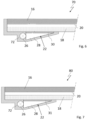
- FIG 4 A vehicle window 50 is shown which largely corresponds to that of Figure 3, but differs from it in that the coupling element 28 comprises, on its surface facing the window body arrangement, an additional deflection structure 52 which optimizes the coupling of the light emitted in the direction of the window body arrangement and which is formed from rows of asymmetric prisms with dimensions in the micrometer or millimeter range or a lens array, for example a Fresnel lens array.
- the additional deflection structure 52 can be a coating of the coupling element 28 or can be manufactured in one piece with it.
- the coupling element 28 is connected at its edges to the underside of the inner pane body 18 of the pane body assembly via adhesive strips 54.
- the vehicle window 50 corresponds to that according to Figure 3 .
- a vehicle window 60 is shown, which in turn largely corresponds to that according to Figure 3 corresponds, but differs from it in that it comprises an LED strip 62 as a light source, which comprises a plurality of LEDs over the length of the coupling element 28, the light of which can be coupled directly into the coupling element 28 via a side surface.
- the LED strip 62 is connected to the underside of the inner pane body 18 via a common adhesive layer 30.
- the vehicle window 60 corresponds to that according to Figure 3 .
- a vehicle window 70 is shown which largely corresponds to that of Figure 2, but differs from it in that the lighting device 22, ie the light guide 26 and the coupling element 28, are not covered by a housing-like cladding element 32. Rather, these elements are accommodated by a polyurethane foam 72 forming a molded section, which is an edge foam or edge foam of the window body arrangement which comprises the outer window body 16, the inner window body 18 and the connecting layer 20.
- the vehicle window 70 corresponds to that according to Figure 2 .
- a vehicle window 80 is shown, which largely corresponds to that according to Figure 6 corresponds, but differs from it in that the coupling element 28 is connected to the inner pane body 18 of the pane body arrangement via an immersion medium 31.
- the immersion medium 31 is formed in the form of a film between the coupling element 28 and the inner pane body 18 and has a refractive index of 1.51 and a viscosity of approximately 30,000 cP.
- the coupling element 28 is held to the inner pane body 18 by the polyurethane foam 72 forming a molded section, which also protects the coupling element 28 against the inner disc body 18 so that an optimal optical coupling between the coupling element 28 and the inner disc body 18 is maintained.
- the vehicle window 80 with the illumination device 22 comprising the coupling element 28 and the immersion means 31 corresponds to that according to Figure 6 .
- a vehicle window 90 is shown, which largely corresponds to that according to Figure 2 corresponds, but differs from this in that pressure elements 92 are arranged between the cladding element 32 and the coupling element 28, by means of which pressure elements 92 the cladding element 32 presses the coupling element 28 in the direction of the inner pane body 18, so that an optimal optical transition is always ensured between the coupling element 28 and the inner pane body 18.
- vehicle window 90 corresponds to that according to Figure 2 .
- a vehicle window 100 is shown, which largely corresponds to that of Figure 5, but differs from it in that it comprises an illumination device 22 on its underside, which has a coupling element 28 formed from a cast resin that is molded directly onto the underside of the window inner body 18 of the window body assembly.
- the coupling element 28, whose coupling section 102 has a triangular or wedge-shaped cross-section, is provided in one piece with a receiving section 104, which receives an LED strip 62 as an insert, which represents the light source of the illumination device 22.
- vehicle window complies with Figure 9 those after Figure 5 .
Landscapes
- Physics & Mathematics (AREA)
- General Physics & Mathematics (AREA)
- Optics & Photonics (AREA)
- Engineering & Computer Science (AREA)
- Mechanical Engineering (AREA)
- Chemical & Material Sciences (AREA)
- Combustion & Propulsion (AREA)
- Transportation (AREA)
- Thermal Sciences (AREA)
- Arrangements Of Lighting Devices For Vehicle Interiors, Mounting And Supporting Thereof, Circuits Therefore (AREA)
- Planar Illumination Modules (AREA)
- Lighting Device Outwards From Vehicle And Optical Signal (AREA)
Description
- Die Erfindung betrifft ein Fahrzeugdach mit einer Fahrzeugscheibe.
- Aus der Praxis ist eine Fahrzeugscheibe bekannt, die insbesondere im Bereich eines Fahrzeugdachs einsetzbar ist. Die Fahrzeugscheibe kann hier ein Festdachelement oder auch ein Deckelelement eines Dachöffnungssystems ausbilden, mittels dessen eine Dachöffnung wahlweise geschlossen oder freigegeben werden kann. Die bekannte Fahrzeugscheibe umfasst einen Scheibenkörper, der gewölbt ausgebildet sein kann und mit einer Lichtleiterschicht versehen ist. Des Weiteren ist bei der bekannten Fahrzeugscheibe eine Lichtquelle vorgesehen, deren Licht in die Lichtleiterschicht einkoppelbar ist. Die Einkopplung erfolgt über einen Rand der Lichtleiterschicht. Die Lichtleiterschicht kann die vom Fahrzeuginnenraum sichtbare Sichtfläche der Fahrzeugscheibe bilden, sodass durch die Lichtleiterschicht bei aktivierter Lichtquelle ein Leuchtelement der Fahrzeugscheibe realisiert ist, mittels dessen ggf. ein Fahrzeuginnenraum ausleuchtbar ist. Die Lichtleiterschicht hat bei der bekannten Fahrzeugscheibe kleinere Abmessungen als der Scheibenkörper, an dessen Innenseite die Lichtleiterschicht angeordnet ist, damit über den Rand der Lichtleiterschicht von der Lichtquelle abgegebenes Licht einkoppelbar ist.
- Aus der Druckschrift
WO 2019/069909 A1 ist eine Beleuchtungseinrichtung für ein Fahrzeugdach bekannt, die einen Scheibenkörper umfasst, der an einer Großfläche mit einem Einkoppelelement versehen ist. Das Einkoppelelement hat einen keilförmigen Querschnitt und eine Seitenfläche, über die Licht einer Lichtquelle in das Einkoppelelement einkoppelbar ist. Die Lichtquelle ist von der Seitenfläche des Einkoppelelements beabstandet. - Der Erfindung liegt die Aufgabe zugrunde, ein gemäß der einleitend genannten Gattung ausgebildetes Fahrzeugdach zu schaffen, bei der durch die Lichtleiterschicht eine möglichst große Leuchtfläche zur Verfügung gestellt werden kann.
- Diese Aufgabe ist erfindungsgemäß durch das Fahrzeugdach mit den Merkmalen des Patentanspruches 1 gelöst.
- Gemäß der Erfindung wird also ein Fahrzeugdach vorgeschlagen, bei der das von der Lichtquelle abgegebene Licht über eine Großfläche in die Lichtleiterschicht einkoppelbar ist, und zwar mittels des an der Innenseite der Scheibenkörperanordnung angeordneten Einkoppelelements. Damit ist es möglich, die Lichtleiterschicht hinsichtlich ihrer Abmessungen bzw. ihrer Grundfläche optimiert an die gestellten Anforderungen anzupassen. Zudem wird in die Lichtleiterschicht nur Licht mit bestimmten Einfallswinkeln eingekoppelt. Lichtstrahlen, die außerhalb dieses Bereiches liegen, werden nicht eingekoppelt, sodass sie sich nicht in der Lichtleiterschicht ausbreiten. Dies verbessert die Leuchtkraft und auch die Leuchthomogenität über die Fläche der Lichtleiterschicht. Das Einkoppelelement lenkt also das von der Lichtquelle abgegebene Licht mit definierten Winkeln in die Lichtleiterschicht, womit eine höhere Einkoppeleffizienz erreicht wird.
- Grundsätzlich ist das Konzept nach der Erfindung, bei dem an der Innenseite der Scheibenkörperanordnung das Einkoppelelement angeordnet ist, bei Einscheibensicherheitsglas (ESG) und bei Verbundsicherheitsglas (VSG) einsetzbar.
- Wenn die Erfindung bei einem Verbundsicherheitsglas Anwendung findet, umfasst die Scheibenkörperanordnung einen Scheibenaußenkörper und einen Scheibeninnenkörper, der über eine Verbindungsschicht an den Scheibenaußenkörper angebunden ist. Der Scheibeninnenkörper bildet die Lichtleiterschicht. In diesem Falle kann das Einkoppelelement direkt an der Innenseite des Scheibeninnenkörpers befestigt sein.
- Denkbar ist es natürlich auch, dass bei einem Verbundsicherheitsglas an dem Scheibeninnenkörper eine zusätzliche Lichtleiterschicht aufgebracht ist, in welche das Licht der Lichtquelle mittels des Einkoppelelements einkoppelbar ist.
- Bei der Ausführungsform, bei der der Scheibeninnenkörper die Lichtleiterschicht bildet, sind keine zusätzlichen Kosten für das Aufbringen einer Lichtleiterschicht aufzubringen. Zudem ergeben sich durch die Funktionsintegration Gewichts- und Bauraumvorteile. Es ist also möglich, durch die erfindungsgemäße Ausgestaltung mit dem Einkoppelelement mittels des Scheibeninnenkörpers eine flächige Ambient-Light-Funktion bereitzustellen, beispielsweise auch bei einem Festdachelement eines Kraftfahrzeuges.
- Der Scheibeninnenkörper, der die gleichen Abmessungen wie der Scheibenaußenkörper haben kann oder auch kleiner ausgebildet sein kann, ist grundsätzlich aus einem beliebigen als Lichtleiter nutzbaren Werkstoff gefertigt. Beispielsweise ist der Scheibeninnenkörper aus einem Werkstoff gefertigt, der Glas und/oder Polycarbonat und/oder einen sonstigen Kunststoff umfasst.
- Bei einer als Verbundsicherheitsglas ausgebildeten Scheibenkörperanordnung ist eine Verbindungsschicht zwischen den einzelnen Scheibenkörpern vorzugsweise aus einem Werkstoff gebildet, der PVB, EVA und/oder TPU umfasst. Die Verbindungsschicht kann klar bzw. transparent oder auch gefärbt sein.
- Das Einkoppelelement des Fahrzeugdachs nach der Erfindung ist bei einer bevorzugten Ausführungsform leistenartig ausgebildet und vorzugsweise randnah an der Unterseite der Scheibenkörperanordnung angeordnet. Über die Erstreckung des leistenartig ausgebildeten Einkoppelelements kann dann Licht in die Lichtleiterschicht der Scheibenkörperanordnung eingekoppelt werden.
- Bei dem Fahrzeugdach nach der Erfindung sind zwei Einkoppelelemente der vorstehend beschriebenen Art vorgesehen, die randnah an einander abgewandten Rändern der Scheibenkörperanordnung an deren Unterseite angeordnet sind.
- Um die Einkoppelwinkel des Lichts, das mittels des Einkoppelelements in die Lichtleiterschicht eingekoppelt wird, in optimierter Weise realisieren zu können, hat das Einkoppelelement bei dem Fahrzeugdach nach der Erfindung einen keilförmigen Querschnitt. Damit wirkt das Einkoppelelement nach Art eines optischen Prismas.
- Das Einkoppelelement, das insbesondere ein leistenartiger Kunststoffkörper ist, ist vorzugsweise aus einem Werkstoff gefertigt, der PMMA (Polymethylmethacrylat), PC (Polycarbonat), PA (Polyamid), COC (Cycloolefin-Copolymer) oder COP (Cycloolefin-Polymer) umfasst.
- Der Brechungsindex des Einkoppelelements ist insbesondere an den Brechungsindex der angrenzenden Lichtleiterschicht angepasst und hat vorzugsweise einen Wert zwischen 1,40 und 1,65 und insbesondere zwischen 1,48 und 1,59.
- Die Herstellung des Einkoppelelements erfolgt vorzugsweise nach einem Extrusionsverfahren oder einem Spritzgießverfahren.
- Um die innere Reflexion zu verbessern, kann das Einkoppelelement mit einer reflektierenden Beschichtung versehen sein, die Metalle wie Aluminium oder Silber umfassen kann und nach einem Aufdampf- oder Sputterprozess aufgebracht sein kann.
- Um das Einkoppelverhalten des Lichts in die Lichtleiterschicht weiter zu verbessern, ist bei einer vorteilhaften Ausführungsform der Fahrzeugscheibe nach der Erfindung zwischen dem Einkoppelelement und der Scheibenkörperanordnung eine Zusatzumlenkstruktur angeordnet. Durch die Zusatzumlenkstruktur kann der Einfallswinkel des Lichts auf die Lichtleiterschicht durch entsprechende Brechung verändert werden, um die innere Reflexion in der Lichtleiterschicht zu erhöhen. Die Zusatzumlenkstruktur kann eine Reihe von asymmetrischen Prismen umfassen, die Abmessungen im Millimeterbereich oder im Mikrometerbereich haben und als dreidimensionales Array oder linienartig angeordnet sind, wie es beispielsweise bei einem Fresnel-Linsen-Array der Fall ist.
- Die Zusatzumlenkstruktur kann in einstückiger Weise mit dem Einkoppelelement ausgebildet sein und direkt bei der Fertigung desselben beispielsweise bei einem Extrusionsprozess oder einem Spritzgießprozess ausgebildet werden. Denkbar ist es auch, dass die Zusatzumlenkstruktur eine Beschichtung des Einkoppelelements darstellt, beispielsweise in Form eines separaten strukturierten Films.
- Das Einkoppelelement ist über eine Klebeschicht mit dem Scheibenkörper verklebt. Die Klebeschicht, die vorzugsweise einen Brechungsindex zwischen 1,40 und 1,65 und insbesondere zwischen 1,48 und 1,56 hat, kann aus einem beliebigen optisch geeigneten Kleber gebildet sein. Beispielsweise ist die Klebeschicht aus einem drucksensitiven Kleber, einem optisch klaren Flüssigkleber (LOCA = liquid optical clear adhesive), EVA (Ethylen-Vinylacetat), PVB (Polyvinylbutyral), TPU (thermoplastischem Polyurethan), einem Epoxy-Kleber oder einem Acrylat-Kleber gebildet.
- Die gewählten Werkstoffe haben vorzugsweise Brechungsindizes, die eine Brechung der Lichtstrahlen an den Grenzflächen minimieren und die Einkoppeleffizienz bei den idealen Winkelbedingungen optimieren.
- Die Brechungsindizes eines aus Glas gefertigten Scheibeninnenkörpers betragen insbesondere 1,52, wohingegen die Brechungsindizes des Einkoppelelements und des Klebstoffs, mittels dessen das Einkoppelelement an den Scheibeninnenkörper angebunden ist, in Abhängigkeit von dem gewählten Werkstoff variieren können. Bei Einsatz von PMMA für das Einkoppelelement beträgt der Brechungsindex 1,49. Der Klebstoff hat dann beispielsweise einen Brechungsindex von 1,52. Bei Einsatz eines Einkoppelelements aus Polycarbonat beträgt der Brechungsindex beispielsweise 1,58, wohingegen der Brechungsindex des eingesetzten Klebstoffes 1,56 beträgt. Wenn das Einkoppelelement aus COP gefertigt ist, beträgt dessen Brechungsindex 1,52. Vorzugsweise hat dann der Klebstoff, über den das Einkoppelelement an den Glasinnenkörper angebunden ist, ebenfalls einen Wert von 1,52.
- Bei einer speziellen Ausführungsform der Fahrzeugscheibe nach der Erfindung ist das Einkopplungselement aus einem Gießharz geformt, das vorzugsweise direkt nach einem Gießverfahren an die Scheibenkörperanordnung angeformt ist. In diesem Falle kann die Lichtquelle, die eine LED-Leiste ist, ein Einlegeteil des Gießharzes sein, d. h. die Lichtquelle kann in das Gießharz eingekapselt sein.
- Bei dem Fahrzeugdach nach der Erfindung ist die Lichtquelle direkt an einer Seitenfläche des Einkoppelelements angeordnet. Die insbesondere als Hochleistungs-LED-Modul ausgebildete Lichtquelle ist eine LED-Leiste bzw. ein LED-Streifen mit einer Vielzahl von LEDs, welche ihr Licht direkt in das Einkoppelelement abgeben.
- Des Weiteren kann an der Innenseite der Scheibenkörperanordnung ein Verkleidungselement bzw. eine Abdeckung angeordnet sein, welches bzw. welche das Einkoppelelement verblendet. Bei dieser hohen optischen Anforderungen genügenden Ausführungsform können zusätzlich die Lichtquelle und gegebenenfalls der Lichtleiter, mittels dessen das Licht in das Einkoppelelement eingekoppelt wird, hinter der Abdeckung liegen. Die ein Gehäuse bildende Abdeckung kann mit der Scheibenkörperanordnung verklebt sein.
- Denkbar ist es auch, dass das Einkoppelelement von einem Formabschnitt aufgenommen ist, der an die Scheibenkörperanordnung angeformt ist und beispielswiese aus einem Polyurethanschaum gefertigt ist. Die reflektierende Beschichtung auf dem Einkoppelelement verhindert in diesem Falle Absorptionsverluste durch den Formabschnitt.
- Um zu gewährleisten, dass stets ein optimaler optischer Übergang zwischen dem Einkoppelelement und der Scheibenkörperanordnung gewährleistet ist, ist das Einkoppelelement bei einer speziellen Ausführungsform der Fahrzeugscheibe nach der Erfindung durch das Verkleidungselement und/oder den Formabschnitt in Richtung der Scheibenkörperanordnung gedrückt. Das Verkleidungselement bzw. der Formabschnitt übt also einen Druck auf das Einkoppelelement aus, so dass sichergestellt ist, dass der optische Kontakt zwischen dem Einkoppelelement und der Scheibenkörperanordnung aufrechterhalten wird.
- Zur weiteren Verbesserung des Übergangs zwischen dem Einkoppelelement und der Scheibenkörperanordnung ist bei einer speziellen Ausführungsform der Fahrzeugscheibe nach der Erfindung das Einkoppelelement über ein transparentes Immersionsmittel optisch mit der Scheibenkörperanordnung gekoppelt. Zwischen dem Einkoppelelement und der Scheibenkörperanordnung ist also bei dieser Ausführungsform eine beispielsweise filmartige Schicht aus einem optischen Immersionsmittel angeordnet. Das Immersionsmittel kann ein Öl und/oder ein Gel umfassen bzw. aus einem Öl und/oder einem Gel gebildet sein.
- Bei einer bevorzugten Ausführungsform der Fahrzeugscheibe nach der Erfindung hat das Immersionsmittel einen Brechungsindex zwischen 1,47 und 1,59 und insbesondere zwischen 1,51 und 1,52, so dass der Brechungsindex an den Brechungsindex eines aus Glas gefertigten Scheibenkörpers der Scheibenkörperanordnung angepasst ist.
- Die Viskosität des Immersionsmittels kann zwischen 10 und 50.000 cP liegen.
- Weitere Vorteile und vorteilhafte Ausgestaltungen des Gegenstandes der Erfindung sind der Beschreibung, der Zeichnung und den Patentansprüchen entnehmbar.
- Ausführungsbeispiele eines Fahrzeugdachs mit einer Fahrzeugscheibe nach der Erfindung sind in der Zeichnung schematisch vereinfacht dargestellt und werden in der nachfolgenden Beschreibung näher erläutert. Es zeigt
- Figur 1
- eine schematische Draufsicht auf ein Fahrzeugdach mit einer Fahrzeugschreibe nach der Erfindung;
- Figur 2
- einen schematischen Schnitt durch die Fahrzeugscheibe des Fahrzeugdachs nach
Figur 1 ; - Figur 3
- einen
Figur 2 entsprechenden Schnitt durch eine zweite Ausführungsform einer Fahrzeugscheibe; - Figur 4
- einen Schnitt durch eine dritte Ausführungsform einer Fahrzeugscheibe;
- Figur 5
- einen Schnitt durch eine vierte Ausführungsform einer Fahrzeugscheibe;
- Figur 6
- einen Schnitt durch eine fünfte Ausführungsform einer Fahrzeugscheibe;
- Figur 7
- einen Schnitt durch eine sechste Ausführungsform einer Fahrzeugscheibe;
- Figur 8
- einen Schnitt durch eine siebte Ausführungsform einer Fahrzeugscheibe; und
- Figur 9
- einen Schnitt durch eine achte Ausführungsform einer Fahrzeugscheibe.
- In
Figur 1 ist ein Fahrzeugdach 10 eines ansonsten nicht näher dargestellten Kraftfahrzeugs gezeigt. Das Fahrzeugdach 10 ist ein Panoramadach, das ein verstellbares Deckelelement 12 und ein Festdachelement 14 aufweist, welches fest bzw. unbeweglich mit der Fahrzeugkarosserie verbunden ist. Sowohl das Deckelelement 12 als auch das Festdachelement 14 umfassen jeweils ein Glaselement, das eine Fahrzeugscheibe darstellt und das als Verbundsicherheitsglas (VSG) ausgebildet ist, welches mit einer Ambient-Light-Funktionalität versehen ist. Diesbezüglich entspricht der Aufbau des Deckelelements 12 demjenigen des Festdachelements 14. Dieser Aufbau ist inFigur 2 näher dargestellt. - Die jeweils als Fahrzeugscheibe ausgebildeten Dachelemente 12 und 14 umfassen jeweils ein Verbundbauteil, das einen Scheibenaußenkörper 16 und einen Scheibeninnenkörper 18 umfasst. Der Scheibenaußenkörper 16 ist aus einer gewölbten Glasplatte gebildet, die beispielsweise aus einem gefärbten Kalk-Natron-Glas gefertigt ist. Denkbar ist es auch, den Scheibenaußenkörper 16 aus einem Kunststoffelement, beispielsweise einem Polycarbonat-Element auszubilden. Der Scheibeninnenkörper 18 kann ebenfalls aus einem anorganischen Glas, wie einem Kalk-Natron-Glas, oder einem Polymer, beispielsweise einem Polycarbonat gefertigt sein. Des Weiteren bildet der Scheibeninnenkörper 18 im vorliegenden Zusammenhang eine Lichtleiterschicht, in der sich in deren Volumen eingekoppeltes Licht ausbreitet.
- Der Scheibenaußenkörper 16 und der Scheibeninnenkörper 18 sind über eine Laminierungsschicht bzw. Verbindungsschicht 20 miteinander verbunden, welche aus einem Werkstoff wie PVB, EVA oder TPU gebildet sein kann. Zudem kann die Verbindungsschicht 20 klar bzw. volltransparent oder auch gefärbt sein. Die Verbindungsschicht 20 hat im vorliegenden Fall eine Dicke von 0,76 mm, kann aber auch eine andere Dicke haben.
- Der Scheibenaußenkörper 16 und der Scheibeninnenkörper 18, die im vorliegenden Fall jeweils eine Dicke von etwa 2,1 mm haben, bilden eine Scheibenkörperanordnung mit einer der Fahrzeugumgebung zugewandten Außenseite und einer dem Fahrzeuginnenraum zugewandten Innenseite. An der Innenseite ist die Scheibenkörperanordnung bezogen auf eine vertikale Dachlängsmittelebene beidseits jeweils mit einer Beleuchtungseinrichtung 22 versehen, mittels der die Ambient-Light-Funktionalität realisierbar ist.
- Die Beleuchtungseinrichtungen 22 erstrecken sich jeweils in Fahrzeuglängsrichtung und sind am jeweiligen seitlichen Rand des Deckelelements 12 bzw. des Festdachelements 14 angeordnet.
- Die Beleuchtungseinrichtungen 22 umfassen jeweils eine Lichtquelle 24, die eine LED-Anordnung umfasst und an einer Stirnseite eines Lichtleiters 26 angeordnet ist, der aus einem Stab oder einer Schnur gebildet ist und beispielsweise einen PMMA-Werkstoff und/oder einen Polycarbonat-Werkstoff umfasst. Die Herstellung des Lichtleiters 26 kann nach einem Extrusionsverfahren oder einem Spritzgießverfahren erfolgen.
- Des Weiteren umfassen die Beleuchtungseinrichtungen 22 jeweils ein leistenartiges Einkoppelelement 28, welches sich über die Länge der jeweiligen Beleuchtungseinrichtung 22 erstreckt und vorliegend einen keilförmigen bzw. dreieckigen Querschnitt hat. Die Einkoppelelemente 28 bilden also jeweils einen prismatischen Körper. Dieser ist vorzugsweise aus einem Kunststoffwerkstoff nach einem Extrusionsverfahren oder einem Spritzgießverfahren gefertigt, wobei als Werkstoffe insbesondere PMMA, PC, PA, COC und/oder COP zum Einsatz kommen können, deren Brechungsindizes zwischen 1,48 und 1,59 liegen.
- Die Einkoppelelemente 28 sind jeweils über eine Klebeschicht 30 an der Scheibenkörperanordnung fixiert. Die Klebeschicht 30 hat einen Brechungsindex, der im Bereich des Brechungsindexes liegt, den das Einkoppelelement 28 hat, oder der zwischen denjenigen des Einkoppelelements 28 und des Scheibeninnenkörpers 18 liegt, und der insbesondere zwischen 1,48 und 1,56 liegt. Als Werkstoff für die Klebeschicht 30 kann ein drucksensitiver Kleber, ein optisch klarer Flüssigkleber, EVA, PVB, TPU, ein Epoxy-Kleber oder ein Acrylat-Kleber zum Einsatz kommen.
- Der Scheibeninnenkörper 18 hat einen Brechungsindex von 1,52.
- Des Weiteren sind die Beleuchtungseinrichtungen 22 jeweils mit einem Verkleidungselement 32 versehen, das ebenfalls an der Unterseite der Scheibenkörperanordnung bzw. an der Unterseite des Scheibeninnenkörpers 18 befestigt ist und das Einkoppelelement 28, den Lichtleiter 26 und die Lichtquelle 24 überdeckt.
- Bei einer Aktivierung der Lichtquelle 24 wird das von dieser abgegebene Licht in den Lichtleiter 26 eingekoppelt und aus dem Lichtleiter in das Einkoppelelement 28 eingekoppelt. Durch innere Reflexion an den Grenzflächen des Einkoppelelements 28 wird das Licht über die Klebeschicht 30 in den eine Lichtleiterschicht darstellenden Scheibeninnenkörper 18 eingekoppelt, wobei es sich in diesem über innere Reflexion an den Grenzflächen ausbreiten kann. Eine Auskopplung des Lichts aus dem Scheibeninnenkörper 18 in Richtung des Fahrzeuginnenraums kann durch Streuelemente erfolgen, die der Scheibeninnenkörper 18 aufweist. Beispielsweise ist an der Oberseite des Scheibeninnenkörpers 18 eine Bedruckung aufgebracht, welche das Licht in Richtung des Fahrzeuginnenraums streut.
- Bei einer alternativen Ausführungsform sind der Lichtleiter 26 und das Einkopplungselement 28 einstückig ausgebildet.
- In
Figur 3 ist eine Fahrzeugscheibe 40 dargestellt, die weitgehend derjenigen nach Figur 2 entspricht, sich von dieser aber dadurch unterscheidet, dass sie einen Lichtleiter 26' aufweist, der an einer Seitenfläche des Einkoppelelements 28 angeordnet ist und der mit einem zusätzlichen Auskoppelelement 42 versehen ist, das sich über die Länge des Lichtleiters 26 erstreckt. Durch das Auskoppelelement 42 wird das Auskoppeln von Licht aus dem Lichtleiter 26' in Richtung des Einkoppelelements 28 unterstützt. Das Auskoppelelement 42 kann einstückig mit dem Lichtleiter 26' hergestellt sein oder auch eine zusätzliche Struktur sein, die als Bedruckung, als Prismastruktur, als Punktstruktur oder dergleichen ausgebildet ist. - Im Übrigen entspricht die Fahrzeugscheibe 40 derjenigen nach
Figur 2 . - In
Figur 4 ist eine Fahrzeugscheibe 50 dargestellt, die weitgehend derjenigen nach Figur 3 entspricht, sich aber von dieser dadurch unterscheidet, dass das Einkoppelelement 28 an seiner der Scheibenkörperanordnung zugewandten Fläche eine Zusatzumlenkstruktur 52 umfasst, die die Einkopplung des in Richtung der Scheibenkörperanordnung abgegebenen Lichts optimiert und die aus Reihen von asymmetrischen Prismen mit Abmessungen im Mikrometerbereich oder Millimeterbereich oder einem Linsen-Array, beispielsweise einem Fresnel-Linsen-Array, gebildet ist. Die Zusatzumlenkstruktur 52 kann eine Beschichtung des Einkoppelelements 28 sein oder auch einstückig mit diesem gefertigt sein. Das Einkoppelelement 28 ist an seinen Rändern über Klebestreifen 54 mit der Unterseite des Scheibeninnenkörpers 18 der Scheibenkörperanordnung verbunden. - Im Übrigen entspricht die Fahrzeugscheibe 50 derjenigen nach
Figur 3 . - In
Figur 5 ist eine Fahrzeugscheibe 60 dargestellt, die wiederum weitgehend derjenigen nachFigur 3 entspricht, sich von dieser aber dadurch unterscheidet, dass sie als Lichtquelle eine LED-Leiste 62 umfasst, die über die Länge des Einkoppelelements 28 eine Vielzahl an LEDs umfasst, deren Licht direkt über eine Seitenfläche in das Einkoppelelement 28 einkoppelbar ist. Die LED-Leiste 62 ist über eine gemeinsame Klebeschicht 30 an die Unterseite des Scheibeninnenkörpers 18 angebunden. - Im Übrigen entspricht die Fahrzeugscheibe 60 derjenigen nach
Figur 3 . - In
Figur 6 ist eine Fahrzeugscheibe 70 dargestellt, die weitgehend derjenigen nach Figur 2 entspricht, sich von dieser aber dadurch unterscheidet, dass die Beleuchtungseinrichtung 22, d. h. der Lichtleiter 26 und das Einkoppelelement 28 nicht von einem gehäuseartigen Verkleidungselement 32 abgedeckt sind. Vielmehr sind diese Elemente von einer einen Formabschnitt bildenden Polyurethan-Umschäumung 72 aufgenommen, welche eine Randumschäumung bzw. Randanschäumung der Scheibenkörperanordnung ist, die den Scheibenaußenkörper 16, den Scheibeninnenkörper 18 und die Verbindungsschicht 20 umfasst. - Im Übrigen entspricht die Fahrzeugscheibe 70 derjenigen nach
Figur 2 . - In
Figur 7 ist eine Fahrzeugscheibe 80 dargestellt, welche weitgehend derjenigen nachFigur 6 entspricht, sich von dieser aber dadurch unterscheidet, dass das Einkoppelelement 28 über ein Immersionsmittel 31 an den Scheibeninnenkörper 18 der Scheibenkörperanordnung angebunden ist. Das Immersionsmittel 31 ist filmartig zwischen dem Einkoppelelement 28 und dem Scheibeninnenkörper 18 ausgebildet und hat einen Brechungsindex von 1,51 und eine Viskosität von etwa 30.000 cP. Gehalten wird das Einkoppelelement 28 an dem Scheibeninnenkörper 18 durch die einen Formabschnitt bildende Polyurethan-Umschäumung 72, welche das Einkoppelelement 28 auch gegen den Scheibeninnenkörper 18 drückt, so dass eine optimale optische Kopplung zwischen dem Einkoppelelement 28 und dem Scheibeninnenkörper 18 aufrechterhalten bleibt. - Im Übrigen entspricht die Fahrzeugscheibe 80 mit der das Einkoppelelement 28 und das Immersionsmittel 31 umfassenden Beleuchtungseinrichtung 22 derjenigen nach
Figur 6 . - In
Figur 8 ist eine Fahrzeugscheibe 90 dargestellt, die weitgehend derjenigen nachFigur 2 entspricht, sich von dieser aber dadurch unterscheidet, dass zwischen dem Verkleidungselement 32 und dem Einkoppelelement 28 Druckelemente 92 angeordnet sind, mittels derer das Verkleidungselement 32 das Einkoppelelement 28 in Richtung des Scheibeninnenkörpers 18 drückt, so dass zwischen dem Einkoppelelement 28 und dem Scheibeninnenkörper 18 stets ein optimaler optischer Übergang gewährleistet bleibt. - Im Übrigen entspricht die Fahrzeugscheibe 90 derjenigen nach
Figur 2 . - In
Figur 9 ist eine Fahrzeugscheibe 100 dargestellt, die weitgehend derjenigen nach Figur 5 entspricht, sich von dieser aber dadurch unterscheidet, dass sie an ihrer Unterseite eine Beleuchtungseinrichtung 22 umfasst, die ein Einkoppelelement 28 aufweist, das aus einem Gießharz gebildet ist, welches direkt an die Unterseite des Scheibeninnenkörpers 18 der Scheibenkörperanordnung angeformt ist. Das Einkoppelelement 28, dessen Einkoppelabschnitt 102 einen dreieckigen bzw. keilförmigen Querschnitt hat, ist in einstückiger Weise mit einem Aufnahmeabschnitt 104 versehen, der als Einlegeteil eine LED-Leiste 62 aufnimmt, die die Lichtquelle der Beleuchtungseinrichtung 22 darstellt. - Im Übrigen entspricht die Fahrzeugscheibe nach
Figur 9 derjenigen nachFigur 5 . -
- 10
- Fahrzeugdach
- 12
- Deckelelement
- 14
- Festdachelement
- 16
- Scheibenaußenkörper
- 18
- Scheibeninnenkörper
- 20
- Verbindungsschicht
- 22
- Beleuchtungseinrichtung
- 24
- Lichtquelle
- 26, 26'
- Lichtleiter
- 28
- Einkoppelelement
- 30
- Klebeschicht
- 31
- Immersionsmittel
- 32
- Verkleidungselement
- 40
- Fahrzeugscheibe
- 42
- Auskoppelelement
- 50
- Fahrzeugscheibe
- 52
- Zusatzumlenkstruktur
- 54
- Klebestreifen
- 60
- Fahrzeugscheibe
- 62
- LED-Leiste
- 70
- Fahrzeugscheibe
- 72
- PU-Umschäumung
- 80
- Fahrzeugscheibe
- 90
- Fahrzeugscheibe
- 92
- Druckelement
- 100
- Fahrzeugscheibe
- 102
- Einkoppelabschnitt
- 104
- Aufnahmeabschnitt
Claims (12)
- Fahrzeugdach, umfassend eine Fahrzeugscheibe, die eine Scheibenkörperanordnung umfasst, die eine einer Fahrzeugumgebung zugewandte Außenseite und eine einem Fahrzeuginnenraum zugewandte Innenseite hat und die eine Lichtleiterschicht aufweist und die einen Scheibenaußenkörper (16) und einen Scheibeninnenkörper (18) umfasst, der über eine Verbindungsschicht (20) an den Scheibenaußenkörper (16) angebunden ist und der die Lichtleiterschicht bildet, wobei die Scheibenkörperanordnung an ihrer Innenseite, die von der Lichtleiterschicht gebildet ist, bezogen auf eine vertikale Dachlängsmittelebene beidseits jeweils mit einer an einem jeweiligen seitlichen Rand der Fahrzeugscheibe angeordneten Beleuchtungseinrichtung versehen ist, die sich in Fahrzeuglängsrichtung erstreckt und die eine Lichtquelle, deren Licht in die Lichtleiterschicht einkoppelbar ist, und ein Einkoppelelement (28) umfasst, das an der Innenseite der Scheibenkörperanordnung angeordnet ist, das von der Lichtquelle abgegebenes Licht in die Lichtleiterschicht einkoppelt und das über eine Klebeschicht (30) an der dem Scheibenaußenkörper (16) abgewandten Seite des Scheibeninnenkörpers (18) befestigt ist und das einen keilförmigen Querschnitt hat, wobei die Lichtquelle an einer Seitenfläche des Einkoppelelements (28) angeordnet ist und eine LED-Leiste (62) ist.
- Fahrzeugdach nach Anspruch 1, dadurch gekennzeichnet, dass das Einkoppelelement (28) ein für das Licht der Lichtquelle (24) transparenter Materialkörper ist, der vorzugsweise leistenartig ausgebildet ist.
- Fahrzeugdach nach Anspruch 1 oder 2, dadurch gekennzeichnet, dass das Einkoppelelement (28) an seiner der Scheibenkörperanordnung zugewandten Seite mit einer Zusatzumlenkstruktur (52) versehen ist.
- Fahrzeugdach nach Anspruch 3, dadurch gekennzeichnet, dass die Zusatzumlenkstruktur (52) einstückig mit dem Einkoppelelement (28) ausgebildet ist oder eine Beschichtung des Einkoppelelements ist.
- Fahrzeugdach nach einem der Ansprüche 1 bis 4, dadurch gekennzeichnet, dass die Klebeschicht (30) einen drucksensitiven Klebstoff und/oder einen optisch klaren Flüssigkleber und/oder einen Klebstoff, welcher EVA, PVB und/oder TPU umfasst, und/oder einen Epoxy-Kleber und/oder einen Acrylat-Kleber umfasst.
- Fahrzeugdach nach einem der Ansprüche 1 bis 5, dadurch gekennzeichnet, dass das Einkoppelelement (28) aus einem Werkstoff gefertigt ist, der PMMA, PC, PA, COC und/oder COP umfasst.
- Fahrzeugdach nach einem der Ansprüche 1 bis 6, dadurch gekennzeichnet, dass der Scheibeninnenkörper (18) eine Grundfläche hat, die derjenigen des Scheibenaußenkörpers (16) entspricht.
- Fahrzeugdach nach einem der Ansprüche 1 bis 7, dadurch gekennzeichnet, dass der Scheibenaußenkörper (16) aus einem anorganischen Glas und/oder einem Polymerglas gefertigt ist und/oder der Scheibeninnenkörper (18) aus einem anorganischen Glas und/oder einem Polymerglas gefertigt ist.
- Fahrzeugdachnach einem der Ansprüche 1 bis 8, dadurch gekennzeichnet, dass das Einkoppelelement (28) mit einem Verkleidungselement (32) versehen ist und/oder von einem Formabschnitt aufgenommen ist, der an die Scheibenkörperanordnung angebunden ist.
- Fahrzeugdach nach Anspruch 9, dadurch gekennzeichnet, dass das Verkleidungselement und/oder der Formabschnitt das Einkoppelelement (28) in Richtung Scheibenkörperanordnung drücken/drückt, so dass ein optischer Kontakt zwischen dem Einkoppelelement (28) und der Scheibenkörperanordnung aufrechterhalten bleibt.
- Fahrzeugdach nach einem der Ansprüche 1 bis 10, dadurch gekennzeichnet, dass das Einkoppelelement (28) über ein transparentes Immersionsmittel (31) optisch mit der Scheibenkörperanordnung gekoppelt ist.
- Fahrzeugdach nach Anspruch 11, dadurch gekennzeichnet, dass das Immersionsmittel (31) ein Öl und/oder ein Gel umfasst.
Applications Claiming Priority (2)
| Application Number | Priority Date | Filing Date | Title |
|---|---|---|---|
| DE102020109338.1A DE102020109338B3 (de) | 2020-04-03 | 2020-04-03 | Fahrzeugscheibe mit Lichtquelle und Lichtleiterschicht |
| PCT/EP2021/058307 WO2021198262A1 (de) | 2020-04-03 | 2021-03-30 | Fahrzeugscheibe mit lichtquelle und lichtleiterschicht |
Publications (2)
| Publication Number | Publication Date |
|---|---|
| EP4126540A1 EP4126540A1 (de) | 2023-02-08 |
| EP4126540B1 true EP4126540B1 (de) | 2025-05-07 |
Family
ID=74844871
Family Applications (1)
| Application Number | Title | Priority Date | Filing Date |
|---|---|---|---|
| EP21718515.6A Active EP4126540B1 (de) | 2020-04-03 | 2021-03-30 | Fahrzeugscheibe mit lichtquelle und lichtleiterschicht |
Country Status (7)
| Country | Link |
|---|---|
| US (1) | US12286056B2 (de) |
| EP (1) | EP4126540B1 (de) |
| JP (1) | JP7603077B2 (de) |
| KR (1) | KR102698933B1 (de) |
| CN (1) | CN115397666A (de) |
| DE (1) | DE102020109338B3 (de) |
| WO (1) | WO2021198262A1 (de) |
Families Citing this family (40)
| Publication number | Priority date | Publication date | Assignee | Title |
|---|---|---|---|---|
| DE102020109338B3 (de) | 2020-04-03 | 2021-05-27 | Webasto SE | Fahrzeugscheibe mit Lichtquelle und Lichtleiterschicht |
| CN113232496B (zh) * | 2021-05-25 | 2022-07-19 | 福耀玻璃工业集团股份有限公司 | 车窗组件及车辆 |
| DE102021122986A1 (de) | 2021-09-06 | 2023-03-09 | Webasto SE | Fahrzeugscheibe mit einer Beleuchtungseinrichtung |
| JPWO2023153306A1 (de) * | 2022-02-09 | 2023-08-17 | ||
| WO2023156939A1 (en) * | 2022-02-16 | 2023-08-24 | Agp Worldwide Operations Gmbh | Glazing having total internal reflection through improved light injection |
| DE102022104600A1 (de) * | 2022-02-25 | 2023-08-31 | Webasto SE | Fahrzeugscheibe und Verfahren zur Herstellung einer Fahrzeugscheibe |
| DE102022108689A1 (de) | 2022-04-11 | 2023-10-12 | Webasto SE | Fahrzeugscheibe mit einer Beleuchtungseinrichtung |
| DE102022108786B4 (de) | 2022-04-11 | 2024-03-07 | Webasto SE | Fahrzeugscheibe mit Beleuchtungseinrichtung und Koppelelement |
| JP2025523897A (ja) | 2022-07-19 | 2025-07-25 | エージーシー グラス ユーロップ | 照明車両グレージング |
| WO2024033772A1 (en) * | 2022-08-12 | 2024-02-15 | Agp Worldwide Operations Gmbh | Glazing having a light injection assembly |
| DE102022003315B4 (de) * | 2022-09-09 | 2024-05-02 | Mercedes-Benz Group AG | Lichtbaugruppe zur Illumination von Flächen und/oder Lichtmedien |
| EP4344951B1 (de) * | 2022-09-29 | 2025-11-12 | Inalfa Roof Systems Group B.V. | Transparente dachplattenanordnung für ein fahrzeugdach |
| DE102022128005A1 (de) * | 2022-10-24 | 2024-04-25 | Webasto SE | Fahrzeugscheibe mit Lichtquelle und Lichtleiterschicht |
| DE102022128832A1 (de) * | 2022-10-31 | 2024-05-02 | Webasto SE | Fahrzeugscheibe mit Lichtquelle und Lichtleiterschicht |
| DE102022130204A1 (de) * | 2022-11-15 | 2024-05-16 | Webasto SE | Optisches Element, optisches System und Fahrzeugscheibe und/oder Scheibenlaminat |
| DE102022130344A1 (de) * | 2022-11-16 | 2024-05-16 | Webasto SE | Fahrzeugscheibe mit einem Verbundaufbau |
| DE102022130336A1 (de) * | 2022-11-16 | 2024-05-16 | Webasto SE | Fahrzeugscheibe mit einem Verbundaufbau |
| DE102022131157A1 (de) | 2022-11-24 | 2024-05-29 | Webasto SE | Fahrzeugscheibe mit Lichtleiterschicht und Lichteinkoppeleinrichtung |
| WO2024120425A1 (zh) * | 2022-12-07 | 2024-06-13 | 福耀玻璃工业集团股份有限公司 | 光线入射结构、车窗、车窗面板、车窗面板总成及车辆 |
| CN115823532A (zh) * | 2022-12-07 | 2023-03-21 | 福耀玻璃工业集团股份有限公司 | 一种光线入射结构、车窗及车辆 |
| WO2024160786A1 (de) * | 2023-01-30 | 2024-08-08 | Carl Zeiss Jena Gmbh | Verbundglasscheibe für ein fahrzeug und beleuchtungssystem für ein fahrzeug mit einer verbundglasscheibe |
| DE102023102556A1 (de) | 2023-02-02 | 2024-08-08 | Webasto SE | Fahrzeugdachanordnung mit Lichtleiterschicht |
| WO2024165247A1 (de) * | 2023-02-08 | 2024-08-15 | Saint-Gobain Glass France | Beleuchtbare verglasung mit verbesserter lichteinkopplung |
| DE102023105782B3 (de) | 2023-03-08 | 2024-09-19 | Webasto SE | Fahrzeugscheibe mit einer Beleuchtungseinrichtung |
| DE102023105780A1 (de) | 2023-03-08 | 2024-09-12 | Webasto SE | Fahrzeugscheibe mit einer Beleuchtungseinrichtung |
| CN118664978A (zh) | 2023-03-17 | 2024-09-20 | 英纳法天窗系统集团有限公司 | 玻璃面板组件和设置有其的车辆的车顶组件 |
| DE102023109096A1 (de) | 2023-04-11 | 2024-10-17 | Webasto SE | Fahrzeugscheibe mit Beleuchtungseinrichtung und Lichtauskoppeleinrichtung |
| DE102023111600A1 (de) * | 2023-05-04 | 2024-11-07 | Webasto SE | Scheibenanordnung für ein Fahrzeug und Fahrzeug |
| WO2024253056A1 (ja) * | 2023-06-06 | 2024-12-12 | Agc株式会社 | 車両用ガラス板、及び車両用ガラス板の製造方法 |
| EP4474694A1 (de) | 2023-06-07 | 2024-12-11 | Inalfa Roof Systems Group B.V. | Transparente dachplattenanordnung für ein fahrzeugdach und verfahren zu ihrer herstellung |
| DE102023116605A1 (de) * | 2023-06-23 | 2024-12-24 | Webasto SE | Fahrzeugscheibe mit Beleuchtungseinrichtung |
| DE102023116859B3 (de) | 2023-06-27 | 2024-05-23 | Webasto SE | Fahrzeugscheibe mit Lichteinkopplungselement |
| DE102023206534A1 (de) | 2023-07-10 | 2025-01-16 | Webasto SE | Fahrzeugscheibe mit Low-Emissivity-Beschichtung für einen reduzierten Farbdrift |
| CN121909110A (zh) | 2023-09-26 | 2026-04-21 | 旭硝子欧洲玻璃公司 | 发光板 |
| WO2025125031A1 (de) * | 2023-12-13 | 2025-06-19 | Saint-Gobain Sekurit France | Verglasungsanordnung mit austauschbarem lichtmodul |
| WO2026021747A1 (en) | 2024-07-25 | 2026-01-29 | Agc Glass Europe | Lighting vehicle glazing |
| CN119283451B (zh) * | 2024-10-14 | 2025-12-09 | 福耀玻璃工业集团股份有限公司 | 夹层玻璃、投影系统及车辆 |
| DE102024132976A1 (de) | 2024-11-12 | 2026-05-13 | Webasto SE | Fahrzeugscheibe mit Scheibenkörperanordnung und Beleuchtungseinrichtung |
| WO2026131376A1 (en) | 2024-12-20 | 2026-06-25 | Agc Glass Europe | Lighting vehicle glazing |
| DE102025101287A1 (de) | 2025-01-15 | 2026-07-16 | Webasto SE | Verglasungseinheit für ein Fahrzeugdach, Beleuchtungssystem sowie Fahrzeugdach |
Citations (1)
| Publication number | Priority date | Publication date | Assignee | Title |
|---|---|---|---|---|
| WO2019069909A1 (ja) * | 2017-10-06 | 2019-04-11 | Agc株式会社 | 照明装置 |
Family Cites Families (29)
| Publication number | Priority date | Publication date | Assignee | Title |
|---|---|---|---|---|
| JPH03297003A (ja) | 1990-04-16 | 1991-12-27 | Nippondenso Co Ltd | ホログラムを用いた表示装置 |
| US5341230A (en) | 1992-12-22 | 1994-08-23 | Hughes Aircraft Company | Waveguide holographic telltale display |
| JPH11219610A (ja) * | 1998-01-30 | 1999-08-10 | Hoshiden Philips Display Kk | 照明装置 |
| JP4000704B2 (ja) * | 1999-02-26 | 2007-10-31 | オムロン株式会社 | 導光板 |
| JP2002109938A (ja) * | 2000-09-29 | 2002-04-12 | Sanyo Electric Co Ltd | 照明装置及び表示装置 |
| DE10049401A1 (de) | 2000-10-05 | 2002-04-25 | Hsm Gmbh | Feuchtigkeitssensor |
| JP2004165124A (ja) * | 2002-09-20 | 2004-06-10 | Sanyo Electric Co Ltd | 線状照明装置並びにこれを用いた面状照明装置 |
| JP4436105B2 (ja) * | 2002-11-29 | 2010-03-24 | 富士通株式会社 | リフレクタ及び照明装置及び導光板及び表示装置 |
| DE10332158A1 (de) * | 2003-07-15 | 2005-02-03 | Daimlerchrysler Ag | Innenraumleuchte, insbesondere für ein Fahrzeug |
| FR2937710B1 (fr) | 2008-10-27 | 2013-05-17 | Saint Gobain | Module a diodes electroluminescentes pour vehicule, support a diodes, fabrications |
| DE102009007198A1 (de) * | 2009-02-03 | 2010-08-12 | GM Global Technology Operations, Inc., Detroit | Fahrzeug mit Armaturenbrett und Anzeigevorrichtung für das Armaturenbrett sowie ein Verfahren zur Herstellung der Anzeigevorrichtung |
| FR2955539B1 (fr) | 2010-01-26 | 2016-03-25 | Saint Gobain | Vitrage lumineux de vehicule, fabrications |
| FR2978524B1 (fr) | 2011-07-29 | 2013-07-05 | Saint Gobain | Vitrage lumineux de vehicule, fabrications |
| FR2982196B1 (fr) | 2011-11-07 | 2015-07-17 | Saint Gobain | Vitrage de signalisation lumineuse pour vehicule |
| US10030846B2 (en) | 2012-02-14 | 2018-07-24 | Svv Technology Innovations, Inc. | Face-lit waveguide illumination systems |
| FR2990379B1 (fr) | 2012-05-10 | 2014-04-25 | Saint Gobain | Vitrage eclairant avec deflecteur incorpore |
| GB201306726D0 (en) | 2013-04-12 | 2013-05-29 | Pilkington Group Ltd | A glazing |
| TW201502607A (zh) | 2013-07-04 | 2015-01-16 | Era Optoelectronics Inc | 使光線被導入導光板進行內全反射的結構 |
| DE102015000071B4 (de) * | 2015-01-12 | 2020-10-08 | Webasto SE | Deckel eines Fahrzeugdaches mit einer Beleuchtungseinrichtung |
| FR3034500A1 (fr) | 2015-04-03 | 2016-10-07 | Saint Gobain | Vitrage lumineux de vehicule automobile et vehicule automobile avec un tel vitrage |
| EP3314164A1 (de) | 2015-06-26 | 2018-05-02 | Covestro Deutschland AG | Indirekte beleuchtungsanordnung und verfahren zum herstellen einer indirekten beleuchtungsanordnung |
| US11035993B2 (en) | 2015-08-14 | 2021-06-15 | S.V.V. Technology Innovations, Inc | Illumination systems employing thin and flexible waveguides with light coupling structures |
| FR3064531B1 (fr) | 2017-03-31 | 2019-04-05 | Saint-Gobain Glass France | Vitrage eclairant. |
| DE102017113987A1 (de) * | 2017-06-23 | 2018-12-27 | Webasto SE | Fahrzeugscheibe mit Flüssigkristallanordnung |
| WO2019011677A1 (en) * | 2017-07-13 | 2019-01-17 | Basf Se | LAMINATED GLAZING, LIGHTING UNIT AND METHOD FOR MANUFACTURING LAMINATED GLAZING |
| DE102017120028B4 (de) * | 2017-08-31 | 2026-06-18 | Webasto SE | Deckel für ein Fahrzeugdach eines Kraftfahrzeugs, Verfahren zum Herstellen eines Deckels sowie Vorrichtung zum Herstellen eines Deckels |
| DE202017107507U1 (de) * | 2017-12-11 | 2019-03-12 | Inalfa Roof Systems Group B.V. | Offen-Dach-Konstruktion für ein Fahrzeug |
| DE102020101813A1 (de) | 2019-01-29 | 2020-07-30 | Schott Ag | Linienleuchte |
| DE102020109338B3 (de) | 2020-04-03 | 2021-05-27 | Webasto SE | Fahrzeugscheibe mit Lichtquelle und Lichtleiterschicht |
-
2020
- 2020-04-03 DE DE102020109338.1A patent/DE102020109338B3/de active Active
-
2021
- 2021-03-30 WO PCT/EP2021/058307 patent/WO2021198262A1/de not_active Ceased
- 2021-03-30 JP JP2022555850A patent/JP7603077B2/ja active Active
- 2021-03-30 KR KR1020227037913A patent/KR102698933B1/ko active Active
- 2021-03-30 CN CN202180026525.0A patent/CN115397666A/zh active Pending
- 2021-03-30 US US17/910,302 patent/US12286056B2/en active Active
- 2021-03-30 EP EP21718515.6A patent/EP4126540B1/de active Active
Patent Citations (1)
| Publication number | Priority date | Publication date | Assignee | Title |
|---|---|---|---|---|
| WO2019069909A1 (ja) * | 2017-10-06 | 2019-04-11 | Agc株式会社 | 照明装置 |
Also Published As
| Publication number | Publication date |
|---|---|
| US20230118480A1 (en) | 2023-04-20 |
| JP7603077B2 (ja) | 2024-12-19 |
| KR102698933B1 (ko) | 2024-08-26 |
| KR20220159465A (ko) | 2022-12-02 |
| DE102020109338B3 (de) | 2021-05-27 |
| WO2021198262A1 (de) | 2021-10-07 |
| JP2023520153A (ja) | 2023-05-16 |
| US12286056B2 (en) | 2025-04-29 |
| CN115397666A (zh) | 2022-11-25 |
| EP4126540A1 (de) | 2023-02-08 |
Similar Documents
| Publication | Publication Date | Title |
|---|---|---|
| DE102020109338B3 (de) | Fahrzeugscheibe mit Lichtquelle und Lichtleiterschicht | |
| EP3010741B1 (de) | Anordnung zum verschliessen einer öffnung eines fahrzeugs mit einer scheibe und einer lichtleiterfolie | |
| WO2020156737A1 (de) | Fahrzeugscheibe mit lichtstreuschicht | |
| DE102022108786B4 (de) | Fahrzeugscheibe mit Beleuchtungseinrichtung und Koppelelement | |
| DE102012109900A1 (de) | Fahrzeugverglasung | |
| WO2024088849A1 (de) | Fahrzeugscheibe mit lichtquelle und lichtleiterschicht | |
| WO2018149568A1 (de) | Scheibenanordnung mit beleuchtungseinrichtung | |
| DE102008056985A1 (de) | Zierleuchteneinheit für Fahrzeuge | |
| DE102022130344A1 (de) | Fahrzeugscheibe mit einem Verbundaufbau | |
| DE19512864C1 (de) | Autoglasscheibe für einen Regensensor | |
| DE102019112889B4 (de) | Fahrzeugscheibe mit Lichtleiterfolie | |
| DE10320614B4 (de) | Deckel für eine Öffnung in einem Fahrzeugdach sowie Herstellungsverfahren dafür | |
| WO2004002789A1 (de) | Regensensor, insbesondere für ein kraftfahrzeug | |
| DE202020005907U1 (de) | Fahrzeugscheibe mit Lichtquelle und Lichtleiterschicht | |
| DE102020101875A1 (de) | Beleuchtungsanordnung für ein Fahrzeugdach und Fahrzeugdach für ein Kraftfahrzeug | |
| WO2024094396A1 (de) | Fahrzeugscheibe mit lichtquelle und lichtleiterschicht | |
| DE102022130336A1 (de) | Fahrzeugscheibe mit einem Verbundaufbau | |
| DE102022130347A1 (de) | Fahrzeugscheibe mit einem Verbundaufbau | |
| EP3138735A1 (de) | Aussenspiegel für ein kraftfahrzeug | |
| WO2024175317A1 (de) | Fahrzeugscheibe mit lichtquelle und lichtleiterschicht | |
| DE102004007555B4 (de) | Innenlicht-Leuchte mit hoher Transparenz und Lichtdurchlässigkeit, insbesondere für Fahrzeuge mit Glasdach | |
| DE102023116859B3 (de) | Fahrzeugscheibe mit Lichteinkopplungselement | |
| WO2013156601A1 (de) | Spiegelvorrichtung | |
| DE20320918U1 (de) | Deckel für eine Öffnung in einem Fahrzeugdach | |
| WO2025125031A1 (de) | Verglasungsanordnung mit austauschbarem lichtmodul |
Legal Events
| Date | Code | Title | Description |
|---|---|---|---|
| STAA | Information on the status of an ep patent application or granted ep patent |
Free format text: STATUS: UNKNOWN |
|
| STAA | Information on the status of an ep patent application or granted ep patent |
Free format text: STATUS: THE INTERNATIONAL PUBLICATION HAS BEEN MADE |
|
| PUAI | Public reference made under article 153(3) epc to a published international application that has entered the european phase |
Free format text: ORIGINAL CODE: 0009012 |
|
| STAA | Information on the status of an ep patent application or granted ep patent |
Free format text: STATUS: REQUEST FOR EXAMINATION WAS MADE |
|
| 17P | Request for examination filed |
Effective date: 20220929 |
|
| AK | Designated contracting states |
Kind code of ref document: A1 Designated state(s): AL AT BE BG CH CY CZ DE DK EE ES FI FR GB GR HR HU IE IS IT LI LT LU LV MC MK MT NL NO PL PT RO RS SE SI SK SM TR |
|
| DAV | Request for validation of the european patent (deleted) | ||
| DAX | Request for extension of the european patent (deleted) | ||
| TPAC | Observations filed by third parties |
Free format text: ORIGINAL CODE: EPIDOSNTIPA |
|
| TPAC | Observations filed by third parties |
Free format text: ORIGINAL CODE: EPIDOSNTIPA |
|
| STAA | Information on the status of an ep patent application or granted ep patent |
Free format text: STATUS: EXAMINATION IS IN PROGRESS |
|
| 17Q | First examination report despatched |
Effective date: 20240208 |
|
| GRAP | Despatch of communication of intention to grant a patent |
Free format text: ORIGINAL CODE: EPIDOSNIGR1 |
|
| STAA | Information on the status of an ep patent application or granted ep patent |
Free format text: STATUS: GRANT OF PATENT IS INTENDED |
|
| INTG | Intention to grant announced |
Effective date: 20241126 |
|
| GRAS | Grant fee paid |
Free format text: ORIGINAL CODE: EPIDOSNIGR3 |
|
| GRAA | (expected) grant |
Free format text: ORIGINAL CODE: 0009210 |
|
| STAA | Information on the status of an ep patent application or granted ep patent |
Free format text: STATUS: THE PATENT HAS BEEN GRANTED |
|
| AK | Designated contracting states |
Kind code of ref document: B1 Designated state(s): AL AT BE BG CH CY CZ DE DK EE ES FI FR GB GR HR HU IE IS IT LI LT LU LV MC MK MT NL NO PL PT RO RS SE SI SK SM TR |
|
| REG | Reference to a national code |
Ref country code: GB Ref legal event code: FG4D Free format text: NOT ENGLISH |
|
| REG | Reference to a national code |
Ref country code: CH Ref legal event code: EP |
|
| REG | Reference to a national code |
Ref country code: DE Ref legal event code: R096 Ref document number: 502021007411 Country of ref document: DE |
|
| REG | Reference to a national code |
Ref country code: IE Ref legal event code: FG4D Free format text: LANGUAGE OF EP DOCUMENT: GERMAN |
|
| REG | Reference to a national code |
Ref country code: NL Ref legal event code: MP Effective date: 20250507 |
|
| PG25 | Lapsed in a contracting state [announced via postgrant information from national office to epo] |
Ref country code: PT Free format text: LAPSE BECAUSE OF FAILURE TO SUBMIT A TRANSLATION OF THE DESCRIPTION OR TO PAY THE FEE WITHIN THE PRESCRIBED TIME-LIMIT Effective date: 20250908 Ref country code: ES Free format text: LAPSE BECAUSE OF FAILURE TO SUBMIT A TRANSLATION OF THE DESCRIPTION OR TO PAY THE FEE WITHIN THE PRESCRIBED TIME-LIMIT Effective date: 20250507 Ref country code: FI Free format text: LAPSE BECAUSE OF FAILURE TO SUBMIT A TRANSLATION OF THE DESCRIPTION OR TO PAY THE FEE WITHIN THE PRESCRIBED TIME-LIMIT Effective date: 20250507 |
|
| REG | Reference to a national code |
Ref country code: LT Ref legal event code: MG9D |
|
| PG25 | Lapsed in a contracting state [announced via postgrant information from national office to epo] |
Ref country code: NO Free format text: LAPSE BECAUSE OF FAILURE TO SUBMIT A TRANSLATION OF THE DESCRIPTION OR TO PAY THE FEE WITHIN THE PRESCRIBED TIME-LIMIT Effective date: 20250807 Ref country code: GR Free format text: LAPSE BECAUSE OF FAILURE TO SUBMIT A TRANSLATION OF THE DESCRIPTION OR TO PAY THE FEE WITHIN THE PRESCRIBED TIME-LIMIT Effective date: 20250808 |
|
| PG25 | Lapsed in a contracting state [announced via postgrant information from national office to epo] |
Ref country code: NL Free format text: LAPSE BECAUSE OF FAILURE TO SUBMIT A TRANSLATION OF THE DESCRIPTION OR TO PAY THE FEE WITHIN THE PRESCRIBED TIME-LIMIT Effective date: 20250507 Ref country code: PL Free format text: LAPSE BECAUSE OF FAILURE TO SUBMIT A TRANSLATION OF THE DESCRIPTION OR TO PAY THE FEE WITHIN THE PRESCRIBED TIME-LIMIT Effective date: 20250507 |
|
| PG25 | Lapsed in a contracting state [announced via postgrant information from national office to epo] |
Ref country code: BG Free format text: LAPSE BECAUSE OF FAILURE TO SUBMIT A TRANSLATION OF THE DESCRIPTION OR TO PAY THE FEE WITHIN THE PRESCRIBED TIME-LIMIT Effective date: 20250507 |
|
| PG25 | Lapsed in a contracting state [announced via postgrant information from national office to epo] |
Ref country code: HR Free format text: LAPSE BECAUSE OF FAILURE TO SUBMIT A TRANSLATION OF THE DESCRIPTION OR TO PAY THE FEE WITHIN THE PRESCRIBED TIME-LIMIT Effective date: 20250507 |
|
| PG25 | Lapsed in a contracting state [announced via postgrant information from national office to epo] |
Ref country code: RS Free format text: LAPSE BECAUSE OF FAILURE TO SUBMIT A TRANSLATION OF THE DESCRIPTION OR TO PAY THE FEE WITHIN THE PRESCRIBED TIME-LIMIT Effective date: 20250807 |
|
| PG25 | Lapsed in a contracting state [announced via postgrant information from national office to epo] |
Ref country code: IS Free format text: LAPSE BECAUSE OF FAILURE TO SUBMIT A TRANSLATION OF THE DESCRIPTION OR TO PAY THE FEE WITHIN THE PRESCRIBED TIME-LIMIT Effective date: 20250907 |
|
| PG25 | Lapsed in a contracting state [announced via postgrant information from national office to epo] |
Ref country code: LV Free format text: LAPSE BECAUSE OF FAILURE TO SUBMIT A TRANSLATION OF THE DESCRIPTION OR TO PAY THE FEE WITHIN THE PRESCRIBED TIME-LIMIT Effective date: 20250507 |
|
| PG25 | Lapsed in a contracting state [announced via postgrant information from national office to epo] |
Ref country code: SM Free format text: LAPSE BECAUSE OF FAILURE TO SUBMIT A TRANSLATION OF THE DESCRIPTION OR TO PAY THE FEE WITHIN THE PRESCRIBED TIME-LIMIT Effective date: 20250507 Ref country code: DK Free format text: LAPSE BECAUSE OF FAILURE TO SUBMIT A TRANSLATION OF THE DESCRIPTION OR TO PAY THE FEE WITHIN THE PRESCRIBED TIME-LIMIT Effective date: 20250507 |
|
| PG25 | Lapsed in a contracting state [announced via postgrant information from national office to epo] |
Ref country code: CZ Free format text: LAPSE BECAUSE OF FAILURE TO SUBMIT A TRANSLATION OF THE DESCRIPTION OR TO PAY THE FEE WITHIN THE PRESCRIBED TIME-LIMIT Effective date: 20250507 |
|
| PG25 | Lapsed in a contracting state [announced via postgrant information from national office to epo] |
Ref country code: EE Free format text: LAPSE BECAUSE OF FAILURE TO SUBMIT A TRANSLATION OF THE DESCRIPTION OR TO PAY THE FEE WITHIN THE PRESCRIBED TIME-LIMIT Effective date: 20250507 |
|
| PG25 | Lapsed in a contracting state [announced via postgrant information from national office to epo] |
Ref country code: SK Free format text: LAPSE BECAUSE OF FAILURE TO SUBMIT A TRANSLATION OF THE DESCRIPTION OR TO PAY THE FEE WITHIN THE PRESCRIBED TIME-LIMIT Effective date: 20250507 |
|
| PG25 | Lapsed in a contracting state [announced via postgrant information from national office to epo] |
Ref country code: IT Free format text: LAPSE BECAUSE OF FAILURE TO SUBMIT A TRANSLATION OF THE DESCRIPTION OR TO PAY THE FEE WITHIN THE PRESCRIBED TIME-LIMIT Effective date: 20250507 |
|
| REG | Reference to a national code |
Ref country code: DE Ref legal event code: R097 Ref document number: 502021007411 Country of ref document: DE |
|
| PLBE | No opposition filed within time limit |
Free format text: ORIGINAL CODE: 0009261 |
|
| STAA | Information on the status of an ep patent application or granted ep patent |
Free format text: STATUS: NO OPPOSITION FILED WITHIN TIME LIMIT |
|
| REG | Reference to a national code |
Ref country code: CH Ref legal event code: L10 Free format text: ST27 STATUS EVENT CODE: U-0-0-L10-L00 (AS PROVIDED BY THE NATIONAL OFFICE) Effective date: 20260318 |
|
| PGFP | Annual fee paid to national office [announced via postgrant information from national office to epo] |
Ref country code: DE Payment date: 20260320 Year of fee payment: 6 |
|
| 26N | No opposition filed |
Effective date: 20260210 |
|
| PGFP | Annual fee paid to national office [announced via postgrant information from national office to epo] |
Ref country code: BE Payment date: 20260323 Year of fee payment: 6 |
|
| PG25 | Lapsed in a contracting state [announced via postgrant information from national office to epo] |
Ref country code: LT Free format text: LAPSE BECAUSE OF FAILURE TO SUBMIT A TRANSLATION OF THE DESCRIPTION OR TO PAY THE FEE WITHIN THE PRESCRIBED TIME-LIMIT Effective date: 20250507 |
|
| PG25 | Lapsed in a contracting state [announced via postgrant information from national office to epo] |
Ref country code: SE Free format text: LAPSE BECAUSE OF FAILURE TO SUBMIT A TRANSLATION OF THE DESCRIPTION OR TO PAY THE FEE WITHIN THE PRESCRIBED TIME-LIMIT Effective date: 20250507 |