EP4116773A1 - Control method of driving apparatus, driving apparatus, lithography apparatus, and method of manufacturing article - Google Patents
Control method of driving apparatus, driving apparatus, lithography apparatus, and method of manufacturing article Download PDFInfo
- Publication number
- EP4116773A1 EP4116773A1 EP22181193.8A EP22181193A EP4116773A1 EP 4116773 A1 EP4116773 A1 EP 4116773A1 EP 22181193 A EP22181193 A EP 22181193A EP 4116773 A1 EP4116773 A1 EP 4116773A1
- Authority
- EP
- European Patent Office
- Prior art keywords
- stator
- driving
- coils
- linear motor
- mover
- Prior art date
- Legal status (The legal status is an assumption and is not a legal conclusion. Google has not performed a legal analysis and makes no representation as to the accuracy of the status listed.)
- Pending
Links
Images





Classifications
-
- G—PHYSICS
- G03—PHOTOGRAPHY; CINEMATOGRAPHY; ANALOGOUS TECHNIQUES USING WAVES OTHER THAN OPTICAL WAVES; ELECTROGRAPHY; HOLOGRAPHY
- G03F—PHOTOMECHANICAL PRODUCTION OF TEXTURED OR PATTERNED SURFACES, e.g. FOR PRINTING, FOR PROCESSING OF SEMICONDUCTOR DEVICES; MATERIALS THEREFOR; ORIGINALS THEREFOR; APPARATUS SPECIALLY ADAPTED THEREFOR
- G03F7/00—Photomechanical, e.g. photolithographic, production of textured or patterned surfaces, e.g. printing surfaces; Materials therefor, e.g. comprising photoresists; Apparatus specially adapted therefor
- G03F7/70—Microphotolithographic exposure; Apparatus therefor
- G03F7/70691—Handling of masks or workpieces
- G03F7/70716—Stages
- G03F7/70725—Stages control
-
- G—PHYSICS
- G03—PHOTOGRAPHY; CINEMATOGRAPHY; ANALOGOUS TECHNIQUES USING WAVES OTHER THAN OPTICAL WAVES; ELECTROGRAPHY; HOLOGRAPHY
- G03F—PHOTOMECHANICAL PRODUCTION OF TEXTURED OR PATTERNED SURFACES, e.g. FOR PRINTING, FOR PROCESSING OF SEMICONDUCTOR DEVICES; MATERIALS THEREFOR; ORIGINALS THEREFOR; APPARATUS SPECIALLY ADAPTED THEREFOR
- G03F7/00—Photomechanical, e.g. photolithographic, production of textured or patterned surfaces, e.g. printing surfaces; Materials therefor, e.g. comprising photoresists; Apparatus specially adapted therefor
- G03F7/70—Microphotolithographic exposure; Apparatus therefor
- G03F7/70691—Handling of masks or workpieces
- G03F7/70758—Drive means, e.g. actuators, motors for long- or short-stroke modules or fine or coarse driving
-
- G—PHYSICS
- G03—PHOTOGRAPHY; CINEMATOGRAPHY; ANALOGOUS TECHNIQUES USING WAVES OTHER THAN OPTICAL WAVES; ELECTROGRAPHY; HOLOGRAPHY
- G03F—PHOTOMECHANICAL PRODUCTION OF TEXTURED OR PATTERNED SURFACES, e.g. FOR PRINTING, FOR PROCESSING OF SEMICONDUCTOR DEVICES; MATERIALS THEREFOR; ORIGINALS THEREFOR; APPARATUS SPECIALLY ADAPTED THEREFOR
- G03F7/00—Photomechanical, e.g. photolithographic, production of textured or patterned surfaces, e.g. printing surfaces; Materials therefor, e.g. comprising photoresists; Apparatus specially adapted therefor
- G03F7/70—Microphotolithographic exposure; Apparatus therefor
- G03F7/70691—Handling of masks or workpieces
- G03F7/70716—Stages
-
- H—ELECTRICITY
- H02—GENERATION; CONVERSION OR DISTRIBUTION OF ELECTRIC POWER
- H02K—DYNAMO-ELECTRIC MACHINES
- H02K41/00—Propulsion systems in which a rigid body is moved along a path due to dynamo-electric interaction between the body and a magnetic field travelling along the path
- H02K41/02—Linear motors; Sectional motors
-
- H—ELECTRICITY
- H02—GENERATION; CONVERSION OR DISTRIBUTION OF ELECTRIC POWER
- H02P—CONTROL OR REGULATION OF ELECTRIC MOTORS, ELECTRIC GENERATORS OR DYNAMO-ELECTRIC CONVERTERS; CONTROLLING TRANSFORMERS, REACTORS OR CHOKE COILS
- H02P25/00—Arrangements or methods for the control of AC motors characterised by the kind of AC motor or by structural details
- H02P25/02—Arrangements or methods for the control of AC motors characterised by the kind of AC motor or by structural details characterised by the kind of motor
- H02P25/06—Linear motors
-
- H—ELECTRICITY
- H02—GENERATION; CONVERSION OR DISTRIBUTION OF ELECTRIC POWER
- H02P—CONTROL OR REGULATION OF ELECTRIC MOTORS, ELECTRIC GENERATORS OR DYNAMO-ELECTRIC CONVERTERS; CONTROLLING TRANSFORMERS, REACTORS OR CHOKE COILS
- H02P25/00—Arrangements or methods for the control of AC motors characterised by the kind of AC motor or by structural details
- H02P25/02—Arrangements or methods for the control of AC motors characterised by the kind of AC motor or by structural details characterised by the kind of motor
- H02P25/06—Linear motors
- H02P25/064—Linear motors of the synchronous type
-
- H—ELECTRICITY
- H02—GENERATION; CONVERSION OR DISTRIBUTION OF ELECTRIC POWER
- H02P—CONTROL OR REGULATION OF ELECTRIC MOTORS, ELECTRIC GENERATORS OR DYNAMO-ELECTRIC CONVERTERS; CONTROLLING TRANSFORMERS, REACTORS OR CHOKE COILS
- H02P25/00—Arrangements or methods for the control of AC motors characterised by the kind of AC motor or by structural details
- H02P25/16—Arrangements or methods for the control of AC motors characterised by the kind of AC motor or by structural details characterised by the circuit arrangement or by the kind of wiring
- H02P25/22—Multiple windings; Windings for more than three phases
Definitions
- the present invention relates to a control method of a driving apparatus, the driving apparatus, a lithography apparatus, and a method of manufacturing an article.
- a lithography apparatus As a lithography apparatus used in manufacturing semiconductor devices or the like, a lithography apparatus is known that uses, as a driving apparatus which drives a stage holding an original and/or a substrate or the like, a multi-phase linear motor that selectively switches the coil to be energized in accordance with the position of a mover.
- the multi-phase excitation driving type linear motor When driving the stage, the multi-phase excitation driving type linear motor simultaneously applies, to the coils of two phases whose phase angles of the magnetic flux densities are separated by 90°, currents corresponding to the respective magnetic flux densities (performs two-phase excitation). With this, it is possible to obtain a constant thrust with reduced thrust unevenness.
- Japanese Patent Laid-Open No. 2006-67761 proposes a method of positioning a stator such that the electrical phase angle of the linear motor upon accelerating or decelerating a driven object is set in a predetermined state (for example, such that the phase angle and current are uniform between the coils of two phases).
- the present invention provides, for example, a technique advantageous in reducing a local deterioration in the stator of a linear motor.
- the present invention in its first aspect provides a control method of a driving apparatus as specified in claims 1 to 8.
- the present invention in its second aspect provides a driving apparatus as specified in claim 9.
- the present invention in its third aspect provides a lithography apparatus as specified in claim 10.
- the present invention in its fourth aspect provides a method of manufacturing an article as specified in claim 11.
- the driving apparatus and the control method thereof according to the present invention are applied to an exposure apparatus that exposes a substrate to transfer the pattern of an original (mask) onto the substrate.
- the present invention is not limited to this.
- the driving apparatus and the control method thereof according to the present invention are also applicable to another lithography apparatus such as an imprint apparatus that forms a pattern of an imprint material on a substrate using a mold.
- the driving apparatus and the control method thereof according to the present invention are applicable not only to the lithography apparatus but also to an apparatus that performs a driving process of a target object (object to be driven).
- Fig. 1 is a schematic view showing an arrangement example of an exposure apparatus 10 of this embodiment.
- the exposure apparatus 10 of this embodiment can include, for example, an illumination optical system 12, an original stage 13 that can move while holding an original M such as a mask, a projection optical system 14, a substrate stage 15 that can move while holding a substrate S such as a wafer, and a controller 16.
- the controller 16 is formed by, for example, a computer including a CPU (Central Processing Unit), a memory, and the like, and controls an exposure process of the substrate S by controlling the respective units of the exposure apparatus 10.
- a step-and-scan exposure apparatus (so-called scanning exposure apparatus) will be illustrated and described as the exposure apparatus 10.
- the illumination optical system 12 shapes light emitted from a light source 11 into, for example, band-like or arcuate slit-shaped light, and illuminates a portion of the original M with this slit-shaped light.
- the light transmitted through the portion of the original M enters the projection optical system 14 as pattern light reflecting the pattern of the portion of the original M.
- the projection optical system 14 has a predetermined projection magnification, and projects the pattern image of the original M onto the substrate S (more specifically, the resist on the substrate) by using the pattern light.
- the original M and the substrate S are held by the original stage 13 and the substrate stage 15, respectively, and are arranged in optically conjugate positions (the object plane and image plane of the projection optical system 14) via the projection optical system 14.
- the controller 16 relatively scans, in a predetermined scanning direction, the original stage 13 and substrate stage 15 in synchronism with each other at a velocity ratio matching the projection magnification of the projection optical system 14. With this, an exposure process of exposing the substrate S to transfer the pattern of the original M onto the substrate can be performed. The exposure process can be performed on each of a plurality of shot regions in the substrate.
- Fig. 2 is a schematic view showing an arrangement example of the driving apparatus 20 of this embodiment, and shows an example in which the original stage 13 is driven as a target object to be driven.
- the original stage 13 is levitated from a stage base 28 at a minute interval by a gas bearing (not shown), and is driven in the Y-axis direction by a linear motor 21 to be described later.
- the driving apparatus 20 may be used to drive the substrate stage 15 in addition to the original stage 13.
- the driving apparatus 20 of this embodiment includes the linear motor 21 and a controller 25.
- the linear motor 21 can include a stator 22 in which a plurality of coils 22a are arrayed along the driving direction (Y-axis direction in Fig. 2 ) of the original stage 13, and a mover 23 provided with the original stage 13.
- the controller 25 is formed by, for example, a computer including a CPU, a memory, and the like, and controls energization of the stator 22 (the plurality of coils 22a) of the linear motor 21 to control driving of the substrate stage 15 by the linear motor 21.
- the controller 25 may be formed as a part of the controller 16 of the exposure apparatus 10 described above, or may be formed as a separate body from the controller 16.
- the position of the original stage 13 in the Y-axis direction can be measured by a laser interferometer 26, and the position of the stator 22 in the Y-axis direction can be measured by a laser interferometer 27.
- the controller 25 can control the position of the original stage 13 in the Y-axis direction based on the measurement result of the laser interferometer 26, and control the position of the stator 22 in the Y-axis direction based on the measurement result of the laser interferometer 27.
- the linear motor 21 in the driving apparatus 20 of this embodiment can be formed as a multi-phase excitation driving type linear motor (to be sometimes described as the multi-phase linear motor 21 hereinafter).
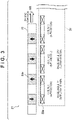
- Fig. 3 shows an arrangement example of a part of the multi-phase linear motor 21.
- the plurality of coils 22a in the stator 22 are arranged by alternately arranging the A-phase (first phase) coil and the B-phase (second phase) coil.
- the mover 23 includes a plurality of permanent magnets 23a arranged in the Halbach array which forms a magnetic flux density waveform.
- the plurality of permanent magnets 23a are arrayed along the array direction of the plurality of coils 22a in the stator 22.
- a current corresponding to the phase angle decided by the relative position between the plurality of coils 22a of the stator 22 and the permanent magnet 23a of the mover 23 is supplied to the plurality of coils 22a.
- Fig. 4 shows an example of the magnetic flux density distribution passing through the coils of respective phases with respect to the position of the mover 23 in the multi-phase linear motor 21.
- a current proportional to cos(X) is supplied to the A-phase coil.
- the magnetic flux density passing through the B-phase coil in which the phase angle of the magnetic flux density is shifted 90° with respect to that of the A-phase coil, is represented by sin(X).
- a current proportional to sin(X) is supplied to the B-phase coil.
- the driving apparatus 20 described above repeatedly performs, for each exposure process, a driving process of driving the original stage 13 in a predetermined range R by the multi-phase linear motor 21.
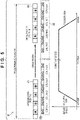
- a driving process for example, when driving the mover 23 in the predetermined range R from the point A to the point B as shown in Fig. 5 , a current can be supplied to the coil 22a of the stator 22 at the point A where the mover 23 is accelerated and the point B where the mover 23 is decelerated.
- the point A may be understood as the acceleration point (acceleration section) where the mover 23 is accelerated
- the point B may be understood as the deceleration point (deceleration section) where the mover 23 is decelerated.
- the predetermined range R is the driving range of the original stage 13 set in advance to drive the original stage 13 in scanning exposure, and may be understood as the driving range of the mover 23 in the multi-phase linear motor 21.
- the driving apparatus 20 of this embodiment includes a moving mechanism 24 (see Fig. 3 ) that moves the stator 22 in the driving direction (Y-axis direction) of the mover 23. At an arbitrary timing (predetermined timing), the position of the stator 22 with respect to the predetermined range R is changed by the moving mechanism 24.
- the output ratios of the plurality of coils 22a in the driving process after the arbitrary timing are determined so as to be changed with respect to the output ratios of the plurality of coils 22a before the arbitrary timing.
- the process to be sometimes referred to as the moving process of the stator 22 hereinafter
- it is possible to reduce the bias of the current load on the coil 22a at the acceleration point and/or the deceleration point, and reduce the local deterioration in the stator 22 (the plurality of coils 22a).
- the moving mechanism 24 includes, for example, an electric actuator, and can move the stator 22 under the control of the controller 25.
- the controller 25 supplies a signal to the moving mechanism 24 at an arbitrary timing
- the position of the stator 22 with respect to the predetermined range R can be automatically changed.
- the moving mechanism 24 may include, for example, a manual actuator such as a ball screw.
- the position of the stator 22 with respect to the predetermine range R can be manually changed. Note that in the following description, an example will be described in which an electric actuator is provided in the moving mechanism 24 and the moving mechanism 24 is controlled by the controller 25.
- the arbitrary timing can be, for example, a timing in a period between a plurality of driving processes (exposure processes).
- the arbitrary timing may also be a timing at which the number of driving operations of the original stage 13 serving as the target object to be driven (this may be understood as the number of exposure processes) reaches a preset threshold value.
- the arbitrary timing may be a timing at which the value of each of various kinds of sensors provided in the driving apparatus 20 (exposure apparatus 10), for example, the value detected by a temperature sensor and/or a pressure sensor reaches a preset threshold value.
- the value of each of the various kinds of sensors can include, for example, the temperature of the linear motor 21 detected by the temperature sensor and/or the internal pressure of the exposure apparatus 10 detected by the pressure sensor.
- the arbitrary timing may be a timing at which the electric characteristic of at least one coil of the plurality of coils 22a in the stator 22 reaches a preset threshold value.
- the electric characteristic can include at least one of the resistance value, the voltage value, the current value, and the inductance value of the coil.
- the arbitrary timing may be a timing at which the difference between the measurement value indicating the driving state of the original stage 13 and a target value (set value) reaches a preset threshold value.
- the driving state can include at least one of the velocity, the acceleration, and the position of the original stage 13 in the driving process.
- Figs. 6A to 7B are views for explaining an example of the moving process of the stator 22, and show the positional relationship between the stator 22 (coils 22a) and the mover 23 (permanent magnets 23a) at each of the acceleration point and the deceleration point.
- Figs. 6A and 6B show the positional relationship between the stator 22 and the mover 23 before performing the moving process of the stator 22
- Figs. 7A and 7B show the positional relationship between the stator 22 and the mover 23 after performing the moving process of the stator 22.
- Figs. 6A to 7B show a case in which the multi-phase linear motor 21 performs two-phase excitation (A-phase and B-phase).
- Figs. 6A and 6B show an example of the positional relationship between the stator 22 (coils 22a) and the mover 23 (permanent magnets 23a) before performing the moving process of the stator 22.
- Fig. 6A shows the positional relationship between the stator 22 and the mover 23 at the point A where the mover 23 is accelerated in the predetermined range R
- Fig. 6B shows the positional relationship between the stator 22 and the mover 23 at the point B where the mover 23 is decelerated in the predetermined range R.
- the A-phase coil and B-phase coil used to accelerate the mover 23 at the point A are the coil No. 1 and coil No. 2, respectively.
- the coil No. 1 A-phase coil
- ⁇ maximum driving current value
- the maximum current is applied (supplied) to the coil No. 1.
- the coil No. 2 B-phase coil
- ⁇ ⁇ cos(270°) 0 holds.
- no current is applied (supplied) to the coil No. 2.
- the A-phase coil and B-phase coil used to decelerate (stop) the mover 23 at the point B are the coil No. 6 and coil No. 7, respectively.
- the position of the stator 22 with respect to the predetermine range R is changed by the moving mechanism 24 at an arbitrary timing and, in accordance with the change of the position of the stator 22, the output ratios of the plurality of coils 22a in the driving process are changed.
- Figs. 7A and 7B shows an example of the positional relationship between the stator 22 (coils 22a) and the mover 23 (permanent magnets 23a) after performing the moving process of the stator 22.
- Fig. 7A shows the positional relationship between the stator 22 and the mover 23 at the point A where the mover 23 is accelerated in the predetermined range R
- Fig. 7B shows the positional relationship between the stator 22 and the mover 23 at the point B where the mover 23 is decelerated in the predetermined range R.
- the position of the stator 22 with respect to the predetermined range R is changed by the moving mechanism 24 such that the phase angle between the stator 22 and the mover 23 is changed by 90°, that is, the position of the stator 22 is changed by the distance corresponding to the phase angle of 90°.
- the distance corresponding to the phase angle of 90° may be understood as the distance of one pole dimension of the plurality of permanent magnets 23a in the mover 23, or may be understood as a distance of half the array pitch of the plurality of permanent magnets 23a.
- the change amount of the position of the stator 22 by the moving mechanism 24 is not limited to the distance corresponding to the phase angle of 90° as long as the output ratios of the plurality of coils 22a in the acceleration and/or deceleration of the mover 23 change.
- the A-phase coil and B-phase coil used to accelerate the mover 23 at the point A are the coil No. 1 and coil No. 2, respectively.
- the coil No. 1 A-phase coil
- ⁇ ⁇ cos(90°) 0 holds.
- no current is applied (supplied) to the coil No. 1.
- the coil No. 2 B-phase coil
- ⁇ ⁇ cos(360°) ⁇ holds.
- the maximum current is applied (supplied) to the coil No. 2. That is, in the example shown in Fig.
- phase angle of the coil No. 1 and the phase angle of the coil No. 2 are interchanged as compared with the example shown in Fig. 6A , so that the output ratios of the plurality coils 22a in the stator 22 can be changed.
- the A-phase coil and B-phase coil used to decelerate (stop) the mover 23 at the point B are the coil No. 6 and coil No. 7, respectively.
- the phase angle of the coil No. 1 and the phase angle of the coil No. 2 after the moving process of the stator 22 are interchanged with respect to those before the moving process.
- the output ratios of the plurality of coils 22a in the stator 22 after the moving process can be determined so as to be changed with respect to those before the moving process. Accordingly, the current load time of the coil No. 1 and that of the coil No. 2 are averaged. This can decrease the bias of the current load, so that the local deterioration in the stator 22 can be reduced.
- point B the deceleration point shown in Figs.
- the current load on the coil No. 6 is equal to the current load on the coil No. 7 both before and after the moving process of the stator 22. Accordingly, also at the deceleration point, the bias of the current load can be decreased, so that the local deterioration in the stator 22 can be reduced.
- the output ratios of the plurality of coils 22a at the deceleration point (point B) are not changed.
- the output ratios of the plurality of coils 22a at the deceleration point may be changed.
- the position of the stator 22 with respect to the predetermined range R may be changed by the moving mechanism 24 such that the output ratios of the plurality of coils 22a at the deceleration point (point B) are changed instead of or in addition to the acceleration point (point A).
- Fig. 8 is a flowchart illustrating an operation example of the driving apparatus 20 of this embodiment.
- the operation of the driving apparatus 20 in a case in which the driving apparatus 20 is applied to the exposure apparatus 10 described above will be described.
- Each step in the flowchart of Fig. 8 can be performed by the controller 25.
- step S11 the controller 25 performs the driving process of driving the original stage 13 by the multi-phase linear motor 21.
- This driving process may be understood to correspond to the exposure process on one shot region in the substrate S.
- step S12 the controller 25 determines whether to change the position of the stator 22, that is, whether to perform the moving process of the stator 22. For example, as has been described above, based on the number of driving operations of the original stage 13, the value of each of the various kinds of sensors, or the like, the controller 25 can determine whether it is the timing to perform the moving process of the stator 22. If it is determined that the moving process of the stator 22 is performed, the process advances to step S13. If it is determined that the moving process of the stator 22 is not performed, the process advances to step S14.
- step S13 the controller 25 performs the moving process of the stator 22 by changing the position of the stator 22 with respect to the predetermined range R by the moving mechanism 24.
- the controller 25 changes the position of the stator 22 by the moving mechanism 24 such that the output ratios of the plurality of coils 22a at the acceleration point and/or the deceleration point after the moving process of the stator 22 are changed with respect to those before the moving process.
- the output ratios of the plurality of coils 22a in the stator 22 are changed such that the mover 23 can be driven in the predetermined range R.
- step S14 the controller 25 determines whether to continue to perform the driving process, that is, whether the next driving process is performed.
- This step S14 may be understood as a step of determining whether there is a shot region to undergo the exposure process next.
- the shot region to undergo the exposure process next may be, for example, a shot region, among the plurality of shot regions in the substrate S, where the exposure process has not been performed, or may be a shot region of a substrate where the exposure process has not been performed in a lot including a plurality of the substrates S. If the next driving process is performed, the process advances to step S11. If the next driving process is not performed, the process is terminated. In this manner, the moving process of the stator 22 can be performed in a period between the driving process and the next driving process.
- the driving apparatus 20 of this embodiment changes the position of the stator 22 with respect to the predetermined range R by the moving mechanism 24 at an arbitrary timing. Then, in accordance with the change of the position of the stator 22, the output ratios of the plurality of coils 22a in the driving process after the arbitrary timing are determined so as to be changed with respect to the output ratios of the plurality of coils 22a before the arbitrary timing. With this process, it is possible to decrease the bias of the current loads on the plurality of coils 22a in the stator 22, so that the local deterioration in the stator 22 can be reduced.
- the two-phase excitation driving type linear motor is used as the multi-phase linear motor 21 in this embodiment, but the present invention is not limited to this. An excitation driving type linear motor of three or more phases may be used. Further, in this embodiment, a moving magnet type linear motor is used as the multi-phase linear motor 21, but a moving coil type linear motor may be used.
- a method of manufacturing an article according to the embodiment of the present invention is suitable for manufacturing an article, for example, a microdevice such as a semiconductor device or an element having a microstructure.
- the method of manufacturing an article according to the embodiment includes a step of forming a pattern on a substrate by using the above-described lithography apparatus (exposure apparatus), and a step of processing the substrate on which the pattern has been formed in the preceding step. Furthermore, this manufacturing method includes other well-known steps (for example, oxidization, deposition, vapor deposition, doping, planarization, etching, resist removal, dicing, bonding, and packaging, and the like).
- the method of manufacturing an article according to the embodiment is superior to a conventional method in at least one of the performance, quality, productivity, and production cost of the article.
- Embodiment(s) of the present invention can also be realized by a computer of a system or apparatus that reads out and executes computer executable instructions (e.g., one or more programs) recorded on a storage medium (which may also be referred to more fully as a 'non-transitory computer-readable storage medium') to perform the functions of one or more of the above-described embodiment(s) and/or that includes one or more circuits (e.g., application specific integrated circuit (ASIC)) for performing the functions of one or more of the above-described embodiment(s), and by a method performed by the computer of the system or apparatus by, for example, reading out and executing the computer executable instructions from the storage medium to perform the functions of one or more of the above-described embodiment(s) and/or controlling the one or more circuits to perform the functions of one or more of the above-described embodiment(s).
- computer executable instructions e.g., one or more programs
- a storage medium which may also be referred to more fully as
- the computer may comprise one or more processors (e.g., central processing unit (CPU), micro processing unit (MPU)) and may include a network of separate computers or separate processors to read out and execute the computer executable instructions.
- the computer executable instructions may be provided to the computer, for example, from a network or the storage medium.
- the storage medium may include, for example, one or more of a hard disk, a random-access memory (RAM), a read only memory (ROM), a storage of distributed computing systems, an optical disk (such as a compact disc (CD), digital versatile disc (DVD), or Blu-ray Disc (BD) TM ), a flash memory device, a memory card, and the like.
- the present invention provides a control method of a driving apparatus (20) that repeatedly performs a process of driving a target object (13, 15) in a predetermined range (R) by a linear motor (21), wherein the linear motor includes a stator (22) in which a plurality of coils (22a) are arrayed, and a mover (23) provided with the target object, the control method comprising: changing a position of the stator with respect to the predetermined range at an arbitrary timing; and determining, in accordance with the changed position of the stator, output ratios of the plurality of coils in the process.
Landscapes
- Physics & Mathematics (AREA)
- General Physics & Mathematics (AREA)
- Engineering & Computer Science (AREA)
- Power Engineering (AREA)
- Chemical & Material Sciences (AREA)
- Combustion & Propulsion (AREA)
- Electromagnetism (AREA)
- Exposure And Positioning Against Photoresist Photosensitive Materials (AREA)
- Control Of Linear Motors (AREA)
- Container, Conveyance, Adherence, Positioning, Of Wafer (AREA)
- Exposure Of Semiconductors, Excluding Electron Or Ion Beam Exposure (AREA)
Applications Claiming Priority (1)
| Application Number | Priority Date | Filing Date | Title |
|---|---|---|---|
| JP2021113134A JP7759200B2 (ja) | 2021-07-07 | 2021-07-07 | 駆動装置の制御方法、駆動装置、リソグラフィ装置、および物品の製造方法 |
Publications (1)
| Publication Number | Publication Date |
|---|---|
| EP4116773A1 true EP4116773A1 (en) | 2023-01-11 |
Family
ID=82321546
Family Applications (1)
| Application Number | Title | Priority Date | Filing Date |
|---|---|---|---|
| EP22181193.8A Pending EP4116773A1 (en) | 2021-07-07 | 2022-06-27 | Control method of driving apparatus, driving apparatus, lithography apparatus, and method of manufacturing article |
Country Status (5)
| Country | Link |
|---|---|
| US (3) | US11754932B2 (https=) |
| EP (1) | EP4116773A1 (https=) |
| JP (1) | JP7759200B2 (https=) |
| KR (2) | KR102905060B1 (https=) |
| CN (1) | CN115598930A (https=) |
Families Citing this family (1)
| Publication number | Priority date | Publication date | Assignee | Title |
|---|---|---|---|---|
| JP7759200B2 (ja) * | 2021-07-07 | 2025-10-23 | キヤノン株式会社 | 駆動装置の制御方法、駆動装置、リソグラフィ装置、および物品の製造方法 |
Citations (3)
| Publication number | Priority date | Publication date | Assignee | Title |
|---|---|---|---|---|
| JPH0919178A (ja) | 1995-06-27 | 1997-01-17 | Canon Inc | リニア・モータ装置 |
| US20020018195A1 (en) * | 2000-06-23 | 2002-02-14 | Kazunori Iwamoto | Moving mechanism in exposure apparatus, and exposure apparatus having the same |
| JP2006067761A (ja) | 2004-08-30 | 2006-03-09 | Canon Inc | 駆動装置 |
Family Cites Families (14)
| Publication number | Priority date | Publication date | Assignee | Title |
|---|---|---|---|---|
| JPH04308450A (ja) * | 1991-04-03 | 1992-10-30 | Ricoh Co Ltd | リニア直流モータ |
| JP3613291B2 (ja) * | 1995-03-08 | 2005-01-26 | 株式会社ニコン | 露光装置 |
| US6590355B1 (en) * | 1999-06-07 | 2003-07-08 | Nikon Corporation | Linear motor device, stage device, and exposure apparatus |
| CA2343830C (en) * | 2000-05-12 | 2005-02-08 | Seiko Epson Corporation | Drive mechanism control device and method |
| JP3724338B2 (ja) * | 2000-06-09 | 2005-12-07 | 松下電工株式会社 | 扉開閉装置 |
| JP4094799B2 (ja) * | 2000-06-22 | 2008-06-04 | 日本トムソン株式会社 | 可動マグネット型リニアモータを内蔵したスライド装置 |
| JP2008118729A (ja) * | 2006-10-31 | 2008-05-22 | Nsk Ltd | 電動パワーステアリング装置 |
| JP2012108608A (ja) * | 2010-11-15 | 2012-06-07 | Smc Corp | アクチュエータ用駆動制御装置及びアクチュエータの駆動制御方法 |
| CN107466444B (zh) * | 2015-02-08 | 2019-05-17 | 超级高铁技术公司 | 动态直线定子段控制 |
| JP6653179B2 (ja) * | 2016-01-14 | 2020-02-26 | Thk株式会社 | リニアモータの制御装置及び制御方法 |
| US10734912B2 (en) * | 2016-08-24 | 2020-08-04 | Beckhoff Automation Gmbh | Stator device for a linear motor, linear drive system, and method for operating a stator device |
| JP7025256B2 (ja) * | 2018-03-16 | 2022-02-24 | キヤノン株式会社 | ステージ装置、リソグラフィ装置、および物品の製造方法 |
| JP2021089963A (ja) * | 2019-12-04 | 2021-06-10 | キヤノン株式会社 | 搬送装置、露光装置及び物品の製造方法 |
| JP7759200B2 (ja) * | 2021-07-07 | 2025-10-23 | キヤノン株式会社 | 駆動装置の制御方法、駆動装置、リソグラフィ装置、および物品の製造方法 |
-
2021
- 2021-07-07 JP JP2021113134A patent/JP7759200B2/ja active Active
-
2022
- 2022-06-27 EP EP22181193.8A patent/EP4116773A1/en active Pending
- 2022-06-28 KR KR1020220078578A patent/KR102905060B1/ko active Active
- 2022-07-01 US US17/856,018 patent/US11754932B2/en active Active
- 2022-07-07 CN CN202210802453.0A patent/CN115598930A/zh active Pending
-
2023
- 2023-07-31 US US18/228,031 patent/US12130560B2/en active Active
-
2024
- 2024-09-26 US US18/896,980 patent/US20250021023A1/en active Pending
-
2025
- 2025-12-23 KR KR1020250207421A patent/KR20260006527A/ko active Pending
Patent Citations (4)
| Publication number | Priority date | Publication date | Assignee | Title |
|---|---|---|---|---|
| JPH0919178A (ja) | 1995-06-27 | 1997-01-17 | Canon Inc | リニア・モータ装置 |
| US20020018195A1 (en) * | 2000-06-23 | 2002-02-14 | Kazunori Iwamoto | Moving mechanism in exposure apparatus, and exposure apparatus having the same |
| JP2006067761A (ja) | 2004-08-30 | 2006-03-09 | Canon Inc | 駆動装置 |
| US20070279614A1 (en) * | 2004-08-30 | 2007-12-06 | Canon Kabushiki Kaisha | Linear Motor and Exposure Apparatus Having the Same |
Also Published As
| Publication number | Publication date |
|---|---|
| US20250021023A1 (en) | 2025-01-16 |
| US11754932B2 (en) | 2023-09-12 |
| JP7759200B2 (ja) | 2025-10-23 |
| KR20230008607A (ko) | 2023-01-16 |
| TW202304123A (zh) | 2023-01-16 |
| US12130560B2 (en) | 2024-10-29 |
| CN115598930A (zh) | 2023-01-13 |
| KR20260006527A (ko) | 2026-01-13 |
| KR102905060B1 (ko) | 2025-12-29 |
| US20230375946A1 (en) | 2023-11-23 |
| US20230011753A1 (en) | 2023-01-12 |
| JP2023009675A (ja) | 2023-01-20 |
Similar Documents
| Publication | Publication Date | Title |
|---|---|---|
| US11381196B2 (en) | Stage driving apparatus, lithography apparatus, and method of manufacturing article | |
| KR100242923B1 (ko) | 스테이지장치 및 리니어모터와, 상기 스테이지장치를사용한 노광장치 및 디바이스생산방법 | |
| US20020117903A1 (en) | Linear motor and stage apparatus, exposure apparatus, and device manufacturing method using the same | |
| US20110248578A1 (en) | Positioning apparatus | |
| KR20260006527A (ko) | 구동장치, 구동장치의 제어 방법, 리소그래피 장치, 및 물품의 제조 방법 | |
| KR102794589B1 (ko) | 스테이지 장치, 리소그래피 장치, 및 물품제조방법 | |
| US7602088B2 (en) | Linear motor and exposure apparatus having the same | |
| EP4120022B1 (en) | Exposure apparatus and method of manufacturing article | |
| TWI922702B (zh) | 驅動裝置及其控制方法、光刻裝置和物品製造方法 | |
| EP4270423A1 (en) | Electromagnetic device, alignment apparatus, and article manufacturing method | |
| US7468783B2 (en) | Exposure apparatus, control method for the same, and device manufacturing method | |
| US12326666B2 (en) | Exposing apparatus and method for manufacturing article | |
| JP2000029530A (ja) | ステージ装置、およびこれを用いた露光装置ならびにデバイス製造方法 | |
| US9804507B2 (en) | Stage apparatus, lithography apparatus, and article manufacturing method | |
| CN114326319B (zh) | 载置台装置、光刻装置以及物品的制造方法 | |
| JP7022527B2 (ja) | ステージ装置、リソグラフィ装置、および物品製造方法 |
Legal Events
| Date | Code | Title | Description |
|---|---|---|---|
| PUAI | Public reference made under article 153(3) epc to a published international application that has entered the european phase |
Free format text: ORIGINAL CODE: 0009012 |
|
| STAA | Information on the status of an ep patent application or granted ep patent |
Free format text: STATUS: THE APPLICATION HAS BEEN PUBLISHED |
|
| AK | Designated contracting states |
Kind code of ref document: A1 Designated state(s): AL AT BE BG CH CY CZ DE DK EE ES FI FR GB GR HR HU IE IS IT LI LT LU LV MC MK MT NL NO PL PT RO RS SE SI SK SM TR |
|
| STAA | Information on the status of an ep patent application or granted ep patent |
Free format text: STATUS: REQUEST FOR EXAMINATION WAS MADE |
|
| 17P | Request for examination filed |
Effective date: 20230711 |
|
| RBV | Designated contracting states (corrected) |
Designated state(s): AL AT BE BG CH CY CZ DE DK EE ES FI FR GB GR HR HU IE IS IT LI LT LU LV MC MK MT NL NO PL PT RO RS SE SI SK SM TR |