EP4107136B1 - Körner zur herstellung eines gesinterten feuerfesten produkts, charge zur herstellung eines gesinterten feuerfesten produkts, verfahren zur herstellung eines gesinterten feuerfesten produkts und gesintertes feuerfestes produkt - Google Patents
Körner zur herstellung eines gesinterten feuerfesten produkts, charge zur herstellung eines gesinterten feuerfesten produkts, verfahren zur herstellung eines gesinterten feuerfesten produkts und gesintertes feuerfestes produkt Download PDFInfo
- Publication number
- EP4107136B1 EP4107136B1 EP21706877.4A EP21706877A EP4107136B1 EP 4107136 B1 EP4107136 B1 EP 4107136B1 EP 21706877 A EP21706877 A EP 21706877A EP 4107136 B1 EP4107136 B1 EP 4107136B1
- Authority
- EP
- European Patent Office
- Prior art keywords
- grains
- zirconia
- batch
- coating
- mass
- Prior art date
- Legal status (The legal status is an assumption and is not a legal conclusion. Google has not performed a legal analysis and makes no representation as to the accuracy of the status listed.)
- Active
Links
Images
Classifications
-
- C—CHEMISTRY; METALLURGY
- C04—CEMENTS; CONCRETE; ARTIFICIAL STONE; CERAMICS; REFRACTORIES
- C04B—LIME, MAGNESIA; SLAG; CEMENTS; COMPOSITIONS THEREOF, e.g. MORTARS, CONCRETE OR LIKE BUILDING MATERIALS; ARTIFICIAL STONE; CERAMICS; REFRACTORIES; TREATMENT OF NATURAL STONE
- C04B35/00—Shaped ceramic products characterised by their composition; Ceramics compositions; Processing powders of inorganic compounds preparatory to the manufacturing of ceramic products
- C04B35/01—Shaped ceramic products characterised by their composition; Ceramics compositions; Processing powders of inorganic compounds preparatory to the manufacturing of ceramic products based on oxide ceramics
- C04B35/03—Shaped ceramic products characterised by their composition; Ceramics compositions; Processing powders of inorganic compounds preparatory to the manufacturing of ceramic products based on oxide ceramics based on magnesium oxide, calcium oxide or oxide mixtures derived from dolomite
- C04B35/04—Shaped ceramic products characterised by their composition; Ceramics compositions; Processing powders of inorganic compounds preparatory to the manufacturing of ceramic products based on oxide ceramics based on magnesium oxide, calcium oxide or oxide mixtures derived from dolomite based on magnesium oxide
- C04B35/043—Refractories from grain sized mixtures
- C04B35/0435—Refractories from grain sized mixtures containing refractory metal compounds other than chromium oxide or chrome ore
-
- C—CHEMISTRY; METALLURGY
- C04—CEMENTS; CONCRETE; ARTIFICIAL STONE; CERAMICS; REFRACTORIES
- C04B—LIME, MAGNESIA; SLAG; CEMENTS; COMPOSITIONS THEREOF, e.g. MORTARS, CONCRETE OR LIKE BUILDING MATERIALS; ARTIFICIAL STONE; CERAMICS; REFRACTORIES; TREATMENT OF NATURAL STONE
- C04B35/00—Shaped ceramic products characterised by their composition; Ceramics compositions; Processing powders of inorganic compounds preparatory to the manufacturing of ceramic products
- C04B35/01—Shaped ceramic products characterised by their composition; Ceramics compositions; Processing powders of inorganic compounds preparatory to the manufacturing of ceramic products based on oxide ceramics
- C04B35/03—Shaped ceramic products characterised by their composition; Ceramics compositions; Processing powders of inorganic compounds preparatory to the manufacturing of ceramic products based on oxide ceramics based on magnesium oxide, calcium oxide or oxide mixtures derived from dolomite
-
- C—CHEMISTRY; METALLURGY
- C04—CEMENTS; CONCRETE; ARTIFICIAL STONE; CERAMICS; REFRACTORIES
- C04B—LIME, MAGNESIA; SLAG; CEMENTS; COMPOSITIONS THEREOF, e.g. MORTARS, CONCRETE OR LIKE BUILDING MATERIALS; ARTIFICIAL STONE; CERAMICS; REFRACTORIES; TREATMENT OF NATURAL STONE
- C04B35/00—Shaped ceramic products characterised by their composition; Ceramics compositions; Processing powders of inorganic compounds preparatory to the manufacturing of ceramic products
- C04B35/01—Shaped ceramic products characterised by their composition; Ceramics compositions; Processing powders of inorganic compounds preparatory to the manufacturing of ceramic products based on oxide ceramics
- C04B35/03—Shaped ceramic products characterised by their composition; Ceramics compositions; Processing powders of inorganic compounds preparatory to the manufacturing of ceramic products based on oxide ceramics based on magnesium oxide, calcium oxide or oxide mixtures derived from dolomite
- C04B35/06—Shaped ceramic products characterised by their composition; Ceramics compositions; Processing powders of inorganic compounds preparatory to the manufacturing of ceramic products based on oxide ceramics based on magnesium oxide, calcium oxide or oxide mixtures derived from dolomite based on oxide mixtures derived from dolomite
-
- C—CHEMISTRY; METALLURGY
- C04—CEMENTS; CONCRETE; ARTIFICIAL STONE; CERAMICS; REFRACTORIES
- C04B—LIME, MAGNESIA; SLAG; CEMENTS; COMPOSITIONS THEREOF, e.g. MORTARS, CONCRETE OR LIKE BUILDING MATERIALS; ARTIFICIAL STONE; CERAMICS; REFRACTORIES; TREATMENT OF NATURAL STONE
- C04B35/00—Shaped ceramic products characterised by their composition; Ceramics compositions; Processing powders of inorganic compounds preparatory to the manufacturing of ceramic products
- C04B35/622—Forming processes; Processing powders of inorganic compounds preparatory to the manufacturing of ceramic products
- C04B35/626—Preparing or treating the powders individually or as batches ; preparing or treating macroscopic reinforcing agents for ceramic products, e.g. fibres; mechanical aspects section B
- C04B35/628—Coating the powders or the macroscopic reinforcing agents
- C04B35/62802—Powder coating materials
- C04B35/62805—Oxide ceramics
- C04B35/62818—Refractory metal oxides
- C04B35/62823—Zirconium or hafnium oxide
-
- C—CHEMISTRY; METALLURGY
- C04—CEMENTS; CONCRETE; ARTIFICIAL STONE; CERAMICS; REFRACTORIES
- C04B—LIME, MAGNESIA; SLAG; CEMENTS; COMPOSITIONS THEREOF, e.g. MORTARS, CONCRETE OR LIKE BUILDING MATERIALS; ARTIFICIAL STONE; CERAMICS; REFRACTORIES; TREATMENT OF NATURAL STONE
- C04B35/00—Shaped ceramic products characterised by their composition; Ceramics compositions; Processing powders of inorganic compounds preparatory to the manufacturing of ceramic products
- C04B35/622—Forming processes; Processing powders of inorganic compounds preparatory to the manufacturing of ceramic products
- C04B35/626—Preparing or treating the powders individually or as batches ; preparing or treating macroscopic reinforcing agents for ceramic products, e.g. fibres; mechanical aspects section B
- C04B35/628—Coating the powders or the macroscopic reinforcing agents
- C04B35/62886—Coating the powders or the macroscopic reinforcing agents by wet chemical techniques
-
- C—CHEMISTRY; METALLURGY
- C04—CEMENTS; CONCRETE; ARTIFICIAL STONE; CERAMICS; REFRACTORIES
- C04B—LIME, MAGNESIA; SLAG; CEMENTS; COMPOSITIONS THEREOF, e.g. MORTARS, CONCRETE OR LIKE BUILDING MATERIALS; ARTIFICIAL STONE; CERAMICS; REFRACTORIES; TREATMENT OF NATURAL STONE
- C04B35/00—Shaped ceramic products characterised by their composition; Ceramics compositions; Processing powders of inorganic compounds preparatory to the manufacturing of ceramic products
- C04B35/622—Forming processes; Processing powders of inorganic compounds preparatory to the manufacturing of ceramic products
- C04B35/626—Preparing or treating the powders individually or as batches ; preparing or treating macroscopic reinforcing agents for ceramic products, e.g. fibres; mechanical aspects section B
- C04B35/628—Coating the powders or the macroscopic reinforcing agents
- C04B35/62897—Coatings characterised by their thickness
-
- C—CHEMISTRY; METALLURGY
- C04—CEMENTS; CONCRETE; ARTIFICIAL STONE; CERAMICS; REFRACTORIES
- C04B—LIME, MAGNESIA; SLAG; CEMENTS; COMPOSITIONS THEREOF, e.g. MORTARS, CONCRETE OR LIKE BUILDING MATERIALS; ARTIFICIAL STONE; CERAMICS; REFRACTORIES; TREATMENT OF NATURAL STONE
- C04B35/00—Shaped ceramic products characterised by their composition; Ceramics compositions; Processing powders of inorganic compounds preparatory to the manufacturing of ceramic products
- C04B35/622—Forming processes; Processing powders of inorganic compounds preparatory to the manufacturing of ceramic products
- C04B35/64—Burning or sintering processes
-
- C—CHEMISTRY; METALLURGY
- C04—CEMENTS; CONCRETE; ARTIFICIAL STONE; CERAMICS; REFRACTORIES
- C04B—LIME, MAGNESIA; SLAG; CEMENTS; COMPOSITIONS THEREOF, e.g. MORTARS, CONCRETE OR LIKE BUILDING MATERIALS; ARTIFICIAL STONE; CERAMICS; REFRACTORIES; TREATMENT OF NATURAL STONE
- C04B35/00—Shaped ceramic products characterised by their composition; Ceramics compositions; Processing powders of inorganic compounds preparatory to the manufacturing of ceramic products
- C04B35/66—Monolithic refractories or refractory mortars, including those whether or not containing clay
-
- C—CHEMISTRY; METALLURGY
- C04—CEMENTS; CONCRETE; ARTIFICIAL STONE; CERAMICS; REFRACTORIES
- C04B—LIME, MAGNESIA; SLAG; CEMENTS; COMPOSITIONS THEREOF, e.g. MORTARS, CONCRETE OR LIKE BUILDING MATERIALS; ARTIFICIAL STONE; CERAMICS; REFRACTORIES; TREATMENT OF NATURAL STONE
- C04B2235/00—Aspects relating to ceramic starting mixtures or sintered ceramic products
- C04B2235/02—Composition of constituents of the starting material or of secondary phases of the final product
- C04B2235/30—Constituents and secondary phases not being of a fibrous nature
- C04B2235/32—Metal oxides, mixed metal oxides, or oxide-forming salts thereof, e.g. carbonates, nitrates, (oxy)hydroxides, chlorides
- C04B2235/3205—Alkaline earth oxides or oxide forming salts thereof, e.g. beryllium oxide
- C04B2235/3206—Magnesium oxides or oxide-forming salts thereof
-
- C—CHEMISTRY; METALLURGY
- C04—CEMENTS; CONCRETE; ARTIFICIAL STONE; CERAMICS; REFRACTORIES
- C04B—LIME, MAGNESIA; SLAG; CEMENTS; COMPOSITIONS THEREOF, e.g. MORTARS, CONCRETE OR LIKE BUILDING MATERIALS; ARTIFICIAL STONE; CERAMICS; REFRACTORIES; TREATMENT OF NATURAL STONE
- C04B2235/00—Aspects relating to ceramic starting mixtures or sintered ceramic products
- C04B2235/02—Composition of constituents of the starting material or of secondary phases of the final product
- C04B2235/30—Constituents and secondary phases not being of a fibrous nature
- C04B2235/32—Metal oxides, mixed metal oxides, or oxide-forming salts thereof, e.g. carbonates, nitrates, (oxy)hydroxides, chlorides
- C04B2235/3205—Alkaline earth oxides or oxide forming salts thereof, e.g. beryllium oxide
- C04B2235/3208—Calcium oxide or oxide-forming salts thereof, e.g. lime
- C04B2235/321—Dolomites, i.e. mixed calcium magnesium carbonates
-
- C—CHEMISTRY; METALLURGY
- C04—CEMENTS; CONCRETE; ARTIFICIAL STONE; CERAMICS; REFRACTORIES
- C04B—LIME, MAGNESIA; SLAG; CEMENTS; COMPOSITIONS THEREOF, e.g. MORTARS, CONCRETE OR LIKE BUILDING MATERIALS; ARTIFICIAL STONE; CERAMICS; REFRACTORIES; TREATMENT OF NATURAL STONE
- C04B2235/00—Aspects relating to ceramic starting mixtures or sintered ceramic products
- C04B2235/02—Composition of constituents of the starting material or of secondary phases of the final product
- C04B2235/30—Constituents and secondary phases not being of a fibrous nature
- C04B2235/32—Metal oxides, mixed metal oxides, or oxide-forming salts thereof, e.g. carbonates, nitrates, (oxy)hydroxides, chlorides
- C04B2235/3231—Refractory metal oxides, their mixed metal oxides, or oxide-forming salts thereof
- C04B2235/3244—Zirconium oxides, zirconates, hafnium oxides, hafnates, or oxide-forming salts thereof
-
- C—CHEMISTRY; METALLURGY
- C04—CEMENTS; CONCRETE; ARTIFICIAL STONE; CERAMICS; REFRACTORIES
- C04B—LIME, MAGNESIA; SLAG; CEMENTS; COMPOSITIONS THEREOF, e.g. MORTARS, CONCRETE OR LIKE BUILDING MATERIALS; ARTIFICIAL STONE; CERAMICS; REFRACTORIES; TREATMENT OF NATURAL STONE
- C04B2235/00—Aspects relating to ceramic starting mixtures or sintered ceramic products
- C04B2235/02—Composition of constituents of the starting material or of secondary phases of the final product
- C04B2235/30—Constituents and secondary phases not being of a fibrous nature
- C04B2235/44—Metal salt constituents or additives chosen for the nature of the anions, e.g. hydrides or acetylacetonate
- C04B2235/442—Carbonates
-
- C—CHEMISTRY; METALLURGY
- C04—CEMENTS; CONCRETE; ARTIFICIAL STONE; CERAMICS; REFRACTORIES
- C04B—LIME, MAGNESIA; SLAG; CEMENTS; COMPOSITIONS THEREOF, e.g. MORTARS, CONCRETE OR LIKE BUILDING MATERIALS; ARTIFICIAL STONE; CERAMICS; REFRACTORIES; TREATMENT OF NATURAL STONE
- C04B2235/00—Aspects relating to ceramic starting mixtures or sintered ceramic products
- C04B2235/02—Composition of constituents of the starting material or of secondary phases of the final product
- C04B2235/50—Constituents or additives of the starting mixture chosen for their shape or used because of their shape or their physical appearance
- C04B2235/54—Particle size related information
- C04B2235/5418—Particle size related information expressed by the size of the particles or aggregates thereof
- C04B2235/5427—Particle size related information expressed by the size of the particles or aggregates thereof millimeter or submillimeter sized, i.e. larger than 0,1 mm
-
- C—CHEMISTRY; METALLURGY
- C04—CEMENTS; CONCRETE; ARTIFICIAL STONE; CERAMICS; REFRACTORIES
- C04B—LIME, MAGNESIA; SLAG; CEMENTS; COMPOSITIONS THEREOF, e.g. MORTARS, CONCRETE OR LIKE BUILDING MATERIALS; ARTIFICIAL STONE; CERAMICS; REFRACTORIES; TREATMENT OF NATURAL STONE
- C04B2235/00—Aspects relating to ceramic starting mixtures or sintered ceramic products
- C04B2235/02—Composition of constituents of the starting material or of secondary phases of the final product
- C04B2235/50—Constituents or additives of the starting mixture chosen for their shape or used because of their shape or their physical appearance
- C04B2235/54—Particle size related information
- C04B2235/5418—Particle size related information expressed by the size of the particles or aggregates thereof
- C04B2235/5436—Particle size related information expressed by the size of the particles or aggregates thereof micrometer sized, i.e. from 1 to 100 micron
-
- C—CHEMISTRY; METALLURGY
- C04—CEMENTS; CONCRETE; ARTIFICIAL STONE; CERAMICS; REFRACTORIES
- C04B—LIME, MAGNESIA; SLAG; CEMENTS; COMPOSITIONS THEREOF, e.g. MORTARS, CONCRETE OR LIKE BUILDING MATERIALS; ARTIFICIAL STONE; CERAMICS; REFRACTORIES; TREATMENT OF NATURAL STONE
- C04B2235/00—Aspects relating to ceramic starting mixtures or sintered ceramic products
- C04B2235/02—Composition of constituents of the starting material or of secondary phases of the final product
- C04B2235/50—Constituents or additives of the starting mixture chosen for their shape or used because of their shape or their physical appearance
- C04B2235/54—Particle size related information
- C04B2235/5418—Particle size related information expressed by the size of the particles or aggregates thereof
- C04B2235/5445—Particle size related information expressed by the size of the particles or aggregates thereof submicron sized, i.e. from 0,1 to 1 micron
-
- C—CHEMISTRY; METALLURGY
- C04—CEMENTS; CONCRETE; ARTIFICIAL STONE; CERAMICS; REFRACTORIES
- C04B—LIME, MAGNESIA; SLAG; CEMENTS; COMPOSITIONS THEREOF, e.g. MORTARS, CONCRETE OR LIKE BUILDING MATERIALS; ARTIFICIAL STONE; CERAMICS; REFRACTORIES; TREATMENT OF NATURAL STONE
- C04B2235/00—Aspects relating to ceramic starting mixtures or sintered ceramic products
- C04B2235/65—Aspects relating to heat treatments of ceramic bodies such as green ceramics or pre-sintered ceramics, e.g. burning, sintering or melting processes
- C04B2235/656—Aspects relating to heat treatments of ceramic bodies such as green ceramics or pre-sintered ceramics, e.g. burning, sintering or melting processes characterised by specific heating conditions during heat treatment
- C04B2235/6567—Treatment time
-
- C—CHEMISTRY; METALLURGY
- C04—CEMENTS; CONCRETE; ARTIFICIAL STONE; CERAMICS; REFRACTORIES
- C04B—LIME, MAGNESIA; SLAG; CEMENTS; COMPOSITIONS THEREOF, e.g. MORTARS, CONCRETE OR LIKE BUILDING MATERIALS; ARTIFICIAL STONE; CERAMICS; REFRACTORIES; TREATMENT OF NATURAL STONE
- C04B2235/00—Aspects relating to ceramic starting mixtures or sintered ceramic products
- C04B2235/70—Aspects relating to sintered or melt-casted ceramic products
- C04B2235/80—Phases present in the sintered or melt-cast ceramic products other than the main phase
-
- C—CHEMISTRY; METALLURGY
- C04—CEMENTS; CONCRETE; ARTIFICIAL STONE; CERAMICS; REFRACTORIES
- C04B—LIME, MAGNESIA; SLAG; CEMENTS; COMPOSITIONS THEREOF, e.g. MORTARS, CONCRETE OR LIKE BUILDING MATERIALS; ARTIFICIAL STONE; CERAMICS; REFRACTORIES; TREATMENT OF NATURAL STONE
- C04B2235/00—Aspects relating to ceramic starting mixtures or sintered ceramic products
- C04B2235/70—Aspects relating to sintered or melt-casted ceramic products
- C04B2235/96—Properties of ceramic products, e.g. mechanical properties such as strength, toughness, wear resistance
Definitions
- the invention relates to grains for the production of a sintered refractory product, a batch for the production of a sintered refractory product, a process for the production of a sintered refractory product and a sintered refractory product.
- refractory product in the sense of the invention refers in particular to refractory products with an operating temperature above 600°C and preferably to refractory products in accordance with DIN 51060: 2006, i.e. materials with a pyrometric cone equivalent > SK17.
- the pyrometric cone equivalent can be determined in particular in accordance with DIN EN 993-12: 1997-06.
- the term "sintered" in the sense of the invention expresses that the refractory product is a ceramic refractory product, i.e. a refractory product consisting of grains sintered together.
- a "batch” is a composition of one or more components or raw materials by which a sintered refractory product can be produced by means of a temperature treatment, i.e. in particular by means of firing, for example in a furnace.
- Components in a batch for the production of sintered refractory products are regularly available in the form of raw materials based on metal oxides.
- Such common raw materials for the production of sintered refractory products are, for example, doloma and magnesia.
- doloma is a raw material based on the metal oxides calcium oxide (CaO) and magnesium oxide (MgO).
- Magnesia is known to be a raw material based on the metal oxide magnesium oxide (MgO).
- Raw materials in the form of doloma can, for example, be in the form of dead-burned dolomite, synthetic doloma or fused doloma.
- Raw materials in the form of magnesia can be in the form of sintered magnesia or fused magnesia.
- sintered refractory products are highly brittle. This brittleness of sintered refractory products manifests itself in a low structural elasticity and a correspondingly high modulus of elasticity of such sintered refractory products. Due to this low structural elasticity, sintered refractory products are highly sensitive to thermal stresses. In particular, such thermal stresses can lead to thermal spalling of refractory products.
- zirconia can form eutectic phases with iron oxide having a melting point of only 1,323°C, which can significantly reduce the slag resistance of the product.
- iron oxide may be present in the product as a minor component of components of the batch.
- iron oxide may also be a component of slags with which the product comes into contact, in particular if the product is used for lining aggregates for holding molten metals.
- zirconia is disadvantageous from an economic point of view as the raw material costs for zirconia are relatively high.
- US 5 573 987 A discloses a refractory ceramic mass comprising a pure magnesia component A and a component B, which consists of granules of pure magnesia, wherein the magnesia granules of component B have a coating consisting of a refractory material whose granule size is smaller than that of the magnesia granules of component B and is inert with respect to the magnesia granules.
- a component in the form of grains for the production of a sintered refractory product comprising the following features:
- the grains according to (1) may have at least one of the following features according to (2) to (5):
- the features of the grains according to (1) to (5) may be modified as set forth herein.
- the grains may comprise one or several of the further features as set forth herein. Further, all features of the grains, as set forth herein, may be combined with each other, either individually or in combination.
- the grains of zirconia known from the state of the art which are used in the above-mentioned batches in order to improve the structural elasticity or to reduce the modulus of elasticity in the sintered refractory products manufactured from these batches, can be replaced by the grains in accordance with the invention.
- the grains according to the invention have a "core" of at least one of the raw materials magnesia, magnesite, doloma or dolomite, whereby the surface of this core has a coating of zirconia at least in sections.
- the elastifying properties of the grains coated in accordance with the invention were such that an elastifying effect could be reached in a sintered refractory product which was better than the elastifying effect of solid grains of zirconia.
- the grains coated only on their surface with zirconia in accordance with the invention offer the possibility of introducing a lower proportion of zirconia into the sintered refractory product than by a solid grain of zirconia.
- pulverized zirconia may be used which can be provided at much lower economic costs than solid grains of zirconia.
- inventive grains having the inventive coating of zirconia are hereinafter referred to as "coated grains”.
- the coated grains, as set forth herein may be used in a batch for the production of a sintered refractory product, and the coated grains, as set forth herein, may be present in such a batch together with other components.
- grains of magnesia within the meaning of the invention means grains of the raw material magnesia, i.e. a material consisting essentially of magnesium oxide (MgO). Such a raw material in the form of magnesia may be present in particular in the form of at least one of the raw materials sintered magnesia or fused magnesia.
- MgO magnesium oxide
- grains of magnesite within the meaning of the invention means grains of the raw material magnesite, i.e. a material consisting essentially of magnesium carbonate (MgCO 3 ). Such a raw material in the form of magnesite may be present in particular in the form of raw magnesite, i.e. non-calcined magnesite.
- MgCO 3 magnesium carbonate
- grains of doloma within the meaning of the invention means grains of the raw material doloma, i.e. a material consisting essentially of magnesium oxide (MgO) and calcium oxide (CaO). Such a raw material in the form of doloma may be present in particular in the form of at least one of the raw materials dead-burned dolomite, sintered doloma or fused doloma.
- MgO magnesium oxide
- CaO calcium oxide
- grains of dolomite in the meaning of the invention means grains of the raw material dolomite, i.e. a material consisting essentially of magnesium carbonate (MgCO 3 ) and calcium carbonate (CaCO 3 ). Such a raw material in the form of dolomite may be present in particular in the form of raw dolomite, i.e. non-calcined dolomite.
- MgCO 3 magnesium carbonate
- CaCO 3 calcium carbonate
- zirconia in the meaning of the invention refers to a material which essentially consists of zirconium oxide (ZrO 2 ). Such a raw material in the form of zirconia may be present in particular in the form of at least one of the raw materials zirconia, baddeleyite, fused zirconia, calcia stabilized zirconia or magnesia stabilized zirconia.
- the coated grains were found to have their best elastifying effect with only a small amount of zirconia being introduced into the sintered refractory product when the coated grains have a grain size in the range from 2.80 to 6.63 mm. According to a preferred embodiment it is therefore provided that the coated grains have a grain size of at most 8.0 mm and even more preferably a grain size of at most 6.63 mm. According to a preferred embodiment it is provided that the coated grains have a grain size in the range from 2.8 to 8.0 mm and even more preferably a grain size in the range from 2.80 to 6.63 mm.
- the coated grains have a core of magnesia, magnesite, doloma or dolomite, the surface of which is at least partially coated with zirconia.
- the coated grains have the coating of zirconia at least in sections indicates that the grains are either completely or only in sections coated with zirconia. If the coated grains have a zirconia coating not only in sections but completely, the zirconia completely surrounds the core of the grains, i.e. the core of magnesia, magnesite, doloma or dolomite of the grains, i.e. like a shell in which the magnesia, magnesite, doloma or dolomite lies like a core.
- the zirconia coating may, for example, have gaps or cracks, or the zirconia coating may only be partially arranged on the grains, for example in the form of separate sections or areas.
- the coated grains preferably have a zirconia coating over at least 50% of the surface area.
- magnesia, magnesite, doloma or dolomite have a zirconia coating on at least 50% of their surface.
- the coated grains preferably have a complete coating of zirconia.
- the elastifying effect of coated grains of magnesite and dolomite, the surface of which is at least in sections coated with zirconia is slightly lower than the elastifying effect of coated grains of magnesia or doloma, the surface of which is at least in sections coated with zirconia.
- the coated grains are therefore preferably in the form of at least one of the following grains: Grains of magnesia whose surface is at least in sections coated with zirconia; or grains of doloma whose surface is at least in sections coated with zirconia.
- the elastifying effect of coated grains of magnesia is slightly lower than the elastifying effect of coated grains of doloma, the surface of which is at least in sections coated with zirconia.
- the coated grains are therefore particularly preferred in the form of doloma grains whose surface is at least in sections coated with zirconia.
- the "grain size" of the coated grains within the meaning of the invention is determined according to DIN 66165-2:2016-08.
- the core of the coated grains of magnesia consists predominantly of magnesia (MgO)
- the core of the coated grains of doloma consists predominantly of magnesia (MgO) and calcium oxide (CaO)
- the core of the coated grains of dolomite consists predominantly of magnesium carbonate (MgCO 3 ) and calcium carbonate (CaCO 3 ), whereby, in addition to these main substances, the usual secondary oxides and impurities, which raw materials usually contain, may be present.
- the coated grains with a core of magnesia may contain secondary oxides in the form of CaO, SiO 2 , Al 2 O 3 or Fe 2 O 3 and the coated grains with a core of doloma or dolomite may contain secondary oxides in the form of SiO 2 , Al 2 O 3 or Fe 2 O 3 .
- these secondary oxides or impurities are preferably present in a proportion of less than 10 % by mass, based on the mass of the cores of the coated grains.
- the coating of zirconia which the coated grains each contain, consists of zirconia (ZrO 2 ) and may contain the usual secondary oxides and impurities in addition to the pure oxide ZrO 2 , e.g. secondary oxides in the form of CaO, SiO 2 , Al 2 O 3 or Fe 2 O 3 .
- the coating has the usual secondary oxide HfO 2 , which is usually associated with ZrO 2 .
- these secondary oxides are present in a proportion of less than 10% by mass, based on the mass of the coating of the coated grains.
- the coated grains can develop their elastifying effect particularly advantageously if the coating is present in a mass fraction of at least 1 % by mass, based on the total mass of the coated grains. Furthermore, it has turned out, in accordance with the invention, that the amount of zirconia in the sintered refractory product due to the coated grains may become too high if the coated grains have the zirconia coating in a proportion by mass of more than 50 %. Therefore, it is preferable, in accordance with the invention, that the mass fraction of the coating of zirconia of the coated grains should be in the range of 1 to 50 % by mass.
- the coated grains can fulfil their elastifying effect particularly advantageously if the coated grains have the coating in a proportion of 20 % by mass and at the same time only the smallest possible input of zirconia into the sintered refractory product.
- the mass fraction of the zirconia coating of the coated grains is as close as possible to this fraction.
- the mass fraction of the zirconia coating of the coated grains is at least 5 % by mass, even more preferred at least 10 % by mass and even more preferred at least 15 % by mass.
- the mass fraction of the zirconia coating of the coated grains is at most 45 % by mass, even more preferably at most 30 % by mass and even more preferably at most 25 % by mass. Accordingly, according to the invention, it may be preferably provided that the mass fraction of the zirconia coating of the coated grains is in the range of 5 to 45 % by mass, even more preferably in the range of 10 to 30 % by mass and even more preferably in the range of 15 to 25 % by mass.
- the mass specifications given above for the mass fraction of the zirconia coating of the coated grains are based in each case on the total mass of the coated grains.
- the zirconia coating of the coated grains from a layer thickness of about 10 ⁇ m is particularly capable of forming calcium zirconate with calcium oxide either from further components of the batch in which the coated grains are present or from the core of the coated grains.
- the zirconia coating is intended to have a thickness of at least 10 ⁇ m.
- the entire zirconia may no longer react with calcium oxide to form calcium zirconate, so that after firing of the product not inconsiderable portions of the zirconia coating could remain in the product and, as explained above, impair the hot properties of the product.
- the zirconia coating should have a thickness of at least 10 ⁇ m and more preferably a thickness in the range of 10 to 800 ⁇ m.
- the optimum thickness of the zirconia coating is in the range from 60 to 500 ⁇ m, since at such a thickness sufficient zirconia can be provided to form calcium zirconate and at the same time only small or no portions of the zirconia coating can remain in the sintered refractory product.
- the zirconia coating should have a thickness of at least 20 ⁇ m, even more preferably of at least 40 ⁇ m and even more preferably of at least 60 ⁇ m.
- the zirconia coating has a thickness of not more than 800 ⁇ m, more preferably not more than 600 ⁇ m and more preferably not more than 500 ⁇ m. According to a preferred embodiment, the zirconia coating is intended to have a thickness ranging from 20 to 700 ⁇ m, even more preferably ranging from 40 to 600 ⁇ m and even more preferably ranging from 60 to 500 ⁇ m.
- each coated grain has a zirconia coating thickness as above, preferably at least 50% of the coated grains, more preferably at least 90% of the coated grains, each based on the total mass of the coated grains.
- the coating of zirconia of the coated grains is particularly preferred in the form of powder, i.e. in the form of fine particles.
- the zirconia of the coating of the coated grains is not sintered.
- Such a coating of the coated grains in the form of zirconia powder has in particular the advantage of a high reactivity of the zirconia, so that it can react particularly advantageously in-situ with calcium oxide to calcium zirconate during firing.
- the zirconia powder may be applied to the surface of the coated grains via an adhesion promoter, e.g. an adhesion promoter in the form of water or binder.
- an adhesion promoter e.g. an adhesion promoter in the form of water or binder.
- a particularly preferred type of coating is zirconia in the form of zirconia powder, which is bound by an organic binder.
- the organic binder can in particular be a temporary binder, which burns out or evaporates when a batch comprising the coated grains is fired.
- the temporary binders known from the state of the art can be used, for example an aqueous solution of polyvinyl alcohol.
- the zirconia powder is preferably particularly fine in the coating or has a small grain size.
- zirconia is present in the coating of zirconia of the coated grains to at least 90 % by mass, even more preferably to at least 97 % by mass and even more preferably to at least 99 % by mass in a grain size below 45 ⁇ m (325 mesh), in each case relative to the total mass of zirconia in the coating of zirconia.
- a process for preparing the coated grains according to the invention comprising the following steps: Providing grains, said grains consisting of at least one of the following grains:
- the grains made available for carrying out the process are hereinafter referred to as "grains to be coated".
- the grains to be coated provided for the process may have the grain size of the coated grains indicated above. Furthermore, the grains to be coated may have the chemical composition of the cores of the coated grains described above.
- the zirconia used in the process may have the grain size and chemical composition of the zirconia of the coated grains described above.
- the grains to be coated and the zirconia are preferably mixed together with a binder, preferably an organic binder, especially preferred with a temporary binder, as described above.
- the proportion of binder by mass, relative to the total mass of the grains to be coated without the binder can, for example, be between 1 and 2 % by mass.
- the zirconia, as described above, is preferably provided as powder, in particular as dry powder, especially with the grain size of the zirconia of the coated grains described above.
- the grains to be coated are preferably coated with such a proportion of zirconia that the mass proportion of the coating of zirconia, in relation to the total mass of the grains to be coated with the coating applied thereto, is present in a mass proportion corresponding to the mass proportion of the above-mentioned coating of zirconia of the coated grains.
- the invention also refers to the following: (6) A batch for the production of a sintered refractory product, the batch comprising the coated grains according to the invention.
- the batch according to (6) may have at least one of the following features according to (7) to (13):
- the chemical composition is determined in accordance with DIN EN ISO 12677:2013.
- the features of the batch according to (8) to (13) may be modified as set forth herein.
- the batch may comprise one or several of the further features as set forth herein. Further, all features of the batch, as set forth herein, may be combined with each other, either individually or in combination.
- the coated grains in accordance with the invention can develop their elastifying effect in a sintered refractory product to be produced from a batch to a particular degree if they are present in an amount of at least 1 % by mass in the batch.
- the batch in accordance with the invention comprises the coated grains in a proportion of at least 1 % by mass.
- too much zirconia can be incorporated into the sintered refractory product to be produced from the batch by the coated grains according to the invention, if the batch comprises the coated grains according to the invention in a proportion of more than 15 % by mass.
- the invention may include a refractory base material.
- This refractory base material may consist, in particular, of one or more components which may include the known prior art batches for the production of a sintered refractory product.
- the components of the refractory base material may consist of one or more non-metallic inorganic materials which, when subjected to temperature, sinter together to form a sintered, i.e. ceramic, refractory product.
- the refractory base material or the components of the refractory base material are present in the form of grains, preferably in grain sizes in the range of > 0 to 8 mm.
- the refractory base material is preferably available in the form of a basic refractory base material, i.e. it consists of one or more basic components.
- basic refractory components are those based on at least one of the oxides calcium oxide (CaO) and magnesium oxide (MgO).
- the batch or refractory base material as such a basic component comprises at least one component comprising calcium oxide.
- Calcium zirconate may be formed in-situ from the calcium oxide of such a component and the zirconia of the zirconia coating of the coated grains during the firing of the batch.
- the component comprising at least one calcium oxide may comprise the calcium oxide, for example as bound calcium oxide, for example in the form of calcium carbonate (CaCO 3 ).
- the component comprising calcium oxide particularly preferentially comprises calcium oxide in free form.
- the component comprising at least one calcium oxide is present in the form of at least one of the following components comprising calcium oxide: Doloma or dolomite.
- the component comprising calcium oxide in the form of doloma is particularly preferred.
- Doloma may preferably be in the form of at least one of the following components: Sintered doloma or fused doloma.
- the refractory base material may preferably comprise as a further basic component at least one component comprising magnesium oxide.
- the component comprising at least one magnesium oxide is in the form of magnesia.
- Magnesia may preferably be in the form of at least one of the following components: Sintered magnesia or fused magnesia.
- the batch according to the invention comprises refractory base material preferably in a proportion in the range of 85 to 99 % by mass, more preferably in a proportion in the range of 90 to 99 % by mass, more preferably in a proportion in the range of 92 to 99 % by mass, more preferably in a proportion in the range of 94 to 99 % by mass and more preferably in a proportion in the range of 96 to 98 % by mass, each based on the total mass of the batch.
- the refractory base material shall preferably consist of one or more basic components, in particular basic components in the form of components comprising calcium oxide and magnesium oxide as specified above. According to a preferred embodiment it is intended that the refractory base material consists of one or more of the basic components and consists of at least 50 % by mass, more preferably at least 70 % by mass, of one or more of the basic components in the form of the components comprising calcium oxide mentioned above.
- the batch according to the invention may also comprise at least one clay, in particular at least one bonding clay, as a further component.
- a bonding clay may be used to improve the sintering properties of the batch.
- the batch according to the invention can, for example, comprise such a clay in a proportion in the range from > 0 to 2 % by mass, in particular in a proportion in the range from 0.1 to 2 % by mass, in each case relative to the total mass of the batch.
- the invention also refers a process for producing a sintered refractory product, the process comprising the following steps:
- the batch according to the invention provided for carrying out the process according to the invention is preferably mixed before firing, preferably in a mixer, particularly preferred in a compulsory mixer.
- a binder in particular an organic binder, especially a temporary organic binder, may be added to the batch during the mixing of the batch.
- temporary binders known from the state of the art can be used in particular to bind batch for the production of a sintered refractory product.
- the batch can be mixed with a temporary binder, for example a non-aqueous organic binder.
- the batch is mixed with a binder in a proportion in the range of 1 to 2 % by mass, based on the total mass of the batch without the binder.
- the batch can then be formed, preferably by pressing, preferably at a pressure in the range of 70 to 200 MPa.
- the batch can be pressed into a shaped, unfired body in the form of a so-called green body.
- the zirconia of the coating of the coated grains reacts in-situ with calcium oxide during firing.
- This calcium oxide may, for example, be present as a minor component of one of the components of the batch.
- calcium oxide is particularly preferred as a component of at least one of the components of the refractory base material, in particular the at least one component comprising calcium oxide.
- the zirconia of the coating reacts in-situ with the calcium oxide to form calcium zirconate during firing.
- An object of the invention is also a sintered refractory product comprising the following features:
- the features of the sintered refractory product may be modified as set forth herein.
- the sintered refractory product may comprise one or several of the further features as set forth herein. Further, all features of the sintered refractory product, as set forth herein, may be combined with each other, either individually or in combination.
- This sintered refractory product according to the invention is preferably produced by the aforementioned process according to the invention.
- the coated grains of the batch according to the invention form the second grains and the components of the refractory base material of the batch according to the invention form the first grains.
- the first grains shall preferably consist of a basic material.
- the first grains preferably comprise calcium oxide comprising grains.
- the first grains may preferably be in the form of grains of doloma or in the form of grains of doloma and magnesia. At least 50 % by mass or more preferably at least 70 % by mass of the first grains may be in the form of grains of doloma, relative to the total mass of the first grains.
- the first grains may be present in the product in a proportion by mass corresponding to the proportion by mass of the refractory base material in the batch according to the invention.
- the product according to the invention comprises first grains preferably in a proportion in the range from 85 to 99 % by mass, even more preferably in a proportion in the range from 90 to 99 % by mass, even more preferably in a proportion in the range from 92 to 99 % by mass, even more preferably in a proportion in the range from 94 to 99 % by mass and even more preferably in a proportion in the range from 96 to 98 % by mass, in each case relative to the total mass of the product.
- the second grains may preferably have the grain size of the coated grains according to the invention. Accordingly, it may be preferred that the second grains have a grain size of at least 2.80 mm and also a grain size of not more than 8.0 mm and more preferably a grain size of not more than 6.63 mm. According to one embodiment it is provided that the second grains have a grain size in the range from 2.80 to 8.0 mm and even more preferably a grain size in the range from 2.80 to 6.63 mm.
- the calcium zirconate coating of the second grains may have a thickness corresponding to the thickness of the zirconia coating of the coated grains according to the invention. It may be provided that the calcium zirconate coating of the second grains has a somewhat larger thickness than the thickness of the zirconia coating of the coated grains according to the invention as the zirconia coating of the second grains may grow during firing. It may be preferably provided that the calcium zirconate coating has a thickness of at least 10 ⁇ m, even more preferentially of at least 40 ⁇ m, even more preferentially of at least 60 ⁇ m and even more preferentially of at least 100 ⁇ m.
- the calcium zirconate coating has a thickness of not more than 800 ⁇ m, more preferably of not more than 700 ⁇ m and even more preferably of not more than 600 ⁇ m.
- the calcium zirconate coating is provided to have a thickness in the range from 10 to 800 ⁇ m, more preferably in the range from 40 to 700 ⁇ m, more preferably in the range from 60 to 600 ⁇ m and more preferably in the range from 100 to 600 ⁇ m.
- the second grains may be present in the product in a proportion by mass corresponding to the proportion by mass of the coated grains in the batch according to the invention.
- the product according to the invention comprises the second grains preferably in a proportion in the range from 1 to 15 % by mass, even more preferably in a proportion in the range from 1 to 10 % by mass, even more preferably in a proportion in the range from 1 to 8 % by mass, even more preferably in a proportion in the range from 1 to 6 % by mass and even more preferably in a proportion in the range from 2 to 4 % by mass, in each case relative to the total mass of the product.
- the first grains may preferably form a matrix in which the second grains are embedded.
- the calcium zirconate coating may be arranged like a shell around the second grains, the second grains being in contact with the matrix of the product, in particular with the first grains, via this calcium zirconate coating.
- the calcium zirconate coating acts as an elasticizer in the sintered refractory product, increasing the structural elasticity of the product and reducing its brittleness. This is particularly evident in the low modulus of elasticity of the product.
- the invention allows only a small proportion of zirconia to be incorporated into the product despite the presence of calcium zirconate, since the second grains do not have a zirconia core but a magnesia, magnesite, doloma or dolomite core.
- this is what makes the product according the invention having such a good slag resistance, since the second grains introduce only very small quantities of zirconia into the product.
- the product according to the invention may have both good hot properties and good microstructural elasticity.
- the proportion of zirconia in the sintered refractory product according to the invention is less than 1 % by mass of the total mass of the product.
- the sintered refractory product according to the invention may have a modulus of elasticity of less than 110 GPa and more preferably less than 100 GPa.
- the modulus of elasticity is determined according to standard DIN EN ISO 12680-1:2007.
- the sintered refractory product according to the invention is particularly preferably characterised by a proportion of zirconia of less than 1 % by mass and a modulus of elasticity as described above.
- the sintered refractory product shall preferably have second grains in the form of at least one of the following grains: Magnesia grains whose surface has, at least in sections, a coating of calcium zirconate or doloma grains whose surface has, at least in sections, a coating of calcium zirconate, since these grains can improve the microstructural elasticity particularly well.
- the sintered refractory product according to the invention has second grains in the form of doloma grains, the surface of which has, at least in sections, a coating of calcium zirconate, since these grains can improve the structural elasticity to the best extent.
- the product according to the invention is particularly suitable for the lining of aggregates for holding a metal melt, in particular a steel melt.
- the product is made from a batch whose refractory base material consists of basic components and, accordingly, where the first grains of the product consist of basic material.
- the product in accordance with the invention can be used for the lining of aggregates for holding a metal melt, in particular a steel melt.
- an aggregate for holding a molten metal, in particular molten steel, having a lining of the products according to the invention is also disclosed.
- the chemical composition is determined according to the standard DIN EN ISO 12677:2013
- the grain size is determined according to DIN 66165-2:2016-08
- the grain size of the zirconia powder is determined according to DIN 66165-2:2016-08
- the modulus of elasticity is determined according to the standard DIN EN ISO 12680-1:2007.
- Grains of magnesia with grain sizes ranging from 2.80 to 6.63 mm, were first provided for the execution of the process.
- magnesia grains had the following chemical composition, relative to the total mass of the magnesia grains: MgO: 98.4 % by mass CaO: 0.8 % by mass Fe 2 O 3 : 0.5 % by mass Al 2 O 3 : 0.1 % by mass SiO 2 : 0.1 % by mass Mn 2 O 3 : 0.1 % by mass
- the zirconia powder had the following chemical composition, based on the total mass of the zirconia powder: ZrO 2 : 92.5 % by mass HfO 2 : 2.0 % by mass CaO: 2.6 % by mass Fe 2 O 3 : 0.1 % by mass Al 2 O 3 : 1.9 % by mass SiO 2 : 0.9 % by mass
- the zirconia powder was 99.5 % by mass, relative to the total mass of the zirconia powder, in a grain size of less than 45 ⁇ m (325 mesh).
- the grains of magnesia were put into a mixer and the mixer was started. A quantity of 1.5 % by mass of a binder, based on the total mass of the grains of magnesia without the binder, was then added to the grains of magnesia in the mixer.
- the binder consisted of an aqueous solution of polyvinyl alcohol.
- the zirconia powder was then slowly added to the magnesia grains prepared with the binder in the mixer. As a result, a zirconia coating was formed from the magnesia grains. This addition of zirconia powder to the mixer was continued until coated grains with a mass ratio of 80 % by mass magnesia to 20 % by mass zirconia were reached. The thickness of the zirconia coating on the magnesia grains was about 80 - 250 ⁇ m.
- An exemplary embodiment of a batch according to the invention was produced, which included the coated grains according to the above exemplary embodiment.
- coated grains were mixed with a refractory base material, bonding clay and a binding agent to form a batch.
- the refractory base material consisted exclusively of basic components in the form of sinter doloma and sinter magnesia.
- the sinter doloma and the sinter magnesia were each provided with grain sizes in the range of > 0 to 6.63 mm.
- the binder was in the form of a temporary organic binder in the form of a non-aqueous organic binder.
- the binder was added to the batch in a proportion of 2 % by mass, based on the batch without the binder.
- the components were then mixed in the mixer to form a batch.
- the batch obtained after mixing was removed from the mixer and pressed in a press at a pressure of 100 MPa. A green body was then obtained.
- the green body or the pressed batch was then fired at a temperature of 1,450 °C for 8 hours.
- the components of the batch sintered together to form a sintered, i.e. ceramic, refractory product.
- the zirconia coating of the coated grains reacted in-situ with the calcium oxide of the doloma grains to form calcium zirconate. As this reaction was associated with an increase in volume, it led to microcracks in the structure of the product during firing.
- the product was in the form of a sintered refractory according to the invention.
- This product had the first sintered grains in the form of grains of sintered doloma and sintered magnesia. These first grains were formed from the grains of the components of the refractory base material.
- second grains in the product which had formed from the coated grains. These second grains were in the form of grains of magnesia, each with a coating of calcium zirconate. The thickness of this calcium zirconate coating was somewhat larger than the thickness of the zirconia coating on the coated grains, i.e. about 100 - 300 ⁇ m.
- the microstructure of the sintered refractory product had a matrix of sintered first grains in which the second grains were embedded.
- the modulus of elasticity of the product was determined to be 88.0 GPa.
- the chemical content of ZrO 2 in the product was 0.7 % by mass, relative to the total mass of the product. This is expected to result in good resistance to slags rich in FeO of the product.
- a sintered refractory product was produced which differed from the product produced according to the exemplary embodiment in that the coated grains were replaced by zirconia grains which had the grain size in the range from 0.6 to 3.35 mm, and wherein the product was made from the following batch: Zirconia grains: 0.87 % by mass Doloma: 89.13 % by mass Magnesia: 9.6 % by mass Bonding clay: 0.4 % by mass.
- the sintered refractory product obtained had only a modulus of elasticity of 91.3 GPa. However, this product had a chemical zirconia content of 0.8 % by mass. Due to this comparatively higher zirconia content, it is expected that this product will have a comparatively lower resistance to slags high in FeO than the product according to exemplary embodiment 1.
- two sintered refractory products were produced for comparison purposes, which differed from the product produced according to the exemplary embodiment solely in that the grain size of the coated grains was less than 2.8 mm.
- the coated grains were provided with a grain size in the range of 0.85 to 2.8 mm.
- the product according to comparative example 2 then had a modulus of elasticity of 100.6 GPa.
- the modulus of elasticity of the products was significantly higher than the modulus of elasticity according to the product of the exemplary embodiment 1 in accordance with the invention, which indicates a significantly lower structural elasticity.
- Grains of doloma with grain sizes ranging from 2.80 to 6.63 mm, were first provided for the execution of the process.
- the doloma grains had the following chemical composition, relative to the total mass of the doloma grains: MgO: 39.8 % by mass CaO: 58.2 % by mass Fe 2 O 3 : 0.8 % by mass Al 2 O 3 : 0.5 % by mass SiO 2 : 0.7 % by mass Mn 2 O 3 : 0.0 % by mass
- the zirconia powder had the chemical composition and grain size according to exemplary embodiment 1.
- the doloma grains were treated like the magnesia grains according to exemplary embodiment 1. Accordingly, zirconia coated doloma grains having a mass ratio of 80 % by mass doloma to 20 % by mass zirconia and further having a thickness of the zirconia coating on the doloma grains of about 150 - 500 ⁇ m were provided.
- coated grains were mixed with a refractory base material, bonding clay and a binding agent to form a batch.
- the refractory base material consisted exclusively of basic components in the form of sinter doloma and sinter magnesia.
- the sinter doloma and the sinter magnesia were each provided with grain sizes in the range of > 0 to 6.63 mm.
- the binder was in the form of a temporary organic binder in the form of a non-aqueous organic binder.
- the binder was added to the batch in a proportion of 1.8 % by mass, based on the batch without the binder.
- the components were then mixed in the mixer to form a batch.
- the product was in the form of a sintered refractory according to the invention.
- This product had the first sintered grains in the form of grains of sintered doloma and sintered magnesia. These first grains were formed from the grains of the components of the refractory base material.
- second grains in the product which had formed from the coated grains. These second grains were in the form of grains of doloma, each with a coating of calcium zirconate. The thickness of this calcium zirconate coating was somewhat larger than the thickness of the zirconia coating on the coated grains, i.e. about 200 - 600 ⁇ m.
- the microstructure of the sintered refractory product had a matrix of sintered first grains in which the second grains were embedded.
- the modulus of elasticity of the product was determined to be 96,4 GPa.
- the chemical content of ZrO 2 in the product was 0.8 % by mass, relative to the total mass of the product. This is expected to result in good resistance to slags rich in FeO of the product.
- a sintered refractory product was produced which differed from the product produced according to the exemplary embodiment 2 in that the coated grains were replaced by zirconia grains which had the grain size in the range from 2.80 to 6.63 mm, and wherein the product was made from the following batch: Zirconia grains: 0.87 % by mass Doloma: 89.23 % by mass Magnesia: 9.5 % by mass Bonding clay: 0.4 % by mass.
- the sintered refractory product obtained had only a modulus of elasticity of 102.0 GPa. However, this product had a chemical zirconia content of 0.9 % by mass. Due to this comparatively higher zirconia content, it is expected that this product will have a comparatively lower resistance to slags high in FeO than the product according to exemplary embodiment 2.
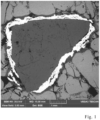
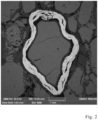
- a white scale at the bottom indicates a length of 1 mm. It should be noted in this respect that the second grains shown in Figures 1 and 2 each have an average grain size of more than 2.8 mm. As far as the grains appear to have a smaller average grain size than 2.8 mm in Figures 1 and 2 , this is due to the fact that the grains have a longitudinal extension away from the cutting plane.
- Figures 1 and 2 show a second grain each in a sintered refractory product according to the respective exemplary embodiments.
- Figure 1 shows a second grain of magnesia coated with calcium zirconate.
- the calcium zirconate coating appears as a light area surrounding a darker area.
- the darker area represents the grain of magnesia, i.e. the "core" of magnesia.
- the second grain shown in Figure 1 is embedded in a matrix of sintered first grains of sintered doloma and sintered magnesia which surround the outer light area of calcium zirconate.
- Figure 2 shows a second grain of doloma coated with calcium zirconate.
- the calcium zirconate coating appears as a light area surrounding a darker area.
- the darker area represents the grain of doloma, i.e. the "core" of doloma.
- the second grain shown in Figure 2 is embedded in a matrix of sintered first grains of sintered doloma and sintered magnesia which surround the outer light area of calcium zirconate.
Landscapes
- Chemical & Material Sciences (AREA)
- Engineering & Computer Science (AREA)
- Ceramic Engineering (AREA)
- Manufacturing & Machinery (AREA)
- Materials Engineering (AREA)
- Structural Engineering (AREA)
- Organic Chemistry (AREA)
- Inorganic Chemistry (AREA)
- Chemical Kinetics & Catalysis (AREA)
- General Chemical & Material Sciences (AREA)
- Compositions Of Oxide Ceramics (AREA)
Claims (15)
- Körner zur Herstellung eines gesinterten feuerfesten Produkts, wobei die Körner die folgenden Merkmale aufweisen:1.1 Die Körner sind aus mindestens einem der folgenden Körner gemacht:1.1.1 Körnern aus Magnesia, wobei ihre Oberfläche zumindest abschnittsweise eine Beschichtung aus Zirkonia aufweist; oder1.1.2 Körnern aus Magnesit, wobei ihre Oberfläche zumindest abschnittsweise eine Beschichtung aus Zirkonia aufweist; oder1.1.3 Körnern aus Doloma, wobei ihre Oberfläche zumindest abschnittsweise eine Beschichtung aus Zirkonia aufweist; oder1.1.4 Körnern aus Dolomit, wobei ihre Oberfläche zumindest abschnittsweise eine Beschichtung aus Zirkonia aufweist;1.2 die Körner haben eine Korngröße von mindestens 2,8 mm.
- Körner gemäß Anspruch 1, wobei die Körner eine Korngröße im Bereich von 2,8 bis 8,0 mm haben.
- Körner gemäß Anspruch 1, wobei der Gewichtsanteil der Beschichtung aus Zirkonia, bezogen auf das Gesamtgewicht der Körner, im Bereich von 1 bis 50 Gewichts-% liegt.
- Körner gemäß Anspruch 1, wobei die Beschichtung aus Zirkonia eine Dicke von mindestens 10 µm hat.
- Körner gemäß Anspruch 1, wobei die Beschichtung aus Zirkonia eine Dicke im Bereich von 10 bis 800 µm hat.
- Versatz zur Herstellung eines gesinterten feuerfesten Produkts, wobei der Versatz Körner umfasst, wobei die Körner die folgenden Merkmale aufweisen:6.1 Die Körner sind aus mindestens einem der folgenden Körner gemacht:6.1.1 Körnern aus Magnesia, wobei ihre Oberfläche zumindest abschnittsweise eine Beschichtung aus Zirkonia aufweist; oder6.1.2 Körnern aus Magnesit, wobei ihre Oberfläche zumindest abschnittsweise eine Beschichtung aus Zirkonia aufweist; oder6.1.3 Körnern aus Doloma, wobei ihre Oberfläche zumindest abschnittsweise eine Beschichtung aus Zirkonia aufweist; oder6.1.4 Körnern aus Dolomit, wobei ihre Oberfläche zumindest abschnittsweise eine Beschichtung aus Zirkonia aufweist;6.2 die Körner haben eine Korngröße von mindestens 2,8 mm.
- Versatz gemäß Anspruch 6, der mindestens 1 Gewichts-% an den Körnern umfasst, bezogen auf das Gesamtgewicht des Versatzes.
- Versatz nach Anspruch 6, der 1 bis 15 Gewichts-% an den Körnern umfasst, bezogen auf das Gesamtgewicht des Versatzes.
- Versatz nach Anspruch 6, der mindestens eine Calciumoxid umfassende Komponente umfasst.
- Versatz nach Anspruch 9, wobei die mindestens eine Calciumoxid umfassende Komponente mindestens eine der folgenden Calciumoxid umfassenden Komponenten ist: Doloma oder Dolomit.
- Versatz nach Anspruch 9, wobei die mindestens eine Calciumoxid umfassende Komponente in Form von Körnern vorliegt.
- Versatz nach Anspruch 6, wobei der Versatz ein Versatz zur Herstellung eines gesinterten feuerfesten Dolomitprodukts ist.
- Versatz nach Anspruch 6, wobei der Versatz eine chemische Zusammensetzung mit MgO im Bereich von 38 bis 90 Massen-% und mit CaO im Bereich von 8 bis 60 hat, wobei es sich bei dem Rest um ZrO2, SiO2, Fe2O3 und Al2O3 handelt.
- Verfahren zur Herstellung eines gesinterten feuerfesten Produkts, wobei das Verfahren die folgenden Schritte umfasst:14.1 Zur Verfügungstellung eines Versatzes, wobei der Versatz Körner umfasst, wobei die Körner die folgenden Merkmale aufweisen:14.1.1 Die Körner sind aus mindestens einem der folgenden Körner gemacht:14.1.1.1 Körnern aus Magnesit, wobei ihre Oberfläche zumindest abschnittsweise eine Beschichtung aus Zirkonia aufweist; oder14.1.1.2 Körnern aus Magnesit, wobei ihre Oberfläche zumindest abschnittsweise eine Beschichtung aus Zirkonia aufweist; oder14.1.1.3 Körnern aus Doloma, wobei ihre Oberfläche zumindest abschnittsweise eine Beschichtung aus Zirkonia aufweist; oder14.1.1.4 Körnern aus Dolomit, wobei ihre Oberfläche zumindest abschnittsweise eine Beschichtung aus Zirkonia aufweist;14.1.2 die Körner haben eine Korngröße von mindestens 2,8 mm.14.2 Brennen des Versatzes, um ein gesintertes feuerfestes Produkt herzustellen.
- Gesintertes feuerfestes Produkt, wobei das Produkt die folgenden Merkmale aufweist:15.1 Das Produkt umfasst Körner, welche miteinander versintert sind;15.2 die Körner umfassen erste Körner und zweite Körner, wobei15.3 die ersten Körner umfassen Calciumoxid umfassende Körner, wobei15.4 die zweiten Körnern wenigstens einer der folgenden Körner sind:15.4.1 Magnesiakörner, deren Oberfläche zumindest abschnittsweise eine Beschichtung aus Calciumzirkonat aufweist; oder15.4.2 Magnesitkörner, deren Oberfläche zumindest abschnittsweise eine Beschichtung aus Calciumzirkonat aufweist; oder15.4.3 Dolomakörner, deren Oberfläche zumindest abschnittsweise eine Beschichtung aus Calciumzirkonat aufweist;und wobei15.5 die zweiten Körner eine Korngröße von mindestens 2,8 mm haben.
Applications Claiming Priority (2)
| Application Number | Priority Date | Filing Date | Title |
|---|---|---|---|
| US16/795,910 US11384021B2 (en) | 2020-02-20 | 2020-02-20 | Grains for the production of a sintered refractory product, a batch for the production of a sintered refractory product, a process for the production of a sintered refractory product and a sintered refractory product |
| PCT/EP2021/053855 WO2021165300A1 (en) | 2020-02-20 | 2021-02-17 | Grains for the production of a sintered refractory product, a batch for the production of a sintered refractory product, a process for the production of a sintered refractory product and a sintered refractory product |
Publications (3)
| Publication Number | Publication Date |
|---|---|
| EP4107136A1 EP4107136A1 (de) | 2022-12-28 |
| EP4107136C0 EP4107136C0 (de) | 2025-04-02 |
| EP4107136B1 true EP4107136B1 (de) | 2025-04-02 |
Family
ID=74672298
Family Applications (1)
| Application Number | Title | Priority Date | Filing Date |
|---|---|---|---|
| EP21706877.4A Active EP4107136B1 (de) | 2020-02-20 | 2021-02-17 | Körner zur herstellung eines gesinterten feuerfesten produkts, charge zur herstellung eines gesinterten feuerfesten produkts, verfahren zur herstellung eines gesinterten feuerfesten produkts und gesintertes feuerfestes produkt |
Country Status (8)
| Country | Link |
|---|---|
| US (1) | US11384021B2 (de) |
| EP (1) | EP4107136B1 (de) |
| JP (1) | JP7746273B2 (de) |
| KR (1) | KR20220141289A (de) |
| CN (1) | CN114945544B (de) |
| ES (1) | ES3031966T3 (de) |
| PL (1) | PL4107136T3 (de) |
| WO (1) | WO2021165300A1 (de) |
Families Citing this family (3)
| Publication number | Priority date | Publication date | Assignee | Title |
|---|---|---|---|---|
| US12384591B2 (en) | 2020-04-20 | 2025-08-12 | Berry Superfos Randers A/S | Package |
| GB202005709D0 (en) | 2020-04-20 | 2020-06-03 | Obrist Closures Switzerland | Jar |
| CN119343325A (zh) | 2022-08-24 | 2025-01-21 | 里弗雷克特里知识产权两合公司 | 用于生产碳化硅涂覆的耐火颗粒的方法及碳化硅涂覆的耐火颗粒 |
Family Cites Families (12)
| Publication number | Priority date | Publication date | Assignee | Title |
|---|---|---|---|---|
| GB2042499A (en) * | 1979-02-23 | 1980-09-24 | Steetley Minerals Ltd | Stabilised dead-burned dolomite |
| US4421799A (en) * | 1982-02-16 | 1983-12-20 | Metco, Inc. | Aluminum clad refractory oxide flame spraying powder |
| DE4403868C2 (de) * | 1994-02-08 | 1995-12-14 | Veitsch Radex Ag | Feuerfeste keramische Masse und deren Verwendung |
| JPH0826860A (ja) * | 1994-07-15 | 1996-01-30 | Mitsubishi Materials Corp | 焼成用治具 |
| CN1176277A (zh) * | 1996-09-06 | 1998-03-18 | 鞍山市腾鳌特区亚新亚耐火材料研究所 | 镁锆轻质喷涂料 |
| JPH11189461A (ja) * | 1997-12-25 | 1999-07-13 | Kurosaki Refract Co Ltd | 高耐食性溶融シリカ含有耐火物 |
| US20050252446A1 (en) * | 2002-08-30 | 2005-11-17 | Mitsui Mining & Semlting Co., Ltd | Electronic component burning jig |
| TW201441177A (zh) * | 2013-03-14 | 2014-11-01 | Vesuvius Crucible Co | 用於耐火元件的氧化鋯系鍍膜及包含此鍍膜的耐火元件 |
| PL2960221T3 (pl) * | 2014-06-26 | 2017-02-28 | Refractory Intellectual Property Gmbh & Co. Kg | Ogniotrwały wyrób ceramiczny |
| HUE045807T2 (hu) * | 2015-10-19 | 2020-01-28 | Saint Gobain Ct Recherches | Ömlesztett spinell-cirkónia szemcsék, valamint ezekbõl a szemcsékbõl nyert hõálló termék |
| CN106977224A (zh) * | 2016-12-23 | 2017-07-25 | 辽宁科技大学 | 一种连铸中间包用镁钙锆质透气上水口耐火材料及其生产方法 |
| CN107162572A (zh) * | 2017-05-19 | 2017-09-15 | 浙江自立新材料股份有限公司 | 一种浇注料用骨料及其制备方法 |
-
2020
- 2020-02-20 US US16/795,910 patent/US11384021B2/en active Active
-
2021
- 2021-02-17 CN CN202180009780.4A patent/CN114945544B/zh active Active
- 2021-02-17 ES ES21706877T patent/ES3031966T3/es active Active
- 2021-02-17 EP EP21706877.4A patent/EP4107136B1/de active Active
- 2021-02-17 PL PL21706877.4T patent/PL4107136T3/pl unknown
- 2021-02-17 WO PCT/EP2021/053855 patent/WO2021165300A1/en not_active Ceased
- 2021-02-17 KR KR1020227025617A patent/KR20220141289A/ko active Pending
- 2021-02-17 JP JP2022544164A patent/JP7746273B2/ja active Active
Also Published As
| Publication number | Publication date |
|---|---|
| PL4107136T3 (pl) | 2025-07-21 |
| CN114945544B (zh) | 2023-11-17 |
| WO2021165300A1 (en) | 2021-08-26 |
| ES3031966T3 (en) | 2025-07-14 |
| EP4107136C0 (de) | 2025-04-02 |
| US11384021B2 (en) | 2022-07-12 |
| CN114945544A (zh) | 2022-08-26 |
| JP7746273B2 (ja) | 2025-09-30 |
| US20210261464A1 (en) | 2021-08-26 |
| JP2023514492A (ja) | 2023-04-06 |
| KR20220141289A (ko) | 2022-10-19 |
| EP4107136A1 (de) | 2022-12-28 |
Similar Documents
| Publication | Publication Date | Title |
|---|---|---|
| CN101384520B (zh) | 耐火的普通陶瓷坯料及用其制备的耐火制品 | |
| EP4107136B1 (de) | Körner zur herstellung eines gesinterten feuerfesten produkts, charge zur herstellung eines gesinterten feuerfesten produkts, verfahren zur herstellung eines gesinterten feuerfesten produkts und gesintertes feuerfestes produkt | |
| US6887810B2 (en) | Synthetic, refractory material for refractory products, and process for producing the product | |
| CA2554301C (en) | Burnt refractory ceramic product and mixture for its manufacture | |
| US11905218B2 (en) | Refractory product, a batch for producing the product, a method for the production of the product and a use of the product | |
| US9212098B2 (en) | Blend for the production of a refractory material, a refractory material, a method for the manufacture of a refractory material, and use of a substance as a sintering aid | |
| US6908871B2 (en) | Batch composition for producing a refractory ceramic shape body, shaped body produced therefrom and the use thereof | |
| EP3868731B1 (de) | Körner zur herstellung eines gesinterten feuerfesten produkts, charge zur herstellung eines gesinterten feuerfesten produkts, verfahren zur herstellung eines gesinterten feuerfesten produkts und gesintertes feuerfestes produkt | |
| CA2379883C (en) | Refractory mixture and elastifier for the same and method for its production | |
| FR2715927A1 (fr) | Masse céramique réfractaire et son utilisation. | |
| US20220396528A1 (en) | Backfill for producing a basic heavy-clay refractory product, such a product and method for producing same, lining of an industrial furnace, and industrial furnace | |
| JPH10203862A (ja) | 高温焼成マグクロ質れんが | |
| RU2541997C1 (ru) | Шихта для изготовления алюможелезистой шпинели и огнеупор с использованием алюможелезистой шпинели | |
| JP3510642B2 (ja) | マグネシアクリンカーおよびその製造法 | |
| JP2599870B2 (ja) | 不定形耐火組成物 | |
| JPH0524911A (ja) | 黒鉛含有MgO−CaO質耐火物 | |
| JPH0925159A (ja) | カルシア耐火物 | |
| JPH02160657A (ja) | CaO含有耐火物 | |
| JPH0925158A (ja) | 塩基性耐火組成物 | |
| JPH0649610B2 (ja) | 耐消化性カルシアクリンカの製造方法 | |
| JPH0647493B2 (ja) | マグネシア・アルミナ系スピネル質原料 | |
| JPH0345026B2 (de) | ||
| MXPA06009151A (en) | Fired refractory ceramic product and a batch for the production thereof | |
| JPH03141179A (ja) | 耐消化性カルシア質耐火物の製造方法 |
Legal Events
| Date | Code | Title | Description |
|---|---|---|---|
| STAA | Information on the status of an ep patent application or granted ep patent |
Free format text: STATUS: UNKNOWN |
|
| STAA | Information on the status of an ep patent application or granted ep patent |
Free format text: STATUS: THE INTERNATIONAL PUBLICATION HAS BEEN MADE |
|
| PUAI | Public reference made under article 153(3) epc to a published international application that has entered the european phase |
Free format text: ORIGINAL CODE: 0009012 |
|
| STAA | Information on the status of an ep patent application or granted ep patent |
Free format text: STATUS: REQUEST FOR EXAMINATION WAS MADE |
|
| 17P | Request for examination filed |
Effective date: 20220610 |
|
| AK | Designated contracting states |
Kind code of ref document: A1 Designated state(s): AL AT BE BG CH CY CZ DE DK EE ES FI FR GB GR HR HU IE IS IT LI LT LU LV MC MK MT NL NO PL PT RO RS SE SI SK SM TR |
|
| DAV | Request for validation of the european patent (deleted) | ||
| DAX | Request for extension of the european patent (deleted) | ||
| GRAP | Despatch of communication of intention to grant a patent |
Free format text: ORIGINAL CODE: EPIDOSNIGR1 |
|
| STAA | Information on the status of an ep patent application or granted ep patent |
Free format text: STATUS: GRANT OF PATENT IS INTENDED |
|
| INTG | Intention to grant announced |
Effective date: 20241025 |
|
| GRAS | Grant fee paid |
Free format text: ORIGINAL CODE: EPIDOSNIGR3 |
|
| GRAA | (expected) grant |
Free format text: ORIGINAL CODE: 0009210 |
|
| STAA | Information on the status of an ep patent application or granted ep patent |
Free format text: STATUS: THE PATENT HAS BEEN GRANTED |
|
| AK | Designated contracting states |
Kind code of ref document: B1 Designated state(s): AL AT BE BG CH CY CZ DE DK EE ES FI FR GB GR HR HU IE IS IT LI LT LU LV MC MK MT NL NO PL PT RO RS SE SI SK SM TR |
|
| REG | Reference to a national code |
Ref country code: GB Ref legal event code: FG4D |
|
| REG | Reference to a national code |
Ref country code: CH Ref legal event code: EP |
|
| REG | Reference to a national code |
Ref country code: IE Ref legal event code: FG4D |
|
| U01 | Request for unitary effect filed |
Effective date: 20250408 |
|
| U07 | Unitary effect registered |
Designated state(s): AT BE BG DE DK EE FI FR IT LT LU LV MT NL PT RO SE SI Effective date: 20250414 |
|
| REG | Reference to a national code |
Ref country code: ES Ref legal event code: FG2A Ref document number: 3031966 Country of ref document: ES Kind code of ref document: T3 Effective date: 20250714 |
|
| REG | Reference to a national code |
Ref country code: SK Ref legal event code: T3 Ref document number: E 46617 Country of ref document: SK |
|
| PG25 | Lapsed in a contracting state [announced via postgrant information from national office to epo] |
Ref country code: GR Free format text: LAPSE BECAUSE OF FAILURE TO SUBMIT A TRANSLATION OF THE DESCRIPTION OR TO PAY THE FEE WITHIN THE PRESCRIBED TIME-LIMIT Effective date: 20250703 Ref country code: NO Free format text: LAPSE BECAUSE OF FAILURE TO SUBMIT A TRANSLATION OF THE DESCRIPTION OR TO PAY THE FEE WITHIN THE PRESCRIBED TIME-LIMIT Effective date: 20250702 |
|
| PG25 | Lapsed in a contracting state [announced via postgrant information from national office to epo] |
Ref country code: HR Free format text: LAPSE BECAUSE OF FAILURE TO SUBMIT A TRANSLATION OF THE DESCRIPTION OR TO PAY THE FEE WITHIN THE PRESCRIBED TIME-LIMIT Effective date: 20250402 |
|
| PG25 | Lapsed in a contracting state [announced via postgrant information from national office to epo] |
Ref country code: RS Free format text: LAPSE BECAUSE OF FAILURE TO SUBMIT A TRANSLATION OF THE DESCRIPTION OR TO PAY THE FEE WITHIN THE PRESCRIBED TIME-LIMIT Effective date: 20250702 |
|
| PG25 | Lapsed in a contracting state [announced via postgrant information from national office to epo] |
Ref country code: IS Free format text: LAPSE BECAUSE OF FAILURE TO SUBMIT A TRANSLATION OF THE DESCRIPTION OR TO PAY THE FEE WITHIN THE PRESCRIBED TIME-LIMIT Effective date: 20250802 |
|
| PG25 | Lapsed in a contracting state [announced via postgrant information from national office to epo] |
Ref country code: SM Free format text: LAPSE BECAUSE OF FAILURE TO SUBMIT A TRANSLATION OF THE DESCRIPTION OR TO PAY THE FEE WITHIN THE PRESCRIBED TIME-LIMIT Effective date: 20250402 |
|
| PG25 | Lapsed in a contracting state [announced via postgrant information from national office to epo] |
Ref country code: CZ Free format text: LAPSE BECAUSE OF FAILURE TO SUBMIT A TRANSLATION OF THE DESCRIPTION OR TO PAY THE FEE WITHIN THE PRESCRIBED TIME-LIMIT Effective date: 20250402 |
|
| PLBE | No opposition filed within time limit |
Free format text: ORIGINAL CODE: 0009261 |
|
| STAA | Information on the status of an ep patent application or granted ep patent |
Free format text: STATUS: NO OPPOSITION FILED WITHIN TIME LIMIT |
|
| REG | Reference to a national code |
Ref country code: CH Ref legal event code: L10 Free format text: ST27 STATUS EVENT CODE: U-0-0-L10-L00 (AS PROVIDED BY THE NATIONAL OFFICE) Effective date: 20260211 |
|
| 26N | No opposition filed |
Effective date: 20260105 |