EP4101523B1 - Vorrichtung zur lagerung von schlamm, system zur herstellung von schlamm und verfahren zur lagerung von schlamm - Google Patents
Vorrichtung zur lagerung von schlamm, system zur herstellung von schlamm und verfahren zur lagerung von schlamm Download PDFInfo
- Publication number
- EP4101523B1 EP4101523B1 EP20917538.9A EP20917538A EP4101523B1 EP 4101523 B1 EP4101523 B1 EP 4101523B1 EP 20917538 A EP20917538 A EP 20917538A EP 4101523 B1 EP4101523 B1 EP 4101523B1
- Authority
- EP
- European Patent Office
- Prior art keywords
- slurry
- value
- storage device
- holding means
- production system
- Prior art date
- Legal status (The legal status is an assumption and is not a legal conclusion. Google has not performed a legal analysis and makes no representation as to the accuracy of the status listed.)
- Active
Links
Images

Classifications
-
- B—PERFORMING OPERATIONS; TRANSPORTING
- B01—PHYSICAL OR CHEMICAL PROCESSES OR APPARATUS IN GENERAL
- B01F—MIXING, e.g. DISSOLVING, EMULSIFYING OR DISPERSING
- B01F25/00—Flow mixers; Mixers for falling materials, e.g. solid particles
- B01F25/50—Circulation mixers, e.g. wherein at least part of the mixture is discharged from and reintroduced into a receptacle
-
- B—PERFORMING OPERATIONS; TRANSPORTING
- B01—PHYSICAL OR CHEMICAL PROCESSES OR APPARATUS IN GENERAL
- B01F—MIXING, e.g. DISSOLVING, EMULSIFYING OR DISPERSING
- B01F23/00—Mixing according to the phases to be mixed, e.g. dispersing or emulsifying
- B01F23/50—Mixing liquids with solids
- B01F23/51—Methods thereof
- B01F23/511—Methods thereof characterised by the composition of the liquids or solids
-
- B—PERFORMING OPERATIONS; TRANSPORTING
- B01—PHYSICAL OR CHEMICAL PROCESSES OR APPARATUS IN GENERAL
- B01F—MIXING, e.g. DISSOLVING, EMULSIFYING OR DISPERSING
- B01F23/00—Mixing according to the phases to be mixed, e.g. dispersing or emulsifying
- B01F23/50—Mixing liquids with solids
- B01F23/53—Mixing liquids with solids using driven stirrers
-
- B—PERFORMING OPERATIONS; TRANSPORTING
- B01—PHYSICAL OR CHEMICAL PROCESSES OR APPARATUS IN GENERAL
- B01F—MIXING, e.g. DISSOLVING, EMULSIFYING OR DISPERSING
- B01F23/00—Mixing according to the phases to be mixed, e.g. dispersing or emulsifying
- B01F23/50—Mixing liquids with solids
- B01F23/59—Mixing systems, i.e. flow charts or diagrams
-
- B—PERFORMING OPERATIONS; TRANSPORTING
- B01—PHYSICAL OR CHEMICAL PROCESSES OR APPARATUS IN GENERAL
- B01F—MIXING, e.g. DISSOLVING, EMULSIFYING OR DISPERSING
- B01F25/00—Flow mixers; Mixers for falling materials, e.g. solid particles
- B01F25/50—Circulation mixers, e.g. wherein at least part of the mixture is discharged from and reintroduced into a receptacle
- B01F25/53—Circulation mixers, e.g. wherein at least part of the mixture is discharged from and reintroduced into a receptacle in which the mixture is discharged from and reintroduced into a receptacle through a recirculation tube, into which an additional component is introduced
-
- B—PERFORMING OPERATIONS; TRANSPORTING
- B01—PHYSICAL OR CHEMICAL PROCESSES OR APPARATUS IN GENERAL
- B01F—MIXING, e.g. DISSOLVING, EMULSIFYING OR DISPERSING
- B01F33/00—Other mixers; Mixing plants; Combinations of mixers
- B01F33/40—Mixers using gas or liquid agitation, e.g. with air supply tubes
- B01F33/402—Mixers using gas or liquid agitation, e.g. with air supply tubes comprising supplementary stirring elements
-
- B—PERFORMING OPERATIONS; TRANSPORTING
- B01—PHYSICAL OR CHEMICAL PROCESSES OR APPARATUS IN GENERAL
- B01F—MIXING, e.g. DISSOLVING, EMULSIFYING OR DISPERSING
- B01F33/00—Other mixers; Mixing plants; Combinations of mixers
- B01F33/40—Mixers using gas or liquid agitation, e.g. with air supply tubes
- B01F33/407—Mixers using gas or liquid agitation, e.g. with air supply tubes by blowing gas on the material from above
-
- B—PERFORMING OPERATIONS; TRANSPORTING
- B01—PHYSICAL OR CHEMICAL PROCESSES OR APPARATUS IN GENERAL
- B01F—MIXING, e.g. DISSOLVING, EMULSIFYING OR DISPERSING
- B01F35/00—Accessories for mixers; Auxiliary operations or auxiliary devices; Parts or details of general application
- B01F35/20—Measuring; Control or regulation
- B01F35/21—Measuring
- B01F35/211—Measuring of the operational parameters
- B01F35/2113—Pressure
-
- B—PERFORMING OPERATIONS; TRANSPORTING
- B01—PHYSICAL OR CHEMICAL PROCESSES OR APPARATUS IN GENERAL
- B01F—MIXING, e.g. DISSOLVING, EMULSIFYING OR DISPERSING
- B01F35/00—Accessories for mixers; Auxiliary operations or auxiliary devices; Parts or details of general application
- B01F35/20—Measuring; Control or regulation
- B01F35/22—Control or regulation
- B01F35/221—Control or regulation of operational parameters, e.g. level of material in the mixer, temperature or pressure
- B01F35/2213—Pressure
-
- B—PERFORMING OPERATIONS; TRANSPORTING
- B01—PHYSICAL OR CHEMICAL PROCESSES OR APPARATUS IN GENERAL
- B01F—MIXING, e.g. DISSOLVING, EMULSIFYING OR DISPERSING
- B01F35/00—Accessories for mixers; Auxiliary operations or auxiliary devices; Parts or details of general application
- B01F35/20—Measuring; Control or regulation
- B01F35/22—Control or regulation
- B01F35/221—Control or regulation of operational parameters, e.g. level of material in the mixer, temperature or pressure
- B01F35/2215—Temperature
-
- B—PERFORMING OPERATIONS; TRANSPORTING
- B01—PHYSICAL OR CHEMICAL PROCESSES OR APPARATUS IN GENERAL
- B01F—MIXING, e.g. DISSOLVING, EMULSIFYING OR DISPERSING
- B01F35/00—Accessories for mixers; Auxiliary operations or auxiliary devices; Parts or details of general application
- B01F35/71—Feed mechanisms
- B01F35/717—Feed mechanisms characterised by the means for feeding the components to the mixer
- B01F35/7173—Feed mechanisms characterised by the means for feeding the components to the mixer using gravity, e.g. from a hopper
- B01F35/71731—Feed mechanisms characterised by the means for feeding the components to the mixer using gravity, e.g. from a hopper using a hopper
-
- B—PERFORMING OPERATIONS; TRANSPORTING
- B01—PHYSICAL OR CHEMICAL PROCESSES OR APPARATUS IN GENERAL
- B01F—MIXING, e.g. DISSOLVING, EMULSIFYING OR DISPERSING
- B01F35/00—Accessories for mixers; Auxiliary operations or auxiliary devices; Parts or details of general application
- B01F35/71—Feed mechanisms
- B01F35/717—Feed mechanisms characterised by the means for feeding the components to the mixer
- B01F35/7176—Feed mechanisms characterised by the means for feeding the components to the mixer using pumps
-
- B—PERFORMING OPERATIONS; TRANSPORTING
- B01—PHYSICAL OR CHEMICAL PROCESSES OR APPARATUS IN GENERAL
- B01F—MIXING, e.g. DISSOLVING, EMULSIFYING OR DISPERSING
- B01F35/00—Accessories for mixers; Auxiliary operations or auxiliary devices; Parts or details of general application
- B01F35/71—Feed mechanisms
- B01F35/717—Feed mechanisms characterised by the means for feeding the components to the mixer
- B01F35/71805—Feed mechanisms characterised by the means for feeding the components to the mixer using valves, gates, orifices or openings
-
- B—PERFORMING OPERATIONS; TRANSPORTING
- B01—PHYSICAL OR CHEMICAL PROCESSES OR APPARATUS IN GENERAL
- B01F—MIXING, e.g. DISSOLVING, EMULSIFYING OR DISPERSING
- B01F35/00—Accessories for mixers; Auxiliary operations or auxiliary devices; Parts or details of general application
- B01F35/90—Heating or cooling systems
-
- B—PERFORMING OPERATIONS; TRANSPORTING
- B01—PHYSICAL OR CHEMICAL PROCESSES OR APPARATUS IN GENERAL
- B01J—CHEMICAL OR PHYSICAL PROCESSES, e.g. CATALYSIS OR COLLOID CHEMISTRY; THEIR RELEVANT APPARATUS
- B01J19/00—Chemical, physical or physico-chemical processes in general; Their relevant apparatus
- B01J19/0053—Details of the reactor
- B01J19/0066—Stirrers
-
- B—PERFORMING OPERATIONS; TRANSPORTING
- B01—PHYSICAL OR CHEMICAL PROCESSES OR APPARATUS IN GENERAL
- B01J—CHEMICAL OR PHYSICAL PROCESSES, e.g. CATALYSIS OR COLLOID CHEMISTRY; THEIR RELEVANT APPARATUS
- B01J19/00—Chemical, physical or physico-chemical processes in general; Their relevant apparatus
- B01J19/18—Stationary reactors having moving elements inside
-
- B—PERFORMING OPERATIONS; TRANSPORTING
- B01—PHYSICAL OR CHEMICAL PROCESSES OR APPARATUS IN GENERAL
- B01J—CHEMICAL OR PHYSICAL PROCESSES, e.g. CATALYSIS OR COLLOID CHEMISTRY; THEIR RELEVANT APPARATUS
- B01J8/00—Chemical or physical processes in general, conducted in the presence of fluids and solid particles; Apparatus for such processes
- B01J8/0015—Feeding of the particles in the reactor; Evacuation of the particles out of the reactor
- B01J8/004—Feeding of the particles in the reactor; Evacuation of the particles out of the reactor by means of a nozzle
-
- B—PERFORMING OPERATIONS; TRANSPORTING
- B65—CONVEYING; PACKING; STORING; HANDLING THIN OR FILAMENTARY MATERIAL
- B65D—CONTAINERS FOR STORAGE OR TRANSPORT OF ARTICLES OR MATERIALS, e.g. BAGS, BARRELS, BOTTLES, BOXES, CANS, CARTONS, CRATES, DRUMS, JARS, TANKS, HOPPERS, FORWARDING CONTAINERS; ACCESSORIES, CLOSURES, OR FITTINGS THEREFOR; PACKAGING ELEMENTS; PACKAGES
- B65D81/00—Containers, packaging elements, or packages, for contents presenting particular transport or storage problems, or adapted to be used for non-packaging purposes after removal of contents
- B65D81/18—Containers, packaging elements, or packages, for contents presenting particular transport or storage problems, or adapted to be used for non-packaging purposes after removal of contents providing specific environment for contents, e.g. temperature above or below ambient
-
- B—PERFORMING OPERATIONS; TRANSPORTING
- B65—CONVEYING; PACKING; STORING; HANDLING THIN OR FILAMENTARY MATERIAL
- B65D—CONTAINERS FOR STORAGE OR TRANSPORT OF ARTICLES OR MATERIALS, e.g. BAGS, BARRELS, BOTTLES, BOXES, CANS, CARTONS, CRATES, DRUMS, JARS, TANKS, HOPPERS, FORWARDING CONTAINERS; ACCESSORIES, CLOSURES, OR FITTINGS THEREFOR; PACKAGING ELEMENTS; PACKAGES
- B65D90/00—Component parts, details or accessories for large containers
-
- B—PERFORMING OPERATIONS; TRANSPORTING
- B65—CONVEYING; PACKING; STORING; HANDLING THIN OR FILAMENTARY MATERIAL
- B65D—CONTAINERS FOR STORAGE OR TRANSPORT OF ARTICLES OR MATERIALS, e.g. BAGS, BARRELS, BOTTLES, BOXES, CANS, CARTONS, CRATES, DRUMS, JARS, TANKS, HOPPERS, FORWARDING CONTAINERS; ACCESSORIES, CLOSURES, OR FITTINGS THEREFOR; PACKAGING ELEMENTS; PACKAGES
- B65D90/00—Component parts, details or accessories for large containers
- B65D90/22—Safety features
- B65D90/32—Arrangements for preventing, or minimising the effect of, excessive or insufficient pressure
-
- H—ELECTRICITY
- H01—ELECTRIC ELEMENTS
- H01M—PROCESSES OR MEANS, e.g. BATTERIES, FOR THE DIRECT CONVERSION OF CHEMICAL ENERGY INTO ELECTRICAL ENERGY
- H01M4/00—Electrodes
- H01M4/02—Electrodes composed of, or comprising, active material
- H01M4/13—Electrodes for accumulators with non-aqueous electrolyte, e.g. for lithium-accumulators; Processes of manufacture thereof
- H01M4/139—Processes of manufacture
-
- H—ELECTRICITY
- H01—ELECTRIC ELEMENTS
- H01M—PROCESSES OR MEANS, e.g. BATTERIES, FOR THE DIRECT CONVERSION OF CHEMICAL ENERGY INTO ELECTRICAL ENERGY
- H01M4/00—Electrodes
- H01M4/02—Electrodes composed of, or comprising, active material
- H01M4/36—Selection of substances as active materials, active masses, active liquids
- H01M4/48—Selection of substances as active materials, active masses, active liquids of inorganic oxides or hydroxides
- H01M4/52—Selection of substances as active materials, active masses, active liquids of inorganic oxides or hydroxides of nickel, cobalt or iron
- H01M4/525—Selection of substances as active materials, active masses, active liquids of inorganic oxides or hydroxides of nickel, cobalt or iron of mixed oxides or hydroxides containing iron, cobalt or nickel for inserting or intercalating light metals, e.g. LiNiO2, LiCoO2 or LiCoOxFy
-
- B—PERFORMING OPERATIONS; TRANSPORTING
- B01—PHYSICAL OR CHEMICAL PROCESSES OR APPARATUS IN GENERAL
- B01F—MIXING, e.g. DISSOLVING, EMULSIFYING OR DISPERSING
- B01F35/00—Accessories for mixers; Auxiliary operations or auxiliary devices; Parts or details of general application
- B01F35/90—Heating or cooling systems
- B01F2035/98—Cooling
-
- B—PERFORMING OPERATIONS; TRANSPORTING
- B01—PHYSICAL OR CHEMICAL PROCESSES OR APPARATUS IN GENERAL
- B01F—MIXING, e.g. DISSOLVING, EMULSIFYING OR DISPERSING
- B01F35/00—Accessories for mixers; Auxiliary operations or auxiliary devices; Parts or details of general application
- B01F35/90—Heating or cooling systems
- B01F2035/99—Heating
-
- B—PERFORMING OPERATIONS; TRANSPORTING
- B01—PHYSICAL OR CHEMICAL PROCESSES OR APPARATUS IN GENERAL
- B01F—MIXING, e.g. DISSOLVING, EMULSIFYING OR DISPERSING
- B01F2101/00—Mixing characterised by the nature of the mixed materials or by the application field
- B01F2101/59—Mixing reaction ingredients for fuel cells
-
- B—PERFORMING OPERATIONS; TRANSPORTING
- B01—PHYSICAL OR CHEMICAL PROCESSES OR APPARATUS IN GENERAL
- B01J—CHEMICAL OR PHYSICAL PROCESSES, e.g. CATALYSIS OR COLLOID CHEMISTRY; THEIR RELEVANT APPARATUS
- B01J2208/00—Processes carried out in the presence of solid particles; Reactors therefor
- B01J2208/00008—Controlling the process
- B01J2208/00592—Controlling the pH
-
- B—PERFORMING OPERATIONS; TRANSPORTING
- B01—PHYSICAL OR CHEMICAL PROCESSES OR APPARATUS IN GENERAL
- B01J—CHEMICAL OR PHYSICAL PROCESSES, e.g. CATALYSIS OR COLLOID CHEMISTRY; THEIR RELEVANT APPARATUS
- B01J2208/00—Processes carried out in the presence of solid particles; Reactors therefor
- B01J2208/00743—Feeding or discharging of solids
- B01J2208/00769—Details of feeding or discharging
- B01J2208/00787—Bringing the solid in the form of a slurry before feeding it to the reactor
-
- Y—GENERAL TAGGING OF NEW TECHNOLOGICAL DEVELOPMENTS; GENERAL TAGGING OF CROSS-SECTIONAL TECHNOLOGIES SPANNING OVER SEVERAL SECTIONS OF THE IPC; TECHNICAL SUBJECTS COVERED BY FORMER USPC CROSS-REFERENCE ART COLLECTIONS [XRACs] AND DIGESTS
- Y02—TECHNOLOGIES OR APPLICATIONS FOR MITIGATION OR ADAPTATION AGAINST CLIMATE CHANGE
- Y02E—REDUCTION OF GREENHOUSE GAS [GHG] EMISSIONS, RELATED TO ENERGY GENERATION, TRANSMISSION OR DISTRIBUTION
- Y02E60/00—Enabling technologies; Technologies with a potential or indirect contribution to GHG emissions mitigation
- Y02E60/10—Energy storage using batteries
-
- Y—GENERAL TAGGING OF NEW TECHNOLOGICAL DEVELOPMENTS; GENERAL TAGGING OF CROSS-SECTIONAL TECHNOLOGIES SPANNING OVER SEVERAL SECTIONS OF THE IPC; TECHNICAL SUBJECTS COVERED BY FORMER USPC CROSS-REFERENCE ART COLLECTIONS [XRACs] AND DIGESTS
- Y02—TECHNOLOGIES OR APPLICATIONS FOR MITIGATION OR ADAPTATION AGAINST CLIMATE CHANGE
- Y02P—CLIMATE CHANGE MITIGATION TECHNOLOGIES IN THE PRODUCTION OR PROCESSING OF GOODS
- Y02P70/00—Climate change mitigation technologies in the production process for final industrial or consumer products
- Y02P70/50—Manufacturing or production processes characterised by the final manufactured product
Definitions
- the present invention relates to a slurry storage device, a slurry production system, and a slurry storage method. More specifically, the present invention relates to the slurry storage device, the slurry production system, and the slurry storage method for an aqueous slurry containing a high nickel material.
- a lithium ion secondary battery having a high energy density, a high operating voltage, and being capable of downsizing and weight saving is widely used.
- the lithium ion secondary battery is a secondary battery (storage battery) that uses lithium ion as an ion responsible for electrical conduction, and means a power storage device called, for example, a lithium ion battery, a lithium secondary battery, a lithium all-solid-state battery, a lithium polymer battery, a lithium gel battery, or the like.
- a lithium transition metal composite oxide containing a transition metal such as nickel, cobalt, and manganese is known.
- a material having a particularly high nickel content is called a high nickel material, and is attracting attention as a positive electrode active material capable of stably extracting a high electric capacity.
- PTL 1 describes an aqueous slurry in which an aqueous solution containing a specific binder component and an electrochemically activating compound (containing a positive electrode active material) are mixed as a slurry for producing an electrode.
- the prepared slurry may be temporarily stored and then subjected to the coating process.
- the present inventors have found that, in particular, when storing an aqueous slurry containing a high nickel material, the pH value of the slurry rises with the passage of time, and the physical properties of the slurry deteriorate.
- the pH value of the slurry rises, there is a problem that the current collector coated with the slurry is corroded in the coating process, which is a next process.
- the coating itself on the current collector is difficult due to the deterioration of the physical properties of the slurry.
- An object of the present invention is to provide a slurry storage device, a slurry production system, and a slurry storage method capable of appropriately storing an aqueous slurry containing a particularly high nickel material among aqueous slurries.
- aqueous slurry particularly containing a high nickel material among the aqueous slurries can be appropriately stored by providing pH value rise suppressing means for suppressing a rise in the pH value of the slurry with respect to holding means for holding the slurry.
- the present invention is a slurry storage device, a slurry production system, and a slurry storage method as follows.
- a slurry production system including a dispersion device configured to transfer an aqueous slurry containing a high nickel material prepared by a dispersion unit to a stirring tank and circulate the aqueous slurry between the stirring tank and the dispersion unit; and a slurry storage device configured to store the aqueous slurry prepared by the dispersion device before the aqueous slurry is subjected to a coating process, in which the slurry storage device includes a holding means configured to hold the aqueous slurry, and a pH value rise suppressing means configured to suppress a rise in a pH value of the aqueous slurry.
- the pH value rise suppressing means that suppresses the rise in the pH value of the aqueous slurry containing the high nickel material, it is possible to suppress alkalization (pH value rise) of the aqueous slurry containing the high nickel material held in the holding means due to a time-dependent change and suppress deterioration of the physical properties of the slurry. As a result, it is possible to stably store the aqueous slurry containing the high nickel material for a long period of time.
- the pH value rise suppressing means includes a pressurizing means using supply of a pressurized gas.
- the slurry in the holding means is alkalized by coming into contact with the moisture in the outside air.
- the slurry in the holding means does not react with the moisture in the outside air, the rise in the pH value of the slurry can be easily suppressed, and the stable storage of the aqueous slurry containing the high nickel material can be easily performed.
- the pressurized gas supplied by the pressurizing means is a gas containing carbon dioxide (carbon dioxide gas) .
- a neutralization reaction (2LiOH + CO 2 ⁇ Li 2 CO 3 + H 2 O) occurs between the acid component generated by dissolving carbon dioxide (carbon dioxide gas, CO 2 ) in water and the alkaline component in the slurry on the surface of the slurry contained in the holding means.
- carbon dioxide gas, CO 2 carbon dioxide gas
- the pH value rise suppressing means includes a dry air supply means that supplies dry air.
- the pH value rise suppressing means includes a decompression means.
- the gas component in the holding means can be removed by reducing the pressure in the holding means.
- the gas component it is possible to reduce the moisture in the gas in the holding means.
- the reaction between the slurry and the moisture in the holding means can be suppressed, the rise in the pH value of the slurry can be easily suppressed, and the stable storage of the aqueous slurry containing the high nickel material can be easily performed.
- a slurry production system including the above-described slurry storage device; and a dispersion device that prepares an aqueous slurry containing a high nickel material.
- the slurry prepared by the dispersion device can be stably stored in a state where alkalization and deterioration of physical properties of the slurry are suppressed until the slurry is transferred to the next process (coating process).
- the slurry is transferred to the next process (coating process).
- a slurry storage method of storing an aqueous slurry containing a high nickel material prepared by a dispersion device which mixes a powder and a solvent the method including a holding step of holding the aqueous slurry containing the high nickel material, and a pH value rise suppressing step of suppressing a rise in a pH value of the aqueous slurry containing the high nickel material.
- the pH value rise suppressing step of suppressing the rise in the pH value of the aqueous slurry containing the high nickel material it is possible to suppress alkalization of the aqueous slurry containing the high nickel material held by the holding step due to a time-dependent change and suppress deterioration of the physical properties of the slurry. As a result, it is possible to stably store the aqueous slurry containing the high nickel material for a long period of time.
- a slurry storage device capable of appropriately storing an aqueous slurry containing a particularly high nickel material among the aqueous slurries.
- the slurry storage device and the slurry production system described in the embodiment are merely exemplified for describing the slurry storage device and the slurry production system according to the present invention, and the present invention is not limited thereto.
- the slurry storage method of the present invention is replaced with the following description of a structure and operation of the slurry storage device.
- Slurry S to be stored in the present invention is an aqueous slurry containing a lithium transition metal composite oxide used as a positive electrode active material for a lithium ion secondary battery.
- examples thereof include an aqueous slurry containing a so-called high nickel material having a particularly high nickel content in a transition metal composite oxide containing lithium.
- the high nickel material means a layered oxide-based material containing lithium in which Ni exceeds 0.5 in a case where the transition metal element in the positive electrode active material is 1.
- a positive electrode active material having Ni of less than 0.5 is produced by firing in air using lithium carbonate, a transition metal hydroxide or the like as raw materials. Therefore, the positive electrode active material contains substantially no lithium hydroxide having high reactivity.
- a positive electrode active material with Ni of 0.5 or more is produced by firing in oxygen using highly reactive lithium hydroxide, transition metal hydroxides, transition metal oxyhydroxides or the like as raw materials. Therefore, the positive electrode active material contains a large amount of highly reactive lithium hydroxide.
- a positive electrode active material having Ni of 0.5 or more is likely to generate lithium hydroxide by a proton exchange reaction. Therefore, it is considered that such a high nickel material is likely to be alkalized with the passage of time during storage in a case where the high nickel material is prepared as an aqueous slurry using water as a solvent or a dispersion medium.
- Examples of the high nickel material include LiNiO 2 , Li (Ni 0.6 Co 0.4 )O 2 , Li (Ni 0.8 Co 0.2 )O 2 , Li(Ni 0.8 Co 0.15 Al 0.05 )O 2 , Li(Ni 0.6 Co 0.2 Mn 0.2 )O 2 , Li(Ni 0.8 Co 0.1 Mn 0.1 )O 2 , Li(Ni 0.9 Co 0.05 Mn 0.05 )O 2 , and the like.
- Examples thereof include a material in which another alkali metal atom replaces a part of the lithium atom site, a material in which a fluorine atom replaces a part of the oxygen atom site of a high nickel material, a material in which an aluminum atom replaces a part of the transition metal atom sites of a high nickel material, and the like.
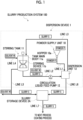
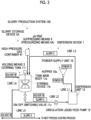
- Fig. 1 is a schematic explanatory view illustrating a structure of a slurry production system according to the first embodiment of the present invention.
- a slurry production system 100 is provided with a dispersion device 1 and a slurry storage device 2A.
- the slurry S is first prepared in the dispersion device 1, and then the prepared slurry S is stored in the slurry storage device 2A. Thereafter, the stored slurry S is transferred from the slurry storage device 2A to a place where the next process is performed according to the timing when the next process (mainly the coating process) is performed.
- the dispersion device 1 may be any device as long as a device can prepare an aqueous slurry containing a high nickel material as the slurry S, and the details of the device configuration are not particularly limited.
- the dispersion device 1 in the present embodiment refers to a device capable of mixing at least a solid (powder) and a liquid (solvent) to prepare a slurry which is a mixture of a granular solid matter and a liquid, and also includes a device called a mixing device, a kneading device, and the like.
- the dispersion device 1 in the present embodiment has a configuration capable of mixing a gas as well. As a result, it is possible to suppress the alkalization of the slurry S at the time of preparation.
- Examples of the raw material of the slurry S to be charged into the dispersion device 1 include powder of a positive electrode active material used in a lithium ion secondary battery (hereinafter, simply referred to as a "powder P"), solvent W (water), a binder, a conductive material, and the like.
- a positive electrode active material it is preferable to use a lithium transition metal composite oxide known as a high nickel material.
- the binder, the conductive material and the like are appropriately used as needed, and the specific substance is not particularly limited. A known substance can be used in the preparation of the aqueous slurry.
- a gas such as carbon dioxide (carbon dioxide gas) or an inert gas may be supplied to the dispersion device 1.
- a gas containing carbon dioxide (carbon dioxide gas) to the dispersion device 1.
- carbon dioxide gas More preferably, it is preferable to supply only carbon dioxide (carbon dioxide gas) to the dispersion device 1.
- the high nickel material is not contained, lithium hydroxide is not contained in the slurry. Therefore, by supplying carbon dioxide (carbon dioxide gas), the pH value of the aqueous slurry is low (pH value is less than 5), and the transition metal may be dissolved with acid. In the slurry in which the transition metal is dissolved in this manner, the metal may re-precipitate during charging and discharging. In addition, it is not preferable because the discharge capacity of the positive electrode active material is small and stable cycle characteristics cannot be obtained.
- carbon dioxide carbon dioxide gas
- the pH value is an index indicating the hydrogen ion concentration. That is, in a case where the pH value is less than 7, it is acidic, and in a case where the pH value exceeds 7, it is alkaline.
- the pH value is a value measured by a pH meter, but as another method, the pH value may be determined by an indicator method or the like.
- Fig. 1 illustrates the dispersion device 1 including a powder supply unit 10, a stirring tank 11, a circulation liquid feed pump 12, and a dispersion unit 13.
- the dispersion device 1 illustrated in Fig. 1 illustrates an example of the dispersion device 1 in the present embodiment, and is not limited to the configuration illustrated in Fig. 1 .
- the powder supply unit 10 charges a solid component (powder P) of the raw materials of the slurry S into the dispersion unit 13.
- a known structure can be used in the dispersion device for charging the solid component, and the structure is not particularly limited.
- a hopper 10a having an upper opening portion and a lower opening portion may be provided and installed so that the powder P is charged from the upper opening portion and is supplied from the lower opening portion to the dispersion unit 13 via a line L1.
- various incidental mechanisms may be provided on the powder supply unit 10 and the line L1.
- an incidental mechanism include a stirring mechanism for stirring the powder P in the powder supply unit 10, a quantitative supply mechanism for quantitatively supplying the powder P from the powder supply unit 10 to the dispersion unit 13, a vibrator or a kicker for removing the powder P adhering to the powder supply unit 10, and the like.
- the stirring tank 11 supplies the liquid component (solvent W) of the raw materials of the slurry S to the dispersion unit 13.
- the stirring tank 11 is connected to the dispersion unit 13 in a circulatable manner and stores the prepared slurry S.
- a known structure for supplying the liquid component and storing the slurry in the dispersion device can be used, and is not particularly limited.
- a tank main body 11a and a stirring device 11b inside the tank main body 11a are provided and are connected to the dispersion unit 13 in a circulatable manner via a line L2 and a line L3.
- the tank main body 11a may be provided with a line L4 for supplying the solvent W (water) from the outside and a line L5 for exhausting the contents (solvent W or slurry S) in the tank main body 11a to the outside of the system.
- the stirring tank 11 can be used also as holding means 3 of the slurry storage device 2A. A description of common use of the holding means 3 of the slurry storage device 2A and the stirring tank 11 will be described later.
- the circulation liquid feed pump 12 is for controlling the flow directions of the solvent W and the slurry S in the dispersion device 1 and regulating the flow rate.
- a pump capable of sucking the solvent W and the slurry S in the stirring tank 11 and delivering the solvent W and the slurry S toward the dispersion unit 13 may be provided on the line L2.
- the solvent W and the slurry S circulate between the stirring tank 11 and the dispersion unit 13, and the dispersion treatment in the dispersion unit 13 can be repeated, so that it is possible to homogenize the dispersion of the powder P with respect to the solvent W.
- the dispersion unit 13 is for preparing a slurry S by mixing and dispersing a solid component (powder P) and a liquid component (solvent W).
- the dispersion unit 13 one having a configuration that disperses by ultrasonic waves, one having a configuration that disperses by shearing force, such as a planetary mixer and a twin-screw kneader, one having a configuration that disperses by cavitation and shearing force, and the like may be used.
- a kneading process is not required and excessive pulverization of the positive electrode active material is unlikely to occur
- examples of those that disperse by cavitation and shearing force include "JET PASTER (registered trademark)" manufactured by Nihon Spindle Manufacturing Co., Ltd. as a commercially available product.
- the powder P and the solvent W are supplied to the dispersion unit 13 from the powder supply unit 10 and the stirring tank 11 via the lines L1 and L2.
- Means for supplying a binder, a conductive material, or the like to the dispersion unit 13 is not particularly limited.
- it may be supplied together with the powder P from the powder supply unit 10 via the line L1, or supplied to the stirring tank 11 and mixed with the solvent W and then supplied via the line L2.
- the slurry S prepared in the dispersion unit 13 may be circulated to the stirring tank 11 via the line L3, or may be supplied to the slurry storage device 2A via the line L6.
- the slurry S in the stirring tank 11 may also be circulated to the dispersion unit 13 via the line L2, or may be supplied to the slurry storage device 2A by branching a part of the line L2 or the line L5.
- the determination regarding a supply destination of the slurry S can be appropriately performed according to the preparation amount and preparation conditions of the slurry S.
- the supply destination of the slurry S may be determined based on the driving time of the dispersion unit 13, the input amount of the powder P, and the like.
- the determination regarding the supply destination of the slurry S and the switching of the supply destination based on the determination may be performed manually by a worker, and may be executed by a control unit including a CPU or a circuit for executing the program.
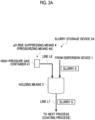
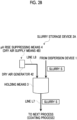
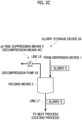
- Figs. 2A to 2C are schematic explanatory views illustrating the structure of the slurry storage device according to the first embodiment of the present invention.
- the slurry storage device 2A is provided with holding means 3 for holding the slurry S and a pH value rise suppressing means 4 for suppressing a rise in the pH value of the slurry S.
- the slurry storage device 2A of the present embodiment is for containing and storing the slurry S prepared by the dispersion device 1. When the storage period is over, the slurry S is transferred to the next process (coating process) via the line L7 provided in the holding means 3.
- the holding means 3 has a space for holding the slurry S, and preferably has a sealable structure having chemical resistance and pressure resistance.
- the specific structure of the holding means 3 is not particularly limited.
- Examples of the holding means 3 include a bottomed tubular structure or a tubular structure having a lid portion that can be sealed and having chemical resistance and pressure resistance.
- the holding means 3 may be provided with various incidental mechanisms.
- a stirring mechanism may be provided in the holding means 3 so that the slurry S can be stirred.
- the contact efficiency between the gas (particularly carbon dioxide (carbon dioxide gas)) supplied by the pH value rise suppressing means 4 described later and the slurry S can be increased, and the pH value rise suppressing effect due to the neutralization reaction or the like can be enhanced.
- a temperature control mechanism may be provided in the holding means 3 to control the temperature suitable for storing the slurry S.
- a temperature control mechanism for example, a heating mechanism may be provided.
- the pH value rise suppressing means 4 is for suppressing the rise in the pH value of the slurry S and suppressing the alkalization of the slurry S.
- the pH value rise suppressing means 4 is not particularly limited as long as means can suppress the alkalization of the slurry S. However, when a pH value regulating agent is added as the pH value rise suppressing means 4, the physical properties and composition of the slurry S may be affected. Therefore, as the pH value rise suppressing means 4, it is preferable to use a means other than adding the pH value regulating agent.
- the pH value of the slurry S is preferably 11 or less, more preferably 10 or less, by the pH value rise suppressing means 4.
- examples of the pH value rise suppressing means 4 of the present embodiment include those provided with a pressurizing means 4A using supply of the pressurized gas.
- the pressurizing means 4A may be any device as long as means can supply a pressurized gas and increase the pressure in the holding means 3 via the line L8, and the specific configuration is not particularly limited.
- gas may be supplied directly into the holding means 3 from a high-pressure gas container (cylinder) 41 or the like, or a pressure pump may be provided to supply gas into the holding means 3.
- the slurry S in the holding means 3 is alkalized by coming into contact with the moisture in the outside air. Therefore, by supplying the pressurized gas by the pressurizing means 4A and making the inside of the holding means 3 positive pressure, it is possible to suppress the inflow of outside air into the holding means 3. As a result, the slurry S in the holding means 3 does not react with the moisture in the outside air, and the rise in the pH value of the slurry S can be suppressed.
- the value of the pressure in the holding means 3 boosted by the pressurizing means 4A is not particularly limited, and can be appropriately set according to the expression conditions of the desired effect, the aspect of use, and the like.
- the lower limit of the pressure value is preferably 0.05 MPa (gauge pressure, the same applies hereinafter) or more, and more preferably 0.1 MPa or more.
- the upper limit of the pressure value is preferably 0.6 MPa or less, and more preferably 0.5 MPa or less.
- Examples of the pressurized gas supplied by the pressurizing means 4A include an inert gas such as nitrogen gas and argon gas, and a gas showing acidity when dissolved in water such as carbon dioxide (carbon dioxide gas).
- an inert gas such as nitrogen gas and argon gas
- a gas showing acidity when dissolved in water such as carbon dioxide (carbon dioxide gas).
- the pressurizing means 4A of the present embodiment it is preferable to use carbon dioxide (carbon dioxide gas) as the pressurized gas.
- carbon dioxide carbon dioxide gas
- the solvent W of the slurry S is water
- carbon dioxide (carbonic dioxide gas) dissolves in water on the surface of the slurry S contained in the holding means 3 to generate an acid component (carbonic acid) . Therefore, on the surface of the slurry S contained in the holding means 3, a neutralization reaction between the alkaline component such as lithium hydroxide and the acid component (carbonic acid) in the slurry S occurs. As a result, it is possible to more reliably suppress the alkalization of the slurry S.
- carbon dioxide carbon dioxide gas
- examples of another aspect of the pH value rise suppressing means 4 of the present embodiment include those provided with a dry air supply means 4B for supplying dry air.
- the dry air supply means 4B is not particularly limited as long as means can supply air (dry air) having a low moisture content (humidity) into the holding means 3.
- a dry air generator 42 capable of generating air from which the moisture is removed may be used.
- the specific configuration of the dry air generator 42 is not particularly limited, and a known generator may be used.
- the dry air supply means 4B as the pH value rise suppressing means 4
- the moisture in the gas in the holding means 3 can be reduced.
- the reaction between the slurry S and the moisture in the gas in the holding means 3 can be suppressed, and the rise in the pH value of the slurry S can be suppressed.
- the dry air does not need to be supplied in a pressurized state, but the pressurized dry air may be supplied. As a result, the effect related to the pressurizing means 4A can also be obtained.
- examples of another aspect of the pH value rise suppressing means 4 of the present embodiment include those provided with a decompression means 4C.
- the decompression means 4C is not particularly limited as long as means can reduce the pressure in the holding means 3.
- Examples of the decompression means 4C include providing a decompression pump 43 for the holding means 3.
- the value of the pressure in the holding means 3 decompressed by the decompression means 4C is not particularly limited, and can be appropriately set according to the expression conditions of the desired effect, the aspect of use, and the like.
- the pressure value is preferably - 0.07 MPa or less.
- the pressure in the holding means 3 is a negative pressure, so that it is possible to reduce the moisture in the gas in the holding means 3.
- the reaction between the slurry S and the moisture in the gas in the holding means 3 can be suppressed, and the rise in the pH value of the slurry S can be suppressed.
- the holding means 3 in the slurry storage device 2A of the present embodiment is not limited to the one provided independently of the dispersion device 1 as illustrated in Figs. 1 and 2A to 2C .
- the configuration (stirring tank 11) in the dispersion device 1 may also have the function of the holding means 3.
- Fig. 3 is a schematic explanatory view illustrating the stirring tank 11 in the dispersion device 1 also having the function of the holding means 3, as another aspect of the slurry production system 100 and the slurry storage device 2A.
- Fig. 3 illustrates the stirring tank 11 provided with the pressurizing means 4A as the pH value rise suppressing means 4, but any of the above-described pH value rise suppressing means 4 may be applied, and is not particularly limited.
- an on/off switching valve 11c is provided on the line L2 connected to the stirring tank 11 of the dispersion device 1, and when the slurry S is prepared, the on/off switching valve 11c is opened to form a circulation path between the stirring tank 11 and the dispersion unit 13.
- the on/off switching valve 11c is closed so that the slurry S can be contained in the stirring tank 11 and the function of the holding means 3 can be provided. Therefore, while the on/off switching valve 11c is closed, carbon dioxide (carbon dioxide gas) is supplied into the stirring tank 11 as a pressurized gas by the pH value rise suppressing means 4 (pressurizing means 4A).
- a part of the line L2 or the line L5 connected to the stirring tank 11 may be branched, and when the storage period ends, the slurry S may be transferred to the next process (coating process) via the branched line L2 or the line L5.
- the configuration of the entire slurry production system 100 can be made compact.
- the implementation conditions of the example are as follows.
- a sealable withstanding pressure container having a volume of 300 mL was used.
- the slurry S 100 mL of an aqueous high nickel slurry containing a positive electrode active material of the composition formula LiNi 0.8 Co 0.15 Al 0.05 was contained in the holding means 3.
- the pressurizing means 4A was used to supply carbon dioxide (carbon dioxide gas) to the holding means 3 (withstanding pressure container), and the pressure in the holding means 3 (withstanding pressure container) was set to 0.1 MPa in gauge pressure.
- the implementation conditions of the comparative example were those using the same holding means 3 and the slurry S as those in the example.
- the comparative example is not provided with the pH value rise suppressing means 4.
- Fig. 4 is a graph illustrating a time-dependent change in pH values when an aqueous slurry containing a high nickel material is stored using the slurry storage device 2A of the present embodiment.
- the vertical axis of Fig. 4 illustrates the pH value of the slurry S
- the horizontal axis of Fig. 4 illustrates the number of days elapsed since the slurry S was contained in the holding means 3.
- a white square ( ⁇ ) illustrates the example
- a white triangle ( ⁇ ) illustrates the comparative example.
- the pH value increases by approximately 1.5 with the passage of time, but it is found that the pH value does not exceed 10 thereafter, and the pH value remains in the range of 9 to 10. On the other hand, in the comparative example, it is found that the pH value continues to rise with the passage of time.
- the slurry storage device 2A in the present embodiment can suppress the rise in the pH value during storage of the aqueous slurry containing the high nickel material, and keep stable storage.
- the slurry storage device and the slurry storage method of the present embodiment it is possible to suppress alkalization due to a time-dependent change and suppress deterioration of the physical properties of the slurry, particularly for the aqueous slurry containing the high nickel material among the aqueous slurries. As a result, it is possible to appropriately store the aqueous slurry containing the high nickel material.
- the prepared slurry can be appropriately stored, so that the slurry can be transferred to the next process (coating process) while maintaining the quality of the slurry.
- the aqueous slurry containing the high nickel material it is possible to reduce the environmental load and the production cost in the entire production of the lithium ion secondary battery.
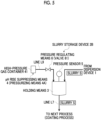
- Fig. 5 is an outline illustrating a configuration of a slurry storage device according to a second embodiment of the present invention.
- a slurry storage device 2B of the second embodiment is provided with a pressure sensor 5 and a pressure regulating means 6 for regulating the pressure in the holding means 3 based on the value of the pressure sensor 5 in the holding means 3 in the slurry storage device 2A of the first embodiment.
- Fig. 5 illustrates the device provided with the pressure sensor 5 and the pressure regulating means 6 with respect to the slurry storage device 2A described with reference to Fig. 2A in the first embodiment.
- the description of the same configuration as that of the first embodiment will be omitted.
- the slurry storage device 2B of the present embodiment detects the pressure in the holding means 3 by the pressure sensor 5, and regulates the pressure in the holding means 3 by the pressure regulating means 6 based on a detected value.
- the pressure sensor 5 can detect a state deviating from the pressure value suitable for suppressing the alkalization of the slurry S.
- the pressure can be regulated by the pressure regulating means 6 so that the pressure inside the holding means 3 is an appropriate pressure value. Therefore, it is possible to quickly determine and respond to the maintenance and management related to the storage of the slurry S.
- by connecting the pressure sensor 5 and the pressure regulating means 6 so that data can be input and controlled, it is possible to automate the maintenance and management related to the storage of the slurry S.
- the pressure sensor 5 is not particularly limited as long as a sensor can detect the pressure in the holding means 3.
- a detection result of the pressure sensor 5 may be directly input to the pressure regulating means 6 as detection data, or the detection result recorded by the worker may be manually input to the pressure regulating means 6.
- the detection result of the pressure sensor 5 can be directly input to the pressure regulating means 6 as data.
- the pressure regulating means 6 is not particularly limited as long as means can regulate the pressure in the holding means 3 based on the detection result of the pressure sensor 5.
- Examples of the pressure regulating means 6 include regulating the supply amount of the pressurized gas to the pressurizing means 4A provided as the pH value rise suppressing means 4, regulating the driving force of the decompression pump to the decompression means 4C, and the like.
- a valve 61 which is a mechanism capable of controlling the amount of gas supplied from the high-pressure gas container 41, may be provided.
- valve 61 and the pressure sensor 5 may be connected to each other in a controllable manner, and a control unit (not illustrated) may be provided in which the detection result of the pressure sensor 5 is input, it is determined whether or not the detection result is within an appropriate range, and the opening degree of the valve 61 is determined and operated according to the detection result. As a result, it is possible to automate the maintenance and management related to storage of the slurry.
- a mechanism for regulating the pressure in the holding means 3 is independently provided separately from the pH value rise suppressing means 4. As a result, even in a case where a problem occurs on the pH value rise suppressing means 4 side, the pressure in the holding means 3 can be appropriately maintained, and the slurry S can be stably stored.
- the slurry storage device 2B of the present embodiment is provided with a pressure sensor for detecting the pressure in the holding means and a pressure regulating means for regulating the pressure in the holding means according to the value of the pressure. Therefore, it is possible to quickly respond to the maintenance and management related to storage of the slurry, and more reliably perform stable storage of the aqueous slurry containing the high nickel material. In addition, it also has the effect of being able to automate the maintenance and management itself related to the storage of the slurry.
- the slurry storage device 2B of the present embodiment can also be suitably used as a slurry storage device in the slurry production system 100 illustrated in the first embodiment.
- the slurry storage device 2B of the present embodiment can also be suitably used as a slurry storage device in the slurry production system 100 illustrated in the first embodiment.
- it is possible to quickly respond to the maintenance and management related to the storage of the slurry, and to make the slurry production system capable of more reliably performing stable storage of the aqueous slurry containing the high nickel material.
- it also has the effect of enabling a slurry production system to be automate the maintenance and management itself related to the storage of the slurry.
- the above-described embodiment illustrates an example of the slurry storage device, the slurry production system, and the slurry storage method.
- the slurry storage device, the slurry production system, and the slurry storage method according to the present invention are not limited to the above-described embodiment.
- the slurry storage device, the slurry production system, and the slurry storage method according to the above-described embodiment may be modified without changing the concept described in the aspects.
- an adsorbent that adsorbs moisture may be provided in the holding means.
- the high-pressure gas container may also be connected to the dispersion unit and used as a means for supplying carbon dioxide (carbon dioxide gas) during the dispersion treatment.
- a high-pressure gas container may be connected so that the holding means and the dispersion unit can be switched.
- the slurry storage device and the slurry storage method of the present invention can be used as a storage technique capable of appropriately storing the slurry.
- these device and method can be suitably used as a storage technique for appropriately storing an aqueous slurry containing a high nickel material.
- the slurry production system of the present invention can be used as a slurry production system that can be stored in a state where the quality of the slurry is maintained after the slurry is prepared.
- the system can be suitably used as a slurry production system for preparing an aqueous slurry containing a high nickel material.
Landscapes
- Chemical & Material Sciences (AREA)
- Chemical Kinetics & Catalysis (AREA)
- Engineering & Computer Science (AREA)
- Electrochemistry (AREA)
- General Chemical & Material Sciences (AREA)
- Mechanical Engineering (AREA)
- Dispersion Chemistry (AREA)
- Inorganic Chemistry (AREA)
- Manufacturing & Machinery (AREA)
- Materials Engineering (AREA)
- Organic Chemistry (AREA)
- Battery Electrode And Active Subsutance (AREA)
- Accessories For Mixers (AREA)
Claims (7)
- Aufschlämmungs-Herstellungssystem (100), umfassend:eine Dispergiervorrichtung (1), die konfiguriert ist, eine wässrige Aufschlämmung (S), die ein nickelreiches Material enthält, die von einer Dispergiereinheit (13) hergestellt wird, die ein Pulver mit einem Lösungsmittel mischt, in einen Rührtank (11) zu überführen und die wässrige Aufschlämmung (S) zwischen dem Rührtank (11) und Dispergiereinheit (13) zu zirkulieren; undeine Aufschlämmungs-Speichervorrichtung (2A), die so konfiguriert ist, dass sie die von der Dispergiervorrichtung (1) hergestellte wässrige Aufschlämmung (S) speichert, bevor die wässrige Aufschlämmung (S) einem Beschichtungsprozess unterzogen wird,wobei die Aufschlämmungs-Speichervorrichtung (2A) umfasstein Haltemittel (3), das konfiguriert ist, um die wässrige Aufschlämmung (S) zu halten, undein Mittel (4) zur Unterdrückung von pH-Wert-Anstieg, das so konfiguriert ist, dass es einen Anstieg eines pH-Werts der wässrigen Aufschlämmung (S) unterdrückt.
- Aufschlämmungs-Herstellungssystem (100) nach Anspruch 1, wobei
das Mittel (4) zur Unterdrückung von pH-Wert-Anstieg ein Druckmittel (4A) umfasst, das Zufuhr eines Druckgases verwendet. - Aufschlämmungs-Herstellungssystem (100) nach Anspruch 2, wobei
das von dem Druckmittel (4A) zugeführte Druckgas ein kohlendioxidhaltiges Gas (Kohlendioxidgas) ist. - Aufschlämmungs-Herstellungssystem (100) nach Anspruch 1, wobei
das Mittel (4) zur Unterdrückung von pH-Wert-Anstieg ein Trockenluft-Zuführungsmittel (4B) umfasst, das Trockenluft zuführt. - Aufschlämmungs-Herstellungssystem (100) nach Anspruch 1, wobei
das Mittel (4) zur Unterdrückung von pH-Wert-Anstieg ein Dekompressionsmittel (4C) umfasst. - Aufschlämmungs-Herstellungssystem (100) nach einem der Ansprüche 1 bis 5, wobeiein Drucksensor (5) in dem Haltemittel (3) vorgesehen ist, unddie Aufschlämmungs-Speichervorrichtung (2A) fernerein Druckregelmittel (6), das einen Druck in dem Haltemittel (3) basierend auf einem Wert des Drucksensors (5) reguliert, umfasst.
- Verfahren zum Speichern von Aufschlämmung, das in einem Aufschlämmungs-Herstellungssystem (100) verwendet wird, umfassend:Überführen einer wässrigen Aufschlämmung (S), die ein nickelreiches Material enthält, die von einer Dispergiereinheit (13) hergestellt wird, die ein Pulver mit einem Lösungsmittel mischt, in einen Rührtank (11);Zirkulieren der wässrigen Aufschlämmung (S) zwischen dem Rührtank (11) und der Dispergiereinheit (13) durch die Dispergiervorrichtung (1);Speichern der durch die Dispergiervorrichtung (1) hergestellten wässrigen Aufschlämmung (S) in einer Aufschlämmungs-Speichervorrichtung (2A), bevor die wässrige Aufschlämmung (S) einem Beschichtungsprozess unterzogen wird; undUnterdrücken eines Anstiegs eines pH-Werts der wässrigen Aufschlämmung (S) durch ein Mittel (4) zur Unterdrückung von pH-Wert-Anstieg.
Applications Claiming Priority (2)
| Application Number | Priority Date | Filing Date | Title |
|---|---|---|---|
| JP2020016442A JP7506481B2 (ja) | 2020-02-03 | 2020-02-03 | スラリー保管装置、スラリー製造システム及びスラリー保管方法 |
| PCT/JP2020/040977 WO2021157146A1 (ja) | 2020-02-03 | 2020-10-30 | スラリー保管装置、スラリー製造システム及びスラリー保管方法 |
Publications (3)
| Publication Number | Publication Date |
|---|---|
| EP4101523A1 EP4101523A1 (de) | 2022-12-14 |
| EP4101523A4 EP4101523A4 (de) | 2023-03-22 |
| EP4101523B1 true EP4101523B1 (de) | 2025-04-02 |
Family
ID=77200099
Family Applications (1)
| Application Number | Title | Priority Date | Filing Date |
|---|---|---|---|
| EP20917538.9A Active EP4101523B1 (de) | 2020-02-03 | 2020-10-30 | Vorrichtung zur lagerung von schlamm, system zur herstellung von schlamm und verfahren zur lagerung von schlamm |
Country Status (7)
| Country | Link |
|---|---|
| US (1) | US12508553B2 (de) |
| EP (1) | EP4101523B1 (de) |
| JP (1) | JP7506481B2 (de) |
| KR (1) | KR20220150873A (de) |
| CN (1) | CN114599445B (de) |
| TW (1) | TWI749873B (de) |
| WO (1) | WO2021157146A1 (de) |
Families Citing this family (4)
| Publication number | Priority date | Publication date | Assignee | Title |
|---|---|---|---|---|
| WO2024202447A1 (ja) * | 2023-03-31 | 2024-10-03 | 日本スピンドル製造株式会社 | スラリー製造装置及びスラリーの製造方法 |
| KR20250045557A (ko) | 2023-09-25 | 2025-04-02 | 고등기술연구원연구조합 | 초음파와 밀착형 블레이드가 적용된 순환형 고분산 석유코크스 슬러리 제조 장치 및 방법 |
| CN118904177A (zh) * | 2024-10-09 | 2024-11-08 | 凯恩茨(福州)工业有限公司 | 一种封堵材料生产装置及其生产方法 |
| CN119075807B (zh) * | 2024-11-06 | 2025-01-24 | 云南聚杰环保科技有限公司 | 一种微克高精密度碱液配碱装置 |
Family Cites Families (25)
| Publication number | Priority date | Publication date | Assignee | Title |
|---|---|---|---|---|
| JP4442129B2 (ja) * | 2003-07-02 | 2010-03-31 | トヨタ自動車株式会社 | リチウム電池、その製造方法ならびに処理方法 |
| WO2007002504A1 (en) * | 2005-06-23 | 2007-01-04 | Grdc, Llc | Efficient production of hydrogen |
| CN101114706A (zh) * | 2007-08-03 | 2008-01-30 | 桐乡市众星能源科技有限公司 | 一种锂离子电池电极浆料储存桶 |
| CN201845823U (zh) * | 2010-08-03 | 2011-05-25 | 江门市力源电子有限公司 | 一种锂离子电池电极浆料自动真空加料系统 |
| CN101980396A (zh) * | 2010-09-08 | 2011-02-23 | 秦皇岛市芯驰光电科技有限公司 | 一种锂离子电池正极浆料制备方法 |
| GB2493375A (en) | 2011-08-03 | 2013-02-06 | Leclancha S A | Aqueous slurry for battery electrodes |
| JP2014053168A (ja) * | 2012-09-07 | 2014-03-20 | Jsr Corp | 蓄電デバイス電極用スラリー、蓄電デバイス電極および蓄電デバイス |
| KR101438570B1 (ko) * | 2012-11-14 | 2014-09-12 | 한국에너지기술연구원 | 코어쉘 구조의 전극활물질 합성방법 |
| JP2014154231A (ja) * | 2013-02-05 | 2014-08-25 | Jsr Corp | 蓄電デバイス電極用スラリー、蓄電デバイス電極、蓄電デバイス、および蓄電デバイス電極用バインダー組成物 |
| CN107851773B (zh) * | 2015-07-17 | 2020-11-06 | 艾利电力能源有限公司 | 电池电极浆料分配装置、电池电极浆料处理装置、电池电极浆料分配方法、悬浊液分配装置、悬浊液分配方法 |
| CN106935850B (zh) * | 2015-12-31 | 2020-04-24 | 惠州比亚迪电池有限公司 | 正极活性材料及其制备方法以及电池浆料和正极与锂电池 |
| WO2017138192A1 (ja) * | 2016-02-08 | 2017-08-17 | 国立研究開発法人産業技術総合研究所 | 非水電解質二次電池の正極用スラリーの製造方法及び非水電解質二次電池の正極用スラリー |
| CN109310976A (zh) * | 2016-06-07 | 2019-02-05 | 株式会社田中化学研究所 | 用于得到无机粒子的反应装置和无机粒子的制造方法 |
| WO2018037805A1 (ja) * | 2016-08-24 | 2018-03-01 | 富士フイルム株式会社 | 保管方法 |
| CN107958997B (zh) * | 2016-10-14 | 2020-04-07 | 宁德新能源科技有限公司 | 正极浆料、正极极片及锂离子电池 |
| CN106450261B (zh) * | 2016-11-02 | 2019-10-11 | 天津市捷威动力工业有限公司 | 一种负极钛酸锂的匀浆涂布方法及其锂离子电池制备方法 |
| CN206184376U (zh) * | 2016-11-17 | 2017-05-24 | 山东精工电子科技有限公司 | 一种锂离子电池浆料的制备装置 |
| CN106784841A (zh) * | 2016-12-22 | 2017-05-31 | 国联汽车动力电池研究院有限责任公司 | 一种油系电极浆料组合物及其制备电极和电化学电池的用途 |
| CN108246169A (zh) * | 2016-12-28 | 2018-07-06 | 深圳格林德能源有限公司 | 一种锂离子电池浆料制备搅拌方法 |
| CN110462895B (zh) * | 2017-03-24 | 2022-09-16 | 尤米科尔公司 | 具有受抑制的产气的锂金属复合氧化物粉末 |
| CN107275574A (zh) * | 2017-06-05 | 2017-10-20 | 珠海光宇电池有限公司 | 正极水系浆料的制备方法、锂电池正极极片及锂电池 |
| US10658651B2 (en) * | 2017-07-31 | 2020-05-19 | Honda Motor Co., Ltd. | Self standing electrodes and methods for making thereof |
| CN111066189B (zh) * | 2017-09-14 | 2024-03-01 | 富士胶片株式会社 | 固体电解质组合物和含固体电解质片材、它们的制造、保存方法、套件以及全固态二次电池 |
| US11973222B2 (en) | 2017-12-08 | 2024-04-30 | Lg Chem, Ltd. | Positive electrode active material precursor for lithium secondary battery, and method of preparing the same |
| CN109533689A (zh) * | 2018-10-29 | 2019-03-29 | 惠州市豪鹏科技有限公司 | 一种电池浆料储存装置和储存方法 |
-
2020
- 2020-02-03 JP JP2020016442A patent/JP7506481B2/ja active Active
- 2020-10-30 CN CN202080072472.1A patent/CN114599445B/zh active Active
- 2020-10-30 EP EP20917538.9A patent/EP4101523B1/de active Active
- 2020-10-30 KR KR1020227012553A patent/KR20220150873A/ko not_active Ceased
- 2020-10-30 WO PCT/JP2020/040977 patent/WO2021157146A1/ja not_active Ceased
- 2020-11-16 TW TW109139844A patent/TWI749873B/zh active
-
2022
- 2022-05-24 US US17/752,482 patent/US12508553B2/en active Active
Also Published As
| Publication number | Publication date |
|---|---|
| US12508553B2 (en) | 2025-12-30 |
| JP7506481B2 (ja) | 2024-06-26 |
| JP2021123366A (ja) | 2021-08-30 |
| EP4101523A4 (de) | 2023-03-22 |
| US20220280902A1 (en) | 2022-09-08 |
| TW202131539A (zh) | 2021-08-16 |
| KR20220150873A (ko) | 2022-11-11 |
| CN114599445A (zh) | 2022-06-07 |
| TWI749873B (zh) | 2021-12-11 |
| EP4101523A1 (de) | 2022-12-14 |
| WO2021157146A1 (ja) | 2021-08-12 |
| CN114599445B (zh) | 2024-09-10 |
Similar Documents
| Publication | Publication Date | Title |
|---|---|---|
| EP4101523B1 (de) | Vorrichtung zur lagerung von schlamm, system zur herstellung von schlamm und verfahren zur lagerung von schlamm | |
| Refly et al. | Regeneration of LiNi1/3Co1/3Mn1/3O2 cathode active materials from end-of-life lithium-ion batteries through ascorbic acid leaching and oxalic acid coprecipitation processes | |
| Pan et al. | ZnNixMnxCo2–2xO4 spinel as a high‐voltage and high‐capacity cathode material for nonaqueous Zn‐ion batteries | |
| Cabana et al. | Mechanisms of degradation and strategies for the stabilization of cathode–electrolyte interfaces in Li-ion batteries | |
| Belliard et al. | Electrochemical performance of ball-milled ZnO–SnO2 systems as anodes in lithium-ion battery | |
| JP6285089B2 (ja) | リチウムイオン電池用正極活物質、リチウムイオン電池用正極及びそれを用いたリチウムイオン電池、並びに、リチウムイオン電池用正極活物質前駆体 | |
| EP2541660A1 (de) | Redoxflussbatterie und betriebsverfahren dafür | |
| CN104379509B (zh) | 镍复合氢氧化物、非水电解质二次电池用正极活性物质、非水电解质二次电池以及它们的制造方法 | |
| US8101300B2 (en) | Cathode active material for non-aqueous electrolyte secondary battery and its production method | |
| Zheng et al. | Lithium nickel cobalt manganese oxide recovery via spray pyrolysis directly from the leachate of spent cathode scraps | |
| HK1243827A1 (zh) | 再循环电池材料中锂的再引入 | |
| US10777813B2 (en) | Positive electrode active material for non-aqueous electrolyte secondary battery and process for producing same, and non-aqueous electrolyte secondary battery using the positive electrode active material | |
| EP4468420A1 (de) | Natrium-ionen-kathodenmaterial, herstellungsverfahren und verwendung davon, natrium-ionen-batterie, natrium-ionen-batteriepack und vorrichtung | |
| Li et al. | Vanadium redox-flow-battery electrolyte preparation with reducing agents | |
| Hua et al. | Electric potential-determined redox intermediates for effective recycling of spent lithium-ion batteries | |
| CN101147283A (zh) | 正极活性物质及其制备方法 | |
| Qiu et al. | Rationally‐Directed Synthesis and Characterization of Nickel‐Rich Cathode Material for Lithium Ion Battery | |
| JP7408912B2 (ja) | リチウムイオン二次電池用正極活物質の製造方法 | |
| CN115548294A (zh) | 高镍正极材料及其制备方法、锂离子电池 | |
| WO2016084930A1 (ja) | 非水系電解質二次電池用正極活物質とその製造方法、および該正極活物質を用いた非水系電解質二次電池 | |
| Lee et al. | Impact of high-temperature storage on capacity fading of Ni-rich cathodes in sulfide-based all-solid-state batteries | |
| CN109616658A (zh) | 一种硒、硫酸根共掺杂高镍正极材料及其制备方法和应用 | |
| Liu et al. | Synthesis of LiNi0. 6Co0. 2Mn0. 2O2 Using Supercritical Carbon Dioxide as a Cathode Material for Lithium‐Ion Batteries | |
| CN107074586A (zh) | 镍锂金属复合氧化物的制造方法、以及通过该制造方法而得到的镍锂金属复合氧化物和由镍锂金属复合氧化物构成的正极活性物质 | |
| JP7472474B2 (ja) | リチウムイオン電池正極材からの金属の溶解方法及び溶解装置 |
Legal Events
| Date | Code | Title | Description |
|---|---|---|---|
| STAA | Information on the status of an ep patent application or granted ep patent |
Free format text: STATUS: THE INTERNATIONAL PUBLICATION HAS BEEN MADE |
|
| PUAI | Public reference made under article 153(3) epc to a published international application that has entered the european phase |
Free format text: ORIGINAL CODE: 0009012 |
|
| STAA | Information on the status of an ep patent application or granted ep patent |
Free format text: STATUS: REQUEST FOR EXAMINATION WAS MADE |
|
| 17P | Request for examination filed |
Effective date: 20220405 |
|
| AK | Designated contracting states |
Kind code of ref document: A1 Designated state(s): AL AT BE BG CH CY CZ DE DK EE ES FI FR GB GR HR HU IE IS IT LI LT LU LV MC MK MT NL NO PL PT RO RS SE SI SK SM TR |
|
| REG | Reference to a national code |
Ref country code: DE Ref legal event code: R079 Free format text: PREVIOUS MAIN CLASS: B01F0015000000 Ipc: H01M0004139000 Ref country code: DE Ref legal event code: R079 Ref document number: 602020048930 Country of ref document: DE Free format text: PREVIOUS MAIN CLASS: B01F0015000000 Ipc: H01M0004139000 |
|
| STAA | Information on the status of an ep patent application or granted ep patent |
Free format text: STATUS: EXAMINATION IS IN PROGRESS |
|
| A4 | Supplementary search report drawn up and despatched |
Effective date: 20230220 |
|
| RIC1 | Information provided on ipc code assigned before grant |
Ipc: B01J 8/00 20060101ALI20230214BHEP Ipc: B65D 90/00 20060101ALI20230214BHEP Ipc: B65D 81/18 20060101ALI20230214BHEP Ipc: H01M 4/525 20100101ALI20230214BHEP Ipc: H01M 4/139 20100101AFI20230214BHEP |
|
| 17Q | First examination report despatched |
Effective date: 20230309 |
|
| DAV | Request for validation of the european patent (deleted) | ||
| DAX | Request for extension of the european patent (deleted) | ||
| RAP1 | Party data changed (applicant data changed or rights of an application transferred) |
Owner name: NIHON SPINDLE MANUFACTURING CO., LTD. |
|
| GRAP | Despatch of communication of intention to grant a patent |
Free format text: ORIGINAL CODE: EPIDOSNIGR1 |
|
| STAA | Information on the status of an ep patent application or granted ep patent |
Free format text: STATUS: GRANT OF PATENT IS INTENDED |
|
| INTG | Intention to grant announced |
Effective date: 20241028 |
|
| GRAS | Grant fee paid |
Free format text: ORIGINAL CODE: EPIDOSNIGR3 |
|
| GRAA | (expected) grant |
Free format text: ORIGINAL CODE: 0009210 |
|
| STAA | Information on the status of an ep patent application or granted ep patent |
Free format text: STATUS: THE PATENT HAS BEEN GRANTED |
|
| AK | Designated contracting states |
Kind code of ref document: B1 Designated state(s): AL AT BE BG CH CY CZ DE DK EE ES FI FR GB GR HR HU IE IS IT LI LT LU LV MC MK MT NL NO PL PT RO RS SE SI SK SM TR |
|
| REG | Reference to a national code |
Ref country code: GB Ref legal event code: FG4D |
|
| REG | Reference to a national code |
Ref country code: CH Ref legal event code: EP |
|
| REG | Reference to a national code |
Ref country code: IE Ref legal event code: FG4D |
|
| REG | Reference to a national code |
Ref country code: DE Ref legal event code: R096 Ref document number: 602020048930 Country of ref document: DE |
|
| REG | Reference to a national code |
Ref country code: NL Ref legal event code: MP Effective date: 20250402 |
|
| PG25 | Lapsed in a contracting state [announced via postgrant information from national office to epo] |
Ref country code: NL Free format text: LAPSE BECAUSE OF FAILURE TO SUBMIT A TRANSLATION OF THE DESCRIPTION OR TO PAY THE FEE WITHIN THE PRESCRIBED TIME-LIMIT Effective date: 20250402 |
|
| REG | Reference to a national code |
Ref country code: AT Ref legal event code: MK05 Ref document number: 1782207 Country of ref document: AT Kind code of ref document: T Effective date: 20250402 |
|
| PG25 | Lapsed in a contracting state [announced via postgrant information from national office to epo] |
Ref country code: PT Free format text: LAPSE BECAUSE OF FAILURE TO SUBMIT A TRANSLATION OF THE DESCRIPTION OR TO PAY THE FEE WITHIN THE PRESCRIBED TIME-LIMIT Effective date: 20250804 Ref country code: FI Free format text: LAPSE BECAUSE OF FAILURE TO SUBMIT A TRANSLATION OF THE DESCRIPTION OR TO PAY THE FEE WITHIN THE PRESCRIBED TIME-LIMIT Effective date: 20250402 Ref country code: ES Free format text: LAPSE BECAUSE OF FAILURE TO SUBMIT A TRANSLATION OF THE DESCRIPTION OR TO PAY THE FEE WITHIN THE PRESCRIBED TIME-LIMIT Effective date: 20250402 |
|
| REG | Reference to a national code |
Ref country code: LT Ref legal event code: MG9D |
|
| PG25 | Lapsed in a contracting state [announced via postgrant information from national office to epo] |
Ref country code: GR Free format text: LAPSE BECAUSE OF FAILURE TO SUBMIT A TRANSLATION OF THE DESCRIPTION OR TO PAY THE FEE WITHIN THE PRESCRIBED TIME-LIMIT Effective date: 20250703 Ref country code: NO Free format text: LAPSE BECAUSE OF FAILURE TO SUBMIT A TRANSLATION OF THE DESCRIPTION OR TO PAY THE FEE WITHIN THE PRESCRIBED TIME-LIMIT Effective date: 20250702 |
|
| PG25 | Lapsed in a contracting state [announced via postgrant information from national office to epo] |
Ref country code: PL Free format text: LAPSE BECAUSE OF FAILURE TO SUBMIT A TRANSLATION OF THE DESCRIPTION OR TO PAY THE FEE WITHIN THE PRESCRIBED TIME-LIMIT Effective date: 20250402 |
|
| PG25 | Lapsed in a contracting state [announced via postgrant information from national office to epo] |
Ref country code: BG Free format text: LAPSE BECAUSE OF FAILURE TO SUBMIT A TRANSLATION OF THE DESCRIPTION OR TO PAY THE FEE WITHIN THE PRESCRIBED TIME-LIMIT Effective date: 20250402 |
|
| PG25 | Lapsed in a contracting state [announced via postgrant information from national office to epo] |
Ref country code: HR Free format text: LAPSE BECAUSE OF FAILURE TO SUBMIT A TRANSLATION OF THE DESCRIPTION OR TO PAY THE FEE WITHIN THE PRESCRIBED TIME-LIMIT Effective date: 20250402 |
|
| PG25 | Lapsed in a contracting state [announced via postgrant information from national office to epo] |
Ref country code: AT Free format text: LAPSE BECAUSE OF FAILURE TO SUBMIT A TRANSLATION OF THE DESCRIPTION OR TO PAY THE FEE WITHIN THE PRESCRIBED TIME-LIMIT Effective date: 20250402 |
|
| PG25 | Lapsed in a contracting state [announced via postgrant information from national office to epo] |
Ref country code: RS Free format text: LAPSE BECAUSE OF FAILURE TO SUBMIT A TRANSLATION OF THE DESCRIPTION OR TO PAY THE FEE WITHIN THE PRESCRIBED TIME-LIMIT Effective date: 20250702 |
|
| PG25 | Lapsed in a contracting state [announced via postgrant information from national office to epo] |
Ref country code: IS Free format text: LAPSE BECAUSE OF FAILURE TO SUBMIT A TRANSLATION OF THE DESCRIPTION OR TO PAY THE FEE WITHIN THE PRESCRIBED TIME-LIMIT Effective date: 20250802 |
|
| PG25 | Lapsed in a contracting state [announced via postgrant information from national office to epo] |
Ref country code: LV Free format text: LAPSE BECAUSE OF FAILURE TO SUBMIT A TRANSLATION OF THE DESCRIPTION OR TO PAY THE FEE WITHIN THE PRESCRIBED TIME-LIMIT Effective date: 20250402 |
|
| REG | Reference to a national code |
Ref country code: DE Ref legal event code: R097 Ref document number: 602020048930 Country of ref document: DE |
|
| PGFP | Annual fee paid to national office [announced via postgrant information from national office to epo] |
Ref country code: DE Payment date: 20250929 Year of fee payment: 6 |
|
| PG25 | Lapsed in a contracting state [announced via postgrant information from national office to epo] |
Ref country code: DK Free format text: LAPSE BECAUSE OF FAILURE TO SUBMIT A TRANSLATION OF THE DESCRIPTION OR TO PAY THE FEE WITHIN THE PRESCRIBED TIME-LIMIT Effective date: 20250402 Ref country code: SM Free format text: LAPSE BECAUSE OF FAILURE TO SUBMIT A TRANSLATION OF THE DESCRIPTION OR TO PAY THE FEE WITHIN THE PRESCRIBED TIME-LIMIT Effective date: 20250402 |
|
| PGFP | Annual fee paid to national office [announced via postgrant information from national office to epo] |
Ref country code: FR Payment date: 20251027 Year of fee payment: 6 |
|
| PG25 | Lapsed in a contracting state [announced via postgrant information from national office to epo] |
Ref country code: CZ Free format text: LAPSE BECAUSE OF FAILURE TO SUBMIT A TRANSLATION OF THE DESCRIPTION OR TO PAY THE FEE WITHIN THE PRESCRIBED TIME-LIMIT Effective date: 20250402 |
|
| PG25 | Lapsed in a contracting state [announced via postgrant information from national office to epo] |
Ref country code: EE Free format text: LAPSE BECAUSE OF FAILURE TO SUBMIT A TRANSLATION OF THE DESCRIPTION OR TO PAY THE FEE WITHIN THE PRESCRIBED TIME-LIMIT Effective date: 20250402 |
|
| PG25 | Lapsed in a contracting state [announced via postgrant information from national office to epo] |
Ref country code: SK Free format text: LAPSE BECAUSE OF FAILURE TO SUBMIT A TRANSLATION OF THE DESCRIPTION OR TO PAY THE FEE WITHIN THE PRESCRIBED TIME-LIMIT Effective date: 20250402 |
|
| PG25 | Lapsed in a contracting state [announced via postgrant information from national office to epo] |
Ref country code: IT Free format text: LAPSE BECAUSE OF FAILURE TO SUBMIT A TRANSLATION OF THE DESCRIPTION OR TO PAY THE FEE WITHIN THE PRESCRIBED TIME-LIMIT Effective date: 20250402 |
|
| PLBE | No opposition filed within time limit |
Free format text: ORIGINAL CODE: 0009261 |
|
| STAA | Information on the status of an ep patent application or granted ep patent |
Free format text: STATUS: NO OPPOSITION FILED WITHIN TIME LIMIT |
|
| PG25 | Lapsed in a contracting state [announced via postgrant information from national office to epo] |
Ref country code: RO Free format text: LAPSE BECAUSE OF FAILURE TO SUBMIT A TRANSLATION OF THE DESCRIPTION OR TO PAY THE FEE WITHIN THE PRESCRIBED TIME-LIMIT Effective date: 20250402 |
|
| REG | Reference to a national code |
Ref country code: CH Ref legal event code: L10 Free format text: ST27 STATUS EVENT CODE: U-0-0-L10-L00 (AS PROVIDED BY THE NATIONAL OFFICE) Effective date: 20260211 |
|
| 26N | No opposition filed |
Effective date: 20260105 |