EP4091850B1 - Elektrisches fahrzeug mit anordnungsstruktur für stromversorgungseinheit und rücksitz - Google Patents
Elektrisches fahrzeug mit anordnungsstruktur für stromversorgungseinheit und rücksitz Download PDFInfo
- Publication number
- EP4091850B1 EP4091850B1 EP20914590.3A EP20914590A EP4091850B1 EP 4091850 B1 EP4091850 B1 EP 4091850B1 EP 20914590 A EP20914590 A EP 20914590A EP 4091850 B1 EP4091850 B1 EP 4091850B1
- Authority
- EP
- European Patent Office
- Prior art keywords
- power supply
- supply unit
- floor
- cross member
- seat
- Prior art date
- Legal status (The legal status is an assumption and is not a legal conclusion. Google has not performed a legal analysis and makes no representation as to the accuracy of the status listed.)
- Active
Links
Images





Classifications
-
- B—PERFORMING OPERATIONS; TRANSPORTING
- B60—VEHICLES IN GENERAL
- B60L—PROPULSION OF ELECTRICALLY-PROPELLED VEHICLES; SUPPLYING ELECTRIC POWER FOR AUXILIARY EQUIPMENT OF ELECTRICALLY-PROPELLED VEHICLES; ELECTRODYNAMIC BRAKE SYSTEMS FOR VEHICLES IN GENERAL; MAGNETIC SUSPENSION OR LEVITATION FOR VEHICLES; MONITORING OPERATING VARIABLES OF ELECTRICALLY-PROPELLED VEHICLES; ELECTRIC SAFETY DEVICES FOR ELECTRICALLY-PROPELLED VEHICLES
- B60L50/00—Electric propulsion with power supplied within the vehicle
- B60L50/50—Electric propulsion with power supplied within the vehicle using propulsion power supplied by batteries or fuel cells
- B60L50/60—Electric propulsion with power supplied within the vehicle using propulsion power supplied by batteries or fuel cells using power supplied by batteries
- B60L50/64—Constructional details of batteries specially adapted for electric vehicles
-
- B—PERFORMING OPERATIONS; TRANSPORTING
- B60—VEHICLES IN GENERAL
- B60K—ARRANGEMENT OR MOUNTING OF PROPULSION UNITS OR OF TRANSMISSIONS IN VEHICLES; ARRANGEMENT OR MOUNTING OF PLURAL DIVERSE PRIME-MOVERS IN VEHICLES; AUXILIARY DRIVES FOR VEHICLES; INSTRUMENTATION OR DASHBOARDS FOR VEHICLES; ARRANGEMENTS IN CONNECTION WITH COOLING, AIR INTAKE, GAS EXHAUST OR FUEL SUPPLY OF PROPULSION UNITS IN VEHICLES
- B60K1/00—Arrangement or mounting of electrical propulsion units
-
- B—PERFORMING OPERATIONS; TRANSPORTING
- B60—VEHICLES IN GENERAL
- B60K—ARRANGEMENT OR MOUNTING OF PROPULSION UNITS OR OF TRANSMISSIONS IN VEHICLES; ARRANGEMENT OR MOUNTING OF PLURAL DIVERSE PRIME-MOVERS IN VEHICLES; AUXILIARY DRIVES FOR VEHICLES; INSTRUMENTATION OR DASHBOARDS FOR VEHICLES; ARRANGEMENTS IN CONNECTION WITH COOLING, AIR INTAKE, GAS EXHAUST OR FUEL SUPPLY OF PROPULSION UNITS IN VEHICLES
- B60K1/00—Arrangement or mounting of electrical propulsion units
- B60K1/04—Arrangement or mounting of electrical propulsion units of the electric storage means for propulsion
-
- B—PERFORMING OPERATIONS; TRANSPORTING
- B60—VEHICLES IN GENERAL
- B60L—PROPULSION OF ELECTRICALLY-PROPELLED VEHICLES; SUPPLYING ELECTRIC POWER FOR AUXILIARY EQUIPMENT OF ELECTRICALLY-PROPELLED VEHICLES; ELECTRODYNAMIC BRAKE SYSTEMS FOR VEHICLES IN GENERAL; MAGNETIC SUSPENSION OR LEVITATION FOR VEHICLES; MONITORING OPERATING VARIABLES OF ELECTRICALLY-PROPELLED VEHICLES; ELECTRIC SAFETY DEVICES FOR ELECTRICALLY-PROPELLED VEHICLES
- B60L50/00—Electric propulsion with power supplied within the vehicle
- B60L50/50—Electric propulsion with power supplied within the vehicle using propulsion power supplied by batteries or fuel cells
- B60L50/60—Electric propulsion with power supplied within the vehicle using propulsion power supplied by batteries or fuel cells using power supplied by batteries
- B60L50/66—Arrangements of batteries
-
- B—PERFORMING OPERATIONS; TRANSPORTING
- B60—VEHICLES IN GENERAL
- B60N—SEATS SPECIALLY ADAPTED FOR VEHICLES; VEHICLE PASSENGER ACCOMMODATION NOT OTHERWISE PROVIDED FOR
- B60N2/00—Seats specially adapted for vehicles; Arrangement or mounting of seats in vehicles
- B60N2/24—Seats specially adapted for vehicles; Arrangement or mounting of seats in vehicles for particular purposes or particular vehicles
- B60N2/30—Non-dismountable or dismountable seats storable in a non-use position, e.g. foldable spare seats
-
- B—PERFORMING OPERATIONS; TRANSPORTING
- B60—VEHICLES IN GENERAL
- B60N—SEATS SPECIALLY ADAPTED FOR VEHICLES; VEHICLE PASSENGER ACCOMMODATION NOT OTHERWISE PROVIDED FOR
- B60N2/00—Seats specially adapted for vehicles; Arrangement or mounting of seats in vehicles
- B60N2/24—Seats specially adapted for vehicles; Arrangement or mounting of seats in vehicles for particular purposes or particular vehicles
- B60N2/30—Non-dismountable or dismountable seats storable in a non-use position, e.g. foldable spare seats
- B60N2/3002—Non-dismountable or dismountable seats storable in a non-use position, e.g. foldable spare seats back-rest movements
- B60N2/3004—Non-dismountable or dismountable seats storable in a non-use position, e.g. foldable spare seats back-rest movements by rotation only
- B60N2/3009—Non-dismountable or dismountable seats storable in a non-use position, e.g. foldable spare seats back-rest movements by rotation only about transversal axis
- B60N2/3011—Non-dismountable or dismountable seats storable in a non-use position, e.g. foldable spare seats back-rest movements by rotation only about transversal axis the back-rest being hinged on the cushion, e.g. "portefeuille movement"
-
- B—PERFORMING OPERATIONS; TRANSPORTING
- B60—VEHICLES IN GENERAL
- B60N—SEATS SPECIALLY ADAPTED FOR VEHICLES; VEHICLE PASSENGER ACCOMMODATION NOT OTHERWISE PROVIDED FOR
- B60N2/00—Seats specially adapted for vehicles; Arrangement or mounting of seats in vehicles
- B60N2/24—Seats specially adapted for vehicles; Arrangement or mounting of seats in vehicles for particular purposes or particular vehicles
- B60N2/30—Non-dismountable or dismountable seats storable in a non-use position, e.g. foldable spare seats
- B60N2/3038—Cushion movements
- B60N2/304—Cushion movements by rotation only
- B60N2/3045—Cushion movements by rotation only about transversal axis
- B60N2/305—Cushion movements by rotation only about transversal axis the cushion being hinged on the vehicle frame
-
- B—PERFORMING OPERATIONS; TRANSPORTING
- B60—VEHICLES IN GENERAL
- B60N—SEATS SPECIALLY ADAPTED FOR VEHICLES; VEHICLE PASSENGER ACCOMMODATION NOT OTHERWISE PROVIDED FOR
- B60N2/00—Seats specially adapted for vehicles; Arrangement or mounting of seats in vehicles
- B60N2/24—Seats specially adapted for vehicles; Arrangement or mounting of seats in vehicles for particular purposes or particular vehicles
- B60N2/30—Non-dismountable or dismountable seats storable in a non-use position, e.g. foldable spare seats
- B60N2/3072—Non-dismountable or dismountable seats storable in a non-use position, e.g. foldable spare seats on a lower level of a multi-level vehicle floor
- B60N2/3077—Non-dismountable or dismountable seats storable in a non-use position, e.g. foldable spare seats on a lower level of a multi-level vehicle floor stowed in the luggage compartment
-
- B—PERFORMING OPERATIONS; TRANSPORTING
- B60—VEHICLES IN GENERAL
- B60N—SEATS SPECIALLY ADAPTED FOR VEHICLES; VEHICLE PASSENGER ACCOMMODATION NOT OTHERWISE PROVIDED FOR
- B60N2/00—Seats specially adapted for vehicles; Arrangement or mounting of seats in vehicles
- B60N2/24—Seats specially adapted for vehicles; Arrangement or mounting of seats in vehicles for particular purposes or particular vehicles
- B60N2/42—Seats specially adapted for vehicles; Arrangement or mounting of seats in vehicles for particular purposes or particular vehicles the seat constructed to protect the occupant from the effect of abnormal g-forces, e.g. crash or safety seats
- B60N2/4207—Seats specially adapted for vehicles; Arrangement or mounting of seats in vehicles for particular purposes or particular vehicles the seat constructed to protect the occupant from the effect of abnormal g-forces, e.g. crash or safety seats characterised by the direction of the g-forces
- B60N2/4214—Seats specially adapted for vehicles; Arrangement or mounting of seats in vehicles for particular purposes or particular vehicles the seat constructed to protect the occupant from the effect of abnormal g-forces, e.g. crash or safety seats characterised by the direction of the g-forces longitudinal
- B60N2/4228—Seats specially adapted for vehicles; Arrangement or mounting of seats in vehicles for particular purposes or particular vehicles the seat constructed to protect the occupant from the effect of abnormal g-forces, e.g. crash or safety seats characterised by the direction of the g-forces longitudinal due to impact coming from the rear
-
- B—PERFORMING OPERATIONS; TRANSPORTING
- B60—VEHICLES IN GENERAL
- B60N—SEATS SPECIALLY ADAPTED FOR VEHICLES; VEHICLE PASSENGER ACCOMMODATION NOT OTHERWISE PROVIDED FOR
- B60N2/00—Seats specially adapted for vehicles; Arrangement or mounting of seats in vehicles
- B60N2/24—Seats specially adapted for vehicles; Arrangement or mounting of seats in vehicles for particular purposes or particular vehicles
- B60N2/42—Seats specially adapted for vehicles; Arrangement or mounting of seats in vehicles for particular purposes or particular vehicles the seat constructed to protect the occupant from the effect of abnormal g-forces, e.g. crash or safety seats
- B60N2/427—Seats or parts thereof displaced during a crash
-
- B—PERFORMING OPERATIONS; TRANSPORTING
- B60—VEHICLES IN GENERAL
- B60N—SEATS SPECIALLY ADAPTED FOR VEHICLES; VEHICLE PASSENGER ACCOMMODATION NOT OTHERWISE PROVIDED FOR
- B60N2/00—Seats specially adapted for vehicles; Arrangement or mounting of seats in vehicles
- B60N2/90—Details or parts not otherwise provided for
-
- B—PERFORMING OPERATIONS; TRANSPORTING
- B62—LAND VEHICLES FOR TRAVELLING OTHERWISE THAN ON RAILS
- B62D—MOTOR VEHICLES; TRAILERS
- B62D21/00—Understructures, i.e. chassis frame on which a vehicle body may be mounted
- B62D21/11—Understructures, i.e. chassis frame on which a vehicle body may be mounted with resilient means for suspension, e.g. of wheels or engine; sub-frames for mounting engine or suspensions
-
- B—PERFORMING OPERATIONS; TRANSPORTING
- B62—LAND VEHICLES FOR TRAVELLING OTHERWISE THAN ON RAILS
- B62D—MOTOR VEHICLES; TRAILERS
- B62D25/00—Superstructure or monocoque structure sub-units; Parts or details thereof not otherwise provided for
- B62D25/20—Floors or bottom sub-units
-
- B—PERFORMING OPERATIONS; TRANSPORTING
- B62—LAND VEHICLES FOR TRAVELLING OTHERWISE THAN ON RAILS
- B62D—MOTOR VEHICLES; TRAILERS
- B62D25/00—Superstructure or monocoque structure sub-units; Parts or details thereof not otherwise provided for
- B62D25/20—Floors or bottom sub-units
- B62D25/2009—Floors or bottom sub-units in connection with other superstructure subunits
- B62D25/2027—Floors or bottom sub-units in connection with other superstructure subunits the subunits being rear structures
-
- B—PERFORMING OPERATIONS; TRANSPORTING
- B60—VEHICLES IN GENERAL
- B60K—ARRANGEMENT OR MOUNTING OF PROPULSION UNITS OR OF TRANSMISSIONS IN VEHICLES; ARRANGEMENT OR MOUNTING OF PLURAL DIVERSE PRIME-MOVERS IN VEHICLES; AUXILIARY DRIVES FOR VEHICLES; INSTRUMENTATION OR DASHBOARDS FOR VEHICLES; ARRANGEMENTS IN CONNECTION WITH COOLING, AIR INTAKE, GAS EXHAUST OR FUEL SUPPLY OF PROPULSION UNITS IN VEHICLES
- B60K1/00—Arrangement or mounting of electrical propulsion units
- B60K1/04—Arrangement or mounting of electrical propulsion units of the electric storage means for propulsion
- B60K2001/0405—Arrangement or mounting of electrical propulsion units of the electric storage means for propulsion characterised by their position
- B60K2001/0433—Arrangement under the rear seats
-
- B—PERFORMING OPERATIONS; TRANSPORTING
- B60—VEHICLES IN GENERAL
- B60Y—INDEXING SCHEME RELATING TO ASPECTS CROSS-CUTTING VEHICLE TECHNOLOGY
- B60Y2306/00—Other features of vehicle sub-units
- B60Y2306/01—Reducing damages in case of crash, e.g. by improving battery protection
Definitions
- the present invention relates to an electric vehicle with an arrangement structure for a power supply unit and a rear seat.
- Electric vehicles are equipped with various power supply units that control power input/output to/from a driving battery.
- a power supply unit include a junction box that connects a driving battery and an electric load such as a driving motor, a charger that charges the driving battery with an external power supply at a charging station or the like, a DC-AC inverter that converts DC power from the driving battery to AC power for allowing home appliances to be used, or an inverter to perform power drive control or regenerative control of the driving motor, and the power supply unit is connected to an electric load such as the driving battery and the driving motor via a power cable.
- Patent Document 1 discloses a rear-wheel drive electric vehicle with measures against rear end collisions.
- This electric vehicle supports left and right rear wheels by a rear suspension cross member suspended and supported on a lower side of a floor of a vehicle body and drives the rear wheels by mounting a driving motor with an inverter and a transaxle as a drive unit on the suspension cross member.
- a junction box, a charger and a DC-AC inverter are disposed as a power supply unit above the drive unit on the lower side of the floor, and each power supply unit, the inverter of the driving motor and a driving battery are connected via a power cable.
- the power supply unit and the drive unit are disposed inside a contour line of the rear suspension cross member in a plan view.
- the strong rear suspension cross member is not easily deformed in the event of a rear end collision, and it is thereby possible to prevent damage to the power supply unit and the drive unit.
- Patent Document 2 relates to an electric vehicle equipped with a power unit and a battery unit.
- Patent Document 1 The technology described in Patent Document 1 is based on a vehicle body structure in which the drive unit and the power supply unit are both disposed on the rear suspension cross member on the lower side of the floor, whereas another vehicle body structure is also widely implemented in which the power supply unit is relocated to the upper side of the floor.
- the power supply unit is disposed in the vicinity of a place right above the drive unit, that is, a place where the drive unit is affected by a rear end collision, for example, out of the necessity that the junction box and the inverter of the driving motor should be connected via a power cable.
- the power supply unit disposed apart upward from the rear suspension cross member via the floor can be hardly protected by the rear suspension cross member, and so conventionally, there has been a demand for effective protective measures.
- the present invention has been implemented to solve such problems, and an object of the present invention is to provide an electric vehicle with an arrangement structure for a power supply unit and a rear seat for a rear-wheel drive vehicle body structure in which a power supply unit is disposed on an upper side of a floor of a vehicle body and a rear seat is disposed right above the power supply unit, capable of more reliably protecting the power supply unit and preventing damage in the event of a rear end collision.
- An aspect of the present invention is directed to an arrangement structure for a power supply unit and a rear seat in an electric vehicle, including a rear suspension cross member suspended from and supported by a pair of left and right side members extending in a front-rear direction on a lower side of a floor of a vehicle body to support left and right rear wheels via a suspension, a drive unit mounted on the rear suspension cross member on the lower side of the floor, including a driving motor that drives at least the left and right rear wheels, a power supply unit mounted on an upper side of the floor, including a junction box that relays power from at least a driving battery and supplies the power to the driving motor, and a rear seat disposed right above the power supply unit, in which a rear part of a seat cushion of the rear seat is supported by
- the framework member is configured to be a strong structure to support the weight of the rear seat and the weight of a passenger.
- the rear seat is disposed right above the power supply unit and the rear part of the seat cushion of the rear seat is supported by the framework member.
- the framework member is located at a position rearward of the power supply unit and at a position forward of the rear end of the rear suspension cross member.
- the framework member is preferably disposed at a position above the power supply unit.
- the rear end of the rear suspension cross member is disposed on the lower side of the power supply unit and the framework member is disposed on the upper side, another vehicle is allowed to reliably collide with the rear end of the rear suspension cross member or the framework member before colliding with the power supply unit regardless of the height of invasion to thereby mitigate the input.
- the framework member is located above the power supply unit, even when the invasion by another vehicle causes the framework member to be deformed or moved to the power supply unit side, it is possible to prevent the framework member from interfering with the power supply unit and more reliably protect the power supply unit and prevent damage.
- a storage recess is formed on the floor at a position rearward of the rear seat, the seat cushion of the rear seat is supported so as to be rotatable around the framework member, a seatback of the rear seat is supported so as to be rotatable with respect to the seat cushion, and when the seatback is rotated so as to overlap the seat cushion, the seat cushion is allowed to be stored in the storage recess by rotating the entire rear seat rearward around the framework member.
- the framework member is disposed at a position above the power supply unit.
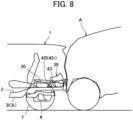
- the rear seat when the rear seat is stored in the storage recess, another vehicle that has invaded forward while deforming the rear part of the floor by the rear end collision collides with the rear seat in the storage recess first.
- the behavior of the rear seat differs depending on collision conditions such as a height of invasion from another vehicle, and the rear seat, for example, is crushed in the front-rear direction while keeping its posture, flipped up with rotation around the framework member, or generates both behaviors simultaneously.
- the rear seat When the rear seat is crushed in the front-rear direction, the rear seat is crushed with its forward movement restricted by the strong framework member, the input from another vehicle is absorbed by a urethane material or the like inside, and so the subsequent input when another vehicle collides with the rear end of the rear suspension cross member or the input when another vehicle collides with the framework member is mitigated.
- the rear seat when the rear seat is flipped up, since the framework member, the center of rotation, is disposed at a position above the power supply unit, all regions of the rear seat after flipped up are located above the power supply unit, and it is thereby possible to reliably prevent a collision of the rear seat with the power supply unit.
- the arrangement structure preferably further includes a front floor cross member and a rear floor cross member formed on a top surface of the floor and extending in a left-right direction, both left and right ends of which are connected to the pair of left and right side members respectively, and a unit cover, a front edge of which is fixed to the front cross member and a rear edge of which is fixed to the rear floor cross member, to cover the power supply unit from above, and the framework member is preferably disposed at a position rearward of the unit cover.
- the strength of the unit cover in the front-rear direction is increased.
- the input from another vehicle is mitigated by a collision of the rear suspension cross member with the rear end, mitigated by a collision with the framework member and further mitigated by a collision with the cover having high strength in the front-rear direction, making it possible to more reliably prevent a collision with the power supply unit by another vehicle.
- the rear suspension cross member is suspended from and supported by a total of four fixed points at the front and rear positions of the pair of left and right side members and the brackets are preferably fixed on the pair of left and right side members at positions sandwiching the pair of left and right fixed points rearward of the rear suspension cross member in the front-rear direction.
- the left and right side members are connected via the rear suspension cross member on the lower side of the floor, and the brackets on the left and right side members are connected via the framework member on the upper side of the floor.
- the left and right brackets sandwich the respective side members and overlap the left and right fixed points rearward of the rear suspension cross member in the front-rear direction.
- the rear part of the rear suspension cross member, the left and right brackets and the framework member are connected at substantially matching positions in the front-rear direction across the left and right side members, acting in concert to form a strong structure, and so the deformation of the rear suspension cross member and the framework member is further suppressed.
- the rear-wheel drive vehicle body structure in which the power supply unit is disposed on the upper side of the floor of the vehicle body and furthermore, the rear seat is disposed right above the power supply unit, it is possible to reliably protect the power supply unit and prevent damage in the event of a rear end collision.
- FIG. 1 is a cross-sectional view illustrating a positional relationship between a rear suspension cross member and a rear seat with respect to a side member viewing a rear part of an electric vehicle of the present embodiment from a left side
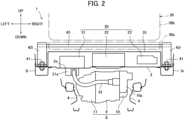
- FIG. 2 is a cross-sectional view illustrating a positional relationship between a drive unit and a power supply unit with respect to a floor likewise viewing a rear part of the electric vehicle from behind
- FIG. 3 is a plan view illustrating a state in which the drive unit is disposed on the rear suspension cross member.
- front-rear, left-right and up-down directions will be expressed with the driver in the vehicle as a main subject.
- An electric vehicle 1 of the present embodiment is a hybrid vehicle equipped with a driving motor 9, which will be described later, and an engine (not shown), as driving power sources.
- a pair of left and right side members 3l and 3r are provided on an undersurface of a floor 2 that constitutes the body of the electric vehicle 1, and each side member 3l or 3r extends in a front-rear direction while forming a closed cross section with the floor 2.
- a rear suspension cross member 4 is disposed on the lower side of the floor 2 and both the left and right sides of the rear suspension cross member 4 are suspended from and supported by the respective side members 3l and 3r. More specifically, in a plan view shown in FIG. 3 , support mounts 5fl, 5fr, 5rl and 5rr (corresponding to the fixed points of the present invention, and so, called hereinafter, "fixed points") are provided at front and rear positions of the left and right side members 3l and 3r, and front left and right, and rear left and right parts of the rear suspension cross member 4 are suspended from and supported by the respective fixed points 5fl, 5fr, 5rl and 5rr. Both left and right sides of the rear suspension cross member 4 are extended forward from the fixed points 5fl and 5fr at the front positions and fastened to the left and right side members 3l and 3r by a pair of bolts 6l and 6r respectively.
- Left and right rear wheels 7 are supported by the left side and the right side of the rear suspension cross member 4 via double-wishbone-based suspension (not shown). Since the configuration of the suspension is well known, detailed description will be omitted, but the suspension is constructed of an upper arm, a lower arm, a toe control link, a spring and an absorber or the like. To resist input from the road surface and a drive reaction force on the rear wheels 7 or the like while the hybrid vehicle 1 is running, the rear suspension cross member 4 is manufactured from a thick steel sheet, has high strength and is supported from the left and right side members 3l and 3r with similarly high strength.
- a driving motor 9, an inverter 10 provided integrally with the driving motor 9 and a transaxle 11 that functions as a reduction gear are mounted on the rear suspension cross member 4 as a drive unit 8 via a support mount 13, and left and right rear wheels 7 are connected to the transaxle 11 via a pair of left and right drive shafts 12.
- the driving motor 9 is driven and controlled by the inverter 10.
- DC power from a driving battery (not shown) is converted to three-phase AC power by the inverter 10, supplied to the driving motor 9, and the rotation of the driving motor 9 is decelerated in the transaxle 11 and the left and right rear wheels 7 are driven via the drive shafts 12.
- the rotations of the left and right rear wheels 7 are transmitted to the driving motor 9 via the drive shafts 12 and the transaxle 11, and three-phase AC power generated by the driving motor 9 is converted to DC power by the inverter 10 to charge the driving battery.
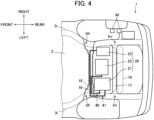
- FIG. 4 is a plan view illustrating a state in which the power supply unit is disposed on the floor 2 and
- FIG. 5 is a cross-sectional view illustrating a state in which the power supply unit is mounted viewing the rear part of the electric vehicle 1 from the left side.
- upper front and upper rear floor cross members 16 and 17 are provided on the top surface of the floor 2, and lower front and lower rear floor cross members 18 and 19 are provided on the undersurface of the floor 2.
- the respective floor cross members 16 to 19 are extended in a left-right direction while forming a closed cross section with the undersurface of the floor 2 and both ends thereof are connected to the left and right side members 3l and 3r.
- a junction box 21, a charger 22 and a DC-AC inverter 23 are mounted in order from the left side on the floor 2 as a power supply unit 20.
- the junction box 21 is a device that connects the driving battery and various electric loads such as the driving motor 9
- the charger 22 is a device that charges the driving battery with power from an external power supply at a charging station or the like via charging ports 30, and the DC-AC inverter 23 is a device that converts DC power of the driving battery to AC power of 100 V to enable home appliances.
- FIG. 5 illustrates a state in which the junction box 21 is mounted, the front side of the junction box 21 is fixed to the upper front floor cross member 16 by a bracket 24 and bolts 25 and 26, and the rear side of the junction box 21 is fixed to the upper rear floor cross member 17 by a bracket 27 and bolts 28 and 29.
- a substantially triangular fragile part 27a is formed by bending in the bracket 27 so that in the event of a rear end collision by another vehicle, the fragile part 27a is bent and deformed to exert impact absorption action.
- similar mounting states are also applicable to the charger 22 and the DC-AC inverter 23.
- a power cable 40 connecting the junction box 21 and the charger 22 on the upper side of the floor 2 and on the front side of the power supply unit 20 is connected to an outer side surface of the junction box 21 in the vehicle and a side surface of the charger 22 on the junction box 21 side, and similarly, a power cable 41 connecting the junction box 21 and the DC-AC inverter 23 is connected to the outer side surface of the junction box 21 in the vehicle and a front side of the DC-AC inverter 23.
- a terminal block 21a is provided on the undersurface of the junction box 21, fitted into a through hole 2a formed in the floor 2 and protruding downward.
- One end of the motor-side power cable 33 is connected to a rear side of the terminal block 21a and the other end is connected to a left side surface of the terminal block 10a of the inverter 10.
- a driving battery is disposed in front of the rear suspension cross member 4 on the lower side of the floor 2, and the terminal block 21a of the junction box 21 is connected to the driving battery via a battery-side power cable 34.
- Power exchange between the driving battery and the charger 22, the DC-AC inverter 23 and the inverter 10 of the driving motor 9 is performed by relaying the junction box 21.
- DC power from the driving battery is supplied to the DC-AC inverter 23 via the junction box 21, converted to AC power of 100 V and used to operate home appliances.
- AC power supplied from an external power supply at a charging station or the like is converted to DC power by the charger 22 to charge the driving battery via the junction box 21.
- the above-described power drive control and regenerative control on the driving motor 9 are also performed via the junction box 21.
- a rectangular box-shaped unit cover 35 that opens downward is disposed right above the power supply unit 20.
- Flange-shaped front edge 35a and rear edge 35b of the unit cover 35 are fixed to the top surfaces of the upper front and upper rear floor cross members 16 and 17 with a bolt 36 and a nut 37, and the power supply unit 20 is covered with the unit cover 35 from above.
- the unit cover 35 is manufactured by bending a steel sheet and the strength thereof is reinforced by forming many ribs (not shown) extending in the front-rear direction.
- FIG. 6 is a plan view illustrating a state in which the rear seat is disposed on the floor.
- a retractable third row seat 39 (corresponding to the rear seat of the present invention, called a "rear seat” in the following description) is disposed right above the unit cover 35, and a storage recess 40 to store a rear seat 39 is formed behind the rear seat 39 on the floor 2.
- Bases of brackets 42l and 42r, which form a substantially triangular shape in a side view are fixed to the left and right side members 3l and 3r by a pair of bolts 41, and a framework member 43 made of a pipe member is spanned in a left-right direction between vertices of the left and right brackets 42l and 42r, both ends of which are fixed to the brackets 42l and 42r.
- the framework member 43 is disposed at a position forward of the rear end of the rear suspension cross member 4 by a dimension L1 in the front-rear direction, disposed at a position forward of the rear left and right fixed points 5rl and 5rr by a dimension L2, which is more minute, and disposed at a position rearward of the rear end of the unit cover 35 by a dimension L3.
- the framework member 43 is disposed at a position upward of the highest part of the power supply unit 20 by a dimension L4.
- the left and right brackets 42l and 42r that support the framework member 43 are disposed at positions overlapping the fixed points 5rl and 5rr in the front-rear direction across the left and right side members 3l and 3r.
- the framework member 43 disposed in this way supports a rear part (not shown) of a seat cushion 39a of the rear seat 39 in the left-right direction, and thus, the rear part of the rear seat 39 is supported from the side members 3l and 3r via the framework member 43 and left and right brackets 42l and 42r.
- the front part of the seat cushion 39a is supported by brackets (not shown) on left and right wheelhouse inners via a latch mechanism (not shown) and when the latch mechanism is released, the front part of the seat cushion 39a is separated from the bracket on the wheelhouse inners and can be rotated around the framework member 43.
- the seatback 39b is rotatably supported by the seat cushion 39a and fixed by a locking mechanism (not shown) at a desired angle.
- a headrest 39c is connected to a top part of the seatback 39b and this headrest 39c is also rotatable with respect to the seatback.
- Such a configuration makes the rear seat 39 foldable around the framework member 43.
- a storing procedure will be described based on FIG. 5 .
- the headrest 39c is folded forward and overlapping the seatback 39b first, the locking mechanism of the seatback 39b is then released, the seatback 39b is folded forward and overlapping the seat cushion 39a.
- the rear seat 39 is folded in three layers, the latch mechanism of the seat cushion 39a is released and the entire rear seat 39 is caused to rotate backward around the framework member 43.
- the rear seat 39 is stored in the storage recess 40 on the floor 2 and the bottom surface of the seat cushion 39a becomes flush with a luggage room board surface 44.
- the reverse of the above-described procedure is taken to unfold the folded rear seat 39 so that the rear seat 39 can be used again.
- the framework member 43 is required to be strong enough to support the weight of the rear seat 39 and the weights of passengers, and accurately fold and unfold the rear seat 39, and the left and right brackets 42l and 42r that support the rear seat 39 are also required to be strong enough.
- the framework member 43, and brackets 42l and 42r are made of a thick raw material, but also the brackets 42l and 42r over the left and right side members that function as the structure of the vehicle body are erected.
- the framework member 43 is originally constructed as a strong structure, and according to the present embodiment, positions in the front-rear direction and in the up-down direction are set as described based on FIG. 1 in order to use the framework member 43 to protect the power supply unit 20 in the event of a rear end collision, and protective action for the power supply unit 20 in the event of a rear end collision will be described hereinafter.
- the framework member 43 is located behind the power supply unit 20. Moreover, since the rear end of the rear suspension cross member 4 is located behind the framework member 43 by the dimension L1, in the event of a rear end collision, another vehicle that has invaded forward while deforming the rear part of the floor 2 collides with the rear end of the rear suspension cross member 4 first. Since the rear suspension cross member 4 itself has high strength and is suspended from and supported by the left and right side members 3l and 3r likewise having high strength, the deformation of the rear suspension cross member 4 is suppressed and input from another vehicle is mitigated.
- a violent rear end collision may cause another vehicle to invade forward further to collide with the framework member 43.
- forward deformation for example, forward bending deformation, is suppressed to minimum and the input from another vehicle is thereby further mitigated.
- the passenger seated in the rear seat 39 can also be reliably protected from a rear end collision by mitigating the input in two stages, that is, the rear end of the rear suspension cross member 4 and the framework member 43.
- the left and right brackets 42l and 42r that support the framework member 43 are disposed at overlapping positions in the front-rear direction with respect to the respective fixed points 5rl and 5rr across the left and right side members 3l and 3r. Moreover, on the lower side of the floor, the left and right side members 3l and 3r are connected via the rear suspension cross member 4, and on the upper side of the floor, the brackets 42l and 42r on the right side members 3l and 3r are connected via the framework member 43.
- the rear part of the rear suspension cross member 4 (locations of the fixed points 5rl and 5rr), the left and right brackets 42l and 42r, and the framework member 43 are connected at substantially matching positions in the front-rear direction across the left and right side members 3l and 3r, acting in concert to form a strong structure.
- This factor also significantly contributes to suppressing deformation of the rear suspension cross member 4 and the framework member 43 in the event of a rear end collision, and eventually protection of the power supply unit 20.
- the framework member 43 is disposed above a highest point of the power supply unit 20 by a dimension L4.
- the rear end of the rear suspension cross member 4 is disposed below the power supply unit 20 and the framework member 43 is disposed at a position above the power supply unit 20.
- the framework member 43 is disposed below the highest point of the power supply unit 20 if the height of invasion of another vehicle is high, another vehicle collides with neither the rear end of the rear suspension cross member 4 nor the framework member 43 from the front, another vehicle is more likely to collide with the power supply unit 20 without mitigating the input so much.
- the framework member 43 is disposed at a position above the power supply unit 20, even when the framework member 43 is deformed or moved to the power supply unit 20 side due to invasion of another vehicle, it is possible to prevent the framework member 43 from interfering with the power supply unit 20 and more reliably protect the power supply unit 20 and prevent damage.
- the front edge 35a and the rear edge 35b of the unit cover 35 that covers the power supply unit 20 from above are fixed to the top surfaces of the upper front and upper rear floor cross members 16 and 17, both ends of which are connected to the left and right side members 3l and 3r.
- the front edge 35a and the rear edge 35b of the unit cover 35 are fixed to the strong upper front and upper rear floor cross members 16 and 17, and their positional displacements are restricted, the strength of the unit cover 35 in the front-rear direction is increased in combination with the formation of many ribs.
- the framework member 43 is disposed at a position rearward of the rear end of the unit cover 35 by the dimension L3. Therefore, the input from another vehicle is mitigated by a collision with the rear end of the rear suspension cross member 4, mitigated by a collision with the framework member 43, and further mitigated by a collision with the unit cover 35 having high strength in the front-rear direction, and so it is possible to more reliably prevent a collision with the power supply unit 20 by another vehicle.
- disposing the framework member 43 at a position upward based on the dimension L4 exerts a protective function of the power supply unit 20 even in the event of a rear end collision while the rear seat 39 is stored.
- FIG. 7 is a schematic view illustrating a state in which the rear seat 39 is stored
- FIG. 8 is a schematic view illustrating the behavior of the rear seat 39 in the event of a rear end collision by another vehicle A with a relatively high vehicle height
- FIG. 9 is a schematic view illustrating the behavior of the rear seat 39 in the event of a rear end collision by another vehicle B with a relatively low vehicle height.
- the behavior of the rear seat 39 in the event of a rear end collision may not always appear clearly as crushing or flipped up, and, for example, when both of the behaviors of crushing and flipped up occur simultaneously, the respective actions and effects can be exerted together.
- the present invention has been embodied as an arrangement structure for the power supply unit 20 and the rear seat 39 in the hybrid vehicle 1, whereas the present invention can be arbitrarily changed for any electric vehicle provided with the power supply unit 20 and the rear seat 39, and the present invention may be applicable to an electric automobile equipped with a motor as a driving power source.
- the driving motor 9, the inverter 10 and the transaxle 11 are disposed on the rear suspension cross member 4 as the drive unit, and the junction box 21, the charger 22 and the DC-AC inverter 23 are disposed on the upper side of the floor 2 as the power supply unit 20, the types and arrangements thereof are not limited to them.
- an array of the driving motor 9, the inverter 10 and the transaxle 11 may be changed or the inverter 10 may be disposed above the floor 2 as one of the power supply unit 20.
- the rear seat 39 is constructed as the retractable third row seat, but the present invention is not limited to this, and it can be a fixed rear seat without any storage function and in the case of an electric vehicle not equipped with the third row seat, a second row seat may be provided as the rear seat.
Landscapes
- Engineering & Computer Science (AREA)
- Transportation (AREA)
- Mechanical Engineering (AREA)
- Chemical & Material Sciences (AREA)
- Combustion & Propulsion (AREA)
- Aviation & Aerospace Engineering (AREA)
- Sustainable Development (AREA)
- Sustainable Energy (AREA)
- Power Engineering (AREA)
- Life Sciences & Earth Sciences (AREA)
- Arrangement Or Mounting Of Propulsion Units For Vehicles (AREA)
- Body Structure For Vehicles (AREA)
- Seats For Vehicles (AREA)
Claims (5)
- Elektrofahrzeug (1) mit einer Anordnungsstruktur für eine Stromversorgungseinheit und einen Rücksitz, das aufweist:einen Hinterradaufhängungs-Querträger (4), der von einem Paar aus einem linken und rechten Längsträger (3l, 3r), die sich in einer Vorwärts-Rückwärts-Richtung auf einer Unterseite eines Bodens (2) einer Fahrzeugkarosserie erstrecken, abgehängt ist und getragen wird, um ein linkes und rechtes Hinterrad (7) über eine Aufhängung zu tragen;eine Antriebseinheit (8), die am Hinterradaufhängungs-Querträger (4) auf der Unterseite des Bodens angebaut ist, mit einem Antriebsmotor (9), der mindestens das linke und rechte Hinterrad (7) antreibt;eine Stromversorgungseinheit (20), die auf einer Oberseite des Bodens (2) angebaut ist, mit einem Anschlusskasten (21), der Strom von mindestens einer Antriebsbatterie weiterleitet und den Strom dem Antriebsmotor (9) zuführt; unddadurch gekennzeichnet, dass es ferner einen Rücksitz (39) aufweist, der genau über der Stromversorgungseinheit (20) angeordnet ist, wobei ein Hinterteil eines Sitzpolsters (39a) des Rücksitzes (39) durch einen Rahmenträger (43) gestützt wird, der sich zwischen Halterungen (421 und 42r) spannt, die auf dem Paar aus dem linken und rechten Längsträger (3l, 3r) auf der Oberseite des Bodens (2) vorgesehen sind, undder Rahmenträger (43) an einer Position hinter der Stromversorgungseinheit (20) und an einer Position vor dem hinteren Ende des Hinterradaufhängungs-Querträgers (4) angeordnet ist.
- Elektrofahrzeug (1) nach Anspruch 1,
wobei der Rahmenträger (43) an einer Position über der Stromversorgungseinheit (20) angeordnet ist. - Elektrofahrzeug (1) nach Anspruch 1, wobeieine Lageraussparung (40) auf dem Boden (2) an einer Position hinter dem Rücksitz (39) ausgebildet ist,das Sitzpolster (39a) des Rücksitzes (39) so gestützt wird, dass es um den Rahmenträger (43) drehbar ist,eine Sitzlehne (39b) des Rücksitzes (39) so gestützt wird, dass sie im Hinblick auf das Sitzpolster (39a) drehbar ist, undbei Drehung der Sitzlehne (39b), um das Sitzpolster (39a) zu überlappen, das Sitzpolster (39a) in der Lageraussparung (40) gelagert werden kann, indem der gesamte Rücksitz um den Rahmenträger (43) nach hinten gedreht wird, undder Rahmenträger (43) an einer Position über der Stromversorgungseinheit (20) angeordnet ist.
- Elektrofahrzeug (1) nach einem der Ansprüche 1 bis 3, das ferner aufweist:einen vorderen Bodenquerträger (16) und einen hinteren Bodenquerträger (17), die auf einer oberen Fläche des Bodens (2) ausgebildet sind und sich in einer Links-Rechts-Richtung erstrecken und von denen beide linke und rechte Enden jeweils mit dem Paar aus dem linken und rechten Längsträger (3l, 3r) verbunden sind; undeine Einheitsabdeckung (35), von der eine Vorderkante am vorderen Querträger (16) befestigt ist und von der eine Hinterkante am hinteren Bodenquerträger (17) befestigt ist, um die Stromversorgungseinheit (20) von oben abzudecken, wobei der Rahmenträger (43) an einer Position hinter der Einheitsabdeckung (35) angeordnet ist.
- Elektrofahrzeug (1) nach einem der Ansprüche 1 bis 4, wobeider Hinterradaufhängungs-Querträger (4) von insgesamt vier Festpunkten an Positionen vor und hinter dem Paar aus dem linken und rechten Längsträger (3l, 3r) abgehängt ist und getragen wird, undsich die Halterungen (421 und 42r) in der Vorwärts-Rückwärts-Richtung über das Paar aus dem linken und rechten Längsträger (3l, 3r) im Hinblick auf ein Paar aus einem linken und rechten Festpunkt an Positionen jeweils hinter dem Hinterradaufhängungs-Querträger (4) überlappen.
Applications Claiming Priority (2)
| Application Number | Priority Date | Filing Date | Title |
|---|---|---|---|
| JP2020006235 | 2020-01-17 | ||
| PCT/JP2020/041654 WO2021145058A1 (ja) | 2020-01-17 | 2020-11-09 | 電動車両における電源ユニット及び後部シートの配置構造 |
Publications (3)
| Publication Number | Publication Date |
|---|---|
| EP4091850A1 EP4091850A1 (de) | 2022-11-23 |
| EP4091850A4 EP4091850A4 (de) | 2023-07-12 |
| EP4091850B1 true EP4091850B1 (de) | 2024-10-09 |
Family
ID=76864156
Family Applications (1)
| Application Number | Title | Priority Date | Filing Date |
|---|---|---|---|
| EP20914590.3A Active EP4091850B1 (de) | 2020-01-17 | 2020-11-09 | Elektrisches fahrzeug mit anordnungsstruktur für stromversorgungseinheit und rücksitz |
Country Status (5)
| Country | Link |
|---|---|
| US (1) | US12296666B2 (de) |
| EP (1) | EP4091850B1 (de) |
| JP (1) | JP7323872B2 (de) |
| CN (1) | CN114929494B (de) |
| WO (1) | WO2021145058A1 (de) |
Families Citing this family (5)
| Publication number | Priority date | Publication date | Assignee | Title |
|---|---|---|---|---|
| EP4092880B1 (de) * | 2020-01-17 | 2025-12-31 | Mitsubishi Jidosha Kogyo Kabushiki Kaisha | Elektrofahrzeug mit einer anordnungsstruktur aus einer antriebseinheit und einer stromversorgungseinheit |
| JP7264070B2 (ja) * | 2020-01-20 | 2023-04-25 | トヨタ自動車株式会社 | 蓄電装置の搭載構造 |
| DE102024110332A1 (de) * | 2024-04-12 | 2025-10-16 | Bayerische Motoren Werke Aktiengesellschaft | Sitzanlage für ein Kraftfahrzeug sowie Anordnung |
| JP2025166609A (ja) * | 2024-04-24 | 2025-11-06 | トヨタ自動車株式会社 | 車両下部構造 |
| JP2026014017A (ja) * | 2024-07-18 | 2026-01-29 | トヨタ自動車株式会社 | 電動車両 |
Family Cites Families (25)
| Publication number | Priority date | Publication date | Assignee | Title |
|---|---|---|---|---|
| JP4736245B2 (ja) * | 2001-06-15 | 2011-07-27 | トヨタ自動車株式会社 | 電気自動車及びその組み立て方法 |
| JP3626160B2 (ja) * | 2001-11-19 | 2005-03-02 | 本田技研工業株式会社 | 車両用シート |
| JP4032020B2 (ja) | 2003-10-16 | 2008-01-16 | 本田技研工業株式会社 | 車両のシート構造 |
| JP4225363B2 (ja) * | 2007-07-24 | 2009-02-18 | トヨタ自動車株式会社 | 内燃機関および回転電機を動力源として備える車両 |
| US7886861B2 (en) * | 2007-09-06 | 2011-02-15 | Mitsubishi Jidosha Kogyo Kabushiki Kaisha | Electric vehicle |
| WO2010098270A1 (ja) * | 2009-02-24 | 2010-09-02 | 日産自動車株式会社 | バッテリ搭載構造 |
| JP2011111124A (ja) * | 2009-11-30 | 2011-06-09 | Mazda Motor Corp | 車両の後部構造 |
| JP2011116224A (ja) * | 2009-12-03 | 2011-06-16 | Mazda Motor Corp | 車両のシート装置 |
| FR2954232B1 (fr) * | 2009-12-22 | 2012-04-20 | Peugeot Citroen Automobiles Sa | Vehicule automobile comportant un groupe electromoteur et son module d'alimentation electrique disposes au voisinage d'un train roulant du vehicule |
| JP5734812B2 (ja) * | 2011-11-15 | 2015-06-17 | トヨタ自動車株式会社 | 車両用シート |
| JP5499055B2 (ja) * | 2012-01-06 | 2014-05-21 | 富士重工業株式会社 | エンジン電気ハイブリッド車両のバッテリ及び燃料タンク搭載構造 |
| JP5807573B2 (ja) * | 2012-02-01 | 2015-11-10 | トヨタ紡織株式会社 | 車両用シートクッションフレーム |
| JP6102953B2 (ja) * | 2015-01-16 | 2017-03-29 | マツダ株式会社 | 車両のサブフレーム構造 |
| JP6181723B2 (ja) * | 2015-09-30 | 2017-08-16 | 株式会社Subaru | 車体構造及び車載用バッテリー |
| JP6613839B2 (ja) * | 2015-11-16 | 2019-12-04 | 三菱自動車工業株式会社 | 車両のバッテリパックの温調構造 |
| JP6686735B2 (ja) * | 2016-06-27 | 2020-04-22 | トヨタ自動車株式会社 | バッテリ搭載構造 |
| JP6471134B2 (ja) * | 2016-10-25 | 2019-02-13 | 本田技研工業株式会社 | 車両 |
| JP6631472B2 (ja) * | 2016-11-07 | 2020-01-15 | トヨタ自動車株式会社 | 車両下部構造 |
| JP6674144B2 (ja) | 2016-12-09 | 2020-04-01 | 三菱自動車工業株式会社 | 車両後部構造 |
| JP6774026B2 (ja) | 2016-12-09 | 2020-10-21 | 三菱自動車工業株式会社 | 車両後部座席構造 |
| JP6794950B2 (ja) * | 2017-07-14 | 2020-12-02 | トヨタ自動車株式会社 | 車体構造 |
| JP2019151174A (ja) * | 2018-03-01 | 2019-09-12 | 三菱自動車工業株式会社 | 電動車両における電源ユニットの配置構造 |
| JP7044589B2 (ja) * | 2018-03-05 | 2022-03-30 | トヨタ自動車株式会社 | 電池パックの防水構造 |
| WO2021145056A1 (ja) * | 2020-01-17 | 2021-07-22 | 三菱自動車工業株式会社 | 電動車両における電源ユニットの配置構造 |
| EP4092880B1 (de) * | 2020-01-17 | 2025-12-31 | Mitsubishi Jidosha Kogyo Kabushiki Kaisha | Elektrofahrzeug mit einer anordnungsstruktur aus einer antriebseinheit und einer stromversorgungseinheit |
-
2020
- 2020-11-09 US US17/761,859 patent/US12296666B2/en active Active
- 2020-11-09 CN CN202080065539.9A patent/CN114929494B/zh active Active
- 2020-11-09 JP JP2021570657A patent/JP7323872B2/ja active Active
- 2020-11-09 WO PCT/JP2020/041654 patent/WO2021145058A1/ja not_active Ceased
- 2020-11-09 EP EP20914590.3A patent/EP4091850B1/de active Active
Also Published As
| Publication number | Publication date |
|---|---|
| JPWO2021145058A1 (de) | 2021-07-22 |
| EP4091850A1 (de) | 2022-11-23 |
| JP7323872B2 (ja) | 2023-08-09 |
| CN114929494B (zh) | 2025-07-04 |
| US12296666B2 (en) | 2025-05-13 |
| US20220363121A1 (en) | 2022-11-17 |
| CN114929494A (zh) | 2022-08-19 |
| WO2021145058A1 (ja) | 2021-07-22 |
| EP4091850A4 (de) | 2023-07-12 |
Similar Documents
| Publication | Publication Date | Title |
|---|---|---|
| EP4091850B1 (de) | Elektrisches fahrzeug mit anordnungsstruktur für stromversorgungseinheit und rücksitz | |
| EP3228527B1 (de) | Mit beweglichem motor ausgestattetes fahrzeug | |
| EP3921197B1 (de) | Elektrisch angetriebenes nutzfahrzeug mit batteriestruktur | |
| US11492044B2 (en) | Vehicle front structure | |
| EP3747704B1 (de) | Hintere fahrzeugkarosseriestruktur eines fahrzeugs, fahrzeugkarosseriestruktur eines fahrzeugs und fahrzeug | |
| JP7339608B2 (ja) | 電動車両における電源ユニットの配置構造 | |
| EP4092880B1 (de) | Elektrofahrzeug mit einer anordnungsstruktur aus einer antriebseinheit und einer stromversorgungseinheit | |
| JP5854149B2 (ja) | 電気自動車の車体構造 | |
| CN102858572B (zh) | 电源装置的保护框架结构 | |
| CN102892604B (zh) | 电源装置保护结构 | |
| US12202548B2 (en) | Vehicle-body structure that supresses damage from a collision | |
| JP2021160516A (ja) | 車両の下部構造 | |
| JP2024013636A (ja) | 床下部品の保護構造 | |
| JP6871971B2 (ja) | 車両 | |
| JP3055340B2 (ja) | 自動車の車体後部構造 | |
| JP7563623B2 (ja) | 電動車両 | |
| JP7415240B2 (ja) | 車両の下部構造 | |
| JP7295912B2 (ja) | 車両 | |
| JP7650686B2 (ja) | 車両 | |
| WO2024257765A1 (ja) | 車両の側部構造 | |
| JP7421333B2 (ja) | 車体構造 | |
| JP2026042336A (ja) | 電池パック保護装置 | |
| WO2024236683A1 (ja) | 燃料電池車 | |
| CN116638956A (zh) | 车体前部构造 | |
| CN116638957A (zh) | 车体前部构造 |
Legal Events
| Date | Code | Title | Description |
|---|---|---|---|
| STAA | Information on the status of an ep patent application or granted ep patent |
Free format text: STATUS: THE INTERNATIONAL PUBLICATION HAS BEEN MADE |
|
| PUAI | Public reference made under article 153(3) epc to a published international application that has entered the european phase |
Free format text: ORIGINAL CODE: 0009012 |
|
| STAA | Information on the status of an ep patent application or granted ep patent |
Free format text: STATUS: REQUEST FOR EXAMINATION WAS MADE |
|
| 17P | Request for examination filed |
Effective date: 20220331 |
|
| AK | Designated contracting states |
Kind code of ref document: A1 Designated state(s): AL AT BE BG CH CY CZ DE DK EE ES FI FR GB GR HR HU IE IS IT LI LT LU LV MC MK MT NL NO PL PT RO RS SE SI SK SM TR |
|
| DAV | Request for validation of the european patent (deleted) | ||
| DAX | Request for extension of the european patent (deleted) | ||
| A4 | Supplementary search report drawn up and despatched |
Effective date: 20230612 |
|
| RIC1 | Information provided on ipc code assigned before grant |
Ipc: B60N 2/90 20180101ALI20230605BHEP Ipc: B60N 2/427 20060101ALI20230605BHEP Ipc: B60N 2/30 20060101ALI20230605BHEP Ipc: B60K 1/00 20060101AFI20230605BHEP |
|
| GRAP | Despatch of communication of intention to grant a patent |
Free format text: ORIGINAL CODE: EPIDOSNIGR1 |
|
| STAA | Information on the status of an ep patent application or granted ep patent |
Free format text: STATUS: GRANT OF PATENT IS INTENDED |
|
| INTG | Intention to grant announced |
Effective date: 20240508 |
|
| GRAS | Grant fee paid |
Free format text: ORIGINAL CODE: EPIDOSNIGR3 |
|
| GRAA | (expected) grant |
Free format text: ORIGINAL CODE: 0009210 |
|
| STAA | Information on the status of an ep patent application or granted ep patent |
Free format text: STATUS: THE PATENT HAS BEEN GRANTED |
|
| AK | Designated contracting states |
Kind code of ref document: B1 Designated state(s): AL AT BE BG CH CY CZ DE DK EE ES FI FR GB GR HR HU IE IS IT LI LT LU LV MC MK MT NL NO PL PT RO RS SE SI SK SM TR |
|
| REG | Reference to a national code |
Ref country code: CH Ref legal event code: EP |
|
| REG | Reference to a national code |
Ref country code: DE Ref legal event code: R096 Ref document number: 602020039364 Country of ref document: DE |
|
| REG | Reference to a national code |
Ref country code: IE Ref legal event code: FG4D |
|
| REG | Reference to a national code |
Ref country code: LT Ref legal event code: MG9D |
|
| REG | Reference to a national code |
Ref country code: NL Ref legal event code: MP Effective date: 20241009 |
|
| REG | Reference to a national code |
Ref country code: AT Ref legal event code: MK05 Ref document number: 1730223 Country of ref document: AT Kind code of ref document: T Effective date: 20241009 |
|
| PG25 | Lapsed in a contracting state [announced via postgrant information from national office to epo] |
Ref country code: NL Free format text: LAPSE BECAUSE OF FAILURE TO SUBMIT A TRANSLATION OF THE DESCRIPTION OR TO PAY THE FEE WITHIN THE PRESCRIBED TIME-LIMIT Effective date: 20241009 |
|
| PG25 | Lapsed in a contracting state [announced via postgrant information from national office to epo] |
Ref country code: NL Free format text: LAPSE BECAUSE OF FAILURE TO SUBMIT A TRANSLATION OF THE DESCRIPTION OR TO PAY THE FEE WITHIN THE PRESCRIBED TIME-LIMIT Effective date: 20241009 |
|
| PG25 | Lapsed in a contracting state [announced via postgrant information from national office to epo] |
Ref country code: IS Free format text: LAPSE BECAUSE OF FAILURE TO SUBMIT A TRANSLATION OF THE DESCRIPTION OR TO PAY THE FEE WITHIN THE PRESCRIBED TIME-LIMIT Effective date: 20250209 Ref country code: HR Free format text: LAPSE BECAUSE OF FAILURE TO SUBMIT A TRANSLATION OF THE DESCRIPTION OR TO PAY THE FEE WITHIN THE PRESCRIBED TIME-LIMIT Effective date: 20241009 Ref country code: PT Free format text: LAPSE BECAUSE OF FAILURE TO SUBMIT A TRANSLATION OF THE DESCRIPTION OR TO PAY THE FEE WITHIN THE PRESCRIBED TIME-LIMIT Effective date: 20250210 |
|
| PG25 | Lapsed in a contracting state [announced via postgrant information from national office to epo] |
Ref country code: FI Free format text: LAPSE BECAUSE OF FAILURE TO SUBMIT A TRANSLATION OF THE DESCRIPTION OR TO PAY THE FEE WITHIN THE PRESCRIBED TIME-LIMIT Effective date: 20241009 |
|
| PG25 | Lapsed in a contracting state [announced via postgrant information from national office to epo] |
Ref country code: BG Free format text: LAPSE BECAUSE OF FAILURE TO SUBMIT A TRANSLATION OF THE DESCRIPTION OR TO PAY THE FEE WITHIN THE PRESCRIBED TIME-LIMIT Effective date: 20241009 |
|
| PG25 | Lapsed in a contracting state [announced via postgrant information from national office to epo] |
Ref country code: ES Free format text: LAPSE BECAUSE OF FAILURE TO SUBMIT A TRANSLATION OF THE DESCRIPTION OR TO PAY THE FEE WITHIN THE PRESCRIBED TIME-LIMIT Effective date: 20241009 |
|
| PG25 | Lapsed in a contracting state [announced via postgrant information from national office to epo] |
Ref country code: NO Free format text: LAPSE BECAUSE OF FAILURE TO SUBMIT A TRANSLATION OF THE DESCRIPTION OR TO PAY THE FEE WITHIN THE PRESCRIBED TIME-LIMIT Effective date: 20250109 |
|
| PG25 | Lapsed in a contracting state [announced via postgrant information from national office to epo] |
Ref country code: LV Free format text: LAPSE BECAUSE OF FAILURE TO SUBMIT A TRANSLATION OF THE DESCRIPTION OR TO PAY THE FEE WITHIN THE PRESCRIBED TIME-LIMIT Effective date: 20241009 Ref country code: GR Free format text: LAPSE BECAUSE OF FAILURE TO SUBMIT A TRANSLATION OF THE DESCRIPTION OR TO PAY THE FEE WITHIN THE PRESCRIBED TIME-LIMIT Effective date: 20250110 Ref country code: AT Free format text: LAPSE BECAUSE OF FAILURE TO SUBMIT A TRANSLATION OF THE DESCRIPTION OR TO PAY THE FEE WITHIN THE PRESCRIBED TIME-LIMIT Effective date: 20241009 |
|
| PG25 | Lapsed in a contracting state [announced via postgrant information from national office to epo] |
Ref country code: PL Free format text: LAPSE BECAUSE OF FAILURE TO SUBMIT A TRANSLATION OF THE DESCRIPTION OR TO PAY THE FEE WITHIN THE PRESCRIBED TIME-LIMIT Effective date: 20241009 |
|
| PG25 | Lapsed in a contracting state [announced via postgrant information from national office to epo] |
Ref country code: RS Free format text: LAPSE BECAUSE OF FAILURE TO SUBMIT A TRANSLATION OF THE DESCRIPTION OR TO PAY THE FEE WITHIN THE PRESCRIBED TIME-LIMIT Effective date: 20250109 |
|
| REG | Reference to a national code |
Ref country code: CH Ref legal event code: PL |
|
| PG25 | Lapsed in a contracting state [announced via postgrant information from national office to epo] |
Ref country code: SM Free format text: LAPSE BECAUSE OF FAILURE TO SUBMIT A TRANSLATION OF THE DESCRIPTION OR TO PAY THE FEE WITHIN THE PRESCRIBED TIME-LIMIT Effective date: 20241009 |
|
| PG25 | Lapsed in a contracting state [announced via postgrant information from national office to epo] |
Ref country code: MC Free format text: LAPSE BECAUSE OF FAILURE TO SUBMIT A TRANSLATION OF THE DESCRIPTION OR TO PAY THE FEE WITHIN THE PRESCRIBED TIME-LIMIT Effective date: 20241009 |
|
| PG25 | Lapsed in a contracting state [announced via postgrant information from national office to epo] |
Ref country code: DK Free format text: LAPSE BECAUSE OF FAILURE TO SUBMIT A TRANSLATION OF THE DESCRIPTION OR TO PAY THE FEE WITHIN THE PRESCRIBED TIME-LIMIT Effective date: 20241009 |
|
| REG | Reference to a national code |
Ref country code: DE Ref legal event code: R097 Ref document number: 602020039364 Country of ref document: DE |
|
| PG25 | Lapsed in a contracting state [announced via postgrant information from national office to epo] |
Ref country code: LU Free format text: LAPSE BECAUSE OF NON-PAYMENT OF DUE FEES Effective date: 20241109 |
|
| REG | Reference to a national code |
Ref country code: CH Ref legal event code: PL |
|
| PG25 | Lapsed in a contracting state [announced via postgrant information from national office to epo] |
Ref country code: EE Free format text: LAPSE BECAUSE OF FAILURE TO SUBMIT A TRANSLATION OF THE DESCRIPTION OR TO PAY THE FEE WITHIN THE PRESCRIBED TIME-LIMIT Effective date: 20241009 |
|
| PG25 | Lapsed in a contracting state [announced via postgrant information from national office to epo] |
Ref country code: CH Free format text: LAPSE BECAUSE OF NON-PAYMENT OF DUE FEES Effective date: 20241130 |
|
| PG25 | Lapsed in a contracting state [announced via postgrant information from national office to epo] |
Ref country code: RO Free format text: LAPSE BECAUSE OF FAILURE TO SUBMIT A TRANSLATION OF THE DESCRIPTION OR TO PAY THE FEE WITHIN THE PRESCRIBED TIME-LIMIT Effective date: 20241009 |
|
| PG25 | Lapsed in a contracting state [announced via postgrant information from national office to epo] |
Ref country code: SK Free format text: LAPSE BECAUSE OF FAILURE TO SUBMIT A TRANSLATION OF THE DESCRIPTION OR TO PAY THE FEE WITHIN THE PRESCRIBED TIME-LIMIT Effective date: 20241009 |
|
| PG25 | Lapsed in a contracting state [announced via postgrant information from national office to epo] |
Ref country code: CZ Free format text: LAPSE BECAUSE OF FAILURE TO SUBMIT A TRANSLATION OF THE DESCRIPTION OR TO PAY THE FEE WITHIN THE PRESCRIBED TIME-LIMIT Effective date: 20241009 |
|
| PG25 | Lapsed in a contracting state [announced via postgrant information from national office to epo] |
Ref country code: IT Free format text: LAPSE BECAUSE OF FAILURE TO SUBMIT A TRANSLATION OF THE DESCRIPTION OR TO PAY THE FEE WITHIN THE PRESCRIBED TIME-LIMIT Effective date: 20241009 |
|
| PLBE | No opposition filed within time limit |
Free format text: ORIGINAL CODE: 0009261 |
|
| STAA | Information on the status of an ep patent application or granted ep patent |
Free format text: STATUS: NO OPPOSITION FILED WITHIN TIME LIMIT |
|
| REG | Reference to a national code |
Ref country code: BE Ref legal event code: MM Effective date: 20241130 |
|
| PG25 | Lapsed in a contracting state [announced via postgrant information from national office to epo] |
Ref country code: SE Free format text: LAPSE BECAUSE OF FAILURE TO SUBMIT A TRANSLATION OF THE DESCRIPTION OR TO PAY THE FEE WITHIN THE PRESCRIBED TIME-LIMIT Effective date: 20241009 |
|
| 26N | No opposition filed |
Effective date: 20250710 |
|
| GBPC | Gb: european patent ceased through non-payment of renewal fee |
Effective date: 20250109 |
|
| PG25 | Lapsed in a contracting state [announced via postgrant information from national office to epo] |
Ref country code: BE Free format text: LAPSE BECAUSE OF NON-PAYMENT OF DUE FEES Effective date: 20241130 Ref country code: GB Free format text: LAPSE BECAUSE OF NON-PAYMENT OF DUE FEES Effective date: 20250109 |
|
| PGFP | Annual fee paid to national office [announced via postgrant information from national office to epo] |
Ref country code: FR Payment date: 20250930 Year of fee payment: 6 |
|
| PG25 | Lapsed in a contracting state [announced via postgrant information from national office to epo] |
Ref country code: IE Free format text: LAPSE BECAUSE OF NON-PAYMENT OF DUE FEES Effective date: 20241109 |
|
| PGFP | Annual fee paid to national office [announced via postgrant information from national office to epo] |
Ref country code: DE Payment date: 20250930 Year of fee payment: 6 |
|
| PG25 | Lapsed in a contracting state [announced via postgrant information from national office to epo] |
Ref country code: HU Free format text: LAPSE BECAUSE OF FAILURE TO SUBMIT A TRANSLATION OF THE DESCRIPTION OR TO PAY THE FEE WITHIN THE PRESCRIBED TIME-LIMIT; INVALID AB INITIO Effective date: 20201109 |
|
| PG25 | Lapsed in a contracting state [announced via postgrant information from national office to epo] |
Ref country code: CY Free format text: LAPSE BECAUSE OF FAILURE TO SUBMIT A TRANSLATION OF THE DESCRIPTION OR TO PAY THE FEE WITHIN THE PRESCRIBED TIME-LIMIT; INVALID AB INITIO Effective date: 20201109 |