EP4068434A2 - Mesoporöser kohlenstoff, elektrodenkatalysator für brennstoffzelle, katalysatorschicht, brennstoffzelle und verfahren zur herstellung von mesoporösem kohlenstoff - Google Patents
Mesoporöser kohlenstoff, elektrodenkatalysator für brennstoffzelle, katalysatorschicht, brennstoffzelle und verfahren zur herstellung von mesoporösem kohlenstoff Download PDFInfo
- Publication number
- EP4068434A2 EP4068434A2 EP22164520.3A EP22164520A EP4068434A2 EP 4068434 A2 EP4068434 A2 EP 4068434A2 EP 22164520 A EP22164520 A EP 22164520A EP 4068434 A2 EP4068434 A2 EP 4068434A2
- Authority
- EP
- European Patent Office
- Prior art keywords
- carbon
- mesoporous
- catalyst
- particles
- mesoporous carbon
- Prior art date
- Legal status (The legal status is an assumption and is not a legal conclusion. Google has not performed a legal analysis and makes no representation as to the accuracy of the status listed.)
- Granted
Links
Images

Classifications
-
- H—ELECTRICITY
- H01—ELECTRIC ELEMENTS
- H01M—PROCESSES OR MEANS, e.g. BATTERIES, FOR THE DIRECT CONVERSION OF CHEMICAL ENERGY INTO ELECTRICAL ENERGY
- H01M4/00—Electrodes
- H01M4/86—Inert electrodes with catalytic activity, e.g. for fuel cells
- H01M4/90—Selection of catalytic material
- H01M4/9075—Catalytic material supported on carriers, e.g. powder carriers
- H01M4/9083—Catalytic material supported on carriers, e.g. powder carriers on carbon or graphite
-
- H—ELECTRICITY
- H01—ELECTRIC ELEMENTS
- H01M—PROCESSES OR MEANS, e.g. BATTERIES, FOR THE DIRECT CONVERSION OF CHEMICAL ENERGY INTO ELECTRICAL ENERGY
- H01M4/00—Electrodes
- H01M4/86—Inert electrodes with catalytic activity, e.g. for fuel cells
- H01M4/8663—Selection of inactive substances as ingredients for catalytic active masses, e.g. binders, fillers
- H01M4/8668—Binders
-
- C—CHEMISTRY; METALLURGY
- C01—INORGANIC CHEMISTRY
- C01B—NON-METALLIC ELEMENTS; COMPOUNDS THEREOF; METALLOIDS OR COMPOUNDS THEREOF NOT COVERED BY SUBCLASS C01C
- C01B32/00—Carbon; Compounds thereof
- C01B32/30—Active carbon
- C01B32/312—Preparation
-
- C—CHEMISTRY; METALLURGY
- C01—INORGANIC CHEMISTRY
- C01B—NON-METALLIC ELEMENTS; COMPOUNDS THEREOF; METALLOIDS OR COMPOUNDS THEREOF NOT COVERED BY SUBCLASS C01C
- C01B32/00—Carbon; Compounds thereof
- C01B32/20—Graphite
- C01B32/205—Preparation
-
- C—CHEMISTRY; METALLURGY
- C01—INORGANIC CHEMISTRY
- C01B—NON-METALLIC ELEMENTS; COMPOUNDS THEREOF; METALLOIDS OR COMPOUNDS THEREOF NOT COVERED BY SUBCLASS C01C
- C01B32/00—Carbon; Compounds thereof
- C01B32/30—Active carbon
- C01B32/354—After-treatment
-
- H—ELECTRICITY
- H01—ELECTRIC ELEMENTS
- H01M—PROCESSES OR MEANS, e.g. BATTERIES, FOR THE DIRECT CONVERSION OF CHEMICAL ENERGY INTO ELECTRICAL ENERGY
- H01M4/00—Electrodes
- H01M4/86—Inert electrodes with catalytic activity, e.g. for fuel cells
-
- H—ELECTRICITY
- H01—ELECTRIC ELEMENTS
- H01M—PROCESSES OR MEANS, e.g. BATTERIES, FOR THE DIRECT CONVERSION OF CHEMICAL ENERGY INTO ELECTRICAL ENERGY
- H01M4/00—Electrodes
- H01M4/86—Inert electrodes with catalytic activity, e.g. for fuel cells
- H01M4/8605—Porous electrodes
-
- H—ELECTRICITY
- H01—ELECTRIC ELEMENTS
- H01M—PROCESSES OR MEANS, e.g. BATTERIES, FOR THE DIRECT CONVERSION OF CHEMICAL ENERGY INTO ELECTRICAL ENERGY
- H01M4/00—Electrodes
- H01M4/86—Inert electrodes with catalytic activity, e.g. for fuel cells
- H01M4/88—Processes of manufacture
- H01M4/8878—Treatment steps after deposition of the catalytic active composition or after shaping of the electrode being free-standing body
- H01M4/8892—Impregnation or coating of the catalyst layer, e.g. by an ionomer
-
- H—ELECTRICITY
- H01—ELECTRIC ELEMENTS
- H01M—PROCESSES OR MEANS, e.g. BATTERIES, FOR THE DIRECT CONVERSION OF CHEMICAL ENERGY INTO ELECTRICAL ENERGY
- H01M4/00—Electrodes
- H01M4/86—Inert electrodes with catalytic activity, e.g. for fuel cells
- H01M4/90—Selection of catalytic material
- H01M4/92—Metals of platinum group
- H01M4/925—Metals of platinum group supported on carriers, e.g. powder carriers
-
- H—ELECTRICITY
- H01—ELECTRIC ELEMENTS
- H01M—PROCESSES OR MEANS, e.g. BATTERIES, FOR THE DIRECT CONVERSION OF CHEMICAL ENERGY INTO ELECTRICAL ENERGY
- H01M4/00—Electrodes
- H01M4/86—Inert electrodes with catalytic activity, e.g. for fuel cells
- H01M4/90—Selection of catalytic material
- H01M4/92—Metals of platinum group
- H01M4/925—Metals of platinum group supported on carriers, e.g. powder carriers
- H01M4/926—Metals of platinum group supported on carriers, e.g. powder carriers on carbon or graphite
-
- H—ELECTRICITY
- H01—ELECTRIC ELEMENTS
- H01M—PROCESSES OR MEANS, e.g. BATTERIES, FOR THE DIRECT CONVERSION OF CHEMICAL ENERGY INTO ELECTRICAL ENERGY
- H01M8/00—Fuel cells; Manufacture thereof
- H01M8/10—Fuel cells with solid electrolytes
- H01M8/1016—Fuel cells with solid electrolytes characterised by the electrolyte material
- H01M8/1018—Polymeric electrolyte materials
-
- C—CHEMISTRY; METALLURGY
- C01—INORGANIC CHEMISTRY
- C01P—INDEXING SCHEME RELATING TO STRUCTURAL AND PHYSICAL ASPECTS OF SOLID INORGANIC COMPOUNDS
- C01P2004/00—Particle morphology
- C01P2004/01—Particle morphology depicted by an image
- C01P2004/03—Particle morphology depicted by an image obtained by SEM
-
- C—CHEMISTRY; METALLURGY
- C01—INORGANIC CHEMISTRY
- C01P—INDEXING SCHEME RELATING TO STRUCTURAL AND PHYSICAL ASPECTS OF SOLID INORGANIC COMPOUNDS
- C01P2006/00—Physical properties of inorganic compounds
- C01P2006/14—Pore volume
-
- C—CHEMISTRY; METALLURGY
- C01—INORGANIC CHEMISTRY
- C01P—INDEXING SCHEME RELATING TO STRUCTURAL AND PHYSICAL ASPECTS OF SOLID INORGANIC COMPOUNDS
- C01P2006/00—Physical properties of inorganic compounds
- C01P2006/16—Pore diameter
-
- H—ELECTRICITY
- H01—ELECTRIC ELEMENTS
- H01M—PROCESSES OR MEANS, e.g. BATTERIES, FOR THE DIRECT CONVERSION OF CHEMICAL ENERGY INTO ELECTRICAL ENERGY
- H01M4/00—Electrodes
- H01M4/86—Inert electrodes with catalytic activity, e.g. for fuel cells
- H01M2004/8678—Inert electrodes with catalytic activity, e.g. for fuel cells characterised by the polarity
- H01M2004/8689—Positive electrodes
-
- H—ELECTRICITY
- H01—ELECTRIC ELEMENTS
- H01M—PROCESSES OR MEANS, e.g. BATTERIES, FOR THE DIRECT CONVERSION OF CHEMICAL ENERGY INTO ELECTRICAL ENERGY
- H01M8/00—Fuel cells; Manufacture thereof
- H01M8/10—Fuel cells with solid electrolytes
- H01M2008/1095—Fuel cells with polymeric electrolytes
-
- Y—GENERAL TAGGING OF NEW TECHNOLOGICAL DEVELOPMENTS; GENERAL TAGGING OF CROSS-SECTIONAL TECHNOLOGIES SPANNING OVER SEVERAL SECTIONS OF THE IPC; TECHNICAL SUBJECTS COVERED BY FORMER USPC CROSS-REFERENCE ART COLLECTIONS [XRACs] AND DIGESTS
- Y02—TECHNOLOGIES OR APPLICATIONS FOR MITIGATION OR ADAPTATION AGAINST CLIMATE CHANGE
- Y02E—REDUCTION OF GREENHOUSE GAS [GHG] EMISSIONS, RELATED TO ENERGY GENERATION, TRANSMISSION OR DISTRIBUTION
- Y02E60/00—Enabling technologies; Technologies with a potential or indirect contribution to GHG emissions mitigation
- Y02E60/30—Hydrogen technology
- Y02E60/50—Fuel cells
Definitions
- the present invention relates to mesoporous carbon, an electrode catalyst for a fuel cell, a catalyst layer, a fuel cell, and a method for producing mesoporous carbon.
- Polymer electrolyte fuel cells include a membrane electrode assembly (MEA) in which electrodes (catalyst layers) containing catalysts are joined to both surfaces of an electrolyte membrane. Gas diffusion layers are usually disposed outside the catalyst layers. Furthermore, current collectors (separators) each including a gas flow path are disposed outside the gas diffusion layers. Polymer electrolyte fuel cells usually have a structure (fuel cell stack) in which a plurality of single-cells including the MEA, the gas diffusion layers, and the current collectors is laminated.
- MEA membrane electrode assembly
- Gas diffusion layers are usually disposed outside the catalyst layers.
- current collectors (separators) each including a gas flow path are disposed outside the gas diffusion layers.
- Polymer electrolyte fuel cells usually have a structure (fuel cell stack) in which a plurality of single-cells including the MEA, the gas diffusion layers, and the current collectors is laminated.
- the catalyst layer is generally made of a mixture of an electrode catalyst containing catalyst metal fine particles, such as platinum, supported on a carrier surface and a catalyst layer ionomer.
- a carbon material such as carbon black or acetylene black, is usually used as a catalyst carrier.
- the pore diameters, specific surface area, and the like of the carbon material that is used for the catalyst carrier have an influence on the characteristics of fuel cells. Therefore, a variety of proposals have been thus far made regarding carbon materials having controlled pore diameters, specific surface areas, and the like.
- WO 2016/152447 discloses a method for producing a carrier carbon material including
- WO 2016/152447 describes that, when a carrier carbon material having catalyst-supported pores with a radius of 2 nm to 5 nm and gas diffusion pores with a radius of 5 nm to 25 nm is used, it is possible to suppress flooding that occurs inside the carrier carbon material.
- an appropriate catalyst layer structure a composite structure, such as an appropriate thickness of the catalyst layer, an appropriate void structure, and the like
- One aspect of the present invention provides mesoporous carbon having excellent flooding resistance in high-current density ranges.
- one aspect of the present invention provides mesoporous carbon having not only excellent flooding resistance but also a small voltage drop attributed to overvoltage.
- another aspect of the present invention provides an electrode catalyst for a fuel cell in which such mesoporous carbon is used as a catalyst carrier.
- still another aspect of the present invention provides a catalyst layer containing such an electrode catalyst for a fuel cell, a fuel cell, and a method for producing mesoporous carbon.
- the mesoporous carbon has a connecting structure in which primary particles made of carbon particles having primary pores with a primary pore diameter of less than 20 nm are connected.
- the pore capacity of secondary pores with secondary pore diameters within a range of 20 nm to 100 nm, which is measured by a mercury intrusion method is 0.42 cm 3 /g or more and 1.34 cm 3 /g or less.
- the mesoporous carbon has a linearity of 2.2 or more and 2.6 or less.
- an average particle diameter of the primary particles may be 30 nm or more and 300 nm or less.
- the pore capacity of the secondary pores may be 0.42 cm 3 /g or more and 1.00 cm 3 /g or less.
- the electrode catalyst contains the mesoporous carbon according to the above aspect of the present invention, and catalyst particles supported in the primary pores of the mesoporous carbon.
- the catalyst layer includes the electrode catalyst for the fuel cell according to another aspect of the present invention, and a catalyst layer ionomer.
- the catalyst layer may be an air electrode catalyst layer of the fuel cell.
- Even still another aspect of the invention relates to a method for producing mesoporous carbon.
- the method includes a first step of preparing mesoporous silica that is a template, a second step of precipitating carbon in mesopores of the mesoporous silica to produce a mesoporous silica and carbon complex, and a third step of removing the mesoporous silica from the complex.
- the method according to the above aspect may further include a fourth step of thermally treating the mesoporous carbon at a temperature higher than 1500°C after the third step.
- the first step may include: a polymerizing step of performing condensation polymerization of a silica source in a reaction solution containing the silica source, a surfactant, and a catalyst to obtain precursor particles, a drying step of separating the precursor particles from the reaction solution and drying the precursor particles, and a firing step of firing the precursor particles to obtain mesoporous silica.
- the first step may further include a diameter expansion step of performing a diameter expansion treatment on the dried precursor particles.
- an electrode catalyst is produced using the mesoporous carbon according to one aspect of the present invention as a catalyst carrier, and a polymer electrolyte fuel cell is produced using this electrode catalyst as an air electrode catalyst
- IV performance equivalent to or more favorable than IV performance of the related art can be obtained particularly in high-current density ranges. This is considered to be because, when mesoporous carbon in which a connecting structure is formed and the pore diameters, the pore capacity, and the linearity are optimized is used as a catalyst carrier, an air electrode catalyst layer having an appropriate thickness and an appropriate amount of voids is obtained, and this suppresses flooding.
- the IV performance of fuel cells for which this mesoporous carbon has been used further improves. This is considered to be because the graphitization of the mesoporous carbon proceeds due to the thermal treatment at higher than 1500°C and the electron conductivity of the mesoporous carbon improves.
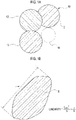
- FIG. 1A shows a schematic view of mesoporous carbon according to one aspect of the present invention.
- mesoporous carbon 10 has a connecting structure in which primary particles 12 made of carbon particles having primary pores (not shown) are connected. Therefore, the mesoporous carbon 10 is not spherical particles and has a distorted shape.
- the degree of deviation of the shape of the mesoporous carbon 10 from a spherical shape can be expressed by linearity. The details of the linearity will be described below.
- secondary pores 14 having a predetermined secondary pore diameter are formed between the mesoporous carbons 10 adjacent to each other.
- the mesoporous carbon 10 is produced using mesoporous silica as a template.
- Mesoporous silica is usually synthesized by the condensation polymerization of a silica source in a reaction solution containing the silica source, a surfactant, and a catalyst.
- the concentration of the surfactant and/or the concentration of the silica source in the reaction solution are optimized, mesoporous silica having a connecting structure and having pore diameters, pore capacity, and linearity within specific ranges can be obtained.
- mesoporous silica is used as a template, the mesoporous carbon 10 having a connecting structure and having pore diameters, pore capacity, and linearity within specific ranges can be obtained.
- connecting structure refers to a structure in which primary particles 12 made of carbon particles are connected in a beaded shape.
- Each of the primary particles 12 constituting the connecting structure has a primary pore (not shown) inside the primary particle 12.
- the primary pore in the primary particle 12 is a cavity remaining after the pore wall of the mesoporous silica used as the template is removed.
- FIGS. 1A and 1B each of the primary particles 12 is drawn in a spherical shape, which is merely an example.
- the shape of the primary particle 12 is usually not a completely spherical shape and is a distorted shape with an aspect ratio of approximately 1.1 to 3.
- the primary particle 12 is made of a carbon particle having a primary pore with a primary pore diameter of less than 20 nm. Since the mesoporous carbon 10 is produced using a method described below, the primary particles 12 configuring the mesoporous carbon 10 have the following characteristics.
- the “average particle diameter of the primary particles 12" refers to the average value of the lengths of the primary particles 12 in the minor axis direction.
- the “length in the minor axis direction” refers to a length in a direction (major axis direction) perpendicular to a direction in which the length of the primary particle 12 is longest.
- the average particle diameter of the primary particles 12 can be obtained by measuring the lengths in the minor axis direction of 100 or more randomly selected primary particles 12 using a microscope and calculating the average value.
- the average particle diameter of the primary particles 12 is preferably 30 nm or more.
- the average particle diameter is preferably 40 nm or more, and more preferably 50 nm or more.
- the average particle diameter of the primary particles 12 becomes too large, it becomes difficult for a reaction gas or a proton to be supplied to the catalyst particles supported in the primary pores or it becomes difficult for water generated by a reaction to be discharged. Therefore, the average particle diameter is preferably 300 nm or less. The average particle diameter is preferably 250 nm or less and more preferably 150 nm or less.
- the "primary pore diameter” refers to the average value of the diameters of the primary pores that are included in the primary particles 12, but does not include the size of a void (secondary pore 14) between the primary particles 12.
- the primary pore diameter can be obtained by analyzing the adsorption side data of the nitrogen adsorption isotherm of the mesoporous carbon 10 by a BJH method and obtaining the pore diameter (most frequent peak value) when the pore capacity is maximized.
- the primary pore diameter is preferably 2 nm or more.
- the primary pore diameter is preferably 2.5 nm or more.
- the primary pore diameter needs to be less than 20 nm.
- the primary pore diameter is preferably 10 nm or less, more preferably 7 nm or less, and still more preferably 5 nm or less.
- the "average thickness of the pore wall” refers to the average value of the thicknesses of the pore walls of the primary pores that are included in the primary particles 12.
- the average thickness of the pore walls can be obtained by measuring the thicknesses of 100 or more randomly selected pore walls using a microscope and calculating the average value.
- the average thickness of the pore walls is preferably 3 nm or more.
- the average thickness is preferably 3.5 nm or more and more preferably 4 nm or more.
- the average thickness of the pore walls is preferably 15 nm or less.
- the average thickness is preferably 12 nm or less and more preferably 10 nm or less.
- the "pore capacity of the primary pores” refers to the volume of the primary pores that are included in the primary particles 12 and does not include the volume of the voids (secondary pores 14) between the primary particles 12.
- the pore capacity of the primary pores is preferably 0.2 mL/g or more.
- the pore capacity of the primary pores is preferably 0.5 mL/g or more and more preferably 1.0 mL/g or more.
- the pore capacity of the primary pores becomes too large, the ratio of the volume of the pore walls to the volume of the primary particles 12 becomes small, and the electron conductivity may become low.
- the pore capacity of the primary pores is preferably 3.0 mL/g or less.
- the pore capacity of the primary pores is preferably 2.5 mL/g or less and more preferably 2.0 mL/g or less.
- the "secondary pore” refers to a pore between the mesoporous carbons 10 adjacent to each other when the mesoporous carbons 10 are deposited in layers.
- the "secondary pore diameter” refers to the diameter of the secondary pore 14 measured by a mercury intrusion method.
- the "pore capacity of the secondary pore” refers to the volume of the secondary pore 14 measured by the mercury intrusion method.
- the secondary pores 14 having a secondary pore diameter of more than 100 nm may also be detected. However, it is mainly the secondary pores 14 having a secondary pore diameter in a range of 20 nm to 100 nm that affect flooding in the high-current density range.
- the pore capacity of the secondary pores 14 having a secondary pore diameter in a range of 20 nm to 100 nm (hereinafter, also referred to as "pore capacity @ 20 nm to 100 nm") in the pore capacity of the secondary pores 14 become too small, the flooding resistance in the high-current density range deteriorates. Therefore, the pore capacity @ 20 nm to 100 nm needs to be 0.42 cm 3 /g or more.
- the pore capacity @ 20 nm to 100 nm is preferably 0.50 cm 3 /g or more and more preferably 0.70 cm 3 /g or more.
- the pore capacity @ 20 nm to 100 nm when the pore capacity @ 20 nm to 100 nm becomes too large, the thickness of a catalyst layer may increase and the proton transport resistance may increase. Therefore, the pore capacity @ 20 nm to 100 nm needs to be 1.34 cm 3 /g or less.
- the pore capacity @ 20 nm to 100 nm is preferably 1.32 cm 3 /g or less, more preferably 1.30 cm 3 /g or less, and still more preferably 1.00 cm 3 /g or less.
- FIG. 1B shows a schematic view for describing the definition of linearity.
- the "linearity” refers to a value represented by the following equation (1).
- Linearity L max 2 / S ⁇ ⁇ / 4
- L max is the length in a direction in which the particle length is maximized (the length in the major axis direction), and
- S is the area of a projection plane of the particle.
- the linearity represents the degree of deviation of the particle shape from a spherical shape and becomes a value closer to one as the shape of the projection plane of the particle is closer to a circle.
- the magnitude of the linearity of the mesoporous carbon 10 affects the secondary pore diameter and pore capacity of the secondary pore 14. In general, when the linearity becomes too small, the secondary pore diameter and/or pore capacity of the secondary pore 14 becomes excessively small, and the flooding resistance in the high-current density range deteriorates. Therefore, the linearity needs to be 2.2 or more.
- the catalyst basis weight (the amount of catalyst particles per unit area) needs to be set to a certain threshold value or more.
- the linearity of the mesoporous carbon 10 is excessively large, the thickness of the catalyst layer needs to be increased in order to make the catalyst basis weight equal to or more than the threshold value. As a result, the proton conductivity of the catalyst layer may decrease. Therefore, the linearity needs to be 2.6 or less.
- the linearity is preferably 2.5 or less and more preferably 2.4 or less.
- the mesoporous carbon can be obtained by filling the mesopores in the mesoporous silica with a carbon source and carbonizing the carbon source.
- the carbonization temperature of the carbon source needs to be set to be relatively low. Therefore, the mesoporous carbon after carbonization of the carbon source is likely to form a turbostratic structure.
- the mesoporous carbon having a turbostratic structure has low electron conductivity compared with mesoporous carbon having a graphite structure.
- the mesoporous carbon having a turbostratic structure when the mesoporous carbon having a turbostratic structure is subjected to a graphitization treatment at a temperature of higher than 1500°C, the mesoporous carbon having a turbostratic structure gradually changes to a graphite structure. In general, as the graphitization treatment temperature increases, the degree of graphitization improves.
- An electrode catalyst for a fuel cell according to another aspect of the present invention contains mesoporous carbon and catalyst particles supported in primary pores in the mesoporous carbon.
- the mesoporous carbon is a catalyst carrier for supporting catalyst particles.
- the catalyst particles are mainly supported in the primary pores in the primary particles 12 configuring the mesoporous carbon.
- the details of the mesoporous carbon are as described above and will not be described again.
- the material of the catalyst particles is not particularly limited as long as the material exhibits oxygen reduction reaction activity or hydrogen oxidation reaction activity.
- Examples of the material of the catalyst particles include
- a catalyst layer according to another aspect of the present invention contains an electrode catalyst for a fuel cell and a catalyst layer ionomer.
- the catalyst layer is particularly suitable as a catalyst layer on the air electrode side, but may also be used as a catalyst layer on the fuel electrode side.
- the catalyst layer contains an electrode catalyst for a fuel cell.
- the details of the electrode catalyst for the fuel cell are as described above and will not be described again.
- the material of the catalyst layer ionomer is not particularly limited.
- the catalyst layer ionomer include a perfluorocarbon sulfonic acid polymer, a highly oxygen-permeable ionomer, and the like.
- the ionomer may be any one of these or two or more thereof may be used in combination.
- perfluorocarbon sulfonic acid polymer refers to a fluorine-containing ion exchange resin including a repeating unit based on a fluorinated sulfonyl vinyl ether monomer.
- perfluorocarbon sulfonic acid polymer examples include NAFION (registered trademark), FLEMION (registered trademark), AQUIVION (registered trademark), ACIPLEX (registered trademark), and the like.
- the "highly oxygen-permeable ionomer” refers to a polymer compound including an acid group and a cyclic structure in the molecular structure.
- the highly oxygen-permeable ionomer includes a cyclic structure in the molecular structure and has a high oxygen permeability coefficient. Therefore, when the highly oxygen-permeable ionomer is used as an ionomer, the oxygen transfer resistance at the interface with the catalyst becomes relatively small.
- the "highly oxygen-permeable ionomer” refers to an ionomer having a higher oxygen permeability coefficient than perfluorocarbon sulfonic acid polymers represented by NAFION (registered trademark).
- Examples of the highly oxygen-permeable ionomer include
- the method for producing mesoporous silica may further include a diameter expansion step of performing a diameter expansion treatment on the dried precursor particles.
- condensation polymerization of a silica source is performed in a reaction solution containing the silica source, a surfactant, and a catalyst to obtain precursor particles (polymerizing step).
- the type of the silica source is not particularly limited.
- the silica source include (a) tetraalkoxysilanes, such as tetramethoxysilane, tetraethoxysilane, tetraisopropoxysilane, tetrabutoxysilane, dimethoxydiethoxysilane, and tetraethyleneglycoxysilane,
- the condensation polymerization of the silica source is performed in the reaction solution, in a case where a surfactant is added to the reaction solution, the surfactant forms a micelle in the reaction solution. Since hydrophilic groups gather around the micelle, the silica source is adsorbed to the surface of the micelle. Furthermore, the micelle to which the silica source is adsorbed self-organizes in the reaction solution, and condensation polymerization of the silica source is performed. As a result, inside the primary particle, a mesopore (including a micropore having a diameter of 2 nm or less, which will be also true below) attributed to the micelle is formed. The size of the mesopore can be controlled (to be 1 nm to 50 nm) mainly by the molecular length of the surfactant.
- the type of the surfactant is not particularly limited, but an alkyl quaternary ammonium salt is preferably used as the surfactant.
- the alkyl quaternary ammonium salt refers to a compound represented by the following formula (a). CH 3 -(CH 2 ) n -N + (R 1 )(R 2 )(R 3 )X - ... (a)
- R 1 , R 2 , and R 3 each represent an alkyl group having 1 to 3 carbon atoms.
- R 1 , R 2 , and R 3 may be the same as or different from each other.
- R 1 , R 2 , and R 3 are preferably all the same.
- at least one of R 1 , R 2 , and R 3 is preferably a methyl group, and all of them are preferably methyl groups.
- X represents a halogen atom.
- the type of halogen atom is not particularly limited, but X is preferably Cl or Br from the viewpoint of easy procurement.
- n represents an integer of 7 to 21.
- n represents an integer of 7 to 21.
- a spherical mesoporous body including a mesopore with a smaller central pore diameter is obtained.
- the central pore diameter becomes larger; however, when n becomes too large, the hydrophobic interaction of the alkyl quaternary ammonium salt becomes excessive. As a result, a layered compound is generated, and a mesoporous body cannot be obtained.
- n is preferably 9 to 17 and more preferably 13 to 17.
- alkyltrimethylammonium halide is preferable.
- alkyltrimethylammonium halide examples include hexadecyltrimethylammonium halide, octadecyltrimethylammonium halide, nonyltrimethylammonium halide, decyltrimethylammonium halide, undecyltrimethylammonium halide, dodecyltrimethylammonium halide, tetradecylammonium halide, and the like.
- alkyltrimethylammonium bromide or alkyltrimethylammonium chloride is particularly preferable.
- one type of alkyl quaternary ammonium salt may be used or two or more types may be used.
- the alkyl quaternary ammonium salt serves as a template for forming mesopores in the primary particles, the type of the alkyl quaternary ammonium salt has a significant influence on the shapes of the mesopores.
- one type of alkyl quaternary ammonium salt is preferably used.
- a catalyst is usually added to the reaction solution.
- an alkali such as sodium hydroxide or aqueous ammonia
- an acid such as hydrochloric acid
- water As a solvent, water, an organic solvent, such as an alcohol, a mixed solvent of water and an organic solvent, or the like is used.
- the alcohol may be any of
- the content of the organic solvent in the mixed solvent can be arbitrarily selected depending on the intended purpose. In general, when an appropriate amount of an organic solvent is added to the solvent, the control of particle diameters or the particle size distribution becomes easy. Furthermore, when the mixed solvent of water and an organic solvent is used, in a case where a mixed solvent in which the content of the organic solvent is 5 mass% or less is used, it is possible to produce, at low costs, mesoporous silica for producing mesoporous carbon having excellent flooding resistance.
- the composition of the reaction solution affects the outer shape and pore structure of mesoporous silica to be synthesized.
- concentration of the surfactant and the concentration of the silica source in the reaction solution have a significant influence on the average particle diameter of the primary particles, the pore diameters, the pore capacity, and the linearity of the mesoporous silica particles.
- the concentration of the surfactant needs to be 0.03 mol/L or more.
- the concentration of the surfactant is preferably 0.035 mol/L or more and more preferably 0.04 mol/L or more.
- the concentration of the surfactant needs to be 1.0 mol/L or less.
- the concentration of the surfactant is preferably 0.95 mol/L or less and more preferably 0.90 mol/L or less.
- the concentration of the silica source needs to be 0.05 mol/L or more.
- the concentration of the silica source is preferably 0.06 mol/L or more and more preferably 0.07 mol/L or more.
- the concentration of the silica source needs to be 1.0 mol/L or less.
- the concentration of the silica source is preferably 0.95 mol/L or less and more preferably 0.9 mol/L or less.
- the concentration of the catalyst is not particularly limited. In general, when the concentration of the catalyst is too low, the precipitation rate of the particles becomes slow. On the other hand, when the concentration of the catalyst is too high, the precipitation rate of the particles becomes fast.
- the optimum concentration of the catalyst is preferably selected depending on the type of the silica source, the type of the surfactant, intended physical property values, and the like. For example, when an acid is used as the catalyst, the concentration of the catalyst is preferably adjusted such that the pH of the reaction solution becomes 9 or less. The pH of the reaction solution is preferably 8.5 or less and more preferably less than 5. On the other hand, when an alkali is used as the catalyst, the concentration of the catalyst is preferably adjusted such that the pH of the reaction solution exceeds 7.
- the silica source is added to the solvent containing a predetermined amount of the surfactant, and hydrolysis and condensation polymerization are performed. Therefore, the surfactant functions as a template, and precursor particles containing silica and the surfactant are obtained.
- the reaction conditions optimum reaction conditions are selected depending on the type of the silica source, the particle diameters of the precursor particles, and the like.
- the reaction temperature is preferably -20°C to 100°C.
- the reaction temperature is preferably 0°C to 100°C, more preferably 0°C to 90°C, still more preferably 10°C to 80°C, and far still more preferably 35°C to 80°C.
- the precursor particles are separated from the reaction solution and dried (drying step).
- the precursor particles are dried to remove the solvent remaining in the precursor particles. Drying conditions are not particularly limited as long as the solvent can be removed.
- a diameter expansion treatment may be performed on the dried precursor particles as needed (diameter expansion step).
- the "diameter expansion treatment” refers to a treatment for expanding the diameters of the mesopores in the primary particles.
- the diameter expansion treatment is performed by hydrothermally treating the synthesized precursor particles (the precursor particles from which the surfactant is not removed) in a solution containing a diameter-expanding agent. This treatment makes it possible to expand the pore diameters in the precursor particles.
- diameter-expanding agent examples include
- the hydrothermal treatment under coexistence with a hydrocarbon expands the pore diameters since silica is rearranged when the diameter-expanding agent is introduced from the solvent into pores of the more hydrophobic precursor particles.
- an acid such as hydrochloric acid
- the conditions for the diameter expansion treatment are not particularly limited as long as intended pore diameters can be obtained. Usually, it is preferable to add approximately 0.05 mol/L to 10 mol/L of the diameter-expanding agent to the reaction solution and perform the hydrothermal treatment at 60°C to 150°C.
- the precursor particles are fired (firing step). Therefore, mesoporous silica is obtained.
- the precursor particles are fired in order to dehydrate and polymerize the precursor particles in which a OH group remains and to thermally decompose the surfactant remaining in the mesopores.
- the firing conditions are not particularly limited as long as dehydration, crystallization, and the thermal decomposition of the surfactant are possible.
- the firing is usually performed by heating the precursor particles in the atmosphere at 400°C to 800°C for 1 hour to 10 hours.
- a method for producing mesoporous carbon according to a sixth aspect of the present invention includes
- mesoporous silica that serves as a template is produced (first step).
- the details of a method for producing the mesoporous silica are as described above and will not be described again.
- carbon precursor refers to a substance capable of generating carbon by thermal decomposition. Specific examples of such a carbon precursor include
- the polymer precursor can be infused into the mesopores without being diluted with a solvent and is thus capable of generating a relatively large amount of carbon in the mesopores with a relatively small number of times of infusion.
- the polymer precursor has an advantage in that no polymerization initiator is needed and handling is also easy.
- the amount of the liquid or solution adsorbed per time is preferably as large as possible and is preferably an amount large enough to fill all of the mesopores with the liquid or solution.
- the amount of the acid is preferably set to a minimum amount large enough to polymerize organic substances.
- the mixture of two-component curable polymer precursors is used as the carbon precursor, as the ratio therebetween, an optimum ratio is selected depending on the type of the polymer precursor.
- the polymerized carbon precursor is carbonized in the mesopores.
- the carbon precursor is carbonized by heating the mesoporous silica containing the carbon precursor to a predetermined temperature in a non-oxidizing atmosphere (for example, in an inert atmosphere, in a vacuum, or the like).
- the heating temperature is preferably 500°C or higher and 1200°C or lower.
- the heating temperature is lower than 500°C, the carbon precursor is not sufficiently carbonized.
- the heating temperature exceeds 1200°C, silica and carbon react with each other, which is not preferable.
- an optimum heating time is selected depending on the heating temperature.
- the amount of carbon generated in the mesopores needs to be equal to or larger than an amount large enough for carbon particles to maintain the shapes when the mesoporous silica has been removed. Therefore, when the amount of carbon produced by one round of filling, polymerization, and carbonization is relatively small, these steps are preferably repeated a plurality of times. In this case, the conditions for each of the steps to be repeated may be the same as or different from each other. In addition, when each step of filling, polymerization and carbonization is repeated a plurality of times, in each carbonization step, a carbonization treatment may be performed at a relatively low temperature, and, after the end of the final carbonization treatment, a carbonization treatment may be performed again at a higher temperature than the previous temperature. When the final carbonization treatment is performed at a higher temperature than that of the previous carbonization treatment, it becomes easy to integrate carbon introduced into the pores a plurality of times.
- mesoporous silica which is a template
- mesoporous carbon is obtained.
- the mesoporous carbon is thermally treated at a temperature higher than 1500°C as needed (fourth step).
- the thermal treatment temperature needs to be lowered in order to suppress a reaction between silica and carbon. Therefore, the degree of graphitization of carbon after the carbonization treatment is low.
- the mesoporous carbon is preferably thermally treated at a high temperature after the template is removed.
- the thermal treatment temperature is preferably higher than 1500°C.
- the thermal treatment temperature is preferably 1700°C or higher and more preferably 1800°C or higher.
- the thermal treatment temperature is preferably 2300°C or lower.
- the thermal treatment temperature is preferably 2200°C or lower.
- an electrode catalyst is produced using the mesoporous carbon according to one aspect of the present invention as a catalyst carrier, and a polymer electrolyte fuel cell is produced using this electrode catalyst as an air electrode catalyst
- IV performance equivalent to or more favorable than IV performance of the related art can be obtained particularly in high-current density ranges. This is considered to be because, when mesoporous carbon in which a connecting structure is formed and the pore diameters, the pore capacity, and the linearity are optimized is used as a catalyst carrier, an air electrode catalyst layer having an appropriate thickness and an appropriate amount of voids is obtained, and this suppresses flooding.
- the IV performance of fuel cells for which this mesoporous carbon has been used further improves. This is considered to be because the graphitization of the mesoporous carbon proceeds due to the thermal treatment at higher than 1500°C and the electron conductivity of the mesoporous carbon improves.
- n-Hexadecyltrimethylammonium chloride (C 16 H 33 N(CH 3 ) 3 Cl), which is a surfactant: 17 g and ethanol: 12 g were added to a 1.5 mass% hydrochloric acid aqueous solution: 540 g.
- the obtained solid product was once filtered, dispersed in ion-exchanged water: 1000 g, and stirred. These filtration, dispersion, and stirring were repeated 5 times to wash the solid product, and then the solid product was dried at 70°C for 24 hours. Next, the dried solid product was then dispersed in 2N hydrochloric acid and heated in an autoclave at 130°C for 3 days. The solid product after the autoclave treatment was filtered, washed, dried, and then fired at 550°C for 6 hours in the presence of an air, thereby obtaining mesoporous silica.
- a surfactant and 1N sodium hydroxide were added to a mixed solvent containing predetermined amounts of water, methanol, and ethylene glycol (EG) to obtain a first solution.
- a predetermined amount of tetraethoxysilane (TEOS) was added to a mixed solvent containing predetermined amounts of methanol and EG to obtain a second solution.
- Table 1 shows the amounts of the solutions prepared.
- Example 3 Example 4 First solution Water (g) 241.0 1690 Methanol (g) 61.0 430 EG (g) 61.0 420 Surfactant (g) 7.1 50 1N NaOH (g) 6.8 45 Second solution TEOS (g) 7.3 50 Methanol (g) 15.0 100 EG (g) 15.0 100
- the solution became white turbid after a while, and it was possible to confirm that particles could be synthesized.
- the solution was filtered, and the residue was re-dispersed in water. After additional filtering, the residue was dried in an oven at 45°C.
- the dried sample was dispersed in 2N sulfuric acid and then heated at 120°C for 3 days in an autoclave. After the sample after the autoclave treatment was filtered and washed, the sample was fired at 550°C for 6 hours to remove an organic component.
- n-Hexadecyltrimethylammonium chloride (C 16 H 33 N(CH 3 ) 3 Cl), which is a surfactant: 51 g and ethanol: 36 g were added to a 1.5 mass% hydrochloric acid aqueous solution: 1600 g.
- the obtained solid product was once filtered, dispersed in ion-exchanged water: 2500 g, and stirred. These filtration, dispersion, and stirring were repeated 5 times to wash the solid product, and then the solid product was dried at 70°C for 24 hours. Next, the dried solid product was then dispersed in 2N hydrochloric acid and heated in an autoclave at 140°C for 3 days. The solid product after the autoclave treatment was filtered, washed, dried, and then fired at 550°C for 6 hours in the presence of an air, thereby obtaining mesoporous silica.
- Mesoporous silica was put into a PFA container, and furfuryl alcohol (FA) was added by an amount of the pore capacity to cause the furfuryl alcohol to penetrate into pores in the silica.
- the resultant was thermally treated at 150°C for 18 hours to polymerize the FA.
- the FA was thermally treated at 500°C for 6 hours in a nitrogen atmosphere to carbonize the FA.
- These steps were repeated twice, and then the FA was thermally treated at 900°C for 6 hours in a nitrogen atmosphere to obtain a mesoporous silica and carbon complex.
- This complex was immersed in a 12% HF solution for 12 hours to dissolve a silica component. After the dissolution, filtration and washing were repeated, and the resultant was further dried at 45°C to obtain mesoporous carbon.
- the dried mesoporous carbon was heated at 1800°C for 1 hour (graphitization treatment).
- Pt was supported by the carbon carrier obtained as described above.
- the amount of Pt supported was set to 40 mass%.
- An air electrode catalyst layer was produced using this.
- the basis weight of Pt on the air electrode side was set to 0.15 mg/cm 2 .
- the I/C of the air electrode catalyst layer was set to 1.0.
- a fuel electrode catalyst layer was produced using commercially available platinum-supported carbon in which the amount of Pt supported was 30 mass%.
- the basis weight of Pt on the fuel electrode side was set to 0.1 mg/cm 2 .
- the I/C of the fuel electrode catalyst layer was set to 0.75.
- the air electrode catalyst layer and the fuel electrode side catalyst layer were transferred to both surfaces of an electrolyte membrane, respectively, to obtain an MEA.
- a fluorine-based solid polymer electrolyte membrane was used as the electrolyte membrane.
- the MEA was combined into a square cell for 1 cm 2 . Furthermore, diffusion layers and current collectors were disposed on both sides of the MEA. Carbon paper (with a microporous layer) was used as the diffusion layer.
- a flow path-integrated gold-plated copper plate (flow paths: linear flow paths at pitches of 0.4 mm) was used as the current collector.
- the pore capacity (the capacity of pores having pore diameters within a range of 20 nm to 100 nm) of secondary pores in the carbon carrier was determined using a mercury intrusion method.
- the output point voltage (mV) under high humidification conditions (80% RH, cell temperature: 60°C) was evaluated using the obtained fuel cell.
- the H 2 flow rate was set to 500 cc/min
- the air flow rate was set to 1000 cc/min
- the back pressure was set to 1 kg/cm 2 .
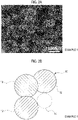
- FIG. 2A and FIG. 2B show a SEM image and a schematic view of the mesoporous carbon of Example 1.
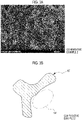
- FIG. 3A and FIG. 3B show a SEM image and a schematic view of the hollow carbon of Comparative Example 2.
- Hollow carbon 10' of Comparative Example 2 has a structure in which rod-shaped bodies made of carbon having mesopores (not shown) are branched in a tree shape. Therefore, the hollow carbon 10' of Comparative Example 2 had a large linearity and contained a relatively large amount of secondary pores 14'.
- the mesoporous carbon 10 of Example 1 has a structure in which primary particles 12 having primary pores (not shown) are connected. Therefore, the mesoporous carbon 10 of Example 1 had a small linearity and a small pore capacity of the secondary pores 14 compared with the hollow carbon 10' of Comparative Example 2.
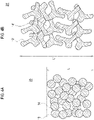
- FIG. 4A shows a schematic cross-sectional view of the air electrode catalyst layer of the fuel cell obtained in Example 1.
- FIG. 4B shows a schematic cross-sectional view of the air electrode catalyst layer of the fuel cell obtained in Comparative Example 2.
- the hollow carbon 10' of Comparative Example 2 has an excessively large linearity and an excessively large pore capacity of the secondary pores 14'. Therefore, when a catalyst layer 20' is formed using the hollow carbon 10' of Comparative Example 2 such that the basis weight of Pt became a predetermined value, as shown in FIG. 4B , a thickness L' of the catalyst layer 20' became excessively thick.
- the mesoporous carbon 10 of Example 1 has an appropriate linearity and an appropriate pore capacity of the secondary pores 14. Therefore, when a catalyst layer 20 is formed using the mesoporous carbon 10 of Example 1 such that the basis weight of Pt became a predetermined value, as shown in FIG. 4A , a thickness L of the catalyst layer 20 became appropriately thin.
- Table 2 shows the physical property values of the carbon carriers and the output point performance @ high humidification of the fuel cells produced using the carbon carriers.
- FIG. 5 shows the output point performance @ high humidification of the fuel cells obtained in Examples 1 to 4 and Comparative Examples 1 to 3.
- the mesoporous carbon according to one aspect of the present invention can be used as a catalyst carrier for an air electrode catalyst layer of a polymer electrolyte fuel cell or as a catalyst carrier for a fuel electrode catalyst layer.
Landscapes
- Chemical & Material Sciences (AREA)
- General Chemical & Material Sciences (AREA)
- Electrochemistry (AREA)
- Chemical Kinetics & Catalysis (AREA)
- Engineering & Computer Science (AREA)
- Organic Chemistry (AREA)
- Materials Engineering (AREA)
- Inorganic Chemistry (AREA)
- Manufacturing & Machinery (AREA)
- Life Sciences & Earth Sciences (AREA)
- Geology (AREA)
- General Life Sciences & Earth Sciences (AREA)
- Sustainable Development (AREA)
- Sustainable Energy (AREA)
- Catalysts (AREA)
- Inert Electrodes (AREA)
- Carbon And Carbon Compounds (AREA)
- Silicates, Zeolites, And Molecular Sieves (AREA)
- Fuel Cell (AREA)
Applications Claiming Priority (1)
| Application Number | Priority Date | Filing Date | Title |
|---|---|---|---|
| JP2021057848A JP7284776B2 (ja) | 2021-03-30 | 2021-03-30 | メソポーラスカーボン、並びに、燃料電池用電極触媒及び触媒層 |
Publications (3)
| Publication Number | Publication Date |
|---|---|
| EP4068434A2 true EP4068434A2 (de) | 2022-10-05 |
| EP4068434A3 EP4068434A3 (de) | 2022-10-19 |
| EP4068434B1 EP4068434B1 (de) | 2025-03-05 |
Family
ID=80952301
Family Applications (1)
| Application Number | Title | Priority Date | Filing Date |
|---|---|---|---|
| EP22164520.3A Active EP4068434B1 (de) | 2021-03-30 | 2022-03-25 | Mesoporöser kohlenstoff, elektrodenkatalysator für brennstoffzelle, katalysatorschicht, brennstoffzelle und verfahren zur herstellung von mesoporösem kohlenstoff |
Country Status (6)
| Country | Link |
|---|---|
| US (1) | US12087952B2 (de) |
| EP (1) | EP4068434B1 (de) |
| JP (1) | JP7284776B2 (de) |
| KR (1) | KR102694466B1 (de) |
| CN (1) | CN115149009B (de) |
| BR (1) | BR102022005116A2 (de) |
Families Citing this family (4)
| Publication number | Priority date | Publication date | Assignee | Title |
|---|---|---|---|---|
| JP7735208B2 (ja) * | 2022-03-17 | 2025-09-08 | 株式会社豊田中央研究所 | メソポーラスカーボン、並びに、燃料電池用電極触媒及び触媒層 |
| CN121794222A (zh) * | 2023-12-28 | 2026-04-03 | 株式会社3Dc | 碳材料、导电助剂、分散液、电极用组合物、电极用浆料、电极、锂离子电池及碳材料的制造方法 |
| CN119191290B (zh) * | 2024-09-18 | 2025-11-21 | 江苏中科锐纳环境科技有限公司 | 一种除醛抗菌活性炭材料的制备方法 |
| CN119786623B (zh) * | 2025-01-17 | 2026-01-27 | 清华大学 | 氧化铈可控修饰贵金属基多孔碳催化剂、制备方法及应用 |
Citations (5)
| Publication number | Priority date | Publication date | Assignee | Title |
|---|---|---|---|---|
| JP2003036856A (ja) | 2001-07-23 | 2003-02-07 | Asahi Glass Co Ltd | ガス拡散電極及びこれを備えた固体高分子型燃料電池 |
| JP2006152249A (ja) | 2004-10-26 | 2006-06-15 | Asahi Glass Co Ltd | フルオロスルホニル基と1,3−ジオキソラン構造を有する重合体およびその用途 |
| WO2012088166A1 (en) | 2010-12-20 | 2012-06-28 | E. I. Du Pont De Nemours And Company | Ionomers and ionically conductive compositions |
| JP2013216811A (ja) | 2012-04-10 | 2013-10-24 | Toyota Central R&D Labs Inc | 高分子電解質及びその製造方法、並びに、燃料電池 |
| WO2016152447A1 (ja) | 2015-03-26 | 2016-09-29 | 新日鐵住金株式会社 | 固体高分子形燃料電池用の担体炭素材料及び触媒 |
Family Cites Families (18)
| Publication number | Priority date | Publication date | Assignee | Title |
|---|---|---|---|---|
| JP3690651B2 (ja) | 2000-07-06 | 2005-08-31 | 松下電器産業株式会社 | 燃料電池 |
| JP4204272B2 (ja) | 2002-08-02 | 2009-01-07 | トヨタ自動車株式会社 | 燃料電池用電極触媒及び燃料電池 |
| KR100574022B1 (ko) * | 2004-06-07 | 2006-04-26 | 한남대학교 산학협력단 | 이중 다공성 탄소 구조체, 그의 제조방법 및 그것을이용한 연료 전지용 촉매 |
| TWI243507B (en) * | 2004-12-30 | 2005-11-11 | Ind Tech Res Inst | Hollow mesocarbon electrode-catalyst for direct methanol fuel cell and preparation thereof |
| KR100612896B1 (ko) * | 2005-05-18 | 2006-08-14 | 삼성에스디아이 주식회사 | 중형 다공성 탄소체 및 그의 제조방법 |
| KR101473319B1 (ko) * | 2007-10-16 | 2014-12-16 | 삼성에스디아이 주식회사 | 복합 중형 다공성 탄소, 그 제조방법 및 이를 이용한연료전지 |
| US20110082024A1 (en) * | 2008-06-10 | 2011-04-07 | Hansan Liu | Controllable Synthesis of Porous Carbon Spheres, and Electrochemical Applications Thereof |
| JP5603566B2 (ja) | 2009-05-12 | 2014-10-08 | 株式会社豊田中央研究所 | 球状メソポーラスカーボン及びその製造方法 |
| CN105073260B (zh) | 2013-02-21 | 2018-04-06 | 新日铁住金化学株式会社 | 催化剂载体用碳材料 |
| JP6063039B2 (ja) * | 2013-05-16 | 2017-01-18 | トヨタ自動車株式会社 | 燃料電池用電極およびその製造方法 |
| US11380895B2 (en) * | 2017-04-03 | 2022-07-05 | The George Washington University | Methods and systems for the production of crystalline flake graphite from biomass or other carbonaceous materials |
| JP6566331B2 (ja) | 2017-04-17 | 2019-08-28 | パナソニックIpマネジメント株式会社 | 電気化学デバイスの電極触媒層、電気化学デバイスの膜/電極接合体、電気化学デバイス、および電気化学デバイスの電極触媒層の製造方法 |
| JP7116564B2 (ja) * | 2018-03-22 | 2022-08-10 | 株式会社豊田中央研究所 | 単分散球状炭素多孔体及び固体高分子形燃料電池 |
| JP7141980B2 (ja) * | 2018-06-07 | 2022-09-26 | 株式会社豊田中央研究所 | 連結メソポーラスシリカ粒子及びその製造方法 |
| JP7192612B2 (ja) | 2019-03-28 | 2022-12-20 | 日本製鉄株式会社 | 触媒担体用炭素材料、燃料電池用触媒層、及び燃料電池 |
| JP7192613B2 (ja) | 2019-03-28 | 2022-12-20 | 日本製鉄株式会社 | 触媒担体用炭素材料、触媒担体用炭素材料の製造方法、燃料電池用触媒層、及び燃料電池 |
| JP7153005B2 (ja) | 2019-11-29 | 2022-10-13 | 株式会社豊田中央研究所 | メソ多孔カーボン及びその製造方法、並びに、固体高分子形燃料電池 |
| CN114829008A (zh) * | 2020-02-10 | 2022-07-29 | 国立大学法人山梨大学 | 负载型金属催化剂以及其制造方法、载体的制造方法 |
-
2021
- 2021-03-30 JP JP2021057848A patent/JP7284776B2/ja active Active
-
2022
- 2022-03-18 BR BR102022005116-0A patent/BR102022005116A2/pt unknown
- 2022-03-22 KR KR1020220035352A patent/KR102694466B1/ko active Active
- 2022-03-25 CN CN202210300049.3A patent/CN115149009B/zh active Active
- 2022-03-25 EP EP22164520.3A patent/EP4068434B1/de active Active
- 2022-03-28 US US17/656,797 patent/US12087952B2/en active Active
Patent Citations (5)
| Publication number | Priority date | Publication date | Assignee | Title |
|---|---|---|---|---|
| JP2003036856A (ja) | 2001-07-23 | 2003-02-07 | Asahi Glass Co Ltd | ガス拡散電極及びこれを備えた固体高分子型燃料電池 |
| JP2006152249A (ja) | 2004-10-26 | 2006-06-15 | Asahi Glass Co Ltd | フルオロスルホニル基と1,3−ジオキソラン構造を有する重合体およびその用途 |
| WO2012088166A1 (en) | 2010-12-20 | 2012-06-28 | E. I. Du Pont De Nemours And Company | Ionomers and ionically conductive compositions |
| JP2013216811A (ja) | 2012-04-10 | 2013-10-24 | Toyota Central R&D Labs Inc | 高分子電解質及びその製造方法、並びに、燃料電池 |
| WO2016152447A1 (ja) | 2015-03-26 | 2016-09-29 | 新日鐵住金株式会社 | 固体高分子形燃料電池用の担体炭素材料及び触媒 |
Also Published As
| Publication number | Publication date |
|---|---|
| CN115149009B (zh) | 2025-08-26 |
| EP4068434A3 (de) | 2022-10-19 |
| KR102694466B1 (ko) | 2024-08-13 |
| EP4068434B1 (de) | 2025-03-05 |
| JP2022154694A (ja) | 2022-10-13 |
| BR102022005116A2 (pt) | 2022-10-04 |
| US12087952B2 (en) | 2024-09-10 |
| KR20220136145A (ko) | 2022-10-07 |
| CN115149009A (zh) | 2022-10-04 |
| US20220320528A1 (en) | 2022-10-06 |
| JP7284776B2 (ja) | 2023-05-31 |
Similar Documents
| Publication | Publication Date | Title |
|---|---|---|
| US20240286902A1 (en) | Mesoporous carbon and manufacturing method of the same, and polymer electrolyte fuel cell | |
| EP4068434B1 (de) | Mesoporöser kohlenstoff, elektrodenkatalysator für brennstoffzelle, katalysatorschicht, brennstoffzelle und verfahren zur herstellung von mesoporösem kohlenstoff | |
| US20240246826A1 (en) | C/sic composite particles and their manufacturing method, electrode catalyst and polymer electrolyte fuel cell comprising the c/sic composite particles | |
| JP7167792B2 (ja) | 空気極触媒層及び固体高分子形燃料電池 | |
| US12592394B2 (en) | Mesoporous carbon, electrode catalyst for fuel cell, and catalyst layer | |
| JP7116564B2 (ja) | 単分散球状炭素多孔体及び固体高分子形燃料電池 | |
| EP4272863A1 (de) | Kohlenstoffträger, katalysator für brennstoffzellen, katalysatorschicht für brennstoffzellen und verfahren zur herstellung des kohlenstoffträgers | |
| US20240006619A1 (en) | Catalyst for fuel cell | |
| JP2025080880A (ja) | 燃料電池 | |
| JP2024118215A (ja) | 多孔質酸化スズ粒子 | |
| BR102020024054B1 (pt) | Carbono mesoporoso e uso de carbono mesoporoso |
Legal Events
| Date | Code | Title | Description |
|---|---|---|---|
| PUAI | Public reference made under article 153(3) epc to a published international application that has entered the european phase |
Free format text: ORIGINAL CODE: 0009012 |
|
| STAA | Information on the status of an ep patent application or granted ep patent |
Free format text: STATUS: REQUEST FOR EXAMINATION WAS MADE |
|
| PUAL | Search report despatched |
Free format text: ORIGINAL CODE: 0009013 |
|
| 17P | Request for examination filed |
Effective date: 20220325 |
|
| AK | Designated contracting states |
Kind code of ref document: A2 Designated state(s): AL AT BE BG CH CY CZ DE DK EE ES FI FR GB GR HR HU IE IS IT LI LT LU LV MC MK MT NL NO PL PT RO RS SE SI SK SM TR |
|
| AK | Designated contracting states |
Kind code of ref document: A3 Designated state(s): AL AT BE BG CH CY CZ DE DK EE ES FI FR GB GR HR HU IE IS IT LI LT LU LV MC MK MT NL NO PL PT RO RS SE SI SK SM TR |
|
| RIC1 | Information provided on ipc code assigned before grant |
Ipc: H01M 4/92 20060101ALI20220915BHEP Ipc: H01M 8/10 20160101ALI20220915BHEP Ipc: H01M 4/86 20060101AFI20220915BHEP |
|
| STAA | Information on the status of an ep patent application or granted ep patent |
Free format text: STATUS: EXAMINATION IS IN PROGRESS |
|
| 17Q | First examination report despatched |
Effective date: 20240419 |
|
| GRAP | Despatch of communication of intention to grant a patent |
Free format text: ORIGINAL CODE: EPIDOSNIGR1 |
|
| STAA | Information on the status of an ep patent application or granted ep patent |
Free format text: STATUS: GRANT OF PATENT IS INTENDED |
|
| INTG | Intention to grant announced |
Effective date: 20241001 |
|
| GRAS | Grant fee paid |
Free format text: ORIGINAL CODE: EPIDOSNIGR3 |
|
| GRAA | (expected) grant |
Free format text: ORIGINAL CODE: 0009210 |
|
| STAA | Information on the status of an ep patent application or granted ep patent |
Free format text: STATUS: THE PATENT HAS BEEN GRANTED |
|
| AK | Designated contracting states |
Kind code of ref document: B1 Designated state(s): AL AT BE BG CH CY CZ DE DK EE ES FI FR GB GR HR HU IE IS IT LI LT LU LV MC MK MT NL NO PL PT RO RS SE SI SK SM TR |
|
| REG | Reference to a national code |
Ref country code: GB Ref legal event code: FG4D |
|
| REG | Reference to a national code |
Ref country code: CH Ref legal event code: EP |
|
| REG | Reference to a national code |
Ref country code: DE Ref legal event code: R096 Ref document number: 602022011290 Country of ref document: DE |
|
| REG | Reference to a national code |
Ref country code: IE Ref legal event code: FG4D |
|
| PGFP | Annual fee paid to national office [announced via postgrant information from national office to epo] |
Ref country code: AT Payment date: 20250417 Year of fee payment: 4 |
|
| P01 | Opt-out of the competence of the unified patent court (upc) registered |
Free format text: CASE NUMBER: APP_20536/2025 Effective date: 20250430 |
|
| PG25 | Lapsed in a contracting state [announced via postgrant information from national office to epo] |
Ref country code: RS Free format text: LAPSE BECAUSE OF FAILURE TO SUBMIT A TRANSLATION OF THE DESCRIPTION OR TO PAY THE FEE WITHIN THE PRESCRIBED TIME-LIMIT Effective date: 20250605 |
|
| PG25 | Lapsed in a contracting state [announced via postgrant information from national office to epo] |
Ref country code: FI Free format text: LAPSE BECAUSE OF FAILURE TO SUBMIT A TRANSLATION OF THE DESCRIPTION OR TO PAY THE FEE WITHIN THE PRESCRIBED TIME-LIMIT Effective date: 20250305 |
|
| REG | Reference to a national code |
Ref country code: NL Ref legal event code: MP Effective date: 20250305 |
|
| PG25 | Lapsed in a contracting state [announced via postgrant information from national office to epo] |
Ref country code: ES Free format text: LAPSE BECAUSE OF FAILURE TO SUBMIT A TRANSLATION OF THE DESCRIPTION OR TO PAY THE FEE WITHIN THE PRESCRIBED TIME-LIMIT Effective date: 20250305 |
|
| REG | Reference to a national code |
Ref country code: LT Ref legal event code: MG9D |
|
| PG25 | Lapsed in a contracting state [announced via postgrant information from national office to epo] |
Ref country code: NO Free format text: LAPSE BECAUSE OF FAILURE TO SUBMIT A TRANSLATION OF THE DESCRIPTION OR TO PAY THE FEE WITHIN THE PRESCRIBED TIME-LIMIT Effective date: 20250605 |
|
| PG25 | Lapsed in a contracting state [announced via postgrant information from national office to epo] |
Ref country code: HR Free format text: LAPSE BECAUSE OF FAILURE TO SUBMIT A TRANSLATION OF THE DESCRIPTION OR TO PAY THE FEE WITHIN THE PRESCRIBED TIME-LIMIT Effective date: 20250305 |
|
| PG25 | Lapsed in a contracting state [announced via postgrant information from national office to epo] |
Ref country code: LV Free format text: LAPSE BECAUSE OF FAILURE TO SUBMIT A TRANSLATION OF THE DESCRIPTION OR TO PAY THE FEE WITHIN THE PRESCRIBED TIME-LIMIT Effective date: 20250305 |
|
| PG25 | Lapsed in a contracting state [announced via postgrant information from national office to epo] |
Ref country code: GR Free format text: LAPSE BECAUSE OF FAILURE TO SUBMIT A TRANSLATION OF THE DESCRIPTION OR TO PAY THE FEE WITHIN THE PRESCRIBED TIME-LIMIT Effective date: 20250606 Ref country code: BG Free format text: LAPSE BECAUSE OF FAILURE TO SUBMIT A TRANSLATION OF THE DESCRIPTION OR TO PAY THE FEE WITHIN THE PRESCRIBED TIME-LIMIT Effective date: 20250305 |
|
| PG25 | Lapsed in a contracting state [announced via postgrant information from national office to epo] |
Ref country code: AT Free format text: LAPSE BECAUSE OF FAILURE TO SUBMIT A TRANSLATION OF THE DESCRIPTION OR TO PAY THE FEE WITHIN THE PRESCRIBED TIME-LIMIT Effective date: 20250305 |
|
| REG | Reference to a national code |
Ref country code: AT Ref legal event code: MK05 Ref document number: 1773791 Country of ref document: AT Kind code of ref document: T Effective date: 20250305 |
|
| PG25 | Lapsed in a contracting state [announced via postgrant information from national office to epo] |
Ref country code: NL Free format text: LAPSE BECAUSE OF FAILURE TO SUBMIT A TRANSLATION OF THE DESCRIPTION OR TO PAY THE FEE WITHIN THE PRESCRIBED TIME-LIMIT Effective date: 20250305 |
|
| PG25 | Lapsed in a contracting state [announced via postgrant information from national office to epo] |
Ref country code: SE Free format text: LAPSE BECAUSE OF FAILURE TO SUBMIT A TRANSLATION OF THE DESCRIPTION OR TO PAY THE FEE WITHIN THE PRESCRIBED TIME-LIMIT Effective date: 20250305 |
|
| REG | Reference to a national code |
Ref country code: DE Ref legal event code: R084 Ref document number: 602022011290 Country of ref document: DE |
|
| PG25 | Lapsed in a contracting state [announced via postgrant information from national office to epo] |
Ref country code: SM Free format text: LAPSE BECAUSE OF FAILURE TO SUBMIT A TRANSLATION OF THE DESCRIPTION OR TO PAY THE FEE WITHIN THE PRESCRIBED TIME-LIMIT Effective date: 20250305 |
|
| PG25 | Lapsed in a contracting state [announced via postgrant information from national office to epo] |
Ref country code: PT Free format text: LAPSE BECAUSE OF FAILURE TO SUBMIT A TRANSLATION OF THE DESCRIPTION OR TO PAY THE FEE WITHIN THE PRESCRIBED TIME-LIMIT Effective date: 20250707 |
|
| PG25 | Lapsed in a contracting state [announced via postgrant information from national office to epo] |
Ref country code: PL Free format text: LAPSE BECAUSE OF FAILURE TO SUBMIT A TRANSLATION OF THE DESCRIPTION OR TO PAY THE FEE WITHIN THE PRESCRIBED TIME-LIMIT Effective date: 20250305 Ref country code: IT Free format text: LAPSE BECAUSE OF FAILURE TO SUBMIT A TRANSLATION OF THE DESCRIPTION OR TO PAY THE FEE WITHIN THE PRESCRIBED TIME-LIMIT Effective date: 20250305 |
|
| PG25 | Lapsed in a contracting state [announced via postgrant information from national office to epo] |
Ref country code: CZ Free format text: LAPSE BECAUSE OF FAILURE TO SUBMIT A TRANSLATION OF THE DESCRIPTION OR TO PAY THE FEE WITHIN THE PRESCRIBED TIME-LIMIT Effective date: 20250305 Ref country code: EE Free format text: LAPSE BECAUSE OF FAILURE TO SUBMIT A TRANSLATION OF THE DESCRIPTION OR TO PAY THE FEE WITHIN THE PRESCRIBED TIME-LIMIT Effective date: 20250305 |
|
| REG | Reference to a national code |
Ref country code: CH Ref legal event code: H13 Free format text: ST27 STATUS EVENT CODE: U-0-0-H10-H13 (AS PROVIDED BY THE NATIONAL OFFICE) Effective date: 20251023 |
|
| PG25 | Lapsed in a contracting state [announced via postgrant information from national office to epo] |
Ref country code: RO Free format text: LAPSE BECAUSE OF FAILURE TO SUBMIT A TRANSLATION OF THE DESCRIPTION OR TO PAY THE FEE WITHIN THE PRESCRIBED TIME-LIMIT Effective date: 20250305 |
|
| PG25 | Lapsed in a contracting state [announced via postgrant information from national office to epo] |
Ref country code: SK Free format text: LAPSE BECAUSE OF FAILURE TO SUBMIT A TRANSLATION OF THE DESCRIPTION OR TO PAY THE FEE WITHIN THE PRESCRIBED TIME-LIMIT Effective date: 20250305 |
|
| PG25 | Lapsed in a contracting state [announced via postgrant information from national office to epo] |
Ref country code: IS Free format text: LAPSE BECAUSE OF FAILURE TO SUBMIT A TRANSLATION OF THE DESCRIPTION OR TO PAY THE FEE WITHIN THE PRESCRIBED TIME-LIMIT Effective date: 20250705 |
|
| PG25 | Lapsed in a contracting state [announced via postgrant information from national office to epo] |
Ref country code: LU Free format text: LAPSE BECAUSE OF NON-PAYMENT OF DUE FEES Effective date: 20250325 |
|
| REG | Reference to a national code |
Ref country code: DE Ref legal event code: R097 Ref document number: 602022011290 Country of ref document: DE |
|
| REG | Reference to a national code |
Ref country code: BE Ref legal event code: MM Effective date: 20250331 |
|
| PG25 | Lapsed in a contracting state [announced via postgrant information from national office to epo] |
Ref country code: MC Free format text: LAPSE BECAUSE OF FAILURE TO SUBMIT A TRANSLATION OF THE DESCRIPTION OR TO PAY THE FEE WITHIN THE PRESCRIBED TIME-LIMIT Effective date: 20250305 |
|
| PLBE | No opposition filed within time limit |
Free format text: ORIGINAL CODE: 0009261 |
|
| STAA | Information on the status of an ep patent application or granted ep patent |
Free format text: STATUS: NO OPPOSITION FILED WITHIN TIME LIMIT |
|
| PG25 | Lapsed in a contracting state [announced via postgrant information from national office to epo] |
Ref country code: DK Free format text: LAPSE BECAUSE OF FAILURE TO SUBMIT A TRANSLATION OF THE DESCRIPTION OR TO PAY THE FEE WITHIN THE PRESCRIBED TIME-LIMIT Effective date: 20250305 |
|
| REG | Reference to a national code |
Ref country code: CH Ref legal event code: L10 Free format text: ST27 STATUS EVENT CODE: U-0-0-L10-L00 (AS PROVIDED BY THE NATIONAL OFFICE) Effective date: 20260114 |
|
| PG25 | Lapsed in a contracting state [announced via postgrant information from national office to epo] |
Ref country code: BE Free format text: LAPSE BECAUSE OF NON-PAYMENT OF DUE FEES Effective date: 20250331 |
|
| PG25 | Lapsed in a contracting state [announced via postgrant information from national office to epo] |
Ref country code: CH Free format text: LAPSE BECAUSE OF NON-PAYMENT OF DUE FEES Effective date: 20250331 |
|
| PG25 | Lapsed in a contracting state [announced via postgrant information from national office to epo] |
Ref country code: IE Free format text: LAPSE BECAUSE OF NON-PAYMENT OF DUE FEES Effective date: 20250325 |
|
| REG | Reference to a national code |
Ref country code: GB Ref legal event code: 746 Effective date: 20260106 |
|
| 26N | No opposition filed |
Effective date: 20251208 |
|
| PGFP | Annual fee paid to national office [announced via postgrant information from national office to epo] |
Ref country code: GB Payment date: 20260202 Year of fee payment: 5 |
|
| PGFP | Annual fee paid to national office [announced via postgrant information from national office to epo] |
Ref country code: DE Payment date: 20260128 Year of fee payment: 5 |
|
| PGFP | Annual fee paid to national office [announced via postgrant information from national office to epo] |
Ref country code: FR Payment date: 20260209 Year of fee payment: 5 |