EP4055014B1 - Pyrrolidin- und piperidinverbindungen - Google Patents
Pyrrolidin- und piperidinverbindungen Download PDFInfo
- Publication number
- EP4055014B1 EP4055014B1 EP20885645.0A EP20885645A EP4055014B1 EP 4055014 B1 EP4055014 B1 EP 4055014B1 EP 20885645 A EP20885645 A EP 20885645A EP 4055014 B1 EP4055014 B1 EP 4055014B1
- Authority
- EP
- European Patent Office
- Prior art keywords
- acetyl
- carbonitrile
- pyrrolidine
- pyrrolidin
- amino
- Prior art date
- Legal status (The legal status is an assumption and is not a legal conclusion. Google has not performed a legal analysis and makes no representation as to the accuracy of the status listed.)
- Active
Links
Classifications
-
- C—CHEMISTRY; METALLURGY
- C07—ORGANIC CHEMISTRY
- C07D—HETEROCYCLIC COMPOUNDS
- C07D207/00—Heterocyclic compounds containing five-membered rings not condensed with other rings, with one nitrogen atom as the only ring hetero atom
- C07D207/02—Heterocyclic compounds containing five-membered rings not condensed with other rings, with one nitrogen atom as the only ring hetero atom with only hydrogen or carbon atoms directly attached to the ring nitrogen atom
- C07D207/04—Heterocyclic compounds containing five-membered rings not condensed with other rings, with one nitrogen atom as the only ring hetero atom with only hydrogen or carbon atoms directly attached to the ring nitrogen atom having no double bonds between ring members or between ring members and non-ring members
- C07D207/10—Heterocyclic compounds containing five-membered rings not condensed with other rings, with one nitrogen atom as the only ring hetero atom with only hydrogen or carbon atoms directly attached to the ring nitrogen atom having no double bonds between ring members or between ring members and non-ring members with hetero atoms or with carbon atoms having three bonds to hetero atoms with at the most one bond to halogen, e.g. ester or nitrile radicals, directly attached to ring carbon atoms
- C07D207/16—Carbon atoms having three bonds to hetero atoms with at the most one bond to halogen, e.g. ester or nitrile radicals
-
- C—CHEMISTRY; METALLURGY
- C07—ORGANIC CHEMISTRY
- C07D—HETEROCYCLIC COMPOUNDS
- C07D401/00—Heterocyclic compounds containing two or more hetero rings, having nitrogen atoms as the only ring hetero atoms, at least one ring being a six-membered ring with only one nitrogen atom
- C07D401/14—Heterocyclic compounds containing two or more hetero rings, having nitrogen atoms as the only ring hetero atoms, at least one ring being a six-membered ring with only one nitrogen atom containing three or more hetero rings
-
- C—CHEMISTRY; METALLURGY
- C07—ORGANIC CHEMISTRY
- C07D—HETEROCYCLIC COMPOUNDS
- C07D403/00—Heterocyclic compounds containing two or more hetero rings, having nitrogen atoms as the only ring hetero atoms, not provided for by group C07D401/00
- C07D403/02—Heterocyclic compounds containing two or more hetero rings, having nitrogen atoms as the only ring hetero atoms, not provided for by group C07D401/00 containing two hetero rings
- C07D403/06—Heterocyclic compounds containing two or more hetero rings, having nitrogen atoms as the only ring hetero atoms, not provided for by group C07D401/00 containing two hetero rings linked by a carbon chain containing only aliphatic carbon atoms
-
- C—CHEMISTRY; METALLURGY
- C07—ORGANIC CHEMISTRY
- C07D—HETEROCYCLIC COMPOUNDS
- C07D403/00—Heterocyclic compounds containing two or more hetero rings, having nitrogen atoms as the only ring hetero atoms, not provided for by group C07D401/00
- C07D403/14—Heterocyclic compounds containing two or more hetero rings, having nitrogen atoms as the only ring hetero atoms, not provided for by group C07D401/00 containing three or more hetero rings
-
- C—CHEMISTRY; METALLURGY
- C07—ORGANIC CHEMISTRY
- C07D—HETEROCYCLIC COMPOUNDS
- C07D405/00—Heterocyclic compounds containing both one or more hetero rings having oxygen atoms as the only ring hetero atoms, and one or more rings having nitrogen as the only ring hetero atom
- C07D405/14—Heterocyclic compounds containing both one or more hetero rings having oxygen atoms as the only ring hetero atoms, and one or more rings having nitrogen as the only ring hetero atom containing three or more hetero rings
-
- C—CHEMISTRY; METALLURGY
- C07—ORGANIC CHEMISTRY
- C07D—HETEROCYCLIC COMPOUNDS
- C07D409/00—Heterocyclic compounds containing two or more hetero rings, at least one ring having sulfur atoms as the only ring hetero atoms
- C07D409/14—Heterocyclic compounds containing two or more hetero rings, at least one ring having sulfur atoms as the only ring hetero atoms containing three or more hetero rings
-
- C—CHEMISTRY; METALLURGY
- C07—ORGANIC CHEMISTRY
- C07D—HETEROCYCLIC COMPOUNDS
- C07D413/00—Heterocyclic compounds containing two or more hetero rings, at least one ring having nitrogen and oxygen atoms as the only ring hetero atoms
- C07D413/14—Heterocyclic compounds containing two or more hetero rings, at least one ring having nitrogen and oxygen atoms as the only ring hetero atoms containing three or more hetero rings
-
- C—CHEMISTRY; METALLURGY
- C07—ORGANIC CHEMISTRY
- C07D—HETEROCYCLIC COMPOUNDS
- C07D417/00—Heterocyclic compounds containing two or more hetero rings, at least one ring having nitrogen and sulfur atoms as the only ring hetero atoms, not provided for by group C07D415/00
- C07D417/14—Heterocyclic compounds containing two or more hetero rings, at least one ring having nitrogen and sulfur atoms as the only ring hetero atoms, not provided for by group C07D415/00 containing three or more hetero rings
-
- C—CHEMISTRY; METALLURGY
- C07—ORGANIC CHEMISTRY
- C07D—HETEROCYCLIC COMPOUNDS
- C07D471/00—Heterocyclic compounds containing nitrogen atoms as the only ring hetero atoms in the condensed system, at least one ring being a six-membered ring with one nitrogen atom, not provided for by groups C07D451/00 - C07D463/00
- C07D471/02—Heterocyclic compounds containing nitrogen atoms as the only ring hetero atoms in the condensed system, at least one ring being a six-membered ring with one nitrogen atom, not provided for by groups C07D451/00 - C07D463/00 in which the condensed system contains two hetero rings
- C07D471/04—Ortho-condensed systems
-
- C—CHEMISTRY; METALLURGY
- C07—ORGANIC CHEMISTRY
- C07D—HETEROCYCLIC COMPOUNDS
- C07D491/00—Heterocyclic compounds containing in the condensed ring system both one or more rings having oxygen atoms as the only ring hetero atoms and one or more rings having nitrogen atoms as the only ring hetero atoms, not provided for by groups C07D451/00 - C07D459/00, C07D463/00, C07D477/00 or C07D489/00
- C07D491/02—Heterocyclic compounds containing in the condensed ring system both one or more rings having oxygen atoms as the only ring hetero atoms and one or more rings having nitrogen atoms as the only ring hetero atoms, not provided for by groups C07D451/00 - C07D459/00, C07D463/00, C07D477/00 or C07D489/00 in which the condensed system contains two hetero rings
- C07D491/04—Ortho-condensed systems
- C07D491/044—Ortho-condensed systems with only one oxygen atom as ring hetero atom in the oxygen-containing ring
- C07D491/048—Ortho-condensed systems with only one oxygen atom as ring hetero atom in the oxygen-containing ring the oxygen-containing ring being five-membered
-
- C—CHEMISTRY; METALLURGY
- C07—ORGANIC CHEMISTRY
- C07D—HETEROCYCLIC COMPOUNDS
- C07D495/00—Heterocyclic compounds containing in the condensed system at least one hetero ring having sulfur atoms as the only ring hetero atoms
- C07D495/02—Heterocyclic compounds containing in the condensed system at least one hetero ring having sulfur atoms as the only ring hetero atoms in which the condensed system contains two hetero rings
- C07D495/04—Ortho-condensed systems
-
- A—HUMAN NECESSITIES
- A61—MEDICAL OR VETERINARY SCIENCE; HYGIENE
- A61K—PREPARATIONS FOR MEDICAL, DENTAL OR TOILETRY PURPOSES
- A61K31/00—Medicinal preparations containing organic active ingredients
- A61K31/33—Heterocyclic compounds
- A61K31/395—Heterocyclic compounds having nitrogen as a ring hetero atom, e.g. guanethidine or rifamycins
- A61K31/40—Heterocyclic compounds having nitrogen as a ring hetero atom, e.g. guanethidine or rifamycins having five-membered rings with one nitrogen as the only ring hetero atom, e.g. sulpiride, succinimide, tolmetin, buflomedil
- A61K31/4025—Heterocyclic compounds having nitrogen as a ring hetero atom, e.g. guanethidine or rifamycins having five-membered rings with one nitrogen as the only ring hetero atom, e.g. sulpiride, succinimide, tolmetin, buflomedil not condensed and containing further heterocyclic rings, e.g. cromakalim
-
- A—HUMAN NECESSITIES
- A61—MEDICAL OR VETERINARY SCIENCE; HYGIENE
- A61K—PREPARATIONS FOR MEDICAL, DENTAL OR TOILETRY PURPOSES
- A61K31/00—Medicinal preparations containing organic active ingredients
- A61K31/33—Heterocyclic compounds
- A61K31/395—Heterocyclic compounds having nitrogen as a ring hetero atom, e.g. guanethidine or rifamycins
- A61K31/41—Heterocyclic compounds having nitrogen as a ring hetero atom, e.g. guanethidine or rifamycins having five-membered rings with two or more ring hetero atoms, at least one of which being nitrogen, e.g. tetrazole
- A61K31/42—Oxazoles
- A61K31/423—Oxazoles condensed with carbocyclic rings
-
- A—HUMAN NECESSITIES
- A61—MEDICAL OR VETERINARY SCIENCE; HYGIENE
- A61K—PREPARATIONS FOR MEDICAL, DENTAL OR TOILETRY PURPOSES
- A61K31/00—Medicinal preparations containing organic active ingredients
- A61K31/33—Heterocyclic compounds
- A61K31/395—Heterocyclic compounds having nitrogen as a ring hetero atom, e.g. guanethidine or rifamycins
- A61K31/435—Heterocyclic compounds having nitrogen as a ring hetero atom, e.g. guanethidine or rifamycins having six-membered rings with one nitrogen as the only ring hetero atom
- A61K31/4353—Heterocyclic compounds having nitrogen as a ring hetero atom, e.g. guanethidine or rifamycins having six-membered rings with one nitrogen as the only ring hetero atom ortho- or peri-condensed with heterocyclic ring systems
- A61K31/4355—Heterocyclic compounds having nitrogen as a ring hetero atom, e.g. guanethidine or rifamycins having six-membered rings with one nitrogen as the only ring hetero atom ortho- or peri-condensed with heterocyclic ring systems the heterocyclic ring system containing a five-membered ring having oxygen as a ring hetero atom
-
- A—HUMAN NECESSITIES
- A61—MEDICAL OR VETERINARY SCIENCE; HYGIENE
- A61K—PREPARATIONS FOR MEDICAL, DENTAL OR TOILETRY PURPOSES
- A61K31/00—Medicinal preparations containing organic active ingredients
- A61K31/33—Heterocyclic compounds
- A61K31/395—Heterocyclic compounds having nitrogen as a ring hetero atom, e.g. guanethidine or rifamycins
- A61K31/435—Heterocyclic compounds having nitrogen as a ring hetero atom, e.g. guanethidine or rifamycins having six-membered rings with one nitrogen as the only ring hetero atom
- A61K31/4353—Heterocyclic compounds having nitrogen as a ring hetero atom, e.g. guanethidine or rifamycins having six-membered rings with one nitrogen as the only ring hetero atom ortho- or peri-condensed with heterocyclic ring systems
- A61K31/4365—Heterocyclic compounds having nitrogen as a ring hetero atom, e.g. guanethidine or rifamycins having six-membered rings with one nitrogen as the only ring hetero atom ortho- or peri-condensed with heterocyclic ring systems the heterocyclic ring system having sulfur as a ring hetero atom, e.g. ticlopidine
-
- A—HUMAN NECESSITIES
- A61—MEDICAL OR VETERINARY SCIENCE; HYGIENE
- A61K—PREPARATIONS FOR MEDICAL, DENTAL OR TOILETRY PURPOSES
- A61K31/00—Medicinal preparations containing organic active ingredients
- A61K31/33—Heterocyclic compounds
- A61K31/395—Heterocyclic compounds having nitrogen as a ring hetero atom, e.g. guanethidine or rifamycins
- A61K31/435—Heterocyclic compounds having nitrogen as a ring hetero atom, e.g. guanethidine or rifamycins having six-membered rings with one nitrogen as the only ring hetero atom
- A61K31/44—Non condensed pyridines; Hydrogenated derivatives thereof
- A61K31/445—Non condensed piperidines, e.g. piperocaine
- A61K31/4523—Non condensed piperidines, e.g. piperocaine containing further heterocyclic ring systems
- A61K31/4545—Non condensed piperidines, e.g. piperocaine containing further heterocyclic ring systems containing a six-membered ring with nitrogen as a ring hetero atom, e.g. pipamperone, anabasine
-
- A—HUMAN NECESSITIES
- A61—MEDICAL OR VETERINARY SCIENCE; HYGIENE
- A61K—PREPARATIONS FOR MEDICAL, DENTAL OR TOILETRY PURPOSES
- A61K31/00—Medicinal preparations containing organic active ingredients
- A61K31/33—Heterocyclic compounds
- A61K31/395—Heterocyclic compounds having nitrogen as a ring hetero atom, e.g. guanethidine or rifamycins
- A61K31/435—Heterocyclic compounds having nitrogen as a ring hetero atom, e.g. guanethidine or rifamycins having six-membered rings with one nitrogen as the only ring hetero atom
- A61K31/47—Quinolines; Isoquinolines
- A61K31/4709—Non-condensed quinolines and containing further heterocyclic rings
-
- A—HUMAN NECESSITIES
- A61—MEDICAL OR VETERINARY SCIENCE; HYGIENE
- A61K—PREPARATIONS FOR MEDICAL, DENTAL OR TOILETRY PURPOSES
- A61K31/00—Medicinal preparations containing organic active ingredients
- A61K31/33—Heterocyclic compounds
- A61K31/395—Heterocyclic compounds having nitrogen as a ring hetero atom, e.g. guanethidine or rifamycins
- A61K31/435—Heterocyclic compounds having nitrogen as a ring hetero atom, e.g. guanethidine or rifamycins having six-membered rings with one nitrogen as the only ring hetero atom
- A61K31/47—Quinolines; Isoquinolines
- A61K31/472—Non-condensed isoquinolines, e.g. papaverine
- A61K31/4725—Non-condensed isoquinolines, e.g. papaverine containing further heterocyclic rings
-
- A—HUMAN NECESSITIES
- A61—MEDICAL OR VETERINARY SCIENCE; HYGIENE
- A61K—PREPARATIONS FOR MEDICAL, DENTAL OR TOILETRY PURPOSES
- A61K31/00—Medicinal preparations containing organic active ingredients
- A61K31/33—Heterocyclic compounds
- A61K31/395—Heterocyclic compounds having nitrogen as a ring hetero atom, e.g. guanethidine or rifamycins
- A61K31/495—Heterocyclic compounds having nitrogen as a ring hetero atom, e.g. guanethidine or rifamycins having six-membered rings with two or more nitrogen atoms as the only ring heteroatoms, e.g. piperazine or tetrazines
- A61K31/505—Pyrimidines; Hydrogenated pyrimidines, e.g. trimethoprim
- A61K31/517—Pyrimidines; Hydrogenated pyrimidines, e.g. trimethoprim ortho- or peri-condensed with carbocyclic ring systems, e.g. quinazoline, perimidine
-
- A—HUMAN NECESSITIES
- A61—MEDICAL OR VETERINARY SCIENCE; HYGIENE
- A61K—PREPARATIONS FOR MEDICAL, DENTAL OR TOILETRY PURPOSES
- A61K31/00—Medicinal preparations containing organic active ingredients
- A61K31/33—Heterocyclic compounds
- A61K31/395—Heterocyclic compounds having nitrogen as a ring hetero atom, e.g. guanethidine or rifamycins
- A61K31/495—Heterocyclic compounds having nitrogen as a ring hetero atom, e.g. guanethidine or rifamycins having six-membered rings with two or more nitrogen atoms as the only ring heteroatoms, e.g. piperazine or tetrazines
- A61K31/505—Pyrimidines; Hydrogenated pyrimidines, e.g. trimethoprim
- A61K31/519—Pyrimidines; Hydrogenated pyrimidines, e.g. trimethoprim ortho- or peri-condensed with heterocyclic rings
-
- A—HUMAN NECESSITIES
- A61—MEDICAL OR VETERINARY SCIENCE; HYGIENE
- A61K—PREPARATIONS FOR MEDICAL, DENTAL OR TOILETRY PURPOSES
- A61K31/00—Medicinal preparations containing organic active ingredients
- A61K31/33—Heterocyclic compounds
- A61K31/395—Heterocyclic compounds having nitrogen as a ring hetero atom, e.g. guanethidine or rifamycins
- A61K31/535—Heterocyclic compounds having nitrogen as a ring hetero atom, e.g. guanethidine or rifamycins having six-membered rings with at least one nitrogen and one oxygen as the ring hetero atoms, e.g. 1,2-oxazines
- A61K31/5375—1,4-Oxazines, e.g. morpholine
- A61K31/5377—1,4-Oxazines, e.g. morpholine not condensed and containing further heterocyclic rings, e.g. timolol
-
- A—HUMAN NECESSITIES
- A61—MEDICAL OR VETERINARY SCIENCE; HYGIENE
- A61P—SPECIFIC THERAPEUTIC ACTIVITY OF CHEMICAL COMPOUNDS OR MEDICINAL PREPARATIONS
- A61P1/00—Drugs for disorders of the alimentary tract or the digestive system
- A61P1/16—Drugs for disorders of the alimentary tract or the digestive system for liver or gallbladder disorders, e.g. hepatoprotective agents, cholagogues, litholytics
-
- A—HUMAN NECESSITIES
- A61—MEDICAL OR VETERINARY SCIENCE; HYGIENE
- A61P—SPECIFIC THERAPEUTIC ACTIVITY OF CHEMICAL COMPOUNDS OR MEDICINAL PREPARATIONS
- A61P35/00—Antineoplastic agents
Definitions
- the present technology relates to pyrrolidine and piperidine compounds, stereoisomers, and pharmaceutically acceptable salts thereof having inhibitory activity on fibroblast activation protein (FAP). Processes for the preparation, pharmaceutical compositions, and methods of use are also provided.
- FAP fibroblast activation protein
- the fibroblast activation protein is a homodimeric type II integral membrane serine protease belonging to the dipeptidyl peptidase-4 (dipeptidyl peptidase IV, DPP4) group.
- This protein group includes other subtype proteins such as DPP7, 8, 9, etc.
- FAP and DPP4 have about 50% amino acid sequence similarity. However, unlike DPP4 which is expressed in most biological tissues, FAP is expressed in tissue remodeling sites including, but not limited to, malignant tumor, fibrosis, atherosclerosis, and arthritis.
- FAP like DPP4, has dipeptidyl peptidase activities capable of cleaving the post-proline bond at two or more residues from the N-terminus but, unlike DPP4, FAP also has specific enzymatic activities of endopeptidase activities capable of cleaving the glycine-proline bond present in the substrate ( Aertgeerts et al., J. Biol. Chem., 2005, 280, 19441 ). Moreover, FAP has collagenase activities capable of degrading gelatin and type 1 collagen (CN - 1) ( Fuming Zi et al., Molecular Medicine Reports, November 2015, 3203 ).
- FAP is expressed where tissue remodeling is in progress, for example, liver fibrosis ( Levy et al., Hepatol., 1999, 29:1768 ). It was found that patients suffering from fibrosis as a result of alcohol abuse or viral infection have a great quantity of FAP expressed in cells associated with excessive scarring and liver diseases. As an example, it was reported that the expression of FAP increases in activated hepatic stellate cells (hereinafter, "aHSC") and myofibroblasts, which play important roles in liver fibrosis or liver fibrosis ( Levy et al., Hepatol., 1999, 29, 1768 ; Lay AJ et al., Front. Biosci. [Landmark Ed] 2019, 24, 1-17 ).
- aHSC activated hepatic stellate cells
- the substrates degraded by FAP include ⁇ 2-antiplasmin, Sprouty-2 protein, and gelatin and type 1 collagen (CN-1). Recently, it was reported that fibroblast growth factor-21 (FGF21) which is one of non-mitogenic hepatokines is also a substrate degraded by FAP ( D. R. Dunshee et al., J. Biol. Chem., 2016, 291, 5986 ).
- FGF21 fibroblast growth factor-21
- references to methods of treatment in the subsequent paragraphs of this description are to be interpreted as references to the compounds, pharmaceutical compositions and medicaments of the present invention for use in a method for treatment of the human (or animal) body by therapy (or for diagnosis).
- R 1 is selected from the group consisting of compounds of Formulas I, II, III, and V:
- R 1 is a compound of Formula I: In some embodiments, R 1 is a compound of Formula II: In some embodiments, R 1 is a compound of Formula III: In some embodiments, R 1 is a compound of Formula IV: In some embodiments, R 1 is a compound of Formula V:
- R 1 is a substituent selected from the group consisting of compounds of Formulas Ia-Va,
- R 1 is a substituent selected from the group consisting of compounds of Formulas Ia, IIa, IIIa, and Va:
- R 1 is a compound of Formula Ia: In some embodiments, R 1 is a compound of Formula IIa. In some embodiments, R 1 is a compound of Formula IIIa: In some embodiments, R 1 is a compound of Formula IVa: In some embodiments, R 1 is a compound of Formula Va:
- R 2 is hydrogen. In some embodiments, R 2 is a C 1-3 alkyl.
- the compound, or its stereoisomer or mixture of stereoisomers, or its pharmaceutically acceptable salt has a structure of Formula 1a:
- R 5 is hydrogen.
- R 5 is a C 1-3 alkyl.
- the compound, or its stereoisomer or mixture of stereoisomers, or its pharmaceutically acceptable salt has a structure of Formula 1b:
- the compound, or its stereoisomer or mixture of stereoisomers, or its pharmaceutically acceptable salt has a structure of Formula 1c:
- the compound, or its stereoisomer or mixture of stereoisomers, or its pharmaceutically acceptable salt has a structure of Formula 1d: In further embodiments, m is 0. In other embodiments, m is 1.
- the compound, or its stereoisomer or mixture of stereoisomers, or its pharmaceutically acceptable salt has a structure of Formula 1e:
- R 3 is a substituent selected from the group consisting of -NR 4 R 5 , - OR 4 , -C(O)NHR 4 , -NHC(O)(CH 2 ) m R 4 , and -NHS(O) 2 R 4 .
- R 3 is a substituent selected from the group consisting of -NR 4 R 5 , -OR 4 , and -NHC(O)(CH 2 ) m R 4 .
- R 3 is a substituent selected from the group consisting of -NR 4 R 5 and -OR 4 .
- R 4 is a phenyl substituted with 1 to 3 Z, wherein each Z is independently selected from the group consisting of hydroxy, amino, halogen, cyano, nitro, carboxylic acid, C 1-5 alkyl optionally substituted with 1 to 3 halogens or amino, C 2-6 alkenyl, C 2-6 alkynyl, C 1-5 alkoxy, C 1-5 alkylthio, mono- or di-C 1-5 alkylamino, piperazinyl optionally substituted with acetyl, C 1-5 alkylsulfonylamino, C 1-5 alkylcarbonylamino, aminosulfonyl, aminocarbonyl, C 1-5 alkylaminocarbonyl, phenyl, phenoxy, benzyl, benzoyl, phenylaminocarbonyl, pyrazolyl, and benzoxazolyl.
- R 4 is a phenyl substituted with a substituent selected from the group consisting of piperazinyl optionally substituted with acetyl, phenyl, phenoxy, benzyl, benzoyl, phenylaminocarbonyl, pyrazolyl, and benzoxazolyl.
- R 4 is a heterocycle selected from the group consisting of benzo[d][1,3]dioxolyl, dihydrobenzo[1,4]dioxinyl, 2,3-dihydrobenzofuranyl, 2-oxo-1,2-dihydroquinolinyl, and 2-oxo-1,2,3,4-tetrahydroquinolinyl, wherein said heterocycle is optionally substituted with 1 to 3 Z.
- R 4 is a heterocycle selected from the group consisting of benzo[d][1,3]dioxolyl, 2,3-dihydrobenzofuranyl, 2-oxo-1,2-dihydroquinolinyl, and 2-oxo-1,2,3 ,4-tetrahydroquinolinyl.
- R 4 is a naphthyl optionally substituted with halogen.
- R 4 is a heteroaryl selected from the group consisting of pyridinyl, pyrimidinyl, pyrazinyl, imidazolyl, pyrazolyl, triazolyl, oxazolyl, thiazolyl, furanyl, pyrrolyl, thiophenyl, quinolinyl, isoquinolinyl, chromenonyl, quinazolinyl, benzoxazolyl, benzofuranyl, benzothiophenyl, indolyl, indolinyl, benzimidazolyl, benzoxazolyl, benzothiazolyl, indazolyl, furo[3,2-c]pyridinyl, thieno[2,3-d]pyrimidinyl, thieno[3,2-c]pyridinyl, isoxazolyl, acridinyl, and naphthyridinyl, wherein said heteroaryl is optionally substitute
- R 4 is a heteroaryl selected from the group consisting of pyridinyl, quinolinyl, isoquinolinyl, chromenonyl, quinazolinyl, benzofuranyl, indolinyl, benzimidazolyl, benzothiophenyl, benzothiazolyl, furo[3,2-c]pyridinyl, thieno[2,3-d]pyrimidinyl, thieno[3,2-c]pyridinyl, isoxazolyl, acridinyl, and naphthyridinyl, wherein said heteroaryl is optionally substituted with 1 to 3 Z, wherein each Z is independently selected from the group consisting of hydroxy, halogen, C 1-5 alkyl optionally substituted with 1 to 3 halogens, C 1-5 alkoxy optionally substituted with 1 to 3 halogens, C 1-5 alkoxycarbonyl, benzyloxy, acetyl,
- R 4 is a phenyl substituted with a substituent selected from the group consisting of piperazinyl optionally substituted with acetyl, phenyl, phenoxy, benzyl, benzoyl, phenylaminocarbonyl, pyrazolyl, and benzoxazolyl;
- R 4 is a phenyl substituted with phenyl; a naphthyl; or a heteroaryl selected from the group consisting of pyridinyl, quinolinyl, isoquinolinyl, chromenonyl, quinazolinyl, benzofuranyl, indolinyl, benzimidazolyl, benzothiophenyl, benzothiazolyl, furo[3,2-c]pyridinyl, and naphthyridinyl, wherein said heteroaryl is optionally substituted with 1 to 3 Z, wherein each Z is independently selected from the group consisting of hydroxy, cyano, nitro, halogen, C 1-5 alkyl optionally substituted with 1 to 3 halogens, C 1-5 alkoxy optionally substituted with 1 to 3 halogens, benzyloxy, acetyl, morpholinyl, -NR 6 C(O)R 7 , and -C(O)
- R 4 is a phenyl substituted with phenyl. In other embodiments, R 4 is a naphthyl. In still other embodiments, R 4 is a heteroaryl selected from the group consisting of pyridinyl, quinolinyl, isoquinolinyl, chromenonyl, quinazolinyl, benzofuranyl, indolinyl, benzimidazolyl, benzothiophenyl, benzothiazolyl, furo[3,2-c]pyridinyl, and naphthyridinyl, wherein said heteroaryl is optionally substituted with 1 to 3 Z, wherein each Z is independently selected from the group consisting of hydroxy, cyano, nitro, halogen, C 1-5 alkyl optionally substituted with 1 to 3 halogens, C 1-5 alkoxy optionally substituted with 1 to 3 halogens, benzyloxy, acetyl, morpholinyl, -NR
- R 4 is quinolinyl or isoquinolinyl, each of which is optionally substituted with 1 to 3 Z, wherein each Z is independently selected from the group consisting of hydroxy, cyano, nitro, halogen, C 1-5 alkyl optionally substituted with 1 to 3 halogens, C 1-5 alkoxy optionally substituted with 1 to 3 halogens, benzyloxy, acetyl, morpholinyl, -NR 6 C(O)R 7 , and - C(O)NR 6 R 7 .
- R 4 is quinolinyl, optionally substituted with 1 to 3 Z, wherein each Z is independently selected from the group consisting of hydroxy, cyano, nitro, halogen, C 1-5 alkyl optionally substituted with 1 to 3 halogens, C 1-5 alkoxy optionally substituted with 1 to 3 halogens, benzyloxy, acetyl, morpholinyl, -NR 6 C(O)R 7 , and -C(O)NR 6 R 7 .
- R 4 is benzofuranyl, benzothiophenyl, or furo[3,2-c]pyridinyl, each of which is optionally substituted with 1 to 3 Z, wherein each Z is independently selected from the group consisting of halogen, C 1-5 alkyl, and C 1-5 alkoxy.
- R 4 is benzofuranyl or benzothiophenyl, each of which is optionally substituted with 1 to 3 Z, wherein each Z is independently selected from the group consisting of halogen, C 1-5 alkyl, and C 1-5 alkoxy.
- R 4 is a phenyl substituted with a substituent selected from the group consisting of piperazinyl optionally substituted with acetyl, phenyl, phenoxy, benzyl, benzoyl, phenylaminocarbonyl, pyrazolyl, and benzoxazolyl;
- R 4 is quinolinyl
- R 4 is a phenyl substituted with phenyl; a naphthyl; or a heteroaryl selected from the group consisting of quinolinyl, isoquinolinyl, benzofuranyl, and benzothiophenyl, wherein said heteroaryl is optionally substituted with 1 to 3 Z, wherein each Z is independently selected from the group consisting of hydroxy, halogen, C 1-5 alkyl, and C 1-5 alkoxy.
- R 4 is a phenyl substituted with phenyl.
- R 4 is a naphthyl.
- R 4 is a heteroaryl selected from the group consisting of quinolinyl, isoquinolinyl, benzofuranyl, and benzothiophenyl, wherein said heteroaryl is optionally substituted with 1 to 3 Z, wherein each Z is independently selected from the group consisting of hydroxy, halogen, C 1-5 alkyl, and C 1-5 alkoxy.
- R 4 is benzofuranyl, optionally substituted with 1 to 3 Z, wherein each Z is independently selected from the group consisting of hydroxy, halogen, C 1-5 alkyl, and C 1-5 alkoxy.
- R 4 is quinolinyl or isoquinolinyl, each of which is optionally substituted with 1 to 3 Z, wherein each Z is independently selected from the group consisting of hydroxy, halogen, C 1-5 alkyl, and C 1-5 alkoxy.
- R 4 is benzofuranyl or benzothiophenyl.
- R 3 is a 3- to 12-membered non-aromatic heterocycle comprising nitrogen, wherein said heterocycle is optionally substituted by 1 to 3 Z. In some embodiments, R 3 is a 5- to 12-membered heteroaryl optionally substituted by 1 to 3 Z. In some embodiments, R 3 is 2-oxo-2,3-dihydro-1H-benzo[d]imidazol-1-yl.
- n is 1 or 2;
- R 1 is a substituent selected from the group consisting of compounds of Formulas I, II, III, and V;
- R 2 is hydrogen;
- R 3 is a substituent selected from the group consisting of -NR 4 R 5 , -OR 4 , -C(O)NHR 4 , -NHC(O)(CH 2 ) m R 4 , and -NHS(O) 2 R 4 ; wherein m is 0 or 1;
- R 4 is a phenyl substituted with a substituent selected from the group consisting of piperazinyl optionally substituted with acetyl, phenyl, phenoxy, benzyl, benzoyl, phenylaminocarbonyl, pyrazolyl, and benzoxazolyl; a heterocycle selected from the group consisting of benzo[d][1,3]dioxolyl, 2,3-dihydrobenzofuranyl, 2-oxo
- n is 1. In some embodiments, n is 2.
- the compound, or its stereoisomer or mixture of stereoisomers, or its pharmaceutically acceptable salt is selected from Table 1, or a stereoisomer or mixture of stereoisomers thereof, or a pharmaceutically acceptable salt thereof.
- composition comprising a compound described herein, or a stereoisomer or mixture of stereoisomers thereof, or a pharmaceutically acceptable salt thereof, and at least one pharmaceutically acceptable excipient.
- a method of inhibiting fibroblast activation protein in a mammal comprising administering, to the mammal, a therapeutically effective amount of a compound, or its stereoisomer or mixture of stereoisomers, or its pharmaceutically acceptable salt described herein.
- a method of treating NASH in a subject in need thereof comprising administering to the subject a therapeutically effective amount of a compound described herein, or a stereoisomer or mixture of stereoisomers thereof, or a pharmaceutically acceptable salt thereof, or a therapeutically effective amount of a pharmaceutical composition described herein.
- a compound described herein, or a stereoisomer or mixture of stereoisomers thereof, or a pharmaceutically acceptable salt thereof for the manufacture of a medicament for the treatment of NASH.
- composition described herein for use in treating NASH.
- composition described herein for use in inhibiting fibroblast activation protein.
- a method of treating a disease mediated by fibroblast activation protein in a subject in need thereof comprising administering to the subject a therapeutically effective amount of a compound described herein, or a stereoisomer or mixture of stereoisomers thereof, or a pharmaceutically acceptable salt thereof, or a therapeutically effective amount of a pharmaceutical composition described herein.
- the disease mediated by fibroblast activation protein is selected from the group consisting of lipid and lipoprotein disorders, conditions and diseases which result from chronic fatty and fibrotic degeneration of organs due to accumulated lipid and specifically triglyceride accumulation and subsequent activation of profibrotic pathways, Type I or Type II Diabetes and clinical complications of Type I and Type II Diabetes, chronic intrahepatic or some forms of extrahepatic cholestatic conditions, liver fibrosis, acute intraheptic cholestatic conditions, obstructive or chronic inflammatory disorders that arise out of improper bile composition, gastrointestinal conditions with a reduced uptake of dietary fat and fat-soluble dietary vitamins, inflammatory bowel diseases, obesity and metabolic syndrome (combined conditions of dyslipidemia, diabetes and abnormally high body-mass index), persistent infections by intracellular bacteria or parasitic protozoae, non-malignant hyperproliferative disorders, malignant hyperproliferative disorders, colon adenocarcinoma and hepatocellular carcinoma in particular, liver fibrosis,
- the disease mediated by fibroblast activation protein is selected from the group consisting of lipid and lipoprotein disorders, conditions and diseases which result from chronic fatty and fibrotic degeneration of organs due to accumulated lipid and specifically triglyceride accumulation and subsequent activation of profibrotic pathways, Type I or Type II Diabetes and clinical complications of Type I and Type II Diabetes, chronic intrahepatic or some forms of extrahepatic cholestatic conditions, liver fibrosis, acute intraheptic cholestatic conditions, obstructive or chronic inflammatory disorders that arise out of improper bile composition, gastrointestinal conditions with a reduced uptake of dietary fat and fat-soluble dietary vitamins, inflammatory bowel diseases, obesity and metabolic syndrome (combined conditions of dyslipidemia, diabetes and abnormally high body-
- a method of treating cancer in a subject in need thereof comprising administering to the subject a therapeutically effective amount of a compound described herein, or a stereoisomer or mixture of stereoisomers thereof, or a pharmaceutically acceptable salt thereof, or a therapeutically effective amount of a pharmaceutical composition described herein.
- a compound described herein or a stereoisomer or mixture of stereoisomers thereof, or a pharmaceutically acceptable salt thereof, for use in treating cancer.
- a method of inhibiting degradation of fibroblast growth factor-21 in a subject comprising administering, to the subject, a therapeutically effective amount of the compound, or its stereoisomer or mixture of stereoisomers, or its pharmaceutically acceptable salt described herein.
- the metal-mediated conditions comprise a palladium catalyst, a ligand, and base at a reaction temperature ranging from 50°C to 150°C.
- the compound of Formula 5 is prepared by reacting a compound of Formula 6 with a compound of any one of Formulas R 1 a-R 1 e to obtain the compound of Formula 5:
- compositions and methods are intended to mean that the compositions and methods include the recited elements, but not excluding others.
- a composition or method “consisting essentially” of the elements as defined herein would not exclude other materials or steps that do not materially affect the basic and novel characteristic(s) of the claimed technology.
- Consisting of shall mean excluding more than trace elements of other ingredients and substantial method steps. Embodiments defined by each of these transition terms are within the scope of this technology. When an embodiment is defined by one of these terms (e.g., “comprising") it should be understood that this disclosure also includes alternative embodiments, such as “consisting essentially of” and “consisting of” for said embodiment.
- substantially or “essentially” means nearly totally or completely, for instance, 95%, 96%, 97%, 98%, 99%, or greater of some given quantity.
- substituted refers to an organic group (e.g., an alkyl group) in which one or more bonds to a hydrogen atom contained therein are replaced by a bond to non-hydrogen or non-carbon atoms.
- Substituted groups also include groups in which one or more bonds to a carbon(s) or hydrogen(s) atom are replaced by one or more bonds, including double or triple bonds, to a heteroatom.
- the present disclosure is understood to include embodiments where, for instance a "substituted alkyl" optionally contains one or more alkene and/or alkyne.
- a substituted group will be substituted with one or more substituents, unless otherwise specified.
- a substituted group is substituted with 1, 2, 3, 4, 5, or 6 substituents.
- substituent groups include: alkyls, haloalkyls, halogens (i.e., F, Cl, Br, and I); hydroxyls; alkoxy, alkenoxy, alkynoxy, aryloxy, aralkyloxy, heterocyclyloxy, and heterocyclylalkoxy groups; aryl groups; heteroaryl groups; cycloalkyl groups; heterocyclyl groups; carbonyls (oxo); carboxyls; esters; carbamates; urethanes; ureas; oximes; hydroxylamines; alkoxyamines; aralkoxyamines; thiols; sulfides; sulfoxides; sulfones; sulfonyls; sulfonamides; amines; N-oxides; hydrazines; hydrazides;
- Substituted ring groups such as substituted carbocyclic, substituted cycloalkyl, substituted aryl, substituted heterocyclic and substituted heteroaryl groups also include rings and fused ring systems in which a bond to a hydrogen atom is replaced with a bond to a carbon atom. Therefore, substituted carbocyclic, substituted cycloalkyl, substituted aryl, substituted heterocyclic and substituted heteroaryl groups may also be substituted with substituted or unsubstituted alkyl, alkenyl, and alkynyl groups as defined below.
- carbocyclic group or “carbocycle” includes aromatic (also referred to as aryl) and non-aromatic ring compounds (such as cycloalkyl) containing 3 or more ring members and that do not contain any heteroatom ring members.
- a carbocycle includes 3 to 20 ring members, whereas other such groups have 3 to 6, 3 to 10, 3 to 12, 3 to 15, or 5 to 12 ring members.
- an "aryl group” refers to a cyclic aromatic hydrocarbon that does not contain heteroatoms.
- Aryl groups include monocyclic, bicyclic and polycyclic ring systems.
- aryl groups include, but are not limited to, phenyl, azulenyl, heptalenyl, biphenylenyl, indacenyl, fluorenyl, phenanthrenyl, triphenylenyl, pyrenyl, naphthacenyl, chrysenyl, biphenyl, anthracenyl, indenyl, indanyl, pentalenyl, and naphthyl groups.
- aryl groups contain 6-14 carbons, and in others from 6 to 12 or even 6-10 carbon atoms in the ring portions of the groups.
- aryl groups includes groups containing fused rings, such as fused aromatic-aliphatic ring systems (e.g., indanyl, tetrahydronaphthyl, and the like), it does not include aryl groups that have other groups, such as alkyl or halo groups, bonded to one of the ring members. Rather, groups such as tolyl are referred to as substituted aryl groups.
- Representative substituted aryl groups may be mono-substituted or substituted more than once.
- monosubstituted aryl groups include, but are not limited to, 2-, 3-, 4-, 5-, or 6-substituted phenyl or naphthyl groups, which may be substituted with substituents such as those listed above.
- cycloalkyl group refers to a cyclic alkyl group such as, but not limited to, cyclopropyl, cyclobutyl, cyclopentyl, cyclohexyl, cycloheptyl, and cyclooctyl groups.
- the cycloalkyl group has 3 to 8 carbon ring members, whereas in other embodiments the number of ring carbon atoms range from 3 to 5, 3 to 6, or 3 to 7.
- Cycloalkyl groups further include mono-, bicyclic and polycyclic ring systems, such as, for example bridged cycloalkyl groups as described below, and fused rings, such as, but not limited to, decalinyl, and the like.
- polycyclic cycloalkyl groups have three rings.
- Substituted cycloalkyl groups may be substituted one or more times with non-hydrogen and non-carbon groups as defined above.
- substituted cycloalkyl groups also include rings that are substituted with straight or branched chain alkyl groups as defined above.
- Representative substituted cycloalkyl groups may be mono-substituted or substituted more than once, such as, but not limited to, 2,2-, 2,3-, 2,4- 2,5- or 2,6-di-substituted cyclohexyl groups, which may be substituted with substituents such as those listed above.
- a cycloalkyl group has one or more alkene bonds, but is not aromatic.
- heterocyclic group or “heterocycle” includes aromatic (also referred to as heteroaryl) and non-aromatic ring compounds containing 3 or more ring members, of which one or more is a heteroatom such as, but not limited to, N, O, S or B.
- heterocyclic groups include 3 to 20 ring members, whereas other such groups have 3 to 6, 3 to 10, 3 to 12, 3 to 15, or 5 to 12 ring members.
- Heterocyclic groups encompass unsaturated, partially saturated and saturated ring systems, such as, for example, imidazolyl, imidazolinyl and imidazolidinyl groups.
- heterocyclic group includes fused ring species including those comprising fused aromatic and non-aromatic groups, such as, for example, benzotriazolyl, 2,3-dihydrobenzo[1,4]dioxinyl, and benzo[1,3]dioxolyl.
- the phrase also includes bridged polycyclic ring systems containing a heteroatom such as, but not limited to, quinuclidyl.
- the phrase does not include heterocyclic groups that have other groups, such as alkyl, oxo or halo groups, bonded to one of the ring members. Rather, these are referred to as "substituted heterocyclic groups".
- Heterocyclic groups include, but are not limited to, acridinyl, aziridinyl, azetidinyl, pyrrolidinyl, imidazolidinyl, pyrazolidinyl, thiazolidinyl, tetrahydrothiophenyl, tetrahydrofuranyl, dioxolyl, furanyl, thiophenyl, pyrrolyl, pyrrolinyl, imidazolyl, imidazolinyl, pyrazolyl, pyrazolinyl, triazolyl, tetrazolyl, oxazolyl, isoxazolyl, thiazolyl, thiazolinyl, isothiazolyl, thiadiazolyl, oxadiazolyl, chromenonyl, piperidyl, piperazinyl, morpholinyl, thiomorpholinyl, tetrahydropyranyl,
- substituted heterocyclic groups may be mono-substituted or substituted more than once, such as, but not limited to, pyridyl or piperazinyl groups, which are 2-, 3-, 4-, 5-, or 6-substituted, or disubstituted with various substituents such as those listed above.
- naphthyridinyl refers to 1,8-naphthyridinyl; 2,6-naphthyridinyl; or 1,5-naphthyridinyl, or any combination of two or more thereof.
- heteroaryl group refers to an aromatic ring compound containing 5 or more ring members, of which, one or more is a heteroatom such as, but not limited to, N, O, S or B.
- one or more heteroatoms are independently chosen from N, O, or S.
- 1 to 4 heteroatoms are independently chosen from N, O, or S.
- 1 to 5 heteroatoms are independently chosen from N, O, or S.
- heteroaryl groups include 5 to 14 ring members, whereas other such groups have 5 to 6, 5 to 9, 5 to 10, 6 to 9, 6 to 10, or 6 to 14 ring members.
- a 5-membered heteroaryl group has 5 ring members; a 6-membered heteroaryl group has 6 ring members; and a 9-membered heteroaryl group has 9 ring members (such as, but not limited to, benzothiophene).
- Heteroaryl groups include, but are not limited to, groups such as pyrrolyl, pyrazolyl, triazolyl, tetrazolyl, oxazolyl, isoxazolyl, thiazolyl, pyridyl, pyridazinyl, pyrimidinyl, pyrazinyl, thiophenyl, benzothiophenyl, furanyl, benzofuranyl, indolyl, azaindolyl (pyrrolopyridyl), indazolyl, benzimidazolyl, imidazopyridyl (azabenzimidazolyl), pyrazolopyridyl, triazolopyridyl, benzotriazolyl, benzoxazolyl, benzothiazolyl, benzothiadiazolyl, imidazopyridyl, isoxazolopyridyl, thianaphthalenyl, purinyl, xanthiny
- heteroaryl groups includes fused ring compounds such as indolyl and 2,3-dihydro indolyl, the phrase does not include heteroaryl groups that have other groups bonded to one of the ring members, such as alkyl groups. Rather, heteroaryl groups with such substitution are referred to as "substituted heteroaryl groups.” Representative substituted heteroaryl groups may be substituted one or more times with various substituents such as those listed above.
- An azolyl group is a 5-membered heteroaryl group containing a nitrogen atom and at least one other atom selected from nitrogen, sulfur, and oxygen as part of the ring.
- Azolyl groups include imidazole, pyrazole, 1,2,3-triazole, 1,2,4-triazole, tetrazole, pentazole, oxazole, isoxazole, 1,2,4-oxadiazole, 1,2,5-oxadiazole, 1,3,4-oxadiazole, thiazole, isothiazole, 1,2,3-thiadiazole, 1,2,4-thiadiazole, 1,2,5-thiadiazole, and 1,3,4-thiadiazole.
- alkyl refers to an aliphatic hydrocarbon radical, which encompasses both straight and branched hydrocarbon radicals. In some embodiments, alkyl has from 1 to about 20 carbon atoms, from 1 to 12 carbons, from 1 to 8 carbons, 1 to 6 carbons, or 1 to 4 carbon atoms.
- C 1-6 alkyl refers to an aliphatic hydrocarbon having 1 to 6 carbons, which includes methyl, ethyl, propyl, n-butyl, n-pentyl, n-hexyl, isopropyl, isobutyl, sec-butyl, tert-butyl, neopentyl, isopentyl, and the like.
- hydroxy is defined as -OH.
- alkoxy refers to a radical formed by substituting the hydrogen atom of a hydroxyl group with an alkyl, as defined above.
- C 1-6 alkoxy includes methoxy, ethoxy, propoxy, n-butoxy, n-pentyloxy, isopropoxy, sec-butoxy, tert-butoxy, neopentyloxy, isopentyloxy, and the like.
- halogen refers to fluorine, bromine, chlorine, and iodine.
- amino is defined as -NH 2
- alkylamino refers to a mono- or di-alkyl substituted amino.
- C 1-6 alkylamino includes mono- or di-C 1-6 alkyl substituted amino.
- alkylthio is defined as -SR* (wherein R* is alkyl), and the term “cyano” is defined as -CN.
- Stereoisomers of compounds also known as "optical isomers,” include all chiral, diastereomeric, and racemic forms of a structure, unless the specific stereochemistry is expressly indicated.
- compounds used in the present technology include enriched or resolved optical isomers at any or all stereogenic atoms as are apparent from the depictions.
- racemic and diastereomeric mixtures, as well as the individual optical isomers can be isolated or synthesized so as to be substantially free of their enantiomeric or diastereomeric partners, and these are all within the scope of the present technology.
- pharmaceutically acceptable is meant a material that is not biologically or otherwise undesirable, e.g ., the material may be incorporated into a pharmaceutical composition administered to a patient without causing any undesirable biological effects or interacting in a deleterious manner with any of the other components of the composition in which it is contained.
- pharmaceutically acceptable refers to a pharmaceutical carrier or excipient, it is implied that the carrier or excipient has met the required standards of toxicological and manufacturing testing or that it is included on the Inactive Ingredient Guide prepared by the U.S. Food and Drug administration.
- an -OH moiety as included herein also includes -OP, where P is a protecting group.
- Protecting groups, as referred to herein may be selected by one of ordinary skill in the art, and include the groups and strategies set forth in the art, for example, those such as described in R. Larock, Comprehensive Organic Transformations, VCH Publishers (1989 ); T. W. Greene and P. G. M. Wuts, Greene's protective groups in organic synthesis, John Wiley & Sons (2006 ); L. Fieser and M.
- Subject refers to an animal, such as a mammal (including a human), that has been or will be the object of treatment, observation or experiment. “Subject” and “patient” may be used interchangeably, unless otherwise indicated. The methods described herein may be useful in human therapy and/or veterinary applications. In some embodiments, the subject is a mammal. In some embodiments, the subject is a human.
- therapeutically effective amount and “effective amount” are used interchangibly and refer to an amount of a compound that is sufficient to effect treatment as defined below, when administered to a patient (e.g., a human) in need of such treatment in one or more doses.
- the therapeutically effective amount will vary depending upon the patient, the disease being treated, the weight and/or age of the patient, the severity of the disease, or the manner of administration as determined by a qualified prescriber or care giver.
- treatment means administering a compound disclosed herein for the purpose of: (i) delaying the onset of a disease, that is, causing the clinical symptoms of the disease not to develop or delaying the development thereof; (ii) inhibiting the disease, that is, arresting the development of clinical symptoms; and/or (iii) relieving the disease, that is, causing the regression of clinical symptoms or the severity thereof.
- the present inventors found that specific pyrrolidine or piperidine compounds, while exhibiting low inhibitory activity on other DPP family enzymes (DPP4, DPP7, DPP8, DPP9, PREP), exhibit selective inhibitory activity on FAP. Therefore, the pyrrolidine or piperidine compounds or their salts can be usefully used in the treatment and prophylaxis of various FAP-mediated diseases, for example, cancer, wound healing, obesity, diabetes, steatosis, nonalcoholic steatohepatitis (NASH), and liver cirrhosis.
- various FAP-mediated diseases for example, cancer, wound healing, obesity, diabetes, steatosis, nonalcoholic steatohepatitis (NASH), and liver cirrhosis.
- the present technology provides the pyrrolidine and piperidine compounds, their stereoisomers, or their pharmaceutically acceptable salts, preparation processes thereof, pharmaceutical compositions comprising the same, and the use thereof.
- a pyrrolidine or piperidine compound in accordance with one aspect of the present technology, there is provided a pyrrolidine or piperidine compound, its stereoisomer or mixture of stereoisomers, or its pharmaceutically acceptable salt.
- a pharmaceutical composition comprising the pyrrolidine or piperidine compound as an active ingredient.
- a method of treatment comprising administering the pyrrolidine or piperidine compound described herein.
- pyrrolidine or piperidine compound or its stereoisomer or mixture of stereoisomers, or its pharmaceutically acceptable salt in the manufacture of a medicament for inhibition of fibroblast activation proteins.
- the compounds according to the present technology i.e., the pyrrolidine or piperidine compounds, or their stereoisomers, or their pharmaceutically acceptable salts, exhibit inhibitory activity on FAP. Therefore, the compounds according to the present technology, or stereoisomers thereof, or pharmaceutically acceptable salts thereof can be usefully applied for the treatment and prophylaxis of FAP-mediated various diseases, for example, cancer, wound healing, obesity, diabetes, steatosis, nonalcoholic steatohepatitis (NASH), and liver cirrhosis.
- various diseases for example, cancer, wound healing, obesity, diabetes, steatosis, nonalcoholic steatohepatitis (NASH), and liver cirrhosis.
- a compound of Formula X or a stereoisomer or mixture of stereoisomers thereof, or a pharmaceutically acceptable salt thereof: wherein
- a compound of Formula 1a or a stereoisomer or mixture of stereoisomers thereof, or a pharmaceutically acceptable salt thereof: wherein R 1 , R 2 , R 4 , R 5 , and n are as defined in the embodiments above or below.
- a compound of Formula 1b or a stereoisomer or mixture of stereoisomers thereof, or a pharmaceutically acceptable salt thereof: wherein R 1 , R 2 , R 4 , and n are as defined in the embodiments above or below.
- a compound of Formula 1c or a stereoisomer or mixture of stereoisomers thereof, or a pharmaceutically acceptable salt thereof: wherein R 1 , R 2 , R 4 , and n are as defined in the embodiments above or below.
- a compound of Formula 1d or a stereoisomer or mixture of stereoisomers thereof, or a pharmaceutically acceptable salt thereof: wherein R 1 , R 2 , R 4 , m, and n are as defined in the embodiments above or below.
- a compound of Formula 1e or a stereoisomer or mixture of stereoisomers thereof, or a pharmaceutically acceptable salt thereof: wherein R 1 , R 2 , R 4 , and n are as defined in the embodiments above or below.
- R 4 is
- R 4 is a phenyl substituted with 1 to 3 Z, wherein each Z is independently selected from the group consisting of hydroxy, amino, halogen, cyano, nitro, carboxylic acid, C 1-5 alkyl optionally substituted with 1 to 3 halogens or amino, C 2-6 alkenyl, C 2-6 alkynyl, C 1-5 alkoxy, C 1-5 alkylthio, mono- or di-C 1-5 alkylamino, piperazinyl optionally substituted with acetyl, C 1-5 alkylsulfonylamino, C 1-5 alkylcarbonylamino, aminosulfonyl, aminocarbonyl, C 1-5 alkylaminocarbonyl, phenyl, phenoxy, benzyl, benzoyl, phenylaminocarbonyl, pyrazolyl
- the present technology provides a compound having inhibitory activity on FAP or its salt, that is, a compound of Formula 1, or its stereoisomer or mixture of stereoisomers, or its pharmaceutically acceptable salt: wherein
- R 1 is selected from the group consisting of compounds of Formulas I, II, III, and V: In some embodiments, R 1 is a substituent of Formula I. In some embodiments, R 1 is a substituent of Formula II. In some embodiments, R 1 is a substituent of Formula III. In some embodiments, R 1 is a substituent of Formula IV. In some embodiments, R 1 is a substituent of Formula V.
- R 1 is a substituent selected from the group consisting of compounds of Formulas Ia-Va,
- R 1 is a substituent selected from the group consisting of compounds of Formulas Ia, IIa, IIIa, and Va:
- R 1 is a compound of Formula Ia:
- R 1 is a compound of Formula IIa:
- R 1 is a compound of Formula IIIa:
- R 1 is a compound of Formula IVa:
- R 1 is a compound of Formula Va:
- R 2 is hydrogen. In some embodiments, R 2 is a C 1-3 alkyl.
- n is 0. In some embodiments, m is 1.
- n is 1. In some embodiments, n is 2.
- R 3 is a substituent selected from the group consisting of -NR 4 R 5 , - OR 4 , -C(O)NHR 4 , -NHC(O)(CH 2 ) m R 4 , and -NHS(O) 2 R 4 .
- R 3 is a substituent selected from the group consisting of -NR 4 R 5 , -OR 4 , and -NHC(O)(CH 2 ) m R 4 .
- R 3 is a substituent selected from the group consisting of -NR 4 R 5 and -OR 4 .
- R 3 is -NR 4 R 5 .
- R 3 is -OR 4 .
- R 3 is -C(O)NHR 4 . In some embodiments, R 3 is -NHC(O)(CH 2 ) m R 4 . In some embodiments, R 3 is -NHS(O) 2 R 4 .
- R 3 is a 3- to 12-membered non-aromatic heterocycle containing 1-3 nitrogens, wherein said heterocycle is optionally substituted by 1 to 3 Z. In some embodiments, R 3 is a 5- to 12-membered heteroaryl optionally substituted by 1 to 3 Z. In some embodiments, R 3 is 2-oxo-2,3-dihydro-1H-benzo[d]imidazol-1-yl.
- R 4 is a phenyl substituted with a substituent selected from the group consisting of piperazinyl optionally substituted with acetyl, phenyl, phenoxy, benzyl, benzoyl, phenylaminocarbonyl, pyrazolyl, and benzoxazolyl; or R 4 is a heterocycle selected from the group consisting of benzo[d][1,3]dioxolyl, 2,3-dihydrobenzofuranyl, 2-oxo-1,2-dihydroquinolinyl, and 2-oxo-1,2,3,4-tetrahydroquinolinyl; or R 4 is a naphthyl optionally substituted with halogen; or or R 4 is a heteroaryl selected from the group consisting of pyridinyl, quinolinyl, isoquinolinyl, quinazolinyl, benzofuranyl, benzothiophenyl, furo[3,
- R 4 is a phenyl substituted with phenyl; or R 4 is a naphthyl; or or R 4 is a heteroaryl selected from the group consisting of quinolinyl, isoquinolinyl, benzofuranyl, benzothiophenyl, and furo[3,2-c]pyridinyl, wherein said heteroaryl is optionally substituted with 1 to 3 Z, wherein each Z is independently selected from the group consisting of halogen, C 1-5 alkyl optionally substituted with 1 to 3 halogens, and C 1-5 alkoxy optionally substituted with 1 to 3 halogens.
- R 4 is a phenyl substituted with phenyl; or R 4 is a naphthyl; or or R 4 is a heteroaryl selected from the group consisting of quinolinyl, isoquinolinyl, benzofuranyl, and benzothiophenyl, wherein said heteroaryl is optionally substituted with 1 to 3 Z, wherein each Z is independently selected from the group consisting of hydroxy, halogen, C 1-5 alkyl, and C 1-5 alkoxy.
- R 4 is a phenyl substituted with a substituent selected from the group consisting of piperazinyl optionally substituted with acetyl, phenyl, phenoxy, benzyl, benzoyl, phenylaminocarbonyl, pyrazolyl, and benzoxazolyl; or R 4 is a heterocycle selected from the group consisting of benzo[d][1,3]dioxolyl, 2,3-dihydrobenzofuranyl, 2-oxo-1,2-dihydroquinolinyl, and 2-oxo-1,2,3,4-tetrahydroquinolinyl; or R 4 is a naphthyl optionally substituted with halogen; or or R 4 is a heteroaryl selected from the group consisting of pyridinyl, quinolinyl, isoquinolinyl, quinazolinyl, thieno[2,3-d]pyrimidinyl, iso
- R 4 is a phenyl substituted with 1 to 3 Z, wherein each Z is independently selected from the group consisting of hydroxy, amino, halogen, cyano, nitro, carboxylic acid, C 1-5 alkyl optionally substituted with 1 to 3 halogens or amino, C 2-6 alkenyl, C 2-6 alkynyl, C 1-5 alkoxy, C 1-5 alkylthio, mono- or di-C 1-5 alkylamino, piperazinyl optionally substituted with acetyl, C 1 .
- R 4 is a phenyl substituted with a substituent selected from the group consisting of piperazinyl optionally substituted with acetyl, phenyl, phenoxy, benzyl, benzoyl, phenylaminocarbonyl, pyrazolyl, and benzoxazolyl. In some embodiments, R 4 is a phenyl substituted with phenyl.
- R 4 is a heterocycle selected from the group consisting of benzo[d][1,3]dioxolyl, dihydrobenzo[1,4]dioxinyl, 2,3-dihydrobenzofuranyl, 2-oxo-1,2-dihydroquinolinyl, and 2-oxo-1,2,3,4-tetrahydroquinolinyl.
- R 4 is a heterocycle selected from the group consisting of benzo[d][1,3]dioxolyl, 2,3-dihydrobenzofuranyl, 2-oxo-1,2-dihydroquinolinyl, and 2-oxo-1,2,3,4-tetrahydroquinolinyl.
- R 4 is a naphthyl optionally substituted with halogen. In some embodiments, R 4 is a naphthyl.
- R 4 is a heteroaryl selected from the group consisting of pyridinyl, pyrimidinyl, pyrazinyl, imidazolyl, pyrazolyl, triazolyl, oxazolyl, thiazolyl, furanyl, pyrrolyl, thiophenyl, quinolinyl, isoquinolinyl, chromenonyl, quinazolinyl, benzoxazolyl, benzofuranyl, benzothiophenyl, indolyl, indolinyl, benzimidazolyl, benzoxazolyl, benzothiazolyl, indazolyl, furo[3,2-c]pyridinyl, thieno[2,3-d]pyrimidinyl, thieno[3,2-c]pyridinyl, isoxazolyl, acridinyl, and naphthyridinyl, wherein said heteroaryl is optionally substitute
- R 4 is a heteroaryl selected from the group consisting of pyridinyl, quinolinyl, isoquinolinyl, chromenonyl, quinazolinyl, benzofuranyl, indolinyl, benzimidazolyl, benzothiophenyl, benzothiazolyl, furo[3,2-c]pyridinyl, thieno[2,3-d]pyrimidinyl, thieno[3,2-c]pyridinyl, isoxazolyl, acridinyl, and naphthyridinyl, wherein said heteroaryl is optionally substituted with 1 to 3 Z, wherein each Z is independently selected from the group consisting of hydroxy, cyano, nitro, halogen, C 1-5 alkyl optionally substituted with 1 to 3 halogens, C 1-5 alkoxy optionally substituted with 1 to 3 halogens, C 1-5 alkoxycarbonyl, benzyloxy
- R 4 is a heteroaryl selected from the group consisting of pyridinyl, quinolinyl, isoquinolinyl, chromenonyl, quinazolinyl, benzofuranyl, indolinyl, benzimidazolyl, benzothiophenyl, benzothiazolyl, furo[3,2-c]pyridinyl, and naphthyridinyl, wherein said heteroaryl is optionally substituted with 1 to 3 Z, wherein each Z is independently selected from the group consisting of hydroxy, cyano, nitro, halogen, C 1-5 alkyl optionally substituted with 1 to 3 halogens, C 1-5 alkoxy optionally substituted with 1 to 3 halogens, benzyloxy, acetyl, morpholinyl, - NR 6 C(O)R 7 , and -C(O)NR 6 R 7 .
- R 4 is a heteroaryl selected from the group consisting of pyridinyl, quinolinyl, isoquinolinyl, chromenonyl, quinazolinyl, benzofuranyl, indolinyl, benzimidazolyl, benzothiophenyl, benzothiazolyl, furo[3,2-c]pyridinyl, and naphthyridinyl, wherein said heteroaryl is optionally substituted with 1 to 3 Z, wherein each Z is independently selected from the group consisting of hydroxy, cyano, nitro, halogen, C 1-5 alkyl optionally substituted with 1 to 3 halogens, C 1-5 alkoxy optionally substituted with 1 to 3 halogens, benzyloxy, acetyl, morpholinyl, - NR 6 C(O)R 7 , and -C(O)NR 6 R 7 ; R 6 is hydrogen or a C 1-3 alkyl group; and
- R 4 is quinolinyl or isoquinolinyl, each of which is optionally substituted with 1 to 3 Z, wherein each Z is independently selected from the group consisting of hydroxy, cyano, nitro, halogen, C 1-5 alkyl optionally substituted with 1 to 3 halogens, C 1-5 alkoxy optionally substituted with 1 to 3 halogens, benzyloxy, acetyl, morpholinyl, -NR 6 C(O)R 7 , and - C(O)NR 6 R 7 ;
- R 6 is hydrogen or a C 1-3 alkyl group; and
- R 7 is a C 1-3 alkyl group optionally substituted with phenyl, a phenyl, or a heteroaryl selected from the group consisting of pyridinyl, pyrimidinyl, and isoxazolyl.
- R 4 is quinolinyl, optionally substituted with 1 to 3 Z, wherein each Z is independently selected from the group consisting of hydroxy, cyano, nitro, halogen, C 1-5 alkyl optionally substituted with 1 to 3 halogens, C 1-5 alkoxy optionally substituted with 1 to 3 halogens, benzyloxy, acetyl, morpholinyl, -NR 6 C(O)R 7 , and -C(O)NR 6 R 7 ;
- R 6 is hydrogen or a C 1-3 alkyl group; and
- R 7 is a C 1-3 alkyl group optionally substituted with phenyl, a phenyl, or a heteroaryl selected from the group consisting of pyridinyl, pyrimidinyl, and isoxazolyl.
- R 4 is a heteroaryl selected from the group consisting of pyridinyl, pyrimidinyl, pyrazinyl, imidazolyl, pyrazolyl, triazolyl, oxazolyl, thiazolyl, furanyl, pyrrolyl, thiophenyl, quinolinyl, isoquinolinyl, chromenonyl, quinazolinyl, benzoxazolyl, benzofuranyl, benzothiophenyl, indolyl, indolinyl, benzimidazolyl, benzoxazolyl, benzothiazolyl, indazolyl, furo[3,2-c]pyridinyl, thieno[2,3-d]pyrimidinyl, thieno[3,2-c]pyridinyl, isoxazolyl, and acridinyl, wherein said heteroaryl is optionally substituted with 1 to 3 Z, wherein
- R 4 is a heteroaryl selected from the group consisting of pyridinyl, quinolinyl, isoquinolinyl, quinazolinyl, benzofuranyl, benzothiophenyl, furo[3,2-c]pyridinyl, thieno[2,3-d]pyrimidinyl, thieno[3,2-c]pyridinyl, isoxazolyl, and acridinyl, wherein said heteroaryl is optionally substituted with 1 to 3 Z, wherein each Z is independently selected from the group consisting of hydroxy, halogen, C 1-5 alkyl optionally substituted with 1 to 3 halogens, C 1-5 alkoxy optionally substituted with 1 to 3 halogens, C 1-5 alkoxycarbonyl, benzyloxy, and phenyl optionally substituted with halogen.
- R 4 is a heteroaryl selected from the group consisting of quinolinyl, isoquinolinyl, benzofuranyl, benzothiophenyl, and furo[3,2-c]pyridinyl, wherein said heteroaryl is optionally substituted with 1 to 3 Z, wherein each Z is independently selected from the group consisting of halogen, C 1-5 alkyl optionally substituted with 1 to 3 halogens, and C 1-5 alkoxy optionally substituted with 1 to 3 halogens.
- R 4 is a heteroaryl selected from the group consisting of quinolinyl, isoquinolinyl, benzofuranyl, and benzothiophenyl, wherein said heteroaryl is optionally substituted with 1 to 3 Z, wherein each Z is independently selected from the group consisting of hydroxy, halogen, C 1-5 alkyl, and C 1-5 alkoxy.
- R 4 is a heteroaryl selected from the group consisting of pyridinyl, quinolinyl, isoquinolinyl, quinazolinyl, thieno[2,3-d]pyrimidinyl, isoxazolyl, and acridinyl wherein said heteroaryl is optionally substituted with 1 to 3 Z, wherein each Z is independently selected from the group consisting of cyano, halogen, C 1-5 alkyl optionally substituted with 1 to 3 halogens, C 1-5 alkoxy optionally substituted with 1 to 3 halogens, benzyloxy, and phenyl optionally substituted with halogen.
- R 4 is a heteroaryl selected from the group consisting of pyridinyl, quinolinyl, isoquinolinyl, quinazolinyl, thieno[2,3-d]pyrimidinyl, isoxazolyl, and acridinyl wherein said heteroaryl is optionally substituted with 1 to 3 Z, wherein each Z is independently selected from the group consisting of halogen, C 1-5 alkyl optionally substituted with 1 to 3 halogens, C 1-5 alkoxy optionally substituted with 1 to 3 halogens, benzyloxy, and phenyl optionally substituted with halogen.
- R 4 is quinolinyl, isoquinolinyl, or quinazolinyl, each of which is optionally substituted with 1 to 3 Z, wherein each Z is independently selected from the group consisting of cyano, halogen, C 1-5 alkyl optionally substituted with 1 to 3 halogens, and C 1-5 alkoxy optionally substituted with 1 to 3 halogens.
- R 4 is quinolinyl, isoquinolinyl, or quinazolinyl, each of which is optionally substituted with 1 to 3 Z, wherein each Z is independently selected from the group consisting of halogen, C 1-5 alkyl optionally substituted with 1 to 3 halogens, and C 1-5 alkoxy optionally substituted with 1 to 3 halogens.
- R 4 is quinolinyl or isoquinolinyl, each of which is optionally substituted with 1 to 3 Z, wherein each Z is independently selected from the group consisting of halogen, C 1-5 alkyl optionally substituted with 1 to 3 halogens, and C 1-5 alkoxy optionally substituted with 1 to 3 halogens.
- R 4 is quinolinyl or isoquinolinyl, each of which is optionally substituted with 1 to 3 Z, wherein each Z is independently selected from the group consisting of hydroxy, halogen, C 1-5 alkyl, and C 1-5 alkoxy.
- R 4 is quinolinyl, optionally substituted with 1 to 3 Z, wherein each Z is independently selected from the group consisting of halogen, C 1-5 alkyl optionally substituted with 1 to 3 halogens, and C 1-5 alkoxy optionally substituted with 1 to 3 halogens.
- R 4 is benzofuranyl, benzothiophenyl, or furo[3,2-c]pyridinyl, each of which is optionally substituted with 1 to 3 Z, wherein each Z is independently selected from the group consisting of halogen, C 1-5 alkyl, and C 1-5 alkoxy.
- R 4 is benzofuranyl or benzothiophenyl, each of which is optionally substituted with 1 to 3 Z, wherein each Z is independently selected from the group consisting of halogen, C 1-5 alkyl, and C 1-5 alkoxy.
- R 4 is benzofuranyl, optionally substituted with 1 to 3 Z, wherein each Z is independently selected from the group consisting of hydroxy, halogen, C 1-5 alkyl, and C 1-5 alkoxy. In some embodiments, R 4 is benzofuranyl or benzothiophenyl.
- R 4 is pyridinyl, wherein said R 4 is optionally substituted with 1 to 3 Z, wherein each Z is independently selected from the group consisting of hydroxy, amino, di-C 1-5 alkylamino, cyano, nitro, halogen, C 1-5 alkyl optionally substituted with 1 to 3 halogens, C 1-5 alkoxy optionally substituted with 1 to 3 halogens, C 1-5 alkoxycarbonyl, benzyloxy, phenyl optionally substituted with halogen, acetyl, C 1-5 alkylsulfonyl, morpholinyl, -NR 6 C(O)R 7 , and -C(O)NR 6 R 7 .
- R 4 is pyridinyl, wherein said R 4 is optionally substituted with 1 to 3 Z, wherein each Z is independently selected from the group consisting of hydroxy, amino, di-C 1-5 alkylamino, cyano, nitro, halogen, C 1-5 alkyl optionally substituted with 1 to 3 halogens, C 1-5 alkoxy optionally substituted with 1 to 3 halogens, C 1-5 alkoxycarbonyl, benzyloxy, phenyl optionally substituted with halogen, acetyl, C 1-5 alkylsulfonyl, morpholinyl, -NR 6 C(O)R 7 , and -C(O)NR 6 R 7 ;
- R 6 is hydrogen or a C 1-3 alkyl group; and
- R 7 is a C 1-3 alkyl group optionally substituted with phenyl, a phenyl, or a heteroaryl selected from the group consisting of pyridinyl, pyr
- R 4 is chromenonyl, wherein said R 4 is optionally substituted with 1 to 3 Z, wherein each Z is independently selected from the group consisting of hydroxy, amino, di-C 1-5 alkylamino, cyano, nitro, halogen, C 1-5 alkyl optionally substituted with 1 to 3 halogens, C 1-5 alkoxy optionally substituted with 1 to 3 halogens, C 1-5 alkoxycarbonyl, benzyloxy, phenyl optionally substituted with halogen, acetyl, C 1-5 alkylsulfonyl, morpholinyl, -NR 6 C(O)R 7 , and -C(O)NR 6 R 7 .
- R 4 is chromenonyl, wherein said R 4 is optionally substituted with 1 to 3 Z, wherein each Z is independently selected from the group consisting of hydroxy, amino, di-C 1-5 alkylamino, cyano, nitro, halogen, C 1-5 alkyl optionally substituted with 1 to 3 halogens, C 1-5 alkoxy optionally substituted with 1 to 3 halogens, C 1-5 alkoxycarbonyl, benzyloxy, phenyl optionally substituted with halogen, acetyl, C 1-5 alkylsulfonyl, morpholinyl, -NR 6 C(O)R 7 , and -C(O)NR 6 R 7 ;
- R 6 is hydrogen or a C 1-3 alkyl group; and
- R 7 is a C 1-3 alkyl group optionally substituted with phenyl, a phenyl, or a heteroaryl selected from the group consisting of pyridinyl, pyrimi
- R 4 is quinazolinyl, wherein said R 4 is optionally substituted with 1 to 3 Z, wherein each Z is independently selected from the group consisting of hydroxy, amino, di-C 1-5 alkylamino, cyano, nitro, halogen, C 1-5 alkyl optionally substituted with 1 to 3 halogens, C 1-5 alkoxy optionally substituted with 1 to 3 halogens, C 1-5 alkoxycarbonyl, benzyloxy, phenyl optionally substituted with halogen, acetyl, C 1-5 alkylsulfonyl, morpholinyl, -NR 6 C(O)R 7 , and -C(O)NR 6 R 7 .
- R 4 is quinazolinyl, wherein said R 4 is optionally substituted with 1 to 3 Z, wherein each Z is independently selected from the group consisting of hydroxy, amino, di-C 1-5 alkylamino, cyano, nitro, halogen, C 1-5 alkyl optionally substituted with 1 to 3 halogens, C 1-5 alkoxy optionally substituted with 1 to 3 halogens, C 1-5 alkoxycarbonyl, benzyloxy, phenyl optionally substituted with halogen, acetyl, C 1-5 alkylsulfonyl, morpholinyl, -NR 6 C(O)R 7 , and -C(O)NR 6 R 7 ;
- R 6 is hydrogen or a C 1-3 alkyl group; and
- R 7 is a C 1-3 alkyl group optionally substituted with phenyl, a phenyl, or a heteroaryl selected from the group consisting of pyridinyl,
- R 4 is benzothiophenyl, wherein said R 4 is optionally substituted with 1 to 3 Z, wherein each Z is independently selected from the group consisting of hydroxy, amino, di-C 1-5 alkylamino, cyano, nitro, halogen, C 1-5 alkyl optionally substituted with 1 to 3 halogens, C 1-5 alkoxy optionally substituted with 1 to 3 halogens, C 1-5 alkoxycarbonyl, benzyloxy, phenyl optionally substituted with halogen, acetyl, C 1-5 alkylsulfonyl, morpholinyl, -NR 6 C(O)R 7 , and -C(O)NR 6 R 7 .
- R 4 is benzothiophenyl, wherein said R 4 is optionally substituted with 1 to 3 Z, wherein each Z is independently selected from the group consisting of hydroxy, amino, di-C 1-5 alkylamino, cyano, nitro, halogen, C 1-5 alkyl optionally substituted with 1 to 3 halogens, C 1-5 alkoxy optionally substituted with 1 to 3 halogens, C 1-5 alkoxycarbonyl, benzyloxy, phenyl optionally substituted with halogen, acetyl, C 1-5 alkylsulfonyl, morpholinyl, -NR 6 C(O)R 7 , and -C(O)NR 6 R 7 ;
- R 6 is hydrogen or a C 1-3 alkyl group; and
- R 7 is a C 1-3 alkyl group optionally substituted with phenyl, a phenyl, or a heteroaryl selected from the group consisting of pyridinyl,
- R 4 is indolinyl, wherein said R 4 is optionally substituted with 1 to 3 Z, wherein each Z is independently selected from the group consisting of hydroxy, amino, di-C 1-5 alkylamino, cyano, nitro, halogen, C 1-5 alkyl optionally substituted with 1 to 3 halogens, C 1-5 alkoxy optionally substituted with 1 to 3 halogens, C 1-5 alkoxycarbonyl, benzyloxy, phenyl optionally substituted with halogen, acetyl, C 1-5 alkylsulfonyl, morpholinyl, -NR 6 C(O)R 7 , and -C(O)NR 6 R 7 .
- R 4 is indolinyl, wherein said R 4 is optionally substituted with 1 to 3 Z, wherein each Z is independently selected from the group consisting of hydroxy, amino, di-C 1-5 alkylamino, cyano, nitro, halogen, C 1-5 alkyl optionally substituted with 1 to 3 halogens, C 1-5 alkoxy optionally substituted with 1 to 3 halogens, C 1-5 alkoxycarbonyl, benzyloxy, phenyl optionally substituted with halogen, acetyl, C 1-5 alkylsulfonyl, morpholinyl, -NR 6 C(O)R 7 , and -C(O)NR 6 R 7 ;
- R 6 is hydrogen or a C 1-3 alkyl group; and
- R 7 is a C 1-3 alkyl group optionally substituted with phenyl, a phenyl, or a heteroaryl selected from the group consisting of pyridinyl, pyrimi
- R 4 is benzothiazolyl, wherein said R 4 is optionally substituted with 1 to 3 Z, wherein each Z is independently selected from the group consisting of hydroxy, amino, di-C 1-5 alkylamino, cyano, nitro, halogen, C 1-5 alkyl optionally substituted with 1 to 3 halogens, C 1-5 alkoxy optionally substituted with 1 to 3 halogens, C 1-5 alkoxycarbonyl, benzyloxy, phenyl optionally substituted with halogen, acetyl, C 1-5 alkylsulfonyl, morpholinyl, -NR 6 C(O)R 7 , and -C(O)NR 6 R 7 .
- R 4 is benzothiazolyl, wherein said R 4 is optionally substituted with 1 to 3 Z, wherein each Z is independently selected from the group consisting of hydroxy, amino, di-C 1-5 alkylamino, cyano, nitro, halogen, C 1-5 alkyl optionally substituted with 1 to 3 halogens, C 1-5 alkoxy optionally substituted with 1 to 3 halogens, C 1-5 alkoxycarbonyl, benzyloxy, phenyl optionally substituted with halogen, acetyl, C 1-5 alkylsulfonyl, morpholinyl, -NR 6 C(O)R 7 , and -C(O)NR 6 R 7 ;
- R 6 is hydrogen or a C 1-3 alkyl group; and
- R 7 is a C 1-3 alkyl group optionally substituted with phenyl, a phenyl, or a heteroaryl selected from the group consisting of pyridinyl, pyr
- R 4 is furo[3,2-c]pyridinyl, wherein said R 4 is optionally substituted with 1 to 3 Z, wherein each Z is independently selected from the group consisting of hydroxy, amino, di-C 1-5 alkylamino, cyano, nitro, halogen, C 1-5 alkyl optionally substituted with 1 to 3 halogens, C 1-5 alkoxy optionally substituted with 1 to 3 halogens, C 1-5 alkoxycarbonyl, benzyloxy, phenyl optionally substituted with halogen, acetyl, C 1-5 alkylsulfonyl, morpholinyl, -NR 6 C(O)R 7 , and -C(O)NR 6 R 7 .
- R 4 is furo[3,2-c]pyridinyl, wherein said R 4 is optionally substituted with 1 to 3 Z, wherein each Z is independently selected from the group consisting of hydroxy, amino, di-C 1-5 alkylamino, cyano, nitro, halogen, C 1-5 alkyl optionally substituted with 1 to 3 halogens, C 1-5 alkoxy optionally substituted with 1 to 3 halogens, C 1-5 alkoxycarbonyl, benzyloxy, phenyl optionally substituted with halogen, acetyl, C 1-5 alkylsulfonyl, morpholinyl, -NR 6 C(O)R 7 , and -C(O)NR 6 R 7 ;
- R 6 is hydrogen or a C 1-3 alkyl group; and
- R 7 is a C 1-3 alkyl group optionally substituted with phenyl, a phenyl, or a heteroaryl selected from the group consisting of pyri
- R 4 is naphthyridinyl, wherein said R 4 is optionally substituted with 1 to 3 Z, wherein each Z is independently selected from the group consisting of hydroxy, amino, di-C 1-5 alkylamino, cyano, nitro, halogen, C 1-5 alkyl optionally substituted with 1 to 3 halogens, C 1-5 alkoxy optionally substituted with 1 to 3 halogens, C 1-5 alkoxycarbonyl, benzyloxy, phenyl optionally substituted with halogen, acetyl, C 1-5 alkylsulfonyl, morpholinyl, -NR 6 C(O)R 7 , and -C(O)NR 6 R 7 .
- R 4 is naphthyridinyl, wherein said R 4 is optionally substituted with 1 to 3 Z, wherein each Z is independently selected from the group consisting of hydroxy, amino, di-C 1-5 alkylamino, cyano, nitro, halogen, C 1-5 alkyl optionally substituted with 1 to 3 halogens, C 1-5 alkoxy optionally substituted with 1 to 3 halogens, C 1-5 alkoxycarbonyl, benzyloxy, phenyl optionally substituted with halogen, acetyl, C 1-5 alkylsulfonyl, morpholinyl, -NR 6 C(O)R 7 , and -C(O)NR 6 R 7 ;
- R 6 is hydrogen or a C 1-3 alkyl group; and
- R 7 is a C 1-3 alkyl group optionally substituted with phenyl, a phenyl, or a heteroaryl selected from the group consisting of pyridinyl,
- R 4 is substituted or unsubstituted pyridinyl. In some embodiments, R 4 is substituted or unsubstituted pyrimidinyl. In some embodiments, R 4 is substituted or unsubstituted pyrazinyl. In some embodiments, R 4 is substituted or unsubstituted imidazolyl. In some embodiments, R 4 is substituted or unsubstituted pyrazolyl. In some embodiments, R 4 is substituted or unsubstituted triazolyl. In some embodiments, R 4 is substituted or unsubstituted oxazolyl. In some embodiments, R 4 is substituted or unsubstituted thiazolyl.
- R 4 is substituted or unsubstituted furanyl. In some embodiments, R 4 is substituted or unsubstituted pyrrolyl. In some embodiments, R 4 is substituted or unsubstituted thiophenyl. In some embodiments, R 4 is substituted or unsubstituted quinolinyl. In some embodiments, R 4 is substituted or unsubstituted isoquinolinyl. In some embodiments, R 4 is substituted or unsubstituted chromenonyl. In some embodiments, R 4 is substituted or unsubstituted quinazolinyl. In some embodiments, R 4 is substituted or unsubstituted benzoxazolyl.
- R 4 is substituted or unsubstituted benzofuranyl. In some embodiments, R 4 is substituted or unsubstituted benzothiophenyl. In some embodiments, R 4 is substituted or unsubstituted indolyl. In some embodiments, R 4 is substituted or unsubstituted indolinyl. In some embodiments, R 4 is substituted or unsubstituted benzimidazolyl. In some embodiments, R 4 is substituted or unsubstituted benzoxazolyl. In some embodiments, R 4 is substituted or unsubstituted benzothiazolyl. In some embodiments, R 4 is substituted or unsubstituted indazolyl.
- R 4 is substituted or unsubstituted furo[3,2-c]pyridinyl. In some embodiments, R 4 is substituted or unsubstituted thieno[2,3-d]pyrimidinyl. In some embodiments, R 4 is substituted or unsubstituted thieno[3,2-c]pyridinyl. In some embodiments, R 4 is substituted or unsubstituted isoxazolyl. In some embodiments, R 4 is substituted or unsubstituted acridinyl. In some embodiments, R 4 is substituted or unsubstituted naphthyridinyl.
- R 4 is a phenyl substituted with a substituent selected from the group consisting of piperazinyl optionally substituted with acetyl, phenyl, phenoxy, benzyl, benzoyl, phenylaminocarbonyl, pyrazolyl, and benzoxazolyl;
- R 4 is a phenyl substituted with a substituent selected from the group consisting of piperazinyl optionally substituted with acetyl, phenyl, phenoxy, benzyl, benzoyl, phenylaminocarbonyl, pyrazolyl, and benzoxazolyl;
- R 4 is a phenyl substituted with phenyl
- R 4 is a phenyl substituted with phenyl
- R 5 is hydrogen. In some embodiments, R 5 is a C 1-3 alkyl.
- R 6 is hydrogen. In some embodiments, R 6 is a C 1-3 alkyl group.
- R 7 is a C 1-3 alkyl group optionally substituted with phenyl.
- R 7 is a phenyl optionally substituted with 1 to 3 Z 2 ; wherein each Z 2 is independently selected from the group consisting of hydroxy, amino, halogen, cyano, nitro, hydroxycarbonyl, C 1-5 alkyl optionally substituted by1 to 3 Z 3 , C 2-6 alkenyl, C 2-6 alkynyl, C 1-5 alkoxy optionally substituted by1 to 3 Z 3 , C 1-5 alkylthio, mono- or di-C 1-5 alkylamino, piperazinyl optionally substituted by Z 3 , C 1-5 alkylsulfonylamino, C 1-5 alkylcarbonylamino, aminosulfonyl, aminocarbonyl, C 1-5 alkylaminocarbonyl, phenyl, phenoxy, benzyl, benzoyl, phenylaminocarbonyl, pyrazolyl, and benzoxazolyl; wherein each Z 3 is independently chosen
- R 7 is a heteroaryl selected from the group consisting of pyridinyl, pyrimidinyl, pyrazinyl, imidazolyl, pyrazolyl, triazolyl, oxazolyl, thiazolyl, furanyl, pyrrolyl, thiophenyl, quinolinyl, isoquinolinyl, chromenonyl, quinazolinyl, benzoxazolyl, benzofuranyl, benzothiophenyl, indolyl, indolinyl, benzimidazolyl, benzoxazolyl, benzothiazolyl, indazolyl, furo[3,2-c]pyridinyl, thieno[2,3-d]pyrimidinyl, thieno[3,2-c]pyridinyl, isoxazolyl, acridinyl, and naphthyridinyl, wherein said heteroaryl is optionally substitute
- R 6 is hydrogen or a C 1-3 alkyl group
- R 7 is a C 1-3 alkyl group optionally substituted with phenyl, a phenyl, or a heteroaryl selected from the group consisting of pyridinyl, pyrimidinyl, and isoxazolyl.
- a compound of Formulas X, Xa, Xb, 1, 1, 1a, 1b, 1c, 1d, or 1e, or a stereoisomer or mixture of stereoisomers thereof, or a pharmaceutically acceptable salt thereof is selected from the following compounds, or stereoisomers thereof, or a pharmaceutically acceptable salt thereof:
- a compound of Formulas X, Xa, Xb, 1, 1, 1a, 1b, 1c, 1d, or 1e, or a stereoisomer or mixture of stereoisomers thereof, or a pharmaceutically acceptable salt thereof is selected from the compounds listed in Table 1, or a stereoisomer or mixture of stereoisomers thereof, or a pharmaceutically acceptable salt thereof.
- the compound of Formulas X, Xa, Xb, 1, 1a, 1b, 1c, 1d, or 1e, or the pharmaceutically acceptable salt thereof can have a substituent comprising asymmetric carbon (e.g., a substituent of R 2 ).
- the compound of Formula 1 or a salt thereof may exist as an optical isomer, such as (R) or (S), or a racemate (RS).
- the compound of Formula 1 or a salt thereof comprises both an optical isomer, such as (R) or (S), and a racemate (RS).
- the compound of Formula 1 or a salt thereof may exist as the geometric isomer of a double-bond cis- or trans-structure depending on the substituent.
- the compound of Formula 1 or salt thereof comprises both geometric isomers of cis- and trans-structures.
- the compound of Formula 1 or a salt thereof may exist as a diastereomer and, unless indicated otherwise, comprises both diastereomers and mixtures thereof.
- the compounds provided in the description are inhibitors of FAP.
- FAP inhibition may be measured, for example, by determining the half maximal inhibitory concentration (IC 50 ).
- IC 50 half maximal inhibitory concentration
- the compounds are selective inhibitors of FAP. Selectivity may be determined, for example, by comparing inhibition of FAP to inhibition to other DPP families such as DPP7 (dipeptidyl peptidase 7), DPP8 (dipeptidyl peptidase 8), DPP9 (dipeptidyl peptidase 9), or PREP (prolyl oligopeptidase).
- DPP7 dipeptidyl peptidase 7
- DPP8 dipeptidyl peptidase 8
- DPP9 dipeptidyl peptidase 9
- PREP prolyl oligopeptidase
- "selective inhibitory activity” means IC 50 for FAP obtained from the in vitro enzyme analysis (in vitro enzyme assay) test is at least 100 times lower than IC 50 of DPP7, at least 100 times lower than IC 50 of DPP8, at least 100 times lower than IC 50 of DPP9, or at least 100 times lower than IC 50 of PREP.
- "selective inhibitory activity” means the IC 50 for FAP obtained from the in vitro enzyme analysis (in vitro enzyme assay) test is at least 100 times lower than IC 50 of DPP7, at least 100 times lower than IC 50 of DPP8, at least 100 times lower than IC 50 of DPP9, and at least 100 times lower than IC 50 of PREP.
- the compound of Formula 1 of the present technology can be in the form of a pharmaceutically acceptable salt.
- pharmaceutically acceptable salt represents salts or zwitterionic forms of the compounds of the present technology which are water or oil-soluble or dispersible; which are suitable for treatment of diseases without undue toxicity, irritation, and allergic-response; which are commensurate with a reasonable benefit/risk ratio; and which are effective for their intended use.
- the salts can be prepared during the final isolation and purification of the compounds or separately by, for example, reacting the appropriate compound in the form of the free base with a suitable acid.
- Such salts include conventional acid addition salts, e.g., a salt derived from inorganic acid such as hydrochloric acid, bromic acid, sulfuric acid, sulfamic acid, phosphoric acid, or nitric acid and a salt derived from organic acid such as acetic acid, propionic acid, succinic acid, glycolic acid, stearic acid, citric acid, maleic acid, malonic acid, methanesulfonic acid, tartaric acid, malic acid, phenylacetic acid, glutamic acid, benzoic acid, salicylic acid, 2-acetoxybenzoic acid, fumaric acid, p-toluenesulfonic acid, oxalic acid or trifluoroacetic acid.
- said salts include conventional metal salt types, e.g. a salt derived from a metal such as lithium, sodium, potassium, magnesium, or calcium. Said acid addition salt or metal salt can be prepared according to conventional methods.
- the compound of Formula 1 or a salt thereof according to the technology may be prepared by various methods.
- a compound of Formula 1a wherein R 3 of Formula 1 is -NR 4 R 5 , or a salt thereof can be prepared by a preparation process comprising the step of reacting a compound of Formula 2a with R 4 X to prepare a compound of Formula 3a; the step of conducting deprotection reaction of the compound of Formula 3a above to prepare a compound of Formula 4a or a salt thereof; and the step of reacting the compound of Formula 4a above or a salt thereof with a compound of Formula 5 to form a compound of Formula 1a.
- X is a halogen (e.g., Br, F, Cl, Br, or I)
- Boc is an amine protecting group (e.g., tert-butoxycarbonyl, 9-fluorenylmethyloxycarbonyl (FMOC), benzyloxycarbonyl (CBZ), triphenylmethyl(trityl), etc.)
- R 1 , R 2 , R 4 , R 5 , and n are the same as defined above.
- the compound of Formula 2a is commercially available.
- the reaction of the compound of Formula 2a above with R 4 X may be carried out by using a palladium catalyst via Buchwald-Hartwig reaction.
- the palladium catalyst includes palladium diacetate (Pd(OAc) 2 ), tris(dibenzylideneacetone)dipalladium (Pd 2 (dba) 3 ), tetrakis(triphenylphosphine)palladium (Pd(PPh 3 ) 4 ) or palladiumdi[1,1'-bis(diphenylphosphino)ferrocene]dichloride (PdCl 2 (dppf) 2 ), etc.
- a ligand and a base can be added in addition to the palladium catalyst.
- Said ligand includes (S)-2,2-bis(diphenylphospino)-1,1-binaphthyl (BINAP), 1,1'-bis(diphenylphospino)ferrocene(dppf) or (tri-O-tolyl)phosphine(P(O-Tol) 3 ), etc.
- said base includes an inorganic base such as cesium carbonate (Cs2CO 3 ), sodium carbonate (Na 2 CO 3 ), potassium carbonate (K 2 CO 3 ), potassium fluoride (KF), cesium fluoride (CsF), sodium hydroxide (NaOH), potassium phosphonate (K 3 PO 4 ), sodium tert-butoxide (tert-BuONa), potassium tert-butoxide (tert-BuOK), or the like.
- Cs2CO 3 cesium carbonate
- Na 2 CO 3 sodium carbonate
- the reaction may be carried out, in a non-polar organic solvent such as benzene or toluene, or a polar organic solvent such as dioxane, tetrahydrofuran, acetonitrile, 1,2-dimethoxyethane, N,N-dimethylformamide, or the like, at a temperature ranging from 50°C to 150°C, preferably from 80°C to 110°C.
- a non-polar organic solvent such as benzene or toluene
- a polar organic solvent such as dioxane, tetrahydrofuran, acetonitrile, 1,2-dimethoxyethane, N,N-dimethylformamide, or the like
- Other reaction conditions including e.g., reaction time, may be determined according to known methods for the Buchwald-Hartwig reaction ( Barbara Czako et al, STRATEGIC APPLICATIONS of NAMED REACTIONS in ORGANIC SYNTHESIS, 2005
- the reaction of the compound of Formula 2a with R 4 X is carried out via nucleophilic substitution.
- the nucleophilic substitution reaction may be carried out at room temperature or reflux conditions (20 °C to 120 °C) by using a base such as cesium carbonate, potassium carbonate, etc., in a solvent such as acetonitrile, dichloromethane, or the like.
- Deprotection of the compound of Formula 3a can be carried out by conventional methods of removing an amine protecting group.
- said amine protecting group in an organic solvent such as dichloromethane, etc. can be removed by using an acid such as trifluoroacetic acid or can be removed in the form of a hydrochloride salt by using hydrogen chloride dissolved in the organic solvents, such as diethyl ether, 1,4-dioxane, etc.
- the reaction of the compound of Formula 4a above or a salt thereof with a compound of Formula 5 may be carried out via nucleophilic substitution.
- the nucleophilic substitution reaction can be carried out at room temperature or warm temperature conditions (20°C to 60°C) by using a base such as cesium carbonate, potassium carbonate, etc., in a solvent such as acetonitrile, dichloromethane, or the like.
- the compound of Formula 5 above can be prepared by reacting the compound of Formula 6 with the compounds of Formulas R 1 a-R 1 e, respectively.
- R 2 is the same as defined in the above.
- the compound of Formula 6 and the compounds of Formulas R 1 a to R 1 e are commercially available.
- the reaction of the compound of Formula 6 with the compounds of Formulas R 1 a-R 1 e can be converted to a compound of Formula 5 via nucleophilic acylsubstitution.
- the nucleophilic acylsubstitution reaction can be carried out by using cesium carbonate, potassium carbonate, etc., in a solvent such as acetonitrile, dichloromethane, or the like, and can be carried out at 0 °C to room temperature.
- the present technology includes a preparation process of a compound of Formula 1b wherein R 3 is -OR 4 , or a stereoisomer or mixture of stereoisomers thereof, or a pharmaceutically acceptable salt thereof. That is, the present technology includes a preparation process of a compound of Formula 1b, or a stereoisomer or mixture of stereoisomers thereof, or a pharmaceutically acceptable salt thereof, comprising the step of reacting a compound of Formula 2b with R 4 -OH to prepare a compound of Formula 3b; the step of carrying out deprotection reaction of the compound of Formula 3b above to prepare a compound of Formula 4b or a salt thereof; and the step of reacting a compound of Formula 4b or a salt thereof with a compound of Formula 5 to give a compound of Formula 1b.
- Boc is an amine protecting group (e.g., tert-butoxycarbonyl, 9-fluorenylmethyloxycarbonyl (FMOC), benzyloxycarbonyl(CBZ), triphenylmethyl(trityl), etc.) and R 1 , R 2 , R 4 and n are the same as defined in the above.
- the compound of Formula 2b is commercially available.
- the reaction of the compound of Formula 2b above with R 4 -OH may be carried out via Mitsunobu reaction.
- the Mitsunobu reaction can be carried out at room temperature or warm temperature condidtions (20°C to 60°C) by using dialkyl azodicarboxylate such as diethyl azodicarboxylate (DEAD), diisopropyl azodicarboxylate (DIAD), di-2-methoxyethyl azodicarboxylate (DMEAD), 1,1'-(azodicarbonyl)dipiperidine, etc.
- DEAD diethyl azodicarboxylate
- DIAD diisopropyl azodicarboxylate
- DMEAD di-2-methoxyethyl azodicarboxylate
- 1,1'-(azodicarbonyl)dipiperidine etc.
- reaction conditions including e.g., reaction time, may be determined according to known methods for the Mitsunobu reaction ( Barbara Czako and Laszlo Kurti, STRATEGIC APPLICATIONS of NAMED REACTIONS in ORGANIC SYNTHESIS, 2005 ).
- Deprotection of the compound of Formula 3b can be carried out by conventional methods of removing an amine protecting group.
- said amine protecting group in an organic solvent such as dichloromethane, etc. can be removed by using an acid such as trifluoroacetic acid or can be removed in the form of a hydrochloride salt by using hydrogen chloride dissolved in the organic solvents, such as diethyl ether, 1,4-dioxane, etc.
- the reaction of the compound of Formula 4b above or a salt thereof with a compound of Formula 5 may be carried out via nucleophilic substitution.
- the nucleophilic substitution reaction can be carried out at room temperature or warm temperature conditions (20°C to 60°C) by using a base such as cesium carbonate, potassium carbonate, etc., in a solvent such as acetonitrile, dichloromethane, or the like.
- the present technology includes a preparation process of a compound of Formula 1b, or a stereoisomer or mixture of stereoisomers thereof, or a pharmaceutically acceptable salt thereof, comprising the step of reacting a compound of Formula 5 with a compound of Formula 7 to prepare a compound of Formula 8; the step of reacting the compound of Formula 8 above with R 4 -OH to prepare a compound of Formula 1b.
- R 1 , R 2 , R 4 , and n are the same as defined in the above.
- the compound of Formula 7 is commercially available.
- the reaction of the compound of Formula 5 above with the compound of Formula 7 may be carried out via nucleophilic substitution.
- the nucleophilic substitution reaction can be carried out at room temperature or warm temperature conditions (20°C to 60°C) by using a base such as cesium carbonate, potassium carbonate, etc., in a solvent such as acetonitrile, dichloromethane, or the like.
- reaction of the compound of Formula 8 above with R 4 -OH may be carried out via the Mitsunobu reaction.
- the present technology includes a preparation process of a compound of Formula 1c wherein R 3 of Formula 1 is -C(O)NHR 4 , or a stereoisomer or mixture of stereoisomers thereof, or a pharmaceutically acceptable salt thereof. That is, the present technology includes a preparation process of a compound of Formula 1c, or a stereoisomer or mixture of stereoisomers thereof, or a pharmaceutically acceptable salt thereof, comprising the step of reacting a compound of Formula 2c with R 4 -NH 2 to prepare a compound of Formula 3c; the step of carrying out deprotection reaction of the compound of Formula 3c above to prepare a compound of Formula 4c or a salt thereof; and the step of reacting the compound of Formula 4c or a salt thereof with a compound of Formula 5 to give a compound of Formula 1c.
- Boc is an amine protecting group (e.g., tert-butoxycarbonyl, 9-fluorenylmethyloxycarbonyl (FMOC), benzyloxycarbonyl (CBZ), triphenylmethyl(trityl), etc.) and R 1 , R 2 , R 4 , and n are the same as defined in the above.
- the compound of Formula 2c is commercially available.
- the reaction of the compound of Formula 2c above with R 4 -NH 2 can be carried out via amide coupling reaction.
- Said amide coupling reaction can be performed using a base such as diisopropylamine, diisopropylethylamine, triethylamine, etc., and a coupling reagent such as O-(7-azabenzotriazol-1-yl)-N,N,N',N'-tetramethylurinium hexafluorophosphate (HATU), O-(benzotriazol-1-yl)-N,N,N',N'-tetramethyluronium hexafluorophosphate (HBTU), etc.
- Said coupling reaction can be performed in organic solvents such as dichloromethane, N,N-dimethylformamide, etc., and can be carried out at room temperature or warm temperature conditions (20°C to 60°C).
- Deprotection of the compound of Formula 3c can be carried out by conventional methods of removing an amine protecting group.
- said amine protecting group in an organic solvent such as dichloromethane, etc. can be removed by using an acid such as trifluoroacetic acid or can be removed in the form of a hydrochloride salt by using hydrogen chloride dissolved in the organic solvents, such as diethyl ether, 1,4-dioxane, etc.
- the reaction of the compound of Formula 4c above or a salt thereof with a compound of Formula 5 can be carried out via nucleophilic substitution.
- the nucleophilic substitution reaction can be carried out at room temperature or warm temperature conditions (20°C to 60°C) by using a base such as cesium carbonate, potassium carbonate, etc., in a solvent such as acetonitrile, dichloromethane, or the like.
- the present technology includes a preparation process of a compound of Formula 1d, wherein R 3 in Formula 1 is -NHC(O)(CH 2 ) m R 4 , or a stereoisomer or mixture of stereoisomers thereof, or a pharmaceutically acceptable salt thereof.
- the present technology includes a preparation process of a compound of Formula 1d, or a stereoisomer or mixture of stereoisomers thereof, or a pharmaceutically acceptable salt thereof, comprising the step of reacting a compound of Formula 5 with a compound of Formula 9 to prepare a compound of Formula 10; the step of carrying out deprotection reaction of the compound of Formula 10 above to prepare a compound of Formula 11 or a salt thereof; and the step of reacting the compound of Formula 11 with R 4 -(CH 2 ) m COOH to give a compound of Formula 1d.
- Boc is an amine protecting group (e.g., tert-butoxycarbonyl, 9-fluorenylmethyloxycarbonyl (FMOC), benzyloxycarbonyl (CBZ), triphenylmethyl(trityl), etc.) and R 1 , R 2 , R 4 , n, and m are the same as defined in the above.
- the compound of Formula 9 is commercially available.
- the reaction of the compound of Formula 5 above with the compound of Formula 9 can be carried out via nucleophilic substitution.
- the nucleophilic substitution reaction can be carried out at room temperature or warm temperature conditions (20°C to 60°C) by using a base such as cesium carbonate, potassium carbonate, etc., in a solvent such as acetonitrile, dichloromethane, or the like.
- Deprotection of the compound of Formula 10 can be carried out by conventional methods of removing an amine protecting group.
- said amine protecting group in an organic solvent such as dichloromethane, etc. can be removed by using an acid such as trifluoroacetic acid or can be removed in the form of a hydrochloride salt by using hydrogen chloride dissolved in the organic solvents, such as diethyl ether, 1,4-dioxane, etc.
- the reaction of the compound of Formula 11 above with R 4 -(CH 2 ) m COOH can be carried out via amide coupling reaction.
- Said amide coupling reaction can be performed using a base such as diisopropylamine, diisopropylethylamine, triethylamine, etc., and a coupling reagent such as O-(7-azabenzotriazol-1-yl)-N,N,N',N'-tetramethylurinium hexafluorophosphate (HATU), O-(benzotriazol-1-yl)-N,N,N',N'-tetramethyluronium hexafluorophosphate (HBTU), etc.
- Said coupling reaction can be performed in organic solvents such as dichloromethane, N,N-dimethylformamide, etc., and can be carried out at room temperature or warm temperature conditions (20°C to 60°C).
- the present technology includes a preparation process of a compound of Formula 1e, wherein R 3 in Formula 1 is -NHS(O) 2 R 4 , or a stereoisomer or mixture of stereoisomers thereof, or a pharmaceutically acceptable salt thereof. That is, the present technology includes a preparation process of a compound of Formula 1e, or a stereoisomer or mixture of stereoisomers thereof, or a pharmaceutically acceptable salt thereof, comprising the step of reacting a compound of Formula 11 or a salt thereof with R 4 -S(O) 2 Cl to prepare a compound of Formula 1e.
- R 1 , R 2 , R 4 , and n are the same as defined in the above.
- the reaction of the compound of Formula 11 above or a salt thereof with R 4 -S(O) 2 Cl may be carried out via nucleophilic substitution.
- the nucleophilic substitution reaction can be carried out at room temperature or warm temperature conditions (20°C to 60°C) by using a base such as cesium carbonate, potassium carbonate, etc., in a solvent such as acetonitrile, dichloromethane, or the like.
- FAP is not expressed in normal tissues but its expression increases in stromal fibroblasts of malignant tumors such as breast cancer, colorectal cancer, ovarian cancer, and the like ( Garin-Chesa et al., Proc. Natl. Acad. Sci., 1990, 87: 7235 ). Accordingly, the inhibition of FAP can be a target of treatment of a malignant tumor.
- ValboroPro PT-100, Talobostat
- an FAP inhibitor when orally administered, exhibits anticancer activities in mice by delaying the proliferation of tumors and inducing the degeneration of tumors ( Adams et al., Cancer Res., 2004, 64:5471 ).
- Val-boroPro (PT-100, talabostat) known as an FAP inihibitor also has DPP4, PREP inhibitory activity, etc.
- the low selectivity for FAP needs to be improved ( O. Ryabtsova et al. Bioorg. Med. Chem. Lett., 2012, 3412-3417 ).
- Nonalcoholic fatty liver disease NASH
- simple steatosis nonalcoholic steatohepatitis
- NAFL nonalcoholic steatohepatitis
- NASH liver cirrhosis
- insulin resistance oxidative stress, inflammatory cascade, and fibrosis are known to play important roles in the progress of NASH.
- the inhibition of FAP may improve insulin resistance which is one of the key factors of NASH and may regulate the hepatoprotective effect and the function of activated hepatic stellate cells (aHSC) by FGF21 regulation and thereby may have the potential for treating NASH ( Lay AJ et al., Front. Biosci. (Landmark Ed), 2019, 24, 1-17 ).
- aHSC activated hepatic stellate cells
- the pyrrolidine and piperidine compounds according to the present technology i.e., the compound of Formulas X, Xa, Xb, 1, 1a, 1b, 1c, 1d, or 1e, or a stereoisomer or mixture of stereoisomers thereof, or a pharmaceutically acceptable salt thereof, have a inhibitory activity on FAP and thus can be usefully applied in the prevention or treatment of a disease mediated by fibroblast activation protein (FAP).
- FAP fibroblast activation protein
- the compound of Formula 1 according to the present technology or a stereoisomer or mixture of stereoisomers thereof, or a pharmaceutically acceptable salt thereof can be usefully applied for the prevention or treatment of obesity, diabetes, steatosis, and nonalcoholic steatohepatitis (NASH).
- NASH nonalcoholic steatohepatitis
- lipid and lipoprotein disorders such as, but not limited to, hypercholesterolemia, hypertriglyceridemia, and atherosclerosis
- profibrotic pathways such as, but not limited to, NASH and chronic cholestatic conditions in the liver, Glomerulosclerosis and Diabetic Nephropathy in the kidney, Macular Degeneration and Diabetic Retinopathy in the eye and neurodegenerative diseases, such as Alzheimer's
- the compounds and/or pharmaceutical compositions disclosed herein are used for prophylaxis and/or treatment of chronic intrahepatic conditions, such as Primary Biliary Cirrhosis (PBC), Primary Sclerosing Cholangitis (PSC), progressive familiar cholestasis (PFIC), alcohol-induced cirrhosis and associated cholestasis, and some forms of extrahepatic cholestatic conditions, or liver fibrosis.
- chronic intrahepatic conditions such as Primary Biliary Cirrhosis (PBC), Primary Sclerosing Cholangitis (PSC), progressive familiar cholestasis (PFIC), alcohol-induced cirrhosis and associated cholestasis, and some forms of extrahepatic cholestatic conditions, or liver fibrosis.
- PBC Primary Biliary Cirrhosis
- PSC Primary Sclerosing Cholangitis
- PFIC progressive familiar cholestasis
- alcohol-induced cirrhosis and associated cholestasis alcohol-induced cir
- a method to treat chronic intrahepatic conditions and/or some forms of extrahepatic cholestatic conditions in a patient in need thereof comprising, consisting essentially of, or consisting of administering to the patient a therapeutically effective amount of a compound or a composition disclosed herein.
- the chronic intrahepatic conditions are selected from PBC, PSC, PFIC, and alcohol-induced cirrhosis and associated cholestasis.
- provided herein is a method to treat liver fibrosis in a patient in need thereof, the method comprising, consisting essentially of, or consisting of administering to the patient a therapeutically effective amount of a compound or a composition disclosed herein.
- lipid and lipoprotein disorder in a patient in need thereof, the method comprising, consisting essentially of, or consisting of administering to the patient a therapeutically effective amount of a compound or a composition disclosed herein.
- the lipid and lipoprotein disorder is selected from hypercholesterolemia, hypertriglyceridemia, and atherosclerosis.
- provided herein is a method to treat a condition or disease which results from chronic fatty and fibrotic degeneration of organs due to accumulated lipid and specifically triglyceride accumulation and subsequent activation of profibrotic pathways in a patient in need thereof, the method comprising, consisting essentially of, or consisting of administering to the patient a therapeutically effective amount of a compound or a composition disclosed herein.
- the condition or disease which results from chronic fatty and fibrotic degeneration of organs due to accumulated lipid and specifically triglyceride accumulation and subsequent activation of profibrotic pathways is selected from NASH and chronic cholestatic conditions in the liver, Glomerulosclerosis and Diabetic Nephropathy in the kidney, Macular Degeneration and Diabetic Retinopathy in the eye, and neurodegenerative diseases.
- neurodegenerative diseases are selected from Alzheimer's Disease in the brain, and Diabetic Neuropathies in the peripheral nervous system.
- provided herein is a method to treat Type I or Type II Diabetes and clinical complications of Type I and Type II Diabetes in a patient in need thereof, the method comprising, consisting essentially of, or consisting of administering to the patient a therapeutically effective amount of a compound or a composition disclosed herein.
- a method to treat Type I Diabetes in a patient in need thereof the method comprising, consisting essentially of, or consisting of administering to the patient a therapeutically effective amount of a compound or a composition disclosed herein.
- provided herein is a method to treat Type II Diabetes in a patient in need thereof, the method comprising, consisting essentially of, or consisting of administering to the patient a therapeutically effective amount of a compound or a composition disclosed herein.
- a method to treat one or more clinical complications of Type I and Type II Diabetes in a patient in need thereof the method comprising, consisting essentially of, or consisting of administering to the patient a therapeutically effective amount of a compound or a composition disclosed herein.
- the clinical complications of Type I and Type II Diabetes are selected from Diabetic Nephropathy, Diabetic Retinopathy, Diabetic Neuropathies, and Peripheral Arterial Occlusive Disease (PAOD), or any combination thereof.
- provided herein is a method to treat acute intraheptic cholestatic conditions in a patient in need thereof, the method comprising, consisting essentially of, or consisting of administering to the patient a therapeutically effective amount of a compound or a composition disclosed herein.
- a method to treat obstructive or chronic inflammatory disorders that arise out of improper bile composition in a patient in need thereof comprising, consisting essentially of, or consisting of administering to the patient a therapeutically effective amount of a compound or a composition disclosed herein.
- the obstructive or chronic inflammatory disorders that arise out of improper bile composition is cholelithiasis also known as cholesterol gallstones.
- provided herein is a method to treat gastrointestinal conditions with a reduced uptake of dietary fat and fat-soluble dietary vitamins in a patient in need thereof, the method comprising, consisting essentially of, or consisting of administering to the patient a therapeutically effective amount of a compound or a composition disclosed herein.
- provided herein is a method to treat inflammatory bowel diseases in a patient in need thereof, the method comprising, consisting essentially of, or consisting of administering to the patient a therapeutically effective amount of a compound or a composition disclosed herein.
- provided herein is a method to treat obesity and metabolic syndrome in a patient in need thereof, the method comprising, consisting essentially of, or consisting of administering to the patient a therapeutically effective amount of a compound or a composition disclosed herein.
- provided herein is a method to treat persistent infections by intracellular bacteria or parasitic protozoae in a patient in need thereof, the method comprising, consisting essentially of, or consisting of administering to the patient a therapeutically effective amount of a compound or a composition disclosed herein.
- provided herein is a method to treat non-malignant hyperproliferative disorders in a patient in need thereof, the method comprising, consisting essentially of, or consisting of administering to the patient a therapeutically effective amount of a compound or a composition disclosed herein.
- a method to treat malignant hyperproliferative disorders in a patient in need thereof comprising, consisting essentially of, or consisting of administering to the patient a therapeutically effective amount of a compound or a composition disclosed herein.
- malignant hyperproliferative disorders are selected from different forms of cancer, specifically certain forms of breast, liver or colon cancer, or a disorder selected from the group consisting of hepatocellular carcinoma, colon adenoma, and polyposis.
- provided herein is a method to treat colon adenocarcinoma in a patient in need thereof, the method comprising, consisting essentially of, or consisting of administering to the patient a therapeutically effective amount of a compound or a composition disclosed herein.
- provided herein is a method to treat hepatocellular carcinoma in a patient in need thereof, the method comprising, consisting essentially of, or consisting of administering to the patient a therapeutically effective amount of a compound or a composition disclosed herein.
- provided herein is a method to treat liver steatosis and associated syndromes in a patient in need thereof, the method comprising, consisting essentially of, or consisting of administering to the patient a therapeutically effective amount of a compound or a composition disclosed herein.
- provided herein is a method to treat Hepatitis B infection in a patient in need thereof, the method comprising, consisting essentially of, or consisting of administering to the patient a therapeutically effective amount of a compound or a composition disclosed herein.
- provided herein is a method to treat Hepatitis C infection in a patient in need thereof, the method comprising, consisting essentially of, or consisting of administering to the patient a therapeutically effective amount of a compound or a composition disclosed herein.
- provided herein is a method to treat cholestatic and fibrotic effects that are associated with alcohol-induced cirrhosis or with viral-borne forms of hepatitis in a patient in need thereof, the method comprising, consisting essentially of, or consisting of administering to the patient a therapeutically effective amount of a compound or a composition disclosed herein.
- provided herein is a method to treat liver failure or liver malfunction as an outcome of chronic liver diseases or of surgical liver resection in a patient in need thereof, the method comprising, consisting essentially of, or consisting of administering to the patient a therapeutically effective amount of a compound or a composition disclosed herein.
- provided herein is a method to treat acute myocardial infarction in a patient in need thereof, the method comprising, consisting essentially of, or consisting of administering to the patient a therapeutically effective amount of a compound or a composition disclosed herein.
- provided herein is a method to treat acute stroke in a patient in need thereof, the method comprising, consisting essentially of, or consisting of administering to the patient a therapeutically effective amount of a compound or a composition disclosed herein.
- thrombosis which occurs as an endpoint of chronic obstructive atherosclerosis in a patient in need thereof, the method comprising, consisting essentially of, or consisting of administering to the patient a therapeutically effective amount of a compound or a composition disclosed herein.
- provided herein is a method to treat osteoarthritis in a patient in need thereof, the method comprising, consisting essentially of, or consisting of administering to the patient a therapeutically effective amount of a compound or a composition disclosed herein.
- provided herein is a method to treat rheumatoid arthritis in a patient in need thereof, the method comprising, consisting essentially of, or consisting of administering to the patient a therapeutically effective amount of a compound or a composition disclosed herein.
- provided herein is a method to treat psoriasis in a patient in need thereof, the method comprising, consisting essentially of, or consisting of administering to the patient a therapeutically effective amount of a compound or a composition disclosed herein.
- provided herein is a method to treat cerebral infarction in a patient in need thereof, the method comprising, consisting essentially of, or consisting of administering to the patient a therapeutically effective amount of a compound or a composition disclosed herein.
- FAP is expressed not only in the form of being attached to a cell membrane but also in the form of being secreted from a cell and circulated in blood (circulating FAP, hereinafter, "c-FAP") and the two forms have the same enzymatic activity.
- c-FAP can be quantified at antigen levels using an enzyme-linked immunosorbent assay (ELISA) or can be quantified at enzymatic activity levels using an FAP-specific substrate, and this FAP quantitative analysis revealed that said levels correlate with the degree of induction of said diseases ( Ultte de Willige S et al., PLoS One, June 5, 2017, 12 ).
- c-FAP can be utilized as an indicator for diagnosis of a disease such as chronic liver disease, malignant tumor, etc.
- methods of using the compounds disclosed herein with c-FAP detection are provided herein.
- methods of diagnosing a disease described herein in a subject comprising contacting blood from the subject with a compound described herein and ascertaining a concentration of c-FAP from the blood.
- FGF21 is known to have anti-obesity and anti-diabetic effects ( M. J. Potthoff et al., Nature Reviews Endocrinology, 2017, 13, and 74 ), lipid metabolic regulation effect ( Murata Y et al. J Nutr Metab. 2011; 2011: 981315 ), and is known to have a potent hepatoprotective effect ( Y. Yu et al, Molecular & Cellular Biochemistry, 2015, 403, 287 ).
- the inhibition of FAP activity may regulate the degradation of FGF-21 by FAP and may be useful for the treatment of metabolic syndromes such as obesity, diabetes, etc.
- provided herein are methods of regulating the degradation of FGF-21 by the inhibition of FAP using a compound described herein.
- the present technology includes a pharmaceutical composition for inhibiting FAP, comprising a therapeutically effective amount of a compound of Formulas X, Xa, Xb, 1, 1a, 1b, 1c, 1d, or 1e, or a stereoisomer or mixture of stereoisomers thereof, or a pharmaceutically acceptable salt thereof as an active ingredient.
- the present technology provides a pharmaceutical composition for preventing or treating obesity, diabetes, steatosis, and nonalcoholic steatohepatitis (NASH), comprising a therapeutically effective amount of a compound of Formulas X, Xa, Xb, 1, 1a, 1b, 1c, 1d, or 1e, or a stereoisomer or mixture of stereoisomers thereof, or a pharmaceutically acceptable salt thereof as an active ingredient.
- NASH nonalcoholic steatohepatitis
- the compounds of the present disclosure may be combined with one or more additional therapies for the prevention or treatment of a disease or condition amenable to treatment by inhibition of FAP.
- compositions disclosed herein contain at least one additional active agent.
- Exemplary additional active agents include, but are not limited to, one or more of a(n) ACE inhibitor, Acetyl CoA carboxylase inhibitor (e.g., firsocostat), Adenosine A3 receptor agonist, Adiponectin receptor agonist, AKT protein kinase inhibitor, AMP-activated protein kinases (AMPK), Amylin receptor agonist, Angiotensin II AT-1 receptor antagonist, Apoptosis Signaling Kinase 1 inhibitor, Autotaxin inhibitors, Bioactive lipid, Calcitonin agonist, Caspase inhibitor, Caspase-3 stimulator, Cathepsin inhibitor, Caveolin 1 inhibitor, CCR2 chemokine antagonist, CCR3 chemokine antagonist, CCR5 chemokine antagonist, CCR2/CCRS dual antagonist (e.g., cenicriviroc), Chloride channel stimulator, CNR1 inhibitor, Cyclin D1 inhibitor, Cytochrome P450 7A1 inhibitor, DGAT1/2 inhibitor, Dipeptidy
- the compound of Formulas X, Xa, Xb, 1, 1a, 1b, 1c, 1d, or 1e, or the stereoisomer or mixture of stereoisomers thereof, or the pharmaceutically acceptable salt thereof, and at least one additional active agent may be administered in any order or even simultaneously.
- the multiple active agents may be provided in a single, unified form, or in multiple forms (by way of example only, either as a single pill or as two separate pills).
- One of the active agents may be given in multiple doses, or both may be given as multiple doses. If not simultaneous, the timing between the multiple doses may vary from more than zero weeks to less than four weeks.
- the combination methods, compositions and formulations are not to be limited to the use of only two agents.
- the pharmaceutical composition of the present technology may comprise a pharmaceutically acceptable carrier, such as diluents, disintegrants, sweetening agents, glidants, or flavoring agents and may be formulated into an oral dosage form such as tablets, capsules, powders, granules, suspensions, emulsions, or syrups; or a parenteral dosage form such as liquids for external use, suspensions for external use, emulsions for external use, gels (ointments or the like), inhaling agents, spraying agents, injections, etc.
- Said dosage forms may be formulated in various forms, e.g., a dosage form for single administration or for multiple administrations.
- the pharmaceutical composition of the present technology may comprise excipients such as lactose, corn starch, or the like, glidants such as magnesium stearate, etc., emulsifying agents, suspending agents, stabilizers, and isotonic agents, etc. If desired, a sweetening agent and/or a flavoring agent may be added.
- Exemplary excipients include, without limitation, polyethylene glycol (PEG), hydrogenated castor oil (HCO), cremophors, carbohydrates, starches (e.g., corn starch), inorganic salts, antimicrobial agents, antioxidants, binders/fillers, surfactants, lubricants (e.g., calcium or magnesium stearate), glidants such as talc, disintegrants, diluents, buffers, acids, bases, film coats, combinations thereof, and the like.
- PEG polyethylene glycol
- HCO hydrogenated castor oil
- cremophors carb
- starches e.g., corn starch
- inorganic salts e.g., antimicrobial agents, antioxidants, binders/fillers
- surfactants e.g., calcium or magnesium stearate
- glidants such as talc, disintegrants, diluents, buffers, acids, bases, film coats, combinations thereof, and the like.
- carbohydrate excipients include, for example: monosaccharides, such as fructose, maltose, galactose, glucose, D-mannose, sorbose, and the like; disaccharides, such as lactose, sucrose, trehalose, cellobiose, and the like; polysaccharides, such as raffinose, melezitose, maltodextrins, dextrans, starches, and the like; and alditols, such as mannitol, xylitol, maltitol, lactitol, xylitol, sorbitol (glucitol), pyranosyl sorbitol, myoinositol, and the like.
- monosaccharides such as fructose, maltose, galactose, glucose, D-mannose, sorbose, and the like
- disaccharides such as lactose,
- Inorganic salt or buffers include, but are not limited to, citric acid, sodium chloride, potassium chloride, sodium sulfate, potassium nitrate, sodium phosphate monobasic, sodium phosphate dibasic, and combinations thereof.
- Suitable antioxidants for use in the present disclosure include, for example, ascorbyl palmitate, butylated hydroxyanisole, butylated hydroxytoluene, hypophosphorous acid, monothioglycerol, propyl gallate, sodium bisulfite, sodium formaldehyde sulfoxylate, sodium metabisulfite, and combinations thereof.
- Additional exemplary excipients include surfactants such as polysorbates, e.g., "Tween 20" and “Tween 80,” and pluronics such as F68 and F88 (both of which are available from BASF, Mount Olive, N.J.), sorbitan esters, lipids (e.g., phospholipids such as lecithin and other phosphatidylcholines, and phosphatidylethanolamines), fatty acids and fatty esters, steroids such as cholesterol, and chelating agents, such as EDTA, zinc and other such suitable cations.
- surfactants such as polysorbates, e.g., "Tween 20" and “Tween 80,” and pluronics such as F68 and F88 (both of which are available from BASF, Mount Olive, N.J.), sorbitan esters, lipids (e.g., phospholipids such as lecithin and other phosphatidylcholines, and phosphatidylethanol
- composition disclosed herein may optionally include one or more acids or bases.
- acids that can be used include those acids selected from the group consisting of hydrochloric acid, acetic acid, phosphoric acid, citric acid, malic acid, lactic acid, formic acid, trichloroacetic acid, nitric acid, perchloric acid, phosphoric acid, sulfuric acid, fumaric acid, and combinations thereof.
- Non-limiting examples of suitable bases include bases selected from the group consisting of sodium hydroxide, sodium acetate, ammonium hydroxide, potassium hydroxide, ammonium acetate, potassium acetate, sodium phosphate, potassium phosphate, sodium citrate, sodium formate, sodium sulfate, potassium sulfate, potassium fumerate, and combinations thereof.
- the amount of any individual excipient in the composition will vary depending on the role of the excipient, the dosage requirements of the active agent components, and particular needs of the composition.
- the excipient will be present in the composition in an amount of about 1% to about 99% by weight, preferably from about 5% to about 98% by weight, more preferably from about 15 to about 95% by weight of the excipient.
- the amount of excipient present in a composition of the disclosure is selected from the following: at least about 2%, 5%, 10%, 15%, 20%, 25%, 30%, 35%, 40%, 45%, 50%, 55%, 60%, 65%, 70%, 75%, 80%, 85%, 90%, or even 95% by weight.
- composition of the present technology can be administered orally or parenterally, including inhalation, intravenous, intraperitoneal, subcutaneous, rectal and topical administration routes. Therefore, the composition of the present technology can be formulated into various forms such as tablets, capsules, aqueous solutions, suspensions, or the like.
- carriers such as lactose, corn starch, and lubricating agents, e.g. magnesium stearate, can be conventionally added thereto.
- lactose and/or dried corn starch can be used as a diluent.
- the active ingredient can be combined with emulsifying and/or suspending agents.
- composition of the present technology may be in the form of an aqueous solution containing pharmaceutically acceptable carriers, e.g., saline having a pH level of 7.4.
- pharmaceutically acceptable carriers e.g., saline having a pH level of 7.4.
- the solutions may be introduced into a patient's intramuscular blood-stream by local bolus injection.
- Said pyrrolidine or piperidine compound i.e., the compound of Formulas X, Xa, Xb, 1, 1a, 1b, 1c, 1d, or 1e, or its stereoisomer or mixture of stereoisomers, or its pharmaceutically acceptable salt, can be administered to a patient in an effective amount ranging from about 0.001 mg/kg to about 100 mg/kg per day.
- the dosage may be changed according to the patient's age, weight, susceptibility, symptom, or the efficacy of the compound.
- a therapeutically effective amount of the compound of Formulas X, Xa, Xb, 1, 1a, 1b, 1c, 1d, or 1e, or a stereoisomer or mixture of stereoisomers thereof, or a pharmaceutically acceptable salt thereof will range from a total daily dosage of about 0.1 mg/day to 1000 mg/day, about 30-720 mg/day, about 60-600 mg/day, or about 100-480 mg/day, or more.
- a therapeutically effective amount of the compound of Formulas X, Xa, Xb, 1, 1a, 1b, 1c, 1d, or 1e, or a stereoisomer or mixture of stereoisomers thereof, or a pharmaceutically acceptable salt thereof will range from about 1-240 mg/day, about 30-240 mg/day, about 30-200 mg/day, about 30-120 mg/day, about 1-120 mg/day, about 50-150 mg/day, about 60-150 mg/day, about 60-120 mg/day, or about 60-100 mg/day, administered as either a single dosage or as multiple dosages.
- multiple dosages include two, three, or four doses per day.
- the therapeutically effective amount of the compound of Formulas X, Xa, Xb, 1, 1a, 1b, 1c, 1d, or 1e, or a stereoisomer or mixture of stereoisomers thereof, or a pharmaceutically acceptable salt thereof is at least 0.1 mg/day, at least 0.5 mg/day, at least 1 mg/day, at least 5 mg/day, at least 10 mg/day, at least 20 mg/day, at least 30 mg/day, at least 40 mg/day, at least 50 mg/day, at least 60 mg/day, at least 70 mg/day, at least 80 mg/day, at least 90 mg/day, at least 100 mg/day, at least 110 mg/day, at least 120 mg/day, at least 130 mg/day, at least 140 mg/day, at least 150 mg/day, at least 160 mg/day, at least 170 mg/day, at least 180 mg/day, at least 190 mg/day, at least 200 mg/day, at least 225 mg/day, at least 250 mg/
- the present technology also includes a method of inhibiting a fibroblast activation protein (FAP) in a mammal, comprising administering to the mammal a therapeutically effective amount of the compound of Formulas X, Xa, Xb, 1, 1a, 1b, 1c, 1d, or 1e, or a stereoisomer or mixture of stereoisomers thereof, or a pharmaceutically acceptable salt thereof.
- FAP fibroblast activation protein
- the present technology provides a method for treating obesity, diabetes, steatosis, and nonalcoholic steatohepatitis (NASH), comprising administering, to a mammal, a therapeutically effective amount of the compound of Formulas X, Xa, Xb, 1, 1a, 1b, 1c, 1d, or 1e, or a stereoisomer or mixture of stereoisomers thereof, or a pharmaceutically acceptable salt thereof.
- NASH nonalcoholic steatohepatitis
- a method for treating NASH in a subject in need thereof comprising, consisting essentially of, or consisting of administering to the subject a therapeutically effective amount of a compound of Formulas X, Xa, Xb, 1, 1a, 1b, 1c, 1d, or 1e, or a stereoisomer or mixture of stereoisomers thereof, or a pharmaceutically acceptable salt thereof.
- Mammals include, but are not limited to, mice, rodents, rats, simians, humans, farm animals, dogs, cats, sport animals, and pets.
- the present technology provides a use of the compound of Formulas X, Xa, Xb, 1, 1a, 1b, 1c, 1d, or 1e, or a stereoisomer or mixture of stereoisomers thereof, or a pharmaceutically acceptable salt thereof for use in the manufacture of a medicament for inhibiting a fibroblast activation protein (FAP) in mammals.
- FAP fibroblast activation protein
- the present technology provides a use of the compound of Formulas X, Xa, Xb, 1, 1a, 1b, 1c, 1d, or 1e, or a stereoisomer or mixture of stereoisomers thereof, or a pharmaceutically acceptable salt thereof for use in the manufacture of a medicament for treating or preventing obesity, diabetes, steatosis, and nonalcoholic steatohepatitis (NASH).
- NASH nonalcoholic steatohepatitis
- Step 1 tert-butyl (S)-3-(quinolin-4-ylamino)pyrrolidine-1-carboxylate
- reaction mixture was cooled to room temperature and then added with water to extract an aqueous layer with ethyl acetate.
- the extracted organic layer was dried and filtered over anhydrous magnesium sulfate.
- Step 1 tert-butyl (S)-3-(quinolin-3-ylamino)pyrrolidine-1-carboxylate
- Step 1 tert-butyl (S)-3-(isoquinolin-4-ylamino)pyrrolidine-1-carboxylate
- Step 1 tert-butyl (S)-3-(benzo[b]thiophen-4-ylamino)pyrrolidine-1-carboxylate
- Step 1 tert-butyl (S)-3-(benzo[b]thiophen-7-ylamino)pyrrolidine-1-carboxylate
- Step 1 tert-butyl (S)-3-(benzofuran-7-ylamino)pyrrolidine-1-carboxylate
- Step 1 tert-butyl (S)-3-(furo[3,2-c]pyridin-7-ylamino)pyrrolidine-1-carboxylate
- Step 1 tert-butyl (S)-3-([1,1'-biphenyl]-2-ylamino)pyrrolidine-1-carboxylate
- Step 1 tert-butyl (S)-3-([1,1'-biphenyl]-4-ylamino)pyrrolidine-1-carboxylate
- Step 1 tert-butyl (S)-3-(naphthalen-2-ylamino)pyrrolidine-1-carboxylate
- Step 1 tert-butyl (S)-3-([1,1'-biphenyl]-3-ylamino)pyrrolidine-1-carboxylate
- Step 1 tert-butyl (S)-3-(quinolin-5-ylamino)pyrrolidine-1-carboxylate
- Step 1 tert-butyl (R)-3-(quinolin-3-ylamino)pyrrolidine-1-carboxylate
- reaction mixture was cooled to room temperature and then added with water to extract an aqueous layer with ethyl acetate.
- the extracted organic layer was dried and filtered over anhydrous magnesium sulfate.
- Step 1 tert-butyl (R)-3-([1,1'-biphenyl]-3-yl)pyrrolidine-1-carboxylate
- Step 1 tert-butyl (R)-3-(isoquinolin-4-ylamino)pyrrolidine-1-carboxylate
- Step 1 tert-butyl (R)-3-(benzo[b]thiophen-7-ylamino)pyrrolidine-1-carboxylate
- Step 1 tert-butyl (S)-3-(quinolin-4-ylcabamoyl)pyrrolidine-1-carboxylate
- Step 1 tert-butyl (S)-3-(quinolin-3-ylcabamoyl)pyrrolidine-1-carboxylate
- Step 1 tert-butyl (R)-3-(quinolin-4-ylcabamoyl)pyrrolidine-1-carboxylate
- Step 1 tert-butyl (R)-3-(quinolin-3-ylcabamoyl)pyrrolidine-1-carboxylate
- Step 1 tert-butyl ((S)-1-(2-((S)-2-cyanopyrrolidin-1-yl)-2-oxoethyl)pyrrolidin-3-yl)carbamate
- Step 2 (S)-1-(2-((S)-3-aminopyrrolidin-1-yl)acetyl)pyrrolidine-2-carbonitrile trifluoroacetate
- Step 1 tert-butyl 4-(quinolin-4-ylamino)piperidine-1-carboxylate
- reaction mixture was cooled to room temperature and then added with water to extract an aqueous layer with ethyl acetate.
- the extracted organic layer was dried and filtered over anhydrous magnesium sulfate.
- Step 1 tert-butyl 4-(quinolin-5-ylamino)piperidine-1-carboxylate
- Step 1 tert-butyl 4-(quinolin-3-yloxy)piperidine-1-carboxylate
- Step 1 tert-butyl (S)-3-(6-fluorobenzofuran-3-carboxamido)pyrrolidin-1-carboxylate
- Step 1 tert-butyl (S)-3-(6-methoxybenzofuran-3-carboxamido)pyrrolidine-1-carboxylate
- Step 1 tert-butyl (R)-3-(methyl(quinolin-2-yl)amino)pyrrolidine-1-carboxylate
- Step 1 tert-butyl (R)-3-(methyl(quinolin-3-yl)amino)pyrrolidine-1-carboxylate
- Step 1 tert-butyl (R)-3-(methyl(quinolin-5-yl)amino)pyrrolidine-1-carboxylate
- Step 1 tert-butyl (R)-3-(methyl(quinolin-6-yl)amino)pyrrolidine-1-carboxylate
- Step 1 tert-butyl (R)-3-(methyl(quinolin-7-yl)amino)pyrrolidine-1-carboxylate
- Step 1 tert-butyl (S)-3-(methyl(quinolin-3-yl)amino)pyrrolidine-1-carboxylate
- Step 1 tert-butyl (S)-3-(methyl(quinolin-4-yl)amino)pyrrolidine-1-carboxylate
- Step 1 tert-butyl (S)-3-(methyl(quinolin-5-yl)amino)pyrrolidine-1-carboxylate
- Step 1 tert-butyl (S)-3-(methyl(quinolin-6-yl)amino)pyrrolidine-1-carboxylate
- Step 1 tert-butyl (S)-3-(methyl(quinolin-7-yl)amino)pyrrolidine-1-carboxylate
- Step 1 tert-butyl (S)-3-(isoquinolin-4-yl(methyl)amino)pyrrolidine-1-carboxylate
- Step 1 tert-butyl (S)-3-(isoquinolin-5-yl(methyl)amino)pyrrolidine-1-carboxylate
- Step 1 tert-butyl (S)-3-(methyl(4-methylquinolin-3-yl)amino)pyrrolidine-1-carboxylate
- Step 1 tert-butyl (S)-3-(methyl(6-methylquinolin-3-yl)amino)pyrrolidine-1-carboxylate
- Step 1 tert-butyl (S)-3-((6-fluoroquinolin-3-yl)(methyl)amino)pyrrolidine-1-carboxylate
- Step 1 tert-butyl (S)-3-((6-methoxyquinolin-3-yl)(methyl)amino)pyrrolidine-1-carboxylate
- Step 1 tert-butyl (S)-3-((7-methoxyquinolin-3-yl)(methyl)amino)pyrrolidine-1-carboxylate
- Step 1 tert-butyl (S)-3-((8-methoxyquinolin-3-yl)(methyl)amino)pyrrolidine-1-carboxylate
- Step 1 tert-butyl (S)-3-(methyl(3-methylquinolin-5-yl)amino)pyrrolidine-1-carboxylate
- Step 1 tert-butyl (S)-3-((3-fluoroquinolin-5-yl)(methyl)amino)pyrrolidine-1-carboxylate
- Step 1 tert-butyl (S)-3-((7-fluoroquinolin-5-yl)(methyl)amino)pyrrolidine-1-carboxylate
- Step 1 tert-butyl (S)-3-((8-fluoroquinolin-5-yl)(methyl)amino)pyrrolidine-1-carboxylate
- Step 1 tert-butyl (S)-3-(methyl(8-(trifluoromethyl)quinolin-5-yl)amino)pyrrolidine-1-carboxylate
- Step 1 tert-butyl (S)-3-(methyl(8-(trifluoromethoxy)quinolin-5-yl)amino)pyrrolidine-1-carboxylate
- Step 1 tert-butyl (R)-3-(quinolin-5-ylamino)pyrrolidine-1-carboxylate
- Step 1 tert-butyl (R)-3-(quinolin-6-ylamino)pyrrolidine-1-carboxylate
- Step 1 tert-butyl (R)-3-(quinolin-7-ylamino)pyrrolidine-1-carboxylate
- Step 1 tert-butyl (R)-3-(quinolin-8-ylamino)pyrrolidine-1-carboxylate
- Step 1 tert-butyl (R)-3-(quinolin-4-ylamino)pyrrolidine-1-carboxylate
- Step 1 tert-butyl (R)-3-((1,8-naphthyridin-3-yl)amino)pyrrolidine-1-carboxylate
- Step 1 tert-butyl (R)-3-((7-chloro-1,8-naphthyridin-3-yl)amino)pyrrolidine-1-carboxylate
- Step 1 tert-butyl (R)-3-((6-fluoroquinolin-5-yl)amino)pyrrolidine-1-carboxylate
- Step 1 tert-butyl (R)-3-((7-fluoroquinolin-5-yl)amino)pyrrolidine-1-carboxylate
- Step 1 tert-butyl (R)-3-((8-fluoroquinolin-5-yl)amino)pyrrolidine-1-carboxylate
- Step 1 tert-butyl (R)-3-((6-methoxyquinolin-5-yl)amino)pyrrolidine-1-carboxylate
- Step 1 tert-butyl (R)-3-((7-methoxyquinolin-5-yl)amino)pyrrolidine-1-carboxylate
- Step 1 tert-butyl (R)-3-((8-methoxyquinolin-5-yl)amino)pyrrolidine-1-carboxylate
- Step 1 tert-butyl (R)-3-((3-methylquinolin-5-yl)amino)pyrrolidine-1-carboxylate
- Step 1 tert-butyl (R)-3-((6-methylquinolin-5-yl)amino)pyrrolidine-1-carboxylate
- Step 1 tert-butyl (R)-3-((8-methylquinolin-5-yl)amino)pyrrolidine-1-carboxylate
- Step 1 tert-butyl (R)-3-((7-(trifluoromethyl)quinolin-5-yl)amino)pyrrolidine-1-carboxylate
- Step 1 tert-butyl (R)-3-((8-(trifluoromethyl)quinolin-5-yl)amino)pyrrolidine-1-carboxylate
- Step 1 tert-butyl (R)-3-((3-fluoroquinolin-5-yl)amino)pyrrolidine-1-carboxylate
- Step 1 tert-butyl (R)-3-((3-chloroquinolin-5-yl)amino)pyrrolidine-1-carboxylate
- Step 1 tert-butyl (R)-3-((8-(trifluoromethoxy)quinolin-5-yl)amino)pyrrolidine-1-carboxylate
- Step 1 tert-butyl (R)-3-((6-methylquinolin-4-yl)amino)pyrrolidine-1-carboxylate
- Step 1 tert-butyl (R)-3-((6-methoxyquinolin-4-yl)amino)pyrrolidine-1-carboxylate
- Step 1 tert-butyl (R)-3-((8-chloroquinolin-4-yl)amino)pyrrolidine-1-carboxylate
- Step 1 tert-butyl (R)-3-((8-methylquinolin-4-yl)amino)pyrrolidine-1-carboxylate
- Step 1 tert-butyl (R)-3-((6-fluoroquinolin-4-yl)amino)pyrrolidine-1-carboxylate
- Step 1 tert-butyl (R)-3-((6-chloroquinolin-4-yl)amino)pyrrolidine-1-carboxylate
- Step 1 tert-butyl (R)-3-((7-methoxyquinolin-4-yl)amino)pyrrolidine-1-carboxylate
- Step 1 tert-butyl (R)-3-((8-fluoroquinolin-4-yl)amino)pyrrolidine-1-carboxylate
- Step 1 tert-butyl (R)-3-((8-methoxyquinolin-4-yl)amino)pyrrolidine-1-carboxylate
- Step 1 tert-butyl (R)-3-((8-(trifluoromethyl)quinolin-4-yl)amino)pyrrolidine-1-carboxylate
- Step 1 tert-butyl (R)-3-((3-methoxyquinolin-5-yl)amino)pyrrolidine-1-carboxylate
- Step 1 tert-butyl (R)-3-((2-chloroquinolin-6-yl)amino)pyrrolidine-1-carboxylate
- Step 1 tert-butyl (R)-3-((2-(trifluoromethyl)quinolin-6-yl)amino)pyrrolidine-1-carboxylate
- Step 1 tert-butyl (R)-3-((3-methylquinolin-6-yl)amino)pyrrolidine-1-carboxylate
- Step 1 tert-butyl (R)-3-((4-methoxyquinolin-7-yl)amino)pyrrolidine-1-carboxylate
- Step 1 tert-butyl (R)-3-((8-methylquinolin-6-yl)amino)pyrrolidine-1-carboxylate
- Step 1 tert-butyl (R)-3-((8-chloroquinolin-6-yl)amino)pyrrolidine-1-carboxylate
- Step 1 tert-butyl (R)-3-((8-(trifluoromethyl)quinolin-6-yl)amino)pyrrolidine-1-carboxylate
- Step 1 tert-butyl (R)-3-((8-fluoroquinolin-6-yl)amino)pyrrolidine-1-carboxylate
- Step 1 tert-butyl (S)-3-(quinolin-6-ylamino)pyrrolidin-1-carboxylate
- Step 1 tert-butyl (S)-3-((2-cyanoquinolin-5-yl)amino)pyrrolidine-1-carboxylate
- Step 1 tert-butyl (S)-3-((3-cyanoquinolin-5-yl)amino)pyrrolidine-1-carboxylate
- Step 1 tert-butyl (S)-3-((3-methoxyquinolin-5-yl)amino)pyrrolidine-1-carboxylate
- Step 1 tert-butyl (S)-3-((3-fluoroquinolin-5-yl)amino)pyrrolidine-1-carboxylate
- Step 2 (S)-3-fluoro-N-(pyrrolidin-3-yl)quinolin-5-amine hydrochloride
- Step 1 tert-butyl (S)-3-((3-chloroquinolin-5-yl)amino)pyrrolidine-1-carboxylate
- Step 1 tert-butyl (S)-3-((7-fluoroquinolin-5-yl)amino)pyrrolidine-1-carboxylate
- Step 1 tert-butyl (S)-3-((7-methoxyquinolin-5-yl)amino)pyrrolidine-1-carboxylate
- Step 1 tert-butyl (S)-3-((7-(trifluoromethyl)quinolin-5-yl)amino)pyrrolidine-1-carboxylate
- Step 1 tert-butyl (S)-3-((6-methylquinolin-5-yl)amino)pyrrolidine-1-carboxylate
- Step 1 tert-butyl (S)-3-((6-methoxyquinolin-5-yl)amino)pyrrolidine-1-carboxylate
- Step 1 tert-butyl (S)-3-((6-fluoroquinolin-5-yl)amino)pyrrolidine-1-carboxylate
- Step 1 tert-butyl (S)-3-((8-methoxyquinolin-5-yl)amino)pyrrolidine-1-carboxylate
- Step 1 tert-butyl (S)-3-((8-fluoroquinolin-5-yl)amino)pyrrolidine-1-carboxylate
- Step 1 tert-butyl (S)-3-((8-(trifluoromethyl)quinolin-5-yl)amino)pyrrolidine-1-carboxylate
- Step 1 tert-butyl (S)-3-((8-(trifluoromethoxy)quinolin-5-yl)amino)pyrrolidine-1-carboxylate
- Step 1 tert-butyl (S)-3-((8-cyanoquinolin-5-yl)amino)pyrrolidine-1-carboxylate
- Step 1 tert-butyl (S)-3-((8-(benzyloxy)quinolin-5-yl)amino)pyrrolidine-1-carboxylate
- Step 1 tert-butyl (S)-3-(quinolin-7-ylamino)pyrrolidin-1-carboxylate
- Step 1 tert-butyl (S)-3-((8-(trifluoromethyl)quinolin-4-yl)amino)pyrrolidin-1-carboxylate
- Step 1 tert-butyl (S)-3-((1,8-naphthyridin-3-yl)amino)pyrrolidine-1-carboxylate
- Step 1 tert-butyl (S)-3-((7-chloro-1,8-naphthyridin-3-yl)amino)pyrrolidine-1-carboxylate
- Step 1 tert-butyl (S)-3-((8-ethoxyquinolin-5-yl)amino)pyrrolidin-1-carboxylate
- Step 2 tert-butyl (S)-3-((8-((tert-butyldimethylsilyl)oxy)quinolin-5-yl)amino)pyrrolidine-1-carboxylate
- Step 1 tert-butyl (S)-3-((8-methylquinolin-6-yl)amino)pyrrolidine-1-carboxylate
- Step 1 tert-butyl (S)-3-((8-fluoroquinolin-6-yl)amino)pyrrolidine-1-carboxylate
- Step 1 tert-butyl (S)-3-((8-chloroquinolin-6-yl)amino)pyrrolidine-1-carboxylate
- Step 1 tert-butyl (S)-3-((8-(trifluoromethyl)quinolin-6-yl)amino)pyrrolidine-1-carboxylate
- Step 2 tert-butyl (S)-3-((8-(methylcarbamoyl)quinolin-5-yl)amino)pyrrolidine-1-carboxylate
- Step 2 tert-butyl (S)-3-((8-(dimethylcarbamoyl)quinolin-5-yl)amino)pyrrolidine-1-carboxylate
- Step 2 tert-butyl (S)-3-((8-(phenylcarbamoyl)quinolin-5-yl)amino)pyrrolidine-1-carboxylate
- Step 2 tert-butyl (S)-3-((8-(methyl(phenyl)carbamoyl)quinolin-5-yl)amino)pyrrolidine-1-carboxylate
- Step 2 tert-butyl (S)-3-((8-(benzyl(methyl)carbamoyl)quinolin-5-yl)amino)pyrrolidine-1-carboxylate
Landscapes
- Chemical & Material Sciences (AREA)
- Organic Chemistry (AREA)
- Health & Medical Sciences (AREA)
- Life Sciences & Earth Sciences (AREA)
- Pharmacology & Pharmacy (AREA)
- Animal Behavior & Ethology (AREA)
- General Health & Medical Sciences (AREA)
- Public Health (AREA)
- Veterinary Medicine (AREA)
- Medicinal Chemistry (AREA)
- Epidemiology (AREA)
- Nuclear Medicine, Radiotherapy & Molecular Imaging (AREA)
- Chemical Kinetics & Catalysis (AREA)
- General Chemical & Material Sciences (AREA)
- Engineering & Computer Science (AREA)
- Bioinformatics & Cheminformatics (AREA)
- Gastroenterology & Hepatology (AREA)
- Pharmaceuticals Containing Other Organic And Inorganic Compounds (AREA)
- Plural Heterocyclic Compounds (AREA)
- Heterocyclic Carbon Compounds Containing A Hetero Ring Having Oxygen Or Sulfur (AREA)
- Nitrogen Condensed Heterocyclic Rings (AREA)
Claims (15)
- Verbindung mit der Formel 1:
 oder ein Stereoisomer, ein Gemisch von Stereoisomeren, oder ein pharmazeutisch verträgliches Salz davon, wobein 1 oder 2 ist;R1 ausgewählt ist aus der Gruppe, die besteht aus Formeln I, II, III, IV und V;
 R2 ein Wasserstoff oder ein C1-3-Alkyl ist;R3 besteht in einem 5- bis 12-gliedrigen Heteroaryl, wobei das Heteroaryl 1 bis 3 unabhängig aus O, N und S ausgewählte Heteroatome enthält und wahlweise substituiert ist durch 1 bis 3 Z,einem 3- bis 12-gliedrigen nichtaromatischen Heterocyclus, wobei der Heterocyclus 1 bis 3 unabhängig aus O, N und S ausgewählte Heteroatome enthält und wahlweise substituiert ist durch 1 bis 3 Z, -NR4R5, -OR4, -C(O)NHR4, -NHC(O)(CH2)mR4, -NHS(O)2R4, -(CH2)mCH2R4 oder -(CH2)mNHR4,wobei m 0 oder 1 ist;R4 besteht in einem Phenyl, substituiert mit 1 bis 3 Z,einem Heterocyclus, ausgewählt aus der Gruppe, die besteht aus Benzo[d][1,3]dioxolyl, Dihydrobenzo[1,4]dioxinyl, 2,3-Dihydrobenzofuranyl, 2-Oxo-1,2-dihydrochinolinyl und 2-Oxo-1,2,3,4-tetrahydrochinolinyl, wobei der Heterocyclus wahlweise substituiert ist mit 1 bis 3 Z,einem Naphthyl, wahlweise substituiert mit 1 bis 3 Z, odereinem Heteroaryl, ausgewählt aus der Gruppe, die besteht aus Pyridinyl, Pyrimidinyl, Pyrazinyl, Imidazolyl, Pyrazolyl, Triazolyl, Oxazolyl, Thiazolyl, Furanyl, Pyrrolyl, Thiophenyl, Chinolinyl, Isochinolinyl, Chromenonyl, Chinazolinyl, Benzoxazolyl, Benzofuranyl, Benzothiophenyl, Indolyl, Indolinyl, Benzimidazolyl, Benzoxazolyl, Benzothiazolyl, Indazolyl, Furo[3,2-c]pyridinyl, Thieno[2,3-d]pyrimidinyl, Thieno[3,2-c]pyridinyl, Isoxazolyl, Acridinyl und Naphthyridinyl, wobei das Heteroaryl wahlweise substituiert ist mit 1 bis 3 Z;R5 ein Wasserstoff oder ein C1-3-Alkyl ist; undjedes Z unabhängig ausgewählt ist aus der Gruppe, die besteht aus Hydroxy, Amino, Halogen, Cyano, Nitro, Carbonsäure, C1-5-Alkyl, wahlweise substituiert durch 1 bis 3 Z1, C2-6-Alkenyl, wahlweise substituiert durch Z1, C2-6-Alkinyl, wahlweise substituiert durch Z1, C1-5-Alkoxy, wahlweise substituiert durch 1 bis 3 Z1, C1-5-Alkylthio, wahlweise substituiert durch Z1, Mono- oder Di-C1-5-alkylamino, wahlweise substituiert durch Z1, Piperazinyl, wahlweise substituiert durch Z1, C1-5-Alkylsulfonylamino, wahlweise substituiert durch Z1, C1-5-Alkylcarbonylamino, wahlweise substituiert durch Z1, Aminosulfonyl, wahlweise substituiert durch Z1, Aminocarbonyl, wahlweise substituiert durch Z1, C1-5-Alkylaminocarbonyl, wahlweise substituiert durch Z1, Phenyl, wahlweise substituiert durch Z1, Phenoxy, wahlweise substituiert durch Z1, Benzyl, wahlweise substituiert durch Z1, Benzoyl, wahlweise substituiert durch Z1, Phenylaminocarbonyl, wahlweise substituiert durch Z1, Pyrazolyl, wahlweise substituiert durch Z1, Benzoxazolyl, wahlweise substituiert durch Z1, C1-5-Alkoxycarbonyl, wahlweise substituiert durch Z1, Benzyloxy, wahlweise substituiert durch Z1, C1-5-Alkylsulfonyl, wahlweise substituiert durch Z1, Acetyl, Morpholinyl, wahlweise substituiert durch Z1, -NR6C(O)R7 und -C(O)NR6R7;wobei jedes Z1 unabhängig ausgewählt ist aus Halogen, Hydroxyl, Amino, C1-5-Alkylamino, Cyano, Acetyl, C1-5-Alkyl, C1-5-Halogenalkyl, C3-6-Carbocyclus, C3-6-Heterocyclus, wobei der C3-6-Carbocyclus und der C3-6-Heterocyclus wahlweise substituiert sind mit Halogen, Hydroxyl, C1-5-Alkyl oder C1-5-Halogenalkyl,R6 Wasserstoff oder eine C1-3-Alkylgruppe ist;R7 besteht in einer C1-3-Alkylgruppe, wahlweise substituiert mit Phenyl,einem Phenyl, wahlweise substituiert mit 1 bis 3 Z2, odereinem Heteroaryl, ausgewählt aus der Gruppe, die besteht aus Pyridinyl, Pyrimidinyl, Pyrazinyl, Imidazolyl, Pyrazolyl, Triazolyl, Oxazolyl, Thiazolyl, Furanyl, Pyrrolyl, Thiophenyl, Chinolinyl, Isochinolinyl, Chromenonyl, Chinazolinyl, Benzoxazolyl, Benzofuranyl, Benzothiophenyl, Indolyl, Indolinyl, Benzimidazolyl, Benzoxazolyl, Benzothiazolyl, Indazolyl, Furo[3,2-c]pyridinyl, Thieno[2,3-d]pyrimidinyl, Thieno[3,2-c]pyridinyl, Isoxazolyl, Acridinyl und Naphthyridinyl, wobei das Heteroaryl wahlweise substituiert ist mit 1 bis 3 Z2; undjedes Z2 unabhängig ausgewählt ist aus der Gruppe, die besteht aus Hydroxy, Amino, Halogen, Cyano, Nitro, Hydroxycarbonyl, C1-5-Alkyl, wahlweise substituiert durch 1 bis 3 Z3, C2-6-Alkenyl, C2-6-Alkinyl, C1-5-Alkoxy, wahlweise substituiert durch 1 bis 3 Z3, C1-5-Alkylthio, Mono- oder Di-C1-5-alkylamino, Piperazinyl, wahlweise substituiert durch Z3, C1-5-Alkylsulfonylamino, C1-5-Alkylcarbonylamino, Aminosulfonyl, Aminocarbonyl, C1-5-Alkylaminocarbonyl, Phenyl, Phenoxy, Benzyl, Benzoyl, Phenylaminocarbonyl, Pyrazolyl und Benzoxazolyl;wobei jedes Z3 unabhängig ausgewählt ist aus Halogen, Amino und Acetyl.
 - Verbindung nach Anspruch 1, oder ein Stereoisomer, ein Gemisch von Stereoisomeren, oder ein pharmazeutisch verträgliches Salz davon, wobei R1 aus der Gruppe ausgewählt ist, die besteht aus Verbindungen mit den Formeln I, II, III und V:


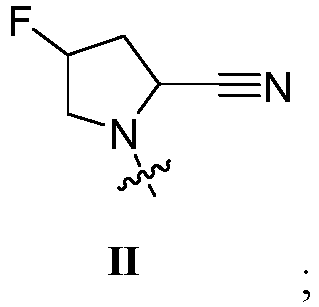


- Verbindung nach einem der Ansprüche 1-2, oder ein Stereoisomer, ein Gemisch von Stereoisomeren, oder ein pharmazeutisch verträgliches Salz davon, mit einer Struktur mit der Formel 1a:


- Verbindung nach einem der Ansprüche 1-3, oder ein Stereoisomer, ein Gemisch von Stereoisomeren, oder ein pharmazeutisch verträgliches Salz davon, wobei R4 ein mit 1 bis 3 Z substituiertes Phenyl ist, wobei jedes Z unabhängig ausgewählt ist aus der Gruppe, die besteht aus Hydroxy, Amino, Halogen, Cyano, Nitro, Carbonsäure, C1-5-Alkyl, wahlweise substituiert mit 1 bis 3 Halogenen oder Amino, C2-6-Alkenyl, C2-6-Alkinyl, C1-5-Alkoxy, C1-5-Alkylthio, Mono- oder Di-C1-5-alkylamino, Piperazinyl, wahlweise substituiert mit Acetyl, C1-5-Alkylsulfonylamino, C1-5-Alkylcarbonylamino, Aminosulfonyl, Aminocarbonyl, C1-5-Alkylaminocarbonyl, Phenyl, Phenoxy, Benzyl, Benzoyl, Phenylaminocarbonyl, Pyrazolyl und Benzoxazolyl,
oder R4 wahlweise ein Phenyl ist, substituiert mit einem Substituenten, ausgewählt aus der Gruppe, die besteht aus Piperazinyl, wahlweise substituiert mit Acetyl, Phenyl, Phenoxy, Benzyl, Benzoyl, Phenylaminocarbonyl, Pyrazolyl und Benzoxazolyl. - Verbindung nach einem der Ansprüche 1-3, oder ein Stereoisomer, ein Gemisch von Stereoisomeren, oder ein pharmazeutisch verträgliches Salz davon, wobei R4 ein Heterocyclus ist, ausgewählt aus der Gruppe, die besteht aus Benzo[d][1,3]dioxolyl, Dihydrobenzo[1,4]dioxinyl, 2,3-Dihydrobenzofuranyl, 2-Oxo-1,2-dihydrochinolinyl und 2-Oxo-1,2,3,4-tetrahydrochinolinyl, wobei der Heterocyclus wahlweise substituiert ist mit 1 bis 3 Z,
oder R4 wahlweise ein Heterocyclus ist, ausgewählt aus der Gruppe, die besteht aus Benzo[d][1,3]dioxolyl, 2,3-Dihydrobenzofuranyl, 2-Oxo-1,2-dihydrochinolinyl und 2-Oxo-1,2,3,4-tetrahydrochinolinyl. - Verbindung nach einem der Ansprüche 1-3, oder ein Stereoisomer, ein Gemisch von Stereoisomeren, oder ein pharmazeutisch verträgliches Salz davon, wobei R4 ein Naphthyl, wahlweise substituiert mit Halogen, ist.
- Verbindung nach einem der Ansprüche 1-3, oder ein Stereoisomer, ein Gemisch von Stereoisomeren, oder ein pharmazeutisch verträgliches Salz davon, wobei R4 ein Heteroaryl ist, ausgewählt aus der Gruppe, die besteht aus Pyridinyl, Pyrimidinyl, Pyrazinyl, Imidazolyl, Pyrazolyl, Triazolyl, Oxazolyl, Thiazolyl, Furanyl, Pyrrolyl, Thiophenyl, Chinolinyl, Isochinolinyl, Chromenonyl, Chinazolinyl, Benzoxazolyl, Benzofuranyl, Benzothiophenyl, Indolyl, Indolinyl, Benzimidazolyl, Benzoxazolyl, Benzothiazolyl, Indazolyl, Furo[3,2-c]pyridinyl, Thieno[2,3-d]pyrimidinyl, Thieno[3,2-c]pyridinyl, Isoxazolyl, Acridinyl und Naphthyridinyl, wobei das Heteroaryl wahlweise substituiert ist mit 1 bis 3 Z, wobei jedes Z unabhängig ausgewählt ist aus der Gruppe, die besteht aus Hydroxy, Amino, Di-C1-5-alkylamino, Cyano, Nitro, Halogen, C1-5-Alkyl, wahlweise substituiert mit 1 bis 3 Halogenen, C1-5-Alkoxy, wahlweise substituiert mit 1 bis 3 Halogenen, C1-5-Alkoxycarbonyl, Benzyloxy, Phenyl, wahlweise substituiert mit Halogen, Acetyl, C1-5-Alkylsulfonyl, Morpholinyl, -NR6C(O)R7 und -C(O)NR6R7,oder R4 wahlweise ein Heteroaryl ist, das aus der Gruppe ausgewählt ist, die besteht aus Pyridinyl, Chinolinyl, Isochinolinyl, Chromenonyl, Chinazolinyl, Benzofuranyl, Indolinyl, Benzimidazolyl, Benzothiophenyl, Benzothiazolyl, Furo[3,2-c]pyridinyl, Thieno[2,3-d]pyrimidinyl, Thieno[3,2-c]pyridinyl, Isoxazolyl, Acridinyl und Naphthyridinyl, wobei das Heteroaryl wahlweise substituiert ist mit 1 bis 3 Z, wobei jedes Z unabhängig ausgewählt ist aus der Gruppe, die besteht aus Hydroxy, Cyano, Nitro, Halogen, C1-5-Alkyl, wahlweise substituiert mit 1 bis 3 Halogenen, C1-5-Alkoxy, wahlweise substituiert mit 1 bis 3 Halogenen, C1-5-Alkoxycarbonyl, Benzyloxy, Acetyl, Morpholinyl, -NR6C(O)R7, -C(O)NR6R7 und Phenyl, wahlweise substituiert mit Halogen;wobei R6 Wasserstoff oder eine C1-3-Alkylgruppe ist; undR7 besteht in einer C1-3-Alkylgruppe, wahlweise substituiert mit Phenyl, einem Phenyl oder einem Heteroaryl, ausgewählt aus der Gruppe, die besteht aus Pyridinyl, Pyrimidinyl und Isoxazolyl.
- Verbindung nach einem der Ansprüche 1-3, oder ein Stereoisomer, ein Gemisch von Stereoisomeren, oder ein pharmazeutisch verträgliches Salz davon, wobei R4 besteht in einem Phenyl, substituiert mit einem Substituenten, ausgewählt aus der Gruppe, die besteht aus Piperazinyl, wahlweise substituiert mit Acetyl, Phenyl, Phenoxy, Benzyl, Benzoyl, Phenylaminocarbonyl, Pyrazolyl und Benzoxazolyl;einem Heterocyclus, ausgewählt aus der Gruppe, die besteht aus Benzo[d][1,3]dioxolyl, 2,3-Dihydrobenzofuranyl, 2-Oxo-1,2-dihydrochinolinyl und 2-Oxo-1,2,3,4-tetrahydrochinolinyl;einem Naphthyl, wahlweise substituiert mit Halogen; odereinem Heteroaryl, ausgewählt aus der Gruppe, die besteht aus Pyridinyl, Chinolinyl, Isochinolinyl, Chromenonyl, Chinazolinyl, Benzofuranyl, Indolinyl, Benzimidazolyl, Benzothiophenyl, Benzothiazolyl, Furo[3,2-c]pyridinyl, Thieno[2,3-d]pyrimidinyl, Thieno[3,2-c]pyridinyl, Isoxazolyl, Acridinyl und Naphthyridinyl, wobei das Heteroaryl wahlweise substituiert ist mit 1 bis 3 Z, wobei jedes Z unabhängig ausgewählt ist aus der Gruppe, die besteht aus Hydroxy, Cyano, Nitro, Halogen, C1-5-Alkyl, wahlweise substituiert mit 1 bis 3 Halogenen, C1-5-Alkoxy, wahlweise substituiert mit 1 bis 3 Halogenen, C1-5-Alkoxycarbonyl, Benzyloxy, Acetyl, Morpholinyl, -NR6C(O)R7, -C(O)NR6R7 und Phenyl, wahlweise substituiert mit Halogen;R6 Wasserstoff oder eine C1-3-Alkylgruppe ist; undR7 besteht in einer C1-3-Alkylgruppe, wahlweise substituiert mit Phenyl,einem Phenyl, odereinem Heteroaryl, ausgewählt aus der Gruppe, die besteht aus Pyridinyl, Pyrimidinyl und Isoxazolyl.
- Verbindung nach einem der Ansprüche 1-2, oder ein Stereoisomer, ein Gemisch von Stereoisomeren, oder ein pharmazeutisch verträgliches Salz davon, wobei R3 ein 5- bis 12-gliedriges Heteroaryl ist, wahlweise substituiert durch 1 bis 3 Z;oder R3 wahlweise ein 3- bis 12-gliedriger nichtaromatischer Heterocyclus ist, welcher Stickstoff umfasst, wobei der Heterocyclus wahlweise substituiert ist durch 1 bis 3 Z;oder R3 wahlweise 2-Oxo-2,3-dihydro-1H-benzo[d]imidazol-1-yl ist.
- Verbindung nach Anspruch 1, oder ein Stereoisomer, ein Gemisch von Stereoisomeren, oder ein pharmazeutisch verträgliches Salz davon, ausgewählt aus der Gruppe, die besteht aus:

(R)-1-(2-((S)-2-Cyanopyrrolidin-1-yl)-2-oxoethyl)-N-(chinolin-3-yl)pyrrolidin-3-carboxamid 
(R)-1-(2-((S)-2-Cyanopyrrolidin-1-yl)-2-oxoethyl)-N-(chinolin-4-yl)pyrrolidin-3-carboxamid 
(S)-1-(2-((S)-2-Cyanopyrrolidin-1-yl)-2-oxoethyl)-N-(chinolin-3-yl)pyrrolidin-3-carboxamid 
(S)-1-(2-((S)-2-Cyanopyrrolidin-1-yl)-2-oxoethyl)-N-(chinolin-4-yl)pyrrolidin-3-carboxamid 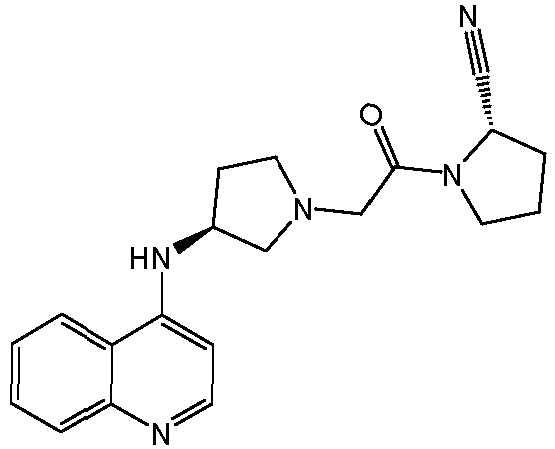
(S)-1-(2-((S)-3-(Chinolin-4-ylamino)pyrrolidin-1-yl)acetyl)pyrrolidin-2-carbonitril 
(S)-4,4-Difluor-1-(2-((S)-3-(chinolin-3-ylamino)pyrrolidin-1-yl)acetyl)pyrrolidin-2-carbonitril 
(S)-4,4-Difluor-1-(2-((S)-3-(chinolin-4-ylamino)pyrrolidin-1-yl)acetyl)pyrrolidin-2-carbonitril 
(S)-4,4-Difluor-1-(2-((S)-3-(isochinolin-4-ylamino)pyrrolidin-1-yl)acetyl)pyrrolidin-2-carbonitril 
(S)-1-(2-((S)-3-(Benzo[b]thiophen-4-ylamino)pyrrolidin-1-yl)acetyl)-4,4-difluorpyrrolidin-2-carbonitril 
(S)-1-(2-((S)-3-(Benzo[b]thiophen-7-ylamino)pyrrolidin-1-yl)acetyl)-4,4-difluorpyrrolidin-2-carbonitril 
(S)-1-(2-((S)-3-(Benzofuran-7-ylamino)pyrrolidin-1-yl)acetyl)-4,4-difluorpyrrolidin-2-carbonitril 
(S)-4,4-Difluor-1-(2-((S)-3-(furo[3,2-c]pyridin-7-ylamino)pyrrolidin-1-yl)acetyl)pyrrolidin-2-carbonitril 
(S)-1-(2-((S)-3-([1,1'-Biphenyl]-2-ylamino)pyrrolidin-1-yl)acetyl)-4,4-difluorpyrrolidin-2-carbonitril 
(S)-1-(2-((S)-3-([1,1'-Biphenyl]-4-ylamino)pyrrolidin-1-yl)acetyl)-4,4-difluorpyrrolidin-2-carbonitril 
(S)-4,4-Difluor-1-(2-((S)-3-(naphthalen-2-ylamino)pyrrolidin-1-yl)acetyl)pyrrolidin-2-carbonitril 
(S)-1-(2-((S)-3-([1,1'-Biphenyl]-3-ylamino)pyrrolidin-1-yl)acetyl)-4,4-difluorpyrrolidin-2-carbonitril 
(S)-1-(2-((R)-3-(Chinolin-3-ylamino)pyrrolidin-1-yl)acetyl)pyrrolidin-2-carbonitril 
(S)-1-(2-((R)-3-([1,1'-Biphenyl]-3-ylamino)pyrrolidin-1-yl)acetyl)pyrrolidin-2-carbonitril 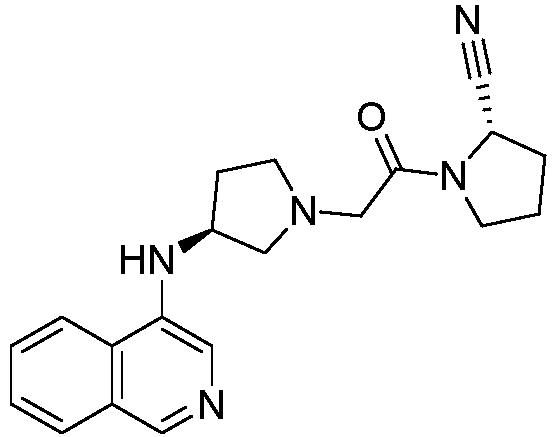
(S)-1-(2-((S)-3-(Isochinolin-4-ylamino)pyrrolidin-1-yl)acetyl)pyrrolidin-2-carbonitril 
(S)-1-(2-((S)-3-(Benzo[b]thiophen-4-ylamino)pyrrolidin-1-yl)acetyl)pyrrolidin-2-carbonitril 
(S)-1-(2-((S)-3-(Benzo[b]thiophen-7-ylamino)pyrrolidin-1-yl)acetyl)pyrrolidin-2-carbonitril 
(S)-1-(2-((S)-3-(Benzofuran-7-ylamino)pyrrolidin-1-yl)acetyl)pyrrolidin-2-carbonitril 
(S)-1-(2-((S)-3-(Furo[3,2-c]pyridin-7-ylamino)pyrrolidin-1-yl)acetyl)pyrrolidin-2-carbonitril 
(S)-1-(2-((R)-3-(Isochinolin-4-ylamino)pyrrolidin-1-yl)acetyl)pyrrolidin-2-carbonitril 
(S)-1-(2-((R)-3-(Benzo[b]thiophen-7-ylamino)pyrrolidin-1-yl)acetyl)pyrrolidin-2-carbonitril 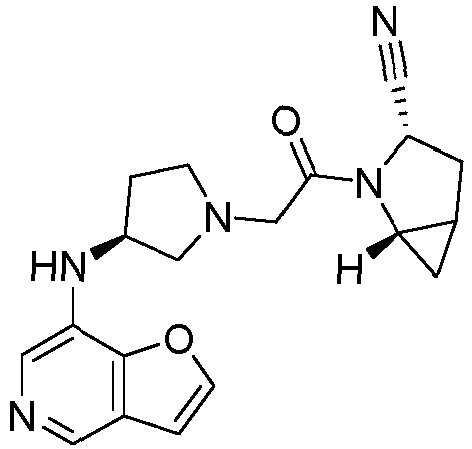
(1S,3S,5S)-2-(2-((S)-3-(Furo[3,2-c]pyridin-7-ylamino)pyrrolidin-1-yl)acetyl)-2-azabicyclo[3.1.0]hexan-3-carbonitril 
(S)-1-(2-((S)-3-(Chinolin-5-ylamino)pyrrolidin-1-yl)acetyl)pyrrolidin-2-carbonitril 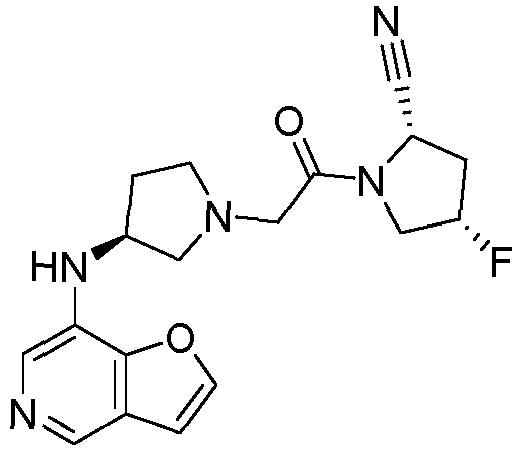
(2S,4S)-4-Fluor-1-(2-((S)-3-(furo[3,2-c]pyridin-7-ylamino)pyrrolidin-1-yl)acetyl)pyrrolidin-2-carbonitril 
N-((S)-1-(2-((2S,4S)-2-Cyano-4-fluorpyrrolidin-1-yl)-2-oxoethyl)pyrrolidin-3-yl)-6-fluorbenzofuran-3-carboxamid 
N-((S)-1-(2-((S)-2-Cyanopyrrolidin-1-yl)-2-oxoethyl)pyrrolidin-3-yl)chinolin-4-carboxamid 
N-((S)-1-(2-((S)-2-Cyanopyrrolidin-1-yl)-2-oxoethyl)pyrrolidin-3-yl)chinolin-3-carboxamid 
N-((S)-1-(2-((S)-2-Cyanopyrrolidin-1-yl)-2-oxoethyl)pyrrolidin-3-yl)chinolin-5-carboxamid 
N-((S)-1-(2-((S)-2-Cyanopyrrolidin-1-yl)-2-oxoethyl)pyrrolidin-3-yl)chinolin-2-carboxamid 
N-((S)-1-(2-((S)-2-Cyanopyrrolidin-1-yl)-2-oxoethyl)pyrrolidin-3-yl)chinolin-8-carboxamid 
N-((S)-1-(2-((S)-2-Cyanopyrrolidin-1-yl)-2-oxoethyl)pyrrolidin-3-yl)isochinolin-1-carboxamid 
N-((S)-1-(2-((S)-2-Cyanopyrrolidin-1-yl)-2-oxoethyl)pyrrolidin-3-yl)benzo[b]thiophen-2-carboxamid 
N-((S)-1-(2-((S)-2-Cyanopyrrolidin-1-yl)-2-oxoethyl)pyrroli din-3-yl)benzofuran-3-carboxamid 
N-((S)-1-(2-((S)-2-Cyanopyrrolidin-1-yl)-2-oxoethyl)pyrrolidin-3-yl)-2-(naphthalen-1-yl)acetamid 
N-((S)-1-(2-((S)-2-Cyanopyrrolidin-1-yl)-2-oxoethyl)pyrrolidin-3-yl)-[1,1'-biphenyl]-2-carboxamid 
N-((S)-1-(2-((S)-2-Cyanopyrrolidin-1-yl)-2-oxoethyl)pyrrolidin-3-yl)benzofuran-2-carboxamid 
N-((S)-1-(2-((S)-2-Cyanopyrrolidin-1-yl)-2-oxoethyl)pyrrolidin-3-yl)benzo[b]thiophen-3-carboxamid 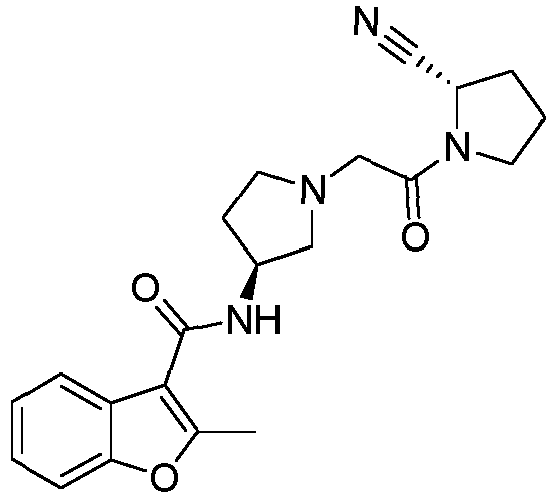
N-((S)-1-(2-((S)-2-Cyanopyrrolidin-1-yl)-2-oxoethyl)pyrrolidin-3-yl)-2-methylbenzofuran-3-carboxamid 
N-((S)-1-(2-((S)-2-Cyanopyrrolidin-1-yl)-2-oxoethyl)pyrrolidin-3-yl)-5-fluorbenzofuran-3-carboxamid 
N-((S)-1-(2-((S)-2-Cyanopyrrolidin-1-yl)-2-oxoethyl)pyrrolidin-3-yl)-6-fluorbenzofuran-3-carboxamid 
N-((S)-1-(2-((S)-2-Cyanopyrrolidin-1-yl)-2-oxoethyl)pyrrolidin-3-yl)-7-methylbenzofuran-3-carboxamid 
N-((S)-1-(2-((S)-2-Cyanopyrrolidin-1-yl)-2-oxoethyl)pyrrolidin-3-yl)-5-methoxybenzofuran-3-carboxamid 
N-((S)-1-(2-((S)-2-Cyanopyrrolidin-1-yl)-2-oxoethyl)pyrrolidin-3-yl)-7-methoxybenzofuran-3-carboxamid 
N-((S)-1-(2-((S)-2-Cyanopyrrolidin-1-yl)-2-oxoethyl)pyrrolidin-3-yl)-4-hydroxybenzofuran-3-carboxamid 
N-((S)-1-(2-((S)-2-Cyanopyrrolidin-1-yl)-2-oxoethyl)pyrrolidin-3-yl)-6-hydroxybenzofuran-3-carboxamid 
N-((S)-1-(2-((S)-2-Cyanopyrrolidin-1-yl)-2-oxoethyl)pyrrolidin-3-yl)-7-fluorbenzofuran-3-carboxamid 
N-((S)-1-(2-((S)-2-Cyanopyrrolidin-1-yl)-2-oxoethyl)pyrrolidin-3-yl)-5,7-difluorbenzofuran-3-carboxamid 
N-((S)-1-(2-((S)-2-Cyanopyrrolidin-1-yl)-2-oxoethyl)pyrrolidin-3 -yl)-5-methylbenzofuran-3 - carboxamid 
N-((S)-1-(2-((S)-2-Cyanopyrrolidin-1-yl)-2-oxoethyl)pyrrolidin-3-yl)-6-methylbenzofuran-3-carboxamid 
N-((S)-1-(2-((S)-2-Cyanopyrrolidin-1-yl)-2-oxoethyl)pyrrolidin-3-yl)-6-methoxybenzofuran-3-carboxamid 
N-((S)-1-(2-((S)-2-Cyanopyrrolidin-1-yl)-2-oxoethyl)pyrrolidin-3-yl)benzofuran-4-carboxamid 
N-((S)-1-(2-((S)-2-Cyanopyrrolidin-1-yl)-2-oxoethyl)pyrrolidin-3-yl)benzofuran-5-carboxamid 
N-((S)-1-(2-((S)-2-Cyanopyrrolidin-1-yl)-2-oxoethyl)pyrrolidin-3-yl)benzofuran-6-carboxamid 
N-((S)-1-(2-((S)-2-Cyanopyrrolidin-1-yl)-2-oxoethyl)pyrrolidin-3-yl)benzofuran-7-carboxamid 
N-((S)-1-(2-((S)-2-Cyanopyrrolidin-1-yl)-2-oxoethyl)pyrrolidin-3-yl)benzofuran-2-sulfonamid 
N-((S)-1-(2-((S)-2-Cyanopyrrolidin-1-yl)-2-oxoethyl)pyrrolidin-3-yl)benzo[b]thiophen-2-sulfonamid 
(S)-1-(2-((S)-3-(Chinolin-4-yloxy)pyrrolidin-1-yl)acetyl)pyrrolidin-2-carbonitril 
(S)-1-(2-((S)-3-(Naphthalen-1-yloxy)pyrrolidin-1-yl)acetyl)pyrrolidin-2-carbonitril 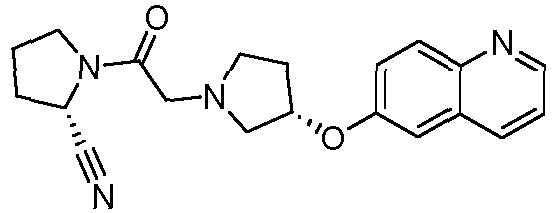
(S)-1-(2-((S)-3-(Chinolin-6-yloxy)pyrrolidin-1-yl)acetyl)pyrrolidin-2-carbonitril 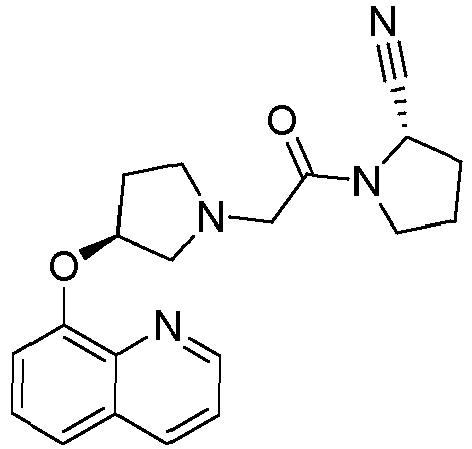
(S)-1-(2-((S)-3-(Chinolin-8-yloxy)pyrrolidin-1-yl)acetyl)pyrrolidin-2-carbonitril 
(S)-1-(2-((S)-3-(Isochinolin-5-yloxy)pyrrolidin-1-yl)acetyl)pyrrolidin-2-carbonitril 
(S)-1-(2-((S)-3-(Chinolin-5-yloxy)pyrrolidin-1-yl)acetyl)pyrrolidin-2-carbonitril 
(S)-1-(2-((S)-3-(Benzo[d][1,3]dioxol-5-yloxy)pyrrolidin-1-yl)acetyl)pyrrolidin-2-carbonitril 
(S)-1-(2-((S)-3-(Thieno[2,3-d]pyrimidin-4-yloxy)pyrrolidin-1-yl)acetyl)pyrrolidin-2-carbonitril 
(S)-1-(2-((S)-3-(Isochinolin-3-yloxy)pyrrolidin-1-yl)acetyl)pyrrolidin-2-carbonitril 
(S)-1-(2-((S)-3-((3-Bromthieno[3,2-c]pyridin-4-yl)oxy)pyrrolidin-1-yl)acetyl)pyrrolidin-2-carbonitril 
(S)-1-(2-((S)-3-((4-Chlornaphthalen-1-yl)oxy)pyrrolidin-1-yl)acetyl)pyrrolidin-2-carbonitril 
(S)-1-(2-((S)-3-(2-(1H-Pyrazol-3-yl)phenoxy)pyrrolidin-1-yl)acetyl)pyrrolidin-2-carbonitril 
(S)-1-(2-((S)-3-((4-Chlorchinazolin-8-yl)oxy)pyrrolidin-1-yl)acetyl)pyrrolidin-2-carbonitril 
(S)-1-(2-((S)-3-((4-Chlorchinazolin-6-yl)oxy)pyrrolidin-1-yl)acetyl)pyrrolidin-2-carbonitril 
(S)-1-(2-((S)-3-((2-Oxo-1,2-dihydrochinolin-5-yl)oxy)pyrrolidin-1-yl)acetyl)pyrrolidin-2-carbonitril 
(S)-1-(2-((S)-3-((2-Oxo-1,2,3,4-tetrahydrochinolin-5-yl)oxy)pyrrolidin-1-yl)acetyl)pyrrolidin-2-carbonitril 
(S)-1-(2-((S)-3-((2-Oxo-1,2,3,4-tetrahydrochinolin-6-yl)oxy)pyrrolidin-1-yl)acetyl)pyrrolidin-2-carbonitril 
(S)-1-(2-((S)-3-((2-Methylchinolin-8-yl)oxy)pyrrolidin-1-yl)acetyl)pyrrolidin-2-carbonitril 
(S)-1-(2-((S)-3-((7-Chlorchinolin-4-yl)oxy)pyrrolidin-1-yl)acetyl)pyrrolidin-2-carbonitril 
(S)-1-(2-((S)-3-((7-Bromchinolin-4-yl)oxy)pyrrolidin-1-yl)acetyl)pyrrolidin-2-carbonitril 
(S)-1-(2-((S)-3-((5-Chlorchinolin-8-yl)oxy)pyrrolidin-1-yl)acetyl)pyrrolidin-2-carbonitril 
(S)-1-(2-((S)-3-([1, 1'-Biphenyl]-3-yloxy)pyrrolidin-1-yl)acetyl)pyrrolidin-2-carbonitril 
(S)-1-(2-((S)-3-([1,1'-Biphenyl]-4-yloxy)pyrrolidin-1-yl)acetyl)pyrrolidin-2-carbonitril 
(S)-1-(2-((S)-3-((6-Methoxychinolin-4-yl)oxy)pyrrolidin-1-yl)acetyl)pyrrolidin-2-carbonitril 
(S)-1-(2-((S)-3-((7,8-Difluorchinolin-4-yl)oxy)pyrrolidin-1-yl)acetyl)pyrrolidin-2-carbonitril 
Methyl-6-(((S)-1-(2-((S)-2-cyanopyrrolidin-1-yl)-2-oxoethyl)pyrrolidin-3-yl)oxy)-2,3-dihydrobenzofuran-2-carboxylat 
(S)-1-(2-((S)-3-(4-Phenoxyphenoxy)pyrrolidin-1-yl)acetyl)pyrrolidin-2-carbonitril 
(S)-1-(2-((S)-3-(3-Phenoxyphenoxy)pyrrolidin-1-yl)acetyl)pyrrolidin-2-carbonitril 
(S)-1-(2-((S)-3-(4-Benzylphenoxy)pyrrolidin-1-yl)acetyl)pyrrolidin-2-carbonitril 
(S)-1-(2-((S)-3-(2-Benzylphenoxy)pyrrolidin-1-yl)acetyl)pyrrolidin-2-carbonitril 
(S)-1-(2-((S)-3-(3-Benzoylphenoxy)pyrrolidin-1-yl)acetyl)pyrrolidin-2-carbonitril 
(S)-1-(2-((S)-3-(4-Benzoylphenoxy)pyrrolidin-1-yl)acetyl)pyrrolidin-2-carbonitril 
(S)-1-(2-((S)-3-((4-(Benzyloxy)pyridin-2-yl)oxy)pyrrolidin-1-yl)acetyl)pyrrolidin-2-carbonitril 
(S)-1-(2-((S)-3-((7-(Trifluormethyl)chinolin-4-yl)oxy)pyrrolidin-1-yl)acetyl)pyrrolidin-2-carbonitril 
(S)-1-(2-((S)-3-((8-(Trifluormethyl)chinolin-4-yl)oxy)pyrrolidin-1-yl)acetyl)pyrrolidin-2-carbonitril 
(S)-1-(2-((S)-3-(Acridin-4-yloxy)pyrrolidin-1-yl)acetyl)pyrrolidin-2-carbonitril 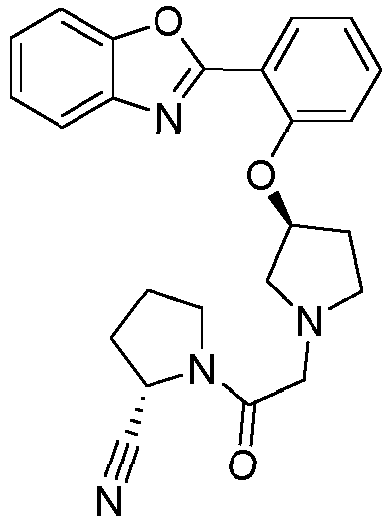
(S)-1-(2-((S)-3-(2-(Benzo[d]oxazol-2-yl)phenoxy)pyrrolidin-1-yl)acetyl)pyrrolidin-2-carbonitril 
(S)-1-(2-((S)-3-(4-(4-Acetylpiperazin-1-yl)phenoxy)pyrrolidin-1-yl)acetyl)pyrrolidin-2-carbonitril 
2-(((S)-1-(2-((S)-2-Cyanopyrrolidin-1-yl)-2-oxoethyl)pyrrolidin-3-yl)oxy)-N-phenylbenzamid 
(S)-1-(2-((S)-3-((7-Methoxychinolin-4-yl)oxy)pyrrolidin-1-yl)acetyl)pyrrolidin-2-carbonitril 
(S)-1-(2-((S)-3-((6,7-Dimethoxychinolin-4-yl)oxy)pyrrolidin-1-yl)acetyl)pyrrolidin-2-carbonitril 
(S)-1-(2-((S)-3-((3-(4-Bromphenyl)isoxazol-5-yl)oxy)pyrrolidin-1-yl)acetyl)pyrrolidin-2-carbonitril 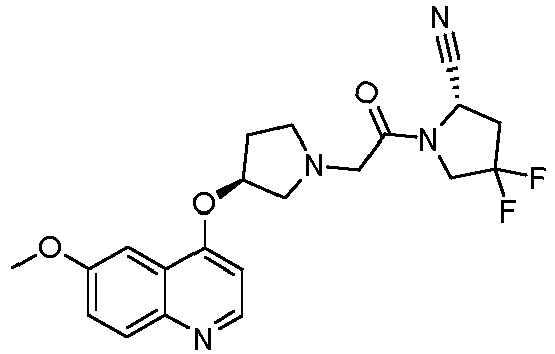
(S)-4,4-Difluor-1-(2-((S)-3-((6-methoxychinolin-4-yl)oxy)pyrrolidin-1-yl)acetyl)pyrrolidin-2-carbonitril 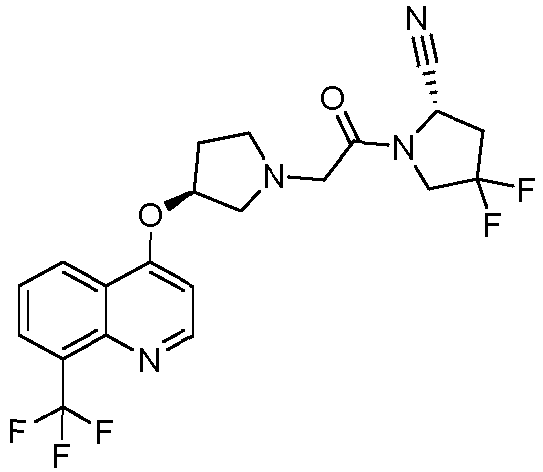
(S)-4,4-Difluor-1-(2-((S)-3-((8-(trifluormethyl)chinolin-4-yl)oxy)pyrrolidin-1-yl)acetyl)pyrrolidin-2-carbonitril 
(S)-4,4-Difluor-1-(2-((S)-3-(chinolin-5-yloxy)pyrrolidin-1-yl)acetyl)pyrrolidin-2-carbonitril 
(S)-4,4-Difluor-1-(2-((S)-3-(isochinolin-5-yloxy)pyrrolidin-1-yl)acetyl)pyrrolidin-2-carbonitril 
(S)-1-(2-((S)-3-((7-Chlorchinolin-4-yl)oxy)pyrrolidin-1-yl)acetyl)-4,4-difluorpyrrolidin-2-carbonitril 
(S)-4,4-Difluor-1-(2-((S)-3-((2-oxo-1,2-dihydrochinolin-5-yl)oxy)pyrrolidin-1-yl)acetyl)pyrrolidin-2-carbonitril 
(S)-1-(2-((S)-3-((5-Chlorchinolin-8-yl)oxy)pyrrolidin-1-yl)acetyl)-4,4-difluorpyrrolidin-2-carbonitril 
(S)-1-(2-(4-(Chinolin-5-ylamino)piperidin-1-yl)acetyl)pyrrolidin-2-carbonitril 
(S)-1-(2-(4-(Chinolin-4-ylamino)piperidin-1-yl)acetyl)pyrrolidin-2-carbonitril 
(1S,3S,5S)-2-(2-(4-(Chinolin-4-ylamino)piperidin-1-yl)acetyl)-2-azabicyclo[3.1.0]hexan-3-carbonitril 
(2S,4S)-4-Fluor-1-(2-(4-(chinolin-5-ylamino)piperidin-1-yl)acetyl)pyrrolidin-2-carbonitril 
(S)-4,4-Difluor-1-(2-(4-(chinolin-5-ylamino)piperidin-1-yl)acetyl)pyrrolidin-2-carbonitril 
(1S,3S,5S)-2-(2-(4-(Chinolin-5-ylamino)piperidin-1-yl)acetyl)-2-azabicyclo[3.1.0]hexan-3-carbonitril 
(S)-1-(2-(4-(Furo[3,2-c]pyridin-7-ylamino)piperidin-1-yl)acetyl)pyrrolidin-2-carbonitril 
(S)-1-(2-(4-(Chinolin-3-yloxy)piperidin-1-yl)acetyl)pyrrolidin-2-carbonitril 
(S)-1-(2-(4-(Chinolin-4-yloxy)piperidin-1-yl)acetyl)pyrrolidin-2-carbonitril 
(S)-1-(2-(4-(Chinolin-5-yloxy)piperidin-1-yl)acetyl)pyrrolidin-2-carbonitril 
(S)-1-(2-(4-(Chinolin-6-yloxy)piperidin-1-yl)acetyl)pyrrolidin-2-carbonitril 
(S)-1-(2-(4-((3-Methylchinolin-5-yl)amino)piperidin-1-yl)acetyl)pyrrolidin-2-carbonitril 
(S)-1-(2-(4-((6-Methylchinolin-5-yl)amino)piperidin-1-yl)acetyl)pyrrolidin-2-carbonitril 
(S)-1-(2-(4-((7-Fluorchinolin-5-yl)amino)piperidin-1-yl)acetyl)pyrrolidin-2-carbonitril 
(S)-1-(2-(4-((7-Methoxychinolin-5-yl)amino)piperidin-1-yl)acetyl)pyrrolidin-2-carbonitril 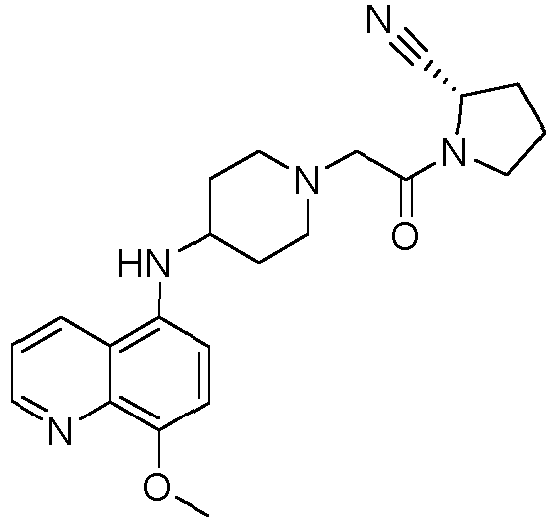
(S)-1-(2-(4-((8-Methoxychinolin-5-yl)amino)piperidin-1-yl)acetyl)pyrrolidin-2-carbonitril 
(2S,4S)-4-Fluor-1-(2-(4-((6-fluorchinolin-4-yl)oxy)piperidin-1-yl)acetyl)pyrrolidin-2-carbonitril 
(2S,4S)-1-(2-(4-((6-Chlorchinolin-4-yl)oxy)piperidin-1-yl)acetyl)-4-fluorpyrrolidin-2-carbonitril 
(2S,4S)-4-Fluor-1-(2-(4-((6-methoxychinolin-4-yl)oxy)piperidin-1-yl)acetyl)pyrrolidin-2-carbonitril 
(2S,4S)-4-Fluor-1-(2-(4-((7-methoxychinolin-4-yl)oxy)piperidin-1-yl)acetyl)pyrrolidin-2-carbonitril 
(2S,4S)-1-(2-(4-((6,7-Dimethoxychinolin-4-yl)oxy)piperidin-1-yl)acetyl)-4-fluorpyrrolidin-2-carbonitril 
(2S,4S)-4-Fluor-1-(2-(4-((3-methylchinolin-5-yl)amino)piperidin-1-yl)acetyl)pyrrolidin-2-carbonitril 
(2S,4S)-4-Fluor-1-(2-(4-((7-fluorchinolin-5-yl)amino)piperidin-1-yl)acetyl)pyrrolidin-2-carbonitril 
(2S,4S)-4-Fluor-1-(2-(4-((7-methoxychinolin-5-yl)amino)piperidin-1-yl)acetyl)pyrrolidin-2-carbonitril 
(2S,4S)-4-Fluor-1-(2-(4-((6-methylchinolin-5-yl)amino)piperidin-1-yl)acetyl)pyrrolidin-2-carbonitril 
(2S,4S)-4-Fluor-1-(2-(4-((8-methoxychinolin-5-yl)amino)piperidin-1-yl)acetyl)pyrrolidin-2-carbonitril 
6-Methoxy-N-[(3S)-1-[2-oxo-2-[(2S,4S)-2-cyano-4-fluor-pyrrolidin-1-yl]ethyl]pyrrolidin-3-yl]benzofuran-3-carboxamid 
(2S)-1-[2-[(3R)-3-[Methyl(2-chinolyl)amino]pyrrolidin-1-yl]acetyl]pyrrolidin-2-carbonitril 
(2S)-1-[2-[(3R)-3-[Methyl(3-chinolyl)amino]pyrrolidin-1-yl]acetyl]pyrrolidin-2-carbonitril 
(2S)-1-[2-[(3R)-3-[Methyl(5-chinolyl)amino]pyrrolidin-1-yl]acetyl]pyrrolidin-2-carbonitril 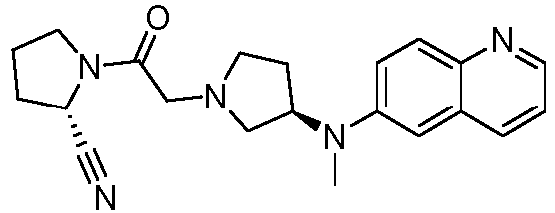
(2S)-1-[2-[(3R)-3-[Methyl(6-chinolyl)amino]pyrrolidin-1-yl]acetyl]pyrrolidin-2-carbonitril 
(2S)-1-[2-[(3R)-3-[Methyl(7-chinolyl)amino]pyrrolidin-1-yl]acetyl]pyrrolidin-2-carbonitril 
(2S)-1-[2-[(3 S)-3-[Methyl(3-chinolyl)amino]pyrrolidin-1-yl]acetyl]pyrrolidin-2-carbonitril 
(2S)-1-[2-[(3S)-3-[Methyl(4-chinolyl)amino]pyrrolidin-1-yl]acetyl]pyrrolidin-2-carbonitril 
(2S)-1-[2-[(3 S)-3-[Methyl(5-chinolyl)amino]pyrrolidin-1-yl]acetyl]pyrrolidin-2-carbonitril 
(2S)-1-[2-[(3S)-3-[Methyl(6-chinolyl)amino]pyrrolidin-1-yl]acetyl]pyrrolidin-2-carbonitril 
(2S)-1-[2-[(3 S)-3-[Methyl(7-chinolyl)amino]pyrrolidin-1-yl]acetyl]pyrrolidin-2-carbonitril 
(2S)-1-[2-[(3S)-3-[4-Isochinolyl(methyl)amino]pyrrolidin-1-yl]acetyl]pyrrolidin-2-carbonitril 
(2S)-1-[2-[(3S)-3-[5-Isochinolyl(methyl)amino]pyrrolidin-1-yl]acetyl]pyrrolidin-2-carbonitril 
(2S)-1-[2-[(3 S)-3-[Methyl-(4-methyl-3-chinolyl)amino]pyrrolidin-1-yl]acetyl]pyrrolidin-2-carbonitril 
(2S)-1-[2-[(3S)-3-[Methyl-(6-methyl-3-chinolyl)amino]pyrrolidin-1-yl]acetyl]pyrrolidin-2-carbonitril 
(S)-1-(2-((S)-3-((6-Fluorchinolin-3-yl)(methyl)amino)pyrrolidin-1-yl)acetyl)pyrrolidin-2-carbonitril 
(S)-1-(2-((S)-3-((6-Methoxychinolin-3-yl)(methyl)amino)pyrrolidin-1-yl)acetyl)pyrrolidin-2-carbonitril 
(S)-1-(2-((S)-3-((7-Methoxychinolin-3-yl)(methyl)amino)pyrrolidin-1-yl)acetyl)pyrrolidin-2-carbonitril 
(S)-1-(2-((S)-3-((8-Methoxychinolin-3-yl)(methyl)amino)pyrrolidin-1-yl)acetyl)pyrrolidin-2-carbonitril 
(2S,4S)-4-Fluor-1-[2-[(3 S)-3-[methyl-(3-methyl-5-chinolyl)amino]pyrrolidin-1-yl]acetyl]pyrrolidin-2-carbonitril 
(2S,4S)-4-Fluor-1-(2-((S)-3-((3-fluorchinolin-5-yl)(methyl)amino)pyrrolidin-1-yl)acetyl)pyrrolidin-2-carbonitril 
(2S,4S)-4-Fluor-1-(2-((S)-3-((7-fluorchinolin-5-yl)(methyl)amino)pyrrolidin-1-yl)acetyl)pyrrolidin-2-carbonitril 
(2S,4S)-4-Fluor-1-(2-((S)-3-((8-fluorchinolin-5-yl)(methyl)amino)pyrrolidin-1-yl)acetyl)pyrrolidin-2-carbonitril 
(2S,4S)-4-Fluor-1-[2-[(3 S)-3-[methyl-[8-(trifluormethyl)-5-chinolyl]amino]pyrrolidin-1-yl]acetyl]pyrrolidin-2-carbonitril 
(2S,4S)-4-Fluor-1-[2-[(3 S)-3-[methyl-[8-(trifluormethoxy)-5-chinolyl]amino]pyrrolidin-1-yl]acetyl]pyrrolidin-2-carbonitril 
(2S)-1-[2-[(3R)-3-(5-Chinolylamino)pyrrolidin-1-yl]acetyl]pyrrolidin-2-carbonitril 
(2S)-1-[2-[(3R)-3-(6-Chinolylamino)pyrrolidin-1-yl]acetyl]pyrrolidin-2-carbonitril 
(2S)-1-[2-[(3R)-3-(7-Chinolylamino)pyrrolidin-1-yl]acetyl]pyrrolidin-2-carbonitril 
(2S)-1-[2-[(3R)-3-(8-Chinolylamino)pyrrolidin-1-yl]acetyl]pyrrolidin-2-carbonitril 
(2S,4S)-4-Fluor-1-[2-[(3R)-3-(3-chinolylamino)pyrrolidin-1-yl]acetyl]pyrrolidin-2-carbonitril 
(2S,4S)-4-Fluor-1-[2-[(3R)-3-(5-chinolylamino)pyrrolidin-1-yl]acetyl]pyrrolidin-2-carbonitril 
(2S,4S)-4-Fluor-1-[2-[(3R)-3-(6-chinolylamino)pyrrolidin-1-yl]acetyl]pyrrolidin-2-carbonitril 
(2S,4S)-4-Fluor-1-[2-[(3R)-3-(7-chinolylamino)pyrrolidin-1-yl]acetyl]pyrrolidin-2-carbonitril 
(2S,4S)-4-Fluor-1-[2-[(3R)-3-(8-chinolylamino)pyrrolidin-1-yl]acetyl]pyrrolidin-2-carbonitril 
(2S,4S)-4-Fluor-1-[2-[(3R)-3-(4-chinolylamino)pyrrolidin-1-yl]acetyl]pyrrolidin-2-carbonitril 
(2S,4S)-4-Fluor-1-[2-[(3R)-3-(1,8-naphthyridin-3-ylamino)pyrrolidin-1-yl]acetyl]pyrrolidin-2-carbonitril 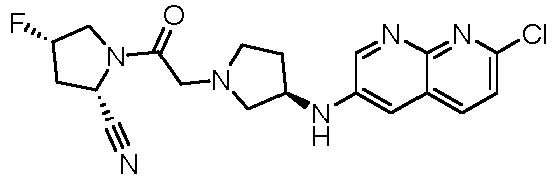
(2S,4S)-4-Fluor-1-[2-[(3R)-3-[(7-chlor-1,8-naphthyridin-3-yl)amino]pyrrolidin-1-yl]acetyl]pyrrolidin-2-carbonitril 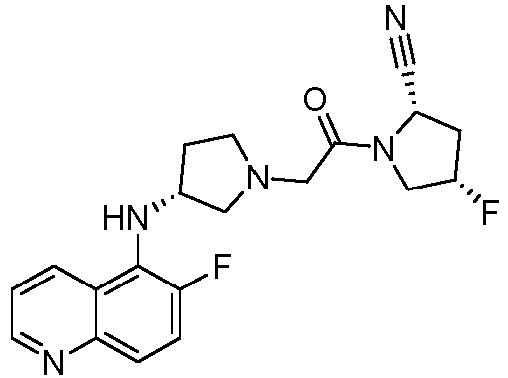
(2S,4S)-4-Fluor-1-[2-[(3R)-3-[(6-fluor-5-chinolyl)amino]pyrrolidin-1-yl]acetyl]pyrrolidin-2-carbonitril 
(2S,4S)-4-Fluor-1-[2-[(3R)-3-[(7-fluor-5-chinolyl)amino]pyrrolidin-1-yl]acetyl]pyrrolidin-2-carbonitril 
(2S,4S)-4-Fluor-1-[2-[(3R)-3-[(8-fluor-5-chinolyl)amino]pyrrolidin-1-yl]acetyl]pyrrolidin-2-carbonitril 
(2S,4S)-4-Fluor-1-[2-[(3R)-3-[(6-methoxy-5-chinolyl)amino]pyrrolidin-1-yl]acetyl]pyrrolidin-2-carbonitril 
(2S,4S)-4-Fluor-1-[2-[(3R)-3-[(7-methoxy-5-chinolyl)amino]pyrrolidin-1-yl]acetyl]pyrrolidin-2-carbonitril 
(2S,4S)-4-Fluor-1-[2-[(3R)-3-[(8-methoxy-5-chinolyl)amino]pyrrolidin-1-yl]acetyl]pyrrolidin-2-carbonitril 
(2S,4S)-4-Fluor-1-[2-[(3R)-3-[(3-methyl-5-chinolyl)amino]pyrrolidin-1-yl]acetyl]pyrrolidin-2-carbonitril 
(2S,4S)-4-Fluor-1-[2-[(3R)-3-[(6-methyl-5-chinolyl)amino]pyrrolidin-1-yl]acetyl]pyrrolidin-2-carbonitril 
(2S,4S)-4-Fluor-1-[2-[(3R)-3-[(8-methyl-5-chinolyl)amino]pyrrolidin-1-yl]acetyl]pyrrolidin-2-carbonitril 
(2S,4S)-4-Fluor-1-[2-[(3R)-3-[[7-(trifluormethyl)-5-chinolyl]amino]pyrrolidin-1-yl]acetyl]pyrrolidin-2-carbonitril 
(2S,4S)-4-Fluor-1-[2-[(3R)-3-[[8-(trifluormethyl)-5-chinolyl]amino]pyrrolidin-1-yl]acetyl]pyrrolidin-2-carbonitril 
(2S,4S)-4-Fluor-1-[2-[(3R)-3-[(3-fluor-5-chinolyl)amino]pyrrolidin-1-yl]acetyl]pyrrolidin-2-carbonitril 
(2S,4S)-4-Fluor-1-[2-[(3R)-3-[(3-chlor-5-chinolyl)amino]pyrrolidin-1-yl]acetyl]pyrrolidin-2-carbonitril 
(2S,4S)-4-Fluor-1-[2-[(3R)-3-[[8-(trifluormethoxy)-5-chinolyl]amino]pyrrolidin-1-yl]acetyl]pyrrolidin-2-carbonitril 
(2S,4S)-4-Fluor-1-[2-[(3R)-3-[(6-methyl-4-chinolyl)amino]pyrrolidin-1-yl]acetyl]pyrrolidin-2-carbonitril 
(2S,4S)-4-Fluor-1-[2-[(3R)-3-[(6-methoxy-4-chinolyl)amino]pyrrolidin-1-yl]acetyl]pyrrolidin-2-carbonitril 
(2S,4S)-4-Fluor-1-[2-[(3R)-3-[(8-chlor-4-chinolyl)amino]pyrrolidin-1-yl]acetyl]pyrrolidin-2-carbonitril 
(2S,4S)-4-Fluor-1-[2-[(3R)-3-[(8-methyl-4-chinolyl)amino]pyrrolidin-1-yl]acetyl]pyrrolidin-2-carbonitril 
(2S,4S)-4-Fluor-1-[2-[(3R)-3-[(6-fluor-4-chinolyl)amino]pyrrolidin-1-yl]acetyl]pyrrolidin-2-carbonitril 
(2S,4S)-4-Fluor-1-[2-[(3R)-3-[(6-chlor-4-chinolyl)amino]pyrrolidin-1-yl]acetyl]pyrrolidin-2-carbonitril 
(2S,4S)-4-Fluor-1-[2-[(3R)-3-[(7-methoxy-4-chinolyl)amino]pyrrolidin-1-yl]acetyl]pyrrolidin-2-carbonitril 
(2S,4S)-4-Fluor-1-[2-[(3R)-3-[(8-fluor-4-chinolyl)amino]pyrrolidin-1-yl]acetyl]pyrrolidin-2-carbonitril 
(2S,4S)-4-Fluor-1-[2-[(3R)-3-[(8-methoxy-4-chinolyl)amino]pyrrolidin-1-yl]acetyl]pyrrolidin-2-carbonitril 
(2S,4S)-4-Fluor-1-[2-[(3R)-3-[[8-(trifluormethyl)-4-chinolyl]amino]pyrrolidin-1-yl]acetyl]pyrrolidin-2-carbonitril 
(2S)-1-[2-[(3R)-3-[(7-Fluor-5-chinolyl)amino]pyrrolidin-1-yl]acetyl]pyrrolidin-2-carbonitril 
(2S)-1-[2-[(3R)-3-[(7-Methoxy-5-chinolyl)amino]pyrrolidin-1-yl]acetyl]pyrrolidin-2-carbonitril 
(2S)-1-[2-[(3R)-3-[(8-Fluor-5-chinolyl)amino]pyrrolidin-1-yl]acetyl]pyrrolidin-2-carbonitril 
(2S)-1-[2-[(3R)-3-[(8-Methyl-5-chinolyl)amino]pyrrolidin-1-yl]acetyl]pyrrolidin-2-carbonitril 
(2S)-1-[2-[(3R)-3-[[8-(Trifluormethyl)-5-chinolyl]amino]pyrrolidin-1-yl]acetyl]pyrrolidin-2-carbonitril 
(2S)-1-[2-[(3R)-3-[[8-(Trifluormethoxy)-5-chinolyl]amino]pyrrolidin-1-yl]acetyl]pyrrolidin-2-carbonitril 
(2S)-1-[2-[(3R)-3-[(3-Chlor-5-chinolyl)amino]pyrrolidin-1-yl]acetyl]pyrrolidin-2-carbonitril 
(2S)-1-[2-[(3R)-3-[(3-Methoxy-5-chinolyl)amino]pyrrolidin-1-yl]acetyl]pyrrolidin-2-carbonitril 
(2S,4S)-4-Fluor-1-[2-[(3R)-3-[(3-methoxy-5-chinolyl)amino]pyrrolidin-1-yl]acetyl]pyrrolidin-2-carbonitril 
(2S)-1-[2-[(3R)-3-[(2-Chlor-6-chinolyl)amino]pyrrolidin-1-yl]acetyl]pyrrolidin-2-carbonitril 
(2S,4S)-4-Fluor-1-[2-[(3R)-3-[(2-chlor-6-chinolyl)amino]pyrrolidin-1-yl]acetyl]pyrrolidin-2-carbonitril 
(2S)-1-[2-[(3R)-3-[(3-Methyl-5-chinolyl)amino]pyrrolidin-1-yl]acetyl]pyrrolidin-2-carbonitril 
(2S)-1-[2-[(3R)-3-[(3-Fluor-5-chinolyl)amino]pyrrolidin-1-yl]acetyl]pyrrolidin-2-carbonitril 
(2S,4S)-4-Fluor-1-[2-[(3R)-3-[[2-(trifluormethyl)-6-chinolyl]amino]pyrrolidin-1-yl]acetyl]pyrrolidin-2-carbonitril 
(2S,4S)-4-Fluor-1-[2-[(3R)-3-[(3-methyl-6-chinolyl)amino]pyrrolidin-1-yl]acetyl]pyrrolidin-2-carbonitril 
(2S,4S)-4-Fluor-1-[2-[(3R)-3-[(4-methoxy-6-chinolyl)amino]pyrrolidin-1-yl]acetyl]pyrrolidin-2-carbonitril 
(2S,4S)-4-Fluor-1-[2-[(3R)-3-[(8-methyl-6-chinolyl)amino]pyrrolidin-1-yl]acetyl]pyrrolidin-2-carbonitril 
(2S,4S)-4-Fluor-1-[2-[(3R)-3-[(8-fluor-6-chinolyl)amino]pyrrolidin-1-yl]acetyl]pyrrolidin-2-carbonitril 
(2S,4S)-4-Fluor-1-[2-[(3R)-3-[(8-chlor-6-chinolyl)amino]pyrrolidin-1-yl]acetyl]pyrrolidin-2-carbonitril 
(2S,4S)-4-Fluor-1-[2-[(3R)-3-[[8-(trifluormethyl)-6-chinolyl]amino]pyrrolidin-1-yl]acetyl]pyrrolidin-2-carbonitril 
(2S)-1-[2-[(3R)-3-[[2-(Trifluormethyl)-6-chinolyl]amino]pyrrolidin-1-yl]acetyl]pyrrolidin-2-carbonitril 
(2S)-1-[2-[(3R)-3-[(3-Methyl-6-chinolyl)amino]pyrrolidin-1-yl]acetyl]pyrrolidin-2-carbonitril 
(2S)-1-[2-[(3R)-3-[(4-Methoxy-6-chinolyl)amino]pyrrolidin-1-yl]acetyl]pyrrolidin-2-carbonitril 
(2S)-1-[2-[(3R)-3-[(8-Methyl-6-chinolyl)amino]pyrrolidin-1-yl]acetyl]pyrrolidin-2-carbonitril 
(2S)-1-[2-[(3R)-3-[(8-Fluor-6-chinolyl)amino]pyrrolidin-1-yl]acetyl]pyrrolidin-2-carbonitril 
(2S)-1-[2-[(3R)-3-[(8-Chlor-6-chinolyl)amino]pyrrolidin-1-yl]acetyl]pyrrolidin-2-carbonitril 
(2S)-1-[2-[(3R)-3-[(6-Methyl-4-chinolyl)amino]pyrrolidin-1-yl]acetyl]pyrrolidin-2-carbonitril 
(2S)-1-[2-[(3R)-3-[(6-Methoxy-4-chinolyl)amino]pyrrolidin-1-yl]acetyl]pyrrolidin-2-carbonitril 
(2S)-1-[2-[(3R)-3-[(6-Fluor-4-chinolyl)amino]pyrrolidin-1-yl]acetyl]pyrrolidin-2-carbonitril 
(2S)-1-[2-[(3R)-3-[(6-Chlor-4-chinolyl)amino]pyrrolidin-1-yl]acetyl]pyrrolidin-2-carbonitril 
(2S)-1-[2-[(3R)-3-[(8-Fluor-4-chinolyl)amino]pyrrolidin-1-yl]acetyl]pyrrolidin-2-carbonitril 
(2S,4S)-4-Fluor-1-[2-[(3S)-3-(5-chinolylamino)pyrrolidin-1-yl]acetyl]pyrrolidin-2-carbonitril 
(2S)-1-[2-[(3S)-3-(3-Chinolylamino)pyrrolidin-1-yl]acetyl]pyrrolidin-2-carbonitril 
(2S)-1-[2-[(3S)-3-(6-Chinolylamino)pyrrolidin-1-yl]acetyl]pyrrolidin-2-carbonitril 
5-[[(3S)-1-[2-Oxo-2-[(2S)-2-cyanopyrrolidin-1-yl]ethyl]pyrrolidin-3-yl]amino]chinolin-2-carbonitril 
5-[[(3S)-1-[2-Oxo-2-[(2S)-2-cyanopyrrolidin-1-yl]ethyl]pyrrolidin-3-yl]amino]chinolin-3-carbonitril 
(2S)-1-[2-[(3S)-3-[(3-Methoxy-5-chinolyl)amino]pyrrolidin-1-yl]acetyl]pyrrolidin-2-carbonitril 
(2S)-1-[2-[(3S)-3-[(3-Fluor-5-chinolyl)amino]pyrrolidin-1-yl]acetyl]pyrrolidin-2-carbonitril 
(2S)-1-[2-[(3S)-3-[(3-Chlor-5-chinolyl)amino]pyrrolidin-1-yl]acetyl]pyrrolidin-2-carbonitril 
(2S)-1-[2-[(3S)-3-[(7-Fluor-5-chinolyl)amino]pyrrolidin-1-yl]acetyl]pyrrolidin-2-carbonitril 
(2S)-1-[2-[(3S)-3-[(7-Methoxy-5-chinolyl)amino]pyrrolidin-1-yl]acetyl]pyrrolidin-2-carbonitril 
(2S)-1-[2-[(3S)-3-[[7-(Trifluormethyl)-5-chinolyl]amino]pyrrolidin-1-yl]acetyl]pyrrolidin-2-carbonitril 
(2S)-1-[2-[(3 S)-3-[(6-Methyl-5-chinolyl)amino]pyrrolidin-1-yl]acetyl]pyrrolidin-2-carbonitril 
(2S)-1-[2-[(3 S)-3-[(6-Methoxy-5-chinolyl)amino]pyrrolidin-1-yl]acetyl]pyrrolidin-2-carbonitril 
(2S)-1-[2-[(3S)-3-[(6-Fluor-5-chinolyl)amino]pyrrolidin-1-yl]acetyl]pyrrolidin-2-carbonitril 
(2S)-1-[2-[(3 S)-3-[(8-Methyl-5-chinolyl)amino]pyrrolidin-1-yl]acetyl]pyrrolidin-2-carbonitril 
(2S)-1-[2-[(3S)-3-[(8-Methoxy-5-chinolyl)amino]pyrrolidin-1-yl]acetyl]pyrrolidin-2-carbonitril 
(2S)-1-[2-[(3S)-3-[(8-Fluor-5-chinolyl)amino]pyrrolidin-1-yl]acetyl]pyrrolidin-2-carbonitril 
(2S)-1-[2-[(3 S)-3-[[8-(Trifluormethyl)-5-chinolyl]amino]pyrrolidin-1-yl]acetyl]pyrrolidin-2-carbonitril 
(2S)-1-[2-[(3 S)-3-[[8-(Trifluormethoxy)-5-chinolyl]amino]pyrrolidin-1-yl]acetyl]pyrrolidin-2-carbonitril 
5-[[(3S)-1-[2-Oxo-2-[(2S)-2-cyanopyrrolidin-1-yl]ethyl]pyrrolidin-3-yl]amino]chinolin-8-carbonitril 
(2S)-1-[2-[(3S)-3-[(8-Benzyloxy-5-chinolyl)amino]pyrrolidin-1-yl]acetyl]pyrrolidin-2-carbonitril 
(2S,4S)-4-Fluor-1-[2-[(3 S)-3-(3-chinolylamino)pyrrolidin-1-yl]acetyl]pyrrolidin-2-carbonitril 
(2S,4S)-4-Fluor-1-[2-[(3S)-3-(6-chinolylamino)pyrrolidin-1-yl]acetyl]pyrrolidin-2-carbonitril 
(2S,4S)-4-Fluor-1-[2-[(3 S)-3-(7-chinolylamino)pyrrolidin-1-yl]acetyl]pyrrolidin-2-carbonitril 
5-[[(3S)-1-[2-Oxo-2-[(2S,4S)-2-cyano-4-fluor-pyrrolidin-1-yl]ethyl]pyrrolidin-3-yl]amino]chinolin-2-carbonitril 
5-[[(3S)-1-[2-Oxo-2-[(2S,4S)-2-cyano-4-fluor-pyrrolidin-1-yl]ethyl]pyrrolidin-3-yl]amino]chinolin-3-carbonitril 
(2S,4S)-4-Fluor-1-[2-[(3 S)-3-[(3-methoxy-5-chinolyl)amino]pyrrolidin-1-yl]acetyl]pyrrolidin-2-carbonitril 
(2S,4S)-4-Fluor-1-[2-[(3S)-3-[(3-fluor-5-chinolyl)amino]pyrrolidin-1-yl]acetyl]pyrrolidin-2-carbonitril 
(2S,4S)-4-Fluor-1-[2-[(3S)-3-[(3-chlor-5-chinolyl)amino]pyrrolidin-1-yl]acetyl]pyrrolidin-2-carbonitril 
(2S,4S)-4-Fluor-1-[2-[(3 S)-3-[(7-methoxy-5-chinolyl)amino]pyrrolidin-1-yl]acetyl]pyrrolidin-2-carbonitril 
(2S,4S)-4-Fluor-1-[2-[(3 S)-3-[[7-(trifluormethyl)-5-chinolyl]amino]pyrrolidin-1-yl]acetyl]pyrrolidin-2-carbonitril 
(2S,4S)-4-Fluor-1-[2-[(3 S)-3-[(6-methyl-5-chinolyl)amino]pyrrolidin-1-yl]acetyl]pyrrolidin-2-carbonitril 
(2S,4S)-4-Fluor-1-[2-[(3 S)-3-[(6-methoxy-5-chinolyl)amino]pyrrolidin-1-yl]acetyl]pyrrolidin-2-carbonitril 
(2S,4S)-4-Fluor-1-[2-[(3 S)-3-[(6-fluor-5-chinolyl)amino]pyrrolidin-1-yl]acetyl]pyrrolidin-2-carbonitril 
(2S,4S)-4-Fluor-1-[2-[(3 S)-3-[(8-methyl-5-chinolyl)amino]pyrrolidin-1-yl]acetyl]pyrrolidin-2-carbonitril 
(2S,4S)-4-Fluor-1-[2-[(3 S)-3-[(8-methoxy-5-chinolyl)amino]pyrrolidin-1-yl]acetyl]pyrrolidin-2-carbonitril 
(2S,4S)-4-Fluor-1-[2-[(3S)-3-[(8-fluor-5-chinolyl)amino]pyrrolidin-1-yl]acetyl]pyrrolidin-2-carbonitril 
(2S,4S)-4-Fluor-1-[2-[(3 S)-3-[[8-(trifluormethyl)-5-chinolyl]amino]pyrrolidin-1-yl]acetyl]pyrrolidin-2-carbonitril 
(2S,4S)-4-Fluor-1-[2-[(3 S)-3-[[8-(trifluormethoxy)-5-chinolyl]amino]pyrrolidin-1-yl]acetyl]pyrrolidin-2-carbonitril 
5-[[(3S)-1-[2-Oxo-2-[(2S,4S)-2-cyano-4-fluor-pyrrolidin-1-yl]ethyl]pyrrolidin-3-yl]amino]chinolin-8-carbonitril 
(2S,4S)-4-Fluor-1-[2-[(3 S)-3-[(8-benzyloxy-5-chinolyl)amino]pyrrolidin-1-yl]acetyl]pyrrolidin-2-carbonitril 
(2S,4S)-4-Fluor-1-[2-[(3S)-3-[(7-fluor-5-chinolyl)amino]pyrrolidin-1-yl]acetyl]pyrrolidin-2-carbonitril 
(2S)-1-[2-[(3 S)-3-[[8-(Trifluormethyl)-4-chinolyl]amino]pyrrolidin-1-yl]acetyl]pyrrolidin-2-carbonitril 
(2S,4S)-4-Fluor-1-[2-[(3 S)-3-[[8-(trifluormethyl)-4-chinolyl]amino]pyrrolidin-1-yl]acetyl]pyrrolidin-2-carbonitril 
(2S,4S)-4-Fluor-1-[2-[(3S)-3-(1,8-naphthyridin-3-ylamino)pyrrolidin-1-yl]acetyl]pyrrolidin-2-carbonitril 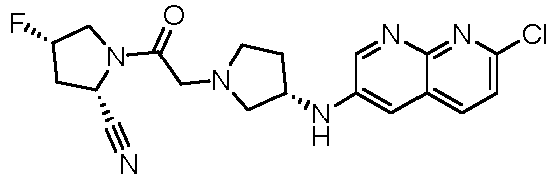
(2S,4S)-4-Fluor-1-[2-[(3S)-3-[(7-chlor-1,8-naphthyridin-3-yl)amino]pyrrolidin-1-yl]acetyl]pyrrolidin-2-carbonitril 
(2S)-1-[2-[(3S)-3-[(8-Ethoxy-5-chinolyl)amino]pyrrolidin-1-yl]acetyl]pyrrolidin-2-carbonitril 
(2S,4S)-4-Fluor-1-[2-[(3 S)-3-[(8-ethoxy-5-chinolyl)amino]pyrrolidin-1-yl]acetyl]pyrrolidin-2-carbonitril 
(2S,4S)-4-Fluor-1-[2-[(3 S)-3-[(8-hydroxy-5-chinolyl)amino]pyrrolidin-1-yl]acetyl]pyrrolidin-2-carbonitril 
(2S,4S)-4-Fluor-1-[2-[(3S)-3-[(8-methyl-6-chinolyl)amino]pyrrolidin-1-yl]acetyl]pyrrolidin-2-carbonitril 
(2S,4S)-4-Fluor-1-[2-[(3S)-3-[(8-fluor-6-chinolyl)amino]pyrrolidin-1-yl]acetyl]pyrrolidin-2-carbonitril 
(2S,4S)-4-Fluor-1-[2-[(3S)-3-[(8-chlor-6-chinolyl)amino]pyrrolidin-1-yl]acetyl]pyrrolidin-2-carbonitril 
(2S,4S)-4-Fluor-1-[2-[(3 S)-3-[[8-(trifluormethyl)-6-chinolyl]amino]pyrrolidin-1-yl]acetyl]pyrrolidin-2-carbonitril 
N-Methyl-5-[[(3 S)-1-[2-oxo-2-[(2S,4S)-2-cyano-4-fluor-pyrrolidin-1-yl]ethyl]pyrrolidin-3-yl]amino]chinolin-8-carboxamid 
N,N-Dimethyl-5-[[(3 S)-1-[2-oxo-2-[(2S,4S)-2-cyano-4-fluor-pyrrolidin-1-yl]ethyl]pyrrolidin-3-yl]amino]chinolin-8-carboxamid 
N-Phenyl-5-[[(3S)-1-[2-oxo-2-[(2S,4S)-2-cyano-4-fluor-pyrrolidin-1-yl]ethyl]pyrrolidin-3-yl]amino]chinolin-8-carboxamid 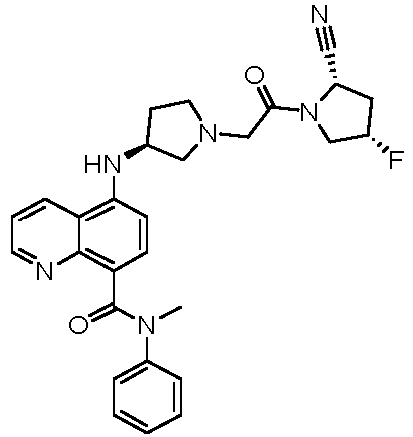
N-Methyl-N-phenyl-5-[[(3S)-1-[2-oxo-2-[(2S,4S)-2-cyano-4-fluor-pyrrolidin-1-yl]ethyl]pyrrolidin-3-yl]amino]chinolin-8-carboxamid 
N-Benzyl-N-methyl-5-[[(3S)-1-[2-oxo-2-[(2S,4S)-2-cyano-4-fluor-pyrrolidin-1-yl]ethyl]pyrrolidin-3-yl]amino]chinolin-8-carboxamid 
N-Methyl-5-[[(3S)-1-[2-oxo-2-[(2S)-2-cyanopyrrolidin-1-yl]ethyl]pyrrolidin-3-yl]amino]chinolin-8-carboxamid 
N-Phenyl-5-[[(3S)-1-[2-oxo-2-[(2S)-2-cyanopyrrolidin-1-yl]ethyl]pyrrolidin-3-yl]amino]chinolin-8-carboxamid 
N-Benzyl-N-methyl-5-[[(3S)-1-[2-oxo-2-[(2S)-2-cyanopyrrolidin-1-yl]ethyl]pyrrolidin-3-yl]amino]chinolin-8-carboxamid 
N-Methyl-N-phenyl-5-[[(3S)-1-[2-oxo-2-[(2S)-2-cyanopyrrolidin-1-yl]ethyl]pyrrolidin-3-yl]amino]chinolin-8-carboxamid 
N-(3-Pyridyl)-5-[[(3S)-1-[2-oxo-2-[(2S)-2-cyanopyrrolidin-1-yl]ethyl]pyrrolidin-3-yl]amino]chinolin-8-carboxamid 
N-(4-Pyridyl)-5-[[(3S)-1-[2-oxo-2-[(2S)-2-cyanopyrrolidin-1-yl]ethyl]pyrrolidin-3-yl]amino]chinolin-8-carboxamid 
N-(4-Pyridyl)-5-[[(3S)-1-[2-oxo-2-[(2S,4S)-2-cyano-4-fluor-pyrrolidin-1-yl]ethyl]pyrrolidin-3-yl]amino]chinolin-8-carboxamid 
N-(2-Pyridyl)-5-[[(3S)-1-[2-oxo-2-[(2S)-2-cyanopyrrolidin-1-yl]ethyl]pyrrolidin-3-yl]amino]chinolin-8-carboxamid 
N-(2-Pyridyl)-5-[[(3S)-1-[2-oxo-2-[(2S,4S)-2-cyano-4-fluor-pyrrolidin-1-yl]ethyl]pyrrolidin-3-yl]amino]chinolin-8-carboxamid 
N-(3-Pyridyl)-5-[[(3S)-1-[2-oxo-2-[(2S,4S)-2-cyano-4-fluor-pyrrolidin-1-yl]ethyl]pyrrolidin-3-yl]amino]chinolin-8-carboxamid 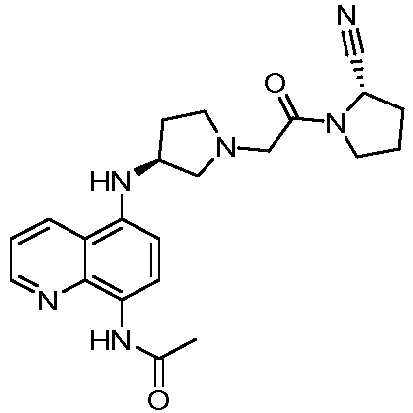
N-[5-[[(3S)-1-[2-Oxo-2-[(2S)-2-cyanopyrrolidin-1-yl]ethyl]pyrrolidin-3-yl]amino]-8-chinolyl]acetamid 
N-[5-[[(3S)-1-[2-Oxo-2-[(2S,4S)-2-cyano-4-fluor-pyrrolidin-1-yl]ethyl]pyrrolidin-3-yl]amino]-8-chinolyl]acetamid 
N-[5-[[(3S)-1-[2-Oxo-2-[(2S,4S)-2-cyano-4-fluor-pyrrolidin-1-yl]ethyl]pyrrolidin-3-yl]amino]-8-chinolyl]benzamid 
(2S,4S)-4-Fluor-1-[2-[(3 S)-3-[(6-methoxy-4-chinolyl)oxy]pyrrolidin-1-yl]acetyl]pyrrolidin-2-carbonitril 
(2S,4S)-4-Fluor-1-[2-[(3S)-3-[(6,7-dimethoxy-4-chinolyl)oxy]pyrrolidin-1-yl]acetyl]pyrrolidin-2-carbonitril 
N-[1-[2-Oxo-2-[(2S)-2-cyanopyrrolidin-1-yl]ethyl]-4-piperidyl]chinolin-8-carboxamid 
(2S)-1-[2-[4-[Ethyl(3-chinolyl)amino]-1-piperidyl]acetyl]pyrrolidin-2-carbonitril 
(2S)-1-[2-[4-[Ethyl(6-chinolyl)amino]-1-piperidyl]acetyl]pyrrolidin-2-carbonitril 
(2S,4S)-1-[2-[4-[Ethyl(3-chinolyl)amino]-1-piperidyl]acetyl]-4-fluor-pyrrolidin-2-carbonitril 
(2S,4S)-1-[2-[4-[Ethyl(5-chinolyl)amino]-1-piperidyl]acetyl]-4-fluor-pyrrolidin-2-carbonitril 
(2S,4S)-1-[2-[4-[Ethyl(6-chinolyl)amino]-1-piperidyl]acetyl]-4-fluor-pyrrolidin-2-carbonitril 
(2S)-1-[2-[4-[Methyl(2-chinolyl)amino]-1-piperidyl]acetyl]pyrrolidin-2-carbonitril 
(2S)-1-[2-[4-[Methyl(4-chinolyl)amino]-1-piperidyl]acetyl]pyrrolidin-2-carbonitril 
(2S)-1-[2-[4-[Methyl(5-chinolyl)amino]-1-piperidyl]acetyl]pyrrolidin-2-carbonitril 
(2S)-1-[2-[4-[Methyl(6-chinolyl)amino]-1-piperidyl]acetyl]pyrrolidin-2-carbonitril 
(2S)-1-[2-[4-[Methyl(7-chinolyl)amino]-1-piperidyl]acetyl]pyrrolidin-2-carbonitril 
(2S)-1-[2-[4-[Furo[3,2-c]pyridin-7-yl(methyl)amino]-1-piperidyl]acetyl]pyrrolidin-2-carbonitril 
(2S)-1-[2-[4-[5-Isochinolyl(methyl)amino]-1-piperidyl]acetyl]pyrrolidin-2-carbonitril 
(2S)-1-(2-(4-(Isochinolin-6-yl(methyl)amino)piperidin-1-yl)acetyl)pyrrolidin-2-carbonitril 
(2S,4S)-4-Fluor-1-[2-[4-[methyl(6-chinolyl)amino]-1-piperidyl]acetyl]pyrrolidin-2-carbonitril 
(2S,4S)-4-Fluor-1-[2-[4-[methyl(3-chinolyl)amino]-1-piperidyl]acetyl]pyrrolidin-2-carbonitril 
(2S,48S)-4-Fluor-1-[2-[4-[3-isochinolyl(methyl)amino]-1-piperidyl]acetyl]pyrrolidin-2-carbonitril 
(2S,4S)-4-Fluor-1-[2-[4-[5-isochinolyl(methyl)amino]-1-piperidyl]acetyl]pyrrolidin-2-carbonitril 
(2S,4S)-4-Fluor-1-[2-[4-[7-isochinolyl(methyl)amino]-1-piperidyl]acetyl]pyrrolidin-2-carbonitril 
(2S,4S)-4-Fluor-1-[2-[4-[8-isochinolyl(methyl)amino]-1-piperidyl]acetyl]pyrrolidin-2-carbonitril 
(2S)-1-[2-[4-[3-Isochinolyl(methyl)amino]-1-piperidyl]acetyl]pyrrolidin-2-carbonitril 
(2S)-1-[2-[4-[Methyl-(6-methyl-3-chinolyl)amino]-1-piperidyl]acetyl]pyrrolidin-2-carbonitril 
(S)-1-(2-(4-((6-Methoxychinolin-3-yl)(methyl)amino)piperidin-1-yl)acetyl)pyrrolidin-2-carbonitril 
(2S)-1-[2-[4-[(7-Methoxy-3-chinolyl)-methyl-amino]-1-piperidyl]acetyl]pyrrolidin-2-carbonitril 
(2S)-1-[2-[4-[(8-Methoxy-3-chinolyl)-methyl-amino]-1-piperidyl]acetyl]pyrrolidin-2-carbonitril 
(2S,4S)-4-Fluor-1-[2-[4-[methyl-(6-methyl-3-chinolyl)amino]-1-piperidyl]acetyl]pyrrolidin-2-carbonitril 
(2S,4S)-4-Fluor-1-(2-(4-((6-methoxychinolin-3-yl)(methyl)amino)piperidin-1-yl)acetyl)pyrrolidin-2-carbonitril 
(2S,4S)-4-Fluor-1-(2-(4-((7-methoxychinolin-3-yl)(methyl)amino)piperidin-1-yl)acetyl)pyrrolidin-2-carbonitril 
(2S,4S)-4-Fluor-1-[2-[4-[(8-methoxy-3-chinolyl)-methyl-amino]-1-piperidyl]acetyl]pyrrolidin-2-carbonitril 
(2S,4S)-4-Fluor-1-[2-[4-[(8-fluor-5-chinolyl)amino]-1-piperidyl]acetyl]pyrrolidin-2-carbonitril 
(2S,4S)-4-Fluor-1-[2-[4-[(8-methyl-5-chinolyl)amino]-1-piperidyl]acetyl]pyrrolidin-2-carbonitril 
(2S,4S)-1-[2-[4-[(8-Benzyloxy-5-chinolyl)amino]-1-piperidyl]acetyl]-4-fluor-pyrrolidin-2-carbonitril 
(2S,4S)-1-[2-[4-[(3-Chlor-5-chinolyl)amino]-1-piperidyl]acetyl]-4-fluor-pyrrolidin-2-carbonitril 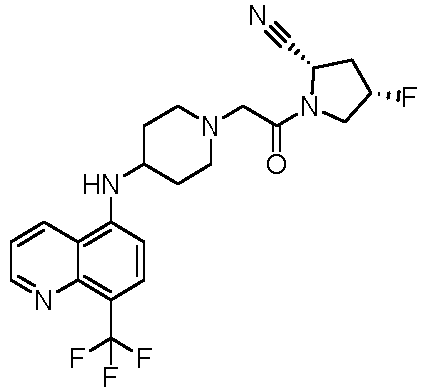
(2S,4S)-4-Fluor-1-[2-[4-[[8-(trifluormethyl)-5-chinolyl]amino]-1-piperidyl]acetyl]pyrrolidin-2-carbonitril 
5-[[1-[2-Oxo-2-[(2S,4S)-2-cyano-4-fluor-pyrrolidin-1-yl]ethyl]-4-piperidyl]amino]chinolin-2-carbonitril 
(2S,4S)-1-(2-(4-(Benzo[b]thiophen-4-ylamino)piperidin-1-yl)acetyl)-4-fluorpyrrolidin-2-carbonitril 
(2S,4S)-4-Fluor-1-[2-[4-[(6-fluor-4-chinolyl)amino]-1-piperidyl]acetyl]pyrrolidin-2-carbonitril 
(2S,4S)-1-[2-[4-[(6-Chlor-4-chinolyl)amino]-1-piperidyl]acetyl]-4-fluor-pyrrolidin-2-carbonitril 
(2S,4S)-4-Fluor-1-[2-[4-(4-isochinolylamino)-1-piperidyl]acetyl]pyrrolidin-2-carbonitril 
(2S,4S)-4-Fluor-1-[2-[4-(5-isochinolylamino)-1-piperidyl]acetyl]pyrrolidin-2-carbonitril 
(2S,4S)-4-Fluor-1-[2-[4-(6-isochinolylamino)-1-piperidyl]acetyl]pyrrolidin-2-carbonitril 
(2S,4S)-4-Fluor-1-[2-[4-(8-isochinolylamino)-1-piperidyl]acetyl]pyrrolidin-2-carbonitril 
(2S,4S)-4-Fluor-1-[2-[4-[(8-methyl-4-chinolyl)amino]-1-piperidyl]acetyl]pyrrolidin-2-carbonitril 
(2S,4S)-1-[2-[4-[(8-Chlor-4-chinolyl)amino]-1-piperidyl]acetyl]-4-fluor-pyrrolidin-2-carbonitril 
(2S,4S)-4-Fluor-1-[2-[4-[(8-fluor-4-chinolyl)amino]-1-piperidyl]acetyl]pyrrolidin-2-carbonitril 
(2S,4S)-4-Fluor-1-[2-[4-[[8-(trifluormethyl)-4-chinolyl]amino]-1-piperidyl]acetyl]pyrrolidin-2-carbonitril 
(2S,4S)-4-Fluor-1-[2-[4-[[8-(trifluormethoxy)-5-chinolyl]amino]-1-piperidyl]acetyl]pyrrolidin-2-carbonitril 
(2S,4S)-4-Fluor-1-[2-[4-[(3-methoxy-5-chinolyl)amino]-1-piperidyl]acetyl]pyrrolidin-2-carbonitril 
(2S,4S)-4-Fluor-1-[2-[4-[(3-fluor-5-chinolyl)amino]-1-piperidyl]acetyl]pyrrolidin-2-carbonitril 
(2S,4S)-4-Fluor-1-[2-[4-[furo[3,2-c]pyridin-7-yl(methyl)amino]-1-piperidyl]acetyl]pyrrolidin-2-carbonitril 
(2S,4S)-1-[2-[4-[(1-Chlor-5-isochinolyl)amino]-1-piperidyl]acetyl]-4-fluor-pyrrolidin-2-carbonitril 
(2S,4S)-1-[2-[4-[(3-Chlor-5-isochinolyl)amino]-1-piperidyl]acetyl]-4-fluor-pyrrolidin-2-carbonitril 
(2S,4S)-1-[2-[4-[(8-Chlor-5-isochinolyl)amino]-1-piperidyl]acetyl]-4-fluor-pyrrolidin-2-carbonitril 
(2S,4S)-4-Fluor-1-[2-[4-[(4-methyl-5-isochinolyl)amino]-1-piperidyl]acetyl]pyrrolidin-2-carbonitril 
(2S,4S)-4-Fluor-1-[2-[4-[(3-methoxy-5-isochinolyl)amino]-1-piperidyl]acetyl]pyrrolidin-2-carbonitril 
(2S,4S)-4-Fluor-1-[2-[4-[(8-nitro-5-isochinolyl)amino]-1-piperidyl]acetyl]pyrrolidin-2-carbonitril 
(2S,4S)-4-Fluor-1-[2-[4-[(8-fluor-5-isochinolyl)amino]-1-piperidyl]acetyl]pyrrolidin-2-carbonitril 
(2S)-1-[2-[4-[(2-Chlor-6,7-dimethoxy-chinazolin-4-yl)amino]-1-piperidyl]acetyl]pyrrolidin-2-carbonitril 
(2S)-1-[2-[4-[(2-Chlor-8-methyl-chinazolin-4-yl)amino]-1-piperidyl]acetyl]pyrrolidin-2-carbonitril 
(2S,4S)-4-Fluor-1-[2-[4-(2,6-naphthyridin-4-ylamino)-1-piperidyl]acetyl]pyrrolidin-2-carbonitril 
(2S,4S)-1-[2-[4-[(8-Chlor-4-isochinolyl)amino]-1-piperidyl]acetyl]-4-fluor-pyrrolidin-2-carbonitril 
(2S,4S)-4-Fluor-1-[2-[4-(3-chinolylamino)-1-piperidyl]acetyl]pyrrolidin-2-carbonitril 
(2S,4S)-4-Fluor-1-[2-[4-[(6-methyl-3-chinolyl)amino]-1-piperidyl]acetyl]pyrrolidin-2-carbonitril 
(2S,4S)-4-Fluor-1-[2-[4-[(6-fluor-3-chinolyl)amino]-1-piperidyl]acetyl]pyrrolidin-2-carbonitril 
(2S,4S)-4-Fluor-1-[2-[4-[(6-methoxy-3-chinolyl)amino]-1-piperidyl]acetyl]pyrrolidin-2-carbonitril 
(2S,4S)-4-Fluor-1-[2-[4-[(7-methoxy-3-chinolyl)amino]-1-piperidyl]acetyl]pyrrolidin-2-carbonitril 
(2S,4S)-4-Fluor-1-[2-[4-[(8-methoxy-3-chinolyl)amino]-1-piperidyl]acetyl]pyrrolidin-2-carbonitril 
(2S,4S)-4-Fluor-1-[2-[4-(1,8-naphthyridin-3-ylamino)-1-piperidyl]acetyl]pyrrolidin-2-carbonitril 
(2S,4S)-1-[2-[4-[(7-Chlor-1,8-naphthyridin-3-yl)amino]-1-piperidyl]acetyl]-4-fluor-pyrrolidin-2-carbonitril 
(2S)-1-[2-[4-[(8-Ethoxy-5-chinolyl)amino]-1-piperidyl]acetyl]pyrrolidin-2-carbonitril 
(2S,4S)-1-[2-[4-[(8-Ethoxy-5-chinolyl)amino]-1-piperidyl]acetyl]-4-fluor-pyrrolidin-2-carbonitril 
(2S,4S)-1-[2-[4-(1,3-Benzothiazol-7-ylamino)-1-piperidyl]acetyl]-4-fluor-pyrrolidin-2-carbonitril 
(2S,4S)-1-[2-[4-[(1-Acetylindolin-4-yl)amino]-1-piperidyl]acetyl]-4-fluor-pyrrolidin-2-carbonitril 
(2S,4S)-4-Fluor-1-[2-[4-[(8-methyl-6-chinolyl)amino]-1-piperidyl]acetyl]pyrrolidin-2-carbonitril 
(2S,4S)-4-Fluor-1-[2-[4-[(8-fluor-6-chinolyl)amino]-1-piperidyl]acetyl]pyrrolidin-2-carbonitril 
(2S,4S)-1-[2-[4-[(8-Chlor-6-chinolyl)amino]-1-piperidyl]acetyl]-4-fluor-pyrrolidin-2-carbonitril 
(2S,4S)-4-Fluor-1-[2-[4-[[8-(trifluormethyl)-6-chinolyl]amino]-1-piperidyl]acetyl]pyrrolidin-2-carbonitril 
(2S)-1-[2-[4-[(2-Oxochromen-4-yl)amino]-1-piperidyl]acetyl]pyrrolidin-2-carbonitril 
(2S,4S)-4-Fluor-1-[2-[4-[(2-oxochromen-4-yl)amino]-1-piperidyl]acetyl]pyrrolidin-2-carbonitril 
(2S,4S)-4-Fluor-1-[2-[4-(1,5-naphthyridin-4-ylamino)-1-piperidyl]acetyl]pyrrolidin-2-carbonitril 
(2S,4S)-4-Fluor-1-[2-[4-[[2-(trifluormethyl)-6-chinolyl]amino]-1-piperidyl]acetyl]pyrrolidin-2-carbonitril 
(2S,4S)-4-Fluor-1-[2-[4-[(4-methoxy-6-chinolyl)amino]-1-piperidyl]acetyl]pyrrolidin-2-carbonitril 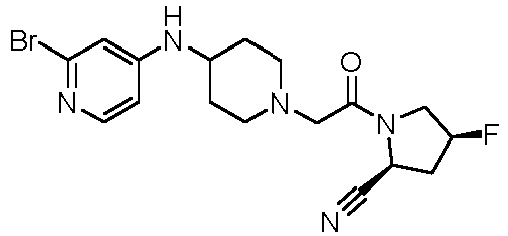
(2S,4S)-1-[2-[4-[(2-Brom-4-pyridyl)amino]-1-piperidyl]acetyl]-4-fluor-pyrrolidin-2-carbonitril 
(2S,4S)-1-[2-[4-(3H-Benzimidazol-4-ylamino)-1-piperidyl]acetyl]-4-fluor-pyrrolidin-2-carbonitril 
(2S,4S)-1-[2-[4-[(2-Chlor-6-morpholino-4-pyridyl)amino]-1-piperidyl]acetyl]-4-fluor-pyrrolidin-2-carbonitril 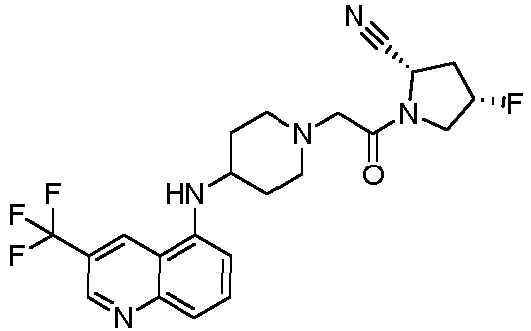
(2S,4S)-4-Fluor-1-[2-[4-[[3-(trifluormethyl)-5-chinolyl]amino]-1-piperidyl]acetyl]pyrrolidin-2-carbonitril 
(2S)-1-[2-[4-[[3-(Trifluormethyl)-5-chinolyl]amino]-1-piperidyl]acetyl]pyrrolidin-2-carbonitril 
5-[[1-[2-Oxo-2-[(2S,4S)-2-cyano-4-fluor-pyrrolidin-1-yl]ethyl]-4-piperidyl]amino]-N-phenyl-chinolin-3-carboxamid 
N-Benzyl-N-methyl-5-[[1-[2-oxo-2-[(2S,4S)-2-cyano-4-fluor-pyrrolidin-1-yl]ethyl]-4-piperidyl]amino]chinolin-3-carboxamid 
N-Methyl-5-[[1-[2-oxo-2-[(2S,4S)-2-cyano-4-fluor-pyrrolidin-1-yl]ethyl]-4-piperidyl]amino]chinolin-8-carboxamid 
N,N-Dimethyl-5-[[1-[2-oxo-2-[(2S,4S)-2-cyano-4-fluor-pyrrolidin-1-yl]ethyl]-4-piperidyl]amino]chinolin-8-carboxamid 
N-Methyl-5-[[1-[2-oxo-2-[(2S,4S)-2-cyano-4-fluor-pyrrolidin-1-yl]ethyl]-4-piperidyl]amino]-N-phenyl-chinolin-8-carboxamid 
N-Benzyl-N-methyl-5-[[1-[2-oxo-2-[(2S,4S)-2-cyano-4-fluor-pyrrolidin-1-yl]ethyl]-4-piperidyl]amino]chinolin-8-carboxamid 
5-[[1-[2-Oxo-2-[(2S,4S)-2-cyano-4-fluor-pyrrolidin-1-yl]ethyl]-4-piperidyl]amino]-N-phenyl-chinolin-8-carboxamid 
N-Methyl-5-[[1-[2-oxo-2-[(2S)-2-cyanopyrrolidin-1-yl]ethyl]-4-piperidyl]amino]chinolin-8-carboxamid 
5-[[1-[2-Oxo-2-[(2S)-2-cyanopyrrolidin-1-yl]ethyl]-4-piperidyl]amino]-N-phenyl-chinolin-8-carboxamid 
N-Benzyl-N-methyl-5-[[1-[2-oxo-2-[(2S)-2-cyanopyrrolidin-1-yl]ethyl]-4-piperidyl]amino]chinolin-8-carboxamid 
N-Methyl-5-[[1-[2-oxo-2-[(2S)-2-cyanopyrrolidin-1-yl]ethyl]-4-piperidyl]amino]-N-phenyl-chinolin-8-carboxamid 
5-[[1-[2-Oxo-2-[(2S)-2-cyanopyrrolidin-1-yl]ethyl]-4-piperidyl]amino]-N-(2-pyridyl)chinolin-8-carboxamid 
5-[[1-[2-Oxo-2-[(2S)-2-cyanopyrrolidin-1-yl]ethyl]-4-piperidyl]amino]-N-(3-pyridyl)chinolin-8-carboxamid 
5-[[1-[2-Oxo-2-[(2S)-2-cyanopyrrolidin-1-yl]ethyl]-4-piperidyl]amino]-N-(4-pyridyl)chinolin-8-carboxamid 
5-[[1-[2-Oxo-2-[(2S)-2-cyanopyrrolidin-1-yl]ethyl]-4-piperidyl]amino]-N-pyrimidin-2-yl-chinolin-8-carboxamid 
5-[[1-[2-Oxo-2-[(2S,4S)-2-cyano-4-fluor-pyrrolidin-1-yl]ethyl]-4-piperidyl]amino]-N-pyrimidin-2-yl-chinolin-8-carboxamid 
5-[[1-[2-Oxo-2-[(2S,4S)-2-cyano-4-fluor-pyrrolidin-1-yl]ethyl]-4-piperidyl]amino]-N-(2-pyridyl)chinolin-8-carboxamid 
5-[[1-[2-Oxo-2-[(2S,4S)-2-cyano-4-fluor-pyrrolidin-1-yl]ethyl]-4-piperidyl]amino]-N-(3-pyridyl)chinolin-8-carboxamid 
5-[[1-[2-Oxo-2-[(2S,4S)-2-cyano-4-fluor-pyrrolidin-1-yl]ethyl]-4-piperidyl]amino]-N-(4-pyridyl)chinolin-8-carboxamid 
N-Isoxazol-3-yl-5-[[1-[2-oxo-2-[(2S,4S)-2-cyano-4-fluor-pyrrolidin-1-yl]ethyl]-4-piperidyl]amino]chinolin-8-carboxamid 
N-[5-[[1-[2-Oxo-2-[(2S)-2-cyanopyrrolidin-1-yl]ethyl]-4-piperidyl]amino]-8-chinolyl]acetamid 
N-[5-[[1-[2-Oxo-2-[(2S,4S)-2-cyano-4-fluor-pyrrolidin-1-yl]ethyl]-4-piperidyl]amino]-8-chinolyl]acetamid 
(2S,4S)-4-Fluor-1-[2-[4-[(6-methyl-4-chinolyl)oxy]-1-piperidyl]acetyl]pyrrolidin-2-carbonitril 
(2S,4S)-4-Fluor-1-[2-[4-[[6-(trifluormethyl)-4-chinolyl]oxy]-1-piperidyl]acetyl]pyrrolidin-2-carbonitril 
(2S,4S)-4-Fluor-1-[2-[4-[[2-(trifluormethyl)-4-chinolyl]oxy]-1-piperidyl]acetyl]pyrrolidin-2-carbonitril 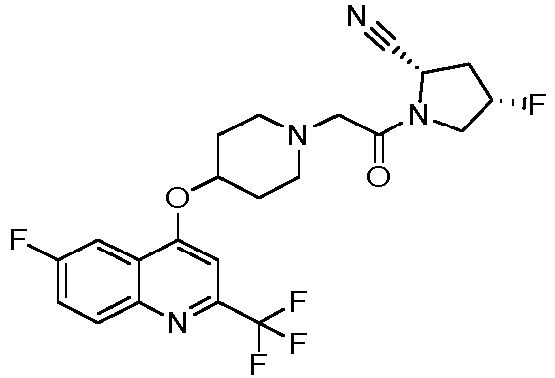
(2S,4S)-4-Fluor-1-[2-[4-[[6-fluor-2-(trifluormethyl)-4-chinolyl]oxy]-1-piperidyl]acetyl]pyrrolidin-2-carbonitril 
(2S,4S)-4-Fluor-1-[2-[4-[[6-methoxy-2-(trifluormethyl)-4-chinolyl]oxy]-1-piperidyl]acetyl]pyrrolidin-2-carbonitril 
(2S,4S)-4-Fluor-1-[2-[4-[[8-methoxy-2-(trifluormethyl)-4-chinolyl]oxy]-1-piperidyl]acetyl]pyrrolidin-2-carbonitril 
(2S,4S)-4-Fluor-1-[2-[4-[(3-fluor-5-chinolyl)oxy]-1-piperidyl]acetyl]pyrrolidin-2-carbonitril 
5-[[1-[2-Oxo-2-[(2S,4S)-2-cyano-4-fluor-pyrrolidin-1-yl]ethyl]-4-piperidyl]oxy]chinolin-2-carbonitril 
(2S,4S)-1-[2-[4-[(8-Chlor-5-chinolyl)oxy]-1-piperidyl]acetyl]-4-fluor-pyrrolidin-2-carbonitril 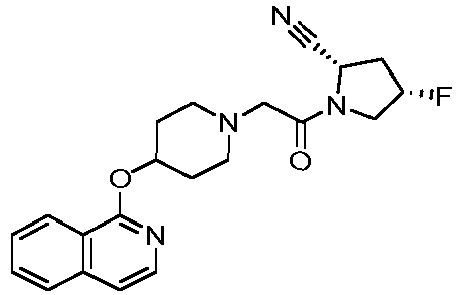
(2S,4S)-4-Fluor-1-[2-[4-(1-isochinolyloxy)-1-piperidyl]acetyl]pyrrolidin-2-carbonitril 
(2S,4S)-4-Fluor-1-[2-[4-(4-isochinolyloxy)-1-piperidyl]acetyl]pyrrolidin-2-carbonitril 
(2S,4S)-4-Fluor-1-[2-[4-(5-isochinolyloxy)-1-piperidyl]acetyl]pyrrolidin-2-carbonitril 
(2S,4S)-4-Fluor-1-[2-[4-(6-isochinolyloxy)-1-piperidyl]acetyl]pyrrolidin-2-carbonitril 
(2S,4S)-4-Fluor-1-[2-[4-(7-isochinolyloxy)-1-piperidyl]acetyl]pyrrolidin-2-carbonitril 
(2S,4S)-4-Fluor-1-[2-[4-[(6-methoxy-2-methyl-4-chinolyl)oxy]-1-piperidyl]acetyl]pyrrolidin-2-carbonitril 
(2S,4S)-4-Fluor-1-[2-[4-(5-chinolyloxy)-1-piperidyl]acetyl]pyrrolidin-2-carbonitril 
(2S)-1-[2-[4-[(6-Methoxy-4-chinolyl)oxy]-1-piperidyl]acetyl]pyrrolidin-2-carbonitril 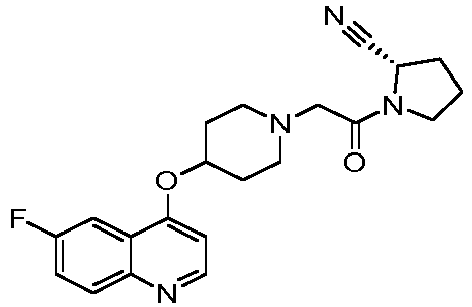
(2S)-1-[2-[4-[(6-Fluor-4-chinolyl)oxy]-1-piperidyl]acetyl]pyrrolidin-2-carbonitril 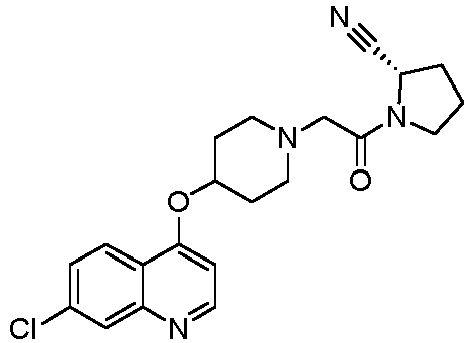
(2S)-1-[2-[4-[(7-Chlor-4-chinolyl)oxy]-1-piperidyl]acetyl]pyrrolidin-2-carbonitril 
(2S)-1-[2-[4-[(3-Fluor-5-chinolyl)oxy]-1-piperidyl]acetyl]pyrrolidin-2-carbonitril 
5-[[1-[2-Oxo-2-[(2S)-2-cyanopyrrolidin-1-yl]ethyl]-4-piperidyl]oxy]chinolin-2-carbonitril 
(2S)-1-[2-[4-[(8-Chlor-5-chinolyl)oxy]-1-piperidyl]acetyl]pyrrolidin-2-carbonitril 
(2S,4S)-4-Fluor-1-[2-[4-[(7-methyl-4-chinolyl)oxy]-1-piperidyl]acetyl]pyrrolidin-2-carbonitril 
(2S,4S)-4-Fluor-1-[2-[4-[(7-fluor-4-chinolyl)oxy]-1-piperidyl]acetyl]pyrrolidin-2-carbonitril 
4-[[1-[2-Oxo-2-[(2S,4S)-2-cyano-4-fluor-pyrrolidin-1-yl]ethyl]-4-piperidyl]oxy]chinolin-8-carbonitril 
(2S,4S)-4-Fluor-1-[2-[4-[(8-fluor-4-chinolyl)oxy]-1-piperidyl]acetyl]pyrrolidin-2-carbonitril 
(2S,4S)-4-Fluor-1-[2-[4-[(2-methyl-4-chinolyl)oxy]-1-piperidyl]acetyl]pyrrolidin-2-carbonitril 
(2S,4S)-4-Fluor-1-[2-[4-[(6-fluor-2-methyl-4-chinolyl)oxy]-1-piperidyl]acetyl]pyrrolidin-2-carbonitril 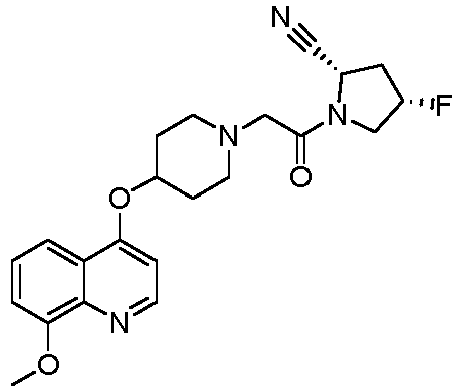
(2S,4S)-4-Fluor-1-[2-[4-[(8-methoxy-4-chinolyl)oxy]-1-piperidyl]acetyl]pyrrolidin-2-carbonitril und 
(2S,4S)-4-Fluor-1-[2-[4-[(8-methyl-4-chinolyl)oxy]-1-piperidyl]acetyl]pyrrolidin-2-carbonitril. - Pharmazeutische Zusammensetzung, umfassend die Verbindung nach einem der Ansprüche 1-10, oder ein Stereoisomer, ein Gemisch von Stereoisomeren davon, oder ein pharmazeutisch verträgliches Salz davon, und zumindest einen pharmazeutisch verträglichen Hilfsstoff.
- Verbindung nach einem der Ansprüche 1-10, oder ein Stereoisomer, ein Gemisch von Stereoisomeren davon, oder ein pharmazeutisch verträgliches Salz davon, oder pharmazeutische Zusammensetzung nach Anspruch 11, zur Verwendung bei Hemmung von Fibroblasten-Aktivierungs-Protein.
- Verbindung nach einem der Ansprüche 1-10, oder ein Stereoisomer, ein Gemisch von Stereoisomeren, oder ein pharmazeutisch verträgliches Salz davon, zur Verwendung bei Behandlung einer durch Fibroblasten-Aktivierungs-Protein vermittelten Erkrankung.
- Verbindung zur Verwendung nach Anspruch 13, wobei die durch Fibroblasten-Aktivierungs-Protein vermittelte Erkrankung aus der Gruppe ausgewählt ist, die besteht aus einer Lipidstörung, einer Lipoproteinstörung, einem Zustand oder einer Erkrankung, der bzw. die aus chronischer Fettdegeneration und fibrotischer Degeneration von Organen aufgrund von akkumuliertem Lipid und spezifisch Triglyceridakkumulation und anschließender Aktivierung eines profibrotischen Wegs resultiert, Typ-I- oder Typ-II-Diabetes, einer klinischen Komplikation von Typ-I- und Typ-II-Diabetes, einem chronischen intrahepatischen cholestatischen Zustand, einem extrahepatischen cholestatischen Zustand, Leberfibrose, einem akuten intrahepatischen cholestatischen Zustand, einer obstruktiven oder chronischen entzündlichen Störung, die von falscher Gallenzusammensetzung herrührt, einem gastrointestinalen Zustand mit einer reduzierten Aufnahme von Nahrungsfett und fettlöslichem Nahrungsvitamin, chronisch entzündlicher Darmerkrankung, Obesitas, metabolischem Syndrom, kombinierten Zuständen von Dyslipidämie, Diabetes und abnorm hohem Body-Mass-Index, einer persistierenden Infektion durch intrazelluläre Bakterien oder parasitäre Protozoen, nichtmaligner hyperproliferativer Störung, maligner hyperproliferativer Störung, Kolonadenokarzinom, hepatozellulärem Karzinom, Lebersteatose oder einem assoziierten Syndrom, Hepatitis-B-Infektion, Hepatitis-C-Infektion, einer cholestatischen und fibrotischen Wirkung, die mit alkoholinduzierter Zirrhose oder mit durch Viren übertragenen Formen von Hepatitis assoziiert ist, Leberversagen oder Leberfehlfunktion als Outcome chronischer Lebererkrankung oder chirurgischer Leberresektion, akutem Herzinfarkt, akutem Schlaganfall, Thrombose, die als Endpunkt chronisch obstruktiver Atherosklerose auftritt, Arthrose, rheumatoider Arthritis, Psoriasis und Hirninfarkt, oder einer Kombination davon.
- Verbindung nach einem der Ansprüche 1-10, oder ein Stereoisomer, ein Gemisch von Stereoisomeren, oder ein pharmazeutisch verträgliches Salz davon, zur Verwendung bei Behandlung von Krebs.
Applications Claiming Priority (2)
| Application Number | Priority Date | Filing Date | Title |
|---|---|---|---|
| US201962931554P | 2019-11-06 | 2019-11-06 | |
| PCT/IB2020/060436 WO2021090245A1 (en) | 2019-11-06 | 2020-11-05 | Pyrrolidine and piperidine compounds |
Publications (4)
| Publication Number | Publication Date |
|---|---|
| EP4055014A1 EP4055014A1 (de) | 2022-09-14 |
| EP4055014A4 EP4055014A4 (de) | 2023-12-06 |
| EP4055014B1 true EP4055014B1 (de) | 2025-04-30 |
| EP4055014C0 EP4055014C0 (de) | 2025-04-30 |
Family
ID=75848988
Family Applications (1)
| Application Number | Title | Priority Date | Filing Date |
|---|---|---|---|
| EP20885645.0A Active EP4055014B1 (de) | 2019-11-06 | 2020-11-05 | Pyrrolidin- und piperidinverbindungen |
Country Status (13)
| Country | Link |
|---|---|
| US (1) | US11655235B2 (de) |
| EP (1) | EP4055014B1 (de) |
| JP (1) | JP7451699B2 (de) |
| KR (1) | KR102799014B1 (de) |
| CN (1) | CN114867719B (de) |
| AR (1) | AR120406A1 (de) |
| AU (1) | AU2020378719B2 (de) |
| BR (1) | BR112022008041A2 (de) |
| CA (1) | CA3160627A1 (de) |
| ES (1) | ES3025089T3 (de) |
| MX (1) | MX2022005388A (de) |
| TW (1) | TW202132281A (de) |
| WO (1) | WO2021090245A1 (de) |
Families Citing this family (2)
| Publication number | Priority date | Publication date | Assignee | Title |
|---|---|---|---|---|
| EP4263535A1 (de) | 2020-12-17 | 2023-10-25 | Astrazeneca AB | N-(2-(4-cyanothiazolidin-3-yl)-2-oxoethyl)-chinolin-4-carboxamide |
| CN119072472A (zh) * | 2022-04-21 | 2024-12-03 | 上海先通生物科技有限公司 | Fap抑制剂 |
Family Cites Families (23)
| Publication number | Priority date | Publication date | Assignee | Title |
|---|---|---|---|---|
| FR2802206B1 (fr) | 1999-12-14 | 2005-04-22 | Sod Conseils Rech Applic | Derives de 4-aminopiperidine et leur utilisation en tant que medicament |
| US6924285B2 (en) | 2002-03-30 | 2005-08-02 | Boehringer Ingelheim Pharma Gmbh & Co. | Bicyclic heterocyclic compounds, pharmaceutical compositions containing these compounds, their use and process for preparing them |
| JP4776882B2 (ja) | 2002-03-30 | 2011-09-21 | ベーリンガー インゲルハイム ファルマ ゲゼルシャフト ミット ベシュレンクテル ハフツング ウント コンパニー コマンディトゲゼルシャフト | 二環式複素環化合物、これらの化合物を含む医薬組成物、それらの使用及びそれらの調製方法 |
| ES2279441T3 (es) | 2003-09-19 | 2007-08-16 | Astrazeneca Ab | Derivados de quinazolina. |
| US7456189B2 (en) | 2003-09-30 | 2008-11-25 | Boehringer Ingelheim International Gmbh | Bicyclic heterocycles, medicaments containing these compounds, their use and processes for their preparation |
| EP1799639B1 (de) | 2004-10-12 | 2013-09-04 | Glenmark Pharmaceuticals S.A. | Neue dipeptidylpeptidase-iv-inhibitoren, pharmazeutische zusammensetzungen, die diese enthalten, und verfahren zu deren herstellung |
| EP1760076A1 (de) | 2005-09-02 | 2007-03-07 | Ferring B.V. | FAP Inhibitoren |
| WO2007063934A1 (ja) * | 2005-12-02 | 2007-06-07 | Mitsubishi Tanabe Pharma Corporation | 脂環式複素環化合物 |
| CN101284810A (zh) * | 2008-06-02 | 2008-10-15 | 秦引林 | 氰基吡咯烷和氰基噻唑烷衍生物 |
| CN101337920B (zh) * | 2008-08-14 | 2010-12-01 | 南京中瑞药业有限公司 | 一种苯丙氨酰吡咯烷衍生物及其制备方法和用途 |
| EP2366699B1 (de) | 2008-10-02 | 2013-08-07 | Asahi Kasei Pharma Corporation | 8-substituiertes isochinolinderivat und seine verwendung |
| GB0910003D0 (en) | 2009-06-11 | 2009-07-22 | Univ Leuven Kath | Novel compounds for the treatment of neurodegenerative diseases |
| WO2012069917A1 (en) | 2010-11-26 | 2012-05-31 | Lupin Limited | Bicyclic gpr119 modulators |
| WO2012097013A1 (en) | 2011-01-10 | 2012-07-19 | Nimbus Iris, Inc. | Irak inhibitors and uses thereof |
| WO2012162507A1 (en) * | 2011-05-24 | 2012-11-29 | Apicore, Llc | Process for preparing saxagliptin and its novel intermediates useful in the synthesis thereof |
| EP2982666B1 (de) | 2013-04-04 | 2019-08-07 | Takeda Pharmaceutical Company Limited | Heterocyclische verbindung |
| AU2016229268B2 (en) | 2015-03-06 | 2020-09-10 | Pharmakea, Inc. | Fluorinated lysyl oxidase-like 2 inhibitors and uses thereof |
| AU2016270373A1 (en) | 2015-06-05 | 2018-01-04 | Vertex Pharmaceuticals Incorporated | Triazoles for the treatment of demyelinating diseases |
| EP3854782A1 (de) | 2016-03-30 | 2021-07-28 | Genentech, Inc. | Substituierte benzamide und verfahren zur verwendung davon |
| CN106349185B (zh) * | 2016-08-26 | 2018-07-06 | 河北科技大学 | 一种氨基保护的3-羟基金刚烷甘氨酸苯并噻唑-2-硫醇活性酯、其制备方法及应用 |
| EP3555087A1 (de) | 2016-12-16 | 2019-10-23 | Janssen Pharmaceutica NV | Monocyclische oga-inhibitor-verbindungen |
| WO2018154133A1 (en) | 2017-02-27 | 2018-08-30 | Janssen Pharmaceutica Nv | [1,2,4]-triazolo [1,5-a]-pyrimidinyl derivatives substituted with piperidine, morpholine or piperazine as oga inhibitors |
| CN108689905B (zh) * | 2017-12-27 | 2020-07-28 | 河北医科大学 | 一种维格列汀杂质化合物及其制备方法、检测方法和用途 |
-
2020
- 2020-11-05 EP EP20885645.0A patent/EP4055014B1/de active Active
- 2020-11-05 AU AU2020378719A patent/AU2020378719B2/en active Active
- 2020-11-05 WO PCT/IB2020/060436 patent/WO2021090245A1/en not_active Ceased
- 2020-11-05 AR ARP200103079A patent/AR120406A1/es not_active Application Discontinuation
- 2020-11-05 MX MX2022005388A patent/MX2022005388A/es unknown
- 2020-11-05 US US17/090,552 patent/US11655235B2/en active Active
- 2020-11-05 TW TW109138557A patent/TW202132281A/zh unknown
- 2020-11-05 JP JP2022525703A patent/JP7451699B2/ja active Active
- 2020-11-05 ES ES20885645T patent/ES3025089T3/es active Active
- 2020-11-05 KR KR1020227018913A patent/KR102799014B1/ko active Active
- 2020-11-05 BR BR112022008041A patent/BR112022008041A2/pt unknown
- 2020-11-05 CN CN202080089432.8A patent/CN114867719B/zh active Active
- 2020-11-05 CA CA3160627A patent/CA3160627A1/en active Pending
Also Published As
| Publication number | Publication date |
|---|---|
| WO2021090245A1 (en) | 2021-05-14 |
| ES3025089T3 (en) | 2025-06-06 |
| EP4055014C0 (de) | 2025-04-30 |
| US20210147386A1 (en) | 2021-05-20 |
| CN114867719A (zh) | 2022-08-05 |
| TW202132281A (zh) | 2021-09-01 |
| AR120406A1 (es) | 2022-02-09 |
| KR20220110206A (ko) | 2022-08-05 |
| US11655235B2 (en) | 2023-05-23 |
| EP4055014A1 (de) | 2022-09-14 |
| CA3160627A1 (en) | 2021-05-14 |
| JP2023500874A (ja) | 2023-01-11 |
| AU2020378719A1 (en) | 2022-05-12 |
| AU2020378719B2 (en) | 2024-04-18 |
| CN114867719B (zh) | 2024-06-25 |
| KR102799014B1 (ko) | 2025-04-28 |
| MX2022005388A (es) | 2022-05-24 |
| JP7451699B2 (ja) | 2024-03-18 |
| EP4055014A4 (de) | 2023-12-06 |
| BR112022008041A2 (pt) | 2022-08-16 |
Similar Documents
| Publication | Publication Date | Title |
|---|---|---|
| TWI437989B (zh) | 4-(4-吡啶基)-苯甲醯胺及其作為Rho激酶(ROCK)活性調節劑之用途 | |
| JP5313125B2 (ja) | スルホンアミド誘導体 | |
| EP2152692B1 (de) | Verbindungen mit krebshemmender wirkung | |
| CN119731169A (zh) | 一种钠通道调节剂及其应用 | |
| RU2741000C2 (ru) | Производное 1,4-дизамещенного имидазола | |
| JPWO2004009555A1 (ja) | 5−置換イソキノリン誘導体 | |
| WO2007026664A1 (ja) | スルホンアミド化合物 | |
| KR20180096683A (ko) | 전압-게이팅 나트륨 채널에서 선택적 활성을 갖는 디아미노-알킬아미노-연결 아릴술폰아미드 화합물 | |
| EP2085383A1 (de) | Piperidinderivate oder salze davon | |
| KR20180095598A (ko) | 전압-게이팅 나트륨 채널에서 선택적 활성을 갖는 히드록시알킬아민- 및 히드록시시클로알킬아민-치환된 디아민-아릴술폰아미드 화합물 | |
| JP5799117B2 (ja) | ウラシル誘導体からなる医薬 | |
| JP2021501178A (ja) | 虚血性脳卒中の治療のための芳香族スルホンアミド誘導体 | |
| EP4055014B1 (de) | Pyrrolidin- und piperidinverbindungen | |
| EP3808747A1 (de) | Imidazopyridinonverbindung | |
| JP2005232175A (ja) | 5−置換イソキノリン医薬 | |
| EP2995611B1 (de) | Alpha-substituiertes glycinamidderivat | |
| CA3228299A1 (en) | Lpar1 antagonists and uses thereof | |
| CN106928252B (zh) | 一种抑制rock的化合物及其制备方法与应用 | |
| RU2803455C1 (ru) | Пирролидиновые и пиперидиновые соединения | |
| CA3160801A1 (en) | Novel functionalized lactams as modulators of the 5-hydroxytryptamine receptor 7 and their method of use | |
| HK40078524B (zh) | 吡咯烷和哌啶化合物 | |
| HK40078524A (en) | Pyrrolidine and piperidine compounds | |
| KR20260054550A (ko) | JAK1를 선택적으로 저해하는 신규한 테트라하이드로이소퀴놀린 또는 이소인돌린 치환 [1,2,4]트리아졸로[1,5-a]피리딘 유도체 및 이의 용도 | |
| KR20050019918A (ko) | 5-치환 이소퀴놀린 유도체 |
Legal Events
| Date | Code | Title | Description |
|---|---|---|---|
| STAA | Information on the status of an ep patent application or granted ep patent |
Free format text: STATUS: THE INTERNATIONAL PUBLICATION HAS BEEN MADE |
|
| PUAI | Public reference made under article 153(3) epc to a published international application that has entered the european phase |
Free format text: ORIGINAL CODE: 0009012 |
|
| STAA | Information on the status of an ep patent application or granted ep patent |
Free format text: STATUS: REQUEST FOR EXAMINATION WAS MADE |
|
| 17P | Request for examination filed |
Effective date: 20220606 |
|
| AK | Designated contracting states |
Kind code of ref document: A1 Designated state(s): AL AT BE BG CH CY CZ DE DK EE ES FI FR GB GR HR HU IE IS IT LI LT LU LV MC MK MT NL NO PL PT RO RS SE SI SK SM TR |
|
| DAV | Request for validation of the european patent (deleted) | ||
| DAX | Request for extension of the european patent (deleted) | ||
| REG | Reference to a national code |
Ref country code: HK Ref legal event code: DE Ref document number: 40080994 Country of ref document: HK |
|
| A4 | Supplementary search report drawn up and despatched |
Effective date: 20231103 |
|
| RIC1 | Information provided on ipc code assigned before grant |
Ipc: A61P 35/00 20060101ALI20231027BHEP Ipc: A61P 1/16 20060101ALI20231027BHEP Ipc: A61K 31/4025 20060101ALI20231027BHEP Ipc: A61K 31/4709 20060101ALI20231027BHEP Ipc: C07D 495/04 20060101ALI20231027BHEP Ipc: C07D 403/06 20060101ALI20231027BHEP Ipc: C07D 491/048 20060101ALI20231027BHEP Ipc: C07D 405/14 20060101ALI20231027BHEP Ipc: C07D 409/14 20060101ALI20231027BHEP Ipc: C07D 401/14 20060101AFI20231027BHEP |
|
| GRAP | Despatch of communication of intention to grant a patent |
Free format text: ORIGINAL CODE: EPIDOSNIGR1 |
|
| STAA | Information on the status of an ep patent application or granted ep patent |
Free format text: STATUS: GRANT OF PATENT IS INTENDED |
|
| INTG | Intention to grant announced |
Effective date: 20241204 |
|
| GRAS | Grant fee paid |
Free format text: ORIGINAL CODE: EPIDOSNIGR3 |
|
| GRAA | (expected) grant |
Free format text: ORIGINAL CODE: 0009210 |
|
| STAA | Information on the status of an ep patent application or granted ep patent |
Free format text: STATUS: THE PATENT HAS BEEN GRANTED |
|
| AK | Designated contracting states |
Kind code of ref document: B1 Designated state(s): AL AT BE BG CH CY CZ DE DK EE ES FI FR GB GR HR HU IE IS IT LI LT LU LV MC MK MT NL NO PL PT RO RS SE SI SK SM TR |
|
| REG | Reference to a national code |
Ref country code: CH Ref legal event code: EP Ref country code: GB Ref legal event code: FG4D |
|
| REG | Reference to a national code |
Ref country code: IE Ref legal event code: FG4D |
|
| REG | Reference to a national code |
Ref country code: DE Ref legal event code: R096 Ref document number: 602020050615 Country of ref document: DE |
|
| REG | Reference to a national code |
Ref country code: ES Ref legal event code: FG2A Ref document number: 3025089 Country of ref document: ES Kind code of ref document: T3 Effective date: 20250606 |
|
| U01 | Request for unitary effect filed |
Effective date: 20250519 |
|
| U07 | Unitary effect registered |
Designated state(s): AT BE BG DE DK EE FI FR IT LT LU LV MT NL PT RO SE SI Effective date: 20250526 |
|
| PG25 | Lapsed in a contracting state [announced via postgrant information from national office to epo] |
Ref country code: NO Free format text: LAPSE BECAUSE OF FAILURE TO SUBMIT A TRANSLATION OF THE DESCRIPTION OR TO PAY THE FEE WITHIN THE PRESCRIBED TIME-LIMIT Effective date: 20250730 Ref country code: GR Free format text: LAPSE BECAUSE OF FAILURE TO SUBMIT A TRANSLATION OF THE DESCRIPTION OR TO PAY THE FEE WITHIN THE PRESCRIBED TIME-LIMIT Effective date: 20250731 |
|
| PG25 | Lapsed in a contracting state [announced via postgrant information from national office to epo] |
Ref country code: PL Free format text: LAPSE BECAUSE OF FAILURE TO SUBMIT A TRANSLATION OF THE DESCRIPTION OR TO PAY THE FEE WITHIN THE PRESCRIBED TIME-LIMIT Effective date: 20250430 |
|
| PGFP | Annual fee paid to national office [announced via postgrant information from national office to epo] |
Ref country code: GB Payment date: 20250911 Year of fee payment: 6 |
|
| PG25 | Lapsed in a contracting state [announced via postgrant information from national office to epo] |
Ref country code: HR Free format text: LAPSE BECAUSE OF FAILURE TO SUBMIT A TRANSLATION OF THE DESCRIPTION OR TO PAY THE FEE WITHIN THE PRESCRIBED TIME-LIMIT Effective date: 20250430 |
|
| PG25 | Lapsed in a contracting state [announced via postgrant information from national office to epo] |
Ref country code: RS Free format text: LAPSE BECAUSE OF FAILURE TO SUBMIT A TRANSLATION OF THE DESCRIPTION OR TO PAY THE FEE WITHIN THE PRESCRIBED TIME-LIMIT Effective date: 20250731 |
|
| PG25 | Lapsed in a contracting state [announced via postgrant information from national office to epo] |
Ref country code: IS Free format text: LAPSE BECAUSE OF FAILURE TO SUBMIT A TRANSLATION OF THE DESCRIPTION OR TO PAY THE FEE WITHIN THE PRESCRIBED TIME-LIMIT Effective date: 20250830 |
|
| U20 | Renewal fee for the european patent with unitary effect paid |
Year of fee payment: 6 Effective date: 20251008 |
|
| PG25 | Lapsed in a contracting state [announced via postgrant information from national office to epo] |
Ref country code: SM Free format text: LAPSE BECAUSE OF FAILURE TO SUBMIT A TRANSLATION OF THE DESCRIPTION OR TO PAY THE FEE WITHIN THE PRESCRIBED TIME-LIMIT Effective date: 20250430 |
|
| PG25 | Lapsed in a contracting state [announced via postgrant information from national office to epo] |
Ref country code: CZ Free format text: LAPSE BECAUSE OF FAILURE TO SUBMIT A TRANSLATION OF THE DESCRIPTION OR TO PAY THE FEE WITHIN THE PRESCRIBED TIME-LIMIT Effective date: 20250430 |
|
| PG25 | Lapsed in a contracting state [announced via postgrant information from national office to epo] |
Ref country code: SK Free format text: LAPSE BECAUSE OF FAILURE TO SUBMIT A TRANSLATION OF THE DESCRIPTION OR TO PAY THE FEE WITHIN THE PRESCRIBED TIME-LIMIT Effective date: 20250430 |
|
| PGFP | Annual fee paid to national office [announced via postgrant information from national office to epo] |
Ref country code: ES Payment date: 20251212 Year of fee payment: 6 |
|
| PLBE | No opposition filed within time limit |
Free format text: ORIGINAL CODE: 0009261 |
|
| STAA | Information on the status of an ep patent application or granted ep patent |
Free format text: STATUS: NO OPPOSITION FILED WITHIN TIME LIMIT |
|
| REG | Reference to a national code |
Ref country code: CH Ref legal event code: L10 Free format text: ST27 STATUS EVENT CODE: U-0-0-L10-L00 (AS PROVIDED BY THE NATIONAL OFFICE) Effective date: 20260311 |
|
| 26N | No opposition filed |
Effective date: 20260202 |
|
| U1N | Appointed representative for the unitary patent procedure changed after the registration of the unitary effect |
Representative=s name: MARKS & CLERK LLP; GB |